WO2025089286A1 - ハロゲン化物ガラス及び光学素子 - Google Patents
ハロゲン化物ガラス及び光学素子 Download PDFInfo
- Publication number
- WO2025089286A1 WO2025089286A1 PCT/JP2024/037632 JP2024037632W WO2025089286A1 WO 2025089286 A1 WO2025089286 A1 WO 2025089286A1 JP 2024037632 W JP2024037632 W JP 2024037632W WO 2025089286 A1 WO2025089286 A1 WO 2025089286A1
- Authority
- WO
- WIPO (PCT)
- Prior art keywords
- less
- content
- halide glass
- glass
- halide
- Prior art date
- Legal status (The legal status is an assumption and is not a legal conclusion. Google has not performed a legal analysis and makes no representation as to the accuracy of the status listed.)
- Ceased
Links
Classifications
-
- C—CHEMISTRY; METALLURGY
- C03—GLASS; MINERAL OR SLAG WOOL
- C03C—CHEMICAL COMPOSITION OF GLASSES, GLAZES OR VITREOUS ENAMELS; SURFACE TREATMENT OF GLASS; SURFACE TREATMENT OF FIBRES OR FILAMENTS MADE FROM GLASS, MINERALS OR SLAGS; JOINING GLASS TO GLASS OR OTHER MATERIALS
- C03C3/00—Glass compositions
- C03C3/32—Non-oxide glass compositions, e.g. binary or ternary halides, sulfides or nitrides of germanium, selenium or tellurium
-
- G—PHYSICS
- G02—OPTICS
- G02B—OPTICAL ELEMENTS, SYSTEMS OR APPARATUS
- G02B1/00—Optical elements characterised by the material of which they are made; Optical coatings for optical elements
Definitions
- the present invention relates to halide glass and optical elements.
- lenses made of low-dispersion materials are used to correct chromatic aberration.
- fluorite is known as a typical low-dispersion material.
- fluorite is poorly moldable and processable, and lens manufacturing requires a lot of time and cost.
- fluoride glass which has an Abbe number ( ⁇ d) similar to that of fluorite
- halide glass such as fluorophosphate glass are being considered as alternative materials to fluorite (Patent Documents 1 and 2).
- fluorite In addition to its low dispersion, fluorite also exhibits a high partial dispersion ratio (anomalous partial dispersion). For this reason, halide glass with dispersion properties comparable to those of fluorite has not yet been developed, and further research is required.
- the present invention aims to provide a halide glass and optical element that have dispersion characteristics comparable to those of fluorite.
- the halide glass of embodiment 1 is characterized by containing, in mol %, 11 to 40% AlF 3 , 0.1 to 20% ScF 3 , and 10 to 88.9% MgF 2 +CaF 2 +SrF 2 +BaF 2 .
- the halide glass of embodiment 2 is preferably the same as embodiment 1, further containing, by mol %, 0-30% MgF 2 , 0-30% CaF 2 , 0-30% SrF 2 , and 0-20% BaF 2 .
- the halide glass of the third embodiment is the same as that of the first or second embodiment, and preferably further contains, in mol %, 0 to 20% YF 3 .
- the halide glass of Aspect 4 in any one of Aspects 1 to 3, preferably has a molar ratio of ScF 3 /(AlF 3 +YF 3 +ScF 3 ) of 0.01 to 0.5.
- the halide glass of embodiment 5 is characterized by containing, in terms of cation %, 11 to 60% Al 3+ , 0.1 to 20% Sc 3+ , and 10 to 88.9% Mg 2+ +Ca 2+ +Sr 2+ +Ba 2+ , and containing, in terms of anion %, 70 to 100% F ⁇ .
- the halide glass of embodiment 6 is similar to embodiment 5, and preferably further contains, in anion %, 0 to 10% of Cl ⁇ +Br ⁇ +I ⁇ .
- the halide glass of embodiment 7 is the same as embodiment 5 or 6, and preferably further contains, in cationic percentages, 0-30% Mg 2+ , 0-30% Ca 2+ , 0-30% Sr 2+ , and 0-20% Ba 2+ .
- the halide glass of embodiment 8 is any one of embodiments 5 to 7, and preferably further contains, in cationic percentage, 0 to 20% Y 3+ .
- the halide glass of aspect 9 is any one of aspects 5 to 8, and further contains, in cationic percentage, less than 0.01% Ln (Ln is at least one selected from Cr, Ce, Nd, Yb, Er, Pr, Sm, Eu, Tb, Dy, Ho, and Tm).
- the halide glass of embodiment 10 is any one of embodiments 1 to 9, and preferably has an Abbe number ( ⁇ d) of 85 to 110.
- the halide glass of embodiment 11 is any one of embodiments 1 to 10, and preferably has a partial dispersion ratio ( ⁇ g,F) of 0.516 to 0.580.
- the optical element of aspect 12 is characterized in that it is made of a halide glass of any one of aspects 1 to 11.
- the present invention provides halide glass and optical elements that have dispersion characteristics comparable to those of fluorite.
- the halide glass is characterized by containing, in mole percent, 11-40% AlF3 , 0.1-20% ScF3 , and 10-88.9% MgF2 + CaF2 + SrF2 + BaF2 .
- the reasons for limiting the content of each component as described above are as follows. In the explanation of the content of each component of the halide glass A, the percentages represent mole percent unless otherwise specified.
- AlF3 is an essential component that can enhance stability against crystallization.
- the content of AlF3 is preferably 11 to 40%. More specifically, the lower limit of the content of AlF3 is preferably 11% or more, 12% or more, 15% or more, 20% or more, and particularly preferably 25% or more.
- the upper limit of the content of AlF3 is preferably 40% or less, 35% or less, and particularly preferably 33% or less. If the content of AlF3 is too low, crystallization will occur easily. If the content of AlF3 is too high, the partial dispersion ratio ( ⁇ g, F) will tend to decrease.
- ScF3 is an essential component that is particularly likely to increase the partial dispersion ratio ( ⁇ g, F).
- the content of ScF3 is preferably 0.1 to 20%. More specifically, the lower limit of the content of ScF3 is preferably 0.1% or more, 1% or more, 1.5% or more, 2% or more, and particularly preferably 5% or more.
- the upper limit of the content of ScF3 is preferably 20% or less, and particularly preferably 19% or less. If the content of ScF3 is too low, the partial dispersion ratio ( ⁇ g, F) is likely to decrease. If the content of ScF3 is too high, crystallization is likely to occur.
- MgF 2 , CaF 2 , SrF 2 and BaF 2 are components that tend to increase the stability of the glass.
- the content of MgF 2 + CaF 2 + SrF 2 + BaF 2 is preferably 10 to 88.9%. More specifically, the lower limit of the content of MgF 2 + CaF 2 + SrF 2 + BaF 2 is preferably 10% or more, 15% or more, 20% or more, 25% or more, 30% or more, 35% or more, 40% or more, and particularly preferably 45% or more.
- MgF2 + CaF2 + SrF2 + BaF2 refers to the total amount of MgF2 , CaF2 , SrF2 , and BaF2 .
- the preferred contents of each of the components MgF2 , CaF2 , SrF2 , and BaF2 are as follows:
- MgF2 is a component that reduces dispersibility.
- the content of MgF2 is preferably 0 to 30%. More specifically, the lower limit of the content of MgF2 is preferably 0% or more, 1% or more, 5% or more, 10% or more, and particularly preferably 15% or more.
- the upper limit of the content of MgF2 is preferably 30% or less, 28% or less, 26% or less, and particularly preferably 24% or less. If the content of MgF2 is too high, it becomes prone to crystallization.
- CaF2 is a component that easily increases the stability of the glass.
- the content of CaF2 is preferably 0 to 30%. More specifically, the lower limit of the content of CaF2 is preferably 0% or more, 1% or more, 5% or more, 8% or more, and particularly preferably 10% or more.
- the upper limit of the content of CaF2 is preferably 30% or less, 27% or less, 25% or less, 22% or less, and particularly preferably 20% or less. If the content of CaF2 is too high, the Abbe number ( ⁇ d) tends to be high. In addition, the partial dispersion ratio ( ⁇ g, F) tends to be low.
- SrF2 is a component that enhances stability against vitrification.
- the content of SrF2 is preferably 0 to 30%. More specifically, the lower limit of the content of SrF2 is preferably 0% or more, 1% or more, 5% or more, 8% or more, and particularly preferably 10% or more.
- the upper limit of the content of SrF2 is preferably 30% or less, 29% or less, 27% or less, 25% or less, 23% or less, and particularly preferably 20% or less. If the content of SrF2 is too high, it becomes prone to crystallization.
- BaF2 is a component that increases stability against crystallization and is likely to increase the Abbe number ( ⁇ d).
- the content of BaF2 is preferably 0 to 20%. More specifically, the lower limit of the content of BaF2 is preferably 0% or more, 1% or more, 3% or more, and particularly preferably 5% or more.
- the upper limit of the content of BaF2 is preferably 20% or less, and particularly preferably 17% or less. If the content of BaF2 is too high, the partial dispersion ratio ( ⁇ g, F) is likely to decrease.
- YF3 is a component that can enhance stability against crystallization.
- the content of YF3 is preferably 0 to 20%. More specifically, the lower limit of the content of YF3 is preferably 0% or more, 0.1% or more, 1% or more, and particularly preferably 3% or more.
- the upper limit of the content of YF3 is preferably 20% or less, 19% or less, 15% or less, 13% or less, and particularly preferably 11% or less. If the content of YF3 is too low, the partial dispersion ratio ( ⁇ g, F) is likely to decrease, and if the content is too high, crystallization is likely to occur.
- the molar ratio ScF3 /( AlF3 + YF3 + ScF3 ) is preferably 0.01 to 0.5. More specifically, the upper limit of ScF3 /( AlF3 + YF3 + ScF3 ) is preferably 0.5 or less, 0.4 or less, and particularly preferably 0.3 or less.
- the lower limit of ScF3 /( AlF3 + YF3 + ScF3 ) is preferably 0.01 or more, and particularly preferably 0.1 or more. By satisfying the above values, it becomes easier to increase the Abbe number ( ⁇ d). Note that " ScF3 /( AlF3 + YF3 + ScF3 )" refers to the value obtained by dividing the content of ScF3 by the combined amount of AlF3 , YF3 and ScF3 .
- the halide glass of the present invention may further contain other fluoride components.
- it may contain ZrF4 , HfF4 , GaF3 , InF3 , and ZnF2 . More specifically, it may contain ZrF4 , HfF4 , GaF3 , InF3 , and ZnF2 in a total amount of 15% or less, 10% or less, and particularly 5% or less.
- the halide glass of the present invention is preferably a so-called fluoride glass, which contains fluoride as the main component.
- the halide glass of the present invention may contain the following optional components in addition to fluoride.
- the halide glass of the present invention preferably contains chloride components such as AlCl 3 , YCl 3 , LaCl 3 , GdCl 3 , YbCl 3 , MgCl 2 , CaCl 2 , SrCl 2 , and BaCl 2.
- chloride components such as AlCl 3 , YCl 3 , LaCl 3 , GdCl 3 , YbCl 3 , MgCl 2 , CaCl 2 , SrCl 2 , and BaCl 2.
- the inclusion of chloride components makes it easier to increase the stability of the glass. More specifically, the upper limit of the total amount of chloride components is preferably 15% or less, 10% or less, and particularly 5% or less.
- the lower limit of the total amount of chloride components is preferably, for example, 0% or more, 0.1% or more, and particularly 0.5% or more.
- the content of each component of the chloride components is preferably 15% or less, 10% or less, and particularly 5% or less, and the lower limit of the content of each component may be, for example, 0% or more, 0.1% or more, and particularly 0.5% or more.
- it is preferable to contain BaCl 2 especially from the viewpoint of raw material cost.
- the halide glass of the present invention preferably contains a phosphate component such as Al( PO3 ) 3 , Mg( PO3 ) 2 , Ca( PO3 ) 2 , Sr( PO3 ) 2 , Ba( PO3 ) 2 , P2O5 , or KPF6 .
- a phosphate component such as Al( PO3 ) 3 , Mg( PO3 ) 2 , Ca( PO3 ) 2 , Sr( PO3 ) 2 , Ba( PO3 ) 2 , P2O5 , or KPF6 .
- the stability of the glass can be improved by containing a phosphate component.
- the content of the phosphate components is preferably 15% or less, 10% or less, and particularly 5% or less in total.
- the lower limit of the total amount of the phosphate components may be, for example, 0% or more, 0.1% or more, and particularly 0.5% or more.
- the halide glass is characterized by containing, in cationic %, Al 3+ 11-60%, Sc 3+ 0.1-20%, Mg 2+ +Ca 2+ +Sr 2+ +Ba 2+ 10-88.9%, and F - 70-100% in anionic %.
- the reasons for limiting the content of each component as described above are as follows. In the explanation of the content of each component of the halide glass B, the percentage indicates cationic % or anionic % unless otherwise specified.
- Al 3+ is an essential component that can enhance stability against crystallization.
- the content of Al 3+ is preferably 11 to 60%. More specifically, the lower limit of the content of Al 3+ is preferably 11% or more, 12% or more, 15% or more, 20% or more, and particularly preferably 25% or more.
- the upper limit of the content of Al 3+ is preferably 60% or less, 55% or less, 50% or less, 45% or less, 40% or less, 35% or less, and particularly preferably 33% or less. If the content of Al 3+ is too low, crystallization is likely to occur. If the content of Al 3+ is too high, the partial dispersion ratio ( ⁇ g,F) is likely to decrease.
- Sc 3+ is an essential component that is particularly likely to increase the partial dispersion ratio ( ⁇ g, F).
- the content of Sc 3+ is preferably 0.1 to 20%. More specifically, the lower limit of the content of Sc 3+ is preferably 0.1% or more, 1% or more, 1.5% or more, 2% or more, and particularly preferably 5% or more.
- the upper limit of the content of Sc 3+ is preferably 20% or less, and particularly preferably 19% or less. If the content of Sc 3+ is too low, the partial dispersion ratio ( ⁇ g, F) is likely to decrease. If the content of Sc 3+ is too high, crystallization is likely to occur.
- Mg 2+ , Ca 2+ , Sr 2+ and Ba 2+ are components that tend to increase the stability of glass.
- the content of Mg 2+ +Ca 2+ +Sr 2+ +Ba 2+ is preferably 10 to 88.9%. More specifically, the lower limit of the content of Mg 2+ +Ca 2+ +Sr 2+ +Ba 2+ is preferably 10% or more, 15% or more, 20% or more, 25% or more, 30% or more, 35% or more, 40% or more, and particularly preferably 45% or more.
- the upper limit of the content of Mg 2+ +Ca 2+ +Sr 2+ +Ba 2+ is preferably 88.9% or less, 88.8% or less, 80% or less, 75% or less, 70% or less, 65% or less, 60% or less, and particularly preferably 57.5% or less. If the content of Mg 2+ +Ca 2+ +Sr 2+ +Ba 2+ is too low, the above effects are difficult to obtain. If the content of Mg 2+ +Ca 2+ +Sr 2+ +Ba 2+ is too high, the partial dispersion ratio ( ⁇ g, F) is likely to be low.
- Mg 2+ +Ca 2+ +Sr 2+ +Ba 2+ refers to the total amount of Mg 2+ , Ca 2+ , Sr 2+ , and Ba 2+ .
- the preferred contents of each of the Mg 2+ , Ca 2+ , Sr 2+ , and Ba 2+ components are as follows:
- Mg 2+ is a component that reduces dispersibility.
- the content of Mg 2+ is preferably 0 to 30%. More specifically, the lower limit of the content of Mg 2+ is preferably 0% or more, 1% or more, 5% or more, 10% or more, and particularly preferably 15% or more.
- the upper limit of the content of Mg 2+ is preferably 30% or less, 28% or less, 26% or less, and particularly preferably 24% or less. If the content of Mg 2+ is too high, crystallization is likely to occur.
- the Ca2 + is a component that tends to increase the stability of the glass.
- the Ca2+ content is preferably 0 to 30%. More specifically, the lower limit of the Ca2 + content is preferably 0% or more, 1% or more, 5% or more, 8% or more, and particularly preferably 10% or more.
- the upper limit of the Ca2+ content is preferably 30% or less, 27% or less, 25% or less, 22% or less, and particularly preferably 20% or less. If the Ca2+ content is too high, the Abbe number ( ⁇ d) tends to be high. In addition, the partial dispersion ratio ( ⁇ g, F) tends to be low.
- Sr2 + is a component that enhances stability against vitrification.
- the content of Sr2 + is preferably 0 to 30%. More specifically, the lower limit of the content of Sr2 + is preferably 0% or more, 1% or more, 5% or more, 8% or more, and particularly preferably 10% or more.
- the upper limit of the content of Sr2 + is preferably 30% or less, 29% or less, 27% or less, 25% or less, 23% or less, and particularly preferably 20% or less. If the content of Sr2+ is too high, crystallization is likely to occur.
- Ba2 + is a component that increases stability against crystallization and is likely to increase the Abbe number ( ⁇ d).
- the content of Ba2+ is preferably 0 to 20%. More specifically, the lower limit of the content of Ba2 + is preferably 0% or more, 1% or more, 3% or more, and particularly preferably 5% or more.
- the upper limit of the content of Ba2+ is preferably 20% or less, and particularly preferably 17% or less. If the content of Ba2 + is too high, the partial dispersion ratio ( ⁇ g, F) is likely to decrease.
- Y 3+ is a component that can enhance stability against crystallization.
- the content of Y 3+ is preferably 0 to 20%. More specifically, the lower limit of the content of Y 3+ is preferably 0% or more, 0.1% or more, 1% or more, and particularly preferably 3% or more.
- the upper limit of the content of Y 3+ is preferably 20% or less, 19% or less, 15% or less, 13% or less, and particularly preferably 11% or less. If the content of Y 3+ is too low, the partial dispersion ratio ( ⁇ g,F) is likely to decrease, and if it is too high, crystallization is likely to occur.
- the cation ratio Sc 3+ /(Al 3+ +Y 3+ +Sc 3+ ) is preferably 0.01 to 0.5. More specifically, the upper limit of Sc 3+ /(Al 3+ +Y 3+ +Sc 3+ ) is preferably 0.5 or less, particularly preferably 0.3 or less. The lower limit of Sc 3+ /(Al 3+ +Y 3+ +Sc 3+ ) is preferably 0.01 or more, particularly preferably 0.1 or more. By satisfying the above values, it becomes easier to increase the Abbe number ( ⁇ d). Note that "Sc 3+ /(Al 3+ +Y 3+ +Sc 3+ )" refers to the value obtained by dividing the content of Sc 3+ by the combined amount of Al 3+ , Y 3+ and Sc 3+ .
- the halide glass of the present invention may further contain other cationic components.
- it may contain at least one selected from Zr 4+ , Hf 4+ , Ga 3+ , In 3+ and Zn 2+ .
- it may contain Zr 4+ , Hf 4+ , Ga 3+ , In 3+ and Zn 2+ in a total amount of 15% or less, 10% or less, particularly 5% or less.
- the halide glass of the present invention preferably contains less than 0.01%, less than 0.001%, or no Ln (Ln is at least one selected from Cr, Ce, Nd, Yb, Er, Pr, Sm, Eu, Tb, Dy, Ho, and Tm). If the content of these components is high, the glass is likely to devitrify. In addition, there is a risk that the halide glass may be colored, making it difficult to use as a substitute for fluorite.
- Examples of the valence of Cr include, but are not limited to, trivalent (Cr 3+ ) and hexavalent (Cr 6+ ).
- Examples of the valence of Ce include, but are not limited to, trivalent (Ce 3+ ) and tetravalent (Ce 4+ ).
- Examples of the valence of Nd include, but are not limited to, trivalent (Nd 3+ ).
- Examples of the valence of Yb include, but are not limited to, trivalent (Yb 3+ ).
- the valence of Er is exemplified by, but is not limited to, trivalent (Er 3+ ).
- the valence of Pr is exemplified by, but is not limited to, trivalent (Pr 3+ ).
- the valence of Sm is exemplified by, but is not limited to, trivalent (Sm 3+ ).
- the valence of Eu is exemplified by, but is not limited to, trivalent (Eu 3+ ).
- the valence of Tb is exemplified by, but is not limited to, trivalent (Tb 3+ ) and tetravalent (Tb 4+ ).
- the valence of Dy is exemplified by, but is not limited to, trivalent (Dy 3+ ).
- the valence of Ho is exemplified by, but is not limited to, trivalent (Ho 3+ ).
- the valence of Tm is exemplified by, but is not limited to, trivalent (Tm 3+ ).
- the F 2 - is an essential component for forming the halide glass of the present invention.
- the F 2 - content is preferably 70 to 100%. More specifically, the lower limit of the F 2 - content is preferably 70% or more, 80% or more, 90% or more, and particularly 95% or more. If the F 2 - content is too low, vitrification becomes difficult.
- the upper limit of the F 2 - content is preferably 100% or less, 99.9% or less, and particularly 99.6% or less. However, in order to contain an anion component other than F 2 - , the upper limit of the F 2 - content may be 95% or less, and particularly 90% or less.
- the halide glass of the present invention may contain the following anion components:
- Cl - , Br - and I - are components that improve stability against crystallization by coexisting with F - in glass.
- the content of Cl - +Br - +I - is preferably 0 to 10%.
- the lower limit of the content of Cl - +Br - +I - is preferably 0% or more, 0.1% or more, 0.2% or more, and particularly 0.3% or more.
- the upper limit of the content of Cl - +Br - +I - is preferably 10% or less, 6% or less, 5% or less, and particularly 3% or less. If the content of Cl - +Br - +I - is too high, problems such as devitrification of glass, phase separation of glass, and deterioration of weather resistance are likely to occur. Note that "Cl - +Br - +I - " indicates the total amount of Cl - , Br - and I - .
- Cl - is a component that is likely to significantly improve stability against crystallization when it coexists with F - in glass.
- the Cl - content is preferably 0 to 10%.
- the lower limit of the Cl - content is preferably 0% or more, 0.1% or more, 0.2% or more, and particularly preferably 0.3% or more.
- the upper limit of the Cl - content is preferably 10% or less, 6% or less, 5% or less, and particularly preferably 3% or less. If the Cl - content is too high, problems such as devitrification of glass, phase separation of glass, and deterioration of weather resistance are likely to occur.
- Br - is a component that easily improves stability against crystallization by coexisting with F - in glass.
- the Br - content is preferably 0 to 10%.
- the lower limit of the Br - content is preferably 0% or more, 0.1% or more, 0.2% or more, and particularly preferably 0.3% or more.
- the upper limit of the Br - content is preferably 10% or less, 6% or less, 5% or less, and particularly preferably 3% or less. If the Br - content is too high, problems such as devitrification of glass, phase separation of glass, and deterioration of weather resistance are likely to occur.
- I - is a component that easily improves stability against crystallization by coexisting with F - in glass.
- the content of I - is preferably 0 to 10%.
- the lower limit of the content of I - is preferably 0% or more, 0.1% or more, 0.2% or more, and particularly preferably 0.3% or more.
- the upper limit of the content of I - is preferably 10% or less, 6% or less, 5% or less, and particularly preferably 3% or less. If the content of I - is too high, problems such as devitrification of glass, phase separation of glass, and deterioration of weather resistance are likely to occur.
- the halide glasses A and B of the present invention can have dispersion characteristics comparable to those of fluorite.
- the halide glasses of the present invention have an Abbe number ( ⁇ d) of 85 to 110 and a partial dispersion ratio ( ⁇ g,F) of 0.515 to 0.550.
- the Abbe number ( ⁇ d) is preferably 85 to 110. More specifically, the lower limit of the Abbe number ( ⁇ d) is preferably 85 or more, 90 or more, 91 or more, 93 or more, and particularly preferably 95 or more.
- the upper limit of the Abbe number ( ⁇ d) is preferably 110 or less, 100 or less, and particularly preferably 99 or less.
- the partial dispersion ratio ( ⁇ g, F) is preferably 0.516 to 0.580. More specifically, the lower limit of the partial dispersion ratio ( ⁇ g, F) is preferably 0.516 or more, 0.520 or more, 0.525 or more, and particularly 0.530 or more.
- the upper limit of the partial dispersion ratio ( ⁇ g, F) is preferably 0.580 or less, 0.550 or less, and particularly 0.545 or less.
- the halide glass of the present invention preferably has a refractive index (nd) of 1.39 to 1.5, and particularly 1.40 to 1.45.
- nd refractive index
- the halide glass of the present invention is comparable to fluorite in terms of refractive index and can be suitably used as a substitute for fluorite.
- the halide glass of the present invention can be suitably used as an optical element.
- the optical element of the present invention is characterized by being made of the above-mentioned halide glass of the present invention.
- optical elements include optical lenses, prisms, filters, diffraction gratings, optical fibers, etc., and optical lenses are particularly preferred.
- the optical lens is preferably a special low dispersion lens.
- the halide glass of the present invention can be produced, for example, as follows.
- the raw materials are weighed to obtain the desired composition to obtain a raw material batch.
- the raw material batch is placed in a crucible.
- the crucible may be a platinum crucible, a gold crucible, a glassy carbon crucible, or the like.
- the raw material batch is then melted at approximately 900°C to 1100°C.
- the melting time can be, for example, 1 to 2 hours.
- the melt is then rapidly cooled and gradually distorted near the glass transition temperature to obtain a halide glass.
- Tables 1 to 10 show Examples 1 to 95 of the present invention and Comparative Example 1.
- the samples were prepared using the following procedure. First, raw materials were weighed to obtain a raw material batch with the composition shown in Tables 1 to 10. Next, the raw material batch was placed in a crucible and melted at 900°C to 1100°C, after which the melt was quenched to obtain a sample. The refractive index of the obtained sample was measured, and the Abbe number ( ⁇ d) and partial dispersion ratio ( ⁇ g, F) were calculated. The results of the refractive index (nd), Abbe number ( ⁇ d), and partial dispersion ratio ( ⁇ g, F) are shown in Tables 1 to 10.
- the refractive index was measured using the well-known V-block method.
- a Kalnew precision refractometer (Shimadzu Corporation, KPR-2000) was used for the measurement.
- the Abbe number ( ⁇ d) and partial dispersion ratio ( ⁇ g, F) were calculated from the following formula using the measured refractive indices nd (587.56 nm), nC (656.27 nm), nF (486.07 nm), and ng (435.83 nm).
- Examples 1 to 95 had a refractive index (nd) of 1.41 or more, an Abbe number ( ⁇ d) of 85 or more, and a partial dispersion ratio ( ⁇ g, F) of 0.516 or more.
- Comparative Example 1 had a partial dispersion ratio ( ⁇ g, F) of less than 0.516.
- the halide glass of the present invention can be suitably used as an optical element such as a lens, a prism, a filter, a diffraction grating, an optical fiber, etc.
- an optical element such as a lens, a prism, a filter, a diffraction grating, an optical fiber, etc.
- it can be suitably used as a special low dispersion lens.
Landscapes
- Physics & Mathematics (AREA)
- Chemical & Material Sciences (AREA)
- General Physics & Mathematics (AREA)
- Optics & Photonics (AREA)
- Life Sciences & Earth Sciences (AREA)
- Engineering & Computer Science (AREA)
- Chemical Kinetics & Catalysis (AREA)
- General Chemical & Material Sciences (AREA)
- Geochemistry & Mineralogy (AREA)
- Materials Engineering (AREA)
- Organic Chemistry (AREA)
- Glass Compositions (AREA)
Abstract
蛍石に匹敵する分散特性を有するハロゲン化物ガラス及び光学素子を提供する。モル%で、AlF3 11~40%、ScF3 0.1~20%、MgF2+CaF2+SrF2+BaF2 10~88.9%を含有する、ハロゲン化物ガラス。
Description
本発明は、ハロゲン化物ガラス及び光学素子に関する。
カメラ等の光学系では、色収差を補正するため低分散材料からなるレンズが用いられる。例えば、代表的な低分散材料として蛍石が知られている。
一方で、蛍石は成形性・加工性に乏しく、レンズ製造に多くの時間とコストを要する。そのため、蛍石の代替材料として、例えば、アッベ数(νd)が蛍石と同等程度のフッ化物ガラスや、フツリン酸塩ガラス等のハロゲン化物ガラスが検討されている(特許文献1、2)。
蛍石は低分散であることに加え、高い部分分散比(異常部分分散性)を示す。そのため、蛍石に匹敵する分散特性を有するハロゲン化物ガラスは未だ開発されておらず、更なる検討が求められている。
以上に鑑み、本発明は蛍石に匹敵する分散特性を有するハロゲン化物ガラス及び光学素子を提供することを目的とする。
上記課題を解決するハロゲン化物ガラス及び光学素子の各態様について説明する。
態様1のハロゲン化物ガラスは、モル%で、AlF3 11~40%、ScF3 0.1~20%、MgF2+CaF2+SrF2+BaF2 10~88.9%を含有することを特徴とする。
態様2のハロゲン化物ガラスは、態様1において、さらにモル%で、MgF2 0~30%、CaF2 0~30%、SrF2 0~30%、BaF2 0~20%を含有することが好ましい。
態様3のハロゲン化物ガラスは、態様1又は態様2において、さらにモル%で、YF3 0~20%を含有することが好ましい。
態様4のハロゲン化物ガラスは、態様1から態様3のいずれか一つの態様において、モル比で、ScF3/(AlF3+YF3+ScF3)が0.01~0.5であることが好ましい。
態様5のハロゲン化物ガラスは、カチオン%で、Al3+ 11~60%、Sc3+ 0.1~20%、Mg2++Ca2++Sr2++Ba2+ 10~88.9%を含有し、アニオン%で、F- 70~100%を含有することを特徴とする。
態様6のハロゲン化物ガラスは、態様5において、さらにアニオン%で、Cl-+Br-+I- 0~10%含有することが好ましい。
態様7のハロゲン化物ガラスは、態様5又は態様6において、さらにカチオン%で、Mg2+ 0~30%、Ca2+ 0~30%、Sr2+ 0~30%、Ba2+ 0~20%を含有することが好ましい。
態様8のハロゲン化物ガラスは、態様5から態様7のいずれか一つの態様において、さらにカチオン%で、Y3+ 0~20%を含有することが好ましい。
態様9のハロゲン化物ガラスは、態様5から態様8のいずれか一つの態様において、さらにカチオン%で、Ln(Lnは、Cr、Ce、Nd、Yb、Er、Pr、Sm、Eu、Tb、Dy、Ho及びTmから選択される少なくとも1種) 0.01%未満を含有することが好ましい。
態様10のハロゲン化物ガラスは、態様1から態様9のいずれか一つの態様において、アッベ数(νd)が85~110であることが好ましい。
態様11のハロゲン化物ガラスは、態様1から態様10のいずれか一つの態様において、部分分散比(θg,F)が0.516~0.580であることが好ましい。
態様12の光学素子は、態様1から態様11のいずれか一つの態様のハロゲン化物ガラスからなることを特徴とする。
本発明によれば、蛍石に匹敵する分散特性を有するハロゲン化物ガラス及び光学素子を提供することができる。
(ハロゲン化物ガラスA)
本発明のある実施形態において、ハロゲン化物ガラスは、モル%で、AlF3 11~40%、ScF3 0.1~20%、MgF2+CaF2+SrF2+BaF2 10~88.9%を含有することを特徴とする。上記のように各成分の含有量を限定した理由を以下に示す。なお、ハロゲン化物ガラスAの各成分の含有量の説明において、%表示は、特に断りがない限りモル%を表す。
本発明のある実施形態において、ハロゲン化物ガラスは、モル%で、AlF3 11~40%、ScF3 0.1~20%、MgF2+CaF2+SrF2+BaF2 10~88.9%を含有することを特徴とする。上記のように各成分の含有量を限定した理由を以下に示す。なお、ハロゲン化物ガラスAの各成分の含有量の説明において、%表示は、特に断りがない限りモル%を表す。
AlF3は結晶化に対する安定性を高めることができる必須成分である。AlF3の含有量は11~40%であることが好ましい。より詳細には、AlF3の含有量の下限は11%以上、12%以上、15%以上、20%以上、特に25%以上であることが好ましい。AlF3の含有量の上限は40%以下、35%以下、特に33%以下であることが好ましい。AlF3の含有量が少なすぎると結晶化しやすくなる。AlF3の含有量が多すぎると部分分散比(θg,F)が低下しやすくなる。
ScF3は部分分散比(θg,F)を特に上昇させやすい必須成分である。ScF3の含有量は0.1~20%であることが好ましい。より詳細には、ScF3の含有量の下限は0.1%以上、1%以上、1.5%以上、2%以上、特に5%以上であることが好ましい。ScF3の含有量の上限は20%以下、特に19%以下であることが好ましい。ScF3の含有量が少なすぎると部分分散比(θg,F)が低下しやすくなる。ScF3の含有量が多すぎると結晶化しやすくなる。
MgF2、CaF2、SrF2及びBaF2はガラスの安定性を高めやすい成分である。MgF2+CaF2+SrF2+BaF2の含有量は10~88.9%であることが好ましい。より詳細には、MgF2+CaF2+SrF2+BaF2の含有量の下限は10%以上、15%以上、20%以上、25%以上、30%以上、35%以上、40%以上、特に45%以上であることが好ましい。MgF2+CaF2+SrF2+BaF2の含有量の上限は88.9%以下、88.8%以下、80%以下、75%以下、70%以下、65%以下、60%以下、特に57.5%以下であることが好ましい。MgF2+CaF2+SrF2+BaF2の含有量が少なすぎると、上記効果が得づらくなる。MgF2+CaF2+SrF2+BaF2の含有量が多すぎると、部分分散比(θg,F)が低くなりやすい。なお、「MgF2+CaF2+SrF2+BaF2」は、MgF2、CaF2、SrF2及びBaF2の合量を指す。また、MgF2、CaF2、SrF2及びBaF2各成分の好ましい含有量は以下の通りである。
MgF2は分散性を低減させる成分である。MgF2の含有量は0~30%であることが好ましい。より詳細には、MgF2の含有量の下限は0%以上、1%以上、5%以上、10%以上、特に15%以上であることが好ましい。MgF2の含有量の上限は30%以下、28%以下、26%以下、特に24%以下であることが好ましい。MgF2の含有量が多すぎると結晶化しやすくなる。
CaF2はガラスの安定性を高めやすい成分である。CaF2の含有量は0~30%であることが好ましい。より詳細には、CaF2の含有量の下限は0%以上、1%以上、5%以上、8%以上、特に10%以上であることが好ましい。CaF2の含有量の上限は30%以下、27%以下、25%以下、22%以下、特に20%以下であることが好ましい。CaF2の含有量が多すぎるとアッベ数(νd)が高くなりやすい。また、部分分散比(θg,F)が低くなりやすい。
SrF2はガラス化に対する安定性を高める成分である。SrF2の含有量は0~30%であることが好ましい。より詳細には、SrF2の含有量の下限は0%以上、1%以上、5%以上、8%以上、特に10%以上であることが好ましい。SrF2の含有量の上限は30%以下、29%以下、27%以下、25%以下、23%以下、特に20%以下であることが好ましい。SrF2の含有量が多すぎると結晶化しやすくなる。
BaF2は結晶化に対する安定性を高め、かつアッベ数(νd)を高めやすい成分である。BaF2の含有量は0~20%であることが好ましい。より詳細には、BaF2の含有量の下限は0%以上、1%以上、3%以上、特に5%以上が好ましい。BaF2の含有量の上限は20%以下、特に17%以下であることが好ましい。BaF2の含有量が多すぎると部分分散比(θg,F)が低下しやすくなる。
YF3は結晶化に対する安定性を高めることができる成分である。YF3の含有量は0~20%であることが好ましい。より詳細には、YF3の含有量の下限は0%以上、0.1%以上、1%以上、特に3%以上が好ましい。YF3の含有量の上限は20%以下、19%以下、15%以下、13%以下、特に11%以下であることが好ましい。YF3の含有量が少なすぎると部分分散比(θg,F)が低下しやすく、多すぎると結晶化しやすくなる。
モル比ScF3/(AlF3+YF3+ScF3)は0.01~0.5であることが好ましい。より詳細には、ScF3/(AlF3+YF3+ScF3)の上限は0.5以下、0.4以下、特に0.3以下であることが好ましい。ScF3/(AlF3+YF3+ScF3)の下限は0.01以上、特に0.1以上であることが好ましい。上記値を満たすことによりアッベ数(νd)を高めやすくなる。なお、「ScF3/(AlF3+YF3+ScF3)」は、ScF3の含有量をAlF3、YF3及びScF3の合量で除した値を指す。
本発明のハロゲン化物ガラスは、さらに、その他のフッ化物成分を含有してもよい。例えば、ZrF4、HfF4、GaF3、InF3、ZnF2を含有してもよい。より詳細には、ZrF4、HfF4、GaF3、InF3、ZnF2を合量で15%以下、10%以下、特に5%以下含有してもよい。
本発明のハロゲン化物ガラスはフッ化物を主成分とする、いわゆるフッ化物ガラスであることが好ましい。もっとも、本発明のハロゲン化物ガラスは、フッ化物に加えて、以下の任意成分を含有してもよい。
本発明のハロゲン化物ガラスは、AlCl3、YCl3、LaCl3、GdCl3、YbCl3、MgCl2、CaCl2、SrCl2、BaCl2などの塩化物成分を含有することが好ましい。塩化物成分を含有することにより、ガラスの安定性を高めやすくなる。より詳細には、塩化物成分の合量の上限は15%以下、10%以下、特に5%以下であることが好ましい。塩化物成分の合量の下限は、例えば0%以上、0.1%以上、特に0.5%以上であることが好ましい。また、塩化物成分の各成分の含有量は、それぞれ15%以下、10%以下、特に5%以下であることが好ましく、各成分の含有量の下限は、例えば0%以上、0.1%以上、特に0.5%以上としてもよい。なお、上記塩化物成分のうち、特に原料コストの観点からBaCl2を含有することが好ましい。例えば、BaCl2を0~15%、0~10%、特に0.1~10%含有することが好ましい。
本発明のハロゲン化物ガラスは、Al(PO3)3、Mg(PO3)2、Ca(PO3)2、Sr(PO3)2、Ba(PO3)2、P2O5、KPF6などのリン酸塩成分を含有することが好ましい。リン酸塩成分を含有することにより、ガラスの安定性を高めることができる。上記リン酸塩成分の含有量は、本発明の効果を的確に享受する観点から、合量で15%以下、10%以下、特に5%以下であることが好ましい。リン酸塩成分の合量の下限は、例えば0%以上、0.1%以上、特に0.5%以上としてもよい。
(ハロゲン化物ガラスB)
本発明のある実施形態において、ハロゲン化物ガラスは、カチオン%で、Al3+ 11~60%、Sc3+ 0.1~20%、Mg2++Ca2++Sr2++Ba2+ 10~88.9%を含有し、アニオン%で、F- 70~100%を含有することを特徴とする。上記のように各成分の含有量を限定した理由を以下に示す。なお、ハロゲン化物ガラスBの各成分の含有量の説明において、%表示は、特に断りがない限りカチオン%又はアニオン%を表す。
本発明のある実施形態において、ハロゲン化物ガラスは、カチオン%で、Al3+ 11~60%、Sc3+ 0.1~20%、Mg2++Ca2++Sr2++Ba2+ 10~88.9%を含有し、アニオン%で、F- 70~100%を含有することを特徴とする。上記のように各成分の含有量を限定した理由を以下に示す。なお、ハロゲン化物ガラスBの各成分の含有量の説明において、%表示は、特に断りがない限りカチオン%又はアニオン%を表す。
Al3+は結晶化に対する安定性を高めることができる必須成分である。Al3+の含有量は11~60%であることが好ましい。より詳細には、Al3+の含有量の下限は11%以上、12%以上、15%以上、20%以上、特に25%以上であることが好ましい。Al3+の含有量の上限は60%以下、55%以下、50%以下、45%以下、40%以下、35%以下、特に33%以下であることが好ましい。Al3+の含有量が少なすぎると結晶化しやすくなる。Al3+の含有量が多すぎると部分分散比(θg,F)が低下しやすくなる。
Sc3+は部分分散比(θg,F)を特に上昇させやすい必須成分である。Sc3+の含有量は0.1~20%であることが好ましい。より詳細には、Sc3+の含有量の下限は0.1%以上、1%以上、1.5%以上、2%以上、特に5%以上であることが好ましい。Sc3+の含有量の上限は20%以下、特に19%以下であることが好ましい。Sc3+の含有量が少なすぎると部分分散比(θg,F)が低下しやすくなる。Sc3+の含有量が多すぎると結晶化しやすくなる。
Mg2+、Ca2+、Sr2+及びBa2+はガラスの安定性を高めやすい成分である。Mg2++Ca2++Sr2++Ba2+の含有量は10~88.9%であることが好ましい。より詳細には、Mg2++Ca2++Sr2++Ba2+の含有量の下限は10%以上、15%以上、20%以上、25%以上、30%以上、35%以上、40%以上、特に45%以上であることが好ましい。Mg2++Ca2++Sr2++Ba2+の含有量の上限は88.9%以下、88.8%以下、80%以下、75%以下、70%以下、65%以下、60%以下、特に57.5%以下であることが好ましい。Mg2++Ca2++Sr2++Ba2+の含有量が少なすぎると、上記効果が得づらくなる。Mg2++Ca2++Sr2++Ba2+の含有量が多すぎると、部分分散比(θg,F)が低くなりやすい。なお、「Mg2++Ca2++Sr2++Ba2+」は、Mg2+、Ca2+、Sr2+及びBa2+の合量を指す。また、Mg2+、Ca2+、Sr2+及びBa2+各成分の好ましい含有量は以下の通りである。
Mg2+は分散性を低減させる成分である。Mg2+の含有量は0~30%であることが好ましい。より詳細には、Mg2+の含有量の下限は0%以上、1%以上、5%以上、10%以上、特に15%以上であることが好ましい。Mg2+の含有量の上限は30%以下、28%以下、26%以下、特に24%以下であることが好ましい。Mg2+の含有量が多すぎると結晶化しやすくなる。
Ca2+はガラスの安定性を高めやすい成分である。Ca2+の含有量は0~30%であることが好ましい。より詳細には、Ca2+の含有量の下限は0%以上、1%以上、5%以上、8%以上、特に10%以上であることが好ましい。Ca2+の含有量の上限は30%以下、27%以下、25%以下、22%以下、特に20%以下であることが好ましい。Ca2+の含有量が多すぎるとアッベ数(νd)が高くなりやすい。また、部分分散比(θg,F)が低くなりやすい。
Sr2+はガラス化に対する安定性を高める成分である。Sr2+の含有量は0~30%であることが好ましい。より詳細には、Sr2+の含有量の下限は0%以上、1%以上、5%以上、8%以上、特に10%以上であることが好ましい。Sr2+の含有量の上限は30%以下、29%以下、27%以下、25%以下、23%以下、特に20%以下であることが好ましい。Sr2+の含有量が多すぎると結晶化しやすくなる。
Ba2+は結晶化に対する安定性を高め、かつアッベ数(νd)を高めやすい成分である。Ba2+の含有量は0~20%であることが好ましい。より詳細には、Ba2+の含有量の下限は0%以上、1%以上、3%以上、特に5%以上が好ましい。Ba2+の含有量の上限は20%以下、特に17%以下であることが好ましい。Ba2+の含有量が多すぎると部分分散比(θg,F)が低下しやすくなる。
Y3+は結晶化に対する安定性を高めることができる成分である。Y3+の含有量は0~20%であることが好ましい。より詳細には、Y3+の含有量の下限は0%以上、0.1%以上、1%以上、特に3%以上が好ましい。Y3+の含有量の上限は20%以下、19%以下、15%以下、13%以下、特に11%以下であることが好ましい。Y3+の含有量が少なすぎると部分分散比(θg,F)が低下しやすく、多すぎると結晶化しやすくなる。
カチオン比Sc3+/(Al3++Y3++Sc3+)は0.01~0.5であることが好ましい。より詳細には、Sc3+/(Al3++Y3++Sc3+)の上限は0.5以下、特に0.3以下であることが好ましい。Sc3+/(Al3++Y3++Sc3+)の下限は0.01以上、特に0.1以上であることが好ましい。上記値を満たすことによりアッベ数(νd)を高めやすくなる。なお、「Sc3+/(Al3++Y3++Sc3+)」は、Sc3+の含有量をAl3+、Y3+及びSc3+の合量で除した値を指す。
本発明のハロゲン化物ガラスは、さらに、その他のカチオン成分を含有してもよい。例えば、Zr4+、Hf4+、Ga3+、In3+及びZn2+から選択される少なくとも一種以上を含有してもよい。例えば、Zr4+、Hf4+、Ga3+、In3+及びZn2+を合量で15%以下、10%以下、特に5%以下含有してもよい。
本発明のハロゲン化物ガラスは、Ln(Lnは、Cr、Ce、Nd、Yb、Er、Pr、Sm、Eu、Tb、Dy、Ho及びTmから選択される少なくとも1種)の含有量が0.01%未満、0.001%未満、特に含有しないことが好ましい。これらの成分の含有量が多いとガラスが失透しやすくなる。また、ハロゲン化物ガラスに着色が生じて蛍石の代替材料として使用しづらくなる恐れがある。なお、Crの価数としては3価(Cr3+)、6価(Cr6+)が例示されるがこれに限定されない。Ceの価数としては3価(Ce3+)、4価(Ce4+)が例示されるがこれに限定されない。Ndの価数としては3価(Nd3+)が例示されるがこれに限定されない。Ybの価数としては3価(Yb3+)が例示されるがこれに限定されない。Erの価数としては3価(Er3+)が例示されるがこれに限定されない。Prの価数としては3価(Pr3+)が例示されるがこれに限定されない。Smの価数としては3価(Sm3+)が例示されるがこれに限定されない。Euの価数としては3価(Eu3+)が例示されるがこれに限定されない。Tbの価数としては3価(Tb3+)、4価(Tb4+)が例示されるがこれに限定されない。Dyの価数としては3価(Dy3+)が例示されるがこれに限定されない。Hoの価数としては3価(Ho3+)が例示されるがこれに限定されない。Tmの価数としては3価(Tm3+)が例示されるがこれに限定されない。
F-は本発明のハロゲン化物ガラスを形成するための必須成分である。F-の含有量は70~100%であることが好ましい。より詳細には、F-の含有量の下限は70%以上、80%以上、90%以上、特に95%以上であることが好ましい。F-の含有量が少なすぎるとガラス化しにくくなる。F-の含有量の上限は100%以下、99.9%以下、特に99.6%以下であることが好ましい。もっとも、F-以外のアニオン成分を含有させるため、F-の含有量の上限を95%以下、特に90%以下としてもよい。
本発明のハロゲン化物ガラスは、以下のアニオン成分を含有してもよい。
Cl-、Br-及びI-はF-とガラス中に共存することで、結晶化に対する安定性を向上させる成分である。Cl-+Br-+I-の含有量は0~10%であることが好ましい。Cl-+Br-+I-の含有量の下限は0%以上、0.1%以上、0.2%以上、特に0.3%以上であることが好ましい。Cl-+Br-+I-の含有量の上限は10%以下、6%以下、5%以下、特に3%以下であることが好ましい。Cl-+Br-+I-の含有量が多すぎると、ガラスの失透やガラスの分相、耐候性の劣化などの問題が生じやすくなる。なお、「Cl-+Br-+I-」は、Cl-、Br-及びI-の合量を示す。
Cl-はF-とガラス中に共存することで、結晶化に対する安定性を著しく向上させやすい成分である。Cl-の含有量は0~10%であることが好ましい。Cl-の含有量の下限は0%以上、0.1%以上、0.2%以上、特に0.3%以上であることが好ましい。Cl-の含有量の上限は10%以下、6%以下、5%以下、特に3%以下であることが好ましい。Cl-の含有量が多すぎるとガラスの失透やガラスの分相、耐候性の劣化などの問題が生じやすくなる。
Br-はF-とガラス中に共存することで、結晶化に対する安定性を向上させやすい成分である。Br-の含有量は0~10%であることが好ましい。Br-の含有量の下限は0%以上、0.1%以上、0.2%以上、特に0.3%以上であることが好ましい。Br-の含有量の上限は10%以下、6%以下、5%以下、特に3%以下であることが好ましい。Br-の含有量が多すぎるとガラスの失透やガラスの分相、耐候性の劣化などの問題が生じやすくなる。
I-はF-とガラス中に共存することで、結晶化に対する安定性を向上させやすい成分である。I-の含有量は0~10%であることが好ましい。I-の含有量の下限は0%以上、0.1%以上、0.2%以上、特に0.3%以上であることが好ましい。I-の含有量の上限は10%以下、6%以下、5%以下、特に3%以下であることが好ましい。I-の含有量が多すぎるとガラスの失透やガラスの分相、耐候性の劣化などの問題が生じやすくなる。
本発明のハロゲン化物ガラスA、Bは上記組成を満たすことにより、蛍石に匹敵する分散特性を有することができる。例えば、本発明のハロゲン化物ガラスは、アッベ数(νd)が85~110であり、部分分散比(θg,F)が0.515~0.550であることが好ましい。
アッベ数(νd)は85~110であることが好ましい。より詳細には、アッベ数(νd)の下限は85以上、90以上、91以上、93以上、特に95以上が好ましい。アッベ数(νd)の上限は110以下、100以下、特に99以下であることが好ましい。上記アッベ数(νd)を有することにより、本発明のハロゲン化物ガラスは、蛍石の代替材料として好適に用いることができる。
部分分散比(θg,F)は0.516~0.580であることが好ましい。より詳細には部分分散比(θg,F)の下限は0.516以上、0.520以上、0.525以上、特に0.530以上であることが好ましい。部分分散比(θg,F)の上限は0.580以下、0.550以下、特に0.545以下であることが好ましい。上記部分分散比(θg,F)を有することにより、本発明のハロゲン化物ガラスは、蛍石に匹敵する異常部分分散性を示す。したがって、蛍石の代替材料として好適に用いることができる。
本発明のハロゲン化物ガラスは、屈折率(nd)が、1.39~1.5、特に1.40~1.45であることが好ましい。上記屈折率を有することで、本発明のハロゲン化物ガラスは、屈折率に関しても蛍石に匹敵する、蛍石の代替材料として好適に用いることができる。
本発明のハロゲン化物ガラスは、光学素子として好適に用いることができる。言い換えると、本発明の光学素子は、上述した本発明のハロゲン化物ガラスからなることを特徴とする。光学素子としては、例えば、光学レンズ、プリズム、フィルター、回折格子、光学ファイバー等が挙げられ、特に光学レンズであることが好ましい。光学レンズとしては、特殊低分散レンズであることが好ましい。
本発明のハロゲン化物ガラスは、例えば、以下のように作製することができる。
はじめに、所望の組成となるよう原料を秤量し、原料バッチを得る。次に、原料バッチを坩堝に投入する。坩堝としては、白金坩堝、金坩堝、グラッシーカーボン坩堝等を使用することができる。
次に、原料バッチを900℃~1100℃程度で溶融する。溶融時間は、例えば1~2時間とすることができる。そして、融液を急冷したのちガラス転移温度付近で徐歪することでハロゲン化物ガラスを得る。
以下、本発明を実施例に基づいて説明するが、本発明はこれらの実施例に限定されるものではない。
表1~10は本発明の実施例1~95及び比較例1を示す。


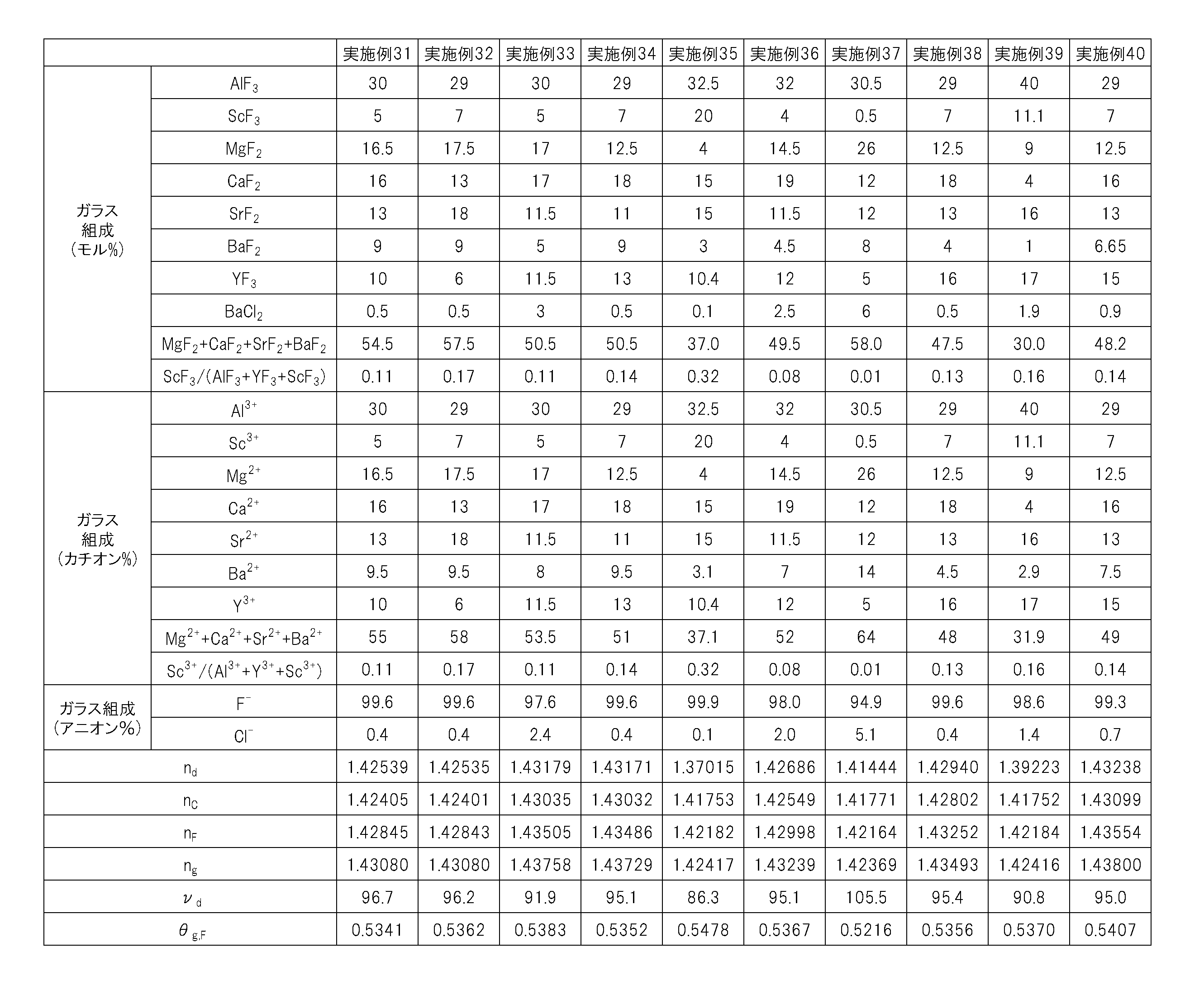
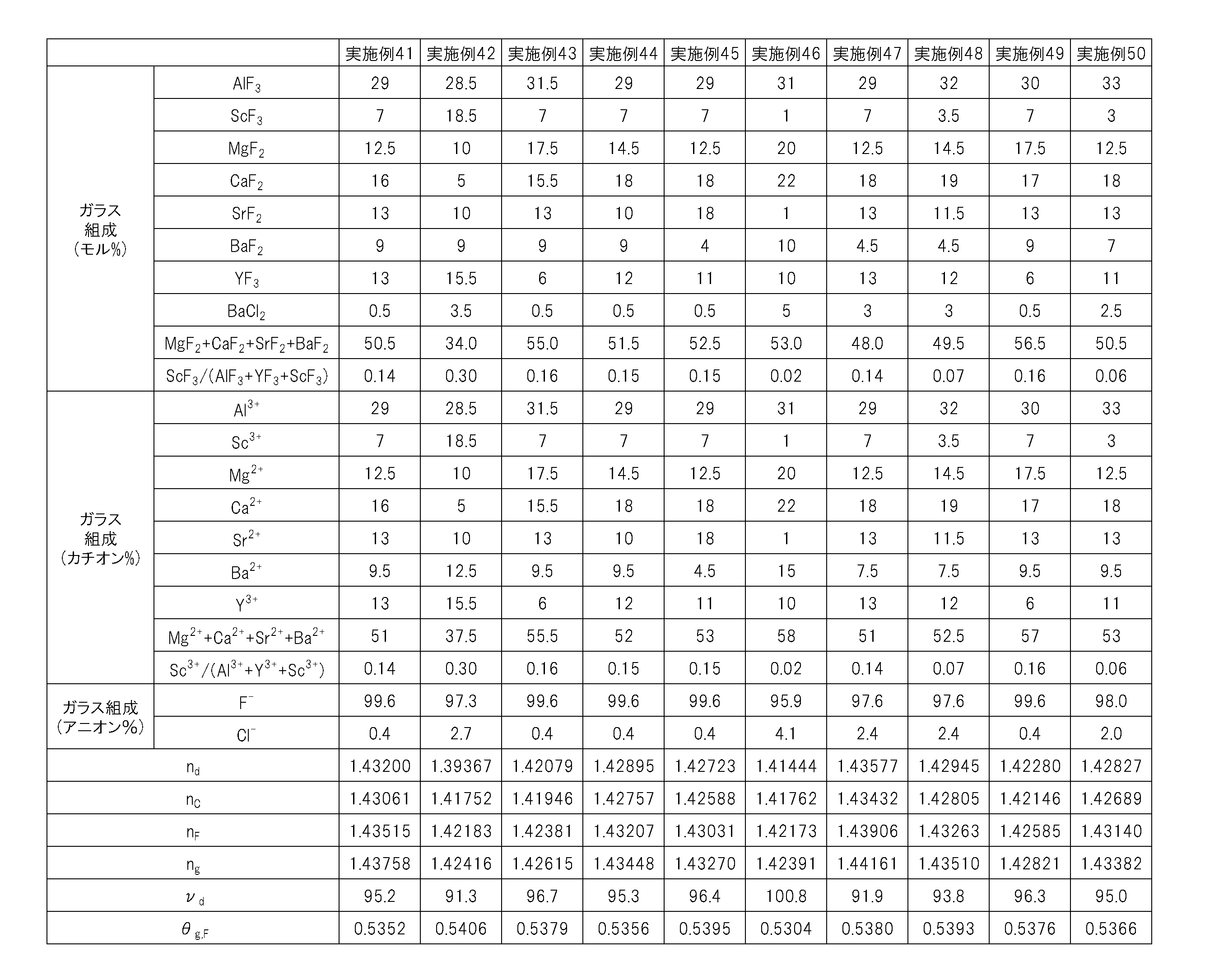
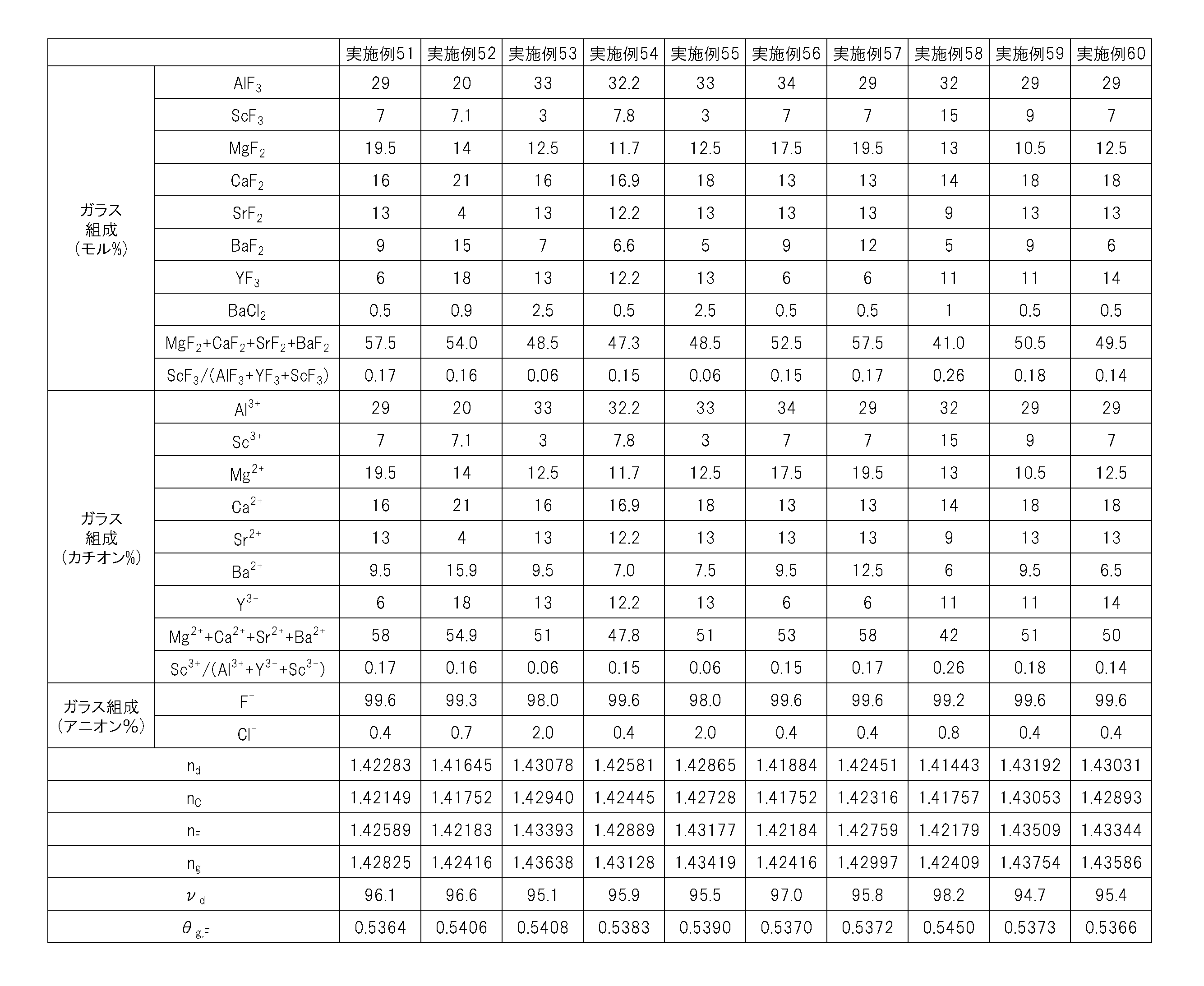
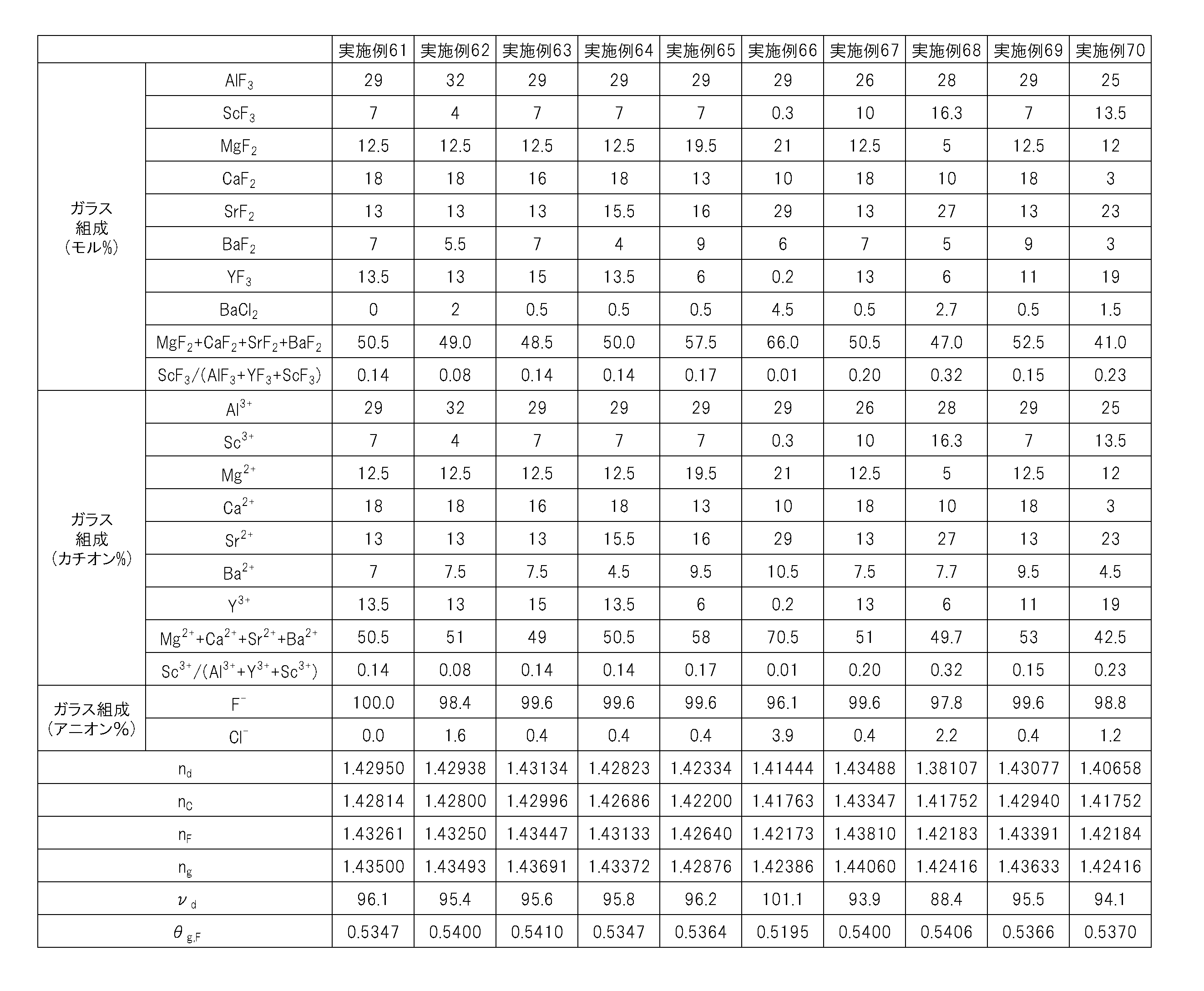

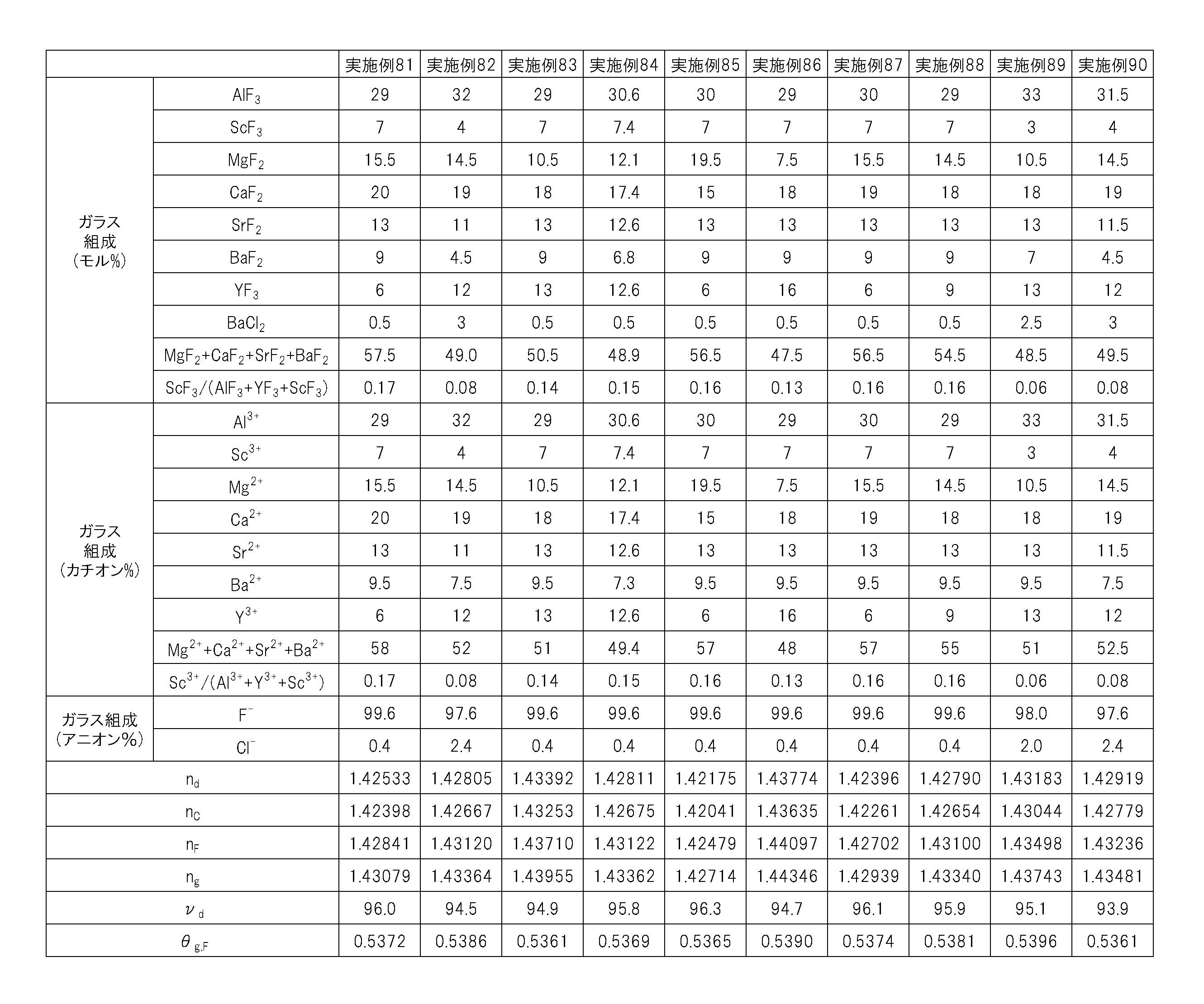
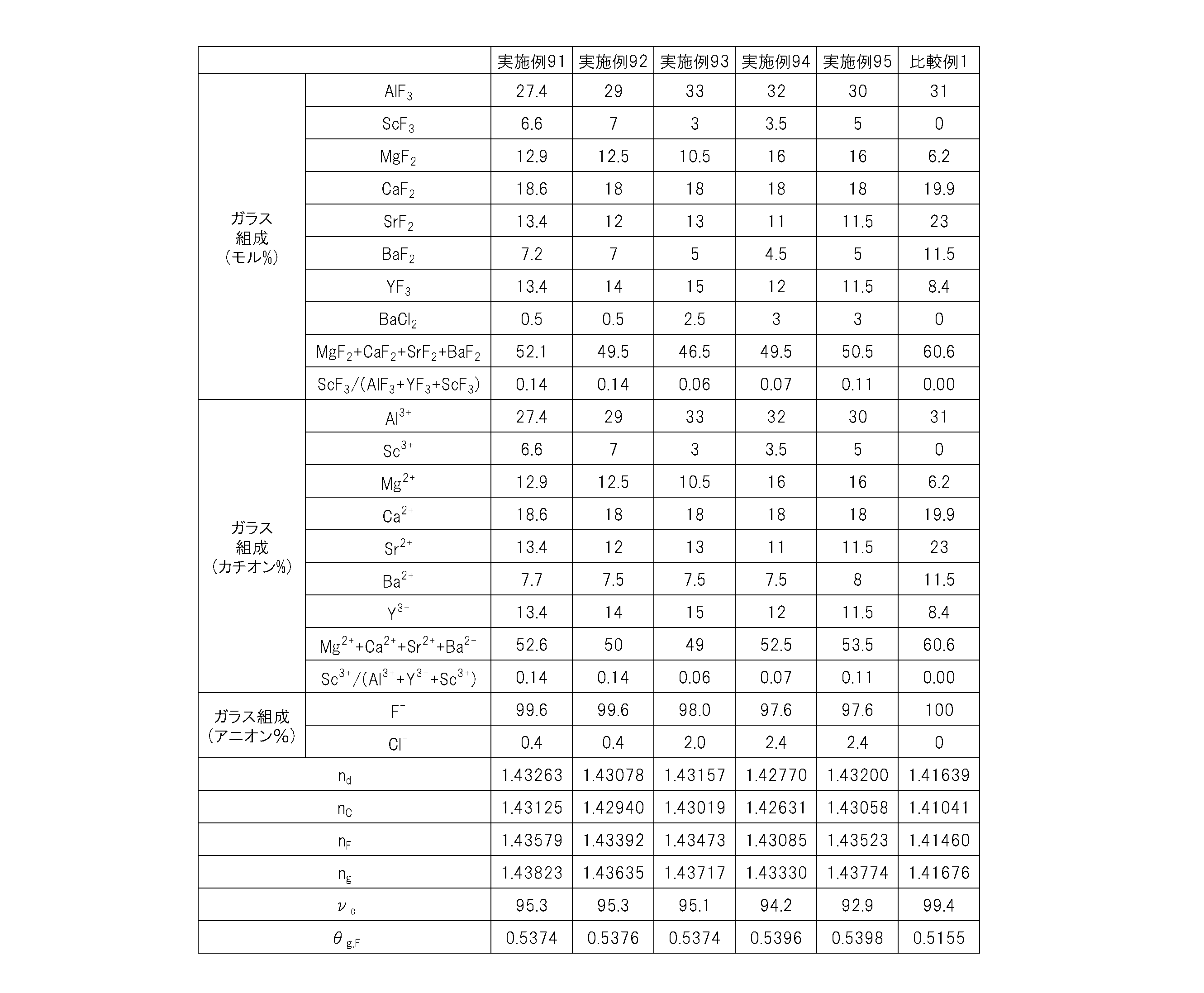
試料は以下の手順で作製した。はじめに、表1~10に記載の組成となるよう原料を秤量し原料バッチを得た。次に、原料バッチを坩堝に投入し900℃~1100℃で溶融後、融液を急冷し試料を得た。得られた試料の屈折率を測定し、アッベ数(νd)及び部分分散比(θg,F)を求めた。屈折率(nd)、アッベ数(νd)及び部分分散比(θg,F)の結果を表1~10に示す。
屈折率は、周知のVブロック法を用いて測定した。測定にはカルニュー精密屈折計(島津製作所製、KPR-2000)を用いた。
アッベ数(νd)及び部分分散比(θg,F)は、測定した屈折率nd(587.56nm)、nC(656.27nm)、nF(486.07nm)、ng(435.83nm)の値を用いて、下記の式より算出した。
νd=(nd-1)/(nF-nC)
θg,F=(ng-nF)/(nF-nC)
表1~10に示すように、実施例1~95は、屈折率(nd)が1.41以上、アッベ数(νd)が85以上、部分分散比(θg,F)が0.516以上となった。一方、比較例1は部分分散比(θg,F)が0.516未満となった。
本発明のハロゲン化物ガラスは、レンズ、プリズム、フィルター、回折格子、光学ファイバー等の光学素子として好適に用いることができる。特に、特殊低分散レンズとして好適に用いることができる。
Claims (12)
- モル%で、AlF3 11~40%、ScF3 0.1~20%、MgF2+CaF2+SrF2+BaF2 10~88.9%を含有する、ハロゲン化物ガラス。
- さらにモル%で、MgF2 0~30%、CaF2 0~30%、SrF2 0~30%、BaF2 0~20%を含有する、請求項1に記載のハロゲン化物ガラス。
- さらにモル%で、YF3 0~20%を含有する、請求項1又は2に記載のハロゲン化物ガラス。
- モル比で、ScF3/(AlF3+YF3+ScF3)が0.01~0.5である、請求項1又は2に記載のハロゲン化物ガラス。
- カチオン%で、Al3+ 11~60%、Sc3+ 0.1~20%、Mg2++Ca2++Sr2++Ba2+ 10~88.9%を含有し、アニオン%で、F- 70~100%を含有する、ハロゲン化物ガラス。
- さらにアニオン%で、Cl-+Br-+I- 0~10%含有する、請求項5に記載のハロゲン化物ガラス。
- さらにカチオン%で、Mg2+ 0~30%、Ca2+ 0~30%、Sr2+ 0~30%、Ba2+ 0~20%を含有する、請求項5又は6に記載のハロゲン化物ガラス。
- さらにカチオン%で、Y3+ 0~20%を含有する、請求項5又は6に記載のハロゲン化物ガラス。
- さらにカチオン%で、Ln(Lnは、Cr、Ce、Nd、Yb、Er、Pr、Sm、Eu、Tb、Dy、Ho及びTmから選択される少なくとも1種) 0.01%未満を含有する、請求項5又は6に記載のハロゲン化物ガラス。
- アッベ数(νd)が85~110である、請求項1又は5に記載のハロゲン化物ガラス。
- 部分分散比(θg,F)が0.516~0.580である、請求項1又は5に記載のハロゲン化物ガラス。
- 請求項1又は5に記載のハロゲン化物ガラスからなる、光学素子。
Priority Applications (2)
| Application Number | Priority Date | Filing Date | Title |
|---|---|---|---|
| JP2025553376A JPWO2025089286A1 (ja) | 2023-10-23 | 2024-10-22 | |
| CN202480067788.XA CN122070264A (zh) | 2023-10-23 | 2024-10-22 | 卤化物玻璃及光学元件 |
Applications Claiming Priority (2)
| Application Number | Priority Date | Filing Date | Title |
|---|---|---|---|
| JP2023-181696 | 2023-10-23 | ||
| JP2023181696 | 2023-10-23 |
Publications (1)
| Publication Number | Publication Date |
|---|---|
| WO2025089286A1 true WO2025089286A1 (ja) | 2025-05-01 |
Family
ID=95515938
Family Applications (1)
| Application Number | Title | Priority Date | Filing Date |
|---|---|---|---|
| PCT/JP2024/037632 Ceased WO2025089286A1 (ja) | 2023-10-23 | 2024-10-22 | ハロゲン化物ガラス及び光学素子 |
Country Status (3)
| Country | Link |
|---|---|
| JP (1) | JPWO2025089286A1 (ja) |
| CN (1) | CN122070264A (ja) |
| WO (1) | WO2025089286A1 (ja) |
Cited By (1)
| Publication number | Priority date | Publication date | Assignee | Title |
|---|---|---|---|---|
| WO2026053872A1 (ja) * | 2024-09-04 | 2026-03-12 | 日本電気硝子株式会社 | ハロゲン化物ガラス、光学素子及び光学装置 |
Citations (6)
| Publication number | Priority date | Publication date | Assignee | Title |
|---|---|---|---|---|
| JPS56134537A (en) * | 1980-03-18 | 1981-10-21 | Verre Fluore Sa | Fluoride glass |
| JPH10152344A (ja) * | 1996-11-18 | 1998-06-09 | Nippon Telegr & Teleph Corp <Ntt> | フッ化物ガラス及びフッ化物光ファイバ |
| JPH1111976A (ja) * | 1997-06-17 | 1999-01-19 | Central Glass Co Ltd | フッ化物ガラス組成物 |
| JP2016023111A (ja) | 2014-07-23 | 2016-02-08 | 旭硝子株式会社 | フツリン酸ガラス、プレス成形用プリフォーム、および光学素子 |
| JP2019151493A (ja) | 2018-02-28 | 2019-09-12 | 株式会社住田光学ガラス | 低分散ガラス |
| WO2024128294A1 (ja) * | 2022-12-16 | 2024-06-20 | 日本電気硝子株式会社 | ハロゲン化物ガラス及び光学素子 |
-
2024
- 2024-10-22 JP JP2025553376A patent/JPWO2025089286A1/ja active Pending
- 2024-10-22 CN CN202480067788.XA patent/CN122070264A/zh active Pending
- 2024-10-22 WO PCT/JP2024/037632 patent/WO2025089286A1/ja not_active Ceased
Patent Citations (6)
| Publication number | Priority date | Publication date | Assignee | Title |
|---|---|---|---|---|
| JPS56134537A (en) * | 1980-03-18 | 1981-10-21 | Verre Fluore Sa | Fluoride glass |
| JPH10152344A (ja) * | 1996-11-18 | 1998-06-09 | Nippon Telegr & Teleph Corp <Ntt> | フッ化物ガラス及びフッ化物光ファイバ |
| JPH1111976A (ja) * | 1997-06-17 | 1999-01-19 | Central Glass Co Ltd | フッ化物ガラス組成物 |
| JP2016023111A (ja) | 2014-07-23 | 2016-02-08 | 旭硝子株式会社 | フツリン酸ガラス、プレス成形用プリフォーム、および光学素子 |
| JP2019151493A (ja) | 2018-02-28 | 2019-09-12 | 株式会社住田光学ガラス | 低分散ガラス |
| WO2024128294A1 (ja) * | 2022-12-16 | 2024-06-20 | 日本電気硝子株式会社 | ハロゲン化物ガラス及び光学素子 |
Cited By (1)
| Publication number | Priority date | Publication date | Assignee | Title |
|---|---|---|---|---|
| WO2026053872A1 (ja) * | 2024-09-04 | 2026-03-12 | 日本電気硝子株式会社 | ハロゲン化物ガラス、光学素子及び光学装置 |
Also Published As
| Publication number | Publication date |
|---|---|
| CN122070264A (zh) | 2026-05-19 |
| JPWO2025089286A1 (ja) | 2025-05-01 |
Similar Documents
| Publication | Publication Date | Title |
|---|---|---|
| JP5475471B2 (ja) | ガラス組成物、それを用いた光学部材及び光学機器 | |
| JP3154575B2 (ja) | 弗燐酸塩光学ガラス | |
| JPH02124740A (ja) | フツリン酸塩光学ガラス | |
| JP5744504B2 (ja) | 光学ガラス、光学素子およびプリフォーム | |
| JP2616983B2 (ja) | フツリン酸塩光学ガラス | |
| JP3973410B2 (ja) | 光学ガラスおよび光学部品 | |
| CN102260043B (zh) | 光学玻璃、光学元件和预成型坯 | |
| US20120021891A1 (en) | Fluorophosphate optical glass | |
| EP1516862B1 (en) | Optical glass having a small photoelastic constant | |
| KR20120098748A (ko) | 광학 유리, 프리폼 및 광학소자 | |
| EP4211088A2 (en) | Silicoborate and borosilicate glasses having high refractive index and low density | |
| JP7178953B2 (ja) | 光学ガラス、光学素子及びプリフォーム | |
| JP2020059629A (ja) | 光学ガラス、プレス成形用ガラス素材、光学素子ブランクおよび光学素子 | |
| TWI714082B (zh) | 光學玻璃及光學元件 | |
| CN113825731A (zh) | 光学玻璃 | |
| CN122070264A (zh) | 卤化物玻璃及光学元件 | |
| JP7401236B2 (ja) | 光学ガラスおよび光学素子 | |
| JP5689736B2 (ja) | 光学ガラス、光学素子およびプリフォーム | |
| WO2024128294A1 (ja) | ハロゲン化物ガラス及び光学素子 | |
| JPH07157330A (ja) | 塩素含有フツ燐酸塩ガラス | |
| JP2019151493A (ja) | 低分散ガラス | |
| JP7171241B2 (ja) | 光学ガラスおよび光学素子 | |
| JP7693274B2 (ja) | 光学ガラス、光学素子及びプリフォーム | |
| JPH01286935A (ja) | 紫外線透過ガラス | |
| JP2727735B2 (ja) | 軽量弗燐酸塩光学ガラス |
Legal Events
| Date | Code | Title | Description |
|---|---|---|---|
| 121 | Ep: the epo has been informed by wipo that ep was designated in this application |
Ref document number: 24882397 Country of ref document: EP Kind code of ref document: A1 |
|
| ENP | Entry into the national phase |
Ref document number: 2025553376 Country of ref document: JP Kind code of ref document: A |
|
| WWE | Wipo information: entry into national phase |
Ref document number: 2025553376 Country of ref document: JP |
|
| NENP | Non-entry into the national phase |
Ref country code: DE |