WO2025083864A1 - 制御装置、及び制御方法 - Google Patents
制御装置、及び制御方法 Download PDFInfo
- Publication number
- WO2025083864A1 WO2025083864A1 PCT/JP2023/037964 JP2023037964W WO2025083864A1 WO 2025083864 A1 WO2025083864 A1 WO 2025083864A1 JP 2023037964 W JP2023037964 W JP 2023037964W WO 2025083864 A1 WO2025083864 A1 WO 2025083864A1
- Authority
- WO
- WIPO (PCT)
- Prior art keywords
- control
- voltage
- frequency
- reactive power
- amplitude
- Prior art date
- Legal status (The legal status is an assumption and is not a legal conclusion. Google has not performed a legal analysis and makes no representation as to the accuracy of the status listed.)
- Pending
Links
Images







Classifications
-
- H—ELECTRICITY
- H02—GENERATION; CONVERSION OR DISTRIBUTION OF ELECTRIC POWER
- H02J—ELECTRIC POWER NETWORKS; CIRCUIT ARRANGEMENTS OR SYSTEMS FOR SUPPLYING OR DISTRIBUTING ELECTRIC POWER; SYSTEMS FOR STORING ELECTRIC ENERGY
- H02J3/00—Circuit arrangements for AC mains or AC distribution networks
- H02J3/28—Arrangements for balancing of the load in networks by storage of energy
- H02J3/32—Arrangements for balancing of the load in networks by storage of energy using batteries or super capacitors with converting means
-
- H—ELECTRICITY
- H02—GENERATION; CONVERSION OR DISTRIBUTION OF ELECTRIC POWER
- H02J—ELECTRIC POWER NETWORKS; CIRCUIT ARRANGEMENTS OR SYSTEMS FOR SUPPLYING OR DISTRIBUTING ELECTRIC POWER; SYSTEMS FOR STORING ELECTRIC ENERGY
- H02J3/00—Circuit arrangements for AC mains or AC distribution networks
- H02J3/38—Arrangements for feeding a single network from two or more generators or sources in parallel; Arrangements for feeding already energised networks from additional generators or sources in parallel
-
- H—ELECTRICITY
- H02—GENERATION; CONVERSION OR DISTRIBUTION OF ELECTRIC POWER
- H02M—APPARATUS FOR CONVERSION BETWEEN AC AND AC, BETWEEN AC AND DC, OR BETWEEN DC AND DC, AND FOR USE WITH MAINS OR SIMILAR POWER SUPPLY SYSTEMS; CONVERSION OF DC OR AC INPUT POWER INTO SURGE OUTPUT POWER; CONTROL OR REGULATION THEREOF
- H02M7/00—Conversion of AC power input into DC power output; Conversion of DC power input into AC power output
- H02M7/66—Conversion of AC power input into DC power output; Conversion of DC power input into AC power output with possibility of reversal
-
- Y—GENERAL TAGGING OF NEW TECHNOLOGICAL DEVELOPMENTS; GENERAL TAGGING OF CROSS-SECTIONAL TECHNOLOGIES SPANNING OVER SEVERAL SECTIONS OF THE IPC; TECHNICAL SUBJECTS COVERED BY FORMER USPC CROSS-REFERENCE ART COLLECTIONS [XRACs] AND DIGESTS
- Y02—TECHNOLOGIES OR APPLICATIONS FOR MITIGATION OR ADAPTATION AGAINST CLIMATE CHANGE
- Y02E—REDUCTION OF GREENHOUSE GAS [GHG] EMISSIONS, RELATED TO ENERGY GENERATION, TRANSMISSION OR DISTRIBUTION
- Y02E40/00—Technologies for an efficient electrical power generation, transmission or distribution
- Y02E40/30—Reactive power compensation
Definitions
- This disclosure relates to a control device and control method for controlling an inverter provided in a power source.
- VSG Virtual Synchronous Generator
- Qv control is often performed to suppress the reactive power Q circulating between each of the distributed power sources.
- the amplitude Vv of the AC voltage output from the inverter is controlled so that the reactive power Q output from the inverter approaches a command value.
- VSG control the frequency fv of the AC voltage output from the inverter is controlled so that the active power P output from the inverter approaches a command value.
- the present disclosure has been made to solve the above problems, and its purpose is to provide a control device and control method that can appropriately control an inverter even when both VSG control and Qv control are implemented.
- one aspect of the present disclosure is a control method performed by a control device that controls an inverter that converts DC voltage from a storage battery to AC voltage, in which a VSG control unit controls the frequency of the AC voltage so that it has a virtual inertial force, a Qv control unit controls the amplitude of the AC voltage so that the difference between a command value and an actual measured value in reactive power is reduced, and the Qv control unit determines the control amount of the amplitude of the AC voltage depending on the relationship between the frequency band of a Qv control system that controls to reduce the difference and the frequency band of a VSG control system controlled by the VSG control unit.
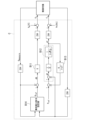
- FIG. 11 is a diagram for explaining control performed by a control device C according to a second embodiment.
- 13 is a diagram for explaining the control performed by a control device C according to a first modified example of the second embodiment.
- FIG. FIG. 13 is a diagram illustrating a configuration example of a microgrid according to a second modification of the second embodiment.
- FIG. 2 is a diagram for explaining the relationship between a control device C and an inverter controller according to the first embodiment.
- FIG. 11 is a diagram for explaining the relationship between a control device C and an inverter controller according to a second embodiment.
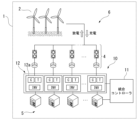
- FIG. 1 is a diagram showing an example of the configuration of a microgrid in embodiment 1.
- the microgrid 1 includes a power generation facility 2, a plurality of power receiving and distributing facilities 4, a plurality of storage batteries 5, a power transmission and distribution network 6, and a storage battery control system 10.
- the components in the microgrid 1 are connected to each other by the power transmission and distribution network 6.
- the power generation facility 2 may be, for example, a wind power plant, a solar cell, a hydroelectric power plant, etc. Other types of power generation facility 2 may also be used. Furthermore, multiple types of power generation facility 2 may be used in combination.
- the microgrid 1 is configured to charge and discharge the multiple storage batteries 5 according to the power supply and demand situation. For example, when the demand for power is low, the multiple storage batteries 5 are charged using power generated by the power generation equipment 2. When the demand for power is high, the power generated by the power generation equipment 2 and the power of the multiple storage batteries 5 are combined and output to the power system. Alternatively, the combined power may be supplied to a load in the microgrid 1. In this embodiment, the microgrid 1 constitutes an autonomous power system that generates and consumes power independently.
- the microgrid 1 may be connected to a power system including a load via a power transmission and distribution network 6.
- a switch (not shown) may be provided between the microgrid 1 and the power system.
- the switch can be switched between a closed state and an open state. When the switch is in the open state, the microgrid 1 is disconnected from the power system, and the microgrid 1 constitutes an independent power system. When the switch is in the closed state, the microgrid 1 is connected to the power system 3.
- Each storage battery 5 may be, for example, a lithium ion battery, a NAS battery, a redox flow battery, etc. Other types of storage batteries 5 may also be used.
- the integrated controller 11 manages multiple PCSs 12.
- the integrated controller 11 controls the battery control system 10.
- the integrated controller 11 may be configured as, for example, a CEMS (Community Energy Management System), an AEMS (Aria Energy Management System), a BEMS (Building and Energy Management System), etc.
- the integrated controller 11 has a calculation unit, a communication unit, etc.
- the calculation unit is a CPU, etc., and performs calculations to realize the functions of the integrated controller 11 described above.
- the communication unit communicates with each PCS 12 wirelessly or via a wire.
- the communication unit transmits command values generated by the calculation unit, such as a command value Pref for active power P and a command value Qref for reactive power Q, which will be described later, to each PCS 12.
- the PCS 12 is configured as a distributed power source incorporating an inverter INV that controls the charging and discharging of the storage battery 5.
- the PCS 12 has a control device C that controls the inverter INV, and a communication device T that communicates with the integrated controller 11.
- each PCS 12 performs GFL (Grid Following) control according to command values notified from the integrated controller 11, such as a command value Pref for active power P and a command value Qref for reactive power Q, which will be described later, and causes the storage battery 5 corresponding to the PCS 12 to function as a voltage source.
- GFL Gated Following
- FIG. 2 is a diagram for explaining the control performed by the control device C according to the first embodiment.
- FIG. 2 shows a schematic diagram of the inverter INV controlled by the control device C, and the load or other inverters INV that are connected to the inverter INV via the line impedance L.
- the load or other inverters INV that are connected to the inverter INV may be simply referred to as the "connection destination.”
- the relationship between the output voltage v1 of the AC power output from the inverter INV, the line impedance L, the current i flowing through the line impedance L, and the output voltage v2 of the AC power output from the connection destination is expressed as the following equation (1).
- fv is the frequency of the AC voltage output from the inverter INV.
- fo is the frequency of the AC voltage output from the connection destination.
- ⁇ o is the phase difference between the active power P and the reactive power Q.
- output power may refer to power flow.
- the power received by the inverter INV from a load, another inverter INV, or the power grid E as a connected destination may be treated as negative output power, and may be treated as the output power supplied to a load, another inverter INV, or the power grid E as a connected destination.
- equation (1) if the difference between frequency fv and frequency fo is ⁇ f, the relationship in equation (1) becomes the following equation (2-1). Solving equation (2-1) for current i gives the following equations (2-2) to (2-4).
- equation (2-4) the apparent power S output from the inverter INV is given by the following equation (3-1).
- P is the active power output from the inverter INV.
- Q is the reactive power output from the inverter INV.
- the active power P can be expressed as in equation (3-2).
- the reactive power Q can be expressed as in equation (3-3).
- the frequency fv of the AC voltage output from the inverter INV is adjusted to give the PCS 12 a pseudo inertial force that a synchronous generator has, thereby stabilizing the power system.
- active power P and reactive power Q are generated according to the relationship between the amplitude Vo, frequency fo, and phase difference ⁇ o at the connected destination.
- active power P and reactive power Q are generated when the other inverter INV connected to the inverter INV has VSG control.
- the output of reactive power Q can be suppressed by adjusting the amplitude Vv of the AC voltage output from the inverter INV using Qv control.
- the active power P includes as parameters both the amplitude Vv and the frequency fv of the AC voltage output from the inverter INV.
- the reactive power Q includes as parameters both the amplitude Vv and the frequency fv of the AC voltage output from the inverter INV.
- the amount of fluctuation in the amplitude is multiplied by a relatively small gain, for example, a gain equivalent to a real number greater than 0 (zero) and less than 1, such as 0.3, to control so that the fluctuation in the amplitude Vv is suppressed.
- a relatively small gain for example, a gain equivalent to a real number greater than 0 (zero) and less than 1, such as 0.3
- the gain of the amplitude Vv by the Qv control is lowered to be small, the effect of suppressing the reactive power Q is reduced.
- the effect of suppressing the reactive power Q is small, particularly in a battery control system 10 having multiple inverters INV that perform VSG control, the reactive power Q will circulate between the inverters INV, resulting in unnecessary power loss.
- this embodiment takes measures by focusing on the fact that VSG control suppresses sudden changes in output power due to fluctuations in power generation and load fluctuations. Specifically, this embodiment is designed to make it difficult for fluctuations in amplitude Vv due to Qv control to occur in the relatively high frequency band that is the subject of control in VSG control.
- Qv control is provided with two gains: a high-band gain that is applied to a high-frequency band that is likely to interfere with VSG control, and a low-band gain that is applied to a low-frequency band that is unlikely to interfere with VSG control.
- the high-band gain is set to a smaller value than the low-band gain.
- Qv control it is possible to suppress fluctuations in amplitude Vv by applying a high-band gain in the high-frequency band that is likely to interfere with VSG control.
- Qv control it is possible to suppress reactive power Q by applying a low-band gain in the low-frequency band that is unlikely to interfere with VSG control. Therefore, it is possible to achieve both the avoidance of control interference and the suppression of wasteful power generation due to the circulation of reactive power Q.
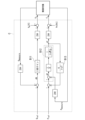
- FIG. 3 is a diagram for explaining the control performed by the control device C according to the first embodiment.
- the "controlled object" shown in FIG. 3 corresponds to the connection destination in FIG. 2, and is the inverter controller that controls the inverter INV, the inverter INV, the inverter output filter, and the power system connected via the inverter INV.
- the inverter controller here is a device that sets the amplitude and frequency of the AC voltage output by the inverter INV to the inverter INV.
- the power system connected via the inverter INV is, for example, another PCS 12 as a connection destination, and wiring and loads between the other PCS 12, etc.
- the control device C controls the amplitude Vv and frequency fv of the AC voltage output from the inverter INV.
- control device C includes, for example, control blocks B11, B12, B13, a zero order hold (ZOH), an adder, and a subtractor.
- ZOH zero order hold
- the control device C receives as input the command values Pref and Qref, which are the command values for the active power P and reactive power Q, respectively, notified by the integrated controller 11.
- the control device C also receives as input the actual measured values Pmeasure and Qmeasure, which are the measured values for the active power P and reactive power Q, respectively, from the inverter INV.
- the actual measured values Qmeasure and Pmeasure are measured, for example, by a measuring device attached to the power line to which power is supplied.
- the control device C uses a subtractor to calculate the deviation dQ of the reactive power Q.
- the deviation dQ is the difference between the command value Qref and the actual measurement value Qmeasure.
- the control device C uses a subtractor to subtract the signal value obtained by performing a zero-order hold ZOH on the actual measurement value Qmeasure from the command value Qref, and outputs the resulting difference value as the deviation dQ to the control block B11.
- Control block B11 performs Qv control.
- Control block B11 is an example of a "Qv control unit.” In the example shown in this diagram, control block B11 is described as "two-stage gain.”
- a closed-loop control system that can be expressed by the transfer function of the output/input from control block B11, which corresponds to the "Qv control unit,” to the controlled object may be described as a "Qv control system.”
- Control block B11 calculates the amplitude deviation so that the deviation dQ approaches zero.
- Control block B calculates the amplitude deviation so that the deviation dQ approaches zero by performing feedback control such as PI control.
- the amplitude deviation here is the difference between the amplitude Vv of the AC voltage that the inverter INV outputs to the controlled object and the rated voltage Vm.
- Figs. 4 to 7 are diagrams for explaining Qv control according to the first embodiment.
- the control block B11 includes, for example, a multiplier, a first frequency characteristic adjuster, and a second frequency characteristic adjuster.
- the multiplier is a multiplier that multiplies by K.
- K is the gain of the amplitude deviation.
- the first frequency characteristic adjuster is a frequency characteristic adjuster that applies a transfer function ⁇ 1/(1+sTa) ⁇ .
- the second frequency characteristic adjuster is a frequency characteristic adjuster that applies a transfer function (1+sTb).
- Ta and Tb are time constants.
- s is the Laplace operator.
- the control block B11 multiplies the deviation dQ by the gain K of the amplitude deviation, and applies the transfer function ⁇ 1/(1+sTa) ⁇ and the transfer function (1+sTb) to the multiplied value, and outputs the result as the amplitude deviation. This allows the control block B11 to output the value obtained by applying the transfer function ⁇ K ⁇ (1+sTb)/(1+sTa) ⁇ to the deviation dQ as the amplitude deviation.
- the time constant Tb must be smaller than the time constant Ta.
- time constants Ta and Tb are desirable to be large enough so as not to affect the characteristics of control systems other than the Qv control system, i.e., VSG control and governor control by control block B13.
- one possible method for determining the time constants Ta and Tb and the gain K of the amplitude deviation is to determine the control parameters through three stages, from the first stage to the third stage.
- the time constant Tb is determined.
- a low-band gain is determined, which corresponds to the gain K of the amplitude deviation related to the convergence value when the gain is converged in the low frequency band.
- (K ⁇ Tb/Ta) is determined, which corresponds to the high-band gain related to stability in the high frequency band.
- the time constant Ta is indirectly determined in the third stage.
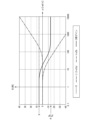
- FIG. 6 shows the gain characteristic, which is the frequency characteristic of the gain applied to the amplitude deviation in the Qv control of this embodiment.
- the horizontal axis of FIG. 6 is the angular frequency ⁇ , and the vertical axis is the gain G.
- the solid line shows the frequency characteristic of the Qv control (two-stage gain) of this embodiment.
- the dashed line shows the frequency characteristic of the gain K of the amplitude deviation.
- the dashed line shows the frequency characteristic of the transfer function ⁇ 1/(1+sTa) ⁇ corresponding to the first frequency characteristic adjuster.
- the two-dot chain line shows the frequency characteristic of the transfer function (1+sTb) corresponding to the second frequency characteristic adjuster.
- the gain K of the amplitude deviation as a control parameter is "2". This means that it is amplified by approximately 6 [dB] from before amplification.
- the time constant Ta is 0.1 [sec]. This is the time constant corresponding to the cutoff frequency at which the gain G attenuates by about 3 [dB] in the frequency characteristic of the transfer function ⁇ 1/(1 + sTa) ⁇ .
- the time constant Tb is 0.01 [sec]. This is the time constant corresponding to the frequency at which the gain G increases by about 3 [dB] in the frequency characteristic of the transfer function (1 + sTb).
- the relationship between the transfer function and the frequency characteristics can be found by replacing the Laplace operator s in the transfer function with the complex number j ⁇ corresponding to a sine wave.
- the limit value when the angular frequency ⁇ approaches 0 as shown in equation (4-2) corresponds to the low-band gain.
- the low-band gain is the gain K of the amplitude deviation.
- the limit value when the angular frequency ⁇ approaches infinity ⁇ corresponds to the high-band gain.
- the high-band gain is (K ⁇ Tb / Ta). That is, in the gain characteristic shown in the example of this figure, the gain of the amplitude deviation is K, which is the low-band gain, in the low frequency band, and (K ⁇ Tb/Ta), which is the high-band gain, in the high frequency band. In the example of this figure, the gain difference between the low-band gain and the high-band gain is about 20 dB.
- FIG. 7 shows the phase characteristic of the gain applied to the amplitude deviation in the Qv control of this embodiment.
- FIG. 7 shows the phase characteristic of the transfer function having the gain characteristic shown in FIG. 6.
- the horizontal axis of FIG. 7 is the angular frequency ⁇ , and the vertical axis is the phase ⁇ G.
- the solid line shows the phase characteristic of the Qv control (two-stage gain) of this embodiment.
- the dashed line shows the phase characteristic of the gain K of the amplitude deviation.
- the dashed line shows the phase characteristic of the transfer function ⁇ 1/(1+sTa) ⁇ corresponding to the first integrator.
- the dashed line shows the phase characteristic of the transfer function (1+sTb) corresponding to the second integrator.
- FIG. 7 shows the phase characteristic of the transfer function having the gain characteristic shown in FIG. 6.
- the horizontal axis of FIG. 7 is the angular frequency ⁇
- the vertical axis is the phase ⁇ G.
- the solid line shows the phase characteristic
- the Qv control (two-stage gain) of this embodiment generates a delay of up to about 50 [deg.].
- the control parameters need to be set so that the Qv control system expressed by the zero-order hold ZOH and the transfer function of the controlled object, in addition to the control block B11, does not become unstable.
- General control theory such as the Nyquist stability criterion, can be used to determine the stability of a Qv control system.
- the amplitude deviation calculated by the control block B11 is zero-order held ZOH
- the rated voltage Vm is added to the amplitude deviation that has been zero-order held ZOH, and the sum is output as the amplitude Vv.
- control device C controls the frequency fv based on the active power P.
- the control device C uses a subtractor to calculate a subtractor output difference value by subtracting the governor output value from the command value Pref of the active power P, and outputs the calculated subtractor output difference value to the control block B12.
- the governor output value here is the output value from the control block B13.
- the control block B13 is a functional block that performs control simulating a governor (governor) for keeping the rotational speed of a synchronous generator constant.
- Control block B12 performs VSG control.
- Control block B12 is an example of a "VSG control unit.”
- a closed-loop control system that can be expressed by a transfer function of the output/input from control block B12, which corresponds to the "VSG control unit," to the controlled object may be referred to as a "VSG control system.”
- Control block B12 calculates the deviation dP of active power P.
- the deviation dP is the difference between the subtractor output difference value and the actual measurement value Pmeasure.
- Control block B12 uses the subtractor to subtract the signal value obtained by performing zero-order hold ZOH on the actual measurement value Pmeasure from the subtractor output difference value, and sets the resulting difference value as the deviation dP.
- Control block B12 calculates frequency deviation df based on deviation dP.
- control block B12 applies a transfer function corresponding to braking parameter D and inertia parameter M to simulate the inertial force of a synchronous generator. Specifically, control block B12 divides deviation dP by braking parameter D, applies transfer function ⁇ 1/(1+sM/D) ⁇ to the divided value, and outputs the result as frequency deviation df.
- Control block B12 adds rated frequency fn to the signal value obtained by zero-order hold ZOH of frequency deviation df, and outputs the result as frequency fv. Control block B12 also outputs frequency deviation df to control block B13.
- Control block B13 simulates governor-like behavior. Control block B13 applies a transfer function ⁇ K/(1+sT) ⁇ to the frequency deviation df to calculate the governor output value. T indicates the governor time constant. The governor time constant T is a time constant equivalent to the integral time. Here, K indicates the gain of the governor. Control block B13 feeds back the calculated governor output value.
- the control device C is a control device that controls the inverter INV that converts the DC voltage from the storage battery 5 into an AC voltage.
- the control device C includes a control block B12 (VSG control unit) and a control block B11 (Qv control unit).
- the control block B12 (VSG control unit) controls the frequency of the AC voltage so that it has a virtual inertial force.
- the control block B11 (Qv control unit) controls the amplitude of the AC voltage so that the difference between the command value Qref and the actual measurement value Qmeasure in the reactive power Q is reduced.
- the control block B11 determines the control amount of the amplitude of the AC voltage, for example, the gain value to be multiplied by the amplitude deviation, according to the relationship between the frequency band of the Qv control system that controls so that the difference between the command value and the actual measurement value in the reactive power is reduced, and the frequency band of the VSG control system controlled by the VSG control unit.
- the control device C according to the first embodiment can change the amount of variation by which the amplitude Vv is varied by Qv control between a frequency band controlled by VSG control and a frequency band not controlled by VSG control.
- the inverter can be appropriately controlled.
- the control block B11 (Qv control unit) has a high-band gain (first gain) and a low-band gain (second gain).
- the high-band gain (first gain) is a gain intended to mitigate interference between the Qv control system and the VSG control system.
- the low-band gain (second gain) is a gain intended to reduce the steady-state deviation of the difference.
- the difference is the difference between the command value Qref and the actual measured value Qmeasure in the reactive power Q.
- the high-band gain (first gain) is a smaller value than the low-band gain (second gain). This allows the control device C according to the first embodiment to achieve gain adjustment according to the frequency band, that is, a two-stage gain.
- the amplitude Vv can be varied by Qv control to suppress the generation of unnecessary power due to the circulation of reactive power Q.
- the control block B11 calculates the amplitude deviation amount so that the difference between the command value Qref and the measured value Qmeasure in the reactive power Q is reduced.
- the control block B11 applies a transfer function ⁇ K ⁇ (1+sTb)/(1+sTa) ⁇ to the calculated amplitude deviation amount to calculate a control amount obtained by multiplying the amplitude deviation amount by a high band gain (first gain) or a low band gain (second gain), which is a gain according to the frequency band of the Qv control system, as a fluctuation amount for fluctuating the amplitude Vv.
- the transfer function ⁇ K ⁇ (1+sTb)/(1+sTa) ⁇ is a function in which the time constants Ta and Tb are set so that the amount of amplification is reduced in the frequency band of the VSG control unit system.
- a two-stage gain can be realized by passing the signal corresponding to the amplitude deviation amount through a filter that blocks signals in the frequency band that is the subject of control in the VSG control, and it is possible to control the circulation of reactive power Q so that suppression is less likely to occur in the frequency band that is the subject of control in the VSG control (relatively high frequency band) so as not to interfere with the VSG control, and in the frequency band that is the subject of control in the VSG control (relatively low frequency band).
- the command value of Qref is fixed at 0 (zero) and the amount of reactive power Q required by the power system such as other PCS 12, wiring, and loads that are the objects of control is Qa (actual measured value Qmeasure).
- the amplitude Vv calculated by Qv control is always an amplitude value greater than the rated voltage Vm.
- the multiple PCSs 12 are controlled so that each outputs an amplitude Vv greater than the rated voltage Vm.
- Such a chain of changes makes it highly likely that the battery control system 10 will not be properly controlled, so it is best to avoid this.
- the control device C calculates the command value Qref for the reactive power Q.
- the control device C sets the command value Qref in advance to the reactive power Qa (actual measured value Qmeasure) required by the power system to be controlled, and calculates the amplitude Vv.
- the multiple PCSs 12 are controlled so that each outputs an amplitude Vv that is as close as possible to the rated voltage Vm. This reduces the amount of fluctuation in the amplitude Vv in the AC power output by each PCS 12, and suppresses a chain of changes. For example, even if measures are taken to reduce the gain and reduce the amount of fluctuation in the amplitude Vv due to Qv control, the variation in the load end voltage can be improved.
- VSG control is performed in each PCS 12, and measures are taken to focus on the fact that the difference ⁇ f in the frequency of the AC voltage output from each PCS 12 gradually converges to an ideal state approaching 0 (zero).
- a command value Qref is calculated so that the reactive power Q is suppressed.
- FIG. 8 is a diagram showing an example of the configuration of a microgrid according to the second embodiment.
- the microgrid 1 includes an integrated controller 11a.
- the integrated controller 11a notifies each PCS 12 of the command value Pref for the active power P, but does not notify the command value Qref for the reactive power Q.
- FIG. 9 is a diagram showing an example of the configuration of a microgrid according to the second embodiment.
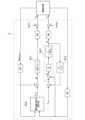
- the control device C includes a control block B14 (reactive power command setting unit).
- the control block B14 (reactive power command setting unit) calculates a command value Qref for reactive power Q based on the actual measured values Pmeasure and Qmeasure, which are the actual measured values of active power P and reactive power Q, respectively.
- the method by which the control block B14 (reactive power command setting unit) calculates the command value Qref for reactive power Q will be described below.
- control block B14 assumes that the difference ⁇ f between frequency fv and frequency fo is 0 (zero) as shown in equation (5-1), and calculates the active power P as shown in equation (5-2) and the reactive power Q as shown in equation (5-3). Equation (5-2) can be calculated by substituting 0 (zero) for the difference ⁇ f in equation (3-2). Equation (5-3) can be calculated by substituting 0 (zero) for the difference ⁇ f in equation (3-3).
- the control block B14 estimates the phase difference ⁇ o between the active power and the reactive power using equations (5-2) and (5-3). For example, the control block B14 expresses the apparent power S in a vector expression using complex numbers as shown in equation (5-4) using equations (5-2) and (5-3).
- equation (5-4) the vector expression of the amplitude Vo is calculated as shown in equations (5-5) and (5-6).
- the scalar value of the amplitude Vo can be obtained using equation (5-6) as shown in equation (5-7).
- the scalar value of the phase difference ⁇ o can be obtained using equation (5-6) as shown in equation (5-8).
- the control block B14 estimates the line impedance L based on the measured value of the amplitude Vo.
- the rated voltage Vm may also be adjusted so that the amplitude Vo falls within a specified range.
- the control block B14 calculates a command value Qref based on the value obtained by substituting the line impedance L for the phase difference ⁇ o shown in equation (5-7) so that the reactive power Q is suppressed as the difference ⁇ f approaches 0 (zero).
- control block B14 sets the line impedance L using a preset value or a representative value.
- the control block B14 calculates the command value Qref of the reactive power Q based on the value obtained by substituting the line impedance L for the phase difference ⁇ o shown in equation (5-7).
- the control block B14 may apply a low-pass filter to the estimated value of the phase difference ⁇ o to remove frequency change components equivalent to noise, and use the result as the phase difference ⁇ o to calculate the command value Qref of the reactive power Q.
- control device C further includes a control block B14 (reactive power command setting unit).
- the control block B14 (reactive power command setting unit) calculates the command value Qref of the reactive power Q using the actual measurement value Pmeasure and the actual measurement value Qmeasure.
- the control block B14 (reactive power command setting unit) calculates the command value Qref on the assumption that the frequency difference ⁇ f between the power system as the connection destination, for example, the other PCS 12, the wiring and the load between the other PCS 12, and the power system as the connection destination, for example, the other PCS 12, the wiring, the load, etc., is zero.
- the control device C can calculate a command value Qref such that the reactive power Q is suppressed as the frequency difference ⁇ f between the AC voltages output from each PCS 12 gradually approaches an ideal state in which the frequency difference ⁇ f approaches 0 (zero), and output the amplitude Vv based on the calculated command value Qref. Therefore, the amplitude can be controlled so that the reactive power Q is suppressed.
- control block B14 calculates the line impedance L to the connection point based on the amplitude Vo at the connection point with the connected power system, calculates the phase difference ⁇ o based on the calculated line impedance L, and calculates the command value Qref based on the phase difference ⁇ o.
- the control device C achieves the same effects as those described above.
- ⁇ Modification 1 of the second embodiment> a first modified example of the second embodiment will be described.
- the gain is not set according to the frequency band in the Qv control, but a uniform gain is set independent of the frequency band as in the conventional case.
- FIG. 10 is a diagram for explaining the control performed by the control device C according to the second embodiment.
- the control block B11 performs conventional Qv control.
- the control block B11 of this modified example calculates an amplitude deviation so that the deviation dQ, which is the difference between the command value Qref and the actual measurement value Qmeasure in the reactive power Q, approaches 0 (zero), and outputs a value obtained by multiplying the calculated amplitude deviation by a uniform gain G regardless of whether the frequency corresponding to the time-series change in the amplitude deviation is high or low.
- a command value Qref close to the actual measurement value Qmeasure, calculated in the control block B14 at the previous stage, is input to the control block B11.
- the deviation dQ becomes close to 0 (zero), and the amplitude deviation does not become a large value. Therefore, even if conventional Qv control, that is, Qv control that amplifies with a uniform gain G regardless of the frequency band, is performed, it is possible to suppress control interference with VSG control.
- the command value Qref is calculated so that the reactive power Q is suppressed in the ideal state where the difference ⁇ f approaches 0 (zero) by the VSG control. Therefore, the reactive power Q is suppressed in the ideal state where the VSG control has converged, and it is possible to suppress the reactive power Q and reduce wasteful power consumption while suppressing control interference with the VSG control.
- the control device C includes a control block B12 (VSG control unit), a control block B11 (Qv control unit), and a control block B14 (reactive power command setting unit).
- the control block B12 (VSG control unit) controls the frequency of the AC voltage so that it has a virtual inertial force.
- the control block B11 (Qv control unit) controls the amplitude of the AC voltage so that the difference between the command value Qref and the actual measured value Qmeasure of the reactive power Q is small.
- the control block B14 (reactive power command setting unit) calculates the command value Qref of the reactive power Q.
- the control block B14 uses the actual measured value Pmeasure of the active power P and the actual measured value Qmeasure of the reactive power Q to calculate the command value Qref of the reactive power Q assuming that ⁇ f is 0 (zero) at the connection point with the power system to which the inverter INV is connected.
- ⁇ f is the difference between the frequency fv of the AC voltage output from the inverter INV and the frequency fo of the AC voltage at the connection point.
- the command value Qref is calculated on the assumption that the frequency fv of the AC voltage output from the inverter INV and the frequency fo of the AC voltage at the connection point are the same frequency, and that the frequency is in a stable ideal state in the battery control system 10.
- the frequency is controlled to a stable ideal state in the battery control system 10 by VSG control, and Qv control is performed so that the reactive power Q is suppressed in the ideal state. This makes it possible to suppress unnecessary power consumption by suppressing the reactive power Q while suppressing control interference with the VSG control.
- FIG. 11 is a diagram showing an example of the configuration of a microgrid according to the second modification of the second embodiment.
- the battery control system 10 includes one PCS 12 and a battery 5.
- the control device C performs VSG control using a control block B12 (VSG control unit) based on a command value Pref corresponding to an active power P that is predetermined according to the power supply capacity of the battery control system 10 including the battery 5.
- the control device C also calculates a command value Qref for reactive power Q using a control block B14 (reactive power command setting unit), and performs Qv control using a control block B11 (Qv control unit) based on the calculated command value Qref.
- the Qv control by the control block B11 may be a two-stage gain Qv control, or as in the past, a uniform gain is set independent of the frequency band.
- the two-stage gain Qv control here refers to Qv control that applies a high-band gain to the high frequency band and a low-band gain to the low frequency band depending on the frequency band.
- the storage battery control system 10 is described by way of example with a configuration including a plurality of PCSs 12. At least one of the plurality of PCSs 12 included in the storage battery control system 10 may be provided with a control device C that performs VSG control and Qv control with two-stage gain. In the other PCSs 12 among the plurality of PCSs 12 included in the storage battery control system 10, VSG control may be performed or not performed. In addition, in the other PCSs 12, Qv control may be performed or not performed. When Qv control is performed, Qv control with two-stage gain may be performed, or a uniform gain independent of the frequency band may be set as in the past.
- control device C controls the amplitude and frequency of the AC voltage output by the inverter INV to the inverter INV controller as the controlled object, but the present invention is not limited to this.
- a part or the whole of the control device C may be the inverter INV controller.
- the relationship between the control device C and the inverter controller will be described with reference to Figs. 12 and 13.
- Figs. 12 and 13 are diagrams for explaining the relationship between the control device C and the inverter controller.
- FIG. 12 shows the relationship between the control device C and the inverter controller according to the first embodiment.
- the range of configurations that can be taken as an inverter controller for the control device C and the controlled object in FIG. 3 are indicated by the symbols INVC1 to INVC3, respectively.
- the inverter controller When the inverter controller is a device that includes components within the range indicated by the symbol INVC1, the inverter controller has the functions of the control device C according to the first embodiment and the function of setting the amplitude and frequency of the AC voltage output by the inverter INV.
- the control device C is a device that outputs a signal value obtained by performing zero-order hold ZOH on the amplitude deviation calculated by the control block B11 for Qv control, and outputs a signal value obtained by performing zero-order hold ZOH on the frequency deviation df calculated by the control block B12 for VSG control.
- the inverter controller acquires the amplitude deviation that has been zero-order hold ZOHed from the control device C, and sets the sum of the acquired amplitude deviation and the rated voltage Vm in the inverter INV as the amplitude Vv of the AC voltage output by the inverter INV.
- the inverter controller also acquires the frequency deviation df that has been zero-order hold ZOHed from the control device C, and sets the sum of the acquired frequency deviation df and the rated frequency fn in the inverter INV as the frequency fv of the AC voltage output by the inverter INV.
- the control device C When the inverter controller is a device having components within the range indicated by the symbol INVC3, the control device C has the functions of the control device C according to the first embodiment, and outputs to the inverter controller a signal value indicating the amplitude Vv and frequency fv of the AC voltage output by the inverter INV.
- the inverter controller acquires from the control device C a signal value indicating the amplitude Vv and frequency fv, and sets the acquired signal value in the inverter INV as the frequency fv of the AC voltage output by the inverter INV.
- FIG. 13 shows the relationship between the control device C and the inverter controller according to the second embodiment.
- the range of configurations that can be taken as an inverter controller for the control device C and controlled object in FIG. 9 are indicated by the symbols INVC4 to INVC7, respectively.
- the inverter controller When the inverter controller is a device that includes components within the range indicated by the symbol INVC4, the inverter controller has the functions of the control device C according to the second embodiment and the function of setting the amplitude and frequency of the AC voltage output by the inverter INV.
- the range enclosed by the symbol INVC4 includes the input of the command value Pref for active power P, but this does not indicate that the inverter controller has the function of generating and inputting the command value Pref. If the inverter controller is a device that includes the components in the range indicated by the symbol INVC4, it is assumed that the command value Pref is input from outside the inverter controller. For example, the command value Pref is input to the inverter controller from the integrated controller 11.
- the inverter controller When the inverter controller is a device that includes components in the range indicated by the reference symbol INVC5, the inverter controller includes the control device C according to the second embodiment minus the functions of control block B14, i.e., the functions of the control device C according to the first embodiment. This is similar to the case where the device includes components in the range indicated by the reference symbol INVC1 in FIG. 12, so a description thereof will be omitted.
- the inverter controller is a device having components in the range indicated by the reference symbol INVC6
- the inverter controller is the same as the device having components in the range indicated by the reference symbol INVC2 in FIG. 12, and therefore the description is omitted.
- the inverter controller is a device having components in the range indicated by reference symbol INVC7
- the inverter controller is the same as the device having components in the range indicated by reference symbol INVC3 in FIG. 12, and therefore the description is omitted.
- the control device C described above has an internal computer system.
- the process steps of the above-mentioned processing are stored in the form of a program on a computer-readable recording medium, and the computer reads and executes this program to perform the above-mentioned processing.
- computer-readable recording medium refers to a magnetic disk, magneto-optical disk, CD-ROM, DVD-ROM, semiconductor memory, etc.
- this computer program may be distributed to a computer via a communication line, and the computer that receives this distribution may execute the program.
Landscapes
- Engineering & Computer Science (AREA)
- Power Engineering (AREA)
- Supply And Distribution Of Alternating Current (AREA)
- Inverter Devices (AREA)
Priority Applications (3)
| Application Number | Priority Date | Filing Date | Title |
|---|---|---|---|
| PCT/JP2023/037964 WO2025083864A1 (ja) | 2023-10-20 | 2023-10-20 | 制御装置、及び制御方法 |
| JP2024518106A JP7490166B1 (ja) | 2023-10-20 | 2023-10-20 | 制御装置、及び制御方法 |
| TW113104422A TWI902138B (zh) | 2023-10-20 | 2024-02-05 | 控制裝置以及控制方法 |
Applications Claiming Priority (1)
| Application Number | Priority Date | Filing Date | Title |
|---|---|---|---|
| PCT/JP2023/037964 WO2025083864A1 (ja) | 2023-10-20 | 2023-10-20 | 制御装置、及び制御方法 |
Publications (1)
| Publication Number | Publication Date |
|---|---|
| WO2025083864A1 true WO2025083864A1 (ja) | 2025-04-24 |
Family
ID=91128484
Family Applications (1)
| Application Number | Title | Priority Date | Filing Date |
|---|---|---|---|
| PCT/JP2023/037964 Pending WO2025083864A1 (ja) | 2023-10-20 | 2023-10-20 | 制御装置、及び制御方法 |
Country Status (3)
| Country | Link |
|---|---|
| JP (1) | JP7490166B1 (https=) |
| TW (1) | TWI902138B (https=) |
| WO (1) | WO2025083864A1 (https=) |
Cited By (1)
| Publication number | Priority date | Publication date | Assignee | Title |
|---|---|---|---|---|
| CN120090233A (zh) * | 2025-04-30 | 2025-06-03 | 湖南大学 | 含电动汽车负荷的构网型光储并联系统频率稳定控制方法及其系统 |
Citations (3)
| Publication number | Priority date | Publication date | Assignee | Title |
|---|---|---|---|---|
| JP2019003454A (ja) * | 2017-06-16 | 2019-01-10 | 東京電力ホールディングス株式会社 | 交直変換器制御装置 |
| JP2019176584A (ja) * | 2018-03-28 | 2019-10-10 | 株式会社日立製作所 | 分散電源の制御装置 |
| WO2022044361A1 (ja) * | 2020-08-25 | 2022-03-03 | 株式会社 東芝 | インバータ電源を用いたマイクログリッドシステムおよびインバータ電源 |
Family Cites Families (5)
| Publication number | Priority date | Publication date | Assignee | Title |
|---|---|---|---|---|
| CN105634310B (zh) * | 2014-11-06 | 2018-09-04 | 台达电子工业股份有限公司 | 控制信号产生系统及其逆变器控制装置与相关控制电路 |
| JP7083687B2 (ja) * | 2018-04-18 | 2022-06-13 | 株式会社日立製作所 | 電力変換装置及び電力変換制方法 |
| JP6735039B1 (ja) * | 2020-03-19 | 2020-08-05 | 富士電機株式会社 | 系統連系インバータ及び系統周波数の変動抑制方法 |
| WO2023275937A1 (ja) * | 2021-06-28 | 2023-01-05 | 三菱電機株式会社 | 電力変換装置 |
| CN115764989A (zh) * | 2022-11-04 | 2023-03-07 | 昆明理工大学 | 一种基于构网型换流器的虚拟同步发电机系统 |
-
2023
- 2023-10-20 JP JP2024518106A patent/JP7490166B1/ja active Active
- 2023-10-20 WO PCT/JP2023/037964 patent/WO2025083864A1/ja active Pending
-
2024
- 2024-02-05 TW TW113104422A patent/TWI902138B/zh active
Patent Citations (3)
| Publication number | Priority date | Publication date | Assignee | Title |
|---|---|---|---|---|
| JP2019003454A (ja) * | 2017-06-16 | 2019-01-10 | 東京電力ホールディングス株式会社 | 交直変換器制御装置 |
| JP2019176584A (ja) * | 2018-03-28 | 2019-10-10 | 株式会社日立製作所 | 分散電源の制御装置 |
| WO2022044361A1 (ja) * | 2020-08-25 | 2022-03-03 | 株式会社 東芝 | インバータ電源を用いたマイクログリッドシステムおよびインバータ電源 |
Cited By (1)
| Publication number | Priority date | Publication date | Assignee | Title |
|---|---|---|---|---|
| CN120090233A (zh) * | 2025-04-30 | 2025-06-03 | 湖南大学 | 含电动汽车负荷的构网型光储并联系统频率稳定控制方法及其系统 |
Also Published As
| Publication number | Publication date |
|---|---|
| JP7490166B1 (ja) | 2024-05-24 |
| JPWO2025083864A1 (https=) | 2025-04-24 |
| TW202518828A (zh) | 2025-05-01 |
| TWI902138B (zh) | 2025-10-21 |
Similar Documents
| Publication | Publication Date | Title |
|---|---|---|
| JP5099237B2 (ja) | 電力安定化システム、電力安定化制御プログラム、電力安定化制御方法 | |
| JP5937519B2 (ja) | 制御装置の設計方法、及び制御装置 | |
| JP5435633B2 (ja) | 分散型電源の制御方法 | |
| WO2013140916A1 (ja) | 系統安定化装置 | |
| WO2020214913A1 (en) | Systems and methods for power system stabilization and oscillation damping control | |
| CN115425636B (zh) | 含飞轮储能的直流微电网虚拟惯量自适应控制方法 | |
| KR20210011727A (ko) | 에너지 저장장치의 관성제어를 위한 장치 및 방법 | |
| Kryonidis et al. | Use of ultracapacitor for provision of inertial response in virtual synchronous generator: Design and experimental validation | |
| JP2018196182A (ja) | 制御装置及び無効電力補償装置 | |
| JPWO2022029924A5 (https=) | ||
| JP7490166B1 (ja) | 制御装置、及び制御方法 | |
| CN117810993A (zh) | 一种基于分布式调相机的新能源系统次同步振荡抑制方法 | |
| JP2010071159A (ja) | 風車と蓄電池による風力発電電力平滑化装置 | |
| Lee et al. | Sub-synchronous oscillation constrained communication-free grid frequency control of offshore wind farm linked HVDC system | |
| CN114759575A (zh) | 一种虚拟同步双馈风机次同步振荡抑制方法及系统 | |
| WO2020158037A1 (ja) | 指令生成装置および指令生成方法 | |
| JP7422951B1 (ja) | 蓄電池制御システム、蓄電池の制御方法、蓄電池の制御プログラム、および統合コントローラ | |
| Hajizadeh et al. | Intelligent robust control of hybrid distributed generation system under voltage sag | |
| JP7373637B2 (ja) | 制御装置 | |
| WO2024018558A1 (ja) | 分散電源統合管理装置、電力変換装置、電力系統管理システム、分散電源管理方法およびプログラム | |
| TWI870907B (zh) | 電力轉換裝置、電力轉換方法及記錄媒體 | |
| JP7425267B1 (ja) | 分散電源統合管理システム、分散電源統合管理装置、分散電源統合管理方法、および、プログラム | |
| JP7537655B1 (ja) | 制御装置及び制御方法 | |
| JP7456543B1 (ja) | 電力変換装置 | |
| Nirmala et al. | Resilient sub-synchronous oscillation damping control for photovoltaic electric vehicle integration |
Legal Events
| Date | Code | Title | Description |
|---|---|---|---|
| ENP | Entry into the national phase |
Ref document number: 2024518106 Country of ref document: JP Kind code of ref document: A |
|
| WWE | Wipo information: entry into national phase |
Ref document number: 2024518106 Country of ref document: JP |
|
| 121 | Ep: the epo has been informed by wipo that ep was designated in this application |
Ref document number: 23956111 Country of ref document: EP Kind code of ref document: A1 |