WO2025079521A1 - 電力変換システム - Google Patents
電力変換システム Download PDFInfo
- Publication number
- WO2025079521A1 WO2025079521A1 PCT/JP2024/035605 JP2024035605W WO2025079521A1 WO 2025079521 A1 WO2025079521 A1 WO 2025079521A1 JP 2024035605 W JP2024035605 W JP 2024035605W WO 2025079521 A1 WO2025079521 A1 WO 2025079521A1
- Authority
- WO
- WIPO (PCT)
- Prior art keywords
- power conversion
- substrate
- conductor pattern
- main surface
- conversion system
- Prior art date
- Legal status (The legal status is an assumption and is not a legal conclusion. Google has not performed a legal analysis and makes no representation as to the accuracy of the status listed.)
- Pending
Links
Images





Classifications
-
- H—ELECTRICITY
- H02—GENERATION; CONVERSION OR DISTRIBUTION OF ELECTRIC POWER
- H02M—APPARATUS FOR CONVERSION BETWEEN AC AND AC, BETWEEN AC AND DC, OR BETWEEN DC AND DC, AND FOR USE WITH MAINS OR SIMILAR POWER SUPPLY SYSTEMS; CONVERSION OF DC OR AC INPUT POWER INTO SURGE OUTPUT POWER; CONTROL OR REGULATION THEREOF
- H02M3/00—Conversion of DC power input into DC power output
- H02M3/22—Conversion of DC power input into DC power output with intermediate conversion into AC
- H02M3/24—Conversion of DC power input into DC power output with intermediate conversion into AC by static converters
- H02M3/28—Conversion of DC power input into DC power output with intermediate conversion into AC by static converters using discharge tubes with control electrode or semiconductor devices with control electrode to produce the intermediate AC
-
- H—ELECTRICITY
- H05—ELECTRIC TECHNIQUES NOT OTHERWISE PROVIDED FOR
- H05K—PRINTED CIRCUITS; CASINGS OR CONSTRUCTIONAL DETAILS OF ELECTRIC APPARATUS; MANUFACTURE OF ASSEMBLAGES OF ELECTRICAL COMPONENTS
- H05K7/00—Constructional details common to different types of electric apparatus
- H05K7/20—Modifications to facilitate cooling, ventilating, or heating
Definitions
- This disclosure relates to a power conversion system.
- Patent Document 1 Japanese Patent Application Laid-Open No. 2013-172520 (Patent Document 1) describes a power conversion device.
- the power conversion device described in Patent Document 1 has a metal base substrate, a semiconductor element, a transformer, a reactor, and electronic components for a control circuit.
- the semiconductor element, transformer, reactor, and electronic components are mounted on the metal base substrate. This improves the heat dissipation of the power conversion device described in Patent Document 1.
- This disclosure has been made in consideration of the problems with the conventional technology described above. More specifically, this disclosure provides a power conversion system that can be miniaturized while improving heat dissipation.
- the power conversion system of the present disclosure includes a plurality of power conversion devices and at least one wiring board.
- Each of the plurality of power conversion devices includes a cooling body, a core, a first board, a second board, a third board, a connecting member, a plurality of first circuit components, and a plurality of second circuit components.
- the cooling body has a first main surface and a second main surface that is the opposite surface to the first main surface. A groove recessed toward the second main surface is formed in the first main surface. At least a portion of the core is disposed in the groove.
- the first board includes a metal base, an insulating layer, and a first conductor pattern.
- the insulating layer is disposed on the metal base.
- the first conductor pattern is disposed on the insulating layer.
- a slit penetrating the first board is formed in the first board.
- the first board is disposed on the cooling body such that the metal base is in contact with the first main surface and the core is passed through the slit.
- the second board includes a base material, a second conductor pattern, and a third conductor pattern.
- the substrate has a third main surface and a fourth main surface opposite to the third main surface.
- the second conductor pattern and the third conductor pattern are disposed on the third main surface and the fourth main surface, respectively.
- the second board is disposed at a distance from the first board so that the third conductor pattern contacts the core.
- the third board has a winding wound around the core and is disposed between the first board and the second board.
- the connection member connects the first board and the second board.
- the first circuit components are electrically connected to the first conductor pattern.
- the second circuit components are electrically connected to either the second conductor pattern or the third conductor pattern.
- the power conversion devices are stacked along the normal direction of the first main surface.
- Each of the at least one wiring board has a plurality of electrical components and a conductor pattern to which the electrical components are electrically connected and which connects the power conversion devices in series or in parallel.
- the power conversion system disclosed herein can be made smaller while improving heat dissipation.
- FIG. 2 is a circuit diagram of a power conversion system 200A.
- FIG. 2 is an exploded perspective view of the power conversion device 100.
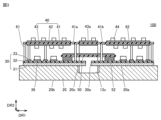
- 1 is a cross-sectional view of a power conversion device 100.
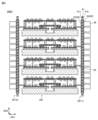
- FIG. FIG. 2 is a cross-sectional view of a power conversion system 200A.
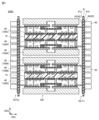
- FIG. 2 is a cross-sectional view of a power conversion system 200B.
- a cross-sectional view of a power conversion system 200D A cross-sectional view of a power conversion system 200E.
- Embodiment 1 A description will be given of a power conversion system according to the embodiment 1.
- the power conversion system according to the embodiment 1 is assumed to be a power conversion system 200A.
- FIG. 1 is a circuit diagram of a power conversion system 200A.
- the power conversion system 200A has a plurality of power conversion devices 100.
- the plurality of power conversion devices 100 are connected in parallel, but the plurality of power conversion devices 100 may also be connected in series.
- the number of power conversion devices 100 is not particularly limited.
- the power conversion device 100 has an inverter circuit section 10, a rectifier circuit section 11, a smoothing circuit section 12, a transformer section 13, and a control circuit section 14.
- the inverter circuit section 10, the rectifier circuit section 11, and the smoothing circuit section 12 form the main circuit section of the power conversion device 100A.
- the power conversion device 100A constitutes, for example, a direct current-direct current conversion circuit (DC-DC converter).
- the inverter circuit section 10 has multiple switching elements 10a and an input capacitor 10b.
- the number of switching elements 10a is four. These four switching elements 10a are referred to as transistor 10aa, transistor 10ab, transistor 10ac, and transistor 10ad, respectively.
- Transistor 10aa and transistor 10ab are connected in series. More specifically, the source of transistor 10aa and the drain of transistor 10ab are connected to each other. Transistor 10ac and transistor 10ad are connected in series. More specifically, the source of transistor 10ac and the drain of transistor 10ad are connected to each other. The drain of transistor 10aa and the drain of transistor 10ac are connected to input terminal 10c. The source of transistor 10ab and the source of transistor 10ad are connected to input terminal 10d. Input capacitor 10b is connected to input terminal 10c and input terminal 10d.
- Transistor 10aa, transistor 10ab, transistor 10ac, and transistor 10ad are power semiconductor elements such as, for example, MOSFETs (Metal Oxide Semiconductor Field Effect Transistors), IGBTs (Insulated Gate Bipolar Transistors), and GaN HEMTs (Gallium Nitride High Electron Transistors).
- MOSFETs Metal Oxide Semiconductor Field Effect Transistors
- IGBTs Insulated Gate Bipolar Transistors
- GaN HEMTs GaN HEMTs (Gallium Nitride High Electron Transistors).
- the rectifier circuit section 11 has a plurality of rectifier elements 11a.
- the number of rectifier elements 11a is four. These four rectifier elements 11a are respectively referred to as diode 11aa, diode 11ab, diode 11ac, and diode 11ad.
- Diode 11aa and diode 11ab are connected in series. More specifically, the anode of diode 11aa and the cathode of diode 11ab are connected to each other.
- Diode 11ac and diode 11ad are connected in series. More specifically, the anode of diode 11ac and the cathode of diode 11ad are connected to each other.
- the rectifying element 11a may be something other than a diode.
- the rectifying element 11a may be a power semiconductor element such as a MOSFET, a GaN HEMT, or a thyristor.
- the smoothing circuit section 12 is connected in parallel to the rectifier circuit section 11.
- the smoothing circuit section 12 has a smoothing reactor 12a and a smoothing capacitor 12b.
- the smoothing reactor 12a and the smoothing capacitor 12b are connected in series.
- One end of the smoothing reactor 12a is connected to the cathode of the diode 11aa and the cathode of the diode 11ac.
- the other end of the smoothing reactor 12a is connected to one end of the smoothing capacitor 12b.
- the other end of the smoothing capacitor 12b is connected to the anode of the diode 11ab and the anode of the diode 11ad.
- the output terminal 12c is connected to the other end of the smoothing reactor 12a and one end of the smoothing capacitor 12b.
- the output terminal 12d is connected to the other end of the smoothing capacitor 12b, the anode of the diode 11ab, and the anode of the diode 11ad.
- the transformer unit 13 is a transformer composed of a winding 13a, a winding 13b, and a core 13c.
- the winding 13a and the winding 13b are the primary and secondary windings, respectively.
- One end of the winding 13a is connected to the source of the transistor 10aa and the drain of the transistor 10ab.
- the other end of the winding 13a is connected to the source of the transistor 10ac and the drain of the transistor 10ad.
- One end of the winding 13b is connected to the anode of the diode 11aa and the cathode of the diode 11ab.
- the other end of the winding 13b is connected to the anode of the diode 11ac and the cathode of the diode 11ad.
- the inverter circuit unit 10 and the rectifier circuit unit 11 are electrically insulated from each other by the transformer constituting the transformer unit 13.
- the control circuit section 14 has a detection section 14a and a control section 14b.
- the detection section 14a detects, for example, the current flowing between the input terminals 10c and 10d, the voltage between the input terminals 10c and 10d, the current flowing between the output terminals 12c and 12d, and the voltage between the output terminals 12c and 12d.
- the detection section 14a detects, for example, the temperatures of the inverter circuit section 10, the rectifier circuit section 11, the smoothing circuit section 12, and the circuit components that constitute them.
- the control unit 14b controls the inverter circuit unit 10 based on the detection result by the detection unit 14a. More specifically, the control unit 14b outputs control signals to the gates of the transistors 10aa, 10ab, 10ac, and 10ad, thereby switching the transistors 10aa, 10ab, 10ac, and 10ad on and off.
- the transistors 10aa, 10ab, 10ac, and 10ad are switched on and off to convert the DC voltage applied between the input terminals 10c and 10d into an AC voltage.
- the AC voltage converted in the inverter circuit section 10 is converted into an AC voltage having an arbitrary voltage.
- the AC voltage obtained by the conversion in the transformer section 13 is determined by the winding ratio of the windings 13a and 13b.
- the AC voltage converted in the transformer section 13 is converted back into a DC voltage in the rectifier circuit section 11.
- the DC voltage converted in the rectifier circuit section 11 is smoothed by the smoothing reactor 12a and smoothing capacitor 12b in the smoothing circuit section 12, and is output from the output terminals 12c and 12d.
- the input terminals 10c of the multiple power conversion devices 100 are connected to each other by a conductor pattern 82, and the input terminals 10d of the multiple power conversion devices 100 are connected to each other by a conductor pattern 82.
- the output terminals 12c of the multiple power conversion devices 100 are connected to each other by a conductor pattern 82, and the output terminals 12d of the multiple power conversion devices 100 are connected to each other by a conductor pattern 82.
- the multiple power conversion devices 100 are connected in parallel.
- an electrical component 86 is connected in series to the conductor pattern 82.
- the electrical component 86 is, for example, a capacitor.
- FIG. 2 is an exploded perspective view of the power conversion device 100.
- FIG. 3 is a cross-sectional view of the power conversion device 100. Note that FIG. 3 shows a cross-section of the power conversion device 100 perpendicular to the second direction DR2.
- the power conversion device 100 further includes a cooling body 20, a first substrate 30, a second substrate 40, and a third substrate 50.
- the cooling body 20 has a main surface 20a and a main surface 20b.
- the main surface 20b is the opposite surface to the main surface 20a.
- Viewing the power conversion device 100 along the normal direction of the main surface 20a is called a plan view.
- the longitudinal direction of the cooling body 20 is along the first direction DR1.
- the direction perpendicular to the first direction DR1 in the plan view is the second direction DR2.
- the outer shape of the cooling body 20 is a rectangle (rectangle) formed by a side along the first direction DR1 and a side along the second direction DR2.
- the direction perpendicular to the first direction DR1 and the second direction DR2 is the third direction DR3.
- the third direction DR3 is along the normal direction of the main surface 20a.
- the main surfaces 20a and 20b are both end faces of the cooling body 20 in the third direction DR3.
- a groove 20c is formed in the main surface 20a.
- the main surface 20a is recessed toward the main surface 20b at the groove 20c.
- the groove 20c has, for example, a rectangular (rectangular) shape in a plan view.
- the longitudinal direction of the groove 20c in a plan view is along the second direction DR2.
- At least a part of the core 13c is disposed in the groove 20c.
- the core 13c is divided, for example, into a first portion 13ca and a second portion 13cb.
- the first portion 13ca and the second portion 13cb are assembled to form one or more closed magnetic circuits.
- the first portion 13ca and the second portion 13cb are fixed to each other by an adhesive or insulating tape.
- the core 13c is disposed in the groove 20c.
- the first portion 13ca and the second portion 13cb are, for example, an E-shaped core and an I-shaped core, respectively.
- the shape of the core 13c is not limited to this.
- the core 13c is not particularly limited as long as it is, for example, an appropriate combination of an E-shaped core, a T-shaped core, a U-shaped core, a cylindrical core, etc. to form one or more loop-shaped closed magnetic circuits.
- the core 13c is, for example, a ferrite core such as a manganese-zinc ferrite core or a nickel-zinc ferrite core.
- the core 13c may be an amorphous core or an iron dust core.
- the cooling body 20 is formed from a material with high thermal conductivity.
- the constituent material of the cooling body 20 is a metal material or a resin material with high thermal conductivity. Specific examples of metal materials that constitute the cooling body 20 include copper, copper alloys, aluminum, aluminum alloys, iron, and iron alloys.
- the constituent material of the cooling body 20 has a thermal conductivity of, for example, 1.0 W/(m ⁇ K) or more.
- the constituent material of the cooling body 20 preferably has a thermal conductivity of 10 W/(m ⁇ K) or more. It is even more preferable that the constituent material of the cooling body 20 has a thermal conductivity of 100 W/(m ⁇ K) or more.
- the cooling body 20 may be electrically connected to another member so that the cooling body 20 has the same potential as the ground potential.
- a heat conductive member may be interposed between the bottom surface of the groove 20c and the core 13c (first portion 13ca).
- the heat conductivity of the heat conductive member is, for example, 0.1 W/(m ⁇ K) or more, preferably 1 W/(m ⁇ K) or more, and more preferably 10 W/(m ⁇ K) or more.
- heat conductive grease, heat conductive sheet, heat conductive adhesive, etc. can be used as the heat conductive member.
- the core 13c may be attached to the bottom surface of the groove 20c using an adhesive.
- the cooling body 20 may form part of the housing of the transformer unit 13, or may form part of the housing of the power conversion device 100.
- the cooling body 20 may be air-cooled or water-cooled on surfaces other than the surfaces facing the first portion 34 and the second portion 35 described below.
- the first substrate 30 is a metal base substrate. In a plan view, the first substrate 30 has a rectangular (rectangular) shape with its longitudinal direction aligned with the first direction DR1.
- the first substrate 30 has a metal base 31, an insulating layer 32, and a conductor pattern 33.
- the metal base 31 is a plate-shaped member made of a metal material. Specific examples of the material of the metal base 31 include copper, copper alloy, aluminum, aluminum alloy, iron, iron alloy, etc.
- the thermal conductivity of the material of the metal base 31 is, for example, 1.0 W/(m ⁇ K) or more.
- the thermal conductivity of the material of the metal base 31 is preferably 10 W/(m ⁇ K) or more. It is even more preferable that the thermal conductivity of the material of the metal base 31 is 100 W/(m ⁇ K) or more.
- the insulating layer 32 is disposed on the metal base 31.
- the insulating layer 32 is formed of an electrically insulating material.
- Specific examples of the constituent material of the insulating layer 32 include epoxy resin, glass fiber reinforced epoxy resin, polyimide resin, etc.
- the resin material contained in the constituent material of the insulating layer 32 may contain a thermally conductive filler to improve the thermal conductivity of the insulating layer 32.
- the thickness of the insulating layer 32 is preferably small as long as it does not affect the electrical insulation or manufacturing.
- the thickness of the insulating layer 32 is preferably 1 ⁇ m or more and 2000 ⁇ m or less, and more preferably 1 ⁇ m or more and 150 ⁇ m or less.
- the conductor pattern 33 is disposed on the insulating layer 32.
- the conductor pattern 33 is formed of a conductor.
- Specific examples of materials constituting the conductor pattern 33 include metal materials such as copper, copper alloy, nickel, nickel alloy, gold, gold alloy, aluminum, aluminum alloy, silver, silver alloy, tin, and tin alloy.
- the thickness of the conductor pattern 33 is, for example, 1 ⁇ m or more and 2000 ⁇ m or less.
- the conductor pattern 33 at one end in the first direction DR1 is provided with input terminal 10c and input terminal 10d, and the conductor pattern 33 at the other end in the first direction DR1 is provided with output terminal 12c and output terminal 12d.
- a slit 30a is formed in the first substrate 30.
- the slit 30a penetrates the first substrate 30 along the third direction DR3.
- the first substrate 30 is placed on the cooling body 20 so that the metal base 31 is in contact with the cooling body 20 (main surface 20a). With the first substrate 30 placed on the cooling body 20, the core 13c passes through the slit 30a.
- the slit 30a divides the metal base 31 around the slit 30a. Therefore, the metal base 31 around the slit 30a does not form a winding for the core 13c.
- the portion of the first substrate 30 on one side of the slit 30a in the first direction DR1 may be referred to as the first portion 34.
- the portion of the first substrate 30 on the other side of the slit 30a in the first direction DR1 (the right side in FIG. 3) may be referred to as the second portion 35.
- the first portion 34 and the second portion 35 may or may not be separated by the slit 30a.
- the metal base 31 in the first portion 34 and the metal base 31 in the second portion 35 may be in contact with the core 13c.
- a plurality of first circuit components 36 are electrically connected to the conductor pattern 33 to form the main circuit of the power conversion device 100.
- the first circuit components 36 connected to the conductor pattern 33 in the first portion 34 form the primary circuit of the main circuit of the power conversion device 100. That is, the first circuit components 36 connected to the conductor pattern 33 in the first portion 34 are the switching element 10a and the input capacitor 10b.
- the first circuit components 36 connected to the conductor pattern 33 in the second portion 35 form the secondary circuit of the main circuit of the power conversion device 100. That is, the first circuit components 36 connected to the conductor pattern 33 in the second portion 35 are the rectifier element 11a, the smoothing reactor 12a, and the smoothing capacitor 12b.
- the second substrate 40 has a base material 41.
- the base material 41 has a rectangular (oblong) shape with its longitudinal direction aligned with the first direction DR1.
- the base material 41 has a main surface 41a and a main surface 41b.
- the main surface 41b is the surface opposite the main surface 41a.
- the main surface 41a and the main surface 41b are both end surfaces of the base material 41 in the third direction DR3.
- the second substrate 40 further has a conductor pattern 42 and a conductor pattern 43.
- the conductor pattern 42 and the conductor pattern 43 are arranged on the main surface 41a and the main surface 41b, respectively.
- the second substrate 40 is arranged at a distance from the first substrate 30 in the third direction DR3 so that the conductor pattern 43 is in contact with the core 13c (second portion 13cb).
- the portion of the conductor pattern 43 in contact with the core 13c is sometimes called the shield 43a.
- the shield 43a may be connected to the reference potential of the control circuit section 14, or may not be connected to any potential.
- the shield 43a may be connected to the cooling body 20 by a support 61, which will be described later.
- a protective film may be provided on the surface of the conductor pattern 43 so as to cover at least a portion of the surface of the conductor pattern 43.
- the second substrate 40 may be arranged so that the conductor pattern 43 is in thermal contact with the core 13c via the protective film.
- the protective film is, for example, a resist or silk made of resin.
- Each of the multiple second circuit components 44 is electrically connected to either the conductor pattern 42 or the conductor pattern 43 to form the control circuit section 14.
- the number of second circuit components 44 is greater than the number of first circuit components 36.
- the amount of heat generated in the second substrate 40 is less than the amount of heat generated in the first substrate 30.
- the second substrate 40 is, for example, a general-purpose printed circuit board.
- the second substrate 40 may have a wiring layer built into the substrate 41.
- the second substrate 40 may be a ceramic substrate in which the substrate 41 is formed of ceramic such as aluminum oxide, aluminum nitride, or silicon carbide.
- the thickness of the shield 43a is, for example, 10 ⁇ m or more.
- the thickness of the shield 43a (conductor pattern 43) is preferably 35 ⁇ m or more, and more preferably 105 ⁇ m or more.
- a plating layer may be disposed on the shield 43a (conductor pattern 43).
- the thickness of the plating layer is preferably 10 ⁇ m or more, and more preferably 30 ⁇ m or more.
- the area of the shield 43a in a planar view is, for example, larger than the area of the core 13c (second portion 13cb) in a planar view.
- the shield 43a may be a solid pattern.
- the third substrate 50 is, for example, a printed circuit board.
- the printed circuit board as the third substrate 50 may be, for example, a general-purpose printed circuit board.
- a through hole 51 is formed in the third substrate 50.
- the core 13c (first portion 13ca) passes through the through hole 51.
- the second portion 13cb is assembled to the first portion 13ca after the first portion 13ca passes through the through hole 51.
- the conductor pattern of the third substrate 50 is wound around the core 13c, and constitutes the windings 13a and 13b.
- the base material of the third substrate 50 may be made of ceramics such as aluminum oxide, aluminum nitride, silicon carbide, etc.
- the third substrate 50 may be a laminated bus bar. That is, the third substrate 50 may be formed by stacking and laminating an insulating film sheet and a metal conductor.
- the insulating film sheet may be, for example, a film made of polyethylene terephthalate (PET: Poly Ethylene Terephthalate), polyimide (PI: Poly Imide), or paper made of aramid (fully aromatic polyamide) fibers.
- PET Poly Ethylene Terephthalate
- PI Poly Imide
- the insulating film sheet and the metal conductor may be bonded to each other using an adhesive layer or a pressure-sensitive adhesive layer.
- the conductor pattern of the third substrate 50 on the surface of the third substrate 50 facing the first substrate 30 is joined to the conductor pattern 33 in the first portion 34 and the conductor pattern 33 in the second portion 35 by a joining member 52.
- the winding 13a and the winding 13b of the third substrate 50 are electrically connected to the inverter circuit section 10 in the first portion 34 and the rectifier circuit section 11 in the second portion 35, respectively.
- brazing material, solder, conductive adhesive, etc. are used for the joining member 52.
- a heat conductive member may be interposed between the first substrate 30 and the third substrate 50.
- the power conversion device 100 further includes a plurality of support pillars 61 and a plurality of connection members 62.
- the support pillars 61 extend along the third direction DR3.
- the support pillars 61 are disposed on the first substrate 30.
- the second substrate 40 is supported by the plurality of support pillars 61 on the first substrate 30 at a distance from the first substrate 30.
- the connection members 62 extend along the third direction DR3.
- the connection members 62 are connected at one end to the conductor pattern 43 and at the other end to the conductor pattern 33. This electrically connects the first substrate 30 and the second substrate 40. More specifically, the plurality of connection members 62 electrically connect the main circuit section and the control circuit section 14 of the power conversion device 100.
- FIG. 4 is a cross-sectional view of the power conversion system 200A.
- the multiple power conversion devices 100 are stacked along the third direction DR3.
- the cooling body 20 of one of two adjacent ones of the multiple power conversion devices 100 faces, for example, the second substrate 40 of the other of the two adjacent ones of the multiple power conversion devices 100.
- the power conversion system 200A further has two wiring substrates 70. Each of the two wiring substrates 70 may be referred to as wiring substrate 71 and wiring substrate 72.
- Each of the two wiring boards 70 has, for example, a substrate 81, a conductor pattern 83, and a conductor pattern 84.
- the substrate 81 has a main surface 81a and a main surface 81b.
- the main surface 81a and the main surface 81b are both end surfaces of the substrate 81 in the thickness direction.
- the conductor patterns 83 and 84 are disposed on the main surface 81a and the main surface 81b, respectively.
- the conductor pattern 82 collectively including the conductor patterns 83 and 84, may be referred to as the conductor pattern 82.
- the conductor pattern 82 (e.g., conductor pattern 83) is electrically connected to each of the conductor patterns 33 (more specifically, input terminal 10c, input terminal 10d, output terminal 12c, output terminal 12d) of the multiple power conversion devices 100 by the connection member 85.
- the multiple power conversion devices 100 are connected in parallel.
- the multiple power conversion devices 100 may also be connected in series.
- the electrical components 86 are mounted on the wiring board 70 by being connected to the conductor patterns 82 (e.g., the conductor patterns 84).
- the electrical components 86 include, for example, capacitors. These capacitors are responsible for, for example, maintaining power during a power outage and suppressing voltage fluctuations. In addition to capacitors, the electrical components 86 may also include terminal blocks for connecting the entire input/output wiring, noise filters, etc.
- the substrate 81 is formed, for example, from a glass composite, glass epoxy, halogen-free, etc.
- the wiring board 70 may be a bus bar on which the electrical components 86 are mounted.
- the power conversion system 200A has multiple power conversion devices.
- heat generated in the core 13c is dissipated through the first substrate 30 and the cooling body 20.
- heat generated in the core 13c is dissipated through the shield 43a (second substrate 40). Therefore, in the power conversion device 100, it is possible to efficiently cool the core 13c. And as a result of the core 13c being efficiently cooled, there is no need to enlarge the core 13c for heat dissipation, and the transformer section 13 and therefore the power conversion system 200A can be made smaller.
- the power conversion system 200A is capable of efficient cooling.
- the second board 40 (shield 43a) is in contact with the core 13c, which not only improves heat dissipation, but also improves vibration resistance by fixing the core 13c, and prevents malfunction of the control circuit unit 14 by shielding electromagnetic noise generated in the core 13c with the shield 43a.
- the core (core 13c) of the transformer unit 13 is placed in the groove 20c and pressed down from above by the second substrate 40.
- the core used in the smoothing reactor 12a may be placed in the groove 20c and pressed down from above by the second substrate 40.
- two wiring boards 70 are used to connect multiple power conversion devices 100 in series or parallel, making it possible to expand capacity and accommodate a wide range of input and output voltages.
- multiple electrical components 86 are mounted on the conductor pattern 82, making it easy to add functions such as maintaining power during a power outage, suppressing voltage fluctuations, and suppressing electromagnetic noise.
- Embodiment 2 A power conversion system according to the second embodiment will be described.
- the power conversion system according to the second embodiment is assumed to be power conversion system 200B.
- differences from power conversion system 200A will be mainly described, and overlapping descriptions will not be repeated.
- FIG. 5 is a cross-sectional view of the power conversion system 200B. As shown in FIG. 5, the power conversion system 200B has a plurality of power conversion devices 100. In this respect, the configuration of the power conversion system 200B is common to the configuration of the power conversion system 200A.
- input terminal 10c, input terminal 10d, output terminal 12c, and output terminal 12d are provided on the conductor pattern 33 at one end in the first direction DR1.
- the power conversion system 200B does not have two wiring boards 70, but only has a wiring board 71.
- the conductor pattern 82 of the wiring board 71 is connected to the input terminal 10c, input terminal 10d, output terminal 12c, and output terminal 12d of each of the multiple power conversion devices 100, thereby connecting the multiple power conversion devices 100 in series or parallel.
- the configuration of the power conversion system 200B differs from the configuration of the power conversion system 200A.
- the number of wiring boards 70 can be reduced from two to one, allowing further miniaturization.
- Embodiment 3 A power conversion system according to the third embodiment will be described.
- the power conversion system according to the third embodiment is assumed to be a power conversion system 200C.
- differences from the power conversion system 200A will be mainly described, and overlapping descriptions will not be repeated.
- FIG. 6 is a cross-sectional view of the power conversion system 200C.
- the power conversion system 200C has a plurality of power conversion devices 100 and a plurality of wiring boards 70.
- the configuration of the power conversion system 200C is common to the configuration of the power conversion system 200A.
- the power conversion system 200C has a plurality of heat conductive members 90.
- Each of the plurality of heat conductive members 90 is disposed between one cooling body 20 of two adjacent power conversion devices 100 and the second substrate 40 of the other of the two adjacent power conversion devices 100.
- the thermal conductivity of the heat conductive member 90 is, for example, 0.1 W/(m ⁇ K) or more, preferably 1 W/(m ⁇ K) or more, and more preferably 10 W/(m ⁇ K) or more.
- heat conductive member 90 heat conductive grease, heat conductive sheet, heat conductive adhesive, etc. can be applied.
- the heat conductive member 90 may be disposed in the entire space between one cooling body 20 of two adjacent power conversion devices 100 and the second substrate 40 of the other of the two adjacent power conversion devices 100, or may be disposed in a part of the space.
- the shield 43a may be thermally coupled to a portion of the conductor pattern 42 that faces the shield 43a with the substrate 41 interposed therebetween by a through hole formed in the substrate 41.
- the configuration of the power conversion system 200C differs from the configuration of the power conversion system 200A.
- the heat generated in the core 13c, second board 40, and second circuit components 44 of one power conversion device 100 can be efficiently transferred to the cooling body 20 of the other power conversion device 100 adjacent to the one power conversion device 100 by the thermal conductive member 90, making it possible to cool more efficiently.
- the thermal conductive member 90 makes it possible to cool more efficiently.
- the shield 43a is thermally coupled to the part of the conductor pattern 42 that faces the shield 43a and the substrate 41 via a through hole formed in the substrate 41, it is possible to more efficiently transfer the heat generated in the core 13c, second board 40, and second circuit components 44 of one power conversion device 100 to the cooling body 20 of the other power conversion device 100 adjacent to the one power conversion device 100.
- Embodiment 4 A power conversion system according to the fourth embodiment will be described.
- the power conversion system according to the fourth embodiment is assumed to be a power conversion system 200D.
- differences from the power conversion system 200A will be mainly described, and overlapping descriptions will not be repeated.
- FIG. 7 is a cross-sectional view of power conversion system 200D. As shown in FIG. 7, power conversion system 200D has multiple power conversion devices 100 and multiple wiring boards 70. In this respect, the configuration of power conversion system 200D is common to the configuration of power conversion system 200A.
- One of the adjacent power conversion devices 100 is referred to as power conversion device 100A, and the other is referred to as power conversion device 100B.
- the cooling body 20 of power conversion device 100A and the cooling body 20 of power conversion device 100B face each other.
- the power conversion device 100 facing the power conversion device 100A on the side opposite the power conversion device 100B is referred to as power conversion device 100C.
- the power conversion device 100 facing the power conversion device 100B on the side opposite the power conversion device 100A is referred to as power conversion device 100D.
- the second substrate 40 of power conversion device 100C and the second substrate 40 of power conversion device 100A face each other.
- the second substrate 40 of power conversion device 100D and the second substrate 40 of power conversion device 100B face each other.
- the power conversion system 200D has a plurality of heat conductive members 91.
- the heat conductivity of the heat conductive members 91 is, for example, 0.1 W/(m ⁇ K) or more, preferably 1 W/(m ⁇ K) or more, and more preferably 10 W/(m ⁇ K) or more.
- heat conductive members 91 heat conductive grease, heat conductive sheets, heat conductive adhesives, etc. can be used.
- Each of the plurality of heat conductive members 91 is disposed between the second board 40 of the power conversion device 100A and the second board 40 of the power conversion device 100C, and between the second board 40 of the power conversion device 100B and the second board 40 of the power conversion device 100D.
- the heat conductive members 91 may be disposed in the entire space between the second board 40 of the power conversion device 100A (power conversion device 100B) and the second board 40 of the power conversion device 100C (power conversion device 100D), or may be disposed in a part of the space.
- the shield 43a may be thermally coupled to a portion of the conductor pattern 42 that faces the shield 43a with the substrate 41 interposed therebetween by a through hole formed in the substrate 41.
- the configuration of the power conversion system 200D differs from the configuration of the power conversion system 200A.
- the heat generated in the core 13c, second board 40, and second circuit components 44 of one power conversion device 100 can be efficiently transferred to the cooling body 20 of the other power conversion device 100 adjacent to the one power conversion device 100 by the thermal conductive member 91, making it possible to cool more efficiently.
- the power conversion system 200D it is not necessary to enlarge the above-mentioned components for heat dissipation, so further miniaturization is possible.
- the shield 43a is thermally coupled to the part of the conductor pattern 42 that faces the shield 43a and the substrate 41 via a through hole formed in the substrate 41, it is possible to more efficiently transfer the heat generated in the core 13c, second board 40, and second circuit components 44 of one power conversion device 100 to the cooling body 20 of the other power conversion device 100 adjacent to the one power conversion device 100.
- Embodiment 5 A power conversion system according to the fifth embodiment will be described.
- the power conversion system according to the fifth embodiment is assumed to be a power conversion system 200E.
- differences from the power conversion system 200A will be mainly described, and overlapping descriptions will not be repeated.
- FIG. 8 is a cross-sectional view of the power conversion system 200E.
- the power conversion system 200E has a plurality of power conversion devices 100 and a plurality of wiring boards 70.
- the configuration of the power conversion system 200E is common to the configuration of the power conversion system 200A.
- One of the adjacent power conversion devices 100 is referred to as power conversion device 100A, and the other is referred to as power conversion device 100B.
- the cooling body 20 of power conversion device 100A and the cooling body 20 of power conversion device 100B face each other.
- the power conversion device 100 facing the power conversion device 100A on the side opposite the power conversion device 100B is referred to as power conversion device 100C.
- the power conversion device 100 facing the power conversion device 100B on the side opposite the power conversion device 100A is referred to as power conversion device 100D.
- the second substrate 40 of power conversion device 100C and the second substrate 40 of power conversion device 100A face each other.
- the second substrate 40 of power conversion device 100D and the second substrate 40 of power conversion device 100B face each other.
- one second substrate 40 is shared between power conversion device 100A and power conversion device 100C, and another second substrate 40 is shared between power conversion device 100B and power conversion device 100D.
- the configuration of power conversion system 200E differs from the configuration of power conversion system 200A.
- the number of second substrates 40 is reduced, which allows for miniaturization and cost reduction. Note that in the power conversion system 200E, the amount of heat transferred to each second substrate 40 increases, but by thickening the second portion 13cb and increasing the cross-sectional area of the magnetic path in the core 13c, the amount of heat generated in the core 13c is reduced, making it possible to suppress the temperature rise in the second substrate 40.
- each of the plurality of power conversion devices includes a cooling body, a core, a first substrate, a second substrate, a third substrate, a connection member, a plurality of first circuit components, and a plurality of second circuit components;
- the cooling body has a first main surface and a second main surface opposite to the first main surface, a groove recessed toward the second main surface is formed in the first main surface, the core is at least partially disposed in the groove,
- the first substrate has a metal base, an insulating layer, and a first conductor pattern; the insulating layer is disposed on the metal base; the first conductor pattern is disposed on the insulating layer;
- the first substrate has a slit formed therein, the slit penetrating the first substrate, the first substrate is disposed on the cooling body such that the metal base is in contact with the first main surface and the core is passed through the slit;
- the second substrate has a base material, a second conductor
- the at least one wiring board is two wiring boards,
- Each of the plurality of power conversion devices has an input terminal and an output terminal at one end and the other end in a longitudinal direction, the conductor pattern of one of the two wiring boards is electrically connected to the input terminal of each of the plurality of power conversion devices; 2.
- the at least one wiring board is one wiring board
- Each of the plurality of power conversion devices has an input terminal and an output terminal at one end in a longitudinal direction, 2.
- Appendix 4> Further comprising a heat conductive member; The power conversion system described in Appendix 2 or Appendix 3, wherein the cooling body of one of two adjacent ones of the plurality of power conversion devices faces the second substrate of the other one of the two adjacent ones of the plurality of power conversion devices, with the thermal conduction member interposed therebetween.
- ⁇ Appendix 5> Further comprising a heat conductive member;
- the plurality of power electronics devices include a first power electronics device, a second power electronics device, a third power electronics device, and a fourth power electronics device
- the cooling body of the first power converter faces the cooling body of the second power converter
- the third power conversion device shares the second substrate with the first power conversion device and is disposed opposite to the first power conversion device on an opposite side to the second power conversion device
- the power conversion system according to any one of claims 2, 3, and 5, wherein the fourth power conversion device shares the second substrate with the second power conversion device and is disposed opposite the second power conversion device on the side opposite to the first power conversion device.
- the plurality of first circuit components constitute a main circuit section of the power conversion device,
- 10 inverter circuit section 10a switching element, 10aa, 10ab, 10ad transistor, 10b input capacitor, 10c, 10d input terminal, 11 rectifier circuit section, 11a rectifier element, 11aa, 11ab, 11ad diode, 12 smoothing circuit section, 12a smoothing reactor, 12b smoothing capacitor, 12c, 12d output terminal, 13 transformer section, 13a, 13b winding, 13c core, 13ca, 34 first part, 13cb, 35 second part, 14 control circuit section, 14a detection section, 14b control section, 20 cooling body, 20a, 20b main surface, 20c groove, 30 first substrate, 30a slit, 31 metal base 32 insulating layer, 33 conductor pattern, 36 first circuit component, 40 second board, 41 base material, 41a, 41b main surface, 42, 43 conductor pattern, 43a shield, 44 second circuit component, 50 third board, 51 through hole, 52 joint member, 61 support, 62 connection member, 70, 71, 72 wiring board, 81 base material,
Landscapes
- Engineering & Computer Science (AREA)
- Power Engineering (AREA)
- Physics & Mathematics (AREA)
- Thermal Sciences (AREA)
- Microelectronics & Electronic Packaging (AREA)
- Dc-Dc Converters (AREA)
Priority Applications (1)
| Application Number | Priority Date | Filing Date | Title |
|---|---|---|---|
| JP2025551471A JPWO2025079521A1 (https=) | 2023-10-12 | 2024-10-04 |
Applications Claiming Priority (2)
| Application Number | Priority Date | Filing Date | Title |
|---|---|---|---|
| JP2023-176851 | 2023-10-12 | ||
| JP2023176851 | 2023-10-12 |
Publications (1)
| Publication Number | Publication Date |
|---|---|
| WO2025079521A1 true WO2025079521A1 (ja) | 2025-04-17 |
Family
ID=95395757
Family Applications (1)
| Application Number | Title | Priority Date | Filing Date |
|---|---|---|---|
| PCT/JP2024/035605 Pending WO2025079521A1 (ja) | 2023-10-12 | 2024-10-04 | 電力変換システム |
Country Status (2)
| Country | Link |
|---|---|
| JP (1) | JPWO2025079521A1 (https=) |
| WO (1) | WO2025079521A1 (https=) |
Citations (5)
| Publication number | Priority date | Publication date | Assignee | Title |
|---|---|---|---|---|
| US20160087536A1 (en) * | 2014-09-22 | 2016-03-24 | Raytheon Company | Stacked power converter assembly |
| WO2018105465A1 (ja) * | 2016-12-09 | 2018-06-14 | 三菱電機株式会社 | 電子回路基板、電力変換装置 |
| US10149413B1 (en) * | 2017-07-31 | 2018-12-04 | Toyota Motor Engineering & Manufacturing North America, Inc. | Integrated thermal management assembly for gate drivers and power components |
| WO2020054376A1 (ja) * | 2018-09-14 | 2020-03-19 | 三菱電機株式会社 | 電力変換器 |
| JP2020205714A (ja) * | 2019-06-18 | 2020-12-24 | 三菱電機株式会社 | 電力変換器および回路基板 |
-
2024
- 2024-10-04 JP JP2025551471A patent/JPWO2025079521A1/ja active Pending
- 2024-10-04 WO PCT/JP2024/035605 patent/WO2025079521A1/ja active Pending
Patent Citations (5)
| Publication number | Priority date | Publication date | Assignee | Title |
|---|---|---|---|---|
| US20160087536A1 (en) * | 2014-09-22 | 2016-03-24 | Raytheon Company | Stacked power converter assembly |
| WO2018105465A1 (ja) * | 2016-12-09 | 2018-06-14 | 三菱電機株式会社 | 電子回路基板、電力変換装置 |
| US10149413B1 (en) * | 2017-07-31 | 2018-12-04 | Toyota Motor Engineering & Manufacturing North America, Inc. | Integrated thermal management assembly for gate drivers and power components |
| WO2020054376A1 (ja) * | 2018-09-14 | 2020-03-19 | 三菱電機株式会社 | 電力変換器 |
| JP2020205714A (ja) * | 2019-06-18 | 2020-12-24 | 三菱電機株式会社 | 電力変換器および回路基板 |
Also Published As
| Publication number | Publication date |
|---|---|
| JPWO2025079521A1 (https=) | 2025-04-17 |
Similar Documents
| Publication | Publication Date | Title |
|---|---|---|
| US8188829B2 (en) | Coil substrate structure, substrate holding structure, and switching power supply | |
| US10916367B2 (en) | Circuit device and power conversion device | |
| US6222733B1 (en) | Device and method for cooling a planar inductor | |
| US6970367B2 (en) | Switching power supply | |
| US11432437B2 (en) | Power converter | |
| US11206729B2 (en) | Power circuit device | |
| US10811958B2 (en) | Water-cooling power supply module | |
| US8237535B2 (en) | Integral planar transformer and busbar | |
| JP5217884B2 (ja) | 半導体装置 | |
| CN112586094A (zh) | 电路装置以及电力变换装置 | |
| JP4558407B2 (ja) | スイッチング電源装置 | |
| CN113519114A (zh) | 电力变换装置 | |
| US20230411066A1 (en) | Transformer | |
| JP7509078B2 (ja) | 半導体モジュール | |
| JP7580599B2 (ja) | コイル装置および電力変換装置 | |
| US11546994B2 (en) | Voltage regulator module | |
| JP7512706B2 (ja) | 半導体装置 | |
| WO2025079521A1 (ja) | 電力変換システム | |
| WO2025079522A1 (ja) | 電力変換装置 | |
| JP2021093484A (ja) | 半導体モジュール | |
| JP7814549B2 (ja) | コイル装置および電力変換装置 | |
| JP7086164B1 (ja) | 電力変換装置、及び遮断機構 | |
| CN115588962A (zh) | 功率转换装置和断路机构 | |
| JP2010251559A (ja) | 電子回路装置 | |
| US6429507B1 (en) | Electrical device including a leaded cell assembly |
Legal Events
| Date | Code | Title | Description |
|---|---|---|---|
| 121 | Ep: the epo has been informed by wipo that ep was designated in this application |
Ref document number: 24877117 Country of ref document: EP Kind code of ref document: A1 |
|
| ENP | Entry into the national phase |
Ref document number: 2025551471 Country of ref document: JP Kind code of ref document: A |
|
| WWE | Wipo information: entry into national phase |
Ref document number: 2025551471 Country of ref document: JP |