WO2025075107A1 - プレス装置及びプレス成形品 - Google Patents
プレス装置及びプレス成形品 Download PDFInfo
- Publication number
- WO2025075107A1 WO2025075107A1 PCT/JP2024/035506 JP2024035506W WO2025075107A1 WO 2025075107 A1 WO2025075107 A1 WO 2025075107A1 JP 2024035506 W JP2024035506 W JP 2024035506W WO 2025075107 A1 WO2025075107 A1 WO 2025075107A1
- Authority
- WO
- WIPO (PCT)
- Prior art keywords
- punch
- press
- die
- shoulder
- top surface
- Prior art date
- Legal status (The legal status is an assumption and is not a legal conclusion. Google has not performed a legal analysis and makes no representation as to the accuracy of the status listed.)
- Pending
Links
Images






Classifications
-
- B—PERFORMING OPERATIONS; TRANSPORTING
- B21—MECHANICAL METAL-WORKING WITHOUT ESSENTIALLY REMOVING MATERIAL; PUNCHING METAL
- B21D—WORKING OR PROCESSING OF SHEET METAL OR METAL TUBES, RODS OR PROFILES WITHOUT ESSENTIALLY REMOVING MATERIAL; PUNCHING METAL
- B21D19/00—Flanging or other edge treatment, e.g. of tubes
- B21D19/08—Flanging or other edge treatment, e.g. of tubes by single or successive action of pressing tools, e.g. vice jaws
-
- B—PERFORMING OPERATIONS; TRANSPORTING
- B21—MECHANICAL METAL-WORKING WITHOUT ESSENTIALLY REMOVING MATERIAL; PUNCHING METAL
- B21D—WORKING OR PROCESSING OF SHEET METAL OR METAL TUBES, RODS OR PROFILES WITHOUT ESSENTIALLY REMOVING MATERIAL; PUNCHING METAL
- B21D24/00—Special deep-drawing arrangements in, or in connection with, presses
- B21D24/04—Blank holders; Mounting means therefor
-
- B—PERFORMING OPERATIONS; TRANSPORTING
- B21—MECHANICAL METAL-WORKING WITHOUT ESSENTIALLY REMOVING MATERIAL; PUNCHING METAL
- B21D—WORKING OR PROCESSING OF SHEET METAL OR METAL TUBES, RODS OR PROFILES WITHOUT ESSENTIALLY REMOVING MATERIAL; PUNCHING METAL
- B21D5/00—Bending sheet metal along straight lines, e.g. to form simple curves
- B21D5/01—Bending sheet metal along straight lines, e.g. to form simple curves between rams and anvils or abutments
Definitions
- This disclosure relates to a press device and a press-molded product.
- press-formed products are used as parts for automobile bodies.
- Press-formed products are manufactured by pressing a metal plate material using a mold.
- cracks can occur on the outer surface of the bent part.
- high-strength thin-walled materials are often used as the material for press-formed products in order to achieve both lightweight body construction and crashworthiness.
- press-formed products may undergo shape changes, such as increasing the bending radius of the bent part.
- increasing the bending radius of the bent part reduces the crashworthiness of the press-formed product compared to when the bending radius is smaller.
- Patent Document 1 discloses a method for manufacturing a press-formed product having a bent portion with a small bend radius and suppressing external cracking.
- the manufacturing method of Patent Document 1 includes a first forming step and a second forming step.
- first forming step a metal plate as a raw material is pressed using a die, and an intermediate molded product including a bent portion with a bend radius R 1 (mm) and a bend angle ⁇ 1 (°) is formed from the raw material.
- the second forming step a press working is performed on the intermediate molded product using a die, and a bent portion with a bend radius R 2 (mm) and a bend angle ⁇ 2 (°) is formed at the position of the bent portion of the intermediate molded product.
- the bend radius R 1 in the first forming step is larger than the bend radius R 2 in the second forming step.
- the bend angle ⁇ 1 in the first forming step is smaller than the bend angle ⁇ 2 in the second forming step.
- the bend radii R 1 , R 2 and the bend angles ⁇ 1 , ⁇ 2 are set to satisfy a predetermined relational expression.
- Patent Document 1 by setting the bending radii R1 , R2 and the bending angles ⁇ 1 , ⁇ 2 in this way, the surface strain of the bent portion is reduced, so that even when a high-strength steel plate having a tensile strength of 590 MPa or more is used as the raw material, the occurrence of cracks is suppressed and a press-formed product having a bent portion with a smaller bending radius can be manufactured.
- the bent portion of the press-molded product is formed through a first molding process and a second molding process.
- the number of dies used and the number of steps increase, which increases the manufacturing cost of the press-molded product.
- the objective of this disclosure is to provide a press device that can form a bent portion of a press-molded product in one process and can suppress cracks on the outer surface of the bent portion.
- the press apparatus includes a first punch, a second punch, a first pad, a die, a support mechanism, and a second pad.
- the first punch includes a first punch top surface.
- the first punch top surface intersects with the press direction.
- the second punch is disposed to the side of the first punch.
- the second punch includes a second punch top surface, a punch shoulder, a punch side surface, and a punch flange surface.
- the second punch top surface intersects with the press direction.
- the punch shoulder is continuous with the second punch top surface on the opposite side of the first punch.
- the punch side surface is connected to the second punch top surface via the punch shoulder.
- the punch flange surface is connected to the punch side surface on the opposite side of the punch shoulder.
- the punch flange surface intersects with the press direction.
- the first pad faces the first punch top surface in the press direction.
- the die includes a die bottom surface, a die shoulder, a die side surface, and a die flange surface.
- the die bottom surface is disposed to the side of the first pad.
- the die bottom surface faces at least the second punch top surface in the press direction.
- the die shoulder is continuous with the die bottom surface on the opposite side of the first pad.
- the die side surface is connected to the die bottom surface via the die shoulder.
- the die flange surface is connected to the die side surface on the opposite side of the die shoulder.
- the die flange surface faces the punch flange surface in the press direction.
- the support mechanism supports the second punch so that the punch shoulder is positioned closer to the die bottom surface than the top surface of the first punch.
- the support mechanism is configured to move the second punch relative to the first punch in the press direction.
- the second pad is positioned between the punch flange surface and the die flange surface.
- the press device disclosed herein can form the bent portion of a press-molded product in one process and can suppress cracks on the outer surface of the bent portion.
- FIG. 1 is a perspective view that illustrates a press-formed product according to an embodiment.
- FIG. 2 is a cross-sectional view of the press device according to the embodiment.
- FIG. 3A is a schematic diagram for explaining a method for producing a press-molded product using the press apparatus shown in FIG. 2.
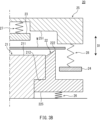
- FIG. 3B is a schematic diagram for explaining a method for producing a press-molded product using the press apparatus shown in FIG. 2.
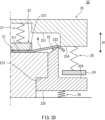
- FIG. 3C is a schematic diagram for explaining a method for manufacturing a press-molded product using the press apparatus shown in FIG. 2.
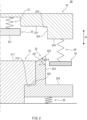
- FIG. 3D is a schematic diagram for explaining a method for producing a press-molded product using the press apparatus shown in FIG. 2 .
- FIG. 3A is a schematic diagram for explaining a method for producing a press-molded product using the press apparatus shown in FIG. 2.
- FIG. 3B is a schematic diagram for explaining a method for producing a press-molded product using the press apparatus shown in FIG. 2.
- FIG. 3C is a schematic
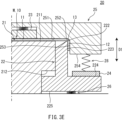
- FIG. 3E is a schematic diagram for explaining a method for manufacturing a press-molded product using the press apparatus shown in FIG. 2.
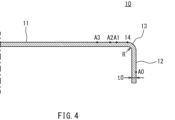
- FIG. 4 is a cross-sectional view of the press-formed product according to the embodiment.
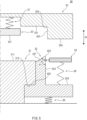
- FIG. 5 is a cross-sectional view of a press device according to a modified example of the embodiment.
- FIG. 6 is a perspective view of a press-formed product according to a modified example of the embodiment.
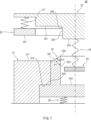
- FIG. 7 is a cross-sectional view of a press device according to a modified example of the embodiment.
- FIG. 8 is a graph showing the distribution of circumferential strain in the example and the comparative example.
- FIG. 9 is a graph showing the distribution of Vickers hardness in the examples and the comparative examples.
- the press apparatus includes a first punch, a second punch, a first pad, a die, a support mechanism, and a second pad.
- the first punch includes a first punch top surface.
- the first punch top surface intersects with the press direction.
- the second punch is arranged to the side of the first punch.
- the second punch includes a second punch top surface, a punch shoulder, a punch side surface, and a punch flange surface.
- the second punch top surface intersects with the press direction.
- the punch shoulder is continuous with the second punch top surface on the opposite side of the first punch.
- the punch side surface is connected to the second punch top surface via the punch shoulder.
- the punch flange surface is connected to the punch side surface on the opposite side of the punch shoulder.
- the punch flange surface intersects with the press direction.
- the first pad faces the first punch top surface in the press direction.
- the die includes a die bottom surface, a die shoulder, a die side surface, and a die flange surface.
- the die bottom surface is arranged to the side of the first pad.
- the die bottom surface faces at least the second punch top surface in the press direction.
- the die shoulder is continuous with the die bottom surface on the opposite side of the first pad.
- the die side surface is connected to the die bottom surface via the die shoulder.
- the die flange surface is connected to the die side surface on the opposite side of the die shoulder.
- the die flange surface faces the punch flange surface in the press direction.
- the support mechanism supports the second punch so that the punch shoulder is positioned closer to the die bottom surface than the top surface of the first punch.
- the support mechanism is configured to move the second punch relative to the first punch in the press direction.
- the second pad is positioned between the punch flange surface and the die flange surface (first configuration).
- the press device includes a first punch and a second punch arranged on the side of the first punch.
- the second punch is supported by a support mechanism so that its punch shoulder is located closer to the bottom surface of the die than the top surface of the first punch.
- the punch shoulder of the second punch is located closer to the bottom surface of the die than the top surface of the first punch, the part of the material located between the second punch and the die is bent toward the die side with respect to the part of the material sandwiched between the first pad and the top surface of the first punch.
- the die comes into contact with the material and the material is bent at the position of the punch shoulder of the second punch.
- the punch flange surface of the second punch is pressed by the die flange surface via the second pad, the second punch and its punch shoulder are pressed in the pressing direction.
- the punch shoulder forms a bent portion together with the die while being pressed in the pressing direction.
- the distance from the top surface of the first punch to the punch shoulder is greater than when the punch shoulder is pressed in. Therefore, by making the punch shoulder protrude from the top surface of the first punch, the material can be bent by the punch shoulder at a position closer to the edge. On the other hand, when the punch shoulder is pressed in the press direction, the distance from the top surface of the first punch to the punch shoulder is smaller. This allows the position of bending by the punch shoulder to move to the inside of the material. That is, in the press device according to the first configuration, the position of the material that is bent by the punch shoulder moves during forming.
- the press device according to the first configuration may further include a connection member.
- the connection member connects, for example, the die flange surface and the second pad. It is preferable that the connection member is configured to be expandable and contractible in the pressing direction (second configuration).
- the presence of a connecting member connecting the die flange surface and the second pad makes it possible to change the distance in the press direction between the punch flange surface of the second punch and the die flange surface during the forming process.
- the material can be bent at a gentle angle by keeping the distance in the press direction between the punch flange surface and the die flange surface relatively large.
- the second pad comes into contact with the punch flange surface and the connecting member begins to shrink.
- the top surface of the second punch may be formed so that the end on the punch shoulder side is located on the bottom surface side of the die relative to the end on the first punch side (third configuration).
- ⁇ 2 ⁇ 1 when the angle between the top surface of the first punch and the side surface of the punch is ⁇ 1 and the angle between the top surface of the second punch and the side surface of the punch is ⁇ 2, ⁇ 2 ⁇ 1 may be satisfied (fourth configuration).
- the press-formed product according to the embodiment includes a top plate, a bent portion, and a vertical wall.
- the bent portion is continuous with the top plate.
- the vertical wall is connected to the top plate via the bent portion.
- H1 is the average value of the Vickers hardness of five points measured at 0.5 mm intervals from a position 8.0 times the reference plate thickness on the vertical wall side from the boundary between the top plate and the bent portion
- H2 is the average value of the Vickers hardness of five points measured at 0.5 mm intervals in the range from a position 2.5 times the reference plate thickness to a position 4.0 times the reference plate thickness on the top plate side from the boundary
- the average Vickers hardness H2 of the top plate near the bend is greater than the average Vickers hardness H1 at a position relatively far from the bend toward the vertical wall.
- work hardening during press forming extends not only to the bend but also to the top plate. The widespread presence of work-hardened areas in this way increases the initial reaction force when a load is input to the press-formed product, allowing the press-formed product to exhibit excellent durability.
- the average Vickers hardness H3 of the top plate at a position farther away from the bend is greater than the average Vickers hardness H1 at a position relatively farther from the bend toward the vertical wall.
- the top plate has work-hardened portions not only in the vicinity of the bend, but also at positions farther away from the bend. This makes it easier for the initial reaction force when a load is input to the press-formed product to be higher, and makes it easier for the press-formed product to demonstrate excellent durability.
- Press-molded products] 1 is a perspective view showing a press-formed product 10 according to the present embodiment.
- the press-formed product 10 is used for a moving body such as an automobile or a ship.
- the press-formed product 10 is preferably used as an automobile part.
- the use of the press-formed product 10 is not limited thereto.
- the press-formed product 10 has, for example, an elongated shape.
- the press-formed product 10 may have a straight shape, or may be curved entirely or partially.
- the press-formed product 10 includes a top plate 11, vertical walls 12A, 12B, and bent portions 13A, 13B.
- the top plate 11 extends in the longitudinal direction of the press-formed product 10.
- the bent portions 13A and 13B are each continuous with the top plate 11.
- the bent portions 13A and 13B extend along both side edges of the top plate 11.
- Each of the bent portions 13A and 13B can have a substantially arc shape when viewed in a cross section (transverse section) perpendicular to the longitudinal direction of the press-formed product 10.
- One vertical wall 12A is connected to the top plate 11 via the bent portion 13A.
- the other vertical wall 12B is connected to the top plate 11 via the bent portion 13B.
- the vertical wall 12B is disposed on the opposite side of the vertical wall 12A with respect to the top plate 11.
- the vertical walls 12A and 12B extend along the bent portions 13A and 13B, respectively.
- the vertical walls 12A and 12B will be collectively referred to as the vertical walls 12, and the bent portions 13A and 13B will be collectively referred to as the bent portions 13.
- the press-molded product 10 can be manufactured using a press device 20 shown in Fig. 2.
- Fig. 2 is a cross-sectional view of the press device 20.
- the press device 20 has the same basic configuration on one side and the other side of the center line in the width direction. Therefore, Fig. 2 shows only a portion of the press device 20 on one side of the center line in the width direction. However, the press device 20 does not have to be completely symmetrical with respect to the center line in the width direction.
- the press device 20 includes a first punch 21, a second punch 22, a first pad 23, a second pad 24, and a die 25.
- the press device 20 further includes a support mechanism 26 and connecting members 27 and 28.
- the pads 23, 24 and the die 25 can approach and move away from the punches 21, 22 relatively.
- the pads 23, 24 and the die 25 are, for example, attached directly or indirectly to a slide (not shown) of the press device 20 and move together with the slide.
- the punches 21, 22 may be attached directly or indirectly to the slide and move together with the slide.
- the direction in which the pads 23, 24 and the die 25 approach and move away from the punches 21, 22 relatively is referred to as the press direction D1.
- the press direction D1 is, for example, the vertical direction.
- the first punch 21 includes a punch top surface 211.
- the punch top surface 211 intersects with the press direction D1.
- the punch top surface 211 may be substantially perpendicular to the press direction D1.
- the punch top surface 211 may have a generally flat shape, but may also have an uneven shape such as a bead in part.
- the second punch 22 is separate from the first punch 21.
- the second punch 22 is arranged to the side of the first punch 21.
- the second punch 22 is arranged outside the first punch 21 in the width direction of the press device 20.
- the second punch 22 includes a punch top surface 221, a punch shoulder 222, a punch side surface 223, and a punch flange surface 224.
- the punch top surface 221 intersects with the press direction D1.
- the punch shoulder 222 is continuous with the punch top surface 221 on the opposite side of the first punch 21.
- the punch shoulder 222 may be a corner (pin angle) that does not have a roundness.
- the radius of curvature of the punch shoulder 222 is, for example, 0 mm or more and 10.0 mm or less, preferably 1.0 mm or more and 10.0 mm or less, and more preferably 1.0 mm or more and 6.0 mm or less.
- the punch side surface 223 is connected to the punch top surface 211 via the punch shoulder 222.
- the punch side surface 223 extends substantially or approximately in the press direction D1 from the punch shoulder 222.
- the punch side surface 223 may be parallel to the press direction D1, or may be inclined with respect to the press direction D1.
- the punch shoulder 222 is located closer to the die 25 than the punch top surface 211 of the first punch 21.
- the punch top surface 221 is formed so that the end of the punch shoulder 222 is located closer to the die 25 than the end of the punch top surface 221 on the first punch 21 side.
- the punch top surface 221 is an inclined surface that is inclined with respect to the punch top surface 211 of the first punch 21. As the punch top surface 221 moves from the first punch 21 toward the punch shoulder 222, it approaches the die 25 in the press direction D1.
- the punch top surface 221 may be a surface that is substantially parallel to the punch top surface 211 of the first punch 21.
- the punch top surface 221 has, for example, a straight line shape when viewed in cross section of the press device 20. Alternatively, the punch top surface 221 may have a curved line shape when viewed in cross section of the press device 20.
- the shape of the punch top surface 221 is not particularly limited.
- the punch top surface 221 forms an angle ⁇ 2 with the punch side surface 223. If the punch top surface 221 has a straight shape in a cross-sectional view of the press device 20, the angle ⁇ 2 is the angle between the punch top surface 221 itself and the punch side surface 223. If the punch top surface 221 has a curved shape, for example, in a cross-sectional view of the press device 20, the angle ⁇ 2 is the angle between the tangent to the punch top surface 221 at the boundary between the punch top surface 221 and the punch shoulder 222 and the punch side surface 223. ⁇ 2 is, for example, 30° or more and 120° or less, and preferably 45° or more and 90° or less.
- the boundary between the punch top surface 221 and the punch shoulder 222 ends at the R on the punch top surface 221 side of the punch shoulder 222.
- the punch shoulder 222 is a pin angle, i.e., when the apex of the punch top surface 221 and the punch side surface 223 is the punch shoulder 222, the boundary between the punch top surface 221 and the punch shoulder 222 is also that apex.
- the angle ⁇ 2 between the punch top surface 221 and the punch side surface 223 is typically less than or equal to the angle ⁇ 1 between the punch top surface 211 and the punch side surface 223 of the first punch 21 ( ⁇ 2 ⁇ 1). It is preferable that the angles ⁇ 1 and ⁇ 2 satisfy ⁇ 2 ⁇ 1. ⁇ 1 is, for example, greater than or equal to 90° and less than or equal to 120°.
- the punch flange surface 224 is connected to the punch side surface 223 on the opposite side of the punch shoulder 222.
- the punch flange surface 224 protrudes from the punch side surface 223 on the opposite side of the first punch 21.
- the punch flange surface 224 intersects with the press direction D1.
- the punch flange surface 224 may be a surface that is substantially perpendicular to the press direction D1.
- the second punch 22 further includes a protrusion 225.
- the protrusion 225 is provided on the surface of the second punch 22 opposite the punch side surface 223.
- the protrusion 225 protrudes from that surface towards the first punch 21.
- the first punch 21 includes a recess 212 that receives the protrusion 225.
- the first pad 23 is disposed above the first punch 21 and the second punch 22.
- the first pad 23 faces the punch top surface 211 of the first punch 21 in the press direction D1.
- the first pad 23 has a plate pressing surface 231 on the punch top surface 211 side. It is preferable that the plate pressing surface 231 is substantially parallel to the punch top surface 211.
- the plate pressing surface 231 has a shape corresponding to the punch top surface 211.
- the die 25 includes a die bottom surface 251, a die shoulder 252, a die side surface 253, and a die flange surface 254.
- the die bottom surface 251 is disposed to the side of the first pad 23. In this embodiment, the die bottom surface 251 is disposed outside the first pad 23 in the width direction of the press device 20.
- the die bottom surface 251 faces at least the punch top surface 221 of the second punch 22 in the press direction D1. In this embodiment, the die bottom surface 251 faces not only the punch top surface 221 of the second punch 22 but also a part of the punch top surface 211 of the first punch 21 in the press direction D1. It is preferable that the die bottom surface 251 is substantially parallel to the punch top surface 211 of the first punch 21. However, the die bottom surface 251 does not have to be parallel to the punch top surface 221 of the second punch 22.
- the die shoulder 252 is continuous with the die bottom surface 251 on the opposite side of the first pad 23.
- the die shoulder 252 is disposed at a position corresponding to the punch shoulder 222 of the second punch 22.
- the die shoulder 252 has a substantially arc shape.
- the die shoulder 252 may be a corner (pin angle) that does not have a rounded shape.
- the die side 253 is connected to the die bottom 251 via the die shoulder 252. That is, the die shoulder 252 is a corner portion between the die bottom 251 and the die side 253.
- the die side 253 extends substantially or approximately in the press direction D1 from the die shoulder 252.
- the die side 253 is disposed at a position corresponding to the punch side 223.
- the die side 253 has a shape corresponding to the punch side 223.
- the die side 253 may be parallel to the press direction D1 in a cross-sectional view of the press device 20, or may be inclined with respect to the press direction D1.
- the die flange surface 254 is connected to the die side surface 253 on the opposite side of the die shoulder 252.
- the die flange surface 254 protrudes from the die side surface 253 on the opposite side of the first pad 23.
- the die flange surface 254 faces the punch flange surface 224 of the second punch 22 in the press direction D1.
- the second pad 24 is disposed between the die flange surface 254 and the punch flange surface 224.
- the support mechanism 26 supports the second punch 22.
- the support mechanism 26 supports the second punch 22 so that the punch shoulder 222 of the second punch 22 is positioned closer to the die bottom surface 251 than the punch top surface 211 of the first punch 21.
- the support mechanism 26 supports the second punch 22 from the side opposite the punch top surface 221.
- the support mechanism 26 is configured to move the second punch 22 relative to the first punch 21 in the press direction D1.
- the support mechanism 26 is configured, for example, to be expandable and contractible in the press direction D1.
- the support mechanism 26 may be a spring such as a compression coil spring, or an actuator such as a hydraulic cylinder or an air cylinder. By operating the support mechanism 26, the second punch 22 can move relative to the first punch 21 in the press direction D1.
- the support mechanism 26 may be capable of controlling the position of the second punch 22 in the press direction D1, but may also simply bias the second punch 22 toward the die bottom surface 251. In this case, the relative movement of the first punch 21 and the second punch 22 in the press direction D1 can be restricted by abutting the convex portion 225 of the second punch 22 against the surface of the concave portion 212 of the first punch 21.
- connection member 27 is attached to the first pad 23 on the side opposite the plate pressing surface 231.
- the connection member 27 connects the first pad 23 to the die 25.
- the connection member 27 may directly connect the first pad 23 to the die 25, or may indirectly connect the first pad 23 to the die 25 via, for example, a slide of the press device 20.
- connection member 27 is configured to be expandable and contractable in the press direction D1.
- the connection member 27 may be a spring such as a compression coil spring, or an actuator such as a hydraulic cylinder or an air cylinder. As the connection member 27 expands and contracts in the press direction D1, the first pad 23 can move in the press direction D1 relative to the die 25.
- connection member 28 connects the die 25 and the second pad 24. More specifically, the connection member 28 connects the die flange surface 254 and the second pad 24.
- the connection member 28 is configured to be expandable and contractible in the press direction D1.
- the connection member 28 may be a spring such as a compression coil spring, or an actuator such as a hydraulic cylinder or an air cylinder.
- Method of manufacturing press-molded products 3A to 3E, an example of a method for manufacturing the press-formed product 10 using the press device 20 will be described.
- This manufacturing method can include a preparation step and a molding step.
- a material M made of a metal plate is prepared.
- the material M is, for example, a blank having a shape obtained by unfolding the press-formed product 10 (FIG. 1).
- the metal plate constituting the material M may be a steel plate. This steel plate has a tensile strength of, for example, 590 MPa or more, preferably 980 MPa or more, and more preferably 1180 MPa or more. The tensile strength of the steel plate may be 1470 MPa or less.
- the plate thickness of the material M is, for example, 1.0 mm or more.
- the plate thickness of the material M may be 6.0 mm or less.
- the press device 20 forms the material M into the press-formed product 10 (FIG. 1).
- the slide (not shown) of the press device 20 is brought to the top dead center, and the first punch 21 and second punch 22 are separated from the first pad 23 and die 25 in the press direction D1.
- the material M is placed between the first punch 21 and second punch 22 and the first pad 23 and die 25.
- the second punch 22 waits with its punch shoulder 222 positioned closer to the die bottom surface 251 than the punch top surface 211 of the first punch 21.
- the convex portion 225 of the second punch 22 can be caught in the concave portion 212 of the first punch 21, causing the second punch 22 to stop with the punch shoulder 222 protruding from the punch top surface 211.
- the first pad 23 is brought relatively close to the first punch 21 in the press direction D1.
- the connecting member 27 is extended to bring the first punch 21 and the first pad 23 relatively close to each other.
- the slide of the press device 20 may be moved in the press direction D1 to bring the first pad 23 together with the die 25 relatively close to the first punch 21.
- the first pad 23 contacts the material M before the die 25.
- the first pad 23 and the first punch 21 clamp a part of the material M. More specifically, the material M is pressed by the plate pressing surface 231 of the first pad 23 and the punch top surface 211 of the first punch 21.
- the second pad 24 is separated from the punch flange surface 224 of the second punch 22 in the press direction D1.
- the material M When the material M is clamped by the first pad 23 and the first punch 21, the material M is pressed down by the first pad 23 at the position of the first punch 21, while the material M is supported by the punch shoulder 222 at the position of the second punch 22. Because the punch shoulder 222 protrudes toward the die 25 relative to the first punch 21, the material M bends at the end of the first pad 23. In other words, the part of the material M that is not clamped by the first pad 23 and the first punch 21 jumps up toward the die 25. As the part of the material M that is not clamped by the first pad 23 and the first punch 21 moves toward the punch shoulder 222, it approaches the die 25 in the press direction D1.
- connection member 27 of the first pad 23 contracts and the die 25 comes into contact with the material M, as shown in FIG. 3D.
- the die 25 first comes into contact with the material M via the die flange surface 254. This causes the material M to bend at the punch shoulder 222.
- the material M is formed into the preliminary shape shown in FIG. 3D.
- the second pad 24 comes into contact with the punch flange surface 224 of the second punch 22.
- the connecting member 28 contracts and the punch flange surface 224 is pressed by the second pad 24.
- the second punch 22 moves in the press direction D1 relative to the first punch 21.
- the support mechanism 26 contracts, causing the second punch 22 to be pressed in the press direction D1 relative to the first punch 21.
- the second punch 22 When the second punch 22 is biased toward the die 25 by the support mechanism 26, the second punch 22 is pushed in the press direction D1 when the pressing load from the die 25 and second pad 24 exceeds the biasing force of the support mechanism 26.
- the die 25 and second pad 24 push the second punch 22 until it reaches the bottom dead center of the press device 20.
- the punch shoulder 222 of the second punch 22 At the bottom dead center of the press device 20, the punch shoulder 222 of the second punch 22 is positioned at substantially the same position in the press direction D1 as the punch top surface 211 of the first punch 21.
- the material M is sandwiched between the punch top surface 211 of the first punch 21 and the first pad 23 and die bottom surface 251 to form the top plate 11. Also, at the bottom dead center of the press device 20, the material M is sandwiched between the punch side surface 223 of the second punch 22 and the die side surface 253 to form the vertical wall 12. Furthermore, the bent portion 13 is formed along the die shoulder 252. In this way, the press-molded product 10 is manufactured.
- Figure 4 is a cross-sectional view of the press-formed product 10 produced by the press device 20.
- Figure 4 partially shows a cross-section (transverse section) of the press-formed product 10 along the plate thickness direction.
- H1 corresponds to the Vickers hardness of the material M before forming.
- H2 The average value of the Vickers hardness of five points measured at 0.5 mm intervals in the range from position A1 to position A2 of the top plate 11 is defined as H2 [HV].
- Position A1 is a position 2.5 times the reference plate thickness t0 away from the boundary 14 toward the top plate 11 side.
- Position A2 is a position 4.0 times the reference plate thickness t0 away from the boundary 14 toward the top plate 11 side. H1 and H2 satisfy H2/H1 ⁇ 1.1.
- the reference plate thickness t0 is the plate thickness of the vertical wall 12, and is measured, for example, near the end of the vertical wall 12. Specifically, the plate thickness measured at a position 10.0 mm toward the bent portion 13 along the outer surface of the bent portion of the press-formed product 10 from the tip (free end) of the vertical wall 12 can be set as the reference plate thickness t0.
- the reference plate thickness t0 corresponds to the plate thickness of the material M before forming.
- H3 is the average value of the Vickers hardness of five consecutive points spaced 0.5 mm apart from the boundary 14 and located on the top plate 11 side beyond position A3, which is 7.0 times the reference plate thickness t0.
- H3 that satisfies H3/H1 ⁇ 1.1.
- Positions A0, A1, A2, and A3 are all positions determined by measuring the distance from the boundary 14 along the outer bent surface of the press-formed product 10.
- H1, H2, and H3 can be obtained as follows.
- a test piece including a cross section of the top plate 11, the bent portion 13, and the vertical wall 12 is taken from the press-formed product 10, and the Vickers hardness of this cross section (test surface) is measured at 1/4 of the plate thickness from the bent outer surface of the press-formed product 10 in accordance with JIS Z 2244:2020 at five points at 0.5 mm intervals from position A0 toward the end of the vertical wall 12. Then, the average value of the measured Vickers hardness is calculated to obtain H1.
- the Vickers hardness of any five points at 0.5 mm intervals within the range from position A1 to position A2 in accordance with JIS Z 2244:2020 is measured at 1/4 of the plate thickness from the bent outer surface of the press-formed product 10 in accordance with JIS Z 2244:2020. Then, the average value of the measured Vickers hardness is calculated to obtain H2.
- the Vickers hardness is measured at a position 1/4 of the plate thickness from the outer surface of the bent part of the press-formed product 10 on the test surface, in accordance with JIS Z 2244:2020, starting from position A3 and measuring at 0.5 mm intervals until the center of the width of the top plate 11 is reached, for example.
- the average Vickers hardness of each measurement point is calculated for five points, including the measurement point and the two measurement points on either side of that measurement point, and each calculated value can be set as H3.
- the test force for the Vickers hardness test when obtaining H1, H2, and H3 is 1 kgw (9.8 N).
- H1 corresponds to the Vickers hardness of the material M as described above.
- H1 ⁇ 370 it can be determined that a steel plate with a tensile strength of 1180 MPa or more is used as the material M.
- R the radius of curvature on the inside of the bend of the bent portion 13
- H1 ⁇ 370 it is preferable that the standard plate thickness t0 and the radius of curvature R satisfy R/t0 ⁇ 1.5, and more preferably R/t0 ⁇ 1.0.
- H1 ⁇ 370 it is preferable that the standard plate thickness t0 and the radius of curvature R satisfy R/t0>0.3, and more preferably R/t0 ⁇ 0.7.
- H1 may be 466 or less (H1 ⁇ 466).
- 370 ⁇ H1 ⁇ 4666 it can be determined that a steel plate with a tensile strength of 1180 MPa or more and 1470 MPa or less is used as the material M. If 308 ⁇ H1 ⁇ 370, it can be determined that a steel plate with a tensile strength of 980 MPa or more and less than 1180 MPa was used as the material M. If 308 ⁇ H1 ⁇ 370, it is preferable that the reference plate thickness t0 and the radius of curvature R satisfy R/t0 ⁇ 1.0, and more preferably R/t0 ⁇ 0.7. If 308 ⁇ H1 ⁇ 370, for example, R/t0>0.1 may be acceptable, and preferably R/t0 ⁇ 0.3.
- the radius of curvature R of the bent portion 13 is, for example, 0.0 mm or more and 6.0 mm or less, and preferably is greater than 0.0 mm and less than 6.0 mm. If the top plate 11 and the vertical wall 12 form an unrounded corner (pin angle), the radius of curvature R is 0.0 mm. On the other hand, if the surface of the bent portion 13 has a substantially arc shape in cross section, the radius of curvature R is greater than 0.0 mm.
- the forming of the material M is started in a state in which the punch shoulder 222 of the second punch 22 protrudes from the punch top surface 211 of the first punch 21 toward the die 25.
- the shortest distance from the punch top surface 211 to the punch shoulder 222 is larger than in a state in which the punch shoulder 222 is pressed in to a position substantially identical to the punch top surface 211. Therefore, the material M can be pre-strained by bending the material M by the punch shoulder 222 at a position closer to the edge of the material M.
- the punch shoulder 222 protruding from the punch top surface 211 is pressed in, thereby making it possible to reduce the shortest distance from the punch top surface 211 to the punch shoulder 222.
- the position of bending by the punch shoulder 222 can be moved to the inside of the material M.
- the punch flange surface 224 of the second punch 22 is pressed by the second pad 24, and the second punch 22 is pushed in the press direction D1.
- the second pad 24 can change the distance between the punch flange surface 224 and the die flange surface 254 in the press direction D1 during the forming process.
- the distance between the punch flange surface 224 and the die flange surface 254 can be secured relatively large. This allows the material M to be bent at a gentle angle by the die 25 and the punch shoulder 222.
- the connecting member 28 shrinks, reducing the distance between the punch flange surface 224 and the die flange surface 254, and the punch flange surface 224 can be pushed in the press direction D1 by the die flange surface 254. This makes it easier for the die 25 and second punch 22 to reliably press the material M when the press device 20 is at the bottom dead center.
- the punch top surface 221 of the second punch 22 is formed so that the end on the punch shoulder 222 side is located closer to the die bottom surface 251 than the end on the first punch 21 side.
- the end of the punch top surface 221 on the first punch 21 side can be positioned further back from the punch top surface 221 of the first punch 21 relative to the die 25. In this case, interference between the boundary between the first punch 21 and the second punch 22 and the material M is less likely to occur.
- the punch top surface 221 of the second punch 22 may be a surface that is substantially parallel to the punch top surface 211 of the first punch 21.
- the punch top surface 221 of the second punch 22 in addition to the punch top surface 211 of the first punch 21, can also press the material M together with the die bottom surface 251.
- the first punch 21 is provided with a recess 212
- the second punch 22 is provided with a protrusion 225.
- the protrusion 225 of the second punch 22 is received in the recess 212 of the first punch 21, thereby restricting the movement of the second punch 22 in the press direction D1.
- the protrusion 225 of the second punch 22 abuts against the surface of the recess 212 of the first punch 21, thereby stopping the second punch 22 and positioning the punch shoulder 222 at a desired position before the start of forming. Therefore, the support mechanism 26 of the second punch 22 may simply bias the second punch 22 toward the die 25. In other words, the support mechanism 26 can be simplified.
- the press-formed product 10 When the press-formed product 10 is manufactured using the press device 20 according to this embodiment, strain is widely distributed in the press-formed product 10 as described above, and therefore work hardening also occurs widely. Specifically, compared with the Vickers hardness H1 equivalent to the material M before forming, the Vickers hardness H2 of the top plate 11 in the vicinity of the bent portion 13 is greater. That is, in the press-formed product 10 after forming, work hardening extends not only to the bent portion 13 but also to the top plate 11. With such a wide presence of the work-hardened portion, for example, in the event of a collision with the top plate 11, the colliding object is more likely to come into contact with the work-hardened portion, and the initial reaction force against the collision load can be increased. Therefore, the press-formed product 10 can exhibit excellent durability.
- the top plate 11 is pressed by the first pad 23 in the initial stage of forming, causing bending and work hardening.
- the Vickers hardness H3 of the top plate 11 at a position relatively far from the bent portion 13 is greater than the Vickers hardness H1 equivalent to the material M before forming. This makes it easier for the initial reaction force to increase when a load is input to the press-formed product 10, further improving the strength of the press-formed product 10.
- the second punch 22 includes a convex portion 225 that protrudes toward the first punch 21.
- the second punch 22 does not necessarily have to include the convex portion 225. If the second punch 22 does not have a convex portion 225, the first punch 21 does not necessarily have to include a concave portion 212.
- the connecting member 28 is disposed between the die flange surface 254 and the second pad 24, and connects the die flange surface 254 and the second pad 24.
- the connecting member 28 may be disposed between the punch flange surface 224 of the second punch 22 and the second pad 24, and connects the punch flange surface 224 and the second pad 24. Even in this case, the distance between the punch flange surface 224 and the die flange surface 254 in the press direction D1 can be changed in the forming process.
- the distance between the punch flange surface 224 and the die flange surface 254 can be secured relatively large. This allows the material to be bent at a gentle angle by the die 25 and the punch shoulder 222.
- the connecting member 28 shrinks, reducing the distance between the punch flange surface 224 and the die flange surface 254, and the punch flange surface 224 can be pressed in the pressing direction D1 by the die flange surface 254. This makes it easier for the die 25 and the second punch 22 to reliably press the material at the bottom dead center of the press device 20.
- the press device 20 does not need to include the connecting member 28.
- the second pad 24 may be directly connected to the die flange surface 254 or the punch flange surface 224.
- the second pad 24 is made of an elastic body.
- the press-formed product 10 has a concave cross section.
- the shape of the press-formed product 10 is not limited to this.
- the press-formed product 10 may have a cylindrical burring portion as the vertical wall 12, and a bent portion 13 at the base of the burring portion.
- the punches 21, 22 and the die 25 of the press device 20 may be axially symmetrical, as shown in FIG. 7, for example.
- Figure 8 is a graph showing the distribution of circumferential strain on the outer surface of the bent portion 13 in the examples and comparative examples.
- the horizontal axis in Figure 8 is the distance measured along the outer surface of the bent portion 13 from a reference point (zero) on the top plate 11 toward the bent portion 13.
- Figure 8 also shows the distribution of circumferential strain during forming (preforming stage) for the examples.
- the punch shoulder 222 of the second punch 22 is positioned closer to the die 25 than the punch top surface 211 of the first punch 21, and the distance from the punch top surface 211 to the punch shoulder 222 is long. Therefore, as shown in FIG. 8, in the pre-forming stage (during forming), bending due to the punch shoulder 222, i.e., the strain peak, occurs at a position relatively far from the reference point (on the edge side of the material M).
- the punch shoulder 222 of the second punch 22 is pressed in the press direction D1 after pre-forming, shortening the distance from the punch top surface 211 to the punch shoulder 222, and the strain peak moves closer to the reference point than in the pre-forming stage. Therefore, in the embodiment, the circumferential strain peak is distributed over a wide range.
- the circumferential strain in the comparative example was significantly larger than the maximum value of the circumferential strain in the example.
- the circumferential strain was distributed over a wide range, resulting in a 27% decrease in the maximum value of the circumferential strain compared to the comparative example.
- Figure 9 is a graph showing the distribution of Vickers hardness at a position 1/4 of the plate thickness for the press-formed product 10 formed in the examples and comparative examples.
- the horizontal axis of Figure 9 is the distance along the outer surface of the bend from the boundary 14 between the top plate 11 and the bent portion 13/reference plate thickness t0.
- the distance from the boundary 14 (the R end of the bent portion 13 on the top plate 11 side) is set to 0 at the position of the boundary 14, negative on the top plate 11 side, and positive on the vertical wall 12 side.
- the vertical axis of Figure 9 is the Vickers hardness measured at a position 1/4 of the plate thickness, and is the ratio to the Vickers hardness (base material hardness) of the steel plate used as the material M of the press-formed product 10.
- the base material hardness is substantially equal to the average Vickers hardness H1 [HV] described in the above embodiment.
- the Vickers hardness measured in the range from position A1, which is 2.5 times the standard plate thickness t0, to position A2, which is 4.0 times the standard plate thickness t0, on the top plate 11 side from the boundary 14 between the top plate 11 and the bent portion 13, was 1.1 times or more the base material hardness H1 overall. Therefore, in the example, when five points of the Vickers hardness measured at 0.5 mm intervals from position A1 to position A2 were arbitrarily selected, the average value H2 of these five points satisfies H2/H1 ⁇ 1.1. On the other hand, in the comparative example, the Vickers hardness was the same as the base material hardness H1 in the range from position A1 to position A2, and H2/H1 was 1.0.
- the strain of the press-formed product 10 becomes smaller than the limit strain at which breakage occurs. Therefore, even if a larger strain occurs during a collision, the press-formed product 10 is less likely to break. As a result, the amount of energy absorbed when the press-formed product 10 is subjected to an impact is likely to be high.
- R is the radius of curvature on the inside of the bent portion 13 after forming.
- M is 980 MPa
- the circumferential strain on the outer surface of the bent portion 13 is 0.50 or less, it is determined that there is no crack, and if it exceeds 0.50, it is determined that there is a crack.
- the tensile strength of material M is 1180 MPa, if the circumferential strain on the outer surface of the bent portion 13 is 0.35 or less, it is determined that there is no crack, and if it exceeds 0.35, it is determined that there is a crack.
- the method is the same as that of the above embodiment, it is possible to form the bent portion 13 without cracks even when the material is a high-strength steel plate with a tensile strength of 980 MPa or more and R/t0 is relatively small, less than 1.0.
- the method is the same as the above embodiment, it is possible to form the bent portion 13 without cracks even when the material is a high-strength steel plate with a tensile strength of 1180 MPa or more and R/t0 is a relatively small value of 1.5 or less.
- the embodiment it is possible to form a bent portion 13 with a smaller bending radius (radius of curvature on the inside of the bend) without cracking compared to the comparative example.
- the bending radius of the bent portion 13 is small, the distance between the R end of the bent portion 13 on the top plate 11 side and the vertical wall 12 is shortened, so that when the press-formed product receives an impact, the load is more likely to pass through the vertical wall 12, improving the load transmission efficiency of the press-formed product 10.
- the load (reaction force) of the press-formed product 10 tends to be higher, and the amount of energy absorption can also be increased.
Landscapes
- Engineering & Computer Science (AREA)
- Mechanical Engineering (AREA)
- Shaping Metal By Deep-Drawing, Or The Like (AREA)
Priority Applications (1)
| Application Number | Priority Date | Filing Date | Title |
|---|---|---|---|
| JP2025550330A JPWO2025075107A1 (https=) | 2023-10-05 | 2024-10-03 |
Applications Claiming Priority (2)
| Application Number | Priority Date | Filing Date | Title |
|---|---|---|---|
| JP2023173829 | 2023-10-05 | ||
| JP2023-173829 | 2023-10-05 |
Publications (1)
| Publication Number | Publication Date |
|---|---|
| WO2025075107A1 true WO2025075107A1 (ja) | 2025-04-10 |
Family
ID=95283286
Family Applications (1)
| Application Number | Title | Priority Date | Filing Date |
|---|---|---|---|
| PCT/JP2024/035506 Pending WO2025075107A1 (ja) | 2023-10-05 | 2024-10-03 | プレス装置及びプレス成形品 |
Country Status (2)
| Country | Link |
|---|---|
| JP (1) | JPWO2025075107A1 (https=) |
| WO (1) | WO2025075107A1 (https=) |
Citations (5)
| Publication number | Priority date | Publication date | Assignee | Title |
|---|---|---|---|---|
| JP2006192480A (ja) * | 2005-01-14 | 2006-07-27 | Nippon Steel Corp | 金属板材の熱間プレス成形方法およびその装置 |
| WO2012118223A1 (ja) * | 2011-03-03 | 2012-09-07 | 新日本製鐵株式会社 | シートメタルの曲げ加工方法および製品 |
| WO2016121358A1 (ja) * | 2015-01-26 | 2016-08-04 | 新日鐵住金株式会社 | プレス成形品、並びにそのプレス成形品の製造方法及び製造設備列 |
| JP2019177388A (ja) * | 2018-03-30 | 2019-10-17 | マツダ株式会社 | 加工装置及び方法 |
| JP2021020236A (ja) * | 2019-07-26 | 2021-02-18 | 株式会社アイエント | 成形金型及びそれを用いるプレス成形方法 |
-
2024
- 2024-10-03 JP JP2025550330A patent/JPWO2025075107A1/ja active Pending
- 2024-10-03 WO PCT/JP2024/035506 patent/WO2025075107A1/ja active Pending
Patent Citations (5)
| Publication number | Priority date | Publication date | Assignee | Title |
|---|---|---|---|---|
| JP2006192480A (ja) * | 2005-01-14 | 2006-07-27 | Nippon Steel Corp | 金属板材の熱間プレス成形方法およびその装置 |
| WO2012118223A1 (ja) * | 2011-03-03 | 2012-09-07 | 新日本製鐵株式会社 | シートメタルの曲げ加工方法および製品 |
| WO2016121358A1 (ja) * | 2015-01-26 | 2016-08-04 | 新日鐵住金株式会社 | プレス成形品、並びにそのプレス成形品の製造方法及び製造設備列 |
| JP2019177388A (ja) * | 2018-03-30 | 2019-10-17 | マツダ株式会社 | 加工装置及び方法 |
| JP2021020236A (ja) * | 2019-07-26 | 2021-02-18 | 株式会社アイエント | 成形金型及びそれを用いるプレス成形方法 |
Also Published As
| Publication number | Publication date |
|---|---|
| JPWO2025075107A1 (https=) | 2025-04-10 |
Similar Documents
| Publication | Publication Date | Title |
|---|---|---|
| KR102445975B1 (ko) | 프레스 성형 방법 | |
| JP6032374B2 (ja) | プレス成形体の製造方法及びプレス成形装置 | |
| KR101970423B1 (ko) | 프레스 성형품, 및 그 프레스 성형품의 제조 방법 및 제조 설비열 | |
| CN108602106B (zh) | 压制装置和压制成型品的制造方法 | |
| CN109562427B (zh) | 冲压成型品的制造方法 | |
| JP7617399B2 (ja) | プレス装置及びプレス成形品の製造方法 | |
| JP2018020349A (ja) | 金型の設計方法およびプレス成形品の製造方法 | |
| JP5020858B2 (ja) | 部材長手方向の平面内に屈曲部を有する金属製断面ハット型形状部材およびそのプレス成形方法 | |
| KR20180102607A (ko) | 프레스 성형품의 제조 방법 | |
| JP7564448B2 (ja) | プレス成形品の製造方法及び製造設備 | |
| JP2019030886A (ja) | プレス成形品の製造方法 | |
| WO2020121591A1 (ja) | プレス成形方法 | |
| KR20230002914A (ko) | 프레스 성형 금형 및 프레스 성형 방법 | |
| CN111801175B (zh) | 冲压成型品的设计方法、冲压成型模具、冲压成型品以及冲压成型品的制造方法 | |
| WO2024053186A1 (ja) | プレス成形品の製造方法 | |
| WO2020217594A1 (ja) | プレス成形方法 | |
| WO2020105647A1 (ja) | 湾曲部材の製造方法 | |
| JP7226382B2 (ja) | プレス部品の製造方法、曲げ戻し用の金型、及びプレス部品の成形方法 | |
| WO2025075107A1 (ja) | プレス装置及びプレス成形品 | |
| JP4907590B2 (ja) | 部材長手方向の平面外で屈曲部を有する金属製断面ハット型形状部材およびそのプレス成形方法 | |
| US11130163B2 (en) | Press molding method and press molding apparatus | |
| JP7780123B2 (ja) | プレス成形品の製造方法及びプレス成形品 | |
| JP6493331B2 (ja) | プレス成形品の製造方法 | |
| JP6176429B1 (ja) | プレス成形品の製造方法 | |
| JP7605372B1 (ja) | プレス成形品の製造方法、及び金型の設計方法 |
Legal Events
| Date | Code | Title | Description |
|---|---|---|---|
| 121 | Ep: the epo has been informed by wipo that ep was designated in this application |
Ref document number: 24874707 Country of ref document: EP Kind code of ref document: A1 |
|
| ENP | Entry into the national phase |
Ref document number: 2025550330 Country of ref document: JP Kind code of ref document: A |
|
| WWE | Wipo information: entry into national phase |
Ref document number: 2025550330 Country of ref document: JP |