WO2025069978A1 - 照明装置 - Google Patents
照明装置 Download PDFInfo
- Publication number
- WO2025069978A1 WO2025069978A1 PCT/JP2024/031849 JP2024031849W WO2025069978A1 WO 2025069978 A1 WO2025069978 A1 WO 2025069978A1 JP 2024031849 W JP2024031849 W JP 2024031849W WO 2025069978 A1 WO2025069978 A1 WO 2025069978A1
- Authority
- WO
- WIPO (PCT)
- Prior art keywords
- light
- liquid crystal
- substrate
- electrode
- shielding
- Prior art date
- Legal status (The legal status is an assumption and is not a legal conclusion. Google has not performed a legal analysis and makes no representation as to the accuracy of the status listed.)
- Pending
Links
Images














Classifications
-
- F—MECHANICAL ENGINEERING; LIGHTING; HEATING; WEAPONS; BLASTING
- F21—LIGHTING
- F21S—NON-PORTABLE LIGHTING DEVICES; SYSTEMS THEREOF; VEHICLE LIGHTING DEVICES SPECIALLY ADAPTED FOR VEHICLE EXTERIORS
- F21S2/00—Systems of lighting devices, not provided for in main groups F21S4/00 - F21S10/00 or F21S19/00, e.g. of modular construction
-
- G—PHYSICS
- G02—OPTICS
- G02F—OPTICAL DEVICES OR ARRANGEMENTS FOR THE CONTROL OF LIGHT BY MODIFICATION OF THE OPTICAL PROPERTIES OF THE MEDIA OF THE ELEMENTS INVOLVED THEREIN; NON-LINEAR OPTICS; FREQUENCY-CHANGING OF LIGHT; OPTICAL LOGIC ELEMENTS; OPTICAL ANALOGUE/DIGITAL CONVERTERS
- G02F1/00—Devices or arrangements for the control of the intensity, colour, phase, polarisation or direction of light arriving from an independent light source, e.g. switching, gating or modulating; Non-linear optics
- G02F1/01—Devices or arrangements for the control of the intensity, colour, phase, polarisation or direction of light arriving from an independent light source, e.g. switching, gating or modulating; Non-linear optics for the control of the intensity, phase, polarisation or colour
- G02F1/13—Devices or arrangements for the control of the intensity, colour, phase, polarisation or direction of light arriving from an independent light source, e.g. switching, gating or modulating; Non-linear optics for the control of the intensity, phase, polarisation or colour based on liquid crystals, e.g. single liquid crystal display cells
-
- G—PHYSICS
- G02—OPTICS
- G02F—OPTICAL DEVICES OR ARRANGEMENTS FOR THE CONTROL OF LIGHT BY MODIFICATION OF THE OPTICAL PROPERTIES OF THE MEDIA OF THE ELEMENTS INVOLVED THEREIN; NON-LINEAR OPTICS; FREQUENCY-CHANGING OF LIGHT; OPTICAL LOGIC ELEMENTS; OPTICAL ANALOGUE/DIGITAL CONVERTERS
- G02F1/00—Devices or arrangements for the control of the intensity, colour, phase, polarisation or direction of light arriving from an independent light source, e.g. switching, gating or modulating; Non-linear optics
- G02F1/01—Devices or arrangements for the control of the intensity, colour, phase, polarisation or direction of light arriving from an independent light source, e.g. switching, gating or modulating; Non-linear optics for the control of the intensity, phase, polarisation or colour
- G02F1/13—Devices or arrangements for the control of the intensity, colour, phase, polarisation or direction of light arriving from an independent light source, e.g. switching, gating or modulating; Non-linear optics for the control of the intensity, phase, polarisation or colour based on liquid crystals, e.g. single liquid crystal display cells
- G02F1/133—Constructional arrangements; Operation of liquid crystal cells; Circuit arrangements
- G02F1/1333—Constructional arrangements; Manufacturing methods
- G02F1/1335—Structural association of cells with optical devices, e.g. polarisers or reflectors
-
- G—PHYSICS
- G02—OPTICS
- G02F—OPTICAL DEVICES OR ARRANGEMENTS FOR THE CONTROL OF LIGHT BY MODIFICATION OF THE OPTICAL PROPERTIES OF THE MEDIA OF THE ELEMENTS INVOLVED THEREIN; NON-LINEAR OPTICS; FREQUENCY-CHANGING OF LIGHT; OPTICAL LOGIC ELEMENTS; OPTICAL ANALOGUE/DIGITAL CONVERTERS
- G02F1/00—Devices or arrangements for the control of the intensity, colour, phase, polarisation or direction of light arriving from an independent light source, e.g. switching, gating or modulating; Non-linear optics
- G02F1/01—Devices or arrangements for the control of the intensity, colour, phase, polarisation or direction of light arriving from an independent light source, e.g. switching, gating or modulating; Non-linear optics for the control of the intensity, phase, polarisation or colour
- G02F1/13—Devices or arrangements for the control of the intensity, colour, phase, polarisation or direction of light arriving from an independent light source, e.g. switching, gating or modulating; Non-linear optics for the control of the intensity, phase, polarisation or colour based on liquid crystals, e.g. single liquid crystal display cells
- G02F1/133—Constructional arrangements; Operation of liquid crystal cells; Circuit arrangements
- G02F1/1333—Constructional arrangements; Manufacturing methods
- G02F1/1335—Structural association of cells with optical devices, e.g. polarisers or reflectors
- G02F1/1336—Illuminating devices
-
- G—PHYSICS
- G02—OPTICS
- G02F—OPTICAL DEVICES OR ARRANGEMENTS FOR THE CONTROL OF LIGHT BY MODIFICATION OF THE OPTICAL PROPERTIES OF THE MEDIA OF THE ELEMENTS INVOLVED THEREIN; NON-LINEAR OPTICS; FREQUENCY-CHANGING OF LIGHT; OPTICAL LOGIC ELEMENTS; OPTICAL ANALOGUE/DIGITAL CONVERTERS
- G02F1/00—Devices or arrangements for the control of the intensity, colour, phase, polarisation or direction of light arriving from an independent light source, e.g. switching, gating or modulating; Non-linear optics
- G02F1/01—Devices or arrangements for the control of the intensity, colour, phase, polarisation or direction of light arriving from an independent light source, e.g. switching, gating or modulating; Non-linear optics for the control of the intensity, phase, polarisation or colour
- G02F1/13—Devices or arrangements for the control of the intensity, colour, phase, polarisation or direction of light arriving from an independent light source, e.g. switching, gating or modulating; Non-linear optics for the control of the intensity, phase, polarisation or colour based on liquid crystals, e.g. single liquid crystal display cells
- G02F1/133—Constructional arrangements; Operation of liquid crystal cells; Circuit arrangements
- G02F1/1333—Constructional arrangements; Manufacturing methods
- G02F1/1343—Electrodes
-
- G—PHYSICS
- G02—OPTICS
- G02F—OPTICAL DEVICES OR ARRANGEMENTS FOR THE CONTROL OF LIGHT BY MODIFICATION OF THE OPTICAL PROPERTIES OF THE MEDIA OF THE ELEMENTS INVOLVED THEREIN; NON-LINEAR OPTICS; FREQUENCY-CHANGING OF LIGHT; OPTICAL LOGIC ELEMENTS; OPTICAL ANALOGUE/DIGITAL CONVERTERS
- G02F1/00—Devices or arrangements for the control of the intensity, colour, phase, polarisation or direction of light arriving from an independent light source, e.g. switching, gating or modulating; Non-linear optics
- G02F1/01—Devices or arrangements for the control of the intensity, colour, phase, polarisation or direction of light arriving from an independent light source, e.g. switching, gating or modulating; Non-linear optics for the control of the intensity, phase, polarisation or colour
- G02F1/13—Devices or arrangements for the control of the intensity, colour, phase, polarisation or direction of light arriving from an independent light source, e.g. switching, gating or modulating; Non-linear optics for the control of the intensity, phase, polarisation or colour based on liquid crystals, e.g. single liquid crystal display cells
- G02F1/133—Constructional arrangements; Operation of liquid crystal cells; Circuit arrangements
- G02F1/1333—Constructional arrangements; Manufacturing methods
- G02F1/1347—Arrangement of liquid crystal layers or cells in which the final condition of one light beam is achieved by the addition of the effects of two or more layers or cells
Definitions
- One embodiment of the present invention relates to a lighting device that uses the electro-optical effect of liquid crystal to control the range of light irradiation.
- a lighting device that utilizes the electro-optical effect of liquid crystals
- a lighting device that can adjust the amount of light emitted for each direction of light irradiation using a liquid crystal cell arranged to cover the light source (see Patent Document 1).
- a lighting device that forms multiple periodic spot patterns that do not overlap on the projection surface by passing light emitted from a light source through a liquid crystal cell (see Patent Document 2).
- Lighting fixtures that emit spotlights installed indoors can adjust the brightness using a dimming function, but because the position of the light source is fixed, the position of the light cannot be freely changed. Also, in trains and airplanes, there are examples of reading lights attached to flexible tubes installed in each passenger seat, but in order to change the position of the light, the user must directly bend the flexible tube.
- One embodiment of the present invention aims to provide a device that allows the position and range of a spotlight to be changed even if the position of the light source remains fixed.
- An illumination device has a light source for illuminating a target space, and a light-shielding element arranged on the optical path of light emitted from the light source.
- the light-shielding element includes a first liquid crystal panel including a first substrate, a second substrate facing the first substrate, and a first liquid crystal layer between the first substrate and the second substrate, and a first polarizing plate and a second polarizing plate arranged in a crossed Nicol or parallel Nicol configuration with the first liquid crystal panel in between.
- the first liquid crystal panel has a first common electrode and a plurality of first drive electrodes.
- the light-shielding element has a plurality of first drive electrodes each individually controlled between a light-shielding mode in which the light from the light source is blocked and a transmission mode in which the light from the light source is transmitted.
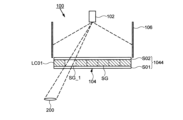
- 1 is a diagram showing a configuration of an illumination device according to an embodiment of the present invention
- 1 is a diagram showing a configuration of an illumination device according to an embodiment of the present invention
- 1 is a diagram showing a configuration of an illumination device according to an embodiment of the present invention
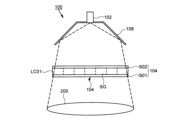
- 1 is a diagram showing a configuration of an illumination device according to an embodiment of the present invention
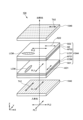
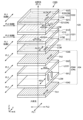
- 1 is a development view showing a configuration of a light-shielding element used in an illumination device according to an embodiment of the present invention.
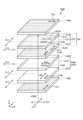
- 1 is a development view showing a configuration of a light-shielding element used in an illumination device according to an embodiment of the present invention.
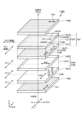
- 1 is a development view showing a configuration of a light-shielding element used in an illumination device according to an embodiment of the present invention.
- 1 is a development view showing a configuration of a light-shielding element used in an illumination device according to an embodiment of the present invention.
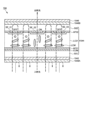
- 1 is a cross-sectional view showing a configuration of a light-shielding element used in an illumination device according to an embodiment of the present invention.
- 1 is a diagram showing a configuration of an illumination device according to an embodiment of the present invention;
- 1 is a diagram showing an irradiation pattern of irradiation light emitted by a lighting device according to an embodiment of the present invention;
- 1 is a perspective view showing a configuration of a liquid crystal light control element used in an illumination device according to an embodiment of the present invention.
- 5A to 5C are cross-sectional views showing the operation of a liquid crystal light control element used in an illumination device according to one embodiment of the present invention.
- 5A to 5C are cross-sectional views showing the operation of a liquid crystal light control element used in an illumination device according to one embodiment of the present invention.
- 1 is a development view showing a configuration of an illumination device according to an embodiment of the present invention
- 1 is a development view showing a configuration of an illumination device according to an embodiment of the present invention
- 1 is a development view showing a configuration of an illumination device according to an embodiment of the present invention
- 1 is a development view showing a configuration of an illumination device according to an embodiment of the present invention
- 1 is a development view showing a configuration of an illumination device according to an embodiment of the present invention
- 1 is a development view showing a configuration of an illumination device according to an embodiment of the present invention
- 1 is a development view showing a configuration of an illumination device according to an embodiment of the present invention
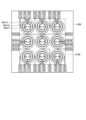
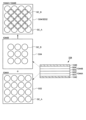
- 4 is a plan view showing a configuration of a driving electrode of a light blocking element used in the lighting device according to the embodiment of the present invention.
- FIG. 1 is a cross-sectional view showing a configuration of a light-shielding element used in an illumination device according to an embodiment of the present invention.
- 5 is a diagram showing the waveform of a drive signal for driving a light blocking element used in the lighting device according to the embodiment of the present invention.
- FIG. 5 is a diagram showing the waveform of a drive signal for driving a light blocking element used in the lighting device according to the embodiment of the present invention.
- FIG. 1 is a cross-sectional view showing a configuration of a light-shielding element used in an illumination device according to an embodiment of the present invention.
- 4 is a plan view showing a configuration of a driving electrode of a light blocking element used in the lighting device according to the embodiment of the present invention.
- FIG. 4 is a plan view showing a configuration of a driving electrode of a light blocking element used in the lighting device according to the embodiment of the present invention.
- FIG. 5A and 5B are diagrams showing a configuration of a driving electrode of a light blocking element used in the lighting device according to one embodiment of the present invention.
- 5A and 5B are diagrams showing a configuration of a driving electrode of a light blocking element used in the lighting device according to one embodiment of the present invention.
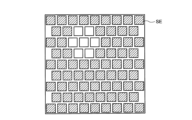
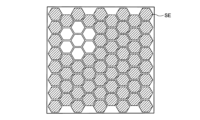
- 1 is a plan view showing a configuration of a light-shielding element used in an illumination device according to an embodiment of the present invention.
- 4 is a plan view showing an arrangement of drive electrodes of a light blocking element used in a lighting device according to an embodiment of the present invention.
- FIG. 4 is a plan view showing an arrangement of drive electrodes of a light blocking element used in a lighting device according to an embodiment of the present invention.
- FIG. 4 is a plan view showing an arrangement of drive electrodes of a light blocking element used in a lighting device according to an embodiment of the present invention.
- FIG. 4 is a plan view showing an arrangement of drive electrodes of a light blocking element used in a lighting device according to an embodiment of the present invention.
- light distribution refers in the usual sense to the degree to which light emitted from a light source spreads, i.e., the distribution of luminous intensity (light strength) in each direction, and controlling the light distribution refers to intentionally controlling the degree to which light emitted from a light source spreads.
- optical rotation refers to the phenomenon in which the polarization axis of linearly polarized light components rotates as they pass through a liquid crystal layer.
- the "alignment direction" of an alignment film refers to the direction in which liquid crystal molecules are aligned when the alignment film is subjected to a treatment (e.g., a rubbing treatment) that imparts an alignment control force to the alignment film and the liquid crystal molecules are aligned on the alignment film.
- a treatment e.g., a rubbing treatment
- the alignment direction of the alignment film is usually the rubbing direction.
- extension direction of a strip electrode refers to the direction in which the long side of a pattern having a short side (width) and a long side (length) extends when the strip electrode is viewed in a plan view.
- An illumination device has a function of irradiating a specific area with light emitted from a light source as a spotlight, and further has a function of moving the irradiation position of the spotlight.
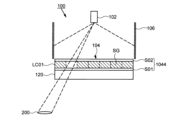
- FIG. 1A shows the configuration of a lighting device 100 according to one embodiment of the present invention.
- the lighting device 100 includes a light source 102 that illuminates a target space, and a shading element 104 that can partially block the light emitted from the light source 102.
- the target space is a space to which illumination is provided, and includes a variety of spaces such as spaces related to human life and production activities, such as homes, offices, and factories, spaces inside passenger cabins of automobiles, railway cars, ships, and aircraft, and spaces for cultivating plants in plant factories.
- the light source 102 is preferably a point light source that emits light radially, or a light source that can be substantially considered as a point light source.
- the light source 102 is, for example, an LED light source.
- a halogen lamp, a xenon lamp, or the like may be used as the light source 102.
- the light-shielding element 104 is an element that utilizes the electro-optical effect of liquid crystal.
- the light-shielding element 104 has the function of electrically controlling a state in which light is transmitted and a state in which light is blocked.
- the light-shielding element 104 is disposed between the light source 102 and the irradiation surface 200 onto which the light emitted from the light source 102 is irradiated.
- the light-shielding element 104 is disposed in the optical path of the emitted light so as to block the light emitted from the light source 102.
- the light-shielding element 104 includes a liquid crystal panel 1044.
- the liquid crystal panel 1044 includes a first substrate S01, a second substrate S02 facing the first substrate S01, and a liquid crystal layer LC01 between the first substrate S01 and the second substrate S02.
- the liquid crystal panel 1044 is divided into a plurality of regions SG, and the light-shielding state and the transmission state can be controlled for each region SG.
- the light-shielding element 104 has a plurality of regions SG, and it is possible to switch between a light-shielding mode that blocks light and a transmission mode that transmits light for each of the plurality of regions SG.
- the transmission mode is a state in which light emitted from the light source 102 is transmitted
- the light blocking mode is a state in which the light emitted by the light source 102 is blocked.
- the liquid crystal panel 1044 is provided with a common electrode and multiple drive electrodes, and the drive electrodes make it possible to control the light blocking mode and transmission mode for each region SG.
- the light blocking element 104 can be switched between the transmission mode and the light blocking mode by combining the liquid crystal panel 1044 with optical components (such as a polarizing plate) not shown.
- FIG. 1A shows a schematic diagram of a state in which all regions SG of the light-shielding element 104 are controlled to the transmission mode.
- FIG. 1B shows a state in which a specific region SG_1 is set to the transmission mode, and the other regions SG are set to the light-shielding mode.
- region SG_1 controlled to the transmission mode light that has passed through region SG_1 controlled to the transmission mode is irradiated onto the irradiation surface 200, while light is not transmitted through regions SG controlled to the light-shielding mode.
- the light emitted from the light source 102 becomes a spotlight and is irradiated onto the irradiation surface 200.
- the light blocking element 104 has multiple regions SG, and each region SG can be arbitrarily set to the transparent mode or the light blocking mode. Therefore, by changing the position of the region SG_1 set to the transparent mode, the spotlight irradiation position can be changed.
- FIG. 1B shows an example in which one region SG_1 out of the multiple regions SG is controlled to the transparent mode, but this is not limiting, and several regions out of the multiple regions SG may be collectively controlled to the transparent mode.
- region SG may be a region defined by a common electrode provided on the liquid crystal panel and one drive electrode facing the common electrode, or may be a region defined by a set of multiple adjacent drive electrodes.
- the light distribution angle ⁇ of the emitted light is about ⁇ 60 degrees.
- a light shielding plate 106 may be added to the lighting device 100 so that the light emitted from the light source 102 does not leak out to the outside without being shielded by the light shielding element 104.
- the shape of the light shielding plate 106 it is preferable that it has a shape that surrounds the space between the light source 102 and the light shielding element 104.
- the lighting device 100 may be provided with an optical system 107 between the light source 102 and the light blocking element 104 to provide directionality to the light emitted from the light source 102.
- the optical system 107 may be composed of at least one lens. By using the optical system 107, the light distribution angle of the light emitted from the light source 102 can be adjusted, and the emitted light can be prevented from diffusing outside the light blocking element 104.
- a reflector 108 may be arranged around the light source 102. By arranging the reflector 108, the light distribution of the light emitted from the light source 102 can be controlled.
- the light blocking plate 106 shown in FIG. 1A may be combined with the configuration of the optical system 107 shown in FIG. 1C and the configuration of the reflector 108 shown in FIG. 1D.
- the lighting device 100 has a configuration in which a light source 102 and a light blocking element 104 are combined.
- the light blocking element 104 limits the irradiation area of the light emitted from the light source 102 to a specific area, and can irradiate a spotlight.
- the light blocking element 104 can arbitrarily control the area in the light blocking mode and the area in the transmission mode, and because this control can be performed dynamically, the irradiation position of the spotlight can be freely moved.
- the size of the light-shielding element 104 (area in a plan view) can be provided in a range of sizes from small to large, similar to liquid crystal displays. Therefore, it is possible to provide lighting devices 100 of various sizes, from narrow to wide ranges over which the spotlight can be moved.
- Figures 2A and 2B are developments of the light blocking element 104, showing the configuration of one area that can be controlled to a light blocking mode and a transmission mode.
- the X-, Y-, and Z-axis directions are shown in Figures 2A and 2B.
- the X-axis direction and the Y-axis direction are orthogonal in a plan view, and the Z-axis direction extends in the normal direction to the X-Y plane.
- expressions such as the X-axis direction, the Y-axis direction, and the Z-axis direction are used to specify the directions, but these expressions can also be replaced with expressions such as the first direction for the X-axis direction, the second direction for the Y-axis direction, and the third direction or the up-down direction for the Z-axis direction.
- the directions of the X-, Y-, and Z-axes are the same when referring to other drawings.
- the light-shielding element 104 includes a liquid crystal panel 1044, a first polarizing plate 1042, and a second polarizing plate 1046.
- the liquid crystal panel 1044 includes a common electrode COM, a first substrate S01 on which a first alignment film AF01 is provided, a second substrate S02 on which a driving electrode SE and a second alignment film AF02 are provided, and a liquid crystal layer LC01 between the first substrate S01 and the second substrate S02.
- the first alignment film AF01 is provided so as to cover the common electrode COM
- the second alignment film AF02 is provided so as to cover the driving electrode SE.
- the alignment directions of the first alignment film AF01 and the second alignment film AF02 are determined by an alignment process such as rubbing.
- the alignment direction AD1 of the first alignment film AF01 is oriented in the Y-axis direction
- the alignment direction AD2 of the second alignment film AF02 is oriented in the X-axis direction. That is, the alignment direction AD1 of the first alignment film AF01 and the alignment direction AD2 of the second alignment film AF02 are in an intersecting (orthogonal) relationship.
- the liquid crystal panel 1044 is a transmissive panel.
- the common electrode COM and the driving electrode SE are formed of a transparent conductive film. Metal auxiliary wiring may be added to the transparent conductive film to reduce the sheet resistance.
- the common electrode COM and the driving electrode SE may also be formed of a mesh-like metal film that is translucent.
- the liquid crystal layer LC01 is formed, for example, of twisted nematic liquid crystal (TN (Twisted Nematic) liquid crystal).
- Figures 2A and 2B show the liquid crystal molecules LCM of the liquid crystal layer LC01.
- the liquid crystal molecules LCM have a long, thin, rod-like molecular structure.
- the initial orientation state of the liquid crystal molecules LCM is regulated by the orientation direction AD1 of the first orientation film AF01 on the first substrate S01 side, and by the orientation direction AD2 of the second orientation film AF02 on the second substrate S02 side.
- the liquid crystal molecules LCM on the first substrate S01 side are oriented with their long axis direction aligned in the same direction as the orientation direction AD1 of the first orientation film AF01, and the liquid crystal molecules LCM on the second substrate side are oriented with their long axis direction aligned in the same direction as the orientation direction AD2 of the second orientation film AF02. Due to this alignment control force, the liquid crystal molecules LCM in the liquid crystal layer LC01 are aligned in a 90-degree twisted state from the first substrate S01 to the second substrate S02.
- the first polarizing plate 1042 is disposed on the first substrate S01 side, and the second polarizing plate 1046 is disposed on the second substrate S02 side.
- the first polarizing plate 1042 and the second polarizing plate 1046 are absorption-type linear polarizing plates.
- a linear polarizing plate has the property of transmitting a polarized component parallel to the transmission polarization axis and absorbing (not transmitting) other polarized components.
- the transmission polarization axis TA1 of the first polarizing plate 1042 is disposed parallel to the alignment direction AD1 of the first alignment film AF01, and the transmission polarization axis TA2 of the second polarizing plate 1046 is disposed so as to intersect (orthogonal) with the alignment direction AD2 of the second alignment film AF02.
- the transmission polarization axis TA1 of the first polarizing plate 1042 and the transmission polarization axis TA2 of the second polarizing plate 1046 are disposed parallel (parallel Nicol).
- FIG. 2A shows a case where light having a first polarization component PL1 and a second polarization component PL2 emitted from a light source 102 (not shown) is incident from the first polarizing plate 1042 side.
- the polarization direction of the first polarization component PL1 is parallel to the Y-axis direction
- the polarization direction of the second polarization component PL2 is parallel to the X-axis direction.
- FIG. 2A shows an off state in which no voltage is applied between the common electrode COM and the drive electrode SE.
- the first polarized component PL1 is rotated by 90 degrees and transitions to the second polarized component PL2 due to the liquid crystal molecules LCM being twisted 90 degrees.
- the transmission polarization axis TA2 of the second polarizer 1046 intersects with the polarization axis of the second polarized component PL2. Therefore, the second polarized component PL2 emitted from the liquid crystal panel 1044 is absorbed by the second polarizer 1046.
- the light emitted from the light source 102 (not shown) is blocked by the light blocking element 104 and is not emitted to the outside.
- FIG. 2B shows the on state in which a voltage is applied between the common electrode COM and the drive electrode SE.
- the long axis direction of the liquid crystal molecules LCM is oriented in a direction parallel to the electric field due to the influence of the electric field generated between the common electrode COM and the drive electrode SE. That is, in the on state, the long axis direction of the liquid crystal molecules LCM is oriented in a vertically standing state between the first substrate S01 and the second substrate S02.
- the first polarized component PL1 incident on the liquid crystal panel 1044 from the first polarizer 1042 is not rotated by the liquid crystal layer LC01 and passes through as the first polarized component PL1.
- the first polarized component PL1 that passes through the liquid crystal panel 1044 has a polarization axis direction parallel to the transmission polarization axis TA2 of the second polarizer 1046. Therefore, in the on state where a voltage is applied to the common electrode COM and the drive electrode SE of the liquid crystal panel 1044, the light emitted from the light source 102 (not shown) passes through the light blocking element 104 and is emitted to the outside.
- FIGS. 2C and 2D show an example of a light-shielding element in which the transmission polarization axis TA2 of the second polarizer 1046 is arranged parallel to the X-axis direction, as compared to the light-shielding element 104 shown in Figs. 2A and 2B.
- the light-shielding element 104 is shown in which the transmission polarization axis TA1 of the first polarizer 1042 and the transmission polarization axis TA2 of the second polarizer 1046 are arranged perpendicular to each other (crossed Nicols).
- FIG. 2C shows an OFF state in which no voltage is applied between the common electrode COM and the drive electrode SE.
- the polarization direction of the second polarized component PL2 emitted from the liquid crystal panel 1044 is parallel to the transmission polarization axis TA2 of the second polarizer 1046, so that the light emitted from the light source 102 (not shown) passes through the second polarizer 1046 and is emitted to the outside.
- FIG. 2D shows an ON state in which a voltage is applied between the common electrode COM and the segment electrode drive electrode SE.
- the polarization direction of the first polarized component PL2 emitted from the liquid crystal panel 1044 is parallel to the transmission polarization axis TA2 of the second polarizer 1046, so that the light emitted from the light source 102 (not shown) does not pass through the second polarizer 1046 and is not emitted to the outside.
- the light-shielding element 104 can control the light-shielding mode and the transmission mode whether the pair of polarizing plates (first polarizing plate 1042, second polarizing plate 1046) is arranged in a parallel Nicol or crossed Nicol configuration.
- Figures 2A to 2D show the liquid crystal panel 1044 in two states, a light blocking mode and a transmissive mode, it can also be controlled to a semi-transmissive mode in which the orientation of the liquid crystal molecules is in an intermediate state.
- FIGS. 2A to 2D show a configuration in which one drive electrode SE is arranged relative to the common electrode COM, but the light-shielding element 104 can arrange multiple drive electrodes SE relative to the common electrode COM and control the voltage application state individually.
- This configuration makes it possible to change the spotlight's illumination position. Furthermore, by successively switching the drive electrodes SE to the transparent mode, it is possible to create the appearance that the spotlight is moving continuously.
- FIG. 3 shows a cross-sectional view of the light-shielding element 104.
- the light-shielding element 104 has a structure in which a first driving electrode SE_01, a second driving electrode SE_02, and a third driving electrode SE_03 are arranged to face the common electrode COM.
- the first drive electrode SE_01, the second drive electrode SE_02, and the third drive electrode SE_03 are individually controlled to be on (a state in which a voltage is applied) or off (a state in which no voltage is applied).
- FIG. 3 shows a case in which the first drive electrode SE_01 and the third drive electrode SE_03 are in the off state, and the second drive electrode SE_02 is in the on state.
- the area corresponding to the first drive electrode SE_01 and the third drive electrode SE_03 forms a light blocking mode area in which light emitted from the light source 102 (not shown) does not pass through.
- the area corresponding to the second drive electrode SE_02 becomes a transmission mode area in which light emitted from the light source 102 (not shown) passes through.
- the first drive electrode SE_01, the second drive electrode SE_02, and the third drive electrode SE_03 are disposed at a distance from each other.
- Liquid crystal is also present in the region between the first drive electrode SE_01 and the second drive electrode SE_02, and in the region between the second drive electrode SE_02 and the third drive electrode SE_03.
- the liquid crystal in the region between these electrodes is in an initial alignment state due to the alignment restriction force of the first alignment film AF01 and the second alignment film AF02. Since the electric field generated by the drive electrodes SE (SE_01 to SE_03) hardly acts on this region between the electrodes, the alignment state of the liquid crystal molecules LCM is maintained in the initial alignment state. Therefore, the region between the drive electrodes SE (SE_01 to SE_03) is in a light-shielding mode, and a state in which light is not transmitted is maintained.
- the polarized component (second polarized component PL2) that is not parallel to the transmitted polarization axis is absorbed by the first polarizing plate 1042.
- the lighting device 100 strong light is irradiated from the light source 102, so if the first polarizing plate 1042 absorbs the light emitted from the light source 102, there is a concern that the polarizing plate will deteriorate due to heat generation.
- the light-shielding element 104 shown in FIG. 3 has a structure in which a first brightness enhancement film 1048A is provided on the surface of the first polarizing plate 1042 opposite the first substrate S01 side (i.e., the surface on the light incident side).
- the first brightness enhancement film 1048A has the property of transmitting a specific polarized component and reflecting other polarized components.
- the first brightness enhancement film 1048A has the property of transmitting the first polarized component PL1 and reflecting the second polarized component PL2.
- a second brightness enhancement film 1048B may be provided between the second substrate S02 and the second polarizer 1046.
- the polarized component that passes through the first polarizer 1042 and is rotated 90 degrees in the liquid crystal layer LC01 to transition to the second polarized component PL2 crosses the transmission polarization axis of the second polarizer 1046, and is absorbed by the second polarizer 1046, causing heat generation. Therefore, by providing a second brightness enhancement film 1048B and arranging it so that its transmission axis coincides with the transmission polarization axis of the second polarizer 1046, the second polarized component PL2 can be reflected and light absorption by the second polarizer 1046 can be suppressed.
- the lighting device 100 is configured such that a light-shielding element 104 using liquid crystal is disposed to block the light emitted from the light source 102, and the light-shielding element 104 is provided with a plurality of regions that can be controlled to a light-shielding mode and a transmission mode, thereby allowing the light emitted from the light source 102 to be partially irradiated like a spotlight.
- the position and range of the transmission region (transmission mode region) of the illumination light controlled by the light-shielding element 104 can be freely adjusted, so that the position of the spotlight can be changed and illumination can be provided as if the spotlight were moving continuously.
- this embodiment shows an example in which a common electrode COM is provided on the first substrate S01 of the liquid crystal panel 1044 and a driving electrode SE is provided on the second substrate S02
- the configuration of the liquid crystal panel 1044 is not limited to this example, and the common electrode COM may be provided on the second substrate S02 and the driving electrode SE on the first substrate.
- liquid crystal panel 1044 can adopt various types of liquid crystal panels such as the VA (Vertical Alignment) type, the MVA type (Multi-domain Vertical Alignment), the IPS (In Plane Switching), and the FFS type (Fringe Field Switching), or a liquid crystal panel using polymer dispersed liquid crystal.
- VA Vertical Alignment
- MVA Multi-domain Vertical Alignment
- IPS In Plane Switching
- FFS Frringe Field Switching
- This embodiment shows a configuration in which a liquid crystal light control element 120 is added to the configuration of the lighting device shown in the first embodiment.
- FIG. 4A shows the configuration of the lighting device 100 according to this embodiment.
- the lighting device 100 according to this embodiment includes a light source 102, a light-shielding element 104, and a liquid crystal light control element 120.
- the liquid crystal light control element 120 is disposed on the light-emitting side of the light-shielding element 104.
- the liquid crystal light control element 120 has a function of controlling the light distribution state (spread of light). Specifically, the liquid crystal light control element 120 can diffuse light in a specific direction to form a line-shaped light distribution pattern (line light distribution), a cross-shaped light distribution pattern (cross light distribution), a square-shaped light distribution pattern, or the like.
- Figure 4B shows an irradiation pattern when a line light distribution is formed by the liquid crystal light control element 120.
- a line-shaped irradiation pattern B that is wider than the irradiation pattern A can be formed.
- a spotlight with a controlled light distribution state can be emitted.
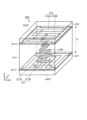
- FIG. 5 shows a perspective view of the first liquid crystal cell 1221 constituting the liquid crystal light control element 120.
- the first liquid crystal cell 1221 includes a first substrate S11, a second substrate S12, a first electrode E11, a second electrode E12, a first alignment film AL11, a second alignment film AL12, and a first liquid crystal layer LC1.
- the first substrate S11 is provided with a first electrode E11 and a first alignment film AL11
- the second substrate S12 is provided with a second electrode E12 and a second alignment film AL12.
- the first alignment film AL11 is provided so as to cover the first electrode E11
- the second alignment film AL12 is provided so as to cover the second electrode E12.
- the first substrate S11 and the second substrate S12 are disposed apart from each other and facing each other.
- the first liquid crystal layer LC1 is provided between the first substrate S11 and the second substrate S12.
- the first electrode E11 includes a first strip electrode E11A and a second strip electrode E11B having multiple strip patterns.
- the second electrode E12 includes a third strip electrode E12A and a fourth strip electrode E12B having multiple strip patterns.
- the first strip electrode E11A and the second strip electrode E11B are alternately arranged on the insulating surface of the first substrate S11, and the third strip electrode E12A and the fourth strip electrode E12B are alternately arranged on the insulating surface of the second substrate S12.
- the multiple strip patterns of the first strip electrode E11A and the second strip electrode E11B extend in the Y-axis direction.
- the multiple strip patterns of the third strip electrode E12A and the fourth strip electrode E12B extend in the X-axis direction.
- the direction in which the multiple strip patterns of the first strip electrode E11A and the second strip electrode E11B extend is perpendicular (intersecting at 90 degrees) to the direction in which the multiple strip patterns of the third strip electrode E12A and the fourth strip electrode E12B extend.
- the relative arrangement of the first strip electrode E11A and the second strip electrode E11B and the third strip electrode E12A and the fourth strip electrode E12B is not limited to an orthogonal relationship, and may be changed within a range of ⁇ 10 degrees from 90 degrees.
- the alignment direction ALD1 of the first alignment film AL11 is oriented in a direction (Y-axis direction) that intersects with the extension direction of the first strip electrode E11A and the second strip electrode E11B.
- the alignment direction ALD2 of the second alignment film AL12 is oriented in a direction (X-axis direction) that intersects with the extension direction of the third strip electrode E12A and the fourth strip electrode E12B.
- the angle at which the extension direction of the first strip electrode E11A and the second strip electrode E11B intersects with the alignment direction ALD1, and the angle at which the extension direction of the third strip electrode E12A and the fourth strip electrode E12B intersects with the alignment direction ALD2 can be set in the range of 90 ⁇ 10 degrees.
- the first substrate S11 and the second substrate S12 are arranged opposite each other with a gap of 10 ⁇ m or more.
- the first substrate S11 and the second substrate S12 are arranged with a gap of 10 ⁇ m or more and 1000 ⁇ m or less, preferably 20 ⁇ m or more and 500 ⁇ m or less.
- the first liquid crystal layer LC1 provided between the first substrate S11 and the second substrate S12 has a thickness D.
- the first electrode E11 and the second electrode E12, as well as the first alignment film AL11 and the second alignment film AL12 are provided between the first substrate S11 and the second substrate S12, but the film thicknesses of these components are negligibly small compared to the gap between the first substrate S11 and the second substrate S12.
- the gap between the first substrate S11 and the second substrate S12 can be regarded as the thickness D of the first liquid crystal layer LC1. That is, the thickness D of the first liquid crystal layer LC1 can be considered to be 10 ⁇ m or more and 1000 ⁇ m or less, preferably 20 ⁇ m or more and 500 ⁇ m or less. Although not shown in FIG. 5, a spacer may be provided between the first substrate S11 and the second substrate S12.
- the liquid crystal material forming the first liquid crystal layer LC1 can be twisted nematic liquid crystal, as in the light-shielding element 104.
- the liquid crystal molecules have a long and thin rod-like structure due to their molecular structure.
- the liquid crystal molecules having a rod-like structure have a dielectric anisotropy and a refractive index anisotropy in the long axis direction (parallel to the molecular long axis) and the short axis direction (orthogonal to the molecular long axis).
- the first liquid crystal cell 1221 is provided with a first alignment film AL11 and a second alignment film AL12 to control the alignment direction of the liquid crystal molecules.
- FIG. 5 shows that the alignment direction ALD1 of the first alignment film AL11 is parallel to the Y axis, and the alignment direction ALD2 of the second alignment film AL12 is parallel to the X axis.
- the liquid crystal molecules LCM of the first liquid crystal layer LC1 are aligned in the alignment directions ALD1, ALD2 of the alignment films due to the alignment restricting forces of the first alignment film AL11 and the second alignment film AL12. Since the alignment direction ALD1 of the first alignment film AL11 and the alignment direction ALD2 of the second alignment film AL12 intersect (are perpendicular), the alignment direction of the liquid crystal molecules LCM gradually changes so that it is twisted 90 degrees from the first substrate S11 to the second substrate S12.
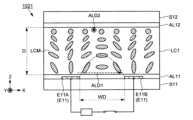
- FIGS. 6A and 6B are diagrams explaining the operation of the first liquid crystal cell 1221.
- FIG. 6A shows a state in which no control signal is applied to the first electrode E11 (first strip electrode E11A and second strip electrode E11B)
- FIG. 6B shows a state in which a control signal is applied to the first electrode E11 and a transverse electric field is generated between the first strip electrode E11A and the second strip electrode E11B.
- the control signal is a voltage signal that generates a transverse electric field between the first strip electrode E11A and the second strip electrode E11B such that the alignment state of the liquid crystal molecules LCM is oriented in a direction parallel to the electric field.
- the first strip-shaped electrode E11A and the second strip-shaped electrode E11B are arranged with the longitudinal direction of the strip pattern extending in the X-axis direction with a distance WD between them. Comparing the thickness D of the first liquid crystal layer LC1 with the electrode distance WD of the first electrode E11, the thickness D of the first liquid crystal layer LC1 is equal to or greater than the electrode distance WD (D ⁇ WD). For example, the thickness D of the first liquid crystal layer LC1 is at least twice as large as the electrode distance WD of the first electrode E11. When the thickness D of the first liquid crystal layer LC1 is 10 ⁇ m, the electrode distance WD can be 5 ⁇ m, and when the thickness D of the first liquid crystal layer LC1 is 50 ⁇ m, the electrode distance WD can be 10 ⁇ m.
- the alignment direction ALD1 of the first alignment film AL11 extends in the X-axis direction
- the alignment direction ALD2 of the second alignment film AL12 extends in the Y-axis direction.
- the thickness D of the first liquid crystal layer LC1 is sufficiently large (10 ⁇ m or more), that is, if the thickness D of the first liquid crystal layer LC1 is sufficiently large, the effect of the electric field formed by the first electrode E11 does not extend to the second substrate S12 side, and the alignment state of the liquid crystal molecule LCM changes only on the first substrate S11 side. In other words, the liquid crystal molecule LCM on the second substrate S12 side is not affected by the electric field and maintains an unchanged alignment.
- the liquid crystal molecules LCM are oriented in a convex arc shape with the long axis of the liquid crystal molecules aligned in the direction of the electric field.
- the distribution of the dielectric constant also changes to an arc shape due to the change in the orientation state of the liquid crystal molecules LCM.
- the polarized component parallel to the X-axis direction is then rotated 90 degrees in the process from the first substrate S11 to the second substrate S12.
- the polarized component parallel to the Y-axis direction is not affected by the dielectric constant distribution and is not diffused when it enters the first liquid crystal layer LC1, and is rotated 90 degrees in the process from the first substrate S11 to the second substrate S12.
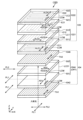
- FIG. 7A is a perspective view showing a first configuration of the lighting device 100 according to this embodiment.
- the light-shielding element 104 and the liquid crystal light control element 120 are arranged in this order from the light source 102 side.
- the light-shielding element 104 has the same configuration as the light-shielding element shown in FIG. 3. That is, the light-shielding element 104 has a configuration in which a first polarizing plate 1042 and a second polarizing plate 1046 are arranged with a liquid crystal panel 1044 sandwiched therebetween.
- the transmission polarization axes of the first polarizing plate 1042 and the second polarizing plate 1046 are arranged parallel to the Y-axis direction.
- the liquid crystal panel 1044 constituting the light-shielding element 104 only shows the first substrate S01, the second substrate S02, and the liquid crystal layer LC01, and the common electrode COM, the drive electrode SE, the first alignment film AF01, the second alignment film AF02, etc. are omitted.
- the alignment directions AD1, AD2 of the first alignment film AF01 and the second alignment film AF02 are indicated by arrows.
- the alignment direction AD1 of the first alignment film (not shown) on the first substrate S01 side is in the same direction as the Y-axis direction
- the alignment direction AD2 of the second alignment film (not shown) on the second substrate S02 side is in the same direction as the X-axis direction.
- the liquid crystal light control element 120 has the same configuration as the liquid crystal light control element shown in FIG. 5.
- the strip pattern of the first electrode E11 extends in the X-axis direction
- the strip pattern of the second electrode E12 extends in the Y-axis direction.
- other components of the first liquid crystal cell 1221 such as the first alignment film AL11 and the second alignment film AL12, are omitted.
- the alignment directions ALD1 and ALD2 of the first alignment film (not shown) and the second alignment film (not shown) of the first liquid crystal cell 1221 are indicated by arrows.
- the alignment direction ALD1 of the first alignment film is in the same direction as the Y-axis direction
- the alignment direction ALD2 of the second alignment film (not shown) is in the same direction as the X-axis direction.
- the lighting device 100 shown in Figure 7A has an optical path in which light emitted from a light source 102 (not shown) passes through a light blocking element 104, and then passes through a liquid crystal light control element 120 to be emitted to the outside.
- the emission direction of the light (first polarized component PL1, second polarized component PL2) emitted from the light source 102 (not shown) is indicated by an arrow pointing from the bottom to the top of the drawing.
- FIG. 7A shows the case where the light blocking element 104 is in the off state (light blocking state).
- the first polarized component PL1 and the second polarized component PL2 are incident on the first polarizing plate 1042.
- the transmission polarization axis TA1 of the first polarizing plate 1042 is in the same direction as the Y-axis direction. Therefore, of the light incident on the first polarizing plate 1042, the first polarized component PL1 is transmitted and the second polarized component PL2 is absorbed. Note that, as described with reference to FIG. 3, when the first brightness enhancement film 1048A is provided, the second polarized component PL2 is reflected by the first brightness enhancement film 1048A.
- the first polarized component PL1 transmitted through the first polarizing plate 1042 is incident on the liquid crystal panel 1044.
- the first polarized component PL1 incident on the liquid crystal panel 1044 is rotated by 90 degrees due to the liquid crystal molecules of the liquid crystal layer LC01 being twisted and oriented by 90 degrees from the first substrate S01 to the second substrate S02, and transitions to the second polarized component PL2. Since the transmission polarization axis of the second polarizing plate 1046 is oriented in the Y-axis direction, the second polarized component PL2 emitted from the liquid crystal panel 1044 is absorbed by the second polarizing plate 1046. In the case where the second brightness enhancement film 1048B is provided, the second polarized component PL2 is reflected here. Therefore, when the light blocking element 104 is in the off state, the light emitted from the light source 102 is blocked and is not emitted to the outside.
- FIG. 7B shows a state in which the light blocking element 104 is in the on state (transmissive state), a control signal is applied to the first electrode E11 and the second electrode E12 of the liquid crystal light control element 120 (on state), and a transverse electric field is generated in a direction parallel to the alignment directions ALD1 and ALD2.
- the first polarized component PL1 incident on the liquid crystal panel 1044 is not rotated by the liquid crystal layer LC01 and passes through the second polarizer 1046 as is.
- the first polarized component PL1 incident on the liquid crystal light control element 120 is incident on the first liquid crystal cell 1221 constituting the liquid crystal light control element 120.
- the liquid crystal molecules LCM form an arc-shaped dielectric constant portion due to an electric field parallel to the Y-axis direction (alignment direction ALD1).
- the direction of the polarization axis of the first polarized component PL1 incident on the first liquid crystal cell 1221 is parallel to the Y-axis direction (alignment direction ALD1). Therefore, the first polarized component PL1 is diffused in the Y-axis direction due to the dielectric constant distribution formed by the liquid crystal molecules LCM. As the first polarized component PL1 passes through the first liquid crystal layer LC1 from the first substrate S11 to the second substrate S12, it is rotated by 90 degrees by the liquid crystal molecules LCM, which are aligned with a 90-degree twist, and transitions to the second polarized component PL2.
- the liquid crystal molecules LCM form an arc-shaped dielectric constant portion due to an electric field generated in a direction parallel to the X-axis direction (alignment direction ALD2). Since the direction of the polarization axis of the second polarized component PL2 is parallel to the X-axis direction (alignment direction ALD2), it is diffused in the X-axis direction by the dielectric constant distribution formed by the liquid crystal molecules LCM. Then, the second polarized component PL2 is emitted from the first liquid crystal cell 1221.
- the first polarized component PL1 of the light emitted from the light source 102 passes through the light blocking element 104, is diffused in the X-axis direction by the liquid crystal light control element 120, transitions to the second polarized component PL2, and is then diffused in the X-axis direction and emitted.
- FIG. 7B shows a state in which a control signal is applied to both the first electrode E11 and the second electrode E12 of the liquid crystal light control element 120
- the control signal applied to the liquid crystal light control element 120 is not limited to this example.
- the control signal applied to the liquid crystal light control element 120 may be applied to only one of the first electrode E11 and the second electrode E12, or may not be applied to both.
- FIG. 8A is a perspective view showing a second configuration of the lighting device 100 according to this embodiment.
- the liquid crystal light control element 120 is composed of two liquid crystal cells, a first liquid crystal cell 1221 and a second liquid crystal cell 1222.
- the first liquid crystal cell 1221 and the second liquid crystal cell 1222 are arranged so that light enters from the first liquid crystal cell 1221 side and exits from the second liquid crystal cell 1222 side.
- the configuration of the first liquid crystal cell 1221 is the same as the configuration shown in FIG. 7A.
- the alignment direction ALD3 of the first alignment film on the first substrate S21 side is oriented in the X-axis direction
- the alignment direction ALD4 of the second alignment film on the second substrate S22 side is oriented in the Y-axis direction.
- FIG. 8A shows a case where the light blocking element 104 is in the off state.
- the operation of the lighting device 100 is the same as the example shown in FIG. 7A, and since the light emitted from the light source 102 is blocked, no light is emitted to the outside.
- FIG. 8B shows a state in which the light-shielding element 104 is in the ON state and a control signal is applied to the electrodes of the first liquid crystal cell 1221 and the second liquid crystal cell 1222 of the liquid crystal light control element 120.
- the first polarized component PL1 of the polarized components emitted from the light source 102 (not shown) is emitted from the light-shielding element 104.
- the first polarized component PL1 incident on the liquid crystal light control element 120 is diffused in the Y-axis direction on the first substrate S11 side of the first liquid crystal cell 1221, rotated 90 degrees in the first liquid crystal layer LC1 and transitioned to the second polarized component PL2, and then diffused in the X-axis direction on the second substrate S12 side.
- the second polarized component PL2 that enters the second liquid crystal cell 1222 is diffused in the X-axis direction on the first substrate S21 side, rotated by 90 degrees in the second liquid crystal layer LC2 and transitioned to the first polarized component PL2, and then diffused in the Y-axis direction on the second substrate D22 side and emitted.
- the first polarized component PL1 emitted from the light blocking element 104 is diffused twice in each of the X-axis direction and the Y-axis direction, and is rotated twice at an angle of 90 degrees, and is emitted in the state of the first polarized component PL1.
- FIG. 8B shows a case where a control signal is applied to all of the electrodes of the first liquid crystal cell 1221 and the second liquid crystal cell 1222
- the operation of the lighting device 100 according to the second configuration is not limited to this example.
- a control signal may be applied only to the second electrode E12 of the first liquid crystal cell 1221 and the first electrode E21 of the second liquid crystal cell 1222 to operate the device so that the polarized wave is diffused twice in the X-axis direction
- a control signal may be applied only to the first electrode E11 of the first liquid crystal cell 1221 and the first electrode E21 of the second liquid crystal cell 1222 to operate the device so that the polarized wave is diffused once in each of the X-axis direction and the Y-axis direction.
- FIG. 9A is a perspective view showing a third configuration of the lighting device 100 according to this embodiment.
- FIG. 9A has a configuration in which the position and the direction of the transmission axis of the second polarizer 1046 are changed compared to the configuration of the lighting device 100 according to the first configuration.
- the lighting device 100 according to the third configuration has a configuration in which the second polarizer 1046 is disposed outside the liquid crystal light control element 120.
- the transmission polarization axis of the second polarizer 1046 is oriented in the X-axis direction.
- FIG. 9A shows a state in which the light blocking element 104 is in an off state and no control signal is applied to the first substrate E11 and the second electrode E12 of the first liquid crystal cell 1221.
- a state in which no control signal is applied to the first electrode E11 and the second electrode E12 of the first liquid crystal cell 1221 is shown.
- the first polarized component PL1 transmitted through the first polarizer 1042 is rotated by 90 degrees in the light blocking element 104, transitioned to the second polarized component PL2, and enters the first liquid crystal cell 1221.
- the second polarized component PL2 is rotated by 90 degrees in the first liquid crystal layer LC1 and transitioned to the first polarized component PL1, but since neither the first electrode E11 nor the second electrode E12 generates a transverse electric field, no diffusion occurs. Since the transmission axis of the second polarizer 1046 is oriented in the X-axis direction, the first polarized component PL1 emitted from the first liquid crystal cell 1221 is absorbed without being transmitted. Therefore, the light emitted from the light source 102 is blocked.
- FIG. 9B shows a state in which the light blocking element 104 is in an on state and a control signal is applied to the first electrode E11 and the second electrode E12 of the first liquid crystal cell 1221.
- the first polarized component PL1 transmitted through the first polarizer 1042 is not rotated by the light blocking element 104 and is incident on the first liquid crystal cell 1221.
- the first polarized component PL1 is diffused in the Y-axis direction on the first substrate S11 side, rotated 90 degrees by the first liquid crystal layer LC1 to become the second polarized component PL2, and diffused in the X-axis direction on the second substrate S12 side. Since the transmission axis of the second polarizer 1046 is oriented in the X-axis direction, the second polarized component PL2 is transmitted through the second polarizer 1046 and emitted.
- the first polarized component PL1 is diffused in the Y-axis direction by the liquid crystal light control element 120, rotated by 90 degrees by the first liquid crystal cell 1221 to become the second polarized component PL2, and then diffused in the X-axis direction and emitted.
- FIG. 9B shows a case where a control signal is applied to both the first electrode E11 and the second electrode E12 of the first liquid crystal cell 1221
- the operation of the lighting device 100 according to the third configuration is not limited to this example.
- a control signal may be applied to only one of the first electrode E11 and the second electrode E12 to cause the polarized wave to be diffused in either the X-axis direction or the Y-axis direction.
- Fig. 10A is a perspective view showing a fourth configuration of the lighting device 100 according to this embodiment.
- Fig. 10A differs from the lighting device 100 according to the third configuration in that the liquid crystal light control element 120 is composed of a first liquid crystal cell 1221 and a second liquid crystal cell 1222, and that the transmission polarization axis TA2 of the second polarizer 1046 is arranged in the same direction as the transmission polarization axis TA1 of the first polarizer 1042.
- FIG. 10A shows a state in which the light blocking element 104 is in an off state and no control signal is applied to the liquid crystal light control element 120.
- the first polarized component PL1 transmitted through the first polarizer 1042 is rotated 90 degrees by the liquid crystal panel 1044 and transitions to the second polarized component PL2.
- the second polarized component PL2 emitted from the light blocking element 104 enters the first liquid crystal cell 1221 of the liquid crystal light control element 120. Since no control signal is applied to the first electrode E11 and the second electrode E12 of the first liquid crystal cell 1221, the second polarized component PL2 is not diffused and is rotated 90 degrees by the first liquid crystal layer LC1 and transitions to the first polarized component PL1.
- the first polarized component PL1 emitted from the first liquid crystal cell 1221 enters the second liquid crystal cell 1222. Since no control signal is applied to the first electrode E21 and the second electrode E22 of the second liquid crystal cell 1222, the first polarized component PL2 is not diffused, but is rotated by 90 degrees in the second liquid crystal layer LC2, transitions to the second polarized component PL2, and enters the second polarizer 1046.
- the transmission polarization axis of the second polarizer 1046 is oriented in the Y-axis direction and intersects with the second polarized component PL2. Therefore, the second polarized component PL2 emitted from the liquid crystal light control element 120 is absorbed by the second polarizer 1046 and is not emitted to the outside. In other words, the light emitted from the light source 102 is blocked.
- FIG. 10B shows a state in which the light-shielding element 104 is on and a control signal is applied to the first electrode E11 and the second electrode E12 of the first liquid crystal cell 1221 and the first electrode E21 and the second electrode E22 of the second liquid crystal cell 1222.
- the first polarized component PL1 transmitted through the first polarizer 1042 is not rotated by the light-shielding element 104 and enters the first liquid crystal cell 1221.
- the first polarized component PL1 is diffused in the Y-axis direction on the first substrate S11 side, rotated 90 degrees in the first liquid crystal layer LC1 to transition to the second polarized component PL2, and diffused in the X-axis direction on the second substrate S12 side.
- the second polarized component PL2 emitted from the first liquid crystal cell 1221 enters the second liquid crystal cell 1222.
- the second polarized component PL2 is diffused in the X-axis direction on the first substrate S21 side, rotated 90 degrees in the second liquid crystal layer LC2 to transition to the first polarized component PL1, and diffused in the Y-axis direction on the second substrate S22 side. Because the transmission axis of the second polarizer 1046 is oriented in the Y-axis direction, the second polarized component PL2 is transmitted through the second polarizer 1046 and emitted.
- the first polarized component PL1 emitted from the light blocking element 104 is diffused twice in the X-axis direction and the Y-axis direction while passing through the liquid crystal light control element 120, and is rotated twice at an angle of 90 degrees, and is emitted in the state of the first polarized component PL1.
- FIG. 10B shows a case where a control signal is applied to all of the electrodes of the first liquid crystal cell 1221 and the second liquid crystal cell 1222
- the operation of the lighting device 100 according to the fourth configuration is not limited to this example.
- a control signal may be applied only to the second electrode E12 of the first liquid crystal cell 1221 and the first electrode E21 of the second liquid crystal cell 1222 to operate the device so that the polarized wave is diffused twice in the X-axis direction
- a control signal may be applied only to the first electrode E11 of the first liquid crystal cell 1221 and the first electrode E21 of the second liquid crystal cell 1222 to operate the device so that the polarized wave is diffused once each in the X-axis direction and the Y-axis direction.
- the lighting device 100 can not only irradiate the light emitted from the light source 102 as a spotlight by the light blocking element 104, but can also irradiate light whose light distribution state is controlled by the liquid crystal light control element 120 as a spotlight onto an arbitrarily selected area.
- FIG. 11A is a plan view showing the configuration of the second substrate S02 side of the light-shielding element 104.
- a plurality of driving electrodes SE_01 to SE16 are provided on the second substrate S02.
- the plurality of driving electrodes SE_01 to SE_16 are arranged, for example, in a matrix.
- the second substrate S02 is also provided with a plurality of input terminals SEG01 to SEG16 for applying voltages to the plurality of driving electrodes SE_01 to SE_16.
- the shape of the plurality of driving electrodes SE_01 to SE_16 in a plan view is, for example, circular.
- the diameter can be, for example, 1 mm to 100 mm.
- the plurality of driving electrodes SE_01 to SE_16 may be the same size, or may be arranged so that driving electrodes of different sizes are mixed. Note that while FIG. 11A shows multiple drive electrodes SE_01 to SE_16, the number of drive electrodes is not limited to the example shown and can be set as appropriate.
- each of the multiple driving electrodes SE_01 to SE_06 can be several millimeters to several tens of millimeters.
- the shape of the multiple driving electrodes SE_01 to SE_06 can be circular with a diameter of 2 mm to 40 mm.
- the shape of the multiple driving electrodes SE_01 to SE_16 in a plan view is not limited to a circle, and can be replaced with other shapes such as a square, triangle, hexagon, or ellipse. Note that FIG. 11A illustrates an arrangement of 16 driving electrodes, but there is no particular limit to the number of driving electrodes SE.
- multiple input terminals SEG01 to SEG16 are provided for applying voltages to the multiple driving electrodes SE_01 to SE_16.
- the multiple input terminals SEG01 to SEG16 are provided corresponding to the multiple driving electrodes SE_01 to SE_16 and are connected by wiring.
- FIG. 11B shows the cross-sectional structure of the light-shielding element 104 corresponding to the area between A and B shown in FIG. 11A.
- a plurality of driving electrodes SE_01 to SE_16 (FIG. 11B shows driving electrodes SE_01 to SE_04) are provided on the second substrate S02 and are arranged to face the common electrode COM provided on the first substrate S01.
- a liquid crystal layer LC01 is provided between the plurality of driving electrodes SE_01 to SE_16 and the common electrode COM.
- a plurality of input terminals SEG01 to SEG16 are arranged in the outer region so as not to overlap with the common electrode COM.
- a control signal is input to the plurality of input terminals SEG01 to SEG16 from an external control circuit.
- FIG. 11C and 11D show an example of a drive signal that drives the light blocking element 104.
- FIG. 11C shows a drive signal that turns on the drive electrode SE_02 shown in FIG. 11B (transmission mode).
- FIG. 11C shows the drive signal S-COM applied to the common electrode COM, the drive signal S-SE_02 applied to the drive electrode SE_02, and the voltage between the common electrode COM and the drive electrode SE_02 when the common electrode COM is viewed as the ground (GND) level.
- Pulse signals of opposite phases are input to the common electrode COM and the drive electrode SE_02. With such drive signals, common inversion drive is performed in which the voltage level between the common electrode COM and the drive electrode SE_02 is inverted when the common electrode COM is viewed as the ground (GND) level.
- FIG. 11D shows a drive signal that turns off the drive electrode SE_02 (light blocking mode).
- in-phase pulse signals are input as the drive signal S-COM applied to the common electrode COM and the drive signal S-SE_02 applied to the drive electrode SE_02.
- the common electrode COM is viewed as the ground (GND) level
- the voltage levels between the common electrode COM and the drive electrode SE_02 become the same, and no potential difference occurs between the common electrode COM and the drive electrode SE_02.
- FIGS. 11C and 11D show the drive signals applied to the common electrode COM and the drive electrode SE_02, but the other drive electrodes can be driven in the same way.
- a drive signal that sets the electrodes SE_01 to SE_16 in a transmissive mode or a light-shielding mode can be input to the drive electrodes SE_01 to SE_16, allowing a spotlight to be irradiated onto a specific area, and the spotlight irradiation position can be moved within the illumination light irradiation range.
- the configuration shown in this embodiment can be applied to the light-shielding element 104 shown in the first and second embodiments, and the lighting device 100 can be configured using the light-shielding element 104 shown in this embodiment.
- a light-shielding layer is added to the light-shielding element 104 shown in the first embodiment.
- FIG. 12 shows a cross-sectional view of the light-shielding element 104 according to this embodiment.
- the light-shielding element 104 according to this embodiment has the same configuration as the light-shielding element 104 shown in the first embodiment (see FIG. 3), except that a light-shielding layer BM is provided. The following description will focus on the differences from the light-shielding element shown in the first embodiment.
- the light-shielding layer BM is disposed in the region between the driving electrodes SE_01 to SE_03.
- the light-shielding layer BM is provided so as to fill the region between the driving electrodes SE_01 to SE_03.
- the light-shielding layer BM may be formed of a metal material or a resin material.
- the metal material it is preferable to use a metal material with low reflectance such as titanium (Ti), molybdenum (Mo), or a molybdenum-tungsten alloy (MoW).
- the resin material it is preferable to use a resin material containing a black pigment.
- the light-shielding layer BM is made of a resin material and has insulating properties, it may be formed in the same layer as the driving electrodes SE_01 to SE_03. On the other hand, if the light-shielding layer BM is made of a metal material, it is preferable that it be provided in a different layer from the driving electrodes SE_01 to SE_03, with the insulating layer IL01 sandwiched between them.
- the light-shielding element 104 is an element that blocks light, so it is possible to block light even if the light-shielding layer BM is not present in the region between the driving electrodes SE_01 to SE_03.
- the light-shielding layer BM between the driving electrodes SE_01 to SE_03, it is possible to block light that passes through the region between the electrodes, and it is possible to suppress the temperature rise of the second polarizing plate 1046. This makes it possible to suppress deterioration of the second polarizing plate 1046.
- the light-shielding layer BM it is possible to obtain the same effect as when a second brightness enhancement film is provided. Since the light-shielding layer BM can be built inside the liquid crystal panel 1044, it is possible to make the light-shielding element 104 thinner than when a brightness enhancement film is used.
- the configuration shown in this embodiment can be applied to the light-shielding element 104 shown in the first to third embodiments, and the lighting device 100 can be configured using the light-shielding element 104 shown in this embodiment.
- FIG. 13 shows the configuration of the driving electrodes SE (SE_01 to SE_09) of the light-shielding element 104 according to this embodiment.
- FIG. 13 shows a configuration in which multiple driving electrodes SE_01 to SE_09 are arranged in a matrix.
- Each of the multiple driving electrodes SE_01 to SE_09 is composed of a combination of multiple sub-electrodes.
- the driving electrode SE_01 is composed of a first sub-driving electrode SE011 and a second sub-driving electrode SE012.
- the second sub-driving electrode SE012 is provided so as to surround the first sub-driving electrode SE011.
- the first sub-driving electrode SE011 is circular in a plan view
- the second sub-driving electrode SE012 has an angular (rectangular) shape that surrounds the circular electrode.
- the first sub-drive electrode SE011 and the second sub-drive electrode SE12 are electrically separated, and a drive voltage can be applied to each sub-drive electrode individually. Therefore, the first sub-drive electrode SE011 is connected to the input terminal SEG11, and the second sub-drive electrode SE012 is connected to the input terminal SEG12.
- the configuration of the driving electrodes SE (SE_01 to SE_09) shown in FIG. 13 allows the spotlight's illumination shape to be switched from a circular shape to a square (rectangle) shape in the same illumination area. Also, the area of the spotlight's illumination area can be switched between large and small.
- FIG. 13 shows a case where the first sub-driving electrode SE011 is circular and the second sub-driving electrode SE012 is angular (rectangular), the configuration of the driving electrodes SE (SE_01 to SE_02) according to this embodiment is not limited to this combination.
- the first sub-driving electrode SE011 and the second sub-driving electrode SE012 can be combined with various shapes.
- the shape of the first sub-driving electrode SE011 in a plan view can be a triangle
- the shape of the second sub-driving electrode SE012 in a plan view can be a hexagon.
- FIG. 14 shows another example of the driving electrodes SE (SE_01 to SE_02) according to this embodiment.
- FIG. 14 shows a configuration in which multiple driving electrodes SE_01 to SE_09 are arranged in a matrix.
- Each of the multiple driving electrodes SE_01 to SE_09 is composed of multiple sub-electrodes arranged in a concentric circle.
- the driving electrode SE_01 is composed of a first sub-driving electrode SE011, a second sub-driving electrode SE012, and a third sub-driving electrode SE013.
- the driving electrode SE_01 has a configuration in which the first sub-driving electrode SE011 is arranged at the center, and the second sub-driving electrode SE012 and the third sub-driving electrode SE013 are arranged concentrically around the first sub-driving electrode SE011.
- the first sub-drive electrode SE011, the second sub-drive electrode SE012, and the third sub-drive electrode SE013 are electrically isolated, and a drive voltage can be applied to each sub-drive electrode individually.
- the first sub-drive electrode SE011 is connected to the input terminal SEG11
- the second sub-drive electrode SE12 is connected to the input terminal SEG12
- the third sub-drive electrode SE013 is connected to the input terminal SE13.
- the configuration of the driving electrodes SE (SE_01 to SE_09) shown in FIG. 14 allows the spotlight illumination range to be expanded or contracted in stages.
- a driving voltage to the first sub-driving electrode SE011 and the third sub-driving electrode SE013 and not applying a driving voltage to the second sub-driving electrode SE012 it is possible to add shading to the brightness of the spotlight illumination area.
- FIG. 14 shows a case where the sub-driving electrodes SE (SE_01 to SE_09) are circular
- the configuration of the driving electrodes SE (SE_01 to SE_02) according to this embodiment is not limited to such a shape.
- the shape of the sub-driving electrodes SE (SE_01 to SE_09) in a plan view can be various shapes such as a triangle, a rectangle, a hexagon, or an ellipse.
- the drive electrodes as sub-drive electrodes, it is possible to vary the illumination range and illumination shape of the spotlight.
- Figures 13 and 14 show multiple drive electrodes SE_01 to SE_09, the number of drive electrodes is not limited to the example shown, and can be set as appropriate.
- the configuration shown in this embodiment can be applied to the light-shielding element 104 shown in the first to fourth embodiments, and the lighting device 100 can be configured using the light-shielding element 104 shown in this embodiment.
- the light blocking element 104 is composed of a plurality of liquid crystal panels.
- the configuration of the liquid crystal panels in this embodiment is substantially the same as that shown in the first embodiment, but there is a difference in the arrangement of the drive electrodes. Below, the differences will be mainly described, and a description of the common parts will be omitted.
- FIG. 15 shows the configuration of a light-shielding element 104 having a first liquid crystal panel 1044A and a second liquid crystal panel 1044B.
- This light-shielding element 104 has a structure in which the first liquid crystal panel 1044A and the second liquid crystal panel 1044B are stacked between a first polarizing plate 1042 and a second polarizing plate 1046.
- the first liquid crystal panel 1044A includes a first substrate S01, a second substrate S02, a liquid crystal layer LC01 (not shown) between the first substrate S01 and the second substrate S02, a first alignment film on the first substrate S01 side, and a second alignment film (not shown) on the second substrate S02 side.
- the second liquid crystal panel 1044B includes a third substrate S03, a fourth substrate S04, a liquid crystal layer LC02 (not shown) between the third substrate S03 and the fourth substrate S04, a third alignment film on the third substrate S03 side, and a fourth alignment film (not shown) on the fourth substrate S04 side.
- FIG. 15 shows, as an inset, the arrangement of the first drive electrodes SE_A provided on the second substrate S02A of the first liquid crystal panel 1044A and the arrangement of the second drive electrodes SE_B provided on the second substrate S04 of the second liquid crystal panel 1044B.
- a first common electrode COM (not shown) is provided opposite the first drive electrode SE_A
- a second common electrode COM (not shown) is provided opposite the second drive electrode SE_B.
- the first drive electrodes SE_A and the second drive electrodes SE_B are arranged in a matrix, and the second drive electrodes SE_B are arranged so as to overlap the gaps (interelectrode regions) of the first drive electrodes SE_A.
- the density of the drive electrodes SE can be increased when the first liquid crystal panel 1044A and the second liquid crystal panel 1044B are stacked.
- a light blocking element 104 having such a configuration to the lighting device 100, the degree of freedom of the spotlight irradiation position and the position to which the spotlight can be moved can be increased.
- the spotlight irradiation range can be expanded.
- the liquid crystal panels constituting the light-shielding element 104 are not limited to a two-tiered configuration.
- four liquid crystal panels 1044A, 1044B, 1044C, and 1044D may be stacked.
- the drive electrodes SE_A, SE_B, SE_C, and SE_D of each liquid crystal panel can be arranged to fill the gaps (inter-electrode regions), thereby further increasing the density of the drive electrodes and providing greater freedom in the spotlight irradiation position and the position to which the spotlight can be moved.
- the configuration shown in this embodiment can be applied to the light-shielding element 104 shown in the first to fifth embodiments, and the lighting device 100 can be configured using the light-shielding element 104 shown in this embodiment.
- the configuration of the light blocking element 104 applied to the lighting device 100 is different from that of the first embodiment.
- the liquid crystal panel constituting the light blocking element 104 has each drive electrode driven by a transistor.
- FIG. 17 shows the configuration of the first substrate S02 side of the liquid crystal panel 1044 that constitutes the light-shielding element 104.
- the second substrate S02 is provided with drive electrodes SE arranged in a matrix and switching elements SW arranged corresponding to each drive electrode SE.
- the switching elements SE are formed of, for example, thin film transistors (TFTs).
- the second substrate S02 is also provided with scanning signal lines SL and data signal lines DL.
- the scanning signal lines SL are connected to a scanning signal line drive circuit SLC, and the data signal lines DL are connected to a selector circuit DLC.
- a signal that selects the switching element SW to which data is written is input to the scanning signal lines SL, and a drive signal that drives the drive electrodes SE is input to the data signal lines DL.
- each of the driving electrodes SE arranged in a matrix can be several tens of micrometers to several hundreds of micrometers.
- the shape of the driving electrodes SE can be rectangular, with the length of one side being 20 ⁇ m to 400 ⁇ m.
- the shape of the multiple driving electrodes SE in a planar view is not limited to a rectangle, and can be other shapes such as a triangle, hexagon, circle, or ellipse.
- the liquid crystal panel 1044 constituting the light blocking element 104 shown in the first embodiment has a circuit configuration in which a drive voltage is applied to each drive electrode SE, but the liquid crystal panel 1044 in this embodiment is active matrix driven, which allows the drive electrodes SE to be turned on and off at higher speeds and allows the spotlight irradiation position to move more smoothly.
- the spotlight irradiation shape spot shape
- Figure 18A shows an example in which drive electrodes SE are arranged in a matrix in the row and column directions.
- drive electrodes SE in the on state are shown in white
- drive electrodes SE in the off state are shown in hatching.
- the size of the spotlight's illumination area and the illumination shape can be freely changed.
- FIG. 18B shows an example in which the driving electrodes SE are arranged in a delta configuration.
- the configuration shown in FIG. 18B also allows the size of the spotlight irradiation area and the irradiation shape (spot shape) to be freely formed.
- FIG. 18C shows an example in which the driving electrodes SE are arranged in a close-packed hexagonal shape in a plan view. With the arrangement of driving electrodes SE shown in FIG. 18C, when multiple driving electrodes SE are turned on and a predetermined range is set to the transmission mode, the contour of the spot shape of the irradiated spotlight can be made smoother.
- FIG. 18D shows an example in which the hexagonal driving electrodes SE are further divided into six sub-segments. With the configuration of driving electrodes SE shown in FIG. 18D, a highly precise spot shape can be formed.
- the driving electrodes SE can be driven in an active matrix manner using the switching elements SE, so the driving electrodes SE can be made highly precise without significantly increasing the number of wirings, allowing the spotlight to move smoothly and form the illumination shape in a smooth curve.
- the configuration shown in this embodiment can be applied to the light-shielding element 104 shown in the first and second embodiments, and the lighting device 100 can be configured using the light-shielding element 104 shown in this embodiment.
Landscapes
- Physics & Mathematics (AREA)
- Nonlinear Science (AREA)
- Chemical & Material Sciences (AREA)
- Crystallography & Structural Chemistry (AREA)
- General Physics & Mathematics (AREA)
- Optics & Photonics (AREA)
- Mathematical Physics (AREA)
- Engineering & Computer Science (AREA)
- General Engineering & Computer Science (AREA)
- Liquid Crystal (AREA)
Priority Applications (1)
| Application Number | Priority Date | Filing Date | Title |
|---|---|---|---|
| JP2025548690A JPWO2025069978A1 (https=) | 2023-09-26 | 2024-09-05 |
Applications Claiming Priority (2)
| Application Number | Priority Date | Filing Date | Title |
|---|---|---|---|
| JP2023-163201 | 2023-09-26 | ||
| JP2023163201 | 2023-09-26 |
Publications (1)
| Publication Number | Publication Date |
|---|---|
| WO2025069978A1 true WO2025069978A1 (ja) | 2025-04-03 |
Family
ID=95203119
Family Applications (1)
| Application Number | Title | Priority Date | Filing Date |
|---|---|---|---|
| PCT/JP2024/031849 Pending WO2025069978A1 (ja) | 2023-09-26 | 2024-09-05 | 照明装置 |
Country Status (2)
| Country | Link |
|---|---|
| JP (1) | JPWO2025069978A1 (https=) |
| WO (1) | WO2025069978A1 (https=) |
Citations (6)
| Publication number | Priority date | Publication date | Assignee | Title |
|---|---|---|---|---|
| JP2004199033A (ja) * | 2002-12-06 | 2004-07-15 | Semiconductor Energy Lab Co Ltd | 表示装置とその駆動方法、および電子機器 |
| JP2007279224A (ja) * | 2006-04-04 | 2007-10-25 | Sharp Corp | 液晶表示装置 |
| WO2017208914A1 (ja) * | 2016-05-31 | 2017-12-07 | シャープ株式会社 | 液晶パネル、スイッチャブル・ミラーパネル及びスイッチャブル・ミラーディスプレイ |
| JP2018159857A (ja) * | 2017-03-23 | 2018-10-11 | 株式会社ジャパンディスプレイ | 照明装置及び表示装置 |
| JP2020017369A (ja) * | 2018-07-24 | 2020-01-30 | スタンレー電気株式会社 | 車両用灯具 |
| KR20220069304A (ko) * | 2020-11-20 | 2022-05-27 | 엘지디스플레이 주식회사 | 시야각 전환 표시장치 |
-
2024
- 2024-09-05 JP JP2025548690A patent/JPWO2025069978A1/ja active Pending
- 2024-09-05 WO PCT/JP2024/031849 patent/WO2025069978A1/ja active Pending
Patent Citations (6)
| Publication number | Priority date | Publication date | Assignee | Title |
|---|---|---|---|---|
| JP2004199033A (ja) * | 2002-12-06 | 2004-07-15 | Semiconductor Energy Lab Co Ltd | 表示装置とその駆動方法、および電子機器 |
| JP2007279224A (ja) * | 2006-04-04 | 2007-10-25 | Sharp Corp | 液晶表示装置 |
| WO2017208914A1 (ja) * | 2016-05-31 | 2017-12-07 | シャープ株式会社 | 液晶パネル、スイッチャブル・ミラーパネル及びスイッチャブル・ミラーディスプレイ |
| JP2018159857A (ja) * | 2017-03-23 | 2018-10-11 | 株式会社ジャパンディスプレイ | 照明装置及び表示装置 |
| JP2020017369A (ja) * | 2018-07-24 | 2020-01-30 | スタンレー電気株式会社 | 車両用灯具 |
| KR20220069304A (ko) * | 2020-11-20 | 2022-05-27 | 엘지디스플레이 주식회사 | 시야각 전환 표시장치 |
Also Published As
| Publication number | Publication date |
|---|---|
| JPWO2025069978A1 (https=) | 2025-04-03 |
Similar Documents
| Publication | Publication Date | Title |
|---|---|---|
| US12216363B2 (en) | Liquid crystal light control device | |
| US9223169B2 (en) | Display device | |
| KR101942584B1 (ko) | 표시 장치 | |
| US20250035988A1 (en) | Liquid crystal light control device | |
| US20240004243A1 (en) | Liquid crystal light control device | |
| US20190155097A1 (en) | Display device | |
| KR20080094286A (ko) | 액정표시장치 | |
| WO2025069978A1 (ja) | 照明装置 | |
| US12572043B2 (en) | Optical element and lighting device including the optical element | |
| JP7732062B2 (ja) | 液晶光制御素子及び照明装置 | |
| US12320478B2 (en) | Lighting device | |
| CN101981370B (zh) | 光源装置及具备该光源装置的显示装置 | |
| WO2022244661A1 (ja) | 照明装置および光学素子 | |
| CN115823535B (zh) | 照明装置 | |
| US12554167B2 (en) | Lighting device | |
| US12613023B2 (en) | Lighting device with liquid crystal panels | |
| US20250389991A1 (en) | Liquid crystal light control device and lighting device | |
| CN121444004A (zh) | 液晶光控制装置 | |
| WO2025047372A1 (ja) | 照明装置 | |
| JP2023154333A (ja) | 表示装置 | |
| WO2023120128A1 (ja) | 照明装置、車両用灯具システム |
Legal Events
| Date | Code | Title | Description |
|---|---|---|---|
| 121 | Ep: the epo has been informed by wipo that ep was designated in this application |
Ref document number: 24871777 Country of ref document: EP Kind code of ref document: A1 |
|
| ENP | Entry into the national phase |
Ref document number: 2025548690 Country of ref document: JP Kind code of ref document: A |
|
| WWE | Wipo information: entry into national phase |
Ref document number: 2025548690 Country of ref document: JP |