WO2025069303A1 - 冷却水循環システム - Google Patents
冷却水循環システム Download PDFInfo
- Publication number
- WO2025069303A1 WO2025069303A1 PCT/JP2023/035403 JP2023035403W WO2025069303A1 WO 2025069303 A1 WO2025069303 A1 WO 2025069303A1 JP 2023035403 W JP2023035403 W JP 2023035403W WO 2025069303 A1 WO2025069303 A1 WO 2025069303A1
- Authority
- WO
- WIPO (PCT)
- Prior art keywords
- cooling water
- passage
- valve
- pressure
- pump
- Prior art date
- Legal status (The legal status is an assumption and is not a legal conclusion. Google has not performed a legal analysis and makes no representation as to the accuracy of the status listed.)
- Pending
Links
Images



Classifications
-
- F—MECHANICAL ENGINEERING; LIGHTING; HEATING; WEAPONS; BLASTING
- F01—MACHINES OR ENGINES IN GENERAL; ENGINE PLANTS IN GENERAL; STEAM ENGINES
- F01P—COOLING OF MACHINES OR ENGINES IN GENERAL; COOLING OF INTERNAL-COMBUSTION ENGINES
- F01P11/00—Component parts, details, or accessories not provided for in, or of interest apart from, groups F01P1/00 - F01P9/00
- F01P11/14—Indicating devices; Other safety devices
-
- F—MECHANICAL ENGINEERING; LIGHTING; HEATING; WEAPONS; BLASTING
- F01—MACHINES OR ENGINES IN GENERAL; ENGINE PLANTS IN GENERAL; STEAM ENGINES
- F01P—COOLING OF MACHINES OR ENGINES IN GENERAL; COOLING OF INTERNAL-COMBUSTION ENGINES
- F01P7/00—Controlling of coolant flow
- F01P7/14—Controlling of coolant flow the coolant being liquid
- F01P7/16—Controlling of coolant flow the coolant being liquid by thermostatic control
Definitions
- the present invention relates to technology for protecting pumps in cooling water circulation systems that cool internal combustion engines.
- a cooling water circulation system that circulates cooling water to cool the internal combustion engine is widely used in internal combustion engines.
- the cooling water is circulated through a circulation path (cooling water passage) by a pump driven by the internal combustion engine or an electric motor, for example.
- a technique is also known in which a valve is provided for opening and closing a cooling water passage, and the valve is controlled to suppress the flow rate of cooling water during cold start, for example, to promote a temperature rise in the internal combustion engine.
- air bubbles may be generated inside the pump when, for example, a valve is closed and the flow rate of the cooling water changes.
- an electric pump is used to circulate the cooling water, and the generation of air bubbles is detected based on the water pressure of the cooling water and the power consumption of the electric pump, and if the generation of air bubbles is detected, the flow rate of the pump is increased to reduce the bubbles.
- the temperature of the internal combustion engine can be increased by reducing the amount of coolant circulating through the engine.
- reducing the amount of coolant circulating can cause air bubbles to easily form in the coolant, and if air bubbles continue to form, this can reduce the durability of the pump.
- the present invention was made in consideration of these problems, and its purpose is to provide a cooling water circulation system for an internal combustion engine that can promote warming up of the internal combustion engine when it is cold, while suppressing the generation of air bubbles in the cooling water and protecting the pump.
- the cooling water circulation system of the present invention comprises a valve provided in a cooling water passage of an internal combustion engine and controlling the flow rate of the cooling water, a pump that circulates the cooling water through the cooling water passage, a prediction means for predicting the generation of air bubbles in the cooling water upstream of the pump in the cooling water passage, a water temperature acquisition unit for acquiring the temperature of the cooling water, and a control unit for controlling the operation of the valve, the control unit opening and closing the valve according to the temperature of the cooling water, and opening the valve when the generation of air bubbles is predicted by the prediction means while the valve is closed.
- a pressure acquisition unit that acquires the pressure of the cooling water is provided upstream of the pump in the cooling water passage, and the prediction means predicts that bubbles will be generated when the pressure of the cooling water acquired by the pressure acquisition unit is equal to or lower than a first pressure. This allows the prediction means to predict the occurrence of air bubbles with a simple configuration.
- the first pressure varies in response to a temperature of the cooling water. This makes it possible to appropriately set the first pressure in response to the change in pressure at which air bubbles are generated in the cooling water depending on the temperature of the cooling water, and to accurately predict the generation of air bubbles.
- a rotation speed acquisition unit that acquires the rotation speed of the internal combustion engine, and when the prediction means predicts the generation of bubbles with the valve closed, the control unit maintains the valve closed if the rotation speed of the internal combustion engine is equal to or lower than a first rotation speed.
- the valve when the valve is closed according to the coolant temperature and the internal combustion engine speed is equal to or lower than a first rotation speed, i.e. when the temperature of the internal combustion engine is low and the rotation speed is also low and warming up of the internal combustion engine is required, such as during a cold start, the valve is kept closed to allow the generation of bubbles, suppressing the cooling effect of the coolant and promoting the warming up of the internal combustion engine.
- the device includes a rotation speed acquisition unit that acquires the rotation speed of the internal combustion engine, and the control unit opens the valve when the prediction means predicts the generation of bubbles while the valve is closed, and then maintains the valve open until the rotation speed of the internal combustion engine becomes equal to or lower than a first rotation speed, and closes the valve when the rotation speed becomes equal to or lower than the first rotation speed.
- a rotation speed acquisition unit that acquires the rotation speed of the internal combustion engine
- the control unit opens the valve when the prediction means predicts the generation of bubbles while the valve is closed, and then maintains the valve open until the rotation speed of the internal combustion engine becomes equal to or lower than a first rotation speed, and closes the valve when the rotation speed becomes equal to or lower than the first rotation speed.
- the cooling water passage has a first passage through which the cooling water circulates by passing through a radiator, and a second passage through which the cooling water circulates without passing through the radiator, the valve is provided at the junction of the first passage and the second passage and is capable of opening and closing the first passage and the second passage, the pump is provided immediately downstream of the valve, and the prediction means predicts the generation of air bubbles between the pump and the valve.
- the cooling water passage has a first passage through which the cooling water circulates by passing through a radiator, and a second passage through which the cooling water circulates without passing through a radiator, the valve is provided at the junction of the first passage and the second passage and is capable of opening and closing the first passage and the second passage, and the control unit changes which of the first passage and the second passage is opened according to the degree of bubble generation predicted by the prediction means while the valve closes the first passage and the second passage.
- the pressure between the valve and the pump can be appropriately controlled, and the generation of bubbles upstream of the pump can be appropriately suppressed.
- an output acquisition unit for acquiring the output of the pump
- the prediction means predicts the generation of bubbles, and predicts that the greater the output of the pump, the greater the degree of bubble generation
- the control unit opens the second passage when the output of the pump exceeds a first output and is equal to or less than a second output greater than the first output when the prediction means predicts the generation of bubbles while the valves are closed on each cooling water passage, and opens the first passage when the output of the pump exceeds the second output.
- the cooling water passage has a first passage through which the cooling water circulates by passing through a radiator, and a second passage through which the cooling water circulates without passing through a radiator
- the valve is provided at the junction of the first passage and the second passage and is capable of opening and closing the first passage and the second passage
- a pressure acquisition unit that acquires the pressure of the cooling water is provided upstream of the pump in the cooling water passage
- the prediction means predicts that air bubbles will be generated when the pressure of the cooling water acquired by the pressure acquisition unit is equal to or lower than a first pressure
- the control unit opens the second passage when the pressure becomes equal to or lower than the first pressure while the valve closes the first passage and the second passage, and opens the first passage if the pressure does not exceed the first pressure within a predetermined time.
- the second passage is first opened to suppress the pressure drop while the first passage is kept closed, suppressing the drop in cooling water temperature and promoting warm-up. Then, if the first pressure is not exceeded within a specified time even after the second passage is opened, the first passage is opened to increase the cooling water pressure and suppress the generation of air bubbles.
- the cooling water passage is mounted on a hybrid vehicle, the cooling water passage having a first passage through which the cooling water circulates by passing through a radiator, and a second passage through which the cooling water circulates without passing through a radiator, the valve is provided at the junction of the first passage and the second passage and is capable of opening and closing the first passage and the second passage, and the control unit opens the second passage during series running and opens the first passage during parallel running when the prediction means predicts the generation of bubbles while the valve is closing the first passage and the second passage.
- the rotation speed of the internal combustion engine is stable at low to medium revolutions during series running, and warming up is promoted without opening the first passage.
- the rotation speed of the internal combustion engine can become high, so by opening the first passage, the cooling performance of the internal combustion engine can be ensured.
- the cooling water circulation system of the present invention appropriately cools the internal combustion engine by opening and closing the valve according to the temperature of the cooling water, and by opening the valve when it is predicted that air bubbles will be generated when the valve is closed according to the temperature of the cooling water, it is possible to prevent a drop in the internal pressure of the pump, prevent the generation of air bubbles, and protect the pump.
- 1 is a schematic configuration diagram of an engine cooling water circulation system according to an embodiment of the present invention
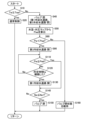
- 5 is a flowchart showing a control procedure of the water flow control valve of the first embodiment in the cooling water circulation system.
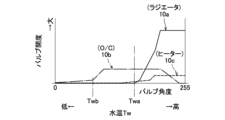
- 13 is a graph showing an example of setting the opening degree of a water flow control valve. 13 is an example of a map for calculating a first threshold value of water pressure.
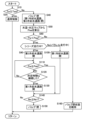
- 10 is a flowchart showing a control procedure of a water flow control valve of a cooling water circulation system according to a second embodiment.
- 13 is a flowchart showing a control procedure of a water flow control valve of a cooling water circulation system according to a third embodiment.
- Fig. 1 is a schematic diagram of a cooling water circulation system 1 according to the present embodiment.
- the bold arrows indicate the direction in which the cooling water flows.
- the cooling water circulation system 1 of this embodiment is used, for example, in an engine 2 (internal combustion engine) mounted on a vehicle, and circulates cooling water to cool the engine 2 and oil cooler 3 (O/C), while also recovering heat in a heater 4 (heater core) to warm the interior of the vehicle.
- engine 2 internal combustion engine
- O/C oil cooler 3
- heater 4 heater core
- the cooling water circulation system 1 has a cooling water passage 10 through which the cooling water circulates.
- a pump 11 for circulating the cooling water is provided in the cooling water passage 10.
- the pump 11 is, for example, a mechanical pump driven by the engine 2, but an electric pump may also be used.
- the engine 2 is disposed downstream of the pump 11 in the cooling water passage 10, and a water flow control valve (MCV) 12 (the valve of the present invention) is provided upstream of the pump 11.
- MCV water flow control valve
- the cooling water passage 10 branches into a first cooling water passage 10a (first passage), a second cooling water passage 10b (second passage), and a third cooling water passage 10c (second passage) downstream of the engine 2.
- the first cooling water passage 10a passes through a radiator 15 and is connected to a water flow control valve 12.
- the second cooling water passage 10 b passes through the oil cooler 3 and is connected to a water flow control valve 12 .
- the third cooling water passage 10 c passes through the heater 4 and is connected to a water flow control valve 12 .
- the radiator 15 cools the cooling water that passes through the first cooling water passage 10a, out of the cooling water whose temperature has increased after passing through the engine 2.
- the oil cooler 3 is a device that cools the oil used to drive and control the operation of the vehicle's hydraulic equipment by exchanging heat with cooling water. In the oil cooler 3, the oil is cooled by the cooling water passing through the second cooling water passage 10b.
- the heater 4 is, for example, a device for heating the interior of the vehicle compartment, and heats the air supplied to the vehicle compartment by exchanging heat between the coolant passing through the third coolant passage 10c and the air.
- the first cooling water passage 10a is a main passage for cooling the engine 2, and therefore has an inner diameter set to be larger than those of the second cooling water passage 10b and the third cooling water passage 10c.
- the water flow control valve 12 is provided at the junction of the first cooling water passage 10a, the second cooling water passage 10b, and the third cooling water passage 10c, and has the function of controlling the opening of each cooling water passage 10a, 10b, and 10c, i.e., the flow rate of the cooling water in each cooling water passage 10a, 10b, and 10c.
- the water flow control valve 12 is provided with, for example, an actuator (not shown), and the relationship between the operation of the actuator and the opening of each cooling water passage 10a, 10b, and 10c can be individually set in advance, or an actuator can be provided for each cooling water passage 10a, 10b, and 10c to individually control the opening of each cooling water passage 10a, 10b, and 10c.
- the operation of the water flow control valve 12 is controlled by the MCV control unit 20 (control unit, prediction means).
- a water pressure sensor 21 pressure acquisition unit is provided in the cooling water passage 10 between the water flow control valve 12 and the pump 11, specifically in a position close to the cooling water inlet of the pump 11, to detect the pressure of the cooling water in the cooling water passage 10 (water pressure Pw), and a water temperature sensor 22 (water temperature acquisition unit) is provided to detect the temperature of the cooling water (water temperature Tw).
- the detection information of the water pressure sensor 21 and the water temperature sensor 22 is input to the MCV control unit 20 .
- the MCV control unit 20 is composed of input/output devices (not shown), storage devices (ROM, RAM, etc.) used for storing control programs, control maps, etc., a central processing unit (CPU), a timer counter, etc.
- the MCV control unit 20 inputs detection information from a water pressure sensor 21 and a water temperature sensor 22, and information corresponding to the output of the pump 11, such as the engine rotation speed Ne from a rotation speed sensor 25 (rotation speed acquisition unit, output acquisition unit), and controls the water flow control valve 12.
- the MCV control unit 20 may be provided in a main control unit installed in the vehicle that performs overall control of the vehicle, or it may be provided in the vehicle separately from the main control unit.
- FIG. 2 is a flowchart showing a control procedure of the water flow control valve 12 according to the first embodiment, which is executed by the MCV control unit 20.
- the control of the water flow control valve 12 shown in FIG. 2 is repeatedly performed when the power source of the vehicle is turned on.
- step S10 the water temperature Tw is input from the water temperature sensor 22, and it is determined whether or not it is equal to or higher than a predetermined temperature Twa.
- the predetermined temperature Twa may be set, for example, to the warm-up completion temperature of the engine 2. If the water temperature Tw is equal to or higher than the predetermined temperature Twa, the process proceeds to step S20. If the water temperature Tw is less than the predetermined temperature Twa, the process proceeds to step S30.
- step S20 normal control (normal control mode) is executed.
- Normal control is a control that increases the opening of the water flow control valve 12 as the water temperature Tw increases.
- the water flow control valve 12 is controlled so that the opening of the first cooling water passage 10a increases as the water temperature Tw increases.
- the second cooling water passage 10b is closed when the water temperature Tw is lower than a temperature Twb, which is lower than the warm-up completion temperature Twa, and is opened when the water temperature Tw is equal to or higher than the temperature Twb. Therefore, when the water temperature Tw is lower than a predetermined temperature Twa and equal to or higher than the temperature Twb, the first cooling water passage 10a is closed and the second cooling water passage 10b is open.
- the state in which the first cooling water passage 10a is closed and the second cooling water passage 10b is open is also considered to be a state in which the "water flow control valve 12 is closed.” Then, this routine ends.
- step S30 the water flow control valve 12 is controlled to close.
- the opening degree of the third cooling water passage 10c changes depending on whether the water temperature Tw is equal to or higher than the warm-up completion temperature Tw, but all cooling water passages (first cooling water passage 10a, second cooling water passage 10b, third cooling water passage 10c) may be controlled to be completely closed, or the opening degree of the third cooling water passage 10c may be set to change.
- it is sufficient that at least the opening degree of the first cooling water passage 10a (the amount of cooling water flowing through the first cooling water passage 10a) is at a level (zero to negligible) that promotes the warm-up of the engine 2. Then, proceed to step S50.
- step S50 the water temperature Tw of the cooling water near the pump inlet is input from the water temperature sensor 22, and a first threshold water pressure Pwa (first pressure) for determining whether to open or close at that water temperature Tw is calculated using a water temperature-water pressure map.
- the water temperature-water pressure map is, for example, a map as shown in FIG. 4, and is set so that the first threshold Pwa increases as the water temperature Tw increases between 40°C and 100°C. In other words, the higher the water temperature Tw, the more likely it is that air bubbles will be generated even if the degree of water pressure drop caused by the pump 11 is small. Then, proceed to step S60.
- step S60 the water pressure Pw at the inlet of the pump 11 is input from the water pressure sensor 21, and it is determined whether the water pressure Pw is lower than the first threshold value Pwa calculated in step S60. If the water pressure Pw is lower than the first threshold value Pwa, the process proceeds to step S80. If the water pressure Pw is equal to or higher than the first threshold value Pwa, the process proceeds to step S160.
- step S80 all inlet passages (first cooling water passage 10a, second cooling water passage 10b, third cooling water passage 10c) of the water flow control valve 12 are opened (open mode). Note that in this step, instead of completely opening all cooling water passages 10a, 10b, 10c, any cooling water passage may be opened. In this step, it is preferable to open at least the first cooling water passage 10a, which has the largest diameter. In this step, it is sufficient to control so that the water pressure upstream of the pump 11 is higher than when the water flow control valve 12 was closed in step S30. Then, proceed to step 140.
- step S140 the rotation speed (revolutions Ne (rpm)) of the engine 2 is input, and it is determined whether the rotation speed Ne is equal to or lower than a predetermined first rotation speed Ne1.
- the first rotation speed Ne1 may be set to a rotation speed that provides an output of the pump 11 such that the generation of bubbles is zero or less than a predetermined value.
- the pump 11 is a mechanical pump, so the output of the pump 11 changes according to the rotation speed of the engine 2. If the pump 11 is an electric pump, the output of the pump 11 may be controlled so that the output of the pump 11 changes according to the rotation speed of the engine 2. If the rotation speed Ne is equal to or lower than the first rotation speed Ne1, that is, if bubbles are unlikely to be generated, the process proceeds to step S150. If the rotation speed Ne is greater than the first rotation speed Ne1, the process returns to this routine.
- step S150 similarly to step S30, the water flow control valve 12 is controlled to close all the inlet passages (the first cooling water passage 10a, the second cooling water passage 10b, and the third cooling water passage 10c), and then the routine returns.
- step S160 the control for closing the water flow control valve 12 performed in step S30 is maintained, and then the present routine is returned.
- the water flow control valve 12 is closed to promote an increase in the water temperature. This allows the temperature of the engine 2 to be quickly increased during a cold start of the engine 2, thereby improving fuel efficiency and exhaust performance.
- the water pressure upstream of the pump 11 may decrease, causing air bubbles to form and reducing the durability of the pump 11.
- the MCV control unit 20 in the cooling water circulation system 1 of this embodiment predicts the generation of air bubbles based on the water temperature Tw and the water pressure Pw when the water temperature Tw is lower than the predetermined temperature Twa, and opens the water flow control valve 12 when the generation of air bubbles is predicted.
- the MCV control unit 20 in the cooling water circulation system 1 of this embodiment predicts the generation of air bubbles based on the water temperature Tw and the water pressure Pw when the water temperature Tw is lower than the predetermined temperature Twa, and opens the water flow control valve 12 when the generation of air bubbles is predicted.
- the water flow control valve 12 When the water temperature Tw is high and equal to or higher than a predetermined temperature Twa, the water flow control valve 12 is not opened or closed based on a prediction of the generation of air bubbles, but normal control is performed to open and close the water flow control valve 12 based on the water temperature Tw, thereby making it possible for the cooling water circulation system 1 to appropriately control the temperature of the engine 2.
- the MCV control unit 20 predicts that air bubbles will occur when the water pressure Pw detected by the water pressure sensor 21 provided upstream of the pump 11 falls below the first threshold value Pwa, making it possible to predict the occurrence of air bubbles with a simple configuration.
- the first threshold value Pwa is changed based on the water temperature Tw detected by the water temperature sensor 22 provided upstream of the pump 11. More specifically, the first threshold value Pwa is set to increase as the water temperature Tw increases. Note that as the water temperature Tw increases, the pressure at which air bubbles begin to form in the cooling water increases, so by changing the first threshold value Pwa in accordance with the water temperature Tw in this way, it becomes possible to accurately predict the formation of air bubbles.
- the MCV control unit 20 controls the water flow control valve 12 to close if the rotation speed Ne of the engine 2 is equal to or lower than the first rotation speed Ne1, even if the water pressure Pw is equal to or lower than the first threshold value Pwa with the water flow control valve 12 closed.
- the water flow control valve 12 is closed, warm-up is required.
- the rotation speed Ne of the engine 2 is low and the output of the pump 11 is low, and the amount of bubbles generated upstream of the pump 11 is small, the durability of the pump 11 is unlikely to decrease, so the water flow control valve 12 is maintained in a closed state to promote warm-up of the engine 2.
- the water flow control valve 12 by closing the water flow control valve 12 and allowing the generation of bubbles, the cooling capacity of the engine 2 by the coolant is reduced, and warm-up can be promoted.
- the water flow control valve 12 After the generation of air bubbles is predicted and the water flow control valve 12 is opened, even if the water temperature Tw is below the predetermined temperature Twa and the water pressure Pw exceeds the first threshold value Pwa, the water flow control valve 12 remains open as long as the rotation speed Ne of the engine 2 exceeds the first rotation speed Ne1. This prevents the water flow control valve 12 from repeatedly opening and closing even if the water pressure Pw fluctuates around the first threshold value Pwa.
- the cooling water passage 10 of the cooling water circulation system 1 of this embodiment has a first cooling water passage 10a through which the cooling water circulates by passing through the radiator 15, and cooling water passages (second cooling water passage 10b, third cooling water passage 10c) through which the cooling water circulates without passing through the radiator 15.
- a water flow control valve 12 is provided at the junction of the first cooling water passage 10a and the other passages (second cooling water passage 10b, third cooling water passage 10c) and can open and close each of the cooling water passages 10a, 10b, 10c.
- a pump 11 is provided immediately downstream of the water flow control valve 12.
- the MCV control unit 20 controls the water flow control valve 12 based on the detection values of a water temperature sensor 22 and a water pressure sensor 21 arranged in the cooling water passage 10 between the pump 11 and the water flow control valve 12, and suppresses the generation of air bubbles between the pump 11 and the water flow control valve 12.
- the water flow control valve 12 is efficiently located at the junction to control the amount of cooling water in each of the first cooling water passage 10a and the other passages (second cooling water passage 10b, third cooling water passage 10c). Also, the pump 11 supplies cooling water to each of the first cooling water passage 10a and the other passages (second cooling water passage 10b, third cooling water passage 10c), so it is efficient to locate it downstream of the junction. However, in this configuration, the opening and closing of the water flow control valve 12 reduces the water pressure downstream of the water flow control valve 12 and upstream of the pump 11, making it easier for air bubbles to form.
- the water flow control valve 12 can independently control the opening degree of each of the cooling water passages 10a, 10b, and 10c.
- FIG. 5 is a flowchart showing a control procedure of the water flow control valve 12 in the cooling water circulation system 1 according to the second embodiment. Only the points that differ from the control of the first embodiment shown in FIG. 2 will be described below.
- step S10 if the water temperature Tw is lower than the predetermined temperature Twa, the process proceeds to step S40.
- step S40 the water flow control valve 12 is controlled to be closed. In this step, at least the first cooling water passage 10a and the third cooling water passage 10c are controlled to be closed. Then, the process proceeds to step S50 and step S60.
- step S60 if the water pressure Pw is lower than the first threshold value Pwa, the process proceeds to step S90.
- step S90 the water flow control valve 12 is controlled to open the third coolant passage 10c, and the process then proceeds to step S110.
- step S110 the current water pressure Pw is input from the water pressure sensor 21, and it is determined whether the water pressure Pw is equal to or greater than the second threshold value Pwb.
- the second threshold value Pwb is a value greater than the first threshold value Pwa. If the water pressure Pw is equal to or greater than the second threshold value Pwb, the process proceeds to step S140. If the water pressure Pw is less than the second threshold value Pwb, the process proceeds to step S120.
- step S120 it is determined whether the state in which the water pressure Pw is less than the second threshold value Pwb has continued for a predetermined time ta.
- the predetermined time ta is, for example, about 30 seconds, and may be a period of time that allows the change in the water pressure Pw to stabilize after the third cooling water passage 10c is opened in step S90. If the state in which the water pressure Pw is less than the second threshold value Pwb has continued for the predetermined time ta, proceed to step S130. If the state in which the water pressure Pw is less than the second threshold value Pwb has not continued for the predetermined time ta, return to step S110.
- step S130 the water flow control valve 12 is controlled to open the first coolant passage 10a for the radiator 15. Then, the process proceeds to step S140.
- the temperature of the cooling water water temperature Tw
- the water flow control valve 12 is closed, and the water pressure Pw is lower than the first threshold value Pwa
- the third cooling water passage 10c is first opened. This makes it possible to suppress a drop in water pressure and suppress the generation of air bubbles, and to promote warming by closing the first cooling water passage 10a.
- the first cooling water passage 10a is opened.
- the water pressure Pw is increased, and the generation of air bubbles can be further suppressed.
- the generation of air bubbles can be suppressed more effectively while promoting warm-up.
- step S90 When opening the third cooling water passage 10c in step S90, it is advisable to open it gradually according to the water pressure Pw. This makes it possible to more efficiently suppress the generation of air bubbles and promote warm-up at the same time.
- opening the first cooling water passage 10a in step S130 it is advisable to open it fully in a short period of time. This makes it possible to more effectively suppress the generation of air bubbles.
- the presence or absence of air bubbles is determined based on the water pressure Pw, but the degree of air bubbles (amount of air bubbles) may be determined based on the output of the pump 11 (the rotational speed of the pump 11, for example, the rotational speed of the engine 2 that drives the pump 11). Then, the opening and closing of the first cooling water passage 10a for the radiator 15 and the other cooling water passages 10b and 10c may be switched based on the degree of air bubbles.
- the degree of bubble generation is determined based on the output of the pump 11 in this embodiment, it may also be determined based on the water pressure Pw. For example, it may be determined that the lower the water pressure Pw, the greater the degree of bubble generation.
- the water flow control valve 12 can independently control the opening of each of the cooling water passages 10a, 10b, and 10c.
- This embodiment is also applicable to a plug-in hybrid vehicle or a hybrid vehicle (hybrid vehicle) that can switch between a series running mode in which the engine 2 drives a generator to generate electricity and the electric motor drives the vehicle, and an engine running mode in which the vehicle is mechanically driven by at least the engine 2, like a parallel running mode.
- FIG. 6 is a flowchart showing a control procedure of the water flow control valve 12 in the cooling water circulation system 1 according to the third embodiment. Hereinafter, only the points that differ from the water flow control of the second embodiment shown in FIG. 5 will be described.
- step S60 if the water pressure Pw is less than the first threshold value Pwa, the process proceeds to step S70.
- step S70 it is determined whether the vehicle's driving mode is series driving. If the vehicle is in series driving, the process proceeds to step S90. If the vehicle is not in series driving, for example, in parallel driving, the process proceeds to step S100.
- series driving the engine 2 generates electricity and the electric motor drives the vehicle as described above, so the rotation speed of the engine 2 is kept approximately constant.
- parallel driving the engine 2 mechanically drives the driving wheels, so the rotation speed of the engine 2 may become high.
- step S100 the water flow control valve 12 is controlled to open the first cooling water passage 10a for the radiator 15. Then, the process proceeds to step S140.
- the third embodiment in addition to the second embodiment, if the water pressure Pw is less than the first threshold value Pwa, it is determined whether or not series running is in progress, and if series running is not in progress, that is, if there is a possibility that the rotation speed of the engine 2 will increase significantly, as in the case of parallel running, the first cooling water passage 10a is opened to suppress the generation of air bubbles.
- the third cooling water passage 10c is first opened to increase the water pressure and promote warming up. Even during series running, if the third cooling water passage 10c is opened as in the second embodiment and the water pressure Pw does not rise to or above the second threshold value Pwb, the first cooling water passage 10a is opened to promote an increase in water pressure, suppress the generation of air bubbles, and protect the pump 11.
- the present invention is not limited to the above-described embodiment, and can be modified without departing from the spirit and scope of the invention.
- the cooling water circulation system 1 of the present embodiment can be applied to engines mounted on various vehicles.
- Cooling water circulation system 2 Engine (internal combustion engine) 10 Cooling water passage 10a First cooling water passage (first passage) 10b Second cooling water passage (second passage) 10c Third cooling water passage (second passage) 11 Pump 12 Water flow control valve (valve) 20 MCV control unit (control unit, prediction means) 21 Water pressure sensor (pressure acquisition unit) 22 Water temperature sensor (water temperature acquisition unit) 25 Rotational speed sensor (rotational speed acquisition unit, output acquisition unit)
Landscapes
- Engineering & Computer Science (AREA)
- Chemical & Material Sciences (AREA)
- Combustion & Propulsion (AREA)
- Mechanical Engineering (AREA)
- General Engineering & Computer Science (AREA)
- Cooling, Air Intake And Gas Exhaust, And Fuel Tank Arrangements In Propulsion Units (AREA)
Priority Applications (2)
| Application Number | Priority Date | Filing Date | Title |
|---|---|---|---|
| PCT/JP2023/035403 WO2025069303A1 (ja) | 2023-09-28 | 2023-09-28 | 冷却水循環システム |
| JP2025548163A JPWO2025069303A1 (https=) | 2023-09-28 | 2023-09-28 |
Applications Claiming Priority (1)
| Application Number | Priority Date | Filing Date | Title |
|---|---|---|---|
| PCT/JP2023/035403 WO2025069303A1 (ja) | 2023-09-28 | 2023-09-28 | 冷却水循環システム |
Publications (1)
| Publication Number | Publication Date |
|---|---|
| WO2025069303A1 true WO2025069303A1 (ja) | 2025-04-03 |
Family
ID=95202480
Family Applications (1)
| Application Number | Title | Priority Date | Filing Date |
|---|---|---|---|
| PCT/JP2023/035403 Pending WO2025069303A1 (ja) | 2023-09-28 | 2023-09-28 | 冷却水循環システム |
Country Status (2)
| Country | Link |
|---|---|
| JP (1) | JPWO2025069303A1 (https=) |
| WO (1) | WO2025069303A1 (https=) |
Citations (6)
| Publication number | Priority date | Publication date | Assignee | Title |
|---|---|---|---|---|
| JP2008057340A (ja) * | 2006-08-29 | 2008-03-13 | Toyota Motor Corp | 内燃機関の排気熱回収装置 |
| JP2013234605A (ja) * | 2012-05-09 | 2013-11-21 | Nissan Motor Co Ltd | エンジン冷却システムの制御装置及び制御方法 |
| WO2015125260A1 (ja) * | 2014-02-20 | 2015-08-27 | 日産自動車株式会社 | 冷却システム制御装置及び冷却システム制御方法 |
| KR101684553B1 (ko) * | 2015-08-25 | 2016-12-08 | 현대자동차 주식회사 | 냉각수 제어밸브를 갖는 엔진시스템 |
| US20170342892A1 (en) * | 2016-05-24 | 2017-11-30 | Hyundai Motor Company | Cooling system and control method of vehicle |
| JP2021059995A (ja) * | 2019-10-04 | 2021-04-15 | 三菱自動車工業株式会社 | 車両の冷却制御装置 |
-
2023
- 2023-09-28 JP JP2025548163A patent/JPWO2025069303A1/ja active Pending
- 2023-09-28 WO PCT/JP2023/035403 patent/WO2025069303A1/ja active Pending
Patent Citations (6)
| Publication number | Priority date | Publication date | Assignee | Title |
|---|---|---|---|---|
| JP2008057340A (ja) * | 2006-08-29 | 2008-03-13 | Toyota Motor Corp | 内燃機関の排気熱回収装置 |
| JP2013234605A (ja) * | 2012-05-09 | 2013-11-21 | Nissan Motor Co Ltd | エンジン冷却システムの制御装置及び制御方法 |
| WO2015125260A1 (ja) * | 2014-02-20 | 2015-08-27 | 日産自動車株式会社 | 冷却システム制御装置及び冷却システム制御方法 |
| KR101684553B1 (ko) * | 2015-08-25 | 2016-12-08 | 현대자동차 주식회사 | 냉각수 제어밸브를 갖는 엔진시스템 |
| US20170342892A1 (en) * | 2016-05-24 | 2017-11-30 | Hyundai Motor Company | Cooling system and control method of vehicle |
| JP2021059995A (ja) * | 2019-10-04 | 2021-04-15 | 三菱自動車工業株式会社 | 車両の冷却制御装置 |
Also Published As
| Publication number | Publication date |
|---|---|
| JPWO2025069303A1 (https=) | 2025-04-03 |
Similar Documents
| Publication | Publication Date | Title |
|---|---|---|
| CN102482982B (zh) | 变流量水泵的控制装置 | |
| JP6079766B2 (ja) | エンジン冷却システム及びその運転方法 | |
| JP4998537B2 (ja) | 車両の冷却装置 | |
| CA2880357C (en) | Exhaust heat recovery control device | |
| JP5282845B2 (ja) | 機関冷却装置 | |
| US11091008B2 (en) | Vehicle control device | |
| JP2008274885A (ja) | 内燃機関の冷却装置 | |
| JP2004360509A (ja) | 内燃機関の冷却装置 | |
| JP2010007570A (ja) | 内燃機関の暖機制御システム | |
| US8978599B2 (en) | Cooling apparatus of internal combustion engine for vehicle | |
| JP2005090236A (ja) | 内燃機関の冷却装置 | |
| CN111824112B (zh) | 混合动力车辆的控制装置和控制方法以及存储介质 | |
| JP6190480B1 (ja) | サーモスタットの異常診断装置 | |
| WO2025069303A1 (ja) | 冷却水循環システム | |
| JP6443824B2 (ja) | エンジンの冷却装置 | |
| JP2006037883A (ja) | 内燃機関の冷却装置 | |
| JP2025025181A (ja) | ハイブリッド車両の制御装置 | |
| JP2017128293A (ja) | 冷却システム | |
| US11319855B2 (en) | Heat accumulation and dissipation device for internal combustion engine | |
| JP2016215863A (ja) | ハイブリッド車両 | |
| JP2017019413A (ja) | 昇温システム | |
| JP5206696B2 (ja) | 内燃機関冷却装置システム | |
| JP6551865B2 (ja) | エンジンの冷却装置 | |
| JP2002188443A (ja) | 内燃機関の冷却装置 | |
| JP7043143B2 (ja) | 内燃機関の冷却水制御装置 |
Legal Events
| Date | Code | Title | Description |
|---|---|---|---|
| 121 | Ep: the epo has been informed by wipo that ep was designated in this application |
Ref document number: 23953274 Country of ref document: EP Kind code of ref document: A1 |
|
| ENP | Entry into the national phase |
Ref document number: 2025548163 Country of ref document: JP Kind code of ref document: A |
|
| WWE | Wipo information: entry into national phase |
Ref document number: 2025548163 Country of ref document: JP |