WO2025063199A1 - 中分子医薬品の分離精製方法および中分子医薬品の分離精製システム - Google Patents
中分子医薬品の分離精製方法および中分子医薬品の分離精製システム Download PDFInfo
- Publication number
- WO2025063199A1 WO2025063199A1 PCT/JP2024/033267 JP2024033267W WO2025063199A1 WO 2025063199 A1 WO2025063199 A1 WO 2025063199A1 JP 2024033267 W JP2024033267 W JP 2024033267W WO 2025063199 A1 WO2025063199 A1 WO 2025063199A1
- Authority
- WO
- WIPO (PCT)
- Prior art keywords
- liquid
- primary treatment
- separation
- component
- icatibant
- Prior art date
- Legal status (The legal status is an assumption and is not a legal conclusion. Google has not performed a legal analysis and makes no representation as to the accuracy of the status listed.)
- Pending
Links
Images




Classifications
-
- A—HUMAN NECESSITIES
- A61—MEDICAL OR VETERINARY SCIENCE; HYGIENE
- A61K—PREPARATIONS FOR MEDICAL, DENTAL OR TOILETRY PURPOSES
- A61K38/00—Medicinal preparations containing peptides
-
- B—PERFORMING OPERATIONS; TRANSPORTING
- B01—PHYSICAL OR CHEMICAL PROCESSES OR APPARATUS IN GENERAL
- B01D—SEPARATION
- B01D15/00—Separating processes involving the treatment of liquids with solid sorbents; Apparatus therefor
-
- B—PERFORMING OPERATIONS; TRANSPORTING
- B01—PHYSICAL OR CHEMICAL PROCESSES OR APPARATUS IN GENERAL
- B01D—SEPARATION
- B01D15/00—Separating processes involving the treatment of liquids with solid sorbents; Apparatus therefor
- B01D15/08—Selective adsorption, e.g. chromatography
-
- C—CHEMISTRY; METALLURGY
- C07—ORGANIC CHEMISTRY
- C07K—PEPTIDES
- C07K1/00—General methods for the preparation of peptides, i.e. processes for the organic chemical preparation of peptides or proteins of any length
- C07K1/14—Extraction; Separation; Purification
- C07K1/16—Extraction; Separation; Purification by chromatography
-
- C—CHEMISTRY; METALLURGY
- C07—ORGANIC CHEMISTRY
- C07K—PEPTIDES
- C07K7/00—Peptides having 5 to 20 amino acids in a fully defined sequence; Derivatives thereof
- C07K7/04—Linear peptides containing only normal peptide links
- C07K7/06—Linear peptides containing only normal peptide links having 5 to 11 amino acids
-
- C—CHEMISTRY; METALLURGY
- C12—BIOCHEMISTRY; BEER; SPIRITS; WINE; VINEGAR; MICROBIOLOGY; ENZYMOLOGY; MUTATION OR GENETIC ENGINEERING
- C12M—APPARATUS FOR ENZYMOLOGY OR MICROBIOLOGY; APPARATUS FOR CULTURING MICROORGANISMS FOR PRODUCING BIOMASS, FOR GROWING CELLS OR FOR OBTAINING FERMENTATION OR METABOLIC PRODUCTS, i.e. BIOREACTORS OR FERMENTERS
- C12M1/00—Apparatus for enzymology or microbiology
Definitions
- the present invention relates to a method for separating and purifying a medium-sized molecule drug and a system for separating and purifying a medium-sized molecule drug.
- Medium molecule drugs are drugs that contain compounds with a molecular weight of 500 to 10,000, and are positioned between small molecule drugs and large molecule drugs.
- Medium molecule drugs usually include peptide drugs and nucleic acid drugs.
- Peptide drugs are drugs whose main ingredient is a peptide with multiple amino acid residues.
- next-generation peptide drugs with non-natural amino acid residues include glucagon-like peptide 1 (GLP-1) such as tirzepatide and icatibant.
- GLP-1 glucagon-like peptide 1
- Icatibant is a peptide consisting of a 10 amino acid sequence. It is a specific antagonist of the bradykinin B2 receptor and is therefore used to treat attacks of hereditary angioedema (HAE). Icatibant is synthesized by solid-phase peptide synthesis, but during the synthesis, several impurities such as aggregated peptides are generated. Therefore, the purity of Icatibant is increased by removing these impurities from the crude Icatibant obtained by the synthesis reaction. For example, Patent Document 1 proposes a method for separating and purifying Icatibant using reverse phase chromatography.
- the interaction between the impurities and the separation agent is similar to that between the target medium-sized molecular weight drug and the separation agent, making separation difficult.
- icatibant a type of peptide drug, as the target medium-sized molecular weight drug.
- the inventors came up with the idea of incorporating the Simulated Moving Bed Chromatography (SMB) method of continuous liquid chromatography into the separation process in order to increase the recovery rate while maintaining the high purity of icatibant.
- SMB Simulated Moving Bed Chromatography
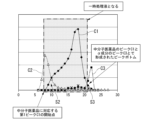
- the impurity with the smallest overlap of the peak areas of icatibant is defined as the ⁇ component, and the selection process of the ⁇ component will be described in more detail.
- peak C1 is the detection peak of icatibant.
- impurity peaks C2 and C3 are shown, but in addition to the impurities corresponding to these two peaks, normal crude icatibant contains many impurities not shown.
- the area of overlap S3 with the peak area of icatibant is the smallest, so the component corresponding to peak C3 is selected as the ⁇ component.
- the area of overlap S2 with the peak area of icatibant is larger than the area of overlap S3. Therefore, the component corresponding to peak C2 is not selected as the component to be removed in the pretreatment (primary treatment) step.
- the simulated moving bed method in the secondary treatment process can separate components that are not alpha components (for example, the beta component corresponding to peak C2 in the example shown in Figure 1).
- the primary treatment process in order to maximize the recovery rate of icatibant, the overlapping portion of icatibant and the beta component is recovered as a purified liquid.
- impurities such as beta components can be removed, so the content of beta components in the primary treatment liquid may be high. In this way, by combining the primary and secondary treatment processes, it is possible to achieve both a high recovery rate and purity of icatibant.
- the ⁇ component is removed in the primary treatment, which is liquid chromatography.
- the ⁇ component has the smallest overlap with the peak area of icatibant in the chromatogram obtained by the primary treatment step. Therefore, even if the ⁇ component is removed in the pretreatment, the amount of the target icatibant removed and the loss are relatively small.
- the present inventors have discovered that by further performing a simulated moving bed process using icatibant obtained from the primary treatment liquid, it is possible to achieve a high recovery rate while maintaining the high purity of icatibant, and have completed the present invention.
- multiple components can be separated in sequence by utilizing the difference in the interaction between each component in the treatment liquid and the separating agent.
- the ⁇ component which has a smaller interaction with the separating agent, has a shorter retention time and is separated first.
- the ⁇ component, which has a larger interaction with the separating agent, has a longer retention time and is separated last.
- the liquid to be treated is not limited to containing two types of impurities, and may contain three or more types of impurities. In that case, the components that overlap the peak area of icatibant in the chromatogram of the liquid to be treated are removed in order.
- the method for separating and purifying icatibant includes a primary treatment step and a secondary treatment step.
- the primary treatment step and the secondary treatment step will be described in order below.
- a liquid to be treated containing icatibant and a plurality of impurities is supplied to a column packed with separating agent X, thereby obtaining a primary treatment liquid from which the ⁇ component has been removed from the liquid to be treated.
- the ⁇ component is the impurity that has the smallest overlap with the peak area of icatibant in the chromatogram of the liquid to be treated obtained by the primary purification.
- the conditions for removing the ⁇ -components from the liquid to be treated can be determined by those skilled in the art by varying various conditions such as the type and concentration of the eluent, gradient conditions, injection pressure, flow rate, and temperature.
- the liquid to be treated containing icatibant and multiple impurities is supplied from a pipe 51 to a column 52 packed with a separating agent X.
- the alpha component is removed from the liquid to be treated by adjusting the interaction with the separating agent X in the column 52.
- An eluent is used to adjust the interaction with the separating agent X.
- the primary treatment liquid from which the alpha component has been removed is then recovered and obtained from a pipe 53.
- the fraction of the liquid to be treated from the starting point of the icatibant peak C1 is retained to obtain the primary treatment liquid, and the ⁇ components that flow out before that can be removed.
- the fraction of the liquid to be treated corresponding to the peak bottom formed by peak C1 of icatibant and peak C3 of the ⁇ component shown in Figure 2
- the fraction of the liquid to be treated from the start of icatibant peak C1 to the bottom of the peak formed by icatibant peak C1 and ⁇ component peak C3 as the primary treatment liquid (gray range in Figure 2).
- the content of the ⁇ component in the primary treatment liquid obtained in the primary treatment step is preferably as close to 0 as possible from the viewpoint of the purity of the icatibant in the secondary treatment.
- the content is preferably 1.0% by mass or less, more preferably 0.5% by mass or less, and even more preferably 0.1% by mass or less.
- the purity of icatibant in the primary treatment liquid obtained in the primary treatment step is preferably 90% by mass or more, more preferably 94% by mass or more, and even more preferably 97% by mass or more, since this tends to increase the recovery rate of icatibant.
- polymeric materials for polymer-based separating agents include vinyl-based synthetic polymers, diene-based synthetic polymers, condensation-based synthetic polymers, and curable synthetic polymers.
- vinyl synthetic polymers examples include styrene synthetic polymers such as polystyrene (PS), (meth)acrylic synthetic polymers such as polymethyl methacrylate (PMMA), acetal synthetic polymers such as polyvinyl chloride (PVC), polyvinylidene chloride (PVDC), polyethylene (PE), polypropylene (PP), polyacrylonitrile (PAN), polyvinyl alcohol (PVA), and polyvinyl butyral, polyvinyl acetate (PVAc), polyacrylamide (PAA), and polyvinyl ether synthetic polymers.
- PS polystyrene
- PVDC polyvinylidene chloride
- PE polyethylene
- PP polypropylene
- PAN polyacrylonitrile
- PAN polyvinyl alcohol
- PAA polyvinyl butyral
- PAA polyacrylamide
- PAA polyvinyl ether synthetic polymers
- condensation synthetic polymers examples include polyamide synthetic polymers such as nylon 6 and nylon 66, polyester synthetic polymers such as polyethylene terephthalate (PET) and polylactone, and polyether synthetic polymers such as polycarbonate (PC) and polyoxymethylene (POM).
- polyamide synthetic polymers such as nylon 6 and nylon 66
- polyester synthetic polymers such as polyethylene terephthalate (PET) and polylactone
- polyether synthetic polymers such as polycarbonate (PC) and polyoxymethylene (POM).
- the average particle size of the separating agent Y is not particularly limited, but may be, for example, in the range of 5 to 100 ⁇ m, 10 to 50 ⁇ m, 10 to 30 ⁇ m, etc.
- the average particle size of the synthetic adsorbent can be measured by a known method. For example, it can be obtained by measuring the particle sizes of 100 or more particles with an optical microscope and calculating the volume median diameter from the distribution.
- the type and average particle size of the separating agent Y may be the same as those of the separating agent X, or may be selected independently.
- the eluent used in the primary treatment may be selected similarly to the eluent used in the primary treatment, or may be selected independently.
- the buffer may be selected similarly to the eluent used in the primary treatment, or may be selected independently.
- Figures 6(a) and 6(b) show the concentration distribution of the P and R components in the filling sections 11-14 during the supply/withdrawal step and the circulation step.
- the horizontal direction represents the position within the filling sections 11-14.
- the left side represents the upper (more upstream) position within the filling sections 11-14. Additionally, the right side represents the lower (more downstream) position within the filling sections 11-14.
- step 101 the concentration distribution of the P and R components will be as shown in Figure 6(b).
- the primary treatment liquid and eluent in the filling section 10 are circulated between the filling sections 10 in a downward flow to advance the separation of the multiple components (step 102: circulation process).
- step 102 the primary treatment liquid and the eluent are not supplied.
- the connection line on-off valves X1, X2, and X3 are opened, and the other on-off valves are closed.
- the pump PM is then operated to circulate the primary treatment liquid and the eluent in the loading section 10 between the loading sections 10 in a downward flow.
- all the loading sections 10 are connected by the pipes HX1, HX2, HX3, and HX4 and the bypass line HB.
- a circulation path that satisfies the following conditions 1 and 2 is formed in the simulated moving bed apparatus 2.
- Condition 1 The primary treatment liquid and the eluent are not additionally supplied to the multiple loading sections 10 .
- Condition 2 The primary treatment liquid and the eluent are circulated among the multiple loading sections in a direction from the supply section 20 toward the withdrawal section 30.
- the primary treatment liquid and eluent can be moved within the circulation path.
- the primary treatment liquid and eluent within the filling section 10 can be moved downward by the width of one filling section 10.
- separation of the P component and the R component progresses.
- the concentration distribution is shifted by one filling section 10 to the right in FIG. 6 from the state shown in FIG. 6(a).
- the concentration distribution is reproduced by shifting one filling section 10 to the right in FIG. 6. This allows the process to return to step 101 again and repeat the same separation process, allowing separation by liquid chromatography to be performed continuously.
- step 103 it is determined whether or not to terminate the separation by the simulated moving bed method. Separation may be terminated, for example, when a predetermined amount of the primary treatment liquid has been treated. Separation may also be terminated when the pressure loss exceeds a predetermined magnitude, or when a predetermined separation operation time has elapsed. If separation is to be ended (Yes in step 103), the separation operation is stopped (step 104). On the other hand, if separation is not to be ended (No in step 103), the process returns to step 101. Thereafter, steps 101, 102 and 103 are repeated.
- Downward arrows and upward arrows indicate the points where the primary treatment liquid and eluent are supplied and the points where the P fraction and R fraction are extracted.
- the primary treatment liquid is represented by "F”
- the eluent by "W”
- the P component and P fraction by "P”
- the R component and R fraction by "R”.
- Table 1 shows the open state of each on-off valve of the switching unit 40 in each process shown in FIG. 7. All on-off valves other than those shown here are closed.
- the primary treatment liquid it is preferable to supply the primary treatment liquid to at least one of the multiple packed sections (11, 12, 13, 14) under the condition of a spatial velocity (SV) of 0.5 h -1 to 10 h -1.
- SV spatial velocity
- the spatial velocity is a flow rate at which a pressure of about 0.8 times the column pressure resistance is applied.
- the above-described method for separating and purifying icatibant removes ⁇ -components from the liquid to be treated by the primary treatment step.
- the ⁇ -components are impurities that have the smallest overlap with the peak area of icatibant in the chromatogram of the liquid to be treated. Therefore, the loss of icatibant is reduced and the recovery rate is improved. Then, based on the characteristics of icatibant and the ⁇ -component, the separating agent X, the eluent, the separation conditions, etc. are determined.
- icatibant in the secondary treatment step, can be continuously separated from the primary treatment liquid obtained in the primary treatment step. Therefore, the recovery rate is improved while maintaining the high purity of icatibant.
- the purification method for icatibant may further include the following alpha component selection step before the primary treatment step:
- the alpha component selection process includes the following steps. A step of determining a first peak (C1) corresponding to icatibant in a chromatogram obtained when the liquid to be treated is supplied to a column packed with separating agent X. A step of determining a second peak (C2) in the chromatogram, which corresponds to an impurity that has passed through the separating agent X before icatibant, among the plurality of impurities. Determining the third peak (C3), which corresponds to the impurities that passed through the separating agent X after Icatibant. a step of selecting, as the ⁇ component, an impurity corresponding to the peak having the smallest overlapping area with the first peak (C1) from among the second peak (C2) and the third peak (C3).
- a post-treatment may be carried out as necessary, such as a solvent removal treatment, a cation exchange treatment, or an anion exchange treatment.
- the separation and purification system for Icatibant includes a primary treatment device and a simulated moving bed device.
- the primary treatment device and the simulated moving bed device will be described below in order.
- the primary treatment device supplies a liquid to be treated, which contains icatibant and a plurality of impurities, to a column packed with separating agent X, thereby obtaining a primary treatment liquid from which the alpha component has been removed from the liquid to be treated.
- the primary treatment device 1 shown in FIG. 3 has a pipe 51, a column 52, and a pipe 53.
- the liquid to be treated containing icatibant and multiple impurities can be supplied from the pipe 51 to a column 52 filled with a separating agent X.
- the ⁇ component is removed from the liquid to be treated by adjusting the interaction with the separating agent X, that is, the impurity that has the smallest overlap with the peak area of icatibant in the chromatogram of the liquid to be treated.
- the eluent used in the column 52 is used to adjust the interaction with the separating agent X, thereby removing the ⁇ component from the liquid to be treated.
- the eluent used in the primary treatment can be appropriately selected depending on the state of the liquid to be treated and the treatment conditions. Examples of the eluent include acetonitrile, ethanol, and methanol. Among these, acetonitrile is more preferable.
- the primary treated liquid from which the ⁇ component has been removed can be recovered and obtained from the pipe 53 .
- the alpha component content of the primary treatment liquid obtained in the primary treatment device is preferably as close to 0 as possible from the viewpoint of the purity of the ikativant in the secondary treatment. For example, 1.0% by mass or less is preferable, 0.5% by mass or less is more preferable, and 0.1% by mass or less is even more preferable.
- the content of icatibant in the primary treatment liquid obtained by the primary treatment device is preferably 90% by mass or more, more preferably 94% by mass or more, and even more preferably 97% by mass or more, since the recovery rate of icatibant by secondary treatment is likely to be high. Since impurities other than the alpha component can be removed by secondary treatment, it may be included in the primary treatment liquid.
- the simulated moving bed apparatus performs a simulated moving bed method for continuously separating icatibant by supplying the primary treated liquid obtained in the primary treatment apparatus to a plurality of packed sections filled with separating agent Y.
- the simulated moving bed apparatus is not particularly limited as long as it is an apparatus for performing the simulated moving bed method using the primary treated liquid obtained in the primary treatment apparatus as the liquid to be separated.
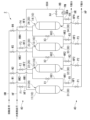
- the simulated moving bed apparatus 2 shown in Figure 4 can perform a simulated moving bed method for continuously separating icatibant by supplying the primary treatment liquid to multiple packed sections 10 (11, 12, 13, 14) filled with separating agent Y.
- the simulated moving bed apparatus 2 has a filling section 10, a supply section 20, a withdrawal section 30 and a switching section 40.
- the separation tower packed with separating agent Y is preferably a packed column that does not have an empty column at the top.
- the packed section 10 may be, for example, a column.
- the packed section 10 has a space inside for packing with separating agent Y. Examples of materials for the packed section 10 include steel plate and resin.
- the liquid-contacting part may be lined with rubber, but this is not particularly limited.
- the shape of the packed section 10 is not particularly limited, but an example is a column with a roughly cylindrical shape.
- the eluent used in the secondary treatment can be appropriately selected depending on the state of the primary treatment liquid and the treatment conditions. Examples include acetonitrile, methanol, and ethanol. Of these, acetonitrile is preferred.
- the eluent used in the secondary treatment may be the same as the eluent used in the primary treatment, or it may be different. From the viewpoint of ease of management, it is preferable that the eluent used in the secondary treatment is the same as the eluent used in the primary treatment.
- the extraction section 30 is a section for extracting the separated liquid from each of the multiple filling sections.
- the extraction section 30 is formed as a discharge outlet at the bottom of each filling section.
- the extraction section 30 is illustrated as extraction sections 31, 32, 33, and 34 (extraction sections 31 to 34).
- extraction sections 31, 32, 33, and 34 extraction sections 31 to 34.
- the simulated moving bed apparatus 2 has a pipe HW for supplying the eluent, a pipe HW1 for supplying the eluent from the pipe HW to the filling section 11, a pipe HW2 for supplying the eluent from the pipe HW to the filling section 12, a pipe HW3 for supplying the eluent from the pipe HW to the filling section 13, and a pipe HW4 for supplying the eluent from the pipe HW to the filling section 14.
- the eluent on-off valves W1 to W4 are provided in the pipes HW1 to HW4, respectively, and control the supply of the eluent to the filling sections 11 to 14.
- the simulated moving bed apparatus 2 has a pipe HF for supplying the primary treatment liquid, a pipe HF1 for supplying the primary treatment liquid from the pipe HF to the filling section 11, a pipe HF2 for supplying the primary treatment liquid from the pipe HF to the filling section 12, a pipe HF3 for supplying the primary treatment liquid from the pipe HF to the filling section 13, and a pipe HF4 for supplying the primary treatment liquid from the pipe HF to the filling section 14.
- Primary treatment liquid on-off valves F1 to F4 are provided in the pipes HF1 to HF4, respectively, and control the supply of the primary treatment liquid to the filling sections 11 to 14.
- the simulated moving bed device 2 has, as connection paths connecting each filling section 10, a pipe HX1 connecting the discharge section 31 of the filling section 11 to the supply section 22 of the filling section 12, a pipe HX2 connecting the discharge section 32 of the filling section 12 to the supply section 23 of the filling section 13, a pipe HX3 connecting the discharge section 33 of the filling section 13 to the supply section 24 of the filling section 14, and a pipe HX4 connecting the discharge section 34 of the filling section 14 to the supply section 21 of the filling section 11.
- the connection path opening/closing valves X1 to X4 are provided in the pipes HX1 to HX4, respectively, and control the flow of liquid between the filling sections 11 to 14.
- a bypass path HB is provided at the connection path on-off valve X4 of pipe HX4.
- a pump PM is provided in the bypass path HB.
- the bypass path HB and the pump PM are installed in pipe HX4, they may be installed in any of pipes HX1 to HX4, or in multiple positions (for example, all positions) of pipes HX1 to HX4.
- the simulated moving bed apparatus 2 has a pipe HR for extracting the R fraction, a pipe HR1 for extracting the R fraction from the filling section 11 to the pipe HR, a pipe HR2 for extracting the R fraction from the filling section 12 to the pipe HR, a pipe HR3 for extracting the R fraction from the filling section 13 to the pipe HR, and a pipe HR4 for extracting the R fraction from the filling section 14 to the pipe HR.
- the R component on-off valves R1 to R4 are provided in the pipes HR1 to HR4, respectively, and control the extraction of the separated liquid from the filling sections 11 to 14.
- the simulated moving bed apparatus 2 has a pipe HP for extracting the P fraction, a pipe HP1 for extracting the P fraction from the packing section 11 to the pipe HP, a pipe HP2 for extracting the P fraction from the packing section 12 to the pipe HP, a pipe HP3 for extracting the P fraction from the packing section 13 to the pipe HP, and a pipe HP4 for extracting the P fraction from the packing section 14 to the pipe HP.
- P component on-off valves P1 to P4 are provided in the pipes HP1 to HP4, respectively, and control the extraction of the separated liquid from the packing sections 11 to 14.
- the above-described Icatibant separation and purification system removes ⁇ -components from the liquid to be treated by the primary treatment device.
- the ⁇ -components are impurities that have the smallest overlap with the peak area of Icatibant in the chromatogram of the liquid to be treated. Therefore, the loss of Icatibant is reduced and the recovery rate is improved.
- the separating agent X, the eluent, the separation conditions, etc. are determined.
- Icatibant can be continuously separated from the primary treatment liquid obtained by the primary treatment device by the simulated moving bed device. Therefore, the recovery rate is improved while maintaining the high purity of Icatibant.
- Example 1 Crude icatibant synthesized by Hamari Chemical Industry Co., Ltd. was obtained and prepared. The synthetic adsorbent, eluent, and crude icatibant were subjected to liquid chromatography under the following conditions.
- the chromatogram obtained is shown in an enlarged view in Figure 1.
- the purity of icatibant was 97.0% by mass, the alpha component content was 0.7% by mass, and the recovery rate of icatibant was 98.0%.
- Table 3 shows the liquid volume for each step in any one of steps 1 to 4 shown in Figure 7.
- run 1 shown in Table 3 is a condition that prioritizes icatibant purity
- run 2 is a condition that prioritizes icatibant recovery rate.
- the total recovery rate of icatibant in the primary and secondary treatments was 93.6% in run 1 and 95.5% in run 2.
- Example 3 The crude icatibant was purified under the same conditions as in Example 1, except that the space velocity (SV) of the secondary treatment was changed to 9.8 h ⁇ 1 . The results are shown in Table 4.
- 1...Primary treatment device 2...Simulated moving bed device, 10 (11, 12, 13, 14)...Filling section, 20 (21, 22, 23, 24)...Supply section, 30 (31, 32, 33, 34)...Extraction section, 40...Switching section.
Landscapes
- Chemical & Material Sciences (AREA)
- Health & Medical Sciences (AREA)
- Life Sciences & Earth Sciences (AREA)
- Organic Chemistry (AREA)
- Engineering & Computer Science (AREA)
- Bioinformatics & Cheminformatics (AREA)
- Medicinal Chemistry (AREA)
- General Health & Medical Sciences (AREA)
- Biochemistry (AREA)
- Analytical Chemistry (AREA)
- Proteomics, Peptides & Aminoacids (AREA)
- Genetics & Genomics (AREA)
- Chemical Kinetics & Catalysis (AREA)
- Biotechnology (AREA)
- Zoology (AREA)
- Wood Science & Technology (AREA)
- Molecular Biology (AREA)
- Biophysics (AREA)
- Sustainable Development (AREA)
- Microbiology (AREA)
- Biomedical Technology (AREA)
- General Engineering & Computer Science (AREA)
- Immunology (AREA)
- Pharmacology & Pharmacy (AREA)
- Epidemiology (AREA)
- Animal Behavior & Ethology (AREA)
- Public Health (AREA)
- Veterinary Medicine (AREA)
- Treatment Of Liquids With Adsorbents In General (AREA)
Priority Applications (1)
| Application Number | Priority Date | Filing Date | Title |
|---|---|---|---|
| JP2025547415A JPWO2025063199A1 (https=) | 2023-09-20 | 2024-09-18 |
Applications Claiming Priority (2)
| Application Number | Priority Date | Filing Date | Title |
|---|---|---|---|
| JP2023152292 | 2023-09-20 | ||
| JP2023-152292 | 2023-09-20 |
Publications (1)
| Publication Number | Publication Date |
|---|---|
| WO2025063199A1 true WO2025063199A1 (ja) | 2025-03-27 |
Family
ID=95072968
Family Applications (1)
| Application Number | Title | Priority Date | Filing Date |
|---|---|---|---|
| PCT/JP2024/033267 Pending WO2025063199A1 (ja) | 2023-09-20 | 2024-09-18 | 中分子医薬品の分離精製方法および中分子医薬品の分離精製システム |
Country Status (2)
| Country | Link |
|---|---|
| JP (1) | JPWO2025063199A1 (https=) |
| WO (1) | WO2025063199A1 (https=) |
Citations (6)
| Publication number | Priority date | Publication date | Assignee | Title |
|---|---|---|---|---|
| JPH0249159A (ja) * | 1988-05-17 | 1990-02-19 | Mitsubishi Kasei Techno Engineers Kk | クロマト分離法 |
| JP2007064944A (ja) * | 2005-09-02 | 2007-03-15 | Japan Organo Co Ltd | クロマト分離方法 |
| JP2013537235A (ja) * | 2010-09-20 | 2013-09-30 | アッヴィ・インコーポレイテッド | 疑似移動床クロマトグラフィーを使用する抗体の精製 |
| CN104862365A (zh) * | 2015-05-15 | 2015-08-26 | 山东温喜生物科技有限公司 | 利用四带模拟移动床系统制备高纯度牡蛎蛋白肽的方法 |
| JP2016515043A (ja) * | 2013-03-08 | 2016-05-26 | ザイレコ,インコーポレイテッド | バイオマス材料の加工 |
| JP2020526373A (ja) * | 2017-07-07 | 2020-08-31 | オロケム テクノロジーズ インコーポレイテッドOrochem Technologies, Inc. | 乾燥大麻及びカンナビスの葉からカンナビノイドを精製し分離するためのプロセス |
-
2024
- 2024-09-18 JP JP2025547415A patent/JPWO2025063199A1/ja active Pending
- 2024-09-18 WO PCT/JP2024/033267 patent/WO2025063199A1/ja active Pending
Patent Citations (6)
| Publication number | Priority date | Publication date | Assignee | Title |
|---|---|---|---|---|
| JPH0249159A (ja) * | 1988-05-17 | 1990-02-19 | Mitsubishi Kasei Techno Engineers Kk | クロマト分離法 |
| JP2007064944A (ja) * | 2005-09-02 | 2007-03-15 | Japan Organo Co Ltd | クロマト分離方法 |
| JP2013537235A (ja) * | 2010-09-20 | 2013-09-30 | アッヴィ・インコーポレイテッド | 疑似移動床クロマトグラフィーを使用する抗体の精製 |
| JP2016515043A (ja) * | 2013-03-08 | 2016-05-26 | ザイレコ,インコーポレイテッド | バイオマス材料の加工 |
| CN104862365A (zh) * | 2015-05-15 | 2015-08-26 | 山东温喜生物科技有限公司 | 利用四带模拟移动床系统制备高纯度牡蛎蛋白肽的方法 |
| JP2020526373A (ja) * | 2017-07-07 | 2020-08-31 | オロケム テクノロジーズ インコーポレイテッドOrochem Technologies, Inc. | 乾燥大麻及びカンナビスの葉からカンナビノイドを精製し分離するためのプロセス |
Non-Patent Citations (1)
| Title |
|---|
| PAREDES, G. ET AL.: "Simulated Moving Bed Operation for Size Exclusion Plasmid Purification", CHEM. ENG. TECHNOL., vol. 28, no. 11, 2005, pages 1335 - 1345, XP071789673, DOI: 10.1002/ceat.200500119 * |
Also Published As
| Publication number | Publication date |
|---|---|
| JPWO2025063199A1 (https=) | 2025-03-27 |
Similar Documents
| Publication | Publication Date | Title |
|---|---|---|
| KR0155555B1 (ko) | 3가지 이상의 성분을 포함하는 혼합물을 3가지 정제 유출물로 연속 크로마토그래피 분리하는 방법 및 이의 장치 | |
| US10590161B2 (en) | Ion exchange purification of mRNA | |
| CN108473673B (zh) | 一种纯化聚醚嵌段共聚物的方法 | |
| JP7445709B2 (ja) | ステビオール配糖体の分離方法、レバウディオサイドaの製造方法およびステビオール配糖体の分離装置 | |
| WO2011126745A2 (en) | Separation system | |
| JPS6329999B2 (https=) | ||
| CN108456264B (zh) | 一种舒更葡糖钠的纯化方法 | |
| EP3110790B1 (en) | Methods and systems for purifying an acetonitrile waste stream and methods for synthesizing oligonucleotides using purified acetonitrile waste streams | |
| CN107207398A (zh) | 长链二酸的提纯 | |
| Ding et al. | Efficient purification of the antimicrobial peptide ε-poly-L-lysine from microbial culture medium with continuous ion-exchange chromatography | |
| Deshmukh et al. | Large-scale purification of antisense oligonucleotides by high-performance membrane adsorber chromatography | |
| WO2025063199A1 (ja) | 中分子医薬品の分離精製方法および中分子医薬品の分離精製システム | |
| Tugcu et al. | Purification of an oligonucleotide at high column loading by high affinity, low-molecular-mass displacers | |
| EP3215640A1 (en) | Chromatographic sequential simulated moving bed fractionation method of a feedstock | |
| US20020156267A1 (en) | High affinity, low molecular weight displacers for oligonucleotide purification | |
| US10974168B2 (en) | Materials and methods for the selective recovery of monovalent products from aqueous solutions using continuous ion exchange | |
| JPH0639205A (ja) | 3成分分離用液体クロマト分離装置 | |
| JP3258513B2 (ja) | 擬似移動層式クロマト分離操作を用いる有用物質の製造方法 | |
| JPH0779927B2 (ja) | 擬似移動床式液体クロマトオリゴ糖分離装置 | |
| EP4408561B1 (en) | Purification method and uses thereof | |
| CN1104924C (zh) | 回收酸产物的热控分离及脱水方法 | |
| CN115925573B (zh) | 一种d-泛酸钙的纯化方法 | |
| Faria et al. | Advances in Simulated Moving Bed Technology | |
| EP3854779B1 (en) | Continuous refining method for esterification reaction products | |
| JPH0383991A (ja) | グルコースの分離法 |
Legal Events
| Date | Code | Title | Description |
|---|---|---|---|
| 121 | Ep: the epo has been informed by wipo that ep was designated in this application |
Ref document number: 24868276 Country of ref document: EP Kind code of ref document: A1 |
|
| ENP | Entry into the national phase |
Ref document number: 2025547415 Country of ref document: JP Kind code of ref document: A |