WO2025057723A1 - N-置換オキシアミド化合物又はその塩 - Google Patents
N-置換オキシアミド化合物又はその塩 Download PDFInfo
- Publication number
- WO2025057723A1 WO2025057723A1 PCT/JP2024/030537 JP2024030537W WO2025057723A1 WO 2025057723 A1 WO2025057723 A1 WO 2025057723A1 JP 2024030537 W JP2024030537 W JP 2024030537W WO 2025057723 A1 WO2025057723 A1 WO 2025057723A1
- Authority
- WO
- WIPO (PCT)
- Prior art keywords
- compound
- formula
- reaction
- caused
- salt
- Prior art date
- Legal status (The legal status is an assumption and is not a legal conclusion. Google has not performed a legal analysis and makes no representation as to the accuracy of the status listed.)
- Pending
Links
Classifications
-
- A—HUMAN NECESSITIES
- A01—AGRICULTURE; FORESTRY; ANIMAL HUSBANDRY; HUNTING; TRAPPING; FISHING
- A01N—PRESERVATION OF BODIES OF HUMANS OR ANIMALS OR PLANTS OR PARTS THEREOF; BIOCIDES, e.g. AS DISINFECTANTS, AS PESTICIDES OR AS HERBICIDES; PEST REPELLANTS OR ATTRACTANTS; PLANT GROWTH REGULATORS
- A01N43/00—Biocides, pest repellants or attractants, or plant growth regulators containing heterocyclic compounds
- A01N43/72—Biocides, pest repellants or attractants, or plant growth regulators containing heterocyclic compounds having rings with nitrogen atoms and oxygen or sulfur atoms as ring hetero atoms
- A01N43/74—Biocides, pest repellants or attractants, or plant growth regulators containing heterocyclic compounds having rings with nitrogen atoms and oxygen or sulfur atoms as ring hetero atoms five-membered rings with one nitrogen atom and either one oxygen atom or one sulfur atom in positions 1,3
- A01N43/78—1,3-Thiazoles; Hydrogenated 1,3-thiazoles
-
- A—HUMAN NECESSITIES
- A01—AGRICULTURE; FORESTRY; ANIMAL HUSBANDRY; HUNTING; TRAPPING; FISHING
- A01P—BIOCIDAL, PEST REPELLANT, PEST ATTRACTANT OR PLANT GROWTH REGULATORY ACTIVITY OF CHEMICAL COMPOUNDS OR PREPARATIONS
- A01P3/00—Fungicides
-
- C—CHEMISTRY; METALLURGY
- C07—ORGANIC CHEMISTRY
- C07D—HETEROCYCLIC COMPOUNDS
- C07D277/00—Heterocyclic compounds containing 1,3-thiazole or hydrogenated 1,3-thiazole rings
- C07D277/02—Heterocyclic compounds containing 1,3-thiazole or hydrogenated 1,3-thiazole rings not condensed with other rings
- C07D277/20—Heterocyclic compounds containing 1,3-thiazole or hydrogenated 1,3-thiazole rings not condensed with other rings having two or three double bonds between ring members or between ring members and non-ring members
- C07D277/32—Heterocyclic compounds containing 1,3-thiazole or hydrogenated 1,3-thiazole rings not condensed with other rings having two or three double bonds between ring members or between ring members and non-ring members with hetero atoms or with carbon atoms having three bonds to hetero atoms with at the most one bond to halogen, e.g. ester or nitrile radicals, directly attached to ring carbon atoms
- C07D277/56—Carbon atoms having three bonds to hetero atoms with at the most one bond to halogen
Definitions
- the present invention relates to novel N-substituted oxyamide compounds or their salts, and agricultural and horticultural fungicides containing them as active ingredients.
- Patent Document 1 discloses an amide compound and its use for controlling plant diseases. However, Patent Document 1 does not specifically disclose the compound represented by the following formula (I). Known compounds that can be used as microbicides include, for example, N-alkoxycarboxamides (Patent Document 2). However, Patent Document 2 does not specifically disclose the compound represented by the following formula (I). Non-Patent Document 1 discloses, from Table I, No. 15, a 5-hydroxytryptophan decarboxylase inhibitory activity test and a monoamine oxidase inhibitory activity test of N-Benzoyl-N-benzyl-O-2-propynylhydroxylamine. However, there is no description whatsoever of the control effect of the compound described in Non-Patent Document 1 against harmful plant diseases.
- Non-Patent Document 1 does not disclose any compound represented by the following formula (I).
- the compounds 2-amino-N-benzyl-N-methoxy-1,3-thiazole-5-carboxamide CAS registration number: 2301497-10-7
- 2-amino-N-benzyl-N-methoxy-4-methyl-1,3-thiazole-5-carboxamide CAS registration number: 2299658-69-6
- their uses are unknown, and of course, the effects of these compounds on plant diseases are completely unknown.
- the objective of the present invention is to provide a novel compound that exhibits excellent control effects against harmful plant diseases.
- R 1 is a (C 1 -C 5 )-chain hydrocarbon or a (C 3 -C 4 )-cycloalkyl, wherein the (C 1 -C 5 )-chain hydrocarbon and the (C 3 -C 4 )-cycloalkyl may be substituted with at least one T 1 ;
- T 1 is halogen, cyano, or -U 1 -R 2 ;
- R2 is ( C1 - C3 )-alkyl;
- X1 is a halogen;
- Y 1 , Y 2 , Y 3 , Y 4 and Y 5 are each independently halogen, (C 1 -C 6 )-alkyl, (C 1 -C 6 )-haloalkyl, nitro, cyano, or a hydrogen atom, provided that when R 1 is (C 1 -C 4 )-alkyl or (C 3 -
- R 1 is (C 1 -C 4 )-alkyl, (C 3 -C 4 )-cycloalkyl, or (C 3 -C 5 )-alkynyl.
- R 1A is (C 1 -C 4 )-alkyl or (C 3 -C 4 )-cycloalkyl;
- X1 is a halogen;
- Y 1 is halogen, (C 1 -C 6 )-alkyl, (C 1 -C 6 )-haloalkyl, nitro, cyano or a hydrogen atom;
- Y 2A , Y 3A and Y 4A each independently represent a hydrogen atom or a halogen atom; and
- Y 5A is a hydrogen atom.
- n 1, 2, or 3
- X1 is a halogen
- Y 1 , Y 2 , Y 3 , Y 4 and Y 5 are each independently a hydrogen atom, a halogen, a (C 1 -C 6 )-alkyl, a (C 1 -C 6 )-haloalkyl, nitro, or cyano.]
- IB N-alkynyloxyamide compound represented by the formula (I) (hereinafter, also referred to as compound (IB)).
- R 1A is (C 1 -C 4 )-alkyl or (C 3 -C 4 )-cycloalkyl;
- X1 is a halogen;
- Y 1 is halogen, (C 1 -C 6 )-alkyl, (C 1 -C 6 )-haloalkyl, nitro, cyano or a hydrogen atom;
- Y 2A , Y 3A and Y 4A each independently represent a hydrogen atom or a halogen atom; and
- Y 5A is a hydrogen atom.
- Y 1 is a hydrogen atom
- Y 2A , Y 3A and Y 4A cannot all be hydrogen atoms at the same time.
- [10] A method for controlling harmful plant diseases by applying an effective amount of the compound or salt thereof described in any one of [1] to [8] to a plant body, a plant pathogen, or soil.
- Compound (I) of the present invention exhibits excellent control effects against harmful plant diseases and is useful as an agricultural and horticultural fungicide.
- Compound (I) includes compounds (IA) and (IB), which are also collectively referred to as the compounds of the present invention.
- Halogen or halogen as a substituent may be fluorine, chlorine, bromine, or iodine atoms.
- the number of halogen as a substituent may be one or more, and when there are two or more, the halogen atoms may be the same or different.
- the substitution position of the halogen as a substituent may be any position.
- C P -C T means that the number of carbon atoms is P to T.
- C 1 -C 4 means that the number of carbon atoms is 1 to 4.
- the expression “optionally substituted” means that the group has a substituent or is unsubstituted.
- (C 1 -C 5 )-Acyclic hydrocarbon means (C 1 -C 4 )-alkyl, (C 3 -C 5 )-alkynyl or (C 3 -C 5 )-alkenyl.
- (C 1 -C 4 )-Alkyl includes, for example, straight or branched alkyl groups having 1 to 4 carbon atoms, such as methyl, ethyl, normal propyl, isopropyl, normal butyl, isobutyl, secondary butyl, or tertiary butyl.
- Examples of (C 3 -C 5 )-alkynyl include linear or branched alkynyl groups having 3 to 5 carbon atoms and having at least one triple bond at any position, such as 1-propynyl, propargyl (also simply referred to as 2-propynyl), 1-butynyl, 2-butynyl, 3-butynyl, 3-butyn-2-yl, buta-1,3-diynyl, 1-pentynyl, 2-pentynyl, 3-pentynyl, 4-pentynyl, 3-methyl-1-butynyl, 3-pentyn-2-yl, 1-pentyn-3-yl, 4-pentyn-2-yl, 2-methyl-3-butynyl, penta-1,3-diynyl, penta-1,4-diynyl, or penta-2,4-diynyl.
- ( C3 - C5 )-alkenyl includes, for example, allyl (also simply referred to as 2-propenyl), 1-propenyl, isopropenyl, 1-butenyl, 2-butenyl, 3-butenyl, buta-1,3-dienyl, buta-1,3-dien-2-yl, 2-methyl-1-propenyl, 2-buten-2-yl, 3-buten-2-yl, 2-methyl-2-propenyl, 3-buten-3-yl, 1-pentenyl, 2-pentenyl, 3-pentenyl, 4-pentenyl, 2-penten-2-yl, 3-methyl-2-buten-2-yl, 3-methyl-2-butenyl, penta-1,3-dienyl, penta-2,4-dienyl, or penta-2,4-dien-2-yl, and the like.
- allyl also simply referred to as 2-propenyl
- 1-propenyl isopropen
- geometric isomers they are either the E or Z isomer, or a mixture of the E and Z isomers in any ratio, and are not particularly limited as long as they are within the specified range of carbon numbers.
- (C 1 -C 6 )-alkyl includes, for example, linear or branched alkyl groups having 1 to 6 carbon atoms, such as methyl, ethyl, normal propyl, isopropyl, normal butyl, isobutyl, secondary butyl, tertiary butyl, normal pentyl, isopentyl, neopentyl, secondary pentyl, 1-ethylpropyl, tertiary pentyl, normal hexyl, isohexyl, secondary hexyl, 2-methylpentyl, 3-methylpentyl, 1-ethylbutyl, 2-ethylbutyl, 1,2-dimethylbutyl, 1,3-dimethylbutyl, 2,3-dimethylbutyl, tertiary hexyl, 2,2-dimethylbutyl, neohexyl, 1-ethyl-2-methylpropyl, or 1-e
- (C 1 -C 3 )-alkyl represents a straight or branched alkyl group having 1 to 3 carbon atoms, specific examples of which include the alkyl groups having 1 to 3 carbon atoms among the specific examples of (C 1 -C 6 )-alkyl mentioned above.
- (C 3 -C 4 )-cycloalkyl represents a cyclic hydrocarbon group having 3 to 4 carbon atoms and can form a 3- to 4-membered monocyclic structure. In the case of forming a 3-membered monocyclic structure, it may be substituted at any position with a methyl group within the range of the specified number of carbon atoms. Examples include cycloalkyl groups having 3 to 4 carbon atoms, such as cyclopropyl, 1-methylcyclopropyl, 2-methylcyclopropyl, and cyclobutyl.
- the (C 1 -C 5 )-chain hydrocarbon and the (C 3 -C 4 )-cycloalkyl may be substituted with at least one T 1.
- the (C 1 -C 5 )-chain hydrocarbon is substituted with T 1
- the (C 1 -C 5 )-chain hydrocarbon can be substituted with 1 to 9 T 1.
- the (C 3 -C 4 )-cycloalkyl is substituted with T 1
- the (C 3 -C 4 )-cycloalkyl can be substituted with 1 to 7 T 1 .
- the substitution position of T 1 may be any substitution position on the (C 1 -C 5 )-chain hydrocarbon or the (C 3 -C 4 )-cycloalkyl.
- each T 1 may be the same or different.
- R 1 in compound (I) is a (C 1 -C 4 )-alkyl substituted with at least one T 1 , specifically, the following substituents are included: For example, fluoromethyl, difluoromethyl, trifluoromethyl, chloromethyl, dichloromethyl, trichloromethyl, bromomethyl, dibromomethyl, tribromomethyl, chlorodifluoromethyl, 1-fluoroethyl, 2-fluoroethyl, 1,1-difluoroethyl, 2,2-difluoroethyl, 2,2,2-trifluoroethyl, perfluoroethyl, 3,3-difluoropropyl, 3,3,3-trifluoropropyl, perfluoropropyl, perfluoroisopropyl, 4-fluorobutyl, 4,4-difluorobutyl, 4,4,4-trifluorobutyl, cyanomethyl, 2-cyanoe
- R 1 of compound (I) is a (C 3 -C 4 )-cycloalkyl substituted with at least one T 1
- substituents are included: For example, 1-fluorocyclopropyl, 2-fluorocyclopropyl, 2,2-difluorocyclopropyl, 1-cyanocyclopropyl, 2-cyanocyclopropyl, 1-methoxycyclopropyl, 2-methoxycyclopropyl, 1-methylthiocyclopropyl, 2-methylthiocyclopropyl, 1-methoxycarbonylcyclopropyl, 2-methoxycarbonylcyclopropyl, 2-methoxycarbonylcyclopropyl, 1-fluorocyclobutyl, 2-fluorocyclobutyl, 3-fluorocyclobutyl, 2,2-difluorocyclobutyl, 3,3-difluorocyclobutyl, 1-cyanocyclobutyl, 2-cyanocyclobutyl, 3-cyanocyclo
- (C 1 -C 6 )-Haloalkyl is, for example, fluoromethyl, difluoromethyl, trifluoromethyl, chloromethyl, dichloromethyl, trichloromethyl, bromomethyl, dibromomethyl, tribromomethyl, chlorodifluoromethyl, dichlorofluoromethyl, chlorofluoromethyl, 1-fluoroethyl, 2-fluoroethyl, 1,1-difluoroethyl, 2,2-difluoroethyl, 2,2,2-trifluoroethyl, perfluoroethyl, 1-chloroethyl, 2-chloroethyl, 1,1-dichloroethyl, 2,2-dichloroethyl, 2,2,2-trichloroethyl, 1-chloro-1-fluoroethyl, 2-chloro-2-fluoroethyl, 1-fluoropropyl, 2-fluoropropy
- (C 1 -C 3 )-haloalkyl represents a straight or branched chain haloalkyl group having 1 to 3 carbon atoms, specific examples of which include the haloalkyl groups having 1 to 3 carbon atoms among the specific examples of (C 1 -C 6 )-haloalkyl mentioned above.
- n 1, 2, or 3 and therefore compound (IB) is specifically represented by the following formulas (IB-a) to (IB-c).
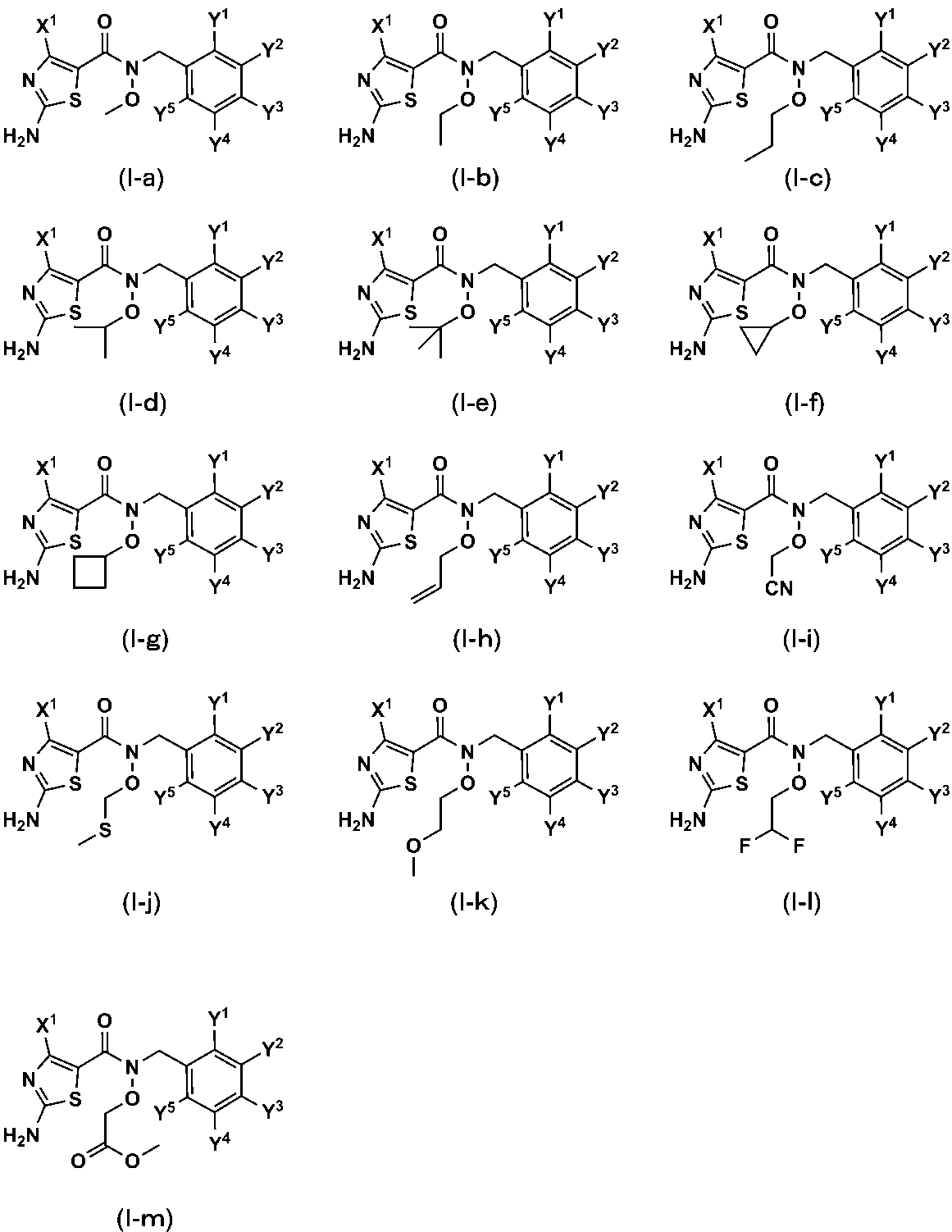
- preferred compounds include an N-(cyclo)alkoxyamide compound represented by formula (IA), an N-alkynyloxyamide compound represented by formula (IB), and compounds represented by the following formulae (I-a) to (I-m).
- Salts of compound (I) include any salts that are agriculturally acceptable, such as alkali metal salts (e.g., sodium salt, potassium salt, etc.), alkaline earth metal salts (e.g., magnesium salt, calcium salt, etc.), amine salts (dimethylamine salt, triethylamine salt, etc.), inorganic acid salts (e.g., hydrochloride, perchlorate, sulfate, nitrate, etc.), or organic acid salts (e.g., acetate, methanesulfonate, paratoluenesulfonate, oxalate, etc.).
- alkali metal salts e.g., sodium salt, potassium salt, etc.
- alkaline earth metal salts e.g., magnesium salt, calcium salt, etc.
- amine salts dimethylamine salt, triethylamine salt, etc.
- inorganic acid salts e.g., hydrochloride, perchlorate
- Compound (I) exists in various isomers, such as optical isomers and geometric isomers, and the present invention may include both each isomer and a mixture of isomers.
- Compound (I) also includes various isomers other than those mentioned above, within the scope of common technical knowledge in the relevant technical field. Furthermore, various isomers can be produced separately using common technical knowledge in the relevant technical field and general experimental techniques.
- compound (I) can be produced according to the following reactions A to E and a conventional method for producing a salt, but the method for obtaining the compound is not limited to these methods.
- compound (I) of the present invention can also be produced by applying various substituent conversion reactions well known in the art (e.g., alkylation reaction, haloalkylation reaction, cross-coupling reaction such as Suzuki coupling reaction, Sandmeyer type reaction, halogenation reaction, oxidation reaction, reduction reaction, etc.) to a substituent on a phenyl group.
- substituent conversion reactions well known in the art
- protection and deprotection reactions commonly used in the art may be applied in the production of the compound of the present invention, if necessary.
- it may be carried out under an inert gas atmosphere such as nitrogen or argon, if necessary, and a salt reagent may be used.
- Reaction A is a deprotection reaction, in which the Boc group is removed from the compound of formula (XX-a) to obtain the compound of formula (I), where the Boc group is a tert-butoxycarbonyl group.
- Reaction A can be carried out under known conditions used for removing the Boc group, for example, the method described in Greene's PROTECTIVE GROUPS in ORGANIC SYNTHESIS (John Wiley and Sons, 2007, Peter G.M. Wuts, Theodora W. Greene). More specifically, for example, the reaction can be carried out by reacting the compound of formula (XX-a) with an acid such as trifluoroacetic acid or hydrogen chloride in the presence of a solvent, or by reacting the compound with trimethylsilyl triflate in the presence of a solvent and a base such as 2,6-lutidine.
- an acid such as trifluoroacetic acid or hydrogen chloride
- a base such as 2,6-lutidine
- Reaction B is a method of reacting a compound of formula (II) with a compound of formula (III) to obtain a compound of formula (XX-b).
- Reaction C is a method of reacting a compound of formula (II-a) with a compound of formula (III) to obtain a compound of formula (XX-b).
- R 1a is H, a (C 1 -C 5 )-chain hydrocarbon, or a (C 3 -C 4 )-cycloalkyl ⁇ wherein the (C 1 -C 5 )-chain hydrocarbon and the (C 3 -C 4 )-cycloalkyl may be substituted with at least one T 1 ⁇ .
- L is a leaving group, examples of which include halogen, alkoxy, aryloxy, alkylcarbonyloxy, and arylcarbonyloxy. Other symbols are as defined above.
- Reaction B can usually be carried out in the presence of a dehydrating condensation agent and a solvent, with the addition of a base as necessary.
- the compound of formula (III) in reaction B can be used in an amount of 0.5 to 3 equivalents, preferably 0.8 to 1.5 equivalents, per equivalent of the compound of formula (II) (an equivalent is a molar equivalent, and the same applies below).
- the dehydration condensation agent in reaction B is a carbodiimide-based condensation agent such as N,N'-dicyclohexylcarbodiimide (DCC), 1-[3-(dimethylamino)propyl]-3-ethylcarbodiimide (EDC) or its hydrochloride; an imidazole-based condensation agent such as 1,1'-carbonyldiimidazole (CDI); a triazine-based condensation agent such as 4-(4,6-dimethoxy-1,3,5-triazin-2-yl)-4-methylmorpholinium chloride (DMT-MM); a 1H-benzotriazol-1-yloxy-tripyrrolidinophosphonium hexafluorophosphate (P
- suitable dehydrating condensing agents include, but are not limited to, phosphonium condensing agents such as 1-[bis(dimethylamino)methylene]-1H-1,2,3-triazolo[4,5-b]
- dehydrating condensing agents such as 1-hydroxybenzotriazole (HOBt) may be added.
- the dehydration condensation agent can be used in an amount of 0.5 to 5 equivalents, preferably 1 to 2 equivalents, per equivalent of the compound of formula (II), and the additive can be used in an amount of 0.2 to 5 equivalents, preferably 1 to 2 equivalents, per equivalent of the compound of formula (II).
- the base in reaction B may be one or more of the following, selected appropriately from among carbonates such as sodium carbonate, potassium carbonate, and cesium carbonate; hydrogen carbonates such as sodium hydrogen carbonate and potassium hydrogen carbonate; metal hydroxides such as sodium hydroxide and potassium hydroxide; metal hydrides such as sodium hydride and potassium hydride; amines such as triethylamine and N,N-diisopropylethylamine; pyridines such as pyridine, 4-dimethylaminopyridine, and 2,6-lutidine; and alkali metal carboxylates such as sodium acetate and potassium acetate.
- the base may be used in an amount of 0.5 to 10 equivalents, preferably 1 to 5 equivalents, per equivalent of the compound of formula (II).
- the solvent in reaction B may be any solvent that is inert to the reaction, and may be selected from one or more of the following: aromatic hydrocarbons such as benzene, toluene, xylene, and chlorobenzene; aliphatic hydrocarbons such as carbon tetrachloride, methyl chloride, chloroform, dichloromethane, dichloroethane, trichloroethane, hexane, and cyclohexane; ethers such as dioxane, tetrahydrofuran, diethyl ether, and dimethoxyethane; esters such as methyl acetate and ethyl acetate; aprotic polar solvents such as dimethyl sulfoxide, sulfolane, N,N-dimethylacetamide, N,N-dimethylformamide, N-methylpyrrolidone, pyridine, acetonitrile, and propionitrile; ketones such as
- the reaction temperature for reaction B is usually about -20°C to 150°C, preferably about 0°C to 100°C, and the reaction time is usually about 0.5 to 48 hours, preferably about 1 to 24 hours.
- Reaction C can be carried out in the presence of a solvent, optionally with the addition of a base.
- the compound of formula (III) can be used in an amount of 0.5 to 3 equivalents, preferably 0.8 to 1.5 equivalents, per equivalent of the compound of formula (II-a).
- the base in reaction C may be one or more of the following, selected appropriately from among carbonates such as sodium carbonate, potassium carbonate, and cesium carbonate; hydrogen carbonates such as sodium hydrogen carbonate and potassium hydrogen carbonate; metal hydroxides such as sodium hydroxide and potassium hydroxide; metal hydrides such as sodium hydride and potassium hydride; amines such as triethylamine and N,N-diisopropylethylamine; pyridines such as pyridine, 4-dimethylaminopyridine, and 2,6-lutidine; and alkali metal carboxylates such as sodium acetate and potassium acetate.
- the base may be used in an amount of 0.1 to 10 equivalents, preferably 0.5 to 5 equivalents, per equivalent of the compound of formula (II-a).
- the solvent in reaction C may be any solvent that is inert to the reaction, and may be selected from one or more of the following: aromatic hydrocarbons such as benzene, toluene, xylene, and chlorobenzene; aliphatic hydrocarbons such as carbon tetrachloride, methyl chloride, chloroform, dichloromethane, dichloroethane, trichloroethane, hexane, and cyclohexane; ethers such as dioxane, tetrahydrofuran, diethyl ether, and dimethoxyethane; esters such as methyl acetate and ethyl acetate; aprotic polar solvents such as dimethyl sulfoxide, sulfolane, N,N-dimethylacetamide, N,N-dimethylformamide, N-methylpyrrolidone, pyridine, acetonitrile, and propionitrile; ketones such as
- the reaction temperature for reaction C is usually about -20°C to 150°C, preferably about 0°C to 100°C, and the reaction time is usually about 0.5 to 48 hours, preferably about 1 to 24 hours.
- the compound of formula (III) used in reaction B and reaction C can be prepared according to reaction 2-2 or reaction 2-4 described below.
- the compound of formula (II) used in reaction B can be produced in accordance with the below-described reaction 1-1 or reaction 1-2 or a known method, or a commercially available product may be used.
- the compound of formula (II-a) used in reaction C can be produced from the compound of formula (II) according to the following reaction 1-4 or a known method.
- the compound of formula (II-a) may be a commercially available product.
- Reaction D is a method of obtaining a compound of formula (XX-a) by reacting a compound of formula (XX-c) with a compound of formula (IV).
- L 1 is a leaving group such as halogen, trifluoromethanesulfonyloxy, methanesulfonyloxy, paratoluenesulfonyloxy, etc., and the other symbols are as defined above.
- Reaction D can be carried out usually in the presence of a base and a solvent, with the addition of a phase transfer catalyst as necessary.
- the compound of formula (IV) can be used in an amount of 1 to 5 equivalents, preferably 1 to 3 equivalents, per equivalent of the compound of formula (XX-c).
- the base in reaction D may be one or more of the following, selected appropriately from among alkali metal alkoxides such as sodium methoxide, sodium ethoxide, and potassium tert-butoxide; carbonates such as sodium carbonate, potassium carbonate, and cesium carbonate; hydrogen carbonates such as sodium hydrogen carbonate and potassium hydrogen carbonate; metal hydroxides such as sodium hydroxide and potassium hydroxide; metal hydrides such as sodium hydride and potassium hydride; amines such as triethylamine and N,N-diisopropylethylamine; pyridines such as pyridine, 4-dimethylaminopyridine, and 2,6-lutidine; organolithium compounds such as n-butyllithium and lithium diisopropylamide; and alkali metal carboxylates such as sodium acetate and potassium acetate.
- the base may be used in an amount of 1 to 10 equivalents, preferably 1 to 5 equivalents, per equivalent of the compound of formula (XX
- the solvent in reaction D may be any solvent inert to the reaction, and may be one or more of the following: aromatic hydrocarbons such as benzene, toluene, xylene, and chlorobenzene; aliphatic hydrocarbons such as carbon tetrachloride, methyl chloride, chloroform, dichloromethane, dichloroethane, trichloroethane, hexane, and cyclohexane; ethers such as dioxane, tetrahydrofuran, diethyl ether, and dimethoxyethane; esters such as methyl acetate and ethyl acetate; alcohols such as methanol, ethanol, propanol, and tert-butanol; aprotic polar solvents such as dimethyl sulfoxide, sulfolane, N,N-dimethylacetamide, N,N-dimethylformamide, N-methylpyrrolidone
- the reaction temperature for reaction D is usually about -20°C to 150°C, preferably about 0°C to 100°C, and the reaction time is usually about 10 minutes to 48 hours, preferably about 1 to 24 hours.
- the compound of formula (IV) used in reaction D can be produced according to known methods, or a commercially available product may be used.
- Reaction E is a method of obtaining a compound of formula (XX-b) by reacting a compound of formula (II-b) with a compound of formula (V).
- Reaction E can be carried out in the same manner as reaction D above.
- the compound of formula (V) can be used in an amount of 1 to 5 equivalents, preferably 1 to 2 equivalents, per equivalent of the compound of formula (II-b).
- the base can be used in an amount of 1 to 10 equivalents, preferably 1 to 5 equivalents, per equivalent of the compound of formula (II-b).
- the phase transfer catalyst can be used in an amount of 0.1 to 3 equivalents per equivalent of the compound of formula (II-b).
- the compound of formula (II-b) used in reaction E can be produced according to reaction 1-3 below or a known method, or a commercially available product may be used.
- the compound of formula (V) used in reaction E can be produced according to a known method, or a commercially available product may be used.
- reactions A to E can be produced according to the methods for producing the intermediates shown below (reactions 1-1 to 1-4 and reactions 2-1 to 2-4) and the usual methods for producing salts, but are not limited to these methods. These compounds may be produced according to known methods or commercially available products may be used.
- Reaction 1-1 is a method of obtaining a compound of formula (II) by oxidizing a compound of formula (1).
- Reaction 1-2 is a method of obtaining a compound of formula (II) by hydrolyzing a compound of formula (2).
- Reaction 1-3 is a method of obtaining a compound of formula (II-b) by reacting a compound of formula (II) or a compound of formula (II-a) with a compound of formula (3).
- Reaction 1-1 can be carried out under general Pinnic oxidation conditions, for example, according to the method described in Bioorganic & Medicinal Chemistry, 2004, 12, 6171-6182.
- Reaction 1-4 is a method for obtaining a compound of formula (II-a) from a compound of formula (II) by halogenation, esterification or carbonylation.
- reaction conditions when reaction 1-4 is esterification are as follows:
- reaction 1-4 when L of the compound of formula (II-a) is alkoxy or aryloxy, the compound of formula (II) can be reacted with an alcohol or an arylhydroxyl in the presence of a solvent and a dehydration condensation agent, and with the addition of a base as necessary, to carry out esterification.
- the alcohols in reaction 1-4 include methanol, ethanol, etc.
- the aryl hydroxyl compounds in reaction 1-4 include phenol, etc.
- the alcohols or aryl hydroxyl compounds can be used in an amount of 0.5 to 5 equivalents, preferably 0.8 to 1.5 equivalents, per equivalent of the compound of formula (II), and an excess amount may be used if no problem occurs in the reaction.
- the dehydration condensation agent in reaction 1-4 those listed in reaction B above can be used.
- a general additive e.g., 1-hydroxybenzotriazole (HOBt) or the like
- the dehydration condensation agent can be used in an amount of 0.5 to 5 equivalents, preferably 1 to 2 equivalents, relative to 1 equivalent of the compound of formula (II)
- the additive can be used in an amount of 0.2 to 5 equivalents, preferably 1 to 2 equivalents, relative to 1 equivalent of the compound of formula (II).
- a base is used together with the dehydration condensation agent in reaction 1-4, the base may be the same as those listed in reaction B.
- the base may be used in an amount of 0.5 to 10 equivalents, preferably 1 to 5 equivalents, per equivalent of the compound of formula (II).
- the compound of formula (II) when L in the compound of formula (II-a) is alkoxy, the compound of formula (II) can be reacted with an alkyl halide in the presence of a solvent and a base to carry out esterification.
- the alkyl halide in the reaction 1-4 include methyl iodide, ethyl iodide, etc.
- the alkyl halide can be used in an amount of 0.5 to 5 equivalents, preferably 0.8 to 1.5 equivalents, per equivalent of the compound of the formula (II).
- the base that can be used in the reaction with the alkyl halide in Reaction 1-4 those listed in the above Reaction D can be used.
- the base can be used in an amount of 0.5 to 10 equivalents, preferably 1 to 5 equivalents, per equivalent of the compound of formula (II).
- reaction conditions when reaction 1-4 is carbonylation are as follows:
- the solvent in reaction 1-4 may be any solvent inert to the reaction, and may be one or more of the following: aromatic hydrocarbons such as benzene, toluene, xylene, and chlorobenzene; aliphatic hydrocarbons such as carbon tetrachloride, methyl chloride, chloroform, dichloromethane, dichloroethane, trichloroethane, hexane, and cyclohexane; ethers such as dioxane, tetrahydrofuran, diethyl ether, and dimethoxyethane; esters such as methyl acetate and ethyl acetate; aprotic polar solvents such as dimethyl sulfoxide, sulfolane, N,N-dimethylacetamide, N,N-dimethylformamide, N-methylpyrrolidone, pyridine, acetonitrile, and propionitrile; ketones such as acetone
- the reaction temperature in Reaction 1-4 is usually about -50°C to 200°C, preferably about -20°C to 100°C, and the reaction time is usually about 0.1 to 12 hours.
- Reaction 2-1 is a method of reacting a compound of formula (10) with a compound of formula (3) to obtain a compound of formula (11).
- Reaction 2-2 is a method of reducing the compound of formula (11) to obtain a compound of formula (III).
- Reactions 2-1 and 2-2 can be carried out consecutively without isolating the compound of formula (11).
- Reaction 2-3 is a method of obtaining a compound of formula (11-b) by reacting a compound of formula (11-a) with a compound of formula (IV).
- Reaction 2-4 is a method for obtaining a compound of formula (III) by reacting a compound of formula (V) with a compound of formula (3).
- Reaction 2-1 can be carried out by adding an acid, a base or a dehydrating agent as necessary. Reaction 2-1 can also be carried out in the presence of a solvent. In such cases, the compound of formula (3) in reaction 2-1 can be used in an amount of 1 to 5 equivalents per equivalent of the compound of formula (10), and may be used in excess if there are no problems with the reaction.
- the acid in reaction 2-1 may be either an inorganic acid or an organic acid, and examples of the inorganic acid include hydrochloric acid, sulfuric acid, etc., and examples of the organic acid include acetic acid, methanesulfonic acid, p-toluenesulfonic acid, etc.
- the acid may be used in an amount of 0.1 to 10 equivalents relative to 1 equivalent of the compound of formula (10), or in excess if no problem occurs in the reaction.
- Examples of the base in reaction 2-1 include alkali metal alkoxides such as sodium methoxide, sodium ethoxide, and potassium tert-butoxide; carbonates such as sodium carbonate and potassium carbonate; hydrogen carbonates such as sodium hydrogen carbonate and potassium hydrogen carbonate; metal hydroxides such as sodium hydroxide and potassium hydroxide; metal hydrides such as sodium hydride and potassium hydride; amines such as triethylamine and N,N-diisopropylethylamine; pyridines such as pyridine, 4-dimethylaminopyridine, and 2,6-lutidine; alkali metal carboxylates such as sodium acetate and potassium acetate; etc.
- the base can be used in an amount of 0.5 to 5 equivalents relative to 1 equivalent of the compound of formula (3).
- the dehydrating agent in reaction 2-1 may, for example, be anhydrous magnesium sulfate, anhydrous sodium sulfate, or molecular sieves.
- the solvent in Reaction 2-1 may be any solvent inert to the reaction, and may be appropriately selected from, for example, one or more of aliphatic halogenated hydrocarbons such as dichloromethane and chloroform; aromatic hydrocarbons such as toluene and xylene; ethers such as dioxane, tetrahydrofuran, diethyl ether and dimethoxyethane; esters such as methyl acetate and ethyl acetate; aprotic polar solvents such as acetonitrile; protic polar solvents such as methanol and ethanol; water; and the like.
- the reaction temperature for reaction 2-1 is usually about -20°C to 200°C, preferably about 0°C to 150°C, and the reaction time is usually about 0.5 to 48 hours, preferably about 1 to 24 hours.
- Reaction 2-1 can also be carried out under general conditions for dehydration condensation using an aldehyde and hydroxylamine or alkoxyamine, for example, in accordance with the method described in HETEROCYCLES, 2009, 78, 463-470.
- reaction 2-1 is carried out under general dehydration condensation conditions, the compound of formula (3) in reaction 2-1 can be used in an amount of 0.7 to 5 equivalents, preferably 1 to 2 equivalents, per equivalent of the compound of formula (10).
- Reaction 2-2 can usually be carried out in the presence of a reducing agent and a solvent, with the addition of an acid if necessary.
- Examples of the reducing agent in reaction 2-2 include sodium borohydride, sodium cyanoborohydride, sodium triacetoxyborohydride, and 2-picoline borane complex.
- the reducing agent can be used in an amount of 0.5 to 10 equivalents, preferably 1 to 5 equivalents, per equivalent of the compound of formula (11).
- the acid to be added may be either an inorganic acid or an organic acid, and examples of the inorganic acid include hydrochloric acid, and examples of the organic acid include acetic acid and trifluoroacetic acid.
- the acid can be used in an amount of 1 to 10 equivalents per equivalent of the compound of formula (11).
- Reaction 2-2 can also be carried out under general conditions for reducing oximes or oxime ethers, for example, according to the method described in HETEROCYCLES, 2009, 78, 463-470.
- Reaction 2-3 can also be carried out according to known oxime alkylation conditions, such as the method described in WO 2010/049946.
- the compound of formula (11-a) used in reaction 2-3 can be produced in accordance with reaction 2-1 above or a known method, or a commercially available product may be used.
- the compound of formula (IV) used in reaction 2-3 can be produced in accordance with a known method, or a commercially available product may be used.
- Reaction 2-4 can be carried out usually in the presence of a base and a solvent, with the addition of a phase transfer catalyst as necessary.
- the compound of formula (3) in reaction 2-4 can be used in an amount of 1 to 5 equivalents, preferably 1 to 3 equivalents, per equivalent of the compound of formula (V).
- the base in reaction 2-4 may be one or more of the following: alkali metal alkoxides such as sodium methoxide, sodium ethoxide, and potassium tert-butoxide; carbonates such as sodium carbonate and potassium carbonate; hydrogen carbonates such as sodium hydrogen carbonate and potassium hydrogen carbonate; metal hydroxides such as sodium hydroxide and potassium hydroxide; metal hydrides such as sodium hydride and potassium hydride; amines such as triethylamine and N,N-diisopropylethylamine; pyridines such as pyridine, 4-dimethylaminopyridine, and 2,6-lutidine; organolithium compounds such as n-butyllithium and lithium diisopropylamide; alkali metal carboxylates such as sodium acetate and potassium acetate; and the like.
- the base may be used in an amount of 1 to 10 equivalents, preferably 1 to 5 equivalents, per equivalent of the compound of formula (V).
- the solvent in reaction 2-4 may be any solvent inert to the reaction, and may be one or more of the following: aromatic hydrocarbons such as benzene, toluene, xylene, and chlorobenzene; aliphatic hydrocarbons such as carbon tetrachloride, methyl chloride, chloroform, dichloromethane, dichloroethane, trichloroethane, hexane, and cyclohexane; ethers such as dioxane, tetrahydrofuran, diethyl ether, and dimethoxyethane; esters such as methyl acetate and ethyl acetate; alcohols such as methanol, ethanol, propanol, and tert-butanol; polar aprotic solvents such as dimethyl sulfoxide, sulfolane, N,N-dimethylacetamide, N,N-dimethylformamide, N-methylpyrrolidon
- the reaction temperature for reaction 2-4 is usually about -20°C to 150°C, preferably about 0°C to 100°C, and the reaction time is usually about 10 minutes to 48 hours, preferably about 1 to 24 hours.
- Reaction 2-4 can also be carried out according to known alkylation conditions for alkoxyamines, such as the method described in Organic Letters, 2004, 6, 2361-2364.
- the compound of formula (V) and the compound of formula (3) used in reaction 2-4 can be produced according to known methods, or commercially available products may be used.
- Compound (I) is useful as an active ingredient of agricultural and horticultural fungicides capable of controlling harmful plant diseases at low doses.
- Compound (I) can control plant diseases caused by plant pathogens belonging to, for example, Oomycota, Endomyxa, Olpidiomycota, Ascomycota, Basidiomycota, and Blastocladiomycota.
- compound (I) is particularly effective in controlling plant diseases caused by plant pathogens belonging to Oomycota, Endomyxa, and Olpidiomycota.
- Olpidiomycota Plant pathogens belonging to classifications such as Olpidiales.
- Ascomycota Plant pathogenic fungi belonging to various classifications such as Cladosporiales, Diaporthales, Erysiphales, Glomerellales, Helotiales, Hypocreales, Magnaporthales, Mycosphaerellales, Myriangiales, Pleosporales, and Venturiales.
- Basidiomycota Plant pathogenic fungi belonging to various classes such as Agaricales, Cantharellales, Pucciniales, and Ustilaginales.
- Blastocladiomycota Examples include those belonging to the classification Physodermatales, etc.
- plant pathogenic fungi include the following: Potato or tomato phytophthora blight (Phytophthora infestans), fig phytophthora (Phytophthora palmivora), pear or strawberry phytophthora blight (Phytophthora cactorum), wax gourd, pumpkin, bell pepper or chili pepper phytophthora (Phytophthora capsici), tomato gray rot (Phytophthora capsici), eggplant or watermelon brown rot (Phytophthora capsici), citrus brown rot (Phytophthora citricola), adzuki bean stem rot (Phytophthora vignae f. sp.
- Hyaloperonospora brassicae cabbage or Chinese cabbage downy mildew
- Bremia spp. such as Bremia lactucae (lettuce downy mildew), Pythium graminicola (rice seedling blight), Pythium snow rot (wheat snow rot) Pythium genus fungi such as Pythium aphanidermatum, Pythium zingiberis, and Pythium ultimum var.
- Aphanomyces genus fungi such as Aphanomyces raphani and Aphanomyces cochlioides
- Albugo genus fungi such as Albugo macrospora, Albugo wasabiae, and Albugo ipomoeae-aquaticae
- Peronospora genus fungi such as Peronospora manshurica, Peronospora parasitica, Peronospora destructor, Peronospora farinosa f. sp. Spinaciae, and Peronospora belbahrii.
- Plasmodiophora species such as Plasmodiophora brassicae, which causes clubroot disease of Chinese cabbage, cabbage, cauliflower, turnip, broccoli or turnip; Polymyxa species such as Polymyxa betae, which transmits Beet necrotic yellow vein virus; Spongospora species such as Spongospora subterranea, which causes potato powdery scab; Olpidium species such as Olpidium virulentus, which transmits Mirafiori lettuce bigvein virus.
- Venturia species such as Venturia inaequalis (apple spot) and Venturia nashicola (pear spot); Pyrenophora teres (barley net blotch) and Pyrenophora graminea (barley leaf spot); Pyrenophora fungi such as Sclerotinia sclerotiorum, which causes sclerotinia rot of beans, cucumbers, cabbage, Chinese cabbage, chili peppers, bell peppers and onions; Sclerotinia borealis, which causes snow mould of wheat, Sclerotinia minor, which causes sclerotinia rot of tomato and Sclerotinia trifoliorum, which causes sclerotinia rot of alfalfa.
- Rhizoctonia fungi such as Rhizoctonia solani
- Ustilago fungi such as Ustilago nuda
- Puccinia fungi such as Puccinia coronata, Puccinia recondita, and Puccinia striiformis
- Phakopsora fungi such as Phakopsora pachyrhizi
- Typhula fungi such as Typhula incarnata or Typhula ishikariensis.
- Septoria fungi such as Septoria nodorum, Septoria tritici; Botrytis cinerea, Botrytis allii, Botrytis squamosa, Botrytis byssoidea, Botrytis tulipae, Botrytis squam ...
- rytis fungi Fusarium fungi such as Fusarium graminearum and Fusarium oxysporum; Pyricularia fungi such as Pyricularia oryzae; Cercospora fungi such as Cercospora beticola and Cercospora kakivora; Colletotrichum fungi such as Colletotrichum orbiculare and Colletotrichum coffeeum; fungi of the genus Alternaria, such as Alternaria alternata apple pathotype, Alternaria alternata Japanese pear pathotype, Alternaria solani, Alternaria brassicae, Alternaria brassicicola, Alternaria porri; fungi of the genus Phoma, such as Phoma lingam; fungi of the genus Wheat eye Pseudocercosporella species, such as Pseudocercosporella herpotrichoides; Pseudocercospora species, such as Pseudocercospor
- Gloeosporium species such as Gloeosporium kaki, which causes anthracnose; Fulvia species such as Fulvia fulva, which causes tomato leaf mold; Corynespora species such as Corynespora cassiicola, which causes brown spot of cucumber; and Physoderma species such as Physoderma maydis, which causes corn spot.
- soybean diseases such as damping-off, ascochyta caused by Septoria fungus, black spot caused by Diaporthe fungus, anthracnose caused by Colletotrichum fungus, and sleeping disease caused by Septogloeum fungus
- cabbage diseases such as black spot or black sooty mold caused by Alternaria fungus, downy mildew caused by Peronospora fungus, black spot bacterial disease caused by Pseudomonas fungus, black rot caused by Xanthomonas fungus, and root rot caused by Phoma fungus
- radish diseases such as black spot caused by Alternaria fungus, yellows caused by Fusarium fungus, and black rot caused by Xanthomonas fungus
- Chinese cabbage diseases such as black spot caused by Alternaria fungus, black rot caused by Xanthomonas fungus, and yellowing disease caused by Verticillium fungus.
- Brassicaceae crop diseases such as blight; tomato diseases such as ring spot disease caused by Alternaria, canker disease caused by Clavibacter, and bacterial spot disease caused by Xanthomonas; eggplant diseases such as brown spot disease caused by Alternaria and brown spot disease caused by Phomopsis; potato diseases such as scab disease caused by Streptomyces, silver scab disease caused by Helminthosporium, and powdery scab disease caused by Spongospora; cucurbit diseases such as black spot disease caused by Alternaria, bacterial spot disease caused by Pseudomonas, and bacterial brown spot disease caused by Xanthomonas; black spot disease caused by Alternaria and ash spot disease caused by Botrytis.
- tomato diseases such as ring spot disease caused by Alternaria, canker disease caused by Clavibacter, and bacterial spot disease caused by Xanthomonas
- eggplant diseases such as brown spot disease caused by Alternaria and brown spot disease caused by Phomopsis
- potato diseases such as
- Compound (I) can preventively or therapeutically control the various diseases mentioned above.
- certain compounds of the present invention can exert excellent preventive or therapeutic control effects at low doses (e.g., 100 ppm, 25 ppm, 12.5 ppm, 6.3 ppm, 3.1 ppm, 1.6 ppm, 0.8 ppm, 0.4 ppm, 0.2 ppm, or 0.1 ppm).
- Compound (I) has excellent rain resistance, residual activity, and penetrating properties, so by applying compound (I) to the plant body, harmful fungi on the above-ground parts of the plant can be controlled for a certain period of time.
- Asteraceae crops (lettuce, burdock, chrysanthemum, sunflower, etc.), Solanaceae crops (potato, eggplant, tomato, bell pepper, tobacco, chili pepper, etc.), Cucurbitaceae crops (cucumber, pumpkin, melon, watermelon, wax gourd, zucchini, etc.), Amaryllidaceae Allium crops (green onion, Chinese chive, shallot, garlic, onion, scallion, etc.), Umbelliferae crops (celery, carrot, parsley, mitsuba, etc.), Liliaceae crops (lily, tulip, etc.), crops of the Polygonaceae family (buckwheat, etc.), crops of the Convolvulaceae family (sweet potato, water beet, etc.), crops of the Chenopodiaceae family (spinach, sugar beet, etc.), crops of the Vitaceae family (grapes, etc.), crops of the Rosaceae family (roses
- plants include plants that have been developed using genetic engineering or gene editing techniques, such as plants that have been endowed with environmental stress resistance, herbicide resistance, pest resistance, disease resistance, etc., or plants that have been modified in terms of growth, fertility characteristics, product quality, yield, etc.
- solid carrier examples include diatomaceous earth, slaked lime, calcium carbonate, talc, white carbon, kaolin, bentonite, kaolinite, sericite, clay, sodium carbonate, baking soda, mirabilite, zeolite, starch, and finely powdered silica.
- liquid carrier examples include water, toluene, xylene, solvent naphtha, dioxane, acetone, isophorone, methyl isobutyl ketone, chlorobenzene, cyclohexane, dimethyl sulfoxide, N,N-dimethylformamide, N,N-dimethylacetamide, N-methyl-2-pyrrolidone, and alcohol.
- surfactants and spreaders examples include anionic surfactants and spreaders such as diethylene alkylaryl phosphate ester salts and salts of naphthalenesulfonic acid formalin condensates; and nonionic surfactants and spreaders such as sorbitan fatty acid esters, glycerin fatty acid esters, fatty acid polyglycerides, fatty acid alcohol polyglycol ethers, acetylene glycol, acetylene alcohol, oxyalkylene block polymers, polyoxyethylene alkyl ethers, polyoxyethylene alkylaryl ethers, polyoxyethylene styrylaryl ethers, polyoxyethylene glycol alkyl ethers, polyethylene glycol, polyoxyethylene fatty acid esters, polyoxyethylene sorbitan fatty acid esters, polyoxyethylene glycerin fatty acid esters, polyoxyethylene hydrogenated castor oil, and polyoxypropylene fatty acid esters.
- anionic surfactants and spreaders such as diethylene
- auxiliary agents may be appropriately selected and used, either alone or in combination, as long as it does not deviate from the object of the present invention.
- auxiliary agents those known in the art may also be appropriately selected and used, for example, various commonly used auxiliary agents such as bulking agents, thickening agents, antisettling agents, antifreezing agents, dispersion stabilizers, phytotoxicity reducing agents, and antifungal agents.
- the mixing ratio of compound (I) to various auxiliary agents is generally 0.001:99.999 to 95:5, preferably 0.005:99.995 to 90:10, by weight.
- these preparations When these preparations are actually used, they may be used as is, or diluted to a predetermined concentration with a diluent such as water, and various spreading agents (surfactants, vegetable oils, mineral oils, etc.) may be added as necessary.
- an effective amount of compound (I) can be applied by a commonly used application method, i.e., spray treatment, soil treatment, seed treatment, etc.
- a commonly used application method compound (I) can be applied at an active ingredient concentration of 0.1 to 10,000 ppm, preferably 1 to 2,000 ppm, more preferably 1 to 1,000 ppm.
- a composition containing compound (I) as an active ingredient hereinafter also referred to as the present composition
- a diluted version thereof can also be applied.
- the appropriate application amount can be about 10 to 100,000 g of the present composition per hectare.
- the appropriate application amount can be about 0.01 to 1,000 g of the present composition per hectare.
- the appropriate application amount can be about 0.001 to 100 g, preferably about 0.01 to 1 g, of the present composition per kg of seeds.
- the spray treatment is a treatment method for controlling plant pathogens by spraying an effective amount of the composition onto the surface of the trunk, buds, stems, leaves, flowers, spikes, or fruits of a plant, or onto plant pathogens.
- Examples of the spray treatment include spraying onto stems and leaves, and spraying onto tree trunks.
- the soil treatment is a method of treating soil with the present composition in order to transfer an effective amount of compound (I) from the roots of a plant to the inside of the plant in order to protect crops from damage caused by plant pathogens.
- Examples of the treatment include irrigation treatment (irrigating the present composition into the soil for plant cultivation), soil incorporation treatment (mixing the present composition with the soil for plant cultivation), planting hole treatment, treatment at the base of a plant or between plants (spraying or irrigation), and incorporation treatment into soil used for culture soil, seedling boxes, seedling trays, paper pots, seedling beds, etc.
- the seed treatment is a treatment method for controlling plant pathogens by treating the seeds, bulbs, etc. of crops with the present composition directly or in the vicinity thereof in order to protect crops from damage caused by plant pathogens.
- Examples of the treatment include coating treatment, dressing treatment, and immersion treatment.
- Treatment include seedling treatment (irrigation or immersion), immersion treatment of bulbs, tubers, bulbs, roots, etc., and further hydroponic treatment such as mixing with a hydroponic nutrient solution. Treatment may be performed on the whole plant or a part of it (stems, leaves, buds, flowers, ears, fruits, trunks, seeds, bulbs, tubers, bulbs, roots, etc.).
- the present composition can be mixed or used in combination with other ingredients selected from other agricultural and horticultural chemicals, fertilizers, safeners, etc., and in this case, even more excellent effects and activity may be exhibited.
- the above-mentioned mixture or combination use means that the present composition and other components are used simultaneously, separately or with an interval of time.
- Other agricultural and horticultural drugs include herbicides, insecticides, acaricides, nematicides, soil pesticides, fungicides, antiviral agents, attractants, antibiotics, plant hormones, plant growth regulators, etc.
- the mixed fungicide composition in which the present composition and one or more active ingredient compounds of other fungicides are mixed or used in combination may improve the scope of application, timing of drug treatment, control activity, etc. in a favorable direction.
- the present composition and the active ingredient compounds of other fungicides may be formulated separately and mixed at the time of spraying, or both may be formulated together and used. Such mixed fungicides are also included in the present invention
- the mixing ratio of compound (I) and the active ingredient compounds of other fungicides cannot be specified in general due to differences in weather conditions, formulation form, target crop, application time, application site, type and occurrence of harmful plant diseases, etc., but can generally be 1:300 to 300:1, preferably 1:100 to 100:1, by weight.
- the appropriate application amount is 0.1 to 70,000 g, preferably 1 to 30,000 g, of the total active ingredient compounds per hectare.
- the present invention also includes a method for controlling harmful plant diseases by applying such a mixed fungicidal composition.
- the active ingredient compounds (common names) of the fungicides in the above other agricultural and horticultural agents can be appropriately selected, for example, from the following compound groups. Even if not specifically stated, if these compounds have various structural isomers such as salts, alkyl esters, and optical isomers, these are of course included.
- Anilinopyrimidine compounds such as mepanipyrim, pyrimethanil, and cyprodinil; Triazolopyrimidine compounds such as ametoctradin; Triazolobenzothiazole compounds such as tricyclazole; Pyridinamine compounds such as fluazinam; Triadimefon, bitertanol, triflumizole, etaconazole, propiconazole, penconazole, flusilazole, myclobutanil, cyproconazole, tebuconazole, hexaconazole, fluconazole-cis, prochloraz, metconazole, epoxiconazole, tetraconazole, oxpoconazole fumarate azole compounds such as fumarate, prothioconazole, triadimenol, flutriafol, difenoconazole, fluquinconazole, fenbuconazole, bromu
- Quinoxaline compounds such as chinomethionat; Dithiocarbamate compounds such as maneb, zineb, mancozeb, polycarbamate, metiram, propineb, thiram; Organochlorine compounds such as phthalide, chlorothalonil, and quintozene; Imidazole compounds such as benomyl, thiophanate-methyl, carbendazim, thiabendazole, and fuberiazole; Cyanoacetamide compounds such as cymoxanil; acylamino acid compounds such as metalaxyl, metalaxyl-M (also known as mefenoxam), oxadixyl, ofurace, benalaxyl, benalaxyl-M (also known as chiralaxyl or chiralaxyl), furalaxyl, and valifenalate; Anilides such as cyprofuram, carboxin, oxycarboxin, thi
- Sulfamide compounds such as dichlofluanid; Copper compounds such as cupric hydroxide, oxine copper, anhydrous copper sulfate, copper nonylphenolsulfonate, copper 8-hydroxyquinoline, and dodecylbenzenesulfonate bis(ethylenediamine)copper(II) complex (also known as DBEDC); Organophosphates such as fosetyl-Al, tolclofos-Methyl, edifenphos, iprobenfos; Phthalimide compounds such as captan, captafol, and folpet; Dicarboximide compounds such as procymidone, iprodione, and vinclozolin; Benzanilide compounds such as flutolanil, mepronil, benodanil, and flufenoxadiazam; Amide compounds such as carpropamid, diclocymet, silthiofam, and fenoxanil; pyrazole
- benzamide compounds such as fluopicolide, fluopyram, zoxamide, and fluopimomide
- Furanilide compounds such as fenfuram
- Thiophene amide compounds such as isofetamide
- Piperazine compounds such as triforine
- Pyridine compounds such as pyrifenox, pyrisoxazole, and aminopyrifen
- Pyrimidine compounds such as fenarimol, ferimzone, nuarimol, and flumetylsulforim
- Piperidine compounds such as fenpropidin
- Morpholine compounds such as fenpropimorph and tridemorph
- Organotin compounds such as fentin hydroxide and fentin acetate
- Urea compounds such as pencicuron
- Carboxylic acid amide compounds such as dimethomorph, flumorph, pyrimorph, iprovalicarb, benthiavalicarb-isopropyl, and mandipropamid
- strobilurin compounds such as azoxystrobin, kresoxim-methyl, metominostrobin, trifloxystrobin, picoxystrobin, oryzastrobin, dimoxystrobin, pyraclostrobin, fluoxastrobin, pyraoxystrobin, pyrametostrobin, coumoxystrobin, enoxastrobin, phenaminestrobin, flufenoxystrobin, triclopyricarb, and mandestrobin; Oxazole compounds such as famoxadone and oxathiapiprolin; Thiazolecarboxamide compounds such as ethaboxam; Imidazolinone compounds such as fenamidone; benzenesulfonamide compounds such as flusulfamide; Oxime ether compounds such as cyflufenamid; Anthraquinone compounds such as dithianon; Crotonic acid compounds such as meptyldinocap; Antibiotics such as validamycin,
- Guanidine compounds such as iminoctadine, dodine, and guazatine; Aliphatic nitrogen-based compounds such as butylamine and seboctylamine; Quinoline compounds such as tebufloquin, quinoxyfen, quinofumelin, ipflufenoquin, and feneptamidoquin; Thiazolidine compounds such as flutianil; Carbamate compounds such as propamocarb hydrochloride, pyribencarb, and tolprocarb; Tetrazole compounds such as picarbutrazox and metyltetraprole; Sulfonamide compounds such as amisulbrom and cyazofamid; Allyl phenyl ketone compounds such as metrafenone and pyriophenone; Benzothiazole compounds such as probenazole and dichlobentiazox; Phenylpyrazole compounds such as fenpyrazamine; Dithiolane compounds such as isoprothi
- Sulfur, sulfur-based compounds such as lime sulfur
- Other compounds include pyroquilon, diclomezine, chloropicrin, dazomet, metam-sodium, proquinazid, spiroxamine, dipymetitrone, etc.
- Microbial germicides such as Bacillus amyloliqefaciens strain QST713, Bacillus amyloliqefaciens strain FZB24, Bacillus amyloliqefaciens strain MBI600, Bacillus amyloliqefaciens strain D747, Pseudomonas fluorescens, Bacillus subtilis, Trichoderma atroviride SKT-1; and plant extracts such as tea tree oil.
- the active ingredient compounds (common names) of the insecticides, nematicides, acaricides, or soil pesticides among the above-mentioned other agricultural and horticultural agents can be appropriately selected, for example, from the following compound groups. Even if not specifically stated, if these compounds have various structural isomers such as salts, alkyl esters, and optical isomers, these are of course included.
- Carbamate compounds such as carbaryl, propoxur, aldicarb, carbofuran, thiodicarb, methomyl, oxamyl, ethiofencarb, pirimicarb, fenobucarb, carbosulfan, benfuracarb, bendiocarb, furathiocarb, isoprocarb, metolcarb, xylylcarb, XMC (3,5-xylyl methylcarbamate), and fenothiocarb;
- Nereistoxin derivatives such as cartap, thiocyclam, thiocyclam oxalate, thiocyclam hydrochloride, bensultap, thiosultap, monosultap (also known as thiosultap-monosodium), bisultap (also known as thiosultap-disodium), and polythialan;
- Organochlorines such as dicofol,
- Fenvalerate permethrin, cypermethrin, alpha-cypermethrin, zeta-cypermethrin, theta-cypermethrin, beta-cypermethrin, deltamethrin, cyhalothrin, gamma-cyhalothrin , lambda-cyhalothrin, tefluthrin, kappa-tefluthrin, etofenprox, flufenprox, cyfluthrin, beta-cyfluthrin, fenpropathrin, flucythrinate, fluvalinate, cycloprotrin hrin), pyrethrins, esfenvalerate, tetramethrin, resmethrin, protrifenbute, bifenthrin, kappa-bifenthrin, acrinathrin
- Benzoyl urea compounds such as diflubenzuron, chlorfluazuron, teflubenzuron, flufenoxuron, lufenuron, novaluron, triflumuron, hexaflumuron, bistrifluron, noviflumuron, fluazuron, and flufenoxuron; Juvenile hormone-like compounds such as methoprene, pyriproxyfen, fenoxycarb, diofenolan; Pyridazinone compounds such as pyridaben; Pyrazole compounds such as fenpyroximate, fipronil, ethiprole, acetoprole, pyrafluprole, pyriprole, cyenopyrafen, and flufiprole; Pyrazolecarboxamide compounds such as pyflubumide, tebufenpyrad, tolfenpyrad, dimpropyridaz; Pyridylpyrazole
- Thiourea compounds such as diafenthiuron and chloromethiuron; Formamidine compounds such as amitraz, chlordimeform, and chloromebuform; Pyridine azomethine compounds such as pymetrozine and pyrifluquinazone; Isoxazolines such as afoxolaner, fluralaner, fluxametamide, sarolaner, and isoflualanam; Other compounds include buprofezin, hexythiazox, triazamate, chlorfenapyr, indoxacarb, acequinocyl, etoxazole, 1,3-dichloropropene, benclothiaz, bifenazate, propargite, clofentezine, metaflumizone, cyflumetofen, fenazaquin, amidoflumet, sulfluramid, hydramethylnon, metaldehyde, sulfoxaflor, fluensulf
- the present composition may also be applied in combination with the following compounds: Microbial pesticides such as crystal protein toxins produced by Bacillus thuringiensis, such as Bacillus thuringiensis aizawai, Bacillus thuringiensis kurstaki, Bacillus thuringiensis israelensis, Bacillus thuringiensis japonensis, and Bacillus thuringiensis tenebrionis, insect pathogenic virus agents, insect pathogenic fungal agents, and nematode pathogenic fungal agents; Antibiotics and semi-synthetic antibiotics such as abamectin, emamectin benzoate, ivermectin, milbemectin, milbemycin oxime, lepimectin, spinosad, spinetoram; Natural products such as azadirachtin, rotenone, and ryanodine; repellents such as deet; Physical control agents such as paraffin oil, mineral oil; RNA
- a compound represented by formula (I) or a salt thereof [2] The compound or salt thereof according to the above [1], wherein the compound of formula (I) is an N-(cyclo)alkoxyamide compound of formula (IA) or an N-alkynyloxyamide compound of formula (IB). [3] The compound or salt thereof according to the above [1], wherein the compound of formula (I) is an N-(cyclo)alkoxyamide compound of formula (IA). [4] The compound or salt thereof according to the above [1], wherein the compound of formula (I) is an N-alkynyloxyamide compound of formula (IB).
- An N-(cyclo)alkoxyamide compound represented by formula (IA) or a salt thereof [50] The N-(cyclo)alkoxyamide compound or a salt thereof according to [49] above, wherein Y 1 is halogen, (C 1 -C 6 )-alkyl, (C 1 -C 6 )-haloalkyl, nitro, or cyano. [51] The N-(cyclo)alkoxyamide compound or a salt thereof according to [49] above, wherein Y 1 is a hydrogen atom, a fluorine atom, a chlorine atom, a bromine atom, methyl, trifluoromethyl, difluoromethyl, nitro, or cyano.
- An agricultural and horticultural fungicide comprising the compound or salt thereof according to any one of [1] to [70] above as an active ingredient.
- a method for controlling harmful plant diseases which comprises applying an effective amount of the compound or salt thereof according to any one of [1] to [70] above to a plant body, a plant pathogen, or soil.
- Tetrahydrofuran (5 mL) was added to the obtained acid chloride to dissolve it, and then a solution of N-(2-chlorobenzyl)-O-methylhydroxylamine (150 mg) in tetrahydrofuran (5 mL) and diisopropylethylamine (0.31 mL) were added successively at room temperature, and the mixture was stirred at 50° C. for 1 hour and 45 minutes. After cooling to room temperature, the reaction solution was quenched using a saturated aqueous sodium hydrogen carbonate solution. Ethyl acetate was added to the quenched reaction solution, and the aqueous layer was extracted with ethyl acetate.
- Synthesis Example 2 Synthesis of 2-amino-4-bromo-N-(4-fluoro-2-methylbenzyl)-N-methoxythiazole-5-carboxamide (Compound No. A-105) (1) Triethylamine (0.5 mL) was added to a methanol (4 mL) solution of O-methylhydroxylamine hydrochloride (302 mg) at 0° C., and the mixture was stirred to obtain a mixture. A methanol (6 mL) solution of 4-fluoro-2-methylbenzaldehyde (500 mg) and acetic acid (1 mL) were added to the mixture, and the temperature was raised to room temperature after 30 minutes.
- Synthesis Example 4 Synthesis of 2-amino-4-chloro-N-(2,4-difluorobenzyl)-N-(2-propynyloxy)thiazole-5-carboxamide (Compound No. B-57) (1) Triethylamine (0.5 mL) was added to a methanol (4 mL) solution of O-2-propynylhydroxylamine hydrochloride (389 mg) at 0° C., and the mixture was stirred to obtain a mixture. A methanol (6 mL) solution of 2,4-difluorobenzaldehyde (514 mg) and acetic acid (1 mL) were added to the mixture, and the temperature was raised to room temperature after 30 minutes.
- Tetrahydrofuran (5 mL) was added to the obtained acid chloride to dissolve it, and then a solution of N-(2,4-difluorobenzyl)-O-2-propynylhydroxylamine (172 mg) in tetrahydrofuran (5 mL) and diisopropylethylamine (0.30 mL) were added successively at room temperature, and the mixture was stirred at 50° C. for 2 hours. After cooling to room temperature, the reaction solution was quenched using a saturated aqueous sodium bicarbonate solution. Ethyl acetate was added to the quenched reaction solution, and the aqueous layer was extracted with ethyl acetate.
- Trifluoroacetic acid (0.69 mL) was added to a solution of tert-butyl ⁇ 4-chloro-5-[(2,4-difluorobenzyl)(2-propynyloxy)carbamoyl]thiazol-2-yl ⁇ carbamate (204 mg) in dichloromethane (3.5 mL), and the mixture was stirred overnight under heating and reflux. After cooling to room temperature, a saturated aqueous solution of sodium bicarbonate was slowly added to the reaction solution to adjust the reaction solution to basicity. The aqueous layer of the reaction solution adjusted to basicity was extracted with ethyl acetate.
- the organic layer obtained by extraction was washed successively with water and saturated saline, dried over anhydrous sodium sulfate, filtered, and then concentrated under reduced pressure.
- the resulting residue was purified by column chromatography (eluent: ethyl acetate/heptane) to obtain the target product (132 mg) as a solid.
- a salt of compound (I) the type of salt is indicated in the remarks column in Tables 1-1 and 1-2.
- compounds described as HCl salt are hydrochlorides
- compounds described as TsOH salt are paratoluenesulfonates
- compounds described as Na salt are sodium salts.
- compound No. A-125 is the hydrochloride salt of compound No. A-20.
- Compound No. A-126 is the paratoluenesulfonate salt of compound No. A-20.
- Compound No. A-127 is the sodium salt of compound No. A-20.
- compounds described as HCl salt are hydrochloride salts
- compounds described as TsOH salt are paratoluenesulfonate salts
- compounds described as Na salt are sodium salts.
- compound No. B-52 is the hydrochloride salt of compound No. B-2.
- Compound No. B-53 is the paratoluenesulfonate salt of compound No. B-2.
- Compound No. B-54 is the sodium salt of compound No. B-2.
- Tables 2 and 3 show the physical properties of compound (I) synthesized according to the above-mentioned production method and examples.
- Table 2 shows the melting point of compound (I).
- Table 3 shows the 1 H-NMR spectrum data of compound (I) [measured by 1 H-nuclear magnetic resonance spectroscopy; ⁇ is the chemical shift value (ppm)].
- the numbers in Tables 2 and 3 have the same meanings as in Tables 1-1 and 1-2.
- *1 indicates the temperature at which the compound decomposed when its melting point was measured.
- s is singlet, brs is broadened singlet, d is doublet, t is triplet, q is quartet, and m is multiplet.
- Test Example 1 Fungicidal effect test against tomato late blight (Phytophthora infestans) (preventive effect test) Tomatoes were grown in vinyl pots with a diameter of 6 cm, and when they reached the 4.5-5.5 leaf stage, 10 ml of the drug solution was sprayed with a spray gun. After the drug solution dried (on the day of treatment), a spore suspension of Phytophthora infestans was sprayed and inoculated, and the plants were placed in an inoculation box at a temperature of 20°C and a humidity of 95% or more for 16 hours.
- Control rate (%) 100 - (X/Y) x 100 X: Lesion area rate of test compound (%), Y: Lesion area rate of untreated area (%) Test compounds: Compound No.
- Test Example 2 Fungicidal effect test against cucumber downy mildew ( Pseudoperonospora cubensis ) (preventive effect test) Cucumbers were grown in vinyl pots with a diameter of 6 cm, and when they reached the 1.2-1.5 leaf stage, 10 ml of the drug solution was sprayed with a spray gun. After the drug solution dried (on the day of treatment), a spore suspension of cucumber downy mildew (Pseudoperonospora cubensis) was sprayed and inoculated, and the plants were placed in an inoculation box at a temperature of 20°C and a humidity of 95% or more for 24 hours.
- test compound Compound No.
- Test Example 3 Fungicidal effect test against tomato late blight ( Phytophthora infestans ) (therapeutic effect test) Tomatoes were grown in vinyl pots with a diameter of 6 cm, and when they reached the 4.5-5.5 leaf stage, they were inoculated by spraying a spore suspension of Phytophthora infestans, and placed in an inoculation box at a temperature of 20°C and a humidity of 95% or more for 4 hours. Then, 10 ml of the liquid was sprayed with a spray gun, and after the liquid dried (on the day of treatment), the pots were placed in a thermostatic chamber at 20°C.
- test compounds Compound No.
- Comparative Compound 1 A comparative test was carried out using, as active ingredients, Compound No. A-10 of the present invention and the compound described in Production Example 2 of Patent Document 1 (hereinafter referred to as Comparative Compound 1).
- each solution was prepared using the same preparation method as above so that the active ingredient had a specified concentration (400 ppm, 200 ppm, 100 ppm, or 50 ppm). Each solution adjusted to the specified concentration was used in the following Comparative Test Example 1.
- Formulation Example 1 (1) 20 parts by weight of compound (I) (2) 72 parts by weight of clay (3) 8 parts by weight of sodium lignin sulfonate The above ingredients are uniformly mixed to give a wettable powder.
- Formulation Example 2 (1) Compound (I) 5 parts by weight (2) Talc 95 parts by weight or more are uniformly mixed to give a powder.
- Formulation Example 3 (1) Compound (I) 20 parts by weight (2) N,N-dimethylacetamide 20 parts by weight (3) Polyoxyethylene alkyl phenyl ether 10 parts by weight (4) Xylene 50 parts by weight The above ingredients are uniformly mixed and dissolved to prepare an emulsion.
- Formulation Example 4 (1) 68 parts by weight of clay (2) 2 parts by weight of sodium lignin sulfonate (3) 5 parts by weight of polyoxyethylene alkylaryl sulfate (4) 25 parts by weight of finely powdered silica A mixture of the above components and compound (I) are mixed in a weight ratio of 4:1 to obtain a wettable powder.
- Formulation Example 5 (1) 50 parts by weight of compound (I), (2) 2 parts by weight of polyoxyethylene alkylphenyl ether phosphate triethanolamine salt, (3) 0.2 parts by weight of silicone, and (4) 47.8 parts by weight of water.
- Formulation Example 7 (1) Compound (I) 2.5 parts by weight (2) N-methyl-2-pyrrolidone 2.5 parts by weight (3) Soybean oil 95.0 parts by weight The above ingredients are uniformly mixed and dissolved to prepare an ultra low volume formulation.
- Formulation Example 8 (1) 20 parts by weight of compound (I) (2) 2 parts by weight of polyoxyethylene alkylphenyl ether phosphate triethanolamine salt (3) 0.2 parts by weight of silicone (4) 0.1 parts by weight of xanthan gum (5) 5 parts by weight of ethylene glycol (6) 72.7 parts by weight of water The above ingredients are uniformly mixed and pulverized to obtain an aqueous suspension.
Landscapes
- Life Sciences & Earth Sciences (AREA)
- Chemical & Material Sciences (AREA)
- Organic Chemistry (AREA)
- Engineering & Computer Science (AREA)
- Zoology (AREA)
- Environmental Sciences (AREA)
- Wood Science & Technology (AREA)
- Pest Control & Pesticides (AREA)
- Plant Pathology (AREA)
- General Chemical & Material Sciences (AREA)
- Mycology (AREA)
- Chemical Kinetics & Catalysis (AREA)
- Microbiology (AREA)
- Agronomy & Crop Science (AREA)
- Health & Medical Sciences (AREA)
- Dentistry (AREA)
- General Health & Medical Sciences (AREA)
- Organic Low-Molecular-Weight Compounds And Preparation Thereof (AREA)
- Agricultural Chemicals And Associated Chemicals (AREA)
Abstract
Description
殺微生物剤として使用することができる化合物は、例えばN-アルコキシカルボキサミドが知られている(特許文献2)。しかしながら、特許文献2には、下記式(I)で表される化合物の具体的な記載は一切ない。
非特許文献1には、Table IのNo.15より、N-Benzoyl-N-benzyl-O-2-propynylhydroxylamineの5-ヒドロキシトリプトファンデカルボキシラーゼ阻害活性試験及びモノアミンオキシダーゼ阻害活性試験が開示されている。しかしながら、非特許文献1に記載された化合物の有害な植物病害に対する防除効果に関する記載は一切ない。さらに、非特許文献1には、下記式(I)で表される化合物の記載も一切ない。
一方で、2-amino-N-benzyl-N-methoxy-1,3-thiazole-5-carboxamide(CAS登録番号:2301497-10-7)及び2-amino-N-benzyl-N-methoxy-4-methyl-1,3-thiazole-5-carboxamide(CAS登録番号:2299658-69-6)の化合物が知られている。しかしながら、その用途は不明であり、当然ながら、これらの化合物が有する植物病害への効果については一切知られていない。
すなわち、本発明は以下の通りである。
[1]式(I):
T1は、ハロゲン、シアノ、又は-U1-R2であり、
U1は、O、S、又はC(=O)Oであり、
R2は、(C1-C3)-アルキルであり、
X1は、ハロゲンであり、
Y1、Y2、Y3、Y4及びY5は、それぞれ独立に、ハロゲン、(C1-C6)-アルキル、(C1-C6)-ハロアルキル、ニトロ、シアノ、又は水素原子である。ただし、R1が(C1-C4)-アルキル又は(C3-C4)-シクロアルキルである場合は、Y1、Y2、Y3、Y4及びY5の全てが同時に水素原子になることはない。]で表される化合物又はその塩(以下、化合物(I)ともいう)。
式(IA):

X1は、ハロゲンであり、
Y1は、ハロゲン、(C1-C6)-アルキル、(C1-C6)-ハロアルキル、ニトロ、シアノ、又は水素原子であり、
Y2A、Y3A及びY4Aは、それぞれ独立に、水素原子、又はハロゲンであり、
Y5Aは、水素原子である。ただし、Y1が水素原子である場合は、Y2A、Y3A及びY4Aの全てが同時に水素原子になることはない。]で表されるN-(シクロ)アルコキシアミド化合物である、前記[1]に記載の化合物又はその塩(以下、化合物(IA)ともいう)。
式(IB):
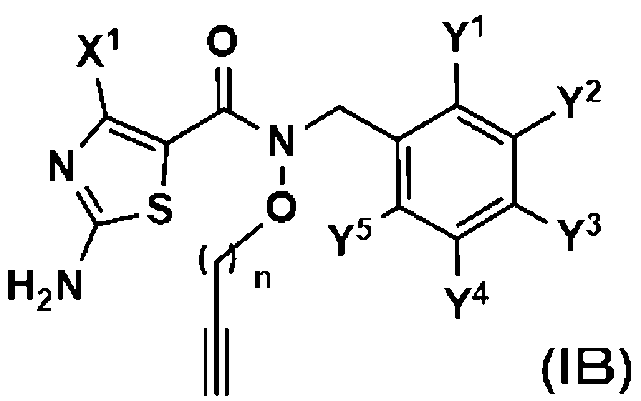
X1は、ハロゲンであり、
Y1、Y2、Y3、Y4及びY5は、それぞれ独立に、水素原子、ハロゲン、(C1-C6)-アルキル、(C1-C6)-ハロアルキル、ニトロ、又はシアノである。]で表されるN-アルキニルオキシアミド化合物である、前記[1]に記載の化合物又はその塩(以下、化合物(IB)ともいう)。
式(IA):
X1は、ハロゲンであり、
Y1は、ハロゲン、(C1-C6)-アルキル、(C1-C6)-ハロアルキル、ニトロ、シアノ、又は水素原子であり、
Y2A、Y3A及びY4Aは、それぞれ独立に、水素原子、又はハロゲンであり、
Y5Aは、水素原子である。ただし、Y1が水素原子である場合は、Y2A、Y3A及びY4Aの全てが同時に水素原子になることはない。]で表されるN-(シクロ)アルコキシアミド化合物、又は
式(IB):
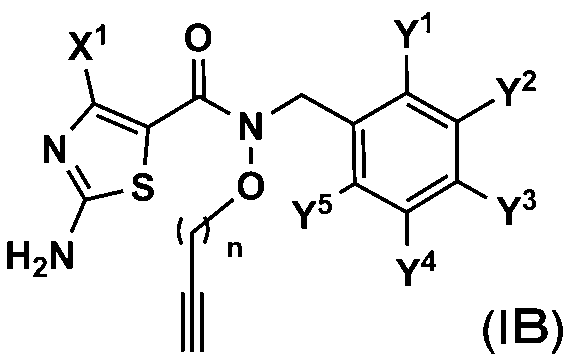
X1は、ハロゲンであり、
Y1、Y2、Y3、Y4及びY5は、それぞれ独立に、水素原子、ハロゲン、(C1-C6)-アルキル、(C1-C6)-ハロアルキル、ニトロ、又はシアノである。]で表されるN-アルキニルオキシアミド化合物である、前記[1]に記載の化合物又はその塩。
(C1-C4)-アルキルは、例えば、メチル、エチル、ノルマルプロピル、イソプロピル、ノルマルブチル、イソブチル、セカンダリーブチル、又はターシャリーブチルのような炭素原子数1~4個の直鎖又は分岐鎖状のアルキル基が挙げられる。
(C1-C3)-アルキルは、炭素原子数1~3個の直鎖又は分岐鎖状のアルキル基を表す。その具体例は、上記の(C1-C6)-アルキルの具体例の中で炭素原子数1~3個のアルキル基が該当する。
前記(C1-C5)-鎖式炭化水素又は前記(C3-C4)-シクロアルキルが少なくとも1個のT1で置換された場合、T1の置換位置は、前記(C1-C5)-鎖式炭化水素又は前記(C3-C4)-シクロアルキル上の何れの置換位置でもよい。
前記(C1-C5)-鎖式炭化水素又は前記(C3-C4)-シクロアルキルが2個以上のT1で置換された場合、各T1は各々同一でも相異なってもよい。
例えば、化合物(I)のR1が少なくとも1個のT1で置換された(C1-C4)-アルキルである場合、具体的には、下記の置換基が含まれる。例えば、フルオロメチル、ジフルオロメチル、トリフルオロメチル、クロロメチル、ジクロロメチル、トリクロロメチル、ブロモメチル、ジブロモメチル、トリブロモメチル、クロロジフルオロメチル、1-フルオロエチル、2-フルオロエチル、1,1-ジフルオロエチル、2,2-ジフルオロエチル、2,2,2-トリフルオロエチル、パーフルオロエチル、3,3-ジフルオロプロピル、3,3,3-トリフルオロプロピル、パーフルオロプロピル、パーフルオロイソプロピル、4-フルオロブチル、4,4-ジフルオロブチル、4,4,4-トリフルオロブチル、シアノメチル、2-シアノエチル、3-シアノプロピル、メトキシメチル、エトキシメチル、プロポキシメチル、2-メトキシエチル、メチルチオメチル、エチルチオメチル、プロピルチオメチル、2-メチルチオエチル、メトキシカルボニルメチル、エトキシカルボニルメチル、プロポキシカルボニルメチル、2-(メトキシカルボニル)エチル、又はイソプロポキシカルボニルメチル等が挙げられる。
化合物(I)は、以下に示す反応A~反応E、及び通常の塩の製造方法に従って製造することができるが、当該化合物を得る方法は、これらの方法に限定されるものではない。例えば、本発明の化合物(I)は、フェニル基上の置換基に、本分野において周知の種々の置換基変換反応(例えば、アルキル化反応、ハロアルキル化反応、鈴木カップリング反応などのクロスカップリング反応、ザンドマイヤー型反応、ハロゲン化反応、酸化反応、還元反応等)を、適用することによって製造することも可能である。また、必要に応じて、本発明化合物の製造において、本分野において通常使用される保護及び脱保護反応を適用してもよい。反応を実施するにあたり、必要な場合は窒素やアルゴンなどの不活性ガス雰囲気下で実施してもよく、塩の試薬を用いてもよい。
反応Aは、脱保護反応であり、式(XX-a)の化合物よりBoc基を除くことにより、式(I)の化合物を得る方法である。ここで、Boc基は、tert-ブトキシカルボニル基である。
反応Bは、式(II)の化合物と式(III)の化合物を反応させ式(XX-b)の化合物を得る方法である。反応Cは、式(II-a)の化合物と式(III)の化合物を反応させ式(XX-b)の化合物を得る方法である。
反応Bで使用される式(II)の化合物は、後述の反応1-1、反応1-2又は公知の方法に準じて製造することができ、又は市販品を使用しても良い。
反応Cで使用される式(II-a)の化合物は、式(II)の化合物より下記反応1-4又は公知の方法に準じて製造することができる。式(II-a)の化合物は市販品を使用しても良い。
反応Dは、式(XX-c)の化合物を式(IV)の化合物と反応させることにより、式(XX-a)の化合物を得る方法である。
反応Eは、式(II-b)の化合物を式(V)の化合物と反応させることにより、式(XX-b)の化合物を得る方法である。
[反応1-1]、[反応1-2]及び[反応1-3]
反応1-1は、式(1)の化合物を酸化し式(II)の化合物を得る方法である。反応1-2は、式(2)の化合物を加水分解し式(II)の化合物を得る方法である。反応1-3は式(II)の化合物又は式(II-a)の化合物を式(3)の化合物と反応させて式(II-b)の化合物を得る方法である。
反応1-1は、一般的なピニック酸化の条件、例えば、Bioorganic & Medicinal Chemistry、2004、12、6171-6182に記載の方法に準じて行うことができる。
反応1-4は、ハロゲン化、エステル化又はカルボニル化により式(II)の化合物から式(II-a)の化合物を得る方法である。

反応1-4におけるハロゲン化剤としては、例えば塩化オキサリル、塩化チオニル、オキシ塩化リン、オキシ臭化リン、三塩化リン、三臭化リン、五塩化リン、塩化スルフリル等が挙げられる。前記ハロゲン化剤は、式(II)の化合物1当量に対して1~10当量、望ましくは1~3当量使用でき、反応に問題がなければ過剰量を使用してもよい。
反応1-4で、N,N-ジメチルホルムアミドを使用する場合は、N,N-ジメチルホルムアミドの使用量は触媒量であり、例えば式(II)の化合物1当量に対して0.01~0.3当量使用できる。
反応1-4におけるアルコール類としては、例えばメタノール、エタノールなどが挙げられる。反応1-4におけるアリールヒドロキシ類としては、フェノールなどが挙げられる。前記アルコール類又は前記アリールヒドロキシ類は、式(II)の化合物1当量に対して0.5~5当量、望ましくは0.8~1.5当量使用でき、反応に問題がなければ過剰量を使用してもよい。
反応1-4における脱水縮合剤としては、上記反応Bに挙げたものが使用できる。反応1-4において前記脱水縮合剤を使用する場合は、必要に応じて脱水縮合剤と一緒に使用される一般的な添加剤(例えば、1-ヒドロキシベンゾトリアゾール(HOBt)など)を添加してもよい。前記脱水縮合剤は、式(II)の化合物1当量に対して、0.5~5当量、望ましくは1~2当量使用でき、前記添加剤は式(II)の化合物1当量に対して、0.2~5当量、望ましくは1~2当量使用できる。
反応1-4において前記脱水縮合剤と一緒に塩基を使用する場合は、前記塩基は上記反応Bに挙げたものが使用できる。前記塩基は、式(II)の化合物1当量に対して、0.5~10当量、望ましくは1~5当量使用できる。
反応1-4におけるアルキルハライド類としては、例えばヨウ化メチル、ヨウ化エチルなどが挙げられる。前記アルキルハライドは、式(II)の化合物1当量に対して0.5~5当量、望ましくは0.8~1.5当量使用できる。
反応1-4のアルキルハライド類と反応で使用できる塩基としては、上記反応Dに挙げたものが使用できる。前記塩基は、式(II)の化合物1当量に対して、0.5~10当量、望ましくは1~5当量使用できる。
反応1-4におけるカルボニル化剤としては、例えばアセチルクロリド、ピバロイルクロリド、ベンゾイルクロリド、無水酢酸、無水安息香酸などが挙げられる。前記カルボニル化剤は、式(II)の化合物1当量に対して0.5~10当量、望ましくは1~5当量使用でき、反応に問題がなければ過剰量を使用してもよい。
反応1-4がカルボニル化の場合に使用する塩基としては、上記反応Bに挙げたものが使用できる。前記塩基は、式(II)の化合物1当量に対して、0.5~10当量、望ましくは1~5当量使用できる。
反応2-1は式(10)の化合物を式(3)の化合物と反応させ式(11)の化合物を得る方法である。反応2-2は式(11)の化合物を還元し、式(III)の化合物を得る方法である。反応2-1と反応2-2は式(11)の化合物を単離することなく、連続して行うこともできる。
反応2-3は、式(11-a)の化合物を式(IV)の化合物と反応させることにより、式(11-b)の化合物を得る方法である。
反応2-4は、式(V)の化合物を式(3)の化合物と反応させることにより、式(III)の化合物を得る方法である。
反応2-1における塩基は、例えば、ナトリウムメトキシド、ナトリウムエトキシド、カリウムtert-ブトキシドのようなアルカリ金属アルコキシド;炭酸ナトリウム、炭酸カリウムのような炭酸塩;炭酸水素ナトリウム、炭酸水素カリウムのような炭酸水素塩;水酸化ナトリウム、水酸化カリウムのような金属水酸化物;水素化ナトリウム、水素化カリウムのような金属水素化物;トリエチルアミン、N,N-ジイソプロピルエチルアミンのようなアミン類;ピリジン、4-ジメチルアミノピリジン、2,6-ルチジンのようなピリジン類;酢酸ナトリウム、酢酸カリウムなどのアルカリ金属カルボン酸塩;などが挙げられる。前記塩基は式(3)の化合物の1当量に対して、0.5~5当量使用できる。
反応2-1における溶媒は、反応に不活性な溶媒であればいずれのものでもよく、例えば、ジクロロメタン、クロロホルムのような脂肪族ハロゲン化炭化水素類;トルエン、キシレンのような芳香族炭化水素類;ジオキサン、テトラヒドロフラン、ジエチルエーテル、ジメトキシエタンのようなエーテル類;酢酸メチル、酢酸エチルのようなエステル類;アセトニトリルのような非プロトン性極性溶媒;メタノール、エタノールのようなプロトン性極性溶媒;水;などから1種又は2種以上を適宜選択することができる。
化合物(I)は、例えば卵菌門(Oomycota)、エンドミクサ門(Endomyxa)、フクロカビ門(Olpidiomycota)、子嚢菌門(Ascomycota)、担子菌門(Basidiomycota)、及びコウマクノウキン門(Blastocladiomycota)などに属する植物病原菌に由来する植物病害を防除できる。その中で、卵菌門(Oomycota)、エンドミクサ門(Endomyxa)、及びフクロカビ門(Olpidiomycota)に属する植物病原菌に由来する植物病害の防除に特に有効である。
卵菌門(Oomycota):Albuginales、Anisolpidiales、Lagenidiales、Leptomitales、Myzocytiopsidales、Olpidiopsidales、Peronosporales、Pythiales、Rhipidiales、Saprolegniales、及びSclerosporales等の各分類に属する植物病原菌。
エンドミクサ門(Endomyxa):Haplosporida、Paradiniida、Paramyxida、Gromiida、Phagomyxida、Plasmodiophorida、及びVampyrellida等の各分類に属する植物病原菌。
フクロカビ門(Olpidiomycota):Olpidiales等の分類に属する植物病原菌。
子嚢菌門(Ascomycota):Cladosporiales、Diaporthales、Erysiphales、Glomerellales、Helotiales、Hypocreales、Magnaporthales、Mycosphaerellales、Myriangiales、Pleosporales、及びVenturiales等の各分類に属する植物病原菌。
担子菌門(Basidiomycota):Agaricales、Cantharellales、Pucciniales、及びUstilaginales等の各分類に属する植物病原菌。
コウマクノウキン門(Blastocladiomycota):Physodermatales等の分類に属するものなどが挙げられる。
バレイショ又はトマト疫病菌(Phytophthora infestans)、イチジク疫病菌(Phytophthora palmivora)、ナシ又はイチゴ疫病菌(Phytophthora cactorum)、トウガン、カボチャ、ピーマン又はトウガラシ疫病菌(Phytophthora capsici)、トマト灰色疫病菌(Phytophthora capsici)、ナス又はスイカ褐色腐敗病菌(Phytophthora capsici)、カンキツ褐色腐敗病菌(Phytophthora citricola)、アズキ茎疫病菌(Phytophthora vignae f. sp. adzukicola)、エダマメ茎疫病菌(Phytophthora megasperma var. sojae)、タマネギ又はラッキョウ白色疫病(Phytophthora porri)のようなフィトフトラ(Phytophthora)属菌;キュウリ、カボチャ、メロン、ズッキーニべと病菌(Pseudoperonospora cubensis)、ホップべと病菌(Pseudoperonospora humuli)のようなシュードペロノスポラ(Pseudoperonospora)属菌;ブドウべと病菌(Plasmopara viticola)、ミツバべと病菌(Plasmopara nivea)のようなプラズモパラ(Plasmopara)属菌;キャベツ又はハクサイべと病菌(Hyaloperonospora brassicae)のようなヒアロペロノスポラ(Hyaloperonospora)属菌;レタスべと病菌(Bremia lactucae)のようなブレミア(Bremia)属菌;イネ苗立枯病菌(Pythium graminicola)、コムギ褐色雪腐病菌(Pythium iwayamai)、ハクサイピシウム腐敗病菌(Pythium aphanidermatum)、ミョウガ根茎腐敗病菌(Pythium zingiberis)、ショウガ根茎腐敗病菌(Pythium ultimum var. ultimum)のようなピシウム(Pythium)属菌;ダイコン根くびれ病菌Aphanomyces raphani)、ホウレンソウ根腐病菌(Aphanomyces cochlioides)のようなアファノミセス(Aphanomyces)属菌;ホウレンソウ、カブ、ダイコン又はナバナ白さび病菌(Albugo macrospora)、ワサビ白さび病菌(Albugo wasabiae)、エンサイ白さび病菌(Albugo ipomoeae-aquaticae)のようなアルブゴ(Albugo)属菌;ダイズ又はエダマメべと病菌(Peronospora manshurica)、ブロッコリー又はカブべと病菌(Peronospora parasitica)、ネギ、ワケギ又はタマネギべと病菌(Peronospora destructor)、ホウレンソウべと病菌(Peronospora farinosa f. sp. Spinaciae)、バジルべと病菌(Peronospora belbahrii)のようなペロノスポラ(Peronospora)属菌。
イネ紋枯病菌(Rhizoctonia solani)のようなリゾクトニア(Rhizoctonia)属菌;コムギ裸黒穂病菌(Ustilago nuda)のようなウスチラゴ(Ustilago)属菌;エンバク冠さび病菌(Puccinia coronata)、コムギ赤さび病菌(Puccinia recondita)、コムギ黄さび病菌(Puccinia striiformis)のようなプクシニア(Puccinia)属菌;ダイズさび病菌(Phakopsora pachyrhizi)のようなファコプソラ(Phakopsora)属菌;コムギ又はオオムギ雪腐小粒菌核病菌(Typhula incarnata又はTyphula ishikariensis)のようなティフラ(Typhula)属菌。
前記有効量とは、化合物(I)が種々の有害な植物病害に対して防除効果を発揮する、化合物(I)の施用量を意味する。
前記植物体とは、樹幹、茎、葉、花、穂、果実のような植物の地上部、塊茎、根茎、根のような植物の地下部及び植物の種子、実生、移植苗等を意味する。
前記土壌とは、畑、水田、果樹園等の農耕地、及び芝生、森林等の非農耕地などの植物の栽培地を意味する。
一般に行われている施用方法において、有効成分として化合物(I)を含む組成物(以下、本組成物ともいう)又はその希釈物の施用を行うこともできる。一般に散布処理の場合、その施用適量としては、1ヘクタールあたり本組成物が、10~100,000g程度とすることができる。土壌処理の場合、その施用適量としては、1ヘクタールあたり本組成物が0.01~1,000g程度とすることができる。種子処理の場合、その施用適量としては、種子1kgあたり本組成物が0.001~100g、望ましくは0.01~1g程度とすることができる。
前記土壌処理とは、植物病原菌による被害から作物を保護するため、化合物(I)の有効量を植物の根部等から植物の内部に浸透移行させるために、土壌に本組成物を処理する方法である。例えば、潅注処理(本組成物を植物の栽培土壌に潅注する)、土壌混和処理(植物の栽培土壌と本組成物を混和する)、植穴処理、株元又は株間への処理(散布又は灌注)、培土、育苗箱、育苗トレイ、ペーパーポット又は苗床等に使用する土壌への混和処理等が挙げられる。
前記種子処理とは、植物病原菌による被害から作物を保護するため、作物の種子、球根等に直接或いは近傍に本組成物を処理することにより、植物病原菌を防除する処理方法である。例えば、塗布処理、粉衣処理、浸漬処理等が挙げられる。
その他、苗処理(灌注又は浸漬)、球根、塊茎、鱗茎、根等への浸漬処理、さらに、水耕栽培養液に混合するような水耕処理が挙げられる。処理は植物の全体であっても一部分(茎葉、芽、花、穂、果実、樹幹、種子、球根、塊茎、鱗茎、根等)であっても良い。
前記混用又は併用とは、本組成物と他の成分とを、同時に、別々に又は時間間隔をおいて使用することを意味する。
他の農園芸用薬剤は、除草剤、殺虫剤、殺ダニ剤、殺線虫剤、殺土壌害虫剤、殺菌剤、抗ウイルス剤、誘引剤、抗生物質、植物ホルモン、植物成長調整剤などが挙げられる。特に、本組成物、並びに他の殺菌剤の有効成分化合物の1種又は2種以上と混用或いは併用した混合殺菌組成物は、適用範囲、薬剤処理の時期、防除活性等を好ましい方向へ改良することがある。尚、本組成物、並びに他の殺菌剤の有効成分化合物は、各々別々に製剤したものを散布時に混合して使用しても、両者を一緒に製剤して使用してもよい。本発明には、このような混合殺菌剤も含まれる。
アメトクトラジン(ametoctradin)のようなトリアゾロピリミジン系化合物;
トリシクラゾール(tricyclazole)のようなトリアゾロベンゾチアゾール系化合物;
フルアジナム(fluazinam)のようなピリジナミン系化合物;
トリアジメホン(triadimefon)、ビテルタノール(bitertanol)、トリフルミゾール(triflumizole)、エタコナゾール(etaconazole)、プロピコナゾール(propiconazole)、ペンコナゾール(penconazole)、フルシラゾール(flusilazole)、ミクロブタニル(myclobutanil)、シプロコナゾール(cyproconazole)、テブコナゾール(tebuconazole)、ヘキサコナゾール(hexaconazole)、フルコナゾール・シス(furconazole-cis)、プロクロラズ(prochloraz)、メトコナゾール(metconazole)、エポキシコナゾール(epoxiconazole)、テトラコナゾール(tetraconazole)、オキスポコナゾールフマル酸塩(oxpoconazole fumarate)、プロチオコナゾール(prothioconazole)、トリアジメノール(triadimenol)、フルトリアホール(flutriafol)、ジフェノコナゾール(difenoconazole)、フルキンコナゾール(fluquinconazole)、フェンブコナゾール(fenbuconazole)、ブロムコナゾール(bromuconazole)、ジニコナゾール(diniconazole)、シメコナゾール(simeconazole)、ペフラゾエート(pefurazoate)、イプコナゾール(ipconazole)、イミベンコナゾール(imibenconazole)、アザコナゾール(azaconazole)、トリチコナゾール(triticonazole)、イマザリル(imazalil)、イプフェントリフルコナゾール(ipfentrifluconazole)、メフェントリフルコナゾール(mefentrifluconazole)のようなアゾール系化合物;
マンネブ(maneb)、ジネブ(zineb)、マンゼブ(mancozeb)、ポリカーバメート(polycarbamate)、メチラム(metiram)、プロピネブ(propineb)、チラム(thiram)のようなジチオカーバメート系化合物;
フサライド(phthalide)、クロロタロニル(chlorothalonil)、キントゼン(quintozene)のような有機塩素系化合物;
ベノミル(benomyl)、チオファネートメチル(thiophanate-methyl)、カルベンダジム(carbendazim)、チアベンダゾール(thiabendazole)、フベリアゾール(fuberiazole)のようなイミダゾール系化合物;
シモキサニル(cymoxanil)のようなシアノアセトアミド系化合物;
メタラキシル(metalaxyl)、メタラキシル-M(metalaxyl-M;別名メフェノキサム(mefenoxam))、オキサジキシル(oxadixyl)、オフレース(ofurace)、ベナラキシル(benalaxyl)、ベナラキシル-M(benalaxyl-M、別名キララキシル(kiralaxyl、chiralaxyl))、フララキシル(furalaxyl)、バリフェナレート(valifenalate)のようなアシルアミノ酸系化合物;
シプロフラム(cyprofuram)、カルボキシン(carboxin)、オキシカルボキシン(oxycarboxin)、チフルザミド(thifluzamide)、ボスカリド(boscalid)、フェンヘキサミド(fenhexamid)、イソチアニル(isotianil)、チアジニル(tiadinil)、ピラジフルミド(pyraziflumid)のようなアニリド系化合物;
水酸化第二銅(cupric hydroxide)、有機銅(oxine copper)、無水硫酸銅、ノニルフェノールスルホン酸銅、8-ヒドロキシキノリン銅、ドデシルベンゼンスルホン酸ビスエチレンジアミン銅錯塩(II)(別名DBEDC)のような銅系化合物;
ホセチルアルミニウム(fosetyl-Al)、トルクロホスメチル(tolclofos-Methyl)、エジフェンホス(edifenphos)、イプロベンホス(iprobenfos)のような有機リン系化合物;
キャプタン(captan)、カプタホール(captafol)、フォルペット(folpet)のようなフタルイミド系化合物;
プロシミドン(procymidone)、イプロジオン(iprodione)、ビンクロゾリン(vinclozolin)のようなジカルボキシイミド系化合物;
フルトラニル(flutolanil)、メプロニル(mepronil)、ベノダニル(benodanil)、フルフェノキサジアザム(flufenoxadiazam)のようなベンズアニリド系化合物;
カルプロパミド(carpropamid)、ジクロシメット(diclocymet)、シルチオファム(silthiofam)、フェノキサニル(fenoxanil)のようなアミド系化合物;
ベンゾビンジフルピル(benzovindiflupyr)、ビキサフェン(bixafen)、フルーインダピル(fluindapyr)、フルキサピロキサド(fluxapyroxad)、フラメトピル(furametpyr)、イソピラザム(isopyrazam)、ペンフルフェン(penflufen)、ペンチオピラド(penthiopyrad)、ピジフルメトフェン(pydiflumetofen)、セダキサン(sedaxane)、イソフルーシプラム(isoflucypram)、インピルフルキサム(inpyrfluxam)、ピラプロポイン(pyrapropoyne)、フェノピラミド(fenopyramid)のようなピラゾールカルボキサミド系化合物;
フェンフラム(fenfuram)のようなフラニリド系化合物;
イソフェタミド(isofetamid)のようなチオフェンアミド系化合物;
トリホリン(triforine)のようなピペラジン系化合物;
ピリフェノックス(pyrifenox)、ピリソキサゾール(pyrisoxazole)、アミノピリフェン(aminopyrifen)のようなピリジン系化合物;
フェナリモル(fenarimol)、フェリムゾン(ferimzone)、ヌアリモール(nuarimol)、フルメチルスルホリム(flumetylsulforim)のようなピリミジン系化合物;
フェンプロピディン(fenpropidin)のようなピペリジン系化合物;
フェンプロピモルフ(fenpropimorph)、トリデモルフ(tridemorph)のようなモルホリン系化合物;
水酸化トリフェニルスズ(fentin hydroxide)、酢酸トリフェニルスズ(fentin acetate)のような有機スズ系化合物;
ペンシキュロン(pencycuron)のような尿素系化合物;
ジメトモルフ(dimethomorph)、フルモルフ(flumorph)、ピリモルフ(pyrimorph)、イプロバリカルブ(iprovalicarb)、ベンチアバリカルブ-イソプロピル(benthiavalicarb-isopropyl)、マンジプロパミド(mandipropamid)のようなカルボン酸アミド系化合物;
ジエトフェンカルブ(diethofencarb)のようなフェニルカーバメート系化合物;
フルジオキソニル(fludioxonil)、フェンピクロニル(fenpiclonil)のようなシアノピロール系化合物;
ファモキサドン(famoxadone)、オキサチアピプロリン(oxathiapiprolin)のようなオキサゾール系化合物;
エタボキサム(ethaboxam)のようなチアゾールカルボキサミド系化合物;
フェンアミドン(フェナミドン、fenamidone)のようなイミダゾリノン系化合物;
フルスルファミド(flusulfamide)のようなベンゼンスルホンアミド系化合物;
シフルフェナミド(cyflufenamid)のようなオキシムエーテル系化合物;
ジチアノン(dithianon)のようなアントラキノン系化合物;
メプチルジノカップ(meptyldinocap)のようなクロトン酸系化合物;
バリダマイシン(validamycin)、カスガマイシン(kasugamycin)、ストレプトマイシン(streptomycin)、ポリオキシン(polyoxins)のような抗生物質;
ブチルアミン(butylamine)、セボクチラミン(seboctylamine)のような脂肪族窒素系化合物;
テブフロキン(tebufloquin)、キノキシフェン(quinoxyfen)、キノフメリン(quinofumelin)、イプフルフェノキン(ipflufenoquin)、フェネプタミドキン(feneptamidoquin)のようなキノリン系化合物;
フルチアニル(flutianil)のようなチアゾリジン系化合物;
プロパモカルブ塩酸塩(propamocarb hydrochloride)、ピリベンカルブ(pyribencarb)、トルプロカルブ(tolprocarb)のようなカーバメート系化合物;
ピカルブトラゾクス(picarbutrazox)、メチルテトラプロール(metyltetraprole)のようなテトラゾール系化合物;
アミスルブロム(amisulbrom)、シアゾファミド(cyazofamid)のようなスルホンアミド系化合物;
メトラフェノン(metrafenone)、ピリオフェノン(pyriofenone)のようなアリルフェニルケトン系化合物;
プロベナゾール(probenazole)、ジクロベンチアゾクス(dichlobentiazox)のようなベンゾチアゾール系化合物;
フェンピラザミン(fenpyrazamine)のようなフェニルピラゾール系化合物;
イソプロチオラン(isoprothiolane)のようなジチオラン系化合物;
フェンピコキサミド(fenpicoxamid)、フロリルピコキサミド(florylpicoxamid)のようなピコリンアミド系化合物;
その他の化合物として、ピロキロン(pyroquilon)、ジクロメジン(diclomezine)、クロルピクリン(chloropicrin)、ダゾメット(dazomet)、メタムナトリウム塩(metam-sodium)、プロキナジド(proquinazid)、スピロキサミン(spiroxamine)、ジピメチトロン(dipymetitrone)など;
Bacillus amyloliqefaciens strain QST713、Bacillus amyloliqefaciens strain FZB24、Bacillus amyloliqefaciens strain MBI600、Bacillus amyloliqefaciens strain D747、Pseudomonas fluorescens、Bacillus subtilis、Trichoderma atroviride SKT-1のような微生物殺菌剤;及び
ティーツリー油(Tea tree oil)のような植物抽出物。
カルタップ(cartap)、チオシクラム(thiocyclam)、シュウ酸水素チオシクラム(thiocyclam oxalate)、チオシクラム塩酸塩(thiocyclam hydrochloride)、ベンスルタップ(bensultap)、チオスルタップ(thiosultap)、モノスルタップ(monosultap;別名チオスルタップモノナトリウム(thiosultap-monosodium)、ビスルタップ(bisultap;別名チオスルタップジナトリウム(thiosultap-disodium)、ポリチアラン(polythialan)のようなネライストキシン誘導体;
ジコホル(dicofol)、テトラジホン(tetradifon)、エンドスルファン(endosulfan)、ジエノクロル(dienochlor)、ディルドリン(dieldrin)、メトキシクロル(methoxychlor)のような有機塩素系化合物;
酸化フェンブタスズ(fenbutatin oxide)、シヘキサチン(cyhexatin)のような有機金属系化合物;
メトプレン(methoprene)、ピリプロキシフェン(pyriproxyfen)、フェノキシカルブ(fenoxycarb)、ジオフェノラン(diofenolan)のような幼若ホルモン様化合物;
ピリダベン(pyridaben)のようなピリダジノン系化合物;
フェンピロキシメート(fenpyroximate)、フィプロニル(fipronil)、エチピロール(ethiprole)、アセトプロール(acetoprole)、ピラフルプロール(pyrafluprole)、ピリプロール(pyriprole)、シエノピラフェン(cyenopyrafen)、フルフィプロール(flufiprole)のようなピラゾール系化合物;
ピフルブミド(pyflubumide)、テブフェンピラド(tebufenpyrad)、トルフェンピラド(tolfenpyrad)、ジンプロピリダズ(dimpropyridaz)のようなピラゾールカルボキサミド系化合物;
クロラントラニリプロール(chlorantraniliprole)、シアントラニリプロール(cyantraniliprole)、シクラニリプロール(cyclaniliprole)、テトラニリプロール(tetraniliprole)、チクロピラゾフロル(tyclopyrazoflor)、フルクロルジニリプロール(fluchlordiniliprole)、チオラントラニリプロール(tiorantraniliprole)のようなピリジルピラゾール系化合物;
テブフェノジド(tebufenozide)、メトキシフェノジド(methoxyfenozide)、クロマフェノジド(chromafenozide)、ハロフェノジド(halofenozide)のようなヒドラジン系化合物;
ピリダリル(pyridalyl)、フロニカミド(flonicamid)のようなピリジン系化合物;
スピロジクロフェン(spirodiclofen)、スピロメシフェン(spiromesifen)、スピロブジフェン(spirobudifen)のようなテトロン酸系化合物;
スピロテトラマト(spirotetramat)、スピロピジオン(spiropidion)のようなテトラミン酸系化合物;
フルアクリピリム(fluacrypyrim)、ピリミノストロビン(pyriminostrobin)、フルピロキシストロビン(flupyroxystrobin)のようなストロビルリン系化合物;
フルフェネリム(flufenerim)、ピリミジフェン(pyrimidifen)のようなピリミジナミン系化合物;
マラチオン(malathion)のような有機硫黄化合物;
シロマジン(cyromazine)のようなトリアジン系化合物;
ヒドラメチルノン(hydramethylnon)のようなヒドラゾン系化合物;
フルベンジアミド(flubendiamide)、ブロフラニリド(broflanilide)、シハロジアミド(cyhalodiamide)、ピオキサニリプロール(pioxaniliprole)、ピペルフラニリド(piperflanilide)のようなジアミド系化合物;
アミトラズ(amitraz)、クロルジメホルム(chlordimeform)、クロロメブホルム(chloromebuform)のようなホルムアミジン系化合物;
ピメトロジン(pymetrozine)、ピリフルキナゾン(pyrifluquinazone)のようなピリジンアゾメチン系化合物;
アフォキソラネル(afoxolaner)、フルララネル(fluralaner)、フルキサメタミド(fluxametamide)、サロラネル(sarolaner)、イソフルアラナム(isoflualanam)のようなイソキサゾリン系化合物;
また、その他の化合物として、ブプロフェジン(buprofezin)、ヘキシチアゾクス(hexythiazox)、トリアザメート(triazamate)、クロルフェナピル(chlorfenapyr)、インドキサカルブ(indoxacarb)、アセキノシル(acequinocyl)、エトキサゾール(etoxazole)、1,3-ジクロロプロペン(1,3-dichloropropene)、ベンクロチアズ(benclothiaz)、ビフェナゼート(bifenazate)、プロパルギット(propargite)、クロフェンテジン(clofentezine)、メタフルミゾン(metaflumizone)、シフルメトフェン(cyflumetofen)、フェナザキン(fenazaquin)、アミドフルメト(amidoflumet)、スルフルラミド(sulfluramid)、ヒドラメチルノン(hydramethylnon)、メタアルデヒド(metaldehyde)、スルホキサフロル(sulfoxaflor)、フルエンスルホン(fluensulfone)、ベルブチン(verbutin)、ジクロロメゾチアズ(dicloromezotiaz)、トリフルメゾピリム(triflumezopyrim)、フルヘキサホン(fluhexafon)、チオキサザフェン(tioxazafen)、アフィドピロペン(afidopyropen)、フロメトキン(flometoquin)、フルピラジフロン(flupyradifurone)、フルアザインドリジン(fluazaindolizine)、アシノナピル(acynonapyr)、ベンツピリモキサン(benzpyrimoxan)、フルーピリミン(flupyrimin)、オキサゾスルフィル(oxazosulfyl)、スルフィフルミン(sulfiflumin)、ビスルフルフェン(bisulflufen)、サイベンゾキサスルフィル(cybenzoxasulfyl)、ガルキン(galquin)、ベデスカーナ(vedescana)、チアピラクロール(tiapyrachlor)、ベンチオフルミン(bentioflumin)のような化合物など。
Bacillus thuringiensis aizawai、Bacillus thuringiensis kurstaki、Bacillus thuringiensis israelensis、Bacillus thuringiensis japonensis、Bacillus thuringiensis tenebrionisなどのBacillus thuringiensisが生成する結晶タンパク毒素、昆虫病原ウイルス剤、昆虫病原糸状菌剤、線虫病原糸状菌剤などのような微生物農薬;
アバメクチン(abamectin)、エマメクチン安息香酸塩(emamectin benzoate)、イベルメクチン(ivermectin)、ミルベメクチン(milbemectin)、ミルベマイシンオキシム(milbemycin oxime)、レピメクチン(lepimectin)、スピノサド(spinosad)、スピネトラム(spinetoram)のような抗生物質及び半合成抗生物質;
アザディラクチン(azadirachtin)、ロテノン(rotenone)、リアノジン(ryanodine)のような天然物;
ディート(deet)のような忌避剤;
パラフィン油、鉱物油(mineral oil)のような物理的防除剤;
レドプロナ(ledprona)、ヴァデスカナ(vadescana)のようなRNAi農薬。
〔1〕式(I)で表される化合物又はその塩。
〔2〕式(I)の化合物が式(IA)のN-(シクロ)アルコキシアミド化合物又は式(IB)のN-アルキニルオキシアミド化合物である、前記〔1〕に記載の化合物又はその塩。
〔3〕式(I)の化合物が式(IA)のN-(シクロ)アルコキシアミド化合物である、前記〔1〕に記載の化合物又はその塩。
〔4〕式(I)の化合物が式(IB)のN-アルキニルオキシアミド化合物である、前記〔1〕に記載の化合物又はその塩。
〔6〕X1が、フッ素原子又は塩素原子である、前記〔1〕に記載の化合物又はその塩。
〔7〕X1が、フッ素原子又は臭素原子である、前記〔1〕に記載の化合物又はその塩。
〔8〕X1が、塩素原子又は臭素原子である、前記〔1〕に記載の化合物又はその塩。
〔9〕X1が、フッ素原子である、前記〔1〕に記載の化合物又はその塩。
〔10〕X1が、塩素原子である、前記〔1〕に記載の化合物又はその塩。
〔11〕X1が、臭素原子である、前記〔1〕に記載の化合物又はその塩。
〔13〕R1が、(C1-C4)-アルキル、(C3-C4)-シクロアルキル、又は(C3-C5)-アルキニルである、前記〔1〕、前記〔5〕~前記〔11〕のいずれか一つに記載の化合物又はその塩。
〔14〕R1が、メチル、エチル、ノルマルプロピル、イソプロピル、ターシャリーブチル、シクロプロピル、シクロブチル、プロパルギル、アリル、メチルチオメチル、シアノメチル、2-メトキシエチル、2,2-ジフルオロエチル、又はメトキシカルボニルメチルである、前記〔1〕、前記〔5〕~前記〔11〕のいずれか一つに記載の化合物又はその塩。
〔15〕R1が、メチル、エチル、シクロプロピル、又はプロパルギルである、前記〔1〕、前記〔5〕~前記〔11〕のいずれか一つに記載の化合物又はその塩。
〔16〕R1が、メチル、エチル、又はシクロプロピルである、前記〔1〕、前記〔5〕~前記〔11〕のいずれか一つに記載の化合物又はその塩。
〔17〕R1が、メチル、エチル、又はプロパルギルである、前記〔1〕、前記〔5〕~前記〔11〕のいずれか一つに記載の化合物又はその塩。
〔18〕R1が、メチル、又はエチルである、前記〔1〕、前記〔5〕~前記〔11〕のいずれか一つに記載の化合物又はその塩。
〔19〕R1が、メチル、又はシクロプロピルである、前記〔1〕、前記〔5〕~前記〔11〕のいずれか一つに記載の化合物又はその塩。
〔20〕R1が、メチル、又はプロパルギルである、前記〔1〕、前記〔5〕~前記〔11〕のいずれか一つに記載の化合物又はその塩。
〔21〕R1が、メチルである、前記〔1〕、前記〔5〕~前記〔11〕のいずれか一つに記載の化合物又はその塩。
〔22〕R1が、エチルである、前記〔1〕、前記〔5〕~前記〔11〕のいずれか一つに記載の化合物又はその塩。
〔23〕R1が、シクロプロピルである、前記〔1〕、前記〔5〕~前記〔11〕のいずれか一つに記載の化合物又はその塩。
〔24〕R1が、プロパルギルである、前記〔1〕、前記〔5〕~前記〔11〕のいずれか一つに記載の化合物又はその塩。
〔26〕Y1が、ハロゲン、(C1-C3)-アルキル、(C1-C3)-ハロアルキル、ニトロ、又はシアノである、前記〔1〕、前記〔5〕~前記〔24〕のいずれか一つに記載の化合物又はその塩。
〔27〕Y1が、水素原子、フッ素原子、塩素原子、臭素原子、メチル、トリフルオロメチル、ジフルオロメチル、ニトロ、又はシアノである、前記〔1〕、前記〔5〕~前記〔24〕のいずれか一つに記載の化合物又はその塩。
〔28〕Y1が、フッ素原子、塩素原子、臭素原子、メチル、トリフルオロメチル、ジフルオロメチル、ニトロ、又はシアノである、前記〔1〕、前記〔5〕~前記〔24〕のいずれか一つに記載の化合物又はその塩。
〔29〕Y1が、フッ素原子、塩素原子、臭素原子、又はメチルである、前記〔1〕、前記〔5〕~前記〔24〕のいずれか一つに記載の化合物又はその塩。
〔30〕Y1が、フッ素原子である、前記〔1〕、前記〔5〕~前記〔24〕のいずれか一つに記載の化合物又はその塩。
〔31〕Y1が、塩素原子である、前記〔1〕、前記〔5〕~前記〔24〕のいずれか一つに記載の化合物又はその塩。
〔32〕Y1が、臭素原子である、前記〔1〕、前記〔5〕~前記〔24〕のいずれか一つに記載の化合物又はその塩。
〔33〕Y1が、メチルである、前記〔1〕、前記〔5〕~前記〔24〕のいずれか一つに記載の化合物又はその塩。
〔35〕Y2が、フッ素原子、塩素原子、(C1-C3)-アルキル、又は水素原子である、前記〔1〕、前記〔5〕~前記〔33〕のいずれか一つに記載の化合物又はその塩。
〔36〕Y2が、フッ素原子、塩素原子、メチル、又は水素原子である、前記〔1〕、前記〔5〕~前記〔33〕のいずれか一つに記載の化合物又はその塩。
〔37〕Y2が、フッ素原子、又は水素原子である、前記〔1〕、前記〔5〕~前記〔33〕のいずれか一つに記載の化合物又はその塩。
〔38〕Y3が、ハロゲン、(C1-C6)-アルキル、又は水素原子である、前記〔1〕、前記〔5〕~前記〔37〕のいずれか一つに記載の化合物又はその塩。
〔39〕Y3が、フッ素原子、塩素原子、(C1-C3)-アルキル、又は水素原子である、前記〔1〕、前記〔5〕~前記〔37〕のいずれか一つに記載の化合物又はその塩。
〔40〕Y3が、フッ素原子、塩素原子、メチル、又は水素原子である、前記〔1〕、前記〔5〕~前記〔37〕のいずれか一つに記載の化合物又はその塩。
〔41〕Y3が、フッ素原子、又は水素原子である、前記〔1〕、前記〔5〕~前記〔37〕のいずれか一つに記載の化合物又はその塩。
〔43〕Y4が、フッ素原子、塩素原子、又は水素原子である、前記〔1〕、前記〔5〕~前記〔41〕のいずれか一つに記載の化合物又はその塩。
〔44〕Y4が、フッ素原子、又は水素原子である、前記〔1〕、前記〔5〕~前記〔41〕のいずれか一つに記載の化合物又はその塩。
〔45〕Y5がハロゲン、又は水素原子である前記〔1〕、前記〔5〕~前記〔44〕のいずれか一つに記載の化合物又はその塩。
〔46〕Y5がフッ素原子、塩素原子、又は水素原子である前記〔1〕、前記〔5〕~前記〔44〕のいずれか一つに記載の化合物又はその塩。
〔47〕Y5がフッ素原子、又は水素原子である前記〔1〕、前記〔5〕~前記〔44〕のいずれか一つに記載の化合物又はその塩。
〔48〕Y5が水素原子である前記〔1〕、前記〔5〕~前記〔44〕のいずれか一つに記載の化合物又はその塩。
〔50〕Y1が、ハロゲン、(C1-C6)-アルキル、(C1-C6)-ハロアルキル、ニトロ、又はシアノである、前記〔49〕に記載のN-(シクロ)アルコキシアミド化合物又はその塩。
〔51〕Y1が、水素原子、フッ素原子、塩素原子、臭素原子、メチル、トリフルオロメチル、ジフルオロメチル、ニトロ、又はシアノである、前記〔49〕に記載のN-(シクロ)アルコキシアミド化合物又はその塩。
〔52〕Y1が、フッ素原子、塩素原子、臭素原子、メチル、トリフルオロメチル、ジフルオロメチル、ニトロ、又はシアノである、前記〔49〕に記載のN-(シクロ)アルコキシアミド化合物又はその塩。
〔53〕Y2Aが、水素原子、フッ素原子又は塩素原子である、前記〔49〕~〔52〕のいずれか1つに記載のN-(シクロ)アルコキシアミド化合物又はその塩。
〔55〕Y3Aが、水素原子、フッ素原子、又は塩素原子である、前記〔49〕~〔54〕のいずれか1つに記載のN-(シクロ)アルコキシアミド化合物又はその塩。
〔56〕Y3Aが、水素原子、又はフッ素原子である、前記〔49〕~〔54〕のいずれか1つに記載のN-(シクロ)アルコキシアミド化合物又はその塩。
〔57〕Y4Aが、水素原子、又はフッ素原子である、前記〔49〕~〔56〕のいずれか1つに記載のN-(シクロ)アルコキシアミド化合物又はその塩。
〔58〕R1Aが、メチル、エチル、ノルマルプロピル、イソプロピル、ターシャリーブチル、シクロプロピル又はシクロブチルである、前記〔49〕~〔57〕のいずれか1つに記載のN-(シクロ)アルコキシアミド化合物又はその塩。
〔59〕R1Aが、メチル、エチル、又はシクロプロピルである、前記〔49〕~〔57〕のいずれか1つに記載のN-(シクロ)アルコキシアミド化合物又はその塩。
〔61〕Y5が、水素原子である前記〔60〕に記載のN-アルキニルオキシアミド化合物又はその塩。
〔62〕Y1が、ハロゲン、(C1-C6)-アルキル、(C1-C6)-ハロアルキル、ニトロ、又はシアノである前記〔60〕又は前記〔61〕に記載のN-アルキニルオキシアミド化合物又はその塩。
〔63〕Y1が、フッ素原子、塩素原子、臭素原子、メチル、ジフルオロメチル、ニトロ、又はシアノである前記〔60〕又は前記〔61〕に記載のN-アルキニルオキシアミド化合物又はその塩。
〔64〕Y2が、水素原子、又はハロゲンである前記〔60〕~〔63〕のいずれか1つに記載のN-アルキニルオキシアミド化合物又はその塩。
〔66〕Y3が、水素原子、又はハロゲンである前記〔60〕~〔65〕のいずれか1つに記載のN-アルキニルオキシアミド化合物又はその塩。
〔67〕Y3が、水素原子、又はフッ素原子である前記〔60〕~〔65〕のいずれか1つに記載のN-アルキニルオキシアミド化合物又はその塩。
〔68〕Y4が、水素原子、又はハロゲンである前記〔60〕~〔67〕のいずれか1つに記載のN-アルキニルオキシアミド化合物又はその塩。
〔69〕Y4が、水素原子、又はフッ素原子である前記〔60〕~〔67〕のいずれか1つに記載のN-アルキニルオキシアミド化合物又はその塩。
〔70〕X1が、フッ素原子、塩素原子、又は臭素原子である前記〔60〕~〔69〕のいずれか1つに記載のN-アルキニルオキシアミド化合物又はその塩。
〔72〕前記〔1〕~〔70〕のいずれか1つに記載の化合物又はその塩の有効量を、植物体、植物病原菌又は土壌に施用し、有害な植物病害を防除する方法。
また、本明細書において、室温は10~30℃程度を意味する。
合成例1:2-アミノ-4-ブロモ-N-(2-クロロベンジル)-N-メトキシチアゾール-5-カルボキサミド(化合物No.A-94)の合成
(1)2-クロロベンジルブロミド(543mg)、及びO-メチルヒドロキシルアミン塩酸塩(662mg)をN,N-ジメチルホルムアミド(10mL)に混合し、得られた混合物へジイソプロピルエチルアミン(2.31mL)を室温で加え、50℃にて5時間撹拌した。室温へ放冷後、反応溶液に水を加えてクエンチした。クエンチした反応溶液に酢酸エチル、及びヘプタンを順次加え、水層を酢酸エチル―ヘプタン混合溶液を用いて抽出した。抽出により得られた有機層を水及び飽和食塩水で順次洗浄し、無水硫酸ナトリウムで乾燥、ろ過した後、減圧下濃縮した。得られた残渣をカラムクロマトグラフィー(溶離液:酢酸エチル/ヘプタン)で精製して、油状のN-(2-クロロベンジル)-O-メチルヒドロキシルアミン(266mg)を得た。このものの1H-NMRスペクトラムデータは以下の通りである。
1H NMR (CDCl3/300MHz):δ(ppm)= 7.42-7.36 (m, 2H), 7.27-7.22 (m, 2H), 5.91 (brs, 1H), 4.18 (s, 2H), 3.54 (s, 3H).
1H NMR (DMSO-d6/300MHz):δ(ppm)= 13.36 (brs, 1H), 12.18 (s, 1H), 1.49 (s, 9H).
1H NMR (DMSO-d6/300MHz):δ(ppm)= 12.12 (brs, 1H), 7.51-7.49 (m, 1H), 7.37-7.35 (m, 3H), 5.02 (s, 2H), 3.67 (s, 3H), 1.48 (s, 9H).
1H NMR (DMSO-d6/300MHz):δ(ppm)= 7.96 (brs, 2H), 7.49-7.46 (m, 1H), 7.36-7.29 (m, 3H), 4.96 (s, 2H), 3.65 (s, 3H).
融点:184.8℃
(1)O-メチルヒドロキシルアミン塩酸塩(302mg)のメタノール(4mL)溶液に、トリエチルアミン(0.5mL)を0℃で加え、撹拌し混合物を得た。得られた混合物に4-フルオロ-2-メチルベンズアルデヒド(500mg)のメタノール(6mL)溶液、及び酢酸(1mL)を順次加え、30分後に室温へ昇温した。3.5時間後、0℃にて2-ピコリンボラン(774mg)を加え、さらに15分後、3N塩酸水溶液(6mL)を加え、2.5時間撹拌し反応溶液を得た。飽和炭酸水素ナトリウム水溶液を前記反応溶液に加え塩基性に調節した後、メタノールを留去した。残渣に酢酸エチルを加え、抽出した。抽出により得られた有機層を水、及び飽和食塩水で順次洗浄し、無水硫酸ナトリウムで乾燥、ろ過した後、減圧下濃縮した。得られた残渣をカラムクロマトグラフィー(溶離液:酢酸エチル/ヘプタン)で精製して、油状のN-(4-フルオロ-2-メチルベンジル)-O-メチルヒドロキシルアミン(392mg)を得た。このものの1H-NMRスペクトラムデータは以下の通りである。
1H NMR (CDCl3/300MHz):δ(ppm)= 7.26-7.21 (m, 1H), 6.90-6.82 (m, 2H), 5.59 (brs, 1H), 4.03 (s, 2H), 2.35 (s, 3H), 2.39 (s, 3H).
1H NMR (DMSO-d6/300MHz):δ(ppm)= 12.10 (brs, 1H), 7.24 (dd, 1H), 7.10-6.99 (m, 2H), 4.90 (s, 2H), 3.62 (s, 3H), 2.31 (s, 3H), 1.48 (s, 9H).
1H NMR (DMSO-d6/300MHz):δ(ppm)= 7.93 (brs, 2H), 7.21 (dd, 1H), 7.08-6.97 (m, 2H), 4.84 (s, 2H), 3.59 (s, 3H), 2.29 (s, 3H).
融点:164.0℃
(1)2-フルオロベンジルブロミド(500mg)、及び米国特許出願公開第2014/0378399号の16頁に記載のSynthetic Example1-2に基づき合成したO-2-プロピニルヒドロキシルアミン塩酸塩(754mg)をN,N-ジメチルホルムアミド(10mL)に混合し、得られた混合物へジイソプロピルエチルアミン(2.31mL)を室温で加え、50℃にて5時間撹拌した。室温へ放冷後、反応溶液に水を加えてクエンチした。クエンチした反応溶液に酢酸エチル及びヘプタンを順次加えて、反応溶液の水層を酢酸エチル―ヘプタン混合溶液を用いて抽出した。抽出により得られた有機層を水及び飽和食塩水で順次洗浄し、無水硫酸ナトリウムで乾燥、ろ過した後、減圧下濃縮した。得られた残渣をカラムクロマトグラフィー(溶離液:酢酸エチル/ヘプタン)で精製して、油状のN-(2-フルオロベンジル)-O-(2-プロピニル)ヒドロキシルアミン(69mg)を得た。このものの1H-NMRスペクトラムデータは以下の通りである。
1H NMR (CDCl3/300MHz):δ(ppm)= 7.38 (dt, 1H), 7.31-7.24 (m, 1H), 7.11 (dt, 1H), 7.08-7.02 (m, 1H), 6.02 (t, 1H), 4.29 (d, 2H), 4.18 (d, 2H), 2.41 (t, 1H).
1H NMR (DMSO-d6/300MHz):δ(ppm)= 12.09 (brs, 1H), 7.41-7.33 (m, 2H), 7.25-7.18 (m, 2H), 5.03 (s, 2H), 4.71 (d, 2H), 3.66 (t, 1H), 1.48 (s, 9H).
1H NMR (DMSO-d6/300MHz):δ(ppm)= 7.98 (brs, 2H), 7.40-7.29 (m, 2H), 7.23-7.16 (m, 2H), 4.97 (s, 2H), 4.64 (d, 2H), 3.68 (t, 1H).
融点:154.1℃
(1)O-2-プロピニルヒドロキシルアミン塩酸塩(389mg)のメタノール(4mL)溶液に、トリエチルアミン(0.5mL)を0℃で加え、撹拌し混合物を得た。得られた混合物に、2,4-ジフルオロベンズアルデヒド(514mg)のメタノール(6mL)溶液及び酢酸(1mL)を順次加え、30分後に室温へ昇温した。3.5時間後、0℃に冷却して2-ピコリンボラン(967mg)を加え、さらに15分後、3N塩酸水溶液(7.2mL)を加え、3時間撹拌し反応溶液を得た。飽和炭酸水素ナトリウム水溶液を前記反応溶液に加え塩基性とした後、メタノールを留去した。残渣に酢酸エチルを加え、抽出した。抽出により得られた有機層を水及び飽和食塩水で順次洗浄し、無水硫酸ナトリウムで乾燥、ろ過した後、減圧下濃縮した。得られた残渣をカラムクロマトグラフィー(溶離液:酢酸エチル/ヘプタン)で精製して、油状のN-(2,4-ジフルオロベンジル)-O-2-プロピニルヒドロキシルアミン(471mg)を得た。このものの1H-NMRスペクトラムデータは以下の通りである。
1H NMR (CDCl3/300MHz):δ(ppm)= 7.40-7.32 (m, 1H), 6.89-6.77 (m, 2H), 5.96 (t, 1H), 4.27 (d, 2H), 4.13 (d, 2H), 2.41 (t, 1H).
1H NMR (DMSO-d6/300MHz):δ(ppm)= 12.09 (brs, 1H), 7.46-7.38 (m, 1H), 7.31-7.24 (m, 1H), 7.14-7.08 (m, 1H), 5.00 (s, 2H), 4.71 (d, 2H), 3.66 (t, 1H), 1.48 (s, 9H).
1H NMR (DMSO-d6/300MHz):δ(ppm)= 7.98 (brs, 2H), 7.42-7.34 (m, 1H), 7.30-7.22 (m, 1H), 7.13-7.06 (m, 1H), 4.93 (s, 2H), 4.64 (d, 2H), 3.68 (t, 1H).
融点:171.5℃
表中、No.は化合物No.を示す。第1-1表及び第1-2表中のR1、Y1、Y2、Y3、Y4、及びY5欄で用いた略語は、各々以下の置換基を示す。Meはメチル基、Etはエチル基、n‐Prはノルマルプロピル基、i‐Prはイソプロピル基、c-Prはシクロプロピル基、t-Buはターシャリーブチル基、c-Buはシクロブチル基、CNはシアノ基、及びNO2はニトロ基である。第1-1表中では、=は二重結合を示す。

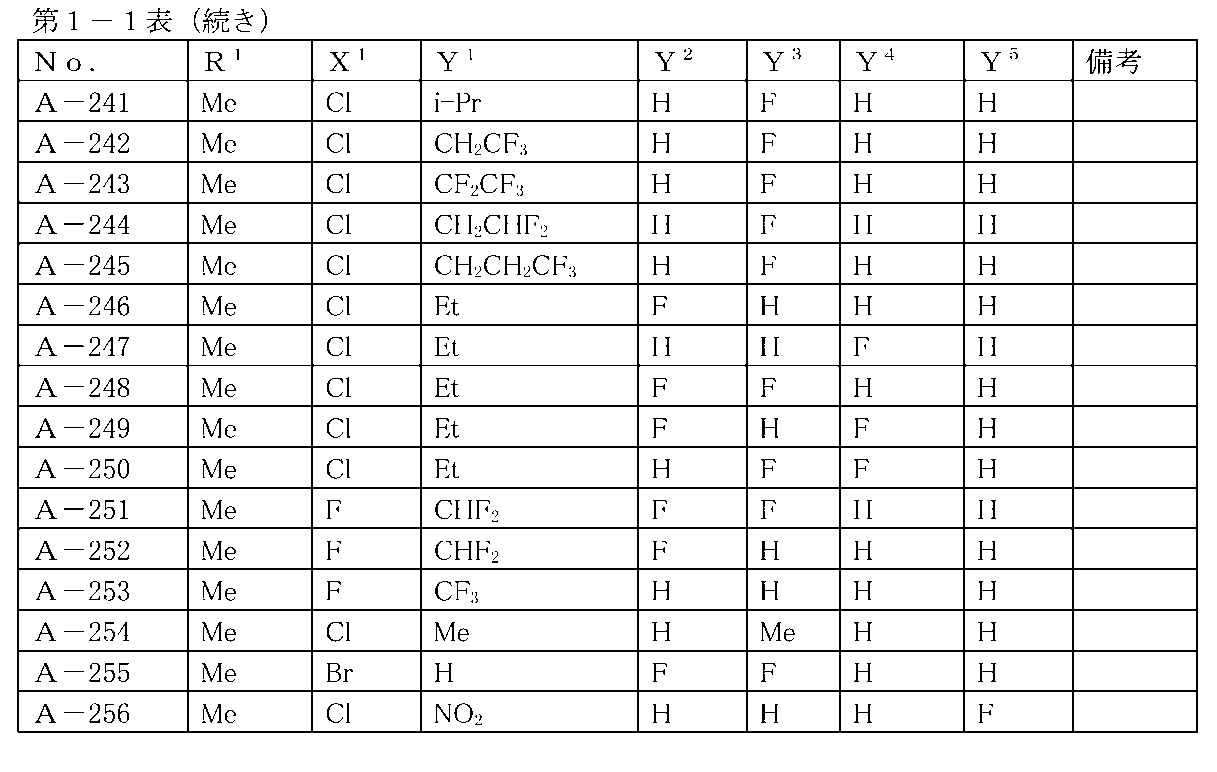
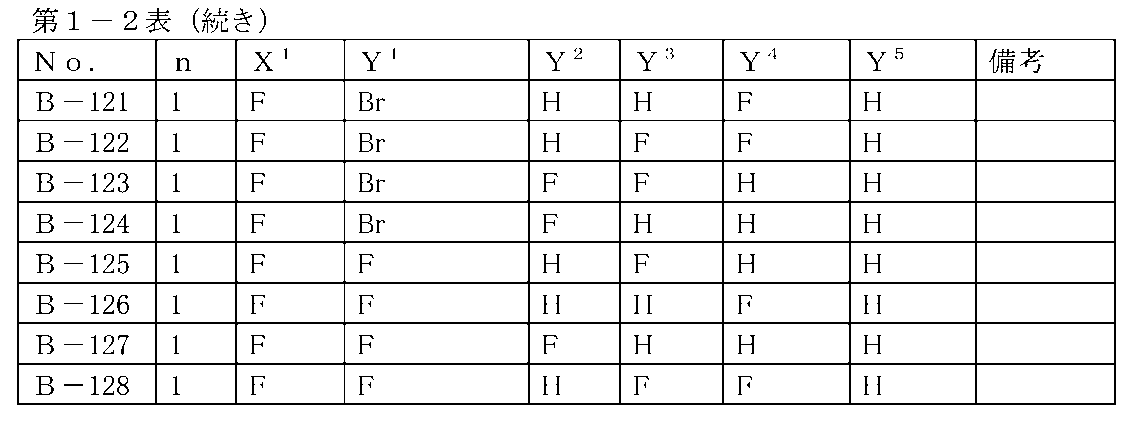
第2表中の融点において、*1は、化合物の融点を測定した時に分解した温度を表す。
第3表中の1H-NMRスペクトラムデータにおいて、sはシングレット(一重線)、brsはブロードしたシングレット、dはダブレット(二重線)、tはトリプレット(三重線)、qはカルテット(四重線)、mはマルチプレット(多重線)である。
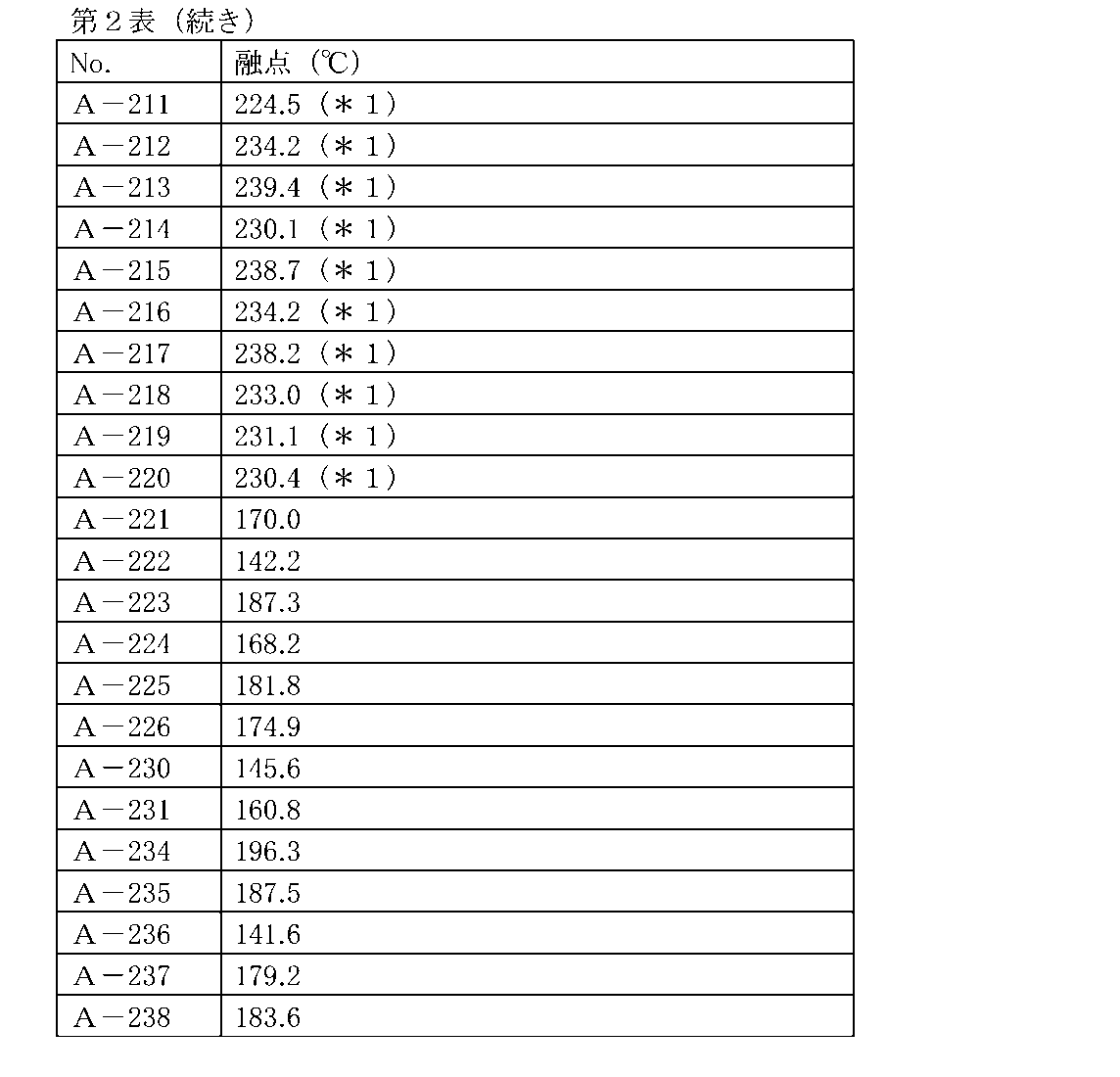

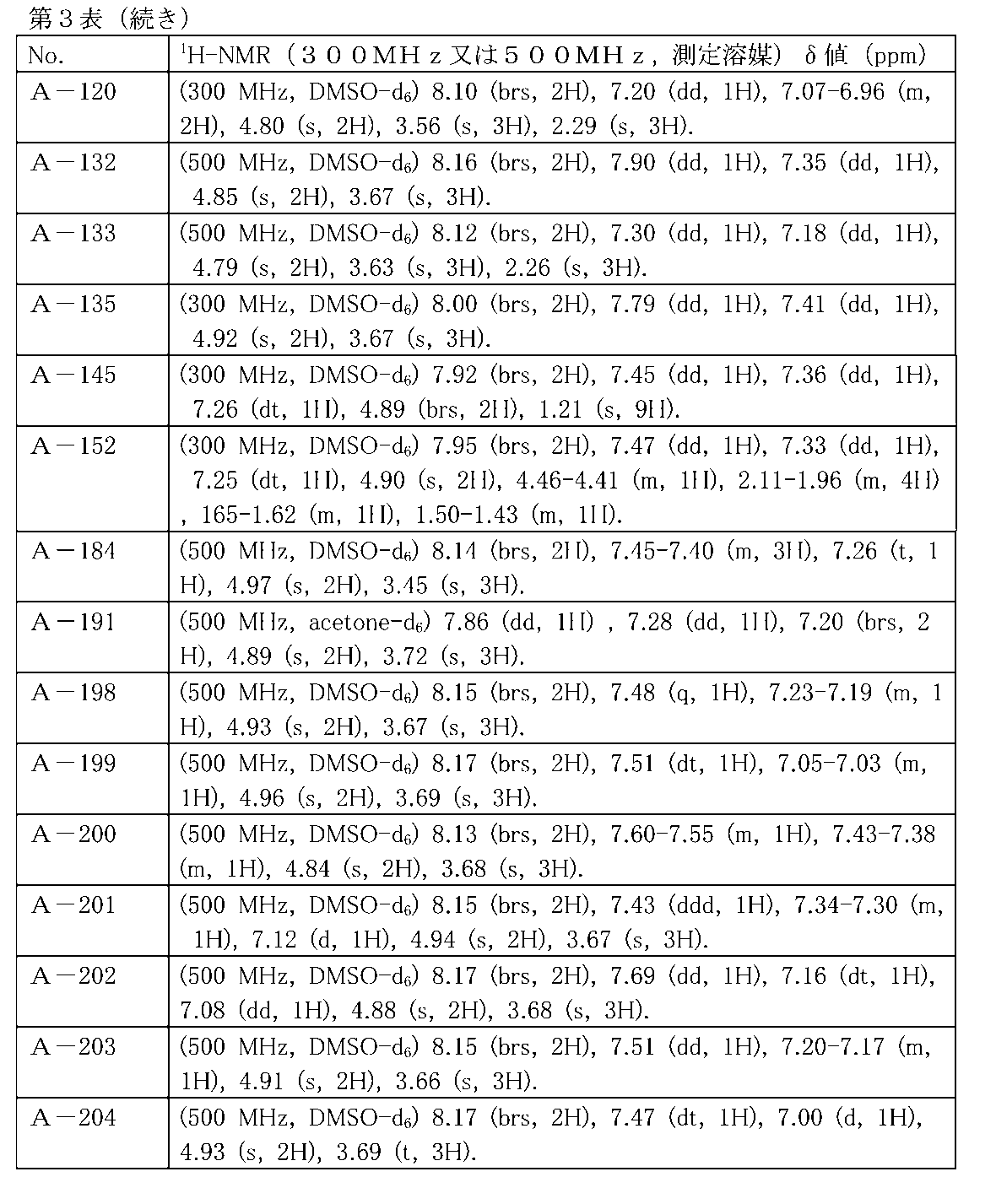

本発明化合物を含む各薬液の調製:
本発明化合物とアセトン又はジメチルスルホキシドとを混合し、本発明化合物を溶解させた。本発明化合物の溶液に水を加えて、有効成分である本発明化合物が所定の濃度(400ppm)になるように希釈して薬液を得た。この薬液を、以下の試験例1~試験例3にて利用した。
直径6cmのビニールポットでトマトを栽培し、4.5~5.5葉期に達した時に薬液10mlをスプレーガンにて散布した。薬液が乾燥した後(処理当日)に、トマト疫病菌(Phytophthora infestans)の胞子懸濁液を噴霧接種し、温度20℃、湿度95%以上の接種箱に16時間入れた。その後、20℃の恒温室内に置き、接種3日後に病斑面積率を調査し、下記計算式に従って防除率を算出した。その結果、以下の各供試化合物を含む各薬液(有効成分濃度は400ppm)がトマト疫病に対して90%以上の防除率を示した。
[防除率の計算式]
防除率(%)=100-(X/Y)×100
X:供試化合物の病斑面積率(%)、Y:無処理区の病斑面積率(%)
供試化合物:化合物No.A-3、A-5、A-6、A-7、A-8、A-10、A-11、A-12、A-14、A-15、A-16、A-18、A-19、A-20、A-21、A-22、A-23、A-24、A-25、A-26、A-27、A-28、A-29、A-30、A-31、A-32、A-33、A-34、A-35、A-36、A-37、A-38、A-39、A-40、A-41、A-42、A-43、A-45、A-46、A-47、A-48、A-50、A-51、A-52、A-54、A-55、A-56、A-57、A-58、A-59、A-60、A-61、A-62、A-64、A-65、A-66、A-67、A-68、A-69、A-70、A-71、A-72、A-73、A-74、A-75、A-76、A-77、A-78、A-79、A-82、A-83、A-84、A-85、A-86、A-87、A-88、A-89、A-91、A-92、A-93、A-94、A-95、A-96、A-97、A-98、A-99、A-100、A-101、A-102、A-103、A-104、A-105、A-106、A-108、A-109、A-110、A-111、A-112、A-113、A-114、A-115、A-116、A-117、A-118、A-119、A-120、A-121、A-122、A-123、A-124、A-128、A-129、A-131、A-132、A-133、A-135、A-138、A-152、A-184、A-191、A-198、A-199、A-200、A-201、A-202、A-203、A-204、A-205、A-206、A-207、A-208、A-209、A-210、A-211、A-212、A-213、A-214、A-215、A-216、A-217、A-218、A-219、A-220、A-221、A-222、A-224、A-225、A-226、A-227、A-230、A-232、A-234、A-235、A-236、A-237、A-238、B-1、B-2、B-3、B-4、B-5、B-6、B-7、B-8、B-9、B-10、B-11、B-12、B-13、B-14、B-15、B-16、B-17、B-18、B-19、B-20、B-21、B-22、B-24、B-25、B-40、B-43、B-47、B-50、B-55、B-57、B-64、B-89、B-105、B-108、B-111、B-112、B-113、B-114、B-115、B-116、B-117、B-118、B-119、B-120、B-121、B-122、B-123、B-124、B-125、B-126、B-127、B-128
直径6cmのビニールポットでキュウリを栽培し、1.2~1.5葉期に達した時に薬液10mlをスプレーガンにて散布した。薬液が乾燥した後(処理当日)に、キュウリべと病菌(Pseudoperonospora cubensis)の胞子懸濁液を噴霧接種し、温度20℃、湿度95%以上の接種箱に24時間入れた。その後、20℃の恒温室内に置き、接種7日後に病斑面積率を調査し、上記試験例1と同じ計算式により防除率を算出した。その結果、以下の各供試化合物を含む各薬液(有効成分濃度が400ppm)がキュウリべと病に対して90%以上の防除率を示した。
供試化合物:化合物No.A-3、A-5、A-6、A-10、A-12、A-15、A-16、A-18、A-19、A-20、A-21、A-22、A-23、A-24、A-26、A-28、A-29、A-30、A-31、A-32、A-33、A-35、A-38、A-39、A-40、A-42、A-43、A-45、A-47、A-48、A-50、A-51、A-52、A-54、A-55、A-57、A-58、A-59、A-62、A-64、A-65、A-67、A-68、A-69、A-71、A-72、A-73、A-75、A-76、A-77、A-78、A-79、A-82、A-83、A-85、A-91、A-92、A-94、A-95、A-96、A-97、A-98、A-99、A-100、A-102、A-103、A-106、A-109、A-111、A-112、A-113、A-114、A-115、A-116、A-117、A-118、A-119、A-120、A-121、A-122、A-123、A-124、A-128、A-129、A-131、A-132、A-133、A-135、A-138、A-145、A-152、A-184、A-191、A-198、A-199、A-200、A-201、A-202、A-203、A-204、A-205、A-206、A-207、A-208、A-209、A-210、A-211、A-212、A-213、A-214、A-215、A-216、A-217、A-218、A-219、A-220、A-221、A-222、A-223、A-224、A-225、A-226、A-232、A-234、A-237、A-238、B-2、B-3、B-4、B-5、B-6、B-7、B-8、B-9、B-10、B-11、B-13、B-14、B-15、B-16、B-17、B-18、B-19、B-20、B-21、B-22、B-24、B-25、B-40、B-43、B-47、B-50、B-55、B-57、B-64、B-105、B-108、B-111、B-112、B-113、B-114、B-115、B-116、B-117、B-118、B-119、B-120、B-121、B-122、B-123、B-124、B-125、B-126、B-127、B-128
直径6cmのビニールポットでトマトを栽培し、4.5~5.5葉期に達した時にトマト疫病菌(Phytophthora infestans)の胞子懸濁液を噴霧接種し、温度20℃、湿度95%以上の接種箱に4時間入れた。その後、薬液10mlをスプレーガンにて散布し、薬液が乾燥した後(処理当日)に、20℃の恒温室内に置き、接種3日後に病斑面積率を調査し、上記試験例1と同じ計算式により防除率を算出した。その結果、以下の各供試化合物を含む各薬液(有効成分濃度は400ppm)がトマト疫病に対して90%以上の防除率を示した。
供試化合物:化合物No.A-2、A-5、A-6、A-10、A-11、A-12、A-13、A-14、A-16、A-18、A-19、A-20、A-21、A-22、A-23、A-29、A-31、A-32、A-33、A-34、A-35、A-36、A-38、A-40、A-41、A-43、A-45、A-48、A-50、A-52、A-55、A-57、A-58、A-60、A-64、A-65、A-67、A-69、A-71、A-77、A-78、A-79、A-85、A-86、A-87、A-88、A-89、A-91、A-92、A-93、A-95、A-97、A-99、A-101、A-109、A-111、A-113、A-115、A-116、A-117、A-118、A-119、A-120、A-121、A-122、A-123、A-124、A-128、A-129、A-132、A-133、A-184、A-191、A-198、A-199、A-200、A-202、A-203、A-204、A-205、A-206、A-207、A-208、A-209、A-210、A-211、A-213、A-214、A-215、A-216、A-217、A-220、A-226、A-230、A-232、A-238、B-7、B-9、B-16、B-22、B-50、B-64、B-111、B-112、B-114、B-115、B-116、B-118、B-119、B-121、B-122、B-123、B-125、B-126、B-128
本発明化合物の化合物No.A-10、及び特許文献1の製造例2に記載の化合物(以下、比較化合物1と記す)を有効成分として用い、比較試験を行った。
上記の所定の濃度に調整した各薬液を用い、試験例2に記載の方法に従って、キュウリべと病に対する殺菌効果試験を行った。
各供試化合物を含む薬液の各有効成分濃度毎の結果を第4表に示す。Aは100%の防除率、Bは90-99%の防除率、Cは70-89%の防除率、Dは30-69%の防除率、Eは0-29%の防除率をそれぞれ意味する。
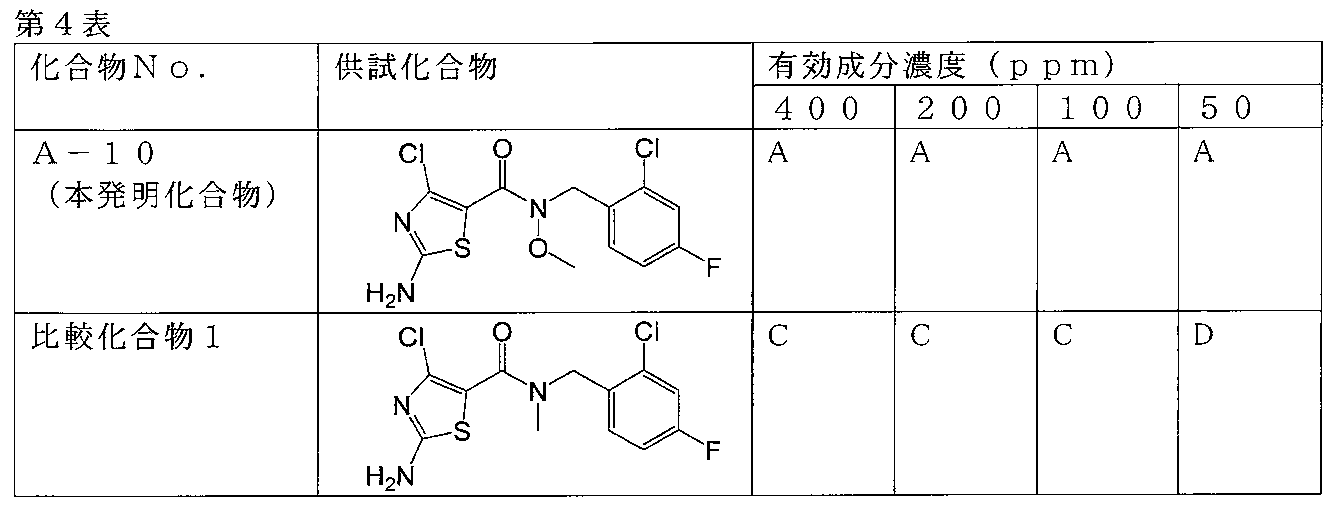
従って、実施例より、本発明のN-置換オキシアミド化合物は、有害な植物病害に対して優れた防除効果を発揮することを見出した。さらに、特許文献1のアミド化合物よりも、本発明のN-置換オキシアミド化合物は、有害な植物病害に対して優れた防除効果を発揮することを見出した。
製剤例1
(1)化合物(I) 20重量部
(2)クレー 72重量部
(3)リグニンスルホン酸ソーダ 8重量部
以上のものを均一に混合して水和剤とする。
製剤例2
(1)化合物(I) 5重量部
(2)タルク 95重量部
以上のものを均一に混合して粉剤とする。
製剤例3
(1)化合物(I) 20重量部
(2)N,N-ジメチルアセトアミド 20重量部
(3)ポリオキシエチレンアルキルフェニルエーテル 10重量部
(4)キシレン 50重量部
以上のものを均一に混合、溶解して乳剤とする。
(1)クレー 68重量部
(2)リグニンスルホン酸ソーダ 2重量部
(3)ポリオキシエチレンアルキルアリールサルフェート 5重量部
(4)微粉シリカ 25重量部
以上の各成分の混合物と、化合物(I)とを4:1の重量割合で混合し、水和剤とする。
製剤例5
(1)化合物(I) 50重量部
(2)ポリオキシエチレンアルキルフェニルエーテルリン酸トリエタノールアミン塩
2重量部
(3)シリコーン 0.2重量部
(4)水 47.8重量部
以上のものを均一に混合、粉砕した原液に更に
(5)ポリカルボン酸ナトリウム 5重量部
(6)無水硫酸ナトリウム 42.8重量部
を加え均一に混合、造粒、乾燥して顆粒水和剤とする。
製剤例6
(1)化合物(I) 5重量部
(2)ポリオキシエチレンオクチルフェニルエーテル 1重量部
(3)ポリオキシエチレンの燐酸エステル 0.1重量部
(4)粒状炭酸カルシウム 93.9重量部
(1)~(3)を予め均一に混合し、適量のアセトンで希釈した後、(4)に吹付け、アセトンを除去して粒剤とする。
(1)化合物(I) 2.5重量部
(2)N-メチル-2-ピロリドン 2.5重量部
(3)大豆油 95.0重量部
以上のものを均一に混合、溶解して微量散布剤(ultra low volume formulation)とする。
製剤例8
(1)化合物(I) 20重量部
(2)ポリオキシエチレンアルキルフェニルエーテルリン酸トリエタノールアミン塩
2重量部
(3)シリコーン 0.2重量部
(4)ザンサンガム 0.1重量部
(5)エチレングリコール 5重量部
(6)水 72.7重量部
以上のものを均一に混合、粉砕して水性懸濁剤とする。
Claims (10)
- 式(I):

T1は、ハロゲン、シアノ、又は-U1-R2であり、
U1は、O、S、又はC(=O)Oであり、
R2は、(C1-C3)-アルキルであり、
X1は、ハロゲンであり、
Y1、Y2、Y3、Y4及びY5は、それぞれ独立に、ハロゲン、(C1-C6)-アルキル、(C1-C6)-ハロアルキル、ニトロ、シアノ、又は水素原子である。ただし、R1が(C1-C4)-アルキル又は(C3-C4)-シクロアルキルである場合は、Y1、Y2、Y3、Y4及びY5の全てが同時に水素原子になることはない。]で表される化合物又はその塩。 - R1が、(C1-C4)-アルキル、(C3-C4)-シクロアルキル、又は(C3-C5)-アルキニルである、請求項1に記載の化合物又はその塩。
- 式(I)の化合物が、
式(IA);

X1は、ハロゲンであり、
Y1は、ハロゲン、(C1-C6)-アルキル、(C1-C6)-ハロアルキル、ニトロ、シアノ、又は水素原子であり、
Y2A、Y3A及びY4Aは、それぞれ独立に、水素原子、又はハロゲンであり、
Y5Aは、水素原子である。ただし、Y1が水素原子である場合は、Y2A、Y3A及びY4Aの全てが同時に水素原子になることはない。]で表されるN-(シクロ)アルコキシアミド化合物である、請求項1に記載の化合物又はその塩。 - 式(I)の化合物が、
式(IB)
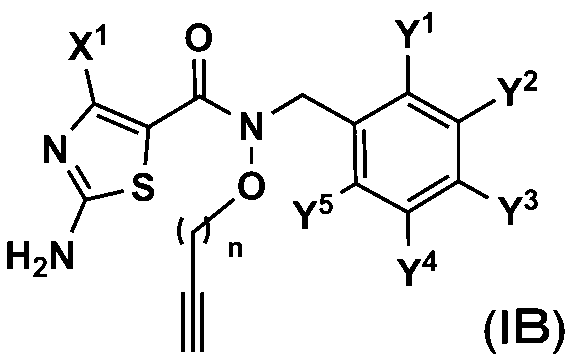
X1は、ハロゲンであり、
Y1、Y2、Y3、Y4及びY5は、それぞれ独立に、水素原子、ハロゲン、(C1-C6)-アルキル、(C1-C6)-ハロアルキル、ニトロ、又はシアノである。]で表されるN-アルキニルオキシアミド化合物である、請求項1に記載の化合物又はその塩。 - 式(I)の化合物が、
式(IA):
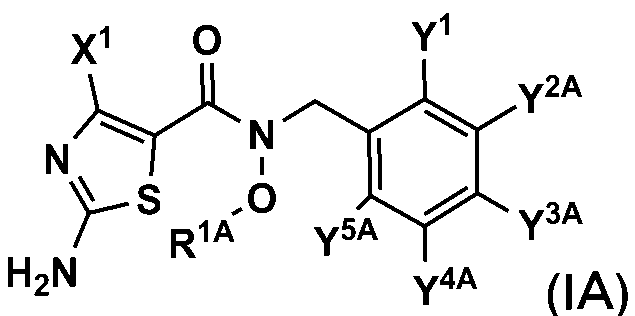
X1は、ハロゲンであり、
Y1は、ハロゲン、(C1-C6)-アルキル、(C1-C6)-ハロアルキル、ニトロ、シアノ、又は水素原子であり、
Y2A、Y3A及びY4Aは、それぞれ独立に、水素原子、又はハロゲンであり、
Y5Aは、水素原子である。ただし、Y1が水素原子である場合は、Y2A、Y3A及びY4Aの全てが同時に水素原子になることはない。]で表されるN-(シクロ)アルコキシアミド化合物、又は
式(IB):

X1は、ハロゲンであり、
Y1、Y2、Y3、Y4及びY5は、それぞれ独立に、水素原子、ハロゲン、(C1-C6)-アルキル、(C1-C6)-ハロアルキル、ニトロ、又はシアノである。]で表されるN-アルキニルオキシアミド化合物である、請求項1に記載の化合物又はその塩。 - Y1が、ハロゲン、(C1-C6)-アルキル、(C1-C6)-ハロアルキル、ニトロ、又はシアノである、請求項1~5のいずれか一項に記載の化合物又はその塩。
- R1Aが、メチル、エチル又はシクロプロピルである、請求項3又は請求項5に記載の化合物又はその塩。
- Y5が、水素原子である請求項1、請求項2、請求項4又は請求項5のいずれか一項に記載の化合物又はその塩。
- 請求項1から請求項5のいずれか一項に記載の化合物又はその塩を有効成分として含有する農園芸用殺菌剤。
- 請求項1から請求項5のいずれか一項に記載の化合物又はその塩の有効量を、植物体、植物病原菌又は土壌に施用し、有害な植物病害を防除する方法。
Priority Applications (6)
| Application Number | Priority Date | Filing Date | Title |
|---|---|---|---|
| AU2024342189A AU2024342189A1 (en) | 2023-09-13 | 2024-08-27 | N–substituted oxyamide compound or salt thereof |
| IL326625A IL326625A (en) | 2023-09-13 | 2024-08-27 | N–substituted oxyamide compound or salt thereof |
| CN202480056752.1A CN121794263A (zh) | 2023-09-13 | 2024-08-27 | N-取代氧酰胺化合物或其盐 |
| DO2026000034A DOP2026000034A (es) | 2023-09-13 | 2026-02-10 | Compuesto de oxiamida n-sustituida o su sal |
| MX2026002779A MX2026002779A (es) | 2023-09-13 | 2026-03-06 | Compuesto de oxiamida n-sustituida o su sal |
| CONC2026/0003220A CO2026003220A2 (es) | 2023-09-13 | 2026-03-17 | Compuesto de oxiamida n-sustituida o su sal. |
Applications Claiming Priority (4)
| Application Number | Priority Date | Filing Date | Title |
|---|---|---|---|
| JP2023148050 | 2023-09-13 | ||
| JP2023-148047 | 2023-09-13 | ||
| JP2023148047 | 2023-09-13 | ||
| JP2023-148050 | 2023-09-13 |
Publications (1)
| Publication Number | Publication Date |
|---|---|
| WO2025057723A1 true WO2025057723A1 (ja) | 2025-03-20 |
Family
ID=95022134
Family Applications (1)
| Application Number | Title | Priority Date | Filing Date |
|---|---|---|---|
| PCT/JP2024/030537 Pending WO2025057723A1 (ja) | 2023-09-13 | 2024-08-27 | N-置換オキシアミド化合物又はその塩 |
Country Status (9)
| Country | Link |
|---|---|
| CN (1) | CN121794263A (ja) |
| AR (1) | AR133764A1 (ja) |
| AU (1) | AU2024342189A1 (ja) |
| CO (1) | CO2026003220A2 (ja) |
| DO (1) | DOP2026000034A (ja) |
| IL (1) | IL326625A (ja) |
| MX (1) | MX2026002779A (ja) |
| TW (1) | TW202525788A (ja) |
| WO (1) | WO2025057723A1 (ja) |
Citations (13)
| Publication number | Priority date | Publication date | Assignee | Title |
|---|---|---|---|---|
| JPH0931069A (ja) * | 1995-07-24 | 1997-02-04 | Nissan Chem Ind Ltd | チアゾールカルボン酸誘導体および植物病害防除剤 |
| WO2006138350A2 (en) | 2005-06-15 | 2006-12-28 | Anormed Inc. | Chemokine receptor binding compounds |
| WO2009100171A1 (en) | 2008-02-07 | 2009-08-13 | Bristol-Myers Squibb Company | Fused heteroaryl modulators of glucocorticoid receptor, ap-1, and/or nf-kb activity and use thereof |
| WO2010049946A2 (en) | 2008-10-27 | 2010-05-06 | Cadila Healthcare Limited | Thyroid receptor ligands |
| WO2010134634A1 (ja) | 2009-05-20 | 2010-11-25 | 住友化学株式会社 | アミド化合物とその植物病害防除用途 |
| WO2011023645A1 (en) | 2009-08-25 | 2011-03-03 | Syngenta Participations Ag | N-alkoxycarboxamides and their use as microbiocides |
| WO2012008999A2 (en) | 2010-07-14 | 2012-01-19 | Merck Sharp & Dohme Corp. | Tricyclic compounds as allosteric modulators of metabotropic glutamate receptors |
| WO2012006760A1 (en) | 2010-07-14 | 2012-01-19 | Merck Sharp & Dohme Corp. | Tricyclic compounds as allosteric modulators of metabotropic glutamate receptors |
| US20140378399A1 (en) | 2011-12-29 | 2014-12-25 | Industry-Academic Cooperation Foundation, Yonsei University | Novel vascular leakageage inhibitor |
| WO2020028141A1 (en) | 2018-07-31 | 2020-02-06 | Eli Lilly And Company | Combination therapy |
| WO2023176458A1 (ja) * | 2022-03-18 | 2023-09-21 | 石原産業株式会社 | チアゾールカルボン酸ヒドラジド化合物を含有する殺菌組成物 |
| JP2023148047A (ja) | 2022-03-30 | 2023-10-13 | 株式会社Mixi | 情報処理装置、プログラム、及び情報処理方法 |
| JP2023148050A (ja) | 2022-03-30 | 2023-10-13 | 本田技研工業株式会社 | 能動型騒音低減装置 |
-
2024
- 2024-08-27 AU AU2024342189A patent/AU2024342189A1/en active Pending
- 2024-08-27 WO PCT/JP2024/030537 patent/WO2025057723A1/ja active Pending
- 2024-08-27 IL IL326625A patent/IL326625A/en unknown
- 2024-08-27 CN CN202480056752.1A patent/CN121794263A/zh active Pending
- 2024-09-09 TW TW113134064A patent/TW202525788A/zh unknown
- 2024-09-10 AR ARP240102403A patent/AR133764A1/es unknown
-
2026
- 2026-02-10 DO DO2026000034A patent/DOP2026000034A/es unknown
- 2026-03-06 MX MX2026002779A patent/MX2026002779A/es unknown
- 2026-03-17 CO CONC2026/0003220A patent/CO2026003220A2/es unknown
Patent Citations (14)
| Publication number | Priority date | Publication date | Assignee | Title |
|---|---|---|---|---|
| JPH0931069A (ja) * | 1995-07-24 | 1997-02-04 | Nissan Chem Ind Ltd | チアゾールカルボン酸誘導体および植物病害防除剤 |
| WO2006138350A2 (en) | 2005-06-15 | 2006-12-28 | Anormed Inc. | Chemokine receptor binding compounds |
| WO2009100171A1 (en) | 2008-02-07 | 2009-08-13 | Bristol-Myers Squibb Company | Fused heteroaryl modulators of glucocorticoid receptor, ap-1, and/or nf-kb activity and use thereof |
| WO2010049946A2 (en) | 2008-10-27 | 2010-05-06 | Cadila Healthcare Limited | Thyroid receptor ligands |
| WO2010134634A1 (ja) | 2009-05-20 | 2010-11-25 | 住友化学株式会社 | アミド化合物とその植物病害防除用途 |
| JP2011001358A (ja) * | 2009-05-20 | 2011-01-06 | Sumitomo Chemical Co Ltd | アミド化合物とその植物病害防除用途 |
| WO2011023645A1 (en) | 2009-08-25 | 2011-03-03 | Syngenta Participations Ag | N-alkoxycarboxamides and their use as microbiocides |
| WO2012008999A2 (en) | 2010-07-14 | 2012-01-19 | Merck Sharp & Dohme Corp. | Tricyclic compounds as allosteric modulators of metabotropic glutamate receptors |
| WO2012006760A1 (en) | 2010-07-14 | 2012-01-19 | Merck Sharp & Dohme Corp. | Tricyclic compounds as allosteric modulators of metabotropic glutamate receptors |
| US20140378399A1 (en) | 2011-12-29 | 2014-12-25 | Industry-Academic Cooperation Foundation, Yonsei University | Novel vascular leakageage inhibitor |
| WO2020028141A1 (en) | 2018-07-31 | 2020-02-06 | Eli Lilly And Company | Combination therapy |
| WO2023176458A1 (ja) * | 2022-03-18 | 2023-09-21 | 石原産業株式会社 | チアゾールカルボン酸ヒドラジド化合物を含有する殺菌組成物 |
| JP2023148047A (ja) | 2022-03-30 | 2023-10-13 | 株式会社Mixi | 情報処理装置、プログラム、及び情報処理方法 |
| JP2023148050A (ja) | 2022-03-30 | 2023-10-13 | 本田技研工業株式会社 | 能動型騒音低減装置 |
Non-Patent Citations (10)
| Title |
|---|
| BIOORGANIC & MEDICINAL CHEMISTRY, vol. 12, 2004, pages 6171 - 6182 |
| HETEROCYCLES, vol. 78, 2009, pages 463 - 470 |
| JOURNAL OF MEDICINAL CHEMISTRY, vol. 12, no. 2299658-69-6, 1969, pages 45 - 48 |
| JOURNAL OF ORGANIC CHEMISTRY, vol. 70, 2005, pages 567 - 574 |
| ORGANIC & BIOMOLECULAR CHEMISTRY, vol. 18, 2020, pages 3281 - 3287 |
| ORGANIC LETTERS, vol. 6, 2004, pages 2361 - 2364 |
| ORGANIC PROCESS RESEARCH AND DEVELOPMENT, vol. 25, 2021, pages 1167 - 1175 |
| PETER G.M.WUTSTHEODORA W.GREENE: "Greene's PROTECTIVE GROUPS in ORGANIC SYNTHESIS", 2007, JOHN WILEY AND SONS |
| REGISTRY(STN) [online], 03 April 2019, p. 1, [retrieved on 17 October 2024], CAS: 2299658-69-6 * |
| THE JOURNAL OF ANTIBIOTICS, vol. 53, 2000, pages 1071 - 1085 |
Also Published As
| Publication number | Publication date |
|---|---|
| IL326625A (en) | 2026-04-01 |
| MX2026002779A (es) | 2026-04-01 |
| CO2026003220A2 (es) | 2026-04-06 |
| CN121794263A (zh) | 2026-04-03 |
| DOP2026000034A (es) | 2026-03-15 |
| AU2024342189A1 (en) | 2026-02-26 |
| AR133764A1 (es) | 2025-10-29 |
| TW202525788A (zh) | 2025-07-01 |
Similar Documents
| Publication | Publication Date | Title |
|---|---|---|
| JP5084721B2 (ja) | N−2−(ヘテロ)アリールエチルカルボキサミド誘導体及びこれを含有する有害生物防除剤 | |
| CN105492432A (zh) | 四唑啉酮化合物及其用途 | |
| JP5997931B2 (ja) | 農園芸用殺菌剤組成物及び植物病害の防除方法 | |
| TW201930267A (zh) | N-甲氧基醯胺化合物或其鹽及含有該等之農園藝用殺菌劑 | |
| CN105324373A (zh) | 四唑啉酮化合物及其应用 | |
| CN105408322A (zh) | 四唑啉酮化合物及其用途 | |
| JP2016520095A (ja) | 殺菌・殺カビ性ピラゾールの固体形態 | |
| WO2019124538A1 (ja) | N-メトキシアミド化合物又はその塩、及びそれらを含有する農園芸用殺菌剤 | |
| JP7776761B2 (ja) | 殺線虫組成物 | |
| JP2017197433A (ja) | ニコチン酸エステル化合物、農園芸用殺菌剤及び植物病害の防除方法 | |
| WO2013062024A1 (ja) | アリールアミジン誘導体又はその塩を含有する植物病害防除剤 | |
| KR102520792B1 (ko) | N-(4-피리딜)니코틴아미드 화합물 또는 그 염 | |
| JP2017001954A (ja) | 含窒素飽和複素環化合物 | |
| JP2025068631A (ja) | チアゾールカルボン酸ヒドラジド化合物を含有する殺菌組成物 | |
| WO2025057723A1 (ja) | N-置換オキシアミド化合物又はその塩 | |
| JP2016179944A (ja) | ジフルオロメチレン化合物 | |
| JP2019142776A (ja) | N−(4−ピリジル)ベンズアミド化合物又はその塩を有効成分として含有する有害生物防除剤 | |
| JP2008100978A (ja) | カルボン酸アミド誘導体を含有する殺菌性組成物 | |
| JP2013018738A (ja) | ベンゾイルアクリル酸誘導体又はその塩並びにそれらを含有する農園芸用殺菌剤 | |
| WO2025126830A1 (ja) | N-置換オキシ-2-アミノチアゾールカルボキサミド化合物又はその塩及び農園芸用殺菌剤 | |
| JPWO2016194741A1 (ja) | 殺菌剤組成物及び植物病害の防除方法 | |
| JP2023137573A (ja) | チアゾールカルボン酸ヒドラジド化合物を含有する殺菌組成物 | |
| JP2017057151A (ja) | アミノエチレン化合物又はその塩、それらを含む農園芸用殺菌剤及びそれらを施用する植物病害の防除方法 | |
| JP2016056117A (ja) | ニコチン酸エステル化合物、農園芸用殺菌剤 | |
| JP2016056100A (ja) | ニコチン酸エステル化合物 |
Legal Events
| Date | Code | Title | Description |
|---|---|---|---|
| 121 | Ep: the epo has been informed by wipo that ep was designated in this application |
Ref document number: 24865226 Country of ref document: EP Kind code of ref document: A1 |
|
| ENP | Entry into the national phase |
Ref document number: 2025545580 Country of ref document: JP Kind code of ref document: A |
|
| WWE | Wipo information: entry into national phase |
Ref document number: 2025545580 Country of ref document: JP |
|
| WWE | Wipo information: entry into national phase |
Ref document number: 202690328 Country of ref document: EA |
|
| WWE | Wipo information: entry into national phase |
Ref document number: AU2024342189 Country of ref document: AU Ref document number: 829921 Country of ref document: NZ |
|
| WWE | Wipo information: entry into national phase |
Ref document number: 326625 Country of ref document: IL |
|
| ENP | Entry into the national phase |
Ref document number: 2024342189 Country of ref document: AU Date of ref document: 20240827 Kind code of ref document: A |
|
| WWP | Wipo information: published in national office |
Ref document number: 829921 Country of ref document: NZ |
|
| WWP | Wipo information: published in national office |
Ref document number: 326625 Country of ref document: IL |
|
| WWE | Wipo information: entry into national phase |
Ref document number: 2601001571 Country of ref document: TH |
|
| REG | Reference to national code |
Ref country code: BR Ref legal event code: B01A Ref document number: 112026005114 Country of ref document: BR |
|
| WWE | Wipo information: entry into national phase |
Ref document number: 2024865226 Country of ref document: EP |