WO2025057716A1 - 殺菌乳飲料及びその製造方法 - Google Patents
殺菌乳飲料及びその製造方法 Download PDFInfo
- Publication number
- WO2025057716A1 WO2025057716A1 PCT/JP2024/030376 JP2024030376W WO2025057716A1 WO 2025057716 A1 WO2025057716 A1 WO 2025057716A1 JP 2024030376 W JP2024030376 W JP 2024030376W WO 2025057716 A1 WO2025057716 A1 WO 2025057716A1
- Authority
- WO
- WIPO (PCT)
- Prior art keywords
- milk beverage
- milk
- mass
- pasteurized
- pasteurized milk
- Prior art date
- Legal status (The legal status is an assumption and is not a legal conclusion. Google has not performed a legal analysis and makes no representation as to the accuracy of the status listed.)
- Pending
Links
Classifications
-
- A—HUMAN NECESSITIES
- A23—FOODS OR FOODSTUFFS; TREATMENT THEREOF, NOT COVERED BY OTHER CLASSES
- A23C—DAIRY PRODUCTS, e.g. MILK, BUTTER OR CHEESE; MILK OR CHEESE SUBSTITUTES; PREPARATION THEREOF
- A23C9/00—Milk preparations; Milk powder or milk powder preparations
- A23C9/12—Fermented milk preparations; Treatment using microorganisms or enzymes
- A23C9/13—Fermented milk preparations; Treatment using microorganisms or enzymes using additives
-
- A—HUMAN NECESSITIES
- A23—FOODS OR FOODSTUFFS; TREATMENT THEREOF, NOT COVERED BY OTHER CLASSES
- A23C—DAIRY PRODUCTS, e.g. MILK, BUTTER OR CHEESE; MILK OR CHEESE SUBSTITUTES; PREPARATION THEREOF
- A23C9/00—Milk preparations; Milk powder or milk powder preparations
- A23C9/152—Milk preparations; Milk powder or milk powder preparations containing additives
Definitions
- the present invention relates to a pasteurized milk beverage and a method for producing the same.
- This application claims priority based on Japanese Patent Application No. 2023-150088, filed on September 15, 2023, the contents of which are incorporated herein by reference.
- typical sour milk drinks such as drinking yogurt
- sour milk drinks are produced by adding lactic acid bacteria to pasteurized (also called primary pasteurization) milk raw material liquid and fermenting it.
- pasteurized also called primary pasteurization
- milk drinks produced by this method contain lactic acid bacteria, they must be stored refrigerated.
- typical sour milk drinks do not have good liquid stability during storage.
- milk proteins aggregate over time, and a transparent layer forms on the top (also known as syneresis). Syneresis is considered undesirable in terms of the product's appearance.
- a sour milk drink that can be stored at room temperature can be produced by heat sterilization (also known as secondary sterilization) after fermentation.
- heat sterilization also known as secondary sterilization
- the milk proteins tend to aggregate together during sterilization, which can lead to a decrease in quality, such as a rough texture, excessive thickening, and/or accelerated syneresis during storage.
- the speed at which syneresis progresses during storage is affected by the storage temperature, and syneresis tends to be more rapid when stored at room temperature than when stored in a refrigerator.
- Patent Document 1 relates to a method for producing a high-protein acidic liquid dairy product using whey protein and enriched with calcium ions and magnesium ions.
- Patent Document 1 describes an example in which a milk mineral composition containing calcium or CaCl2 is added to the milk raw material liquid after heat sterilization and before fermentation in a method for producing an acidic liquid dairy product by heat sterilizing a high-protein milk raw material liquid, adding a starter, and fermenting (i.e., acidifying) the milk raw material liquid.
- the present invention was made in consideration of the above circumstances, and aims to provide a novel pasteurized milk beverage that contains milk protein and calcium, and has good liquid stability despite its low pH.
- the present invention has the following aspects.
- the content of the phosphate is 0.01% by mass or more relative to the total mass of the pasteurized milk beverage, When the content of the phosphate is 0.01% by mass or more and less than 0.05% by mass, the content of the sour milk stabilizer is 0.40% by mass or more;
- the TSI slope 48 value calculated by the following formula (2) is 0.15 or less.
- Measurement method (Z) (1) Approximately 20 mL of the measurement sample liquid adjusted to 25°C is filled into a glass bottle with an outer diameter of 27 mm, and light with a wavelength of 880 nm is incident from the outside of the glass bottle with the height direction being vertical, and the intensity of the transmitted light at 180° and the backscattered light at 45° to the incident direction is measured with a photoreceiver. The measurement is performed in an atmosphere at 25°C.
- BST is a signal obtained by measuring the light intensity. When the transmitted light intensity is less than 0.2% of the incident light intensity, the backscattered light signal BS is used; otherwise, the transmitted light intensity signal T is used.
- the pasteurized milk beverage described in [12] which can be stored at room temperature.
- a method for producing the sterilized milk beverage described in [14] above comprising the steps of: preparing a raw material liquid that contains milk protein, calcium, and phosphate and that has been primarily sterilized; preparing a stabilizer liquid that contains an acid milk stabilizer separately from the raw material liquid; adding a fermenting bacterium to the raw material liquid and fermenting it to obtain a fermented liquid; mixing the fermentation liquid and the stabilizer liquid to obtain a mixture; and secondarily sterilizing the mixture to obtain the sterilized milk beverage.
- the present invention has the following features.
- [1] A pasteurized milk beverage containing milk protein and calcium, the pH at 25°C being 5.0 or less, the milk protein including whey protein, the whey protein content being 40% by mass or more relative to the total mass of protein contained in the pasteurized milk beverage, and the pasteurized milk beverage containing a phosphate and an acid milk stabilizer.
- [2] The sterilized milk beverage according to [1], wherein the total mass of protein contained in the sterilized milk beverage is 4.0% by mass or less relative to the total mass of the sterilized milk beverage.
- the content of the phosphate is 0.01% by mass or more relative to the total mass of the pasteurized milk beverage, When the content of the phosphate is 0.01% by mass or more and less than 0.05% by mass, the content of the sour milk stabilizer is 0.40% by mass or more relative to the total mass of the sterilized milk beverage; When the content of the phosphate is 0.05% by mass or more, the content of the acid milk stabilizer is 0.30% by mass or more relative to the total mass of the pasteurized milk beverage.
- the pasteurized milk beverage according to any one of claims 1 to 5.
- the TSI slope 48 value calculated by the following formula (2) is 0.15 or less.
- Measurement method (Z) (1) Approximately 20 mL of a measurement sample liquid adjusted to 25°C is filled into a glass bottle with an outer diameter of 27 mm, the glass bottle is held so that its height direction is vertical, light with a wavelength of 880 nm is incident on the measurement sample liquid from the outside of the glass bottle, and the intensity of the transmitted light at 180° and the backscattered light at 45° to the incident direction is measured with a photoreceiver. The measurement is performed in an atmosphere at 25°C.
- BST is a signal obtained by measuring the light intensity. When the transmitted light intensity is less than 0.2% of the incident light intensity, the backscattered light signal BS is used; otherwise, the transmitted light intensity signal T is used.
- the pasteurized milk beverage described in [12] which can be stored at room temperature.
- a method for producing the sterilized milk beverage described in [14] above comprising: preparing a raw material liquid containing milk protein, calcium, and phosphate and subjected to primary sterilization; preparing a stabilizer liquid containing an acid milk stabilizer separately from the raw material liquid; adding a fermenting bacterium to the raw material liquid and fermenting the raw material liquid to obtain a fermented liquid; mixing the fermented liquid with the stabilizer liquid to obtain a mixture; and secondarily sterilizing the mixture to obtain the sterilized milk beverage.
- the present invention provides a pasteurized milk beverage that contains milk protein and calcium and has good liquid stability despite its low pH.
- Normal temperature means a temperature in the range of more than 5°C and less than or equal to 35°C.
- Storable at room temperature means that the product can be stored in an atmosphere of 15°C to 35°C for 90 days or more without spoilage or spoilage.
- the symbol "to” used in a numerical range indicates a numerical range including the lower limit and upper limit. In the present specification, the contents expressed as percentages are by mass unless otherwise specified.
- the protein content is measured by the Dumas method (also known as the oxygen circulation combustion method).
- An analytical instrument SUMIGRAPH NC-220F (manufactured by Sumika Chemical Analysis Center Co., Ltd.), can be used.
- the measurement conditions are as follows. Electric furnace temperature: reaction furnace 870°C, reduction furnace: 600°C Oxygen purge: 0.2 ⁇ 0.02 L/min Column temperature: 70 ⁇ 5° C. Detector: Detector temperature: 100°C, CURRENT: 160mA Carrier gas: Helium flow rate 80 ⁇ 5 mL/min at column temperature 70 ⁇ 5°C Constituent reference substance: Aspartic acid Measurement sample amount: 500 ⁇ 100 mg Reference substance amount: 500 ⁇ 100mg
- the fat content is measured by the Roese-Gott Kunststoffsch method. Specifically, 3 g of sample is placed in a Majorier tube, 7 ml of water, 1 drop of phenolphthalein, and 2 ml of aqueous ammonia are added, and the tube is gently shaken. Then, 10 ml of ethanol, 25 ml of ethyl ether, and 25 ml of petroleum ether are added, and the tube is capped and shaken two or three times after each addition. The Majorier tube is centrifuged, and the solvent layer is transferred to a dish and the solvent is allowed to evaporate. The residue is fat, and is then weighed.
- the moisture content (unit: mass%) is measured by the mixed sand drying method. Specifically, the sample is dried under certain conditions until it becomes a constant weight, and the weight of the dried substance is calculated, and the loss on drying is taken as the moisture content. Specifically, the steps are as follows: (1) Place 25 g of refined silica sand and a glass rod in an aluminum weighing tube, dry in a dryer until a constant weight is reached, transfer to a desiccator, and allow to cool at room temperature for 30 minutes before weighing.
- the solid content (unit: mass %) is calculated from the moisture content as the content other than the moisture content.
- Non-fat milk solids are the solids derived from milk (also called milk solids) minus the fat (also called milk fat) content.
- the calcium (Ca) content is measured by inductively coupled plasma atomic emission spectrometry.
- a "sterilized milk beverage” means a milk beverage that satisfies at least one of the following (a) or (b): (a) A milk beverage that has been sterilized so that the total viable bacteria count, mold count, and yeast count are all zero per milliliter and the coliform bacteria test is negative in the microbiological test specified in the Food Sanitation Inspection Guidelines of Japan. (b) A milk beverage that has been sterilized so that the number of Listeria and Salmonella per ml is zero and the number of coliform bacteria is negative in the microbiological test specified in the food hygiene inspection guidelines in the CODEX standards.
- Milk beverage refers to a beverage that uses ingredients derived from milk (hereinafter also referred to as “dairy ingredients”) and has a milk solids content of 3.0% or more.
- milk refers to milk derived from a mammal, and examples of such milk include milk derived from cows, sheep or goats. Milk derived from cows (i.e., cow's milk) is preferred.
- the pasteurized milk beverage of the present embodiment contains milk protein and calcium, and further contains phosphate and an acid milk stabilizer. Proteins other than milk protein may also be contained.
- the milk protein contains at least whey protein, and may further contain milk proteins other than whey protein, such as casein protein.
- the pasteurized milk beverage of the present embodiment contains a milk protein source containing whey protein (but excluding the calcium source described below).
- milk protein sources containing whey protein include raw milk, skim milk, skim concentrated milk, skim milk powder, whey powder, WPC (abbreviation of whey protein concentrate), WPI (abbreviation of whey protein isolate), and heat-denatured WPC.
- WPC abbreviation of whey protein concentrate
- WPI abbreviation of whey protein isolate
- heat-denatured WPC heat-denatured WPC is preferred because it is easy to achieve liquid stability and low viscosity.
- Thermally denatured WPC is prepared by heating whey protein concentrate to cause it to coagulate and then applying shear force to granulate it, and is available commercially.
- the whey protein content (hereinafter also referred to as “whey/total protein”) relative to the total mass of protein (hereinafter also referred to as “total protein”) contained in the pasteurized milk beverage of this embodiment is 40% by mass or more, preferably 50% by mass or more, more preferably 60% by mass or more, even more preferably 70% by mass or more, even more preferably 80% by mass or more, and even more preferably 90% by mass or more. It may even be 100% by mass.
- the whey/total protein ratio is equal to or greater than the lower limit of the above range, the liquid stability is excellent. Specifically, aggregation and thickening due to heat sterilization are easily suppressed, and syneresis and sedimentation during storage are unlikely to occur.
- the total protein content of the pasteurized milk beverage is preferably 4.0% by mass or less, more preferably 3.5% by mass or less, even more preferably 3.1% by mass or less, and particularly preferably 2.5% by mass or less.
- the upper limit of the total protein content may be 2.0% by mass or less, or 1.0% by mass or less.
- the lower limit of the total protein content is not particularly limited, and may be, for example, 0.1% by mass, 0.3% by mass, 0.5% by mass, 0.7% by mass, or 1.1% by mass.
- the total protein content is equal to or less than the upper limit of the above range, the liquid stability is excellent. Specifically, aggregation and thickening due to heat sterilization are easily suppressed, and syneresis and sedimentation during storage are unlikely to occur.
- the total protein content relative to the total mass of the pasteurized milk beverage is, for example, preferably 0.1 to 4.0 mass%, more preferably 0.7 to 3.1 mass%, and particularly preferably 1.1 to 2.5 mass%.
- milk protein/total protein The content of milk protein relative to the total protein of the pasteurized milk beverage (hereinafter also referred to as "milk protein/total protein") is preferably 40% by mass or more, more preferably 60% by mass or more, and even more preferably 80% by mass or more. It may be 100% by mass.
- milk protein/total protein ratio is equal to or greater than the lower limit of the above range, aggregation and thickening due to heat sterilization are easily suppressed, and syneresis and sedimentation during storage are less likely to occur, and in addition, protein with an excellent amino acid balance can be supplied.
- the pasteurized milk beverage of the present embodiment preferably contains a calcium source containing 5.0% by mass or more of calcium (Ca).
- calcium sources include milk calcium concentrate, calcium phosphate, calcium citrate, calcium carbonate, and the like. From the viewpoint of digestibility and absorbability, the calcium source is preferably derived from milk, and milk calcium concentrate is more preferred.
- Milk calcium concentrate is a milk-derived composition in which the calcium concentration is increased by separating and removing fat, protein, lactose, etc. in milk. It is available commercially.
- the ratio of the total mass of calcium to the total mass of milk protein is preferably 3.5% by mass or more, more preferably 4.0% by mass or more, more preferably 5.0% by mass or more, more preferably 6.0% by mass or more, more preferably 7.0% by mass or more, and even more preferably 8.0% by mass or more.
- the calcium content per 1 g of milk protein is about 33.3 mg (i.e., 3.33% by mass).
- the pasteurized milk beverage of the present embodiment is preferably a calcium-fortified milk beverage to which calcium is additionally added.
- the upper limit of the total calcium/milk protein is not particularly limited, and may be, for example, 57% by mass, 36% by mass, or 26% by mass.
- total calcium is preferably 140 mg/100 g or more, more preferably 180 mg/100 g or more, more preferably 200 mg/100 g or more, more preferably 230 mg/100 g or more, more preferably 250 mg/100 g or more, more preferably 270 mg/100 g or more, more preferably 290 mg/100 g or more, and even more preferably 310 mg/100 g or more. If the total calcium is equal to or greater than the lower limit, the solution stability is likely to decrease, and this is preferable in that the application of the present invention is highly effective.
- the upper limit of the total calcium is not particularly limited, but may be 400 mg/100 g, 350 mg/100 g, 314 mg/100 g, 290 mg/100 g, 250 mg/100 g, 230 mg/100 g, 200 mg/100 g, or 180 mg/100 g from the viewpoint of ensuring liquid stability.
- the total calcium/milk protein ratio is 3.5% by mass or more and the total calcium is 140 to 400 mg/100 g. It is more preferable that the total calcium/milk protein ratio is 4.0% by mass or more and the total calcium is 180 to 314 mg/100 g, and it is even more preferable that the total calcium/milk protein ratio is 4.0% by mass or more and the total calcium is 180 to 250 mg/100 g.
- the total mass of additionally added calcium (hereinafter also referred to as "added calcium") per 100 g of the pasteurized milk beverage is preferably 20 mg/100 g or more, more preferably 60 mg/100 g or more, more preferably 110 mg/100 g or more, and even more preferably 180 mg/100 g or more. If the total calcium is equal to or greater than the lower limit, the solution stability is likely to decrease, and this is preferable in that the application of the present invention is highly effective.
- the total mass of added calcium per 100 g of the pasteurized milk beverage there is no particular upper limit on the total mass of added calcium per 100 g of the pasteurized milk beverage, but from the standpoint of ensuring liquid stability, it may be, for example, 400 mg/100 g, 350 mg/100 g, or 314 mg/100 g.
- the phosphate and the acid milk stabilizer contribute to improving the liquid stability.
- the phosphate include sodium hexametaphosphate, sodium ultraphosphate, sodium polyphosphate, potassium dihydrogen phosphate, tetrapotassium pyrophosphate, etc.
- the phosphate contains sodium hexametaphosphate.
- sodium hexametaphosphate accounts for 20% by mass or more, and preferably 50% by mass or more, of the total mass of the phosphate.
- the term "acid milk stabilizer” refers to a thickening polysaccharide that inhibits protein precipitation or aggregation in the acidic range and stabilizes proteins. Specific examples include high methoxyl pectin, soybean polysaccharides, carboxymethyl cellulose, etc. In particular, from the viewpoint of liquid stability, it is preferable that the acid milk stabilizer contains high methoxyl pectin. For example, it is preferred that high methoxyl pectin accounts for 20% by mass or more, and preferably 50% by mass or more, of the total mass of the sour milk stabilizer.
- the content of the phosphate is preferably 0.01% by mass or more, more preferably 0.05% by mass or more, based on the total mass of the pasteurized milk beverage.
- the upper limit is not particularly limited, but is preferably 0.5% by mass or less, more preferably 0.3% by mass or less, in terms of the flavor presented.
- the content of the acid milk stabilizer is preferably 0.30% by mass or more, more preferably 0.40% by mass or more, based on the total mass of the pasteurized milk beverage.
- the upper limit is not particularly limited, but is preferably 1.00% by mass or less, more preferably 0.80% by mass or less, in terms of being easy to maintain a low viscosity.
- the acid milk stabilizer content is preferably 0.40% by mass or more, more preferably 0.45% by mass or more, and even more preferably 0.50% by mass or more.
- the acid milk stabilizer content is preferably 0.30% by mass or more, more preferably 0.40% by mass or more, and even more preferably 0.50% by mass or more.
- the sterilized milk beverage of the present embodiment may contain other ingredients in addition to the milk protein source containing whey protein, the calcium source, the phosphate salt, the acid milk stabilizer and water.
- Other ingredients include, for example, sugars, sweeteners, acidulants, casein hydrolysates, animal fats, vegetable fats, flavorings, pH adjusters, vitamins, minerals, dietary fiber, fruit juice, antioxidants, coloring agents, etc.
- the pasteurized milk beverage of the present embodiment is acidic.
- it may be a milk beverage acidified by adding an acidulant or fruit juice, or it may be fermented milk acidified by fermentation.
- the pH of the pasteurized milk beverage at 25° C. is 5.0 or less, preferably 3.5 to 4.5, and more preferably 3.7 to 4.3. It is preferable for the pH of the pasteurized milk beverage to be below the upper limit and above the lower limit of the above range, since in addition to exhibiting a suitable sourness as a sour milk beverage, the effect of the sour milk stabilizer is maximized, thereby increasing liquid stability.
- the pasteurized milk beverage of the present embodiment is preferably fermented milk that has been pasteurized after fermentation (also called pasteurized fermented milk).
- fermented milk means "a product obtained by fermenting milk or milk containing an equivalent or higher nonfat milk solids content with lactic acid bacteria or yeast, and turning it into a paste or liquid, or by freezing these products," as specified in the "Ministry Ordinance on the Compositional Standards, etc. of Milk and Dairy Products" in Japan.
- the nonfat milk solids content is 8.0% or more, as specified in the compositional standards of the ministerial ordinance.
- pasteurized fermented milk means fermented milk that has been sterilized by heating at 75°C or higher for 15 minutes after fermentation, or by a method that has an equivalent or greater sterilizing effect, as specified in the Ministerial Ordinance on the Compositional Standards, etc. of Milk and Dairy Products in Japan.
- Sterilized milk beverages, which are pasteurized fermented milk, contain dead fermentation bacteria.
- the sterilized milk beverage of this embodiment contains milk protein, calcium, and phosphate, and can be produced by a method including a step of preparing a raw material liquid that has been primarily sterilized (also referred to as the first step), a step of preparing a stabilizer liquid containing an acid milk stabilizer separately from the raw material liquid (also referred to as the second step), a step of acidifying the raw material liquid to obtain an acidic raw material liquid (also referred to as the acidification step), a step of mixing the acidic raw material liquid and the stabilizer liquid to obtain a mixture (also referred to as the mixing step), and a step of secondarily sterilizing the mixture to obtain a sterilized milk beverage (also referred to as the secondary sterilization step).
- a fermenting bacterium is added to the raw material liquid and fermented to obtain a fermented liquid, and in the mixing step, the fermented liquid is mixed with a stabilizer liquid.
- a raw material liquid containing milk protein, calcium, and phosphate is primarily sterilized without containing an acid milk stabilizer, acidified after the primary sterilization, and then secondary sterilized by adding an acid milk stabilizer after acidification. Therefore, this method is suitable for producing a sterilized milk beverage that contains milk protein and calcium and has a low pH, but in which protein aggregation and thickening are suppressed.
- the raw material liquid can be prepared by mixing and dissolving a milk protein source containing whey protein, a calcium source, phosphate, water, and other components as necessary, and then heat sterilization (also called primary sterilization).
- the raw material liquid does not contain an acid milk stabilizer.
- the pH of the raw material liquid at 25°C is preferably more than 5.5, more preferably 6.0 or more.
- the liquid may be heated when dissolving the raw materials.
- the liquid temperature when dissolving the raw materials is preferably, for example, 10 to 90° C.
- the homogenization may be performed before the heat sterilization.
- the homogenization conditions are preferably, for example, a liquid temperature of 55 to 85° C. and a homogenization pressure of 10 to 25 MPa.
- the heat sterilization conditions are preferably within the range of, for example, 90 to 145° C. for 15 minutes to 2 seconds.
- the raw material liquid is preferably cooled to, for example, 25 to 45°C.
- the stabilizer solution can be prepared by mixing and dissolving the sour milk stabilizer in water.
- the stabilizer solution may contain other ingredients except for the milk protein source, calcium source, and phosphate.
- the stabilizer liquid may or may not be subjected to a heat sterilization step. If heat sterilization is performed, the conditions are preferably, for example, 75 to 145° C. for 15 minutes to 2 seconds. After heat sterilization, the stabilizer liquid is preferably cooled to, for example, 5 to 30°C.
- the raw material liquid obtained in the first step may be acidified by adding an acid component such as an acidulant or fruit juice as another component, or may be acidified by adding a fermentation bacterium to the raw material liquid obtained in the first step and fermenting it.
- acidulants include citric acid and lactic acid.
- the pH at 25° C. of both the acidic raw material liquid obtained by adding an acid component and the fermentation liquid obtained by fermentation is preferably 3.0 to 5.0, more preferably 3.8 to 4.5.
- lactic acid bacteria When the raw material liquid is fermented, it is preferable to use at least lactic acid bacteria as the fermenting bacteria. Two or more kinds of lactic acid bacteria may be combined. In addition to lactic acid bacteria, one or more kinds of known fermenting bacteria such as bifidobacteria and yeast may be used in combination. It is preferable to use a lactic acid bacteria starter as the fermentation bacteria. For example, it is preferable to use one or more of the lactic acid bacteria starters usually used in yogurt production, such as Lactobacillus bulgaricus (L. bulgaricus), Lactococcus lactis (L. lactis), and Streptococcus thermophilus (S. thermophilus). The lactic acid bacteria starter is available as a commercial product.
- fermentation bacteria are added to the raw material liquid, which is then maintained at a fermentation temperature and fermented until a preset pH is reached, to obtain a fermented liquid. It is preferable to adjust the temperature of the raw material liquid to a predetermined fermentation temperature before adding the fermentation bacteria.
- the fermentation temperature is preferably 25 to 45°C, more preferably 35 to 43°C. Since acid is produced during fermentation by lactic acid bacteria, the pH of the raw material liquid decreases over time after fermentation has begun.
- the pH of the raw material liquid in the fermentation process can be adjusted by the type and amount of fermentation bacteria added and the fermentation time.
- the curd is pulverized by stirring or homogenization to produce a fermentation liquid.
- the acidic raw material liquid or fermentation liquid obtained in the acidification step is mixed with the stabilizer liquid obtained in the second step to obtain a mixture.
- the mixing ratio is preferably set so that the composition of the mixture becomes the composition of the desired pasteurized milk beverage.
- the mixture obtained in the mixing step is subjected to secondary sterilization to obtain the desired sterilized milk beverage.
- the heat sterilization conditions are preferably within the range of, for example, 80 to 112°C for 5 minutes to 2 seconds. Homogenization may be performed before or after heat sterilization.
- the homogenization conditions are preferably, for example, a liquid temperature of 20 to 100° C. and a homogenization pressure of 10 to 25 MPa. After the secondary sterilization, it is preferable to cool the mixture to, for example, 15 to 40°C.
- the secondarily sterilized sterilized milk beverage is filled into a container and sealed (also referred to as the filling step), thereby obtaining a bottled sterilized milk beverage.
- the sterilized milk beverage is aseptically filled into a container and sealed to obtain a bottled sterilized milk beverage that can be stored at room temperature.
- a known aseptic filling method can be used, such as a method of filling into a sterilized container in a sterile environment where the number of live bacteria is controlled, such as a sterile room, and then sealing the container.
- the upper limit of the cooling time is not particularly limited.
- the liquid temperature of the sterilized milk beverage in the cooling step is preferably 1 to 8°C, more preferably 1 to 5°C.
- a sterilized milk beverage can be obtained having a viscosity at 25°C of 300 mPa ⁇ s or less, preferably 200 mPa ⁇ s or less, more preferably 150 mPa ⁇ s or less, and even more preferably 100 mPa ⁇ s or less.
- the viscosity in this specification is a value measured by the method described in the Examples section below.
- the lower limit of the viscosity of the pasteurized milk beverage at 25° C. is not particularly limited, and may be, for example, 5 mPa ⁇ s, 10 mPa ⁇ s, or 15 mPa ⁇ s.
- the lower limit of the median diameter of the pasteurized milk beverage is not particularly limited, and may be, for example, 0.2 ⁇ m, 0.3 ⁇ m, 0.5 ⁇ m, or 0.7 ⁇ m.
- syneresis rate may be 0.
- the water separation rate in this specification is a value obtained by the measurement method described in the Examples below.
- the liquid stability of the sterilized milk beverage can be improved, and a sterilized milk beverage having a TSI slope 48 value of 0.15 or less, preferably 0.027 or less, more preferably 0.020 or less, more preferably 0.015 or less, and even more preferably 0.010 or less can be obtained.
- the TSI slope 48 value may be 0.
- TSI Teurbiscan Stability Index
- TSI slope 48 value is an index for evaluating the stability of a dispersion. The smaller the TSI slope 48 value, the smaller the morphological changes such as sedimentation and water release during storage, and the more stable the dispersion.
- TSI slope 48 is a value obtained by the following measurement method (Z) using a pasteurized milk beverage as a measurement sample liquid and a liquid dispersion stability evaluation device.
- the pasteurized milk beverage can be stored at room temperature, and can be stored in an atmosphere of 15°C to 35°C for a period of 90 days or more, preferably 120 days or more, and more preferably 180 days or more without spoilage or spoilage.
- the present invention has the following aspects.
- a sterilized milk beverage containing milk protein and calcium the sterilized milk beverage having a pH of 3.5 to 5.0 at 25°C, the milk protein containing whey protein, the whey protein content being 40 to 100% by mass relative to the total mass of protein contained in the sterilized milk beverage, and the sterilized milk beverage containing a phosphate and an acid milk stabilizer.
- the sterilized milk beverage according to [1] wherein the total mass of protein contained in the sterilized milk beverage is 0.1 to 4.0% by mass relative to the total mass of the sterilized milk beverage.
- the content of the phosphate is 0.01% by mass or more and less than 0.05% by mass with respect to the total mass of the sterilized milk beverage, and the content of the acid milk stabilizer is 0.40 to 1.0% by mass with respect to the total mass of the sterilized milk beverage.
- the content of the phosphate is 0.05 to 5.0% by mass relative to the total mass of the sterilized milk beverage, and the content of the acid milk stabilizer is 0.30 to 1.0% by mass relative to the total mass of the sterilized milk beverage.
- the TSI slope 48 calculated by the formula (2) is 0 to 0.15.
- the sterilized milk beverage according to any one of [1] to [10].
- the ratio of the total mass of calcium contained in the sterilized milk beverage to the total mass of milk protein contained in the sterilized milk beverage is 3.5% by mass or more and less than 4.0% by mass, and the total mass of calcium contained in the sterilized milk beverage per 100 g of the sterilized milk beverage is 140 to 400 mg/100 g.
- the ratio of the total mass of calcium contained in the sterilized milk beverage to the total mass of milk protein contained in the sterilized milk beverage is 4.0 to 36% by mass, and the total mass of calcium contained in the sterilized milk beverage per 100 g of the sterilized milk beverage is 180 to 314 mg/100 g.
- the phosphate contains sodium hexametaphosphate, and the ratio of the sodium hexametaphosphate to the total mass of the phosphate is 20 to 100% by mass.
- the pasteurized milk beverage according to any one of [1] to [13].
- the pasteurized milk beverage according to [16] wherein the milk protein content is 40 to 100% by mass relative to the total mass of protein contained in the pasteurized milk beverage.
- ⁇ Measurement method> The following measurement methods were used: [Method of measuring median diameter] Using a pasteurized milk beverage as a sample, the particle size distribution was measured under the following measurement conditions using a laser diffraction/scattering type particle size distribution measuring device (HORIBA product name: Partica LA-950V2). In detail, first, a flow cell attached to the device was connected, and the sample was dropped into the circulating dispersion medium, which was then circulated and stirred to prepare the sample. When the sample transmittance reached a predetermined value, the device was operated to capture laser diffraction/scattering data. A particle size distribution was obtained based on the captured data, and the volume-based median diameter of the obtained particle size distribution was calculated.
- HORIBA product name: Partica LA-950V2 Partica LA-950V2
- Dispersion medium water.
- Sample refractive index 1.600-0.000
- Dispersion method No ultrasonic irradiation, no surfactant or dispersant was used.
- the viscosity is the value (unit: mPa ⁇ s) 10 seconds after the start of measurement when measured using a Brookfield viscometer with a No. 2 rotor at a rotation speed of 60 rpm.
- TSI slope 48 was measured by the above-mentioned measurement method (Z).
- the liquid dispersion stability evaluation device used was Formulation Company's product name "Turbiscan Tower”.
- Thermally modified WPC (2) Arla Foods Ingredients product name "Nutrilac CH-4560", non-fat milk solids 88.9%, fat 2.3%, protein 43.5%, whey protein 43.5%, calcium 1.4%, powder. Lactose: manufactured by MILEI GmbH, edible grade, non-fat milk solids 98.0%, fat 1.0%, protein 2.0%, whey protein 0.4%, calcium 0%, powder. Milk calcium concentrate: Morinaga Milk Industry Co., Ltd. product name "Milk Ca-28EX”, non-fat milk solids 87.5%, fat 0.1%, protein 3.1%, whey protein 3.1%, calcium 30.0%, powder.
- Phosphate (1) Sodium hexametaphosphate, manufactured by Taihei Chemical Industry Co., Ltd., powder. Lactic acid bacteria starter: Danisco product name "YO-MIX (registered trademark) 505". Sour milk stabilizer (1): High methoxyl pectin, San-Ei Gen FFI product name "SM-MN-2779", powder.
- Examples 1 to 25 Sterilized milk beverages, which are fermented milk that has been sterilized after fermentation, were produced using the compositions shown in Tables 1 to 5.
- Examples 1 to 3 and 8 are comparative examples, and Examples 4 to 7 and 9 to 25 are working examples.
- the raw materials other than the lactic acid bacteria starter were mixed in a mixer to prepare a mixed liquid according to the composition of the fermentation liquid shown in the table.
- the temperature of the mixed liquid was set to 70°C.
- the temperature was raised and homogenized using a homogenizer.
- the homogenization conditions were a temperature of 85°C, a pressure of 15 MPa, and a time of 2 seconds.
- the 85°C mixed liquid obtained after the homogenization was heat-sterilized (also called primary sterilization) in a batch sterilizer at 90°C for 10 minutes, and then cooled to 43°C to obtain a raw material liquid.
- a lactic acid bacteria starter was added to the cooled raw material liquid, which was then kept at 41 to 45° C.
- a stabilizer solution was obtained by mixing sour milk stabilizer and water in the formulation shown in the table.
- the fermented liquid and stabilizer liquid were mixed according to the formulation of the milk beverage shown in the table, the mixture was heated to 40°C in a tubular heat exchanger, and homogenized at a pressure of 15 MPa using a homogenizer to obtain a milk beverage in which the milk protein curds were crushed (i.e., a mixture of fermented milk and stabilizer liquid). The resulting 40° C.
- milk beverage was heat sterilized (also called secondary sterilization) at 90° C. for 30 seconds, and then cooled to 30° C. to obtain a sterilized milk beverage.
- the resulting sterilized milk beverage was aseptically filled into a container and sealed to obtain a bottled sterilized milk beverage (i.e., drink yogurt) that can be stored at room temperature.
- the filling temperature was 30° C., and the filling amount was 45 mL. After the filling process was completed, the container was transferred to a room temperature environment of 25° C. and stored.
- the container-packed sterilized milk beverage stored at room temperature for one day was used as the measurement subject, and the median diameter of the sterilized milk beverage was measured by the method described above.
- the container-packed sterilized milk beverage stored in the room temperature environment for one day was used as the measurement subject, and the viscosity of the sterilized milk beverage was measured by the method described above.
- the bottled sterilized milk beverage stored at room temperature for one day was used as the measurement subject, and the TSI slope 48 of the sterilized milk beverage was measured by the above-mentioned method.
- the bottled sterilized milk beverage stored at room temperature for 90 days was used as the measurement subject, and the syneresis rate was measured by the method described above.
- the bottled sterilized milk beverage stored at room temperature for one day was used as the measurement subject, and the pH at 25°C was measured. The results are shown in the table.
- the pasteurized milk beverages of Examples 4 to 7 and 9 to 25 were calcium-fortified pasteurized milk beverages that were heat-sterilized at a low pH, but had small median diameters and low viscosities, and were inhibited from flocculation and thickening due to heat sterilization.
- the TSI slope 48 values were small, and even when stored at room temperature for a long period of time, there was little syneresis, and the liquid stability during storage was excellent.
- Examples 2 and 8 which contained less whey protein, and Example 1, which contained less whey protein and no phosphate, showed significant thickening and a large median diameter.
- Example 8 used a thermally denatured whey protein, which reduced the viscosity compared to Example 2 and promoted syneresis.
- Example 3 which did not contain both phosphate and sour milk stabilizer, had poor liquid stability during storage and showed a large amount of syneresis when stored at room temperature for a long period of time.
- the present invention provides a pasteurized milk beverage that contains milk protein and calcium and has good liquid stability despite its low pH.
Landscapes
- Life Sciences & Earth Sciences (AREA)
- Chemical & Material Sciences (AREA)
- Engineering & Computer Science (AREA)
- Food Science & Technology (AREA)
- Polymers & Plastics (AREA)
- Microbiology (AREA)
- Dairy Products (AREA)
- Non-Alcoholic Beverages (AREA)
Abstract
乳タンパク質及びカルシウムを含有し、25℃におけるpHが5.0以下であり、前記乳タンパク質がホエイタンパク質を含み、前記殺菌乳飲料に含まれるタンパク質の総質量に対して前記ホエイタンパク質の含有量が40質量%以上であり、リン酸塩及び酸乳安定剤を含む殺菌乳飲料は、乳タンパク質とカルシウムを含みpHが低いにもかかわらず、液安定性が良好である。
Description
本発明は、殺菌乳飲料及びその製造方法に関する。
本願は、2023年9月15日に、日本に出願された特願2023-150088号に基づき優先権を主張し、その内容をここに援用する。
本願は、2023年9月15日に、日本に出願された特願2023-150088号に基づき優先権を主張し、その内容をここに援用する。
例えばドリンクヨーグルトに代表される、一般的な酸乳飲料は、殺菌(一次殺菌ともいう)した乳原料液に、乳酸菌を添加し、発酵させて製造される。この方法で製造された酸乳飲料は、乳酸菌を含んでいるため冷蔵で保存する必要がある。
一般的な酸乳飲料は、保存中の液安定性が良くないことが知られている。例えば、酸乳飲料を保存すると、経時的に乳タンパク質が凝集し、上部に透明層が発生(離水ともいう)する。離水は製品の外観として好ましくないと考えられている。
一般的な酸乳飲料は、保存中の液安定性が良くないことが知られている。例えば、酸乳飲料を保存すると、経時的に乳タンパク質が凝集し、上部に透明層が発生(離水ともいう)する。離水は製品の外観として好ましくないと考えられている。
一方、発酵後に加熱殺菌(二次殺菌ともいう)する方法で、常温で保存できる酸乳飲料を製造できる。しかし、発酵によりpHが低下した状態で二次殺菌すると、殺菌時に乳タンパク質同士の凝集が促進され、食感のざらつき、過度の増粘、及び又は保存中の離水促進などの品質低下が生じやすい。保存中の離水の進行スピードは保存温度の影響を受け、冷蔵保存よりも常温保存の方が、離水が促進される傾向がある。
ところで、近年は、超高齢社会化した社会背景もあり、カルシウム等の特定の栄養素の含有量を高めた(強化ともいう)食品のニーズが高まっている。
特許文献1は、ホエータンパク質を用い、カルシウムイオン、マグネシウムイオンを強化した、高タンパク酸性液体乳製品を製造する方法に関する。特許文献1には、高タンパクの乳原料液を加熱殺菌し、スターターを添加し、発酵(つまり、酸性化)させて酸性液体乳製品を製造する方法において、カルシウムを含むミルクミネラル組成物又はCaCl2を、乳原料液の加熱殺菌後かつ発酵前に添加した例が記載されている。
特許文献1は、ホエータンパク質を用い、カルシウムイオン、マグネシウムイオンを強化した、高タンパク酸性液体乳製品を製造する方法に関する。特許文献1には、高タンパクの乳原料液を加熱殺菌し、スターターを添加し、発酵(つまり、酸性化)させて酸性液体乳製品を製造する方法において、カルシウムを含むミルクミネラル組成物又はCaCl2を、乳原料液の加熱殺菌後かつ発酵前に添加した例が記載されている。
乳に自然な状態で含まれているカルシウムは、酸乳飲料中でも比較的安定であることが知られている。しかし、乳とは別にカルシウムを追加で添加した場合は、保存中の離水や底部への沈殿発生が促進されやすく、特に二次殺菌を行う場合には、過度な凝集発生や著しい増粘が生じやすいという問題がある。このため、pHが低いうえに、カルシウムが強化された酸乳飲料は、二次殺菌を行って常温で保存可能とすることが、より困難であった。
本発明は、前記事情に鑑みてなされたもので、乳タンパク質とカルシウムを含み、pHが低いにもかかわらず、液安定性が良好である、新規な殺菌乳飲料を提供することを目的とする。
本発明は、以下の態様を有する。
[1]乳タンパク質及びカルシウムを含有する殺菌乳飲料であって、25℃におけるpHが5.0以下であり、前記乳タンパク質がホエイタンパク質を含み、前記殺菌乳飲料に含まれるタンパク質の総質量に対して前記ホエイタンパク質の含有量が40質量%以上であり、リン酸塩及び酸乳安定剤を含む、殺菌乳飲料。
[2]前記殺菌乳飲料の総質量に対して、前記タンパク質の総質量が4.0質量%以下である、[1]に記載の殺菌乳飲料。
[3]前記乳タンパク質の総質量に対して、前記カルシウムの総質量の割合が3.5質量%以上である、[1]又は[2]に記載の殺菌乳飲料。
[4]前記殺菌乳飲料100gあたりの、前記カルシウムの総質量が140mg/100g以上である、[1]~[3]のいずれか一項に記載の殺菌乳飲料。
[5]前記酸乳安定剤がハイメトキシルペクチンを含む、[1]~[4]のいずれか一項に記載の殺菌乳飲料。
[6]前記殺菌乳飲料の総質量に対して、前記リン酸塩の含有量が0.01質量%以上であり、
前記リン酸塩の含有量が0.01質量%以上0.05質量%未満の場合、前記酸乳安定剤の含有量が0.40質量%以上であり、
前記リン酸塩の含有量が0.05質量%以上の場合、前記酸乳安定剤の含有量が0.30質量%以上である、[1]~[5]のいずれか一項に記載の殺菌乳飲料。
[7]25℃における粘度が300mPa・s以下である、[1]~[6]のいずれか一項に記載の殺菌乳飲料。
[8]前記殺菌乳飲料に含まれる粒子群の、体積基準の粒度分布におけるメジアン径が5μm以下である、[1]~[7]のいずれか一項に記載の殺菌乳飲料。
[9]25℃で90日間保存したときの離水率が25%以下である、[1]~[8]のいずれか一項に記載の殺菌乳飲料。
[10]前記殺菌乳飲料を測定サンプル液とし、液中分散安定性評価装置を用いた下記の測定方法(Z)により液の不安定さを示す指標であるTSIを測定したときに、下記式(2)で算出されるTSIslope48の値が0.15以下である、[1]~[9]のいずれか一項に記載の殺菌乳飲料。
測定方法(Z)
(1)25℃に温度調節した測定サンプル液の約20mLを外径27mmガラスボトルに充填し、高さ方向を垂直方向として、ガラスボトルの外側から波長880nmの光を入射し、入射方向に対して180°の透過光及び45°の後方散乱光の強度を受光器で測定する。測定は25℃の雰囲気中で行う。
(2)待機時間5分の後、入射光を垂直方向において下から上へスキャンしながら、スキャン間隔(Δh=40μm)ごとに前記透過光及び前記後方散乱光を測定する操作を行い(t1=0)、4時間間隔(t2=4、t3=8…)で、総時間が48時間(tmax=48)になるまで前記操作を繰り返す。
(3)垂直方向におけるスキャン領域の下限位置(zmin)から上限位置(zmax)までの距離を(zmax-zmin)とし、スキャン領域内の測定点の数をNh=(zmax-zmin)/Δhで求める。
(4)下記式(1)により、44時間(t=44)におけるTSI44hと、48時間(t=48)におけるTSI48hを求め、下記式(2)により、TSIslope48を求める。
式(1)において、BSTは光強度の測定で得られる信号であり、入射光強度に対して透過光強度が0.2%より小さい場合は、後方散乱光の信号BSを採用し、それ以外は透過光強度の信号Tを採用する。
[1]乳タンパク質及びカルシウムを含有する殺菌乳飲料であって、25℃におけるpHが5.0以下であり、前記乳タンパク質がホエイタンパク質を含み、前記殺菌乳飲料に含まれるタンパク質の総質量に対して前記ホエイタンパク質の含有量が40質量%以上であり、リン酸塩及び酸乳安定剤を含む、殺菌乳飲料。
[2]前記殺菌乳飲料の総質量に対して、前記タンパク質の総質量が4.0質量%以下である、[1]に記載の殺菌乳飲料。
[3]前記乳タンパク質の総質量に対して、前記カルシウムの総質量の割合が3.5質量%以上である、[1]又は[2]に記載の殺菌乳飲料。
[4]前記殺菌乳飲料100gあたりの、前記カルシウムの総質量が140mg/100g以上である、[1]~[3]のいずれか一項に記載の殺菌乳飲料。
[5]前記酸乳安定剤がハイメトキシルペクチンを含む、[1]~[4]のいずれか一項に記載の殺菌乳飲料。
[6]前記殺菌乳飲料の総質量に対して、前記リン酸塩の含有量が0.01質量%以上であり、
前記リン酸塩の含有量が0.01質量%以上0.05質量%未満の場合、前記酸乳安定剤の含有量が0.40質量%以上であり、
前記リン酸塩の含有量が0.05質量%以上の場合、前記酸乳安定剤の含有量が0.30質量%以上である、[1]~[5]のいずれか一項に記載の殺菌乳飲料。
[7]25℃における粘度が300mPa・s以下である、[1]~[6]のいずれか一項に記載の殺菌乳飲料。
[8]前記殺菌乳飲料に含まれる粒子群の、体積基準の粒度分布におけるメジアン径が5μm以下である、[1]~[7]のいずれか一項に記載の殺菌乳飲料。
[9]25℃で90日間保存したときの離水率が25%以下である、[1]~[8]のいずれか一項に記載の殺菌乳飲料。
[10]前記殺菌乳飲料を測定サンプル液とし、液中分散安定性評価装置を用いた下記の測定方法(Z)により液の不安定さを示す指標であるTSIを測定したときに、下記式(2)で算出されるTSIslope48の値が0.15以下である、[1]~[9]のいずれか一項に記載の殺菌乳飲料。
測定方法(Z)
(1)25℃に温度調節した測定サンプル液の約20mLを外径27mmガラスボトルに充填し、高さ方向を垂直方向として、ガラスボトルの外側から波長880nmの光を入射し、入射方向に対して180°の透過光及び45°の後方散乱光の強度を受光器で測定する。測定は25℃の雰囲気中で行う。
(2)待機時間5分の後、入射光を垂直方向において下から上へスキャンしながら、スキャン間隔(Δh=40μm)ごとに前記透過光及び前記後方散乱光を測定する操作を行い(t1=0)、4時間間隔(t2=4、t3=8…)で、総時間が48時間(tmax=48)になるまで前記操作を繰り返す。
(3)垂直方向におけるスキャン領域の下限位置(zmin)から上限位置(zmax)までの距離を(zmax-zmin)とし、スキャン領域内の測定点の数をNh=(zmax-zmin)/Δhで求める。
(4)下記式(1)により、44時間(t=44)におけるTSI44hと、48時間(t=48)におけるTSI48hを求め、下記式(2)により、TSIslope48を求める。
式(1)において、BSTは光強度の測定で得られる信号であり、入射光強度に対して透過光強度が0.2%より小さい場合は、後方散乱光の信号BSを採用し、それ以外は透過光強度の信号Tを採用する。
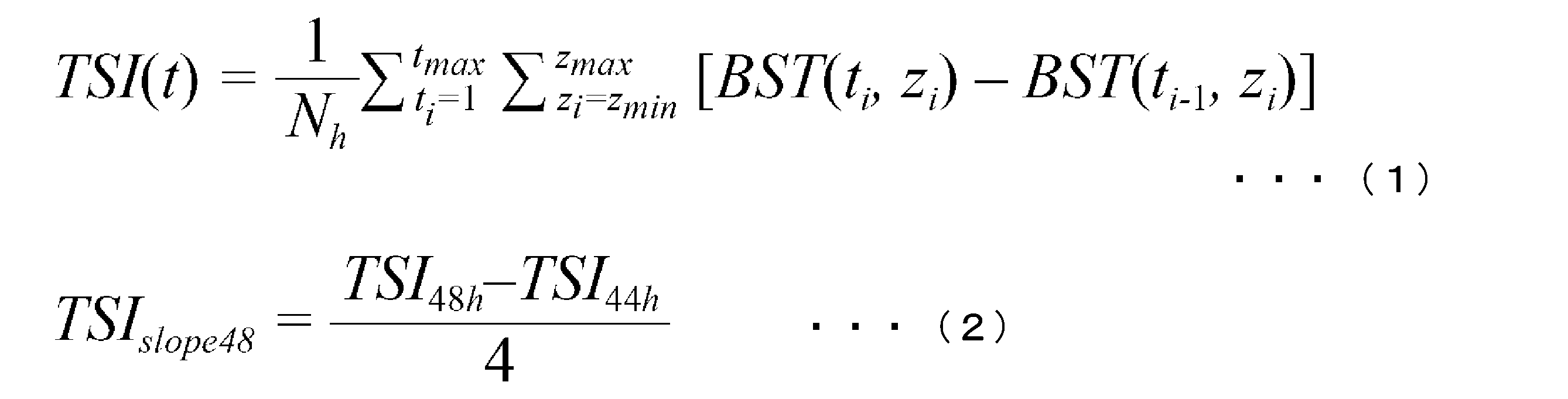
[11]常温保存可能である、[1]~[10]のいずれか一項に記載の殺菌乳飲料。
[12]乳タンパク質とカルシウムを含有する、殺菌乳飲料であって、前記乳タンパク質の総質量に対して、前記カルシウムの総質量の割合が3.5質量%以上であり、25℃におけるpHが5.0以下であり、25℃における粘度が300mPa・s以下であり、25℃で90日間保存したときの離水率が25%以下である、殺菌乳飲料。
[13]常温保存可能である、[12]に記載の殺菌乳飲料。
[14]発酵後に殺菌された発酵乳である、[1]~[13]のいずれか一項に記載の殺菌乳飲料。
[15]前記[1]~[13]のいずれか一項に記載の殺菌乳飲料を製造する方法であって、乳タンパク質、カルシウム、及びリン酸塩を含み、一次殺菌された原料液を調製する工程と、前記原料液とは別に、酸乳安定剤を含む安定剤液を調製する工程と、前記原料液を酸性化して酸性原料液を得る工程と、前記酸性原料液と前記安定剤液とを混合して混合物を得る工程と、前記混合物を二次殺菌して前記殺菌乳飲料を得る工程とを有する、殺菌乳飲料の製造方法。
[16]前記[14]に記載の殺菌乳飲料を製造する方法であって、乳タンパク質、カルシウム、及びリン酸塩を含み、一次殺菌された原料液を調製する工程と、前記原料液とは別に、酸乳安定剤を含む安定剤液を調製する工程と、前記原料液に発酵菌を添加し、発酵させて発酵液を得る工程と、前記発酵液と前記安定剤液とを混合して混合物を得る工程と、前記混合物を二次殺菌して前記殺菌乳飲料を得る工程とを有する、殺菌乳飲料の製造方法。
[12]乳タンパク質とカルシウムを含有する、殺菌乳飲料であって、前記乳タンパク質の総質量に対して、前記カルシウムの総質量の割合が3.5質量%以上であり、25℃におけるpHが5.0以下であり、25℃における粘度が300mPa・s以下であり、25℃で90日間保存したときの離水率が25%以下である、殺菌乳飲料。
[13]常温保存可能である、[12]に記載の殺菌乳飲料。
[14]発酵後に殺菌された発酵乳である、[1]~[13]のいずれか一項に記載の殺菌乳飲料。
[15]前記[1]~[13]のいずれか一項に記載の殺菌乳飲料を製造する方法であって、乳タンパク質、カルシウム、及びリン酸塩を含み、一次殺菌された原料液を調製する工程と、前記原料液とは別に、酸乳安定剤を含む安定剤液を調製する工程と、前記原料液を酸性化して酸性原料液を得る工程と、前記酸性原料液と前記安定剤液とを混合して混合物を得る工程と、前記混合物を二次殺菌して前記殺菌乳飲料を得る工程とを有する、殺菌乳飲料の製造方法。
[16]前記[14]に記載の殺菌乳飲料を製造する方法であって、乳タンパク質、カルシウム、及びリン酸塩を含み、一次殺菌された原料液を調製する工程と、前記原料液とは別に、酸乳安定剤を含む安定剤液を調製する工程と、前記原料液に発酵菌を添加し、発酵させて発酵液を得る工程と、前記発酵液と前記安定剤液とを混合して混合物を得る工程と、前記混合物を二次殺菌して前記殺菌乳飲料を得る工程とを有する、殺菌乳飲料の製造方法。
もう一つの側面として、本発明は以下の態様を有する。
[1]乳タンパク質及びカルシウムを含有する殺菌乳飲料であって、25℃におけるpHが5.0以下であり、前記乳タンパク質がホエイタンパク質を含み、前記殺菌乳飲料に含まれるタンパク質の総質量に対して前記ホエイタンパク質の含有量が40質量%以上であり、リン酸塩及び酸乳安定剤を含む、殺菌乳飲料。
[2]前記殺菌乳飲料に含まれるタンパク質の総質量が、前記殺菌乳飲料の総質量に対して4.0質量%以下である、[1]に記載の殺菌乳飲料。
[3]前記殺菌乳飲料に含まれる乳タンパク質の総質量に対して、前記殺菌乳飲料に含まれるカルシウムの総質量の割合が3.5質量%以上である、[1]又は[2]に記載の殺菌乳飲料。
[4]前記殺菌乳飲料100gあたりの、前記殺菌乳飲料に含まれるカルシウムの総質量が140mg/100g以上である、[1]~[3]のいずれか一項に記載の殺菌乳飲料。
[5]前記酸乳安定剤がハイメトキシルペクチンを含む、[1]~[4]のいずれか一項に記載の殺菌乳飲料。
[6]前記殺菌乳飲料の総質量に対して、前記リン酸塩の含有量が0.01質量%以上であり、
前記リン酸塩の含有量が0.01質量%以上0.05質量%未満の場合、前記殺菌乳飲料の総質量に対して、前記酸乳安定剤の含有量が0.40質量%以上であり、
前記リン酸塩の含有量が0.05質量%以上の場合、前記殺菌乳飲料の総質量に対して、前記酸乳安定剤の含有量が0.30質量%以上である、[1]~[5]のいずれか一項に記載の殺菌乳飲料。
[7]前記殺菌乳飲料の25℃における粘度が、300mPa・s以下である、[1]~[6]のいずれか一項に記載の殺菌乳飲料。
[8]前記殺菌乳飲料に含まれる粒子群の、体積基準の粒度分布におけるメジアン径が、5μm以下である、[1]~[7]のいずれか一項に記載の殺菌乳飲料。
[9]前記殺菌乳飲料を、25℃で90日間保存したときの離水率が25%以下である、[1]~[8]のいずれか一項に記載の殺菌乳飲料。
[10]前記殺菌乳飲料を測定サンプル液とし、液中分散安定性評価装置を用いた下記の測定方法(Z)により、液の不安定さを示す指標であるTSIを測定したときに、下記式(2)で算出されるTSIslope48の値が0.15以下である、[1]~[9]のいずれか一項に記載の殺菌乳飲料。
測定方法(Z)
(1)25℃に温度調節した測定サンプル液の約20mLを外径27mmガラスボトルに充填し、前記ガラスボトルをその高さ方向が垂直方向となるように保持し、前記ガラスボトルの外側から、前記測定サンプル液に波長880nmの光を入射し、入射方向に対して180°の透過光及び45°の後方散乱光の強度を受光器で測定する。測定は25℃の雰囲気中で行う。
(2)待機時間5分の後、入射光を前記ガラスボトルの下から上へ高さ方向にスキャンしながら、スキャン間隔(Δh)が40μmごとに前記透過光及び前記後方散乱光を測定する操作を行い(t1=0)、4時間間隔(t2=4、t3=8…)で、総時間が48時間(tmax=48)になるまで前記操作を繰り返す。
(3)前記ガラスボトルの高さ方向におけるスキャン領域の下限位置(zmin)から上限位置(zmax)までの距離を(zmax-zmin)とし、スキャン領域内の測定点の数をNh=(zmax-zmin)/Δhで求める。
(4)下記式(1)により、44時間(t=44)におけるTSI44hと、48時間(t=48)におけるTSI48hを求め、下記式(2)により、TSIslope48を求める。
式(1)において、BSTは光強度の測定で得られる信号であり、入射光強度に対して透過光強度が0.2%より小さい場合は、後方散乱光の信号BSを採用し、それ以外は透過光強度の信号Tを採用する。
[1]乳タンパク質及びカルシウムを含有する殺菌乳飲料であって、25℃におけるpHが5.0以下であり、前記乳タンパク質がホエイタンパク質を含み、前記殺菌乳飲料に含まれるタンパク質の総質量に対して前記ホエイタンパク質の含有量が40質量%以上であり、リン酸塩及び酸乳安定剤を含む、殺菌乳飲料。
[2]前記殺菌乳飲料に含まれるタンパク質の総質量が、前記殺菌乳飲料の総質量に対して4.0質量%以下である、[1]に記載の殺菌乳飲料。
[3]前記殺菌乳飲料に含まれる乳タンパク質の総質量に対して、前記殺菌乳飲料に含まれるカルシウムの総質量の割合が3.5質量%以上である、[1]又は[2]に記載の殺菌乳飲料。
[4]前記殺菌乳飲料100gあたりの、前記殺菌乳飲料に含まれるカルシウムの総質量が140mg/100g以上である、[1]~[3]のいずれか一項に記載の殺菌乳飲料。
[5]前記酸乳安定剤がハイメトキシルペクチンを含む、[1]~[4]のいずれか一項に記載の殺菌乳飲料。
[6]前記殺菌乳飲料の総質量に対して、前記リン酸塩の含有量が0.01質量%以上であり、
前記リン酸塩の含有量が0.01質量%以上0.05質量%未満の場合、前記殺菌乳飲料の総質量に対して、前記酸乳安定剤の含有量が0.40質量%以上であり、
前記リン酸塩の含有量が0.05質量%以上の場合、前記殺菌乳飲料の総質量に対して、前記酸乳安定剤の含有量が0.30質量%以上である、[1]~[5]のいずれか一項に記載の殺菌乳飲料。
[7]前記殺菌乳飲料の25℃における粘度が、300mPa・s以下である、[1]~[6]のいずれか一項に記載の殺菌乳飲料。
[8]前記殺菌乳飲料に含まれる粒子群の、体積基準の粒度分布におけるメジアン径が、5μm以下である、[1]~[7]のいずれか一項に記載の殺菌乳飲料。
[9]前記殺菌乳飲料を、25℃で90日間保存したときの離水率が25%以下である、[1]~[8]のいずれか一項に記載の殺菌乳飲料。
[10]前記殺菌乳飲料を測定サンプル液とし、液中分散安定性評価装置を用いた下記の測定方法(Z)により、液の不安定さを示す指標であるTSIを測定したときに、下記式(2)で算出されるTSIslope48の値が0.15以下である、[1]~[9]のいずれか一項に記載の殺菌乳飲料。
測定方法(Z)
(1)25℃に温度調節した測定サンプル液の約20mLを外径27mmガラスボトルに充填し、前記ガラスボトルをその高さ方向が垂直方向となるように保持し、前記ガラスボトルの外側から、前記測定サンプル液に波長880nmの光を入射し、入射方向に対して180°の透過光及び45°の後方散乱光の強度を受光器で測定する。測定は25℃の雰囲気中で行う。
(2)待機時間5分の後、入射光を前記ガラスボトルの下から上へ高さ方向にスキャンしながら、スキャン間隔(Δh)が40μmごとに前記透過光及び前記後方散乱光を測定する操作を行い(t1=0)、4時間間隔(t2=4、t3=8…)で、総時間が48時間(tmax=48)になるまで前記操作を繰り返す。
(3)前記ガラスボトルの高さ方向におけるスキャン領域の下限位置(zmin)から上限位置(zmax)までの距離を(zmax-zmin)とし、スキャン領域内の測定点の数をNh=(zmax-zmin)/Δhで求める。
(4)下記式(1)により、44時間(t=44)におけるTSI44hと、48時間(t=48)におけるTSI48hを求め、下記式(2)により、TSIslope48を求める。
式(1)において、BSTは光強度の測定で得られる信号であり、入射光強度に対して透過光強度が0.2%より小さい場合は、後方散乱光の信号BSを採用し、それ以外は透過光強度の信号Tを採用する。

[11]常温保存可能である、[1]~[10]のいずれか一項に記載の殺菌乳飲料。
[12]乳タンパク質とカルシウムを含有する、殺菌乳飲料であって、前記乳タンパク質の総質量に対して、前記カルシウムの総質量の割合が3.5質量%以上であり、25℃におけるpHが5.0以下であり、25℃における粘度が300mPa・s以下であり、25℃で90日間保存したときの離水率が25%以下である、殺菌乳飲料。
[13]常温保存可能である、[12]に記載の殺菌乳飲料。
[14]発酵後に殺菌された発酵乳である、[1]~[13]のいずれか一項に記載の殺菌乳飲料。
[15]前記[1]~[13]のいずれか一項に記載の殺菌乳飲料を製造する方法であって、乳タンパク質、カルシウム、及びリン酸塩を含み、一次殺菌された原料液を調製し、前記原料液とは別に、酸乳安定剤を含む安定剤液を調製し、前記原料液を酸性化して酸性原料液を得た後、前記酸性原料液と前記安定剤液とを混合して混合物を得て、前記混合物を二次殺菌して前記殺菌乳飲料を得ることを有する、殺菌乳飲料の製造方法。
[16]前記[14]に記載の殺菌乳飲料を製造する方法であって、乳タンパク質、カルシウム、及びリン酸塩を含み、一次殺菌された原料液を調製し、前記原料液とは別に、酸乳安定剤を含む安定剤液を調製し、前記原料液に発酵菌を添加し、発酵させて発酵液を得た後、前記発酵液と前記安定剤液とを混合して混合物を得て、前記混合物を二次殺菌して前記殺菌乳飲料を得ることを有する、殺菌乳飲料の製造方法。
[12]乳タンパク質とカルシウムを含有する、殺菌乳飲料であって、前記乳タンパク質の総質量に対して、前記カルシウムの総質量の割合が3.5質量%以上であり、25℃におけるpHが5.0以下であり、25℃における粘度が300mPa・s以下であり、25℃で90日間保存したときの離水率が25%以下である、殺菌乳飲料。
[13]常温保存可能である、[12]に記載の殺菌乳飲料。
[14]発酵後に殺菌された発酵乳である、[1]~[13]のいずれか一項に記載の殺菌乳飲料。
[15]前記[1]~[13]のいずれか一項に記載の殺菌乳飲料を製造する方法であって、乳タンパク質、カルシウム、及びリン酸塩を含み、一次殺菌された原料液を調製し、前記原料液とは別に、酸乳安定剤を含む安定剤液を調製し、前記原料液を酸性化して酸性原料液を得た後、前記酸性原料液と前記安定剤液とを混合して混合物を得て、前記混合物を二次殺菌して前記殺菌乳飲料を得ることを有する、殺菌乳飲料の製造方法。
[16]前記[14]に記載の殺菌乳飲料を製造する方法であって、乳タンパク質、カルシウム、及びリン酸塩を含み、一次殺菌された原料液を調製し、前記原料液とは別に、酸乳安定剤を含む安定剤液を調製し、前記原料液に発酵菌を添加し、発酵させて発酵液を得た後、前記発酵液と前記安定剤液とを混合して混合物を得て、前記混合物を二次殺菌して前記殺菌乳飲料を得ることを有する、殺菌乳飲料の製造方法。
本発明によれば、乳タンパク質とカルシウムを含み、pHが低いにもかかわらず、液安定性が良好な殺菌乳飲料が得られる。
本明細書において以下の定義が適用される。
「常温」は、5℃を超え、35℃以下の範囲内の温度を意味する。
「常温保存可能」とは、15℃~35℃の雰囲気中で、腐る又は腐敗することなく貯蔵可能な期間が90日以上であることを意味する。
本明細書において、数値範囲に用いられる記号「~」は、その下限値及び上限値を含む数値範囲を表す。
また本明細書において百分率で表された含有率は、特に断りのない限り質量による表示である。
「常温」は、5℃を超え、35℃以下の範囲内の温度を意味する。
「常温保存可能」とは、15℃~35℃の雰囲気中で、腐る又は腐敗することなく貯蔵可能な期間が90日以上であることを意味する。
本明細書において、数値範囲に用いられる記号「~」は、その下限値及び上限値を含む数値範囲を表す。
また本明細書において百分率で表された含有率は、特に断りのない限り質量による表示である。
<測定方法>
成分等の含有量の測定方法は以下の方法を用いる。
成分等の含有量の測定方法は以下の方法を用いる。
タンパク質含有量は、デュマ法(酸素循環燃焼方式ともいう)によって測定する。分析機器SUMIGRAPH NC-220F(住化分析センター社製)を用いることができる。測定条件は下記のとおりである。
電気炉温度:反応炉870℃、還元炉:600℃
酸素パージ:0.2±0.02L/min
カラム温度:70±5℃
検出器:検出器温度:100℃、CURRENT:160mA
キャリアーガス:カラム温度70±5℃の時にヘリウム流量80±5mL/min
構成基準物質:Aspartic acid
測定試料量:500±100mg
基準物質量:500±100mg
電気炉温度:反応炉870℃、還元炉:600℃
酸素パージ:0.2±0.02L/min
カラム温度:70±5℃
検出器:検出器温度:100℃、CURRENT:160mA
キャリアーガス:カラム温度70±5℃の時にヘリウム流量80±5mL/min
構成基準物質:Aspartic acid
測定試料量:500±100mg
基準物質量:500±100mg
タンパク質中のホエイタンパク質の含有量(単位:質量%)は、SDS-PAGE(「ドデシル硫酸ナトリウム-ポリアクリルアミドゲル電気泳動の」略称)により測定される、α-カゼイン、β-カゼイン、κ-カゼイン、β-ラクトグロブリン及びα-ラクトアルブミンのバンド強度合計値に対する、β-ラクトグロブリン及びα-ラクトアルブミンのバンド強度合計値の比として求める。
脂肪含有量は、レーゼ・ゴットリーブ法により測定する。具体的には、マジョニア管に試料3gを採取し、水7ml、フェノールフタレイン1滴、アンモニア水2mlを加えて軽く振とうする。その後、エタノール10ml、エチルエーテル25ml、石油エーテル25mlを加え、各液を添加する毎に栓をして2、3回振とうする。マジョニア管を遠心分離した後に溶媒層をディッシュに移し、溶媒を揮発させる。この残留物が脂肪であるので、当該残留物を秤量する。
水分含有量(単位:質量%)は、混砂乾燥法により測定する。具体的には、試料を一定条件で恒量となるまで乾燥し、乾燥物質量を求め算出した乾燥減量を水分量とする。
具体的には、以下の手順である。
(1)アルミニウム製秤量管に精製硅砂25gとガラス棒を入れ、乾燥機で恒量になるまで乾燥し、デシケーターに移し30分間室温で放冷し秤量する。
(2)秤量管を傾け、硅砂を一方に寄せ、試料を精秤し、机上に秤量管を写し、温湯5mlを加えガラス棒で試料を硅砂とよく撹拌均一に分散させる。
(3)沸騰した水浴上で撹拌しながら、ほとんどの水分を蒸発させる、サラサラになった所で99±1℃の乾燥機に3時間入れ、デシケーターで30分間放冷し秤量する。
乾燥、冷却、秤量を恒量になるまで繰り返し行い、以下の水分量計算式により水分を算出する。
水分含有量(単位:質量%)=乾燥減量(単位:g)/試料採取量(単位:g)×100
具体的には、以下の手順である。
(1)アルミニウム製秤量管に精製硅砂25gとガラス棒を入れ、乾燥機で恒量になるまで乾燥し、デシケーターに移し30分間室温で放冷し秤量する。
(2)秤量管を傾け、硅砂を一方に寄せ、試料を精秤し、机上に秤量管を写し、温湯5mlを加えガラス棒で試料を硅砂とよく撹拌均一に分散させる。
(3)沸騰した水浴上で撹拌しながら、ほとんどの水分を蒸発させる、サラサラになった所で99±1℃の乾燥機に3時間入れ、デシケーターで30分間放冷し秤量する。
乾燥、冷却、秤量を恒量になるまで繰り返し行い、以下の水分量計算式により水分を算出する。
水分含有量(単位:質量%)=乾燥減量(単位:g)/試料採取量(単位:g)×100
固形分濃度(単位:質量%)は、水分含有量以外の含有量として、前記水分含有量から算出する。算出式は「100-水分含有量=固形分濃度」である。
無脂乳固形分は乳由来の固形分(乳固形分ともいう)から脂肪(乳脂肪ともいう)含有量を差し引いた値である。
カルシウム(Ca)の含有量は、誘導結合プラズマ発光分析法により測定する。
無脂乳固形分は乳由来の固形分(乳固形分ともいう)から脂肪(乳脂肪ともいう)含有量を差し引いた値である。
カルシウム(Ca)の含有量は、誘導結合プラズマ発光分析法により測定する。
<殺菌乳飲料>
本明細書において、「殺菌乳飲料」は、下記(a)又は(b)の少なくとも一方を満たす乳飲料を意味する。
(a)日本における食品衛生検査指針に規定されている微生物検査において、一般生菌数、かび数、及び酵母数がいずれも、1ml当たり0であり、かつ大腸菌群が陰性となるように殺菌された乳飲料。
(b)CODEX規格における食品衛生検査指針に規定されている微生物検査において、リステリア菌数、及びサルモネラ菌数がいずれも、1ml当たり0であり、かつ大腸菌群が陰性となるように殺菌された乳飲料。
「乳飲料」は、乳由来の原料(以下、「乳原料」ともいう)を使用し、乳固形分が3.0%以上である飲料を意味する。
「乳」は、哺乳動物由来の乳であり、ウシ、ヒツジ又はヤギ由来の乳が例示できる。ウシ由来の乳(つまり、牛乳)が好ましい。
本明細書において、「殺菌乳飲料」は、下記(a)又は(b)の少なくとも一方を満たす乳飲料を意味する。
(a)日本における食品衛生検査指針に規定されている微生物検査において、一般生菌数、かび数、及び酵母数がいずれも、1ml当たり0であり、かつ大腸菌群が陰性となるように殺菌された乳飲料。
(b)CODEX規格における食品衛生検査指針に規定されている微生物検査において、リステリア菌数、及びサルモネラ菌数がいずれも、1ml当たり0であり、かつ大腸菌群が陰性となるように殺菌された乳飲料。
「乳飲料」は、乳由来の原料(以下、「乳原料」ともいう)を使用し、乳固形分が3.0%以上である飲料を意味する。
「乳」は、哺乳動物由来の乳であり、ウシ、ヒツジ又はヤギ由来の乳が例示できる。ウシ由来の乳(つまり、牛乳)が好ましい。
本実施形態の殺菌乳飲料は、乳タンパク質及びカルシウムを含有し、さらにリン酸塩及び酸乳安定剤を含む。乳タンパク質以外のタンパク質を含んでもよい。
乳タンパク質は少なくともホエイタンパク質を含む。さらにホエイタンパク質以外の乳タンパク質を含んでもよい。ホエイタンパク質以外の乳タンパク質としては、例えば、カゼインタンパク質が挙げられる。
乳タンパク質は少なくともホエイタンパク質を含む。さらにホエイタンパク質以外の乳タンパク質を含んでもよい。ホエイタンパク質以外の乳タンパク質としては、例えば、カゼインタンパク質が挙げられる。
[乳タンパク質源]
本実施形態の殺菌乳飲料は、ホエイタンパク質を含有する乳タンパク質源(ただし、後述のカルシウム源を除く)を含む。
ホエイタンパク質を含む乳タンパク質源としては、生乳、脱脂乳、脱脂濃縮乳、脱脂粉乳、ホエイパウダー、WPC(ホエイプロテインコンセントレートの略称)、WPI(ホエイプロテインアイソレートの略称)、熱変性WPC、が例示できる。これらのうち、液安定性および低粘度を実現しやすい点で熱変性WPCが好ましい。
熱変性WPCは、ホエイプロテインコンセントレートを加熱して凝集させた後にせん断力をかけて粒子化したものであり、市販品から入手可能である。
本実施形態の殺菌乳飲料は、ホエイタンパク質を含有する乳タンパク質源(ただし、後述のカルシウム源を除く)を含む。
ホエイタンパク質を含む乳タンパク質源としては、生乳、脱脂乳、脱脂濃縮乳、脱脂粉乳、ホエイパウダー、WPC(ホエイプロテインコンセントレートの略称)、WPI(ホエイプロテインアイソレートの略称)、熱変性WPC、が例示できる。これらのうち、液安定性および低粘度を実現しやすい点で熱変性WPCが好ましい。
熱変性WPCは、ホエイプロテインコンセントレートを加熱して凝集させた後にせん断力をかけて粒子化したものであり、市販品から入手可能である。
本実施形態の殺菌乳飲料に含まれるタンパク質の総質量(以下、「総タンパク質」ともいう。)に対するホエイタンパク質の含有量(以下、「ホエイ/総タンパク質」とも記す。)は40質量%以上であり、50質量%以上が好ましく、60質量%以上がより好ましく、70質量%以上がさらに好ましく、80質量%以上がさらに好ましく、90質量%以上がさらに好ましい。100質量%でもよい。
前記ホエイ/総タンパク質が上記範囲の下限値以上であると、液安定性に優れる。具体的には、加熱殺菌による凝集及び増粘が抑制されやすく、保存中の離水や沈降が生じ難い。
前記ホエイ/総タンパク質が上記範囲の下限値以上であると、液安定性に優れる。具体的には、加熱殺菌による凝集及び増粘が抑制されやすく、保存中の離水や沈降が生じ難い。
殺菌乳飲料の総質量に対する、総タンパク質含有量は4.0質量%以下が好ましく、3.5質量%以下がより好ましく、3.1質量%以下がさらに好ましく、2.5質量%以下が特に好ましい。また前記総タンパク質含有量の上限値は2.0質量%以下であってもよく、1.0質量%以下であってもよい。前記総タンパク質含有量の下限値は特に限定されないが、例えば0.1質量%、0.3質量%、0.5質量%、0.7質量%、又は1.1質量%であってよい。
総タンパク質含有量が上記範囲の上限値以下であると液安定性に優れる。具体的には、加熱殺菌による凝集及び増粘が抑制されやすく、保存中の離水や沈降が生じ難い。
殺菌乳飲料の総質量に対する総タンパク質含有量は、例えば、0.1~4.0質量%が好ましく、0.7~3.1質量%がより好ましく、1.1~2.5質量%が特に好ましい。
総タンパク質含有量が上記範囲の上限値以下であると液安定性に優れる。具体的には、加熱殺菌による凝集及び増粘が抑制されやすく、保存中の離水や沈降が生じ難い。
殺菌乳飲料の総質量に対する総タンパク質含有量は、例えば、0.1~4.0質量%が好ましく、0.7~3.1質量%がより好ましく、1.1~2.5質量%が特に好ましい。
殺菌乳飲料の総タンパク質に対する乳タンパク質の含有量(以下、「乳タンパク質/総タンパク質」とも記す。)は40質量%以上が好ましく、60質量%以上がより好ましく、80質量%以上がより好ましい。100質量%でもよい。
前記乳タンパク質/総タンパク質が上記範囲の下限値以上であると加熱殺菌による凝集及び増粘が抑制されやすく、保存中の離水や沈降が生じ難いことに加え、アミノ酸バランスに優れたタンパク質を補給することができる。
前記乳タンパク質/総タンパク質が上記範囲の下限値以上であると加熱殺菌による凝集及び増粘が抑制されやすく、保存中の離水や沈降が生じ難いことに加え、アミノ酸バランスに優れたタンパク質を補給することができる。
[カルシウム源]
本実施形態の殺菌乳飲料は、カルシウム(Ca)を5.0質量%以上含有するカルシウム源を含むことが好ましい。
カルシウム源としてはミルクカルシウム濃縮物、リン酸カルシウム、クエン酸カルシウム、炭酸カルシウムなどが例示できる。
カルシウム源は消化吸収性の点で乳由来であることが好ましく、ミルクカルシウム濃縮物がより好ましい。
ミルクカルシウム濃縮物は、乳中の脂肪、タンパク質、乳糖等を分離除去してカルシウム濃度を高めた、乳由来の組成物である。市販品から入手可能である。
本実施形態の殺菌乳飲料は、カルシウム(Ca)を5.0質量%以上含有するカルシウム源を含むことが好ましい。
カルシウム源としてはミルクカルシウム濃縮物、リン酸カルシウム、クエン酸カルシウム、炭酸カルシウムなどが例示できる。
カルシウム源は消化吸収性の点で乳由来であることが好ましく、ミルクカルシウム濃縮物がより好ましい。
ミルクカルシウム濃縮物は、乳中の脂肪、タンパク質、乳糖等を分離除去してカルシウム濃度を高めた、乳由来の組成物である。市販品から入手可能である。
乳タンパク質の総質量に対するカルシウムの総質量の割合(以下、「総カルシウム/乳タンパク質」とも記す。)は3.5質量%以上が好ましく、4.0質量%以上がより好ましく、5.0質量%以上がより好ましく、6.0質量%以上がより好ましく、7.0質量%以上がより好ましく、8.0質量%以上がさらに好ましい。
一般的な牛乳において、乳タンパク質1gあたりのカルシウムの含有量は33.3mg(つまり、3.33質量%)程度である。本実施形態の殺菌乳飲料は、追加的にカルシウムが添加されたカルシウム強化乳飲料であることが好ましい。
前記総カルシウム/乳タンパク質が上記下限値以上であるとカルシウムが強化されていることで液安定性が低下しやすく、本発明を適用することによる効果が大きい点で好ましい。
前記総カルシウム/乳タンパク質の上限値は特に限定されないが、例えば57質量%、36質量%、又は26質量%であってよい。
一般的な牛乳において、乳タンパク質1gあたりのカルシウムの含有量は33.3mg(つまり、3.33質量%)程度である。本実施形態の殺菌乳飲料は、追加的にカルシウムが添加されたカルシウム強化乳飲料であることが好ましい。
前記総カルシウム/乳タンパク質が上記下限値以上であるとカルシウムが強化されていることで液安定性が低下しやすく、本発明を適用することによる効果が大きい点で好ましい。
前記総カルシウム/乳タンパク質の上限値は特に限定されないが、例えば57質量%、36質量%、又は26質量%であってよい。
殺菌乳飲料100gあたりのカルシウムの総質量(以下、「総カルシウム」ともいう。)は140mg/100g以上が好ましく、180mg/100g以上がより好ましく、200mg/100g以上がより好ましく、230mg/100g以上がより好ましく、250mg/100g以上がより好ましく、270mg/100g以上がより好ましく、290mg/100g以上がより好ましく、310mg/100g以上がさらに好ましい。
前記総カルシウムが上記下限値以上であると液安定性が低下しやすく、本発明を適用することによる効果が大きい点で好ましい。
前記総カルシウムの上限値は特に限定されないが、液安定性の確保の点からは400mg/100g、350mg/100g、314mg/100g、290mg/100g、250mg/100g、230mg/100g、200mg/100g、又は180mg/100gであってよい。
前記総カルシウムが上記下限値以上であると液安定性が低下しやすく、本発明を適用することによる効果が大きい点で好ましい。
前記総カルシウムの上限値は特に限定されないが、液安定性の確保の点からは400mg/100g、350mg/100g、314mg/100g、290mg/100g、250mg/100g、230mg/100g、200mg/100g、又は180mg/100gであってよい。
殺菌乳飲料において、総カルシウム/乳タンパク質が3.5質量%以上であり、かつ総カルシウムが140~400mg/100gであることが好ましい。
総カルシウム/乳タンパク質が4.0質量%以上であり、かつ総カルシウムが180~314mg/100gであることがより好ましく、総カルシウム/乳タンパク質が4.0質量%以上であり、かつ総カルシウムが180~250mg/100gであることがさらに好ましい。
総カルシウム/乳タンパク質が4.0質量%以上であり、かつ総カルシウムが180~314mg/100gであることがより好ましく、総カルシウム/乳タンパク質が4.0質量%以上であり、かつ総カルシウムが180~250mg/100gであることがさらに好ましい。
殺菌乳飲料がカルシウム強化乳飲料である場合、殺菌乳飲料100gあたりの、追加的に添加されたカルシウムの総質量(以下、「添加カルシウム」ともいう。)は20mg/100g以上が好ましく、60mg/100g以上がより好ましく、110mg/100g以上がより好ましく、180mg/100g以上がさらに好ましい。
前記総カルシウムが上記下限値以上であると液安定性が低下しやすく、本発明を適用することによる効果が大きい点で好ましい。
殺菌乳飲料100gあたりの添加カルシウムの総質量の上限値は特に限定されないが、液安定性の確保の点からは、例えば400mg/100g、350mg/100g、又は314mg/100gであってよい。
前記総カルシウムが上記下限値以上であると液安定性が低下しやすく、本発明を適用することによる効果が大きい点で好ましい。
殺菌乳飲料100gあたりの添加カルシウムの総質量の上限値は特に限定されないが、液安定性の確保の点からは、例えば400mg/100g、350mg/100g、又は314mg/100gであってよい。
[リン酸塩及び酸乳安定剤]
本実施形態において、リン酸塩及び酸乳安定剤は液安定性の向上に寄与する。
リン酸塩としては、ヘキサメタリン酸ナトリウム、ウルトラリン酸ナトリウム、ポリリン酸ナトリウム、リン酸二水素カリウム、ピロリン酸四カリウムなどが例示できる。特に液安定性の点で、リン酸塩がヘキサメタリン酸ナトリウムを含むことが好ましい。
例えば、リン酸塩の総質量のうち、20質量%以上、好ましくは50質量%以上がヘキサメタリン酸ナトリウムであることが好ましい。
本実施形態において、リン酸塩及び酸乳安定剤は液安定性の向上に寄与する。
リン酸塩としては、ヘキサメタリン酸ナトリウム、ウルトラリン酸ナトリウム、ポリリン酸ナトリウム、リン酸二水素カリウム、ピロリン酸四カリウムなどが例示できる。特に液安定性の点で、リン酸塩がヘキサメタリン酸ナトリウムを含むことが好ましい。
例えば、リン酸塩の総質量のうち、20質量%以上、好ましくは50質量%以上がヘキサメタリン酸ナトリウムであることが好ましい。
本明細書において「酸乳安定剤」は、酸性域において、タンパク質の沈殿や凝集を抑制し、タンパク質を安定化させる増粘多糖類を意味する。具体例としては、ハイメトキシルペクチン、大豆多糖類、カルボキシメチルセルロース等が挙げられる。特に液安定性の点で、酸乳安定剤がハイメトキシルペクチンを含むことが好ましい。
例えば、酸乳安定剤の総質量のうち、20質量%以上、好ましくは50質量%以上がハイメトキシルペクチンであることが好ましい。
例えば、酸乳安定剤の総質量のうち、20質量%以上、好ましくは50質量%以上がハイメトキシルペクチンであることが好ましい。
殺菌乳飲料の総質量に対して、リン酸塩の含有量は0.01質量%以上が好ましく、0.05質量%以上がより好ましい。上限は特に限定されないが、呈する風味の点で0.5質量%以下が好ましく、0.3質量%以下がより好ましい。
殺菌乳飲料の総質量に対して、酸乳安定剤の含有量は0.30質量%以上が好ましく、0.40質量%以上がより好ましい。上限は特に限定されないが、低粘度を維持しやすい点で1.00質量%以下が好ましく、0.80質量%以下がより好ましい。
殺菌乳飲料の総質量に対して、リン酸塩の含有量が0.01質量%以上かつ0.05質量%未満の場合、酸乳安定剤の含有量は0.40質量%以上が好ましく、0.45質量%以上がより好ましく、0.50質量%以上がさらに好ましい。
殺菌乳飲料の総質量に対して、リン酸塩の含有量が0.05質量%以上の場合、酸乳安定剤の含有量は0.30質量%以上が好ましく、0.40質量%以上がより好ましく、0.50質量%以上がさらに好ましい。
前記リン酸塩及び酸乳安定剤の含有量が、それぞれ上記範囲の下限値以上であると液安定性の向上効果に優れる。
殺菌乳飲料の総質量に対して、酸乳安定剤の含有量は0.30質量%以上が好ましく、0.40質量%以上がより好ましい。上限は特に限定されないが、低粘度を維持しやすい点で1.00質量%以下が好ましく、0.80質量%以下がより好ましい。
殺菌乳飲料の総質量に対して、リン酸塩の含有量が0.01質量%以上かつ0.05質量%未満の場合、酸乳安定剤の含有量は0.40質量%以上が好ましく、0.45質量%以上がより好ましく、0.50質量%以上がさらに好ましい。
殺菌乳飲料の総質量に対して、リン酸塩の含有量が0.05質量%以上の場合、酸乳安定剤の含有量は0.30質量%以上が好ましく、0.40質量%以上がより好ましく、0.50質量%以上がさらに好ましい。
前記リン酸塩及び酸乳安定剤の含有量が、それぞれ上記範囲の下限値以上であると液安定性の向上効果に優れる。
[その他の成分]
本実施形態の殺菌乳飲料は、ホエイタンパク質を含有する乳タンパク質源、カルシウム源、リン酸塩、酸乳安定剤及び水以外の、その他の成分を含んでもよい。
その他の成分としては、例えば糖類、甘味料、酸味料、カゼイン加水分解物、動物性脂肪、植物性脂肪、香料、pH調整剤、ビタミン、ミネラル、食物繊維、果汁、酸化防止剤、着色料等が挙げられる。
本実施形態の殺菌乳飲料は、ホエイタンパク質を含有する乳タンパク質源、カルシウム源、リン酸塩、酸乳安定剤及び水以外の、その他の成分を含んでもよい。
その他の成分としては、例えば糖類、甘味料、酸味料、カゼイン加水分解物、動物性脂肪、植物性脂肪、香料、pH調整剤、ビタミン、ミネラル、食物繊維、果汁、酸化防止剤、着色料等が挙げられる。
本実施形態の殺菌乳飲料は酸性である。例えば酸味料、果汁を添加して酸性化した乳飲料でもよく、発酵により酸性化した発酵乳でもよい。
殺菌乳飲料の25℃におけるpHは5.0以下であり、3.5~4.5が好ましく、3.7~4.3がより好ましい。
殺菌乳飲料のpHが上記範囲の上限値以下かつ下限値以上であると、酸乳飲料として適度な酸味を呈することに加え、酸乳安定剤の効果が最大化し液安定性が高まるため好ましい。
殺菌乳飲料の25℃におけるpHは5.0以下であり、3.5~4.5が好ましく、3.7~4.3がより好ましい。
殺菌乳飲料のpHが上記範囲の上限値以下かつ下限値以上であると、酸乳飲料として適度な酸味を呈することに加え、酸乳安定剤の効果が最大化し液安定性が高まるため好ましい。
本実施形態の殺菌乳飲料は、発酵後に殺菌された発酵乳(殺菌発酵乳ともいう)であることが好ましい。発酵によりpHが低下した状態で殺菌すると液安定性が低下しやすいため、本発明を適用することによる効果が大きい。
本明細書における発酵乳は、日本における「乳及び乳製品の成分規格等に関する省令」で規定されているように「乳又はこれと同等以上の無脂乳固形分を含む乳等を乳酸菌又は酵母で発酵させ、糊状または液状にしたもの又はこれらを凍結したもの」を意味する。無脂乳固形分は、前記省令の成分規格に記載されているように8.0%以上である。
本明細書における殺菌発酵乳は、日本における「乳及び乳製品の成分規格等に関する省令」で規定されているように、発酵乳のうち、発酵させた後において、75℃以上で15分間加熱するか、又はこれと同等以上の殺菌効果を有する方法で加熱殺菌したものを意味する。
殺菌発酵乳である殺菌乳飲料には、死滅した発酵菌が含まれる。
本明細書における発酵乳は、日本における「乳及び乳製品の成分規格等に関する省令」で規定されているように「乳又はこれと同等以上の無脂乳固形分を含む乳等を乳酸菌又は酵母で発酵させ、糊状または液状にしたもの又はこれらを凍結したもの」を意味する。無脂乳固形分は、前記省令の成分規格に記載されているように8.0%以上である。
本明細書における殺菌発酵乳は、日本における「乳及び乳製品の成分規格等に関する省令」で規定されているように、発酵乳のうち、発酵させた後において、75℃以上で15分間加熱するか、又はこれと同等以上の殺菌効果を有する方法で加熱殺菌したものを意味する。
殺菌発酵乳である殺菌乳飲料には、死滅した発酵菌が含まれる。
<殺菌乳飲料の製造方法>
本実施形態の殺菌乳飲料は、乳タンパク質、カルシウム、及びリン酸塩を含み、一次殺菌された原料液を調製する工程(第1の工程ともいう)と、原料液とは別に、酸乳安定剤を含む安定剤液を調製する工程(第2の工程ともいう)と、原料液を酸性化して酸性原料液を得る工程(酸性化工程ともいう)と、酸性原料液と安定剤液とを混合して混合物を得る工程(混合工程ともいう)と、前記混合物を二次殺菌して殺菌乳飲料を得る工程(二次殺菌工程ともいう)とを有する方法で製造できる。
殺菌乳飲料が殺菌発酵乳である場合は、前記酸性化工程において、原料液に発酵菌を添加し、発酵させて発酵液を得るとともに、前記混合工程において発酵液と安定剤液とを混合する。
このような本実施形態の製造方法は、乳タンパク質とカルシウムとリン酸塩を含む原料液を、酸乳安定剤を含まない状態で一次殺菌し、一次殺菌後に酸性化し、酸性化した後に酸乳安定剤を添加して二次殺菌するため、乳タンパク質とカルシウムを含みpHが低いにもかかわらず、タンパク質の凝集や増粘が抑えられた殺菌乳飲料を製造するのに好適である。
本実施形態の殺菌乳飲料は、乳タンパク質、カルシウム、及びリン酸塩を含み、一次殺菌された原料液を調製する工程(第1の工程ともいう)と、原料液とは別に、酸乳安定剤を含む安定剤液を調製する工程(第2の工程ともいう)と、原料液を酸性化して酸性原料液を得る工程(酸性化工程ともいう)と、酸性原料液と安定剤液とを混合して混合物を得る工程(混合工程ともいう)と、前記混合物を二次殺菌して殺菌乳飲料を得る工程(二次殺菌工程ともいう)とを有する方法で製造できる。
殺菌乳飲料が殺菌発酵乳である場合は、前記酸性化工程において、原料液に発酵菌を添加し、発酵させて発酵液を得るとともに、前記混合工程において発酵液と安定剤液とを混合する。
このような本実施形態の製造方法は、乳タンパク質とカルシウムとリン酸塩を含む原料液を、酸乳安定剤を含まない状態で一次殺菌し、一次殺菌後に酸性化し、酸性化した後に酸乳安定剤を添加して二次殺菌するため、乳タンパク質とカルシウムを含みpHが低いにもかかわらず、タンパク質の凝集や増粘が抑えられた殺菌乳飲料を製造するのに好適である。
[第1の工程]
原料液は、ホエイタンパク質を含有する乳タンパク質源、カルシウム源、リン酸塩、水、及び必要に応じたその他の成分を混合し、溶解し、加熱殺菌(一次殺菌ともいう)して調製できる。原料液は、酸乳安定剤を含まない。原料液の25℃におけるpHは5.5超が好ましく、6.0以上がより好ましい。
原料を溶解する際に加温してもよい。原料を溶解する際の液温は例えば10~90℃が好ましい。
加熱殺菌する前に均質化処理してもよい。均質化条件は、例えば液温55~85℃、均質化圧力10~25MPaが好ましい。
加熱殺菌条件は、例えば90~145℃で15分間~2秒間の範囲が好ましい。
加熱殺菌後の原料液は、例えば25~45℃に冷却することが好ましい。
原料液は、ホエイタンパク質を含有する乳タンパク質源、カルシウム源、リン酸塩、水、及び必要に応じたその他の成分を混合し、溶解し、加熱殺菌(一次殺菌ともいう)して調製できる。原料液は、酸乳安定剤を含まない。原料液の25℃におけるpHは5.5超が好ましく、6.0以上がより好ましい。
原料を溶解する際に加温してもよい。原料を溶解する際の液温は例えば10~90℃が好ましい。
加熱殺菌する前に均質化処理してもよい。均質化条件は、例えば液温55~85℃、均質化圧力10~25MPaが好ましい。
加熱殺菌条件は、例えば90~145℃で15分間~2秒間の範囲が好ましい。
加熱殺菌後の原料液は、例えば25~45℃に冷却することが好ましい。
[第2の工程]
安定剤液は、酸乳安定剤と水とを混合して溶解して調製できる。安定剤液には乳タンパク質源、カルシウム源およびリン酸塩を除くその他の成分を含んでもよい。
安定剤液の加熱殺菌工程の有無は問わないが、加熱殺菌する場合の条件は、例えば75~145℃で15分間~2秒間の範囲が好ましい。
加熱殺菌後の安定剤液は、例えば5~30℃に冷却することが好ましい。
安定剤液は、酸乳安定剤と水とを混合して溶解して調製できる。安定剤液には乳タンパク質源、カルシウム源およびリン酸塩を除くその他の成分を含んでもよい。
安定剤液の加熱殺菌工程の有無は問わないが、加熱殺菌する場合の条件は、例えば75~145℃で15分間~2秒間の範囲が好ましい。
加熱殺菌後の安定剤液は、例えば5~30℃に冷却することが好ましい。
[酸性化工程]
第1の工程で得た原料液に、その他の成分として酸味料、果汁等の酸成分を添加する方法で酸性化してもよく、又は第1の工程で得た原料液に、発酵菌を添加して発酵させる方法で酸性化してもよい。
酸味料の例としては、クエン酸、乳酸等が挙げられる。
酸成分を添加して得られる酸性原料液、及び発酵させて得られる発酵液の、25℃におけるpHはいずれも3.0~5.0が好ましく、3.8~4.5がより好ましい。
第1の工程で得た原料液に、その他の成分として酸味料、果汁等の酸成分を添加する方法で酸性化してもよく、又は第1の工程で得た原料液に、発酵菌を添加して発酵させる方法で酸性化してもよい。
酸味料の例としては、クエン酸、乳酸等が挙げられる。
酸成分を添加して得られる酸性原料液、及び発酵させて得られる発酵液の、25℃におけるpHはいずれも3.0~5.0が好ましく、3.8~4.5がより好ましい。
原料液を発酵させる場合、発酵菌としては、少なくとも乳酸菌を用いることが好ましい。2種以上の乳酸菌を組み合わせてもよい。乳酸菌以外に、例えばビフィズス菌及び酵母等の、公知の発酵菌の1種以上を併用してもよい。
発酵菌として乳酸菌スターターを用いることが好ましい。例えば、ラクトバチルス・ブルガリクス(L.bulgaricus)、ラクトコッカス・ラクチス(L.lactis)、ストレプトコッカス・サーモフィラス(S.thermophilus)等のヨーグルト製造に通常用いられている乳酸菌スターターの1種又は2種以上を用いることが好ましい。乳酸菌スターターは市販品から入手可能である。
発酵菌として乳酸菌スターターを用いることが好ましい。例えば、ラクトバチルス・ブルガリクス(L.bulgaricus)、ラクトコッカス・ラクチス(L.lactis)、ストレプトコッカス・サーモフィラス(S.thermophilus)等のヨーグルト製造に通常用いられている乳酸菌スターターの1種又は2種以上を用いることが好ましい。乳酸菌スターターは市販品から入手可能である。
発酵工程では、原料液に発酵菌を添加し、発酵温度に保持し、予め設定されたpHとなるまで発酵させて、発酵液を得る。
発酵菌を添加する前に、予め原料液の温度を所定の発酵温度に調整しておくことが好ましい。例えば、発酵菌として上記に例示した乳酸菌スターターを用いる場合の発酵温度は25~45℃が好ましく、35~43℃がより好ましい。
乳酸菌による発酵においては酸が生成されるため、発酵が開始された後の原料液のpHは経時的に低下する。発酵工程における原料液のpHは、発酵菌の種類、添加量および発酵時間によって調整できる。
pHが目標の値(到達pHともいう)に達したら、撹拌又は均質化処理によりカードを粉砕して発酵液とする。
発酵菌を添加する前に、予め原料液の温度を所定の発酵温度に調整しておくことが好ましい。例えば、発酵菌として上記に例示した乳酸菌スターターを用いる場合の発酵温度は25~45℃が好ましく、35~43℃がより好ましい。
乳酸菌による発酵においては酸が生成されるため、発酵が開始された後の原料液のpHは経時的に低下する。発酵工程における原料液のpHは、発酵菌の種類、添加量および発酵時間によって調整できる。
pHが目標の値(到達pHともいう)に達したら、撹拌又は均質化処理によりカードを粉砕して発酵液とする。
[混合工程]
次いで、酸性化工程で得た酸性原料液又は発酵液と、第2の工程で得た安定剤液とを混合して混合物を得る。混合割合は、混合物の組成が目的の殺菌乳飲料の組成となるように設定することが好ましい。
次いで、酸性化工程で得た酸性原料液又は発酵液と、第2の工程で得た安定剤液とを混合して混合物を得る。混合割合は、混合物の組成が目的の殺菌乳飲料の組成となるように設定することが好ましい。
[二次殺菌工程]
次いで、混合工程で得た混合物を二次殺菌して目的の殺菌乳飲料を得る。加熱殺菌条件は、例えば80~112℃で5分間~2秒間の範囲が好ましい。
加熱殺菌前もしくは後に均質化処理してもよい。均質化条件は、例えば液温20~100℃、均質化圧力10~25MPaが好ましい。
二次殺菌後は、例えば15~40℃に冷却することが好ましい。
次いで、混合工程で得た混合物を二次殺菌して目的の殺菌乳飲料を得る。加熱殺菌条件は、例えば80~112℃で5分間~2秒間の範囲が好ましい。
加熱殺菌前もしくは後に均質化処理してもよい。均質化条件は、例えば液温20~100℃、均質化圧力10~25MPaが好ましい。
二次殺菌後は、例えば15~40℃に冷却することが好ましい。
[充填工程]
二次殺菌した殺菌乳飲料を、容器に充填して密封すること(充填工程ともいう)により、容器入り殺菌乳飲料が得られる。
充填工程において、殺菌乳飲料を無菌的に容器に充填して密封すると常温保存可能な容器入り殺菌乳飲料が得られる。無菌的に容器に充填する方法としては、無菌ルームなどの生菌数が制御された無菌環境下で、滅菌処理された容器に充填し密封する方法など、公知の無菌充填方法を用いることができる。
二次殺菌した殺菌乳飲料を、容器に充填して密封すること(充填工程ともいう)により、容器入り殺菌乳飲料が得られる。
充填工程において、殺菌乳飲料を無菌的に容器に充填して密封すると常温保存可能な容器入り殺菌乳飲料が得られる。無菌的に容器に充填する方法としては、無菌ルームなどの生菌数が制御された無菌環境下で、滅菌処理された容器に充填し密封する方法など、公知の無菌充填方法を用いることができる。
[冷却工程]
常温保存可能な容器入り殺菌乳飲料を製造する場合、容器に充填し密閉した後、常温で保存する前に1~10℃に冷却する工程(冷却工程ともいう)を設けることが好ましい。
例えば、容器入り殺菌乳飲料を庫内温度が1~10℃の冷蔵庫内に入れて冷却する。冷却工程は殺菌乳飲料の物性安定性の向上に寄与する。
冷蔵庫内に入れてから出すまでの冷却時間は、殺菌乳飲料の液温が10℃以下に達するのに必要な時間以上であればよい。例えば10分間以上が好ましく、4時間以上がより好ましく、24時間以上がさらに好ましい。冷却時間の上限は特に限定されない。
冷却工程における殺菌乳飲料の液温は、1~8℃が好ましく、1~5℃がより好ましい。
常温保存可能な容器入り殺菌乳飲料を製造する場合、容器に充填し密閉した後、常温で保存する前に1~10℃に冷却する工程(冷却工程ともいう)を設けることが好ましい。
例えば、容器入り殺菌乳飲料を庫内温度が1~10℃の冷蔵庫内に入れて冷却する。冷却工程は殺菌乳飲料の物性安定性の向上に寄与する。
冷蔵庫内に入れてから出すまでの冷却時間は、殺菌乳飲料の液温が10℃以下に達するのに必要な時間以上であればよい。例えば10分間以上が好ましく、4時間以上がより好ましく、24時間以上がさらに好ましい。冷却時間の上限は特に限定されない。
冷却工程における殺菌乳飲料の液温は、1~8℃が好ましく、1~5℃がより好ましい。
本実施形態によれば、二次殺菌時の増粘を抑制でき、25℃における粘度が、300mPa・s以下、好ましくは200mPa・s以下、より好ましくは150mPa・s以下、さらに好ましくは100mPa・s以下である殺菌乳飲料を得ることができる。
本明細書における粘度は、後述の実施例に記載の方法で測定した値である。
25℃における粘度が上記上限値以下であると、のど越しがすっきりとした好ましい飲み心地が得られやすい。
前記殺菌乳飲料の25℃における粘度の下限値は特に限定されないが、例えば5mPa・s、10mPa・s、又は15mPa・sであってよい。
本明細書における粘度は、後述の実施例に記載の方法で測定した値である。
25℃における粘度が上記上限値以下であると、のど越しがすっきりとした好ましい飲み心地が得られやすい。
前記殺菌乳飲料の25℃における粘度の下限値は特に限定されないが、例えば5mPa・s、10mPa・s、又は15mPa・sであってよい。
本実施形態によれば、二次殺菌時の凝集を抑制でき、殺菌乳飲料に含まれる粒子群の、体積基準の粒度分布におけるメジアン径が5μm以下、好ましくは3μm以下、より好ましくは2μm以下である殺菌乳飲料を得ることができる。
本明細書におけるメジアン径は、レーザー回折/散乱式粒子径分布測定装置で測定した累積体積分布曲線において50%となる点の粒子径、すなわち体積基準累積50%径(d50)である。
殺菌乳飲料を測定対象として測定したメジアン径が小さいほど、乳タンパク質の凝集が抑制され、安定であることを意味する。
メジアン径が5μm以下であると、食感のざらつきがなく、なめらかな食感に優れる。
前記殺菌乳飲料のメジアン径の下限値は特に限定されないが、例えば0.2μm、0.3μm、0.5μm、又は0.7μmであってよい。
本明細書におけるメジアン径は、レーザー回折/散乱式粒子径分布測定装置で測定した累積体積分布曲線において50%となる点の粒子径、すなわち体積基準累積50%径(d50)である。
殺菌乳飲料を測定対象として測定したメジアン径が小さいほど、乳タンパク質の凝集が抑制され、安定であることを意味する。
メジアン径が5μm以下であると、食感のざらつきがなく、なめらかな食感に優れる。
前記殺菌乳飲料のメジアン径の下限値は特に限定されないが、例えば0.2μm、0.3μm、0.5μm、又は0.7μmであってよい。
本実施形態によれば、保存中の離水を抑制でき、25℃で90日間保存したときの離水率が25%以下、好ましくは5%以下、より好ましくは4%以下、より好ましくは3%以下、さらに好ましくは2%以下である殺菌乳飲料を得ることができる。前記離水率は0でもよい。
本明細書における離水率は、後述の実施例に記載の測定方法で得られる値である。
本明細書における離水率は、後述の実施例に記載の測定方法で得られる値である。
本実施形態によれば、殺菌乳飲料の液安定性を向上させることができ、TSIslope48の値が0.15以下、好ましくは0.027以下、より好ましくは0.020以下、より好ましくは0.015以下、さらに好ましくは0.010以下である殺菌乳飲料を得ることができる。前記TSIslope48の値は0でもよい。
TSI(Turbiscan Stability Index)は、Food Science and Technology Research,26(6),863-873,2020に記載されているように、分散液の安定性を評価できる指標であり、TSIslope48の値が小さいほど、保存中の沈降や離水などの形態変化が小さく、安定であることを意味する。
本明細書におけるTSIslope48は、殺菌乳飲料を測定サンプル液とし、液中分散安定性評価装置を用いた下記の測定方法(Z)により得られる値である。
TSI(Turbiscan Stability Index)は、Food Science and Technology Research,26(6),863-873,2020に記載されているように、分散液の安定性を評価できる指標であり、TSIslope48の値が小さいほど、保存中の沈降や離水などの形態変化が小さく、安定であることを意味する。
本明細書におけるTSIslope48は、殺菌乳飲料を測定サンプル液とし、液中分散安定性評価装置を用いた下記の測定方法(Z)により得られる値である。
測定方法(Z)
(1)25℃に温度調節した測定サンプル液の約20mLを外径27mmガラスボトルに充填し、前記ガラスボトルをその高さ方向が垂直方向となるように保持し、前記ガラスボトルの外側から、前記測定サンプル液に波長880nmの光を入射し、入射方向に対して180°の透過光及び45°の後方散乱光の強度を受光器で測定する。測定は25℃の雰囲気中で行う。
(2)待機時間5分の後、入射光を前記ガラスボトルの下から上へ高さ方向にスキャンしながら、スキャン間隔(Δh)が40μmごとに前記透過光及び前記後方散乱光を測定する操作を行い(t1=0)、4時間間隔(t2=4、t3=8…)で、総時間が48時間(tmax=48)になるまで前記操作を繰り返す。
(3)前記ガラスボトルの高さ方向におけるスキャン領域の下限位置(zmin)から上限位置(zmax)までの距離を(zmax-zmin)とし、スキャン領域内の測定点の数をNh=(zmax-zmin)/Δhで求める。
(4)下記式(1)により、44時間(t=44)におけるTSI44hと、48時間(t=48)におけるTSI48hを求め、下記式(2)により、TSIslope48を求める。
式(1)において、BSTは光強度の測定で得られる信号であり、入射光強度に対して透過光強度が0.2%より小さい場合は、後方散乱光の信号BSを採用し、それ以外は透過光強度の信号Tを採用する。
(1)25℃に温度調節した測定サンプル液の約20mLを外径27mmガラスボトルに充填し、前記ガラスボトルをその高さ方向が垂直方向となるように保持し、前記ガラスボトルの外側から、前記測定サンプル液に波長880nmの光を入射し、入射方向に対して180°の透過光及び45°の後方散乱光の強度を受光器で測定する。測定は25℃の雰囲気中で行う。
(2)待機時間5分の後、入射光を前記ガラスボトルの下から上へ高さ方向にスキャンしながら、スキャン間隔(Δh)が40μmごとに前記透過光及び前記後方散乱光を測定する操作を行い(t1=0)、4時間間隔(t2=4、t3=8…)で、総時間が48時間(tmax=48)になるまで前記操作を繰り返す。
(3)前記ガラスボトルの高さ方向におけるスキャン領域の下限位置(zmin)から上限位置(zmax)までの距離を(zmax-zmin)とし、スキャン領域内の測定点の数をNh=(zmax-zmin)/Δhで求める。
(4)下記式(1)により、44時間(t=44)におけるTSI44hと、48時間(t=48)におけるTSI48hを求め、下記式(2)により、TSIslope48を求める。
式(1)において、BSTは光強度の測定で得られる信号であり、入射光強度に対して透過光強度が0.2%より小さい場合は、後方散乱光の信号BSを採用し、それ以外は透過光強度の信号Tを採用する。
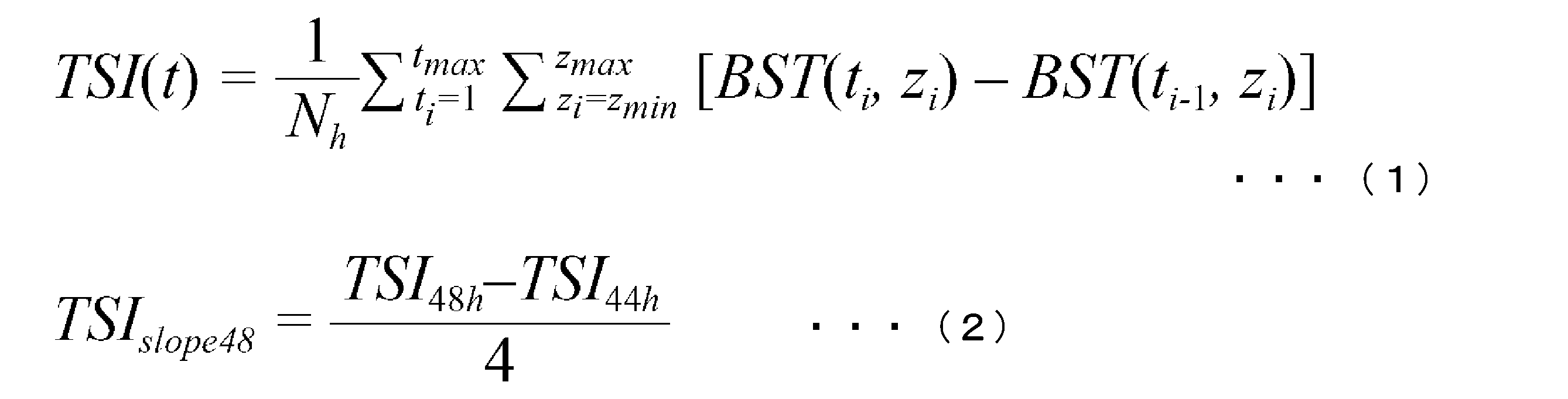
本実施形態によれば、殺菌乳飲料は常温保存可能であり、15℃~35℃の雰囲気中で、腐る又は腐敗することなく貯蔵可能な期間が90日以上であり、好ましくは120日以上であり、さらに好ましくは180日以上である。
本発明は以下の側面を有する。
[1]乳タンパク質及びカルシウムを含有する殺菌乳飲料であって、25℃におけるpHが3.5~5.0であり、前記乳タンパク質がホエイタンパク質を含み、前記殺菌乳飲料に含まれるタンパク質の総質量に対して前記ホエイタンパク質の含有量が40~100質量%であり、リン酸塩及び酸乳安定剤を含む、殺菌乳飲料。
[2]前記殺菌乳飲料に含まれるタンパク質の総質量が、前記殺菌乳飲料の総質量に対して0.1~4.0質量%である、[1]に記載の殺菌乳飲料。
[3]前記殺菌乳飲料に含まれる乳タンパク質の総質量に対して、前記殺菌乳飲料に含まれるカルシウムの総質量の割合が3.5~57質量%である、[1]又は[2]に記載の殺菌乳飲料。
[4]前記殺菌乳飲料100gあたりの、前記殺菌乳飲料に含まれるカルシウムの総質量が140~400mg/100gである、[1]~[3]のいずれか一項に記載の殺菌乳飲料。
[5]前記酸乳安定剤がハイメトキシルペクチンを含み、前記酸乳安定剤の総質量に対して、前記ハイメトキシルペクチンの割合が20~100質量%である、[1]~[4]のいずれか一項に記載の殺菌乳飲料。
[6]前記殺菌乳飲料の総質量に対して、前記リン酸塩の含有量が0.01質量%以上0.05質量%未満であり、前記殺菌乳飲料の総質量に対して、前記酸乳安定剤の含有量が0.40~1.0質量%である、[1]~[5]のいずれか一項に記載の殺菌乳飲料。
[7]前記殺菌乳飲料の総質量に対して、前記リン酸塩の含有量が0.05~5.0質量%であり、前記殺菌乳飲料の総質量に対して、前記酸乳安定剤の含有量が0.30~1.0質量%である、[1]~[5]のいずれか一項に記載の殺菌乳飲料。
[8]前記殺菌乳飲料の25℃における粘度が、5~300mPa・sである、[1]~[7]のいずれか一項に記載の殺菌乳飲料。
[9]前記殺菌乳飲料に含まれる粒子群の、体積基準の粒度分布におけるメジアン径が、0.3~5μmである、[1]~[8]のいずれか一項に記載の殺菌乳飲料。
[10]前記殺菌乳飲料を、25℃で90日間保存したときの離水率が0~25%である、[1]~[9]のいずれか一項に記載の殺菌乳飲料。
[11]前記殺菌乳飲料を測定サンプル液とし、液中分散安定性評価装置を用いた前記測定方法(Z)により、液の不安定さを示す指標であるTSIを測定したときに、前記式(2)で算出されるTSIslope48の値が0~0.15である、[1]~[10]のいずれか一項に記載の殺菌乳飲料。
[12]前記殺菌乳飲料に含まれる乳タンパク質の総質量に対して、前記殺菌乳飲料に含まれるカルシウムの総質量の割合が3.5質量%以上4.0質量%未満であり、前記殺菌乳飲料100gあたりの、前記殺菌乳飲料に含まれるカルシウムの総質量が140~400mg/100gである、[1]~[11]のいずれか一項に記載の殺菌乳飲料。
[13]前記殺菌乳飲料に含まれる乳タンパク質の総質量に対して、前記殺菌乳飲料に含まれるカルシウムの総質量の割合が4.0~36質量%であり、前記殺菌乳飲料100gあたりの、前記殺菌乳飲料に含まれるカルシウムの総質量が180~314mg/100gである、[1]~[11]のいずれか一項に記載の殺菌乳飲料。
[14]前記リン酸塩がヘキサメタリン酸ナトリウムを含み、前記リン酸塩の総質量に対して、前記ヘキサメタリン酸ナトリウムの割合が20~100質量%である、[1]~[13]のいずれか一項に記載の殺菌乳飲料。
[15]前記殺菌乳飲料に含まれるタンパク質の総質量に対して、前記乳タンパク質の含有量が40~100質量%である、[1]~[14]のいずれか一項に記載の殺菌乳飲料。
[16]乳タンパク質とカルシウムを含有する、殺菌乳飲料であって、前記乳タンパク質の総質量に対して、前記カルシウムの総質量の割合が3.5~26質量%であり、25℃におけるpHが3.5~5.0であり、25℃における粘度が10~300mPa・sであり、25℃で90日間保存したときの離水率が0~25%である、殺菌乳飲料。
[17]前記殺菌乳飲料に含まれるタンパク質の総質量に対して、前記乳タンパク質の含有量が40~100質量%である、[16]に記載の殺菌乳飲料。
[18]常温保存可能である、[16]又は[17]に記載の殺菌乳飲料。
[19]発酵後に殺菌された発酵乳である、[1]~[18]のいずれか一項に記載の殺菌乳飲料。
[1]乳タンパク質及びカルシウムを含有する殺菌乳飲料であって、25℃におけるpHが3.5~5.0であり、前記乳タンパク質がホエイタンパク質を含み、前記殺菌乳飲料に含まれるタンパク質の総質量に対して前記ホエイタンパク質の含有量が40~100質量%であり、リン酸塩及び酸乳安定剤を含む、殺菌乳飲料。
[2]前記殺菌乳飲料に含まれるタンパク質の総質量が、前記殺菌乳飲料の総質量に対して0.1~4.0質量%である、[1]に記載の殺菌乳飲料。
[3]前記殺菌乳飲料に含まれる乳タンパク質の総質量に対して、前記殺菌乳飲料に含まれるカルシウムの総質量の割合が3.5~57質量%である、[1]又は[2]に記載の殺菌乳飲料。
[4]前記殺菌乳飲料100gあたりの、前記殺菌乳飲料に含まれるカルシウムの総質量が140~400mg/100gである、[1]~[3]のいずれか一項に記載の殺菌乳飲料。
[5]前記酸乳安定剤がハイメトキシルペクチンを含み、前記酸乳安定剤の総質量に対して、前記ハイメトキシルペクチンの割合が20~100質量%である、[1]~[4]のいずれか一項に記載の殺菌乳飲料。
[6]前記殺菌乳飲料の総質量に対して、前記リン酸塩の含有量が0.01質量%以上0.05質量%未満であり、前記殺菌乳飲料の総質量に対して、前記酸乳安定剤の含有量が0.40~1.0質量%である、[1]~[5]のいずれか一項に記載の殺菌乳飲料。
[7]前記殺菌乳飲料の総質量に対して、前記リン酸塩の含有量が0.05~5.0質量%であり、前記殺菌乳飲料の総質量に対して、前記酸乳安定剤の含有量が0.30~1.0質量%である、[1]~[5]のいずれか一項に記載の殺菌乳飲料。
[8]前記殺菌乳飲料の25℃における粘度が、5~300mPa・sである、[1]~[7]のいずれか一項に記載の殺菌乳飲料。
[9]前記殺菌乳飲料に含まれる粒子群の、体積基準の粒度分布におけるメジアン径が、0.3~5μmである、[1]~[8]のいずれか一項に記載の殺菌乳飲料。
[10]前記殺菌乳飲料を、25℃で90日間保存したときの離水率が0~25%である、[1]~[9]のいずれか一項に記載の殺菌乳飲料。
[11]前記殺菌乳飲料を測定サンプル液とし、液中分散安定性評価装置を用いた前記測定方法(Z)により、液の不安定さを示す指標であるTSIを測定したときに、前記式(2)で算出されるTSIslope48の値が0~0.15である、[1]~[10]のいずれか一項に記載の殺菌乳飲料。
[12]前記殺菌乳飲料に含まれる乳タンパク質の総質量に対して、前記殺菌乳飲料に含まれるカルシウムの総質量の割合が3.5質量%以上4.0質量%未満であり、前記殺菌乳飲料100gあたりの、前記殺菌乳飲料に含まれるカルシウムの総質量が140~400mg/100gである、[1]~[11]のいずれか一項に記載の殺菌乳飲料。
[13]前記殺菌乳飲料に含まれる乳タンパク質の総質量に対して、前記殺菌乳飲料に含まれるカルシウムの総質量の割合が4.0~36質量%であり、前記殺菌乳飲料100gあたりの、前記殺菌乳飲料に含まれるカルシウムの総質量が180~314mg/100gである、[1]~[11]のいずれか一項に記載の殺菌乳飲料。
[14]前記リン酸塩がヘキサメタリン酸ナトリウムを含み、前記リン酸塩の総質量に対して、前記ヘキサメタリン酸ナトリウムの割合が20~100質量%である、[1]~[13]のいずれか一項に記載の殺菌乳飲料。
[15]前記殺菌乳飲料に含まれるタンパク質の総質量に対して、前記乳タンパク質の含有量が40~100質量%である、[1]~[14]のいずれか一項に記載の殺菌乳飲料。
[16]乳タンパク質とカルシウムを含有する、殺菌乳飲料であって、前記乳タンパク質の総質量に対して、前記カルシウムの総質量の割合が3.5~26質量%であり、25℃におけるpHが3.5~5.0であり、25℃における粘度が10~300mPa・sであり、25℃で90日間保存したときの離水率が0~25%である、殺菌乳飲料。
[17]前記殺菌乳飲料に含まれるタンパク質の総質量に対して、前記乳タンパク質の含有量が40~100質量%である、[16]に記載の殺菌乳飲料。
[18]常温保存可能である、[16]又は[17]に記載の殺菌乳飲料。
[19]発酵後に殺菌された発酵乳である、[1]~[18]のいずれか一項に記載の殺菌乳飲料。
以下に実施例を用いて本発明をさらに詳しく説明するが、本発明はこれら実施例に限定されるものではない。
以下において、含有量の単位である「%」は特に断りがない限り「質量%」である。
以下において、含有量の単位である「%」は特に断りがない限り「質量%」である。
<測定方法>
以下の測定方法を用いた。
[メジアン径の測定方法]
殺菌乳飲料をサンプルとし、レーザー回折/散乱式粒子径分布測定装置(HORIBA社製品名:Partica LA-950V2)を用い、下記の測定条件で粒度分布を測定した。
詳細には、まず、装置に付属のフローセルを接続し、循環している分散媒にサンプルを滴下し、循環、撹拌を行って試料を調製した。試料透過率が所定の値に達した段階で、装置を稼働させてレーザー回折/散乱データをキャッチした。キャッチしたデータに基づいて粒度分布を得て、得られた粒度分布における体積基準のメジアン径を求めた。
(測定条件:湿式)
分散媒:水。
サンプル屈折率:1.600-0.000
分散方法:超音波照射なし、界面活性剤及び分散剤は使用しない。
循環速度:目盛り「5」(流量2.3L/min、モーター回転数1160rpm)
撹拌速度:目盛り「2」
試料透過率:85.0±5.0%
以下の測定方法を用いた。
[メジアン径の測定方法]
殺菌乳飲料をサンプルとし、レーザー回折/散乱式粒子径分布測定装置(HORIBA社製品名:Partica LA-950V2)を用い、下記の測定条件で粒度分布を測定した。
詳細には、まず、装置に付属のフローセルを接続し、循環している分散媒にサンプルを滴下し、循環、撹拌を行って試料を調製した。試料透過率が所定の値に達した段階で、装置を稼働させてレーザー回折/散乱データをキャッチした。キャッチしたデータに基づいて粒度分布を得て、得られた粒度分布における体積基準のメジアン径を求めた。
(測定条件:湿式)
分散媒:水。
サンプル屈折率:1.600-0.000
分散方法:超音波照射なし、界面活性剤及び分散剤は使用しない。
循環速度:目盛り「5」(流量2.3L/min、モーター回転数1160rpm)
撹拌速度:目盛り「2」
試料透過率:85.0±5.0%
[粘度の測定方法]
B型粘度計にて、回転数60rpmでNo.2ローターを使用して測定したときの、測定開始から10秒後の値(単位:mPa・s)である。
B型粘度計にて、回転数60rpmでNo.2ローターを使用して測定したときの、測定開始から10秒後の値(単位:mPa・s)である。
[TSIslope48の測定方法]
上述の測定方法(Z)によりTSIslope48を測定した。液中分散安定性評価装置はFormulaction社製品名「Turbiscan Tower」を用いた。
上述の測定方法(Z)によりTSIslope48を測定した。液中分散安定性評価装置はFormulaction社製品名「Turbiscan Tower」を用いた。
[離水率の測定方法]
容量50mLの目盛り付き滅菌プラスチックチューブにサンプル45mLを充填し、25℃で90日間静置保存し、上部に生じた透明な離水層の体積を目視で測定した。測定により得られた離水層の体積をサンプル総体積で除し、離水層の体積比率を算出し、離水率とした。
容量50mLの目盛り付き滅菌プラスチックチューブにサンプル45mLを充填し、25℃で90日間静置保存し、上部に生じた透明な離水層の体積を目視で測定した。測定により得られた離水層の体積をサンプル総体積で除し、離水層の体積比率を算出し、離水率とした。
<原料>
以下の原料を用いた。
脱脂粉乳:森永乳業社製、無脂乳固形分95.2%、脂肪分1.0%、タンパク質34.0%、ホエイタンパク質6.8%、カルシウム1.2%
ホエイパウダー:森永乳業社製、無脂乳固形分95.0%、脂肪分1.0%、タンパク質12.5%、ホエイタンパク質12.5%、カルシウム0.5%。
熱変性WPC(1):アーラフーズイングレディエンツ社製品名「Nutrilac YO-8075」、無脂乳固形分86.0%、脂肪分6.3%、タンパク質80.3%、ホエイタンパク質80.3%、カルシウム0.4%、粉末。
熱変性WPC(2):アーラフーズイングレディエンツ社製品名「Nutrilac CH-4560」、無脂乳固形分88.9%、脂肪分2.3%、タンパク質43.5%、ホエイタンパク質43.5%、カルシウム1.4%、粉末。
乳糖:MILEI GmbH社製、エディブルグレード、無脂乳固形分98.0%、脂肪分1.0%、タンパク質2.0%、ホエイタンパク質0.4%、カルシウム0%、粉末。
ミルクカルシウム濃縮物:森永乳業社製品名「ミルクCa-28EX」、無脂乳固形分87.5%、脂肪分0.1%、タンパク質3.1%、ホエイタンパク質3.1%、カルシウム30.0%、粉末。
リン酸塩(1):ヘキサメタリン酸ナトリウム、太平化学産業社製、粉末。
乳酸菌スターター:ダニスコ社製品名「YO-MIX(登録商標)505」。
酸乳安定剤(1):ハイメトキシルペクチン、三栄源エフエフアイ社製品名「SM-MN-2779」、粉末。
以下の原料を用いた。
脱脂粉乳:森永乳業社製、無脂乳固形分95.2%、脂肪分1.0%、タンパク質34.0%、ホエイタンパク質6.8%、カルシウム1.2%
ホエイパウダー:森永乳業社製、無脂乳固形分95.0%、脂肪分1.0%、タンパク質12.5%、ホエイタンパク質12.5%、カルシウム0.5%。
熱変性WPC(1):アーラフーズイングレディエンツ社製品名「Nutrilac YO-8075」、無脂乳固形分86.0%、脂肪分6.3%、タンパク質80.3%、ホエイタンパク質80.3%、カルシウム0.4%、粉末。
熱変性WPC(2):アーラフーズイングレディエンツ社製品名「Nutrilac CH-4560」、無脂乳固形分88.9%、脂肪分2.3%、タンパク質43.5%、ホエイタンパク質43.5%、カルシウム1.4%、粉末。
乳糖:MILEI GmbH社製、エディブルグレード、無脂乳固形分98.0%、脂肪分1.0%、タンパク質2.0%、ホエイタンパク質0.4%、カルシウム0%、粉末。
ミルクカルシウム濃縮物:森永乳業社製品名「ミルクCa-28EX」、無脂乳固形分87.5%、脂肪分0.1%、タンパク質3.1%、ホエイタンパク質3.1%、カルシウム30.0%、粉末。
リン酸塩(1):ヘキサメタリン酸ナトリウム、太平化学産業社製、粉末。
乳酸菌スターター:ダニスコ社製品名「YO-MIX(登録商標)505」。
酸乳安定剤(1):ハイメトキシルペクチン、三栄源エフエフアイ社製品名「SM-MN-2779」、粉末。
<例1~25>
表1~5に示す配合で、発酵後に殺菌された発酵乳である殺菌乳飲料を製造した。
例1~3、8は比較例、例4~7、9~25は実施例である。
表1~5に示す配合で、発酵後に殺菌された発酵乳である殺菌乳飲料を製造した。
例1~3、8は比較例、例4~7、9~25は実施例である。
まず、表に示す発酵液の配合で、乳酸菌スターター以外の原料をミキサーで混合し、混合液を調製した。混合液の温度は70℃とした。次いで、ホモジナイザーで昇温及び均質化処理した。均質化処理条件は、温度85℃、2秒で圧力15MPaとした。均質化処理後に得られた85℃の混合液を、90℃で10分間の条件で、バッチ式殺菌機にて加熱殺菌(一次殺菌ともいう)した後、43℃に降温して原料液を得た。
降温した原料液に乳酸菌スターターを添加した後、タンク内で41~45℃に保持して所定のpHに達するまで発酵させた、10℃に降温して発酵を終了させた。発酵終了後の液を発酵液とした。
これとは別に、表に示す安定剤液の配合で、酸乳安定剤と水を混合して安定剤液を得た。
次いで、表に示す乳飲料の配合で発酵液と安定剤液とを混合し、チューブラー式熱交換器にて温度40℃まで昇温し、ホモジナイザーを用いて圧力15MPaで均質化処理して、乳タンパク質カードが破砕された乳飲料(つまり、発酵乳と安定剤液との混合物)を得た。
得られた40℃の乳飲料を、90℃で30秒間の条件で加熱殺菌(二次殺菌ともいう)した後、30℃に降温し、殺菌乳飲料を得た。得られた殺菌乳飲料を、無菌的に容器に充填し密封して、常温保存可能な容器入り殺菌乳飲料(つまり、ドリンクヨーグルト)を得た。
充填温度は30℃、充填量は45mLとした。充填工程終了後、室温25℃の常温環境に移して保存した。
降温した原料液に乳酸菌スターターを添加した後、タンク内で41~45℃に保持して所定のpHに達するまで発酵させた、10℃に降温して発酵を終了させた。発酵終了後の液を発酵液とした。
これとは別に、表に示す安定剤液の配合で、酸乳安定剤と水を混合して安定剤液を得た。
次いで、表に示す乳飲料の配合で発酵液と安定剤液とを混合し、チューブラー式熱交換器にて温度40℃まで昇温し、ホモジナイザーを用いて圧力15MPaで均質化処理して、乳タンパク質カードが破砕された乳飲料(つまり、発酵乳と安定剤液との混合物)を得た。
得られた40℃の乳飲料を、90℃で30秒間の条件で加熱殺菌(二次殺菌ともいう)した後、30℃に降温し、殺菌乳飲料を得た。得られた殺菌乳飲料を、無菌的に容器に充填し密封して、常温保存可能な容器入り殺菌乳飲料(つまり、ドリンクヨーグルト)を得た。
充填温度は30℃、充填量は45mLとした。充填工程終了後、室温25℃の常温環境に移して保存した。
前記常温環境で1日間保存した容器入り殺菌乳飲料を測定対象とし、殺菌乳飲料のメジアン径を上記の方法で測定した。
前記常温環境で1日間保存した容器入り殺菌乳飲料を測定対象とし、殺菌乳飲料の粘度を上記の方法で測定した。
前記常温環境で1日間保存した容器入り殺菌乳飲料を測定対象とし、殺菌乳飲料のTSIslope48を上記の方法で測定した。
前記常温環境で90日間保存した容器入り殺菌乳飲料を測定対象とし、上記の方法で離水率を測定した。
前記常温環境で1日間保存した容器入り殺菌乳飲料を測定対象とし、25℃におけるpHを測定した。
これらの結果を表に示す。
前記常温環境で1日間保存した容器入り殺菌乳飲料を測定対象とし、殺菌乳飲料の粘度を上記の方法で測定した。
前記常温環境で1日間保存した容器入り殺菌乳飲料を測定対象とし、殺菌乳飲料のTSIslope48を上記の方法で測定した。
前記常温環境で90日間保存した容器入り殺菌乳飲料を測定対象とし、上記の方法で離水率を測定した。
前記常温環境で1日間保存した容器入り殺菌乳飲料を測定対象とし、25℃におけるpHを測定した。
これらの結果を表に示す。
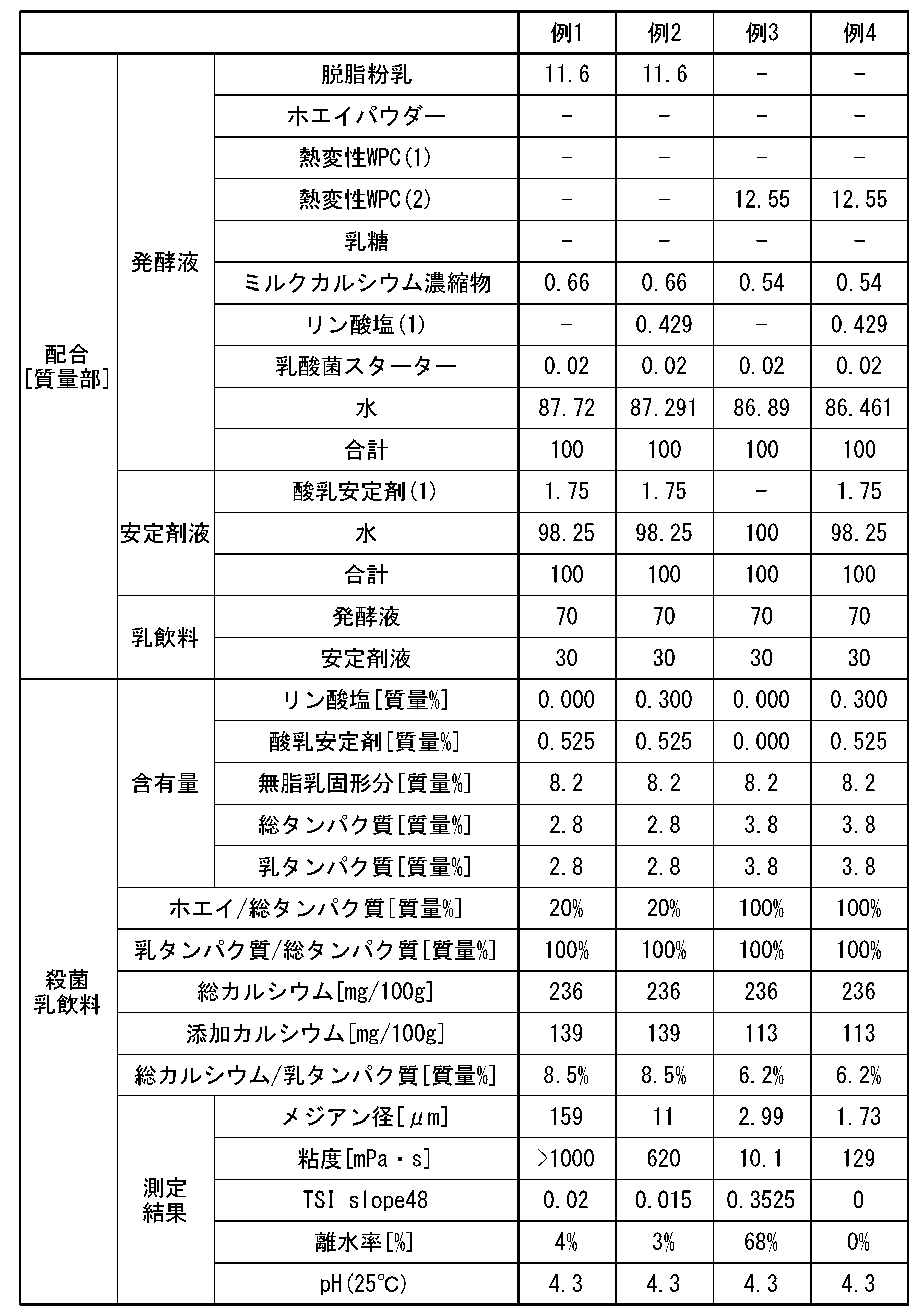
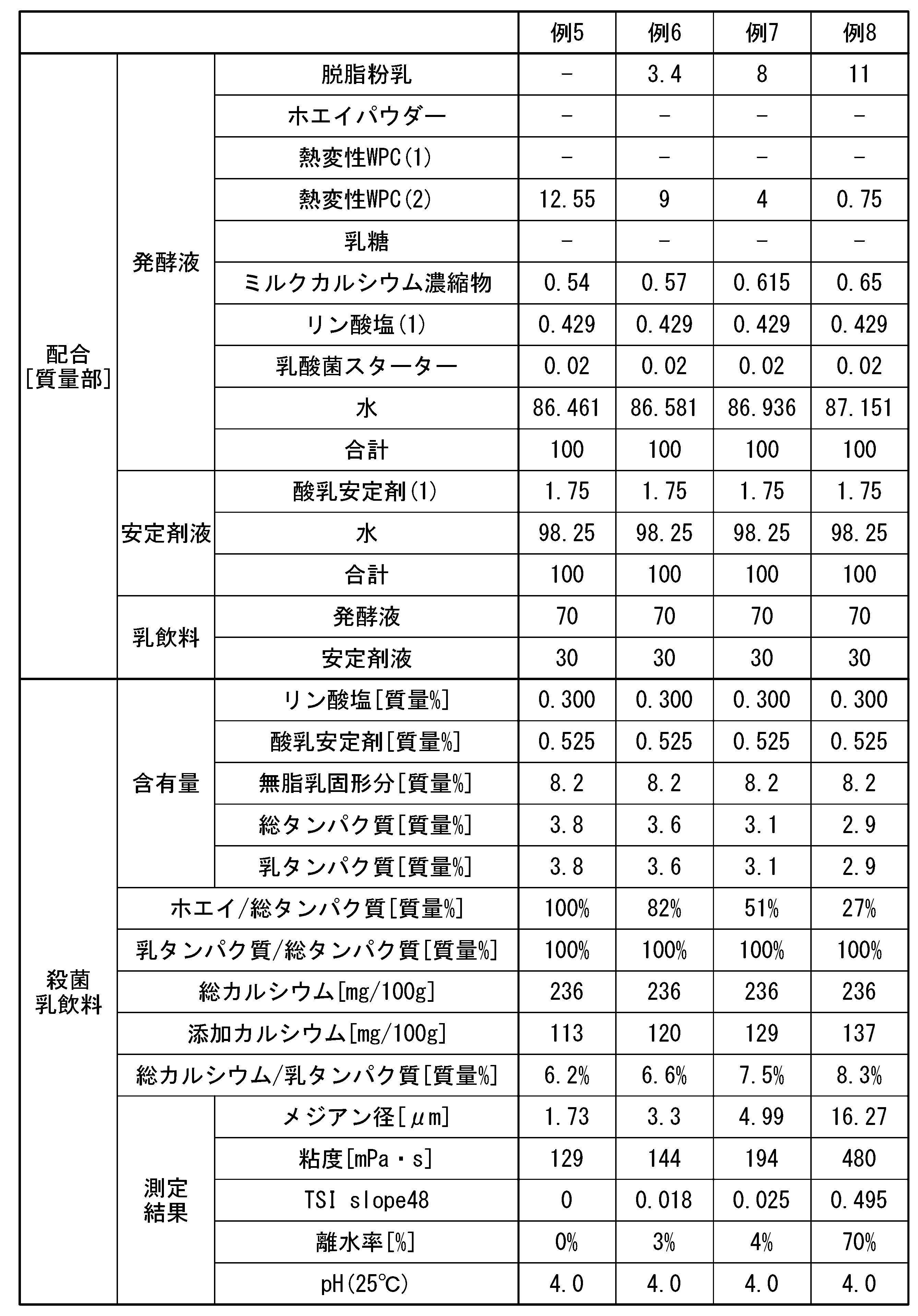


表の結果に示されるように、例4~7、9~25の殺菌乳飲料は、カルシウムが強化されており、pHが低い状態で加熱殺菌された殺菌乳飲料でありながら、メジアン径が小さく、低粘度であり、加熱殺菌による凝集及び増粘が抑えられた。また、TSIslope48の値が小さく、常温で長期間保存した場合も離水が少なく、保存中の液安定性に優れていた。
一方、ホエイタンパク質が少ない例2、8、及びホエイタンパク質が少なくリン酸塩を含まない例1は、増粘が著しく、メジアン径が大きくなった。例2と例8を比べると、例8は熱変性ホエイタンパク質を用いたことにより、例2に比べて粘度が低下して離水が促進されたと考えられる。
また、リン酸塩と酸乳安定剤の両方を含まない例3は、保存中の液安定性が劣り、常温で長期間保存したときの離水が多かった。
一方、ホエイタンパク質が少ない例2、8、及びホエイタンパク質が少なくリン酸塩を含まない例1は、増粘が著しく、メジアン径が大きくなった。例2と例8を比べると、例8は熱変性ホエイタンパク質を用いたことにより、例2に比べて粘度が低下して離水が促進されたと考えられる。
また、リン酸塩と酸乳安定剤の両方を含まない例3は、保存中の液安定性が劣り、常温で長期間保存したときの離水が多かった。
本発明によれば、乳タンパク質とカルシウムを含み、pHが低いにもかかわらず、液安定性が良好な殺菌乳飲料が得られる。
Claims (16)
- 乳タンパク質及びカルシウムを含有する殺菌乳飲料であって、
25℃におけるpHが5.0以下であり、
前記乳タンパク質がホエイタンパク質を含み、
前記殺菌乳飲料に含まれるタンパク質の総質量に対して前記ホエイタンパク質の含有量が40質量%以上であり、
リン酸塩及び酸乳安定剤を含む、殺菌乳飲料。 - 前記殺菌乳飲料に含まれるタンパク質の総質量が、前記殺菌乳飲料の総質量に対して4.0質量%以下である、請求項1に記載の殺菌乳飲料。
- 前記殺菌乳飲料に含まれる乳タンパク質の総質量に対して、前記殺菌乳飲料に含まれるカルシウムの総質量の割合が3.5質量%以上である、請求項1に記載の殺菌乳飲料。
- 前記殺菌乳飲料100gあたりの、前記殺菌乳飲料に含まれるカルシウムの総質量が140mg/100g以上である、請求項1に記載の殺菌乳飲料。
- 前記酸乳安定剤がハイメトキシルペクチンを含む、請求項1に記載の殺菌乳飲料。
- 前記殺菌乳飲料の総質量に対して、前記リン酸塩の含有量が0.01質量%以上であり、
前記リン酸塩の含有量が0.01質量%以上0.05質量%未満の場合、前記殺菌乳飲料の総質量に対して、前記酸乳安定剤の含有量が0.40質量%以上であり、
前記リン酸塩の含有量が0.05質量%以上の場合、前記殺菌乳飲料の総質量に対して、前記酸乳安定剤の含有量が0.30質量%以上である、請求項1に記載の殺菌乳飲料。 - 前記殺菌乳飲料の25℃における粘度が、300mPa・s以下である、請求項1に記載の殺菌乳飲料。
- 前記殺菌乳飲料に含まれる粒子群の、体積基準の粒度分布におけるメジアン径が、5μm以下である、請求項1に記載の殺菌乳飲料。
- 前記殺菌乳飲料を、25℃で90日間保存したときの離水率が25%以下である、請求項1に記載の殺菌乳飲料。
- 前記殺菌乳飲料を測定サンプル液とし、液中分散安定性評価装置を用いた下記の測定方法(Z)により、液の不安定さを示す指標であるTSIを測定したときに、下記式(2)で算出されるTSIslope48の値が0.15以下である、請求項1に記載の殺菌乳飲料。
測定方法(Z)
(1)25℃に温度調節した測定サンプル液の約20mLを外径27mmガラスボトルに充填し、前記ガラスボトルをその高さ方向が垂直方向となるように保持し、前記ガラスボトルの外側から、前記測定サンプル液に波長880nmの光を入射し、入射方向に対して180°の透過光及び45°の後方散乱光の強度を受光器で測定する。測定は25℃の雰囲気中で行う。
(2)待機時間5分の後、入射光を前記ガラスボトルの下から上へ高さ方向にスキャンしながら、スキャン間隔(Δh)が40μmごとに前記透過光及び前記後方散乱光を測定する操作を行い(t1=0)、4時間間隔(t2=4、t3=8…)で、総時間が48時間(tmax=48)になるまで前記操作を繰り返す。
(3)前記ガラスボトルの高さ方向におけるスキャン領域の下限位置(zmin)から上限位置(zmax)までの距離を(zmax-zmin)とし、スキャン領域内の測定点の数をNh=(zmax-zmin)/Δhで求める。
(4)下記式(1)により、44時間(t=44)におけるTSI44hと、48時間(t=48)におけるTSI48hを求め、下記式(2)により、TSIslope48を求める。
式(1)において、BSTは光強度の測定で得られる信号であり、入射光強度に対して透過光強度が0.2%より小さい場合は、後方散乱光の信号BSを採用し、それ以外は透過光強度の信号Tを採用する。

- 常温保存可能である、請求項1に記載の殺菌乳飲料。
- 乳タンパク質とカルシウムを含有する、殺菌乳飲料であって、
前記乳タンパク質の総質量に対して、前記カルシウムの総質量の割合が3.5質量%以上であり、
25℃におけるpHが5.0以下であり、
25℃における粘度が300mPa・s以下であり、
25℃で90日間保存したときの離水率が25%以下である、殺菌乳飲料。 - 常温保存可能である、請求項12に記載の殺菌乳飲料。
- 発酵後に殺菌された発酵乳である、請求項1~13のいずれか一項に記載の殺菌乳飲料。
- 請求項1~13のいずれか一項に記載の殺菌乳飲料を製造する方法であって、
乳タンパク質、カルシウム、及びリン酸塩を含み、一次殺菌された原料液を調製し、
前記原料液とは別に、酸乳安定剤を含む安定剤液を調製し、
前記原料液を酸性化して酸性原料液を得た後、前記酸性原料液と前記安定剤液とを混合して混合物を得て、
前記混合物を二次殺菌して前記殺菌乳飲料を得ることを有する、殺菌乳飲料の製造方法。 - 請求項14に記載の殺菌乳飲料を製造する方法であって、
乳タンパク質、カルシウム、及びリン酸塩を含み、一次殺菌された原料液を調製し、
前記原料液とは別に、酸乳安定剤を含む安定剤液を調製し、
前記原料液に発酵菌を添加し、発酵させて発酵液を得た後、前記発酵液と前記安定剤液とを混合して混合物を得て、
前記混合物を二次殺菌して前記殺菌乳飲料を得ることを有する、殺菌乳飲料の製造方法。
Priority Applications (1)
| Application Number | Priority Date | Filing Date | Title |
|---|---|---|---|
| JP2025545576A JPWO2025057716A1 (ja) | 2023-09-15 | 2024-08-27 |
Applications Claiming Priority (2)
| Application Number | Priority Date | Filing Date | Title |
|---|---|---|---|
| JP2023-150088 | 2023-09-15 | ||
| JP2023150088 | 2023-09-15 |
Publications (1)
| Publication Number | Publication Date |
|---|---|
| WO2025057716A1 true WO2025057716A1 (ja) | 2025-03-20 |
Family
ID=95022176
Family Applications (1)
| Application Number | Title | Priority Date | Filing Date |
|---|---|---|---|
| PCT/JP2024/030376 Pending WO2025057716A1 (ja) | 2023-09-15 | 2024-08-27 | 殺菌乳飲料及びその製造方法 |
Country Status (2)
| Country | Link |
|---|---|
| JP (1) | JPWO2025057716A1 (ja) |
| WO (1) | WO2025057716A1 (ja) |
Citations (5)
| Publication number | Priority date | Publication date | Assignee | Title |
|---|---|---|---|---|
| JPS61170341A (ja) * | 1985-01-22 | 1986-08-01 | Meiji Milk Prod Co Ltd | ホエイ発酵飲料の製造方法 |
| EP0449354A1 (en) * | 1990-03-16 | 1991-10-02 | Friesland (Frico Domo) Coöperatie B.A. | A process for preparing a calcium enriched fermented milk beverage |
| JP2011067148A (ja) * | 2009-09-28 | 2011-04-07 | Morinaga Milk Ind Co Ltd | カルシウム強化ホエイ含有組成物の製造方法 |
| US20120189737A1 (en) * | 2009-07-10 | 2012-07-26 | Claus Andersen | drinkable acidified dairy product based on acid whey and a process of preparing it |
| JP2020507330A (ja) * | 2017-02-17 | 2020-03-12 | アーラ フーズ エエムビエArla Foods amba | 低下した粘度を有する高タンパク酸性液体乳製品、それを製造する方法及び関連する成分 |
-
2024
- 2024-08-27 JP JP2025545576A patent/JPWO2025057716A1/ja active Pending
- 2024-08-27 WO PCT/JP2024/030376 patent/WO2025057716A1/ja active Pending
Patent Citations (5)
| Publication number | Priority date | Publication date | Assignee | Title |
|---|---|---|---|---|
| JPS61170341A (ja) * | 1985-01-22 | 1986-08-01 | Meiji Milk Prod Co Ltd | ホエイ発酵飲料の製造方法 |
| EP0449354A1 (en) * | 1990-03-16 | 1991-10-02 | Friesland (Frico Domo) Coöperatie B.A. | A process for preparing a calcium enriched fermented milk beverage |
| US20120189737A1 (en) * | 2009-07-10 | 2012-07-26 | Claus Andersen | drinkable acidified dairy product based on acid whey and a process of preparing it |
| JP2011067148A (ja) * | 2009-09-28 | 2011-04-07 | Morinaga Milk Ind Co Ltd | カルシウム強化ホエイ含有組成物の製造方法 |
| JP2020507330A (ja) * | 2017-02-17 | 2020-03-12 | アーラ フーズ エエムビエArla Foods amba | 低下した粘度を有する高タンパク酸性液体乳製品、それを製造する方法及び関連する成分 |
Also Published As
| Publication number | Publication date |
|---|---|
| JPWO2025057716A1 (ja) | 2025-03-20 |
Similar Documents
| Publication | Publication Date | Title |
|---|---|---|
| KR101501300B1 (ko) | 발효 유장 제조물 및 이의 제조 방법 | |
| JP7382360B2 (ja) | 発酵乳およびその製造方法 | |
| JP5666541B2 (ja) | 発酵乳の食感改良方法 | |
| CN103689084A (zh) | 一种干酪酸奶及其制备方法 | |
| US20200045985A1 (en) | Choline ester-containing composition for oral ingestion | |
| JP5873422B2 (ja) | 撹拌型発酵乳の製造方法 | |
| WO2012133015A1 (ja) | 液状発酵乳及びその製造方法 | |
| US20190357556A1 (en) | Production method for low-acid fermented milk | |
| JP5822729B2 (ja) | 発酵乳の製造方法及び乳製品の製造方法 | |
| Kilic-Akyilmaz et al. | Comparison of high intensity ultrasound and heat treatment for extending shelf life of a fermented milk beverage | |
| CN101808526A (zh) | 发酵乳的制造方法 | |
| WO2025057716A1 (ja) | 殺菌乳飲料及びその製造方法 | |
| JP6901837B2 (ja) | 低温殺菌した原料ミックスを用いた発酵乳の製造方法 | |
| JP7372113B2 (ja) | 常温保存酸乳食品の製造方法及び物性安定性向上方法、並びに酸乳食品の加熱殺菌方法 | |
| JP7471046B2 (ja) | 低温発酵による発酵乳の製造方法および該方法により製造された発酵乳 | |
| JP7385984B2 (ja) | 発酵乳の高pH製造方法および該方法により製造された発酵乳 | |
| JP2023048209A (ja) | 発酵乳及びその製造方法 | |
| JP7736440B2 (ja) | 発酵乳及びその製造方法 | |
| JP3986977B2 (ja) | レアチーズケーキの製造方法及びレアチーズケーキ | |
| US20210282423A1 (en) | Method for producing fermented milk using raw material mix containing material sterilized at ultra-high temperature | |
| WO2019064956A1 (ja) | 発酵乳の製造方法 | |
| JP2024110597A (ja) | 濃縮発酵乳の製造方法、光沢度向上方法、及び酸味抑制方法 | |
| JP2023047901A (ja) | 発酵乳及びその製造方法 | |
| WO2024058229A1 (ja) | 殺菌発酵乳及びその製造方法 | |
| WO2024058230A1 (ja) | 殺菌発酵乳及びその製造方法 |
Legal Events
| Date | Code | Title | Description |
|---|---|---|---|
| 121 | Ep: the epo has been informed by wipo that ep was designated in this application |
Ref document number: 24865220 Country of ref document: EP Kind code of ref document: A1 |
|
| ENP | Entry into the national phase |
Ref document number: 2025545576 Country of ref document: JP Kind code of ref document: A |
|
| WWE | Wipo information: entry into national phase |
Ref document number: 2025545576 Country of ref document: JP |