WO2025052643A1 - 発電設備併設e-fuel生産システム - Google Patents
発電設備併設e-fuel生産システム Download PDFInfo
- Publication number
- WO2025052643A1 WO2025052643A1 PCT/JP2023/032761 JP2023032761W WO2025052643A1 WO 2025052643 A1 WO2025052643 A1 WO 2025052643A1 JP 2023032761 W JP2023032761 W JP 2023032761W WO 2025052643 A1 WO2025052643 A1 WO 2025052643A1
- Authority
- WO
- WIPO (PCT)
- Prior art keywords
- gas
- carbon dioxide
- synthesis
- dioxide gas
- supplied
- Prior art date
- Legal status (The legal status is an assumption and is not a legal conclusion. Google has not performed a legal analysis and makes no representation as to the accuracy of the status listed.)
- Pending
Links
Images
Classifications
-
- C—CHEMISTRY; METALLURGY
- C10—PETROLEUM, GAS OR COKE INDUSTRIES; TECHNICAL GASES CONTAINING CARBON MONOXIDE; FUELS; LUBRICANTS; PEAT
- C10G—CRACKING HYDROCARBON OILS; PRODUCTION OF LIQUID HYDROCARBON MIXTURES, e.g. BY DESTRUCTIVE HYDROGENATION, OLIGOMERISATION, POLYMERISATION; RECOVERY OF HYDROCARBON OILS FROM OIL-SHALE, OIL-SAND, OR GASES; REFINING MIXTURES MAINLY CONSISTING OF HYDROCARBONS; REFORMING OF NAPHTHA; MINERAL WAXES
- C10G2/00—Production of liquid hydrocarbon mixtures of undefined composition from oxides of carbon
Definitions
- the present invention relates to an e-fuel production system that produces synthetic gas from direct air capture (DAC) carbon dioxide gas captured from the atmosphere and green hydrogen gas produced by electrolyzing water using electricity derived from renewable energy sources, and then subjects the synthetic gas to an FT synthesis reaction to produce FT crude oil.
- DAC direct air capture
- E-fuel is a synthetic fuel produced by synthesizing DAC carbon dioxide and green hydrogen gas, which are then subjected to FT synthesis to produce FT crude oil, which is then refined to produce LPG, naphtha, kerosene, diesel, and residual oil.
- DAC carbon dioxide is required, but the concentration of carbon dioxide in the atmosphere is very low at about 400 ppm, so about 4,000 times the amount of air required must be processed.
- DAC plants that directly capture carbon dioxide from the atmosphere are high-cost and energy-intensive plants, and the unit price of DAC carbon dioxide is extremely high.
- DAC plants and e-fuel production plants require a large amount of electricity, which is required to be carbon neutral.
- Patent Document 1 describes a technology in which green electricity is generated through biomass power generation, carbon-neutral methane gas is generated from carbon dioxide gas and low-carbon hydrogen gas produced by the biomass power generation, synthetic gas is produced from the carbon-neutral methane gas, the synthetic gas is synthesized into FT crude oil, and the exhaust heat generated during the synthesis is used to recover carbon dioxide gas.
- Patent Document 1 describes a technology for generating synthetic gas from carbon dioxide and low-carbon hydrogen gas produced during biomass power generation, and for producing FT crude oil from the synthetic gas, but does not describe the low-cost, low-energy production of e-fuel from DAC carbon dioxide and green hydrogen gas.
- the object of the present invention is to provide an e-fuel production system equipped with a power generation facility that drives a steam turbine generator with superheated steam produced by burning diesel and residual oil produced by refining the FT crude oil in a boiler, in an e-fuel production system equipped with a synthetic gas production unit that produces synthetic gas from DAC carbon dioxide gas and green hydrogen gas, and an FT synthesis unit that produces FT crude oil by subjecting the synthetic gas to an FT synthesis reaction.
- the system is capable of producing carbon-neutral e-fuel at low cost and with low energy consumption.
- the present invention relates to an e-fuel production system that is equipped with a synthesis gas production device that is supplied with DAC carbon dioxide gas recovered from the atmosphere by direct air capture (DAC) and green hydrogen gas generated by electrolyzing water using electricity derived from renewable energy, and produces synthesis gas with a molar ratio of hydrogen gas and carbon monoxide gas of approximately 2:1, and an FT synthesis device that produces FT crude oil by subjecting the synthesis gas supplied from the synthesis gas production device to an FT synthesis reaction using a catalyst under a predetermined temperature and pressure environment, and the system is equipped with a power generation facility that is supplied with diesel and residual oil produced by refining the FT crude oil in a refining device as fuel, a boiler that generates superheated steam by burning the fuel, and a steam turbine generator driven by the superheated steam, and a steam turbine generator that generates superheated steam from the boiler.
- DAC direct air capture
- FT synthesis device that produces FT crude oil by subjecting the synthesis gas supplied from the synthesis gas
- the system is an e-fuel production system with a power generation facility, and includes an absorption tower to which exhaust gas generated by the combustion of the fuel is supplied and which absorbs the carbon dioxide gas contained in the exhaust gas into an absorbing liquid to produce a CO2-containing absorbing liquid, a regeneration tower to which the CO2-containing absorbing liquid is supplied from the absorption tower and which heats the CO2-containing absorbing liquid with exhaust heat supplied from the FT synthesis device, releases the carbon dioxide gas, and recovers it as recovered carbon dioxide gas, and a carbon dioxide mixing device that mixes the recovered carbon dioxide gas with the DAC carbon dioxide gas and supplies the mixed carbon dioxide gas to the synthesis gas production device, and the synthesis gas production device is supplied with the mixed carbon dioxide gas and the amount of green hydrogen gas necessary to produce the synthesis gas from the mixed carbon dioxide gas.
- carbon-neutral electricity can be produced by burning diesel and residual oil produced by refining FT crude oil produced from DAC carbon dioxide and green hydrogen gas in a boiler to generate heated steam to drive a steam turbine generator.
- Carbon dioxide is recovered from the exhaust gas discharged from the boiler using the exhaust heat emitted from the FT synthesis device, and mixed with DAC carbon dioxide before being supplied to the synthesis gas production device, thereby reducing the amount of expensive DAC carbon dioxide used.
- e-fuel and carbon-neutral electricity can be produced in a carbon-neutral manner in every process of the system, at low cost and with low energy consumption.
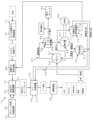
- FIG. 1 is a block diagram showing an overall configuration of an e-fuel production system equipped with a power generation facility according to a first embodiment.
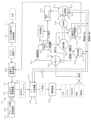
- FIG. 11 is a block diagram showing the overall configuration of an e-fuel production system equipped with a power generation facility according to a second embodiment.
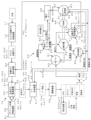
- FIG. 11 is a diagram showing the mass-energy balance of an e-fuel production system equipped with a power generation facility according to a second embodiment.
- the e-fuel production system 1a equipped with a power generation facility includes a DAC carbon dioxide supplying device 10, a green hydrogen supplying device 20, a synthesis gas production device 30, an FT synthesis device 40, a power generation facility 50, a heat exchanger 60, a carbon dioxide recovery device 70, and a carbon dioxide mixing device 80.
- the DAC plant 11 is well known and directly recovers carbon dioxide gas contained in the atmosphere as DAC carbon dioxide gas using direct air recovery technology.
- the DAC carbon dioxide gas supplying device 10 supplies the DAC carbon dioxide gas recovered in the DAC plant 11 to the synthesis gas production device 30 via the carbon dioxide gas mixing device 80 at a set flow rate.
- the green hydrogen production device 21 is well known and produces green hydrogen gas by electrolyzing water using electricity derived from renewable energy.
- the green hydrogen supplying device 20 supplies the green hydrogen gas produced in the green hydrogen production device 21 to the synthesis gas production device 30 at a set flow rate.
- the synthesis gas production apparatus 30 is known, and as an example, includes a reverse water gas shift reactor 31 filled with a reverse water gas shift reaction catalyst and a mixer 32.
- the reverse water gas shift reactor 31 is supplied with DAC carbon dioxide gas from the DAC carbon dioxide gas supply device 10 and green hydrogen gas from the green hydrogen supply device 20 at flow rates such that the molar ratio of carbon dioxide gas to hydrogen gas is 1:1, and performs a reverse water gas shift reaction according to reaction formula (1) to generate carbon monoxide gas and water vapor.
- the mixer 32 is supplied with carbon monoxide gas obtained by removing water vapor from the product generated in the reactor 31, and green hydrogen gas from the green hydrogen supply device 20, and mixes the two gases to deliver a synthesis gas with a molar ratio of carbon monoxide to hydrogen of 1:2.
- the green hydrogen supply device 20 supplies the synthesis gas production apparatus 30 with an amount of green hydrogen gas necessary for producing a synthesis gas from the DAC carbon dioxide gas and the green hydrogen gas.
- CO 2 + H 2 CO + H 2 O (endothermic reaction 439 kcal/Nm 3 -CO 2 ) (1)
- the synthesis gas production device 30 may include a methanation reactor filled with a methanation catalyst, a methane dry reforming reactor filled with a catalyst for methane dry reforming, and a mixer.
- the methanation reactor receives DAC carbon dioxide gas from the DAC carbon dioxide gas supply device 10 and green hydrogen gas from the green hydrogen supply device 20 at flow rates such that the molar ratio of carbon dioxide gas to hydrogen gas is 1:4, and undergoes a methanation reaction according to reaction formula (2) to generate methane gas and water vapor.
- methane gas from which water vapor has been removed from the product produced in the methanation reactor, is supplied from the DAC carbon dioxide gas supply device 10 at a flow rate such that the molar ratio of methane gas to carbon dioxide gas is 1:1, and a methane dry reforming reaction is carried out in accordance with reaction formula (3), thereby producing a mixed gas having a molar ratio of carbon monoxide gas to hydrogen gas of 1:1.
- the mixer is supplied with mixed gas from the methane dry reforming reactor and green hydrogen gas from the green hydrogen supply device 20 at a volumetric flow rate half that of the mixed gas, and mixes the two gases to deliver a synthesis gas with a carbon monoxide to hydrogen molar ratio of 1:2.
- the FT synthesis unit 40 comprises a reactor 41 filled with a catalyst and a cooling pipe 42 arranged inside the reactor 41. Synthetic gas is supplied to the reactor 41 from the synthetic gas production unit 30, and the synthetic gas is reacted with the catalyst under a predetermined temperature and pressure environment to synthesize FT crude oil.
- a heat medium circulation circuit 43 is connected to the cooling pipe 42, through which the heat medium is circulated. The reaction heat generated when synthesizing synthetic gas into FT crude oil in the FT synthesis unit 40 is transferred to the heat medium in the cooling pipe 42 to maintain the inside of the reactor 41 at a predetermined temperature, and is transported to the heat exchanger 60 and carbon dioxide gas recovery unit 70 by the heat medium circulating through the heat medium circulation circuit 43 as exhaust heat discharged from the FT synthesis unit 40.
- the refining unit 45 is well known and receives FT crude oil from the FT synthesis unit 40, which is then distilled into LPG, gasoline, kerosene, diesel, and residual oil components in an atmospheric distillation unit, after which the necessary processing is carried out to produce final products such as various fuels.
- the power generation facility 50 includes a boiler 51 and a steam turbine generator 53.
- the boiler 51 burns diesel and residual oil produced by refining FT crude oil in the refining device 45 as fuel in the combustion chamber 52, and generates superheated steam by heating supplied high-temperature water with the heat of combustion. It is preferable to mix a portion of the diesel and residual oil to produce fuel.
- the condensing turbine 54 is rotated by the superheated steam supplied from the boiler 51, and the generator 55 is driven by the condensing turbine 54 to generate electricity.
- a portion of the generated electricity is used as on-site electricity in the power generation facility-attached e-fuel production system 1a, and surplus electricity is sold to the power grid 59, which is connected to the grid to allow reverse power flow.
- the low-pressure steam is cooled in the condenser 56 and becomes condensed water.
- a cooling tower 58 is connected to the cooling pipe 57 of the condenser 56, and cooling water is circulated between the two.
- the low-pressure steam discharged from the condensing turbine 54 and flowing into the condenser 56 transfers condensation heat to the cooling water flowing through the cooling pipe 57 and becomes condensed water, and the cooling water to which the condensation heat has been transferred releases its condensation heat in the cooling tower 58, is cooled, and is returned to the cooling pipe 57.
- the condensed water sent out from the condenser 56 flows into the heat exchanger 60, where it is heated and returned to the boiler 51.
- the heat transfer tube 61 of the heat exchanger 60 is connected to the cooling tube 42 of the FT synthesis device 40 via the heat medium circulation circuit 43.
- the reaction heat generated in the FT synthesis device 40 is transferred to the heat transfer tube 61 by the heat medium circulating through the heat medium circulation circuit 43 as the exhaust heat discharged from the FT synthesis device 40, and the condensed water that flows into the heat exchanger 60 is heated to become high-temperature water.
- the carbon dioxide recovery device 70 is supplied with exhaust gas generated by the combustion of diesel and residual oil from the boiler 51, and recovers the carbon dioxide contained in the exhaust gas as recovered carbon dioxide.
- the carbon dioxide recovery device 70 is publicly known, for example as described in Patent No. 4956519, and includes an absorption tower 71 in which the regenerated absorbing liquid absorbs the carbon dioxide contained in the exhaust gas to produce a CO2-containing absorbing liquid, a regeneration tower 72 in which the carbon dioxide is separated from the CO2-containing absorbing liquid to produce a regenerated absorbing liquid, and a reboiler 73 in which a part of the regenerated absorbing liquid is heated to produce high-temperature steam.
- the absorption tower 71 is supplied with exhaust gas from the combustion chamber 52 of the boiler 51 at the bottom, and the regenerated absorbing liquid cooled on its way back from the regeneration tower 72 to the absorption tower 71 is supplied from the top, and the carbon dioxide contained in the exhaust gas is absorbed by the descending regenerated absorbing liquid to produce a CO2-containing absorbing liquid, and the exhaust gas from which the carbon dioxide has been recovered is released from the top.
- the regenerator 72 is supplied from above with the CO2-containing absorbing liquid that has been heated on its way from the absorption tower 71 to the regenerator 72, and the descending CO2-containing absorbing liquid is heated with steam supplied from the bottom, releasing carbon dioxide gas to produce regenerated absorbing liquid.
- the regenerated absorbing liquid that remains at the bottom of the regenerator 72 is returned to the absorption tower 71.
- the heat transfer tube 74 of the reboiler 73 is connected to the cooling tube 42 of the FT synthesis device 40 via the heat medium circulation circuit 43.
- a portion of the regenerated absorbing liquid supplied to the reboiler 73 from the bottom of the regenerator 72 is heated by the exhaust heat of the FT synthesis device 40 that is transferred to the heat transfer tube 74 by the heat medium circulating in the heat medium circulation circuit 43, and part of the moisture is converted into steam and returned to the regenerator 72.
- the carbon dioxide gas mixing device 80 is supplied with DAC carbon dioxide gas from the DAC carbon dioxide gas supply device 10 and with recovered carbon dioxide gas from the carbon dioxide gas recovery device 70, and mixes the recovered carbon dioxide gas with the DAC carbon dioxide gas to supply the mixed carbon dioxide gas to the synthesis gas production device 30.
- the green hydrogen supply device 20 supplies the synthesis gas production device 30 with the amount of green hydrogen gas required to produce synthesis gas from the mixed carbon dioxide gas and green hydrogen gas.
- the synthesis gas production apparatus 30 is supplied with mixed carbon dioxide gas from the mixer 80, and is supplied with an amount of green hydrogen gas from the green hydrogen supply apparatus 20 necessary to produce synthesis gas using the supplied mixed carbon dioxide gas and green hydrogen gas.
- the synthesis gas production apparatus 30 produces synthesis gas with a molar ratio of hydrogen gas to carbon monoxide gas of approximately 2:1 and delivers it to the FT synthesis apparatus 40.
- synthesis gas is supplied from the synthesis gas production unit 30 to a reactor 41 filled with a catalyst, and the synthesis gas is reacted by the catalyst under a specified temperature and pressure environment to produce FT crude oil.
- the reaction heat generated by the catalytic reaction is transferred to a heat medium circulating through a cooling pipe 42, maintaining the inside of the reactor 41 at a specified temperature.
- FT crude oil is supplied to the refinery 45, where it is distilled in an atmospheric distillation unit into LPG, gasoline, kerosene, diesel, and residual oil, and then subjected to the necessary processing to become the final product.
- a portion of the diesel oil is mixed with the residual oil and supplied to the boiler 51 of the power generation facility 50 as fuel.
- the boiler 51 burns the diesel oil and residual oil supplied from the refinery 45 in the combustion chamber 52, and heats the high-temperature water supplied from the heat exchanger 60 to generate superheated steam.
- the condensing turbine 54 driven by the superheated steam operates the generator 55.
- a portion of the power output from the generator 55 is used as in-house power in the power generation facility-attached e-fuel production system 1a, and surplus power is sold to the power grid 59.
- the steam whose pressure has been reduced by rotating the condensing turbine 54 is discharged to the condenser 56, where it transfers latent heat to the cooling water circulating between the cooling pipe 57 and the cooling tower 58, becoming condensed water, which is then sent to the heat exchanger 60.
- the condensed water that flows into the heat exchanger 60 is heated to high temperature water by the exhaust heat from the FT synthesis device 40 that is transferred to the heat transfer tube 61 via the heat medium circulation circuit 43, and is returned to the boiler 51.
- the carbon dioxide recovery unit 70 exhaust gas discharged from the combustion chamber 52 of the boiler 51 is supplied to the absorption tower 71, and the regenerated absorbing liquid absorbs the carbon dioxide contained in the exhaust gas to become a CO2-containing absorbing liquid.
- the CO2-containing absorbing liquid sent to the regenerator 72 is heated by the exhaust heat of the FT synthesis unit 40, which is transferred to the heat transfer tube 74 of the reboiler 73 by the heat medium circulating through the heat medium circulation circuit 43, and releases carbon dioxide to become regenerated absorbing liquid, which is returned to the absorption tower 71.
- the released carbon dioxide is supplied to the carbon dioxide mixing unit 80 as recovered carbon dioxide.
- the carbon dioxide gas mixing device 80 mixes the recovered carbon dioxide gas supplied from the carbon dioxide gas recovery device 70 with the DAC carbon dioxide gas supplied from the DAC carbon dioxide gas supply device 10, and supplies the resulting mixed carbon dioxide gas to the synthesis gas production device 30.
- the reaction heat generated by the FT reaction in the FT synthesis device 40 is transferred to the heat transfer tube 61 of the heat exchanger 60 through the heat medium circulation circuit 43 as exhaust heat discharged from the FT synthesis device 40, and the condensed water that flows into the heat exchanger 60 from the condenser 57 of the power generation facility 50 is heated to produce high-temperature water, thereby improving thermal efficiency. Furthermore, by utilizing the exhaust heat discharged from the FT synthesis device 40, carbon dioxide gas is recovered from the exhaust gas discharged from the combustion chamber 52 of the boiler 51 as recovered carbon dioxide gas, which is mixed with DAC carbon dioxide gas and supplied to the synthesis gas production device, thereby reducing the amount of DAC carbon dioxide gas, which has a high unit price, used.
- the recovered carbon dioxide gas is carbon neutral because it is generated in the e-fuel production facility 1a attached to the power generation facility, where the only raw materials supplied from outside are green hydrogen gas and DAC carbon dioxide gas.
- the only raw materials supplied from outside are green hydrogen gas and DAC carbon dioxide gas.
- the e-fuel production system 1b equipped with power generation equipment according to the second embodiment is the same as the first embodiment except that in the first embodiment, exhaust heat discharged from the FT synthesis device 40 is utilized in the binary power generation equipment 90. Therefore, only the differences will be described, and the same components as those in the first embodiment will be denoted by the same reference numbers and their description will be omitted.
- the binary power generation facility 90 generates electricity by driving a generator with a medium turbine rotated by the medium vapor.
- the medium vapor that rotates the medium turbine is condensed in a condenser 91 and then evaporated in an evaporator 93 to become medium vapor.
- Cooling water is circulated between the cooling pipe 92 of the condenser 91 and the cooling tower 58.
- the heat transfer pipe 94 of the evaporator 93 is connected to the cooling pipe 42 of the FT synthesis device 40 via the heat medium circulation circuit 43.
- the exhaust heat emitted from the FT synthesis device 40 is used to operate the binary power generation equipment 90 to generate electricity, so in addition to the effects of the first embodiment, it is possible to produce more carbon-neutral electricity with low energy consumption.
- the steam turbine of the steam turbine generator 53 is the condensing turbine 54, but it may be a back-pressure turbine. If a back-pressure turbine is used, the condenser 57 becomes unnecessary, and the condensed water sent out from the condenser 57 does not need to be heated to high-temperature water by the exhaust heat discharged from the FT synthesis device 40.
- the synthesis gas production method is the reverse water gas shift reaction method, and the efficiency is 100%.
- the recovery rate of carbon dioxide in the carbon dioxide recovery device 70 is assumed to be 100%.
- the power generation efficiency of the condensing steam turbine generator 53 is 35%, and the power generation efficiency of the binary power generation facility 90 is 8%.
- the carbon dioxide emission coefficient of residual oil is 1.5 Nm 3 -CO2/kg-residual oil. 5.
- the endothermic reaction heat in the synthesis gas production unit 30 is 439 kcal/Nm 3 -CO 2
- the exothermic reaction heat in the FT synthesis unit 40 is 1789 kcal/Nm 3 -CO.
- B. Effects of the e-fuel production system with power generation facility When DAC carbon dioxide is supplied to the carbon dioxide mixer 80 at a flow rate of 20,625 Nm3/h and recovered carbon dioxide is supplied to the carbon dioxide mixer 80 at a flow rate of 9.375 Nm3/h, and green hydrogen is supplied to the synthesis gas production unit 30 at a flow rate of 90,000 Nm3/h, the flow rates of the products sent out from each unit are as shown in Figure 3, and the products of the e-fuel production system with power generation facility are as follows. 1. E-fuel yield is 345kl/day 2. Carbon neutral electricity is approximately 36,000kW
- 1a-1b e-fuel production system with power generation facility
- 10 DAC carbon dioxide supply device
- 11 DAC plant
- 20 green hydrogen supply device
- 21 green hydrogen production device
- 30 synthetic gas production device
- 40 FT synthesis device
- 42 cooling pipe
- 43 heat transfer medium circulation circuit
- 45 purification device
- 53 steam turbine generator
- 55 generator
- 56 condenser
- 57 cooling pipe
- 58 cooling tower
- 60 heat exchanger
- 61 heat transfer tube
- 70 carbon dioxide recovery device
- 71 absorption tower
- 72 regeneration tower
- 73 reboiler
- 80 carbon dioxide mixing device
- 90 binary power generation facility
- 91 condenser
- 92 cooling pipe
- 93 evaporator
- 94 heat transfer tube.
Landscapes
- Chemical & Material Sciences (AREA)
- Oil, Petroleum & Natural Gas (AREA)
- Engineering & Computer Science (AREA)
- Chemical Kinetics & Catalysis (AREA)
- General Chemical & Material Sciences (AREA)
- Organic Chemistry (AREA)
- Production Of Liquid Hydrocarbon Mixture For Refining Petroleum (AREA)
- Hydrogen, Water And Hydrids (AREA)
Priority Applications (2)
| Application Number | Priority Date | Filing Date | Title |
|---|---|---|---|
| JP2024503488A JP7474013B1 (ja) | 2023-09-07 | 2023-09-07 | 発電設備併設e-fuel生産システムおよび発電設備併設e-fuel生産方法 |
| PCT/JP2023/032761 WO2025052643A1 (ja) | 2023-09-07 | 2023-09-07 | 発電設備併設e-fuel生産システム |
Applications Claiming Priority (1)
| Application Number | Priority Date | Filing Date | Title |
|---|---|---|---|
| PCT/JP2023/032761 WO2025052643A1 (ja) | 2023-09-07 | 2023-09-07 | 発電設備併設e-fuel生産システム |
Publications (1)
| Publication Number | Publication Date |
|---|---|
| WO2025052643A1 true WO2025052643A1 (ja) | 2025-03-13 |
Family
ID=90735761
Family Applications (1)
| Application Number | Title | Priority Date | Filing Date |
|---|---|---|---|
| PCT/JP2023/032761 Pending WO2025052643A1 (ja) | 2023-09-07 | 2023-09-07 | 発電設備併設e-fuel生産システム |
Country Status (2)
| Country | Link |
|---|---|
| JP (1) | JP7474013B1 (https=) |
| WO (1) | WO2025052643A1 (https=) |
Families Citing this family (1)
| Publication number | Priority date | Publication date | Assignee | Title |
|---|---|---|---|---|
| WO2026075057A1 (ja) * | 2024-10-04 | 2026-04-09 | 株式会社Ihi | 炭化水素製造システム及び炭化水素製造方法 |
Citations (3)
| Publication number | Priority date | Publication date | Assignee | Title |
|---|---|---|---|---|
| JP2008533287A (ja) * | 2005-03-16 | 2008-08-21 | フュエルコア エルエルシー | 合成炭化水素化合物を生成するためのシステム、方法、および組成物 |
| JP2020121944A (ja) * | 2019-01-30 | 2020-08-13 | 三菱自動車工業株式会社 | 炭化水素合成システム |
| WO2022138910A1 (ja) * | 2020-12-25 | 2022-06-30 | Eneos株式会社 | 炭化水素製造方法 |
-
2023
- 2023-09-07 WO PCT/JP2023/032761 patent/WO2025052643A1/ja active Pending
- 2023-09-07 JP JP2024503488A patent/JP7474013B1/ja active Active
Patent Citations (3)
| Publication number | Priority date | Publication date | Assignee | Title |
|---|---|---|---|---|
| JP2008533287A (ja) * | 2005-03-16 | 2008-08-21 | フュエルコア エルエルシー | 合成炭化水素化合物を生成するためのシステム、方法、および組成物 |
| JP2020121944A (ja) * | 2019-01-30 | 2020-08-13 | 三菱自動車工業株式会社 | 炭化水素合成システム |
| WO2022138910A1 (ja) * | 2020-12-25 | 2022-06-30 | Eneos株式会社 | 炭化水素製造方法 |
Also Published As
| Publication number | Publication date |
|---|---|
| JP7474013B1 (ja) | 2024-04-24 |
| JPWO2025052643A1 (https=) | 2025-03-13 |
Similar Documents
| Publication | Publication Date | Title |
|---|---|---|
| JP2024521560A (ja) | 水素製造のためのアンモニア分解 | |
| KR102292411B1 (ko) | 수소생산을 위한 석유코크스 합성가스화 공정 중 수성가스전환반응을 통한 고순도 수소생산 시스템 | |
| JP2021502539A (ja) | 水素および二酸化炭素の生成および分離のためのシステムおよび方法 | |
| CN114466815A (zh) | 用于二氧化碳的转化的工艺 | |
| JP2008163944A (ja) | 部分的co2回収式サイクルプラント用の改質システム | |
| US11952272B1 (en) | Process for producing hydrogen product having reduced carbon intensity | |
| JP7627332B2 (ja) | 水素及び炭化水素燃料を製造するためのメタン改質装置 | |
| US8278362B2 (en) | Method of combining existing chemical processes to produce hydrocarbon fuels | |
| WO2023037673A1 (ja) | カーボンニュートラルメタン使用液体燃料製造システム | |
| JP7474013B1 (ja) | 発電設備併設e-fuel生産システムおよび発電設備併設e-fuel生産方法 | |
| JPWO2025052643A5 (https=) | ||
| CN102010284A (zh) | 煤基合成气甲烷化生产代用天然气的方法 | |
| CN114989867A (zh) | 一种基于垃圾裂解的发电系统 | |
| US3071453A (en) | Hydrocarbon reform process | |
| JPS6232227A (ja) | 低熱量燃料ガスからエネルギ−を回収する方法 | |
| JPH07119491A (ja) | Lng改質ガス燃焼ガスタービン複合発電プラント | |
| AU2023420007B2 (en) | A method and a system for carbon neutral power generation | |
| JPH04261130A (ja) | 核熱を利用したメタノール製造方法 | |
| US12466731B2 (en) | Method and apparatus for co-generating electricity in a process plant integrated with a thermal power generator using feedwater | |
| JPH04334729A (ja) | 発電方法 | |
| US12486165B2 (en) | Process for producing ammonia product having reduced carbon intensity | |
| US20240327214A1 (en) | Process for producing hydrogen product having reduced carbon intensity | |
| CN116789532B (zh) | 撬装型自热式沼气制备二甲醚的方法 | |
| RU2832477C1 (ru) | Способ получения аммиака и метанола из природного газа | |
| NL8702706A (nl) | Werkwijze en inrichting voor het bereiden van waterstof. |
Legal Events
| Date | Code | Title | Description |
|---|---|---|---|
| ENP | Entry into the national phase |
Ref document number: 2024503488 Country of ref document: JP Kind code of ref document: A |
|
| WWE | Wipo information: entry into national phase |
Ref document number: 2024503488 Country of ref document: JP |
|
| 121 | Ep: the epo has been informed by wipo that ep was designated in this application |
Ref document number: 23951541 Country of ref document: EP Kind code of ref document: A1 |