WO2025047321A1 - 表面保護フィルム - Google Patents
表面保護フィルム Download PDFInfo
- Publication number
- WO2025047321A1 WO2025047321A1 PCT/JP2024/027966 JP2024027966W WO2025047321A1 WO 2025047321 A1 WO2025047321 A1 WO 2025047321A1 JP 2024027966 W JP2024027966 W JP 2024027966W WO 2025047321 A1 WO2025047321 A1 WO 2025047321A1
- Authority
- WO
- WIPO (PCT)
- Prior art keywords
- urethane
- weight
- sensitive adhesive
- polyol
- surface protection
- Prior art date
- Legal status (The legal status is an assumption and is not a legal conclusion. Google has not performed a legal analysis and makes no representation as to the accuracy of the status listed.)
- Ceased
Links
Images
Classifications
-
- B—PERFORMING OPERATIONS; TRANSPORTING
- B32—LAYERED PRODUCTS
- B32B—LAYERED PRODUCTS, i.e. PRODUCTS BUILT-UP OF STRATA OF FLAT OR NON-FLAT, e.g. CELLULAR OR HONEYCOMB, FORM
- B32B27/00—Layered products comprising a layer of synthetic resin
-
- C—CHEMISTRY; METALLURGY
- C08—ORGANIC MACROMOLECULAR COMPOUNDS; THEIR PREPARATION OR CHEMICAL WORKING-UP; COMPOSITIONS BASED THEREON
- C08L—COMPOSITIONS OF MACROMOLECULAR COMPOUNDS
- C08L83/00—Compositions of macromolecular compounds obtained by reactions forming in the main chain of the macromolecule a linkage containing silicon with or without sulfur, nitrogen, oxygen or carbon only; Compositions of derivatives of such polymers
- C08L83/04—Polysiloxanes
- C08L83/06—Polysiloxanes containing silicon bound to oxygen-containing groups
-
- C—CHEMISTRY; METALLURGY
- C09—DYES; PAINTS; POLISHES; NATURAL RESINS; ADHESIVES; COMPOSITIONS NOT OTHERWISE PROVIDED FOR; APPLICATIONS OF MATERIALS NOT OTHERWISE PROVIDED FOR
- C09J—ADHESIVES; NON-MECHANICAL ASPECTS OF ADHESIVE PROCESSES IN GENERAL; ADHESIVE PROCESSES NOT PROVIDED FOR ELSEWHERE; USE OF MATERIALS AS ADHESIVES
- C09J11/00—Features of adhesives not provided for in group C09J9/00, e.g. additives
- C09J11/02—Non-macromolecular additives
- C09J11/06—Non-macromolecular additives organic
-
- C—CHEMISTRY; METALLURGY
- C09—DYES; PAINTS; POLISHES; NATURAL RESINS; ADHESIVES; COMPOSITIONS NOT OTHERWISE PROVIDED FOR; APPLICATIONS OF MATERIALS NOT OTHERWISE PROVIDED FOR
- C09J—ADHESIVES; NON-MECHANICAL ASPECTS OF ADHESIVE PROCESSES IN GENERAL; ADHESIVE PROCESSES NOT PROVIDED FOR ELSEWHERE; USE OF MATERIALS AS ADHESIVES
- C09J11/00—Features of adhesives not provided for in group C09J9/00, e.g. additives
- C09J11/08—Macromolecular additives
-
- C—CHEMISTRY; METALLURGY
- C09—DYES; PAINTS; POLISHES; NATURAL RESINS; ADHESIVES; COMPOSITIONS NOT OTHERWISE PROVIDED FOR; APPLICATIONS OF MATERIALS NOT OTHERWISE PROVIDED FOR
- C09J—ADHESIVES; NON-MECHANICAL ASPECTS OF ADHESIVE PROCESSES IN GENERAL; ADHESIVE PROCESSES NOT PROVIDED FOR ELSEWHERE; USE OF MATERIALS AS ADHESIVES
- C09J175/00—Adhesives based on polyureas or polyurethanes; Adhesives based on derivatives of such polymers
- C09J175/04—Polyurethanes
- C09J175/06—Polyurethanes from polyesters
-
- C—CHEMISTRY; METALLURGY
- C09—DYES; PAINTS; POLISHES; NATURAL RESINS; ADHESIVES; COMPOSITIONS NOT OTHERWISE PROVIDED FOR; APPLICATIONS OF MATERIALS NOT OTHERWISE PROVIDED FOR
- C09J—ADHESIVES; NON-MECHANICAL ASPECTS OF ADHESIVE PROCESSES IN GENERAL; ADHESIVE PROCESSES NOT PROVIDED FOR ELSEWHERE; USE OF MATERIALS AS ADHESIVES
- C09J175/00—Adhesives based on polyureas or polyurethanes; Adhesives based on derivatives of such polymers
- C09J175/04—Polyurethanes
- C09J175/08—Polyurethanes from polyethers
-
- C—CHEMISTRY; METALLURGY
- C09—DYES; PAINTS; POLISHES; NATURAL RESINS; ADHESIVES; COMPOSITIONS NOT OTHERWISE PROVIDED FOR; APPLICATIONS OF MATERIALS NOT OTHERWISE PROVIDED FOR
- C09J—ADHESIVES; NON-MECHANICAL ASPECTS OF ADHESIVE PROCESSES IN GENERAL; ADHESIVE PROCESSES NOT PROVIDED FOR ELSEWHERE; USE OF MATERIALS AS ADHESIVES
- C09J7/00—Adhesives in the form of films or foils
- C09J7/30—Adhesives in the form of films or foils characterised by the adhesive composition
- C09J7/38—Pressure-sensitive adhesives [PSA]
-
- C—CHEMISTRY; METALLURGY
- C09—DYES; PAINTS; POLISHES; NATURAL RESINS; ADHESIVES; COMPOSITIONS NOT OTHERWISE PROVIDED FOR; APPLICATIONS OF MATERIALS NOT OTHERWISE PROVIDED FOR
- C09J—ADHESIVES; NON-MECHANICAL ASPECTS OF ADHESIVE PROCESSES IN GENERAL; ADHESIVE PROCESSES NOT PROVIDED FOR ELSEWHERE; USE OF MATERIALS AS ADHESIVES
- C09J2301/00—Additional features of adhesives in the form of films or foils
- C09J2301/30—Additional features of adhesives in the form of films or foils characterized by the chemical, physicochemical or physical properties of the adhesive or the carrier
- C09J2301/312—Additional features of adhesives in the form of films or foils characterized by the chemical, physicochemical or physical properties of the adhesive or the carrier parameters being the characterizing feature
Definitions
- the present invention relates to a surface protection film.
- a surface protective film is generally applied to the exposed surfaces of the optical and electronic components to prevent the surfaces of the optical and electronic components from being damaged during processing, assembly, inspection, transportation, etc.
- Such a surface protective film is peeled off from the optical and electronic components when surface protection is no longer necessary (Patent Document 1).
- the film When peeling a surface protection film from an optical or electronic component to which it is attached, the film must be able to peel off smoothly only at the interface between the film and the optical or electronic component, i.e., it must have easy peelability.
- Patent Documents 2 and 3 As a means of imparting easy peelability to a surface protection film, a technique of adding a fluorine-based compound or a silicone-based compound to an adhesive composition that forms the adhesive that constitutes the adhesive layer has been reported (Patent Documents 2 and 3).
- Patent Documents 2 and 3 such conventional additives for imparting easy peelability tend to be unevenly distributed not only on the surface side of the adhesive layer but also on the substrate side, resulting in a problem of reduced anchoring strength between the substrate and the adhesive layer.
- urethane-based adhesives are known as preferred adhesives that constitute the adhesive layer of surface protection films whose main purpose is to attach them to the exposed surfaces of optical or electronic components (Patent Documents 1 to 3).
- Patent Documents 1 to 3 urethane-based adhesives
- conventional surface protection films that include an adhesive layer made of a urethane-based adhesive can produce glue residue when cut, which can easily lead to process defects.
- the object of the present invention is to provide a surface protection film that includes an adhesive layer and that can simultaneously exhibit excellent anchoring power and suppress the generation of glue residue when cut.
- a surface protection film is a surface protection film including a pressure-sensitive adhesive layer composed of a urethane-based pressure-sensitive adhesive, the urethane-based pressure-sensitive adhesive including a urethane polymer, the urethane-based pressure-sensitive adhesive being formed from a urethane-based pressure-sensitive adhesive composition, the urethane-based pressure-sensitive adhesive composition including a base polymer (A) and a silicone-based compound (B), the base polymer (A) being a urethane prepolymer obtained by reacting a polyol with a polyfunctional isocyanate compound, the polyol including a polyester polyol (a1) and a polyether polyol (a2), the polyether polyol (a2) including a polyol (a3) including three or more groups of at least one type selected from the group consisting of a methylene group and a methine group.
- the content of the polyester polyol (a1) in the polyol may be 0.01% by weight to 10.0% by weight.
- the urethane-based pressure-sensitive adhesive composition may contain a catalyst, and the catalyst may be at least one selected from the group consisting of zinc-based catalysts and titanium-based catalysts.
- the average peel strength is defined as adhesive strength (I)
- adhesive strength (II) when the pressure-sensitive adhesive layer is attached to a glass plate, left for 1 day at an environmental temperature of 50° C., and then the average peel strength is peeled from the glass plate at a peel angle of 180° and a peel speed of 300 mm/min, the rate of increase over time of adhesion to the glass plate, defined as [adhesive strength (II)/adhesive strength (I)] ⁇ 100(%), may be less than 210%.
- the silicone-based compound (B) may contain at least one selected from the group consisting of reactive silicone oils having at least one selected from the group consisting of polyether structures and carbinol structures, and non-reactive silicone oils having a polyether structure and an HLB value of 15 or less.
- the surface of the pressure-sensitive adhesive layer may have a surface free energy with respect to diiodomethane of 2.5 mJ/m 2 to 20.0 mJ/m 2 .
- the content of the silicone-based compound (B) relative to 100 parts by weight of the base polymer (A) may be 0.01 parts by weight to 0.48 parts by weight.
- An optical member according to an embodiment of the present invention includes the surface protection film according to any one of [1] to [7] above.
- An electronic device according to an embodiment of the present invention includes the surface protection film according to any one of [1] to [7] above.
- the present invention provides a surface protection film that includes an adhesive layer and that exhibits both excellent anchoring power and reduced generation of glue residue when cut.
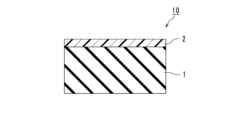
- FIG. 1 is a schematic cross-sectional view of a surface protection film according to one embodiment of the present invention.
- weight Whenever the term “weight” appears in this specification, it may be read as “mass,” which is the commonly used SI unit for indicating weight.
- the surface protection film according to the embodiment of the present invention includes a pressure-sensitive adhesive layer composed of a urethane-based pressure-sensitive adhesive.
- the urethane-based pressure-sensitive adhesive includes a urethane polymer.
- the urethane-based adhesive is formed from a urethane-based adhesive composition, which contains a base polymer (A) and a silicone-based compound (B).
- the content of the base polymer (A) in the urethane-based adhesive composition is preferably 50% by weight to 100% by weight, more preferably 70% by weight to 99% by weight, even more preferably 80% by weight to 98% by weight, and particularly preferably 90% by weight to 97% by weight, calculated as solid content.
- the content of the base polymer (A) in the urethane-based adhesive composition is preferably 60% by weight to 99.9% by weight, more preferably 70% by weight to 99% by weight, even more preferably 80% by weight to 98% by weight, and particularly preferably 90% by weight to 97% by weight, calculated as solids. If the content of the base polymer (A) in the urethane-based adhesive composition is within the above range, calculated as solids, the effects of the present invention can be more effectively achieved.
- the surface protection film according to an embodiment of the present invention may contain any other appropriate components as long as the effects of the present invention are not impaired, so long as it contains an adhesive layer composed of a urethane-based adhesive.
- the surface protection film according to an embodiment of the present invention contains a substrate and the above-mentioned adhesive layer.
- the surface of the adhesive layer opposite the substrate may be provided with any appropriate release liner (sometimes called a release sheet or separator) for protection until use, etc.
- FIG. 1 is a schematic cross-sectional view of a surface protection film according to one embodiment of the present invention.
- the surface protection film 10 comprises a substrate 1 and an adhesive layer 2.
- the substrate 1 and the adhesive layer 2 are directly laminated together.
- the surface of the adhesive layer 2 opposite the substrate 1 may be provided with any suitable release liner (sometimes called a release sheet or separator) for protection until use (not shown).
- release liners include release liners in which the surface of a substrate (liner substrate) such as paper or plastic film is silicone-treated, and release liners in which the surface of a substrate (liner substrate) such as paper or plastic film is laminated with a polyolefin resin.
- the thickness of the release liner is preferably 1 ⁇ m to 500 ⁇ m, more preferably 3 ⁇ m to 450 ⁇ m, even more preferably 5 ⁇ m to 400 ⁇ m, and particularly preferably 10 ⁇ m to 300 ⁇ m.
- the thickness of the surface protection film according to the embodiment of the present invention may be any appropriate thickness within a range that does not impair the effects of the present invention.
- Such a thickness is preferably 5 ⁇ m to 500 ⁇ m, more preferably 10 ⁇ m to 450 ⁇ m, even more preferably 15 ⁇ m to 400 ⁇ m, and particularly preferably 20 ⁇ m to 300 ⁇ m.
- the adhesive layer is attached to a glass plate, left for 30 minutes at an environmental temperature of 23° C., and then the surface protection film is peeled from the glass plate at a peel angle of 180 degrees and a peel speed of 300 mm/min.
- the adhesive strength (I) is preferably 5.0 gf/25 mm or less, more preferably 4.0 gf/25 mm or less, even more preferably 3.5 gf/25 mm or less, even more preferably 3.0 gf/25 mm or less, particularly preferably 2.5 gf/25 mm or less, and most preferably 2.0 gf/25 mm or less.
- the lower limit of the adhesive strength (I) is preferably 0.3 gf/25 mm or more in reality. If the adhesive strength (I) is within the above range, a surface protection film that adheres appropriately to an adherend and is easy to peel off can be provided. If the adhesive strength (I) is too large outside the above range, for example, the adhesive strength to the adherend may be too high, resulting in a surface protection film that is difficult to peel off. Details of the method for measuring the adhesive strength (I) will be described later.
- the average peel strength is defined as adhesive strength (II), and the degree of increase in adhesive strength from the adhesive strength (I), i.e., the rate of increase in adhesive strength to the glass plate over time defined as [adhesive strength (II)/adhesive strength (I)] x 100 (%) is preferably less than 210%, more preferably 200% or less, even more preferably 190% or less, even more preferably 180% or less, even more preferably 170% or less, even more preferably 160% or less, even more preferably 150% or less, even more preferably 140% or less, particularly preferably 135% or less, and most preferably 130% or less.
- the lower limit of the rate of increase in adhesive strength to the glass plate over time is preferably 100% or more. If the rate of increase in adhesive strength to glass plate over time is within the above range, the increase in adhesive strength to the adherend over time is suppressed, and a surface protection film that adheres appropriately even after a long time has passed after being attached to the adherend and is easy to peel off can be provided. If the rate of increase in adhesive strength to glass plate over time is too large outside the above range, for example, the adhesive strength to the adherend may increase over time, and after a long time has passed after being attached to the adherend, the adhesive strength may become strong and difficult to peel off. Details of the method for measuring the adhesive strength (II) will be described later.
- the surface free energy of the pressure-sensitive adhesive layer surface to diiodomethane is preferably 2.5 mJ/m 2 to 20.0 mJ/m 2 , more preferably 3.0 mJ/m 2 to 18.0 mJ/m 2 , even more preferably 3.3 mJ/m 2 to 16.0 mJ/m 2 , and particularly preferably 3.5 mJ/m 2 to 15.0 mJ/m 2.
- the adhesive strength of the pressure-sensitive adhesive layer (for example, the adhesive strength (I) described in this specification) may be too high, and the surface protection film may be difficult to peel off. If the surface free energy of the pressure-sensitive adhesive layer surface with respect to diiodomethane is too large, for example, there is a concern that the haze will become high.
- the method for measuring the surface free energy of the pressure-sensitive adhesive layer surface with respect to diiodomethane will be described in detail below.
- the haze of the surface protection film according to the embodiment of the present invention is preferably 7.0% or less, more preferably 6.0% or less, even more preferably 5.0% or less, even more preferably 4.0% or less, even more preferably 3.0% or less, particularly preferably 2.0% or less, and most preferably 1.5% or less.
- the lower limit of the haze is preferably 0% or more. If the haze is within the above range, the transparency of the surface protection film is high, and it becomes possible to accurately perform inspections, for example, when the surface protection film is attached to the surface of an adherend such as an optical member or electronic member. If the haze is too large outside the above range, for example, the transparency of the surface protection film decreases, which may cause problems in the above-mentioned inspections. The method for measuring the haze will be described in detail later.
- the surface protective film according to the embodiment of the present invention can be produced by any suitable method.
- a production method include (1) A method of applying a solution or a hot melt of a material for forming the adhesive layer onto a substrate, (2) A method of applying a solution or a hot melt of a material for forming an adhesive layer onto a release liner to form an adhesive layer, and then transferring the adhesive layer onto a substrate; (3) A method of forming and coating a pressure-sensitive adhesive layer by extruding a material for forming the pressure-sensitive adhesive layer onto a substrate; (4) A method of extruding a substrate and a pressure-sensitive adhesive layer in two or more layers, (5) A method of laminating a single layer of a pressure-sensitive adhesive layer on a substrate, or a method of laminating a double layer of a pressure-sensitive adhesive layer together with a laminate layer, (6) A method of laminating a pressure-sensitive adhesive layer and a substrate-forming material such as a film or a laminate layer in a two-
- the pressure-sensitive adhesive layer is composed of a urethane-based pressure-sensitive adhesive.
- the urethane-based pressure-sensitive adhesive is formed from a urethane-based pressure-sensitive adhesive composition. That is, the pressure-sensitive adhesive layer is composed of a urethane-based pressure-sensitive adhesive, and the urethane-based pressure-sensitive adhesive is formed from a urethane-based pressure-sensitive adhesive composition.
- the urethane-based pressure-sensitive adhesive formed from the urethane-based pressure-sensitive adhesive composition forms a layer shape to become the pressure-sensitive adhesive layer.
- the adhesive layer may be formed by any suitable method.
- a method may be used in which a urethane adhesive composition is applied to any suitable substrate, heated and dried as necessary, and cured as necessary to form an adhesive layer on the substrate.
- the application method, heating and drying conditions, curing conditions, etc. may be appropriately selected from methods commonly known for forming adhesive layers.
- the thickness of the adhesive layer can be set appropriately according to the purpose of the present invention, as long as it does not impair the effects of the present invention.
- the thickness of the adhesive layer is typically 5 ⁇ m to 150 ⁇ m, preferably 10 ⁇ m to 120 ⁇ m, more preferably 20 ⁇ m to 110 ⁇ m, even more preferably 30 ⁇ m to 100 ⁇ m, and particularly preferably 40 ⁇ m to 90 ⁇ m.
- the urethane-based adhesive contains a urethane polymer.
- the urethane polymer in the urethane-based adhesive may be of only one type, or of two or more types.
- the content of the urethane polymer in the urethane adhesive is preferably 60% by weight to 99.9% by weight, more preferably 70% by weight to 99.9% by weight, even more preferably 80% by weight to 99.9% by weight, particularly preferably 85% by weight to 99.9% by weight, and most preferably 90% by weight to 99.9% by weight, calculated as solids. If the content of the urethane polymer in the urethane adhesive is within the above range, calculated as solids, the effects of the present invention can be more effectively achieved.
- the urethane polymer contained in the urethane-based adhesive is typically a prepolymer-type urethane polymer. There may be only one type of prepolymer-type urethane polymer, or two or more types.
- known urethane polymers include "prepolymer-type urethane polymers” produced by reacting a urethane prepolymer with a polyfunctional isocyanate compound, and "one-shot-type urethane polymers” produced by directly reacting a polyol with a polyfunctional isocyanate compound without using a urethane prepolymer.
- a urethane prepolymer is typically obtained by reacting a polyol with an excess of a polyfunctional isocyanate compound, and has an isocyanate group at the molecular end.
- the prepolymer-type urethane polymer which is the urethane polymer contained in the urethane-based adhesive, is different from the one-shot-type urethane polymer.
- the prepolymer type urethane polymer is obtained by reacting a urethane prepolymer as the base polymer (A) contained in the urethane-based adhesive composition with a polyfunctional isocyanate compound. Therefore, in the surface protection film according to an embodiment of the present invention, the urethane-based adhesive composition that forms the urethane-based adhesive typically contains a urethane prepolymer as the base polymer (A), a polyfunctional isocyanate compound, and a silicone-based compound (B).
- the prepolymer type urethane polymer can be prepared by any appropriate method that is used in the urethane reaction between the urethane prepolymer as the base polymer (A) and the polyfunctional isocyanate compound, as long as the effect of the present invention is not impaired.
- the urethane prepolymer may be of one type or of two or more types.
- the number average molecular weight Mn of the urethane prepolymer is, for example, 3,000 to 1,000,000.
- the urethane prepolymer is obtained by reacting a polyol with a polyfunctional isocyanate compound.
- the polyol contains polyester polyol (a1) and polyether polyol (a2).
- polyester polyol (a2) in particular, by containing not only polyether polyol (a2) but also polyester polyol (a1), it is possible to provide a surface protection film that can simultaneously exhibit excellent anchoring power and suppress the generation of glue residue when cut. In particular, it is possible to effectively exhibit excellent anchoring power.
- the total content of polyester polyol (a1) and polyether polyol (a2) in the polyol is preferably 50% by weight to 100% by weight, more preferably 70% by weight to 100% by weight, even more preferably 90% by weight to 100% by weight, particularly preferably 95% by weight to 100% by weight, and most preferably 98% by weight to 100% by weight, in order to further exert the effects of the present invention.
- the polyol typically consists of polyester polyol (a1) and polyether polyol (a2).
- the polyester polyol (a1) may be of only one type or of two or more types.
- the polyether polyol (a2) may be of only one type or of two or more types.
- polyester polyol (a1) polyester polyols that can be normally used in the preparation of urethane prepolymers can be appropriately used.
- polyester polyols include polyester polyols obtained by reacting an acid component with a glycol component.
- the acid component include terephthalic acid, adipic acid, azelaic acid, sebacic acid, phthalic anhydride, isophthalic acid, and trimellitic acid.
- glycol component examples include ethylene glycol, propylene glycol, diethylene glycol, butylene glycol, 1,6-hexane glycol, 3-methyl-1,5-pentanediol, 3,3'-dimethylolheptane, polyoxyethylene glycol, polyoxypropylene glycol, 1,4-butanediol, neopentyl glycol, butylethylpentanediol, glycerin, trimethylolpropane, and pentaerythritol.
- polyester polyols include polyester polyols obtained by ring-opening polymerization of lactones such as polycaprolactone, poly( ⁇ -methyl- ⁇ -valerolactone), and polyvalerolactone.
- the molecular weight of the polyester polyol (a1) can range from low to high.
- the number average molecular weight Mn of the polyester polyol (a1) is, for example, 100 to 100,000, preferably 100 to 10,000, more preferably 100 to 7,000, even more preferably 500 to 5,000, and particularly preferably 1,000 to 4,000.
- the content of polyester polyol (a1) in the polyol is preferably 0.01% by weight to 10.0% by weight, more preferably 0.05% by weight to 5.0% by weight, even more preferably 0.08% by weight to 3.0% by weight, even more preferably 0.1% by weight to 2.0% by weight, particularly preferably 0.2% by weight to 1.5% by weight, and most preferably 0.3% by weight to 1.0% by weight. If the content of polyester polyol (a1) in the polyol is within the above range, it is possible to provide a surface protection film that can simultaneously exhibit excellent anchoring power and suppress the generation of glue residue when cut. In particular, it is possible to effectively exhibit excellent anchoring power.
- the polyether polyol (a2) is typically a polyether polyol containing two or more of at least one type of group selected from the group consisting of methylene groups and methine groups, such as a polyether polyol containing two of at least one type of group selected from the group consisting of methylene groups and methine groups, or a polyether polyol containing three or more of at least one type of group selected from the group consisting of methylene groups and methine groups. If necessary, polyether polyol (a2) can be used in combination by replacing a part of it with glycols such as ethylene glycol or polyamines such as ethylenediamine.
- polyether polyols containing two of at least one type of group selected from the group consisting of methylene groups and methine groups include polyethylene glycol and polypropylene glycol.
- polyether polyol containing three or more groups of at least one type selected from the group consisting of methylene groups and methine groups is polytetramethylene glycol.
- the molecular weight of the polyether polyol (a2) can range from low to high.
- the molecular weight of the polyether polyol (a2) is, for example, a number average molecular weight Mn of 100 to 100,000, preferably 100 to 10,000, more preferably 100 to 7,000, even more preferably 500 to 5,000, and particularly preferably 1,000 to 4,000.
- the content of polyether polyol (a2) in the polyol is preferably 90.0% by weight to 99.99% by weight, more preferably 95.0% by weight to 99.95% by weight, even more preferably 97.0% by weight to 99.92% by weight, even more preferably 98.0% by weight to 99.9% by weight, particularly preferably 98.5% by weight to 99.8% by weight, and most preferably 99.0% by weight to 99.7% by weight.
- the polyether polyol (a2) contains a polyether polyol (a3) containing three or more of at least one type of group selected from the group consisting of methylene groups and methine groups.
- a polyether polyol (a3) containing three or more of at least one type of group selected from the group consisting of methylene groups and methine groups in the polyether polyol (a2), it is possible to provide a surface protective film that can simultaneously exhibit excellent anchoring power and suppression of the generation of glue residue when cut. In particular, it is possible to effectively suppress the generation of glue residue when cut.
- the content of polyether polyol (a3) containing three or more groups of at least one type selected from the group consisting of methylene groups and methine groups in polyether polyol (a2) is preferably 40.0% by weight to 80.0% by weight, more preferably 42.5% by weight to 77.5% by weight, even more preferably 45.0% by weight to 75.0% by weight, particularly preferably 47.5% by weight to 72.5% by weight, and most preferably 50% by weight to 70% by weight, in order to further exert the effects of the present invention.
- the polyfunctional isocyanate compound that is reacted with the polyol may be of only one type, or of two or more types.
- polyfunctional isocyanate compound any suitable polyfunctional isocyanate compound that can be used in the preparation of a urethane prepolymer can be used.
- polyfunctional isocyanate compounds include polyfunctional aliphatic isocyanate compounds, polyfunctional alicyclic isocyanate compounds, polyfunctional aromatic isocyanate compounds, and polyfunctional aromatic aliphatic isocyanate compounds.
- polyfunctional aliphatic isocyanate compounds include trimethylene diisocyanate, tetramethylene diisocyanate, hexamethylene diisocyanate, pentamethylene diisocyanate, 1,2-propylene diisocyanate, 1,3-butylene diisocyanate, 2,3-butylene diisocyanate, dodecamethylene diisocyanate, and 2,4,4-trimethylhexamethylene diisocyanate.
- polyfunctional alicyclic isocyanate compounds include 3-isocyanatomethyl-3,5,5-trimethylcyclohexyl isocyanate, 1,3-cyclopentane diisocyanate, 1,3-cyclohexane diisocyanate, 1,4-cyclohexane diisocyanate, isophorone diisocyanate, methyl-2,4-cyclohexane diisocyanate, methyl-2,6-cyclohexane diisocyanate, 4,4'-methylenebis(cyclohexyl isocyanate), 1,4-bis(isocyanatomethyl)cyclohexane, 1,4-bis(isocyanatomethyl)cyclohexane, hydrogenated diphenylmethane diisocyanate, hydrogenated xylylene diisocyanate, hydrogenated tolylene diisocyanate, and hydrogenated tetramethylxylylene diisocyanate.
- polyfunctional aromatic isocyanate compounds include 1,3-phenylene diisocyanate, 1,4-phenylene diisocyanate, 2,4-tolylene diisocyanate, 2,6-tolylene diisocyanate, 2,2'-diphenylmethane diisocyanate, 4,4'-diphenylmethane diisocyanate, 4,4'-toluidine diisocyanate, 2,4,6-triisocyanate toluene, 1,3,5-triisocyanate benzene, 4,4'-diphenylether diisocyanate, 4,4'-diphenyl diisocyanate, 1,5-naphthalene diisocyanate, 4,4',4"-triphenylmethane triisocyanate, dianisidine diisocyanate, and xylylene diisocyanate.
- polyfunctional aromatic aliphatic isocyanate compounds include ⁇ , ⁇ '-diisocyanate-1,3-dimethylbenzene, ⁇ , ⁇ '-diisocyanate-1,4-dimethylbenzene, ⁇ , ⁇ '-diisocyanate-1,4-diethylbenzene, 1,4-tetramethylxylylene diisocyanate, and 1,3-tetramethylxylylene diisocyanate.
- the polyfunctional isocyanate compound is preferably used in an equivalent ratio such that the isocyanate groups (NCO groups) of the compound are in excess of the hydroxyl groups (OH groups) of the polyol.
- an equivalent ratio of NCO groups/OH groups ([NCO]/[OH]) is preferably 1.01 to 5.0, more preferably 1.1 to 3.0, even more preferably 1.1 to 2.0, particularly preferably 1.1 to 1.8, and most preferably 1.2 to 1.6.
- a catalyst When preparing the urethane prepolymer, a catalyst may be used. Any appropriate catalyst may be used as long as it does not impair the effects of the present invention. Examples of such catalysts include tertiary amine catalysts and organometallic catalysts. Only one type of catalyst may be used, or two or more types may be used.
- Tertiary amine catalysts include, for example, triethylamine, triethylenediamine, and 1,8-diazabicyclo(5,4,0)-undecene-7 (DBU).
- DBU 1,8-diazabicyclo(5,4,0)-undecene-7
- Organometallic catalysts include, for example, bismuth-based catalysts such as bismuth octoate, bismuth neodecanoate, bismuth naphthenate, and bismuth rosinate; tin-based catalysts such as dibutyltin dilaurate (DBTDL) and dioctyltin dilaurate (DOTDL); titanium-based catalysts such as dibutyltitanium dichloride, tetrabutyl titanate, butoxytitanium trichloride, and titanium tetraacetylacetonate; iron-based catalysts such as iron 2-ethylhexanoate and iron acetylacetonate; cobalt-based catalysts such as cobalt benzoate and cobalt 2-ethylhexanoate; zinc-based catalysts such as zinc octoate, zinc naphthenate, and zinc 2-ethylhexanoate; and zirconium
- the amount of catalyst used is preferably 0.0001% by weight to 1.0% by weight, more preferably 0.001% by weight to 1.0% by weight, even more preferably 0.003% by weight to 1.0% by weight, and particularly preferably 0.005% by weight to 1.0% by weight, based on the total amount of the polyol and the polyfunctional isocyanate compound.
- the reaction temperature is preferably less than 100°C, and more preferably 85°C to 95°C. If the temperature is above 100°C, it may become difficult to control the reaction rate and crosslinking structure.
- the reaction temperature is preferably 100°C or higher, and more preferably 110°C or higher.
- Any appropriate method may be used to prepare the urethane prepolymer as long as it does not impair the effects of the present invention.
- Examples of such methods include 1) a method in which the entire amount of polyol, catalyst, and polyfunctional isocyanate compound are charged into a reaction vessel, and 2) a method in which the polyol and catalyst are charged into a reaction vessel and the polyfunctional isocyanate compound is added dropwise.
- method 2) after the polyfunctional isocyanate compound has been added dropwise, additional polyol and polyfunctional isocyanate compound may be added.
- Any suitable solvent may be used to prepare the urethane prepolymer.
- suitable solvents include methyl ethyl ketone, ethyl acetate, toluene, xylene, and acetone.
- any appropriate other components may be used as long as they do not impair the effects of the present invention.
- other components include antioxidants, UV absorbers, light stabilizers, resin components, tackifiers, crosslinking retarders, inorganic fillers, organic fillers, metal powders, pigments, foil-like materials, softeners, anti-aging agents, conductive agents, surface lubricants, leveling agents, corrosion inhibitors, heat stabilizers, polymerization inhibitors, and lubricants.
- the other components may be one type only, or two or more types.
- antioxidants, UV absorbers, and light stabilizers are preferred embodiments.
- antioxidants include radical chain inhibitors and peroxide decomposers.
- radical chain inhibitors include phenol-based antioxidants and amine-based antioxidants.
- peroxide decomposers include sulfur-based antioxidants and phosphorus-based antioxidants.
- ultraviolet absorbers examples include benzophenone-based ultraviolet absorbers, benzotriazole-based ultraviolet absorbers, salicylic acid-based ultraviolet absorbers, anilide oxalate-based ultraviolet absorbers, cyanoacrylate-based ultraviolet absorbers, and triazine-based ultraviolet absorbers.
- Examples of light stabilizers include hindered amine light stabilizers.
- the urethane-based pressure-sensitive adhesive composition typically contains a polyfunctional isocyanate compound.
- the polyfunctional isocyanate compound reacts with the base polymer (A) to form a urethane polymer.
- the polyfunctional isocyanate compound reacts with the urethane prepolymer as the base polymer (A) to form a prepolymer-type urethane polymer.
- the polyfunctional isocyanate compound that reacts with the base polymer (A) may be of only one type, or of two or more types.
- any suitable polyfunctional isocyanate compound that can be used in a urethane reaction can be used.
- a polyfunctional isocyanate compound for example, the polyfunctional isocyanate compound that can be used in the preparation of a urethane prepolymer, as described above, can be used.
- the equivalent ratio ([NCO]/[OH]) of the isocyanate group (NCO group) of the polyfunctional isocyanate compound to the hydroxyl group (OH group) of the urethane prepolymer is preferably 2.00 or less, more preferably 1.70 or less, even more preferably 0.60 to 1.70, and even more preferably 0.75 to 1.7 0, more preferably 0.90 to 1.70, even more preferably 1.00 to 1.70, even more preferably 1.10 to 1.65, particularly preferably 1.15 to 1.62, most preferably 1.15 to 1.60, and even 1.20 to 1.60, 1.25 to 1.60, 1.30 to 1.60, 1.35 to 1.60, 1.40 to 1.60, or 1.45 to 1.60.
- the proportion of the polyfunctional isocyanate compound used per 100 parts by weight of the urethane prepolymer is preferably 0.5 to 15 parts by weight, more preferably 1.0 to 10 parts by weight, even more preferably 1.5 to 8.0 parts by weight, particularly preferably 1.7 to 6.0 parts by weight, and most preferably 2.0 to 5.0 parts by weight.
- Any appropriate method may be used to prepare the urethane polymer, so long as it is a method of curing a urethane-based adhesive composition containing a base polymer (A) and a polyfunctional isocyanate compound to form a urethane polymer, as long as the effects of the present invention are not impaired.
- Such a method includes, for example, a method in which a urethane-based adhesive composition containing a base polymer (A) and a polyfunctional isocyanate compound is applied to any appropriate substrate, heated and dried as necessary, and cured as necessary, to prepare the urethane polymer in an adhesive layer formed on the substrate.
- the application method, heating and drying conditions, curing conditions, etc. may be appropriately selected from methods commonly known for forming adhesive layers.
- the urethane-based pressure-sensitive adhesive composition may contain a catalyst to promote the reaction between the base polymer (A) and the polyfunctional isocyanate compound.
- a catalyst to promote the reaction between the base polymer (A) and the polyfunctional isocyanate compound.
- Any suitable catalyst may be used as the catalyst as long as it does not impair the effects of the present invention. Examples of such catalyst include the catalysts that can be used in the preparation of the urethane prepolymer described above.
- the catalyst contained in the urethane-based adhesive composition is preferably an organometallic compound, and more preferably at least one selected from the group consisting of zinc-based catalysts and titanium-based catalysts, in that it can further exert the effects of the present invention.
- Examples of zinc-based catalysts include zinc octoate, zinc naphthenate, and zinc 2-ethylhexanoate.
- Titanium catalysts include, for example, dibutyltitanium dichloride, tetrabutyltitanate, butoxytitanium trichloride, and titanium tetraacetylacetonate.
- the content of the catalyst in the urethane-based adhesive composition is, in terms of solid content, preferably 0.0001 to 1.0 parts by weight, more preferably 0.001 to 1.0 parts by weight, even more preferably 0.003 to 1.0 parts by weight, and particularly preferably 0.005 to 1.0 parts by weight, per 100 parts by weight of the base polymer (A).
- the urethane-based pressure-sensitive adhesive composition contains a silicone-based compound (B).
- the silicone-based compound (B) may be of only one type, or of two or more types.
- the content of the silicone compound (B) in the urethane-based adhesive composition is, in terms of solid content, preferably 0.001 to 20 parts by weight, more preferably 0.005 to 10 parts by weight, even more preferably 0.01 to 7 parts by weight, even more preferably 0.01 to 4 parts by weight, even more preferably 0.01 to 2 parts by weight, particularly preferably 0.01 to 1 part by weight, and most preferably 0.01 to 0.80 parts by weight, per 100 parts by weight of the base polymer (A). If the content of the silicone compound (B) in the urethane-based adhesive composition is within the above range, the effects of the present invention can be more effectively achieved. If the content of the silicone compound (B) in the urethane-based adhesive composition is too high, for example, there is a risk of high haze.
- the silicone-based compound (B) typically contains at least one selected from the group consisting of reactive silicone oils and non-reactive silicone oils.
- the content of at least one selected from the group consisting of reactive silicone oils and non-reactive silicone oils in the silicone-based compound (B) is preferably 50% to 100% by weight, more preferably 70% to 100% by weight, even more preferably 90% to 100% by weight, particularly preferably 95% to 100% by weight, and most preferably 98% to 100% by weight.
- the silicone-based compound (B) may contain at least one type selected from the group consisting of reactive silicone oils and non-reactive silicone oils, as well as any other appropriate silicone-based compound within a range that does not impair the effects of the present invention.
- reactive silicone oils examples include side-chain reactive silicone oils in which an organic group is bonded as a side chain to a Si atom that is used for siloxane bonding; both-end reactive silicone oils in which an organic group is bonded to a Si atom located at both ends of the structure; one-end reactive silicone oils in which an organic group is bonded to only one of the Si atoms located at both ends of the structure; and both-end side-chain reactive silicone oils in which an organic group is bonded as a side chain to a Si atom that is used for siloxane bonding and an organic group is bonded to a Si atom located at both ends of the structure.
- Side-chain reactive silicone oils include, for example, amino-modified side-chain reactive silicone oils, epoxy-modified side-chain reactive silicone oils, carbinol-modified side-chain reactive silicone oils, mercapto-modified side-chain reactive silicone oils, carboxyl-modified side-chain reactive silicone oils, and methylhydrogen silicone oil-type side-chain reactive silicone oils.
- Commercially available products include, for example, the various silicone oils sold as side-chain reactive silicone oils manufactured by Shin-Etsu Chemical Co., Ltd.
- both-end reactive silicone oils examples include amino-modified both-end reactive silicone oils, epoxy-modified both-end reactive silicone oils, carbinol-modified both-end reactive silicone oils, methacrylic-modified both-end reactive silicone oils, polyether-modified both-end reactive silicone oils, mercapto-modified both-end reactive silicone oils, carboxyl-modified both-end reactive silicone oils, phenol-modified both-end reactive silicone oils, silanol-end reactive silicone oils, acrylic-modified both-end reactive silicone oils, and carboxylic anhydride-modified both-end reactive silicone oils.
- Commercially available products include, for example, the various silicone oils available as both-end reactive silicone oils manufactured by Shin-Etsu Chemical Co., Ltd.
- single-end reactive silicone oils include single-end reactive modified type single-end reactive silicone oils, average single-end carboxyl modified type single-end reactive silicone oils, and more specifically, carbinol modified type single-end reactive silicone oils.
- Commercially available products of these include, for example, the various silicone oils available as single-end reactive silicone oils manufactured by Shin-Etsu Chemical Co., Ltd.
- side chain both-end reactive silicone oils examples include side chain both-end reactive silicone oils with amino and methoxy modified side chains, and epoxy modified side chain both-end reactive silicone oils.
- Examples of commercially available products include various silicone oils sold as side chain both-end reactive silicone oils manufactured by Shin-Etsu Chemical Co., Ltd.
- non-reactive silicone oils examples include side-chain non-reactive silicone oils in which organic groups are bonded as side chains to the Si atoms that contribute to siloxane bonds, and double-end non-reactive silicone oils in which organic groups are bonded to the Si atoms located at both ends of the structure.
- Side-chain non-reactive silicone oils include, for example, polyether-modified side-chain non-reactive silicone oils, aralkyl-modified side-chain non-reactive silicone oils, fluoroalkyl-modified side-chain non-reactive silicone oils, long-chain alkyl-modified side-chain non-reactive silicone oils, higher fatty acid ester-modified side-chain non-reactive silicone oils, higher fatty acid-containing side-chain non-reactive silicone oils, and phenyl-modified side-chain non-reactive silicone oils.
- Commercially available products include, for example, the various silicone oils available as side-chain non-reactive silicone oils manufactured by Shin-Etsu Chemical Co., Ltd.
- a dual-end non-reactive silicone oil is a polyether-modified dual-end non-reactive silicone oil.
- examples of commercially available products include various silicone oils sold as dual-end non-reactive silicone oils manufactured by Shin-Etsu Chemical Co., Ltd.
- a preferred embodiment of the silicone-based compound (B) includes at least one selected from the group consisting of reactive silicone oils having at least one selected from the group consisting of polyether structures and carbinol structures, and non-reactive silicone oils having a polyether structure and an HLB value of 15 or less.
- the silicone-based compound (B) can provide a surface protection film that adheres appropriately to an adherend and is easy to peel off, and that is inhibited from increasing in adhesion to the adherend over time, and that adheres appropriately to an adherend and is easy to peel off even after a long time has passed after it has been attached to the adherend.
- An example of a reactive silicone oil having a polyether structure is a polyether-modified type reactive silicone oil at both ends.
- polyether-modified, double-ended reactive silicone oils include, for example, “X-22-4952,” “X-22-4272,” and “KF-6123” manufactured by Shin-Etsu Chemical Co., Ltd.
- reactive silicone oils having a carbinol structure examples include carbinol-modified side-chain reactive silicone oils, carbinol-modified both-end reactive silicone oils, and carbinol-modified one-end reactive silicone oils.
- carbinol-modified side-chain reactive silicone oils include, for example, “X-22-4039” and “X-22-4015” manufactured by Shin-Etsu Chemical Co., Ltd.
- carbinol-modified, double-ended reactive silicone oils include, for example, “KF-6000,” “KF-6001,” “KF-6002,” and “KF-6003” manufactured by Shin-Etsu Chemical Co., Ltd.
- carbinol-modified single-terminated reactive silicone oils include, for example, “X-22-170BX” and “X-22-170DX” manufactured by Shin-Etsu Chemical Co., Ltd.
- a non-reactive silicone oil having a polyether structure and an HLB value of 15 or less can be selected from non-reactive silicone oils having a polyether structure that have an HLB value of 15 or less.
- non-reactive silicone oils with a polyether structure examples include polyether-modified side-chain non-reactive silicone oils and polyether-modified both-end non-reactive silicone oils.
- polyether-modified side-chain non-reactive silicone oils include, for example, “KF-351A”, “KF-352A”, “KF-353”, “KF-354L”, “KF-355A”, “KF-615A”, “KF-945”, “KF-640", “KF-642”, “KF-643”, “KF-644", "KF-6020”, “KF-6204”, “X-22-4515”, “KF-6011”, “KF-6012”, “KF-6015”, “KF-6017”, and “X-22-2516” manufactured by Shin-Etsu Chemical Co., Ltd.
- the urethane-based adhesive composition may contain any other suitable components as long as they do not impair the effects of the present invention.
- suitable components include ionic compounds, fatty acid esters, solvents, crosslinking accelerators, silane coupling agents, antioxidants, UV absorbers, light stabilizers, resin components, tackifiers, crosslinking retarders, inorganic fillers, organic fillers, metal powders, colorants (pigments, dyes, etc.), chain transfer agents, plasticizers, softeners, antioxidants, conductive agents, foil-like materials, surface lubricants, leveling agents, corrosion inhibitors, heat stabilizers, polymerization inhibitors, and lubricants.
- the other components may be one type only, or two or more types.
- the substrate may be a single layer or may be two or more layers.
- the substrate may be a stretched substrate.
- the thickness of the substrate is preferably 4 ⁇ m to 450 ⁇ m, more preferably 8 ⁇ m to 400 ⁇ m, even more preferably 12 ⁇ m to 350 ⁇ m, and particularly preferably 16 ⁇ m to 250 ⁇ m.
- a release treatment can be performed by adding, for example, fatty acid amide, polyethyleneimine, long-chain alkyl additives, etc. to the substrate in order to form a roll that is easy to unwind, or a coating layer made of any suitable release agent, such as silicone-based, long-chain alkyl-based, or fluorine-based, can be provided.
- any suitable material may be used as the material for the substrate depending on the application. Examples include plastic, paper, metal film, nonwoven fabric, etc. Plastic is preferable. That is, the substrate is preferably a plastic film.
- the substrate may be made of one type of material, or may be made of two or more types of materials. For example, it may be made of two or more types of plastic.
- polyester resins examples include polyester resins, polyamide resins, polyolefin resins, etc.
- polyester resins examples include polyethylene terephthalate, polybutylene terephthalate, polyethylene naphthalate, etc.
- the substrate may contain any suitable additives as necessary.
- additives that may be contained in the substrate include antioxidants, UV absorbers, light stabilizers, antistatic agents, fillers, and pigments.
- the type, number, and amount of additives that may be contained in the substrate may be appropriately set depending on the purpose.
- the substrate is made of plastic, it is preferable to contain some of the above additives for the purpose of preventing deterioration, etc.
- particularly preferred additives include antioxidants, UV absorbers, light stabilizers, and fillers.
- the surface protective film according to the embodiment of the present invention is typically attached to an exposed surface of an optical member or electronic member in the manufacturing process of the optical member or electronic member to prevent the surface of the optical member or electronic member from being scratched during processing, assembly, inspection, transportation, etc., and can be suitably used for surface protection of the optical member or electronic member.
- the optical member of the present invention has the surface protective film of the present invention attached thereto.
- the electronic member of the present invention has the surface protective film of the present invention attached thereto.
- the conditions of the tensile test were an environment of 23°C and 50% RH, a peel angle of 180 degrees, and a peel speed (pulling speed) of 300 mm/min.
- the peel force (load) when the surface protective film was peeled from the glass plate was measured, and the average peel force (average load) at that time was taken as the adhesive force (I) to the glass plate (sometimes simply referred to as adhesive force (I)).
- adhesive force (I) As the tensile tester, a product name "Autograph AG-Xplus HS 6000 mm/min high-speed model (AG-50NX plus)" manufactured by Shimadzu Corporation was used.
- the conditions of the tensile test were an environment of 23°C and 50% RH, a peel angle of 180 degrees, and a peel speed (pulling speed) of 300 mm/min.
- the peel force (load) when the surface protective film was peeled from the glass plate was measured, and the average peel force (average load) at that time was taken as the adhesive force (II) to the glass plate (sometimes simply referred to as adhesive force (II)).
- adhesive force (II) As the tensile tester, a product name "Autograph AG-Xplus HS 6000 mm/min high-speed model (AG-50NX plus)" manufactured by Shimadzu Corporation was used.
- HM-150N Murakami Color Research Laboratory
- ⁇ Anchor strength evaluation> The surface protection film was cut into a size of 50 mm x 50 mm to prepare an evaluation sample. After removing the release liner from the evaluation sample, the adhesive layer side was rubbed from the edge with a finger. If the adhesive layer peeled off from the substrate when rubbed hard, it was evaluated as ⁇ , if the adhesive layer peeled off from the substrate when rubbed hard, it was evaluated as ⁇ , and if the adhesive layer did not peel off from the substrate, it was evaluated as ⁇ .
- the release liner was peeled off from the surface protection film (width 25 mm ⁇ length 140 mm), and the adhesive layer side of the film was cut by 1 cm at a 90 degree angle with a cutter blade.
- G good
- B better
- hexamethylene diisocyanate product name "HDI", manufactured by Tosoh Corporation
- polymerization was carried out by maintaining the temperature of the solution in the experimental apparatus at 90 ⁇ 2°C in a water bath for 4 hours to obtain a solution of urethane prepolymer A.
- ethyl acetate was appropriately added dropwise to control the temperature during polymerization and to prevent a decrease in stirrability due to an increase in viscosity.
- the total amount of ethyl acetate added was 300 g.
- the solids concentration of the solution of urethane prepolymer A was 50% by weight.
- hexamethylene diisocyanate product name "HDI", manufactured by Tosoh Corporation
- HDI hexamethylene diisocyanate
- toluene was appropriately added dropwise during the polymerization to control the temperature during polymerization and to prevent a decrease in stirrability due to an increase in viscosity.
- the total amount of toluene added was 380 g.
- the solid content concentration of the solution of urethane prepolymer B was 50% by weight.
- a urethane-based pressure-sensitive adhesive composition (1) was obtained by blending 100 parts by weight of a urethane prepolymer A, 4.0 parts by weight of a polyfunctional isocyanate compound (Coronate HX (C/HX), manufactured by Nippon Polyurethane Co., Ltd.) as a crosslinking agent, 0.10 parts by weight of KF-354L (manufactured by Shin-Etsu Chemical Co., Ltd.) as a silicone-based compound, 0.50 parts by weight of Irganox 1010 (manufactured by BASF Co., Ltd.) as an antioxidant, and 0.20 parts by weight of Nikka Octix Zinc 18% (manufactured by Nippon Chemical Industry Co., Ltd.) as a catalyst, and diluting with ethyl acetate to a total solids content of 50% by weight.
- a polyfunctional isocyanate compound (Coronate HX (C/HX), manufactured by Nippon Polyurethane Co.
- the urethane-based adhesive composition (1) was applied to a substrate made of polyester resin (product name "T100-75S", thickness 75 ⁇ m, manufactured by Mitsubishi Chemical Corporation) so that the thickness after drying would be 75 ⁇ m, and cured and dried under conditions of a drying temperature of 150° C. and a drying time of 3 minutes to prepare an adhesive layer (1).
- the silicone-treated surface of a release liner made of polyester resin having a thickness of 25 ⁇ m and one side of which was silicone-treated (product name "MRF25”, thickness 25 ⁇ m, manufactured by Mitsubishi Chemical Corporation) was laminated to the surface of the obtained adhesive layer (1) to obtain a surface protection film (1). Aging was carried out at room temperature for 5 days, and various evaluations were performed. The results are shown in Tables 1 and 2.
- a urethane-based pressure-sensitive adhesive composition (2) was obtained by blending 100 parts by weight of urethane prepolymer A, 4.0 parts by weight of a polyfunctional isocyanate compound (Coronate HX (C/HX), manufactured by Nippon Polyurethane Co., Ltd.) as a crosslinking agent, 0.10 parts by weight of KF-640 (manufactured by Shin-Etsu Chemical Co., Ltd.) as a silicone-based compound, 0.50 parts by weight of Irganox 1010 (manufactured by BASF Co., Ltd.) as an antioxidant, and 0.20 parts by weight of Nikka Octix Zinc 18% (manufactured by Nippon Chemical Industry Co., Ltd.) as a catalyst, and diluting with ethyl acetate to a total solids content of 50% by weight.
- a polyfunctional isocyanate compound (Coronate HX (C/HX), manufactured by Nippon Polyurethane Co., Ltd.
- Example 2 Except for using the urethane-based pressure-sensitive adhesive composition (2) instead of the urethane-based pressure-sensitive adhesive composition (1), the same procedure as in Example 1 was carried out to obtain a pressure-sensitive adhesive layer (2) and a surface protective film (2). Aging was carried out at room temperature for 5 days, and various evaluations were carried out. The results are shown in Tables 1 and 2.
- a urethane prepolymer A 100 parts by weight, a polyfunctional isocyanate compound (Coronate HX (C/HX), manufactured by Nippon Polyurethane Co., Ltd.) as a crosslinking agent: 4.0 parts by weight, a silicone-based compound: X-22-4515 (manufactured by Shin-Etsu Chemical Co., Ltd.): 0.10 parts by weight, an antioxidant: Irganox 1010 (manufactured by BASF Co., Ltd.): 0.50 parts by weight, and a catalyst: Nikka Octix Zinc 18% (manufactured by Nippon Chemical Industry Co., Ltd.): 0.20 parts by weight were mixed, and the mixture was diluted with ethyl acetate so that the total solid content was 50% by weight, to obtain a urethane-based pressure-sensitive adhesive composition (3).
- a polyfunctional isocyanate compound (Coronate HX (C/HX), manufactured by Nippon Polyurethane Co
- Example 2 Except for using the urethane-based pressure-sensitive adhesive composition (3) instead of the urethane-based pressure-sensitive adhesive composition (1), the same procedure as in Example 1 was carried out to obtain a pressure-sensitive adhesive layer (3) and a surface protective film (3). Aging was carried out at room temperature for 5 days, and various evaluations were carried out. The results are shown in Tables 1 and 2.
- a urethane-based pressure-sensitive adhesive composition (4) was obtained by blending 100 parts by weight of a urethane prepolymer A, 4.0 parts by weight of a polyfunctional isocyanate compound (Coronate HX (C/HX), manufactured by Nippon Polyurethane Co., Ltd.) as a crosslinking agent, 0.10 parts by weight of KF-6001 (manufactured by Shin-Etsu Chemical Co., Ltd.) as a silicone-based compound, 0.50 parts by weight of Irganox 1010 (manufactured by BASF Co., Ltd.) as an antioxidant, and 0.20 parts by weight of Nikka Octix Zinc 18% (manufactured by Nippon Chemical Industry Co., Ltd.) as a catalyst, and diluting with ethyl acetate to a total solids content of 50% by weight.
- a polyfunctional isocyanate compound (Coronate HX (C/HX), manufactured by Nippon Polyurethane Co.
- Example 2 Except for using the urethane-based pressure-sensitive adhesive composition (4) instead of the urethane-based pressure-sensitive adhesive composition (1), the same procedure as in Example 1 was carried out to obtain a pressure-sensitive adhesive layer (4) and a surface protective film (4). Aging was carried out at room temperature for 5 days, and various evaluations were carried out. The results are shown in Tables 1 and 2.
- a urethane-based pressure-sensitive adhesive composition (5) was obtained by blending 100 parts by weight of urethane prepolymer A, 4.0 parts by weight of a polyfunctional isocyanate compound (Coronate HX (C/HX), manufactured by Nippon Polyurethane Co., Ltd.) as a crosslinking agent, 0.10 parts by weight of KF-615A (manufactured by Shin-Etsu Chemical Co., Ltd.) as a silicone-based compound, 0.50 parts by weight of Irganox 1010 (manufactured by BASF Co., Ltd.) as an antioxidant, and 0.20 parts by weight of Nikka Octix Zinc 18% (manufactured by Nippon Chemical Industry Co., Ltd.) as a catalyst, and diluting with ethyl acetate to a total solids content of 50% by weight.
- a polyfunctional isocyanate compound (Coronate HX (C/HX), manufactured by Nippon Polyurethane Co.,
- Example 2 Except for using the urethane-based pressure-sensitive adhesive composition (5) instead of the urethane-based pressure-sensitive adhesive composition (1), the same procedure as in Example 1 was carried out to obtain a pressure-sensitive adhesive layer (5) and a surface protective film (5). Aging was carried out at room temperature for 5 days, and various evaluations were carried out. The results are shown in Tables 1 and 2.
- a urethane-based pressure-sensitive adhesive composition (6) was obtained by blending 100 parts by weight of urethane prepolymer A, 4.0 parts by weight of a polyfunctional isocyanate compound (Coronate HX (C/HX), manufactured by Nippon Polyurethane Co., Ltd.) as a crosslinking agent, 0.10 parts by weight of KF-615A (manufactured by Shin-Etsu Chemical Co., Ltd.) as a silicone-based compound, 0.50 parts by weight of Irganox 1010 (manufactured by BASF Co., Ltd.) as an antioxidant, and 0.20 parts by weight of Orgatix TC-401 (titanium tetraacetylacetonate, manufactured by Matsumoto Fine Chemical Co., Ltd.) as a catalyst, and diluting with ethyl acetate to a total solid content of 50% by weight.
- a polyfunctional isocyanate compound (Coronate HX (C/HX), manufactured by N
- Example 2 Except for using the urethane-based pressure-sensitive adhesive composition (6) instead of the urethane-based pressure-sensitive adhesive composition (1), the same procedure as in Example 1 was carried out to obtain a pressure-sensitive adhesive layer (6) and a surface protective film (6). Aging was carried out at room temperature for 5 days, and various evaluations were carried out. The results are shown in Tables 1 and 2.
- a urethane-based pressure-sensitive adhesive composition (7) was obtained by blending 100 parts by weight of urethane prepolymer A, 4.0 parts by weight of a polyfunctional isocyanate compound (Coronate HX (C/HX), manufactured by Nippon Polyurethane Co., Ltd.) as a crosslinking agent, 0.10 parts by weight of KF-615A (manufactured by Shin-Etsu Chemical Co., Ltd.) as a silicone-based compound, 0.50 parts by weight of Irganox 1010 (manufactured by BASF Co., Ltd.) as an antioxidant, and 0.20 parts by weight of Nursem Ferric (manufactured by Nippon Chemical Industry Co., Ltd.) as a catalyst, and diluting with ethyl acetate to a total solids content of 50% by weight.
- a polyfunctional isocyanate compound (Coronate HX (C/HX), manufactured by Nippon Polyurethane Co., Ltd.) as
- Example 2 Except for using the urethane-based pressure-sensitive adhesive composition (7) instead of the urethane-based pressure-sensitive adhesive composition (1), the same procedure as in Example 1 was carried out to obtain a pressure-sensitive adhesive layer (7) and a surface protective film (7). Aging was carried out at room temperature for 5 days, and various evaluations were carried out. The results are shown in Tables 1 and 2.
- a urethane-based pressure-sensitive adhesive composition (8) was obtained by blending 100 parts by weight of urethane prepolymer A, 4.0 parts by weight of a polyfunctional isocyanate compound (Coronate HX (C/HX), manufactured by Nippon Polyurethane Co., Ltd.) as a crosslinking agent, 0.50 parts by weight of KF-615A (manufactured by Shin-Etsu Chemical Co., Ltd.) as a silicone-based compound, 0.50 parts by weight of Irganox 1010 (manufactured by BASF Co., Ltd.) as an antioxidant, and 0.20 parts by weight of Nikka Octix Zinc 18% (manufactured by Nippon Chemical Industry Co., Ltd.) as a catalyst, and diluting with ethyl acetate to a total solids content of 50% by weight.
- a polyfunctional isocyanate compound (Coronate HX (C/HX), manufactured by Nippon Polyurethane Co.,
- Example 2 Except for using the urethane-based pressure-sensitive adhesive composition (8) instead of the urethane-based pressure-sensitive adhesive composition (1), the same procedure as in Example 1 was carried out to obtain a pressure-sensitive adhesive layer (8) and a surface protective film (8). Aging was carried out at room temperature for 5 days, and various evaluations were carried out. The results are shown in Tables 1 and 2.
- a urethane-based pressure-sensitive adhesive composition (C1) was obtained by blending 100 parts by weight of urethane prepolymer B, 4.0 parts by weight of a polyfunctional isocyanate compound (Coronate HX (C/HX), manufactured by Nippon Polyurethane Co., Ltd.) as a crosslinking agent, 0.10 parts by weight of KF-615A (manufactured by Shin-Etsu Chemical Co., Ltd.) as a silicone-based compound, 0.50 parts by weight of Irganox 1010 (manufactured by BASF Co., Ltd.) as an antioxidant, and 0.20 parts by weight of Nikka Octix Zinc 18% (manufactured by Nippon Chemical Industry Co., Ltd.) as a catalyst, and diluting with ethyl acetate to a total solids content of 50% by weight.
- a polyfunctional isocyanate compound (Coronate HX (C/HX), manufactured by Nippon Polyurethane Co.
- Example 1 Except for using the urethane-based pressure-sensitive adhesive composition (C1) instead of the urethane-based pressure-sensitive adhesive composition (1), the same procedure as in Example 1 was carried out to obtain a pressure-sensitive adhesive layer (C1) and a surface protective film (C1). Aging was carried out at room temperature for 5 days, and various evaluations were carried out. The results are shown in Tables 1 and 2.
- a urethane-based pressure-sensitive adhesive composition (C2) was obtained by blending 100 parts by weight of urethane prepolymer C, 4.0 parts by weight of a polyfunctional isocyanate compound (Coronate HX (C/HX), manufactured by Nippon Polyurethane Co., Ltd.) as a crosslinking agent, 0.10 parts by weight of KF-615A (manufactured by Shin-Etsu Chemical Co., Ltd.) as a silicone-based compound, 0.50 parts by weight of Irganox 1010 (manufactured by BASF Co., Ltd.) as an antioxidant, and 0.20 parts by weight of Nikka Octix Zinc 18% (manufactured by Nippon Chemical Industry Co., Ltd.) as a catalyst, and diluting with ethyl acetate to a total solids content of 50% by weight.
- a polyfunctional isocyanate compound (Coronate HX (C/HX), manufactured by Nippon Polyurethane Co.
- Example 2 Except for using the urethane-based pressure-sensitive adhesive composition (C2) instead of the urethane-based pressure-sensitive adhesive composition (1), the same procedure as in Example 1 was carried out to obtain a pressure-sensitive adhesive layer (C2) and a surface protective film (C2). Aging was carried out at room temperature for 5 days, and various evaluations were carried out. The results are shown in Tables 1 and 2.
- Example 9 to 16 For each of the surface protection films (1) to (8) obtained in Examples 1 to 8, the release liner was peeled off, and the pressure-sensitive adhesive layer side was attached to a polarizing plate (manufactured by Nitto Denko Corporation, product name "TEG1465DUHC”), which is an optical component, to obtain an optical component with a surface protection film attached thereto.
- a polarizing plate manufactured by Nitto Denko Corporation, product name "TEG1465DUHC”
- Example 17 to 24 For each of the surface protection films (1) to (8) obtained in Examples 1 to 8, the release liner was peeled off, and the pressure-sensitive adhesive layer side was attached to a conductive film (manufactured by Nitto Denko Corporation, product name "ELECRYSTA V270L-TFMP"), which is an electronic component, to obtain an electronic component having a surface protection film attached thereto.
- a conductive film manufactured by Nitto Denko Corporation, product name "ELECRYSTA V270L-TFMP”
- the surface protective film of the present invention can be used for any suitable application, and is preferably used in the fields of optical members and electronic members.
Landscapes
- Chemical & Material Sciences (AREA)
- Organic Chemistry (AREA)
- Health & Medical Sciences (AREA)
- Chemical Kinetics & Catalysis (AREA)
- Medicinal Chemistry (AREA)
- Polymers & Plastics (AREA)
- Adhesive Tapes (AREA)
- Laminated Bodies (AREA)
Abstract
Description
[2]上記[1]に記載の表面保護フィルムにおいて、上記ポリオール中の上記ポリエステルポリオール(a1)の含有割合が0.01重量%~10.0重量%であってもよい。
[3]上記[1]または[2]に記載の表面保護フィルムにおいて、上記ウレタン系粘着剤組成物が触媒を含み、該触媒が亜鉛系触媒およびチタン系触媒からなる群から選ばれる少なくとも1種であってもよい。
[4]上記[1]から[3]までのいずれかに記載の表面保護フィルムにおいて、上記粘着剤層をガラス板に貼り付けて23℃の環境温度下で30分放置した後に剥離角度180度、剥離速度300mm/分で該ガラス板から該表面保護フィルムを剥離したときの平均剥離力を粘着力(I)とし、上記粘着剤層をガラス板に貼り付けて50℃の環境温度下で1日放置した後に剥離角度180度、剥離速度300mm/分で該ガラス板から該表面保護フィルムを剥離したときの平均剥離力を粘着力(II)としたときに、[粘着力(II)/粘着力(I)]×100(%)で定義される対ガラス板粘着力経時上昇率が210%未満であってもよい。
[5]上記[1]から[4]までのいずれかに記載の表面保護フィルムにおいて、上記シリコーン系化合物(B)が、ポリエーテル構造およびカルビノール構造からなる群から選ばれる少なくとも1種を有する反応性シリコーンオイル、および、ポリエーテル構造を有するHLB値が15以下の非反応性シリコーンオイル、からなる群から選ばれる少なくとも1種を含んでいてもよい。
[6]上記[1]から[5]までのいずれかに記載の表面保護フィルムにおいて、上記粘着剤層表面のジヨードメタンに対する表面自由エネルギーが2.5mJ/m2~20.0mJ/m2であってもよい。
[7]上記[1]から[6]までのいずれかに記載の表面保護フィルムにおいて、上記ベースポリマー(A)100重量部に対する上記シリコーン系化合物(B)の含有量が、0.01重量部~0.48重量部であってもよい。
[8]本発明の実施形態による光学部材は、上記[1]から[7]までのいずれかに記載の表面保護フィルムを含む。
[9]本発明の実施形態による電子部材は、上記[1]から[7]までのいずれかに記載の表面保護フィルムを含む。
本発明の実施形態による表面保護フィルムは、ウレタン系粘着剤から構成される粘着剤層を含む。本発明の実施形態による表面保護フィルムにおいて、ウレタン系粘着剤はウレタンポリマーを含む。
(1)粘着剤層の形成材料の溶液や熱溶融液を基材上に塗布する方法、
(2)粘着剤層の形成材料の溶液や熱溶融液をはく離ライナー上に塗布して形成した粘着剤層を基材上に移着する方法、
(3)粘着剤層の形成材料を基材上に押出して形成塗布する方法、
(4)基材と粘着剤層を二層または多層にて押出しする方法、
(5)基材上に粘着剤層を単層ラミネートする方法またはラミネート層とともに粘着剤層を二層ラミネートする方法、
(6)粘着剤層とフィルムやラミネート層等の基材形成材料とを二層または多層ラミネートする方法、
などの、任意の適切な製造方法に準じて行うことができる。なお、上記の塗布の方法としては、任意の適切な方法を採用し得る。このような塗布の方法としては、例えば、ロールコーター法、コンマコーター法、ダイコーター法、リバースコーター法、シルクスクリーン法、グラビアコーター法などが使用できる。
粘着剤層は、ウレタン系粘着剤から構成される。ウレタン系粘着剤は、ウレタン系粘着剤組成物から形成される。すなわち、粘着剤層はウレタン系粘着剤から構成され、該ウレタン系粘着剤はウレタン系粘着剤組成物から形成される。代表的には、ウレタン系粘着剤組成物から形成されるウレタン系粘着剤が層形状を構成することによって粘着剤層となる。
ベースポリマー(A)としてのウレタンプレポリマーは、多官能イソシアネート化合物と反応して、プレポリマー型ウレタンポリマーとなり得る。
ウレタン系粘着剤組成物は、代表的には、多官能イソシアネート化合物を含む。多官能イソシアネート化合物は、ベースポリマー(A)と反応することにより、ウレタンポリマーとなる。詳細には、多官能イソシアネート化合物は、ベースポリマー(A)としてのウレタンプレポリマーと反応することによりプレポリマー型ウレタンポリマーとなり得る。
ウレタン系粘着剤組成物は、ベースポリマー(A)と多官能イソシアネート化合物の反応を促進する等のために、触媒を用いてもよい。このような触媒としては、本発明の効果を損なわない範囲で、任意の適切な触媒を用い得る。このような触媒としては、前述した、ウレタンプレポリマーの調製に用い得る触媒が挙げられる。
ウレタン系粘着剤組成物は、シリコーン系化合物(B)を含む。シリコーン系化合物(B)は、1種のみであってもよいし、2種以上であってもよい。
ウレタン系粘着剤組成物中には、本発明の効果を損なわない範囲で、任意の適切なその他の成分を含み得る。このようなその他の成分としては、例えば、イオン性化合物、脂肪酸エステル、溶剤、架橋促進剤、シランカップリング剤、酸化防止剤、紫外線吸収剤、光安定剤、樹脂成分、粘着付与剤、架橋遅延剤、無機充填剤、有機充填剤、金属粉、着色剤(顔料や染料など)、連鎖移動剤、可塑剤、軟化剤、老化防止剤、導電剤、箔状物、表面潤滑剤、レベリング剤、腐食防止剤、耐熱安定剤、重合禁止剤、滑剤が挙げられる。その他の成分は、1種のみであってもよいし、2種以上であってもよい。
基材は、1層のみであってもよいし、2層以上であってもよい。基材は、延伸されたものであってもよい。
本発明の実施形態による表面保護フィルムは、代表的には、光学部材や電子部材の製造工程において、加工、組立、検査、輸送などの際の該光学部材や該電子部材の表面の傷付き防止のために該光学部材や該電子部材の露出面に貼り合わされ、光学部材や電子部材の表面保護に好適に用いることができる。本発明の光学部材は、本発明の表面保護フィルムが貼着されたものである。本発明の電子部材は、本発明の表面保護フィルムが貼着されたものである。
23℃、50%RHの環境下で、はく離ライナーを剥がした表面保護フィルムを幅25mm×長さ140mmにカットし、ガラス板(ソーダライムガラス、松浪硝子工業株式会社製)の表面に2kgハンドローラー1往復にて圧着してサンプルとした。
このサンプルを、23℃の環境温度下で30分間放置した後、引っ張り試験機にサンプルをセットし、引っ張り試験を開始した。引っ張り試験の条件は、23℃、50%RHの環境下で、剥離角度180度、剥離速度(引っ張り速度)300mm/分とした。ガラス板から表面保護フィルムを剥離した時の剥離力(荷重)を測定し、その際の平均剥離力(平均荷重)を、対ガラス板粘着力(I)(単に粘着力(I)と称することがある)とした。引っ張り試験機としては、島津製作所社製の商品名「オートグラフAG-Xplus HS 6000mm/min高速モデル(AG-50NX plus)」を用いた。
23℃、50%RHの環境下で、はく離ライナーを剥がした表面保護フィルムを幅25mm×長さ140mmにカットし、ガラス板(ソーダライムガラス、松浪硝子工業株式会社製)の表面に2kgハンドローラー1往復にて圧着してサンプルとした。
このサンプルを、50℃の環境温度下で1日放置した後、引っ張り試験機にサンプルをセットし、引っ張り試験を開始した。引っ張り試験の条件は、23℃、50%RHの環境下で、剥離角度180度、剥離速度(引っ張り速度)300mm/分とした。ガラス板から表面保護フィルムを剥離した時の剥離力(荷重)を測定し、その際の平均剥離力(平均荷重)を、対ガラス板粘着力(II)(単に粘着力(II)と称することがある)とした。引っ張り試験機としては、島津製作所社製の商品名「オートグラフAG-Xplus HS 6000mm/min高速モデル(AG-50NX plus)」を用いた。
[粘着力(II)/粘着力(I)]×100(%)の式によって算出した。
はく離ライナーを剥がした表面保護フィルムを幅50mm×長さ100mmのサイズにカットし、粘着剤層表面を上面にして、接触角計(協和界面科学社製、型式「CA-X」)に固定し、粘着剤層表面に水を2.0μL滴下して接触角を測定した。次に同様の手順で、粘着剤層表面にジヨードメタンを2.0μL滴下して接触角を測定した。以上の2液の接触角の値からOwens-Wendt法を用いて粘着剤層表面のジヨードメタンに対する表面自由エネルギーを算出した。
23℃、50%RHの環境下で、はく離ライナーを剥がした表面保護フィルムを50mm×50mmにカットし、村上色彩技術研究所社製の「HM-150N」で測定した。
表面保護フィルムを50mm×50mmのサイズにカットして、評価サンプルとした。評価サンプルからはく離ライナーを剥がした後、粘着剤層側を指で端面からこすった時に、基材から粘着剤層が剥がれたものを×、強くこすると基材から粘着剤層が剥がれたものを△、基材から粘着剤層が剥がれなかったものを〇として評価した。
はく離ライナーを剥がした表面保護フィルム(幅25mm×長さ140mm)の粘着剤層側の中央にカッターの刃を90度の角度で入れて1cm切断した。目視にて糊カスが確認された場合をG(good)、糊カスが確認されなかった場合をB(better)とした。
1L丸底セパラブルフラスコ、セパラブルカバー、分液ロート、温度計、窒素導入管、リービッヒ冷却器、バキュームシール、攪拌棒、攪拌羽が装備された実験装置に、ポリテトラメチレングリコール(製品名「PTMG3000」、三菱ケミカル社製):260g、ポリプロプレングリコール(製品名「サンニックスGP-1500」、三洋化成社製):173g、ポリエステルポリオール(製品名「クラレポリオールP-2010」、クラレ社製):3g、溶剤として酢酸エチル(東ソー社製):150gを投入し、撹拌しながら、触媒としてオクチル酸ビスマス(日本化学産業社製):0.05gを投入し、常温で窒素置換を1時間実施した。その後、窒素流入下、攪拌しながら、ヘキサメチレンジイソシアネート(製品名「HDI」、東ソー社製):15gを投入し、ウォーターバスにて実験装置内溶液の温度が90±2℃となるように制御しつつ、4時間保持して重合を行い、ウレタンプレポリマーAの溶液を得た。なお、重合途中に、重合中の温度制御および粘度上昇による撹拌性低下防止のために、適宜酢酸エチルを滴下した。滴下した酢酸エチルの総量は300gであった。ウレタンプレポリマーAの溶液の固形分濃度は50重量%であった。
1L丸底セパラブルフラスコ、セパラブルカバー、分液ロート、温度計、窒素導入管、リービッヒ冷却器、バキュームシール、攪拌棒、攪拌羽が装備された実験装置に、ポリプロピレングリコール(製品名「サンニックスPP-2000」、三洋化成工業社製):347g、ポリエステルポリオール(製品名「クラレポリオールP-2010」、クラレ社製):47g、溶剤としてトルエン(東ソー社製):110g、触媒としてオクチル酸ビスマス(日本化学産業社製):0.041g、を投入し、撹拌しながら、常温で窒素置換を1時間実施した。その後、窒素流入下、攪拌しながら、ヘキサメチレンジイソシアネート(製品名「HDI」、東ソー社製):33.5g投入し、ウォーターバスにて実験装置内溶液の温度が90±2℃となるように制御しつつ、4時間保持した後、ポリプロピレングリコール(製品名「GP1000」、三洋化成工業社製):44g投入し、ウォーターバスにて実験装置内溶液の温度が90±2℃となるように制御しつつ、2時間保持した後、ヘキサメチレンジイソシアネート(製品名「HDI」、東ソー社製):25.4g投入し、ウォーターバスにて実験装置内溶液の温度が90±2℃となるように制御しつつ、2時間保持し、ウレタンプレポリマーBの溶液を得た。なお、重合途中に、重合中の温度制御および粘度上昇による撹拌性低下防止のために、適宜トルエンを滴下した。滴下したトルエンの総量は380gであった。ウレタンプレポリマーBの溶液の固形分濃度は50重量%であった。
1L丸底セパラブルフラスコ、セパラブルカバー、分液ロート、温度計、窒素導入管、リービッヒ冷却器、バキュームシール、攪拌棒、攪拌羽が装備された実験装置に、ポリテトラメチレングリコール(製品名「PTMG3000」、三菱ケミカル社製):260g、ポリプロプレングリコール(製品名「サンニックスGP-1500」、三洋化成社製):173g、溶剤として酢酸エチル(東ソー社製):150gを投入し、撹拌しながら、触媒としてオクチル酸ビスマス(日本化学産業社製):0.05gを投入し、常温で窒素置換を1時間実施した。その後、窒素流入下、攪拌しながら、ヘキサメチレンジイソシアネート(製品名「HDI」、東ソー社製):17gを投入し、ウォーターバスにて実験装置内溶液の温度が90±2℃となるように制御しつつ、4時間保持して重合を行い、ウレタンプレポリマーCの溶液を得た。なお、重合途中に、重合中の温度制御および粘度上昇による撹拌性低下防止のために、適宜酢酸エチルを滴下した。滴下した酢酸エチルの総量は300gであった。ウレタンプレポリマーCの溶液の固形分濃度は50重量%であった。
ウレタンプレポリマーA:100重量部、架橋剤として多官能イソシアネート化合物(コロネートHX(C/HX)、日本ポリウレタン社製):4.0重量部、シリコーン系化合物としてKF-354L(信越化学工業社製):0.10重量部、酸化防止剤としてIrganox1010(BASF社製):0.50重量部、触媒としてニッカオクチックス亜鉛18%(日本化学産業社製):0.20重量部を配合し、全体の固形分が50重量%となるように酢酸エチルで希釈し、ウレタン系粘着剤組成物(1)を得た。
ウレタン系粘着剤組成物(1)を、ポリエステル樹脂からなる基材(商品名「T100-75S」、厚み75μm、三菱ケミカル株式会社製)に乾燥後の厚みが75μmとなるよう塗布し、乾燥温度150℃、乾燥時間3分の条件でキュアーして乾燥し、粘着剤層(1)を作製した。次いで、得られた粘着剤層(1)の表面に、一方の面にシリコーン処理を施した厚さ25μmのポリエステル樹脂からなるはく離ライナー(商品名「MRF25」、厚み25μm、三菱ケミカル株式会社製)のシリコーン処理面を貼合せて、表面保護フィルム(1)を得た。常温で5日間エージングを行い、各種評価を行った。
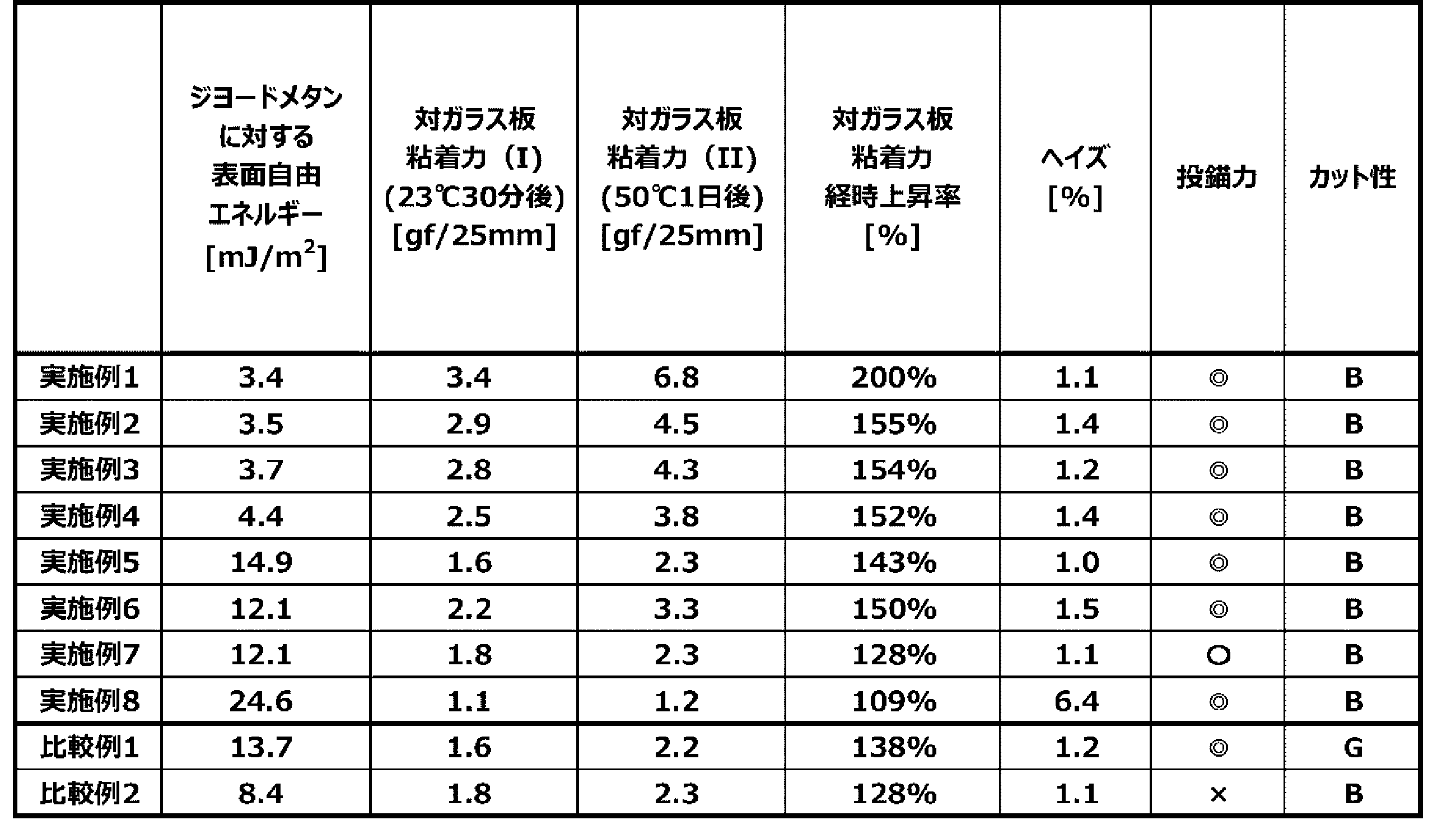
結果を表1、2に示した。
ウレタンプレポリマーA:100重量部、架橋剤として多官能イソシアネート化合物(コロネートHX(C/HX)、日本ポリウレタン社製):4.0重量部、シリコーン系化合物としてKF-640(信越化学工業社製):0.10重量部、酸化防止剤としてIrganox1010(BASF社製):0.50重量部、触媒としてニッカオクチックス亜鉛18%(日本化学産業社製):0.20重量部を配合し、全体の固形分が50重量%となるように酢酸エチルで希釈し、ウレタン系粘着剤組成物(2)を得た。
ウレタン系粘着剤組成物(1)に代えてウレタン系粘着剤組成物(2)を用いた以外は、実施例1と同様に行い、粘着剤層(2)、表面保護フィルム(2)を得た。常温で5日間エージングを行い、各種評価を行った。
結果を表1、2に示した。
ウレタンプレポリマーA:100重量部、架橋剤として多官能イソシアネート化合物(コロネートHX(C/HX)、日本ポリウレタン社製):4.0重量部、シリコーン系化合物としてX-22-4515(信越化学工業社製):0.10重量部、酸化防止剤としてIrganox1010(BASF社製):0.50重量部、触媒としてニッカオクチックス亜鉛18%(日本化学産業社製):0.20重量部を配合し、全体の固形分が50重量%となるように酢酸エチルで希釈し、ウレタン系粘着剤組成物(3)を得た。
ウレタン系粘着剤組成物(1)に代えてウレタン系粘着剤組成物(3)を用いた以外は、実施例1と同様に行い、粘着剤層(3)、表面保護フィルム(3)を得た。常温で5日間エージングを行い、各種評価を行った。
結果を表1、2に示した。
ウレタンプレポリマーA:100重量部、架橋剤として多官能イソシアネート化合物(コロネートHX(C/HX)、日本ポリウレタン社製):4.0重量部、シリコーン系化合物としてKF-6001(信越化学工業社製):0.10重量部、酸化防止剤としてIrganox1010(BASF社製):0.50重量部、触媒としてニッカオクチックス亜鉛18%(日本化学産業社製):0.20重量部を配合し、全体の固形分が50重量%となるように酢酸エチルで希釈し、ウレタン系粘着剤組成物(4)を得た。
ウレタン系粘着剤組成物(1)に代えてウレタン系粘着剤組成物(4)を用いた以外は、実施例1と同様に行い、粘着剤層(4)、表面保護フィルム(4)を得た。常温で5日間エージングを行い、各種評価を行った。
結果を表1、2に示した。
ウレタンプレポリマーA:100重量部、架橋剤として多官能イソシアネート化合物(コロネートHX(C/HX)、日本ポリウレタン社製):4.0重量部、シリコーン系化合物としてKF-615A(信越化学工業社製):0.10重量部、酸化防止剤としてIrganox1010(BASF社製):0.50重量部、触媒としてニッカオクチックス亜鉛18%(日本化学産業社製):0.20重量部を配合し、全体の固形分が50重量%となるように酢酸エチルで希釈し、ウレタン系粘着剤組成物(5)を得た。
ウレタン系粘着剤組成物(1)に代えてウレタン系粘着剤組成物(5)を用いた以外は、実施例1と同様に行い、粘着剤層(5)、表面保護フィルム(5)を得た。常温で5日間エージングを行い、各種評価を行った。
結果を表1、2に示した。
ウレタンプレポリマーA:100重量部、架橋剤として多官能イソシアネート化合物(コロネートHX(C/HX)、日本ポリウレタン社製):4.0重量部、シリコーン系化合物としてKF-615A(信越化学工業社製):0.10重量部、酸化防止剤としてIrganox1010(BASF社製):0.50重量部、触媒としてオルガチックスTC-401(チタンテトラアセチルアセトネート、マツモトファインケミカル社製):0.20重量部を配合し、全体の固形分が50重量%となるように酢酸エチルで希釈し、ウレタン系粘着剤組成物(6)を得た。
ウレタン系粘着剤組成物(1)に代えてウレタン系粘着剤組成物(6)を用いた以外は、実施例1と同様に行い、粘着剤層(6)、表面保護フィルム(6)を得た。常温で5日間エージングを行い、各種評価を行った。
結果を表1、2に示した。
ウレタンプレポリマーA:100重量部、架橋剤として多官能イソシアネート化合物(コロネートHX(C/HX)、日本ポリウレタン社製):4.0重量部、シリコーン系化合物としてKF-615A(信越化学工業社製):0.10重量部、酸化防止剤としてIrganox1010(BASF社製):0.50重量部、触媒としてナーセム第2鉄(日本化学産業社製):0.20重量部を配合し、全体の固形分が50重量%となるように酢酸エチルで希釈し、ウレタン系粘着剤組成物(7)を得た。
ウレタン系粘着剤組成物(1)に代えてウレタン系粘着剤組成物(7)を用いた以外は、実施例1と同様に行い、粘着剤層(7)、表面保護フィルム(7)を得た。常温で5日間エージングを行い、各種評価を行った。
結果を表1、2に示した。
ウレタンプレポリマーA:100重量部、架橋剤として多官能イソシアネート化合物(コロネートHX(C/HX)、日本ポリウレタン社製):4.0重量部、シリコーン系化合物としてKF-615A(信越化学工業社製):0.50重量部、酸化防止剤としてIrganox1010(BASF社製):0.50重量部、触媒としてニッカオクチックス亜鉛18%(日本化学産業社製):0.20重量部を配合し、全体の固形分が50重量%となるように酢酸エチルで希釈し、ウレタン系粘着剤組成物(8)を得た。
ウレタン系粘着剤組成物(1)に代えてウレタン系粘着剤組成物(8)を用いた以外は、実施例1と同様に行い、粘着剤層(8)、表面保護フィルム(8)を得た。常温で5日間エージングを行い、各種評価を行った。
結果を表1、2に示した。
ウレタンプレポリマーB:100重量部、架橋剤として多官能イソシアネート化合物(コロネートHX(C/HX)、日本ポリウレタン社製):4.0重量部、シリコーン系化合物としてKF-615A(信越化学工業社製):0.10重量部、酸化防止剤としてIrganox1010(BASF社製):0.50重量部、触媒としてニッカオクチックス亜鉛18%(日本化学産業社製):0.20重量部を配合し、全体の固形分が50重量%となるように酢酸エチルで希釈し、ウレタン系粘着剤組成物(C1)を得た。
ウレタン系粘着剤組成物(1)に代えてウレタン系粘着剤組成物(C1)を用いた以外は、実施例1と同様に行い、粘着剤層(C1)、表面保護フィルム(C1)を得た。常温で5日間エージングを行い、各種評価を行った。
結果を表1、2に示した。
ウレタンプレポリマーC:100重量部、架橋剤として多官能イソシアネート化合物(コロネートHX(C/HX)、日本ポリウレタン社製):4.0重量部、シリコーン系化合物としてKF-615A(信越化学工業社製):0.10重量部、酸化防止剤としてIrganox1010(BASF社製):0.50重量部、触媒としてニッカオクチックス亜鉛18%(日本化学産業社製):0.20重量部を配合し、全体の固形分が50重量%となるように酢酸エチルで希釈し、ウレタン系粘着剤組成物(C2)を得た。
ウレタン系粘着剤組成物(1)に代えてウレタン系粘着剤組成物(C2)を用いた以外は、実施例1と同様に行い、粘着剤層(C2)、表面保護フィルム(C2)を得た。常温で5日間エージングを行い、各種評価を行った。
結果を表1、2に示した。

実施例1~8で得られた表面保護フィルム(1)~(8)のそれぞれについて、はく離ライナーを剥離し、粘着剤層側を、光学部材である偏光板(日東電工株式会社製、商品名「TEG1465DUHC」)に貼着し、表面保護フィルムが貼着された光学部材を得た。
実施例1~8で得られた表面保護フィルム(1)~(8)のそれぞれについて、はく離ライナーを剥離し、粘着剤層側を、電子部材である導電性フィルム(日東電工株式会社製、商品名「エレクリスタV270L-TFMP」)に貼着し、表面保護フィルムが貼着された電子部材を得た。
Claims (9)
- ウレタン系粘着剤から構成される粘着剤層を含む表面保護フィルムであって、
該ウレタン系粘着剤がウレタンポリマーを含み、
該ウレタン系粘着剤がウレタン系粘着剤組成物から形成され、
該ウレタン系粘着剤組成物が、ベースポリマー(A)およびシリコーン系化合物(B)を含み、
該ベースポリマー(A)は、ポリオールと多官能イソシアネート化合物を反応させて得られるウレタンプレポリマーであり、
該ポリオールが、ポリエステルポリオール(a1)とポリエーテルポリオール(a2)を含み、
該ポリエーテルポリオール(a2)が、メチレン基およびメチン基からなる群から選ばれる少なくとも1種の基を3個以上含むポリオール(a3)を含む、
表面保護フィルム。 - 前記ポリオール中の前記ポリエステルポリオール(a1)の含有割合が0.01重量%~10.0重量%である、請求項1に記載の表面保護フィルム。
- 前記ウレタン系粘着剤組成物が触媒を含み、該触媒が亜鉛系触媒およびチタン系触媒からなる群から選ばれる少なくとも1種である、請求項1に記載の表面保護フィルム。
- 前記粘着剤層をガラス板に貼り付けて23℃の環境温度下で30分放置した後に剥離角度180度、剥離速度300mm/分で該ガラス板から前記表面保護フィルムを剥離したときの平均剥離力を粘着力(I)とし、前記粘着剤層をガラス板に貼り付けて50℃の環境温度下で1日放置した後に剥離角度180度、剥離速度300mm/分で該ガラス板から前記表面保護フィルムを剥離したときの平均剥離力を粘着力(II)としたときに、
[粘着力(II)/粘着力(I)]×100(%)で定義される対ガラス板粘着力経時上昇率が210%未満である、
請求項1に記載の表面保護フィルム。 - 前記シリコーン系化合物(B)が、ポリエーテル構造およびカルビノール構造からなる群から選ばれる少なくとも1種を有する反応性シリコーンオイル、および、ポリエーテル構造を有するHLB値が15以下の非反応性シリコーンオイル、からなる群から選ばれる少なくとも1種を含む、請求項1に記載の表面保護フィルム。
- 前記粘着剤層表面のジヨードメタンに対する表面自由エネルギーが2.5mJ/m2~20.0mJ/m2である、請求項1に記載の表面保護フィルム。
- 前記ベースポリマー(A)100重量部に対する前記シリコーン系化合物(B)の含有量が、0.01重量部~0.48重量部である、請求項1に記載の表面保護フィルム。
- 請求項1から7までのいずれかに記載の表面保護フィルムを含む、光学部材。
- 請求項1から7までのいずれかに記載の表面保護フィルムを含む、電子部材。
Priority Applications (3)
| Application Number | Priority Date | Filing Date | Title |
|---|---|---|---|
| JP2025542849A JPWO2025047321A1 (ja) | 2023-08-28 | 2024-08-05 | |
| CN202480055651.2A CN121752682A (zh) | 2023-08-28 | 2024-08-05 | 表面保护膜 |
| KR1020267007206A KR20260056181A (ko) | 2023-08-28 | 2024-08-05 | 표면 보호 필름 |
Applications Claiming Priority (2)
| Application Number | Priority Date | Filing Date | Title |
|---|---|---|---|
| JP2023-137717 | 2023-08-28 | ||
| JP2023137717 | 2023-08-28 |
Publications (1)
| Publication Number | Publication Date |
|---|---|
| WO2025047321A1 true WO2025047321A1 (ja) | 2025-03-06 |
Family
ID=94818862
Family Applications (1)
| Application Number | Title | Priority Date | Filing Date |
|---|---|---|---|
| PCT/JP2024/027966 Ceased WO2025047321A1 (ja) | 2023-08-28 | 2024-08-05 | 表面保護フィルム |
Country Status (5)
| Country | Link |
|---|---|
| JP (1) | JPWO2025047321A1 (ja) |
| KR (1) | KR20260056181A (ja) |
| CN (1) | CN121752682A (ja) |
| TW (1) | TW202513757A (ja) |
| WO (1) | WO2025047321A1 (ja) |
Citations (2)
| Publication number | Priority date | Publication date | Assignee | Title |
|---|---|---|---|---|
| JP2019218472A (ja) * | 2018-06-20 | 2019-12-26 | 日東電工株式会社 | 表面保護フィルム |
| WO2022138179A1 (ja) * | 2020-12-21 | 2022-06-30 | 日東電工株式会社 | 表面保護フィルム |
Family Cites Families (2)
| Publication number | Priority date | Publication date | Assignee | Title |
|---|---|---|---|---|
| JP6613516B2 (ja) | 2014-07-07 | 2019-12-04 | リンテック株式会社 | 表面保護フィルム |
| JP6368810B2 (ja) | 2016-03-04 | 2018-08-01 | 日東電工株式会社 | 表面保護フィルム |
-
2024
- 2024-08-05 JP JP2025542849A patent/JPWO2025047321A1/ja active Pending
- 2024-08-05 KR KR1020267007206A patent/KR20260056181A/ko active Pending
- 2024-08-05 WO PCT/JP2024/027966 patent/WO2025047321A1/ja not_active Ceased
- 2024-08-05 CN CN202480055651.2A patent/CN121752682A/zh active Pending
- 2024-08-15 TW TW113130644A patent/TW202513757A/zh unknown
Patent Citations (2)
| Publication number | Priority date | Publication date | Assignee | Title |
|---|---|---|---|---|
| JP2019218472A (ja) * | 2018-06-20 | 2019-12-26 | 日東電工株式会社 | 表面保護フィルム |
| WO2022138179A1 (ja) * | 2020-12-21 | 2022-06-30 | 日東電工株式会社 | 表面保護フィルム |
Also Published As
| Publication number | Publication date |
|---|---|
| CN121752682A (zh) | 2026-03-27 |
| KR20260056181A (ko) | 2026-04-24 |
| JPWO2025047321A1 (ja) | 2025-03-06 |
| TW202513757A (zh) | 2025-04-01 |
Similar Documents
| Publication | Publication Date | Title |
|---|---|---|
| TWI595063B (zh) | 胺甲酸酯系黏著劑及使用其之表面保護膜 | |
| JP5975775B2 (ja) | 粘着剤 | |
| JP7142482B2 (ja) | 表面保護フィルム | |
| JP5628870B2 (ja) | 表面保護フィルム | |
| CN103571360B (zh) | 表面保护膜、光学构件和电子构件 | |
| CN108384505A (zh) | 粘着剂及粘着带 | |
| JP6123145B2 (ja) | 粘着剤および粘着シート | |
| JP2022507844A (ja) | ポリエステルポリオール及びそれから作製されるポリウレタンポリマー | |
| JP2023004299A (ja) | 表面保護フィルム | |
| JP2019077750A (ja) | シリコーン吸着フィルム | |
| WO2025047320A1 (ja) | 表面保護フィルム | |
| WO2025047322A1 (ja) | 表面保護フィルム | |
| KR20260056181A (ko) | 표면 보호 필름 | |
| WO2025047319A1 (ja) | 表面保護フィルム | |
| WO2025047318A1 (ja) | 表面保護フィルム | |
| KR20240090115A (ko) | 표면 보호 필름 | |
| JP2025032992A (ja) | 表面保護フィルム | |
| JP2026071511A (ja) | 表面保護フィルム | |
| KR20180134142A (ko) | 대전 방지성 점착제 조성물 및 이로부터 제조된 보호 시트 | |
| KR20260045656A (ko) | 표면 보호 필름 | |
| JP2026060847A (ja) | 表面保護フィルム | |
| CN121736649A (zh) | 表面保护膜 | |
| TW202534140A (zh) | 表面保護膜 | |
| KR20190019558A (ko) | 점착제 조성물 및 이로부터 제조된 보호 시트 |
Legal Events
| Date | Code | Title | Description |
|---|---|---|---|
| 121 | Ep: the epo has been informed by wipo that ep was designated in this application |
Ref document number: 24859361 Country of ref document: EP Kind code of ref document: A1 |
|
| ENP | Entry into the national phase |
Ref document number: 2025542849 Country of ref document: JP Kind code of ref document: A |
|
| WWE | Wipo information: entry into national phase |
Ref document number: 2025542849 Country of ref document: JP |
|
| ENP | Entry into the national phase |
Ref document number: 1020267007206 Country of ref document: KR Free format text: ST27 STATUS EVENT CODE: A-0-1-A10-A15-NAP-PA0105 (AS PROVIDED BY THE NATIONAL OFFICE) |
|
| NENP | Non-entry into the national phase |
Ref country code: DE |