WO2025046725A1 - 工具、歯車加工装置及び歯車加工方法 - Google Patents
工具、歯車加工装置及び歯車加工方法 Download PDFInfo
- Publication number
- WO2025046725A1 WO2025046725A1 PCT/JP2023/031141 JP2023031141W WO2025046725A1 WO 2025046725 A1 WO2025046725 A1 WO 2025046725A1 JP 2023031141 W JP2023031141 W JP 2023031141W WO 2025046725 A1 WO2025046725 A1 WO 2025046725A1
- Authority
- WO
- WIPO (PCT)
- Prior art keywords
- tool
- processing
- blade
- gear
- machining
- Prior art date
- Legal status (The legal status is an assumption and is not a legal conclusion. Google has not performed a legal analysis and makes no representation as to the accuracy of the status listed.)
- Pending
Links
Images










Classifications
-
- B—PERFORMING OPERATIONS; TRANSPORTING
- B23—MACHINE TOOLS; METAL-WORKING NOT OTHERWISE PROVIDED FOR
- B23F—MAKING GEARS OR TOOTHED RACKS
- B23F19/00—Finishing gear teeth by other tools than those used for manufacturing gear teeth
-
- B—PERFORMING OPERATIONS; TRANSPORTING
- B23—MACHINE TOOLS; METAL-WORKING NOT OTHERWISE PROVIDED FOR
- B23F—MAKING GEARS OR TOOTHED RACKS
- B23F19/00—Finishing gear teeth by other tools than those used for manufacturing gear teeth
- B23F19/10—Chamfering the end edges of gear teeth
-
- B—PERFORMING OPERATIONS; TRANSPORTING
- B23—MACHINE TOOLS; METAL-WORKING NOT OTHERWISE PROVIDED FOR
- B23F—MAKING GEARS OR TOOTHED RACKS
- B23F21/00—Tools specially adapted for use in machines for manufacturing gear teeth
- B23F21/12—Milling tools
-
- B—PERFORMING OPERATIONS; TRANSPORTING
- B23—MACHINE TOOLS; METAL-WORKING NOT OTHERWISE PROVIDED FOR
- B23F—MAKING GEARS OR TOOTHED RACKS
- B23F21/00—Tools specially adapted for use in machines for manufacturing gear teeth
- B23F21/12—Milling tools
- B23F21/16—Hobs
-
- B—PERFORMING OPERATIONS; TRANSPORTING
- B23—MACHINE TOOLS; METAL-WORKING NOT OTHERWISE PROVIDED FOR
- B23F—MAKING GEARS OR TOOTHED RACKS
- B23F5/00—Making straight gear teeth involving moving a tool relatively to a workpiece with a rolling-off or an enveloping motion with respect to the gear teeth to be made
- B23F5/20—Making straight gear teeth involving moving a tool relatively to a workpiece with a rolling-off or an enveloping motion with respect to the gear teeth to be made by milling
Definitions
- the present invention relates to a tool, a gear processing device, and a gear processing method.
- the workpiece may require different machining processes while rotating in mesh with the tool.
- relief process may be required to remove corners by moving the machining point relative to the workpiece in order to improve tooth striking of the gear.
- shaving process may be required to remove irregularities (so-called polygonal error) that have occurred on the tooth surface of the gear while moving the machining point relative to the workpiece in order to achieve smooth meshing.
- the object of the present invention is to provide a tool that can improve production efficiency, a gear machining device that uses the tool, and a gear machining method that uses the tool.
- the tool body of this tool is formed by a disk-shaped first tool body and a disk-shaped second tool body, and includes a first tool member having a first processing blade formed on the outer peripheral surface of the first tool body to perform a first processing on the workpiece, and a second tool member having a second processing blade formed on the outer peripheral surface of the second tool body to perform a second processing on the workpiece, and when the first tool member and the second tool member are combined so that the rotation axes of the first tool body and the second tool body are coaxial, one of the processing blades of the first tool member and the second tool member is formed to protrude toward the other of the first tool member and the second tool member, and the other processing blade is formed to be positioned at a predetermined distance in the circumferential direction from the protruding portion of the one processing blade.
- the gear machining device of the present invention includes the above-mentioned tool, a tool spindle that rotates and drives the tool, a work spindle that rotatably supports a gear to be machined as a workpiece, and a moving device that moves the work spindle and the tool spindle relative to each other so that the tool supported by the tool spindle and the gear to be machined supported by the work spindle can mesh with each other, and repeatedly performs the first machining and the second machining in one machining process.
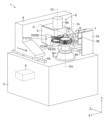
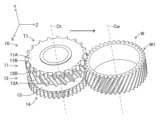
- FIG. 1 is a schematic configuration diagram of a tool and a gear machining device according to an embodiment
- FIG. 2 is a diagram for explaining names of a gear to be machined, which is a workpiece.
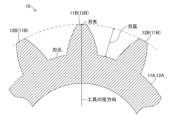
- FIG. 13 is a diagram for explaining names of tools.
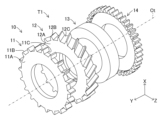
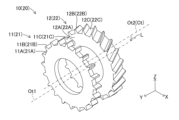
- FIG. 1 is a schematic configuration diagram of a tool according to an embodiment.
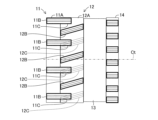
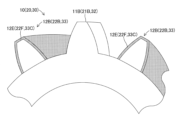
- FIG. 2 is a diagram for explaining a configuration of a tool according to an embodiment.
- 1 is a flowchart illustrating an example of a gear machining method.
- FIG. 4 is a diagram for explaining the operation of the gear machining device.
- FIG. 4 is a diagram for explaining meshing between a tool and a gear to be machined in the embodiment.
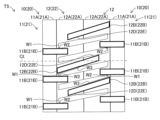
- FIG. 11 is a schematic configuration diagram of a tool according to a first modified example.
- FIG. 11 is a diagram illustrating an operation of the gear machining device according to a first modified example.
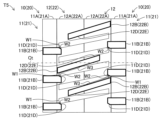
- FIG. 11 is a diagram illustrating a configuration of a tool according to a second modified example.
- FIG. 11 is a diagram for explaining meshing between a tool and a workpiece gear in a second modified example.
- FIG. 11 is a diagram along a pitch circle showing first and second machining of a gear to be machined by a tool unit of a third modified example.
- FIG. 11 is a schematic configuration diagram of a tool according to a first modified example.
- FIG. 11 is a diagram illustrating an operation of the gear machining device according to a first modified example.
- FIG. 11 is a diagram illustrating a configuration of a tool according to a second modified example.
- FIG. 11 is a diagram for explaining meshing between a tool and a workpiece gear in a second modified example.
- FIG. 13 is a diagram along a pitch circle showing first and second machining of a gear to be machined by a tool unit of a fourth modified example.
- FIG. 13 is a diagram along a pitch circle showing first and second machining of a gear to be machined by a tool unit of a fifth modified example.
- FIG. 13 is a diagram along a pitch circle showing first and second machining of a gear to be machined by a tool unit of a fifth modified example.
- FIG. 13 is a diagram along a pitch circle showing first and second machining of a gear to be machined by a tool unit of a fifth modified example.
- FIG. 13 is a diagram along a pitch circle showing first and second machining of a gear to be machined by a tool unit of a sixth modified example.
- FIG. 13 is a diagram along a pitch circle showing first and second machining of a gear to be machined by a tool unit of a sixth modified example.
- FIG. 13 is a diagram along a pitch circle showing first and second machining of a gear to be machined by a tool unit of a sixth modified example.
- FIG. 13 is a diagram along a pitch circle showing first and second machining of a gear to be machined by a tool unit of a sixth modified example.
- FIG. 13 is a diagram along a pitch circle showing first and second machining of a gear to be machined by a tool unit of a seventh modified example.
- FIG. 13 is a diagram along a pitch circle showing first and second machining of a gear to be machined by a tool unit of a seventh modified example.
- FIG. 13 is a diagram along a pitch circle showing first and second machining of a gear to be machined by a tool unit of a seventh modified example.
- FIG. 13 is a diagram illustrating the difference in blade height between the first processing blade and the second processing blade according to an eighth modified example.
- FIG. 13 is a view illustrating eccentricity of a first tool member and a second tool member according to a ninth modified example.
- FIG. 13 is a diagram illustrating a coating layer according to a tenth modified example.
- the gear machining device 1 is a machine tool that performs a predetermined machining process, such as rolling, cutting, or grinding, on a workpiece.
- the workpiece that is machined by the gear machining device 1 is, for example, a machined gear W in which workpiece teeth W1 are generated through a gear cutting process (description omitted) using a gear cutter such as a hob or a gear shaper.
- the machined gear W may be simply referred to as a "gear workpiece W".
- gear workpiece W may have helical teeth created through a gear cutting process, or of course, spur teeth may be created through a gear cutting process.
- the case where the workpiece teeth W1 are helical teeth will be described as an example.
- the gear processing device 1 performs rolling, cutting, or grinding while rotating the gear work W and the tool 10 in a state where the gear work W is engaged with the tool 10 described below.
- examples of the gear processing device 1 include a machining center equipped with multiple drive shafts that change the relative position and posture of the gear work W and the tool 10, a lathe, a grinding machine, etc.
- the gear machining device 1 mainly comprises a base 2, a work spindle 3, a Z-axis moving table 4, a swivel table 5, a tool spindle 6, an X-axis moving table 7, a deburring roller 8, and a control device 9.
- the gear machining device 1 also comprises a tool unit T1 that is attached to the tool spindle 6 and includes a tool 10.
- the gear machining device 1 has, for example, an X-axis, a Y-axis, and a Z-axis that are mutually perpendicular.
- the direction of the rotation axis Cw of the gear workpiece W (the rotation axis Cw of the workpiece spindle 3) is defined as the Y-axis direction, and the two axes perpendicular to the Y-axis direction are defined as the X-axis direction and the Z-axis direction.
- the horizontal direction is the X-axis direction
- the vertical direction is the Y-axis direction
- the depth direction is the Z-axis direction.
- the gear machining device 1 also has a rotation axis Ct (rotation axis Ct of the tool spindle 6) that is arranged along the Y-axis direction and that rotates and drives the tool 10.
- the gear machining device 1 also has a rotation axis Cr that is arranged along the Y-axis direction and that supports the deburring roller 8 so that it can rotate freely.
- the tool spindle 6 has a C-axis (a rotation axis around the Z-axis in the reference state shown in FIG. 1) in order to change the relative position between the gear workpiece W and the tool 10, as will be described in detail later.
- the base 2 is fixed onto the installation surface.
- the base 2 is formed into any shape, such as a substantially rectangular shape.
- the work spindle 3 is located on the top surface of the base 2, approximately in the center in the X-axis direction and at the front in the Z-axis direction.
- the work spindle 3 supports the gear work W so that it can freely rotate around the Y-axis, i.e., around the rotation axis Cw.
- the gear work W supported by the work spindle 3 is engaged with the tool 10 (tool unit T1) held by the tool spindle 6 and the tool 10 is driven to rotate, as described below.
- the Z-axis moving table 4 which serves as a moving device, is provided so as to be movable in the Z-axis direction relative to the base 2. Specifically, a pair of Z-axis guide rails 4A extending in the Z-axis direction is provided on the upper surface of the base 2. The Z-axis moving table 4 is driven by a linear motor or a ball screw mechanism (not shown). As a result, the Z-axis moving table 4 moves back and forth in the Z-axis direction, i.e., relative to the gear workpiece W and the workpiece spindle 3, while being guided by the pair of Z-axis guide rails 4A.
- the swivel table 5 which serves as a moving device, is installed on the side of the Z-axis moving table 4 facing the gear workpiece W, and moves back and forth in the Z-axis direction together with the Z-axis moving table 4.
- the swivel table 5 is also arranged so that it can rotate about the C-axis relative to the Z-axis moving table 4.
- the swivel table 5 is driven by a rotary motor (not shown) to enable it to rotate about the C-axis.
- the tool spindle 6 is arranged parallel to the Y-axis direction.
- the tool spindle 6 is rotatably supported by the turning table 5 and moves in the Z-axis direction together with the turning table 5 and the Z-axis moving table 4, i.e., moves relative to the work spindle 3.
- the tool spindle 6 is rotated by a spindle motor 6A provided on the turning table 5.
- the tool spindle 6 supports a tool unit T1 including a tool 10.
- the tool spindle 6 has a tool holder (not shown), and the tool unit T1 is attached to the tip of the tool spindle 6 by being held by the tool holder.
- the tool 10 rotates in conjunction with the rotation of the tool spindle 6 driven by the spindle motor 6A.
- the X-axis moving table 7 is provided so as to be movable in the X-axis direction relative to the base 2. Specifically, on the upper surface of the base 2, an X-axis guide rail 7B extending in the X-axis direction is provided on a support section 7A erected in the X-axis direction (to the right of the work spindle 3 in FIG. 1) and in front of the work spindle 3 in the Z-axis direction.
- the X-axis moving table 7 is driven by a linear motor or a ball screw mechanism (not shown). As a result, the X-axis moving table 7 moves back and forth in the X-axis direction, i.e., relative to the gear workpiece W, while being guided by the X-axis guide rail 7B.
- the deburring roller 8 removes burrs that occur on the gear workpiece W during processing.
- the deburring roller 8 is mounted on the X-axis moving table 7 and moves back and forth in the X-axis direction together with the X-axis moving table 7.
- the deburring roller 8 also includes a pair of rollers 8A.
- the pair of rollers 8A are driven by a drive mechanism (not shown) to move toward or away from each other along the rotation axis Cr, i.e., the Y-axis direction.
- the control device 9 controls the operation of the gear machining device 1 based on an NC program generated based on operation command data such as the shape of the workpiece tooth W1 in the gear workpiece W, the machining conditions, and the shape of the tool 10 (tool unit T1). That is, the control device 9 inputs the operation command data and generates an NC program based on the operation command data. The control device 9 then performs machining of the workpiece tooth W1 of the gear workpiece W (gear W to be machined) by controlling each motor including the spindle motor 6A based on the generated NC program.
- the operation command data includes, for example, a commanded cutting speed, a commanded position, a commanded rotational speed of the tool 10, a commanded pressing force with which the tool 10 presses the gear workpiece W, etc.
- the radial direction of the gear workpiece W is referred to as the "workpiece radial direction".
- the "tooth trace direction” corresponds to the extension direction of a continuous workpiece tooth W1 that continues from one end to the other end in the direction of the rotation axis Cw of the gear workpiece W.
- the gear workpiece W has helical teeth
- the tooth trace direction is inclined with respect to the rotation axis Cw of the gear workpiece W.
- the gear workpiece W has spur teeth
- the tooth trace direction is parallel to the rotation axis Cw of the gear workpiece W.
- Figure 2 illustrates an example in which the gear workpiece W has spur teeth.
- end W2 and “fraging portion W2" correspond to both ends in the tooth trace direction, as shown by the bold lines in Figure 2.
- fragmenting portion W2 is formed on “end W2".
- corner W3 and "relief W3" correspond to one of the four corners in the tooth trace direction. That is, “corner W3" is an area that exists on the tooth tip side and tooth base side of the work tooth W1, as shown by dots in Figure 2. Then, when relief processing is performed on “corner W3" to remove the corner, “relief W3" is formed in “corner W3".
- blade height refers to the radial distance from the base to the tip of the first processing blade 11B and the second processing blade 12B, taking the example of tool 10 described below.
- blade length refers to the length of the first processing blade 11B and the second processing blade 12B, which are continuous from one end to the other end in the direction of the rotation axis Ct of tool 10, taking the example of tool 10.
- the tool unit T1 of this embodiment includes a tool 10, a spacer 13, and a chamfering cutter 14.
- the tool unit T1 is assembled together via the spacer 13 so that the tool 10 and the chamfering cutter 14 are coaxial with a gap corresponding to the tooth width in the tooth trace direction of the gear workpiece W.
- the tool 10 and the chamfering cutter 14 are fixed to the spacer 13 by, for example, a bolt (not shown).
- the tool 10 is a rolling die and includes a first tool member 11 and a second tool member 12.
- the tool 10 is formed by combining the first tool member 11 and the second tool member 12.
- the tool 10 which is a combination of the first tool member 11 and the second tool member 12, and the chassing cutter 14 are fixed to the spacer 13.
- the first tool member 11 is a tool member that performs a first machining process on the work tooth W1 of the gear workpiece W.
- the first tool member 11 has a disk-shaped first tool body 11A.
- the first tool member 11 also has a first machining blade 11B formed on the outer peripheral surface of the first tool body 11A.
- the "first machining process” in this embodiment is a chamfering process (chamfering process) that chamfers the end W2 of the work tooth W1. Therefore, the first machining blade 11B in this embodiment is a chamfering blade that is formed parallel to the rotation axis Ct of the first tool body 11A and performs the chamfering process.
- the second tool member 12 is a tool member that performs a second processing, different from the first processing, on the work tooth W1 of the gear work W.
- the second tool member 12 has a disk-shaped second tool body 12A that is different from the first tool body 11A.
- the second tool member 12 also has a second processing blade 12B formed on the outer peripheral surface of the second tool body 12A.
- the "second processing" in this embodiment is a relief processing that removes the corner of one corner portion W3 of the four corners of the work tooth W1. Therefore, the second processing blade 12B in this embodiment is a relief blade that is formed so as to be twisted (i.e., in a helical tooth shape) with respect to the rotation axis Ct of the second tool body 12A and performs the relief processing.
- the blade length of the first processing blade 11B parallel to the rotation axis Ct of the tool 10 corresponds to the length obtained by adding the protruding portion of the protruding portion 11C described below to the thickness of the first tool body 11A (the distance in the direction of the rotation axis Ct).
- the second processing blade 12B is twisted with respect to the rotation axis Ct of the tool 10, i.e., inclined with respect to the rotation axis Ct, and therefore extends along the circumferential direction of the second tool body 12A.
- the blade length of the second processing blade 12B is longer than the blade length of the first processing blade 11B.
- the first tool member 11 and the second tool member 12 are combined with each other. Specifically, the first tool member 11 and the second tool member 12 are combined so that the rotation axes Ct of the first tool body 11A and the second tool body 12A are coaxial.
- one of the processing blades of the first tool member 11 and the second tool member 12, the first processing blade 11B in this embodiment as shown in Figures 4 and 5, has a protruding portion 11C that protrudes toward the second tool member 12, which is the other of the first tool member 11 and the second tool member 12.
- the second processing blade 12B is formed so as to be positioned at a predetermined interval in the circumferential direction from the protruding protruding portion 11C of the first processing blade 11B of the first tool member 11.
- the forming pitch of the cutting blade of the chamfering cutter 14 is the same as the forming pitch of the work teeth W1 created on the gear workpiece W.
- the forming pitch of the chamfering cutter 14 is used as a reference, the forming pitch of the first cutting blade 11B and the forming pitch of the second cutting blade 12B are larger than the forming pitch of the chamfering cutter 14, assuming that they are the same forming pitch.
- the second tool member 12 should have the second processing blade 12B formed with the same forming pitch as the chamfering cutter 14.
- the second tool member 12 has a removed portion 12C shown by the dashed line in FIG. 5 due to a portion of the second processing blade 12B being removed.
- the protruding portion 11C of the first processing blade 11B enters the removed portion 12C of the second tool member 12, in other words, between two second processing blades 12B adjacent in the circumferential direction. Therefore, in this embodiment, the first processing blade 11B and the second processing blade 12B have a predetermined distance in the circumferential direction.
- gear Machining Method Next, a gear machining method will be described in which, for example, fraging and relief are performed on a gear workpiece W (a gear W to be machined) before heat treatment with the tool unit T1 including the tool 10 attached to the gear machining device 1 described above. Note that the gear workpiece W is subjected to fraging and relief before heat treatment, so that rough fraging portions W2 and relief portions W3 are formed in advance. Finally, the workpiece teeth W1 are subjected to finishing grinding or the like, so that the gear workpiece W is produced as a gear, which is a product.
- the first processing blade 11B and the chamfering cutter 14 are engaged with both ends W2 of the work tooth W1 in the tooth trace direction.
- the first processing blade 11B and the chamfering cutter 14 then cut into the work tooth W1 while rotating, thereby performing a rolling process in which the end W2 is pressed and crushed by each blade surface, i.e., a chamfered chamfering portion W2 is formed at the end W2 of the work tooth W1, achieving smooth meshing of the gears.
- the second machining blade 12B moves the machining point along the tooth trace direction while rotating while meshing with the work tooth W1.
- the second machining blade 12B performs relief machining by pressing an area of the tooth surface of the work tooth W1 where high surface pressure occurs at the beginning of meshing, specifically, one of the four corners W3 of the tooth surface.
- the corner of the corner W3 of the tooth surface is then removed to form the relief portion W3, in other words, the thickness of the portion of the work tooth W1 where the relief portion W3 is formed is reduced, thereby suppressing the generation of high surface pressure.
- the control device 9 executes a gear machining process in which the first machining and the second machining are sequentially and continuously repeated in step S11. Then, in step S12, the control device 9 determines whether the machining time of the gear machining process has been executed until a predetermined time has elapsed, and if so, ends in step S13.
- the tool 10 is a combination of a first tool member 11 that performs framing and a second tool member 12 that performs relief. That is, in the tool 10, the first tool member 11 and the second tool member 12 are combined, so that the framing blade, which is the spur-toothed first processing blade 11B, and the relief blade, which is the helical-toothed second processing blade 12B, are arranged alternately along the circumferential direction.
- the first tool member 11 and the second tool member 12 can alternately perform framing and relief processing on the workpiece tooth W1. Therefore, in the gear machining process of step S11, the gear machining device 1 can perform framing and relief processing in succession and repeatedly.
- the gear machining process is a process in which a gear workpiece W before heat treatment is rotated by meshing it with a tool 10 to perform framing and relief machining on the workpiece teeth W1.
- framing and relief machining before heat treatment, it is possible to form rough framing portions W2 and relief portions W3 in advance before finishing. This makes it possible to shorten the machining time required for finishing, thereby improving productivity, and ultimately making it possible to manufacture high-performance gears with higher load capacity while suppressing increases in manufacturing costs.
- the control device 9 moves the Z-axis moving table 4 in the Z-axis direction, as shown by the thick arrow in FIG. 7. That is, the control device 9 moves the tool unit T1 including the tool spindle 6, i.e., the tool 10, toward the gear workpiece W.
- the control device 9 also moves the X-axis moving table 7 in the X-axis direction, as shown by the thick arrow in FIG. 7. That is, the control device 9 moves the deburring roller 8 toward the gear workpiece W.
- the control device 9 brings the first machining blade 11B or the second machining blade 12B of the tool 10 into mesh with the workpiece teeth W1 of the gear workpiece W, and brings the chamfering cutter 14 of the tool unit T1 into mesh with the workpiece teeth W1 of the gear workpiece W.
- the control device 9 can mesh the gear workpiece W with the tool 10, for example, by rotating the tool spindle 6 at an extremely low speed while reciprocating the Z-axis moving table 4.
- the control device 9 also moves the pair of rollers 8A of the deburring roller 8, which has been moved close to the gear workpiece W, closer to each other, as shown in FIG. 7. This causes the pair of rollers 8A of the deburring roller 8 to clamp the side of the gear workpiece W. Furthermore, the control device 9 can, for example, move the X-axis moving table 7 back and forth during framing so that the deburring roller 8 rotates with the gear workpiece W while clamping the side of the gear workpiece W.
- control device 9 controls a motor (not shown) and the like to move the Z-axis moving table 4 so that the tool 10 and chamfering cutter 14 meshed with the gear workpiece W press the gear workpiece W with a predetermined pressing force in the Z-axis direction, as shown by the thick arrow in Figure 8.
- the tool 10 and chamfering cutter 14 are always maintained in a state in which they press the gear workpiece W with a predetermined pressing force.
- the control device 9 generates a rotational driving force in the spindle motor 6A of the tool spindle 6 to rotate the tool unit T1.
- the gear workpiece W supported by the workpiece spindle 3 rotates in conjunction with the rotational drive of the tool unit T1.
- the first machining blade 11B and the chamfering cutter 14 perform chamfering on the end W2 of the workpiece tooth W1.
- the second machining blade 12B adjacent to the first machining blade 11B performing the chamfering performs relief processing on the corner W3 following the chamfering processing by the first machining blade 11B.
- the gear machining device 1 continuously repeats chamfering and relief processing in sequence on the workpiece tooth W1 of the gear workpiece W in one gear machining process.
- the first machining blade 11B of the first tool member 11 presses the end W2 on one end side of the work tooth W1 to chamfer it and form the framing portion W2.
- the second machining blade 12B of the second tool member 12 presses the corner W3 on the side of the work tooth W1 on which the first machining blade 11B formed the framing portion W2, circumferentially adjacent to the formed framing portion W2, while moving the machining point in a direction along the rotation axis Ct, thereby removing the corner and forming a relief portion W3.
- the corner portion W3, i.e., the relief portion W3, is changed depending on whether the finished gear is a drive gear or a driven gear.
- the finished gear is a drive gear
- the gear begins to mesh with the mating gear on the tooth base side in the workpiece radial direction, so the relief portion W3 is formed in the corner portion W3 on the tooth base side of the workpiece tooth W1 (see Figure 2).
- the finished gear is a driven gear
- the gear begins to mesh with the mating gear on the tooth tip side in the workpiece radial direction, so the relief portion W3 is formed in the corner portion W3 on the tooth tip side of the workpiece tooth W1 (see Figure 2).
- the chamfering cutter 14 forms the chamfering portion W2 by pressing the end W2 on the other end side of the work tooth W1 that is opposite the machining position by the first machining blade 11B and the second machining blade 12B in the direction of the rotation axis Ct.
- the chamfering cutter 14 forms the chamfering portion W2 by pressing the end W2 on the other end side of the work tooth W1 where the first machining blade 11B and the second machining blade 12B are in contact, and where the first machining blade 11B and the second machining blade 12B are not in contact.
- the processing time can be significantly reduced compared to, for example, performing framing processing using a single framing cutter and then switching to a separate single relief cutter to perform relief processing. More specifically, when the tool 10 is used, framing processing and relief processing can be performed repeatedly and continuously without changing stages.
- tool 10 when tool 10 is used, for example, framing and relief processing can be performed in a processing time that is approximately the same as the processing time required to perform only conventional framing processing. Therefore, when tool 10 is used, the production efficiency of gears can be improved. Furthermore, when tool 10 is used, there is no need to change stages, so there is no need to clearly distinguish between the framing process and the relief process, and there is also no need to provide a dedicated processing machine for framing processing or a dedicated processing machine for relief processing.
- the tool 10 includes a first tool member 11 having a first processing blade 11B formed on the outer peripheral surface of the first tool body 11A and performing a framing process as a first process on the gear workpiece W (gear W to be processed), which is the workpiece, and a second tool member 12 having a second processing blade 12B formed on the outer peripheral surface of the second tool body 12A and performing a relief process as a second process on the gear workpiece W.
- the first processing blade 11B of the first tool member 11, which is one of the processing blades of the first tool member 11 and the second tool member 12, is formed to protrude toward the second tool member 12, which is the other of the first tool member 11 and the second tool member 12, and the second processing blade 12B of the second tool member 12 is formed to be positioned at a predetermined interval in the circumferential direction from the protruding portion of the first processing blade 11B.
- the first machining blade 11B is formed on the outer peripheral surface of the disk-shaped first tool body 11A so as to be parallel to the rotation axis Ct of the first tool body 11A, and performs a first machining on the work tooth W1 of the gear workpiece W.
- the second machining blade 12B is formed on the outer peripheral surface of the second tool body 12A so as to be twisted about the rotation axis Ct, and is formed with a blade length longer along the direction of the rotation axis Ct than the first machining blade 11B so that the machining point for the work tooth W1 of the gear workpiece W can be moved, and performs a second machining on the work tooth W1 of the gear workpiece W.
- the tool 10 can be equipped with a first machining blade 11B that performs the first machining and a second machining blade 12B that performs the second machining, which is different from the first machining and moves the machining point.
- the tool 10 can then perform the first machining and the second machining on the gear workpiece W in a continuous and repeated manner.
- no time is required for changeover, etc., and therefore it is possible to reduce the machining time. Therefore, when the tool 10 is used, it is possible to improve the production efficiency of gears.
- the tool 10 can continuously and repeatedly perform the first and second processes, which are different from each other, there is no need to prepare a process or a dedicated machine for the first process, or a process or a dedicated machine for the second process. Therefore, when using the tool 10, it is possible to suppress increases in production costs even when producing high-performance gears with higher load capacities.
- the gear machining device 1 performs, as the second machining, a relief machining on the workpiece teeth W1 of the gear workpiece W.
- the gear machining device 1 can perform a shaving process in which the gear machining device 1 moves a machining point relative to the tooth surface while meshing with the gear workpiece W and contacting the tooth surface, thereby removing irregularities on the tooth surface.
- the first modified example will be specifically described below.
- the tool 20 includes a first tool member 21 and a second tool member 22.
- the tool 20 is formed by combining the first tool member 21 and the second tool member 22.
- the tool unit T2 is assembled integrally via a spacer 23 so that the tool 20 and the chamfering cutter 24 are coaxial with a gap corresponding to the tooth width in the tooth trace direction of the gear workpiece W.
- the first tool member 21 is a tool member that performs framing processing as a first processing on the gear workpiece W, similar to the first tool member 11 in the above-described embodiment.
- the first tool member 21 has a disk-shaped first tool body 21A.
- the first tool member 21 also has a first processing blade 21B (i.e., a framing blade) that is formed on the outer peripheral surface of the first tool body 21A parallel to the rotation axis Ct of the first tool body 21A and performs framing processing.
- the second tool member 22 is a tool member that performs a shaving process on the work teeth W1 of the gear workpiece W as a second process that is different from the first process.
- the second tool member 22 has a disk-shaped second tool body 22A that is different from the first tool body 21A.
- the second tool member 22 also has a second processing blade 22B that performs the shaving process and is formed on the outer peripheral surface of the second tool body 22A so as to be twisted about the rotation axis Ct of the second tool body 22A.
- the second machining blade 22B has a number of serration grooves 22D on the blade surface to remove unevenness (so-called polygonal error) on the tooth surface of the work tooth W1 while cutting.
- the second machining blade 22B is a shaving blade for performing shaving processing. Therefore, in the first modified example, the first machining blade 21B (fraging blade) that performs framing processing as the first processing and the second machining blade 22B (shaving blade) that performs shaving processing as the second processing are combined to form the tool 20.
- the second machining blade 22B can perform crowning processing to form a bulge in the central part in the tooth trace direction of the work tooth W1, for example.
- the second machining blade 22B can remove unevenness on the tooth surface of the work tooth W1, it can perform relief processing to remove the corners of the corner portion W3, as in the above-mentioned embodiment.
- the first tool body 21A and the second tool body 22A are assembled so that their respective rotation axes Ct are coaxial.
- the first processing blade 21B of the first tool member 21 is formed so as to protrude toward the second tool member 22. Therefore, in the second tool member 22, the second processing blade 22B and the removal portion 22C are formed so as to be positioned at a predetermined distance in the circumferential direction from the protruding portion 21C of the first processing blade 21B of the first tool member 21.
- a gear machining method will be described in which, for example, frazing and shaving are performed on a gear workpiece W (machined gear W) before heat treatment when the above-mentioned gear machining device 1 is fitted with a tool unit T2 including a tool 20.
- frazing and shaving are performed in sequence and repeatedly in the gear machining process shown in Figure 6.
- the control device 9 rotates the tool spindle 6, i.e., the tool unit T2, of the gear machining device 1 around the C axis. That is, the control device 9 operates the swivel table 5 to rotate the tool spindle 6, i.e., the tool unit T2, around the C axis.
- the magnitude of rotation of the tool spindle 6, i.e., the tool 20, around the C axis is determined, for example, based on the magnitude of torsion of the second machining blade 22B about the rotation axis Ct and the magnitude of torsion of the work tooth W1 of the gear work W about the rotation axis Cw. This allows the second machining blade 22B to continuously contact the tooth surface of the work tooth W1 in the tooth trace direction, i.e., to move the machining point, and to remove unevenness on the tooth surface by the serration groove 22D.
- the control device 9 brings the first machining blade 21B or the second machining blade 22B of the tool 20 into mesh with the work tooth W1 of the gear work W, and brings the chamfering cutter 24 of the tool unit T2 into mesh with the work tooth W1 of the gear work W.
- the tool 20 and the chamfering cutter 24 engaged with the gear work W are maintained in a state in which they press the gear work W with a predetermined pressing force in the Z-axis direction.
- the control device 9 also causes the pair of rollers 8A of the deburring roller 8 to clamp the side of the gear work W.
- the control device 9 generates a rotational driving force in the spindle motor 6A of the tool spindle 6 to rotate the tool unit T2.
- the gear workpiece W supported by the workpiece spindle 3 rotates in conjunction with the rotational drive of the tool unit T1.
- the first machining blade 21B and the chafing cutter 24 perform chafing on the workpiece teeth W1.
- the second machining blade 22B adjacent to the first machining blade 21B performing the chafing performs a shaving process following the chafing process by the first machining blade 21B.
- the gear machining device 1 of the first modified example repeatedly and continuously performs chafing and shaving in the gear machining process until the machining time has elapsed for a predetermined period of time.
- the framing portion W2 can be formed on the work tooth W1 of the gear work W by framing processing in the same manner as in the above-mentioned embodiment, and shaving processing can be performed to remove irregularities.
- a tool unit T2 including a tool 20 in the gear machining device 1 framing processing and shaving processing can be performed continuously and repeatedly on the work tooth W1 of the gear work W. Therefore, the first modified example can also achieve the same effects as the above-mentioned embodiment.
- the tool 10 of the tool unit T1 of the above-described embodiment includes a first tool member 11 for performing a first processing (specifically, framing processing) and a second tool member 12 for performing a second processing (specifically, relief processing), and the first tool member 11 and the second tool member 12 are combined.
- the first tool member 11 has a disk-shaped first tool body 11A
- the second tool member 12 has a disk-shaped second tool body 12A.
- the tool 20 of the tool unit T2 of the first modified example described above includes a first tool member 21 for performing a first process (specifically, frazing) and a second tool member 22 for performing a second process (specifically, shaving), and the first tool member 21 and the second tool member 22 are combined together.
- the first tool member 21 has a disk-shaped first tool body 21A
- the second tool member 22 has a disk-shaped second tool body 22A.
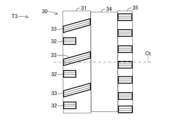
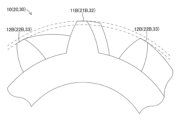
- the tool 30 constituting the tool unit T3 includes, for example, a disk-shaped tool body 31 formed by integrating the first tool body 11A and the second tool body 12A of the tool 10, as shown in FIG. 12.
- the tool body 31 is formed by the first tool body 11A and the second tool body 12A.
- the tool body 31 can also be formed by the first tool body 21A and the second tool body 22A of the tool 20.
- a first machining blade 32 is formed on the outer peripheral surface of the disk-shaped tool body 31, which performs a first machining operation on the workpiece teeth W1 of the gear workpiece W.
- the first machining blade 32 is formed to be parallel to the rotation axis Ct of the tool body 31.
- the first machining blade 32 is a framing blade that performs framing as the first machining operation.
- a second processing blade 33 is formed on the outer peripheral surface of the tool body 31 to perform a second processing on the work tooth W1 of the gear work W.
- the second processing blade 33 is formed so as to twist about the rotation axis Ct of the tool body 31.
- the second processing blade 33 is formed so as to have a longer blade length along the direction of the rotation axis Ct than the first processing blade 32 so that the processing point for the work tooth W1 can be moved.
- the second modified example illustrates a case where the second processing blade 33 is a relief blade that performs a relief processing as the second processing.
- the second processing blade 33 may also be a shaving blade that performs a shaving processing as the second processing.
- the first machining blade 32 and the second machining blade 33 are arranged alternately along the outer circumferential surface of the tool body 31, for example, in accordance with the spacing of the work teeth W1 in the circumferential direction of the gear work W, in the same manner as the tool 10 in which the first tool member 11 and the second tool member 12 described above are combined.
- the tool 30 and the chamfering cutter 35 are assembled together via the spacer 34 so that they are coaxial with each other and have a spacing according to the tooth width in the tooth trace direction of the gear work W.
- the control device 9 also generates a rotational driving force in the spindle motor 6A of the tool spindle 6 to rotate the tool unit T3 pressing against the gear workpiece W.
- This causes the first machining blade 32 and the chamfering cutter 25 to perform chamfering on the workpiece tooth W1.
- the second machining blade 33 adjacent to the first machining blade 32 performing the chamfering performs a relief or shaving process following the chamfering process by the first machining blade 32.
- the gear machining device 1 repeatedly and continuously performs the chamfering process and the relief or shaving process in the gear machining process shown in FIG. 6 until the machining time has elapsed a predetermined time. Therefore, in the second modified example, the same effects as those of the above-mentioned embodiment and the first embodiment can be obtained.
- the first modified example, and the second modified example, the first processing blade 11B, the first processing blade 21B, and the first processing blade 32 perform the framing process as the first process.
- the first processing blades 11B, 21B, and 32 and the framing cutters 14, 24, and 35 press the side surfaces parallel to the rotation axis Ct against the workpiece tooth W1 to chamfer the workpiece tooth W1 and form the framing portion W2.
- the first machining blade 11B, 21B, 32 is provided with chamfering portion 11D, chamfering portion 21D, and chamfering portion 32A for chamfering the workpiece tooth W1.
- the tools 10, 20, 30 chamfer the workpiece tooth W1 by pressing the chamfering portion 11D, 21D, 32A against the workpiece tooth W1 during the framing process. This makes it possible to form a framing portion W2 of the desired shape on the workpiece tooth W1.
- the chamfering cutter 14, 24, 35 is provided with chamfering portions 14A, 14B, chamfering portions 24A, 24B, and chamfering portions 35A, 35B for chamfering two adjacent work teeth W1 in a gear work W.
- the tool 10, 20, 30 chamfers the work teeth W1 by pressing the chamfering portion 14A, 24A, 35A against one of the two adjacent work teeth W1 and pressing the chamfering portion 14B, 24B, 35B against the other of the two adjacent work teeth W1 during the chamfering process. This makes it possible to form a chamfering portion W2 of the desired shape for the work tooth W1 and to shorten the processing time.
- the first machining blade 11B, 21B, 32 is provided with a chamfered portion 11D, 21D, 32A on only one side, and performs framing on one work tooth W1 of the gear work W.
- the tool units T1, T2, T3 are configured by assembling one tool 10, 20, 30 and a chamfering cutter 14, 24, 35 via the spacers 13, 23, 34.
- the chamfering cutters 14, 24, 35 and the spacers 13, 23, 34 of the tool units T1, T2, T3 may be omitted, and the two tools 10, 20, 30 may be assembled using bolts or the like.
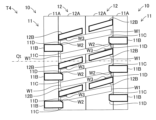
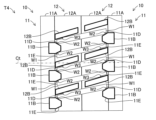
- a tool unit T4 can be configured by assembling two tools 10.
- the tool 10 constituting the tool unit T4 can be provided with a chamfered portion 11D on the first processing blade 11B in the same manner as in the third modified example described above. Also, in this case, as shown in Figure 18, the tool 10 constituting the tool unit T4 can be provided with chamfered portions 11D, 11E on the first processing blade 11B in the same manner as in the fourth modified example described above. Note that, although the fifth modified example shows an example of a tool unit T4 using the tool 10, it is of course also possible to form a tool unit using tools 20, 30.
- the second processing blade 22B of the second tool member 22 can have, for example, a protruding portion 22E protruding toward the adjacent second tool member 22 on the opposite side to the first tool member 21 along the rotation axis Ct.
- the blade length of the second machining blade 12B provided on the second tool member 12 can be made longer, and for example, by setting the angle between the second machining blade 12B and the work tooth W1 small, the relief portion W3 can be formed large along the tooth trace direction.
- the area in which relief processing is performed can be expanded as necessary.
- the serration groove 22D of the second machining blade 22B is more likely to come into contact with the tooth surface of the work tooth W1. This makes it possible to grind the tooth surface of the work tooth W1 more smoothly.
- the tools 10 and 20 constituting the tool unit T5 can be provided with chamfered portions 11D and 21D on the first processing blades 11B and 21B in the same manner as in the third modified example described above.
- the tools 10 and 20 constituting the tool unit T5 can be provided with chamfered portions 11D and 11E and chamfered portions 21D and 21E for chamfering the first processing blades 11B and 21B in the same manner as in the fourth modified example described above.
- the tool units T1, T2, T4, and T5 each have the tool 10 and the tool 20 in which one first tool member 11 and one second tool member 12, or one first tool member 21 and one second tool member 22 are combined.
- the tool units T1, T2, T4, and T5 each may have the tool 10 and the tool 20 in which a plurality of first tool members 11 and a plurality of second tool members 12, or a plurality of first tool members 21 and a plurality of second tool members 22 are combined.
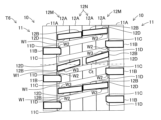
- the tool unit T6 may include, for example, a tool 10 having one first tool member 11 and two second tool members 12M and 12N.
- the arrangement of the second machining blades 12B of the two second tool members 12M and 12N can be different so that the machining positions relative to the work tooth W1 are different.
- the second machining blade 12B of the second tool member 12M is formed so that the contact angle with the work tooth W1 is small.
- the second machining blade 12B of the second tool member 12N is formed so that the contact angle with the work tooth W1 is large.
- the second tool member 12M and the second tool member 12N can each perform relief machining of different corners W3 (relief portions W3) of the work tooth W1, that is, two corners W3.
- the seventh modified example it is possible to increase the number of locations where the second processing, for example, relief processing, can be performed, and as a result, it is possible to reduce the processing time.
- the two second tool members 12M and 12N perform the second processing, although they are at different processing positions. Therefore, the two second tool members 12M and 12N can be regarded as one second tool member 12.
- the second processing is not limited to relief processing, but also includes the shaving processing described above.
- the tool 10 constituting the tool unit T6 can be provided with a chamfered portion 11D on the first processing blade 11B in the same manner as in the third modified example described above. Also in this case, as shown in FIG. 24, the tool 10 constituting the tool unit T6 can be provided with chamfered portions 11D, 11E on the first processing blade 11B in the same manner as in the fourth modified example described above. Although not shown in the figures, the tool 20 can also be provided with chamfered portions in a similar manner.
- the blade height of the first machining blade 11B, 21B, 32 and the blade height of the second machining blade 12B, 22B, 33 are the same as each other.
- the force required to machine the workpiece tooth W1 of the gear workpiece W i.e., the machining force
- the gear machining device 1 performs machining while pressing the tool spindle 6, i.e., the tools 10, 20, 30, toward the gear workpiece W so as to generate a predetermined pressing force, with the tools 10, 20, 30 meshing with the gear workpiece W.
- the blade height of the first machining blades 11B, 21B, 32 and the blade height of the second machining blades 12B, 22B, 33 are made different so that the necessary machining force can be applied to the gear workpiece W depending on the difference between the first machining and the second machining.
- the blade height of the machining blade that requires a relatively large machining force is made higher than the blade height of the other machining blade.
- frazing requires a greater machining force in the radial direction of the workpiece than relief machining or shaving machining along the tooth trace direction. For this reason, as shown in FIG. 25, the blade height of the first machining blades 11B, 21B, 32 that perform frazing is made higher than the blade height of the second machining blades 12B, 22B, 33 that perform relief machining and shaving.
- the processing force of the framing processing by the first processing blades 11B, 21B, 32 is relatively greater than the processing force of the relief processing and shaving processing by the second processing blades 12B, 22B, 33. Therefore, the first processing blades 11B, 21B, 32 can reliably form the framing portion W2 on the workpiece tooth W1.
- the same effects as those of the above-mentioned embodiment and each modified example can be obtained.
- the first tool member 11, 21 and the second tool member 12, 22 are coaxial with respect to the rotation axis Ct, that is, the central axis of the first tool body 11A, 21A and the central axis of the second tool body 12A, 22A are coaxial with respect to the rotation axis Ct.
- the processing force required for the first processing may differ from that required for the second processing.
- it is effective to vary the blade height of some of the first processing blades 11B, 21B formed along the outer peripheral surface of the first tool body 11A, 21A, or the blade height of some of the second processing blades 12B, 22B formed along the outer peripheral surface of the second tool body 12A, 22A, depending on the required processing force.
- the central axis Ot1 of the first tool body 11A, 21A and the central axis Ot2 of the second tool body 12A, 22A are offset by a distance L from the central axis Ot1 of the first tool body 11A, 21A and the central axis Ot2 of the second tool body 12A, 22A.
- the central axis Ot1 of the first tool body 11A, 21A is offset by a distance L in the Z-axis direction with respect to the central axis Ot2 of the second tool body 12A, 22A.
- the central axis Ot2 of the second tool body 12A, 22A coincides with the rotation axis Ct of the tools 10, 20.
- the central axis Ot1 of the first tool body 11A, 21A is eccentric from the rotation axis Ct by a distance L. It is not necessary for the central axis Ot2 of the second tool body 12A, 22A to coincide with the rotation axis Ct of the tools 10, 20.
- the diameter of the second tool body 12A, 22A can be set to be smaller than the diameter of the first tool body 11A, 21A by a distance 2L.
- the outer diameter of the first tool body 11A, 21A and the outer diameter of the second tool body 12A, 22A are different, and the outer diameter of the first tool body 11A, 21A is set to be larger than the outer diameter of the second tool body 12A, 22A.
- the tenth modified example therefore illustrates a case in which the second machining blade 12B, 22B, 33 has a coating layer containing abrasive grains and performs relief processing or shaving processing by grinding on the work tooth W1.
- the surface of the second machining blade 12B, 22B, 33 is covered with a coating layer 12E, 22F, 33C containing abrasive grains.
- the second cutting blades 12B, 22B, 33 it is effective for the second cutting blades 12B, 22B, 33 to have coating layers 12E, 22F, 33C when performing grinding, but it is also possible for the first cutting blades 11B, 21B, 32, which perform rolling, to have a coating layer.
- the coating layer containing abrasive grains has high hardness, making it possible to suppress wear and abrasion of the first cutting blades 11B, 21B, 32, which perform rolling.
- the configuration for moving the gear workpiece W and the tool 10 relative to each other can be changed as appropriate.
- the tool 10 i.e., the tool spindle 6
- the deburring roller 8 can be made to move linearly toward the gear workpiece W in the Z-axis direction.
- the gear machining device 1 can also move the gear workpiece W (i.e., the workpiece spindle 3) linearly toward the tool 10 (i.e., the tool spindle 6) in the Z-axis direction or the X-axis direction.
- the gear machining device 1 can be configured to rotate the tool spindle 6 around the A-axis, which is the rotation axis around the X-axis in the reference state, with the workpiece spindle 3 as the reference.
- the gear machining device 1 can be configured to rotate the workpiece spindle 3 around the C-axis or the A-axis with the tool spindle 6 as the reference.
- the gear machining device 1 has been exemplified as having the work spindle 3 as a free rotating axis and the tool spindle 6 as a rotationally driven axis.
- the gear machining device 1 it is also possible to configure the work spindle 3 as a rotationally driven axis and the tool spindle 6 as a free rotating axis.
- the second form of the tool of the present invention is the tool of the first form described above, in which the tool body is formed of a disk-shaped first tool body and a disk-shaped second tool body, and includes a first tool member having a first processing blade formed on the outer peripheral surface of the first tool body and performing a first processing on the workpiece, and a second tool member having a second processing blade formed on the outer peripheral surface of the second tool body and performing a second processing on the workpiece, and when the first tool member and the second tool member are combined so that the rotation axes of the first tool body and the second tool body are coaxial, one of the processing blades of the first tool member and the second tool member is formed to protrude toward the other of the first tool member and the second tool member, and the other processing blade is formed to be positioned at a predetermined distance in the circumferential direction from the protruding portion of the one processing blade.
- the tool of the second embodiment of the present invention is a tool having a plurality of machining blades, and is composed of a first tool member having a first machining blade formed on the outer peripheral surface of a disk-shaped first tool body for performing a first machining on a workpiece, and a second tool member having a second machining blade formed on the outer peripheral surface of a disk-shaped second tool body different from the first tool body for performing a second machining on the workpiece, and when the first tool member and the second tool member are combined so that the rotation axes of the first tool body and the second tool body are coaxial, one of the machining blades of the first tool member and the second tool member may be formed to protrude toward the other of the first tool member and the second tool member, and the other machining blade may be formed to be positioned at a predetermined interval in the circumferential direction from the protruding portion of one of the machining blades.
- the third form of the tool of the present invention is the second form of the tool, with one side having a protruding portion formed so that at least a portion of the processing blade protrudes toward the other side, and the other side having a removal portion where at least a portion of the processing blade has been removed, and when the first tool member and the second tool member are combined, the protruding portion enters the removal portion.
- the forming pitch at which the first machining blade is formed on the first tool member is the same as the forming pitch at which the second machining blade is formed on the second tool member in the third embodiment.
- the fifth embodiment of the tool of the present invention is the second embodiment of the tool, in which the number of teeth on the other cutting blade is less than the number of teeth on one cutting blade.
- the sixth embodiment of the tool of the present invention is the fifth embodiment of the tool, in which the forming pitch at which the cutting blade is formed on the other side is at least twice the forming pitch at which the cutting blade is formed on the one side.
- the seventh embodiment of the tool of the present invention is any one of the second to sixth embodiments, in which the central axis of one of the first and second tool members is eccentric with respect to the central axis of the other of the first and second tool members.
- the eighth embodiment of the tool of the present invention is the seventh embodiment of the tool, in which the outer diameter of the first tool body of the first tool member is different from the outer diameter of the second tool body of the second tool member.
- the ninth embodiment of the tool of the present invention is the eighth embodiment of the tool, in which the outer diameter of the first tool body is greater than the outer diameter of the second tool body.
- the tenth embodiment of the tool of the present invention is any one of the first to ninth embodiments, in which the first and second processing blades have different blade heights, which represent the height from the base to the tip of the blade.
- the tool of the eleventh embodiment of the present invention is the tool of the tenth embodiment, in which the blade height of one of the first processing blade and the second processing blade is greater than the blade height of the other of the first processing blade and the second processing blade.
- the twelfth form of the tool of the present invention is a tool according to any one of the first to eleventh forms, in which the workpiece is a gear to be machined, the first machining blade is a framing blade that performs a first machining process by meshing with the gear to be machined and pressing an end of the tooth flank of the gear to be machined in the tooth trace direction to chamfer the end, and the second machining blade is a relief blade that performs a second machining process by meshing with the gear to be machined and pressing one of the four corners of the tooth flank in the tooth trace direction while moving the machining point relative to the tooth flank of the gear to be machined, thereby removing the corner of the corner.
- the thirteenth form of the tool of the present invention is a tool according to any one of the first to twelfth forms, in which the workpiece is a gear to be machined, the first machining blade is a framing blade that meshes with the gear to be machined and presses the end of the tooth surface of the gear to be machined in the tooth trace direction to perform a framing process as a first process, and the second machining blade is a shaving blade that meshes with the gear to be machined and moves the machining point relative to the tooth surface while contacting the tooth surface to perform a shaving process as a second process, removing unevenness on the tooth surface.
- the fourteenth embodiment of the present invention is a tool according to any one of the first to thirteenth embodiments, in which the surface of the first processing blade and at least the second processing blade of the second processing blade is covered with a coating layer containing abrasive grains.
- the fifteenth embodiment of the tool of the present invention is a tool of any one of the first to fourteenth embodiments, which has a first cutting blade group consisting of a plurality of first cutting blades arranged continuously along the outer peripheral surface, and a second cutting blade group consisting of at least one second cutting blade along the outer peripheral surface.
- chamfered portion 32B... Chamfering portion, 33... second processing blade (relief blade, shaving blade), 34... spacer, 35... chamfering cutter, 35A... chamfering portion, 35B... chamfering portion, W... gear work (gear to be processed (workpiece)), W1... work tooth, W2... chamfering portion (end), W3... relief portion (corner), Ct, Cw, Cr... rotation axis, Ot1, Ot2... center axis, T1, T2, T3, T4, T5, T6... tool unit
Landscapes
- Engineering & Computer Science (AREA)
- Mechanical Engineering (AREA)
- Gear Processing (AREA)
Priority Applications (2)
| Application Number | Priority Date | Filing Date | Title |
|---|---|---|---|
| JP2024501729A JP7587730B1 (ja) | 2023-08-29 | 2023-08-29 | 工具、歯車加工装置及び歯車加工方法 |
| PCT/JP2023/031141 WO2025046725A1 (ja) | 2023-08-29 | 2023-08-29 | 工具、歯車加工装置及び歯車加工方法 |
Applications Claiming Priority (1)
| Application Number | Priority Date | Filing Date | Title |
|---|---|---|---|
| PCT/JP2023/031141 WO2025046725A1 (ja) | 2023-08-29 | 2023-08-29 | 工具、歯車加工装置及び歯車加工方法 |
Publications (1)
| Publication Number | Publication Date |
|---|---|
| WO2025046725A1 true WO2025046725A1 (ja) | 2025-03-06 |
Family
ID=93518193
Family Applications (1)
| Application Number | Title | Priority Date | Filing Date |
|---|---|---|---|
| PCT/JP2023/031141 Pending WO2025046725A1 (ja) | 2023-08-29 | 2023-08-29 | 工具、歯車加工装置及び歯車加工方法 |
Country Status (2)
| Country | Link |
|---|---|
| JP (1) | JP7587730B1 (https=) |
| WO (1) | WO2025046725A1 (https=) |
Citations (6)
| Publication number | Priority date | Publication date | Assignee | Title |
|---|---|---|---|---|
| DE2654177A1 (de) * | 1976-11-30 | 1978-06-01 | Zahnradfabrik Friedrichshafen | Schaelwerkzeug zum bearbeiten von innen- und aussenverzahnten stirnraedern |
| JP2009034785A (ja) * | 2007-08-02 | 2009-02-19 | Honda Motor Co Ltd | 歯車加工方法 |
| JP2012096352A (ja) * | 2004-04-22 | 2012-05-24 | Reishauer Ag | 研削ウォーム及び研削ウォームをプロファイリングするためのプロファイリングギヤ並びにプロファイリング方法 |
| JP2013056403A (ja) | 2011-09-09 | 2013-03-28 | Mitsubishi Materials Corp | フレージングカッタ |
| JP2018167369A (ja) * | 2017-03-30 | 2018-11-01 | 三菱マテリアル株式会社 | フレージングカッタ |
| JP2020526399A (ja) * | 2017-07-13 | 2020-08-31 | グリーソン − プァウター マシネンファブリク ゲーエムベーハー | 歯切りされたワークピースを創成するための方法、並びにそのために好適な制御プログラム、ツール及び歯切り盤 |
-
2023
- 2023-08-29 JP JP2024501729A patent/JP7587730B1/ja active Active
- 2023-08-29 WO PCT/JP2023/031141 patent/WO2025046725A1/ja active Pending
Patent Citations (6)
| Publication number | Priority date | Publication date | Assignee | Title |
|---|---|---|---|---|
| DE2654177A1 (de) * | 1976-11-30 | 1978-06-01 | Zahnradfabrik Friedrichshafen | Schaelwerkzeug zum bearbeiten von innen- und aussenverzahnten stirnraedern |
| JP2012096352A (ja) * | 2004-04-22 | 2012-05-24 | Reishauer Ag | 研削ウォーム及び研削ウォームをプロファイリングするためのプロファイリングギヤ並びにプロファイリング方法 |
| JP2009034785A (ja) * | 2007-08-02 | 2009-02-19 | Honda Motor Co Ltd | 歯車加工方法 |
| JP2013056403A (ja) | 2011-09-09 | 2013-03-28 | Mitsubishi Materials Corp | フレージングカッタ |
| JP2018167369A (ja) * | 2017-03-30 | 2018-11-01 | 三菱マテリアル株式会社 | フレージングカッタ |
| JP2020526399A (ja) * | 2017-07-13 | 2020-08-31 | グリーソン − プァウター マシネンファブリク ゲーエムベーハー | 歯切りされたワークピースを創成するための方法、並びにそのために好適な制御プログラム、ツール及び歯切り盤 |
Also Published As
| Publication number | Publication date |
|---|---|
| JP7587730B1 (ja) | 2024-11-20 |
| JPWO2025046725A1 (https=) | 2025-03-06 |
Similar Documents
| Publication | Publication Date | Title |
|---|---|---|
| US9199323B2 (en) | Semi-completing skiving method and device having corresponding skiving tool for executing a semi-completing skiving method | |
| US6757949B2 (en) | Combination gear hobber, chamfer/debur and shaver apparatus and method | |
| KR20120139595A (ko) | 복수의 다른 베벨 기어의 기어 예비절삭 방법과 부합하는 밀링 공구의 사용 | |
| US7624505B2 (en) | Deburring by hobbing with integrated secondary deburring without a smoothing tool | |
| CN101808771B (zh) | 桶状蜗杆形刀具 | |
| CN107405706B (zh) | 通过滚切对工件轮制齿的方法和设备 | |
| CN121870179A (zh) | 用于工件的齿轮制造加工的方法 | |
| CN115135442B (zh) | 加工工件齿布置齿面区方法、倒角刀具、具有执行该方法控制指令的控制程序及齿轮切削机 | |
| US11819935B2 (en) | Method for precision machining a workpiece provided with gearing | |
| US20060174464A1 (en) | Multiple operation gear manufacturing apparatus with common work axis | |
| US20090060672A1 (en) | Multiple Operation Gear Manufacturing Apparatus With Common Work Axis | |
| CN109702276B (zh) | 用于加工锥齿轮工件的齿侧面的方法 | |
| US20240227049A1 (en) | Method for machining a tooth flank region of a workpiece tooth arrangement, chamfering tool, control program having control instructions for carrying out the method, and gear-cutting machine | |
| JP5162920B2 (ja) | 歯車の加工方法及び歯車加工装置 | |
| JP7587730B1 (ja) | 工具、歯車加工装置及び歯車加工方法 | |
| CN113182618A (zh) | 线接触弧齿圆柱齿轮的加工方法 | |
| JP2813448B2 (ja) | 主ロータ用グロボイドねじを製造する方法及び装置 | |
| CN113579369B (zh) | 用于加工齿顶圆直径的方法和用于产生齿轮的工具 | |
| JP4326745B2 (ja) | 歯車加工方法 | |
| WO2022078629A1 (en) | Near zero degrees cross-axis angle gear cutter and method of gear cutting using such a tool | |
| CN113319376A (zh) | 弧齿圆柱齿轮副的加工刀具及加工方法 | |
| JP2588353B2 (ja) | 歯車加工装置 | |
| US20230219153A1 (en) | Method And Device For Grinding Tooth Flanks Of The Teeth Of Toothed Workpieces, And Tool For Carrying Out The Method | |
| MEHR et al. | HARD FINISHING OF ASYMMETRIC TOOTH PROFILES-SOLUTIONS FOR SERIES PRODUCTION | |
| JPH0788720A (ja) | 正面カムの加工方法 |
Legal Events
| Date | Code | Title | Description |
|---|---|---|---|
| ENP | Entry into the national phase |
Ref document number: 2024501729 Country of ref document: JP Kind code of ref document: A |
|
| WWE | Wipo information: entry into national phase |
Ref document number: 2024501729 Country of ref document: JP |
|
| WWE | Wipo information: entry into national phase |
Ref document number: 18841786 Country of ref document: US |
|
| 121 | Ep: the epo has been informed by wipo that ep was designated in this application |
Ref document number: 23924466 Country of ref document: EP Kind code of ref document: A1 |