WO2025032933A1 - 電子部品及び複合電子部品 - Google Patents
電子部品及び複合電子部品 Download PDFInfo
- Publication number
- WO2025032933A1 WO2025032933A1 PCT/JP2024/019744 JP2024019744W WO2025032933A1 WO 2025032933 A1 WO2025032933 A1 WO 2025032933A1 JP 2024019744 W JP2024019744 W JP 2024019744W WO 2025032933 A1 WO2025032933 A1 WO 2025032933A1
- Authority
- WO
- WIPO (PCT)
- Prior art keywords
- external electrode
- electronic component
- edge
- pair
- component according
- Prior art date
- Legal status (The legal status is an assumption and is not a legal conclusion. Google has not performed a legal analysis and makes no representation as to the accuracy of the status listed.)
- Pending
Links
Images








Classifications
-
- H—ELECTRICITY
- H01—ELECTRIC ELEMENTS
- H01C—RESISTORS
- H01C1/00—Details
- H01C1/01—Mounting; Supporting
-
- H—ELECTRICITY
- H01—ELECTRIC ELEMENTS
- H01C—RESISTORS
- H01C1/00—Details
- H01C1/14—Terminals or tapping points specially adapted for resistors; Arrangements of terminals or tapping points on resistors
- H01C1/142—Terminals or tapping points specially adapted for resistors; Arrangements of terminals or tapping points on resistors the terminals or tapping points being coated on the resistive element
-
- H—ELECTRICITY
- H01—ELECTRIC ELEMENTS
- H01F—MAGNETS; INDUCTANCES; TRANSFORMERS; SELECTION OF MATERIALS FOR THEIR MAGNETIC PROPERTIES
- H01F27/00—Details of transformers or inductances, in general
- H01F27/28—Coils; Windings; Conductive connections
- H01F27/29—Terminals; Tapping arrangements for signal inductances
-
- H—ELECTRICITY
- H01—ELECTRIC ELEMENTS
- H01G—CAPACITORS; CAPACITORS, RECTIFIERS, DETECTORS, SWITCHING DEVICES, LIGHT-SENSITIVE OR TEMPERATURE-SENSITIVE DEVICES OF THE ELECTROLYTIC TYPE
- H01G4/00—Fixed capacitors; Processes of their manufacture
- H01G4/002—Details
- H01G4/228—Terminals
- H01G4/232—Terminals electrically connecting two or more layers of a stacked or rolled capacitor
-
- H—ELECTRICITY
- H01—ELECTRIC ELEMENTS
- H01G—CAPACITORS; CAPACITORS, RECTIFIERS, DETECTORS, SWITCHING DEVICES, LIGHT-SENSITIVE OR TEMPERATURE-SENSITIVE DEVICES OF THE ELECTROLYTIC TYPE
- H01G4/00—Fixed capacitors; Processes of their manufacture
- H01G4/30—Stacked capacitors
-
- H—ELECTRICITY
- H01—ELECTRIC ELEMENTS
- H01G—CAPACITORS; CAPACITORS, RECTIFIERS, DETECTORS, SWITCHING DEVICES, LIGHT-SENSITIVE OR TEMPERATURE-SENSITIVE DEVICES OF THE ELECTROLYTIC TYPE
- H01G4/00—Fixed capacitors; Processes of their manufacture
- H01G4/32—Wound capacitors
Definitions
- This disclosure relates to electronic components and composite electronic components.
- the AC coupling circuit shown in the following patent document has a chip capacitor and a die capacitor connected in parallel as electronic components that remove DC electrical components.
- a high dielectric constant material is selected as the dielectric of the capacitor.
- high dielectric constant materials generally do not have excellent high frequency characteristics, resulting in loss of high frequency signals. Therefore, there is a demand for the development of electronic components that suppress high frequency signal loss. In addition, there is a demand for suppressing high frequency signal loss even when the electronic components are other than capacitors.
- the present disclosure has been made in consideration of the above, and aims to provide an electronic component that suppresses loss of high-frequency signals, and a composite electronic component that includes the electronic component.
- the electronic component of the present disclosure has a first external electrode, a base portion, and a second external electrode arranged in sequence in a first direction.
- a direction opposite to the first direction is defined as a second direction.
- a direction perpendicular to the first direction is defined as an orthogonal direction.
- the first external electrode has a first external electrode body arranged in the second direction from the second external electrode across the base portion, and a first external electrode extension extending in the first direction from an edge of the first external electrode body.
- the second external electrode has a second external electrode body arranged in the first direction from the first external electrode across the base portion, and a second external electrode extension extending in the second direction from an edge of the second external electrode body.
- the first external electrode has a first external electrode body arranged in the second direction from the second external electrode across the base portion, and a first external electrode extension extending in the first direction from an edge of the first external electrode body.
- the second external electrode has a second external electrode main body disposed in the first direction from the first external electrode across the base portion, and a second external electrode extension extending in the second direction from an edge of the second external electrode main body.
- a portion of the first external electrode extension and a portion of the second external electrode extension form a pair of opposing portions that face each other in the perpendicular direction.
- An insulating layer is provided between the pair of opposing portions.
- the composite electronic component of the present disclosure also includes the electronic component described above, an annular retaining portion extending circumferentially along the outer peripheral surface of the electronic component, and an annular external conductor portion extending circumferentially along the outer peripheral surface of the retaining portion.
- the electronic components and composite electronic components disclosed herein reduce loss of high-frequency signals.
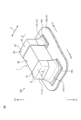
- FIG. 1 is a perspective view of an electronic component module according to a first embodiment.
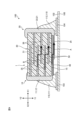
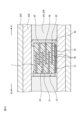
- FIG. 2 is a cross-sectional view taken along line II-II in FIG. 1, viewed from the direction of the arrow.
- FIG. 3 is an enlarged view of a part of FIG.
- FIG. 4 is a diagram for explaining the effects of the electronic component according to the first embodiment.
- FIG. 5 is an enlarged view of an electronic component according to a first modified example.
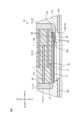
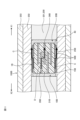
- FIG. 6 is a cross-sectional view of the electronic component module according to the second embodiment taken along the center line of a coaxial cable.
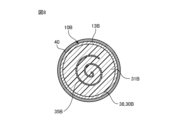
- FIG. 9 is a cross-sectional view taken along line IX-IX in FIG. 7 and seen from the direction of the arrows.
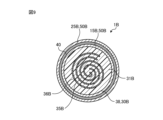
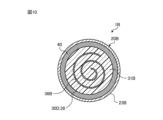
- FIG. 10 is a cross-sectional view taken along line XX in FIG. 7 and seen from the direction of the arrows.
- FIG. 11 is a diagram for explaining the effects of the electronic component according to the second embodiment.
- FIG. 12 is a diagram for explaining the effect of the electronic component of the second modified example.
- 13 is a cross-sectional view taken along line XII-XII in FIG. 12 and seen from the direction of the arrows.
- FIG. 14 is a cross-sectional view showing an example in which the electronic component of the first embodiment is provided on a coaxial cable.
- FIG. 15 is a cross-sectional view of an electronic component according to a third modified example.
- FIG. 16 is a cross-sectional view of the electronic component module of the third embodiment taken along the center line of the coaxial cable.
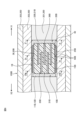
- 17 is a cross-sectional view taken along line XVII-XVII in FIG. 16 and seen from the direction of the arrows.
- FIG. 18 is a cross-sectional view of a composite electronic component according to a fourth modified example taken in an orthogonal direction.
- FIG. 19 is a cross-sectional view of a composite electronic component according to the fifth modified example taken in an orthogonal direction.
- FIG. 20 is a cross-sectional view of the electronic component module of the sixth modified example taken along the center line of the coaxial cable.
- FIG. 1 is a perspective view of an electronic component module according to the first embodiment.
- an electronic component module 100 according to the first embodiment includes a substrate 101 having a mounting surface 102, an electronic component 1 arranged on the mounting surface 102, and solder 110 that fixes the electronic component 1 to the mounting surface 102.
- the substrate 101 is a multi-layer wiring substrate, in which wiring layers and insulating layers are alternately stacked.
- the mounting surface 102 of the substrate 101 is composed of an insulating layer.
- a first land electrode 103 and a second land electrode 104 are provided on the mounting surface 102 of the substrate 101. Note that the substrate of the present disclosure is not limited to a multi-layer wiring substrate.
- the solder 110 has a first solder 111 that joins the first land electrode 103 to the electronic component 1, and a second solder 112 that joins the second land electrode 104 to the electronic component 1.
- the electronic component 1 has a first external electrode 10, a base portion 30, and a second external electrode 20 arranged in this order in a direction parallel to the mounting surface 102.
- the direction in which the first external electrode 10, the base portion 30, and the second external electrode 20 are arranged is referred to as the length direction.
- the direction in which the second external electrode 20 is arranged as viewed from the first external electrode 10 in the length direction is referred to as the first direction X1, and the direction opposite to the first direction X1 is referred to as the second direction X2.
- the direction perpendicular to the length direction (first direction X1) is referred to as the perpendicular direction.
- the overall shape of the electronic component 1 is a hexahedron, and all of the ridges and corners of the hexahedron are chamfered. Note that the present disclosure is not limited to a hexahedron in which all of the ridges and corners are chamfered, and it is sufficient that at least one of the ridges and corners of the hexahedron is chamfered.
- the above-mentioned ridges are parts where two faces intersect, and the above-mentioned corners are parts where three faces intersect.
- FIG. 2 is a cross-section taken along line II-II in FIG. 1, viewed from the direction of the arrow.
- the base portion 30 has a dielectric 31 and a plurality of first internal electrodes 35 and second internal electrodes 36 arranged alternately inside the dielectric 31.
- the dashed line M in FIG. 2 is an imaginary line that passes through the center of the base portion 30 in the longitudinal direction.
- the dielectric 31 is formed in a rectangular parallelepiped shape, and has a first end face 33 facing the second direction X2, and a second end face 34 facing the first direction X1.
- the outer peripheral surface of the dielectric 31 includes a first surface 32 facing the mounting surface 102.
- the first surface 32 is a flat surface parallel to the mounting surface 102.
- An insulating layer 40 is provided on the first surface 32. Details of the insulating layer 40 will be described later.
- the first internal electrode 35 and the second internal electrode 36 are formed in a plate shape and extend in a direction parallel to the mounting surface 102.
- the direction in which the first internal electrodes 35 and the second internal electrodes 36 are arranged is referred to as the stacking direction.
- the direction in which the first surface 32 is arranged as viewed from the first internal electrodes 35 and the second internal electrodes 36 is referred to as the first stacking direction Y1
- the direction opposite to the first stacking direction Y1 is referred to as the second stacking direction Y2.
- the direction perpendicular to both the length direction and the stacking direction is referred to as the width direction Z (see FIG. 1).
- the first internal electrode 35 and the second internal electrode 36 contain, for example, a metal such as Ni, Ag, Pd, Au, Cu, Ti, or Cr, or an alloy mainly composed of the above-mentioned metal.
- the first internal electrode 35 and the second internal electrode 36 may contain, as a common material, the same ceramic material as the dielectric ceramic contained in the dielectric 31.
- the end of the first internal electrode 35 in the second direction X2 is extended to the first end surface 33 of the dielectric 31 and joined to the first external electrode 10.
- the end of the second internal electrode 36 in the first direction X1 is extended to the second end surface 34 of the dielectric 31 and joined to the second external electrode 20.
- the first internal electrode 35 and the second internal electrode 36 are spaced apart from each other in the stacking direction. Therefore, a dielectric 31 (dielectric layer) is interposed between the first internal electrode 35 and the second internal electrode 36. As a result, the portions of the first internal electrode 35 and the second internal electrode 36 that face each other form opposing electrodes. Then, a capacitance is formed by the opposing electrodes, and the electronic component 1 functions as a capacitor.
- a dielectric 31 dielectric layer
- the first external electrode 10 and the second external electrode 20 are each composed of a single metal part. Note that the present disclosure is not particularly limited and may also be directed to the first external electrode 10 and the second external electrode 20 being composed of multiple plating layers.
- the first external electrode 10 has a first external electrode body 11 arranged in the second direction X2 of the base part 30, and a first external electrode extension part 15 arranged in the first stacking direction Y1 of the base part 30.
- the first external electrode body 11 has a first opposing wall 12 facing the first end face 33 of the dielectric 31, and a ring-shaped first fitting part 13 protruding from the edge of the first opposing wall 12 in the first direction X1.
- the first opposing wall 12 is formed in a plate shape and extends in the stacking direction and the width direction Z.
- the first opposing wall 12 is rectangular when viewed from the length direction.
- a first internal electrode 35 is joined to the face of the first opposing wall 12 in the first direction X1.
- the first fitting portion 13 is formed into a rectangular frame when viewed from the length direction.
- the end of the base portion 30 in the second direction X2 is fitted inside the first fitting portion 13.
- a part of the first fitting portion 13 is disposed in the first stacking direction Y1 with respect to the dielectric 31 and abuts against the first surface 32.
- the part of the first fitting portion 13 that abuts against the first surface 32 of the dielectric 31 will be referred to as the first mounting surface sidewall portion 14.
- the first external electrode body 11 is disposed in the second stacking direction Y2 of the first land electrode 103.
- the first solder 111 is mainly bonded to the surface of the first opposing wall 12 in the second direction X2 (see FIG. 1). This electrically connects the first external electrode 10 and the first land electrode 103.
- the first external electrode extension 15 extends in the first direction X1 from an edge of the first external electrode body 11.
- the edge of the first external electrode body 11 refers to the edge of the first fitting portion 13 (in this embodiment, the end of the first mounting surface side wall portion 14 in the first direction X1).
- the first external electrode extension 15 is formed in a plate shape and extends in the length direction and width direction Z.
- the first external electrode extension 15 extends along the first surface 32 and abuts against the first surface 32.
- the end 15a of the first external electrode extension 15 in the first direction X1 is located further in the first direction X1 than the dashed line M.
- the second external electrode 20 has a second external electrode body 21 arranged in the first direction X1 of the base part 30, and a second external electrode extension part 25 arranged in the first stacking direction Y1 of the base part 30.
- the second external electrode body 21 has a second opposing wall 22 facing the second end face 34 of the dielectric 31, and a ring-shaped second fitting part 23 protruding in the second direction X2 from the edge of the second opposing wall 22.
- the second opposing wall 22 is formed in a plate shape and extends in the stacking direction and the width direction Z.
- the second opposing wall 22 is rectangular when viewed from the length direction.
- a second internal electrode 36 is joined to the surface of the second opposing wall 22 in the second direction X2.
- the second fitting portion 23 is formed into a rectangular frame when viewed from the length direction.
- the end of the base portion 30 in the first direction X1 is fitted inside the second fitting portion 23.
- a part of the second fitting portion 23 is disposed in the first stacking direction Y1 with respect to the dielectric 31 and abuts against the first surface 32.
- the part of the second fitting portion 23 that abuts against the first surface 32 of the dielectric 31 will be referred to as the second mounting surface side wall portion 24.
- the second external electrode body 21 is disposed in the second stacking direction Y2 of the second land electrode 104.
- the second solder 112 is mainly bonded to the surface of the second opposing wall 22 in the first direction X1 (see FIG. 1). This electrically connects the second external electrode 20 and the second land electrode 104.
- the second external electrode extension 25 extends in the second direction X2 from the edge of the second external electrode body 21.
- the edge of the second external electrode body 21 refers to the edge of the second fitting portion 23 (in this embodiment, the end of the second mounting surface side wall portion 24 in the second direction X2).
- the second external electrode extension 25 is formed in a plate shape and extends in the length direction and width direction Z.
- the second external electrode extension 25 is spaced from the first surface 32 of the base portion 30 in the first stacking direction Y1.
- An insulating layer 40 is interposed between the second external electrode extension 25 and the first surface 32.
- the end 25a of the second external electrode extension 25 in the second direction X2 is disposed further in the second direction X2 than the dashed line M.
- a portion of the first external electrode extension 15 and a portion of the second external electrode extension 25 are spaced apart in the stacking direction and face each other in a direction perpendicular to each other.
- the portions of the first external electrode extension 15 and the second external electrode extension 25 that face each other are referred to as a pair of facing portions 50, 50.
- An insulating layer 40 is interposed between the pair of opposing portions 50, 50.
- the insulating layer 40 is also provided on the first stacking direction Y1 of the first external electrode extension 15. Therefore, the surface of the first external electrode extension 15 in the first stacking direction Y1 is not exposed.
- the insulating layer 40 is not provided on the first stacking direction Y1 of the second external electrode extension 25. Therefore, the surface of the second external electrode extension 25 in the first stacking direction Y1 is exposed.
- FIG. 3 is an enlarged view of a portion of FIG. 2.
- imaginary lines N1 and N2 in FIG. 3 are boundary lines when the base portion 30 is divided into three equal parts in the longitudinal direction. More specifically, imaginary line N1 is a boundary line on the second direction X2 side of the longitudinal center of the base portion 30, and imaginary line N2 is a boundary line on the first direction X1 side of the longitudinal center of the base portion 30.
- the pair of opposing portions 50, 50 are arranged in the first stacking direction Y1 (orthogonal direction) with respect to the center portion (portion between virtual lines N1 and N2) when the base portion 30 is divided into three equal parts in the longitudinal direction. Therefore, the distance L1 from the second external electrode extension portion 25 to the first solder 111 is relatively large. Note that the surface of the second external electrode extension portion 25 in the first stacking direction Y1 is exposed, and there is a possibility that it will join with the first solder 111 that has dissolved between the mounting surface 102 and the base portion 30. However, according to this embodiment, since the distance L1 is relatively large, there is a low possibility that the second external electrode extension portion 25 and the first solder 111 will join.
- the length L2 of the pair of opposing portions 50, 50 in the longitudinal direction is 1/20 or more of the length L3 of the base portion 30 in the longitudinal direction (first direction X1).
- the distance L4 between the pair of opposing parts 50, 50 is 25 ⁇ m or more and 100 ⁇ m or less. If the distance L4 is 25 ⁇ m or more and 100 ⁇ m or less, the pair of opposing parts 50, 50 are magnetically coupled to each other. Also, minute irregularities of 10 ⁇ m or less may be formed on the surface of the opposing part 50. If the distance L4 between at least the pair of opposing parts 50, 50 is 25 ⁇ m, even if a 10 ⁇ m convex part is formed on each of the pair of opposing parts 50, 50, the insulating layer 40 is reliably interposed between the convex parts. In other words, contact between the pair of opposing parts 50, 50 is reliably avoided. Also, if the distance L4 between the pair of opposing parts 50, 50 exceeds 100 ⁇ m, there is a possibility that the loss of high frequency signals will increase, which is not preferable.
- the distance L5 between the first external electrode extension 15 and the internal electrode is greater than the distance L4 between the pair of opposing portions 50, 50. This prevents the first external electrode extension 15 and the internal electrode (the second internal electrode 36 in FIG. 3) from being magnetically coupled.
- FIG. 4 is a diagram for explaining the effect of the electronic component of the first embodiment.
- a signal is supplied from the first land electrode 103 to the first external electrode 10 in the electronic component module 100 of the first embodiment.
- the high-frequency signal passes through a pair of opposing parts 50, 50, which is the shortest path, and is sent to the second external electrode 20 (see arrow A in FIG. 4).
- the shortest path in this embodiment refers to the shortest circuit among the electric circuits connecting the first land electrode 103 and the second land electrode 104.
- the pair of opposing parts 50, 50 are arranged closer to the mounting surface side than the other internal electrodes, and are the shortest path. From the above, the high-frequency signal passes through the pair of opposing parts 50, 50, and does not pass through the dielectric layer between the first internal electrode 35 and the second internal electrode 36. Thus, the loss of the high-frequency signal is suppressed.
- the low-frequency signal passes through the first internal electrode 35 and the second internal electrode 36 (see arrow B in FIG. 4).
- the DC electrical component is removed and signal loss is suppressed over a wide band from the high frequency band to the low frequency band.
- the electronic component 1 of the first embodiment has been described above, but the present disclosure is not limited thereto.
- the present disclosure may be modified so that the longitudinal positions of the pair of opposing portions 50, 50 are changed.
- a first modified example in which the longitudinal positions of the pair of opposing portions 50, 50 are changed will be described.
- FIG. 5 is an enlarged view of the electronic component of the first modified example.
- the electronic component 1A of the first modified example differs from the electronic component 1 of the first embodiment in that the end 15a of the first external electrode extension 15 in the first direction X1 is positioned further in the first direction X1 than the imaginary line N2.
- the electronic component 1A of the first modified example also differs from the electronic component 1 of the first embodiment in that the end 25a of the second external electrode extension 25 in the second direction X2 is positioned further in the first direction X1 than the imaginary line N2.
- the pair of opposing portions 50A, 50A are disposed in the first direction X1 (closer to the second external electrode body 21) than the imaginary line N2. Therefore, the distance L1 between the first solder 111 and the second external electrode extension 25 is greater than in the first embodiment. This makes it possible to extremely reduce the possibility of the second external electrode extension 25 and the first solder 111 joining together.
- the pair of opposing parts 50, 50 in the first embodiment extend only partially around the outer periphery of the base part 30, the present disclosure is not limited to this.
- the pair of opposing parts 50, 50 are annular will be described.
- the pair of opposing parts 50, 50 are provided on a coaxial cable instead of the substrate 101 will be described.
- Second Embodiment Fig. 6 is a cross-sectional view of the electronic component module of the second embodiment cut along the center line of the coaxial cable.
- the electronic component module 100B of the second embodiment includes a coaxial cable 200 and an electronic component 1B.
- the coaxial cable 200 includes an inner conductor 201, a dielectric 202, an outer conductor 203, and a protective layer (not shown) arranged in this order from the inner circumference side. A part of the inner conductor 201 is cut out to provide a space in which the electronic component 1B is arranged.
- the electronic component 1B will be described, focusing on the differences from the electronic component 1 of the first embodiment.
- FIG. 7 is an oblique view of an electronic component of a second embodiment.
- FIG. 8 is a cross-sectional view taken along line VIII-VIII in FIG. 7, viewed from the direction of the arrows.
- FIG. 9 is a cross-sectional view taken along line IX-IX in FIG. 7, viewed from the direction of the arrows.
- FIG. 10 is a cross-sectional view taken along line X-X in FIG. 7, viewed from the direction of the arrows.
- electronic component 1B has an overall cylindrical shape. Therefore, as shown in FIGS. 8 to 10, electronic component 1B has a circular cross-sectional shape in the orthogonal direction. In addition, outer peripheral surface 38 of base portion 30B is also circular.
- the base portion 30B is formed by winding a laminate in which a dielectric sheet, a first internal electrode 35B, a dielectric sheet, and a second internal electrode 36B are stacked in this order. Therefore, the dielectric 31B of the base portion 30B is composed of two dielectric sheets.
- the first opposing wall 12B of the first external electrode body 11B is formed in a circular shape, although not shown.
- the first fitting portion 13B is formed in a cylindrical shape.
- the first external electrode extension portion 15B extends circumferentially along the edge of the first fitting portion 13B (first external electrode body 11B). In other words, the first external electrode extension portion 15B is formed in a cylindrical (annular) shape. The first external electrode extension portion 15B abuts against the outer peripheral surface 38 of the base portion 30B.
- the second opposing wall 22B of the second external electrode body 21B is formed in a circular shape, as shown in FIG. 7.
- the second fitting portion 23B is formed in a cylindrical shape.
- the second external electrode extension portion 25 extends circumferentially along the edge of the second fitting portion 23B (second external electrode body 21B).
- the second external electrode extension portion 25 is formed in a cylindrical (annular) shape.
- the inner diameter of the second external electrode extension 25 is larger than the outer diameter of the first external electrode extension 15B.
- An insulating layer 40 is interposed between the outer peripheral surface 38 of the base portion 30B and the second external electrode extension 25.
- the second external electrode extension 25 does not abut against the outer peripheral surface 38 of the base portion 30B.
- the first external electrode extension 15B and the second external electrode extension 25B have portions that face each other in a direction perpendicular to each other. In other words, the portions of the first external electrode extension 15B and the second external electrode extension 25B that face each other form a pair of facing portions 50B, 50B.
- FIG. 11 is a diagram for explaining the effect of the electronic component of the second embodiment.
- a high-frequency signal flows on the outer periphery of the internal conductor 201 due to the skin effect. Therefore, when a high-frequency signal is supplied from the internal conductor 201 to the first external electrode 10, the signal flows to the second external electrode 20B through a pair of opposing portions 50B, 50B, which are on the outer periphery of the electronic component 1B and are the shortest path (see arrow C in FIG. 11). Therefore, the high-frequency signal is not affected by the dielectric 31B, and loss is suppressed.
- FIG. 12 is a diagram for explaining the effect of the electronic component of the second modified example.
- FIG. 13 is a cross-sectional view taken along line XII-XII in FIG. 12, viewed from the direction of the arrow.
- electronic component 1C of the second modified example is formed in a rectangular prism shape.
- this electronic component 1C has a rectangular cross-sectional shape when cut in an orthogonal direction.
- the first external electrode extension 15C of the first external electrode 10C is formed in a rectangular frame shape that surrounds the outer periphery of the base portion 30C.
- the insulating layer 40 arranged on the outer periphery of the first external electrode extension 15C is also formed in a rectangular frame shape.
- the second external electrode extension 25C of the second external electrode 20C arranged on the outer periphery of the insulating layer 40 is also rectangular frame shaped.
- the pair of opposing portions 50C, 50C are in a rectangular frame shape (annular shape). Therefore, the pair of opposing portions 50C, 50C is expanded in the circumferential direction more than the pair of opposing portions 50, 50 of the first embodiment. Therefore, the loss of high frequency signals is suppressed to a smaller extent than in the first embodiment.
- FIG. 14 is a cross-sectional view showing an example in which the electronic component of embodiment 1 is provided on a coaxial cable.
- the electronic component 1 of the first embodiment is exemplified as being mounted on a substrate 101, as shown in FIG. 14, the electronic component 1 may also be provided on a coaxial cable 200.
- the object on which the electronic component of the present disclosure is provided is not limited to a substrate or a coaxial cable.
- the first embodiment is a hexahedron with chamfered edges and corners
- the second modified example is cylindrical, but the electronic component of the present disclosure may be formed, for example, in the shape of a rectangular parallelepiped (rectangular prism).
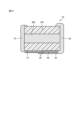
- the base part of each embodiment and each modified example is a capacitor having a dielectric and an internal electrode, but the base part of the present disclosure may have a resistor 300 and an insulating layer 301 that insulates the periphery of the resistor 300 as shown in FIG. 15.
- the electronic component 1D may form a resistance component.
- the base part of the present disclosure may be an inductor having a coil.
- Fig. 16 is a cross-sectional view of the electronic component module of the third embodiment taken along the center line of the coaxial cable.
- Fig. 17 is a cross-sectional view of the cross section taken along line XVII-XVII in Fig. 16 as viewed from the direction of the arrows.
- the electronic component module 100E of the third embodiment includes a coaxial cable 200E and a composite electronic component 400.
- the coaxial cable 200E of the third embodiment differs from the coaxial cable 200 of the second embodiment (see FIG. 6) in which only the inner conductor 201 is cut out.
- the composite electronic component 400 is placed (mounted) in the space cut out of the coaxial cable 200E.
- the outer periphery of the composite electronic component 400 is covered with a protective layer (not shown) of the coaxial cable 200.
- the composite electronic component 400 includes an electronic component 1E that joins with the internal conductor 201, a holding portion 410 that joins with the dielectric 202, and an external conductor portion 420 that joins with the external conductor 203.
- the outer peripheral surface of the composite electronic component 400 is circular.
- the composite electronic component 400 is a cylindrical component.
- the center of the cylinder formed by the composite electronic component 400 is hereinafter referred to as the center O of the composite electronic component 400.
- the electronic component 1E is disposed in the central portion of the composite electronic component 400. In other words, the electronic component 1E is not disposed radially (orthogonally) shifted from the center O of the composite electronic component 400.
- the electronic component 1E is rectangular when viewed from the length direction.
- the electronic component 1E of the third embodiment has the same structure as the electronic component 1C of the second modified example, which is formed into a rectangular prism. Therefore, a description of the electronic component 1E is omitted. Also, in the drawings, the same reference numerals as the electronic component 1C are used. As shown in FIG. 16, the diameter of the outer peripheral surface 401 of the electronic component 1E of this embodiment is smaller than the outer diameter of the inner conductor 201 of the coaxial cable 200E.
- the holding portion 410 is formed from a dielectric material. As shown in FIG. 17, the holding portion 410 extends circumferentially along the outer peripheral surface 401 of the electronic component 1E and is formed in an annular shape.
- the cross-sectional shape of the inner peripheral surface 411 of the holding portion 410 is rectangular corresponding to the outer peripheral surface 401 of the electronic component 1E.
- the inner peripheral surface 411 of the holding portion 410 is joined to the outer peripheral surface 401 of the electronic component 1E.
- the cross-sectional shape of the outer peripheral surface 412 of the holding portion 410 is circular.
- the external conductor portion 420 is formed of a conductive material. As shown in FIG. 17, the external conductor portion 420 extends circumferentially along the outer peripheral surface 412 of the holding portion 410 and is formed in an annular shape. The cross-sectional shape of the inner peripheral surface 421 of the external conductor portion 420 is circular corresponding to the outer peripheral surface 412 of the holding portion 410. The inner peripheral surface 421 of the external conductor portion 420 is joined to the outer peripheral surface 412 of the holding portion 410.
- the inner surface 421 of the external conductor portion 420 has a first edge portion 422, a second edge portion 423, and an intermediate portion 424.
- the first edge portion 422 is an annular portion located at the end of the inner surface 421 of the external conductor portion 420 in the first direction X1.
- the second edge portion 423 is an annular portion located at the end of the inner surface 421 of the external conductor portion 420 in the second direction X2.
- the intermediate portion 424 is an annular portion located between the first edge portion 422 and the second edge portion 423 on the inner surface 421 of the external conductor portion 420.
- the distance (radial thickness of the holding portion 410) between the inner surface 421 (middle portion 424) of the external conductor portion 420 and the outer surface 401 of the electronic component 1E is a distance (thickness) that results in a desired impedance value.
- the desired impedance value is the impedance value between the inner conductor 201 and the outer conductor 203 in the coaxial cable 200E. Therefore, in this embodiment, impedance matching can be achieved between the coaxial cable 200E and the composite electronic component 400.
- the first edge 422 and the second edge 423 are tapered. More specifically, the first edge 422 expands in diameter in the first direction X1. The second edge 423 expands in diameter in the second direction X2. The diameter of the first edge 422 at the end in the first direction X1 and the diameter of the second edge 423 at the end in the second direction X2 are the same as the inner surface of the outer conductor 203 of the coaxial cable 200E. For this reason, the inner surface 421 of the outer conductor portion 420 is convex with the middle portion 424 protruding toward the electronic component 1E.
- the effect of the third embodiment will be described.
- the electronic component 1B of the second embodiment described above only the electronic component 1B is mounted on the coaxial cable 200.
- the electronic component 1B may be shifted radially from the center of the internal conductor 201.
- the distance between the outer circumferential surface of the electronic component 1B and the outer conductor 203 of the coaxial cable 200 in other words, the thickness of the dielectric 202, varies depending on the circumferential position.
- the impedance between the outer circumferential surface of the electronic component 1B and the outer conductor 203 may not be the desired value.
- the composite electronic component 400 of the third embodiment includes not only the electronic component 1E but also the holding portion 410 and the external conductor portion 420.
- the distance between the electronic component 1E and the external conductor portion 420 does not vary depending on the circumferential position. Therefore, the passing characteristics of high-frequency signals are improved compared to the second embodiment.
- first edge 422 and the second edge 423 are not tapered, that is, when the entire inner peripheral surface 421 of the external conductor portion 420 has the same diameter as the intermediate portion 424, a step surface is formed between the external conductor portion 420 and the external conductor 203 of the coaxial cable 200E, which protrudes radially inward from the inner peripheral surface of the external conductor 203 and extends in the perpendicular direction.
- this step surface is formed, high-frequency signals are easily reflected.
- the first edge 422 and second edge 423 are tapered, there is no step surface extending in the perpendicular direction, and reflection of high-frequency signals is suppressed.
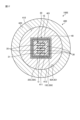
- FIG. 18 is a cross-sectional view of the composite electronic component of the fourth modified example taken in an orthogonal direction.
- the electronic component 1H of the composite electronic component 400H of the fourth modified example is a square prism, which is common to the third embodiment.
- the electronic component 1H differs from the third embodiment in that the corners are chamfered. That is, the outer peripheral surface 401H of the electronic component 1H is square when viewed from the length direction, and the corners are arc-shaped.
- the inner peripheral surface 421H of the composite electronic component 400H of the fourth modified example differs from the third embodiment in that the inner peripheral surface 421H of the external conductor portion 420H and the outer peripheral surface 401H of the electronic component 1H have corresponding shapes (similar shapes).
- This composite electronic component 400H can achieve the same effect as the third embodiment.
- the distance between the outer peripheral surface 401H of the electronic component 1H and the inner peripheral surface 421H of the external conductor portion 420H is uniform throughout, which makes it possible to avoid concentration of current distribution. Therefore, power loss is kept smaller than in the third embodiment.
- the inner peripheral surface of the external conductor portion of the present disclosure is not limited to the examples shown in the third embodiment and the fourth modified example, and may be circular or have other shapes.
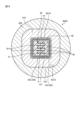
- FIG. 19 is a cross-sectional view of a composite electronic component of the fifth modified example taken in an orthogonal direction.
- a composite electronic component 400F of the fifth modified example differs from the third embodiment in that it includes a cylindrical electronic component 1F instead of the rectangular columnar electronic component 1E.
- the electronic component 1F has the same structure as the electronic component 1B described in the second embodiment. Therefore, a description of the electronic component 1F will be omitted. Also, in the drawings, the same reference numerals as the electronic component 1B are used. Even with such a composite electronic component 400F, it is possible to achieve the same effects as the third embodiment.
- FIG. 20 is a cross-sectional view of the electronic component module of the sixth modified example taken along the center line of the coaxial cable.
- the composite electronic component 400G of the sixth modified example differs from the third embodiment in the shape of the inner circumferential surface 421G of the outer conductor portion 420G. Details are described below.
- the distance between the intermediate portion 424G of the external conductor portion 420G and the outer peripheral surface 401 of the electronic component 1E is greater than the inner peripheral surface of the external conductor 203 of the coaxial cable 200E in order to obtain the desired impedance value.
- the first edge portion 422G is tapered in the first direction X1.
- the second edge portion 423G is tapered in the second direction X2. Therefore, the inner peripheral surface 421G of the external conductor portion 420G is concave, with the intermediate portion 424G recessed toward the outer peripheral side of the external conductor portion 420G.
- the first edge 422F and the second edge 423F are tapered, so reflection of high-frequency signals is suppressed.
- Example 10 Next, an example will be described.
- an electronic component was provided on a coaxial cable (see FIG. 11), and S parameters S11 (reflection characteristic) and S21 (transmission characteristic) were obtained when a high-frequency signal was supplied.
- the high-frequency signal had two frequencies: a 20 GHz signal and a 100 GHz signal.
- the electronic component manufactured in the example is a rectangular prism (rectangular parallelepiped) electronic component 1C (see FIG. 12) shown in the second modified example, and has a pair of opposing portions 50D, 50D in the shape of a rectangular frame (see FIG. 13). Three electronic components were prepared, and the distance L4 (see FIG. 3) between each pair of opposing portions 50D, 50D was changed.
- the first electronic component (hereinafter referred to as Example 1) has a distance L4 between the pair of opposing portions 50D, 50D of 25 ⁇ m.
- the second electronic component (hereinafter referred to as Example 2) has a distance L4 between the pair of opposing portions 50D, 50D of 50 ⁇ m.
- the third electronic component (hereinafter referred to as Example 3) has a distance L4 between the pair of opposing portions 50D, 50D of 100 ⁇ m.
- the electronic component of the comparative example is an electronic component in which the first external electrode extension 15C and the second external electrode extension 25C have been removed from the electronic component on the square pillar side shown in the second modified example. In other words, it does not have a pair of opposing portions 50, 50 in the shape of a square frame.
- the signal frequency is 20 GHz, as shown in Table 1, all of Examples 1 to 3 showed better S11 (reflection characteristics) than the comparative example. Furthermore, when the signal frequency is 100 GHz, Examples 1 and 2 showed better S11 (reflection characteristics) than the comparative example. Thus, according to the examples, the reflection of high-frequency signals was reduced.
- the S-parameter S21 (transmission characteristics) for each example and comparative example is shown in Table 2.
- the S-parameter S21 (transmission characteristic) indicates that the closer the value is to 0.1, the smaller the signal loss. Whether the signal frequency is 20 GHz or 100 GHz, as shown in Table 2, Examples 1 to 3 had better S21 (transmission characteristic) than the comparative example. In other words, the examples suppressed high-frequency signal loss.
- the present disclosure may also be implemented in the following combinations: (1) a first external electrode, a base portion, and a second external electrode arranged in this order in a first direction; A direction opposite to the first direction is a second direction, A direction perpendicular to the first direction is defined as an orthogonal direction,
- the first external electrode is a first external electrode body disposed in the second direction from the second external electrode across the base portion; a first external electrode extension extending in the first direction from an edge of the first external electrode body; having
- the second external electrode is a second external electrode body disposed in the first direction from the first external electrode across the base portion; a second external electrode extension extending in the second direction from an edge of the second external electrode body; having a portion of the first external electrode extension portion and a portion of the second external electrode extension portion constitute a pair of opposing portions opposing each other in the perpendicular direction,
- An electronic component having an insulating layer provided between the pair of opposing portions.
- an outer peripheral surface of the base portion has a first surface facing a substrate on which the electronic component is attached; the first external electrode extension portion and the second external electrode extension portion are each disposed toward the first surface as viewed from the base portion, the first external electrode extension portion is disposed closer to the first surface than the second external electrode extension portion;
- the electronic component according to any one of (1) to (4), wherein the pair of opposing portions are closer to the second external electrode body than to a central portion when the base portion is divided into three equal parts in the first direction.
- the first external electrode extension portion is formed in an annular shape by extending in a circumferential direction along an edge portion of the first external electrode body
- the second external electrode extension portion is formed in an annular shape by extending in a circumferential direction along an edge portion of the second external electrode body
- the electronic component according to any one of (1) to (6), wherein the pair of opposing portions are formed into annular shapes.
- a length of the pair of opposing portions in the first direction is 1/20 or more of a length of the base portion in the first direction.
- An electronic component according to the present invention an annular holding portion extending in a circumferential direction along an outer circumferential surface of the electronic component; an annular outer conductor portion extending in a circumferential direction along an outer circumferential surface of the holding portion;
- a composite electronic component comprising: (14) The inner circumferential surface of the outer conductor portion is a first annular edge portion located at an end portion in the first direction of the inner circumferential surface of the outer conductor portion; a second annular edge portion located at an end portion of the inner circumferential surface of the outer conductor portion in the second direction; an annular intermediate portion located on the inner circumferential surface of the outer conductor portion between the first edge portion and the second edge portion; having The composite electronic component according to claim 13, wherein the first edge portion and the second edge portion are tapered.
- the first edge portion has a diameter that increases in the first direction
- the second edge portion has a diameter that increases as it advances in the second direction
- the first edge portion has a diameter that decreases as it advances in the first direction
- the second edge portion has a diameter that decreases as it advances in the second direction
- the composite electronic component according to (14) above, wherein the inner circumferential surface of the outer conductor portion has a concave shape in which the intermediate portion is recessed toward an outer circumferential side of the outer conductor.
Landscapes
- Engineering & Computer Science (AREA)
- Power Engineering (AREA)
- Microelectronics & Electronic Packaging (AREA)
- Manufacturing & Machinery (AREA)
- Coils Or Transformers For Communication (AREA)
Priority Applications (2)
| Application Number | Priority Date | Filing Date | Title |
|---|---|---|---|
| CN202480051247.8A CN121713260A (zh) | 2023-08-09 | 2024-05-29 | 电子部件以及复合电子部件 |
| JP2025539144A JPWO2025032933A1 (https=) | 2023-08-09 | 2024-05-29 |
Applications Claiming Priority (4)
| Application Number | Priority Date | Filing Date | Title |
|---|---|---|---|
| JP2023-130123 | 2023-08-09 | ||
| JP2023130123 | 2023-08-09 | ||
| JP2023-206482 | 2023-12-06 | ||
| JP2023206482 | 2023-12-06 |
Related Child Applications (1)
| Application Number | Title | Priority Date | Filing Date |
|---|---|---|---|
| US19/440,990 Continuation US20260128230A1 (en) | 2023-08-09 | 2026-01-06 | Electronic component and composite electronic component |
Publications (1)
| Publication Number | Publication Date |
|---|---|
| WO2025032933A1 true WO2025032933A1 (ja) | 2025-02-13 |
Family
ID=94534577
Family Applications (1)
| Application Number | Title | Priority Date | Filing Date |
|---|---|---|---|
| PCT/JP2024/019744 Pending WO2025032933A1 (ja) | 2023-08-09 | 2024-05-29 | 電子部品及び複合電子部品 |
Country Status (3)
| Country | Link |
|---|---|
| JP (1) | JPWO2025032933A1 (https=) |
| CN (1) | CN121713260A (https=) |
| WO (1) | WO2025032933A1 (https=) |
Citations (2)
| Publication number | Priority date | Publication date | Assignee | Title |
|---|---|---|---|---|
| JPH07249541A (ja) * | 1994-03-11 | 1995-09-26 | Mitsubishi Materials Corp | 複合セラミックコンデンサ |
| JP2006270047A (ja) * | 2005-03-24 | 2006-10-05 | Samsung Electro-Mechanics Co Ltd | 積層セラミックコンデンサ及びその製造方法 |
-
2024
- 2024-05-29 CN CN202480051247.8A patent/CN121713260A/zh active Pending
- 2024-05-29 JP JP2025539144A patent/JPWO2025032933A1/ja active Pending
- 2024-05-29 WO PCT/JP2024/019744 patent/WO2025032933A1/ja active Pending
Patent Citations (2)
| Publication number | Priority date | Publication date | Assignee | Title |
|---|---|---|---|---|
| JPH07249541A (ja) * | 1994-03-11 | 1995-09-26 | Mitsubishi Materials Corp | 複合セラミックコンデンサ |
| JP2006270047A (ja) * | 2005-03-24 | 2006-10-05 | Samsung Electro-Mechanics Co Ltd | 積層セラミックコンデンサ及びその製造方法 |
Also Published As
| Publication number | Publication date |
|---|---|
| CN121713260A (zh) | 2026-03-20 |
| JPWO2025032933A1 (https=) | 2025-02-13 |
Similar Documents
| Publication | Publication Date | Title |
|---|---|---|
| JP3548821B2 (ja) | 積層コンデンサ、ならびにこれを用いた電子装置および高周波回路 | |
| JP5787760B2 (ja) | フィルタ | |
| US10176927B2 (en) | Composite electronic component | |
| US10340070B2 (en) | Multilayer common mode filter | |
| JP5630572B2 (ja) | 電子部品 | |
| KR20120024475A (ko) | 전자부품 | |
| US11735347B2 (en) | Multilayer coil component | |
| TWI659522B (zh) | Electronic parts | |
| US20080225463A1 (en) | Layered capacitor and mounting structure | |
| JP4303693B2 (ja) | 積層型電子部品 | |
| JP6363444B2 (ja) | 積層型コンデンサ | |
| WO2025032933A1 (ja) | 電子部品及び複合電子部品 | |
| US20210126609A1 (en) | Band pass filter | |
| JP5141715B2 (ja) | 積層コンデンサ | |
| US10276912B2 (en) | Directional coupler | |
| US20260128230A1 (en) | Electronic component and composite electronic component | |
| WO2005060093A1 (ja) | 積層セラミック電子部品 | |
| KR20230021980A (ko) | 복합 소자 | |
| JP2004103884A (ja) | 積層コンデンサ | |
| JP2006339337A (ja) | 積層コンデンサおよびその実装構造 | |
| US20240282497A1 (en) | Multilayer inductor | |
| JP5141714B2 (ja) | 積層コンデンサ | |
| JP2025151965A (ja) | 電子部品 | |
| JP2026063981A (ja) | 電子部品 | |
| JP2025040584A (ja) | 電子部品 |
Legal Events
| Date | Code | Title | Description |
|---|---|---|---|
| 121 | Ep: the epo has been informed by wipo that ep was designated in this application |
Ref document number: 24851367 Country of ref document: EP Kind code of ref document: A1 |
|
| ENP | Entry into the national phase |
Ref document number: 2025539144 Country of ref document: JP Kind code of ref document: A |
|
| WWE | Wipo information: entry into national phase |
Ref document number: 2025539144 Country of ref document: JP |
|
| NENP | Non-entry into the national phase |
Ref country code: DE |