WO2025032901A1 - 監視装置、監視方法及びプログラム - Google Patents
監視装置、監視方法及びプログラム Download PDFInfo
- Publication number
- WO2025032901A1 WO2025032901A1 PCT/JP2024/016989 JP2024016989W WO2025032901A1 WO 2025032901 A1 WO2025032901 A1 WO 2025032901A1 JP 2024016989 W JP2024016989 W JP 2024016989W WO 2025032901 A1 WO2025032901 A1 WO 2025032901A1
- Authority
- WO
- WIPO (PCT)
- Prior art keywords
- value
- gap
- abnormality
- threshold
- monitoring device
- Prior art date
- Legal status (The legal status is an assumption and is not a legal conclusion. Google has not performed a legal analysis and makes no representation as to the accuracy of the status listed.)
- Pending
Links
Images



Classifications
-
- G—PHYSICS
- G05—CONTROLLING; REGULATING
- G05B—CONTROL OR REGULATING SYSTEMS IN GENERAL; FUNCTIONAL ELEMENTS OF SUCH SYSTEMS; MONITORING OR TESTING ARRANGEMENTS FOR SUCH SYSTEMS OR ELEMENTS
- G05B23/00—Testing or monitoring of control systems or parts thereof
- G05B23/02—Electric testing or monitoring
Definitions
- This disclosure relates to a monitoring device, a monitoring method, and a program.
- This disclosure claims priority to Japanese Patent Application No. 2023-130132, filed on August 9, 2023, the contents of which are incorporated herein by reference.
- the Mahalanobis-Taguchi method is known as a method for detecting abnormalities in equipment and plants.
- the Mahalanobis distance (referred to as MD value) is calculated from time series data of multiple variables, and an abnormality is determined when the MD value exceeds a threshold.
- the measurement values of the various sensors used to calculate the MD value may contain noise, missing values, fluctuations, etc., and when the MD value is calculated using such measurement data, the MD value obtained may deviate from the normal range. For example, in the case of rotating machinery such as turbines and compressors, fluctuations in the rotation speed can cause the bearing temperature to rise, and even if the machinery is not abnormal, the MD value may exceed the threshold and an alarm may be falsely issued.
- Patent Document 1 discloses a method for detecting signs of abnormality not only by comparing a measurement value obtained by a sensor or the like with a threshold value, but also by using other measurement values that affect the measurement value in question.
- Patent Document 2 discloses a bearing abnormality prediction method for determining that when vibrations during rotation of a rolling bearing fall below a threshold value, this is a sign of excessive temperature rise in the rolling bearing.
- Patent Documents 1 and 2 do not disclose an abnormality detection method that can complement the MT method.
- This disclosure provides a monitoring device, a monitoring method, and a program that can solve the above-mentioned problems.
- the monitoring device has a means for calculating a Mahalanobis distance based on a process value of a rotating machine, a means for calculating a gap value indicating the ratio of the difference between the actual value of the process value and the estimated value of the process value to the difference between a threshold value for determining an abnormality in the process value and the estimated value of the process value, and a means for determining the operating state of the rotating machine based on the Mahalanobis distance and the gap value.
- the monitoring method includes the steps of: calculating a Mahalanobis distance based on a process value of a rotating machine; calculating a gap value indicating the ratio of the difference between the actual value of the process value and the estimated value of the process value to the difference between a threshold value for determining an abnormality in the process value and the estimated value of the process value; and determining the operating state of the rotating machine based on the Mahalanobis distance and the gap value.
- the program causes a computer to function as: a means for calculating a Mahalanobis distance based on a process value of a rotating machine; a means for calculating a gap value indicating the ratio of the difference between an actual value of the process value and an estimated value of the process value to the difference between a threshold value for determining an abnormality in the process value and the estimated value of the process value; and a means for determining the operating state of the rotating machine based on the Mahalanobis distance and the gap value.
- the above-mentioned monitoring device, monitoring method, and program can improve the monitoring accuracy using the MT method and prevent false positives.
- FIG. 1 is a block diagram showing an example of a monitoring device according to an embodiment
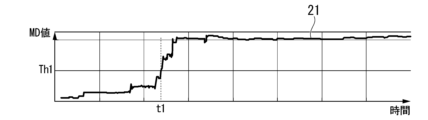
- FIG. 11 is a diagram showing an example of a transition of an MD value according to an embodiment.
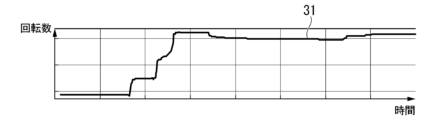
- FIG. 4 is a diagram showing an example of a transition of the rotation speed according to the embodiment.
- FIG. 2 is a diagram illustrating an example of monitoring target items according to the embodiment.
- FIG. 4 is a first diagram illustrating a gap value according to the embodiment.
- FIG. 11 is a second diagram illustrating a gap value according to the embodiment.
- 5 is a flowchart illustrating an example of an abnormality determination process according to the embodiment.
- FIG. 2 is a schematic diagram illustrating an example of a hardware configuration of a monitoring device according to an embodiment.
- FIG. 1 is a block diagram illustrating an example of a monitoring device according to an embodiment.
- the monitoring device 10 monitors the operating state of a rotating machine such as a compressor, a turbine, an engine, a pump, a generator, etc.
- a rotating machine such as a compressor, a turbine, an engine, a pump, a generator, etc.
- the compressor 1 and the monitoring device 10 are connected to each other so as to be able to communicate with each other via a wired or wireless network, a signal line, etc.
- the monitoring device 10 includes a process value acquisition unit 11, an MD value calculation unit 12, a gap value calculation unit 13, a determination unit 14, an analysis unit 15, an output unit 16, and a storage unit 17.
- the process value acquisition unit 11 acquires the measurement values measured by each sensor 2 of the compressor 1 or values calculated from the measurement values.
- the measurement values or values calculated from the measurement values are called process values or actual measured values of the process values.
- the process values may be calculated by another device or may be calculated by the process value acquisition unit 11.
- the process value acquisition unit 11 acquires the process values and stores them in the memory unit 17.
- the MD value calculation unit 12 creates a unit space for calculating the Mahalanobis distance (MD value) using the normal process values of the compressor 1 acquired by the process value acquisition unit 11. After monitoring begins, the MD value calculation unit 12 calculates the MD value used to evaluate the degree of abnormality of the compressor 1 based on the created unit space and the process values acquired by the process value acquisition unit 11. The MD value calculation unit 12 extracts process values to be evaluated that are the same type as the process values used to create the unit space from the process values acquired by the process value acquisition unit 11, and calculates the Mahalanobis distance (MD value) between the extracted process values and the unit space.
- the MD value is a value that indicates how far the compressor 1 deviates from the normal state.
- the method of calculating the Mahalanobis distance is publicly known, so a description of it will be omitted in this specification.
- the MD value calculation unit 12 outputs the calculated MD value to the determination unit 14.
- FIG. 2 shows a graph that shows a schematic diagram of the transition of the MD value.
- the vertical axis of the graph in FIG. 2 is the MD value
- the horizontal axis is time
- Th1 is a threshold value.
- Graph 21 shows the time series of MD values calculated by the MD value calculation unit 12.
- FIG. 3 shows the trend of the rotation speed of the compressor 1.
- the vertical axis of the graph in FIG. 2 is the MD value
- the horizontal axis is time
- Th1 is a threshold value.
- Graph 21 shows the time series of MD values calculated by the MD value calculation unit 12.
- FIG. 3 shows the trend of the rotation speed of the compressor 1.
- FIG. 3 is the rotation speed of the compressor 1, the horizontal axis is time, and graph 31 shows the time series of rotation speed acquired by the process value acquisition unit 11. If the same position on the horizontal axis in FIG. 2 and FIG. 3 represents the same time, it can be seen that the MD value shows a transition such that it exceeds the threshold value Th1 as the rotation speed increases. If the bearing temperature or the like increases with the increase in the rotation speed, the MD value will exceed the threshold value and an alarm will be issued. However, in reality, the operating state of the compressor 1 may be normal. In the past, when the MD value exceeded the threshold value, a monitor would first check whether the process value, such as the rotation speed, had fluctuated and judged whether the increase in the MD value was due to an abnormality or an increase in the rotation speed.
- a monitored item in addition to the MD value, a monitored item is set and the value of the monitored item is estimated.
- the estimated value is then used as an estimated value (the predicted value, average value, and performance predicted value described below are collectively referred to as the estimated value or the estimated value of the process value), and a gap value (described later) is calculated using the difference between the estimated value and the actual measured value. If the MD value exceeds the threshold value and the gap value exceeds the threshold value, it is determined that an abnormality or a sign of an abnormality has been detected.
- the gap value calculation unit 13 calculates gap values for monitored items.
- An example of monitored items is shown in FIG. 4.
- Process values such as journal bearing temperature in FIG. 4 indicate monitored items, and predicted values, average values, etc. indicate calculation methods for estimated values of each process value used to calculate gap values.
- the gap value calculation unit 13 calculates gap values for each monitored item in FIG. 4. For example, predicted values for each monitored item are used to calculate gap values for journal bearing temperature, thrust bearing temperature, and shaft position (axial displacement of the rotating shaft).
- the predicted value is calculated, for example, by a prediction formula derived from a theoretical formula for calculating the journal bearing temperature, etc., or a prediction model constructed using machine learning, etc.
- the monitored items include process values that are affected by fluctuations in the rotation speed of the compressor 1, and examples thereof include the journal bearing temperature and thrust bearing temperature.
- the prediction formula for calculating the predicted value may use parameters such as the rotation speed of the compressor 1 and the temperature of the lubricating oil. These parameters are factors that have a strong correlation with the bearing temperature among the parameters constituting the theoretical formula.
- the actual measured value is, for example, a process value measured by the sensor 2 that measures each bearing temperature.
- the conventional threshold value is a threshold value set to detect an abnormality in the journal bearing temperature.
- the gap value is calculated using the average value at the start of monitoring. Average values are used to calculate the gap values of the shaft vibration, steam pressure and temperature, compressor suction temperature, cooling water temperature, gas seal differential pressure, lubricating oil pressure, and lubricating oil temperature in Figure 4.
- the average values of shaft vibration, steam pressure, etc. collected during past operation may be calculated in advance, and the gap value calculation unit 13 may calculate the gap value of each monitored item using the average value of each process value, the actual measured value (process value) acquired by the process value acquisition unit 11 during monitoring, a conventional threshold value, and formula (2).
- the gap value calculation unit 13 may calculate the average value of each process value acquired by the process value acquisition unit 11, such as shaft vibration, steam pressure, steam temperature, compressor suction temperature, cooling water temperature, gas seal differential pressure, lubricating oil pressure, and lubricating oil temperature, from the start of monitoring the compressor 1 until a predetermined time has elapsed, and may calculate the gap value using the calculated average values and formula (2) after the predetermined time has elapsed.
- the gap value calculation unit 13 calculates a predicted value (predicted performance value) of the discharge pressure of the compressor 1 from a predetermined performance curve (a curve showing the relationship between the discharge pressure of the compressor 1 and other parameters) or a predetermined theoretical formula, and calculates the gap value using the following formula (3).
- Gap value (actual value - predicted performance value) ⁇ (conventional threshold value - predicted performance value) ...(3)
- the gap value calculation unit 13 calculates the discharge temperature of the compressor 1 using a predetermined performance curve or theoretical formula, and calculates the gap value of the discharge temperature using formula (3).
- the monitored items shown in FIG. 4 may be used to calculate the MD value.
- the rotation speed, compressor flow rate, steam flow rate, compressor suction pressure, etc. may be used to calculate the MD value. These items may be divided into groups, and the MD value may be calculated for each group.
- the determination unit 14 compares the MD value calculated by the MD value calculation unit 12 and the gap value calculated by the gap value calculation unit 13 with their respective thresholds, and if the MD value exceeds threshold Th1 and any of the gap values of the monitored items exceed a predetermined threshold, it determines that an abnormality should be detected. Specifically, the determination unit 14 constantly monitors the MD value and the gap value in parallel, and if both exceed their thresholds, it issues an alarm indicating a pre-existing abnormality or a detected abnormality. By adding a determination based on the gap value in addition to the MD value, it is possible to avoid issuing an alarm even if the MD value exceeds threshold Th1 as the rotation speed increases, as long as the gap value is within the threshold.
- the threshold for the gap value can be set in multiple stages.
- the threshold for monitoring Tha may be set to 30%, the threshold for abnormality prediction Thb to 50%, and the threshold for abnormality prediction Thc to 100%.
- the purpose of the abnormality prediction alarm is to identify the cause early and take measures early before the abnormality becomes serious, and it is necessary to avoid issuing an alarm for a fluctuation amount that cannot be considered abnormal. Since it is not desirable to issue an alarm too early or too late, for example, the middle (50%) between the predicted value and the conventional threshold value may be set as the threshold Thb for abnormality prediction detection. For targets such as shaft vibration, where it is difficult to calculate a predicted value, the middle value between the average value at the beginning of operation and the conventional threshold value can be set as the threshold Thb.
- a threshold value Tha for follow-up observation may be set for fluctuation levels lower than the detection of abnormal signs, and when this threshold is exceeded, cause analysis such as Fault Tree Analysis (FTA) may be initiated for the process values measured by sensor 2, and the analysis results and process values may be recorded for storage. If the fluctuation level is too small, the accuracy of the cause analysis may decrease, so the threshold value Tha may be set to a value that provides sufficient analytical accuracy.
- FFA Fault Tree Analysis
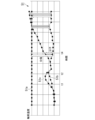
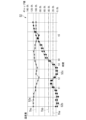
- Graph 51 in FIG. 5A shows the transition of predicted and measured values for a monitored item (e.g., journal bearing temperature), and graph 52 in FIG. 5B shows an example of the transition of the gap value for the monitored item.
- the vertical axis of graph 51 is the bearing temperature, and the horizontal axis is time.
- the vertical axis of graph 52 is the temperature difference between the predicted and measured values, and the horizontal axis is time.
- threshold 51a shows the threshold set for the journal bearing temperature (the conventional threshold in formula (1))
- graphs 51b and 51c show the predicted and measured values of the journal bearing temperature, respectively.
- the gap value (%) of the journal bearing temperature is calculated as a fraction with the difference between graphs 51b and 51c as the numerator and the difference between graphs 51a and 51b as the denominator.
- graphs 52a and 52b show the denominator and numerator of formula (1), respectively.
- Graph 52c shows the gap value calculated by formula (1).
- the numerator represents the deviation of the actual measurement from the predicted value
- the denominator represents the tolerance between the predicted value and the threshold. Normalizing by the tolerance makes it possible to evaluate the deviation of the actual measurement from the predicted value in a relative manner.
- the MD value quantifies the deviation from the standard deviation of each signal, and it is difficult to explain its relationship to the actual amount of fluctuation, but by introducing a gap value (a normalized value of the distance between the actual measurement and the conventional threshold 51a), it is possible to more specifically evaluate the state of the monitored object.
- the determination unit 14 determines that follow-up observation is necessary and instructs the analysis unit 15 to perform a cause analysis and record the analysis results, etc.
- the gap value becomes equal to or less than threshold value Tha at time t2
- the determination unit 14 determines that follow-up observation is unnecessary and instructs the analysis unit 15 to stop recording data.
- the gap value exceeds threshold value Tha again at time t3
- the determination unit 14 instructs the analysis unit 15 to record data.
- the judgment unit 14 judges that a sign of an abnormality has been detected and instructs the output unit 16 to issue an alarm indicating the detection of a sign of an abnormality and to prompt the user to start preparing countermeasures.
- the judgment unit 14 judges that an abnormality has been detected and instructs the output unit 16 to issue an alarm indicating the detection of an abnormality.
- the analysis unit 15 performs an analysis of the cause of the abnormality using FTA or the like when a sign of an abnormality is detected.
- the analysis unit 15 records the various process values acquired by the process value acquisition unit 11 and the analysis results using FTA or the like in the memory unit 17.
- the recorded data is used as learning data for analyzing the cause of an abnormality and detecting signs of an abnormality.
- the output unit 16 outputs various information related to the monitoring of the compressor 1 to a display device or other devices. For example, the output unit 16 reports the result of the determination by the determination unit 14 and issues an alarm.
- the storage unit 17 stores various information, such as the process values acquired by the process value acquisition unit 11, various thresholds, a prediction formula or a prediction model used to calculate a predicted value, and a unit space used to calculate an MD value.
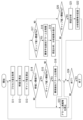
- FIG. 6 is a flowchart illustrating an example of an abnormality determination process according to the embodiment.
- the monitoring device 10 repeats the following process at a predetermined control period.
- the process value acquisition unit 11 acquires a process value (step S11).
- the MD value calculation unit 12 calculates an MD value (step S12).
- the MD value calculation unit 12 outputs the calculated MD value to the determination unit 14.
- the gap value calculation unit 13 calculates a gap value for each monitored item using equations (1) to (3) (step S13).
- the gap value calculation unit 13 outputs the calculated gap value to the determination unit 14.
- the determination unit 14 determines whether there is an abnormality or the like based on the MD value and the gap value (steps S14, S15, S17, S20). If the MD value is equal to or less than the threshold value Th1 (step S14; No), the process proceeds to step S23.
- the determination unit 14 determines that an abnormality has been detected and instructs the output unit 16 to issue an alarm.
- the output unit 16 issues an alarm notifying the detection of the abnormality (step S16).
- the output unit 16 may display an alarm on a display device connected to the monitoring device 10, or may turn on a lamp, sound a buzzer, or transmit an alarm of the abnormality detection to another terminal device, etc.
- step S14 If the MD value is greater than the threshold Th1, all the gap values are equal to or less than the threshold Thc, and any of the gap values is greater than the threshold Thb (step S14; Yes, step S15; No, step S17; Yes), the judgment unit 14 judges that a sign of an abnormality has been detected, and instructs the output unit 16 to issue an alarm.
- the output unit 16 issues an alarm to prompt the detection of a sign of an abnormality and the start of preparation for countermeasures (step S18).
- the judgment unit 14 instructs the analysis unit 15 to analyze the cause of the abnormality.
- the analysis unit 15 performs FTA or the like on the monitored items related to the gap values that exceed the threshold Thb, and analyzes the cause of the abnormality (step S19).
- the memory unit 17 stores a fault tree for each monitored item regarding the value of the monitored item indicating an abnormality, and the analysis unit 15 analyzes the cause of the gap value exceeding the threshold Thb based on this fault tree.
- the analysis unit 15 displays the results of the analysis of the abnormality by FTA or the like on the display device via the output unit 16.
- the process of step S19 may also be performed when an abnormality is detected.
- step S14 If the MD value is greater than the threshold Th1, all gap values are equal to or less than the thresholds Thc and Thb, and any gap value is greater than the threshold Tha (step S14; Yes, step S15; No, step S17; No, step S20; Yes), the determination unit 14 determines that follow-up observation is necessary and instructs the analysis unit 15 to analyze the cause of the gap value exceeding the threshold Tha and record the analysis results.
- the analysis unit 15 performs FTA or the like on the monitored items related to the gap values that exceed the threshold Tha, and analyzes the cause of the abnormality (step S21).
- the analysis unit 15 records and saves the results of the cause analysis and the measurement values used in the cause analysis in the memory unit 17 (step S22).
- step S14 If the MD value is greater than the threshold value Th1 and all the gap values are equal to or less than the threshold value Tha (step S14; Yes, step S15; No, step S17; No, step S20; No), the judgment unit 14 judges that the operating state of the compressor 1 is not abnormal. In this case, if an alarm is being issued, the alarm is stopped and the process proceeds to step S24 (step S23). For example, if an abnormality or a sign of an abnormality has been detected, the judgment unit 14 instructs the output unit 16 to stop issuing the alarm. The output unit 16 stops issuing the alarm. For example, if it has been determined that follow-up observation is necessary, the judgment unit 14 instructs the analysis unit 15 to stop the cause analysis and recording of the analysis results. The analysis unit 15 stops the cause analysis and recording.
- the monitoring device 10 determines whether to end monitoring of the compressor 1 (step S24). For example, when a stop command is input by the user, the monitoring device 10 determines to end monitoring (step S24; Yes) and ends the processing of the flowchart in FIG. 6. If monitoring is not to be ended (step S24; No), the processing from step S11 is repeatedly executed.
- the accuracy of abnormality detection by the MT method can be improved. For example, even if only the MD value exceeds the threshold value Th1 due to an increase in the rotation speed during a normal operating state in which the gap value is equal to or less than the threshold value, erroneous alarm is avoided. By using not only the gap value but also the MD value, highly accurate abnormality detection is possible.
- the abnormality detection or abnormality sign detection is performed.
- the operating state of the compressor 1 is normal, it is possible to prevent erroneous abnormality detection even in a situation in which the prediction accuracy of the predicted value cannot be obtained for some reason and the deviation between the actual value and the predicted value (the numerator of formula (1)) becomes large.
- a genuine abnormality for example, MD value > threshold Th1 and gap value of journal bearing temperature etc. > threshold Thb or threshold Thc
- the compressor 1 is used as an example, but the object to be monitored is not limited to a compressor and may be another rotating machine.
- the monitored items shown in FIG. 4 are only an example and are not limited to this. It is not necessary to judge the gap values of all the monitored items shown in FIG. 4 and other examples, and any required monitored items can be selected.
- the judgment condition is that "any gap value exceeds the threshold value Thc," but the judgment condition may be that the gap values of multiple monitored items exceed the threshold value Thc.
- three thresholds for the gap value are set, but only one or two levels may be set, or four or more levels may be set. A different threshold value may be set for each monitored item.
- a computer 900 includes a CPU 901, a main storage device 902, an auxiliary storage device 903, an input/output interface 904, and a communication interface 905.
- the above-described monitoring device 10 is implemented in a computer 900.
- Each of the above-described functions is stored in the auxiliary storage device 903 in the form of a program.
- the CPU 901 reads the program from the auxiliary storage device 903, loads it in the main storage device 902, and executes the above-described processing in accordance with the program.
- the CPU 901 secures a storage area in the main storage device 902 in accordance with the program.
- the CPU 901 secures a storage area in the auxiliary storage device 903 for storing data being processed in accordance with the program.
- the computer 900 may include a GPU (Graphic Processing Unit), a microprocessor, etc. instead of/in addition to the CPU 901.
- the computer 900 may include a custom LSI (Large Scale Integrated Circuit) such as a PLD (Programmable Logic Device) instead of or in addition to the above configuration.
- PLDs include PAL (Programmable Array Logic), GAL (Generic Array Logic), CPLD (Complex Programmable Logic Device), and FPGA (Field Programmable Gate Array).
- PLDs include PAL (Programmable Array Logic), GAL (Generic Array Logic), CPLD (Complex Programmable Logic Device), and FPGA (Field Programmable Gate Array).
- PAL Programmable Array Logic
- GAL Generic Array Logic
- CPLD Complex Programmable Logic Device
- FPGA Field Programmable Gate Array
- auxiliary storage device 903 examples include a hard disk drive (HDD), a solid state drive (SSD), a magnetic disk, a magneto-optical disk, a compact disc read only memory (CD-ROM), a digital versatile disc read only memory (DVD-ROM), and semiconductor memory.
- the auxiliary storage device 903 may be an internal medium directly connected to the bus of the computer 900, or an external medium connected to the computer 900 via the input/output interface 904 or a communication line.
- a program for implementing all or part of the functions of the monitoring device 10 may be recorded on a computer-readable recording medium, and the program recorded on the recording medium may be read into a computer system and executed to perform processing by each functional unit.
- a "computer-readable recording medium” refers to portable media such as CDs, DVDs, and USBs, and storage devices such as hard disks built into a computer system. If the program is distributed to the computer 900 via a communication line, the computer 900 that receives the program may load the program into the main storage device 902 and execute the above processing.
- the program may be for implementing part of the functions described above, or may be capable of implementing the functions described above in combination with a program already recorded in the computer system.
- the monitoring device, the monitoring method, and the program described in each embodiment can be understood, for example, as follows.
- a monitoring device has a means for calculating a Mahalanobis distance based on a process value of a rotating machine, a means for calculating a gap value indicating the ratio of the difference between an actual value of the process value and the estimated value of the process value to the difference between a threshold value for determining an abnormality in the process value and the estimated value of the process value, and a means for determining the operating state of the rotating machine based on the Mahalanobis distance and the gap value.
- a monitoring device is the monitoring device of (1), wherein when the Mahalanobis distance exceeds a first threshold value, the judging means evaluates the degree of abnormality regarding the operating condition depending on the magnitude of the gap value. Various operating conditions can be evaluated depending on the size of the gap value.
- a monitoring device is the monitoring device of (1) to (2), wherein the judging means judges that a sign of an abnormality has been detected when the Mahalanobis distance exceeds the first threshold value and the gap value exceeds a second threshold value. This makes it possible to detect abnormal signs while avoiding excessive abnormal sign detection.
- a monitoring device is a monitoring device of (1) to (3), wherein the determining means determines that the driving condition requires follow-up observation when the Mahalanobis distance exceeds a first threshold value and the gap value exceeds a third threshold value that is smaller than the second threshold value. This makes it possible to detect operating conditions that may not be signs of an abnormality but may potentially lead to an abnormality in the future.
- a monitoring device is the monitoring device of (4), further comprising: a means for performing a cause analysis of an abnormality based on the actual measured value when the determining means determines that the operating state requires follow-up observation, and for recording the results of the cause analysis. This makes it possible to accumulate data that is useful for detecting signs of abnormalities.
- a monitoring device is a monitoring device of any one of (1) to (5), wherein the determining means determines that an abnormality has been detected when the MD value exceeds the first threshold value and the gap value exceeds a fourth threshold value that is greater than the second threshold value. This makes it possible to detect abnormalities while avoiding excessive abnormality detection.
- a monitoring device is the monitoring device of (1) to (6), wherein the means for calculating the gap value calculates the gap value using the process value that is affected by fluctuations in the rotation speed of the rotating machine. This makes it possible to determine whether an abnormality exists while checking whether an increase in the MD value is due to a fluctuation in the rotation speed of the rotating machine.
- a monitoring device is the monitoring device of (1) to (7), wherein the means for calculating the gap value calculates an estimate of the process value using a predetermined prediction formula having the rotation speed of the rotating machine as a parameter. This makes it possible to calculate a predicted value of the process value that is affected by the rotation speed.
- a monitoring device is a monitoring device of any one of (1) to (8), wherein the means for calculating the gap value calculates an average value of the actual measurement values measured from the start of monitoring of the rotating machine until a predetermined time has elapsed as an estimate of the process value. This makes it possible to calculate estimates for process values that are difficult to predict.
- a monitoring method includes a step of calculating a Mahalanobis distance based on a process value of a rotating machine, a step of calculating a gap value indicating the ratio of the difference between the actual value of the process value and the estimated value of the process value to the difference between a threshold value for determining an abnormality in the process value and the estimated value of the process value, and a step of determining the operating state of the rotating machine based on the Mahalanobis distance and the gap value.
- the program according to the eleventh aspect causes a computer to function as a means for calculating a Mahalanobis distance based on a process value of a rotating machine, a means for calculating a gap value indicating the ratio of the difference between an actual value of the process value and an estimated value of the process value to the difference between a threshold value for determining an abnormality in the process value and the estimated value of the process value, and a means for determining the operating state of the rotating machine based on the Mahalanobis distance and the gap value.
- the above-mentioned monitoring device, monitoring method, and program can improve the monitoring accuracy using the MT method and prevent false positives.
Landscapes
- Physics & Mathematics (AREA)
- General Physics & Mathematics (AREA)
- Engineering & Computer Science (AREA)
- Automation & Control Theory (AREA)
- Testing Of Devices, Machine Parts, Or Other Structures Thereof (AREA)
- Testing And Monitoring For Control Systems (AREA)
Applications Claiming Priority (2)
| Application Number | Priority Date | Filing Date | Title |
|---|---|---|---|
| JP2023130132A JP2025025399A (ja) | 2023-08-09 | 2023-08-09 | 監視装置、監視方法及びプログラム |
| JP2023-130132 | 2023-08-09 |
Publications (1)
| Publication Number | Publication Date |
|---|---|
| WO2025032901A1 true WO2025032901A1 (ja) | 2025-02-13 |
Family
ID=94533920
Family Applications (1)
| Application Number | Title | Priority Date | Filing Date |
|---|---|---|---|
| PCT/JP2024/016989 Pending WO2025032901A1 (ja) | 2023-08-09 | 2024-05-07 | 監視装置、監視方法及びプログラム |
Country Status (2)
| Country | Link |
|---|---|
| JP (1) | JP2025025399A (https=) |
| WO (1) | WO2025032901A1 (https=) |
Cited By (1)
| Publication number | Priority date | Publication date | Assignee | Title |
|---|---|---|---|---|
| CN120597310A (zh) * | 2025-04-29 | 2025-09-05 | 广东云康链仓供应链管理有限公司 | 一种基于大数据的用工管理系统 |
Citations (2)
| Publication number | Priority date | Publication date | Assignee | Title |
|---|---|---|---|---|
| JP2019091113A (ja) * | 2017-11-10 | 2019-06-13 | 三菱日立パワーシステムズ株式会社 | プラント異常監視システム、および、プラント異常監視方法 |
| JP2021047523A (ja) * | 2019-09-17 | 2021-03-25 | 株式会社東芝 | 異常予兆検知装置、方法及びプログラム |
-
2023
- 2023-08-09 JP JP2023130132A patent/JP2025025399A/ja active Pending
-
2024
- 2024-05-07 WO PCT/JP2024/016989 patent/WO2025032901A1/ja active Pending
Patent Citations (2)
| Publication number | Priority date | Publication date | Assignee | Title |
|---|---|---|---|---|
| JP2019091113A (ja) * | 2017-11-10 | 2019-06-13 | 三菱日立パワーシステムズ株式会社 | プラント異常監視システム、および、プラント異常監視方法 |
| JP2021047523A (ja) * | 2019-09-17 | 2021-03-25 | 株式会社東芝 | 異常予兆検知装置、方法及びプログラム |
Cited By (2)
| Publication number | Priority date | Publication date | Assignee | Title |
|---|---|---|---|---|
| CN120597310A (zh) * | 2025-04-29 | 2025-09-05 | 广东云康链仓供应链管理有限公司 | 一种基于大数据的用工管理系统 |
| CN120597310B (zh) * | 2025-04-29 | 2026-04-07 | 广东云康链仓供应链管理有限公司 | 一种基于大数据的用工管理系统 |
Also Published As
| Publication number | Publication date |
|---|---|
| JP2025025399A (ja) | 2025-02-21 |
Similar Documents
| Publication | Publication Date | Title |
|---|---|---|
| US8720275B2 (en) | Detecting rotor anomalies | |
| US8988238B2 (en) | Change detection system using frequency analysis and method | |
| US9267864B2 (en) | Method for identifying damage on transmissions | |
| US11555757B2 (en) | Monitoring device, monitoring method, method of creating shaft vibration determination model, and program | |
| JP2931187B2 (ja) | ポンプ劣化診断システム | |
| US20160223496A1 (en) | Method and Arrangement for Monitoring an Industrial Device | |
| KR102040179B1 (ko) | 제조 설비의 이상 감지 및 진단 방법 | |
| CN119670023B (zh) | 一种基于多维感知融合识别的泵机组故障监测方法 | |
| US20130338938A1 (en) | Identifying wind or water turbines for maintenance | |
| US20120109569A1 (en) | Diagnosis of bearing thermal anomalies in an electrical machine | |
| WO2025032901A1 (ja) | 監視装置、監視方法及びプログラム | |
| EP3819608A1 (en) | Detecting rotor anomalies by determining vibration trends during transient speed operation | |
| CN118392231A (zh) | 传感器故障检测方法及系统 | |
| CN117734347B (zh) | 轮毂单元、监测方法及其应用 | |
| JP2010175446A (ja) | 状態診断装置 | |
| JPWO2004068078A1 (ja) | 状態判定方法と状態予測方法及び装置 | |
| CN110382878A (zh) | 确定用于预测压缩机中不稳定性的指标的方法和装置及其用途 | |
| JP4312477B2 (ja) | 回転機械の診断方法、診断装置及びそのプログラム | |
| JP2008058191A (ja) | 回転機械の診断方法、そのプログラム、及びその診断装置 | |
| JP7057760B2 (ja) | 回転電機の異常診断システム | |
| CN119469281A (zh) | 离心泵运行监测方法及系统 | |
| KR101335787B1 (ko) | 전동기의 예방 보전 장치 | |
| JP7813567B2 (ja) | 流体機械の異常原因推定装置及びその異常原因推定方法並びに流体機械の異常原因推定システム | |
| US20220333499A1 (en) | Closed loop control employing magnetostrictive sensing | |
| JP7260410B2 (ja) | 回転機械の異常診断方法 |
Legal Events
| Date | Code | Title | Description |
|---|---|---|---|
| 121 | Ep: the epo has been informed by wipo that ep was designated in this application |
Ref document number: 24851335 Country of ref document: EP Kind code of ref document: A1 |
|
| WWE | Wipo information: entry into national phase |
Ref document number: 112026000001597 Country of ref document: IT |
|
| WWG | Wipo information: grant in national office |
Ref document number: 112026000001597 Country of ref document: IT |