WO2025028431A1 - 細胞収容用ディッシュ、および細胞投与用キット - Google Patents
細胞収容用ディッシュ、および細胞投与用キット Download PDFInfo
- Publication number
- WO2025028431A1 WO2025028431A1 PCT/JP2024/026773 JP2024026773W WO2025028431A1 WO 2025028431 A1 WO2025028431 A1 WO 2025028431A1 JP 2024026773 W JP2024026773 W JP 2024026773W WO 2025028431 A1 WO2025028431 A1 WO 2025028431A1
- Authority
- WO
- WIPO (PCT)
- Prior art keywords
- cell
- section
- opening
- main body
- cell storage
- Prior art date
- Legal status (The legal status is an assumption and is not a legal conclusion. Google has not performed a legal analysis and makes no representation as to the accuracy of the status listed.)
- Pending
Links
Images




Classifications
-
- A—HUMAN NECESSITIES
- A61—MEDICAL OR VETERINARY SCIENCE; HYGIENE
- A61M—DEVICES FOR INTRODUCING MEDIA INTO, OR ONTO, THE BODY; DEVICES FOR TRANSDUCING BODY MEDIA OR FOR TAKING MEDIA FROM THE BODY; DEVICES FOR PRODUCING OR ENDING SLEEP OR STUPOR
- A61M37/00—Other apparatus for introducing media into the body; Percutany, i.e. introducing medicines into the body by diffusion through the skin
-
- C—CHEMISTRY; METALLURGY
- C12—BIOCHEMISTRY; BEER; SPIRITS; WINE; VINEGAR; MICROBIOLOGY; ENZYMOLOGY; MUTATION OR GENETIC ENGINEERING
- C12M—APPARATUS FOR ENZYMOLOGY OR MICROBIOLOGY; APPARATUS FOR CULTURING MICROORGANISMS FOR PRODUCING BIOMASS, FOR GROWING CELLS OR FOR OBTAINING FERMENTATION OR METABOLIC PRODUCTS, i.e. BIOREACTORS OR FERMENTERS
- C12M1/00—Apparatus for enzymology or microbiology
Definitions
- the present invention relates to a cell-containing dish and a cell administration kit including the cell-containing dish.
- Patent Document 1 discloses a method for treating a medical, aesthetic, or veterinary condition in a subject, which involves administering cells from a specified container containing cells to the subject through a cannula.
- the present invention was made in consideration of the above problems, and aims to provide a cell storage dish that allows the stored cells or cell clusters to be easily aspirated and recovered using a cannula.
- the cell storage dish of the present invention is characterized in that the main body is provided with one or more first cell storage sections that are concave in shape and have longitudinal and lateral directions and that are open on the upper surface side of the main body and capable of storing a liquid containing cells or cell clusters, and that the first cell storage section has a straight section in the longitudinal direction that extends linearly longer than the length in the lateral direction, and further has inclined surfaces that slope downward from both ends of the opening in the lateral direction of the straight section so as to approach each other toward the bottom side of the concave shape.
- the cell administration kit according to the present invention is characterized by comprising the cell storage dish according to the present invention described above, and a cannula, which is a tubular structure made of a resin material and has a substantially elliptical opening that can suck cells or cell clusters from the first cell storage section of the cell storage dish according to the present invention into its interior.
- the present invention makes it possible to provide a cell storage dish that allows the stored cells or cell clusters to be easily aspirated and collected using a cannula, as well as a cell administration kit that includes this cell storage dish and a cannula.
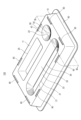
- FIG. 2 is a perspective view of the cell-containing dish according to the present embodiment, seen from the top side.
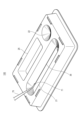
- FIG. 2 is a perspective view of the back side (lower side) of the cell-containing dish according to the present embodiment.
- 3 is a cross-sectional view of the cell-containing dish according to the present embodiment taken along line III-III in FIG. 1.
- FIG. 2 is a front view from the top side of the cell-containing dish according to the present embodiment.
- FIG. 13 is a perspective view showing a state in which cells or cell clumps are aspirated and collected from a first cell containing portion of a cell containing dish according to the present embodiment using a cannula provided in the cell administration kit according to the present embodiment.
- FIG. 2 is an enlarged view of a cannula provided in the cell administration kit according to the present embodiment.
- FIG. 2 is a cross-sectional view showing a state in which a cell clump and a cannula are placed in a first cell-containing section of the cell-containing dish according to the present embodiment.
- FIG. 11 is a cross-sectional view showing a state in which a cell clump and a cannula are placed in a modified first cell-containing section of the cell-containing dish according to the present embodiment.
- FIG. 13 is a cross-sectional view showing a state in which a cell clump and a cannula are placed in another modified example of the first cell-containing section in the cell-containing dish according to the present embodiment.
- Figs. 1 and 2 are perspective views that typically show the entire cell-containing dish 100 according to this embodiment.
- Fig. 3 is a cross-sectional view that typically shows a cross section including the first cell-containing section 21 and the second cell-containing section 22 of the cell-containing dish 100 according to this embodiment.
- Fig. 4 is a front view from the top that typically shows the entire cell-containing dish 100 according to this embodiment.
- Fig. 5 is a perspective view that typically shows the entire cell-containing dish 100 according to this embodiment and a part of the cannula 70 used therein.
- the cell-containing dish 100 is used for containing cells or cell clumps 80, and the main body 10 of the cell-containing dish 100 is provided with one or more first cell-containing sections 21, which are concave in shape and have longitudinal and lateral directions and open on the upper surface side (main body upper surface 11 side) of the main body 10 and are capable of containing a liquid containing cells or cell clumps 80, and this first cell-containing section 21 has a straight section 31 in its longitudinal direction that extends linearly longer than its lateral length, and further has inclined surfaces that slope downward from both ends of the opening in the lateral direction of the straight section 31 so as to approach each other toward the bottom side of the concave shape.
- the cell-accommodating dish 100 has at least a main body 10, which is the main body of the dish, and is provided with one or more first cell-accommodating sections 21 having a concave shape and opening on the upper surface side of the main body 10.
- the main body 10 may further include a second cell-accommodating section 22 and a waste liquid-accommodating section 25, which will be described later.
- the first cell storage section 21 is a concave structure having a longitudinal direction and a lateral direction that opens on the upper surface side (main body upper surface 11 side) of the main body section 10, and has a straight section 31 that extends linearly in the longitudinal direction longer than the lateral length.
- the longitudinal length of the straight section 31, which is the region in which the concave shape extends linearly is longer than the lateral length of the first cell storage section 21.
- the first cell storage section 21 is a concave structure having a longitudinal direction and a lateral direction, and therefore does not include a concave structure that does not substantially have a longitudinal direction and a lateral direction, such as a concave opening having a circular opening or a square opening. Furthermore, the first cell storage section 21 has at least an inclined surface 33 that slopes downward from both ends of the opening in the lateral direction of the concave shape in the straight section 31 toward the bottom side of the concave shape so as to approach each other.
- the cells or cell clumps 80 (e.g., multiple cells or cell clumps 80) stored in this first cell storage section 21 tend to gather near the bottom side of the straight section 31 that extends linearly in the longitudinal direction, in other words, the cells or cell clumps 80 tend to gather near the bottom side of the straight section 31 in a state roughly aligned in the longitudinal direction, making it easier to suction and recover the cells or cell clumps 80 from the first cell storage section 21 using a cannula.
- the cells or cell clumps 80 e.g., multiple cells or cell clumps 80
- an embodiment is exemplified in which the main body 10 of the cell storage dish 100 is provided with a first cell storage section 21 that has a horizontally elongated concave structure that opens on the main body upper surface 11 side, further has a straight section 31 in the longitudinal direction in which the concave shape extends linearly longer than the short side length, and has inclined surfaces 33 (a pair of inclined surfaces 33 in the straight section 31) that are inclined so as to approach each other from both ends of the opening in the short side direction of the straight section 31 toward the bottom side of the concave shape. Note that in the embodiment of Figs.
- the straight section 31 is arranged so that it occupies 75% or more of the area of the longitudinal length of the first cell storage section 21, and further, both ends of the longitudinal opening of the first cell storage section 21 are formed to be approximately semicircular.
- the straight portion 31 may have, for example, a cross section in the short direction that is a generally V-shaped concave shape, or a cross section that is a generally inverted trapezoidal concave shape, or may have a cross section that is a concave shape having a bottom surface that is curved toward the bottom (the bottom surface is rounded).
- the first cell storage section 21 has a flat surface 35 that is formed flat so as to be continuous with the inclined surface 33 and extends linearly in the longitudinal direction on the bottom side of the concave shape of the straight section 31 as shown in Figs. 1 to 5.
- This flat surface 35 is a surface that is approximately parallel (substantially parallel) to the upper surface 11 of the main body.
- the flat surface 35 extends over almost the entire longitudinal direction on the bottom side of the concave shape of the straight section 31. In other words, it is more preferable that the flat surface 35 extends over almost the entire longitudinal direction of the straight section 31.
- the flat surface 35 may be arranged so that the cross section in the short direction of the straight portion 31 has a generally symmetrical inverted trapezoidal concave shape, or the cross section may have an offset base (the cross section has a base that is not generally symmetrical but is closer to one end of the straight portion 31 in the short direction).
- the short-side length of this flat surface 35 is designed so that the contained cells or cell clumps 80 can easily gather in a state of being arranged in a line along the longitudinal direction.
- the short-side length of the flat surface 35 is not more than twice the diameter of the contained cells or cell clumps 80 (a length of not more than twice the diameter).
- the short-side length of the flat surface 35 is preferably about 0.1 mm or more and 1.6 mm or less, more preferably about 0.1 mm or more and 1.0 mm or less, and even more preferably about 0.2 mm or more and 0.7 mm or less.
- the first cell storage section 21 is configured so that the inclined surface 33 (a pair of inclined surfaces 33) in the straight section 31 described above is inclined downward from the open end of the area other than the straight section 31 toward the bottom side of the concave shape so as to be continuous.
- the inclined surface 33 is formed so as to be inclined downward from the entire open end of the first cell storage section 21 toward the bottom side of the concave shape and to be continuous. This is because the cells or cell aggregates 80 stored in the first cell storage section 21 are more likely to gather near the bottom side of the concave shape in the straight section 31.
- the bottom side of the concave shape in the straight section 31 has the flat surface 35 described above, and the inclined surfaces 33 are formed so as to be inclined downward from the entire open end of the first cell storage section 21 toward this flat surface 35 so as to approach each other, the cells or cell aggregates 80 are more likely to gather near this flat surface 35, and the suction and collection of the cells or cell aggregates 80 by the cannula 70 becomes even easier.
- the inclined surface 33 of the straight portion 31 in the first cell storage section 21 is configured so that the angle ⁇ 1 between the upper surface (main body upper surface 11) of the main body section 10 at both ends of the short-side opening of the straight portion 31 is preferably 10° or more, more preferably 15° or more, even more preferably 20° or more, and is preferably 35° or less, more preferably 30° or less, and even more preferably 25° or less.
- this angle ⁇ 1 is downwardly inclined to be 10° or more and 35° or less, more preferably 15° or more and 30° or less, and even more preferably 20° or more and 25° or less. The same applies to configurations with flat surfaces 35.
- this angle ⁇ 1 refers to the angle of the portion shown in Figure 3. Specifically, in Figure 3, the imaginary main body upper surface 11 at the opening portion of the first cell storage section 21 is shown by a dashed line, and the angle ⁇ 1 is the angle between this imaginary main body upper surface 11 and the inclined surface 33 of the first cell storage section 21 at both ends of the short-side opening of the straight section 31.
- the first cell storage section 21 is a concave structure that opens on the upper surface side of the main body section 10 and has a longitudinal and lateral direction, and can be modified in various ways other than the above, so long as it has the straight section 31 and the inclined surface 33 described above.
- it may be an embodiment in which the opening on the upper surface side of the main body section 10 is substantially rectangular having a longitudinal and lateral direction (an embodiment in which the entire section is a straight section 31), or an embodiment in which the opening and the concave shape have a bent or curved region in addition to the straight section 31.
- the bottom of the straight section 31 is inclined from one end to the other end in the longitudinal direction (the bottom of the straight section 31 is inclined upward (downward) in the longitudinal direction), a configuration in which the opening width in the lateral direction of the straight section 31 gradually narrows from one end to the other end in the longitudinal direction, a configuration in which the bottom of the straight section 31 is inclined upward in the longitudinal direction as described above, and the opening width gradually narrows in the direction in which the bottom is inclined upward as described above, and the like.
- the multiple first cell storage sections 21 may be configured to differ from one another in terms of the angle ⁇ 1 described above, the length of the short side of the straight section 31, etc.
- the straight section 31 is not limited to being a completely straight line, and may be a slightly curved shape within the plane of the main body 10 as long as it is substantially straight (approximately straight).
- the above-mentioned "extending linearly” also includes an embodiment in which it extends in a substantially straight (approximately straight) shape.
- the main body 10 of the cell storage dish 100 is more preferably configured to further include one or more second cell storage sections 22 that are substantially conical recesses and have a continuous inclined surface 43 that opens on the upper surface side of the main body 10 and slopes downward from the opening end toward the bottom side so as to approach each other, and that can store a liquid containing cells or cell aggregates 80.
- second cell storage section 22 in which cells or cell aggregates 80 tend to gather at one point (near the deepest part 45), in combination with the first cell storage section 21, it becomes easier to aspirate and recover all of the cells or cell aggregates 80 in the liquid using the cannula 70.
- the second cell storage section 22 in addition to the first cell storage section 21. It should be noted that the second cell storage section 22 and the like may be used to aspirate and recover the cells or cell aggregates 80 using a syringe or the like instead of the cannula 70 .
- the second cell storage section 22 provided in the main body section 10 is an approximately conical concave shape tapered from its opening end toward the deepest part 45.
- this approximately conical concave shape includes not only a perfect conical concave shape, but also a structure that is substantially a conical concave shape, such as a structure having a slight flat surface at the deepest part 45.
- the opening is not limited to a perfect circle, and may be substantially circular.
- the area is preferably 0.3 mm2 or more and 10 mm2 or less, although this is not limited.
- the second cell storage section 22 is more preferably configured such that the depth of the deepest region from the top surface (top surface 11) of the main body 10 in the second cell storage section 22, that is, the depth to the deepest part 45, is deeper than the depth of the deepest region from the top surface (top surface 11) of the main body 10 in the first cell storage section 21.
- the deepest region from the top surface of the main body 10 in the first cell storage section 21 is included in the straight section 31, and the depth to the deepest part 45 of the second cell storage section 22 is deeper than this. This is because by using the deeper second cell storage section 22 in combination, it becomes easier to suck and collect all the cells or cell aggregates 80 in the liquid using the cannula 70, etc.
- the depth of the deepest region from the top surface of the main body 10 in the second cell storage section 22 means D2 in the embodiment of FIG. 3
- the depth of the deepest region from the top surface of the main body 10 in the first cell storage section 21 means D1 in the embodiment of FIG. 3.
- the inclined surface 43 of the second cell storage section 22 is configured to slope downward at its opening end such that the angle ⁇ 2 it forms with the upper surface of the main body section 10 (main body upper surface 11) is preferably 10° or more, more preferably 15° or more, more preferably 20° or more, more preferably 25° or more, even more preferably 30° or more, and preferably 40° or less, more preferably 35° or less.
- this angle ⁇ 2 slope downward so that it is 10° or more and 40° or less.
- this angle ⁇ 2 also refers to the angle of the portion shown in Figure 3. Specifically, in Figure 3, the imaginary upper surface 11 of the main body at the opening of the second cell storage section 22 is also shown by a dashed line, and the angle ⁇ 2 is the angle between this imaginary upper surface 11 of the main body and the inclined surface 43 of the second cell storage section 22 at the opening end.
- the angle ⁇ 2 that the inclined surface 43 of the second cell storage section 22 makes with the upper surface of the main body section 10 described above is greater than the angle ⁇ 1 that the inclined surface 33 of the straight section 31 in the first cell storage section 21 makes with the upper surface of the main body section 10 described above, i.e., ⁇ 2> ⁇ 1.
- the deepest region from main body upper surface 11 of second cell storage section 22 that is, the position of deepest part 45 (position in the longitudinal direction) is located at the same position as either end of the longitudinal direction of straight section 31 of first cell storage section 21.
- the same position makes it easier (minimized) to transfer liquid containing cells or cell clumps 80 between first cell storage section 21 and second cell storage section 22 and to move cannula 70. In other words, the effect of using these together is more easily achieved.
- the position of the deepest part 45 of the second cell storage section 22 is the same as the position of one end of the straight section 31 of the first cell storage section 21 in the longitudinal direction of the first cell storage section 21 on the main body upper surface 11 side (the position of dotted line A in Figure 4).
- the same position includes not only embodiments in which the deepest part 45 of the second cell storage section 22 and the end of the straight section 31 of the first cell storage section 21 are exactly in the same position in the longitudinal direction, but also embodiments in which they are substantially in the same position.
- the position of one end of the opening of the second cell storage section 22 (one opening end in the longitudinal direction) is the same as the position of either one of the opening ends of the first cell storage section 21 (one opening end in the longitudinal direction) in the longitudinal direction of the first cell storage section 21 on the upper surface of the main body section 10, it becomes easier to transfer the liquid containing the cells or cell aggregates 80 from the first cell storage section 21 to the second cell storage section 22 and to move the cannula 70, and it is very preferable because it is less likely that the cells or cell aggregates 80 or the liquid will leak out of the storage section during movement. For example, as shown in FIG.
- an embodiment is exemplified in which the position of one opening end of the second cell storage section 22 and the position of one opening end of the first cell storage section 21 are the same (the position of the dotted line B in FIG. 4) in the longitudinal direction of the first cell storage section 21 on the main body upper surface 11 side.
- This "same position” also includes not only an embodiment in which the positions are completely the same, but also an embodiment in which the positions are substantially the same.
- this second cell storage section 22 is an approximately conical concave shape that opens on the top side of the main body section 10 and has a continuous inclined surface 43 that slopes downward from the opening end toward the bottom side so as to approach each other, various modifications other than those described above are possible.
- these multiple second cell storage sections 22 may be configured to differ from each other in the above-mentioned angle ⁇ 2, depth to the deepest part 45, size of the opening, presence or absence of a flat surface, etc.
- the main body 10 of the cell-containing dish 100 in addition to the above-mentioned first cell-containing section 21, it is more preferable that the main body 10 further includes one or more recessed waste liquid storage sections 25 opening on the upper surface side of the main body 10, which can store waste liquid (unnecessary liquid) separated from the liquid containing the cells or cell clumps 80.
- the first cell-containing section 21, the second cell-containing section 22, and the waste liquid storage section 25 are each one or more.
- This waste liquid storage section 25 is not particularly limited as long as it is configured to store waste liquid separated from a liquid containing cells or cell aggregates 80, that is, has a concave shape that opens on the upper surface side of the main body section 10, but an example embodiment is one in which the opening on the upper surface side of the main body section 10 is approximately rectangular in shape with longitudinal and lateral directions, and further has a flat surface on the bottom side, as shown in Figures 1 and 2.
- the main body 10 comprising these components may be made of a material other than resin (such as glass), but is more preferably made of resin.
- resin such as glass
- it can be manufactured by injection molding or vacuum forming using resin as the raw material.
- "made of resin” means that resin is included as the main material (resin accounts for 70% or more by mass of the total mass of the component, more preferably 80% or more by mass, and even more preferably 90% or more by mass), and that materials other than resin, such as additives, may also be included. The same applies below.
- the resin material may be, for example, polyolefin resins or cyclic polyolefin resins such as polypropylene, polyethylene, polymethylpentene, and ethylene-propylene copolymers; polystyrene resins such as polystyrene and acrylonitrile-butadiene-styrene; polyacrylic resins such as polyethylene terephthalate and polybutylene terephthalate; methacrylic resins such as polymethyl methacrylate; fluorine resins such as polytetrafluoroethylene; cellulose resins such as propionate resin; polyacrylonitrile resins; polycarbonate resins; vinyl chloride resins; polyvinylidene chloride resins; polyarylate resins; polysulfone resins; polyethersulfone resins; polyetheretherketone resins; polyetherimide resins, and the like. These may be used alone or in combination of two or more. In particular, from the viewpoints of manufactur
- the main body 10 made of a resin material is not particularly limited, but for example, the color is preferably colorless, white, or milky white, and the clarity (light transmittance) is preferably transparent or translucent. For example, it may be colorless transparent, white translucent, milky translucent, white opaque, milky opaque, etc. From the viewpoint of making the cells or cell mass 80 in the liquid easier to see and easy to handle, it is more preferable that the main body 10 is translucent or transparent. Particularly preferably, the main body 10 made of this resin material is transparent, that is, it is more preferable that the clarity is high. Note that the color of the main body 10 is not particularly limited as long as the clarity is high, but in one embodiment, it is preferable that the main body 10 made of this resin material is colorless and transparent.
- high clarity (transparent) means that the total light transmittance measured in accordance with JIS K 7375:2008 is 70% or more, preferably 80% or more, and more preferably 90% or more. Therefore, the main body 10 made of a resin material preferably has a total light transmittance measured in accordance with JIS K 7375:2008 of 70% or more, more preferably 80% or more, and even more preferably 90% or more.
- semi-transparent means that the total light transmittance is 50% or more and less than 70%.
- the cell-containing dish 100 it is preferable to place the cell-containing dish 100 according to this embodiment on a dark-colored mounting surface. If the mounting surface is not dark-colored, it is possible to use a dark-colored sheet-like article between the main body 10 and the mounting surface, but it is also possible to use a cell-containing dish 100 with a dark-colored sheet-like article arranged on the bottom of the main body 10.
- the operator can appropriately select and use the cell-containing dish 100 in which the cells or cell aggregates 80 are easily visible from among the cell-containing dish 100 in which a dark-colored sheet-like article is arranged on the bottom of the main body 10 and the cell-containing dish 100 in which a dark-colored sheet-like article is not arranged on the bottom of the main body 10.
- the material of the sheet-like article is not particularly limited as long as the surface is dark-colored, but includes those composed of paper, fiber (including surgical coverings (oifu) or nonwoven fabrics/nonwoven polypropylene fiber such as surgical drapes), resin, metal, wood, or rubber, and may be composed of a combination of these or surface-treated.
- the clarity and color tone are not particularly limited, but it is preferable that the transparency is low and the surface visible to the operator is a dark color.
- the dark color includes colors such as black, navy blue, dark blue, dark green, and purple, but is not limited to these, and black is the most preferable.
- the transparency (total light transmittance described above) is preferably 50% or less, more preferably 20% or less, and most preferably 0%.
- the size of the sheet-like article is not particularly limited, but when it is directly attached (integrated) to the bottom surface of the main body 10, it is preferable that it is the same as or slightly larger than the edge 60 (the periphery on the lower surface side of the main body 10) described later.
- a preferred embodiment is the cell-containing dish 100 with a black resin plate attached to the bottom surface of the main body 10, but another embodiment is to lay a similar resin plate and place the cell-containing dish 100 on it to perform the work. Another embodiment is to lay a black nonwoven fabric on a workbench and place the cell-containing dish 100 on it.
- the color tone of the resin plate or nonwoven fabric is not particularly limited as long as it is a dark color, and for example, a color selected from navy blue, dark blue, dark green, purple, etc. other than black is preferable.
- the sheet-like article can also be included in the kit described below.
- the cell-containing dish 100 may include any member within a range that does not affect the above-mentioned effects, in addition to the above-mentioned main body 10. Furthermore, the main body 10 may also include any member within a range that does not affect the above-mentioned effects, in addition to the above-mentioned first cell-containing section 21, second cell-containing section 22, and waste liquid containing section 25.
- the cell storage dish 100 is configured with a member on the bottom side (lower side) of the main body 10 that can further increase the stability of the placement when the dish is placed on a placement surface with the bottom side facing down.
- the cell storage dish 100 according to this embodiment has a member on the upper or lower surface thereof that can hold another cell storage dish 100 according to this embodiment in a stacked state. This is because the cell storage dishes 100 before and after use can be stored in a stacked state, thereby saving space in storage, etc.
- a fitting portion 90 is arranged on the periphery of the upper surface 11 of the main body 10 and formed to protrude upward from the upper surface 11 of the main body.
- the inside of the main body 10 of the cell storage dish 100 has a hollow structure (hollow structure) with an opening on the bottom side as shown in Figs. 1 and 2, and the hollow structure on the lower side of the main body 10 (the hollow area surrounded by the edge portion 60 on the back side of the main body 10 in Figs. 1 and 2) is formed to fit with the fitting portion 90 on the upper side of the main body 10 of another cell storage dish 100.
- the hollow structure on the lower side of the main body 10 and the fitting portion 90 on the upper side fit together to hold them.
- this is not limited to this.
- These members may be made of a material other than a resin material (such as glass), or may be made of a resin material and a material other than a resin material (a combination of these).
- these members are preferably made of a resin material, since they can be easily formed by integral molding with the main body 10 made of this resin material, and it is even more preferable that they are made of the same resin material as the resin material that makes up the main body 10 (i.e., the entire cell storage dish 100 according to this embodiment is made of the same resin material).
- Fig. 5 is the above-mentioned perspective view
- Fig. 6 is an enlarged view of a portion including the opening 71 and tubular structure portion of the cannula 70 provided in this cell administration kit
- Figs. 7 to 9 are cross-sectional views each showing a schematic state when the cannula 70 is aligned with the straight portion 31 of the first cell storage section 21 of the cell storage dish 100 according to this embodiment to suck and collect the cell mass 80.
- the cell administration kit according to this embodiment is used for administering cells or cell aggregates 80 to a living body, and includes the cell storage dish 100 according to this embodiment described above, and a cannula 70 made of a resin material and having a tubular structure with an approximately elliptical opening 71 that can suck cells or cell aggregates 80 from at least the first cell storage section 21 of the cell storage dish 100 into the interior.
- the cannula 70 is capable of holding cells or cell aggregates 80 sucked into the interior (hollow region) of the tubular structure. It is more preferable that the cannula 70 has an opening 71 that can suck cells or cell aggregates 80 from the second cell storage section 22 of the cell storage dish 100 into the interior.
- the cell administration kit may also be configured to include at least one of the cell storage dish 100 and the cannula 70 in a plurality of units.
- This cell administration kit has the characteristic that the cells or cell clumps 80 contained in the first cell storage section 21 of the cell storage dish 100 can be easily sucked up and collected using the cannula 70, and further, the collected cells or cell clumps 80 can be directly administered to a living body using this cannula 70.
- the site of the living body to which the cannula 70 is used for administration is not particularly limited, but may be, for example, subretinal.
- the tip including the opening 71 of the cannula 70 is partially bent (bent) or curved, for example, as shown in FIG. 5 or FIG. 6.
- the tubular structure of the tip of the cannula 70 is partially bent (bent) or curved (partially bent (bent) or curved so that the tip including the opening 71 can be aligned to the bottom of the straight section 31), as shown in FIG. 5 or FIG. 6.
- the tubular structure of the cannula 70 is not limited, but since it is easier to hold the recovered cells or cell mass 80 inside, it is more preferable that it is configured to include a hollow region having a cross-sectional major axis 73 (the longest diameter among the inner diameters of the cross section) larger than the major axis 71a of the opening 71 (the longest diameter among the inner diameters of the opening), and it is even more preferable that the hollow region having a cross-sectional major axis 73 larger than the major axis 71a of the opening 71 in the tubular structure is more than the hollow region having a cross-sectional major axis 73 equal to or smaller than the major axis 71a of the opening 71.
- the cross-sectional major axis 73 of the tubular structure is approximately the same as the major axis 71a of the opening 71, and from this predetermined position, the cross-sectional major axis 73 of the tubular structure gradually expands to the end of the tubular structure (region 79), and the region 79 in the tubular structure is larger (has a longer extension length) than the region 75.
- the size of the opening 71 is not limited, but for example, the major axis 71a of the approximately elliptical shape is about 0.5 mm to 1.6 mm, and the minor axis (the shortest diameter of the inner diameter of the opening) is about 0.1 mm to 1.0 mm.
- the thickness of the tip of the cannula 70, including the opening 71, can be adjusted by appropriately setting it.
- the cell-containing dish 100 and the cannula 70 of the cell administration kit have the following configuration. Specifically, when a cell or cell cluster 80 is accommodated in the first cell accommodation section 21 of the cell accommodation dish 100 and is arranged so that it is in partial contact with the bottom of the straight section 31 and the long axis, which is the longest axis of the cell or cell cluster 80, is aligned along the longitudinal direction of the first cell accommodation section 21 (the longitudinal direction of the straight section 31), the circumscribing circle of the cross section with the largest area among the cross sections of the cell or cell cluster 80 that are perpendicular to the long axis and the opening 71 of the cannula 70 are aligned in the longitudinal direction of the first cell accommodation section 21 (the longitudinal direction of the straight section 31).
- the area of the region of the circumscribing circle disposed inside the opening 71 that is on the inside of the thickness of the cannula 70 forming the opening 71 is greater than the area of the region of the circumscribing circle disposed outside the opening that is on the outside of the opening that is on the outside of the thickness of the cannula 70 forming the opening 71. This is because the cells or cell masses 80 stored in the first cell storage section 21 can be easily sucked up by the cannula 70 having the predetermined relationship, making recovery easier.
- the phrase "cells or cell clumps 80 and cannula 70 are arranged so as to be in partial contact with the bottom of straight section 31" does not necessarily require that they are in partial contact with the deepest line segment of straight section 31, but also includes a state in which they are not in contact with this deepest line segment but are in partial contact with the vicinity thereof (for example, part of inclined surface 33 as shown in FIG. 7). In other words, it is sufficient that the cells or cell clumps 80 and cannula 70 are arranged so as to be in contact with at least a portion of the bottom.
- the long axis of the cell or cell cluster 80 is the longest axis when the cell or cell cluster 80 is an elongated, approximately oval (such as an approximately spheroid), the longest plate diameter when the cell or cell cluster 80 is approximately plate-shaped, any diameter when the cell or cell cluster 80 is approximately spherical, and any disk diameter when the cell or cell cluster 80 is approximately disk-shaped. Therefore, "the longest axis of the cell or cell cluster 80 is arranged so as to be aligned along the longitudinal direction of the first cell housing section 21" means a state in which the cell or cell cluster 80 is arranged so that any of the above directions is aligned along the longitudinal direction of the first cell housing section 21, depending on the shape of the cell or cell cluster 80.
- a substantially spheroidal cell mass 80 is accommodated in the first cell storage section 21, the cross section of which in the short direction of the straight section 31 is a substantially V-shaped concave shape, with a portion of the cell mass being in contact with the inclined surface 33 at the bottom and with the major axis being arranged along the longitudinal direction of the first cell storage section 21, and the cannula 70 is arranged with the opening 71 facing the longitudinal direction of the first cell storage section 21 so that both of the thick outer ends of the opening 71 are in partial contact with the inclined surface 33 at the bottom of the straight section 31.
- the area of the circumscribing circle that is located inside the opening, which is inside the thickness of the cannula 70 that forms the opening 71 is preferably larger than the area of the circumscribing circle that is located outside the opening, which is outside the thickness of the cannula 70 that forms the opening 71 (area 80b located on the outside of the opening in the cell mass 80 in FIG. 7).
- the cell storage dish 100 and cannula 70 included in the cell administration kit according to this embodiment are preferably sterilized.
- Sterilization methods include, for example, ethylene oxide gas (EOG) sterilization, steam sterilization, and radiation sterilization, with EOG sterilization being particularly preferred from the perspective of mass production.
- EOG ethylene oxide gas
- the cell administration kit according to this embodiment which includes the cell storage dish 100 and cannula 70 as described above, is characterized in that the cells or cell clumps 80 stored in the first cell storage section 21 of the cell storage dish 100 can be easily aspirated and collected by the cannula 70, and the aspirated and collected cells or cell clumps 80 can be administered directly to a living body from the cannula 70. Furthermore, because all of the cells or cell clumps 80 stored in the cell storage dish 100 can be easily aspirated and collected by the cannula 70, it is easy to control the dosage and there is little loss.
- tissues examples include ectoderm-derived tissues, specifically, nervous system tissues, aggregates of nervous system progenitor cells, and more specifically, tissues containing cells of a specific brain or nerve region (tissues containing nerve cells such as forebrain, midbrain, cerebrum, spinal cord, and retinal tissue).
- tissues, etc. that can be produced by inducing differentiation of ES cells or iPS cells include endoderm-derived tissues and mesoderm-derived tissues, specifically, tissues containing cells of the digestive system (stomach, intestines, liver, pancreas, etc.), respiratory system tissue, urinary tract tissue, skeletal system tissue, muscular system tissue, circulatory system tissue (heart, blood vessels, etc.), pancreatic tissue, intestinal tissue, and urogenital system (kidneys, etc.).
- endoderm-derived tissues and mesoderm-derived tissues specifically, tissues containing cells of the digestive system (stomach, intestines, liver, pancreas, etc.), respiratory system tissue, urinary tract tissue, skeletal system tissue, muscular system tissue, circulatory system tissue (heart, blood vessels, etc.), pancreatic tissue, intestinal tissue, and urogenital system (kidneys, etc.).
- the size of this cell mass is about 0.05 mm or more and 10.0 mm or less in width and height, preferably about 0.1 mm or more and 5.0 mm or less, more preferably about 0.2 mm or more and 3.0 mm or less, and even more preferably about 0.3 mm or more and 2.0 mm or less.
- a cell administration kit including the cell storage dish 100 and cannula 70 according to this embodiment such cells or cell clusters 80 suspended in a culture medium or storage solution can be temporarily stored in the cell storage dish 100, and the cells or cell clusters 80 can be easily sucked into the inside of the cannula 70 (inside the tubular structure) and collected. The cells or cell clusters 80 can then be administered to a living body directly from this cannula 70.
- a cell storage dish used to store cells or cell clusters having one or more first cell storage sections in a main body thereof, the first cell storage sections having a concave shape with a longitudinal direction and a transverse direction and opening on an upper surface side of the main body, capable of storing a liquid containing the cells or cell clusters, the first cell storage sections having a straight section extending linearly in the longitudinal direction longer than the length in the transverse direction, and further having inclined surfaces sloping downward from both ends of the opening in the transverse direction of the straight section so as to approach each other toward the bottom side of the concave shape.
- (6) A cell-containing dish described in (5), wherein the depth of the deepest region from the top surface of the main body portion in the second cell-containing portion is deeper than the depth of the deepest region from the top surface of the main body portion in the first cell-containing portion.
- the main body is made of a resin material, more preferably a polyolefin resin, a cyclic polyolefin resin, a polystyrene resin, a polyacrylic resin, a methacrylic resin, a fluorine-based resin, a cellulose resin, a polyacrylonitrile resin, a polycarbonate resin, a vinyl chloride resin, a polyvinylidene chloride resin, a polyarylate resin, a polysulfone resin, a polyethersulfone resin, a polyetheretherketone resin, or a polyetherimide resin.
- a resin material more preferably a polyolefin resin, a cyclic polyolefin resin, a polystyrene resin, a polyacrylic resin, a methacrylic resin, a fluorine-based resin, a cellulose resin, a polyacrylonitrile resin, a polycarbonate resin, a vinyl chloride resin, a polyvinyliden
Landscapes
- Health & Medical Sciences (AREA)
- Engineering & Computer Science (AREA)
- Life Sciences & Earth Sciences (AREA)
- Chemical & Material Sciences (AREA)
- Bioinformatics & Cheminformatics (AREA)
- Zoology (AREA)
- Biotechnology (AREA)
- Organic Chemistry (AREA)
- Biomedical Technology (AREA)
- General Health & Medical Sciences (AREA)
- Wood Science & Technology (AREA)
- Biochemistry (AREA)
- Medical Informatics (AREA)
- General Engineering & Computer Science (AREA)
- Microbiology (AREA)
- Genetics & Genomics (AREA)
- Medicinal Chemistry (AREA)
- Dermatology (AREA)
- Sustainable Development (AREA)
- Anesthesiology (AREA)
- Heart & Thoracic Surgery (AREA)
- Hematology (AREA)
- Animal Behavior & Ethology (AREA)
- Public Health (AREA)
- Veterinary Medicine (AREA)
- Apparatus Associated With Microorganisms And Enzymes (AREA)
Priority Applications (1)
| Application Number | Priority Date | Filing Date | Title |
|---|---|---|---|
| JP2025537390A JPWO2025028431A1 (https=) | 2023-07-28 | 2024-07-26 |
Applications Claiming Priority (2)
| Application Number | Priority Date | Filing Date | Title |
|---|---|---|---|
| JP2023-123571 | 2023-07-28 | ||
| JP2023123571 | 2023-07-28 |
Publications (1)
| Publication Number | Publication Date |
|---|---|
| WO2025028431A1 true WO2025028431A1 (ja) | 2025-02-06 |
Family
ID=94394610
Family Applications (1)
| Application Number | Title | Priority Date | Filing Date |
|---|---|---|---|
| PCT/JP2024/026773 Pending WO2025028431A1 (ja) | 2023-07-28 | 2024-07-26 | 細胞収容用ディッシュ、および細胞投与用キット |
Country Status (2)
| Country | Link |
|---|---|
| JP (1) | JPWO2025028431A1 (https=) |
| WO (1) | WO2025028431A1 (https=) |
Citations (4)
| Publication number | Priority date | Publication date | Assignee | Title |
|---|---|---|---|---|
| WO2020255444A1 (ja) * | 2019-06-19 | 2020-12-24 | リプロサポートメディカルリサーチセンター株式会社 | 細胞を操作する際に使用する器具 |
| JP2022543225A (ja) * | 2019-08-02 | 2022-10-11 | モレキュラー デバイシーズ, エルエルシー | 培地交換ウェル内で細胞を培養する方法およびシステム |
| WO2022230977A1 (ja) * | 2021-04-30 | 2022-11-03 | 国立研究開発法人理化学研究所 | 網膜色素上皮細胞のひも状凝集体、それを製造するためのデバイスおよび製造方法、ならびに該ひも状凝集体を含有する治療薬 |
| WO2023135906A1 (ja) * | 2022-01-12 | 2023-07-20 | 国立研究開発法人理化学研究所 | 組織移植用樹脂製チップ、組織移植用デバイス、網膜組織移植方法及び網膜組織移植用キット |
-
2024
- 2024-07-26 JP JP2025537390A patent/JPWO2025028431A1/ja active Pending
- 2024-07-26 WO PCT/JP2024/026773 patent/WO2025028431A1/ja active Pending
Patent Citations (4)
| Publication number | Priority date | Publication date | Assignee | Title |
|---|---|---|---|---|
| WO2020255444A1 (ja) * | 2019-06-19 | 2020-12-24 | リプロサポートメディカルリサーチセンター株式会社 | 細胞を操作する際に使用する器具 |
| JP2022543225A (ja) * | 2019-08-02 | 2022-10-11 | モレキュラー デバイシーズ, エルエルシー | 培地交換ウェル内で細胞を培養する方法およびシステム |
| WO2022230977A1 (ja) * | 2021-04-30 | 2022-11-03 | 国立研究開発法人理化学研究所 | 網膜色素上皮細胞のひも状凝集体、それを製造するためのデバイスおよび製造方法、ならびに該ひも状凝集体を含有する治療薬 |
| WO2023135906A1 (ja) * | 2022-01-12 | 2023-07-20 | 国立研究開発法人理化学研究所 | 組織移植用樹脂製チップ、組織移植用デバイス、網膜組織移植方法及び網膜組織移植用キット |
Also Published As
| Publication number | Publication date |
|---|---|
| JPWO2025028431A1 (https=) | 2025-02-06 |
Similar Documents
| Publication | Publication Date | Title |
|---|---|---|
| US9521840B2 (en) | Film-shaped tissue storage transport container and storage transport method | |
| JP2022000184A (ja) | 採血装置用の5斜角のカニューレ | |
| KR20140025510A (ko) | 동력화된 주사 및 흡인을 위한 시스템 및 방법 | |
| ES2881273T3 (es) | Estabilizador de jeringa | |
| WO2025028431A1 (ja) | 細胞収容用ディッシュ、および細胞投与用キット | |
| BR112015013471B1 (pt) | agulha funcional e segura para coleta de sangue com capa de dupla superfície | |
| US8062882B2 (en) | Apparatus for capturing cell | |
| CN117653399A (zh) | 一种斑马鱼光学成像固定装置及固定方法 | |
| CN209033172U (zh) | 一种中医药科针灸筒 | |
| CN110448362A (zh) | 一种血液科骨髓穿刺针 | |
| CN215778482U (zh) | 一种可调式甲状腺穿刺针 | |
| RU2392974C1 (ru) | Устройство для аспирации биологической жидкости из полости носа и носоглоточного пространства у новорожденных | |
| CN203873892U (zh) | 临床用组合式治疗盘 | |
| CN118541117A (zh) | 组织移植用树脂制移植头、组织移植用器件、视网膜组织移植方法和视网膜组织移植用套件 | |
| JP2014014398A (ja) | 手術器具本発明は、移植手術に用いられる手術器具に関する。 | |
| CN211896963U (zh) | 一种用于甲状旁腺前臂移植术的研磨-抽吸器 | |
| CN221350560U (zh) | 多功能取样装置 | |
| TWI695731B (zh) | 自動化核酸萃取的方法及裝置 | |
| CN211155835U (zh) | 一种安全型血气针 | |
| CN217295265U (zh) | 一种多功能的新型医用标本架 | |
| CN221712218U (zh) | 腔镜手术器械收纳装置 | |
| CN106619116A (zh) | 一种安瓿插架 | |
| CN216855338U (zh) | 医用消毒持物筒 | |
| CN224085299U (zh) | 用于肛瘘治疗的肛门镜 | |
| CN213190321U (zh) | 一种角膜移植推注器 |
Legal Events
| Date | Code | Title | Description |
|---|---|---|---|
| 121 | Ep: the epo has been informed by wipo that ep was designated in this application |
Ref document number: 24849084 Country of ref document: EP Kind code of ref document: A1 |
|
| ENP | Entry into the national phase |
Ref document number: 2025537390 Country of ref document: JP Kind code of ref document: A |
|
| WWE | Wipo information: entry into national phase |
Ref document number: 2025537390 Country of ref document: JP |
|
| NENP | Non-entry into the national phase |
Ref country code: DE |