WO2025028255A1 - 接合装置、接合システム、及び接合方法 - Google Patents
接合装置、接合システム、及び接合方法 Download PDFInfo
- Publication number
- WO2025028255A1 WO2025028255A1 PCT/JP2024/025592 JP2024025592W WO2025028255A1 WO 2025028255 A1 WO2025028255 A1 WO 2025028255A1 JP 2024025592 W JP2024025592 W JP 2024025592W WO 2025028255 A1 WO2025028255 A1 WO 2025028255A1
- Authority
- WO
- WIPO (PCT)
- Prior art keywords
- die
- substrate
- carrier
- suction head
- unit
- Prior art date
- Legal status (The legal status is an assumption and is not a legal conclusion. Google has not performed a legal analysis and makes no representation as to the accuracy of the status listed.)
- Pending
Links
Images




Classifications
-
- H—ELECTRICITY
- H10—SEMICONDUCTOR DEVICES; ELECTRIC SOLID-STATE DEVICES NOT OTHERWISE PROVIDED FOR
- H10P—GENERIC PROCESSES OR APPARATUS FOR THE MANUFACTURE OR TREATMENT OF DEVICES COVERED BY CLASS H10
- H10P72/00—Handling or holding of wafers, substrates or devices during manufacture or treatment thereof
-
- H—ELECTRICITY
- H10—SEMICONDUCTOR DEVICES; ELECTRIC SOLID-STATE DEVICES NOT OTHERWISE PROVIDED FOR
- H10P—GENERIC PROCESSES OR APPARATUS FOR THE MANUFACTURE OR TREATMENT OF DEVICES COVERED BY CLASS H10
- H10P72/00—Handling or holding of wafers, substrates or devices during manufacture or treatment thereof
- H10P72/30—Handling or holding of wafers, substrates or devices during manufacture or treatment thereof for conveying, e.g. between different workstations
-
- H—ELECTRICITY
- H10—SEMICONDUCTOR DEVICES; ELECTRIC SOLID-STATE DEVICES NOT OTHERWISE PROVIDED FOR
- H10P—GENERIC PROCESSES OR APPARATUS FOR THE MANUFACTURE OR TREATMENT OF DEVICES COVERED BY CLASS H10
- H10P72/00—Handling or holding of wafers, substrates or devices during manufacture or treatment thereof
- H10P72/70—Handling or holding of wafers, substrates or devices during manufacture or treatment thereof for supporting or gripping
-
- H—ELECTRICITY
- H10—SEMICONDUCTOR DEVICES; ELECTRIC SOLID-STATE DEVICES NOT OTHERWISE PROVIDED FOR
- H10P—GENERIC PROCESSES OR APPARATUS FOR THE MANUFACTURE OR TREATMENT OF DEVICES COVERED BY CLASS H10
- H10P95/00—Generic processes or apparatus for manufacture or treatments not covered by the other groups of this subclass
-
- H—ELECTRICITY
- H10—SEMICONDUCTOR DEVICES; ELECTRIC SOLID-STATE DEVICES NOT OTHERWISE PROVIDED FOR
- H10W—GENERIC PACKAGES, INTERCONNECTIONS, CONNECTORS OR OTHER CONSTRUCTIONAL DETAILS OF DEVICES COVERED BY CLASS H10
- H10W72/00—Interconnections or connectors in packages
- H10W72/071—Connecting or disconnecting
Definitions
- This disclosure relates to a joining device, a joining system, and a joining method.
- the chip mounting system described in Patent Document 1 includes a chip supply device, a bonding device, a surface treatment device, an input/output section, and a transport section (paragraph [0225] of Patent Document 1).
- the chip supply device supplies multiple chips individually.
- the chips are attached to tape that covers the opening of the frame, and are pushed upward one by one and turned upside down one by one (paragraph [0251] of Patent Document 1).
- the bonding device attaches the chips supplied from the chip supply device onto a substrate.
- One aspect of the present disclosure provides a technique for improving the efficiency of die-to-substrate bonding.
- a bonding device bonds multiple dies to a substrate.
- the substrate has multiple first devices on a bonding surface with the die, and the die has a second device electrically connected to the first device on the bonding surface with the substrate.
- the bonding device includes a carrier holding section that holds a carrier on which the multiple dies are mounted, a substrate holding section that holds the substrate, a first transport section that receives the die from the carrier held by the carrier holding section and transports it, a second transport section that receives the die from the carrier and transports it separately from the first transport section, and a mount section that receives the dies from the first transport section and the second transport section in a desired order and mounts the received dies on the substrate held by the substrate holding section.
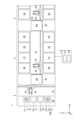
- FIG. 1 is a plan view illustrating a joint system according to one embodiment.
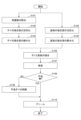
- FIG. 2 is a flow chart illustrating a bonding method according to one embodiment.
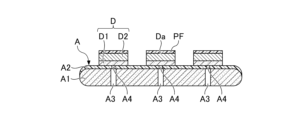
- FIG. 3 is a cross-sectional view showing an example of a carrier with a die attached thereto.
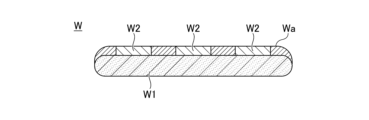
- FIG. 4 is a cross-sectional view showing an example of a substrate.
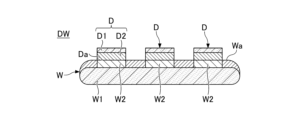
- FIG. 5 is a cross-sectional view showing an example of a substrate with a die.
- FIG. 6 is a cross-sectional view showing an example of the operation of the joining device.
- FIG. 7 is a cross-sectional view showing an example of the operation subsequent to that shown in FIG.
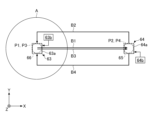
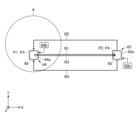
- FIG. 8 is a plan view showing an example of the movement of the first suction head and the second suction head as viewed from above.
- FIG. 1 is a plan view illustrating a joint system according to one embodiment.
- FIG. 2 is a flow chart illustrating a bonding method according to one embodiment.
- FIG. 3 is a cross-sectional
- FIG. 9 is a plan view showing an example of the movement of the first suction head and the second suction head subsequent to FIG.
- FIG. 10 is a plan view showing an example of the movement of the first suction head and the second suction head subsequent to FIG.
- FIG. 11 is a plan view showing an example of the movement of the first suction head and the second suction head subsequent to FIG.
- the X-axis, Y-axis, and Z-axis directions are perpendicular to each other.
- the X-axis and Y-axis directions are horizontal directions, and the Z-axis direction is vertical.
- the X-axis direction includes the positive X-axis direction and the negative X-axis direction that is opposite to the positive X-axis direction.
- the Y-axis direction includes the positive Y-axis direction and the negative Y-axis direction that is opposite to the positive Y-axis direction.
- the Z-axis direction includes the positive Z-axis direction and the negative Z-axis direction that is opposite to the positive Z-axis direction.
- the bonding system 1 manufactures a die-attached substrate DW by bonding multiple dies D to a substrate W.
- the die-attached substrate DW includes a substrate W and multiple dies D joined to the substrate W.
- the substrate W has a first base substrate W1 and a plurality of first devices W2 formed on the first base substrate W1.
- the first base substrate W1 is, for example, a silicon wafer, a compound semiconductor wafer, or a glass substrate.
- the first devices W2 include semiconductor elements, circuits, terminals, or the like.
- the substrate W has a plurality of first devices W2 on the bonding surface Wa with the die D.
- the die D has a second base substrate D1 and a second device D2 formed on the second base substrate D1.
- the second base substrate D1 is, for example, a silicon wafer, a compound semiconductor wafer, or a glass substrate.
- the second device D2 includes a semiconductor element, a circuit, a terminal, or the like.
- the die D has a second device D2 electrically connected to a first device W2 of the substrate W on a bonding surface Da with the substrate W.
- One second device D2 is electrically connected to one first device W2, but multiple second devices D2 may be electrically connected.
- a second die may be prepared separately from the die D.
- the second die has a third device on its bonding surface with the substrate W, which is electrically connected to the first device W2 of the substrate W.
- the third device has a different function, i.e., a different electrical circuit, from the second device D2.
- the second device D2 and the third device may be electrically connected to one first device W2.
- One third device is electrically connected to one first device W2, but multiple third devices may also be electrically connected.
- the bonding system 1 includes a loading/unloading station 2, a first processing station 3, a second processing station 5, and a control circuit 9.
- the loading/unloading station 2, the first processing station 3, and the second processing station 5 are arranged in this order from the negative side of the X-axis to the positive side of the X-axis.
- multiple second processing stations 5 may be provided, and multiple second processing stations 5 may be arranged from the negative side of the X-axis to the positive side of the X-axis.
- the loading/unloading station 2 includes a mounting table 20.
- Cassettes C1 to C4 are mounted on the mounting table 20.
- Cassette C1 contains a carrier A with a die D attached.
- Cassette C2 contains a carrier A from which the die D has been peeled off.
- Cassette C3 contains a substrate W prior to bonding with the die D.
- Cassette C4 contains a substrate DW with a die attached.
- carrier A holds multiple dies D.
- Carrier A is, for example, an electrostatic carrier.
- the electrostatic carrier electrostatically adsorbs multiple dies D.
- the electrostatic carrier may also electrostatically adsorb multiple dies D and vacuum adsorb them. Even after the electrostatic adsorption force disappears, it is possible to continue to hold multiple dies D by the vacuum adsorption force.
- a carrier A is prepared, for example, for each substrate W.
- the carrier A holds only a plurality of dies D having the same function, but in addition to the plurality of dies D, the carrier A may further hold a plurality of second dies as described above. It is preferable that one carrier A holds all the dies to be bonded to one substrate W.
- Carrier A for example, has a conductive substrate A1 and an insulating film A2, and adsorbs die D on the side opposite conductive substrate A1 with insulating film A2 as a reference.
- a charge supply unit (not shown) applies a voltage to conductive substrate A1, thereby supplying a charge of a first polarity (e.g., positive) to conductive substrate A1.
- a charge removal unit (not shown) removes the charge of the first polarity from die D, leaving a charge of a second polarity (e.g., negative) that is opposite to the first polarity on die D.
- a charge of the first polarity accumulates on the conductive substrate A1, while a charge of the second polarity accumulates on the die D.
- a potential difference occurs between the conductive substrate A1 and the die D across the insulating film A2, generating an electrostatic adsorption force.
- the generated electrostatic adsorption force is maintained even after the application of voltage to the conductive substrate A1 and the de-electrification of the die D are released.
- the conductive substrate A1 is made of, for example, silicon, aluminum, an aluminum alloy, stainless steel, or titanium.
- the conductive substrate A1 may have one or more through holes A3 formed therein for each die D.
- the die D can be peeled off from the carrier A by supplying gas to the through holes A3 or by inserting a pin (not shown) into the through holes A3.
- the number and arrangement of the through holes A3 are not particularly limited.
- the insulating film A2 maintains the electrostatic adsorption force by limiting the movement of charge between the second base substrate D1 of the die D and the conductive substrate A1.
- the insulating film A2 preferably has a breakdown voltage of 30 kV or more, and more preferably 40 kV or more.
- the insulating film A2 is preferably made of a flexible material, specifically a material with an elastic modulus of 2 GPa or less, more preferably 0.5 GPa or less.
- a vacuum adsorption force is generated between the die D and the insulating film A2.
- the insulating film A2 is made of, for example, polyimide or EVA (ethylene-vinyl acetate copolymer) from the viewpoint of durability when modifying the bonding surface Da.
- the thickness of the insulating film A2 is, for example, 10 ⁇ m.
- the insulating film A2 may have a through hole A4 formed therein, which is connected to the through hole A3 in the conductive substrate A1.
- the diameter of the through hole A4 in the insulating film A2 is preferably smaller than the diameter of the through hole A3 in the conductive substrate A1.
- the through hole A4 may not be necessary. Even if the through hole A4 is not present, the insulating film A2 can be locally deformed by supplying gas to the through hole A3 or by inserting a pin into the through hole A3, and the die D can be peeled off from the carrier A.
- the carrier A may have a carrier substrate corresponding to the conductive substrate A1 and a resin film corresponding to the insulating film A2, and multiple dies D may be mounted on the resin film.
- the carrier A preferably holds the die D with the bonding surface Da of the die D facing upward.
- the carrier A electrostatically attracts the die D, for example. Note that by pressing the die D against the resin film, the resin film can be deformed so as to remove gas from between the die D and the resin film, and it is also possible to vacuum-attach the die D to the resin film.
- the carrier substrate may be conductive or insulating. Through holes penetrating the carrier substrate in the thickness direction are formed in the carrier substrate.
- the die D can be separated from the carrier A by supplying gas to the through holes or by inserting pins (not shown) into the through holes.
- the number and arrangement of the through holes are not particularly limited. One or more through holes may be formed for each die D.
- the carrier substrate is preferably made of a material having rigidity.
- the carrier substrate is preferably made of silicon (Si), ceramic, aluminum, aluminum alloy, stainless steel, zirconia, silicon carbide (SiC), titanium, or glass.
- the carrier substrate may have a diameter similar to that of the substrate W.
- the carrier substrate may also have a thickness similar to that of the substrate W.
- the resin film is preferably made of a flexible material, specifically a material with an elastic modulus of 2 GPa or less, more preferably 0.5 GPa or less. From the viewpoint of durability when modifying the bonding surface of the die D, the resin film is preferably made of, for example, polyimide or EVA (ethylene-vinyl acetate copolymer). The thickness of the resin film is, for example, 10 ⁇ m.
- the resin film is a single layer, but may be multiple layers. For example, the resin film may have a polyolefin layer and an acrylic adhesive layer.
- carrier A has the same diameter as substrate W.
- the transport arm that transports carrier A and the transport arm that transports substrate W can have the same model number (i.e. the same dimensions and shape), reducing costs.
- the first activation device 37 and the second activation device 39, or the first hydrophilization device 38 and the second hydrophilization device 40 can have the same model number, reducing costs. This also prevents the device from becoming too large.
- the loading/unloading station 2 comprises a third transport area 21, a third carrier transport arm 22, and a third substrate transport arm 23.
- the third transport area 21 is adjacent to the mounting table 20.
- the third transport area 21 extends in the Y-axis direction.
- the third carrier transport arm 22 holds and transports a carrier A in the third transport area 21.
- the third substrate transport arm 23 holds and transports a substrate W in the third transport area 21.
- the loading/unloading station 2 has a drive unit (not shown) that moves or rotates the third carrier transport arm 22 and the third substrate transport arm 23.
- the third carrier transport arm 22 and the third substrate transport arm 23 can move horizontally (in both the X-axis and Y-axis directions) and vertically, and can rotate around a vertical axis.
- the third carrier transport arm 22 and the third substrate transport arm 23 may be mounted on the same Y-axis slider and moved simultaneously in the Y-axis direction as shown in FIG. 1, or may be mounted on different Y-axis sliders and moved independently in the Y-axis direction.
- the third carrier transport arm 22 and the third substrate transport arm 23 are positioned at different heights.
- the first processing station 3 comprises a first transfer region 31, a first carrier transfer arm 32, and a first substrate transfer arm 33.
- the first transfer region 31 extends in the X-axis direction.
- the first carrier transfer arm 32 holds and transports a carrier A in the first transfer region 31.
- the first substrate transport arm 33 holds and transports a substrate W in the first transfer region 31.
- the first processing station 3 has a drive unit (not shown) that moves or rotates the first carrier transport arm 32 and the first substrate transport arm 33.
- the first carrier transport arm 32 and the first substrate transport arm 33 can move horizontally (in both the X-axis and Y-axis directions) and vertically, and can rotate around the vertical axis.
- the first carrier transport arm 32 and the first substrate transport arm 33 may be mounted on the same X-axis slider and moved simultaneously in the X-axis direction as shown in FIG. 1, or may be mounted on different X-axis sliders and moved independently in the X-axis direction.
- the first carrier transport arm 32 and the first substrate transport arm 33 are positioned at different heights.
- the first processing station 3 includes a third transition device 34, a fourth transition device 35, a cleaning device 36, a first activation device 37, a first hydrophilization device 38, a second activation device 39, a second hydrophilization device 40, an inspection device 41, a peeling device 42, and an annealing device 43.
- the third transition device 34, the fourth transition device 35, the cleaning device 36, the first activation device 37, the first hydrophilization device 38, the second activation device 39, the second hydrophilization device 40, the inspection device 41, the peeling device 42, and the annealing device 43 are adjacent to the first transport area 31.
- the third transition device 34 is provided between the third transport area 21 and the first transport area 31, and temporarily stores the carrier A.
- the third transition device 34 relays the carrier A between the third carrier transport arm 22 and the first carrier transport arm 32.
- the relayed carrier A may be one with the die D attached or one from which the die D has been peeled off.
- the fourth transition device 35 is provided between the third transfer region 21 and the first transfer region 31, and temporarily stores the substrate W.
- the fourth transition device 35 relays the substrate W between the third substrate transfer arm 23 and the first substrate transfer arm 33.
- the substrate W to be relayed may be one before the die D is bonded thereto, or one after the die D has been bonded thereto (i.e., a substrate DW with a die attached).
- the cleaning device 36 removes the protective film PF from the die D while the die D is held by the carrier A.
- the protective film PF protects the bonding surface Da of the die D, for example, during dicing. If the protective film PF is water-soluble, the cleaning device 36 supplies pure water to the protective film PF. After removing the protective film PF from the die D, the cleaning device 36 may further clean the bonding surface Da of the die D. This can improve the quality of the processing of the bonding surface Da of the die D that is performed thereafter.
- the first activation device 37 activates the bonding surface Da of the die D while the die D is held by the carrier A.
- the first activation device 37 is, for example, a plasma processing device.
- oxygen gas which is a processing gas
- the bonding surface Da of the die D is activated by irradiating the oxygen ions onto the bonding surface Da of the die D.
- the processing gas is not limited to oxygen gas, and may be, for example, nitrogen gas, etc.
- the first hydrophilization device 38 hydrophilizes the bonding surface Da of the die D while the die D is held by the carrier A.
- the first hydrophilization device 38 supplies pure water (e.g., deionized water) onto the die D while rotating the carrier A held by the spin chuck.
- the pure water imparts OH groups to the bonding surface Da of the die D, which has been activated in advance.
- the die D and the substrate W can be bonded by utilizing hydrogen bonds between the OH groups.
- the second activation device 39 activates the bonding surface Wa of the substrate W.
- the second activation device 39 is, for example, a plasma processing device.
- oxygen gas which is a processing gas
- the bonding surface Wa of the substrate W is activated by irradiating the oxygen ions onto the bonding surface Wa of the substrate W.
- the processing gas is not limited to oxygen gas, and may be, for example, nitrogen gas, etc.
- the second hydrophilization device 40 hydrophilizes the bonding surface Wa of the substrate W.
- the second hydrophilization device 40 supplies pure water (e.g., deionized water) onto the substrate W while rotating the substrate W held by the spin chuck.
- the pure water imparts OH groups to the bonding surface Wa of the substrate W, which has been activated in advance.
- the die D and the substrate W can be bonded by utilizing hydrogen bonds between the OH groups.
- the inspection device 41 inspects whether the bonding state between the substrate W and the die D in the die-attached substrate DW is good or bad. The inspection is performed for each die D.
- the inspection items include at least one of the presence or absence of foreign matter such as air bubbles and the presence or absence of misalignment.
- the peeling device 42 peels off the die D that is found to have a poor bonding state in the inspection by the inspection device 41 from the substrate W.
- the peeling device 42 peels off the die D before the annealing device 43 heats the substrate DW with the die.
- the annealing device 43 heats the substrate DW with the die attached. Before the heat treatment, the die D and the substrate W are bonded by hydrogen bonds between OH groups. The heat treatment causes a dehydration condensation reaction, resulting in covalent bonds and improving the bonding strength between the die D and the substrate W.
- the second processing station 5 comprises a second transport region 51, a second carrier transport arm 52, and a second substrate transport arm 53.
- the second transport region 51 extends in the X-axis direction.
- the second carrier transport arm 52 holds and transports a carrier A in the second transport region 51.
- the second substrate transport arm 53 holds and transports a substrate W in the second transport region 51.
- the second processing station 5 has a drive unit (not shown) that moves or rotates the second carrier transport arm 52 and the second substrate transport arm 53.
- the second carrier transport arm 52 and the second substrate transport arm 53 can move horizontally (in both the X-axis and Y-axis directions) and vertically, and can rotate around the vertical axis.
- the second carrier transport arm 52 and the second substrate transport arm 53 may be mounted on the same X-axis slider and moved simultaneously in the X-axis direction as shown in FIG. 1, or may be mounted on different X-axis sliders and moved independently in the X-axis direction.
- the second carrier transport arm 52 and the second substrate transport arm 53 are positioned at different heights.
- the second processing station 5 includes a first transition device 54, a second transition device 55, and a joining device 56.
- the first transition device 54, the second transition device 55, and the joining device 56 are adjacent to the second transport area 51.
- the first transition device 54 is provided between the first transport area 31 and the second transport area 51, and temporarily stores the carrier A.
- the first transition device 54 relays the carrier A between the first carrier transport arm 32 and the second carrier transport arm 52.
- the relayed carrier A may be one with the die D attached or one from which the die D has been peeled off.
- the second transition device 55 is provided between the first transport area 31 and the second transport area 51, and temporarily stores the substrate W.
- the second transition device 55 relays the substrate W between the first substrate transport arm 33 and the second substrate transport arm 53.
- the substrate W to be relayed may be one before the die D is bonded thereto, or one after the die D has been bonded thereto (i.e., a substrate DW with a die attached).
- the bonding device 56 removes the die D from the carrier A, and bonds the die D to the substrate W by orienting the bonding surface Da of the removed die D toward the bonding surface Wa of the substrate W.
- a substrate DW with a die is obtained.
- the second device D2 of the die D and the first device W2 of the substrate W are electrically connected. Details of the bonding device 56 will be described later.
- the control circuit 9 is, for example, a computer, and includes an arithmetic unit 91 such as a CPU (Central Processing Unit) and a storage unit 92 such as a memory.
- the storage unit 92 stores programs that control various processes executed in the bonding system 1.
- the control circuit 9 controls the operation of the bonding system 1 by having the arithmetic unit 91 execute the programs stored in the storage unit 92.
- a lower control circuit that controls the operation of each device constituting the bonding system 1 may be provided, and a higher-level control circuit that controls multiple lower-level control circuits may be provided.
- the control circuit 9 may be composed of the lower-level control circuit and the higher-level control circuit.
- the control circuit 9 includes electronic circuits such as a CPU, FPGA (Field Programmable Gate Array) or ASIC (Application Specific Integrated Circuit), and executes the various control operations described in this specification by executing instruction codes stored in memory or by being a circuit designed for a specific purpose.
- electronic circuits such as a CPU, FPGA (Field Programmable Gate Array) or ASIC (Application Specific Integrated Circuit)
- the third carrier transport arm 22 takes out the multiple dies D together with the carrier A from the cassette C1 and transports them to the third transition device 34.
- the first carrier transport arm 32 takes out the multiple dies D together with the carrier A from the third transition device 34 and transports them to the cleaning device 36.
- the cleaning device 36 removes the protective film PF from the die D while the die D is held by the carrier A (step S101).
- the first carrier transport arm 32 takes out the multiple dies D together with the carrier A from the cleaning device 36 and transports them to the first activation device 37.
- the first activation device 37 activates the bonding surface Da of the die D while the die D is held by the carrier A (step S102).
- the first carrier transport arm 32 removes the multiple dies D together with the carrier A from the first activation device 37 and transports them to the first hydrophilization device 38.
- the first hydrophilization device 38 hydrophilizes the bonding surface Da of the die D while the die D is held by the carrier A (step S103).
- the first carrier transport arm 32 takes out the multiple dies D together with the carrier A from the first hydrophilization device 38 and transports them to the first transition device 54.
- the second carrier transport arm 52 takes out the multiple dies D together with the carrier A from the first transition device 54 and transports them to the bonding device 56.
- the third substrate transport arm 23 removes the substrate W from the cassette C3 and transports it to the fourth transition device 35. Then, the first substrate transport arm 33 removes the substrate W from the fourth transition device 35 and transports it to the second activation device 39.
- the second activation device 39 activates the bonding surface Wa of the substrate W (step S104).
- the first substrate transport arm 33 removes the substrate W from the second activation device 39 and transports it to the second hydrophilization device 40.
- the second hydrophilization device 40 hydrophilizes the bonding surface Wa of the substrate W (step S105).
- the first substrate transport arm 33 removes the substrate W from the second hydrophilization device 40 and transports it to the second transition device 55.
- the second substrate transport arm 53 removes the substrate W from the second transition device 55 and transports it to the bonding device 56.
- the bonding device 56 removes the die D from the carrier A and bonds the die D to the substrate W by orienting the bonding surface Da of the removed die D toward the bonding surface Wa of the substrate W (step S106). This results in a substrate DW with a die attached.
- the second substrate transport arm 53 then removes the substrate DW with a die attached from the bonding device 56 and transports it to the second transition device 55.
- the first substrate transport arm 33 then removes the substrate DW with a die attached from the second transition device 55 and transports it to the inspection device 41.
- the inspection device 41 inspects whether the bonding state between the substrate W and the die D is good or bad (step S107).
- the inspection device 41 transmits the inspection result to the control circuit 9.
- the control circuit 9 checks for the presence or absence of defects (step S108).
- the control circuit 9 controls the transport destination of the substrate DW with the die attached to be either the annealing device 43 or the peeling device 42 according to the inspection result by the inspection device 41.
- the inspection does not have to be performed every time. For example, the inspection may be performed for each lot, for each predetermined number of substrates, or at predetermined intervals.
- a lot is composed of multiple substrates W (e.g., 25 substrates W) stored in one cassette C3. It is sufficient to inspect the first substrate W in the lot.
- the destination of the die-attached substrate DW is the peeling device 42.
- the first substrate transport arm 33 removes the die-attached substrate DW from the inspection device 41 and transports it to the peeling device 42.
- the peeling device 42 peels off the die D with a defective bonding state from the substrate W (step S109).
- the first substrate transport arm 33 removes the die-attached substrate DW from the peeling device 42 and transports it to the annealing device 43. Then, the processing from step S110 onwards is performed.
- step S109 another operation may be performed.
- the first substrate transport arm 33 removes the substrate W from the peeling device 42 and transports it to the second transition device 55.
- the second substrate transport arm 53 removes the substrate W from the second transition device 55 and transports it to the bonding device 56.
- the bonding device 56 re-bonds the die D to the position where the die D was peeled. Then, the processing from step S107 onwards may be performed again.
- the destination of the die-attached substrate DW is the annealing device 43.
- the first substrate transport arm 33 removes the die-attached substrate DW from the inspection device 41 and transports it to the annealing device 43.
- the annealing device 43 heats the die-attached substrate DW (step S110). The heat treatment improves the bonding strength between the die D and the substrate W.
- the first substrate transport arm 33 removes the die-attached substrate DW from the annealing device 43 and transports it to the fourth transition device 35.
- the third substrate transport arm 23 removes the die-attached substrate DW from the fourth transition device 35 and stores it in cassette C4. The die-attached substrate DW stored in cassette C4 is transported out of the bonding system 1.
- the second carrier transport arm 52 removes carrier A from the bonding device 56 and transports it to the first transition device 54.
- the first carrier transport arm 32 removes carrier A from the first transition device 54 and transports it to the third transition device 34.
- the third carrier transport arm 22 removes carrier A from the third transition device 34 and stores it in cassette C2.
- the bonding device 56 removes the die D from the carrier A, and bonds the die D to the substrate W by orienting the bonding surface Da of the removed die D toward the bonding surface Wa of the substrate W. A substrate DW with a die is obtained. The second device D2 of the die D and the first device W2 of the substrate W are electrically connected.
- the bonding device 56 includes, for example, a carrier holding unit 61, a substrate holding unit 62, a first transport unit 63, and a mounting unit 65.
- the carrier holding unit 61 holds a carrier A.
- the substrate holding unit 62 holds a substrate W.
- the first transport unit 63 receives and transports a die D from the carrier A held by the carrier holding unit 61.
- the mounting unit 65 receives the die D from the first transport unit 63 and mounts the received die D on the substrate W held by the substrate holding unit 62.
- the carrier holding unit 61 holds the carrier A horizontally from below with the joining surface Da of the die D facing upward.
- the substrate holding unit 62 holds the substrate W horizontally from below with the joining surface Wa of the substrate W facing upward.
- the first transport unit 63 turns the die D upside down while transporting it, so that the joining surface Da of the die D faces downward.
- the mount unit 65 receives the die D from the first transport unit 63 and mounts the received die D on the substrate W held by the substrate holding unit 62.
- the carrier holding unit 61 of this embodiment holds the carrier A horizontally from below with the joining surface Da of the die D facing upward
- the technology according to the present disclosure is not limited to this.
- the carrier holding unit 61 may hold the carrier A horizontally from above with the joining surface Da of the die D facing downward.
- the first conveying unit 63 does not need to turn the die D upside down while conveying the die D. This makes it possible to eliminate the mechanism for individually turning the die D upside down, and reduces dust generation from that mechanism.
- the first transport section 63 has, for example, a first suction head 63a and a first moving mechanism 63b.
- the first suction head 63a suctions the die D.
- the first suction head 63a suctions the die D while facing the joining surface Da of the die D. It is preferable that the first suction head 63a suctions the die D without contact in order to prevent contamination of the joining surface Da of the die D.
- the first moving mechanism 63b moves the first suction head 63a.
- the first moving mechanism 63b will be described in more detail below, but as shown in Figures 8 to 11, moves the first suction head 63a between the first receiving position P1 and the first delivery position P2.
- the first receiving position P1 is the position where the first suction head 63a receives the die D from the carrier A.
- the first delivery position P2 is the position where the first suction head 63a delivers the die D to the mount section 65.
- the first moving mechanism 63b may turn the first suction head 63a upside down while the die D is being transported, thereby turning the die D upside down.
- the bonding device 56 may include a pressing unit 66.
- the pressing unit 66 presses the die D upward to separate the die D from the carrier A held by the carrier holding unit 61.
- the pressing unit 66 presses the die D upward, for example, by supplying gas to the through hole A3 of the conductive substrate A1 or by inserting a pin (not shown) into the through hole A3.
- the pressing unit 66 presses the die D downward.
- the pressing unit 66 only needs to press the die D in a direction to separate the die D from the carrier A.
- the first transport unit 63 receives the die D pressed by the pressing unit 66 from the carrier A at the first receiving position P1.
- the carrier holding portion 61 may adsorb only a portion of the underside of the carrier A. In the remaining portion of the underside of the carrier A, the pressing portion 66 can press the die D upward.
- the carrier holding portion 61 is formed, for example, in a ring shape, and adsorbs the outer periphery of the underside of the carrier A. In the center of the underside of the carrier A, the pressing portion 66 can press the die D upward. Note that if the die D can be separated from the carrier A simply by raising the die D together with the first suction head 63a, the pressing portion 66 may not be necessary.
- the joining device 56 may include a carrier moving unit 67.
- the carrier moving unit 67 moves the carrier A together with the carrier holding unit 61.
- the carrier moving unit 67 moves the carrier A, for example, in the X-axis direction and the Y-axis direction. This allows the pressing unit 66 to press multiple dies D in a desired order without the need for the pressing unit 66 to move in the X-axis direction and the Y-axis direction.
- the first conveying unit 63 can receive the die D at the same first receiving position P1 every time. This simplifies the operation of the first conveying unit 63.
- the carrier moving unit 67 may rotate the carrier A around a vertical axis instead of moving it in the X-axis direction.
- the carrier moving unit 67 may also move the carrier A in the Z-axis direction.
- the bonding device 56 may include a substrate moving unit 68.
- the substrate moving unit 68 moves the substrate W together with the substrate holder 62.
- the substrate moving unit 68 moves the substrate W, for example, in the X-axis direction and the Y-axis direction. This makes it possible to change the bonding position of the die D relative to the substrate W.
- the first transport unit 63 can transfer the die D to the mount unit 65 at the same first transfer position P2 every time. This simplifies the operation of the first transport unit 63.
- the substrate moving unit 68 may rotate the substrate W around a vertical axis instead of moving it in the X-axis direction.
- the substrate moving unit 68 may also move the substrate W in the Z-axis direction.
- the mounting unit 65 has, for example, a third suction head 65a and a third moving mechanism 65b.
- the third suction head 65a suctions the die D from the side opposite the first suction head 63a and the second suction head 64a described below.
- the die D has a joining surface Da and a back surface Db facing opposite the joining surface Da. Since it is not a problem if the back surface Db becomes dirty, the third suction head 65a may come into contact with the back surface Db of the die D.
- the third moving mechanism 65b moves the third suction head 65a in the Z-axis direction to bond the die D to the substrate W.
- the third moving mechanism 65b may move the third suction head 65a in the X-axis direction and the Y-axis direction, or may rotate the third suction head 65a around a vertical axis, in order to improve the accuracy of the bonding position of the die D relative to the substrate W.
- the amount of movement or rotation required to improve the accuracy of the bonding position is small, and the third suction head 65a does not need to move much when viewed from above.
- the bonding device 56 may include at least one of a first imaging unit 71, a second imaging unit 72, and a third imaging unit 73 to improve the accuracy of the bonding position of the die D relative to the substrate W. Note that the first imaging unit 71, the second imaging unit 72, and the third imaging unit 73 do not have to capture an image every time the die D and the substrate W are bonded, and may capture images periodically.
- the first imaging unit 71 images the alignment marks on the bonding surface Da of the die D held by the third suction head 65a.
- the number of alignment marks to be imaged is, for example, two, but is not particularly limited.
- the alignment marks may be dedicated marks or may be part of the electrical circuit that constitutes the second device D2.
- the first imaging unit 71 is disposed, for example, below the third suction head 65a.
- the first imaging unit 71 transmits the captured image to the control circuit 9.
- the control circuit 9 detects the position of the die D in the first coordinate system set for the third suction head 65a by processing the image captured by the first imaging unit 71.
- the second imaging unit 72 captures an image of the alignment marks on the bonding surface Wa of the substrate W held by the substrate holding unit 62.
- the number of alignment marks captured is, for example, two, but is not limited thereto.
- the alignment marks may be dedicated marks or may be part of the electrical circuit that constitutes the first device W2.
- the second imaging unit 72 is disposed, for example, above the board holding unit 62, and is provided, for example, on the third suction head 65a.
- the second imaging unit 72 transmits the captured image to the control circuit 9.
- the control circuit 9 detects the position of the first device W2 in the second coordinate system set on the board holding unit 62 by processing the image captured by the second imaging unit 72.
- the control circuit 9 aligns the die D held by the third suction head 65a and the substrate W held by the substrate holder 62 using images captured by at least one of the first imaging unit 71 and the second imaging unit 72.
- the alignment is performed by controlling at least one of the third movement mechanism 65b and the substrate movement unit 68.
- the position of the die D or the substrate W can be corrected, improving the accuracy of the bonding position.
- the third imaging unit 73 simultaneously captures an image of both the alignment mark on the bonding surface Da of the die D and the alignment mark on the bonding surface Wa of the substrate W.
- the third imaging unit 73 captures an image of the alignment marks of the die D and the substrate W, for example, by transmitting light through the die D.
- the third imaging unit 73 is composed of, for example, an infrared camera.
- the third imaging unit 73 When the third imaging unit 73 is to capture an image of the alignment marks of the die D and the substrate W through the die D, it is disposed, for example, above the substrate holding unit 62 and is provided, for example, on the third suction head 65a.
- the third imaging unit 73 transmits the captured image to the control circuit 9.
- the control circuit 9 detects the deviation between the actual bonding position and the target bonding position by processing the image captured by the third imaging unit 73.
- the control circuit 9 uses the image captured by the third imaging unit 73 to align the die D held by the third suction head 65a with the substrate W held by the substrate holder 62 in the next and subsequent bonding of the die D and substrate W.
- the position of the die D or substrate W can be corrected taking into account the characteristics of the bonding device 56, improving the accuracy of the bonding position.
- the bonding device 56 includes the second transport unit 64.
- the second transport unit 64 receives and transports the die D from the carrier A separately from the first transport unit 63.
- the mount unit 65 receives the die D from the first transport unit 63 and the second transport unit 64 in a desired order, and mounts the received die D on the substrate W held by the substrate holder 62. After the mount unit 65 mounts the n-th die D on the substrate W, the second transport unit 64 passes the (n+1)-th die D to the mount unit 65 before the first transport unit 63 passes the (n+2)-th die D to the mount unit 65, and the mount unit 65 mounts the (n+1)-th die D on the substrate W.
- nth die D refers to the nth die D bonded to one substrate W.
- the second transport section 64 has, for example, a second suction head 64a and a second moving mechanism 64b.
- the second suction head 64a suctions the die D.
- the second suction head 64a suctions the die D while facing the joining surface Da of the die D. It is preferable that the second suction head 64a suctions the die D without contact in order to prevent contamination of the joining surface Da of the die D.
- the second moving mechanism 64b moves the second suction head 64a.
- the second moving mechanism 64b moves the second suction head 64a between the second receiving position P3 and the second delivery position P4.
- the second receiving position P3 is a position where the second suction head 64a receives the die D from the carrier A.
- the second delivery position P4 is a position where the second suction head 64a delivers the die D to the mount section 65.
- the second moving mechanism 64b may invert the second suction head 64a upside down while the die D is being transported, thereby inverting the die D upside down.
- the outgoing path B1 of the first suction head 63a from the first receiving position P1 to the first delivery position P2 may overlap with the outgoing path B3 of the second suction head 64a from the second receiving position P3 to the second delivery position P4.
- the outgoing path B1 of the first suction head 63a and the outgoing path B3 of the second suction head 64a completely overlap, but it is sufficient that they overlap at least partially.
- the installation area of the joining device 56 can be reduced.
- the first receiving position P1 and the second receiving position P3 overlap, and the first transfer position P2 and the second transfer position P4 overlap.
- the outgoing path B1 of the first suction head 63a and the outgoing path B3 of the second suction head 64a completely overlap.
- multiple (preferably all) dies D can be transported along the same route from the carrier A to the mounting section 65. Therefore, multiple dies D can be bonded to the substrate W with the same quality.
- the movement path of the first suction head 63a excluding the outgoing path B1, and the return path B2, excluding the outgoing path B3, of the movement path of the second suction head 64a do not overlap. While one of the first suction head 63a and the second suction head 64a moves on the outgoing path, the other can move on the return path. This provides better movement efficiency than when one head is stopped and the other head moves.
- the return path B2 of the first suction head 63a and the return path B4 of the second suction head 64a may be arranged symmetrically with respect to the outgoing paths B1 and B3.
- the return path B2 of the first suction head 63a is formed, for example, in a U-shape
- the return path B4 of the second suction head 64a is formed, for example, in an inverted U-shape.
- the second suction head 64a delivers the die D to the mount section 65 at the second delivery position P4. Then, as shown in FIG. 9, while the first suction head 63a moves from the first receiving position P1 to the first delivery position P2, the second suction head 64a moves from the second delivery position P4 to the second receiving position P3.
- the second suction head 64a receives the die D from the carrier A at the second receiving position P3. Then, as shown in FIG. 11, while the first suction head 63a moves from the first delivery position P2 to the first receiving position P1, the second suction head 64a moves from the second receiving position P3 to the second delivery position P4.
- the first conveying unit 63 and the second conveying unit 64 may convey the dies D alternately.
- the first conveying unit 63 conveys odd-numbered dies D
- the second conveying unit 64 conveys even-numbered dies D.
- the first conveying unit 63 may convey even-numbered dies D
- the second conveying unit 64 may convey odd-numbered dies D.
- the carrier moving unit 67 may move the carrier A in the Y-axis direction so that the first receiving position P1 and the second receiving position P3 overlap when viewed from above. Note that the carrier moving unit 67 only needs to move the carrier A in at least one of the X-axis direction and the Y-axis direction. Furthermore, the carrier moving unit 67 may rotate the carrier A around the vertical axis instead of moving it in the X-axis direction.
- the carrier moving unit 67 may move the carrier A in the Y-axis direction so that the first receiving position P1 and the second receiving position P3 overlap when viewed from above. Note that the carrier moving unit 67 only needs to move the carrier A in at least one of the X-axis direction and the Y-axis direction. Furthermore, the carrier moving unit 67 may rotate the carrier A around the vertical axis instead of moving it in the X-axis direction.
- the carrier moving unit 67 moves the carrier A in the X-axis and Y-axis directions, so that the pressing unit 66 can press the multiple dies D in the desired order without the need for the pressing unit 66 to move in the X-axis and Y-axis directions.
- the pressing unit 66 presses the die D upward to separate the die D from the carrier A at a position where the first receiving position and the second receiving position overlap when viewed from above. Note that when the carrier A is turned upside down, the pressing unit 66 presses the die D downward.
- the pressing unit 66 only needs to press the die D in the direction in which the die D is separated from the carrier A.
Landscapes
- Wire Bonding (AREA)
- Container, Conveyance, Adherence, Positioning, Of Wafer (AREA)
Priority Applications (1)
| Application Number | Priority Date | Filing Date | Title |
|---|---|---|---|
| JP2025537828A JPWO2025028255A1 (https=) | 2023-07-28 | 2024-07-17 |
Applications Claiming Priority (2)
| Application Number | Priority Date | Filing Date | Title |
|---|---|---|---|
| JP2023123344 | 2023-07-28 | ||
| JP2023-123344 | 2023-07-28 |
Publications (1)
| Publication Number | Publication Date |
|---|---|
| WO2025028255A1 true WO2025028255A1 (ja) | 2025-02-06 |
Family
ID=94394533
Family Applications (1)
| Application Number | Title | Priority Date | Filing Date |
|---|---|---|---|
| PCT/JP2024/025592 Pending WO2025028255A1 (ja) | 2023-07-28 | 2024-07-17 | 接合装置、接合システム、及び接合方法 |
Country Status (3)
| Country | Link |
|---|---|
| JP (1) | JPWO2025028255A1 (https=) |
| TW (1) | TW202510160A (https=) |
| WO (1) | WO2025028255A1 (https=) |
Citations (6)
| Publication number | Priority date | Publication date | Assignee | Title |
|---|---|---|---|---|
| US20110079361A1 (en) * | 2009-10-07 | 2011-04-07 | Park Byeong-Kuk | Apparatus for semiconductor die bonding |
| JP2016139630A (ja) * | 2015-01-26 | 2016-08-04 | ファスフォードテクノロジ株式会社 | 半導体若しくは電子部品実装装置及び半導体若しくは電子部品実装方法 |
| JP2017050327A (ja) * | 2015-08-31 | 2017-03-09 | ファスフォードテクノロジ株式会社 | ダイボンダ、ボンディング方法および半導体装置の製造方法 |
| WO2020044580A1 (ja) * | 2018-08-31 | 2020-03-05 | ボンドテック株式会社 | 部品実装システムおよび部品実装方法 |
| WO2021039405A1 (ja) * | 2019-08-23 | 2021-03-04 | 東京エレクトロン株式会社 | 接合装置、接合システム、及び接合方法 |
| WO2023090155A1 (ja) * | 2021-11-16 | 2023-05-25 | 東京エレクトロン株式会社 | 処理システム、静電キャリア及び処理方法 |
-
2024
- 2024-07-17 JP JP2025537828A patent/JPWO2025028255A1/ja active Pending
- 2024-07-17 WO PCT/JP2024/025592 patent/WO2025028255A1/ja active Pending
- 2024-07-19 TW TW113127008A patent/TW202510160A/zh unknown
Patent Citations (6)
| Publication number | Priority date | Publication date | Assignee | Title |
|---|---|---|---|---|
| US20110079361A1 (en) * | 2009-10-07 | 2011-04-07 | Park Byeong-Kuk | Apparatus for semiconductor die bonding |
| JP2016139630A (ja) * | 2015-01-26 | 2016-08-04 | ファスフォードテクノロジ株式会社 | 半導体若しくは電子部品実装装置及び半導体若しくは電子部品実装方法 |
| JP2017050327A (ja) * | 2015-08-31 | 2017-03-09 | ファスフォードテクノロジ株式会社 | ダイボンダ、ボンディング方法および半導体装置の製造方法 |
| WO2020044580A1 (ja) * | 2018-08-31 | 2020-03-05 | ボンドテック株式会社 | 部品実装システムおよび部品実装方法 |
| WO2021039405A1 (ja) * | 2019-08-23 | 2021-03-04 | 東京エレクトロン株式会社 | 接合装置、接合システム、及び接合方法 |
| WO2023090155A1 (ja) * | 2021-11-16 | 2023-05-25 | 東京エレクトロン株式会社 | 処理システム、静電キャリア及び処理方法 |
Also Published As
| Publication number | Publication date |
|---|---|
| TW202510160A (zh) | 2025-03-01 |
| JPWO2025028255A1 (https=) | 2025-02-06 |
Similar Documents
| Publication | Publication Date | Title |
|---|---|---|
| US20130153116A1 (en) | Joint system, substrate processing system, and joint method | |
| TWI529841B (zh) | 接合系統、基板處理系統、接合方法、及電腦記憶媒體 | |
| JP5580806B2 (ja) | 剥離装置、剥離システム、剥離方法、プログラム及びコンピュータ記憶媒体 | |
| JP2020057750A (ja) | 部品実装システム、部品供給装置および部品実装方法 | |
| WO2013136982A1 (ja) | 剥離装置、剥離システム及び剥離方法 | |
| JP5777549B2 (ja) | 剥離装置、剥離システム、剥離方法、プログラム及びコンピュータ記憶媒体 | |
| WO2025028255A1 (ja) | 接合装置、接合システム、及び接合方法 | |
| WO2024089907A1 (ja) | 基板処理装置、及び基板処理方法 | |
| WO2025028244A1 (ja) | 接合装置、接合システム、及び接合方法 | |
| WO2025239202A1 (ja) | 接合装置、及び接合方法 | |
| WO2025057271A1 (ja) | 接合装置、接合システム、接合方法、載せ替え装置、及び載せ替え方法 | |
| WO2025182629A1 (ja) | 接合装置、及び接合方法 | |
| WO2025164322A1 (ja) | 接合装置、及び接合方法 | |
| WO2024228335A1 (ja) | 接合装置、接合システム、及び接合方法 | |
| WO2025057736A1 (ja) | 基板処理方法、接合装置、及び接合システム | |
| TW202534834A (zh) | 接合裝置、接合系統及接合方法 | |
| WO2025169810A1 (ja) | 接合装置 | |
| WO2025142388A1 (ja) | 処理システム及び処理方法 | |
| JP2024160867A (ja) | 接合装置、接合システム、及び接合方法 | |
| WO2025134786A1 (ja) | 接合システム、及び接合方法 | |
| TW202614348A (zh) | 拾起裝置、接合裝置、拾起方法及接合方法 | |
| WO2025159180A1 (ja) | 処理システム及び処理方法 | |
| WO2026004670A1 (ja) | 処理システム、処理方法及び搬送装置 | |
| WO2026028817A1 (ja) | 処理システム及び処理方法 | |
| JP2025058910A (ja) | 実装装置及び実装方法 |
Legal Events
| Date | Code | Title | Description |
|---|---|---|---|
| 121 | Ep: the epo has been informed by wipo that ep was designated in this application |
Ref document number: 24848910 Country of ref document: EP Kind code of ref document: A1 |
|
| ENP | Entry into the national phase |
Ref document number: 2025537828 Country of ref document: JP Kind code of ref document: A |
|
| WWE | Wipo information: entry into national phase |
Ref document number: 2025537828 Country of ref document: JP |
|
| NENP | Non-entry into the national phase |
Ref country code: DE |