WO2025028122A1 - カーボンブラックの製造方法およびカーボンブラック製造用反応炉 - Google Patents
カーボンブラックの製造方法およびカーボンブラック製造用反応炉 Download PDFInfo
- Publication number
- WO2025028122A1 WO2025028122A1 PCT/JP2024/023851 JP2024023851W WO2025028122A1 WO 2025028122 A1 WO2025028122 A1 WO 2025028122A1 JP 2024023851 W JP2024023851 W JP 2024023851W WO 2025028122 A1 WO2025028122 A1 WO 2025028122A1
- Authority
- WO
- WIPO (PCT)
- Prior art keywords
- raw material
- zone
- carbon black
- primary
- containing gas
- Prior art date
- Legal status (The legal status is an assumption and is not a legal conclusion. Google has not performed a legal analysis and makes no representation as to the accuracy of the status listed.)
- Pending
Links
Images

Classifications
-
- C—CHEMISTRY; METALLURGY
- C09—DYES; PAINTS; POLISHES; NATURAL RESINS; ADHESIVES; COMPOSITIONS NOT OTHERWISE PROVIDED FOR; APPLICATIONS OF MATERIALS NOT OTHERWISE PROVIDED FOR
- C09C—TREATMENT OF INORGANIC MATERIALS, OTHER THAN FIBROUS FILLERS, TO ENHANCE THEIR PIGMENTING OR FILLING PROPERTIES ; PREPARATION OF CARBON BLACK ; PREPARATION OF INORGANIC MATERIALS WHICH ARE NO SINGLE CHEMICAL COMPOUNDS AND WHICH ARE MAINLY USED AS PIGMENTS OR FILLERS
- C09C1/00—Treatment of specific inorganic materials other than fibrous fillers; Preparation of carbon black
- C09C1/44—Carbon
- C09C1/48—Carbon black
Definitions
- the present invention relates to a method for producing carbon black and a reactor for producing carbon black.
- the most commonly known methods for producing carbon black include the furnace method, the acetylene black method, and the channel method. Of these, the furnace method is known as an economical method that allows for mass production of carbon black.
- the furnace process is known as a method for producing carbon black by pyrolyzing liquid feedstock oil such as heavy oil or natural gas as the raw hydrocarbon material in a fire-resistant furnace under conditions of insufficient oxygen.
- a method for producing carbon black uses a reactor having therein a fuel combustion zone that generates a combustion gas flow, a reaction zone in which liquid feedstock oil or natural gas is introduced as a feedstock hydrocarbon to the combustion gas flow obtained in the fuel combustion zone and converted into carbon black by a pyrolysis reaction, and a reaction termination zone in which the reaction gas obtained in the reaction zone is quenched to terminate the reaction.
- carbon black for rubber reinforcement there are many varieties of carbon black for rubber reinforcement, each with different characteristics. Since these characteristics are the main factors that determine the performance of the rubber, carbon black with characteristics suited to the component application is selected when compounding into the rubber composition.
- carbon black that satisfies various properties such as a dibutyl phthalate (DBP) absorption of 40 to 180 mL/100 g, a nitrogen adsorption specific surface area (N 2 SA) of 40 to 300 m 2 /g, and a toluene color transmission rate (LT) of 90% or more has been proposed as a material to be blended into a rubber composition for a tire tread, which can further reduce rolling resistance while improving durability such as abrasion resistance (Patent Document 3, etc.).
- DBP dibutyl phthalate
- N 2 SA nitrogen adsorption specific surface area
- LT toluene color transmission rate
- the carbon black to be blended in the above-mentioned rubber composition for tire treads is required to have a dibutyl phthalate (DBP) absorption of 40 to 180 mL/100 g, a nitrogen adsorption specific surface area (N 2 SA) of 40 to 190 m 2 /g, and a toluene color transmission rate (LT) of 90% or more.
- DBP dibutyl phthalate
- N 2 SA nitrogen adsorption specific surface area
- LT toluene color transmission rate
- the most commonly known methods for producing carbon black include the furnace method, the acetylene black method, and the channel method.
- the furnace method is known as an economical method that allows for mass production of carbon black.
- the furnace process is known as a method for producing carbon black by pyrolyzing liquid feedstock oil such as heavy oil or natural gas as the raw hydrocarbon material in a fire-resistant furnace under conditions of insufficient oxygen.
- an object of the present invention is to provide a furnace process for producing carbon black having desired properties in a high yield while reducing carbon dioxide (CO 2 ) emissions, and a reactor for producing carbon black.
- a reactor for producing carbon black is used, the reactor having a fuel combustion zone, a primary raw material introduction zone, a heating zone, and a secondary raw material introduction zone provided in this order from the upstream to the downstream direction of a gas flow path,
- the inventors have found that the above technical problems can be solved by a method for producing carbon black, which comprises introducing an oxygen-containing gas and a fuel into the fuel combustion zone, mixing and burning them to generate a fuel combustion gas flow, introducing a hydrocarbon as a primary raw material while introducing the fuel combustion gas flow into the primary raw material introduction zone to generate a primary reactant-containing gas, electrically heating the primary reactant-containing gas in the heating zone, and then introducing a hydrocarbon as a secondary raw material while introducing the electrically heated primary reactant-containing gas into the secondary raw material introduction zone to carry out a secondary reaction.
- a method for producing carbon black which comprises introducing an oxygen-containing gas and a fuel into the fuel combustion zone, mixing and burning them to generate a fuel combustion gas flow, introducing a
- the present invention provides (1) A reactor for producing carbon black is used, which is provided with a fuel combustion zone, a primary raw material introduction zone, a heating zone, and a secondary raw material introduction zone in this order from the upstream to the downstream direction of a gas flow passage, An oxygen-containing gas and a fuel are introduced into the fuel combustion zone, mixed and combusted to generate a fuel combustion gas stream, a hydrocarbon as a primary feedstock is introduced into the primary feedstock introduction zone while the fuel combustion gas stream is being introduced to generate a primary reactant-containing gas, and then the primary reactant-containing gas is electrically heated in the heating zone; and a secondary raw material introduction zone, while introducing the electrically heated primary reactant-containing gas, and introducing a hydrocarbon as a secondary raw material to carry out a secondary reaction; (2) A method for producing carbon black according to the above (1), which produces carbon black having a dibutyl phthalate (DBP) absorption of 40 to 180 mL/100 g, a nitrogen adsorption specific surface area (DBP
- a reactor for producing carbon black which is provided with a fuel combustion zone, a primary raw material introduction zone, a heating zone, and a secondary raw material introduction zone in the order from the upstream to the downstream of the gas flow path, and a hydrocarbon as a primary raw material is introduced into the primary raw material introduction zone, a part of which is pyrolyzed to produce a primary reactant (carbon black nuclei) as a precursor, and the generated primary reactant-containing gas is heated by electrical heating in the heating zone, which is considered to be able to reduce the emission of carbon dioxide (CO 2 ) and to suitably produce a gas containing a sufficient amount of the primary reactant (carbon black nuclei) as a precursor by pyrolyzing the remainder of the primary raw material.
- a hydrocarbon as a primary raw material is introduced into the primary raw material introduction zone, a part of which is pyrolyzed to produce a primary reactant (carbon black nuclei) as a precursor, and the generated primary reactant-containing gas is heated by electrical
- a hydrocarbon as a secondary raw material is introduced while introducing the primary reactant-containing gas, which causes the pyrolysis product of the secondary raw material to grow the particle size of the primary reactant (carbon black nuclei) to form primary particles, and a secondary reaction occurs in which the primary particles form a chain-like structure aggregate in which a plurality of the primary particles are linked in a bead-like shape, which is considered to be able to produce carbon black having desired properties easily and continuously with a high yield.
- the present invention it is possible to provide a furnace process in which a secondary raw material is used as raw material hydrocarbons together with a primary raw material, and a method for producing carbon black having desired properties at a high yield while reducing carbon dioxide (CO 2 ) emissions, and a reactor for producing carbon black that can be suitably used in the method.
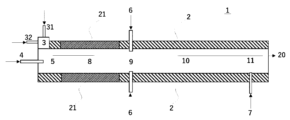
- FIG. 1 is a schematic diagram showing a cross section of an example of a reactor for producing carbon black.
- FIG. 1 is a schematic diagram showing a cross section of a conventionally used reactor for producing carbon black.
- the method for producing carbon black according to the present invention includes the steps of: A reactor for producing carbon black is used, the reactor having a fuel combustion zone, a primary raw material introduction zone, a heating zone, and a secondary raw material introduction zone provided in this order from the upstream to the downstream direction of a gas flow path, An oxygen-containing gas and a fuel are introduced into the fuel combustion zone, mixed and combusted to generate a fuel combustion gas stream, a hydrocarbon as a primary feedstock is introduced into the primary feedstock introduction zone while the fuel combustion gas stream is being introduced to generate a primary reactant-containing gas, and then the primary reactant-containing gas is electrically heated in the heating zone; and In the secondary raw material introduction zone, a secondary reaction is carried out by introducing a hydrocarbon as a secondary raw material while introducing the electrically heated primary reactant-containing gas.
- a reactor for manufacturing carbon black is used that is provided with a fuel combustion zone, a primary raw material introduction zone, a heating zone, and a secondary raw material introduction zone in the order listed from upstream to downstream of the gas flow (gas flow path) inside the furnace.
- the gas flow path be such that the gas flows in approximately one direction from the upstream to the downstream side.
- FIG. 1 An example of such a carbon black production reactor is one whose cross-sectional shape is shown in FIG. 1.
- the carbon black production reactor 1 is provided with a fuel combustion zone 3, a primary raw material introduction zone 5, a heating zone 8, and a secondary raw material introduction zone 9, which are connected in the upstream to downstream direction of a gas flow path 20 formed in the furnace.
- an oxygen-containing gas and a fuel are introduced into the fuel combustion zone 3, mixed, and combusted to generate a fuel combustion gas stream.
- the oxygen-containing gas may be oxygen, air, or a mixture of these
- the fuel may be one or more selected from hydrogen, carbon monoxide, FCC residual oil, petroleum-based liquid fuels such as heavy oil, coal-based liquid fuels such as creosote oil, hydrocarbon gases such as methane, ethane, propane, natural gas, petroleum gas, ethylene, acetylene, and mixtures of these, and gases generated by the thermal decomposition of rubber or plastic.
- the amount of air supplied per 1 kg of the total supply amount of the primary raw materials and secondary raw materials described below is preferably 5 to 20 Nm3 , more preferably 6 to 18 Nm3, and even more preferably 7 to 15 Nm3 .
- the two can be mixed and burned to generate a high-temperature combustion gas flow.
- the fuel combustion zone 3 is equipped with an oxygen-containing gas inlet 31 for introducing an oxygen-containing gas such as air, and a combustion burner 32 for supplying fuel.
- the oxygen-containing gas and fuel are introduced into the fuel combustion zone 3, mixed, and combusted to generate a fuel combustion gas flow.
- the hydrocarbons that serve as the primary raw material are introduced into the primary raw material introduction zone 5 while the fuel combustion gas stream generated in the fuel combustion zone 3 is being introduced.
- the primary raw material hydrocarbon can be a gaseous fuel (gaseous hydrocarbon) or a fuel with a large molecular weight (hydrocarbon with a large molecular weight).
- gaseous fuel means a fuel that is gaseous under standard conditions (25°C, 1 atm)
- a fuel with a large molecular weight means a fuel with a molecular weight of 70 or more as measured by the following GC-TOF/MS.
- the molecular weight was measured by GC-TOF/MS under the following conditions. Measuring device: JEOL JMS-T200GC Measurement conditions Inlet temperature: 280°C Carrier gas: Helium Column: BPX-5 Ionization method: EI method Ionization voltage: 70 eV Ionization current: 300 ⁇ A
- the gaseous fuel may be one or more selected from the group consisting of hydrocarbon gases such as methane, ethane, propane, natural gas, petroleum gas, ethylene, and acetylene, mixed gases thereof, and gases generated by the thermal decomposition of rubber or plastic.
- examples of the fuel having a large molecular weight include one or more selected from aromatic hydrocarbons such as benzene, toluene, xylene, naphthalene, anthracene, etc.; coal-based hydrocarbons such as creosote oil, tar oil, carboxylic acid oil, etc.; petroleum-based heavy oils such as ethylene heavy end oil, FCC residual oil, etc.; acetylenic unsaturated hydrocarbons; ethylenic hydrocarbons; aliphatic saturated hydrocarbons such as pentane and hexane; vegetable oils such as rapeseed oil and soybean oil; and oils generated by the thermal decomposition of rubber or plastics.
- aromatic hydrocarbons such as benzene, toluene, xylene, naphthalene, anthracene, etc.
- coal-based hydrocarbons such as creosote oil, tar oil, carboxylic acid oil, etc.
- benzene, toluene, xylene, naphthalene, anthracene, creosote oil, carboxylic acid oil, ethylene heavy end oil, FCC residual oil, etc. are preferred.
- the primary raw material may be a mixture of two or more of the above-mentioned hydrocarbons.
- the hydrocarbon serving as the primary raw material preferably contains the fuel having a large molecular weight as described above.
- the amount of the primary raw material introduced into primary raw material introduction zone 5 is preferably 0.01 to 5.00 kg, more preferably 0.02 to 4.90 kg, and even more preferably 0.03 to 4.80 kg per 1 Nm3 of air under standard conditions (25° C., 1 atm).
- a primary raw material introduction zone 5 is provided in communication with the fuel combustion zone 3, and the primary raw material is introduced from a primary raw material introduction nozzle 4 that supplies the primary raw material in the furnace axial direction.
- the primary raw material introduction nozzle 4 may be, for example, a one-fluid nozzle.
- the primary raw material is a solid at room temperature, it is preferable to heat it appropriately to make it liquid or gaseous before introducing the primary raw material through the primary raw material introduction nozzle 4.
- the primary raw material hydrocarbons are introduced into the primary raw material introduction zone 5 while the fuel combustion gas stream generated in the fuel combustion zone 3 is being introduced, whereby a portion of the primary raw material is thermally decomposed to produce a primary reactant-containing gas that contains the primary reactants (carbon black nuclei) that become precursors.
- the primary reactant-containing gas produced is electrically heated in heating zone 8 .
- examples of electric heating include resistance heating, induction heating, dielectric heating, etc.
- examples of electric heating include one or more types selected from heating by an electric heater, electromagnetic induction heating, microwave heating, etc.
- the heating temperature in heating zone 8 is preferably 1000 to 2000°C, more preferably 1100 to 1900°C, and even more preferably 1200 to 1800°C.
- the heating time in heating zone 8 may be appropriately adjusted so that the primary raw material introduced into heating zone 8 is thermally decomposed to suitably generate a gas containing the primary reactant (carbon black nuclei).
- the furnace walls 2, of which the furnace wall 21 in the heating zone 8 are made of a material with higher thermal conductivity than the furnace walls in the other zones, and the inside of the furnace can be heated by heating the outer surface of the furnace wall 21 and conducting heat to the inner surface of the furnace wall 21.
- Means for heating the furnace wall 21 include electric heaters, electromagnetic induction heating, microwave heating, etc.
- the primary reactant itself introduced into the heating zone 8 can be heated by dielectric heating.
- dielectric heating include microwave heating.
- a fuel combustion gas flow is generated in the fuel combustion zone 3 and electrical heating is performed in the heating zone 8, whereby the hydrocarbons serving as the primary raw material are suitably pyrolyzed while reducing carbon dioxide (CO 2 ) emissions to produce primary reaction products (carbon black nuclei) having an appropriate particle size, and the desired carbon black can be easily produced while controlling the structure in the secondary reaction described below.
- CO 2 carbon dioxide
- a reactor 1 for producing carbon black is used, which is provided with a fuel combustion zone 3, a primary raw material introduction zone 5, a heating zone 8, and a secondary raw material introduction zone 9 in that order from the upstream to downstream direction of a gas flow path.
- a primary raw material is introduced into the primary raw material introduction zone 5, and the generated primary reactant-containing gas is heated by electrical heating in the heating zone 8, thereby making it possible to suitably produce a gas containing primary reactants (carbon black nuclei) while reducing the amount of carbon dioxide (CO 2 ) emissions.
- the primary reactant-containing gas produced in the heating zone 8 is introduced into the secondary raw material introduction zone 9 while the hydrocarbons that serve as the secondary raw material are introduced to carry out the secondary reaction.
- the hydrocarbons used as the secondary raw material can be gaseous fuel (gaseous hydrocarbons) or large molecular weight fuel (hydrocarbons with large molecular weights).
- gaseous fuel means a fuel that is gaseous under standard conditions (25°C, 1 atm)
- large molecular weight fuel means a fuel with a molecular weight of 70 or more as measured by GC-TOF/MS.
- the gaseous fuel may be one or more selected from the group consisting of hydrocarbon gases such as methane, ethane, propane, natural gas, petroleum gas, ethylene, and acetylene, mixed gases of these, and gases generated by the thermal decomposition of rubber or plastic.
- hydrocarbon gases such as methane, ethane, propane, natural gas, petroleum gas, ethylene, and acetylene, mixed gases of these, and gases generated by the thermal decomposition of rubber or plastic.
- examples of fuels with a large molecular weight include one or more selected from aromatic hydrocarbons such as benzene, toluene, xylene, naphthalene, anthracene, etc.; coal-based hydrocarbons such as creosote oil, tar oil, and carboxylic acid oil; petroleum-based heavy oils such as FCC residual oil and ethylene heavy end oil; acetylene-based unsaturated hydrocarbons, ethylenic hydrocarbons, and aliphatic hydrocarbons such as pentane and hexane; vegetable oils such as rapeseed oil and soybean oil; and oils generated by the thermal decomposition of rubber and plastics.
- aromatic hydrocarbons such as benzene, toluene, xylene, naphthalene, anthracene, etc.
- coal-based hydrocarbons such as creosote oil, tar oil, and carboxylic acid oil
- petroleum-based heavy oils such as FCC residual
- the secondary raw material is preferably a gaseous fuel, in particular one or more hydrocarbon gases selected from methane, ethane, propane, natural gas, petroleum gas, ethylene, acetylene, etc., in order to appropriately adjust the properties of the carbon black produced.
- a gaseous fuel in particular one or more hydrocarbon gases selected from methane, ethane, propane, natural gas, petroleum gas, ethylene, acetylene, etc.
- the amount of secondary raw material introduced in secondary raw material introduction zone 9 is preferably 0.10 to 5.00 times by mass, more preferably 0.15 to 4.95 times by mass, and even more preferably 0.20 to 4.90 times by mass, relative to the amount of primary raw material introduced in primary raw material introduction zone 5.
- the amount of secondary raw material introduced in secondary raw material introduction zone 9 relative to the amount of primary raw material introduced in primary raw material introduction zone 5 is within the above range, so that carbon black having the desired characteristics can be easily manufactured.
- the secondary raw material is introduced into the secondary raw material introduction zone 9 while the primary reactant-containing gas generated in the heating zone 8 is introduced, and the secondary raw material is pyrolyzed while both are circulated in the furnace to carry out the secondary reaction.
- a secondary raw material introduction zone 9 is provided coaxially in communication with the primary raw material introduction zone 5, and the secondary raw material introduction zone 9 receives the secondary raw material from a secondary raw material introduction nozzle 6 that supplies the secondary raw material from a direction perpendicular to the furnace axis.
- the secondary material introduction nozzle 6 may be, for example, a one-fluid nozzle. If the secondary raw material is solid at room temperature, it is appropriately heated to a liquid or gaseous state, and the secondary raw material is introduced from the secondary raw material introduction nozzle 6 .
- the secondary raw material introduced into the secondary raw material introduction zone 9 is thermally decomposed in the reaction zone 10 while flowing in the axial direction of the furnace, to carry out a secondary reaction.
- the carbon black production method of the present invention uses a carbon black production reactor in which a fuel combustion zone 3, a primary raw material introduction zone 5, a heating zone 8, and a secondary raw material introduction zone 9 are sequentially arranged from the upstream to downstream direction of the gas flow path, and while introducing the gas containing the primary reactant (carbon black nuclei) obtained in the heating zone 8 into the secondary raw material introduction zone 9, a hydrocarbon that serves as the secondary raw material is introduced.
- the reaction is stopped appropriately after the desired carbon black is produced.
- a reaction stop zone 11 is provided coaxially in communication with the reaction zone 10, and a cooling liquid introduction nozzle 7 is provided in the reaction stop zone 11 in a direction perpendicular to the furnace axis, and the reaction can be stopped by spraying a cooling liquid from this cooling liquid introduction nozzle 7.
- the cooling liquid can be water or the like, and the carbon black particles suspended in the high-temperature combustion gas are cooled by spraying the cooling liquid.
- the cooled carbon black particles are passed through a flue or other passage and are then separated and collected by a collection system (separation and collection device) such as a cyclone or bag filter, allowing the desired carbon black to be recovered.
- a collection system separation and collection device
- the reactor for producing carbon black is not limited to the form shown in FIG. 1 and can have various shapes.
- the carbon black obtained by the manufacturing method of the present invention preferably has a dibutyl phthalate (DBP) absorption of 40 to 180 mL/100 g, more preferably 55 to 175 mL/100 g, and even more preferably 70 to 170 mL/100 g.
- DBP dibutyl phthalate
- the above DBP absorption amount is an indicator of the degree of structure development, i.e., the degree of complexity of the aggregate structure.
- the carbon black obtained by the manufacturing method of the present invention has a dibutyl phthalate (DBP) absorption amount within the above range, so that when it is blended into a rubber composition for tire treads, for example, it can optimally exhibit the desired tensile stress and elongation.
- DBP dibutyl phthalate
- DBP absorption refers to the value measured by the method specified in JIS K6217-4 "Carbon black for rubber - Basic properties - Part 4, Determination of DBP absorption.”
- the carbon black obtained by the production method according to the present invention preferably has a nitrogen adsorption specific surface area (N 2 SA) of 40 to 190 m 2 /g, more preferably 55 to 180 m 2 /g, and even more preferably 70 to 170 m 2 /g.
- N 2 SA nitrogen adsorption specific surface area
- the carbon black obtained by the production method according to the present invention has an N 2 SA within the above range, so that when it is blended into a rubber composition for a tire tread, it can suitably exhibit desired tensile strength and abrasion resistance.
- N 2 SA means a value measured by the amount of nitrogen adsorption according to the method specified in JIS K6217-2 2001 "Testing method for basic performance of carbon black for rubber”.
- the carbon black obtained by the manufacturing method of the present invention preferably has a toluene color transmittance (LT) of 90% or more, more preferably 93% or more, and even more preferably 95% or more.
- LT toluene color transmittance
- the carbon black obtained by the manufacturing method of the present invention has a toluene color transmission (LT) within the above range, which suppresses the tar content, especially aromatic content, on the carbon black surface, and when compounded into a rubber composition for tire treads, the desired wear resistance can be optimally exhibited.
- LT toluene color transmission
- toluene color transmission refers to the value measured according to JIS K6218 "Test methods for additional properties of carbon black for rubber, 8. Toluene color transmission, Method A.”
- the method for producing carbon black according to the present invention can provide a furnace process using secondary raw materials as raw hydrocarbons, which produces carbon black having desired properties in high yield while reducing carbon dioxide (CO 2 ) emissions.
- the present invention relates to a reactor for producing carbon black, which is provided with a fuel combustion zone, a primary raw material introduction zone, a heating zone, and a secondary raw material introduction zone in this order from an upstream to a downstream direction of a gas flow passage, and the fuel combustion zone is a region in which an oxygen-containing gas and a fuel are introduced, mixed, and combusted to generate a fuel combustion gas stream;
- the primary feed introduction zone is a zone in which a hydrocarbon as a primary feed is introduced while the fuel combustion gas stream is introduced to generate a primary reactant-containing gas, the heating zone is an area in which the primary reactant-containing gas is electrically heated;
- the secondary raw material introduction zone is characterized in that it is a zone in which a secondary reaction is carried out by introducing a hydrocarbon as a secondary raw material while introducing the electrically heated primary reactant-containing gas.
- reactor for producing carbon black according to the present invention Details of the reactor for producing carbon black according to the present invention are as described in the description of the method for producing carbon black according to the present invention, and a specific example thereof is the above-mentioned reactor for producing carbon black 1.
- the reactor for producing carbon black according to the present invention can be suitably used in the method for producing carbon black according to the present invention.
- a reactor for producing carbon black which is used in a furnace process using a secondary raw material as a raw material hydrocarbon, and which can produce carbon black having desired properties in a high yield while reducing carbon dioxide (CO 2 ) emissions.
- the reactor shown in Figure 1 is provided with a fuel combustion zone 3, a primary raw material introduction zone 5, a heating zone 8, a secondary raw material introduction zone 9, a reaction zone 10, and a reaction stop zone 11, which are connected in the upstream to downstream direction of a gas flow path 20 formed inside the reactor.
- the fuel combustion zone 3 is equipped with an oxygen-containing gas inlet 31 for introducing an oxygen-containing gas such as air, and a combustion burner 32 for supplying fuel.
- the primary raw material introduction zone 5 is equipped with a primary raw material introduction nozzle 4, which is a one-fluid nozzle that supplies the primary raw material in the furnace axial direction, and is provided in communication with the fuel combustion zone 3.
- the heating zone 8 has a furnace wall 21 made of a material with higher thermal conductivity than the other parts of the furnace wall 2, and the inside of the furnace is heated by electrically heating the outer surface of the furnace wall 21 and conducting heat to the inner surface of the furnace wall 21.
- the secondary raw material introduction zone 9 is equipped with a single-fluid nozzle, which is a secondary raw material introduction nozzle 6, from a direction perpendicular to the furnace axis direction, and is provided coaxially in communication with the heating zone 8, and the reaction zone 10 is provided coaxially in communication with the secondary raw material introduction zone 9.
- the reaction terminating zone 11 is equipped with a cooling liquid introduction nozzle 7 (water-cooled quench) that supplies cooling liquid from a direction perpendicular to the furnace axis direction and can be moved up and down in the figure, and is provided coaxially in communication with the reaction zone 10.
- carbon black was produced using the carbon black production reactor 1 as follows:
- naphthalene molecular weight 128, was supplied as the primary raw material from the one-fluid nozzle, which is the primary raw material introduction nozzle 4, in the amounts shown in Table 1, and then the above-mentioned high-temperature combustion gas stream and the primary raw material were introduced into the heating zone 8.
- the outer surface of the furnace wall 21 was electrically heated to 1200-1400°C by an electric heater, and the inside of the furnace was heated to the electric heating temperatures shown in Table 1, thereby sufficiently generating gas containing the primary reactants.
- the nitrogen adsorption specific surface area N 2 SA (m 2 /g), dibutyl phthalate (DBP) absorption amount (mL/100 g), and toluene coloring transmittance LT (%) of each of the obtained carbon blacks were measured. The results are shown in Table 2.
- Carbon black was produced using a reactor 1A for producing carbon black having a generally cylindrical shape as shown in the cross-sectional view of FIG.
- the carbon black production reactor 1A shown in FIG. 2 does not have a furnace wall 21 made of a highly thermally conductive material, and does not have a heating zone 8, but the structure and furnace size are the same as those of the carbon black production reactor 1 shown in FIG. 1.
- naphthalene (molecular weight 128) was supplied as the primary raw material from the one-fluid nozzle, which is the primary raw material introduction nozzle 4, in the amounts shown in Table 3.
- city gas gas type 13A
- the gas was introduced into the reaction stop zone 11, where cooling water was sprayed from the cooling liquid introduction nozzle 7.
- the cooled carbon black particles passed through a flue or the like and were collected by a separation and collection device (not shown), and the desired carbon black was recovered.
- a carbon black production reactor 1 in which a fuel combustion zone 3, a primary raw material introduction zone 5, a heating zone 8, and a secondary raw material introduction zone 9 are sequentially arranged from upstream to downstream of a gas flow path 20.
- An oxygen-containing gas and a fuel are introduced into the fuel combustion zone 3, mixed and combusted to generate a fuel combustion gas flow.
- the primary raw material is introduced into the primary raw material introduction zone 5 while the fuel combustion gas flow is being introduced to generate a primary reactant-containing gas.
- the primary reactant-containing gas is then electrically heated in the heating zone 8.
- the secondary raw material introduction zone 9 the secondary raw material is introduced while the primary reactant-containing gas is being introduced to carry out a secondary reaction, thereby producing carbon black.
- Tables 3 and 4 show that in Comparative Example 1, in relation to Examples 1 to 9, no carbon black is obtained because no primary raw material is supplied in primary raw material introduction zone 5 and no electrical heating is performed in heating zone 8.
- Comparative Examples 2 to 10 do not employ electrical heating in the heating zone, and therefore have a high amount of CO2 generated per unit amount of carbon black (CB) produced ( CO2 generated amount/CB produced amount), and thus cannot reduce the amount of carbon dioxide ( CO2 ) emitted during the production of carbon black.
- Table 4 shows that in Comparative Examples 2 to 10, in comparison with Examples 1 to 9, no electrical heating was performed in the heating zone, and therefore only carbon black with a low toluene coloring transmittance LT of 1 to 43% was obtained.
- the present invention it is possible to provide a furnace process using a secondary raw material as a raw material hydrocarbon, which produces carbon black having desired properties in a high yield while reducing carbon dioxide (CO 2 ) emissions, and a reactor for producing carbon black that can be suitably used in the process.
Landscapes
- Chemical & Material Sciences (AREA)
- Organic Chemistry (AREA)
- Pigments, Carbon Blacks, Or Wood Stains (AREA)
Priority Applications (3)
| Application Number | Priority Date | Filing Date | Title |
|---|---|---|---|
| CN202480049880.3A CN121620568A (zh) | 2023-08-02 | 2024-07-02 | 炭黑的制造方法及炭黑制造用反应炉 |
| JP2025505592A JP7762833B2 (ja) | 2023-08-02 | 2024-07-02 | カーボンブラックの製造方法 |
| KR1020267005194A KR20260042543A (ko) | 2023-08-02 | 2024-07-02 | 카본 블랙의 제조 방법 및 카본 블랙 제조용 반응로 |
Applications Claiming Priority (2)
| Application Number | Priority Date | Filing Date | Title |
|---|---|---|---|
| JP2023126375 | 2023-08-02 | ||
| JP2023-126375 | 2023-08-02 |
Publications (1)
| Publication Number | Publication Date |
|---|---|
| WO2025028122A1 true WO2025028122A1 (ja) | 2025-02-06 |
Family
ID=94394410
Family Applications (1)
| Application Number | Title | Priority Date | Filing Date |
|---|---|---|---|
| PCT/JP2024/023851 Pending WO2025028122A1 (ja) | 2023-08-02 | 2024-07-02 | カーボンブラックの製造方法およびカーボンブラック製造用反応炉 |
Country Status (5)
| Country | Link |
|---|---|
| JP (1) | JP7762833B2 (https=) |
| KR (1) | KR20260042543A (https=) |
| CN (1) | CN121620568A (https=) |
| TW (1) | TW202509155A (https=) |
| WO (1) | WO2025028122A1 (https=) |
Citations (4)
| Publication number | Priority date | Publication date | Assignee | Title |
|---|---|---|---|---|
| JP2004043598A (ja) | 2002-07-10 | 2004-02-12 | Mitsubishi Chemicals Corp | カーボンブラックの製造方法及び装置 |
| JP2004277443A (ja) | 2003-03-12 | 2004-10-07 | Mitsubishi Chemicals Corp | カーボンブラックの製造方法及びその装置 |
| JP2011026392A (ja) | 2009-07-22 | 2011-02-10 | Bridgestone Corp | ゴム組成物及びそれを用いたタイヤ |
| JP2018522996A (ja) * | 2015-04-30 | 2018-08-16 | キャボット コーポレイションCabot Corporation | 炭素コーティング粒子 |
Family Cites Families (2)
| Publication number | Priority date | Publication date | Assignee | Title |
|---|---|---|---|---|
| JP5672427B2 (ja) * | 2010-02-05 | 2015-02-18 | 東海カーボン株式会社 | カーボンブラック、カーボンブラックの製造方法およびゴム組成物 |
| EP4101900A1 (en) * | 2021-06-10 | 2022-12-14 | Orion Engineered Carbons GmbH | Sustainable carbon black formation |
-
2024
- 2024-07-02 WO PCT/JP2024/023851 patent/WO2025028122A1/ja active Pending
- 2024-07-02 CN CN202480049880.3A patent/CN121620568A/zh active Pending
- 2024-07-02 KR KR1020267005194A patent/KR20260042543A/ko active Pending
- 2024-07-02 JP JP2025505592A patent/JP7762833B2/ja active Active
- 2024-07-05 TW TW113125205A patent/TW202509155A/zh unknown
Patent Citations (4)
| Publication number | Priority date | Publication date | Assignee | Title |
|---|---|---|---|---|
| JP2004043598A (ja) | 2002-07-10 | 2004-02-12 | Mitsubishi Chemicals Corp | カーボンブラックの製造方法及び装置 |
| JP2004277443A (ja) | 2003-03-12 | 2004-10-07 | Mitsubishi Chemicals Corp | カーボンブラックの製造方法及びその装置 |
| JP2011026392A (ja) | 2009-07-22 | 2011-02-10 | Bridgestone Corp | ゴム組成物及びそれを用いたタイヤ |
| JP2018522996A (ja) * | 2015-04-30 | 2018-08-16 | キャボット コーポレイションCabot Corporation | 炭素コーティング粒子 |
Also Published As
| Publication number | Publication date |
|---|---|
| JPWO2025028122A1 (https=) | 2025-02-06 |
| CN121620568A (zh) | 2026-03-06 |
| JP7762833B2 (ja) | 2025-10-30 |
| TW202509155A (zh) | 2025-03-01 |
| KR20260042543A (ko) | 2026-03-31 |
Similar Documents
| Publication | Publication Date | Title |
|---|---|---|
| EP1188801B1 (en) | Device and method for converting carbon containing feedstock into carbon containing materials, having a defined structure | |
| US11149148B2 (en) | Secondary heat addition to particle production process and apparatus | |
| US4101639A (en) | Process for production of carbon black | |
| AU2002213938A1 (en) | Device and method for converting carbon containing feedstock into carbon containing materials, having a defined nanostructure | |
| JP3115603B2 (ja) | カーボンブラックの製造方法 | |
| KR20190138862A (ko) | 입자 시스템 및 방법 | |
| US7829057B2 (en) | Carbon black and multi-stage process for making same | |
| JP4129970B2 (ja) | 高ストラクチャーカーボンブラックの製造方法 | |
| US20050019246A1 (en) | Process and apparatus for producing carbon blacks | |
| US2768067A (en) | Manufacture of carbon black | |
| JP7762833B2 (ja) | カーボンブラックの製造方法 | |
| JPH0657806B2 (ja) | カ−ボンブラツクの製造方法 | |
| US4645657A (en) | Production of carbon black | |
| JPH0126620B2 (https=) | ||
| JPH11335577A (ja) | カーボンブラックの製造方法 | |
| JPH0734001A (ja) | カーボンブラックの製造方法 | |
| JPH10140035A (ja) | カーボンブラックの製造方法 | |
| JPH0572429B2 (https=) | ||
| HK1060589A (en) | Device and method for converting carbon containing feedstock into carbon containing materials, having a defined nanostructure | |
| JPH10140034A (ja) | カーボンブラックの製造方法 | |
| JPS6350380B2 (https=) |
Legal Events
| Date | Code | Title | Description |
|---|---|---|---|
| WWE | Wipo information: entry into national phase |
Ref document number: 2025505592 Country of ref document: JP |
|
| 121 | Ep: the epo has been informed by wipo that ep was designated in this application |
Ref document number: 24848781 Country of ref document: EP Kind code of ref document: A1 |
|
| WWE | Wipo information: entry into national phase |
Ref document number: 202617001598 Country of ref document: IN |
|
| WWE | Wipo information: entry into national phase |
Ref document number: 2601000480 Country of ref document: TH |
|
| WWP | Wipo information: published in national office |
Ref document number: 202617001598 Country of ref document: IN |
|
| ENP | Entry into the national phase |
Ref document number: 1020267005194 Country of ref document: KR Free format text: ST27 STATUS EVENT CODE: A-0-1-A10-A15-NAP-PA0105 (AS PROVIDED BY THE NATIONAL OFFICE) |
|
| WWE | Wipo information: entry into national phase |
Ref document number: 2024848781 Country of ref document: EP |
|
| NENP | Non-entry into the national phase |
Ref country code: DE |