WO2025028062A1 - 気体圧縮機 - Google Patents
気体圧縮機 Download PDFInfo
- Publication number
- WO2025028062A1 WO2025028062A1 PCT/JP2024/022590 JP2024022590W WO2025028062A1 WO 2025028062 A1 WO2025028062 A1 WO 2025028062A1 JP 2024022590 W JP2024022590 W JP 2024022590W WO 2025028062 A1 WO2025028062 A1 WO 2025028062A1
- Authority
- WO
- WIPO (PCT)
- Prior art keywords
- temperature sensor
- compressed gas
- gas
- detection value
- intercooler
- Prior art date
- Legal status (The legal status is an assumption and is not a legal conclusion. Google has not performed a legal analysis and makes no representation as to the accuracy of the status listed.)
- Pending
Links
Images




Classifications
-
- F—MECHANICAL ENGINEERING; LIGHTING; HEATING; WEAPONS; BLASTING
- F04—POSITIVE - DISPLACEMENT MACHINES FOR LIQUIDS; PUMPS FOR LIQUIDS OR ELASTIC FLUIDS
- F04B—POSITIVE-DISPLACEMENT MACHINES FOR LIQUIDS; PUMPS
- F04B39/00—Component parts, details, or accessories, of pumps or pumping systems specially adapted for elastic fluids, not otherwise provided for in, or of interest apart from, groups F04B25/00 - F04B37/00
- F04B39/02—Lubrication
-
- F—MECHANICAL ENGINEERING; LIGHTING; HEATING; WEAPONS; BLASTING
- F04—POSITIVE - DISPLACEMENT MACHINES FOR LIQUIDS; PUMPS FOR LIQUIDS OR ELASTIC FLUIDS
- F04B—POSITIVE-DISPLACEMENT MACHINES FOR LIQUIDS; PUMPS
- F04B39/00—Component parts, details, or accessories, of pumps or pumping systems specially adapted for elastic fluids, not otherwise provided for in, or of interest apart from, groups F04B25/00 - F04B37/00
- F04B39/06—Cooling; Heating; Prevention of freezing
-
- F—MECHANICAL ENGINEERING; LIGHTING; HEATING; WEAPONS; BLASTING
- F04—POSITIVE - DISPLACEMENT MACHINES FOR LIQUIDS; PUMPS FOR LIQUIDS OR ELASTIC FLUIDS
- F04B—POSITIVE-DISPLACEMENT MACHINES FOR LIQUIDS; PUMPS
- F04B41/00—Pumping installations or systems specially adapted for elastic fluids
-
- F—MECHANICAL ENGINEERING; LIGHTING; HEATING; WEAPONS; BLASTING
- F04—POSITIVE - DISPLACEMENT MACHINES FOR LIQUIDS; PUMPS FOR LIQUIDS OR ELASTIC FLUIDS
- F04B—POSITIVE-DISPLACEMENT MACHINES FOR LIQUIDS; PUMPS
- F04B49/00—Control, e.g. of pump delivery, or pump pressure of, or safety measures for, machines, pumps, or pumping installations, not otherwise provided for, or of interest apart from, groups F04B1/00 - F04B47/00
- F04B49/10—Other safety measures
Definitions
- the present invention relates to a gas compressor.
- Patent Document 1 discloses an air compressor, which is one type of gas compressor.
- the air compressor of one embodiment of Patent Document 1 includes a low-pressure stage compressor main body that compresses air (gas), a heat recovery device that generates hot water by heating water (liquid) using the heat of the compressed air (compressed gas) discharged from the low-pressure stage compressor, an intercooler that further cools the compressed air cooled by the heat recovery device, and a high-pressure stage compressor main body that further compresses the compressed air cooled by the intercooler.
- the presence or absence of water supply to the heat recovery device or the flow rate is controlled based on the usage load and/or temperature of the hot water. In other words, the cooling power of the heat recovery device is variably controlled.
- FIG. 1 Another embodiment of the air compressor in Patent Document 1 includes a compressor body that compresses air while injecting oil into the working chamber, an oil separator that separates oil from the compressed air discharged from the compressor body, a heat recovery device that heats water using the heat of the oil separated in the oil separator to generate hot water, and an oil cooler that further cools the oil cooled in the heat recovery device and supplies it to the compressor body.
- the presence or absence or flow rate of water supplied to the heat recovery device is controlled based on the usage load and/or temperature of the hot water. In other words, the cooling power of the heat recovery device is variably controlled.
- the compressed air discharged from the low-pressure stage compressor body is cooled by a heat recovery device and an intercooler. Therefore, depending on the cooling power of the heat recovery device, the compressed air may be overcooled, resulting in the generation of condensed water. Even if a water separator is provided to separate condensed water from the compressed air, a large amount of condensed water may be generated that exceeds the capacity of the water separator. The compressed air containing condensed water may then flow into the high-pressure stage compressor body, causing corrosion inside the high-pressure stage compressor body and interfering with its operation.
- the oil separated in the oil separator is cooled in a heat recovery device and an oil cooler. Therefore, depending on the cooling power of the heat recovery device, the oil may be supercooled, and this oil may supercool the compressed air, resulting in the generation of condensed water. The oil containing the condensed water may then flow into the compressor body, causing corrosion inside the compressor body and interfering with its operation.
- the present invention was made in consideration of the above, and one of its objectives is to prevent overcooling caused by the heat recovery device and the intercooler or oil cooler, regardless of the cooling power of the heat recovery device.
- the present invention includes a plurality of means for solving the above problem, and one example is a gas compressor including a low-pressure stage compressor body that compresses gas, a heat recovery device that heats a liquid using the heat of the compressed gas discharged from the low-pressure stage compressor body, an intercooler that further cools the compressed gas cooled by the heat recovery device, and a high-pressure stage compressor body that further compresses the compressed gas cooled by the intercooler, the gas compressor including a compressed gas temperature sensor that detects the temperature of the compressed gas downstream of the intercooler and upstream of the high-pressure stage compressor body, and a control device that variably controls the cooling power of the intercooler based on the detection value of the compressed gas temperature sensor.
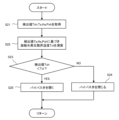
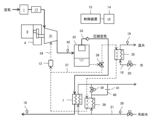
- FIG. 1 is a diagram illustrating a configuration of an air compressor according to a first embodiment of the present invention. 4 is a flowchart showing a processing procedure of a control device in the first embodiment of the present invention.
- FIG. 6 is a diagram illustrating a configuration of an air compressor according to a second embodiment of the present invention.
- 10 is a flowchart showing a processing procedure of a control device in a second embodiment of the present invention.
- FIG. 10 is a diagram illustrating a configuration of an air compressor according to a third embodiment of the present invention.
- 13 is a flowchart showing a processing procedure of a control device according to a third embodiment of the present invention.
- FIG. 1 shows the configuration of an air compressor in this embodiment.
- the air compressor (gas compressor) of this embodiment includes a low-pressure stage compressor main body 2 that sucks in and compresses air (gas) through an air filter 1, etc., a low-pressure stage heat recovery device 3 that heats water (liquid) with the heat of the compressed air (compressed gas) discharged from the low-pressure stage compressor main body 2, an intercooler 4 that further cools the compressed air cooled by the low-pressure stage heat recovery device 3, a high-pressure stage compressor main body 5 that further compresses the compressed air cooled by the intercooler 4, a high-pressure stage heat recovery device 6 that heats water with the heat of the compressed air discharged from the high-pressure stage compressor main body 5, and an aftercooler 7 that further cools the compressed air cooled by the high-pressure stage heat recovery device 6.
- the compressed air cooled by the aftercooler 7 is supplied to its destination.
- the low-pressure stage compressor body 2 includes, for example, a pair of screw rotors, a number of bearings that rotatably support the pair of screw rotors while meshing with each other without contact, a pair of timing gears that rotate the pair of screw rotors synchronously, and a casing that houses them.
- the high-pressure stage compressor body 5 has a configuration substantially similar to that of the low-pressure stage compressor body 2.
- the low-pressure stage compressor body 2 and the high-pressure stage compressor body 5 are configured so that liquids such as oil or water are not injected into the working chamber.
- the casing of the low-pressure stage compressor body 2 has a cooling water flow path (cooling liquid flow path) through which cooling water (cooling liquid) that has passed through the aftercooler 7 flows
- the casing of the high-pressure stage compressor body 5 has a cooling water flow path (cooling liquid flow path) through which cooling water (cooling liquid) that has passed through the intercooler 4 flows. This allows the low-pressure stage compressor body 2 and the high-pressure stage compressor body 5 to be cooled.
- the low-pressure stage compressor body 2 and the high-pressure stage compressor body 5 are driven by an electric motor 9 via a speed increaser 8.
- the speed increaser 8 is composed of a first gear connected to the output shaft of the electric motor 9, a second gear connected to the input shaft of the low-pressure stage compressor body 2 and meshing with the first gear, a third gear connected to the input shaft of the high-pressure stage compressor body 5 and meshing with the first gear, and a gear box that houses the first gear, second gear, and third gear and stores lubricating oil.
- the oil stored in the speed increasing device 8 is supplied to the bearings of the low-pressure stage compressor body 2 and the bearings of the high-pressure stage compressor body 5 via the oil line 10, and is then returned to the speed increasing device 8.
- the oil line 10 includes a pump 11, an oil cooler 12 arranged downstream of the pump 11, and an oil filter 13 arranged downstream of the oil cooler 12.
- the air compressor of this embodiment includes a user interface 14, a control device 15, a pressure sensor 16 provided downstream of the aftercooler 7, a suction throttle valve 17 provided upstream of the low-pressure stage compressor body 2, and an air release valve (not shown) provided in a flow path (not shown) branched off from the flow path downstream of the high-pressure stage compressor body 5 and upstream of the high-pressure stage heat recovery device 6.
- the user interface 14 has, for example, an operation switch, a stop switch, and a touch panel on which various settings and displays can be performed.
- the control device 15 has a memory for storing programs and data, and a processor for executing processing based on the programs.
- the control device 15 drives the electric motor 9 in response to the operation of the operation switch, and stops the electric motor 9 in response to the operation of the stop switch.
- the control device 15 also controls the suction throttle valve 17 and the air release valve based on the detection value of the pressure sensor 16. If the detection value of the pressure sensor 16 rises to a predetermined upper limit during loaded operation, the suction throttle valve 17 is switched from open to closed, and the air release valve is switched from closed to open. This switches from loaded operation to unloaded operation. If the detection value of the pressure sensor 16 falls to a predetermined lower limit during unloaded operation, the suction throttle valve 17 is switched from closed to open, and the air release valve is switched from open to closed. This switches from unloaded operation to loaded operation.
- Water (liquid) is supplied to and discharged from the low-pressure stage heat recovery device 3 and the high-pressure stage heat recovery device 6 via a water line 18 (liquid line), and the water is heated by heat exchange with compressed air.
- the hot water generated in this manner is effectively used for applications such as preheating the boiler feed water and insulation.
- the flow control valve 20 is controlled based on the temperature of the hot water detected by the hot water temperature sensor 19 to control the presence or absence of water supply to the low-pressure stage heat recovery device 3 and the high-pressure stage heat recovery device 6, or the flow rate.
- the cooling power of the low-pressure stage heat recovery device 3 and the cooling power of the high-pressure stage heat recovery device 6 are variably controlled.
- the intercooler 4 and aftercooler 7 are supplied with cooling water (cooling liquid) via a cooling water line 21 (cooling liquid line), and cool the compressed air by heat exchange with the cooling water.
- the oil cooler 12 is supplied with cooling water via a cooling water line 21, and cools the oil by heat exchange with the cooling water.
- the cooling water line 21 is configured to cool the cooling water discharged from the intercooler 4, aftercooler 7, and oil cooler 12 in a cooling tower or the like, and supply it to the intercooler 4, aftercooler 7, and oil cooler 12.
- the compressed air discharged from the low-pressure stage compressor body 2 is cooled by the low-pressure stage heat recovery device 3 and the intercooler 4. Therefore, depending on the cooling power of the low-pressure stage heat recovery device 3, the compressed air may be supercooled, resulting in the generation of condensed water.
- the present embodiment is provided with a water separator 22 that separates condensed water from the compressed air cooled by the intercooler 4, there is a possibility that a large amount of condensed water may be generated that exceeds the performance of the water separator 22.
- the compressed air containing the condensed water may then flow into the high-pressure stage compressor body 5, causing corrosion inside the high-pressure stage compressor body 5 and interfering with its operation.
- the air compressor of this embodiment is therefore provided with a bypass flow path 23 that is provided in the cooling water line 21 and bypasses the intercooler 4, and a bypass valve 24 that opens and closes the bypass flow path 23, as a configuration for varying the cooling power of the intercooler 4. It also has a compressed air temperature sensor 25 (compressed gas temperature sensor) that detects the temperature of the compressed air (compressed gas) downstream of the intercooler 4 and upstream of the high-pressure stage compressor main body 5, and a cooling water temperature sensor 26 (cooling liquid temperature sensor) that detects the temperature of the cooling water (cooling liquid) upstream of the intercooler 4.
- a compressed air temperature sensor 25 compressed gas temperature sensor
- cooling water temperature sensor 26 cooling liquid temperature sensor
- the control device 15 variably controls the cooling power of the intercooler 4 by opening and closing the bypass valve 24 based on the detection values of the compressed air temperature sensor 25 and the cooling water temperature sensor 26. Details of this control are explained using Figure 2.
- Figure 2 is a flowchart showing the processing procedure of the control device 15 in this embodiment.
- step S11 the control device 15 acquires the detection value Tsh of the compressed air temperature sensor 25 and the detection value Twc of the cooling water temperature sensor 26. Then, proceeding to step S12, the control device 15 determines whether the difference between the detection value Tsh of the compressed air temperature sensor 25 and the detection value Twc of the cooling water temperature sensor 26 (Tsh-Twc) is less than a predetermined value ⁇ Tsmin.
- the specified value ⁇ Tsmin is set by calculating the upper limit temperature of the compressed air at which condensation occurs downstream of the intercooler 4 and upstream of the high-pressure stage compressor body 5 (the condensation water generation limit temperature) assuming specified conditions (more specifically, the temperature and humidity of the air upstream of the low-pressure stage compressor body 2, the compressed air pressure downstream of the intercooler 4 and upstream of the high-pressure stage compressor body 5, etc.), and based on the conditions under which the detection value Tsh of the compressed air temperature sensor 25 becomes the condensation water generation limit temperature.
- step S13 the control device 15 closes the bypass valve 24. This increases the flow rate of the cooling water in the intercooler 4, thereby increasing the cooling power of the intercooler 4.
- step S14 the control device 15 opens the bypass valve 24. This reduces the flow rate of the cooling water in the intercooler 4, thereby decreasing the cooling power of the intercooler 4.
- the cooling power of the intercooler 4 is variably controlled by opening and closing the bypass valve 24 based on the detection values of the compressed air temperature sensor 25 and the cooling water temperature sensor 26.
- FIG. 3 is a diagram showing the configuration of an air compressor in this embodiment. Note that in this embodiment, parts equivalent to those in the above embodiment are given the same reference numerals, and descriptions will be omitted as appropriate.
- the air compressor of this embodiment is equipped with an air temperature sensor 27 (gas temperature sensor) and an air humidity sensor 28 (gas humidity sensor) that detect the temperature and humidity of the air (gas) upstream (e.g., the surroundings) of the low-pressure stage compressor main body 2, and a compressed air pressure sensor 29 (compressed gas pressure sensor) that detects the pressure of the compressed air (compressed gas) downstream of the intercooler 4 and upstream of the high-pressure stage compressor main body 5.
- an air temperature sensor 27 gas temperature sensor
- an air humidity sensor 28 gas humidity sensor
- a compressed air pressure sensor 29 compressed gas pressure sensor
- the control device 15 variably controls the cooling power of the intercooler 4 by opening and closing the bypass valve 24 based on the detection values of the compressed air temperature sensor 25, the air temperature sensor 27, the air humidity sensor 28, and the compressed air pressure sensor 29. Details of this control are explained using Figure 4.
- Figure 4 is a flowchart showing the processing procedure of the control device in this embodiment.
- step S21 the control device 15 acquires the detection value Tsh of the compressed air temperature sensor 25, the detection value Ta of the air temperature sensor 27, the detection value Ha of the air humidity sensor 28, and the detection value Psh of the compressed air pressure sensor 29. Then, the process proceeds to step S22, where the control device 15 calculates the upper limit temperature (condensate generation limit temperature) Tcl of the compressed air at which condensate is generated downstream of the intercooler 4 and upstream of the high-pressure stage compressor main body 5, based on the detection value Ta of the air temperature sensor 27, the detection value Ha of the air humidity sensor 28, and the detection value Psh of the compressed air pressure sensor 29. Then, the process proceeds to step S23, where the control device 15 determines whether the detection value Tsh of the compressed air temperature sensor 25 is less than the condensate generation limit temperature Tcl.
- step S24 the control device 15 closes the bypass valve 24. This increases the flow rate of the cooling water in the intercooler 4, thereby increasing the cooling power of the intercooler 4.
- step S25 the control device 15 opens the bypass valve 24. This reduces the flow rate of the cooling water in the intercooler 4, thereby decreasing the cooling power of the intercooler 4.
- the cooling power of the intercooler 4 is variably controlled by opening and closing the bypass valve 24 based on the detection values of the compressed air temperature sensor 25, the air temperature sensor 27, the air humidity sensor 28, and the compressed air pressure sensor 29.
- the cooling power of the intercooler 4 is variably controlled by opening and closing the bypass valve 24 based on the detection values of the compressed air temperature sensor 25, the air temperature sensor 27, the air humidity sensor 28, and the compressed air pressure sensor 29.
- the cooling water line 21 is described as having the bypass flow passage 23 and the bypass valve 24 as a configuration for varying the cooling power of the intercooler 4, but this is not limited to the above.
- the cooling water line 21 may have, for example, an on-off valve provided downstream of the intercooler 4, a bypass flow passage that bypasses the on-off valve, and a throttle provided in the bypass flow passage.
- the control device 15 opens the on-off valve to increase the flow rate of the cooling water in the intercooler 4 and increase the cooling power of the intercooler 4, and closes the on-off valve to decrease the flow rate of the cooling water in the intercooler 4 and decrease the cooling power of the intercooler 4. Even in such a modified example, the same effect as above can be obtained.
- the water line 18 is illustrated as an example in which the high-pressure stage heat recovery device 6 and the low-pressure stage heat recovery device 3 are connected in series in that order, but this is not limited to this.
- the water line 18 may connect the low-pressure stage heat recovery device 3 and the high-pressure stage heat recovery device 6 in series in that order, or may connect them in parallel.
- the low-pressure stage heat recovery unit 3 and the high-pressure stage heat recovery unit 6 are illustrated as being configured so that the compressed air and water flow in counter directions, but this is not limited thereto, and the compressed air and water may flow in parallel directions.
- the intercooler 4 and the aftercooler 7 are illustrated as being configured so that the compressed air and cooling water flow in counter directions, but this is not limited thereto, and the compressed air and cooling water may flow in parallel directions.
- the oil cooler 12 is illustrated as being configured so that the oil and cooling water flow in counter directions, but this is not limited thereto, and the oil and cooling water may flow in parallel directions.
- FIG. 5 is a diagram showing the configuration of an air compressor in this embodiment. Note that in this embodiment, parts equivalent to those in the above embodiment are given the same reference numerals, and descriptions will be omitted as appropriate.
- the air compressor of this embodiment is driven by an electric motor 9 via a speed increasing device 8, and includes a compressor body 31 that draws in and compresses air (gas) via an air filter 1 and an intake throttle valve 17, an oil separator 32 that separates oil from the compressed air discharged from the compressor body 31, a compressed air line 33 that supplies the compressed air separated by the oil separator 32 to a demand destination, and an oil line 34 that supplies the oil separated by the oil separator 32 to the compressor body 31 due to the pressure difference between the oil separator 32 and the compressor body 31.
- the compressed air line 33 has an aftercooler 7 that cools the compressed air, and a pressure sensor 16 arranged downstream of the aftercooler 7.
- the compressor body 31 includes, for example, a pair of screw rotors, a number of bearings that rotatably support the pair of screw rotors while they are in contact with and meshed with each other, and a casing that houses them. As the screw rotors rotate, the working chambers formed in the tooth grooves of the screw rotors move and their volume changes. This causes air to be sucked in, compressed, and discharged as compressed air.
- the compressor body 31 is configured to inject oil from the oil line 34 into the working chamber and supply it to the bearings, etc. This provides cooling, sealing, lubrication, etc.
- the oil line 34 includes a heat recovery device 35, an oil cooler 36 arranged downstream of the heat recovery device 35, a bypass line 37 that bypasses the heat recovery device 35 and the oil cooler 36, a temperature control valve (three-way valve) 38 arranged at the branching point of the bypass line 37, and an oil filter 13 arranged downstream of the junction of the bypass line 37.
- the temperature control valve 38 adjusts the flow rate of the heat recovery device 35 and the oil cooler 36 and the flow rate of the bypass line 37 according to the temperature of the oil. This adjusts the temperature of the oil supplied to the compressor body 31.
- the flow control valve 20 is controlled based on the hot water temperature detected by the hot water temperature sensor 19, for example, to control whether or not water is supplied to the heat recovery device 35, or the flow rate. In other words, the cooling power of the heat recovery device 35 is variably controlled.
- the oil cooler 36 receives cooling water through the cooling water line 21 and cools the oil by exchanging heat with the cooling water.
- the oil stored in the oil separator 32 is cooled by the heat recovery device 35 and the oil cooler 36. Therefore, depending on the cooling power of the heat recovery device 35, the oil may be supercooled.
- a bypass line 37 and a temperature control valve 38 are provided to prevent the oil from being supercooled, but this alone may not be sufficient.
- the oil supplied to the compressor body 31 may supercool the compressed air, causing condensation.
- the amount of condensed water contained in the oil stored in the oil separator 32 may increase, and the oil containing the condensed water may flow into the compressor body 31, causing corrosion inside the compressor body 31 and interfering with its operation.
- the air compressor of this embodiment is therefore equipped with an on-off valve 39 provided downstream of the oil cooler 36 in the cooling water line 21, a bypass flow path 40 that bypasses the on-off valve 39, and a throttle 41 (more specifically, a throttle with a smaller flow path cross section than the on-off valve 39 in its open state) provided in the bypass flow path 40 as a configuration for varying the cooling power of the oil cooler 36. It also includes a compressed air temperature sensor 42 (compressed gas temperature sensor) that detects the temperature of the compressed air (compressed gas) downstream of the compressor body 31, and a cooling water temperature sensor 26 that detects the temperature of the cooling water upstream of the oil cooler 36.
- a compressed air temperature sensor 42 compressed gas temperature sensor
- the control device 15 variably controls the cooling power of the oil cooler 36 by opening and closing the on-off valve 39 based on the detection values of the compressed air temperature sensor 42 and the cooling water temperature sensor 26. Details of this control are explained using Figure 6.
- Figure 6 is a flowchart showing the processing procedure of the control device 15 in this embodiment.
- step S31 the control device 15 acquires the detection value To of the compressed air temperature sensor 42 and the detection value Twc of the cooling water temperature sensor 26. Then, proceeding to step S32, the control device 15 determines whether the difference between the detection value To of the compressed air temperature sensor 42 and the detection value Twc of the cooling water temperature sensor 26 (To-Twc) is less than a predetermined value ⁇ Tomin.
- the specified value ⁇ Tomin is set by calculating the upper limit temperature of the compressed air at which condensation occurs downstream of the compressor body 31 (the condensation water generation limit temperature) assuming specified conditions (more specifically, the temperature and humidity of the air upstream of the compressor body 31, the compressed air pressure downstream of the compressor body 31, etc.), and based on the conditions under which the detection value To of the compressed air temperature sensor 42 becomes the condensation water generation limit temperature.
- step S33 the control device 15 opens the on-off valve 39. This increases the flow rate of the cooling water in the oil cooler 36, thereby increasing the cooling power of the oil cooler 36.
- step S34 the control device 15 closes the on-off valve 39. This reduces the flow rate of the cooling water in the oil cooler 36, thereby decreasing the cooling power of the oil cooler 36.
- the cooling power of the oil cooler 36 is variably controlled by opening and closing the on-off valve 39 based on the detection values of the compressed air temperature sensor 42 and the cooling water temperature sensor 26. This makes it possible to prevent the oil from being overcooled by the heat recovery device 35 and the oil cooler 36, regardless of the cooling power of the heat recovery device 35. As a result, it is possible to suppress the generation of condensed water and prevent corrosion of the compressor body 31. In addition, it is possible to avoid suppressing the cooling power of the heat recovery device 35 (in other words, suppressing the amount of heat recovery).
- FIG. 7 is a diagram showing the configuration of an air compressor in this embodiment. Note that in this embodiment, parts equivalent to those in the above embodiment are given the same reference numerals, and descriptions will be omitted as appropriate.
- the air compressor of this embodiment is equipped with an air temperature sensor 27 and an air humidity sensor 28 that detect the temperature and humidity of the air upstream of the compressor body 31, and a compressed air pressure sensor 43 (compressed gas pressure sensor) that detects the pressure of the compressed air (compressed gas) downstream of the compressor body 31.
- an air temperature sensor 27 and an air humidity sensor 28 that detect the temperature and humidity of the air upstream of the compressor body 31, and a compressed air pressure sensor 43 (compressed gas pressure sensor) that detects the pressure of the compressed air (compressed gas) downstream of the compressor body 31.
- the control device 15 variably controls the cooling power of the oil cooler 36 by opening and closing the on-off valve 39 based on the detection values of the compressed air temperature sensor 42, the air temperature sensor 27, the air humidity sensor 28, and the compressed air pressure sensor 43. Details of this control are explained using Figure 8.
- Figure 8 is a flowchart showing the processing procedure of the control device 15 in this embodiment.
- step S41 the control device 15 acquires the detection value To of the compressed air temperature sensor 42, the detection value Ta of the air temperature sensor 27, the detection value Ha of the air humidity sensor 28, and the detection value Po of the compressed air pressure sensor 43. Then, proceeding to step S42, the control device 15 calculates the upper limit temperature Tcl of the compressed air at which condensation occurs downstream of the compressor body 31 (the condensation water generation limit temperature) based on the detection value Ta of the air temperature sensor 27, the detection value Ha of the air humidity sensor 28, and the detection value Po of the compressed air pressure sensor 43. Then, proceeding to step S43, the control device 15 determines whether the detection value To of the compressed air temperature sensor 42 is less than the condensation water generation limit temperature Tcl.
- step S44 the control device 15 opens the on-off valve 39. This increases the flow rate of the cooling water in the oil cooler 36, thereby increasing the cooling power of the oil cooler 36.
- step S45 the control device 15 closes the on-off valve 39. This reduces the flow rate of the cooling water in the oil cooler 36, thereby decreasing the cooling power of the oil cooler 36.
- the cooling power of the oil cooler 36 is variably controlled by opening and closing the on-off valve 39 based on the detection values of the compressed air temperature sensor 42, the air temperature sensor 27, the air humidity sensor 28, and the compressed air pressure sensor 43.
- the cooling power of the heat recovery device 35 is variably controlled by opening and closing the on-off valve 39 based on the detection values of the compressed air temperature sensor 42, the air temperature sensor 27, the air humidity sensor 28, and the compressed air pressure sensor 43.
- the cooling water line 21 is described as having an on-off valve 39, a bypass flow path 40, and a throttle 41 as a configuration for varying the cooling power of the oil cooler 36, but this is not limited to the above.
- the cooling water line 21 may have, for example, a bypass flow path that bypasses the oil cooler 36, and a bypass valve that opens and closes the bypass flow path.
- the control device 15 closes the bypass valve to increase the flow rate of the cooling water in the oil cooler 36 and increase the cooling power of the oil cooler 36, and opens the bypass valve to decrease the flow rate of the cooling water in the oil cooler 36 and decrease the cooling power of the oil cooler 36. Even in such a modification, the same effect as above can be obtained.
- the heat recovery device 35 is illustrated as being configured so that the compressed air and water flow in counter directions, but this is not limited to this and the compressed air and water may flow in parallel directions.
- the aftercooler 7 is illustrated as being configured so that the compressed air and cooling water flow in counter directions, but this is not limited to this and the compressed air and cooling water may flow in parallel directions.
- the oil cooler 36 is illustrated as being configured so that the oil and cooling water flow in counter directions, but this is not limited to this and the oil and cooling water may flow in parallel directions.
- the heat recovery device has been described as heating water, but this is not limited to this, and liquids other than water may be heated.
- the intercooler, aftercooler, or oil cooler has been described as supplying and discharging cooling water through a cooling water line, but this is not limited to this, and cooling liquids other than cooling water may be supplied and discharged through a cooling liquid line.
- the compressor body is described as being of a screw type, but this is not limited thereto, and it may be of a scroll type, for example.
- an air compressor that compresses air has been used as an example of an application of the present invention, but the present invention is not limited to this. In other words, the present invention may also be applied to a gas compressor that compresses a gas other than air.
Landscapes
- Engineering & Computer Science (AREA)
- Mechanical Engineering (AREA)
- General Engineering & Computer Science (AREA)
- Compressor (AREA)
- Applications Or Details Of Rotary Compressors (AREA)
Priority Applications (1)
| Application Number | Priority Date | Filing Date | Title |
|---|---|---|---|
| JP2025537723A JPWO2025028062A1 (https=) | 2023-07-31 | 2024-06-21 |
Applications Claiming Priority (2)
| Application Number | Priority Date | Filing Date | Title |
|---|---|---|---|
| JP2023-124318 | 2023-07-31 | ||
| JP2023124318 | 2023-07-31 |
Publications (1)
| Publication Number | Publication Date |
|---|---|
| WO2025028062A1 true WO2025028062A1 (ja) | 2025-02-06 |
Family
ID=94394501
Family Applications (1)
| Application Number | Title | Priority Date | Filing Date |
|---|---|---|---|
| PCT/JP2024/022590 Pending WO2025028062A1 (ja) | 2023-07-31 | 2024-06-21 | 気体圧縮機 |
Country Status (2)
| Country | Link |
|---|---|
| JP (1) | JPWO2025028062A1 (https=) |
| WO (1) | WO2025028062A1 (https=) |
Citations (4)
| Publication number | Priority date | Publication date | Assignee | Title |
|---|---|---|---|---|
| JPS5613607U (https=) * | 1979-07-06 | 1981-02-05 | ||
| WO2014115616A1 (ja) * | 2013-01-28 | 2014-07-31 | 株式会社日立産機システム | 油冷式ガス圧縮機における排熱回収システム |
| JP2015038354A (ja) * | 2014-09-29 | 2015-02-26 | 三浦工業株式会社 | 熱回収システム |
| WO2017111120A1 (ja) * | 2015-12-25 | 2017-06-29 | 株式会社日立産機システム | 気体圧縮機 |
-
2024
- 2024-06-21 JP JP2025537723A patent/JPWO2025028062A1/ja active Pending
- 2024-06-21 WO PCT/JP2024/022590 patent/WO2025028062A1/ja active Pending
Patent Citations (4)
| Publication number | Priority date | Publication date | Assignee | Title |
|---|---|---|---|---|
| JPS5613607U (https=) * | 1979-07-06 | 1981-02-05 | ||
| WO2014115616A1 (ja) * | 2013-01-28 | 2014-07-31 | 株式会社日立産機システム | 油冷式ガス圧縮機における排熱回収システム |
| JP2015038354A (ja) * | 2014-09-29 | 2015-02-26 | 三浦工業株式会社 | 熱回収システム |
| WO2017111120A1 (ja) * | 2015-12-25 | 2017-06-29 | 株式会社日立産機システム | 気体圧縮機 |
Also Published As
| Publication number | Publication date |
|---|---|
| JPWO2025028062A1 (https=) | 2025-02-06 |
Similar Documents
| Publication | Publication Date | Title |
|---|---|---|
| JP6713439B2 (ja) | 給油式空気圧縮機 | |
| CN113597511B (zh) | 压缩机系统及其控制方法 | |
| JP5598724B2 (ja) | 圧縮熱回収システム | |
| US11105537B2 (en) | Refrigeration cycle apparatus | |
| JP5425043B2 (ja) | 油冷式圧縮機 | |
| JP6264688B2 (ja) | 冷凍装置 | |
| JP5675568B2 (ja) | 無給油式スクリュー圧縮機及びその制御方法 | |
| CN101400953A (zh) | 带有解决溢流压缩机操作问题的控制器的制冷系统 | |
| WO2015198647A1 (ja) | 気体圧縮機 | |
| JP2010002173A (ja) | 冷凍装置 | |
| JP5506830B2 (ja) | スクリュー圧縮機 | |
| JP2018178976A (ja) | 圧縮空気貯蔵発電装置 | |
| CN103486028B (zh) | 无油螺杆压缩机 | |
| JP2012167675A (ja) | 無給油式スクリュー圧縮機 | |
| JPH08319976A (ja) | 油冷式空気圧縮機 | |
| WO2025028062A1 (ja) | 気体圧縮機 | |
| CN118891443A (zh) | 气体压缩机 | |
| JP2017150689A (ja) | 空気調和装置 | |
| JP5927553B2 (ja) | 冷凍装置 | |
| JP4767133B2 (ja) | 冷凍サイクル装置 | |
| JP6467682B2 (ja) | 冷凍装置 | |
| CN106196761B (zh) | 制冷循环系统及其控制方法 | |
| JP2007232230A (ja) | 冷凍装置 | |
| JP7385765B2 (ja) | 気体圧縮機 | |
| JP5542518B2 (ja) | 空気圧縮機 |
Legal Events
| Date | Code | Title | Description |
|---|---|---|---|
| 121 | Ep: the epo has been informed by wipo that ep was designated in this application |
Ref document number: 24848723 Country of ref document: EP Kind code of ref document: A1 |
|
| ENP | Entry into the national phase |
Ref document number: 2025537723 Country of ref document: JP Kind code of ref document: A |
|
| WWE | Wipo information: entry into national phase |
Ref document number: 2025537723 Country of ref document: JP |
|
| NENP | Non-entry into the national phase |
Ref country code: DE |