WO2025027857A1 - 受信装置及び信号検出方法 - Google Patents
受信装置及び信号検出方法 Download PDFInfo
- Publication number
- WO2025027857A1 WO2025027857A1 PCT/JP2023/028462 JP2023028462W WO2025027857A1 WO 2025027857 A1 WO2025027857 A1 WO 2025027857A1 JP 2023028462 W JP2023028462 W JP 2023028462W WO 2025027857 A1 WO2025027857 A1 WO 2025027857A1
- Authority
- WO
- WIPO (PCT)
- Prior art keywords
- distribution
- noise
- receiving device
- density distribution
- signal
- Prior art date
- Legal status (The legal status is an assumption and is not a legal conclusion. Google has not performed a legal analysis and makes no representation as to the accuracy of the status listed.)
- Pending
Links
Images






Classifications
-
- H—ELECTRICITY
- H04—ELECTRIC COMMUNICATION TECHNIQUE
- H04B—TRANSMISSION
- H04B11/00—Transmission systems employing ultrasonic, sonic or infrasonic waves
Definitions
- the present invention relates to a receiving device and a signal detection method.
- Non-Patent Document 1 A commonly used signal detection method is the likelihood ratio test based on the Neyman-Pearson lemma, which can minimize the rate of undetected signals given a certain rate of false positives (see, for example, Non-Patent Document 1).
- the likelihood ratio test formula shown in Non-Patent Document 1 changes depending on the probability density distribution of the noise added to the received signal.
- cross-correlation detection In conventional land radio using radio waves, cross-correlation detection is used, which calculates the cross-correlation between a known signal and a received signal, and detects the position where a correlation peak exceeding a preset threshold is confirmed as the desired signal position (see, for example, Non-Patent Document 2). This is equivalent to a likelihood ratio test when Gaussian-distributed noise is assumed as the noise added to the received signal, and is the optimal detection method in a Gaussian noise environment such as land radio. In previous underwater acoustic communications, cross-correlation detection similar to that used for land radio has also been commonly used.
- the aim is to provide technology that can improve signal detection performance in underwater acoustic communications.
- One aspect of the present invention is a receiving device that includes one or more received symbols, a calculation unit that calculates a likelihood ratio based on a probability density distribution other than a normal distribution, and a threshold determination unit that performs a threshold determination for detecting a signal based on the calculated likelihood ratio.
- One aspect of the present invention is a signal detection method that calculates a likelihood ratio based on one or more received symbols and a probability density distribution other than a normal distribution, and performs a threshold determination for detecting a signal based on the calculated likelihood ratio.
- the present invention makes it possible to improve signal detection performance in underwater acoustic communications.
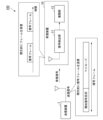
- FIG. 1 is a diagram illustrating an example of a configuration of a communication system 100 according to a first embodiment.
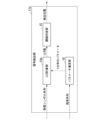
- FIG. 2 is a diagram illustrating an example of the configuration of a signal detection unit 11 according to the first embodiment.
- 10 is a flowchart showing a flow of a process of creating a density distribution table performed by a probability distribution estimation unit 13 in the first embodiment.
- FIG. 4 is a diagram illustrating an example of a configuration of a density distribution table according to the first embodiment.
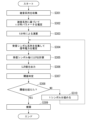
- FIG. 4 is a flowchart showing a flow of processing of the receiving device 10 in the first embodiment.
- FIG. 11 is a diagram illustrating an example of the configuration of a signal detection unit 11a according to a second embodiment. 10 is a flowchart showing a process flow of a receiving device 10a according to the second embodiment.
- FIG. 11 is a diagram showing simulation results in the first and second embodiments.
- j is an integer of 1, 2, ....
- the null hypothesis H 0 represents the case where the observed signal does not contain a known signal (only noise)
- the alternative hypothesis H 1 represents the case where the observed signal contains a known signal.
- f n ( ⁇ ) represents the probability density distribution of noise
- ⁇ represents the detection threshold.
- a signal is detected (decision D 1 )
- the likelihood ratio ⁇ j is equal to or less than the threshold ⁇ (decision D 0 )
- the received signal vector is advanced by one symbol to the next frame (i.e., j is increased by 1) and the calculation of the likelihood ratio is continued.
- the likelihood ratio is calculated sequentially while advancing the received signal vector by one symbol, and the position exceeding the threshold ⁇ is detected as the start position of the desired signal frame.
- the likelihood ratio test formula changes depending on the probability density distribution fn (.) of the noise added to the received signal. If we assume a Gaussian distribution as the probability density distribution fn (.), the likelihood ratio test formula becomes the cross-correlation detection formula shown in the following formula (4).
- cross-correlation detection expressed by equation (4) is the optimal signal detection method. For this reason, cross-correlation detection has been commonly used as the signal detection method in conventional land wireless (Gaussian noise environment).
- FIG. 3 is a diagram showing an example of the configuration of a communication system 100 in the first embodiment.
- the communication system 100 includes a transmitting device 1 and a receiving device 10.
- the transmitting device 1 is provided underwater and transmits a signal.
- the transmitting device 1 intermittently transmits a signal frame in which a known signal sequence is added to a payload including transmission data.
- the receiving device 10 intermittently receives the signal frame transmitted from the transmitting device 1.
- the receiving device 10 includes a signal detection unit 11 and a demodulation unit 12.
- the signal detection unit 11 detects the start position of a signal frame.
- the demodulation unit 12 performs demodulation processing from the start position of the signal frame detected by the signal detection unit 11, and demodulates the transmitted information.
- FIG. 4 is a diagram showing an example of the configuration of the signal detection unit 11 in the first embodiment.
- the signal detection unit 11 includes a probability distribution estimation unit 13, an LLR (Log-likelihood ratio) calculation unit 14, and a threshold determination unit 15.
- LLR Log-likelihood ratio
- the probability distribution estimation unit 13 creates a density distribution table by tabulating the noise density distribution by collecting noise samples for a predetermined period in the environment in which the receiving device 10 is installed. Specifically, the probability distribution estimation unit 13 receives a noise sequence (N 1 , ..., N M ) of sequence length M as input, and creates a density distribution table using the input noise sequence.
- the LLR calculation unit 14 calculates an LLR value for each received symbol included in the received symbol sequence based on the received symbol sequence and the density distribution table created by the probability distribution estimation unit 13.
- the LLR calculation unit 14 calculates an LLR value for each received symbol included in the received symbol sequence using the density distribution table created by the probability distribution estimation unit 13. That is, the LLR calculation unit 14 in the first embodiment calculates an LLR value based on a probability density distribution other than a normal distribution.
- the normal distribution here means the probability density distribution of white Gaussian noise.
- the LLR calculation unit 14 is one aspect of a calculation unit.
- the threshold determination unit 15 detects the signal by performing a threshold determination based on the LLR value for each received symbol calculated by the LLR calculation unit 14.
- the method of signal detection performed by the threshold determination unit 15 is the same as in the conventional method.
- FIG. 5 is a flowchart showing the flow of the process of creating a density distribution table performed by the probability distribution estimation unit 13 in the first embodiment.
- the process in FIG. 5 is executed before the receiving device 10 starts communication. Note that after the receiving device 10 has executed the process of creating a density distribution table once, it is not necessary to execute it every time before starting communication, and it may be executed at a specified timing, such as when an instruction is given by the user.
- the probability distribution estimation unit 13 collects a predetermined number of noise samples (step S101). At this time, the receiving device 10 does not transmit a signal.
- the values of the noise samples collected by the probability distribution estimation unit 13 are P 1 , ..., P L , where L is an integer equal to or greater than 2.
- L is an integer equal to or greater than 2.
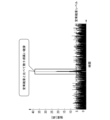
- the noise distribution in the sea has an extremely broad tail, so many noise samples are required.
- the probability distribution estimation unit 13 collects about 10 6 samples. This corresponds to noise observation for about several minutes (approximately 10 minutes at most) in underwater acoustic communication.
- the probability distribution estimation unit 13 calculates a cumulative distribution f p (x) using a predetermined number of collected noise sample values P 1 , ..., P L (step S102). Specifically, the probability distribution estimation unit 13 first calculates an average ⁇ p based on the following formula (5) using the predetermined number of collected noise sample values P 1 , ..., P L. Furthermore, the probability distribution estimation unit 13 calculates a dispersion parameter ⁇ p based on the following formula (6) using the predetermined number of collected noise sample values P 1 , ..., P L. In formulas (5) and (6), L represents the total number of noise samples, and P l represents the value of the l-th noise sample (l is an integer equal to or greater than 1).
- the probability distribution estimation unit 13 normalizes the mean ⁇ p of the noise sample values P 1 , ..., P L to 0 and the variance parameter ⁇ p to 1 based on the following equation (7).
- P j ' in equation (7) represents a normalized value of the l-th noise sample value. Then, the probability distribution estimation unit 13 creates a table of cumulative distribution (empirical cumulative distribution of noise) based on the following equation (8).
- the probability distribution estimation unit 13 uses the calculated noise density distribution fp ( xn ) to store the noise density distribution fp ( xn ) when the value of n is changed in a table as shown in Figure 6, thereby tabulating the noise density distribution (step S104).
- Figure 6 is a diagram showing an example of the configuration of a density distribution table in the first embodiment.
- the noise density distribution stored in the density distribution table is created based on noise samples measured in advance in the environment in which the receiving device 10 is installed, as described above. Therefore, the noise density distribution becomes a probability density distribution closer to the noise density distribution generated in the environment in which the receiving device 10 is installed, compared to the noise density distribution obtained by assuming an AWGN transmission path.
- FIG. 7 is a flowchart showing the flow of processing by the receiving device 10 in the first embodiment. Note that the processing in FIG. 7 is processing during actual communication between the transmitting device 1 and the receiving device 10, and it is assumed that a density distribution table has already been created.
- the LLR calculation unit 14 collects a received symbol sequence ( yj , yj+1, ..., yj+N-1 ) of sequence length N (step S201). Using the collected received symbol sequence ( yj , yj+1, ..., yj+N-1 ) of sequence length N and a density distribution table created by the probability distribution estimation unit 13, the LLR calculation unit 14 calculates an LLR value for each received symbol included in the received symbol sequence based on the following formula (10) (step S202). Specifically, in the numerator of equation (10), the LLR calculation unit 14 refers to the density distribution table shown in FIG.
- fp (x) corresponding to x may be estimated by performing an interpolation process on the density distribution table of Fig. 6.
- the LLR calculation unit 14 calculates the LLR value ⁇ j based on the formula (10) from the calculated LLR value for each received symbol, and outputs the calculated LLR value ⁇ j to the threshold determination unit 15 (step S203).
- the threshold determination unit 15 receives the LLR value ⁇ j output from the LLR calculation unit 14.
- the threshold determination unit 15 performs threshold determination based on the input LLR value ⁇ j (step S204). Specifically, the threshold determination unit 15 performs threshold determination by comparing the LLR value ⁇ j with a preset threshold. As a result of the threshold determination, the threshold determination unit 15 determines whether the LLR value ⁇ j exceeds the threshold (step S205).
- the threshold determination unit 15 determines that the LLR value ⁇ j exceeds the threshold (step S205-YES) If the threshold determination unit 15 determines that the LLR value ⁇ j exceeds the threshold (step S205-YES), the threshold determination unit 15 detects the position of j as the start position of the received signal. After that, the threshold determination unit 15 outputs the received symbol sequence (y j , y j+1, ..., y j+K-1 ) of sequence length K to the demodulation unit 12. The demodulation unit 12 demodulates the received symbol sequence (y j , y j+1, ..., y j+K-1 ) of sequence length K input from the threshold determination unit 15 (step S206).
- the threshold determination unit 15 determines that the LLR value ⁇ j does not exceed the threshold (step S205-NO)
- the threshold determination unit 15 advances the received signal vector to the next frame by one symbol (step S207). That is, the threshold determination unit 15 advances the received signal vector to the next frame by one symbol by incrementing the value of j by 1. Thereafter, the process returns to step S201 and signal detection continues.
- the receiving device 10 includes an LLR calculation unit 14 that calculates an LLR value ⁇ j based on a received symbol sequence including one or more received symbols and a probability density distribution other than a normal distribution, and a threshold determination unit 15 that performs a threshold determination for detecting a signal based on the calculated LLR value ⁇ j .
- the receiving device 10 calculates an LLR value for each received symbol using a density distribution table created based on a noise sample measured in advance in the environment in which the receiving device 10 is installed as a probability density distribution other than a normal distribution.
- the receiving device 10 calculates an LLR value for each received symbol using a probability density distribution close to the density distribution of noise generated in the environment in which the receiving device 10 is installed. Therefore, it is possible to improve the estimation accuracy of the LLR value for each received symbol. Therefore, it is possible to improve the performance of signal detection in underwater acoustic communication.
- the receiving device 10 creates a density distribution table using the noise distribution obtained by noise measurement before actual communication, and calculates the LLR value for each received symbol using the created density distribution table. In this way, the receiving device 10 collects noise occurring in the environment in which the receiving device 10 is installed, and creates a density distribution table in advance before communication begins. This makes it possible to calculate the LLR value for each received symbol using a density distribution table that stores a probability density distribution that is close to the density distribution of the noise occurring in the environment in which the receiving device 10 is installed. Therefore, the estimation accuracy of the LLR value for each received symbol can be improved. This makes it possible to improve the performance of signal detection in underwater acoustic communication.
- the probability density distribution of the noise may be generated by other methods than the method shown in Fig. 5. Furthermore, if the probability density distribution of the noise is known, it does not need to be estimated.
- the density distribution table is created in the receiving device 10, but the receiving device 10 may obtain the density distribution table from an external device.
- the LLR calculation unit 14 of the receiving device 10 obtains the density distribution table created in advance in an external device and calculates the LLR value for each received symbol.
- Second Embodiment In the first embodiment, in order to accurately directly calculate the probability density distribution of noise, it is necessary to measure noise in advance for a long time in the environment in which the receiving device is installed before starting communication.
- a configuration capable of approximating the noise density distribution by measuring noise in advance for a short time is described.
- the density distribution of underwater noise with a wide tail is approximated by a t-distribution, and the signal power is further estimated to perform a likelihood ratio test.
- FIG. 8 is a diagram showing an example of the configuration of the signal detection unit 11a in the second embodiment.
- the signal detection unit 11a includes an LLR calculation unit 14a, a threshold determination unit 15, and a parameter estimation unit 16.
- the signal detection unit 11a differs from the signal detection unit 11 in that it does not include a probability distribution estimation unit 13, that it includes an LLR calculation unit 14a instead of the LLR calculation unit 14, and that it newly includes a parameter estimation unit 16. The following mainly describes the differences from the signal detection unit 11.
- the parameter estimation unit 16 receives a noise sequence (N 1 , ..., N M ) of sequence length M, and estimates a variance parameter ⁇ based on the following equation (11) or equation (12) using the input noise sequence.
- the parameter estimation unit 16 also estimates a parameter v representing the width of the tail of the distribution based on the estimated variance parameter ⁇ and equation (13).
- Equation (14) f t (N j ; 0, v i , ⁇ ) is the density function of the t-distribution, and is expressed as in the following equation (14): ⁇ in equation (14) represents the gamma function.
- the LLR calculation unit 14a estimates the received signal power ⁇ s from the received symbol sequence based on the least squares criterion. Furthermore, the LLR calculation unit 14a calculates an LLR value for each received symbol included in the received symbol sequence based on the t-distribution parameters ( ⁇ , ⁇ ) and the estimated received signal power ⁇ s . The LLR calculation unit 14a calculates the LLR value for each received symbol included in the received symbol sequence using the t-distribution parameters ( ⁇ , ⁇ ) estimated by the parameter estimation unit 16. That is, the LLR calculation unit 14a in the second embodiment calculates the LLR value based on a probability density distribution other than a normal distribution.
- FIG. 9 is a flowchart showing the flow of processing performed by the receiving device 10a in the second embodiment.
- the parameter estimation unit 16 collects a noise sequence (N 1 , ..., N M ) of sequence length M (step S301).
- the parameter estimation unit 16 estimates t-distribution parameters ( ⁇ , v) based on the above formula (11) or (12) and (13) using the collected noise sequence (N 1 , ..., N M ) of sequence length M (step S302). After that, the parameter estimation unit 16 uses the estimated t-distribution parameters ( ⁇ , v) to approximate the noise density distribution with a t-distribution (step S303).
- the parameter estimation unit 16 outputs the variance parameter ⁇ and the width of the tail of the estimated density distribution ⁇ as t-distribution parameters ( ⁇ , ⁇ ) to the LLR calculation unit 14a.
- the LLR calculation unit 14a receives the t-distribution parameters ( ⁇ , ⁇ ) output from the parameter estimation unit 16.
- the LLR calculation unit 14a further collects a received symbol sequence (y j , y j+1, ..., y j+N-1 ) of sequence length N.
- the LLR calculation unit 14a uses the input t-distribution parameters ( ⁇ , ⁇ ) and the collected received symbol sequence (y j , y j+1, ..., y j+N-1 ) of sequence length N to calculate a maximum likelihood estimate of the signal power ⁇ s based on the least squares criterion as shown in the following equation (15) (step S304).
- the LLR calculation unit 14a uses the parameters ( ⁇ , v, ⁇ s ) obtained in steps S302 and S304 to calculate the LLR value ⁇ j according to the following equation (17) (step S305).
- the LLR calculation unit 14a outputs the calculated LLR value ⁇ j to the threshold determination unit 15 (step S306).
- the threshold determination unit 15 receives the LLR value ⁇ j output from the LLR calculation unit 14a.
- the threshold determination unit 15 performs threshold determination based on the input LLR value ⁇ j (step S307). Specifically, the threshold determination unit 15 performs threshold determination by comparing the LLR value ⁇ j with a threshold set in advance. As a result of the threshold determination, the threshold determination unit 15 determines whether the LLR value ⁇ j exceeds the threshold (step S308).
- the threshold determination unit 15 determines that the LLR value ⁇ j exceeds the threshold (step S308-YES) If the threshold determination unit 15 determines that the LLR value ⁇ j exceeds the threshold (step S308-YES), the threshold determination unit 15 detects the position of j as the start position of the received signal. After that, the threshold determination unit 15 outputs the received symbol sequence (y j , y j+1, ..., y j+K-1 ) of sequence length K to the demodulation unit 12. The demodulation unit 12 demodulates the received symbol sequence (y j , y j+1, ..., y j+K-1 ) of sequence length K input from the threshold determination unit 15 (step S309).
- the threshold determination unit 15 determines that the LLR value ⁇ j does not exceed the threshold (step S2307-NO)
- the threshold determination unit 15 advances the received signal vector to the next frame by one symbol (step S310). That is, the threshold determination unit 15 advances the received signal vector to the next frame by one symbol by incrementing the value of j by 1. Thereafter, the process returns to step S201 and signal detection continues.
- the receiving device 10 in the second embodiment configured as described above can achieve the same effects as the first embodiment.
- the receiving device 10 in the second embodiment approximates the noise density distribution using a t-distribution. This approximation using a t-distribution can be achieved by short-term noise measurement, and the receiving device 10a does not need to measure noise for a long period of time before starting communication as in the first embodiment. Therefore, communication can be started immediately without prior long-term noise measurement.
- Noise model Generated from the probability density distribution of noise measured in actual sea areas (L2 distribution in Figure 2)
- Known signal sequence M sequence (127 symbols)
- No-signal section 1000 symbols before and after the known signal section
- Threshold ⁇ Optimal value determined from the ROC (Receiver Operating Characteristic) curve
- Signal detection technology Proposed technology in the first embodiment (optimal signal detection in which the noise probability density distribution is directly calculated from the noise sample and the signal power is known), proposed technology in the second embodiment (t-distribution approximation of the noise probability density distribution + signal power estimation), and conventional technology (cross-correlation detection)
- Figure 10 shows the simulation results in shallow waters (corresponding to the distribution of L2 in Figure 2) where the noise probability density distribution deviates significantly from a Gaussian distribution.
- the horizontal axis represents the SNR
- the vertical axis represents the false detection rate.
- line segment L5 represents the simulation result obtained using conventional technology (cross-correlation detection)
- line segment L6 represents the simulation result obtained using optimal signal detection, which is the technology proposed in the first embodiment
- line segment L7 represents the simulation result obtained using the technology proposed in the second embodiment.
- the t-distribution parameters ( ⁇ , ⁇ ) in the above formulas (11), (12), and (13) may be fixed values.
- the receiving device 10 does not need to include the parameter estimation unit 16.
- Some or all of the functional units of the receiving device 10 in the first and second embodiments are realized as software by a processor such as a CPU (Central Processing Unit) executing a program stored in a storage device having a non-volatile recording medium (non-transient recording medium) and in the storage unit.
- the program may be recorded on a computer-readable non-transient recording medium.
- Examples of computer-readable non-transient recording media include portable media such as flexible disks, optical magnetic disks, ROMs (Read Only Memory), and CD-ROMs (Compact Disc Read Only Memory), and storage devices such as hard disks built into a computer system.
- Some or all of the functional units of the receiving device 10 in the first and second embodiments may be realized using hardware including electronic circuits (electronic circuits or circuitry) using, for example, an LSI (Large Scale Integrated circuit), an ASIC (Application Specific Integrated Circuit), a PLD (Programmable Logic Device), or an FPGA (Field Programmable Gate Array).
- electronic circuits electronic circuits or circuitry
- LSI Large Scale Integrated circuit
- ASIC Application Specific Integrated Circuit
- PLD Programmable Logic Device
- FPGA Field Programmable Gate Array
- This invention can be applied to underwater acoustic communications.
Landscapes
- Engineering & Computer Science (AREA)
- Computer Networks & Wireless Communication (AREA)
- Signal Processing (AREA)
- Mobile Radio Communication Systems (AREA)
Priority Applications (2)
| Application Number | Priority Date | Filing Date | Title |
|---|---|---|---|
| PCT/JP2023/028462 WO2025027857A1 (ja) | 2023-08-03 | 2023-08-03 | 受信装置及び信号検出方法 |
| JP2025538169A JPWO2025027857A1 (https=) | 2023-08-03 | 2023-08-03 |
Applications Claiming Priority (1)
| Application Number | Priority Date | Filing Date | Title |
|---|---|---|---|
| PCT/JP2023/028462 WO2025027857A1 (ja) | 2023-08-03 | 2023-08-03 | 受信装置及び信号検出方法 |
Publications (1)
| Publication Number | Publication Date |
|---|---|
| WO2025027857A1 true WO2025027857A1 (ja) | 2025-02-06 |
Family
ID=94394891
Family Applications (1)
| Application Number | Title | Priority Date | Filing Date |
|---|---|---|---|
| PCT/JP2023/028462 Pending WO2025027857A1 (ja) | 2023-08-03 | 2023-08-03 | 受信装置及び信号検出方法 |
Country Status (2)
| Country | Link |
|---|---|
| JP (1) | JPWO2025027857A1 (https=) |
| WO (1) | WO2025027857A1 (https=) |
Citations (5)
| Publication number | Priority date | Publication date | Assignee | Title |
|---|---|---|---|---|
| JP2007272973A (ja) * | 2006-03-30 | 2007-10-18 | Sharp Corp | 復号装置、再生装置、復号方法、復号プログラムおよびそれを記録したコンピュータ読み取り可能な記録媒体 |
| JP2010130322A (ja) * | 2008-11-27 | 2010-06-10 | Fujitsu Ltd | 通信システム |
| JP2018502512A (ja) * | 2015-03-17 | 2018-01-25 | 三菱電機株式会社 | 光信号を復号化する方法および受信機 |
| JP2020535562A (ja) * | 2017-12-18 | 2020-12-03 | 三菱電機株式会社 | システムを制御する装置及び方法 |
| KR102280403B1 (ko) * | 2020-11-05 | 2021-07-23 | 한국해양과학기술원 | 수중 음파 통신 대역의 채널 대역폭 설정 방법 및 이를 이용하는 장치 |
-
2023
- 2023-08-03 JP JP2025538169A patent/JPWO2025027857A1/ja active Pending
- 2023-08-03 WO PCT/JP2023/028462 patent/WO2025027857A1/ja active Pending
Patent Citations (5)
| Publication number | Priority date | Publication date | Assignee | Title |
|---|---|---|---|---|
| JP2007272973A (ja) * | 2006-03-30 | 2007-10-18 | Sharp Corp | 復号装置、再生装置、復号方法、復号プログラムおよびそれを記録したコンピュータ読み取り可能な記録媒体 |
| JP2010130322A (ja) * | 2008-11-27 | 2010-06-10 | Fujitsu Ltd | 通信システム |
| JP2018502512A (ja) * | 2015-03-17 | 2018-01-25 | 三菱電機株式会社 | 光信号を復号化する方法および受信機 |
| JP2020535562A (ja) * | 2017-12-18 | 2020-12-03 | 三菱電機株式会社 | システムを制御する装置及び方法 |
| KR102280403B1 (ko) * | 2020-11-05 | 2021-07-23 | 한국해양과학기술원 | 수중 음파 통신 대역의 채널 대역폭 설정 방법 및 이를 이용하는 장치 |
Also Published As
| Publication number | Publication date |
|---|---|
| JPWO2025027857A1 (https=) | 2025-02-06 |
Similar Documents
| Publication | Publication Date | Title |
|---|---|---|
| KR100958562B1 (ko) | 무선 트랜스시버에서 채널 추정 노이즈를 감소시키는 장치및 방법 | |
| US8681899B2 (en) | Method and apparatus for processing signals received from a channel having a variable channel length | |
| US6331976B1 (en) | Circuits system and methods for synchronization word detection in bitstream communications apparatus | |
| CN106936514B (zh) | 稀疏信道下基于能量集中的水声前导信号检测方法 | |
| JP2021521716A (ja) | 非協調システムにおける干渉検出および抑制 | |
| WO2023173161A1 (en) | Delay-doppler domain channel estimation and frame synchronization | |
| CN111123312B (zh) | 一种高动态低信噪比环境下的卫星弱信号捕获方法及系统 | |
| US6567481B1 (en) | Receivers including iterative map detection and related methods | |
| CN111884754A (zh) | 小区搜索方法、芯片和可读存储介质 | |
| CN108039182B (zh) | 一种语音激活检测方法 | |
| WO2025027857A1 (ja) | 受信装置及び信号検出方法 | |
| KR100691303B1 (ko) | 위성통신시스템에서 오차에 강인한 bpsk/qpsk블라인드 변조 분류 장치 및 그 방법 | |
| CN110808791A (zh) | 基于分数阶傅里叶变换的线性调频信号的检测方法 | |
| Hamkins | An analytic technique to separate cochannel fm signals | |
| KR101597090B1 (ko) | 이동통신 시스템의 수신 장치 및 방법 | |
| US9118370B2 (en) | Method and apparatus for impulsive noise mitigation using adaptive blanker based on BPSK modulation system | |
| CN109617839B (zh) | 一种基于卡尔曼滤波算法的莫尔斯信号检测方法 | |
| US20240244542A1 (en) | Method of detecting synchronization timing and sub-band based on adaptive threshold and receiver performing the same | |
| CN116361746B (zh) | 基于多特征融合的水声信号波达时刻估计方法及系统 | |
| EP1531556A1 (en) | Data reception device and data reception method | |
| US7366260B2 (en) | Efficient MLSE equalizer implementation | |
| US9674011B1 (en) | Auto-detection of repeated signals | |
| KR100758283B1 (ko) | 무선통신 시스템에서 bpsk/qpsk 블라인드 변조분류 장치 및 그 방법 | |
| Nie et al. | An improved cumulant-based modulation classification method for underwater acoustic applications | |
| JP5252430B2 (ja) | 信号検出方法,プログラム,情報記憶媒体,及びセンサー |
Legal Events
| Date | Code | Title | Description |
|---|---|---|---|
| 121 | Ep: the epo has been informed by wipo that ep was designated in this application |
Ref document number: 23947654 Country of ref document: EP Kind code of ref document: A1 |
|
| ENP | Entry into the national phase |
Ref document number: 2025538169 Country of ref document: JP Kind code of ref document: A |
|
| WWE | Wipo information: entry into national phase |
Ref document number: 2025538169 Country of ref document: JP |
|
| NENP | Non-entry into the national phase |
Ref country code: DE |