WO2025023263A1 - 光導波路用樹脂組成物、ならびにそれを用いたドライフィルムおよび光導波路 - Google Patents
光導波路用樹脂組成物、ならびにそれを用いたドライフィルムおよび光導波路 Download PDFInfo
- Publication number
- WO2025023263A1 WO2025023263A1 PCT/JP2024/026387 JP2024026387W WO2025023263A1 WO 2025023263 A1 WO2025023263 A1 WO 2025023263A1 JP 2024026387 W JP2024026387 W JP 2024026387W WO 2025023263 A1 WO2025023263 A1 WO 2025023263A1
- Authority
- WO
- WIPO (PCT)
- Prior art keywords
- epoxy resin
- resin composition
- type epoxy
- resin
- optical waveguide
- Prior art date
- Legal status (The legal status is an assumption and is not a legal conclusion. Google has not performed a legal analysis and makes no representation as to the accuracy of the status listed.)
- Pending
Links
Images
Classifications
-
- C—CHEMISTRY; METALLURGY
- C08—ORGANIC MACROMOLECULAR COMPOUNDS; THEIR PREPARATION OR CHEMICAL WORKING-UP; COMPOSITIONS BASED THEREON
- C08G—MACROMOLECULAR COMPOUNDS OBTAINED OTHERWISE THAN BY REACTIONS ONLY INVOLVING UNSATURATED CARBON-TO-CARBON BONDS
- C08G59/00—Polycondensates containing more than one epoxy group per molecule; Macromolecules obtained by polymerising compounds containing more than one epoxy group per molecule using curing agents or catalysts which react with the epoxy groups
- C08G59/18—Macromolecules obtained by polymerising compounds containing more than one epoxy group per molecule using curing agents or catalysts which react with the epoxy groups ; e.g. general methods of curing
- C08G59/20—Macromolecules obtained by polymerising compounds containing more than one epoxy group per molecule using curing agents or catalysts which react with the epoxy groups ; e.g. general methods of curing characterised by the epoxy compounds used
- C08G59/22—Di-epoxy compounds
- C08G59/24—Di-epoxy compounds carbocyclic
-
- G—PHYSICS
- G02—OPTICS
- G02B—OPTICAL ELEMENTS, SYSTEMS OR APPARATUS
- G02B6/00—Light guides; Structural details of arrangements comprising light guides and other optical elements, e.g. couplings
- G02B6/10—Light guides; Structural details of arrangements comprising light guides and other optical elements, e.g. couplings of the optical waveguide type
- G02B6/12—Light guides; Structural details of arrangements comprising light guides and other optical elements, e.g. couplings of the optical waveguide type of the integrated circuit kind
Definitions
- the present invention relates to a resin composition for optical waveguides, and a dry film and optical waveguide using the same.
- Optical fiber has traditionally been the mainstream transmission medium in the fields of long-distance and medium-distance communications in the FTTH (Fiber to the Home) and in-vehicle fields.
- FTTH Fiber to the Home
- high-speed transmission using light has become necessary even over short distances of less than 1m.
- optical waveguide-type optical wiring boards are suitable because they allow high-density wiring (narrow pitch, branching, crossing, multi-layering, etc.), surface mounting, integration with electrical boards, and small-diameter bending, which are not possible with optical fiber.
- the optical waveguide is obtained by forming a clad and a core using two types of ultraviolet (UV) curable optical waveguide resin compositions with high transparency and different refractive indexes.
- such optical waveguide resin compositions contain a resin, such as an epoxy resin, an acrylic resin, or a silicone resin, and a curing agent (see, for example, Patent Documents 1 and 2).
- epoxy resins are preferably used from the viewpoints of heat resistance and optical signal transmission.
- Patent Documents 1 and 2 also list many types of epoxy resins.
- bisphenol A type epoxy resins have traditionally been more preferably used from the viewpoints of being able to form optical waveguide resin compositions with high transparency and being able to easily cure with ultraviolet light.
- the objective of the present invention is to provide a resin composition for optical waveguides that can suppress optical loss (particularly at a wavelength of 1,310 nm) and has good film handling properties.
- the present invention includes the following preferred aspects.
- the resin composition for an optical waveguide comprises an epoxy resin (A), A curing agent (B),
- the epoxy resin (A) comprises a bisphenol A type epoxy resin (a-1) having an epoxy equivalent of 1500 g/eq or less, and a fluorene type epoxy resin (a-2) not containing a hydroxyl group in its molecular structure,
- the content of the fluorene-type epoxy resin (a-2) is 15% by mass or more and 80% by mass or less based on the total amount of the epoxy resin (A).
- the dry film according to the second aspect of the present invention includes a layer made of an uncured or semi-cured optical waveguide resin composition according to the first aspect.
- An optical waveguide according to a third aspect of the present invention is an optical waveguide including a core layer and a clad layer having a refractive index lower than that of the core layer,
- the core layer is formed using the resin composition for an optical waveguide according to the first aspect (or the dry film according to the second aspect).
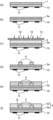
- FIG. 1 is a schematic cross-sectional view for explaining an example of a method for forming an optical waveguide using the dry film according to the present embodiment.
- FIG. 1(a) is a schematic view showing a stage in which a clad dry film is laminated on a surface of a substrate.
- FIG. 1(b) is a schematic view showing a stage in which an underclad is laminated.
- FIG. 1(c) is a schematic view showing a stage in which a core dry film is exposed with a core pattern.
- FIG. 1(d) is a schematic view showing a stage in which a core is formed on the surface of the underclad.
- FIG. 1(e) is a schematic view showing a stage in which a clad dry film is laminated so as to cover the underclad and the core.
- FIG. 1(f) is a schematic view showing a stage in which an optical waveguide is formed.
- bisphenol A type epoxy resins that have traditionally been used in resin compositions for optical waveguides generally contain a normal amount or more of hydroxyl groups (specifically secondary hydroxyl groups) in their molecular structure.
- hydroxyl groups specifically secondary hydroxyl groups
- the optical loss at a wavelength of 1,310 nm can be suppressed by including a fluorene-type epoxy resin that does not contain a hydroxyl group in its molecular structure as the resin in the resin composition for optical waveguides.
- a fluorene-type epoxy resin that does not contain a hydroxyl group in its molecular structure as the resin in the resin composition for optical waveguides.
- the handling properties during film formation can be deteriorated depending on the content of the fluorene-type epoxy resin.
- the inventors then conducted further intensive research and found that by containing, as the epoxy resin in the resin composition for optical waveguides, a bisphenol A type epoxy resin having an epoxy equivalent of 1500 g/eq or less and a fluorene type epoxy resin that does not contain a hydroxyl group in its molecular structure, and by setting the content of the fluorene type epoxy resin within a specified range, it is possible to obtain a resin composition for optical waveguides that can suppress optical loss (particularly at a wavelength of 1310 nm) and has good film handleability.
- the present invention can provide a resin composition for optical waveguides that can suppress optical loss (particularly at a wavelength of 1,310 nm) and has good film handling properties.
- epoxy resin refers to the form of an epoxy compound, including not only epoxy resin as a polymer, but also monomers that can form epoxy resin.
- Resin Composition for Optical Waveguide contains an epoxy resin (A) and a curing agent (B).
- the epoxy resin (A) contains a bisphenol A type epoxy resin (a-1) and a fluorene type epoxy resin (a-2).
- Epoxy resin (A) includes a bisphenol A type epoxy resin (a-1) and a fluorene type epoxy resin (a-2).
- the epoxy resin (A) may further include a multifunctional epoxy resin (a-3).
- epoxy resins (A) may be liquid epoxy resins or solid epoxy resins.
- liquid means that the epoxy resin is in a liquid state at room temperature
- solid means that the epoxy resin is in a solid state at room temperature.
- the epoxy equivalent of the bisphenol A type epoxy resin (a-1) is 1500 g/eq or less.
- the content of hydroxyl groups derived from the epoxy resin (A) can be reduced, thereby suppressing optical loss at a wavelength of 1310 nm.
- the epoxy equivalent of the bisphenol A type epoxy resin (a-1) is preferably 1300 g/eq or less, more preferably 1200 g/eq or less, even more preferably 1100 g/eq or less, and particularly preferably a value selected from the group consisting of 900 g/eq, 700 g/eq, 600 g/eq, 500 g/eq, 400 g/eq, and 300 g/eq or less.
- the lower limit of the epoxy equivalent of the bisphenol A type epoxy resin (a-1) is not particularly limited as long as it exhibits the effects of suppressing light loss and film handleability in this embodiment.
- the epoxy equivalent of the bisphenol A type epoxy resin (a-1) may be 150 g/eq or more, and is preferably 170 g/eq or more.
- Bisphenol A type epoxy resin (a-1) may be synthesized by a known method, or a commercially available product may be used.
- commercially available solid bisphenol A type epoxy resins include “1001", “1002", “1003", “1055", “1004", “1004AF”, “1003F”, “1004F”, “1005F”, “1004FS”, “1006FS”, and “1007FS” manufactured by Mitsubishi Chemical Group Corporation.
- commercially available liquid bisphenol A type epoxy resins include “Epicron (registered trademark) 850S” manufactured by DIC Corporation and "JER (registered trademark) 825" manufactured by Mitsubishi Chemical Corporation.
- the bisphenol A type epoxy resin (a-1) may be used alone or in combination of two or more types. From the viewpoint of adjusting the tack of the film and the film handling properties, it is preferable to use a combination of at least one type of solid bisphenol A type epoxy resin and at least one type of liquid bisphenol A type epoxy resin.
- the content of bisphenol A type epoxy resin (a-1) is not particularly limited as long as it satisfies the conditions for the content of fluorene type epoxy resin (a-2) described below and does not impair the effects of suppressing light loss and film handleability in this embodiment.
- the content of bisphenol A type epoxy resin (a-1) may be 20 mass% or more and 85 mass% or less based on the total amount of epoxy resin (A). With such a content, a resin composition that is highly transparent and easily cured by ultraviolet light can be obtained.
- the content of bisphenol A type epoxy resin (a-1) is preferably 25% by mass or more, more preferably 30% by mass or more, and even more preferably 35% by mass or more, based on the total amount of epoxy resin (A).
- the content of bisphenol A type epoxy resin (a-1) is preferably 65% by mass or less, more preferably 55% by mass or less, even more preferably 45% by mass or less, and particularly preferably 40% by mass or less, based on the total amount of epoxy resin (A).
- the fluorene-type epoxy resin (a-2) By containing a predetermined amount of the fluorene type epoxy resin (a-2) that does not contain a hydroxyl group in the molecular structure, the resin composition can suppress light loss and maintain good film handleability.
- the fluorene type epoxy resin (a-2) preferably contains a liquid fluorene type epoxy resin. By containing the liquid fluorene type epoxy resin, cracks, powder fall, etc. are more unlikely to occur, and a dry film with better film handleability can be obtained.
- the content of the liquid fluorene type epoxy resin is preferably 65% by mass or more based on the total amount of the fluorene type epoxy resin (a-2).
- the liquid fluorene type epoxy resin By containing a larger amount of the liquid fluorene type epoxy resin, a dry film that is more reliably less likely to crack, powder fall, etc. can be produced.
- the upper limit of the content of the liquid fluorene type epoxy resin is not particularly limited, but the content of the liquid fluorene type epoxy resin is preferably 100% by mass based on the total amount of the fluorene type epoxy resin (a-2).
- fluorene-type epoxy resin refers to an epoxy resin that contains a fluorene skeleton in its monomer structure and does not contain a hydroxyl group (secondary hydroxyl group) in the skeleton of its molecular structure.
- liquid fluorene-type epoxy resin is a fluorene-type epoxy resin having a monomer structure represented by the following structural formula (2).
- solid fluorene-type epoxy resin is a fluorene-type epoxy resin having a monomer structure represented by the following structural formula (4).
- the fluorene-type epoxy resin (a-2) may be synthesized by a known method, or a commercially available product may be used.
- Commercially available liquid fluorene-type epoxy resins include, for example, "OGSOL-EG200” (epoxy equivalent: 290 g/eq) and "OGSOL-EG280" manufactured by Osaka Gas Chemicals Co., Ltd.
- Commercially available solid fluorene-type epoxy resins include, for example, "OGSOL-PG100" and “OGSOL-CG500” (epoxy equivalent: 310 g/eq) manufactured by Osaka Gas Chemicals Co., Ltd.
- the fluorene-type epoxy resin (a-2) may be used alone or in combination of two or more.
- the content of fluorene-type epoxy resin (a-2) is 15% by mass or more and 80% by mass or less based on the total amount of epoxy resin (A).
- the content of fluorene-type epoxy resin (a-2) is 15% by mass or more and 80% by mass or less based on the total amount of epoxy resin (A).
- the content of hydroxyl groups derived from epoxy resin (A) can be reduced, and light loss at a wavelength of 1310 nm can be suppressed.
- a resin composition that can maintain good film handling properties can be obtained.
- the content of the fluorene type epoxy resin (a-2) is preferably 20% by mass or more, more preferably 25% by mass or more, even more preferably 35% by mass or more, particularly preferably 47.5% by mass or more, more preferably 50% by mass or more, and even more preferably 55% by mass or more, based on the total amount of the epoxy resin (A).
- the content of the fluorene type epoxy resin (a-2) is preferably 75% by mass or less, more preferably 73% by mass or less, even more preferably 70% by mass or less, and especially preferably 65% by mass or less, based on the total amount of the epoxy resin (A).
- the optionally contained polyfunctional epoxy resin (a-3) has three or more epoxy groups.
- Specific examples of the polyfunctional epoxy resin (a-3) include 2-[4-(2,3-epoxypropoxy)phenyl]-2-[4-[1,1-bis[4-([2,3-epoxypropoxy]phenyl)]ethyl]phenyl]propane, cresol novolac type epoxy resin, and the like.
- the polyfunctional epoxy resin (a-3) may be synthesized by a known method, but a commercially available product may also be used. Examples of commercially available products include "VG3101M80" manufactured by Printec Co., Ltd., "EHPE-3150” manufactured by Daicel Corporation, and "EPPN-502" manufactured by Nippon Kayaku Co., Ltd.
- the polyfunctional epoxy resin (a-3) may be used alone or in combination of two or more.
- the glass transition temperature Tg of the cured product can be improved, and therefore good heat resistance can be imparted to the cured product.
- the glass transition temperature Tg of the cured product is preferably 145°C or higher, and more preferably 148°C or higher.
- the glass transition temperature Tg is defined as the temperature measured from the peak temperature of tan ⁇ calculated by attaching the dry film to a dynamic viscoelasticity measuring device.
- the epoxy equivalent of the multifunctional epoxy resin (a-3) is not particularly limited, but is, for example, 250 g/eq or less.
- the lower limit of the epoxy equivalent of the multifunctional epoxy resin (a-3) is also not particularly limited, but from the viewpoint of improving the film handling properties, it is preferably 150 g/eq or more.
- the content of the polyfunctional epoxy resin (a-3) is not particularly limited as long as it satisfies the conditions for the content of the fluorene-type epoxy resin (a-2) described above and does not impair the effects of suppressing light loss and film handleability in this embodiment.
- the content of the polyfunctional epoxy resin (a-3) can be in a range selected from the group consisting of 0% by mass or more and 20% by mass or less, 0% by mass or more and 15% by mass or less, 5% by mass or more and 20% by mass or less, and 5% by mass or more and 15% by mass or less, based on the total amount of the epoxy resin (A).
- the resin composition may contain an epoxy resin other than the above-mentioned epoxy resin, so long as the effects of suppressing light loss and good film handling in this embodiment are not impaired.
- the other epoxy resin include "NER-1202” and “NER-1302” manufactured by Nippon Kayaku Co., Ltd., and "EPOX-MK R1710” manufactured by Printec Co., Ltd.
- the content of hydroxyl groups derived from the epoxy resin (A) is preferably 0.0013 mol/g or less. If the content of hydroxyl groups is 0.0013 mol/g or less, the optical loss at a wavelength of 1310 nm can be reliably suppressed, and therefore the resin composition can be used particularly well as a resin composition for cores.
- the content of hydroxyl groups derived from epoxy resin (A) means the amount of hydroxyl groups (mol/g) calculated from the blending amount, molecular weight, and number of hydroxyl groups in the skeleton of bisphenol A type epoxy resin (a-1) and optionally contained multifunctional epoxy resin (a-3) (and optionally contained other epoxy resins).
- the content of hydroxyl groups derived from the epoxy resin (A) is more preferably 0.0010 mol/g or less, even more preferably 0.0009 mol/g or less, and particularly preferably 0.0007 mol/g or less.
- the curing agent (B) is not particularly limited as long as it can promote the photocuring of the resin composition containing the epoxy resin (A).
- the curing agent (B) is a polymerization initiator that causes ring-opening polymerization of the epoxy group of each epoxy resin, and an example thereof is a photoacid generator that can start a reaction by light such as ultraviolet light.
- hardener (B) examples include antimony-based hardeners, phosphorus-based hardeners, special phosphorus-based hardeners, borate-based hardeners, etc. These hardeners may be used alone or in combination of two or more.
- the curing agent (B) is an antimony-based curing agent.
- an antimony-based curing agent it is possible to further increase the curability and transparency, and to reliably reduce the optical loss at a wavelength of 1310 nm.
- Commercially available antimony-based curing agents can be used. Examples of commercially available antimony-based curing agents include "CPI-101A” manufactured by San-Apro Co., Ltd. and "SP-170” manufactured by ADEKA Corporation.
- the content of the curing agent (B) is not particularly limited as long as it does not impair the effects of suppressing light loss and improving film handleability in this embodiment.
- the content of the curing agent (B) is preferably 0.1% by mass or more and 0.9% by mass or less, and more preferably 0.25% by mass or more and 0.75% by mass or less, based on the total amount of the epoxy resin (A).
- the resin composition may further contain other additives such as antioxidants, leveling agents, coupling agents (silane coupling agents), flame retardants, and inorganic fillers, as long as the effects of suppressing light loss and improving film handleability in this embodiment are not impaired.
- additives such as antioxidants, leveling agents, coupling agents (silane coupling agents), flame retardants, and inorganic fillers, as long as the effects of suppressing light loss and improving film handleability in this embodiment are not impaired.
- the resin composition further contains an antioxidant (C).
- the antioxidant (C) is not particularly limited, and a phenol-based antioxidant, a phosphite-based antioxidant, a sulfur-based antioxidant, etc. can be used. Of these, it is preferable that the antioxidant (C) is a phenol-based antioxidant.
- phenolic antioxidants can be used. Examples of commercially available phenolic antioxidants include “AO-20”, “AO-30”, “AO-40”, “AO-50”, “AO-60”, and “AO-80” manufactured by Adeka Corporation, and “SUMILIZER GA-80” manufactured by Sumitomo Chemical Co., Ltd.
- the content of the antioxidant (C) is not particularly limited, but is preferably 0% by mass or more and 5% by mass or less based on the total amount of the epoxy resin (A).
- the resin composition for optical waveguides according to this embodiment is used in the form of a cured product when used in an optical waveguide, which will be described later.
- the refractive index of the cured product of the resin composition is preferably greater than 1.5700.
- the refractive index of the cured product is greater than 1.5700, it can be suitably used as a resin composition for cores.
- refractive index of the cured product means the refractive index of the cured product at a wavelength of 1310 nm at a temperature of 25°C, measured using an Abbe refractometer.
- the refractive index of the cured product is preferably 1.575 or more, and even more preferably 1.580 or more.
- the resin composition for optical waveguides according to this embodiment can suppress optical loss at a wavelength of 1310 nm and has good film handling properties. Therefore, this resin composition can be suitably used as a material for the dry film according to the embodiment described below that is used when manufacturing optical waveguides.
- the resin composition for optical waveguides according to this embodiment may be used for both the core and the cladding. However, since the optical loss at a wavelength of 1310 nm occurs mainly in the core, the resin composition for optical waveguides according to this embodiment can be more effective when used to manufacture a dry film for the core.
- the dry film according to this embodiment is not particularly limited as long as it has a layer made of the resin composition for optical waveguide according to the above-mentioned embodiment.
- the dry film includes a layer made of an uncured or semi-cured product of the resin composition for optical waveguide according to the above-mentioned embodiment (hereinafter also referred to as "resin composition layer for optical waveguide” or “resin composition layer”). Since the resin composition for optical waveguide according to the above-mentioned embodiment has good film handling properties, the dry film according to this embodiment has excellent film handling properties and excellent adhesion to the film base, film substrate, etc.
- uncured material or “semi-cured material” refers to a resin composition layer in an uncured or semi-cured state, in which a varnish-like resin composition as described below is applied and then heated and/or dried at an appropriate temperature and time as necessary, so that the solvent and the like are reduced or removed.
- an "uncured material” or “semi-cured material” is in a state in which the epoxy resin in the resin composition layer can be further cured.
- the term "cured product" refers to a resin layer in which the curing reaction of an uncured or semi-cured resin composition layer progresses due to irradiation with light such as ultraviolet light, causing the resin to crosslink, resulting in a resin layer that does not melt even when heated.
- the optical waveguide finally obtained comprises a core layer and/or a clad layer that is a cured product of the resin composition for optical waveguides.
- the dry film may include a film substrate laminated on at least one side of the resin composition layer. Furthermore, a protective film may be laminated on the other side of the resin composition layer.
- the dry film may also include other layers in addition to the resin composition layer, the film substrate and/or the protective film. However, the dry film may be composed of a resin composition layer made of an uncured and/or semi-cured product of the resin composition for optical waveguide according to the above-mentioned embodiment.
- the film substrate is not particularly limited, but examples thereof include polyethylene terephthalate (PET) film, biaxially oriented polypropylene film, polyethylene naphthalate film, polyimide film, etc. Of these, PET film is preferable.
- PET film is preferable.
- the protective film is not particularly limited, but examples thereof include polypropylene film, etc.
- the method for producing the dry film is not particularly limited, but may be, for example, the method described below.
- a solvent or the like is added to the resin composition for optical waveguides according to the above-mentioned embodiment to form a varnish-like resin composition, and the varnish is applied to the film substrate.
- This application may be performed using a comma coater or the like.
- the applied varnish is then dried at an appropriate temperature and time to form a resin composition layer on the film substrate.
- a protective film is laminated on this resin composition layer. Examples of the method for laminating the protective film include a thermal lamination method.
- the dry film containing the resin composition layer produced in this manner is used as a material for an optical waveguide according to an embodiment described below.
- the dry film may be used when producing a core layer of an optical waveguide, or may be used when producing a cladding layer.
- optical loss at a wavelength of 1310 nm occurs mainly in the core layer, so it is preferably used when producing a core layer of an optical waveguide.
- the resin composition for optical waveguide according to the above-mentioned embodiment does not necessarily have to be used after forming the dry film according to this embodiment when manufacturing an optical waveguide.
- the resin composition for optical waveguide according to the above-mentioned embodiment may be made into a varnish-like resin composition and used directly when manufacturing the core layer and/or clad layer of the optical waveguide.
- the optical waveguide according to this embodiment is formed using the resin composition or dry film according to the above-mentioned embodiment. Since the optical waveguide is formed using the resin composition or dry film according to the above-mentioned embodiment, it is possible to suppress the optical loss at a wavelength of 1310 nm, and is very useful for industrial use.
- the optical waveguide according to this embodiment is an optical waveguide including a core layer and a clad layer having a lower refractive index than the core layer, and the core layer or the clad layer is formed using the resin composition or the dry film according to the above-mentioned embodiment.
- the core layer of the optical waveguide is formed using the resin composition or the dry film according to the above-mentioned embodiment.
- Figures 1(a) to 1(f) respectively indicate a clad dry film 1, a core dry film 2, a clad 3, an underclad 3a, an overclad 3b, a core 4, a substrate 10, an electric circuit 11, a slit 12, a mask 13, and an optical waveguide A.
- the optical waveguide is formed by using a clad dry film and a core dry film to form the core and clad, respectively.
- the core dry film is a dry film according to the embodiment described above
- the clad dry film is a dry film with a lower refractive index than the core film.
- the clad dry film and the core dry film may both be dry films according to the embodiment described above.
- a clad dry film 1 is laminated onto the surface of a substrate 10 on which an electric circuit 11 is formed, and then the clad dry film 1 is cured by irradiation with ultraviolet light or other light, heating, or the like.
- the substrate 10 may be, for example, a flexible printed wiring board with an electric circuit formed on one side of a transparent base material such as a polyimide film, or a printed wiring board such as a glass epoxy.
- an underclad 3a is laminated and formed on the surface of the substrate 10, as shown in FIG. 1(b).
- the core dry film 2 is laminated onto the surface of the underclad 3a, and then a mask 13 with slits 12 of the core pattern is placed over it. Then, light capable of photocuring, such as ultraviolet light, is irradiated through the slits 12, thereby exposing the core dry film 2 to the core pattern.
- the exposure method may be a selective exposure method using a mask 13, or a direct writing method in which a laser beam is scanned and irradiated along the pattern shape.
- the core dry film 2 is developed using a developer such as an aqueous flux cleaner to remove the resin from the unexposed and uncured parts of the core dry film 2.
- a core 4 with a specified core pattern is formed on the surface of the underclad 3a, as shown in Figure 1(d).
- the clad dry film 1 is laminated so as to cover the underclad 3a and the core 4.
- the clad dry film 1 is then cured by irradiation with light, heating, etc., to form the overclad 3b as shown in FIG. 1(f).
- an optical waveguide A is formed on the surface of the substrate 10, with the core 4 embedded in the clad 3 consisting of the underclad 3a and overclad 3b.
- the optical waveguide A thus obtained uses the dry film according to the above-mentioned embodiment, thereby suppressing optical loss at a wavelength of 1310 nm and enabling excellent optical communication. Therefore, the substrate 10 on which such an optical waveguide A is formed is preferably used as a printed wiring board for optical transmission, and is preferably used in, for example, mobile phones, personal digital assistants, etc.
- the resin composition for optical waveguides contains an epoxy resin (A) and a curing agent (B), the epoxy resin (A) contains a bisphenol A type epoxy resin (a-1) having an epoxy equivalent of 1500 g/eq or less, and a fluorene type epoxy resin (a-2) that does not contain a hydroxyl group in its molecular structure, and the content of the fluorene type epoxy resin (a-2) is 15% by mass or more and 80% by mass or less based on the total amount of the epoxy resin (A).
- the epoxy resin (A) contains a bisphenol A type epoxy resin (a-1) having an epoxy equivalent of 1500 g/eq or less, and a fluorene type epoxy resin (a-2) that does not contain a hydroxyl group in its molecular structure, and the content of the fluorene type epoxy resin (a-2) is 15% by mass or more and 80% by mass or less based on the total amount of the epoxy resin (A).
- the resin composition for optical waveguides according to the third aspect of the present invention is the resin composition for optical waveguides according to the first or second aspect, in which the epoxy resin (A) further contains a multifunctional epoxy resin (a-3).
- the resin composition for optical waveguides according to the fourth aspect of the present invention is a resin composition for optical waveguides according to any one of the first to third aspects, in which the content of hydroxyl groups derived from the epoxy resin (A) is 0.0013 mol/g or less.
- the resin composition for optical waveguides according to the fifth aspect of the present invention is a resin composition for optical waveguides according to any one of the first to fourth aspects, in which the refractive index of the cured product is greater than 1.5700.
- the resin composition for optical waveguides according to the sixth aspect of the present invention is a resin composition for optical waveguides according to any one of the first to fifth aspects, further comprising an antioxidant (C).
- the dry film according to the seventh aspect of the present invention includes a layer made of an uncured or semi-cured product of the resin composition for optical waveguide according to any one of the first to sixth aspects.
- the optical waveguide according to the eighth aspect of the present invention is an optical waveguide having a core layer and a clad layer having a lower refractive index than the core layer, and the core layer is formed using the resin composition for optical waveguides according to any one of the first to sixth aspects (or the dry film according to the seventh aspect).
- various resin compositions for optical waveguides were prepared using various epoxy resins and varying the content of each epoxy resin, and these were used to manufacture dry films and waveguide samples for evaluating optical loss. Furthermore, the content of hydroxyl groups derived from the epoxy resin was calculated for each resin composition for optical waveguides, and the physical properties of various dry films and cured products were also evaluated or measured.
- the following describes the method for preparing the resin composition for optical waveguides, the method for calculating the content of hydroxyl groups derived from the epoxy resin, the method for producing the dry film, and the method for evaluating the optical loss (1310 nm) using a waveguide sample in each example and comparative example.
- the methods for evaluating and measuring the physical properties of the dry film and the cured product are also described below.
- the fluorene-type epoxy resin (a-2) ("OGSOL-EG200", liquid fluorene-type epoxy resin, manufactured by Osaka Gas Chemicals Co., Ltd.) does not contain a hydroxyl group. Therefore, the content of the hydroxyl group derived from the epoxy resin (A) was calculated based on the amount of hydroxyl groups in the bisphenol A type (BisA type) epoxy resin (a-1) by the following method.
- Epiclon (registered trademark) 850S epoxy equivalent: 183 to 193 g/eq
- DIC Corporation has a monomer structure represented by the following structural formula (5).
- n in the following structural formula is estimated to be about 0.13.
- Epiclon (registered trademark) 850S represented by the above structural formula (5) has a significantly smaller amount of hydroxyl groups than other bisphenol A type (BisA type) epoxy resins. Therefore, the amount of hydroxyl groups was set to 0 and was not included in the calculation formula. Specifically, first, “jER (registered trademark) 1001” (hereinafter also simply referred to as “1001”) and “Epicoat (registered trademark) 1006FS” (hereinafter also simply referred to as "1006FS”) were divided by their respective molecular weights to calculate the number of molecules (mol) of each epoxy resin contained in the resin composition.
- 1001 contains 2.1 hydroxyl groups in the skeleton
- 1006FS contains 5.5 hydroxyl groups in the skeleton. Therefore, next, these values were multiplied by the number of molecules of each epoxy resin calculated earlier, and the calculated values were added. Then, the added value was divided by the total amount of epoxy resin to calculate the content (mol/g) of hydroxyl groups contained in the resin composition.
- the hydroxyl group content is 0.0013 mol/g or less, it can be evaluated as being suitable for use as a resin composition for optical waveguides for cores.
- the calculation results of the hydroxyl group content for each example and comparative example are summarized in Table 1 below.
- Epoxy resins were 14 parts by mass of alicyclic epoxy resin ("Celloxide 2021P", Daicel Corporation), 25 parts by mass of bisphenol A type epoxy resin ("Epicoat (registered trademark) 1006FS", Mitsubishi Chemical Corporation), 38 parts by mass of hydrogenated bisphenol A type epoxy resin ("JER (registered trademark) YX8040", Mitsubishi Chemical Corporation), and 38 parts by mass of multifunctional (trifunctional) epoxy resin ("VG3101M80 “, manufactured by Printec Co., Ltd.), 23 parts by mass of antimony-based curing agent as a curing agent ("SP-170", manufactured by ADEKA Co., Ltd.), 1 part by mass of antioxidant as an additive (“AO-60”, manufactured by ADEKA Co., Ltd.), and 0.1 part by mass of leveling agent ("PF-636", manufactured by OMNOVA Co., Ltd.) were dissolved in a mixed solvent of MEK, toluene and PGMEA of 50 parts by mass per 100 parts by mass of epoxy resin.
- the mixture was filtered through a membrane filter with a pore size of 1 ⁇ m and degassed to prepare an epoxy resin varnish.
- the prepared resin varnish was applied to a PET film (product number A4100) manufactured by Toyobo Co., Ltd. using a multi-coater with a comma coater head manufactured by Hirano Tecseed Co., Ltd. The film was then dried to obtain a dry film for clad of a predetermined thickness.
- the obtained clad film was laminated onto a substrate as an underclad. Furthermore, a core film was laminated on top of that. After the laminated film was exposed to light and heat treated, an overclad was laminated using the clad film to produce a slab waveguide sample.
- the manufactured slab waveguide sample was used to measure the optical loss at a wavelength of 1310 nm using the following method.
- Light from a 1310 nm LED light source was passed through an optical fiber with a core diameter of 9 ⁇ m and NA of 0.12, and silicone oil was injected into the end of the manufactured waveguide sample via matching oil (refractive index 1.505).
- the other side of the waveguide sample was connected to a power meter through an optical fiber with a core diameter of 50 ⁇ m and NA of 0.21 via the same matching oil, and the power (P1) when an optical circuit was inserted was measured.
- the power (P0) was measured by butting two similar optical fibers in a state without an optical circuit.
- the optical loss (1310 nm) was calculated from the measured value using the formula -10 log (P1/P0).
- the calculation results of the optical loss (1310 nm) in each embodiment and each comparative example are summarized in Table 1 below.
- the light loss was 0.400 or less, the light loss was evaluated as being well suppressed, if the light loss was greater than 0.400 and less than 0.440, the light loss was evaluated as being suppressed, and if the light loss was greater than 0.440, the light loss was evaluated as being large.
- Example and Comparative Example manufactured as described above were used to evaluate the film handling properties. Specifically, in the first test, the dry film was folded 90° to check whether resin cracks occurred at the fold, and if no cracks occurred, the first test was deemed to have passed. Furthermore, in the second test, the dry film was cut with a cutter to check whether cracks or powder fall occurred from the end, and if no cracks or powder fall occurred, the second test was deemed to have passed.
- ⁇ Method for measuring glass transition temperature Tg> The dry films of each of the examples and comparative examples manufactured as described above were cut to a size of 10 mm x 40 mm and attached to a dynamic viscoelasticity measuring device (Seiko Instruments Inc., "DMS6100"). The test was performed under conditions of a strain amplitude of 10 ⁇ m, a frequency of 10 Hz (sine wave), and a temperature rise rate of 5 ° C./min, and the calculated peak temperature of tan ⁇ was adopted as the glass transition temperature Tg (° C.). The higher the glass transition temperature Tg, the more excellent the heat resistance of the cured product can be evaluated. For example, if the glass transition temperature Tg is 150 ° C., an optical waveguide having excellent heat resistance can be reliably obtained. The glass transition temperature Tg was measured in some of the examples. The measurement results are summarized in Table 1 below.
- Comparative Example 1 in which only fluorene-type epoxy resin (a-2) was used as the epoxy resin (A), film handling was significantly poor and a film could not be formed.
- Comparative Example 2 in which the content of fluorene-type epoxy resin (a-2) was high, a film could be formed, but the handling was poor.
- Comparative Example 3 which did not contain fluorene-type epoxy resin (a-2), the light loss was large. This is thought to be due to the high content of hydroxyl groups derived from the epoxy resin (A), resulting in large light loss.
- the present invention it is possible to obtain a resin composition for optical waveguides that can suppress optical loss (particularly at a wavelength of 1,310 nm) and has good film handling properties.
- the optical waveguides can be preferably used as optical transmission printed wiring boards for mobile phones, personal digital assistants, etc.
Landscapes
- Physics & Mathematics (AREA)
- Chemical & Material Sciences (AREA)
- General Physics & Mathematics (AREA)
- Engineering & Computer Science (AREA)
- Optics & Photonics (AREA)
- Health & Medical Sciences (AREA)
- Microelectronics & Electronic Packaging (AREA)
- Chemical Kinetics & Catalysis (AREA)
- Medicinal Chemistry (AREA)
- Polymers & Plastics (AREA)
- Organic Chemistry (AREA)
- Epoxy Resins (AREA)
- Optical Integrated Circuits (AREA)
Priority Applications (1)
| Application Number | Priority Date | Filing Date | Title |
|---|---|---|---|
| JP2025535847A JPWO2025023263A1 (https=) | 2023-07-25 | 2024-07-23 |
Applications Claiming Priority (2)
| Application Number | Priority Date | Filing Date | Title |
|---|---|---|---|
| JP2023120914 | 2023-07-25 | ||
| JP2023-120914 | 2023-07-25 |
Publications (1)
| Publication Number | Publication Date |
|---|---|
| WO2025023263A1 true WO2025023263A1 (ja) | 2025-01-30 |
Family
ID=94375403
Family Applications (1)
| Application Number | Title | Priority Date | Filing Date |
|---|---|---|---|
| PCT/JP2024/026387 Pending WO2025023263A1 (ja) | 2023-07-25 | 2024-07-23 | 光導波路用樹脂組成物、ならびにそれを用いたドライフィルムおよび光導波路 |
Country Status (2)
| Country | Link |
|---|---|
| JP (1) | JPWO2025023263A1 (https=) |
| WO (1) | WO2025023263A1 (https=) |
Citations (5)
| Publication number | Priority date | Publication date | Assignee | Title |
|---|---|---|---|---|
| JP2017134319A (ja) * | 2016-01-29 | 2017-08-03 | 日東電工株式会社 | 光導波路形成用感光性エポキシ樹脂組成物および光導波路形成用感光性フィルム、ならびにそれを用いた光導波路、光・電気伝送用混載フレキシブルプリント配線板 |
| WO2018123389A1 (ja) * | 2016-12-28 | 2018-07-05 | 日東電工株式会社 | 光電気混載基板 |
| JP2018146710A (ja) * | 2017-03-03 | 2018-09-20 | 日東電工株式会社 | 光導波路コア形成用感光性エポキシ樹脂組成物、光導波路コア形成用感光性フィルム、光導波路、光電気混載基板および光導波路の製造方法 |
| WO2020026970A1 (ja) * | 2018-07-31 | 2020-02-06 | 日東電工株式会社 | 光導波路形成用感光性エポキシ樹脂組成物、光導波路形成用感光性フィルムおよびそれを用いた光導波路、光・電気伝送用混載フレキシブルプリント配線板 |
| WO2020121818A1 (ja) * | 2018-12-11 | 2020-06-18 | 日東電工株式会社 | 光導波路用エポキシ樹脂感光性組成物、光導波路用感光性フィルム、光導波路、および、光電気混載基板 |
-
2024
- 2024-07-23 JP JP2025535847A patent/JPWO2025023263A1/ja active Pending
- 2024-07-23 WO PCT/JP2024/026387 patent/WO2025023263A1/ja active Pending
Patent Citations (5)
| Publication number | Priority date | Publication date | Assignee | Title |
|---|---|---|---|---|
| JP2017134319A (ja) * | 2016-01-29 | 2017-08-03 | 日東電工株式会社 | 光導波路形成用感光性エポキシ樹脂組成物および光導波路形成用感光性フィルム、ならびにそれを用いた光導波路、光・電気伝送用混載フレキシブルプリント配線板 |
| WO2018123389A1 (ja) * | 2016-12-28 | 2018-07-05 | 日東電工株式会社 | 光電気混載基板 |
| JP2018146710A (ja) * | 2017-03-03 | 2018-09-20 | 日東電工株式会社 | 光導波路コア形成用感光性エポキシ樹脂組成物、光導波路コア形成用感光性フィルム、光導波路、光電気混載基板および光導波路の製造方法 |
| WO2020026970A1 (ja) * | 2018-07-31 | 2020-02-06 | 日東電工株式会社 | 光導波路形成用感光性エポキシ樹脂組成物、光導波路形成用感光性フィルムおよびそれを用いた光導波路、光・電気伝送用混載フレキシブルプリント配線板 |
| WO2020121818A1 (ja) * | 2018-12-11 | 2020-06-18 | 日東電工株式会社 | 光導波路用エポキシ樹脂感光性組成物、光導波路用感光性フィルム、光導波路、および、光電気混載基板 |
Also Published As
| Publication number | Publication date |
|---|---|
| JPWO2025023263A1 (https=) | 2025-01-30 |
Similar Documents
| Publication | Publication Date | Title |
|---|---|---|
| KR101302767B1 (ko) | 광도파로-형성 에폭시 수지 조성물, 광도파로-형성 경화 필름, 광전송 가요성 인쇄 회로, 및 전자 정보 장치 | |
| JP6150178B2 (ja) | 光導波路および光導波路作製用のドライフィルム | |
| CN101379421B (zh) | 柔性光波导及光学模块 | |
| CN110938190B (zh) | 光波导用组合物、光波导用干膜和光波导 | |
| AU2008227642A1 (en) | Adhesive composition for optical waveguide, adhesive film for optical waveguide and adhesive sheet for optical waveguide each using the same, and optical device using any of them | |
| US9005740B2 (en) | Resin composition for optical waveguide, dry film, optical waveguide, and photoelectric composite wiring board using same | |
| CN103309153A (zh) | 光波导形成用环氧树脂组合物及由其得到的光波导形成用固化性薄膜及光传送用挠性印制板 | |
| WO2007105795A1 (ja) | 光学材料用フェノキシ樹脂、光学材料用樹脂組成物、光学材料用樹脂フィルム及びこれらを用いた光導波路 | |
| WO2020026970A1 (ja) | 光導波路形成用感光性エポキシ樹脂組成物、光導波路形成用感光性フィルムおよびそれを用いた光導波路、光・電気伝送用混載フレキシブルプリント配線板 | |
| WO2023276622A1 (ja) | 光導波路用樹脂組成物、並びに、それを用いたドライフィルム及び光導波路 | |
| WO2025142472A1 (ja) | 光導波路用樹脂組成物、ならびにそれを用いたドライフィルムおよび光導波路 | |
| WO2025023263A1 (ja) | 光導波路用樹脂組成物、ならびにそれを用いたドライフィルムおよび光導波路 | |
| JP2008164763A (ja) | フィルム状光導波路 | |
| JP2007119585A (ja) | 硬化性エポキシ樹脂フィルム | |
| JP5160743B2 (ja) | 活性エネルギー線硬化性接着剤およびその用途 | |
| KR20240151722A (ko) | 적층체 및 전자 기기 | |
| WO2023210629A1 (ja) | 光導波路用樹脂組成物、並びに、それを用いたドライフィルム及び光導波路 | |
| CN113412296B (zh) | 光波导覆层用组合物、光波导覆层用干膜及光波导 | |
| JP7696089B2 (ja) | 光導波路用材料 | |
| WO2025142620A1 (ja) | エポキシ樹脂組成物、光導波路用エポキシ樹脂組成物、層間絶縁用エポキシ樹脂組成物、樹脂付きフィルムおよび液状材料 | |
| WO2025105092A1 (ja) | 光導波路用樹脂組成物、並びに、それを用いたドライフィルム、光導波路及び半導体パッケージ基板 | |
| EP2733511A2 (en) | Optical waveguide forming resin composition, optical waveguide and light transmission flexible printed board produced by using the resin composition, and production method for the optical waveguide | |
| WO2026028830A1 (ja) | 光導波路用樹脂組成物、ならびにそれを用いたドライフィルム、樹脂付きフィルム、液状材料および光導波路 | |
| JP2009175456A (ja) | クラッド層形成用樹脂組成物およびこれを用いたクラッド層形成用樹脂フィルム、これらを用いた光導波路ならびに光モジュール | |
| JP2025182831A (ja) | 光電気複合基板、光学部品、基板、および、光電気複合基板の製造方法 |
Legal Events
| Date | Code | Title | Description |
|---|---|---|---|
| 121 | Ep: the epo has been informed by wipo that ep was designated in this application |
Ref document number: 24845638 Country of ref document: EP Kind code of ref document: A1 |
|
| ENP | Entry into the national phase |
Ref document number: 2025535847 Country of ref document: JP Kind code of ref document: A |
|
| WWE | Wipo information: entry into national phase |
Ref document number: 2025535847 Country of ref document: JP |
|
| NENP | Non-entry into the national phase |
Ref country code: DE |