WO2025018224A1 - 音響出力装置 - Google Patents
音響出力装置 Download PDFInfo
- Publication number
- WO2025018224A1 WO2025018224A1 PCT/JP2024/024772 JP2024024772W WO2025018224A1 WO 2025018224 A1 WO2025018224 A1 WO 2025018224A1 JP 2024024772 W JP2024024772 W JP 2024024772W WO 2025018224 A1 WO2025018224 A1 WO 2025018224A1
- Authority
- WO
- WIPO (PCT)
- Prior art keywords
- case
- frame
- output device
- diaphragm
- coil
- Prior art date
- Legal status (The legal status is an assumption and is not a legal conclusion. Google has not performed a legal analysis and makes no representation as to the accuracy of the status listed.)
- Pending
Links
Images








Classifications
-
- H—ELECTRICITY
- H04—ELECTRIC COMMUNICATION TECHNIQUE
- H04R—LOUDSPEAKERS, MICROPHONES, GRAMOPHONE PICK-UPS OR LIKE ACOUSTIC ELECTROMECHANICAL TRANSDUCERS; ELECTRIC HEARING AIDS; PUBLIC ADDRESS SYSTEMS
- H04R1/00—Details of transducers, loudspeakers or microphones
- H04R1/06—Arranging circuit leads; Relieving strain on circuit leads
-
- H—ELECTRICITY
- H04—ELECTRIC COMMUNICATION TECHNIQUE
- H04R—LOUDSPEAKERS, MICROPHONES, GRAMOPHONE PICK-UPS OR LIKE ACOUSTIC ELECTROMECHANICAL TRANSDUCERS; ELECTRIC HEARING AIDS; PUBLIC ADDRESS SYSTEMS
- H04R1/00—Details of transducers, loudspeakers or microphones
- H04R1/10—Earpieces; Attachments therefor ; Earphones; Monophonic headphones
-
- H—ELECTRICITY
- H04—ELECTRIC COMMUNICATION TECHNIQUE
- H04R—LOUDSPEAKERS, MICROPHONES, GRAMOPHONE PICK-UPS OR LIKE ACOUSTIC ELECTROMECHANICAL TRANSDUCERS; ELECTRIC HEARING AIDS; PUBLIC ADDRESS SYSTEMS
- H04R7/00—Diaphragms for electromechanical transducers; Cones
- H04R7/16—Mounting or tensioning of diaphragms or cones
- H04R7/18—Mounting or tensioning of diaphragms or cones at the periphery
- H04R7/22—Clamping rim of diaphragm or cone against seating
-
- H—ELECTRICITY
- H04—ELECTRIC COMMUNICATION TECHNIQUE
- H04R—LOUDSPEAKERS, MICROPHONES, GRAMOPHONE PICK-UPS OR LIKE ACOUSTIC ELECTROMECHANICAL TRANSDUCERS; ELECTRIC HEARING AIDS; PUBLIC ADDRESS SYSTEMS
- H04R9/00—Transducers of moving-coil, moving-strip, or moving-wire type
- H04R9/02—Details
-
- H—ELECTRICITY
- H04—ELECTRIC COMMUNICATION TECHNIQUE
- H04R—LOUDSPEAKERS, MICROPHONES, GRAMOPHONE PICK-UPS OR LIKE ACOUSTIC ELECTROMECHANICAL TRANSDUCERS; ELECTRIC HEARING AIDS; PUBLIC ADDRESS SYSTEMS
- H04R9/00—Transducers of moving-coil, moving-strip, or moving-wire type
- H04R9/02—Details
- H04R9/04—Construction, mounting, or centering of coil
Definitions
- This technology relates to the technical field of audio output devices that output sound.
- audio output devices that are worn on the head, such as the ears, as headphones or earphones, and sound is output from a speaker unit.
- audio output devices have been increasingly used outdoors in addition to indoors.
- Such audio output devices include so-called dynamic audio output devices that are provided with a speaker unit having a magnet, a coil, and a diaphragm, and sound is output by vibrating the diaphragm through a magnetic circuit (see, for example, Patent Documents 1, 2, and 3).
- the outer periphery of the diaphragm is attached by a diaphragm ring to the outer periphery of a member called a frame, which has a magnet attached and also functions as a yoke, ensuring a stable attachment state of the diaphragm to the frame.
- the outer shape of the part that comes into contact with the head is rounded, and it is desirable to place a speaker unit with the largest diameter possible within a limited space.
- the presence of the diaphragm ring tends to make the acoustic output device larger.
- the aim of the audio output device of this technology is to achieve miniaturization while ensuring a stable attachment state of the diaphragm to the frame.
- the sound output device comprises a speaker unit having a ring-shaped magnet, a frame to which the magnet is attached, a coil to which a drive current is supplied, and a diaphragm to which the coil is attached, the diaphragm having a vibration part that vibrates integrally with the coil when sound is output, and a bending part that is continuous with the outer periphery of the vibration part and is bent toward the magnet with respect to the vibration part, and the bending part is provided with a joint that is joined to the outer periphery of the frame.
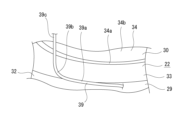
- the diaphragm is attached to the frame by joining the joint provided at the bent portion bent toward the magnet side relative to the vibrating portion to the outer peripheral surface of the frame.
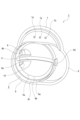
- FIG. 1 shows an embodiment of a sound output device according to the present technology together with FIG. 2 to FIG. 14, and is a perspective view of the sound output device.
- FIG. 2 is an exploded perspective view of the sound output device.
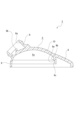
- FIG. FIG. 4 is a cross-sectional view of the first case. 4 is a cross-sectional view showing a state in which the speaker unit is arranged in a unit arrangement space of the first case.
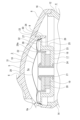
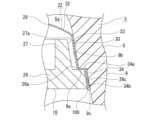
- FIG. FIG. 2 is a cross-sectional view of the speaker unit. 4 is an enlarged cross-sectional view showing a state in which the diaphragm is attached to the frame.
- FIG. 4 is an enlarged cross-sectional view showing a state in which an adhesive is applied to the outermost periphery of the diaphragm.
- FIG. 4 is an enlarged cross-sectional view showing a state in which an adhesive is applied to the outermost periphery of the diaphragm.
- FIG. 11 is a perspective view showing an arrangement state of a wiring board connected to a microphone with respect to a first case.
- FIG. 4 is a cross-sectional view showing the arrangement of a wiring board connected to a microphone relative to a first case.
- FIG. FIG. 4 is a side view showing an arrangement of wires drawn out from a coil. 13 and 14 show the steps for assembling the speaker unit, and this figure is a cross-sectional view showing the state in which the coil is attached to the diaphragm.
- 4 is a cross-sectional view showing a state in which the diaphragm is assembled to the first case.
- FIG. 4 is a cross-sectional view showing a state in which the diaphragm is attached to a frame.
- the sound output device of the present technology is applied to headphones.
- the scope of application of the present technology is not limited to headphones, and can be widely applied to various other sound output devices such as earphones.
- the sound output device described below is equipped with a dynamic speaker unit that functions as an audio output section, and the speaker unit has a ring-shaped coil and magnet.
- the axial direction of the coil is taken as the front-to-back direction, and the directions indicated are front-to-back, up-down, left-to-right.
- the sound output devices 1 are used, for example, in a pair, one for the left ear and the other for the right ear. However, sound may be heard using a single sound output device 1.
- the sound output device 1 has a housing 2 that serves as an outer case, and the necessary parts arranged inside the housing 2 (see Figures 1 and 2).
- the housing 2 is constructed by joining a first case 3 and a second case 4 in the front-to-rear direction.
- the first case 3 is integrally formed with a concave case section 5 that opens to the rear, a sound-guiding tubular section 6 that protrudes diagonally to the front side from the case section 5, a terminal protrusion 7 that protrudes upward from the rear end of the case section 5, and a protruding section 8 that protrudes to the side from the case section 5.
- the entire outer surface of the case section 5 is formed into an outwardly convex curved surface.
- the case section 5 is formed into a roughly circular shape when viewed from the front-to-rear direction, and the internal space is formed as a unit arrangement space 5a.
- the sound-guiding tubular portion 6 is formed in a substantially cylindrical shape.
- the internal space of the sound-guiding tubular portion 6 is formed as a sound-guiding space 6a, which is connected to the unit arrangement space 5a of the case portion 5.
- the sound-guiding tubular portion 6 has a microphone arrangement portion 6b provided in the sound-guiding space 6a.
- the terminal protrusion 7 has, for example, three terminal arrangement holes 7a formed therein.
- a terminal board (not shown) on which three connection terminals are mounted is disposed on the rear side of the terminal protrusion 7, and the connection terminals are inserted and arranged in the terminal arrangement holes 7a.
- the connection terminals are, for example, charging terminals, communication terminals, etc.
- the protrusion 8 is formed in a shallow recess that opens to the rear.
- the case 5 has a substantially annular peripheral surface 9 and a curved blocking portion 10 that is connected to the front end of the peripheral surface 9, and the sound-guiding tubular portion 6 is connected to the blocking portion 10.
- the blocking portion 10 is formed in a substantially spherical shape that is gently convex toward the front.
- a circular pressing surface 9a facing rearward is formed on the inner periphery of the peripheral portion 9 (see Figures 3 and 4).
- the front portion of the inner periphery of the peripheral portion 9 is formed as a first peripheral surface 9b
- the rear portion of the pressing surface 9a is formed as a second peripheral surface 9c, with the second peripheral surface 9c being positioned more radially outward than the first peripheral surface 9b.
- the first peripheral surface 9b and the second peripheral surface 9c are gently inclined so that they are displaced outward as they move rearward.
- a retaining groove 11 is formed on the inner surface of the case 5 in a portion spanning the peripheral surface 9 and the blocking portion 10, and the retaining groove 11 is formed at a position that runs from a part of the peripheral surface 9 through the blocking portion 10 toward the sound-guiding tubular portion 6. Therefore, the position where the retaining groove 11 is formed on the peripheral surface 9 is a non-formed portion 9d where the pressing surface 9a, the first peripheral surface 9b, and the second peripheral surface 9c are not formed.
- the second case 4 is integrally formed with a concave main body 12 that opens on the side opposite the first case 3 and a stem 13 that protrudes downward from the main body 12.
- the main body 12 is made up of a first cover part 14 formed in a horizontally elongated shape and a second cover part 15 positioned above the first cover part 14.
- the opening of the main body 12 is provided as a circumferential joint part 16 that is the same shape and size as the rear end part of the first case 3.
- a battery (not shown) is placed inside the main body 12, and a microphone (not shown) that functions as a feedforward microphone is placed inside the stem 13.
- the housing 2 is constructed by butting together the case portion 5 of the first case 3 and the circumferential joint portion 16 of the second case 4 (see Figure 1).
- a speaker unit 17 is placed in the unit placement space 5a of the first case 3 (see Figure 5). Sound output from the speaker unit 17 passes through the sound-guiding space 6a of the sound-guiding tubular portion 6 and is radiated to the outside.
- the speaker unit 17 is a dynamic type speaker unit, and has a frame 18, a magnet 19, a flat yoke 20, a holding member 21, a diaphragm 22, and a coil 23 (see Figures 5 and 6).
- the frame 18 is made of a magnetic metal material and is integrally formed with a base plate portion 24 formed in a circular ring shape facing the front-to-rear direction, a circular connecting portion 25 protruding forward from the outer periphery of the base plate portion 24, a flange portion 26 protruding outward from the front end of the connecting portion 25, and a vertical wall portion 27 protruding forward from a position near the outer periphery of the flange portion 26.
- the outer periphery of the flange portion 26 is formed with a surface facing forward on the outer periphery side of the vertical wall portion 27, and this surface is formed as a receiving surface 26a.
- the outer periphery of the flange portion 26 is formed with a pull-out hole 26b.
- the outer periphery surface 26c of the flange portion 26 is inclined so that it gradually displaces outward as it moves rearward.
- the outer peripheral surface of the vertical wall portion 27 is formed as a gently inclined inclined surface 27a that displaces outward as it moves rearward.
- the magnet 19 and the flat yoke 20 are both formed in an annular shape and are connected in the front-to-rear direction.
- the flat yoke 20 is attached to the front surface of the magnet 19, and the rear surface of the magnet 19 is attached to the front surface of the base plate portion 24 of the frame 18.
- the holding member 21 is made of a magnetic metal material and is formed in a generally cylindrical shape, and is inserted through the base plate portion 24 of the frame 18, the magnet 19, and the flat yoke 20, with its front end fixed to the flat yoke 20 and its rear end fixed to the base plate portion 24. Therefore, in the speaker unit 17, the frame 18, the magnet 19, and the flat yoke 20 are joined and held in close contact with each other in the front-to-rear direction by the holding member 21.
- a gap 28 is formed as a predetermined space between the inner circumferential surface of the connecting portion 25 of the frame 18 and the outer circumferential surfaces of the magnet 19 and flat yoke 20.
- the diaphragm 22 has a vibration portion 29 that vibrates when sound is output, and a bent portion 30 that is bent toward the magnet 19 relative to the vibration portion 29.
- the vibration part 29 consists of a dome part 31 formed in a roughly spherical shape that is convex forward, and a ring-shaped outer peripheral part 32 that is continuous with the outer periphery of the dome part 31.
- the front end of the coil 23 is fixed by adhesive or the like to the rear surface of the boundary 29a between the dome portion 31 and the outer periphery 32 of the vibrating portion 29, and at least a portion of it is positioned in the gap 28.
- the diaphragm 22 is attached, for example, by the step portion 34a to the receiving surface 26a of the frame 18 with adhesive 100 (see FIG. 7). At this time, the step portion 34a is pressed from the front by the pressing surface 9a of the first case 3 and pressed against the receiving surface 26a to be joined.
- At least a portion of the outermost portion 34b is joined to the outer peripheral surface of the frame 18.
- at least a portion of the outermost portion 34b may be sandwiched between the outer peripheral surface of the frame 18 and the inner peripheral surface of the peripheral portion 9 of the first case 3.
- at least a portion of the outermost portion 34b may be glued to the outer peripheral surface of the frame 18.
- the pressing surface 9a is formed on the first case 3
- the receiving surface 26a is formed on the frame 18, and a step portion 34a is provided at the joint 34 of the diaphragm 22, and the step portion 34a is pressed by the pressing surface 9a and pressed against the receiving surface 26a.
- the joint 34 is joined to the outer circumferential surface of the frame 18 while the step portion 34a is pressed against the frame 18 by the first case 3, so that a stable fixed state of the bent portion 30 to the frame 18 can be ensured.
- the outer peripheral portion 34b is positioned such that the outer peripheral surface 26c of the flange portion 26 of the frame 18 and the second peripheral surface 9c of the peripheral portion 9 of the first case 3 face each other on both sides in the thickness direction, and instead of bonding the step portion 34a, adhesive 100 may be applied to the tip of the outer peripheral portion 34b (see FIG. 8).
- adhesive 100 may be applied to the tip of the outer peripheral portion 34b (see FIG. 8).
- the applied adhesive 100 wraps around between the outer peripheral portion 34b and the outer peripheral surface 26c of the frame 18 and also wraps around between the outer peripheral portion 34b and the second peripheral surface 9c of the peripheral portion 9, so that the outer peripheral portion 34b is bonded to both the frame 18 and the first case 3 at the same time.
- the adhesive 100 when the adhesive 100 is applied between the step portion 34a and the receiving surface 26a, the adhesive 100 may be applied to the area spanning the outer peripheral surface 26c of the frame 18, the outermost peripheral portion 34b, and the second peripheral surface 9c of the peripheral portion 9.
- a microphone 35 is attached and arranged in the microphone arrangement section 6b of the first case 3 (see FIG. 2).
- the microphone 35 functions as a feedback microphone, and is a microphone for performing a noise canceling function together with the microphone that functions as the feedforward microphone described above.
- the microphone 35 is mounted on one end of the wiring board 36 in the longitudinal direction, and a first reinforcing plate 37 is attached to one end of the wiring board 36 on the opposite side to the microphone 35.
- a flexible printed wiring board is used as the wiring board 36.
- the first reinforcing plate 37 reinforces the wiring board 36, and the microphone 35 is maintained in a stable mounting state on the wiring board 36.
- the wiring board 36 is held in a state where all of its length except for both ends are inserted into the retaining groove 11 formed in the first case 3 (see Figures 9 and 10). By being inserted and held in the retaining groove 11, the wiring board 36 is positioned across the dome portion 31 and outer periphery 32 of the diaphragm 22.
- a second reinforcing plate 38 is attached to a portion of the wiring board 36.
- the second reinforcing plate 38 is attached to the same surface in the thickness direction of the wiring board 36 as the surface to which the first reinforcing plate 37 is attached. In other words, the second reinforcing plate 38 is attached to the surface of the wiring board 36 that faces the surface of the vibration section 29.
- the second reinforcing plate 38 is disposed in the non-formed portion 9d of the peripheral portion 9 in the retaining groove 11. By disposing the second reinforcing plate 38 in the non-formed portion 9d, the rear surface of the second reinforcing plate 38 is positioned on approximately the same plane as the pressing surface 9a of the peripheral portion 9, and the rear surface of the second reinforcing plate 38 has the same function as the pressing surface 9a.
- the step portion 34a of the vibration plate 22 is pressed against the receiving surface 26a while being pressed by the pressing surface 9a and the second reinforcing plate 38.
- the wiring board 36 which is a flexible printed wiring board, is connected to the microphone 35, and the first case 3 has a holding groove 11 formed in a position facing the surface of the vibration section 29, and the wiring board 36 is held in a state where it is inserted into the holding groove 11.
- the wiring board 36 is held in a state where it is inserted into the holding groove 11 positioned opposite the surface of the vibration part 29, it is possible to ensure that the wiring board 36 is held in a good state while ensuring the compactness of the sound output device 1.
- a second reinforcing plate 38 is attached to the surface of the wiring board 36 that faces the surface of the vibration section 29, and a portion of the second reinforcing plate 38 is positioned next to the pressing surface 9a between the bent section 30 and the first case 3.
- the second reinforcing plate 38 is attached to the same side of the wiring board 36 as the side to which the first reinforcing plate 37 is attached in the thickness direction, the work of attaching the first reinforcing plate 37 and the second reinforcing plate 38 to the wiring board 36 is easy, and it is possible to ensure a good seal between the diaphragm 22 and the first case 3 while improving workability.
- the lead wire 39 is positioned along the inner circumferential surface of the bent portion 30 of the diaphragm 22, then bent in a curved shape and drawn out rearward.
- the portion of the lead wire 39 that is along the inner circumferential surface of the bent portion 30 is provided as the first portion 39a, the curved bent portion is provided as the second portion 39b, and the straight portion drawn out rearward from the diaphragm 22 is provided as the third portion 39c.
- the third portion 39c of the pull-out wire 39 is inserted into the pull-out hole 26b formed in the flange portion 26 of the frame 18 and pulled out rearward.
- the lead wire 39 has a first portion 39a positioned circumferentially along the inner surface of the diaphragm 22 and a curved second portion 39b bent relative to the first portion 39a, and is inserted into the lead hole 26b of the frame 18.
- the first portion 39a is positioned along the inner peripheral surface of the speaker unit 17, and the second portion 39b is bent in a curved shape and inserted into the pull-out hole 26b and pulled out, so that a load is not easily applied to the pull-out wire 39 during vibrations caused by the vibrating part 29 of the coil 23, and damage to the pull-out wire 39 can be prevented.
- the case part 5 of the first case 3 and the main body part 12 of the second case 4 are joined and the ear pads 50 are attached to the sound-conducting tubular part 6 to form the sound output device 1.
- the sound output device 1 is worn on the ear by inserting the ear pads 50 into the ear canal.
- the sound output from the speaker unit 17 is released to the outside from the sound-conducting space 6a of the sound-conducting tubular part 6.
- the diaphragm 22 is made of a resin film, such as polyethylene terephthalate, which is formed into a predetermined shape by a molding die (not shown) (see FIG. 12). At this time, as described above, the continuous portion 33 and the outermost peripheral portion 34b are gently inclined so that they are displaced outward as they move rearward.
- a resin film such as polyethylene terephthalate
- the coil 23 is attached to the diaphragm 22. At this time, the coil 23 is positioned based on the bent portion 30, each of which is gently inclined, and attached to the diaphragm 22, ensuring high positioning accuracy of the coil 23 relative to the diaphragm 22, and the central axis of the diaphragm 22 and the central axis of the coil 23 are aligned.
- the diaphragm 22, with the coil 23 attached, is inserted into the first case 3 from the rear (see FIG. 13).
- the continuous portion 33 is guided by the first peripheral surface 9b, the diaphragm 22 is positioned with high precision relative to the first case 3, and the central axis of the peripheral surface portion 9 in the first case 3 and the central axis of the diaphragm 22 are aligned.
- the frame 18 is inserted into the first case 3 from behind (see FIG. 14).
- the flange portion 26 of the frame 18 is inserted inside the bent portion 30 of the diaphragm 22.
- the vertical wall portion 27 of the frame 18 is inserted inside the connecting portion 33 of the diaphragm 22, but because the outer peripheral surface of the vertical wall portion 27 is formed as an inclined surface 27a, the vertical wall portion 27 does not interfere with the connecting portion 33, and the frame 18 can be smoothly inserted into the first case 3.
- the diaphragm 22 has a vibration section 29 that vibrates integrally with the coil 23 when sound is output, and a bending section 30 that is continuous with the outer periphery of the vibration section 29 and is bent toward the magnet 19 relative to the vibration section 29, and a joint section 34 is provided on the bending section 30 which is joined to the outer periphery of the frame 18.
- the vibration plate 22 is attached to the frame 18 by joining the joint 34 provided on the bent portion 30, which is bent toward the magnet 19 side relative to the vibrating portion 29, to the outer peripheral surface of the frame 18, so that the sound output device 1 can be made smaller while ensuring a stable attachment state of the vibration plate 22 to the frame 18.
- the diaphragm 22 is attached to the frame 18 without using a diaphragm ring, it is possible to place a speaker unit 17 with the largest diameter in a limited space, making it possible to miniaturize the sound output device 1 while ensuring that the nominal diameter of the speaker unit 17 is maximized.
- the sound output device 1 by making the sound output device 1 smaller, it is possible to improve the ease of wearing the sound output device 1 on the ear and the convenience of carrying it around.
- the present technology can be configured as follows.
- a speaker unit includes an annular magnet, a frame to which the magnet is attached, a coil to which a driving current is supplied, and a diaphragm to which the coil is attached, the diaphragm has a vibration part which vibrates integrally with the coil when sound is output, and a bent part which is continuous with the outer periphery of the vibration part and is bent toward the magnet side with respect to the vibration part, the bent portion is provided with a joint portion that is joined to an outer peripheral surface of the frame.
- a housing is provided to hold the speaker unit therein, the housing includes a first case having a sound guide space and a second case coupled to the first case;
- the first case has a pressing surface formed thereon,
- the frame is formed with a receiving surface,
- the joint is provided with a step portion,
- an outer circumferential surface of the frame and an inner circumferential surface of the first case are positioned opposite each other on both sides in a thickness direction of the tip end of the joint,
- a microphone is disposed inside the first case, A wiring board, which is a flexible printed wiring board, is connected to the microphone, A holding groove is formed in the first case at a position facing a surface of the vibration section, The acoustic output device according to any one of (1) to (3), wherein the wiring board is held in a state where it is inserted into the holding groove.
- the first case has a pressing surface formed thereon, a step portion is provided in the bent portion and is continuous with the joint portion and is pressed by the pressing surface; a reinforcing plate is attached to a surface of the wiring board facing a surface of the vibration portion; The sound output device according to (1), wherein a predetermined surface of the reinforcing plate is positioned next to the pressing surface between the bent portion and the first case.
- the coil is connected to a power supply circuit by a lead wire, A drawing hole is formed on the outer periphery of the frame, the lead wire has a first portion positioned along the inner peripheral surface of the diaphragm in the circumferential direction and a curved second portion bent relative to the first portion,
- the sound output device according to any one of (1) to (3), wherein the coil is inserted into the lead-out hole.
Landscapes
- Engineering & Computer Science (AREA)
- Physics & Mathematics (AREA)
- Acoustics & Sound (AREA)
- Signal Processing (AREA)
- Multimedia (AREA)
- Audible-Bandwidth Dynamoelectric Transducers Other Than Pickups (AREA)
Priority Applications (1)
| Application Number | Priority Date | Filing Date | Title |
|---|---|---|---|
| JP2025533997A JPWO2025018224A1 (https=) | 2023-07-19 | 2024-07-09 |
Applications Claiming Priority (2)
| Application Number | Priority Date | Filing Date | Title |
|---|---|---|---|
| JP2023117650 | 2023-07-19 | ||
| JP2023-117650 | 2023-07-19 |
Publications (1)
| Publication Number | Publication Date |
|---|---|
| WO2025018224A1 true WO2025018224A1 (ja) | 2025-01-23 |
Family
ID=94281889
Family Applications (1)
| Application Number | Title | Priority Date | Filing Date |
|---|---|---|---|
| PCT/JP2024/024772 Pending WO2025018224A1 (ja) | 2023-07-19 | 2024-07-09 | 音響出力装置 |
Country Status (2)
| Country | Link |
|---|---|
| JP (1) | JPWO2025018224A1 (https=) |
| WO (1) | WO2025018224A1 (https=) |
Citations (6)
| Publication number | Priority date | Publication date | Assignee | Title |
|---|---|---|---|---|
| JPS5463620U (https=) * | 1977-10-06 | 1979-05-04 | ||
| JPS5871798A (ja) | 1981-10-26 | 1983-04-28 | Sony Corp | ダイナミツク型ヘツドホン |
| JP2000165991A (ja) | 1998-11-24 | 2000-06-16 | Sony Corp | スピーカ及びスピーカ装置 |
| JP2000188797A (ja) | 1998-12-22 | 2000-07-04 | Sony Corp | スピーカ |
| JP2015126267A (ja) * | 2013-12-25 | 2015-07-06 | 株式会社Jvcケンウッド | カナル型イヤホンマイク及び音響システム |
| WO2019077925A1 (ja) * | 2017-10-19 | 2019-04-25 | パナソニックIpマネジメント株式会社 | スピーカ、および、振動板ユニット |
-
2024
- 2024-07-09 JP JP2025533997A patent/JPWO2025018224A1/ja active Pending
- 2024-07-09 WO PCT/JP2024/024772 patent/WO2025018224A1/ja active Pending
Patent Citations (6)
| Publication number | Priority date | Publication date | Assignee | Title |
|---|---|---|---|---|
| JPS5463620U (https=) * | 1977-10-06 | 1979-05-04 | ||
| JPS5871798A (ja) | 1981-10-26 | 1983-04-28 | Sony Corp | ダイナミツク型ヘツドホン |
| JP2000165991A (ja) | 1998-11-24 | 2000-06-16 | Sony Corp | スピーカ及びスピーカ装置 |
| JP2000188797A (ja) | 1998-12-22 | 2000-07-04 | Sony Corp | スピーカ |
| JP2015126267A (ja) * | 2013-12-25 | 2015-07-06 | 株式会社Jvcケンウッド | カナル型イヤホンマイク及び音響システム |
| WO2019077925A1 (ja) * | 2017-10-19 | 2019-04-25 | パナソニックIpマネジメント株式会社 | スピーカ、および、振動板ユニット |
Also Published As
| Publication number | Publication date |
|---|---|
| JPWO2025018224A1 (https=) | 2025-01-23 |
Similar Documents
| Publication | Publication Date | Title |
|---|---|---|
| JP4631070B2 (ja) | 骨伝導スピーカ | |
| JP3569413B2 (ja) | スピーカ装置及びスピーカ装置の製造方法 | |
| US8548186B2 (en) | Earphone assembly | |
| US8270648B2 (en) | Earpiece and electro-acoustic transducer | |
| US8520885B2 (en) | Composite speaker | |
| WO2010005039A1 (ja) | イヤホン | |
| CN107409259B (zh) | 电子音响变换装置 | |
| US7965856B2 (en) | Speaker unit | |
| TW201537996A (zh) | 骨傳導喇叭單元 | |
| US20200077199A1 (en) | Electro-acoustic transducer diaphragm with integrated structural features, and related systems and methods | |
| WO2019077925A1 (ja) | スピーカ、および、振動板ユニット | |
| EP1651004A2 (en) | Speaker device and manufacturing method thereof | |
| JP2008545354A (ja) | ラウドスピーカー用アダプタ | |
| US20070104340A1 (en) | System and Method for Manufacturing a Transducer Module | |
| US20080002850A1 (en) | Speaker and manufacturing method | |
| JP4159408B2 (ja) | スピーカ | |
| US11395070B2 (en) | Diaphragm and electroacoustic transducer including the diaphragm | |
| WO2025018224A1 (ja) | 音響出力装置 | |
| WO2020031534A1 (ja) | 音響出力装置 | |
| JP3247596B2 (ja) | スピーカ構造及びスピーカ組立治具 | |
| US11778389B2 (en) | Loudspeaker device | |
| JPWO2010005039A1 (ja) | イヤホン | |
| JP2005203972A (ja) | ドーム型振動板及びスピーカ装置 | |
| CN110545507A (zh) | 扬声器及扬声器的组装方法 | |
| KR20130004464A (ko) | 고출력 음향변환장치 |
Legal Events
| Date | Code | Title | Description |
|---|---|---|---|
| 121 | Ep: the epo has been informed by wipo that ep was designated in this application |
Ref document number: 24843016 Country of ref document: EP Kind code of ref document: A1 |
|
| ENP | Entry into the national phase |
Ref document number: 2025533997 Country of ref document: JP Kind code of ref document: A |
|
| WWE | Wipo information: entry into national phase |
Ref document number: 2025533997 Country of ref document: JP |
|
| WWE | Wipo information: entry into national phase |
Ref document number: 2024843016 Country of ref document: EP |
|
| NENP | Non-entry into the national phase |
Ref country code: DE |