WO2025018209A1 - 画像照射装置 - Google Patents
画像照射装置 Download PDFInfo
- Publication number
- WO2025018209A1 WO2025018209A1 PCT/JP2024/024597 JP2024024597W WO2025018209A1 WO 2025018209 A1 WO2025018209 A1 WO 2025018209A1 JP 2024024597 W JP2024024597 W JP 2024024597W WO 2025018209 A1 WO2025018209 A1 WO 2025018209A1
- Authority
- WO
- WIPO (PCT)
- Prior art keywords
- concave mirror
- image
- projection device
- image projection
- light
- Prior art date
- Legal status (The legal status is an assumption and is not a legal conclusion. Google has not performed a legal analysis and makes no representation as to the accuracy of the status listed.)
- Pending
Links
Images

Classifications
-
- G—PHYSICS
- G02—OPTICS
- G02B—OPTICAL ELEMENTS, SYSTEMS OR APPARATUS
- G02B27/00—Optical systems or apparatus not provided for by any of the groups G02B1/00 - G02B26/00, G02B30/00
- G02B27/01—Head-up displays
Definitions
- This disclosure relates to an image projection device.
- An image projection device for vehicles such as that described in Patent Document 1, is known.
- the image projection device projects an image or video onto a windshield or combiner, and allows the occupants to view the image by superimposing it on real space through the windshield or combiner, thereby achieving what is known as AR (Augmented Reality).
- the image projection device of Patent Document 1 includes an illumination device, a polarization separation element, a first optical modulation unit, a second optical modulation unit, and a projection unit.
- the polarization separation element transmits a first polarized light and reflects a second polarized light orthogonal to the first polarized light from the illumination device.
- the first optical modulation unit displays a first image using the transmitted light that has passed through the polarization separation element.
- the second optical modulation unit displays a second image using the reflected light reflected by the polarization separation element.
- the projection unit projects the first image onto a first projection area on the projection surface, and projects the second image onto a second projection area different from the first projection area on the projection surface.
- the image projection device is configured to emit light within the range in which the occupant can see a virtual image (the eye box).
- the size of the reflector of the image projection device is determined by the viewing angle of the occupant and the size of the eye box. For this reason, a large reflector is required to emit light to the entire area of the eye box, and there is room for improvement in miniaturizing the entire device.
- the purpose of this disclosure is to provide an image projection device that makes it easy to miniaturize the entire device.
- An image projection device includes: An image projection device for displaying a virtual image in an eye box, A plurality of reflectors are provided for emitting light to different areas each of which is smaller than the maximum area of the eyebox.
- This disclosure provides an image projection device that makes it easy to miniaturize the entire device.
- FIG. 1 is a schematic diagram illustrating a vehicle 1 in which an image projection device according to the present disclosure is provided.
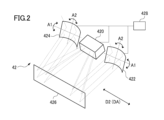
- FIG. 2 is a perspective view of the image projection device of FIG.
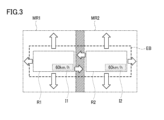
- FIG. 3 is a schematic diagram showing the relationship between the eye box and the light irradiation area of the image projection device of FIG.
- the "left-right direction,” “up-down direction,” and “front-rear direction” may be referred to as appropriate. These directions are relative directions set for the head-up display (HUD) 42 shown in FIG. 1.
- the "left-right direction” includes the “left direction” and the “right direction.”
- the "up-down direction” includes the “upward direction” and the “downward direction.”
- the "front-rear direction” includes the "forward direction” and the "rearward direction.”
- the front-rear direction in the HUD 42 and the front-rear direction in the vehicle 1 are the same.
- the traveling direction of the vehicle 1 is the forward direction.
- the left-right direction is not shown in FIG. 1, it is a direction perpendicular to the up-down direction and the front-rear direction.
- the left-right direction is also the vehicle width direction of the vehicle 1.
- FIG. 1 is a schematic diagram illustrating a vehicle 1 equipped with a HUD 42 according to this embodiment. As shown in FIG. 1, the vehicle 1 is equipped with a HUD 42 and a camera 62.
- the HUD 42 is located inside the vehicle 1. Specifically, the HUD 42 is installed in a predetermined location inside the vehicle 1. For example, the HUD 42 may be disposed in the dashboard of the vehicle 1.
- the HUD 42 is an example of an image projection device.
- HUD 42 is configured to display a virtual image. More specifically, HUD 42 is configured to display predetermined information (hereinafter referred to as HUD information) as an image directed to the occupant of vehicle 1 so that the HUD information is superimposed on the real space outside vehicle 1 (particularly, the surrounding environment in front of vehicle 1).
- HUD information displayed by HUD 42 is, for example, vehicle driving information related to the driving of vehicle 1 and/or surrounding environment information related to the surrounding environment of vehicle 1 (particularly, information related to objects present outside vehicle 1).
- HUD 42 is an AR display that functions as a visual interface between vehicle 1 and the occupant.
- the camera 62 is disposed inside the vehicle 1 and configured to acquire image data showing the occupant.
- the camera 62 functions as a tracking camera that tracks the occupant's viewpoint E.
- the camera 62 may have a light projection function, an image processing function, and an arithmetic processing function required for tracking.
- the occupant's viewpoint E is the viewpoint of the occupant's left eye and right eye.
- the camera 62 is connected to the vehicle control unit 22 that controls the driving of the vehicle 1.
- the vehicle control unit 22 may identify the position of the occupant's left eye and the position of the occupant's right eye based on the image data acquired by the camera 62.
- the positions of the occupant's left eye and right eye are updated at a predetermined cycle based on the image data.
- the camera 62 defines an eye box EB as a detectable area.
- the eye box EB is fixed according to the position where the camera 62 is attached to the vehicle 1.
- the eye box EB is, for example, rectangular.
- the longitudinal direction of the eye box EB corresponds to the arrangement direction DA of the multiple concave mirrors described below.
- the vehicle control unit 22 may identify the position of the viewpoint E (the position of the occupant's left eye and the position of the occupant's right eye) as, for example, coordinates within the eye box EB.
- the HUD 42 is configured to display a virtual image within this eye box EB. More specifically, the light emitted from the HUD 42 is reflected by the windshield 18 of the vehicle 1 and is irradiated to the occupant's viewpoint E (the occupant's left eye and right eye). As a result, the occupant recognizes the light emitted from the HUD 42 as an image (predetermined image) formed at a predetermined distance in front of the windshield 18. In this way, the image displayed by the HUD 42 is superimposed on the real space in front of the vehicle 1 through the windshield 18, and the occupant can visually recognize the virtual image object I formed by the predetermined image as floating above the road located outside the vehicle.
- Fig. 2 is a perspective view of the HUD 42.
- the HUD 42 includes a picture generation unit (PGU) 420, a first concave mirror 422, a second concave mirror 424, a plane mirror 426, and a control unit 428.
- the first concave mirror 422 and the second concave mirror 424 are examples of a plurality of reflecting mirrors.
- the image generating device 420 is configured to emit light that forms a predetermined image (virtual image) that is displayed toward the occupants of the vehicle 1.
- the image generating device 420 emits light that generates a changing image that changes according to the situation of the vehicle 1, for example.
- the image generating device 420 has a light source, optical components, and a display device.
- the light source is, for example, a laser light source or an LED light source.
- the optical components include a prism, a lens, a diffuser, a magnifying glass, etc.
- the display device is a liquid crystal display, a DMD (Digital Mirror Device), etc.
- the plane mirror 426 is disposed on the optical path of the light emitted from the image generating device 420.
- the plane mirror 426 has a planar reflecting surface.
- the reflecting surface of the plane mirror 426 is disposed to face the emission surface of the image generating device 420.
- the plane mirror 426 reflects light at the same magnification as the image of the light emitted from the image generating device 420 and formed.
- the plane mirror 426 is configured to reflect a portion of the light emitted from the image generating device 420 toward the first concave mirror 422.
- the plane mirror 426 is configured to reflect another portion of the light emitted from the image generating device 420 toward the second concave mirror 424.
- the first concave mirror 422 is disposed on the optical path of the light emitted from the image generating device 420.
- the first concave mirror 422 has a concavely curved reflective surface.
- the reflective surface of the first concave mirror 422 is disposed to face the reflective surface of the plane mirror 426.
- the first concave mirror 422 reflects light at a predetermined magnification relative to the light image emitted from the image generating device 420 and formed.
- the first concave mirror 422 is configured to reflect the light emitted from the plane mirror 426 toward the windshield 18 ( Figure 1).
- the light reflected by the first concave mirror 422 is irradiated toward the left eye of the occupant within the eye box EB.
- the second concave mirror 424 is disposed on the optical path of the other light emitted from the image generating device 420.
- the second concave mirror 424 has a concavely curved reflective surface.
- the reflective surface of the second concave mirror 424 is disposed to face the reflective surface of the plane mirror 426.
- the second concave mirror 424 reflects light at a predetermined magnification relative to the image of the light emitted from the image generating device 420 and formed.
- the second concave mirror 424 is configured to reflect the other light emitted from the plane mirror 426 toward the windshield 18 ( Figure 1).
- the light reflected by the second concave mirror 424 is irradiated toward the right eye of the occupant within the eye box EB.
- the control unit 428 is configured to control the operation of each part of the HUD 42.
- the control unit 428 is connected to the vehicle control unit 22 that controls the driving of the vehicle 1 ( Figure 1).
- the control unit 428 can be realized by one or more processors and memory.
- the processor include a CPU, an MPU, and a GPU.
- the memory include a ROM and a RAM.
- the ROM is an example of a non-transitory computer-readable medium that stores a computer program that executes processing related to the operation of each part of the HUD 42.
- the general-purpose microprocessor specifies at least a portion of the computer program stored in the ROM, expands it on the RAM, and cooperates with the RAM to execute the above-mentioned processing.
- the control unit 428 controls the operation of the image generating device 420. Specifically, the control unit 428 generates a control signal for controlling the operation of the image generating device 420 based on vehicle driving information and surrounding environment information transmitted from the vehicle control unit 22, and transmits the generated control signal to the image generating device 420.
- vehicle driving information includes, for example, information related to the driving of the vehicle 1 (for example, vehicle speed, information related to automatic driving, etc.).
- the surrounding environment information includes, for example, information related to objects present outside the vehicle 1 (pedestrians, other vehicles including the vehicle in front, signs, etc.).
- Figure 3 is a schematic diagram showing the relationship between the eye box EB and the light irradiation area of the HUD 42.
- the maximum area of the eye box EB is indicated by a thick dashed line.
- the first concave mirror 422 is configured to emit light to a first area R1 that is smaller than the maximum area of the eye box EB.
- the second concave mirror 424 is configured to emit light to a second area R2 that is smaller than the maximum area of the eye box EB.
- the first area R1 and the second area R2 are different areas.
- the first region R1 is an area that is displayed when the entire light-emitting surface of the exit surface of the image generating device 420 that emits light incident on the first concave mirror 422 is lit.
- the second region R2 is an area that is displayed when the entire light-emitting surface of the exit surface of the image generating device 420 that emits light incident on the second concave mirror 424 is lit.
- the first concave mirror 422 and the second concave mirror 424 emit light toward different areas within the eye box EB, making it easier to make each concave mirror small.
- this embodiment divides one large concave mirror into multiple small concave mirrors, making it easier to place small concave mirrors in storage spaces within the HUD 42 that were not previously used. In this way, this embodiment makes it easier to make the entire HUD 42 smaller, since the HUD 42 is composed of the small first concave mirror 422 and the small second concave mirror 424.
- the first concave mirror 422 may be configured so that the first region R1 is movable within a first movement range MR1. In other words, the maximum area within which the first region R1 can move is the first movement range MR1.
- the second concave mirror 424 may be configured so that the second region R2 is movable within a second movement range MR2. In other words, the maximum area within which the second region R2 can move is the second movement range MR2.
- the first movement range MR1 and the second movement range MR2 are different movement ranges.
- the first concave mirror 422 is configured to rotate in a first direction D1 and a second direction D2 perpendicular to the first direction D1 (FIG. 1).
- the first direction D1 is, for example, the up-down direction.
- the second direction D2 is, for example, the left-right direction.
- the first concave mirror 422 is supported by a first drive shaft A1 that rotates the first concave mirror 422 in the first direction D1 and a second drive shaft A2 that rotates the first concave mirror 422 in the second direction D2 (FIG. 2).
- the first concave mirror 422 is provided with a rotation mechanism that drives the first drive shaft A1 and the second drive shaft A2.
- the rotation mechanism is, for example, a swivel actuator.
- the rotation mechanism drives the first drive shaft A1 to rotate based on a control signal transmitted from the control unit 428.
- the first concave mirror 422 rotates in the up-down direction around the first drive shaft A1.
- the rotation mechanism rotates the second drive shaft A2 based on a control signal sent from the control unit 428. This causes the first concave mirror 422 to rotate left and right around the second drive shaft A2.
- the first region R1 which is the light irradiation range of the first concave mirror 422, can move within the first movement range MR1.
- the second concave mirror 424 is configured to rotate in the first direction D1 and the second direction D2 (FIGS. 1 and 2).
- the configuration of the second concave mirror 424 is similar to that of the first concave mirror 422, so a description thereof will be omitted.
- the control unit 428 may drive the first concave mirror 422 in at least one of the first direction D1 and the second direction D2 based on the position of the occupant's left eye acquired by the camera 62. Similarly, the control unit 428 may drive the second concave mirror 424 in at least one of the first direction D1 and the second direction D2 based on the position of the occupant's right eye acquired by the camera 62.
- the control unit 428 may rotate the first concave mirror 422 and the second concave mirror 424 depending on the display position of the virtual image.
- the vehicle 1 is provided with an operation unit 82 that accepts operation by the occupant to display the display position of the virtual image ( Figure 1).
- the operation unit 82 is, for example, a lever switch. If the occupant feels uncomfortable with the display position of the virtual image, the occupant can adjust the display position of the virtual image by moving the lever switch up, down, left, or right.
- the operation unit 82 is connected to the vehicle control unit 22.
- the vehicle control unit 22 may identify the display position of the virtual image to be changed based on the operation input of the occupant accepted by the operation unit 82, and transmit it to the control unit 428 of the HUD 42.
- the first concave mirror 422 and the second concave mirror 424 may be rotated independently of each other, or may be rotated in conjunction with each other.
- the first concave mirror 422 and the second concave mirror 424 can move in different movement ranges in the first region R1 and the second region R2, respectively. More specifically, the first concave mirror 422 and the second concave mirror 424 can rotate in the first direction D1 and the second direction D2, respectively, depending on the movement of the occupant's viewpoint E (left eye and right eye) and the display position of the virtual image. This effectively expands the area that can be illuminated by the first concave mirror 422 and the second concave mirror 424. Therefore, light can be illuminated over a wide area of the eye box EB. Furthermore, by using a smaller first concave mirror 422 and second concave mirror 424, it is easier to further miniaturize the entire HUD 42.
- the first movement range MR1 and the second movement range MR2 may overlap with each other.
- the area where the first movement range MR1 and the second movement range MR2 overlap with each other is shown by hatched areas.
- the HUD 42 of this embodiment can easily irradiate light over the entire maximum area of the eye box EB.
- the maximum area of the eye box EB which was previously covered by a single large concave mirror, can now be covered with multiple small concave mirrors (first concave mirror 422 and second concave mirror 424).
- the size of the entire area from which the first concave mirror 422 and the second concave mirror 424 can emit light may be equal to or larger than the maximum area of the eye box EB.
- the entire area from which the first concave mirror 422 and the second concave mirror 424 can emit light is the sum of the area of the first movement range MR1 and the second movement range MR2 minus the area where the first movement range MR1 and the second movement range MR2 overlap (the area shaded with diagonal lines).
- the size of this entire area is equal to or larger than the maximum area of the eye box EB, which is indicated by the thick dashed line. In this way, according to this embodiment, the eye box EB, which was conventionally covered by a single large concave mirror, can be easily covered by multiple small concave mirrors (the first concave mirror 422 and the second concave mirror 424).
- the light emitted by the first concave mirror 422 and the second concave mirror 424 may each form a common virtual image.
- a first virtual image I1 is displayed in a first region R1 of the light emitted from the first concave mirror 422.
- the first virtual image I1 is, for example, the traveling speed of the vehicle 1.
- a second virtual image I2 is displayed in a second region R2 of the light emitted from the second concave mirror 424.
- the second virtual image I2 is also the traveling speed of the vehicle 1, like the first virtual image I1.
- the first concave mirror 422 and the second concave mirror 424 each form a common virtual image, the first virtual image I1 and the second virtual image I2, so that the occupant can view a single virtual image.
- the image generating device 420 may be arranged so that a part of the image generating device 420 overlaps the first concave mirror 422 and the second concave mirror 424 when viewed from the array direction DA in which the first concave mirror 422 and the second concave mirror 424 are arranged (FIG. 1). As shown in FIG. 1, the lower end of the first concave mirror 422 is located below the lower end of the exit surface of the image generating device 420, and the upper end of the first concave mirror 422 is located above the upper end of the exit surface of the image generating device 420. The positional relationship between the image generating device 420 and the second concave mirror 424 is also similar.
- the image generating device 420 when viewed from the array direction DA, the image generating device 420 is arranged so that it overlaps the first concave mirror 422 and the second concave mirror 424 in the vertical direction. Therefore, compared to a case in which the image generating device 420 is arranged away from the first concave mirror 422 or the second concave mirror 424 in the vertical direction, it is possible to save space.
- the image generating device 420 may be provided between the first concave mirror 422 and the second concave mirror 424 in the array direction DA (FIG. 2).
- a single large concave mirror as in the conventional embodiment, is divided into multiple small concave mirrors (the first concave mirror 422 and the second concave mirror 424). This makes it possible to place the image generating device 420 in a space that did not exist in the conventional embodiment, between the first concave mirror 422 and the second concave mirror 424, thereby enabling space saving.
- the HUD 42 does not need to include a plane mirror 426.
- light emitted from the image generating device 420 can be directly irradiated onto the first concave mirror 422 and the second concave mirror 424.
- the first concave mirror 422 and the second concave mirror 424 emit light to the first region R1 and the second region R2, respectively, which are smaller than the maximum region of the eye box EB. This provides the same effect as described above, that is, the entire HUD 42 can be easily made smaller.
- the HUD 42 may include multiple plane mirrors. One plane mirror may emit a portion of the light emitted from the image generating device 420 to the first concave mirror 422, and another plane mirror may emit another portion of the light emitted from the image generating device 420 to the second concave mirror 424.
- the number of multiple concave mirrors is not limited to two.
- the number of concave mirrors may be, for example, four.
- the image generating device 420 may be arranged so that it is surrounded by the four concave mirrors in the front-to-rear direction.
- Each concave mirror irradiates light to a different area that is smaller than the maximum area of the eye box EB.
- Each of these four different areas can move within a corresponding movement range, and the size of the total area from which all four concave mirrors can emit light may be greater than or equal to the maximum area of the eye box EB.
- the image generating device 420 does not have to be provided between the first concave mirror 422 and the second concave mirror 424.
- the first concave mirror 422 may be provided between the second concave mirror 424 and the image generating device 420. It is sufficient that a portion of the light from the image generating device 420 is irradiated toward the first concave mirror 422, and another portion of the light from the image generating device 420 is irradiated toward the second concave mirror 424.
- the first concave mirror 422 or the second concave mirror 424 may be configured to be driven in translation rather than rotation.
- the first concave mirror 422 may be driven in translation in the forward and backward directions.
- Item 1 An image projection device for displaying a virtual image in an eye box, An image projection device comprising a plurality of reflecting mirrors each emitting light to a different area smaller than the maximum area of the eyebox.
- Item 2 2. The image projection device according to claim 1, wherein the plurality of reflecting mirrors are configured such that the regions are each movable within a different range of movement.
- Item 3 3. The image projection device according to claim 2, wherein the movement ranges overlap each other.
- Item 4 4. The image projection device according to item 3, wherein a size of a total area from which all of the plurality of reflecting mirrors can emit light is equal to or larger than the maximum area of the eye box.
- Item 5 5.
- the image projection device according to any one of claims 1 to 4, wherein the light beams emitted by the plurality of reflecting mirrors each form a common virtual image.
Landscapes
- Physics & Mathematics (AREA)
- General Physics & Mathematics (AREA)
- Optics & Photonics (AREA)
- Instrument Panels (AREA)
Priority Applications (1)
| Application Number | Priority Date | Filing Date | Title |
|---|---|---|---|
| JP2025533989A JPWO2025018209A1 (https=) | 2023-07-14 | 2024-07-08 |
Applications Claiming Priority (2)
| Application Number | Priority Date | Filing Date | Title |
|---|---|---|---|
| JP2023-116022 | 2023-07-14 | ||
| JP2023116022 | 2023-07-14 |
Publications (1)
| Publication Number | Publication Date |
|---|---|
| WO2025018209A1 true WO2025018209A1 (ja) | 2025-01-23 |
Family
ID=94281906
Family Applications (1)
| Application Number | Title | Priority Date | Filing Date |
|---|---|---|---|
| PCT/JP2024/024597 Pending WO2025018209A1 (ja) | 2023-07-14 | 2024-07-08 | 画像照射装置 |
Country Status (2)
| Country | Link |
|---|---|
| JP (1) | JPWO2025018209A1 (https=) |
| WO (1) | WO2025018209A1 (https=) |
Citations (4)
| Publication number | Priority date | Publication date | Assignee | Title |
|---|---|---|---|---|
| JP2015069081A (ja) * | 2013-09-30 | 2015-04-13 | 日本精機株式会社 | 投射型表示装置 |
| JP2015225119A (ja) * | 2014-05-26 | 2015-12-14 | 株式会社デンソー | ヘッドアップディスプレイ装置 |
| JP2016113033A (ja) * | 2014-12-16 | 2016-06-23 | 三菱電機株式会社 | 車両用表示装置 |
| JP2018072597A (ja) * | 2016-10-31 | 2018-05-10 | 株式会社ジャパンディスプレイ | 表示装置 |
-
2024
- 2024-07-08 JP JP2025533989A patent/JPWO2025018209A1/ja active Pending
- 2024-07-08 WO PCT/JP2024/024597 patent/WO2025018209A1/ja active Pending
Patent Citations (4)
| Publication number | Priority date | Publication date | Assignee | Title |
|---|---|---|---|---|
| JP2015069081A (ja) * | 2013-09-30 | 2015-04-13 | 日本精機株式会社 | 投射型表示装置 |
| JP2015225119A (ja) * | 2014-05-26 | 2015-12-14 | 株式会社デンソー | ヘッドアップディスプレイ装置 |
| JP2016113033A (ja) * | 2014-12-16 | 2016-06-23 | 三菱電機株式会社 | 車両用表示装置 |
| JP2018072597A (ja) * | 2016-10-31 | 2018-05-10 | 株式会社ジャパンディスプレイ | 表示装置 |
Also Published As
| Publication number | Publication date |
|---|---|
| JPWO2025018209A1 (https=) | 2025-01-23 |
Similar Documents
| Publication | Publication Date | Title |
|---|---|---|
| US11480855B2 (en) | Image display device | |
| US10859826B2 (en) | Head-up display device | |
| JP6601431B2 (ja) | ヘッドアップディスプレイ装置 | |
| JP6579180B2 (ja) | 虚像表示装置 | |
| WO2018131444A1 (ja) | ヘッドアップディスプレイ装置 | |
| JP7110968B2 (ja) | ヘッドアップディスプレイ装置 | |
| JP7087981B2 (ja) | 虚像表示装置 | |
| JP2001018682A (ja) | 車両用表示装置 | |
| WO2022210362A1 (ja) | 画像投影装置 | |
| KR20250170670A (ko) | 투영 장치 | |
| WO2025018209A1 (ja) | 画像照射装置 | |
| WO2018150736A1 (ja) | ヘッドアップディスプレイ装置 | |
| JP7798864B2 (ja) | 画像生成装置、当該画像生成装置を備える画像照射装置、及び画像照射装置 | |
| WO2023100785A1 (ja) | ヘッドアップディスプレイ装置 | |
| JP7538165B2 (ja) | 車両用表示装置 | |
| JP2017227681A (ja) | ヘッドアップディスプレイ装置 | |
| WO2024171814A1 (ja) | 画像投影装置 | |
| US20250013040A1 (en) | Image generation apparatus and head-up display | |
| JP2025097337A (ja) | ヘッドアップディスプレイ装置 | |
| WO2024190743A1 (ja) | 画像照射装置 | |
| JP2020060619A (ja) | 表示システム、移動体および透過部材 | |
| JP2025171234A (ja) | 画像投影装置 | |
| JP2024136196A (ja) | 画像投影装置 | |
| JP2025042054A (ja) | ヘッドアップディスプレイ装置 | |
| JP2025042056A (ja) | ヘッドアップディスプレイ装置 |
Legal Events
| Date | Code | Title | Description |
|---|---|---|---|
| 121 | Ep: the epo has been informed by wipo that ep was designated in this application |
Ref document number: 24843001 Country of ref document: EP Kind code of ref document: A1 |
|
| ENP | Entry into the national phase |
Ref document number: 2025533989 Country of ref document: JP Kind code of ref document: A |
|
| WWE | Wipo information: entry into national phase |
Ref document number: 2025533989 Country of ref document: JP |
|
| NENP | Non-entry into the national phase |
Ref country code: DE |