WO2025013623A1 - 二次電池用電解液および二次電池 - Google Patents
二次電池用電解液および二次電池 Download PDFInfo
- Publication number
- WO2025013623A1 WO2025013623A1 PCT/JP2024/023116 JP2024023116W WO2025013623A1 WO 2025013623 A1 WO2025013623 A1 WO 2025013623A1 JP 2024023116 W JP2024023116 W JP 2024023116W WO 2025013623 A1 WO2025013623 A1 WO 2025013623A1
- Authority
- WO
- WIPO (PCT)
- Prior art keywords
- secondary battery
- electrolyte
- solvent
- negative electrode
- anisole
- Prior art date
- Legal status (The legal status is an assumption and is not a legal conclusion. Google has not performed a legal analysis and makes no representation as to the accuracy of the status listed.)
- Pending
Links
Images

Classifications
-
- H—ELECTRICITY
- H01—ELECTRIC ELEMENTS
- H01M—PROCESSES OR MEANS, e.g. BATTERIES, FOR THE DIRECT CONVERSION OF CHEMICAL ENERGY INTO ELECTRICAL ENERGY
- H01M10/00—Secondary cells; Manufacture thereof
- H01M10/05—Accumulators with non-aqueous electrolyte
- H01M10/056—Accumulators with non-aqueous electrolyte characterised by the materials used as electrolytes, e.g. mixed inorganic/organic electrolytes
- H01M10/0564—Accumulators with non-aqueous electrolyte characterised by the materials used as electrolytes, e.g. mixed inorganic/organic electrolytes the electrolyte being constituted of organic materials only
- H01M10/0566—Liquid materials
- H01M10/0569—Liquid materials characterised by the solvents
-
- H—ELECTRICITY
- H01—ELECTRIC ELEMENTS
- H01M—PROCESSES OR MEANS, e.g. BATTERIES, FOR THE DIRECT CONVERSION OF CHEMICAL ENERGY INTO ELECTRICAL ENERGY
- H01M10/00—Secondary cells; Manufacture thereof
- H01M10/05—Accumulators with non-aqueous electrolyte
- H01M10/052—Li-accumulators
-
- H—ELECTRICITY
- H01—ELECTRIC ELEMENTS
- H01M—PROCESSES OR MEANS, e.g. BATTERIES, FOR THE DIRECT CONVERSION OF CHEMICAL ENERGY INTO ELECTRICAL ENERGY
- H01M10/00—Secondary cells; Manufacture thereof
- H01M10/05—Accumulators with non-aqueous electrolyte
- H01M10/052—Li-accumulators
- H01M10/0525—Rocking-chair batteries, i.e. batteries with lithium insertion or intercalation in both electrodes; Lithium-ion batteries
-
- H—ELECTRICITY
- H01—ELECTRIC ELEMENTS
- H01M—PROCESSES OR MEANS, e.g. BATTERIES, FOR THE DIRECT CONVERSION OF CHEMICAL ENERGY INTO ELECTRICAL ENERGY
- H01M10/00—Secondary cells; Manufacture thereof
- H01M10/05—Accumulators with non-aqueous electrolyte
- H01M10/056—Accumulators with non-aqueous electrolyte characterised by the materials used as electrolytes, e.g. mixed inorganic/organic electrolytes
- H01M10/0564—Accumulators with non-aqueous electrolyte characterised by the materials used as electrolytes, e.g. mixed inorganic/organic electrolytes the electrolyte being constituted of organic materials only
- H01M10/0566—Liquid materials
- H01M10/0567—Liquid materials characterised by the additives
-
- H—ELECTRICITY
- H01—ELECTRIC ELEMENTS
- H01M—PROCESSES OR MEANS, e.g. BATTERIES, FOR THE DIRECT CONVERSION OF CHEMICAL ENERGY INTO ELECTRICAL ENERGY
- H01M2300/00—Electrolytes
- H01M2300/0017—Non-aqueous electrolytes
- H01M2300/0025—Organic electrolyte
- H01M2300/0028—Organic electrolyte characterised by the solvent
- H01M2300/0034—Fluorinated solvents
-
- H—ELECTRICITY
- H01—ELECTRIC ELEMENTS
- H01M—PROCESSES OR MEANS, e.g. BATTERIES, FOR THE DIRECT CONVERSION OF CHEMICAL ENERGY INTO ELECTRICAL ENERGY
- H01M2300/00—Electrolytes
- H01M2300/0017—Non-aqueous electrolytes
- H01M2300/0025—Organic electrolyte
- H01M2300/0028—Organic electrolyte characterised by the solvent
- H01M2300/0037—Mixture of solvents
-
- Y—GENERAL TAGGING OF NEW TECHNOLOGICAL DEVELOPMENTS; GENERAL TAGGING OF CROSS-SECTIONAL TECHNOLOGIES SPANNING OVER SEVERAL SECTIONS OF THE IPC; TECHNICAL SUBJECTS COVERED BY FORMER USPC CROSS-REFERENCE ART COLLECTIONS [XRACs] AND DIGESTS
- Y02—TECHNOLOGIES OR APPLICATIONS FOR MITIGATION OR ADAPTATION AGAINST CLIMATE CHANGE
- Y02E—REDUCTION OF GREENHOUSE GAS [GHG] EMISSIONS, RELATED TO ENERGY GENERATION, TRANSMISSION OR DISTRIBUTION
- Y02E60/00—Enabling technologies; Technologies with a potential or indirect contribution to GHG emissions mitigation
- Y02E60/10—Energy storage using batteries
Definitions
- This technology relates to electrolytes for secondary batteries and secondary batteries.
- secondary batteries are being developed as a power source that is small, lightweight, and has a high energy density. These secondary batteries contain a positive electrode, a negative electrode, and an electrolyte, and various studies are being conducted on the configuration of these secondary batteries.
- the non-aqueous electrolyte contains a fluorine-containing organic compound, and the content of the fluorine-containing organic compound in the non-aqueous electrolyte is 0.01% by weight to 20% by weight (see, for example, Patent Document 1).
- the electrolyte contains dimethoxyethane and anisole, and the mixture ratio (molar ratio) of the dimethoxyethane and anisole is 1:2 (see, for example, Non-Patent Document 1).
- the electrolyte for a secondary battery contains a solvent, the solvent contains an anisole compound represented by formula (1), and the content of the anisole compound in the solvent is 30% by weight or more.
- Each of R1, R2 and R3 is either a hydrogen group or a halogen group.
- an anisole compound is a compound in which a trifluoromethoxy group ( -OCF3 ) and a methoxy-type group (-OCR1R2R3) are bonded to a benzene ring.
- a trifluoromethoxy group -OCF3
- a methoxy-type group -OCR1R2R3
- the positions at which the trifluoromethoxy group and the methoxy-type group are bonded to the benzene ring are not particularly limited. The details of the structure of the anisole compound will be described later.
- the solvent contains the anisole compound shown in formula (1), and the content of the anisole compound in the solvent is 30% by weight or more, so that excellent battery characteristics and excellent safety can be obtained.
- FIG. 1 is a perspective view illustrating a configuration of a secondary battery according to an embodiment of the present technology.
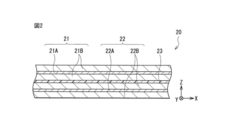
- FIG. 2 is an enlarged cross-sectional view showing the configuration of the battery element shown in FIG.
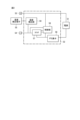
- FIG. 3 is a block diagram showing a configuration of an application example of a secondary battery.
- Electrolyte for secondary batteries First, an electrolyte for a secondary battery (hereinafter simply referred to as an "electrolyte”) according to an embodiment of the present technology will be described.
- This electrolyte is a liquid electrolyte used in a secondary battery, which is an electrochemical device.
- the electrolyte may also be used in other electrochemical devices.
- the type of other electrochemical device is not particularly limited, but a specific example is a capacitor.
- the electrolyte contains a solvent, and more specifically, the electrolyte further contains an electrolyte salt that ionizes in the solvent.
- the solvent is a medium for dissolving and ionizing the electrolyte salt. Since the solvent used here is a non-aqueous solvent, the electrolyte solution containing the non-aqueous solvent is a so-called non-aqueous electrolyte solution.
- the solvent contains one or more of the anisole compounds represented by formula (1).
- Each of R1, R2 and R3 is either a hydrogen group or a halogen group.
- this anisole compound is a compound in which a trifluoromethoxy group ( -OCF3 ) and a methoxy-type group (-OCR1R2R3) are bonded to a benzene ring, although there are no particular limitations on the positions at which the trifluoromethoxy group and the methoxy-type group are bonded to the benzene ring.
- the methoxy type group may be located at the ortho position relative to the trifluoromethoxy group, the meta position relative to the trifluoromethoxy group, or the para position relative to the trifluoromethoxy group.
- the content of the anisole compound in the solvent is set to a predetermined amount. Specifically, the content of the anisole compound in the solvent is 30% by weight or more.
- anisole compounds have the property of being less coordinated to alkali metal ions compared to other compounds described below.
- alkali metal ions are alkali metal ions derived from cations contained in the electrolyte salt, more specifically, lithium ions described below.
- anisole compounds tend not to coordinate to alkali metal ions.
- the anisole compound is not easily reductively decomposed. Therefore, by changing the types of the other compounds and anions, it is possible to adjust the electrochemical state of the coating formed on the surface of the negative electrode, which will be described later.
- the trifluoromethoxy group in the anisole compound contains fluorine as a constituent element.
- a good coating containing fluorine as a constituent element is easily formed on the surface of the negative electrode, and the surface of the negative electrode is electrochemically protected using this coating.
- the decomposition reaction of the electrolyte on the surface of the negative electrode is suppressed.
- anisole compounds have a high boiling point and a high ignition temperature compared to other compounds. As a result, even if the temperature of the secondary battery rises due to some factor during use of the secondary battery, the electrolyte is less likely to boil and ignite.
- the content of the anisole compound in the solvent is particularly optimized, so that the protective function of the anisole compound that protects the surface of the negative electrode is effectively exerted.
- the surface of the negative electrode is sufficiently and stably protected by the coating, and the decomposition reaction of the electrolyte is also sufficiently and stably suppressed.
- the content of the anisole compound in the solvent is preferably 60% by weight or more. This is because the protective function of the anisole compound is more effectively exerted, and the decomposition reaction of the electrolyte is more effectively suppressed.
- the content of the anisole compound in the solvent is preferably 80% by weight or less. This is because the decomposition reaction of the electrolyte solution is sufficiently suppressed while the solubility of the electrolyte salt in the electrolyte solution is guaranteed.
- the halogen group contains a fluorine group, because this improves the reactivity of the anisole compound, making it easier for a coating to form on the surface of the negative electrode.
- the anisole compound preferably contains a compound represented by formula (2).
- the methoxy group is preferably arranged in the para position relative to the trifluoromethoxy group. This is because the reactivity of the anisole compound is improved, making it easier to form a coating on the surface of the negative electrode. Details regarding R4 to R6 are the same as those regarding R1 to R3.
- Each of R4, R5 and R6 is either a hydrogen group or a halogen group.
- the anisole compound contains 4-(trifluoromethoxy)anisole. This is because the protective function of the anisole compound is fully exerted, and the decomposition reaction of the electrolyte is also sufficiently suppressed.
- the electrolyte is analyzed to confirm that the solvent contains anisole compounds and to measure the amount of anisole compounds contained in the solvent.
- the electrolyte analysis method is not particularly limited, but specifically includes one or more of the following: inductively coupled plasma (ICP) optical emission spectroscopy, nuclear magnetic resonance spectroscopy (NMR), and gas chromatography-mass spectrometry (GC-MS).
- the secondary battery When using a secondary battery containing an electrolyte to analyze the electrolyte, the secondary battery is disassembled to recover the electrolyte, which is then analyzed. This identifies the type of component (anisole compound) contained in the electrolyte, as well as the amount of that component.
- the solvent may further contain one or more of the other compounds.
- the solvent may contain other compounds in addition to the anisole compound.
- the other compounds are non-aqueous solvents (organic solvents). However, the anisole compounds mentioned above are excluded from the other compounds described here.
- Non-aqueous solvents include esters and ethers, and more specifically, carbonate ester compounds, carboxylate ester compounds, and lactone compounds. This is because they improve the dissociation of the electrolyte salt and also the mobility of ions.
- Carbonate compounds include cyclic carbonates and chain carbonates. Specific examples of cyclic carbonates include ethylene carbonate and propylene carbonate, while specific examples of chain carbonates include dimethyl carbonate, diethyl carbonate, and ethyl methyl carbonate.
- Carboxylic acid ester compounds include chain carboxylates.
- chain carboxylates include ethyl acetate, ethyl propionate, propyl propionate, and ethyl trimethylacetate.
- Lactone compounds include lactones. Specific examples of lactones include gamma-butyrolactone and gamma-valerolactone.
- the ethers may be 1,2-dimethoxyethane, tetrahydrofuran, 1,3-dioxolane, 1,4-dioxane, anisole, etc.
- Non-aqueous solvents include unsaturated cyclic carbonates, fluorinated cyclic carbonates, sulfonates, phosphates, acid anhydrides, nitrile compounds, and isocyanate compounds. This is because they improve the electrochemical stability of the electrolyte.
- unsaturated cyclic carbonates include vinylene carbonate, vinylethylene carbonate, and methyleneethylene carbonate.
- fluorinated cyclic carbonates include monofluoroethylene carbonate and difluoroethylene carbonate.
- sulfonic acid esters include propane sultone and propene sultone.
- phosphate esters include trimethyl phosphate and triethyl phosphate.
- acid anhydrides include succinic anhydride, 1,2-ethanedisulfonic anhydride, and 2-sulfobenzoic anhydride.
- nitrile compounds include succinonitrile.
- isocyanate compounds include hexamethylene diisocyanate.
- the electrolyte salt contains one or more kinds of light metal salts such as lithium salts.
- lithium salts include lithium hexafluorophosphate ( LiPF6 ), lithium tetrafluoroborate ( LiBF4 ), lithium trifluoromethanesulfonate (LiCF3SO3), lithium bis(fluorosulfonyl)imide (LiN( FSO2 ) 2 ), lithium bis(trifluoromethanesulfonyl)imide (LiN( CF3SO2 ) 2 ), lithium tris (trifluoromethanesulfonyl)methide (LiC(CF3SO2)3), lithium bis(oxalato)borate (LiB(C2O4)2 ) , lithium monofluorophosphate ( Li2PFO3 ) , and lithium difluorophosphate ( LiPF2O2 ) . This is because a high battery capacity can be obtained.
- LiPF6 lithium hexafluorophosphate
- LiBF4 lithium tetrafluoroborate
- the amount of electrolyte salt contained is not particularly limited, but is typically 0.3 mol/kg to 3.0 mol/kg relative to the solvent. This is because high ionic conductivity is obtained.
- an electrolyte salt is added to a solvent containing an anisole compound.
- the amount of the anisole compound added is adjusted so that the content of the anisole compound in the solvent falls within the above-mentioned range. In this way, the electrolyte salt is dissolved in the solvent, and an electrolyte solution is prepared.
- the solvent contains an anisole compound, and the content of the anisole compound in the solvent is 30% by weight or more.
- the properties of the anisole compound are utilized so that the anisole compound is less likely to coordinate with alkali metal ions, and a good coating containing fluorine as a constituent element is more likely to be formed on the surface of the negative electrode during charging and discharging of a secondary battery using the electrolyte.
- the surface of the negative electrode is electrochemically protected using the coating, and the decomposition reaction of the electrolyte on the surface of the negative electrode is suppressed.
- the electrolyte is less likely to boil or catch fire even if the temperature of the secondary battery rises due to some factor during use of the secondary battery equipped with the electrolyte.
- the protective function of the anisole compound is utilized to further suppress the decomposition reaction of the electrolyte, resulting in a greater effect.
- the content of the anisole compound in the solvent is 80% by weight or less, the solubility of the electrolyte salt in the electrolyte is ensured while the decomposition reaction of the electrolyte is sufficiently suppressed, resulting in a higher effect.
- the halogen group contains a fluorine group
- the reactivity of the anisole compound is improved. This makes it easier for a coating to form on the surface of the negative electrode, resulting in greater effectiveness.
- the anisole compound contains the compound shown in formula (2), the reactivity of the anisole compound is improved. This makes it easier for a coating to form on the surface of the negative electrode, resulting in greater effectiveness.
- the anisole compound contains 4-(trifluoromethoxy)anisole, the protective function of the anisole compound is fully exerted. As a result, the decomposition reaction of the electrolyte is also sufficiently suppressed, resulting in a higher effect.
- the type of electrode reactant is not particularly limited, but specifically includes light metals such as alkali metals and alkaline earth metals.
- alkali metals include lithium, sodium, and potassium
- alkaline earth metals include beryllium, magnesium, and calcium.
- the charge capacity of the negative electrode is greater than the discharge capacity of the positive electrode.
- the electrochemical capacity per unit area of the negative electrode is greater than the electrochemical capacity per unit area of the positive electrode. This is to prevent electrode reaction materials from being deposited on the surface of the negative electrode during charging.
- FIG. 1 shows a perspective view of a secondary battery
- FIG. 2 shows an enlarged cross-sectional view of a battery element 20 shown in FIG.
- FIG. 1 the exterior film 10 and the battery element 20 are shown in a state separated from each other, and a cross section of the battery element 20 along the XZ plane is shown by a dashed line. In FIG. 2, only a portion of the battery element 20 is shown.
- this secondary battery includes an exterior film 10, a battery element 20, a positive electrode lead 31, a negative electrode lead 32, and sealing films 41 and 42.
- the secondary battery described here uses a flexible or pliable exterior film 10 as an exterior member for housing the battery element 20. Therefore, the secondary battery shown in Figures 1 and 2 is a so-called laminate film type secondary battery.
- the exterior film 10 has a bag-like structure that is sealed when the battery element 20 is housed therein.
- the exterior film 10 houses a positive electrode 21, a negative electrode 22, a separator 23, and an electrolyte (not shown), which will be described later.
- the exterior film 10 is a single film-like member that is folded in the folding direction F.
- This exterior film 10 is provided with a recessed portion 10U (a so-called deep drawn portion) for accommodating the battery element 20.
- the exterior film 10 is a three-layer laminate film in which a fusion layer, a metal layer, and a surface protection layer are laminated in this order from the inside, and when the exterior film 10 is folded, the outer peripheral edges of the opposing fusion layers are fused to each other.
- the fusion layer contains a polymer compound such as polypropylene.
- the metal layer contains a metallic material such as aluminum.
- the surface protection layer contains a polymer compound such as nylon.
- the configuration (number of layers) of the exterior film 10 is not particularly limited, so it may be one or two layers, or four or more layers.
- the battery element 20 is housed in an exterior film 10.
- the battery element 20 is a so-called power generating element, and includes a positive electrode 21, a negative electrode 22, a separator 23, and an electrolyte (not shown), as shown in Figures 1 and 2 .
- the battery element 20 is a so-called wound electrode body, so that the positive electrode 21 and the negative electrode 22 are wound around the winding axis P while facing each other via the separator 23.
- This winding axis P is a virtual axis extending in the Y-axis direction, as shown in FIG. 1.
- the three-dimensional shape of the battery element 20 is not particularly limited.
- the battery element 20 has a flat three-dimensional shape, so that the shape of the cross section (cross section along the XZ plane) of the battery element 20 intersecting the winding axis P is a flat shape defined by the major axis J1 and the minor axis J2.
- the long axis J1 is an imaginary axis extending in the X-axis direction and has a length greater than that of the short axis J2.
- the short axis J2 is an imaginary axis extending in the Z-axis direction intersecting the X-axis direction and has a length less than that of the long axis J1.
- the three-dimensional shape of the battery element 20 is a flattened cylinder, and therefore the cross-sectional shape of the battery element 20 is a flattened, approximately elliptical shape.
- the positive electrode 21 includes a positive electrode current collector 21A and a positive electrode active material layer 21B.
- the positive electrode current collector 21A may be omitted.
- the positive electrode collector 21A has a pair of surfaces on which the positive electrode active material layer 21B is provided.
- This positive electrode collector 21A contains a conductive material such as a metal material, and a specific example of the conductive material is aluminum.
- the positive electrode active material layer 21B contains one or more types of positive electrode active materials that absorb and release lithium. However, the positive electrode active material layer 21B may further contain one or more types of other materials such as a positive electrode binder and a positive electrode conductor.
- the method of forming the positive electrode active material layer 21B is not particularly limited, but specifically includes a coating method.
- the positive electrode active material layer 21B is provided on both sides of the positive electrode collector 21A.
- the positive electrode active material layer 21B may be provided on only one side of the positive electrode collector 21A on the side where the positive electrode 21 faces the negative electrode 22.
- the type of positive electrode active material is not particularly limited, but specifically includes lithium-containing compounds.
- This lithium-containing compound is a compound that contains one or more transition metal elements as constituent elements along with lithium, and may further contain one or more other elements as constituent elements.
- the type of other element is not particularly limited, so long as it is an element other than lithium and transition metal elements, but specifically includes elements belonging to groups 2 to 15 of the long period periodic table.
- the type of lithium-containing compound is not particularly limited, but specifically includes oxides, phosphate compounds, silicate compounds, and borate compounds.
- oxides include LiNiO2 , LiCoO2 , LiCo0.98Al0.01Mg0.01O2 , LiNi0.5Co0.2Mn0.3O2 , LiNi0.8Co0.15Al0.05O2 , LiNi0.33Co0.33Mn0.33O2 , Li1.2Mn0.52Co0.175Ni0.1O2 , Li1.15 ( Mn0.65Ni0.22Co0.13 ) O2 , and LiMn2O4 .
- phosphate compounds include LiFePO4 , LiMnPO4 , LiFe0.5Mn0.5PO4 , and LiFe0.3Mn0.7PO4 .
- the positive electrode binder contains one or more of the following materials: synthetic rubber, polymeric compound, etc.
- synthetic rubber include styrene butadiene rubber, fluororubber, and ethylene propylene diene.
- polymeric compounds include polyvinylidene fluoride, polyimide, and carboxymethyl cellulose.
- the positive electrode conductive agent contains one or more conductive materials such as carbon materials, metal materials, and conductive polymer compounds.
- conductive materials such as carbon materials, metal materials, and conductive polymer compounds.
- Specific examples of carbon materials include graphite, carbon black, acetylene black, and ketjen black.
- the negative electrode 22 includes a negative electrode current collector 22A and a negative electrode active material layer 22B.
- the negative electrode current collector 22A may be omitted.
- the negative electrode current collector 22A has a pair of surfaces on which the negative electrode active material layer 22B is provided.
- This negative electrode current collector 22A contains a conductive material such as a metal material, and a specific example of the conductive material is copper.
- the negative electrode active material layer 22B contains one or more types of negative electrode active materials that absorb and release lithium. However, the negative electrode active material layer 22B may further contain one or more types of other materials such as a negative electrode binder and a negative electrode conductor.
- the method of forming the negative electrode active material layer 22B is not particularly limited, but specifically includes one or more types of a coating method, a gas phase method, a liquid phase method, a thermal spraying method, and a firing method (sintering method).
- the negative electrode active material layer 22B is provided on both sides of the negative electrode collector 22A.
- the negative electrode active material layer 22B may be provided on only one side of the negative electrode collector 22A on the side where the negative electrode 22 faces the positive electrode 21.
- the type of negative electrode active material is not particularly limited, but specific examples include carbon materials and metal-based materials, because they provide high energy density.
- carbon materials include graphitizable carbon, non-graphitizable carbon, and graphite.
- the graphite may be natural graphite, artificial graphite, or both.
- Metallic materials are a general term for materials that contain one or more of metallic elements and semi-metallic elements that can form an alloy with lithium as constituent elements, and specific examples of the metallic elements and semi-metallic elements include silicon and tin.
- the metallic materials may be simple substances, alloys, compounds, mixtures of two or more of them, or materials containing two or more of them. However, the simple substances may contain any amount of impurities.
- Specific examples of metallic materials include TiSi2 and SiOx (0 ⁇ x ⁇ 2 or 0.2 ⁇ x ⁇ 1.4).
- the separator 23 is an insulating porous film interposed between the positive electrode 21 and the negative electrode 22, and allows lithium to pass through in an ionic state while preventing the occurrence of a short circuit due to contact between the positive electrode 21 and the negative electrode 22.
- the separator 23 contains one or more types of insulating polymer compounds, and a specific example of the insulating polymer compound is polyethylene.
- the electrolyte is impregnated into each of the positive electrode 21, the negative electrode 22, and the separator 23, and has the above-mentioned configuration. That is, the solvent contains an anisole compound, and the content of the anisole compound in the solvent is in the above-mentioned range.
- the positive electrode lead 31 is a positive electrode wiring connected to the positive electrode current collector 21A of the positive electrode 21, and is led out of the exterior film 10.
- the positive electrode lead 31 contains one or more kinds of conductive materials such as metal materials, and a specific example of the conductive material is aluminum.
- the shape of the positive electrode lead 31 is either a thin plate shape or a mesh shape.
- the negative electrode lead 32 is a negative electrode wiring connected to the negative electrode 22, and is led out of the exterior film 10.
- the lead-out direction of the negative electrode lead 32 is the same as the lead-out direction of the positive electrode lead 31.
- This negative electrode lead 32 contains one or more kinds of conductive materials such as metal materials, and a specific example of the conductive material is copper. Details regarding the shape of the negative electrode lead 32 are the same as the details regarding the shape of the positive electrode lead 31.
- sealing film 41 is inserted between the exterior film 10 and the positive electrode lead 31. Also, as shown in Fig. 1, the sealing film 42 is inserted between the exterior film 10 and the negative electrode lead 32. However, one or both of the sealing films 41 and 42 may be omitted.
- the sealing film 41 is a sealing member that prevents outside air from entering the interior of the exterior film 10.
- This sealing film 41 contains a polymer compound such as polyolefin that has adhesion to the positive electrode lead 31, and a specific example of the polymer compound is polypropylene.
- the configuration of the sealing film 42 is the same as that of the sealing film 41, except that the sealing film 42 is a sealing member that has adhesion to the negative electrode lead 32.
- the sealing film 42 contains a polymer compound such as polyolefin that has adhesion to the negative electrode lead 32.
- This secondary battery operates in the battery element 20 as follows.
- lithium When charging, lithium is released from the positive electrode 21 and is absorbed into the negative electrode 22 via the electrolyte.
- discharging lithium is released from the negative electrode 22 and is absorbed into the positive electrode 21 via the electrolyte.
- discharging and charging lithium is absorbed and released in an ionic state.
- the positive electrode 21 and the negative electrode 22 are each produced according to the procedure described below as an example, and then the secondary battery is assembled and subjected to a stabilization treatment after assembly. conduct.
- a positive electrode active material, a positive electrode binder, and a positive electrode conductive agent are mixed together to prepare a positive electrode mixture. Then, the positive electrode mixture is poured into a solvent to prepare a paste-like positive electrode mixture slurry.
- the solvent may be an aqueous solvent or an organic solvent.
- the positive electrode active material layer 21B is formed by applying the positive electrode mixture slurry to both sides of the positive electrode current collector 21A.
- the positive electrode active material layer 21B may be compression molded using a compression device such as a roll press. In this case, the positive electrode active material layer 21B may be heated, or the compression molding may be repeated multiple times. In this way, the positive electrode active material layer 21B is formed on both sides of the positive electrode current collector 21A, and the positive electrode 21 is produced.
- the negative electrode 22 is formed by the same procedure as the procedure for producing the positive electrode 21 described above. Specifically, first, a mixture (negative electrode mixture) in which the negative electrode active material, the negative electrode binder, and the negative electrode conductive agent are mixed together is put into a solvent to prepare a paste-like negative electrode mixture slurry. Details regarding the solvent are as described above. Finally, the negative electrode mixture slurry is applied to both sides of the negative electrode current collector 22A to form the negative electrode active material layer 22B. After this, the negative electrode active material layer 22B may be compression molded. Details regarding the compression molding are as described above. As a result, the negative electrode active material layer 22B is formed on both sides of the negative electrode current collector 22A, and the negative electrode 22 is produced.
- the positive electrode lead 31 is connected to the positive electrode collector 21A of the positive electrode 21 using a joining method such as welding, and the negative electrode lead 32 is connected to the negative electrode collector 22A of the negative electrode 22 using a joining method such as welding.
- the positive electrode 21 and the negative electrode 22 are stacked on top of each other with the separator 23 interposed therebetween to form a laminate (not shown).
- the laminate is then wound to produce a wound body (not shown), which is then pressed using a compression device such as a press to form the wound body into a flat shape.
- the wound body after this formation has a configuration similar to that of the battery element 20, except that the positive electrode 21, the negative electrode 22, and the separator 23 are not impregnated with electrolyte.
- the exterior film 10 (adhesive layer/metal layer/surface protection layer) is folded so that the exterior films 10 face each other.
- the outer edges of two of the opposing adhesive layers are joined to each other using an adhesive method such as heat fusion, thereby housing the roll in the bag-shaped exterior film 10.
- a sealing film 41 is inserted between the exterior film 10 and the positive electrode lead 31, and a sealing film 42 is inserted between the exterior film 10 and the negative electrode lead 32.
- the wound body is impregnated with the electrolyte, and the battery element 20 is produced.
- the battery element 20 is then enclosed in the bag-shaped exterior film 10, and the secondary battery is assembled.
- Stabilization treatment of secondary battery after assembly The assembled secondary battery is charged and discharged. Stabilization conditions such as the environmental temperature, the number of charge/discharge cycles (number of charge/discharge conditions), and the like can be set arbitrarily.
- a coating is formed on the surface of each of the positive electrode 21 and the negative electrode 22.
- a coating derived from the anisole compound is formed on the surface of the negative electrode 22.
- the state of the battery element 20 becomes electrochemically stable, completing the secondary battery.
- the electrolyte has the above-mentioned structure, and therefore, for the above-mentioned reasons, the safety of the secondary battery during use is guaranteed, and the decomposition reaction of the electrolyte on the surface of the negative electrode 22 during charging and discharging of the secondary battery is suppressed, thereby providing excellent battery characteristics and excellent safety.
- the secondary battery is a lithium-ion secondary battery
- sufficient battery capacity can be stably obtained by utilizing the absorption and release of lithium, resulting in even greater effects.
- the negative electrode active material layer 22B of the negative electrode 22 contains a negative electrode active material that absorbs and releases lithium, and therefore the secondary battery is a lithium ion secondary battery that utilizes the absorption and release of lithium.
- the secondary battery may be a lithium metal secondary battery that utilizes the precipitation and dissolution of lithium.
- the secondary battery (lithium metal secondary battery) described here has a similar configuration to that of a lithium ion secondary battery, except that the negative electrode 22 contains elemental lithium (so-called lithium metal).
- the negative electrode 22 is a lithium metal foil or the like.
- the lithium metal may contain any amount of impurities.
- the method for manufacturing this secondary battery is similar to the method for manufacturing a lithium-ion secondary battery, except that a negative electrode 22 containing lithium metal is used.
- the battery capacity is obtained by utilizing the precipitation and dissolution of lithium, so a similar effect can be obtained.
- a porous membrane separator 23 was used. However, although not specifically shown here, a laminated separator including a polymer compound layer may also be used.
- the laminated separator includes a porous membrane having a pair of surfaces, and a polymer compound layer provided on one or both surfaces of the porous membrane.
- the polymer compound layer includes polyvinylidene fluoride, etc. This is because polyvinylidene fluoride has excellent physical strength and is electrochemically stable.
- one or both of the porous film and the polymer compound layer may contain one or more types of insulating particles. This is because the insulating particles dissipate heat when the secondary battery generates heat, improving the safety (heat resistance) of the secondary battery.
- the insulating particles contain one or more types of insulating materials such as inorganic materials and resin materials. Specific examples of inorganic materials include aluminum oxide, aluminum nitride, boehmite, silicon oxide, titanium oxide, magnesium oxide, and zirconium oxide. Specific examples of resin materials include acrylic resin and styrene resin.
- a precursor solution containing a polymer compound and an organic solvent is prepared, and then the precursor solution is applied to one or both sides of a porous film.
- the precursor solution may contain multiple insulating particles.
- the lithium can move in an ionic state between the positive electrode 21 and the negative electrode 22, so the same effect can be obtained.
- swelling of the secondary battery is further suppressed, so a greater effect can be obtained.
- the positive electrode 21 and the negative electrode 22 are wound facing each other with the separator 23 and the electrolyte layer interposed between them.
- the electrolyte layer is interposed between the positive electrode 21 and the separator 23, and also between the negative electrode 22 and the separator 23.
- the electrolyte layer contains a polymer compound together with an electrolyte solution, and the electrolyte solution is held by the polymer compound. This is because leakage of the electrolyte solution is prevented.
- the composition of the electrolyte solution is as described above.
- the polymer compound contains polyvinylidene fluoride and the like.
- the lithium ions can move between the positive electrode 21 and the negative electrode 22 via the electrolyte layer, so the same effect can be obtained.
- leakage of the electrolyte is particularly prevented as described above, so a greater effect can be obtained.
- a secondary battery used as a power source may be a main power source or an auxiliary power source in electronic devices and electric vehicles.
- a main power source is a power source that is used preferentially regardless of the presence or absence of other power sources.
- An auxiliary power source may be a power source used in place of the main power source or a power source that can be switched from the main power source.
- secondary batteries are as follows: Electronic devices such as video cameras, digital still cameras, mobile phones, notebook computers, headphone stereos, portable radios, and portable information terminals. Storage devices such as backup power sources and memory cards. Power tools such as electric drills and power saws. Battery packs installed in electronic devices. Medical electronic devices such as pacemakers and hearing aids. Electric vehicles such as electric cars (including hybrid cars). Power storage systems such as home or industrial battery systems that store power in preparation for emergencies. In these applications, one secondary battery may be used, or multiple secondary batteries may be used.
- the battery pack may include a single cell or a battery pack.
- the electric vehicle is a vehicle that runs on a secondary battery as a driving power source, and may be a hybrid vehicle that also includes a driving source other than the secondary battery.
- a home power storage system it is possible to use home electrical appliances and the like by utilizing the power stored in the secondary battery, which is a power storage source.
- FIG. 3 shows the block diagram of a battery pack, which is an example of an application of a secondary battery.
- the battery pack described here is a battery pack (a so-called soft pack) that uses one secondary battery, and is installed in electronic devices such as smartphones.
- this battery pack includes a power source 51 and a circuit board 52.
- This circuit board 52 is connected to the power source 51 and includes a positive terminal 53, a negative terminal 54, and a temperature detection terminal 55.
- the power source 51 includes one secondary battery.
- the positive electrode lead is connected to the positive electrode terminal 53
- the negative electrode lead is connected to the negative electrode terminal 54.
- This power source 51 is connected to the outside via the positive electrode terminal 53 and the negative electrode terminal 54, and is therefore capable of charging and discharging.
- the circuit board 52 includes a control unit 56, a switch 57, a PTC element 58 which is a thermosensitive resistor, and a temperature detection unit 59. However, the PTC element 58 may be omitted.
- the control unit 56 includes a central processing unit (CPU) and memory, and controls the operation of the entire battery pack. This control unit 56 detects and controls the usage status of the power source 51.
- CPU central processing unit
- the control unit 56 turns off the switch 57 to prevent charging current from flowing through the current path of the power source 51.
- the overcharge detection voltage is not particularly limited, but is specifically 4.20V ⁇ 0.05V, and the overdischarge detection voltage is not particularly limited, but is specifically 2.40V ⁇ 0.10V.
- Switch 57 includes a charge control switch, a discharge control switch, a charge diode, and a discharge diode, and switches between the presence and absence of a connection between power source 51 and an external device in response to an instruction from control unit 56.
- Switch 57 includes a field effect transistor (MOSFET) that uses a metal oxide semiconductor, and the charge current and discharge current are each detected based on the ON resistance of switch 57.
- MOSFET field effect transistor
- the temperature detection unit 59 includes a temperature detection element such as a thermistor. This temperature detection unit 59 measures the temperature of the power supply 51 using the temperature detection terminal 55, and outputs the temperature measurement result to the control unit 56. The temperature measurement result measured by the temperature detection unit 59 is used when the control unit 56 performs charge/discharge control in the event of abnormal heat generation, and when the control unit 56 performs correction processing when calculating the remaining capacity.
- test secondary battery was fabricated according to the following procedure: This test secondary battery was a simplified lithium metal secondary battery.
- the electrolyte salt lithium bis(fluorosulfonyl)imide
- the solvent was then stirred to prepare the electrolyte solution.
- the solvent used was an anisole compound 4-(trifluoromethoxy)anisole (TFMAS) and another compound 1,2-dimethoxyethane (DME). In this case, the mixing ratio of the anisole compound to the other compound was adjusted.
- the content (wt%) of the anisole compound in the solvent, the content (wt%) of other compounds in the solvent, and the physical properties of the anisole compound and other compounds, namely the boiling point (°C) and the flash point (°C), are as shown in Table 1.
- an electrolyte solution was prepared in the same manner, except that another compound, anisole (AS), was used as the solvent, as shown in Table 1.
- AS anisole
- test electrode and counter electrode were then laminated together with a separator impregnated with electrolyte interposed between them. This resulted in the test electrode and counter electrode facing each other with the separator impregnated with electrolyte interposed between them, completing a test secondary battery.
- the secondary battery was repeatedly charged and discharged until the total number of cycles reached 25, while calculating the coulombic efficiency for each cycle.
- the charging and discharging conditions were as described above.
- the average Coulombic efficiency which is an index for evaluating the charge/discharge characteristics, was calculated by averaging the 16 Coulombic efficiencies calculated for each of the 10th to 25th cycles. This average Coulombic efficiency value was rounded off to one decimal place.
- the secondary battery may go out of control due to excessive evaporation of the electrolyte, and the secondary battery may catch fire and burn.
- the solvent contains an anisole compound (4-(trifluoromethoxy)anisole) and another compound (1,2-dimethoxyethane), and when the content of the anisole compound in the solvent is less than 30% by weight (Comparative Example 2), the average Coulombic efficiency also increased, but the boiling point and flash point both dropped significantly due to the other compound (1,2-dimethoxyethane) that made up the majority of the solvent.
- the solvent contained an anisole compound (4-(trifluoromethoxy)anisole) and another compound (1,2-dimethoxyethane) and the content of the anisole compound in the solvent was 30% by weight or more (Examples 1 to 4), the average Coulombic efficiency increased.
- the proportion of the anisole compound with a high boiling point and high flash temperature could be sufficiently increased by relatively sufficiently reducing the proportion of other compounds with low boiling points and low flash temperatures while maintaining the average Coulombic efficiency.
- the solvent contains an anisole compound and the content of the anisole compound in the solvent is 30% by weight or more, the tendency described below was obtained.
- the battery structure of the secondary battery has been described as being of a laminate film type.
- the battery structure of the secondary battery is not particularly limited, and may be of a cylindrical type, a square type, a coin type, a button type, etc.
- the battery element has been described as having a wound structure.
- the structure of the battery element is not particularly limited, and may be a stacked type or a zigzag type.
- the positive and negative electrodes are alternately stacked with a separator between them, while in the zigzag type, the positive and negative electrodes are folded in a zigzag pattern while facing each other with the separator between them.
- the electrode reactant is lithium in the above description, the electrode reactant is not particularly limited. Specifically, as described above, the electrode reactant may be other alkali metals such as sodium and potassium, or alkaline earth metals such as beryllium, magnesium, and calcium. In addition, the electrode reactant may be other light metals such as aluminum.
- the anisole compound includes a compound represented by formula (2): ⁇ 4> The secondary battery according to any one of ⁇ 1> to ⁇ 4>. (Each of R4, R5 and R6 is either a hydrogen group or a halogen group.) ⁇ 6>
- the anisole compound includes 4-(trifluoromethoxy)anisole.
- ⁇ 7> It is a lithium-ion secondary battery.
- ⁇ 8> Contains a solvent,
- the solvent comprises an anisole compound represented by formula (1),
- the content of the anisole compound in the solvent is 30% by weight or more.
- Electrolyte for secondary batteries. Each of R1, R2 and R3 is either a hydrogen group or a halogen group.
Landscapes
- Chemical & Material Sciences (AREA)
- Engineering & Computer Science (AREA)
- Manufacturing & Machinery (AREA)
- Chemical Kinetics & Catalysis (AREA)
- Electrochemistry (AREA)
- General Chemical & Material Sciences (AREA)
- Physics & Mathematics (AREA)
- Condensed Matter Physics & Semiconductors (AREA)
- General Physics & Mathematics (AREA)
- Inorganic Chemistry (AREA)
- Materials Engineering (AREA)
- Secondary Cells (AREA)
Priority Applications (3)
| Application Number | Priority Date | Filing Date | Title |
|---|---|---|---|
| JP2025532661A JPWO2025013623A1 (https=) | 2023-07-11 | 2024-06-26 | |
| CN202480044101.0A CN121420401A (zh) | 2023-07-11 | 2024-06-26 | 二次电池用电解液以及二次电池 |
| US19/408,812 US20260088362A1 (en) | 2023-07-11 | 2025-12-04 | Electrolytic solution for secondary battery, and secondary battery |
Applications Claiming Priority (2)
| Application Number | Priority Date | Filing Date | Title |
|---|---|---|---|
| JP2023113810 | 2023-07-11 | ||
| JP2023-113810 | 2023-07-11 |
Related Child Applications (1)
| Application Number | Title | Priority Date | Filing Date |
|---|---|---|---|
| US19/408,812 Continuation US20260088362A1 (en) | 2023-07-11 | 2025-12-04 | Electrolytic solution for secondary battery, and secondary battery |
Publications (1)
| Publication Number | Publication Date |
|---|---|
| WO2025013623A1 true WO2025013623A1 (ja) | 2025-01-16 |
Family
ID=94215350
Family Applications (1)
| Application Number | Title | Priority Date | Filing Date |
|---|---|---|---|
| PCT/JP2024/023116 Pending WO2025013623A1 (ja) | 2023-07-11 | 2024-06-26 | 二次電池用電解液および二次電池 |
Country Status (4)
| Country | Link |
|---|---|
| US (1) | US20260088362A1 (https=) |
| JP (1) | JPWO2025013623A1 (https=) |
| CN (1) | CN121420401A (https=) |
| WO (1) | WO2025013623A1 (https=) |
Citations (4)
| Publication number | Priority date | Publication date | Assignee | Title |
|---|---|---|---|---|
| JP2003217652A (ja) * | 2002-01-18 | 2003-07-31 | Mitsubishi Chemicals Corp | 非水系電解液及びそれを用いたリチウム二次電池 |
| JP2016054142A (ja) * | 2014-09-01 | 2016-04-14 | 三菱化学株式会社 | 非水系電解液及びそれを用いた非水系電解液電池 |
| WO2016063835A1 (ja) * | 2014-10-21 | 2016-04-28 | 日本電気株式会社 | 二次電池およびその製造方法 |
| WO2016167316A1 (ja) * | 2015-04-14 | 2016-10-20 | 日本電気株式会社 | リチウムイオン二次電池 |
-
2024
- 2024-06-26 WO PCT/JP2024/023116 patent/WO2025013623A1/ja active Pending
- 2024-06-26 JP JP2025532661A patent/JPWO2025013623A1/ja active Pending
- 2024-06-26 CN CN202480044101.0A patent/CN121420401A/zh active Pending
-
2025
- 2025-12-04 US US19/408,812 patent/US20260088362A1/en active Pending
Patent Citations (4)
| Publication number | Priority date | Publication date | Assignee | Title |
|---|---|---|---|---|
| JP2003217652A (ja) * | 2002-01-18 | 2003-07-31 | Mitsubishi Chemicals Corp | 非水系電解液及びそれを用いたリチウム二次電池 |
| JP2016054142A (ja) * | 2014-09-01 | 2016-04-14 | 三菱化学株式会社 | 非水系電解液及びそれを用いた非水系電解液電池 |
| WO2016063835A1 (ja) * | 2014-10-21 | 2016-04-28 | 日本電気株式会社 | 二次電池およびその製造方法 |
| WO2016167316A1 (ja) * | 2015-04-14 | 2016-10-20 | 日本電気株式会社 | リチウムイオン二次電池 |
Also Published As
| Publication number | Publication date |
|---|---|
| US20260088362A1 (en) | 2026-03-26 |
| CN121420401A (zh) | 2026-01-27 |
| JPWO2025013623A1 (https=) | 2025-01-16 |
Similar Documents
| Publication | Publication Date | Title |
|---|---|---|
| WO2022196266A1 (ja) | 二次電池 | |
| JP7517480B2 (ja) | 二次電池 | |
| WO2023119947A1 (ja) | リチウムイオン二次電池用電解液およびリチウムイオン二次電池 | |
| WO2025013623A1 (ja) | 二次電池用電解液および二次電池 | |
| WO2025033413A1 (ja) | 二次電池用電解液および二次電池 | |
| JP7726276B2 (ja) | 二次電池用電解液および二次電池 | |
| JP7537504B2 (ja) | 二次電池用電解液および二次電池 | |
| JP7694716B2 (ja) | 二次電池 | |
| JP7800688B2 (ja) | 二次電池用電極および二次電池 | |
| JP7823777B2 (ja) | 二次電池用負極および二次電池 | |
| US20250183374A1 (en) | Secondary battery | |
| JP7715362B2 (ja) | 二次電池用電解液および二次電池 | |
| JP7761126B2 (ja) | 二次電池用電解液および二次電池 | |
| JP7694802B2 (ja) | 二次電池用負極および二次電池 | |
| JP7694715B2 (ja) | 二次電池 | |
| JP7715210B2 (ja) | 二次電池用電解液および二次電池 | |
| JP7715211B2 (ja) | 二次電池用電解液および二次電池 | |
| JP7750378B2 (ja) | 二次電池用電解液および二次電池 | |
| JP7761128B2 (ja) | 二次電池 | |
| JP7761127B2 (ja) | 二次電池用電解液および二次電池 | |
| JP7462142B2 (ja) | 二次電池 | |
| WO2024262634A1 (ja) | 二次電池 | |
| WO2024070821A1 (ja) | 二次電池用電解液および二次電池 | |
| WO2024204453A1 (ja) | 二次電池 | |
| WO2025013611A1 (ja) | 二次電池 |
Legal Events
| Date | Code | Title | Description |
|---|---|---|---|
| 121 | Ep: the epo has been informed by wipo that ep was designated in this application |
Ref document number: 24839516 Country of ref document: EP Kind code of ref document: A1 |
|
| ENP | Entry into the national phase |
Ref document number: 2025532661 Country of ref document: JP Kind code of ref document: A |
|
| WWE | Wipo information: entry into national phase |
Ref document number: 2025532661 Country of ref document: JP |
|
| NENP | Non-entry into the national phase |
Ref country code: DE |