WO2025009545A1 - 粘着剤シート及び積層体 - Google Patents
粘着剤シート及び積層体 Download PDFInfo
- Publication number
- WO2025009545A1 WO2025009545A1 PCT/JP2024/024038 JP2024024038W WO2025009545A1 WO 2025009545 A1 WO2025009545 A1 WO 2025009545A1 JP 2024024038 W JP2024024038 W JP 2024024038W WO 2025009545 A1 WO2025009545 A1 WO 2025009545A1
- Authority
- WO
- WIPO (PCT)
- Prior art keywords
- meth
- adhesive sheet
- pressure
- adherend
- sensitive adhesive
- Prior art date
- Legal status (The legal status is an assumption and is not a legal conclusion. Google has not performed a legal analysis and makes no representation as to the accuracy of the status listed.)
- Ceased
Links
Classifications
-
- B—PERFORMING OPERATIONS; TRANSPORTING
- B32—LAYERED PRODUCTS
- B32B—LAYERED PRODUCTS, i.e. PRODUCTS BUILT-UP OF STRATA OF FLAT OR NON-FLAT, e.g. CELLULAR OR HONEYCOMB, FORM
- B32B27/00—Layered products comprising a layer of synthetic resin
-
- B—PERFORMING OPERATIONS; TRANSPORTING
- B32—LAYERED PRODUCTS
- B32B—LAYERED PRODUCTS, i.e. PRODUCTS BUILT-UP OF STRATA OF FLAT OR NON-FLAT, e.g. CELLULAR OR HONEYCOMB, FORM
- B32B7/00—Layered products characterised by the relation between layers; Layered products characterised by the relative orientation of features between layers, or by the relative values of a measurable parameter between layers, i.e. products comprising layers having different physical, chemical or physicochemical properties; Layered products characterised by the interconnection of layers
- B32B7/02—Physical, chemical or physicochemical properties
- B32B7/027—Thermal properties
-
- C—CHEMISTRY; METALLURGY
- C09—DYES; PAINTS; POLISHES; NATURAL RESINS; ADHESIVES; COMPOSITIONS NOT OTHERWISE PROVIDED FOR; APPLICATIONS OF MATERIALS NOT OTHERWISE PROVIDED FOR
- C09J—ADHESIVES; NON-MECHANICAL ASPECTS OF ADHESIVE PROCESSES IN GENERAL; ADHESIVE PROCESSES NOT PROVIDED FOR ELSEWHERE; USE OF MATERIALS AS ADHESIVES
- C09J11/00—Features of adhesives not provided for in group C09J9/00, e.g. additives
- C09J11/02—Non-macromolecular additives
- C09J11/06—Non-macromolecular additives organic
-
- C—CHEMISTRY; METALLURGY
- C09—DYES; PAINTS; POLISHES; NATURAL RESINS; ADHESIVES; COMPOSITIONS NOT OTHERWISE PROVIDED FOR; APPLICATIONS OF MATERIALS NOT OTHERWISE PROVIDED FOR
- C09J—ADHESIVES; NON-MECHANICAL ASPECTS OF ADHESIVE PROCESSES IN GENERAL; ADHESIVE PROCESSES NOT PROVIDED FOR ELSEWHERE; USE OF MATERIALS AS ADHESIVES
- C09J133/00—Adhesives based on homopolymers or copolymers of compounds having one or more unsaturated aliphatic radicals, each having only one carbon-to-carbon double bond, and at least one being terminated by only one carboxyl radical, or of salts, anhydrides, esters, amides, imides, or nitriles thereof; Adhesives based on derivatives of such polymers
-
- C—CHEMISTRY; METALLURGY
- C09—DYES; PAINTS; POLISHES; NATURAL RESINS; ADHESIVES; COMPOSITIONS NOT OTHERWISE PROVIDED FOR; APPLICATIONS OF MATERIALS NOT OTHERWISE PROVIDED FOR
- C09J—ADHESIVES; NON-MECHANICAL ASPECTS OF ADHESIVE PROCESSES IN GENERAL; ADHESIVE PROCESSES NOT PROVIDED FOR ELSEWHERE; USE OF MATERIALS AS ADHESIVES
- C09J133/00—Adhesives based on homopolymers or copolymers of compounds having one or more unsaturated aliphatic radicals, each having only one carbon-to-carbon double bond, and at least one being terminated by only one carboxyl radical, or of salts, anhydrides, esters, amides, imides, or nitriles thereof; Adhesives based on derivatives of such polymers
- C09J133/04—Homopolymers or copolymers of esters
-
- C—CHEMISTRY; METALLURGY
- C09—DYES; PAINTS; POLISHES; NATURAL RESINS; ADHESIVES; COMPOSITIONS NOT OTHERWISE PROVIDED FOR; APPLICATIONS OF MATERIALS NOT OTHERWISE PROVIDED FOR
- C09J—ADHESIVES; NON-MECHANICAL ASPECTS OF ADHESIVE PROCESSES IN GENERAL; ADHESIVE PROCESSES NOT PROVIDED FOR ELSEWHERE; USE OF MATERIALS AS ADHESIVES
- C09J133/00—Adhesives based on homopolymers or copolymers of compounds having one or more unsaturated aliphatic radicals, each having only one carbon-to-carbon double bond, and at least one being terminated by only one carboxyl radical, or of salts, anhydrides, esters, amides, imides, or nitriles thereof; Adhesives based on derivatives of such polymers
- C09J133/04—Homopolymers or copolymers of esters
- C09J133/14—Homopolymers or copolymers of esters of esters containing halogen, nitrogen, sulfur or oxygen atoms in addition to the carboxy oxygen
-
- C—CHEMISTRY; METALLURGY
- C09—DYES; PAINTS; POLISHES; NATURAL RESINS; ADHESIVES; COMPOSITIONS NOT OTHERWISE PROVIDED FOR; APPLICATIONS OF MATERIALS NOT OTHERWISE PROVIDED FOR
- C09J—ADHESIVES; NON-MECHANICAL ASPECTS OF ADHESIVE PROCESSES IN GENERAL; ADHESIVE PROCESSES NOT PROVIDED FOR ELSEWHERE; USE OF MATERIALS AS ADHESIVES
- C09J7/00—Adhesives in the form of films or foils
- C09J7/10—Adhesives in the form of films or foils without carriers
-
- C—CHEMISTRY; METALLURGY
- C09—DYES; PAINTS; POLISHES; NATURAL RESINS; ADHESIVES; COMPOSITIONS NOT OTHERWISE PROVIDED FOR; APPLICATIONS OF MATERIALS NOT OTHERWISE PROVIDED FOR
- C09J—ADHESIVES; NON-MECHANICAL ASPECTS OF ADHESIVE PROCESSES IN GENERAL; ADHESIVE PROCESSES NOT PROVIDED FOR ELSEWHERE; USE OF MATERIALS AS ADHESIVES
- C09J7/00—Adhesives in the form of films or foils
- C09J7/30—Adhesives in the form of films or foils characterised by the adhesive composition
- C09J7/38—Pressure-sensitive adhesives [PSA]
-
- B—PERFORMING OPERATIONS; TRANSPORTING
- B32—LAYERED PRODUCTS
- B32B—LAYERED PRODUCTS, i.e. PRODUCTS BUILT-UP OF STRATA OF FLAT OR NON-FLAT, e.g. CELLULAR OR HONEYCOMB, FORM
- B32B17/00—Layered products essentially comprising sheet glass, or glass, slag, or like fibres
- B32B17/06—Layered products essentially comprising sheet glass, or glass, slag, or like fibres comprising glass as the main or only constituent of a layer, next to another layer of a specific material
- B32B17/10—Layered products essentially comprising sheet glass, or glass, slag, or like fibres comprising glass as the main or only constituent of a layer, next to another layer of a specific material of synthetic resin
Definitions
- the present invention relates to an adhesive sheet and a laminate.
- adhesive sheets are materials formed with an adhesive layer whose main component is, for example, an acrylic polymer, and are used to bond various optical components such as touch panels and liquid crystal displays (LCDs), as well as for automobile sunroofs and large building windows.
- main component is, for example, an acrylic polymer
- LCDs liquid crystal displays
- Patent Document 1 proposes an adhesive sheet with a release liner, which comprises an adhesive sheet having a substrate and an adhesive layer, and a release liner disposed on the adhesive layer, and is said to be capable of easily releasing air when the sheet is applied to an adherend during use, allowing for good adhesion.
- a pair of adherends with different linear expansion coefficients may be bonded together using an adhesive sheet.
- a laminate is known in which a glass substrate and a resin substrate are bonded together with an adhesive sheet. It is also known that such laminates can be used in a variety of applications, such as sunroofs for automobiles and large windows for buildings.
- laminates in which adherends with different expansion and contraction rates are bonded together with a conventional adhesive sheet have the problem that, due to the difference in the expansion and contraction rates between the adherends in an environment where temperature changes or high temperatures occur, peeling occurs, for example, at the edges of the adherends.
- This problem becomes more pronounced the larger the adherend is, and for example, the thicker the adherend is, the more likely it is that peeling will occur in an environment where temperature changes or high temperatures occur. From this perspective, there has been a demand for an adhesive sheet that is less likely to peel when adherends with different expansion and contraction rates are bonded together, even when placed in an environment where temperature changes or high temperatures occur.
- the present invention was made in consideration of the above, and aims to provide an adhesive sheet that is unlikely to peel off from the adherend when adherends with different expansion and contraction rates are bonded together, even in environments where temperature changes occur or in high-temperature environments.
- the present invention includes, for example, the subject matter described in the following sections.
- Item 1 A pressure-sensitive adhesive sheet used to bond a pair of adherends having different stretch rates, A pressure-sensitive adhesive layer is provided from the pressure-sensitive adhesive composition,
- the pressure-sensitive adhesive composition contains at least a base agent containing a (meth)acrylic polymer and a silane coupling agent,
- the pressure-sensitive adhesive layer has a gel fraction of 80% or more, the pressure-sensitive adhesive layer has a residual stress of 3.0 kPa or more and 10.0 kPa or less 60 seconds after application of a 15% torsional shear stress at 105°C;
- Item 2 Item 2. The pressure-sensitive adhesive sheet according to item 1, wherein the pressure-sensitive adhesive composition contains a monofunctional monomer having a ring structure.
- Item 3 Item 3. The pressure-sensitive adhesive sheet according to item 1 or 2, wherein the pressure-sensitive adhesive composition contains 0.05 parts by mass or more and 5 parts by mass or less of the silane coupling agent relative to 100 parts by mass of the base agent.
- Item 4 The pressure-sensitive adhesive composition is a solvent-free type, Item 4.
- Item 5 Item 5.
- Item 6 Item 6.
- Item 7 Item 7.
- Item 8 Item 8.
- Item 9 Item 9.
- Item 10 Item 10.
- a laminate comprising the pressure-sensitive adhesive sheet according to any one of items 1 to 9 and a pair of adherends having different stretch rates.
- the adhesive sheet of the present invention is used to bond adherends with different expansion and contraction rates, and is unlikely to peel off from the adherend even in environments where temperature changes occur or in high-temperature environments.
- the pressure-sensitive adhesive sheet of the present invention is a pressure-sensitive adhesive sheet used for bonding adherends having different stretch rates, and includes a pressure-sensitive adhesive layer obtained from a pressure-sensitive adhesive composition.
- the pressure-sensitive adhesive composition contains at least a base agent containing a (meth)acrylic polymer and a silane coupling agent, the pressure-sensitive adhesive layer has a gel fraction of 80% or more, and the pressure-sensitive adhesive layer has a residual stress of 3.0 kPa or more and 10.0 kPa or less 60 seconds after application of a 15% torsional shear stress at 105°C.
- the pressure-sensitive adhesive sheet of the present invention has The following formula (1)
- the adhesive sheet of the present invention is used to bond adherends with different elasticity rates together, and is unlikely to peel off from the adherend even in environments where temperature changes occur or in high-temperature environments.
- the adhesive sheet of the present invention has an adhesive layer obtained from an adhesive composition.
- the adhesive composition is an active energy ray curable type as described below
- the adhesive layer can be formed by irradiating the adhesive with active energy rays to cure it.
- the adhesive composition for forming the adhesive layer contains at least a base agent containing a (meth)acrylic polymer and a silane coupling agent.
- the base agent containing a (meth)acrylic polymer contains at least a (meth)acrylic polymer and is the main component of the pressure-sensitive adhesive composition.
- the base agent containing a (meth)acrylic polymer may be composed of only a (meth)acrylic polymer, or the base agent containing a (meth)acrylic polymer may contain a (meth)acrylic polymer and a monofunctional monomer described below.
- the base agent containing a (meth)acrylic polymer contains a (meth)acrylic polymer and a monofunctional monomer
- the base agent becomes a monomer solution of the (meth)acrylic polymer, which is a so-called syrup.
- the (meth)acrylic polymer may be, for example, a wide variety of known acrylic polymers used to form pressure-sensitive adhesive sheets.
- the (meth)acrylic polymer may be a polymer of a (meth)acrylic acid ester.
- the (meth)acrylic polymer is a polymer that has a (meth)acrylic acid ester unit.
- Examples of (meth)acrylic acid esters include (meth)acrylates having a linear or branched alkyl group, (meth)acrylates having a ring structure in the side chain, and (meth)acrylates having a hydroxyl group in the side chain.
- the number of carbon atoms in the alkyl group can be, for example, 1 to 20, preferably 1 to 15, more preferably 2 to 14, and even more preferably 3 to 12.
- (meth)acrylates having a straight-chain or branched alkyl group include methyl (meth)acrylate, ethyl (meth)acrylate, n-butyl (meth)acrylate, t-butyl (meth)acrylate, isopropyl (meth)acrylate, isooctyl (meth)acrylate, 2-ethylhexyl (meth)acrylate, nonyl (meth)acrylate, decyl (meth)acrylate, lauryl (meth)acrylate, cetyl (meth)acrylate, stearyl (meth)acrylate, and behenyl (meth)acrylate.
- the (meth)acrylate having a ring structure in the side chain is preferably a (meth)acrylic monomer having an alicyclic or aromatic ring in the side chain, and more preferably a (meth)acrylic monomer having an alicyclic ring.
- Examples of the alicyclic ring include cyclopropane, cyclobutane, cyclopentane, cyclohexane, cycloheptane, cyclooctane, cyclononane, cyclodecane, cycloundecane, cyclododecane, norbornene, norbornadiene, dicyclopentane, isobornyl, tetrahydrofuran, and tetrahydropyran.
- the alicyclic ring may have a spiro structure.
- the aromatic ring examples include benzene, naphthalene, anthracene, pyridine, furan, benzofuran, pyrrole, thiophene, imidazole, and oxazole.
- the ring structure is preferably an alicyclic ring, more preferably at least one selected from cyclohexane, dicyclopentane, isobornyl, and benzene, and particularly preferably cyclohexane or isobornyl.
- the above-mentioned ring structure may further have a substituent.
- substituents examples include a substitutable substituent selected from a halogen atom, a halogenated alkyl group, an alkyl group, an alkenyl group, an acyl group, a hydroxy group, a hydroxyalkyl group, an alkoxy group, an aryl group, a heteroaryl group, an alicyclic group, a cyano group, an epoxy group, an oxetanyl group, a mercapto group, an amino group, a (meth)acryloyl group, and the like.
- a substitutable substituent selected from a halogen atom, a halogenated alkyl group, an alkyl group, an alkenyl group, an acyl group, a hydroxy group, a hydroxyalkyl group, an alkoxy group, an aryl group, a heteroaryl group, an alicyclic group, a cyano group, an epoxy group, an oxetanyl group, a
- the (meth)acrylate having a ring structure in the side chain preferably has a structure in which a monovalent group having a ring structure is bonded to the ester oxygen of the (meth)acrylate, and in this case, the monovalent group having a ring structure preferably has 3 to 12 carbon atoms, more preferably 4 to 10 carbon atoms, and even more preferably 4 to 8 carbon atoms.
- (meth)acrylates having a ring structure in the side chain include cyclohexyl (meth)acrylate, dicyclopentanyl (meth)acrylate, dicyclopentenyloxyethyl (meth)acrylate, isobornyl (meth)acrylate, benzyl (meth)acrylate, phenoxyethyl (meth)acrylate, 3-phenoxybenzyl (meth)acrylate, O-phenylphenoxyethyl (meth)acrylate, etc.
- the (meth)acrylate having a ring structure in the side chain is preferably one or more selected from the group consisting of cyclohexyl (meth)acrylate and isobornyl (meth)acrylate, in that peeling between the adherend and the adhesive sheet is unlikely to occur even in a temperature changing environment and a high temperature environment.
- Examples of (meth)acrylates having a hydroxyl group on the side chain include 2-hydroxyethyl (meth)acrylate, 2-hydroxypropyl (meth)acrylate, 3-hydroxypropyl (meth)acrylate, 3-chloro-2-hydroxypropyl (meth)acrylate, 4-hydroxybutyl (meth)acrylate, 6-hydroxyhexyl (meth)acrylate, 5-hydroxypentyl (meth)acrylate, 2-hydroxybutyl (meth)acrylate, 2-hydroxy-3-phenoxypropyl (meth)acrylate, 2,2-dimethyl 2-hydroxyethyl (meth)acrylate, 3-chloro 2-hydroxypropyl (meth)acrylate, 2-hydroxy-3-phenoxypropyl (meth)acrylate, 8-hydroxyoctyl (meth)acrylate, 8-hydroxyoctyl (meth)acrylate, and polyalkylene glycol mono(meth)acrylate.
- the (meth)acrylic polymer can have other monomer units besides the above-mentioned (meth)acrylic acid esters, such as carboxyl group-containing (meth)acrylate units such as (meth)acrylic acid, glycidyl group-containing (meth)acrylate units, amino group-containing (meth)acrylates, and other monomer units based on (meth)acrylamide, allylamine, etc.
- monomer units besides the above-mentioned (meth)acrylic acid esters such as carboxyl group-containing (meth)acrylate units such as (meth)acrylic acid, glycidyl group-containing (meth)acrylate units, amino group-containing (meth)acrylates, and other monomer units based on (meth)acrylamide, allylamine, etc.
- the (meth)acrylic polymer is preferably a polymer of monomers containing at least one selected from the group consisting of (meth)acrylates having at least a linear or branched alkyl group, (meth)acrylates having a ring structure in the side chain, and (meth)acrylates having a hydroxyl group in the side chain.
- the (meth)acrylic polymer preferably contains at least one monomer unit selected from the group consisting of (meth)acrylate units having at least a linear or branched alkyl group, (meth)acrylate units having a ring structure in the side chain, and (meth)acrylate units having a hydroxyl group in the side chain.
- the (meth)acrylic polymer preferably contains at least (meth)acrylate units having a linear or branched alkyl group.
- the (meth)acrylic polymer preferably contains 30% by mass or more of (meth)acrylate units having a linear or branched alkyl group, more preferably 40% by mass or more, even more preferably 50% by mass or more, more preferably 90% by mass or less, even more preferably 85% by mass or less, and particularly preferably 80% by mass or less.
- the (meth)acrylic polymer preferably contains 1% by mass or more of (meth)acrylate having a ring structure in the side chain, more preferably 3% by mass or more, even more preferably 5% by mass or more, more preferably 50% by mass or less, even more preferably 40% by mass or less, and particularly preferably 30% by mass or less.
- the (meth)acrylic polymer preferably contains 10% by mass or more of (meth)acrylate units having hydroxyl groups in the side chains, more preferably 15% by mass or more, even more preferably 20% by mass or more, more preferably 50% by mass or less, even more preferably 45% by mass or less, and particularly preferably 40% by mass or less.
- the (meth)acrylic polymer may contain other monomer units other than those described above, so long as the effects of the present invention are not impaired.
- the content of the other monomer units in the (meth)acrylic polymer may be 20% by mass or less, preferably 15% by mass or less, more preferably 10% by mass or less, and even more preferably 5% by mass or less.
- the ratio (molar ratio) of each structural unit in the (meth)acrylic polymer can be considered to be the same as the molar ratio of each monomer used in the production of the polymer.
- the (meth)acrylic polymer may be composed of only one type of monomer unit selected from the group consisting of (meth)acrylate units having a linear or branched alkyl group, (meth)acrylate units having a ring structure in the side chain, and (meth)acrylate units having a hydroxyl group in the side chain.
- the weight average molecular weight of the (meth)acrylic polymer is preferably greater than 10,000, more preferably greater than 100,000, and even more preferably greater than 200,000.
- the weight average molecular weight of the (meth)acrylic polymer is preferably less than 2,000,000, more preferably less than 1,500,000, and even more preferably less than 1,200,000.
- the weight average molecular weight in the present invention refers to the weight average molecular weight in terms of polystyrene measured by gel permeation chromatography (GPC).
- GPC gel permeation chromatography
- Tetrahydrofuran is used as the eluent, and the measurement is performed at a flow rate of 1.0 ml/min.
- a calibration curve is prepared using standard polystyrene, and the weight average molecular weight (Mw) can be obtained in terms of polystyrene.
- the (meth)acrylic polymer can be produced by a known method.
- a monomer mixture for forming each constituent unit can be polymerized by a known polymerization method to produce a (meth)acrylic polymer.
- the (meth)acrylic polymer may be a partial polymer, that is, a state in which some of the monomers used in the polymerization remain unpolymerized, that is, in the above-mentioned syrup state. In this case, it is clear that the monomers contained in the syrup are some of the monomers used in the polymerization of the (meth)acrylic polymer.
- the polymerization method for example, solution polymerization, bulk polymerization, suspension polymerization, emulsion polymerization, etc. can be used.
- the acrylic polymer can also be obtained from commercial products, etc.
- the base agent in the adhesive composition, can be in the form of a syrup (in the form of a partial polymer of the (meth)acrylic polymer) as described above, that is, the base agent can be a monofunctional monomer solution of the (meth)acrylic polymer.
- the polymer fraction (the content ratio of the polymer to the total mass of the polymer and the monofunctional monomer) can be, for example, 1 to 50 mass%, and preferably 5 to 30 mass%.
- the base agent may consist of only the (meth)acrylic polymer and the monofunctional monomer.
- the type of monofunctional monomer is not particularly limited, and examples thereof include various monomers used to form the (meth)acrylic polymer, namely, the above-mentioned (meth)acrylic acid esters, specifically, (meth)acrylates having a linear or branched alkyl group, (meth)acrylates having a ring structure in the side chain, (meth)acrylates having a hydroxyl group in the side chain, etc.
- the content ratios of the (meth)acrylates having a linear or branched alkyl group, (meth)acrylates having a ring structure in the side chain, and (meth)acrylates having a hydroxyl group in the side chain contained in the monofunctional monomer can be in the same range as the content ratios of the (meth)acrylate units having a linear or branched alkyl group, (meth)acrylate units having a ring structure in the side chain, and (meth)acrylate units having a hydroxyl group in the side chain contained in the (meth)acrylic polymer, respectively.
- silane coupling agent examples include mercapto-based silane coupling agents containing a mercapto group, epoxy-based silane coupling agents having an epoxy group, vinyl-based silane coupling agents having a vinyl group, and isocyanurate-based silane coupling agents.
- Commercially available silane coupling agents can also be used. Examples of commercially available products include KBM-802, X-12-1056ES, KBM-402, KBM-403, KBM-5103, KBM-502, KBM-503, and KBM-9659 manufactured by Shin-Etsu Chemical Co., Ltd.
- the adhesive composition contains a silane coupling agent
- its content is not particularly limited.
- the content of the silane coupling agent is preferably 0.05 parts by mass or more, more preferably 0.1 parts by mass or more, even more preferably 0.15 parts by mass or more, and particularly preferably 0.2 parts by mass or more, and is preferably 5 parts by mass or less, more preferably 3 parts by mass or less, even more preferably 2 parts by mass or less, and particularly preferably 1 part by mass or less, relative to 100 parts by mass of the main agent.
- the pressure-sensitive adhesive composition may further contain a tackifier.
- the pressure-sensitive adhesive layer formed from the pressure-sensitive adhesive composition tends to have better adhesion to an adherend.
- the type of tackifier is not particularly limited, and for example, a wide range of tackifiers used in known adhesive sheets can be applied.
- the tackifier is preferably an acrylic tackifier.
- the adhesive composition preferably contains an acrylic tackifier.
- the acrylic tackifier may be a resin with a glass transition temperature of 20°C or higher.
- the glass transition temperature of the acrylic tackifier is preferably 30°C or higher, more preferably 40°C or higher, and even more preferably 50°C or higher, and is preferably 200°C or lower, more preferably 180°C or lower, and even more preferably 150°C or lower.
- the structural units contained in the acrylic tackifier may include a monomer unit having an alicyclic ring.
- the number of carbon atoms constituting the alicyclic ring is preferably 6 or more.
- Examples of alicyclic rings having 6 or more carbon atoms include cyclohexane, cycloheptane, cyclooctane, cyclononane, cyclodecane, cycloundecane, cyclododecane, norbornene, norbornadiene, isobornyl, and dicyclopentane.
- monomers having an alicyclic ring that can be preferably used include isobornyl (meth)acrylate, dicyclopentanyl (meth)acrylate, and dicyclopentenyl (meth)acrylate.
- the acrylic tackifier can contain an alkyl (meth)acrylate unit in place of the monomer unit having an alicyclic ring, or in addition to the monomer unit having an alicyclic ring.
- alkyl (meth)acrylates include alkyl (meth)acrylates such as methyl (meth)acrylate, ethyl (meth)acrylate, butyl (meth)acrylate, isobutyl (meth)acrylate, 2-ethylhexyl (meth)acrylate, nonyl (meth)acrylate, decyl (meth)acrylate, lauryl (meth)acrylate, cetyl (meth)acrylate, stearyl (meth)acrylate, and behenyl (meth)acrylate.
- the acrylic tackifier contains methyl (meth)acrylate.
- the acrylic tackifier is preferably a copolymer containing both an alicyclic monomer unit and an alkyl (meth)acrylate unit.
- the content of alkyl (meth)acrylate units relative to the total mass of the acrylic tackifier is preferably 5% by mass or more, more preferably 10% by mass or more, and is preferably 90% by mass or less, more preferably 80% by mass or less.
- the acrylic tackifier may contain other monomer units as necessary.
- the other monomers may be any monomers that are copolymerizable with the alkyl (meth)acrylates described above, such as (meth)acrylonitrile, vinyl acetate, vinyl chloride, ethyl vinyl ether, etc.
- the content of other monomer units in the acrylic tackifier is preferably 10% by mass or less, and more preferably 5% by mass or less.
- the weight average molecular weight of the tackifier is preferably 3,000 or more, more preferably 3,200 or more, and even more preferably 3,500 or more.
- the weight average molecular weight of the tackifier may be 20,000 or less, more preferably 15,000 or less, and even more preferably 10,000 or less.
- the weight average molecular weight of the tackifier is measured by gel permeation chromatography (GPC) and converted using a calibration curve made using standard polystyrene with a known molecular weight.
- GPC gel permeation chromatography
- Such resins may be commercially available or may be synthesized by a known method.
- the amount of tackifier contained in the adhesive composition is not particularly limited. In order to easily improve the adhesion of the adhesive sheet to the adherend, the amount of tackifier contained is preferably 1 part by mass or more, more preferably 2 parts by mass or more, and is preferably 50 parts by mass or less, more preferably 30 parts by mass or less, and even more preferably 20 parts by mass or less, per 100 parts by mass of the base agent.
- the tackifier may be formed only from an acrylic tackifier, or may contain other components in addition to the acrylic tackifier.
- the tackifier contained in the adhesive composition may be one type alone or two or more types.
- the adhesive composition may contain a polyfunctional monomer.
- polyfunctional monomers include compounds having two or more polymerizable double bonds in the molecule.
- the number of polymerizable double bonds (e.g., radically polymerizable double bonds) in the polyfunctional monomer is two or more, preferably two or more and less than five, more preferably two or more and less than four.
- the adhesive composition may react with the monomer in the syrup to form, for example, a crosslinked polymer. That is, when the adhesive composition contains a polyfunctional monomer, the resulting adhesive layer may have a crosslinked structure due to the polyfunctional monomer.
- the resulting adhesive sheet is particularly unlikely to peel off from the adherend even when placed in a temperature changing environment or a high temperature environment.
- polyfunctional monomers include bifunctional monomers (monomers with two polymerizable double bonds), such as polyethylene glycol diacrylate, polypropylene diacrylate, alkyl diacrylate, polytetramethylene glycol diacrylate, polypropylene glycol diacrylate, dioxane diacrylate, tricyclodecanol diacrylate, and fluorene diacrylate.
- polyfunctional monomers include trifunctional or higher monomers, such as alkoxylated trimethylolpropane triacrylate, alkoxylated glycerin triacrylate, caprolactone-modified isocyanurate triacrylate, pentaerythritol acrylate, alkoxylated pentaerythritol acrylate, (alkoxylated) pentaerythritol acrylate, (alkoxylated) ditrimethylolpropane acrylate, (alkoxylated) dipentaerythritol acrylate, and (ethoxylated) polyglycerin acrylate.
- trifunctional or higher monomers such as alkoxylated trimethylolpropane triacrylate, alkoxylated glycerin triacrylate, caprolactone-modified isocyanurate triacrylate, pentaerythritol acrylate, alkoxylated pentaerythritol acrylate,
- the polyfunctional monomer may have a bisphenol skeleton in one molecule.
- Examples of such polyfunctional monomers include diacrylate of bisphenol A diglycidyl ether, diacrylate of propoxylated bisphenol A, and diacrylate of bisphenol F diglycidyl ether.
- polyfunctional monomer can be used as the polyfunctional monomer.
- Commercially available products include the NK Ester series of bifunctional polyethylene glycol acrylates "A-200" (polyethylene glycol #200 diacrylate), "A-400” (polyethylene glycol #400 diacrylate), and "A-600” (polyethylene glycol #600 diacrylate) manufactured by Shin-Nakamura Chemical Co., Ltd., the trifunctional monomer A-TMPT ((alkoxylated) trimethylolpropane acrylate), the trifunctional monomer M310 (trimethylolpropane PO modified triacrylate) and the trifunctional monomer M321 (trimethylolpropane propylene oxide modified triacrylate) manufactured by Toagosei Co., Ltd., the bifunctional monomer M211B (bisphenol A EO modified diacrylate), M240 (polyethylene glycol diacrylate), and the tetrafunctional monomer M-408 (ditrimethylolpropane tetraacrylate) manufactured
- polyfunctional monomers include, for example, A-DOG, A-DCP, A-9300, and A-9200YN manufactured by Shin-Nakamura Chemical, FA-731A manufactured by Hitachi Chemical, and AOMA manufactured by Nippon Shokubai.
- the content of the polyfunctional monomer is not particularly limited.
- the content of the polyfunctional monomer is preferably 0.05 parts by mass or more, more preferably 0.1 parts by mass or more, even more preferably 0.15 parts by mass or more, and particularly preferably 0.2 parts by mass or more, and is preferably 5 parts by mass or less, more preferably 3 parts by mass or less, even more preferably 2 parts by mass or less, even more preferably 1 part by mass or less, and particularly preferably 0.6 parts by mass or less, relative to 100 parts by mass of the main agent.
- the polyfunctional monomer contained in the adhesive composition may be one type alone or two or more types.
- the adhesive composition may contain an additional monofunctional monomer.
- the base agent when the base agent is a syrup (for example, a partial polymer), the base agent contains a (meth)acrylic polymer and a part of the monomer (monofunctional monomer) used when polymerizing the polymer, and in addition to this, the adhesive composition may further contain an additional monofunctional monomer. Therefore, in this specification, “monofunctional monomer” means a monomer derived from a partial polymer of a (meth)acrylic polymer, while “additional monofunctional monomer” may mean a monomer other than the monomer derived from a partial polymer of a (meth)acrylic polymer.
- the additional monofunctional monomer may be the same type as the monomer derived from the partial polymer of a (meth)acrylic polymer, or may be a different type.
- the type of additional monofunctional monomer is not particularly limited, and may be, for example, a wide variety of known monofunctional monomers that are used in adhesive sheets.
- the additional monofunctional monomer preferably has a ring structure.
- the adhesive composition preferably contains a monofunctional monomer having a ring structure. In this case, the adhesive sheet obtained is likely to be prevented from peeling off the adherend from the adhesive sheet even when placed in a temperature changing environment or a high temperature environment.
- the monofunctional monomer having a ring structure is preferably a (meth)acrylate having a ring structure in the side chain.
- the number of carbon atoms in the ring structure is preferably 3 or more, more preferably 4 or more, even more preferably 5 or more, even more preferably 6 or more, preferably 18 or less, more preferably 14 or less, even more preferably 12 or less, and particularly preferably 11 or less.
- additional monofunctional monomers include cyclohexyl (meth)acrylate, dicyclopentanyl (meth)acrylate, dicyclopentenyloxyethyl (meth)acrylate, isobornyl (meth)acrylate, benzyl (meth)acrylate, phenoxyethyl (meth)acrylate, 3-phenoxybenzyl (meth)acrylate, O-phenylphenoxyethyl (meth)acrylate, etc.
- the additional monofunctional monomer is preferably one or more selected from the group consisting of dicyclopentanyl (meth)acrylate and isobornyl (meth)acrylate, since peeling between the adherend and the pressure-sensitive adhesive sheet is unlikely to occur even in a temperature changing environment and a high temperature environment.
- the content of the additional monofunctional monomer in the adhesive composition is not particularly limited.
- the content of the additional monofunctional monomer is preferably 1 part by mass or more, more preferably 2 parts by mass or more, even more preferably 3 parts by mass or more, and particularly preferably 5 parts by mass or more, and is preferably 50 parts by mass or less, more preferably 40 parts by mass or less, even more preferably 30 parts by mass or less, and particularly preferably 25 parts by mass or less, relative to 100 parts by mass of the base agent.
- the additional monofunctional monomer contained in the adhesive composition may be one type alone or two or more types.
- the pressure-sensitive adhesive composition may further include a photopolymerization initiator.
- the photopolymerization initiator initiates polymerization of the polyfunctional monomer by irradiation with active energy rays.
- active energy rays refers to electromagnetic waves or charged particle rays that have an energy quantum, and examples of such rays include ultraviolet rays, electron beams, visible light, X-rays, and ion beams. Among these, ultraviolet rays or electron beams are preferred from the viewpoint of versatility, and ultraviolet rays are particularly preferred.
- the type of photopolymerization initiator is not particularly limited, and examples include a wide range of known photopolymerization initiators.
- the photopolymerization initiator include acetophenone-based photopolymerization initiators such as 2,2-dimethoxy-2-phenylacetophenone, 1-hydroxycyclohexyl-phenyl ketone, 2-hydroxy-2-methyl-1-phenylpropanone, 1-[4-(2-hydroxyethoxyl)-phenyl]-2-hydroxy-methylpropanone, and 2-hydroxy-1-(4-(4-(2-hydroxy-2-methylpropionyl)benzyl)phenyl)-2-methyl-1-propanone; acylphosphine oxide-based photopolymerization initiators such as 2,4,6-trimethylbenzoyl-diphenylphosphine oxide and 2,4,6-trimethylbenzoyl)phenylphosphine oxide; intramolecular hydrogen abstraction photopolymerization initiators such as methyl benzoylformate and 4-
- the photopolymerization initiator is preferably at least one selected from the group consisting of acetophenone-based photopolymerization initiators, acylphosphine oxide-based photopolymerization initiators, and oxime ester-based photopolymerization initiators.
- acetophenone-based photopolymerization initiators include EsacureOne (oligo(2-hydroxy-2-methyl-1-[4-(1-methylvinyl)phenylpropanone], photoinitiator manufactured by IGM RESINS B.V.), Omnirad 651 (2,2-dimethoxy-2-phenylacetophenone, manufactured by IGM RESINS B.V.), Omnirad 184 (1-hydroxycyclohexylphenylketone, manufactured by IGM RESINS B.V.), and Omnirad 1173 (2 -hydroxy-2-methyl-1-phenylpropanone, manufactured by IGM RESINS B.V.
- acylphosphine oxide photopolymerization initiators include Omnirad 819 (bis(2,4,6-trimethylbenzoyl)phenylphosphine oxide, manufactured by IGM RESINS B.V.) and Omnirad TPO (2,4,6-trimethylbenzoyl-diphenylphosphine oxide, manufactured by IGM RESINS B.V.).
- the content of the photopolymerization initiator is not particularly limited, and for example, it is preferably 0.01 parts by mass or more relative to 100 parts by mass of the main agent, more preferably 0.05 parts by mass or more, and even more preferably 0.1 parts by mass or more, and is preferably 10 parts by mass or less, more preferably 5 parts by mass or less, even more preferably 3 parts by mass or less, and particularly preferably 1.5 parts by mass or less.
- the adhesive composition contains at least the (meth)acrylic polymer and the silane coupling agent, and may contain one or more selected from the group consisting of a tackifier, a polyfunctional monomer, a monofunctional monomer, and a photopolymerization initiator, as necessary.
- the adhesive composition may contain other components to the extent that the effect of the present invention is not impaired. Examples of other components include a crosslinking agent, a solvent, a plasticizer, an antioxidant, a metal corrosion inhibitor, an ultraviolet absorber, and a light stabilizer.
- a dye or a pigment may be added for the purpose of coloring.
- the crosslinking agent can be appropriately selected, for example, taking into consideration the reactivity with the crosslinkable functional group of the (meth)acrylic polymer, and can be a wide variety of known crosslinking agents contained in the pressure-sensitive adhesive sheet.
- Specific crosslinking agents can be selected from known crosslinking agents such as isocyanate compounds, epoxy compounds, oxazoline compounds, aziridine compounds, metal chelate compounds, and butylated melamine compounds. Of these, it is preferable that the crosslinking agent contains at least one selected from isocyanate compounds, epoxy compounds, and metal chelate compounds.
- the solvent is a solvent other than a polymerizable monomer (i.e., excluding monofunctional monomers, additional monofunctional monomers, and polyfunctional monomers), and examples thereof include hydrocarbons such as hexane, heptane, octane, toluene, xylene, ethylbenzene, cyclohexane, and methylcyclohexane; alcohols such as methanol, ethanol, propanol, isopropyl alcohol, butanol, isobutyl alcohol, and diacetone alcohol; ethers such as diethyl ether, diisopropyl ether, dioxane, and tetrahydrofuran; ketones such as acetone, methyl ethyl ketone, methyl isobutyl ketone, isophorone, and cyclohexanone; esters such as methyl acetate, ethyl a
- the adhesive composition is preferably a solvent-free type.
- the adhesive composition preferably contains a polyfunctional monomer. That is, the adhesive composition is a solvent-free type, and the adhesive layer preferably has a crosslinked structure due to the polyfunctional monomer.
- the method for preparing the adhesive composition is not particularly limited, and for example, any known method can be widely adopted.
- the adhesive composition is preferably a so-called active energy ray curable type that has the property of being cured by irradiation with active energy rays.
- the adhesive composition contains a photopolymerization initiator and a component whose polymerization is initiated by the photopolymerization initiator (for example, the above-mentioned monofunctional monomer, additional monofunctional monomer, and polyfunctional monomer).
- the pressure-sensitive adhesive sheet of the present invention is obtained by forming the pressure-sensitive adhesive composition into a sheet, that is, it has a pressure-sensitive adhesive layer containing a cured product of the pressure-sensitive adhesive composition.
- the adhesive layer can be formed by curing the adhesive composition.
- the method for curing the adhesive composition is not particularly limited, and for example, any known method can be widely adopted. Specifically, the method can include a step of applying the adhesive composition onto a substrate to form a coating film, and a step of irradiating the coating film with active energy rays to obtain a cured product of the adhesive composition. This allows the adhesive layer to be formed by curing the adhesive composition.
- the adhesive composition can be applied using a known coating device.
- coating devices include a blade coater, an air knife coater, a roll coater, a bar coater, a gravure coater, a microgravure coater, a rod blade coater, a lip coater, a die coater, and a curtain coater.
- the substrate used for coating the adhesive composition is not particularly limited.
- the adhesive composition can be coated onto various substrates such as resin substrates and glass substrates. When the substrate has a release sheet as described below, the adhesive composition can also be coated onto this release sheet.
- the adhesive composition can also be directly coated onto the member to be bonded.
- the thickness of the adhesive composition after coating is not particularly limited, and can be appropriately set according to the desired thickness of the adhesive layer (or adhesive sheet). After the coating film is formed, the coating film may be subjected to a heating treatment or drying treatment as necessary.
- the process of irradiating the coating with active energy rays can be, for example, a process similar to that of a known method.
- the photopolymerization initiator in the adhesive composition generates radicals due to the active energy rays
- the polymerizable components in the adhesive composition e.g., monomers, polyfunctional monomers, etc. in the adhesive composition
- This forms an adhesive layer and also improves adhesive strength.
- Examples of active energy rays include ultraviolet rays, electron beams, visible light, X-rays, ion beams, etc., and can be appropriately selected depending on the photopolymerization initiator contained in the pressure-sensitive adhesive composition. Among them, ultraviolet rays or electron beams are preferred from the viewpoint of versatility, and ultraviolet rays are particularly preferred.
- Examples of light sources for ultraviolet rays include chemical lamps, high-pressure mercury lamps, low-pressure mercury lamps, ultra-high-pressure mercury lamps, metal halide lamps, carbon arcs, xenon arcs, and electrodeless ultraviolet lamps.
- the irradiation output of ultraviolet rays is preferably such that the integrated light amount is 100 to 10,000 mJ/cm 2 , and more preferably 200 to 5,000 mJ/cm 2.
- the active energy rays may be irradiated in two stages.
- the cured product formed as described above can be used as the adhesive layer of the adhesive sheet of the present invention.
- the adhesive layer may consist of only the cured adhesive product, or it may contain other components in addition to the cured adhesive product.
- the adhesive sheet of the present invention may include other layers as long as it includes the adhesive layer, or may be formed only of the adhesive layer. In other words, it is preferable that the adhesive sheet is composed only of the adhesive layer.
- the adhesive layer has, for example, a single-layer structure.
- the gel fraction of the adhesive layer is 80% or more. If the gel fraction of the adhesive layer is less than 80%, peeling between the adherend and the adhesive sheet is likely to occur when placed in a temperature changing environment or a high temperature environment.
- the gel fraction of the adhesive layer is preferably 82% or more, more preferably 84% or more, and is preferably 98% or less, more preferably 95% or less.
- the adhesive layer has a residual stress 60 seconds after application of a 15% torsional shear stress at 105°C of 3.0 kPa or more and 10.0 kPa or less.
- residual stress after 60 seconds the residual stress 60 seconds after application of a 15% torsional shear stress at 105°C will be referred to simply as "residual stress after 60 seconds.”
- the residual stress of the adhesive layer after 60 seconds is preferably 3.5 kPa or more, and more preferably 9 kPa or less, more preferably 8 kPa or less, and even more preferably 7 kPa or less.
- the residual stress of the adhesive layer after 60 seconds can be measured using a laminated sheet of adhesive layers laminated to a thickness of 1000 ⁇ m. Specifically, the laminated sheet is pressurized in an autoclave at 30°C and 0.5 MPa for 10 minutes to obtain a measurement sample. The obtained measurement sample is then held at a constant temperature of 105°C for 2 minutes using an Anton Paar MCR301 with a probe diameter of 8 mm and an initial heating temperature of 105°C, after which a 15% torsional strain is applied while the temperature is held at 105°C, and the shear stress is read 1 minute after the load. This shear stress is the residual stress of the adhesive layer after 60 seconds.
- the thickness of the adhesive layer is preferably 75 ⁇ m or more. In this case, peeling between the adherend and the adhesive sheet is less likely to occur even when placed in an environment with high temperature changes and in a warm environment.
- the thickness of the adhesive layer is more preferably 80 ⁇ m or more, even more preferably 90 ⁇ m or more, and particularly preferably 100 ⁇ m or more, and is preferably 1000 ⁇ m or less, more preferably 500 ⁇ m or less, and even more preferably 400 ⁇ m or less.
- the adhesive sheet of the present invention can also be an adhesive sheet provided with a substrate such as a release sheet on one or both sides.
- the present invention also includes an adhesive sheet with a release sheet that includes an adhesive sheet and a release sheet.
- the release sheet may be a release laminate sheet having a release sheet substrate and a release agent layer provided on one side of the release sheet substrate, or a polyolefin film such as a polyethylene film or a polypropylene film as a low polar substrate. Paper or polymer film is used as the release sheet substrate in the release laminate sheet.
- a general-purpose addition type or condensation type silicone-based release agent or a compound containing a long-chain alkyl group is used as the release agent that constitutes the release agent layer.
- Commercially available products may be used as the release laminate sheet.
- a heavy separator film that is a release-treated polyethylene terephthalate film manufactured by Teijin DuPont Films Co., Ltd., or a light separator film that is a release-treated polyethylene terephthalate film manufactured by Teijin DuPont Films Co., Ltd., may be used.
- the pressure-sensitive adhesive sheet of the present invention is used to bond a pair of adherends having different stretch rates.
- one of the pair of adherends is adherend A and the other is adherend B
- the following formula (1) is satisfied:
- X1 is the expansion/contraction rate (%) when adherend A is heated from 23°C to 110°C
- X2 is the expansion/contraction rate (%) when adherend B is heated from 23°C to 110°C.
- x is ⁇ (length of adherend at 110°C - length of adherend at 23°C before heating) / length of adherend at 23°C before heating ⁇ x 100 (%)
- the length of the adherend is, for example, the length in the MD or TD direction of the adherend.
- the stretch rate may be directional for adherend A and adherend B (the stretch rate may differ depending on the direction).
- the stretch rates in the direction in which the rate of change in the stretch rate when heated from 23°C to 110°C is large will be used as the values of X1 and X2, respectively.
- adherend A and adherend B which satisfy formula (1)
- peeling between the adherend and the adhesive sheet is less likely to occur even when placed in a temperature changing environment or a high temperature environment.
- the adherend A and the adherend B the one that has a higher expansion/contraction rate when heated from 23°C to 110°C preferably has a thickness of 2 mm or more.
- the adhesive sheet of the present invention can also be suitably used for applications such as sunroofs for automobiles and large windows for buildings.
- the thickness of the adherend A and the adherend B can be, for example, 100 mm or less.
- both the adherend A and the adherend B have a total light transmittance of 50% or more.
- the pressure-sensitive adhesive sheet of the present invention is suitable for applications requiring high transparency, and can be particularly suitably used for applications such as sunroofs for automobiles and large windows for buildings.
- the combination of materials for the adherend A and the adherend B is not particularly limited, and various combinations can be used as long as the formula (1) is satisfied.
- the adherend having a larger expansion rate (%) when heated from 23°C to 110°C is polycarbonate
- examples of the adherend having a smaller expansion rate (%) when heated from 23°C to 110°C include glass, stretched polyethylene terephthalate, cycloolefin polymer film, TAC film, and ITO-deposited film.
- the adhesive sheet of the present invention can be used in a variety of applications for bonding adherends together, and is particularly suitable for use in car windows and sunroofs, building window materials, and door windows.
- the adhesive sheet of the present invention is less likely to peel off from the adherend even when placed in a temperature-changing or high-temperature environment, and is therefore suitable for use in applications such as car sunroofs and large building windows.
- the adhesive sheet of the present invention can be used to form a laminate by bonding adherends together.
- the present invention encompasses a laminate comprising the above-mentioned adhesive sheet and a pair of adherends having different stretch rates.
- One embodiment of the laminate is a laminate in which the adherend A, the pressure-sensitive adhesive sheet of the present invention, and the adherend B are laminated in this order.
- the pressure-sensitive adhesive sheet of the present invention is directly attached to the adherend A and the adherend B.
- the laminate includes the adhesive sheet of the present invention, and therefore, even when placed in a temperature changing environment or a high temperature environment, peeling between the adherend and the adhesive sheet is unlikely to occur, even if the adherend A and the adherend B have different expansion and contraction rates. For example, even if the adherend with the larger expansion and contraction rate has a thickness of, for example, more than 2 mm, peeling of the adhesive sheet in the laminate is unlikely to occur.
- A-200 Bifunctional monomer (polyethylene glycol #200 diacrylate, manufactured by Shin-Nakamura Chemical Co., Ltd., NK Ester A-200 (registered trademark))
- A-600 Bifunctional monomer (polyethylene glycol #200 diacrylate, manufactured by Shin-Nakamura Chemical Co., Ltd., NK Ester A-600 (registered trademark))
- IBXA Isobornyl acrylate (manufactured by Osaka Organic Chemical Industry Co., Ltd.)
- DCPA dicyclopentanyl acrylate (manufactured by Resonac)
- tackifier resin a referred to as tackifier resin a in Table 1 having a weight average molecular weight of 6,000 and a glass transition temperature of 85 ° C. was obtained.
- the tackifiers obtained in Production Examples 1 to 3 were first dried at 100°C for 5 hours to remove the solvent before being used in each Example.
- Example 1 ⁇ Production of base agent containing (meth)acrylic polymer> According to the main composition containing the (meth)acrylic polymer shown in Table 1, a (meth)acrylic polymer (syrup) was synthesized. Specifically, 100 parts by mass of a mixed monomer consisting of 2EHA, 4HBA, and IBXA (mass ratio 65:30:5) prepared in the amounts shown in Table 1, and 0.06 parts by mass of n-dodecyl mercaptan were charged into a 2L flask equipped with a stirrer, a nitrogen inlet tube, a cooling tube, and a thermometer, and nitrogen replacement was performed for 60 minutes at a nitrogen flow rate of 300 ml/min.
- a mixed monomer consisting of 2EHA, 4HBA, and IBXA mass ratio 65:30:5
- a pressure-sensitive adhesive layer was obtained from a pressure-sensitive adhesive composition prepared according to the pressure-sensitive adhesive composition preparation conditions shown in Table 1.
- Table 1 6 parts by mass of tackifier a (tackifier resin a) obtained in Production Example 1, 0.2 parts by mass of A-200 as a polyfunctional monomer, 5 parts by mass of IBXA as an additional monofunctional monomer (referred to as "monofunctional monomer” in Table 1), 0.3 parts by mass of KBM-9659 as a silane coupling agent, and 0.3 parts by mass of Esacure One as a photopolymerization initiator were added relative to 100 parts by mass of the total amount of the base material, and the mixture was stirred and degassed to obtain a pressure-sensitive adhesive composition 1.
- the obtained adhesive composition 1 was coated to a thickness of 300 ⁇ m on a 100 ⁇ m thick polyester film (release sheet) coated with a silicone release agent, and laminated with a 75 ⁇ m thick polyester film (release sheet) coated with a silicone release agent. Then, the film was irradiated with a chemical lamp at an illuminance of 5 mW/ cm2 and an accumulated illuminance of 750 mJ/ cm2 , and further irradiated with a high-pressure mercury lamp at an illuminance of 200 mW/ cm2 and an accumulated illuminance of 2000 mJ/ cm2 to form an adhesive layer, and an adhesive sheet 1 with release sheets on both sides was obtained.
- adherend A a 5 mm thick polycarbonate plate (manufactured by Takiron C.I., "PC-1600") cut into a 15 cm square was prepared, and as the adherend B, a 1 mm thick float glass (manufactured by Hiraoka Glass Industry Co., Ltd.) cut into a 15 cm square was prepared.
- the adherend A was annealed in advance by putting it in a 95°C dryer for 6 hours, and then one side of the annealed adherend A was corona treated.
- Such corona treatment was performed using a CORONA GENERATOR AGF-B10 (manufactured by Kasuga Electric Co., Ltd.) with an output of 0.14 kW, a speed of 5 m/min, and four treatments.
- one of the polyester films bonded to the adhesive sheet 1 was peeled off, and the corona-treated surface of the adherend A was bonded to the exposed adhesive layer.
- the other polyester film of the adhesive sheet was peeled off, and the adherend B was bonded to the exposed adhesive layer to obtain a laminate.
- This laminate was pressure-bonded in an autoclave at a pressure of 0.5 kPa and a temperature of 30° C. for 30 minutes, and then allowed to stand at room temperature for one day to prepare a laminate for evaluation.
- Example 2 Provide of base agent containing (meth)acrylic polymer> A syrup of a (meth)acrylic polymer was obtained as a base component in the same manner as in the production of a (meth)acrylic polymer in Example 1, except that the base component composition was changed to the conditions shown in Table 1.
- An adhesive composition 2 was obtained in the same manner as in the production of the adhesive composition of Example 1, except that the preparation conditions of the adhesive composition were changed to those shown in Table 1.
- An adhesive sheet 2 was obtained in the same manner as in the production of the adhesive sheet in Example 1, except that, instead of adhesive composition 1, adhesive composition 2 was applied to a thickness of 175 ⁇ m.
- a laminate was obtained in the same manner as in the preparation of the laminate in Example 1, except that the adhesive sheet 1 was changed to the adhesive sheet 2 and the adherend A was changed to a polycarbonate plate having a thickness of 3 mm.
- Example 3 Provide of (meth)acrylic polymer> A syrup of a (meth)acrylic polymer was obtained as a base component in the same manner as in the production of a (meth)acrylic polymer in Example 1, except that the base component composition was changed to the conditions shown in Table 1.
- Pressure-sensitive adhesive composition 3 was obtained in the same manner as in the production of the pressure-sensitive adhesive composition of Example 1, except that the conditions for preparing the pressure-sensitive adhesive composition were changed to those shown in Table 1.
- An adhesive sheet 3 was obtained in the same manner as in the production of the adhesive sheet in Example 1, except that adhesive composition 3 was applied in place of adhesive composition 1 so as to give a thickness of 250 ⁇ m.
- Example 4 Provide of (meth)acrylic polymer> A syrup of a (meth)acrylic polymer was obtained as a base component in the same manner as in the production of a (meth)acrylic polymer in Example 1, except that the base component composition was changed to the conditions shown in Table 1.
- Pressure-sensitive adhesive composition 4 was obtained in the same manner as in the production of the pressure-sensitive adhesive composition of Example 1, except that the pressure-sensitive adhesive composition preparation conditions were changed to those shown in Table 1.
- An adhesive sheet 4 was obtained in the same manner as in the production of the adhesive sheet in Example 1, except that the obtained adhesive composition 4 was used instead of the adhesive composition 1.
- a laminate was obtained in the same manner as in Example 1, except that the adhesive sheet 1 was changed to the adhesive sheet 4, the adherend A was changed to a polycarbonate plate having a thickness of 3 mm, and the adherend B was changed to a polyethylene terephthalate film having a thickness of 0.1 mm ("A4360" manufactured by Toyobo Co., Ltd.). In producing this laminate, the two were attached together so that the adhesive surface of the polyethylene terephthalate film was in contact with the adhesive sheet (adhesive layer).
- Example 5 Provide of (meth)acrylic polymer> A syrup of a (meth)acrylic polymer was obtained as a base component in the same manner as in the production of a (meth)acrylic polymer in Example 1, except that the base component composition was changed to the conditions shown in Table 1.
- Pressure-sensitive adhesive composition 5 was obtained in the same manner as in the production of the pressure-sensitive adhesive composition of Example 1, except that the pressure-sensitive adhesive composition preparation conditions were changed to those shown in Table 1.
- An adhesive sheet 5 was obtained in the same manner as in the production of the adhesive sheet in Example 1, except that, instead of adhesive composition 1, adhesive composition 5 was applied to a thickness of 100 ⁇ m.
- a laminate was obtained in the same manner as in Example 1, except that the adhesive sheet 1 was changed to adhesive sheet 5, the adherend A was changed to a polycarbonate plate having a thickness of 2 mm (Mitsubishi Gas Chemical Company, MRS58TB), and the adherend B was changed to a heat shielding film having a thickness of 0.05 mm (Geomatec's "ITO vapor deposition film").
- the adhesive sheet (adhesive layer) and the heat shielding film were attached together so that the ITO surface of the heat shielding film was in contact with each other.
- Example 6 Provide of (meth)acrylic polymer> A syrup of a (meth)acrylic polymer was obtained as a base component in the same manner as in the production of a (meth)acrylic polymer in Example 1, except that the base component composition was changed to the conditions shown in Table 1.
- Pressure-sensitive adhesive composition 6 was obtained in the same manner as in the production of the pressure-sensitive adhesive composition of Example 1, except that the pressure-sensitive adhesive composition preparation conditions were changed to those shown in Table 1.
- An adhesive sheet 6 was obtained in the same manner as in the production of the adhesive sheet in Example 1, except that, instead of adhesive composition 1, adhesive composition 6 was applied to a thickness of 150 ⁇ m.
- a laminate was obtained in the same manner as in Example 1, except that adhesive sheet 1 was changed to adhesive sheet 6 and adherend A was changed to a polycarbonate plate having a thickness of 1 mm (Teijin's "PC1151").
- Example 7 ⁇ Production of (meth)acrylic polymer> A syrup of a (meth)acrylic polymer was obtained as a base component in the same manner as in the production of a (meth)acrylic polymer in Example 1, except that the base component composition was changed to the conditions shown in Table 1.
- Pressure-sensitive adhesive composition 7 was obtained in the same manner as in the production of the pressure-sensitive adhesive composition of Example 1, except that the pressure-sensitive adhesive composition preparation conditions were changed to those shown in Table 1.
- Adhesive sheet 7 was obtained in the same manner as in the production of the adhesive sheet in Example 1, except that, instead of adhesive composition 1, adhesive composition 7 was applied to a thickness of 50 ⁇ m, and the 75 ⁇ m thick polyester film (release sheet) coated with a silicone release agent was changed to a 50 ⁇ m thick polyester film (release sheet) coated with a silicone release agent.
- a laminate was obtained in the same manner as in Example 1, except that adhesive sheet 1 was changed to adhesive sheet 7 and adherend A was changed to a polycarbonate plate having a thickness of 2 mm (Mitsubishi Gas Chemical Company, MRS58TB).
- An adhesive composition 1a was obtained in the same manner as in the production of the adhesive composition of Example 1, except that the preparation conditions of the adhesive composition were changed to those shown in Table 1.
- An adhesive sheet 1a was obtained in the same manner as in the production of the adhesive sheet in Example 1, except that the adhesive composition 1a was applied in place of the adhesive composition 1 so as to give a thickness of 250 ⁇ m.
- An adhesive composition 2a was obtained in the same manner as in the production of the adhesive composition of Example 1, except that the preparation conditions of the adhesive composition were changed to those shown in Table 1.
- An adhesive sheet 2a was obtained in the same manner as in the production of the adhesive sheet in Example 1, except that the adhesive composition 2a obtained was used instead of the adhesive composition 1.
- ⁇ Preparation of Laminate> Except for changing the adhesive sheet 1 to the adhesive sheet 2a and changing the adherend B to a polyethylene terephthalate film having a thickness of 0.1 mm ("A4360" manufactured by Toyobo), a laminate was obtained in the same manner as in the preparation of the laminate in Example 1. In preparing this laminate, the polyethylene terephthalate film and the adhesive sheet (adhesive layer) were attached together so that the easily adhesive surface of the polyethylene terephthalate film was in contact with the adhesive sheet (adhesive layer).
- An adhesive composition 3a was obtained in the same manner as in the production of the adhesive composition of Example 1, except that the preparation conditions of the adhesive composition were changed to those shown in Table 1.
- An adhesive sheet 3a was obtained in the same manner as in the production of the adhesive sheet in Example 1, except that adhesive composition 3a was applied in place of adhesive composition 1 so as to have a thickness of 175 ⁇ m.
- a laminate was obtained in the same manner as in the preparation of the laminate in Example 1, except that the adhesive sheet 1 was changed to the adhesive sheet 3a and the adherend A was changed to a polycarbonate plate having a thickness of 3 mm.
- Tg of tackifier The glass transition temperature of the tackifier was measured using a Hitachi High-Tech Science DSC600. 5 mg of alumina was used as a reference, and about 5 mg of the solvent-removed tackifier resin was placed in a 5 mm diameter aluminum sample pan, and the temperature was raised from 0°C to 150°C at a heating rate of 10°C/min in an environment with a nitrogen flow rate of 50 ml/min. The inflection point at which the specific heat changed was read as the glass transition temperature of the tackifier resin.
- a laminated sheet having a thickness of 1000 ⁇ m was prepared by laminating a plurality of pressure-sensitive adhesive layers formed from each pressure-sensitive adhesive composition. The laminated sheet was then pressurized in an autoclave at 30° C. and 0.5 MPa for 10 minutes to obtain a measurement sample. The obtained measurement sample was subjected to a constant temperature of 2 minutes at an initial heating temperature of 105° C. using an Anton Paar MCR301 with a probe diameter of 8 mm, and then a 15% torsional strain was applied while the sample was kept at a constant temperature of 105° C., and the shear stress was read 1 minute after the load. This shear stress was taken as the residual stress of the pressure-sensitive adhesive layer after 60 seconds. The residual stress after 60 seconds means the residual stress after 60 seconds after applying a 15% torsional shear stress at 105° C.
- ⁇ High-temperature-low-temperature cycle test> The laminates produced in the Examples and Comparative Examples were placed in a thermal shock tester ES-57L manufactured by Hitachi Air Conditioning SE. The atmospheric temperature in the test chamber was changed from -20°C to 85°C, and then changed back to -20°C, forming one cycle, and the temperature was repeatedly changed. The time per cycle was set to 1 hour, and the test was terminated after 72 hours had elapsed. The laminates after the test were visually inspected and evaluated according to the following criteria. ⁇ Evaluation Criteria> A: Peeling from the edge was less than 2 mm, and no air bubbles or the like were generated. Peeling was extremely easily suppressed even when temperature changes occurred.
- ⁇ Peeling from the edge was 2 mm or more and less than 5 mm, no air bubbles were generated, and peeling was easily suppressed even when temperature changes occurred.
- x Peeling from the edge was 5 mm or more or the generation of air bubbles was confirmed, and peeling was likely to occur due to temperature changes.
- Evaluation results Table 1 shows the (meth)acrylic polymer composition and pressure-sensitive adhesive composition preparation conditions used in producing the pressure-sensitive adhesive sheets obtained in each of the Examples and Comparative Examples, as well as the measurement results of the thickness, gel fraction, and residual stress after 60 seconds (residual stress after 60 seconds of application of a 15% torsional shear stress at 105°C) of the obtained pressure-sensitive adhesive sheets.
- Table 1 also shows the evaluation results (results of high-temperature-low-temperature cycle tests and boiling tests) of the laminates obtained using the adhesive sheets obtained in each Example and Comparative Example and the adherends A and B.
- Table 1 also shows the expansion/contraction ratios (2%) and thicknesses of adherends A and B when heated from 23°C to 110°C, as well as the value of
- X1 indicates the expansion/contraction ratio (%) of adherend A when heated from 23°C to 110°C
- X2 indicates the expansion/contraction ratio (%) of adherend B when heated from 23°C to 110°C.
- blank spaces mean that the raw material was not used.
- the adhesive sheet obtained in the examples is resistant to peeling even when adherends with different stretch rates are bonded together, and the adhesive sheet has good adhesion to the adherend even when placed in a high-temperature environment, and peeling of the adhesive sheet is resistant, with peeling at the edges being particularly easily suppressed. Therefore, it has been demonstrated that an adhesive sheet that is resistant to peeling even when exposed to temperature changes and high-temperature environments can be obtained by providing the adhesive layer obtained from the adhesive composition containing at least a (meth)acrylic polymer and a silane coupling agent, and by having the gel fraction and residual stress after 60 seconds within the specified ranges of the adhesive layer.
Landscapes
- Chemical & Material Sciences (AREA)
- Organic Chemistry (AREA)
- Physics & Mathematics (AREA)
- Thermal Sciences (AREA)
- Adhesive Tapes (AREA)
- Adhesives Or Adhesive Processes (AREA)
Abstract
伸縮率が異なる被着体どうしの貼り合わせに使用されるものであって、温度変化が起こる環境下及び高温環境下のいずれの環境下であっても被着体からの剥離が生じにくい粘着剤シートを提供する。 本発明の粘着剤シートは、異なる伸縮率を有する一対の被着体どうしを貼り合わせるために用いられるものであって、粘着剤組成物から得られる粘着剤層を備え、前記粘着剤組成物は、(メタ)アクリル重合体を含む主剤とシランカップリング剤とを少なくとも含有し、前記粘着剤層のゲル分率は80%以上であり、前記粘着剤層は、105℃において15%ねじりせん断応力をかけた後の60秒後の残留応力が3.0kPa以上10.0kPa以下である。
Description
本発明は、粘着剤シート及び積層体に関する。
近年、粘着剤シートは、例えば、アクリル系重合体を主成分とした粘着剤層を備えて形成される材料であり、タッチパネル、液晶ディスプレイ(LCD)などの各種光学部材を貼り合わせる用途に使用される他、自動車用サンルーフや、建屋の大型窓にも適用される。
斯かる粘着剤シートは従来から広く検討されており、粘着力のみならず、各種性能を向上させるための手段が種々提案されている。例えば、特許文献1には、基材および粘着剤層を有する粘着剤シートと、前記粘着剤層上に配置された剥離ライナーとを備える剥離ライナー付き粘着剤シートが提案されており、使用時において被着体に貼付する際に空気が抜け易くて密着性良く貼付することができるものとされている。
一方、粘着剤シートを用いて線膨張率(伸縮率)が互いに異なる一対の被着体どうしを貼合わせることもある。例えば、ガラス基材と樹脂基材とを粘着剤シートで互いに貼り合わせた積層体が知られている。斯かる積層体は、例えば、自動車用サンルーフや、建屋の大型窓等の各種用途に適用できることも知られている。
しかしながら、伸縮率が異なる被着体どうしを従来の粘着剤シートで貼り合わせた積層体は、温度変化が起こる環境下あるいは高温環境下では互いの伸縮率の相違に起因して、例えば、被着体の端部にて剥離が生じるという問題がある。斯かる問題は、被着体が大きいほど顕著となり、例えば、厚みが大きい被着体ほど、温度変化が起こる環境下あるいは高温環境下での剥離が起こりやすいものであった。この観点から、伸縮率が異なる被着体どうしを貼り合わせた場合に、温度変化環境下及び高温環境下におかれても剥離が生じにくい粘着剤シートが望まれていた。
本発明は、上記に鑑みてなされたものであり、伸縮率が異なる被着体どうしを貼り合わせた場合に、温度変化が起こる環境下及び高温環境下のいずれの環境下であっても被着体からの剥離が生じにくい粘着剤シートを提供することを目的とする。
本発明者らは、上記目的を達成すべく鋭意研究を重ねた結果、特定の物性を有する粘着剤層を用いることにより上記目的を達成できることを見出し、本発明を完成するに至った。
すなわち、本発明は、例えば、以下の項に記載の主題を包含する。
項1
異なる伸縮率を有する一対の被着体どうしを貼り合わせるために用いられる粘着剤シートであって、
粘着剤組成物から得られる粘着剤層を備え、
前記粘着剤組成物は、(メタ)アクリル重合体を含む主剤と、シランカップリング剤とを少なくとも含有し、
前記粘着剤層のゲル分率は80%以上であり、
前記粘着剤層は、105℃において15%ねじりせん断応力をかけた後の60秒後の残留応力が3.0kPa以上10.0kPa以下であり、
下記式(1)
|(X1-X2)|≧0.1%・・・(1)
(ここで、前記一対の被着体の一方を被着体A、他方を被着体Bとしたとき、X1は被着体Aを23℃から110℃まで加熱した時の伸縮率(%)、X2は被着体Bを23℃から110℃まで加熱した時の伸縮率(%)である)
を満たす、粘着剤シート。
項2
前記粘着剤組成物は環構造を有する単官能モノマーを含む、項1に記載の粘着剤シート。
項3
前記粘着剤組成物は、前記主剤100質量部に対して、前記シランカップリング剤を0.05質量部以上、5質量部以下含有する、項1又は2に記載の粘着剤シート。
項4
前記粘着剤組成物は無溶媒型であり、
前記粘着剤層は、多官能モノマーによる架橋構造を有する、項1~3のいずれか1項に記載の粘着剤シート。
項5
前記粘着剤組成物は、アクリル系粘着付与剤を含む、項1~4のいずれか1項に記載の粘着剤シート。
項6
厚みが75μm以上である、項1~5のいずれか1項に記載の粘着剤シート。
項7
前記被着体A及び前記被着体Bのうち、伸縮率が高い方の被着体の厚みが2mm以上である、項1~6のいずれか1項に記載の粘着剤シート。
項8
前記被着体A及び前記被着体Bはいずれも全光線透過率が50%以上である、項1~7のいずれか1項に記載の粘着剤シート。
項9
車の窓、建材の窓又はドアの窓用である、項8に記載の粘着剤シート。
項10
項1~9のいずれか1項に記載の粘着剤シートと、伸縮率が互いに異なる一対の被着体とを備える、積層体。
項1
異なる伸縮率を有する一対の被着体どうしを貼り合わせるために用いられる粘着剤シートであって、
粘着剤組成物から得られる粘着剤層を備え、
前記粘着剤組成物は、(メタ)アクリル重合体を含む主剤と、シランカップリング剤とを少なくとも含有し、
前記粘着剤層のゲル分率は80%以上であり、
前記粘着剤層は、105℃において15%ねじりせん断応力をかけた後の60秒後の残留応力が3.0kPa以上10.0kPa以下であり、
下記式(1)
|(X1-X2)|≧0.1%・・・(1)
(ここで、前記一対の被着体の一方を被着体A、他方を被着体Bとしたとき、X1は被着体Aを23℃から110℃まで加熱した時の伸縮率(%)、X2は被着体Bを23℃から110℃まで加熱した時の伸縮率(%)である)
を満たす、粘着剤シート。
項2
前記粘着剤組成物は環構造を有する単官能モノマーを含む、項1に記載の粘着剤シート。
項3
前記粘着剤組成物は、前記主剤100質量部に対して、前記シランカップリング剤を0.05質量部以上、5質量部以下含有する、項1又は2に記載の粘着剤シート。
項4
前記粘着剤組成物は無溶媒型であり、
前記粘着剤層は、多官能モノマーによる架橋構造を有する、項1~3のいずれか1項に記載の粘着剤シート。
項5
前記粘着剤組成物は、アクリル系粘着付与剤を含む、項1~4のいずれか1項に記載の粘着剤シート。
項6
厚みが75μm以上である、項1~5のいずれか1項に記載の粘着剤シート。
項7
前記被着体A及び前記被着体Bのうち、伸縮率が高い方の被着体の厚みが2mm以上である、項1~6のいずれか1項に記載の粘着剤シート。
項8
前記被着体A及び前記被着体Bはいずれも全光線透過率が50%以上である、項1~7のいずれか1項に記載の粘着剤シート。
項9
車の窓、建材の窓又はドアの窓用である、項8に記載の粘着剤シート。
項10
項1~9のいずれか1項に記載の粘着剤シートと、伸縮率が互いに異なる一対の被着体とを備える、積層体。
本発明に係る粘着剤シートは、伸縮率が異なる被着体どうしの貼り合わせに使用されるものであって、温度変化が起こる環境下及び高温環境下のいずれの環境下であっても被着体からの剥離が生じにくい。
以下、本発明の実施形態について詳細に説明する。なお、本明細書中において、「含有」及び「含む」なる表現については、「含有」、「含む」、「実質的にからなる」及び「のみからなる」という概念を含む。
本発明の粘着剤シートは、異なる伸縮率を有する被着体どうしを貼り合わせるために用いられる粘着剤シートであって、粘着剤組成物から得られる粘着剤層を備えるものである。ここで、前記粘着剤組成物は、(メタ)アクリル重合体を含む主剤と、シランカップリング剤とを少なくとも含有し、前記粘着剤層のゲル分率は80%以上であり、前記粘着剤層は、105℃において15%ねじりせん断応力をかけた後の60秒後の残留応力が3.0kPa以上10.0kPa以下である。加えて、本発明の粘着剤シートは、
下記式(1)
|(X1-X2)|≧0.1%・・・(1)
(ここで、前記一対の被着体の一方を被着体A、他方を被着体Bとしたとき、X1は被着体Aを23℃から110℃まで加熱した時の伸縮率(%)、X2は被着体Bを23℃から110℃まで加熱した時の伸縮率(%)である)
を満たす。
下記式(1)
|(X1-X2)|≧0.1%・・・(1)
(ここで、前記一対の被着体の一方を被着体A、他方を被着体Bとしたとき、X1は被着体Aを23℃から110℃まで加熱した時の伸縮率(%)、X2は被着体Bを23℃から110℃まで加熱した時の伸縮率(%)である)
を満たす。
本発明に係る粘着剤シートは、伸縮率が異なる被着体どうしの貼り合わせに使用されるものであって、温度変化が起こる環境下及び高温環境下のいずれの環境下であっても被着体からの剥離が生じにくいものである。
本発明の粘着剤シートは、前述のように、粘着剤組成物から得られる粘着剤層を備えるものであり、例えば、粘着剤組成物が後記する活性エネルギー線硬化型である場合は、斯かる粘着剤に対して活性エネルギー線を照射して硬化させることで粘着剤層を形成することができる。
粘着剤層を形成するための粘着剤組成物は、(メタ)アクリル重合体を含む主剤とシランカップリング剤とを少なくとも含有する。
((メタ)アクリル重合体を含む主剤)
(メタ)アクリル重合体を含む主剤は、(メタ)アクリル重合体を少なくとも含むものであって、粘着剤組成物の主成分をなすものである。(メタ)アクリル重合体を含む主剤は、(メタ)アクリル重合体のみからなるものであってもよく、あるいは、(メタ)アクリル重合体を含む主剤は、(メタ)アクリル重合体と、後記する単官能モノマーを含むものであってもよい。(メタ)アクリル重合体を含む主剤が(メタ)アクリル重合体と、単官能モノマーを含む場合、主剤は、(メタ)アクリル重合体のモノマー溶液となり、いわゆるシロップとなる。
(メタ)アクリル重合体を含む主剤は、(メタ)アクリル重合体を少なくとも含むものであって、粘着剤組成物の主成分をなすものである。(メタ)アクリル重合体を含む主剤は、(メタ)アクリル重合体のみからなるものであってもよく、あるいは、(メタ)アクリル重合体を含む主剤は、(メタ)アクリル重合体と、後記する単官能モノマーを含むものであってもよい。(メタ)アクリル重合体を含む主剤が(メタ)アクリル重合体と、単官能モノマーを含む場合、主剤は、(メタ)アクリル重合体のモノマー溶液となり、いわゆるシロップとなる。
(メタ)アクリル重合体は、例えば、粘着剤シートを形成するために用いられる公知のアクリル系重合体を広く挙げることができる。例えば、(メタ)アクリル重合体は、(メタ)アクリル酸エステルの重合体を挙げることができる。すなわち、(メタ)アクリル重合体は、(メタ)アクリル酸エステル単位を有するポリマーである。
(メタ)アクリル酸エステルとしては、例えば、直鎖又は分岐のアルキル基を有する(メタ)アクリレート、側鎖に環構造を有する(メタ)アクリレート、側鎖に水酸基を有する(メタ)アクリレート等を挙げることができる。
直鎖又は分岐のアルキル基を有する(メタ)アクリレートにおいて、アルキル基の炭素数は、例えば、1~20とすることができ、好ましくは1~15、より好ましくは2~14、さらに好ましくは3~12である。
直鎖又は分岐のアルキル基を有する(メタ)アクリレートの具体例としては、メチル(メタ)アクリレート、エチル(メタ)アクリレート、n-ブチル(メタ)アクリレート、t-ブチル(メタ)アクリレート、イソプロピル(メタ)アクリレート、イソオクチル(メタ)アクリレート、2-エチルヘキシル(メタ)アクリレート、ノニル(メタ)アクリレート、デシル(メタ)アクリレート、ラウリル(メタ)アクリレート、セチル(メタ)アクリレート、ステアリル(メタ)アクリレート、ベヘニル(メタ)アクリレート等を挙げることができる。
側鎖に環構造を有する(メタ)アクリレートは、側鎖に脂環もしくは芳香族環を有する(メタ)アクリルモノマーであることが好ましく、脂環を有する(メタ)アクリルモノマーであることがより好ましい。脂環としては、例えば、シクロプロパン、シクロブタン、シクロペンタン、シクロヘキサン、シクロヘプタン、シクロオクタン、シクロノナン、シクロデカン、シクロウンデカン、シクロドデカン、ノルボルネン、ノルボルナジエン、ジシクロペンタン、イソボルニル、テトラヒドロフラン、テトラヒドロピラン等が挙げられる。なお、脂環はスピロ構造を有するものであってもよい。芳香族環としては、例えば、ベンゼン、ナフタレン、アントラセン、ピリジン、フラン、ベンゾフラン、ピロール、チオフェン、イミダゾール、オキサゾールが挙げられる。中でも、環構造は、脂環であることが好ましく、シクロヘキサン、ジシクロペンタン、イソボルニル及びベンゼンから選択される少なくとも1種であることがより好ましく、シクロヘキサン又はイソボルニルであることが特に好ましい。なお、上述した環構造はさらに置換基を有していてもよい。置換基としては、例えば、ハロゲン原子、ハロゲン化アルキル基、アルキル基、アルケニル基、アシル基、ヒドロキシ基、ヒドロキシアルキル基、アルコキシ基、アリール基、ヘテロアリール基、脂環基、シアノ基、エポキシ基、オキセタニル基、メルカプト基、アミノ基、(メタ)アクリロイル基等から選択される置換可能な置換基を挙げることができる。
側鎖に環構造を有する(メタ)アクリレートは、(メタ)アクリレートのエステル酸素に環構造を有する1価の基が結合した構造を有することが好ましく、この場合において、環構造を有する1価の基は、炭素数が3~12であることが好ましく、4~10であることがより好ましく、4~8であることがさらに好ましい。
側鎖に環構造を有する(メタ)アクリレートの具体例としては、例えば、シクロヘキシル(メタ)アクリレート、ジシクロペンタニル(メタ)アクリレート、ジシクロペンテニルオキシエチル(メタ)アクリレート、イソボルニル(メタ)アクリレート、ベンジル(メタ)アクリレート、フェノキシエチル(メタ)アクリレート、3フェノキシベンジル(メタ)アクリレート、O-フェニルフェノキシエチル(メタ)アクリレート等を挙げることができる。中でも、温度変化環境下及び高温環境下におかれても被着体と粘着剤シートとの剥離が起こりにくい点で、側鎖に環構造を有する(メタ)アクリレートは、シクロヘキシル(メタ)アクリレート及びイソボルニル(メタ)アクリレートからなる群より選ばれる1種以上が好ましい。
側鎖に水酸基を有する(メタ)アクリレートは、例えば、2-ヒドロキシエチル(メタ)アクリレート、2-ヒドロキシプロピル(メタ)アクリレート、3-ヒドロキシプロピル(メタ)アクリレート、3-クロロ-2-ヒドロキシプロピル(メタ)アクリレート、4-ヒドロシキブチル(メタ)アクリレート、6-ヒドロキシヘキシル(メタ)アクリレート、5-ヒドロキシペンチル(メタ)アクリレート、2-ヒドロキシブチル(メタ)アクリレート、2-ヒドロキシ3-フェノキシプロピル(メタ)アクリレート、2,2-ジメチル2-ヒドロキシエチル(メタ)アクリレート、3-クロロ2-ヒドロキシプロピル(メタ)アクリレート、2-ヒドロキシ3-フェノキシプロピル(メタ)アクリレート、8-ヒドロキシオクチル(メタ)アクリレート、8-ヒドロキシオクチル(メタ)アクリレート、ポリアルキレングリコールモノ(メタ)アクリレート等が挙げられる。
(メタ)アクリル重合体は、上述した(メタ)アクリル酸エステル以外の他の単量体単位を有することができ、例えば、(メタ)アクリル酸等のカルボキシル基含有(メタ)アクリレート単位、グリシジル基含有(メタ)アクリレート単位、アミノ基含有(メタ)アクリレート、その他、(メタ)アクリルアミド、アリルアミン等に基づく単量体単位が挙げられる。
温度変化環境下及び高温環境下におかれても被着体と粘着剤シートとの剥離が起こりにくい点で、(メタ)アクリル重合体は、少なくとも直鎖又は分岐のアルキル基を有する(メタ)アクリレート、側鎖に環構造を有する(メタ)アクリレート及び側鎖に水酸基を有する(メタ)アクリレートからなる群より選ばれる1種以上を含むモノマーの重合体であることが好ましい。すなわち、(メタ)アクリル重合体は、少なくとも直鎖又は分岐のアルキル基を有する(メタ)アクリレート単位、側鎖に環構造を有する(メタ)アクリレート単位及び側鎖に水酸基を有する(メタ)アクリレート単位からなる群より選ばれる1種の単量体単位を含むことが好ましい。とりわけ、(メタ)アクリル重合体は、少なくとも直鎖又は分岐のアルキル基を有する(メタ)アクリレート単位を含むことが好ましい。
(メタ)アクリル重合体は、直鎖又は分岐のアルキル基を有する(メタ)アクリレート単位を30質量%以上含むことが好ましく、40質量%以上含むことがより好ましく、50質量%以上含むことがさらに好ましく、また、90質量%以下含むことがより好ましく、85質量%以下含むことがさらに好ましく、80質量%以下含むことが特に好ましい。
(メタ)アクリル重合体は、側鎖に環構造を有する(メタ)アクリレートを1質量%以上含むことが好ましく、3質量%以上含むことがより好ましく、5質量%以上含むことがさらに好ましく、また、50質量%以下含むことがより好ましく、40質量%以下含むことがさらに好ましく、30質量%以下含むことが特に好ましい。
(メタ)アクリル重合体は、側鎖に水酸基を有する(メタ)アクリレート単位を10質量%以上含むことが好ましく、15質量%以上含むことがより好ましく、20質量%以上含むことがさらに好ましく、また、50質量%以下含むことがより好ましく、45質量%以下含むことがさらに好ましく、40質量%以下含むことが特に好ましい。
(メタ)アクリル重合体は、本発明の効果が阻害されない限り、上述以外の他の単量体単位を含むことができる。当該他の単量体単位の含有割合は、(メタ)アクリル重合体中、20質量%以下とすることができ、好ましくは15質量%以下、より好ましくは10質量%以下、さらに好ましくは5質量%以下である。
なお、(メタ)アクリル重合体中の各構成単位の割合(モル比)は、重合体の製造に使用する各単量体のモル比と一致するとみなすことができる。
(メタ)アクリル重合体は、直鎖又は分岐のアルキル基を有する(メタ)アクリレート単位、側鎖に環構造を有する(メタ)アクリレート単位及び側鎖に水酸基を有する(メタ)アクリレート単位からなる群より選ばれる1種の単量体単位のみからなるものであってもよい。
(メタ)アクリル重合体の重量平均分子量は、10000より大きいことが好ましく、10万以上であることがより好ましく、20万以上であることがさらに好ましい。また、(メタ)アクリル重合体の重量平均分子量は、200万以下であることが好ましく、150万以下であることがより好ましく、120万以下であることがさらに好ましい。
なお、本発明でいう重量平均分子量とは、ゲルパーミエーションクロマトグラフィー(GPC)法によって測定したポリスチレン換算重量平均分子量のことである。GPC法に使用されるGPC装置には特に制限はなく、市販のGPC測定機、例えば、日本分光株式会社製、LC-2000Plusシリーズ、検出機としてRI-2031Plus、UV-2075Plus等を使用できる。この場合、例えば、昭和電工株式会社製「Shodex KF801」、「Shodex KF803L」、「Shodex KF800L」及び「Shodex KF800D」の4本を接続してなるGPCカラム-が用いられる。カラム温度を40℃とすることができる。溶離液としてテトラヒドロフランが用いられ、流速1.0ml/分にて測定される。通常、標準ポリスチレンを用いて検量線を作製し、ポリスチレン換算により重量平均分子量(Mw)を得ることができる。
(メタ)アクリル重合体は、公知の方法で製造することができる。例えば、各構成単位を形成するためのモノマー混合物を公知の重合方法によって重合することで、(メタ)アクリル重合体を製造することができる。(メタ)アクリル重合体は部分重合物であってもよく、すなわち、重合に使用するモノマーの一部が重合せずに残存した状態、すなわち、前述のシロップの状態であってもよい。この場合、シロップに含まれるモノマーは、(メタ)アクリル重合体の重合時に使用するモノマーの一部であることは明らかである。重合方法としては、例えば、溶液重合、バルク重合、懸濁重合、乳化重合等を採用できる。アクリル系重合体は、市販品等から入手することも可能である。
粘着剤組成物において、主剤は、前述のようにシロップの形態((メタ)アクリル重合体の部分重合物の形態)とすることができ、すなわち、主剤は前記(メタ)アクリル重合体の単官能モノマー溶液とすることができる。斯かる単官能モノマー溶液である場合、ポリマー分率(重合体及び単官能モノマーの全質量に対する重合体の含有割合)は、例えば、1~50質量%とすることができ、好ましくは、5~30質量%である。主剤は、前記(メタ)アクリル重合体及び前記単官能モノマーのみからなるものであってもよい。
単官能モノマーの種類は特に限定されず、例えば、前記(メタ)アクリル重合体を形成するために用いられる各種単量体を挙げることができ、すなわち、前述の(メタ)アクリル酸エステル、具体的には、直鎖又は分岐のアルキル基を有する(メタ)アクリレート、側鎖に環構造を有する(メタ)アクリレート、側鎖に水酸基を有する(メタ)アクリレート等を挙げることができる。単官能モノマーに含まれる直鎖又は分岐のアルキル基を有する(メタ)アクリレート、側鎖に環構造を有する(メタ)アクリレートおよび側鎖に水酸基を有する(メタ)アクリレートの含有割合はそれぞれ、(メタ)アクリル重合体に含まれる直鎖又は分岐のアルキル基を有する(メタ)アクリレート単位、側鎖に環構造を有する(メタ)アクリレート単位及び側鎖に水酸基を有する(メタ)アクリレート単位の含有割合と同じ範囲とすることができる。
(シランカップリング剤)
シランカップリング剤としては、例えば、メルカプト基を含有するメルカプト系シランカップリング剤や、エポキシ基を有するエポキシ系シランカップリング剤、ビニル基を有するビニル系シランカップリング剤、イソシアヌレート系シランカップリング剤等が挙げられる。シランカップリング剤は、市販品を用いることもできる。市販品としては、例えば、信越化学工業製のKBM-802、X―12-1056ES、KBM-402、KBM-403、KBM-5103、KBM-502、KBM-503、KBM-9659等を挙げることができる。粘着剤組成物がシランカップリング剤を含むことで、粘着剤組成物から形成される粘着剤シートと被着体の密着性をより高めることができる。
シランカップリング剤としては、例えば、メルカプト基を含有するメルカプト系シランカップリング剤や、エポキシ基を有するエポキシ系シランカップリング剤、ビニル基を有するビニル系シランカップリング剤、イソシアヌレート系シランカップリング剤等が挙げられる。シランカップリング剤は、市販品を用いることもできる。市販品としては、例えば、信越化学工業製のKBM-802、X―12-1056ES、KBM-402、KBM-403、KBM-5103、KBM-502、KBM-503、KBM-9659等を挙げることができる。粘着剤組成物がシランカップリング剤を含むことで、粘着剤組成物から形成される粘着剤シートと被着体の密着性をより高めることができる。
粘着剤組成物がシランカップリング剤を含む場合、その含有割合は特に限定されない。温度変化環境下及び高温環境下におかれても被着体と粘着剤シートとの剥離が起こりにくい点で、シランカップリング剤の含有割合は、前記主剤100質量部に対し0.05質量部以上であることが好ましく、0.1質量部以上であることがより好ましく、0.15質量部以上であることがさらに好ましく、0.2質量部以上であることが特に好ましく、また、5質量部以下であることが好ましく、3質量部以下であることがより好ましく、2質量部以下であることがさらに好ましく、1質量部以下であることが特に好ましい。
<粘着付与剤>
粘着剤組成物は、粘着付与剤をさらに含むことができる。粘着付与剤が粘着剤組成物に含まれることで、粘着剤組成物から形成される粘着剤層は、被着体に対してより優れた密着性を有しやすくなる。
粘着剤組成物は、粘着付与剤をさらに含むことができる。粘着付与剤が粘着剤組成物に含まれることで、粘着剤組成物から形成される粘着剤層は、被着体に対してより優れた密着性を有しやすくなる。
粘着付与剤の種類は特に限定されず、例えば、公知の粘着剤シートに使用されている粘着付与剤を広く適用することができる。
中でも粘着付与剤は、アクリル系粘着付与剤であることが好ましい。すなわち、前記粘着剤組成物は、アクリル系粘着付与剤を含むことが好ましい。
アクリル系粘着付与剤は、ガラス転移温度が20℃以上である樹脂を挙げることができる。アクリル系粘着付与剤のガラス転移温度は、30℃以上であることが好ましく、40℃以上であることがより好ましく、50℃以上であることがさらに好ましく、また、200℃以下であることが好ましく、180℃以下であることがより好ましく、150℃以下であることがさらに好ましい。アクリル系粘着付与剤のガラス転移温度を上記範囲内とすることにより、被着体に対する粘着剤シートの密着性を高めることができる。
アクリル系粘着付与剤に含まれる構成単位として、脂環を有する単量体単位を含むことができる。アクリル系粘着付与剤が脂環を有する単量体単位を含む場合、脂環を構成する炭素数は6以上であることが好ましい。炭素数が6以上の脂環としては、例えば、シクロヘキサン、シクロヘプタン、シクロオクタン、シクロノナン、シクロデカン、シクロウンデカン、シクロドデカン、ノルボルネン、ノルボルナジエン、イソボルニル、ジシクロペンタン等が挙げられる。脂環を有する単量体としては、例えば、イソボルニル(メタ)アクリレート、ジシクロペンタニル(メタ)アクリレート、ジシクロペンテニル(メタ)アクリレート等を好ましく用いることができる。
アクリル系粘着付与剤は、脂環を有する単量体単位に替えて、あるいは、脂環を有する単量体単位と共にアルキル(メタ)アクリレート単位を含有できる。アルキル(メタ)アクリレートの例としては、メチル(メタ)アクリレート、エチル(メタ)アクリレート、ブチル(メタ)アクリレート、イソブチル(メタ)アクリレート、2-エチルヘキシル(メタ)アクリレート、ノニル(メタ)アクリレート、デシル(メタ)アクリレート、ラウリル(メタ)アクリレート、セチル(メタ)アクリレート、ステアリル(メタ)アクリレート、ベヘニル(メタ)アクリレート等のアルキル(メタ)アクリレート等が挙げられる。中でも、アクリル系粘着付与剤は、メチル(メタ)アクリレートを含むことが好ましい。
アクリル系粘着付与剤は、脂環を有する単量体単位と、アルキル(メタ)アクリレート単位との両方を含む共重合体であることが好ましい。粘着剤シートと被着体の密着性が向上しやすい点で、アクリル系粘着付与剤の全質量に対するアルキル(メタ)アクリレート単位の含有量は、5質量%以上であることが好ましく、10質量%以上であることがより好ましく、また、90質量%以下であることが好ましく、80質量%以下であることがより好ましい。
アクリル系粘着付与剤は、必要に応じて、他の単量体単位を有してもよい。他の単量体は、上述したアルキル(メタ)アクリレートと共重合可能なものであればよく、例えば(メタ)アクリロニトリル、酢酸ビニル、塩化ビニル、エチルビニルエーテル等が挙げられる。アクリル系粘着付与剤における他の単量体単位の含有量は10質量%以下であることが好ましく、5質量%以下であることがより好ましい。
粘着付与剤の重量平均分子量は、3000以上であることが好ましく、3200以上であることがより好ましく、3500以上であることがさらに好ましい。また粘着付与剤の重量平均分子量は、20000以下であればよく、15000以下であることがより好ましく、10000以下であることがさらに好ましい。粘着付与剤の重量平均分子量は、ゲル浸透クロマトグラフィー(GPC)により測定し、分子量が既知である標準ポリスチレンを用いて作成した検量線を用いて換算して求めた値である。このような樹脂としては、市販のものを用いてもよく、公知の方法により合成したものを用いてもよい。
粘着剤組成物中における粘着付与剤の含有量は特に限定されない。被着体に対する粘着剤シートの密着性が向上しやすい点で、粘着付与剤の含有量は、前記主剤100質量部に対して1質量部以上であることが好ましく、2質量部以上であることがより好ましく、また、50質量部以下であることが好ましく、30質量部以下であることがより好ましく、20質量部以下であることがさらに好ましい。
粘着付与剤は、アクリル系粘着付与剤のみで形成されていても良いし、アクリル系粘着付与剤以外の他の成分を含むこともできる。粘着剤組成物に含まれる粘着付与剤は、1種単独又は2種以上とすることができる。
<多官能モノマー>
粘着剤組成物は多官能モノマーを含むことができる。斯かる多官能モノマーは、例えば、分子内に重合性二重結合を2つ以上有する化合物を挙げることができる。多官能モノマーは、重合性二重結合(例えば、ラジカル重合性二重結合)の個数が2個以上であり、2個以上5個未満であることが好ましく、2個以上4個未満であることがより好ましい。粘着剤組成物が多官能モノマーを含むことにより、前記シロップ中の単量体と反応して、例えば架橋ポリマーが形成され得る。すなわち、粘着剤組成物が多官能モノマーを含む場合は、得られる粘着剤層は、多官能モノマーによる架橋構造を有することができる。
粘着剤組成物は多官能モノマーを含むことができる。斯かる多官能モノマーは、例えば、分子内に重合性二重結合を2つ以上有する化合物を挙げることができる。多官能モノマーは、重合性二重結合(例えば、ラジカル重合性二重結合)の個数が2個以上であり、2個以上5個未満であることが好ましく、2個以上4個未満であることがより好ましい。粘着剤組成物が多官能モノマーを含むことにより、前記シロップ中の単量体と反応して、例えば架橋ポリマーが形成され得る。すなわち、粘着剤組成物が多官能モノマーを含む場合は、得られる粘着剤層は、多官能モノマーによる架橋構造を有することができる。
粘着剤組成物が多官能モノマーを含む場合、得られる粘着剤シートは、温度変化環境下及び高温環境下におかれても被着体と粘着剤シートとの剥離が特に起こりにくいものとなる。
多官能モノマーとしては、例えば、2官能モノマー(重合性二重結合の個数が2個である単量体)として、ポリエチレングリコールジアクリレート、ポリプロピレンジアクリレート、アルキルジアクリレート、ポリテトラメチレングリコールジアクリレート、ポリプロピレングリコールジアクリレート、ジオキサンジアクリレート、トリシクロデカノールジアクリレート、フルオレンジアクリレートを挙げることができる。また、多官能モノマーとしては、3官能以上のモノマーとして、アルコキシ化トリメチロールプロパントリアクリレート、アルコキシ化グリセリントリアクリレート、カプロラクトン変性イソシアヌレートトリアクリレート、ペンタエリスリトールアクリレート、アルコキシ化ペンタエリルリトールアクリレート、(アルコキシ化)ペンタエリスリトールアクリレート、(アルコキシ化)ジトリメチロールプロパンアクリレート、(アルコキシ化)ジペンタエリスリトールアクリレート、(エトキシ化)ポリグリセリンアクリレート等を挙げることができる。
多官能モノマーは、1分子内にビスフェノール骨格を有するものであってもよい。斯かる多官能モノマーとしては、例えば、ビスフェノールAジグリシジルエーテルのジアクレート、プロポキシ化ビスフェノールAのジアクリレート、ビスフェノールFジグリシジルエーテルのジアクレート等が挙げられる。
多官能モノマーは、例えば、市販品を使用できる。市販品としては、新中村化学製の2官能ポリエチレングリコールアクリレートであるNKエステルシリーズの「A-200」(ポリエチレングリコール♯200ジアクリレート)、「A-400」(ポリエチレングリコール♯400ジアクリレート)、「A-600」(ポリエチレングリコール♯600ジアクリレート)、三官能モノマーA-TMPT((アルコキシ化)トチメチロールプロパンアクリレート)、東亞合成社製の三官能モノマーM310(トリメチロールプロパンPO変性トリアクリレート)や三官能モノマーM321(トリメチロールプロパンプロピレンオキサイド変性トリアクリレート)、東亞合成社製の二官能モノマーM211B(ビスフェノールA EO変性ジアクリレート)、M240(ポリエチレングリコールジアクリレート)、四官能モノマーM-408(ジトリメチロールプロパンテトラアクリレート)等が挙げられる。その他、多官能モノマーの市販品としては、例えば、新中村化学製のA-DOGやA-DCP、A-9300、A-9200YN、日立化成工業のFA-731A、日本触媒製のAOMA等を挙げることができる。
粘着剤組成物において、多官能モノマーの含有割合は特に限定されない。温度変化環境下及び高温環境下におかれても被着体と粘着剤シートとの剥離を特に起こりにくくできる点で、多官能モノマーの含有割合は、主剤100質量部に対して0.05質量部以上であることが好ましく、0.1質量部以上であることがより好ましく、0.15質量部以上であることがさらに好ましく、0.2質量部以上であることが特に好ましく、また、5質量部以下であることが好ましく、3質量部以下であることがより好ましく、2質量部以下であることがさらに好ましく、1質量部以下であることがよりさらに好ましく、0.6質量部以下であることが特に好ましい。多官能モノマーの含有量が上記範囲であることで、105℃において15%ねじりせん断応力をかけた後の60秒後の残留応力を所望の範囲に制御することが容易になる。
粘着剤組成物に含まれる多官能モノマーは、1種単独又は2種以上とすることができる。
<追加単官能モノマー>
粘着剤組成物は追加単官能モノマーを含むことができる。前述のように主剤がシロップである場合(例えば、部分重合物である場合)には、主剤には(メタ)アクリル重合体及び該重合体を重合するときに使用するモノマー(単官能モノマー)の一部が含まれるところ、これに加えて、粘着剤組成物は更に追加的に単官能モノマーを含むことができる。従って、本明細書において、「単官能モノマー」とは、(メタ)アクリル重合体の部分重合物に由来するモノマーであることを意味する一方、「追加単官能モノマー」は、(メタ)アクリル重合体の部分重合物に由来するモノマー以外のモノマーを意味することができる。追加単官能モノマーは、(メタ)アクリル重合体の部分重合物に由来するモノマーと同種であってもよいし、異なる種類であってもよい。
粘着剤組成物は追加単官能モノマーを含むことができる。前述のように主剤がシロップである場合(例えば、部分重合物である場合)には、主剤には(メタ)アクリル重合体及び該重合体を重合するときに使用するモノマー(単官能モノマー)の一部が含まれるところ、これに加えて、粘着剤組成物は更に追加的に単官能モノマーを含むことができる。従って、本明細書において、「単官能モノマー」とは、(メタ)アクリル重合体の部分重合物に由来するモノマーであることを意味する一方、「追加単官能モノマー」は、(メタ)アクリル重合体の部分重合物に由来するモノマー以外のモノマーを意味することができる。追加単官能モノマーは、(メタ)アクリル重合体の部分重合物に由来するモノマーと同種であってもよいし、異なる種類であってもよい。
追加単官能モノマーの種類は特に限定されず、例えば、粘着剤シートの適用される公知の単官能モノマーを広く挙げることができる。中でも追加単官能モノマーは、環構造を有することが好ましい。すなわち、粘着剤組成物は環構造を有する単官能モノマーを含むことが好ましい。この場合、得られる粘着剤シートは、温度変化環境下及び高温環境下におかれても被着体と粘着剤シートとの剥離が抑制されやすい。
環構造を有する単官能モノマーは、側鎖に環構造を有する(メタ)アクリレートがより好ましい。側鎖に環構造を有する(メタ)アクリレートにおいて、環構造の炭素数は3以上であることが好ましく、4以上であることがより好ましく、5以上であることがさらに好ましく、6以上であることがよりさらに好ましく、18以下であることが好ましく、14以下であることがより好ましく、12以下であることがさらに好ましく、11以下であることが特に好ましい。
追加単官能モノマーの具体例としては、例えば、シクロヘキシル(メタ)アクリレート、ジシクロペンタニル(メタ)アクリレート、ジシクロペンテニルオキシエチル(メタ)アクリレート、イソボルニル(メタ)アクリレート、ベンジル(メタ)アクリレート、フェノキシエチル(メタ)アクリレート、3フェノキシベンジル(メタ)アクリレート、O-フェニルフェノキシエチル(メタ)アクリレート等を挙げることができる。中でも、温度変化環境下及び高温環境下におかれても被着体と粘着剤シートとの剥離が起こりにくい点で、追加単官能モノマーは、ジシクロペンタニル(メタ)アクリレート及びイソボルニル(メタ)アクリレートからなる群より選ばれる1種以上が好ましい。
粘着剤組成物中における追加単官能モノマーの含有量は特に限定されない。被着体に対する粘着剤シートの密着性が向上しやすい点で、追加単官能モノマーの含有量は、前記主剤100質量部に対して1質量部以上であることが好ましく、2質量部以上であることがより好ましく、3質量部以上であることがさらに好ましく、5質量部以上であることが特に好ましく、また、50質量部以下であることが好ましく、40質量部以下であることがより好ましく、30質量部以下であることがさらに好ましく、25質量部以下であることが特に好ましい。
粘着剤組成物に含まれる追加単官能モノマーは、1種単独又は2種以上とすることができる。
<光重合開始剤>
粘着剤組成物は、光重合開始剤をさらに含むことができる。光重合開始剤は、活性エネルギー線の照射により、多官能モノマーの重合を開始させるものである。本明細書において、「活性エネルギー線」とは電磁波または荷電粒子線の中でエネルギー量子を有するものを意味し、紫外線、電子線、可視光線、X線、イオン線等が挙げられる。中でも、汎用性の点から、紫外線または電子線が好ましく、紫外線が特に好ましい。
粘着剤組成物は、光重合開始剤をさらに含むことができる。光重合開始剤は、活性エネルギー線の照射により、多官能モノマーの重合を開始させるものである。本明細書において、「活性エネルギー線」とは電磁波または荷電粒子線の中でエネルギー量子を有するものを意味し、紫外線、電子線、可視光線、X線、イオン線等が挙げられる。中でも、汎用性の点から、紫外線または電子線が好ましく、紫外線が特に好ましい。
光重合開始剤の種類は特に限定されず、例えば、公知の光重合開始剤を広く挙げることができる。光重合開始剤としては、例えば、2,2-ジメトキシー2-フェニルアセトフェノン、1-ヒドロキシシクロヘキシル-フェニルケトン、2-ヒドロキシ-2-メチル-1-ヘニルプロパノン、1-[4-(2-ヒドロキシエトキシル)-フェニル]-2-ヒドロキシ-メチルプロパノン、2-ヒドロキシ-1-(4-(4-(2-ヒドロキシ-2-メチルプロピオニル)ベンジル)フェニル)-2-メチル-1-プロパノン等のアセトフェノン系光重合開始剤、2,4,6-トリメチルベンゾイル-ジフェニルフォスフィンオキサイドや、2,4,6-トリメチルベンゾイル)フェニルフォスフィンオキサイド等のアシルフォスフィンオキサイド系光重合開始剤、ベンゾイルギ酸メチルや4メチルベンゾフェノン等の分子内水素引き抜き型光重合開始剤の他、オキシムエステル系光重合開始剤やカチオン系光重合開始剤などの油溶性重合開始剤を挙げることができる。中でも、光重合開始剤は、アセトフェノン系光重合開始剤、アシルフォスフィンオキサイド系光重合開始剤及びオキシムエステル系光重合開始剤からなる群より選択される少なくとも1種であることが好ましい。
アセトフェノン系光重合開始剤の市販品としてはEsacureOne(オリゴ(2-ヒドロキシ-2-メチル-1-[4-(1-メチルビニル)フェニルプロパノン]、IGM RESINS B.V.製光開始剤)、Omnirad651(2,2-ジメトキシー2-フェニルアセトフェノン、IGM RESINS B.V.社製)、Omnirad184(1-ヒドロキシシクロヘキシルーフェニルケトン、IGM RESINS B.V.社製)、Omnirad1173(2-ヒドロキシ-2-メチル-1-フェニルプロパノン、IGM RESINS B.V.社製)等が挙げられる。また、アシルフォスフィンオキサイド系光重合開始剤の市販品としてはOmnirad 819(ビス(2,4,6-トリメチルベンゾイル)フェニルフォスフィンオキサイド IGMRESINS B.V.社製)やOmnirad TPO(2,4,6-トリメチルベンゾイルージフェニルフォスフィンオキサイド IGM RESINS B.V.社製)等が挙げられる。
粘着剤組成物において、光重合開始剤の含有割合は特に限定されず、例えば、前記主剤100質量部に対して0.01質量部以上であることが好ましく、0.05質量部以上であることがより好ましく、0.1質量部以上であることがさらに好ましく、また、10質量部以下であることが好ましく、5質量部以下であることがより好ましく、3質量部以下であることがさらに好ましく、1.5質量部以下であることが特に好ましい。
<粘着剤組成物>
粘着剤組成物は、前記(メタ)アクリル重合体及びシランカップリング剤を少なくとも含有し、その他、必要に応じて粘着付与剤、多官能モノマー、単官能モノマー及び光重合開始剤からなる群より選ばれる1種以上を含有することができる。粘着剤組成物は、本発明の効果が阻害されない程度である限り、その他成分を含むことができる。その他成分として、架橋剤、溶剤、可塑剤、酸化防止剤、金属腐食防止剤、紫外線吸収剤、光安定剤等を挙げることができる。また、着色を目的に染料や顔料を添加してもよい。
粘着剤組成物は、前記(メタ)アクリル重合体及びシランカップリング剤を少なくとも含有し、その他、必要に応じて粘着付与剤、多官能モノマー、単官能モノマー及び光重合開始剤からなる群より選ばれる1種以上を含有することができる。粘着剤組成物は、本発明の効果が阻害されない程度である限り、その他成分を含むことができる。その他成分として、架橋剤、溶剤、可塑剤、酸化防止剤、金属腐食防止剤、紫外線吸収剤、光安定剤等を挙げることができる。また、着色を目的に染料や顔料を添加してもよい。
架橋剤としては、例えば、前記(メタ)アクリル重合体が有する架橋性官能基との反応性を考慮して適宜選択でき、例えば、粘着剤シートに含まれる公知の架橋剤を広く挙げることができる。具体的な架橋剤として、イソシアネート化合物、エポキシ化合物、オキサゾリン化合物、アジリジン化合物、金属キレート化合物、ブチル化メラミン化合物などの公知の架橋剤の中から選択できる。中でも、架橋剤は、イソシアネート化合物、エポキシ化合物及び金属キレート化合物から選択される少なくとも1種を含むものであることが好ましい。
粘着剤組成物が溶剤を含む場合、溶剤としては、重合性モノマー以外(すなわち、単官能モノマー、追加単官能モノマーおよび多官能モノマーは除かれる)であって、例えば、ヘキサン、ヘプタン、オクタン、トルエン、キシレン、エチルベンゼン、シクロヘキサン、メチルシクロヘキサン等の炭化水素類;メタノール、エタノール、プロパノール、イソプロピルアルコール、ブタノール、イソブチルアルコール、ジアセトンアルコール等のアルコール類;ジエチルエーテル、ジイソプロピルエーテル、ジオキサン、テトラヒドロフラン等のエーテル類;アセトン、メチルエチルケトン、メチルイソブチルケトン、イソホロン、シクロヘキサノン等のケトン類;酢酸メチル、酢酸エチル、酢酸ブチル、酢酸イソブチル、酢酸アミル、酪酸エチル等のエステル類;エチレングリコールモノメチルエーテル、エチレングリコールモノエチルエーテル、エチレングリコールモノメチルエーテルアセタート、プロピレングリコールモノメチルエーテル、プロピレングリコールモノエチルエーテル、プロピレングリコールモノメチルエーテルアセタート等のポリオール及びその誘導体が挙げられる。
粘着剤組成物は、無溶媒型であることが好ましい。この場合において、粘着剤組成物は、多官能モノマーを含むことが好ましい。すなわち、粘着剤組成物は無溶媒型であり、粘着剤層は、多官能モノマーによる架橋構造を有することが好ましい。粘着剤組成物の調製方法は特に限定されず、例えば、公知の方法を広く採用することができる。
粘着剤組成物は、活性エネルギー線を照射することで硬化する性質を有する、いわゆる活性エネルギー線硬化型であることが好ましい。この場合、粘着剤組成物は、光重合開始剤と、光重合開始剤によって重合が開始する成分(例えば、前述の単官能モノマー、追加単官能モノマー及び多官能モノマー)を含有する。
(粘着剤シート)
本発明の粘着剤シートは、上記粘着剤組成物をシート化させて得られるものであり、すなわち、粘着剤組成物の硬化物を含む粘着剤層を備える。
本発明の粘着剤シートは、上記粘着剤組成物をシート化させて得られるものであり、すなわち、粘着剤組成物の硬化物を含む粘着剤層を備える。
粘着剤層は、粘着剤組成物を硬化させることで形成することができる。粘着剤組成物の硬化方法は特に限定されず、例えば、公知の方法を広く採用することができる。具体的には、基材上に前記粘着剤組成物を塗工して塗膜を形成する工程と、この塗膜に活性エネルギー線を照射して粘着剤組成物の硬化物を得る工程を備えることができる。これによって、粘着剤組成物が硬化してなる粘着剤層を形成することができる。
粘着剤組成物の塗工は、公知の塗工装置を用いて実施できる。塗工装置としては、例えば、ブレードコーター、エアナイフコーター、ロールコーター、バーコーター、グラビアコーター、マイクログラビアコーター、ロッドブレードコーター、リップコーター、ダイコーター、カーテンコーター等が挙げられる。
粘着剤組成物を塗工するにあたって、使用する基材は、特に限定されない。例えば、粘着剤組成物は、樹脂製の基材、ガラス製の基材等の各種基材に塗工することができる。基材が後記剥離シートを有する場合、この剥離シート上に粘着剤組成物を塗工することもできる。また、粘着剤組成物は接着対象とする部材上に直接塗工することもできる。粘着剤組成物の塗工後の厚みも特に制限されず、目的とする粘着剤層(あるいは粘着剤シート)の厚みに応じて適宜設定することができる。塗膜を形成した後は、必要に応じて塗膜を加熱処理や乾燥処理を施しても良い。
塗膜に活性エネルギー線を照射する工程は、例えば、公知の方法と同様の工程を採用することができる。斯かる工程では、粘着剤組成物中の光重合開始剤が活性エネルギー線によりラジカルを発生させ、同じく粘着剤組成物中の重合性を有する成分(例えば、粘着剤組成物中の単量体、多官能モノマー等)が、発生したラジカルにより重合反応を開始・進行することで重合硬化物となる。これにより、粘着剤層が形成され、また粘着力も向上させることができる。
活性エネルギー線としては、紫外線、電子線、可視光線、X線、イオン線等が挙げられ、粘着剤組成物に含まれる光重合開始剤に応じて適宜選択できる。中でも、汎用性の点から、紫外線または電子線が好ましく、紫外線が特に好ましい。紫外線の光源としては、例えば、ケミカルランプ、高圧水銀灯、低圧水銀灯、超高圧水銀灯、メタルハライドランプ、カーボンアーク、キセノンアーク、無電極紫外線ランプ等を使用できる。紫外線の照射出力は、積算光量が100~10000mJ/cm2となるようにすることが好ましく、200~5000mJ/cm2となるようにすることがより好ましい。塗膜に活性エネルギー線を照射する工程では、活性エネルギー線を2段階で照射してもよい。
上記のように形成される硬化物を、本発明の粘着剤シートの粘着剤層とすることができる。粘着剤層は粘着剤の硬化物のみからなるものであってもよく、あるいは、粘着剤の硬化物以外に他の成分を含有することもできる。
本発明の粘着剤シートは、前記粘着剤層を備える限り、他の層を備えることができ、あるいは、粘着剤層のみで形成されていてもよい。すなわち、粘着剤シートは、粘着剤層のみからなることが好ましい。粘着剤層は、例えば、単層構造である。
粘着剤層のゲル分率は80%以上である。粘着剤層のゲル分率が80%未満である場合、温度変化環境下及び高温環境下におかれたときの被着体と粘着剤シートとの剥離が起こりやすくなる。粘着剤層のゲル分率は、82%以上であることが好ましく、84%以上であることがより好ましく、また、98%以下であることが好ましく、95%以下であることがより好ましい。
粘着剤層のゲル分率は、以下の方法で測定した値である。まず、粘着剤シート(粘着剤層)約0.1gをサンプル瓶に採取し、酢酸エチル30mlを加えて24時間振とうする。その後、このサンプル瓶の内容物を200メッシュのステンレス製金網でろ別し、金網上の残留物を120℃で1時間乾燥して乾燥質量(g)を測定する。得られた乾燥質量から下記式
ゲル分率(質量%)=(乾燥質量/粘着剤シートの採取質量)×100・・・式1
1によりゲル分率を求める。
ゲル分率(質量%)=(乾燥質量/粘着剤シートの採取質量)×100・・・式1
1によりゲル分率を求める。
粘着剤層は、105℃において15%ねじりせん断応力をかけた後の60秒後の残留応力が3.0kPa以上10.0kPa以下である。以下、105℃において15%ねじりせん断応力をかけた後の60秒後の残留応力を単に「60秒後残留応力」と表記する。
粘着剤層の60秒後残留応力が3.0kPa未満である場合、あるいは10.0kPaを超過する場合、温度変化環境下及び高温環境下におかれたときに被着体と粘着剤シートとの剥離が起こりやすくなる。粘着剤層の60秒後残留応力は、3.5kPa以上であることが好ましく、また、9kPa以下であることが好ましく、8kPa以下であることがより好ましく、7kPa以下であることがさらに好ましい。
粘着剤層の60秒後残留応力は、厚みが1000μmになるよう積層した粘着剤層の積層シートを用いて測定することができる。具体的には積層シートをオートクレーブにて30℃及び0.5MPaの雰囲気下で10分間加圧して測定サンプルを得る。得られた測定サンプルを、アントンパール社製MCR301を用い、プローブ径8mm、初期加熱温度105℃にて2分間恒温保持した後、105℃で恒温保持した状態で、15%のねじり歪を負荷し、負荷後1分経過したときのせん断応力を読み取る。このせん断応力を粘着剤層の60秒後残留応力とする。
粘着剤層の厚みは、75μm以上であることが好ましい。この場合、高温度変化環境下及び温環境下におかれても被着体と粘着剤シートとの剥離が生じにくいものとなりやすい。粘着剤層の厚みは、80μm以上であることがより好ましく、90μm以上であることがさらに好ましく、100μm以上であることが特に好ましく、また、1000μm以下であることが好ましく、500μm以下であることがより好ましく、400μm以下であることがさらに好ましい。
本発明の粘着剤シートは、片面又は両面に剥離シート等の基材を備えた粘着剤シートとすることもできる。すなわち、本発明は、粘着剤シートと、剥離シートとを備える剥離シート付粘着剤シートも包含する。
剥離シートとしては、剥離シート用基材及びこの剥離シート用基材の片面に設けられた剥離剤層を有する剥離性積層シート、あるいは、低極性基材としてポリエチレンフィルムやポリプロピレンフィルム等のポリオレフィンフィルムが挙げられる。剥離性積層シートにおける剥離シート用基材には、紙類、高分子フィルムが使用される。剥離剤層を構成する剥離剤としては、例えば、汎用の付加型もしくは縮合型のシリコーン系剥離剤や長鎖アルキル基含有化合物が用いられる。剥離性積層シートとして、市販品を用いてもよい。例えば、帝人デュポンフィルム社製の離型処理されたポリエチレンテレフタレートフィルムである重セパレータフィルムや、帝人デュポンフィルム社製の離型処理されたポリエチレンテレフタレートフィルムである軽セパレータフィルムを挙げることができる。
本発明の粘着剤シートは、異なる伸縮率を有する一対の被着体どうしを貼り合わせるために用いられる。ここで、前記一対の被着体の一方を被着体A、他方を被着体Bとしたとき、下記式(1)
|(X1-X2)|≧0.1%・・・(1)
を満たす。式(1)において、X1は被着体Aを23℃から110℃まで加熱した時の伸縮率(%)、X2は被着体Bを23℃から110℃まで加熱した時の伸縮率(%)である。伸縮率をxとしたとき、xは
{(110℃における被着体の長さ―加熱前23℃における被着体の長さ)/加熱前23℃における被着体長さ}×100(%)
により算出される値である。被着体の長さとは、例えば、被着体のMD方向又はTD方向の長さである。
|(X1-X2)|≧0.1%・・・(1)
を満たす。式(1)において、X1は被着体Aを23℃から110℃まで加熱した時の伸縮率(%)、X2は被着体Bを23℃から110℃まで加熱した時の伸縮率(%)である。伸縮率をxとしたとき、xは
{(110℃における被着体の長さ―加熱前23℃における被着体の長さ)/加熱前23℃における被着体長さ}×100(%)
により算出される値である。被着体の長さとは、例えば、被着体のMD方向又はTD方向の長さである。
なお、式(1)において、被着体A及び被着体Bにおいて、伸縮率の方向性があることもある(方向によって、伸縮率が異なる場合もある)。そのような場合は、23℃から110℃まで加熱した時の伸縮率の変化率が大きい値を有する方向の伸縮率をそれぞれ、X1及びX2の値として採用することとする。
式(1)を満たす被着体A及び被着体Bを本発明の粘着剤シートで貼り合わせることで、温度変化環境下及び高温環境下におかれても被着体と粘着剤シートと剥離が生じにくいものとなりやすい。
式(1)において、|(X1-X2)|≧0.1%であることが好ましく、|(X1-X2)|≧0.15%であることがより好ましく、|(X1-X2)|≧0.2%であることがさらに好ましい。また、|(X1-X2)|の上限は、1%であることが好ましい。
前記被着体A及び前記被着体Bのうち、23℃から110℃まで加熱した時の伸縮率が高い方の被着体の厚みが2mm以上であることが好ましい。この場合、本発明の粘着剤シートは、自動車用サンルーフや、建屋の大型窓等の用途にも好適に使用することができる。前記被着体A及び前記被着体Bの厚みは、例えば、100mm以下とすることができる。
前記被着体A及び前記被着体Bはいずれも全光線透過率が50%以上であることが好ましい。この場合、本発明の粘着剤シートは、高い透明性が求められる用途に適しており、とりわけ、自動車用サンルーフや、建屋の大型窓等の用途にも好適に使用することができる。
前記被着体A及び前記被着体Bの材料の組み合わせは特に限定されず、前記(1)式を満たす限り、種々に組み合わせを挙げることができる。例えば、23℃から110℃まで加熱した時の伸縮率(%)が大きい方の被着体が、ポリカーボネートである場合、23℃から110℃まで加熱した時の伸縮率(%)が小さい方の被着体としては、例えば、ガラス、延伸されたポリエチレンテレフタレート、シクロオレフィンポリマーフィルム、TACフィルム、ITO蒸着されたフィルム等が挙げられる。
本発明の粘着剤シートは、被着体どうしを貼り合わせるために各種用途に使用することができ、中でも車の窓用及びサンルーフ用、建材の窓用、ドアの窓用に好適である。特に本発明の粘着剤シートは、温度変化環境下及び高温環境下におかれても被着体と粘着剤シートとの剥離が生じにくいものとなることから、自動車用サンルーフや、建屋の大型窓等の用途に好適に使用することができる。
本発明の粘着剤シートは、被着体どうしを貼り合わせることで、積層体を形成することができる。すなわち、本発明は、上記粘着剤シートと、異なる伸縮率を有する一対の被着体とを備える積層体を包含する。
積層体の一態様として、前記被着体Aと、本発明の粘着剤シートと、前記被着体Bとがこの順に積層された積層体を挙げることができる。この場合において、本発明の粘着剤シートは前記被着体A及び被着体Bに直接貼り合わされる。
上記積層体は、本発明の粘着剤シートを備えるので、被着体A及び被着体Bの伸縮率が互いに異なるにもかかわらず、温度変化環境下及び高温環境下におかれても被着体と粘着剤シートとの剥離が生じにくい。例えば、伸縮率が大きい方の被着体が、例えば、2mmを超えるような厚みであっても、積層体中の粘着剤シートの剥離が起こりにくい。
本開示に包含される発明を特定するにあたり、本開示の各実施形態で説明した各構成(性質、構造、機能等)は、どのように組み合わせられてもよい。すなわち、本開示には、本明細書に記載される組み合わせ可能な各構成のあらゆる組み合わせからなる主題が全て包含される。
以下、実施例により本発明をより具体的に説明するが、本発明はこれら実施例の態様に限定されるものではない。
各実施例で使用する「(メタ)アクリル重合体を含む主剤」を製造するための単量体(単官能モノマー)として、下記を準備した。
・2EHA:2-エチルヘキシルアクリレート
・BA:ブチルアクリレート
・4HBA:4-ヒドロキシブチルアクリレート
・IBXA:イソボルニルアクリレート
・CHMA:シクロヘキシルメタクリレート
・2EHA:2-エチルヘキシルアクリレート
・BA:ブチルアクリレート
・4HBA:4-ヒドロキシブチルアクリレート
・IBXA:イソボルニルアクリレート
・CHMA:シクロヘキシルメタクリレート
また、各実施例で使用する「多官能モノマー」、「追加単官能モノマー」、「シランカップリング剤」及び「光重合開始剤」として、下記を準備した。
(多官能モノマー)
・A-200:二官能モノマー(ポリエチレングリコール#200ジアクリレート、新中村化学工業社製、NKエステルA-200(登録商標))
・A-600:二官能モノマー(ポリエチレングリコール#200ジアクリレート、新中村化学工業社製、NKエステルA-600(登録商標))
・A-200:二官能モノマー(ポリエチレングリコール#200ジアクリレート、新中村化学工業社製、NKエステルA-200(登録商標))
・A-600:二官能モノマー(ポリエチレングリコール#200ジアクリレート、新中村化学工業社製、NKエステルA-600(登録商標))
(追加単官能モノマー)
・IBXA:イソボルニルアクリレート(大阪有機化学工業製)
・DCPA:ジシクロペンタニルアクリレート(レゾナック製)
・IBXA:イソボルニルアクリレート(大阪有機化学工業製)
・DCPA:ジシクロペンタニルアクリレート(レゾナック製)
(シランカップリング剤)
・KBM-9659(信越化学工業製「KBM-9659」(登録商標))
・KBM-403(信越化学工業製「KBM-403」(登録商標))
・KBM-9659(信越化学工業製「KBM-9659」(登録商標))
・KBM-403(信越化学工業製「KBM-403」(登録商標))
(光重合開始剤)
・Esacure One(登録商標)(IGM Resins B.V製、Esacure One(登録商標))
・Esacure One(登録商標)(IGM Resins B.V製、Esacure One(登録商標))
(製造例1:粘着付与剤aの製造)
攪拌機、窒素導入管、冷却管、温度計を備えた2Lフラスコにメタクリル酸メチル250g、メタクリル酸イソボルニル250g、n-ドデシルメルカプタン20g、酢酸エチル500g、メチルエチルケトン200gを投入し、窒素流量300ml/minで60分間窒素置換した後、窒素流量を100ml/minまで下げ、ウォーターバスにて70℃まで昇温し加熱を停止した。2gのAIBNを投入し、発熱を制御しながら3時間反応させ、その後3gのAIBNを追加投入し、4時間反応させた後、30℃まで冷却した。最後に100℃で5時間乾燥させ、溶媒を除去することで、重量平均分子量が6,000、ガラス転移温度85℃のアクリル系の粘着付与剤a(表1において、粘着付与樹脂aと表記)を得た。
攪拌機、窒素導入管、冷却管、温度計を備えた2Lフラスコにメタクリル酸メチル250g、メタクリル酸イソボルニル250g、n-ドデシルメルカプタン20g、酢酸エチル500g、メチルエチルケトン200gを投入し、窒素流量300ml/minで60分間窒素置換した後、窒素流量を100ml/minまで下げ、ウォーターバスにて70℃まで昇温し加熱を停止した。2gのAIBNを投入し、発熱を制御しながら3時間反応させ、その後3gのAIBNを追加投入し、4時間反応させた後、30℃まで冷却した。最後に100℃で5時間乾燥させ、溶媒を除去することで、重量平均分子量が6,000、ガラス転移温度85℃のアクリル系の粘着付与剤a(表1において、粘着付与樹脂aと表記)を得た。
(製造例2:粘着付与剤bの製造)
メタクリル酸メチル200g、メタクリル酸イソボルニル300g、n-ドデシルメルカプタン15gに変更したこと以外は製造例1と同様の方法で重量平均分子量が8,000、ガラス転移温度95℃のアクリル系の粘着付与剤b(表1において、粘着付与樹脂bと表記)を得た。
メタクリル酸メチル200g、メタクリル酸イソボルニル300g、n-ドデシルメルカプタン15gに変更したこと以外は製造例1と同様の方法で重量平均分子量が8,000、ガラス転移温度95℃のアクリル系の粘着付与剤b(表1において、粘着付与樹脂bと表記)を得た。
(製造例3:粘着付与剤cの製造)
メタクリル酸イソボルニル250gの代わりにメタクリル酸ジシクロペンタニル250gに変更したこと以外は製造例1と同様の方法で重量平均分子量が6,000、ガラス転移温度95℃のアクリル系の粘着付与剤c(表1において、粘着付与樹脂cと表記)を得た。
メタクリル酸イソボルニル250gの代わりにメタクリル酸ジシクロペンタニル250gに変更したこと以外は製造例1と同様の方法で重量平均分子量が6,000、ガラス転移温度95℃のアクリル系の粘着付与剤c(表1において、粘着付与樹脂cと表記)を得た。
なお、製造例1~3で得た粘着付与剤についてはあらかじめ、100℃で5時間乾燥させ、溶媒を除去してから、各実施例で使用した。
(実施例1)
<(メタ)アクリル重合体を含む主剤の製造>
表1に示す(メタ)アクリル重合体を含む主剤組成に従い、(メタ)アクリル重合体(シロップ)を合成した。具体的には、表1に示す配合量で調製した2EHA、4HBA、及び、IBXA(質量比65:30:5)からなる混合モノマー100質量部と、n-ドデシルメルカプタン0.06質量部とを攪拌機、窒素導入管、冷却管、温度計を備えた2Lフラスコに投入し、窒素流量300ml/minで60分間窒素置換した。その後、窒素流量を100ml/minまで下げ、ウォーターバスにて65℃まで昇温してから、0.15gのAIBNを投入し、発熱を制御しながら30分間反応させ、その後室温まで冷却した。前述の質量比のモノマー比率となるように追加モノマーをフラスコに投入し、固形分濃度が20%となるよう調整した。以上のようにして、固形分濃度20質量%、重量平均分子量が90万の(メタ)アクリル重合体のシロップ((メタ)アクリル重合体が単官能モノマーに溶解した溶液)を主剤として得た。
<(メタ)アクリル重合体を含む主剤の製造>
表1に示す(メタ)アクリル重合体を含む主剤組成に従い、(メタ)アクリル重合体(シロップ)を合成した。具体的には、表1に示す配合量で調製した2EHA、4HBA、及び、IBXA(質量比65:30:5)からなる混合モノマー100質量部と、n-ドデシルメルカプタン0.06質量部とを攪拌機、窒素導入管、冷却管、温度計を備えた2Lフラスコに投入し、窒素流量300ml/minで60分間窒素置換した。その後、窒素流量を100ml/minまで下げ、ウォーターバスにて65℃まで昇温してから、0.15gのAIBNを投入し、発熱を制御しながら30分間反応させ、その後室温まで冷却した。前述の質量比のモノマー比率となるように追加モノマーをフラスコに投入し、固形分濃度が20%となるよう調整した。以上のようにして、固形分濃度20質量%、重量平均分子量が90万の(メタ)アクリル重合体のシロップ((メタ)アクリル重合体が単官能モノマーに溶解した溶液)を主剤として得た。
<粘着剤組成物の製造>
次いで、表1に示す粘着剤組成物調製条件に従って調製した粘着剤組成物から粘着剤層を得た。まず、表1に示すように、主剤の総量100質量部に対し、製造例1で得られた粘着付与剤a(粘着付与樹脂a)を6質量部と、多官能モノマーとしてA-200を0.2質量部と、追加単官能モノマー(表1において「単官能モノマー」と表記」としてIBXAを5質量部と、シランカップリング剤としてKBM-9659を0.3質量部と、光重合開始剤としてEsacure Oneを0.3質量部とを添加し、攪拌脱泡を行い、粘着剤組成物1を得た。
次いで、表1に示す粘着剤組成物調製条件に従って調製した粘着剤組成物から粘着剤層を得た。まず、表1に示すように、主剤の総量100質量部に対し、製造例1で得られた粘着付与剤a(粘着付与樹脂a)を6質量部と、多官能モノマーとしてA-200を0.2質量部と、追加単官能モノマー(表1において「単官能モノマー」と表記」としてIBXAを5質量部と、シランカップリング剤としてKBM-9659を0.3質量部と、光重合開始剤としてEsacure Oneを0.3質量部とを添加し、攪拌脱泡を行い、粘着剤組成物1を得た。
<粘着剤シートの製造>
得られた粘着剤組成物1を、シリコーン離型剤が塗布された厚み100μmポリエステルフィルム(剥離シート)の上に厚みが300μmになるように塗工し、シリコーン離型剤が塗布された厚み75μmポリエステルフィルム(剥離シート)でラミネートした後、ケミカルランプを照度5mW/cm2、積算照度750mJ/cm2となるように照射し、さらに高圧水銀ランプを照度200mW/cm2、積算照度2000mJ/cm2となるように照射することで粘着剤層を形成させ、両面に剥離シートを備える粘着剤シート1を得た。
得られた粘着剤組成物1を、シリコーン離型剤が塗布された厚み100μmポリエステルフィルム(剥離シート)の上に厚みが300μmになるように塗工し、シリコーン離型剤が塗布された厚み75μmポリエステルフィルム(剥離シート)でラミネートした後、ケミカルランプを照度5mW/cm2、積算照度750mJ/cm2となるように照射し、さらに高圧水銀ランプを照度200mW/cm2、積算照度2000mJ/cm2となるように照射することで粘着剤層を形成させ、両面に剥離シートを備える粘着剤シート1を得た。
<積層体の作製>
被着体Aとして、15cm角にカットした厚み5mmのポリカーボネート板(タキロンシーアイ製「PC-1600」)を被着体Bとして、15cm角にカットした厚み1mmのフロートガラス(平岡硝子工業製)を準備した。被着体Aについては、95℃の乾燥機に6時間投入することであらかじめアニール処理した後、アニール処理された被着体Aの片面をコロナ処理した。斯かるコロナ処理は、CORONA GENERATOR AGF-B10(春日電機製)を用い、出力0.14kW、速度5m/min、処理回数4回で行った。次いで、粘着剤シート1に貼り合わされた一方のポリエステルフィルムを剥がし、露出した粘着剤層に対し、前記被着体Aのコロナ処理面を貼り合わせた。この後、粘着剤シートの他方のポリエステルフィルムを剥がし、露出した粘着剤層に対し、被着体Bを貼り合わせて積層体を得た。この積層体をオートクレーブにて圧力0.5kPa、温度30℃にて30分圧着した後、室温にて1日静置することで、評価用の積層体を作製した。
被着体Aとして、15cm角にカットした厚み5mmのポリカーボネート板(タキロンシーアイ製「PC-1600」)を被着体Bとして、15cm角にカットした厚み1mmのフロートガラス(平岡硝子工業製)を準備した。被着体Aについては、95℃の乾燥機に6時間投入することであらかじめアニール処理した後、アニール処理された被着体Aの片面をコロナ処理した。斯かるコロナ処理は、CORONA GENERATOR AGF-B10(春日電機製)を用い、出力0.14kW、速度5m/min、処理回数4回で行った。次いで、粘着剤シート1に貼り合わされた一方のポリエステルフィルムを剥がし、露出した粘着剤層に対し、前記被着体Aのコロナ処理面を貼り合わせた。この後、粘着剤シートの他方のポリエステルフィルムを剥がし、露出した粘着剤層に対し、被着体Bを貼り合わせて積層体を得た。この積層体をオートクレーブにて圧力0.5kPa、温度30℃にて30分圧着した後、室温にて1日静置することで、評価用の積層体を作製した。
(実施例2)
<(メタ)アクリル重合体を含む主剤の製造>
主剤組成を表1に示す条件に変更したこと以外は実施例1の(メタ)アクリル重合体の製造と同様の方法でメタ)アクリル重合体のシロップを主剤として得た。
<(メタ)アクリル重合体を含む主剤の製造>
主剤組成を表1に示す条件に変更したこと以外は実施例1の(メタ)アクリル重合体の製造と同様の方法でメタ)アクリル重合体のシロップを主剤として得た。
<粘着剤組成物の製造>
粘着剤組成物調製条件を表1に示す条件に変更したこと以外は実施例1の粘着剤組成物の製造と同様の方法で粘着剤組成物2を得た。
粘着剤組成物調製条件を表1に示す条件に変更したこと以外は実施例1の粘着剤組成物の製造と同様の方法で粘着剤組成物2を得た。
<粘着剤シートの製造>
粘着剤組成物1の代わりに、粘着剤組成物2を厚みが175μmになるように塗工したこと以外は実施例1の粘着剤シートの製造と同様の方法で粘着剤シート2を得た。
粘着剤組成物1の代わりに、粘着剤組成物2を厚みが175μmになるように塗工したこと以外は実施例1の粘着剤シートの製造と同様の方法で粘着剤シート2を得た。
<積層体の作製>
粘着剤シート1を粘着剤シート2に変更し、被着体Aを厚みが3mmであるポリカーボネート板に変更したこと以外は実施例1の積層体の作製と同様の方法で積層体を得た。
粘着剤シート1を粘着剤シート2に変更し、被着体Aを厚みが3mmであるポリカーボネート板に変更したこと以外は実施例1の積層体の作製と同様の方法で積層体を得た。
(実施例3)
<(メタ)アクリル重合体の製造>
主剤組成を表1に示す条件に変更したこと以外は実施例1の(メタ)アクリル重合体の製造と同様の方法でメタ)アクリル重合体のシロップを主剤として得た。
<(メタ)アクリル重合体の製造>
主剤組成を表1に示す条件に変更したこと以外は実施例1の(メタ)アクリル重合体の製造と同様の方法でメタ)アクリル重合体のシロップを主剤として得た。
<粘着剤組成物の製造>
粘着剤組成物調製条件を表1に示す条件に変更したこと以外は実施例1の粘着剤組成物の製造と同様の方法で粘着剤組成物3を得た。
粘着剤組成物調製条件を表1に示す条件に変更したこと以外は実施例1の粘着剤組成物の製造と同様の方法で粘着剤組成物3を得た。
<粘着剤シートの製造>
粘着剤組成物1の代わりに粘着剤組成物3を厚みが250μmになるように塗工したこと以外は実施例1の粘着剤シートの製造と同様の方法で粘着剤シート3を得た。
粘着剤組成物1の代わりに粘着剤組成物3を厚みが250μmになるように塗工したこと以外は実施例1の粘着剤シートの製造と同様の方法で粘着剤シート3を得た。
<積層体の作製>
粘着剤シート1を粘着剤シート3に変更したこと以外は実施例1の積層体の作製と同様の方法で積層体を得た。
粘着剤シート1を粘着剤シート3に変更したこと以外は実施例1の積層体の作製と同様の方法で積層体を得た。
(実施例4)
<(メタ)アクリル重合体の製造>
主剤組成を表1に示す条件に変更したこと以外は実施例1の(メタ)アクリル重合体の製造と同様の方法でメタ)アクリル重合体のシロップを主剤として得た。
<(メタ)アクリル重合体の製造>
主剤組成を表1に示す条件に変更したこと以外は実施例1の(メタ)アクリル重合体の製造と同様の方法でメタ)アクリル重合体のシロップを主剤として得た。
<粘着剤組成物の製造>
粘着剤組成物調製条件を表1に示す条件に変更したこと以外は実施例1の粘着剤組成物の製造と同様の方法で粘着剤組成物4を得た。
粘着剤組成物調製条件を表1に示す条件に変更したこと以外は実施例1の粘着剤組成物の製造と同様の方法で粘着剤組成物4を得た。
<粘着剤シートの製造>
粘着剤組成物1の代わりに得られた粘着剤組成物4を用いたこと以外は実施例1の粘着剤シートの製造と同様の方法で粘着剤シート4を得た。
粘着剤組成物1の代わりに得られた粘着剤組成物4を用いたこと以外は実施例1の粘着剤シートの製造と同様の方法で粘着剤シート4を得た。
<積層体の作製>
粘着剤シート1を粘着剤シート4に変更し、被着体Aを厚みが3mmであるポリカーボネート板に変更し、被着体Bを厚みが0.1mmのポリエチレンテレフタレートフィルム(東洋紡製「A4360」)に変更したこと以外は実施例1の積層体の作製と同様の方法で積層体を得た。なお、この積層体の作製にあたり、ポリエチレンテレフタレートフィルムの易接着面が粘着剤シート(粘着剤層)と接するように両者を貼り合わせた。
粘着剤シート1を粘着剤シート4に変更し、被着体Aを厚みが3mmであるポリカーボネート板に変更し、被着体Bを厚みが0.1mmのポリエチレンテレフタレートフィルム(東洋紡製「A4360」)に変更したこと以外は実施例1の積層体の作製と同様の方法で積層体を得た。なお、この積層体の作製にあたり、ポリエチレンテレフタレートフィルムの易接着面が粘着剤シート(粘着剤層)と接するように両者を貼り合わせた。
(実施例5)
<(メタ)アクリル重合体の製造>
主剤組成を表1に示す条件に変更したこと以外は実施例1の(メタ)アクリル重合体の製造と同様の方法でメタ)アクリル重合体のシロップを主剤として得た。
<(メタ)アクリル重合体の製造>
主剤組成を表1に示す条件に変更したこと以外は実施例1の(メタ)アクリル重合体の製造と同様の方法でメタ)アクリル重合体のシロップを主剤として得た。
<粘着剤組成物の製造>
粘着剤組成物調製条件を表1に示す条件に変更したこと以外は実施例1の粘着剤組成物の製造と同様の方法で粘着剤組成物5を得た。
粘着剤組成物調製条件を表1に示す条件に変更したこと以外は実施例1の粘着剤組成物の製造と同様の方法で粘着剤組成物5を得た。
<粘着剤シートの製造>
粘着剤組成物1の代わりに、粘着剤組成物5を厚みが100μmになるように塗工したこと以外は実施例1の粘着剤シートの製造と同様の方法で粘着剤シート5を得た。
粘着剤組成物1の代わりに、粘着剤組成物5を厚みが100μmになるように塗工したこと以外は実施例1の粘着剤シートの製造と同様の方法で粘着剤シート5を得た。
<積層体の作製>
粘着剤シート1を粘着剤シート5に変更し、被着体Aを厚みが2mmであるポリカーボネート板(三菱ガス化学製、MRS58TB)に変更し、被着体Bを厚みが0.05mmの遮熱フィルム(ジオマテック製「ITO蒸着フィルム」)に変更したこと以外は実施例1の積層体の作製と同様の方法で積層体を得た。なお、この積層体の作製にあたり、遮熱フィルムのITO面が粘着剤シート(粘着剤層)と接するように両者を貼り合わせた。
粘着剤シート1を粘着剤シート5に変更し、被着体Aを厚みが2mmであるポリカーボネート板(三菱ガス化学製、MRS58TB)に変更し、被着体Bを厚みが0.05mmの遮熱フィルム(ジオマテック製「ITO蒸着フィルム」)に変更したこと以外は実施例1の積層体の作製と同様の方法で積層体を得た。なお、この積層体の作製にあたり、遮熱フィルムのITO面が粘着剤シート(粘着剤層)と接するように両者を貼り合わせた。
(実施例6)
<(メタ)アクリル重合体の製造>
主剤組成を表1に示す条件に変更したこと以外は実施例1の(メタ)アクリル重合体の製造と同様の方法でメタ)アクリル重合体のシロップを主剤として得た。
<(メタ)アクリル重合体の製造>
主剤組成を表1に示す条件に変更したこと以外は実施例1の(メタ)アクリル重合体の製造と同様の方法でメタ)アクリル重合体のシロップを主剤として得た。
<粘着剤組成物の製造>
粘着剤組成物調製条件を表1に示す条件に変更したこと以外は実施例1の粘着剤組成物の製造と同様の方法で粘着剤組成物6を得た。
粘着剤組成物調製条件を表1に示す条件に変更したこと以外は実施例1の粘着剤組成物の製造と同様の方法で粘着剤組成物6を得た。
<粘着剤シートの製造>
粘着剤組成物1の代わりに、粘着剤組成物6を厚みが150μmになるように塗工したこと以外は実施例1の粘着剤シートの製造と同様の方法で粘着剤シート6を得た。
粘着剤組成物1の代わりに、粘着剤組成物6を厚みが150μmになるように塗工したこと以外は実施例1の粘着剤シートの製造と同様の方法で粘着剤シート6を得た。
<積層体の作製>
粘着剤シート1を粘着剤シート6に変更し、被着体Aを厚みが1mmであるポリカーボネート板(帝人製「PC1151」)に変更したこと以外は実施例1の積層体の作製と同様の方法で積層体を得た。
粘着剤シート1を粘着剤シート6に変更し、被着体Aを厚みが1mmであるポリカーボネート板(帝人製「PC1151」)に変更したこと以外は実施例1の積層体の作製と同様の方法で積層体を得た。
(実施例7)
<(メタ)アクリル重合体の製造>
主剤組成を表1に示す条件に変更したこと以外は実施例1の(メタ)アクリル重合体の製造と同様の方法でメタ)アクリル重合体のシロップを主剤として得た。
<(メタ)アクリル重合体の製造>
主剤組成を表1に示す条件に変更したこと以外は実施例1の(メタ)アクリル重合体の製造と同様の方法でメタ)アクリル重合体のシロップを主剤として得た。
<粘着剤組成物の製造>
粘着剤組成物調製条件を表1に示す条件に変更したこと以外は実施例1の粘着剤組成物の製造と同様の方法で粘着剤組成物7を得た。
粘着剤組成物調製条件を表1に示す条件に変更したこと以外は実施例1の粘着剤組成物の製造と同様の方法で粘着剤組成物7を得た。
<粘着剤シートの製造>
粘着剤組成物1の代わりに、粘着剤組成物7を厚みが50μmになるように塗工したこと、及び、シリコーン離型剤が塗布された厚み75μmポリエステルフィルム(剥離シート)の代わりにシリコーン離型剤が塗布された厚み50μmポリエステルフィルム(剥離シート)に変更したこと以外は実施例1の粘着剤シートの製造と同様の方法で粘着剤シート7を得た。
粘着剤組成物1の代わりに、粘着剤組成物7を厚みが50μmになるように塗工したこと、及び、シリコーン離型剤が塗布された厚み75μmポリエステルフィルム(剥離シート)の代わりにシリコーン離型剤が塗布された厚み50μmポリエステルフィルム(剥離シート)に変更したこと以外は実施例1の粘着剤シートの製造と同様の方法で粘着剤シート7を得た。
<積層体の作製>
粘着剤シート1を粘着剤シート7に変更し、被着体Aを厚みが2mmであるポリカーボネート板(三菱ガス化学製、MRS58TB)に変更したこと以外は実施例1の積層体の作製と同様の方法で積層体を得た。
粘着剤シート1を粘着剤シート7に変更し、被着体Aを厚みが2mmであるポリカーボネート板(三菱ガス化学製、MRS58TB)に変更したこと以外は実施例1の積層体の作製と同様の方法で積層体を得た。
(比較例1)
<(メタ)アクリル重合体の製造>
主剤組成を表1に示す条件に変更したこと以外は実施例1の(メタ)アクリル重合体の製造と同様の方法でメタ)アクリル重合体のシロップを主剤として得た。
<(メタ)アクリル重合体の製造>
主剤組成を表1に示す条件に変更したこと以外は実施例1の(メタ)アクリル重合体の製造と同様の方法でメタ)アクリル重合体のシロップを主剤として得た。
<粘着剤組成物の製造>
粘着剤組成物調製条件を表1に示す条件に変更したこと以外は実施例1の粘着剤組成物の製造と同様の方法で粘着剤組成物1aを得た。
粘着剤組成物調製条件を表1に示す条件に変更したこと以外は実施例1の粘着剤組成物の製造と同様の方法で粘着剤組成物1aを得た。
<粘着剤シートの製造>
粘着剤組成物1の代わりに粘着剤組成物1aを厚みが250μmになるように塗工したこと以外は実施例1の粘着剤シートの製造と同様の方法で粘着剤シート1aを得た。
粘着剤組成物1の代わりに粘着剤組成物1aを厚みが250μmになるように塗工したこと以外は実施例1の粘着剤シートの製造と同様の方法で粘着剤シート1aを得た。
<積層体の作製>
粘着剤シート1を粘着剤シート1aに変更したこと以外は実施例1の積層体の作製と同様の方法で積層体を得た。
粘着剤シート1を粘着剤シート1aに変更したこと以外は実施例1の積層体の作製と同様の方法で積層体を得た。
(比較例2)
<(メタ)アクリル重合体の製造>
主剤組成を表1に示す条件に変更したこと以外は実施例1の(メタ)アクリル重合体の製造と同様の方法でメタ)アクリル重合体のシロップを主剤として得た。
<(メタ)アクリル重合体の製造>
主剤組成を表1に示す条件に変更したこと以外は実施例1の(メタ)アクリル重合体の製造と同様の方法でメタ)アクリル重合体のシロップを主剤として得た。
<粘着剤組成物の製造>
粘着剤組成物調製条件を表1に示す条件に変更したこと以外は実施例1の粘着剤組成物の製造と同様の方法で粘着剤組成物2aを得た。
粘着剤組成物調製条件を表1に示す条件に変更したこと以外は実施例1の粘着剤組成物の製造と同様の方法で粘着剤組成物2aを得た。
<粘着剤シートの製造>
粘着剤組成物1の代わりに得られた粘着剤組成物2aを用いたこと以外は実施例1の粘着剤シートの製造と同様の方法で粘着剤シート2aを得た。
粘着剤組成物1の代わりに得られた粘着剤組成物2aを用いたこと以外は実施例1の粘着剤シートの製造と同様の方法で粘着剤シート2aを得た。
<積層体の作製>
粘着剤シート1を粘着剤シート2aに変更し、被着体Bを厚みが0.1mmのポリエチレンテレフタレートフィルム(東洋紡製「A4360」)に変更したこと以外は実施例1の積層体の作製と同様の方法で積層体を得た。なお、この積層体の作製にあたり、ポリエチレンテレフタレートフィルムの易接着面が粘着剤シート(粘着剤層)と接するように両者を貼り合わせた。
粘着剤シート1を粘着剤シート2aに変更し、被着体Bを厚みが0.1mmのポリエチレンテレフタレートフィルム(東洋紡製「A4360」)に変更したこと以外は実施例1の積層体の作製と同様の方法で積層体を得た。なお、この積層体の作製にあたり、ポリエチレンテレフタレートフィルムの易接着面が粘着剤シート(粘着剤層)と接するように両者を貼り合わせた。
(比較例3)
<(メタ)アクリル重合体の製造>
主剤組成を表1に示す条件に変更したこと以外は実施例1の(メタ)アクリル重合体の製造と同様の方法でメタ)アクリル重合体のシロップを主剤として得た。
<(メタ)アクリル重合体の製造>
主剤組成を表1に示す条件に変更したこと以外は実施例1の(メタ)アクリル重合体の製造と同様の方法でメタ)アクリル重合体のシロップを主剤として得た。
<粘着剤組成物の製造>
粘着剤組成物調製条件を表1に示す条件に変更したこと以外は実施例1の粘着剤組成物の製造と同様の方法で粘着剤組成物3aを得た。
粘着剤組成物調製条件を表1に示す条件に変更したこと以外は実施例1の粘着剤組成物の製造と同様の方法で粘着剤組成物3aを得た。
<粘着剤シートの製造>
粘着剤組成物1の代わりに、粘着剤組成物3aを厚みが175μmになるように塗工したこと以外は実施例1の粘着剤シートの製造と同様の方法で粘着剤シート3aを得た。
粘着剤組成物1の代わりに、粘着剤組成物3aを厚みが175μmになるように塗工したこと以外は実施例1の粘着剤シートの製造と同様の方法で粘着剤シート3aを得た。
<積層体の作製>
粘着剤シート1を粘着剤シート3aに変更し、被着体Aを厚みが3mmであるポリカーボネート板に変更したこと以外は実施例1の積層体の作製と同様の方法で積層体を得た。
粘着剤シート1を粘着剤シート3aに変更し、被着体Aを厚みが3mmであるポリカーボネート板に変更したこと以外は実施例1の積層体の作製と同様の方法で積層体を得た。
評価方法
(粘着付与剤のTg)
粘着付与剤のガラス転移温度の測定には日立ハイテクサイエンス製DSC600を用いた。リファレンスはアルミナ5mgとし、直径5mmのサンプル用アルミパンに粘着付与樹脂の溶媒除去品を5mg程度入れ、窒素流量50ml/minの環境下にて昇温速度10℃/minで0℃~150℃まで昇温させた。その際に、比熱が変化する変曲点を粘着付与樹脂のガラス転移温度として読み取った。
(粘着付与剤のTg)
粘着付与剤のガラス転移温度の測定には日立ハイテクサイエンス製DSC600を用いた。リファレンスはアルミナ5mgとし、直径5mmのサンプル用アルミパンに粘着付与樹脂の溶媒除去品を5mg程度入れ、窒素流量50ml/minの環境下にて昇温速度10℃/minで0℃~150℃まで昇温させた。その際に、比熱が変化する変曲点を粘着付与樹脂のガラス転移温度として読み取った。
(ゲル分率)
粘着剤シート(粘着剤層)約0.1gをサンプル瓶に採取し、酢酸エチル30mlを加えて24時間振とうした後、このサンプル瓶の内容物を200メッシュのステンレス製金網でろ別し、金網上の残留物を120℃で1時間乾燥して乾燥質量(g)を測定した。得られた乾燥質量から下記式
ゲル分率(質量%)=(乾燥質量/粘着剤シートの採取質量)×100・・・式1
1によりゲル分率を求めた。
粘着剤シート(粘着剤層)約0.1gをサンプル瓶に採取し、酢酸エチル30mlを加えて24時間振とうした後、このサンプル瓶の内容物を200メッシュのステンレス製金網でろ別し、金網上の残留物を120℃で1時間乾燥して乾燥質量(g)を測定した。得られた乾燥質量から下記式
ゲル分率(質量%)=(乾燥質量/粘着剤シートの採取質量)×100・・・式1
1によりゲル分率を求めた。
<60秒後残留応力>
まず、各粘着剤組成物から形成した粘着剤層を複数積層することで、厚みが1000μmである積層シートを作製した。次いで、積層シートをオートクレーブにて30℃及び0.5MPaの雰囲気下で10分間加圧して測定サンプルを得た。得られた測定サンプルを、アントンパール社製MCR301を用い、プローブ径8mm、初期加熱温度105℃にて2分間恒温保持した後、105℃で恒温保持した状態で、15%のねじり歪を負荷し、負荷後1分経過したときのせん断応力を読み取った。このせん断応力を粘着剤層の60秒後残留応力とした。なお、60秒後残留応力とは、105℃において15%ねじりせん断応力をかけた後の60秒後の残留応力を意味する。
まず、各粘着剤組成物から形成した粘着剤層を複数積層することで、厚みが1000μmである積層シートを作製した。次いで、積層シートをオートクレーブにて30℃及び0.5MPaの雰囲気下で10分間加圧して測定サンプルを得た。得られた測定サンプルを、アントンパール社製MCR301を用い、プローブ径8mm、初期加熱温度105℃にて2分間恒温保持した後、105℃で恒温保持した状態で、15%のねじり歪を負荷し、負荷後1分経過したときのせん断応力を読み取った。このせん断応力を粘着剤層の60秒後残留応力とした。なお、60秒後残留応力とは、105℃において15%ねじりせん断応力をかけた後の60秒後の残留応力を意味する。
<被着体の伸縮率測定>
被着体A及び被着体Bの伸縮率測定には日立ハイテクサイエンス製TMA7100を用いた。窒素流量200ml/minの環境下に被着体を静置し、昇温速度20℃/minで23℃から150℃まで昇温させた。このとき、試料温度が110℃に達した時点での伸縮率を読み取り、これを被着体の伸縮率(X1及びX2)とした。なお、厚みが1mmを超える被着体は、1cm角の試料辺を作製し、圧縮モードにて測定を行い、また、フィルムについては5mm×40mmにカットしてから引張モードで測定を行った。
被着体A及び被着体Bの伸縮率測定には日立ハイテクサイエンス製TMA7100を用いた。窒素流量200ml/minの環境下に被着体を静置し、昇温速度20℃/minで23℃から150℃まで昇温させた。このとき、試料温度が110℃に達した時点での伸縮率を読み取り、これを被着体の伸縮率(X1及びX2)とした。なお、厚みが1mmを超える被着体は、1cm角の試料辺を作製し、圧縮モードにて測定を行い、また、フィルムについては5mm×40mmにカットしてから引張モードで測定を行った。
<高温-低温サイクル試験>
実施例および比較例で作製した積層体を、日立空調SE製の熱衝撃試験機ES-57L内に静置させた。この試験畿内の雰囲気温度を-20℃から85℃に変化させた後に再度-20℃に変化させ、これを1サイクルとして、繰り返し温度を変化させた。1サイクルあたりの時間が1時間となるようにし、72時間経過した時点で試験を終了とし、試験終了後の積層体を目視確認し、下記の判定基準で評価した。
≪判定基準≫
〇:端部からの剥離が2mm未満であり、かつ、気泡等の発生がなく、温度変化が起こっても剥離が極めて抑制されやすいものであった。
△:端部からの剥離が2mm以上5mm未満であり、かつ、気泡の発生がなく、温度変化が起こっても剥離が抑制されやすいものであった。
×:端部からの剥離が5mm以上もしくは気泡の発生が確認され、温度変化により剥離が起こりやすいものであった。
実施例および比較例で作製した積層体を、日立空調SE製の熱衝撃試験機ES-57L内に静置させた。この試験畿内の雰囲気温度を-20℃から85℃に変化させた後に再度-20℃に変化させ、これを1サイクルとして、繰り返し温度を変化させた。1サイクルあたりの時間が1時間となるようにし、72時間経過した時点で試験を終了とし、試験終了後の積層体を目視確認し、下記の判定基準で評価した。
≪判定基準≫
〇:端部からの剥離が2mm未満であり、かつ、気泡等の発生がなく、温度変化が起こっても剥離が極めて抑制されやすいものであった。
△:端部からの剥離が2mm以上5mm未満であり、かつ、気泡の発生がなく、温度変化が起こっても剥離が抑制されやすいものであった。
×:端部からの剥離が5mm以上もしくは気泡の発生が確認され、温度変化により剥離が起こりやすいものであった。
<煮沸試験>
実施例および比較例で作製した積層体を沸騰した湯浴に投入し、この状態で2時間保持した後、積層体を取り出して目視確認を行い、下記の判定基準で評価した。
〇:端部からの剥離が2mm未満であり、かつ、気泡等の発生がなく、高温環境下におかれても被着体と粘着剤シートとの剥離が極めて起こりにくいものであった。
△:端部からの剥離が2mm以上5mm未満であり、かつ、気泡等の発生がなく、高温環境下におかれても被着体と粘着剤シートとの剥離が起こりにくいものであった。
×:端部からの剥離が5mm以上もしくは気泡の発生が確認され、高温環境下により剥離が起こりやすいものであった。
実施例および比較例で作製した積層体を沸騰した湯浴に投入し、この状態で2時間保持した後、積層体を取り出して目視確認を行い、下記の判定基準で評価した。
〇:端部からの剥離が2mm未満であり、かつ、気泡等の発生がなく、高温環境下におかれても被着体と粘着剤シートとの剥離が極めて起こりにくいものであった。
△:端部からの剥離が2mm以上5mm未満であり、かつ、気泡等の発生がなく、高温環境下におかれても被着体と粘着剤シートとの剥離が起こりにくいものであった。
×:端部からの剥離が5mm以上もしくは気泡の発生が確認され、高温環境下により剥離が起こりやすいものであった。
評価結果
表1には、各実施例及び比較例で得た粘着剤シートを製造するにあたっての(メタ)アクリル重合体組成、粘着剤組成物調製条件、並びに、得られた粘着剤シートの厚み、ゲル分率、60秒後残留応力(105℃において15%ねじりせん断応力をかけた後の60秒後の残留応力)の測定結果を示している。
表1には、各実施例及び比較例で得た粘着剤シートを製造するにあたっての(メタ)アクリル重合体組成、粘着剤組成物調製条件、並びに、得られた粘着剤シートの厚み、ゲル分率、60秒後残留応力(105℃において15%ねじりせん断応力をかけた後の60秒後の残留応力)の測定結果を示している。
また、表1には、各実施例及び比較例で得た粘着剤シートと、被着体A及び被着体Bとを用いて得た積層体の評価結果(高温-低温サイクル試験及び煮沸試験の結果)を示している。併せて表1には、被着体A及びBの23℃から110℃まで加熱した時の伸縮率(2%)及び厚み、並びに、(1)式の|(X1-X2)|の値を示している。なお、X1が被着体Aの23℃から110℃まで加熱した時の伸縮率(%)を、X2が被着体Bの23℃から110℃まで加熱した時の伸縮率(%)を示す。
なお、表1の粘着剤組成物の調製条件において、空欄は、その原料を使用していないことを意味する。
表1から、実施例で得られた粘着剤シートは、伸縮率が異なる被着体どうしを貼り合わせたとしても、温度変化に対しても剥離が生じにくく、また、高温環境下におかれても被着体と粘着剤シートとの密着性が良好であり、粘着剤シートの剥離が生じにくく、端部の剥離が特に抑制されやすいものであった。従って、(メタ)アクリル重合体とシランカップリング剤とを少なくとも含有する前記粘着剤組成物から得られた前記粘着剤層を備え、該粘着剤層のゲル分率は及び60秒後残留応力が所定の範囲であることで、温度変化及び高温環境下でも剥離しにくい粘着シートになることが実証された。
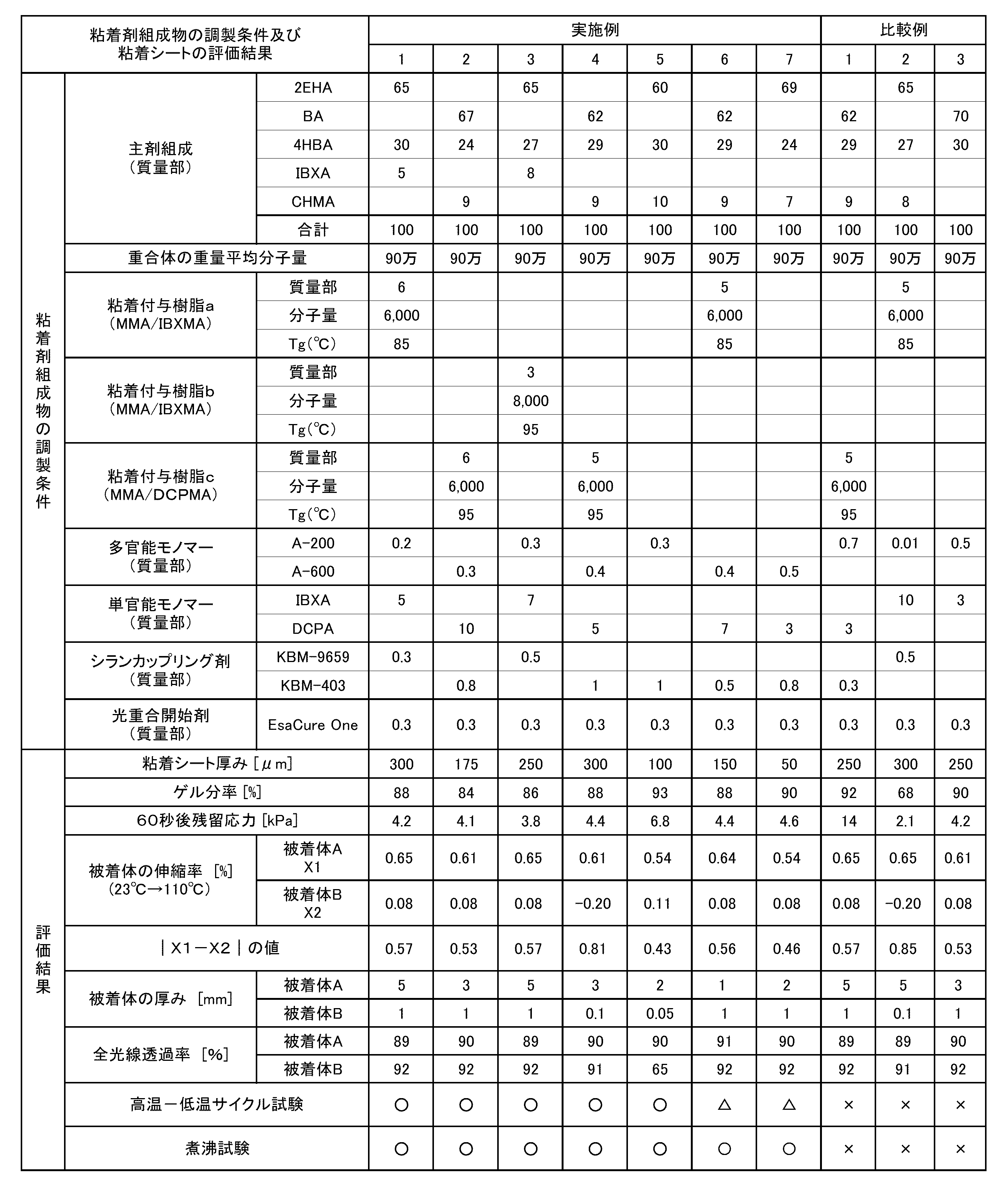
Claims (10)
- 異なる伸縮率を有する一対の被着体どうしを貼り合わせるために用いられる粘着剤シートであって、
粘着剤組成物から得られる粘着剤層を備え、
前記粘着剤組成物は、(メタ)アクリル重合体を含む主剤と、シランカップリング剤とを少なくとも含有し、
前記粘着剤層のゲル分率は80%以上であり、
前記粘着剤層は、105℃において15%ねじりせん断応力をかけた後の60秒後の残留応力が3.0kPa以上10.0kPa以下であり、
下記式(1)
|(X1-X2)|≧0.1%・・・(1)
(ここで、前記一対の被着体の一方を被着体A、他方を被着体Bとしたとき、X1は被着体Aを23℃から110℃まで加熱した時の伸縮率(%)、X2は被着体Bを23℃から110℃まで加熱した時の伸縮率(%)である)
を満たす、粘着剤シート。 - 前記粘着剤組成物は環構造を有する単官能モノマーを含む、請求項1に記載の粘着剤シート。
- 前記粘着剤組成物は、前記主剤100質量部に対して、前記シランカップリング剤を0.05質量部以上、5質量部以下含有する、請求項1又は2に記載の粘着剤シート。
- 前記粘着剤組成物は無溶媒型であり、
前記粘着剤層は、多官能モノマーによる架橋構造を有する、請求項1又は2に記載の粘着剤シート。 - 前記粘着剤組成物は、アクリル系粘着付与剤を含む、請求項1又は2に記載の粘着剤シート。
- 厚みが75μm以上である、請求項1又は2に記載の粘着剤シート。
- 前記被着体A及び前記被着体Bのうち、伸縮率が高い方の被着体の厚みが2mm以上である、請求項1又は2に記載の粘着剤シート。
- 前記被着体A及び前記被着体Bはいずれも全光線透過率が50%以上である、請求項1又は2に記載の粘着剤シート。
- 車の窓、建材の窓又はドアの窓用である、請求項8に記載の粘着剤シート。
- 請求項1又は2に記載の粘着剤シートと、伸縮率が互いに異なる一対の被着体とを備える、積層体。
Priority Applications (1)
| Application Number | Priority Date | Filing Date | Title |
|---|---|---|---|
| CN202480044379.8A CN121443697A (zh) | 2023-07-05 | 2024-07-03 | 粘合剂片及层叠体 |
Applications Claiming Priority (2)
| Application Number | Priority Date | Filing Date | Title |
|---|---|---|---|
| JP2023110554A JP7435889B1 (ja) | 2023-07-05 | 2023-07-05 | 粘着剤シート及び積層体 |
| JP2023-110554 | 2023-07-05 |
Publications (1)
| Publication Number | Publication Date |
|---|---|
| WO2025009545A1 true WO2025009545A1 (ja) | 2025-01-09 |
Family
ID=89904387
Family Applications (1)
| Application Number | Title | Priority Date | Filing Date |
|---|---|---|---|
| PCT/JP2024/024038 Ceased WO2025009545A1 (ja) | 2023-07-05 | 2024-07-03 | 粘着剤シート及び積層体 |
Country Status (3)
| Country | Link |
|---|---|
| JP (1) | JP7435889B1 (ja) |
| CN (1) | CN121443697A (ja) |
| WO (1) | WO2025009545A1 (ja) |
Citations (4)
| Publication number | Priority date | Publication date | Assignee | Title |
|---|---|---|---|---|
| JP2013159704A (ja) * | 2012-02-06 | 2013-08-19 | Nitto Denko Corp | アクリル系粘着テープ |
| JP2019042965A (ja) * | 2017-08-30 | 2019-03-22 | リンテック株式会社 | 構成体およびその製造方法、表示体、ならびに光学用粘着シート |
| JP2019111660A (ja) * | 2017-12-20 | 2019-07-11 | 東亞合成株式会社 | 粘着剤層を備える積層体及び積層体の製造方法 |
| JP2021113280A (ja) * | 2020-01-20 | 2021-08-05 | 王子ホールディングス株式会社 | 粘着剤組成物及び粘着シート |
Family Cites Families (2)
| Publication number | Priority date | Publication date | Assignee | Title |
|---|---|---|---|---|
| TWI534235B (zh) | 2011-02-18 | 2016-05-21 | 3M新設資產公司 | 光學透明黏著劑,其使用方法,及得自其之物件 |
| JP7659962B2 (ja) | 2017-12-21 | 2025-04-10 | 日東電工株式会社 | 離型フィルム付き粘着シート |
-
2023
- 2023-07-05 JP JP2023110554A patent/JP7435889B1/ja active Active
-
2024
- 2024-07-03 WO PCT/JP2024/024038 patent/WO2025009545A1/ja not_active Ceased
- 2024-07-03 CN CN202480044379.8A patent/CN121443697A/zh active Pending
Patent Citations (4)
| Publication number | Priority date | Publication date | Assignee | Title |
|---|---|---|---|---|
| JP2013159704A (ja) * | 2012-02-06 | 2013-08-19 | Nitto Denko Corp | アクリル系粘着テープ |
| JP2019042965A (ja) * | 2017-08-30 | 2019-03-22 | リンテック株式会社 | 構成体およびその製造方法、表示体、ならびに光学用粘着シート |
| JP2019111660A (ja) * | 2017-12-20 | 2019-07-11 | 東亞合成株式会社 | 粘着剤層を備える積層体及び積層体の製造方法 |
| JP2021113280A (ja) * | 2020-01-20 | 2021-08-05 | 王子ホールディングス株式会社 | 粘着剤組成物及び粘着シート |
Also Published As
| Publication number | Publication date |
|---|---|
| JP7435889B1 (ja) | 2024-02-21 |
| CN121443697A (zh) | 2026-01-30 |
| JP2025008400A (ja) | 2025-01-20 |
Similar Documents
| Publication | Publication Date | Title |
|---|---|---|
| WO2023189284A1 (ja) | 粘着剤組成物及び粘着シート | |
| JP6705542B1 (ja) | 粘着シート | |
| TW201710435A (zh) | 黏著片暨積層體及其製造方法 | |
| TW201715005A (zh) | 黏著片暨積層體及其製造方法 | |
| JP2019077747A (ja) | 粘着シート、積層体の製造方法および積層体 | |
| JP7287280B2 (ja) | 粘着シート及び積層体の製造方法 | |
| JP2019089947A (ja) | 粘着シート、積層体の製造方法および積層体 | |
| TWI842958B (zh) | 黏著片 | |
| JP6687152B1 (ja) | 粘着シート及び粘着シートの製造方法 | |
| JP2024007176A (ja) | 剥離シート付き粘着シートの製造方法及び剥離シート付き粘着シート | |
| JPWO2017204248A1 (ja) | 積層粘着シート | |
| JP2017210542A (ja) | 粘着シート | |
| JP7435889B1 (ja) | 粘着剤シート及び積層体 | |
| JP6705543B1 (ja) | 粘着剤組成物及び粘着シート | |
| JP6579254B1 (ja) | 積層体及び積層体の製造方法 | |
| JP2019089948A (ja) | 粘着シート、積層体の製造方法および積層体 | |
| JP2022174182A (ja) | 粘着シート、剥離シート付き粘着シート、積層体及び積層体の製造方法 | |
| JP2023057915A (ja) | 粘着剤組成物及び粘着シート | |
| JP7318834B1 (ja) | 粘着剤組成物、粘着シート及び積層体 | |
| JP7127260B2 (ja) | 両面粘着シート、積層体の製造方法及び両面粘着シートの使用方法 | |
| WO2024190806A1 (ja) | 光学部材用粘着シート、剥離シート付粘着シート及び積層体 | |
| JP2021095428A (ja) | 粘着剤組成物及び粘着シート | |
| WO2024214759A1 (ja) | 粘着シート、積層体及び剥離シート付粘着シート | |
| WO2018221635A1 (ja) | 両面粘着シート、両面粘着シートの使用方法及び積層体の製造方法 | |
| JP2025158001A (ja) | 粘着剤シート及び積層体 |
Legal Events
| Date | Code | Title | Description |
|---|---|---|---|
| 121 | Ep: the epo has been informed by wipo that ep was designated in this application |
Ref document number: 24836058 Country of ref document: EP Kind code of ref document: A1 |
|
| NENP | Non-entry into the national phase |
Ref country code: DE |