WO2025009508A1 - 光接続構造体、及び、光接続構造体の製造方法 - Google Patents
光接続構造体、及び、光接続構造体の製造方法 Download PDFInfo
- Publication number
- WO2025009508A1 WO2025009508A1 PCT/JP2024/023814 JP2024023814W WO2025009508A1 WO 2025009508 A1 WO2025009508 A1 WO 2025009508A1 JP 2024023814 W JP2024023814 W JP 2024023814W WO 2025009508 A1 WO2025009508 A1 WO 2025009508A1
- Authority
- WO
- WIPO (PCT)
- Prior art keywords
- optical
- lens
- fiber
- face
- optical fiber
- Prior art date
- Legal status (The legal status is an assumption and is not a legal conclusion. Google has not performed a legal analysis and makes no representation as to the accuracy of the status listed.)
- Ceased
Links
Images




Classifications
-
- G—PHYSICS
- G02—OPTICS
- G02B—OPTICAL ELEMENTS, SYSTEMS OR APPARATUS
- G02B6/00—Light guides; Structural details of arrangements comprising light guides and other optical elements, e.g. couplings
- G02B6/02—Optical fibres with cladding with or without a coating
-
- G—PHYSICS
- G02—OPTICS
- G02B—OPTICAL ELEMENTS, SYSTEMS OR APPARATUS
- G02B6/00—Light guides; Structural details of arrangements comprising light guides and other optical elements, e.g. couplings
- G02B6/24—Coupling light guides
- G02B6/26—Optical coupling means
- G02B6/32—Optical coupling means having lens focusing means positioned between opposed fibre ends
Definitions
- This disclosure relates to an optical connection structure and a method for manufacturing an optical connection structure.
- This application claims priority to Japanese Patent Application No. 2023-109871, filed on July 4, 2023, and incorporates all of the contents of said Japanese application by reference.
- An optical connection structure that optically couples a pair of optical fiber assemblies is known.
- the optical fiber assembly includes an optical fiber.
- Patent Document 1 and Patent Document 2 disclose an optical connection structure in which a pair of lenses are arranged between a pair of optical fiber assemblies. The pair of optical fiber assemblies are optically coupled by the pair of lenses.
- the optical connection structure includes a first optical fiber assembly, a second optical fiber assembly, a first lens, and a second lens.
- the first optical fiber assembly includes at least one first fiber core.
- the first optical fiber assembly has a first end face. At least one first fiber core is exposed from the first end face.
- the second optical fiber assembly includes at least one second fiber core.
- the second optical fiber assembly has a second end face. At least one second fiber core is exposed from the second end face and is optically coupled to the first end face.
- the first lens and the second lens are arranged in order from the first optical fiber assembly to the second optical fiber assembly between the first optical fiber assembly and the second optical fiber assembly.
- an axis passing through the center of gravity of at least one first fiber core is shifted in a direction along a vertical cross section of at least one first fiber core with respect to the optical axis of the first lens.
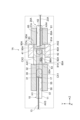
- FIG. 1 is a cross-sectional view taken along the optical axis direction of an optical connection structure according to an embodiment.
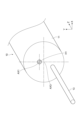
- FIG. 2 is a schematic diagram showing the structure of an optical fiber assembly.
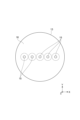
- FIG. 3 is a diagram showing an end face of an optical fiber.
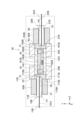
- FIG. 4 is a schematic diagram for explaining the configuration of the optical connection structure.
- FIG. 5 is a schematic diagram for explaining the configuration of the optical connection structure.
- FIG. 6 is a cross-sectional view taken along the optical axis direction of an optical connection structure according to a modified example of this embodiment.
- FIG. 7 is a cross-sectional view taken along the optical axis direction of an optical connection structure according to a modified example of this embodiment.
- FIG. 8 is a schematic diagram showing the structure of an optical fiber assembly in a modified example of this embodiment.
- FIGS. 9A to 9C are schematic diagrams for explaining reflected light at a lens.
- 10A to 10D are schematic diagrams showing lenses included in an optical connection structure according to a modified example of this embodiment.
- FIG. 11 is a cross-sectional view of an optical fiber of an optical connection structure in a modified example of this embodiment.
- the return light may cause various problems. For example, the return light may destabilize the operation of an amplifier or laser arranged upstream of the optical connection structure, degrading their performance. If return light occurs, the signal quality in bidirectional transmission may also deteriorate. As a result, the quality of optical transmission may deteriorate.
- An optical connection structure includes a first optical fiber assembly, a second optical fiber assembly, a first lens, and a second lens.
- the first optical fiber assembly includes at least one first fiber core.
- the first optical fiber assembly has a first end face. At least one first fiber core is exposed from the first end face.
- the second optical fiber assembly includes at least one second fiber core.
- the second optical fiber assembly has a second end face. At least one second fiber core is exposed from the second end face and is optically coupled to the first end face.
- the first lens and the second lens are arranged in order from the first optical fiber assembly to the second optical fiber assembly between the first optical fiber assembly and the second optical fiber assembly.
- an axis passing through the center of gravity of at least one first fiber core is shifted in a direction along a vertical cross section of at least one first fiber core with respect to the optical axis of the first lens.
- the reflected light from the first lens can be prevented from entering the first fiber core.
- the quality of optical transmission is improved.
- the first optical fiber assembly includes a plurality of first fiber cores as the at least one first fiber core, and an axis passing through the center of gravity of the at least one first fiber core at the first end face may be shifted in a direction perpendicular to the direction in which two of the at least one first fiber core are arranged at the first end face with respect to the optical axis of the first lens.
- the quality of optical transmission between a pair of optical fiber assemblies having a plurality of fiber cores is improved.
- the first optical fiber assembly may include a capillary and a multicore fiber.
- the capillary may have at least one hole extending along the longitudinal direction of the first optical fiber assembly.
- the multicore fiber may be provided in the hole.
- the multicore fiber may include a plurality of first fiber cores.
- the first optical fiber assembly may include a capillary and a plurality of single-core fibers.
- the capillary may have a plurality of holes extending along the longitudinal direction of the first optical fiber assembly.
- the plurality of single-core fibers may be provided in each of the plurality of holes.
- Each of the plurality of single-core fibers may include a first fiber core.
- the number of the first fiber cores may be three or more, the three or more first fiber cores may be arranged in a row on the first end face, and the axis passing through the center of gravity of the three or more first fiber cores may be shifted in a direction perpendicular to the arrangement direction of the three or more first fiber cores with respect to the optical axis of the first lens. In this case, the incidence of the reflected light at the first lens into the first fiber cores may be further suppressed.
- an axis passing through the center of gravity of at least one second fiber core at the second end face may be shifted in a direction perpendicular to the direction in which two of the at least one second fiber core are aligned with respect to the optical axis of the second lens.
- the reflected light at the second lens can be prevented from being incident on the second fiber core.
- the quality of bidirectional optical transmission is improved.
- the second optical fiber assembly includes a plurality of second fiber cores as at least one second fiber core
- the focal length of the first lens is "f1”
- the focal length of the second lens is "f2”
- the core pitch of the multiple first fiber cores at the first end face is “P1”
- the core pitch of the multiple second fiber cores at the second end face is “P2”.
- the first end face may be inclined with respect to the vertical cross section. In this case, optical coupling in the first fiber core can be suppressed for the light reflected at the first end face.
- the first lens may have an opposing surface that faces the first end face.
- the opposing surface may be inclined with respect to the optical axis of the first lens. In this case, the reflected light reflected at the opposing surface may be prevented from entering the first fiber core.
- the shape of the arrangement of at least one first fiber core on the first end face as viewed from the optical axis direction of the first lens and the shape of the arrangement of at least one of the plurality of second fiber cores on the second end face as viewed from the optical axis direction of the second lens may be similar to each other. In this case, optical loss between the fiber cores is reduced.
- At least one first fiber core may be enlarged at the first end face. In this case, even if the beam diameter is enlarged by the first and second lenses, leakage of the incident light can be further suppressed, and optical loss in the optical fiber can be further suppressed.
- a method for manufacturing an optical connection structure includes preparing a first optical fiber assembly, a second optical fiber assembly, a first lens, and a second lens, and arranging the first lens and the second lens in order.
- the first optical fiber assembly includes at least one first fiber core.
- the first optical fiber assembly has a first end face from which the at least one first fiber core is exposed.
- the second optical fiber assembly includes at least one second fiber core.
- the second optical fiber assembly has a second end face from which the at least one second fiber core is exposed and optically coupled to the first end face.
- the first lens and the second lens are arranged in order from the first optical fiber assembly to the second optical fiber assembly between the first optical fiber assembly and the second optical fiber assembly. In the first end face, an axis passing through the center of gravity of the at least one first fiber core is shifted from the optical axis of the first lens in a direction along a vertical cross section of the at least one first fiber core.
- the first optical fiber assembly includes a plurality of first fiber cores as the at least one first fiber core, and an axis passing through the center of gravity of at least one first fiber core at the first end face may be shifted in a direction perpendicular to the direction in which two of the at least one first fiber core are aligned at the first end face with respect to the optical axis of the first lens.
- Figure 1 is a cross-sectional view of an optical connection structure according to one embodiment taken along the optical axis direction.
- the optical connection structure 1 includes a pair of optical fiber assemblies 10, 20, a pair of lenses 30, 40, a pair of holders 50, 60, and a sleeve 70.
- the optical connection structure 1 optically couples the pair of optical fiber assemblies 10, 20 to each other via the pair of lenses 30, 40.
- the optical fiber assembly 10 corresponds to a first optical fiber assembly
- the optical fiber assembly 20 corresponds to a second optical fiber assembly.
- the lens 30 corresponds to a first lens
- the lens 40 corresponds to a second lens.
- FIG. 2 is a schematic diagram showing the structure of the optical fiber assembly 10.
- the optical fiber assembly 20 has a structure symmetrical to the optical fiber assembly 10 in the Z-axis direction.
- the X-axis direction, the Y-axis direction, and the Z-axis direction are mutually perpendicular.
- the optical fiber assemblies 10 and 20 each have an elongated shape.
- the optical fiber assemblies 10 and 20 have a cylindrical shape.
- the optical fiber assemblies 10 and 20 extend in the Z-axis direction.
- the optical fiber assembly 10 has an end face 17 facing the lens 30.
- the optical fiber assembly 20 has an end face 27 facing the lens 40.
- the optical fiber assembly 10 includes a capillary 11 and one optical fiber 13.
- the optical fiber assembly 20 includes a capillary 21 and one optical fiber 23.
- the capillary 11 has at least one hole H1.
- the hole H1 passes through the capillary 11 and is connected to an opening formed in the end face 17.
- the hole H1 extends along the longitudinal direction of the optical fiber assembly 10.
- the capillary 21 has at least one hole H2.
- the hole H2 passes through the capillary 21 and is connected to an opening formed in the end face 27.
- the hole H2 extends along the longitudinal direction of the optical fiber assembly 20.
- the capillaries 11 and 21 each have one hole H1 and H2.
- the optical fiber 13 includes at least one fiber core 15 and a cladding 16.
- the optical fiber 13 is provided in the hole H1 and is exposed from the end face 17.
- At least one fiber core 15 is exposed from the end face 17.
- the end face 17 is inclined with respect to a vertical cross section of at least one fiber core 15.
- the "vertical cross section of the fiber core” means a cross section perpendicular to the infinitesimal length direction of the fiber core.
- the "infinite length direction of the fiber core” means the extension direction of the fiber core viewed microscopically.
- the end face 17 is inclined with respect to a vertical cross section of an axis passing through the center of gravity of at least one fiber core 15.
- the end face 17 is inclined with respect to a vertical cross section with respect to the central axis of each fiber core 15.
- the end face 17 is formed by polishing both the optical fiber 13 and the capillary 11.
- the optical fiber 13 is a multi-core fiber including multiple fiber cores 15.
- the axis passing through the center of gravity of at least one fiber core 15 coincides with the central axis of each fiber core 15.
- the fiber core 15 is expanded, for example, at the end face 17 by heating.
- the molded field diameter (MFD) of the fiber core 15 is expanded near the end face 17 by heating, and includes a tapered portion whose diameter increases toward the end face 17.
- the optical fiber 13 is, for example, a TEC (Thermally Expanded Core) fiber, and a shape in which the MFD differs in parts is formed by TEC processing.
- TEC Thermally Expanded Core
- the optical fiber 23 includes at least one fiber core 25.
- the optical fiber 23 is disposed in the hole H2 and is exposed from the end face 27.
- the at least one fiber core 25 is exposed from the end face 27.
- the end face 27 is inclined with respect to a vertical cross section of the at least one fiber core 25.
- the end face 27 is inclined with respect to a vertical cross section of an axis passing through the center of gravity of the at least one fiber core 25.
- the end face 27 is inclined with respect to a vertical cross section of the central axis of each fiber core 25.
- the end face 27 is formed by polishing the optical fiber 23 and the capillary 21 together.
- the optical fiber 23 is a multicore fiber including multiple fiber cores 25.
- At least one fiber core 25 exposed at end face 27 and at least one fiber core 15 exposed at end face 17 are optically coupled to each other.
- each of the multiple fiber cores 25 exposed at end face 27 is optically coupled to a corresponding fiber core 25 among the multiple fiber cores 15 exposed at end face 17.
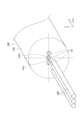
- FIG. 3 is a diagram showing the end face of the optical fiber 13, and shows the end face 17 as viewed from the Z-axis direction.
- the dashed line shows an image of the boundary of the MFD.
- the optical fiber 23 has a similar structure to the optical fiber 13.
- the multiple fiber cores 25 are arranged in a row at the end face 27.
- five fiber cores are arranged in the X-axis direction in the optical fiber 13 and the optical fiber 23.
- the lenses 30 and 40 are arranged between the optical fiber assembly 10 and the optical fiber assembly 20.
- the lens 30 is interposed between the end face 17 of the optical fiber assembly 10 and the lens 40.
- the lens 40 is interposed between the lens 30 and the end face 27 of the optical fiber assembly 20.
- the lenses 30 and 40 are arranged in order from the end face 17 of the optical fiber assembly 10 toward the end face 27 of the optical fiber assembly 20.
- the lens 30, for example, focuses the multiple light beams L emitted from each of the multiple fiber cores 15 of the optical fiber assembly 10 on the opposite side of the optical fiber assembly 10 from the lens 30.
- the lens 40 for example, focuses the light beams L on each fiber core 25 of the end face 27.
- the lenses 30 and 40 are, for example, C lenses.
- the lens 30 is a rod lens having a spherical surface on the lens 40 side, a flat surface on the optical fiber assembly 10 side, and the same outer diameter as the optical fiber assembly 10.
- the lens 40 is a rod lens having a spherical surface on the lens 30 side, a flat surface on the optical fiber assembly 20 side, and the same outer diameter as the optical fiber assembly 20.
- Figures 4 and 5 are schematic diagrams for explaining the configuration of the optical connection structure 1.
- Figures 4 and 5 the relationship between the optical fiber 13, the optical fiber 23, the lens 30, and the lens 40 is shown.
- Figure 4 shows the configuration as viewed from the X-axis direction.
- Figure 5 shows the configuration as viewed from the Y-axis direction.
- Light L1 and light L2 are light L emitted from different fiber cores 15.
- Planes S1, S2, S3, S4, S5, and S6 are shown in Figures 4 and 5.
- Plane S1 corresponds to a virtual plane that includes the intersection of the central axis of the fiber core 15 and the end face 17 and extends in a direction perpendicular to the optical axis CX1 of the lens 30.
- Planes S2 and S3 each include different principal surfaces of the pair of principal surfaces of the lens 30.
- the term "principal surface” means a surface consisting of a set of points where an extension line of an incident light ray at an arbitrary height intersects with an extension line of an exit light ray corresponding to the incident light ray when a light ray parallel to the optical axis of the lens is incident.
- Plane S2 corresponds to the principal surface of the pair of principal surfaces of the lens 30 that faces the optical fiber 13.
- Plane S3 corresponds to the principal surface of the pair of principal surfaces of the lens 30 that faces the lens 40.
- Plane S4 and S5 each include different principal surfaces of the pair of principal surfaces of the lens 40.
- Plane S4 corresponds to the principal surface of the pair of principal surfaces of the lens 40 that faces the lens 30.
- Plane S5 corresponds to the principal surface of the pair of principal surfaces of the lens 40 that faces the optical fiber 23.
- Plane S6 corresponds to a virtual plane that includes the intersection between the central axis of fiber core 25 and the emission surface and extends in a direction perpendicular to optical axis CX2 of lens 40.
- Lens 30 has an opposing surface 31 facing end face 17 and an opposing surface 32 facing lens 40.
- Lens 40 has an opposing surface 41 facing end face 27 and an opposing surface 42 facing lens 30.
- opposing surface 31 is inclined with respect to the optical axis of lens 30, and opposing surface 41 is inclined with respect to the optical axis of lens 40.
- an axis AX1 passing through the center of gravity of at least one fiber core 15 of the optical fiber assembly 10 is offset in a direction along a vertical cross section of at least one fiber core 15 with respect to the optical axis CX1 of the lens 30.
- the axis AX1 is offset in the Y-axis direction with respect to the optical axis CX1 of the lens 30.
- an axis AX2 passing through the center of gravity of at least one fiber core 25 of the optical fiber assembly 20 is offset in a direction along a vertical cross section of at least one fiber core 25 with respect to the optical axis CX2 of the lens 40.
- the axis AX2 is offset in the Y-axis direction with respect to the optical axis CX2 of the lens 40.
- an axis AX1 passing through the center of gravity of at least one fiber core 15 of the optical fiber assembly 10 is offset in a direction along a vertical cross section of at least one fiber core 15 with respect to an axis AX3 passing through the center of gravity of the optical fiber assembly 10.
- an axis AX2 passing through the center of gravity of at least one fiber core 25 is offset in a direction along a vertical cross section of at least one fiber core 35 with respect to an axis AX4 passing through the center of gravity of the optical fiber assembly 20.
- Axis AX1 corresponds to an axis passing through the center of gravity of at least one hole H1 in capillary 11 at end face 17.
- Axis AX3 corresponds to an axis passing through the center of gravity of capillary 11 at end face 17.
- Axis AX2 corresponds to an axis passing through the center of gravity of at least one hole H2 in capillary 21 at end face 27.
- Axis AX4 corresponds to an axis passing through the center of gravity of capillary 21 at end face 27.
- the multiple fiber cores 15 are arranged in a row in the X-axis direction on the end face 17, and the axis AX1 is offset in the Y-axis direction perpendicular to the X-axis direction, which is the arrangement direction of the multiple fiber cores 15, with respect to the optical axis CX1 of the lens 30.
- the axis AX1 passing through the center of gravity of at least one fiber core 15 is offset in a direction perpendicular to the direction in which two of the multiple fiber cores 15 are lined up on the end face 17, with respect to the optical axis CX1 of the lens 30.
- the arrangement direction of the multiple fiber cores 15 is adjusted by the rotation of the optical fiber 13 when the optical fiber 13 is inserted into the hole H1 of the capillary 11.
- the multiple fiber cores 25 are arranged in a row in the X-axis direction on the end face 27, and the axis AX2 is offset in the Y-direction perpendicular to the X-axis direction, which is the arrangement direction of the multiple fiber cores 25, with respect to the optical axis CX2 of the lens 40.
- an axis AX2 passing through the center of gravity of at least one fiber core 25 is shifted with respect to the optical axis CX2 of the lens 40 in a direction perpendicular to the direction in which two of the multiple fiber cores 25 are aligned at the end face 27.
- the arrangement direction of the multiple fiber cores 25 is adjusted by rotating the optical fiber 23 when the optical fiber 23 is inserted into the hole H2 of the capillary 21.
- the optical connection structure 1 includes one fiber core 15 and one fiber core 25, and is configured such that the distance between planes S2 and S1 is equal to the focal length, and the distance between planes S3 and S4 is equal to the sum of the focal length of lens 30 and the focal length of lens 40.
- the fiber core 15 and the fiber core 25 can be optically coupled with relatively low loss.
- the fiber core 15 and the fiber core 25 can be optically coupled with a loss of less than 1 dB.
- the optical connection structure 1 includes multiple fiber cores 15 and multiple fiber cores 25, and that the optical connection structure 1 is configured so that the following formula (1) holds.
- the MFD formed in fiber core 15 is “D 1 ".
- the MFD formed in fiber core 25 is “D 2 ".
- the core pitch of fiber core 15 at end face 17 is “P 1 ".
- the core pitch of fiber core 25 at end face 27 is “P 2 ".
- the focal length of lens 30 is “f 1 ".
- the focal length of lens 40 is “f 2 ".
- core pitch corresponds to the distance between the centers of fiber cores in the XY plane.
- the shape of the arrangement of the multiple fiber cores 15 on the end face 17 as viewed from the direction of the optical axis CX1 of the lens 30 and the shape of the arrangement of the multiple fiber cores 25 on the end face 27 as viewed from the direction of the optical axis of the lens 40 are similar to each other.
- the light distribution formed on the end face 17 of the optical fiber 13 and the light distribution formed on the end face 27 of the optical fiber 23 are similar to each other according to the ratio of the focal lengths f1, f2 of the lens 30 and the lens 40.
- the ratio of the MFD of the fiber core 15 on the end face 17 to the MFD of the fiber core 25 on the end face 27 matches the ratio of the focal lengths f1, f2 of the lens 30 and the lens 40.
- the fiber core 15 and the fiber core 25 can be optically coupled with a relatively low loss.
- the fiber core 15 and the fiber core 25 can be optically coupled with a loss of less than 1 dB.
- the optical connection structure 1 is configured so that the following relationship expressions (2) and (3) are satisfied.
- the holder 50 holds the optical fiber assembly 10 and the lens 30.
- the holder 50 is cylindrical.
- the holder 50 has an inner peripheral surface 51 and an outer peripheral surface 52.
- the inner peripheral surface 51 forms a through hole 55 that penetrates the holder 50 in the extension direction of the holder 50.
- a part of the optical fiber assembly 10 and a part of the lens 30 are accommodated in the through hole 55.
- the holder 50 holds the optical fiber assembly 10 and the lens 30 on the inner peripheral surface 51 that forms the through hole 55.
- the holder 50 fixes the capillary 11 and the lens 30 on the inner peripheral surface 51.
- the lens 30 and the optical fiber assembly 10 are fixed by the holder 50 so that the axis AX1 passing through the center of gravity of the fiber core 15 and the optical axis CX1 of the lens 30 are positioned parallel to each other.
- the end face 17 of the optical fiber assembly 10 and the opposing face 31 of the lens 30 are positioned close to each other.
- the light emitted from the end face 17 of the optical fiber assembly 10 becomes parallel light via the lens 30.
- a collimator is formed by the optical fiber assembly 10 and the lens 30.
- the holder 50 is a collimator holder.
- the holder 60 holds the optical fiber assembly 20 and the lens 40.
- the holder 60 is cylindrical.
- the holder 60 has an inner peripheral surface 61 and an outer peripheral surface 62.
- the inner peripheral surface 61 forms a through hole 65 that penetrates the holder 60 in the extension direction of the holder 60. A part of the optical fiber assembly 20 and a part of the lens 40 are accommodated in the through hole 65.
- the holder 60 holds the optical fiber assembly 20 and the lens 40 on the inner peripheral surface 61 that forms the through hole 65.
- the holder 60 fixes the capillary 21 and the lens 40 on the inner peripheral surface 61.
- the lens 40 and the optical fiber assembly 20 are fixed by the holder 60 so that the axis AX2 passing through the center of gravity of the fiber core 25 and the optical axis CX2 of the lens 40 are positioned parallel to each other.
- the end face 27 of the optical fiber assembly 20 and the opposing face 41 of the lens 40 are positioned close to each other.
- the light emitted from the end face 27 of the optical fiber assembly 20 becomes parallel light via the lens 40.
- a collimator is formed by the optical fiber assembly 20 and the lens 40.
- the holder 60 is a collimator holder.
- the sleeve 70 holds the holder 50 and the holder 60.
- the sleeve 70 is cylindrical.
- the sleeve 70 has an inner circumferential surface 71.
- the inner circumferential surface 71 forms a through hole 75 that passes through the sleeve 70 in the extension direction of the sleeve 70.
- a part of the holder 50 and a part of the holder 60 are accommodated in the through hole 75.
- the sleeve 70 holds the holder 50 and the holder 60 at the inner circumferential surface 71 that forms the through hole 75.
- the sleeve 70 fixes the holder 50 and the holder 60 so that the optical axis CX1 of the lens 30 and the optical axis CX2 of the lens 40 are positioned parallel to each other.
- the amount of deviation in the Y-axis direction of the axis passing through the center of gravity of the multiple fiber cores 15 at the end face 17 relative to the optical axis CX1 of the lens 30 corresponds to the amount of deviation in the Y-axis direction of the axis passing through the center of gravity of the multiple holes H1 at the end face 17 relative to the axis passing through the center of gravity of the capillary 11.
- the amount of deviation in the Y-axis direction of the axis passing through the center of gravity of the multiple fiber cores 15 at the end face 17 relative to the optical axis CX1 of the lens 30 corresponds to the amount of deviation in the Y-axis direction of the axis passing through the center of gravity of the multiple holes H1 at the end face 17 relative to the axis passing through the center of gravity of the capillary 11. Therefore, when fixing the holder 50 and the holder 60 to the sleeve 70, no special method is required to adjust the amount of deviation, and the amount of deviation can be set by a known method that simply adjusts the positional relationship between the holder 50 and the holder 60.
- the optical fiber assembly 10 the optical fiber assembly 20, the lens 30, and the lens 40 are prepared.
- at least one fiber core 15 may be expanded by heating at the end face 17, if necessary.
- the fiber core 15 may be expanded by, for example, TEC processing.
- the optical fiber assembly 10 and the lens 30 are placed in the through hole 55 of the holder 50.
- the optical fiber assembly 10 and the lens 30 are fixed to the inner surface 51 by an adhesive.
- the optical fiber assembly 20 and the lens 40 are placed in the through hole 65 of the holder 60.
- the optical fiber assembly 20 and the lens 40 are fixed to the inner surface 61 by an adhesive.
- holder 50 and holder 60 are placed in through hole 75 of sleeve 70.
- outer peripheral surface 52 of holder 50 and outer peripheral surface 62 of holder 60 are fixed to inner peripheral surface 71 by adhesive.
- holder 50 and holder 60 are fixed to sleeve 70, they are aligned so that fiber core 15 and fiber core 25 are optically coupled with relatively low loss.
- holder 50, holder 60, and sleeve 70 are all housed and sealed in a cylindrical housing.
- the lenses 30 and 40 are arranged between the optical fiber assembly 10 and the optical fiber assembly 20, in order from the optical fiber assembly 10 toward the optical fiber assembly 20.
- the axis AX1 passing through the center of gravity of at least one fiber core 15 at the end face 17 is positioned offset from the optical axis CX1 of the lens 30.
- the axis AX2 passing through the center of gravity of at least one fiber core 25 at the end face 27 is positioned offset from the optical axis CX2 of the lens 40.
- FIG. 6 is a cross-sectional view along the optical axis direction of the optical connection structure in this modified example.
- This modified example is generally similar to or the same as the embodiment described above.
- This modified example differs from the embodiment described above in terms of the configuration for fixing the lens and the optical fiber assembly, the configuration of the optical fiber assembly, and the type of lens. Below, the differences between the embodiment described above and the modified example will be mainly described.
- the optical connection structure 1A optically couples a multicore fiber and a fiber array.
- the optical connection structure 1A includes a pair of optical fiber assemblies 10, 20A, a pair of lenses 30, 40A, a pair of holders 50, 60A, 80A, and a sleeve 90A.
- the optical connection structure 1 optically couples the pair of optical fiber assemblies 10, 20A to each other via the pair of lenses 30, 40A.
- the optical fiber assembly 10 corresponds to a first optical fiber assembly
- the optical fiber assembly 20A corresponds to a second optical fiber assembly.
- the lens 30 corresponds to a first lens
- the lens 40A corresponds to a second lens.
- the optical fiber assembly 20A includes a capillary 21A and a plurality of optical fibers 23A.
- the optical fiber assembly 20A is a fiber array including a plurality of optical fibers 23A.
- the optical fiber assembly 20A has an end face 27A facing the lens 40A.
- the plurality of optical fibers 23A are arranged in an example on the end face 27A.
- the end face 27A is inclined with respect to the optical axis CX2 of the lens 40A.
- the end face 27A is inclined with respect to a perpendicular cross section with respect to the central axis of the fiber core 25.
- Each optical fiber 23A is a single-core fiber including one fiber core 25.
- the capillary 21A has a plurality of holes H2.
- the plurality of holes H2 may be separated from each other or may be connected in the X-axis direction.
- the plurality of optical fibers 23A are provided in the corresponding holes H2 and are exposed from the end face 27A.
- the plurality of fiber cores 25 are exposed from the end face 27A.
- an axis AX2 passing through the center of gravity of the plurality of fiber cores 25 is offset from an axis AX4 passing through the center of gravity of the optical fiber assembly 20A.
- the end face 27A and the end face 17 are optically coupled to each other.
- the multiple fiber cores 25 exposed at the end face 27A and the multiple fiber cores 15 exposed at the end face 17 are optically coupled to each other.
- the multiple fiber cores 25 of the optical fiber assembly 20A are expanded, for example, by heating at the end face 27A.
- the MFD of the fiber cores 25 of the optical fiber assembly 20A is expanded near the end face 27A by heating, and includes a tapered portion whose diameter increases toward the end face 27A.
- the optical fiber 23A is, for example, a TEC fiber, and a shape with a partially different MFD is formed by TEC processing.
- the above-mentioned tapered portion may be formed by TEC processing.
- Lens 30 and lens 40A are arranged between optical fiber assembly 10 and optical fiber assembly 20A.
- Lens 40A is interposed between lens 30 and end face 27A of optical fiber assembly 20.
- Lens 30 and lens 40A are arranged in order from end face 17 of optical fiber assembly 10 toward end face 27A of optical fiber assembly 20A.
- Lens 40A is, for example, a plano-convex lens.
- lens 40A has a convex surface on the lens 30 side and a flat surface on the optical fiber assembly 20A side.
- the holder 60A holds the optical fiber assembly 20A.
- the holder 60A is cylindrical.
- the holder 60A has an inner surface 61.
- a portion of the optical fiber assembly 20A is housed in a through hole 65.
- the holder 60A holds the optical fiber assembly 20A at the inner surface 61 that forms the through hole 65.
- the holder 60A fixes the capillary 21A at the inner surface 61.
- the holder 80A holds the lens 40A.
- the holder 80A is cylindrical.
- the holder 80A has an inner peripheral surface 81A and an outer peripheral surface 82A.
- the inner peripheral surface 81A forms a through hole 85 that penetrates the holder 80A in the extension direction of the holder 80A.
- the lens 40A is accommodated in the through hole 85A.
- the holder 80A holds the lens 40A on the inner peripheral surface 81A that forms the through hole 85A.
- the holder 80A fixes the lens 40A on the inner peripheral surface 81A.
- the through hole 85A of the holder 80A and the through hole 55 of the holder 50A are connected to the side surface 83A of the holder 80A and the side surface 53 of the holder 50A.
- the side surface 83A of the holder 80A and the side surface 53 of the holder 50A are connected to each other so that the optical axis CX1 of the lens 30 and the optical axis CX2 of the lens 40 are positioned parallel to each other.
- Side 83A and side 53 each have a circular ring shape.
- the sleeve 90A holds the holder 60A and the holder 80A.
- the sleeve 90A is cylindrical.
- the sleeve 90A has an inner circumferential surface 91A and a side surface 93A.
- the inner circumferential surface 91A forms a through hole 95A that penetrates the sleeve 90A in the extension direction of the sleeve 90A.
- the side surface 93A is annular. A portion of the holder 80A is accommodated in the through hole 95A.
- the sleeve 90A holds the holder 80A at the inner circumferential surface 91A that forms the through hole 95A.
- the through hole 95A of the sleeve 90A and the through hole 85A of the holder 80A are connected within the through hole 95A.
- the through hole 95A of the sleeve 90A and the through hole 65 of the holder 60A are connected at the side surface 93A of the sleeve 90A and the side surface 63 of the holder 60A.
- the side 93A of the sleeve 90A and the side 63 of the holder 60A are connected to each other so that the optical axis CX2 of the lens 40A and the axis AX2 passing through the center of gravity of the multiple fiber cores 25 are positioned parallel to each other.
- the optical fiber assembly 10 the optical fiber assembly 20A, the lens 30, and the lens 40A are prepared.
- the fiber core 25 is expanded at the end surface 27A by heating.
- the fiber core 25 is expanded, for example, by TEC processing.
- the optical fiber assembly 10 and the lens 30 are placed in the through hole 55 of the holder 50.
- the optical fiber assembly 10 and the lens 30 are fixed to the inner surface 51 by an adhesive.
- the optical fiber assembly 20A is placed in the through hole 65 of the holder 60A.
- the optical fiber assembly 20A is fixed to the inner surface 61 by an adhesive.
- the lens 40A is placed in the through hole 85A of the holder 80A.
- the lens 40A is fixed to the inner surface 81A by an adhesive.
- the holder 80A is placed in the through hole 95A of the sleeve 90A.
- the fiber core 15 and the fiber core 25 are aligned and fixed so as to be optically coupled with relatively low loss.
- the sleeve 90A and the holder 80A are fixed to each other, the sleeve 90A and the holder 60A are fixed to each other, and the holder 50 and the holder 80A are fixed to each other. These are fixed, for example, with an adhesive.
- the axis AX1 passing through the center of gravity of the multiple fiber cores 15 of the optical fiber 13 is offset from the optical axis CX1 of the lens 30, the axis passing through the center of gravity of the multiple holes H1 of the capillary 11 is offset from the axis passing through the center of gravity of the capillary 11.
- the arrangement of the multiple fiber cores 15 is adjusted by rotating the optical fiber 13. Due to the above-mentioned alignment and the rotation of the optical fiber 13, the axis passing through the center of gravity of the capillary 21A including the multiple fiber cores 25 is offset from the optical axis CX2 of the lens 40A in a direction perpendicular to the arrangement direction of the multiple optical fibers 23A.
- Figure 7 is a cross-sectional view along the optical axis direction of the optical connection structure in this modified example.
- This modified example is generally similar to or the same as the embodiment described above.
- This modified example differs from the embodiment described above in terms of the configuration for fixing the lens and the optical fiber assembly, the configuration of the optical fiber assembly, and the type of lens. Below, the differences between the embodiment described above and the modified example will be mainly described.
- the optical connection structure 1B optically couples a pair of fiber arrays together.
- the optical connection structure 1B includes a pair of optical fiber assemblies 10B, 20B, a pair of lenses 30B, 40A, a pair of holders 50B, 60B, 160B, and a pair of sleeves 170B, 180B.
- the optical connection structure 1B optically couples the pair of optical fiber assemblies 10B, 20B together via the pair of lenses 30B, 40A.
- the optical fiber assembly 10B corresponds to a first optical fiber assembly
- the optical fiber assembly 20B corresponds to a second optical fiber assembly.
- the optical fiber assemblies 10B and 20B each have an elongated shape.
- the optical fiber assemblies 10B and 20B each have a cylindrical shape.
- the optical fiber assemblies 10B and 20B each extend in the Z-axis direction.
- the optical fiber assembly 10B includes a capillary 11B and a plurality of optical fibers 13B.
- the optical fiber assembly 10B is a fiber array including a plurality of optical fibers 13B.
- the optical fiber assembly 10B has an end face 17B facing the lens 30B.
- the plurality of optical fibers 13B are arranged in an example on the end face 17B.
- the end face 17B is inclined with respect to the optical axis CX1 of the lens 30B.
- the end face 17B is inclined with respect to a vertical cross section perpendicular to the central axis of the plurality of fiber cores 25.
- Each optical fiber 13B is a single-core fiber including one fiber core 15.
- the capillary 11B has multiple holes H1.
- the multiple holes H1 may be separated from each other or may be connected in the X-axis direction.
- the multiple optical fibers 13B are provided in the corresponding holes H1 and are exposed from the end face 17B.
- the multiple fiber cores 15 are exposed from the end face 17B.
- the fiber cores 15 are expanded by heating at the end face 17B.
- the fiber cores 15 are expanded near the end face 17B by heating, and include a tapered portion whose diameter increases toward the end face 17B.
- the optical fiber assembly 20B includes a capillary 21B and a plurality of optical fibers 23B.
- the optical fiber assembly 20B is a fiber array including a plurality of optical fibers 23B.
- the optical fiber assembly 20B has an end face 27B facing the lens 40B.
- the plurality of optical fibers 23B are arranged in an example on the end face 27B.
- the end face 27B is inclined with respect to the optical axis CX2 of the lens 40B.
- the end face 27B is inclined with respect to a vertical cross section perpendicular to the central axis of the plurality of fiber cores 25.
- Each of the optical fibers 23B includes one fiber core 25.
- the capillary 21B has a plurality of holes H2.
- the holes H2 may be spaced apart from one another or may be connected in the X-axis direction.
- the optical fibers 23B are provided in the corresponding holes H2 and are exposed from the end surface 27B.
- the fiber cores 25 are exposed from the end surface 27B.
- End face 27B and end face 17B are optically coupled to each other.
- the multiple fiber cores 25 exposed at end face 27B and the multiple fiber cores 15 exposed at end face 17B are optically coupled to each other.
- Capillary 11B has multiple holes H1. Each of the multiple holes H1 is connected to multiple openings formed in end face 17B. Each of the multiple holes H1 extends along the longitudinal direction of optical fiber assembly 10B. In end face 17B, axis AX2 passing through the center of gravity of the multiple holes H1 is offset from optical axis CX1 of lens 30B.
- Capillary 21B has multiple holes H2.
- the multiple holes H2 are connected to an opening formed in end face 27B.
- Each of the multiple holes H2 extends along the longitudinal direction of optical fiber assembly 20B.
- axis AX4 passing through the center of gravity of the multiple holes H2 is offset from optical axis CX2 of lens 40A.
- axis AX1 passing through the center of gravity of the multiple fiber cores 15 coincides with axis AX3 passing through the center of gravity of optical fiber assembly 10B.
- axis AX2 passing through the center of gravity of the multiple fiber cores 25 coincides with axis AX4 passing through the center of gravity of optical fiber assembly 20B.
- Lens 30B and lens 40A are arranged between optical fiber assembly 10B and optical fiber assembly 20B.
- Lens 30B is interposed between lens 40A and end face 17B of optical fiber assembly 10B.
- Lenses 30B and lens 40A are arranged in order from end face 17B of optical fiber assembly 10B toward end face 27B of optical fiber assembly 20B.
- Lens 30B is, for example, a plano-convex lens.
- lens 30B has a convex surface on the lens 40A side and a flat surface on the optical fiber assembly 10B side.
- Holder 160B holds lens 30B and lens 40A.
- Holder 160B is cylindrical.
- Holder 160B has an inner circumferential surface 161B and an outer circumferential surface 162B.
- Inner circumferential surface 161B forms a through hole 165B that penetrates holder 160B in the extension direction of holder 160B.
- Lenses 30B and 40A are housed in through hole 165B.
- Holder 160B holds lens 30B and lens 40A on inner circumferential surface 161B that forms through hole 165B.
- Holder 160B fixes lens 30B and lens 40A on inner circumferential surface 161B.
- the sleeve 170B holds the holder 160B.
- the sleeve 170B is cylindrical.
- the sleeve 170B has an inner circumferential surface 171B and a side surface 173B.
- the inner circumferential surface 171B forms a through hole 175B that passes through the sleeve 170B in the extension direction of the sleeve 170B.
- a portion of the holder 160B is accommodated in the through hole 175B.
- the sleeve 170B holds the holder 160B at the inner circumferential surface 171B that forms the through hole 175B.
- the sleeve 170B fixes the holder 160B at the inner circumferential surface 171B.
- Through hole 175B of sleeve 170B and through hole 55 of holder 50B are connected at side 173B of sleeve 170B and side 53 of holder 50B.
- Side 173B of sleeve 170B and side 53 of holder 50B are connected to each other so that optical axis CX1 of lens 30B and axis AX3 of optical fiber assembly 10B are positioned parallel to each other.
- Side 173B and side 53 each have a circular ring shape.
- Sleeve 180B holds holder 160B.
- Sleeve 180B is cylindrical.
- Sleeve 180B has an inner circumferential surface 181B and a side surface 183B.
- Inner circumferential surface 181B forms a through hole 185B that passes through sleeve 180B in the extension direction of sleeve 180B.
- a portion of sleeve 180B is accommodated in through hole 185B.
- Sleeve 180B holds holder 160B at inner circumferential surface 181B that forms through hole 185B.
- Sleeve 180B fixes holder 160B at inner circumferential surface 181B.
- Through hole 185B of sleeve 180B and through hole 65 of holder 60B are connected at side 183B of sleeve 180B and side 63 of holder 60B.
- Side 183B of sleeve 180B and side 63 of holder 60B are connected to each other so that optical axis CX2 of lens 40B and axis AX4 of optical fiber assembly 20B are positioned parallel to each other.
- Side 183B and side 63 each have a circular ring shape.
- the optical fiber assembly 10B, the optical fiber assembly 20B, the lens 30B, and the lens 40A are prepared.
- the fiber core 15 is expanded at the end face 17B by heating.
- the fiber core 15 is expanded, for example, by TEC processing.
- optical fiber assembly 10B is placed in through hole 55 of holder 50B.
- optical fiber assembly 10B and lens 30B are fixed to inner surface 51 by adhesive.
- Optical fiber assembly 20B is placed in through hole 65 of holder 60B.
- optical fiber assembly 20B is fixed to inner surface 61 by adhesive.
- Lens 30B and lens 40A are placed in through hole 165B of holder 160B.
- lens 30B and lens 40A are fixed to inner surface 161B by adhesive.
- the fiber cores 15 and 25 are aligned so as to be optically coupled with relatively low loss.
- holder 160B, sleeve 170B, and sleeve 180B are fixed to each other, sleeve 170B and holder 50B are fixed to each other, and sleeve 180B and holder 60B are fixed to each other.
- the arrangement of the multiple fiber cores 15 is adjusted by rotating the optical fiber 13B. Alignment is performed so that the axis passing through the center of gravity of the capillary 11B containing the multiple fiber cores 15 is shifted in a direction perpendicular to the arrangement direction of the multiple optical fibers 23B with respect to the optical axis CX2 of the lens 30B, and the axis passing through the center of gravity of the capillary 21B containing the multiple fiber cores 25 is shifted in a direction perpendicular to the arrangement direction of the multiple optical fibers 23B with respect to the optical axis CX2 of the lens 40B.
- the above-mentioned amount of shift is precisely adjusted. As a result, the effect of return light on each optical fiber 13B and optical fiber 23B is easily suppressed.
- the reflected light L R at the lens 230 is shown as an example.
- the lens 230 is a plano-convex lens.
- Fig. 9(a) shows a state in which a part of the light emitted from the fiber core 15 is reflected by the rear end surface 231 of the lens 230 and the reflected light L R returns to the fiber core 15.
- Fig. 9(b) shows a state in which a part of the light emitted from the fiber core 15 is reflected by the front end surface 232 of the lens 230 and the reflected light L R returns to the fiber core 15.
- the reflected light L R at the lens 230 enters the original fiber core 15 and the adjacent fiber core 15, and a part of the light is combined within the fiber core 15.
- the reflected light L R entering the same fiber core 15 may destabilize the operation of the equipment arranged upstream.
- the reflected light L R entering the different fiber core 15 becomes noise in the originally propagating optical signal. As a result, there is a risk of degrading the signal quality.
- the axis AX1 passing through the center of gravity of the fiber core 15 is parallel to the optical axis CX1 of the lens 230 and is shifted from the optical axis CX1 in a direction perpendicular to the arrangement direction of the fiber cores 15.
- the reflection direction at the front end surface 232 of the lens 230 is different from that in the configurations shown in Fig. 9(a) and Fig. 9(b).
- the reflected light L R at the front end surface 232 of the lens 230 is warped from each fiber core 15, and the incidence of the reflected light L R on each fiber core 15 is suppressed. Therefore, the reflected light is coupled to the fiber core 15 from which it is emitted or the adjacent fiber core 15, thereby reducing the effects of operational instability and signal quality degradation.
- an axis AX1 passing through the center of gravity of at least one fiber core 15 is shifted in a direction along a vertical cross section of at least one fiber core 15 with respect to an optical axis CX1 of the lens 30.
- the reflected light L 1 R reflected by the lens 30 can be suppressed from being incident on the fiber core 15.
- the quality of optical transmission is improved.
- the same effect is achieved in the optical connection structures 1A and 1B.
- the optical fiber assembly 10 includes multiple fiber cores 15 as at least one fiber core 14.
- an axis AX1 passing through the center of gravity of at least one fiber core 15 at the end face 17 may be shifted with respect to the optical axis CX1 of the lens 30 in a direction perpendicular to the direction in which two of the at least one fiber core 15 are arranged at the end face 17.
- the quality of optical transmission is improved between the optical fiber assembly 10 having multiple fiber cores 15 and the optical fiber assembly 20 having multiple fiber cores 25.
- the same effect is achieved in the optical connection structures 1A and 1B.
- the optical fiber assembly 10 may include a capillary 11 and a multi-core fiber.
- the capillary 11 has at least one hole H1.
- the hole H1 extends along the longitudinal direction of the optical fiber assembly 10.
- the multi-core fiber may be provided in the hole H1.
- the axis AX1 passing through the center of gravity of the fiber core 15 can be easily realized with respect to the optical axis CX1 of the lens 30, and reliability can also be improved.
- the optical connection structure 1A also has the same effect.
- the optical fiber assembly 10B may include a capillary 11B and a plurality of single-core fibers.
- the capillary 11B may have a plurality of holes H1 extending along the longitudinal direction of the optical fiber assembly 10B.
- the plurality of single-core fibers may be provided in each of the plurality of holes H1.
- Each of the plurality of single-core fibers may include a fiber core 15.
- the axis AX1 passing through the center of gravity of the fiber core 15 can be easily realized with respect to the optical axis CX1 of the lens 30, and reliability can also be improved.
- the same effect is achieved in the optical fiber assembly 20A of the optical connection structure 1A.
- the multiple fiber cores 15 may be arranged in a row on the end surface 17 in a direction perpendicular to the direction in which the axis AX1 passing through the center of gravity of at least one fiber core 15 is shifted from the optical axis CX1 of the lens 30.
- the reflected light at the lens 30 can be further suppressed from entering the fiber core 15.
- the optical connection structures 1A and 1B also have the same effect.
- the end face 17 may be inclined with respect to a cross section perpendicular to the central axis of at least one fiber core 15. In this case, optical coupling in the fiber core 15 for the light reflected at the end face 17 can be suppressed. The same effect is achieved in the optical connection structures 1A and 1B.
- the reflectance at the end face 17 for the same wavelength can be reduced to -65 dB even without an anti-reflection coating (AR coating).
- AR coating anti-reflection coating
- the same fiber is polished 4 times, the reduction in reflectance is limited to -35 dB, but if an AR coating with a reflectance of 0.25% is further vapor-deposited, the reflectance can be reduced to -61 dB.
- the lens 30 has an opposing surface 31 that faces the end face 17.
- the opposing surface 31 may be inclined with respect to the optical axis CX1 of the lens 30. In this case, the reflected light reflected at the opposing surface 31 can be prevented from entering the fiber core 15.
- the optical connection structure 1A also has the same effect.
- the axis AX2 passing through the center of gravity of at least one fiber core 25 at the end face 27 may be shifted with respect to the optical axis CX2 of the lens 40 in a vertical cross section perpendicular to the direction in which two of the at least one fiber core 25 are aligned.
- the reflected light at the lens 40 can be prevented from being incident on the fiber core 25.
- the quality of bidirectional optical transmission is improved.
- the same effect is achieved in the optical connection structures 1A and 1B.
- the shape of the arrangement of at least one fiber core 15 on the end face 17 of the lens 30 as viewed from the optical axis direction may be similar to the shape of the arrangement of at least one fiber core 25 on the end face 27 of the lens 40 as viewed from the optical axis direction. In this case, optical loss between the fiber cores is reduced. The same effect is achieved in the optical connection structures 1A and 1B.
- the focal length of lens 30 is "f1"
- the focal length of lens 40 is "f2”
- the core pitch of the multiple fiber cores 15 at end face 17 is “P1”
- the core pitch of the multiple fiber cores 25 at end face 27 is “P2”.
- leakage of incident light can be further suppressed, and optical loss in the optical fiber can be further suppressed.
- optical connection structures 1A and 1B can be achieved.
- At least one fiber core 15 may be enlarged at the end face 17. In this case, even if the beam diameter is enlarged by the lenses 30 and 40, the leakage of the incident light can be further suppressed, and the optical loss of the optical fiber can be further suppressed. The same effect can be achieved in the optical connection structures 1A and 1B.
- the present invention is not limited to the above embodiments and can be applied to various embodiments.
- the configurations of the optical connection structures 1, 1A, and 1B may be combined.
- the configuration of the fiber bundle side and the configuration of the MCF side may have different configurations from those of the examples shown by the optical connection structures 1, 1A, and 1B.
- the multiple lenses arranged between the optical fiber assembly 10 and the optical fiber assembly 20 may include a type of lens other than the C lens used in the optical connection structures 1 and 1A and the convex lens used in the optical connection structures 1A and 1B.
- the various lenses shown in Figures 10(a) to 10(d) may be used.
- Figures 10(a) to 10(d) show various lenses 30D, 30E, 30F, and 30G and the light L incident on each lens 30D, 30E, 30F, and 30G.
- lens 30D is a biconvex lens and includes a pair of end faces 31D, 32D that are convex. For example, end faces 31D, 32D are aspheric.
- Lens 30D is made of a single material.
- lens 30E is an achromatic lens and is formed by bonding together multiple plates. Each of the multiple plates of lens 30E has a curved surface and is made of a different material. For example, end faces 31E, 32E are aspheric.
- lens 30F is a ball lens. Lens 30F is made of a sphere made of a single material.
- lens 30G is a GRIN lens. Lens 30G includes a pair of end faces 31G, 32G that are flat. Lens 30G is made of a cylinder with different refractive index distributions in the radial direction.
- the optical connection structure 1 may have a structure in which multiple types of lenses are combined.
- the optical connection structure 1 may have a configuration in which two or more lenses selected from a biconvex lens, an achromatic lens, a ball lens, a C lens, a GRIN lens, etc. are combined.
- the lenses located at both ends correspond to a first lens and a second lens, respectively.
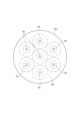
- FIG. 11 shows a cross-sectional view of optical fiber 13J as a modified example.
- Optical fiber 13J differs from optical fiber 13 only in the number and arrangement of fiber cores 15.
- Seven fiber cores 15 are provided in optical fiber 13J.
- the seven fiber cores 15 have a close-packed structure in the XY plane so as to function optically.
- the parts described as being fixed with adhesive may also be fixed by welding.
- Optical connection structure 10B 1, 1A, 1B...
- Optical connection structure 10B 20, 20A, 20B...
Landscapes
- Physics & Mathematics (AREA)
- General Physics & Mathematics (AREA)
- Optics & Photonics (AREA)
- Optical Couplings Of Light Guides (AREA)
Priority Applications (2)
| Application Number | Priority Date | Filing Date | Title |
|---|---|---|---|
| CN202480042718.9A CN121399514A (zh) | 2023-07-04 | 2024-07-01 | 光连接结构体及光连接结构体的制造方法 |
| JP2025531548A JPWO2025009508A1 (https=) | 2023-07-04 | 2024-07-01 |
Applications Claiming Priority (2)
| Application Number | Priority Date | Filing Date | Title |
|---|---|---|---|
| JP2023109871 | 2023-07-04 | ||
| JP2023-109871 | 2023-07-04 |
Publications (1)
| Publication Number | Publication Date |
|---|---|
| WO2025009508A1 true WO2025009508A1 (ja) | 2025-01-09 |
Family
ID=94171534
Family Applications (1)
| Application Number | Title | Priority Date | Filing Date |
|---|---|---|---|
| PCT/JP2024/023814 Ceased WO2025009508A1 (ja) | 2023-07-04 | 2024-07-01 | 光接続構造体、及び、光接続構造体の製造方法 |
Country Status (3)
| Country | Link |
|---|---|
| JP (1) | JPWO2025009508A1 (https=) |
| CN (1) | CN121399514A (https=) |
| WO (1) | WO2025009508A1 (https=) |
Citations (5)
| Publication number | Priority date | Publication date | Assignee | Title |
|---|---|---|---|---|
| JP2004045646A (ja) * | 2002-07-10 | 2004-02-12 | Furukawa Electric Co Ltd:The | 多芯光コリメータ及びこれを用いた光モジュール |
| US20110228404A1 (en) * | 2010-03-22 | 2011-09-22 | Peter Webb | Fiber-Coupled Collimator for Generating Multiple Collimated Optical Beams Having Different Wavelengths |
| WO2022004220A1 (ja) * | 2020-06-29 | 2022-01-06 | 住友電気工業株式会社 | 光ファイバ接続構造 |
| WO2022019019A1 (ja) * | 2020-07-22 | 2022-01-27 | 住友電気工業株式会社 | マルチコアファイバモジュール及びマルチコアファイバ増幅器 |
| JP2022104211A (ja) * | 2020-12-28 | 2022-07-08 | 湖北工業株式会社 | ファンイン/ファンアウトデバイス |
-
2024
- 2024-07-01 JP JP2025531548A patent/JPWO2025009508A1/ja active Pending
- 2024-07-01 WO PCT/JP2024/023814 patent/WO2025009508A1/ja not_active Ceased
- 2024-07-01 CN CN202480042718.9A patent/CN121399514A/zh active Pending
Patent Citations (5)
| Publication number | Priority date | Publication date | Assignee | Title |
|---|---|---|---|---|
| JP2004045646A (ja) * | 2002-07-10 | 2004-02-12 | Furukawa Electric Co Ltd:The | 多芯光コリメータ及びこれを用いた光モジュール |
| US20110228404A1 (en) * | 2010-03-22 | 2011-09-22 | Peter Webb | Fiber-Coupled Collimator for Generating Multiple Collimated Optical Beams Having Different Wavelengths |
| WO2022004220A1 (ja) * | 2020-06-29 | 2022-01-06 | 住友電気工業株式会社 | 光ファイバ接続構造 |
| WO2022019019A1 (ja) * | 2020-07-22 | 2022-01-27 | 住友電気工業株式会社 | マルチコアファイバモジュール及びマルチコアファイバ増幅器 |
| JP2022104211A (ja) * | 2020-12-28 | 2022-07-08 | 湖北工業株式会社 | ファンイン/ファンアウトデバイス |
Also Published As
| Publication number | Publication date |
|---|---|
| JPWO2025009508A1 (https=) | 2025-01-09 |
| CN121399514A (zh) | 2026-01-23 |
Similar Documents
| Publication | Publication Date | Title |
|---|---|---|
| JP7658374B2 (ja) | 光ファイバ接続構造 | |
| US10222563B2 (en) | Multimode optical connector | |
| US20120014645A1 (en) | Single lens, multi-fiber optical connection method and apparatus | |
| US10775569B2 (en) | Optical connector and optical connection structure | |
| CN111758057B (zh) | 具有倾斜镜的光学连接器 | |
| US20210033802A1 (en) | Optical connector | |
| WO2023167065A1 (ja) | ファンイン/ファンアウトデバイス | |
| US11624876B2 (en) | Fiber optic cable assembly having a connector with a holographic optical element and method of making same | |
| CN1530677A (zh) | 光学准直器结构 | |
| JP7590762B2 (ja) | ファンイン/ファンアウトデバイス | |
| CN101535862A (zh) | 透镜组件、光学器件及光学器件的光轴调节方法 | |
| WO2025009508A1 (ja) | 光接続構造体、及び、光接続構造体の製造方法 | |
| CN212749311U (zh) | 紧凑型同轴度高的在线式四端口光纤波分复用器 | |
| CN212808694U (zh) | 紧凑型同轴度高的在线式三端口光纤波分复用器 | |
| EP0305534A1 (en) | Optical space transmission apparatus | |
| WO2024257727A1 (ja) | 光接続構造体 | |
| CN224035665U (zh) | 一种单芯光纤束构件以及多芯光纤扇入扇出器 | |
| US12339501B2 (en) | Optical connection component and connector assembly | |
| WO2025127041A1 (ja) | 光接続構造体及び光接続構造体の製造方法 | |
| WO2024257728A1 (ja) | 光接続構造体 | |
| WO1998047032A2 (en) | Optical transmission systems including optical rods with three-dimensional patterns thereon and related structures | |
| JP2024129214A (ja) | 光ファイバ接続構造 | |
| WO2025075063A1 (ja) | 光コネクタ、光接続アセンブリ、光導波路部材、および光コネクタの製造方法 | |
| CN116990908A (zh) | 基于自聚焦光纤式反射镜的多芯光纤芯间交换耦合器 | |
| WO2024171835A1 (ja) | マルチコアファイバ |
Legal Events
| Date | Code | Title | Description |
|---|---|---|---|
| 121 | Ep: the epo has been informed by wipo that ep was designated in this application |
Ref document number: 24836021 Country of ref document: EP Kind code of ref document: A1 |
|
| ENP | Entry into the national phase |
Ref document number: 2025531548 Country of ref document: JP Kind code of ref document: A |
|
| WWE | Wipo information: entry into national phase |
Ref document number: 2025531548 Country of ref document: JP |
|
| NENP | Non-entry into the national phase |
Ref country code: DE |