WO2025009464A1 - 天然ピレトリンと酸化防止剤とを含有する組成物 - Google Patents
天然ピレトリンと酸化防止剤とを含有する組成物 Download PDFInfo
- Publication number
- WO2025009464A1 WO2025009464A1 PCT/JP2024/023373 JP2024023373W WO2025009464A1 WO 2025009464 A1 WO2025009464 A1 WO 2025009464A1 JP 2024023373 W JP2024023373 W JP 2024023373W WO 2025009464 A1 WO2025009464 A1 WO 2025009464A1
- Authority
- WO
- WIPO (PCT)
- Prior art keywords
- mass
- content
- group
- pest control
- composition
- Prior art date
- Legal status (The legal status is an assumption and is not a legal conclusion. Google has not performed a legal analysis and makes no representation as to the accuracy of the status listed.)
- Ceased
Links
Images


Classifications
-
- A—HUMAN NECESSITIES
- A01—AGRICULTURE; FORESTRY; ANIMAL HUSBANDRY; HUNTING; TRAPPING; FISHING
- A01M—CATCHING, TRAPPING OR SCARING OF ANIMALS; APPARATUS FOR THE DESTRUCTION OF NOXIOUS ANIMALS OR NOXIOUS PLANTS
- A01M1/00—Stationary means for catching or killing insects
- A01M1/20—Poisoning, narcotising, or burning insects
-
- A—HUMAN NECESSITIES
- A01—AGRICULTURE; FORESTRY; ANIMAL HUSBANDRY; HUNTING; TRAPPING; FISHING
- A01N—PRESERVATION OF BODIES OF HUMANS OR ANIMALS OR PLANTS OR PARTS THEREOF; BIOCIDES, e.g. AS DISINFECTANTS, AS PESTICIDES OR AS HERBICIDES; PEST REPELLANTS OR ATTRACTANTS; PLANT GROWTH REGULATORS
- A01N25/00—Biocides, pest repellants or attractants, or plant growth regulators, characterised by their forms, or by their non-active ingredients or by their methods of application, e.g. seed treatment or sequential application; Substances for reducing the noxious effect of the active ingredients to organisms other than pests
- A01N25/18—Vapour or smoke emitting compositions with delayed or sustained release
-
- A—HUMAN NECESSITIES
- A01—AGRICULTURE; FORESTRY; ANIMAL HUSBANDRY; HUNTING; TRAPPING; FISHING
- A01N—PRESERVATION OF BODIES OF HUMANS OR ANIMALS OR PLANTS OR PARTS THEREOF; BIOCIDES, e.g. AS DISINFECTANTS, AS PESTICIDES OR AS HERBICIDES; PEST REPELLANTS OR ATTRACTANTS; PLANT GROWTH REGULATORS
- A01N25/00—Biocides, pest repellants or attractants, or plant growth regulators, characterised by their forms, or by their non-active ingredients or by their methods of application, e.g. seed treatment or sequential application; Substances for reducing the noxious effect of the active ingredients to organisms other than pests
- A01N25/22—Biocides, pest repellants or attractants, or plant growth regulators, characterised by their forms, or by their non-active ingredients or by their methods of application, e.g. seed treatment or sequential application; Substances for reducing the noxious effect of the active ingredients to organisms other than pests containing ingredients stabilising the active ingredients
-
- A—HUMAN NECESSITIES
- A01—AGRICULTURE; FORESTRY; ANIMAL HUSBANDRY; HUNTING; TRAPPING; FISHING
- A01N—PRESERVATION OF BODIES OF HUMANS OR ANIMALS OR PLANTS OR PARTS THEREOF; BIOCIDES, e.g. AS DISINFECTANTS, AS PESTICIDES OR AS HERBICIDES; PEST REPELLANTS OR ATTRACTANTS; PLANT GROWTH REGULATORS
- A01N53/00—Biocides, pest repellants or attractants, or plant growth regulators containing cyclopropane carboxylic acids or derivatives thereof
-
- A—HUMAN NECESSITIES
- A01—AGRICULTURE; FORESTRY; ANIMAL HUSBANDRY; HUNTING; TRAPPING; FISHING
- A01P—BIOCIDAL, PEST REPELLANT, PEST ATTRACTANT OR PLANT GROWTH REGULATORY ACTIVITY OF CHEMICAL COMPOUNDS OR PREPARATIONS
- A01P7/00—Arthropodicides
- A01P7/04—Insecticides
-
- C—CHEMISTRY; METALLURGY
- C07—ORGANIC CHEMISTRY
- C07C—ACYCLIC OR CARBOCYCLIC COMPOUNDS
- C07C69/00—Esters of carboxylic acids; Esters of carbonic or haloformic acids
- C07C69/74—Esters of carboxylic acids having an esterified carboxyl group bound to a carbon atom of a ring other than a six-membered aromatic ring
- C07C69/743—Esters of carboxylic acids having an esterified carboxyl group bound to a carbon atom of a ring other than a six-membered aromatic ring of acids with a three-membered ring and with unsaturation outside the ring
- C07C69/747—Chrysanthemumic acid esters
Definitions
- the present invention relates to compositions containing natural pyrethrins and antioxidants.
- This application claims priority based on Japanese Patent Application No. 2023-109574 filed in Japan on July 3, 2023, and Japanese Patent Application No. 2023-143206 filed in Japan on September 4, 2023, the contents of which are incorporated herein by reference.
- Natural pyrethrins Due to the growing consumer preference for natural products, natural pyrethrins have been attracting attention (e.g., Patent Document 1). Natural pyrethrins are suitable for use in pest control, but due to the instability of their chemical structure, it is known that their pest control effect and storage stability tend to decrease over time.
- the objective of the present invention is to provide a new composition containing natural pyrethrins that maintains its pest control effect or has excellent storage stability.
- the inventors conducted research to provide a new composition containing natural pyrethrins. As a result, they discovered that a composition containing natural pyrethrins and a specific antioxidant has excellent effects, and thus completed the present invention.
- composition of the present invention includes the following aspects, but is not limited to these.
- a composition containing natural pyrethrin and one or more phosphorus-based antioxidants selected from group P or one or more sulfur-based antioxidants selected from group S (hereinafter referred to as the composition of the present invention):
- Group P Formula (2)
- R represents a C9-C14 alkyl group.
- the group P is 3,9-bis(isodecyloxy)-2,4,8,10-tetraoxa-3,9-diphosphaspiro[5.5]undecane, 3,9-bis(isotridecyloxy)-2,4,8,10-tetraoxa-3,9-diphosphaspiro[5.5]undecane, 3,9-bis(2,4-di-tert-butylphenoxy)-2,4,8,10-tetraoxa-3,9-diphosphaspiro[5.5]undecane, tris(nonylphenyl)phosphite, triphenyl phosphite, 4,4'-biphenylenediphosphinate tetrakis(2,4-di-tert-butylphenyl), trithiophosphite tridodecyl, triisodecyl phosphite, diphenylisodecyl phosphite,
- composition according to [1] or [2], which contains a phenol-based antioxidant which contains a phenol-based antioxidant.
- the one or more phosphorus-based antioxidants selected from group P or the one or more sulfur-based antioxidants selected from group S are one or more phosphorus-based antioxidants selected from group P -L : Group P L : the group consisting of triisodecyl phosphite, diphenylisodecyl phosphite, and 4,4'-butylidenebis(3-methyl-6-t-butylphenyl ditridecyl phosphite).
- the composition according to [4] further comprising a phenol-based antioxidant.
- a pest control formulation for thermal evaporation comprising the composition according to [4] or [5] and a paraffin-based solvent.
- a method for exterminating mosquitoes using the composition according to any one of [4] or [5] or the pest control formulation for thermal evaporation according to [6].
- the composition according to [8] which contains a phenol-based antioxidant.
- the present invention further includes the following aspects, but is not limited to these. ⁇ 1> A composition containing natural pyrethrin and one or more phosphorus-based antioxidants selected from Group P or one or more sulfur-based antioxidants selected from Group S: Group P: Formula (1)
- R 1 and R 2 are the same or different and represent a C9-C14 alkyl group.
- Group P is 3,9-bis(isodecyloxy)-2,4,8,10-tetraoxa-3,9-diphosphaspiro[5.5]undecane, 3,9-bis(isotridecyloxy)-2,4,8,10-tetraoxa-3,9-diphosphaspiro[5.5]undecane, 3,9-bis(2,4-di-tert-butylphenoxy)-2,4,8,10-tetraoxa-3,9-diphosphaspiro[5.5]undecane, tris(nonylphenyl)phosphite, triphenyl phosphite, 4,4'-biphenylenediphosphinate tetrakis(2,4-di-tert-butylphenyl), trithiophosphite, triisodecyl phosphite, diphenylisodecyl phosphite, 4,4'-butylid
- phosphorus-based antioxidants selected from group P or the one or more sulfur-based antioxidants selected from group S are one or more phosphorus-based antioxidants selected from group P L : Group P L : the group consisting of triisodecyl phosphite, diphenylisodecyl phosphite, and 4,4'-butylidenebis(3-methyl-6-t-butylphenyl ditridecyl phosphite).
- Group PM the group consisting of triisodecyl phosphite, diphenylisodecyl phosphite, 4,4'-butylidenebis(3-methyl-6-t-butylphenyl ditridecyl phosphite), and tetra(C12-15 alkyl)-4,4'-isopropylidenediphenyl diphosphite.
- the auxiliary solvent is preferably diisopropyl adipate, isopropyl myristate, or the like.
- composition for pest control mats of the present invention is a composition containing 13.3 parts by mass of natural pyrethrin, 1 to 10 parts by mass of triisodecyl phosphite, and 0 to 5 parts by mass of BHT.
- composition for pest control mats of the present invention is a composition containing 1 to 30 parts by mass, preferably 1 to 20 parts by mass, and more preferably 7 to 15 parts by mass of 4,4'-butylidenebis(3-methyl-6-t-butylphenyl ditridecylphosphite), and 0 to 30 parts by mass, 0.01 to 30 parts by mass, preferably 0 to 10 parts by mass, 0.1 to 10 parts by mass, and more preferably 0 to 5 parts by mass, 1 to 5 parts by mass of BHT, per 13.3 parts by mass of natural pyrethrin.
- composition for pest control mats of the present invention is a composition containing 13.3 parts by mass of natural pyrethrin, 7 to 15 parts by mass of 4,4'-butylidenebis(3-methyl-6-t-butylphenyl ditridecylphosphite), and 0 to 5 parts by mass of BHT.
- composition for pest control mats of the present invention is a composition containing 13.3 parts by mass of natural pyrethrin, 7 to 15 parts by mass of 4,4'-butylidenebis(3-methyl-6-t-butylphenyl ditridecylphosphite), and 1 to 5 parts by mass of BHT.
- composition for pest control mats of the present invention is a composition containing 1 to 30 parts by mass, preferably 1 to 20 parts by mass, more preferably 1 to 10 parts by mass of tetra(C12-15 alkyl)-4,4'-isopropylidenediphenyl diphosphite, and 0 to 30 parts by mass, 0.01 to 30 parts by mass, preferably 0 to 10 parts by mass, 0.1 to 10 parts by mass, more preferably 0 to 5 parts by mass, 1 to 5 parts by mass of BHT, per 13.3 parts by mass of natural pyrethrin.
- composition for pest control mats of the present invention is a composition containing 13.3 parts by mass of natural pyrethrin, 1 to 10 parts by mass of tetra(C12-15 alkyl)-4,4'-isopropylidenediphenyl diphosphite, and 0 to 5 parts by mass of BHT.
- composition for pest control mats of the present invention is a composition containing 13.3 parts by mass of natural pyrethrin, 1 to 10 parts by mass of tetra(C12-15 alkyl)-4,4'-isopropylidenediphenyl diphosphite, and 1 to 5 parts by mass of BHT.
- examples of the composition containing natural pyrethrin, a phenolic antioxidant, and a phosphorus-based antioxidant include the following compositions.
- [Aspect MATB5] A composition containing 28.0 parts by weight of natural pyrethrin (content 47.5%, 13.3 parts by weight as natural pyrethrin active ingredient), 5 parts by weight of BHT, and 10 parts by weight of 4,4'-butylidenebis(3-methyl-6-t-butylphenyl ditridecyl phosphite).
- [Aspect MATB6] A composition containing natural pyrethrin, a phenolic antioxidant, and tetra(C12-15 alkyl)-4,4'-isopropylidenediphenyl diphosphite.
- [Aspect MATB7] A composition containing natural pyrethrin, BHT, and tetra(C12-15 alkyl)-4,4'-isopropylidenediphenyl diphosphite.
- the mass-to-volume concentration of natural pyrethrin is 10-15 w/v%
- the mass-to-volume concentration of triisodecyl phosphite is 1-10 w/v%
- the mass-to-volume concentration of BHT is 1-5 w/v%
- the content of paraffin-based solvent is adjusted to the aforementioned concentrations, relative to the volume of the pest control mat formulation.
- the mass-to-volume ratio concentration of natural pyrethrin is 1 to 40 w/v%, preferably 5 to 20 w/v%, more preferably 10 to 15 w/v%
- the mass-to-volume ratio concentration of 4,4'-butylidenebis(3-methyl-6-t-butylphenyl ditridecylphosphite) is 1 to 30 w/v%, preferably 1 to 20 w/v%, more preferably 7 to 15 w/v%
- the mass-to-volume ratio concentration of BHT is 0 to 30 w/v%, 0.01 to 30 w/v%, preferably 0 to 10 w/v%, 0.1 to 10 w/v%, more preferably 0 to 5 w/v%, 1 to 5 w/v%
- the content of paraffin-based solvent is adjusted to the above concentrations, relative to the volume of the pest control mat formulation.
- the mass-to-volume ratio of natural pyrethrin is 10 to 15 w/v%
- the mass-to-volume ratio of 4,4'-butylidenebis(3-methyl-6-t-butylphenyl ditridecylphosphite) is 7 to 15 w/v%
- the mass-to-volume ratio of BHT is 0 to 5 w/v%
- the content of paraffin-based solvent is adjusted to the aforementioned concentrations, relative to the volume of the pest control mat formulation.
- the mass-to-volume concentration of natural pyrethrin is 10 to 15 w/v%
- the mass-to-volume concentration of 4,4'-butylidenebis(3-methyl-6-t-butylphenyl ditridecylphosphite) is 7 to 15 w/v%
- the mass-to-volume concentration of BHT is 1 to 5 w/v%
- the content of paraffin-based solvent is adjusted to the aforementioned concentrations, relative to the volume of the pest control mat formulation.
- the mass-to-volume ratio concentration of natural pyrethrin is 1 to 40 w/v%, preferably 5 to 20 w/v%, more preferably 10 to 15 w/v%
- the mass-to-volume ratio concentration of tetra(C12-15 alkyl)-4,4'-isopropylidenediphenyl diphosphite is 1 to 30 w/v%, preferably 1 to 20 w/v%, more preferably 1 to 10 w/v%
- the mass-to-volume ratio concentration of BHT is 0 to 30 w/v%, 0.01 to 30 w/v%, preferably 0 to 10 w/v%, 0.1 to 10 w/v%, more preferably 0 to 5 w/v%, 1 to 5 w/v%
- the content of paraffin-based solvent is adjusted to the above concentrations, relative to the volume of the pest control mat formulation.
- the mass-to-volume ratio of natural pyrethrin is 10-15 w/v%
- the mass-to-volume ratio of tetra(C12-15 alkyl)-4,4'-isopropylidenediphenyl diphosphite is 1-10 w/v%
- the mass-to-volume ratio of BHT is 0-5 w/v%
- the content of paraffin-based solvent is adjusted to the aforementioned concentrations, relative to the volume of the pest control mat formulation.
- the mass-to-volume concentration of natural pyrethrin is 10-15 w/v%
- the mass-to-volume concentration of tetra(C12-15 alkyl)-4,4'-isopropylidenediphenyl diphosphite is 1-10 w/v%
- the mass-to-volume concentration of BHT is 1-5 w/v%
- the content of paraffin-based solvent is adjusted to the aforementioned concentrations, relative to the volume of the pest control mat formulation.
- the following composition is an example of the pest control mat formulation containing natural pyrethrin, a phenol-based antioxidant, and a phosphorus-based antioxidant.
- [Aspect MATBF3] A formulation for pest control mats containing natural pyrethrin, a phenolic antioxidant, 4,4'-butylidenebis(3-methyl-6-t-butylphenyl ditridecylphosphite) and a paraffinic solvent.
- [Aspect MATBF4] A formulation for pest control mats containing natural pyrethrin, BHT, 4,4'-butylidenebis(3-methyl-6-t-butylphenyl ditridecylphosphite) and a paraffin-based solvent.
- a formulation for pest control mats containing, relative to the volume of the formulation for pest control mats, a mass-to-volume ratio concentration of 28.0 w/v% natural pyrethrin (content 47.5%, 13.3 w/v% as natural pyrethrin active ingredient), 5 w/v% BHT, and 10 w/v% 4,4'-butylidenebis(3-methyl-6-t-butylphenyl ditridecyl phosphite), as well as a paraffin solvent in an amount sufficient to adjust to the aforementioned concentrations.
- a formulation for pest control mats containing, relative to the volume of the formulation for pest control mats, a mass-to-volume ratio concentration of 28.0 w/v% natural pyrethrin (content 47.5%, 13.3 w/v% as natural pyrethrin active ingredient), 5 w/v% BHT, 10 w/v% 4,4'-butylidenebis(3-methyl-6-t-butylphenyl ditridecylphosphite), and an amount of Isopar M to adjust to the aforementioned concentrations.
- [Aspect MATBF7] A formulation for pest control mats containing natural pyrethrin, a phenolic antioxidant, tetra(C12-15 alkyl)-4,4'-isopropylidenediphenyl diphosphite, and a paraffinic solvent.
- [Aspect MATBF8] A formulation for pest control mats containing natural pyrethrin, BHT, tetra(C12-15 alkyl)-4,4'-isopropylidenediphenyl diphosphite, and a paraffin-based solvent.
- a pest control mat according to one embodiment of the present invention can usually be produced by retaining a pest control mat preparation according to one embodiment of the present invention in a fibrous carrier or a porous carrier by impregnation or the like.
- fibrous carriers include natural fibers such as pulp, cellulose, and cotton; synthetic fibers such as polyester and acrylic; and inorganic fibers such as glass fiber and asbestos.
- porous carriers include porous inorganic substances such as diatomaceous earth; porous magnetic substances such as unglazed clay; and porous resins such as urethane foam and polypropylene foam.
- the size of the fibrous carrier or porous carrier used in the present invention is typically in the range of 2.0 to 4.0 cm3 (e.g., approximately 2.2 cm3, 3.8 cm x 4.8 cm x 0.20 cm (approximately 3.5 cm3 ) ) in terms of apparent volume before the formulation for pest control mats is retained, and the pest control mat of one embodiment of the present invention typically retains 20 to 1600 mg of the formulation for pest control mats per 2.2 cm3 of fibrous carrier or porous carrier.
- the pest control mat formulation which is one embodiment of the present invention, can contain other pest control active compounds, repellents, etc. as appropriate, which is expected to further improve the efficacy.
- pests that can be effectively controlled by the pest control mat formulation according to one embodiment of the present invention include pests similar to the pests that can be controlled by the pest control formulation for thermal evaporation described above.
- mosquitoes such as Culex mosquitoes, Aedes mosquitoes, and Anopheles mosquitoes can also be included as pests that can be controlled.
- One embodiment of the present invention is a method for controlling a target pest, which comprises heating a pest control mat holding a formulation for a pest control mat to evaporate an effective amount of the composition for the pest control mat into the atmosphere.
- Another embodiment of the present invention is a method for controlling a target pest, in which the pest control mat is heated by placing the pest control mat on a hot plate and heating the pest control mat with the heated hot plate.
- One embodiment of the present invention is a resin formulation containing natural pyrethrins and antioxidants.
- the resin formulation according to one embodiment of the present invention is a formulation that can be housed in, for example, an insect repellent 300 as shown in FIG. 3.
- a composition containing natural pyrethrin and an antioxidant which is preferably used in a resin formulation, may be referred to as a composition for a resin formulation.
- a resin formulation 25 formed into a net shape by weaving resin threads spun from a resin composition containing a thermoplastic resin, natural pyrethrin, and an antioxidant is housed in a housing 20 having openings 23 and 24.
- the insect repellent 300 is usually placed in an environment at room temperature (e.g., 5 to 35° C.) to volatilize the composition for a resin formulation contained in the resin formulation 25 into the atmosphere, thereby controlling pests.
- the housing 20 may be composed of an inner member 21 and an outer member 22, and the inner member 21 and the outer member 22 may be configured to be movable relative to each other, and when the inner member 21 and the outer member 22 are in a specific position, openings provided in the inner member 21 and the outer member 22 are separated from each other to seal the inside of the housing 20.
- the housing 20 may also be configured to include a hook 26 so that the insect repellent can be hung from the hook 26 for installation.
- the resin formulation can control pests that come into contact with the resin formulation.
- the aspects and methods of use of the resin formulation of one embodiment of the present invention are not limited to the above disclosure, and any of the conventionally known resin formulations can be used to achieve excellent effects.
- Another embodiment of the present invention is a resin composition for producing said resin formulation. Resin formulations to which the present invention can be applied are described in detail below.
- the resin formulation of one embodiment of the present invention can be formed by melt molding a resin composition containing a thermoplastic resin, natural pyrethrin, and an antioxidant.
- the resin formulation can be produced by melt-spinning the resin composition into a resin thread, and knitting or weaving the thread into a net shape to form a large number of meshes.
- a thermoplastic resin is used as a carrier for carrying natural pyrethrins and antioxidants.
- the thermoplastic resin may be a polyolefin resin, polyvinyl alcohol, polyvinyl acetate, polycarbonate, polyester, polyamide, polystyrene, polymethyl methacrylate, acrylonitrile-butadiene-styrene copolymer, or polyvinyl chloride.
- thermoplastic resin a polyolefin resin is preferred, and as the polyolefin resin, the following compounds are preferred.
- ⁇ -olefin homopolymers for example, polyethylene, polypropylene, etc.
- Ethylene- ⁇ -olefin copolymers for example, ethylene-propylene copolymers, ethylene-butene-1 copolymers, ethylene-4-methyl-1-pentene copolymers, ethylene-hexene copolymers, and the like.
- Copolymers of ethylene and organic carboxylic acid derivatives having an ethylenically unsaturated bond for example, ethylene-methyl methacrylate copolymer, ethylene-vinyl acetate copolymer, ethylene-acrylic acid copolymer, ethylene-vinyl acetate-methyl methacrylate copolymer, etc.
- Another embodiment of the present invention is a resin formulation formed by melt-spinning a thermoplastic resin that does not contain a composition for a resin formulation containing natural pyrethrins and an antioxidant, knitting or weaving the resin threads to form a net shape so as to form a large number of meshes, and then coating the net-shaped molded product with a composition for a resin formulation containing natural pyrethrins and an antioxidant.
- Yet another embodiment of the present invention is a resin formulation formed by melt-spinning a thermoplastic resin composition containing a thermoplastic resin and either natural pyrethrins or an antioxidant, knitting or weaving the resin yarn into a net-like shape so as to form a large number of meshes, and then coating the net-like molded product with either natural pyrethrins or the antioxidant, which is not contained in the net-like molded product.
- Yet another embodiment of the present invention is a resin formulation formed by melt-spinning a thermoplastic resin composition containing a thermoplastic resin and a portion of the total amount of a composition for a resin formulation containing natural pyrethrins and an antioxidant contained in a final product, knitting or weaving the resin yarn into a net shape so as to form a large number of meshes, and then coating the net-shaped molded body with the remaining composition for a resin formulation contained in the final product.
- the resin formulation is not limited to a net-shaped molded product, and may be molded, for example, into a plate, film, sheet (single layer or multilayer), tape, thread, net, cloth, ring, tube, pipe, string, mat, or block shape.
- specific product forms of the resin formulation may be duvet covers, pillow covers, protective covers, product packages, curtains, mattresses, sofa components, animal collars, animal ear tags, clothing, protective hats, arm/leg covers, bait strings, gardening supports, crop protection films, agricultural mulch, greenhouse films, screen doors, mosquito nets, garbage bags, garbage disposal nets, drainage nets, waste components, garbage cans, drainage components, cushioning materials, foam materials, insulation materials, various tubes, drain pipes, or packings, etc.
- the resin preparation regardless of the shape or product form, can exhibit an excellent pest control effect by the composition for a resin preparation volatilized from the resin preparation or by contact with the resin preparation.
- a resin formulation of one embodiment of the present invention can be prepared as follows. (1) A thermoplastic resin, natural pyrethrins, an antioxidant, and optional compounding ingredients are mixed with stirring, and the resulting mixture is melt-kneaded. (2) A thermoplastic resin, at least one component selected from natural pyrethrins and antioxidants, and any compounding ingredients are mixed by stirring, and the mixture obtained is melt-kneaded to obtain a resin molded body. The unselected component is then coated on the surface of the resin molded body. (3) The thermoplastic resin and any compounding ingredients are mixed by stirring, and the mixture obtained is melt-kneaded to obtain a resin molded product. The surface of the resin molded product is then coated with natural pyrethrin and an antioxidant.
- thermoplastic resin a portion of the total amount of the natural pyrethrins and the antioxidant, and any compounding ingredients are mixed by stirring, and the mixture obtained is melt-kneaded to obtain a resin molded product, and the remaining natural pyrethrins and the antioxidant are then coated on the surface of the resin molded product.
- the resin composition of the present invention can also be produced by supporting one or more components selected from natural pyrethrins and antioxidants on a carrier and then melt-kneading with a thermoplastic resin.
- Carriers include silica-based compounds, zeolites, clay minerals, metal oxides, micas, hydrotalcites, and organic carriers.
- Silica-based compounds include amorphous silica and crystalline silica, such as powdered silicic acid, fine powdered silicic acid, acid clay, diatomaceous earth, quartz, and white carbon.
- Zeolites include A-type zeolite and mordenite
- clay minerals include montmorillonite, saponite, beidellite, bentonite, kaolinite, halloysite, nacrite, dickite, anoxite, illite, and sericite
- metal oxides include zinc oxide, magnesium oxide, aluminum oxide, iron oxide, copper oxide, and titanium oxide
- micas include mica and vermiculite
- hydrotalcites include hydrotalcite and smectite
- organic carriers include charcoal (e.g., charcoal, peat, and grass peat), polymer beads (e.g., microcrystalline cellulose, polystyrene beads, acrylic acid ester beads, methacrylic acid ester beads, and polyvinyl alcohol beads), and crosslinked polymer beads thereof.
- Other examples include perlite, gypsum, ceramics, and volcanic rocks.
- amorphous inorganic carriers are preferred, and amorphous silica is more preferred.
- the resin formulation of one embodiment of the present invention is produced by melt spinning a resin composition containing a thermoplastic resin, natural pyrethrin, and an antioxidant.
- a resin composition containing a thermoplastic resin, natural pyrethrin, and an antioxidant.
- methods commonly used in resin molding can be applied, and the desired molded product can be produced by, for example, extrusion molding, injection molding, blow molding, compression molding, powder molding, press molding, or the like.
- a dipping method, a spraying method, or the like can be applied.
- composition for resin formulations of the present invention is a composition that contains 0.01 to 100 parts by mass, preferably 0.05 to 10 parts by mass, and more preferably 0.1 to 5 parts by mass of a phosphorus-based antioxidant per 1 part by mass of natural pyrethrin.
- the citric acid content is 0-10% by mass, 0.8-10% by mass, preferably 0.8-5% by mass, more preferably 0.8-1.5% by mass, and the sum of the content of natural pyrethrins, the content of BHT, the content of pentaerythritol tetrakis [3-(dodecylthio)propionate], and the content of citric acid does not exceed 100% by mass.
- the content of natural pyrethrins is 20-90% by mass, preferably 30-80% by mass, 50-80% by mass, more preferably 50-75% by mass
- the content of BHT is 0-10% by mass, 1-10% by mass, preferably 2-8% by mass, more preferably 4-6% by mass
- the content of 2-mercaptobenzimidazole is 0.5-10% by mass, preferably 0.8-5% by mass, more preferably 0.8-1.5% by mass
- the content of citric acid is 0-10% by mass, 0.8-10% by mass, preferably 0.8-5% by mass, more preferably 0.8-1.5% by mass
- the sum of the content of natural pyrethrins, the content of BHT, the content of 2-mercaptobenzimidazole, and the content of citric acid does not exceed 100% by mass, relative to the total amount of MUP.
- the content of natural pyrethrins is 20-90% by mass
- the content of BHT is 0-10% by mass
- the content of 2-mercaptobenzimidazole is 0.5-10% by mass
- the content of citric acid is 0-10% by mass, relative to the total amount of MUP, and the sum of the content of natural pyrethrins, the content of BHT, the content of 2-mercaptobenzimidazole, and the content of citric acid does not exceed 100% by mass.
- Another embodiment of the MUP of the present invention is a composition in which the content of natural pyrethrins is 20 to 90% by mass, preferably 30 to 80% by mass, 50 to 80% by mass, and more preferably 50 to 75% by mass, the content of BHT is 0 to 10% by mass, 1 to 10% by mass, preferably 2 to 8% by mass, and more preferably 4 to 6% by mass, and the content of 2,4-bis[(dodecylthio)methyl]-6-methylphenol is 0. .
- one or more components selected from the group consisting of the following groups (a), (b), (c), and (d) are mixed or used in combination in an amount of 0.001 to 1,000 parts by mass, preferably 0.002 to 500 parts by mass, and more preferably 0.01 to 100 parts by mass, per part by mass of natural pyrethrin:
- One aspect of the present invention is a composition containing one or more components selected from the group consisting of groups (a), (b), (c), and (d), and the composition of the present invention (hereinafter referred to as composition A).
- composition A is not particularly limited, but is a composition containing 0.001 to 1000 parts by mass, preferably 0.002 to 500 parts by mass, and more preferably 0.01 to 100 parts by mass of one or more components selected from the group consisting of groups (a), (b), (c), and (d) below, per part by mass of natural pyrethrin.
- Group (a) includes acetylcholinesterase inhibitors (e.g., carbamate insecticides, organophosphate insecticides), GABAergic chloride channel blockers (e.g., phenylpyrazole insecticides), sodium channel modulators (e.g., pyrethroid insecticides), nicotinic acetylcholine receptor competitive modulators (e.g., neonicotinoid insecticides), nicotinic acetylcholine receptor allosteric modulators, glutamatergic chloride channel allosteric modulators (e.g., macrolide insecticides), juvenile hormone mimics, multisite inhibitors, chordotonal organ TRPV channel modulators, mite growth inhibitors, The group consists of microbial insect midgut membrane disruptors, mitochondrial ATP synthase inhibitors, oxidative phosphorylation uncouplers, nicotinic acetylcholine receptor channel blockers (e.g., ner
- Group (b) consists of nucleic acid synthesis inhibitors (e.g., phenylamide fungicides, acylamino acid fungicides), cell division and cytoskeleton inhibitors (e.g., MBC fungicides), respiratory inhibitors (e.g., QoI fungicides, QiI fungicides), amino acid synthesis and protein synthesis inhibitors (e.g., anilinopyridine fungicides), signal transduction inhibitors, lipid synthesis and membrane synthesis inhibitors, sterol biosynthesis inhibitors (e.g., DMI fungicides such as triazoles), cell wall biosynthesis inhibitors, melanin synthesis inhibitors, plant defense inducers, multisite contact active fungicides, microbial fungicides, and other fungicidal active ingredients. These are described in the classification based on the mechanism of action of FRAC.
- nucleic acid synthesis inhibitors e.g., phenylamide fungicides, acylamino
- Group (c) is a group of plant growth regulators (including mycorrhizal fungi and rhizobia).
- Group (d) is a group of repellent components.
- composition of the present invention is effective against harmful arthropods such as harmful insects and harmful mites, harmful nematodes, and harmful mollusks.
- harmful arthropods such as harmful insects and harmful mites, harmful nematodes, and harmful mollusks.
- harmful arthropods, harmful nematodes, and harmful mollusks include the following:
- Delphacidae such as the sparse brown planthopper (Laodelphax striatellus), brown planthopper (Nilaparvata lugens), white-backed planthopper (Sogatella furcifera), corn planthopper (Peregrinus maidis), yellow-eared planthopper (Javesella pellucida), black horned planthopper (Perkinsiella saccharicida), Tagosodes orizicolus, and Stenocranus pacificus.
- Delphacidae such as the sparse brown planthopper (Laodelphax striatellus), brown planthopper (Nilaparvata lugens), white-backed planthopper (Sogatella furcifera), corn planthopper (Peregrinus maidis), yellow-eared planthopper (Javesella pellucida), black horned planthopper (Perkinsiella saccharicida), Tagosodes orizicolus, and Stenocranus pacificus.
- Aphis pomi, snow willow aphid (Aphis spiraecola), green peach aphid (Myzus persicae), strawberry aphid (Brachycaudus helichrysi), radish aphid (Brevicoryne brassicae), rosy apple aphid (Dysaphis plantaginea), false radish aphid (Lipaphis erysimi), tulip long-horn aphid (Macrosiphum euphorbiae), oats Aulacorthum solani, lettuce aphid (Nasonovia ribisnigri), wheat curl aphid (Rhopalosiphum padi), corn aphid (Rhopalosiphum maidis), citrus black aphid (Toxoptera citricida), peach buttercup aphid (Hyalopterus pruni), barnyard millet aphid (Melana
- the Miridae family such as the long-spined wheat grass bug (Stenodema calcarata) and the rusty whitefly (Lygus lineolaris);
- Trialeurodes vaporariorum Bemisia tabaci, Dialeurodes citri, Aleurocanthus spiniferus, Aleurocanthus camelliae, and the Japanese whitefly (Aleurocanthus schidigera).
- the family Aleyrodidae such as the whitefly (Pealius euryae); the family Coccinellidae, such as the palm scale insect (Abgrallaspis cyanophylli), the red scale insect (Aonidiella aurantii), the pear scale insect (Diaspidiotus perniciosus), the mulberry scale insect (Pseudaulacaspis pentagona), the Yanon scale insect (Unaspis yanonensis), and the false Yanon scale insect (Unaspis citri).
- the family Coccinellidae such as the palm scale insect (Abgrallaspis cyanophylli), the red scale insect (Aonidiella aurantii), the pear scale insect (Diaspidiotus perniciosus), the mulberry scale insect (Pseudaulacaspis pentagona), the Yanon scale insect (Unaspis yanonensis), and the false
- Psyllidae including Cacopsylla pyrisuga, Cacopsylla chinensis, Bactericera cockerelli, and Cacopsylla pyricola; Corythucha ciliata, Corythucha marmorata, Stephanitis nashi, and Stephanitis pyrioi des and other Tingidae; Cimicidae such as Cimex lectularius and Cimex hempterus; Cicadidae such as Quesada gigas; Reduviidae such as Triatoma infestans, Triatoma rubrofasciata, Triatoma dimidiata, and Rhodonius prolixus.
- Lepidoptera Chilo suppressalis, Dark headed stem borer, Chilo polychrysus, White stem borer, Scirpophaga innotata, Scirpophaga incertulas, Rupela albina, Cnaphalocrocis medinalis, Marasmia patnalis, Marasmia exigua, Notarcha derogata, Ostrinia furnacalis, European corn borer, Hellula undalis, Herpetogramma luc Crambidae, such as the Japanese bush moth (Parapediasia teterrellus), the rice case worm (Nymphula depunctalis), the sugar cane borer (Diatraea saccharalis), and the eggplant fruit borer (Leucinodes orbonalis); Pyralidae, such as the corn moth (Elasmopalpus lignosellus), the Indian meal moth (Plodia interpunctella), the two-spotted moth (E
- Heliothis virescens such as Heliothis virescens, Helicoverpa spp. such as Helicoverpa armigera, corn earworm (Helicoverpa zea), Noctuidae such as Velvet bean caterpillar (Anticarsia gemmatalis), cotton leafworm (Alabama argillacea), hop wine borer (Hydraecia immanis), Pieridae such as Pieris rapae, pear fruit moth (Grapholita molesta), plum fruit moth (Grapholita dimorpha), bean cicada (Coleoptera pedunculidae), Japanese quince (Pyral ...
- Heliothis virescens such as Helicoverpa armigera, corn earworm (Helicoverpa zea), Noctuidae such as Velvet bean caterpillar (Anticarsia gemmatalis), cotton leafworm (Alabama argillacea), hop wine bore
- Tortricidae such as the grass moth (Leguminivora glycinivorella), the bean pea moth (Matsumuraeses azukivora), the smaller apple tortrix moth (Adoxophyes orana fasciata), the smaller tea tortrix moth (Adoxophyes honmai), the tea tortrix moth (Homona magnima), the common tortrix moth (Archips fuscocupreanus), the codling moth (Cydia pomonella), the sugar candy moth (Tetramoera schistaceana), the bean shoot borer (Epinotia aporema), the citrus fruit borer (Citripestis sagittiferella), and the European grape wine moth (Lobesia botrana); Gracilariidae family, such as Caloptilia theivora and Phyllonorycter ringoniella; Carposinidae family, such as Carposina sa
- Thysanoptera Thripidae, such as Frankliniella occidentalis, Thrips palmi, Scirtothrips dorsalis, Thrips tabaci, Frankliniella intonsa, Stenchaetothrips biformis, Echinothrips americanus, Scirtothrips perseae; Phlaeothripidae, such as Haplothrips aculeatus.
- Diptera Anthomyiidae such as Delia platura, Delia antiqua, Pegomyia cunicularia, etc.; Ulidiidae such as Tetanops myopaeformis, etc.; Agromyza oryzae, Liriomyza sativae, Liriomyza trifolii, Chromatomyia horticola, etc.
- Agromyzidae (Agromyzidae); Chloropidae (Chlorops oryzae), etc.; Bactrocera cucurbitae (Melon fly), Bactrocera dorsalis (Oriental fruit fly), Bactrocera latifrons (Eastern fruit fly), Bactrocera oleae (Olive fruit fly), Bactrocera tryoni (Queensland fruit fly), Ceratitis capitata (Mediterranean fruit fly), Rhagoletis pomonella (Apple maggot), Rhagoletis suzukii (Sugar apple fly), Rhagoletis japonica (Chrysocarpus japonica), Rhagoletis japonica (Rhagoletis ...
- Tephritidae such as Hacochlaena japonica
- Ephydridae such as Hydrellia griseola, Hydrellia philippina, and Hydrellia sasakii
- Drosophilidae such as Drosophila suzukii and Drosophila melanogaster
- Megaselia spiracularis Psychodidae, such as Clogmia albipunctata, Sciaridae, such as Bradysia difformis and Bradysia odoriphaga
- Cecidomyiidae such as Mayetiola destructor and Orseolia oryzae
- Diopsidae such as Diopsis macrophthalma
- Glos Family Glossinidae such as Glossina sina palpalis and Glossina morsitans
- Family Simuliidae such as Simulium japonicum and Simulium damnosum
- Diabrotica spp. e.g. Western corn rootworm (Diabrotica virgifera virgifera), Southern corn rootworm (Diabrotica undecimpunctata howardi), Northern corn rootworm (Diabrotica barberi), Mexican corn rootworm (Diabrotica virgifera zeae), Banded cucumber beetle (Diabrotica balteata), Cucumber beetle (Diabrotica speciosa), etc.), Bean leaf beetle (Cerotoma trifurcata), Red-necked leaf beetle (Oulema melanopus), Cucumber leaf beetle (Aulacophora femoralis), Striped flea beetle (Phyllotreta striolat a), cabbage free beetle (Phyllotreta cruciferae), western black free beetle (Phyllotreta pusilla), cabbage stem free beetle (Psylliodes chry
- fungus weevils such as Araecerus coffeee Family Anthriibidae; Family Aponidae such as sweet potato weevil (Cylas formicarius); Family Bruchidae such as Brazilian bean weevil (Zabrotes subfasciatus); Family Scolytidae such as pine bark beetle (Tomicus piniperda) and coffee berry borer (Hypothenemus hampei); Family Scolytidae such as potato weevil (Hypothenemus hampei); Bug (Euscepes postfasciatus), Alfalfa weevil (Hypera postica), Maize weevil (Sitophilus zeamais), Rice weevil (Sitophilus oryzae), Granary maize weevil (Sitophilus granarius), Rice weevil (Echinocnemus squameus), Rice water weevil (Lis
- Aracanthus spp. such as the rust gourd weevil (Scepticus griseus), the brown gourd weevil (Scepticus uniformis), Aracanthus mourei, and the cotton root borer (Eutinobothrus brasiliensis); eum, Tribolium confusum, Alphitobius diaperinus and other Tenebrionidae; Epilachna vigintioctopunctata and other Coccinellidae; Lyctus brunneus, Rhizope rtha dominica; Ptinidae; Cerambycidae; Anoplophora malasiaca, Migdolus fryanus, Aromia bungii; Melanotus okinawensis, Brown-necked wire beetle; Elateridae, including Agriotes fuscicollis, Melanotus legatus, Anchastus spp., Conoderus spp.,
- the Dermestidae family including Anthrenus verbasci, Dermestes maculates, and Trogoderma granarium
- the tobacco beetle Lasioderma serricorne
- the Japanese cigar beetle Stepgobium paniceum and other Anobiidae
- Brassicogethes aeneus and other Blossom Beetles Brassicogethes aeneus and other Blossom Beetles.
- Hymenoptera Tenthredinidae such as Athalia rosae and Athalia japonica; Solenopsis spp. such as Solenopsis invicta and Solenopsis geminata; Atta spp.
- Atta capiguara and Acro ant myrmex spp.
- Paraponera clavata Ochetellus glaber
- Monomorium pharaonis Argentine ant (Linepithema humile)
- Formica japonica Pristomyrmex punctutus
- Pheidole noda Pheidole megacephala
- Camponotus spp. such as the Japanese camponotus (Camponotus japonicus), Camponotus spp., such as the red-breasted camponotus (Camponotus obscuripes)
- Pogonomyrmex spp. such as Pogonomyrmex occidentalis
- Wasmania spp. such as Wasmania auropunctata
- Vespidae such as the giant hornet (Vespa mandarinia), the hairy hornet (Vespa simillima), the small hornet (Vespa analis), the red hornet (Vespa velutina), and the Japanese paper wasp (Polistes jokahamae); Siricidae (Wasps) such as the fir wasp (Urocerus gigas); and Bethylidae (Hornets).
- Vespidae such as the giant hornet (Vespa mandarinia), the hairy hornet (Vespa simillima), the small hornet (Vespa analis), the red hornet (Vespa velutina), and the Japanese paper wasp (Polistes jokahamae); Siricidae (Wasps) such as the fir wasp (Urocerus gigas); and Bethylidae (Hornets).
- Family Ectobiidae such as the German cockroach (Blattella germanica); Family Blattidae, such as the Siberian cockroach (Periplaneta fuliginosa), the American cockroach (Periplaneta americana), the American cockroach (Periplaneta australiae), the brown cockroach (Periplaneta brunnea), and the Asian cockroach (Blatta orientalis); Family Reticulitermes speratus, Formosan termite (Coptotermes formosanus), Formosan dry wood termite (Incisitermes minor), Formosan termite (Cryptotermes domesticus), Formosan termite (Odontotermes formosanus), and Formosan termite (Neotermes Termites of the family Termitidae, such as Glyptotermes satsumensis, Glyptotermes nakajimai, Glyptotermes fuscus,
- Order Siphonaptera Family Pulicidae such as the human flea (Pulex irritans), cat flea (Ctenocephalides felis), dog flea (Ctenocephalides canis), rat flea (Xenopsylla cheopis), chicken flea (Echidnophaga gallinacea), etc.; Family Hectopsyllidae such as the sand flea (Tunga penetrans); Family Ceratophyllidae such as the European rat flea (Nosopsyllus fasciatus).
- Family Pulicidae such as the human flea (Pulex irritans), cat flea (Ctenocephalides felis), dog flea (Ctenocephalides canis), rat flea (Xenopsylla cheopis), chicken flea (Echidnophaga gallinacea), etc.
- Family Hectopsyllidae such as the sand flea (Tunga penetrans)
- Psocodae Family Pediculidae such as head lice (Pediculus humanus capitis); Family Pthiridae such as pubic lice (Pthirus pubis); Family Haematopinidae such as cow lice (Haematopinus eurysternus) and pig lice (Haematopinus suis); Family Linognathus vituli, Sheep trunk lice Family Linognathidae, such as body lice (Linognathus ovillus) and cow lice (Solenopotes capillatus); Family Bovicoliidae, such as cow lice (Bovicola bovis), sheep lice (Bovicola ovis), Bovicola breviceps, Damalinia forficula, and Werneckiella spp.; Family Bovicoliidae, such as dog lice (T Family Trichodectidae, such as richodectes canis and Felicola subrostratus; Family Menoponi
- Trogiidae such as Trogium pulsatorium
- Liposcelidae or Liposcelididae such as Liposcelis corrodens, Liposcelis bostrychophila, Liposcelis pearmani, and Liposcelis entomophila.
- Thysanura Family Lepismatidae, including the Japanese silverfish (Ctenolepisma villosa) and the European silverfish (Lepisma saccharina).
- Eriophyidae such as Acarus carinatus, Acaphylla theavagrans, Eriophyes chibaensis, Aculus Louendali, Aceria diospyri, Aceria tosichella, Shevtchenkella sp.; Tarsonemidae, such as Polyphagotarsonemus latus; Deutzia purpurea, such as Brevipalpus phoenicis.
- Araneae Eutichuridae such as Cheiracanthium japonicum; Theridiidae such as Latrodectus hasseltii.
- Polydesmida Paradoxosomatidae such as Oxidus gracilis and Nedyopus tambanus.
- Isopoda Family Armadillidiidae, including Armadillidium vulgare.
- Chilopoda Scutigeridae such as Thereuonema hilgendorfi; Scolopendridae such as Scolopendra subspinipes; Ethopolyidae such as Bothropolys rugosus.
- Class Gastropoda Family Limacidae such as the brown slug (Limax marginatus) and the yellow slug (Limax flavus); Family Philomycidae such as the slug (Meghimatium bilineatum); Family Ampullariidae such as the apple snail (Pomacea canaliculata); Family Lymnaeidae such as the lymnae snail (Austropeplea ollula).
- Nematoda Aphelenchoididae, such as Aphelenchoides besseyi; Pratylenchidae, such as Pratylenchus coffeee, Pratylenchus brachyurus, Pratylenchus neglectus, and Radopholus similis ); Java root-knot nematodes (Meloidogyne javanica), sweet potato root-knot nematodes (Meloidogyne incognita), guava root-knot nematodes (Meloidogyne enterolobii), northern root-knot nematodes (Meloidogyne hapla), soybean cyst nematodes (Heterodera glycines), potato cyst nematodes (Globodera rostochien sis, Globodera pallida, Meloidogyne chitwoodi, etc.
- Java root-knot nematodes Java root
- the harmful insects, harmful arthropods such as harmful mites, harmful mollusks, and harmful nematodes may be harmful insects, harmful arthropods such as harmful mites, harmful mollusks, and harmful nematodes that have reduced sensitivity to insecticides, acaricides, molluscicides, or nematocides, or that have developed resistance to the insecticides, acaricides, molluscicides, or nematocides.
- the method for controlling harmful arthropods of the present invention is carried out by applying an effective amount of the composition of the present invention or composition A directly to the harmful arthropods and/or to the habitat of the harmful arthropods (plants, soil, inside a house, animals, etc.).
- Examples of the method for controlling harmful arthropods of the present invention include foliage treatment, soil treatment, root treatment, shower treatment, fumigation treatment, water surface treatment and seed treatment.
- composition of the present invention or composition A is usually prepared by mixing an inactivated carrier such as a solid carrier, a liquid carrier, or a gaseous carrier with a surfactant, and adding formulation auxiliary agents such as a binder, a dispersant, or a stabilizer as necessary, to prepare an aqueous suspension preparation, an oil suspension preparation, an oil solution, an emulsifiable concentrate, an emulsion preparation, a microemulsion preparation, a microcapsule preparation, a wettable powder, a wettable granule, a dust, a granule, a tablet, an aerosol, a resin preparation, etc.
- an inactivated carrier such as a solid carrier, a liquid carrier, or a gaseous carrier with a surfactant
- formulation auxiliary agents such as a binder, a dispersant, or a stabilizer as necessary
- composition can be prepared in the dosage form described in the Manual on development and use of FAO and WHO Specifications for pesticides, FAO Plant Production and Protection Papers-271 to 276, prepared by the FAO/WHO Joint Meeting on Pesticide Specifications, 2016, ISSN:0259-2517, without being limited to these formulations.
- These preparations usually contain the composition of the present invention or composition A in an amount of 0.0001 to 99% by weight.
- Solid carriers include, for example, clay (pyrophyllite clay, kaolin clay, etc.), talc, calcium carbonate, diatomaceous earth, zeolite, bentonite, acid clay, attapulgite, white carbon, ammonium sulfate, vermiculite, perlite, pumice, silica sand, fine powders and granules of chemical fertilizers (ammonium sulfate, ammonium phosphate, ammonium nitrate, urea, ammonium chloride, etc.), and resins (polyethylene, polypropylene, polyester, polyurethane, polyamide, polyvinyl chloride, etc.).
- clay pyrophyllite clay, kaolin clay, etc.
- talc calcium carbonate
- diatomaceous earth zeolite
- bentonite acid clay
- attapulgite white carbon
- ammonium sulfate vermiculite
- perlite perlite
- pumice pumice
- Liquid carriers include, for example, water, alcohols (ethanol, cyclohexanol, benzyl alcohol, propylene glycol, polyethylene glycol, etc.), ketones (acetone, cyclohexanone, etc.), aromatic hydrocarbons (xylene, phenylxylylethane, methylnaphthalene, etc.), aliphatic hydrocarbons (hexane, cyclohexane, etc.), esters (ethyl acetate, methyl oleate, propylene carbonate, etc.), nitriles (acetonitrile, etc.), ethers (ethylene glycol dimethyl ether, etc.), amides (N,N-dimethylformamide, N,N-dimethyloctanamide, etc.), sulfoxides (dimethyl sulfoxide, etc.), lactams (N-methylpyrrolidone, N-octylpyrrolidone, etc.), fatty
- Gaseous carriers include, for example, fluorocarbons, butane gas, LPG (liquefied petroleum gas), dimethyl ether, nitrogen, and carbon dioxide.
- Surfactants include, for example, nonionic surfactants (polyoxyethylene alkyl ethers, polyoxyethylene alkylaryl ethers, polyethylene glycol fatty acid esters, etc.) and anionic surfactants (alkyl sulfonates, alkylaryl sulfonates, alkyl sulfates, etc.).
- formulation adjuvants include binders, dispersants, colorants, and stabilizers, and specific examples include polysaccharides (starch, gum arabic, cellulose derivatives, alginic acid, etc.), lignin derivatives, synthetic water-soluble polymers (polyvinyl alcohol, polyvinylpyrrolidone, polyacrylic acids, etc.), acid isopropyl phosphate, and dibutylhydroxytoluene.
- adjuvants can be used as ingredients that enhance or support the efficacy of active ingredients.
- Specific examples include Nimbus (registered trademark), Assist (registered trademark), Aureo (registered trademark), Iharol (registered trademark), Silwet L-77 (registered trademark), BreakThru (registered trademark), SundanceII (registered trademark), Induce (registered trademark), Penetrator (registered trademark), AgriDex (registered trademark), Lutensol A8 (registered trademark), NP-7 (registered trademark), Triton (registered trademark), Nufilm (registered trademark), Emulgator NP7 (registered trademark), Emulad (registered trademark), TRITON X 45 (registered trademark), AGRAL 90 (registered trademark), AGROTIN (registered trademark), ARPON (registered trademark), EnSpray N (registered trademark), and BANOLE (registered trademark).
- plants include whole plants, stems and leaves, flowers, spikes, fruits, trunks, branches, crowns, seeds, vegetative reproductive organs, and seedlings.
- a vegetative reproductive organ is a part of a plant, such as a root, stem, or leaf, that has the ability to grow when it is separated from the main body and placed in soil.
- vegetative reproductive organs include tuberous roots, creeping roots, bulbs, corms (or solid bulbs), tubers, rhizomes, stolons, rhizophores, cane cuttings, propagules, and vine cuttings. Stolons are sometimes called runners, and bulbils are also called bulbils and are divided into broad buds and bulbils. Vines refer to shoots (a collective term for leaves and stems) of sweet potatoes, Chinese yams, etc. Bulbs are a collective term for bulbs, corms, tubers, rhizomes, stem fragments, rhizophores, or tuberous roots.
- Potato cultivation begins with planting tubers in the soil, and the tubers used are generally called seed potatoes.
- a method for controlling harmful arthropods by applying an effective amount of the composition of the present invention or composition A to soil includes, for example, applying an effective amount of the composition of the present invention or composition A to the soil before or after planting a plant. More specifically, for example, planting hole treatment (spraying in planting holes, mixing soil for planting hole treatment), plant base treatment (spraying at the plant base, mixing soil at the plant base, irrigation at the plant base, plant base treatment in the latter half of the seedling raising period), planting furrow treatment (spraying in planting furrow, mixing soil in planting furrow), crop row treatment (spraying in crop row, mixing soil in crop row, crop row spray during the growing season), crop row treatment at the time of sowing (crop row spraying at the time of sowing, mixing soil in crop row at the time of sowing), overall treatment (overall soil spray, overall soil mixing), side row treatment, water surface treatment (water surface application, water surface application after flooding), other soil spray treatments (foliar spraying of granules during the growing season, spraying under the tree crown
- irrigation treatments include irrigation treatments (soil irrigation, seedling irrigation, chemical injection treatment, ground level irrigation, chemical drip irrigation, chemigation), seedling box treatments (seedling box spraying, seedling box irrigation, seedling box flooding with chemicals), seedling tray treatments (seedling tray spraying, seedling tray irrigation, seedling tray flooding with chemicals), seedling bed treatments (seedling bed spraying, seedling bed irrigation, water seedling bed spraying, seedling immersion), bed soil mixing treatments (bed soil mixing, bed soil mixing before sowing, spraying before soil cover at sowing, spraying after soil cover at sowing, soil cover mixing), and other treatments (mixing culture soil, plowing in, mixing topsoil, mixing soil from areas that have fallen off due to rain, planting position treatment, spraying granular inflorescences, mixing paste fertilizer).
- Examples of seed treatment include treatment of seeds or vegetative reproductive organs with the composition of the present invention or composition A, and more specifically, examples include spray treatment in which a suspension of the composition of the present invention or composition A is misted and sprayed onto the surface of a seed or vegetative reproductive organ, smear treatment in which the composition of the present invention or composition A is applied to the seed or vegetative reproductive organ, immersion treatment in which the seed or vegetative reproductive organ is immersed in a liquid solution of the composition of the present invention or composition A for a certain period of time, and a method of coating the seed or vegetative reproductive organ with a carrier containing the composition of the present invention or composition A (film coating treatment, pellet coating treatment, etc.).
- the above-mentioned vegetative reproductive organ particularly includes seed potatoes.
- composition A When applying composition A to seeds or vegetative reproductive organs, composition A can be applied to the seeds or vegetative reproductive organs as one formulation, or composition A can be applied to the seeds or vegetative reproductive organs in multiple separate applications as multiple different formulations.
- Examples of the method of applying composition A in multiple separate applications as multiple different formulations include a method of applying a formulation containing only the composition of the present invention as an active ingredient, air-drying the seeds or vegetative reproductive organs, and then applying a formulation containing this component; and a method of applying a formulation containing the composition of the present invention and this component as active ingredients, air-drying the seeds or vegetative reproductive organs, and then applying a formulation containing this component other than the component that has already been applied.
- a seed or vegetative reproductive organ carrying the composition of the present invention or composition A means a seed or vegetative reproductive organ having the composition of the present invention or composition A attached to its surface.
- the seed or vegetative reproductive organ carrying the composition of the present invention or composition A may have a material other than the composition of the present invention or composition A attached thereto before or after the composition of the present invention or composition A is attached to the seed or vegetative reproductive organ.
- the layer may consist of one or more layers.
- each layer may contain one or more active ingredients, or each layer may consist of a layer containing one or more active ingredients and a layer containing no active ingredients. Seeds or vegetative reproductive organs carrying the composition of the invention or composition A can be obtained, for example, by applying a formulation containing the composition of the invention or composition A to the seeds or vegetative reproductive organs by the seed treatment methods described above.
- the application amount is usually 1 to 10,000 g of the composition of the present invention per 10,000 m2 .
- the amount of the composition of the present invention is usually applied in the range of 0.001 to 100 g per 1 kg of seeds or vegetative reproductive organs.
- the composition of the present invention or composition A is formulated as an emulsifiable concentrate, wettable powder, flowable agent, or the like, it is usually applied after diluting with water so that the active ingredient concentration is 0.01 to 10,000 ppm, and granules, dusts, and the like are usually applied as is.
- the application amount is usually 0.01 to 1000 mg of the composition of the present invention per m2 of treatment area when applied on a surface, and usually 0.01 to 500 mg of the composition of the present invention per m3 of treatment space when applied in a space.
- the composition of the present invention or composition A is formulated as an emulsifiable concentrate, wettable powder, flowable, etc., it is usually applied after diluting with water so that the active ingredient concentration is 0.1 to 10000 ppm, and when it is an oil concentrate, aerosol concentrate, fumigation concentrate, poison bait, etc., it is applied as it is.
- composition of the present invention or composition A When the composition of the present invention or composition A is used for controlling external parasites in livestock such as cows, horses, pigs, sheep, goats, and chickens, and small animals such as dogs, cats, rats, and mice, it can be administered to animals by methods known in veterinary medicine. Specific methods of use include, for example, administration by tablet, inclusion in feed, suppository, and injection (intramuscular, subcutaneous, intravenous, intraperitoneal, etc.) for systemic inhibition, and, for non-systemic inhibition, spraying of an oil or aqueous liquid, pour-on treatment, spot-on treatment, washing the animal with a shampoo preparation, or attaching a resin preparation to the animal as a collar or ear tag.
- the amount of the composition of the present invention or composition A when administered to an animal is usually in the range of 0.1 to 1000 mg per 1 kg of the animal's body weight.
- composition of the present invention or composition A can be used as an agent for controlling harmful arthropods in agricultural land such as fields, paddy fields, lawns, orchards, etc.
- agricultural land such as fields, paddy fields, lawns, orchards, etc.
- plants include the following:
- the above plants are not particularly limited as long as they are varieties that are commonly cultivated.
- the above plants also include plants that can be produced by natural crossbreeding, plants that can be generated by mutation, F1 hybrid plants, and genetically modified crops.
- genetically modified crops include plants that have been given resistance to herbicides such as HPPD (4-hydroxyphenylpyruvate dioxygenase enzyme) inhibitors such as isoxaflutole, ALS (acetolactate synthase) inhibitors such as imazethapyr and thifensulfuron methyl, EPSP (5-enolpyruvylshikimate-3-phosphate synthase) inhibitors, glutamine synthetase inhibitors, PPO (protoporphyrinogen oxidase) inhibitors, bromoxynil, or dicamba; plants that are able to synthesize selective toxins known from the Bacillus genus, such as Bacillus thuringiensis; and plants that can be given specific insecticid
- Antioxidant 1 4,4'-butylidenebis(3-methyl-6-t-butylphenyl ditridecylphosphite) (JPH-1200 (manufactured by Johoku Chemical Industry Co., Ltd.));
- Antioxidant 2 diphenylisodecyl phosphite (ADEKA STAB 135A (manufactured by ADEKA));
- Antioxidant 3 3,9-bis(isotridecyloxy)-2,4,8,10-tetraoxa-3,9-diphosphaspiro[5.5]undecane (JPE-13R (manufactured by Johoku Chemical Industry Co., Ltd.));
- Antioxidant 4 3,9-bis(isodecyloxy)-2,4,8,10-tetraox
- Example 1 (pest control formulation 1 for thermal evaporation) 1.26 parts by mass of natural pyrethrin (content 47.5%, 0.6 parts by mass of natural pyrethrin active ingredient), 5 parts by mass of BHT, and 2 parts by mass of triisodecyl phosphite were mixed with 91.74 parts by mass of Isopar G (manufactured by Exxon Mobil) to make 100 parts by mass, to obtain pest control formulation 1 for thermal evaporation.
- Isopar G manufactured by Exxon Mobil
- Example 1-2 thermo evaporation insect control formulation 2
- natural pyrethrin content 47.5%, 0.6 parts by mass as the amount of natural pyrethrin active ingredient
- BHT BHT
- triisodecyl phosphite triisodecyl phosphite
- a 4:6 (weight ratio) mixed solvent of Isopar M and Isopar L Isopar M (trade name) and Isopar L (trade name) are both manufactured by Exxon Mobil Corporation
- Comparative Example 9 Comparative Pest Control Formulation for Heat Transpiration
- 1.26 parts by mass of natural pyrethrin content 47.5%, 0.6 parts by mass as active ingredient natural pyrethrin
- 98.74 parts by mass of Isopar G manufactured by Exxon Mobil
- Comparative Examples 1 and 2 Preparation of formulations for pest control mats and pest control mats
- a formulation for a pest control mat was produced by mixing each component to obtain the composition shown in Table 1. 0.75 mL of the produced formulation for a pest control mat was spread onto blank mat material (made of pulp and cotton linter, thickness 0.21 cm, long side 3.5 cm, short side 2.2 cm) to obtain a pest control mat holding 100 mg of the active ingredient natural pyrethrin per pest control mat (in Comparative Example 1, a pest control mat holding 200 mg of the active ingredient natural pyrethrin per pest control mat was obtained).
- phenolic antioxidant 1 is BHT
- Phenol-based antioxidant 2 is 2,2'-methylenebis(6-t-butyl-4-methylphenol) (Sumilizer (trademark) MDP-S (manufactured by Sumitomo Chemical))
- Cosolvents include isopropyl myristate;
- the solvent used was an isoparaffin-based solvent (Isopar M (trade name), manufactured by Exxon Mobil Corporation).
- Examples 6 to 25 and Comparative Examples 4 and 5 (Production of MUP)
- the MUPs of Examples 6 to 15 were produced by mixing 500 mg of natural pyrethrin (containing 75% (375 mg of natural pyrethrin active ingredient) and 5% (25 mg) of BHT), 5 mg of an antioxidant shown in Table 3, and 5 mg of citric acid so as to obtain the composition shown in Table 3.
- the MUPs of Examples 16 to 25 were produced by mixing 500 mg of natural pyrethrin (containing 75% (375 mg of natural pyrethrin active ingredient) and 5% (25 mg) of BHT) and 5 mg of an antioxidant shown in Table 3 so as to obtain the composition shown in Table 3.
- Comparative Example 5 contains 500 mg of the natural pyrethrin used in the Examples (containing 75% natural pyrethrin (375 mg as the amount of active natural pyrethrin ingredient) and 5% BHT (25 mg)).
- Examples 26 to 29 (Production of pest control formulations for thermal evaporation) Natural pyrethrin (content 47.5% (0.6 mass% as the amount of natural pyrethrin active ingredient)), 5.0 mass% BHT, 0.5 mass% or 0.25 mass% of an antioxidant shown in Table 4, and 15 mass% diisopropyl adipate were mixed to obtain the composition shown in Table 4, and then mixed with a 4:6 (weight ratio) mixed solvent of Isopar M and Isopar L to produce the pest control formulations for thermal evaporation of Examples 26 to 29.
- Natural pyrethrin content 47.5% (0.6 mass% as the amount of natural pyrethrin active ingredient)
- 5.0 mass% BHT 0.5 mass% or 0.25 mass% of an antioxidant shown in Table 4
- 15 mass% diisopropyl adipate were mixed to obtain the composition shown in Table 4, and then mixed with a 4:6 (weight ratio) mixed solvent of Isopar M and Isopar L to produce the pest
- Reference Example 1 Production of a pest control formulation for thermal evaporation
- Natural pyrethrin content 47.5% (0.6% by mass as the amount of natural pyrethrin active ingredient)
- BHT BHT
- 4:6 weight ratio mixed solvent of Isopar M and Isopar L
- Reference Example 2 Production of a pest control formulation for thermal evaporation
- Natural pyrethrin content 47.5% (0.6% by mass as the amount of natural pyrethrin active ingredient)
- BHT BHT
- 4:6 weight ratio mixed solvent of Isopar M and Isopar L
- Examples 30 to 35 and Comparative Example 6 (Production of a pest control formulation for thermal evaporation) Natural pyrethrin (content 47.5% (0.6 mass% as the amount of natural pyrethrin active ingredient), 0.5 mass% BHT (however, 1.0 mass% in Comparative Example 6), and 0.5 mass% of an antioxidant shown in Table 5 were mixed to obtain the composition shown in Table 5, and then mixed with a 4:6 (weight ratio) mixed solvent of Isopar M and Isopar L to produce the pest control formulations for thermal evaporation of Examples 30 to 35 and Comparative Example 6.
- the solvent used was an isoparaffinic solvent, a mixed solvent of Isopar M and Isopar L at a weight ratio of 4:6 (Isopar M (trade name) and Isopar L (trade name) are both manufactured by ExxonMobil Corporation).
- Examples 36 to 45 Preparation of compositions containing natural pyrethrins
- Natural pyrethrin content 47.5% (200 mg of natural pyrethrin active ingredient)
- 150 mg of an antioxidant shown in Table 6 were mixed on an aluminum dish (diameter 3.8 cm) to prepare the natural pyrethrin-containing compositions of Examples 36 to 45.
- Comparative Example 7 (Preparation of a composition containing natural pyrethrins) Natural pyrethrin (content 47.5% (200 mg of active natural pyrethrin ingredient)) was placed on an aluminum dish (diameter 3.8 cm) to prepare a composition of Comparative Example 7.
- Comparative Example 8 (Preparation of a composition containing natural pyrethrins) A composition of Comparative Example 8 was prepared by mixing natural pyrethrin (content 47.5% (200 mg of active natural pyrethrin ingredient)) and 150 mg of BHT on an aluminum dish (diameter 3.8 cm).
- Test Example 1 Evaluation of a pest control formulation for thermal evaporation (clay core)
- a 45 mL plastic container was filled with 34 g of pest control preparation 1 for thermal evaporation obtained in Example 1 or 34 g of pest control preparation 2 for thermal evaporation obtained in Example 1-2, and a porous liquid-absorbing wick (diameter 7 mm, length 73 mm, fired silica, calcite, etc. (made of china clay)) whose upper part could be heated by a heater was inserted through an inner stopper to obtain a bottle containing pest control preparation 1 for thermal evaporation with a liquid-absorbing wick or a bottle containing pest control preparation 2 for thermal evaporation with a liquid-absorbing wick.
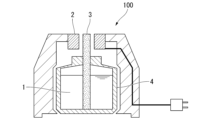
- the bottle was placed in the thermal evaporation type insecticide device of Fig. 1 and heated at a heater temperature of 140°C.
- the heating method consisted of 8 hours of continuous heating followed by 16 hours of heating before stopping, which constituted one cycle (one day), and this cycle was repeated.
- the amount of natural pyrethrins volatilized for one hour, 4 to 5 hours after the start of heating was measured.
- the test was performed twice, and the amount of natural pyrethrins volatilized was calculated as the average value of the two measurements.
- the amount of natural pyrethrins evaporated was determined by collecting the evaporated natural pyrethrins over time using a glass column packed with polyurethane sponge as an adsorbent, then extracting the polyurethane sponge with acetone and quantitatively analyzing the amount of natural pyrethrins evaporated using high performance liquid chromatography (absolute calibration curve method). The results are shown in Table 7.
- ND means not determined.
- the pest control formulations for thermal evaporation of Examples 1 and 1-2 contain a specific amount of a specific antioxidant, and therefore have an excellent amount of natural pyrethrin volatilized per hour, which can be maintained for a long period of time.
- Quantitation of natural pyrethrins by high-performance liquid chromatography can be carried out, for example, under the analytical conditions described in "Separation and quantitative analysis of natural pyrethrins by high-performance liquid chromatography," Chromatographia, 1999, Vol. 50, pp. 607-610.
- Test Example 2 Evaluation of formulations for pest control mats
- Two pieces of the pest control mats (total amount of natural pyrethrin active ingredient: 200 mg/treatment area) produced in Examples 2 and 3 and Comparative Examples 1 and 2 were heated on a ceramic heater at 180°C, and the amount of natural pyrethrin volatilized for one hour between 3 and 4 hours after the start of heating was analyzed. The results are shown in Table 8.
- the pest control mat formulations of Examples 2 and 3 contain a specific amount of a specific antioxidant, and therefore have a superior amount of natural pyrethrin volatilized in one hour between 3 and 4 hours after the start of heating compared to Comparative Examples 1 and 2.
- Test Example 3 Evaluation of Composition for Resin Preparation
- the natural pyrethrins and the antioxidants used in Examples 6 and 7, and Comparative Example 3 were each dissolved in an appropriate amount of acetone, and then the solution was dropped onto a petri dish having a diameter of 4.5 cm so that the natural pyrethrins were 0.3 mg and the antioxidants used in Examples 6 and 7, and Comparative Example 3 were 0.03 mg each.
- the solution was then spread evenly and dried for 5 days to obtain a composition of the present invention.
- the petri dish was placed in a plastic cup, and 10 adult female mosquitoes were released into it.
- KD rate (number of knocked down insects/number of test insects) x 100 The results are shown in Table 9.
- compositions for resin formulations of Examples 4 and 5 contain a specific amount of a specific antioxidant, and therefore have a superior knockdown rate of pests after a predetermined time has elapsed compared to Comparative Example 3.
- Test Example 4 Evaluation of MUP
- the MUP solutions of Examples 6 to 25 and Comparative Examples 4 and 5 were placed in 2 mL glass containers, and the glass containers were set in a block heater heated to 90° C.
- the block heater was covered with aluminum foil to shield the glass containers from light, and the containers were heated at 90° C. for 14 days to obtain samples.
- the obtained sample was taken out of the glass vessel and dissolved in tetrahydrofuran (THF), and the amount of the polymer component contained in the sample was measured according to the following analytical conditions.
- the Munsell value of the sample was also determined according to the following appearance observation method.
- the MUPs of Examples 6 to 25 contain a specific amount of a specific antioxidant, and thus, compared to Comparative Examples 4 and 5, the increase in the amount of polymer components after storage at 90°C for 14 days while heating is suppressed. In other words, the storage stability is improved. Furthermore, it is observed that MUPs containing citric acid tend to have the above-mentioned effects superior to MUPs not containing citric acid. Furthermore, it is also possible to confirm antioxidants that contain a specific amount of a specific antioxidant and thus have the effect of suppressing deterioration of appearance, such as coloration.
- Test Example 5 Evaluation of a thermal evaporation insect control formulation (ceramic core) 34 g of the pest control formulations for thermal evaporation obtained in Examples 26 to 29 were each filled into a 45 mL plastic container, and a porous liquid-absorbing wick (diameter 7 mm, length 73 mm, made of ceramic) with an inner stopper that could be heated at the top with a heater was inserted to obtain a bottle containing the pest control formulation for thermal evaporation with a liquid-absorbing wick. The bottle was placed in the thermal evaporation type insecticide device of Fig. 1 and heated at a heater temperature of 140°C.
- the heating method consisted of 8 hours of continuous heating followed by 4 hours of stopping heating, which constituted one cycle, and this cycle was repeated.
- the amount of natural pyrethrins volatilized for 1 hour, 4 to 5 hours after the start of heating was measured.
- the test was repeated twice, and the amount of natural pyrethrins volatilized was calculated as the average value of the two measurements.
- the amount of natural pyrethrins evaporated was determined by collecting the evaporated natural pyrethrins over time using a glass column packed with polyurethane sponge as an adsorbent, then extracting the polyurethane sponge with acetone and quantitatively analyzing the amount of natural pyrethrins evaporated using high performance liquid chromatography (absolute calibration curve method). The results are shown in Table 11.
- Test Example 6 Evaluation 2 of a thermal vaporization pest control formulation (ceramic core) 34 g of the pest control formulations for thermal evaporation obtained in Examples 30 to 35 and Comparative Example 6 were each filled into a 45 mL plastic container, and a porous liquid-absorbing wick (diameter 7 mm, length 73 mm, made of ceramic) whose upper part could be heated by a heater was inserted through an inner stopper to obtain a bottle containing the pest control formulation for thermal evaporation with a liquid-absorbing wick. The bottle was placed in the thermal evaporation type insect killing device shown in Fig. 1 and heated at a heater temperature of 140°C.
- the heating method consisted of 8 hours of continuous heating followed by 4 hours of heating to be one cycle, which was repeated. After 20 cycles (total heating time was 160 hours) were performed from the start of heating, the molecular weight (polystyrene equivalent) of the polymer generated in the heated portion of the porous liquid-absorbent wick was determined by high performance liquid chromatography (GPC) using the method described in the polymer analysis conditions.
- GPC high performance liquid chromatography
- Test Example 7 Evaluation of a composition containing natural pyrethrins
- the aluminum dishes on which the natural pyrethrin-containing compositions obtained in Examples 36 to 45 and Comparative Examples 7 and 8 were placed were heated on a ceramic heater at 180° C. for 1 hour.
- the molecular weight (in terms of polystyrene) of the polymer formed on the aluminum dish was determined by high performance liquid chromatography (GPC) using the method described under polymer analysis conditions. The results are shown in Table 13.
- Test Example 8 Evaluation of a pest control formulation for thermal evaporation 45 mL of the pest control formulation 1 for thermal evaporation obtained in Example 1 was filled into a 45 mL plastic container, and a porous liquid-absorbing wick (diameter 7 mm, length 73 mm, fired silica, calcite, etc. (made of china clay)) with an inner stopper so that the top could be heated by a heater was inserted to make a bottle containing the pest control formulation 1 for thermal evaporation with a liquid-absorbing wick. The bottle was placed in the thermal evaporation type insecticide device shown in Fig. 1 and heated at a heater temperature of 140°C.
- the heating method consisted of 8 hours of continuous heating followed by 16 hours of heating before stopping, which constituted one cycle (one day), and this cycle was repeated.
- the KD rate in that cycle was calculated by the following method. Twenty adult female Culex pipiens pallens were placed in a glass tube 4.5 cm in diameter and 12 cm in height, and 16-mesh nylon netting was fixed to the top and bottom openings of the glass tube with rubber bands to confine them in.
- a metal cylinder 22 cm in diameter and 83 cm in height was set upright, and two glass tubes containing the Culex pipiens pallens were fixed upright to the top openings.
- KD rate (number of knocked down insects/number of test insects) x 100
- the test was performed in duplicate, and the KD rate was calculated as the average of the two results. The results are shown in Table 14.
- the present invention provides a new composition containing natural pyrethrins that maintains pest control effects and has excellent storage stability.
Landscapes
- Life Sciences & Earth Sciences (AREA)
- Pest Control & Pesticides (AREA)
- General Health & Medical Sciences (AREA)
- Health & Medical Sciences (AREA)
- Wood Science & Technology (AREA)
- Engineering & Computer Science (AREA)
- Environmental Sciences (AREA)
- Zoology (AREA)
- Plant Pathology (AREA)
- Chemical & Material Sciences (AREA)
- Agronomy & Crop Science (AREA)
- Dentistry (AREA)
- Organic Chemistry (AREA)
- Toxicology (AREA)
- Insects & Arthropods (AREA)
- General Chemical & Material Sciences (AREA)
- Chemical Kinetics & Catalysis (AREA)
- Agricultural Chemicals And Associated Chemicals (AREA)
- Compositions Of Macromolecular Compounds (AREA)
Priority Applications (4)
| Application Number | Priority Date | Filing Date | Title |
|---|---|---|---|
| AU2024289132A AU2024289132A1 (en) | 2023-07-03 | 2024-06-27 | Composition containing natural pyrethrin and antioxidant |
| JP2025531519A JPWO2025009464A1 (https=) | 2023-07-03 | 2024-06-27 | |
| CN202480042205.8A CN121398679A (zh) | 2023-07-03 | 2024-06-27 | 含有天然除虫菊酯和抗氧化剂的组合物 |
| MX2025014745A MX2025014745A (es) | 2023-07-03 | 2025-12-08 | Composicion que contiene piretrina natural y un antioxidante |
Applications Claiming Priority (4)
| Application Number | Priority Date | Filing Date | Title |
|---|---|---|---|
| JP2023-109574 | 2023-07-03 | ||
| JP2023109574 | 2023-07-03 | ||
| JP2023-143206 | 2023-09-04 | ||
| JP2023143206 | 2023-09-04 |
Publications (1)
| Publication Number | Publication Date |
|---|---|
| WO2025009464A1 true WO2025009464A1 (ja) | 2025-01-09 |
Family
ID=94171526
Family Applications (1)
| Application Number | Title | Priority Date | Filing Date |
|---|---|---|---|
| PCT/JP2024/023373 Ceased WO2025009464A1 (ja) | 2023-07-03 | 2024-06-27 | 天然ピレトリンと酸化防止剤とを含有する組成物 |
Country Status (5)
| Country | Link |
|---|---|
| JP (1) | JPWO2025009464A1 (https=) |
| CN (1) | CN121398679A (https=) |
| AU (1) | AU2024289132A1 (https=) |
| MX (1) | MX2025014745A (https=) |
| WO (1) | WO2025009464A1 (https=) |
Citations (12)
| Publication number | Priority date | Publication date | Assignee | Title |
|---|---|---|---|---|
| JPS5212106B1 (https=) | 1964-05-24 | 1977-04-05 | ||
| JPS5845670A (ja) | 1981-09-07 | 1983-03-16 | Matsushita Electric Ind Co Ltd | 磁気デイスク装置 |
| JPH11510055A (ja) | 1995-07-25 | 1999-09-07 | ザ シャウベル コーポレーション | 揮発性物質の分出装置 |
| JPH11323008A (ja) * | 1998-05-13 | 1999-11-26 | Nippon Carbide Ind Co Inc | フッ素系樹脂フィルムのリサイクル方法 |
| JP2012176947A (ja) | 2011-02-04 | 2012-09-13 | Sumitomo Chemical Co Ltd | 加熱蒸散用害虫防除材及び加熱蒸散害虫防除方法 |
| US20130323292A1 (en) * | 2012-06-01 | 2013-12-05 | Lina Long | Clog Resistant Insect Control Formulations Containing Pyrethrin, An Acetylenic Compound, And A Hydrocarbon Diene |
| US20130324604A1 (en) * | 2012-06-01 | 2013-12-05 | Lina Long | Clog Resistant Insect Control Formulations Having Terminal Diyne Acetylenic Hydrocarbon And Pyrethrin |
| CN109090130A (zh) * | 2017-06-21 | 2018-12-28 | 季剑 | 缓释型天然除虫菊素驱蚊粉剂的制备 |
| JP2021102661A (ja) * | 2021-04-16 | 2021-07-15 | 住友化学株式会社 | 有害生物防除組成物および防除方法 |
| WO2022220294A1 (ja) | 2021-04-16 | 2022-10-20 | 住友化学株式会社 | 有害生物防除組成物および防除方法 |
| JP2023109574A (ja) | 2022-01-27 | 2023-08-08 | 株式会社プラッツ | 体位変換装置 |
| JP2023143206A (ja) | 2022-03-25 | 2023-10-06 | サッポロビール株式会社 | 飲料サーバー |
-
2024
- 2024-06-27 JP JP2025531519A patent/JPWO2025009464A1/ja active Pending
- 2024-06-27 AU AU2024289132A patent/AU2024289132A1/en active Pending
- 2024-06-27 WO PCT/JP2024/023373 patent/WO2025009464A1/ja not_active Ceased
- 2024-06-27 CN CN202480042205.8A patent/CN121398679A/zh active Pending
-
2025
- 2025-12-08 MX MX2025014745A patent/MX2025014745A/es unknown
Patent Citations (12)
| Publication number | Priority date | Publication date | Assignee | Title |
|---|---|---|---|---|
| JPS5212106B1 (https=) | 1964-05-24 | 1977-04-05 | ||
| JPS5845670A (ja) | 1981-09-07 | 1983-03-16 | Matsushita Electric Ind Co Ltd | 磁気デイスク装置 |
| JPH11510055A (ja) | 1995-07-25 | 1999-09-07 | ザ シャウベル コーポレーション | 揮発性物質の分出装置 |
| JPH11323008A (ja) * | 1998-05-13 | 1999-11-26 | Nippon Carbide Ind Co Inc | フッ素系樹脂フィルムのリサイクル方法 |
| JP2012176947A (ja) | 2011-02-04 | 2012-09-13 | Sumitomo Chemical Co Ltd | 加熱蒸散用害虫防除材及び加熱蒸散害虫防除方法 |
| US20130323292A1 (en) * | 2012-06-01 | 2013-12-05 | Lina Long | Clog Resistant Insect Control Formulations Containing Pyrethrin, An Acetylenic Compound, And A Hydrocarbon Diene |
| US20130324604A1 (en) * | 2012-06-01 | 2013-12-05 | Lina Long | Clog Resistant Insect Control Formulations Having Terminal Diyne Acetylenic Hydrocarbon And Pyrethrin |
| CN109090130A (zh) * | 2017-06-21 | 2018-12-28 | 季剑 | 缓释型天然除虫菊素驱蚊粉剂的制备 |
| JP2021102661A (ja) * | 2021-04-16 | 2021-07-15 | 住友化学株式会社 | 有害生物防除組成物および防除方法 |
| WO2022220294A1 (ja) | 2021-04-16 | 2022-10-20 | 住友化学株式会社 | 有害生物防除組成物および防除方法 |
| JP2023109574A (ja) | 2022-01-27 | 2023-08-08 | 株式会社プラッツ | 体位変換装置 |
| JP2023143206A (ja) | 2022-03-25 | 2023-10-06 | サッポロビール株式会社 | 飲料サーバー |
Non-Patent Citations (4)
| Title |
|---|
| "Separation and quantitative analysis of natural pyrethrins by high-performance liquid chromatography", CHROMATOGRAPHIA, vol. 50, 1999, pages 607 - 610 |
| ADNANE. H. ALAIN, C.CHANTAL, B.: "The Production of Pyrethrins by Plant Cell and Tissue Cultures of Chrysanthemum cinerariaefolium and Tagetes Species.", CRITICAL REVIEWS IN PLANT SCIENCES, vol. 19, no. 1, 2000, pages 69 - 89 |
| JOHN E. CASIDAGARY B. QUISTAD: "Production, Chemistry, Toxicology, and Uses", 1995, OXFORD UNIVERSITY PRESS, article "PYRETHRUM FLOWERS", pages: 123 - 125 |
| KUDAKASSERIL, G. J.STABA, E. J.: "Cell Culture and Somatic Cell Genetics of Plants.", 1988, ACADEMIC PRESS, article "Insecticidal phytochemicals", pages: 537 - 552 |
Also Published As
| Publication number | Publication date |
|---|---|
| CN121398679A (zh) | 2026-01-23 |
| MX2025014745A (es) | 2026-01-07 |
| AU2024289132A1 (en) | 2026-01-15 |
| JPWO2025009464A1 (https=) | 2025-01-09 |
Similar Documents
| Publication | Publication Date | Title |
|---|---|---|
| JP7489564B1 (ja) | 2-(5-シクロプロピル-3-(エチルスルホニル)ピリジン-2-イル)-5-((トリフルオロメチル)スルフィニル)ベンゾ[d]オキサゾールの結晶 | |
| TW202446264A (zh) | 增強殺蟲效果用之組成物及增強殺蟲效果的方法 | |
| JP7332584B2 (ja) | アルキン化合物及びそれを含有する有害節足動物防除組成物 | |
| JP7716469B2 (ja) | ゾアンタミン類を用いる有害節足動物又は有害線形動物の防除方法 | |
| WO2019124568A2 (ja) | 有害生物防除組成物及び有害生物の防除方法 | |
| JP7281447B2 (ja) | シクロプロピルエチレン化合物及びそれを含有する有害節足動物防除組成物 | |
| JP7489565B1 (ja) | 2-(5-シクロプロピル-3-(エチルスルホニル)ピリジン-2-イル)-5-((トリフルオロメチル)スルホニル)ベンゾ[d]オキサゾールの結晶 | |
| BR112021016488A2 (pt) | Composto de éter e composição de controle de artrópode nocivo contendo o mesmo | |
| WO2025009464A1 (ja) | 天然ピレトリンと酸化防止剤とを含有する組成物 | |
| WO2025053083A1 (ja) | 合成ピレスロイド化合物とペンタエリスリトール系酸化防止剤とを含有する組成物 | |
| WO2026004535A1 (ja) | ピレスロイド化合物と亜リン酸トリステアリルとを含有する組成物 | |
| KR20260059649A (ko) | 합성 피레트로이드 화합물과 펜타에리트리톨계 산화 방지제를 함유하는 조성물 | |
| JP7538380B1 (ja) | エステル化合物及びその用途 | |
| JP2024153983A (ja) | 殺虫剤組成物及び植食性害虫の防除方法 | |
| TW202342020A (zh) | 使用唑安他命類似物防除有害節肢動物或有害線形動物之方法 | |
| WO2024080355A1 (ja) | スルホンアミド化合物及びそれを含有する有害節足動物防除組成物 | |
| BR112020019804A2 (pt) | Composto heterocíclico e composição de controle de peste artrópode contendo o mesmo |
Legal Events
| Date | Code | Title | Description |
|---|---|---|---|
| 121 | Ep: the epo has been informed by wipo that ep was designated in this application |
Ref document number: 24835977 Country of ref document: EP Kind code of ref document: A1 |
|
| ENP | Entry into the national phase |
Ref document number: 2025531519 Country of ref document: JP Kind code of ref document: A |
|
| WWE | Wipo information: entry into national phase |
Ref document number: MX/A/2025/014745 Country of ref document: MX |
|
| WWE | Wipo information: entry into national phase |
Ref document number: AU2024289132 Country of ref document: AU |
|
| REG | Reference to national code |
Ref country code: BR Ref legal event code: B01A Ref document number: 112025026847 Country of ref document: BR |
|
| WWE | Wipo information: entry into national phase |
Ref document number: 2501008746 Country of ref document: TH |
|
| WWP | Wipo information: published in national office |
Ref document number: MX/A/2025/014745 Country of ref document: MX |
|
| ENP | Entry into the national phase |
Ref document number: 2024289132 Country of ref document: AU Date of ref document: 20240627 Kind code of ref document: A |
|
| WWE | Wipo information: entry into national phase |
Ref document number: 2024835977 Country of ref document: EP |
|
| NENP | Non-entry into the national phase |
Ref country code: DE |
|
| ENP | Entry into the national phase |
Ref document number: 2024835977 Country of ref document: EP Effective date: 20260203 |