WO2025009010A1 - コイル部品、コイル部品の製造方法および電子・電気機器 - Google Patents
コイル部品、コイル部品の製造方法および電子・電気機器 Download PDFInfo
- Publication number
- WO2025009010A1 WO2025009010A1 PCT/JP2023/024566 JP2023024566W WO2025009010A1 WO 2025009010 A1 WO2025009010 A1 WO 2025009010A1 JP 2023024566 W JP2023024566 W JP 2023024566W WO 2025009010 A1 WO2025009010 A1 WO 2025009010A1
- Authority
- WO
- WIPO (PCT)
- Prior art keywords
- magnetic powder
- region
- coil
- coil component
- diameter
- Prior art date
- Legal status (The legal status is an assumption and is not a legal conclusion. Google has not performed a legal analysis and makes no representation as to the accuracy of the status listed.)
- Ceased
Links
Images










Classifications
-
- H—ELECTRICITY
- H01—ELECTRIC ELEMENTS
- H01F—MAGNETS; INDUCTANCES; TRANSFORMERS; SELECTION OF MATERIALS FOR THEIR MAGNETIC PROPERTIES
- H01F1/00—Magnets or magnetic bodies characterised by the magnetic materials therefor; Selection of materials for their magnetic properties
- H01F1/01—Magnets or magnetic bodies characterised by the magnetic materials therefor; Selection of materials for their magnetic properties of inorganic materials
- H01F1/03—Magnets or magnetic bodies characterised by the magnetic materials therefor; Selection of materials for their magnetic properties of inorganic materials characterised by their coercivity
- H01F1/12—Magnets or magnetic bodies characterised by the magnetic materials therefor; Selection of materials for their magnetic properties of inorganic materials characterised by their coercivity of soft-magnetic materials
- H01F1/14—Magnets or magnetic bodies characterised by the magnetic materials therefor; Selection of materials for their magnetic properties of inorganic materials characterised by their coercivity of soft-magnetic materials metals or alloys
- H01F1/20—Magnets or magnetic bodies characterised by the magnetic materials therefor; Selection of materials for their magnetic properties of inorganic materials characterised by their coercivity of soft-magnetic materials metals or alloys in the form of particles, e.g. powder
- H01F1/22—Magnets or magnetic bodies characterised by the magnetic materials therefor; Selection of materials for their magnetic properties of inorganic materials characterised by their coercivity of soft-magnetic materials metals or alloys in the form of particles, e.g. powder pressed, sintered, or bound together
- H01F1/24—Magnets or magnetic bodies characterised by the magnetic materials therefor; Selection of materials for their magnetic properties of inorganic materials characterised by their coercivity of soft-magnetic materials metals or alloys in the form of particles, e.g. powder pressed, sintered, or bound together the particles being insulated
- H01F1/26—Magnets or magnetic bodies characterised by the magnetic materials therefor; Selection of materials for their magnetic properties of inorganic materials characterised by their coercivity of soft-magnetic materials metals or alloys in the form of particles, e.g. powder pressed, sintered, or bound together the particles being insulated by macromolecular organic substances
-
- H—ELECTRICITY
- H01—ELECTRIC ELEMENTS
- H01F—MAGNETS; INDUCTANCES; TRANSFORMERS; SELECTION OF MATERIALS FOR THEIR MAGNETIC PROPERTIES
- H01F17/00—Fixed inductances of the signal type
- H01F17/04—Fixed inductances of the signal type with magnetic core
-
- H—ELECTRICITY
- H01—ELECTRIC ELEMENTS
- H01F—MAGNETS; INDUCTANCES; TRANSFORMERS; SELECTION OF MATERIALS FOR THEIR MAGNETIC PROPERTIES
- H01F27/00—Details of transformers or inductances, in general
- H01F27/24—Magnetic cores
- H01F27/255—Magnetic cores made from particles
Definitions
- the present invention relates to a coil component, a manufacturing method thereof, and an electronic/electrical device in which the coil component is mounted.
- Patent document 1 discloses a power inductor comprising a body containing magnetic powder and a polymer, at least one substrate provided inside the body and having at least one coil pattern formed on at least one surface thereof, and an insulating layer formed between the coil pattern and the body, the body including at least one region in which the particles of the magnetic powder are distributed in a size different from the rest.
- the magnetic circuit formed in the main body by passing current through the coil progresses in a direction along the central axis of the coil on the inner and outer sides of the coil, and in a direction across the central axis of the coil on the two bottom sides of the coil.
- the magnetic properties it may be preferable for the magnetic properties to be different on the inner and bottom sides of the coil in the main body.
- the part of the coil located on the bottom side of the main body may face the board or protrude from the board. For this reason, it may be preferable for the above-mentioned parts to have different electrical properties, mechanical properties, etc. from the part located on the inner side of the coil in the main body.
- the present invention aims to provide a coil component with improved functionality of the main body. It also aims to provide a method for manufacturing the coil component, and an electronic/electrical device in which the coil component is mounted.
- the present invention which is provided to solve the above problems, is a coil component including a coil section having an annular conductor section having a central axis along a first direction and two electrical ends, and a main body section covering the annular conductor section with a first face and a second face aligned in the first direction and including a magnetic powder and a binder.
- the coil section is exposed from the surface of the main body section at a first end face connected to one of the two electrical ends of the annular conductor section and a second end face connected to the other of the two electrical ends of the annular conductor section.
- the main body section includes a first region made of a first material and including the first face, a second region made of a second material and including the second face, and a third region made of a third material and located between the first face and the second face in the first direction.
- the third region includes a central region whose entire outer periphery faces the inner periphery of the annular conductor section.
- the second material and the third material differ in at least one selected from the group consisting of the composition of the magnetic powder, the shape distribution which is the distribution of the shapes of the magnetic powder, the content of the magnetic powder, the composition of the binder, the content of the binder, and, if a third component other than the magnetic powder and the binder is contained, the composition and the content of the third component.
- the material of the third region including the central region can be made different from the material located near the intersection surface. This allows the main body to be endowed with new functions and to have high functionality.
- the first material and the second material may be the same.
- the region including the central region may have different characteristics from the other regions.
- the first material and the second material may differ in one or more selected from the group consisting of the composition of the magnetic powder, the shape distribution of the magnetic powder, the content of the magnetic powder, the composition of the binder, the content of the binder, and, if the third component other than the magnetic powder and the binder is contained, the composition and the content of the third component.
- the first material and the third material may be the same.
- the second region may be able to have unique properties different from other regions.
- the annular conductor portion may contact at least one of the first region and the second region at the end in the first direction.
- the third region may extend in the first direction so as to contact at least one of the two ends of the annular conductor in the first direction.
- the third material extend between at least one of the areas between the annular conductor and the first region and between the annular conductor and the second region, it may be possible to more stably enjoy the benefit of constructing the third region from the third material (suppression of short circuits in the annular conductor due to localized breakage of the insulating portion).
- the second material may be harder than the third material. Since most of the second region is an area where the coil portion does not exist, by making this region hard, defects due to loss or deformation of the main body portion are less likely to occur. Furthermore, when forming the main body portion by pressing a material containing magnetic powder and a hardenable material in a first direction, it becomes easier to control the position of the coil portion within the main body portion.
- a second area ratio which is the area ratio of the magnetic powder on a second cut surface obtained by cutting the second region on a surface perpendicular to the first direction
- a third area ratio which is the area ratio of the magnetic powder on a third cut surface obtained by cutting the third region on a surface perpendicular to the first direction.
- the second region is more likely to be hard.
- the second material may have higher insulating properties than the third material. If the second surface is the mounting surface, short circuits are less likely to occur on the mounting surface side. In particular, if bottom electrodes are provided, short circuits between bottom electrodes are less likely to occur. If the second surface is on the opposite side to the mounting surface, the second region is relatively susceptible to the effects of collisions, etc., but insulation breakdown is less likely to occur even if the exterior coating peels off due to a collision.
- the resistivity of the second region may be greater than the resistivity of the third region. In this case, it is easier to achieve a higher insulating property for the second material than for the third material.
- the magnetic powder contained in the second material may include metal magnetic powder, and the relative magnetic permeability ⁇ 2 of the second region may be smaller than the relative magnetic permeability ⁇ 1 of the first region.
- One method for relatively increasing the insulation of the second region is to increase the content of insulating material in the second material. In this case, the content of metal magnetic powder is relatively decreased, so that the relative magnetic permeability ⁇ 2 of the second region tends to be smaller than the relative magnetic permeability ⁇ 1 of the first region.
- the length h2 of the second region in the first direction may be greater than the length h1 of the first region in the first direction. Even if the relative permeability ⁇ 2 of the second region is smaller than the relative permeability ⁇ 1 of the first region, by setting h2>h1, it is possible to avoid the magnetic resistance of the second region becoming excessively high.
- the second material may contain insulating inorganic particles as the third component.
- Many insulating inorganic particles have a higher dielectric strength than the binder, and this tendency is more pronounced when the binder is a polymer.
- inorganic particles By including inorganic particles as the third component of the second material, the possibility of dielectric breakdown occurring in the second region can be reduced.
- the magnetic powder contained in the second material may include a metal magnetic powder having an insulating coating on its surface.
- the magnetic powder When the magnetic powder is a metal magnetic powder, the magnetic powder forms a conductive path in the event of dielectric breakdown. Therefore, by having an insulating coating on the surface of the metal magnetic powder, it may be possible to reduce the possibility of dielectric breakdown occurring in the second region.
- the annular conductor portion has an insulating portion on its surface
- the magnetic powder contained in the third material includes metal magnetic powder
- a third average equivalent circle diameter which is an average equivalent circle diameter of the magnetic powder on the third cut surface, is smaller than a second average equivalent circle diameter, which is an average equivalent circle diameter of the magnetic powder on the second cut surface
- a third median diameter which is a median diameter of the magnetic powder on the third cut surface, is smaller than a second median diameter, which is a median diameter of the magnetic powder on the second cut surface
- a third maximum equivalent circle diameter which is a maximum equivalent circle diameter of the magnetic powder on the third cut surface, is smaller than a second maximum equivalent circle diameter of the magnetic powder on the second cut surface
- at least one of the second diameter distribution which is a distribution of the equivalent circle diameters of the magnetic powder on the second cross section, and the third diameter distribution, which is a distribution of the equivalent circle diameters of the magnetic powder on the third cross section, has two or more peaks
- the third peak diameter which is the maximum frequency equivalent circle diameter of the largest diameter peak among the peaks in the third diameter distribution, is smaller than the
- the third region is more likely to contain magnetic powder with a relatively small particle size, when forming the main body by applying pressure to a material containing magnetic powder in a first direction, even if the insulating portion provided on the surface of the annular conductor portion is locally broken by the magnetic powder due to pressure application, a short circuit is less likely to occur within the annular conductor portion.
- the third region is more likely to contain magnetic powder with a relatively small particle size, when forming the main body by applying pressure to a material containing magnetic powder in a first direction, even if the insulating portion provided on the surface of the annular conductor portion is locally broken by the magnetic powder due to pressure application, a short circuit is less likely to occur within the annular conductor portion.
- the third region is more likely to contain magnetic powder with a relatively small particle size, when forming the main body by applying pressure to a material containing magnetic powder in a first direction, even if the insulating portion provided on the surface of the annular conductor is locally broken by the magnetic powder due to pressure application, a short circuit is less likely to occur within the annular conductor.
- the third region is more likely to contain magnetic powder with a relatively small particle size, when forming the main body by applying pressure to a material containing magnetic powder in a first direction, even if the insulating portion provided on the surface of the annular conductor portion is locally broken by the magnetic powder due to pressure application, a short circuit is less likely to occur within the annular conductor portion.
- the annular conductor portion has an insulating portion on its surface
- the magnetic powder contained in the third material includes a metal magnetic powder
- the third particle size distribution, which is the volumetric particle size distribution of the magnetic powder contained in the third region may have two or more peaks.
- the third particle size which is the particle size with the highest frequency at the peak on the largest diameter side among the peaks of the third particle size distribution, may be smaller than the second particle size, which is the particle size with the highest frequency at the peak on the largest diameter side among the peaks of the second particle size distribution.
- the binder contained in the second region may contain a second polymer
- the binder contained in the third region may contain a third polymer.
- the physical properties of a polymer can be easily adjusted by adjusting the monomer composition and polymerization. Therefore, by having the binder contain a polymer, it becomes easier to adjust the properties of the binder.
- the weight average molecular weight of the second polymer may be greater than the weight average molecular weight of the third polymer.
- the second region containing the polymer with a relatively large molecular weight tends to have high strength and high viscosity overall, and therefore may have excellent impact resistance.
- the hardness of the binder contained in the second region measured by a nanoindenter may be smaller than the hardness of the binder contained in the third region measured by a nanoindenter.
- the second region containing a relatively hard binder tends to have high strength and high viscosity overall, and therefore may have excellent impact resistance.
- the present invention provides a method for manufacturing a coil component including a coil section having an annular conductor section having a central axis in a first direction and two electrical ends, and a main body section including a magnetic powder, covering the annular conductor section at a pair of intersecting surfaces aligned in the first direction.
- a laminated structure is disposed in a cavity of a mold, the laminated structure including the coil section, a first member located on one side of the coil section in the first direction and including a first magnetic powder and a first hardenable material, a second member located on the other side of the coil section in the first direction and including a second magnetic powder and a second hardenable material, and a third member located between the first member and the second member and including a third magnetic powder and a third hardenable material.
- a molded body including the coil section and the main body section is obtained from the laminated structure, including increasing the pressure in the cavity.
- a central region in which the entire outer periphery faces the inner periphery of the annular conductor section is made of a material based on the third member.
- the second member and the third member may differ in one or more selected from the group consisting of the composition of the second magnetic powder and the composition of the third magnetic powder, the particle size distribution of the second magnetic powder and the particle size distribution of the third magnetic powder, the content of the second magnetic powder in the second member and the content of the third magnetic powder in the third member, the composition of the second hardenable material and the composition of the third hardenable material, the content of the second hardenable material in the second member and the content of the third hardenable material in the third member, and, if the second member contains a second additive component other than the second hardenable material and the second magnetic powder and the third member contains a third additive component other than the third hardenable material and the third magnetic powder, the composition of the second additive component and the composition of the third additive component.
- hardenable material includes materials that harden and materials that cause hardening (such as polymerization initiators).
- additive components are materials that are not ferromagnetic and do not react with the hardenable material, and specific examples include non-polymerizable materials for softening components and inorganic particles for improving insulation.
- the first member and the third member may have the same composition.
- the first member and the third member may be integral. This may improve productivity.
- the above-mentioned coil component manufacturing method may include hardening the third hardenable material from the first hardenable material.
- the first direction may be along the vertical direction
- the second member may be located below the coil portion
- the second member may be harder than the third member.
- the second member is harder than the third member
- at least one of the following (I) to (VI) may be satisfied.
- (I) for the laminated structure disposed in the cavity the viscosity of the second curable material is higher than the viscosity of the third curable material
- (II) for the laminated structure disposed in the cavity the degree of polymerization of the second curable material is higher than the degree of polymerization of the third curable material
- III for the laminated structure disposed in the cavity, the content of uncured material contained in the second curable material is lower than the content of uncured material contained in the third curable material
- (IV) for the laminated structure disposed in the cavity the content of uncured material contained in the second curable material is lower than the content of uncured material contained in the third curable material
- (V) for the laminate structure disposed in the cavity a volume ratio of the second magnetic powder contained in the second member is greater than a volume ratio of the third magnetic powder contained in the third member
- the second member may have higher insulating properties than the third member.
- the coil portion has an insulating portion covering a surface of the annular conductor portion
- the third magnetic powder includes metal magnetic powder
- the present invention provides an electronic/electrical device in which the above-mentioned coil component is mounted, the coil component being connected to a substrate at terminal portions provided on exposed conductor portions located at each of the two ends of the coil portion and exposed to the outside.
- Examples of such electronic/electrical devices include power supplies and small portable communication devices equipped with a power switching circuit, a voltage step-up circuit, a smoothing circuit, etc.
- the electronic/electrical device according to the present invention has excellent overall characteristics as an inductance element because it is equipped with the above-mentioned coil component.
- a coil component such as the ability to prevent breakage during impact, the ability to ensure insulation against external electrodes, the ability to prevent short circuits within the coil section, and the ability to position the coil section within the main body.
- the functionality of the main body is enhanced, and a coil component is provided that has excellent electrical and other properties.
- this coil component is mounted in electronic or electrical equipment, the performance of the electronic or electrical equipment can be improved and the dimensions of the electronic or electrical equipment can be reduced.
- electronic or electrical equipment in which the coil component is mounted is provided. Furthermore, a method for manufacturing the above-mentioned coil component is also provided.
- FIG. 1 is a perspective view conceptually illustrating the shape of a coil component according to an embodiment of the present invention.
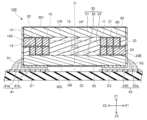
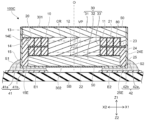
- This is an XZ cross-sectional view taken along line A-A' in Figure 1.
- 2 is an XZ cross-sectional view showing a state in which the coil component is mounted on a substrate.
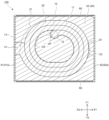
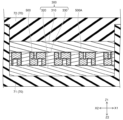
- FIG. This is an XY cross-sectional view taken along line B-B' in Figure 2.
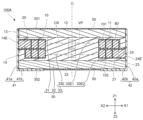
- 10 is an XZ cross-sectional view illustrating a modified example (part 1) of a coil component according to an embodiment of the present invention.
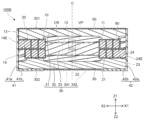
- FIG. 11 is an XZ cross-sectional view illustrating a modified example (part 2) of the coil component according to one embodiment of the present invention.
- FIG. FIG. 13 is a diagram illustrating different shape distributions of magnetic powder particles.
- FIG. 11A to 11C are explanatory diagrams (comparative examples) of an example of the function of a main body of a coil component according to an embodiment of the present invention.
- 1A to 1C are explanatory diagrams (examples of the present invention) of an example of the function of a main body of a coil component according to an embodiment of the present invention.
- FIG. 13 is a diagram illustrating different shape distributions of magnetic powder particles.
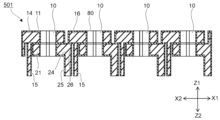
- FIG. 11 is an XZ cross-sectional view illustrating a modified example (part 3) of the coil component according to an embodiment of the present invention.
- FIG. 11 is an XZ cross-sectional view illustrating a fourth modified example of the coil component according to an embodiment of the present invention.
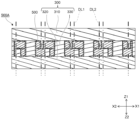
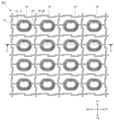
- FIG. 2 is an explanatory diagram (part 1) of an example of a manufacturing method of a coil component according to an embodiment of the present invention, and is an XY plan view of a coil array sheet. This is an XZ cross-sectional view along line C-C' in Figure 11A.
- FIG. 2 is an explanatory diagram (part 2) of an example of a manufacturing method for a coil component according to one embodiment of the present invention, and is an XZ cross-sectional view showing a state in which a coil array sheet or the like is placed in a cavity of a mold.
- FIG. 11 is an explanatory diagram (part 3) of an example of a manufacturing method for a coil component according to one embodiment of the present invention, and is an XZ cross-sectional view showing the state in which molding is performed using a mold to form a molded body.
- FIG. 11 is an explanatory diagram (part 4) of an example of a manufacturing method for a coil component according to an embodiment of the present invention, and is an XZ cross-sectional view showing a state before cutting the molded body.
- FIG. 5 is an explanatory diagram (part 5) of an example of a manufacturing method for a coil component according to one embodiment of the present invention, and is an XZ cross-sectional view showing the state in which the molded body has been cut to obtain a coil chip.
- 11A to 11C are explanatory diagrams (part 1) of an example of a manufacturing method for a modified coil component according to an embodiment of the present invention. This is an XZ cross-sectional view along line C-C' in Figure 16A.
- 13A to 13C are explanatory diagrams (part 2) of an example of a manufacturing method for a modified example of a coil component according to an embodiment of the present invention.
- 13A to 13C are explanatory diagrams (part 3) of an example of a manufacturing method for a modified coil component according to an embodiment of the present invention.
- FIG. 1 is a perspective view conceptually showing the shape of a coil component according to one embodiment of the present invention.
- FIG. 2 is an XZ cross-sectional view taken along line A-A' in FIG. 1.
- FIG. 3 is an XZ cross-sectional view showing the coil component mounted on a substrate.
- FIG. 4 is an XY cross-sectional view taken along line B-B' in FIG. 2.
- a coil component 100 includes a coil portion 10 having a coil conductor portion 20 , a main body portion 30 , a first external electrode 41 , a second external electrode 42 , and exterior coats 50 and 60 .
- the coil portion 10 has a coil conductor portion 20 having a first spiral conductor portion 11 in a spiral shape around a central axis O along a first direction (Z1-Z2 direction).
- the first spiral conductor portion 11 is an example of a part of an annular conductor portion.
- the spiral shape of the first spiral conductor portion 11 is a shape that moves away from the central axis O from an inner peripheral end portion 12, which is an end portion on the inner peripheral side of a pair of ends of the first spiral conductor portion 11, toward an outer peripheral end portion 13, which is an end portion on the outer peripheral side of a pair of ends of the first spiral conductor portion 11.
- an inner peripheral end portion 12 which is an end portion on the inner peripheral side of a pair of ends of the first spiral conductor portion 11
- an outer peripheral end portion 13 which is an end portion on the outer peripheral side of a pair of ends of the first spiral conductor portion 11.
- the first spiral conductor portion 11 has a conductor arranged in a spiral shape that moves away from the central axis O in a clockwise direction from the inner peripheral end portion 12 toward the outer peripheral end portion 13 when viewed from the Z1-Z2 direction Z1 side.
- the "spiral direction" of the spiral portion means the direction from the end portion on the inner peripheral side to the end portion on the outer peripheral side.
- the conductor (conductive material) constituting the coil conductor section 20 is not limited as long as it has appropriate conductivity.
- Specific examples of the conductor constituting the coil conductor section 20 include metals such as copper, copper alloys, aluminum, and aluminum alloys, and the coil conductor section 20 can be manufactured using a film-forming technique such as plating.
- the coil section 10 has an insulating coil insulation section 80 on the surface of the coil conductor section 20. This coil insulation section 80 ensures insulation between adjacent conductors in the coil conductor section 20 (between the surfaces of the conductors facing each other).
- the material constituting the coil insulation section 80 can be, for example, a resin material, but is not limited to a specific material, and may be an inorganic material or a mixture of an organic material and an inorganic material.
- the coil insulation section 80 is not provided at the ends of the two ends (the first lead-out end section 14E and the second lead-out end section 24E) of the coil conductor section 20, and the coil section 10 can be electrically connected to other
- the coil insulation section 80 may be thermoplastic, and a specific example is a thermoplastic resin containing a paraxylylene-based polymer.
- thermoplastic resins include polyethylene, polypropylene, polyamide, polyester, polyamideimide, polyimide, polysulfone, polycarbonate, liquid crystal polymer, polyvinylidene fluoride, and polytetrafluoroethylene.
- the coil insulation section 80 as a whole only needs to have thermoplastic properties, and may contain, in addition to the above-mentioned thermoplastic resins, for example, inorganic insulating particles.
- examples of the constituent materials of the coil insulation section 80 include organic materials such as thermosetting resins and inorganic materials such as oxides.
- the coil insulating part 80 has excellent insulation properties, and specifically, in some cases, it is preferable that the volume resistivity obtained by ASTM D257 is 1.0 ⁇ 10 14 ⁇ cm or more. This volume resistivity is more preferably 1.0 ⁇ 10 15 ⁇ cm or more, and even more preferably 1.0 ⁇ 10 16 ⁇ cm or more. The upper limit of the volume resistivity is not particularly limited. The volume resistivity may be 1.0 ⁇ 10 20 ⁇ cm or less. In addition, it is preferable that the coil insulating part 80 has excellent dielectric properties, and specifically, in some cases, it is preferable that the relative dielectric constant at 60 Hz obtained by ASTM D150 is 4.0 or less.
- This relative dielectric constant is more preferably 3.5 or less, and even more preferably 3.0 or less.
- the lower limit of this relative dielectric constant is not particularly limited.
- the relative dielectric constant may be 1.0 or more.
- the method for measuring the volume resistivity and relative dielectric constant of the coil insulating part 80 is not limited as long as the results equivalent to those obtained by the above ASTM D257 and D150 are expected. For example, a measurement sample is prepared by cutting a material equivalent to the coil insulating portion 80 to the dimensions required for measurement, and the constituent materials are identified using analytical techniques such as component analysis and FT-IR using this measurement sample, and the characteristics of the material, such as volume resistivity, are evaluated.
- the coil conductor portion 20 has a second spiral conductor portion 21 arranged alongside the first spiral conductor portion 11 in the first direction.
- the second spiral conductor portion 21 is another example of a part of an annular conductor portion.
- the second spiral conductor portion 21 has a spiral shape around a central axis O along the first direction (Z1-Z2 direction), from one end (inner circumference end portion 22) which is the inner circumference end portion of the second spiral conductor portion 21, to the other end (outer circumference end portion 23) which is the outer circumference end portion of the second spiral conductor portion 21, which moves away from the central axis O.
- the average value of the separation distance in the first direction (Z1-Z2 direction) between the first spiral conductor portion 11 and the second spiral conductor portion 21 is not particularly limited.
- the separation distance is 0.4 ⁇ m or more and 20 ⁇ m or less. In order to reduce the variation in the separation distance and to more reliably support the coil in the same plane in terms of manufacturing, it is more preferable that the separation distance is 1.0 ⁇ m or more, and even more preferable that it is 5.0 ⁇ m or more.
- the inner peripheral end 12 of the first spiral conductor portion 11 and the inner peripheral end 22 of the second spiral conductor portion 21 are electrically connected by the via portion VP.
- the via portion VP may be made of a conductor similar to that of the coil conductor portion 20.
- the via portion VP is manufactured in the process of manufacturing the first spiral conductor portion 11 and the second spiral conductor portion 21.
- the via portion VP is integrated with the inner peripheral end 12 of the first spiral conductor portion 11 and the inner peripheral end 22 of the second spiral conductor portion 21. Therefore, in this embodiment, the annular conductor portion has the first spiral conductor portion 11 and the second spiral conductor portion 21 as well as the via portion VP, and the outer peripheral ends 13 and 23 are the electrical ends of the two annular conductor portions.
- the first lead-out portion 14 is connected to the outer peripheral end 13 of the first spiral conductor portion 11, and the second lead-out portion 24 is connected to the outer peripheral end 23 of the second spiral conductor portion 21. Therefore, the outer peripheral end 13 of the first spiral conductor portion 11 is essentially an interface with the first lead-out portion 14, and the outer peripheral end 23 of the second spiral conductor portion 21 is essentially an interface with the second lead-out portion 24.
- the first lead-out portion 14 and the second lead-out portion 24 are manufactured together in the process of manufacturing the first spiral conductor portion 11 and the second spiral conductor portion 21.
- first lead-out portion 14 has a portion that is seamlessly integrated with the outer peripheral end 13 of the first spiral conductor portion 11
- the second lead-out portion 24 has a portion that is seamlessly integrated with the outer peripheral end 23 of the second spiral conductor portion 21.
- the coil conductor portion 20 has a first spiral conductor portion 11, a first lead-out portion 14, a second spiral conductor portion 21, a second lead-out portion 24, and a via portion VP, which are manufactured to have integrated portions in a common manufacturing process.
- the coil component 100 As shown in FIG. 1, the coil component 100 according to this embodiment has an external electrode provided on the outside of the main body 30 as a terminal of the coil component 100. In other words, the external electrode is provided on an exposed conductor portion, which is a portion of the coil portion 10 exposed to the outside.
- the coil component 10 has a first external electrode 41 in contact with the first lead end 14E and a second external electrode 42 in contact with the second lead end 24E.
- the first external electrode 41 is continuous with a first lateral external electrode 41a located on the outer surface of the main body 30 and a first intersecting plane external electrode 41b located on the second surface 302 of the main body 30.
- the second external electrode 42 is continuous with a second lateral external electrode 42a located on the outer surface of the main body 30 and a second intersecting plane external electrode 42b located on the second surface 302 of the main body 30.
- the solder S1 is located between the first board electrode E1 and the first lateral external electrode 41a, which extend in the X1-X2 direction from a position on the board SB sufficiently distal to the first lateral external electrode 41a (on the X2 side in the X1-X2 direction) to a position facing the second surface 302, and between the first board electrode E1 and the first intersecting plane external electrode 41b.
- solder S2 is located between the second board electrode E2 and the second lateral external electrode 42a, which extend in the X1-X2 direction from a position on the board SB sufficiently distal to the second lateral external electrode 42a (on the X1 side in the X1-X2 direction) to a position facing the second surface 302, and between the second board electrode E2 and the second intersecting plane external electrode 42b.
- the material and configuration of the first external electrode 41 and the second external electrode 42 are not limited as long as they have appropriate conductivity.
- One non-limiting example of the first external electrode 41 and the second external electrode 42 is a layer having a structure of Cu plating/Ni plating/Sn plating from the side proximal to the surface of the main body 30.
- the first external electrode 41 and the second external electrode 42 may be composed of a coated electrode in which a conductive material such as silver is dispersed in a resin or the like.
- the first external electrode 41 and the second external electrode 42 may also be a combination of plating and a coated electrode.
- the main body 30 covers the first spiral conductor 11 and the second spiral conductor 21 at least with a pair of intersecting surfaces (first surface 301, second surface 302) arranged in a first direction (Z1-Z2 direction), and contains a magnetic powder and a binder.
- the main body 30 has four outer surfaces extending in the first direction (Z1-Z2 direction) between the pair of intersecting surfaces, and has a substantially rectangular parallelepiped shape.
- the main body 30 includes a portion other than the outermost end surface (X2 side in the X1-X2 direction and both sides in the Z1-Z2 direction) of the first lead-out portion 14 and the outermost end surface (X1 side in the X1-X2 direction and both sides in the Z1-Z2 direction) of the second lead-out portion 24, which are located at the end of the coil portion 10.
- the coil portion 10 is exposed from the surface of the main body portion 30 at a first end face (first pull-out end 14E) that is connected to one of the two electrical ends of the annular conductor portion (outer peripheral end 13) and a second end face (second pull-out end 24E) that is connected to the other of the two electrical ends of the annular conductor portion (outer peripheral end 23).
- the main body 30 is composed of a first region 31 made of a first material and including a first surface 301, a second region 32 made of a second material and including a second surface 302, and a third region 33 made of a third material and located between the first surface 301 and the second surface 302 in the first direction.
- the third region 33 includes a central region CR whose entire outer periphery faces the inner periphery of the annular conductor (the first spiral conductor 11 and the second spiral conductor 21, and the via portion VP).
- the length (thickness) of the central region CR in the first direction is appropriately set according to the characteristics required for the central region CR and the shape of the inner periphery of the annular conductor.
- the thickness of the central region CR may be equal to the length of the annular conductor in the first direction (the thickness of the annular conductor), or may be half the thickness of the annular conductor, or may be, for example, 1/4.
- the central region CR may be positioned to one side toward the first region 31, to one side toward the second region 32, or to be positioned so as to be spaced approximately evenly apart from the first region 31 and the second region 32.
- the second material and the third material differ in one or more properties selected from the group consisting of the following [1] to [6].
- a main body 30 is obtained in which the characteristics of the second region 32 and the third region 33 are different.
- the first material and the second material may be the same, and in this case, the third region 33 including the central region CR can have different characteristics from the other regions.
- the first region 31 and the second region 32 when current is applied to the coil component 100, a magnetic circuit is formed in a direction intersecting the first direction, so by being made of a common material, it may be possible to suppress a local increase in magnetic resistance.
- the first region 31 and the second region 32 are hard, and therefore may be less susceptible to the effects of external impacts.
- the first material and the second material in the main body 30 may also differ in one or more of the group consisting of [1] to [6] above.
- the first region 31 and the second region 32 have different characteristics, it may be possible to impart additional functions to the main body 30.
- the first region 31 does not face the substrate SB, so the first material may be formed to be relatively hard, for example, to increase resistance to external impacts, and the second region 32 faces the mounting surface, so the second material may be formed to have relatively high insulating properties.
- the first material and the third material may be the same.
- the second region 32 has unique properties different from the other regions, which may give the main body 30 a new function and improve its functionality.
- the positional relationship between the boundary between the first region 31, the third region 33, and the second region 32 aligned in the first direction in the main body 30 and the end in the first direction of the portion in the coil section 10 in which the annular conductor portion is located is not particularly limited.
- the portion in the coil section 10 in which the annular conductor portion is located may contact at least one of the first region 31 and the second region 32 at the end in the first direction.
- the end (first end 101) on the Z1-Z2 direction Z1 side of the portion in the coil section 10 in which the first spiral conductor portion 11 is located contacts the first region 31, and the end (second end 102) on the Z1-Z2 direction Z2 side of the portion in the coil section 10 in which the second spiral conductor portion 21 is located contacts the second region 32.
- the benefits of providing the first region 31 and the second region 32 may be more stably enjoyed.
- Figure 5 is an XZ cross-sectional view illustrating a modified example (part 1) of a coil component according to one embodiment of the present invention.
- the third region 33 may extend in the first direction so as to contact at least one of the two ends (first end 101, second end 102) in the first direction in the portion where the annular conductor portion of the coil portion 10 is located.
- the third region 33 extends on both sides in the first direction (Z1 side and Z2 side in the Z1-Z2 direction) and has a first extension portion 33E1 that contacts the first end 101 of the coil portion 10 and a second extension portion 33E2 that contacts the second end 102 of the coil portion 10.
- the second material may be harder than the third material. Since most of the second region 32 does not include the coil portion 10, by making the second region 32 hard, defects due to loss or deformation of the main body portion 30 are less likely to occur. This gives the main body portion 30 a new function of suppressing loss upon impact. From this perspective, the first material may also be harder than the third material. In addition, as described later, when the main body portion 30 is formed by pressing a material containing a magnetic powder and a hardening material in a first direction, the position of the coil portion 10 in the main body portion 30 is easily controlled.
- the second area ratio which is the area ratio of the magnetic powder in the second cut surface obtained by cutting the second region 32 in a surface perpendicular to the first direction
- the third area ratio which is the area ratio of the magnetic powder in the third cut surface obtained by cutting the third region 33 in a surface perpendicular to the first direction
- Figure 7 is a diagram explaining the different shape distributions of magnetic powders, where the left figure corresponds to an observation image at the third cut surface, and the right figure corresponds to an observation image at the second cut surface.
- the cross section of the magnetic powder is shown hatched, and the cross section of materials other than the magnetic powder (matrix), such as binders, is shown colorless.
- matrix such as binders
- a specific example of a binder is a polymer, as described below, in which case the magnetic powder is harder than the matrix. Therefore, as shown in Figure 7, when the second area ratio (right figure) is higher than the third area ratio (left figure), the second material is harder than the third material.
- the difference between the second area ratio and the third area ratio is 1% or more and 5% or less based on the second area ratio.
- the composition of the magnetic powder can be classified into a case where the magnetic substance of the magnetic powder is made of a conductive material and a case where the magnetic substance of the magnetic powder is made of an insulating material.
- a specific example of a conductive material is a metal material, and when the magnetic powder is thus a metal magnetic powder, its crystallographic structure is not limited.
- This structure may include a crystalline phase or an amorphous phase.
- a crystalline material is defined as a material consisting of a crystalline phase, an amorphous material as a material consisting of an amorphous phase, and a composite material as a material consisting of a crystalline phase and an amorphous material. If the diffraction spectrum obtained by a general X-ray diffraction method includes a sharp diffraction peak that can identify the type of crystalline phase, the material includes a crystalline phase.
- the material includes an amorphous phase. If the DSC curve obtained by differential thermal analysis includes a peak indicating crystallization, that is, heat generation associated with a phase change from an amorphous phase to a crystalline phase, the material also includes an amorphous phase.
- the material system of the magnetic body is not limited.
- crystalline materials include Fe-Si-Cr alloys, Fe-Ni alloys, Fe-Co alloys, Fe-V alloys, Fe-Al alloys, Fe-Si alloys, Fe-Si-Al alloys, pure iron, and Mn-Zn ferrite.
- Carbonyl iron powder is preferable as pure iron powder.
- amorphous materials include Fe-Si-B alloys, Fe-P-C alloys, and Co-Fe-Si-B alloys.
- composite materials include Fe-Zr alloys, Fe-Zr-B alloys, Fe-Nb-B alloys, Fe-Si-B-Nb-Cu alloys, and Fe-Si-B-P-Cu alloys.
- the magnetic body contains Fe
- the synergistic effect of improving the magnetic properties is particularly large.
- an Fe-Si-Cr alloy may be composed of 1.0-10.0 mass% Si, 1.0-10.0 mass% Cr, and the remainder composed of Fe and impurities.
- an Fe-Ni alloy may be composed of 1.0-99.0 mass% Ni, and the remainder composed of Fe and impurities.
- an Fe-P-C alloy may be composed of 1.0-13.0 atomic% P, 1.0-13.0 atomic% C, Fe, and impurities. This Fe-P-C alloy may contain one or more optional elements selected from the group consisting of Ni, Sn, Cr, B, and Si.
- the amount of Ni may be 0 to 10.0 atomic %
- the amount of Sn may be 0 to 3.0 atomic %
- the amount of Cr may be 0 to 6.0 atomic %
- the amount of B may be 0 to 9.0 atomic %
- the amount of Si may be 0 to 7.0 atomic %.
- the amount of Fe is preferably 65 atomic % or more.
- the Fe-Si-B-Nb-Cu alloy may be composed of 1.0 to 16.0 atomic % Si, 1.0 to 15.0 atomic % B, 0.50 to 5.0 atomic % Nb, 0.50 to 5.0 atomic % Cu, and the balance consisting of Fe and impurities.
- the amount of Fe is preferably 65 atomic % or more.
- a specific example of a magnetic powder in which the magnetic substance is made of an insulating material is Ni-Zn ferrite.
- the magnetic powder may be subjected to a surface insulating treatment.
- a surface insulating treatment When the magnetic powder is subjected to a surface insulating treatment, the insulation resistance of the main body 30 is improved.
- the magnetic powder may have an insulating coating on the surface of the magnetic particles. This insulating coating may contain at least one element selected from the group consisting of Si, P, and B, and O (oxygen).
- the magnetic powder may be a mixed material in which multiple powder materials are mixed.
- This magnetic powder is preferably a ferromagnetic material, and more preferably a soft magnetic material.
- the shape distribution which is the distribution of the shape of the magnetic powder, includes the shape of the magnetic powder itself (spherical, acicular, amorphous, etc.) and the distribution of particle size.
- An example of the particle size range of the magnetic powder is 0.10 to 50.0 ⁇ m.
- Specific examples of particle size distribution include the volumetric particle size distribution obtained by performing particle size measurement on the magnetic powder using a laser diffraction/scattering method, and the distribution of the average circular equivalent diameter of the magnetic powder obtained by analyzing an image (secondary electron image) obtained by capturing an image of a cut surface of the main body 30 with a scanning electron microscope.
- the second material may have higher insulating properties than the third material. In this case, a new function of ensuring insulation against external electrodes is imparted to the main body 30.
- the second surface 302 is the mounting surface side (the side facing the substrate SB)
- short circuits are less likely to occur on the mounting surface side.
- a bottom electrode such as the first intersecting plane external electrode 41b or the second intersecting plane external electrode 42b is provided, insulation between the bottom electrode and the main body 30 is ensured, so that short circuits between the bottom electrodes are less likely to occur.
- the second region 32 is relatively susceptible to the effects of collisions, etc., but even if the exterior coating 60 peels off due to a collision, insulation breakdown is less likely to occur. From this perspective, the first material may also have higher insulation properties than the third material.
- One way to increase the insulating properties of the second material more than the insulating properties of the third material is to make the resistivity of the second region 32 greater than the resistivity of the third region 33.
- the relative magnetic permeability ⁇ 2 of the second region 32 is smaller than the relative magnetic permeability ⁇ 1 of the first region 31 from the viewpoint of stably realizing that the second material has higher insulating properties than the third material.
- the magnetic powder comes into contact inside the main body 30, increasing the possibility of forming a conductive path that reduces insulating properties. Therefore, one method for relatively increasing the insulating properties of the second region 32 is to increase the content of insulating material in the second material. In this case, the content of metal magnetic powder is reduced, so that the relative magnetic permeability ⁇ 2 of the second region 32 is likely to be smaller than the relative magnetic permeability ⁇ 1 of the first region 31.
- the length h2 in the first direction of the second region 32 may be greater than the length h1 in the first direction of the first region 31. Even if the relative permeability ⁇ 2 of the second region 32 is smaller than the relative permeability ⁇ 1 of the first region 31, by making h2>h1, it is possible to avoid the magnetic resistance of the second region 32 becoming excessively high.
- a second area ratio which is an area ratio of the magnetic powder on the second cut surface, is lower than a third area ratio, which is an area ratio of the magnetic powder on the third cut surface
- a second average equivalent circle diameter which is an average equivalent circle diameter of the magnetic powder on the second cut surface, is larger than a third average equivalent circle diameter, which is an average equivalent circle diameter of the magnetic powder on the third cut surface.
- (A) by making the second area ratio ⁇ the third area ratio, it is easy to achieve ⁇ 2 ⁇ ⁇ 3.
- the area ratio of the binder is higher in the second region 32, so the insulation properties of the second region 32 are likely to be high.
- (A) is satisfied when the cross section shown in the left figure, where the area ratio of the magnetic powder is relatively low, is the second cut surface, and the cross section in the right figure is the third cross section.
- the second material may contain insulating inorganic particles as a third component.
- Many insulating inorganic particles have a higher dielectric strength voltage than the binder, and this tendency is more pronounced when the binder is a polymer.
- inorganic particles By including inorganic particles as the third component of the second material, the possibility of dielectric breakdown occurring in the second region 32 can be reduced.
- the type of inorganic particles is not limited. Inorganic oxide particles such as silica, alumina, and zirconia may be preferable in terms of availability.
- the magnetic powder contained in the second region 32 may include a metal magnetic powder having an insulating coating on its surface.
- the magnetic powder is a metal magnetic powder
- the magnetic powder forms a conductive path in the event of insulation breakdown. Therefore, by having the metal magnetic powder have an insulating coating on its surface, it may be possible to reduce the possibility of insulation breakdown occurring in the second region 32.
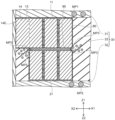
- FIG. 8A is an explanatory diagram (comparative example) of an example of the function of the main body of the coil component according to one embodiment of the present invention
- Fig. 8B is an explanatory diagram (inventive example) of an example of the function of the main body of the coil component according to one embodiment of the present invention
- Fig. 8C is a diagram explaining the difference in shape distribution of the magnetic powder.
- a coil insulation section 80 is provided around the first spiral conductor section 11 and the second spiral conductor section 21 to prevent short circuits between turns of the same spiral conductor section.
- an insulating interposer 90 is disposed between the first spiral conductor section 11 and the second spiral conductor section 21 as an insulating section to also prevent short circuits between the turns of the first spiral conductor section 11 and the turns of the second spiral conductor section 21 that are aligned with these turns in the first direction.
- the magnetic powder MP3 contained in the third material constituting the third region 33 contains a metal magnetic powder
- the particle size of the magnetic powder MP3 is larger than the thickness of the interposer 90
- the magnetic powder MP3 may be positioned to form a short circuit path EP between the turn of the first spiral conductor portion 11 and the turn of the second spiral conductor portion 21, as shown in FIG. 8A.
- a similar short circuit phenomenon may also occur between the first draw-out portion 14 and the turn of the second spiral conductor portion 21, or between the second draw-out portion 24 and the turn of the first spiral conductor portion 11.
- the magnetic powder MP3 When a material containing the magnetic powder MP3 is placed around the coil portion 10 and pressurized to form the main body portion 30, the magnetic powder MP3 may come into contact with the conductor of the coil portion 10 while partially destroying the insulating portion of the coil portion 10 (coil insulating portion 80, interposer 90), and at this time, the possibility of the above-mentioned short circuit phenomenon occurring increases.
- the main body 30 is given a new function of suppressing short circuits in the coil section 10.
- the magnetic powder MP3 contained in the third material is a metal magnetic powder having a smaller diameter than the magnetic powder MP2 contained in the second material and the magnetic powder MP1 contained in the first material. Therefore, even if the magnetic powder MP3 comes into contact with the conductor of the coil section 10 while partially destroying the insulation section (coil insulation section 80, interposer 90) of the coil section 10, a short circuit is unlikely to occur.
- the material constituting the interposer 90 is not limited as long as it has an appropriate insulating property.
- the interposer 90 may preferably have a volume resistivity of 1.0 ⁇ 10 14 ⁇ cm or more obtained by ASTM D257. This volume resistivity is more preferably 1.0 ⁇ 10 15 ⁇ cm or more, and even more preferably 1.0 ⁇ 10 16 ⁇ cm or more. The upper limit of the volume resistivity is not particularly limited. The volume resistivity may be 1.0 ⁇ 10 20 ⁇ cm or less.
- the interposer 90 may preferably have excellent dielectric properties, and specifically, may preferably have a relative dielectric constant of 4.0 or less at 60 Hz obtained by ASTM D150.
- This relative dielectric constant is more preferably 3.5 or less, and even more preferably 3.0 or less.
- the lower limit of this relative dielectric constant is not particularly limited.
- the relative dielectric constant may be 1.0 or more.
- To measure the volume resistivity and relative dielectric constant of the interposer 90 a material corresponding to the interposer 90 prepared separately is prepared to a size required for the measurement and used. The material corresponding to the interposer 90 can be identified, as in the case of the coil insulating portion 80, by analysis such as component analysis or FT-IR.
- the material constituting the interposer 90 may be composed of an organic material, may be composed of an inorganic material, or may be a composite material of an organic material and an inorganic material.
- the inorganic material may have a particulate shape and may be dispersed in a matrix composed of an organic material.
- organic materials include polyimide resin, polyethylene resin, polypropylene resin, polyamide resin, polyester resin, polyamideimide resin, polysulfone resin, polycarbonate resin, liquid crystal polymer resin, polyvinylidene fluoride resin, and polytetrafluoroethylene resin.
- inorganic materials particularly inorganic materials in composite materials, include inorganic materials such as oxides, carbides, nitrides, and inorganic salts.
- oxides include silica, alumina, and zirconia.
- carbides and nitrides include inorganic materials such as silicon carbide and boron nitride, respectively.
- inorganic salts include minerals such as wollastonite, kaolin, and mica.
- oxide-based materials such as oxides, silicates, and phosphates are preferred in terms of cost and insulation.
- the inorganic material contains at least one selected from the group consisting of silicon (Si), phosphorus (P), boron (B), and calcium (Ca).
- the second cut surface and the third cut surface are compared to satisfy at least one of the following (a) to (d): (a) The third average equivalent circle diameter, which is the average equivalent circle diameter of the magnetic powder MP3 at the third cut surface, is smaller than the second average equivalent circle diameter, which is the average equivalent circle diameter of the magnetic powder MP2 at the second cut surface.
- the third median diameter which is the median diameter of the magnetic powder MP3 at the third cut surface, is smaller than the second median diameter, which is the median diameter of the magnetic powder MP2 at the second cut surface.
- the third maximum equivalent circle diameter which is the maximum equivalent circle diameter of the magnetic powder MP3 at the third cut surface, is smaller than the maximum equivalent circle diameter of the magnetic powder MP2 at the second cut surface.
- At least one of the second diameter distribution, which is the distribution of the circular equivalent diameters of the magnetic powder MP2 on the second cross section, and the third diameter distribution, which is the distribution of the circular equivalent diameters of the magnetic powder MP3 on the third cross section, has two or more peaks, and the third peak diameter, which is the circular equivalent diameter with the highest frequency at the peak on the largest diameter side among the peaks in the third diameter distribution, is smaller than the second peak diameter, which is the circular equivalent diameter with the highest frequency at the peak on the largest diameter side among the peaks in the second diameter distribution.
- the third region 33 is more likely to contain magnetic powder with a relatively small particle size, when the main body 30 is formed by pressurizing a material containing magnetic powder MP3, even if the insulating portion (coil insulating portion 80, interposer 90) provided on the surface of the annular conductor portion (first spiral conductor portion 11, second spiral conductor portion 21, and via portion VP) is locally broken by the magnetic powder due to the pressurization, a short circuit is less likely to occur within the annular conductor portion.
- the difference between the second average equivalent circle diameter and the third average equivalent circle diameter may preferably be 1% or more and 5% or less based on the second average equivalent circle diameter.
- the smaller the third average equivalent circle diameter the more preferable it is.
- the filling rate of the second region 32 will be relatively low, and there is a concern that the magnetic resistance of the second region 32 will increase. If the above range is set, it is possible to appropriately suppress short circuits in the annular conductor portion while suppressing the magnetic resistance of the second region 32 from becoming too high relatively.
- the third region 33 is more likely to contain magnetic powder with a relatively small particle size, when the main body 30 is formed by pressurizing a material containing the magnetic powder MP3, even if the insulating portion provided on the surface of the annular conductor portion is locally broken by the magnetic powder due to the pressurization, a short circuit is unlikely to occur within the annular conductor portion.
- the difference between the second median diameter and the third median diameter may be 1% or more and 5% or less based on the second median diameter. From the viewpoint of preventing short circuits within the annular conductor portion, the smaller the third average circular equivalent diameter, the more preferable it is. However, since a small median diameter tends to increase the filling rate, if the third median diameter is excessively small, the filling rate of the second region 32 will be relatively low, and there is a concern that the magnetic resistance of the second region 32 will increase. If the above range is set, it is possible to appropriately suppress short circuits within the annular conductor portion while suppressing the magnetic resistance of the second region 32 from becoming too high relatively.
- the third region 33 is more likely to contain magnetic powder with a relatively small particle size, when the main body 30 is formed by pressurizing a material containing magnetic powder MP3, even if the insulating portion provided on the surface of the annular conductor portion is locally broken by the magnetic powder MP3 due to the pressurization, a short circuit is less likely to occur within the annular conductor portion.
- the difference between the second maximum circle equivalent diameter and the third maximum circle equivalent diameter may preferably be 1% or more and 5% or less based on the second maximum circle equivalent diameter. From the viewpoint of preventing short circuits within the annular conductor portion, the smaller the third maximum circle equivalent diameter, the more preferable it is. However, since a small maximum circle equivalent diameter may tend to increase the filling rate, if the third maximum circle equivalent diameter is excessively small, the filling rate of the second region 32 may become relatively low, and there may be a concern that the magnetic resistance of the second region 32 may increase. If the above range is set, it is possible to appropriately suppress short circuits within the annular conductor portion while suppressing the magnetic resistance of the second region 32 from becoming too high relatively.
- the second maximum equivalent circle diameter is 12.0 ⁇ m or more and 50.0 ⁇ m or less
- the third maximum equivalent circle diameter is 2.0 ⁇ m or more and 10.0 ⁇ m or less.
- the third region 33 is more likely to contain magnetic powder with a relatively small particle size, when the main body 30 is formed by pressurizing a material containing magnetic powder MP3, even if the insulating portion provided on the surface of the annular conductor is locally broken by magnetic powder MP3 due to pressurization, a short circuit is unlikely to occur within the annular conductor.
- the distribution on the right has two peaks. Comparing the peaks of the largest diameter side of the two distributions, the distribution on the right has a larger diameter. Therefore, of the two distributions of circle equivalent diameters shown in FIG. 8C, the left side is an example of the third diameter distribution, and the right side is an example of the second diameter distribution.
- the difference between the second peak diameter and the third peak diameter is 1% or more and 5% or less based on the second peak diameter. From the viewpoint of preventing short circuits within the annular conductor portion, the smaller the third peak diameter, the more preferable it is. However, since a small peak diameter tends to increase the filling rate, there is a concern that if the third peak diameter is excessively small, the filling rate of the second region 32 will be relatively low, and the magnetic resistance of the second region 32 will increase. If the above range is set, it is possible to appropriately suppress short circuits within the annular conductor portion while suppressing the magnetic resistance of the second region 32 from becoming too high relatively.
- the second diameter distribution has a larger number of peaks than the third diameter distribution.
- the small diameter magnetic powder is contained to an extent that it has a peak, which makes it easier to increase the filling rate of the magnetic powder MP2 and tends to improve the magnetic properties of the second region 32.
- the distribution on the right which is an example of the second diameter distribution, has two peaks.
- the magnetic powder MP3 contains metal magnetic powder and the above-mentioned short circuit is a concern, from the viewpoint of more stably reducing the possibility of the short circuit phenomenon occurring, it may be preferable that at least one of the second particle size distribution, which is the volumetric particle size distribution of the magnetic powder contained in the second region 32, and the third particle size distribution, which is the volumetric particle size distribution of the magnetic powder contained in the third region 33, has two or more peaks, and that the third particle size, which is the particle size with the greatest frequency at the peak on the largest diameter side among the peaks of the third particle size distribution, is smaller than the second particle size, which is the particle size with the greatest frequency at the peak on the largest diameter side among the peaks of the second particle size distribution.
- the third region 33 is more likely to contain magnetic powder with a relatively small particle size, when the main body 30 is formed by pressurizing a material containing magnetic powder MP3, even if the insulating portion provided on the surface of the annular conductor portion is locally broken by the magnetic powder MP3 due to the pressurization, a short circuit is less likely to occur within the annular conductor portion.
- the difference between the second particle size and the third particle size may preferably be 1% or more and 5% or less based on the second particle size. From the viewpoint of preventing short circuits within the annular conductor portion, the smaller the third particle size, the more preferable it is. However, since a small particle size as defined above may tend to increase the filling rate, if the third particle size is excessively small, the filling rate of the second region 32 may become relatively low, and there may be a concern that the magnetic resistance of the second region 32 may increase. If the difference is within the above range, it is possible to appropriately suppress short circuits within the annular conductor portion while preventing the magnetic resistance of the second region 32 from becoming too high relatively.
- the second particle size distribution has a larger number of peaks than the third particle size distribution.
- small diameter magnetic powder is contained to an extent that it has a peak, which makes it easier to increase the filling rate of the magnetic powder MP2 and tends to improve the magnetic properties of the second region 32.
- the magnetic powder MP3 contained in the third region 33 and the magnetic powder MP2 contained in the second region 32 may have a similar relationship.
- the shape distribution of the magnetic powder MP1 and the shape distribution of the magnetic powder MP2 may be equal or different. From the viewpoint of suppressing an increase in local magnetic resistance, it may be preferable that the shape distribution of the magnetic powder MP1 and the shape distribution of the magnetic powder MP2 are equal.
- the second surface 302 is the mounting surface as in this embodiment, it may be preferable that the insulation of the second region 32 is relatively high, or that the hardness of the second region 32 is relatively high. From these viewpoints, it may be preferable that the shape distribution of the magnetic powder MP1 and the shape distribution of the magnetic powder MP2 are different.
- the binder contained in the second region 32 may contain a second polymer
- the binder contained in the third region 33 may contain a third polymer. Since the physical properties of a polymer can be easily adjusted by adjusting the monomer composition and the degree of polymerization, the binder containing a polymer makes it easy to adjust the binder characteristics.
- the polymer include acrylic resin, silicone resin, epoxy resin, phenol resin, urea resin, melamine resin, and polyester resin.
- the binder may contain an inorganic material, a specific example of which is a glass-based material such as water glass.
- the weight average molecular weight of the second polymer may be greater than the weight average molecular weight of the third polymer.
- the second region 32 which contains a polymer with a relatively large molecular weight, tends to have high strength and high viscosity overall.
- the difference between the weight average molecular weight of the second polymer and the weight average molecular weight of the third polymer may be 1% or more and 5% or less based on the weight average molecular weight of the second polymer.
- the benefits of the high strength and high viscosity of the second region 32 can be stably enjoyed.
- the density of unreacted groups in the second polymer may be lower than the density of unreacted groups in the third polymer.
- unreacted groups include active functional groups that are highly reactive with other functional groups, such as glycidyl groups, isocyanate groups, and carboxy groups, and functional groups having active hydrogen that react with such active functional groups (hydroxyl groups, amino groups, etc.).
- active functional groups that are highly reactive with other functional groups, such as glycidyl groups, isocyanate groups, and carboxy groups
- functional groups having active hydrogen that react with such active functional groups hydroxyl groups, amino groups, etc.
- the second region 32 which contains a polymer with a relatively low density of unreacted groups, tends to have high strength and high viscosity overall.
- the difference between the density of unreacted groups in the second polymer and the density of unreacted groups in the third polymer may be 1% or more and 5% or less based on the density of unreacted groups in the second polymer.
- the benefits of the high strength and high viscosity of the second region 32 can be stably enjoyed.
- the content of the polymerization catalyst in the second material may be greater than the content of the polymerization catalyst in the third material.
- the polymerization catalyst is appropriately set according to the monomer for forming the polymer.
- the polymerization catalyst include a urethane polymerization catalyst such as 2-(dimethylamino)ethanol, an epoxy polymerization catalyst such as tetrabutylphosphonium bromide, and an olefin polymerization catalyst such as a metallocene compound.
- the second region 32 containing a polymer with a relatively high content of polymerization catalyst tends to have high strength and high viscosity as a whole.
- the difference between the content of the polymerization catalyst in the second material and the content of the polymerization catalyst in the third material may be 1% or more and 5% or less based on the content of the polymerization catalyst in the second material.
- the benefits of the high strength and high viscosity of the second region 32 can be stably enjoyed.
- the hardness of the binder contained in the second region 32 measured by a nanoindenter may be smaller than the hardness of the binder contained in the third region 33 measured by a nanoindenter.
- the second region 32 containing a relatively hard binder tends to have high strength and high viscosity overall.
- the difference between the hardness of the second binder measured by a nanoindenter and the hardness of the third binder measured by a nanoindenter may be 1% or more and 5% or less based on the hardness of the second binder measured by a nanoindenter.
- the benefits of the second region 32 being hard and highly viscous can be stably enjoyed.
- the binder contained in the first region 31 may contain a first polymer. Specific examples of this polymer are the same as those of the second polymer and the third polymer.
- the binder contained in the first region 31 may contain an inorganic material.
- the first polymer may have the same composition as the second polymer or the third polymer, or may have a different composition from either of them.
- Modification 9 and 10 are XZ sectional views illustrating a third and fourth modified example of the coil component according to an embodiment of the present invention.
- the coil component 100C according to one of the modified examples of this embodiment shown in FIG. 9 has a basic structure in common with the coil component 100, so only the differences in structure will be described and the common structure will not be described.
- coil component 100C of this example has a first connection conductor portion 15 extending from first lead-out portion 14 toward second surface 302 (Z2 side in Z1-Z2 direction), and a second connection conductor portion 25 extending from second lead-out portion 24 toward second surface 302 (Z2 side in Z1-Z2 direction).
- the first connection conductor portion 15 is exposed from second surface 302 of main body portion 30 at first connection end portion 15E
- the second connection conductor portion 25 is exposed from second surface 302 of main body portion 30 at second connection end portion 25E.
- the first connection end portion 15E is electrically connected to first intersecting plane external electrode 41b as a part of the first end surface of coil portion 10, and the second connection end portion 25E is electrically connected to second intersecting plane external electrode 42b as a part of the second end surface of coil portion 10. Therefore, the first external electrode 41 is electrically connected to the first lead-out end 14E and the first connection end 15E, and the second external electrode 42 is electrically connected to the second lead-out end 24E and the second connection end 25E. This stabilizes the electrical connection between the coil component 100 and the first board electrode E1 and the second board electrode E2.
- the coil component 100D according to one of the modified examples of this embodiment shown in FIG. 10 has a basic structure in common with the coil component 100C, so only the differences in structure will be described and the common structure will not be described.
- the first external electrode 41 does not have a first lateral external electrode 41a and is composed of a first intersecting plane external electrode 41b
- the second external electrode 42 does not have a second lateral external electrode 42a and is composed of a second intersecting plane external electrode 42b
- an exterior coat 61 is located where the first lateral external electrode 41a is located
- an exterior coat 62 is located where the second lateral external electrode 42a is located.
- the first end face of the coil section 10 is composed of the first connection end 15E
- the second end face of the coil section 10 is composed of the second connection end 25E
- the portion in electrical contact with the first board electrode E1 and the second board electrode E2 is located only on the mounting surface side (Z2 side in the Z1-Z2 direction). Therefore, in the board SB on which the coil component 100D is mounted, the areas of the first board electrode E1 and the second board electrode E2 can be reduced; specifically, the extension portion on the X2 side in the X1-X2 direction of the first board electrode E1 can be shortened, and the extension portion on the X1 side in the X1-X2 direction of the second board electrode E2 can be shortened. In other words, by using the coil component 100D, the mounting density of the components mounted on the board SB can be increased.
- FIG. 11A is an explanatory diagram (part 1) of an example of a manufacturing method for coil components according to one embodiment of the present invention, and is an XY plan view of a coil array sheet.
- FIG. 11B is an XZ cross-sectional view taken along line C-C' in FIG. 11A.
- FIG. 12 is an explanatory diagram (part 2) of an example of a manufacturing method for coil components according to one embodiment of the present invention, and is an XZ cross-sectional view showing a state in which a coil array sheet or the like is placed in a cavity of a mold.
- FIG. 12 is an explanatory diagram (part 2) of an example of a manufacturing method for coil components according to one embodiment of the present invention, and is an XZ cross-sectional view showing a state in which a coil array sheet or the like is placed in a cavity of a mold.
- FIG. 13 is an explanatory diagram (part 3) of an example of a manufacturing method for coil components according to one embodiment of the present invention, and is an XZ cross-sectional view showing a state in which molding is performed using a mold to form a molded body.
- FIG. 14 is an explanatory diagram (part 4) of an example of a manufacturing method for coil components according to one embodiment of the present invention, and is an XZ cross-sectional view showing a state before cutting the molded body.
- FIG. 15 is an explanatory diagram (part 5) of an example of a manufacturing method for coil components according to one embodiment of the present invention, and is an XZ cross-sectional view showing a state in which the molded body is cut to obtain a coil chip.
- a coil array sheet 500 is formed in which a plurality of coil sections 10 including the first spiral conductor section 11 and the second spiral conductor section 21, and the first lead section 14 and the second lead section 24 are connected to each other via the first connecting conductor section 16 and the second connecting conductor section 26.
- the manufacturing method is not limited, but a plating process can be used as described below.
- a conductor layer seed layer is formed on both sides (Z1 side and Z2 side in the Z1-Z2 direction) of the surface of an insulating sheet base material.
- an electroplating process is performed to form a conductor including the first spiral conductor section 11 and the second spiral conductor section 21, the first lead section 14 and the second lead section 24, and the first connecting conductor section 16 and the second connecting conductor section 26 on the conductor layer by plating deposits, as shown in FIG. 11B.
- the method of forming the conductor is not limited.
- a pattern of an insulating layer that is a negative pattern of the conductor may be formed on a conductor layer on an insulating sheet substrate, and an electric plating process may be performed to pass electricity through the conductor layer, depositing plating deposits on the conductor layer exposed around the negative pattern to form a conductor having a desired shape.
- an electric plating process it is possible to form a via portion VP by filling the through-holes in the sheet substrate with plating deposits.
- the sheet substrate on which the conductor is formed is removed so as to include the area of the sheet substrate surrounded by the inner edges of the first spiral conductor portion 11 and the second spiral conductor portion 21 when viewed in the first direction (Z1-Z2 direction).
- the insulating layer is removed first, and then the conductor layer that is exposed in the Z1-Z2 direction due to the removal of the insulating layer is removed. In this way, a portion of the sheet substrate is exposed in the Z1-Z2 direction as an exposed portion, and a process of removing this exposed portion is performed.
- the specific removal process for the sheet substrate is set appropriately depending on the constituent material of the sheet substrate. Removal processes are broadly classified into dry processes such as plasma etching and wet processes such as wet etching. A part of the sheet substrate may be removed by the removal process, and a remaining part may not be removed.
- the sheet substrate may be made of a composite material of a matrix portion made of an organic material and an inorganic material dispersed in the matrix portion, and the sheet substrate may be removed by removing the matrix portion made of the organic material in the removal process.
- the coil insulation section 80 is formed so as to cover the exposed surface of the conductor.
- the insulating section of the coil array sheet 500 the portion of which is covered with the conductor on both sides in the Z1-Z2 direction, is not made up of the coil insulation section 80 but is made up of the remaining sheet base material, but is not shown in Figure 11B and is treated as the same as the coil insulation section 80.
- the coil array sheet 500 thus obtained is placed in the cavity 70C of the mold 70.
- the first member 311 is positioned on one side in the first direction of the coil array sheet 500 including the coil section 10
- the second member 321 is positioned on the other side in the first direction of the coil array sheet 500 including the coil section 10
- the third member 331 is positioned between the first member 311 and the second member 321.
- the second member 321, a part 331A of the third member 331, the coil array sheet 500, another part 331B of the third member 331, and the first member 311 are positioned in order from the lower mold 71 side (Z2 side in the Z1-Z2 direction) of the mold 70 to the upper mold 72 side (Z1 side in the Z1-Z2 direction).
- a laminated structure having the coil array sheet 500, the first member 311, the second member 321, and the third member 331 is placed in the cavity 70C of the mold 70.
- the first member 311 includes a first magnetic powder and a first hardenable material, and becomes a first material body 310 made of the first material that constitutes the first region 31 after molding.
- the second member 321 includes a second magnetic powder and a second hardenable material, and becomes a second material body 320 made of the second material that constitutes the second region 32 after molding.
- the third member 331 includes a third magnetic powder and a third hardenable material, and becomes a third material body 330 made of the third material that constitutes the third region 33 including the central region CR after molding.
- curable material includes materials that are cured and materials that are cured (such as polymerization initiators). Specifically, compounds that contain active functional groups that are highly reactive with other functional groups, such as glycidyl groups, isocyanate groups, and carboxy groups, and compounds that contain functional groups with active hydrogen that react with such active functional groups (such as hydroxyl groups and amino groups) are included. Crosslinking substances that contain polyvalent ions, such as magnesium and calcium, are also included in the curable material. When the curable material is polymerized by a radical polymerization catalyst, a compound with an ethylenically unsaturated bond can also be a curable material.
- Polymerization catalysts that initiate and continue the polymerization reaction of the above-mentioned polymerization reaction substances are also included in the curable material.
- polymerization catalysts include urethane polymerization catalysts such as 2-(dimethylamino)ethanol, epoxy polymerization catalysts such as tetrabutylphosphonium bromide, and olefin polymerization catalysts such as metallocene compounds.
- the second member 321 and the third member 331 differ in one or more points selected from the group consisting of the following [1] to [6].
- [4] A composition of a second hardenable material and a composition of a third hardenable material;
- [5] The content of the second hardening material in the second member 321 and the content of the third hardening material in the third member 331, and [6] when the second member 321 contains a second additive component other than the second hardening material and the second magnetic powder, and the third member 331 contains a third additive component other than the third hardening material and the third magnetic powder, the composition of the second additive component and the composition of the third additive component.
- the laminated structure thus obtained is subjected to a molding process that includes increasing the pressure in the cavity, so that the laminated structure has a coil portion 10 and a main body portion 30, as shown in FIG. 13.
- a molded body 500A is obtained that has a coil array sheet 500 including a plurality of coil portions 10 and a main body portion component 300 that provides the main body portion 30.
- the molding process for obtaining the molded body 500A from the laminated structure may involve heating in addition to pressure. As described below, if the degree of hardening of the third hardening material in the third member 331 is low, the hardening may be completed by, for example, heating.
- the above molding process may include hardening the first hardenable material to the third hardenable material.
- the first member 311 and the first material body 310 are made of different materials
- the second member 321 and the second material body 320 are made of different materials
- the third member 331 and the third material body 330 are made of different materials. Therefore, the first member 311 to the third member 331 can be given unique functions in terms of molding process.
- the bottom of the coil array sheet 500 on the vertical lower side (Z2 side in the Z1-Z2 direction) is stabilized in a state in contact with the upper end of the second member 321. Therefore, the positional accuracy of the coil array sheet 500 in the molded body 500A in the vertical direction (first direction) can be improved.
- the coil component 100 it becomes easy to set the distance between the end of the coil section 10 on the Z2 side in the Z1-Z2 direction and the second surface 302 in an appropriate range.
- Making the second member 321 harder than the third member 331 may be achieved by satisfying at least one of the following (I) to (VI).
- (I) for the laminated structure disposed within the cavity the viscosity of the second curable material is higher than the viscosity of the third curable material.
- (II) for the laminated structure disposed within the cavity the degree of polymerization of the second curable material is higher than the degree of polymerization of the third curable material.
- the content of uncured material contained in the second curable material is lower than the content of uncured material contained in the third curable material.
- the first member 311 may be harder than the third member 331.
- the end of the coil array sheet 500 on the vertical upper side (Z1 side in the Z1-Z2 direction) is stable in contact with the end of the second member 321 on the vertical lower side (Z2 side in the Z1-Z2 direction). Therefore, the positional accuracy in the vertical direction (first direction) of the coil array sheet 500 in the molded body 500A can be further improved.
- the coil component 100 it becomes easy to set the distance between the end of the coil section 10 on the Z1 side in the Z1-Z2 direction and the first surface 301 to an appropriate range.
- the second member 321 may have higher insulating properties than the third member 331.
- the insulating properties of the second material formed from the second member 321 can be made higher than the insulating properties of the third material formed from the third member 331.
- the coil portion 10 has an insulating portion (such as the coil insulating portion 80) covering the surface of the annular conductor portion as in this embodiment, and the third magnetic powder contains metal magnetic powder, it may be preferable to satisfy at least one of the following (i) to (iv) when the second member 321 is cut to obtain a second member cut surface and the third member 331 is cut to obtain a third member cut surface.
- the third member average equivalent circle diameter which is the average equivalent circle diameter of the third magnetic powder at the cut surface of the third member, is smaller than the second member average equivalent circle diameter, which is the average equivalent circle diameter of the second magnetic powder at the cut surface of the second member
- the third member median diameter which is the median diameter of the third magnetic powder at the cut surface of the third member, is smaller than the second member median diameter, which is the median diameter of the second magnetic powder at the cut surface of the second member
- the third member maximum equivalent circle diameter which is the maximum equivalent circle diameter of the third magnetic powder at the cut surface of the third member, is smaller than the maximum equivalent circle diameter of the magnetic powder at the cut surface of the second member
- at least one of the second member diameter distribution which is a distribution of the circular equivalent diameters of the second magnetic powder at the cut surface of the second member, and the third member diameter distribution, which is a distribution of the circular equivalent diameters of the third magnetic powder at the cut surface of the third member, has two or more peaks, and
- a coil chip 100Z having a main body portion 30 consisting of a first region 31, a second region 32, and a third region 33, and a coil portion 10. Exterior coatings 50 and 60 are formed on this coil chip 100Z, and a first external electrode 41 and a second external electrode 42 are further formed to obtain the coil component 100.
- FIGS. 16A to 18 are explanatory diagrams (parts 1 to 3) of an example of a manufacturing method for a modified coil component according to an embodiment of the present invention.
- the coil section 10 may have the first connecting conductor 15 and the second connecting conductor 25 in the state of the coil array sheet 501, as shown in FIG. 16A and FIG. 16B.
- the second connecting conductor 25 and the second linking conductor 26 are integrated, and are separated by cutting.
- the forming process for the coil array sheet 501 is basically the same as that for the coil array sheet 500.
- the portion on the Z2 side of the coil array sheet 501 in the Z1-Z2 direction that includes the second connecting conductor 25 and the second linking conductor 26 and the portion including the first connecting conductor 15 are referred to as "protruding portions" are embedded in a portion 331A of the third member and are in contact with the end of the second member 321 on the Z1 side in the Z1-Z2 direction. This arrangement can be achieved by making the second member 321 harder than the third member 331.
- the molds are clamped to bring the lower mold 71 and the upper mold 72 close to each other, so that the protruding portion is embedded inside the second member 321, and the first spiral conductor portion 11 and the second spiral conductor portion 21 of the coil portion 10 are embedded in the third member 331.
- the hardening of each member progresses with the lower end (the end portion on the Z2 side in the Z1-Z2 direction) of the second spiral conductor portion 21 in contact with the upper end (the end portion on the Z1 side in the Z1-Z2 direction) of the second member 321, and a molded body 501A is obtained in which the coil array sheet 501 is embedded in the main body component member 300 composed of the first material body 310 formed from the first material from the first member 311, the second material body 320 formed from the second material from the second member 321, and the third material body 330 formed from the third material from the third member 331.
- the electronic/electrical device is an electronic/electrical device in which the coil components 100, 100A, 100B, 100C, and 100D according to one embodiment of the present invention are mounted, and the coil components 100, 100A, 100B, 100C, and 100D are electronic/electrical devices connected to the substrate SB at terminals (first external electrode 41 and second external electrode 42) provided on exposed conductors (e.g., first lead end 14E and second lead end 24E) located at two ends of the coil section 10 and exposed to the outside.
- first external electrode 41 and second external electrode 42 exposed conductors
- the electronic/electrical device is mounted with the coil components 100, 100A, 100B, 100C, and 100D according to one embodiment of the present invention, so that the device can be easily miniaturized.
- the coil component 100D is easily compatible with high-density mounting, so that devices equipped with these components can be particularly easily miniaturized.
- the coil components 100, 100A, 100B, 100C, and 100D are less likely to suffer from deterioration in their characteristics or problems caused by heat generation.
- the second surface 302 of the main body 30 is located on the mounting surface side during use and on the lower side during manufacture, but this is not limited to this.
- the first surface 301 of the main body 30 may be located on the lower side during manufacture, and the second surface 302 may be located on the mounting surface side during use.
- the third member 331 is composed of two members and is arranged to sandwich the coil array sheet 500, but this is not limited to this.
- the third member 331 may be composed of one member and may be arranged above or below the coil array sheet 500.
Landscapes
- Engineering & Computer Science (AREA)
- Power Engineering (AREA)
- Physics & Mathematics (AREA)
- Spectroscopy & Molecular Physics (AREA)
- Chemical & Material Sciences (AREA)
- Dispersion Chemistry (AREA)
- Microelectronics & Electronic Packaging (AREA)
- Coils Or Transformers For Communication (AREA)
Priority Applications (3)
| Application Number | Priority Date | Filing Date | Title |
|---|---|---|---|
| JP2025530810A JPWO2025009010A1 (https=) | 2023-07-03 | 2023-07-03 | |
| CN202380101927.1A CN121844400A (zh) | 2023-07-03 | 2023-07-03 | 线圈部件、线圈部件的制造方法及电子/电气机器 |
| PCT/JP2023/024566 WO2025009010A1 (ja) | 2023-07-03 | 2023-07-03 | コイル部品、コイル部品の製造方法および電子・電気機器 |
Applications Claiming Priority (1)
| Application Number | Priority Date | Filing Date | Title |
|---|---|---|---|
| PCT/JP2023/024566 WO2025009010A1 (ja) | 2023-07-03 | 2023-07-03 | コイル部品、コイル部品の製造方法および電子・電気機器 |
Publications (1)
| Publication Number | Publication Date |
|---|---|
| WO2025009010A1 true WO2025009010A1 (ja) | 2025-01-09 |
Family
ID=94171759
Family Applications (1)
| Application Number | Title | Priority Date | Filing Date |
|---|---|---|---|
| PCT/JP2023/024566 Ceased WO2025009010A1 (ja) | 2023-07-03 | 2023-07-03 | コイル部品、コイル部品の製造方法および電子・電気機器 |
Country Status (3)
| Country | Link |
|---|---|
| JP (1) | JPWO2025009010A1 (https=) |
| CN (1) | CN121844400A (https=) |
| WO (1) | WO2025009010A1 (https=) |
Citations (11)
| Publication number | Priority date | Publication date | Assignee | Title |
|---|---|---|---|---|
| JPH09306715A (ja) * | 1996-05-15 | 1997-11-28 | Tokin Corp | 電子部品及びその製造方法 |
| JP2009009985A (ja) * | 2007-06-26 | 2009-01-15 | Sumida Corporation | コイル部品 |
| JP2013110171A (ja) * | 2011-11-17 | 2013-06-06 | Taiyo Yuden Co Ltd | 積層インダクタ |
| JP2013201374A (ja) * | 2012-03-26 | 2013-10-03 | Tdk Corp | 平面コイル素子 |
| JP2014090158A (ja) * | 2012-10-03 | 2014-05-15 | Tdk Corp | インダクタ素子およびその製造方法 |
| US20140167897A1 (en) * | 2012-12-14 | 2014-06-19 | Samsung Electro-Mechanics Co., Ltd. | Power inductor and method of manufacturing the same |
| JP2014130988A (ja) * | 2012-12-28 | 2014-07-10 | Samsung Electro-Mechanics Co Ltd | パワーインダクタ及びその製造方法 |
| JP2016009858A (ja) * | 2014-06-24 | 2016-01-18 | サムソン エレクトロ−メカニックス カンパニーリミテッド. | チップ電子部品及びその製造方法 |
| JP2016092404A (ja) * | 2014-11-04 | 2016-05-23 | サムソン エレクトロ−メカニックス カンパニーリミテッド. | チップ電子部品及びその製造方法 |
| JP2018107199A (ja) * | 2016-12-22 | 2018-07-05 | 株式会社村田製作所 | 表面実装インダクタ |
| JP2019532519A (ja) * | 2016-09-30 | 2019-11-07 | モダ−イノチップス シーオー エルティディー | パワーインダクター |
-
2023
- 2023-07-03 JP JP2025530810A patent/JPWO2025009010A1/ja active Pending
- 2023-07-03 WO PCT/JP2023/024566 patent/WO2025009010A1/ja not_active Ceased
- 2023-07-03 CN CN202380101927.1A patent/CN121844400A/zh active Pending
Patent Citations (11)
| Publication number | Priority date | Publication date | Assignee | Title |
|---|---|---|---|---|
| JPH09306715A (ja) * | 1996-05-15 | 1997-11-28 | Tokin Corp | 電子部品及びその製造方法 |
| JP2009009985A (ja) * | 2007-06-26 | 2009-01-15 | Sumida Corporation | コイル部品 |
| JP2013110171A (ja) * | 2011-11-17 | 2013-06-06 | Taiyo Yuden Co Ltd | 積層インダクタ |
| JP2013201374A (ja) * | 2012-03-26 | 2013-10-03 | Tdk Corp | 平面コイル素子 |
| JP2014090158A (ja) * | 2012-10-03 | 2014-05-15 | Tdk Corp | インダクタ素子およびその製造方法 |
| US20140167897A1 (en) * | 2012-12-14 | 2014-06-19 | Samsung Electro-Mechanics Co., Ltd. | Power inductor and method of manufacturing the same |
| JP2014130988A (ja) * | 2012-12-28 | 2014-07-10 | Samsung Electro-Mechanics Co Ltd | パワーインダクタ及びその製造方法 |
| JP2016009858A (ja) * | 2014-06-24 | 2016-01-18 | サムソン エレクトロ−メカニックス カンパニーリミテッド. | チップ電子部品及びその製造方法 |
| JP2016092404A (ja) * | 2014-11-04 | 2016-05-23 | サムソン エレクトロ−メカニックス カンパニーリミテッド. | チップ電子部品及びその製造方法 |
| JP2019532519A (ja) * | 2016-09-30 | 2019-11-07 | モダ−イノチップス シーオー エルティディー | パワーインダクター |
| JP2018107199A (ja) * | 2016-12-22 | 2018-07-05 | 株式会社村田製作所 | 表面実装インダクタ |
Also Published As
| Publication number | Publication date |
|---|---|
| JPWO2025009010A1 (https=) | 2025-01-09 |
| CN121844400A (zh) | 2026-04-10 |
Similar Documents
| Publication | Publication Date | Title |
|---|---|---|
| KR101900879B1 (ko) | 파워 인덕터 | |
| US11107623B2 (en) | Inductor | |
| US11069474B2 (en) | Inductor | |
| KR101681405B1 (ko) | 파워 인덕터 | |
| US11069473B2 (en) | Inductor | |
| US10741321B2 (en) | Thin film type inductor | |
| JP7647652B2 (ja) | コイル部品 | |
| WO2025009010A1 (ja) | コイル部品、コイル部品の製造方法および電子・電気機器 | |
| JP2025007597A (ja) | コイル部品、コイル部品の製造方法および電子・電気機器 | |
| CN113096941B (zh) | 线圈组件 | |
| US20260066183A1 (en) | Coil component, method for manufacturing coil component, and electronic/electric device | |
| WO2025074633A1 (ja) | コイル部品、コイル部品の製造方法および電子・電気機器 | |
| WO2025046820A1 (ja) | コイル部品およびコイル部品の製造方法 | |
| WO2024209688A1 (ja) | コイル部品、コイル部品の製造方法および電子・電気機器 | |
| WO2025163730A1 (ja) | コイル部品、コイル部品の製造方法および電子・電気機器 | |
| WO2025074632A1 (ja) | コイル部品、コイル部品の製造方法および電子・電気機器 | |
| TWI916871B (zh) | 線圈元件及線圈元件的製造方法 | |
| WO2025083796A1 (ja) | コイル部品、および電子・電気機器 | |
| WO2024252582A1 (ja) | コイル部品、コイル部品の製造方法および電子・電気機器 | |
| WO2025004287A1 (ja) | コイル部品、コイルアレイシート、コイル部品の製造方法および電子・電気機器 | |
| JP2025065079A (ja) | コイル部品 | |
| WO2024252581A1 (ja) | コイル部品、コイル部品の製造方法および電子・電気機器 | |
| CN121605497A (zh) | 线圈部件及电子/电气机器 | |
| WO2026028579A1 (ja) | インダクタ | |
| JP2024107795A (ja) | コイル部品 |
Legal Events
| Date | Code | Title | Description |
|---|---|---|---|
| 121 | Ep: the epo has been informed by wipo that ep was designated in this application |
Ref document number: 23944264 Country of ref document: EP Kind code of ref document: A1 |
|
| ENP | Entry into the national phase |
Ref document number: 2025530810 Country of ref document: JP Kind code of ref document: A |
|
| WWE | Wipo information: entry into national phase |
Ref document number: 2025530810 Country of ref document: JP |
|
| NENP | Non-entry into the national phase |
Ref country code: DE |