WO2025005265A1 - 毒性が低減されたアンチセンスオリゴヌクレオチド - Google Patents
毒性が低減されたアンチセンスオリゴヌクレオチド Download PDFInfo
- Publication number
- WO2025005265A1 WO2025005265A1 PCT/JP2024/023582 JP2024023582W WO2025005265A1 WO 2025005265 A1 WO2025005265 A1 WO 2025005265A1 JP 2024023582 W JP2024023582 W JP 2024023582W WO 2025005265 A1 WO2025005265 A1 WO 2025005265A1
- Authority
- WO
- WIPO (PCT)
- Prior art keywords
- group
- antisense oligonucleotide
- nucleotide
- oligonucleotide
- nucleotides
- Prior art date
- Legal status (The legal status is an assumption and is not a legal conclusion. Google has not performed a legal analysis and makes no representation as to the accuracy of the status listed.)
- Ceased
Links
Classifications
-
- A—HUMAN NECESSITIES
- A61—MEDICAL OR VETERINARY SCIENCE; HYGIENE
- A61K—PREPARATIONS FOR MEDICAL, DENTAL OR TOILETRY PURPOSES
- A61K31/00—Medicinal preparations containing organic active ingredients
- A61K31/70—Carbohydrates; Sugars; Derivatives thereof
- A61K31/7088—Compounds having three or more nucleosides or nucleotides
- A61K31/712—Nucleic acids or oligonucleotides having modified sugars, i.e. other than ribose or 2'-deoxyribose
-
- A—HUMAN NECESSITIES
- A61—MEDICAL OR VETERINARY SCIENCE; HYGIENE
- A61K—PREPARATIONS FOR MEDICAL, DENTAL OR TOILETRY PURPOSES
- A61K48/00—Medicinal preparations containing genetic material which is inserted into cells of the living body to treat genetic diseases; Gene therapy
-
- A—HUMAN NECESSITIES
- A61—MEDICAL OR VETERINARY SCIENCE; HYGIENE
- A61P—SPECIFIC THERAPEUTIC ACTIVITY OF CHEMICAL COMPOUNDS OR MEDICINAL PREPARATIONS
- A61P43/00—Drugs for specific purposes, not provided for in groups A61P1/00-A61P41/00
-
- C—CHEMISTRY; METALLURGY
- C07—ORGANIC CHEMISTRY
- C07H—SUGARS; DERIVATIVES THEREOF; NUCLEOSIDES; NUCLEOTIDES; NUCLEIC ACIDS
- C07H21/00—Compounds containing two or more mononucleotide units having separate phosphate or polyphosphate groups linked by saccharide radicals of nucleoside groups, e.g. nucleic acids
- C07H21/04—Compounds containing two or more mononucleotide units having separate phosphate or polyphosphate groups linked by saccharide radicals of nucleoside groups, e.g. nucleic acids with deoxyribosyl as saccharide radical
-
- C—CHEMISTRY; METALLURGY
- C07—ORGANIC CHEMISTRY
- C07K—PEPTIDES
- C07K16/00—Immunoglobulins [IG], e.g. monoclonal or polyclonal antibodies
-
- C—CHEMISTRY; METALLURGY
- C12—BIOCHEMISTRY; BEER; SPIRITS; WINE; VINEGAR; MICROBIOLOGY; ENZYMOLOGY; MUTATION OR GENETIC ENGINEERING
- C12N—MICROORGANISMS OR ENZYMES; COMPOSITIONS THEREOF; PROPAGATING, PRESERVING, OR MAINTAINING MICROORGANISMS; MUTATION OR GENETIC ENGINEERING; CULTURE MEDIA
- C12N15/00—Mutation or genetic engineering; DNA or RNA concerning genetic engineering, vectors, e.g. plasmids, or their isolation, preparation or purification; Use of hosts therefor
- C12N15/09—Recombinant DNA-technology
- C12N15/11—DNA or RNA fragments; Modified forms thereof; Non-coding nucleic acids having a biological activity
- C12N15/113—Non-coding nucleic acids modulating the expression of genes, e.g. antisense oligonucleotides; Antisense DNA or RNA; Triplex- forming oligonucleotides; Catalytic nucleic acids, e.g. ribozymes; Nucleic acids used in co-suppression or gene silencing
-
- C—CHEMISTRY; METALLURGY
- C12—BIOCHEMISTRY; BEER; SPIRITS; WINE; VINEGAR; MICROBIOLOGY; ENZYMOLOGY; MUTATION OR GENETIC ENGINEERING
- C12N—MICROORGANISMS OR ENZYMES; COMPOSITIONS THEREOF; PROPAGATING, PRESERVING, OR MAINTAINING MICROORGANISMS; MUTATION OR GENETIC ENGINEERING; CULTURE MEDIA
- C12N15/00—Mutation or genetic engineering; DNA or RNA concerning genetic engineering, vectors, e.g. plasmids, or their isolation, preparation or purification; Use of hosts therefor
- C12N15/09—Recombinant DNA-technology
- C12N15/87—Introduction of foreign genetic material using processes not otherwise provided for, e.g. co-transformation
-
- C—CHEMISTRY; METALLURGY
- C12—BIOCHEMISTRY; BEER; SPIRITS; WINE; VINEGAR; MICROBIOLOGY; ENZYMOLOGY; MUTATION OR GENETIC ENGINEERING
- C12N—MICROORGANISMS OR ENZYMES; COMPOSITIONS THEREOF; PROPAGATING, PRESERVING, OR MAINTAINING MICROORGANISMS; MUTATION OR GENETIC ENGINEERING; CULTURE MEDIA
- C12N15/00—Mutation or genetic engineering; DNA or RNA concerning genetic engineering, vectors, e.g. plasmids, or their isolation, preparation or purification; Use of hosts therefor
- C12N15/09—Recombinant DNA-technology
- C12N15/87—Introduction of foreign genetic material using processes not otherwise provided for, e.g. co-transformation
- C12N15/88—Introduction of foreign genetic material using processes not otherwise provided for, e.g. co-transformation using microencapsulation, e.g. using amphiphile liposome vesicle
Definitions
- the present invention relates to antisense oligonucleotides with reduced toxicity.
- Nucleic acid drugs are medicines consisting of nucleic acids (oligonucleotides) that form complementary base pairs with target DNA or RNA, and are expected to be new medicines.
- Various artificial nucleic acid units artificial nucleosides or artificial nucleotides that are phosphate adducts thereof) have been developed as nucleic acid units used in nucleic acid drugs.
- MOE methoxyethylating
- 2',4'-BNA and 2',4'-LNA are compounds in which the 2' and 4' positions of the sugar moiety of the nucleic acid unit are crosslinked, and are known to have high affinity to the target nucleic acid (see, for example, Patent Documents 2 to 5).
- MCE methylcarbamoylethyl
- gapmer-type antisense nucleic acids in which artificial nucleic acid units are introduced into both ends (5'-side region and 3'-side region) of a single-stranded oligodeoxyribonucleotide is progressing. It is known that gapmer-type antisense nucleic acids form a double-stranded complex with a target RNA, and that RNase H in cells recognizes the double-stranded portion between the deoxyribonucleotide portion and the target RNA and cleaves the RNA strand.
- gapmer-type antisense nucleic acids in which 2'-4' bridged nucleotides such as 2',4'-BNA and 2',4'-LNA are introduced into both ends are known to have a strong knockdown effect on the target RNA.
- gapmer-type antisense nucleic acids having 2'-4' bridged nucleotides introduced at both termini can induce cytotoxicity by acting on non-target RNA or by binding to non-specific proteins within cells (see, for example, Non-Patent Document 3).
- a gapmer-type antisense nucleic acid having a nucleotide (2'-O-R-ECE) in which an amino group or a heterocyclic group has been introduced via an alkyl group to the nitrogen atom of a 2'-position modified carbamoylethyl group, in the central region and/or the 5' region and/or the 3' region, can reduce toxicity, and thus completed the present invention. That is, the present invention encompasses the following aspects.
- the 2'-O-R-ECE nucleotide is The following formula (I): (wherein Bx is a purin-9-yl group, a 2-oxo-pyrimidin-1-yl group or a 2-thioxo-pyrimidin-1-yl group (the purin-9-yl group, the 2-oxo-pyrimidin-1-yl group and the 2-thioxo-pyrimidin-1-yl group are each independently unsubstituted or substituted with one or more substituents selected, either singly or differently, from the group consisting of a halogen atom, a C1-6 alkyl group, an amino group, a protected amino group, a hydroxy group, a protected hydroxy group, a sulfanyl group and a protected sulfanyl group), R 1 , R 2 , R 3 and R 4 each independently represent a hydrogen atom, a halogen atom, a cyano group, a C1-6 alkyl group or a C
- the central region consists of 5 to 15 nucleotides, 8.
- the antisense oligonucleotide according to any one of 1 to 7, wherein the 5' region and the 3' region each independently consist of 2 to 7 nucleotides.
- the central region consists of 8 to 12 nucleotides, 9.
- the antisense oligonucleotide according to any one of 1 to 8, wherein the 5' region and the 3' region each independently consist of 2 to 5 nucleotides.
- the antisense oligonucleotide according to any one of 1. to 9., wherein the 2'-4' bridged nucleotide is at least one selected from the group consisting of LNA, cEt-BNA, ENA, BNA NC , AmNA, scpBNA and GuNA.
- the antisense oligonucleotide according to any one of 1. to 9., wherein the 2'-modified nucleotide is at least one selected from the group consisting of a 2'-O-R-ECE nucleotide, a 2'-O-MCE nucleotide, a 2'-O-MOE nucleotide, a 2'-O-NMA nucleotide, and a 2'-O-Me nucleotide.
- each nucleotide constituting the antisense oligonucleotide is independently linked by a phosphodiester bond or a phosphorothioate bond.
- a prodrug of the antisense oligonucleotide according to any one of 1. to 19.
- a double-stranded oligonucleotide complex comprising: (i) the antisense oligonucleotide according to any one of 1. to 19.; and (ii) an oligonucleotide comprising a region that hybridizes to the antisense oligonucleotide.
- An oligonucleotide comprising (i) a group derived from the antisense oligonucleotide according to any one of 1. to 19., and (ii) a group derived from an oligonucleotide comprising a region that hybridizes to the antisense oligonucleotide, wherein the group derived from the antisense oligonucleotide (i) and the group derived from the oligonucleotide (ii) are linked together.
- a pharmaceutical composition comprising the antisense oligonucleotide according to any one of 1. to 19., the prodrug according to 20., the oligonucleotide conjugate according to 21., or the oligonucleotide according to 22., and a pharmacologically acceptable carrier.
- a method for controlling a function of a target RNA comprising the step of contacting a cell with the antisense oligonucleotide according to any one of 1. to 19., the prodrug according to 20., the oligonucleotide conjugate according to 21., or the oligonucleotide according to 22..
- a method for regulating a function of a target RNA in a mammal comprising the step of administering to the mammal the pharmaceutical composition according to 23.
- a method for controlling expression of a target gene comprising the step of contacting a cell with the antisense oligonucleotide according to any one of 1. to 19., the prodrug according to 20., the oligonucleotide conjugate according to 21., or the oligonucleotide according to 22..
- a method for regulating expression of a target gene in a mammal comprising the step of administering to the mammal the pharmaceutical composition according to 23.
- the present invention provides antisense oligonucleotides with reduced toxicity.
- n- stands for normal, "i-” stands for iso, "s-” stands for secondary, “t-” stands for tertiary, “o-” stands for ortho, “m-” stands for meta, and “p-” stands for para.
- Ph stands for phenyl
- Me stands for methyl
- Bu stands for butyl
- Ac stands for acetyl
- DMTr dimethoxytrityl
- Halogen atom means a fluorine atom, chlorine atom, bromine atom or iodine atom.
- C1-6 alkyl group means a monovalent group of linear or branched saturated aliphatic hydrocarbons having 1 to 6 carbon atoms.
- Examples of C1-6 alkyl groups include methyl, ethyl, n-propyl, isopropyl, n-butyl, isobutyl, s-butyl, t-butyl, n-pentyl, isopentyl, neopentyl, n-hexyl, and isohexyl.
- C1-3 alkyl group means a monovalent group of linear or branched saturated aliphatic hydrocarbons having 1 to 3 carbon atoms.
- Halo C1-6 alkyl group refers to a group in which at least one hydrogen atom at any position of the "C1-6 alkyl group” is replaced with the "halogen atom” described above.
- C2-6 alkenyl group means a monovalent group of a straight-chain or branched unsaturated aliphatic hydrocarbon containing 2 to 6 carbon atoms and containing at least one carbon-carbon double bond.
- Examples of C2-6 alkenyl groups include vinyl groups, allyl groups, propenyl groups, isopropenyl groups, butenyl groups, isobutenyl groups, butadienyl groups, 3-methyl-2-butenyl groups, pentenyl groups, isopentenyl groups, pentadienyl groups, hexenyl groups, isohexenyl groups, and hexadienyl groups.
- C1-6 alkoxy group refers to a group in which the above-mentioned "C1-6 alkyl group” is bonded to an oxy (-O-) group.
- Examples of C1-6 alkoxy groups include methoxy, ethoxy, n-propoxy, isopropoxy, n-butoxy, t-butoxy, isobutoxy, s-butoxy, n-pentyloxy, isopentyloxy, and n-hexyloxy groups.
- C2-6 alkenyloxy group refers to a group in which the "C2-6 alkenyl group” is bonded to an oxy (-O-) group.
- Examples of C2-6 alkenyloxy groups include vinyloxy groups, allyloxy groups, propenyloxy groups, isopropenyloxy groups, butenyloxy groups, isobutenyloxy groups, butadienyloxy groups, 3-methyl-2-butenyloxy groups, pentenyloxy groups, isopentenyloxy groups, pentadienyloxy groups, hexenyloxy groups, isohexenyloxy groups, and hexadienyloxy groups.
- C2-20 alkylene group means a divalent linear or branched saturated aliphatic hydrocarbon group having 2 to 20 carbon atoms.
- C8-12 alkylene group means a divalent linear or branched saturated aliphatic hydrocarbon group having 8 to 12 carbon atoms, among the above-mentioned “C2-20 alkylene groups”.
- C2-6 alkylene group refers to a divalent linear or branched saturated aliphatic hydrocarbon group having 2 to 6 carbon atoms, among the above-mentioned "C2-20 alkylene groups”.
- Examples include an ethylene (ethanediyl) group, a propylene group, a propane-1,3-diyl (trimethylene) group, a propane-2,2-diyl (isopropylidene) group, a 2,2-dimethyl-propane-1,3-diyl group, a hexane-1,6-diyl (hexamethylene) group, and a 3-methylbutane-1,2-diyl group.
- C2-20 alkenylene group means a divalent linear or branched unsaturated aliphatic hydrocarbon group containing 2 to 20 carbon atoms and at least one carbon-carbon double bond.
- C1-6 alkylamino group includes mono-C1-6 alkylamino groups and di-C1-6 alkylamino groups.
- mono-C1-6 alkylamino group refers to a group in which one of the above-mentioned "C1-6 alkyl groups” is bonded to an amino group. Examples of mono-C1-6 alkylamino groups include methylamino group, ethylamino group, n-propylamino group, isopropylamino group, n-butylamino group, n-pentylamino group, and n-hexylamino group.
- di-C1-6 alkylamino group refers to a group in which two of the above-mentioned "C1-6 alkyl groups” are bonded to an amino group.
- the two alkyl groups may be the same or different.
- di-C1-6 alkylamino groups include dimethylamino, diethylamino, N,N-diisopropylamino, N-methyl-N-ethylamino, N-isopropyl-N-methylamino, N-n-butyl-N-methylamino, N-tert-butyl-N-methylamino, N-methyl-N-n-pentylamino, N-n-hexyl-N-methylamino, and N-isopropyl-N-ethylamino groups.
- C1-6 alkylaminocarbonyl group refers to a group in which the above-mentioned “C1-6 alkylamino group” is bonded to a carbonyl group.
- C1-6 alkylcarbonyloxy group refers to a group in which the above-mentioned “C1-6 alkylcarbonyl group” is bonded to an oxy group.
- C1-6 alkylcarbonylamino group refers to a group in which one of the above “C1-6 alkylcarbonyl groups” is bonded to an amino group.
- C1-6 alkoxycarbonylamino group refers to a group in which one of the above “C1-6 alkoxycarbonyl groups” is bonded to an amino group.
- Aryl group means a monovalent group formed by removing one hydrogen atom at any position from a monocyclic or bicyclic aromatic hydrocarbon in which all atoms constituting the ring are carbon atoms. Specific examples include “C6-10 aryl groups” such as phenyl and naphthyl groups.
- Alkyl group refers to a monovalent group in which a hydrogen atom at any position of the "C1-6 alkyl group” is replaced by the "C6-10 aryl group.”
- 3-11 membered nitrogen-containing non-aromatic heterocycle refers to a monocyclic, condensed polycyclic (in the condensed polycyclic, the non-aromatic ring may be condensed to a non-aromatic ring or an aromatic ring), bridged or spirocyclic non-aromatic heterocyclic compound containing at least one nitrogen atom and having 3 to 11 atoms constituting the ring, and examples of such heterocyclic compounds include azetidine, pyrrolidine, 2-oxopyrrolidine, piperidine, 3-oxopiperidine, piperazine, morpholine, thiomorpholine, homomorpholine and homopiperazine.
- C2-9 aromatic heterocyclic group means a monovalent group formed by removing one hydrogen atom at any position from an aromatic monocyclic or fused ring compound having one or more identical or different heteroatoms selected from oxygen atoms, sulfur atoms, and nitrogen atoms in the ring and having 2 to 9 carbon atoms constituting the ring.
- 5-10 membered heterocyclic group refers to a monovalent group obtained by removing one hydrogen atom at any position from a monocyclic or condensed polycyclic aromatic heterocyclic compound having 5 to 10 atoms constituting the ring and containing 1 to 5 heteroatoms (heteroatoms refer to nitrogen atoms, oxygen atoms, or sulfur atoms, and when there are two or more heteroatoms, they may be the same or different) among the atoms constituting the ring.
- Examples of monocyclic "5- to 10-membered heterocyclic groups” include 2-thienyl, 3-thienyl, 2-furyl, 3-furyl, 2-pyranyl, 3-pyranyl, 4-pyranyl, 1-pyrrolyl, 2-pyrrolyl, 3-pyrrolyl, 1-imidazolyl, 2-imidazolyl, 4-imidazolyl, 1-pyrazolyl, 3-pyrazolyl, 4-pyrazolyl, and 5-pyrazolyl groups.
- the aryl group include 1,3,4-oxazolyl group, 2-oxazolyl group, 4-oxazolyl group, 5-oxazolyl group, 3-isoxazolyl group, 4-isoxazolyl group, 5-isoxazolyl group, 2-pyridyl group, 3-pyridyl group, 4-pyridyl group, 2-pyrazinyl group, 2-pyrimidinyl group, 4-pyrimidinyl group, 5-pyrimidinyl group, 3-pyrid
- Fused polycyclic "5- to 10-membered heterocyclic group” includes 2-benzofuranyl group, 3-benzofuranyl group, 4-benzofuranyl group, 5-benzofuranyl group, 6-benzofuranyl group, 7-benzofuranyl group, 1-isobenzofuranyl group, 4-isobenzofuranyl group, 5-isobenzofuranyl group, 2-benzothienyl group, 3-benzothienyl group, 4-benzothienyl group, 5-benzothienyl group, 6- Benzothienyl group, 7-benzothienyl group, 1-isobenzothienyl group, 4-isobenzothienyl group, 5-isobenzothienyl group, 2-benzothiazolyl group, 4-benzothiazolyl group, 5-benzothiazolyl group, 6-benzothiazolyl group, 7-benzothiazolyl group, 2-chromenyl group, 3-chromenyl group, 4-chromenyl group,
- protected hydroxy group refers to a hydroxy group protected by a hydroxy-protecting group, an amino group protected by an amino-protecting group and a sulfanyl group protected by a sulfanyl-protecting group, respectively.
- the hydroxy-protecting group, the amino-protecting group and the sulfanyl-protecting group are not particularly limited as long as they are stable during the synthesis of antisense oligonucleotides, and examples of the protecting groups include those described in Protective Groups in Organic Synthesis, 4th Edition, T. W. Greene, P. G. M. Wuts, John Wiley & Sons Inc. (2006), which are well known to those skilled in the art.
- the "amino protecting group” may be an amide-based protecting group such as acyl (e.g., formyl, acetyl, propionyl, pivaloyl (Pv), tigloyl, etc.), haloacyl (e.g., fluoroacetyl, difluoroacetyl, trifluoroacetyl, chloroacetyl, dichloroacetyl, trichloroacetyl, etc.), arylcarbonyl (e.g., benzoyl, p-bromobenzoyl, p-nitrobenzoyl, 2,4-dinitrobenzoyl, etc.); C1-6 alkoxycarbonyl (e.g., methoxycarbonyl, ethoxycarbonyl, n-propoxycarbonyl, etc.); nyl, i-propoxycarbonyl, n-butoxycarbonyl, i-butoxycarbonyl, t
- iMds 2,6-dimethyl-4-methoxybenzenesulfonyl
- Mds 2,4,6-trimethoxybenzenesulfonyl
- the "antisense effect” means that the function of a target RNA is controlled by hybridization of a target RNA selected corresponding to a target gene with, for example, an oligonucleotide having a sequence complementary to a partial sequence of the target RNA.
- a target RNA selected corresponding to a target gene
- an oligonucleotide having a sequence complementary to a partial sequence of the target RNA for example, when the target RNA is an mRNA, this means inhibition of translation of the target RNA by hybridization, a splicing function conversion effect such as exon skipping, or degradation of the target RNA by recognition of the hybridized portion.
- an "antisense oligonucleotide” is an oligonucleotide that produces the antisense effect. Examples include, but are not limited to, DNA and oligodeoxyribonucleotides, and may also be RNA, oligoribonucleotides, or oligonucleotides designed to normally produce an antisense effect. The same applies to antisense nucleic acids.
- Hybridize refers to the act of forming a double strand between oligonucleotides or groups derived from oligonucleotides that contain complementary sequences, and the phenomenon in which oligonucleotides or groups derived from oligonucleotides that contain complementary sequences form a double strand.
- “Complementary” means that two nucleobases can form Watson-Crick base pairs (natural base pairs) or non-Watson-Crick base pairs (Hoogsteen base pairs, etc.) through hydrogen bonds.
- Two oligonucleotides or groups derived from oligonucleotides can "hybridize” if their sequences are complementary.
- the complementarity for two oligonucleotides or groups derived from oligonucleotides to hybridize is preferably 70% or more, more preferably 80% or more, and even more preferably 90% or more (e.g., 95%, 96%, 97%, 98%, or 99% or more).
- Sequence complementarity can be determined by using a computer program that automatically identifies partial sequences of oligonucleotides.
- OligoAnalyzer is one such software and is provided by Integrated DNA Technologies. This program is also available on the website.
- Those skilled in the art can easily determine the conditions (temperature, salt concentration, etc.) under which two oligonucleotides or groups derived from oligonucleotides can hybridize.
- Those skilled in the art can also easily design an antisense oligonucleotide complementary to a target RNA, for example, by using a BLAST program based on the nucleotide sequence information of the target RNA. For the BLAST program, see Proceedings of the National Academy of Sciences of the United States of America, 1990, 87, pp. 2264-2268; ibid., 1993, 90, pp. 5873-5877; and Journal of Molecular Biology, 1990, 215, pp. 403-410, etc.
- Nucleotide refers to a molecule that can be a building block of a nucleic acid (oligonucleotide), and typically has a base as a component.
- a nucleotide is composed of, for example, a sugar, a base, and a phosphate.
- Nucleotides include ribonucleotides, deoxyribonucleotides, and sugar-modified nucleotides, which are described below.
- Oligonucleotide refers to a molecule having a polymerized structure of one or more of the above-mentioned nucleotides.
- the oligonucleotide can be referred to as a "nucleotide.”
- the nucleotides contained in the "antisense oligonucleotide” molecule of the present invention are each independently linked to each other by a phosphodiester bond, a modified phosphodiester bond as described below, or a linking group containing a non-nucleotide structure as described below.
- the 3'-terminal nucleotide of the antisense oligonucleotide molecule of the present invention preferably has a hydroxy group or a phosphate group, more preferably a hydroxy group, and usually a hydroxy group, at its 3' position.
- the 5'-terminal nucleotide of the antisense oligonucleotide molecule preferably has a hydroxy group or a phosphate group, more preferably a hydroxy group, and usually a hydroxy group, at its 5' position.
- a group derived from an oligonucleotide means a group in which a hydrogen atom, a hydroxyl group, etc. has been removed from at least one of the hydroxyl groups at the 3' end and the 5' end of the oligonucleotide, and is indirectly covalently linked to another group (e.g., a group derived from another oligonucleotide) by forming a phosphodiester bond or a modified phosphodiester bond.
- the hydroxyl group at the 3' end or the 5' end includes a hydroxyl group possessed by a phosphate group.
- a group in which a hydrogen atom has been removed from the hydroxyl group at the 3' end of an oligonucleotide and a group in which a hydroxyl group has been removed from the phosphate group at the 5' end of another oligonucleotide form a phosphodiester bond or a modified phosphodiester bond.
- Nucleotide sequence means the base sequence of the nucleotides that make up an oligonucleotide.
- the 3' position of the deoxyribonucleotide is usually linked to another nucleotide, etc., via a phosphodiester bond or a modified phosphodiester bond (e.g., phosphorothioate bond), and the 5' position of the deoxyribonucleotide is linked to another nucleotide, etc., via a phosphodiester bond or a modified phosphodiester bond (e.g., phosphorothioate bond).
- the deoxyribonucleotide at the 3' end of the antisense oligonucleotide molecule of the present invention preferably has a hydroxyl group or a phosphate group at its 3' position, and the 5' position is as described above.
- the deoxyribonucleotide at the 5' end of the antisense oligonucleotide molecule preferably has a hydroxyl group or a phosphate group at its 5' position, and the 3' position is as described above.
- Oligonucleotide means an oligonucleotide composed of the above-mentioned deoxyribonucleotides.
- the deoxyribonucleotides that compose the oligodeoxyribonucleotide may be the same or different.
- DNA refers to an oligonucleotide composed of natural deoxyribonucleotides.
- the natural deoxyribonucleotides that make up DNA may be identical or different.
- “Ribonucleotide” refers to a molecule in which the sugar is ribose, a base is bound to the carbon atom at position 1 of the ribose, and a phosphate group is at position 2, 3, or 5.
- the ribonucleotide in the present invention may be a naturally occurring ribonucleotide, or a ribonucleotide in which the base portion or the phosphodiester bond portion of a naturally occurring ribonucleotide has been modified. Modifications of the base portion or the phosphodiester bond portion may be combined and performed on one ribonucleotide.
- modified ribonucleotides are described, for example, in Journal of Medicinal Chemistry, 2016, 59, pp. 9645-9667, Medicinal Chemistry Communication, 2014, 5, pp. 1454-1471, Future Medicinal Chemistry, 2011, 3, pp. 339-365, etc.
- the 3' position of the ribonucleotide is typically linked to another nucleotide via a phosphodiester bond or a modified phosphodiester bond (e.g., phosphorothioate bond), and the 5' position of the ribonucleotide is linked to another nucleotide, etc. via a phosphodiester bond or a modified phosphodiester bond (e.g., phosphorothioate bond).
- the 3'-terminal ribonucleotide of the antisense oligonucleotide molecule of the present invention preferably has a hydroxyl group or a phosphate group at its 3' position, and the 5' position is as described above.
- the 5'-terminal ribonucleotide of the antisense oligonucleotide molecule preferably has a hydroxyl group or a phosphate group at its 5' position, and the 3' position is as described above.
- Oligonucleotide means an oligonucleotide composed of the above-mentioned ribonucleotides.
- the ribonucleotides that compose the oligoribonucleotide may be the same or different.
- RNA means an oligonucleotide composed of natural ribonucleotides.
- the natural ribonucleotides that make up the RNA may be identical or different.
- Modified sugar refers to (Z1) A molecule in which ribose or 2-deoxyribose is partially replaced by one or more substituents; (Z2) a pentose or hexose other than ribose and 2-deoxyribose (e.g., hexitol, threose, etc.); (Z3) A molecule in which the entire ribose or 2-deoxyribose, or the tetrahydrofuran ring thereof, is replaced with a 5- to 7-membered saturated or unsaturated ring (e.g., cyclohexane, cyclohexene, morpholine, etc.), or a partial structure capable of forming a 5- to 7-membered ring by hydrogen bonding (e.g., a peptide structure), Or (Z4) means a molecule in which ribose or 2-deoxyribose is replaced with C2-6 alkylene glycol (e
- Modified sugars include "2-modified sugars,””2-4 linked sugars,” and “5-modified sugars,” as described below.
- modified sugars and sugar-modified nucleotides described below include sugars and sugar-modified nucleotides disclosed as being suitable for use in the antisense method in JP-A-10-304889, WO 2005/021570, JP-A-10-195098, Published Japanese Translation of PCT International Publication No. 2002-521310, WO 2007/143315, WO 2008/043753, WO 2008/029619, WO 2008/049085, and WO 2017/142054 (hereinafter, these documents are referred to as "documents related to the antisense method" and the like.
- examples of the N-substituted carbamoyl group include an N-methyl-carbamoyl group and an N-ethyl-carbamoyl group, in which the methyl group and the ethyl group of the N-methyl-carbamoyl group and the N-ethyl-carbamoyl group may be substituted with a 5- to 10-membered heterocyclic group or a mono- or di-C 1-6 alkylamino group.
- N-substituted carbamoyl group examples include an N-methylcarbamoyl group, an N-ethylcarbamoyl group, an N-dimethylaminoethyl-carbamoyl group, an N-(morpholinoethyl)carbamoyl group, an N-(2-pyridylethyl)carbamoyl group, an N-((benzimidazol-1-yl)ethyl)carbamoyl group, and the like.
- “Sugar-modified nucleotide” refers to a molecule having the above-mentioned “modified sugar” in place of the sugar portion of a deoxyribonucleotide or ribonucleotide. For example, it includes the "2'-modified nucleotide” and “2'-4' bridged nucleotide” described below, as well as the "5'-modified nucleotide.”
- the modified sugar is (Z3) as defined above, the sugar-modified nucleotide also includes a molecule in which the modified sugar and the nucleic acid base are linked via a methylene chain or the like.
- “Dimodified sugar” means a non-bridged sugar in which the oxygen or carbon atom at position 2 of ribose is modified, and includes "2-O-Me", “2-O-MOE”, “2-O-MCE”, “2-O-NMA”, “2-O-AP”, “2-F”, “2-DMAECE”, “2-MorECE”, “2-PyECE” and “2-BimECE”.
- the 4th and 5th positions of the "dimodified sugar” are preferably not modified.
- a “2'-modified nucleotide” refers to a molecule having a base bound to the carbon atom at position 1 (position 1 of unmodified ribose) of the "2'-modified sugar" and a phosphate group at position 3 or 5, and examples include "2'-O-Me nucleotide,”"2'-O-MOEnucleotide,”"2'-O-MCEnucleotide,”"2'-O-NMAnucleotide,”"2'-O-APnucleotide,”"2'-Fnucleotide,”"2'-DMAECEnucleotide,”"2'-MorECEnucleotide,”"2'-PyECEnucleotide,” and “2'-BimECE nucleotide.”
- 2-O-Me (also called 2-O-methyl) means a sugar in which the hydroxy group at position 2 of ribose is replaced with a methoxy group.
- a "2'-O-Me nucleotide” (also called a 2'-O-methyl nucleotide) means a molecule having a base bound to the carbon atom at position 1 of "2-O-Me” (position 1 of unmodified ribose) and a phosphate group at position 3 or 5.
- 2-O-MOE also known as 2-O-methoxyethyl
- 2-O-methoxyethyl means a sugar in which the hydroxy group at position 2 of ribose is replaced with a 2-methoxyethyloxy group.
- a "2'-O-MOE nucleotide” also called a 2'-O-methoxyethyl nucleotide
- a base is bound to the carbon atom at position 1 of "2-O-MOE” (position 1 of unmodified ribose) and a phosphate group is at position 3 or 5.
- 2-O-MCE also called 2-O-methylcarbamoylethyl
- 2-O-methylcarbamoylethyl means a sugar in which the hydroxy group at position 2 of ribose is replaced with a methylcarbamoylethyloxy group.
- 2'-O-MCE nucleotide also called 2'-O-methylcarbamoylethyl nucleotide
- 2-O-NMA means a sugar in which the hydroxy group at position 2 of ribose is replaced with a [2-(methylamino)-2-oxoethyl]oxy group.
- the term "2'-O-NMA nucleotide” refers to a molecule having a base bound to the carbon atom at position 1 of "2-O-NMA” (position 1 of unmodified ribose) and a phosphate group at position 3 or 5.
- 2-O-AP means a sugar in which the hydroxy group at position 2 of ribose is replaced with a 3-aminopropyloxy group.
- the term "2'-O-AP nucleotide” refers to a molecule having a base bound to the carbon atom at position 1 of "2-O-AP” (position 1 of unmodified ribose) and a phosphate group at position 3 or 5.
- 2-F means a sugar in which the hydroxy group at position 2 of ribose is replaced with a fluorine atom.
- the term "2'-F nucleotide” refers to a molecule having a base bound to the carbon atom at position 1 of "2-F” (position 1 of unmodified ribose) and a phosphate group at position 3 or 5.
- 2'-DMAECE nucleotide refers to molecules in which a base is bound to the carbon atom at position 1 (position 1 of unmodified ribose) of "2-DMAECE”, “2-MorECE”, “2-PyECE” and “2-BimECE”, respectively, and which have a phosphate group at position 3 or 5.
- the "2'-O-R-ECE nucleotide” has the following formula (I):
- Bx is a purin-9-yl group, a 2-oxo-pyrimidin-1-yl group or a 2-thioxo-pyrimidin-1-yl group
- the purin-9-yl group, the 2-oxo-pyrimidin-1-yl group and the 2-thioxo-pyrimidin-1-yl group are each independently unsubstituted or substituted with one or more substituents selected, either singly or differently, from the group consisting of a halogen atom, a C1-6 alkyl group, an amino group, a protected amino group, a hydroxy group, a protected hydroxy group, a sulfanyl group and a protected sulfanyl group)
- R 1 , R 2 , R 3 and R 4 each independently represent a hydrogen atom, a halogen atom, a cyano group, a C1-6 alkyl group or a C2-6 alkenyl group (the C1-6 alkyl group and the C2-6 alkeny
- the C7-10 aralkyl group is unsubstituted or substituted with one or more substituents selected, either alone or differently, from the group consisting of a halogen atom, a cyano group, a nitro group, an amino group, a hydroxy group, a carboxy group, a carbamoyl group, a C1-6 alkyl group, a C2-6 alkenyl group, a C1-6 alkoxy group, a C2-6 alkenyloxy group, a C1-6 alkoxycarbonyl group, a C2-6 alkenyloxycarbonyl group, a C1-6 alkylcarbonyl group, a C1-6 haloalkyl group, a C1-6 alkylamino group, a C1-6 alkylaminocarbonyl group, a C1-6 alkylcarbonyloxy group, a C1-6 alkylcarbonylamino group and a C1-6 alkoxycarbonylamino
- R 1 and R 2 each independently represent a hydrogen atom, a halogen atom, a cyano group, a C1-6 alkyl group, or a C2-6 alkenyl group, wherein the C1-6 alkyl group and the C2-6 alkenyl group are unsubstituted or substituted with one or more substituents, either singly or differently, selected from the group consisting of a halogen atom, a C1-6 alkoxy group, and a cyano group.
- R 1 is preferably a hydrogen atom or a C1-3 alkyl group, more preferably a hydrogen atom.
- R 2 is preferably a hydrogen atom or a C1-3 alkyl group, more preferably a hydrogen atom.
- R 3 and R 4 each independently represent a hydrogen atom, a halogen atom, a cyano group, a C1-6 alkyl group, or a C2-6 alkenyl group.
- the C1-6 alkyl group and the C2-6 alkenyl group are unsubstituted or substituted with one or more substituents, either singly or differently, selected from the group consisting of a halogen atom, a C1-6 alkoxy group, and a cyano group.
- R 3 may be the same or different
- R 4 may be the same or different.
- R3 is preferably a hydrogen atom or a C1-3 alkyl group, more preferably a hydrogen atom.
- R4 is preferably a hydrogen atom or a C1-3 alkyl group, more preferably a hydrogen atom.
- R 5 and R 6 each independently represent a hydrogen atom, a C1-6 alkyl group, a C2-6 alkenyl group, or a C7-10 aralkyl group.
- the C1-6 alkyl group and the C2-6 alkenyl group are unsubstituted or substituted with one or more substituents selected independently or differently from the group consisting of a halogen atom, a cyano group, a nitro group, an amino group, a hydroxy group, a carboxy group, a carbamoyl group, a C1-6 alkoxy group, a C2-6 alkenyloxy group, a C1-6 alkoxycarbonyl group, a C2-6 alkenyloxycarbonyl group, a C1-6 alkylcarbonyl group, a C1-6 alkylamino group, a C1-6 alkylaminocarbonyl group, a C1-6 alkylcarbonyloxy group, a C1-6 alkylcarbonyloxy group, a C1-6
- the group is unsubstituted or substituted with one or more substituents selected, either alone or differently, from the group consisting of a halogen atom, a cyano group, a nitro group, an amino group, a hydroxy group, a carboxy group, a carbamoyl group, a C1-6 alkyl group, a C2-6 alkenyl group, a C1-6 alkoxy group, a C2-6 alkenyloxy group, a C1-6 alkoxycarbonyl group, a C2-6 alkenyloxycarbonyl group, a C1-6 alkylcarbonyl group, a C1-6 haloalkyl group, a C1-6 alkylamino group, a C1-6 alkylaminocarbonyl group, a C1-6 alkylcarbonyloxy group, a C1-6 alkylcarbonylamino group and a C1-6 alkoxycarbonylamino group.
- R5 is preferably a hydrogen atom or a C1-3 al
- R 5 and R 6 may together with the nitrogen atom to which they are bonded form a 3-11 membered nitrogen-containing non-aromatic heterocycle, where the 3-11 membered nitrogen-containing non-aromatic heterocycle is unsubstituted or substituted with one or more substituents independently or differently selected from the group consisting of a halogen atom, a cyano group, a nitro group, an amino group, a hydroxy group, a carboxy group, a carbamoyl group, a C1-6 alkyl group, a C2-6 alkenyl group, a C1-6 alkoxy group, a C2-6 alkenyloxy group, a C1-6 alkoxycarbonyl group, a C2-6 alkenyloxycarbonyl group, a C1-6 alkylcarbonyl group, a C1-6 haloalkyl group, a C1-6 alkylamino group, a C1-6 alkylaminocarbonyl group, a C1-6 alkyl
- the 3-11-membered nitrogen-containing non-aromatic heterocycle formed by R5 and R6 together with the nitrogen atom to which they are bonded is preferably a 4-8-membered nitrogen-containing non-aromatic heterocycle containing 4 to 6 methylene groups, such as piperidine, pyrrolidine, morpholine, thiomorpholine, homopiperidine, and homomorpholine. More preferably, it is a ring further containing an oxygen atom or a sulfur atom as an atom constituting the ring, such as morpholine, thiomorpholine, and homomorpholine. Morpholine is particularly preferred. In addition, it is preferable that the 4-8-membered nitrogen-containing non-aromatic heterocycle is unsubstituted.
- Y may be a C2-9 aromatic heterocyclic group. It is preferably a pyridyl group, an imidazolyl group, or a benzimidazolyl group, more preferably 2-pyridyl, imidazol-1-yl, or (benzimidazol)-1-yl, and particularly preferably 2-pyridyl or (benzimidazol)-1-yl.
- the nucleoside structure represented by formula (I) may be contained at the 3'-end or 5'-end of an oligonucleotide. When it is contained at the 3'-end, it has a structure represented by the following formula (II), for example.
- R 1 to R 4 , Bx, Y and n in formula (II) have the same meanings as R 1 to R 4 , Bx, Y and n in formula (I).
- Z 2 is a hydrogen atom or a phosphate group, and is preferably a hydrogen atom. When it is contained at the 5' end, it has a structure represented by the following formula (III), for example.
- R 1 to R 4 , Bx, Y and n have the same meanings as R 1 to R 4 , Bx, Y and n in formula (I).
- Z 1 is a hydrogen atom or a phosphate group, and is preferably a hydrogen atom.
- the "2'-modified nucleotide” includes a "2'-O-R-ECE nucleotide", and the "2'-O-R-ECE nucleotide” includes a "2'-DMAECE nucleotide", a "2'-MorECE nucleotide”, a "2'-PyECE nucleotide”, and a "2'-BimECE nucleotide”.
- 2-4 bridged sugar refers to a sugar in which the bridge unit is substituted at two positions, the 2-position and the 4-position of ribose.
- the bridge unit include a C2-6 alkylene group (the alkylene group is unsubstituted or substituted with one or more substituents selected from the group consisting of a halogen atom, an oxo group, and a thioxo group, and one or two methylene groups of the alkylene group are unsubstituted or independently substituted with a group selected from the group consisting of -O-, -NR'- (R' is a hydrogen atom, a C1-6 alkyl group, or a halo-C1-6 alkyl group), and -S-).
- Position 5 of the "2-4 bridged sugar" is preferably not modified.
- a “2',4' bridged nucleotide”(2',4'-BNA) refers to a molecule having a base bound to the carbon atom at position 1 of the "2,4 bridged sugar" (position 1 of unmodified ribose or 2-deoxyribose) and a nucleobase at position 3 or 5 of a phosphate group.
- 5-modified sugar means a non-bridged sugar in which the 5-position of 2-deoxyribose is modified, and includes "5-CP,””5-methyl,” and “5-aminopropyl.”
- the 2- and 4-positions of the "5-modified sugar” are preferably not modified.
- 5'-modified nucleotide refers to a molecule in which a base is bound to the carbon atom at position 1 (position 1 of 2-deoxyribose before modification) of the "5-modified sugar" and a nucleic acid base is attached to a phosphate group at position 2, 3 or 5, and includes, for example, "5'-CP nucleotide", “5'-methyl nucleotide” and "5'-aminopropyl nucleotide”.
- “5-CP” is a sugar in which the 5-position of 2-deoxyribose is substituted with two methyl groups, which together form a cyclopropane.
- a “5'-CP nucleotide” is a molecule in which the sugar is the above-mentioned “5-CP,” a base is bound to the carbon atom at position 1 (position 1 of the parent 2-deoxyribose), and a phosphate group is bound to position 3 or 5, and can be represented by the following structural formula.
- Base is a nucleic acid base. The wavy line is understood to represent a bond to an adjacent nucleotide, linker, etc., or a hydrogen atom or a phosphate group.
- 5-methyl is a sugar in which the 5-position of the 2-deoxyribose is substituted with a methyl group.
- 5-aminopropyl is a sugar in which the 5-position of the 2-deoxyribose is substituted with a 3-aminopropyl group.
- the terms "5'-methyl nucleotide” and “5'-aminopropyl nucleotide” refer to molecules in which a base is bound to the 1-position (the 1-position of the parent 2-deoxyribose) carbon atom of a "5-methyl” or “5-aminopropyl” nucleotide, respectively, and which have a nucleobase in a phosphate group at the 3- or 5-position.
- the bond between the carbon atom at the 1' position and the base can be an ⁇ -glycosidic bond or a ⁇ -glycosidic bond, but is usually a ⁇ -glycosidic bond. Therefore, ⁇ -D-methyleneoxy BNA is usually used as LNA.
- the "sugar-modified nucleotide" constitutes the antisense oligonucleotide molecule of the present invention
- the 3' position of the sugar-modified nucleotide is linked to another nucleotide, etc., via a phosphodiester bond or a modified phosphodiester bond (e.g., a phosphorothioate bond)
- the 5' position of the sugar-modified nucleotide is linked to another nucleotide, etc., via a phosphodiester bond or a modified phosphodiester bond (e.g., a phosphorothioate bond).
- the sugar-modified nucleotide at the 3' end of the antisense oligonucleotide molecule of the present invention preferably has a hydroxyl group or a phosphate group at its 3' position, and the 5' position is as described above.
- the sugar-modified nucleotide at the 5' end of the antisense oligonucleotide molecule preferably has a hydroxyl group or a phosphate group at its 5' position, and the 3' position is as described above.
- Examples of modifications of the phosphodiester bond in deoxyribonucleotides, ribonucleotides, and sugar-modified nucleotides include phosphorothioation, methylphosphonate (including chiral-methylphosphonate), methylthiophosphonate, phosphorodithioate, phosphoroamidate, phosphorodiamidate, phosphoroamidothioate, and boranophosphate.
- Examples of modifications of the phosphodiester bond in nucleotides are disclosed in Journal of Medicinal Chemistry, 2016, 59, pp. 9645-9667; Medicinal Chemistry Communication, 2014, 5, pp. 1454-1471; Future Medicinal Chemistry, 2011, 3, pp. 339-365, etc., and these can be used for the phosphodiester bond in deoxyribonucleotides, ribonucleotides, and sugar-modified nucleotides.
- modified nucleobases include 5-methylcytosine (5-me-C), 5-hydroxymethylcytosine, xanthine, hypoxanthine, 2-aminoadenine, 6-methyl and other alkyl derivatives of adenine and guanine, 2-propyl and other alkyl derivatives of adenine and guanine, 2-thiouracil, 2-thiothymine and 2-thiocytosine, 5-halouracil and cytosine, the pyrimidine base 5-propynyl (-C ⁇ C-CH 3 ) uracil and cytosine and other alkynyl derivatives, 6-azo uracil, cytosine and thymine, 5-uracil (pseudouracil), 4-thiouracil, 8-halo, 8-amino, 8-thiol, 8-thioalkyl, 8-hydroxyl and other 8-position substituted adenines and guanines, 5-halo, particularly 5-bromo, 5-bro
- nucleobases include tricyclic pyrimidines such as phenoxazine cytidine (1H-pyrimido[5,4-b][1,4]benzoxazin-2(3H)-one), phenothiazine cytidine (1H-pyrimido[5,4-b][1,4]benzothiazin-2(3H)-one), G-clamps such as substituted phenoxazine cytidines (e.g., 9-(2-aminoethoxy)-H-pyrimido[5,4-b][1,4]benzoxazin-2(3H)-one), carbazole cytidine (2H-pyrimido[4,5-b]indol-2-one), pyridoindole cytidine (H-pyrido[3',2':4,5]pyrrolo[2,3-d]pyrimidin-2-one).
- tricyclic pyrimidines such as
- the modified nucleic acid base may also include those in which the purine or pyrimidine base is replaced with other heterocycles, such as 7-deazaadenine, 7-deazaguanosine, 2-aminopyridine, and 2-pyridone.
- modifications of the base moiety in nucleotides are disclosed in Journal of Medicinal Chemistry, 2016, 59, pp 9645-9667, Medicinal Chemistry Communication, 2014, 5, pp 1454-1471, Future Medicinal Chemistry, 2011, 3, pp 339-365, International Publication No. 2007/090071, etc., and these can be used for the base moiety in deoxyribonucleotides, ribonucleotides, and sugar-modified nucleotides.
- the amino and hydroxy of the base moiety may be independently protected.
- the base portion of the deoxyribonucleotide, ribonucleotide, and sugar-modified nucleotide is preferably at least one selected from the group consisting of adenine (A), guanine (G), thymine (T), cytosine (C), uracil (U), and 5-methylcytosine (5-me-C).
- RNase H is generally known as a ribonuclease that recognizes a double strand in which DNA and RNA are hybridized, and cleaves the RNA to produce single-stranded DNA.
- RNase H is not limited to a double strand in which DNA and RNA are hybridized, but can also recognize a double strand in which at least one of the base portion, phosphodiester bond portion, and sugar portion of at least one of DNA and RNA is modified. For example, it can also recognize a double strand in which an oligodeoxyribonucleotide and an oligoribonucleotide are hybridized. Therefore, when DNA hybridizes with RNA, it can be recognized by RNase H.
- RNA hybridizes with DNA, it can be cleaved by RNase H.
- at least one of the base moiety, the phosphodiester bond moiety, and the sugar moiety is modified in at least one of the DNA and the RNA.
- RNase H used in the present invention is preferably mammalian RNase H, more preferably human RNase H, and particularly preferably human RNase H1.
- the "gap region” is a region that contains "at least four consecutive nucleotides that are recognized by RNase H” and is not particularly limited as long as it contains four or more consecutive nucleotides and is recognized by RNase H, but the consecutive nucleotides are preferably independently selected from deoxyribonucleotides and 5'-modified nucleotides.
- the "5' wing region” is a region that is linked to the 5' side of the gap region and contains "at least one nucleotide” without containing the "at least four consecutive nucleotides recognized by RNase H", in which the sugar moiety of the 3'-terminal nucleotide of the 5' wing region is different from the sugar moiety of the 5'-terminal nucleotide of the gap region.
- the difference in sugar moiety identifies the boundary between the 5' wing region and the gap region.
- the 3'-terminal nucleotide of the 5' wing region is generally a 2'-modified nucleotide or a 2'-4' bridged nucleotide.
- the 5' wing region is not particularly limited as long as it satisfies the above definition, but is preferably independently selected from deoxyribonucleotides and sugar-modified nucleotides and contains at least one 2'-modified nucleotide or 2'-4' bridged nucleotide.
- the "3' wing region” is a region that is linked to the 3' side of the gap region and contains "at least one nucleotide” without containing the "at least four consecutive nucleotides recognized by RNase H", in which the sugar moiety of the 5'-terminal nucleotide of the 3' wing region is different from the sugar moiety of the 3'-terminal nucleotide of the gap region.
- the difference in sugar moiety identifies the boundary between the 3' wing region and the gap region.
- the 5'-terminal nucleotide of the 3' wing region is generally a 2'-modified nucleotide or a 2'-4' bridged nucleotide.
- the 3' wing region is not particularly limited as long as it satisfies the above definition, but is preferably independently selected from deoxyribonucleotides and sugar-modified nucleotides and contains at least one 2'-modified nucleotide or 2'-4' bridged nucleotide.
- Antisense oligonucleotides having a gap region, a 5' wing region and a 3' wing region are called gapmer-type antisense oligonucleotides.
- the "central region” is the central region in an oligonucleotide.
- the "5'region” is a region that is linked to the 5' side of the "central region” and contains at least one nucleotide.
- the "3'region” is a region that is linked to the 3' side of the "central region” and contains at least one nucleotide.
- the sugar moiety of the 5'-end nucleotide in the 3'-side region is different from the sugar moiety of the 3'-end nucleotide in the central region.
- the difference in sugar moieties identifies the boundary between the 3'-side region and the central region.
- the sugar moiety of the 3'-end nucleotide in the 5'-side region is different from the sugar moiety of the 5'-end nucleotide in the central region.
- the difference in sugar moieties identifies the boundary between the 5'-side region and the central region.
- At least four consecutive nucleotides recognized by RNase H includes four or more consecutive nucleotides, and is not particularly limited as long as it is recognized by RNase H, but examples thereof include “at least four consecutive deoxyribonucleotides” and "at least four consecutive nucleotides independently selected from the group consisting of deoxyribonucleotides and 5'-modified nucleotides".
- the number of nucleotides is, for example, 5 to 30, preferably 5 to 15, and more preferably 8 to 12.
- Those skilled in the art can determine whether or not a sequence of at least four consecutive nucleotides is "at least four consecutive nucleotides recognized by RNase H" based on the structure of the sugar moieties of the consecutive nucleotides.
- the antisense oligonucleotide of the present invention does not need to hybridize with the entire target RNA, but it is sufficient to hybridize with at least a part of the target RNA, but usually hybridizes with at least a part of the target RNA.
- the expression of the target gene is controlled by hybridizing at least a part of the target RNA with an oligonucleotide (such as DNA, oligodeoxyribonucleotide, or oligonucleotide designed to generate an antisense effect) having an antisense sequence complementary to a partial sequence of the target RNA.
- the entire antisense oligonucleotide does not need to hybridize, and a part of it may not hybridize. The entire antisense sequence part may not hybridize, but it is preferable that it hybridizes.
- antisense sequence refers to the base sequence of nucleotides constituting an oligonucleotide that enables hybridization with a target RNA
- antisense sequence portion refers to the partial structure of the region of an oligonucleotide chain that has the antisense sequence.
- the complementarity between the antisense sequence portion of the antisense oligonucleotide and the partial sequence of the target RNA is preferably 70% or more, more preferably 80% or more, and even more preferably 90% or more (e.g., 95%, 96%, 97%, 98%, 99% or more).
- the number of nucleotides contained in the central region is 5 to 30, preferably 5 to 15, more preferably 8 to 12, and particularly preferably 9 or 10.
- the number of nucleotides contained in the central region is usually selected depending on other factors such as the strength of the antisense effect on the target RNA, low toxicity, cost, and synthesis yield.
- the central region may contain both deoxyribonucleotides and 5'-modified nucleotides.
- the number (total number) of 5'-modified nucleotides contained in the central region is 1 to 30, preferably 1 to 5, more preferably 1 to 3, even more preferably 1 to 2, and particularly preferably 1.
- the number of 5'-modified nucleotides contained in the central region is usually selected depending on other factors such as the strength of the antisense effect on the target RNA, low toxicity, cost, and synthesis yield.
- the 5'-modified nucleotide in the central region may be present at any position in the central region, but is preferably present between the third nucleotide counting from the 5' end and the 5' end of the central region.
- the position in which the 5'-modified nucleotide is present is usually selected depending on other factors such as the strength of the antisense effect on the target RNA and low toxicity.
- the nucleotides contained in the central region may all be deoxyribonucleotides.
- the 5' region is composed of at least two nucleotides independently selected from the group consisting of deoxyribonucleotides, ribonucleotides and sugar-modified nucleotides, and includes at least one 2'-4' bridged nucleotide, and its 3' end is a 2'-4' bridged nucleotide or a 2'-modified nucleotide, wherein the 3' end sugar-modified nucleotide is linked to the central region and does not include an oligonucleotide chain composed of at least four consecutive nucleotides independently selected from the group consisting of at least four consecutive deoxyribonucleotides and 5'-modified nucleotides.
- the 3' region is composed of at least two nucleotides independently selected from the group consisting of deoxyribonucleotides, ribonucleotides and sugar-modified nucleotides, and includes at least one 2'-4' bridged nucleotide, and its 5' end is a 2'-4' bridged nucleotide or a 2'-modified nucleotide, wherein the 5' end sugar-modified nucleotide is linked to the central region and does not include an oligonucleotide chain composed of at least four consecutive nucleotides independently selected from the group consisting of at least four consecutive deoxyribonucleotides and 5'-modified nucleotides.
- At least one 2'-O-R-ECE nucleotide is included in at least one of the central region, 5' region, and 3' region.
- at least one 2'-O-R-ECE nucleotide is included in at least one of the 5' region and 3' region. More preferably, at least one 2'-O-R-ECE nucleotide is included in the 5' region.
- the sugar-modified nucleotide contained in the 5'-region is preferably a nucleotide having increased affinity for a partial sequence of a target RNA or increased resistance to a nuclease due to substitution, etc. More preferably, it is independently selected from a 2'-modified nucleotide and a 2',4'-BNA.
- the 2'-modified nucleotide is preferably independently selected from the group consisting of 2'-O-methylated nucleotides, 2'-O-methoxyethyl (MOE)-modified nucleotides, 2'-O-aminopropyl (AP)-modified nucleotides, 2'-fluorinated nucleotides, 2'-O-(N-methylacetamide) (NMA)-modified nucleotides, 2'-O-methylcarbamoylethyl (MCE)-modified nucleotides, and 2'-O-R-ECE nucleotides, more preferably independently selected from 2'-O-methoxyethyl (MOE)-modified nucleotides, 2'-O-methylcarbamoylethyl (MCE)-modified nucleotides, and 2'-O-R-ECE nucleotides, even more preferably 2'-O-R-ECE
- the type, number and position of sugar-modified nucleotides, deoxyribonucleotides and ribonucleotides in the 5'-side region may affect the antisense effect of the antisense oligonucleotide disclosed herein.
- the type, number and position of the sugar-modified nucleotides vary depending on the sequence of the target RNA, and therefore cannot be generalized. However, a person skilled in the art can determine a preferred embodiment by taking into consideration the description in the literature on the antisense method.
- the antisense effect of the oligonucleotide after modification of the base portion, sugar portion or phosphodiester bond portion is measured, and if the measured value is not significantly lower than that of the oligonucleotide before modification (for example, if the measured value of the oligonucleotide after modification is 30% or more of the measured value of the oligonucleotide before modification), the modification can be evaluated as a preferred embodiment.
- the antisense effect can be measured, for example, by introducing a test oligonucleotide into cells, etc., as shown in the examples described below, and measuring the expression level of the target RNA, the expression level of cDNA related to the target RNA, the amount of protein related to the target RNA, etc., controlled by the antisense effect of the test oligonucleotide, by appropriately using known techniques such as Northern blotting, quantitative PCR, and Western blotting.
- the 3' region is the same as the 5' region.
- the 5'-side region preferably consists of 2 to 5 nucleotides independently selected from the group consisting of 2'-modified nucleotides, 2',4'-BNA, and deoxyribonucleotides, and includes at least one 2'-O-R-ECE nucleotide and at least one 2',4'-BNA. More preferably, it consists of 2 to 5 nucleotides independently selected from the group consisting of 2'-O-R-ECE nucleotides and 2',4'-BNA, and even more preferably, it consists of 3 to 5 nucleotides independently selected from the group consisting of 2'-O-R-ECE nucleotides and 2',4'-BNA.
- it consists of 4 to 5 nucleotides independently selected from LNA and 2'-O-R-ECE nucleotides. Even more preferably, it consists of 1 to 3 LNA and 1 to 3 nucleotides independently selected from 2'-DMAECE nucleotides, 2'-MorECE nucleotides, 2'-PyECE nucleotides, and 2'-BimECE nucleotides.
- the 3' region is similar to the 5' region.
- the 3' region preferably consists of 2 to 5 2',4'-BNAs, and particularly preferably consists of 3 LNAs.
- nucleotides contained in the 5' region it is preferred that at least one nucleotide is phosphorothioated, more preferably that 50% of the nucleotides are phosphorothioated, even more preferably that 80% of the nucleotides are phosphorothioated, and particularly preferably that all are phosphorothioated. In another embodiment, it is preferred that all of the nucleotides contained in the 5' region are linked by phosphodiester bonds.
- the 3' region is the same as the 5' region.
- the 3' end of the 5' side region and the 5' end of the central region are linked by forming a phosphodiester bond or a modified phosphodiester bond, and the 5' end of the 3' side region and the 3' end of the central region are linked by forming a phosphodiester bond or a modified phosphodiester bond.
- the 3' end of the 5' side region and the 5' end of the central region are linked by forming a modified phosphodiester bond, and the 5' end of the 3' side region and the 3' end of the central region are linked by forming a modified phosphodiester bond.
- the 3' end of the 5' side region and the 5' end of the central region are linked by a phosphorothioate bond, and the 5' end of the 3' side region and the 3' end of the central region are linked by a phosphorothioate bond.
- the 3'-terminal nucleotide of the 5'-region is preferably an LNA or 2'-O-R-ECE nucleotide, more preferably a 2'-O-R-ECE nucleotide.
- the 5'-terminal nucleotide of the 3'-region is preferably an LNA or 2'-O-R-ECE nucleotide, more preferably an LNA.
- the antisense oligonucleotide of the present invention may be bound directly or indirectly to a functional molecule.
- the binding between the functional molecule and the antisense oligonucleotide may be direct or indirect via another substance, but it is preferable that the oligonucleotide and the functional molecule are bound by a covalent bond, an ionic bond, or a hydrogen bond. From the viewpoint of high stability of the bond, it is more preferable that they are bound directly by a covalent bond, or bound covalently via a linker (linking group).
- the functional molecule When the functional molecule is covalently linked to the antisense oligonucleotide, the functional molecule is preferably linked directly or indirectly to the 3'-end or 5'-end of the antisense oligonucleotide molecule.
- the bond between the linker or functional molecule and the terminal nucleotide of the antisense oligonucleotide molecule is selected depending on the functional molecule.
- the linker or functional molecule and the terminal nucleotide of the antisense oligonucleotide molecule are preferably linked via a phosphodiester bond or a modified phosphodiester bond, more preferably via a phosphodiester bond.
- the linker or functional molecule may be directly linked to the 3' oxygen atom of the 3' terminal nucleotide or the 5' oxygen atom of the 5' terminal nucleotide of the antisense oligonucleotide molecule.
- the structure of the "functional molecule” is not particularly limited, and the binding of the functional molecule confers a desired function to the antisense oligonucleotide. Desired functions include labeling, purification, and delivery to a target site. Examples of molecules that confer a labeling function include compounds such as fluorescent proteins and luciferase. Examples of molecules that confer a purification function include compounds such as biotin, avidin, His tag peptide, GST tag peptide, and FLAG tag peptide.
- a molecule having a function of delivering the antisense oligonucleotide to the target site is bound as a functional molecule.
- a functional molecule see, for example, European Journal of Pharmaceutics and Biopharmaceutics, 2016, 107, pp. 321-340; Advanced Drug Delivery Reviews, 2016, 104, pp. 78-92; Expert Opinion on Drug Delivery, 2014, 11, pp. 791-822, etc.
- lipids and sugars can be mentioned from the viewpoint of being able to deliver antisense oligonucleotides with high specificity and efficiency to the liver, etc., for example.
- lipids include cholesterol; fatty acids; fat-soluble vitamins such as vitamin E (tocopherols, tocotrienols), vitamin A, vitamin D, and vitamin K; intermediate metabolites such as acylcarnitine and acyl CoA; glycolipids; glycerides; and derivatives thereof.
- vitamin E tocopherols, tocotrienols
- sugars sugar derivatives that interact with the asialoglycoprotein receptor can be mentioned.
- the "asialoglycoprotein receptor" is present on the surface of liver cells, and recognizes the galactose residue of asialoglycoprotein, and takes up the molecule into the cell and degrades it.
- the "sugar derivative that interacts with the asialoglycoprotein receptor” is preferably a compound that has a structure similar to that of the galactose residue and is taken up into the cell by interacting with the asialoglycoprotein receptor, and examples of such a compound include GalNAc (N-acetylgalactosamine) derivatives, galactose derivatives, and lactose derivatives.
- examples of the "functional molecule” include sugars (e.g., glucose, sucrose, etc.).
- examples of the "functional molecule” include receptor ligands, antibodies, and peptides or proteins of their fragments.
- the linker that mediates the bond between the functional molecule and the antisense oligonucleotide is not particularly limited as long as it can exert the function of the functional molecule as an antisense oligonucleotide molecule, and can stably bond the functional molecule and the oligonucleotide.
- Examples of the linker include a group derived from an oligonucleotide having 1 to 20 nucleotides, a group derived from a polypeptide having 2 to 20 amino acids, an alkylene having 2 to 20 carbon atoms, and an alkenylene having 2 to 20 carbon atoms.
- the group derived from an oligonucleotide having 2 to 20 nucleotides is a group obtained by removing a hydroxyl, a hydrogen atom, or the like from an oligonucleotide having 2 to 20 nucleotides.
- For the group derived from an oligonucleotide having 1 to 20 nucleotides see, for example, International Publication No. WO 2017/053995.
- International Publication No. WO 2017/053995 describes, for example, a 3-base linker having a TCA motif and a 1-5-base linker not having a TCA motif.
- the group derived from a polypeptide having 2 to 20 amino acids is a group obtained by removing a hydroxyl, hydrogen atom, amino, or the like from a polypeptide having 2 to 20 amino acids.
- the linker is preferably a C2-20 alkylene or a C2-20 alkenylene (methylene contained in the alkylene and alkenylene is each independently unsubstituted or substituted with 1 or 2 substituents selected from the group consisting of a halogen atom, hydroxy, protected hydroxy, oxo and thioxo.
- the left side [C2-6 alkylene] binds to the functional molecule
- the linker is more preferably a C2-20 alkylene (wherein each methylene of the alkylene is independently unsubstituted or replaced by -O-. Each unsubstituted methylene is independently unsubstituted or substituted by hydroxy or protected hydroxy), and even more preferably a C8-12 alkylene (wherein each methylene of the alkylene is independently unsubstituted or replaced by -O-. Each unsubstituted methylene is independently unsubstituted or substituted by hydroxy).
- the linker is more preferably a C2-20 alkylene (wherein the methylenes of the alkylene are each independently unsubstituted or replaced by -O- or -NR B - (wherein R B is a hydrogen atom or a C1-6 alkyl).
- the unsubstituted methylenes are each independently unsubstituted or substituted by oxo), and even more preferably a C8-12 alkylene (wherein the methylenes of the alkylene are each independently unsubstituted or replaced by -O- or -NR B - (wherein R B is a hydrogen atom or a C1-6 alkyl).
- the unsubstituted methylenes are each independently unsubstituted or substituted by oxo).
- One to five (preferably one to three, particularly preferably three) 3-11-membered nitrogen-containing non-aromatic heterocycle-diyldimethanol structures may be linked to the 5' or 3' end of the antisense oligonucleotide via phosphodiester or phosphorothioate bonds, and the linker may be linked to the 3-11-membered nitrogen-containing non-aromatic heterocycle.
- the number of functional molecules linked via the linker is also preferably one to five, more preferably one to three, particularly preferably three.
- the 3-11-membered nitrogen-containing non-aromatic heterocycle is preferably pyrrolidine or piperidine.
- the 3-11-membered nitrogen-containing non-aromatic heterocycle-diyldimethanol is particularly preferably piperidine-4,4-diylmethanol.
- the protecting group of the "protected hydroxyl” is not particularly limited as long as it is stable when the functional molecule and the oligonucleotide are bonded.
- the linker is not particularly limited, and may be any protecting group described in, for example, Protective Groups in Organic Synthesis, 4th Edition, T. W. Greene, P. G. M. Wuts, John Wiley & Sons Inc. (2006).
- the present invention also includes prodrugs of the antisense oligonucleotides.
- a prodrug is a derivative of a pharmaceutical compound having a group that can be decomposed chemically or metabolically, and is a compound that is derived into a pharmacologically active pharmaceutical compound by solvolysis or decomposition in vivo under physiological conditions. Methods for selecting and preparing suitable prodrug derivatives are described, for example, in Design of Prodrugs (Elsevier, Amsterdam, 1985).
- examples of prodrugs include acyloxy derivatives prepared by reacting the compound with a suitable acyl halide, a suitable acid anhydride, or a suitable alkyloxycarbonyl halide compound.
- examples of the prodrug include those produced by reacting a compound having an amino group with a suitable acid halide, a suitable mixed acid anhydride or a suitable halogenated alkyloxycarbonyl compound.
- oligonucleotides include double-stranded oligonucleotides (e.g., as described in WO 2013/089283, WO 2017/068791, WO 2017/068790, or WO 2018/003739) that are complementary to the antisense oligonucleotide and contain ribonucleotides (e.g., oligoribonucleotides, RNA), oligonucleotides that contain peptide nucleic acids (PNA), or oligonucleotides that contain deoxyribonucleotides (e.g., oligodeoxyribonucleotides, DNA), and single-stranded oligonucleotides in which an RNA oligonucleotide complementary to the antisense oligonucleotide is linked by a linker (e.g., as described in WO 2017/131124).
- ribonucleotides e.g., oligori
- the linker is not limited to those described in WO 2017/131124, and may, for example, contain a non-nucleotide structure. Also included are single-stranded oligonucleotides in which an RNA oligonucleotide complementary to the antisense oligonucleotide is directly linked.
- An oligonucleotide complex comprising: (i) the antisense oligonucleotide; and (ii) an oligonucleotide comprising at least one ribonucleotide and comprising a region that hybridizes to the (i) antisense oligonucleotide.
- An oligonucleotide comprising (i) a group derived from the antisense oligonucleotide, and (ii) a group derived from an oligonucleotide containing at least one ribonucleotide and containing a region that hybridizes to the antisense oligonucleotide (i), wherein the group derived from the antisense oligonucleotide (i) and the group derived from the oligonucleotide (ii) are linked together.
- the group derived from the antisense oligonucleotide and (ii) the group derived from the oligonucleotide may be linked by a group derived from an oligonucleotide that is degraded under physiological conditions, may be linked by a linking group containing a non-nucleotide structure, or may be linked directly.
- the group derived from an oligonucleotide and (iv) the group derived from an oligonucleotide may be linked via a group derived from an oligonucleotide that is degraded under physiological conditions, may be linked via a linking group containing a non-nucleotide structure, or may be linked directly.
- the group derived from the antisense oligonucleotide and the oligonucleotide chain containing at least one ribonucleotide may be linked by a group derived from an oligonucleotide that is degraded under physiological conditions, may be linked by a linking group containing a non-nucleotide structure, or may be linked directly.
- oligonucleotide degraded under physiological conditions may be an oligonucleotide that is degraded by various enzymes such as DNase (deoxyribonuclease) and RNase (ribonuclease) under physiological conditions, and the nucleotides constituting the oligonucleotide may or may not be chemically modified in the base, sugar, or phosphate bond in part or all of them.
- DNase deoxyribonuclease
- RNase ribonuclease
- oligonucleotide degraded under physiological conditions is, for example, an oligonucleotide that contains at least one phosphodiester bond, preferably linked by a phosphodiester bond, more preferably an oligodeoxyribonucleotide or oligoribonucleotide, even more preferably DNA or RNA, and even more preferably RNA.
- the oligonucleotide degraded under physiological conditions may or may not contain a partially complementary sequence within the oligonucleotide degraded under physiological conditions, but preferably does not contain a partially complementary sequence.
- oligonucleotide is (N) k' (wherein N is independently adenosine, uridine, cytidine, guanosine, 2'-deoxyadenosine, thymidine, 2'-deoxycytidine, or 2'-deoxyguanosine, and k is an integer (repetition number) of 1 to 40) linked by a phosphodiester bond.
- k' is preferably 3 to 20, more preferably 4 to 10, even more preferably 4 to 7, even more preferably 4 or 5, and particularly preferably 4.
- the type, number and position of sugar-modified nucleotides, deoxyribonucleotides and ribonucleotides may affect the antisense effect of the prodrug of the antisense oligonucleotide disclosed herein.
- the type, number and position of the sugar-modified nucleotides may vary depending on the sequence of the target RNA, and therefore cannot be generally stated, but a person skilled in the art can determine a preferred embodiment while taking into consideration the description in the literature on the antisense method.
- the antisense effect of the prodrug of the antisense oligonucleotide after modification of the base portion, sugar portion or phosphodiester bond portion is measured, and if the measured value is not significantly lower than that of the prodrug of the antisense oligonucleotide before modification (for example, if the measured value of the prodrug of the antisense oligonucleotide after modification is 30% or more of the measured value of the prodrug before modification), the modification can be evaluated as a preferred embodiment.
- the antisense effect can be measured, for example, as shown in the Examples described below, by introducing a test oligonucleotide into a cell or the like, and measuring the expression level of the target RNA controlled by the antisense effect of the test oligonucleotide, the expression level of cDNA associated with the target RNA, the amount of protein associated with the target RNA, etc., by appropriately using known techniques such as Northern blotting, quantitative PCR, Western blotting, etc.
- the oligonucleotide (ii) in the oligonucleotide complex shown in (A) or the group derived from the oligonucleotide (ii) in the oligonucleotide shown in (B) is independently selected from ribonucleotides, deoxyribonucleotides, and sugar-modified nucleotides, and is preferably selected from ribonucleotides.
- the ribonucleotides are preferably linked to each other via phosphodiester bonds.
- the oligonucleotide or group derived from the oligonucleotide (ii) is selected from ribonucleotides and sugar-modified nucleotides, and the sugar-modified nucleotide is selected from sugar-modified nucleotides excluding 5'-modified nucleotides.
- the terminal of the oligonucleotide is at least one sugar-modified nucleotide.
- This sugar-modified nucleotide is preferably a 2'-O-methylated nucleotide, and is preferably bonded to an adjacent nucleotide via a phosphorothioate bond.
- the oligonucleotide (iii) contains at least one ribonucleotide (the same applies to the portion that hybridizes to an oligonucleotide chain containing at least four consecutive nucleotides recognized by RNase H).
- the 3'- and 5'-terminal nucleotides of the oligonucleotide (ii) are preferably sugar-modified nucleotides.
- the terminal nucleotides of the 3'- and 5'-terminals of the group derived from the oligonucleotide (ii) that are not bonded to the group derived from the antisense oligonucleotide (i) are preferably sugar-modified nucleotides.
- the terminal nucleotides of the 3'- and 5'-terminals of the group derived from the oligonucleotide (iii) that are not bonded to the group derived from the antisense oligonucleotide are preferably sugar-modified nucleotides.
- the number of bases in the oligonucleotide (ii) or the group derived from the oligonucleotide is not particularly limited and may be the same as or different from the number of bases in the antisense oligonucleotide (i) (or the group derived from it).
- the number of bases in the oligonucleotides (i) and (ii) is preferably the same, and it is preferable that the entire oligonucleotides (i) and (ii) hybridize.
- the oligonucleotide (iv) in the oligonucleotide conjugate shown in (C) and the group derived from the oligonucleotide (iv) in the oligonucleotide in (D) are independently selected from ribonucleotides, deoxyribonucleotides, and sugar-modified nucleotides, and are preferably selected from deoxyribonucleotides and sugar-modified nucleotides.
- the sugar-modified nucleotide contained in the oligonucleotide (iv) or group derived from the oligonucleotide is preferably selected from sugar-modified nucleotides excluding 5'-modified nucleotides.
- the 5'-terminus and 3'-terminus of the oligonucleotide or group derived from the oligonucleotide are preferably at least one sugar-modified nucleotide.
- the at least one sugar-modified nucleotide is preferably at least one selected from 2'-modified nucleotides and 2',4'-BNA, and more preferably at least one selected from the group consisting of 2'-O-methylated nucleotides, 2'-O-methoxyethyl (MOE)-modified nucleotides, 2'-O-aminopropyl (AP)-modified nucleotides, 2'-fluorinated nucleotides, 2'-O-(N-methylacetamide) (NMA)-modified nucleotides, 2'-O-methylcarbamoylethyl (MCE)-modified nucleotides, LNA, cEt-BNA, ENA, BNA
- the oligonucleotide chain containing at least one ribonucleotide of (iii) and the oligonucleotide chain containing at least four consecutive nucleotides recognized by RNaseH of (iv) hybridize with each other, and the oligonucleotide chain containing at least one ribonucleotide of (iii) is considered to be recognized by RNaseH, and the oligonucleotide chain containing at least one ribonucleotide of (iii) is considered to be cleaved.
- the antisense oligonucleotide of the present invention is generated in target cells, etc., and the prodrug of (C) is considered to exert a therapeutic effect, etc.
- the oligonucleotide complex shown in (A) has a functional molecule
- the oligonucleotide (ii) contains a functional molecule, and it is preferable that the functional molecule is bound to the end of the oligonucleotide (ii).
- the oligonucleotide shown in (B) has a functional molecule
- the oligonucleotide complex shown in (C) has a functional molecule
- the oligonucleotide (iv) contains a functional molecule, and it is preferable that the functional molecule is bound to the end of the oligonucleotide (iv).
- the oligonucleotide shown in (D) The preferred aspects of the functional molecule and its bond are as described above.
- the oligonucleotide (ii) or the group derived from the oligonucleotide may further have a group derived from the antisense oligonucleotide.
- the group derived from the antisense oligonucleotide (ii) may be the same as or different from the group derived from the antisense oligonucleotide (i). In addition, it may or may not be the group derived from the antisense oligonucleotide of the present invention.
- the group derived from the antisense oligonucleotide (ii) does not hybridize with the antisense oligonucleotide (i) or the group derived from the antisense oligonucleotide.
- the oligonucleotide (iv) or the group derived from the oligonucleotide may be an antisense oligonucleotide or a group derived from the antisense oligonucleotide.
- the antisense oligonucleotide (iv) or the group derived from the antisense oligonucleotide may be the same as or different from the group derived from the antisense oligonucleotide contained in the oligonucleotide (iii). In addition, it may or may not be a group derived from the antisense oligonucleotide of the present invention. It is preferable that the antisense oligonucleotide (iv) or the group derived from the antisense oligonucleotide does not hybridize with the antisense oligonucleotide (iii) or the group derived from the antisense oligonucleotide. Examples of antisense oligonucleotides that are not the antisense oligonucleotides of the present invention include the following antisense oligonucleotides:
- An antisense oligonucleotide having a central region, a 5' region, and a 3' region, - The central area is at least five nucleotides independently selected from the group consisting of deoxyribonucleotides, ribonucleotides, and sugar-modified nucleotides, said sugar-modified nucleotides being selected from sugar-modified nucleotides excluding 5'-modified nucleotides; at least one oligonucleotide chain whose 3' and 5' ends are each independently a deoxyribonucleotide or a ribonucleotide, and which is comprised of at least four consecutive nucleotides independently selected from deoxyribonucleotides and 5'-modified nucleotides;
- the 5' region is at least one nucleotide independently selected from the group consisting of deoxyribonucleotides, ribonucleotides, and sugar-modified nucleot
- antisense oligonucleotide (2) An antisense oligonucleotide having a central region, a 5' region, and a 3' region, - The central area is consisting of at least five nucleotides independently selected from deoxyribonucleotides;
- the 5' region is at least one nucleotide independently selected from the group consisting of deoxyribonucleotides and sugar-modified nucleotides, the 3' terminus of which is a sugar-modified nucleotide, wherein the sugar-modified nucleotide at the 3' terminus is linked to a central region and is selected from sugar-modified nucleotides excluding 5'-modified nucleotides; and does not include an oligonucleotide chain composed of at least four consecutive nucleotides independently selected from the group consisting of deoxyribonucleotides and 5'-modified nucleotides;
- the 3' region is at
- the central region is preferably a gap region
- the 5' region is preferably a 5' wing region
- the 3' region is preferably a 3' wing region.
- preferred aspects of the 5' region and the 3' region are the same as the 5' region and the 3' region in the antisense oligonucleotide of the present invention.
- Preferred aspects of the central region are the same as the central region in the antisense oligonucleotide of the present invention.
- antisense oligonucleotides consisting of at least five nucleotides independently selected from the group consisting of deoxyribonucleotides, ribonucleotides, and sugar-modified nucleotides;
- An antisense oligonucleotide comprising an oligonucleotide strand consisting of 1 to 3 nucleotides independently selected from deoxyribonucleotides and 5'-modified nucleotides, and an oligonucleotide strand consisting of 1 to 3 nucleotides independently selected from 2'-modified nucleotides and 2',4'-BNA, alternating therewith.
- a linking group containing a non-nucleotide structure can be bonded to an oligonucleotide by the general amidite method or H-phosphonate method.
- an amidite reagent e.g., 2-cyanoethyl chloro(diisopropylamino)phosphinite, 2-cyanoethyl bis(diisopropylamino)phosphinite, etc.
- an H-phosphonate reagent e.g., diphenyl phosphite, phosphorous acid, etc.
- the protected hydroxyl group can be deprotected and the nucleotide can be further extended using a commercially available automated nucleic acid synthesizer.
- the compound having the two hydroxyl groups can be synthesized from raw materials such as amino acids, carboxylic acids, diol compounds, etc., by combining protection/deprotection reactions known to those skilled in the art (see, for example, Protective Groups in Organic Synthesis, 4th Edition), oxidation reactions, reduction reactions, condensation reactions (see, for example, Comprehensive Organic Transformations, 2nd Edition, R.C. Larock, Wiley-VCH (1999) for oxidation reactions, reduction reactions, and condensation reactions).
- the linking group containing a non-nucleotide structure has a functional group other than the two hydroxyl groups (e.g., an amino group, a hydroxyl group, or a thiol group), it can be efficiently elongated by protecting it with a protecting group known to those skilled in the art (see, for example, Protective Groups in Organic Synthesis, 4th Edition).
- a protecting group known to those skilled in the art (see, for example, Protective Groups in Organic Synthesis, 4th Edition).
- two oligonucleotides can be synthesized separately and then linked to a linking group containing a non-nucleotide structure.
- An example of a synthesis method is shown below.
- a partial structure having a functional group such as an amino group is linked to the 5' end of an oligonucleotide by a method known to those skilled in the art (for example, 6-(trifluoroacetylamino)hexyl-[(2-cyanoethyl)-(N,N-diisopropyl)]-phosphoramidite, etc.
- a partial structure having a functional group such as an amino group is linked to the 3' end of another oligonucleotide by a method known to those skilled in the art (for example, 2-((4,4'-dimethoxytrityl)oxymethyl)-6-fluorenylmethoxycarbonylamino-hexane-1-succinoyl-long chain alkylamino-CPG (Glen RESEARCH, product number 20-2958), etc. is used).
- the two functional groups of the linking group containing a non-nucleotide structure can be converted to the desired functional groups that react with the amino group, etc., to link the two oligonucleotides.
- the two functional groups of the linking group containing a non-nucleotide structure can be linked by converting them to a carboxylic acid, ester, activated ester (e.g., N-hydroxysuccinimidation), acid chloride, activated carbonate diester (e.g., 4-nitrophenyl carbonate diester), isocyanate, or the like, and then reacting them under known N-carbonylation conditions.
- activated ester e.g., N-hydroxysuccinimidation
- acid chloride e.g., activated carbonate diester (e.g., 4-nitrophenyl carbonate diester), isocyanate, or the like
- activated carbonate diester e.g., 4-nitrophenyl carbonate diester
- isocyanate or the like
- Those skilled in the art can protect one of the two functional groups as necessary, bind one oligonucleotide to the linking group containing a non-nucleotide structure, deprotect it, and then similarly bind another oligonucleotide to the linking group containing a non-nucleotide structure.
- antisense oligonucleotides or prodrugs thereof also include those that exist as mixtures thereof or mixtures of the respective isomers.
- an asymmetric center exists or an asymmetric center is generated as a result of isomerization, it also includes those that exist as the respective optical isomers and mixtures in any ratio.
- diastereomers due to the respective optical isomers also exist.
- the present invention also includes those that include all of these forms in any ratio.
- optically active forms can be obtained by methods well known for this purpose.
- the antisense oligonucleotide or prodrug thereof of the present invention contains a modified phosphodiester bond (e.g., a phosphorothioate bond) and the phosphorus atom is an asymmetric atom
- a modified phosphodiester bond e.g., a phosphorothioate bond
- the phosphorus atom is an asymmetric atom
- both oligonucleotides in which the phosphorus atom is stereoregulated and oligonucleotides in which the phosphorus atom is not stereoregulated are included within the scope of the present invention.
- the antisense oligonucleotides, their prodrugs, or their pharma- ceutically acceptable salts of the present invention can exist in any crystalline form or any hydrate depending on the manufacturing conditions, and these crystalline forms, hydrates, and mixtures thereof are also included in the scope of the present invention. They may also exist as solvates containing organic solvents such as acetone, ethanol, 1-propanol, and 2-propanol, and all of these forms are included in the scope of the present invention.
- the antisense oligonucleotide or its prodrug of the present invention can be converted into a pharmaceutically acceptable salt or released from the resulting salt, if necessary.
- pharmaceutically acceptable salts of the antisense oligonucleotide or its prodrug include salts with alkali metals (lithium, sodium, potassium, etc.), alkaline earth metals (magnesium, calcium, etc.), ammonium, organic bases (triethylamine, trimethylamine, etc.), amino acids (glycine, lysine, glutamic acid, etc.), inorganic acids (hydrochloric acid, hydrobromic acid, phosphoric acid, sulfuric acid, etc.) or organic acids (acetic acid, citric acid, maleic acid, fumaric acid, tartaric acid, benzenesulfonic acid, methanesulfonic acid, p-toluenesulfonic acid, etc.).
- may be converted to an anionic partial structure represented by -P( O)(S - )-, which similarly forms a salt with an alkali metal, an alkaline earth metal, ammonium, etc.
- the antisense oligonucleotide or its prodrug of the present invention can be prepared by a person skilled in the art by appropriately selecting a known method.
- a person skilled in the art can design the nucleotide sequence of the antisense oligonucleotide based on the information of the nucleotide sequence of the target RNA, and synthesize it using a commercially available automated nucleic acid synthesizer (Applied Biosystems, Beckman, GeneDesign, etc.). It can also be synthesized by a reaction using an enzyme. Examples of the enzyme include, but are not limited to, polymerase, ligase, and restriction enzymes.
- the method for producing the antisense oligonucleotide or its prodrug according to this embodiment can include a step of extending the nucleotide chain at the 3' end or 5' end.
- the functional molecule and the linker can be bound by a known method, and then the linker can be converted into an amidite form using an amidite reagent or into an H-phosphonate form using an H-phosphonate reagent, and then bound to the oligonucleotide.
- the resulting oligonucleotide can be purified by reverse phase column chromatography or the like to prepare an antisense oligonucleotide or its prodrug.
- the antisense oligonucleotide or prodrug thereof of the present invention can effectively control the expression of a target gene. Therefore, the present invention can provide a composition that contains the antisense oligonucleotide of the present invention as an active ingredient, for example, for controlling the expression of a target gene by the antisense effect.
- the antisense oligonucleotide or prodrug thereof of the present invention can obtain high efficacy by administration at low concentrations, and in some embodiments, a pharmaceutical composition can be provided for treating, preventing, or ameliorating diseases associated with increased expression of a target gene, such as metabolic diseases, tumors, and infectious diseases.
- composition containing the antisense oligonucleotide or its prodrug of the present invention can be formulated by known pharmaceutical methods.
- it can be used enterally (orally, etc.) or parenterally as capsules, tablets, pills, liquids, powders, granules, fine granules, film coatings, pellets, lozenges, sublinguals, chewable tablets, buccal tablets, pastes, syrups, suspensions, elixirs, emulsions, liniments, ointments, plasters, poultices, transdermal preparations, lotions, inhalants, aerosols, injections, suppositories, etc.
- these formulations can be appropriately combined with carriers that are pharmacologically or food and beverage acceptable, specifically, sterile water, physiological saline, vegetable oil, solvent, base, emulsifier, suspending agent, surfactant, pH adjuster, stabilizer, flavoring agent, fragrance, excipient, vehicle, preservative, binder, diluent, isotonicity agent, soothing agent, bulking agent, disintegrant, buffer, coating agent, lubricant, colorant, sweetener, thickener, flavoring agent, dissolution aid, or other additives.
- carriers that are pharmacologically or food and beverage acceptable, specifically, sterile water, physiological saline, vegetable oil, solvent, base, emulsifier, suspending agent, surfactant, pH adjuster, stabilizer, flavoring agent, fragrance, excipient, vehicle, preservative, binder, diluent, isotonicity agent, soothing agent, bulking agent, disintegrant, buffer, coating agent, lubricant, colorant, sweet
- the administration form of the composition containing the antisense oligonucleotide or its prodrug of the present invention is not particularly limited, but may be enteral (oral, etc.) or parenteral administration. More preferably, it may be intravenous administration, intraarterial administration, intraperitoneal administration, subcutaneous administration, intradermal administration, intratracheal administration, rectal administration, intramuscular administration, intrathecal administration, intraventricular administration, intranasal administration, intravitreal administration, etc., or administration by infusion.
- Diseases that can be treated, prevented, or ameliorated by the nucleic acid pharmaceutical using the antisense oligonucleotide or its prodrug of the present invention are not particularly limited, and examples include metabolic diseases, cardiovascular diseases, tumors, infectious diseases, eye diseases, inflammatory diseases, autoimmune diseases, rare genetic diseases, and other diseases caused by gene expression.
- hypercholesterolemia hypertriglyceridemia, spinal muscular atrophy, muscular dystrophy (Duchenne muscular dystrophy, myotonic dystrophy, congenital muscular dystrophy (Fukuyama congenital muscular dystrophy, Ullrich congenital muscular dystrophy, merosin-deficient congenital muscular dystrophy, integrin deficiency, Walker-Warburg syndrome, etc.), Becker muscular dystrophy, limb-girdle muscular dystrophy, Miyoshi muscular dystrophy, facioscapulohumeral muscular dystrophy, etc.), Huntington's disease, Alzheimer's disease, and other conditions.
- rheumatoid arthritis transthyretin amyloidosis, familial amyloidotic cardiomyopathy, multiple sclerosis, Crohn's disease, inflammatory bowel disease, acromegaly, type 2 diabetes, chronic nephropathy, respiratory syncytial virus infection, Ebola hemorrhagic fever, Marburg fever, HIV, influenza, hepatitis B, hepatitis C, cirrhosis, chronic heart failure, myocardial fibrosis, atrial fibrillation, prostate cancer, melanoma, breast cancer, pancreatic cancer, colon cancer, renal cell carcinoma, bile duct cancer, cervical cancer, liver cancer, lung cancer, leukemia, non-Hodgkin's lymphoma, atopic dermatitis, glaucoma, and age-related macular degeneration.
- a gene causing the disease is set as the target gene, and the expression control sequence (e.g., antisense sequence) can be set as the target gene, and
- compositions comprising the antisense oligonucleotides of the present invention or prodrugs thereof can be treated, prevented, or ameliorated with compositions comprising the antisense oligonucleotides of the present invention or prodrugs thereof.
- diseases can be treated in mammalian species including, but not limited to, cows, sheep, goats, horses, dogs, cats, guinea pigs, or other bovine, ovine, equine, canine, feline, and rodent species such as mice.
- Compositions comprising antisense oligonucleotides can also be used in other species such as birds (e.g., chickens).
- the dosage or intake is appropriately selected depending on the age, weight, symptoms, health condition, type of composition (medicine, food, beverage, etc.) of the subject, and the dosage or intake is preferably 0.0001 mg/kg/day to 100 mg/kg/day in terms of antisense oligonucleotide.
- the antisense oligonucleotide or prodrug thereof of the present invention can effectively control the expression of a target gene while being less toxic than conventional antisense oligonucleotides. Therefore, it is possible to provide a method for more safely controlling the expression of a target gene by the antisense effect by administering the antisense oligonucleotide or prodrug thereof of the present invention to animals, including humans. It is also possible to provide a method for treating, preventing, and ameliorating various diseases accompanied by increased expression of a target gene, which includes administering a composition containing the antisense oligonucleotide or prodrug thereof of the present invention to animals, including humans.
- Preferred methods of using the antisense oligonucleotides of the present invention include the following.
- a method for regulating the function of a target RNA comprising the step of contacting a cell with the antisense oligonucleotide of the present invention or a prodrug thereof.
- a method for regulating the function of a target RNA in a mammal comprising the step of administering to the mammal a pharmaceutical composition containing the antisense oligonucleotide of the present invention or a prodrug thereof.
- a method for regulating expression of a target gene comprising the step of contacting a cell with the antisense oligonucleotide of the present invention or a prodrug thereof.
- a method for regulating expression of a target gene in a mammal comprising the step of administering to the mammal a pharmaceutical composition containing the antisense oligonucleotide of the present invention or a prodrug thereof.
- Use of the antisense oligonucleotide of the present invention or a prodrug thereof to control the expression of a target gene in a mammal Use of the antisense oligonucleotide of the present invention or a prodrug thereof for the manufacture of a drug for controlling the expression of a target gene in a mammal.
- control of the function of the target RNA means that the antisense sequence portion covers a part of the target RNA through hybridization, thereby regulating or converting the splicing function, such as translation inhibition or exon skipping, or that the function of the target RNA is suppressed through degradation of the target RNA, which can occur through recognition of the hybridized part of the antisense sequence portion and a part of the target RNA.
- the mammal is preferably a human.
- the route of administration is preferably enteral. In other embodiments, the route of administration is parenteral.
- the 2'-O-R-ECE nucleotide according to the embodiment of the present invention can be produced by referring to WO2017/142054, etc.
- NMR nuclear magnetic resonance
- (v/v) means (volume/volume).
- ⁇ unit: ppm
- MS was measured using the ESI (electrospray ionization) method under any one of the following analytical conditions 1 to 5.
- ESI + means ESI positive ion mode
- ESI - means ESI negative ion mode.
- Purification by silica gel column chromatography was performed using Purif-Pack (registered trademark)-EX (SI-50 ⁇ m) manufactured by SHOKO SCIENCE or Presep (registered trademark) (Luer Lock) NH 2 (HC) manufactured by FUJIFILM Wako Pure Chemical Industries, Ltd., unless otherwise specified.
- Nucleoside analogue Synthesis of diisopropyl phosphoramidite (2-cyanoethyl) (2R,3R,4R,5R)-5-(6-acetamido-9H-purin-9-yl)-2-((bis(4-methoxyphenyl)(phenyl)methoxy)methyl)-4-(3-((2-morpholinoethyl)amino)-3-oxopropoxy)tetrahydrofuran-3-yl (compound 6)
- the resulting crude product (2.0 g) was dissolved in pyridine (20 mL). To the solution, 4,4'-dimethoxytrityl chloride (2.44 g, 7.2 mmol) was added, and then 4,4'-dimethoxytrityl chloride (0.40 g, 1.2 mmol) was further added, and the mixture was stirred at room temperature for 45 minutes. After the reaction, methanol and a saturated aqueous sodium bicarbonate solution were added, and the mixture was extracted with ethyl acetate. The organic layer was collected, and the solvent was distilled off under reduced pressure.
- the obtained crude product (3.0 g) was azeotroped with toluene, and pyridine (30 mL) was added. 4,4'-dimethoxytrityl chloride (3.5 g, 10.6 mmol) was added to the solution, and the mixture was stirred overnight. After the reaction, methanol and a saturated aqueous solution of sodium bicarbonate were added, and the mixture was extracted with ethyl acetate. The organic layer was collected, and the solvent was distilled off under reduced pressure.
- Nucleoside analogue Synthesis of diisopropyl phosphoramidite (2-cyanoethyl) (2R,3R,4R,5R)-2-((bis(4-methoxyphenyl)(phenyl)methoxy)methyl)-5-(2-(((E)-(dimethylamino)methylene)amino)-6-oxo-1,6-dihydro-9H-purin-9-yl)-4-(3-((2-morpholinoethyl)amino)-3-oxopropoxy)tetrahydrofuran-3-yl (compound 20)
- N,N-diisopropylethylamine (6.2 mL, 35.6 mmol)
- 4-(2-aminoethyl)morpholine 4 mL, 35.6 mmol
- 1-[bis(dimethylamino)methylene]-1H-1,2,3-triazolo[4,5-b]pyridinium 3-oxide hexafluorophosphate (6.7 g, 17.8 mmol) were added and stirred at room temperature for 1 hour.
- a saturated aqueous solution of sodium bicarbonate was added and extracted with ethyl acetate. The organic layer was collected and the solvent was distilled off under reduced pressure.
- Nucleoside analogue Synthesis of diisopropyl phosphoramidite (2-cyanoethyl) (2R,3R,4R,5R)-5-(6-acetamido-9H-purin-9-yl)-2-((bis(4-methoxyphenyl)(phenyl)methoxy)methyl)-4-(3-oxo-3-((2-(pyridin-2-yl)ethyl)amino)propoxy)tetrahydrofuran-3-yl (compound 27)
- the obtained crude product (4.5 g) containing compound 24 was dissolved in tetrahydrofuran (45 mL). Triethylamine (4.1 mL, 29.4 mmol) and triethylamine trihydrofluoride (3.0 mL, 18.5 mmol) were added to the solution, and the mixture was stirred at room temperature for 1 hour.
- Nucleoside analogue Synthesis of diisopropyl phosphoramidite (2-cyanoethyl) (2R,3R,4R,5R)-2-((bis(4-methoxyphenyl)(phenyl)methoxy)methyl)-5-(2-(((E)-(dimethylamino)methylene)amino)-6-oxo-1,6-dihydro-9H-purin-9-yl)-4-(3-oxo-3-((2-(pyridin-2-yl)ethyl)amino)propoxy)tetrahydrofuran-3-yl (compound 32)
- Nucleoside analogue Synthesis of diisopropyl phosphoramidite (2-cyanoethyl) (2R,3R,4R,5R)-4-(3-((2-(1H-benzo(d)imidazol-1-yl)ethyl)amino)-3-oxopropoxy)-5-(6-benzamido-9H-purin-9-yl)-2-((bis(4-methoxyphenyl)(phenyl)methoxy)methyl)tetrahydrofuran-3-yl (compound 38)
- the obtained crude product (960 mg) containing compound 35 was dissolved in pyridine (34 mL). The solution was cooled to 0° C., trimethylsilyl chloride (1.26 mL, 9.9 mmol) was added, and the mixture was stirred at 0° C. for 30 minutes. Benzoyl chloride (1.1 mL, 9.9 mmol) was added to the obtained reaction solution, and the mixture was stirred at room temperature for 2 hours. After the reaction, the reaction solution was cooled to 0° C., and an aqueous ammonia solution (13.4 mL, 14%, w/w) was added, and the mixture was stirred at room temperature for 30 minutes.
- the solvent was distilled off under reduced pressure, and the obtained residue was purified by silica gel column chromatography (ethyl acetate/chloroform/methanol) to obtain a crude product (1.1 g) containing compound 36.
- the obtained crude product (1.1 g) containing compound 36 was dissolved in pyridine (11 mL). 4,4'-dimethoxytrityl chloride (1.1 g, 3.4 mmol) was added to the solution, and the mixture was stirred at room temperature for 45 minutes. Then, 4,4'-dimethoxytrityl chloride (1.1 g, 3.4 mmol) was added and the mixture was stirred at room temperature for 30 minutes.
- Nucleoside analogue Synthesis of diisopropyl phosphoramidite (2-cyanoethyl) (2R,3R,4R,5R)-4-(3-((2-(1H-benzo(d)imidazol-1-yl)ethyl)amino)-3-oxopropoxy)-2-((bis(4-methoxyphenyl)(phenyl)methoxy)methyl)-5-(2-(((E)-(dimethylamino)methylene)amino)-6-oxo-1,6-dihydro-9H-purin-9-yl)tetrahydrofuran-3-yl (compound 43)
- N,N-diisopropylethylamine (380 ⁇ L, 2.2 mmol) and 2-cyanoethyl N,N-diisopropylchlorophosphoramidite (100 ⁇ L, 0.4 mmol) were added to the reaction solution, and the mixture was stirred for 2 hours.
- Table 1 The columns in Table 1 are denoted as follows: "Compd. No.”: represents the compound number. "Chemical Structure”: represents a chemical structure. "Expected MW”: represents the theoretical molecular weight (Da) of each compound. “Observed MW”: represents the observed molecular weight (Da) of each compound. “Target RNA”: The name of the mouse gene (transcript) targeted by each compound.
- the antisense oligonucleotides shown in Table 1 were synthesized using an automatic nucleic acid synthesizer nS-8II (Gene Design) or an automatic nucleic acid synthesizer M-8-SE (Nihon Techno Service).
- the synthesized antisense oligonucleotides were subjected to mass spectrometry using ESI-MS under the analytical condition 6 shown below, and each was identified as the target compound (the theoretical molecular weight and detected molecular weight of each compound are shown in Table 1).
- RNA was prepared using CellAmp (registered trademark) Direct RNA Prep Kit for RT-PCR (Real Time) (Takara Bio), and then the expression level of mouse Cxcl12 gene was measured by quantitative real-time PCR using One Step PrimeScript (registered trademark) III RT-qPCR Mix (Takara Bio) and TaqMan (registered trademark) Gene Expression Assays (Thermo Fisher Scientific).
- real-time PCR the amount of mRNA of the housekeeping gene Gapdh was also quantified at the same time, and the amount of Cxcl12 mRNA relative to the amount of Gapdh mRNA was evaluated as the expression level of Cxcl12.
- Table 2 The results are presented in Table 2 as percentage inhibition at 10 nM relative to untreated control cells and 50% inhibitory concentration (IC 50 ) calculated from the percentage expression of Cxcl12 using GraphPad PRISM 9.0 (Dotmatics).
- RNA was prepared using CellAmp (registered trademark) Direct RNA Prep Kit for RT-PCR (Real Time) (Takara Bio), and then the expression level of mouse F11 gene was measured by quantitative real-time PCR using One Step PrimeScript (registered trademark) III RT-qPCR Mix (Takara Bio) and TaqMan (registered trademark) Gene Expression Assays (Thermo Fisher Scientific).
- real-time PCR the amount of mRNA of the housekeeping gene Gapdh was also quantified at the same time, and the amount of F11 mRNA relative to the amount of Gapdh mRNA was evaluated as the expression level of F11.
- the results are presented in Table 3 as percentage inhibition at 10 nM relative to untreated control cells and 50% inhibitory concentration (IC 50 ) calculated from the percentage expression of F11 using GraphPad PRISM 9.0 (Dotmatics).
- oligonucleotides of the present invention are believed to be able to suppress off-target effects and therefore reduce toxicity, and are useful as pharmaceutical compositions for treating and preventing diseases associated with increased target RNA function and/or target gene expression, such as metabolic diseases, tumors, and infectious diseases.
Landscapes
- Health & Medical Sciences (AREA)
- Life Sciences & Earth Sciences (AREA)
- Chemical & Material Sciences (AREA)
- Genetics & Genomics (AREA)
- Engineering & Computer Science (AREA)
- Organic Chemistry (AREA)
- Molecular Biology (AREA)
- General Health & Medical Sciences (AREA)
- Biotechnology (AREA)
- Biomedical Technology (AREA)
- Biochemistry (AREA)
- Bioinformatics & Cheminformatics (AREA)
- Zoology (AREA)
- Wood Science & Technology (AREA)
- General Engineering & Computer Science (AREA)
- Biophysics (AREA)
- Medicinal Chemistry (AREA)
- Pharmacology & Pharmacy (AREA)
- Microbiology (AREA)
- Plant Pathology (AREA)
- Physics & Mathematics (AREA)
- Veterinary Medicine (AREA)
- Public Health (AREA)
- Animal Behavior & Ethology (AREA)
- Epidemiology (AREA)
- Proteomics, Peptides & Aminoacids (AREA)
- Nuclear Medicine, Radiotherapy & Molecular Imaging (AREA)
- General Chemical & Material Sciences (AREA)
- Chemical Kinetics & Catalysis (AREA)
- Immunology (AREA)
- Pharmaceuticals Containing Other Organic And Inorganic Compounds (AREA)
Abstract
毒性が低減されたアンチセンスオリゴヌクレオチドを提供する。 中央領域、5'側領域及び3'側領域を有するアンチセンスオリゴヌクレオチドであって、2'-4'架橋ヌクレオチドを5'側領域及び3'側領域に有し、2'-O-R-ECEヌクレオチドを5'側領域及び3'側領域の少なくとも一方に有することを特徴とする、ギャップマー型アンチセンスオリゴヌクレオチド。
Description
本発明は、毒性が低減されたアンチセンスオリゴヌクレオチドに関する。
核酸医薬は、標的となるDNA又はRNAと相補的塩基対を形成する核酸(オリゴヌクレオチド)からなる医薬品であり、新規な医薬品として期待されている。そして、核酸医薬に用いられる核酸単位として、種々の人工核酸単位(人工ヌクレオシド又はそのリン酸付加体である人工ヌクレオチド)が開発されている。例えば、リボヌクレオチドの糖部2’位の酸素原子をメトキシエチル(MOE)化することで、標的核酸への親和性、及びヌクレアーゼへの耐性が向上することが知られている(例えば、特許文献1参照)。また、2’,4’-BNA及び2’,4’-LNAは、核酸単位の糖部分の2’位と4’位が架橋された化合物であり、標的核酸への高い親和性が知られている(例えば、特許文献2~5参照)。さらに、リボヌクレオチドの糖部2’位の酸素原子の修飾体としてメチルカルバモイルエチル(MCE)化ヌクレオチドが報告されている(例えば、特許文献6、非特許文献1参照)。さらには、カルバモイルエチル基の窒素原子にアルキル基を介してアミノ基あるいは複素環基を導入すること(R-ECE化ヌクレオチド)で、高いヌクレアーゼ耐性が得られることが報告されている(例えば、特許文献7、非特許文献2参照)。
一本鎖オリゴデオキシリボヌクレオチドの両末端(5’側領域及び3’側領域)に、人工核酸単位を導入したギャップマー型アンチセンス核酸の開発が進んでいる。ギャップマー型アンチセンス核酸は標的RNAと二重鎖複合体を形成し、細胞内のRNaseHが、デオキシリボヌクレオチド部分と標的RNAとの二重鎖部分を認識し、RNA鎖を切断することが知られている。特に、2’,4’-BNA及び2’,4’-LNA等の2’-4’架橋ヌクレオチドを両末部に導入したギャップマー型アンチセンス核酸は、強力な標的RNAのノックダウン作用を有することが知られている。
しかしながら近年、2’-4’架橋ヌクレオチドを両末部に導入したギャップマー型アンチセンス核酸は非標的RNAへの作用や細胞内での非特異なタンパク質結合等により細胞毒性を誘発しうることが報告されている(例えば、非特許文献3参照)。
しかしながら近年、2’-4’架橋ヌクレオチドを両末部に導入したギャップマー型アンチセンス核酸は非標的RNAへの作用や細胞内での非特異なタンパク質結合等により細胞毒性を誘発しうることが報告されている(例えば、非特許文献3参照)。
The Journal of Organic Chemistry, 2011, 76, pp 3042-3053
Organic & Biomolecular Chemistry, 2019, 17, pp 4835-4842
Nature biotechnology, 2019, 37, pp 640-650
2’-4’架橋ヌクレオチドを両末部に導入したギャップマー型アンチセンス核酸において、活性を維持したまま毒性を低減する新たな技術が求められている。
本発明の目的は、毒性が低減されたアンチセンスオリゴヌクレオチドを提供することにある。
本発明者らは、2’位修飾カルバモイルエチル基の窒素原子にアルキル基を介してアミノ基あるいは複素環基を導入したヌクレオチド(2’-O-R-ECE)を、中央領域及び/又は5’側領域及び/又は3’側領域に有するギャップマー型アンチセンス核酸が、毒性を軽減できることを見出し、本発明を完成するに至った。すなわち、本発明は以下の態様を包含する。
1.
中央領域、5’側領域及び3’側領域を有するアンチセンスオリゴヌクレオチドであって、
ここで、
- 中央領域は、
デオキシリボヌクレオチド、リボヌクレオチド及び糖修飾ヌクレオチドからなる群から独立して選択される少なくとも5個のヌクレオチドからなり、その3’末端及び5’末端が、それぞれ独立して、デオキシリボヌクレオチド及び5’-修飾ヌクレオチドから選択されるヌクレオチドであり、そして
デオキシリボヌクレオチド及び5’-修飾ヌクレオチドから選択される少なくとも4個の連続するヌクレオチドから構成されるオリゴヌクレオチド鎖を、少なくとも一つ含み;
- 5’側領域は、
デオキシリボヌクレオチド、リボヌクレオチド及び糖修飾ヌクレオチドからなる群から独立して選択される少なくとも2個のヌクレオチドからなり、少なくとも1個の2’-4’架橋ヌクレオチドを含み、その3’末端が、2’-4’架橋ヌクレオチド又は2’-修飾ヌクレオチドであり、ここで、該3’末端のヌクレオチドは、中央領域に結合し、そして
デオキシリボヌクレオチド及び5’-修飾ヌクレオチドから選択される少なくとも4個の連続するヌクレオチドから構成されるオリゴヌクレオチド鎖を含まず;
- 3’側領域は、
デオキシリボヌクレオチド、リボヌクレオチド及び糖修飾ヌクレオチドからなる群から独立して選択される少なくとも2個のヌクレオチドからなり、少なくとも1個の2’-4’架橋ヌクレオチドを含み、その5’末端が、2’-4’架橋ヌクレオチド又は2’-修飾ヌクレオチドであり、ここで、該5’末端のヌクレオチドは、中央領域に結合し、そして
デオキシリボヌクレオチド及び5’-修飾ヌクレオチドから選択される少なくとも4個の連続するヌクレオチドから構成されるオリゴヌクレオチド鎖を含まず;
中央領域、5’側領域及び3’側領域の少なくとも一つの領域に、少なくとも1個の2’-O-R-ECEヌクレオチドを含む、
アンチセンスオリゴヌクレオチド。
中央領域、5’側領域及び3’側領域を有するアンチセンスオリゴヌクレオチドであって、
ここで、
- 中央領域は、
デオキシリボヌクレオチド、リボヌクレオチド及び糖修飾ヌクレオチドからなる群から独立して選択される少なくとも5個のヌクレオチドからなり、その3’末端及び5’末端が、それぞれ独立して、デオキシリボヌクレオチド及び5’-修飾ヌクレオチドから選択されるヌクレオチドであり、そして
デオキシリボヌクレオチド及び5’-修飾ヌクレオチドから選択される少なくとも4個の連続するヌクレオチドから構成されるオリゴヌクレオチド鎖を、少なくとも一つ含み;
- 5’側領域は、
デオキシリボヌクレオチド、リボヌクレオチド及び糖修飾ヌクレオチドからなる群から独立して選択される少なくとも2個のヌクレオチドからなり、少なくとも1個の2’-4’架橋ヌクレオチドを含み、その3’末端が、2’-4’架橋ヌクレオチド又は2’-修飾ヌクレオチドであり、ここで、該3’末端のヌクレオチドは、中央領域に結合し、そして
デオキシリボヌクレオチド及び5’-修飾ヌクレオチドから選択される少なくとも4個の連続するヌクレオチドから構成されるオリゴヌクレオチド鎖を含まず;
- 3’側領域は、
デオキシリボヌクレオチド、リボヌクレオチド及び糖修飾ヌクレオチドからなる群から独立して選択される少なくとも2個のヌクレオチドからなり、少なくとも1個の2’-4’架橋ヌクレオチドを含み、その5’末端が、2’-4’架橋ヌクレオチド又は2’-修飾ヌクレオチドであり、ここで、該5’末端のヌクレオチドは、中央領域に結合し、そして
デオキシリボヌクレオチド及び5’-修飾ヌクレオチドから選択される少なくとも4個の連続するヌクレオチドから構成されるオリゴヌクレオチド鎖を含まず;
中央領域、5’側領域及び3’側領域の少なくとも一つの領域に、少なくとも1個の2’-O-R-ECEヌクレオチドを含む、
アンチセンスオリゴヌクレオチド。
2.
前記2’-O-R-ECEヌクレオチドが、
下記式(I):

(式中、Bxは、プリン-9-イル基、2-オキソ-ピリミジン-1-イル基又は2-チオキソ-ピリミジン-1-イル基(該プリン-9-イル基、2-オキソ-ピリミジン-1-イル基及び2-チオキソ-ピリミジン-1-イル基は、それぞれ独立して、無置換であるか、又はハロゲン原子、C1-6アルキル基、アミノ基、保護されたアミノ基、ヒドロキシ基、保護されたヒドロキシ基、スルファニル基及び保護されたスルファニル基からなる群から単独に若しくは異なって選択される1以上の置換基で置換されている)であり、
R1、R2、R3及びR4は、それぞれ独立して、水素原子、ハロゲン原子、シアノ基、C1-6アルキル基又はC2-6アルケニル基(該C1-6アルキル基及びC2-6アルケニル基は、それぞれ独立して、無置換であるか、又はハロゲン原子、C1-6アルコキシ基及びシアノ基からなる群から単独に若しくは異なって選択される1以上の置換基で置換されている)であり、
Yは、NR5R6(該R5及びR6はそれぞれ独立して、水素原子、C1-6アルキル基、C2-6アルケニル基(該C1-6アルキル基及びC2-6アルケニル基は、それぞれ独立して、無置換であるか、又はハロゲン原子、シアノ基、ニトロ基、アミノ基、ヒドロキシ基、カルボキシ基、カルバモイル基、C1-6アルコキシ基、C2-6アルケニルオキシ基、C1-6アルコキシカルボニル基、C2-6アルケニルオキシカルボニル基、C1-6アルキルカルボニル基、C1-6アルキルアミノ基、C1-6アルキルアミノカルボニル基、C1-6アルキルカルボニルオキシ基、C1-6アルキルカルボニルアミノ基及びC1-6アルコキシカルボニルアミノ基からなる群から単独に若しくは異なって選択される1以上の置換基で置換されている)又はC7-10アラルキル基(該C7-10アラルキル基は、無置換であるか、又はハロゲン原子、シアノ基、ニトロ基、アミノ基、ヒドロキシ基、カルボキシ基、カルバモイル基、C1-6アルキル基、C2-6アルケニル基、C1-6アルコキシ基、C2-6アルケニルオキシ基、C1-6アルコキシカルボニル基、C2-6アルケニルオキシカルボニル基、C1-6アルキルカルボニル基、C1-6ハロアルキル基、C1-6アルキルアミノ基、C1-6アルキルアミノカルボニル基、C1-6アルキルカルボニルオキシ基、C1-6アルキルカルボニルアミノ基及びC1-6アルコキシカルボニルアミノ基からなる群から単独に若しくは異なって選択される1以上の置換基で置換されている)であるか、又は該R5及びR6は、これらが結合している窒素原子と一緒になって、3-11員含窒素非芳香族ヘテロ環(該3-11員含窒素非芳香族ヘテロ環は、無置換であるか、又はハロゲン原子、シアノ基、ニトロ基、アミノ基、ヒドロキシ基、カルボキシ基、カルバモイル基、C1-6アルキル基、C2-6アルケニル基、C1-6アルコキシ基、C2-6アルケニルオキシ基、C1-6アルコキシカルボニル基、C2-6アルケニルオキシカルボニル基、C1-6アルキルカルボニル基、C1-6ハロアルキル基、C1-6アルキルアミノ基、C1-6アルキルアミノカルボニル基、C1-6アルキルカルボニルオキシ基、C1-6アルキルカルボニルアミノ基及びC1-6アルコキシカルボニルアミノ基からなる群から単独に若しくは異なって選択される1以上の置換基で置換されている)を形成している)、又は
C2-9芳香族複素環式基(該C2-9芳香族複素環式基は、無置換であるか、又はハロゲン原子、シアノ基、ニトロ基、アミノ基、ヒドロキシ基、カルボキシ基、カルバモイル基、C1-6アルキル基、C2-6アルケニル基、C1-6アルコキシ基、C2-6アルケニルオキシ基、C1-6アルコキシカルボニル基、C2-6アルケニルオキシカルボニル基、C1-6アルキルカルボニル基、C1-6ハロアルキル基、C1-6アルキルアミノ基、C1-6アルキルアミノカルボニル基、C1-6アルキルカルボニルオキシ基、C1-6アルキルカルボニルアミノ基及びC1-6アルコキシカルボニルアミノ基からなる群から単独に若しくは異なって選択される1以上の置換基で置換されている)であり、
nは、1から3の整数であるが、nが2又は3であるとき、2又は3のR3及びR4はそれぞれ同一でも異なっていてもよい)で表される部分構造を含むヌクレオチドである、1.に記載のアンチセンスオリゴヌクレオチド。
前記2’-O-R-ECEヌクレオチドが、
下記式(I):
(式中、Bxは、プリン-9-イル基、2-オキソ-ピリミジン-1-イル基又は2-チオキソ-ピリミジン-1-イル基(該プリン-9-イル基、2-オキソ-ピリミジン-1-イル基及び2-チオキソ-ピリミジン-1-イル基は、それぞれ独立して、無置換であるか、又はハロゲン原子、C1-6アルキル基、アミノ基、保護されたアミノ基、ヒドロキシ基、保護されたヒドロキシ基、スルファニル基及び保護されたスルファニル基からなる群から単独に若しくは異なって選択される1以上の置換基で置換されている)であり、
R1、R2、R3及びR4は、それぞれ独立して、水素原子、ハロゲン原子、シアノ基、C1-6アルキル基又はC2-6アルケニル基(該C1-6アルキル基及びC2-6アルケニル基は、それぞれ独立して、無置換であるか、又はハロゲン原子、C1-6アルコキシ基及びシアノ基からなる群から単独に若しくは異なって選択される1以上の置換基で置換されている)であり、
Yは、NR5R6(該R5及びR6はそれぞれ独立して、水素原子、C1-6アルキル基、C2-6アルケニル基(該C1-6アルキル基及びC2-6アルケニル基は、それぞれ独立して、無置換であるか、又はハロゲン原子、シアノ基、ニトロ基、アミノ基、ヒドロキシ基、カルボキシ基、カルバモイル基、C1-6アルコキシ基、C2-6アルケニルオキシ基、C1-6アルコキシカルボニル基、C2-6アルケニルオキシカルボニル基、C1-6アルキルカルボニル基、C1-6アルキルアミノ基、C1-6アルキルアミノカルボニル基、C1-6アルキルカルボニルオキシ基、C1-6アルキルカルボニルアミノ基及びC1-6アルコキシカルボニルアミノ基からなる群から単独に若しくは異なって選択される1以上の置換基で置換されている)又はC7-10アラルキル基(該C7-10アラルキル基は、無置換であるか、又はハロゲン原子、シアノ基、ニトロ基、アミノ基、ヒドロキシ基、カルボキシ基、カルバモイル基、C1-6アルキル基、C2-6アルケニル基、C1-6アルコキシ基、C2-6アルケニルオキシ基、C1-6アルコキシカルボニル基、C2-6アルケニルオキシカルボニル基、C1-6アルキルカルボニル基、C1-6ハロアルキル基、C1-6アルキルアミノ基、C1-6アルキルアミノカルボニル基、C1-6アルキルカルボニルオキシ基、C1-6アルキルカルボニルアミノ基及びC1-6アルコキシカルボニルアミノ基からなる群から単独に若しくは異なって選択される1以上の置換基で置換されている)であるか、又は該R5及びR6は、これらが結合している窒素原子と一緒になって、3-11員含窒素非芳香族ヘテロ環(該3-11員含窒素非芳香族ヘテロ環は、無置換であるか、又はハロゲン原子、シアノ基、ニトロ基、アミノ基、ヒドロキシ基、カルボキシ基、カルバモイル基、C1-6アルキル基、C2-6アルケニル基、C1-6アルコキシ基、C2-6アルケニルオキシ基、C1-6アルコキシカルボニル基、C2-6アルケニルオキシカルボニル基、C1-6アルキルカルボニル基、C1-6ハロアルキル基、C1-6アルキルアミノ基、C1-6アルキルアミノカルボニル基、C1-6アルキルカルボニルオキシ基、C1-6アルキルカルボニルアミノ基及びC1-6アルコキシカルボニルアミノ基からなる群から単独に若しくは異なって選択される1以上の置換基で置換されている)を形成している)、又は
C2-9芳香族複素環式基(該C2-9芳香族複素環式基は、無置換であるか、又はハロゲン原子、シアノ基、ニトロ基、アミノ基、ヒドロキシ基、カルボキシ基、カルバモイル基、C1-6アルキル基、C2-6アルケニル基、C1-6アルコキシ基、C2-6アルケニルオキシ基、C1-6アルコキシカルボニル基、C2-6アルケニルオキシカルボニル基、C1-6アルキルカルボニル基、C1-6ハロアルキル基、C1-6アルキルアミノ基、C1-6アルキルアミノカルボニル基、C1-6アルキルカルボニルオキシ基、C1-6アルキルカルボニルアミノ基及びC1-6アルコキシカルボニルアミノ基からなる群から単独に若しくは異なって選択される1以上の置換基で置換されている)であり、
nは、1から3の整数であるが、nが2又は3であるとき、2又は3のR3及びR4はそれぞれ同一でも異なっていてもよい)で表される部分構造を含むヌクレオチドである、1.に記載のアンチセンスオリゴヌクレオチド。
3.
R1、R2、R3及びR4が、水素原子である、2.に記載のアンチセンスオリゴヌクレオチド。
R1、R2、R3及びR4が、水素原子である、2.に記載のアンチセンスオリゴヌクレオチド。
4.
Yが、NR5R6であり、該R5及びR6は、これらが結合している窒素原子と一緒になって、4-8員含窒素非芳香族ヘテロ環のうち、メチレン基を4乃至6個含む環を形成しているか、又は、
Yが、C2-9芳香族複素環式基である、2.又は3.に記載のアンチセンスオリゴヌクレオチド。
Yが、NR5R6であり、該R5及びR6は、これらが結合している窒素原子と一緒になって、4-8員含窒素非芳香族ヘテロ環のうち、メチレン基を4乃至6個含む環を形成しているか、又は、
Yが、C2-9芳香族複素環式基である、2.又は3.に記載のアンチセンスオリゴヌクレオチド。
5.
Yが、NR5R6であり、該R5及びR6は、これらが結合している窒素原子と一緒になって、モルホリンを形成している、2.から4.の何れか一項に記載のアンチセンスオリゴヌクレオチド。
Yが、NR5R6であり、該R5及びR6は、これらが結合している窒素原子と一緒になって、モルホリンを形成している、2.から4.の何れか一項に記載のアンチセンスオリゴヌクレオチド。
6.
Yが、ピリジル基、イミダゾリル基又はベンゾイミダゾリル基である、2.から4.の何れか一項に記載のアンチセンスオリゴヌクレオチド。
Yが、ピリジル基、イミダゾリル基又はベンゾイミダゾリル基である、2.から4.の何れか一項に記載のアンチセンスオリゴヌクレオチド。
7.
nが2である、2.から6.の何れか一項に記載のアンチセンスオリゴヌクレオチド。
nが2である、2.から6.の何れか一項に記載のアンチセンスオリゴヌクレオチド。
8.
前記中央領域が、5~15個のヌクレオチドからなり、
前記5’側領域及び前記3’側領域が、それぞれ独立して、2~7個のヌクレオチドからなる、1.から7.の何れか一項に記載のアンチセンスオリゴヌクレオチド。
前記中央領域が、5~15個のヌクレオチドからなり、
前記5’側領域及び前記3’側領域が、それぞれ独立して、2~7個のヌクレオチドからなる、1.から7.の何れか一項に記載のアンチセンスオリゴヌクレオチド。
9.
前記中央領域が、8~12個のヌクレオチドからなり、
前記5’側領域及び前記3’側領域が、それぞれ独立して、2~5個のヌクレオチドからなる、1.から8.の何れか一項に記載のアンチセンスオリゴヌクレオチド。
前記中央領域が、8~12個のヌクレオチドからなり、
前記5’側領域及び前記3’側領域が、それぞれ独立して、2~5個のヌクレオチドからなる、1.から8.の何れか一項に記載のアンチセンスオリゴヌクレオチド。
10.
前記2’-4’架橋ヌクレオチドが、LNA、cEt-BNA、ENA、BNANC、AmNA、scpBNA及びGuNAからなる群から選択される少なくとも1つである、1.から9.の何れか一項に記載のアンチセンスオリゴヌクレオチド。
前記2’-4’架橋ヌクレオチドが、LNA、cEt-BNA、ENA、BNANC、AmNA、scpBNA及びGuNAからなる群から選択される少なくとも1つである、1.から9.の何れか一項に記載のアンチセンスオリゴヌクレオチド。
11.
前記2’-修飾ヌクレオチドが、2’-O-R-ECEヌクレオチド、2’-O-MCEヌクレオチド、2’-O-MOEヌクレオチド、2’-O-NMAヌクレオチド、及び2’-O-Meヌクレオチドからなる群から選択される少なくとも1つである、1.から9.の何れか一項に記載のアンチセンスオリゴヌクレオチド。
前記2’-修飾ヌクレオチドが、2’-O-R-ECEヌクレオチド、2’-O-MCEヌクレオチド、2’-O-MOEヌクレオチド、2’-O-NMAヌクレオチド、及び2’-O-Meヌクレオチドからなる群から選択される少なくとも1つである、1.から9.の何れか一項に記載のアンチセンスオリゴヌクレオチド。
12.
前記5’ -修飾ヌクレオチドが、5’-CPヌクレオチドである、1.から11.の何れか一項に記載のアンチセンスオリゴヌクレオチド。
前記5’ -修飾ヌクレオチドが、5’-CPヌクレオチドである、1.から11.の何れか一項に記載のアンチセンスオリゴヌクレオチド。
13.
アンチセンスオリゴヌクレオチドが、ホスホロチオエート結合を含む、1.から12.の何れか一項に記載のアンチセンスオリゴヌクレオチド。
アンチセンスオリゴヌクレオチドが、ホスホロチオエート結合を含む、1.から12.の何れか一項に記載のアンチセンスオリゴヌクレオチド。
14.
アンチセンスオリゴヌクレオチドを構成する各ヌクレオチドが、独立してホスホジエステル結合又はホスホロチオエート結合によって連結されている、1.から13.の何れか一項に記載のアンチセンスオリゴヌクレオチド。
アンチセンスオリゴヌクレオチドを構成する各ヌクレオチドが、独立してホスホジエステル結合又はホスホロチオエート結合によって連結されている、1.から13.の何れか一項に記載のアンチセンスオリゴヌクレオチド。
15.
標識機能、精製機能及び標的部位への送達機能からなる群から選択される少なくとも1種の機能を有する機能性分子に由来する基をさらに含む、1.から14.の何れか一項に記載のアンチセンスオリゴヌクレオチド。
標識機能、精製機能及び標的部位への送達機能からなる群から選択される少なくとも1種の機能を有する機能性分子に由来する基をさらに含む、1.から14.の何れか一項に記載のアンチセンスオリゴヌクレオチド。
16.
前記機能性分子が、糖、脂質、ペプチド及びタンパク質並びにそれらの誘導体からなる群から選択される、15.に記載のアンチセンスオリゴヌクレオチド。
前記機能性分子が、糖、脂質、ペプチド及びタンパク質並びにそれらの誘導体からなる群から選択される、15.に記載のアンチセンスオリゴヌクレオチド。
17.
前記機能性分子が、コレステロール、トコフェロール及びトコトリエノールからなる群から選択される脂質である、15.又は16.に記載のアンチセンスオリゴヌクレオチド。
前記機能性分子が、コレステロール、トコフェロール及びトコトリエノールからなる群から選択される脂質である、15.又は16.に記載のアンチセンスオリゴヌクレオチド。
18.
前記機能性分子が、アシアロ糖タンパク質受容体と相互作用する糖誘導体である、15.又は16.に記載のアンチセンスオリゴヌクレオチド。
前記機能性分子が、アシアロ糖タンパク質受容体と相互作用する糖誘導体である、15.又は16.に記載のアンチセンスオリゴヌクレオチド。
19.
前記機能性分子が、受容体のリガンド及び抗体からなる群から選択される、ペプチド又はタンパク質である、15.又は16.に記載のアンチセンスオリゴヌクレオチド。
前記機能性分子が、受容体のリガンド及び抗体からなる群から選択される、ペプチド又はタンパク質である、15.又は16.に記載のアンチセンスオリゴヌクレオチド。
20.
1.から19.の何れか一つに記載のアンチセンスオリゴヌクレオチドのプロドラッグ。
1.から19.の何れか一つに記載のアンチセンスオリゴヌクレオチドのプロドラッグ。
21.
(i)1.から19.の何れか一つに記載のアンチセンスオリゴヌクレオチド、及び
(ii)該アンチセンスオリゴヌクレオチドに対してハイブリダイズする領域を含むオリゴヌクレオチド
を含む、二本鎖オリゴヌクレオチド複合体。
(i)1.から19.の何れか一つに記載のアンチセンスオリゴヌクレオチド、及び
(ii)該アンチセンスオリゴヌクレオチドに対してハイブリダイズする領域を含むオリゴヌクレオチド
を含む、二本鎖オリゴヌクレオチド複合体。
22.
(i)1.から19.の何れか一つに記載のアンチセンスオリゴヌクレオチドに由来する基、及び
(ii)該アンチセンスオリゴヌクレオチドに対してハイブリダイズする領域を含むオリゴヌクレオチドに由来する基
を含み、前記(i)アンチセンスオリゴヌクレオチドに由来する基と、前記(ii)オリゴヌクレオチドに由来する基とが連結された、オリゴヌクレオチド。
(i)1.から19.の何れか一つに記載のアンチセンスオリゴヌクレオチドに由来する基、及び
(ii)該アンチセンスオリゴヌクレオチドに対してハイブリダイズする領域を含むオリゴヌクレオチドに由来する基
を含み、前記(i)アンチセンスオリゴヌクレオチドに由来する基と、前記(ii)オリゴヌクレオチドに由来する基とが連結された、オリゴヌクレオチド。
23.
1.から19.の何れか一つに記載のアンチセンスオリゴヌクレオチド、20.に記載のプロドラッグ、21.に記載のオリゴヌクレオチド複合体、又は22.に記載のオリゴヌクレオチドと、薬理学上許容される担体とを含む、医薬組成物。
1.から19.の何れか一つに記載のアンチセンスオリゴヌクレオチド、20.に記載のプロドラッグ、21.に記載のオリゴヌクレオチド複合体、又は22.に記載のオリゴヌクレオチドと、薬理学上許容される担体とを含む、医薬組成物。
24.
1.から19.の何れか一つに記載のアンチセンスオリゴヌクレオチド、20.に記載のプロドラッグ、21.に記載のオリゴヌクレオチド複合体、又は22.に記載のオリゴヌクレオチドと、細胞とを接触させる工程を含む、標的RNAの機能を制御する方法。
1.から19.の何れか一つに記載のアンチセンスオリゴヌクレオチド、20.に記載のプロドラッグ、21.に記載のオリゴヌクレオチド複合体、又は22.に記載のオリゴヌクレオチドと、細胞とを接触させる工程を含む、標的RNAの機能を制御する方法。
25.
23.に記載の医薬組成物を、哺乳動物に投与する工程を含む、該哺乳動物における標的RNAの機能を制御する方法。
23.に記載の医薬組成物を、哺乳動物に投与する工程を含む、該哺乳動物における標的RNAの機能を制御する方法。
26.
1.から19.の何れか一つに記載のアンチセンスオリゴヌクレオチド、20.に記載のプロドラッグ、21.に記載のオリゴヌクレオチド複合体、又は22.に記載のオリゴヌクレオチドと、細胞とを接触させる工程を含む、標的遺伝子の発現を制御する方法。
1.から19.の何れか一つに記載のアンチセンスオリゴヌクレオチド、20.に記載のプロドラッグ、21.に記載のオリゴヌクレオチド複合体、又は22.に記載のオリゴヌクレオチドと、細胞とを接触させる工程を含む、標的遺伝子の発現を制御する方法。
27.
23.に記載の医薬組成物を、哺乳動物に投与する工程を含む、該哺乳動物における標的遺伝子の発現を制御する方法。
23.に記載の医薬組成物を、哺乳動物に投与する工程を含む、該哺乳動物における標的遺伝子の発現を制御する方法。
28.
2’-O-R-ECEヌクレオチドを使用して、1.から19.の何れか一つに記載のアンチセンスオリゴヌクレオチド、20.に記載のプロドラッグ、21.に記載のオリゴヌクレオチド複合体、又は22.に記載のオリゴヌクレオチドを製造する方法。
2’-O-R-ECEヌクレオチドを使用して、1.から19.の何れか一つに記載のアンチセンスオリゴヌクレオチド、20.に記載のプロドラッグ、21.に記載のオリゴヌクレオチド複合体、又は22.に記載のオリゴヌクレオチドを製造する方法。
本発明により、毒性が低減されたアンチセンスオリゴヌクレオチドが提供される。
本明細書において使用される用語は、特に言及する場合を除いて、当該分野で通常用いられる意味で用いられる。以下に、本明細書中で使用する各用語を説明する。なお、本明細書中、各用語は単独で使用されている場合も、又は他の用語と一緒になって使用されている場合も、特に記載の無い限り、同一の意義を有する。
「n-」はノルマル、「i-」はイソ、「s-」はセカンダリー、「t-」はターシャリー、「o-」はオルト、「m-」はメタ、「p-」はパラを意味する。「Ph」はフェニル、「Me」はメチル、「Bu」はブチル、「Ac」はアセチル、「DMTr」はジメトキシトリチルを意味する。
「ハロゲン原子」とは、フッ素原子、塩素原子、臭素原子又はヨウ素原子を意味する。
「C1-6アルキル基」とは、炭素数が1から6の直鎖又は分枝状の飽和脂肪族炭化水素の1価の基を意味する。C1-6アルキル基としては、例えば、メチル基、エチル基、n-プロピル基、イソプロピル基、n-ブチル基、イソブチル基、s-ブチル基、t-ブチル基、n-ペンチル基、イソペンチル基、ネオペンチル基、n-ヘキシル基、イソヘキシル基等が挙げられる。同様に「C1-3アルキル基」とは、炭素数が1から3の直鎖又は分枝状の飽和脂肪族炭化水素の1価の基を意味する。
「ハロC1-6アルキル基」とは、前記「C1-6アルキル基」の任意の位置の水素原子の少なくとも1個が、前記「ハロゲン原子」で置換された基を意味する。
「C2-6アルケニル基」とは、少なくとも1個の炭素-炭素二重結合を含む、炭素数が2から6の直鎖又は分枝状の不飽和脂肪族炭化水素の1価の基を意味する。C2-6アルケニル基としては、例えば、ビニル基、アリル基、プロペニル基、イソプロペニル基、ブテニル基、イソブテニル基、ブタジエニル基、3-メチル-2-ブテニル基、ペンテニル基、イソペンテニル基、ペンタジエニル基、ヘキセニル基、イソヘキセニル基、ヘキサジエニル基等が挙げられる。
「C1-6アルコキシ基」とは、前記「C1-6アルキル基」がオキシ(-O-)基に結合した基を意味する。C1-6アルコキシ基としては、例えば、メトキシ基、エトキシ基、n-プロポキシ基、イソプロポキシ基、n-ブトキシ基、t-ブトキシ基、イソブトキシ基、s-ブトキシ基、n-ペンチルオキシ基、イソペンチルオキシ基、n-へキシルオキシ基等が挙げられる。
「C2-6アルケニルオキシ基」とは、前記「C2-6アルケニル基」がオキシ(-O-)基に結合した基を意味する。C2-6アルケニルオキシ基としては、例えば、ビニルオキシ基、アリルオキシ基、プロペニルオキシ基、イソプロペニルオキシ基、ブテニルオキシ基、イソブテニルオキシ基、ブタジエニルオキシ基、3-メチル-2-ブテニルオキシ基、ペンテニルオキシ基、イソペンテニルオキシ基、ペンタジエニルオキシ基、ヘキセニルオキシ基、イソヘキセニルオキシ基、ヘキサジエニルオキシ基等が挙げられる。
「C1-6アルキルカルボニル基」は、前記「C1-6アルキル基」がカルボニル(-C(=O)-)基に結合した基を意味する。
「C1-6アルコキシカルボニル基」は、前記「C1-6アルコキシ基」がカルボニル(-C(=O)-)基に結合した基を意味し、「C2-6アルケニルオキシカルボニル基」は、前記「C2-6アルケニルオキシ基」がカルボニル(-C(=O)-)基に結合した基を意味する。
「C2-20アルキレン基」とは、炭素数が2から20の直鎖又は分枝状の飽和脂肪族炭化水素の2価の基を意味する。
「C8-12アルキレン基」とは、前記「C2-20アルキレン基」のうち、炭素数が8から12の直鎖又は分枝状の飽和脂肪族炭化水素の2価の基を意味する。
「C2-6アルキレン基」とは、前記「C2-20アルキレン基」のうち、炭素数が2から6の直鎖又は分岐状の飽和脂肪族炭化水素の2価の基を意味し、例としては、エチレン(エタンジイル)基、プロピレン基、プロパン-1,3-ジイル(トリメチレン)基、プロパン-2,2-ジイル(イソプロピリデン)基、2,2-ジメチル-プロパン-1,3-ジイル基、ヘキサン-1,6-ジイル(ヘキサメチレン)基及び3-メチルブタン-1,2-ジイル基等が挙げられる。
「C8-12アルキレン基」とは、前記「C2-20アルキレン基」のうち、炭素数が8から12の直鎖又は分枝状の飽和脂肪族炭化水素の2価の基を意味する。
「C2-6アルキレン基」とは、前記「C2-20アルキレン基」のうち、炭素数が2から6の直鎖又は分岐状の飽和脂肪族炭化水素の2価の基を意味し、例としては、エチレン(エタンジイル)基、プロピレン基、プロパン-1,3-ジイル(トリメチレン)基、プロパン-2,2-ジイル(イソプロピリデン)基、2,2-ジメチル-プロパン-1,3-ジイル基、ヘキサン-1,6-ジイル(ヘキサメチレン)基及び3-メチルブタン-1,2-ジイル基等が挙げられる。
「C2-20アルケニレン基」とは、炭素数が2から20の、少なくとも1個の炭素-炭素二重結合を含む、直鎖又は分枝状の不飽和脂肪族炭化水素の2価の基を意味する。
「C1-6アルキルアミノ基」は、モノC1-6アルキルアミノ基及びジC1-6アルキルアミノ基を含む。「モノC1-6アルキルアミノ基」とは、1個の前記「C1-6アルキル基」がアミノ基に結合した基を意味する。モノC1-6アルキルアミノ基としては、例えば、メチルアミノ基、エチルアミノ基、n-プロピルアミノ基、イソプロピルアミノ基、n-ブチルアミノ基、n-ペンチルアミノ基、n-ヘキシルアミノ基等が挙げられる。「ジC1-6アルキルアミノ基」とは、2個の前記「C1-6アルキル基」がアミノ基に結合した基を意味する。2個のアルキル基は、同一でも異なっていてもよい。ジC1-6アルキルアミノ基としては、例えば、ジメチルアミノ基、ジエチルアミノ基、N,N-ジイソプロピルアミノ基、N-メチル-N-エチルアミノ基、N-イソプロピル-N-メチルアミノ基、N-n-ブチル-N-メチルアミノ基、N-tert-ブチル-N-メチルアミノ基、N-メチル-N-n-ペンチルアミノ基、N-n-ヘキシル-N-メチルアミノ基、N-イソプロピル-N-エチルアミノ基等が挙げられる。
「C1-6アルキルアミノカルボニル基」は、前記「C1-6アルキルアミノ基」がカルボニル基に結合した基を意味する。
「C1-6アルキルカルボニルオキシ基」は、前記「C1-6アルキルカルボニル基」がオキシ基に結合した基を意味する。
「C1-6アルキルカルボニルアミノ基」は、1つの前記「C1-6アルキルカルボニル基」がアミノ基に結合した基を意味する。
「C1-6アルコキシカルボニルアミノ基」は、1つの前記「C1-6アルコキシカルボニル基」がアミノ基に結合した基を意味する。
「アリール基」とは、環を構成する原子が全て炭素原子である、単環式又は二環式の芳香族炭化水素から任意の位置の水素原子を1個取り除いた1価の基を意味し、具体例としては、フェニル基及びナフチル基等の「C6-10アリール基」が挙げられる。
「アラルキル基」とは、前記「C1-6アルキル基」の任意の位置の水素原子が、前記「C6-10アリール基」によって置き換えられた1価の基を意味する。
「3-11員含窒素非芳香族ヘテロ環」とは、少なくとも1個以上の窒素原子を含有する、環を構成する原子数が3乃至11個である単環式、縮合多環式(該縮合多環式では、非芳香族環が非芳香族環又は芳香族環に縮合していてもよい。)、橋架け環式又はスピロ環式の非芳香族性の複素環化合物を意味し、アゼチジン、ピロリジン、2-オキソピロリジン、ピペリジン、3-オキソピペリジン、ピペラジン、モルホリン、チオモルホリン、ホモモルホリン、ホモピペラジン等が挙げられる。
「C2-9芳香族複素環式基」とは、酸素原子、硫黄原子及び窒素原子から任意に選択される同一又は異なるヘテロ原子を環内に1以上有し、環を構成する炭素原子数が2から9である芳香族の単環又は縮合環化合物から、任意の位置の水素原子を1個取り除いた1価の基を意味する。C2-9芳香族複素環式基としては、例えば、プリニル基、ピリミジニル基、チエニル基、フリル基、イソベンゾフラニル基、ピロリル基、イミダゾリル基、ピラゾリル基、チアゾリル基、イソチアゾリル基、イソキサゾリル基、オキサジアゾリル基、ピリジル基、ピリダジニル基、ピラジニル基、インドリジニル基、インドリル基、イソインドリル基、イソキノリル基、キノリル基、ナフチリジニル基、キノキサリニル基、キナゾリニル基、プテリジニル基、ベンゾフラニル基、ベンゾチエニル基、ベンゾイミダゾリル基等が挙げられる。
「5-10員複素環基」とは、環を構成する原子の数が5乃至10個であり、環を構成する原子中に1乃至5個のヘテロ原子(該へテロ原子は、窒素原子、酸素原子又は硫黄原子を意味し、2個以上の場合は、同一でも異なっていてもよい。)を含有する単環式又は縮合多環式の芳香族複素環化合物から任意の位置の水素原子を1個取り除いた1価の基を意味する。
単環式の「5-10員複素環基」としては、2-チエニル基、3-チエニル基、2-フリル基、3-フリル基、2-ピラニル基、3-ピラニル基、4-ピラニル基、1-ピロリル基、2-ピロリル基、3-ピロリル基、1-イミダゾリル基、2-イミダゾリル基、4-イミダゾリル基、1-ピラゾリル基、3-ピラゾリル基、4-ピラゾリル基、5-ピラゾリル基、2-チアゾリル基、4-チアゾリル基、5-チアゾリル基、3-イソチアゾリル基、4-イソチアゾリル基、5-イソチアゾリル基、1,2,4-トリアゾール-1-イル基、1,2,4-トリアゾール-3-イル基、1,2,4-トリアゾール-5-イル基、1,2,3-トリアゾール-1-イル基、1,2,3-トリアゾール-4-イル基、1,2,3-トリアゾール-5-イル基、2-オキサゾリル基、4-オキサゾリル基、5-オキサゾリル基、3-イソオキサゾリル基、4-イソオキサゾリル基、5-イソオキサゾリル基、2-ピリジル基、3-ピリジル基、4-ピリジル基、2-ピラジニル基、2-ピリミジニル基、4-ピリミジニル基、5-ピリミジニル基、3-ピリダジニル基、4-ピリダジニル基、1,3,4-オキサジアゾール-2-イル基、1,3,4-チアジアゾール-2-イル基、1,2,4-オキサジアゾール-3-イル基、1,2,4-オキサジアゾール-5-イル基、1,2,4-チアジアゾール-3-イル基、1,2,4-チアジアゾール-5-イル基、1,2,5-オキサジアゾール-3-イル基及び1,2,5-チアジアゾール-3-イル基等が挙げられる。
縮合多環式の「5-10員複素環基」としては、2-ベンゾフラニル基、3-ベンゾフラニル基、4-ベンゾフラニル基、5-ベンゾフラニル基、6-ベンゾフラニル基、7-ベンゾフラニル基、1-イソベンゾフラニル基、4-イソベンゾフラニル基、5-イソベンゾフラニル基、2-ベンゾチエニル基、3-ベンゾチエニル基、4-ベンゾチエニル基、5-ベンゾチエニル基、6-ベンゾチエニル基、7-ベンゾチエニル基、1-イソベンゾチエニル基、4-イソベンゾチエニル基、5-イソベンゾチエニル基、2-ベンゾチアゾリル基、4-ベンゾチアゾリル基、5-ベンゾチアゾリル基、6-ベンゾチアゾリル基、7-ベンゾチアゾリル基、2-クロメニル基、3-クロメニル基、4-クロメニル基、5-クロメニル基、6-クロメニル基、7-クロメニル基、8-クロメニル基、1-インドリジニル基、2-インドリジニル基、3-インドリジニル基、5-インドリジニル基、6-インドリジニル基、7-インドリジニル基、8-インドリジニル基、1-イソインドリル基、2-イソインドリル基、4-イソインドリル基、5-イソインドリル基、1-インドリル基、2-インドリル基、3-インドリル基、4-インドリル基、5-インドリル基、6-インドリル基、7-インドリル基、1-インダゾリル基、2-インダゾリル基、4-インダゾリル基、5-インダゾリル基、6-インダゾリル基、7-インダゾリル基、2-プリニル基、6-プリニル基、7-プリニル基、8-プリニル基、2-キノリル基、3-キノリル基、4-キノリル基、5-キノリル基、6-キノリル基、7-キノリル基、8-キノリル基、1-イソキノリル基、3-イソキノリル基、4-イソキノリル基、5-イソキノリル基、6-イソキノリル基、7-イソキノリル基、8-イソキノリル基、1-フタラジニル基、5-フタラジニル基、6-フタラジニル基、2,7-ナフチリジン-1-イル基、2,7-ナフチリジン-3-イル基、2,7-ナフチリジン-4-イル基、2,6-ナフチリジン-1-イル基、2,6-ナフチリジン-3-イル基、2,6-ナフチリジン-4-イル基、1,8-ナフチリジン-2-イル基、1,8-ナフチリジン-3-イル基、1,8-ナフチリジン-4-イル基、1,7-ナフチリジン-2-イル基、1,7-ナフチリジン-3-イル基、1,7-ナフチリジン-4-イル基、1,7-ナフチリジン-5-イル基、1,7-ナフチリジン-6-イル基、1,7-ナフチリジン-8-イル基、1,6-ナフチリジン-2-イル基、1,6-ナフチリジン-3-イル基、1,6-ナフチリジン-4-イル基、1,6-ナフチリジン-5-イル基、1,6-ナフチリジン-7-イニル基、1,6-ナフチリジン-8-イル基、1,5-ナフチリジン-2-イル基、1,5-ナフチリジン-3-イル基、1,5-ナフチリジン-4-イル基、2-キノキサリニル基、5-キノキサリニル基、6-キノキサリニル基、2-キナゾリニル基、4-キナゾリニル基、5-キナゾリニル基、6-キナゾリニル基、7-キナゾリニル基、8-キナゾリニル基、3-シンノリニル基、4-シンノリニル基、5-シンノリニル基、6-シンノリニル基、7-シンノリニル基、8-シンノリニル基、2-プテリジニル基、4-プテリジニル基、6-プテリジニル基及び7-プテリジニル基等が挙げられる。
「オキソ」とは、酸素原子が二重結合を介して置換した基(=O)を示す。オキソが炭素原子に置換した場合は当該炭素原子と一緒となってカルボニルを形成する。
「チオキソ」とは、硫黄原子が二重結合を介して置換した基(=S)を示す。チオキソが炭素原子に置換した場合は当該炭素原子と一緒となってチオカルボニルを形成する。
「チオキソ」とは、硫黄原子が二重結合を介して置換した基(=S)を示す。チオキソが炭素原子に置換した場合は当該炭素原子と一緒となってチオカルボニルを形成する。
「保護されたヒドロキシ基」、「保護されたアミノ基」及び「保護されたスルファニル基」とは、それぞれ、ヒドロキシ保護基で保護されたヒドロキシ基、アミノ保護基で保護されたアミノ基及びスルファニル保護基で保護されたスルファニル基を意味し、ヒドロキシ保護基、アミノ保護基及びスルファニル保護基は、アンチセンスオリゴヌクレオチドを合成する際に安定であればよいため、特に限定されず、例えば、当業者に良く知られた、Protective Groups in Organic Synthesis 第4版、T. W. Greene、P. G. M. Wuts著、John Wiley & Sons Inc.(2006年)等に記載されている保護基を挙げることができる。
例えば、「ヒドロキシ保護基」としては、C1-6アルキル(例えば、メチル、t-ブチル等が挙げられる)、トリアリールメチル(例えば、トリフェニルメチル(トリチル)、モノメトキシトリチル、ジメトキシトリチル(DMTr)、トリメトキシトリチル等が挙げられる)等のエーテル系保護基;メトキシメチル、メチルチオメチル、メトキシエチル、ベンジルオキシメチル、2-テトラヒドロピラニル、エトキシエチル等のアセタール系保護基;アシル(例えば、ホルミル、アセチル、ピバロイル、ベンゾイル等が挙げられる)等のアシル系保護基;トリ(C1-6アルキル)シリル(例えば、トリメチルシリル、トリエチルシリル、トリイソプロピルシリル、t-ブチルジメチルシリル、ジメチルイソプロピルシリル等が挙げられる)、(C1-6アルキル)ジアリールシリル(例えば、t-ブチルジフェニルシリル、ジフェニルメチルシリル等が挙げられる)、トリアリールシリル(例えば、トリフェニルシリル等が挙げられる)、トリベンジルシリル、[(トリイソプロピルシリル)オキシ]メチル(Tom基)等のシリル系保護基;1-(4-クロロフェニル)-4-エトキシピペリジン-4-イル(Cpep基)、9-フェニルキサンテン-9-イル(Pixyl基)、9-(p-メトキシフェニル)キサンテン-9-イル(MOX基)等を挙げることができる。
例えば、「アミノ保護基」としては、アシル(例えば、ホルミル、アセチル、プロピオニル、ピバロイル(Pv)、チグロイル等が挙げられる)、ハロアシル(例えば、フルオロアセチル、ジフルオロアセチル、トリフルオロアセチル、クロロアセチル、ジクロロアセチル、トリクロロアセチル等が挙げられる)、アリールカルボニル(例えば、ベンゾイル、p-ブロモベンゾイル、p-ニトロベンゾイル、2,4-ジニトロベンゾイル等が挙げられる)等のアミド系保護基;C1-6アルコキシカルボニル(例えば、メトキシカルボニル、エトキシカルボニル、n-プロポキシカルボニル、i-プロポキシカルボニル、n-ブトキシカルボニル、i-ブトキシカルボニル、t-ブトキシカルボニル(Boc)、t-アミルオキシカルボニル等が挙げられ、好ましくはBoc等が挙げられる)、C2-6アルケニルオキシカルボニル(例えば、ビニルオキシカルボニル(Voc)、アリルオキシカルボニル(Alloc)等が挙げられる)、トリ(C1-3アルキル)シリルエトキシカルボニル(例えば、2-(トリメチルシリル)エトキシカルボニル(Teoc)等が挙げられる)、ハロC1-6アルコキシカルボニル(例えば、2,2,2-トリクロロエトキシカルボニル(Troc)等が挙げられる)、アリールオキシカルボニル(例えば、ベンジルオキシカルボニル(Z又はCbz)、p-ニトロベンジルオキシカルボニル、p-メトキシベンジルオキシカルボニル(Moz)等が挙げられる)等のカルバメート系保護基;及びアルキルスルホニル(例えば、メタンスルホニル(Ms)、エタンスルホニル等が挙げられる)、アリールスルホニル(例えば、ベンゼンスルホニル、p-トルエンスルホニル(Ts)、p-クロロベンゼンスルホニル、p-メトキシベンゼンスルホニル(MBS)、m-ニトロベンゼンスルホニル、o-ニトロベンゼンスルホニル、p-ニトロベンゼンスルホニル、2,4-ニトロベンゼンスルホニル、2,6-ジメトキシ-4-メチルベンゼンスルホニル(iMds)、2,6-ジメチル-4-メトキシベンゼンスルホニル(Mds)、2,4,6-トリメトキシベンゼンスルホニル(Mtb)、2,3,5,6-テトラメチル-4-メトキシベンゼンスルホニル(Mte)、2,3,6-トリメチル-4-メトキシベンゼンスルホニル(Mtr)、2,4,6-トリメチルベンゼンスルホニル(Mts)、ペンタメチルベンゼンスルホニル(Pme)等が挙げられる)等のスルホンアミド系保護基等が挙げられる。
例えば、「スルファニル保護基」としては、ベンジル、p-メトキシベンジル、p-アセトキシベンジル、p-ニトロベンジル、4-ピコリル、9-フルオレニルメチル、ジ若しくはトリアリールメチル(例えば、ジフェニルメチル、トリフェニルメチル(トリチル)、ビス(4-メトキシフェニル)メチル等が挙げられる)等のエーテル系保護基;メトキシメチル、イソブトキシメチル、ベンジルチオメチル、2-テトラヒドロピラニル等のチオアセタール系保護基;アシル(例えば、アセチル、ベンゾイル等が挙げられる)等のチオエステル系保護基等を挙げることができる。
本発明における「ヒドロキシ保護基」、「アミノ保護基」及び「スルファニル保護基」の保護及び脱保護についてもまた、Protective Groups in Organic Synthesis 第4版、T. W. Greene、P. G. M. Wuts著、John Wiley & Sons Inc.(2006年)等を参照可能である。
「アンチセンス効果」とは、標的遺伝子に対応して選択される標的RNAと、例えば、その部分配列に相補的な配列を有するオリゴヌクレオチドとがハイブリダイズすることによって、標的RNAの機能が制御されることを意味する。例えば、標的RNAがmRNAの場合、ハイブリダイゼーションにより前記標的RNAの翻訳が阻害されること、エキソンスキッピング等のスプライシング機能変換効果、ハイブリダイズした部分が認識されることにより前記標的RNAが分解されること等を意味する。
「アンチセンスオリゴヌクレオチド」は、前記アンチセンス効果が生じるオリゴヌクレオチドである。例えば、DNA及びオリゴデオキシリボヌクレオチド等が挙げられるが、これらに限定されず、RNA、オリゴリボヌクレオチド又はアンチセンス効果が通常生じるように設計されたオリゴヌクレオチド等でもよい。アンチセンス核酸も同様である。
「標的RNA」は、mRNA、mRNA前駆体又はncRNAを意味し、標的遺伝子をコードするゲノムDNAから転写されたmRNA、塩基の修飾を受けていないmRNA、スプライシングを受けていないmRNA前駆体及びncRNA等を含む。アンチセンス効果によって機能が制御される「標的RNA」としては、特に制限はなく、各種疾患において発現が亢進する遺伝子に関連するRNAが挙げられる。「標的RNA」は、DNA依存性RNAポリメラーゼによって合成されるいかなるRNAでもよく、好ましくはmRNA又はmRNA前駆体である。より好ましくは、哺乳動物のmRNA又はmRNA前駆体であり、さらに好ましくは、ヒトのmRNA又はmRNA前駆体であり、特に好ましくは、ヒトのmRNAである。
「ハイブリダイズ」とは、相補的な配列を含むオリゴヌクレオチド又はオリゴヌクレオチドに由来する基同士で二重鎖を形成させる行為、及び相補的な配列を含むオリゴヌクレオチド又はオリゴヌクレオチドに由来する基同士が二重鎖を形成する現象を意味する。
「相補的」とは、2つの核酸塩基が、水素結合を介して、ワトソン-クリック型塩基対(天然型塩基対)又は非ワトソン-クリック型塩基対(フーグスティーン型塩基対等)を形成できることを意味する。2つのオリゴヌクレオチド又はオリゴヌクレオチドに由来する基は、それらの配列が相補的である場合に「ハイブリダイズ」し得る。2つのオリゴヌクレオチド又はオリゴヌクレオチドに由来する基がハイブリダイズするために、それらが完全に相補的である必要はないが、2つのオリゴヌクレオチド又はオリゴヌクレオチドに由来する基がハイブリダイズするための相補性は、好ましくは70%以上であり、より好ましくは80%以上であり、さらに好ましくは90%以上(例えば、95%、96%、97%、98%、又は99%以上)である。配列の相補性は、オリゴヌクレオチドの部分配列を自動的に同定するコンピュータープログラムを利用することにより決定することができる。例えば、OligoAnalyzerは、そのようなソフトウエアの1つであり、Integrated DNA Technologies社が提供している。このプログラムは、ウェブサイトでも利用することができる。当業者は、2つのオリゴヌクレオチド又はオリゴヌクレオチドに由来する基がハイブリダイズできる条件(温度、塩濃度等)を容易に決定することができる。また、当業者は、例えば、標的RNAのヌクレオチド配列の情報に基づいて、BLASTプログラム等を利用することにより、標的RNAに相補的なアンチセンスオリゴヌクレオチドを容易に設計することができる。BLASTプログラムについては、Proceedings of the National Academy of Sciences of the United States of America, 1990, 87, pp 2264-2268、同1993, 90, pp 5873-5877、及びJournal of Molecular Biology, 1990, 215, pp 403-410等を参照できる。
「ヌクレオチド」は、核酸(オリゴヌクレオチド)の構成単位となりうる分子を意味し、通常、構成要素として塩基を有する。ヌクレオチドは、例えば、糖、塩基及びリン酸から構成される。ヌクレオチドは、後述するリボヌクレオチド、デオキシリボヌクレオチド及び糖修飾ヌクレオチドを包含する。
「オリゴヌクレオチド」は、1つ以上の前記ヌクレオチドが重合した構造を有する分子を意味する。「オリゴヌクレオチド」が1つのヌクレオチドから構成されるとき、そのオリゴヌクレオチドは、「ヌクレオチド」と言うことができる。
本発明の「アンチセンスオリゴヌクレオチド」分子が含むヌクレオチドは、それぞれ独立して、互いにホスホジエステル結合、後述する修飾されたホスホジエステル結合又は後述する非ヌクレオチド構造を含む連結基で連結されている。本発明のアンチセンスオリゴヌクレオチド分子の3’末端のヌクレオチドは、その3’位に、好ましくはヒドロキシ基又はリン酸基を有し、より好ましくはヒドロキシ基を有し、通常はヒドロキシ基を有する。アンチセンスオリゴヌクレオチド分子の5’末端のヌクレオチドは、その5’位に、好ましくはヒドロキシ基又はリン酸基を有し、より好ましくはヒドロキシ基を有し、通常はヒドロキシ基を有する。
本発明の「アンチセンスオリゴヌクレオチド」分子が含むヌクレオチドは、それぞれ独立して、互いにホスホジエステル結合、後述する修飾されたホスホジエステル結合又は後述する非ヌクレオチド構造を含む連結基で連結されている。本発明のアンチセンスオリゴヌクレオチド分子の3’末端のヌクレオチドは、その3’位に、好ましくはヒドロキシ基又はリン酸基を有し、より好ましくはヒドロキシ基を有し、通常はヒドロキシ基を有する。アンチセンスオリゴヌクレオチド分子の5’末端のヌクレオチドは、その5’位に、好ましくはヒドロキシ基又はリン酸基を有し、より好ましくはヒドロキシ基を有し、通常はヒドロキシ基を有する。
「オリゴヌクレオチドに由来する基」は、前記オリゴヌクレオチドの3’末端及び5’末端の少なくとも一方のヒドロキシ基から水素原子、ヒドロキシ基等を取り除いた基を意味し、他の基(例えば、他のオリゴヌクレオチドに由来する基)と、ホスホジエステル結合若しくは修飾されたホスホジエステル結合を形成して間接的に共有結合で連結されている。前記3’末端又は5’末端のヒドロキシ基とは、リン酸基が有するヒドロキシ基を含む。例えば、オリゴヌクレオチドの3’末端のヒドロキシ基から水素原子を取り除いた基と、他のオリゴヌクレオチドの5’末端のリン酸基からヒドロキシ基を取り除いた基がホスホジエステル結合若しくは修飾されたホスホジエステル結合を形成する。
「ヌクレオチド配列」は、オリゴヌクレオチドを構成するヌクレオチドの塩基配列を意味する。
本明細書において、「配列部分」は、オリゴヌクレオチド鎖の部分構造を意味する。例えば、ヌクレオチドを含む配列部分は、オリゴヌクレオチド鎖のうち、該ヌクレオチドを含む領域の部分構造である。
「デオキシリボヌクレオチド」は、糖が2-デオキシリボースであり、2-デオキシリボースの1位の炭素原子に塩基が結合し、3位又は5位にリン酸基を有する分子を意味する。本発明におけるデオキシリボヌクレオチドは、天然に存在するデオキシリボヌクレオチドであっても、天然に存在するデオキシリボヌクレオチドの塩基部分若しくはホスホジエステル結合部分が修飾されたデオキシリボヌクレオチドであってもよい。塩基部分の修飾やホスホジエステル結合部位の修飾は1つのデオキシリボヌクレオチドに対して、複数種組み合わせて施されてもよい。前記修飾されたデオキシリボヌクレオチドは、例えば、Journal of Medicinal Chemistry, 2016, 59, pp 9645-9667、Medicinal Chemistry Communication, 2014, 5, pp 1454-1471、Future Medicinal Chemistry, 2011, 3, pp 339-365等に記載されている。
前記「デオキシリボヌクレオチド」が本発明のアンチセンスオリゴヌクレオチド分子を構成する際、通常、デオキシリボヌクレオチドの3’位がホスホジエステル結合又は修飾されたホスホジエステル結合(例えば、ホスホロチオエート結合)で他のヌクレオチド等と連結され、デオキシリボヌクレオチドの5’位がホスホジエステル結合又は修飾されたホスホジエステル結合(例えば、ホスホロチオエート結合)で別のヌクレオチド等と連結されている。本発明のアンチセンスオリゴヌクレオチド分子の3’末端のデオキシリボヌクレオチドは、その3’位に、好ましくはヒドロキシ基又はリン酸基を有し、5’位は前述の通りである。アンチセンスオリゴヌクレオチド分子の5’末端のデオキシリボヌクレオチドは、その5’位に、好ましくはヒドロキシ基又はリン酸基を有し、3’位は前述の通りである。
「オリゴデオキシリボヌクレオチド」は、前記デオキシリボヌクレオチドにより構成されるオリゴヌクレオチドを意味する。オリゴデオキシリボヌクレオチドを構成するデオキシリボヌクレオチドは、それぞれ同一であっても異なっていてもよい。
「DNA」は、天然のデオキシリボヌクレオチドにより構成されるオリゴヌクレオチドを意味する。DNAを構成する天然のデオキシリボヌクレオチドは、それぞれ同一であっても異なっていてもよい。
「リボヌクレオチド」は、糖がリボースであり、リボースの1位の炭素原子に塩基が結合し、2位、3位又は5位にリン酸基を有する分子を意味する。本発明におけるリボヌクレオチドは、天然に存在するリボヌクレオチドであっても、天然に存在するリボヌクレオチドの塩基部分若しくはホスホジエステル結合部分が修飾されたリボヌクレオチドであってもよい。塩基部分の修飾やホスホジエステル結合部位の修飾は1つのリボヌクレオチドに対して、複数種組み合わせて施されてもよい。前記修飾されたリボヌクレオチドは、例えば、Journal of Medicinal Chemistry, 2016, 59, pp 9645-9667、Medicinal Chemistry Communication, 2014, 5, pp 1454-1471、Future Medicinal Chemistry, 2011, 3, pp 339-365等に記載されている。
前記「リボヌクレオチド」が本発明のアンチセンスオリゴヌクレオチド分子を構成する際、典型的には、リボヌクレオチドの3’位がホスホジエステル結合又は修飾されたホスホジエステル結合(例えば、ホスホロチオエート結合)で他のヌクレオチドと連結され、リボヌクレオチドの5’位がホスホジエステル結合又は修飾されたホスホジエステル結合(例えば、ホスホロチオエート結合)で別のヌクレオチド等と連結されている。本発明のアンチセンスオリゴヌクレオチド分子の3’末端のリボヌクレオチドは、その3’位に、好ましくはヒドロキシ基又はリン酸基を有し、5’位は前述の通りである。アンチセンスオリゴヌクレオチド分子の5’末端のリボヌクレオチドは、その5’位に、好ましくはヒドロキシ基又はリン酸基を有し、3’位は前述の通りである。
「オリゴリボヌクレオチド」は、前記リボヌクレオチドにより構成されるオリゴヌクレオチドを意味する。オリゴリボヌクレオチドを構成するリボヌクレオチドは、それぞれ同一であっても異なっていてもよい。
「RNA」は、天然のリボヌクレオチドにより構成されるオリゴヌクレオチドを意味する。RNAを構成する天然のリボヌクレオチドは、それぞれ同一であっても異なっていてもよい。
「修飾糖」は、
(Z1)リボース又は2-デオキシリボースが、部分的に1つ以上の置換基によって置換されている分子、
(Z2)リボース及び2-デオキシリボースとは異なる五単糖又は六単糖(例えば、ヘキシトール、トレオース等)、
(Z3)リボース又は2-デオキシリボース全体、あるいはこれらのテトラヒドロフラン環が、5から7員の飽和若しくは不飽和環(例えば、シクロヘキサン、シクロヘキセン、モルホリン等)、又は5から7員の環を水素結合によって形成し得る部分構造(例えば、ペプチド構造)へ置き換えられた分子、
又は
(Z4)リボース又は2-デオキシリボースが、C2~6アルキレングリコール(例えば、エチレングリコール、プロピレングリコール等)へ置き換えられた分子
を意味する。
修飾糖は、後述の「2修飾糖」、「2-4架橋糖」及び「5修飾糖」を含む。
修飾糖及び、後述の糖修飾ヌクレオチドとしては、例えば、特開平10-304889号公報、国際公開第2005/021570号、特開平10-195098号公報、特表2002-521310号公報、国際公開第2007/143315号、国際公開第2008/043753号、国際公開第2008/029619号、国際公開第2008/049085号及び国際公開2017/142054号(以下、これら文献を「アンチセンス法に関する文献」と称する)等において、アンチセンス法に好適に用いられるとして開示されている糖及び糖修飾ヌクレオチド等が挙げられる。また、Journal of Medicinal Chemistry, 2016, 59, pp 9645-9667、Medicinal Chemistry Communication, 2014, 5, pp 1454-1471、Future Medicinal Chemistry, 2011, 3, pp 339-365、国際公開第2018/155450号等にも、修飾糖及び糖修飾ヌクレオチドが開示されている。
(Z1)リボース又は2-デオキシリボースが、部分的に1つ以上の置換基によって置換されている分子、
(Z2)リボース及び2-デオキシリボースとは異なる五単糖又は六単糖(例えば、ヘキシトール、トレオース等)、
(Z3)リボース又は2-デオキシリボース全体、あるいはこれらのテトラヒドロフラン環が、5から7員の飽和若しくは不飽和環(例えば、シクロヘキサン、シクロヘキセン、モルホリン等)、又は5から7員の環を水素結合によって形成し得る部分構造(例えば、ペプチド構造)へ置き換えられた分子、
又は
(Z4)リボース又は2-デオキシリボースが、C2~6アルキレングリコール(例えば、エチレングリコール、プロピレングリコール等)へ置き換えられた分子
を意味する。
修飾糖は、後述の「2修飾糖」、「2-4架橋糖」及び「5修飾糖」を含む。
修飾糖及び、後述の糖修飾ヌクレオチドとしては、例えば、特開平10-304889号公報、国際公開第2005/021570号、特開平10-195098号公報、特表2002-521310号公報、国際公開第2007/143315号、国際公開第2008/043753号、国際公開第2008/029619号、国際公開第2008/049085号及び国際公開2017/142054号(以下、これら文献を「アンチセンス法に関する文献」と称する)等において、アンチセンス法に好適に用いられるとして開示されている糖及び糖修飾ヌクレオチド等が挙げられる。また、Journal of Medicinal Chemistry, 2016, 59, pp 9645-9667、Medicinal Chemistry Communication, 2014, 5, pp 1454-1471、Future Medicinal Chemistry, 2011, 3, pp 339-365、国際公開第2018/155450号等にも、修飾糖及び糖修飾ヌクレオチドが開示されている。
部分的に1つの置換基によって置換されている修飾糖の例としては、糖部分の任意の位置が、以下の(i)又は(ii)の1個以上(好ましくは1又は2個)の置換基で置換されたリボース若しくは2-デオキシリボースが挙げられる。
(i)C1-6アルキル基。ここで、2以上のC1-6アルキル基による置換が含有される場合、2以上のC1-6アルキル基は、一緒になって3~6員の環を形成していてもよい。
(ii)ハロゲン原子、C1-6アルコキシ基、ハロC1-6アルコキシ基、モノ-又はジ-C1-6アルキルアミノ基、5-10員複素環基、カルボキシ基、カルバモイル基、及びN-置換カルバモイル基からなる群から選択される少なくとも1つで置換されたC1-6アルキル基。
ここで、前記N-置換カルバモイル基としては、N-メチル-カルバモイル基及びN-エチル-カルバモイル基が挙げられ、ここで、N-メチル-カルバモイル基及びN-エチル-カルバモイル基のメチル基及びエチル基は、5-10員複素環基又はモノ-若しくはジ-C1-6アルキルアミノ基で置換されていてもよい。N-置換カルバモイル基の具体例としては、N-メチルカルバモイル基、N-エチルカルバモイル基、N-ジメチルアミノエチル-カルバモイル基、N-(モルホリノエチル)カルバモイル基、N-(2-ピリジルエチル)カルバモイル基、N-((ベンズイミダゾール-1-イル)エチル)カルバモイル基等が挙げられる。
(i)C1-6アルキル基。ここで、2以上のC1-6アルキル基による置換が含有される場合、2以上のC1-6アルキル基は、一緒になって3~6員の環を形成していてもよい。
(ii)ハロゲン原子、C1-6アルコキシ基、ハロC1-6アルコキシ基、モノ-又はジ-C1-6アルキルアミノ基、5-10員複素環基、カルボキシ基、カルバモイル基、及びN-置換カルバモイル基からなる群から選択される少なくとも1つで置換されたC1-6アルキル基。
ここで、前記N-置換カルバモイル基としては、N-メチル-カルバモイル基及びN-エチル-カルバモイル基が挙げられ、ここで、N-メチル-カルバモイル基及びN-エチル-カルバモイル基のメチル基及びエチル基は、5-10員複素環基又はモノ-若しくはジ-C1-6アルキルアミノ基で置換されていてもよい。N-置換カルバモイル基の具体例としては、N-メチルカルバモイル基、N-エチルカルバモイル基、N-ジメチルアミノエチル-カルバモイル基、N-(モルホリノエチル)カルバモイル基、N-(2-ピリジルエチル)カルバモイル基、N-((ベンズイミダゾール-1-イル)エチル)カルバモイル基等が挙げられる。
「糖修飾ヌクレオチド」は、デオキシリボヌクレオチド又はリボヌクレオチドの糖部分の代わりに、前記「修飾糖」を有する分子を意味する。例えば、後述の「2’-修飾ヌクレオチド」及び「2’-4’架橋ヌクレオチド」を包含し、「5’-修飾ヌクレオチド」も包含する。修飾糖が、前記定義の(Z3)である場合、糖修飾ヌクレオチドは、修飾糖と核酸塩基とが、メチレン鎖等を介して結合した分子も含む。
「2修飾糖」は、リボースの2位の酸素原子又は炭素原子が修飾された、非架橋の糖を意味し、「2-O-Me」、「2-O-MOE」、「2-O-MCE」、「2-O-NMA」、「2-O-AP」、「2-F」、「2-DMAECE」、「2-MоrECE」、「2-PyECE」及び「2-BimECE」を包含する。「2修飾糖」の4位及び5位は、好ましくは修飾されていない。
「2’修飾ヌクレオチド」は、前記「2修飾糖」の1位(修飾前リボースの1位)の炭素原子に塩基が結合し、3位又は5位にリン酸基を有する分子を意味し、例えば、「2’-O-Meヌクレオチド」、「2’-O-MOEヌクレオチド」、「2’-O-MCEヌクレオチド」、「2’-O-NMAヌクレオチド」、「2’-O-APヌクレオチド」、「2’-Fヌクレオチド」、「2’-DMAECEヌクレオチド」、「2’-MоrECEヌクレオチド」、「2’-PyECEヌクレオチド」及び「2’-BimECEヌクレオチド」が挙げられる。
「2’修飾ヌクレオチド」は、前記「2修飾糖」の1位(修飾前リボースの1位)の炭素原子に塩基が結合し、3位又は5位にリン酸基を有する分子を意味し、例えば、「2’-O-Meヌクレオチド」、「2’-O-MOEヌクレオチド」、「2’-O-MCEヌクレオチド」、「2’-O-NMAヌクレオチド」、「2’-O-APヌクレオチド」、「2’-Fヌクレオチド」、「2’-DMAECEヌクレオチド」、「2’-MоrECEヌクレオチド」、「2’-PyECEヌクレオチド」及び「2’-BimECEヌクレオチド」が挙げられる。
「2-O-Me」(2-O-メチルとも称される)は、リボースの2位のヒドロキシ基が、メトキシ基に置き換えられた糖を意味する。
「2’-O-Meヌクレオチド」(2’-O-メチルヌクレオチドとも称される)は、「2-O-Me」の1位(修飾前リボースの1位)の炭素原子に塩基が結合し、3位又は5位にリン酸基を有する分子を意味する。
「2’-O-Meヌクレオチド」(2’-O-メチルヌクレオチドとも称される)は、「2-O-Me」の1位(修飾前リボースの1位)の炭素原子に塩基が結合し、3位又は5位にリン酸基を有する分子を意味する。
「2-O-MOE」(2-O-メトキシエチルとも称される)は、リボースの2位のヒドロキシ基が、2-メトキシエチルオキシ基に置き換えられた糖を意味する。
「2’-O-MOEヌクレオチド」(2’-O-メトキシエチルヌクレオチドとも称される)は、「2-O-MOE」の1位(修飾前リボースの1位)の炭素原子に塩基が結合し、3位又は5位にリン酸基を有する分子を意味する。
「2’-O-MOEヌクレオチド」(2’-O-メトキシエチルヌクレオチドとも称される)は、「2-O-MOE」の1位(修飾前リボースの1位)の炭素原子に塩基が結合し、3位又は5位にリン酸基を有する分子を意味する。
「2-O-MCE」(2-O-メチルカルバモイルエチルとも称される)は、リボースの2位のヒドロキシ基が、メチルカルバモイルエチルオキシ基に置き換えられた糖を意味する。
「2’-O-MCEヌクレオチド」(2’-O-メチルカルバモイルエチルヌクレオチドとも称される)は、「2-O-MCE」の1位(修飾前リボースの1位)の炭素原子に塩基が結合し、3位又は5位にリン酸基を有する分子を意味する。
「2’-O-MCEヌクレオチド」(2’-O-メチルカルバモイルエチルヌクレオチドとも称される)は、「2-O-MCE」の1位(修飾前リボースの1位)の炭素原子に塩基が結合し、3位又は5位にリン酸基を有する分子を意味する。
「2-O-NMA」は、リボースの2位のヒドロキシ基が、[2-(メチルアミノ)-2-オキソエチル]オキシ基に置き換えられた糖を意味する。
「2’-O-NMAヌクレオチド」は、「2-O-NMA」の1位(修飾前リボースの1位)の炭素原子に塩基が結合し、3位又は5位にリン酸基を有する分子を意味する。
「2’-O-NMAヌクレオチド」は、「2-O-NMA」の1位(修飾前リボースの1位)の炭素原子に塩基が結合し、3位又は5位にリン酸基を有する分子を意味する。
「2-O-AP」は、リボースの2位のヒドロキシ基が、3-アミノプロピルオキシ基に置き換えられた糖を意味する。
「2’-O-APヌクレオチド」は、「2-O-AP」の1位(修飾前リボースの1位)の炭素原子に塩基が結合し、3位又は5位にリン酸基を有する分子を意味する。
「2’-O-APヌクレオチド」は、「2-O-AP」の1位(修飾前リボースの1位)の炭素原子に塩基が結合し、3位又は5位にリン酸基を有する分子を意味する。
「2-F」は、リボースの2位のヒドロキシ基が、フッ素原子に置き換えられた糖を意味する。
「2’-Fヌクレオチド」は、「2-F」の1位(修飾前リボースの1位)の炭素原子に塩基が結合し、3位又は5位にリン酸基を有する分子を意味する。
「2’-Fヌクレオチド」は、「2-F」の1位(修飾前リボースの1位)の炭素原子に塩基が結合し、3位又は5位にリン酸基を有する分子を意味する。
「2-DMAECE」、「2-MоrECE」、「2-PyECE」、及び「2-BimECE」は、リボースの2位のヒドロキシ基が、それぞれ、以下のDMAECE、MоrECE、PyECE、BimECEで示される構造に置き換えられた糖である。以下構造中、波線は、リボースの2位ヒドロキシ基が結合する炭素原子との結合位置を示す。
「2’-DMAECEヌクレオチド」、「2’-MоrECEヌクレオチド」、「2’-PyECEヌクレオチド」及び「2’-BimECEヌクレオチド」は、それぞれ「2-DMAECE」、「2-MоrECE」、「2-PyECE」及び「2-BimECE」の1位(修飾前リボースの1位)の炭素原子に塩基が結合し、3位又は5位にリン酸基を有する分子を意味する。
「2’-O-R-ECEヌクレオチド」は、下記式(I):

(式中、Bxは、プリン-9-イル基、2-オキソ-ピリミジン-1-イル基又は2-チオキソ-ピリミジン-1-イル基(該プリン-9-イル基、2-オキソ-ピリミジン-1-イル基及び2-チオキソ-ピリミジン-1-イル基は、それぞれ独立して、無置換であるか、又はハロゲン原子、C1-6アルキル基、アミノ基、保護されたアミノ基、ヒドロキシ基、保護されたヒドロキシ基、スルファニル基及び保護されたスルファニル基からなる群から単独に若しくは異なって選択される1以上の置換基で置換されている)であり、
R1、R2、R3及びR4は、それぞれ独立して、水素原子、ハロゲン原子、シアノ基、C1-6アルキル基又はC2-6アルケニル基(該C1-6アルキル基及びC2-6アルケニル基は、それぞれ独立して、無置換であるか、又はハロゲン原子、C1-6アルコキシ基及びシアノ基からなる群から単独に若しくは異なって選択される1以上の置換基で置換されている)であり、
Yは、NR5R6(該R5及びR6はそれぞれ独立して、水素原子、C1-6アルキル基、C2-6アルケニル基(該C1-6アルキル基及びC2-6アルケニル基は、それぞれ独立して、無置換であるか、又はハロゲン原子、シアノ基、ニトロ基、アミノ基、ヒドロキシ基、カルボキシ基、カルバモイル基、C1-6アルコキシ基、C2-6アルケニルオキシ基、C1-6アルコキシカルボニル基、C2-6アルケニルオキシカルボニル基、C1-6アルキルカルボニル基、C1-6アルキルアミノ基、C1-6アルキルアミノカルボニル基、C1-6アルキルカルボニルオキシ基、C1-6アルキルカルボニルアミノ基及びC1-6アルコキシカルボニルアミノ基からなる群から単独に若しくは異なって選択される1以上の置換基で置換されている)又はC7-10アラルキル基(該C7-10アラルキル基は、無置換であるか、又はハロゲン原子、シアノ基、ニトロ基、アミノ基、ヒドロキシ基、カルボキシ基、カルバモイル基、C1-6アルキル基、C2-6アルケニル基、C1-6アルコキシ基、C2-6アルケニルオキシ基、C1-6アルコキシカルボニル基、C2-6アルケニルオキシカルボニル基、C1-6アルキルカルボニル基、C1-6ハロアルキル基、C1-6アルキルアミノ基、C1-6アルキルアミノカルボニル基、C1-6アルキルカルボニルオキシ基、C1-6アルキルカルボニルアミノ基及びC1-6アルコキシカルボニルアミノ基からなる群から単独に若しくは異なって選択される1以上の置換基で置換されている)であるか、又は該R5及びR6は、これらが結合している窒素原子と一緒になって、3-11員含窒素非芳香族ヘテロ環(該3-11員含窒素非芳香族ヘテロ環は、無置換であるか、又はハロゲン原子、シアノ基、ニトロ基、アミノ基、ヒドロキシ基、カルボキシ基、カルバモイル基、C1-6アルキル基、C2-6アルケニル基、C1-6アルコキシ基、C2-6アルケニルオキシ基、C1-6アルコキシカルボニル基、C2-6アルケニルオキシカルボニル基、C1-6アルキルカルボニル基、C1-6ハロアルキル基、C1-6アルキルアミノ基、C1-6アルキルアミノカルボニル基、C1-6アルキルカルボニルオキシ基、C1-6アルキルカルボニルアミノ基及びC1-6アルコキシカルボニルアミノ基からなる群から単独に若しくは異なって選択される1以上の置換基で置換されている)を形成している)、又は
C2-9芳香族複素環式基(該C2-9芳香族複素環式基は、無置換であるか、又はハロゲン原子、シアノ基、ニトロ基、アミノ基、ヒドロキシ基、カルボキシ基、カルバモイル基、C1-6アルキル基、C2-6アルケニル基、C1-6アルコキシ基、C2-6アルケニルオキシ基、C1-6アルコキシカルボニル基、C2-6アルケニルオキシカルボニル基、C1-6アルキルカルボニル基、C1-6ハロアルキル基、C1-6アルキルアミノ基、C1-6アルキルアミノカルボニル基、C1-6アルキルカルボニルオキシ基、C1-6アルキルカルボニルアミノ基及びC1-6アルコキシカルボニルアミノ基からなる群から単独に若しくは異なって選択される1以上の置換基で置換されている)であり、
nは、1から3の整数であるが、nが2又は3であるとき、2又は3のR3及びR4はそれぞれ同一でも異なっていてもよい)で表されるヌクレオチドである。式(I)における5’末端及び3’末端は、水素原子である。
R1、R2、R3及びR4は、それぞれ独立して、水素原子、ハロゲン原子、シアノ基、C1-6アルキル基又はC2-6アルケニル基(該C1-6アルキル基及びC2-6アルケニル基は、それぞれ独立して、無置換であるか、又はハロゲン原子、C1-6アルコキシ基及びシアノ基からなる群から単独に若しくは異なって選択される1以上の置換基で置換されている)であり、
Yは、NR5R6(該R5及びR6はそれぞれ独立して、水素原子、C1-6アルキル基、C2-6アルケニル基(該C1-6アルキル基及びC2-6アルケニル基は、それぞれ独立して、無置換であるか、又はハロゲン原子、シアノ基、ニトロ基、アミノ基、ヒドロキシ基、カルボキシ基、カルバモイル基、C1-6アルコキシ基、C2-6アルケニルオキシ基、C1-6アルコキシカルボニル基、C2-6アルケニルオキシカルボニル基、C1-6アルキルカルボニル基、C1-6アルキルアミノ基、C1-6アルキルアミノカルボニル基、C1-6アルキルカルボニルオキシ基、C1-6アルキルカルボニルアミノ基及びC1-6アルコキシカルボニルアミノ基からなる群から単独に若しくは異なって選択される1以上の置換基で置換されている)又はC7-10アラルキル基(該C7-10アラルキル基は、無置換であるか、又はハロゲン原子、シアノ基、ニトロ基、アミノ基、ヒドロキシ基、カルボキシ基、カルバモイル基、C1-6アルキル基、C2-6アルケニル基、C1-6アルコキシ基、C2-6アルケニルオキシ基、C1-6アルコキシカルボニル基、C2-6アルケニルオキシカルボニル基、C1-6アルキルカルボニル基、C1-6ハロアルキル基、C1-6アルキルアミノ基、C1-6アルキルアミノカルボニル基、C1-6アルキルカルボニルオキシ基、C1-6アルキルカルボニルアミノ基及びC1-6アルコキシカルボニルアミノ基からなる群から単独に若しくは異なって選択される1以上の置換基で置換されている)であるか、又は該R5及びR6は、これらが結合している窒素原子と一緒になって、3-11員含窒素非芳香族ヘテロ環(該3-11員含窒素非芳香族ヘテロ環は、無置換であるか、又はハロゲン原子、シアノ基、ニトロ基、アミノ基、ヒドロキシ基、カルボキシ基、カルバモイル基、C1-6アルキル基、C2-6アルケニル基、C1-6アルコキシ基、C2-6アルケニルオキシ基、C1-6アルコキシカルボニル基、C2-6アルケニルオキシカルボニル基、C1-6アルキルカルボニル基、C1-6ハロアルキル基、C1-6アルキルアミノ基、C1-6アルキルアミノカルボニル基、C1-6アルキルカルボニルオキシ基、C1-6アルキルカルボニルアミノ基及びC1-6アルコキシカルボニルアミノ基からなる群から単独に若しくは異なって選択される1以上の置換基で置換されている)を形成している)、又は
C2-9芳香族複素環式基(該C2-9芳香族複素環式基は、無置換であるか、又はハロゲン原子、シアノ基、ニトロ基、アミノ基、ヒドロキシ基、カルボキシ基、カルバモイル基、C1-6アルキル基、C2-6アルケニル基、C1-6アルコキシ基、C2-6アルケニルオキシ基、C1-6アルコキシカルボニル基、C2-6アルケニルオキシカルボニル基、C1-6アルキルカルボニル基、C1-6ハロアルキル基、C1-6アルキルアミノ基、C1-6アルキルアミノカルボニル基、C1-6アルキルカルボニルオキシ基、C1-6アルキルカルボニルアミノ基及びC1-6アルコキシカルボニルアミノ基からなる群から単独に若しくは異なって選択される1以上の置換基で置換されている)であり、
nは、1から3の整数であるが、nが2又は3であるとき、2又は3のR3及びR4はそれぞれ同一でも異なっていてもよい)で表されるヌクレオチドである。式(I)における5’末端及び3’末端は、水素原子である。
R1及びR2はそれぞれ独立して、水素原子、ハロゲン原子、シアノ基、C1-6アルキル基又はC2-6アルケニル基を表す。ここでC1-6アルキル基及びC2-6アルケニル基は、無置換であるか、又はハロゲン原子、C1-6アルコキシ基及びシアノ基からなる群から単独に若しくは異なって選択される1以上の置換基で置換されている。
R1は、好ましくは水素原子又はC1-3アルキル基であり、より好ましくは水素原子である。R2は、好ましくは水素原子又はC1-3アルキル基であり、より好ましくは水素原子である。
R1は、好ましくは水素原子又はC1-3アルキル基であり、より好ましくは水素原子である。R2は、好ましくは水素原子又はC1-3アルキル基であり、より好ましくは水素原子である。
R3及びR4はそれぞれ独立して、水素原子、ハロゲン原子、シアノ基、C1-6アルキル基又はC2-6アルケニル基を表す。ここでC1-6アルキル基及びC2-6アルケニル基は、無置換であるか、又はハロゲン原子、C1-6アルコキシ基及びシアノ基からなる群から単独に若しくは異なって選択される1以上の置換基で置換されている。ここで、nが2又は3であるとき、R3はそれぞれ同一でも異なっていてもよく、R4はそれぞれ同一でも異なっていてもよい。
R3は、好ましくは水素原子又はC1-3アルキル基であり、より好ましくは水素原子である。R4は、好ましくは水素原子又はC1-3アルキル基であり、より好ましくは水素原子である。
R3は、好ましくは水素原子又はC1-3アルキル基であり、より好ましくは水素原子である。R4は、好ましくは水素原子又はC1-3アルキル基であり、より好ましくは水素原子である。
Yが、NR5R6のとき、R5及びR6はそれぞれ独立して、水素原子、C1-6アルキル基、C2-6アルケニル基又はC7-10アラルキル基を表す。ここでC1-6アルキル基及びC2-6アルケニル基は、無置換であるか、又はハロゲン原子、シアノ基、ニトロ基、アミノ基、ヒドロキシ基、カルボキシ基、カルバモイル基、C1-6アルコキシ基、C2-6アルケニルオキシ基、C1-6アルコキシカルボニル基、C2-6アルケニルオキシカルボニル基、C1-6アルキルカルボニル基、C1-6アルキルアミノ基、C1-6アルキルアミノカルボニル基、C1-6アルキルカルボニルオキシ基、C1-6アルキルカルボニルアミノ基及びC1-6アルコキシカルボニルアミノ基からなる群から単独に若しくは異なって選択される1以上の置換基で置換されており、C7-10アラルキル基は、無置換であるか、又はハロゲン原子、シアノ基、ニトロ基、アミノ基、ヒドロキシ基、カルボキシ基、カルバモイル基、C1-6アルキル基、C2-6アルケニル基、C1-6アルコキシ基、C2-6アルケニルオキシ基、C1-6アルコキシカルボニル基、C2-6アルケニルオキシカルボニル基、C1-6アルキルカルボニル基、C1-6ハロアルキル基、C1-6アルキルアミノ基、C1-6アルキルアミノカルボニル基、C1-6アルキルカルボニルオキシ基、C1-6アルキルカルボニルアミノ基及びC1-6アルコキシカルボニルアミノ基からなる群から単独に若しくは異なって選択される1以上の置換基で置換されている。
R5は、好ましくは水素原子又はC1-3アルキル基であり、より好ましくはメチル基である。
R6は、好ましくは水素原子又はC1-3アルキル基であり、より好ましくはメチル基である。
R5は、好ましくは水素原子又はC1-3アルキル基であり、より好ましくはメチル基である。
R6は、好ましくは水素原子又はC1-3アルキル基であり、より好ましくはメチル基である。
その他の様態として、R5及びR6はこれらが結合している窒素原子と一緒になって、3-11員含窒素非芳香族ヘテロ環を形成していてもよい。ここで該3-11員含窒素非芳香族ヘテロ環は、無置換であるか、又はハロゲン原子、シアノ基、ニトロ基、アミノ基、ヒドロキシ基、カルボキシ基、カルバモイル基、C1-6アルキル基、C2-6アルケニル基、C1-6アルコキシ基、C2-6アルケニルオキシ基、C1-6アルコキシカルボニル基、C2-6アルケニルオキシカルボニル基、C1-6アルキルカルボニル基、C1-6ハロアルキル基、C1-6アルキルアミノ基、C1-6アルキルアミノカルボニル基、C1-6アルキルカルボニルオキシ基、C1-6アルキルカルボニルアミノ基及びC1-6アルコキシカルボニルアミノ基からなる群から単独に若しくは異なって選択される1以上の置換基で置換されている。
R5及びR6がこれらが結合している窒素原子と一緒になって形成する3-11員含窒素非芳香族ヘテロ環は、好ましくは4-8員含窒素非芳香族ヘテロ環のうち、メチレン基を4乃至6個含む環であり、ピペリジン、ピロリジン、モルホリン、チオモルホリン、ホモピペリジン、ホモモルホリン等が挙げられる。より好ましくは、さらに、環を構成する原子に酸素原子又は硫黄原子を含む環であり、モルホリン、チオモルホリン、ホモモルホリンが挙げられる。特に好ましくは、モルホリンである。また、該4-8員含窒素非芳香族ヘテロ環は無置換であることが好ましい。
R5及びR6がこれらが結合している窒素原子と一緒になって形成する3-11員含窒素非芳香族ヘテロ環は、好ましくは4-8員含窒素非芳香族ヘテロ環のうち、メチレン基を4乃至6個含む環であり、ピペリジン、ピロリジン、モルホリン、チオモルホリン、ホモピペリジン、ホモモルホリン等が挙げられる。より好ましくは、さらに、環を構成する原子に酸素原子又は硫黄原子を含む環であり、モルホリン、チオモルホリン、ホモモルホリンが挙げられる。特に好ましくは、モルホリンである。また、該4-8員含窒素非芳香族ヘテロ環は無置換であることが好ましい。
その他の様態として、YはC2-9芳香族複素環式基であってもよい。好ましくはピリジル基、イミダゾリル基又はベンゾイミダゾリル基であり、より好ましくは、2-ピリジル、イミダゾール-1-イル又は(ベンゾイミダゾ-ル)-1-イルであり、特に好ましくは、2-ピリジル又は(ベンゾイミダゾ-ル)-1-イルである。
nは、繰り返し単位構造の数であって、1から3の整数であり、好ましくは2である。
波線は、隣接するヌクレオチドと結合することを示す。
波線は、隣接するヌクレオチドと結合することを示す。
式(I)で示される化合物には異性体が存在する場合がある。その場合、本実施形態の化合物は特定の異性体に限定されるものではなく、全ての可能な異性体(例えば、ケト-エノール異性体、イミン-エナミン異性体、ジアステレオ異性体、光学異性体、回転異性体等)、ラセミ体及びそれらの混合物を含む。
式(I)で示されるヌクレオシド構造を、オリゴヌクレオチドの3’末端又は5’末端に含有してもよい。3’末端に含まれる場合、例えば、以下の式(II)で示される構造となる。

式(II)におけるR1~R4、Bx、Y及びnは、式(I)におけるR1~R4、Bx、Y及びnと同義である。Z2は、水素原子又はリン酸基であり、好ましくは水素原子である。
また、5’末端に含まれる場合、例えば、以下の式(III)で示される構造となる。

また、5’末端に含まれる場合、例えば、以下の式(III)で示される構造となる。
式(III)におけるR1~R4、Bx、Y及びnは、式(I)におけるR1~R4、Bx、Y及びnと同義である。Z1は、水素原子又はリン酸基であり、好ましくは水素原子である。
「2’-修飾ヌクレオチド」は、「2’-O-R-ECEヌクレオチド」を含有し、「2’-O-R-ECEヌクレオチド」は、「2’-DMAECEヌクレオチド」、「2’-MоrECEヌクレオチド」、「2’-PyECEヌクレオチド」及び「2’-BimECEヌクレオチド」を含有する。
「2-4架橋糖」は、リボースにおける2位及び4位の2箇所の置換によって架橋ユニットが置換された糖を意味する。架橋ユニットとしては、例えば、C2-6アルキレン基(前記アルキレン基は無置換であるか、又はハロゲン原子、オキソ基及びチオキソ基からなる群から選択される1個以上の置換基で置換されており、かつ前記アルキレン基の1若しくは2つのメチレン基は、置き換えられていないか、又は独立して-O-、-NR′-(R′は水素原子、C1-6アルキル基又はハロC1-6アルキル基を示す)及び-S-からなる群から選択される基で置き換えられている)が挙げられる。前記置換と置き換えを組み合わせて、架橋ユニットは、-C(=O)-O-、-O-C(=O)-NR21-(R21は、水素原子、C1-6アルキル又はハロC1-6アルキルを示す)、-C(=O)-NR21-(R21は、水素原子、C1-6アルキル又はハロC1-6アルキルを示す)、-C(=S)-NR21-(R21は、水素原子、C1-6アルキル又はハロC1-6アルキルを示す)等で表される基を含んでいてもよい。「2-4架橋糖」の5位は、好ましくは修飾されていない。
「2’-4’架橋ヌクレオチド」(2’,4’-BNA)は、前記「2-4架橋糖」の1位(修飾前リボース又は2-デオキシリボースの1位)の炭素原子に塩基が結合し、3位又は5位にリン酸基に核酸塩基を有する分子を意味する。例えば、LNA(ロックド核酸;Locked Nucleic Acid(登録商標))とも称されるβ-D-メチレンオキシ(4’-CH2-O-2’)BNA又はα-L-メチレンオキシ(4’-CH2-O-2’)BNA、ENAとも称されるエチレンオキシ(4’-(CH2)2-O-2’)BNA、β-D-チオ(4’-CH2-S-2’)BNA、アミノオキシ(4’-CH2-O-N(R11)-2’)BNA(R11は、水素原子又はメチルである)、BNANCとも称されるオキシアミノ(4’-CH2-N(R12)-O-2’)BNA(R12は、水素原子又はメチルである)、2’,4’-BNACOC、3’-アミノ-2’,4’-BNA、5’-メチルBNA、cEt-BNAとも称される(4’-CH(CH3)-O-2’)BNA、cMOE-BNAとも称される(4’-CH(CH2OCH3)-O-2’)BNA、AmNAとも称されるアミド型BNA(4’-C(=O)-N(R13)-2’)BNA(R13は、水素原子又はメチルである)、scpBNAとも称される(4’-C(スピロ-シクロプロピル)-O-2’)BNA、GuNAとも称される(4’-CH2-N(R14)-2’)BNA(R14は、C(=NHR15+)NHR16であり、R15、R16は、それぞれ独立して、水素原子、メチル、エチル、イソプロピル又はt-ブチルである)、アミノLNAとも称される(4’-CH2-N(R17)-2’)BNA(R17は、水素原子又はメチルである)、当業者に知られた他のBNA等が挙げられる。
AmNA[Me]は、前記R13がメチルであるAmNAである。
GuNA[tBu]は、前記R15がt-ブチルであり、R16がHであるGuNAである。
AmNA[Me]は、前記R13がメチルであるAmNAである。
GuNA[tBu]は、前記R15がt-ブチルであり、R16がHであるGuNAである。
「5修飾糖」は、2-デオキシリボースの5位が修飾された、非架橋の糖を意味し、「5-CP」「5-メチル」「5-アミノプロピル」を包含する。「5修飾糖」の2位及び4位は、好ましくは修飾されていない。
「5’-修飾ヌクレオチド」は、前記「5修飾糖」の1位(修飾前の2-デオキシリボースの1位)の炭素原子に塩基が結合し、2位、3位又は5位にリン酸基に核酸塩基を有する分子を意味し、例えば「5’-CPヌクレオチド」、「5’-メチルヌクレオチド」及び「5’-アミノプロピルヌクレオチド」を含む。
「5’-修飾ヌクレオチド」は、前記「5修飾糖」の1位(修飾前の2-デオキシリボースの1位)の炭素原子に塩基が結合し、2位、3位又は5位にリン酸基に核酸塩基を有する分子を意味し、例えば「5’-CPヌクレオチド」、「5’-メチルヌクレオチド」及び「5’-アミノプロピルヌクレオチド」を含む。
「5-CP」は、2-デオキシリボースの5位が2個のメチル基で置換され、この2個のメチル基が一緒になってシクロプロパンを形成している糖である。
「5’-CPヌクレオチド」は、糖が前記「5-CP」であり、その1位(基となる2-デオキシリボースの1位)の炭素原子に塩基が結合し、3位又は5位にリン酸基を有する分子であり、以下の構造式で表すことができる。式中、Baseは、核酸塩基である。波線は隣接するヌクレオチドやリンカー等と結合すること、又は水素原子若しくはリン酸基と理解される。

「5-メチル」は、2-デオキシリボースの5位がメチル基で置換された糖である。
「5-アミノプロピル」は、2-デオキシリボースの5位が、3-アミノプロピル基で置換された糖である。
「5’-メチルヌクレオチド」及び「5’-アミノプロピルヌクレオチド」は、それぞれ「5-メチル」及び「5-アミノプロピル」の1位(基となる2-デオキシリボースの1位)の炭素原子に塩基が結合し、3位又は5位にリン酸基に核酸塩基を有する分子を意味する。
「5’-CPヌクレオチド」は、糖が前記「5-CP」であり、その1位(基となる2-デオキシリボースの1位)の炭素原子に塩基が結合し、3位又は5位にリン酸基を有する分子であり、以下の構造式で表すことができる。式中、Baseは、核酸塩基である。波線は隣接するヌクレオチドやリンカー等と結合すること、又は水素原子若しくはリン酸基と理解される。
「5-メチル」は、2-デオキシリボースの5位がメチル基で置換された糖である。
「5-アミノプロピル」は、2-デオキシリボースの5位が、3-アミノプロピル基で置換された糖である。
「5’-メチルヌクレオチド」及び「5’-アミノプロピルヌクレオチド」は、それぞれ「5-メチル」及び「5-アミノプロピル」の1位(基となる2-デオキシリボースの1位)の炭素原子に塩基が結合し、3位又は5位にリン酸基に核酸塩基を有する分子を意味する。
前記「デオキシリボヌクレオチド」、「リボヌクレオチド」、「2’-修飾ヌクレオチド」、「2’-4’架橋ヌクレオチド」及び「5’-修飾ヌクレオチド」等において、1’位の炭素原子と塩基との結合は、α-グリコシド結合及びβ-グリコシド結合が挙げられるが、通常は、β-グリコシド結合である。従って、LNAとして、通常β-D-メチレンオキシBNAが用いられる。
前記「糖修飾ヌクレオチド」が本発明のアンチセンスオリゴヌクレオチド分子を構成する際、例えば、該糖修飾ヌクレオチドの3’位がホスホジエステル結合又は修飾されたホスホジエステル結合(例えば、ホスホロチオエート結合)で他のヌクレオチド等と連結され、該糖修飾ヌクレオチドの5’位がホスホジエステル結合又は修飾されたホスホジエステル結合(例えば、ホスホロチオエート結合)で別のヌクレオチド等と連結されている。本発明のアンチセンスオリゴヌクレオチド分子の3’末端の糖修飾ヌクレオチドは、例えば、その3’位に、好ましくはヒドロキシ基又はリン酸基を有し、5’位は前述の通りである。アンチセンスオリゴヌクレオチド分子の5’末端の糖修飾ヌクレオチドは、例えば、その5’位に、好ましくはヒドロキシ基又はリン酸基を有し、3’位は前述の通りである。
デオキシリボヌクレオチド、リボヌクレオチド及び糖修飾ヌクレオチドにおけるホスホジエステル結合部分の修飾の例としては、ホスホロチオエート化、メチルホスホネート化(キラル-メチルホスホネート化を含む)、メチルチオホスホネート化、ホスホロジチオエート化、ホスホロアミデート化、ホスホロジアミデート化、ホスホロアミドチオエート化及びボラノホスフェート化等が挙げられる。また、Journal of Medicinal Chemistry, 2016, 59, pp 9645-9667、Medicinal Chemistry Communication, 2014, 5, pp 1454-1471、Future Medicinal Chemistry, 2011, 3, pp 339-365等に、ヌクレオチドにおけるホスホジエステル結合部分の修飾の例が開示されており、これらをデオキシリボヌクレオチド、リボヌクレオチド及び糖修飾ヌクレオチドにおけるホスホジエステル結合部分に用いることができる。
「架橋化ヌクレオチド」とは、糖部分における2箇所の置換によって架橋ユニットが置換された糖修飾ヌクレオチドであり、例えば、2’-4’架橋ヌクレオチド等が挙げられる。
糖修飾ヌクレオチドは、ここで例示されたものに限定されるわけではない。多数の糖修飾ヌクレオチドが当該分野では知られており、例えば、Tachasらの米国特許第8299039号明細書(特に17から22欄)、又はJournal of Medicinal Chemistry, 2016, 59, pp 9645-9667、Medicinal Chemistry Communication, 2014, 5, pp 1454-1471、Future Medicinal Chemistry, 2011, 3, pp 339-365等に記載の糖修飾ヌクレオチドを、本発明の実施態様として利用することもできる。
当業者であれば、このような糖修飾ヌクレオチドの中から、アンチセンス効果、標的RNAの部分配列に対する親和性、核酸分解酵素に対する耐性等の観点を考慮し、適宜糖修飾ヌクレオチドを選択して利用することができる。
「核酸塩基」とは、一般に、核酸を構成する塩基成分であり、天然の核酸塩基として、プリン塩基:アデニン(A)及びグアニン(G)、並びにピリミジン塩基:チミン(T)、シトシン(C)及びウラシル(u)を含む。本明細書に使用されるデオキシリボヌクレオチド、リボヌクレオチド及び糖修飾ヌクレオチドの塩基部分には、天然の核酸塩基及びその修飾された核酸塩基を用いることができる。修飾された核酸塩基は、任意の核酸塩基(好ましくは、修飾前の核酸塩基に相補的な塩基)と塩基対を形成しうる(すなわち、水素結合を形成しうる)。典型的には、修飾された核酸塩基には、5-メチルシトシン(5-me-C)、5-ヒドロキシメチルシトシン、キサンチン、ヒポキサンチン、2-アミノアデニン、アデニン及びグアニンの6-メチル及びその他のアルキル誘導体、アデニン及びグアニンの2-プロピル及びその他のアルキル誘導体、2-チオウラシル、2-チオチミン及び2-チオシトシン、5-ハロウラシル及びシトシン、ピリミジン塩基の5-プロピニル(-C≡C-CH3)ウラシル及びシトシン及びその他のアルキニル誘導体、6-アゾウラシル、シトシン及びチミン、5-ウラシル(プソイドウラシル)、4-チオウラシル、8-ハロ、8-アミノ、8-チオール、8-チオアルキル、8-ヒドロキシル及びその他の8位が置換されたアデニン及びグアニン、5-ハロ、特に5-ブロモ、5-トリフルオロメチル及びその他の5位が置換されたウラシル、及びシトシン、7-メチルグアニン及び7-メチルアデニン、2-F-アデニン、2-アミノ-アデニン、8―アザグアニン及び8-アザアデニン、7-デアザグアニン及び7-デアザアデニン、3-デアザグアニン及び3-デアザアデニンを含む。さらなる修飾された核酸塩基には、フェノキサジンシチジン(1H-ピリミド[5,4-b][1,4]ベンゾキサジン-2(3H)-オン)、フェノチアジンシチジン(1H-ピリミド[5,4-b][1,4]ベンゾチアジン-2(3H)-オン)、置換されたフェノキサジンシチジンなどのG-クランプ(例えば、9-(2-アミノエトキシ)-H-ピリミド[5,4-b][1,4]ベンゾキサジン-2(3H)-オン)、カルバゾールシチジン(2H-ピリミド[4,5-b]インドール-2-オン)、ピリドインドールシチジン(H-ピリド[3’,2’:4,5]ピロロ[2,3-d]ピリミジン-2-オン)などの三環系ピリミジンを含む。また、修飾された核酸塩基には、プリン又はピリミジン塩基がその他の複素環で置換されたもの、例えば7-デアザアデニン、7-デアザグアノシン、2-アミノピリジン及び2-ピリドンを含んでいてもよい。また、Journal of Medicinal Chemistry, 2016, 59, pp 9645-9667、Medicinal Chemistry Communication, 2014, 5, pp 1454-1471、Future Medicinal Chemistry, 2011, 3, pp 339-365、国際公開第2007/090071号等に、ヌクレオチドにおける塩基部分の修飾の例が開示されており、これらをデオキシリボヌクレオチド、リボヌクレオチド及び糖修飾ヌクレオチドにおける塩基部分に用いることができる。塩基部分のアミノ及びヒドロキシは、それぞれ独立に、保護されていてもよい。
デオキシリボヌクレオチド、リボヌクレオチド及び糖修飾ヌクレオチドにおける塩基部分は、好ましくは、アデニン(A)、グアニン(G)、チミン(T)、シトシン(C)、ウラシル(U)及び5-メチルシトシン(5-me-C)からなる群から選択される少なくとも1種である。
「RNaseH」は、一般的には、DNAとRNAとがハイブリダイズした二重鎖を認識して、そのRNAを切断し一本鎖DNAを生じさせるリボヌクレアーゼとして知られている。RNaseHは、DNAとRNAがハイブリダイズした二重鎖に限らず、DNA及びRNAの少なくとも一方の、塩基部分、ホスホジエステル結合部分及び糖部分の少なくとも1つが修飾された二重鎖をも認識し得る。例えば、オリゴデオキシリボヌクレオチドとオリゴリボヌクレオチドがハイブリダイズした二重鎖をも認識し得る。
よって、DNAは、RNAとハイブリダイズした際に、RNaseHによって認識され得る。DNA及びRNAの少なくとも一方において、塩基部分、ホスホジエステル結合部分及び糖部分の少なくとも1つが修飾された場合も、同様である。例えば、代表的なものとして、DNAのホスホジエステル結合部分が、ホスホロチオエートに修飾されたオリゴヌクレオチド等が挙げられる。
RNAは、DNAとハイブリダイズした際に、RNaseHによって切断され得る。DNA及びRNAの少なくとも一方において、塩基部分、ホスホジエステル結合部分及び糖部分の少なくとも1つが修飾された場合も、同様である。
RNaseHによって認識され得るDNA及び/又はRNAの修飾例は、例えば、Nucleic Acids Research, 2014, 42, pp 5378-5389、Bioorganic & Medicinal Chemistry Letters, 2008, 18, pp 2296-2300(上述の、非特許文献1)、Molecular BioSystems, 2009, 5, pp 838-843、Nucleic Acid Therapeutics, 2015, 25, pp 266-274、The Journal of Biological Chemistry, 2004, 279, pp 36317-36326(上述の、非特許文献2)等に記載されている。
本発明に用いられるRNaseHは、好ましくは哺乳動物のRNaseHであり、より好ましくはヒトのRNaseHであり、特に好ましくはヒトRNaseH1である。
よって、DNAは、RNAとハイブリダイズした際に、RNaseHによって認識され得る。DNA及びRNAの少なくとも一方において、塩基部分、ホスホジエステル結合部分及び糖部分の少なくとも1つが修飾された場合も、同様である。例えば、代表的なものとして、DNAのホスホジエステル結合部分が、ホスホロチオエートに修飾されたオリゴヌクレオチド等が挙げられる。
RNAは、DNAとハイブリダイズした際に、RNaseHによって切断され得る。DNA及びRNAの少なくとも一方において、塩基部分、ホスホジエステル結合部分及び糖部分の少なくとも1つが修飾された場合も、同様である。
RNaseHによって認識され得るDNA及び/又はRNAの修飾例は、例えば、Nucleic Acids Research, 2014, 42, pp 5378-5389、Bioorganic & Medicinal Chemistry Letters, 2008, 18, pp 2296-2300(上述の、非特許文献1)、Molecular BioSystems, 2009, 5, pp 838-843、Nucleic Acid Therapeutics, 2015, 25, pp 266-274、The Journal of Biological Chemistry, 2004, 279, pp 36317-36326(上述の、非特許文献2)等に記載されている。
本発明に用いられるRNaseHは、好ましくは哺乳動物のRNaseHであり、より好ましくはヒトのRNaseHであり、特に好ましくはヒトRNaseH1である。
「ギャップ領域」は、「RNaseHによって認識される少なくとも4個の連続するヌクレオチド」を含む領域であり、4個以上の連続するヌクレオチドを含み、RNaseHによって認識される限り特に限定されないが、該連続するヌクレオチドは、好ましくはデオキシリボヌクレオチド及び5’-修飾ヌクレオチドから独立して選択される。
「5’ウィング領域」は、ギャップ領域の5’側に連結し、前記「RNaseHによって認識される少なくとも4個の連続するヌクレオチド」を含まずに「少なくとも1個のヌクレオチド」を含む領域であり、ここで、5’ウィング領域の3’末端のヌクレオチドの糖部分は、ギャップ領域の5’末端のヌクレオチドの糖部分と異なっている。糖部分の違いにより、5’ウィング領域とギャップ領域の境界が確認される。5’ウィング領域の3’末端のヌクレオチドは、一般的に、2’-修飾ヌクレオチド又は2’-4’架橋ヌクレオチドである。5’ウィング領域は、上記定義を満たす限り特に限定されないが、好ましくはデオキシリボヌクレオチド及び糖修飾ヌクレオチドから独立して選ばれ、少なくとも1個の2’-修飾ヌクレオチド又は2’-4’架橋ヌクレオチドを含む。
「3’ウィング領域」は、ギャップ領域の3’側に連結し、前記「RNaseHによって認識される少なくとも4個の連続するヌクレオチド」を含まずに「少なくとも1個のヌクレオチド」を含む領域であり、ここで、3’ウィング領域の5’末端のヌクレオチドの糖部分は、ギャップ領域の3’末端のヌクレオチドの糖部分と異なっている。糖部分の違いにより、3’ウィング領域とギャップ領域の境界が確認される。3’ウィング領域の5’末端のヌクレオチドは、一般的に、2’-修飾ヌクレオチド又は2’-4’架橋ヌクレオチドである。3’ウィング領域は、上記定義を満たす限り特に限定されないが、好ましくはデオキシリボヌクレオチド及び糖修飾ヌクレオチドから独立して選ばれ、少なくとも1個の2’-修飾ヌクレオチド又は2’-4’架橋ヌクレオチドを含む。
ギャップ領域、5’ウィング領域及び3’ウィング領域を有するアンチセンスオリゴヌクレオチドは、ギャップマー型アンチセンスオリゴヌクレオチドと呼ばれる。
「中央領域」は、オリゴヌクレオチドにおける中央の領域である。
「5’側領域」は、前記「中央領域」の5’側に連結し、少なくとも1個のヌクレオチドを含む領域である。
「3’側領域」は、前記「中央領域」の3’側に連結し、少なくとも1個のヌクレオチドを含む領域である。
「5’側領域」は、前記「中央領域」の5’側に連結し、少なくとも1個のヌクレオチドを含む領域である。
「3’側領域」は、前記「中央領域」の3’側に連結し、少なくとも1個のヌクレオチドを含む領域である。
3’ 側領域の5’末端のヌクレオチドの糖部分は、中央領域の3’末端のヌクレオチドの糖部分と異なっている。糖部分の違いにより、3’ 側領域と中央領域の境界が確認される。5’ 側領域の3’末端のヌクレオチドの糖部分は、中央領域の5’末端のヌクレオチドの糖部分と異なっている。糖部分の違いにより、5’ 側領域と中央領域の境界が確認される。
「RNaseHによって認識される少なくとも4個の連続するヌクレオチド」は、4個以上の連続するヌクレオチドを含み、RNaseHによって認識される限り特に限定されないが、例えば、「少なくとも4個の連続するデオキシリボヌクレオチド」及び「デオキシリボヌクレオチド及び5’-修飾ヌクレオチドからなる群から独立して選択される、連続する少なくとも4個のヌクレオチド」などが挙げられる。ヌクレオチドの数は、例えば、5~30であり、好ましくは5~15であり、より好ましくは8~12である。
ある少なくとも4個の連続するヌクレオチドが、「RNaseHによって認識される少なくとも4個の連続するヌクレオチド」であるかどうか、当業者は、その連続するヌクレオチドの糖部分の構造により、判断できる。
ある少なくとも4個の連続するヌクレオチドが、「RNaseHによって認識される少なくとも4個の連続するヌクレオチド」であるかどうか、当業者は、その連続するヌクレオチドの糖部分の構造により、判断できる。
次に、本発明のアンチセンスオリゴヌクレオチドについて説明する。
本発明のアンチセンスオリゴヌクレオチドは、標的RNAの全体とハイブリダイズする必要はなく、標的RNAの少なくとも一部とハイブリダイズすればよいが、通常は、標的RNAの少なくとも一部とハイブリダイズする。例えば、標的RNAの部分配列に相補的なアンチセンス配列を有するオリゴヌクレオチド(DNA、オリゴデオキシリボヌクレオチド又は通常アンチセンス効果が生じるように設計されたオリゴヌクレオチド等)と標的RNAの少なくとも一部がハイブリダイズすることによって、標的遺伝子の発現が制御される。また、アンチセンスオリゴヌクレオチドの全体がハイブリダイズする必要はなく、一部がハイブリダイズしなくてもよい。アンチセンス配列部分の全体は、一部がハイブリダイズしなくてもよいが、ハイブリダイズすることが、好ましい。
本発明のアンチセンスオリゴヌクレオチドは、標的RNAの全体とハイブリダイズする必要はなく、標的RNAの少なくとも一部とハイブリダイズすればよいが、通常は、標的RNAの少なくとも一部とハイブリダイズする。例えば、標的RNAの部分配列に相補的なアンチセンス配列を有するオリゴヌクレオチド(DNA、オリゴデオキシリボヌクレオチド又は通常アンチセンス効果が生じるように設計されたオリゴヌクレオチド等)と標的RNAの少なくとも一部がハイブリダイズすることによって、標的遺伝子の発現が制御される。また、アンチセンスオリゴヌクレオチドの全体がハイブリダイズする必要はなく、一部がハイブリダイズしなくてもよい。アンチセンス配列部分の全体は、一部がハイブリダイズしなくてもよいが、ハイブリダイズすることが、好ましい。
なお、「アンチセンス配列」とは、標的RNAとのハイブリダイズを可能にするオリゴヌクレオチドを構成するヌクレオチドの塩基配列を意味し、「アンチセンス配列部分」は、オリゴヌクレオチド鎖のうち、前記アンチセンス配列を有する領域の部分構造を意味する。
前記アンチセンスオリゴヌクレオチドのアンチセンス配列部分と標的RNAの部分配列との相補性は、好ましくは70%以上、より好ましくは80%以上、さらに好ましくは90%以上(例えば、95%、96%、97%、98%、99%以上)である。アンチセンスオリゴヌクレオチドのアンチセンス配列部分と標的RNAの少なくとも一部とがハイブリダイズするために、それらの配列が完全に相補的である必要はないが、完全に相補的であることがさらにより好ましい。
当業者は、「標的RNAとのハイブリダイズを可能にする」アンチセンス配列に適合する塩基配列を、BLASTプログラム等を利用することにより容易に決定することができる。
本発明のアンチセンスオリゴヌクレオチドは、中央領域、5’側領域及び3’側領域を有する。中央領域は好ましくは、ギャップ領域であり、5’側領域は、好ましくは5’ウィング領域であり、3’側領域は、3’ウィング領域である。
中央領域は、デオキシリボヌクレオチド、リボヌクレオチド及び糖修飾ヌクレオチドからなる群から独立して選択される少なくとも5個のヌクレオチドからなり、その3’末端及び5’末端が、それぞれ独立して、デオキシリボヌクレオチド及び5’-修飾ヌクレオチドから選択されるヌクレオチドであり、そしてデオキシリボヌクレオチド及び5’-修飾ヌクレオチドからなる群から独立して選択され少なくとも4個の連続するヌクレオチドから構成されるオリゴヌクレオチド鎖を、少なくとも一つ含む。
中央領域は、デオキシリボヌクレオチド、リボヌクレオチド及び糖修飾ヌクレオチドからなる群から独立して選択される少なくとも5個のヌクレオチドからなり、その3’末端及び5’末端が、それぞれ独立して、デオキシリボヌクレオチド及び5’-修飾ヌクレオチドから選択されるヌクレオチドであり、そしてデオキシリボヌクレオチド及び5’-修飾ヌクレオチドからなる群から独立して選択され少なくとも4個の連続するヌクレオチドから構成されるオリゴヌクレオチド鎖を、少なくとも一つ含む。
中央領域に含まれるヌクレオチドの数は、5~30個であり、好ましくは5~15個であり、より好ましくは8~12個であり、特に好ましくは、9又は10個である。中央領域に含まれるヌクレオチドの数は、通常、前記標的RNAに対するアンチセンス効果の強さ、毒性の低さ、費用、合成収率等の他の要素に応じて選択される。
中央領域は、デオキシリボヌクレオチド及び5’-修飾ヌクレオチドをともに含んでいてもよい。中央領域に含まれる5’-修飾ヌクレオチドの数(総数)は、1~30であり、好ましくは1~5であり、より好ましくは1~3であり、さらに好ましくは1~2であり、特に好ましくは1である。中央領域に含まれる5’-修飾ヌクレオチドの数は、通常、前記標的RNAに対するアンチセンス効果の強さ、毒性の低さ、費用、合成収率等の他の要素に応じて選択される。
中央領域に含まれる5’-修飾ヌクレオチドは、中央領域の任意の箇所に含むことができるが、中央領域の5’末端から数えて3つ目のヌクレオチドから、5’末端までの間に含むことが好ましい。5’-修飾ヌクレオチドを含む箇所は、通常、前記標的RNAに対するアンチセンス効果の強さ、毒性の低さ等の他の要素に応じて選択される。
中央領域に含まれるヌクレオチドは、全てがデオキシリボヌクレオチドであってもよい。
中央領域に含まれる5’-修飾ヌクレオチドは、中央領域の任意の箇所に含むことができるが、中央領域の5’末端から数えて3つ目のヌクレオチドから、5’末端までの間に含むことが好ましい。5’-修飾ヌクレオチドを含む箇所は、通常、前記標的RNAに対するアンチセンス効果の強さ、毒性の低さ等の他の要素に応じて選択される。
中央領域に含まれるヌクレオチドは、全てがデオキシリボヌクレオチドであってもよい。
中央領域に含まれるヌクレオチドのうち、少なくとも1個のヌクレオチドがホスホロチオエート化されていることが好ましく、80%のヌクレオチドがホスホロチオエート化されていることがさらに好ましく、90%のヌクレオチドがホスホロチオエート化されていることがさらにより好ましく、全てがホスホロチオエート化されていることが特に好ましい。
5’側領域は、デオキシリボヌクレオチド、リボヌクレオチド及び糖修飾ヌクレオチドからなる群から独立して選択される少なくとも2個のヌクレオチドからなり、少なくとも1個の2’-4’架橋ヌクレオチドを含み、その3’末端が、2’-4’架橋ヌクレオチド又は2’-修飾ヌクレオチドであり、ここで、該3’末端の糖修飾ヌクレオチドは、中央領域に結合し、そして連続する少なくとも4個のデオキシリボヌクレオチド及び5’-修飾ヌクレオチドからなる群から独立して選択される少なくとも4個の連続するヌクレオチドから構成されるオリゴヌクレオチド鎖を含まない。
3’側領域は、デオキシリボヌクレオチド、リボヌクレオチド及び糖修飾ヌクレオチドからなる群から独立して選択される少なくとも2個のヌクレオチドからなり、少なくとも1個の2’-4’架橋ヌクレオチドを含み、その5’末端が、2’-4’架橋ヌクレオチド又は2’-修飾ヌクレオチドであり、ここで、該5’末端の糖修飾ヌクレオチドは、中央領域に結合し、そして連続する少なくとも4個のデオキシリボヌクレオチド及び5’-修飾ヌクレオチドからなる群から独立して選択される少なくとも4個の連続するヌクレオチドから構成されるオリゴヌクレオチド鎖を含まない。
3’側領域は、デオキシリボヌクレオチド、リボヌクレオチド及び糖修飾ヌクレオチドからなる群から独立して選択される少なくとも2個のヌクレオチドからなり、少なくとも1個の2’-4’架橋ヌクレオチドを含み、その5’末端が、2’-4’架橋ヌクレオチド又は2’-修飾ヌクレオチドであり、ここで、該5’末端の糖修飾ヌクレオチドは、中央領域に結合し、そして連続する少なくとも4個のデオキシリボヌクレオチド及び5’-修飾ヌクレオチドからなる群から独立して選択される少なくとも4個の連続するヌクレオチドから構成されるオリゴヌクレオチド鎖を含まない。
中央領域、5’側領域及び3’側領域の少なくとも一つの領域に、少なくとも1個の2’-O-R-ECEヌクレオチドを含む。好ましくは、5’側領域及び3’側領域の少なくとも一つの領域に、少なくとも1個の2’-O-R-ECEヌクレオチドを含む。さらに好ましくは5’側領域に、少なくとも1個の2’-O-R-ECEヌクレオチドを含む。
5’側領域に含まれるヌクレオチドの数は、2~15個であり、好ましくは2~7個であり、より好ましくは2~5個であり、特に好ましくは、3個である。5’側領域に含まれるヌクレオチドの数は、通常、前記標的RNAに対するアンチセンス効果の強さ、毒性の低さ、費用、合成収率等の他の要素に応じて選択される。3’側領域は、5’側領域と同様である。
5’側領域に含まれる糖修飾ヌクレオチドは、置換等により、標的RNAの部分配列に対する親和性が増大したヌクレオチド又は核酸分解酵素に対する耐性が増大したヌクレオチドが好ましい。より好ましくは、2’-修飾ヌクレオチド及び2’,4’-BNAから独立して選択される。
2’-修飾ヌクレオチドは、好ましくは、2’-O-メチル化ヌクレオチド、2’-O-メトキシエチル(MOE)化ヌクレオチド、2’-O-アミノプロピル(AP)化ヌクレオチド、2’-フルオロ化ヌクレオチド、2’-O-(N-メチルアセトアミド)(NMA)化ヌクレオチド及び2’-O-メチルカルバモイルエチル(MCE)化ヌクレオチド、及び2’-O-R-ECEヌクレオチドからなる群から独立して選択され、より好ましくは、2’-O-メトキシエチル(MOE)化ヌクレオチド、2’-O-メチルカルバモイルエチル(MCE)化ヌクレオチド、及び2’-O-R-ECEヌクレオチドから独立して選択され、さらに好ましくは、2’-O-R-ECEヌクレオチドであり、特に好ましくは、2’-DMAECEヌクレオチド、2’-MоrECEヌクレオチド、2’-PyECEヌクレオチド及び2’-BimECEヌクレオチドから独立して選択される。
2’,4’-BNAは、好ましくは、LNA、cEt-BNA、ENA、BNANC、AmNA及びscpBNAであり、より好ましくはLNAである。3’側領域は、5’側領域と同様である。
2’-修飾ヌクレオチドは、好ましくは、2’-O-メチル化ヌクレオチド、2’-O-メトキシエチル(MOE)化ヌクレオチド、2’-O-アミノプロピル(AP)化ヌクレオチド、2’-フルオロ化ヌクレオチド、2’-O-(N-メチルアセトアミド)(NMA)化ヌクレオチド及び2’-O-メチルカルバモイルエチル(MCE)化ヌクレオチド、及び2’-O-R-ECEヌクレオチドからなる群から独立して選択され、より好ましくは、2’-O-メトキシエチル(MOE)化ヌクレオチド、2’-O-メチルカルバモイルエチル(MCE)化ヌクレオチド、及び2’-O-R-ECEヌクレオチドから独立して選択され、さらに好ましくは、2’-O-R-ECEヌクレオチドであり、特に好ましくは、2’-DMAECEヌクレオチド、2’-MоrECEヌクレオチド、2’-PyECEヌクレオチド及び2’-BimECEヌクレオチドから独立して選択される。
2’,4’-BNAは、好ましくは、LNA、cEt-BNA、ENA、BNANC、AmNA及びscpBNAであり、より好ましくはLNAである。3’側領域は、5’側領域と同様である。
5’側領域における糖修飾ヌクレオチド、デオキシリボヌクレオチド及びリボヌクレオチドの種類、数及び位置は、ここで開示するアンチセンスオリゴヌクレオチドが奏するアンチセンス効果等に影響を与えうる。その種類、数及び位置は、標的RNAの配列等によっても異なるため、一概には言えないが、当業者は、前記アンチセンス法に関する文献の記載を参酌しながら、好ましい態様を決定することができる。また、塩基部分、糖部分又はホスホジエステル結合部分の修飾後のオリゴヌクレオチドが有するアンチセンス効果を測定し、得られた測定値が、修飾前のオリゴヌクレオチドのそれよりも有意に低下していなければ(例えば、修飾後オリゴヌクレオチドの測定値が修飾前のオリゴヌクレオチドの測定値の30%以上であれば)、当該修飾が好ましい態様であると評価することができる。アンチセンス効果の測定は、例えば、後述の実施例において示されているように、細胞等に被検オリゴヌクレオチドを導入し、該被検オリゴヌクレオチドが奏するアンチセンス効果によって制御された標的RNAの発現量、標的RNAに関連しているcDNAの発現量、標的RNAに関連しているタンパク質の量等を、ノザンブロッティング、定量的PCR、ウェスタンブロッティング等の公知の手法を適宜利用することによって行うことができる。3’側領域は、5’側領域と同様である。
5’側領域は好ましくは、2’-修飾ヌクレオチド、2’,4’-BNA、及びデオキシリボヌクレオチドからなる群から独立して選択される2~5個のヌクレオチドからなり、少なくとも1つの2’-O-R-ECEヌクレオチド及び少なくとも1つの2’,4’-BNAを含む。より好ましくは、2’-O-R-ECEヌクレオチド及び2’,4’-BNAからなる群から独立して選択される2~5個のヌクレオチドからなり、さらに好ましくは、2’-O-R-ECEヌクレオチド及び2’,4’-BNAからなる群から独立して選択される3~5個のヌクレオチドからなる。さらに好ましくは、LNA及び2’-O-R-ECEヌクレオチドから独立して選択される4~5個のヌクレオチドからなる。さらに好ましくは1~3個のLNAと、2’-DMAECEヌクレオチド、2’-MоrECEヌクレオチド、2’-PyECEヌクレオチド及び2’-BimECEヌクレオチドから選択される1~3個のヌクレオチドからなる。さらにより好ましくは、2~3個のLNAと、2’-DMAECEヌクレオチド、2’-MоrECEヌクレオチド、2’-PyECEヌクレオチド及び2’-BimECEヌクレオチドから選択される1~2個のヌクレオチドからなる。特に好ましくは、3個のLNAと、2’-DMAECEヌクレオチド、2’-MоrECEヌクレオチド、2’-PyECEヌクレオチド及び2’-BimECEヌクレオチドから選択される1~2個のヌクレオチドからなる。
3’側領域は、5’側領域と同様である。3’領域は、他の態様として好ましくは、2~5個の2’,4’-BNAからなり、特に好ましくは3個のLNAからなる。
3’側領域は、5’側領域と同様である。3’領域は、他の態様として好ましくは、2~5個の2’,4’-BNAからなり、特に好ましくは3個のLNAからなる。
5’側領域に含まれるヌクレオチドのうち、少なくとも1個のヌクレオチドがホスホロチオエート化されていることが好ましく、50%のヌクレオチドがホスホロチオエート化されていることがさらに好ましく、80%のヌクレオチドがホスホロチオエート化されていることがさらにより好ましく、全てがホスホロチオエート化されていることが特に好ましい。別の形態として、5’側領域に含まれるヌクレオチドの全てがホスホジエステル結合で連結されていることが好ましい。3’側領域は、5’側領域と同様である。
本発明のアンチセンスオリゴヌクレオチドは、5’側領域の3’末端と中央領域の5’末端が、ホスホジエステル結合若しくは修飾されたホスホジエステル結合を形成して連結されており、3’側領域の5’末端と中央領域の3’末端が、ホスホジエステル結合若しくは修飾されたホスホジエステル結合を形成して連結されている。好ましくは、5’側領域の3’末端と中央領域の5’末端が、修飾されたホスホジエステル結合を形成して連結されており、3’側領域の5’末端と中央領域の3’末端が、修飾されたホスホジエステル結合を形成して連結されている。さらに好ましくは、5’側領域の3’末端と中央領域の5’末端が、ホスホロチオエート結合で連結されており、3’側領域の5’末端と中央領域の3’末端が、ホスホロチオエート結合で形成して連結されている。
5’側領域の3’末端のヌクレオチドは、好ましくはLNA又は2’-O-R-ECEヌクレオチドであり、より好ましくは2’-O-R-ECEヌクレオチドである。
3’側領域の5’末端のヌクレオチドは、好ましくはLNA又は2’-O-R-ECEヌクレオチドであり、より好ましくはLNAである。
5’側領域の3’末端のヌクレオチドは、好ましくはLNA又は2’-O-R-ECEヌクレオチドであり、より好ましくは2’-O-R-ECEヌクレオチドである。
3’側領域の5’末端のヌクレオチドは、好ましくはLNA又は2’-O-R-ECEヌクレオチドであり、より好ましくはLNAである。
本発明のアンチセンスオリゴヌクレオチドには、直接的に又は間接的に機能性分子が結合していてもよい。機能性分子とアンチセンスオリゴヌクレオチドとの結合は、直接的でも、他の物質を介して間接的でもよいが、共有結合、イオン結合又は水素結合でオリゴヌクレオチドと機能性分子とが結合していることが好ましい。その結合の安定性が高いという観点から、共有結合で直接的に結合していること、又は共有結合でリンカー(連結基)を介して結合していることがより好ましい。
前記機能性分子が、共有結合でアンチセンスオリゴヌクレオチドに結合する場合、前記機能性分子は、アンチセンスオリゴヌクレオチド分子の3’末端又は5’末端に、直接的に又は間接的に結合していることが好ましい。前記リンカー又は機能性分子と、アンチセンスオリゴヌクレオチド分子の末端ヌクレオチドとの結合は、機能性分子に応じて選択される。
前記リンカー又は機能性分子と、アンチセンスオリゴヌクレオチド分子の末端ヌクレオチドとは、ホスホジエステル結合又は修飾されたホスホジエステル結合で連結されていることが好ましく、ホスホジエステル結合で連結されていることがより好ましい。
前記リンカー又は機能性分子は、アンチセンスオリゴヌクレオチド分子の3’末端のヌクレオチドが有する3’位の酸素原子又は5’末端のヌクレオチドが有する5’位の酸素原子に直接連結されていてもよい。
前記リンカー又は機能性分子と、アンチセンスオリゴヌクレオチド分子の末端ヌクレオチドとは、ホスホジエステル結合又は修飾されたホスホジエステル結合で連結されていることが好ましく、ホスホジエステル結合で連結されていることがより好ましい。
前記リンカー又は機能性分子は、アンチセンスオリゴヌクレオチド分子の3’末端のヌクレオチドが有する3’位の酸素原子又は5’末端のヌクレオチドが有する5’位の酸素原子に直接連結されていてもよい。
「機能性分子」の構造は、特に制限はなく、それが結合することによりアンチセンスオリゴヌクレオチドに所望の機能が付与される。所望の機能としては、標識機能、精製機能及び標的部位への送達機能が挙げられる。標識機能を付与する分子の例としては、蛍光タンパク質、ルシフェラーゼ等の化合物が挙げられる。精製機能を付与する分子の例としては、ビオチン、アビジン、Hisタグペプチド、GSTタグペプチド、FLAGタグペプチド等の化合物が挙げられる。
また、アンチセンスオリゴヌクレオチドを特異性高く効率的に標的部位(例えば、標的細胞)に送達し、かつ当該アンチセンスオリゴヌクレオチドによって標的遺伝子の発現を非常に効果的に制御するという観点から、機能性分子として、アンチセンスオリゴヌクレオチドを標的部位に送達させる機能を有する分子が結合していることが好ましい。該送達機能を有する分子は、例えば、European Journal of Pharmaceutics and Biopharmaceutics, 2016, 107, pp 321-340、Advanced Drug Delivery Reviews, 2016, 104, pp 78-92、Expert Opinion on Drug Delivery, 2014, 11, pp 791-822等を参照できる。
標的RNAへの送達機能を付与する分子として、例えば、肝臓等に特異性高く効率的にアンチセンスオリゴヌクレオチドを送達できるという観点から、脂質、糖が挙げられる。このような脂質としては、コレステロール;脂肪酸;ビタミンE(トコフェロール類、トコトリエノール類)、ビタミンA、ビタミンD、ビタミンK等の脂溶性ビタミン;アシルカルニチン、アシルCoA等の中間代謝物;糖脂質;グリセリド;それらの誘導体等が挙げられる。これらの中では、より安全性が高いという観点から、コレステロール、ビタミンE(トコフェロール類、トコトリエノール類)が好ましい。中でも、トコフェロール類がより好ましく、トコフェロールがさらに好ましく、α-トコフェロールが特に好ましい。糖としては、アシアロ糖タンパク質受容体と相互作用を有する糖誘導体が挙げられる。
「アシアロ糖タンパク質受容体」は肝臓細胞表面に存在し、アシアロ糖タンパク質のガラクトース残基を認識して、その分子を細胞内に取り込み分解する作用を持つ。「アシアロ糖タンパク質受容体と相互作用する糖誘導体」は、ガラクトース残基と類似した構造を持ち、アシアロ糖タンパク質受容体との相互作用により細胞内に取り込まれる化合物が好ましく、例えば、GalNAc(N-アセチルガラクトサミン)誘導体、ガラクトース誘導体及びラクトース誘導体が挙げられる。また、脳に特異性高く効率的に本発明のアンチセンスオリゴヌクレオチドを送達できるという観点では、「機能性分子」として、糖(例えば、グルコース、スクロース等)が挙げられる。また、各臓器の細胞表面にある各種タンパク質に相互作用することにより、当該臓器に特異性高く効率的にアンチセンスオリゴヌクレオチドを送達できるという観点では、「機能性分子」として、受容体のリガンド、抗体、それらの断片のペプチド又はタンパク質が挙げられる。
機能性分子と、アンチセンスオリゴヌクレオチドとの結合を介するリンカーは、アンチセンスオリゴヌクレオチド分子として機能性分子が有する機能を発揮できればよいため、該機能性分子と該オリゴヌクレオチドとを、安定して結合させるリンカーであれば特に限定されない。該リンカーとしては、例えば、ヌクレオチド数が1~20のオリゴヌクレオチドに由来する基、アミノ酸数が2~20のポリペプチドに由来する基、炭素数が2~20のアルキレン及び炭素数が2~20のアルケニレン等が挙げられる。前記ヌクレオチド数が2~20のオリゴヌクレオチドに由来する基は、ヌクレオチド数が2~20のオリゴヌクレオチドから、ヒドロキシ、水素原子等を取り除いた基である。前記ヌクレオチド数が1~20のオリゴヌクレオチドに由来する基は、例えば国際公開第2017/053995号が参照できる。国際公開第2017/053995号には、例えば、TCAモチーフを有する3塩基のリンカー、TCAモチーフを有さない1~5塩基のリンカー等が記載されている。前記アミノ酸数が2~20のポリペプチドに由来する基は、アミノ酸数が2~20のポリペプチドから、ヒドロキシ、水素原子、アミノ等を取り除いた基である。
リンカーは、好ましくは、C2-20アルキレン又はC2-20アルケニレン(該アルキレン及びアルケニレンに含まれるメチレンは、それぞれ独立して、無置換であるか、ハロゲン原子、ヒドロキシ、保護されたヒドロキシ、オキソ及びチオキソからなる群から選択される1又は2の置換基により置換されている。また、該アルキレン及びアルケニレンのメチレンは、それぞれ独立して、置き換えられていないか、又は-O-、-NRB-(RBは、水素原子、C1-6アルキル又はハロC1-6アルキルである)、-S-、-S(=O)-又は-S(=O)2-により置き換えられている)である。ここで、前記置換と置き換えを組み合わせて、リンカーは、-C(=O)-O-、-O-C(=O)-NR"-(R"は、水素原子、C1-6アルキル又はハロC1-6アルキルを示す)、-C(=O)-NR"-(R"は、水素原子、C1-6アルキル又はハロC1-6アルキルを示す)、-C(=S)-NR"-(R"は、水素原子、C1-6アルキル又はハロC1-6アルキルを示す)、-NR"-C(=O)-NR"-(R"は、それぞれ独立して、水素原子、C1-6アルキル又はハロC1-6アルキルを示す)等で表される基を含んでいてもよい。
例えば、-[C2-6アルキレン]-[C(=O)-NR"-(R"は、水素原子又はC1-6アルキルを示す)]-[C2-6アルキレン]-[C(=O)]-なるリンカー構造を用いることができる。ここで、好ましくは左側の[C2-6アルキレン]が前記機能性分子に結合し、右側の[C(=O)]がオリゴヌクレオチドに結合する。
例えば、-[C2-6アルキレン]-[C(=O)-NR"-(R"は、水素原子又はC1-6アルキルを示す)]-[C2-6アルキレン]-[C(=O)]-なるリンカー構造を用いることができる。ここで、好ましくは左側の[C2-6アルキレン]が前記機能性分子に結合し、右側の[C(=O)]がオリゴヌクレオチドに結合する。
リンカーは、より好ましくは、C2-20アルキレン(該アルキレンのメチレンは、それぞれ独立して、置き換えられていないか、又は-O-により置き換えられている。置き換えられていないメチレンは、それぞれ独立して、無置換であるか、又はヒドロキシ又は保護されたヒドロキシで置換されている)であり、さらに好ましくはC8-12アルキレン(該アルキレンのメチレンは、それぞれ独立して、置き換えられていないか、又は-O-により置き換えられている。置き換えられていないメチレンは、それぞれ独立して、無置換であるか、又はヒドロキシで置換されている)である。
その他の態様として、リンカーは、より好ましくは、C2-20アルキレン(該アルキレンのメチレンは、それぞれ独立して、置き換えられていないか、又は-O-若しくは-NRB-(RBは、水素原子又はC1-6アルキルである)により置き換えられている。置き換えられていないメチレンは、それぞれ独立して、無置換であるか、又はオキソにより置換されている)であり、さらに好ましくはC8-12アルキレン(該アルキレンのメチレンは、それぞれ独立して、置き換えられていないか、又は-O-若しくは-NRB-(RBは、水素原子又はC1-6アルキルである)により置き換えられている。置き換えられていないメチレンは、それぞれ独立して、無置換であるか、又はオキソで置換されている)である。
アンチセンスオリゴヌクレオチドの5’末端又は3’末端に、1~5個(好ましくは1~3個、特に好ましくは3個)の3-11員含窒素非芳香族ヘテロ環-ジイルジメタノール構造がホスホジエステル結合又はホスホロチオエート結合により連結されて、当該3-11員含窒素非芳香族ヘテロ環に前記リンカーが連結されていてもよい。この場合、リンカーを介して結合する機能性分子の数も、1~5個が好ましく、さらに好ましくは1~3個、特に好ましくは3個である。前記3-11員含窒素非芳香族ヘテロ環は、好ましくはピロリジン又はピペリジンである。3-11員含窒素非芳香族ヘテロ環-ジイルジメタノールは、特に好ましくはピペリジン-4,4-ジイルメタノールである。
前記「保護されたヒドロキシ」の保護基は、機能性分子とオリゴヌクレオチドとを結合させる際に安定であればよいため、特に限定されない。リンカーとして特に限定されず、例えば、Protective Groups in Organic Synthesis 第4版、T. W. Greene、P. G. M. Wuts著、John Wiley & Sons Inc.(2006年)等に記載されている任意の保護基を挙げることができる。具体的には、用語の説明で述べたとおりであるが、好ましくは、ベンゾイル、トリメチルシリル、トリエチルシリル、トリイソプロピルシリル、t-ブチルジメチルシリル、トリフェニルメチル、モノメトキシトリチル、ジメトキシトリチル、トリメトキシトリチル、9-フェニルキサンテン-9-イル又は9-(p-メトキシフェニル)キサンテン-9-イルであり、より好ましくは、モノメトキシトリチル、ジメトキシトリチル又はトリメトキシトリチルであり、さらにより好ましくはジメトキシトリチルである。
本発明には、該アンチセンスオリゴヌクレオチドのプロドラッグも含む。
プロドラッグとは、化学的又は代謝的に分解できる基を有する医薬品化合物の誘導体であり、加溶媒分解又は生理的条件下のインビボ(in vivo)での分解により、薬理学的に活性な医薬品化合物へと誘導される化合物である。適当なプロドラッグ誘導体を選択する方法及び製造する方法は、例えばDesign of Prodrugs(Elsevier, Amsterdam, 1985)に記載されている。本発明の場合、ヒドロキシ基を有する場合は、その化合物と適当なアシルハライド、適当な酸無水物又は適当なハロゲン化アルキルオキシカルボニル化合物とを反応させることによって製造されるアシルオキシ誘導体のようなプロドラッグが例示される。プロドラッグとして特に好ましい構造としては、-O-C(=O)C2H5、-O-C(=O)(t-Bu)、-O-C(=O)C15H31、-O-C(=O)-(m-CO2Na-Ph)、-O-C(=O)CH2CH2CO2Na-OC(=O)CH(NH2)CH3、-O-C(=O)CH2N(CH3)2又は-O-CH2OC(=O)CH3などが挙げられる。本発明を形成するアンチセンスオリゴヌクレオチドがアミノ基を有する場合は、アミノ基を有する化合物と適当な酸ハロゲン化物、適当な混合酸無水物又は適当なハロゲン化アルキルオキシカルボニル化合物とを反応させることにより製造されるプロドラッグが例示される。プロドラッグとして特に好ましい構造としては、-NH-C(=O)-(CH2)20OCH3、-NH-C(=O)CH(NH2)CH3、-NH-CH2OC(=O)CH3等が挙げられる。
プロドラッグとは、化学的又は代謝的に分解できる基を有する医薬品化合物の誘導体であり、加溶媒分解又は生理的条件下のインビボ(in vivo)での分解により、薬理学的に活性な医薬品化合物へと誘導される化合物である。適当なプロドラッグ誘導体を選択する方法及び製造する方法は、例えばDesign of Prodrugs(Elsevier, Amsterdam, 1985)に記載されている。本発明の場合、ヒドロキシ基を有する場合は、その化合物と適当なアシルハライド、適当な酸無水物又は適当なハロゲン化アルキルオキシカルボニル化合物とを反応させることによって製造されるアシルオキシ誘導体のようなプロドラッグが例示される。プロドラッグとして特に好ましい構造としては、-O-C(=O)C2H5、-O-C(=O)(t-Bu)、-O-C(=O)C15H31、-O-C(=O)-(m-CO2Na-Ph)、-O-C(=O)CH2CH2CO2Na-OC(=O)CH(NH2)CH3、-O-C(=O)CH2N(CH3)2又は-O-CH2OC(=O)CH3などが挙げられる。本発明を形成するアンチセンスオリゴヌクレオチドがアミノ基を有する場合は、アミノ基を有する化合物と適当な酸ハロゲン化物、適当な混合酸無水物又は適当なハロゲン化アルキルオキシカルボニル化合物とを反応させることにより製造されるプロドラッグが例示される。プロドラッグとして特に好ましい構造としては、-NH-C(=O)-(CH2)20OCH3、-NH-C(=O)CH(NH2)CH3、-NH-CH2OC(=O)CH3等が挙げられる。
本発明に含まれるプロドラッグの別の好ましい構造は、アンチセンスオリゴヌクレオチドと相補的な、リボヌクレオチドを含むオリゴヌクレオチド(例えば、オリゴリボヌクレオチドヌクレオチド、RNA)、ペプチド核酸(PNA)を含むオリゴヌクレオチド、又はデオキシリボヌクレオチドを含むオリゴヌクレオチド(例えば、オリゴデオキシリボヌクレオチド、DNA)を含む二本鎖オリゴヌクレオチド(例えば、国際公開第2013/089283号、国際公開第2017/068791号、国際公開第2017/068790号又は国際公開第2018/003739号に記載されている)、アンチセンスオリゴヌクレオチドと相補的なRNAオリゴヌクレオチドをリンカーにより結合した一本鎖オリゴヌクレオチド(例えば、国際公開第2017/131124号に記載されている)などが挙げられる。前記リンカーは、国際公開第2017/131124号に記載のものに限られず、例えば、非ヌクレオチド構造を含んでもよい。また、アンチセンスオリゴヌクレオチドと相補的なRNAオリゴヌクレオチドが直接連結した一本鎖オリゴヌクレオチドも挙げられる。
本発明のプロドラッグのより具体的な例は、以下に挙げられる。
(A)
(i)前記アンチセンスオリゴヌクレオチド、及び
(ii)少なくとも1個のリボヌクレオチドを含み、かつ前記(i)アンチセンスオリゴヌクレオチドに対してハイブリダイズする領域を含むオリゴヌクレオチド
を含む、オリゴヌクレオチド複合体。
(i)前記アンチセンスオリゴヌクレオチド、及び
(ii)少なくとも1個のリボヌクレオチドを含み、かつ前記(i)アンチセンスオリゴヌクレオチドに対してハイブリダイズする領域を含むオリゴヌクレオチド
を含む、オリゴヌクレオチド複合体。
(B)
(i)前記アンチセンスオリゴヌクレオチドに由来する基、及び
(ii)少なくとも1個のリボヌクレオチドを含み、かつ上記(i)アンチセンスオリゴヌクレオチドに対してハイブリダイズする領域を含むオリゴヌクレオチドに由来する基
を含み、前記(i)アンチセンスオリゴヌクレオチドに由来する基と、前記(ii)のオリゴヌクレオチドに由来する基とが
連結されたオリゴヌクレオチド。
(i)前記アンチセンスオリゴヌクレオチドに由来する基、及び
(ii)少なくとも1個のリボヌクレオチドを含み、かつ上記(i)アンチセンスオリゴヌクレオチドに対してハイブリダイズする領域を含むオリゴヌクレオチドに由来する基
を含み、前記(i)アンチセンスオリゴヌクレオチドに由来する基と、前記(ii)のオリゴヌクレオチドに由来する基とが
連結されたオリゴヌクレオチド。
(B)において、(i)アンチセンスオリゴヌクレオチドに由来する基と、(ii)オリゴヌクレオチドに由来する基とは、生理的条件で分解されるオリゴヌクレオチドに由来する基により連結されていてもよく、非ヌクレオチド構造を含む連結基により連結されていてもよく、直接的に連結されていてもよい。
(C)
(iii)前記アンチセンスオリゴヌクレオチドに由来する基に、少なくとも1個のリボヌクレオチドを含むオリゴヌクレオチド鎖が連結されたオリゴヌクレオチド、及び
(iv)RNaseHによって認識される少なくとも4個の連続するヌクレオチドを含むオリゴヌクレオチド鎖を含むオリゴヌクレオチド
を含むオリゴヌクレオチド複合体であって、
前記(iii)の少なくとも1個のリボヌクレオチドを含む前記オリゴヌクレオチド鎖と、前記(iv)のRNaseHによって認識される少なくとも4個の連続するヌクレオチドを含む前記オリゴヌクレオチド鎖とがハイブリダイズする、オリゴヌクレオチド複合体。
(iii)前記アンチセンスオリゴヌクレオチドに由来する基に、少なくとも1個のリボヌクレオチドを含むオリゴヌクレオチド鎖が連結されたオリゴヌクレオチド、及び
(iv)RNaseHによって認識される少なくとも4個の連続するヌクレオチドを含むオリゴヌクレオチド鎖を含むオリゴヌクレオチド
を含むオリゴヌクレオチド複合体であって、
前記(iii)の少なくとも1個のリボヌクレオチドを含む前記オリゴヌクレオチド鎖と、前記(iv)のRNaseHによって認識される少なくとも4個の連続するヌクレオチドを含む前記オリゴヌクレオチド鎖とがハイブリダイズする、オリゴヌクレオチド複合体。
(D)
(iii)前記アンチセンスオリゴヌクレオチドに由来する基に、少なくとも1個のリボヌクレオチドを含むオリゴヌクレオチド鎖が連結されたオリゴヌクレオチドに由来する基、及び
(iv)RNaseHによって認識される少なくとも4個の連続するヌクレオチドを含むオリゴヌクレオチド鎖を含むオリゴヌクレオチドに由来する基
を含み、前記(iii)オリゴヌクレオチドに由来する基と、前記(iv)オリゴヌクレオチドに由来する基とが連結され、
前記(iii)の少なくとも1個のリボヌクレオチドを含むオリゴヌクレオチド鎖と、前記(iv)のRNaseHによって認識される少なくとも4個の連続するヌクレオチドを含むオリゴヌクレオチド鎖とがハイブリダイズする、オリゴヌクレオチド。
(iii)前記アンチセンスオリゴヌクレオチドに由来する基に、少なくとも1個のリボヌクレオチドを含むオリゴヌクレオチド鎖が連結されたオリゴヌクレオチドに由来する基、及び
(iv)RNaseHによって認識される少なくとも4個の連続するヌクレオチドを含むオリゴヌクレオチド鎖を含むオリゴヌクレオチドに由来する基
を含み、前記(iii)オリゴヌクレオチドに由来する基と、前記(iv)オリゴヌクレオチドに由来する基とが連結され、
前記(iii)の少なくとも1個のリボヌクレオチドを含むオリゴヌクレオチド鎖と、前記(iv)のRNaseHによって認識される少なくとも4個の連続するヌクレオチドを含むオリゴヌクレオチド鎖とがハイブリダイズする、オリゴヌクレオチド。
(D)において、(iii)オリゴヌクレオチドに由来する基と、(iv)オリゴヌクレオチドに由来する基とは、生理的条件で分解されるオリゴヌクレオチドに由来する基により連結されていてもよく、非ヌクレオチド構造を含む連結基により連結されていてもよく、直接的に連結されていてもよい。
(C)及び(D)において、アンチセンスオリゴヌクレオチドに由来する基と、少なくとも1個のリボヌクレオチドを含むオリゴヌクレオチド鎖とは、生理的条件で分解されるオリゴヌクレオチドに由来する基により連結されていてもよく、非ヌクレオチド構造を含む連結基により連結されていてもよく、直接的に連結されていてもよい。
「生理的条件で分解されるオリゴヌクレオチド」は、生理的条件にて各種DNase(デオキシリボヌクレアーゼ)及びRNase(リボヌクレアーゼ)等の酵素によって分解されるオリゴヌクレオチドであればよく、該オリゴヌクレオチドを構成するヌクレオチドは、その一部あるいは全部において、塩基、糖若しくはリン酸塩結合に化学修飾がされていてもよく、されていなくてもよい。「生理的条件で分解されるオリゴヌクレオチド」は、例えば、ホスホジエステル結合を少なくとも1つ含み、好ましくはホスホジエステル結合で連結されたオリゴヌクレオチドであり、より好ましくはオリゴデオキシリボヌクレオチド又はオリゴリボヌクレオチドであり、さらに好ましくはDNA又はRNAであり、さらにより好ましくはRNAである。
生理的条件で分解されるオリゴヌクレオチドは、生理的条件で分解されるオリゴヌクレオチド内において部分的に相補的な配列を含んでいてもよく、含んでいなくてもよいが、好ましくは、部分的に相補的な配列を含まない。そのようなオリゴヌクレオチドの例として、ホスホジエステル結合で連結された(N)k’(Nは、それぞれ独立してアデノシン、ウリジン、シチジン、グアノシン、2’-デオキシアデノシン、チミジン、2’-デオキシシチジン、又は2’-デオキシグアノシンであり、kは1~40の整数(繰り返し数)である)を挙げることができる。中でも、k’は好ましくは3~20であり、より好ましくは4~10であり、さらに好ましくは4~7であり、さらにより好ましくは、4又は5であり、特に好ましくは4である。
生理的条件で分解されるオリゴヌクレオチドは、生理的条件で分解されるオリゴヌクレオチド内において部分的に相補的な配列を含んでいてもよく、含んでいなくてもよいが、好ましくは、部分的に相補的な配列を含まない。そのようなオリゴヌクレオチドの例として、ホスホジエステル結合で連結された(N)k’(Nは、それぞれ独立してアデノシン、ウリジン、シチジン、グアノシン、2’-デオキシアデノシン、チミジン、2’-デオキシシチジン、又は2’-デオキシグアノシンであり、kは1~40の整数(繰り返し数)である)を挙げることができる。中でも、k’は好ましくは3~20であり、より好ましくは4~10であり、さらに好ましくは4~7であり、さらにより好ましくは、4又は5であり、特に好ましくは4である。
以下、上記(A)における(ii)のオリゴヌクレオチド、上記(B)における(ii)のオリゴヌクレオチドに由来する基、上記(C)及び(D)に示されるオリゴヌクレオチド又はオリゴヌクレオチド複合体における(iii)のオリゴヌクレオチドのうち少なくとも1個のリボヌクレオチドを含むオリゴヌクレオチド鎖(RNaseHによって認識される少なくとも4個の連続するヌクレオチドを含むオリゴヌクレオチド鎖とハイブリダイズする部分)について、説明する。
糖修飾ヌクレオチド、デオキシリボヌクレオチド及びリボヌクレオチドの種類、数及び位置は、ここで開示するアンチセンスオリゴヌクレオチドのプロドラッグが奏するアンチセンス効果等に影響を与えうる。その種類、数及び位置は、標的RNAの配列等によっても異なるため、一概には言えないが、当業者は、前記アンチセンス法に関する文献の記載を参酌しながら、好ましい態様を決定することができる。また、塩基部分、糖部分又はホスホジエステル結合部分の修飾後のアンチセンスオリゴヌクレオチドのプロドラッグが有するアンチセンス効果を測定し、得られた測定値が、修飾前のアンチセンスオリゴヌクレオチドのプロドラッグのそれよりも有意に低下していなければ(例えば、修飾後アンチセンスオリゴヌクレオチドのプロドラッグの測定値が修飾前のプロドラッグの測定値の30%以上であれば)、当該修飾が好ましい態様であると評価することができる。アンチセンス効果の測定は、例えば、後述の実施例において示されているように、細胞等に被検オリゴヌクレオチドを導入し、該被検オリゴヌクレオチドが奏するアンチセンス効果によって制御された標的RNAの発現量、標的RNAに関連しているcDNAの発現量、標的RNAに関連しているタンパク質の量等を、ノザンブロッティング、定量的PCR、ウェスタンブロッティング等の公知の手法を適宜利用することによって行うことができる。
糖修飾ヌクレオチド、デオキシリボヌクレオチド及びリボヌクレオチドの種類、数及び位置は、ここで開示するアンチセンスオリゴヌクレオチドのプロドラッグが奏するアンチセンス効果等に影響を与えうる。その種類、数及び位置は、標的RNAの配列等によっても異なるため、一概には言えないが、当業者は、前記アンチセンス法に関する文献の記載を参酌しながら、好ましい態様を決定することができる。また、塩基部分、糖部分又はホスホジエステル結合部分の修飾後のアンチセンスオリゴヌクレオチドのプロドラッグが有するアンチセンス効果を測定し、得られた測定値が、修飾前のアンチセンスオリゴヌクレオチドのプロドラッグのそれよりも有意に低下していなければ(例えば、修飾後アンチセンスオリゴヌクレオチドのプロドラッグの測定値が修飾前のプロドラッグの測定値の30%以上であれば)、当該修飾が好ましい態様であると評価することができる。アンチセンス効果の測定は、例えば、後述の実施例において示されているように、細胞等に被検オリゴヌクレオチドを導入し、該被検オリゴヌクレオチドが奏するアンチセンス効果によって制御された標的RNAの発現量、標的RNAに関連しているcDNAの発現量、標的RNAに関連しているタンパク質の量等を、ノザンブロッティング、定量的PCR、ウェスタンブロッティング等の公知の手法を適宜利用することによって行うことができる。
前記(A)に示されるオリゴヌクレオチド複合体における(ii)のオリゴヌクレオチド又は前記(B)に示されるオリゴヌクレオチドにおける(ii)のオリゴヌクレオチドに由来する基は、リボヌクレオチド、デオキシリボヌクレオチド、糖修飾ヌクレオチドから独立して選択され、好ましくは、リボヌクレオチドから選択される。(ii)のオリゴヌクレオチド又はオリゴヌクレオチドに由来する基が、リボヌクレオチドから選択されるとき、当該リボヌクレオチドは、好ましくは互いにホスホジエステル結合で連結されている。
その他の態様として、(ii)のオリゴヌクレオチド又はオリゴヌクレオチドに由来する基は、リボヌクレオチド及び糖修飾ヌクレオチドから選択され、当該糖修飾ヌクレオチドは、5’-修飾ヌクレオチドを除く糖修飾ヌクレオチドから選択される。このとき、当該オリゴヌクレオチドの末端が、少なくとも1つの糖修飾ヌクレオチドであることが好ましい。この糖修飾ヌクレオチドは、好ましくは、2’-O-メチル化ヌクレオチドであり、ホスホロチオエート結合で隣接するヌクレオチドと結合していることが好ましい。前記(C)に示されるオリゴヌクレオチド複合体又は(D)に示されるオリゴヌクレオチドにおいて、(iii)のオリゴヌクレオチドのうち少なくとも1個のリボヌクレオチドを含むオリゴヌクレオチド鎖(RNaseHによって認識される少なくとも4個の連続するヌクレオチドを含むオリゴヌクレオチド鎖とハイブリダイズする部分も同様である。
その他の態様として、(ii)のオリゴヌクレオチド又はオリゴヌクレオチドに由来する基は、リボヌクレオチド及び糖修飾ヌクレオチドから選択され、当該糖修飾ヌクレオチドは、5’-修飾ヌクレオチドを除く糖修飾ヌクレオチドから選択される。このとき、当該オリゴヌクレオチドの末端が、少なくとも1つの糖修飾ヌクレオチドであることが好ましい。この糖修飾ヌクレオチドは、好ましくは、2’-O-メチル化ヌクレオチドであり、ホスホロチオエート結合で隣接するヌクレオチドと結合していることが好ましい。前記(C)に示されるオリゴヌクレオチド複合体又は(D)に示されるオリゴヌクレオチドにおいて、(iii)のオリゴヌクレオチドのうち少なくとも1個のリボヌクレオチドを含むオリゴヌクレオチド鎖(RNaseHによって認識される少なくとも4個の連続するヌクレオチドを含むオリゴヌクレオチド鎖とハイブリダイズする部分も同様である。
(A)の場合、(ii)のオリゴヌクレオチドの3’末端及び5’末端のヌクレオチドは、好ましくは糖修飾ヌクレオチドである。(B)の場合、(ii)のオリゴヌクレオチドに由来する基の3’末端及び5’末端のうち、(i)アンチセンスオリゴヌクレオチドに由来する基と結合していない末端のヌクレオチドは、好ましくは、糖修飾ヌクレオチドである。(C)及び(D)の場合、(iii)のオリゴヌクレオチドに由来する基の3’末端及び5’末端のうち、上記アンチセンスオリゴヌクレオチドに由来する基と結合していない末端のヌクレオチドは、好ましくは、糖修飾ヌクレオチドである。
(ii)のオリゴヌクレオチド又はオリゴヌクレオチドに由来する基の塩基数は、特に制限されず、(i)アンチセンスオリゴヌクレオチド(又は由来する基)の塩基数と同一であっても異なっていてもよい。(A)においては、(i)及び(ii)のオリゴヌクレオチドの塩基数は、同一であることが好ましく、(i)及び(ii)のオリゴヌクレオチドの全体がハイブリダイズすることが好ましい。(B)において、(i)と(ii)のオリゴヌクレオチドに由来する基が、生理的条件で分解されるオリゴヌクレオチドに由来する基又は非ヌクレオチド構造を含む連結基により連結されている場合も同様である。
前記(C)に示されるオリゴヌクレオチド複合体における(iv)のオリゴヌクレオチド、及び前記(D)におけるオリゴヌクレオチドにおける(iv)のオリゴヌクレオチドに由来する基は、リボヌクレオチド、デオキシリボヌクレオチド、糖修飾ヌクレオチドから独立して選択され、好ましくは、デオキシリボヌクレオチド及び糖修飾ヌクレオチドから選択される。(iv)のオリゴヌクレオチド又はオリゴヌクレオチドに由来する基に含まれる糖修飾ヌクレオチドは、好ましくは、5’-修飾ヌクレオチドを除く糖修飾ヌクレオチドから選択される。このとき、当該オリゴヌクレオチド又はオリゴヌクレオチドに由来する基の5’末端及び3’末端は、少なくとも1つの糖修飾ヌクレオチドであることが好ましい。当該少なくとも1つの糖修飾ヌクレオチドは、好ましくは、2’-修飾ヌクレオチド及び2’,4’-BNAから選択される少なくとも1つであり、より好ましくは、2’-O-メチル化ヌクレオチド、2’-O-メトキシエチル(MOE)化ヌクレオチド、2’-O-アミノプロピル(AP)化ヌクレオチド、2’-フルオロ化ヌクレオチド、2’-O-(N-メチルアセトアミド)(NMA)化ヌクレオチド、2’-O-メチルカルバモイルエチル(MCE)化ヌクレオチド、LNA、cEt-BNA、ENA、BNANC、AmNA及びscpBNAからなる群から選択される少なくとも1つである。(iv)又はオリゴヌクレオチドに由来する基のオリゴヌクレオチドに含まれるヌクレオチドは、好ましくは互いにホスホロチオエート結合で連結されている。
前記(A)においては、
上記(i)アンチセンスオリゴヌクレオチドと、(ii)少なくとも1個のリボヌクレオチドを含み、かつ上記(i)アンチセンスオリゴヌクレオチドに対してハイブリダイズする領域とがハイブリダイズした部分が、RNaseHによって認識され、(ii)少なくとも1個のリボヌクレオチドを含み、かつ上記(i)アンチセンスオリゴヌクレオチドに対してハイブリダイズする領域が切断されると考えられる。その結果、標的細胞等において、本発明のアンチセンスオリゴヌクレオチドが生成し、(A)のプロドラッグは治療効果等を発揮すると考えられる。前記(B)についても同様である。
前記(C)においては、
前記(iii)の少なくとも1個のリボヌクレオチドを含む前記オリゴヌクレオチド鎖と、前記(iv)のRNaseHによって認識される少なくとも4個の連続するヌクレオチドを含む前記オリゴヌクレオチド鎖とが、ハイブリダイズした部分が、RNaseHによって認識され、(iii)の少なくとも1個のリボヌクレオチドを含む前記オリゴヌクレオチド鎖が切断されると考えられる。その結果、標的細胞等において、本発明のアンチセンスオリゴヌクレオチドが生成し、(C)のプロドラッグは治療効果等を発揮すると考えられる。前記(D)についても同様である。
上記(i)アンチセンスオリゴヌクレオチドと、(ii)少なくとも1個のリボヌクレオチドを含み、かつ上記(i)アンチセンスオリゴヌクレオチドに対してハイブリダイズする領域とがハイブリダイズした部分が、RNaseHによって認識され、(ii)少なくとも1個のリボヌクレオチドを含み、かつ上記(i)アンチセンスオリゴヌクレオチドに対してハイブリダイズする領域が切断されると考えられる。その結果、標的細胞等において、本発明のアンチセンスオリゴヌクレオチドが生成し、(A)のプロドラッグは治療効果等を発揮すると考えられる。前記(B)についても同様である。
前記(C)においては、
前記(iii)の少なくとも1個のリボヌクレオチドを含む前記オリゴヌクレオチド鎖と、前記(iv)のRNaseHによって認識される少なくとも4個の連続するヌクレオチドを含む前記オリゴヌクレオチド鎖とが、ハイブリダイズした部分が、RNaseHによって認識され、(iii)の少なくとも1個のリボヌクレオチドを含む前記オリゴヌクレオチド鎖が切断されると考えられる。その結果、標的細胞等において、本発明のアンチセンスオリゴヌクレオチドが生成し、(C)のプロドラッグは治療効果等を発揮すると考えられる。前記(D)についても同様である。
前記(A)に示されるオリゴヌクレオチド複合体が、機能性分子を有するとき、(ii)のオリゴヌクレオチドが機能性分子を含むことが好ましく、当該機能性分子は、(ii)のオリゴヌクレオチドの末端に結合することが好ましい。前記(B)に示されるオリゴヌクレオチドも同様である。前記(C)に示されるオリゴヌクレオチド複合体が、機能性分子を有するとき、(iv)のオリゴヌクレオチドが機能性分子を含むことが好ましく、当該機能性分子は、(iv)のオリゴヌクレオチドの末端に結合することが好ましい。前記(D)に示されるオリゴヌクレオチドも同様である。機能性分子とその結合の好ましい態様は、前述の通りである。
前記(A)及び(B)のうち、(ii)のオリゴヌクレオチド又はオリゴヌクレオチドに由来する基は、さらにアンチセンスオリゴヌクレオチドに由来する基を有してもよい。当該(ii)のアンチセンスオリゴヌクレオチドに由来する基は、(i)のアンチセンスオリゴヌクレオチド又はオリゴヌクレオチドに由来する基と同一でもよく、異なっていてもよい。また、本発明のアンチセンスオリゴヌクレオチドに由来する基であってもなくてもよい。前記(ii)のアンチセンスオリゴヌクレオチドに由来する基は、(i)のアンチセンスオリゴヌクレオチド又はアンチセンスオリゴヌクレオチドに由来する基とは、ハイブリダイズしないことが好ましい。
前記(C)及び(D)のうち、(iv)のオリゴヌクレオチド又はオリゴヌクレオチドに由来する基は、アンチセンスオリゴヌクレオチド又はアンチセンスオリゴヌクレオチドに由来する基であってもよい。当該(iv)のアンチセンスオリゴヌクレオチド又はアンチセンスオリゴヌクレオチドに由来する基は、(iii)のオリゴヌクレオチドが含むアンチセンスオリゴヌクレオチドに由来する基と同一でもよく、異なっていてもよい。また、本発明のアンチセンスオリゴヌクレオチドに由来する基であってもなくてもよい。前記(iv)のアンチセンスオリゴヌクレオチド又はアンチセンスオリゴヌクレオチドに由来する基は、(iii)のアンチセンスオリゴヌクレオチド又はアンチセンスオリゴヌクレオチドに由来する基とは、ハイブリダイズしないことが好ましい。
本発明のアンチセンスオリゴヌクレオチドでないアンチセンスオリゴヌクレオチドとしては、例えば、以下のアンチセンスオリゴヌクレオチドが挙げられる。
前記(C)及び(D)のうち、(iv)のオリゴヌクレオチド又はオリゴヌクレオチドに由来する基は、アンチセンスオリゴヌクレオチド又はアンチセンスオリゴヌクレオチドに由来する基であってもよい。当該(iv)のアンチセンスオリゴヌクレオチド又はアンチセンスオリゴヌクレオチドに由来する基は、(iii)のオリゴヌクレオチドが含むアンチセンスオリゴヌクレオチドに由来する基と同一でもよく、異なっていてもよい。また、本発明のアンチセンスオリゴヌクレオチドに由来する基であってもなくてもよい。前記(iv)のアンチセンスオリゴヌクレオチド又はアンチセンスオリゴヌクレオチドに由来する基は、(iii)のアンチセンスオリゴヌクレオチド又はアンチセンスオリゴヌクレオチドに由来する基とは、ハイブリダイズしないことが好ましい。
本発明のアンチセンスオリゴヌクレオチドでないアンチセンスオリゴヌクレオチドとしては、例えば、以下のアンチセンスオリゴヌクレオチドが挙げられる。
(1)中央領域、5’側領域及び3’側領域を有するアンチセンスオリゴヌクレオチドであって、ここで、
- 中央領域は、
デオキシリボヌクレオチド、リボヌクレオチド及び糖修飾ヌクレオチドからなる群から独立して選択される少なくとも5個のヌクレオチドからなり、前記糖修飾ヌクレオチドは、5’-修飾ヌクレオチドを除く糖修飾ヌクレオチドから選択され、
その3’末端及び5’末端が、それぞれ独立して、デオキシリボヌクレオチド又はリボヌクレオチドであり、そして
デオキシリボヌクレオチド及び5’-修飾ヌクレオチドから独立して選択される、連続する少なくとも4個のヌクレオチドから構成されるオリゴヌクレオチド鎖を、少なくとも一つ含み;
- 5’側領域は、
デオキシリボヌクレオチド、リボヌクレオチド及び糖修飾ヌクレオチドからなる群から独立して選択される少なくとも1個のヌクレオチドからなり、その3’末端が、糖修飾ヌクレオチドであり、ここで、該3’末端の糖修飾ヌクレオチドは、中央領域に結合し、5’-修飾ヌクレオチドを除く糖修飾ヌクレオチドから選択され、そして
デオキシリボヌクレオチド、5’-修飾ヌクレオチドからなる群から独立して選択される、連続する少なくとも4個のヌクレオチドから構成されるオリゴヌクレオチド鎖を含まず;
- 3’側領域は、
デオキシリボヌクレオチド、リボヌクレオチド及び糖修飾ヌクレオチドからなる群から独立して選択される少なくとも1個のヌクレオチドからなり、その5’末端が、糖修飾ヌクレオチドであり、ここで、該5’末端の糖修飾ヌクレオチドは、中央領域に結合し、5’-修飾ヌクレオチドを除く糖修飾ヌクレオチドから選択され、そして
デオキシリボヌクレオチド、5’-修飾ヌクレオチドからなる群から独立して選択される、連続する少なくとも4個のヌクレオチドから構成されるオリゴヌクレオチド鎖を含まない、
アンチセンスオリゴヌクレオチド。
- 中央領域は、
デオキシリボヌクレオチド、リボヌクレオチド及び糖修飾ヌクレオチドからなる群から独立して選択される少なくとも5個のヌクレオチドからなり、前記糖修飾ヌクレオチドは、5’-修飾ヌクレオチドを除く糖修飾ヌクレオチドから選択され、
その3’末端及び5’末端が、それぞれ独立して、デオキシリボヌクレオチド又はリボヌクレオチドであり、そして
デオキシリボヌクレオチド及び5’-修飾ヌクレオチドから独立して選択される、連続する少なくとも4個のヌクレオチドから構成されるオリゴヌクレオチド鎖を、少なくとも一つ含み;
- 5’側領域は、
デオキシリボヌクレオチド、リボヌクレオチド及び糖修飾ヌクレオチドからなる群から独立して選択される少なくとも1個のヌクレオチドからなり、その3’末端が、糖修飾ヌクレオチドであり、ここで、該3’末端の糖修飾ヌクレオチドは、中央領域に結合し、5’-修飾ヌクレオチドを除く糖修飾ヌクレオチドから選択され、そして
デオキシリボヌクレオチド、5’-修飾ヌクレオチドからなる群から独立して選択される、連続する少なくとも4個のヌクレオチドから構成されるオリゴヌクレオチド鎖を含まず;
- 3’側領域は、
デオキシリボヌクレオチド、リボヌクレオチド及び糖修飾ヌクレオチドからなる群から独立して選択される少なくとも1個のヌクレオチドからなり、その5’末端が、糖修飾ヌクレオチドであり、ここで、該5’末端の糖修飾ヌクレオチドは、中央領域に結合し、5’-修飾ヌクレオチドを除く糖修飾ヌクレオチドから選択され、そして
デオキシリボヌクレオチド、5’-修飾ヌクレオチドからなる群から独立して選択される、連続する少なくとも4個のヌクレオチドから構成されるオリゴヌクレオチド鎖を含まない、
アンチセンスオリゴヌクレオチド。
中でも、以下(2)のアンチセンスオリゴヌクレオチドが挙げられる。
(2)中央領域、5’側領域及び3’側領域を有するアンチセンスオリゴヌクレオチドであって、ここで、
- 中央領域は、
デオキシリボヌクレオチドから独立して選択される少なくとも5個のヌクレオチドからなり、
- 5’側領域は、
デオキシリボヌクレオチド及び糖修飾ヌクレオチドからなる群から独立して選択される少なくとも1個のヌクレオチドからなり、その3’末端が、糖修飾ヌクレオチドであり、ここで、該3’末端の糖修飾ヌクレオチドは、中央領域に結合し、5’-修飾ヌクレオチドを除く糖修飾ヌクレオチドから選択され、そして
デオキシリボヌクレオチド、5’-修飾ヌクレオチドからなる群から独立して選択される、連続する少なくとも4個のヌクレオチドから構成されるオリゴヌクレオチド鎖を含まず;
- 3’側領域は、
デオキシリボヌクレオチド及び糖修飾ヌクレオチドからなる群から独立して選択される少なくとも1個のヌクレオチドからなり、その5’末端が、糖修飾ヌクレオチドであり、ここで、該5’末端の糖修飾ヌクレオチドは、中央領域に結合し、5’-修飾ヌクレオチドを除く糖修飾ヌクレオチドから選択され、そして
デオキシリボヌクレオチド、5’-修飾ヌクレオチドからなる群から独立して選択される、連続する少なくとも4個のヌクレオチドから構成されるオリゴヌクレオチド鎖を含まない、
アンチセンスオリゴヌクレオチド。
(2)中央領域、5’側領域及び3’側領域を有するアンチセンスオリゴヌクレオチドであって、ここで、
- 中央領域は、
デオキシリボヌクレオチドから独立して選択される少なくとも5個のヌクレオチドからなり、
- 5’側領域は、
デオキシリボヌクレオチド及び糖修飾ヌクレオチドからなる群から独立して選択される少なくとも1個のヌクレオチドからなり、その3’末端が、糖修飾ヌクレオチドであり、ここで、該3’末端の糖修飾ヌクレオチドは、中央領域に結合し、5’-修飾ヌクレオチドを除く糖修飾ヌクレオチドから選択され、そして
デオキシリボヌクレオチド、5’-修飾ヌクレオチドからなる群から独立して選択される、連続する少なくとも4個のヌクレオチドから構成されるオリゴヌクレオチド鎖を含まず;
- 3’側領域は、
デオキシリボヌクレオチド及び糖修飾ヌクレオチドからなる群から独立して選択される少なくとも1個のヌクレオチドからなり、その5’末端が、糖修飾ヌクレオチドであり、ここで、該5’末端の糖修飾ヌクレオチドは、中央領域に結合し、5’-修飾ヌクレオチドを除く糖修飾ヌクレオチドから選択され、そして
デオキシリボヌクレオチド、5’-修飾ヌクレオチドからなる群から独立して選択される、連続する少なくとも4個のヌクレオチドから構成されるオリゴヌクレオチド鎖を含まない、
アンチセンスオリゴヌクレオチド。
前記(1)、(2)において、中央領域は、好ましくはギャップ領域であり、5’側領域は、好ましくは5’ウィング領域であり、3’側領域は、好ましくは3’ウィング領域である。また、5’側領域及び3’側領域の好ましい態様は、本発明のアンチセンスオリゴヌクレオチドにおける5’側領域及び3’側領域と同様である。中央領域の好ましい態様は、本発明のアンチセンスオリゴヌクレオチドにおける中央領域と同様である。
その他に、以下(3)のアンチセンスオリゴヌクレオチド(いわゆるミックスマー)が挙げられる。
(3)デオキシリボヌクレオチド、リボヌクレオチド及び糖修飾ヌクレオチドからなる群から独立して選択される少なくとも5個のヌクレオチドからなり、
デオキシリボヌクレオチド及び5’-修飾ヌクレオチドから独立して選択される1~3個のヌクレオチドから構成されるオリゴヌクレオチド鎖と、2’-修飾ヌクレオチド及び2’,4’-BNAから独立して選択される1~3個のヌクレオチドから構成されるオリゴヌクレオチド鎖とを交互に含む、アンチセンスオリゴヌクレオチド。
(3)デオキシリボヌクレオチド、リボヌクレオチド及び糖修飾ヌクレオチドからなる群から独立して選択される少なくとも5個のヌクレオチドからなり、
デオキシリボヌクレオチド及び5’-修飾ヌクレオチドから独立して選択される1~3個のヌクレオチドから構成されるオリゴヌクレオチド鎖と、2’-修飾ヌクレオチド及び2’,4’-BNAから独立して選択される1~3個のヌクレオチドから構成されるオリゴヌクレオチド鎖とを交互に含む、アンチセンスオリゴヌクレオチド。
非ヌクレオチド構造を含む連結基とオリゴヌクレオチドとは、一般的なアミダイト法又はH-ホスホネート法により、結合できる。例えば、2つのヒドロキシ基を有する化合物の一方のヒドロキシ基を保護した後、アミダイト化試薬(例えば、クロロ(ジイソプロピルアミノ)亜ホスフィン酸2-シアノエチル、ビス(ジイソプロピルアミノ)亜ホスフィン酸2-シアノエチル等)によりアミダイト体へ、又はH-ホスホネート試薬(例えば、亜リン酸ジフェニル、亜リン酸等)によりH-ホスホネート体へと誘導し、オリゴヌクレオチドと結合させることができ、前記保護されたヒドロキシ基を脱保護し、市販の核酸自動合成機を用いて、さらにヌクレオチドを伸長することができる。前記2つのヒドロキシ基を有する化合物は、当業者に公知の保護・脱保護反応(例えば、前記 Protective Groups in Organic Synthesis 第4版を参照できる)、酸化反応、還元反応、縮合反応(酸化反応、還元反応、縮合反応は、例えば、Comprehensive Organic Transformations, 第2版、R.C.Larock著、Wiley-VCH(1999年)等を参照できる)等を組み合わせて用い、例えば、アミノ酸、カルボン酸、ジオール化合物等の原料から、合成することができる。非ヌクレオチド構造を含む連結基に、上記2つのヒドロキシ基以外の官能基(例えば、アミノ基、ヒドロキシ基又はチオール基)を有する場合は、当業者に公知の保護基(例えば、Protective Groups in Organic Synthesis 第4版を参照できる)で保護することで、効率よく伸長できる。また、非ヌクレオチド構造を含む連結基を有するオリゴヌクレオチドの合成に、WO2012/017919、WO2013/103146、WO2013/133221、WO2015/099187、WO2016/104775等を参照できる。
また、二つのオリゴヌクレオチドを別途合成した後に、非ヌクレオチド構造を含む連結基を結合させることができる。合成法の一例を以下に示す。オリゴヌクレオチドの5’末端に、当業者に公知の方法でアミノ基等の官能基を有する部分構造を結合させ(例えば、6-(トリフルオロアセチルアミノ)ヘキシル-[(2-シアノエチル)-(N,N-ジイソプロピル)]-ホスホロアミダイト等を使用する)、別のオリゴヌクレオチドの3’末端に、当業者に公知の方法でアミノ基等の官能基を有する部分構造を結合させる(例えば、2-((4,4’-ジメトキシトリチル)オキシメチル)-6-フルオレニルメトキシカルボニルアミノ-ヘキサン-1-スクシノイル-ロングチェーンアルキルアミノ-CPG(Glen RESEARCH社、製品番号20-2958)等を使用する)。非ヌクレオチド構造を含む連結基が有する2つの官能基を前記アミノ基等と反応する所望の官能基へと変換し、二つのオリゴヌクレオチドを、連結することができる。例えば、非ヌクレオチド構造を含む連結基が有する2つの官能基を、カルボン酸、エステル、活性エステル(N-ヒドロキシスクシンイミド化等)、酸クロリド、活性化炭酸ジエステル(4-ニトロフェニル化炭酸ジエステル等)、イソシアネート等に変換した後、既知のN-カルボニル化条件により反応させることで連結できる。前記、N-カルボニル化条件は、例えば、{(Comprehensive Organic Transformations Second Edition)1999年、(John Wiley & Sons, INC.)}等を参照することができる。当業者は、必要に応じて前記2つの官能基のうち、一方を保護し、1つのオリゴヌクレオチドを、非ヌクレオチド構造を含む連結基に結合させ、脱保護した後、同様にもう1つのオリゴヌクレオチドを、非ヌクレオチド構造を含む連結基に結合させることができる。
アンチセンスオリゴヌクレオチド又はそのプロドラッグは、それらの互変異性、幾何異性を経由して存在することに加えて、その混合物或いはそれぞれの異性体の混合物として存在するものも含む。また不斉中心が存在する場合、或いは異性化の結果、不斉中心が生じる場合は、それぞれの光学異性体及び任意の比率の混合物として存在するものも含む。また、不斉中心を2個以上持つ化合物の場合には、さらにそれぞれの光学異性によるジアステレオマーも存在する。本発明は、これらすべての型を、任意の割合で含んだものも含む。また、光学活性体はこの目的のためによく知られた方法によって得ることができる。
例えば、本発明のアンチセンスオリゴヌクレオチド又はそのプロドラッグが、修飾されたホスホジエステル結合(例えば、ホスホロチオエート結合)を含み、且つリン原子が不斉原子となる場合、リン原子の立体が制御されたオリゴヌクレオチド及びリン原子の立体が制御されていないオリゴヌクレオチドのいずれの形態も、本発明の範囲に含有される。
本発明のアンチセンスオリゴヌクレオチド、そのプロドラッグ又はそれらの医薬的に許容される塩は、製造条件により任意の結晶形として存在することができ、任意の水和物として存在することができるが、これら結晶形や水和物及びそれらの混合物も本発明の範囲に含有される。またアセトン、エタノール、1-プロパノール、2-プロパノールなどの有機溶媒を含む溶媒和物として存在することもあるが、これらの形態はいずれも本発明の範囲に含有される。
本発明のアンチセンスオリゴヌクレオチド又はそのプロドラッグは、必要に応じて医薬的に許容され得る塩に変換することも、又は生成した塩から遊離させることもできる。アンチセンスオリゴヌクレオチド又はそのプロドラッグの医薬的に許容され得る塩としては、例えば、アルカリ金属(リチウム、ナトリウム、カリウムなど)、アルカリ土類金属(マグネシウム、カルシウムなど)、アンモニウム、有機塩基(トリエチルアミン、トリメチルアミンなど)、アミノ酸(グリシン、リシン、グルタミン酸など)、無機酸(塩酸、臭化水素酸、リン酸、硫酸など)又は有機酸(酢酸、クエン酸、マレイン酸、フマル酸、酒石酸、ベンゼンスルホン酸、メタンスルホン酸、p-トルエンスルホン酸など)との塩が挙げられる。
特に、-P(=O)(OH)-で表される部分構造が、-P(=O)(O-)-で表されるアニオン性の部分構造へ変換されて、アルカリ金属(リチウム、ナトリウム、カリウムなど)、アルカリ土類金属(マグネシウム、カルシウムなど)又はアンモニウム等と塩を形成してもよい。また、ホスホロチオエート結合を形成する、-P(=O)(SH)-で表される部分構造が、-P(=O)(S-)-で表されるアニオン性の部分構造へ変換されて、同様に、アルカリ金属、アルカリ土類金属又はアンモニウム等と塩を形成しても
よい。その他の修飾されたホスホジエステル結合についても同様である。
特に、-P(=O)(OH)-で表される部分構造が、-P(=O)(O-)-で表されるアニオン性の部分構造へ変換されて、アルカリ金属(リチウム、ナトリウム、カリウムなど)、アルカリ土類金属(マグネシウム、カルシウムなど)又はアンモニウム等と塩を形成してもよい。また、ホスホロチオエート結合を形成する、-P(=O)(SH)-で表される部分構造が、-P(=O)(S-)-で表されるアニオン性の部分構造へ変換されて、同様に、アルカリ金属、アルカリ土類金属又はアンモニウム等と塩を形成しても
よい。その他の修飾されたホスホジエステル結合についても同様である。
本発明のアンチセンスオリゴヌクレオチド又はそのプロドラッグは、当業者であれば公知の方法を適宜選択することにより調製することができる。例えば、当業者は、標的RNAのヌクレオチド配列の情報に基づいて、アンチセンスオリゴヌクレオチドのヌクレオチド配列を設計し、市販の核酸自動合成機(アプライドバイオシステムズ社製、ベックマン社製、ジーンデザイン社等)を用いて合成することができる。また、酵素を用いた反応によって合成することもできる。前記酵素としては、ポリメラ―ゼ、ライゲース及び制限酵素等が挙げられるが、これらに限定されない。すなわち、本実施形態に係るアンチセンスオリゴヌクレオチド又はそのプロドラッグの製造方法は、3’末端又は5’末端でヌクレオチド鎖を伸長する工程を含むことができる。
機能性分子と該オリゴヌクレオチドとを結合させるための多くの方法は、当該分野においてよく知られており、例えば、European Journal of Pharmaceutics and Biopharmaceutics, 2016, 107, pp 321-340、Advanced Drug Delivery Reviews, 2016, 104, pp 78-92、Expert Opinion on Drug Delivery, 2014, 11, pp 791-822等を参照できる。例えば、機能性分子とリンカーとを公知の方法により結合させた後に、それをアミダイト化試薬によりアミダイト体へ、又はH-ホスホネート試薬によりH-ホスホネート体へと誘導し、オリゴヌクレオチドと結合させることができる。
得られるオリゴヌクレオチドを逆相カラムクロマトグラフィー等により精製することにより、アンチセンスオリゴヌクレオチド又はそのプロドラッグを調製することができる。
本発明のアンチセンスオリゴヌクレオチド又はそのプロドラッグは、標的遺伝子の発現を効果的に制御することができる。従って、本発明のアンチセンスオリゴヌクレオチドを有効成分として含有する、例えば、標的遺伝子の発現をアンチセンス効果によって制御するための組成物を、本発明は提供することができる。特に、本発明のアンチセンスオリゴヌクレオチド又はそのプロドラッグは、低濃度の投与により高い薬効を得ることができ、代謝性疾患、腫瘍、感染症といった標的遺伝子の発現亢進に伴う疾患を治療、予防、改善するための医薬組成物も、いくつかの実施形態において提供することができる。
本発明のアンチセンスオリゴヌクレオチド又はそのプロドラッグを含む組成物は、公知の製剤学的方法により製剤化することができる。例えば、カプセル剤、錠剤、丸剤、液剤、散剤、顆粒剤、細粒剤、フィルムコーティング剤、ペレット剤、トローチ剤、舌下剤、咀嚼剤、バッカル剤、ペースト剤、シロップ剤、懸濁剤、エリキシル剤、乳剤、塗布剤、軟膏剤、硬膏剤、パップ剤、経皮吸収型製剤、ローション剤、吸引剤、エアゾール剤、注射剤、坐剤等として、経腸管的(経口的等)又は非経腸管的に使用することができる。
これら製剤化においては、薬理学上若しくは飲食品として許容される担体、具体的には、滅菌水や生理食塩水、植物油、溶剤、基剤、乳化剤、懸濁剤、界面活性剤、pH調節剤、安定剤、香味剤、芳香剤、賦形剤、ベヒクル、防腐剤、結合剤、希釈剤、等張化剤、無痛化剤、増量剤、崩壊剤、緩衝剤、コーティング剤、滑沢剤、着色剤、甘味剤、粘稠剤、矯味矯臭剤、溶解補助剤あるいはその他の添加剤等と適宜組み合わせることができる。
本発明のアンチセンスオリゴヌクレオチド又はそのプロドラッグを含む組成物の投与形態としては特に制限はないが、経腸管的(経口的等)又は非経腸管的投与が挙げられる。より好ましくは、静脈内投与、動脈内投与、腹腔内投与、皮下投与、皮内投与、気道内投与、直腸投与、筋肉内投与、髄腔内投与、脳室内投与、経鼻投与及び硝子体内投与等及び輸液による投与が挙げられる。
本発明のアンチセンスオリゴヌクレオチド又はそのプロドラッグを利用した核酸医薬品が治療、予防、改善できる疾患は、特に制限されず、例えば、代謝性疾患、循環器疾患、腫瘍、感染症、眼疾患、炎症性疾患、自己免疫疾患、遺伝性希少疾患等、遺伝子の発現が原因となる疾患等が挙げられる。より具体的には、高コレステロール血症、高トリグリセリド血症、脊髄性筋委縮症、筋ジストロフィー(デュシェンヌ型筋ジストロフィー、筋強直性ジストロフィー、先天性筋ジストロフィー(福山型先天性筋ジストロフィー、ウールリッヒ型先天性筋ジストロフィー、メロシン欠損型先天性筋ジストロフィー、インテグリン欠損症、ウォーカーワールブルグ症候群等)、ベッカー型筋ジストロフィー、肢帯型筋ジストロフィー、三好型筋ジストロフィー、顔面肩甲上腕型筋ジストロフィー等)、ハンチントン病、アルツハイマー症、トランスサイレイチン型アミロイドーシス、家族性アミロイド性心筋症、多発性硬化症、クローン病、炎症性大腸疾患、先端巨大症、2型糖尿病、慢性腎症、RSウイルス感染症、エボラ出血熱、マールブルグ熱、HIV、インフルエンザ、B型肝炎、C型肝炎、肝硬変、慢性心不全、心筋線維化、心房細動、前立腺癌、メラノーマ、乳癌、膵臓癌、大腸癌、腎細胞癌、胆管癌、子宮頸癌、肝癌、肺癌、白血病、非ホジキンリンパ腫、アトピー性皮膚炎、緑内障、加齢性黄斑変性症等が挙げられる。前記疾患の種類に応じて、その疾患の原因となる遺伝子を前記標的遺伝子に設定し、さらに、前記標的遺伝子の配列に応じて、前記発現制御配列(例えば、アンチセンス配列)を適宜設定することができる。
ヒトなどの霊長類に加えて、様々な他の哺乳類の疾患を、本発明のアンチセンスオリゴヌクレオチド又はそのプロドラッグを含む組成物により治療、予防、改善することができる。例えば、それだけに限らないが、ウシ(cow)、ヒツジ(sheep)、ヤギ、ウマ(horse)、イヌ(dog)、ネコ(cat)、テンジクネズミ、又は他のウシ(bovine)、ヒツジ(ovine)、ウマ(equine)、イヌ(canine)、ネコ(feline)、マウスなどの齧歯類の種を含めた哺乳類の種の疾患を治療することができる。また、アンチセンスオリゴヌクレオチドを含む組成物は、鳥類(例えば、ニワトリ)などの他の種においても適用することができる。
本発明のアンチセンスオリゴヌクレオチド又はそのプロドラッグを含む組成物を、ヒトを含む動物に投与又は摂取する場合、その投与量又は摂取量は、対象の年齢、体重、症状、健康状態、組成物の種類(医薬品、飲食品など)等に応じて、適宜選択されるが、その投与量又は摂取量は、アンチセンスオリゴヌクレオチド換算で0.0001mg/kg/日~100mg/kg/日であることが好ましい。
本発明のアンチセンスオリゴヌクレオチド又はそのプロドラッグは、標的遺伝子の発現を効果的に制御しつつ、従来のアンチセンスオリゴヌクレオチドに比較して、毒性を低減することができる。従って、ヒトを含む動物に本発明のアンチセンスオリゴヌクレオチド又はそのプロドラッグを投与し、より安全に標的遺伝子の発現をアンチセンス効果によって制御する方法を提供することができる。また、本発明のアンチセンスオリゴヌクレオチド又はそのプロドラッグを含む組成物を、ヒトを含む動物に投与することを含む、標的遺伝子の発現亢進等を伴う各種疾患を治療、予防、改善するための方法をも提供することができる。
本発明のアンチセンスオリゴヌクレオチドを使用する好ましい方法としては以下に示すものが挙げられる。
本発明のアンチセンスオリゴヌクレオチド又はそのプロドラッグと、細胞を接触させる工程を含む、標的RNAの機能を制御する方法。
本発明のアンチセンスオリゴヌクレオチド又はそのプロドラッグを含む医薬組成物を、哺乳動物に投与する工程を含む、該哺乳動物おける標的RNAの機能を制御する方法。
哺乳動物において、標的RNAの機能を制御するための、本発明のアンチセンスオリゴヌクレオチド又はそのプロドラッグの使用。
哺乳動物において、標的RNAの機能を制御するための薬剤を製造するための、本発明のアンチセンスオリゴヌクレオチド又はそのプロドラッグの使用。
本発明のアンチセンスオリゴヌクレオチド又はそのプロドラッグと細胞を接触させる工程を含む、標的遺伝子の発現を制御する方法。
本発明のアンチセンスオリゴヌクレオチド又はそのプロドラッグを含む医薬組成物を、哺乳動物に投与する工程を含む、該哺乳動物おける標的遺伝子の発現を制御する方法。
哺乳動物において、標的遺伝子の発現を制御するための、本発明のアンチセンスオリゴヌクレオチド又はそのプロドラッグの使用。
哺乳動物において、標的遺伝子の発現を制御するための薬剤を製造するための、本発明のアンチセンスオリゴヌクレオチド又はそのプロドラッグの使用。
本発明のアンチセンスオリゴヌクレオチド又はそのプロドラッグと、細胞を接触させる工程を含む、標的RNAの機能を制御する方法。
本発明のアンチセンスオリゴヌクレオチド又はそのプロドラッグを含む医薬組成物を、哺乳動物に投与する工程を含む、該哺乳動物おける標的RNAの機能を制御する方法。
哺乳動物において、標的RNAの機能を制御するための、本発明のアンチセンスオリゴヌクレオチド又はそのプロドラッグの使用。
哺乳動物において、標的RNAの機能を制御するための薬剤を製造するための、本発明のアンチセンスオリゴヌクレオチド又はそのプロドラッグの使用。
本発明のアンチセンスオリゴヌクレオチド又はそのプロドラッグと細胞を接触させる工程を含む、標的遺伝子の発現を制御する方法。
本発明のアンチセンスオリゴヌクレオチド又はそのプロドラッグを含む医薬組成物を、哺乳動物に投与する工程を含む、該哺乳動物おける標的遺伝子の発現を制御する方法。
哺乳動物において、標的遺伝子の発現を制御するための、本発明のアンチセンスオリゴヌクレオチド又はそのプロドラッグの使用。
哺乳動物において、標的遺伝子の発現を制御するための薬剤を製造するための、本発明のアンチセンスオリゴヌクレオチド又はそのプロドラッグの使用。
本発明における標的RNAの機能の制御は、アンチセンス配列部分がハイブリダイゼーションにより標的RNAの一部を被覆することによって生じる、翻訳の阻害又はエキソンスキッピング等のスプライシング機能が調節若しくは変換されること、又は、アンチセンス配列部分と標的RNAの一部とがハイブリダイズした部分が認識されることにより生じ得る前記標的RNAの分解によって、標的RNAの機能が抑制されること等を意味する。
前記哺乳動物は、好ましくはヒトである。
投与経路は、好ましくは経腸管的である。その他の態様として、投与経路は、非経腸管的である。
投与経路は、好ましくは経腸管的である。その他の態様として、投与経路は、非経腸管的である。
本発明の実施形態に係る2’-O-R-ECEヌクレオチドは、WO2017/142054等を参照して製造することができる。
以下、実施例に基づいて本発明をより具体的に説明するが、以下の実施例は本発明の範囲を何ら限定するものではない。なお、実施例中、「NMR」は核磁気共鳴を、「(v/v)」は(体積/体積)を意味する。
1H-NMRデータが記載されている場合には、300MHz(JNM-ECX300;日本電子(JEOL)(株)製)あるいは400MHz(JNM-ECZ400;日本電子(JEOL)(株)製)で測定し、テトラメチルシランを内部標準としたシグナルの化学シフトδ(単位:ppm)(分裂パターン、積分値)を表す。「s」はシングレット、「d」はダブレット、「t」はトリプレット、「q」はカルテット、「dd」はダブレット・オブ・ダブレット、「td」はトリプレット・オブ・ダブレット、「m」はマルチプレット、「brs」はブロードシングレット、「CDCl3」は重クロロホルム、「DMSO-d6」は重ジメチルスルホキシド、「METHANOL-d4」は重メタノールを意味する。
31P-NMRデータが記載されている場合には、162MHz(JNM-ECZ400;日本電子(JEOL)(株)製)で測定し、リン酸を内部標準としたシグナルの化学シフトδ(単位:ppm)を表す。
1H-NMRデータが記載されている場合には、300MHz(JNM-ECX300;日本電子(JEOL)(株)製)あるいは400MHz(JNM-ECZ400;日本電子(JEOL)(株)製)で測定し、テトラメチルシランを内部標準としたシグナルの化学シフトδ(単位:ppm)(分裂パターン、積分値)を表す。「s」はシングレット、「d」はダブレット、「t」はトリプレット、「q」はカルテット、「dd」はダブレット・オブ・ダブレット、「td」はトリプレット・オブ・ダブレット、「m」はマルチプレット、「brs」はブロードシングレット、「CDCl3」は重クロロホルム、「DMSO-d6」は重ジメチルスルホキシド、「METHANOL-d4」は重メタノールを意味する。
31P-NMRデータが記載されている場合には、162MHz(JNM-ECZ400;日本電子(JEOL)(株)製)で測定し、リン酸を内部標準としたシグナルの化学シフトδ(単位:ppm)を表す。
MSは、特に記述がない場合は、以下の分析条件1から5のいずれか条件を用いて、ESI(エレクトロスプレーイオン化)法を用いて測定した。「ESI+」はESI正イオンモードを意味し、「ESI-」はESI負イオンモードを意味する。
分析条件1:
装置:Waters ACQUITY UPLC H CLASS/SQ Detector 2
カラム:Waters ACQUITY UPLC BEH C18(1.7μm、2.1×50mm)
カラム温度:40℃
溶媒:
A液:0.1%ギ酸水溶液
B液:0.1%ギ酸-アセトニトリル溶液
グラジエント条件:
流速0.6mL/min、A液とB液の混合比を90/10で測定開始後、3分間でA液とB液の混合比を10/90に直線的に変えた。
検出波長:PDA(210-400nm)
装置:Waters ACQUITY UPLC H CLASS/SQ Detector 2
カラム:Waters ACQUITY UPLC BEH C18(1.7μm、2.1×50mm)
カラム温度:40℃
溶媒:
A液:0.1%ギ酸水溶液
B液:0.1%ギ酸-アセトニトリル溶液
グラジエント条件:
流速0.6mL/min、A液とB液の混合比を90/10で測定開始後、3分間でA液とB液の混合比を10/90に直線的に変えた。
検出波長:PDA(210-400nm)
分析条件2:
装置:Waters ACQUITY UPLC H CLASS/SQ Detector 2
カラム:Waters ACQUITY UPLC BEH C18(1.7μm、2.1×50mm)
カラム温度:40℃
溶媒:
A液: 0.026% v/v 重炭酸アンモニウム水溶液
B液:10%水-アセトニトリル溶液(0.026% v/v 重炭酸アンモニウム)
グラジエント条件:
流速0.6mL/min、A液とB液の混合比を91/9で測定開始後、3分間でA液とB液の混合比を19/81に直線的に変えた。
検出波長:PDA(210-400nm)
装置:Waters ACQUITY UPLC H CLASS/SQ Detector 2
カラム:Waters ACQUITY UPLC BEH C18(1.7μm、2.1×50mm)
カラム温度:40℃
溶媒:
A液: 0.026% v/v 重炭酸アンモニウム水溶液
B液:10%水-アセトニトリル溶液(0.026% v/v 重炭酸アンモニウム)
グラジエント条件:
流速0.6mL/min、A液とB液の混合比を91/9で測定開始後、3分間でA液とB液の混合比を19/81に直線的に変えた。
検出波長:PDA(210-400nm)
分析条件3:
装置:Waters ACQUITY UPLC H CLASS/SQ Detector 2
カラム:Waters ACQUITY UPLC BEH C18(1.7μm、2.1×50mm)
カラム温度:40℃
溶媒:
A液: 0.026% v/v 重炭酸アンモニウム水溶液
B液:10%水-アセトニトリル溶液(0.026% v/v 重炭酸アンモニウム)
グラジエント条件:
流速0.6mL/min、A液とB液の混合比を82/18で測定開始後、2.5分間でA液とB液の混合比を10/90に直線的に変えた。
検出波長:PDA(210-400nm)
装置:Waters ACQUITY UPLC H CLASS/SQ Detector 2
カラム:Waters ACQUITY UPLC BEH C18(1.7μm、2.1×50mm)
カラム温度:40℃
溶媒:
A液: 0.026% v/v 重炭酸アンモニウム水溶液
B液:10%水-アセトニトリル溶液(0.026% v/v 重炭酸アンモニウム)
グラジエント条件:
流速0.6mL/min、A液とB液の混合比を82/18で測定開始後、2.5分間でA液とB液の混合比を10/90に直線的に変えた。
検出波長:PDA(210-400nm)
分析条件4:
装置:Waters ACQUITY UPLC H CLASS/QDa Detector
カラム:Waters ACQUITY UPLC BEH C18(1.7μm、2.1×50mm)
カラム温度:40℃
溶媒:
A液:0.1%ギ酸水溶液
B液:0.1%ギ酸-アセトニトリル溶液
グラジエント条件:
流速0.6mL/min、A液とB液の混合比を90/10で測定開始後、3分間でA液とB液の混合比を10/90に直線的に変えた。
検出波長:PDA(210-400nm)
装置:Waters ACQUITY UPLC H CLASS/QDa Detector
カラム:Waters ACQUITY UPLC BEH C18(1.7μm、2.1×50mm)
カラム温度:40℃
溶媒:
A液:0.1%ギ酸水溶液
B液:0.1%ギ酸-アセトニトリル溶液
グラジエント条件:
流速0.6mL/min、A液とB液の混合比を90/10で測定開始後、3分間でA液とB液の混合比を10/90に直線的に変えた。
検出波長:PDA(210-400nm)
分析条件5:
装置:Waters ACQUITY UPLC H CLASS/QDa Detector
カラム:Waters ACQUITY UPLC BEH C18(1.7μm、2.1×50mm)
カラム温度:40℃
溶媒:
A液:0.1%ギ酸水溶液
B液:0.1%ギ酸-アセトニトリル溶液
グラジエント条件:
流速0.6mL/min、A液とB液の混合比を80/20で測定開始後、2.5分間でA液とB液の混合比を0/100に直線的に変えた。
検出波長:PDA(210-400nm)
装置:Waters ACQUITY UPLC H CLASS/QDa Detector
カラム:Waters ACQUITY UPLC BEH C18(1.7μm、2.1×50mm)
カラム温度:40℃
溶媒:
A液:0.1%ギ酸水溶液
B液:0.1%ギ酸-アセトニトリル溶液
グラジエント条件:
流速0.6mL/min、A液とB液の混合比を80/20で測定開始後、2.5分間でA液とB液の混合比を0/100に直線的に変えた。
検出波長:PDA(210-400nm)
シリカゲルカラムクロマトグラフィーでの精製は、特に記述がない場合は、SHOKO SCIENCE製Purif-Pack(登録商標)-EX(SI-50μm)、あるいは富士フイルム和光純薬(株)製Presep(登録商標)(Luer Lock)NH2(HC)を用いた。
[参考製造例1]

ヌクレオシド類縁体:ジイソプロピル亜ホスホルアミド酸 (2-シアノエチル) (2R,3R,4R,5R)-5-(6-アセトアミド-9H-プリン-9-イル)-2-((ビス(4-メトキシフェニル)(フェニル)メトキシ)メチル)-4-(3-((2-モルホリノエチル)アミノ)-3-オキソプロポキシ)テトラヒドロフラン-3-イル(化合物6)の合成
化合物1(The Journal of Organic Chemistry, 2011, 76, p 3042に記載の方法に準じて合成した)(9.5g、15.9mmol)に、4-(2-アミノエチル)モルホリン(31.1mL、239mmol)を加え、120℃で終夜攪拌した。反応後、水を加え、ジクロロメタンで抽出した。その有機層を回収し、溶媒を減圧下留去した。得られた残渣をシリカゲルカラムクロマトグラフィー(ヘキサン/酢酸エチル)にて精製し、目的とする化合物2を含んだ粗生成物を得た。得られた粗生成物(8.2g)をジクロロメタン(40mL)に溶解させた。その溶液に、ピリジン(2.5mL)、塩化アセチル(1.3mL、17.7mmol)を加えた後、さらに塩化アセチル(0.84mL、11.8mmol)を加え、室温で終夜攪拌した。反応後、飽和炭酸水素ナトリウム水溶液を加え、ジクロロメタンで抽出した。その有機層を回収し、溶媒を減圧下留去した。得られた残渣をシリカゲルカラムクロマトグラフィー(ヘキサン/酢酸エチル=60/40→0/100)にて精製した。その後、得られた化合物3を含んだ粗生成物をシリカゲルカラムクロマトグラフィー(酢酸エチル/メタノール=100/0→50/50)にて精製し、目的とする化合物3(3.7g、2段階収率 31%)を固体として得た。
MASS(ESI+)(条件5):[M+H]+ 736
1H-NMR (400 MHz, CDCl3) δ 0.91-1.15 (m, 24H), 1.62-1.70 (m, 4H), 2.30-2.53 (m, 8H), 2.62 (s, 3H), 2.65-2.74 (m, 1H), 3.34-3.42 (m, 1H), 3.44-3.60 (m, 6H), 3.92-4.06 (m, 2H), 4.25-4.33 (m, 1H), 4.60 (dd, 1H), 6.23 (s, 1H), 8.35 (s, 1H), 8.60 (s, 1H), 8.69 (s, 1H).
MASS(ESI+)(条件5):[M+H]+ 736
1H-NMR (400 MHz, CDCl3) δ 0.91-1.15 (m, 24H), 1.62-1.70 (m, 4H), 2.30-2.53 (m, 8H), 2.62 (s, 3H), 2.65-2.74 (m, 1H), 3.34-3.42 (m, 1H), 3.44-3.60 (m, 6H), 3.92-4.06 (m, 2H), 4.25-4.33 (m, 1H), 4.60 (dd, 1H), 6.23 (s, 1H), 8.35 (s, 1H), 8.60 (s, 1H), 8.69 (s, 1H).
化合物3(3.0g、4.1mmol)をテトラヒドロフラン(15mL)に溶解した。その溶液に、トリエチルアミン(2.8mL、20mmol)、トリエチルアミン三フッ化水素酸塩(2.0mL、12mmol)を加え、室温にて2時間30分攪拌した。反応後、メトキシトリメチルシラン(3.4mL、25mmol)を加え、溶媒を減圧下留去した。得られた残渣をシリカゲルカラムクロマトグラフィー(クロロホルム/メタノール=50/50→5/90)にて精製し、目的とする化合物4を含んだ粗生成物を得た。得られた粗生成物(2.0g)をピリジン(20mL)に溶解した。その溶液に、4,4’-ジメトキシトリチルクロリド(2.44g、7.2mmol)を加えた後、さらに4,4’-ジメトキシトリチルクロリド(0.40g、1.2mmol)を加え、室温にて45分間攪拌した。反応後、メタノールと飽和炭酸水素ナトリウム水溶液を加え、酢酸エチルで抽出した。その有機層を回収し、溶媒を減圧下留去した。得られた残渣をシリカゲルカラムクロマトグラフィー(酢酸エチル/メタノール/トリエチルアミン=95/5/0.5→50/50/0.5)にて精製した。その後、得られた化合物5を含んだ粗生成物をさらにシリカゲルカラムクロマトグラフィー(クロロホルム/メタノール/トリエチルアミン=100/0/0.5→80/20/0.5)にて精製し、目的とする化合物5(2.7g、2段階収率 82%)を固体として得た。
MASS(ESI+)(条件5):[M+H]+ 796
1H NMR (400 MHz, DMSO-d6) δ 2.21-2.26 (5H, m), 2.26-2.32 (6H, m), 3.10 (q, 2H), 3.18-3.28 (m, 2H), 3.51 (t, 4H), 3.64-3.88 (m, 8H), 4.07 (q, 1H), 4.48 (q, 1H), 4.67 (t, 1H), 5.36 (d, 1H), 6.09 (d, 1H), 6.79-6.87 (m, 4H), 7.11-7.29 (m, 7H), 7.33-7.36 (m, 2H), 7.87 (t, 1H), 8.56-8.57 (m, 2H), 10.73 (s, 1H)
MASS(ESI+)(条件5):[M+H]+ 796
1H NMR (400 MHz, DMSO-d6) δ 2.21-2.26 (5H, m), 2.26-2.32 (6H, m), 3.10 (q, 2H), 3.18-3.28 (m, 2H), 3.51 (t, 4H), 3.64-3.88 (m, 8H), 4.07 (q, 1H), 4.48 (q, 1H), 4.67 (t, 1H), 5.36 (d, 1H), 6.09 (d, 1H), 6.79-6.87 (m, 4H), 7.11-7.29 (m, 7H), 7.33-7.36 (m, 2H), 7.87 (t, 1H), 8.56-8.57 (m, 2H), 10.73 (s, 1H)
化合物5(2.7g、3.3mmol)にジクロロメタン(20mL)を加えた。その溶液に、N,N-ジイソプロピルエチルアミン(1.7mL、10.0mmol)、2-シアノエチル N,N-ジイソプロピルクロロホスホルアミダイト(1.9mL、8.3mmol)を加え、室温にて1時間攪拌した。反応後、シリカゲルカラムクロマトグラフィー(クロロホルム/メタノール/トリエチルアミン=100/0/0.5→80/20/0.5)にて精製し、目的とする化合物6(2.5g、収率 70%)を固体として得た。
MASS(ESI+)(条件3):[M+H]+ 997
1H-NMR (400 MHz, DMSO-d6) δ 1.02 (d, J = 6.8 Hz, 3H), 1.09-1.15 (m, 9H), 2.10-2.36 (m, 11H), 2.61 (t, 1H), 2.79-2.82 (m, 1H), 3.01-3.13 (m, 2H), 3.22-3.38 (m, 2H), 3.50-3.90 (m, 16H), 4.18-4.26 (m, 1H), 4.67-4.75 (m, 1H), 4.85-4.93 (m, 1H), 6.09-6.20 (m, 1H), 6.75-6.88 (m, 4H), 7.13-7.29 (m, 7H), 7.33-7.46 (m, 2H), 7.69-7.77 (m, 1H), 8.52-8.70 (m, 2H), 10.71-10.79 (m, 1H).
31P-NMR (162 MHz, DMSO-d6) δ 149.8, 149.6
MASS(ESI+)(条件3):[M+H]+ 997
1H-NMR (400 MHz, DMSO-d6) δ 1.02 (d, J = 6.8 Hz, 3H), 1.09-1.15 (m, 9H), 2.10-2.36 (m, 11H), 2.61 (t, 1H), 2.79-2.82 (m, 1H), 3.01-3.13 (m, 2H), 3.22-3.38 (m, 2H), 3.50-3.90 (m, 16H), 4.18-4.26 (m, 1H), 4.67-4.75 (m, 1H), 4.85-4.93 (m, 1H), 6.09-6.20 (m, 1H), 6.75-6.88 (m, 4H), 7.13-7.29 (m, 7H), 7.33-7.46 (m, 2H), 7.69-7.77 (m, 1H), 8.52-8.70 (m, 2H), 10.71-10.79 (m, 1H).
31P-NMR (162 MHz, DMSO-d6) δ 149.8, 149.6

ヌクレオシド類縁体:ジイソプロピル亜ホスホルアミド酸 (2-シアノエチル) (2R,3R,4R,5R)-5-(4-アセトアミド-5-メチル-2-オキソピリミジン-1(2H)-イル)-2-((ビス(4-メトキシフェニル)(フェニル)メトキシ)メチル)-4-(3-((2-モルホリノエチル)アミノ)-3-オキソプロポキシ)テトラヒドロフラン-3-イル(化合物13)の合成
化合物7(オーガニック・アンド・バイオモリキュラー・ケミストリー、第12巻、6457ページ(2014年)に記載の方法に準じて合成した)(11g、14.5mmol)をメタノール(11mL)に溶解した。得られた溶液に、4-(2-アミノエチル)モルホリン(19mL、144mmol)を加え、80℃で30分間攪拌した。反応後、溶媒を減圧下留去した。得られた残渣をシリカゲルカラムクロマトグラフィー(クロロホルム/酢酸エチル/メタノール=60/40/0→0/100/0→95/0/5→80/0/20)にて精製し、目的とする化合物8を含んだ粗生成物を得た。
上記に従い得られた粗生成物(8.3g)をアセトニトリル(120mL)に溶解した。その溶液に、トリエチルアミン(16.8mL、121mmol)、4-ジメチルアミノピリジン(5.2g、42.2mmol)を加えた後、0℃に冷却し、p-トルエンスルホニルクロリド(6.9g、36.4mmol)を加え、室温で1時間30分攪拌した。得られた混合物に、28質量%アンモニア水(87mL)を加えた。反応後、1M塩酸を加え、酢酸エチルで抽出した。その有機層を回収し、溶媒を減圧下留去した。得られた残渣をシリカゲルカラムクロマトグラフィー(ヘキサン/酢酸エチル=70/30→0/100)、次いでシリカゲルカラムクロマトグラフィー(クロロホルム/メタノール=90/10→70/30)にて精製し、目的とする化合物9を含んだ粗生成物を得た。
上記に従い得られた粗生成物(7.5g)をピリジン(35mL)に溶解した。その溶液を0℃に冷却し、塩化アセチル(0.94mL、13.1mmol)を加え、室温で終夜攪拌した。反応後、飽和炭酸水素ナトリウム水溶液を加え、酢酸エチルで抽出した。その有機層を回収し、溶媒を減圧下留去した。得られた残渣をシリカゲルカラムクロマトグラフィー(クロロホルム/メタノール=100/0→80/20)にて精製し、目的とする化合物10(5.5g、3段階収率 31%)を固体として得た。
MASS(ESI+)(条件5):[M+H]+ 727
1H-NMR (400 MHz, CDCl3) δ 0.99-1.07 (m, 24H), 1.11-1.15 (m, 4H), 2.05 (s, 3H), 2.35 (s, 3H), 2.38-2.52 (m, 8H), 3.45-3.62 (m, 8H), 3.62-3.68 (brs, 1H), 3.91-4.01 (m, 2H), 4.14-4.19 (m, 2H), 4.24-4.29 (m, 1H), 5.89 (s, 1H), 7.30 (s, 1H), 7.99 (brs, 1H).
MASS(ESI+)(条件5):[M+H]+ 727
1H-NMR (400 MHz, CDCl3) δ 0.99-1.07 (m, 24H), 1.11-1.15 (m, 4H), 2.05 (s, 3H), 2.35 (s, 3H), 2.38-2.52 (m, 8H), 3.45-3.62 (m, 8H), 3.62-3.68 (brs, 1H), 3.91-4.01 (m, 2H), 4.14-4.19 (m, 2H), 4.24-4.29 (m, 1H), 5.89 (s, 1H), 7.30 (s, 1H), 7.99 (brs, 1H).
化合物10(5.5g、7.5mmol)をテトラヒドロフラン(55mL)に溶解した。その溶液に、トリエチルアミン(3.1mL、22.6mmol)とトリエチルアミン三フッ化水素酸塩(2.5mL、15.1mmol)を加え、室温にて1時間攪拌した。反応後、メトキシトリメチルシラン(4.3mL、30.1mmol)を加え、溶媒を減圧下留去した。得られた残渣をシリカゲルカラムクロマトグラフィー(クロロホルム/メタノール=100/0→20/80)にて精製し、目的とする化合物11を含んだ粗生成物を得た。
得られた粗生成物(3.0g)をトルエンで共沸し、ピリジン(30mL)を加えた。その溶液に、4,4’-ジメトキシトリチルクロリド(3.5g、10.6mmol)を加え、終夜攪拌した。反応後、メタノールと飽和炭酸水素ナトリウム水溶液を加え、酢酸エチルで抽出した。その有機層を回収し、溶媒を減圧下留去した。得られた残渣をシリカゲルカラムクロマトグラフィー(クロロホルム/メタノール/トリエチルアミン=100/0/0.5→80/20/0.5)した後、化合物12を含む粗生成物をさらにシリカゲルカラムクロマトグラフィー(酢酸エチル/メタノール/トリエチルアミン=100/0/0.5→50/50/0.5)にて精製し、目的とする化合物12(2.9g、2段階収率 49%)を固体として得た。
MASS(ESI+)(条件3):[M+H]+ 787
1H-NMR (400 MHz, CDCl3) δ 1.35 (s, 3H), 2.36 (s, 3H), 2.39-2.56 (m, 6H), 2.69 (s, 2H), 3.29-3.74 (m, 9H), 3.75-3.83 (m, 6H), 3.94-4.22 (m, 4H), 4.52-4.57 (m, 1H), 5.93-6.02 (m, 1H), 6.80-6.86 (m, 4H), 7.13-7.35 (m, 9H), 7.38-7.44 (m, 2H), 8.15 (brs, 1H)
得られた粗生成物(3.0g)をトルエンで共沸し、ピリジン(30mL)を加えた。その溶液に、4,4’-ジメトキシトリチルクロリド(3.5g、10.6mmol)を加え、終夜攪拌した。反応後、メタノールと飽和炭酸水素ナトリウム水溶液を加え、酢酸エチルで抽出した。その有機層を回収し、溶媒を減圧下留去した。得られた残渣をシリカゲルカラムクロマトグラフィー(クロロホルム/メタノール/トリエチルアミン=100/0/0.5→80/20/0.5)した後、化合物12を含む粗生成物をさらにシリカゲルカラムクロマトグラフィー(酢酸エチル/メタノール/トリエチルアミン=100/0/0.5→50/50/0.5)にて精製し、目的とする化合物12(2.9g、2段階収率 49%)を固体として得た。
MASS(ESI+)(条件3):[M+H]+ 787
1H-NMR (400 MHz, CDCl3) δ 1.35 (s, 3H), 2.36 (s, 3H), 2.39-2.56 (m, 6H), 2.69 (s, 2H), 3.29-3.74 (m, 9H), 3.75-3.83 (m, 6H), 3.94-4.22 (m, 4H), 4.52-4.57 (m, 1H), 5.93-6.02 (m, 1H), 6.80-6.86 (m, 4H), 7.13-7.35 (m, 9H), 7.38-7.44 (m, 2H), 8.15 (brs, 1H)
化合物12(2.5g、3.2mmol)をジクロロメタン(25mL)に溶解した。その溶液に、N,N-ジイソプロピルエチルアミン(1.7mL、9.6mmol)、2-シアノエチルN,N,N’,N’-テトライソプロピルホスホロジアミダイト(1.8mL、8.0mmol)を加え、室温にて2時間攪拌した。反応後、シリカゲルカラムクロマトグラフィー(クロロホルム/メタノール/トリエチルアミン=95/5/0.5→80/20/0.5)にて精製し、目的とする化合物13(2.4g、収率76%)を固体として得た。
MASS(ESI+)(条件3):[M+H]+ 987
1H-NMR (400 MHz, DMSO-d6) δ 0.86-0.97 (m, 3H), 1.02-1.14 (m, 9H), 1.40-1.50 (m, 3H), 2.20-2.25 (m, 2H), 2.27-2.37 (m, 7H), 2.52-2.63 (m, 1H), 2.75-2.81 (m, 1H), 3.08-3.19 (m, 2H), 3.3-3.34 (m, 7H), 3.46-3.61 (m, 6H), 3.72-3.73 (m, 6H), 3.90-4.03 (m, 1H), 4.08-4.20 (m, 2H), 4.34-4.47 (m, 1H), 5.82-5.92 (m, 1H), 6.82-6.95 (m, 4H), 7.11-7.20 (m, 1H), 7.22-7.36 (m, 6H), 7.37-7.45 (m, 2H), 7.73-7.81 (m, 1H), 7.89-7.97 (m, 1H), 9.71-9.84 (brs, 1H).
31P-NMR (162 MHz, DMSO-d6) δ 149.9, 149.0.
MASS(ESI+)(条件3):[M+H]+ 987
1H-NMR (400 MHz, DMSO-d6) δ 0.86-0.97 (m, 3H), 1.02-1.14 (m, 9H), 1.40-1.50 (m, 3H), 2.20-2.25 (m, 2H), 2.27-2.37 (m, 7H), 2.52-2.63 (m, 1H), 2.75-2.81 (m, 1H), 3.08-3.19 (m, 2H), 3.3-3.34 (m, 7H), 3.46-3.61 (m, 6H), 3.72-3.73 (m, 6H), 3.90-4.03 (m, 1H), 4.08-4.20 (m, 2H), 4.34-4.47 (m, 1H), 5.82-5.92 (m, 1H), 6.82-6.95 (m, 4H), 7.11-7.20 (m, 1H), 7.22-7.36 (m, 6H), 7.37-7.45 (m, 2H), 7.73-7.81 (m, 1H), 7.89-7.97 (m, 1H), 9.71-9.84 (brs, 1H).
31P-NMR (162 MHz, DMSO-d6) δ 149.9, 149.0.
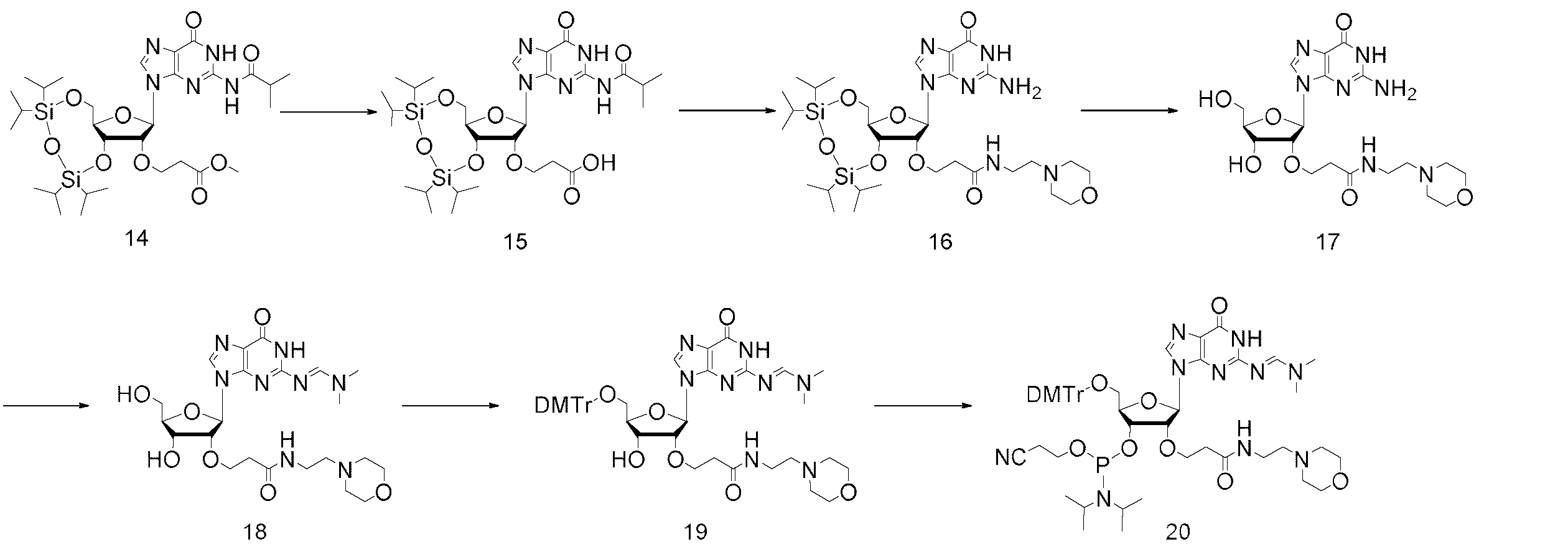
ヌクレオシド類縁体:ジイソプロピル亜ホスホルアミド酸 (2-シアノエチル)(2R,3R,4R,5R)-2-((ビス(4-メトキシフェニル)(フェニル)メトキシ)メチル)-5-(2-(((E)-(ジメチルアミノ)メチレン)アミノ)-6-オキソ-1,6-ジヒドロ-9H-プリン-9-イル)-4-(3-((2-モルホリノエチル)アミノ)-3-オキソプロポキシ)テトラヒドロフラン-3-イル(化合物20)の合成
化合物14(PCT/JP2022/031705に記載の方法に準じて合成した)(6.0g、8.8mmol)にジオキサン(6mL)と水(6mL)を加えた。その溶液に、水酸化リチウム一水和物(839mg、20.0mmol)を加え、室温で1時間攪拌した。反応後、0℃に冷却し、1N塩酸を加えた後、ジクロロメタンで抽出した。得られた有機層を回収し、溶媒を減圧下留去し、目的とする化合物15を含んだ粗生成物を得た。
得られた粗生成物をジメチルホルムアミド(30mL)に溶解した。その溶液に、N,N-ジイソプロピルエチルアミン(6.2mL、35.6mmol)、4-(2-アミノエチル)モルホリン(4.6mL、35.6mmol)、1-[ビス(ジメチルアミノ)メチレン]-1H-1,2,3-トリアゾロ[4,5-b]ピリジニウム3-オキシドヘキサフルオロホスファート(6.7g、17.8mmol)を加え、室温で1時間攪拌した。反応後、飽和炭酸水素ナトリウム水溶液を加え、酢酸エチルで抽出した。その有機層を回収して、溶媒を減圧下留去した。次いで、得られた残渣に、4-(2-アミノエチル)モルホリン(2.3mL、17.7mmol)を室温で加え、80℃で1時間攪拌した。反応後、溶媒を減圧下留去した。得られた残渣をシリカゲルカラムクロマトグラフィー(クロロホルム/メタノール=90/10→60/40)にて精製して、化合物16を含んだ粗生成物を得た。
得られた粗生成物(6.4g)をテトラヒドロフラン(60mL)で溶解した。その溶液に、トリエチルアミン(3.7mL、26.7mmol)とトリエチルアミン三フッ化水素酸塩(2.9mL、17.8mmol)を加え、室温で2時間攪拌した。反応後、メトキシトリメチルシラン(1.9mL、18.0mmol)を加え、溶媒を減圧下留去した。得られた残渣をシリカゲルカラムクロマトグラフィー(クロロホルム/メタノール=70/30→50/50)にて精製し、目的とする化合物17を含んだ粗生成物を得た。
得られた粗生成物(4g)をメタノール(20mL)で溶解した。その溶液を40℃に加熱し、N,N-ジメチルホルムアミドジメチルアセタール(2.0mL、15.0mmol)を加え、40℃で1時間攪拌した後、さらにN,N-ジメチルホルムアミドジメチルアセタール(1.0mL、7.5mmol)を加え、40℃で1時間攪拌した。反応後、溶媒を減圧下留去した。得られた残渣をシリカゲルカラムクロマトグラフィー(クロロホルム/メタノール=70/30→30/70)にて精製し、目的とする化合物18(2.0g、4段階収率 44%)を固体として得た。
MASS(ESI+)(条件5):[M+H]+ 523
1H-NMR (400 MHz, METHANOL-d4) δ 2.37-2.51 (m, 8H), 3.11 (s, 3H), 3.21 (s, 3H), 3.24-3.36 (m, 3H), 3.61-3.76 (m, 6H), 3.78-3.88 (m, 2H), 3.89-3.97 (m, 1H), 4.05-4.10 (m, 1H), 4.40-4.53 (m, 2H), 6.00 (d, 1H), 8.10 (s, 1H), 8.65 (s, 1H).
得られた粗生成物をジメチルホルムアミド(30mL)に溶解した。その溶液に、N,N-ジイソプロピルエチルアミン(6.2mL、35.6mmol)、4-(2-アミノエチル)モルホリン(4.6mL、35.6mmol)、1-[ビス(ジメチルアミノ)メチレン]-1H-1,2,3-トリアゾロ[4,5-b]ピリジニウム3-オキシドヘキサフルオロホスファート(6.7g、17.8mmol)を加え、室温で1時間攪拌した。反応後、飽和炭酸水素ナトリウム水溶液を加え、酢酸エチルで抽出した。その有機層を回収して、溶媒を減圧下留去した。次いで、得られた残渣に、4-(2-アミノエチル)モルホリン(2.3mL、17.7mmol)を室温で加え、80℃で1時間攪拌した。反応後、溶媒を減圧下留去した。得られた残渣をシリカゲルカラムクロマトグラフィー(クロロホルム/メタノール=90/10→60/40)にて精製して、化合物16を含んだ粗生成物を得た。
得られた粗生成物(6.4g)をテトラヒドロフラン(60mL)で溶解した。その溶液に、トリエチルアミン(3.7mL、26.7mmol)とトリエチルアミン三フッ化水素酸塩(2.9mL、17.8mmol)を加え、室温で2時間攪拌した。反応後、メトキシトリメチルシラン(1.9mL、18.0mmol)を加え、溶媒を減圧下留去した。得られた残渣をシリカゲルカラムクロマトグラフィー(クロロホルム/メタノール=70/30→50/50)にて精製し、目的とする化合物17を含んだ粗生成物を得た。
得られた粗生成物(4g)をメタノール(20mL)で溶解した。その溶液を40℃に加熱し、N,N-ジメチルホルムアミドジメチルアセタール(2.0mL、15.0mmol)を加え、40℃で1時間攪拌した後、さらにN,N-ジメチルホルムアミドジメチルアセタール(1.0mL、7.5mmol)を加え、40℃で1時間攪拌した。反応後、溶媒を減圧下留去した。得られた残渣をシリカゲルカラムクロマトグラフィー(クロロホルム/メタノール=70/30→30/70)にて精製し、目的とする化合物18(2.0g、4段階収率 44%)を固体として得た。
MASS(ESI+)(条件5):[M+H]+ 523
1H-NMR (400 MHz, METHANOL-d4) δ 2.37-2.51 (m, 8H), 3.11 (s, 3H), 3.21 (s, 3H), 3.24-3.36 (m, 3H), 3.61-3.76 (m, 6H), 3.78-3.88 (m, 2H), 3.89-3.97 (m, 1H), 4.05-4.10 (m, 1H), 4.40-4.53 (m, 2H), 6.00 (d, 1H), 8.10 (s, 1H), 8.65 (s, 1H).
化合物18(2.0g、3.8mmol)をピリジン(20mL)に溶解した。その溶液に、4,4’-ジメトキシトリチルクロリド(2.2g、6.5mmol)を加え、室温にて50分間攪拌した。反応後、メタノール、飽和炭酸水素ナトリウム水溶液を加え、酢酸エチルで抽出した。その有機層を回収し、減圧下留去した。得られた残渣をシリカゲルカラムクロマトグラフィー(酢酸エチル/メタノール/トリエチルアミン=90/10/0.5→80/20/0.5)にて精製し、目的とする化合物19(2.1g、収率 66%)を固体として得た。
MASS(ESI+)(条件5):[M+H]+ 825
1H-NMR (400 MHz, CDCl3) δ 2.40-2.65 (m, 8H), 3.04 (s, 3H), 3.09 (s, 3H), 3.32-3.50 (m, 4H), 3.68-3.72 (m, 4H), 3.76-3.88 (m, 7H), 3.94-4.02 (m, 1H), 4.23-4.27 (m, 1H), 4.42 (dd, 1H), 4.58 (dd, 1H), 6.05 (d, 1H), 6.60-6.68 (brs, 1H), 6.78-6.83 (m, 4H), 7.13-7.24 (m, 2H), 7.25-7.36 (m, 6H), 7.41-7.43 (m, 2H), 7.73 (s, 1H), 8.60 (s, 1H), 9.01-9.13 (brs, 1H).
MASS(ESI+)(条件5):[M+H]+ 825
1H-NMR (400 MHz, CDCl3) δ 2.40-2.65 (m, 8H), 3.04 (s, 3H), 3.09 (s, 3H), 3.32-3.50 (m, 4H), 3.68-3.72 (m, 4H), 3.76-3.88 (m, 7H), 3.94-4.02 (m, 1H), 4.23-4.27 (m, 1H), 4.42 (dd, 1H), 4.58 (dd, 1H), 6.05 (d, 1H), 6.60-6.68 (brs, 1H), 6.78-6.83 (m, 4H), 7.13-7.24 (m, 2H), 7.25-7.36 (m, 6H), 7.41-7.43 (m, 2H), 7.73 (s, 1H), 8.60 (s, 1H), 9.01-9.13 (brs, 1H).
化合物19(2.1g、2.54mmol)をジクロロメタン(20mL)に溶解した。その溶液に、N,N-ジイソプロピルエチルアミン(1.34mL、7.70mmol)、2-シアノエチル N,N-ジイソプロピルクロロホスホルアミダイト(1.4mL、6.40mmol)を加え、室温で1時間攪拌した。反応後、シリカゲルカラムクロマトグラフィー(クロロホルム/メタノール/トリエチルアミン=100/0/0.5→70/30/0.5)にて精製し、目的とする化合物20(1.5g、収率57%)を固体として得た。
MASS(ESI+)(条件3):[M+H]+ 1026
1H-NMR (300 MHz, DMSO-d6) δ 0.94 (d, 3H), 1.01-1.18 (m, 9H), 2.21-2.37 (m, 10H), 2.53-2.60 (m, 1H), 2.72-2.81 (m, 1H), 3.02 (s, 3H), 3.08-3.13 (m, 5H), 3.19-3.27 (m, 2H), 3.50-3.62 (m, 6H), 3.65-3.85 (m, 9H), 4.03-4.19 (m, 1H), 4.47-4.59 (m, 1H), 5.94-5.99 (m, 1H), 6.79-6.86 (m, 4H), 7.11-7.41 (m, 9H), 7.68-7.78 (m, 1H), 7.86-7.96 (m, 1H), 8.48-8.54 (m, 1H), 11.39 (brs, 1H).
31P-NMR (162 MHz, DMSO-d6) δ 149.7, 149.9.
MASS(ESI+)(条件3):[M+H]+ 1026
1H-NMR (300 MHz, DMSO-d6) δ 0.94 (d, 3H), 1.01-1.18 (m, 9H), 2.21-2.37 (m, 10H), 2.53-2.60 (m, 1H), 2.72-2.81 (m, 1H), 3.02 (s, 3H), 3.08-3.13 (m, 5H), 3.19-3.27 (m, 2H), 3.50-3.62 (m, 6H), 3.65-3.85 (m, 9H), 4.03-4.19 (m, 1H), 4.47-4.59 (m, 1H), 5.94-5.99 (m, 1H), 6.79-6.86 (m, 4H), 7.11-7.41 (m, 9H), 7.68-7.78 (m, 1H), 7.86-7.96 (m, 1H), 8.48-8.54 (m, 1H), 11.39 (brs, 1H).
31P-NMR (162 MHz, DMSO-d6) δ 149.7, 149.9.

ヌクレオシド類縁体:ジイソプロピル亜ホスホルアミド酸 (2-シアノエチル) (2R,3R,4R,5R)-5-(6-アセトアミド-9H-プリン-9-イル)-2-((ビス(4-メトキシフェニル)(フェニル)メトキシ)メチル)-4-(3-オキソ-3-((2-(ピリジン-2-イル)エチル)アミノ)プロポキシ)テトラヒドロフラン-3-イル(化合物27)の合成
化合物21(The Journal of Organic Chemistry, 2011, 76, p 3042に記載の方法に準じて合成した)(12.0g、23.6mmol)をt-ブタノール(60mL)に溶解した。その溶液に、アクリル酸2,2,2-トリフルオロエチル(44.2mL、353mmol)を加え、0℃に冷却し、カリウムt-ブトキシド(23.6mL、1M、23.6mmol、テトラヒドロフラン溶液)を加え、0℃で1時間攪拌した。反応後、酢酸水溶液を0℃で加え、メチルt-ブチルエーテルで抽出した。得られた有機層を水で洗浄した後、その有機層を回収し、溶媒を減圧下留去し、目的とする化合物22を含んだ粗生成物を得た。
得られた粗生成物(15.4g)に、2-(2-アミノエチル)ピリジン(15.4mL)加え、75℃で2時間30分攪拌した。反応後、水を加え、酢酸エチルで有機層を抽出した。その有機層を回収し、溶媒を減圧下留去した。得られた残渣をシリカゲルクロマトグラフィー(クロロホルム/酢酸エチル=90/10→100/0)で精製し、得られた化合物23を含む粗生成物をさらにシリカゲルクロマトグラフィー(クロロホルム/メタノール)にて精製して、目的とする化合物23(7.2g、2段階収率 44%)を固体として得た。
MASS(ESI+)(条件2):[M+H]+ 686
1H-NMR (400 MHz, DMSO-d6) δ 0.88-1.06 (m, 28H), 2.22-2.38 (m, 2H), 2.72-2.83 (m, 2H), 3.34-3.43 (m, 1H), 3.60-3.66 (m, 1H), 3.71-3.80 (m, 1H), 3.85-3.89 (m, 1H), 3.94-4.00 (m, 2H), 4.42 (dd, 1H), 4.54 (t, 1H), 5.30 (d, 1H), 5.96 (d, 1H), 7.17-7.23 (m, 2H), 7.31-7.36 (brs, 2H), 7.62-7.69 (m, 1H), 8.04 (t, 1H), 8.11-8.12 (m, 1H), 8.25-8.27 (m, 1H), 8.44-8.47 (m, 1H).
得られた粗生成物(15.4g)に、2-(2-アミノエチル)ピリジン(15.4mL)加え、75℃で2時間30分攪拌した。反応後、水を加え、酢酸エチルで有機層を抽出した。その有機層を回収し、溶媒を減圧下留去した。得られた残渣をシリカゲルクロマトグラフィー(クロロホルム/酢酸エチル=90/10→100/0)で精製し、得られた化合物23を含む粗生成物をさらにシリカゲルクロマトグラフィー(クロロホルム/メタノール)にて精製して、目的とする化合物23(7.2g、2段階収率 44%)を固体として得た。
MASS(ESI+)(条件2):[M+H]+ 686
1H-NMR (400 MHz, DMSO-d6) δ 0.88-1.06 (m, 28H), 2.22-2.38 (m, 2H), 2.72-2.83 (m, 2H), 3.34-3.43 (m, 1H), 3.60-3.66 (m, 1H), 3.71-3.80 (m, 1H), 3.85-3.89 (m, 1H), 3.94-4.00 (m, 2H), 4.42 (dd, 1H), 4.54 (t, 1H), 5.30 (d, 1H), 5.96 (d, 1H), 7.17-7.23 (m, 2H), 7.31-7.36 (brs, 2H), 7.62-7.69 (m, 1H), 8.04 (t, 1H), 8.11-8.12 (m, 1H), 8.25-8.27 (m, 1H), 8.44-8.47 (m, 1H).
化合物23(6.5g、9.5mmol)をピリジン(13mL)に溶解した。その溶液を100℃に加熱し、無水酢酸(1.3mL、14.2mmol)を100℃で加えた。100℃で3時間攪拌した後、さらに無水酢酸(89.8μl、0.95mmol)を加え、100℃で1時間攪拌した。反応後、水(0.14mL)を加え、100℃で1時間攪拌した後、酢酸エチルで抽出した。その有機層を回収し、溶媒を減圧下留去した。得られた残渣をシリカゲルクロマトグラフィー(ヘキサン/酢酸エチル=50/50→0/100)で精製し、得られた化合物24を含む粗生成物をさらにシリカゲルクロマトグラフィー(酢酸エチル/メタノール=100/0→70/30)にて精製して、目的とする化合物24を含んだ粗生成物を得た。
得られた化合物24を含んだ粗生成物(4.5g)をテトラヒドロフラン(45mL)溶解した。その溶液に、トリエチルアミン(4.1mL、29.4mmol)、トリエチルアミン三フッ化水素酸塩(3.0mL、18.5mmol)を加え、室温で1時間攪拌した。反応後、メトキシトリメチルシラン(4.3mL、31mmol)を加え、溶媒を減圧下留去した。得られた残渣をシリカゲルカラムクロマトグラフィー(クロロホルム/メタノール=70/30→40/60)にて精製し、目的とする化合物25を含んだ粗生成物を得た。
得られた化合物25を含んだ粗生成物(3.4g)をピリジン(34mL)に溶解した。その溶液に、4,4’-ジメトキシトリチルクロリド(4.8g、12.6mmol)を加え、室温にて終夜攪拌した。反応後、メタノールと水を加え、酢酸エチルで抽出し、その有機層を飽和炭酸水素ナトリウム水溶液で洗浄した。その有機層を回収し、減圧下留去した。得られた残渣をシリカゲルカラムクロマトグラフィー(クロロホルム/酢酸エチル/トリエチルアミン=50/50/0.5→0/100/0.5)で精製し、得られた化合物26を含む粗生成物をさらにシリカゲルカラムクロマトグラフィー(クロロホルム/メタノール/トリエチルアミン=100/0/0.5→50/50/0.5)、次いでシリカゲルカラムクロマトグラフィー(酢酸エチル/メタノール/トリエチルアミン=100/0/0.5→40/60/0.5)にて精製し、目的とする化合物26を含んだ粗生成物を得た。得られた化合物26を含んだ粗生成物(4.0g)をジクロロメタン(40mL)に溶解した。その溶液に、N,N-ジイソプロピルエチルアミン(2.7mL、15.3mmol)、2-シアノエチル N,N-ジイソプロピルクロロホスホルアミダイト(2.8mL、12.9mmol)を加え、室温にて1時間攪拌した。反応後、シリカゲルカラムクロマトグラフィー(クロロホルム/メタノール/トリエチルアミン)にて精製し、目的とする化合物27(3.2g、4段階収率 34%)を固体として得た。
MASS(ESI+)(条件3):[M+H]+ 989
1H-NMR (400 MHz, CDCl3) δ 1.05 (d, 3H), 1.12-1.18 (m, 9H), 2.32-2.44 (m, 5H), 2.57-2.61 (m, 2H), 2.86-2.96 (m, 2H), 3.33-3.38 (m, 1H), 3.51-3.74 (m, 6H), 3.75-3.79 (m, 7H), 3.83-3.90 (m, 2H), 3.98-4.10 (m, 1H), 4.30-4.37 (m, 1H), 4.59-4.63 (m, 1H), 6.08-6.12 (m, 1H), 6.78-6.83 (m, 4H), 7.03-7.34 (m, 9H), 7.38-7.44 (m, 2H), 7.51-7.59 (m, 1H), 8.23-8.26 (m, 1H), 8.40-8.45 (m, 1H), 8.54-8.59 (m, 1H), 8.74 (brs, 1H).
31P-NMR (162 MHz, CDCl3) δ 150.7, 150.8.
得られた化合物24を含んだ粗生成物(4.5g)をテトラヒドロフラン(45mL)溶解した。その溶液に、トリエチルアミン(4.1mL、29.4mmol)、トリエチルアミン三フッ化水素酸塩(3.0mL、18.5mmol)を加え、室温で1時間攪拌した。反応後、メトキシトリメチルシラン(4.3mL、31mmol)を加え、溶媒を減圧下留去した。得られた残渣をシリカゲルカラムクロマトグラフィー(クロロホルム/メタノール=70/30→40/60)にて精製し、目的とする化合物25を含んだ粗生成物を得た。
得られた化合物25を含んだ粗生成物(3.4g)をピリジン(34mL)に溶解した。その溶液に、4,4’-ジメトキシトリチルクロリド(4.8g、12.6mmol)を加え、室温にて終夜攪拌した。反応後、メタノールと水を加え、酢酸エチルで抽出し、その有機層を飽和炭酸水素ナトリウム水溶液で洗浄した。その有機層を回収し、減圧下留去した。得られた残渣をシリカゲルカラムクロマトグラフィー(クロロホルム/酢酸エチル/トリエチルアミン=50/50/0.5→0/100/0.5)で精製し、得られた化合物26を含む粗生成物をさらにシリカゲルカラムクロマトグラフィー(クロロホルム/メタノール/トリエチルアミン=100/0/0.5→50/50/0.5)、次いでシリカゲルカラムクロマトグラフィー(酢酸エチル/メタノール/トリエチルアミン=100/0/0.5→40/60/0.5)にて精製し、目的とする化合物26を含んだ粗生成物を得た。得られた化合物26を含んだ粗生成物(4.0g)をジクロロメタン(40mL)に溶解した。その溶液に、N,N-ジイソプロピルエチルアミン(2.7mL、15.3mmol)、2-シアノエチル N,N-ジイソプロピルクロロホスホルアミダイト(2.8mL、12.9mmol)を加え、室温にて1時間攪拌した。反応後、シリカゲルカラムクロマトグラフィー(クロロホルム/メタノール/トリエチルアミン)にて精製し、目的とする化合物27(3.2g、4段階収率 34%)を固体として得た。
MASS(ESI+)(条件3):[M+H]+ 989
1H-NMR (400 MHz, CDCl3) δ 1.05 (d, 3H), 1.12-1.18 (m, 9H), 2.32-2.44 (m, 5H), 2.57-2.61 (m, 2H), 2.86-2.96 (m, 2H), 3.33-3.38 (m, 1H), 3.51-3.74 (m, 6H), 3.75-3.79 (m, 7H), 3.83-3.90 (m, 2H), 3.98-4.10 (m, 1H), 4.30-4.37 (m, 1H), 4.59-4.63 (m, 1H), 6.08-6.12 (m, 1H), 6.78-6.83 (m, 4H), 7.03-7.34 (m, 9H), 7.38-7.44 (m, 2H), 7.51-7.59 (m, 1H), 8.23-8.26 (m, 1H), 8.40-8.45 (m, 1H), 8.54-8.59 (m, 1H), 8.74 (brs, 1H).
31P-NMR (162 MHz, CDCl3) δ 150.7, 150.8.
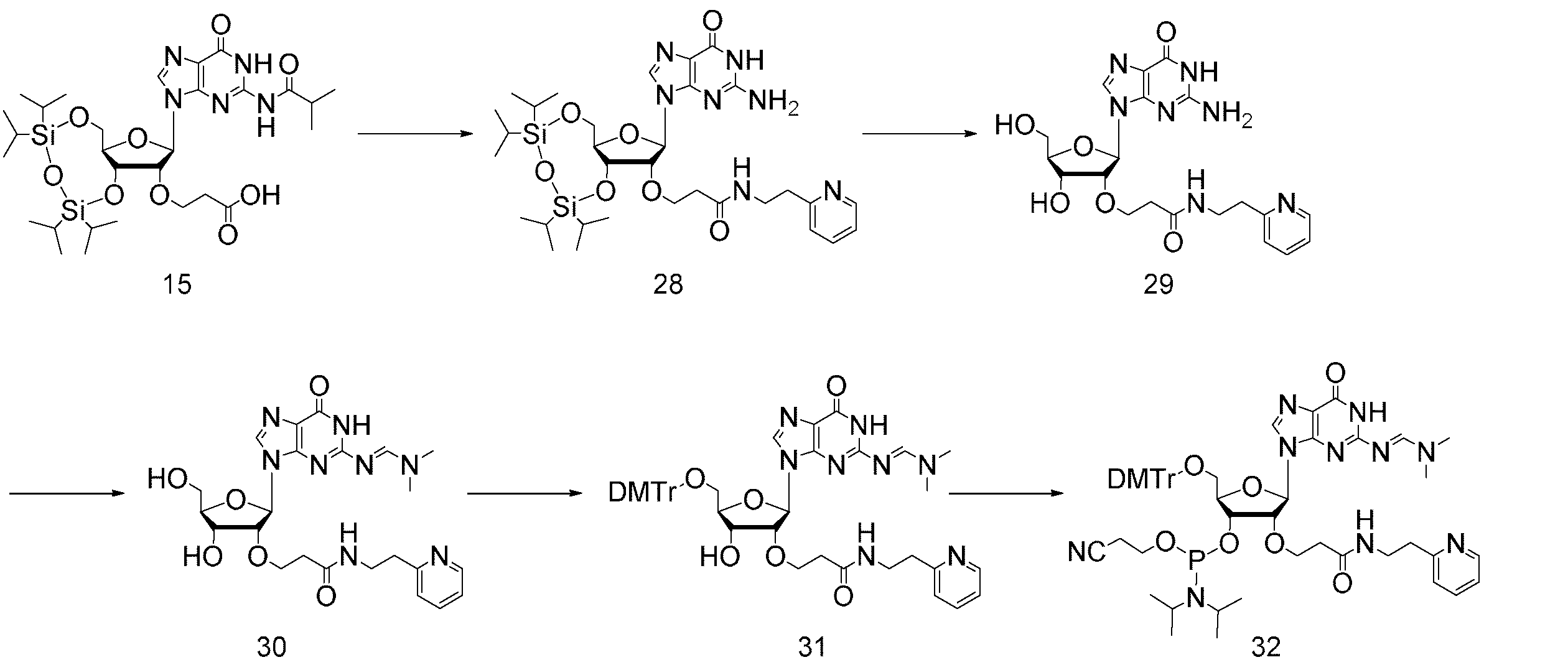
ヌクレオシド類縁体:ジイソプロピル亜ホスホルアミド酸 (2-シアノエチル) (2R,3R,4R,5R)-2-((ビス(4-メトキシフェニル)(フェニル)メトキシ)メチル) -5-(2-(((E)-(ジメチルアミノ)メチレン)アミノ)-6-オキソ-1,6-ジヒドロ-9H-プリン-9-イル)-4-(3-オキソ-3-((2-(ピリジン-2-イル)エチル)アミノ)プロポキシ)テトラヒドロフラン-3-イル(化合物32)の合成
化合物15(3.1g、4.7mmol)をジメチルホルムアミド(15mL)に溶解した。その溶液に、N,N-ジイソプロピルエチルアミン(3.3mL、18.8mmol)、2-(2-アミノエチル)ピリジン(2.3mL、18.8mmol)、1-[ビス(ジメチルアミノ)メチレン]-1H-1,2,3-トリアゾロ[4,5-b]ピリジニウム3-オキシドヘキサフルオロホスファート(3.5g、9.4mmol)を加え、2時間攪拌した後、さらに1-[ビス(ジメチルアミノ)メチレン]-1H-1,2,3-トリアゾロ[4,5-b]ピリジニウム3-オキシドヘキサフルオロホスファート(1.8g、4.7mmol)、2-(2-アミノエチル)ピリジン(1.1mL、9.4mmol)を加え、室温で終夜攪拌した。反応後、飽和炭酸水素ナトリウム水溶液を加えて、酢酸エチルで抽出した。その有機層を回収して、溶媒を減圧下留去した。次いで、得られた残渣に2-(2-アミノエチル)ピリジン(1.1mL、9.4mmol)を加え、室温で2時間攪拌した。反応後、飽和炭酸水素ナトリウム水溶液を加えて、酢酸エチルで抽出した。その有機層を回収し、溶媒を減圧下留去した。得られた残渣に、アンモニアメタノール溶液(30mL)を加え、2時間攪拌した後、さらにアンモニアメタノール溶液(30mL)を加え、2時間攪拌した。反応後、溶媒を減圧下留去した。得られた残渣に、アンモニアメタノール溶液(30mL)を加え、30℃で終夜攪拌した。反応後、溶媒を減圧下留去した。得られた残渣をシリカゲルカラムクロマトグラフィー(クロロホルム/メタノール)にて精製し、化合物28を含んだ粗生成物を得た。
得られた粗生成物(3.2g)をテトラヒドロフラン(32mL)に溶解した。その溶液に、トリエチルアミン(1.9mL、14mmol)、トリエチルアミン三フッ化水素酸塩(1.5mL、9.0mmol)を加え、室温にて2時間攪拌した。反応後、メトキシトリメチルシラン(2.4mL、18mmol)を加え、溶媒を減圧下留去した。得られた残渣をシリカゲルカラムクロマトグラフィー(クロロホルム/メタノール=90/10→50/50)にて精製し、化合物29を含んだ粗生成物を得た。
得られた粗生成物(820mg)をメタノール(4mL)に溶解した。その溶液に、N、N-ジメチルホルムアミドジメチルアセタール(720μL、5.35mmol)を40℃で加え、1時間攪拌した後、さらにN、N-ジメチルホルムアミドジメチルアセタール(300μL、2.2mmol)を室温で加え、40℃で20分間攪拌した。反応後、溶媒を減圧下留去した。得られた残渣をシリカゲルカラムクロマトグラフィー(クロロホルム/メタノール=90/10→60/40)にて精製し、目的とする化合物30(820mg、3段階収率 34%)を固体として得た。
MASS(ESI+)(条件4):[M+H]+ 515
1H-NMR (400 MHz, DMSO-d6) δ 2.32 (t, 2H), 2.81 (t, 2H), 3.01 (s, 3H), 3.13 (s, 3H), 3.34-3.39 (m, 2H), 3.51-3.78 (m, 3H), 3.88-3.92 (m, 1H), 4.02-4.12 (m, 1H), 4.31-4.39 (m, 2H), 5.08 (t, 1H), 5.25 (d, 1H), 5.85 (d, 1H), 7.17-7.21 (m, 2H), 7.67 (td, 1H), 8.01-8.04 (m, 1H), 8.07 (s, 1H), 8.43-8.49 (m, 1H), 8.54 (s, 1H), 11.34 (brs, 1H).
得られた粗生成物(3.2g)をテトラヒドロフラン(32mL)に溶解した。その溶液に、トリエチルアミン(1.9mL、14mmol)、トリエチルアミン三フッ化水素酸塩(1.5mL、9.0mmol)を加え、室温にて2時間攪拌した。反応後、メトキシトリメチルシラン(2.4mL、18mmol)を加え、溶媒を減圧下留去した。得られた残渣をシリカゲルカラムクロマトグラフィー(クロロホルム/メタノール=90/10→50/50)にて精製し、化合物29を含んだ粗生成物を得た。
得られた粗生成物(820mg)をメタノール(4mL)に溶解した。その溶液に、N、N-ジメチルホルムアミドジメチルアセタール(720μL、5.35mmol)を40℃で加え、1時間攪拌した後、さらにN、N-ジメチルホルムアミドジメチルアセタール(300μL、2.2mmol)を室温で加え、40℃で20分間攪拌した。反応後、溶媒を減圧下留去した。得られた残渣をシリカゲルカラムクロマトグラフィー(クロロホルム/メタノール=90/10→60/40)にて精製し、目的とする化合物30(820mg、3段階収率 34%)を固体として得た。
MASS(ESI+)(条件4):[M+H]+ 515
1H-NMR (400 MHz, DMSO-d6) δ 2.32 (t, 2H), 2.81 (t, 2H), 3.01 (s, 3H), 3.13 (s, 3H), 3.34-3.39 (m, 2H), 3.51-3.78 (m, 3H), 3.88-3.92 (m, 1H), 4.02-4.12 (m, 1H), 4.31-4.39 (m, 2H), 5.08 (t, 1H), 5.25 (d, 1H), 5.85 (d, 1H), 7.17-7.21 (m, 2H), 7.67 (td, 1H), 8.01-8.04 (m, 1H), 8.07 (s, 1H), 8.43-8.49 (m, 1H), 8.54 (s, 1H), 11.34 (brs, 1H).
化合物30(830mg、1.61mmol)をピリジン(8.3mL)に溶解した。その溶液に、4,4’-ジメトキシトリチルクロリド(929mg、2.74mmol)を加え、室温にて50分間攪拌した。反応後、メタノールと、飽和炭酸水素ナトリウム水溶液を加え、酢酸エチルで抽出した。その有機層を回収し、無水硫酸ナトリウムで乾燥し、溶媒を減圧下留去した。得られた残渣をシリカゲルカラムクロマトグラフィー(クロロホルム/メタノール/トリエチルアミン)にて精製し、目的とする化合物31(1.14g、収率 87%)を固体として得た。
MASS(ESI+)(条件3):[M+H]+ 817
1H-NMR (400 MHz, DMSO-d6) δ 2.34 (t, 2H), 2.81 (t, 2H), 3.01 (s, 3H), 3.09 (s, 3H), 3.12-3.26 (m, 2H), 3.34-3.39 (m, 3H), 3.72-3.82 (m, 7H), 3.96-4.02 (m, 1H), 4.29-4.36 (m, 1H), 4.40 (t, 1H), 5.29-5.30 (m, 1H), 5.90 (d, 1H), 6.81-6.85 (m, 4H), 7.12-7.27 (m, 9H), 7.34-7.36 (m, 2H), 7.65 (td, 1H), 7.91 (s, 1H), 8.01-8.04 (m, 1H), 8.45-8.47 (m, 1H), 8.52 (s, 1H), 11.37 (brs, 1H).
MASS(ESI+)(条件3):[M+H]+ 817
1H-NMR (400 MHz, DMSO-d6) δ 2.34 (t, 2H), 2.81 (t, 2H), 3.01 (s, 3H), 3.09 (s, 3H), 3.12-3.26 (m, 2H), 3.34-3.39 (m, 3H), 3.72-3.82 (m, 7H), 3.96-4.02 (m, 1H), 4.29-4.36 (m, 1H), 4.40 (t, 1H), 5.29-5.30 (m, 1H), 5.90 (d, 1H), 6.81-6.85 (m, 4H), 7.12-7.27 (m, 9H), 7.34-7.36 (m, 2H), 7.65 (td, 1H), 7.91 (s, 1H), 8.01-8.04 (m, 1H), 8.45-8.47 (m, 1H), 8.52 (s, 1H), 11.37 (brs, 1H).
化合物31(950mg、1.16mmol)をトルエンに溶解し、その溶液を減圧下留去した後、ジクロロメタン(11mL)に溶解した。その溶液に、N,N-ジイソプロピルエチルアミン(2.0mL、11.3mmol)、2-シアノエチル N,N-ジイソプロピルクロロホスホルアミダイト(1.3mL、5.8mmol)を加え、室温にて2時間攪拌した。反応後、シリカゲルカラムクロマトグラフィー(クロロホルム/アセトン/トリエチルアミン=90/10/0.5→5/95/0.5)で精製した後、得られた化合物32を含む粗生成物をさらにシリカゲルカラムクロマトグラフィー(クロロホルム/メタノール/トリエチルアミン=90/10/0.5→70/30/0.5)にて精製し、目的とする化合物32(720mg、収率 61%)を固体として得た。
MASS(ESI+)(条件3):[M+H]+ 1018
1H-NMR (400 MHz, DMSO-d6) δ 0.93 (d, 3H), 1.07-1.13 (m, 9H), 2.23-2.34 (m, 2 H), 2.54 (t, 1H), 2.72-2.82 (m, 3H), 3.00 (d, 3H), 3.07 (d, 3H), 3.18-3.39 (m, 5H), 3.46-3.64 (m, 3H), 3.68-3.74 (m, 7H), 3.78 (t, 2H), 4.08-4.17 (m, 1H), 4.48-4.59 (m, 1H), 5.96 (d, 1H), 6.79-6.85 (m, 4H), 7.13-7.27 (m, 9H), 7.32-7.36 (m, 2H), 7.62-7.67 (m, 1H), 7.85-7.91 (m, 1H), 7.91-7.96 (m, 1H), 8.43-8.47 (m, 1H), 8.48-8.53 (m, 1H), 11.38 (brs, 1H).
31P-NMR (162 MHz, DMSO-d6) δ 149.7, 149.9.
MASS(ESI+)(条件3):[M+H]+ 1018
1H-NMR (400 MHz, DMSO-d6) δ 0.93 (d, 3H), 1.07-1.13 (m, 9H), 2.23-2.34 (m, 2 H), 2.54 (t, 1H), 2.72-2.82 (m, 3H), 3.00 (d, 3H), 3.07 (d, 3H), 3.18-3.39 (m, 5H), 3.46-3.64 (m, 3H), 3.68-3.74 (m, 7H), 3.78 (t, 2H), 4.08-4.17 (m, 1H), 4.48-4.59 (m, 1H), 5.96 (d, 1H), 6.79-6.85 (m, 4H), 7.13-7.27 (m, 9H), 7.32-7.36 (m, 2H), 7.62-7.67 (m, 1H), 7.85-7.91 (m, 1H), 7.91-7.96 (m, 1H), 8.43-8.47 (m, 1H), 8.48-8.53 (m, 1H), 11.38 (brs, 1H).
31P-NMR (162 MHz, DMSO-d6) δ 149.7, 149.9.

ヌクレオシド類縁体:ジイソプロピル亜ホスホルアミド酸 (2-シアノエチル) (2R,3R,4R,5R)-4-(3-((2-(1H-ベンゾ(d)イミダゾール-1-イル)エチル)アミノ)-3-オキソプロポキシ)-5-(6-ベンズアミド-9H-プリン-9-イル)-2-((ビス(4-メトキシフェニル)(フェニル)メトキシ)メチル)テトラヒドロフラン-3-イル(化合物38)の合成
化合物1(The Journal of Organic Chemistry, 2011, 76, p 3042に記載の方法に準じて合成した)(6.3g、10.7mmol)を水(12mL)、ジオキサン(30mL)に溶解した。その溶液に、水酸化リチウム一水和物(1.8g、42.8mmol)を加え、4時間攪拌した。反応後、溶媒を減圧下留去し、化合物33を含んだ粗生成物を得た。
得られた化合物33を含む粗生成物(3.4g)に、2-(1H-ベンゾイミダゾール-1-イル)エチルアミン(3.7g、22.7mmol)を加えた。得られた混合物をジメチルホルムアミド(34mL)で溶解し、N,N-ジイソプロピルエチルアミン(2.9mL、17.0mmol)を加え、0℃に冷却し、1-[ビス(ジメチルアミノ)メチレン]-1H-1,2,3-トリアゾロ[4,5-b]ピリジニウム3-オキシドヘキサフルオロホスファート(6.5g、17.0mmol)を加え、室温で3時間攪拌した。反応後、0℃に冷却し、飽和炭酸水素ナトリウム水溶液を加え、酢酸エチルで抽出した。得られた有機層を回収し、溶媒を減圧下留去した。得られた残渣をシリカゲルクロマトグラフィー(クロロホルム/メタノール=100/0→70/30)にて精製して、目的とする化合物34(3.4g、2段階収率 81%)を得た。
MASS(ESI+)(条件1):[M+H2O+H]+ 743
1H-NMR (400 MHz, DMSO-d6) δ 0.88-1.04 (m, 24H), 2.25-2.33 (m, 4H), 3.39-3.46 (m, 2H), 3.51-3.62 (m, 2H), 3.71-3.77 (m, 1H), 3.85-3.89 (m, 1H), 3.95-4.01 (m, 2H), 4.26 (t, 2H), 4.38-4.43 (m, 1H), 4.53 (t, 1H), 5.30 (d, 1H), 5.98 (d, 1H), 7.12-7.30 (m, 5H), 7.54-7.58 (m, 1H), 7.61-7.64 (m, 1H), 8.10 (m 2H), 8.27 (s, 1H).
得られた化合物33を含む粗生成物(3.4g)に、2-(1H-ベンゾイミダゾール-1-イル)エチルアミン(3.7g、22.7mmol)を加えた。得られた混合物をジメチルホルムアミド(34mL)で溶解し、N,N-ジイソプロピルエチルアミン(2.9mL、17.0mmol)を加え、0℃に冷却し、1-[ビス(ジメチルアミノ)メチレン]-1H-1,2,3-トリアゾロ[4,5-b]ピリジニウム3-オキシドヘキサフルオロホスファート(6.5g、17.0mmol)を加え、室温で3時間攪拌した。反応後、0℃に冷却し、飽和炭酸水素ナトリウム水溶液を加え、酢酸エチルで抽出した。得られた有機層を回収し、溶媒を減圧下留去した。得られた残渣をシリカゲルクロマトグラフィー(クロロホルム/メタノール=100/0→70/30)にて精製して、目的とする化合物34(3.4g、2段階収率 81%)を得た。
MASS(ESI+)(条件1):[M+H2O+H]+ 743
1H-NMR (400 MHz, DMSO-d6) δ 0.88-1.04 (m, 24H), 2.25-2.33 (m, 4H), 3.39-3.46 (m, 2H), 3.51-3.62 (m, 2H), 3.71-3.77 (m, 1H), 3.85-3.89 (m, 1H), 3.95-4.01 (m, 2H), 4.26 (t, 2H), 4.38-4.43 (m, 1H), 4.53 (t, 1H), 5.30 (d, 1H), 5.98 (d, 1H), 7.12-7.30 (m, 5H), 7.54-7.58 (m, 1H), 7.61-7.64 (m, 1H), 8.10 (m 2H), 8.27 (s, 1H).
化合物34(3.4g、4.6mmol)をテトラヒドロフラン(34mL)に溶解した。その溶液に、トリエチルアミン(2.6mL、18.4mmol)、トリエチルアミン三フッ化水素酸塩(2.3mL、13.8mmol)を加え、室温で3時間攪拌した。反応後、メトキシトリメチルシラン(3.2mL、23.0mmol)を加え、溶媒を減圧下留去した。得られた残渣をシリカゲルカラムクロマトグラフィー(クロロホルム/メタノール=100/0/0.5→50/50/0.5)にて精製し、化合物35を含んだ粗生成物(1.1g)を得た。
得られた化合物35を含んだ粗生成物(960mg)をピリジン(34mL)に溶解した。その溶液を0℃に冷却し、トリメチルシリルクロリド(1.26mL、9.9mmol)を加え、0℃で30分間攪拌した。得られた反応液に、ベンゾイルクロリド(1.1mL、9.9mmol)を加え、室温で2時間攪拌した。反応後、反応液を0℃に冷却し、アンモニア水溶液(13.4mL、14%、w/w)を加え、室温で30分間攪拌した。溶媒を減圧下留去し、得られた残渣をシリカゲルカラムクロマトグラフィー(酢酸エチル/クロロホルム/メタノール)にて精製し、化合物36を含んだ粗生成物(1.1g)を得た。
得られた化合物36を含んだ粗生成物(1.1g)をピリジン(11mL)に溶解した。その溶液に、4,4’-ジメトキシトリチルクロリド(1.1g、3.4mmol)を加え、室温にて45分間攪拌した後、さらに4,4’-ジメトキシトリチルクロリド(1.1g、3.4mmol)を加え、室温で30分間攪拌した。反応後、メタノールと、飽和炭酸水素ナトリウム水溶液を加え、酢酸エチルで抽出した。その有機層を回収し、溶媒を減圧下留去した。得られた残渣をシリカゲルカラムクロマトグラフィー(クロロホルム/メタノール/トリエチルアミン)で精製し、得られた化合物37を含む粗生成物をさらにシリカゲルカラムクロマトグラフィー(酢酸エチル/メタノール/トリエチルアミン)にて精製し、目的とする化合物37(1.4g、3段階収率 34%)を固体で得た。
MASS(ESI-)(条件4):[M-H]- 887
1H-NMR (400 MHz, CDCl3) δ 2.39-2.54 (m, 2H), 3.39-3.66 (m, 3H), 3.70-3.82 (m, 9H), 3.93 (td, 1H), 4.28-4.46 (m, 2H), 4.54-4.63 (m, 3H), 6.12 (d, 1H), 6.78-6.81 (m, 4H), 7.14-7.34 (m, 10H), 7.37-7.45 (m, 3H), 7.50-7.54 (m, 2H), 7.59-7.67 (m, 2H), 8.01-8.03 (m, 2H), 8.24 (s, 1H), 8.66 (s, 1H), 9.10 (s, 1H).
得られた化合物35を含んだ粗生成物(960mg)をピリジン(34mL)に溶解した。その溶液を0℃に冷却し、トリメチルシリルクロリド(1.26mL、9.9mmol)を加え、0℃で30分間攪拌した。得られた反応液に、ベンゾイルクロリド(1.1mL、9.9mmol)を加え、室温で2時間攪拌した。反応後、反応液を0℃に冷却し、アンモニア水溶液(13.4mL、14%、w/w)を加え、室温で30分間攪拌した。溶媒を減圧下留去し、得られた残渣をシリカゲルカラムクロマトグラフィー(酢酸エチル/クロロホルム/メタノール)にて精製し、化合物36を含んだ粗生成物(1.1g)を得た。
得られた化合物36を含んだ粗生成物(1.1g)をピリジン(11mL)に溶解した。その溶液に、4,4’-ジメトキシトリチルクロリド(1.1g、3.4mmol)を加え、室温にて45分間攪拌した後、さらに4,4’-ジメトキシトリチルクロリド(1.1g、3.4mmol)を加え、室温で30分間攪拌した。反応後、メタノールと、飽和炭酸水素ナトリウム水溶液を加え、酢酸エチルで抽出した。その有機層を回収し、溶媒を減圧下留去した。得られた残渣をシリカゲルカラムクロマトグラフィー(クロロホルム/メタノール/トリエチルアミン)で精製し、得られた化合物37を含む粗生成物をさらにシリカゲルカラムクロマトグラフィー(酢酸エチル/メタノール/トリエチルアミン)にて精製し、目的とする化合物37(1.4g、3段階収率 34%)を固体で得た。
MASS(ESI-)(条件4):[M-H]- 887
1H-NMR (400 MHz, CDCl3) δ 2.39-2.54 (m, 2H), 3.39-3.66 (m, 3H), 3.70-3.82 (m, 9H), 3.93 (td, 1H), 4.28-4.46 (m, 2H), 4.54-4.63 (m, 3H), 6.12 (d, 1H), 6.78-6.81 (m, 4H), 7.14-7.34 (m, 10H), 7.37-7.45 (m, 3H), 7.50-7.54 (m, 2H), 7.59-7.67 (m, 2H), 8.01-8.03 (m, 2H), 8.24 (s, 1H), 8.66 (s, 1H), 9.10 (s, 1H).
化合物37(1.4g、1.6mmol)をジクロロメタン(14mL)に溶解した。その溶液に、N,N-ジイソプロピルエチルアミン(820μL、4.7mmol)、2-シアノエチル N,N-ジイソプロピルクロロホスホルアミダイト(880μl、3.9mmol)を加え、室温にて30分攪拌した。反応後、シリカゲルカラムクロマトグラフィー(クロロホルム/メタノール/トリエチルアミン)にて精製した後、得られた化合物38を含む粗生成物をさらに富士シリシア株式会社製クロマトレックス(登録商標)DIOL MB100-40/75を用いたシリカゲルカラムクロマトグラフィー(ヘキサン/酢酸エチル/メタノール)にて精製し、目的とする化合物38(634mg、収率 37%)を固体として得た。
MASS(ESI-)(条件1):[M-H]- 1088
1H-NMR (400 MHz, DMSO-d6) δ 1.01 (d, 3H), 1.08-1.24 (m, 9H), 2.21-2.27 (m, 2H), 2.59 (t, 1H), 2.75-2.80 (m, 1H), 2.88 (t, 1H), 3.21-3.26 (m, 1H), 3.52-3.66 (m, 4H), 3.68-3.70 (m, 8H), 3.73-3.88 (m, 2H), 4.17-4.22 (m, 3H), 4.66-4.74 (m, 1H), 4.88-4.92 (m, 1H), 6.15-6.17 (m, 1H), 6.78-6.83 (m, 4H), 7.12-7.26 (m, 9H), 7.33-7.35 (m, 2H), 7.48-7.59 (m, 3H), 7.59-7.66 (m, 2H), 7.91-8.03 (m, 3H), 8.08 (s, 1H), 8.61-8.63 (m, 2H), 11.18-11.24 (brs, 1H).
31P-NMR (162 MHz, DMSO-d6) δ 149.7, 149.8.
MASS(ESI-)(条件1):[M-H]- 1088
1H-NMR (400 MHz, DMSO-d6) δ 1.01 (d, 3H), 1.08-1.24 (m, 9H), 2.21-2.27 (m, 2H), 2.59 (t, 1H), 2.75-2.80 (m, 1H), 2.88 (t, 1H), 3.21-3.26 (m, 1H), 3.52-3.66 (m, 4H), 3.68-3.70 (m, 8H), 3.73-3.88 (m, 2H), 4.17-4.22 (m, 3H), 4.66-4.74 (m, 1H), 4.88-4.92 (m, 1H), 6.15-6.17 (m, 1H), 6.78-6.83 (m, 4H), 7.12-7.26 (m, 9H), 7.33-7.35 (m, 2H), 7.48-7.59 (m, 3H), 7.59-7.66 (m, 2H), 7.91-8.03 (m, 3H), 8.08 (s, 1H), 8.61-8.63 (m, 2H), 11.18-11.24 (brs, 1H).
31P-NMR (162 MHz, DMSO-d6) δ 149.7, 149.8.

ヌクレオシド類縁体:ジイソプロピル亜ホスホルアミド酸 (2-シアノエチル) (2R,3R,4R,5R)-4-(3-((2-(1H-ベンゾ(d)イミダゾール-1-イル)エチル)アミノ)-3-オキソプロポキシ)-2-((ビス(4-メトキシフェニル)(フェニル)メトキシ)メチル)-5-(2-(((E)-(ジメチルアミノ)メチレン)アミノ)-6-オキソ-1,6-ジヒドロ-9H-プリン-9-イル)テトラヒドロフラン-3-イル(化合物43)の合成
化合物14(PCT/JP2022/031705に記載の方法に準じて合成した)(4.1g、6.0mmol)をジオキサン(41mL)と水(21mL)の混合溶媒に溶解した。その溶液に、水酸化リチウム一水和物(785mg、18.7mmol)を加えて、室温で1時間攪拌した。反応後、1M塩酸を加えて、酢酸エチルで抽出した。その有機層を回収し、無水硫酸ナトリウムで乾燥した後、溶媒を減圧下留去し、化合物15を含んだ粗生成物を得た。
得られた化合物15を含む粗生成物(3.7g)に、2-(1H-ベンゾイミダゾール-1-イル)エチルアミン(4.8g、30mmol)を加えた後、ジメチルホルムアミド(37mL)に溶解した。その溶液に、N,N-ジイソプロピルエチルアミン(3.1mL、18mmol)を室温で加えた後、1-[ビス(ジメチルアミノ)メチレン]-1H-1,2,3-トリアゾロ[4,5-b]ピリジニウム3-オキシドヘキサフルオロホスファート(6.8g、18mmol)を0℃で加えて、室温で2時間30分攪拌した。反応後、0℃に冷却し、飽和炭酸水素ナトリウム水溶液を加えて、酢酸エチルで抽出した。その有機層を回収して、溶媒を減圧下留去した。得られた残渣に、アンモニアメタノール溶液を加え、終夜攪拌した後、溶媒を減圧下留去した。得られた残渣をシリカゲルカラムクロマトグラフィー(クロロホルム/メタノール=100/0→50/50)にて精製して、得られた化合物39を含んだ粗生成物をさらにシリカゲルカラムクロマトグラフィー(クロロホルム/メタノール→100/0→70/30)にて精製して、目的の化合物39(1.7g、2段階収率 37%)を固体で得た。
MASS(ESI+)(条件1):[M+H2O+H]+ 759
1H-NMR (300 MHz, DMSO-d6) δ 0.78-1.02 (m, 28H), 2.22-2.29 (t, 2H), 3.38-3.96 (m, 6H), 4.22-4.35 (m, 5H), 5.78 (d, 1H), 6.51-6.62 (brs, 2H), 7.15-7.25 (m, 3H), 7.54-7.64 (m, 2H), 7.83 (s, 1H), 8.08-8.18 (m, 2H).
得られた化合物15を含む粗生成物(3.7g)に、2-(1H-ベンゾイミダゾール-1-イル)エチルアミン(4.8g、30mmol)を加えた後、ジメチルホルムアミド(37mL)に溶解した。その溶液に、N,N-ジイソプロピルエチルアミン(3.1mL、18mmol)を室温で加えた後、1-[ビス(ジメチルアミノ)メチレン]-1H-1,2,3-トリアゾロ[4,5-b]ピリジニウム3-オキシドヘキサフルオロホスファート(6.8g、18mmol)を0℃で加えて、室温で2時間30分攪拌した。反応後、0℃に冷却し、飽和炭酸水素ナトリウム水溶液を加えて、酢酸エチルで抽出した。その有機層を回収して、溶媒を減圧下留去した。得られた残渣に、アンモニアメタノール溶液を加え、終夜攪拌した後、溶媒を減圧下留去した。得られた残渣をシリカゲルカラムクロマトグラフィー(クロロホルム/メタノール=100/0→50/50)にて精製して、得られた化合物39を含んだ粗生成物をさらにシリカゲルカラムクロマトグラフィー(クロロホルム/メタノール→100/0→70/30)にて精製して、目的の化合物39(1.7g、2段階収率 37%)を固体で得た。
MASS(ESI+)(条件1):[M+H2O+H]+ 759
1H-NMR (300 MHz, DMSO-d6) δ 0.78-1.02 (m, 28H), 2.22-2.29 (t, 2H), 3.38-3.96 (m, 6H), 4.22-4.35 (m, 5H), 5.78 (d, 1H), 6.51-6.62 (brs, 2H), 7.15-7.25 (m, 3H), 7.54-7.64 (m, 2H), 7.83 (s, 1H), 8.08-8.18 (m, 2H).
化合物39(1.7g、2.2mmol)をテトラヒドロフラン(17mL)に溶解した。その溶液に、トリエチルアミン(1.2mL、8.8mmol)とトリエチルアミン三フッ化水素酸塩(1.1mL、6.6mmol)を加えて、室温で終夜攪拌した。反応後、メトキシトリメチルシラン(1.5mL、11mmol)を加えて、溶媒を減圧下留去した。得られた残渣をシリカゲルカラムクロマトグラフィー(クロロホルム/メタノール=90/10→60/40)にて精製し、化合物40を含んだ粗生成物を得た。
得られた化合物40を含む粗生成物(1.0g)をメタノール(15ml)に溶解した。その溶液に、N、N-ジメチルホルムアミドジメチルアセタール(820μL、6.1mmol)を40℃で滴下し、40℃で1時間攪拌した後、N、N-ジメチルホルムアミドジメチルアセタール(410μL、3.1mmol)を40℃で滴下し、40℃で1時間攪拌した。反応後、溶媒を減圧下留去し、得られた残渣をシリカゲルカラムクロマトグラフィー(クロロホルム/メタノール=90/10→20/80)にて精製し、目的とする化合物41(1.1g、2段階収率 90%)を固体で得た。
MASS(ESI+)(条件1):[M+H]+ 554
1H-NMR (400 MHz, DMSO-d6) δ 2.23-2.35 (m, 2H), 3.29-3.46 (m, 8H), 3.51-3.62 (m, 2H), 3.70-3.75 (m, 1H), 3.91-3.93 (m, 1H), 4.26-4.38 (m, 3H), 5.10 (t, 1H), 5.20 (d, 1H), 5.78 (d, 1H), 6.40-6.65 (brs, 2H), 7.14-7.27 (m, 3H), 7.57 (d, 1H), 7.64-7.66 (m, 1H), 7.95 (s, 1H), 8.11-8.18 (m, 2H), 10.59-10.65 (brs, 1H).
得られた化合物40を含む粗生成物(1.0g)をメタノール(15ml)に溶解した。その溶液に、N、N-ジメチルホルムアミドジメチルアセタール(820μL、6.1mmol)を40℃で滴下し、40℃で1時間攪拌した後、N、N-ジメチルホルムアミドジメチルアセタール(410μL、3.1mmol)を40℃で滴下し、40℃で1時間攪拌した。反応後、溶媒を減圧下留去し、得られた残渣をシリカゲルカラムクロマトグラフィー(クロロホルム/メタノール=90/10→20/80)にて精製し、目的とする化合物41(1.1g、2段階収率 90%)を固体で得た。
MASS(ESI+)(条件1):[M+H]+ 554
1H-NMR (400 MHz, DMSO-d6) δ 2.23-2.35 (m, 2H), 3.29-3.46 (m, 8H), 3.51-3.62 (m, 2H), 3.70-3.75 (m, 1H), 3.91-3.93 (m, 1H), 4.26-4.38 (m, 3H), 5.10 (t, 1H), 5.20 (d, 1H), 5.78 (d, 1H), 6.40-6.65 (brs, 2H), 7.14-7.27 (m, 3H), 7.57 (d, 1H), 7.64-7.66 (m, 1H), 7.95 (s, 1H), 8.11-8.18 (m, 2H), 10.59-10.65 (brs, 1H).
化合物41(1.1g、2.0mmol)をピリジンに溶解し、その溶液を減圧下留去した後、ピリジン(10mL)に溶解した。その溶液に、4,4’-ジメトキシトリチルクロリド(1.2g、3.6mmol)を加えて室温にて2時間攪拌後、4,4’-ジメトキシトリチルクロリド(1.2g、3.6mmol)を加えて、終夜攪拌した。反応後、メタノールと飽和炭酸水素ナトリウム水溶液を加えて、酢酸エチルで抽出した。その有機層を回収し、無水硫酸ナトリウムで乾燥した後、溶媒を減圧下留去した。得られた残渣をシリカゲルカラムクロマトグラフィー(クロロホルム/メタノール=100/0→70/30)にて精製し、目的とする化合物42(1.4g、収率79%)を固体として得た。
MASS(ESI+)(条件3):[M+H]+ 856
1H-NMR (400 MHz, DMSO-d6) δ 2.29-2.34 (m, 4H), 3.21-3.46 (m, 8H), 3.64-3.85 (m, 8H), 4.03-4.12 (m, 1H), 4.22-4.29 (m, 2H), 4.46-4.52 (m, 1H), 4.70 (t, 1H), 5.37 (d, 1H), 6.14 (d, 1H), 6.80-6.88 (m, 4H), 7.11-7.26 (m, 5H), 7.30-7.43 (m, 2H), 7.52-7.68 (m, 5H), 8.03 (d, 2H), 8.09-8.15 (m, 1H), 8.59 (s, 1H), 8.65 (s, 1H),11.18-11.26 (d, 1H).
MASS(ESI+)(条件3):[M+H]+ 856
1H-NMR (400 MHz, DMSO-d6) δ 2.29-2.34 (m, 4H), 3.21-3.46 (m, 8H), 3.64-3.85 (m, 8H), 4.03-4.12 (m, 1H), 4.22-4.29 (m, 2H), 4.46-4.52 (m, 1H), 4.70 (t, 1H), 5.37 (d, 1H), 6.14 (d, 1H), 6.80-6.88 (m, 4H), 7.11-7.26 (m, 5H), 7.30-7.43 (m, 2H), 7.52-7.68 (m, 5H), 8.03 (d, 2H), 8.09-8.15 (m, 1H), 8.59 (s, 1H), 8.65 (s, 1H),11.18-11.26 (d, 1H).
化合物42(1.4g、1.6mmol)をジクロロメタン(14.0mL)に溶解した。その溶液に、N,N-ジイソプロピルエチルアミン(808μL、4.7mmol)、2-シアノエチル N,N-ジイソプロピルクロロホスホルアミダイト(872μL、3.9mmol)を加えて、室温にて3時間攪拌した。その後、反応液に、N,N-ジイソプロピルエチルアミン(380μL、2.2mmol)と2-シアノエチル N,N-ジイソプロピルクロロホスホルアミダイト(100μL、0.4mmol)を加えて、2時間攪拌した。その反応液をシリカゲルカラムクロマトグラフィー(クロロホルム/メタノール/トリエチルアミン=100/0/0.5→70/30/0.5)にて精製し、得られた化合物43を含む粗生成物をさらにシリカゲルカラムクロマトグラフィー(クロロホルム/アセトン/トリエチルアミン=50/50/0.5→0/100/0.5)、次いでシリカゲルカラムクロマトグラフィー(クロロホルム/メタノール/トリエチルアミン=70/30/0.5)にて精製し、目的とする化合物43(1.0g、収率60%)を固体として得た。
MASS(ESI+)(条件2):[M+H]+ 1057
1H-NMR (400 MHz, DMSO-d6) δ 0.93 (d, 3H), 1.01-1.15 (m, 9H), 2.20-2.31 (m, 2H), 2.52-2.57 (m, 1H), 2.72-2.81 (m, 1H), 2.93-3.06 (m, 6H), 3.15-3.60 (m, 7H), 3.67-3.86 (m, 9H), 4.11-4.33 (m, 3H), 4.49-4.58 (m, 2H), 5.98 (d, 1H), 6.77-6.84 (m, 4H), 7.11-7.27 (m, 9H), 7.33-7.39 (m, 2H), 7.53 (dd, 1H), 7.61 (dd, 1H), 7.94-8.10 (m, 3H), 8.42-8.46 (m, 1H), 11.37 (brs, 1H).
31P-NMR (162 MHz, DMSO-d6) δ 149.7, 149.9.
MASS(ESI+)(条件2):[M+H]+ 1057
1H-NMR (400 MHz, DMSO-d6) δ 0.93 (d, 3H), 1.01-1.15 (m, 9H), 2.20-2.31 (m, 2H), 2.52-2.57 (m, 1H), 2.72-2.81 (m, 1H), 2.93-3.06 (m, 6H), 3.15-3.60 (m, 7H), 3.67-3.86 (m, 9H), 4.11-4.33 (m, 3H), 4.49-4.58 (m, 2H), 5.98 (d, 1H), 6.77-6.84 (m, 4H), 7.11-7.27 (m, 9H), 7.33-7.39 (m, 2H), 7.53 (dd, 1H), 7.61 (dd, 1H), 7.94-8.10 (m, 3H), 8.42-8.46 (m, 1H), 11.37 (brs, 1H).
31P-NMR (162 MHz, DMSO-d6) δ 149.7, 149.9.
[製造例1] アンチセンスオリゴヌクレオチドの合成及び精製
表1に記載されたアンチセンスオリゴヌクレオチドを、核酸自動合成機を使用して、以下の手順で調製した。なお、表1中の配列表記において、「(L)」はLNAヌクレオチドを意味し、「(Mo)」は2’-MоrECEヌクレオチドを意味し、「(Py)」は2’-PyECEヌクレオチドを意味し、「(Bz)」は2’-BimECEヌクレオチドを意味し、小文字のアルファベットはデオキシリボヌクレオチドを意味し、「5(x)」は、そのデオキシリボヌクレオチドの核酸塩基が5-メチルシトシンであることを意味し、「^」はホスホロチオエート結合を意味し、「5」はヌクレオチドの塩基が5-メチルシトシンであることを意味し、「X」は次の式(4)

(式中、*は、オリゴヌクレオチドとの結合位置を表す。)で表される基がオリゴヌクレオチドの5’末端ヒドロキシ基の酸素原子に -P(=O)(OH)-で表される基を介して結合していることを意味する。
表1に記載されたアンチセンスオリゴヌクレオチドを、核酸自動合成機を使用して、以下の手順で調製した。なお、表1中の配列表記において、「(L)」はLNAヌクレオチドを意味し、「(Mo)」は2’-MоrECEヌクレオチドを意味し、「(Py)」は2’-PyECEヌクレオチドを意味し、「(Bz)」は2’-BimECEヌクレオチドを意味し、小文字のアルファベットはデオキシリボヌクレオチドを意味し、「5(x)」は、そのデオキシリボヌクレオチドの核酸塩基が5-メチルシトシンであることを意味し、「^」はホスホロチオエート結合を意味し、「5」はヌクレオチドの塩基が5-メチルシトシンであることを意味し、「X」は次の式(4)
(式中、*は、オリゴヌクレオチドとの結合位置を表す。)で表される基がオリゴヌクレオチドの5’末端ヒドロキシ基の酸素原子に -P(=O)(OH)-で表される基を介して結合していることを意味する。
なお、表1中の各カラムの表記は以下の通りである。
“Compd. No.”:化合物番号を表す。
“Chemical Structure”:化合構造を表す。
“Expected MW”:各化合物の理論分子量(Da)の数値を表す。
“Observed MW”:各化合物の実測された分子量(Da)を表す。
“Target RNA”:各化合物が標的とするマウス遺伝子(転写産物)名を表す。
“Compd. No.”:化合物番号を表す。
“Chemical Structure”:化合構造を表す。
“Expected MW”:各化合物の理論分子量(Da)の数値を表す。
“Observed MW”:各化合物の実測された分子量(Da)を表す。
“Target RNA”:各化合物が標的とするマウス遺伝子(転写産物)名を表す。
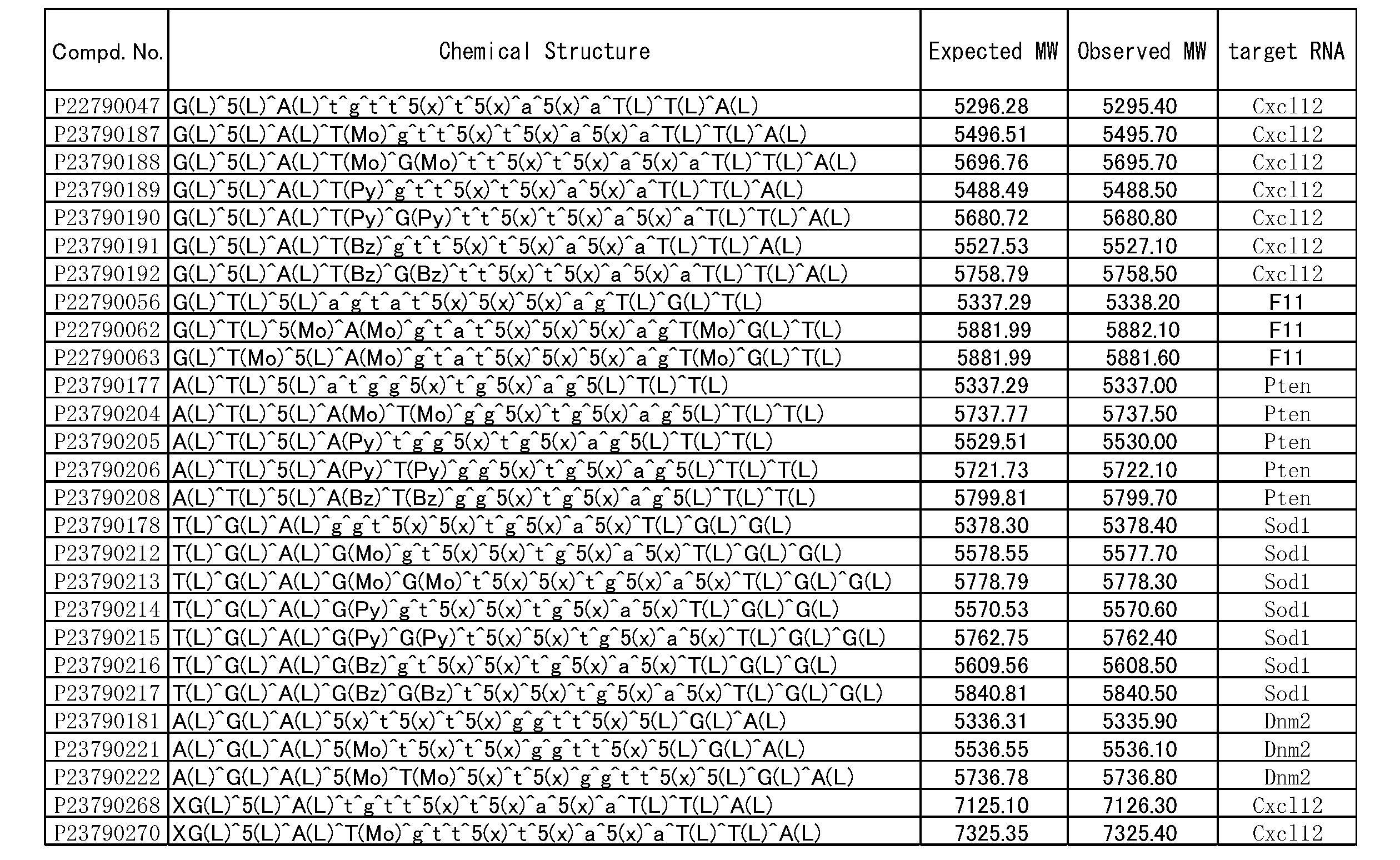
表1に示すアンチセンスオリゴヌクレオチドを、核酸自動合成装置nS-8II(ジーンデザイン社製)又は核酸自動合成装置M-8-SE(日本テクノサービス社製)を用いて合成した。5’-末端がDMTr基により保護されかつ固相支持されたオリゴヌクレオチド類縁体を、飽和アンモニア水で処理した。これを、逆相HPLC(SHIMADZU製、分取カラムとしてWatersXBridge(登録商標) BEH C18 OBD(登録商標) Prep Column 130A,5μm(10mm×250mm))により精製した。
合成したアンチセンスオリゴヌクレオチドは、以下に示す分析条件6にて、ESI-MSによる質量分析を行い、それぞれ目的物と同定した(各化合物の理論分子量、及び検出された分子量を表1に示す)。
(分析条件6)
装置:Waters ACQUITY UPLC H CLASS/SQ Detector 2
カラム:ACQUITY UPLC Oligonucleotide BEH C18 Column(130Å、1.7μm、2.1x50mm)
カラム温度:60℃
溶媒:
A液:水(0.75% v/v ヘキサフルオロイソプロパノール;0.038% v/v トリエチルアミン;5μM エチレンジアミン四酢酸)
B液:90% v/v メタノール水溶液(0.75% v/v ヘキサフルオロイソプロパノール;0.038% v/v トリエチルアミン;5μM エチレンジアミン四酢酸)
グラジエント条件:
流速0.36mL/min、A液とB液の混合比を95/5(v/v)に固定して測定開始し、0.56分後に5.5分間でA液とB液の混合比を40/60(v/v)に直線的に変えた。
検出波長:260nm
デコンボリューション:
イオンシグナルをProMass for MassLynx Software(Waters製)を用いて解析した。
装置:Waters ACQUITY UPLC H CLASS/SQ Detector 2
カラム:ACQUITY UPLC Oligonucleotide BEH C18 Column(130Å、1.7μm、2.1x50mm)
カラム温度:60℃
溶媒:
A液:水(0.75% v/v ヘキサフルオロイソプロパノール;0.038% v/v トリエチルアミン;5μM エチレンジアミン四酢酸)
B液:90% v/v メタノール水溶液(0.75% v/v ヘキサフルオロイソプロパノール;0.038% v/v トリエチルアミン;5μM エチレンジアミン四酢酸)
グラジエント条件:
流速0.36mL/min、A液とB液の混合比を95/5(v/v)に固定して測定開始し、0.56分後に5.5分間でA液とB液の混合比を40/60(v/v)に直線的に変えた。
検出波長:260nm
デコンボリューション:
イオンシグナルをProMass for MassLynx Software(Waters製)を用いて解析した。
[評価例1]3T3-L1細胞(マウス線維芽細胞)中のマウスCxcl12のアンチセンス抑制
10,000細胞/ウェルの密度で96ウェルプレートに播種した3T3-L1細胞に、約24時間後、その最終濃度が0.3~30nMとなるようにP22790047、P23790187、P23790188、P23790189、P23790190、P23790191及びP23790192をLipofectamine(登録商標)3000 Reagent(Thermo Fisher Scientific)存在下で添加した(Lipofection)。24時間後、CellAmp(登録商標)Direct RNA Prep Kit for RT-PCR (Real Time)(タカラバイオ)を用いて、RNAを含む細胞ライセートを作製したのちに、One Step PrimeScript(登録商標) III RT-qPCR Mix(タカラバイオ)を用いて、TaqMan(登録商標) Gene Expression Assays(Thermo Fisher Scientific)による定量リアルタイムPCRでマウスCxcl12遺伝子発現レベルを測定した。リアルタイムPCRでは、ハウスキーピング遺伝子のGapdhのmRNA量も同時に定量し、GapdhのmRNA量に対するCxcl12のmRNA量を、Cxcl12の発現レベルとして評価した。結果を、未処理対照細胞に対する10nMにおける阻害率パーセント値及び、Cxcl12のパーセント発現からGraphPad PRISM 9.0(Dotmatics)を用いて算出した50%阻害濃度(IC50)として表2に表す。
10,000細胞/ウェルの密度で96ウェルプレートに播種した3T3-L1細胞に、約24時間後、その最終濃度が0.3~30nMとなるようにP22790047、P23790187、P23790188、P23790189、P23790190、P23790191及びP23790192をLipofectamine(登録商標)3000 Reagent(Thermo Fisher Scientific)存在下で添加した(Lipofection)。24時間後、CellAmp(登録商標)Direct RNA Prep Kit for RT-PCR (Real Time)(タカラバイオ)を用いて、RNAを含む細胞ライセートを作製したのちに、One Step PrimeScript(登録商標) III RT-qPCR Mix(タカラバイオ)を用いて、TaqMan(登録商標) Gene Expression Assays(Thermo Fisher Scientific)による定量リアルタイムPCRでマウスCxcl12遺伝子発現レベルを測定した。リアルタイムPCRでは、ハウスキーピング遺伝子のGapdhのmRNA量も同時に定量し、GapdhのmRNA量に対するCxcl12のmRNA量を、Cxcl12の発現レベルとして評価した。結果を、未処理対照細胞に対する10nMにおける阻害率パーセント値及び、Cxcl12のパーセント発現からGraphPad PRISM 9.0(Dotmatics)を用いて算出した50%阻害濃度(IC50)として表2に表す。
[評価例2]NMuLi細胞(マウス肝細胞)中のマウスCaspase3/7 activityの上昇抑制
10,000細胞/ウェルの密度で96ウェルプレートに播種したNMuLi細胞に、約24時間後、その最終濃度が10nMとなるようにP22790047、P23790187、P23790188、P23790189、P23790190、P23790191及びP23790192をLipofectamine(登録商標)3000 Reagent(Thermo Fisher Scientific)存在下で添加した(Lipofection)。24時間後、Caspase-Glo(登録商標)3/7 assay System(Promega)を用いて、Caspase3/7 activityを測定した。結果を、未処理対照細胞に対するCaspase3/7 activityのパーセント値及びCaspase3/7 activityのパーセント値を3T3-L1における10nMにおけるCxcl12発現阻害率パーセント値で除した値として表2に表す。
10,000細胞/ウェルの密度で96ウェルプレートに播種したNMuLi細胞に、約24時間後、その最終濃度が10nMとなるようにP22790047、P23790187、P23790188、P23790189、P23790190、P23790191及びP23790192をLipofectamine(登録商標)3000 Reagent(Thermo Fisher Scientific)存在下で添加した(Lipofection)。24時間後、Caspase-Glo(登録商標)3/7 assay System(Promega)を用いて、Caspase3/7 activityを測定した。結果を、未処理対照細胞に対するCaspase3/7 activityのパーセント値及びCaspase3/7 activityのパーセント値を3T3-L1における10nMにおけるCxcl12発現阻害率パーセント値で除した値として表2に表す。

表2から明らかなように、化合物P23790187~P23790192は、P22790047(R-ECEヌクレオチドを有しないLNAギャップマー)と比較して、同程度若しくは微弱程度のmRNA阻害活性を維持しつつ、毒性を大幅に軽減することができた。
[評価例3]Hepa―1c1c7細胞(マウス肝細胞)中のマウスF11のアンチセンス抑制
5,000細胞/ウェルの密度で96ウェルプレートに播種したHepa―1c1c7細胞に、約24時間後、その最終濃度が0.1~30nMとなるようにP22790056、P22790062及びP22790063をLipofectamine(登録商標)3000 Reagent(Thermo Fisher Scientific)存在下で添加した(Lipofection)。24時間後、CellAmp(登録商標)Direct RNA Prep Kit for RT-PCR (Real Time)(タカラバイオ)を用いて、RNAを含む細胞ライセートを作製したのちに、One Step PrimeScript(登録商標) III RT-qPCR Mix(タカラバイオ)を用いて、TaqMan(登録商標) Gene Expression Assays(Thermo Fisher Scientific)による定量リアルタイムPCRでマウスF11遺伝子発現レベルを測定した。リアルタイムPCRでは、ハウスキーピング遺伝子のGapdhのmRNA量も同時に定量し、GapdhのmRNA量に対するF11のmRNA量を、F11の発現レベルとして評価した。結果を、未処理対照細胞に対する10nMにおける阻害率パーセント値及び、F11のパーセント発現からGraphPad PRISM 9.0(Dotmatics)を用いて算出した50%阻害濃度(IC50)として表3に表す。
5,000細胞/ウェルの密度で96ウェルプレートに播種したHepa―1c1c7細胞に、約24時間後、その最終濃度が0.1~30nMとなるようにP22790056、P22790062及びP22790063をLipofectamine(登録商標)3000 Reagent(Thermo Fisher Scientific)存在下で添加した(Lipofection)。24時間後、CellAmp(登録商標)Direct RNA Prep Kit for RT-PCR (Real Time)(タカラバイオ)を用いて、RNAを含む細胞ライセートを作製したのちに、One Step PrimeScript(登録商標) III RT-qPCR Mix(タカラバイオ)を用いて、TaqMan(登録商標) Gene Expression Assays(Thermo Fisher Scientific)による定量リアルタイムPCRでマウスF11遺伝子発現レベルを測定した。リアルタイムPCRでは、ハウスキーピング遺伝子のGapdhのmRNA量も同時に定量し、GapdhのmRNA量に対するF11のmRNA量を、F11の発現レベルとして評価した。結果を、未処理対照細胞に対する10nMにおける阻害率パーセント値及び、F11のパーセント発現からGraphPad PRISM 9.0(Dotmatics)を用いて算出した50%阻害濃度(IC50)として表3に表す。
[評価例4]Hepa―1c1c7細胞(マウス肝細胞)中のマウスCaspase3/7 activityの上昇抑制
5,000細胞/ウェルの密度で96ウェルプレートに播種したHepa―1c1c7細胞に、約24時間後、その最終濃度が10nMとなるようにP22790056、P22790062及びP22790063をLipofectamine(登録商標)3000 Reagent(Thermo Fisher Scientific)存在下で添加した(Lipofection)。24時間後、Caspase-Glo(登録商標)3/7 assay System(Promega)を用いて、Caspase3/7 activityを測定した。結果を、未処理対照細胞に対するCaspase3/7 activityのパーセント値及びCaspase3/7 activityのパーセント値をHepa―1c1c7における10nMにおけるF11発現阻害率パーセント値で除した値として表3に表す。
5,000細胞/ウェルの密度で96ウェルプレートに播種したHepa―1c1c7細胞に、約24時間後、その最終濃度が10nMとなるようにP22790056、P22790062及びP22790063をLipofectamine(登録商標)3000 Reagent(Thermo Fisher Scientific)存在下で添加した(Lipofection)。24時間後、Caspase-Glo(登録商標)3/7 assay System(Promega)を用いて、Caspase3/7 activityを測定した。結果を、未処理対照細胞に対するCaspase3/7 activityのパーセント値及びCaspase3/7 activityのパーセント値をHepa―1c1c7における10nMにおけるF11発現阻害率パーセント値で除した値として表3に表す。

表3から明らかなように、化合物P22790062及びP22790063は、P22790056(R-ECEヌクレオチドを有しないLNAギャップマー)と比較して、同程度若しくは微弱程度のmRNA阻害活性を維持しつつ、毒性を大幅に軽減することができた。
[評価例5]3T3-L1細胞中のマウスPtenのアンチセンス抑制
評価例1と同様の評価方法を用いて、P23790177、P23790204、P23790205、P23790206及びP23790208をその最終濃度が0.3~30nMとなるようにし、マウスGapdhのmRNA量に対するPtenのmRNA量を、Ptenの発現レベルとして評価した。結果を、未処理対照細胞に対する10nMにおける阻害率パーセント値及び、Ptenのパーセント発現から算出した50%阻害濃度(IC50)として表4に表す。
評価例1と同様の評価方法を用いて、P23790177、P23790204、P23790205、P23790206及びP23790208をその最終濃度が0.3~30nMとなるようにし、マウスGapdhのmRNA量に対するPtenのmRNA量を、Ptenの発現レベルとして評価した。結果を、未処理対照細胞に対する10nMにおける阻害率パーセント値及び、Ptenのパーセント発現から算出した50%阻害濃度(IC50)として表4に表す。
[評価例6]NMuLi細胞中のマウスCaspase3/7 activityの上昇抑制
評価例2と同様の評価方法を用いて、P23790177、P23790204、P23790205、P23790206及びP23790208をその最終濃度が10nMとなるようにし、Caspase3/7 activityを測定した。結果を、未処理対照細胞に対するCaspase3/7 activityのパーセント値及びCaspase3/7 activityのパーセント値を3T3-L1における10nMにおけるPten発現阻害率パーセント値で除した値として表4に表す。
評価例2と同様の評価方法を用いて、P23790177、P23790204、P23790205、P23790206及びP23790208をその最終濃度が10nMとなるようにし、Caspase3/7 activityを測定した。結果を、未処理対照細胞に対するCaspase3/7 activityのパーセント値及びCaspase3/7 activityのパーセント値を3T3-L1における10nMにおけるPten発現阻害率パーセント値で除した値として表4に表す。

表4から明らかなように、化合物P23790204、P23790205、P23790206及びP23790208は、P23790177(R-ECEヌクレオチドを有しないLNAギャップマー)と比較して、同程度若しくは微弱程度のmRNA阻害活性を維持しつつ、毒性を大幅に軽減することができた。
[評価例7]3T3-L1細胞中のマウスSod1のアンチセンス抑制
評価例1と同様の評価方法を用いて、P23790178、P23790212、P23790213、P23790214、P23790215、P23790216及びP23790217をその最終濃度が0.3~30nMとなるようにし、マウスGapdhのmRNA量に対するSod1のmRNA量を、Sod1の発現レベルとして評価した。結果を、未処理対照細胞に対する10nMにおける阻害率パーセント値及び、Sod1のパーセント発現から算出した50%阻害濃度(IC50)として表5に表す。
評価例1と同様の評価方法を用いて、P23790178、P23790212、P23790213、P23790214、P23790215、P23790216及びP23790217をその最終濃度が0.3~30nMとなるようにし、マウスGapdhのmRNA量に対するSod1のmRNA量を、Sod1の発現レベルとして評価した。結果を、未処理対照細胞に対する10nMにおける阻害率パーセント値及び、Sod1のパーセント発現から算出した50%阻害濃度(IC50)として表5に表す。
[評価例8]NMuLi細胞中のマウスCaspase3/7 activityの上昇抑制
評価例2と同様の評価方法を用いて、P23790178、P23790212、P23790213、P23790214、P23790215、P23790216及びP23790217をその最終濃度が10nMとなるようにし、Caspase3/7 activityを測定した。結果を、未処理対照細胞に対するCaspase3/7 activityのパーセント値およびCaspase3/7 activityのパーセント値を3T3-L1における10nMにおけるSod1発現阻害率パーセント値で除した値として表5に表した。
評価例2と同様の評価方法を用いて、P23790178、P23790212、P23790213、P23790214、P23790215、P23790216及びP23790217をその最終濃度が10nMとなるようにし、Caspase3/7 activityを測定した。結果を、未処理対照細胞に対するCaspase3/7 activityのパーセント値およびCaspase3/7 activityのパーセント値を3T3-L1における10nMにおけるSod1発現阻害率パーセント値で除した値として表5に表した。

表5から明らかなように、化合物P23790212~P22790217は、P23790178(R-ECEヌクレオチドを有しないLNAギャップマー)と比較して、同程度若しくは微弱程度のmRNA阻害活性を維持しつつ、毒性を大幅に軽減することができた。
[評価例9]3T3-L1細胞中のマウスDnm2のアンチセンス抑制
評価例1と同様の評価方法を用いて、P23790181、P23790221及びP23790222をその最終濃度が0.3~30nMとなるようにし、マウスGapdhのmRNA量に対するDnm2のmRNA量を、Dnm2の発現レベルとして評価した。結果を、未処理対照細胞に対する10nMにおける阻害率パーセント値及び、Dnm2のパーセント発現から算出した50%阻害濃度(IC50)として表6に表す。
評価例1と同様の評価方法を用いて、P23790181、P23790221及びP23790222をその最終濃度が0.3~30nMとなるようにし、マウスGapdhのmRNA量に対するDnm2のmRNA量を、Dnm2の発現レベルとして評価した。結果を、未処理対照細胞に対する10nMにおける阻害率パーセント値及び、Dnm2のパーセント発現から算出した50%阻害濃度(IC50)として表6に表す。
[評価例10]NMuLi細胞中のマウスCaspase3/7 activityの上昇抑制
評価例2と同様の評価方法を用いて、P23790181、P23790221及びP23790222をその最終濃度が10nMとなるようにし、Caspase3/7 activityを測定した。結果を、未処理対照細胞に対するCaspase3/7 activityのパーセント値及びCaspase3/7 activityのパーセント値を3T3-L1における10nMにおけるDnm2発現阻害率パーセント値で除した値として表6に表す。
評価例2と同様の評価方法を用いて、P23790181、P23790221及びP23790222をその最終濃度が10nMとなるようにし、Caspase3/7 activityを測定した。結果を、未処理対照細胞に対するCaspase3/7 activityのパーセント値及びCaspase3/7 activityのパーセント値を3T3-L1における10nMにおけるDnm2発現阻害率パーセント値で除した値として表6に表す。
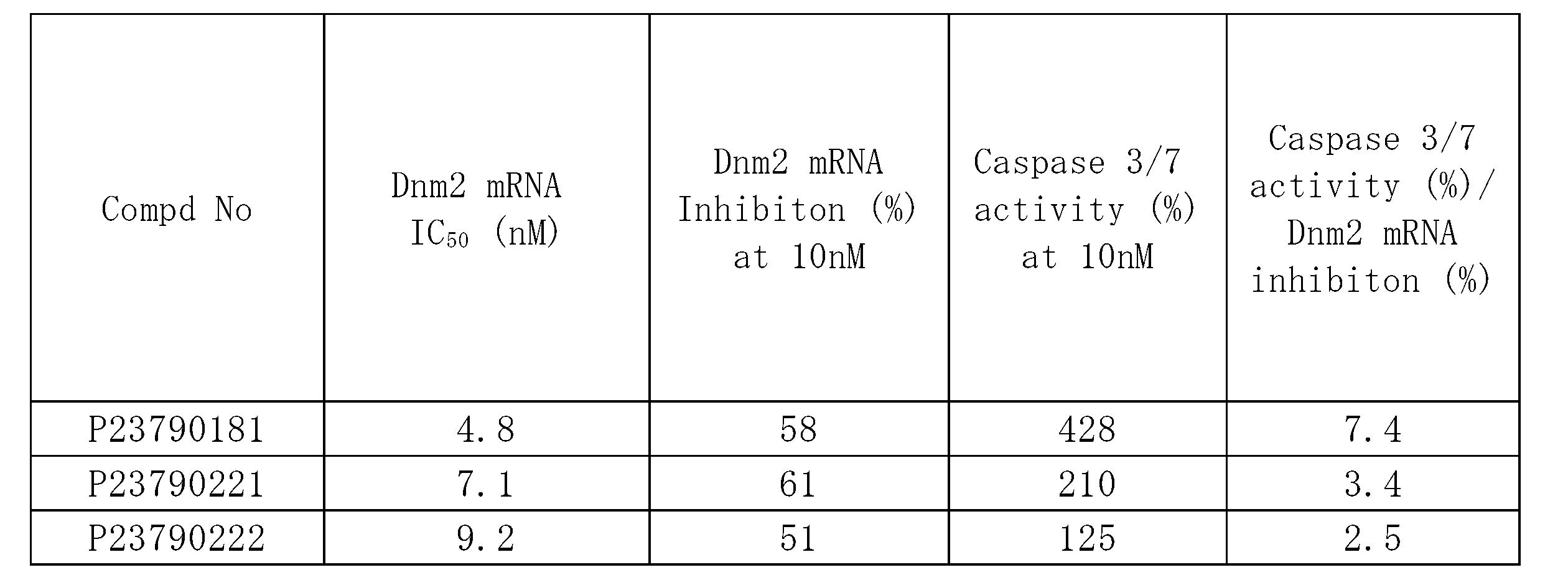
表6から明らかなように、化合物P23790221及びP22790222は、P23790181(R-ECEヌクレオチドを有しないLNAギャップマー)と比較して、同程度若しくは微弱程度のmRNA阻害活性を維持しつつ、毒性を大幅に軽減することができた。
[評価例11]マウスにおけるCxcl12のアンチセンス抑制
Balb/cマウス(オス6週齢、ジャクソン・ラボラトリー・ジャパン社)へ、生理食塩水(大塚生食注、大塚製薬工場)に溶解したP23790268及びP23790270を、マウス個体あたりの投与量がアンチセンスオリゴヌクレオチド量換算で0.04,0.2,1.0及び5.0 mg/kgとなるように背部皮下投与した。コントロールとして、生理食塩水(大塚生食注、大塚製薬工場)のみを投与した。投与3日後にイソフルラン麻酔下で肝臓を採取した。肝臓からMagMAX(登録商標) mirVana(登録商標) Total RNA Isolation Kit(Thermo Fisher Scientific)を用いてRNAを単離した後に、One Step PrimeScript(登録商標) III RT-qPCR Mix(タカラバイオ)を用いて、TaqMan(登録商標) Gene Expression Assays(Thermo Fisher Scientific)による定量リアルタイムPCRでマウスCxcl12遺伝子発現レベルを測定した。リアルタイムPCRでは、ハウスキーピング遺伝子のGapdhのmRNA量も同時に定量し、GapdhのmRNA量に対するCxcl12のmRNA量を、Cxcl12の発現レベルとして評価した。結果を未処理対照群に対する、Cxcl12のパーセント発現からGraphPad PRISM 9.0(Dotmatics)を用いて50%有効用量(EC50)を算出し、表7に表す。
Balb/cマウス(オス6週齢、ジャクソン・ラボラトリー・ジャパン社)へ、生理食塩水(大塚生食注、大塚製薬工場)に溶解したP23790268及びP23790270を、マウス個体あたりの投与量がアンチセンスオリゴヌクレオチド量換算で0.04,0.2,1.0及び5.0 mg/kgとなるように背部皮下投与した。コントロールとして、生理食塩水(大塚生食注、大塚製薬工場)のみを投与した。投与3日後にイソフルラン麻酔下で肝臓を採取した。肝臓からMagMAX(登録商標) mirVana(登録商標) Total RNA Isolation Kit(Thermo Fisher Scientific)を用いてRNAを単離した後に、One Step PrimeScript(登録商標) III RT-qPCR Mix(タカラバイオ)を用いて、TaqMan(登録商標) Gene Expression Assays(Thermo Fisher Scientific)による定量リアルタイムPCRでマウスCxcl12遺伝子発現レベルを測定した。リアルタイムPCRでは、ハウスキーピング遺伝子のGapdhのmRNA量も同時に定量し、GapdhのmRNA量に対するCxcl12のmRNA量を、Cxcl12の発現レベルとして評価した。結果を未処理対照群に対する、Cxcl12のパーセント発現からGraphPad PRISM 9.0(Dotmatics)を用いて50%有効用量(EC50)を算出し、表7に表す。
[評価例12]マウスにおける肝毒性抑制
Balb/cマウス(オス6週齢、ジャクソン・ラボラトリー・ジャパン社)へ、生理食塩水(大塚生食注、大塚製薬工場)に溶解したP23790268及びP23790270を、マウス個体あたりの投与量がアンチセンスオリゴヌクレオチド量換算で0.04,0.2,1.0及び5.0 mg/kgとなるように背部皮下投与した。コントロールとして、生理食塩水(大塚生食注、大塚製薬工場)のみを投与した。投与3日後にイソフルラン麻酔下で腹部大静脈より静脈血を採血し、遠心操作によって血漿を得たのちに、富士ドライケムスライドGOT/AST-PIII及び富士ドライケムスライドGPT/ALT-PIIIを用いて血漿中AST及びALT量を測定した。結果を表7に表す。
Balb/cマウス(オス6週齢、ジャクソン・ラボラトリー・ジャパン社)へ、生理食塩水(大塚生食注、大塚製薬工場)に溶解したP23790268及びP23790270を、マウス個体あたりの投与量がアンチセンスオリゴヌクレオチド量換算で0.04,0.2,1.0及び5.0 mg/kgとなるように背部皮下投与した。コントロールとして、生理食塩水(大塚生食注、大塚製薬工場)のみを投与した。投与3日後にイソフルラン麻酔下で腹部大静脈より静脈血を採血し、遠心操作によって血漿を得たのちに、富士ドライケムスライドGOT/AST-PIII及び富士ドライケムスライドGPT/ALT-PIIIを用いて血漿中AST及びALT量を測定した。結果を表7に表す。

表7から明らかなように、化合物P23790270は、P23790268(R-ECEヌクレオチドを有しないLNAギャップマー)と比較して、微弱程度のmRNA阻害活性を維持しつつ、毒性を大幅に軽減することができた。
本発明のオリゴヌクレオチドは、オフターゲット効果を抑制できるため、毒性を低減できると考えられ、代謝性疾患、腫瘍、感染症等の、標的RNAの機能及び/又は標的遺伝子の発現亢進に伴う疾患を治療、予防するための医薬組成物等として、有用である。
Claims (28)
- 中央領域、5’側領域及び3’側領域を有するアンチセンスオリゴヌクレオチドであって、
ここで、
- 中央領域は、
デオキシリボヌクレオチド、リボヌクレオチド及び糖修飾ヌクレオチドからなる群から独立して選択される少なくとも5個のヌクレオチドからなり、その3’末端及び5’末端が、それぞれ独立して、デオキシリボヌクレオチド及び5’-修飾ヌクレオチドから選択されるヌクレオチドであり、そして
デオキシリボヌクレオチド及び5’-修飾ヌクレオチドから選択される少なくとも4個の連続するヌクレオチドから構成されるオリゴヌクレオチド鎖を、少なくとも一つ含み;
- 5’側領域は、
デオキシリボヌクレオチド、リボヌクレオチド及び糖修飾ヌクレオチドからなる群から独立して選択される少なくとも2個のヌクレオチドからなり、少なくとも1個の2’-4’架橋ヌクレオチドを含み、その3’末端が、2’-4’架橋ヌクレオチド又は2’-修飾ヌクレオチドであり、ここで、該3’末端のヌクレオチドは、中央領域に結合し、そして
デオキシリボヌクレオチド及び5’-修飾ヌクレオチドから選択される少なくとも4個の連続するヌクレオチドから構成されるオリゴヌクレオチド鎖を含まず;
- 3’側領域は、
デオキシリボヌクレオチド、リボヌクレオチド及び糖修飾ヌクレオチドからなる群から独立して選択される少なくとも2個のヌクレオチドからなり、少なくとも1個の2’-4’架橋ヌクレオチドを含み、その5’末端が、2’-4’架橋ヌクレオチド又は2’-修飾ヌクレオチドであり、ここで、該5’末端のヌクレオチドは、中央領域に結合し、そして
デオキシリボヌクレオチド及び5’-修飾ヌクレオチドから選択される少なくとも4個の連続するヌクレオチドから構成されるオリゴヌクレオチド鎖を含まず;
中央領域、5’側領域及び3’側領域の少なくとも一つの領域に、少なくとも1個の2’-O-R-ECEヌクレオチドを含む、
アンチセンスオリゴヌクレオチド。 - 前記2’-O-R-ECEヌクレオチドが、
下記式(I):

(式中、Bxは、プリン-9-イル基、2-オキソ-ピリミジン-1-イル基又は2-チオキソ-ピリミジン-1-イル基(該プリン-9-イル基、2-オキソ-ピリミジン-1-イル基及び2-チオキソ-ピリミジン-1-イル基は、それぞれ独立して、無置換であるか、又はハロゲン原子、C1-6アルキル基、アミノ基、保護されたアミノ基、ヒドロキシ基、保護されたヒドロキシ基、スルファニル基及び保護されたスルファニル基からなる群から単独に若しくは異なって選択される1以上の置換基で置換されている)であり、
R1、R2、R3及びR4は、それぞれ独立して、水素原子、ハロゲン原子、シアノ基、C1-6アルキル基又はC2-6アルケニル基(該C1-6アルキル基及びC2-6アルケニル基は、それぞれ独立して、無置換であるか、又はハロゲン原子、C1-6アルコキシ基及びシアノ基からなる群から単独に若しくは異なって選択される1以上の置換基で置換されている)であり、
Yは、NR5R6(該R5及びR6はそれぞれ独立して、水素原子、C1-6アルキル基、C2-6アルケニル基(該C1-6アルキル基及びC2-6アルケニル基は、それぞれ独立して、無置換であるか、又はハロゲン原子、シアノ基、ニトロ基、アミノ基、ヒドロキシ基、カルボキシ基、カルバモイル基、C1-6アルコキシ基、C2-6アルケニルオキシ基、C1-6アルコキシカルボニル基、C2-6アルケニルオキシカルボニル基、C1-6アルキルカルボニル基、C1-6アルキルアミノ基、C1-6アルキルアミノカルボニル基、C1-6アルキルカルボニルオキシ基、C1-6アルキルカルボニルアミノ基及びC1-6アルコキシカルボニルアミノ基からなる群から単独に若しくは異なって選択される1以上の置換基で置換されている)又はC7-10アラルキル基(該C7-10アラルキル基は、無置換であるか、又はハロゲン原子、シアノ基、ニトロ基、アミノ基、ヒドロキシ基、カルボキシ基、カルバモイル基、C1-6アルキル基、C2-6アルケニル基、C1-6アルコキシ基、C2-6アルケニルオキシ基、C1-6アルコキシカルボニル基、C2-6アルケニルオキシカルボニル基、C1-6アルキルカルボニル基、C1-6ハロアルキル基、C1-6アルキルアミノ基、C1-6アルキルアミノカルボニル基、C1-6アルキルカルボニルオキシ基、C1-6アルキルカルボニルアミノ基及びC1-6アルコキシカルボニルアミノ基からなる群から単独に若しくは異なって選択される1以上の置換基で置換されている)であるか、又は該R5及びR6は、これらが結合している窒素原子と一緒になって、3-11員含窒素非芳香族ヘテロ環(該3-11員含窒素非芳香族ヘテロ環は、無置換であるか、又はハロゲン原子、シアノ基、ニトロ基、アミノ基、ヒドロキシ基、カルボキシ基、カルバモイル基、C1-6アルキル基、C2-6アルケニル基、C1-6アルコキシ基、C2-6アルケニルオキシ基、C1-6アルコキシカルボニル基、C2-6アルケニルオキシカルボニル基、C1-6アルキルカルボニル基、C1-6ハロアルキル基、C1-6アルキルアミノ基、C1-6アルキルアミノカルボニル基、C1-6アルキルカルボニルオキシ基、C1-6アルキルカルボニルアミノ基及びC1-6アルコキシカルボニルアミノ基からなる群から単独に若しくは異なって選択される1以上の置換基で置換されている)を形成している)、又は
C2-9芳香族複素環式基(該C2-9芳香族複素環式基は、無置換であるか、又はハロゲン原子、シアノ基、ニトロ基、アミノ基、ヒドロキシ基、カルボキシ基、カルバモイル基、C1-6アルキル基、C2-6アルケニル基、C1-6アルコキシ基、C2-6アルケニルオキシ基、C1-6アルコキシカルボニル基、C2-6アルケニルオキシカルボニル基、C1-6アルキルカルボニル基、C1-6ハロアルキル基、C1-6アルキルアミノ基、C1-6アルキルアミノカルボニル基、C1-6アルキルカルボニルオキシ基、C1-6アルキルカルボニルアミノ基及びC1-6アルコキシカルボニルアミノ基からなる群から単独に若しくは異なって選択される1以上の置換基で置換されている)であり、
nは、1から3の整数であるが、nが2又は3であるとき、2又は3のR3及びR4はそれぞれ同一でも異なっていてもよい)で表される部分構造を含むヌクレオチドである、請求項1に記載のアンチセンスオリゴヌクレオチド。 - R1、R2、R3及びR4が、水素原子である、請求項2に記載のアンチセンスオリゴヌクレオチド。
- Yが、NR5R6であり、該R5及びR6は、これらが結合している窒素原子と一緒になって、4-8員含窒素非芳香族ヘテロ環のうち、メチレン基を4乃至6個含む環を形成しているか、又は、
Yが、C2-9芳香族複素環式基である、請求項2又は3に記載のアンチセンスオリゴヌクレオチド。 - Yが、NR5R6であり、該R5及びR6は、これらが結合している窒素原子と一緒になって、モルホリンを形成している、請求項2から4の何れか一項に記載のアンチセンスオリゴヌクレオチド。
- Yが、ピリジル基、イミダゾリル基又はベンゾイミダゾリル基である、請求項2から4の何れか一項に記載のアンチセンスオリゴヌクレオチド。
- nが2である、請求項2から6の何れか一項に記載のアンチセンスオリゴヌクレオチド。
- 前記中央領域が、5~15個のヌクレオチドからなり、
前記5’側領域及び前記3’側領域が、それぞれ独立して、2~7個のヌクレオチドからなる、請求項1から7の何れか一項に記載のアンチセンスオリゴヌクレオチド。 - 前記中央領域が、8~12個のヌクレオチドからなり、
前記5’側領域及び前記3’側領域が、それぞれ独立して、2~5個のヌクレオチドからなる、請求項1から8の何れか一項に記載のアンチセンスオリゴヌクレオチド。 - 前記2’-4’架橋ヌクレオチドが、LNA、cEt-BNA、ENA、BNANC、AmNA、scpBNA及びGuNAからなる群から選択される少なくとも1つである、請求項1から9の何れか一項に記載のアンチセンスオリゴヌクレオチド。
- 前記2’-修飾ヌクレオチドが、2’-O-R-ECEヌクレオチド、2’-O-MCEヌクレオチド、2’-O-MOEヌクレオチド、2’-O-NMAヌクレオチド、及び2’-O-Meヌクレオチドからなる群から選択される少なくとも1つである、請求項1から9の何れか一項に記載のアンチセンスオリゴヌクレオチド。
- 前記5’-修飾ヌクレオチドが、5’-CPヌクレオチドである、請求項1から11の何れか一項に記載のアンチセンスオリゴヌクレオチド。
- アンチセンスオリゴヌクレオチドが、ホスホロチオエート結合を含む、請求項1から12の何れか一項に記載のアンチセンスオリゴヌクレオチド。
- アンチセンスオリゴヌクレオチドを構成する各ヌクレオチドが、独立してホスホジエステル結合又はホスホロチオエート結合によって連結されている、請求項1から13の何れか一項に記載のアンチセンスオリゴヌクレオチド。
- 標識機能、精製機能及び標的部位への送達機能からなる群から選択される少なくとも1種の機能を有する機能性分子に由来する基をさらに含む、請求項1から14の何れか一項に記載のアンチセンスオリゴヌクレオチド。
- 前記機能性分子が、糖、脂質、ペプチド及びタンパク質並びにそれらの誘導体からなる群から選択される、請求項15に記載のアンチセンスオリゴヌクレオチド。
- 前記機能性分子が、コレステロール、トコフェロール及びトコトリエノールからなる群から選択される脂質である、請求項15又は16に記載のアンチセンスオリゴヌクレオチド。
- 前記機能性分子が、アシアロ糖タンパク質受容体と相互作用する糖誘導体である、請求項15又は16に記載のアンチセンスオリゴヌクレオチド。
- 前記機能性分子が、受容体のリガンド及び抗体からなる群から選択される、ペプチド又はタンパク質である、請求項15又は16に記載のアンチセンスオリゴヌクレオチド。
- 請求項1から19の何れか一つに記載のアンチセンスオリゴヌクレオチドのプロドラッグ。
- (i)請求項1から19の何れか一つに記載のアンチセンスオリゴヌクレオチド、及び
(ii)該アンチセンスオリゴヌクレオチドに対してハイブリダイズする領域を含むオリゴヌクレオチド
を含む、二本鎖オリゴヌクレオチド複合体。 - (i)請求項1から19の何れか一つに記載のアンチセンスオリゴヌクレオチドに由来する基、及び
(ii)該アンチセンスオリゴヌクレオチドに対してハイブリダイズする領域を含むオリゴヌクレオチドに由来する基
を含み、前記(i)アンチセンスオリゴヌクレオチドに由来する基と、前記(ii)オリゴヌクレオチドに由来する基とが連結された、オリゴヌクレオチド。 - 請求項1から19の何れか一つに記載のアンチセンスオリゴヌクレオチド、請求項20に記載のプロドラッグ、請求項21に記載のオリゴヌクレオチド複合体、又は請求項22に記載のオリゴヌクレオチドと、薬理学上許容される担体とを含む、医薬組成物。
- 請求項1から19の何れか一つに記載のアンチセンスオリゴヌクレオチド、請求項20に記載のプロドラッグ、請求項21に記載のオリゴヌクレオチド複合体、又は請求項22に記載のオリゴヌクレオチドと、細胞とを接触させる工程を含む、標的RNAの機能を制御する方法。
- 請求項23に記載の医薬組成物を、哺乳動物に投与する工程を含む、該哺乳動物における標的RNAの機能を制御する方法。
- 請求項1から19の何れか一つに記載のアンチセンスオリゴヌクレオチド、請求項20に記載のプロドラッグ、請求項21に記載のオリゴヌクレオチド複合体、又は請求項22に記載のオリゴヌクレオチドと、細胞とを接触させる工程を含む、標的遺伝子の発現を制御する方法。
- 請求項23に記載の医薬組成物を、哺乳動物に投与する工程を含む、該哺乳動物における標的遺伝子の発現を制御する方法。
- 2’-O-R-ECEヌクレオチドを使用して、請求項1から19の何れか一つに記載のアンチセンスオリゴヌクレオチド、請求項20に記載のプロドラッグ、請求項21に記載のオリゴヌクレオチド複合体、又は請求項22に記載のオリゴヌクレオチドを製造する方法。
Priority Applications (1)
| Application Number | Priority Date | Filing Date | Title |
|---|---|---|---|
| JP2025530243A JPWO2025005265A1 (ja) | 2023-06-30 | 2024-06-28 |
Applications Claiming Priority (2)
| Application Number | Priority Date | Filing Date | Title |
|---|---|---|---|
| JP2023-108733 | 2023-06-30 | ||
| JP2023108733 | 2023-06-30 |
Publications (1)
| Publication Number | Publication Date |
|---|---|
| WO2025005265A1 true WO2025005265A1 (ja) | 2025-01-02 |
Family
ID=93939177
Family Applications (1)
| Application Number | Title | Priority Date | Filing Date |
|---|---|---|---|
| PCT/JP2024/023582 Ceased WO2025005265A1 (ja) | 2023-06-30 | 2024-06-28 | 毒性が低減されたアンチセンスオリゴヌクレオチド |
Country Status (2)
| Country | Link |
|---|---|
| JP (1) | JPWO2025005265A1 (ja) |
| WO (1) | WO2025005265A1 (ja) |
Citations (7)
| Publication number | Priority date | Publication date | Assignee | Title |
|---|---|---|---|---|
| JPH072889A (ja) * | 1993-05-12 | 1995-01-06 | Ciba Geigy Ag | 2’−エーテル基を有するヌクレオシド及びオリゴヌクレオチド |
| WO1998039352A1 (en) * | 1997-03-07 | 1998-09-11 | Takeshi Imanishi | Novel bicyclonucleoside and oligonucleotide analogues |
| WO2007102581A1 (ja) * | 2006-03-08 | 2007-09-13 | Tokyo Institute Of Technology | 2'水酸基修飾リボヌクレオシド誘導体 |
| WO2009006478A2 (en) * | 2007-07-05 | 2009-01-08 | Isis Pharmaceuticals, Inc. | 6-disubstituted bicyclic nucleic acid analogs |
| WO2011052436A1 (ja) * | 2009-10-29 | 2011-05-05 | 国立大学法人大阪大学 | 架橋型人工ヌクレオシドおよびヌクレオチド |
| WO2015125783A1 (ja) * | 2014-02-18 | 2015-08-27 | 国立大学法人大阪大学 | 架橋型ヌクレオシドおよびヌクレオチド |
| WO2017142054A1 (ja) * | 2016-02-17 | 2017-08-24 | 国立大学法人東京工業大学 | 人工ヌクレオシド及び人工ヌクレオチド並びに人工オリゴヌクレオチド |
-
2024
- 2024-06-28 JP JP2025530243A patent/JPWO2025005265A1/ja active Pending
- 2024-06-28 WO PCT/JP2024/023582 patent/WO2025005265A1/ja not_active Ceased
Patent Citations (7)
| Publication number | Priority date | Publication date | Assignee | Title |
|---|---|---|---|---|
| JPH072889A (ja) * | 1993-05-12 | 1995-01-06 | Ciba Geigy Ag | 2’−エーテル基を有するヌクレオシド及びオリゴヌクレオチド |
| WO1998039352A1 (en) * | 1997-03-07 | 1998-09-11 | Takeshi Imanishi | Novel bicyclonucleoside and oligonucleotide analogues |
| WO2007102581A1 (ja) * | 2006-03-08 | 2007-09-13 | Tokyo Institute Of Technology | 2'水酸基修飾リボヌクレオシド誘導体 |
| WO2009006478A2 (en) * | 2007-07-05 | 2009-01-08 | Isis Pharmaceuticals, Inc. | 6-disubstituted bicyclic nucleic acid analogs |
| WO2011052436A1 (ja) * | 2009-10-29 | 2011-05-05 | 国立大学法人大阪大学 | 架橋型人工ヌクレオシドおよびヌクレオチド |
| WO2015125783A1 (ja) * | 2014-02-18 | 2015-08-27 | 国立大学法人大阪大学 | 架橋型ヌクレオシドおよびヌクレオチド |
| WO2017142054A1 (ja) * | 2016-02-17 | 2017-08-24 | 国立大学法人東京工業大学 | 人工ヌクレオシド及び人工ヌクレオチド並びに人工オリゴヌクレオチド |
Non-Patent Citations (1)
| Title |
|---|
| YOSHIAKI, MASAKI ET AL.: "Modification of oligonucleotides with weak basic residues via the 2'-O-carbamoylethyl linker for improving nuclease resistance without loss of duplex stability and antisense activity", ORG. BIOMOL. CHEM., vol. 17, 2019, pages 4835 - 4842, XP055621204, DOI: 10.1039/C9OB00668K * |
Also Published As
| Publication number | Publication date |
|---|---|
| JPWO2025005265A1 (ja) | 2025-01-02 |
Similar Documents
| Publication | Publication Date | Title |
|---|---|---|
| CN108137492B (zh) | 寡核苷酸组合物及其方法 | |
| CN111050806A (zh) | 寡核苷酸组合物及其使用方法 | |
| EP4240849A1 (en) | Oligonucleotide compositions and methods thereof | |
| KR20220076508A (ko) | 올리고뉴클레오티드 조성물 및 이의 사용 방법 | |
| WO2023201095A2 (en) | Oligonucleotide compositions and methods relating thereto | |
| TW201904587A (zh) | 寡核苷酸組合物及其使用方法 | |
| JP7190794B2 (ja) | 核酸医薬及び多分岐脂質の複合体 | |
| TW201908483A (zh) | 寡核苷酸組合物及其使用方法 | |
| CN119452084A (zh) | 寡核苷酸组合物及其方法 | |
| WO2017015555A1 (en) | Oligonucleotide compositions and methods thereof | |
| EP4328310A1 (en) | Sirna targeting 17b-hydroxysteroid dehydrogenase type 13 and sirna conjugate | |
| WO2019182037A1 (ja) | 毒性が低減されたアンチセンスオリゴヌクレオチド | |
| WO2025072862A9 (en) | Oligonucleotide compositions and methods thereof | |
| WO2017142054A1 (ja) | 人工ヌクレオシド及び人工ヌクレオチド並びに人工オリゴヌクレオチド | |
| WO2024002006A1 (zh) | 具有增强的稳定性的核苷酸替代物 | |
| JP2026513347A (ja) | CIDEB mRNAの発現を調節するためのdsRNA分子 | |
| WO2024002007A1 (zh) | 含有可降低脱靶毒性的核苷酸类似物的双链rna | |
| WO2025143262A1 (ja) | カルバモイルエチル修飾を含有する二本鎖rna | |
| RU2849194C1 (ru) | МОДИФИЦИРОВАННАЯ миРНК С ПОНИЖЕННОЙ НЕЦЕЛЕВОЙ АКТИВНОСТЬЮ | |
| US12454693B1 (en) | Nucleic acids for inhibiting expression of transferrin receptor 2 | |
| HK40128800A (zh) | 寡核苷酸组合物及其使用方法 | |
| HK40029072A (en) | Oligonucleotide compositions and methods of use thereof | |
| HK40005788A (en) | Oligonucleotide compositions and methods thereof | |
| HK1256225B (en) | Oligonucleotide compositions and methods thereof | |
| HK40010323A (en) | Oligonucleotide compositions and methods thereof |
Legal Events
| Date | Code | Title | Description |
|---|---|---|---|
| 121 | Ep: the epo has been informed by wipo that ep was designated in this application |
Ref document number: 24832122 Country of ref document: EP Kind code of ref document: A1 |
|
| ENP | Entry into the national phase |
Ref document number: 2025530243 Country of ref document: JP Kind code of ref document: A |
|
| WWE | Wipo information: entry into national phase |
Ref document number: 2025530243 Country of ref document: JP |
|
| NENP | Non-entry into the national phase |
Ref country code: DE |