WO2025005248A1 - 感光性組成物、硬化物及びその製造方法、表示素子、並びに撮像素子 - Google Patents
感光性組成物、硬化物及びその製造方法、表示素子、並びに撮像素子 Download PDFInfo
- Publication number
- WO2025005248A1 WO2025005248A1 PCT/JP2024/023515 JP2024023515W WO2025005248A1 WO 2025005248 A1 WO2025005248 A1 WO 2025005248A1 JP 2024023515 W JP2024023515 W JP 2024023515W WO 2025005248 A1 WO2025005248 A1 WO 2025005248A1
- Authority
- WO
- WIPO (PCT)
- Prior art keywords
- photosensitive composition
- group
- mass
- particles
- meth
- Prior art date
- Legal status (The legal status is an assumption and is not a legal conclusion. Google has not performed a legal analysis and makes no representation as to the accuracy of the status listed.)
- Ceased
Links
Classifications
-
- G—PHYSICS
- G03—PHOTOGRAPHY; CINEMATOGRAPHY; ANALOGOUS TECHNIQUES USING WAVES OTHER THAN OPTICAL WAVES; ELECTROGRAPHY; HOLOGRAPHY
- G03F—PHOTOMECHANICAL PRODUCTION OF TEXTURED OR PATTERNED SURFACES, e.g. FOR PRINTING, FOR PROCESSING OF SEMICONDUCTOR DEVICES; MATERIALS THEREFOR; ORIGINALS THEREFOR; APPARATUS SPECIALLY ADAPTED THEREFOR
- G03F7/00—Photomechanical, e.g. photolithographic, production of textured or patterned surfaces, e.g. printing surfaces; Materials therefor, e.g. comprising photoresists; Apparatus specially adapted therefor
- G03F7/004—Photosensitive materials
-
- G—PHYSICS
- G03—PHOTOGRAPHY; CINEMATOGRAPHY; ANALOGOUS TECHNIQUES USING WAVES OTHER THAN OPTICAL WAVES; ELECTROGRAPHY; HOLOGRAPHY
- G03F—PHOTOMECHANICAL PRODUCTION OF TEXTURED OR PATTERNED SURFACES, e.g. FOR PRINTING, FOR PROCESSING OF SEMICONDUCTOR DEVICES; MATERIALS THEREFOR; ORIGINALS THEREFOR; APPARATUS SPECIALLY ADAPTED THEREFOR
- G03F7/00—Photomechanical, e.g. photolithographic, production of textured or patterned surfaces, e.g. printing surfaces; Materials therefor, e.g. comprising photoresists; Apparatus specially adapted therefor
- G03F7/26—Processing photosensitive materials; Apparatus therefor
- G03F7/40—Treatment after imagewise removal, e.g. baking
Definitions
- the present invention relates to a photosensitive composition, a cured product and a method for producing the same, a display element, and an imaging element, and more specifically to a technique for forming an optical member for a display element or an imaging element.
- Solid-state imaging elements are provided with hemispherical condensing lenses (hereinafter also referred to as "microlenses") or intralayer lenses to collect light on the light receiving element (photodiode) and improve the sensor sensitivity.
- microlenses hemispherical condensing lenses
- display elements such as organic EL elements
- a structure is adopted in which a microlens is provided on the light output side of each pixel in order to improve the light extraction efficiency and adjust the viewing angle (see, for example, Patent Document 1).
- lenses for solid-state imaging elements and display elements have also been formed by photolithography technology using a photosensitive composition.
- the photosensitive composition for example, a film-forming composition containing inorganic particles, a polysilane compound, a polymerizable monomer, and a curing accelerator such as a dehydrating agent is known (see, for example, Patent Document 2).
- photosensitive compositions containing particles can increase in viscosity over time, resulting in poor storage stability.
- a coating means such as a coating slit nozzle
- the slit nozzle is repeatedly used in a cycle of coating, leaving it to stand, coating, and leaving it to stand.
- part of the photosensitive composition inside the coating means solidifies and adheres to the tip of the nozzle, resulting in coating defects.
- the present invention aims to provide a photosensitive composition that exhibits excellent storage stability with little increase in viscosity even after a certain period of time, does not solidify when using a coating slit nozzle or the like, and can be applied even after a certain period of time has passed (good applicability over time), a cured film formed from the photosensitive composition and a method for producing the same, a display element including the cured film, and an imaging element including the cured film.
- the present invention comprises:
- the composition comprises particles (A), a radical polymerizable compound (B), a photoradical generator (C), and a dehydrating agent (D),
- the dehydrating agent (D) contains an orthoester compound.
- the present invention relates to a photosensitive composition for forming an optical member.
- the present invention comprises: A photosensitive composition for forming an optical member, comprising particles (A), a radical polymerizable compound (B), and a photoradical generator (C),
- a photosensitive composition for forming an optical member comprising particles (A), a radical polymerizable compound (B), and a photoradical generator (C)
- the amount of water contained in the photosensitive composition is less than 2000 ppm.
- the present invention relates to a photosensitive composition for forming an optical member.
- the present invention comprises: applying the photosensitive composition onto a substrate; exposing the photosensitive composition coated on the substrate to radiation; developing the photosensitive composition after irradiation with radiation; a step of heating the developed photosensitive composition at a temperature of 100° C. or less to cure it;
- the present invention relates to a method for producing a cured product comprising the steps of:
- the present invention comprises:
- the present invention also relates to a cured product formed by curing the above photosensitive composition, and a display device and an imaging device comprising the cured film.
- the photosensitive composition of the present invention has excellent storage stability with little increase in viscosity even after a certain time has passed, and when using a coating slit nozzle or the like, the photosensitive composition does not solidify and can be applied even after a certain time has passed (i.e., has good coatability over time).
- the reason for this is presumed to be as follows. When a photosensitive composition containing particles is exposed to the atmosphere for a certain time, the moisture in the atmosphere acts on the particles in the photosensitive composition and promotes aggregation, which is thought to result in an increase in the viscosity of the photosensitive composition and poor coatability over time and storage stability.
- the amount of moisture contained in the photosensitive composition is less than 2000 ppm, so it is believed that the particulate components in the composition are less likely to aggregate, resulting in good coatability over time.
- the method for producing a cured film of the present invention uses a photosensitive composition that exhibits little increase in viscosity even after a certain period of time and has excellent long-term application properties and storage stability, making it possible to produce a high-quality cured film even after a certain period of time has passed.
- the display element and image sensor of the present invention are of high quality because they are provided with the above-mentioned cured film.
- a numerical range described using “ ⁇ ” means that the numerical range includes the numerical values before and after " ⁇ " as the lower and upper limits.
- a “structural unit” is a unit that mainly constitutes the main chain structure, and refers to a unit that is contained in at least two units in the main chain structure.
- hydrocarbon group includes linear hydrocarbon groups, alicyclic hydrocarbon groups, and aromatic hydrocarbon groups.
- linear hydrocarbon group refers to linear and branched hydrocarbon groups that do not include a ring structure in the main chain and are composed only of a chain structure. However, they may be saturated or unsaturated.
- alicyclic hydrocarbon group refers to a hydrocarbon group that includes only an alicyclic hydrocarbon structure as a ring structure and does not include an aromatic ring structure. However, it does not have to be composed only of an alicyclic hydrocarbon structure, and it also includes those that have a chain structure as part of it.
- aromatic hydrocarbon group refers to a hydrocarbon group that includes an aromatic ring structure as a ring structure. However, it does not have to be composed only of an aromatic ring structure, and it may include a chain structure or an alicyclic hydrocarbon structure as part of it.
- the ring structures of the alicyclic hydrocarbon group and the aromatic hydrocarbon group may have a substituent that is composed of a hydrocarbon structure.
- (meth)acrylo includes “acrylo” and “methacrylo
- (meth)acrylic includes “acrylic” and “methacrylic”
- (meth)acrylate includes “acrylate” and "methacrylate”.
- the photosensitive composition according to this embodiment (hereinafter also simply referred to as "the composition") has A composition comprising particles (A), a radical polymerizable compound (B), a photoradical generator (C), and a dehydrating agent (D), wherein the dehydrating agent (D) comprises an orthoester compound (hereinafter also referred to as the present composition (1));
- the photosensitive composition for forming an optical member comprises particles (A), a radical polymerizable compound (B), and a photoradical generator (C), and the photosensitive composition has a water content of less than 2000 ppm (hereinafter, also referred to as composition (2)).
- the photosensitive composition is a photosensitive composition for forming an optical member for a display element such as an organic EL element or an imaging element.
- the optical member formed by this composition is, for example, for increasing the light extraction efficiency in a display element, or for collecting light in a light receiving element (photodiode) in a solid-state imaging device to improve the sensor sensitivity.
- the optical member is preferably a pattern formed by repeatedly arranging a planarizing film or a lens.
- the lens constituting the pattern may have a shape of a hemisphere, a cylinder, a truncated cone, or the like.
- the shape of the lens as viewed from the top surface may be a circle, a polygon, or the like, and each may have a curved surface such as a sphere, or may be a columnar or a trapezoidal shape such as a truncated cone.
- the lens is formed by the photosensitive composition of the present invention, and another transparent material layer such as a low bending material layer may be formed in the gap between the lenses.
- the planarizing film is formed on a substrate to planarize the surface of the substrate on which a semiconductor element or the like is formed.
- the pattern is a micro-light collector (lens or trapezoidal/rectangular pattern) or interlayer lens provided in a display element or solid-state imaging element (e.g., CCD image sensor, CMOS image sensor).
- a display element such as an organic EL element
- the pattern is provided in each pixel for the purpose of improving the light extraction efficiency in each pixel and adjusting the viewing angle
- a solid-state imaging element the pattern is provided for the purpose of collecting light in a light receiving element and improving the sensor sensitivity.
- the composition is preferably a photosensitive composition for forming a planarizing film or a photosensitive composition for forming a pattern. Each component contained in the photosensitive composition will be described below.
- the particles (A) may be any particle suitable for the purpose of addition, such as adjusting the refractive index, and in the present invention, it is preferable to use particles that can increase the refractive index of the resulting cured product.
- the particles (A) may be either inorganic particles or organic particles, and pigment particles may also be used.
- the inorganic particles are not particularly limited, and examples include particulate substances such as zirconium oxide, titanium oxide, aluminum oxide, silver oxide, zinc oxide, barium titanate, silicon dioxide (including silica and hollow silica), cerium oxide, silicon nitride, and palladium sulfide.
- particulate substances such as zirconium oxide, titanium oxide, aluminum oxide, silver oxide, zinc oxide, barium titanate, silicon dioxide (including silica and hollow silica), cerium oxide, silicon nitride, and palladium sulfide.
- zirconium oxide particles are particularly preferred in terms of the high stability of the dispersion.
- the organic particles are not particularly limited, and examples include particles made of polymer compounds such as polystyrene, polyolefin resins such as polyethylene and polypropylene, and acrylic resins. Organic particles also include transparent particles, opaque particles, colored particles, and hollow particles.
- the pigment particles may be either organic or inorganic.
- the pigments include organic or inorganic pigments such as carbon black, graphite, activated carbon, carbon fiber, carbon nanotubes, carbon microcoils, carbon nanohorns, carbon aerogel, fullerene, aniline black, pigment black 7, titanium black, lactam black, perylene black, chromium oxide green, Milori blue, cobalt green, cobalt blue, manganese, ferrocyanide, phosphate ultramarine, Prussian blue, ultramarine, cerulean blue, pyridian, emerald green, lead sulfate, yellow lead, zinc yellow, red iron oxide (red iron (III)), cadmium red, amber, lake pigment, barium sulfate, calcium carbonate, hydrated magnesium silicate (talc), magnesium carbonate, calcium sulfate, diatomaceous earth, mica, and silica.
- perylene black is preferred.
- the shape of the above particles (A) is not particularly limited, but examples include spherical, granular, plate-like, columnar, etc.
- the average particle diameter of the particles (A) is not particularly limited, but from the viewpoint of obtaining a cured film with high surface flatness and transparency, it is preferably 100 nm or less, more preferably 50 nm or less, and even more preferably 30 nm or less. From the viewpoint of dispersion stability, the average particle diameter of the particles (A) is, for example, 1 nm or more, and preferably 2 nm or more.
- the average particle diameter in the present invention means the D50 particle diameter (median diameter, which is the particle diameter showing the 50% cumulative value of the cumulative distribution curve) in the measurement by the dynamic light scattering method, and can be measured, for example, using MicrotracWaveII-EX150 manufactured by MicrotracBell.
- the above-mentioned particles (A) are preferably particles coated with a surface coating agent from the viewpoint of the dispersion stability of the particles in the solvent, and are more preferably inorganic particles (hereinafter also referred to as “coated particles") coated with a compound having an acidic group (hereinafter also referred to as "specific coating agent").
- inorganic particles coated with a specific coating agent are specific coating agent-particle complexes in which particles are surface-treated with a surface coating agent containing the above-mentioned specific coating agent.
- the acidic group possessed by the specific coating agent includes a carboxy group, a phenolic hydroxyl group, a sulfo group, a phosphate group, a phosphonic acid group, and the like. From the viewpoint of improving the dispersibility of the particles in the solvent and the alkaline developability, among these, a carboxy group or a phenolic hydroxyl group is preferred, and a carboxy group is particularly preferred.
- the coated particles are preferably particles whose surface is coated with at least one type of carboxy group-containing compound selected from the group consisting of zirconium oxide, titanium oxide, and barium titanate, and more preferably zirconium oxide particles whose surface is coated with a carboxy group-containing compound.
- the monocarboxylic acid used as the specific coating agent includes a compound represented by the following formula (2).
- R 3 -COOH...(2) (In formula (2), R3 is a monovalent hydrocarbon group or halogenated hydrocarbon group having 4 or more carbon atoms, or a monovalent group having one or more atoms selected from the group consisting of oxygen atoms, sulfur atoms, and nitrogen atoms.)
- examples of the monovalent hydrocarbon group having 4 or more carbon atoms represented by R 3 include a chain hydrocarbon group, an alicyclic hydrocarbon group, and an aromatic hydrocarbon group.
- the monovalent hydrocarbon group represented by R 3 when it is a chain hydrocarbon group or an alicyclic hydrocarbon group, it may be either saturated or unsaturated, and when it is a chain hydrocarbon group, it may be either linear or branched.
- the monovalent hydrocarbon group represented by R 3 is preferably a chain hydrocarbon group, and more preferably an alkyl group or an alkenyl group. From the viewpoint of increasing the dispersibility of the particles (A), the carbon number of R 3 is preferably 6 or more, more preferably 7 or more.
- the carbon number of R 3 is preferably 30 or less, more preferably 20 or less.
- examples of the halogen atom possessed by R 3 include a fluorine atom, a chlorine atom, and the like.
- R 3 is a monovalent group having one or more atoms selected from the group consisting of oxygen atoms, sulfur atoms, and nitrogen atoms
- examples of the monovalent group include a group containing one or more atoms selected from the group consisting of -O-, -S-, and -NH- between the carbon-carbon bonds in a hydrocarbon group, and a group in which any hydrogen atom in a hydrocarbon group is substituted with one or more atoms selected from the group consisting of a hydroxyl group, a thiol group, and an amino group.
- a group containing -O- between the carbon-carbon bonds in a hydrocarbon group is preferred.
- R 3 is a monovalent group having one or more atoms selected from the group consisting of oxygen atoms, sulfur atoms, and nitrogen atoms
- the number of carbon atoms in R 3 is preferably 2 or more, more preferably 2 to 15, and even more preferably 2 to 8, from the viewpoint of improving the dispersibility of the particles (A).
- Specific examples of the compound represented by the above formula (2) include monocarboxylic acids in which R3 is a monovalent hydrocarbon group, such as pentanoic acid, hexanoic acid, heptanoic acid, octanoic acid, nonanoic acid, decanoic acid, dodecanoic acid, tridecanoic acid, tetradecanoic acid, hexadecanoic acid, octadecanoic acid, stearic acid, 2-ethylhexanoic acid, 2-methylheptanoic acid, neodecanoic acid, 2-hexyldecanoic acid, naphthenic acid, cyclohexanecarboxylic acid, oleic acid, linoleic acid, and linolenic acid.
- R3 is a monovalent hydrocarbon group
- Examples of monocarboxylic acids in which R3 is a monovalent group having one or more atoms selected from the group consisting of oxygen atoms, sulfur atoms, and nitrogen atoms include methoxyacetic acid, ethoxyacetic acid, 3-ethoxypropionic acid, 2-methoxyethoxyacetic acid, glyoxylic acid, pyruvic acid, hydroxybenzoic acid, thioglycolic acid, 2-[2-(2-methoxyethoxy)]ethoxyacetic acid, oxovaleric acid, asparagine, glutamine, methionine, glycolic acid, lactic acid, 2-hydroxyisobutyric acid, hydroxystearic acid, and salicylic acid.
- carboxyl group-containing polymer a polymer containing a structural unit having a carboxyl group can be preferably used.
- Specific examples of the carboxyl group-containing polymer as the specific coating agent include the same polymers as those exemplified as specific examples of the binder resin (G) described below.
- other coating agents compounds other than the specific coating agent (hereinafter also referred to as “other coating agents”) may be used alone or in combination with the specific coating agent.
- other coating agents include titanium alkoxides, alkoxysilyl group-containing compounds, and unsaturated carbon-carbon bond-containing compounds. Specific examples of these include titanium alkoxides such as titanium tetra-n-butoxide, titanium tetra-t-butoxide, and titanium tetraethoxide.
- alkoxysilyl group-containing compounds examples include vinyl trimethoxysilane, vinyl triethoxysilane, 3-(meth)acryloyloxypropyl trimethoxysilane, 3-(meth)acryloyloxypropyl triethoxysilane, N-(2-aminoethyl)-3-aminopropyl methyl dimethoxysilane, N-(2-aminoethyl)-3-aminopropyl trimethoxysilane, p-styryl trimethoxysilane, p-styryl triethoxysilane, phenyl trimethoxysilane, and phenyl triethoxysilane.
- examples of compounds containing unsaturated carbon-carbon bonds include silane compounds having carbon-carbon unsaturated bonds. Compounds having basic groups can also be used as the surface coating agent.
- the proportion of the other coating agent used is preferably 50 mass% or less, and more preferably 40 mass% or less, based on the total amount of the surface coating agent used to coat the particles (A).
- the manufacturing method is not particularly limited, and they can be manufactured by contacting treated particles with a surface coating agent according to a known method.
- the coated particles may be manufactured by a top-down method or a bottom-up method.
- the coated particles may be manufactured in a gas phase or a liquid phase.
- the treated particles can be contacted with a surface coating agent, preferably in the presence of water, to obtain coated particles.
- the treated particles and the surface coating agent may be mixed in an organic solvent, preferably in the presence of a dispersant, and the coated particles may be obtained by stirring using beads.
- the temperature and pressure when the treated particles and the surface coating agent are brought into contact with each other can be appropriately set according to the manufacturing method to be adopted.
- the ratio of the treated particles to the surface coating agent can be, for example, 0.5 to 20 parts by mass of the surface coating agent per 100 parts by mass of the treated particles, and it is preferable that the surface coating agent be 1 to 20 parts by mass per 100 parts by mass of the treated particles.
- titanium oxide particles whose surfaces are coated with inorganic oxides of silicon, zinc, tin, zirconium, aluminum, etc. (inorganic oxide-coated titanium oxide particles) as described in JP-A-2013-008428 and JP-A-2009-179678 can be suitably used.
- the composition may contain one or a combination of two or more types of particles (A).
- the lower limit of the content of particles (A) in the composition is preferably 10 mass% based on the total amount of solids (i.e., components other than the solvent) contained in the composition, from the viewpoint of increasing the refractive index of the resulting cured product, more preferably 15 mass%, even more preferably 35 mass%, even more preferably 45 mass%, and particularly preferably 55 mass%.
- the upper limit of the content of particles (A) is preferably 95 mass%, more preferably 90 mass%, based on the total amount of solids contained in the composition, from the viewpoint of ensuring the stability of the dispersion.
- radical polymerizable compound (B) examples include a monofunctional polymerizable compound (B1) and a polyfunctional polymerizable compound (B2).
- the radical polymerizable compound (B) is a compound that can generate a polymer by reacting a plurality of polymerizable compounds (B) with each other when the composition is irradiated with radiation.
- a compound having one radical polymerizable group can be preferably used, and examples thereof include (meth)acryloyl group-containing compounds, chain vinyl compounds, aromatic vinyl compounds, maleimide compounds, etc.
- Specific examples of (meth)acryloyl group-containing compounds include unsaturated carboxylic acids, unsaturated carboxylic anhydrides, (meth)acrylic acid esters having a chain structure, (meth)acrylic acid esters having an alicyclic structure, (meth)acrylic acid esters having an aromatic ring structure, (meth)acrylamide compounds, chain vinyl compounds, and compounds having a phosphate group and a (meth)acryloyl group.
- a (meth)acryloyl group-containing compound can be preferably used from the viewpoint of achieving a high refractive index and transparency.
- the above-mentioned unsaturated carboxylic acids include (meth)acrylic acid, crotonic acid, maleic acid, itaconic acid, fumaric acid, etc.; the above-mentioned unsaturated carboxylic acid anhydrides include maleic anhydride, itaconic anhydride, citraconic anhydride, etc.
- Examples of the (meth)acrylic acid ester having the above chain structure include (meth)acrylic acid alkyl esters, (meth)acrylic acid hydroxyalkyl esters, (meth)acrylic acid alkoxyalkyl esters, (meth)acrylic acid polyoxyalkylene esters, (meth)acrylic acid alkoxypolyoxyalkylene esters, (meth)acrylic acid polyoxycarbonyl alkylene esters, (meth)acrylic acid alkoxypolyoxycarbonyl alkylene esters, and mono(meth)acryloyloxyalkyl esters of dicarboxylic acids.
- Examples of the (meth)acrylic acid alkyl ester include methyl (meth)acrylate, ethyl (meth)acrylate, n-propyl (meth)acrylate, isopropyl (meth)acrylate, butyl (meth)acrylate, 2-ethylhexyl (meth)acrylate, isodecyl (meth)acrylate, n-lauryl (meth)acrylate, and n-stearyl (meth)acrylate;
- Examples of the hydroxyalkyl (meth)acrylate include 2-hydroxyethyl (meth)acrylate, 2-hydroxypropyl (meth)acrylate, 3-hydroxypropyl (meth)acrylate, and 4-hydroxybutyl (meth)acrylate;
- Examples of the (meth)acrylic acid alkoxyalkyl ester include methoxyethyl (meth)acrylate, ethoxyethyl (meth)acrylate, and propoxyethyl (me
- Examples of the (meth)acrylic acid ester having an alicyclic structure include cyclohexyl (meth)acrylate, 2-methylcyclohexyl (meth)acrylate, 4-butylcyclohexyl (meth)acrylate, 4-hydroxymethylcyclohexyl (meth)acrylate, tricyclo[5.2.1.0 2,6 ]decan-8-yl (meth)acrylate, tricyclo[5.2.1.0 2,5 ]decan-8-yloxyethyl (meth)acrylate, and isobornyl (meth)acrylate.
- Examples of (meth)acrylic acid esters having the aromatic ring structure include phenyl (meth)acrylate, benzyl (meth)acrylate, naphthylmethyl (meth)acrylate, naphthylethyl (meth)acrylate, phenoxyethyl (meth)acrylate, phenylthioethyl (meth)acrylate, m-phenoxyphenylmethyl (meth)acrylate, p-phenoxyphenylmethyl (meth)acrylate, o-phenylphenoxyethyl (meth)acrylate, 2-hydroxy-3-phenoxypropyl (meth)acrylate, polyethyleneoxynonylphenyl (meth)acrylate, (1-naphthyl)methyl (meth)acrylate, (2-naphthyl)methyl (meth)acrylate, (1,1'-biphenyl-4-yl)methyl (meth)acrylate, 4'-(6-acryloyloxyhe
- Examples of the (meth)acrylamide compounds include (meth)acryloylmorpholine, N-(2-hydroxyethyl)(meth)acrylamide, N-vinyl-2-pyrrolidone, and N-vinyl- ⁇ -caprolactam.
- the above-mentioned chain vinyl compounds include propene, butene, pentene, hexene, etc.
- the above-mentioned aromatic vinyl compounds include styrene, methylstyrene, ⁇ -methylstyrene, t-butoxystyrene, o-hydroxystyrene, m-hydroxystyrene, p-hydroxystyrene, o-vinylbenzoic acid, m-vinylbenzoic acid, p-vinylbenzoic acid, vinylnaphthalene, etc.
- the above-mentioned maleimide compounds include N-methylmaleimide, N-cyclohexylmaleimide, N-phenylmaleimide, N-(p-methylphenyl)maleimide, etc.
- Examples of compounds having the above phosphoric acid group and (meth)acryloyl group include 2-hydroxyethyl methacrylic acid phosphate (CAS number: 52628-03-2), beta-(2-furyl)acrylamido phosphoric acid ester (CAS number: 16655-99-5), bis(2-methylacryloxyethyl)phosphate (CAS number: 32435-46-4), polyethylene glycol methacrylate phosphate (CAS number: 35705-94-3), bis(2-(acryloyloxy)ethyl)phosphate (CAS number: 40074-34-8), 10-(2-methacryloyloxy group)monodecyl phosphate (CAS number: 85590-00-7), etc.
- the monofunctional polymerizable compound (B1) include compounds represented by each of the following formulas (b1-1) to (b1-28).
- R 20 is a hydrogen atom or a methyl group
- R 21 is a monovalent hydrocarbon group having 1 to 20 carbon atoms
- n is an integer of 0 to 10.
- polyfunctional polymerizable compound (B2) a compound having two or more radically polymerizable groups can be preferably used, and examples thereof include a polyfunctional (meth)acryloyl group-containing compound, a polyfunctional aromatic vinyl compound, a polyfunctional chain vinyl compound, etc.
- trifunctional or higher (meth)acrylic acid esters include trimethylolpropane tri(meth)acrylate, ethylene oxide modified trimethylolpropane tri(meth)acrylate, pentaerythritol tri(meth)acrylate, pentaerythritol tetra(meth)acrylate, dipentaerythritol penta(meth)acrylate, dipentaerythritol hexa(meth)acrylate, ethylene oxide modified dipentaerythritol hexa(meth)acrylate, tri(2-(meth)acryloyloxyethyl)phosphate,
- Examples include succinic acid modified pentaerythritol tri(meth)acrylate, succinic acid modified dipentaerythritol penta(meth)acrylate, tris(2-(meth)acryloyloxyethyl) isocyanurate, carboxy group-containing polybasic acid modified (me
- polyfunctional aromatic vinyl compounds examples include 1,3-divinylbenzene, 1,4-divinylbenzene, etc.
- polyfunctional chain vinyl compounds examples include 1,5-hexadiene, 1,6-heptadiene, 1,7-octadiene, etc.
- polyfunctional polymerizable compound (B2) examples include the compounds represented by each of the following formulas (b2-29) to (b2-53).
- R20 is a hydrogen atom or a methyl group.
- m and n each independently represent an integer from 0 to 10.
- x, y and z each independently represent an integer from 0 to 3, provided that 1 ⁇ x+y+z ⁇ 3 is satisfied.
- the radical polymerizable compound (B) may also be a polymerizable compound (B3) having both a radical polymerizable group and a cationic polymerizable group, and is preferably used in combination with the monofunctional polymerizable compound (B1) or the polyfunctional polymerizable compound (B2).
- the cationic polymerizable group include an epoxy group, an oxetanyl group, and a vinyl ether group.
- the polymerizable compound (B3) having both a radical polymerizable group and a cationic polymerizable group is preferably a compound having a vinyl group or a (meth)acryloyl group as the radical polymerizable group and an epoxy group or an oxetanyl group as the cationic polymerizable group.
- Examples of the polymerizable compound (B3) include glycidyl (meth)acrylate, 3,4-epoxycyclohexyl (meth)acrylate, 3,4-epoxycyclohexylmethyl (meth)acrylate, 2-(3,4-epoxycyclohexyl)ethyl (meth)acrylate, 3,4-epoxytricyclo[5.2.1.0 2,6 ]decyl (meth)acrylate, 2-hydroxyethyl methacrylate [3,4-epoxytricyclo(5.2.1.0 2,6 )decan-9-yl], methacrylic acid [3,4-epoxytricyclo(5.2.1.0 2,6 ) decan-9-yl], (3-methyloxetan-3-yl)methyl (meth)acrylate, (3-ethyloxetan-3-yl) (meth)acrylate, (3-ethyloxetan-3-yl)methyl (meth)acrylate, (oxetan-3
- the radical polymerizable compound (B) contains both a monofunctional polymerizable compound (B1) and a polyfunctional polymerizable compound (B2)
- the content of the monofunctional polymerizable compound (B1) is preferably 20% by mass or more, more preferably 30% by mass or more, and even more preferably 40% by mass or more, based on the total amount of the monofunctional polymerizable compound (B1) and the polyfunctional polymerizable compound (B2).
- the content of the monofunctional polymerizable compound (B1) is preferably 100% by mass or less, more preferably 90% by mass or less, more preferably 80% by mass or less, and even more preferably 70% by mass or less, based on the total amount of the monofunctional polymerizable compound (B1) and the polyfunctional polymerizable compound (B2).
- the radical polymerizable compound (B) contains the polymerizable compound (B3)
- the content thereof in the radical polymerizable compound (B) is preferably 50 mass% or less, and more preferably 30 mass% or less.
- the lower limit of the content of the radical polymerizable compound (B) in the composition is preferably 5 parts by mass, more preferably 10 parts by mass, and even more preferably 20 parts by mass, relative to 100 parts by mass of the particles (A).
- the upper limit of the content of the radical polymerizable compound (B) is preferably 350 parts by mass, more preferably 200 parts by mass, even more preferably 100 parts by mass, even more preferably 50 parts by mass, even more preferably 45 parts by mass, and particularly preferably 35 parts by mass, relative to 100 parts by mass of the particles (A).
- a cationic polymerizable compound (B4) having no radical polymerizable group but having a cationic polymerizable group can be used.
- a compound having an epoxy group (oxiranyl group) or a compound having an oxetanyl group (oxetane compound) is preferable.
- the cationic polymerizable compound (B4) may have one or more cationic polymerizable groups, and preferably has 1 to 3 cationic polymerizable groups.
- the above-mentioned compounds having an epoxy group include alicyclic compounds having an epoxy group (alicyclic epoxy compounds), aromatic compounds having an epoxy group (aromatic epoxy compounds), non-cyclic compounds having an epoxy group (non-cyclic epoxy compounds), etc., with alicyclic epoxy compounds being preferred.
- alicyclic epoxy compounds examples include 3',4'-epoxycyclohexylmethyl-3,4-epoxycyclohexanecarboxylate, 3,4-epoxycyclohexylalkyl(meth)acrylate (e.g., 3,4-epoxycyclohexylmethyl(meth)acrylate, etc.), (3,3',4,4'-diepoxy)bicyclohexyl, hydrogenated bisphenol A type epoxy resin, hydrogenated bisphenol F type epoxy resin, etc.
- the above oxetane compounds include 3-ethyl-3-hydroxymethyloxetane (product name Aron Oxetane OXT-101, manufactured by Toagosei Co., Ltd.), 1,4-bis[(3-ethyl-3-oxetanyl)methoxymethyl]benzene (OXT-121, manufactured by Toagosei Co., Ltd.), 3-ethyl-3-(phenoxymethyl)oxetane (OXT-211, manufactured by Toagosei Co., Ltd.), di(1-ethyl-(3-oxetanyl))methyl ether (OXT-221, manufactured by Toagosei Co., Ltd.), 3-ethyl-3-(2-ethylhexyloxymethyl)oxetane (OXT-212, manufactured by Toagosei Co., Ltd.), etc.
- compounds having both epoxy and oxetanyl groups can be used.
- One such compound is 3-ethyl-3-(2,3-epoxypropoxymethyl)oxetane.
- the lower limit of the content of the cationic polymerizable compound (B4) (the total content when multiple types are contained) is preferably 5 parts by mass, more preferably 10 parts by mass, and even more preferably 20 parts by mass, relative to 100 parts by mass of the particles (A).
- the upper limit of the content of the cationic polymerizable compound (B4) is preferably 100 parts by mass, more preferably 80 parts by mass, and even more preferably 60 parts by mass, relative to 100 parts by mass of the particles (A).
- the above polymerizable compounds (B1) to (B4) can be used in appropriate combination.
- polymerizable compounds having an alkylene oxide chain such as an ethylene oxide chain or a propylene oxide chain
- polymerizable compounds having an acidic group are preferred from the viewpoints of bending resistance and dispersibility.
- Photoradical generator (C) As the photoradical generator (C), a photoradical polymerization initiator capable of generating radicals in response to radiation and initiating polymerization of the radically polymerizable compound (B) can be preferably used.
- the photopolymerization initiator used is not particularly limited, but examples thereof include O-acyloxime compounds, acetophenone compounds, biimidazole compounds, and acylphosphine oxide compounds.
- O-acyloxime compounds include 1,2-octanedione 1-[4-(phenylthio)-2-(O-benzoyloxime)], ethanone-1-[9-ethyl-6-(2-methylbenzoyl)-9H-carbazol-3-yl]-1-(O-acetyloxime), 1-(9-ethyl-6-benzoyl-9.H.-carbazol-3-yl)-octan-1-one oxime-O-acetate, 1-[9-ethyl-6-(2-methylbenzoyl)-9.H.-carbazol-3-yl]-ethan-1-one oxime-O-benzoate, 1-[9-n-butyl-6-(2-ethylbenzoyl)-9.H.
- ADEKA ARCLES N-1919T NCI-831E, NCI-930, and NCI-730 (all manufactured by ADEKA Corporation), and Irgacure OXE01, OXE2, OXE3, and OXE4 (all manufactured by BASF).
- Acetophenone compounds include, for example, ⁇ -aminoketone compounds and ⁇ -hydroxyketone compounds. Specific examples of these include ⁇ -aminoketone compounds such as 2-benzyl-2-dimethylamino-1-(4-morpholinophenyl)-butan-1-one, 2-dimethylamino-2-(4-methylbenzyl)-1-(4-morpholin-4-yl-phenyl)-butan-1-one, and 2-methyl-1-(4-methylthiophenyl)-2-morpholinopropan-1-one.
- ⁇ -aminoketone compounds such as 2-benzyl-2-dimethylamino-1-(4-morpholinophenyl)-butan-1-one, 2-dimethylamino-2-(4-methylbenzyl)-1-(4-morpholin-4-yl-phenyl)-butan-1-one, and 2-methyl-1-(4-methylthiophenyl)-2-morpholinopropan-1-one.
- ⁇ -hydroxyketone compounds include 1-phenyl-2-hydroxy-2-methylpropan-1-one, 1-(4-i-propylphenyl)-2-hydroxy-2-methylpropan-1-one, 4-(2-hydroxyethoxy)phenyl-(2-hydroxy-2-propyl)ketone, and 1-hydroxycyclohexylphenylketone.
- Commercially available products include, for example, Irgacure 369, 369E, 379EG, 651, 184, and 907 (all manufactured by BASF).
- biimidazole compounds include 2,2'-bis(2-chlorophenyl)-4,4',5,5'-tetraphenyl-1,2'-biimidazole, 2,2'-bis(2,4-dichlorophenyl)-4,4',5,5'-tetraphenyl-1,2'-biimidazole, and 2,2'-bis(2,4,6-trichlorophenyl)-4,4',5,5'-tetraphenyl-1,2'-biimidazole.
- the composition may contain one or a combination of two or more of the above photoradical generators (C).
- the lower limit of the content of the photoradical generator (C) in the composition is preferably 0.5 parts by mass, and more preferably 1 part by mass, relative to 100 parts by mass of the particles (A) contained in the composition.
- the upper limit of the content of the photoradical generator (C) is preferably 40 parts by mass, more preferably 30 parts by mass, even more preferably 15 parts by mass, even more preferably 10 parts by mass, and particularly preferably 5 parts by mass, relative to 100 parts by mass of the particles (A) contained in the composition.
- the composition (1) contains a dehydrating agent (D), and the dehydrating agent (D) contains an orthoester compound.
- An orthoester compound is a compound having a structure in which three groups "-OR 1 " (where R 1 is a monovalent hydrocarbon group) are bonded to the same carbon, and is represented by the general formula: R 2 -C(OR 1 ) 3.
- R 2 is a hydrogen atom or a monovalent organic group.
- An orthoester compound is hydrolyzed to convert to an ester.
- an orthoester compound is preferred in that it is stable and hydrophobic in an alkaline developer, and has little effect on exposed areas (for example, effect on sensitivity).
- Examples of the group "-OR 1 " contained in the ortho ester compound include a methoxy group, an ethoxy group, an n-propoxy group, an i-propoxy group, an n-butoxy group, an i-butoxy group, a tert-butoxy group, an n-pentoxy group, a phenoxy group, and a methylphenyloxy group.
- the group "-OR 1 " contained in the ortho ester compound is preferably an alkoxy group, more preferably an alkoxy group having 1 to 4 carbon atoms.
- the three groups "-OR 1 " contained in the ortho ester compound may be the same or different.
- R2 examples include a hydrogen atom, a monovalent chain hydrocarbon group, a halogenated chain hydrocarbon group in which at least one hydrogen atom of the chain hydrocarbon group is substituted with a halogen atom, a monovalent aromatic ring group, etc.
- R2 is preferably a hydrogen atom, a monovalent chain hydrocarbon group, or a monovalent aromatic ring group, and specific examples thereof include a hydrogen atom, an alkyl group having 1 to 20 carbon atoms, an alkenyl group having 2 to 20 carbon atoms, and an aryl group having 6 to 20 carbon atoms.
- R 21 -C-(OR 11 ) 3 ...(1)
- R 11 is an alkyl group having 1 to 4 carbon atoms or a phenyl group
- R 21 is a hydrogen atom, a monovalent chain hydrocarbon group having 1 to 4 carbon atoms, or a monovalent aromatic ring group having 6 to 12 carbon atoms.
- the three R 11s are the same or different.
- the alkyl group of R 11 may be linear or branched.
- R 11 is preferably a methyl group, an ethyl group, or a phenyl group, and more preferably a methyl group or an ethyl group.
- the linear hydrocarbon group of R 21 is preferably a linear or branched alkyl group having 1 to 4 carbon atoms.
- the aromatic ring group of R 21 include a phenyl group, a methylphenyl group, a dimethylphenyl group, an ethylphenyl group, and a naphthyl group.
- the linear hydrocarbon group or the aromatic ring group may have at least one hydrogen atom substituted with a halogen atom.
- R 21 is preferably a monovalent aromatic ring group, and more preferably a phenyl group, in terms of its high effect of improving long-term coating properties and storage stability.
- orthoester compounds include triethyl orthochloroacetate, trimethyl orthoformate, triethyl orthoformate, tripropyl orthoformate, triisopropyl orthoformate, tributyl orthoformate, diethylphenyl orthoformate, trimethyl orthoacetate, triethyl orthoacetate, triethyl orthodichloroacetate, trimethyl orthobutyrate, triethyl orthobutyrate, trimethyl orthopropionate, triethyl orthopropionate, trimethyl orthovalerate, triethyl orthovalerate, trimethyl orthoisobutyrate, trimethyl orthoisobutyrate, trimethyl orthoisopropionate, triethyl orthovaler ...
- Examples of the orthobenzoate include trimethyl orthobenzoate and triethyl orthobenzoate. Among these, it is preferable to use one or more selected from the group consisting of methyl orthoacetate, triethyl orthoacetate, trimethyl orthobenzoate, and triethyl orthobenzoate. It is more preferable to use one or more selected from the group consisting of triethyl orthoacetate, trimethyl orthobenzoate, and triethyl orthobenzoate. It is even more preferable to use one or more selected from the group consisting of trimethyl orthobenzoate and triethyl orthobenzoate.
- a compound having an aromatic ring group can be preferably used as the orthoester compound.
- Specific examples of the compound having an aromatic ring group include a compound in which at least one of R11 and R21 in the above formula (1) is an aromatic ring-containing group.
- orthoester compounds having an aromatic ring group include trimethyl orthobenzoate, triethyl orthobenzoate, and diethylphenyl orthoformate. Of these, trimethyl orthobenzoate and triethyl orthobenzoate are particularly preferred because of their high effect of improving application properties over time and storage stability.
- the boiling point of the orthoester compound is not particularly limited, but is preferably 105°C or higher at 1 atmospheric pressure, more preferably 110°C or higher, and even more preferably 115°C or higher. If the boiling point of the orthoester compound is high, even if the photosensitive composition is allowed to remain in a coating means or the like for a certain period of time, the orthoester compound can be prevented from volatilizing during that time, and the compounding effect of the orthoester compound can be maintained, which is preferable.
- orthoester compounds having a boiling point of 105°C or higher at 1 atmosphere include triethyl orthoformate (boiling point 145°C), tripropyl orthoformate (boiling point 198°C), tributyl orthoformate (boiling point 247°C), trimethyl orthoacetate (boiling point 108°C), triethyl orthoacetate (boiling point 145°C), triethyl orthodichloroacetate (boiling point 195°C), trimethyl orthobutyrate (boiling point 146°C), trimethyl orthopropionate (boiling point 128°C), triethyl orthopropionate (boiling point 158°C), trimethyl orthovalerate (boiling point 164°C), trimethyl orthobenzoate (boiling point 115°C), and triethyl orthobenzoate (boiling point 240°C). Of these, trimethyl orthobenzoate (b
- the dehydrating agent (D) may contain one or a combination of two or more of the above orthoester compounds, or may contain a known dehydrating agent other than an orthoester compound, but is preferably composed only of an orthoester compound.
- the lower limit of the content of the dehydrating agent (D) in the composition is preferably 1 part by mass, more preferably 3 parts by mass, and even more preferably 5 parts by mass, per 100 parts by mass of the particles (A) contained in the composition.
- the upper limit of the content of the dehydrating agent (D) is preferably 40 parts by mass, more preferably 30 parts by mass, and even more preferably 25 parts by mass, per 100 parts by mass of the particles (A) contained in the composition.
- the composition (1) may contain components other than the particles (A), radical polymerizable compound (B), photoradical generator (C), and dehydrating agent (D).
- the other components include a photoacid generator (E), a solvent (F), a binder resin (G), a surfactant (H), and an adhesion aid (I).
- the composition (2) may contain components other than the particles (A), radical polymerizable compound (B), and photoradical generator (C).
- Examples of the other components include a dehydrating agent (D), a photoacid generator (E), a solvent (F), a binder resin (G), a surfactant (H), an adhesion aid (I), and a sensitizer (J).
- the photoacid generator (E) refers to a compound that generates an acid by irradiation with light or other radiation. Examples of radiation include ultraviolet light, far ultraviolet light, X-rays, charged particle beams, etc.
- the generation of the acid can initiate cationic polymerization of the cationic polymerizable compound. Therefore, when the radical polymerizable compound (B) contains the polymerizable compound (B3), it is preferable to contain the photoacid generator (E).
- Examples of the photoacid generator (E) include oxime sulfonate compounds, sulfonimide compounds, halogen-containing compounds, diazomethane compounds, sulfone compounds, sulfonic acid ester compounds, carboxylate compounds, onium salts, etc. Specific examples of these compounds include those described in JP-A-2020-026515. Among these, onium salts are preferred.
- onium salts include diphenyliodonium salts, triphenylsulfonium salts, sulfonium salts, benzothiazonium salts, tetrahydrothiophenium salts, etc.
- diphenyliodonium salts include diphenyliodonium tetrafluoroborate and 4-isobutylphenyl-4'-tolyliodohexafluorophosphate.
- triphenylsulfonium salts include triphenylsulfonium trifluoromethanesulfonate, triphenylsulfonium hexafluoroantimonate, triphenylsulfonium hexafluorophosphate, triphenylsulfonium tetrakis(pentafluorophenyl)borate, and diphenyl[4-(phenylthio)phenyl]sulfonium hexafluorophosphate.
- triphenylsulfonium hexafluoroantimonate and diphenyl[4-(phenylthio)phenyl]sulfonium hexafluorophosphate are preferred.
- the composition may contain one or a combination of two or more of the above photoacid generators (E).
- the lower limit of the content of the photoacid generator (E) (the total content when multiple types are contained) is preferably 0.1 parts by mass, more preferably 0.2 parts by mass, even more preferably 0.5 parts by mass, and even more preferably 1 part by mass, per 100 parts by mass of the particles (A) contained in the composition.
- the upper limit of the content of the photoacid generator (E) is preferably 10 parts by mass, more preferably 5 parts by mass, per 100 parts by mass of the particles (A) contained in the composition.
- a photoacid generator (E) When a photoacid generator (E) is used in this composition, the above-mentioned polymerizable compound (B3), adhesion aids (I) having a cationic polymerizable group such as an oxiranyl group or an oxetanyl group, and polymerizable compound (B4) can be used.
- a photoacid generator (E) when a photoacid generator (E) is used in this composition, a sensitizer (J) can be used to improve sensitivity.
- the composition is preferably a liquid composition in which the particles (A), the radical polymerizable compound (B), the photoradical generator (C), the dehydrating agent (D), and other components that are blended as necessary are dissolved or dispersed in a solvent.
- a solvent an organic solvent that dissolves the particles (A), the radical polymerizable compound (B), the photoradical generator (C), and the dehydrating agent (D) and does not react with each component is preferred.
- the solvent (F) include alcohols such as methanol, ethanol, isopropanol, butanol, octanol, and diacetone alcohol; esters such as ethyl acetate, butyl acetate, ethyl lactate, ⁇ -butyrolactone, propylene glycol monomethyl ether acetate, propylene glycol monoethyl ether acetate, dipropylene glycol methyl ether acetate, 3-methoxybutyl acetate, methyl 3-methoxypropionate, and ethyl 3-ethoxypropionate; ethers such as ethylene glycol monobutyl ether, propylene glycol monomethyl ether, ethylene diglycol monomethyl ether, ethylene diglycol ethyl methyl ether, dimethylene glycol dimethyl ether, diethylene glycol dimethyl ether, and diethylene glycol ethyl methyl ether; amides such as dimethylformamide,
- the solvent (F) preferably contains at least one selected from the group consisting of alcohols, ethers, and esters, and more preferably contains at least one selected from the group consisting of propylene glycol monomethyl ether acetate, propylene glycol monomethyl ether, 3-methoxybutyl acetate, diethylene glycol ethyl methyl ether, diacetone alcohol, and dipropylene glycol methyl ether acetate.
- the solvent (F) contains a solvent with a high boiling point (e.g., 160°C or higher).
- the binder resin (G) is preferably a polymer having an acidic group.
- the acidic group include a carboxyl group, a phenolic hydroxyl group, and a fluorinated hydroxyalkyl group.
- the binder resin is preferably an alkali-soluble resin.
- alkali-soluble refers to a polymer that can be dissolved or swelled in a 2.38% by mass aqueous solution of tetramethylammonium hydroxide (TMAH) at 25°C.
- TMAH tetramethylammonium hydroxide
- the fluorinated hydroalkyl group refers to a group in which any hydrogen atom bonded to carbon in a hydroxyalkyl group is replaced with a fluorine atom.
- the binder resin (G) a polymer having an ethylenically unsaturated monomer as a constituent unit can be preferably used.
- the ethylenically unsaturated monomer constituting the polymer includes the same compounds as those exemplified as the monofunctional polymerizable compound (B1), and preferably contains a carboxyl group-containing compound.
- the binder resin (G) preferably contains 5% by mass or more, more preferably 10% by mass or more, and even more preferably 20% by mass or more of structural units derived from the carboxyl group-containing compound relative to the total structural units constituting the binder resin (G).
- the binder resin (G) is a polymer having an ethylenically unsaturated monomer as a constituent unit
- the polymer can be produced, for example, by using the above-mentioned ethylenically unsaturated monomer in a suitable solvent in the presence of a polymerization initiator, etc., according to a known method such as radical polymerization.
- a polymerization initiator include azo compounds such as 2,2'-azobis(isobutyronitrile), 2,2'-azobis(2,4-dimethylvaleronitrile), and 2,2'-azobis(dimethylisobutyrate).
- the proportion of the polymerization initiator used is preferably 0.01 to 30 parts by mass relative to 100 parts by mass of the total amount of the monomers used in the reaction.
- the polymerization solvent include alcohols, ethers, ketones, esters, and hydrocarbons, and specific examples include those listed in the above solvent (F).
- the amount of the polymerization solvent used is preferably such that the total amount of the monomers used in the reaction is 0.1 to 60% by mass relative to the total amount of the reaction solution.
- the reaction temperature is usually 30°C to 180°C.
- the reaction time varies depending on the type of polymerization initiator and monomer and the reaction temperature, but is usually 0.5 to 10 hours.
- the binder resin (G) may be a polymer having an ethylenically unsaturated monomer as a constituent unit, or may be a phenolic hydroxyl group-containing polymer such as a novolac resin, a phenol-xylylene glycol condensation resin, a cresol-xylylene glycol condensation resin, or a phenol-dicyclopentadiene condensation resin.
- a novolac resin such as a novolac resin
- a phenol-xylylene glycol condensation resin such as a cresol-xylylene glycol condensation resin, or a phenol-dicyclopentadiene condensation resin.
- an alkali-soluble polyorganosiloxane, an alkali-soluble polyimide, an alkali-soluble polybenzoxazole, or the like may be used as the binder resin (G).
- alkali-soluble polyorganosiloxane examples include the polymers described in WO 2017/188047, WO 2017/169763, and the like.
- alkali-soluble polyimide and polybenzoxazole examples include the polymers described in WO 2017/169763, WO 2017/159876, and the like.
- binder resin (G) By including binder resin (G) in this composition, it is possible to improve alkaline developability, but the surface smoothness of the resulting cured product tends to decrease. Therefore, the presence or absence of binder resin (G) and the amount of binder resin (G) to be included can be determined depending on the intended use of the resulting cured product. Specifically, in applications where the resulting cured product requires surface smoothness, it is preferable not to use binder resin (G), and in applications where improved alkaline developability is required, it is preferable to use binder resin (G).
- the composition may contain one or a combination of two or more of the binder resins (G).
- the content ratio of the binder resin (G) (the total content ratio when multiple types are contained) is preferably 1 part by mass or more and 30 parts by mass or less, and more preferably 5 parts by mass or more and 20 parts by mass or less, per 100 parts by mass of the particles (A) contained in the composition.
- the surfactant (H) can be used to improve the coatability of the composition (wetting and spreading properties and reduction of coating unevenness).
- Examples of the surfactant (H) include fluorine-based surfactants, silicone-based surfactants, and nonionic surfactants.
- surfactants include fluorine-based surfactants, such as Megafac F-171, F-172, F-173, F-251, F-430, F-554, and F-563 (manufactured by DIC Corporation); Fluorad FC430 and FC431 (manufactured by Sumitomo 3M); Asahi Guard AG710, Surflon S-382, SC-101, SC-102, SC-103, SC-104, SC-105, SC-106, and S-611 (manufactured by AGC Seimi Chemical Co., Ltd.); and Polyflow No. 75 and No.
- fluorine-based surfactants such as Megafac F-171, F-172, F-173, F-251, F-430, F-554, and F-563 (manufactured by DIC Corporation); Fluorad FC430 and FC431 (manufactured by Sumitomo 3M); Asahi Guard AG710, Surflon S-382, SC-101, SC-102, SC-103
- Silicone surfactants include the following trade names: SH200-100cs, SH-28PA, SH-30PA, SH-89PA, SH-190, SH-8400, FLUID, SH-193, SZ-6032, SF-8428, DC-57, DC-190, PAINTAD19, FZ-2101, FZ-77, FZ-2118, L-70 01, L-7002 (manufactured by Toray Dow Corning Silicone Co., Ltd.); organosiloxane polymer KP341 (manufactured by Shin-Etsu Chemical Co., Ltd.); BYK-300, 306, 310, 313, 320, 330, 331, 335, 341, 344, 370, 340, and 345 (manufactured by BYK Japan Co., Ltd.).
- nonionic surfactants include polyoxyethylene lauryl ether, polyoxyethylene stearyl ether, polyoxyethylene oleyl ether, polyoxyethylene n-octylphenyl ether, polyoxyethylene n-nonylphenyl ether, polyethylene glycol dilaurate, and polyethylene glycol distearate.
- the composition may contain one or a combination of two or more of the above surfactants (H).
- the content ratio of surfactant (H) (total content ratio when multiple types are included) is preferably 0.01 parts by mass or more and 15 parts by mass or less, more preferably 0.01 parts by mass or more and 5 parts by mass or less, even more preferably 0.01 parts by mass or more and 3 parts by mass or less, even more preferably 0.01 parts by mass or more and 1.5 parts by mass or less, and particularly preferably 0.02 parts by mass or more and 1.2 parts by mass or less, relative to 100 parts by mass of particles (A) contained in the composition.
- the adhesion aid (I) is a component that improves the adhesion between the obtained cured film and a substrate.
- a functional silane coupling agent having a reactive functional group such as a carboxy group, a methacryloyl group, a vinyl group, an isocyanate group, or an oxiranyl group is preferable.
- Examples of the functional silane coupling agent include trimethoxysilylbenzoic acid, ⁇ -methacryloxypropyltrimethoxysilane, vinyltriacetoxysilane, vinyltrimethoxysilane, ⁇ -isocyanatopropyltriethoxysilane, ⁇ -glycidoxypropyltrimethoxysilane, ⁇ -(3,4-epoxycyclohexyl)ethyltrimethoxysilane, ⁇ -(3,4-epoxycyclohexyl)ethyltriethoxysilane, etc.
- the composition may contain one or a combination of two or more of the adhesion aids (I).
- the content ratio of the adhesion aid (I) (the total content ratio when multiple types are contained) is preferably 1 part by mass to 60 parts by mass, more preferably 1 part by mass to 50 parts by mass, even more preferably 1 part by mass to 35 parts by mass, even more preferably 1 part by mass to 15 parts by mass, and particularly preferably 3 parts by mass to 10 parts by mass, relative to 100 parts by mass of the particles (A) contained in the composition.
- a sensitizer can be used to promote polymerization.
- the sensitizer include amine-based sensitizers and alkoxyanthracene-based sensitizers.
- the amine-based sensitizers include triethanolamine, methyldiethanolamine, triisopropanolamine, methyl 4-dimethylaminobenzoate, ethyl 4-dimethylaminobenzoate, isoamyl 4-dimethylaminobenzoate, 2-dimethylaminoethyl benzoate, 2-ethylhexyl 4-dimethylaminobenzoate, N,N-dimethyl p-toluidine, 4,4'-bis(dimethylamino)benzophenone (commonly known as Michler's ketone), 4,4'-bis(diethylamino)benzophenone, and 4,4'-bis(ethylmethylamino)benzophenone
- alkoxyanthracene sensitizer examples include 9,10-dimethoxyanthracene, 9,10-dibutoxyanthracene, 2-ethyl-9,10-dimethoxyanthracene, 9,10-diethoxyanthracene, and 2-ethyl-9,10-diethoxyanthracene.
- the content of the sensitizer (J) (the total content when multiple types are contained) is preferably 0.01 parts by mass or more and 10 parts by mass or less, more preferably 0.01 parts by mass or more and 5 parts by mass or less, even more preferably 0.05 parts by mass or more and 5 parts by mass or less, and even more preferably 0.05 parts by mass or more and 3 parts by mass or less, relative to 100 parts by mass of the particles (A) contained in the composition.
- Other components include, in addition to those mentioned above, for example, polymerization inhibitors, antioxidants, softeners, plasticizers, ultraviolet absorbers, etc.
- the blending ratio of these components is appropriately selected according to each component within a range that does not impair the effects of the present disclosure.
- the present composition (1) can be obtained by mixing the above-mentioned particles (A), radical polymerizable compound (B), photoradical generator (C), dehydrating agent (D), and other components that are optionally blended, in a predetermined ratio, while the present composition (2) can be obtained by mixing the above-mentioned particles (A), radical polymerizable compound (B), photoradical generator (C), and other components that are optionally blended, in a predetermined ratio.
- the composition obtained by mixing the respective components may be filtered, for example, through a filter having a pore size of 0.5 ⁇ m or less.
- the solids concentration of the composition (i.e., the ratio of the total mass of the components other than the solvent in the photosensitive composition to the total mass of the photosensitive composition) is appropriately selected taking into consideration the viscosity, volatility, etc.
- the solids concentration of the composition is preferably in the range of 3 to 60 mass%.
- a solids concentration of 3 mass% or more is preferable in that a sufficient thickness of the coating film can be ensured when the composition is applied to a substrate.
- a solids concentration of 60 mass% or less is preferable in that the thickness of the coating film does not become too large, and furthermore, the viscosity of the composition can be appropriately increased, and good coatability can be ensured.
- the solids concentration of the composition is more preferably 5 to 55 mass%, and even more preferably 10 to 50 mass%.
- the water content in composition (2) is less than 2000 ppm, preferably 1500 ppm or less, more preferably 1200 ppm or less, and even more preferably 1000 ppm or less. Having a water content within the above range ensures stable application properties.
- the water content in the composition can be measured by the method described in the examples. Also, it is preferable that composition (1) has the above water content.
- a cured product can be produced by using the photosensitive composition prepared as described above.
- This composition is particularly suitable as a negative pattern-forming material in which a part of a film formed by the photosensitive composition is exposed to light, and the unexposed part is dissolved in an alkaline developer to obtain a pattern (i.e., the part formed by the photosensitive composition), which is then cured by heat treatment.
- the cured product of the present disclosure is produced, for example, by a method including the following steps (I) to (IV).
- steps (I) to (IV)) in the production method of the present disclosure will be described below.
- Step (I) is a step of forming a coating film on a substrate by applying the composition onto the substrate.
- the substrate include a glass substrate, a silicon wafer, a plastic substrate, and a plastic film.
- the plastic substrate and plastic film include substrates having a color resist, an overcoat, an anti-reflection film, various metal thin films, a sealing film, etc. formed on the surface thereof.
- the substrates include resin substrates and films made of plastics such as butylene terephthalate (PBT), polyethersulfone, polycarbonate, and polyimide.
- PBT butylene terephthalate
- PBT polyethersulfone
- polycarbonate polycarbonate
- polyimide polyimide
- a suitable method such as a spray method, a roll coating method, a rotary coating method (spin coating method), a slit die coating method, a bar coating method, an inkjet method, etc. can be used.
- spin coating method the spin coating method, the bar coating method, and the slit die coating method are preferred as application methods.
- the composition may be preheated (prebaked) to prevent dripping.
- the prebaking conditions can be set appropriately depending on the type and use ratio of each component.
- the prebaking conditions can be, for example, 60 to 100°C for 30 seconds to 10 minutes. From the viewpoint of being applicable to organic EL elements, the prebaking temperature is preferably 60 to 90°C.
- the thickness of the coating film formed after prebaking is preferably 0.1 to 20 ⁇ m, more preferably 0.2 to 15 ⁇ m.
- Step (II) is a step of irradiating at least a part of the coating film formed in step (I) with radiation. This radiation irradiation causes a curing reaction to proceed in the exposed area.
- the radiation exposure is usually carried out through a mask, which may be a multi-tone mask such as a half-tone mask or a grey-tone mask.
- Examples of the radiation to be irradiated to the coating film include ultraviolet rays, far ultraviolet rays, X-rays, and charged particle rays.
- Examples of the ultraviolet rays include g-rays (wavelength 436 nm), i-rays (wavelength 365 nm), and KrF excimer laser light (wavelength 248 nm).
- Examples of the X-rays include synchrotron radiation.
- Examples of the charged particle rays include electron beams.
- the radiation to be irradiated to the coating film is preferably ultraviolet rays, and more preferably ultraviolet rays with a wavelength of 200 nm or more and 380 nm or less.
- Examples of the light source to be used include low-pressure mercury lamps, high-pressure mercury lamps, deuterium lamps, metal halide lamps, argon resonance lamps, xenon lamps, and excimer lasers.
- the radiation exposure is preferably 500 J/m 2 to 5,000 J/m 2 (50 to 500 mJ/cm 2 ).
- Step (III) is a step of forming a pattern on the substrate by developing the coating film irradiated with radiation in step (II). The unexposed areas are removed, and a pattern consisting of the exposed areas can be formed on the substrate.
- Examples of the developing solution include aqueous solutions of alkalis (basic compounds) such as sodium hydroxide, potassium hydroxide, sodium carbonate, sodium silicate, sodium metasilicate, ammonia, ethylamine, n-propylamine, diethylamine, diethylaminoethanol, di-n-propylamine, triethylamine, methyldiethylamine, dimethylethanolamine, triethanolamine, tetramethylammonium hydroxide (TMAH), tetraethylammonium hydroxide, pyrrole, piperidine, 1,8-diazabicyclo[5.4.0]-7-undecene, and 1,5-diazabicyclo[4.3.0]-5-nonane.
- alkalis basic compounds
- an aqueous solution obtained by adding an appropriate amount of a water-soluble organic solvent such as methanol or ethanol or a surfactant to an aqueous solution of an alkali, or by adding a small amount of various organic solvents capable of dissolving the present composition, may be used as the developing solution.
- a suitable method such as a puddle method, a dipping method, a rocking immersion method, a shower method, etc. can be used.
- the development time may be adjusted as appropriate depending on the composition of the present composition.
- the development time is, for example, 20 to 120 seconds.
- Step (IV) is a step of heating the developed pattern at 100° C. or less.
- the heat treatment in step (IV) further promotes curing, resulting in a cured product that exhibits good heat resistance and chemical resistance.
- the heat treatment can be carried out using a heating device such as an oven or a hot plate.
- the developed pattern can be subjected to thermal flow by the heat treatment in step (IV). By this, a hemispherical microlens may be obtained.
- the heating temperature in step (IV) is 100°C or less, preferably 95°C or less, and more preferably 90°C or less, from the viewpoint of enabling application to organic EL elements. Furthermore, from the viewpoint of obtaining a cured product with high heat resistance and chemical resistance, the heating temperature in step (IV) is preferably 60°C or more, and more preferably 80°C or more.
- the heating time can be set appropriately depending on the type of heating device, etc. For example, when heating is performed using a hot plate, the heating time is, for example, 5 to 60 minutes. Furthermore, when heating is performed using an oven, the heating time is, for example, 10 to 90 minutes. In step (IV), a step bake method in which heating is performed multiple times may be used.
- the manufacturing method of the present disclosure may further include, as an optional step, a step of irradiating radiation to the cured product before or after the heating step in step (IV) (hereinafter also referred to as a "post-exposure step”).
- a post-exposure step By irradiating radiation in the post-exposure step (hereinafter also referred to as "post-exposure"), the heat resistance, chemical resistance, etc. can be further improved, resulting in a cured product with higher reliability.
- the type of radiation and exposure conditions in the post-exposure may be the same as those in step (II). Note that the conditions such as the wavelength and dose of the irradiated light and the light source during the post-exposure may be the same as or different from those in step (II).
- the cured film of the present invention can be formed by curing the above-mentioned photosensitive composition.
- a cured product with a high refractive index can be obtained, specifically, a cured product with a refractive index of 1.60 or more at a wavelength of 550 nm can be obtained.
- a cured film with a high refractive index preferably 1.68 or more, more preferably 1.70 or more at a wavelength of 550 nm, can also be obtained.
- This composition has high solubility in an alkaline developer, and has excellent storage stability and applicability over time. Therefore, this composition can be used to obtain a cured product having a desired pattern shape by exposure and development of the composition, and a similar cured product can be obtained even after a certain amount of time has passed.
- the above cured film is suitable as an optical component for display elements or imaging elements.
- the optical component is preferably a component that improves the light extraction efficiency in a display element (a component for adjusting the path of light) or a component for adjusting the path of light to focus it on a light receiving element (photodiode) in an imaging element such as a camera.
- the display element of the present invention includes a cured film formed from the photosensitive composition.
- Examples of the display element include a liquid crystal display element, an organic EL display element, and a micro LED (Light Emitting Diode) display element.
- the imaging element of the present invention includes a cured film formed from the above-mentioned photosensitive composition.
- the cured film of the present invention is preferably used as an optical path adjustment member for adjusting the path of light to be collected on a light receiving element (photodiode) included in the imaging element of a camera or the like.
- the Mw of the polymer is a polystyrene-equivalent value measured by the following method and conditions. Measurement method: gel permeation chromatography (GPC) method Apparatus: GPC-101 manufactured by Showa Denko K.K.
- GPC column Shimadzu GLC's GPC-KF-801, GPC-KF-802, GPC-KF-803 and GPC-KF-804
- Mobile phase Tetrahydrofuran
- Column temperature 40°C
- Flow rate 1.0 mL/min
- Sample concentration 1.0% by mass
- Sample injection volume 100 ⁇ L
- Detector Differential refractometer
- ⁇ Standard material Monodisperse polystyrene
- the average particle size of the particles is the D50 particle size (median size, which is the particle size showing the 50% integrated value of the integrated distribution curve) in the measurement by dynamic light scattering method, and was measured using MicrotracWaveII-EX150 manufactured by Microtrac Corporation.
- the flask was heated to 80°C, and a mixed solution of 100 parts by mass of propylene glycol monomethyl ether acetate, 15 parts by mass of methacrylic acid, 15 parts by mass of styrene, 5 parts by mass of benzyl methacrylate, 15 parts by mass of 2-hydroxyethyl methacrylate, 23 parts by mass of 2-ethylhexyl methacrylate, 12 parts by mass of N-phenylmaleimide, 15 parts by mass of succinic acid mono(2-acryloyloxyethyl) and 6 parts by mass of 2,2'-azobis(2,4-dimethylvaleronitrile) was dropped over 1 hour at the same temperature, and the temperature was maintained and polymerization was carried out for 2 hours.
- binder resin (G-1). Binder resin (G-1).
- Preparation Example 1 Zirconia particle dispersion (A-1) 782 g of a zirconium 2-ethylhexanoate mineral spirit solution (manufactured by Daiichi Kigenso Kagaku Kogyo Co., Ltd.) was mixed with 268 g of pure water. The resulting mixture was placed in an autoclave equipped with a stirrer, and the atmosphere in the reaction vessel was replaced with nitrogen gas. The reaction solution was then heated to 180°C and reacted for 16 hours to synthesize zirconium oxide. The pressure in the vessel during the reaction at 180°C was 1.03 MPa.
- the average particle diameter of the obtained coated zirconium oxide particles was measured and found to be 12 nm. Furthermore, propylene glycol monomethyl ether (PGME) was added to the white powder, and the mixture was stirred to obtain a zirconia particle dispersion containing 80 mass % of coated zirconia particles (this is referred to as "zirconia particle dispersion (A-1)"). The average particle size of the aggregated particles in the zirconia particle dispersion (A-1) was 12 nm.
- PGME propylene glycol monomethyl ether
- Zirconia particle dispersion (A-2) Except for changing the solvent (PGME) of the particle dispersion (A-1) to propylene glycol monomethyl ether acetate (PGMEA), a zirconia particle dispersion (A-2) was prepared in the same manner as in Preparation Example 1.
- the average particle size of the particles in the zirconia particle dispersion (A-2) was 12 nm.
- a particle dispersion (A-3) was prepared by mixing zirconium dioxide particles, a dispersant, a binder resin (G-1) and a solvent so that the solid contents of the zirconium dioxide particles, the dispersant and the binder resin (G-1) and the amount of the solvent in the dispersion were as follows: Note that the amount of the solvent below is the total amount including the amount of the dispersant and the amount of the solvent contained in the binder resin (G-1) used when preparing the particle dispersion (A-3).
- mixed liquid Lqb ⁇ Zirconium dioxide particles (manufactured by Daiichi Kigenso Kagaku Kogyo Co., Ltd., UEP) 100.00 parts by mass ⁇ Dispersant (manufactured by BYK-Chemie, DISPERBYK-111) 6.67 parts by mass/solid content equivalent ⁇ Binder resin (G-1) 6.67 parts by mass/solid content equivalent ⁇ Solvent (PGMEA) 138.51 parts by mass The above components were thoroughly stirred to obtain a mixed liquid (this is referred to as mixed liquid Lqb).
- a dispersion treatment was performed for 6 hours at 25 to 45 ° C. using a paint shaker. After the dispersion treatment, the beads and the dispersion were separated by a filter to prepare a zirconia dispersion liquid (A-3) having a total solid content of 45% by mass.
- the average particle diameter of the particles in the zirconia particle dispersion liquid (A-3) was 38 nm.
- Titania particle dispersion (A-4) (1) Preparation of rutile titanium oxide hydrosol In a 1L glass beaker, 240g of titanium oxychloride aqueous solution (60g as TiO2 ) with a TiO2 concentration of 25% and 5g of zirconium oxychloride powder (1.8g as ZrO2 ) with a ZrO2 concentration of 35% were placed, and water was added to make the total volume 1L. It was confirmed that the zirconium oxychloride powder had dissolved. This solution is called Liquid A.
- titanium oxide hydrosol having a pH of 1.3, a TiO2 concentration of 20%, and containing 10% SnO2 and 3% ZrO2 relative to TiO2 .
- (2) Hydrosol Coating Treatment In a 2L glass beaker, 200g of titanium oxide hydrosol (40g as TiO2 ) with a TiO2 concentration of 20% obtained in (1) above was placed, and ion-exchanged water was added to dilute the TiO2 concentration to 4%, and 5.2g of 3-glycidoxypropyltrimethoxylane (organosilane KBM-403, manufactured by Shin-Etsu Chemical Co., Ltd.) was added thereto while stirring.
- Liquid B This solution is called Liquid B.
- 40g of sodium silicate aqueous solution with a SiO2 concentration of 10% (4g as SiO2 ) and 2g of 48% sodium hydroxide aqueous solution were charged, and the total amount was diluted with ion-exchanged water to 1200g.
- Liquid B was added dropwise to this solution over 15 minutes while stirring. The pH after the end of the dropwise addition was 10.
- the pH was further adjusted to 8 with t-butylamine, and the solid concentration was further concentrated to 20% using the same ultrafiltration module, to obtain a rutile titanium oxide hydrosol having a solid concentration of 20% and coated with 15% SiO2 and 15% SnO2 relative to TiO2 .
- barium titanate manufactured by Sigma-Aldrich Co., Ltd., primary particle diameter less than 100 nm
- zirconia beads manufactured by Nikkato Co., Ltd. having a particle diameter of 0.1 mm were further added, and the mixture was shaken for 1 hour using a paint conditioner (manufactured by REDDEVIL Co., Ltd.) to disperse the barium titanate nanoparticles in propylene glycol monomethyl ether, and then the zirconia beads were removed to obtain a barium titanate particle dispersion (A-5).
- the average particle diameter of the particles in the barium titanate particle dispersion (A-5) was 50 nm.
- Perylene Black Particle Dispersion (A-6) As a perylene black-based black pigment, 12 parts by mass of C.I. Pigment Black 788, as a dispersant, 6 parts by mass (solid content concentration: 40% by mass) of BYK-LPN21116 (manufactured by BYK Corporation), as a dispersant, 4 parts by mass (solid content concentration: 33% by mass) of binder resin (G-1), and 78 parts by mass of PGMEA as a solvent were used, and treated with a bead mill to prepare a perylene black particle dispersion (A-6). The average particle diameter of the particles in the perylene black particle dispersion (A-6) was 42 nm.
- the obtained filtrate was purified by separation three times using dichloromethane and distilled water, and extracted with dichloromethane. Next, a small amount of activated carbon was added to the dichloromethane layer to remove coloring, and the mixture was dried over magnesium sulfate, and the solvent was further distilled off by vacuum concentration.
- a photosensitive composition (S-1) was prepared by adding 100.0 parts by mass (solid content equivalent) of zirconia particle dispersion (A-1) as particles (A), 10.0 parts by mass (solid content equivalent) of binder resin (G-1) as polymerizable compound (B), 10.0 parts by mass of polymerizable compound (B-1) as polymerizable compound (B-2), 15.0 parts by mass of polymerizable compound (B-2), 4.0 parts by mass of (C-1) as photoradical generator (C), 10.0 parts by mass of (D-1) as dehydrating agent (D), and 0.05 parts by mass of (H-1) as surfactant (H), and further adding (F-1) and (F-2) in a ratio of 50:50 (mass ratio) as solvent (F) so that the solid content concentration was 40.0 mass%, stirring was performed, and then filtering was performed using a 0.5 ⁇ m filter.
- the clear syringe was left to stand, and after a certain period of time, the syringe head cap was removed. If the photosensitive composition passed through, it was judged as "no syringe clogging", and if the photosensitive composition did not pass through, it was judged as "syringe clogging", and was evaluated according to the following evaluation criteria.
- B The syringe was not clogged when less than 80 minutes had elapsed, but was clogged when 80 minutes or more but less than 100 minutes had elapsed.
- C The syringe was not clogged when less than 60 minutes had elapsed, but was clogged when 60 minutes or more but less than 80 minutes had elapsed.
- D The syringe was not clogged within 20 minutes, but was clogged within 20 minutes or more but less than 60 minutes.
- E Syringe clogging occurred within 20 minutes.
- ⁇ Storage stability evaluation (viscosity change rate)> The viscosity of each of the photosensitive compositions (S-1 to 24) was measured immediately after preparation using an E-type viscometer (initial viscosity). The photosensitive compositions were then stored at 25°C for one month, and the viscosity was measured again (viscosity after storage). The viscosity change rate was calculated using the following formula, and evaluated according to the following criteria. A: Viscosity change rate is less than 2%. B: Viscosity change rate is 2% or more and less than 5%. C: Viscosity change rate is 5% or more and less than 10%. D: Viscosity change rate is 10% or more.
- the wafer was exposed to light through a photomask having a 20 ⁇ m hole so that the cumulative exposure dose was 100 mJ/cm 2 , and paddle development was performed for 60 seconds using a 2.38% TMAH aqueous solution (developer temperature: 25° C.), and then washed with water.
- the substrate was heated in a clean oven at 85° C. for 60 minutes to form a cured film on the 6-inch glass wafer.
- the bottom width inside the resulting hole was confirmed with an optical microscope to evaluate the resolution.
- B Resolution change is 1 ⁇ m or more and less than 3 ⁇ m.
- C Resolution change is 3 ⁇ m or more and less than 5 ⁇ m.
- D Resolution change is 5 ⁇ m or more.
- Table 2 shows the evaluation results for the photosensitive compositions (S-1 to 24) prepared in the examples and comparative examples.
- Photosensitive compositions (S-26) to (S-30) were prepared in the same manner as photosensitive composition (S-25) by mixing the particle dispersion, polymerizable compound, photoradical generator, photoacid generator, sensitizer, dehydrating agent, surfactant, adhesion aid, and solvent in the ratios shown in Table 3.
- "-" indicates that the corresponding component was not used.
- the % in the solvent column indicates the mass ratio of each component.
- Table 4 shows the evaluation results for the photosensitive compositions (S-25 to 30) prepared in the examples and comparative examples.
- ⁇ Moisture content evaluation> The moisture content of each of the photosensitive compositions (S-1 to 30) was measured using a coulometric titration moisture meter CA-100 manufactured by Mitsubishi Chemical Analytical Co., Ltd.
- the titration reagent used was Aquamicron TMAX/CXU. The measurement was repeated three times, and the average value was calculated as the moisture content of each photosensitive composition.
Landscapes
- Physics & Mathematics (AREA)
- General Physics & Mathematics (AREA)
- Addition Polymer Or Copolymer, Post-Treatments, Or Chemical Modifications (AREA)
- Spectroscopy & Molecular Physics (AREA)
- Polymerisation Methods In General (AREA)
Abstract
本発明は、一定時間経過後においても粘度増加が少なく保存安定性に優れ、塗布スリットノズル等を使用する際に感光性組成物が凝固せず、一定時間経過後であっても塗布可能である(経時塗布性が良好である)感光性組成物、当該感光性組成物から形成された硬化膜及びその製造方法、当該硬化膜を備える表示素子、並びに当該硬化膜を備える撮像素子を提供することを目的とする。本発明は、粒子(A)、ラジカル重合性化合物(B)、光ラジカル発生剤(C)、及び脱水剤(D)を含み、上記脱水剤(D)がオルトエステル化合物を含む、光学部材形成用の感光性組成物に関する。
Description
本発明は、感光性組成物、硬化物及びその製造方法、表示素子、並びに撮像素子に関し、詳しくは、表示素子用又は撮像素子用の光学部材を形成するための技術に関する。
CCD(Charge-Coupled Device)イメージセンサや、CMOS(Complementary Metal-Oxide-Semiconductor)イメージセンサといった各種イメージセンサは、カメラ等の撮像装置における固体撮像素子として用いられている。固体撮像素子には、受光素子(フォトダイオード)に光を集めてセンサ感度を向上させるために、半球状の集光レンズ(以下、「マイクロレンズ」ともいう)や層内レンズが設けられている。また、有機EL素子等の表示素子において、光取り出し効率の向上や視野角調整を目的として、各画素に対し光出射側にマイクロレンズを設けた構造を採用することが行われている(例えば、特許文献1参照)。固体撮像素子や表示素子のレンズもまた、感光性組成物を用いたフォトリソグラフィー技術により形成することが近年行われている。
上記感光性組成物として、例えば、無機粒子、ポリシラン化合物、重合性モノマー及び脱水剤等の硬化促進剤を含有する膜形成用組成物が知られている(例えば、特許文献2参照)。
本発明者らが検討したところ、粒子を配合した感光性組成物では、経時的に粘度が増加し保存安定性が劣ることがある。また、塗布スリットノズル等の塗布手段を使用する際には、スリットノズルを塗布、静置、塗布、静置と繰り返して使用するが、一定時間経過後に、塗布手段内部の感光性組成物の一部が凝固し、ノズル先端部に付着して塗布不良が発生することが分かった。
本発明は、一定時間経過後においても粘度増加が少なく保存安定性に優れ、塗布スリットノズル等を使用する際に感光性組成物が凝固せず、一定時間経過後であっても塗布可能である(経時塗布性が良好である)感光性組成物、当該感光性組成物から形成された硬化膜及びその製造方法、当該硬化膜を備える表示素子、並びに当該硬化膜を備える撮像素子を提供することを目的とする。
本発明者らは、本課題を解決すべく鋭意検討を重ねた結果、下記構成の感光性組成物とすることにより、上記目的を達成できることを見出し、本発明を完成させるに至った。
本発明は、一実施形態において、
粒子(A)、ラジカル重合性化合物(B)、光ラジカル発生剤(C)、及び脱水剤(D)を含み、
上記脱水剤(D)がオルトエステル化合物を含む、
光学部材形成用の感光性組成物に関する。
粒子(A)、ラジカル重合性化合物(B)、光ラジカル発生剤(C)、及び脱水剤(D)を含み、
上記脱水剤(D)がオルトエステル化合物を含む、
光学部材形成用の感光性組成物に関する。
本発明は、別の実施形態において、
粒子(A)、ラジカル重合性化合物(B)、及び光ラジカル発生剤(C)を含む光学部材形成用の感光性組成物であり、
前記感光性組成物中に含まれる水分量が2000ppm未満である、
光学部材形成用の感光性組成物に関する。
粒子(A)、ラジカル重合性化合物(B)、及び光ラジカル発生剤(C)を含む光学部材形成用の感光性組成物であり、
前記感光性組成物中に含まれる水分量が2000ppm未満である、
光学部材形成用の感光性組成物に関する。
本発明は、別の実施形態において、
上記感光性組成物を基材上に塗布する工程と、
上記基材上に塗布した感光性組成物に放射線を照射する工程と、
放射線を照射した後の上記感光性組成物を現像する工程と、
現像後の上記感光性組成物を100℃以下の温度で加熱して硬化させる工程と、
を含む、硬化物の製造方法に関する。
上記感光性組成物を基材上に塗布する工程と、
上記基材上に塗布した感光性組成物に放射線を照射する工程と、
放射線を照射した後の上記感光性組成物を現像する工程と、
現像後の上記感光性組成物を100℃以下の温度で加熱して硬化させる工程と、
を含む、硬化物の製造方法に関する。
本発明は、別の実施形態において、
上記感光性組成物を硬化して形成した硬化物、当該硬化膜を備える表示素子、撮像素子に関する。
上記感光性組成物を硬化して形成した硬化物、当該硬化膜を備える表示素子、撮像素子に関する。
本発明の感光性組成物によれば、一定時間経過後においても粘度増加が少なく保存安定性に優れるものであり、塗布スリットノズル等を使用する場合において感光性組成物が凝固せず、一定時間経過後であっても塗布可能である(即ち、経時塗布性が良好である)。この理由は以下のように推察される。粒子が配合された感光性組成物は、一定時間大気に曝されると、大気中の水分が感光性組成物中の粒子に作用して凝集を促進し、その結果、感光性組成物の粘度が増加し、経時塗布性や保存安定性に劣ると考えられるが、本発明においては、感光性組成物にオルトエステル化合物を配合することで、感光性組成物中に侵入した水分を捕捉することができ、粒子を配合した感光性組成物であっても、粘度増加が少なく、経時塗布性や保存安定性に優れると考えられる。
また、他の実施形態に係る感光性組成物によれば、感光性組成物中に含まれる水分量が2000ppm未満であるため、組成物中の粒子成分が凝集しにくく、経時塗布性が良好になると考えられる。
本発明の硬化膜の製造方法では、一定時間経過後においても粘度増加も少なく、経時塗布性や保存安定性に優れる感光性組成物を用いるため、一定時間経過後であっても高品位な硬化膜を製造することができる。
本発明の表示素子及び撮像素子は、上記硬化膜を備えるため、高品位なものである。
以下、本発明の実施形態について詳細に説明するが、本発明はこれらの実施形態に限定されるものではない。なお、本明細書において、「~」を用いて記載された数値範囲は、「~」の前後に記載される数値を下限値及び上限値として含む意味である。「構造単位」とは、主鎖構造を主として構成する単位であって、少なくとも主鎖構造中に2個以上含まれる単位をいう。
本明細書において、「炭化水素基」は、鎖状炭化水素基、脂環式炭化水素基及び芳香族炭化水素基を含む意味である。「鎖状炭化水素基」とは、主鎖に環状構造を含まず、鎖状構造のみで構成された直鎖状炭化水素基及び分岐状炭化水素基を意味する。ただし、飽和でも不飽和でもよい。「脂環式炭化水素基」とは、環構造としては脂環式炭化水素の構造のみを含み、芳香環構造を含まない炭化水素基を意味する。ただし、脂環式炭化水素の構造のみで構成されている必要はなく、その一部に鎖状構造を有するものも含む。「芳香族炭化水素基」とは、環構造として芳香環構造を含む炭化水素基を意味する。ただし、芳香環構造のみで構成されている必要はなく、その一部に鎖状構造や脂環式炭化水素の構造を含んでいてもよい。なお、脂環式炭化水素基及び芳香族炭化水素基が有する環構造は、炭化水素構造からなる置換基を有していてもよい。
本明細書において、「(メタ)アクリロ」は、「アクリロ」及び「メタクリロ」を包含する意味であり、「(メタ)アクリル」は、「アクリル」及び「メタクリル」を包含する意味である。「(メタ)アクリレート」は、「アクリレート」及び「メタクリレート」を包含する意味である。
≪感光性組成物≫
本実施形態に係る感光性組成物(以下、単に「本組成物」ともいう。)は、
粒子(A)、ラジカル重合性化合物(B)、光ラジカル発生剤(C)、及び脱水剤(D)を含み、上記脱水剤(D)がオルトエステル化合物を含む組成物(以下、本組成物(1)とも言う。)と、
粒子(A)、ラジカル重合性化合物(B)、及び光ラジカル発生剤(C)を含む光学部材形成用の感光性組成物であり、前記感光性組成物中に含まれる水分量が2000ppm未満である組成物(以下、本組成物(2)とも言う。)である。
本実施形態に係る感光性組成物(以下、単に「本組成物」ともいう。)は、
粒子(A)、ラジカル重合性化合物(B)、光ラジカル発生剤(C)、及び脱水剤(D)を含み、上記脱水剤(D)がオルトエステル化合物を含む組成物(以下、本組成物(1)とも言う。)と、
粒子(A)、ラジカル重合性化合物(B)、及び光ラジカル発生剤(C)を含む光学部材形成用の感光性組成物であり、前記感光性組成物中に含まれる水分量が2000ppm未満である組成物(以下、本組成物(2)とも言う。)である。
上記感光性組成物は、有機EL素子等の表示素子用や撮像素子用の光学部材を形成するための感光性組成物である。本組成物により形成される光学部材は、例えば、表示素子において光取り出し効率を高めたり、固体撮像装置において受光素子(フォトダイオード)に光を集めてセンサ感度を向上させたりするものである。当該光学部材としては、好ましくは平坦化膜又はレンズを繰り返し整列して形成されたパターンが挙げられる。パターンを構成するレンズの形状としては、半球状、円柱状、円錐台状等のものが挙げられる。レンズの上面から見た形状としては、円状、多角形状等が挙げられ、各々が球状のような曲面を有するものであったり、柱状、円錐台のような台形状のものであってもよい。レンズは、本発明の感光性組成物により形成されており、そのレンズとレンズとの間隙に低屈材層等の他の透明材層が形成されていてもよい。平坦化膜は、半導体素子等が形成された基板の表面を平坦化するために基板上に形成される。パターンは、表示素子や固体撮像素子(例えば、CCDイメージセンサ、CMOSイメージセンサ)に設けられる微小集光体(レンズあるいは台形/長方形パターン)又は層間レンズである。有機EL素子等の表示素子においては、各画素における光取り出し効率の向上や視野角調整を目的として各画素に設けられ、固体撮像素子においては、受光素子に光を集めてセンサ感度を向上させる目的で設けられる。本組成物は、好ましくは、平坦化膜形成用感光性組成物又はパターン形成用感光性組成物である。以下、上記感光性組成物に含まれる各成分について説明する。
<粒子(A)>
上記粒子(A)は、屈折率調整等の添加目的に応じた粒子を使用することができ、本発明においては、得られる硬化物の高屈折率化を図ることができる粒子を使用することが好ましい。上記粒子(A)としては、無機粒子又は有機粒子のいずれであってもよく、顔料粒子も使用することができる。
上記粒子(A)は、屈折率調整等の添加目的に応じた粒子を使用することができ、本発明においては、得られる硬化物の高屈折率化を図ることができる粒子を使用することが好ましい。上記粒子(A)としては、無機粒子又は有機粒子のいずれであってもよく、顔料粒子も使用することができる。
上記無機粒子としては、特に限定されず、例えば、酸化ジルコニウム、酸化チタン、酸化アルミニウム、酸化銀、酸化亜鉛、チタン酸バリウム、二酸化ケイ素(シリカ、中空シリカを含む)、酸化セリウム、窒化ケイ素、硫化パラジウム等の粒子状物質が挙げられる。これらのうち、粒子の安定性の観点から、酸化ジルコニウム、酸化チタン及びチタン酸バリウムよりなる群から選択される少なくとも1種の粒子が好ましく、分散体の安定性が高い点において酸化ジルコニウム粒子が特に好ましい。
上記有機粒子としては、特に限定されず、例えば、ポリスチレン、ポリエチレンやポリプロピレン等のポリオレフィン系樹脂、アクリル系樹脂等の高分子化合物からなる粒子が挙げられる。また、有機粒子には透明粒子、不透明粒子、着色粒子が含まれ、中空粒子も含まれる。
また、上記顔料粒子としては、有機顔料や無機顔料のいずれも使用することができる。上記顔料としては、例えば、カーボンブラック、黒鉛、活性炭、炭素繊維、カーボンナノチューブ、カーボンマイクロコイル、カーボンナノホーン、カーボンエアロゲル、フラーレン、アニリンブラック、ピグメントブラック7、チタンブラック、ラクタムブラック、ペリレンブラック、酸化クロム緑、ミロリブルー、コバルト緑、コバルト青、マンガン系、フェロシアン化物、リン酸塩群青、紺青、ウルトラマリン、セルリアンブルー、ピリジアン、エメラルドグリーン、硫酸鉛、黄色鉛、亜鉛黄、べんがら(赤色酸化鉄(III))、カドミウム赤、アンバー、レーキ顔料、硫酸バリウム、炭酸カルシウム、含水珪酸マグネシウム(タルク)、炭酸マグネシウム、硫酸カルシウム、珪藻土、マイカ、シリカ等の有機又は無機顔料が挙げられる。これらの中でも、ペリレンブラックが好ましい。
上記粒子(A)の形状については、特に限定されないが、例えば、球状、粒状、板状、柱状等が挙げられる。
また、粒子(A)の平均粒子径は、特に限定されないが、表面平坦性及び透明性が高い硬化膜を得る観点から、好ましくは100nm以下であり、より好ましくは50nm以下であり、更に好ましくは30nm以下である。また、粒子(A)の平均粒子径は、分散安定性の観点から、例えば、1nm以上であり、好ましくは2nm以上である。本発明における平均粒子径とは、動的光散乱法での測定におけるD50粒子径(積算分布曲線の50%積算値を示す粒子径であるメジアン径)を意味し、例えば、マイクロトラックベル社製MicrotracWaveII-EX150を用いて測定することができる。
上記粒子(A)としては、溶剤中における粒子の分散安定性の点から、表面被覆剤により被覆された粒子であることが好ましく、酸性基を有する化合物(以下、「特定被覆剤」ともいう)により被覆された無機粒子(以下、「被覆粒子」ともいう)であることがより好ましい。ここで、特定被覆剤により被覆された無機粒子とは、上記特定被覆剤を含む表面被覆剤により粒子が表面処理された特定被覆剤-粒子複合体である。
上記特定被覆剤が有する酸性基としては、カルボキシ基、フェノール性水酸基、スルホ基、リン酸基、ホスホン酸基等が挙げられる。溶剤中における粒子の分散性及びアルカリ現像性を良好にする観点から、これらのうちカルボキシ基又はフェノール性水酸基が好ましく、カルボキシ基が特に好ましい。アルカリ現像性に優れ、現像残渣を抑制できる点において、被覆粒子としては、酸化ジルコニウム、酸化チタン、及びチタン酸バリウムよりなる群から選択される少なくとも1種の表面がカルボキシ基含有化合物によって被覆された粒子が好ましく、カルボキシ基含有化合物によって表面が被覆された酸化ジルコニウム粒子がより好ましい。
上記特定被覆剤は、低分子化合物(即ち、分子量分布を有しない化合物)であってもよく、重合体であってもよい。特定被覆剤は、カルボキシ基含有化合物を含むことが好ましく、カルボキシ基含有化合物としてモノカルボン酸又はカルボキシ基含有重合体を含むことがより好ましい。
上記特定被覆剤として用いられるモノカルボン酸としては、下記式(2)で表される化合物が挙げられる。
R3-COOH …(2)
(式(2)中、R3は、炭素数4以上の1価の炭化水素基若しくはハロゲン化炭化水素基、又は、酸素原子、硫黄原子及び窒素原子よりなる群から選択される1個以上を有する1価の基である。)
R3-COOH …(2)
(式(2)中、R3は、炭素数4以上の1価の炭化水素基若しくはハロゲン化炭化水素基、又は、酸素原子、硫黄原子及び窒素原子よりなる群から選択される1個以上を有する1価の基である。)
上記式(2)において、R3で表される炭素数4以上の1価の炭化水素基としては、鎖状炭化水素基、脂環式炭化水素基、及び芳香族炭化水素基が挙げられる。また、R3で表される1価の炭化水素基が鎖状炭化水素基又は脂環式炭化水素基である場合、飽和及び不飽和のいずれでもよく、鎖状炭化水素基である場合、直鎖状及び分岐状のいずれでもよい。R3で表される1価の炭化水素基は、これらのうち鎖状炭化水素基が好ましく、アルキル基又はアルケニル基がより好ましい。R3の炭素数は、粒子(A)の分散性を高める観点から、好ましくは6以上であり、より好ましくは7以上である。また、被覆容易性の観点から、R3の炭素数は、好ましくは30以下であり、より好ましくは20以下である。R3が炭素数4以上の1価のハロゲン化炭化水素基である場合、R3が有するハロゲン原子としては、フッ素原子、塩素原子等が挙げられる。
R3が酸素原子、硫黄原子及び窒素原子よりなる群から選択される1個以上を有する1価の基である場合、当該1価の基としては、炭化水素基における炭素-炭素結合間に-O-、-S-及び-NH-よりなる群から選択される1種以上を含む基、炭化水素基が有する任意の水素原子が水酸基、チオール基及びアミノ基よりなる群から選択される1種以上で置換された基が挙げられる。これらのうち、炭化水素基における炭素-炭素結合間に-O-を含む基が好ましい。R3が酸素原子、硫黄原子及び窒素原子よりなる群から選択される1個以上を有する1価の基である場合、R3の炭素数は、粒子(A)の分散性を高める観点から、2以上が好ましく、2~15がより好ましく、2~8が更に好ましい。
上記式(2)で表される化合物の具体例としては、R3が1価の炭化水素基であるモノカルボン酸として、ペンタン酸、ヘキサン酸、ヘプタン酸、オクタン酸、ノナン酸、デカン酸、ドデカン酸、トリデカン酸、テトラデカン酸、ヘキサデカン酸、オクタデカン酸、ステアリン酸、2-エチルヘキサン酸、2-メチルヘプタン酸、ネオデカン酸、2-ヘキシルデカン酸、ナフテン酸、シクロヘキサンカルボン酸、オレイン酸、リノール酸、リノレン酸等が挙げられる。
R3が酸素原子、硫黄原子及び窒素原子よりなる群から選択される1個以上を有する1価の基であるモノカルボン酸として、メトキシ酢酸、エトキシ酢酸、3-エトキシプロピオン酸、2-メトキシエトキシ酢酸、グリオキシル酸、ピルビン酸、ヒドロキシ安息香酸、チオグリコール酸、2-[2-(2-メトキシエトキシ)]エトキシ酢酸、オキソ吉草酸、アスパラギン、グルタミン、メチオニン、グリコール酸、乳酸、2-ヒドロキシイソ酪酸、ヒドロキシステアリン酸、サリチル酸等が挙げられる。
カルボキシ基含有重合体としては、カルボキシ基を有する構造単位を含む重合体を好ましく使用できる。特定被覆剤としてのカルボキシ基含有重合体の具体例としては、後述するバインダー樹脂(G)の具体例として例示する重合体と同様のものが挙げられる。
上記表面被覆剤としては、上記特定被覆剤以外の化合物(以下、「その他の被覆剤」ともいう)を単独で用いてもよく、又は、上記特定被覆剤と併用してもよい。その他の被覆剤としては、例えば、チタンアルコキシド、アルコキシシリル基含有化合物、不飽和炭素-炭素結合含有化合物等が挙げられる。これらの具体例としては、チタンアルコキシドとして、チタニウムテトラ-n-ブトキシド、チタニウムテトラ-t-ブトキシド、チタニウムテトラエトキシド等が挙げられる。アルコキシシリル基含有化合物としては、ビニルトリメトキシシラン、ビニルトリエトキシシラン、3-(メタ)アクリロイルオキシプロピルトリメトキシシラン、3-(メタ)アクリロイルオキシプロピルトリエトキシシラン、N-(2-アミノエチル)-3-アミノプロピルメチルジメトキシシラン、N-(2-アミノエチル)-3-アミノプロピルトリメトキシシラン、p-スチリルトリメトキシシラン、p-スチリルトリエトキシシラン、フェニルトリメトキシシラン、フェニルトリエトキシシラン等が挙げられる。不飽和炭素-炭素結合含有化合物としては、アルコキシシリル基含有化合物として例示した化合物のうち、炭素-炭素不飽和結合を有するシラン化合物が挙げられる。また、上記表面被覆剤として、塩基性基を有する化合物も使用することができる。
上記特定被覆剤とその他の被覆剤を併用する場合、その他の被覆剤の使用割合は、粒子(A)の被覆に使用する表面被覆剤の全量に対して、50質量%以下が好ましく、40質量%以下がより好ましい。
粒子(A)が、被覆粒子である場合、その製造方法は特に限定されず、公知の方法に従い被処理粒子と表面被覆剤とを接触させることにより製造することができる。このとき、被覆粒子は、トップダウン法により製造されてもよく、ボトムアップ法により製造されてもよい。また、被覆粒子は、気相中で製造されてもよく、液相中で製造されてもよい。例えば、被処理粒子と表面被覆剤とを好ましくは水存在下で接触させることにより被覆粒子を得ることができる。また、被処理粒子と表面被覆剤とを好ましくは分散剤の存在下、有機溶媒中で混合し、ビーズを用いて撹拌処理を行うことにより被覆粒子を得てもよい。被処理粒子と表面被覆剤とを接触させる際の温度や圧力については、採用する製造方法に応じて適宜設定することができる。被処理粒子と表面被覆剤とを接触させる際において、被処理粒子と表面被覆剤との割合は、例えば、被処理粒子100質量部に対し、表面被覆剤が0.5~20質量部となる量とすることができ、被処理粒子100質量部に対し、表面被覆剤が1~20質量部となる量とすることが好ましい。
また、粒子(A)として、特開2013-008428号公報や特開2009-179678号公報に記載のケイ素、亜鉛、スズ、ジルコニウム、アルミニウム等の無機酸化物で表面が被覆された酸化チタン粒子(無機酸化物被覆酸化チタン粒子)も好適に用いることができる。
本組成物は、上記粒子(A)を1種又は2種以上組み合わせて含んでいてもよい。
本組成物における粒子(A)の含有割合(複数種含む場合は合計の含有割合)の下限値は、得られる硬化物の高屈折率化を図る観点から、本組成物に含まれる固形分(即ち、溶剤以外の成分)の全量に対して、10質量%が好ましく、15質量%がより好ましく、35質量%が更に好ましく、45質量%がより更に好ましく、55質量%が特に好ましい。また、粒子(A)の含有割合の上限値は、分散液の安定性確保の観点から、本組成物に含まれる固形分の全量に対して、95質量%が好ましく、90質量%がより好ましい。
<ラジカル重合性化合物(B)>
ラジカル重合性化合物(B)としては、単官能重合性化合物(B1)、多官能重合性化合物(B2)を挙げることができる。ラジカル重合性化合物(B)とは、本組成物に対する放射線照射に伴い、複数の重合性化合物(B)同士が反応して重合体を生成し得る化合物である。
ラジカル重合性化合物(B)としては、単官能重合性化合物(B1)、多官能重合性化合物(B2)を挙げることができる。ラジカル重合性化合物(B)とは、本組成物に対する放射線照射に伴い、複数の重合性化合物(B)同士が反応して重合体を生成し得る化合物である。
単官能重合性化合物(B1)としては、ラジカル重合性基を1個有する化合物を好ましく使用でき、例えば、(メタ)アクリロイル基含有化合物、鎖状ビニル化合物、芳香族ビニル化合物、マレイミド化合物等が挙げられる。(メタ)アクリロイル基含有化合物の具体例としては、不飽和カルボン酸、不飽和カルボン酸無水物、鎖状構造からなる(メタ)アクリル酸エステル、脂環式構造を有する(メタ)アクリル酸エステル、芳香環構造を有する(メタ)アクリル酸エステル、(メタ)アクリルアミド化合物、鎖状ビニル化合物、リン酸基と(メタ)アクリロイル基とを有する化合物等が挙げられる。これらの化合物は、重合性が良好である点や、可塑性が比較的高い点で好ましく使用できる。単官能重合性化合物(B1)としては、高屈折率化を図る観点や透明性の観点から、中でも(メタ)アクリロイル基含有化合物を好ましく使用できる。
上記不飽和カルボン酸としては、(メタ)アクリル酸、クロトン酸、マレイン酸、イタコン酸、フマル酸等;上記不飽和カルボン酸無水物としては、マレイン酸無水物、イタコン酸無水物、シトラコン酸無水物等が挙げられる。
上記鎖状構造からなる(メタ)アクリル酸エステルとしては、(メタ)アクリル酸アルキルエステル、(メタ)アクリル酸ヒドロキシアルキルエステル、(メタ)アクリル酸アルコキシアルキルエステル、(メタ)アクリル酸ポリオキシアルキレンエステル、(メタ)アクリル酸アルコキシポリオキシアルキレンエステル、(メタ)アクリル酸ポリオキシカルボニルアルキレンエステル、(メタ)アクリル酸アルコキシポリオキシカルボニルアルキレンエステル、ジカルボン酸のモノ(メタ)アクリロイルオキシアルキルエステル等が挙げられる。
上記(メタ)アクリル酸アルキルエステルとしては、(メタ)アクリル酸メチル、(メタ)アクリル酸エチル、(メタ)アクリル酸n-プロピル、(メタ)アクリル酸イソプロピル、(メタ)アクリル酸ブチル、(メタ)アクリル酸2-エチルヘキシル、(メタ)アクリル酸イソデシル、(メタ)アクリル酸n-ラウリル、(メタ)アクリル酸n-ステアリル等;
上記(メタ)アクリル酸ヒドロキシアルキルエステルとしては、(メタ)アクリル酸2-ヒドロキシエチル、(メタ)アクリル酸2-ヒドロキシプロピル、(メタ)アクリル酸3-ヒドロキシプロピル、(メタ)アクリル酸4-ヒドロキシブチル等;
上記(メタ)アクリル酸アルコキシアルキルエステルとしては、(メタ)アクリル酸メトキシエチル、(メタ)アクリル酸エトキシエチル、(メタ)アクリル酸プロポキシエチル等;
上記(メタ)アクリル酸ポリオキシアルキレンエステル及び(メタ)アクリル酸アルコキシポリオキシアルキレンエステルとしては、(メタ)アクリル酸メトキシジエチレングリコール、(メタ)アクリル酸メトキシテトラエチレングリコール、(メタ)アクリル酸エトキシジエチレングリコール、(メタ)アクリル酸メトキシジプロピレングリコール、(メタ)アクリル酸エトキシジプロピレングリコール、(メタ)アクリル酸2-エチルヘキシルオキシジエチレングリコール、α-(メタ)アクリロイルオキシ-ω-カルボキシメチル-ポリエチレングリコール(AA-PEG-COOH)等;
上記(メタ)アクリル酸ポリオキシカルボニルアルキレンエステルとしては、ω-カルボキシ-ポリカプロラクトンモノ(メタ)アクリレート等;
上記ジカルボン酸のモノ(メタ)アクリロイルオキシアルキルエステルとしては、こはく酸モノ(2-(メタ)アクリロイルオキシエチル)、フタル酸モノ(2-(メタ)アクリロイルオキシエチル)等が挙げられる。
上記(メタ)アクリル酸ヒドロキシアルキルエステルとしては、(メタ)アクリル酸2-ヒドロキシエチル、(メタ)アクリル酸2-ヒドロキシプロピル、(メタ)アクリル酸3-ヒドロキシプロピル、(メタ)アクリル酸4-ヒドロキシブチル等;
上記(メタ)アクリル酸アルコキシアルキルエステルとしては、(メタ)アクリル酸メトキシエチル、(メタ)アクリル酸エトキシエチル、(メタ)アクリル酸プロポキシエチル等;
上記(メタ)アクリル酸ポリオキシアルキレンエステル及び(メタ)アクリル酸アルコキシポリオキシアルキレンエステルとしては、(メタ)アクリル酸メトキシジエチレングリコール、(メタ)アクリル酸メトキシテトラエチレングリコール、(メタ)アクリル酸エトキシジエチレングリコール、(メタ)アクリル酸メトキシジプロピレングリコール、(メタ)アクリル酸エトキシジプロピレングリコール、(メタ)アクリル酸2-エチルヘキシルオキシジエチレングリコール、α-(メタ)アクリロイルオキシ-ω-カルボキシメチル-ポリエチレングリコール(AA-PEG-COOH)等;
上記(メタ)アクリル酸ポリオキシカルボニルアルキレンエステルとしては、ω-カルボキシ-ポリカプロラクトンモノ(メタ)アクリレート等;
上記ジカルボン酸のモノ(メタ)アクリロイルオキシアルキルエステルとしては、こはく酸モノ(2-(メタ)アクリロイルオキシエチル)、フタル酸モノ(2-(メタ)アクリロイルオキシエチル)等が挙げられる。
上記脂環式構造を有する(メタ)アクリル酸エステルとしては、(メタ)アクリル酸シクロへキシル、(メタ)アクリル酸2-メチルシクロへキシル、(メタ)アクリル酸4-ブチルシクロへキシル、(メタ)アクリル酸4-ヒドロキシメチルシクロへキシル、(メタ)アクリル酸トリシクロ[5.2.1.02,6]デカン-8-イル、(メタ)アクリル酸トリシクロ[5.2.1.02,5]デカン-8-イルオキシエチル、(メタ)アクリル酸イソボルニル等が挙げられる。
上記芳香環構造を有する(メタ)アクリル酸エステルとしては、(メタ)アクリル酸フェニル、(メタ)アクリル酸ベンジル、(メタ)アクリル酸ナフチルメチル、(メタ)アクリル酸ナフチルエチル、(メタ)アクリル酸フェノキシエチル、(メタ)アクリル酸フェニルチオエチル、(メタ)アクリル酸m-フェノキシフェニルメチル、(メタ)アクリル酸p-フェノキシフェニルメチル、(メタ)アクリル酸o-フェニルフェノキシエチル、(メタ)アクリル酸2-ヒドロキシ-3-フェノキシプロピル、(メタ)アクリル酸ポリエチレンオキシノニルフェニル、(メタ)アクリル酸(1-ナフチル)メチル、(メタ)アクリル酸(2-ナフチル)メチル、(メタ)アクリル酸(1,1’-ビフェニル-4-イル)メチル、4’-(6-アクリロイルオキシヘキシルオキシ)ビフェニル-4-カルボン酸(CAS番号:134903-88-1)、等が挙げられる。
上記(メタ)アクリルアミド化合物としては、(メタ)アクリロイルモルフォリン、N-(2-ヒドロキシエチル)(メタ)アクリルアミド、N-ビニル-2-ピロリドン、N-ビニル-ε-カプロラクタム等が挙げられる。
上記鎖状ビニル化合物としては、プロペン、ブテン、ペンテン、ヘキセン等が挙げられる。上記芳香族ビニル化合物としては、スチレン、メチルスチレン、α-メチルスチレン、t-ブトキシスチレン、o-ヒドロキシスチレン、m-ヒドロキシスチレン、p-ヒドロキシスチレン、o-ビニル安息香酸、m-ビニル安息香酸、p-ビニル安息香酸、ビニルナフタレン等が挙げられる。上記マレイミド化合物としては、N-メチルマレイミド、N-シクロヘキシルマレイミド、N-フェニルマレイミド、N-(p-メチルフェニル)マレイミド等が挙げられる。
上記リン酸基と(メタ)アクリロイル基とを有する化合物としては、リン酸メタクリル酸2-ヒドロキシエチルエステル(CAS番号:52628-03-2)、beta-(2-フリル)アクリルアミドリン酸エステル(CAS番号:16655-99-5),ビス(2-メチルアクリロキシエチル)ホスフェート(CAS番号:32435-46-4)、ポリエチレングリコールメタクリレートホスフェート(CAS番号:35705-94-3)、ビス(2-(アクリロイルオキシ)エチル)ホスフェート(CAS番号:40074-34-8),10-(2-メタクリロイルオキシ基)モノデシルホスフェート(CAS番号:85590-00-7)等が挙げられる。
単官能重合性化合物(B1)の更なる具体例としては、下記式(b1-1)~式(b1-28)のそれぞれで表される化合物等が挙げられる。

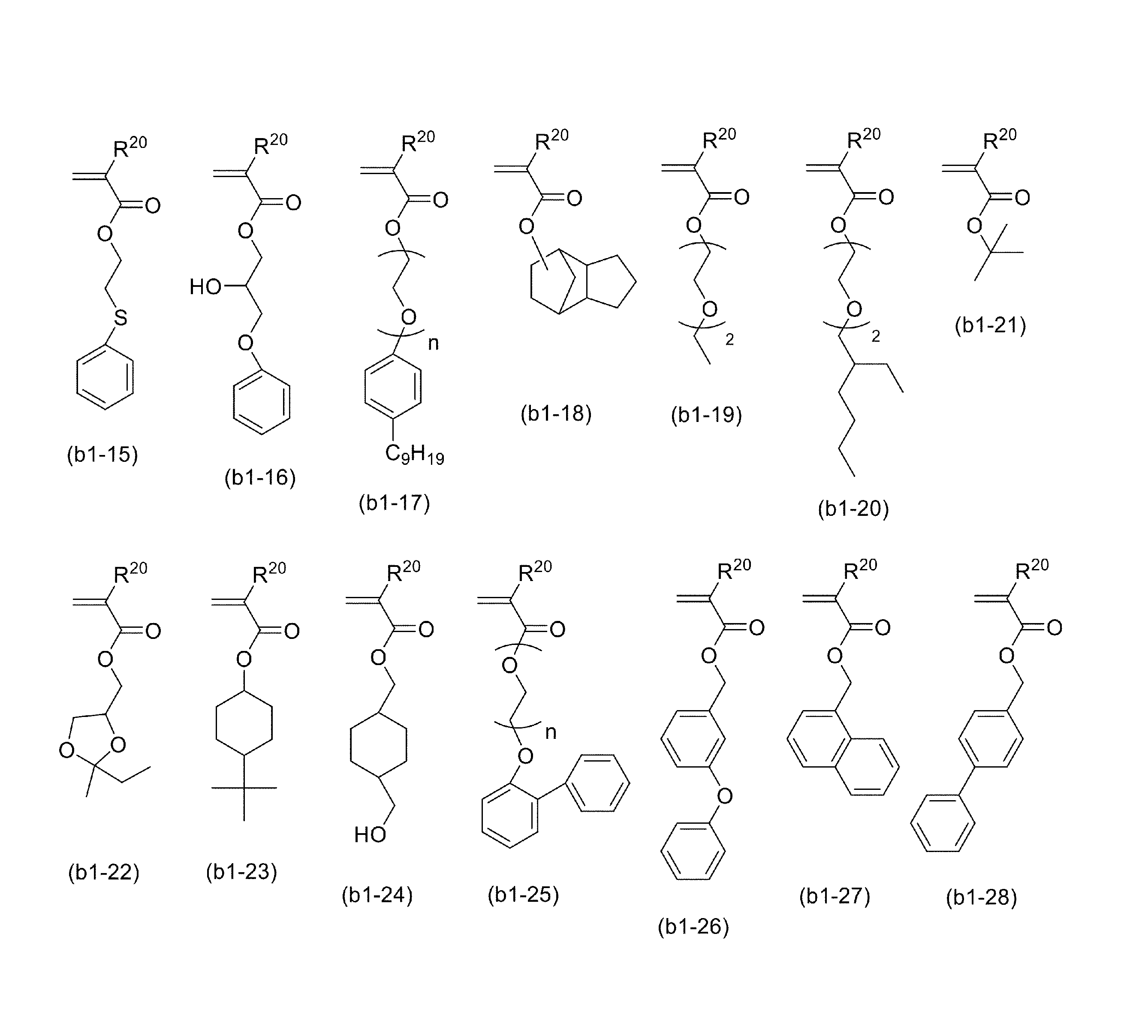
(式(b1-1)~式(b1-28)中、R20は、水素原子又はメチル基である。R21は、炭素数1~20の1価の炭化水素基である。nは0~10の整数である。)
上記多官能重合性化合物(B2)としては、ラジカル重合性基を2個以上有する化合物を好ましく使用でき、例えば、多官能(メタ)アクリロイル基含有化合物、多官能芳香族ビニル化合物、多官能鎖状ビニル化合物等が挙げられる。
上記多官能(メタ)アクリロイル基含有化合物の具体例としては、2官能(メタ)アクリル酸エステル、3官能以上の(メタ)アクリル酸エステル等を例示できる。これらの具体例としては、2官能(メタ)アクリル酸エステルとして、例えば、エチレングリコールジ(メタ)アクリレート、ポリエチレングリコールジ(メタ)アクリレート、プロピレングリコールジ(メタ)アクリレート、ポリプロピレングリコールジ(メタ)アクリレート、ネオペンチルグリコールジ(メタ)アクリレート、EO変性ネオペンチルグリコールジ(メタ)アクリレート、PO変性ネオペンチルグリコールジ(メタ)アクリレート、ビスフェノールAジ(メタ)アクリレート、EO変性ビスフェノールAジ(メタ)アクリレート、PO変性ビスフェノールAジ(メタ)アクリレート、1,6-ヘキサンジオールジ(メタ)アクリレート、1,9-ノナンジオールジ(メタ)アクリレート、1,10-デカンジオールジ(メタ)アクリレート、ジエチレングリコールジ(メタ)アクリレート、テトラエチレングリコールジ(メタ)アクリレート等が挙げられる。
3官能以上の(メタ)アクリル酸エステルとしては、例えば、トリメチロールプロパントリ(メタ)アクリレート、エチレンオキサイド変性トリメチロールプロパントリ(メタ)アクリレート、ペンタエリスリトールトリ(メタ)アクリレート、ペンタエリスリトールテトラ(メタ)アクリレート、ジペンタエリスリトールペンタ(メタ)アクリレート、ジペンタエリスリトールヘキサ(メタ)アクリレート、エチレンオキサイド変性ジペンタエリスリトールヘキサ(メタ)アクリレート、トリ(2-(メタ)アクリロイルオキシエチル)フォスフェート、コハク酸変性ペンタエリスリトールトリ(メタ)アクリレート、コハク酸変性ジペンタエリスリトールペンタ(メタ)アクリレート、イソシアヌル酸トリス(2-(メタ)アクリロイルオキシエチル)、カルボキシ基含有多塩基酸変性(メタ)アクリルオリゴマーの他、直鎖アルキレン基及び脂環式構造を有し、かつ2個以上のイソシアネート基を有する化合物と、分子内に1個以上のヒドロキシ基とを有し、かつ3個、4個又は5個の(メタ)アクリロイルオキシ基を有する化合物と反応させて得られる多官能ウレタンアクリレート化合物等が挙げられる。
上記多官能芳香族ビニル化合物としては、1,3-ジビニルベンゼン、1,4-ジビニルベンゼン等が挙げられる。上記多官能鎖状ビニル化合物としては、1,5-ヘキサジエン、1,6-ヘプタジエン、1,7-オクタジエン等が挙げられる。
多官能重合性化合物(B2)の更なる具体例としては、下記式(b2-29)~式(b2-53)のそれぞれで表される化合物等が挙げられる。


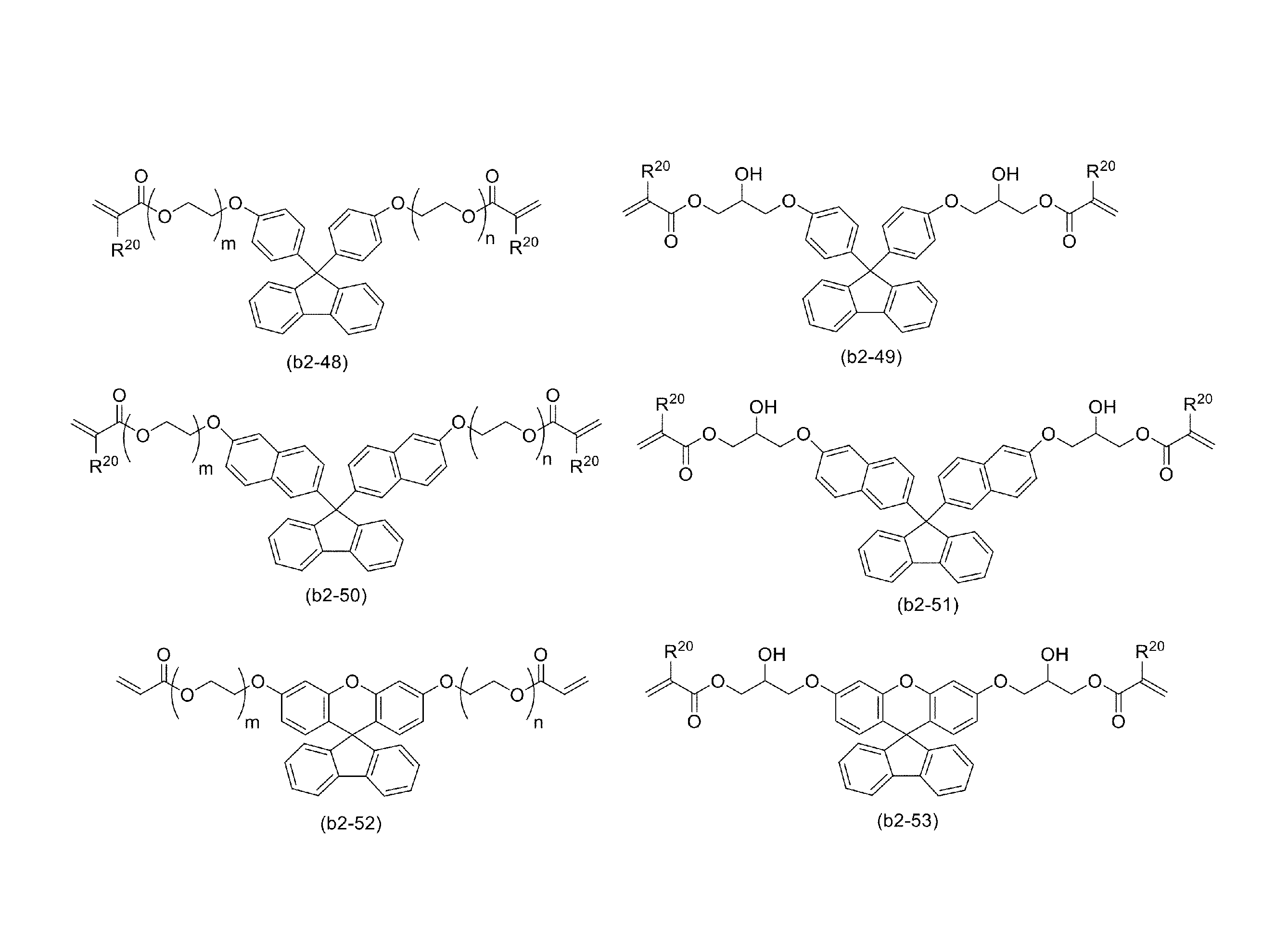
(式(b2-29)~式(b2-53)中、R20は、水素原子又はメチル基である。m及びnは、それぞれ独立して0~10の整数である。x、y及びzは、それぞれ独立して、0~3の整数である。ただし、1≦x+y+z≦3を満たす。)
多官能重合性化合物(B2)としては、高屈折率化を図る観点や透明性の観点から、上記の中でも(メタ)アクリロイル基含有化合物を好ましく使用できる。
また、ラジカル重合性化合物(B)として、ラジカル重合性基とカチオン重合性基の両方を有する重合性化合物(B3)も挙げることができ、上記単官能重合性化合物(B1)や多官能重合性化合物(B2)と併用することが好ましい。カチオン重合性基としては、エポキシ基、オキセタニル基又はビニルエーテル基を挙げることができる。
ラジカル重合性基とカチオン重合性基の両方を有する重合性化合物(B3)としては、ラジカル重合性基として、ビニル基又は(メタ)アクリロイル基を有し、カチオン重合性基として、エポキシ基又はオキセタニル基を有する化合物が好ましい。重合性化合物(B3)としては、グリシジル(メタ)アクリレート、3,4-エポキシシクロヘキシル(メタ)アクリレート、3,4-エポキシシクロヘキシルメチル(メタ)アクリレート、2-(3,4-エポキシシクロヘキシル)エチル(メタ)アクリレート、3,4-エポキシトリシクロ[5.2.1.02,6]デシル(メタ)アクリレート、メタクリル酸2-ヒドロキシエチル[3,4-エポキシトリシクロ(5.2.1.02,6)デカン-9-イル]、メタクリル酸[3,4-エポキシトリシクロ(5.2.1.02,6)デカン-9-イル]、(3-メチルオキセタン-3-イル)メチル(メタ)アクリレート、(3-エチルオキセタン-3-イル)(メタ)アクリレート、(3-エチルオキセタン-3-イル)メチル(メタ)アクリレート、(オキセタン-3-イル)メチル(メタ)アクリレート、3-(メタ)アクリロイルオキシメチル-3-エチルオキセタン、o-ビニルベンジルグリシジルエーテル、m-ビニルベンジルグリシジルエーテル、p-ビニルベンジルグリシジルエーテル、3-[(4-ビニルベンジル)オキシメチル]-3-エチルオキセタン等が挙げられ、3-[(4-ビニルベンジル)オキシメチル]-3-エチルオキセタンが好ましい。
本組成物は、上記ラジカル重合性化合物(B)を1種又は2種以上組み合わせて含んでいてもよい。
上記ラジカル重合性化合物(B)が、単官能重合性化合物(B1)と多官能重合性化合物(B2)の両方を含む場合、単官能重合性化合物(B1)の含有量は、単官能重合性化合物(B1)と多官能重合性化合物(B2)との合計量に対して20質量%以上含むことが好ましく、30質量%以上含むことがより好ましく、40質量%以上含むことが更に好ましい。また、単官能重合性化合物(B1)の含有量は、単官能重合性化合物(B1)と多官能重合性化合物(B2)との合計量に対して、100質量%以下含むことが好ましく、90質量%以下含むことが好ましく、80質量%以下含むことがより好ましく、70質量%以下含むことが更に好ましい。
また、ラジカル重合性化合物(B)が、前記重合性化合物(B3)を含む場合、その含有量は、ラジカル重合性化合物(B)中50質量%以下であることが好ましく、30質量%以下であることがより好ましい。
本組成物におけるラジカル重合性化合物(B)の含有割合(上記重合性化合物(B1)~(B3)を複数種含む場合は合計の含有割合)の下限値は、粒子(A)100質量部に対して、5質量部が好ましく、10質量部がより好ましく、20質量部が更に好ましい。また、ラジカル重合性化合物(B)の含有割合の上限は、粒子(A)100質量部に対して、350質量部が好ましく、200質量部がより好ましく、100質量部がさら更に好ましく、50質量部がより更に好ましく、45質量部がより更に好ましく、35質量部が特に好ましい。本組成物におけるラジカル重合性化合物(B)の含有割合を上記範囲とすることにより、屈折率を高めることができ、本組成物の感度を良好にでき、また耐熱性及び耐薬品性が良好な硬化物を得ることができる。
<ラジカル重合性基を有さず、カチオン重合性基を有するカチオン重合性化合物(B4)>
本発明においては、ラジカル重合性基を有さず、カチオン重合性基を有するカチオン重合性化合物(B4)を用いることができる。カチオン重合性化合物(B4)としては、エポキシ基(オキシラニル基)を有する化合物又はオキセタニル基を有する化合物(オキセタン化合物)が好ましい。カチオン重合性化合物(B4)は、カチオン重合性基を1個以上有すればよく、1~3個有することが好ましい。
本発明においては、ラジカル重合性基を有さず、カチオン重合性基を有するカチオン重合性化合物(B4)を用いることができる。カチオン重合性化合物(B4)としては、エポキシ基(オキシラニル基)を有する化合物又はオキセタニル基を有する化合物(オキセタン化合物)が好ましい。カチオン重合性化合物(B4)は、カチオン重合性基を1個以上有すればよく、1~3個有することが好ましい。
上記エポキシ基を有する化合物としては、エポキシ基を有する脂環式化合物(脂環式エポキシ化合物)、エポキシ基を有する芳香族化合物(芳香族エポキシ化合物)、エポキシ基を有する非環式化合物(非環式エポキシ化合物)等が挙げられ、脂環式エポキシ化合物が好ましい。脂環式エポキシ化合物としては、3’,4’-エポキシシクロヘキシルメチル-3,4-エポキシシクロヘキサンカルボキシレート、3,4-エポキシシクロヘキシルアルキル(メタ)アクリレート(例えば、3,4-エポキシシクロヘキシルメチル(メタ)アクリレート等)、(3、3’、4、4’-ジエポキシ)ビシクロヘキシル、水添ビスフェノールA型エポキシ樹脂、水添ビスフェノールF型エポキシ樹脂等が挙げられる。
上記オキセタン化合物としては、3-エチル-3-ヒドロキシメチルオキセタン(東亞合成(株)製商品名アロンオキセタンOXT-101等)、1,4-ビス[(3-エチル-3-オキセタニル)メトキシメチル]ベンゼン(同OXT-121等)、3-エチル-3-(フェノキシメチル)オキセタン(同OXT-211等)、ジ(1-エチル-(3-オキセタニル))メチルエーテル(同OXT-221等)、3-エチル-3-(2-エチルヘキシロキシメチル)オキセタン(同OXT-212等)等が挙げられる。
また、エポキシ基とオキセタニル基との両方を有する化合物も用いることができる。当該化合物としては、3-エチル-3-(2,3-エポキシプロポキシメチル)オキセタンが挙げられる。
本組成物が上記カチオン重合性化合物(B4)を含有する場合、カチオン重合性化合物(B4)の含有割合(複数種含む場合は合計の含有割合)の下限値は、粒子(A)100質量部に対して、5質量部が好ましく、10質量部がより好ましく、20質量部が更に好ましい。また、カチオン重合性化合物(B4)の含有割合の上限は、粒子(A)100質量部に対して、100質量部が好ましく、80質量部がより好ましく、60質量部が更に好ましい。本組成物におけるカチオン重合性化合物(B4の含有割合を上記範囲とすることにより、屈折率を高めることができ、本組成物の感度を良好にでき、また耐熱性及び耐薬品性が良好な硬化物を得ることができる。
上記ラジカル重合性化合物(B)としては、上記重合性化合物(B1)~(B4)を適宜組み合わせて用いることができるが、これらの中でも、エチレンオキサイド鎖、プロピレンオキサイド鎖等のアルキレンオキサイド鎖を有する重合性化合物、酸性基を有する重合性化合物が、折り曲げ耐性や分散性の観点から好ましい。
<光ラジカル発生剤(C)>
光ラジカル発生剤(C)としては、放射線に感応してラジカルを発生し、前記ラジカル重合性化合物(B)の重合を開始できる光ラジカル重合開始剤を好ましく使用できる。使用される光重合開始剤としては、特に限定されないが、例えば、O-アシルオキシム化合物、アセトフェノン化合物、ビイミダゾール化合物、アシルホスフィンオキサイド化合物等を挙げることができる。
光ラジカル発生剤(C)としては、放射線に感応してラジカルを発生し、前記ラジカル重合性化合物(B)の重合を開始できる光ラジカル重合開始剤を好ましく使用できる。使用される光重合開始剤としては、特に限定されないが、例えば、O-アシルオキシム化合物、アセトフェノン化合物、ビイミダゾール化合物、アシルホスフィンオキサイド化合物等を挙げることができる。
O-アシルオキシム化合物としては、例えば、1,2-オクタンジオン1-[4-(フェニルチオ)-2-(O-ベンゾイルオキシム)]、エタノン-1-〔9-エチル-6-(2-メチルベンゾイル)-9H-カルバゾール-3-イル〕-1-(O-アセチルオキシム)、1-(9-エチル-6-ベンゾイル-9.H.-カルバゾール-3-イル)-オクタン-1-オンオキシム-O-アセテート、1-〔9-エチル-6-(2-メチルベンゾイル)-9.H.-カルバゾール-3-イル〕-エタン-1-オンオキシム-O-ベンゾエート、1-〔9-n-ブチル-6-(2-エチルベンゾイル)-9.H.-カルバゾール-3-イル〕-エタン-1-オンオキシム-O-ベンゾエート、エタノン-1-[9-エチル-6-(2-メチル-4-テトラヒドロフラニルベンゾイル)-9.H.-カルバゾール-3-イル]-1-(O-アセチルオキシム)、エタノン-1-〔9-エチル-6-(2-メチル-4-テトラヒドロピラニルベンゾイル)-9.H.-カルバゾール-3-イル〕-1-(O-アセチルオキシム)、エタノン-1-〔9-エチル-6-(2-メチル-5-テトラヒドロフラニルベンゾイル)-9.H.-カルバゾール-3-イル〕-1-(O-アセチルオキシム)、エタノン-1-〔9-エチル-6-{2-メチル-4-(2,2-ジメチル-1,3-ジオキソラニル)メトキシベンゾイル}-9.H.-カルバゾール-3-イル〕-1-(O-アセチルオキシム)等が挙げられる。また、市販品として、例えば、アデカアークルズN-1919T、同NCI-831E、同NCI-930、同NCI-730(以上、(株)ADEKA製)、イルガキュアOXE01、同OXE2、同OXE3、同OXE4(以上、BASF社製)等が挙げられる。
アセトフェノン化合物としては、例えば、α-アミノケトン化合物、α-ヒドロキシケトン化合物等が挙げられる。これらの具体例としては、α-アミノケトン化合物として、例えば、2-ベンジル-2-ジメチルアミノ-1-(4-モルホリノフェニル)-ブタン-1-オン、2-ジメチルアミノ-2-(4-メチルベンジル)-1-(4-モルフォリン-4-イル-フェニル)-ブタン-1-オン、2-メチル-1-(4-メチルチオフェニル)-2-モルフォリノプロパン-1-オン等が挙げられる。α-ヒドロキシケトン化合物としては、例えば、1-フェニル-2-ヒドロキシ-2-メチルプロパン-1-オン、1-(4-i-プロピルフェニル)-2-ヒドロキシ-2-メチルプロパン-1-オン、4-(2-ヒドロキシエトキシ)フェニル-(2-ヒドロキシ-2-プロピル)ケトン、1-ヒドロキシシクロヘキシルフェニルケトン等が挙げられる。また、市販品として、例えば、イルガキュア369、同369E、同379EG、同651、同184、同907(以上、BASF社製)等が挙げられる。
ビイミダゾール化合物としては、例えば、2,2’-ビス(2-クロロフェニル)-4,4’,5,5’-テトラフェニル-1,2’-ビイミダゾール、2,2’-ビス(2,4-ジクロロフェニル)-4,4’,5,5’-テトラフェニル-1,2’-ビイミダゾール、又は2,2’-ビス(2,4,6-トリクロロフェニル)-4,4’,5,5’-テトラフェニル-1,2’-ビイミダゾール等を挙げることができる。
アシルホスフィンオキサイド化合物としては、例えば、2,4,6-トリメチルベンゾイル-ジフェニルホスフィンオキサイド、フェニルビス(2,4,6-トリメチルベンゾイル)ホスフィンオキサイド等が挙げられる。
本組成物は、上記光ラジカル発生剤(C)を1種又は2種以上組み合わせて含んでいてもよい。
本組成物における光ラジカル発生剤(C)の含有割合(複数種含む場合は合計の含有割合)の下限値は、本組成物中に含まれる粒子(A)100質量部に対して、0.5質量部が好ましく、1質量部がより好ましい。また、光ラジカル発生剤(C)の含有割合の上限値は、本組成物中に含まれる粒子(A)100質量部に対して、40質量部が好ましく、30質量部がより好ましく、15質量部が更に好ましく、10質量部がより更に好ましく、5質量部が特に好ましい。光ラジカル発生剤(C)の含有割合を上記範囲とすることにより、良好な硬化性と透明性を示す感光性組成物とすることができる。
<脱水剤(D)>
本組成物(1)は、脱水剤(D)を含有し、脱水剤(D)は、オルトエステル化合物を含む。オルトエステル化合物とは、3個の基「-OR1」(ただし、R1は1価の炭化水素基である)が同一の炭素に結合した構造を有する化合物であり、一般式:R2-C(OR1)3で表される。ここで、R2は、水素原子又は1価の有機基である。オルトエステル化合物は、加水分解してエステルに変わる。こうしたオルトエステル化合物を感光性組成物に含有させることにより、オルトエステル化合物の吸水作用によって、感光性組成物の経時塗布性や保存安定性を向上させることができる。また、オルトエステル化合物は、アルカリ現像液に対し安定で疎水的であり、露光部に及ぼす影響(例えば、感度への影響)も少ない点で好ましい。
本組成物(1)は、脱水剤(D)を含有し、脱水剤(D)は、オルトエステル化合物を含む。オルトエステル化合物とは、3個の基「-OR1」(ただし、R1は1価の炭化水素基である)が同一の炭素に結合した構造を有する化合物であり、一般式:R2-C(OR1)3で表される。ここで、R2は、水素原子又は1価の有機基である。オルトエステル化合物は、加水分解してエステルに変わる。こうしたオルトエステル化合物を感光性組成物に含有させることにより、オルトエステル化合物の吸水作用によって、感光性組成物の経時塗布性や保存安定性を向上させることができる。また、オルトエステル化合物は、アルカリ現像液に対し安定で疎水的であり、露光部に及ぼす影響(例えば、感度への影響)も少ない点で好ましい。
オルトエステル化合物が有する基「-OR1」としては、例えば、メトキシ基、エトキシ基、n-プロポキシ基、i-プロポキシ基、n-ブトキシ基、i-ブトキシ基、tert-ブトキシ基、n-ペントキシ基、フェノキシ基、メチルフェニルオキシ基等が挙げられる。これらのうち、オルトエステル化合物が有する基「-OR1」は、アルコキシ基が好ましく、炭素数1~4のアルコキシ基がより好ましい。なお、オルトエステル化合物が有する3個の基「-OR1」は、互いに同一の基又は異なる基である。
R2としては、例えば、水素原子、1価の鎖状炭化水素基、当該鎖状炭化水素基の少なくとも1個の水素原子がハロゲン原子で置換されたハロゲン化鎖状炭化水素基、1価の芳香環基等が挙げられる。これらのうち、R2は、水素原子、1価の鎖状炭化水素基又は1価の芳香環基が好ましく、具体的には、水素原子、炭素数1~20のアルキル基、炭素数2~20のアルケニル基、炭素数6~20のアリール基が挙げられる。
オルトエステル化合物としては、上記の中でも、下記式(1)で表される化合物を好ましく使用することができる。
R21-C-(OR11)3 …(1)
(式(1)中、R11は、炭素数1~4のアルキル基又はフェニル基であり、R21は、水素原子、炭素数1~4の1価の鎖状炭化水素基又は炭素数6~12の1価の芳香環基である。3個のR11は、互いに同一又は異なる。)
R21-C-(OR11)3 …(1)
(式(1)中、R11は、炭素数1~4のアルキル基又はフェニル基であり、R21は、水素原子、炭素数1~4の1価の鎖状炭化水素基又は炭素数6~12の1価の芳香環基である。3個のR11は、互いに同一又は異なる。)
上記式(1)において、R11のアルキル基は、直鎖状でも分岐状でもよい。感度への影響がより小さい点で、R11は、メチル基、エチル基又はフェニル基が好ましく、メチル基又はエチル基がより好ましい。
R21の鎖状炭化水素基は、炭素数1~4の鎖状又は分岐状のアルキル基が好ましい。R21の芳香環基としては、例えば、フェニル基、メチルフェニル基、ジメチルフェニル基、エチルフェニル基、ナフチル基等が挙げられる。また、当該鎖状炭化水素基や芳香環基の少なくとも1個の水素原子がハロゲン原子で置換された基であってもよい。R21は、経時塗布性や保存安定性の向上効果が高い点で、1価の芳香環基が好ましく、フェニル基が特に好ましい。
オルトエステル化合物の具体例としては、オルトクロロ酢酸トリエチル、オルト蟻酸トリメチル、オルト蟻酸トリエチル、オルト蟻酸トリプロピル、オルト蟻酸トリイソプロピル、オルト蟻酸トリブチル、オルト蟻酸ジエチルフェニル、オルト酢酸トリメチル、オルト酢酸トリエチル、オルトジクロロ酢酸トリエチル、オルト酪酸トリメチル、オルト酪酸トリエチル、オルトプロピオン酸トリメチル、オルトプロピオン酸トリエチル、オルト吉草酸トリメチル、オルト吉草酸トリエチル、オルトイソ酪酸トリメチル、オルト安息香酸トリメチル、オルト安息香酸トリエチル等が挙げられ、これらの中でも、オルト酢酸メチル、オルト酢酸トリエチル、オルト安息香酸トリメチル、及びオルト安息香酸トリエチルよりなる群から選択される1種以上であることが好ましく、オルト酢酸トリエチル、オルト安息香酸トリメチル、及びオルト安息香酸トリエチルよりなる群から選択される1種以上であることがより好ましく、オルト安息香酸トリメチル及びオルト安息香酸トリエチルよりなる群から選択される1種以上であることが更に好ましい。
オルトエステル化合物としては、経時塗布性や保存安定性の観点から、芳香環基を有する化合物を好ましく使用できる。芳香環基を有する化合物の具体例としては、上記式(1)においてR11及びR21の少なくとも一つの基が芳香環含有基である化合物が挙げられる。
芳香環基を有するオルトエステル化合物の具体例としては、オルト安息香酸トリメチル、オルト安息香酸トリエチル、オルト蟻酸ジエチルフェニル等を挙げることができる。これらのうち、経時塗布性及び保存安定性の改善効果が高い点で、オルト安息香酸トリメチル及びオルト安息香酸トリエチルが特に好ましい。
オルトエステル化合物の沸点は、特に限定されないが、1気圧において105℃以上であることが好ましく、110℃以上であることがより好ましく、115℃以上であることが更に好ましい。なお、オルトエステル化合物の沸点が高い場合、感光性組成物を塗布手段等に一定時間滞在させても、その間にオルトエステル化合物が揮発するのを抑制でき、オルトエステル化合物の配合効果を維持することができるため好ましい。
沸点が1気圧において105℃以上であるオルトエステル化合物の具体例としては、オルト蟻酸トリエチル(沸点145℃)、オルト蟻酸トリプロピル(沸点198℃)、オルト蟻酸トリブチル(沸点247℃)、オルト酢酸トリメチル(沸点108℃)、オルト酢酸トリエチル(沸点145℃)、オルトジクロロ酢酸トリエチル(沸点195℃)、オルト酪酸トリメチル(沸点146℃)、オルトプロピオン酸トリメチル(沸点128℃)、オルトプロピオン酸トリエチル(沸点158℃)、オルト吉草酸トリメチル(沸点164℃)、オルト安息香酸トリメチル(沸点115℃)、オルト安息香酸トリエチル(沸点240℃)等が挙げられ、これらの中でも、オルト安息香酸トリメチル(沸点115℃/3.3kPa)、オルト安息香酸トリエチル(沸点240℃)が好ましい。なお、本明細書において沸点は1気圧下での値である。
脱水剤(D)は、上記オルトエステル化合物を1種又は2種以上組み合わせて含んでいてもよく、また、オルトエステル化合物以外の公知の脱水剤を含んでもよいが、オルトエステル化合物のみからなることが好ましい。
本組成物における脱水剤(D)の含有割合の下限値は、本組成物中に含まれる粒子(A)100質量部に対して、1質量部が好ましく、3質量部がより好ましく、5質量部が更に好ましい。また、脱水剤(D)の含有割合の上限値は、本組成物中に含まれる粒子(A)100質量部に対して、40質量部が好ましく、30質量部がより好ましく、25質量部更に好ましい。脱水剤(D)の含有割合を上記範囲にすることで、経時塗布性、保存安定性に優れる感光性組成物とすることができるため好ましい。
本組成物(1)には、上記粒子(A)、ラジカル重合性化合物(B)、光ラジカル発生剤(C)、及び脱水剤(D)以外の成分を含むことができる。その他の成分としては、光酸発生剤(E)、溶剤(F)、バインダー樹脂(G)、界面活性剤(H)、密着助剤(I)等を挙げることができる。また、本組成物(2)には、上記粒子(A)、ラジカル重合性化合物(B)、及び光ラジカル発生剤(C)以外の成分を含むことができる。その他の成分としては、上記脱水剤(D)、光酸発生剤(E)、溶剤(F)、バインダー樹脂(G)、界面活性剤(H)、密着助剤(I)、増感剤(J)等を挙げることができる。
<光酸発生剤(E)>
光酸発生剤(E)は、光又はその他の放射線の照射によって酸を発生する化合物をいう。放射線としては、例えば、紫外線、遠紫外線、X線、荷電粒子線等が挙げられる。この酸の発生により、カチオン重合性化合物のカチオン重合を開始させることができる。従って、上記ラジカル重合性化合物(B)が、重合性化合物(B3)を含有する場合は、光酸発生剤(E)を含むことが好ましい。
光酸発生剤(E)は、光又はその他の放射線の照射によって酸を発生する化合物をいう。放射線としては、例えば、紫外線、遠紫外線、X線、荷電粒子線等が挙げられる。この酸の発生により、カチオン重合性化合物のカチオン重合を開始させることができる。従って、上記ラジカル重合性化合物(B)が、重合性化合物(B3)を含有する場合は、光酸発生剤(E)を含むことが好ましい。
光酸発生剤(E)としては、例えば、オキシムスルホネート化合物、スルホンイミド化合物、ハロゲン含有化合物、ジアゾメタン化合物、スルホン化合物、スルホン酸エステル化合物、カルボン酸エステル化合物、オニウム塩等を挙げることができる。これらの化合物の具体例としては、例えば、特開2020-026515号公報に記載のものを挙げることができる。これらの中でも、オニウム塩が好ましい。
上記オニウム塩としては、ジフェニルヨードニウム塩、トリフェニルスルホニウム塩、スルホニウム塩、ベンゾチアゾニウム塩、テトラヒドロチオフェニウム塩等を挙げることができる。ジフェニルヨードニウム塩としては、例えば、ジフェニルヨードニウムテトラフルオロボレート、4-イソブチルフェニル-4’-トルイルヨードヘキサフルオロホスフェートを挙げることができる。トリフェニルスルホニウム塩としては、例えば、トリフェニルスルホニウムトリフルオロメタンスルホナート、トリフェニルスルホニウムヘキサフルオロアンチモネート、トリフェニルスルホニウムヘキサフルオロホスフェート、トリフェニルスルホニウムテトラキス(ペンタフルオロフェニル)ボラート、ジフェニル[4-(フェニルチオ)フェニル]スルホニウムヘキサフルオロホスフェート等を挙げることができる。これらの中でも、トリフェニルスルホニウムヘキサフルオロアンチモネート、ジフェニル[4-(フェニルチオ)フェニル]スルホニウムヘキサフルオロホスフェートが好ましい。
本組成物は、上記光酸発生剤(E)を1種又は2種以上組み合わせて含んでいてもよい。
本組成物が光酸発生剤(E)を含有する場合、光酸発生剤(E)の含有割合(複数種含む場合は合計の含有割合)の下限値は、本組成物中に含まれる粒子(A)100質量部に対して、0.1質量部が好ましく、0.2質量部がより好ましく、0.5質量部が更に好ましく、1質量部がより更に好ましい。また、光酸発生剤(E)の含有割合の上限値は、本組成物中に含まれる粒子(A)100質量部に対して、10質量部が好ましく、5質量部がより好ましい。光酸発生剤(E)の含有割合を上記範囲とすることにより、良好な硬化性を示す感光性組成物とすることができる。
本組成物に光酸発生剤(E)を使用する場合には、上記重合性化合物(B3)や、密着助剤(I)の中でもオキシラニル基又はオキセタニル基のようなカチオン重合性基を有するもの、重合性化合物(B4)を用いることができる。また、本組成物に光酸発生剤(E)を使用する場合には、感度向上のため増感剤(J)を用いることができる。
<溶剤(F)>
本組成物は、上記粒子(A)、ラジカル重合性化合物(B)、光ラジカル発生剤(C)、脱水剤(D)、及び必要に応じて配合されるその他の成分が、溶剤に溶解又は分散された液状の組成物であることが好ましい。溶剤(F)としては、上記粒子(A)、ラジカル重合性化合物(B)、光ラジカル発生剤(C)、及び脱水剤(D)を溶解し、かつ各成分と反応しない有機溶媒が好ましい。
本組成物は、上記粒子(A)、ラジカル重合性化合物(B)、光ラジカル発生剤(C)、脱水剤(D)、及び必要に応じて配合されるその他の成分が、溶剤に溶解又は分散された液状の組成物であることが好ましい。溶剤(F)としては、上記粒子(A)、ラジカル重合性化合物(B)、光ラジカル発生剤(C)、及び脱水剤(D)を溶解し、かつ各成分と反応しない有機溶媒が好ましい。
溶剤(F)の具体例としては、例えば、メタノール、エタノール、イソプロパノール、ブタノール、オクタノール、ジアセトンアルコール等のアルコール類;酢酸エチル、酢酸ブチル、乳酸エチル、γ-ブチロラクトン、プロピレングリコールモノメチルエーテルアセテート、プロピレングリコールモノエチルエーテルアセテート、ジプロピレングリコールメチルエーテルアセテート、3-メトキシブチルアセテート、3-メトキシプロピオン酸メチル、3-エトキシプロピオン酸エチル等のエステル類;エチレングリコールモノブチルエーテル、プロピレングリコールモノメチルエーテル、エチレンジグリコールモノメチルエーテル、エチレンジグリコールエチルメチルエーテル、ジメチレングリコールジメチルエーテル、ジエチレングリコールジメチルエーテル、ジエチレングリコールエチルメチルエーテル等のエーテル類;ジメチルホルムアミド、N,N-ジメチルアセトアミド、N-メチルピロリドン等のアミド類;アセトン、メチルエチルケトン、メチルイソブチルケトン、シクロペンタノン、シクロヘキサノン等のケトン類;ベンゼン、トルエン、キシレン、エチルベンゼン等の芳香族炭化水素類が挙げられる。これらのうち、溶剤(F)としては、アルコール類、エーテル類、及びエステル類よりなる群から選択される少なくとも1種を含むことが好ましく、プロピレングリコールモノメチルエーテルアセテート、プロピレングリコールモノメチルエーテル、3-メトキシブチルアセテート、ジエチレングリコールエチルメチルエーテル、ジアセトンアルコール、及びジプロピレングリコールメチルエーテルアセテートよりなる群から選択される少なくとも1種を含むことがより好ましい。
溶剤(F)としては、経時塗布性の観点から、沸点が高い(例えば、160℃以上)溶剤を含むことが好ましい。
<バインダー樹脂(G)>
バインダー樹脂(G)は、酸性基を有する重合体であることが好ましい。酸性基としては、カルボキシ基、フェノール性水酸基、フッ素化ヒドロキシアルキル基等が挙げられる。バインダー樹脂は、アルカリ可溶性樹脂であることが好ましい。ここで、「アルカリ可溶性」とは、25℃において、2.38質量%濃度のテトラメチルアンモニウムヒドロキシド(TMAH)水溶液に溶解又は膨潤可能な重合体をいう。フッ素化ヒドロアルキル基は、ヒドロキシアルキル基が有する、炭素に結合する任意の水素原子がフッ素原子で置換された基をいう。
バインダー樹脂(G)は、酸性基を有する重合体であることが好ましい。酸性基としては、カルボキシ基、フェノール性水酸基、フッ素化ヒドロキシアルキル基等が挙げられる。バインダー樹脂は、アルカリ可溶性樹脂であることが好ましい。ここで、「アルカリ可溶性」とは、25℃において、2.38質量%濃度のテトラメチルアンモニウムヒドロキシド(TMAH)水溶液に溶解又は膨潤可能な重合体をいう。フッ素化ヒドロアルキル基は、ヒドロキシアルキル基が有する、炭素に結合する任意の水素原子がフッ素原子で置換された基をいう。
上記バインダー樹脂(G)としては、エチレン性不飽和単量体を構成単位とする重合体を好ましく使用できる。当該重合体を構成するエチレン性不飽和単量体としては、単官能重合性化合物(B1)として例示した化合物と同様の化合物が挙げられ、カルボキシ基含有化合物を含むことが好ましい。この場合、バインダー樹脂(G)は、カルボキシ基含有化合物に由来する構造単位を、バインダー樹脂(G)を構成する全構造単位に対して、5質量%以上有することが好ましく、10質量%以上有することがより好ましく、20質量%以上有することが更に好ましい。
バインダー樹脂(G)が、エチレン性不飽和単量体を構成単位とする重合体である場合、当該重合体は、例えば、上述したエチレン性不飽和単量体を用い、適当な溶媒中、重合開始剤等の存在下で、ラジカル重合等の公知の方法に従って製造することができる。重合開始剤としては、2,2’-アゾビス(イソブチロニトリル)、2,2’-アゾビス(2,4-ジメチルバレロニトリル)、2,2’-アゾビス(イソ酪酸)ジメチル等のアゾ化合物が挙げられる。重合開始剤の使用割合は、反応に使用する単量体の全量100質量部に対して、0.01~30質量部であることが好ましい。重合溶媒としては、例えば、アルコール類、エーテル類、ケトン類、エステル類、炭化水素類等が挙げられ、具体的には、上記溶剤(F)で挙げたものを挙げることができる。重合溶媒の使用量は、反応に使用する単量体の合計量が、反応溶液の全体量に対して、0.1~60質量%になるような量にすることが好ましい。重合において、反応温度は、通常、30℃~180℃である。反応時間は、重合開始剤及び単量体の種類や反応温度に応じて異なるが、通常、0.5~10時間である。
バインダー樹脂(G)としては、エチレン性不飽和単量体を構成単位とする重合体のほか、例えば、ノボラック樹脂、フェノール-キシリレングリコール縮合樹脂、クレゾール-キシリレングリコール縮合樹脂、フェノール-ジシクロペンタジエン縮合樹脂等のフェノール性水酸基含有重合体が挙げられる。また、バインダー樹脂(G)として、アルカリ可溶性ポリオルガノシロキサン、アルカリ可溶性ポリイミド、アルカリ可溶性ポリベンゾオキサゾール等を使用してもよい。アルカリ可溶性ポリオルガノシロキサンの具体例としては、例えば、国際公開第2017/188047号、国際公開第2017/169763号等に記載されている重合体が挙げられる。アルカリ可溶性のポリイミド及びポリベンゾオキサゾールの具体例としては、例えば、国際公開第2017/169763号、国際公開第2017/159876号等に記載されている重合体が挙げられる。
本組成物にバインダー樹脂(G)を含有させることによってアルカリ現像性の向上を図ることができる一方、得られる硬化物の表面平坦性が低下する傾向がある。従って、得られる硬化物の使用目的に応じてバインダー樹脂(G)を配合の有無、及びその配合量を決めることができる。具体的には、得られる硬化物に表面平坦性が必要とされる用途においては、バインダー樹脂(G)を使用しないことが好ましく、アルカリ現像性の向上が必要とされる用途においては、バインダー樹脂(G)を使用することが好ましい。
本組成物は、上記バインダー樹脂(G)を1種又は2種以上組み合わせて含んでいてもよい。
本組成物がバインダー樹脂(G)を含む場合、バインダー樹脂(G)の含有割合(複数種含む場合は合計の含有割合)は、本組成物中に含まれる粒子(A)100質量部に対して、1質量部以上30質量部以下が好ましく、5質量部以上20質量部以下がより好ましい。
<界面活性剤(H)>
界面活性剤(H)は、本組成物の塗布性(濡れ広がり性や塗布ムラの低減)を改良するために使用することができる。界面活性剤(H)としては、例えば、フッ素系界面活性剤、シリコーン系界面活性剤、ノニオン系界面活性剤が挙げられる。
界面活性剤(H)は、本組成物の塗布性(濡れ広がり性や塗布ムラの低減)を改良するために使用することができる。界面活性剤(H)としては、例えば、フッ素系界面活性剤、シリコーン系界面活性剤、ノニオン系界面活性剤が挙げられる。
界面活性剤(H)の具体例としては、フッ素系界面活性剤として、以下商品名で、メガファックF-171、同F-172、同F-173、同F-251、同F-430、F-554、F-563(DIC(株)製);フロラードFC430、同FC431(住友スリーエム社製);アサヒガードAG710、サーフロンS-382、同SC-101、同SC-102、同SC-103、同SC-104、同SC-105、同SC-106、同S-611(AGCセイミケミカル(株)製);ポリフローNo.75、同No.95(共栄社化学(株)製);FTX-218((株)ネオス製);エフトップEF301、同EF303、同EF352(新秋田化成(株)製)等が挙げられる。
シリコーン系界面活性剤としては、以下商品名で、SH200-100cs、SH-28PA、SH-30PA、SH-89PA、SH-190、SH-8400、FLUID、SH-193、SZ-6032、SF-8428、DC-57、DC-190、PAINTAD19、FZ-2101、FZ-77、FZ-2118、L-7001、L-7002(東レ・ダウコーニング・シリコーン(株)製);オルガノシロキサンポリマーKP341(信越化学工業(株)製);BYK-300、同306、同310、同313、同320、同330、同331、同335、同341、同344、同370、同340、同345(ビックケミー・ジャパン(株)製)が挙げられる。
ノニオン系界面活性剤としては、例えば、ポリオキシエチレンラウリルエーテル、ポリオキシエチレンステアリルエーテル、ポリオキシエチレンオレイルエーテル、ポリオキシエチレンn-オクチルフェニルエーテル、ポリオキシエチレンn-ノニルフェニルエーテル、ポリエチレングリコールジラウレート、ポリエチレングリコールジステアレート等が挙げられる。
本組成物は、上記界面活性剤(H)を1種又は2種以上組み合わせて含んでいてもよい。
本組成物中に界面活性剤(H)を配合する場合、界面活性剤(H)の含有割合(複数種含む場合は合計の含有割合)は、本組成物中に含まれる粒子(A)100質量部に対して、0.01質量部以上15質量部以下が好ましく、0.01質量部以上5質量部以下がより好ましく、0.01質量部以上3質量部以下が更に好ましく、0.01質量部以上1.5質量部以下がより更に好ましく、0.02質量部以上1.2質量部以下が特に好ましい。
<密着助剤(I)>
密着助剤(I)は、得られる硬化膜と基板との接着性を向上させる成分である。上記密着助剤(I)としては、カルボキシ基、メタクリロイル基、ビニル基、イソシアネート基、オキシラニル基等の反応性官能基を有する官能性シランカップリング剤が好ましい。
密着助剤(I)は、得られる硬化膜と基板との接着性を向上させる成分である。上記密着助剤(I)としては、カルボキシ基、メタクリロイル基、ビニル基、イソシアネート基、オキシラニル基等の反応性官能基を有する官能性シランカップリング剤が好ましい。
上記官能性シランカップリング剤としては、例えば、トリメトキシシリル安息香酸、γ-メタクリロキシプロピルトリメトキシシラン、ビニルトリアセトキシシラン、ビニルトリメトキシシラン、γ-イソシアナートプロピルトリエトキシシラン、γ-グリシドキシプロピルトリメトキシシラン、β-(3,4-エポキシシクロヘキシル)エチルトリメトキシシラン、β-(3,4-エポキシシクロヘキシル)エチルトリエトキシシラン等が挙げられる。
本組成物は、上記密着助剤(I)を1種又は2種以上組み合わせて含んでいてもよい。
本組成物が密着助剤(I)を含む場合、密着助剤(I)の含有割合(複数種含む場合は合計の含有割合)は、本組成物中に含まれる粒子(A)100質量部に対して、1質量部以上60質量部以下が好ましく、1質量部以上50質量部以下がより好ましく、1質量部以上35質量部以下が更に好ましく、1質量部以上15質量部以下がより更に好ましく、3質量部以上10質量部以下が特に好ましい。
<増感剤(J)>
本発明において重合を増進させるために増感剤を使用できる。増感剤としては、例えばアミン系増感剤、アルコキシアントラセン系増感剤が挙げられる。アミン系増感剤としては、トリエタノールアミン、メチルジエタノールアミン、トリイソプロパノールアミン、メチル4-ジメチルアミノベンゾエート、エチル4-ジメチルアミノベンゾエート、イソアミル4-ジメチルアミノベンゾエート、2-ジメチルアミノエチルベンゾエート、2-エチルヘキシル4-ジメチルアミノベンゾエート、N、N-ジメチルp-トルイジン、4,4’-ビス(ジメチルアミノ)ベンゾフェノン(通称:ミヒラーズ(Michler’s)ケトン)、4,4’-ビス(ジエチルアミノ)ベンゾフェノン、4,4’-ビス(エチルメチルアミノ)ベンゾフェノンなどが挙げられる。前記アルコキシアントラセン系増感剤としては、9,10-ジメトキシアントラセン、9,10-ジブトキシアントラセン、2-エチル-9,10-ジメトキシアントラセン、9,10-ジエトキシアントラセン、2-エチル-9,10-ジエトキシアントラセンなどが挙げられる。
本発明において重合を増進させるために増感剤を使用できる。増感剤としては、例えばアミン系増感剤、アルコキシアントラセン系増感剤が挙げられる。アミン系増感剤としては、トリエタノールアミン、メチルジエタノールアミン、トリイソプロパノールアミン、メチル4-ジメチルアミノベンゾエート、エチル4-ジメチルアミノベンゾエート、イソアミル4-ジメチルアミノベンゾエート、2-ジメチルアミノエチルベンゾエート、2-エチルヘキシル4-ジメチルアミノベンゾエート、N、N-ジメチルp-トルイジン、4,4’-ビス(ジメチルアミノ)ベンゾフェノン(通称:ミヒラーズ(Michler’s)ケトン)、4,4’-ビス(ジエチルアミノ)ベンゾフェノン、4,4’-ビス(エチルメチルアミノ)ベンゾフェノンなどが挙げられる。前記アルコキシアントラセン系増感剤としては、9,10-ジメトキシアントラセン、9,10-ジブトキシアントラセン、2-エチル-9,10-ジメトキシアントラセン、9,10-ジエトキシアントラセン、2-エチル-9,10-ジエトキシアントラセンなどが挙げられる。
本組成物が増感剤(J)を含む場合、増感剤(J)の含有割合(複数種含む場合は合計の含有割合)は、本組成物中に含まれる粒子(A)100質量部に対して、0.01質量部以上10質量部以下が好ましく、0.01質量部以上5質量部以下がより好ましく、0.05質量部以上5質量部以下が更に好ましく、0.05質量部以上3質量部以下がより更に好ましい。
その他の成分としては、上記のほか、例えば、重合禁止剤、酸化防止剤、軟化剤、可塑剤、紫外線吸収剤等が挙げられる。これらの成分の配合割合は、本開示の効果を損なわない範囲で各成分に応じて適宜選択される。
本組成物(1)は、上記粒子(A)、ラジカル重合性化合物(B)、光ラジカル発生剤(C)、脱水剤(D)、及び任意に配合されるその他の成分を、本組成物(2)は、上記粒子(A)、ラジカル重合性化合物(B)、光ラジカル発生剤(C)、及び任意に配合されるその他の成分を、所定の割合で混合することにより得ることができる。各成分を混合することにより得られる組成物は、例えば、孔径0.5μm以下のフィルタでろ過してもよい。
本組成物の固形分濃度(即ち、感光性組成物中の溶剤以外の成分の合計質量が、感光性組成物の全質量に対して占める割合)は、粘性や揮発性等を考慮して適宜に選択される。本組成物の固形分濃度は、好ましくは3~60質量%の範囲である。固形分濃度が3質量%以上であると、本組成物を基板上に塗布した際に塗膜の膜厚を十分に確保できる点で好ましい。また、固形分濃度が60質量%以下であると、塗膜の膜厚が過大となりすぎず、更に本組成物の粘性を適度に高くでき、良好な塗布性を確保できる点で好ましい。本組成物における固形分濃度は、より好ましくは5~55質量%であり、更に好ましくは10~50質量%である。
本組成物(2)に含まれる水分量は、2000ppm未満であり、1500ppm以下が好ましく、1200ppm以下がより好ましく、1000ppm以下が更に好ましい。水分量が上記の範囲内であることで、安定した塗布性が得られる。組成物中の水分量は実施例に記載の方法で測定することができる。また、本組成物(1)においても、上記水分量であることが好ましい。
≪硬化物の製造方法≫
上記のように調製された感光性組成物を用いることにより硬化物を製造することができる。本組成物は特に、感光性組成物により形成された膜の一部を露光し、未露光部をアルカリ現像液に溶解させることによって得られたパターン(即ち、感光性組成物により形成された部分)を熱処理により硬化させるネガ型のパターン形成材料として好適である。
上記のように調製された感光性組成物を用いることにより硬化物を製造することができる。本組成物は特に、感光性組成物により形成された膜の一部を露光し、未露光部をアルカリ現像液に溶解させることによって得られたパターン(即ち、感光性組成物により形成された部分)を熱処理により硬化させるネガ型のパターン形成材料として好適である。
本開示の硬化物は、例えば、以下の工程(I)~(IV)を含む方法により製造される。
(I)基材上に本組成物を塗布する工程
(II)基材上に塗布した本組成物に放射線を照射する工程
(III)放射線を照射した後の本組成物を現像する工程
(IV)現像後の本組成物を100℃以下の温度で加熱して硬化させる工程
以下、本開示の製造方法における各工程(工程(I)~(IV))について説明する。
(I)基材上に本組成物を塗布する工程
(II)基材上に塗布した本組成物に放射線を照射する工程
(III)放射線を照射した後の本組成物を現像する工程
(IV)現像後の本組成物を100℃以下の温度で加熱して硬化させる工程
以下、本開示の製造方法における各工程(工程(I)~(IV))について説明する。
<工程(I):塗布工程>
工程(I)は、本組成物を基材上に塗布することにより、基材上に塗膜を形成する工程である。基材としては、例えば、ガラス基板、シリコンウエハ、プラスチック基板、プラスチックフィルム及びこれらの表面に着色レジスト、オーバーコート、反射防止膜、各種金属薄膜、封止膜等が形成された基板等が挙げられる。プラスチック基板及びプラスチックフィルムとしては、例えば、ポリエチレンテレフタレート(PET)、ポリブチレンテレフタレート(PBT)、ポリエーテルスルホン、ポリカーボネート、ポリイミド等のプラスチックからなる樹脂基板及びフィルムが挙げられる。これらの基材には、各種素子(例えば、フォトダイオード等の受光素子や、有機発光ダイオード等の発光素子)が予め設けられていてもよい。
工程(I)は、本組成物を基材上に塗布することにより、基材上に塗膜を形成する工程である。基材としては、例えば、ガラス基板、シリコンウエハ、プラスチック基板、プラスチックフィルム及びこれらの表面に着色レジスト、オーバーコート、反射防止膜、各種金属薄膜、封止膜等が形成された基板等が挙げられる。プラスチック基板及びプラスチックフィルムとしては、例えば、ポリエチレンテレフタレート(PET)、ポリブチレンテレフタレート(PBT)、ポリエーテルスルホン、ポリカーボネート、ポリイミド等のプラスチックからなる樹脂基板及びフィルムが挙げられる。これらの基材には、各種素子(例えば、フォトダイオード等の受光素子や、有機発光ダイオード等の発光素子)が予め設けられていてもよい。
本組成物の塗布方法としては、例えば、スプレー法、ロールコート法、回転塗布法(スピンコート法)、スリットダイ塗布法、バー塗布法、インクジェット法等の適宜の方法を採用することができる。塗布方法としては、これらのうち、スピンコート法、バー塗布法、スリットダイ塗布法が好ましい。
本組成物を基材上に塗布した後には、液だれ防止等を目的として、本組成物を予備加熱する処理(プレベーク)が行われてもよい。プレベークの条件は、各成分の種類や使用割合等によって適宜設定することができる。プレベークの条件は、例えば、60~100℃で30秒間~10分間程度の条件とすることができる。プレベーク温度は、有機EL素子に適用可能にする観点から、好ましくは60~90℃である。形成される塗膜の膜厚は、プレベーク後の値として、0.1~20μmが好ましく、0.2~15μmがより好ましい。
<工程(II):露光工程>
工程(II)は、工程(I)で形成した塗膜の少なくとも一部に放射線を照射する工程である。この放射線照射により露光部において硬化反応が進行する。工程(II)において、塗膜に対する放射線照射は、通常、マスクを介して実施される。マスクは、ハーフトーンマスクやグレイトーンマスク等の多階調マスクであってもよい。
工程(II)は、工程(I)で形成した塗膜の少なくとも一部に放射線を照射する工程である。この放射線照射により露光部において硬化反応が進行する。工程(II)において、塗膜に対する放射線照射は、通常、マスクを介して実施される。マスクは、ハーフトーンマスクやグレイトーンマスク等の多階調マスクであってもよい。
塗膜に照射する放射線としては、例えば、紫外線、遠紫外線、X線、荷電粒子線等が挙げられる。紫外線としては、例えば、g線(波長436nm)、i線(波長365nm)、KrFエキシマレーザー光(波長248nm)等が挙げられる。X線としては、例えば、シンクロトロン放射線等が挙げられる。荷電粒子線としては、例えば、電子線等が挙げられる。これらのうち、塗膜に照射する放射線は紫外線が好ましく、波長200nm以上380nm以下の紫外線がより好ましい。使用する光源としては、例えば、低圧水銀ランプ、高圧水銀ランプ、重水素ランプ、メタルハライドランプ、アルゴン共鳴ランプ、キセノンランプ、エキシマレーザー等が挙げられる。放射線の露光量としては、500J/m2~5,000J/m2(50~500mJ/cm2)が好ましい。
<工程(III):現像工程>
工程(III)は、工程(II)により放射線が照射された塗膜を現像することにより、基材上にパターンを形成する工程である。この現像工程により、基材上に形成された塗膜のうち未露光部が除去されて、露光部からなるパターンを基材上に形成することができる。
工程(III)は、工程(II)により放射線が照射された塗膜を現像することにより、基材上にパターンを形成する工程である。この現像工程により、基材上に形成された塗膜のうち未露光部が除去されて、露光部からなるパターンを基材上に形成することができる。
現像液としては、例えば、水酸化ナトリウム、水酸化カリウム、炭酸ナトリウム、ケイ酸ナトリウム、メタケイ酸ナトリウム、アンモニア、エチルアミン、n-プロピルアミン、ジエチルアミン、ジエチルアミノエタノール、ジ-n-プロピルアミン、トリエチルアミン、メチルジエチルアミン、ジメチルエタノールアミン、トリエタノールアミン、テトラメチルアンモニウムヒドロキシド(TMAH)、テトラエチルアンモニウムヒドロキシド、ピロール、ピペリジン、1,8-ジアザビシクロ〔5.4.0〕-7-ウンデセン、1,5-ジアザビシクロ〔4.3.0〕-5-ノナン等のアルカリ(塩基性化合物)の水溶液等が挙げられる。また、アルカリの水溶液に、メタノールやエタノール等の水溶性有機溶媒や界面活性剤を適量添加したり、本組成物を溶解可能な各種有機溶媒を少量添加したりすることにより得られる水溶液を現像液として使用してもよい。
現像方法としては、例えば、液盛り法、ディッピング法、揺動浸漬法、シャワー法等の適宜の方法を採用することができる。現像時間は、本組成物の組成によって適宜調整すればよい。現像時間は、例えば、20秒~120秒である。
<工程(IV):加熱工程>
工程(IV)は、現像後のパターンを100℃以下で加熱する工程である。工程(IV)の加熱処理により更に硬化が進行して、良好な耐熱性及び耐薬品性を示す硬化物を得ることができる。加熱処理は、例えば、オーブンやホットプレート等の加熱装置を用いて行うことができる。硬化物としてマイクロレンズを得る場合、工程(IV)の加熱処理によって現像後のパターンをサーマルフローさせることにより半球状のマイクロレンズを得るようにしてもよい。
工程(IV)は、現像後のパターンを100℃以下で加熱する工程である。工程(IV)の加熱処理により更に硬化が進行して、良好な耐熱性及び耐薬品性を示す硬化物を得ることができる。加熱処理は、例えば、オーブンやホットプレート等の加熱装置を用いて行うことができる。硬化物としてマイクロレンズを得る場合、工程(IV)の加熱処理によって現像後のパターンをサーマルフローさせることにより半球状のマイクロレンズを得るようにしてもよい。
工程(IV)における加熱温度は、有機EL素子への適用を可能にする観点から、100℃以下であり、95℃以下が好ましく、90℃以下がより好ましい。また、耐熱性及び耐薬品性が高い硬化物を得る観点から、工程(IV)における加熱温度は、60℃以上が好ましく、80℃以上がより好ましい。加熱時間は、加熱装置の種類等に応じて適宜設定することができる。例えば、ホットプレートにより加熱を行う場合、加熱時間は、例えば、5~60分間である。また、オーブンにより加熱を行う場合、加熱時間は、例えば、10~90分間である。工程(IV)においては、複数回の加熱処理を行うステップベーク法を用いてもよい。
本開示の製造方法は、任意の工程として、工程(IV)による加熱工程の前又は後の硬化物に対し放射線を照射する工程(以下、「ポスト露光工程」ともいう)を更に含んでいてもよい。ポスト露光工程における放射線の照射(以下、「ポスト露光」ともいう)により、耐熱性や耐薬品性等を更に向上でき、信頼性がより高い硬化物とすることができる。ポスト露光における放射線の種類や露光条件については、工程(II)と同様の条件を採用することができる。なお、ポスト露光の際の照射光の波長や照射量、光源等の条件は、工程(II)と同一でもよく異なってもよい。
≪硬化膜≫
本発明の硬化膜は、上記感光性組成物を硬化して形成することができる。本組成物によれば、高屈折率の硬化物を得ることができ、具体的には、波長550nmにおける屈折率が1.60以上の硬化物を得ることができる。また、本組成物によれば、波長550nmにおける屈折率が、好ましくは1.68以上、より好ましくは1.70以上である高屈折率の硬化膜を得ることもできる。
本発明の硬化膜は、上記感光性組成物を硬化して形成することができる。本組成物によれば、高屈折率の硬化物を得ることができ、具体的には、波長550nmにおける屈折率が1.60以上の硬化物を得ることができる。また、本組成物によれば、波長550nmにおける屈折率が、好ましくは1.68以上、より好ましくは1.70以上である高屈折率の硬化膜を得ることもできる。
本組成物は、アルカリ現像液に対する溶解性が高く、かつ、保存安定性や経時塗布性に優れるものである。したがって、本組成物によれば、本組成物に対する露光処理及び現像処理によって所望のパターン形状を有する硬化物を得ることができ、一定時間経過後であっても、同様の硬化物を得ることができるものである。
上記硬化膜は、表示素子用又は撮像素子用の光学部材として適している。当該光学部材は、表示素子における光取り出し効率を向上させる部材(光の経路を調整する光路調整用部材)カメラ等の撮像素子が備える受光素子(フォトダイオード)に集光するために光の経路を調整する光路調整用部材が好ましい。
≪表示素子≫
本発明の表示素子は、上記感光性組成物から形成された硬化膜を備える。表示素子としては、例えば、液晶表示素子、有機EL表示素子、マイクロLED(Light Emitting Diode)表示素子等が挙げられる。
本発明の表示素子は、上記感光性組成物から形成された硬化膜を備える。表示素子としては、例えば、液晶表示素子、有機EL表示素子、マイクロLED(Light Emitting Diode)表示素子等が挙げられる。
≪撮像素子≫
本発明の撮像素子は、上記感光性組成物から形成された硬化膜を備える。本発明の硬化膜は、カメラ等の撮像素子が備える受光素子(フォトダイオード)に集光するために光の経路を調整する光路調整用部材として用いることが好ましい。
本発明の撮像素子は、上記感光性組成物から形成された硬化膜を備える。本発明の硬化膜は、カメラ等の撮像素子が備える受光素子(フォトダイオード)に集光するために光の経路を調整する光路調整用部材として用いることが好ましい。
以下、本発明を実施例により具体的に説明するが、本発明はこれらの実施例に限定されるものではない。なお、実施例、比較例中の「部」及び「%」は、特に断らない限り質量基準である。本実施例において、重合体(バインダー樹脂)の重量平均分子量(Mw)は以下の方法により測定した。
[重量平均分子量(Mw)]
重合体(バインダー樹脂)のMwは、下記方法及び条件により測定したポリスチレン換算値である。
・測定方法:ゲルパーミエーションクロマトグラフィー(GPC)法
・装置:昭和電工(株)製のGPC-101
・GPCカラム:(株)島津ジーエルシー製のGPC-KF-801、GPC-KF-802、GPC-KF-803及びGPC-KF-804を結合
・移動相:テトラヒドロフラン
・カラム温度:40℃
・流速:1.0mL/分
・試料濃度:1.0質量%
・試料注入量:100μL
・検出器:示差屈折計
・標準物質:単分散ポリスチレン
重合体(バインダー樹脂)のMwは、下記方法及び条件により測定したポリスチレン換算値である。
・測定方法:ゲルパーミエーションクロマトグラフィー(GPC)法
・装置:昭和電工(株)製のGPC-101
・GPCカラム:(株)島津ジーエルシー製のGPC-KF-801、GPC-KF-802、GPC-KF-803及びGPC-KF-804を結合
・移動相:テトラヒドロフラン
・カラム温度:40℃
・流速:1.0mL/分
・試料濃度:1.0質量%
・試料注入量:100μL
・検出器:示差屈折計
・標準物質:単分散ポリスチレン
[平均粒子径]
粒子の平均粒子径は、動的光散乱法での測定におけるD50粒子径(積算分布曲線の50%積算値を示す粒子径であるメジアン径)であり、マイクロトラックベル社製MicrotracWaveII-EX150を用いて測定した。
粒子の平均粒子径は、動的光散乱法での測定におけるD50粒子径(積算分布曲線の50%積算値を示す粒子径であるメジアン径)であり、マイクロトラックベル社製MicrotracWaveII-EX150を用いて測定した。
<バインダー樹脂(G-1)の合成>
[合成例1]
冷却管と撹拌機を備えたフラスコに、プロピレングリコールモノメチルエーテルアセテート100質量部を仕込んで窒素置換した。80℃に加熱して、同温度でプロピレングリコールモノメチルエーテルアセテート100質量部、メタクリル酸15質量部、スチレン15質量部、ベンジルメタクリレート5質量部、2-ヒドロキシエチルメタクリレート15質量部、2-エチルヘキシルメタクリレート23質量部、N-フェニルマレイミド12質量部、こはく酸モノ(2-アクリロイルオキシエチル)15質量部及び2,2’-アゾビス(2,4-ジメチルバレロニトリル)6質量部の混合溶液を1時間かけて滴下し、この温度を保持して2時間重合した。その後、反応溶液の温度を100℃に昇温させ、更に1時間重合することにより、バインダー樹脂溶液(固形分濃度:33質量%)を得た。得られたバインダー樹脂溶液のMwは12,200であった。このバインダー樹脂溶液を「バインダー樹脂(G-1)」とする。
[合成例1]
冷却管と撹拌機を備えたフラスコに、プロピレングリコールモノメチルエーテルアセテート100質量部を仕込んで窒素置換した。80℃に加熱して、同温度でプロピレングリコールモノメチルエーテルアセテート100質量部、メタクリル酸15質量部、スチレン15質量部、ベンジルメタクリレート5質量部、2-ヒドロキシエチルメタクリレート15質量部、2-エチルヘキシルメタクリレート23質量部、N-フェニルマレイミド12質量部、こはく酸モノ(2-アクリロイルオキシエチル)15質量部及び2,2’-アゾビス(2,4-ジメチルバレロニトリル)6質量部の混合溶液を1時間かけて滴下し、この温度を保持して2時間重合した。その後、反応溶液の温度を100℃に昇温させ、更に1時間重合することにより、バインダー樹脂溶液(固形分濃度:33質量%)を得た。得られたバインダー樹脂溶液のMwは12,200であった。このバインダー樹脂溶液を「バインダー樹脂(G-1)」とする。
<粒子分散液の調製>
[調製例1]ジルコニア粒子分散液(A-1)
2-エチルヘキサン酸ジルコニウムミネラルスピリット溶液(第一稀元素化学工業(株)製)782gに、純水268gを混合した。得られた混合物を撹拌機付きオートクレーブ内に仕込み、反応容器中の雰囲気を窒素ガスにより置換した。その後、反応溶液を180℃まで加熱し、16時間反応させることにより酸化ジルコニウムを合成した。180℃で反応した際の容器中圧力は1.03MPaであった。反応後の溶液を取り出し、底部にたまった沈殿物を濾別してアセトンで洗浄した後に乾燥した。乾燥後の沈殿物100gをトルエン800mLに分散させたところ、白濁溶液となった。
次に、精製工程として定量濾紙(アドバンテック東洋(株)製、No.5C)にて再度濾過し、沈殿物中の粗大粒子等を除去した。次に、濾液を減圧濃縮したトルエンを除去することで白色の酸化ジルコニウム粒子を回収した。
上記で得られた酸化ジルコニウム粒子10gをトルエン90gに分散させ、透明分散液を得た。得られた透明分散液に、表面被覆剤として、3-メタクリロキシプロピルトリメトキシシラン1.5g(信越化学工業(株)製、KBM-503)を添加し、90℃で1時間加熱還流した。次いで、還流処理後の分散液にn-ヘキサンを添加することで分散粒子を凝集させて分散液を白濁させた。白濁液から凝集粒子を濾紙により分離後、室温で加熱乾燥し、2-エチルヘキサン酸と3-メタクリロキシプロピルトリメトキシシランにより表面処理された酸化ジルコニウム粒子を調製した。得られた被覆酸化ジルコニウム粒子の平均粒子径を測定したところ12nmであった。また、白色粉末にプロピレングリコールモノメチルエーテル(PGME)を添加し、撹拌して被覆ジルコニア粒子を80質量%含有するジルコニア粒子分散液(これを「ジルコニア粒子分散液(A-1)」とする)を得た。ジルコニア粒子分散液(A-1)中での凝集粒子の平均粒子径は12nmであった。
[調製例1]ジルコニア粒子分散液(A-1)
2-エチルヘキサン酸ジルコニウムミネラルスピリット溶液(第一稀元素化学工業(株)製)782gに、純水268gを混合した。得られた混合物を撹拌機付きオートクレーブ内に仕込み、反応容器中の雰囲気を窒素ガスにより置換した。その後、反応溶液を180℃まで加熱し、16時間反応させることにより酸化ジルコニウムを合成した。180℃で反応した際の容器中圧力は1.03MPaであった。反応後の溶液を取り出し、底部にたまった沈殿物を濾別してアセトンで洗浄した後に乾燥した。乾燥後の沈殿物100gをトルエン800mLに分散させたところ、白濁溶液となった。
次に、精製工程として定量濾紙(アドバンテック東洋(株)製、No.5C)にて再度濾過し、沈殿物中の粗大粒子等を除去した。次に、濾液を減圧濃縮したトルエンを除去することで白色の酸化ジルコニウム粒子を回収した。
上記で得られた酸化ジルコニウム粒子10gをトルエン90gに分散させ、透明分散液を得た。得られた透明分散液に、表面被覆剤として、3-メタクリロキシプロピルトリメトキシシラン1.5g(信越化学工業(株)製、KBM-503)を添加し、90℃で1時間加熱還流した。次いで、還流処理後の分散液にn-ヘキサンを添加することで分散粒子を凝集させて分散液を白濁させた。白濁液から凝集粒子を濾紙により分離後、室温で加熱乾燥し、2-エチルヘキサン酸と3-メタクリロキシプロピルトリメトキシシランにより表面処理された酸化ジルコニウム粒子を調製した。得られた被覆酸化ジルコニウム粒子の平均粒子径を測定したところ12nmであった。また、白色粉末にプロピレングリコールモノメチルエーテル(PGME)を添加し、撹拌して被覆ジルコニア粒子を80質量%含有するジルコニア粒子分散液(これを「ジルコニア粒子分散液(A-1)」とする)を得た。ジルコニア粒子分散液(A-1)中での凝集粒子の平均粒子径は12nmであった。
[調製例2]ジルコニア粒子分散液(A-2)
粒子分散液(A-1)の溶剤(PGME)をプロピレングリコールモノメチルエーテルアセテート(PGMEA)に変更した以外は、調製例1と同様にして、ジルコニア粒子分散液(A-2)を作製した。ジルコニア粒子分散液(A-2)中での粒子の平均粒子径は12nmであった。
粒子分散液(A-1)の溶剤(PGME)をプロピレングリコールモノメチルエーテルアセテート(PGMEA)に変更した以外は、調製例1と同様にして、ジルコニア粒子分散液(A-2)を作製した。ジルコニア粒子分散液(A-2)中での粒子の平均粒子径は12nmであった。
[調製例3]ジルコニア粒子分散液(A-3)
分散液中における二酸化ジルコニウム粒子、分散剤及びバインダー樹脂(G-1)の固形分並びに溶剤の量が以下の量となるように、二酸化ジルコニウム粒子、分散剤、バインダー樹脂(G-1)及び溶剤を混合し、粒子分散液(A-3)を調製した。なお、以下の溶剤の量は、粒子分散液(A-3)を調製する際に用いた分散剤及びバインダー樹脂(G-1)に含まれる溶剤量を含む総量である。
・二酸化ジルコニウム粒子(第一稀元素化学工業(株)製、UEP)100.00質量部
・分散剤(ビックケミー社製、DISPERBYK-111)6.67質量部/固形分換算
・バインダー樹脂(G-1) 6.67質量部/固形分換算
・溶剤(PGMEA)138.51質量部
上記の成分を十分に撹拌して混合液(これを混合液Lqbとする)を得た。次に、直径0.3mmのジルコニアビーズ20gと、混合液Lqb 10gを用い、ペイントシェーカーにより25~45℃で6時間分散処理を行った。分散処理終了後、フィルターによりビーズと分散液を分離して、全固形分の含有割合が45質量%のジルコニア分散液(A-3)を調製した。ジルコニア粒子分散液(A-3)中での粒子の平均粒子径は38nmであった。
分散液中における二酸化ジルコニウム粒子、分散剤及びバインダー樹脂(G-1)の固形分並びに溶剤の量が以下の量となるように、二酸化ジルコニウム粒子、分散剤、バインダー樹脂(G-1)及び溶剤を混合し、粒子分散液(A-3)を調製した。なお、以下の溶剤の量は、粒子分散液(A-3)を調製する際に用いた分散剤及びバインダー樹脂(G-1)に含まれる溶剤量を含む総量である。
・二酸化ジルコニウム粒子(第一稀元素化学工業(株)製、UEP)100.00質量部
・分散剤(ビックケミー社製、DISPERBYK-111)6.67質量部/固形分換算
・バインダー樹脂(G-1) 6.67質量部/固形分換算
・溶剤(PGMEA)138.51質量部
上記の成分を十分に撹拌して混合液(これを混合液Lqbとする)を得た。次に、直径0.3mmのジルコニアビーズ20gと、混合液Lqb 10gを用い、ペイントシェーカーにより25~45℃で6時間分散処理を行った。分散処理終了後、フィルターによりビーズと分散液を分離して、全固形分の含有割合が45質量%のジルコニア分散液(A-3)を調製した。ジルコニア粒子分散液(A-3)中での粒子の平均粒子径は38nmであった。
[調製例4]チタニア粒子分散液(A-4)
(1)ルチル型酸化チタンヒドロゾルの製造
1Lのガラスビーカーに、TiO2濃度25%のオキシ塩化チタン水溶液240g(TiO2として60g)と、ZrO2濃度35%のオキシ塩化ジルコニウム粉末5g(ZrO2として1.8g)を入れ、水を加えて全量を1Lとし、オキシ塩化ジルコニウム粉末が溶解したことを確認した。この溶液をA液と呼ぶ。撹拌手段及び還流冷却器を備えた2Lフラスコに、水1kgと、SnO2濃度30%の塩化第二スズ水溶液20g(SnO2として6g)を仕込み、撹拌下加熱し、温度が60℃に達した時点で60℃を維持しながらA液を15分かけて滴下し、滴下終了後沸騰するまで加熱し、還流下3時間沸騰状態を維持した。その後40℃に冷却し、28%アンモニア水溶液でpHを7.0に調整し、濾過し、洗浄してケーキを得た。このケーキに、水と36%塩酸を加えて撹拌し、pH1.3、TiO2濃度20%で、TiO2に対して、SnO2として10%、ZrO2として3%を含有する酸化チタンヒドロゾル300gを製造した。
(2)ヒドロゾルの被覆処理
2Lガラスビーカーに、上記(1)で得たTiO2濃度20%の酸化チタンヒドロゾル200g(TiO2として40g)を入れ、イオン交換水を加えてTiO2濃度4%に希釈し、これに撹拌しながら3-グリシドキシプロピルトリメトキシラン(信越化学工業(株)製、オルガノシランKBM-403)5.2gを添加した。この溶液をB液と呼ぶ。別の5Lガラスビーカーに、SiO2濃度10%のケイ酸ナトリウム水溶液40g(SiO2として4g)と、48%水酸化ナトリウム水溶液2gを仕込み、イオン交換水で希釈して全量を1200gとした。この溶液に、撹拌しながらB液を15分かけて滴下した。滴下終了後のpHは10であった。次にこの混合溶液へ、SnO2濃度30%の塩化第二スズ水溶液20g(SnO2として6g)を、48%水酸化ナトリウム水溶液と同時に、pH10を維持しながら15分かけて滴下し、引き続きSiO2濃度10%のケイ酸ナトリウム水溶液20g(SiO2として2g)を添加し、80℃に加熱した後、1%塩酸でpH8に調整し、同温度で120分間熟成した。これを20℃に冷却し、濃度10%のクエン酸水溶液でpH3に調整し、この液を限外濾過モジュール(旭化成ケミカルズ(株)製、マイクローザSLP-1 053)に濾過量と同量のイオン交換水を補水しながら通液し、TiO2濃度3%で電気伝導度3×10⁻³S/cm以下になるまで電解質成分を低減させた。この段階でpH調整剤として使用したクエン酸は除去され、残存していなかった。更にt-ブチルアミンでpH8に調整し、更に同じ限外濾過モジュールを用いて固形分濃度が20%になるまで濃縮し、固形分濃度20%で、TiO2に対して、SiO2として15%、SnO2として15%を被覆したルチル形酸化チタンヒドロゾルを得た。
(3)ヒドロゾルのプロピレングリコールモノメチルエーテル溶媒置換
上記(2)で得た被覆処理酸化チタンヒドロゾルをプロピレングリコールモノメチルエーテルでTiO2濃度5%に希釈し、同じ限外濾過モジュールを用いて濾過量と同量のプロピレングリコールモノメチルエーテルを補給しながら通液し、最後にプロピレングリコールモノメチルエーテルの補給を止めて水分が1%以下、固形分濃度20%で、TiO2に対して、SiO2として15%、SnO2として15%を被覆したチタニア粒子分散液(A-4)を得た。チタニア粒子分散液(A-4)中での粒子の平均粒子径は36nmであった。
(1)ルチル型酸化チタンヒドロゾルの製造
1Lのガラスビーカーに、TiO2濃度25%のオキシ塩化チタン水溶液240g(TiO2として60g)と、ZrO2濃度35%のオキシ塩化ジルコニウム粉末5g(ZrO2として1.8g)を入れ、水を加えて全量を1Lとし、オキシ塩化ジルコニウム粉末が溶解したことを確認した。この溶液をA液と呼ぶ。撹拌手段及び還流冷却器を備えた2Lフラスコに、水1kgと、SnO2濃度30%の塩化第二スズ水溶液20g(SnO2として6g)を仕込み、撹拌下加熱し、温度が60℃に達した時点で60℃を維持しながらA液を15分かけて滴下し、滴下終了後沸騰するまで加熱し、還流下3時間沸騰状態を維持した。その後40℃に冷却し、28%アンモニア水溶液でpHを7.0に調整し、濾過し、洗浄してケーキを得た。このケーキに、水と36%塩酸を加えて撹拌し、pH1.3、TiO2濃度20%で、TiO2に対して、SnO2として10%、ZrO2として3%を含有する酸化チタンヒドロゾル300gを製造した。
(2)ヒドロゾルの被覆処理
2Lガラスビーカーに、上記(1)で得たTiO2濃度20%の酸化チタンヒドロゾル200g(TiO2として40g)を入れ、イオン交換水を加えてTiO2濃度4%に希釈し、これに撹拌しながら3-グリシドキシプロピルトリメトキシラン(信越化学工業(株)製、オルガノシランKBM-403)5.2gを添加した。この溶液をB液と呼ぶ。別の5Lガラスビーカーに、SiO2濃度10%のケイ酸ナトリウム水溶液40g(SiO2として4g)と、48%水酸化ナトリウム水溶液2gを仕込み、イオン交換水で希釈して全量を1200gとした。この溶液に、撹拌しながらB液を15分かけて滴下した。滴下終了後のpHは10であった。次にこの混合溶液へ、SnO2濃度30%の塩化第二スズ水溶液20g(SnO2として6g)を、48%水酸化ナトリウム水溶液と同時に、pH10を維持しながら15分かけて滴下し、引き続きSiO2濃度10%のケイ酸ナトリウム水溶液20g(SiO2として2g)を添加し、80℃に加熱した後、1%塩酸でpH8に調整し、同温度で120分間熟成した。これを20℃に冷却し、濃度10%のクエン酸水溶液でpH3に調整し、この液を限外濾過モジュール(旭化成ケミカルズ(株)製、マイクローザSLP-1 053)に濾過量と同量のイオン交換水を補水しながら通液し、TiO2濃度3%で電気伝導度3×10⁻³S/cm以下になるまで電解質成分を低減させた。この段階でpH調整剤として使用したクエン酸は除去され、残存していなかった。更にt-ブチルアミンでpH8に調整し、更に同じ限外濾過モジュールを用いて固形分濃度が20%になるまで濃縮し、固形分濃度20%で、TiO2に対して、SiO2として15%、SnO2として15%を被覆したルチル形酸化チタンヒドロゾルを得た。
(3)ヒドロゾルのプロピレングリコールモノメチルエーテル溶媒置換
上記(2)で得た被覆処理酸化チタンヒドロゾルをプロピレングリコールモノメチルエーテルでTiO2濃度5%に希釈し、同じ限外濾過モジュールを用いて濾過量と同量のプロピレングリコールモノメチルエーテルを補給しながら通液し、最後にプロピレングリコールモノメチルエーテルの補給を止めて水分が1%以下、固形分濃度20%で、TiO2に対して、SiO2として15%、SnO2として15%を被覆したチタニア粒子分散液(A-4)を得た。チタニア粒子分散液(A-4)中での粒子の平均粒子径は36nmであった。
[調製例5]チタン酸バリウム粒子分散液(A-5)
パーフルオロアルコキシアルカン(PFA)容器に、チタン酸バリウム(シグマアルドリッチ社製、一次粒子径100nm未満)100質量部に対して、松本油脂製薬(株)製マーボンAC-F3(ポリオキシエチレンセカンダリーアルキルエーテル)11質量部、プロピレングリコールモノメチルエーテル192質量部を加え、更に粒径0.1mmのジルコニアビーズ((株)ニッカトー製)900質量部を加えて、ペイントコンディショナー(REDDEVIL社製)を用いて、1時間振とうして、チタン酸バリウムのナノ粒子をプロピレングリコールモノメチルエーテルに分散させた後、ジルコニアビーズを除去することでチタン酸バリウム粒子分散液(A-5)を得た。チタン酸バリウム粒子分散液(A-5)中での粒子の平均粒子径は50nmであった。
パーフルオロアルコキシアルカン(PFA)容器に、チタン酸バリウム(シグマアルドリッチ社製、一次粒子径100nm未満)100質量部に対して、松本油脂製薬(株)製マーボンAC-F3(ポリオキシエチレンセカンダリーアルキルエーテル)11質量部、プロピレングリコールモノメチルエーテル192質量部を加え、更に粒径0.1mmのジルコニアビーズ((株)ニッカトー製)900質量部を加えて、ペイントコンディショナー(REDDEVIL社製)を用いて、1時間振とうして、チタン酸バリウムのナノ粒子をプロピレングリコールモノメチルエーテルに分散させた後、ジルコニアビーズを除去することでチタン酸バリウム粒子分散液(A-5)を得た。チタン酸バリウム粒子分散液(A-5)中での粒子の平均粒子径は50nmであった。
[調製例6]ペリレンブラック粒子分散液(A-6)
ペリレンブラック系黒色顔料として、C.I.ピグメントブラック788を12質量部、分散剤としてBYK-LPN21116(ビックケミー(BYK)社製)を6質量部(固形分濃度:40質量%)、バインダー樹脂(G-1)を4質量部(固形分濃度:33質量%)、溶媒としてPGMEA78質量部を用いて、ビーズミルにより処理して、ペリレンブラック粒子分散液(A-6)を調製した。ペリレンブラック粒子分散液(A-6)中での粒子の平均粒子径は42nmであった。
ペリレンブラック系黒色顔料として、C.I.ピグメントブラック788を12質量部、分散剤としてBYK-LPN21116(ビックケミー(BYK)社製)を6質量部(固形分濃度:40質量%)、バインダー樹脂(G-1)を4質量部(固形分濃度:33質量%)、溶媒としてPGMEA78質量部を用いて、ビーズミルにより処理して、ペリレンブラック粒子分散液(A-6)を調製した。ペリレンブラック粒子分散液(A-6)中での粒子の平均粒子径は42nmであった。
<重合性化合物(B-3)の合成>
[合成例2]
50質量%水酸化ナトリウム水溶液/ジクロロメタン(質量比=1/1)440質量部に、3-エチル-3-ヒドロキシメチルオキセタン13.9g(0.12モル)、p-ビニルベンジルクロライド15.2g(0.1モル)、及び層間移動触媒としてテトラブチルアンモニウムブロマイド2.1gを加え、室温、窒素雰囲気下にて6時間撹拌した。次いで、ガラスフィルターにより反応液から生成した塩を取り除き、残渣を十分なジクロロメタンで洗浄した。得られた濾液について、ジクロロメタンと蒸留水を用いて3回分液精製を行い、ジクロロメタンにより抽出した。次いで、ジクロロメタン層に少量の活性炭素を加え着色を取り除いた後、硫酸マグネシウムで乾燥し、更に減圧濃縮にて溶剤を留去した。得られた粗生成物を、シリカゲルクロマトグラフィー(酢酸エチル/n-ヘキサン=1/3)により精製し、3-[(4-ビニルベンジル)オキシメチル]-3-エチルオキセタン(重合性化合物(B-3))17.2gを得た。
[合成例2]
50質量%水酸化ナトリウム水溶液/ジクロロメタン(質量比=1/1)440質量部に、3-エチル-3-ヒドロキシメチルオキセタン13.9g(0.12モル)、p-ビニルベンジルクロライド15.2g(0.1モル)、及び層間移動触媒としてテトラブチルアンモニウムブロマイド2.1gを加え、室温、窒素雰囲気下にて6時間撹拌した。次いで、ガラスフィルターにより反応液から生成した塩を取り除き、残渣を十分なジクロロメタンで洗浄した。得られた濾液について、ジクロロメタンと蒸留水を用いて3回分液精製を行い、ジクロロメタンにより抽出した。次いで、ジクロロメタン層に少量の活性炭素を加え着色を取り除いた後、硫酸マグネシウムで乾燥し、更に減圧濃縮にて溶剤を留去した。得られた粗生成物を、シリカゲルクロマトグラフィー(酢酸エチル/n-ヘキサン=1/3)により精製し、3-[(4-ビニルベンジル)オキシメチル]-3-エチルオキセタン(重合性化合物(B-3))17.2gを得た。
<感光性組成物の調製>
感光性組成物の調製に用いた粒子(A)、ラジカル重合性化合物(B)、ラジカル重合開始剤(C)、脱水剤(D)、光酸発生剤(E)、溶剤(F)、バインダー樹脂(G)、界面活性剤(H)、密着助剤(I)の種類及び略称を以下に示す。
<(A)粒子>
A-1~A-6:調製例1~6により得られた粒子分散液(A-1)~(A-6)
<(B)ラジカル重合性化合物>
B-1:ジペンタエリスリトールペンタアクリレートとジペンタエリスリトールヘキサアクリレートの混合物(商品名:KAYARAD DPHA、日本化薬(株)製)
B-2:3-フェノキシベンジルアクリレート(商品名:ライトアクリレートPOB-A、共栄社化学(株)製)
B-3:合成例2で得られた3-[(4-ビニルベンジル)オキシメチル]-3-エチルオキセタン
<(C)光ラジカル発生剤>
C-1:NCI-930(商品名、(株)ADEKA製)
<(D)脱水剤>
D-1:オルトギ酸メチル
D-2:オルト酢酸メチル
D-3:オルト酢酸トリエチル
D-4:オルト安息香酸トリメチル
D-5:オルト安息香酸トリエチル
D-6:無水酢酸
<(E)光酸発生剤>
E-1:トリフェニルスルホニウムヘキサフルオロアンチモネート
<(F)溶剤>
F-1:プロピレングリコールモノメチルエーテルアセテート
F-2:プロピレングリコールモノメチルエーテル
F-3:3-メトキシブチルアセテート
F-4:ジエチレングリコールエチルメチルエーテル
F-5:ジアセトンアルコール
F-6:ジプロピレングリコールメチルエーテルアセテート
<(G)バインダー樹脂>
G-1:合成例1により得られたバインダー樹脂(G-1)
<(H)界面活性剤>
H-1:ポリエーテル変性シリコーン添加剤(商品名:DOWSILTM SH28 Paint Additive、東レダウコーニング社製)
<(I)密着助剤>
I-1:3-グリシドキシプロピルトリメトキシシラン
I-2:3-メタクリロキシプロピルトリメトキシシラン(商品名:サイラエースS710、チッソ(株)製)
感光性組成物の調製に用いた粒子(A)、ラジカル重合性化合物(B)、ラジカル重合開始剤(C)、脱水剤(D)、光酸発生剤(E)、溶剤(F)、バインダー樹脂(G)、界面活性剤(H)、密着助剤(I)の種類及び略称を以下に示す。
<(A)粒子>
A-1~A-6:調製例1~6により得られた粒子分散液(A-1)~(A-6)
<(B)ラジカル重合性化合物>
B-1:ジペンタエリスリトールペンタアクリレートとジペンタエリスリトールヘキサアクリレートの混合物(商品名:KAYARAD DPHA、日本化薬(株)製)
B-2:3-フェノキシベンジルアクリレート(商品名:ライトアクリレートPOB-A、共栄社化学(株)製)
B-3:合成例2で得られた3-[(4-ビニルベンジル)オキシメチル]-3-エチルオキセタン
<(C)光ラジカル発生剤>
C-1:NCI-930(商品名、(株)ADEKA製)
<(D)脱水剤>
D-1:オルトギ酸メチル
D-2:オルト酢酸メチル
D-3:オルト酢酸トリエチル
D-4:オルト安息香酸トリメチル
D-5:オルト安息香酸トリエチル
D-6:無水酢酸
<(E)光酸発生剤>
E-1:トリフェニルスルホニウムヘキサフルオロアンチモネート
<(F)溶剤>
F-1:プロピレングリコールモノメチルエーテルアセテート
F-2:プロピレングリコールモノメチルエーテル
F-3:3-メトキシブチルアセテート
F-4:ジエチレングリコールエチルメチルエーテル
F-5:ジアセトンアルコール
F-6:ジプロピレングリコールメチルエーテルアセテート
<(G)バインダー樹脂>
G-1:合成例1により得られたバインダー樹脂(G-1)
<(H)界面活性剤>
H-1:ポリエーテル変性シリコーン添加剤(商品名:DOWSILTM SH28 Paint Additive、東レダウコーニング社製)
<(I)密着助剤>
I-1:3-グリシドキシプロピルトリメトキシシラン
I-2:3-メタクリロキシプロピルトリメトキシシラン(商品名:サイラエースS710、チッソ(株)製)
[実施例1]感光性組成物の調製
粒子(A)としてジルコニア粒子分散液(A-1)を100.0質量部(固形分換算)、バインダー樹脂(G-1)を10.0質量部(固形分換算)、重合性化合物(B)として重合性化合物(B-1)10.0質量部、重合性化合物(B-2)15.0質量部、光ラジカル発生剤(C)として(C-1)4.0質量部、脱水剤(D)として(D-1)10.0質量部、及び界面活性剤(H)として(H-1)0.05質量部、更に固形分濃度が40.0質量%となるように溶剤(F)として、(F-1)及び(F-2)を50:50(質量比)で加えて撹拌した後、0.5μmのフィルターを用いて濾過を行い、感光性組成物(S-1)を調製した。
粒子(A)としてジルコニア粒子分散液(A-1)を100.0質量部(固形分換算)、バインダー樹脂(G-1)を10.0質量部(固形分換算)、重合性化合物(B)として重合性化合物(B-1)10.0質量部、重合性化合物(B-2)15.0質量部、光ラジカル発生剤(C)として(C-1)4.0質量部、脱水剤(D)として(D-1)10.0質量部、及び界面活性剤(H)として(H-1)0.05質量部、更に固形分濃度が40.0質量%となるように溶剤(F)として、(F-1)及び(F-2)を50:50(質量比)で加えて撹拌した後、0.5μmのフィルターを用いて濾過を行い、感光性組成物(S-1)を調製した。
[実施例2~21、比較例1、2]感光性組成物(S-2)~(S-24)の調製
粒子分散液、バインダー樹脂、ラジカル重合性化合物、光ラジカル発生剤、脱水剤、界面活性剤、密着助剤、並びに溶剤は、表1に記載の比率で各材料を混合し、感光性組成物(S-1)と同様にして、感光性組成物(S-2)~(S-24)を調製した。なお、表1中、「-」は該当する成分を用いなかったことを示す。また、表1中、溶剤欄の%は、各成分の質量比を表す。例えば、実施例2では、(F-1)と(F-2)を50:50(質量比)で混合した混合溶媒を用いたことを示し、実施例10では、(F-1)を単体で用いたことを示す。
粒子分散液、バインダー樹脂、ラジカル重合性化合物、光ラジカル発生剤、脱水剤、界面活性剤、密着助剤、並びに溶剤は、表1に記載の比率で各材料を混合し、感光性組成物(S-1)と同様にして、感光性組成物(S-2)~(S-24)を調製した。なお、表1中、「-」は該当する成分を用いなかったことを示す。また、表1中、溶剤欄の%は、各成分の質量比を表す。例えば、実施例2では、(F-1)と(F-2)を50:50(質量比)で混合した混合溶媒を用いたことを示し、実施例10では、(F-1)を単体で用いたことを示す。

<経時塗布性(シリンジ詰まり)評価方法>
10mLクリアシリンジ(武蔵エンジニアリング(株)製、PSY-10E)にSUSニードル(武蔵エンジニアリング(株)製、SNA-20G-B、内径×針外径(φmm):0.61×0.91)を装着した。クリアシリンジに感光性組成物(S-1~24)それぞれ5gを入れ、速やかにシリンジヘッドキャップ(武蔵エンジニアリング(株)製、HC-10C)で蓋をした。SUSニードルから感光性組成物が出てくるが、20秒程度で止まった。クリアシリンジを静置し、一定時間経過した後に、シリンジヘッドキャップを取り、感光性組成物が通液すれば「シリンジ詰まりなし」、通液しなければ「シリンジ詰まりあり」と判断し、以下の評価基準で評価した。
A:100分以上経過してもシリンジ詰まりが発生しなかった。
B:80分未満経過ではシリンジが詰まらなかったが、80分以上100分未満経過でシリンジ詰まりが発生した。
C:60未満経過ではシリンジが詰まらなかったが、60分以上80分未満経過でシリンジ詰まりが発生した。
D:20分未満経過ではシリンジが詰まらなかったが、20分以上60分未満経過でシリンジ詰まりが発生した。
E:20分未満経過でシリンジ詰まりが発生した。
10mLクリアシリンジ(武蔵エンジニアリング(株)製、PSY-10E)にSUSニードル(武蔵エンジニアリング(株)製、SNA-20G-B、内径×針外径(φmm):0.61×0.91)を装着した。クリアシリンジに感光性組成物(S-1~24)それぞれ5gを入れ、速やかにシリンジヘッドキャップ(武蔵エンジニアリング(株)製、HC-10C)で蓋をした。SUSニードルから感光性組成物が出てくるが、20秒程度で止まった。クリアシリンジを静置し、一定時間経過した後に、シリンジヘッドキャップを取り、感光性組成物が通液すれば「シリンジ詰まりなし」、通液しなければ「シリンジ詰まりあり」と判断し、以下の評価基準で評価した。
A:100分以上経過してもシリンジ詰まりが発生しなかった。
B:80分未満経過ではシリンジが詰まらなかったが、80分以上100分未満経過でシリンジ詰まりが発生した。
C:60未満経過ではシリンジが詰まらなかったが、60分以上80分未満経過でシリンジ詰まりが発生した。
D:20分未満経過ではシリンジが詰まらなかったが、20分以上60分未満経過でシリンジ詰まりが発生した。
E:20分未満経過でシリンジ詰まりが発生した。
<保存安定性評価(粘度変化率)>
感光性組成物(S-1~24)それぞれについて、E型粘度計を用いて、調製直後の粘度を測定した(初期粘度)。その後25℃下で感光性組成物を1ヶ月保管し、再度粘度を測定した(保管後粘度)。以下の式により、粘度変化率を求め、以下の評価基準で評価した。

A:粘度変化率が2%未満
B:粘度変化率が2%以上5%未満
C:粘度変化率が5%以上10%未満
D:粘度変化率が10%以上
感光性組成物(S-1~24)それぞれについて、E型粘度計を用いて、調製直後の粘度を測定した(初期粘度)。その後25℃下で感光性組成物を1ヶ月保管し、再度粘度を測定した(保管後粘度)。以下の式により、粘度変化率を求め、以下の評価基準で評価した。
B:粘度変化率が2%以上5%未満
C:粘度変化率が5%以上10%未満
D:粘度変化率が10%以上
<保存安定性評価(解像度変化)>
感光性組成物(S-1~24)それぞれについて、調製直後の解像度を以下の方法に従って測定した(初期解像度)。その後25℃下で感光性組成物を1ヶ月保管し、再度解像度を測定した(保管後解像度)。以下の式により、解像度変化を求め、以下の評価基準で評価した。
解像度変化(μm)=(初期解像度)-(保管後解像度)
(解像度評価方法)
6インチガラスウエハー上にスピンナーを用いて感光性組成物(S-1~24)をそれぞれ塗布した後、85℃にて60秒間ホットプレート上でプレベークして膜厚3.0μmの塗膜を形成した。高圧水銀ランプ(SUSS社)を用い、20μmのホールを有するフォトマスクを介して、積算照射量が100mJ/cm2となるように露光し、2.38%TMAH水溶液(現像液の温度:25℃)を用いパドル現像を60秒間行い、その後水洗した。この基板をクリーンオーブン内にて85℃で60分加熱することにより、6インチガラスウエハー上に硬化膜を形成した。光学顕微鏡にて、得られたホール内部の下部幅を確認し、解像度を評価した。
A:解像度変化が1μm未満
B:解像度変化が1μm以上3μm未満
C:解像度変化が3μm以上5μm未満
D:解像度変化が5μm以上
感光性組成物(S-1~24)それぞれについて、調製直後の解像度を以下の方法に従って測定した(初期解像度)。その後25℃下で感光性組成物を1ヶ月保管し、再度解像度を測定した(保管後解像度)。以下の式により、解像度変化を求め、以下の評価基準で評価した。
解像度変化(μm)=(初期解像度)-(保管後解像度)
(解像度評価方法)
6インチガラスウエハー上にスピンナーを用いて感光性組成物(S-1~24)をそれぞれ塗布した後、85℃にて60秒間ホットプレート上でプレベークして膜厚3.0μmの塗膜を形成した。高圧水銀ランプ(SUSS社)を用い、20μmのホールを有するフォトマスクを介して、積算照射量が100mJ/cm2となるように露光し、2.38%TMAH水溶液(現像液の温度:25℃)を用いパドル現像を60秒間行い、その後水洗した。この基板をクリーンオーブン内にて85℃で60分加熱することにより、6インチガラスウエハー上に硬化膜を形成した。光学顕微鏡にて、得られたホール内部の下部幅を確認し、解像度を評価した。
A:解像度変化が1μm未満
B:解像度変化が1μm以上3μm未満
C:解像度変化が3μm以上5μm未満
D:解像度変化が5μm以上
実施例及び比較例で調製した感光性組成物(S-1~24)について、評価結果を表2に示す。
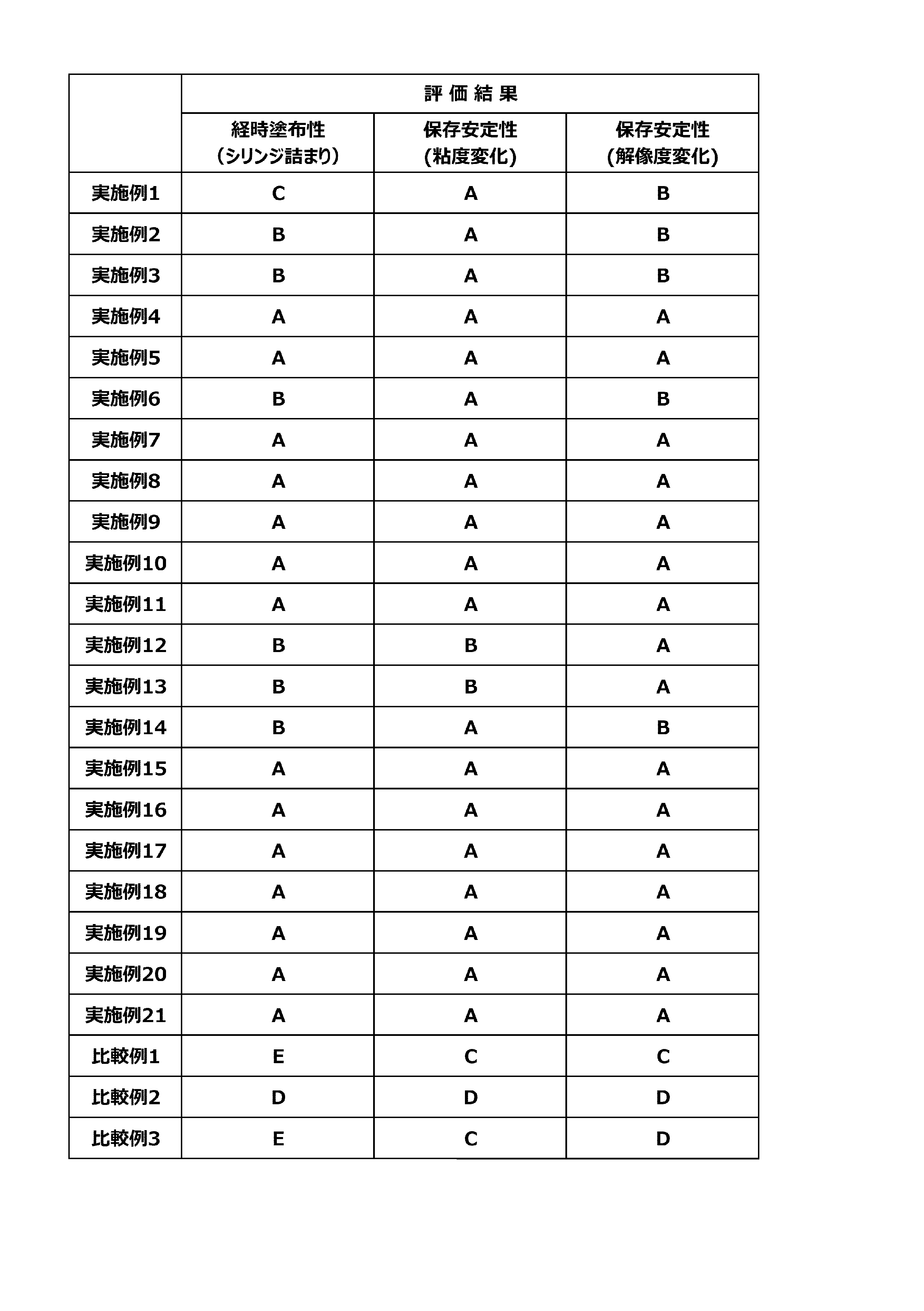
表2に示されるように、実施例1~21の各感光性組成物は、経時塗布性、及び保存安定性の評価がいずれも良好であった。これに対し、比較例1~3は、60分未満経過後にシリンジが詰まり、塗布ができなかった。また、保存安定性にも劣るものであった。
続いて実施例22~実施例26、及び、比較例4について説明する。これらの実施例、比較例に使用した化合物は以下の通りである。
<(A)粒子>
A-2、A-4:調製例2、調製例4により得られた粒子分散液(A-2)、(A-4)
<(B)ラジカル重合性化合物>
B-4:α-アクリロイルオキシ-ω-カルボキシメチル-ポリエチレングリコール
B-5:4’-(6-アクリロイルオキシヘキシルオキシ)ビフェニル-4-カルボン酸(CAS番号:134903-88-1)
B-6:2-メチル-2-アクリル酸-2-ヒドロキシエチルホスフェート(CAS番号:52628-03-2)
B-7:2-(2-エトキシエトキシ)エチルアクリレート(CAS番号:7328-17-8)
B-8:α-アクリロイル-ω-(アクリロイルオキシ)ポリ(オキシチレン)(CAS番号:26570-48-9)
B-9:トリプロピレングリコールジアクリレート(CAS番号:42978-66-5)
B-10:α,α’-[プロパン-2,2-ジイルビス(4,1-フェニレン)]ビス[ω-(メタクリロイルオキシ)ポリ(オキシエチレン)](CAS番号:41637-38-1)
B-11:3-エチル-3-(2,3-エポキシプロポキシメチル)オキセタン(CAS番号:15957-34-3)
B-12:3,3’-[オキシビス(メチレン)]ビス(3-エチルオキセタン)(CAS番号:18934-00-4)
<(C)光ラジカル発生剤>
C-2:Irgacure OXE-01(BASF社製)
C-3:Irgacure OXE-02(BASF社製)
<(D)脱水剤>
D-4:オルト安息香酸トリメチル
<(E)光酸発生剤>
E-2:ジフェニル[4-(フェニルチオ)フェニル]スルホニウムヘキサフルオロりん酸塩
E-3:4-イソブチルフェニル-4’-トルイルヨードヘキサフルオロりん酸塩
<(F)溶剤>
F-1:プロピレングリコールモノメチルエーテルアセテート
F-2:プロピレングリコールモノメチルエーテル
F-3:3-メトキシブチルアセテート
F-5:ジアセトンアルコール
<(H)界面活性剤>
H-2:BYK-310(ビックケミー(BYK)社製)
H-3:BYK-313(ビックケミー(BYK)社製)
H-4:BYK-320(ビックケミー(BYK)社製)
H-5:BYK-331(ビックケミー(BYK)社製)
<(I)密着助剤>
I-3:β-(3,4-エポキシシクロヘキシル)エチルトリメトキシシラン(CAS番号:3388-04-3)
I-4:β-(3,4-エポキシシクロヘキシル)エチルトリエトキシシラン
<(J)増感剤>
J-1:4-(ジメチルアミノ)安息香酸エチル(CAS番号:10287-53-3)
J-2:9,10-ジブトキシアントラセン(CAS番号:76275-14-4)
<(A)粒子>
A-2、A-4:調製例2、調製例4により得られた粒子分散液(A-2)、(A-4)
<(B)ラジカル重合性化合物>
B-4:α-アクリロイルオキシ-ω-カルボキシメチル-ポリエチレングリコール
B-5:4’-(6-アクリロイルオキシヘキシルオキシ)ビフェニル-4-カルボン酸(CAS番号:134903-88-1)
B-6:2-メチル-2-アクリル酸-2-ヒドロキシエチルホスフェート(CAS番号:52628-03-2)
B-7:2-(2-エトキシエトキシ)エチルアクリレート(CAS番号:7328-17-8)
B-8:α-アクリロイル-ω-(アクリロイルオキシ)ポリ(オキシチレン)(CAS番号:26570-48-9)
B-9:トリプロピレングリコールジアクリレート(CAS番号:42978-66-5)
B-10:α,α’-[プロパン-2,2-ジイルビス(4,1-フェニレン)]ビス[ω-(メタクリロイルオキシ)ポリ(オキシエチレン)](CAS番号:41637-38-1)
B-11:3-エチル-3-(2,3-エポキシプロポキシメチル)オキセタン(CAS番号:15957-34-3)
B-12:3,3’-[オキシビス(メチレン)]ビス(3-エチルオキセタン)(CAS番号:18934-00-4)
<(C)光ラジカル発生剤>
C-2:Irgacure OXE-01(BASF社製)
C-3:Irgacure OXE-02(BASF社製)
<(D)脱水剤>
D-4:オルト安息香酸トリメチル
<(E)光酸発生剤>
E-2:ジフェニル[4-(フェニルチオ)フェニル]スルホニウムヘキサフルオロりん酸塩
E-3:4-イソブチルフェニル-4’-トルイルヨードヘキサフルオロりん酸塩
<(F)溶剤>
F-1:プロピレングリコールモノメチルエーテルアセテート
F-2:プロピレングリコールモノメチルエーテル
F-3:3-メトキシブチルアセテート
F-5:ジアセトンアルコール
<(H)界面活性剤>
H-2:BYK-310(ビックケミー(BYK)社製)
H-3:BYK-313(ビックケミー(BYK)社製)
H-4:BYK-320(ビックケミー(BYK)社製)
H-5:BYK-331(ビックケミー(BYK)社製)
<(I)密着助剤>
I-3:β-(3,4-エポキシシクロヘキシル)エチルトリメトキシシラン(CAS番号:3388-04-3)
I-4:β-(3,4-エポキシシクロヘキシル)エチルトリエトキシシラン
<(J)増感剤>
J-1:4-(ジメチルアミノ)安息香酸エチル(CAS番号:10287-53-3)
J-2:9,10-ジブトキシアントラセン(CAS番号:76275-14-4)
[実施例22]感光性組成物の調製
粒子(A)としてジルコニア粒子分散液(A-2)を10.0質量部(固形分換算)、重合性化合物(B)として重合性化合物(B-4)16.0質量部、重合性化合物(B-7)16.0質量部、光ラジカル発生剤(C)として(C-2)3.0質量部、光酸発生剤として(E-2)0.02質量部、増感剤として(J-1)0.01質量部、脱水剤(D)として(D-4)1.0質量部、密着助剤(I)として(I-3)6.0質量部、及び界面活性剤(H)として(H-2)1.0質量部、更に固形分濃度が40.0質量%となるように溶剤(F)として(F-3)を加えて撹拌した後、0.5μmのフィルターを用いて濾過を行い、感光性組成物(S-25)を調製した。
粒子(A)としてジルコニア粒子分散液(A-2)を10.0質量部(固形分換算)、重合性化合物(B)として重合性化合物(B-4)16.0質量部、重合性化合物(B-7)16.0質量部、光ラジカル発生剤(C)として(C-2)3.0質量部、光酸発生剤として(E-2)0.02質量部、増感剤として(J-1)0.01質量部、脱水剤(D)として(D-4)1.0質量部、密着助剤(I)として(I-3)6.0質量部、及び界面活性剤(H)として(H-2)1.0質量部、更に固形分濃度が40.0質量%となるように溶剤(F)として(F-3)を加えて撹拌した後、0.5μmのフィルターを用いて濾過を行い、感光性組成物(S-25)を調製した。
[実施例23~実施例26、比較例4]感光性組成物(S-26)~(S-30)の調製
粒子分散液、重合性化合物、光ラジカル発生剤、光酸発生剤、増感剤、脱水剤、界面活性剤、密着助剤、並びに溶剤は、表3に記載の比率で各材料を混合し、感光性組成物(S-25)と同様にして、感光性組成物(S-26)~(S-30)を調製した。なお、表3中、「-」は該当する成分を用いなかったことを示す。また、表3中、溶剤欄の%は、各成分の質量比を表す。
粒子分散液、重合性化合物、光ラジカル発生剤、光酸発生剤、増感剤、脱水剤、界面活性剤、密着助剤、並びに溶剤は、表3に記載の比率で各材料を混合し、感光性組成物(S-25)と同様にして、感光性組成物(S-26)~(S-30)を調製した。なお、表3中、「-」は該当する成分を用いなかったことを示す。また、表3中、溶剤欄の%は、各成分の質量比を表す。
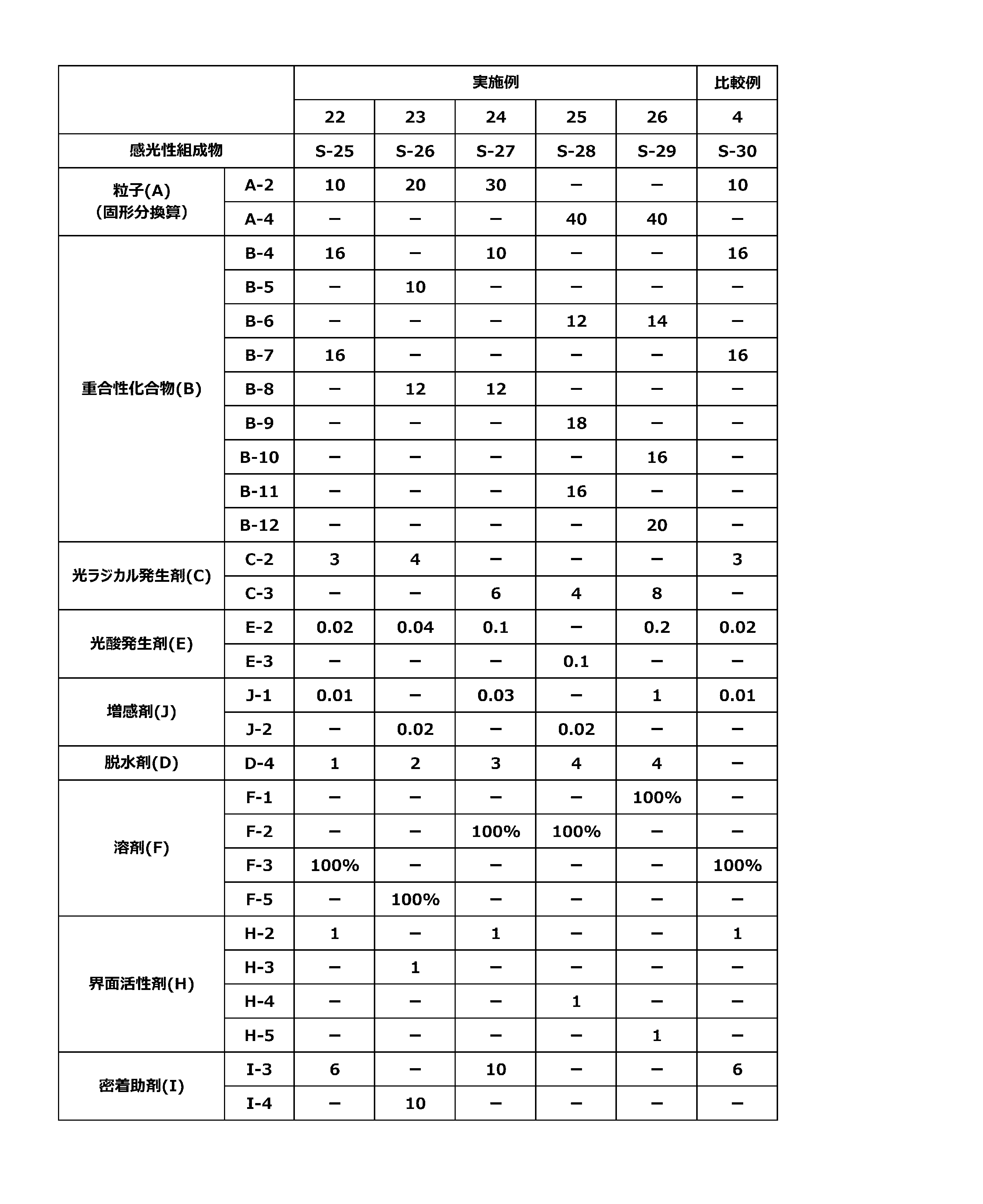
実施例及び比較例で調製した感光性組成物(S-25~30)について、評価結果を表4に示す。

表4に示されるように、実施例22~26の各感光性組成物は、経時塗布性、及び保存安定性の評価がいずれも良好であった。これに対し、比較例4は、経時塗布性、及び保存安定性が実施例より劣るものであった。
実施例1~26、及び、比較例1~4の組成物中の水分量と経時塗布性(シリンジ詰まり)との相関性を評価した結果を表5に示した。なお、水分量の測定は以下の通りに行った。
<水分量評価>
感光性組成物(S-1~30)それぞれについて、(株)三菱ケミカルアナリティック製電量滴定用水分計CA-100を用いて、水分量を測定した。滴定の試薬はアクアミクロンTMAX/CXUを使用した。繰り返し3回測定し、平均値を各感光性組成物の水分量として算出した。
感光性組成物(S-1~30)それぞれについて、(株)三菱ケミカルアナリティック製電量滴定用水分計CA-100を用いて、水分量を測定した。滴定の試薬はアクアミクロンTMAX/CXUを使用した。繰り返し3回測定し、平均値を各感光性組成物の水分量として算出した。
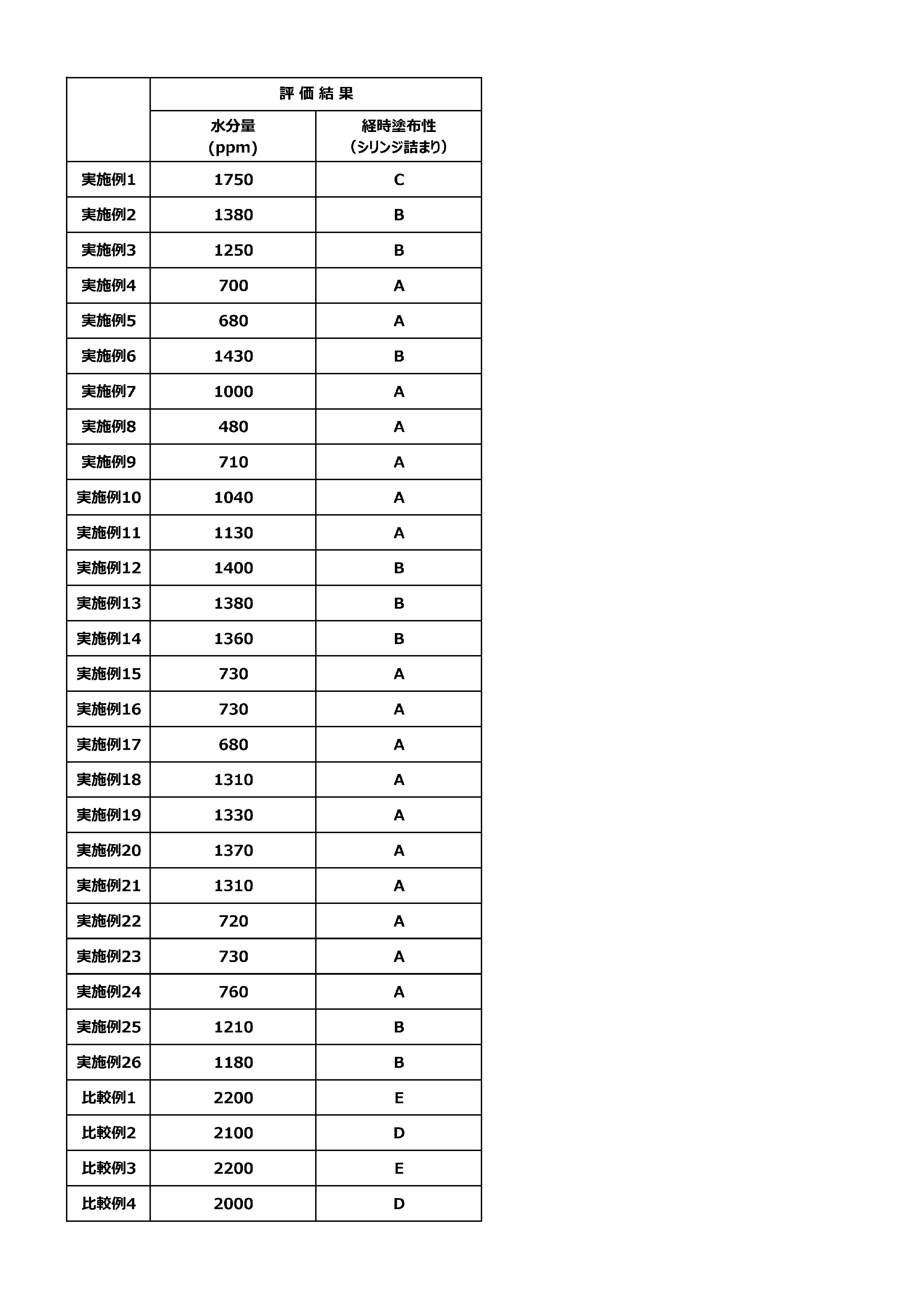
表5の結果から、水分量が2000ppm以上である比較例1~4では、組成物中の粒子成分が凝集しやすく、経時塗布性に劣るものであった。一方、水分量が2000ppm未満では、凝集しにくく、経時塗布性が比較例より良好なものであった。特に、水分量が1000ppmより小さい場合には、組成物中の粒子成分が凝集しにくく、経時塗布性は良好であり、全く問題がなかった。
Claims (13)
- 粒子(A)、ラジカル重合性化合物(B)、光ラジカル発生剤(C)、及び脱水剤(D)を含み、
上記脱水剤(D)がオルトエステル化合物を含む、
光学部材形成用の感光性組成物。 - 上記脱水剤(D)が、沸点が105℃以上のオルトエステル化合物を含む、請求項1に記載の感光性組成物。
- 上記オルトエステル化合物は、以下の式(1)で表される化合物である、請求項1に記載の感光性組成物。
R21-C-(OR11)3 …(1)
(式(1)中、R11は、炭素数1~4のアルキル基又はフェニル基であり、R21は、水素原子、炭素数1~4の1価の鎖状炭化水素基又は炭素数6~12の1価の芳香環基である。3個のR11は、互いに同一又は異なる。) - 上記オルトエステル化合物は芳香環基を有する、請求項1に記載の感光性組成物。
- 上記粒子(A)は、酸性基を有する化合物により被覆された無機粒子である、請求項1に記載の感光性組成物。
- 上記無機粒子は、酸化ジルコニウム、酸化チタン、チタン酸バリウム及びシリカよりなる群から選択される少なくとも1種の粒子である、請求項5に記載の感光性組成物。
- 上記感光性組成物中に含まれる水分量が2000ppm未満である、請求項1に記載の感光性組成物。
- 上記光学部材は、表示素子における光取出効率を向上させる部材である、請求項1に記載の感光性組成物。
- 請求項1~8のいずれか一項に記載の感光性組成物が硬化された硬化物。
- 請求項1~8のいずれか一項に記載の感光性組成物を基材上に塗布する工程と、
上記基材上に塗布した感光性組成物に放射線を照射する工程と、
放射線を照射した後の上記感光性組成物を現像する工程と、
現像後の上記感光性組成物を100℃以下の温度で加熱して硬化させる工程と、
を含む、硬化物の製造方法。 - 請求項9に記載の硬化物を備える、表示素子。
- 請求項9に記載の硬化物を備える、撮像素子。
- 粒子(A)、ラジカル重合性化合物(B)、及び光ラジカル発生剤(C)を含む光学部材形成用の感光性組成物であり、
前記感光性組成物中に含まれる水分量が2000ppm未満である、
光学部材形成用の感光性組成物。
Priority Applications (3)
| Application Number | Priority Date | Filing Date | Title |
|---|---|---|---|
| JP2025530238A JPWO2025005248A1 (ja) | 2023-06-30 | 2024-06-28 | |
| KR1020257043610A KR20260030766A (ko) | 2023-06-30 | 2024-06-28 | 감광성 조성물, 경화물 및 그의 제조 방법, 표시 소자, 그리고 촬상 소자 |
| CN202480042096.XA CN121399545A (zh) | 2023-06-30 | 2024-06-28 | 感光性组合物、硬化物及其制造方法、显示元件、以及摄像元件 |
Applications Claiming Priority (2)
| Application Number | Priority Date | Filing Date | Title |
|---|---|---|---|
| JP2023-107787 | 2023-06-30 | ||
| JP2023107787 | 2023-06-30 |
Publications (1)
| Publication Number | Publication Date |
|---|---|
| WO2025005248A1 true WO2025005248A1 (ja) | 2025-01-02 |
Family
ID=93939133
Family Applications (1)
| Application Number | Title | Priority Date | Filing Date |
|---|---|---|---|
| PCT/JP2024/023515 Ceased WO2025005248A1 (ja) | 2023-06-30 | 2024-06-28 | 感光性組成物、硬化物及びその製造方法、表示素子、並びに撮像素子 |
Country Status (5)
| Country | Link |
|---|---|
| JP (1) | JPWO2025005248A1 (ja) |
| KR (1) | KR20260030766A (ja) |
| CN (1) | CN121399545A (ja) |
| TW (1) | TW202502840A (ja) |
| WO (1) | WO2025005248A1 (ja) |
Citations (3)
| Publication number | Priority date | Publication date | Assignee | Title |
|---|---|---|---|---|
| JP2000144012A (ja) * | 1998-11-06 | 2000-05-26 | Jsr Corp | 回路基板およびその製造方法 |
| JP2002023351A (ja) * | 2000-07-05 | 2002-01-23 | Toray Ind Inc | 感光性ペーストおよびディスプレイ用部材 |
| WO2020045208A1 (ja) * | 2018-08-28 | 2020-03-05 | 富士フイルム株式会社 | レンズ用組成物、レンズ、レンズの製造方法および表示装置 |
-
2024
- 2024-06-28 WO PCT/JP2024/023515 patent/WO2025005248A1/ja not_active Ceased
- 2024-06-28 JP JP2025530238A patent/JPWO2025005248A1/ja active Pending
- 2024-06-28 KR KR1020257043610A patent/KR20260030766A/ko active Pending
- 2024-06-28 TW TW113124340A patent/TW202502840A/zh unknown
- 2024-06-28 CN CN202480042096.XA patent/CN121399545A/zh active Pending
Patent Citations (3)
| Publication number | Priority date | Publication date | Assignee | Title |
|---|---|---|---|---|
| JP2000144012A (ja) * | 1998-11-06 | 2000-05-26 | Jsr Corp | 回路基板およびその製造方法 |
| JP2002023351A (ja) * | 2000-07-05 | 2002-01-23 | Toray Ind Inc | 感光性ペーストおよびディスプレイ用部材 |
| WO2020045208A1 (ja) * | 2018-08-28 | 2020-03-05 | 富士フイルム株式会社 | レンズ用組成物、レンズ、レンズの製造方法および表示装置 |
Also Published As
| Publication number | Publication date |
|---|---|
| CN121399545A (zh) | 2026-01-23 |
| JPWO2025005248A1 (ja) | 2025-01-02 |
| KR20260030766A (ko) | 2026-03-06 |
| TW202502840A (zh) | 2025-01-16 |
Similar Documents
| Publication | Publication Date | Title |
|---|---|---|
| TWI666511B (zh) | 負型感光性樹脂組成物、由其硬化而成的硬化膜與其製造方法及具備其的光學元件以及影像感測器 | |
| CN103348289B (zh) | 感放射线性组成物以及硬化膜及其形成方法 | |
| CN103765314B (zh) | 负型感光性树脂组合物、分隔壁以及光学元件 | |
| JP6036699B2 (ja) | 撥インク剤の製造方法、ネガ型感光性樹脂組成物、隔壁および光学素子 | |
| TWI663478B (zh) | 矽氧烷樹脂組成物、使用該矽氧烷樹脂組成物之透明硬化物、透明像素、微透鏡、固體攝像元件 | |
| JP2010026360A (ja) | ネガ型感光性シロキサン樹脂組成物 | |
| TW200523676A (en) | Radiation sensitive composition, microlens, process for forming the microlens and use of the microlens | |
| TWI660990B (zh) | 矽氧烷樹脂組成物、利用該矽氧烷樹脂組成物之透明硬化物、透明像素、微透鏡、固體攝像元件 | |
| KR101860580B1 (ko) | 흑색 감광성 수지 조성물, 이를 포함하는 컬러 필터 및 표시 장치 | |
| TWI900479B (zh) | 感光性樹脂組成物、使感光性樹脂組成物硬化而成的硬化膜、帶有硬化膜的基板及帶有硬化膜的基板的製造方法 | |
| JP6986830B2 (ja) | 感放射線性樹脂組成物、パターン、パターン形成方法及び表示素子 | |
| JP2014122926A (ja) | ネガ型用感光性組成物および塗膜 | |
| JP6387110B2 (ja) | シロキサン樹脂組成物、これを用いた透明硬化物、透明画素、マイクロレンズ、固体撮像素子、およびマイクロレンズの製造方法 | |
| JP2020100819A (ja) | 樹脂組成物、硬化膜およびその製造方法 | |
| JP7831317B2 (ja) | 感光性樹脂組成物、マイクロレンズ | |
| KR20260030766A (ko) | 감광성 조성물, 경화물 및 그의 제조 방법, 표시 소자, 그리고 촬상 소자 | |
| TW202012456A (zh) | 透鏡用組成物、透鏡、透鏡之製造方法及顯示裝置 | |
| WO2025159178A1 (ja) | 感光性組成物、硬化物及びその製造方法、表示素子、並びに撮像素子 | |
| JP7646722B2 (ja) | レンズの製造方法 | |
| TWI378322B (en) | Photosensitive resin composition | |
| TWI920367B (zh) | 組成物、膜、濾光器、光學感測器、圖像顯示裝置及結構體 | |
| US20240199854A1 (en) | Composition, cured film, structural body, optical filter, solid-state imaging element, image display device, and manufacturing method of cured film | |
| TW202405561A (zh) | 感光性組成物、硬化物及其製造方法、顯示裝置以及攝像裝置 | |
| JP2025060463A (ja) | 感放射線性組成物、レンズの製造方法、表示素子、表示装置、固体撮像素子、撮像装置及び化合物 | |
| JP2025007416A (ja) | 硬化性組成物、硬化物、有機el素子、固体撮像素子及び化合物 |
Legal Events
| Date | Code | Title | Description |
|---|---|---|---|
| 121 | Ep: the epo has been informed by wipo that ep was designated in this application |
Ref document number: 24832106 Country of ref document: EP Kind code of ref document: A1 |
|
| ENP | Entry into the national phase |
Ref document number: 2025530238 Country of ref document: JP Kind code of ref document: A |
|
| WWE | Wipo information: entry into national phase |
Ref document number: 2025530238 Country of ref document: JP |
|
| NENP | Non-entry into the national phase |
Ref country code: DE |