WO2025005203A1 - トレッドゴム組成物、タイヤ及び重荷重用タイヤ - Google Patents
トレッドゴム組成物、タイヤ及び重荷重用タイヤ Download PDFInfo
- Publication number
- WO2025005203A1 WO2025005203A1 PCT/JP2024/023434 JP2024023434W WO2025005203A1 WO 2025005203 A1 WO2025005203 A1 WO 2025005203A1 JP 2024023434 W JP2024023434 W JP 2024023434W WO 2025005203 A1 WO2025005203 A1 WO 2025005203A1
- Authority
- WO
- WIPO (PCT)
- Prior art keywords
- rubber
- mass
- parts
- rubber composition
- tire
- Prior art date
- Legal status (The legal status is an assumption and is not a legal conclusion. Google has not performed a legal analysis and makes no representation as to the accuracy of the status listed.)
- Ceased
Links
Classifications
-
- Y—GENERAL TAGGING OF NEW TECHNOLOGICAL DEVELOPMENTS; GENERAL TAGGING OF CROSS-SECTIONAL TECHNOLOGIES SPANNING OVER SEVERAL SECTIONS OF THE IPC; TECHNICAL SUBJECTS COVERED BY FORMER USPC CROSS-REFERENCE ART COLLECTIONS [XRACs] AND DIGESTS
- Y02—TECHNOLOGIES OR APPLICATIONS FOR MITIGATION OR ADAPTATION AGAINST CLIMATE CHANGE
- Y02T—CLIMATE CHANGE MITIGATION TECHNOLOGIES RELATED TO TRANSPORTATION
- Y02T10/00—Road transport of goods or passengers
- Y02T10/80—Technologies aiming to reduce greenhouse gasses emissions common to all road transportation technologies
- Y02T10/86—Optimisation of rolling resistance, e.g. weight reduction
Definitions
- Japanese Patent Application Publication No. 1-311141 Japanese Patent Application Publication No. 3-65406 Japanese Patent Application Publication No. 4-226140
- an object of the present invention is to provide a rubber composition for a tread which is excellent in abrasion resistance without deteriorating other physical properties.
- Another object of the present invention is to provide a tire and a heavy load tire that are excellent in wear resistance without deteriorating other physical properties.
- the gist of the present invention for solving the above problems is as follows.
- a rubber composition comprising a rubber component, silica, and an antioxidant,
- the rubber component contains high-purity natural rubber having a nitrogen content of 0.3% by mass or less, The content of the silica exceeds 15 parts by mass per 100 parts by mass of the rubber component,
- the rubber composition for a tread having the above-mentioned configuration has excellent abrasion resistance without deteriorating other physical properties.
- a tire comprising the rubber composition for a tread according to any one of (1) to (4) above.
- a tire having the above configuration has excellent wear resistance without deteriorating other physical properties.
- the present invention it is possible to provide a rubber composition for a tread having excellent abrasion resistance without deteriorating other physical properties. Moreover, according to the present invention, it is possible to provide a tire and a heavy load tire having excellent wear resistance without deteriorating other physical properties.
- the rubber composition for a tread of the present invention contains a rubber component, silica, and an antioxidant.
- each component constituting the rubber composition for tread of the present invention will be described.
- the rubber component contained in the rubber composition for tread of the present invention contains high purity natural rubber having a nitrogen content of 0.3 mass % or less.
- the nitrogen content in the natural rubber is preferably 0.25% by mass or less, and more preferably 0.2% by mass or less.
- the high purity natural rubber is not particularly limited in other respects so long as the nitrogen content is 0.3% by mass or less.
- the high purity natural rubber may be natural rubber obtained by removing proteins through a centrifugation process.
- the centrifugation process is a process for deproteinizing natural rubber latex, which is a raw material for natural rubber, by centrifugation.
- the conditions for the centrifugation are not particularly limited, and the conditions can be appropriately changed depending on the protein content to be removed.
- the centrifugation process can be carried out several times at a rotation speed of about 7500 rpm. After the centrifugation process, washing and drying processes are carried out to obtain highly purified natural rubber.
- the natural rubber latex used in the centrifugation process is not particularly limited.
- field latex extracted from rubber trees or concentrated natural rubber latex obtained by processing this can be used.
- the dry rubber content in the natural rubber latex is also not particularly limited, and from the viewpoint of obtaining better abrasion resistance, it is preferably 10% by mass or more, more preferably 30% by mass or more, and even more preferably 40% by mass or more.
- the content of the highly purified natural rubber in the rubber component may be 100%, but other rubbers may also be contained within a range that does not impair the object of the present invention.
- the natural rubber may be not only the highly purified natural rubber, but also a mixture with ordinary natural rubber.
- the content of the highly purified natural rubber in the rubber component is preferably 50% by mass or more, more preferably 70% by mass or more, and particularly preferably 90% by mass or more, from the viewpoint of further improving abrasion resistance.
- the rubber component may contain other synthetic rubbers in addition to the natural rubbers mentioned above.
- synthetic rubbers include diene-based synthetic rubbers such as butadiene rubber (BR), isoprene rubber (IR), styrene butadiene rubber (SBR), styrene isoprene butadiene rubber (SIBR), chloroprene rubber (CR), and acrylonitrile butadiene rubber (NBR), and non-diene-based synthetic rubbers such as ethylene propylene diene rubber (EPDM), ethylene propylene rubber (EPM), and butyl rubber (IIR).
- BR butadiene rubber
- IR isoprene rubber
- SBR styrene butadiene rubber
- SIBR styrene isoprene butadiene rubber
- CR chloroprene rubber
- NBR acrylonitrile butadiene rubber
- non-diene-based synthetic rubbers such as ethylene propylene dien
- the rubber component contains butadiene rubber and/or styrene-butadiene rubber. This is because it is possible to achieve both low loss and abrasion resistance at a higher level.
- the natural rubber and diene synthetic rubber may be unmodified diene rubber (hereinafter sometimes referred to as “unmodified diene rubber”) or modified diene rubber (hereinafter sometimes referred to as “modified diene rubber”).
- the rubber composition for tire treads of the present invention contains silica in addition to the above-mentioned rubber component, and the content of the silica exceeds 15 parts by mass per 100 parts by mass of the rubber component.
- the content of the silica is preferably 18 parts by mass or more per 100 parts by mass of the rubber component.
- the content of the silica is preferably 30 parts by mass or less, more preferably 25 parts by mass or less, per 100 parts by mass of the rubber component.
- the silica preferably has a CTAB specific surface area of 200 to 240 ml/100 g.
- CTAB specific surface area of the silica is 200 ml/100 g or more, a more excellent effect of improving abrasion resistance can be obtained, and when the CTAB specific surface area of the silica is 240 ml/100 g or less, poor dispersion and deterioration of processability can be suppressed.
- the CTAB specific surface area of the silica can be measured in accordance with, for example, JIS K 6430:2008.
- the silica may be, for example, wet silica (hydrated silicic acid), dry silica (anhydrous silicic acid), calcium silicate, aluminum silicate, etc., and among these, wet silica is preferred because it has a large number of silanol groups.
- wet silica hydrated silicic acid
- dry silica anhydrous silicic acid
- calcium silicate aluminum silicate
- wet silica is preferred because it has a large number of silanol groups.
- These silicas may be used alone or in combination of two or more types.
- the rubber composition of the present invention preferably further contains carbon black in addition to the above-mentioned rubber component and silica. This is because the reinforcing properties of the rubber composition are improved, and better abrasion resistance can be obtained.
- the carbon black preferably has a nitrogen adsorption specific surface area (N 2 SA) of 130 to 180 m 2 /g, because when the N 2 SA of the carbon black is 130 m 2 /g or more, better abrasion resistance can be obtained, and when the N 2 SA of the carbon black is 180 m 2 /g or less, deterioration of productivity and low heat generation can be suppressed.
- the N 2 SA of the carbon black is preferably 140 to 170 m 2 /g.
- the nitrogen adsorption specific surface area (N 2 SA) of the carbon black can be measured in accordance with, for example, JIS K 6217-7:2013.
- the carbon black preferably has a dibutyl phthalate (DBP) oil absorption of 80 to 120 ml/100 g.
- DBP dibutyl phthalate
- the DBP oil absorption of the carbon black is 80 m 2 /g or more, deterioration of low heat generation properties and productivity can be suppressed, and when the N 2 SA of the carbon black is 120 ml/100 g or less, gelation can be suppressed and better abrasion resistance can be obtained.
- the DBP of the carbon black is preferably from 85 to 110 m 2 /g, and more preferably from 85 to 100 m 2 /g.
- the DBP oil content of the carbon black can be measured in accordance with JIS K 6217-4:2017.
- the carbon black content is preferably 30 parts by mass or more, more preferably 40 parts by mass or more, and even more preferably 45 parts by mass or more, per 100 parts by mass of the rubber component.
- the carbon black content is preferably 55 parts by mass or less per 100 parts by mass of the rubber component.
- the carbon black content is 55 parts by mass or less per 100 parts by mass of the rubber component, deterioration of low heat generation can be suppressed.
- the compounding ratio of the silica to the carbon black is 0.1 to 0.5, preferably 0.35 to 0.5.
- this ratio is 0.1 or more, the effects of suppressing the decrease in abrasion resistance and elongation at break (Eb) can be obtained more reliably, while when the silica/carbon black ratio is less than 0.5, poor dispersion and deterioration of low heat buildup can be suppressed.
- the rubber composition for treads of the present invention contains an antioxidant in addition to the above-mentioned rubber component, silica, and carbon black as an optional component, and the content of the antioxidant is 0.4 parts by mass or more per 100 parts by mass of the rubber component.
- the content of the antioxidant is preferably 1 part by mass or more based on 100 parts by mass of the rubber component.
- the content of the anti-aging agent is 2 parts by mass or less per 100 parts by mass of the rubber component.
- the content of the anti-aging agent is 2 parts by mass or less per 100 parts by mass of the rubber component, the reaction between the silica and the silane coupling agent described later can be inhibited and a decrease in the kneading quality of the rubber composition can be suppressed.
- the type of the antioxidant is not particularly limited.
- an amine-based antioxidant, a phenol-based antioxidant, or other antioxidants can be used.
- these antioxidants it is preferable to use at least an amine-based antioxidant from the viewpoint of obtaining better abrasion resistance.
- the amine-based antioxidant is preferably at least one selected from the group consisting of N-(1,3-dimethylbutyl)-N'-phenyl-para-phenylenediamine, N-isopropyl-N'-p-phenylenediamine, N-(3-methacryloyloxy-2-hydroxypropyl)-N'-phenyl-p-phenylenediamine, and N,N'-di-2-naphthyl-p-phenylenediamine, and among these, N-(1,3-dimethylbutyl)-N'-phenyl-para-phenylenediamine is particularly preferred.
- the amine-based antiaging agent may be used alone or in combination of two or more kinds.
- the rubber composition for treads of the present invention can be blended with other components as appropriate, as long as the effects of the present invention are not impaired.
- other components include additives such as silane coupling agents, inorganic fillers other than silica and carbon black, zinc oxide, softeners, tackifiers, dispersants, crosslinking agents, crosslinking accelerators, crosslinking assistants, stearic acid, colorants, antistatic agents, and lubricants, as well as various known compounding chemicals that are commonly used in the rubber industry. Commercially available products can be used.
- the silane coupling agent may, for example, be bis(3-triethoxysilylpropyl)tetrasulfide, bis(3-triethoxysilylpropyl)trisulfide, bis(3-triethoxysilylpropyl)disulfide, bis(2-triethoxysilylethyl)tetrasulfide, bis(3-trimethoxysilylpropyl)tetrasulfide, bis(2-trimethoxysilylethyl)tetrasulfide, 3-mercaptopropyltrimethoxysilane, 3-mercaptopropyltriethoxysilane, 2-Mercaptoethyltrimethoxysilane, 2-Mercaptoethyltriethoxysilane, 3-Trimethoxysilylpropyl-N,N-dimethylthiocarbamoyltetrasulfide, 3-Triethoxysilylpropyl-N
- inorganic fillers examples include, for example, aluminum hydroxide, clay, etc.
- aluminum hydroxide, etc. is preferred because it has a relatively high reinforcing property, and clay, etc. is effective because it takes advantage of its shape characteristics.
- the rubber composition for treads of the present invention preferably contains zinc oxide (ZnO) as a crosslinking promoter. This is because the inclusion of ZnO can further improve heat aging resistance and high elastic modulus. However, if the ZnO content is too high, crack growth properties may deteriorate, so the content is preferably less than 5 parts by mass per 100 parts by mass of the rubber component.
- ZnO zinc oxide
- the softener is not particularly limited and can be appropriately selected depending on the purpose. Examples include naphthenic base oil, paraffinic base oil, and aromatic base oil.
- the content of the softener is preferably 2 to 30 parts by mass per 100 parts by mass of the rubber component. If the content of the softener exceeds 30 parts by mass per 100 parts by mass of the rubber component, the softener may bleed onto the surface of the rubber product or the abrasion resistance may decrease.
- Aromatic oil is undesirable because it contains a lot of aromatic components, has a high affinity with the chemical, which is an aromatic compound, and inhibits the reaction with the polymer more.
- naphthenic base oil and paraffinic base oil have the effect of diffusing into the polymer and helping it to react, and oils with low pour points diffuse into the polymer better.
- the classification of naphthenic base oil, paraffinic base oil, and aromatic base oil is determined by CA value, CP value, and CN value.
- naphthenic base oil includes TDAE, SRAE, RAE, black oil, etc.
- paraffinic base oil includes spindle oil and paraffin oil.
- a more preferable effect can be obtained by using a mixed oil such as A/O Mix (Sankyo Yuka Kogyo Co., Ltd.) in which the naphthenic base oil and the naphthenic asphalt are mixed.
- A/O Mix Sud Kogyo Co., Ltd.
- the lubricating oils may be added by oil extension during the production of the rubber component, or may be added when the rubber composition for tread is kneaded.
- the crosslinking agent is not particularly limited, and may be, for example, sulfur.
- the crosslinking accelerator may also be a known one and is not particularly limited.
- Examples of the crosslinking accelerator include thiazole-based vulcanization accelerators such as 2-mercaptobenzothiazole and dibenzothiazyl disulfide, sulfenamide-based vulcanization accelerators such as N-cyclohexyl-2-benzothiazyl sulfenamide and N-t-butyl-2-benzothiazyl sulfenamide, guanidine-based vulcanization accelerators such as diphenyl guanidine, thiuram-based vulcanization accelerators such as tetramethylthiuram disulfide, tetraethylthiuram disulfide, tetrabutylthiuram disulfide, tetradodecylthiuram disulfide, tetraoctylthi
- the method for producing the rubber composition for treads of the present invention is not particularly limited.
- the rubber composition can be produced by blending various components appropriately selected as necessary with the rubber component, kneading, heating, extruding, etc.
- the resulting rubber composition can be vulcanized to produce a vulcanized rubber.
- kneading there are no particular limitations on the conditions for the kneading, and the input volume of the kneading device, the rotation speed of the rotor, the ram pressure, etc., as well as the conditions for the kneading temperature, kneading time, type of kneading device, etc., can be appropriately selected according to the purpose.
- kneading devices include Banbury mixers, intermixes, kneaders, rolls, etc., which are typically used for kneading rubber compositions.
- heat-in process temperature heat-in process time
- heat-in process equipment heat-in process equipment
- other conditions can be appropriately selected depending on the purpose.
- the heat-in process equipment include a heat-in process roll machine that is typically used for heat-in process of rubber compositions.
- extrusion conditions there are no particular limitations on the extrusion conditions, and various conditions such as extrusion time, extrusion speed, extrusion equipment, and extrusion temperature can be appropriately selected depending on the purpose.
- extrusion equipment include extruders that are typically used for extruding rubber compositions.
- the extrusion temperature can be appropriately determined.
- vulcanization equipment There are no particular limitations on the vulcanization equipment, method, conditions, etc., and they can be selected appropriately depending on the purpose.
- vulcanization equipment include a mold vulcanizer that uses a mold to vulcanize rubber compositions.
- the vulcanization temperature is, for example, about 100 to 190°C.
- the tire of the present invention is characterized by including the above-mentioned rubber composition for tread of the present invention.
- the rubber composition for tread of the present invention as a tire material, excellent abrasion resistance can be achieved without deteriorating other physical properties.
- the tire of the present invention can be used as, for example, a heavy load tire, a truck/bus tire, an aircraft tire, or a passenger car tire, and among these, it is preferable to use it as a heavy load tire, because the rubber composition for tread used as the material of the tread portion has excellent abrasion resistance and is advantageous when used as a heavy load tire.
- an unvulcanized rubber composition may be used and molded, followed by vulcanization, or a semi-vulcanized rubber that has been subjected to a pre-vulcanization process or the like may be molded and then further vulcanized.
- the tire of this embodiment is preferably a pneumatic tire, and the gas to be filled in the pneumatic tire may be normal air or air with an adjusted oxygen partial pressure, or an inert gas such as nitrogen, argon, or helium.
- the above-mentioned rubber composition for tread of the present invention must be applied to the tread (base tread, cap tread, under tread), but it can also be applied to various other components.
- the rubber composition for tread of the present invention can also be applied to rubber crawlers, seismic isolation rubber, etc.
- the abrasion resistance of the rubber composition having the compounding shown in Table 2 was predicted.
- the predicted value of the abrasion resistance is an index value, and a larger index value indicates better abrasion resistance.
- the results are shown in Table 2.
- vulcanization accelerators were selected from thiazole-based vulcanization accelerators, sulfenamide-based vulcanization accelerators, guanidine-based vulcanization accelerators, thiuram-based vulcanization accelerators, and dithiocarbamate-based vulcanization accelerators. The same types and amounts were used in all examples and comparative examples.
- the present invention it is possible to provide a rubber composition for a tread having excellent abrasion resistance without deteriorating other physical properties. Moreover, according to the present invention, it is possible to provide a tire and a heavy load tire having excellent wear resistance without deteriorating other physical properties.
Landscapes
- Compositions Of Macromolecular Compounds (AREA)
Abstract
Description
も種々提案されている。
また、本発明は、他の物性を低下させることなく、耐摩耗性に優れたタイヤ及び重荷重用タイヤを提供することを目的とする。
(1)ゴム成分と、シリカと、老化防止剤と、を含むゴム組成物であって、
前記ゴム成分は、窒素含有量が0.3質量%以下の高純度天然ゴムを含有し、
前記シリカの含有量が、前記ゴム成分100質量部に対して15質量部を超え、
前記老化防止剤の含有量が、前記ゴム成分100質量部に対して0.4質量部以上であることを特徴とする、トレッド用ゴム組成物。
上記構成を具えるトレッド用ゴム組成物は、他の物性を低下させることなく、耐摩耗性に優れる。
上記構成を具えるトレッド用ゴム組成物は、より耐摩耗性に優れる。
上記構成を具えるトレッド用ゴム組成物は、より耐摩耗性に優れる。
上記構成を具えるトレッド用ゴム組成物は、より耐摩耗性に優れる。
上記構成を具えるタイヤは、他の物性を低下させることなく、耐摩耗性に優れる。
また、本発明によれば、他の物性を低下させることなく、耐摩耗性に優れたタイヤ及び重荷重用タイヤを提供することができる。
本発明のトレッド用ゴム組成物は、ゴム成分と、シリカと、老化防止剤と、を含む。
以下、本発明のトレッド用ゴム組成物を構成する各成分について説明する。
(ゴム成分)
本発明のトレッド用ゴム組成物に含まれるゴム成分については、窒素含有量が0.3質量%以下の高純度天然ゴムを含有する。
前記高純度天然ゴムを含有することで、天然ゴム中に過剰量のたんぱく質が含まれず、ゲル化を抑制できる結果、優れた耐摩耗性を実現できる。
同様の観点から、前記天然ゴム中の窒素含有量は、0.25質量%以下であることが好ましく、0.2質量%以下であることがより好ましい。
前記遠心分離プロセスについては、天然ゴムの原料である天然ゴムラテックスから遠心分離によって脱たんぱく処理するプロセスである。前記遠心分離の条件(回転数、時間等)については、特に限定はされず、取り除くたんぱく質含有量に応じて適宜条件を変更することができる。例えば、天然ゴム中の窒素含有量を0.1質量%以下とする場合には、7500rpm程度の回転数で遠心分離プロセスを数回行うことができる。
なお、遠心分離プロセスの後は、洗浄、乾燥処理を行うことによって、高純度化天然ゴムを得ることができる。
その場合、前記ゴム成分における前記高純度化天然ゴムの含有量は、耐摩耗性をより向上できる観点から、50質量%以上であることが好ましく、70質量%以上であることがより好ましく、90質量%以上であることが特に好ましい。
本発明のタイヤ用トレッド用ゴム組成物は、上述したゴム成分に加えて、シリカを含み、該シリカの含有量は、前記ゴム成分100質量部に対して15質量部を超える。
前記シリカの含有量を前記ゴム成分100質量部に対して15質量部超とすることによって、タイヤの補強性を高め、より優れた耐摩耗性を実現できる。同様の観点から、前記シリカの含有量は、前記ゴム成分100質量部に対して18質量部以上とすることが好ましい。一方、ゴム組成物の加工性悪化を抑える観点からは、前記シリカの含有量は、前記ゴム成分100質量部に対して30質量部以下とすることが好ましく、25質量部以下がより好ましい。
なお、前記シリカのCTAB比表面積については、例えばJIS K 6430:2008に準拠して測定することができる。
本発明のゴム組成物は、上述したゴム成分及びシリカに加えて、カーボンブラックをさらに含むことが好ましい。
ゴム組成物の補強性が高まり、より優れた耐摩耗性を得ることができるためである。
同様の観点から、前記カーボンブラックのN2SAは、140~170m2/gであることが好ましい。
なお、前記カーボンブラックの窒素吸着比表面積(N2SA)については、例えばJIS K 6217-7:2013に準拠して測定することができる。
同様の観点から、前記カーボンブラックのDBPは、85~110m2/gであることが好ましく、85~100m2/gであることがより好ましい。
なお、前記カーボンブラックのDBP給油量については、JIS K 6217-4:2017に準拠して測定することができる。
本発明のトレッド用ゴム組成物は、上述したゴム成分、シリカ及び任意成分としてのカーボンブラックに加えて、老化防止剤を含み、該老化防止剤の含有量が、前記ゴム成分100質量部に対して0.4質量部以上である。
トレッド用ゴム組成物中に老化防止剤を前記ゴム成分100質量部に対して0.4質量部以上含むことで、トレッド用ゴム組成物の補強性や耐摩耗性を高めることができる。同様の観点から、前記老化防止剤の含有量は、前記ゴム成分100質量部に対して1質量部以上であることが好ましい。
これらの老化防止剤の中でも、より優れた耐摩耗性を得る観点からは、アミン系老化防止剤を少なくとも用いることが好ましい。
アミン系老化防止剤は、1種単独で用いてもよいし、2種以上を組み合わせて用いてもよい。
本発明のトレッド用ゴム組成物は、上述した各成分に加えて、本発明の効果を損なわない範囲で、目的ないし必要に応じて、その他の成分を適宜に選択して配合することができる。その他の成分としては、例えば、シランカップリング剤、シリカ及びカーボンブラック以外の無機充填剤、酸化亜鉛、軟化剤、粘着賦与剤、分散剤、架橋剤、架橋促進剤、架橋助剤、ステアリン酸、着色剤、帯電防止剤、滑剤等の添加剤の他、ゴム業界で通常用いられる各種の公知配合薬品等が挙げられる。これらは、市販品を使用することができる。
さらに、上述した軟化剤の中でも、ナフテン系ベースオイル又はパラフィン系ベースオイルを用いることが好ましく、ナフテン系ベースオイルを用いることが最も好ましい。アロマオイルは、芳香族成分が多いため、芳香族化合物である当該薬品との親和性が高く、ポリマーとの反応をより阻害するため好ましくないためである。一方で、ナフテン系ベースオイルやパラフィン系ベースオイルは、ポリマー中に拡散し反応することを助ける効果があり、流動点が低いオイルの方がよくポリマー中に拡散するためである。
なお、前記ナフテン系ベースオイル、前記パラフィン系ベースオイル、前記アロマ系ベースオイルという分類については、CA値、CP値、CN値により決定される。例えば、前記ナフテン系ベースオイル前記分類されるのは、TDAE、SRAE、RAE、Black Oil等である。また、前記パラフィン系ベースオイルとして分類されるのは、スピンドルオイルヤパラフィンオイルである。
さらにまた、前記ナフテン系ベースオイルと前記ナフテン系アスファルトを混合した、A/O Mix(三共油化工業株式会社)等の混合油でもより好ましい効果が得られる。
これらの潤滑油を配合するタイミングについては特に限定はされず、例えば、前記ゴム成分の製造の段階で 油展させてもよいし、トレッド用ゴム組成物を混錬する際に、添加させてもよい。
前記架橋促進剤についても、公知のものを用いることができ、特に制限されるものではない。例えば、2-メルカプトベンゾチアゾール、ジベンゾチアジルジスルフィド等のチアゾール系加硫促進剤;N-シクロヘキシル-2-ベンゾチアジルスルフェンアミド、N-t-ブチル-2-ベンゾチアジルスルフェンアミド等のスルフェンアミド系加硫促進剤;ジフェニルグアニジン等のグアニジン系加硫促進剤;テトラメチルチウラムジスルフィド、テトラエチルチウラムジスルフィド、テトラブチルチウラムジスルフィド、テトラドデシルチウラムジスルフィド、テトラオクチルチウラムジスルフィド、テトラベンジルチウラムジスルフィド、ジペンタメチレンチウラムテトラスルフィド等のチウラム系加硫促進剤;ジメチルジチオカルバミン酸亜鉛等のジチオカルバミン酸塩系加硫促進剤;ジアルキルジチオリン酸亜鉛等が挙げられる。
本発明のトレッド用ゴム組成物の製造方法は、特に限定されるものではないが、例えば、前記ゴム成分に、必要に応じて適宜選択した各種成分を配合して、混練り、熱入れ、押出等することにより、前記ゴム組成物を製造することができる。
また、得られたゴム組成物を加硫することで、加硫ゴムとすることができる。
本発明のタイヤは、上述した本発明のトレッド用ゴム組成物を含むことを特徴とする。本発明のトレッド用ゴム組成物をタイヤ材料として含むことで、他の物性を低下させることなく、優れた耐摩耗性を実現できる。
ここで、本発明のタイヤは、例えば、重荷重用タイヤ、トラック・バス用タイヤ、航空機用タイヤ、乗用車用タイヤとして用いることができるが、これらのなかでも、重荷重用タイヤとすることが好ましい。トレッド部の材料として用いているトレッド用ゴム組成物は、耐摩耗性に優れており、重荷重用タイヤとして使用した際のメリットが大きいためである。
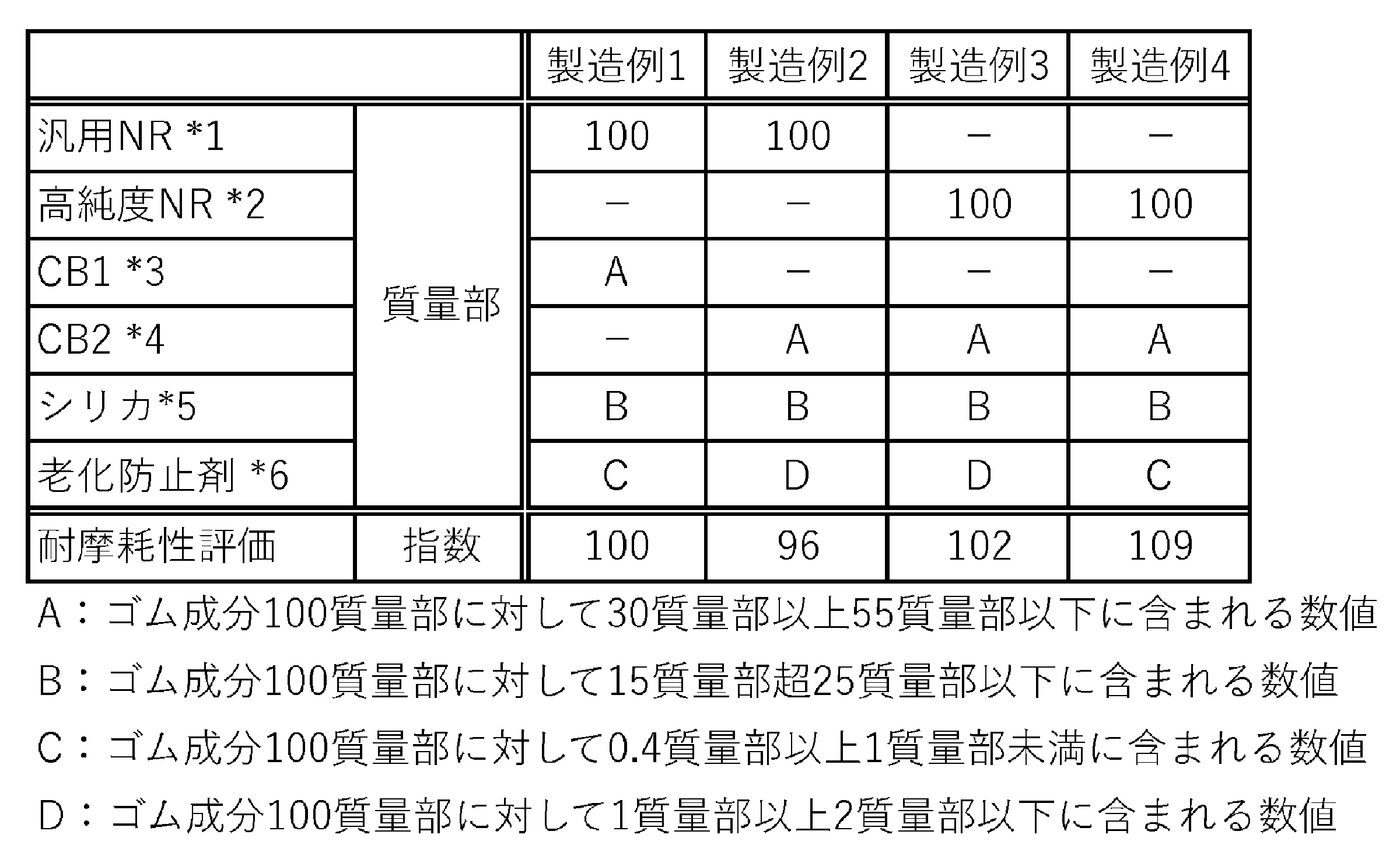
表1に示す配合に従い、各成分において表1に示す範囲に含まれる配合でゴム組成物を配合し、バンバリーミキサーを用いて混練りすることで、トレッド用ゴム組成物のサンプルを作製した。なお、表1に示す配合物以外にも、加硫促進剤や硫黄などの薬品を、すべての例において同じものを同じ量配合している。
[実施例1~5、比較例1~4]
表2に示す配合に従い、各成分を配合し、トレッド用ゴム組成物のサンプルを作製することを想定する。
製造例1~4の各サンプルについて、シート状に押出した後、温度145℃で、90分加硫して、加硫ゴム試料を作製した。そして、得られた加硫ゴム試料について、以下の評価を行った。
製造例1~4の各加硫ゴムサンプルについて、タイヤ状にし、砥石の上を一定速度で転がし、摩耗速度を測定した。
評価は、摩耗速度の逆数を算出し、製造例1のゴム組成物からなる加硫ゴムの摩耗速度の逆数を100としたときの指数として表示した。指数値が大きい程、摩耗速度が遅く、耐摩耗性が良好であることを示す。評価結果を表1に示す。
なお、耐摩耗性の予測値については、指数値であり、指数値が大きい程、耐摩耗性が良好であることを示す。結果を表2に示す。
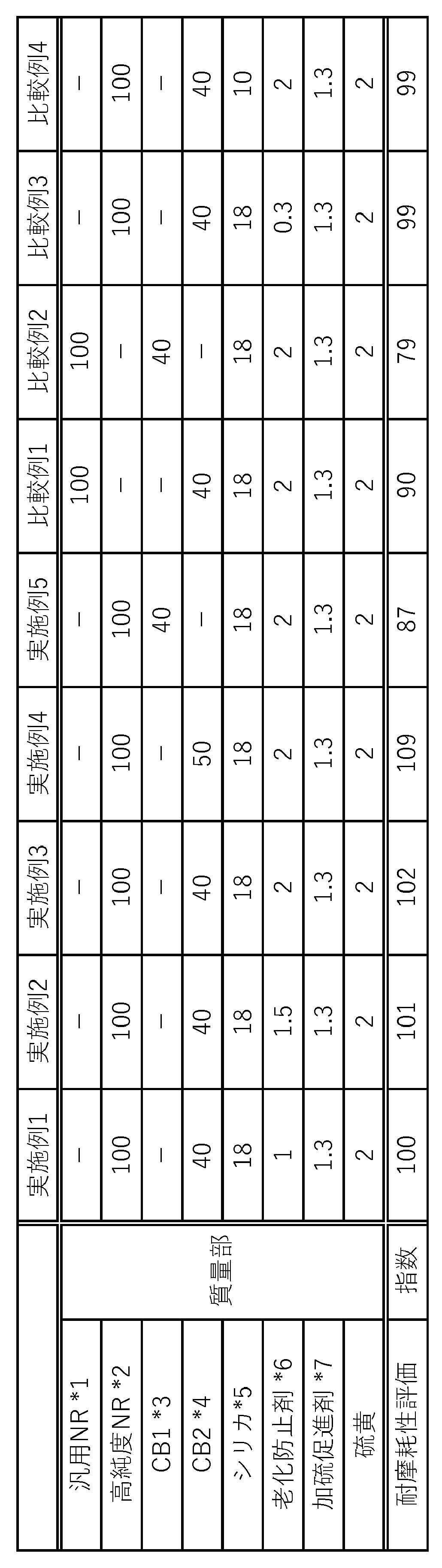
*2 遠心分離によって得られた、窒素含有量が0.18質量%の高純度天然ゴム
*3 N2SA:126m2/g、DBP給油量:92ml/100gのカーボンブラック
*4 N2SA:145m2/g、DBP給油量:99ml/100gのカーボンブラック
*5 CTAB比表面積:220m2/g
*6 N-(1,3-ジメチルブチル)-N’-フェニル-p-フェニレンジアミン、大内新興化学工業株式会社製 「ノクラック6C」
*7 チアゾール系加硫促進剤、スルフェンアミド系加硫促進剤、グアニジン系加硫促進剤、チウラム系加硫促進剤及びジチオカルバミン酸塩系加硫促進剤の中から1種類以上選択。すべての実施例及び比較例において同じものを同じ量使用した。
また、表1及び表2から、実施例に該当するトレッド用ゴム組成物の各サンプルは、優れた耐摩耗性を示すことがわかる。
また、本発明によれば、他の物性を低下させることなく、耐摩耗性に優れたタイヤ及び重荷重用タイヤを提供することができる。
Claims (5)
- ゴム成分と、シリカと、老化防止剤と、を含むゴム組成物であって、
前記ゴム成分は、窒素含有量が0.3質量%以下の高純度天然ゴムを含有し、
前記シリカの含有量が、前記ゴム成分100質量部に対して15質量部を超え、
前記老化防止剤の含有量が、前記ゴム成分100質量部に対して0.4質量部以上であることを特徴とする、トレッド用ゴム組成物。 - 前記高純度天然ゴムが、天然ゴムラテックスから遠心分離プロセスによってたんぱく質が除去されたものであることを特徴とする、請求項1に記載のトレッド用ゴム組成物。
- さらにカーボンブラックを含み、該カーボンブラックの含有量が、前記ゴム成分100質量部に対し、45質量部以上55質量部以下であることを特徴とする、請求項1又は2に記載のトレッド用ゴム組成物。
- 前記シリカのCTAB比表面積が200~240ml/100gであることを特徴とする、請求項1又は2に記載のトレッド用ゴム組成物。
- 請求項1又は2に記載のトレッド用ゴム組成物を含むことを特徴とする、タイヤ。
Priority Applications (1)
| Application Number | Priority Date | Filing Date | Title |
|---|---|---|---|
| JP2025530205A JPWO2025005203A1 (ja) | 2023-06-30 | 2024-06-27 |
Applications Claiming Priority (2)
| Application Number | Priority Date | Filing Date | Title |
|---|---|---|---|
| JP2023108888 | 2023-06-30 | ||
| JP2023-108888 | 2023-06-30 |
Publications (1)
| Publication Number | Publication Date |
|---|---|
| WO2025005203A1 true WO2025005203A1 (ja) | 2025-01-02 |
Family
ID=93939226
Family Applications (1)
| Application Number | Title | Priority Date | Filing Date |
|---|---|---|---|
| PCT/JP2024/023434 Ceased WO2025005203A1 (ja) | 2023-06-30 | 2024-06-27 | トレッドゴム組成物、タイヤ及び重荷重用タイヤ |
Country Status (2)
| Country | Link |
|---|---|
| JP (1) | JPWO2025005203A1 (ja) |
| WO (1) | WO2025005203A1 (ja) |
Citations (3)
| Publication number | Priority date | Publication date | Assignee | Title |
|---|---|---|---|---|
| JP2005047993A (ja) * | 2003-07-30 | 2005-02-24 | Sumitomo Rubber Ind Ltd | タイヤトレッド用ゴム組成物および当該ゴム組成物を用いた空気入りタイヤ |
| JP2016006169A (ja) * | 2014-05-28 | 2016-01-14 | 株式会社ブリヂストン | タイヤトレッド用ゴム組成物の製造方法、及びその方法で得られたゴム組成物をタイヤトレッドに配設するタイヤの製造方法 |
| JP2018188601A (ja) * | 2017-05-11 | 2018-11-29 | 住友ゴム工業株式会社 | スタッドレスタイヤ用ゴム組成物 |
-
2024
- 2024-06-27 WO PCT/JP2024/023434 patent/WO2025005203A1/ja not_active Ceased
- 2024-06-27 JP JP2025530205A patent/JPWO2025005203A1/ja active Pending
Patent Citations (3)
| Publication number | Priority date | Publication date | Assignee | Title |
|---|---|---|---|---|
| JP2005047993A (ja) * | 2003-07-30 | 2005-02-24 | Sumitomo Rubber Ind Ltd | タイヤトレッド用ゴム組成物および当該ゴム組成物を用いた空気入りタイヤ |
| JP2016006169A (ja) * | 2014-05-28 | 2016-01-14 | 株式会社ブリヂストン | タイヤトレッド用ゴム組成物の製造方法、及びその方法で得られたゴム組成物をタイヤトレッドに配設するタイヤの製造方法 |
| JP2018188601A (ja) * | 2017-05-11 | 2018-11-29 | 住友ゴム工業株式会社 | スタッドレスタイヤ用ゴム組成物 |
Also Published As
| Publication number | Publication date |
|---|---|
| JPWO2025005203A1 (ja) | 2025-01-02 |
Similar Documents
| Publication | Publication Date | Title |
|---|---|---|
| JP5074077B2 (ja) | ゴム組成物 | |
| JP4954810B2 (ja) | サイドウォール用ゴム組成物およびクリンチエイペックス用ゴム組成物、ならびにそれらを用いたタイヤ | |
| US7411016B2 (en) | Rubber composition and pneumatic tire using the same for tread | |
| JP2008050570A (ja) | ゴム組成物ならびにそれを用いたトレッドおよび/またはサイドウォールを有するタイヤ | |
| JP5159190B2 (ja) | インナーライナー用ゴム組成物およびそれを用いたインナーライナーを有するタイヤ | |
| US20100051153A1 (en) | Rubber composition for studless tire and studless tire using the same | |
| EP1988120B1 (en) | Tire with tire tread structure including cap tread and base tread | |
| EP3162846A1 (en) | Rubber composition and pneumatic tire using same | |
| EP2019123B1 (en) | Rubber composition for bead apex and tire obtained with the same | |
| JP7205227B2 (ja) | 加硫後ゴム組成物及び空気入りタイヤ | |
| JP4573369B2 (ja) | タイヤトレッド用ゴム組成物 | |
| JP2004143187A (ja) | ゴム組成物及び空気入りタイヤ | |
| JP3384793B2 (ja) | タイヤトレッド用ゴム組成物およびそれを用いた空気入りタイヤ | |
| CN110741037A (zh) | 橡胶组合物和轮胎 | |
| EP1803766B1 (en) | Rubber composition for coating textile cord and tire using the same | |
| JP5117035B2 (ja) | タイヤ用ゴム組成物およびそれを用いたトレッドを有するタイヤ | |
| JP2002338750A (ja) | タイヤトレッド用ゴム組成物およびそれを用いた空気入りタイヤ | |
| CN100528953C (zh) | 轮胎用橡胶组合物及具有使用该橡胶组合物的胎面的轮胎 | |
| WO2025041482A1 (ja) | トレッドゴム組成物、タイヤ及び重荷重用タイヤ | |
| JP2004091716A (ja) | タイヤ | |
| JP7272145B2 (ja) | 空気入りタイヤ | |
| JP2025091798A (ja) | トレッドゴム組成物及びタイヤ | |
| WO2025121129A1 (ja) | トレッド用ゴム組成物及びタイヤ | |
| JP2016166309A (ja) | ゴム組成物およびそれを用いた空気入りタイヤ | |
| EP4474420B1 (en) | Rubber composition for tires and pneumatic tire |
Legal Events
| Date | Code | Title | Description |
|---|---|---|---|
| 121 | Ep: the epo has been informed by wipo that ep was designated in this application |
Ref document number: 24832061 Country of ref document: EP Kind code of ref document: A1 |
|
| ENP | Entry into the national phase |
Ref document number: 2025530205 Country of ref document: JP Kind code of ref document: A |
|
| WWE | Wipo information: entry into national phase |
Ref document number: 2025530205 Country of ref document: JP |
|
| NENP | Non-entry into the national phase |
Ref country code: DE |
|
| 122 | Ep: pct application non-entry in european phase |
Ref document number: 24832061 Country of ref document: EP Kind code of ref document: A1 |