WO2025005153A1 - 4-(アミノメチル)シクロヘキサン-1-カルボン酸の製造方法 - Google Patents
4-(アミノメチル)シクロヘキサン-1-カルボン酸の製造方法 Download PDFInfo
- Publication number
- WO2025005153A1 WO2025005153A1 PCT/JP2024/023249 JP2024023249W WO2025005153A1 WO 2025005153 A1 WO2025005153 A1 WO 2025005153A1 JP 2024023249 W JP2024023249 W JP 2024023249W WO 2025005153 A1 WO2025005153 A1 WO 2025005153A1
- Authority
- WO
- WIPO (PCT)
- Prior art keywords
- protein
- compound
- activity
- group
- aldehyde
- Prior art date
- Legal status (The legal status is an assumption and is not a legal conclusion. Google has not performed a legal analysis and makes no representation as to the accuracy of the status listed.)
- Ceased
Links
Images

Classifications
-
- C—CHEMISTRY; METALLURGY
- C12—BIOCHEMISTRY; BEER; SPIRITS; WINE; VINEGAR; MICROBIOLOGY; ENZYMOLOGY; MUTATION OR GENETIC ENGINEERING
- C12P—FERMENTATION OR ENZYME-USING PROCESSES TO SYNTHESISE A DESIRED CHEMICAL COMPOUND OR COMPOSITION OR TO SEPARATE OPTICAL ISOMERS FROM A RACEMIC MIXTURE
- C12P13/00—Preparation of nitrogen-containing organic compounds
- C12P13/001—Amines; Imines
-
- C—CHEMISTRY; METALLURGY
- C12—BIOCHEMISTRY; BEER; SPIRITS; WINE; VINEGAR; MICROBIOLOGY; ENZYMOLOGY; MUTATION OR GENETIC ENGINEERING
- C12N—MICROORGANISMS OR ENZYMES; COMPOSITIONS THEREOF; PROPAGATING, PRESERVING, OR MAINTAINING MICROORGANISMS; MUTATION OR GENETIC ENGINEERING; CULTURE MEDIA
- C12N9/00—Enzymes; Proenzymes; Compositions thereof; Processes for preparing, activating, inhibiting, separating or purifying enzymes
- C12N9/0004—Oxidoreductases (1.)
- C12N9/0006—Oxidoreductases (1.) acting on CH-OH groups as donors (1.1)
-
- C—CHEMISTRY; METALLURGY
- C12—BIOCHEMISTRY; BEER; SPIRITS; WINE; VINEGAR; MICROBIOLOGY; ENZYMOLOGY; MUTATION OR GENETIC ENGINEERING
- C12N—MICROORGANISMS OR ENZYMES; COMPOSITIONS THEREOF; PROPAGATING, PRESERVING, OR MAINTAINING MICROORGANISMS; MUTATION OR GENETIC ENGINEERING; CULTURE MEDIA
- C12N9/00—Enzymes; Proenzymes; Compositions thereof; Processes for preparing, activating, inhibiting, separating or purifying enzymes
- C12N9/0004—Oxidoreductases (1.)
- C12N9/0008—Oxidoreductases (1.) acting on the aldehyde or oxo group of donors (1.2)
-
- C—CHEMISTRY; METALLURGY
- C12—BIOCHEMISTRY; BEER; SPIRITS; WINE; VINEGAR; MICROBIOLOGY; ENZYMOLOGY; MUTATION OR GENETIC ENGINEERING
- C12N—MICROORGANISMS OR ENZYMES; COMPOSITIONS THEREOF; PROPAGATING, PRESERVING, OR MAINTAINING MICROORGANISMS; MUTATION OR GENETIC ENGINEERING; CULTURE MEDIA
- C12N9/00—Enzymes; Proenzymes; Compositions thereof; Processes for preparing, activating, inhibiting, separating or purifying enzymes
- C12N9/0004—Oxidoreductases (1.)
- C12N9/0012—Oxidoreductases (1.) acting on nitrogen containing compounds as donors (1.4, 1.5, 1.6, 1.7)
- C12N9/0014—Oxidoreductases (1.) acting on nitrogen containing compounds as donors (1.4, 1.5, 1.6, 1.7) acting on the CH-NH2 group of donors (1.4)
- C12N9/0016—Oxidoreductases (1.) acting on nitrogen containing compounds as donors (1.4, 1.5, 1.6, 1.7) acting on the CH-NH2 group of donors (1.4) with NAD or NADP as acceptor (1.4.1)
-
- C—CHEMISTRY; METALLURGY
- C12—BIOCHEMISTRY; BEER; SPIRITS; WINE; VINEGAR; MICROBIOLOGY; ENZYMOLOGY; MUTATION OR GENETIC ENGINEERING
- C12N—MICROORGANISMS OR ENZYMES; COMPOSITIONS THEREOF; PROPAGATING, PRESERVING, OR MAINTAINING MICROORGANISMS; MUTATION OR GENETIC ENGINEERING; CULTURE MEDIA
- C12N9/00—Enzymes; Proenzymes; Compositions thereof; Processes for preparing, activating, inhibiting, separating or purifying enzymes
- C12N9/10—Transferases (2.)
- C12N9/1096—Transferases (2.) transferring nitrogenous groups (2.6)
-
- C—CHEMISTRY; METALLURGY
- C12—BIOCHEMISTRY; BEER; SPIRITS; WINE; VINEGAR; MICROBIOLOGY; ENZYMOLOGY; MUTATION OR GENETIC ENGINEERING
- C12Y—ENZYMES
- C12Y101/00—Oxidoreductases acting on the CH-OH group of donors (1.1)
- C12Y101/03—Oxidoreductases acting on the CH-OH group of donors (1.1) with a oxygen as acceptor (1.1.3)
- C12Y101/03017—Choline oxidase (1.1.3.17)
-
- C—CHEMISTRY; METALLURGY
- C12—BIOCHEMISTRY; BEER; SPIRITS; WINE; VINEGAR; MICROBIOLOGY; ENZYMOLOGY; MUTATION OR GENETIC ENGINEERING
- C12Y—ENZYMES
- C12Y102/00—Oxidoreductases acting on the aldehyde or oxo group of donors (1.2)
- C12Y102/01—Oxidoreductases acting on the aldehyde or oxo group of donors (1.2) with NAD+ or NADP+ as acceptor (1.2.1)
- C12Y102/01015—Malonate-semialdehyde dehydrogenase (1.2.1.15)
-
- C—CHEMISTRY; METALLURGY
- C12—BIOCHEMISTRY; BEER; SPIRITS; WINE; VINEGAR; MICROBIOLOGY; ENZYMOLOGY; MUTATION OR GENETIC ENGINEERING
- C12Y—ENZYMES
- C12Y104/00—Oxidoreductases acting on the CH-NH2 group of donors (1.4)
- C12Y104/01—Oxidoreductases acting on the CH-NH2 group of donors (1.4) with NAD+ or NADP+ as acceptor (1.4.1)
- C12Y104/01001—Alanine dehydrogenase (1.4.1.1)
-
- C—CHEMISTRY; METALLURGY
- C12—BIOCHEMISTRY; BEER; SPIRITS; WINE; VINEGAR; MICROBIOLOGY; ENZYMOLOGY; MUTATION OR GENETIC ENGINEERING
- C12Y—ENZYMES
- C12Y106/00—Oxidoreductases acting on NADH or NADPH (1.6)
- C12Y106/03—Oxidoreductases acting on NADH or NADPH (1.6) with oxygen as acceptor (1.6.3)
- C12Y106/03001—NAD(P)H oxidase (1.6.3.1), i.e. NOX1
-
- C—CHEMISTRY; METALLURGY
- C12—BIOCHEMISTRY; BEER; SPIRITS; WINE; VINEGAR; MICROBIOLOGY; ENZYMOLOGY; MUTATION OR GENETIC ENGINEERING
- C12Y—ENZYMES
- C12Y206/00—Transferases transferring nitrogenous groups (2.6)
- C12Y206/01—Transaminases (2.6.1)
-
- C—CHEMISTRY; METALLURGY
- C12—BIOCHEMISTRY; BEER; SPIRITS; WINE; VINEGAR; MICROBIOLOGY; ENZYMOLOGY; MUTATION OR GENETIC ENGINEERING
- C12Y—ENZYMES
- C12Y102/00—Oxidoreductases acting on the aldehyde or oxo group of donors (1.2)
- C12Y102/01—Oxidoreductases acting on the aldehyde or oxo group of donors (1.2) with NAD+ or NADP+ as acceptor (1.2.1)
- C12Y102/01003—Aldehyde dehydrogenase (NAD+) (1.2.1.3)
Definitions
- the present invention relates to a protein used in the production of 4-(aminomethyl)cyclohexane-1-carboxylic acid, and a method for producing 4-(aminomethyl)cyclohexane-1-carboxylic acid using the protein.
- the present invention also relates to an efficient method for producing trans-4-(aminomethyl)cyclohexane-1-carboxylic acid.
- AMCHA 4-(aminomethyl)cyclohexane-1-carboxylic acid
- Non-Patent Document 1 4-(aminomethyl)cyclohexane-1-carboxylic acid
- AMCHA exists as a cis-type and a trans-type stereoisomer.
- Non-Patent Document 2 confirmed that the trans-type has an antiplasmin effect.
- trans-type 4-(aminomethyl)cyclohexane-1-carboxylic acid, trans-4-aminomethylcyclohexane-1-carboxylic acid is also called tranexamic acid (TXA), and is used as a hemostatic agent and anti-inflammatory agent to prevent and treat bleeding due to its antiplasmin effect (Non-Patent Documents 3-4).
- Patent Document 1 discloses a method of producing the trans-isomer 4-(aminomethyl)cyclohexane-1-carboxylic acid through a three-stage chemical synthesis reaction using 4-(chloromethyl)benzoic acid as a starting material, producing 4-(aminomethyl)cyclohexane-1-carboxylic acid through an amination reaction and a hydrogenation reaction, followed by an isomerization reaction.
- Chemical synthesis methods including those mentioned above, require reactions at high temperatures and pressures, which poses challenges such as high energy costs and a large environmental burden.
- Patent Document 2 discloses a method for producing the trans isomer of 4-(aminomethyl)cyclohexane-1-carboxylic acid by contacting a mixture of cis and trans isomers of 1,4-bis(aminomethyl)cyclohexane with a microorganism belonging to the genus Corynebacterium or Nocardia.
- this method is a conversion reaction that uses the microorganism itself isolated from nature, the productivity of 4-(aminomethyl)cyclohexane-1-carboxylic acid is low, and the enzyme that is the active form has not been identified.
- the present invention aims to provide a method for producing 4-(aminomethyl)cyclohexane-1-carboxylic acid based on a novel enzyme reaction pathway, and a protein that can be used in the enzyme reaction.
- the inventors assumed an enzymatic reaction pathway by aminotransferase and aldehyde dehydrogenase as a reaction pathway for producing 4-(aminomethyl)cyclohexane-1-carboxylic acid from 1,4-bis(aminomethyl)cyclohexane, and selected proteins that may have the desired activity. They also found that 4-(aminomethyl)cyclohexane-1-carboxylic acid can be produced from 1,4-bis(aminomethyl)cyclohexane by expressing and purifying the protein in an E. coli strain and carrying out an enzymatic reaction.
- the inventors assumed an enzymatic reaction pathway by choline oxidase, aminotransferase, and aldehyde dehydrogenase as a reaction pathway for producing 4-(aminomethyl)cyclohexane-1-carboxylic acid from 1,4-cyclohexanedimethanol, and selected proteins that may have the desired activity. They also found that 4-(aminomethyl)cyclohexane-1-carboxylic acid can be produced from 1,4-cyclohexanedimethanol by expressing the protein in an E. coli strain and carrying out a resting cell reaction, which led to the completion of the present invention.
- the present invention relates to, for example, the following inventions.
- A1 The present invention relates to a method for producing cis- and/or trans-4-(aminomethyl)cyclohexane-1-carboxylic acid using a compound represented by the following general formula (1) as a substrate compound or an intermediate compound in the presence of at least one enzyme selected from a protein having an activity of converting a hydroxy group to an aldehyde group, a protein having an activity of converting an aldehyde group to a carboxy group, and a protein having an activity of reversibly converting an aldehyde group and an amino group: [In the formula, R 1 and R 2 are each independently CH 2 OH, CHO, COOH, or CH 2 NH 2 (excluding the cases where one of R 1 and R 2 is COOH and the other is CH 2 NH 2 , and excluding the cases where R 1 and R 2 are both COOH)] Specifically, the compound represented by the above general formula (1) is any one of compounds 1, 2, 3,
- [A2] The method according to [A1], wherein the production is carried out in the presence of a protein having the activity of converting the hydroxy group to an aldehyde group, a protein having the activity of converting the aldehyde group to a carboxy group, and a protein having the activity of reversibly converting the aldehyde group and an amino group.
- [A3] The method according to [A2], in which a compound represented by the above general formula (1), in which one of R1 and R2 is CH2OH and the other is CH2OH , CHO, or CH2NH2 , is used as a substrate compound or an intermediate compound, is produced in the presence of a protein having the activity of converting the hydroxy group to an aldehyde group, a protein having the activity of converting the aldehyde group to a carboxy group, and a protein having the activity of reversibly converting the aldehyde group and amino group.
- [A4] The method according to [A1], in which a compound represented by general formula (1), in which one of R1 and R2 is CH2NH2 and the other is CHO , is used as a substrate compound or an intermediate compound, is produced in the presence of a protein having an activity of converting the aldehyde group to a carboxy group.
- [A5] The method according to [A1], in which a compound represented by general formula (1), in which one of R1 and R2 is CHO, and the other is COOH, is used as a substrate compound or an intermediate compound, is produced in the presence of a protein having an activity of reversibly converting the aldehyde group and the amino group.
- [A8] The method according to [A1], in which a compound represented by general formula (1), in which one of R1 and R2 is CH2OH and the other is COOH, is used as a substrate compound or an intermediate compound, is produced in the presence of a protein having an activity of converting the hydroxy group to an aldehyde group, and a protein having an activity of reversibly converting the aldehyde group and amino group.
- [A9] The method according to any of [A1] to [A8], wherein the protein having the activity of converting a hydroxy group to an aldehyde group is at least one selected from a protein having oxidase activity, a protein having dehydrogenase activity, and a protein having aldehyde reductase activity, the protein having the activity of converting an aldehyde group to a carboxy group is a protein having aldehyde dehydrogenase activity and/or a protein having aldehyde oxidase activity, and the protein having the activity of reversibly converting an aldehyde group and an amino group is at least one selected from a protein having aminotransferase activity, a protein having amine dehydrogenase activity, and a protein having amine oxidase activity.
- [A10] The method according to any of [A1] to [A9], wherein the protein having the activity of converting a hydroxy group to an aldehyde group is a protein having choline oxidase activity, the protein having the activity of converting an aldehyde group to a carboxy group is a protein having aldehyde dehydrogenase activity, and the protein having the activity of reversibly converting an aldehyde group and an amino group is a protein having aminotransferase activity.
- the protein having the activity of converting a hydroxy group to an aldehyde group is a protein having choline oxidase activity
- the protein having the activity of converting an aldehyde group to a carboxy group is a protein having aldehyde dehydrogenase activity
- the protein having the activity of reversibly converting an aldehyde group and an amino group is a protein having aminotransferase activity.
- the protein having choline oxidase activity is a protein consisting of an amino acid sequence having 60% or more identity to the amino acid sequence represented by SEQ ID NO: 201
- the protein having aldehyde dehydrogenase activity is a protein consisting of an amino acid sequence having 50% or more identity to any one of the amino acid sequences represented by SEQ ID NOs: 19 to 22, 35 to 46, and 127 to 139
- the protein having aminotransferase activity is a protein consisting of an amino acid sequence having 60% or more identity to any one of the amino acid sequences represented by SEQ ID NOs: 1 to 4, and 103 to 105.
- a method for producing cis- and/or trans-isomers of 4-(aminomethyl)cyclohexane-1-carboxylic acid using a compound represented by the following general formula (1) as a substrate compound or an intermediate compound, in the presence of at least one enzyme selected from a protein having an activity of converting a hydroxy group to an aldehyde group, a protein having an activity of converting an aldehyde group to a carboxy group, and a protein having an activity of reversibly converting an aldehyde group and an amino group, wherein the protein having the activity of converting an aldehyde group to a carboxy group is a protein consisting of an amino acid sequence represented by any one of SEQ ID NOs:127 to 139, or an amino acid sequence having 50% or more, 60% or more, 70% or more, 75% or more, 80% or more, 90% or more, 93% or more, 95% or more, or 98% or more identity to any one of the amino acid sequences represented by these
- a method for producing cis and/or trans 4-(aminomethyl)cyclohexane-1-carboxylic acid in the presence of a protein having an activity of converting an aldehyde group to a carboxy group comprising the steps of: The method according to [A16], which produces cis- and/or trans-4-(aminomethyl)cyclohexane- 1 -carboxylic acid using a compound represented by the above general formula (1), in which one of R 1 and R 2 is CH 2 NH 2 and the other is CHO (i.e., compound 7) as a substrate compound or intermediate compound. [A19] 1.
- a method for producing cis and/or trans 4-(aminomethyl)cyclohexane-1-carboxylic acid in the presence of a protein having an activity of converting an aldehyde group to a carboxy group and a protein having an activity of reversibly converting an aldehyde group and an amino group comprising the steps of:
- a method for producing cis and/or trans 4-(aminomethyl)cyclohexane-1-carboxylic acid in the presence of a protein having an activity of converting an aldehyde group to a carboxy group and a protein having an activity of converting a hydroxy group to an aldehyde group comprising the steps of: The method according to [A16] for producing cis- and/or trans-4-(aminomethyl)cyclohexane-1-carboxylic acid using a compound represented by the above general formula (1) in which one of R 1 and R 2 is CH 2 NH 2 and the other is CH 2 OH (i.e., compound 6) as a substrate compound or intermediate compound.
- [A21] A method for producing cis and/or trans 4-(aminomethyl)cyclohexane-1-carboxylic acid in the presence of a protein having an activity of converting a hydroxy group to an aldehyde group, a protein having an activity of converting an aldehyde group to a carboxy group, and a protein having an activity of reversibly converting an aldehyde group and an amino group, comprising the steps of:
- the method according to [A16] which produces cis- and/or trans-4-(aminomethyl)cyclohexane-1-carboxylic acid using a compound represented by the above general formula (1) in which one of R 1 and R 2 is CH 2 OH and the other is CH 2 OH or CHO (i.e., compound 1 or compound 2) as a substrate compound or intermediate compound.
- [A22] The method according to any of [A16] to [A21], wherein the protein having the activity of converting an aldehyde group to a carboxy group is at least one of the following 1) to 6): 1) a protein consisting of an amino acid sequence having an identity of 71% or more, 75% or more, 80% or more, 90% or more, 93% or more, 95% or more, or 98% or more to the amino acid sequence represented by SEQ ID NO:19; 2) a protein consisting of an amino acid sequence having an identity of 68% or more, 70% or more, 75% or more, 80% or more, 90% or more, 93% or more, 95% or more, or 98% or more to the amino acid sequence represented by SEQ ID NO:20; 3) a protein which is an aldehyde dehydrogenase derived from the genus Psudomonas and has an amino acid sequence having an identity of 50% or more, 60% or more, 70% or more, 75% or more, 80% or more, 90% or more, 9
- the method according to [A22], wherein the protein having the activity of converting an aldehyde group to a carboxy group is a protein consisting of an amino acid sequence represented by any one of SEQ ID NOs: 127 to 131, 133 to 135, 138, and 139.
- the present invention provides a method for producing cis- and/or trans-4-(aminomethyl)cyclohexane-1-carboxylic acid using a compound represented by the following general formula (1), which is a compound (i) as a substrate compound or an intermediate compound, in the presence of at least one enzyme selected from a protein having an activity of converting a hydroxy group to an aldehyde group, a protein having an activity of converting an aldehyde group to a carboxy group, and a protein having an activity of reversibly converting an aldehyde group and an amino group: (i) In the general formula (1), R1 and R2 are each independently CH2OH , CHO, COOH, or CH2NH2 .
- the compounds represented by the general formula (1) are excluded. That is, the compound represented by the general formula (1) is any one of compounds 1, 2, 3, 4, 5, or 6.
- a method for producing cis- and/or trans-isomers of 4-(aminomethyl)cyclohexane-1-carboxylic acid using a compound represented by the following general formula (1) as a substrate compound or an intermediate compound, in the presence of at least one enzyme selected from a protein having an activity of converting a hydroxy group to an aldehyde group, a protein having an activity of converting an aldehyde group to a carboxy group, and a protein having an activity of reversibly converting an aldehyde group and an amino group, wherein the protein having the activity of converting an aldehyde group to a carboxy group is a protein consisting of an amino acid sequence represented by SEQ ID NO:207, or an amino acid sequence having 50% or more, 60% or more, 70% or more, 75% or more, 80% or more, 90% or more, 93% or more, 95% or more, or 98% or more identity to the amino acid sequence: [In the formula, R 1 and R 2 are each independently
- [A27] The method according to [A16], wherein the protein having the activity of converting a hydroxy group into an aldehyde group is at least one selected from a protein having an oxidase activity, a protein having a dehydrogenase activity, and a protein having an aldehyde reductase activity, and the protein having the activity of reversibly converting an aldehyde group and an amino group is at least one selected from a protein having an aminotransferase activity, a protein having an amine dehydrogenase activity, and a protein having an amine oxidase activity.
- the present invention also relates to, for example, the following inventions: [1] A protein having an aminotransferase activity that transfers the amino group of 1,4-bis(aminomethyl)cyclohexane to another compound to produce 4-(aminomethyl)cyclohexane-1-carbaldehyde, and consisting of an amino acid sequence having 60% or more identity with any one of the amino acid sequences represented by SEQ ID NOs: 1 to 4 and 103 to 105. [2] A DNA encoding the protein according to [1]. [3] A recombinant DNA comprising the DNA according to [2].
- a recombinant cell comprising the DNA according to [2] or obtained by transforming a host cell with the recombinant DNA according to [3].
- a protein having an aldehyde dehydrogenase activity that oxidizes the aldehyde group of 4-(aminomethyl)cyclohexane-1-carbaldehyde to produce 4-(aminomethyl)cyclohexane-1-carboxylic acid, and consisting of an amino acid sequence that has 50% or more identity with any one of the amino acid sequences represented by SEQ ID NOs: 19 to 22, 35 to 46, and 127 to 139.
- a recombinant DNA comprising the DNA according to [7].
- a recombinant cell comprising the DNA according to [7] or obtained by transforming a host cell with the recombinant DNA according to [8].
- a process for producing cis- and/or trans-4-(aminomethyl)cyclohexane-1-carboxylic acid from cis- and/or trans-1,4-bis(aminomethyl)cyclohexane comprising the steps of: (i) producing 4-(aminomethyl)cyclohexane-1-carbaldehyde from 1,4-bis(aminomethyl)cyclohexane in the presence of an aminotransferase; (ii) producing 4-(aminomethyl)cyclohexane-1-carboxylic acid from 4-(aminomethyl)cyclohexane-1-carbaldehyde in the presence of aldehyde dehydrogenase.
- a recombinant DNA comprising the DNA according to [22].
- a recombinant cell comprising the DNA according to [22] or obtained by transforming a host cell with the recombinant DNA according to [23].
- [30] The method according to any one of [25] to [28], wherein a part or all of the above process is carried out in the presence of a secondary amine.
- a recombinant DNA comprising the DNA according to [2], [7] or [22], and/or a DNA encoding a protein having an activity of converting a hydroxy group of the compound having a hydroxy group into an aldehyde group.
- the protein of the present invention having the activity of converting the hydroxy group of a compound having a hydroxy group to an aldehyde group (e.g., a protein having oxidase activity), the protein of the present invention having the activity of reversibly converting an aldehyde group and an amino group (e.g., a protein having aminotransferase activity), and/or the protein of the present invention having the activity of converting an aldehyde group to a carboxy group (e.g., a protein having aldehyde dehydrogenase activity), 4-(aminomethyl)cyclohexane-1-carboxylic acid can be produced based on a novel enzyme reaction pathway.
- an aldehyde group e.g., a protein having oxidase activity
- an amino group e.g., a protein having aminotransferase activity
- 4-(aminomethyl)cyclohexane-1-carboxylic acid can be produced based
- the production method of the present invention does not require high temperature and high pressure, and can efficiently produce 4-(aminomethyl)cyclohexane-1-carboxylic acid while reducing production costs.
- a compound that accepts an amino group e.g., a keto acid
- a compound that donates an amino group e.g., an amino acid
- the enzyme reaction can be made more efficient and the productivity of 4-(aminomethyl)cyclohexane-1-carboxylic acid can be improved.
- the protein of the present invention having the activity of converting an aldehyde group to a carboxy group (e.g., a protein having aldehyde dehydrogenase activity) that selectively acts on trans 4-(aminomethyl)cyclohexane-1-carbaldehyde is used, and the reaction is carried out in neutral or basic conditions, so that the isomerization reaction of 4-(aminomethyl)cyclohexane-1-carbaldehyde, which is one of the intermediate compounds, from the cis to the trans isomer is promoted, and the trans 4-(aminomethyl)cyclohexane-carboxylic acid (tranexamic acid) can be produced in high yield and with high selectivity by dynamic kinetic resolution.
- a carboxy group e.g., a protein having aldehyde dehydrogenase activity
- FIG. 1 shows a scheme for producing cis- or trans-4-(aminomethyl)cyclohexane-1-carbaldehyde and cis- or trans-4-(aminomethyl)cyclohexane-1-carboxylic acid from cis- or trans-1,4-bis(aminomethyl)cyclohexane in one embodiment.
- FIG. 1 is a schematic diagram showing a method for constructing an expression plasmid (pQE80L-PpAT8) for a protein having aminotransferase activity (AT) in Example 1.
- 1 shows an LC-MS chromatogram (EIC: 142.10 m/z) of the PatA enzyme reaction solution in Example 1.
- FIG. 1 shows a scheme for producing cis- or trans-4-(aminomethyl)cyclohexane-1-carbaldehyde and cis- or trans-4-(aminomethyl)cyclohexane-1-carboxylic acid from cis- or trans
- FIG. 1 is a schematic diagram showing a method for constructing a plasmid (pET28a-PatA-XylC) for co-expressing AT and a protein having aldehyde dehydrogenase activity (ALDH) in Example 7.
- 5A and 5B are diagrams showing the alignment of amino acid sequences of proteins having aldehyde dehydrogenase activity (ALDH) in Example 11.
- 5A and 5B are diagrams showing the alignment of amino acid sequences of proteins having aldehyde dehydrogenase activity (ALDH) in Example 11.
- the following shows a scheme for producing 4-(aminomethyl)cyclohexane-1-carboxylic acid from a compound represented by general formula (1) in one embodiment.
- 1 is a table showing the substituents of each compound represented by general formula (1), predicted synthesis routes to 4-(aminomethyl)cyclohexane-1-carboxylic acid when each of the compounds is used as a substrate compound or an intermediate compound, and enzymes to be used in the synthesis routes.
- 13 is a chromatogram of o-phthalaldehyde (OPA) derivatization analysis of the enzyme reaction solution in Example 15.
- OPA o-phthalaldehyde
- DNPH dinitrophenylhydrazine
- the target compound in the present invention 4-(aminomethyl)cyclohexane-1-carboxylic acid (hereinafter sometimes referred to as "AMCHA"), is a non-natural amino acid (hereinafter sometimes referred to as the target compound in the present invention).
- 4-(aminomethyl)cyclohexane-1-carboxylic acid exists in two forms: cis-4-(aminomethyl)cyclohexane-1-carboxylic acid (cis-4-(aminomethyl)cyclohexane-1-carboxylic acid) which is a cis form, and trans-4-(aminomethyl)cyclohexane-1-carboxylic acid (trans-4-(aminomethyl)cyclohexane-1-carboxylic acid) which is a trans form.
- trans-4-(aminomethyl)cyclohexane-1-carboxylic acid is also called tranexamic acid (hereinafter sometimes referred to as "TXA").
- transcriptexamic acid or "TXA” means trans-4-(aminomethyl)cyclohexane-1-carboxylic acid, and cis-4-(aminomethyl)cyclohexane-1-carboxylic acid is called cis-tranexamic acid or cis-TXA (cis-TXA).
- a substrate compound (sometimes simply referred to as a "substrate") or an intermediate compound (sometimes simply referred to as an "intermediate") for producing a target compound is a compound represented by the following general formula (1).
- the substrate compound in the present invention means a compound that is catalyzed by an enzyme in the production of 4-(aminomethyl)cyclohexane-1-carboxylic acid.
- the intermediate compound means a compound other than the target compound that is generated by the catalysis of an enzyme in the production process of 4-(aminomethyl)cyclohexane-1-carboxylic acid among the substrate compounds and is further catalyzed by the same or another enzyme.
- each compound (compounds 1 to 8) are shown in FIG. 7, and the chemical name of each compound is shown in FIG. 6. All compounds include both cis and trans forms when they can be cis and trans, unless otherwise specified.
- R 1 and R 2 are each independently CH 2 OH, CHO, COOH, or CH 2 NH 2 (excluding the cases where one of R 1 and R 2 is COOH and the other is CH 2 NH 2 , and excluding the cases where R 1 and R 2 are both COOH)]
- the compound represented by the above general formula (1) is any one of compounds 1, 2, 3, 4, 5, 6, 7 and 8.
- compounds 1 to 8 which are substrate compounds or intermediate compounds in the present invention, are as follows. Of these compounds, compounds that are commercially available and easily available or can be easily synthesized (e.g., compound 1 and compound 8) are preferably used as starting substrate compounds. On the other hand, compounds that are not commercially available, are difficult to synthesize and purify, or are poorly stable are preferably used as intermediate compounds.
- the enzymatic reaction for producing a target compound includes at least one of the following (1) to (3): (1) An enzymatic reaction that converts a hydroxy group of a compound having a hydroxy group into an aldehyde group. (2) An enzymatic reaction that reversibly converts an aldehyde group and an amino group, i.e., both an enzymatic reaction that converts an aldehyde group of a compound having an aldehyde group into an amino group and the reverse reaction, an enzymatic reaction that converts an amino group of a compound having an amino group into an aldehyde group. (3) An enzymatic reaction that converts an aldehyde group of a compound having an aldehyde group into a carboxy group.
- the enzymatic reaction of the present invention is carried out in the presence of an enzyme.
- the enzyme used in the enzymatic reaction (1) is a protein having an activity of converting a hydroxyl group to an aldehyde group, and may be referred to as "enzyme A" in this specification.
- Examples of enzyme A include a protein having oxidase activity (OX), a protein having dehydrogenase activity, and a protein having aldehyde reductase activity.
- the enzyme used in the enzymatic reaction (2) is a protein having an activity of reversibly converting an aldehyde group and an amino group, and may be referred to as "enzyme B" in this specification.
- Examples of enzyme B include a protein having aminotransferase activity (AT), a protein having amine dehydrogenase activity, and a protein having amine oxidase activity.
- the enzyme used in the enzymatic reaction (3) is a protein having an activity of converting an aldehyde group to a carboxyl group, and may be referred to as "enzyme C" in this specification.
- Examples of enzyme C include a protein having aldehyde dehydrogenase activity (ALDH) and a protein having aldehyde oxidase activity. These enzymes are described in detail below in "2. Proteins and DNA of the present invention.”
- a protein having aminotransferase activity when used as enzyme B, a compound that donates an amino group or a compound that accepts an amino group may be used.
- a protein having dehydrogenase activity or a protein having aldehyde reductase activity when used as enzyme A, when a protein having amine dehydrogenase activity is used as enzyme B, and/or when a protein having aldehyde dehydrogenase activity is used as enzyme C, a coenzyme may be used as an electron acceptor.
- oxygen and/or a coenzyme may be used as an electron acceptor.
- compounds that donate an amino group include amino acids (e.g., alanine, glutamic acid, ⁇ -aminobutyric acid), and the like
- compounds that accept an amino group include keto acids (e.g., pyruvic acid, ⁇ -ketoglutaric acid, ⁇ -ketobutyric acid), and the like.
- the coenzyme include NAD(P) + and FAD.
- compound 1 can be converted to compound 2 by converting the hydroxyl group of compound 1 to an aldehyde group in the presence of a protein (enzyme A) that has the activity of converting a hydroxyl group to an aldehyde group.
- a protein enzyme A
- compound 2 can be converted to compound 4 by converting the aldehyde group in compound 2 to a carboxy group in the presence of a protein (enzyme C) having the activity of converting an aldehyde group to a carboxy group.
- Compound 2 can be converted to compound 3 by converting the hydroxy group in compound 2 to an aldehyde group in the presence of enzyme A.
- Compound 2 can be converted to compound 6 by converting the aldehyde group in compound 2 to an amino group in the presence of a protein (enzyme B) having the activity of reversibly converting an aldehyde group and an amino group.
- compound 3 can be converted to compound 5 in the presence of enzyme C by converting one of the aldehyde groups of compound 3 to a carboxy group.
- Compound 3 can also be converted to compound 7 in the presence of enzyme B by converting one of the aldehyde groups of compound 3 to an amino group.
- compound 4 can be converted to compound 5 in the presence of enzyme A by converting the hydroxyl group of compound 4 to an aldehyde group.
- compound 5 can be converted to 4-(aminomethyl)cyclohexane-1-carboxylic acid (target compound) in the presence of enzyme B by converting the aldehyde group of compound 5 to an amino group.
- compound 6 can be converted to compound 7 in the presence of enzyme A by converting the hydroxy group of compound 6 to an aldehyde group.
- Compound 6 can also be converted to compound 2 in the presence of enzyme B by converting the amino group of compound 6 to an aldehyde group.
- compound 7 can be converted to the target compound by converting the aldehyde group of compound 7 to a carboxy group in the presence of enzyme C.
- Compound 7 can also be converted to compound 3 by converting the amino group of compound 7 to an aldehyde group in the presence of enzyme B.
- compound 8 can be converted to compound 7 in the presence of enzyme B by converting the amino group of compound 8 to an aldehyde group.
- 1,4-bis(aminomethyl)cyclohexane (compound 8) is used as a substrate.
- the enzyme reaction is an enzyme reaction that produces a target compound from compound 8 via compound 7, which is an intermediate.
- the enzyme reaction includes a two-step reaction as shown below.
- the substrate compound 1,4-bis(aminomethyl)cyclohexane (compound 8) reacts with a keto acid (e.g., pyruvic acid), which is a compound that can accept an amino group, and is converted by a protein (AT) having aminotransferase activity as enzyme B into 4-(aminomethyl)cyclohexane-1-carbaldehyde (compound 7), which is an intermediate, and a compound that has accepted an amino group (alanine when pyruvic acid is used as the keto acid).
- a keto acid e.g., pyruvic acid
- AT protein having aminotransferase activity as enzyme B
- compound 7 4-(aminomethyl)cyclohexane-1-carbaldehyde
- the intermediate 4-(aminomethyl)cyclohexane-1-carbaldehyde (compound 7) is converted to 4-(aminomethyl)cyclohexane-1-carboxylic acid and NAD(P)H by a protein having aldehyde dehydrogenase activity (ALDH) as enzyme C, using NAD(P) + as a coenzyme (FIGS. 1, 6, and 7).
- ADH aldehyde dehydrogenase activity
- the enzymatic reaction in the first step and the enzymatic reaction in the second step may be carried out in separate reaction systems in order, but it is preferable to carry them out in one reaction system.
- the produced alanine can be converted (regenerated) into pyruvate by alanine dehydrogenase
- the produced NAD(P)H can be converted (regenerated) into NAD(P) + by NAD(P)H oxidase.
- NAD(P) + can be regenerated by electrically oxidizing NAD(P)H ( Figure 1).
- the substrate compound or intermediate compound 1,4-bis(aminomethyl)cyclohexane (compound 8) may be a mixture of cis and trans isomers, or either the trans or cis isomer.
- 4-(aminomethyl)cyclohexane-1-carbaldehyde (compound 7) may be a mixture of cis and trans isomers, or either the trans or cis isomer.
- 1,4-cyclohexanedimethanol (compound 1) is used as a substrate.
- the enzyme reaction includes multiple enzyme reactions that produce a target compound from compound 1, as shown in Figures 6 and 7.
- the enzyme reaction may include the enzyme reactions shown below.
- the substrate compound 1,4-cyclohexanedimethanol (compound 1) is converted to 4-(hydroxymethyl)cyclohexane-1-carbaldehyde (compound 2) by an enzyme (enzyme A) that has the activity of converting a hydroxy group of a compound having a hydroxy group to an aldehyde group, and then through various enzyme reactions, is finally converted to the target compound 4-(aminomethyl)cyclohexane-1-carboxylic acid.
- enzyme reactions may be carried out in sequence in multiple reaction systems, but it is preferable to carry them out in a single reaction system.
- the above 4-(hydroxymethyl)cyclohexane-1-carbaldehyde (compound 2) can be converted to the target compound 4-(aminomethyl)cyclohexane-1-carboxylic acid in the presence of an enzyme having the activity of converting a hydroxy group of a compound having a hydroxy group to an aldehyde group (enzyme A; for example, a protein having oxidase activity), an enzyme having the activity of reversibly converting an aldehyde group and an amino group (enzyme B; for example, a protein having aminotransferase activity), and an enzyme having the activity of converting an aldehyde group to a carboxy group (enzyme C; for example, a protein having aldehyde dehydrogenase activity).
- enzyme A for example, a protein having oxidase activity
- enzyme B for example, a protein having aminotransferase activity
- the enzymatic reaction may convert 4-(hydroxymethyl)cyclohexane-1-carbaldehyde (compound 2) into various compounds (compounds 3, 4, and 6), which are then converted into 4-formylcyclohexane-1-carboxylic acid (compound 5) and/or 4-(aminomethyl)cyclohexane-1-carbaldehyde (compound 7), and finally into the target compound 4-(aminomethyl)cyclohexane-1-carboxylic acid ( Figure 6).
- Compounds 3 and 7, and compounds 2 and 6, can be mutually converted in the presence of an enzyme (enzyme B) that has the activity of reversibly converting aldehyde groups and amino groups.
- proteins with aminotransferase activity donate an amino group to a substrate and/or intermediate that has an aldehyde group from an amino acid (e.g., alanine or glutamic acid), which is a compound that can donate an amino group, and generate a product that has accepted the amino group and a keto acid (pyruvic acid when alanine is used as the amino acid, and ⁇ -ketoglutaric acid when glutamic acid is used).
- an amino acid e.g., alanine or glutamic acid
- a keto acid pyruvic acid when alanine is used as the amino acid, and ⁇ -ketoglutaric acid when glutamic acid is used.
- a product that has an aldehyde group and an amino acid are generated from a substrate and/or intermediate that has an amino group and a keto acid.
- the produced pyruvate or ⁇ -ketoglutaric acid can be converted (regenerated) into alanine or glutamic acid by alanine dehydrogenase or glutamate dehydrogenase, which will be described later. Regeneration is also possible in the reverse reaction.
- NAD(P)H can be converted (regenerated) to NAD(P) + by NAD(P)H oxidase, which will be described later.
- the substrate compound 1,4-cyclohexanedimethanol (compound 1) may be a mixture of cis and trans isomers, or either trans or cis isomers.
- 4-(aminomethyl)cyclohexane-1-carbaldehyde (compound 7) and 4-formylcyclohexane-1-carboxylic acid (compound 5) may also be a mixture of cis and trans isomers, or either trans or cis isomers.
- Patent Document 3 and Non-Patent Document 5 disclose a choline oxidase mutant derived from Arthrobacter chlorophenolicus that produces 1,4-cyclohexanedicarbaldehyde from 1,4-cyclohexanedimethanol
- Patent Document 4 discloses a putrescine aminotransferase (PatA) mutant derived from Escherichia coli that produces 1,4-bis(aminomethyl)cyclohexane from 1,4-cyclohexanedicarbaldehyde.
- PatA putrescine aminotransferase
- Proteins and DNAs of the present invention (1) A protein (enzyme B) having the activity of reversibly converting an aldehyde group and an amino group according to the present invention, and a DNA encoding the same
- activity to reversibly convert an aldehyde group and an amino group means activity to catalyze both an enzyme reaction that converts an aldehyde group of a compound having an aldehyde group to an amino group, and the reverse reaction, an enzyme reaction that converts an amino group of a compound having an amino group to an aldehyde group.
- enzyme B A protein having an activity to reversibly convert an aldehyde group and an amino group is also referred to as "an enzyme that reversibly converts an aldehyde group and an amino group.”
- the protein (enzyme B) of the present invention having the activity of reversibly converting an aldehyde group and an amino group is specifically a protein having the activity of converting the amino group of [4-(aminomethyl)cyclohexyl]methanol (compound 6), 4-(aminomethyl)cyclohexane-1-carbaldehyde (compound 7), or 1,4-bis(aminomethyl)cyclohexane (compound 8), which are compounds having an amino group shown in Figures 6 and 7, to an aldehyde group, or converting the aldehyde group of 4-(hydroxymethyl)cyclohexane-1-carbaldehyde (compound 2), 1,4-cyclohexanedicarbaldehyde (compound 3), or 4-formylcyclohexane-1-carboxylic acid (compound 5), which are compounds having an aldehyde group shown in Figures 6 and 7, to an amino group.
- proteins (enzyme B) that have the activity of reversibly converting aldehyde groups and amino groups include proteins with aminotransferase activity, proteins with amine dehydrogenase activity, and proteins with amine oxidase activity, with preference given to proteins with aminotransferase activity.
- Aminotransferase (also referred to as aminotransferase; AT, or transaminase) is a general term for enzymes that catalyze the reaction between amino acids and ⁇ -keto acids in biochemistry.
- having aminotransferase activity refers to the activity of catalyzing a reversible reaction in which an amino group is transferred from a compound having an amino group to another compound, converting it to a carbonyl group.
- a protein with aminotransferase activity refers to a protein that has the activity of catalyzing a reversible reaction in which an amino group is transferred from a compound having an amino group to another compound, converting it to a carbonyl group, and is sometimes referred to as "AT".
- the AT is a protein that has an amino acid sequence that has 60% or more identity (preferably 70% or more, 75% or more, 80% or more, 90% or more, 93% or more, 95% or more, or 98% or more) to the amino acid sequence represented by any one of SEQ ID NOs: 1 to 4 and 103 to 105, and has aminotransferase activity.
- AT in this embodiment may be a protein consisting of an amino acid sequence represented by any one of SEQ ID NOs: 1 to 4 and 103 to 105.
- the protein having the amino acid sequence represented by SEQ ID NO: 1 is aminotransferase PpAT8 derived from Pseudomonas putida KT2440
- the protein having the amino acid sequence represented by SEQ ID NO: 2 is aminotransferase PpAT2 derived from Pseudomonas putida KT2440
- the protein having the amino acid sequence represented by SEQ ID NO: 3 is aminotransferase AsAT5 derived from Aeromonas salmonicida subsp.
- Salmonicida and the protein having the amino acid sequence represented by SEQ ID NO: 4 is aminotransferase PatA derived from Escherichia coli K12 MG1655.
- the proteins consisting of the amino acid sequences represented by SEQ ID NOs: 103 to 105 are homologous proteins of the proteins (PpAT8 or PatA) consisting of the amino acid sequences represented by SEQ ID NOs: 1 or 4, which are derived from the microorganisms listed in Table 3. These proteins have not been known to have the activity of transferring the amino group of a compound having an amino group shown in FIG. 6 to another compound, or the activity of transferring an amino group to a compound having an aldehyde group shown in FIG. 6.
- the AT may be a mutant protein or a homologous protein of the protein having the amino acid transferase activity, for example, a mutant protein or a homologous protein of a protein having an amino acid sequence represented by any one of SEQ ID NOs: 1 to 4 and 103 to 105, which has an amino acid sequence that is 60% or more identical (preferably 70% or more, 75% or more, 80% or more, 90% or more, 93% or more, 95% or more, or 98% or more) to the amino acid sequence represented by any one of SEQ ID NOs: 1 to 4 and 103 to 105, and which has amino acid transferase activity.
- a mutant protein or a homologous protein of a protein having an amino acid sequence represented by any one of SEQ ID NOs: 1 to 4 and 103 to 105 which has an amino acid sequence that is 60% or more identical (preferably 70% or more, 75% or more, 80% or more, 90% or more, 93% or more, 95% or more, or 98% or more) to the amino acid sequence represented by
- a mutant protein refers to a protein obtained by artificially deleting or substituting amino acid residues in an original protein, or artificially inserting or adding amino acid residues into said protein.
- a homologous protein refers to a group of proteins found in organisms that exist in nature, which are derived from the same protein in evolutionary origin. Homologous proteins are similar to one another in structure and function.
- the deletion, substitution, insertion or addition of amino acids means that 1 to 20 amino acids may be deleted, substituted, inserted or added at any position in the amino acid sequence, for example, 1 to 15, 1 to 10, 1 to 5, 1 to 4, 1 to 3, 1 to 2, or 1 amino acid may be deleted, substituted, inserted or added.
- the amino acids to be substituted, inserted or added may be either natural or non-natural.
- Natural amino acids include L-alanine, L-asparagine, L-aspartic acid, L-glutamine, L-glutamic acid, glycine, L-histidine, L-isoleucine, L-leucine, L-lysine, L-arginine, L-methionine, L-phenylalanine, L-proline, L-serine, L-threonine, L-tryptophan, L-tyrosine, L-valine, L-cysteine, etc.
- amino acids examples include amino acids that can be substituted for each other.
- Amino acids in the same group can be substituted for each other.
- Group A leucine, isoleucine, norleucine, valine, norvaline, alanine, 2-aminobutanoic acid, methionine, o-methylserine, t-butylglycine, t-butylalanine, cyclohexylalanine
- Group B aspartic acid, glutamic acid, isoaspartic acid, isoglutamic acid, 2-aminoadipic acid, 2-aminosuberic acid
- Group C asparagine, glutamine
- D lysine, arginine, ornithine, 2,4-diaminobutanoic acid, 2,3-diaminopropionic acid
- Group E proline, 3-hydroxyproline, 4-hydroxyproline
- Group F serine, threonine, homoserine
- Group G phen
- the amino acid sequence of a mutant protein or a homologous protein of a protein consisting of an amino acid sequence represented by any one of SEQ ID NOs: 1 to 4 and 103 to 105 has an identity of at least 60%, preferably 70% or more, 75% or more, 80% or more, 90% or more, or 93% or more, more preferably 95% or more, and most preferably 98% or more to the amino acid sequence represented by any one of SEQ ID NOs: 1 to 4 and 103 to 105.
- amine dehydrogenase is a general term for a group of enzymes that catalyze an oxidation-reduction reaction between a compound having an amino group and a compound having an aldehyde group using NAD(P) + as a coenzyme.
- having amine dehydrogenase activity refers to the activity of catalyzing the reversible reactions of a reaction of converting an amino group of a compound having an amino group to an aldehyde group via a reaction of oxidizing the amino group, and a reaction of converting an aldehyde group of a compound having an aldehyde group to an amino group via a reaction of reducing the aldehyde group.
- a protein having amine dehydrogenase activity refers to a protein having the above-mentioned amine dehydrogenase activity.
- the protein having amine dehydrogenase activity is not particularly limited as long as it has the activity of reversibly converting the amino group and aldehyde group of the compound shown in Figure 6, but may be a known amine dehydrogenase.
- amine dehydrogenases examples include amine dehydrogenases derived from bacteria of the genus Bacillus (e.g., amine dehydrogenase derived from Bacillus badius, amine dehydrogenase derived from Bacillus stearothermophilus, amine dehydrogenase derived from Streptomyces virginiae, amine dehydrogenase derived from Pseudomonas putida, amine dehydrogenase derived from Escherichia coli, amine dehydrogenase derived from Salmonella enterica, etc.).
- Bacillus e.g., amine dehydrogenase derived from Bacillus badius, amine dehydrogenase derived from Bacillus stearothermophilus, amine dehydrogenase derived from Streptomyces virginiae, amine dehydrogenase derived from Pseudomonas putida,
- the protein having amine dehydrogenase activity may be a mutant or homologous protein of amine dehydrogenase, and may have the activity of reversibly converting the amino group and aldehyde group of the compounds shown in FIG. 6 (e.g., Compound 2, Compound 3, Compound 5, Compound 6, Compound 7, and Compound 8).
- a protein may be, for example, a protein consisting of an amino acid sequence having 60% or more identity (preferably 70% or more, 75% or more, 80% or more, 90% or more, 93% or more, 95% or more, or 98% or more) to the amino acid sequence of the above-mentioned known amine dehydrogenase, and having amine dehydrogenase activity.
- Amine oxidase is a general term for enzymes that in biochemistry catalyze an oxidation-reduction reaction between a compound with an amino group and a compound with an aldehyde group, using oxygen as an electron acceptor.
- having amine oxidase activity refers to the activity of catalyzing a reversible reaction that converts a compound with an amino group into an aldehyde group via a reaction that oxidizes the amino group.
- a protein with amine oxidase activity refers to a protein that has the activity of catalyzing a reversible reaction that converts a compound with an amino group into an aldehyde group via a reaction that oxidizes the amino group.
- the protein having amine oxidase activity is not particularly limited as long as it has the activity of reversibly converting the amino group and aldehyde group of the compound shown in FIG. 6, but may be a known amine oxidase.
- the known amine oxidase may be a primary amine oxidase, a diamine oxidase, or a putrescine oxidase.
- the putrescine oxidase is a putrescine oxidase derived from a fungus of the genus Aspergillus (e.g., putrescine oxidase derived from Aspergillus nidulans, putrescine oxidase derived from Aspergillus luchuensis, etc.), putrescine oxidase derived from Bos taurus, putrescine oxidase derived from a fungus of the genus Candida (e.g., C putrescine oxidase from Candida albicans, Candida parapsilosis, Candida tropicalis, etc.), putrescine oxidase from Kocuria bacteria (e.g., Kocuria rosea putrescine oxidase, etc.), Meyerozyma guilliermondii putrescine oxidase from Micrococcus luteus, putrescine oxida
- the primary amine oxidase is selected from the group consisting of Paenarthrobacter aurescens-derived primary amine oxidase, Trifolium pratense-derived primary amine oxidase, Huperzia serrata-derived primary amine oxidase, Homo sapiens-derived primary amine oxidase, Malus domestica-derived primary amine oxidase, and Pisum sativum-derived primary amine oxidase.
- primary amine oxidases derived from Ogataea angusta primary amine oxidases derived from Onobrychis viciifolia, primary amine oxidases derived from Rattus norvegicus, primary amine oxidases derived from Rhodococcus opacus, primary amine oxidases derived from Schizosaccharomyces pombe, primary amine oxidases derived from Sus scrofa, primary amine oxidases derived from Trifolium pratense, and primary amine oxidases derived from Vicia faba.
- the diamine oxidase is selected from the group consisting of diamine oxidase derived from Brugmansia xcandida, diamine oxidase derived from Glycine max, diamine oxidase derived from Homo sapiens, diamine oxidase derived from Hyoscyamus niger, and diamine oxidase derived from plants of the genus Lathyrus (e.g., diamine oxidase derived from Lathyrus sativus, diamine oxidase derived from Lathyrus citrifolia, and diamine oxidase derived from the plant species Lathyrus spp.).
- Lathyrus e.g., diamine oxidase derived from Lathyrus sativus, diamine oxidase derived from Lathyrus citrifolia, and diamine oxidase derived from the plant species Lathyrus spp.
- diamine oxidase derived from Nicotiana tabacum diamine oxidase derived from Pisum plants (e.g., diamine oxidase derived from Pisum sativum, diamine oxidase derived from Pinus sylvestris, etc.), diamine oxidase derived from Sus scrofa, diamine oxidase derived from Trifolium subterraneus, diamine oxidase derived from Yarrowia l diamine oxidase derived from Arthrobacter sp., diamine oxidase derived from Arthrobacter globiformis, etc.), diamine oxidase derived from Papaver somniferum, diamine oxidase derived from Arachis hypogaea, diamine oxidase derived from Euphorbia charac ias-derived diamine oxidase, Lens culinaris-derived diamine oxidase, Vicia faba-derived
- the protein having amine oxidase activity may be a mutant or homologous protein of amine oxidase, and may have the activity of reversibly converting an amino group of a compound having an amino group to an aldehyde group.
- a protein may be, for example, a protein having an amino acid sequence that has 60% or more identity (preferably 70% or more, 75% or more, 80% or more, 90% or more, 93% or more, 95% or more, or 98% or more) with the amino acid sequence of the above-mentioned amine oxidase, and having amine oxidase activity.
- the activity of reversibly converting an aldehyde group and an amino group can be confirmed, for example, by the following method.
- a recombinant DNA containing a DNA encoding a protein for which the activity is to be confirmed is prepared by the method described below.
- a microorganism such as Escherichia coli is transformed with the recombinant DNA to obtain a microorganism, and a compound having an amino group in FIG. 6 (e.g., compound 6, compound 7, or compound 8), a compound having an aldehyde group in FIG.
- the target protein can be confirmed to have the activity of reversibly converting an aldehyde group and an amino group by detecting the above-mentioned generated compound in the bacterial cell or in the culture supernatant using a general analytical method using HPLC or the like.
- the DNA encoding Enzyme B is, for example, a DNA consisting of an amino acid sequence having 60% or more identity (preferably 70% or more, 75% or more, 80% or more, 90% or more, 93% or more, 95% or more, or 98% or more) to the amino acid sequence represented by any one of SEQ ID NOs: 1 to 4 and 103 to 105, and encoding a protein having aminotransferase activity.
- the DNA may be a gene, a part of a gene, or an artificially synthesized DNA (for example, a DNA encoding a mutant protein or a codon-optimized DNA).
- the DNA encoding enzyme B in this embodiment is, for example, a base sequence encoding a protein consisting of an amino acid sequence represented by any one of SEQ ID NOs: 1 to 4 and 103 to 105, and an example thereof is DNA consisting of a base sequence represented by any one of SEQ ID NOs: 5 to 8 and 108 to 110.
- the DNA encoding Enzyme B is, for example, DNA encoding a mutant protein or a homologous protein of a protein consisting of an amino acid sequence represented by any one of SEQ ID NOs: 1 to 4 and 103 to 105.
- the DNA encoding the mutant protein or homologous protein may have 1 to 50 bases deleted, substituted, inserted or added at any position in the base sequence represented by any one of SEQ ID NOs: 5 to 8 and 108 to 110, and may have, for example, 1 to 40, 1 to 30, 1 to 25, 1 to 20, 1 to 15, 1 to 10, 1 to 5, 1 to 4, 1 to 3, 1 to 2, or 1 base deleted, substituted, inserted or added.
- the DNA encoding the mutant protein or homologous protein preferably consists of a base sequence that has at least 60% identity, preferably 70% or more, 75% or more, 80% or more, 85% or more, 90% or more, or 93% or more, more preferably 95% or more, and most preferably 98% or more identity to the base sequence represented by any one of SEQ ID NOs: 5 to 8 and 108 to 110, and more preferably consists of a base sequence represented by any one of SEQ ID NOs: 5 to 8 and 108 to 110.
- DNA consisting of any one of the base sequences represented by SEQ ID NOs: 5 to 8 and 108 to 110, or DNA encoding a homologous protein whose sequence is known may be amplified by PCR using appropriate primers with genomic DNA as a template.
- the end of the primer may contain a DNA sequence for cloning into an expression vector, such as a restriction enzyme site.
- Homologous proteins can also be obtained by designing a probe or primer based on the search and using a microorganism having the DNA to obtain DNA encoding the homologous protein.
- DNA encoding mutant proteins can be obtained by error-prone PCR, partial specific mutagenesis by PCR, or a commercially available partial specific mutagenesis kit.
- the DNA encoding the AT of one embodiment can be prepared by chemical synthesis using an NTS M series DNA synthesizer manufactured by Nippon Techno Service Co., Ltd., based on the determined DNA base sequence, to prepare the desired DNA.
- the expression level of the protein encoded by the DNA can be improved.
- Information on the frequency of codon usage in host cells can be obtained through public databases.
- the DNA encoding enzyme B may also be, for example, a DNA that hybridizes under stringent conditions with a DNA having a base sequence complementary to any one of the base sequences represented by SEQ ID NOs: 5 to 8 and 108 to 110.
- Hybridization is the process in which DNA hybridizes to a DNA having a specific base sequence or a part of the DNA.
- the base sequence of the DNA having the specific base sequence or the DNA that hybridizes to a part of the DNA may be a DNA of a length that is useful as a probe for Northern or Southern blot analysis, or can be used as an oligonucleotide primer for PCR analysis.
- the above-mentioned stringent conditions include, for example, incubating the DNA-immobilized filter and the probe DNA overnight at 42°C in a solution containing 50% formamide, 5xSSC (750 mM sodium chloride, 75 mM sodium citrate), 50 mM sodium phosphate (pH 7.6), 5xDenhardt's solution, 10% dextran sulfate, and 20 ⁇ g/L denatured salmon sperm DNA, and then washing the filter in a 0.2xSSC solution at about 65°C.
- 5xSSC 750 mM sodium chloride, 75 mM sodium citrate
- 50 mM sodium phosphate pH 7.6
- 5xDenhardt's solution 10% dextran sulfate
- 20 ⁇ g/L denatured salmon sperm DNA 20 ⁇ g/L denatured salmon sperm DNA
- the various conditions described above can also be set by adding or changing blocking reagents used to suppress background in hybridization experiments.
- the addition of blocking reagents described above may be accompanied by a change in hybridization conditions to adapt the conditions.
- the protein (enzyme C) of the present invention having the activity of converting an aldehyde group to a carboxy group is specifically a protein having the activity of catalyzing a reaction of converting 4-(hydroxymethyl)cyclohexane-1-carbaldehyde (compound 2), 1,4-cyclohexanedicarbaldehyde (compound 3), or 4-(aminomethyl)cyclohexane-1-carbaldehyde (compound 7), which are compounds having an aldehyde group as shown in Figures 6 and 7, into 4-(hydroxymethyl)cyclohexane-1-carboxylic acid (compound 4), 4-formylcyclohexane-1-carboxylic acid (compound 5), or 4-(aminomethyl)cyclohexane-1-carboxylic acid (target compound), which are carboxylic acids as shown in Figures 6 and 7, respectively.
- proteins that have the activity of converting aldehyde groups to carboxy groups include proteins with aldehyde dehydrogenase activity and proteins with aldehyde oxidase activity.
- a protein having aldehyde dehydrogenase activity refers to a protein having the activity of catalyzing the reaction of oxidizing the aldehyde group of a compound having an aldehyde group and converting it to a carboxy group, and may be referred to as "ALDH".
- ALDH is a protein having an amino acid sequence that has 50% or more, or 60% or more (preferably 70% or more, 75% or more, 80% or more, 90% or more, 93% or more, 95% or more, or 98% or more) identity to an amino acid sequence represented by any one of SEQ ID NOs: 19-22, 35-46, 127-139, and 207, and has aldehyde dehydrogenase activity.
- the ALDH of this embodiment may be a protein consisting of an amino acid sequence represented by any one of SEQ ID NOs: 19-22, 35-46, 127-139, and 207.
- the proteins consisting of the amino acid sequences represented by SEQ ID NOs: 35 to 46 and 127 to 139 are homologous proteins of the proteins (PatD, XylC or StyD) consisting of the amino acid sequences represented by SEQ ID NOs: 19, 20 or 21, which are derived from the microorganisms listed in Tables 13 and 20.
- the protein consisting of the amino acid sequence represented by SEQ ID NO: 207 is a benzaldehyde dehydrogenase derived from Xanthomonas campestris. These proteins have not been known to have the activity of converting the aldehyde group of the compound having an aldehyde group shown in Figure 6 above into a carboxy group.
- the ALDH may be a mutant protein or a homologous protein of a protein having aldehyde dehydrogenase activity, for example, a mutant protein or a homologous protein of a protein consisting of an amino acid sequence represented by any one of SEQ ID NOs: 19-22, 35-46, 127-139, and 207, which consists of an amino acid sequence having 50% or more, or 60% or more identity to the amino acid sequence represented by any one of SEQ ID NOs: 19-22, 35-46, 127-139, and 207, and which has aldehyde dehydrogenase activity.
- the amino acid sequence of the mutant protein or homologous protein has an identity of at least 50% or more, or 60% or more, preferably 70% or more, 75% or more, 80% or more or 85% or more, more preferably 90% or more, even more preferably 93% or more or 95% or more, and most preferably 98% or more, to the amino acid sequence represented by any one of SEQ ID NOs: 19-22, 35-46, 127-139, and 207.
- the activity of converting an aldehyde group to a carboxy group can be confirmed, for example, by the following method.
- a recombinant DNA containing a DNA encoding a protein whose activity is to be confirmed is prepared by the method described below.
- a microorganism such as Escherichia coli is transformed with the recombinant DNA to obtain a microorganism, which is then cultured, and compound 2, 3 or 7 and a coenzyme such as NAD(P) + or FAD are added to the medium to produce the desired carboxylic acid.
- the target protein can be confirmed to have aldehyde dehydrogenase activity by detecting the desired carboxylic acid in the bacterial cell or culture supernatant using a general analytical method such as HPLC.
- ALDH may be a protein that has aldehyde dehydrogenase activity that oxidizes an aldehyde group of a compound having an aldehyde group, and is classified into any one or more of the following 1) to 6).
- ALDH examples include proteins consisting of the amino acid sequence represented by any one of SEQ ID NOs: 19-21, 35-41, 44-46, 127-131, 133-135, 138, and 139.
- the protein having aldehyde dehydrogenase activity is preferably an aldehyde dehydrogenase derived from a bacterium of the genus Pseudomonas.
- Pseudomonas bacteria examples include Pseudomonas putida, Pseudomonas aeruginosa, Pseudomonas sp., Pseudomonas sp. MAP12, Pseudomonas fluorescens, Pseudomonas syringae, Pseudomonas amygdali, Pseudomonas oryzihabitans, Pseudomonas maltophilia, Pseudomonas trivialis, Pseudomonas savastanoi, Pseudomonas stutzeri, etc.
- ALDH may be a benzaldehyde dehydrogenase, which is a protein having aldehyde dehydrogenase activity that oxidizes the aldehyde group of a compound having an aldehyde group.
- the benzaldehyde dehydrogenase of this embodiment has aldehyde dehydrogenase activity that oxidizes the aldehyde group of a compound having an aldehyde group.
- Benzaldehyde dehydrogenase is a type of aldehyde dehydrogenase, and is a general term for a group of enzymes that catalyze the oxidation reaction of benzaldehyde to benzoic acid.
- the benzaldehyde dehydrogenase of this embodiment may be benzaldehyde dehydrogenase derived from a microorganism expressing benzaldehyde dehydrogenase, in addition to the above-mentioned Pseudomonas bacteria, and examples of the microorganism expressing benzaldehyde dehydrogenase include Hydrogenophaga aromaticivorans, Alteromonas, Tepidiphilus succinatimandens, Halomonas cupida, Glaciimonas immobilis, Paraburkholderia unamae, Marinobacter salsuginis, Aromatoleum toluclasticum, Burkholderia sp.
- the benzaldehyde dehydrogenase may be a protein consisting of an amino acid sequence represented by any one of SEQ ID NOs: 20, 40, 41, 43, 127 to 137, 139, and 207.
- the benzaldehyde dehydrogenase may be a mutant protein or a homologous protein of a protein consisting of an amino acid sequence represented by any one of SEQ ID NOs: 20, 40, 41, 43, 127 to 137, 139, and 207, which has an amino acid sequence identity of 50% or more, or 60% or more (preferably 65% or more, 70% or more, 75% or more, 80% or more, 90% or more, 93% or more, 95% or more, or 98% or more) to the amino acid sequence represented by any one of SEQ ID NOs: 20, 40, 41, 43, 127 to 137, 139, and 207, and which has aldehyde dehydrogenase activity.
- the benzaldehyde dehydrogenase may be a protein that has aldehyde dehydrogenase activity that oxidizes an aldehyde group of a compound having an aldehyde group, and is classified into any one or more of the following 7) to 12).
- examples of such benzaldehyde dehydrogenase include proteins consisting of an amino acid sequence represented by any one of SEQ
- the ALDH may be a mutant protein or a homologous protein of the above-mentioned benzaldehyde dehydrogenase, for example, a protein having aldehyde dehydrogenase activity of oxidizing an aldehyde group of a compound having an aldehyde group, and having an amino acid sequence having 50% or more (preferably 55% or more, 60% or more, 65% or more, 70% or more, 75% or more, 80% or more, 85% or more, 90% or more, 93% or more, 95% or more, or 98% or more) identity to the amino acid sequence represented by SEQ ID NO:20, and comprising an amino acid sequence containing at least one of the following amino acid groups (1) to (26) when aligned with the amino acid sequence represented by SEQ ID NO:20: (1) the amino acid residue at position 35 is a glycine residue (G); (2) the amino acid residue at position 65 is an alanine residue (A); (3) the amino acid residue at position 82 is a
- amino acid residue at a position corresponding to position 35 refers to the amino acid residue in the amino acid sequence of the target protein that is located at a position corresponding to the 35th amino acid residue in SEQ ID NO:20 when the amino acid sequence of the target protein and the amino acid sequence represented by SEQ ID NO:20 are aligned.
- the amino acid residues shown in (1) to (26) above are amino acid residues conserved in ALDH, which has particularly high specificity for trans-4-(aminomethyl)cyclohexane-1-carbaldehyde. Therefore, it is considered that the amino acid sequence of the aldehyde dehydrogenase of this embodiment contains at least one of the amino acid groups (1) to (26) above, and thus has specificity for trans-4-(aminomethyl)cyclohexane-1-carbaldehyde.
- the ALDH of this embodiment can have aldehyde dehydrogenase activity with high trans selectivity (also called trans specificity).
- high trans selectivity means that, when 4-(aminomethyl)cyclohexane-1-carboxylic acid is produced using ALDH, the trans ratio of the produced 4-(aminomethyl)cyclohexane-1-carboxylic acid containing tranexamic acid (TXA) and/or cis-TXA calculated using the formula shown in Equation 2 below is more than 50%, and particularly high trans specificity means that the trans ratio is 70% or more.
- “selectivity” is treated as synonymous with “specificity”
- selective is treated as synonymous with "specific”.
- the amino acid sequence of the protein having aldehyde dehydrogenase activity of this embodiment may contain at least one of the amino acid groups (1) to (26) above, and may contain, for example, 2 or more, 3 or more, 4 or more, 5 or more, 6 or more, 7 or more, 8 or more, 9 or more, 10 or more, 11 or more, 12 or more, 13 or more, 14 or more, 15 or more, 16 or more, 17 or more, 18 or more, 19 or more, 20 or more, 21 or more, 22 or more, 23 or more, 24 or more, 25 or more, or all 26.
- the alignment of amino acid sequences can be created, for example, using the known alignment program Clustal Omega.
- Clustal Omega can be accessed, for example, from https://www.ebi.ac.uk/Tools/msa/clustalo/.
- default values can be used as parameters when creating an alignment using Clustal Omega.
- the protein having aldehyde dehydrogenase activity in this embodiment may be a protein that has an amino acid sequence that has 50% or more identity (preferably 55% or more, 60% or more, 65% or more, 70% or more, 75% or more, 80% or more, 85% or more, 90% or more, 93% or more, 95% or more, or 98% or more) with the amino acid sequence represented by any one of SEQ ID NOs: 20, 40, 41, 127, 128, 130, 131, and 133, and has aldehyde dehydrogenase activity.
- aldehyde oxidase is a general term for a group of enzymes that catalyze the oxidation reaction of aldehydes to carboxylic acids using oxygen and FAD as a coenzyme.
- having aldehyde oxidase activity refers to the activity of catalyzing the reaction of oxidizing the aldehyde group of a compound that has an aldehyde group and converting it to a carboxy group.
- a protein that has aldehyde oxidase activity refers to a protein that has the activity of catalyzing the reaction of oxidizing the aldehyde group of a compound that has an aldehyde group and converting it to a carboxy group.
- the protein having aldehyde oxidase activity is an aldehyde oxidase derived from Escherichia coli, an aldehyde oxidase derived from a bacterium of the genus Pseudomonas (e.g., an aldehyde oxidase derived from Pseudomonas putida, an aldehyde oxidase derived from Pseudomonas stutzeri, an aldehyde oxidase derived from Pseudomonas sp., etc.), an aldehyde oxidase derived from Cavia porcellus, an aldehyde oxidase derived from Oryctolagus cuniculus, or the like.
- Pseudomonas e.g., an aldehyde oxidase derived from Pseudomonas putida, an alde
- aldehyde oxidase aldehyde oxidase, aldehyde oxidase from Mus musculus, aldehyde oxidase from Arabidopsis thaliana, aldehyde oxidase from Solanum lycopersicum, aldehyde oxidase from Rattus norvegicus, aldehyde oxidase from Streptomyces moderatus, aldehyde oxidase from Homo sapiens, aldehyde oxidase from Culex quinquefasciatus, aldehyde oxidase from Burkholderia sp.
- aldehyde oxidase derived from Arabidopsis thaliana and aldehyde oxidase derived from Gluconobacter thailandicus.
- the protein having aldehyde oxidase activity in this embodiment may be a mutant protein or a homologous protein of these aldehyde oxidases, and may be a protein having aldehyde oxidase activity.
- the protein may be a protein having an amino acid sequence that has 60% or more identity (preferably 70% or more, 75% or more, 80% or more, 90% or more, 93% or more, 95% or more, or 98% or more) with the amino acid sequence of these aldehyde oxidases, and having aldehyde oxidase activity.
- the DNA encoding the enzyme C in this embodiment is a DNA encoding a protein having the above-mentioned aldehyde dehydrogenase activity.
- the DNA encoding the ALDH in one embodiment is a base sequence encoding a protein consisting of an amino acid sequence represented by any one of SEQ ID NOs: 19-22, 35-46, 127-139, and 207, and an example thereof is a DNA consisting of a base sequence represented by any one of SEQ ID NOs: 23-26, 47-58, 140-152, and 208.
- the DNA encoding the enzyme C may be a DNA encoding an aldehyde dehydrogenase, for example, a DNA encoding a mutant protein or a homologous protein of a protein consisting of an amino acid sequence represented by any one of SEQ ID NOs: 19-22, 35-46, 127-139, and 207.
- the DNA encoding the mutant protein or homologous protein may have 1 to 50 bases deleted, substituted, inserted, or added at any position of the base sequence represented by any one of SEQ ID NOs: 23-26, 47-58, 140-152, and 208, for example, 1 to 40, 1 to 30, 1 to 25, 1 to 20, 1 to 15, 1 to 10, 1 to 5, 1 to 4, 1 to 3, 1 to 2, or 1 base deleted, substituted, inserted, or added.
- the DNA encoding ALDH is preferably composed of a base sequence having at least 50% or 60% identity, preferably 70% or more, 75% or more, 80% or more, 85% or more, or 90% or more, more preferably 93% or more or 95% or more, and most preferably 98% or more identity to the base sequence represented by any one of SEQ ID NOs: 23 to 26, 47 to 58, 140 to 152, and 208, and more preferably composed of a base sequence represented by any one of SEQ ID NOs: 23 to 26, 47 to 58, 140 to 152, and 208.
- the DNA encoding the enzyme C may be a DNA encoding a protein having aldehyde dehydrogenase activity, and may be, for example, a DNA that hybridizes under stringent conditions with a DNA consisting of a base sequence complementary to any one of the base sequences represented by SEQ ID NOs: 23-26, 47-58, 140-152, and 208.
- the DNA encoding the enzyme C of this embodiment may be, for example, DNA encoding a protein having the above-mentioned aldehyde oxidase activity.
- activity of converting a hydroxy group to an aldehyde group means activity of oxidizing a hydroxy group of a compound having a hydroxy group and converting the hydroxy group to an aldehyde group.
- these proteins are collectively referred to as "enzyme A.”
- a protein having an activity of converting a hydroxy group to an aldehyde group is also referred to as "an enzyme that converts a hydroxy group to an aldehyde group.”
- the protein of the present invention having the activity of converting a hydroxy group into an aldehyde group is a protein having the activity of catalyzing the reaction of 1,4-cyclohexanedimethanol (compound 1), 4-(hydroxymethyl)cyclohexane-1-carbaldehyde (compound 2), [4-(aminomethyl)cyclohexyl]methanol (compound 6), and 4-(hydroxymethyl)cyclohexane-1-carboxylic acid (compound 4), which are compounds having a hydroxy group as shown in Figures 6 and 7, to 4-(hydroxymethyl)cyclohexane-1-carbaldehyde (compound 2), 1,4-cyclohexanedicarbaldehyde (compound 3), 4-(aminomethyl)cyclohexane-1-carbaldehyde (compound 7), or 4-formylcyclohexane-1-carboxylic acid (compound 5), which are compounds having an aldehyde group as shown in
- Examples of the enzyme (enzyme A) having the activity of converting a hydroxy group to an aldehyde group in the present invention include proteins having oxidase activity, proteins having dehydrogenase activity, and proteins having aldehyde reductase activity.
- Oxidase is a general term for enzymes that oxidize a substrate using molecular oxygen as an electron acceptor.
- having oxidase activity as enzyme A refers to the activity of catalyzing a reaction that oxidizes a hydroxy group in a compound that has a hydroxy group and converts it to an aldehyde group.
- a protein that has oxidase activity as enzyme A refers to a protein that has the activity of catalyzing a reaction that oxidizes a hydroxy group in a compound that has a hydroxy group and converts it to an aldehyde group, and may be referred to as "OX" in this specification.
- OX may be, for example, a flavin adenine dinucleotide (FAD)-binding oxidase or a phenol oxidase, and is preferably an FAD-binding oxidase.
- FAD-binding oxidase is a general term for oxidases in which FAD binds to the active site of the enzyme and uses FAD as a coenzyme
- phenol oxidase is a general term for oxidases that use phenols as substrates.
- FAD-linked oxidase refers to an enzyme that has the activity of using a compound having a hydroxyl group as a substrate, molecular oxygen as an electron acceptor, and converting the hydroxyl group of the substrate to an aldehyde group.
- FAD-linked oxidase may also include, for example, alcohol oxidase, choline oxidase, glucose oxidase, cholesterol oxidase, sarcosine oxidase, L- ⁇ -glycerophosphate oxidase, etc.
- choline oxidase is preferred.
- a phenol oxidase, laccase, etc. can be mentioned.
- OX as enzyme A in one embodiment may be an alcohol oxidase, for example, an alcohol oxidase derived from a fungus of the genus Pichia (e.g., an alcohol oxidase derived from Pichia pastoris, an alcohol oxidase derived from Pichia sp., etc.), an alcohol oxidase derived from Komagataella pastoris, an alcohol oxidase derived from a fungus of the genus Ogataea (e.g., an alcohol oxidase derived from Ogataea angusta, an alcohol oxidase derived from Ogataea alcohol oxidase derived from Thermomethanolica, alcohol oxidase derived from Ogataea methanolica, etc.), alcohol oxidase derived from Phanerodontia chrysosporium, alcohol oxidase derived from Aspergillus fungi (e.g.,
- alcohol oxidase derived from Thermoascus aurantiacus alcohol oxidase derived from Gloeophyllum trabeum, alcohol oxidase derived from Colletotrichum graminicola, alcohol oxidase derived from Arthrobacter globiformis, alcohol oxidase derived from Comamonas sp., alcohol oxidase derived from Cornu aspersum, alcohol oxidase derived from Candida fungi (e.g., alcohol oxidase derived from Candida methanosorbosa, alcohol oxidase derived from Candida sp., etc.), or alcohol oxidase derived from Rhodococcus triatomae.
- Candida fungi e.g., alcohol oxidase derived from Candida methanosorbosa, alcohol oxidase derived from Candida sp., etc.
- Rhodococcus triatomae Rhodococcus triatom
- OX as enzyme A in one embodiment may be choline oxidase, for example, choline oxidase derived from bacteria of the genus Arthrobacter (e.g., choline oxidase derived from Arthrobacter chlorophenolicus, choline oxidase derived from Arthrobacter globiformis, etc.), choline oxidase derived from Achromobacter cholinophagum, choline oxidase derived from Arthrobacter pascens, choline oxidase derived from Fusarium oxysporum, choline oxidase derived from Cylindrocarpon didymum, choline oxidase derived from Glutamicibacter nicotianae, choline oxidase derived from Alcaligenes sp.
- Arthrobacter e.g., choline oxidase derived from Arthrobacter chlorophenolicus, choline oxida
- OX is preferably a choline oxidase derived from bacteria of the genus Arthrobacter, and more preferably a choline oxidase derived from Arthrobacter chlorophenolicus.
- OX as the enzyme A in one embodiment may be a glucoxidase, for example, glucose oxidase derived from a fungus of the genus Fusarium (e.g., glucose oxidase derived from Fusarium graminearum, glucose oxidase derived from Fusarium oxysporum, etc.), glucose oxidase derived from a fungus of the genus Aspergillus (e.g., glucose oxidase derived from Aspergillus niger, glucose oxidase derived from Aspergillus sp., etc.), glucose oxidase derived from Cladosporium neopsychrotolerans, glucose oxidase derived from a fungus of the genus Penicillium (e.g., glucose oxidase derived from Penicillium adametzii, glucose oxidase derived from Penicillium amagasakiense
- OX as enzyme A in one embodiment may be a laccase, for example, a laccase derived from a bacterium of the genus Trametes (e.g., a laccase derived from Trametes versicolor, a laccase derived from Trametes villosa, etc.), a laccase derived from a bacterium of the genus Bacillus (e.g., a laccase derived from Bacillus subtilis, a laccase derived from Bacillus pumilus, etc.), a laccase derived from Escherichia coli, or a laccase derived from Pseudomonas putida.
- a laccase derived from a bacterium of the genus Trametes e.g., a laccase derived from Trametes versicolor, a laccase derived from Trametes villosa, etc.
- a laccase derived from a bacterium of the genus Bacillus e.g
- OX as enzyme A in one embodiment is, for example, a protein having an activity of converting a hydroxy group to an aldehyde group and consisting of an amino acid sequence having 60% or more identity (preferably 70% or more, 75% or more, 80% or more, 90% or more, 93% or more, 95% or more, or 98% or more) with the amino acid sequence represented by SEQ ID NO:201.
- OX as enzyme A in this embodiment may be a protein having an amino acid sequence represented by SEQ ID NO: 201.
- the protein having the amino acid sequence represented by SEQ ID NO: 201 is choline oxidase derived from Arthrobacter chlorophenolicus.
- dehydrogenase is a general term for enzymes that oxidize the above-mentioned substrate using a coenzyme such as NAD(P) + as an electron acceptor.
- having dehydrogenase activity as enzyme A refers to the activity of catalyzing a reaction in which a compound having a hydroxyl group is used as a substrate and a coenzyme such as NAD(P) + is used as an electron acceptor to oxidize the substrate.
- having dehydrogenase activity as enzyme A refers to a protein that has the activity of catalyzing a reaction in which a compound having a hydroxyl group is used as a substrate and a coenzyme such as NAD(P) + is used as an electron acceptor to oxidize the above-mentioned substrate.
- the protein having dehydrogenase activity as enzyme A may be an alcohol dehydrogenase, such as alcohol dehydrogenase derived from Sulfolobus solfataricus, alcohol dehydrogenase derived from Brevibacterium sp., alcohol dehydrogenase derived from horse liver, or alcohol dehydrogenase derived from Pseudomonas putida.
- alcohol dehydrogenase such as alcohol dehydrogenase derived from Sulfolobus solfataricus, alcohol dehydrogenase derived from Brevibacterium sp., alcohol dehydrogenase derived from horse liver, or alcohol dehydrogenase derived from Pseudomonas putida.
- aldehyde reductase refers to an enzyme that, in biochemistry, oxidizes a hydroxy group of a substrate having a hydroxy group to an aldehyde group using a coenzyme such as NAD(P) + as an electron acceptor.
- having aldehyde reductase activity refers to the activity of catalyzing a reaction in which a hydroxy group of a substrate having a hydroxy group is oxidized to an aldehyde group using a coenzyme such as NAD(P) + as an electron acceptor.
- a protein having aldehyde reductase activity refers to a protein having the activity of catalyzing a reaction in which a hydroxy group of a substrate having a hydroxy group is oxidized to an aldehyde group using a coenzyme such as NAD(P ) + as an electron acceptor.
- the protein having aldehyde reductase activity is an aldehyde reductase derived from Saccharomyces cerevisiae, an aldehyde reductase derived from Rhodococcus rubber, an aldehyde reductase derived from Magnusiomyces capitatus, an aldehyde reductase derived from Saccharolobus solfataricus, aldehyde reductase derived from Thermus thermophilus, aldehyde reductase derived from Corynebacterium glutamicum, aldehyde reductase derived from Escherichia coli, aldehyde reductase derived from Geobacillus bacteria, aldehyde reductase derived from Pseudomonas putida, etc.
- the activity of converting a hydroxy group to an aldehyde group can be confirmed, for example, by the following method.
- a recombinant DNA containing DNA encoding the protein for which the activity is to be confirmed is prepared by the method described below.
- a microorganism such as Escherichia coli is transformed with the recombinant DNA, and the resulting microorganism is cultured, and compound 1, compound 2, compound 6, or compound 4 is added to the medium to produce the desired aldehyde.
- the target protein can be confirmed to have the activity of converting a hydroxy group to an aldehyde group by detecting the desired aldehyde within the bacterial cells or in the culture supernatant using a general analytical method such as HPLC.
- the DNA encoding enzyme A in one embodiment may be DNA encoding a protein having choline oxidase activity, for example, DNA consisting of an amino acid sequence having 60% or more identity (preferably 70% or more, 75% or more, 80% or more, 90% or more, 93% or more, 95% or more, or 98% or more) with the amino acid sequence represented by SEQ ID NO: 201, and encoding a protein having choline oxidase activity.
- DNA may be a gene or a part of a gene.
- the DNA encoding the enzyme A of this embodiment may be DNA encoding a protein having choline oxidase activity, for example, a base sequence encoding a protein consisting of the amino acid sequence represented by SEQ ID NO: 201, and one example of this is DNA consisting of the base sequence represented by SEQ ID NO: 202.
- the DNA encoding Enzyme A may be a DNA encoding a protein having choline oxidase activity, for example, a DNA encoding a mutant protein or a homologous protein of a protein consisting of the amino acid sequence represented by SEQ ID NO: 201.
- the DNA encoding the mutant protein or homologous protein may have 1 to 50 bases deleted, substituted, inserted or added at any position in the base sequence represented by SEQ ID NO: 202, for example, 1 to 40, 1 to 30, 1 to 25, 1 to 20, 1 to 15, 1 to 10, 1 to 5, 1 to 4, 1 to 3, 1 to 2, or 1 base deleted, substituted, inserted or added.
- the DNA encoding the mutant protein or homologous protein preferably consists of a base sequence having at least 60% identity to the base sequence shown in SEQ ID NO:202, preferably 70% or more, 75% or more, 80% or more, 85% or more, 90% or more, or 93% or more, more preferably 95% or more, and most preferably 98% or more identity, and more preferably consists of the base sequence shown in SEQ ID NO:202.
- DNA consisting of the base sequence represented by SEQ ID NO:202, or DNA encoding a homologous protein whose sequence is known may be amplified by PCR using appropriate primers with genomic DNA as a template.
- the end of the primer may contain a DNA sequence for cloning into an expression vector, such as a restriction enzyme site.
- a probe or primer may also be designed based on the search, and DNA encoding the homologous protein may be obtained using a microorganism having the DNA.
- DNA encoding a mutant protein may be obtained by error-prone PCR, partial specific mutagenesis by PCR, or a commercially available partial specific mutagenesis kit.
- the DNA encoding the AT of one embodiment may be chemically synthesized using an NTS M series DNA synthesizer manufactured by Nippon Techno Service Co., Ltd., based on the determined DNA base sequence, to prepare the desired DNA.
- the DNA encoding Enzyme A in one embodiment may also be DNA encoding a protein having choline oxidase activity, and may be, for example, DNA that hybridizes under stringent conditions with DNA consisting of a base sequence complementary to the base sequence represented by SEQ ID NO: 202.
- DNA that can hybridize under stringent conditions include DNA consisting of a base sequence that has an identity of at least 50% or 60% or more, preferably 70% or more, 75% or more, 80% or more, 85% or more, or 90% or more, more preferably 93% or more or 95% or more, and most preferably 98% or more, to the base sequence represented by SEQ ID NO: 202, when calculated using a program such as BLAST or FASTA.
- the DNA encoding enzyme A may be, for example, DNA encoding a protein having oxidase activity, a protein having dehydrogenase activity, and a protein having aldehyde reductase activity as enzyme A.
- the recombinant DNA of the present invention includes DNA encoding a protein (enzyme A) having the activity of converting a hydroxy group of a compound having a hydroxy group of the present invention to an aldehyde group, DNA encoding a protein (enzyme B) having the activity of reversibly converting an aldehyde group and an amino group of the present invention, and/or DNA encoding a protein (enzyme C) having the activity of converting an aldehyde group to a carboxy group of the present invention, and may include DNA encoding one type of enzyme having the same enzymatic activity among these enzymes, or may include DNA encoding multiple types of enzymes having different enzymatic activities.
- DNA encoding multiple types of enzymes may include DNA encoding combinations such as enzyme A and enzyme B, enzyme A and enzyme C, enzyme B and enzyme C, or enzyme A, enzyme B and enzyme C.
- the enzymes having the same enzymatic activity may include multiple different enzymes.
- the recombinant DNA of the present invention may further contain DNA encoding alanine dehydrogenase or glutamate dehydrogenase, which will be described later, and/or DNA encoding NADH oxidase.
- the recombinant DNA of the present invention may contain DNA encoding only one type of enzyme in one recombinant DNA, or may contain DNA encoding multiple types of enzymes. In the case of multiple types of enzymes, each enzyme may be controlled by a single promoter or by separate promoters.
- the recombinant DNA of the present invention is a vector capable of autonomous replication in a host cell and/or a vector capable of integration into a host cell chromosome and capable of transcribing the above DNA.
- the recombinant DNA of the present invention preferably further contains a promoter, a ribosome binding sequence, and a transcription termination sequence in addition to the DNA encoding the various enzymes described above, and may further contain a gene that controls the promoter.
- a transcription termination sequence is not necessarily required for the expression of the DNA encoding the various enzymes described above, but it is preferable to place the transcription termination sequence immediately downstream of the structural gene.
- the vector is not particularly limited as long as it is a suitable DNA molecule for introducing the target DNA into a host and for amplifying and expressing it.
- plasmids for example, artificial chromosomes, vectors using transposons, and cosmids may also be used.
- examples of vectors include pColdI, pSTV28, pSTV29, pUC118 (all manufactured by Takara Bio Inc.), pMW118, pMW119, pMW218 (all manufactured by Nippon Gene Co., Ltd.), pET21a, pET28a, pCDF-1b, pRSF-1b (all manufactured by Merck Millipore), pMAL-c5x (manufactured by New England Biolabs), pGEX-4T-1, pTrc 99A (all manufactured by GE Healthcare Biosciences), pTrcHis, pSE280 (all manufactured by Thermo Fisher Scientific), pGEMEX-1 (manufactured by Promega), pQE-30, pQE-60, pQE80L (all manufactured by Qiagen
- pKYP200 Agric. Biol. Chem., 48, 669 (1984)]
- pLSA1 Agric. Biol. Chem. , 53, 277 (1989)
- pGEL1 Proc. Natl. Acad. Sci. , USA, 82, 4306 (1985)]
- pTrS30 prepared from Escherichia coli JM109/pTrS30 (FERM BP-5407)
- pTrS32 prepared from Escherichia coli JM109/pTrS32 (FERM BP-5408)]
- pTK31 [APPLIED AND ENVIRONMENTAL MICROBIOLOGY, 2007, Vol. 73, No.
- any promoter may be used as long as it functions in the cells of a microorganism belonging to the genus Escherichia.
- promoters derived from Escherichia coli or phages such as the trp promoter, gapA promoter, lac promoter, PL promoter, PR promoter, and PSE promoter, can be used.
- Artificially designed and modified promoters such as two trp promoters in series, tac promoter, trc promoter, lacT5 promoter, lacT7 promoter, and let I promoter can also be used.
- examples of vectors include pCG1 (JP Patent Publication No. 57-134500), pCG2 (JP Patent Publication No. 58-35197), pCG4 (JP Patent Publication No. 57-183799), pCG11 (JP Patent Publication No. 57-134500), pCG116, pCE54, pCB101 (all of which are JP Patent Publication No. 58-105999), pCE51, pCE52, and pCE53 [all of which are Molecular and General Genetics, 196, 175 (1984)].
- any promoter that functions in the cells of coryneform bacteria may be used, but for example, the P54-6 promoter [Appl. Microbiol. Biotechnol., 53, p674-679 (2000)] can be used.
- examples of vectors include YEp13 (ATCC37115), YEp24 (ATCC37051), YCp50 (ATCC37419), pHS19, and pHS15.
- any promoter that functions in the cells of a yeast strain may be used, and examples include the PHO5 promoter, PGK promoter, GAP promoter, ADH promoter, gal1 promoter, gal10 promoter, heat shock polypeptide promoter, MF ⁇ 1 promoter, and CUP1 promoter.
- the recombinant DNA of the present invention can be prepared, for example, by using the In-FusionTM HD Cloning Kit (Takara Bio Inc.) or by treating a DNA fragment encoding the desired enzyme with a restriction enzyme and inserting it downstream of the promoter of the appropriate expression vector described above.
- the recombinant cells of the present invention are recombinant cells that contain the DNA of the present invention or are obtained by transforming a host cell with the recombinant DNA of the present invention. They may further contain DNA encoding alanine dehydrogenase or glutamate dehydrogenase, and/or DNA encoding NADH oxidase, which will be described later.
- the DNA of the present invention or recombinant DNA may be incorporated into the genome or may exist as an autonomously replicable plasmid, but the DNA of the present invention is contained in a transcriptionally active state.
- a host cell may contain only one type of DNA, or may contain two or more types of DNA.
- the host cell may be any of prokaryotes, yeast, animal cells, insect cells, plant cells, etc., but is preferably a prokaryote or yeast strain, more preferably a prokaryote belonging to the genera Escherichia, Serratia, Bacillus, Brevibacterium, Corynebacterium, Microbacterium, or Pseudomonas, or a yeast strain belonging to the genera Saccharomyces, Schizosaccharomyces, Kluyveromyces, Trichosporon, Siwaniomyces, Pichia, or Candida, and most preferably Escherichia coli BL21 codon plus, Escherichia coli XL1-Blue, Escherichia coli XL2-Blue (all manufactured by Agilent Technologies), Escherichia coli BL21 (DE3) (Novagen), Escherichia coli BL21 (DE3) pLysS (Merck Millipore), Escherichia coli DH
- yeast strains include prokaryotes such as Saccharomyces cerevisiae, Schizosaccharomyces pombe, Kluyveromyces lactis, Trichosporon pullulans, Schwanniomyces alluvius, Pichia pastoris, and Candida utilis.
- Methods for introducing the recombinant DNA of the present invention into a host cell as an autonomously replicable plasmid include, for example, a method using calcium ions [Proc. Natl. Acad. Sci., USA, 69, 2110 (1972)], the protoplast method (JP Patent Publication 63-248394), the electroporation method [Nucleic Acids Res., 16, 6127 (1988)], the spheroplast method [Proc. Natl. Acad. Sci., USA, 81, 4889 (1984)], and the lithium acetate method [J. Bacteriol., 153, 163 (1983)].
- the method of introducing the recombinant DNA of the present invention into the chromosome of a host cell can be, for example, the homologous recombination method.
- An example of the homologous recombination method is a method using a plasmid for homologous recombination that can be prepared by linking with a plasmid DNA having a drug resistance gene that cannot autonomously replicate in the host cell to be introduced.
- An example of a method using homologous recombination that is frequently used in Escherichia coli is a method of introducing recombinant DNA using the homologous recombination system of lambda phage [Proc. Natl. Acad. Sci. USA, 97, 6641-6645 (2000)].
- E. coli in which a target region on the chromosomal DNA of a host cell has been replaced with the DNA of the present invention or recombinant DNA by using a selection method that utilizes the fact that E. coli becomes sucrose sensitive due to Bacillus subtilis levan sucrase that has been incorporated on the chromosome together with the recombinant DNA, or a selection method that utilizes the fact that E. coli becomes streptomycin sensitive by incorporating a wild-type rpsL gene into E. coli that has a mutant rpsL gene that is resistant to streptomycin [Mol. Microbiol., 55, 137 (2005); Biosci. Biotechnol. Biochem., 71, 2905 (2007)], etc.
- the production method of the present invention is a method for producing cis- and/or trans-4-(aminomethyl)cyclohexane-1-carboxylic acid using a compound represented by the following general formula (1) as a substrate compound or an intermediate compound in the presence of at least one enzyme selected from a protein having an activity of converting a hydroxy group to an aldehyde group, a protein having an activity of converting an aldehyde group to a carboxy group, and a protein having an activity of reversibly converting an aldehyde group and an amino group: [In the formula, R 1 and R 2 are each independently CH 2 OH, CHO, COOH, or CH 2 NH 2 (excluding the cases where one of R 1 and R 2 is COOH and the other is CH 2 NH 2 , and excluding the cases where R 1 and R 2 are both COOH)] Specifically, the compound represented by the above general formula (1) is any one of compounds 1, 2, 3, 4, 5, 6, 7 and 8.
- the protein having the activity of converting a hydroxy group to an aldehyde group, the protein having the activity of converting an aldehyde group to a carboxy group, and the protein having the activity of reversibly converting an aldehyde group and an amino group are enzyme A, enzyme C, and enzyme B, respectively.
- the enzymes may be produced in the presence of one of these enzymes (only enzyme A, only enzyme B, or only enzyme C), two of them (enzyme A + enzyme B, enzyme A + enzyme C, or enzyme B + enzyme C), or all three of them (enzyme A + enzyme B + enzyme C).
- compounds 1 to 8 can be used as substrate compounds or intermediate compounds.
- each enzyme reaction synthetic route
- the enzymes used in each enzyme reaction are shown in Figures 6 and 7.
- each compound, enzyme, and enzyme reaction in the production method of the present invention are as described above in “1. Compounds and enzyme reactions” and "2. Proteins and DNA of the present invention.
- At least one of compounds 1 to 8 may be produced in the presence of at least one of enzymes A, B, and C, as well as any enzyme and any substrate compound required for producing compounds 1 to 8.
- the method is carried out in the presence of a protein (enzyme A) having an activity of converting a hydroxy group to an aldehyde group, a protein (enzyme C) having an activity of converting an aldehyde group to a carboxy group, and a protein (enzyme B) having an activity of reversibly converting an aldehyde group and an amino group.
- the method is preferably carried out in the presence of a protein (enzyme A) having an activity of converting a hydroxy group to an aldehyde group, a protein (enzyme C) having an activity of converting an aldehyde group to a carboxy group, and a protein (enzyme B) having an activity of reversibly converting an aldehyde group and an amino group.
- a protein (enzyme A) having an activity of converting a hydroxy group to an aldehyde group a protein (enzyme C) having an activity of converting an aldehyde group to a carboxy group
- a protein (enzyme B) having an activity of reversibly converting an aldehyde group and an amino group.
- the compound (i.e., compound 7) in which one of R1 and R2 in the above general formula (1) is CH2NH2 and the other is CHO is a compound generated from any one of the substrate compounds or intermediate compounds of the following (i) and (ii): (i) A compound in which R 1 and R 2 are both CHO (i.e., compound 3) (ii) A compound in which one of R1 and R2 is CH2NH2 and the other is CH2OH (i.e., compound 6).
- the compound in which one of R1 and R2 in the above general formula (1) is COOH and the other is CHO is a compound generated from any one of the substrate compounds or intermediate compounds of the following (i) and (ii): (i) A compound in which R 1 and R 2 are both CHO (i.e., compound 3) (ii) A compound in which one of R 1 and R 2 is COOH and the other is CH 2 OH (i.e., compound 4).
- compound 4 When a compound represented by general formula (1) in which one of R1 and R2 is CH2OH and the other is COOH (compound 4) is used as a substrate compound or intermediate compound, it is preferable to carry out the reaction in the presence of a protein (enzyme A) having the activity of converting a hydroxy group to an aldehyde group, and a protein (enzyme B) having the activity of reversibly converting an aldehyde group and an amino group.
- a protein represented by general formula (1) in which one of R1 and R2 is CH2OH and the other is COOH compound 4
- it is preferable to carry out the reaction in the presence of a protein (enzyme A) having the activity of converting a hydroxy group to an aldehyde group a protein (enzyme B) having the activity of reversibly converting an aldehyde group and an amino group.
- the protein (enzyme A) having the activity of converting a hydroxy group to an aldehyde group is preferably choline oxidase, and the choline oxidase is preferably a protein consisting of an amino acid sequence having 60% or more identity with the amino acid sequence shown in SEQ ID NO: 201.
- the protein (enzyme C) having the activity of converting an aldehyde group to a carboxy group is preferably aldehyde dehydrogenase, and the aldehyde dehydrogenase is preferably a protein consisting of an amino acid sequence having 50% or more identity with any one of the amino acid sequences shown in SEQ ID NO: 19-22, 35-46, and 127-139.
- the protein (enzyme B) having the activity of reversibly converting an aldehyde group and an amino group is preferably an aminotransferase, and the aminotransferase is preferably a protein consisting of an amino acid sequence having 60% or more identity with any one of the amino acid sequences shown in SEQ ID NO: 1-4 and 103-105.
- compound 1 or compound 8 is preferably used, and compound 1 is more preferably used.
- the presence of enzyme A, enzyme B, and/or enzyme C means that active enzyme A, enzyme B, and/or enzyme C are present in the reaction system so as to catalyze the reaction.
- this includes adding enzyme A, enzyme B, and/or enzyme C of the present invention to the reaction system, or allowing a cell that contains DNA encoding enzyme A, enzyme B, and/or enzyme C of the present invention and is capable of expressing the enzyme, or a recombinant cell obtained by transforming a host cell with recombinant DNA containing DNA encoding enzyme A, enzyme B, and/or enzyme C of the present invention and capable of expressing the enzyme, to act.
- allowing the cell to act means adding a substrate substance to a system in which the cells are cultured and allowing it to act on the protein expressed by the cells.
- the production method is a production method using 1,4-bis(aminomethyl)cyclohexane (compound 8) as a substrate compound, (i) producing 4-(aminomethyl)cyclohexane-1-carbaldehyde (compound 7) from 1,4-bis(aminomethyl)cyclohexane (compound 8) in the presence of a protein (enzyme B) having an activity of reversibly converting an aldehyde group and an amino group; (ii) producing 4-(aminomethyl)cyclohexane-1-carboxylic acid (target compound) from 4-(aminomethyl)cyclohexane-1-carbaldehyde (compound 7) in the presence of a protein (enzyme C) having the activity of converting an aldehyde group into a carboxy group.
- the production method is a production method using 1,4-cyclohexanedimethanol (compound 1) as a substrate compound, (iii) a step (iii) of converting a hydroxy group of 1,4-cyclohexanedimethanol (compound 1) into an aldehyde group in the presence of a protein (enzyme A) having the activity of converting a hydroxy group into an aldehyde group to produce 4-(hydroxymethyl)cyclohexane-1-carbaldehyde (compound 2).
- the method for producing the target compound, 4-(aminomethyl)cyclohexane-1-carboxylic acid, using 4-(hydroxymethyl)cyclohexane-1-carbaldehyde (compound 2) as a substrate compound or intermediate compound can take multiple routes as shown in Figures 6 and 7, and the substrate compound or intermediate compound and enzymes can be selected according to the desired reaction route.
- the compounds that can be converted using each enzyme are as follows.
- Enzyme A Compound 1 to Compound 2, Compound 2 to Compound 3, Compound 4 to Compound 5, Compound 6 to Compound 7 (can be carried out in the same manner as in step (iii))
- Enzyme B Compound 8 to Compound 7, Compound 7 to Compound 3 (reversible), Compound 5 to target compound (reversible), Compound 2 to Compound 6 (reversible) (can be carried out in the same manner as in step (i))
- Enzyme C Compound 2 to Compound 4, Compound 3 to Compound 5, Compound 7 to the target compound (can be carried out in the same manner as in step (ii))
- the production method is a method for producing cis- and/or trans-4-(aminomethyl)cyclohexane-1-carboxylic acid using a compound represented by the following general formula (1) as a substrate compound in the presence of at least one enzyme selected from a protein having an activity of converting a hydroxy group to an aldehyde group, a protein having an activity of converting an aldehyde group to a carboxy group, and a protein having an activity of reversibly converting an aldehyde group and an amino group:
- R1 and R2 are each independently CH2OH , CHO, COOH, or CH2NH2 (excluding the cases where one of R1 and R2 is COOH and the other is CH2NH2 , where R1 and R2 are both COOH, and where in the compound represented by general formula (1), one of R1 and R2 is CH2NH2 and the other is CHO or CH2NH2 )]
- the compound represented by the above general formula (1) is
- the production method is a method for producing cis- and/or trans-4-(aminomethyl)cyclohexane-1-carboxylic acid using a compound represented by the following general formula (1) as an intermediate compound in the presence of at least one enzyme selected from a protein having an activity of converting a hydroxy group to an aldehyde group, a protein having an activity of converting an aldehyde group to a carboxy group, and a protein having an activity of reversibly converting an aldehyde group and an amino group:
- R 1 and R 2 are each independently CH 2 OH, CHO, COOH, or CH 2 NH 2 (provided that when one of R 1 and R 2 is COOH and the other is CH 2 NH 2 , when R 1 and R 2 are both COOH, when one of R 1 and R 2 is CH 2 NH 2 and the other is CH 2 NH 2 in the compound represented by general formula (1), and (Except when one of R 1 and R 2 is CH 2 NH
- the production method is a method for producing cis- and/or trans-4-(aminomethyl)cyclohexane-1-carboxylic acid using a compound represented by the following general formula (1) as a substrate compound or an intermediate compound in the presence of at least one enzyme selected from a protein having an activity of converting a hydroxy group to an aldehyde group, a protein having an activity of converting an aldehyde group to a carboxy group, and a protein having an activity of reversibly converting an aldehyde group and an amino group:
- R 1 and R 2 are each independently CH 2 OH, CHO, COOH, or CH 2 NH 2
- the compound represented by the general formula (1) is (i) a substrate compound or intermediate compound (i.e., compound 4 or compound 5) in which one of R 1 and R 2 is COOH and the other is CH 2 OH or CHO; (ii) a substrate compound or intermediate compound (i.e.
- compound 6 in which one of R1 and R2 is CH2NH2 and the other is CH2OH ; and, (iii) an intermediate compound (i.e., compound 7) derived from a compound represented by general formula (1 ) in which both R1 and R2 are CHO, or one of R1 and R2 is CH2OH and the other is CH2NH2 (i.e., compound 3 or 6), in which one of R1 and R2 is CH2NH2 and the other is CHO; At least one of the following is true.
- the compound represented by the above general formula (1) is at least one of compounds 1, 2, 3, 4, 5, and 6 as substrate compounds, or at least one of compounds 1, 2, 3, 4, 5, and 6 as intermediate compounds, and compound 7 generated from compound 3 or 6.
- the production method is preferably a method for producing cis- and/or trans-4-(aminomethyl ) cyclohexane- 1 - carboxylic acid in the presence of at least one enzyme selected from a protein having an activity of converting a hydroxy group to an aldehyde group, a protein having an activity of converting an aldehyde group to a carboxy group , and a protein having an activity of reversibly converting an aldehyde group and an amino group , using as a substrate compound or intermediate compound any one of the following in the above general formula (1): a compound in which both R 1 and R 2 are CHO (i.e., compound 3), a compound in which one of R 1 and R 2 is COOH and the other is CH 2 OH (i.e., compound 4), or a compound in which one of R 1 and R 2 is CH 2 NH 2 and the other is CH 2 OH (i.e., compound 6).
- a compound in which both R 1 and R 2 are
- R1 and R2 are each independently CH2OH , CHO, COOH, or CH2NH2 (excluding the cases where one of R1 and R2 is COOH and the other is CH2NH2 , and excluding the cases where R1 and R2 are both COOH)]
- the compound represented by the above general formula (1) is any one of compounds 1, 2, 3, 4, 5, 6, 7 and 8.
- the manufacturing method of embodiment A is preferably a method of manufacturing in the presence of a protein having the activity of converting the hydroxy group to an aldehyde group, a protein having the activity of converting the aldehyde group to a carboxy group, and a protein having the activity of reversibly converting the aldehyde group and the amino group.
- the production method of embodiment A is a method for producing cis and/or trans 4-(aminomethyl)cyclohexane-1-carboxylic acid in the presence of a protein having an activity of converting an aldehyde group to a carboxy group, the method comprising the steps of:
- the method is preferably a method for producing cis- and/or trans-4-(aminomethyl)cyclohexane-1-carboxylic acid using a compound represented by the above general formula (1) in which one of R 1 and R 2 is CH 2 NH 2 and the other is CHO (i.e., compound 7) as a substrate compound or intermediate compound.
- the compound (i.e., compound 7) in which one of R1 and R2 in the above general formula (1) is CH2NH2 and the other is CHO is a compound generated from any one of the substrate compounds or intermediate compounds of the following (i) and (ii): (i) A compound in which R 1 and R 2 are both CHO (i.e., compound 3) (ii) A compound in which one of R1 and R2 is CH2NH2 and the other is CH2OH (i.e., compound 6).
- the production method of embodiment A is a method for producing cis and/or trans 4-(aminomethyl)cyclohexane-1-carboxylic acid in the presence of a protein having an activity of converting an aldehyde group to a carboxy group and a protein having an activity of reversibly converting an aldehyde group and an amino group, the method comprising the steps of:
- the method is preferably a method for producing cis- and/or trans-4-(aminomethyl)cyclohexane-1-carboxylic acid using, as a substrate compound or intermediate compound, a compound in which R 1 and R 2 are both CHO in the above general formula (1) (i.e., compound 3 ) and/or a compound in which R 1 and R 2 are both CH 2 NH 2 in the above general formula (1) (i.e., compound 8).
- the production method of embodiment A is a method for producing cis and/or trans 4-(aminomethyl)cyclohexane-1-carboxylic acid in the presence of a protein having an activity of converting an aldehyde group to a carboxy group and a protein having an activity of converting a hydroxy group to an aldehyde group, the method comprising the steps of:
- the method is preferably a method for producing cis- and/or trans-4-(aminomethyl)cyclohexane-1-carboxylic acid using a compound represented by the above general formula (1) in which one of R 1 and R 2 is CH 2 NH 2 and the other is CH 2 OH (i.e., compound 6) as a substrate compound or intermediate compound.
- the production method of embodiment A is a method for producing cis and/or trans 4-(aminomethyl)cyclohexane-1-carboxylic acid in the presence of a protein having an activity of converting a hydroxy group to an aldehyde group, a protein having an activity of converting an aldehyde group to a carboxy group, and a protein having an activity of reversibly converting an aldehyde group and an amino group, comprising the steps of:
- the method is preferably a method for producing cis- and/or trans-4-(aminomethyl)cyclohexane-1-carboxylic acid using a compound represented by the above general formula (1) in which one of R 1 and R 2 is CH 2 OH and the other is CH 2 OH or CHO (i.e., compound 1 or compound 2) as a substrate compound or intermediate compound.
- the protein having the activity of converting an aldehyde group to a carboxy group is preferably at least one of the following 1) to 6).
- a protein consisting of an amino acid sequence having an identity of 63.9% or more, 70% or more, 75% or more, 80% or more, 90% or more, 93% or more, 95% or more, or 98% or more to the amino acid sequence represented by SEQ ID NO:41.
- the protein having the activity of converting an aldehyde group to a carboxy group is at least one of the following 1) to 6
- it is preferable that the protein having the activity of converting an aldehyde group to a carboxy group is a protein consisting of an amino acid sequence represented by any one of SEQ ID NOs: 127 to 131, 133 to 135, 138, and 139.
- the protein having the activity of converting an aldehyde group to a carboxy group is at least one of the following 1) to 6
- it is preferable that the protein having the activity of converting an aldehyde group to a carboxy group has an aldehyde dehydrogenase activity that oxidizes the aldehyde group of a compound having an aldehyde group, and is an aldehyde dehydrogenase derived from a bacterium of the genus Pseudomonas.
- the protein having the activity of converting a hydroxy group to an aldehyde group is at least one selected from a protein having an oxidase activity, a protein having a dehydrogenase activity, and a protein having an aldehyde reductase activity, and that the protein having the activity of reversibly converting an aldehyde group and an amino group is at least one selected from a protein having an aminotransferase activity, a protein having an amine dehydrogenase activity, and a protein having an amine oxidase activity.
- the protein having the activity of converting a hydroxy group to an aldehyde group is a protein having choline oxidase activity
- the protein having the activity of reversibly converting an aldehyde group and an amino group is a protein having aminotransferase activity.
- the protein having choline oxidase activity is a protein consisting of an amino acid sequence having 60% or more identity with the amino acid sequence represented by SEQ ID NO: 201
- the protein having aminotransferase activity is a protein consisting of an amino acid sequence having 60% or more identity with the amino acid sequence represented by any one of SEQ ID NOs: 1 to 4 and 103 to 105.
- the production method of embodiment A is preferably a method for producing cis- and/ or trans-4-(aminomethyl ) cyclohexane- 1 -carboxylic acid in the presence of at least one enzyme selected from a protein having an activity of converting a hydroxy group to an aldehyde group, a protein having an activity of converting an aldehyde group to a carboxy group , and a protein having an activity of reversibly converting an aldehyde group and an amino group , using as a substrate compound or intermediate compound any one of the following in the above general formula (1): a compound in which both R 1 and R 2 are CHO (i.e., compound 3), a compound in which one of R 1 and R 2 is COOH and the other is CH 2 OH (i.e., compound 4), or a compound in which one of R 1 and R 2 is CH 2 NH 2 and the other is CH 2 OH (i.e., compound 6).
- a production method may be a method for producing cis- and/or trans-4-(aminomethyl)cyclohexane-1-carboxylic acid in the presence of at least one enzyme selected from a protein having an activity of converting a hydroxyl group to an aldehyde group, a protein having an activity of converting an aldehyde group to a carboxyl group, and a protein having an activity of reversibly converting an aldehyde group and an amino group, using a compound represented by the following general formula (1), which is a compound (i) below, as a substrate compound or an intermediate compound: (i)
- R1 and R2 are each independently CH2OH , CHO, COOH, or CH2NH2 .
- the compounds represented by the general formula (1) are excluded. That is, the compound represented by the general formula (1) is any one of compounds 1, 2, 3, 4, 5, or 6.
- Another embodiment of the production method may be a method for producing cis- and/or trans-isomers of 4-(aminomethyl)cyclohexane-1-carboxylic acid in the presence of at least one enzyme selected from a protein having an activity of converting a hydroxy group to an aldehyde group, a protein having an activity of converting an aldehyde group to a carboxy group, and a protein having an activity of reversibly converting an aldehyde group and an amino group, using a compound represented by the following general formula (1) as a substrate compound or an intermediate compound, wherein the protein having the activity of converting an aldehyde group to a carboxy group is a protein consisting of an amino acid sequence represented by SEQ ID NO:207, or an amino acid sequence having 50% or more, 60% or more, 70% or more, 75% or more, 80% or more, 90% or more, 93% or more, 95% or more, or 98% or more identity to the amino acid sequence.
- R 1 and R 2 are each independently CH 2 OH, CHO, COOH, or CH 2 NH 2 (excluding the cases where one of R 1 and R 2 is COOH and the other is CH 2 NH 2 , and excluding the cases where R 1 and R 2 are both COOH)]
- the compound represented by the above general formula (1) is any one of compounds 1, 2, 3, 4, 5, 6, 7 and 8.
- the substrate compound or intermediate compound e.g., 1,4-bis(aminomethyl)cyclohexane (compound 8) in step (i) and 1,4-cyclohexanedimethanol (compound 1) in step (iii)
- the substrate compound or intermediate compound may be either the trans isomer, the cis isomer, or a mixture thereof, and is preferably a mixture of the trans and cis isomers in view of the ease of obtaining the raw materials.
- the intermediate compound in each step may be either the trans isomer, the cis isomer, or a mixture thereof.
- the intermediate compound generated in each step is supplied to the production of tranexamic acid, it is preferably the trans isomer.
- the ratio of the trans isomer to the cis isomer is not important, but the ratio of the trans isomer is preferably more than 50%.
- the substrate compound in each enzyme reaction step for example, 1,4-bis(aminomethyl)cyclohexane (compound 8) in step (i) or 4-(aminomethyl)cyclohexane-1-carbaldehyde (compound 7) in step (ii) has a different three-dimensional structure from, for example, 4-(aminomethyl)cyclohexane-1-carbaldehyde (compound 7) in step (i) or 4-(aminomethyl)cyclohexane-1-carboxylic acid (target compound) in step (ii)
- it is preferable that a part or all of the production method of this embodiment is carried out under neutral or basic conditions, for example, a part or all of the steps in step (i) and/or a part or all of the steps in step (ii) are carried out under neutral or basic conditions.
- trans-4-(aminomethyl)cyclohexane-1-carboxylic acid is the final target product
- the cis form or a mixture of cis and trans forms is used as the substrate
- an aldehyde dehydrogenase with high trans selectivity described below it is possible to obtain more trans-4-(aminomethyl)cyclohexane-1-carboxylic acid, that is, a higher trans ratio in the product mixture can be obtained.
- This allows tranexamic acid to be produced in high yield.
- isomerization can be prevented by making the solution acidic (for example, pH 4 to 6), and more trans-form products can be obtained.
- Neutrality means that the pH of the reaction solution is around 7, while basicity means that the pH of the reaction solution is greater than 7 and between 12.
- Neutrality or basicity means that the pH of the reaction solution is preferably between 7 and 12, and more preferably between 7 and 10.
- a part of the process being carried out in a neutral or basic state means that the process is neutral or basic from the beginning to the middle, or neutral or basic from the middle to the end.
- the beginning of the process means before the enzyme is added to the reaction solution, and the end of the process means after the enzyme reaction is completed (same below).
- an isomerization rate of 20% or more, for example, 40% or more, 50% or more, or 60% or more can be obtained.
- an isomerization rate of 20% or more, for example, 30% or more, or 35% or more can be obtained.
- the substrate compound in each enzymatic reaction step of the production method of the present invention has a different three-dimensional structure from the intermediate compound or the target compound, it is preferable that some or all of the reaction steps are carried out in the presence of a secondary amine.
- a secondary amine promotes the isomerization of 4-(aminomethyl)cyclohexane-1-carbaldehyde.
- secondary amines include L-proline, pyrrolidine, pyrrolidine derivatives, trans-4-hydroxy-L-proline, etc.
- the amount of secondary amine added to the reaction solution may be 0.01 to 500 mM, and is preferably 0.1 to 200 mM.
- an enzyme that catalyzes the enzymatic reaction in that step may be used as an enzyme source, and the enzyme source and substrate compound may be present in an aqueous medium, and an intermediate compound or target compound may be produced and accumulated in the aqueous medium, or cells capable of producing an enzyme that catalyzes the enzymatic reaction in that step (enzyme A, enzyme B, and/or enzyme C of the present invention) may be cultured in a medium, and an intermediate compound or target compound may be produced and accumulated in the culture.
- the enzyme source may be a purified protein, or it may be a culture obtained by culturing in a medium cells capable of producing a protein having a desired activity, or a processed product of the culture.
- the culture or processed culture product contains a protein having the desired activity as an enzyme source.
- processed culture products include a concentrate of the culture, a dried culture, bacterial cells obtained by centrifuging the culture, a dried product of the bacterial cells, a freeze-dried product of the bacterial cells, a surfactant-treated product of the bacterial cells, an ultrasonically treated product of the bacterial cells, a mechanically ground product of the bacterial cells, a solvent-treated product of the bacterial cells, an enzyme-treated product of the bacterial cells, a protein fraction of the bacterial cells, an immobilized product of the bacterial cells, or an enzyme preparation obtained by extraction from the bacterial cells.
- the amount of the enzyme (enzyme A, enzyme B, and/or enzyme C of the present invention) that catalyzes the enzymatic reaction in that step may be 0.01 to 100% by weight, preferably 0.1 to 50% by weight, relative to the substrate compound or intermediate compound.
- the amount of the enzyme source varies depending on the specific activity of the enzyme source, and may be, for example, 5 to 1000% by weight, preferably 10 to 400% by weight, in terms of wet cell weight, relative to the substrate compound or intermediate compound.
- Aqueous media include water, phosphates, carbonates, acetates, borates, citrates, Tris, 2-morpholinoethanesulfonic acid (MES), 3-morpholinopropanesulfonic acid (MOPS), N-cyclohexyl-2-aminoethanesulfonic acid (CHES), 4-(2-hydroxyethyl)-1-piperazineethanesulfonic acid (HEPES), and other buffer solutions, alcohols such as methanol and ethanol, esters such as ethyl acetate, ketones such as acetone, and amides such as acetamide.
- the culture medium may also be the same as that of the microorganism used as the enzyme source.
- step (i)) catalyzed by enzyme B in the enzymatic reaction step (e.g., step (i)) catalyzed by enzyme B, as described in 1. above, in the enzymatic reaction of converting a compound having an amino group to a compound having an aldehyde group in the presence of a protein having amino group transferase activity, which is one of enzymes B, for example, the enzymatic reaction of converting a compound having an amino group such as 1,4-bis(aminomethyl)cyclohexane (compound 8) to a compound having an aldehyde group such as 4-(aminomethyl)cyclohexane-1-carbaldehyde (compound 7), it is desirable to have a compound capable of accepting an amino group coexist. Also, as described in 1.
- Examples of compounds that can accept an amino group include keto acids, preferably pyruvic acid, ⁇ -ketoglutaric acid, ⁇ -ketobutyric acid, etc.
- Examples of compounds that can donate an amino group include amino acids, preferably alanine, glutamic acid, ⁇ -aminobutyric acid, etc.
- the origin of the keto acid is not important so long as it can accept an amino group, but a culture of a microorganism capable of producing a keto acid or a processed product of the culture may be used as is, or a keto acid recovered from the culture or the processed product of the culture.
- the origin of the amino acid is not important so long as it can donate an amino group, but a culture of a microorganism capable of producing an amino acid or a processed product of the culture may be used as is, or an amino acid recovered from the culture or the processed product of the culture.
- keto acids may be produced in the reaction system rather than being added.
- a microorganism capable of producing a keto acid may be used.
- microorganisms capable of producing a keto acid include microorganisms in which the gene for the pyruvate dehydrogenase complex involved in pyruvate decomposition in vivo has been deleted or weakened, microorganisms in which the lactate dehydrogenase gene has been deleted or weakened, and microorganisms in which the pyruvate oxidase gene has been deleted or weakened.
- “weakening” means reducing the expression level of the target gene (e.g., the gene for the pyruvate dehydrogenase complex) or the activity of the enzyme.
- amino acids may be produced in the reaction system rather than being added.
- a microorganism capable of producing an amino acid when culturing a microorganism in a medium to produce and accumulate an intermediate compound or a target compound (e.g., when producing and accumulating compound 6 from compound 2), a microorganism capable of producing an amino acid may be used.
- microorganisms capable of producing an amino acid include microorganisms in which the gene for glutamic acid decarboxylase involved in the breakdown of glutamic acid in vivo has been deleted or weakened, and microorganisms in which a gene involved in glutamic acid biosynthesis has been strengthened.
- “weakening” means reducing the expression level of the target gene or the activity of the enzyme
- strengthening means increasing the expression level of the target gene or the activity of the enzyme.
- the amount added may be, for example, a molar ratio of 0.01 to 100 relative to the substrate compound (e.g., compound 8 or compound 2), and preferably 0.01 to 60.
- the manufacturing method of this embodiment includes the coexistence of alanine dehydrogenase or glutamate dehydrogenase, and/or NAD(P)H oxidase in part or all of the method.
- an aminotransferase as enzyme B for example, in the first step (step (i)) or in the step of manufacturing the target compound 4-aminomethylcyclohexane-1-carboxylic acid from 4-(hydroxymethyl)cyclohexane-1-carbaldehyde (compound 2)
- it is preferable to have alanine dehydrogenase or glutamate dehydrogenase, and/or NADH oxidase coexist, and when manufacturing in the presence of an aldehyde dehydrogenase as enzyme C (for example, in the second step (step (ii)) or in the step of manufacturing the target compound (4-aminomethylcyclohexane-1-carbaldehyde) from 4-(hydroxymethyl)cyclohe
- step (i) the first step (step (i)) or the step of producing the target compound (4-aminomethylcyclohexane-1-carboxylic acid) from 4-(hydroxymethyl)cyclohexane-1-carbaldehyde (compound 2)
- step (iii) the step of producing the target compound (4-aminomethylcyclohexane-1-carboxylic acid) from 4-(hydroxymethyl)cyclohexane-1-carbaldehyde (compound 2)
- AlaDH alanine dehydrogenase
- GDH glutamate dehydrogenase
- AlaDH is one of the alanine/aspartic acid/glutamic acid metabolic enzymes, and is an oxidoreductase that catalyzes the reversible reaction between (alanine + water + NAD + ) and (pyruvic acid + NH 3 + NADH + H + ).
- alanine produced when pyruvic acid is used as a keto acid can be converted to pyruvic acid.
- pyruvic acid produced when alanine is used as an amino acid can be converted to alanine.
- GDH is an oxidoreductase that catalyzes the reversible reaction between (glutamic acid + water + NAD + ) and ( ⁇ -ketoglutaric acid + NH 3 + NADH + H + ).
- AlaDH is not particularly limited, and may be, for example, AlaDH derived from Bacillus subtilis, Alkalihalobacillus pseudofirmus, or Staphylococcus aureus. Specifically, alanine dehydrogenase BsAlaDH derived from Bacillus subtilis 168 (accession number: WP _003243280.1), alanine dehydrogenase ApAlaDH derived from Alkalihalobacillus pseudofirmus (accession number: WP_012957376.1), and alanine dehydrogenase SaAlaDH derived from Staphylococcus aureus (accession number: WP_000689998.1).
- GDH is not particularly limited, and examples thereof include glutamate dehydrogenase derived from Escherichia coli, glutamate dehydrogenase derived from Bacillus bacteria (e.g., glutamate dehydrogenase derived from Bacillus subtilis, etc.), glutamate dehydrogenase derived from Pseudomonas bacteria (e.g., Pseudomonas aeruginosa, sa-derived glutamate dehydrogenase), Clostridium bacterium-derived glutamate dehydrogenase, Aspergillus fungus-derived glutamate dehydrogenase, Peptoniphilus asaccharolyticus-derived glutamate dehydrogenase, Saccharomyces cerevisiae-derived glutamate dehydrogenase, etc.
- the coexistence of AlaDH or GDH may mean adding a culture of cells expressing AlaDH or GDH or a processed product of said culture in a reaction using an aminotransferase as enzyme B, co-culturing cells expressing AlaDH or GDH, or including DNA encoding AlaDH or GDH in the recombinant cells.
- the amount of AlaDH or GDH may be 0.01 to 100% by weight, preferably 0.1 to 50% by weight, relative to the alanine, pyruvic acid, glutamic acid, or ⁇ -ketoglutaric acid produced in the transamination reaction.
- the amount of the enzyme source varies depending on the specific activity of the enzyme source, and may be, for example, 5 to 1000% by weight, preferably 10 to 400% by weight, in terms of wet cell weight, relative to a substrate compound or intermediate compound (e.g., 1,4-bis(aminomethyl)cyclohexane (compound 8)).
- NAD + e.g., 1,4-bis(aminomethyl)cyclohexane (compound 8)
- the amount of NAD + added may be 0.01 to 100 in molar ratio, preferably 0.01 to 60, relative to alanine, pyruvic acid, glutamic acid, or ⁇ -ketoglutaric acid produced in the transamination reaction.
- an enzyme reaction step catalyzed by enzyme C e.g., step (ii)
- an enzyme reaction step catalyzed by enzyme B e.g., step (i)
- an enzyme reaction step catalyzed by enzyme A e.g., step (iii)
- enzyme C e.g., step (ii)
- an enzyme reaction step catalyzed by enzyme B e.g., step (i)
- an enzyme reaction step catalyzed by enzyme A e.g., step (iii)
- the enzymatic reaction of converting a compound having an aldehyde group e.g., 4-(aminomethyl)cyclohexane-1-carbaldehyde (compound 7)
- a compound having a carboxy group e.g., 4-(aminomethyl)cyclohexane-1-carboxylic acid (target compound)
- a protein having aldehyde dehydrogenase activity which is one
- the enzymes C the protein having aldehyde dehydrogenase activity, the protein having dehydrogenase activity and the protein having aldehyde reductase activity, and the protein having amine dehydrogenase activity among the enzymes B, there are NAD + type that prefers NAD + as a coenzyme, NADP + type that prefers NADP + , and those that can utilize both NAD + and NADP + .
- the protein having aldehyde dehydrogenase among the enzymes C when any of the protein having aldehyde dehydrogenase among the enzymes C, the protein having dehydrogenase activity and the protein having aldehyde reductase activity among the enzymes A, and the protein having amine dehydrogenase activity among the enzymes B is used, it is preferable to coexist with a coenzyme that is highly usable by the protein.
- the amount of NAD(P) + may be a molar ratio of 0.01 to 100, preferably 0.01 to 60, relative to the substrate compound or intermediate compound (eg, compound 1, 7 or 8).
- a protein having aldehyde dehydrogenase activity is used as enzyme C
- a protein having dehydrogenase activity or a protein having aldehyde reductase activity is used as enzyme A
- a protein having amine dehydrogenase activity is used as enzyme B
- a microorganism capable of producing a coenzyme can be used as a host for expressing the protein as a method for supplying a coenzyme. This is expected to further improve the production amount of the desired 4-(aminomethyl)cyclohexane-1-carboxylic acid.
- microorganisms capable of producing a coenzyme include microorganisms in which genes involved in NAD(P) + decomposition in vivo (e.g., mazG, nudC) have been deleted, lost or weakened, microorganisms in which genes involved in NAD(P) + production (e.g., pncB, nadA, nadB) have been enhanced or introduced, and microorganisms in which genes that suppress the expression or function of gene products involved in the above-mentioned NAD(P) + production (e.g., nadR) have been deleted, lost or weakened.
- genes involved in NAD(P) + decomposition in vivo e.g., mazG, nudC
- genes involved in NAD(P) + production e.g., pncB, nadA, nadB
- nadR genes that suppress the expression or function of gene products involved in the above-mentione
- the amount of the enzyme C protein having aldehyde dehydrogenase activity, the enzyme A protein having dehydrogenase activity, the enzyme B protein having aldehyde reductase activity, and/or the enzyme B protein having amine dehydrogenase activity may be 0.01 to 100% by weight, preferably 0.1 to 50% by weight, relative to the substrate compound or intermediate compound (e.g., compound 1, 7, or 8).
- the amount of the enzyme source varies depending on the specific activity of the enzyme source, and may be, for example, 5 to 1000% by weight, preferably 10 to 400% by weight, in terms of wet cell weight, relative to the substrate compound or intermediate compound (e.g., compound 1, 7, or 8).
- a protein having dehydrogenase or aldehyde reductase activity which is an enzyme A
- a protein having amine dehydrogenase activity which is an enzyme B
- a protein having aldehyde dehydrogenase activity which is an enzyme C
- a protein having aminotransferase activity it is preferable to allow NAD(P)H oxidase (NOX) to coexist in the process carried out in the presence of alanine dehydrogenase or glutamate dehydrogenase.
- NOX NAD(P)H oxidase
- NAD(P)H oxidase is a metabolic enzyme, and is an oxidoreductase that catalyzes the reaction of converting (NAD(P)H+H + +O 2 ) to (NAD(P) + +H 2 O 2 or H 2 O).
- NAD(P)H produced in the step performed in the presence of alanine dehydrogenase or glutamate dehydrogenase can be converted to NAD(P) + .
- NAD(P)H oxidase is reused, and 4-(aminomethyl)cyclohexane-1-carboxylic acid can be produced efficiently with a small amount of raw material.
- NOX is not particularly limited, and may be, for example, NOX derived from Bacillus subtilis, Streptococcus mutans, Lactococcus lactis, or Enterococcus feacalis.
- NOX derived from Bacillus subtilis, Streptococcus mutans, Lactococcus lactis, or Enterococcus feacalis.
- NADH oxidase BsNOX accession number: NP_389836.1
- NP_389836.1 accession number: NP_389836.1
- NADH oxidase SmNOX accession number: WP_002268044.1
- NADH oxidase LlNOX accession number: CAL97012.1
- NADH oxidase EfNOX accession number: WP_002361833.1
- the coexistence of NAD(P)H oxidase may mean adding a culture of cells expressing NAD(P)H oxidase or a processed product of said culture, or co-culturing cells expressing NAD(P)H oxidase, or including DNA encoding NAD(P)H oxidase in the recombinant cells.
- the amount of NAD(P)H oxidase may be 0.001 to 100% by weight, preferably 0.01 to 50% by weight, based on the total amount of NAD(P)H generated when using a protein having alanine dehydrogenase activity, a protein having glutamate dehydrogenase activity, a protein of enzyme A having dehydrogenase activity, a protein of enzyme B having amine dehydrogenase activity, or a protein of enzyme C having aldehyde dehydrogenase activity.
- the amount of the enzyme source varies depending on the specific activity of the enzyme source, and may be, for example, 0.5 to 1000% by weight, preferably 1 to 400% by weight, based on the wet cell weight of the substrate compound or intermediate compound (e.g., compound 1 or 8).
- NAD(P)H can be electrically oxidized to regenerate NAD(P) + .
- part or all of the method is carried out in a neutral or basic environment, and further, it is preferable that part or all of the method is carried out in the presence of a secondary amine.
- part or all of the method is carried out in an acidic environment.
- the target compound 4-(aminomethyl)cyclohexane-1-carboxylic acid may be either the cis form, the trans form or a mixture thereof.
- the cis form i.e., cis-tranexamic acid
- the trans form i.e., tranexamic acid
- an enzyme having high trans selectivity of one embodiment any of SEQ ID NOs: 20, 38, 40, 41, 127, 128, 129, 130, 131, 133, 139 and 207, or a mutant or homologous protein thereof.
- enzymes with particularly high trans specificity such as any of SEQ ID NOs: 20, 40, 41, 127, 128, 130, 131, 133, and 207, or mutant or homologous proteins thereof.
- any aldehyde dehydrogenase of the present invention may be used.
- the ratio of trans isomers in the mixture of cis and trans isomers is preferably 30% or more, for example 40% or more, 50% or more, 60% or more, or 70% or more.
- highly trans-selective enzyme refers to an enzyme in which the trans ratio of 4-(aminomethyl)cyclohexane-1-carboxylic acid (AMCHA; target compound) is more than 50% (e.g., 51% or more, 55% or more, 60% or more, 65% or more, 70% or more) produced by a two-step reaction using a mixture of cis and trans isomers of 1,4-bis(aminomethyl)cyclohexane (compound 8) as calculated in the Examples described below, and among them, an enzyme with a trans ratio of 70% or more is considered to be an enzyme with particularly high trans selectivity.
- ACHA 4-(aminomethyl)cyclohexane-1-carboxylic acid
- the trans ratio of AMCHA can be calculated by multiplying the ratio of the amount of AMCHA produced in trans form to the total amount of AMCHA produced in trans form and the amount of AMCHA produced in cis form by 100.
- These enzymes with high trans specificity can produce tranexamic acid in high yield, and are therefore useful in the production of tranexamic acid.
- each step may be carried out separately, or may be carried out simultaneously in the same system.
- the various enzymes may be contained in cells or may be purified proteins, or may be partly contained in cells and partly purified proteins.
- the above cells can be cultured according to conventional methods.
- the medium for culturing the cells may be either a natural medium or a synthetic medium, as long as it contains a carbon source, a nitrogen source, inorganic salts, etc. that the cells can assimilate and allows the cells to be cultured efficiently.
- a substrate compound or intermediate compound e.g., 1,4-bis(aminomethyl)cyclohexane (compound 8) or 1,4-cyclohexanedimethanol (compound 1)
- the substrate compound or intermediate compound e.g., 1,4-bis(aminomethyl)cyclohexane (compound 8) or 1,4-cyclohexanedimethanol (compound 1)
- the substrate compound or intermediate compound may be added to the medium before culture, or may be added to the culture solution during culture.
- the substrate compound or intermediate compound e.g., 1,4-bis(aminomethyl)cyclohexane (compound 8) or 1,4-cyclohexanedimethanol (compound 1)
- the substrate compound or intermediate compound e.g., 1,4-bis(aminomethyl)cyclohexane (compound 8) or 1,4-cyclohexanedimethanol (compound 1)
- the substrate compound or intermediate compound may be supplied by co-culturing a microorganism capable of producing the substrate compound or intermediate compound (e.g., 1,4-bis(aminomethyl)cyclohexane (compound 8) or 1,4-cyclohexanedimethanol (compound 1)) with the above-mentioned cells.
- the carbon source may be anything that can be assimilated by the cells, and examples include carbohydrates such as glucose, fructose, sucrose, and molasses containing these, glycerol, starch, and starch hydrolysates, organic acids such as acetic acid and propionic acid, and alcohols such as ethanol and propanol.
- carbohydrates such as glucose, fructose, sucrose, and molasses containing these, glycerol, starch, and starch hydrolysates, organic acids such as acetic acid and propionic acid, and alcohols such as ethanol and propanol.
- Nitrogen sources include, for example, ammonia, ammonium salts of inorganic or organic acids such as ammonium chloride, ammonium sulfate, ammonium acetate, and ammonium phosphate, other nitrogen-containing compounds, as well as peptone, meat extract, yeast extract, corn steep liquor, casein hydrolysate, soybean meal and soybean meal hydrolysate, various fermentation bacteria, and digested products thereof.
- ammonia ammonium salts of inorganic or organic acids such as ammonium chloride, ammonium sulfate, ammonium acetate, and ammonium phosphate, other nitrogen-containing compounds, as well as peptone, meat extract, yeast extract, corn steep liquor, casein hydrolysate, soybean meal and soybean meal hydrolysate, various fermentation bacteria, and digested products thereof.
- inorganic salts include potassium dibasic phosphate, potassium dibasic phosphate, magnesium phosphate, magnesium sulfate, sodium chloride, ferrous sulfate, manganese sulfate, copper sulfate, and calcium carbonate.
- pyruvic acid, ⁇ -ketoglutaric acid, ⁇ -ketobutyric acid, alanine, glutamic acid, ⁇ -aminobutyric acid, NAD + , NADP + , etc. which serve as substrates for a protein having dehydrogenase activity or a protein having aldehyde reductase activity, which is one of enzymes A, a protein having aminotransferase activity or a protein having amine dehydrogenase activity, which is one of enzymes B, or a protein having aldehyde dehydrogenase activity , which is one of enzymes C, may be added to the medium.
- a secondary amine, preferably L-proline, a pyrrolidine derivative, etc. may be added to the medium.
- these compounds may be supplied by co-cultivating microorganisms capable of producing them with the cells or by co-expressing them with the enzymes.
- Cultivation is preferably carried out under aerobic conditions, such as shaking culture or deep aeration agitation culture.
- the culture temperature is preferably 15 to 40°C, and the culture time is usually 5 hours to 7 days.
- the pH during culture is preferably maintained at 3.0 to 9.0.
- the pH is adjusted using inorganic or organic acids, alkaline solutions, urea, calcium carbonate, ammonia, etc.
- antibiotics such as ampicillin or kanamycin may be added to the medium during culture.
- an inducer may be added to the medium as necessary.
- isopropyl- ⁇ -D-thiogalactopyranoside or the like may be added to the medium
- indoleacrylic acid or the like may be added to the medium.
- an intermediate compound or a target compound e.g., 4-(aminomethyl)cyclohexane-1-carboxylic acid
- an intermediate compound or a target compound e.g., 4-(aminomethyl)cyclohexane-1-carboxylic acid
- an intermediate compound or a target compound e.g., 4-(aminomethyl)cyclohexane-1-carboxylic acid
- Quantitation of 4-(aminomethyl)cyclohexane-1-carboxylic acid can be performed using LCMS (e.g., Shimadzu Corporation's LCMS-8040 analytical device).
- the intermediate compound or the target compound e.g., 4-(aminomethyl)cyclohexane-1-carboxylic acid
- the intermediate compound or the target compound can be collected from the culture by combining the usual ion exchange resin method, precipitation method, and other known methods. If the intermediate compound or the target compound (e.g., 4-(aminomethyl)cyclohexane-1-carboxylic acid) accumulates within the cells, the cells can be disrupted by ultrasonication or the like, and the cells removed by centrifugation. The intermediate compound or the target compound (e.g., 4-(aminomethyl)cyclohexane-1-carboxylic acid) can be collected from the supernatant by the ion exchange resin method or the like.
- the reaction solution containing the enzyme after the enzyme reaction, the reaction solution containing the microorganism after the resting cell reaction, or the culture solution containing the microorganism after the culture was centrifuged to recover the supernatant.
- the 1,4-bis(aminomethyl)cyclohexane, 4-(aminomethyl)cyclohexane-1-carbaldehyde, or 4-(aminomethyl)cyclohexane-1-carboxylic acid contained in the supernatant was analyzed using an LCMS-8040 (Shimadzu Corporation). Under the following analytical conditions, the cis-trans isomers of 4-(aminomethyl)cyclohexane-1-carbaldehyde and 4-(aminomethyl)cyclohexane-1-carboxylic acid can be separated.
- the reaction solution containing the enzyme after the enzyme reaction, the reaction solution containing the microorganism after the resting cell reaction, or the culture solution containing the microorganism after the culture was centrifuged to recover the supernatant.
- the 1,4-bis(aminomethyl)cyclohexane, 4-(aminomethyl)cyclohexane-1-carbaldehyde, or 4-(aminomethyl)cyclohexane-1-carboxylic acid contained in the supernatant was analyzed using an LCMS-8040 (Shimadzu Corporation). Under the following analytical conditions, the cis-trans isomers of 4-(aminomethyl)cyclohexane-1-carbaldehyde and 4-(aminomethyl)cyclohexane-1-carboxylic acid can be separated.
- Example 1 Search for a protein (AT) having aminotransferase activity of 1,4-bis(aminomethyl)cyclohexane (1) Selection of AT to be evaluated Until now, no enzyme was known that has aminotransferase activity that transfers the amino group of 1,4-bis(aminomethyl)cyclohexane to produce 4-(aminomethyl)cyclohexane-1-carbaldehyde.
- AT protein having aminotransferase activity of 1,4-bis(aminomethyl)cyclohexane
- the present inventors targeted 33 enzymes annotated as aminotransferases in the genome of Pseudomonas putida KT2440, a strain of Pseudomonas putida that can grow in harsh environments (Applied Microbiology and Biotechnology, 2020, 104:7745-7766), whose genome information has been disclosed, and selected PpAT8 (SEQ ID NO: 1) and PpAT2 (SEQ ID NO: 2) as enzymes that may have the desired activity through preliminary tests using aminotransferase activity as an indicator. Furthermore, Aeromonas salmonicida subsp.
- a PCR was performed using a primer set consisting of DNA with the base sequences shown in SEQ ID NOs: 9 and 10 and a template plasmid pQE80L (QIAGEN) containing a T5 promoter and an N-terminal His tag sequence to obtain a vector fragment of approximately 7 kb.
- the 5' end of the base sequence shown in SEQ ID NO: 9 contains a sequence complementary to the 5' end of the base sequences shown in SEQ ID NOs: 11, 13, 15, and 17, and the 5' end of the base sequence shown in SEQ ID NO: 10 contains a sequence complementary to the 5' end of the base sequences shown in SEQ ID NOs: 12, 14, 16, and 18.
- the various amplified DNA fragments and vector fragments obtained above were ligated using In-Fusion HD Cloning Kit (Takara Bio Inc.) to construct plasmids expressing various ATs, pQE80L-PpAT8 ( Figure 2), pQE80L-PpAT2, pQE80L-AsAT5, and pQE80L-PatA.
- the resulting AT expression plasmids pQE80L-PpAT8, pQE80L-PpAT2, pQE80L-AsAT5, and pQE80L-PatA were used to transform Escherichia coli BL21 (DE3) to construct recombinant E. coli carrying various plasmids.
- the amplified DNA fragment obtained by the above PCR and the vector fragment of pQE80L prepared in Example 1 were linked using In-FusionTM HD Cloning Kit (Takara Bio Inc.) to construct each AT expression plasmid.
- the resulting expression plasmids were used to transform Escherichia coli BL21 (DE3) to construct recombinant E. coli having each AT expression plasmid.
- reaction solution 0.1 mL of reaction solution (pH 7.8) was prepared containing 0.07 mg of each purified enzyme obtained, 50 mM MOPS (pH 7.8), 1 mM magnesium chloride, 1 mM DTT, 1 mM pyruvic acid, 0.1 mM PLP, and 1 mM cis- and trans-isomer mixture of 1,4-bis(aminomethyl)cyclohexane (trans ratio 45.7%), and reacted for 24 hours at 30°C and 400 rpm.
- MOPS MOPS
- 1 mM magnesium chloride 1 mM DTT
- mM pyruvic acid 1 mM pyruvic acid
- 0.1 mM PLP 1 mM cis- and trans-isomer mixture of 1,4-bis(aminomethyl)cyclohexane (trans ratio 45.7%)
- trans ratio 45.7% 1,4-bis(aminomethyl)cyclohexane
- PcAT, PaAT and HeAT1 have aminotransferase activity toward 1,4-bis(aminomethyl)cyclohexane and generate and accumulate 4-(aminomethyl)cyclohexane-1-carbaldehyde.
- PaAT was found to have activity comparable to that of PatA.
- PpAT8 homologs with 60% or more identity with PpAT8 have the desired activity.
- Example 2 Effect of pH in the production process of 4-(aminomethyl)cyclohexane-1-carbaldehyde (1) Evaluation of the effect of solution pH in transamination reaction The effect of pH conditions (pH 7.0 or pH 9.0) in the supply of 4-(aminomethyl)cyclohexane-1-carbaldehyde, which is an intermediate of 4-(aminomethyl)cyclohexane-1-carboxylic acid, was evaluated.
- a 0.1 mL reaction solution was prepared containing 0.07 mg of the purified PatA enzyme obtained in Example 1 (3), 50 mM MOPS (pH 7.0) or 50 mM CHES (pH 9.0), 1 mM magnesium chloride, 1 mM DTT, 1 mM pyruvic acid, 0.1 mM PLP, and 1 mM cis- or trans-1,4-bis(aminomethyl)cyclohexane as a reaction substrate, and the reaction was carried out at 30°C and 400 rpm for 24 hours.
- the trans isomer means trans-4-(aminomethyl)cyclohexane-1-carbaldehyde
- the cis isomer means cis-4-(aminomethyl)cyclohexane-1-carbaldehyde.
- any of the following buffers was added: 50 mM sodium acetate buffer (pH 0 or pH 5.0), 50 mM MES buffer (pH 6.0), 50 mM sodium phosphate buffer (pH 6.0 or pH 7.0), 50 mM MOPS buffer (pH 7.0), 50 mM CHES buffer (pH 9.0 or 10.0), or 50 mM sodium carbonate buffer (pH 9.0 or 10.0), and the mixture was allowed to react for 20 hours at 30° C. and 400 rpm.
- Example 3 Evaluation of the activity of a protein (ALDH) having aldehyde dehydrogenase activity (1) Selection of ALDH to be evaluated Until now, no enzyme was known that has aldehyde dehydrogenase activity that oxidizes the aldehyde group of 4-(aminomethyl)cyclohexane-1-carbaldehyde to produce 4-(aminomethyl)cyclohexanecarboxylic acid.
- NAD + -dependent gamma-aminobutyraldehyde dehydrogenase PatD derived from Escherichia coli K12 MG1655 (FEBS Letters, 2005, 579: 4107-4112), which is involved in the metabolism of putrescine and cadaverine like PatA, was selected as the ALDH to be evaluated.
- ALDH activity has been reported for substrates with bulky and low polarity benzene ring structures, although the three-dimensional structures are different.
- NAD + -dependent benzaldehyde dehydrogenase XylC from Pseudomonas putida CSV86 (Arch. Microbiol., 2011, 193:553-563)
- NAD + -dependent phenylacetaldehyde dehydrogenase StyD from Pseudomonas putida S12 (Archive of Biochemistry and Biophysics, 2017, 616:47-58)
- PCR was carried out using the DNA shown in “Template” in Table 8 as a template and DNA consisting of the base sequences shown in “Primer set” in Table 8 as a primer set, to amplify each DNA fragment.
- the chromosomal DNA of Escherichia coli K12 MG1655 was prepared by a conventional method.
- the DNA represented by SEQ ID NO:24 is the base sequence of the gene encoding XylC derived from Pseudomonas putida CSV86 represented by SEQ ID NO:20, and was prepared by artificial synthesis.
- the DNA represented by SEQ ID NO:25 is the base sequence of the gene encoding StyD derived from Pseudomonas putida S12 represented by SEQ ID NO:21, and was prepared by artificial synthesis.
- the DNA represented by SEQ ID NO:26 is the base sequence of the gene encoding PchA derived from Pseudomonas putida NCIMB 9866 represented by SEQ ID NO:22, and was prepared by artificial synthesis.
- the 5' end of the base sequence represented by SEQ ID NO:9 contains a sequence complementary to the 5' ends of SEQ ID NOs:27, 29, 31 and 33
- the 5' end of the base sequence represented by SEQ ID NO:10 contains a sequence complementary to the 5' ends of the base sequences represented by SEQ ID NOs:28, 30, 32 and 34.
- the various amplified DNA fragments obtained above were linked to the pQE80L vector fragment prepared in Example 1 using an In-Fusion HD Cloning Kit (Takara Bio Inc.) to create plasmids expressing various ALDHs: pQE80L-PatD, pQE80L-XylC, pQE80L-StyD, and pQE80L-PchA.
- the ALDH-expressing plasmids obtained above, pQE80L-PatD, pQE80L-XylC, pQE80L-StyD, and pQE80L-PchA, were used to transform Escherichia coli BL21 (DE3), producing E. coli strains carrying various plasmids.
- the reaction product was analyzed by the same method as in Example 1.
- TXA tranexamic acid
- cis-TXA trans ratio of 4-(aminomethyl)cyclohexane-1-carboxylic acid
- the concentration (mM) of each compound was calculated by comparison with the Area value of a standard sample of known concentration.
- Table 9 shows the results when a mixture of cis and trans isomers of 1,4-bis(aminomethyl)cyclohexane (trans ratio: 45.7%) was used as the substrate.
- Table 9 shows that by combining PatA with PatD, XylC, or StyD, 4-(aminomethyl)cyclohexane-1-carboxylic acid can be produced and accumulated using 1,4-bis(aminomethyl)cyclohexane as a substrate.
- Table 10 shows the results when only the trans isomer of 1,4-bis(aminomethyl)cyclohexane was used as the substrate.
- Table 11 shows that when the cis isomer is used as a substrate, the proportion of cis-TXA produced is high for both ALDHs. In addition, the amount of cis-TXA produced by XylC is low, indicating that XylC does not readily accept cis substrates.
- TXA was produced at a relatively high rate only when XylC was used. This is presumably because the reaction was carried out under weakly basic conditions at pH 7.8, and therefore isomerization of the intermediate occurred under the basic conditions shown in Example 2, and even when a cis substrate was added, a trans intermediate was produced, resulting in a large accumulation of TXA.
- XylC as ALDH to selectively oxidize the trans intermediate to produce TXA, while dynamically isomerizing the remaining cis intermediate to the trans form under neutral or basic conditions, even when a mixture of cis and trans substrates is used.
- a reaction solution was prepared by adding 1 mM NADP + instead of NAD + in the above reaction solution composition, and the same reaction as above was carried out. A mixture of cis and trans isomers (trans ratio 45.7%) was used as the substrate. In addition, as a negative control, a reaction solution was also carried out by adding an equal amount of MOPS buffer instead of the purified enzyme.
- PchA can produce 4-(aminomethyl)cyclohexane-1-carboxylic acid by adding NADP + as a coenzyme.
- XylC is known as an NAD + -dependent enzyme, it was found that NADP + can also be used as a coenzyme in the production of 4-(aminomethyl)cyclohexane-1-carboxylic acid.
- Example 4 Production of 4-(aminomethyl)cyclohexane carboxylic acid using ALDH homologues (1) Search for ALDH homologue enzymes on a database Using the amino acid sequences (SEQ ID NOs: 19-21) of PatD, XylC and StyD obtained in Example 3 as ALDH capable of producing 4-(aminomethyl)cyclohexane-1-carboxylic acid as queries, enzymes with 50-80% identity to each enzyme were searched for using the homology search function of BLAST (https://blast.ncbi.nlm.nih.gov/Blast.cgi), a protein sequence database of the National Center for Biotechnology Information.
- BLAST https://blast.ncbi.nlm.nih.gov/Blast.cgi
- CkpatD, SepatD, CspatD and PppatD are all proteins annotated as gamma-aminobutyraldehyde dehydrogenase.
- SsBD, HaBD and RrAD are proteins annotated as benzaldehyde dehydrogenase.
- PmsLAD is a protein annotated as phenylacetaldehyde dehydrogenase. The others are proteins annotated as aldehyde dehydrogenase or family proteins thereof.
- the DNA represented by SEQ ID NO:47 is a DNA in which the base sequence of the gene encoding ALDH derived from Citrobacter koseri ATCC BAA-895 strain represented by SEQ ID NO:35 has been codon-optimized for expression in Escherichia coli, and was prepared by artificial synthesis.
- the DNA represented by SEQ ID NO:48 is a DNA in which the base sequence of the gene encoding ALDH derived from Salmonella enterica subsp. enterica serovar Choleraesuis str. SC-B67 strain represented by SEQ ID NO:36 has been codon-optimized for expression in Escherichia coli, and was prepared by artificial synthesis.
- the DNA represented by SEQ ID NO: 49 is a DNA obtained by optimizing the base sequence of the gene encoding ALDH derived from Pectobacterium atrosepticum SCRI1043 strain represented by SEQ ID NO: 37 in order to express it in Escherichia coli, and was prepared by artificial synthesis.
- the DNA represented by SEQ ID NO: 52 is a DNA obtained by optimizing the base sequence of the gene encoding ALDH derived from Halioxenophilus aromaticivorans strain represented by SEQ ID NO: 40 in order to express it in Escherichia coli, and was prepared by artificial synthesis.
- the DNA represented by SEQ ID NO: 53 is a DNA obtained by optimizing the base sequence of the gene encoding ALDH derived from Sphingomonas sp.
- the DNA represented by SEQ ID NO: 56 is a DNA obtained by optimizing the base sequence of the gene encoding ALDH derived from Pseudomonas sp. represented by SEQ ID NO: 44 in order to express it in Escherichia coli, and was prepared by artificial synthesis.
- the DNA represented by SEQ ID NO:57 is a DNA in which the base sequence of the gene encoding ALDH derived from the Burkholderia lata strain represented by SEQ ID NO:45 has been codon-optimized for expression in E. coli, and was prepared by artificial synthesis.
- the DNA represented by SEQ ID NO:58 is a DNA in which the base sequence of the gene encoding ALDH derived from the Paraburkholderia sp. 5N strain represented by SEQ ID NO:46 has been codon-optimized for expression in E. coli, and was prepared by artificial synthesis.
- the base sequence represented by SEQ ID NO:9 and each primer 1 in Table 14, and the base sequence represented by SEQ ID NO:10 and each primer 2 in Table 14 contain complementary base sequences at their respective 5' ends. That is, the 5' end of the base sequence represented by SEQ ID NO:9 contains a complementary base sequence to the 5' end of the base sequence represented by each primer 1 in Table 14, and the 5' end of the base sequence represented by SEQ ID NO:10 contains a complementary base sequence to the 5' end of the base sequence represented by each primer 2 in Table 14.
- the amplified DNA fragment obtained by the above PCR and the vector fragment of pQE80L prepared in Example 1 were linked using In-FusionTM HD Cloning Kit (Takara Bio Inc.) to construct each ALDH expression plasmid.
- Escherichia coli BL21 (DE3) was transformed with each of the expression plasmids obtained above to create E. coli strains carrying each of the ALDH expression plasmids.
- a reaction solution to which an equal amount of MOPS buffer was added instead of the purified enzyme as a negative control, and a reaction solution using the purified enzyme XylC as a positive control were also reacted in the same manner.
- Table 15 shows that 4-(aminomethyl)cyclohexane-1-carboxylic acid can be produced even when ALDH with approximately 60% or more identity with PatD, XylC, or StyD is used. Furthermore, when CspatD, HaBD, or SsBD is used, the trans ratio of the produced 4-(aminomethyl)cyclohexane-1-carboxylic acid is greater than 50%, indicating that these enzymes are highly trans-specific.
- the trans ratio of the produced 4-(aminomethyl)cyclohexane-1-carboxylic acid is greater than 70%, indicating that these enzymes react particularly trans-selectively, i.e., have high trans, like XylC.
- Example 5 Evaluation of TXA productivity by introduction of a coenzyme regeneration system (1) Construction of an alanine dehydrogenase (AlaDH) expressing strain
- AlaDH alanine dehydrogenase
- a PCR reaction was performed using chromosomal DNA of Bacillus subtilis 168 prepared by a conventional method as a template and oligonucleotides having base sequences represented by SEQ ID NO: 83 and 84 as a primer set to obtain a BsAlaDH gene fragment represented by SEQ ID NO: 124.
- the 5' end of the base sequence represented by SEQ ID NO: 9 contains a sequence complementary to the 5' end of the base sequence represented by SEQ ID NO: 83
- the 5' end of the base sequence represented by SEQ ID NO: 10 contains a sequence complementary to the 5' end of the base sequence represented by SEQ ID NO: 84.
- the BsAlaDH fragment obtained by the above PCR and the vector fragment of pQE80L prepared in Example 1 were ligated using In-FusionTM HD Cloning Kit (Takara Bio Inc.) to obtain the expression plasmid pQE80L-BsAlaDH.
- the expression plasmid obtained above was used to transform Escherichia coli BL21(DE3) to obtain BL21(DE3)/pQE80L-BsAlaDH.
- NADH oxidase (NOX) expressing strain In order to obtain a gene fragment of BsNOX encoding NADH oxidase derived from Bacillus subtilis 168 represented by SEQ ID NO: 125, a PCR reaction was performed using the chromosomal DNA of Bacillus subtilis 168 as a template and oligonucleotides having base sequences represented by SEQ ID NOs: 85 and 86 as a primer set to obtain a BsNOX gene fragment represented by SEQ ID NO: 126.
- the 5' end of the base sequence represented by SEQ ID NO: 9 contains a sequence complementary to the 5' end of the base sequence represented by SEQ ID NO: 85
- the 5' end of the base sequence represented by SEQ ID NO: 10 contains a sequence complementary to the 5' end of the base sequence represented by SEQ ID NO: 86.
- the BsNOX gene fragment obtained by the above PCR and the vector fragment of pQE80L prepared in Example 1 were each ligated in 5 parts using the In-FusionTM HD Cloning Kit (Takara Bio Inc.) to obtain the expression plasmid pQE80L-BsNOX.
- the expression plasmid obtained above was used to transform Escherichia coli BL21(DE3) to obtain BL21(DE3)/pQE80L-BsNOX.
- Table 16 shows that when the coenzyme regeneration system BsAlaDH and BsNOX were introduced, substrate consumption increased and productivity of 4-(aminomethyl)cyclohexane-1-carboxylic acid improved.
- Example 6 Production of 4-(aminomethyl)cyclohexane-1-carboxylic acid by resting cell reaction using AT-expressing strain and ALDH-expressing strain
- Wet cells were obtained in the same manner as in Example 1(2) for the BL21(DE3)/pQE80L-PatA strain and the BL21(DE3)/pQE80L-XylC strain constructed in Example 1.
- Xylene was added to the wet cells to a final concentration of 10 mL/L, and membrane treatment was carried out at 30° C. and 850 rpm for 30 minutes.
- reaction solution containing 50 g/L of each membrane-treated wet bacterial cell, 50 mM MOPS (pH 7.8), 350 mM glucose, 50 mM cis- and trans-isomer mixture of 1,4-bis(aminomethyl)cyclohexane (trans ratio 45.7%), 50 mM magnesium chloride, and 50 mM NAD + was prepared and reacted at 30°C and 850 rpm for 24 hours.
- Example 7 Production of 4-(aminomethyl)cyclohexane-1-carboxylic acid by resting cell reaction using a strain co-expressing AT and ALDH
- a strain co-expressing AT and ALDH A) Construction of BL21(DE3)/pET28a-PatA-XylC strain Using the chromosomal DNA of Escherichia coli K12 MG1655 as a template, a PCR reaction was carried out using oligonucleotides having the base sequences represented by SEQ ID NOs: 89 and 90 as a primer set to obtain a PatA fragment.
- a PCR reaction was carried out using oligonucleotides having the base sequences represented by SEQ ID NOs: 91 and 92 as a primer set to obtain a XylC fragment.
- the 5' end of the base sequence represented by SEQ ID NO: 90 contains a sequence complementary to the 5' end of the base sequence represented by SEQ ID NO: 91.
- a PCR reaction was carried out using a mixture of the PatA and XylC fragments obtained above as a template and oligonucleotides with the base sequences represented by SEQ ID NOs: 89 and 92 as a primer set to obtain a DNA fragment in which the two fragments were linked (hereinafter referred to as PatA-XylC).
- a PCR reaction was performed using DNA consisting of the base sequences represented by SEQ ID NO:87 and 88 as a primer set and the expression vector pET28a (Novagen) as a template to obtain a vector fragment of approximately 5.2 kb.
- the 5' end of the base sequence represented by SEQ ID NO:87 contains a sequence complementary to the 5' end of the base sequence represented by SEQ ID NO:89
- the 5' end of the base sequence represented by SEQ ID NO:88 contains a sequence complementary to the 5' end of the base sequence represented by SEQ ID NO:92.
- PatA-XylC fragment and vector fragment obtained above were ligated using the In-FusionTM HD Cloning Kit (Takara Bio Inc.) to obtain the expression plasmid pET28a-PatA-XylC ( Figure 4).
- the expression plasmid obtained above was used to transform Escherichia coli BL21(DE3) to obtain the BL21(DE3)/pET28a-PatA-XylC strain.
- a PCR reaction was carried out using a mixture of the XylC and PatA fragments obtained above as a template and oligonucleotides consisting of the base sequences represented by SEQ ID NOs: 93 and 96 as a primer set to obtain a DNA fragment (hereinafter referred to as XylC-PatA) in which the two fragments were linked.
- XylC-PatA DNA fragment in which the two fragments were linked.
- the 5' end of the base sequence represented by SEQ ID NO: 87 contains a sequence complementary to the 5' end of SEQ ID NO: 93
- the 5' end of the base sequence represented by SEQ ID NO: 88 contains a sequence complementary to the 5' end of the base sequence represented by SEQ ID NO: 96.
- the XylC-PatA fragment obtained above and the vector fragment obtained in (a) above were ligated using the In-FusionTM HD Cloning Kit (Takara Bio Inc.) to obtain the expression plasmid pET28a-XylC-PatA.
- the expression plasmid obtained above was used to transform Escherichia coli BL21(DE3) to obtain the BL21(DE3)/pET28a-XylC-PatA strain.
- a PCR reaction was carried out using a mixture of the PatA and XylC fragments obtained above as a template and DNA consisting of the base sequences represented by SEQ ID NOs: 99 and 100 as a primer set to obtain a DNA fragment in which the two fragments were linked (hereinafter referred to as PatA-XylC).
- a PCR reaction was carried out using DNA consisting of the base sequences represented by SEQ ID NO:97 and 98 as a primer set and the expression vector pUC19 (manufactured by Nippon Gene Co., Ltd.) as a template to obtain a vector fragment of approximately 2.6 kb.
- the 5' end of the base sequence represented by SEQ ID NO:97 contains a sequence complementary to the 5' end of the base sequence represented by SEQ ID NO:99
- the 5' end of the base sequence represented by SEQ ID NO:98 contains a sequence complementary to the 5' end of the base sequence represented by SEQ ID NO:100.
- PatA-XylC fragment and vector fragment obtained above were ligated using In-FusionTM HD Cloning Kit (Takara Bio Inc.) to obtain the expression plasmid pUC19-PatA-XylC.
- the expression plasmid obtained above was used to transform Escherichia coli BL21(DE3) to obtain the BL21(DE3)/pUC19-PatA-XylC strain.
- a PCR reaction was carried out using a mixture of the XylC fragment and the PatA gene fragment obtained above as a template and oligonucleotides having the base sequences represented by SEQ ID NOs: 101 and 102 as a primer set to obtain a DNA fragment (hereinafter referred to as XylC-PatA) in which the two fragments were linked.
- XylC-PatA DNA fragment
- the 5' end of the base sequence represented by SEQ ID NO: 97 contains a sequence complementary to the 5' end of the base sequence represented by SEQ ID NO: 101
- the 5' end of the base sequence represented by SEQ ID NO: 98 contains a sequence complementary to the 5' end of the base sequence represented by SEQ ID NO: 102.
- the XylC-PatA fragment obtained above and the pUC19 vector fragment obtained in (c) above were ligated using the In-FusionTM HD Cloning Kit (Takara Bio Inc.) to obtain the expression plasmid pUC19-XylC-PatA.
- the expression plasmid obtained above was used to transform Escherichia coli BL21(DE3) to obtain the BL21(DE3)/pUC19-XylC-PatA strain.
- Each strain was inoculated into a test tube containing 2 mL of LB medium containing 30 mg/L kanamycin or 100 mg/L ampicillin, and cultured with shaking at 30°C for 16 hours.
- the culture was inoculated into a 250 mL Erlenmeyer flask containing 40 mL of LB medium containing 30 mg/L kanamycin or 100 mg/L ampicillin, and cultured with shaking at 30°C for 2 hours.
- IPTG was then added to a final concentration of 1 mM, and cultured with shaking at 37°C for an additional 5 hours.
- BL21(DE3) was similarly cultured in medium without kanamycin or ampicillin.
- the culture solution was centrifuged to obtain wet cells.
- Xylene was added to the wet cells to a final concentration of 10 mL/L, and membrane treatment was performed at 30°C and 850 rpm for 30 minutes.
- Table 17 confirms that 4-(aminomethyl)cyclohexane-1-carboxylic acid can be produced by the resting cell reaction using a strain co-expressing PatA and XylC.
- Example 8 Production of 4-(aminomethyl)cyclohexane-1-carboxylic acid by fed culture using a strain co-expressing AT and ALDH
- the productivity of 4-(aminomethyl)cyclohexane-1-carboxylic acid was evaluated by fed culture using the BL21(DE3)/pUC19-PatA-XylC strain, the BL21(DE3)/pUC19-XylC-PatA strain constructed in Example 7, and the BL21(DE3) strain as a negative control.
- Each strain was inoculated into a test tube containing 2 mL of LB medium containing 100 mg/L ampicillin and cultured with shaking at 30°C for 16 hours.
- the BL21(DE3) strain was similarly cultured in a medium without ampicillin.
- the culture was inoculated into a large test tube containing 4 mL of LB medium containing 30 mg/L or 100 mg/L ampicillin and cultured at 30°C for 5 hours, after which IPTG and a mixture of cis and trans isomers of 1,4-bis(aminomethyl)cyclohexane (trans ratio 45.7%) at final concentrations of 1 mM were added and the mixture was further cultured at 37°C for 24 hours.
- Table 19 confirms that TXA can also be produced using the supplemented culture method.
- Example 9 Production of 4-(aminomethyl)cyclohexanecarboxylic acid using ALDH homologues (1) Search for ALDH homologue enzymes Using the amino acid sequence (SEQ ID NO: 20) of XylC, which is an ALDH with high selectivity for trans-substrates in Example 3, as a query, the homology search function of BLAST (https://blast.ncbi.nlm.nih.gov/Blast.cgi), a protein sequence database of the National Center for Biotechnology Information, was used to select enzymes that were 50% or more identical to XylC and had less than 90% identity with the homologue enzymes in the search results. The amino acid sequences (SEQ ID NOs: 127 to 139) of the enzymes extracted by the above operation are shown in Table 20.
- ALDH homologs 1 to 11 and 13 in Table 20 are all annotated as benzaldehyde dehydrogenases, and ALDH homolog 12 is an aldehyde dehydrogenase family protein.
- the DNA represented by SEQ ID NOs: 140 to 152 is a DNA in which the base sequence of the gene encoding the ALDH homolog enzyme represented by SEQ ID NOs: 127 to 139 has been codon-optimized for expression in E. coli, and was prepared by artificial synthesis.
- the amplified DNA fragment obtained by the PCR and the vector fragment of pQE80L prepared in Example 1 were linked using the In-FusionTM HD Cloning Kit (Takara Bio Inc.) to construct each ALDH expression plasmid.
- Each expression plasmid obtained above was used to transform Escherichia coli BL21 (DE3) to construct E. coli having each ALDH expression plasmid.
- a 0.1 mL reaction solution (pH 7.8) containing 0.07 mg of the purified enzyme obtained, 0.07 mg of PatA obtained in Example 1, 50 mM CHES (pH 9.0), 10 mM magnesium chloride, 1 mM DTT, 1 mM pyruvic acid, 0.1 mM PLP, 1 mM NAD + , and 1 mM cis- and trans-isomer mixture of 1,4-bis(aminomethyl)cyclohexane (trans ratio 45.7%) was prepared and reacted for 24 hours at 30° C. and 400 rpm.
- a reaction was also carried out in the same manner using a reaction solution using the purified enzyme XylC as a positive control.
- ALDH homologs 1, 2, 4, 5, and 7 had a trans ratio of 4-(aminomethyl)cyclohexane-1-carboxylic acid of 70% or more, indicating particularly high selectivity for trans substrates comparable to XylC.
- ALDH homologs 4 and 5 produced trans-4-(aminomethyl)cyclohexane-1-carboxylic acid in amounts equivalent to XylC.
- a PCR reaction was carried out using a mixture of the XylC and PatA fragments obtained above as a template and oligonucleotides with the base sequences represented by SEQ ID NOs: 179 and 180 as a primer set to obtain a DNA fragment in which the two fragments were linked (hereinafter referred to as XylC-PatA).
- a PCR reaction was performed using DNA consisting of the base sequences represented by SEQ ID NO:181 and 182 as a primer set and the expression vector pQE80L (QIAGEN) as a template to obtain a vector fragment of approximately 7 kb.
- the 5' end of the base sequence represented by SEQ ID NO:181 contains a sequence complementary to the 5' end of the base sequence represented by SEQ ID NO:179
- the 5' end of the base sequence represented by SEQ ID NO:182 contains a sequence complementary to the 5' end of the base sequence represented by SEQ ID NO:180.
- the XylC-PatA fragment and vector fragment obtained above were ligated using In-FusionTM HD Cloning Kit (Takara Bio Inc.) to obtain the expression plasmid pQE80L-XylC-PatA.
- the expression plasmid obtained above was used to transform Escherichia coli MG1655, and the MG1655/pQE80L-XylC-PatA strain was obtained.
- a PCR reaction was carried out using a mixture of the PatA and XylC fragments obtained above as a template and oligonucleotides with the base sequences represented by SEQ ID NOs: 183 and 30 as a primer set to obtain a DNA fragment in which the two fragments were linked (hereinafter referred to as PatA-XylC).
- a PCR reaction was performed using DNA consisting of the base sequences represented by SEQ ID NO:181 and 182 as a primer set and the expression vector pQE80L (QIAGEN) as a template to obtain a vector fragment of approximately 7 kb.
- the 5' end of the base sequence represented by SEQ ID NO:181 contains a sequence complementary to the 5' end of the base sequence represented by SEQ ID NO:183
- the 5' end of the base sequence represented by SEQ ID NO:182 contains a sequence complementary to the 5' end of the base sequence represented by SEQ ID NO:30.
- the PatA fragment and vector fragment obtained above were ligated using In-FusionTM HD Cloning Kit (Takara Bio Inc.) to obtain the plasmid pQE80L-PatA-XylC.
- a PCR reaction was performed to obtain a DNA fragment (hereinafter referred to as pQE80L-PatA).
- a PCR reaction was performed using the chromosomal DNA of Bacillus subtilis 168 as a template and oligonucleotides having the base sequences represented by SEQ ID NOs: 185 and 186 as a primer set to obtain a BsAlaDH gene fragment.
- a PCR reaction was performed using the chromosomal DNA of Bacillus subtilis 168 as a template and oligonucleotides having the base sequences represented by SEQ ID NOs: 187 and 86 as a primer set to obtain a BsNOX gene fragment.
- the 5' end of the base sequence represented by SEQ ID NO: 186 contains a sequence complementary to the 5' end of the base sequence represented by SEQ ID NO: 187.
- a PCR reaction was carried out using a mixture of the BsAlaDH gene fragment and the NOX gene fragment obtained above as a template and a primer set consisting of oligonucleotides with the base sequences represented by SEQ ID NOs: 185 and 86, to obtain a DNA fragment in which the two fragments were linked (hereinafter referred to as BsAlaDH-BsNOX).
- the 5' end of the base sequence represented by SEQ ID NO:185 contains a sequence complementary to the 5' end of the base sequence represented by SEQ ID NO:184
- the 5' end of the base sequence represented by SEQ ID NO:86 contains a sequence complementary to the 5' end of the base sequence represented by SEQ ID NO:182.
- the pQE80L-PatA fragment and the BsAlaDH-BsNOX fragment obtained above were ligated using the In-FusionTM HD Cloning Kit (Takara Bio Inc.) to obtain the plasmid pQE80L-PatA-BsAlaDH-BsNOX.
- a PCR reaction was carried out using the plasmid obtained above as a template and DNA consisting of the base sequences represented by SEQ ID NOs: 188 and 189 as a primer set, to obtain a DNA fragment (hereinafter referred to as pQE80L-PatA-BsAlaDH-BsNOX).
- a PCR reaction was carried out using the base sequence represented by SEQ ID NO:24 as a template and oligonucleotides having the base sequences represented by SEQ ID NO:190 and 94 as a primer set to obtain the XylC fragment.
- the 5' end of the base sequence represented by SEQ ID NO:188 contains a sequence complementary to the 5' end of the base sequence represented by SEQ ID NO:190, and the 5' end of the base sequence represented by SEQ ID NO:189 contains a sequence complementary to the 5' end of the base sequence represented by SEQ ID NO:94.
- the pQE80L-PatA-BsAlaDH-BsNOX fragment and the XylC fragment obtained above were ligated using In-FusionTM HD Cloning Kit (Takara Bio Inc.) to obtain the expression plasmid pQE80L-PatA-BsAlaDH-XylC-BsNOX.
- the expression plasmid obtained above was used to transform Escherichia coli MG1655, yielding the MG1655/pQE80L-PatA-BsAlaDH-XylC-BsNOX strain.
- PCR was performed using DNA consisting of the base sequences represented by SEQ ID NOs: 191 and 192 as a primer set and pCatSac (Appl Environ Microbiol (2013) 79, 3033-3039) as a template to obtain a cat-sacB fragment containing a chloramphenicol-resistant cat gene and a sucrose-sensitive sacB gene.
- E. coli lacking DNA encoding pyruvate dehydrogenase (hereinafter referred to as aceE gene) was constructed by the following method. PCR was performed using genomic DNA of Escherichia coli MG1655 strain prepared by a conventional method as a template and DNA consisting of the base sequences shown in "Primer set" in Table 23 as a primer set to amplify each DNA fragment.
- AceE upstream 1 and aceE upstream 2 include the region from the start codon of the aceE gene to approximately 1000 bp upstream of the start codon.
- AceE downstream 1 and aceE downstream 2 include the region from approximately 50 bp downstream of the stop codon of the aceE gene to approximately 1000 bp downstream.
- a mixture of aceE upstream 1, aceE downstream 1, and cat-sacB fragments in an equimolar ratio was used as a template, and PCR was performed using DNA consisting of the base sequences represented by SEQ ID NOs: 193 and 196 as a primer set to obtain a DNA fragment consisting of a sequence in which the cat-sacB fragment was inserted into the sequence of the region surrounding the aceE gene (hereinafter referred to as aceE::cat-sacB).
- a mixture of aceE upstream 2 and aceE downstream 2 in an equimolar ratio was used as a template, and PCR was performed using DNA consisting of the base sequences represented by SEQ ID NOs: 193 and 196 as a primer set to obtain a DNA fragment (hereinafter referred to as ⁇ aceE) that does not contain aceE and consists of a sequence in which the upstream and downstream of aceE are directly linked.
- ⁇ aceE DNA fragment that does not contain aceE and consists of a sequence in which the upstream and downstream of aceE are directly linked.
- the aceE::cat-sacB fragment was introduced by electroporation into the MG1655 strain carrying the plasmid pKD46 [Datsenko, K. A., Warner, B. L., Proc. Natl. Acad. Sci., USA, Vol. 97, 6640-6645 (2000)], which contains a gene encoding ⁇ recombinase, to obtain a transformant that exhibited chloramphenicol resistance and sucrose sensitivity (a transformant in which the aceE gene was replaced by aceE::cat-sacB).
- the ⁇ aceE fragment was introduced into the transformant by electroporation to obtain a transformant that was sensitive to chloramphenicol and resistant to sucrose (a transformant in which aceE::cat-sacB had been replaced by ⁇ aceE). From these, a transformant that was sensitive to ampicillin (a transformant in which pKD46 had been lost) was further obtained.
- the transformant was named MG1655 ⁇ aceE.
- PCR was performed using DNA consisting of the base sequences represented by SEQ ID NOs: 199 and 182 as a primer set to obtain a DNA fragment (hereinafter referred to as pQE80L-PatA-XylC).
- the BsAlaDH-BsNOX fragment obtained in (a) was used as a template to perform PCR using DNA consisting of the base sequences shown in SEQ ID NOs: 200 and 86 as a primer set to obtain a DNA fragment (hereinafter referred to as BsAlaDH-BsNOX2).
- the 5' end of the base sequence represented by SEQ ID NO:200 contains a sequence complementary to the 5' end of the base sequence represented by SEQ ID NO:199
- the 5' end of the base sequence represented by SEQ ID NO:86 contains a sequence complementary to the 5' end of the base sequence represented by SEQ ID NO:182.
- the pQE80L-PatA-XylC fragment and the BsAlaDH-BsNOX2 fragment obtained above were ligated using In-FusionTM HD Cloning Kit (Takara Bio Inc.) to obtain the expression plasmid pQE80L-PatA-XylC-BsAlaDH-BsNOX.
- the expression plasmid obtained above was transformed into Escherichia coli MG1655 ⁇ aceE to obtain the MG1655 ⁇ aceE/pQE80L-PatA-XylC-BsAlaDH-BsNOX strain.
- Each strain was inoculated into a test tube containing 2 mL of LB medium containing 100 mg/L ampicillin and cultured with shaking at 30°C for 16 hours.
- the culture was inoculated into a 250 mL Erlenmeyer flask containing 40 mL of LB medium containing 100 mg/L ampicillin and cultured with shaking at 28°C for 2 hours, after which IPTG was added to a final concentration of 1 mM and cultured with shaking at 28°C for a further 24 hours.
- the culture time before the addition of ITPG was 3.5 hours.
- the culture solution was centrifuged to obtain wet cells.
- Xylene was added to the wet cells to a final concentration of 10 mL/L, and membrane treatment was performed at 30°C and 850 rpm for 30 minutes.
- Example 11 Extraction of amino acid residues common to ALDHs with high specificity for trans-4-(aminomethyl)cyclohexane-1-carbaldehyde
- ALDHs that produced AMCHA with a high trans ratio in a reaction using a cis-trans mixed substrate are useful in the production of AMCHA, particularly in the production of TXA.
- a comparison of amino acid sequences was performed.
- ALDH (SEQ ID NOs: 134 and 135) in which the trans ratio of AMCHA produced by the reaction using a cis-trans mixed substrate was less than 50% was extracted as ALDH with no specificity for the trans isomer of 4-(aminomethyl)cyclohexane-1-carbaldehyde.
- amino acid sequences of ALDH extracted by the above procedure were aligned using Clustal Omega (FIGS. 5A and 5B). Furthermore, amino acid residues that are conserved in ALDHs with high specificity for trans-4-(aminomethyl)cyclohexane-1-carbaldehyde and are not conserved in ALDHs that do not have specificity for trans-4-(aminomethyl)cyclohexane-1-carbaldehyde were extracted.
- the extracted amino acid residues are shown in Table 25 with the amino acid residue numbers corresponding to XylC (SEQ ID NO: 20).
- amino acid residues shown in Table 25 are suggested to be important for ALDH to have particularly high specificity for trans-4-(aminomethyl)cyclohexane-1-carbaldehyde.
- Example 12 assuming the reaction pathway shown in Figure 6, an attempt was made to produce 4-(aminomethyl)cyclohexane-1-carboxylic acid using 1,4-cyclohexanedimethanol as a substrate compound.
- the plasmid pQE80L-PatA-XylC obtained in (1)(i) of [Example 10] was used as a template to perform a PCR reaction using the base sequences represented by SEQ ID NOs: 181 and 206 as a primer set to obtain a DNA fragment (hereinafter referred to as pQE80L-PatA-XylC2).
- the 5' end of the base sequence represented by SEQ ID NO: 181 contains a sequence complementary to the 5' end of the base sequence represented by SEQ ID NO: 203
- the 5' end of the base sequence represented by SEQ ID NO: 206 contains a sequence complementary to the 5' end of the base sequence represented by SEQ ID NO: 205.
- the AcCOx2 fragment and the pQE80L-PatA-XylC2 fragment obtained above were ligated using In-FusionTM HD Cloning Kit (Takara Bio Inc.) to obtain the expression plasmid pQE80L-AcCOx-PatA-XylC.
- Escherichia coli MG1655 was transformed with the expression plasmid obtained above to obtain the MG1655/pQE80L-AcCOx-PatA-XylC strain.
- Escherichia coli MG1655 was transformed with the commercially available vector pQE80L (Qiagen) to obtain the MG1655/pQE80L strain.
- Each strain was inoculated into a test tube containing 2 mL of LB medium containing 100 mg/L ampicillin, and cultured with shaking at 30°C for 16 hours.
- the culture was inoculated into a 250 mL Erlenmeyer flask containing 40 mL of LB medium containing 100 mg/L ampicillin, and cultured with shaking at 30°C for 2 hours, after which IPTG was added to a final concentration of 1 mM, and cultured with shaking at 30°C for an additional 5 hours.
- the culture was centrifuged to obtain wet bacterial cells.
- Xylene was added to the wet bacterial cells to a final concentration of 10 mL/L, and membrane treatment was performed for 30 minutes at 30°C at 850 rpm.
- 4-(aminomethyl)cyclohexane-1-carboxylic acid can be produced using 1,4-cyclohexanedimethanol as a substrate compound by the resting cell reaction using microbial cells co-expressing OX, AT and ALDH.
- the aminotransferase used in this example not only transfers the amino group of 1,4-bis(aminomethyl)cyclohexane to generate 4-(aminomethyl)cyclohexane-1-carbaldehyde, but also, as a protein having the activity of transferring the amino group of a compound having an amino group to another compound, can be used to produce 4-(aminomethyl)cyclohexane-1-carboxylic acid from 1,4-cyclohexanedimethanol via the reaction pathway shown in Figure 6.
- aldehyde dehydrogenase used in this example can be used to produce 4-(aminomethyl)cyclohexane-1-carboxylic acid from 1,4-cyclohexanedimethanol via the reaction pathway shown in Figure 6.
- 1,4-bis(aminomethyl)cyclohexane i.e., compound 8
- PatA 1,4-bis(aminomethyl)cyclohexane
- XylC 4-(aminomethyl)cyclohexane-1-carboxylic acid
- the compound with a mass-to-charge ratio of 142.1 is presumed to be 4-(aminomethyl)cyclohexane-1-carbaldehyde (i.e., compound 7).
- the compound with an elution time of 14.50 minutes is considered to be a compound produced by the reaction of the trans substrate
- the compound with an elution time of 15.07 minutes is considered to be a compound produced by the reaction of the cis substrate with the enzyme
- these compounds have a molecular weight of 141.
- the reaction solution for derivatization is merged, derivatized in the column oven, and the derivatized compound is introduced into the detector.
- the derivatized compound is introduced into the detector.
- Reaction solution 18.5 g/L boric acid, 11.0 g/L sodium hydroxide, 3.0 mL/L 30% Brij-35, 0.6 g/L o-phthalaldehyde, and 4.66 g/L N-acetyl-L-cysteine dissolved in purified water.
- Reaction solution flow rate 0.3 mL/min
- Analysis time 70 minutes
- Detector RF-20A (Shimadzu Corporation)
- Excitation/fluorescence wavelength 350 nm/450 nm
- the compound with an elution time of 12.66 minutes is thought to be a compound produced by the reaction of the trans substrate
- the compound with an elution time of 13.37 minutes is thought to be a compound produced by the reaction of the cis substrate with the enzyme, and both are compounds that contain an amino group.
- 4-(aminomethyl)cyclohexane-1-carbaldehyde which is thought to be the product of the transfer of one amino group of 1,4-bis(aminomethyl)cyclohexane, contains an amino group.
- the compound with an elution time of 12.66 minutes is trans-4-(aminomethyl)cyclohexane-1-carbaldehyde (i.e., the trans form of compound 7), and the compound with an elution time of 13.37 minutes is cis-4-(aminomethyl)cyclohexane-1-carbaldehyde (i.e., the cis form of compound 7).
- DNPH dinitrophenylhydrazine
- reaction solution after the enzyme reaction was diluted 10-fold with purified water and filtered. 2 ⁇ L of 20% phosphoric acid aqueous solution was added to 100 ⁇ L of the filtrate and mixed, and then 5 ⁇ L of 0.1% DNPH acetonitrile solution was added and mixed, and the mixture was left to stand at room temperature for 20 minutes for derivatization.
- the derivatized sample was measured using an HPLC system in which a PDA detector (SPD-M20A) and an MS detector (LCMS8040) were connected in sequence, and the ultraviolet absorption and mass-to-charge ratio of the DNPH derivative were measured.
- a PDA detector SPD-M20A
- an MS detector LCMS8040
- the sample was introduced into the MS 8 minutes after the start of the analysis.
- the DNPH derivatization of the enzyme reaction solution produces a DNPH derivative with a molecular weight of 321.
- the molecular weight before DNPH derivatization is estimated to be 141, which is consistent with the molecular weight of 141.2 for 4-(aminomethyl)cyclohexane-1-carbaldehyde.
- Example 16 Production of 4-(aminomethyl)cyclohexanecarboxylic acid using benzaldehyde dehydrogenase (BZDH) (1) Construction of evaluation strain The known benzaldehyde dehydrogenase XcBZDH derived from Xanthomonas campestris shown in SEQ ID NO: 207 was evaluated. The base sequence encoding XcBZDH is shown in SEQ ID NO: 208. Using the DNA shown in SEQ ID NO: 208 as a template and DNA consisting of the base sequences shown in SEQ ID NOs: 209 and 210 as a primer set, a PCR reaction was performed to amplify a DNA fragment. The chromosomal DNA of Xanthomonas campestris was used as a template, and the chromosomal DNA was prepared by a conventional method.
- BZDH benzaldehyde dehydrogenase
- the base sequences represented by SEQ ID NO:9 and SEQ ID NO:209, and the base sequences represented by SEQ ID NO:10 and SEQ ID NO:210 each contain a complementary base sequence at their 5' ends. That is, the 5' end of the base sequence represented by SEQ ID NO:9 contains a complementary base sequence to the 5' end of the base sequence represented by SEQ ID NO:209, and the 5' end of the base sequence represented by SEQ ID NO:10 contains a complementary base sequence to the 5' end of the base sequence represented by SEQ ID NO:210.
- the amplified DNA fragment obtained by the above PCR and the vector fragment of pQE80L prepared in Example 1 were linked together using In-FusionTM HD Cloning Kit (Takara Bio Inc.) to create an XcBZDH expression plasmid.
- Escherichia coli BL21 (DE3) was transformed with each of the expression plasmids obtained above to create E. coli carrying the XcBZDH expression plasmid.
- a reaction solution using purified enzyme XylC was also reacted in the same manner.
- Table 28 shows that by combining XcBZDH, a known benzaldehyde dehydrogenase, and PatA, it is possible to produce and accumulate 4-(aminomethyl)cyclohexane-1-carboxylic acid using 1,4-bis(aminomethyl)cyclohexane (i.e., compound 8) as a substrate.
Landscapes
- Chemical & Material Sciences (AREA)
- Organic Chemistry (AREA)
- Life Sciences & Earth Sciences (AREA)
- Health & Medical Sciences (AREA)
- Engineering & Computer Science (AREA)
- Zoology (AREA)
- Wood Science & Technology (AREA)
- Bioinformatics & Cheminformatics (AREA)
- Genetics & Genomics (AREA)
- General Health & Medical Sciences (AREA)
- General Engineering & Computer Science (AREA)
- Biochemistry (AREA)
- Microbiology (AREA)
- Biotechnology (AREA)
- Biomedical Technology (AREA)
- Molecular Biology (AREA)
- Medicinal Chemistry (AREA)
- Proteomics, Peptides & Aminoacids (AREA)
- Chemical Kinetics & Catalysis (AREA)
- General Chemical & Material Sciences (AREA)
- Preparation Of Compounds By Using Micro-Organisms (AREA)
- Enzymes And Modification Thereof (AREA)
- Organic Low-Molecular-Weight Compounds And Preparation Thereof (AREA)
Abstract
Description
[A1]
下記一般式(1)で表される化合物を基質化合物または中間体化合物として、ヒドロキシ基をアルデヒド基に変換する活性を有するタンパク質、アルデヒド基をカルボキシ基に変換する活性を有するタンパク質、およびアルデヒド基とアミノ基を可逆的に変換する活性を有するタンパク質から選択される少なくとも一つの酵素の存在下で、シス体および/またはトランス体の4-(アミノメチル)シクロヘキサン-1-カルボン酸を製造する方法。

具体的には、上記一般式(1)で表される化合物は化合物1,2,3,4,5,6,7または8のいずれか一つである。
[A2]
上記ヒドロキシ基をアルデヒド基に変換する活性を有するタンパク質、上記アルデヒド基をカルボキシ基に変換する活性を有するタンパク質、および上記アルデヒド基とアミノ基を可逆的に変換する活性を有するタンパク質の存在下で製造する、[A1]に記載の方法。
[A3]
R1とR2の一方がCH2OHであり、他方がCH2OH、CHO、またはCH2NH2である、上記一般式(1)で表される化合物を基質化合物または中間体化合物とする場合、上記ヒドロキシ基をアルデヒド基に変換する活性を有するタンパク質、上記アルデヒド基をカルボキシ基に変換する活性を有するタンパク質、および上記アルデヒド基とアミノ基を可逆的に変換する活性を有するタンパク質の存在下で製造する、[A2]に記載の方法。
[A4]
R1とR2の一方がCH2NH2であり、他方がCHOである、一般式(1)で表される化合物を基質化合物または中間体化合物とする場合、上記アルデヒド基をカルボキシ基に変換する活性を有するタンパク質の存在下で製造する、[A1]に記載の方法。
[A5]
R1とR2の一方がCHOであり、他方がCOOHである、一般式(1)で表される化合物を基質化合物または中間体化合物とする場合、上記アルデヒド基とアミノ基を可逆的に変換する活性を有するタンパク質の存在下で製造する、[A1]に記載の方法。
[A6]
R1とR2の一方がCHOであり、他方がCH2NH2、もしくはCHOである、またはR1とR2が共にCH2NH2である、一般式(1)で表される化合物を基質化合物または中間体化合物とする場合、上記アルデヒド基をカルボキシ基に変換する活性を有するタンパク質、および上記アルデヒド基とアミノ基を可逆的に変換する活性を有するタンパク質の存在下で製造する、[A1]に記載の方法。
[A7]
R1とR2の一方がCH2OHであり、他方がCH2NH2である、一般式(1)で表される化合物を基質化合物または中間体化合物とする場合、上記ヒドロキシ基をアルデヒド基に変換する活性を有するタンパク質、および上記アルデヒド基をカルボキシ基に変換する活性を有するタンパク質の存在下で製造する、[A1]に記載の方法。
[A8]
R1とR2の一方がCH2OHであり、他方がCOOHである、一般式(1)で表される化合物を基質化合物または中間体化合物とする場合、上記ヒドロキシ基をアルデヒド基に変換する活性を有するタンパク質、および上記アルデヒド基とアミノ基を可逆的に変換する活性を有するタンパク質の存在下で製造する、[A1]に記載の方法。
[A9]
上記ヒドロキシ基をアルデヒド基に変換する活性を有するタンパク質が、オキシダーゼ活性を有するタンパク質、デヒドロゲナーゼ活性を有するタンパク質およびアルデヒドレダクターゼ活性を有するタンパク質から選択される少なくとも1つであり、上記アルデヒド基をカルボキシ基に変換する活性を有するタンパク質が、アルデヒドデヒドロゲナーゼ活性を有するタンパク質、および/またはアルデヒドオキシダーゼ活性を有するタンパク質であり、上記アルデヒド基とアミノ基を可逆的に変換する活性を有するタンパク質が、アミノ基転移酵素活性を有するタンパク質、アミンデヒドロゲナーゼ活性を有するタンパク質およびアミンオキシダーゼ活性を有するタンパク質から選択される少なくとも1つである、[A1]~[A8]のいずれかに記載の方法。
[A10]
上記ヒドロキシ基をアルデヒド基に変換する活性を有するタンパク質が、コリンオキシダーゼ活性を有するタンパク質であり、上記アルデヒド基をカルボキシ基に変換する活性を有するタンパク質が、アルデヒドデヒドロゲナーゼ活性を有するタンパク質であり、上記アルデヒド基とアミノ基を可逆的に変換する活性を有するタンパク質が、アミノ基転移酵素活性を有するタンパク質である、[A1]~[A9]のいずれかに記載の方法。
[A11]
上記コリンオキシダーゼ活性を有するタンパク質が、配列番号201で表されるアミノ酸配列と60%以上の同一性を有するアミノ酸配列からなるタンパク質であり、上記アルデヒドデヒドロゲナーゼ活性を有するタンパク質が、配列番号19~22、35~46および127~139のいずれか1つで表されるアミノ酸配列と50%以上の同一性を有するアミノ酸配列からなるタンパク質であり、上記アミノ基転移酵素活性を有するタンパク質が、配列番号1~4および103~105のいずれか1つで表されるアミノ酸配列と60%以上の同一性を有するアミノ酸配列からなるタンパク質である、[A10]に記載の方法。
[A12]
上記一般式(1)において、R1とR2の一方がCOOHであり、他方がCHOで表される化合物(すなわち化合物5)が下記(i)および(ii)のいずれか一つの基質化合物または中間体化合物から生じた化合物である、[A5]に記載の方法。
(i)R1とR2が共にCHOである化合物(すなわち化合物3)
(ii)R1とR2の一方がCOOHであり、他方がCH2OHである化合物(すなわち化合物4)
[A13]
上記一般式(1)において、R1とR2の一方がCH2NH2であり、他方がCHOである、化合物(すなわち化合物7)が下記(i)および(ii)のいずれか一つの基質化合物または中間体化合物から生じた化合物である、[A4]に記載の方法。
(i)R1とR2が共にCHOである化合物(すなわち化合物3)
(ii)R1とR2の一方がCH2NH2であり、他方がCH2OHである化合物(すなわち化合物6)
[A14]
上記一般式(1)において、R1とR2が共にCHOである化合物(すなわち化合物3)、R1とR2の一方がCOOHであり、他方がCH2OHである化合物(すなわち化合物4)または、R1とR2の一方がCH2NH2であり、他方がCH2OHである化合物(すなわち化合物6)のいずれか一つを基質化合物または中間体化合物とし、ヒドロキシ基をアルデヒド基に変換する活性を有するタンパク質、アルデヒド基をカルボキシ基に変換する活性を有するタンパク質、およびアルデヒド基とアミノ基を可逆的に変換する活性を有するタンパク質から選択される少なくとも一つの酵素の存在下で、シス体および/またはトランス体の4-(アミノメチル)シクロヘキサン-1-カルボン酸を製造する、[A1]に記載の方法。
[A15]
上記一般式(1)において、R1とR2が共にCHOである化合物(すなわち化合物3)を基質化合物または中間体化合物とする場合、アルデヒド基をカルボキシ基に変換する活性を有するタンパク質、およびアルデヒド基とアミノ基を可逆的に変換する活性を有するタンパク質の存在下で、
上記一般式(1)において、R1とR2の一方がCOOHであり、他方がCH2OHである化合物(すなわち化合物4)を基質化合物または中間体化合物とする場合、ヒドロキシ基をアルデヒド基に変換する活性を有するタンパク質、およびアルデヒド基とアミノ基を可逆的に変換する活性を有するタンパク質の存在下で、または、
上記一般式(1)において、R1とR2の一方がCH2NH2であり、他方がCH2OHである化合物(すなわち化合物6)を基質化合物または中間体化合物する場合、ヒドロキシ基をアルデヒド基に変換する活性を有するタンパク質、およびアルデヒド基をカルボキシ基に変換する活性を有するタンパク質の存在下で、シス体および/またはトランス体の4-(アミノメチル)シクロヘキサン-1-カルボン酸を製造する、[A14]に記載の方法。
[A16]
下記一般式(1)で表される化合物を基質化合物または中間体化合物として、ヒドロキシ基をアルデヒド基に変換する活性を有するタンパク質、アルデヒド基をカルボキシ基に変換する活性を有するタンパク質、およびアルデヒド基とアミノ基を可逆的に変換する活性を有するタンパク質から選択される少なくとも一つの酵素の存在下で、シス体および/またはトランス体の4-(アミノメチル)シクロヘキサン-1-カルボン酸を製造する方法であって、上記アルデヒド基をカルボキシ基に変換する活性を有するタンパク質が配列番号127~139のいずれか1つで表されるアミノ酸配列、またはこれらのいずれか1つで表されるアミノ酸配列と50%以上、60%以上、70%以上、75%以上、80%以上、90%以上、93%以上、95%以上、または98%以上の同一性を有するアミノ酸配列からなるタンパク質である、方法。

具体的には、上記一般式(1)で表される化合物は化合物1,2,3,4,5,6,7または8のいずれか一つである。
[A17]
上記ヒドロキシ基をアルデヒド基に変換する活性を有するタンパク質、上記アルデヒド基をカルボキシ基に変換する活性を有するタンパク質、および上記アルデヒド基とアミノ基を可逆的に変換する活性を有するタンパク質の存在下で製造する、[A16]に記載の方法。
[A18]
アルデヒド基をカルボキシ基に変換する活性を有するタンパク質の存在下でシス体および/またはトランス体の4-(アミノメチル)シクロヘキサン-1-カルボン酸を製造する方法であって、
上記一般式(1)において、R1とR2の一方がCH2NH2であり、他方がCHOである、化合物(すなわち化合物7)を基質化合物または中間体化合物とする、シス体および/またはトランス体の4-(アミノメチル)シクロヘキサン-1-カルボン酸を製造する、[A16]に記載の方法。
[A19]
アルデヒド基をカルボキシ基に変換する活性を有するタンパク質およびアルデヒド基とアミノ基を可逆的に変換する活性を有するタンパク質の存在下でシス体および/またはトランス体の4-(アミノメチル)シクロヘキサン-1-カルボン酸を製造する方法であって、
上記一般式(1)において、R1とR2が共にCHOである化合物(すなわち化合物3)および/または上記一般式(1)において、R1とR2が共にCH2NH2である、化合物(すなわち化合物8)を基質化合物または中間体化合物とする、シス体および/またはトランス体の4-(アミノメチル)シクロヘキサン-1-カルボン酸を製造する、[A16]に記載の方法。
[A20]
アルデヒド基をカルボキシ基に変換する活性を有するタンパク質およびヒドロキシ基をアルデヒド基に変換する活性を有するタンパク質の存在下でシス体および/またはトランス体の4-(アミノメチル)シクロヘキサン-1-カルボン酸を製造する方法であって、
上記一般式(1)において、R1とR2の一方がCH2NH2であり、他方がCH2OHである化合物(すなわち化合物6)を基質化合物または中間体化合物とする、シス体および/またはトランス体の4-(アミノメチル)シクロヘキサン-1-カルボン酸を製造する、[A16]に記載の方法。
[A21]
ヒドロキシ基をアルデヒド基に変換する活性を有するタンパク質、アルデヒド基をカルボキシ基に変換する活性を有するタンパク質、およびアルデヒド基とアミノ基を可逆的に変換する活性を有するタンパク質の存在下でシス体および/またはトランス体の4-(アミノメチル)シクロヘキサン-1-カルボン酸を製造する方法であって、
上記一般式(1)において、R1とR2の一方がCH2OHであり、他方がCH2OHまたはCHOである化合物(すなわち化合物1または化合物2)を基質化合物または中間体化合物とする、シス体および/またはトランス体の4-(アミノメチル)シクロヘキサン-1-カルボン酸を製造する、[A16]に記載の方法。
[A22]
上記アルデヒド基をカルボキシ基に変換する活性を有するタンパク質が、以下の1)から6)の少なくともいずれか1つである、[A16]~[A21]のいずれかに記載の方法。
1)配列番号19で表されるアミノ酸配列と71%以上、75%以上、80%以上、90%以上、93%以上、95%以上、または98%以上の同一性を有するアミノ酸配列からなるタンパク質
2)配列番号20で表されるアミノ酸配列と68%以上、70%以上、75%以上、80%以上、90%以上、93%以上、95%以上、または98%以上の同一性を有するアミノ酸配列からなるタンパク質
3)Psudomonas属由来アルデヒドデヒドロゲナーゼであり、かつ配列番号20で表されるアミノ酸配列と50%以上、60%以上、70%以上、75%以上、80%以上、90%以上、93%以上、95%以上、または98%以上の同一性を有するアミノ酸配列からなるタンパク質
4)配列番号21で表されるアミノ酸配列と63%、70%以上、75%以上、80%以上、90%以上、93%以上、95%以上、または98%以上の同一性を有するアミノ酸配列からなるタンパク質
5)配列番号40で表されるアミノ酸配列と56.5%以上、60%以上、70%以上、75%以上、80%以上、90%以上、93%以上、95%以上、または98%以上の同一性を有するアミノ酸配列からなるタンパク質
6)配列番号41で表されるアミノ酸配列と63.9%以上、70%以上、75%以上、80%以上、90%以上、93%以上、95%以上、または98%以上の同一性を有するアミノ酸配列からなるタンパク質
[A23]
上記アルデヒド基をカルボキシ基に変換する活性を有するタンパク質が、配列番号127~131、133~135、138、および139のいずれか1つで表されるアミノ酸配列からなるタンパク質である、[A22]に記載の方法。
[A24]
上記アルデヒド基をカルボキシ基に変換する活性を有するタンパク質が、アルデヒド基を有する化合物のアルデヒド基を酸化させるアルデヒドデヒドロゲナーゼ活性を有し、Pseudomonas属細菌由来のアルデヒドデヒドロゲナーゼである、[A22]に記載の方法。
[A25]
下記一般式(1)で表される化合物であって、下記(i)の化合物を基質化合物または中間体化合物として、ヒドロキシ基をアルデヒド基に変換する活性を有するタンパク質、アルデヒド基をカルボキシ基に変換する活性を有するタンパク質、およびアルデヒド基とアミノ基を可逆的に変換する活性を有するタンパク質から選択される少なくとも一つの酵素の存在下で、シス体および/またはトランス体の4-(アミノメチル)シクロヘキサン-1-カルボン酸を製造する方法。
(i)一般式(1)において、R1およびR2は、それぞれ独立してCH2OH、CHO、COOH、またはCH2NH2である。但し、一般式(1)において、R1とR2の一方がCOOHであり、他方がCH2NH2である場合、R1とR2が共にCOOHである場合、およびR1とR2の一方がCH2NH2であり、他方がCHOである場合(すなわち一般式(1)で表される化合物が化合物7である場合)を除く。すなわち、上記一般式(1)で表される化合物は化合物1,2,3,4,5または6のいずれか一つである。

下記一般式(1)で表される化合物を基質化合物または中間体化合物として、ヒドロキシ基をアルデヒド基に変換する活性を有するタンパク質、アルデヒド基をカルボキシ基に変換する活性を有するタンパク質、およびアルデヒド基とアミノ基を可逆的に変換する活性を有するタンパク質から選択される少なくとも一つの酵素の存在下で、シス体および/またはトランス体の4-(アミノメチル)シクロヘキサン-1-カルボン酸を製造する方法であって、上記アルデヒド基をカルボキシ基に変換する活性を有するタンパク質が配列番号207で表されるアミノ酸配列、または当該アミノ酸配列と50%以上、60%以上、70%以上、75%以上、80%以上、90%以上、93%以上、95%以上、または98%以上の同一性を有するアミノ酸配列からなるタンパク質である、方法。

具体的には、上記一般式(1)で表される化合物は化合物1,2,3,4,5,6,7または8のいずれか一つである。
[A27]
上記ヒドロキシ基をアルデヒド基に変換する活性を有するタンパク質が、オキシダーゼ活性を有するタンパク質、デヒドロゲナーゼ活性を有するタンパク質およびアルデヒドレダクターゼ活性を有するタンパク質から選択される少なくとも1つであり、上記アルデヒド基とアミノ基を可逆的に変換する活性を有するタンパク質が、アミノ基転移酵素活性を有するタンパク質、アミンデヒドロゲナーゼ活性を有するタンパク質およびアミンオキシダーゼ活性を有するタンパク質から選択される少なくとも1つである、[A16]に記載の方法。
[A28]
上記ヒドロキシ基をアルデヒド基に変換する活性を有するタンパク質が、コリンオキシダーゼ活性を有するタンパク質であり、上記アルデヒド基とアミノ基を可逆的に変換する活性を有するタンパク質が、アミノ基転移酵素活性を有するタンパク質である、[A16]に記載の方法。
[A29]
上記コリンオキシダーゼ活性を有するタンパク質が、配列番号201で表されるアミノ酸配列と60%以上の同一性を有するアミノ酸配列からなるタンパク質であり、上記アミノ基転移酵素活性を有するタンパク質が、配列番号1~4および103~105のいずれか1つで表されるアミノ酸配列と60%以上の同一性を有するアミノ酸配列からなるタンパク質である、[A16]に記載の方法。
[A30]
上記一般式(1)において、R1とR2の一方がCH2NH2であり、他方がCHOである、化合物(すなわち化合物7)が下記(i)および(ii)のいずれか一つの基質化合物または中間体化合物から生じた化合物である、[A18]に記載の方法。
(i)R1とR2が共にCHOである化合物(すなわち化合物3)
(ii)R1とR2の一方がCH2OHであり、他方がCH2NH2である化合物(すなわち化合物6)
[A31]
上記一般式(1)において、R1とR2が共にCHOである化合物(すなわち化合物3)、R1とR2の一方がCOOHであり、他方がCH2OHである化合物(すなわち化合物4)または、R1とR2の一方がCH2NH2であり、他方がCH2OHである化合物(すなわち化合物6)のいずれか一つを基質化合物または中間体化合物とし、ヒドロキシ基をアルデヒド基に変換する活性を有するタンパク質、アルデヒド基をカルボキシ基に変換する活性を有するタンパク質、およびアルデヒド基とアミノ基を可逆的に変換する活性を有するタンパク質から選択される少なくとも一つの酵素の存在下で、シス体および/またはトランス体の4-(アミノメチル)シクロヘキサン-1-カルボン酸を製造する、[A16]に記載の方法。
[A32]
上記一般式(1)において、R1とR2が共にCHOである化合物(すなわち化合物3)を基質化合物または中間体化合物とする場合、アルデヒド基をカルボキシ基に変換する活性を有するタンパク質、およびアルデヒド基とアミノ基を可逆的に変換する活性を有するタンパク質の存在下で、
上記一般式(1)において、R1とR2の一方がCOOHであり、他方がCH2OHである化合物(すなわち化合物4)を基質化合物または中間体化合物とする場合、ヒドロキシ基をアルデヒド基に変換する活性を有するタンパク質、およびアルデヒド基とアミノ基を可逆的に変換する活性を有するタンパク質の存在下で、または、
上記一般式(1)において、R1とR2の一方がCH2NH2であり、他方がCH2OHである化合物(すなわち化合物6)を基質化合物または中間体化合物する場合、ヒドロキシ基をアルデヒド基に変換する活性を有するタンパク質、およびアルデヒド基をカルボキシ基に変換する活性を有するタンパク質の存在下で、シス体および/またはトランス体の4-(アミノメチル)シクロヘキサン-1-カルボン酸を製造する、[A31]に記載の方法。
[1]
1,4-ビス(アミノメチル)シクロヘキサンのアミノ基を他の化合物へ転移させ、4-(アミノメチル)シクロヘキサン-1-カルバルデヒドを産生させるアミノ基転移酵素活性を有し、かつ配列番号1~4および103~105のいずれか1つで表されるアミノ酸配列と60%以上の同一性を有するアミノ酸配列からなるタンパク質。
[2]
[1]に記載のタンパク質をコードするDNA。
[3]
[2]に記載のDNAを含む組換え体DNA。
[4]
[2]に記載のDNAを含むか、または、[3]に記載の組換え体DNAで宿主細胞を形質転換して得られる、組換え細胞。
[5]
4-(アミノメチル)シクロヘキサン-1-カルバルデヒドのアルデヒド基を酸化させ、4-(アミノメチル)シクロヘキサン-1-カルボン酸を産生させるアルデヒドデヒドロゲナーゼ活性を有し、かつ配列番号19~22、35~46および127~139のいずれか1つで表されるアミノ酸配列と50%以上の同一性を有するアミノ酸配列からなるタンパク質。
[6]
4-(アミノメチル)シクロヘキサン-1-カルバルデヒドのアルデヒド基を酸化させ、4-(アミノメチル)シクロヘキサン-1-カルボン酸を産生させるアルデヒドデヒドロゲナーゼ活性を有し、かつ配列番号19~22、35~46および127~139のいずれか1つで表されるアミノ酸配列と60%以上の同一性を有するアミノ酸配列からなるタンパク質。
[7]
[5]または[6]に記載のタンパク質をコードするDNA。
[8]
[7]に記載のDNAを含む組換え体DNA。
[9]
[7]に記載のDNAを含むか、または、[8]に記載の組換え体DNAで宿主細胞を形質転換して得られる、組換え細胞。
[10]
シス体および/またはトランス体の1,4-ビス(アミノメチル)シクロヘキサンから、シス体および/またはトランス体の4-(アミノメチル)シクロヘキサン-1-カルボン酸を製造するための製造方法であって、
(i)アミノ基転移酵素の存在下、1,4-ビス(アミノメチル)シクロヘキサンから4-(アミノメチル)シクロヘキサン-1-カルバルデヒドを製造する工程と、
(ii)アルデヒドデヒドロゲナーゼの存在下、4-(アミノメチル)シクロヘキサン-1-カルバルデヒドから4-(アミノメチル)シクロヘキサン-1-カルボン酸を製造する工程と
を含む、製造方法。
[11]
上記アミノ基転移酵素が[1]に記載のタンパク質であり、上記アルデヒドデヒドロゲナーゼが[5]または[6]に記載のタンパク質である、[10]に記載の製造方法。
[12]
上記方法の一部または全部において、アラニンデヒドロゲナーゼ、および/または、NADHオキシダーゼを共存させることを含む、[10]または[11]に記載の製造方法。
[13]
シス体および/またはトランス体の1,4-ビス(アミノメチル)シクロヘキサンから、トランス-4-(アミノメチル)シクロヘキサン-1-カルボン酸を製造する、[10]~[12]のいずれかに記載の製造方法。
[14]
シス体および/またはトランス体の1,4-ビス(アミノメチル)シクロヘキサンから、シス-4-(アミノメチル)シクロヘキサン-1-カルボン酸を製造する、[10]~[12]のいずれかに記載の製造方法。
[15]
上記方法の一部または全部が、中性または塩基性条件下で行われる、[10]~[13]のいずれに記載の製造方法。
[16]
上記方法の一部または全部が、2級アミンの存在下で行われる、[15]に記載の製造方法。
[17]
アルデヒドデヒドロゲナーゼであって、4-(アミノメチル)シクロヘキサン-1-カルバルデヒドのアルデヒド基を酸化させて、4-(アミノメチル)シクロヘキサン-1-カルボン酸を産生させるアルデヒドデヒドロゲナーゼ活性を有する、タンパク質。
[18]
ベンズアルデヒドデヒドロゲナーゼであって、4-(アミノメチル)シクロヘキサン-1-カルバルデヒドのアルデヒド基を酸化させて、4-(アミノメチル)シクロヘキサン-1-カルボン酸を産生させるアルデヒドデヒドロゲナーゼ活性を有する、[17]に記載のタンパク質。
[19]
上記アルデヒドデヒドロゲナーゼが、Pseudomonas属細菌由来のアルデヒドデヒドロゲナーゼである、[17]または[18]に記載のタンパク。
[20]
配列番号19~22、35~46および127~139のいずれか1つで表されるアミノ酸配列と50%以上の同一性を有するアミノ酸配列からなる、[17]または[18]に記載のタンパク質。
[21]
4-(アミノメチル)シクロヘキサン-1-カルバルデヒドから、4-(アミノメチル)シクロヘキサン-1-カルボン酸を産生させるアルデヒドデヒドロゲナーゼ活性を有し、配列番号20で表されるアミノ酸配列と50%以上の同一性を有するアミノ酸配列であって、かつ、配列番号20で表されるアミノ酸配列とアライメントしたとき、下記(1)~(26)の少なくとも1つのアミノ酸基を含むアミノ酸配列からなる、タンパク質。
(1)35位相当位置のアミノ酸残基がグリシン残基(G)である
(2)65位相当位置のアミノ酸残基がアラニン残基(A)である
(3)82位相当位置のアミノ酸残基がロイシン残基(L)である
(4)104位相当位置のアミノ酸残基がグリシン残基(G)である
(5)109位相当位置のアミノ酸残基がグリシン残基(G)である
(6)110位相当位置のアミノ酸残基がイソロイシン残基(I)である
(7)117位相当位置のアミノ酸残基がグルタミン残基(Q)である
(8)122位相当位置のアミノ酸残基がアラニン残基(A)である
(9)124位相当位置のアミノ酸残基がロイシン残基(L)である
(10)134位相当位置のアミノ酸残基がバリン残基(V)である
(11)144位相当位置のアミノ酸残基がバリン残基(V)である
(12)160位相当位置のアミノ酸残基がフェニルアラニン残基(F)である
(13)271位相当位置のアミノ酸残基がグリシン残基(G)である
(14)290位相当位置のアミノ酸残基がアラニン残基(A)である
(15)319位相当位置のアミノ酸残基がアスパラギン酸残基(D)である
(16)333位相当位置のアミノ酸残基がアスパラギン酸残基(D)である
(17)365位相当位置のアミノ酸残基がグルタミン残基(Q)である
(18)390位相当位置のアミノ酸残基がイソロイシン残基(I)である
(19)420位相当位置のアミノ酸残基がアラニン残基(A)である
(20)423位相当位置のアミノ酸残基がロイシン残基(L)である
(21)434位相当位置のアミノ酸残基がバリン残基(V)である
(22)440位相当位置のアミノ酸残基がプロリン残基(P)である
(23)443位相当位置のアミノ酸残基がシステイン残基(C)である
(24)445位相当位置のアミノ酸残基がプロリン残基(P)である
(25)466位相当位置のアミノ酸残基がセリン残基(S)である
(26)467位相当位置のアミノ酸残基がイソロイシン残基(I)である
[22]
[17]~[21]のいずれかに記載のタンパク質をコードするDNA。
[23]
[22]に記載のDNAを含む組換え体DNA。
[24]
[22]に記載のDNAを含むか、または、[23]に記載の組換え体DNAで宿主細胞を形質転換して得られる、組換え細胞。
[25]
上記アミノ基転移酵素が[1]に記載のタンパク質であり、上記アルデヒドデヒドロゲナーゼが[17]~[21]のいずれかに記載のタンパク質である、[10]に記載の製造方法。
[26]
上記方法の一部または全部において、アラニンデヒドロゲナーゼ、および/または、NADHオキシダーゼを共存させる、[25]に記載の製造方法。
[27]
シス体および/またはトランス体の1,4-ビス(アミノメチル)シクロヘキサンから、トランス-4-(アミノメチル)シクロヘキサン-1-カルボン酸を製造する、[25]または[26]に記載の製造方法。
[28]
シス体および/またはトランス体の1,4-ビス(アミノメチル)シクロヘキサンから、シス-4-(アミノメチル)シクロヘキサン-1-カルボン酸を製造する、[25]または[26]に記載の製造方法。
[29]
上記方法の一部または全部が、中性または塩基性条件下で行われる、[25]~[28]のいずれかに記載の製造方法。
[30]
上記方法の一部または全部が、2級アミンの存在下で行われる、[25]~[28]のいずれかに記載の製造方法。
[31]
[2]並びに[7]もしくは[22]に記載のDNA、および/または上記ヒドロキシ基を有する化合物のヒドロキシ基をアルデヒド基に変換する活性を有するタンパク質をコードするDNAを含む組換え体DNA。
[32]
[2]並びに[7]もしくは[22]に記載のDNA、および/または上記ヒドロキシ基を有する化合物のヒドロキシ基をアルデヒド基に変換する活性を有するタンパク質をコードするDNAを含むか、または、[31]に記載の組換え体DNAで宿主細胞を形質転換して得られる、組換え細胞。
[33]
上記ヒドロキシ基を有する化合物のヒドロキシ基をアルデヒド基に変換する活性を有する酵素をコードするDNAを更に含むか、上記ヒドロキシ基を有する化合物のヒドロキシ基をアルデヒド基に変換する活性を有する酵素をコードするDNAを更に含む組換え体DNAで宿主細胞を形質転換して得られる、[32]に記載の組換え細胞。
本発明における目的化合物である4-(アミノメチル)シクロヘキサン-1-カルボン酸(4-(aminomethyl)cyclohexane-1-carboxylic acid;以下、場合によって「AMCHA」という)は非天然型のアミノ酸である(以下、本発明において目的化合物という場合がある)。4-(アミノメチル)シクロヘキサン-1-カルボン酸にはシス体であるシス-4-(アミノメチル)シクロヘキサン-1-カルボン酸(cis-4-(aminomethyl)cyclohexane-1-carboxylic acid)と、トランス体であるトランス-4-(アミノメチル)シクロヘキサン-1-カルボン酸(trans-4-(aminomethyl)cyclohexane-1-carboxylic acid)が存在する。このうちトランス-4-(アミノメチル)シクロヘキサン-1-カルボン酸は、トラネキサム酸(Tranexamic acid;以下、場合によって「TXA」という)とも呼ばれる。本明細書において特に示さない限り、「トラネキサム酸」または「TXA」はトランス-4-(アミノメチル)シクロヘキサン-1-カルボン酸を意味し、シス-4-(アミノメチル)シクロヘキサン-1-カルボン酸は、シス-トラネキサム酸またはシス-TXA(cis-TXA)という。

具体的には、上記一般式(1)で表される化合物は化合物1,2,3,4,5,6,7または8のいずれか一つである。
化合物2:4-(ヒドロキシメチル)シクロヘキサン-1-カルバルデヒド(4-(hydroxymethyl)cyclohexane-1-carbaldehyde)
化合物3:1,4-シクロヘキサンジカルバルデヒド(1,4-cyclohexanedicarboxylic acid)
化合物4:4-(ヒドロキシメチル)シクロヘキサン-1-カルボン酸(4-(hydroxymethyl)cyclohexane-1-carboxylic acid)
化合物5:4-ホルミルシクロヘキサン-1-カルボン酸(4-Formylcyclohexane-1-carboxylic acid)
化合物6:[4-(アミノメチル)シクロへキシル]メタノール([4-(aminomethyl)cyclohexyl]methanol)
化合物7:4-(アミノメチル)シクロヘキサン-1-カルバルデヒド(4-(aminomethyl)cyclohexane-1-carbaldehyde)
化合物8:1,4-ビス(アミノメチル)シクロヘキサン(1,4-bis(aminomethyl)cyclohexane)
(1)ヒドロキシ基を有する化合物のヒドロキシ基をアルデヒド基に変換する酵素反応
(2)アルデヒド基とアミノ基を可逆的に変換する酵素反応、すなわち、アルデヒド基を有する化合物のアルデヒド基をアミノ基に変換する酵素反応と、その逆反応の、アミノ基を有する化合物のアミノ基をアルデヒド基に変換する酵素反応の両方
(3)アルデヒド基を有する化合物のアルデヒド基をカルボキシ基に変換する酵素反応
(1)本発明のアルデヒド基とアミノ基を可逆的に変換する活性を有するタンパク質(酵素B)およびそれをコードするDNA
本明細書において、「アルデヒド基とアミノ基を可逆的に変換する活性」とは、アルデヒド基を有する化合物のアルデヒド基をアミノ基に変換する酵素反応と、その逆反応の、アミノ基を有する化合物のアミノ基をアルデヒド基に変換する酵素反応の両方を触媒する活性を意味する。本明細書において、これらのタンパク質は併せて「酵素B」という。アルデヒド基とアミノ基を可逆的に変換する活性を有するタンパク質は、「アルデヒド基とアミノ基を可逆的に変換する酵素」ともいう。
A群:ロイシン、イソロイシン、ノルロイシン、バリン、ノルバリン、アラニン、2-アミノブタン酸、メチオニン、o-メチルセリン、t-ブチルグリシン、t-ブチルアラニン、シクロヘキシルアラニン
B群:アスパラギン酸、グルタミン酸、イソアスパラギン酸、イソグルタミン酸、2-アミノアジピン酸、2-アミノスベリン酸
C群:アスパラギン、グルタミン
D群:リジン、アルギニン、オルニチン、2,4-ジアミノブタン酸、2,3-ジアミノプロピオン酸
E群:プロリン、3-ヒドロキシプロリン、4-ヒドロキシプロリン
F群:セリン、スレオニン、ホモセリン
G群:フェニルアラニン、チロシン
本明細書において、「アルデヒド基をカルボキシ基に変換する活性」とは、アルデヒド基を有する化合物のアルデヒド基をカルボキシ基に変換する酵素反応を触媒する活性を意味する。本明細書において、これらのタンパク質は併せて「酵素C」という。アルデヒド基をカルボキシ基に変換する活性を有するタンパク質は、「アルデヒド基をカルボキシ基に変換する酵素」ともいう。
1)配列番号19で表されるアミノ酸配列と71%以上の同一性を有するアミノ酸配列からなるタンパク質
2)配列番号20で表されるアミノ酸配列と68%以上の同一性を有するアミノ酸配列からなるタンパク質
3)Psudomonas属由来アルデヒドデヒドロゲナーゼであり、かつ配列番号20で表されるアミノ酸配列と50%以上の同一性を有するアミノ酸配列からなるタンパク質
4)配列番号21で表されるアミノ酸配列と63%以上の同一性を有するアミノ酸配列からなるタンパク質
5)配列番号40で表されるアミノ酸配列と56.5%以上の同一性を有するアミノ酸配列からなるタンパク質
6)配列番号41で表されるアミノ酸配列と63.9%以上の同一性を有するアミノ酸配列からなるタンパク質
7)配列番号19で表されるアミノ酸配列と71%以上の同一性を有するアミノ酸配列からなるタンパク質
8)配列番号20で表されるアミノ酸配列と68%以上の同一性を有するアミノ酸配列からなるタンパク質
9)Psudomonas属由来アルデヒドデヒドロゲナーゼであり、かつ配列番号20で表されるアミノ酸配列と50%以上の同一性を有するアミノ酸配列からなるタンパク質
10)配列番号21で表されるアミノ酸配列と63%以上の同一性を有するアミノ酸配列からなるタンパク質
11)配列番号40で表されるアミノ酸配列と56.5%以上の同一性を有するアミノ酸配列からなるタンパク質
12)配列番号41で表されるアミノ酸配列と63.9%以上の同一性を有するアミノ酸配列からなるタンパク質
このようなベンズアルデヒドデヒドロゲナーゼとしては、例えば配列番号20、40、41、127~131、133~135、および139のいずれか1つで表されるアミノ酸配列からなるタンパク質が挙げられる。
(1)35位相当位置のアミノ酸残基がグリシン残基(G)である
(2)65位相当位置のアミノ酸残基がアラニン残基(A)である
(3)82位相当位置のアミノ酸残基がロイシン残基(L)である
(4)104位相当位置のアミノ酸残基がグリシン残基(G)である
(5)109位相当位置のアミノ酸残基がグリシン残基(G)である
(6)110位相当位置のアミノ酸残基がイソロイシン残基(I)である
(7)117位相当位置のアミノ酸残基がグルタミン残基(Q)である
(8)122位相当位置のアミノ酸残基がアラニン残基(A)である
(9)124位相当位置のアミノ酸残基がロイシン残基(L)である
(10)134位相当位置のアミノ酸残基がバリン残基(V)である
(11)144位相当位置のアミノ酸残基がバリン残基(V)である
(12)160位相当位置のアミノ酸残基がフェニルアラニン残基(F)である
(13)271位相当位置のアミノ酸残基がグリシン残基(G)である
(14)290位相当位置のアミノ酸残基がアラニン残基(A)である
(15)319位相当位置のアミノ酸残基がアスパラギン酸残基(D)である
(16)333位相当位置のアミノ酸残基がアスパラギン酸残基(D)である
(17)365位相当位置のアミノ酸残基がグルタミン残基(Q)である
(18)390位相当位置のアミノ酸残基がイソロイシン残基(I)である
(19)420位相当位置のアミノ酸残基がアラニン残基(A)である
(20)423位相当位置のアミノ酸残基がロイシン残基(L)である
(21)434位相当位置のアミノ酸残基がバリン残基(V)である
(22)440位相当位置のアミノ酸残基がプロリン残基(P)である
(23)443位相当位置のアミノ酸残基がシステイン残基(C)である
(24)445位相当位置のアミノ酸残基がプロリン残基(P)である
(25)466位相当位置のアミノ酸残基がセリン残基(S)である
(26)467位相当位置のアミノ酸残基がイソロイシン残基(I)である
本明細書において、「ヒドロキシ基をアルデヒド基に変換する活性」とは、ヒドロキシ基を有する化合物のヒドロキシ基を酸化し、当該ヒドロキシ基をアルデヒド基に変換する活性を意味する。本明細書において、これらのタンパク質は併せて「酵素A」という。ヒドロキシ基をアルデヒド基に変換する活性を有するタンパク質は、「ヒドロキシ基をアルデヒド基に変換する酵素」ともいう。
本発明の組換え体DNAは、本発明のヒドロキシ基を有する化合物のヒドロキシ基をアルデヒド基に変換する活性を有するタンパク質(酵素A)をコードするDNA、本発明のアルデヒド基とアミノ基を可逆的に変換する活性を有するタンパク質(酵素B)をコードするDNA、および/または、本発明のアルデヒド基をカルボキシ基に変換する活性を有するタンパク質(酵素C)をコードするDNAを含み、これらの酵素のうち、同じ酵素活性を有する1種の酵素をコードするDNAを含んでもよく、異なる酵素活性を有する複数種の酵素をコードするDNAを含んでもよい。複数種の酵素をコードするDNAを含む場合は、酵素Aと酵素B、酵素Aと酵素C、酵素Bと酵素C、酵素Aと酵素Bと酵素C等の組み合わせをコードするDNAを含んでもよい。ここで、同じ酵素活性を有する酵素(例えば、酵素A)としては、複数の異なる酵素を含んでもよい。
本発明の組換え細胞は、本発明のDNAを含むか、または、本発明の組換え体DNAで宿主細胞を形質転換して得られる組換え細胞である。また、後述するアラニンデヒドロゲナーゼまたはグルタミン酸デヒドロゲナーゼをコードするDNA、および/または、NADHオキシダーゼをコードするDNAをさらに含んでもよい。組換え細胞において、本発明のDNAまたは組換え体DNAはゲノムに組み込まれていてもよく、自律複製可能なプラスミドとして存在していてもよいが、本発明のDNAが転写可能な状態で含まれている。1つの宿主細胞を1種類のみのDNAを含んでいてもよく、2種類以上のDNAを含んでよい。
本発明の製造方法は、下記一般式(1)で表される化合物を基質化合物または中間体化合物として、ヒドロキシ基をアルデヒド基に変換する活性を有するタンパク質、アルデヒド基をカルボキシ基に変換する活性を有するタンパク質、およびアルデヒド基とアミノ基を可逆的に変換する活性を有するタンパク質から選択される少なくとも一つの酵素の存在下で、シス体および/またはトランス体の4-(アミノメチル)シクロヘキサン-1-カルボン酸を製造する方法である。

具体的には、上記一般式(1)で表される化合物は化合物1,2,3,4,5,6,7または8のいずれか一つである。
(i)R1とR2が共にCHOである化合物(すなわち化合物3)
(ii)R1とR2の一方がCH2NH2であり、他方がCH2OHである化合物(すなわち化合物6)
(i)R1とR2が共にCHOである化合物(すなわち化合物3)
(ii)R1とR2の一方がCOOHであり、他方がCH2OHである化合物(すなわち化合物4)
(i)アルデヒド基とアミノ基を可逆的に変換する活性を有するタンパク質(酵素B)の存在下、1,4-ビス(アミノメチル)シクロヘキサン(化合物8)から4-(アミノメチル)シクロヘキサン-1-カルバルデヒド(化合物7)を製造する工程と、
(ii)アルデヒド基をカルボキシ基に変換する活性を有するタンパク質(酵素C)の存在下、4-(アミノメチル)シクロヘキサン-1-カルバルデヒド(化合物7)から4-(アミノメチル)シクロヘキサン-1-カルボン酸(目的化合物)を製造する工程と
を含む。
(iii)ヒドロキシ基をアルデヒド基に変換する活性を有するタンパク質(酵素A)の存在下において、1,4-シクロヘキサンジメタノール(化合物1)のヒドロキシ基をアルデヒド基に変換し、4-(ヒドロキシメチル)シクロヘキサン-1-カルバルデヒド(化合物2)を製造する工程(工程(iii))を含む。
酵素A:化合物1から化合物2、化合物2から化合物3、化合物4から化合物5、化合物6から化合物7(工程(iii)と同様に行うことができる)
酵素B:化合物8から化合物7、化合物7から化合物3(可逆的)、化合物5から目的化合物(可逆的)、化合物2から化合物6(可逆的)(工程(i)と同様に行うことができる)
酵素C:化合物2から化合物4、化合物3から化合物5、化合物7から目的化合物(工程(ii)と同様に行うことができる)

具体的には、上記一般式(1)で表される化合物は、化合物1、2、3、4、5および6のいずれか一つである。

R1とR2の一方がCH2NH2であり、他方がCHOであって、化合物8から生じた中間体化合物である場合、を除く)]
具体的には、上記一般式(1)で表される化合物は、化合物1、2、3、4、5、6および7のいずれか一つであって、化合物7が化合物8から生じた中間体化合物である場合を除く。

(i)R1とR2の一方がCOOHであり、他方はCH2OHまたはCHOである、基質化合物または中間体化合物(すなわち化合物4または化合物5)、
(ii)R1とR2の一方がCH2NH2であり、他方はCH2OHである、基質化合物または中間体化合物(すなわち化合物6)、
および、
(iii)R1とR2が共にCHOであるか、またはR1とR2の一方がCH2OHであり他方がCH2NH2である一般式(1)で表される化合物(すなわち化合物3または6)から生じた化合物であって、R1とR2の一方がCH2NH2であり、他方がCHOである中間体化合物(すなわち化合物7)、
の少なくともいずれか一つである。]
具体的には、上記一般式(1)で表される化合物は、基質化合物としての化合物1、2、3、4、5および6の少なくともいずれか一つであり、あるいは、中間体化合物としての化合物1、2、3、4、5および6、ならびに、化合物3もしくは6から生じた化合物7の少なくともいずれか一つである。
上記一般式(1)において、R1とR2の一方がCOOHであり、他方がCH2OHである化合物(すなわち化合物4)を基質化合物または中間体化合物とする場合、ヒドロキシ基をアルデヒド基に変換する活性を有するタンパク質、およびアルデヒド基とアミノ基を可逆的に変換する活性を有するタンパク質の存在下で、または、
上記一般式(1)において、R1とR2の一方がCH2NH2であり、他方がCH2OHである化合物(すなわち化合物6)を基質化合物または中間体化合物する場合、ヒドロキシ基をアルデヒド基に変換する活性を有するタンパク質、およびアルデヒド基をカルボキシ基に変換する活性を有するタンパク質の存在下で、シス体および/またはトランス体の4-(アミノメチル)シクロヘキサン-1-カルボン酸を製造する方法であることがより好ましい。

具体的には、上記一般式(1)で表される化合物は化合物1,2,3,4,5,6,7または8のいずれか一つである。
上記一般式(1)において、R1とR2の一方がCH2NH2であり、他方がCHOである、化合物(すなわち化合物7)を基質化合物または中間体化合物とする、シス体および/またはトランス体の4-(アミノメチル)シクロヘキサン-1-カルボン酸を製造する方法であることが好ましい。
(i)R1とR2が共にCHOである化合物(すなわち化合物3)
(ii)R1とR2の一方がCH2NH2であり、他方がCH2OHである化合物(すなわち化合物6)
上記一般式(1)において、R1とR2が共にCHOである化合物(すなわち化合物3)および/または上記一般式(1)において、R1とR2が共にCH2NH2である、化合物(すなわち化合物8)を基質化合物または中間体化合物とする、シス体および/またはトランス体の4-(アミノメチル)シクロヘキサン-1-カルボン酸を製造する方法であることが好ましい。
上記一般式(1)において、R1とR2の一方がCH2NH2であり、他方がCH2OHである化合物(すなわち化合物6)を基質化合物または中間体化合物とする、シス体および/またはトランス体の4-(アミノメチル)シクロヘキサン-1-カルボン酸を製造する方法であることが好ましい。
上記一般式(1)において、R1とR2の一方がCH2OHであり、他方がCH2OHまたはCHOである化合物(すなわち化合物1または化合物2)を基質化合物または中間体化合物とする、シス体および/またはトランス体の4-(アミノメチル)シクロヘキサン-1-カルボン酸を製造する方法であることが好ましい。
1)配列番号19で表されるアミノ酸配列と71%以上、75%以上、80%以上、90%以上、93%以上、95%以上、または98%以上の同一性を有するアミノ酸配列からなるタンパク質
2)配列番号20で表されるアミノ酸配列と68%以上、70%以上、75%以上、80%以上、90%以上、93%以上、95%以上、または98%以上の同一性を有するアミノ酸配列からなるタンパク質
3)Psudomonas属由来アルデヒドデヒドロゲナーゼであり、かつ配列番号20で表されるアミノ酸配列と50%以上、60%以上、70%以上、75%以上、80%以上、90%以上、93%以上、95%以上、または98%以上の同一性を有するアミノ酸配列からなるタンパク質
4)配列番号21で表されるアミノ酸配列と63%、70%以上、75%以上、80%以上、90%以上、93%以上、95%以上、または98%以上の同一性を有するアミノ酸配列からなるタンパク質
5)配列番号40で表されるアミノ酸配列と56.5%以上、60%以上、70%以上、75%以上、80%以上、90%以上、93%以上、95%以上、または98%以上の同一性を有するアミノ酸配列からなるタンパク質
6)配列番号41で表されるアミノ酸配列と63.9%以上、70%以上、75%以上、80%以上、90%以上、93%以上、95%以上、または98%以上の同一性を有するアミノ酸配列からなるタンパク質
上記一般式(1)において、R1とR2の一方がCOOHであり、他方がCH2OHである化合物(すなわち化合物4)を基質化合物または中間体化合物とする場合、ヒドロキシ基をアルデヒド基に変換する活性を有するタンパク質、およびアルデヒド基とアミノ基を可逆的に変換する活性を有するタンパク質の存在下で、または、
上記一般式(1)において、R1とR2の一方がCH2NH2であり、他方がCH2OHである化合物(すなわち化合物6)を基質化合物または中間体化合物する場合、ヒドロキシ基をアルデヒド基に変換する活性を有するタンパク質、およびアルデヒド基をカルボキシ基に変換する活性を有するタンパク質の存在下で、シス体および/またはトランス体の4-(アミノメチル)シクロヘキサン-1-カルボン酸を製造する方法であることが好ましい。
(i)一般式(1)において、R1およびR2は、それぞれ独立してCH2OH、CHO、COOH、またはCH2NH2である。但し、一般式(1)において、R1とR2の一方がCOOHであり、他方がCH2NH2である場合、R1とR2が共にCOOHである場合、およびR1とR2の一方がCH2NH2であり、他方がCHOである場合(すなわち一般式(1)で表される化合物が化合物7である場合)を除く。すなわち、上記一般式(1)で表される化合物は化合物1,2,3,4,5または6のいずれか一つである。


具体的には、上記一般式(1)で表される化合物は化合物1,2,3,4,5,6,7または8のいずれか一つである。

具体的には、上記一般式(1)で表される化合物は、化合物1、2、3、4、5、6、7および8のいずれか1つの化合物である。
実施例において、1,4-ビス(アミノメチル)シクロヘキサン、4-(アミノメチル)シクロヘキサン-1-カルバルデヒドまたは4-(アミノメチル)シクロヘキサン-1-カルボン酸の分析、定量は以下に示す手順で行った。
実施例において、1,4-ビス(アミノメチル)シクロヘキサン、4-(アミノメチル)シクロヘキサン-1-カルバルデヒドまたは4-(アミノメチル)シクロヘキサン-1-カルボン酸の分析、定量は以下に示す手順で行った。
カラム:Develosil(商標)ODS-HG 5μm 2.0×150mm(野村化学社)
カラム温度:40℃
移動相:
(移動相A)5mmol/Lヘプタフルオロ酪酸水
(移動相B)5mmol/Lヘプタフルオロ酪酸アセトニトリル
移動相AおよびB混合比
(0~5分)100:0
(5~25分)100:0から50:50
(25~30分)50:50
(30~31分)50:50から100:0
(31~35分)100:0
流速:0.25mL/min
検出:ポジティブモード
検出イオン:
(1,4-ビス(アミノメチル)シクロヘキサン)143.1>67.0m/z
(4-(アミノメチル)シクロヘキサン-1-カルバルデヒド)142.1m/z
(4-(アミノメチル)シクロヘキサン-1-カルボン酸)158.2>95.0m/z
(1)評価するATの選定
これまで、1,4-ビス(アミノメチル)シクロヘキサンのアミノ基を転移させ、4-(アミノメチル)シクロヘキサン-1-カルバルデヒドを生成させる、アミノ基転移酵素活性を有する酵素は知られていなかった。本発明者らは、非天然化合物である1,4-ビス(アミノメチル)シクロヘキサンに対するアミノ基転移酵素活性を有する酵素を探索するため、過酷な環境中で生育することのできるPseudomonas putida(AppliedMicrobiology and Biotechnology, 2020, 104:7745-7766)のうち、ゲノム情報が開示されているPseudomonas putida KT2440のゲノムにおいて、アミノトランスフェラーゼとしてアノテーションされている33個の酵素を対象とし、アミノ基転移酵素活性を指標とした予備試験によって目的の活性を有する可能性のある酵素としてPpAT8(配列番号1)およびPpAT2(配列番号2)を選定した。さらに、PpAT8と65%の同一性を有するホモログ酵素であるAeromonas salmonicida subsp. salmonicida由来アミノトランスフェラーゼAsAT5(配列番号3)も評価対象とした。加えて、1,4-ビス(アミノメチル)シクロヘキサンと同じく、一分子内に二つのアミノ基を有するプトレシンおよびカダベリンに対するアミノ基転移酵素活性が報告されているEscherichia coli K12 MG1655由来プトレシンアミノトランスフェラーゼPatA(Journalof Bacteriology, 2012, 194, 15:4080-4088)(配列番号4)を評価対象とした。
表1の「プライマーセット」で表される塩基配列からなるDNAをプライマーセットとして、表1の「鋳型」に記載されたDNAを鋳型としてPCRを行い、各増幅DNA断片を得た。各種染色体DNAは常法により調製した。なお、本実施例で使用した遺伝子配列はすべてNational Center for Biotechnology Informationのデータベース(https://www.ncbi.nlm.nih.gov/)から取得した。また、本実施例のPCRにはすべてPrimeSTAR(商標)MAX DNA Polymerase(タカラバイオ社)を用いて、説明書に従い反応を行った。
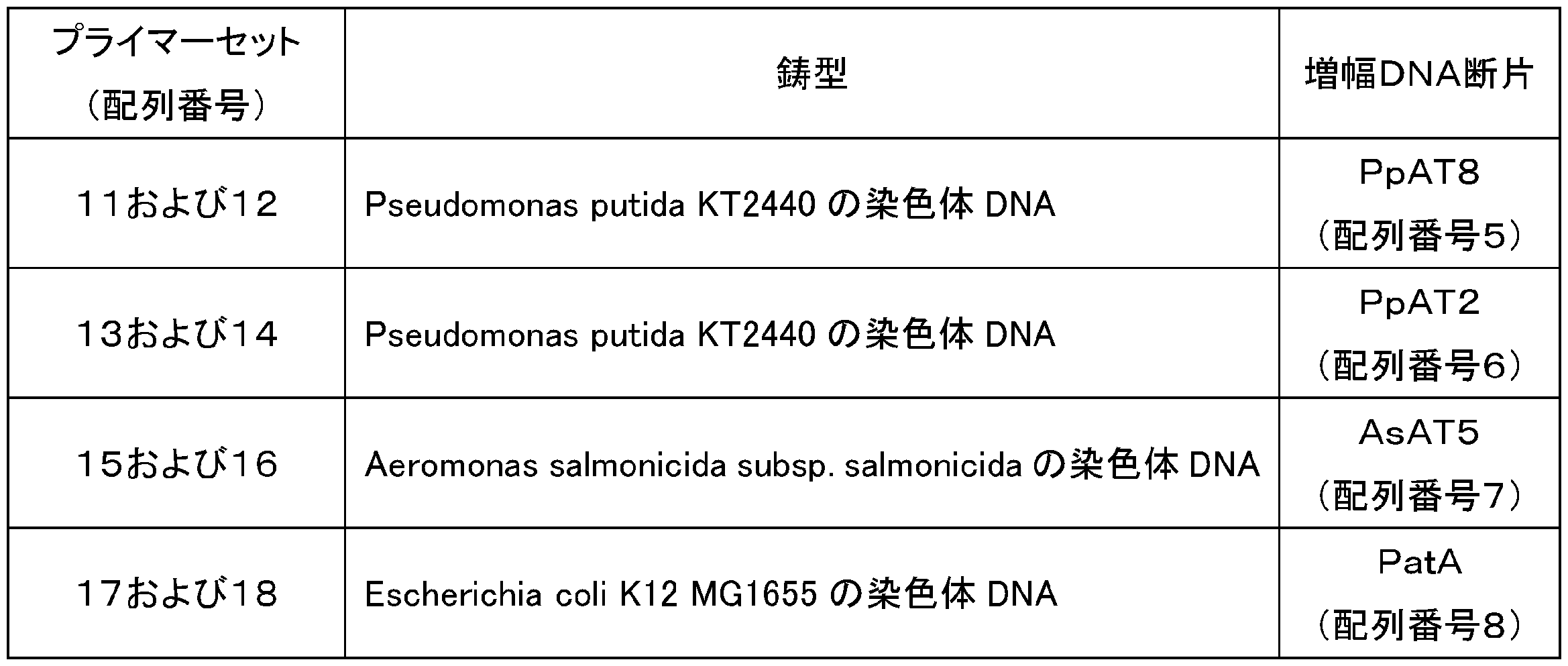
上記(2)で得られた各種組換え大腸菌を、100mg/Lのアンピシリンを含む2mLのLB培地の入った試験管に接種し30℃で16時間、振盪培養した。培養液を100mg/Lのアンピシリンを含む40mLのLB培地の入った250mL容三角フラスコに接種し30℃で2時間振盪培養した後、終濃度が1mMとなるようにIsopropyl-β-D-thiogalactopyranoside(IPTG)を添加し、さらに30℃で5時間振盪培養した。培養液を遠心分離して湿菌体を取得した。該湿菌体から、TALON(商標)Metal Affinity Resin(Clontech社)を用いて酵素精製を行い、Hisタグ付加組換え型の精製酵素PpAT8、PpAT2、AsAT5およびPatAを取得した。
(3)で精製した各精製酵素について、4-(アミノメチル)シクロヘキサン-1-カルバルデヒドの生成量を指標とし、各種ATの酵素活性を評価した。
上記(3)で取得した精製酵素(PpAT8、PpAT2、AsAT5またはPatA)0.07mg、50mMのMOPS(pH7.8)、10mMの塩化マグネシウム、1mMのDithiothreitol(DTT)、10mMのピルビン酸、0.1mMのPyridoxal phosphate(PLP)、並びに、10mMの1,4-ビス(アミノメチル)シクロヘキサンのシス体およびトランス体混合物(トランス比率45.7%)を含む0.1mLの反応液(pH7.8)を調製し、30℃、400rpmの条件で24時間反応を行った。また、ネガティブコントロールとして精製酵素液の代わりに等量のMOPS緩衝液を添加したもの反応液についても同様に反応を行った。
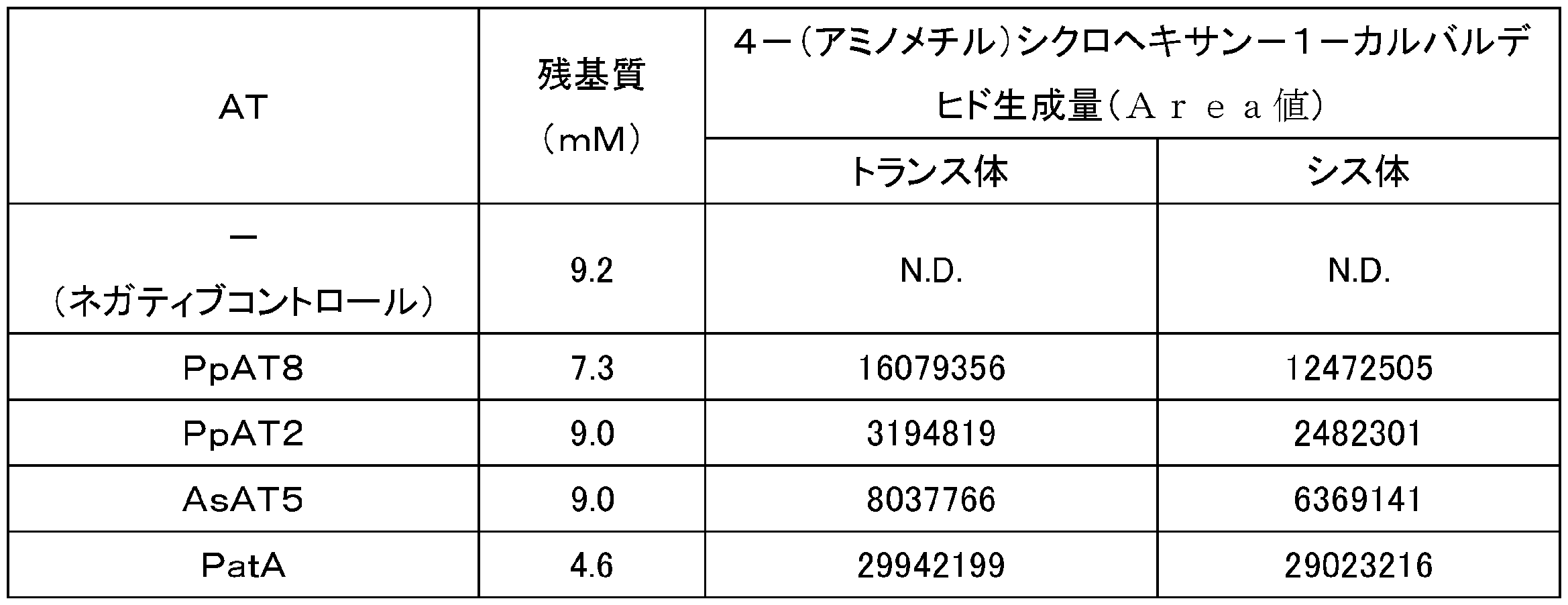
(5)データベース上でのATホモログ酵素の探索
実施例1で1,4-ビス(アミノメチル)シクロヘキサンに対する活性を有するATとして得られたPpAT8およびPatAのアミノ酸配列(配列番号5および8)をクエリーとして、National Center for Biotechnology Informationのタンパク質配列データベースであるBLAST(https://blast.ncbi.nlm.nih.gov/Blast.cgi)のホモロジー検索機能を用いて、各クエリー酵素と同一性40~85%の酵素を探索した。上記操作によって抽出された酵素のアミノ酸配列(配列番号103~107)および各酵素をコードする塩基配列(配列番号108~112)を表3に示す。
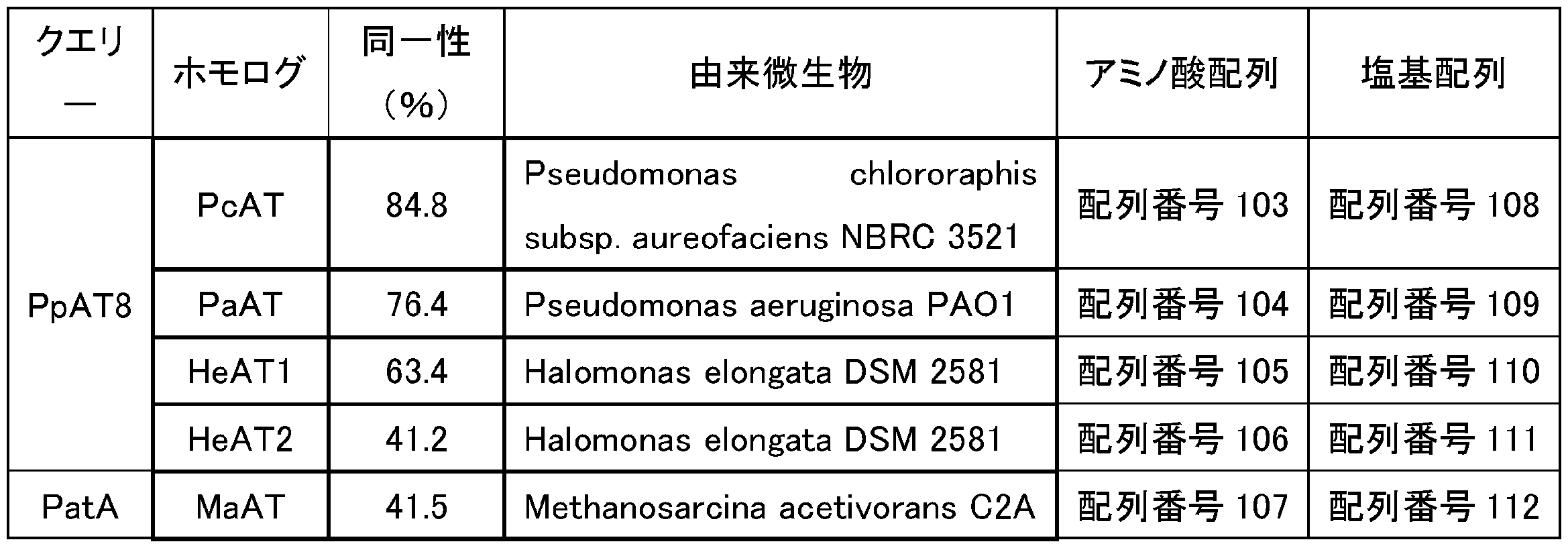
上記表3に記載の各ATホモログ酵素の遺伝子断片を得るため、表4に示した鋳型、プライマー1および2を用いて、PCR反応を行った。各種染色体DNAは常法により調製した。このとき、配列番号9で表される塩基配列の5’末端は表4の各プライマー1で表される塩基配列の5’末端に相補な塩基配列を含み、配列番号10で表される塩基配列の5’末端は表4の各プライマー2で表される塩基配列の5’末端に相補な塩基配列を含む。
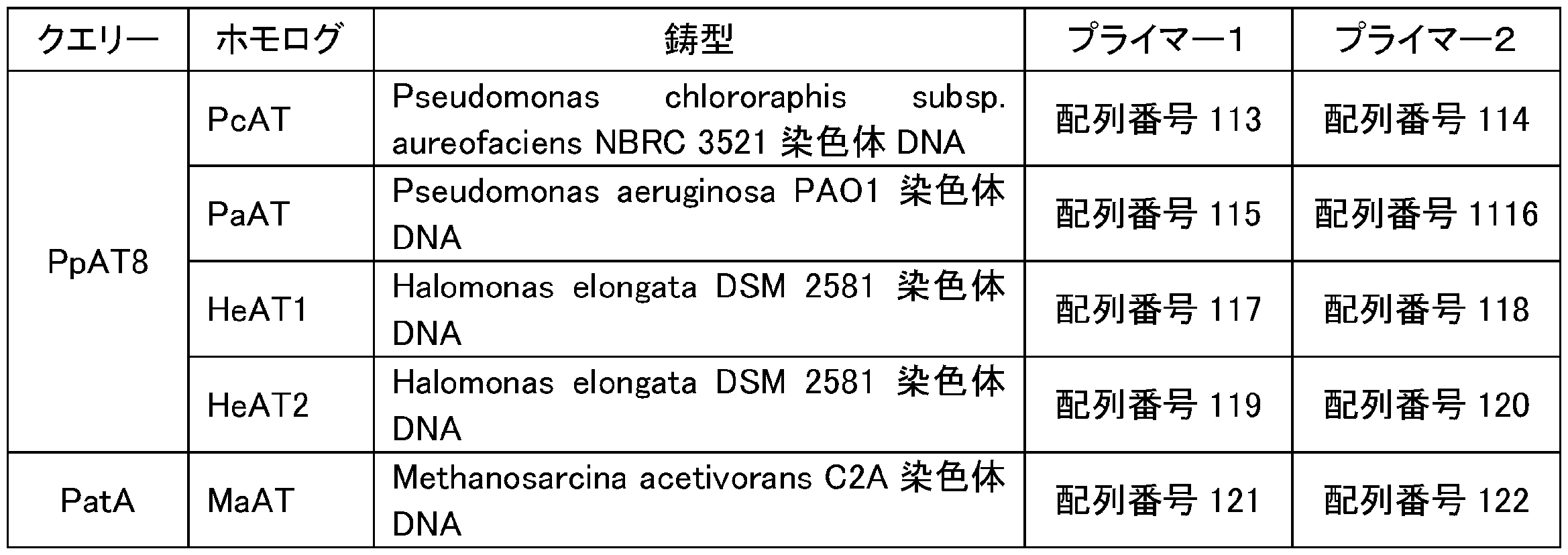
上記(6)で得た各AT発現プラスミドを有する組換え大腸菌を用いて、(3)と同様の方法でHisタグ付加組換え型の各AT精製酵素を取得した。
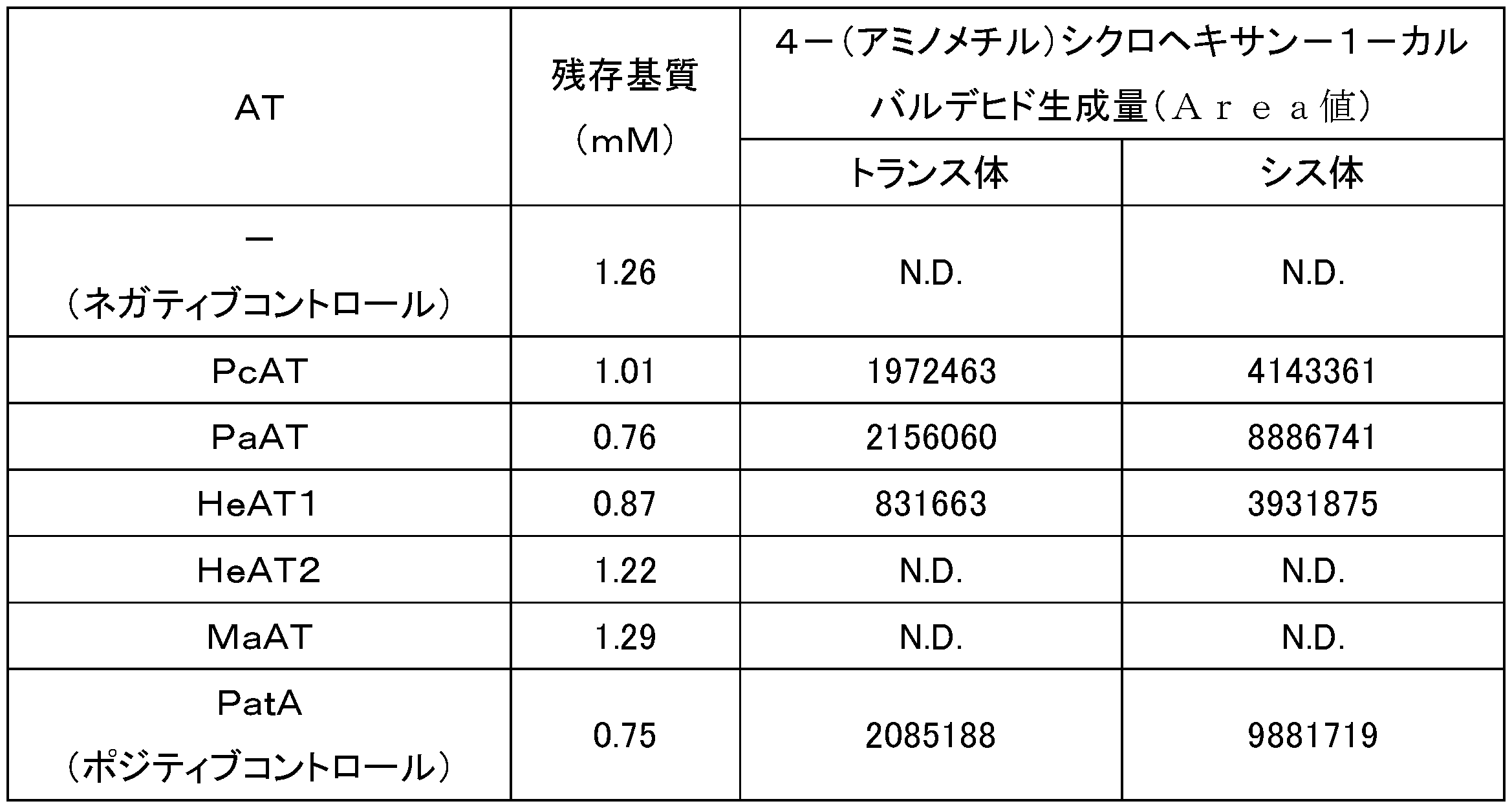
(1)アミノ基転移反応における溶液pHの影響評価
4-(アミノメチル)シクロヘキサン-1-カルボン酸の中間体である4-(アミノメチル)シクロヘキサン-1-カルバルデヒドの供給における、pH条件(pH7.0またはpH9.0)の影響を評価した。

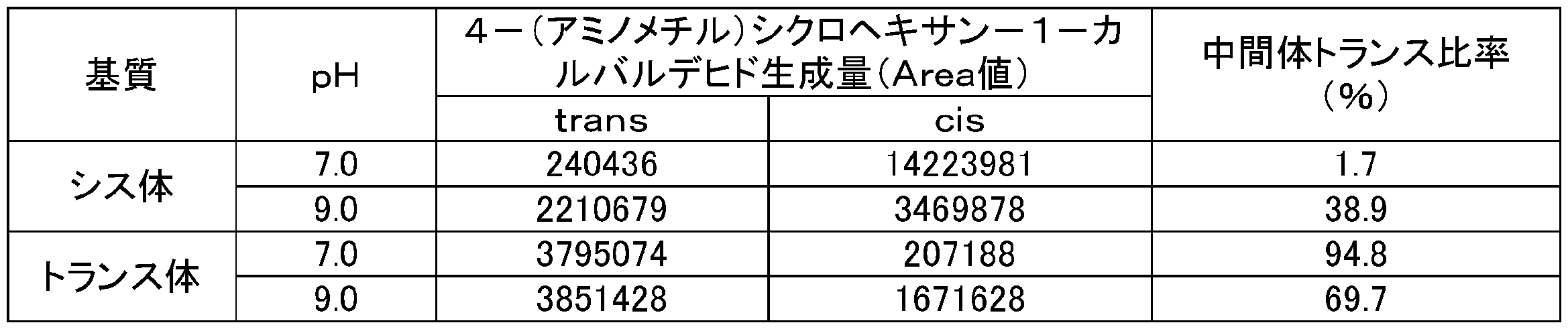
上記(1)に従い、(i)pH7.0の条件でPatA精製酵素とシス体の基質を反応させることにより中間体トランス比率が2.1%となった反応液、(ii)pH7.0の条件でPatA精製酵素とトランス体基質を反応させることにより中間体トランス比率が95.3%となった反応液を、それぞれ調製した。Amicon(商標)Ultra 0.5mL,3K(Millipore社製)を用いて各反応液中の酵素を除去し、フロースルー画分を回収した。各フロースルー画分10μLに対し、50mMの酢酸ナトリウム緩衝液(pH0またはpH5.0)、50mMのMES緩衝液(pH6.0)、50mMのリン酸ナトリウム緩衝液(pH6.0またはpH7.0)、50mMのMOPS緩衝液(pH7.0)、50mMのCHES緩衝液(pH9.0または10.0)、若しくは50mMの炭酸ナトリウム緩衝液(pH9.0または10.0)のいずれかの緩衝液を90μL添加し、30℃、400rpmの条件で20時間反応させた。

(1)評価するALDHの選定
これまで、4-(アミノメチル)シクロヘキサン-1-カルバルデヒドのアルデヒド基を酸化させ、4-(アミノメチル)シクロヘキサンカルボン酸を生成させる、アルデヒドデヒドロゲナーゼ活性を有する酵素は知られていなかった。
(1)で選定したALDH(PatD、XylC、StyDおよびPchA)のアミノ酸配列を配列番号19~22に示す。これらの酵素をコードする塩基配列をそれぞれ配列番号23~26に示す。これらの酵素を発現する株は以下のように造成した。
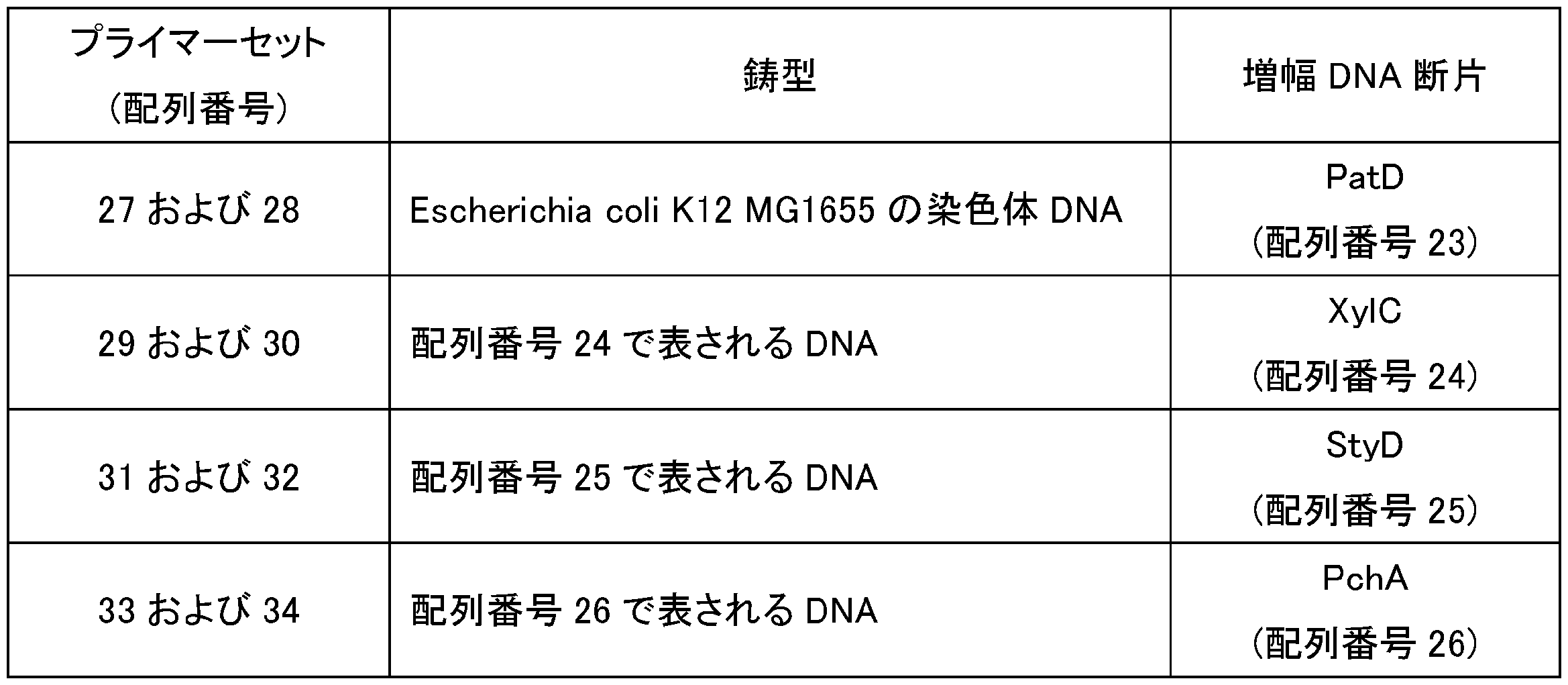
上記(2)で得られた菌株を用いて、実施例1と同様の方法により湿菌体を取得し酵素精製を行うことで、Hisタグ付加組換え型の精製酵素PatD、XylC、StyDおよびPchAを取得した。
<ALDHの補酵素としてNAD+を用いた場合>
上記(3)で取得した精製酵素(PatD、XylC、StyDおよびPchA)0.07mg、実施例1(3)で取得したPatA 0.07mg、50mMのMOPS(pH7.8)、1mMの塩化マグネシウム、1mMのDTT、1mMのピルビン酸、0.1mMのPLP、2mMのニコチンアミドアデニンジヌクレオチド(NAD+)、および、1mMの1,4-ビス(アミノメチル)シクロヘキサンのシス体およびトランス体混合物(トランス比率45.7%)を含む0.1mLの反応液(pH7.8)を調製し、30℃、400rpmの条件で24時間反応を行った。また、ネガティブコントロールとして精製酵素の代わりに等量のMOPS緩衝液を添加した反応液についても同様に反応を行った。



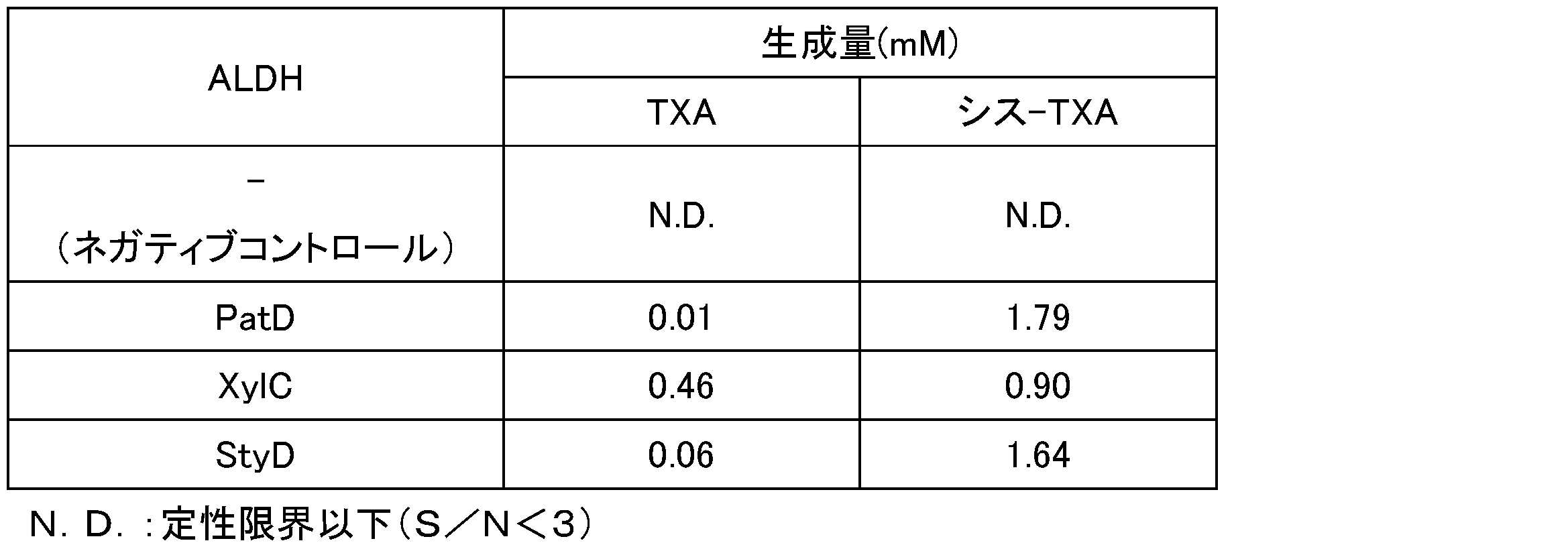
上記表6の結果においてALDH活性が確認できなかったPchAは、補酵素としてNADP+を利用することが知られている(Appl.Microbiol. Biotechnol., 2014, 98:1349-1356)。そこで、上記(3)で取得した精製酵素PchA、また比較対象としてXylCを用い、補酵素としてNADP+を用いた場合の4-(アミノメチル)シクロヘキサン-1-カルバルデヒドのアルデヒド酸化活性を評価した。
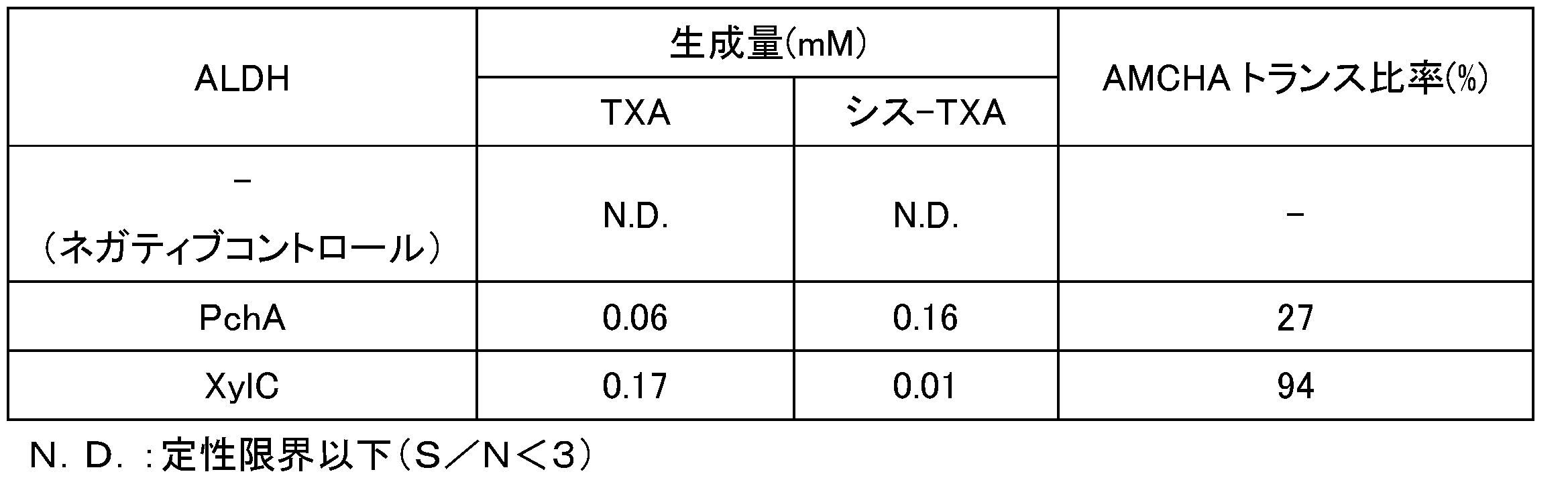
(1)データベース上でのALDHホモログ酵素の探索
実施例3で4-(アミノメチル)シクロヘキサン-1-カルボン酸生成が可能なALDHとして取得したPatD、XylCおよびStyDのアミノ酸配列(配列番号19~21)をクエリーとして、National Center for Biotechnology Informationのタンパク質配列データベースであるBLAST(https://blast.ncbi.nlm.nih.gov/Blast.cgi)のホモロジー検索機能を用いて、各酵素と同一性50~80%の酵素を探索した。上記操作によって抽出された酵素のアミノ酸配列(配列番号35~46)および各酵素をコードする塩基配列(配列番号47~58)を表13に示す。表13中、CkpatD、SepatD、CspatDおよびPppatDはいずれもガンマ-アミノブチルアルデヒドデヒドロゲナーゼとアノテーションされているタンパク質である。SsBD、HaBDおよびRrADはベンズアルデヒドデヒドロゲナーゼとアノテーションされているタンパク質である。PmsLADはフェニルアセトアルデヒドデヒドロゲナーゼとアノテーションされているタンパク質である。その他はアルデヒドデヒドロゲナーゼまたはそのファミリータンパク質とアノテーションされているタンパク質である。
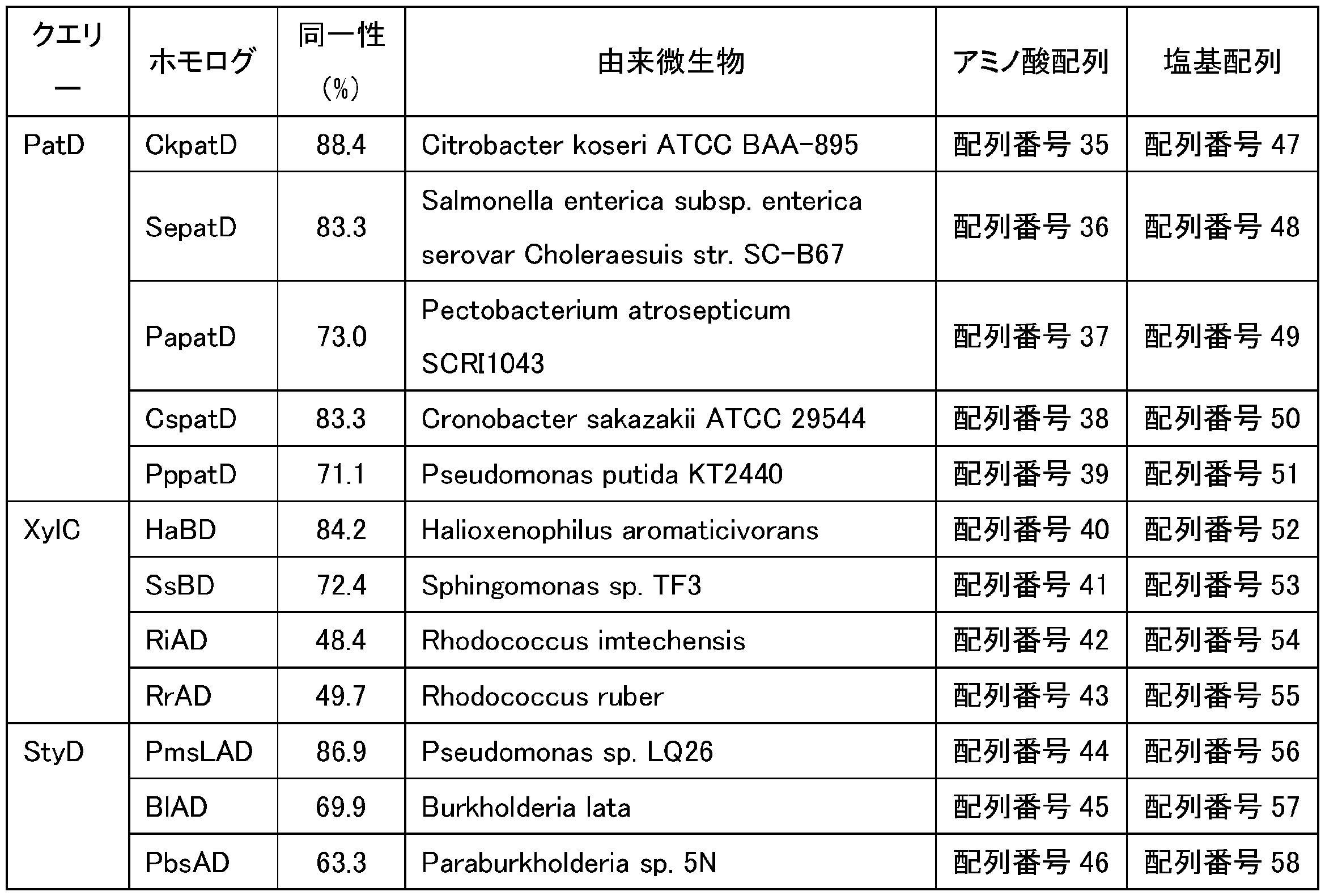
上記表13に記載の各ALDHホモログ酵素の遺伝子断片を得るため、表14に示した鋳型、プライマー1および2を用いて、PCR反応を行った。

上記(2)で得た各ALDH発現プラスミドを有する大腸菌を用いて、実施例1と同様の方法でHisタグ付加組換え型の各ALDH精製酵素を取得した。
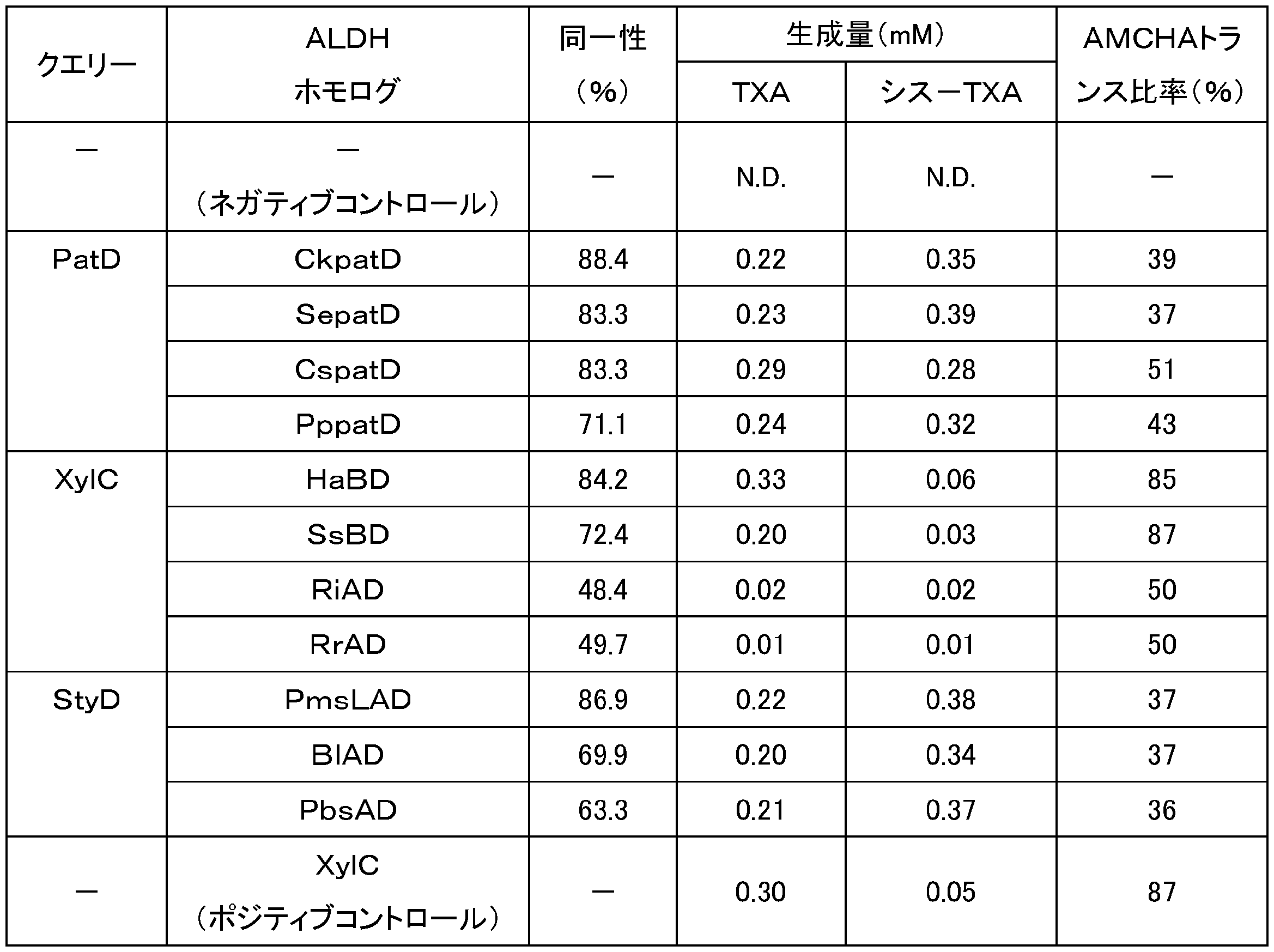
(1)アラニンデヒドロゲナーゼ(AlaDH)発現株の造成
配列番号123で表されるBacillus subtilis 168由来アラニンデヒドロゲナーゼをコードするBsAlaDHの遺伝子断片を得るため、常法により調製したBacillus subtilis 168の染色体DNAを鋳型として、配列番号83および84で表される塩基配列であるオリゴヌクレオチドをプライマーセットとして用いてPCR反応を行い、配列番号124で表されるBsAlaDH遺伝子断片を得た。配列番号9で表される塩基配列の5’末端は配列番号83で表される塩基配列の5’末端に相補的な配列を含み、配列番号10で表される塩基配列の5’末端は配列番号84で表される塩基配列の5’末端に相補的な配列を含む。
配列番号125で表されるBacillus subtilis 168由来NADHオキシダーゼをコードする、BsNOXの遺伝子断片を得るため、Bacillus subtilis 168の染色体DNAを鋳型として、配列番号85および86で表される塩基配列であるオリゴヌクレオチドをプライマーセットとして用いて、PCR反応を行い、配列番号126で表されるBsNOX遺伝子断片を得た。配列番号9で表される塩基配列の5’末端は配列番号85で表される塩基配列の5’末端に相補的な配列を含み、配列番号10で表される塩基配列の5’末端は配列番号86で表される塩基配列の5’末端に相補的な配列を含む。
上記で得られたBL21(DE3)/pQE80L-BsAlaDHおよびBL21(DE3)/pQE80L-BsNOXを用いて、実施例1と同様の方法でHisタグ付加組換え型の酵素精製BsAlaDHおよびBsNOXを取得した。
実施例1で取得したPatA 0.07mg、実施例2で取得したXylC 0.07mg、上記(3)で取得したBsAlaDH 0.07mg、BsNOX 0.07mg、50mMのMOPS(pH7.8)、1mMの塩化マグネシウム、1mMのDTT、1mMのピルビン酸、0.1mMのPLP、2mM NAD+、並びに、1mMの1,4-ビス(アミノメチル)シクロヘキサンのシス体およびトランス体混合物(トランス比率45.7%)を含む0.1mLの反応液(pH7.8)を調製し、30℃で400rpmの条件で24時間反応を行った。

実施例1で造成したBL21(DE3)/pQE80L-PatA株およびBL21(DE3)/pQE80L-XylC株について、実施例1(2)と同様の方法で湿菌体を取得した。該湿菌体に終濃度10mL/Lとなるようキシレンを添加し、30℃で850rpmのもと30分間の膜処理を行った。
(1)ATおよびALDHの共発現株の造成
ア)BL21(DE3)/pET28a-PatA-XylC株の造成
Escherichia coli K12 MG1655の染色体DNAを鋳型として、配列番号89および90で表される塩基配列であるオリゴヌクレオチドをプライマーセットとして用いてPCR反応を行い、PatA断片を得た。続いて、配列番号24で表される塩基配列を鋳型として、配列番号91および92で表される塩基配列であるオリゴヌクレオチドをプライマーセットとして用いてPCR反応を行い、XylC断片を得た。なお、配列番号90で表される塩基配列の5’末端は、配列番号91で表される塩基配列の5’末端に相補的な配列を含む。
配列番号24で表される塩基配列を鋳型として、配列番号93および94で表される塩基配列であるオリゴヌクレオチドをプライマーセットとして用いてPCR反応を行い、XylC断片を得た。Escherichia coli K12 MG1655の染色体DNAを鋳型として、配列番号95および96で表される塩基配列からなるオリゴヌクレオチドをプライマーセットとして用いてPCR反応を行い、PatA断片を得た。なお、配列番号94で表される塩基配列の5’末端は配列番号95で表される塩基配列の5’末端に相補的な配列を含む。
Escherichia coli K12 MG1655の染色体DNAを鋳型として、配列番号99および90で表される塩基配列であるオリゴヌクレオチドをプライマーセットとして用いて、PCR反応を行い、PatA断片を得た。続いて、配列番号24で表される塩基配列を鋳型として、配列番号91および100で表される塩基配列であるオリゴヌクレオチドをプライマーセットとして用いてPCR反応を行い、XylC断片を得た。なお、配列番号90で表される塩基配列の5’末端は配列番号91で表される塩基配列の5’末端に相補的な配列を含む。
配列番号24で表されるDNAを鋳型として、配列番号101および94で表される塩基配列であるオリゴヌクレオチドをプライマーセットとして用いてPCR反応を行い、XylC断片を得た。続いてEscherichia coli K12 MG1655の染色体DNAを鋳型として、配列番号95および102で表される塩基配列であるオリゴヌクレオチドをプライマーセットとして用いてPCR反応を行い、PatA断片を得た。なお、配列番号94で表される塩基配列の5’末端は配列番号95で表される塩基配列の5’末端に相補的な配列を含む。
上記(1)で造成したBL21(DE3)/pET28a-PatA-XylC株、BL21(DE3)/pET28a-XylC-PatA株、BL21(DE3)/pUC19-PatA-XylC株およびBL21(DE3)/pUC19-XylC-PatA株、および、ネガティブコントロールとしてBL21(DE3)株を用い、静止菌体反応による4-(アミノメチル)シクロヘキサン-1-カルボン酸の生産性を評価した。
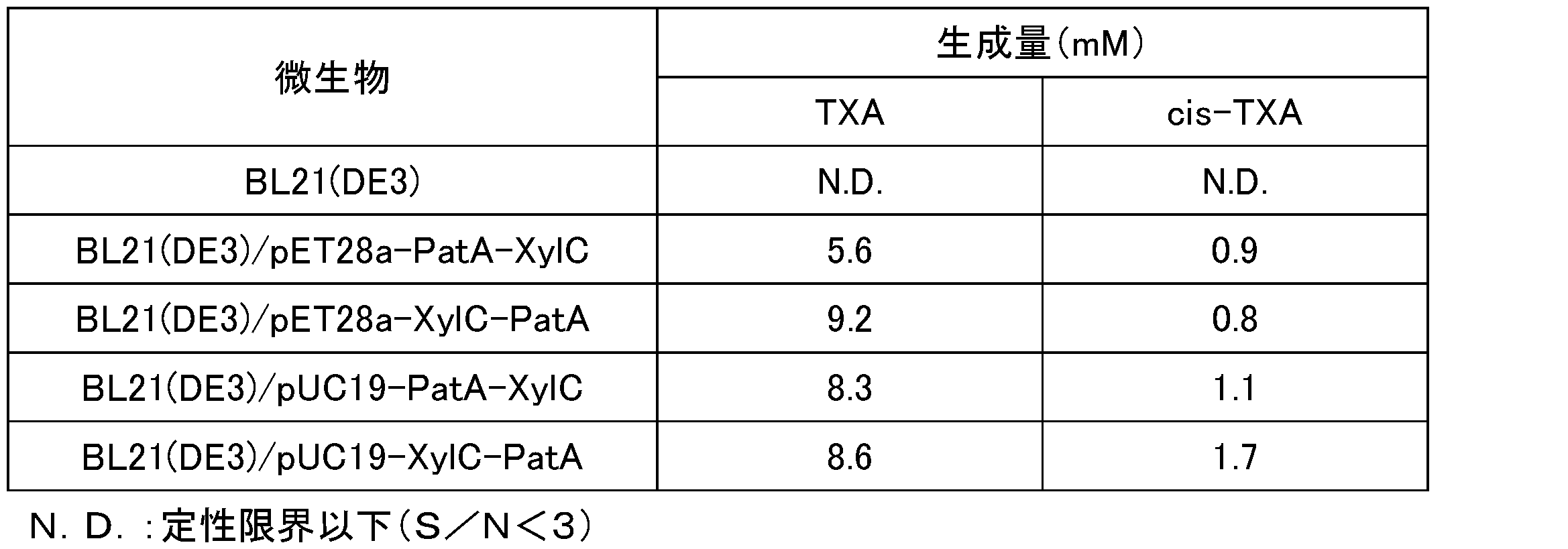

実施例7で造成したBL21(DE3)/pUC19-PatA-XylC株、BL21(DE3)/pUC19-XylC-PatA株、および、ネガティブコントロールとしてBL21(DE3)株を用い、添加培養法による4-(アミノメチル)シクロヘキサン-1-カルボン酸の生産性を評価した。
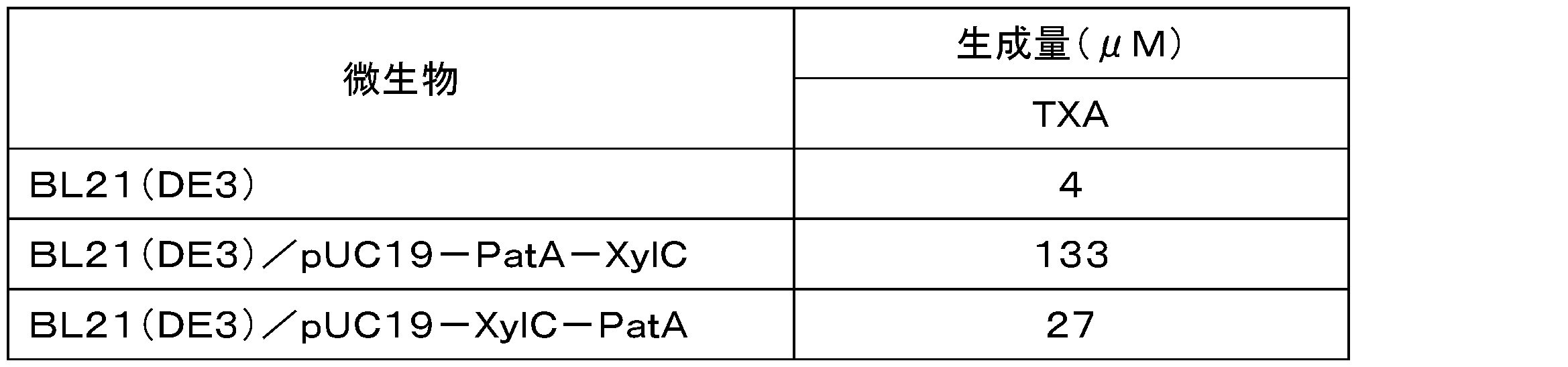
(1)ALDHホモログ酵素の探索
実施例3でトランス体基質に高い選択性を有するALDHであるXylCのアミノ酸配列(配列番号20)をクエリーとして、National Center for Biotechnology Informationのタンパク質配列データベースであるBLAST(https://blast.ncbi.nlm.nih.gov/Blast.cgi)のホモロジー検索機能を用いて、XylCと同一性50%以上であり、かつ検索結果におけるホモログ酵素同士の同一性が90%未満のものを選択した。上記操作によって抽出された酵素のアミノ酸配列(配列番号127~139)を表20に示す。

上記表20に記載の各ALDHホモログ酵素の遺伝子断片を得るため、表21に示した鋳型、プライマー1および2を用いて、PCR反応を行った。このとき、配列番号9で表される塩基配列の5’末端は表21の各プライマー1で表される塩基配列の5’末端に相補な塩基配列を含み、配列番号10で表される塩基配列の5’末端は表21の各プライマー2で表される塩基配列の5’末端に相補な塩基配列を含む。

上記(2)で得た各ALDH発現プラスミドを有する大腸菌を用いて、実施例1と同様の方法でHisタグ付加組換え型の各ALDH精製酵素を取得した。

(1)評価株の造成
ア)MG1655/pQE80L-XylC-PatAの造成
配列番号24で表される塩基配列を鋳型として、配列番号179および94で表される塩基配列であるオリゴヌクレオチドをプライマーセットとして用いてPCR反応を行い、XylC断片を得た。続いて、Escherichia coli K12 MG1655の染色体DNAを鋳型として、配列番号95および180で表される塩基配列であるオリゴヌクレオチドをプライマーセットとして用いてPCR反応を行い、PatA断片を得た。なお、配列番号94で表される塩基配列の5’末端は、配列番号95で表される塩基配列の5’末端に相補的な配列を含む。
Escherichia coli K12 MG1655の染色体DNAを鋳型として、配列番号183および90で表される塩基配列であるオリゴヌクレオチドをプライマーセットとして用いてPCR反応を行い、PatA断片を得た。続いて、配列番号24で表される塩基配列を鋳型として、配列番号91および30で表される塩基配列であるオリゴヌクレオチドをプライマーセットとして用いてPCR反応を行い、XylC断片を得た。なお、配列番号90で表される塩基配列の5’末端は、配列番号91で表される塩基配列の5’末端に相補的な配列を含む。
<遺伝子欠損の際にマーカーとして用いるDNA断片の取得>
配列番号191および192で表される塩基配列からなるDNAをプライマーセットとして、pCatSac(Appl Environ Microbiol(2013)79,3033-3039)を鋳型としてPCRを行い、クロラムフェニコール耐性cat遺伝子およびスクロース感受性sacB遺伝子を含む、cat-sacB断片を得た。
ピルビン酸デヒドロゲナーゼをコードするDNA(以下、aceE遺伝子という。)を欠損した大腸菌を、以下の方法で造成した。常法により調製したEscherichia coli MG1655株のゲノムDNAを鋳型として、表23の「プライマーセット」で表される塩基配列からなるDNAをプライマーセットとしてPCRを行い、各DNA断片を増幅した。

イ)で得たプラスミドpQE80L-PatA-XylCを鋳型として、配列番号199および182で表される塩基配列からなるDNAをプライマーセットに用いてPCRを行い、DNA(以下、pQE80L-PatA-XylCという。)断片を得た。
上記(1)で造成したMG1655/pQE80L-XylC-PatA株、MG1655/pQE80L-PatA-BsAlaDH-XylC-BsNOX株およびMG1655ΔaceE/pQE80L-PatA-XylC-BsAlaDH-BsNOX株、を用い、静止菌体反応による4-(アミノメチル)シクロヘキサン-1-カルボン酸の生産性を評価した。
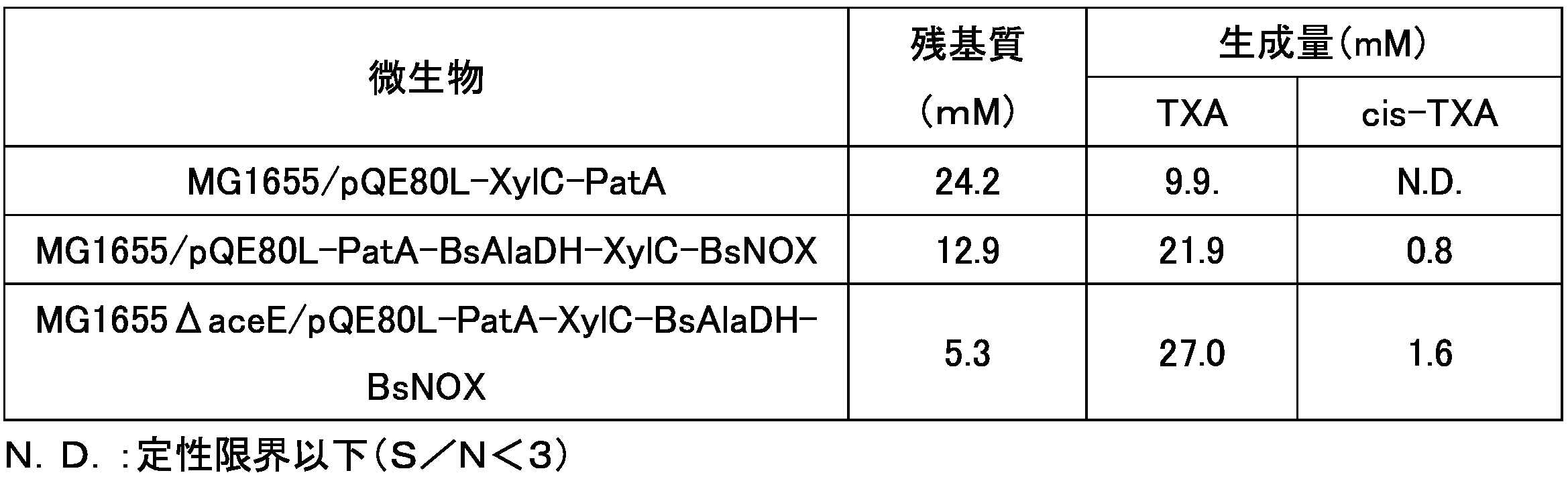
実施例3、実施例4および実施例9において、シス-トランス体混合基質を用いた反応により、生成するAMCHAのトランス体比率が高かったALDHは、AMCHAの製造のうち、特にTXAの製造において有用であるといえる。これらのALDHに特徴的なアミノ酸残基を見出すため、アミノ酸配列の比較を行った。
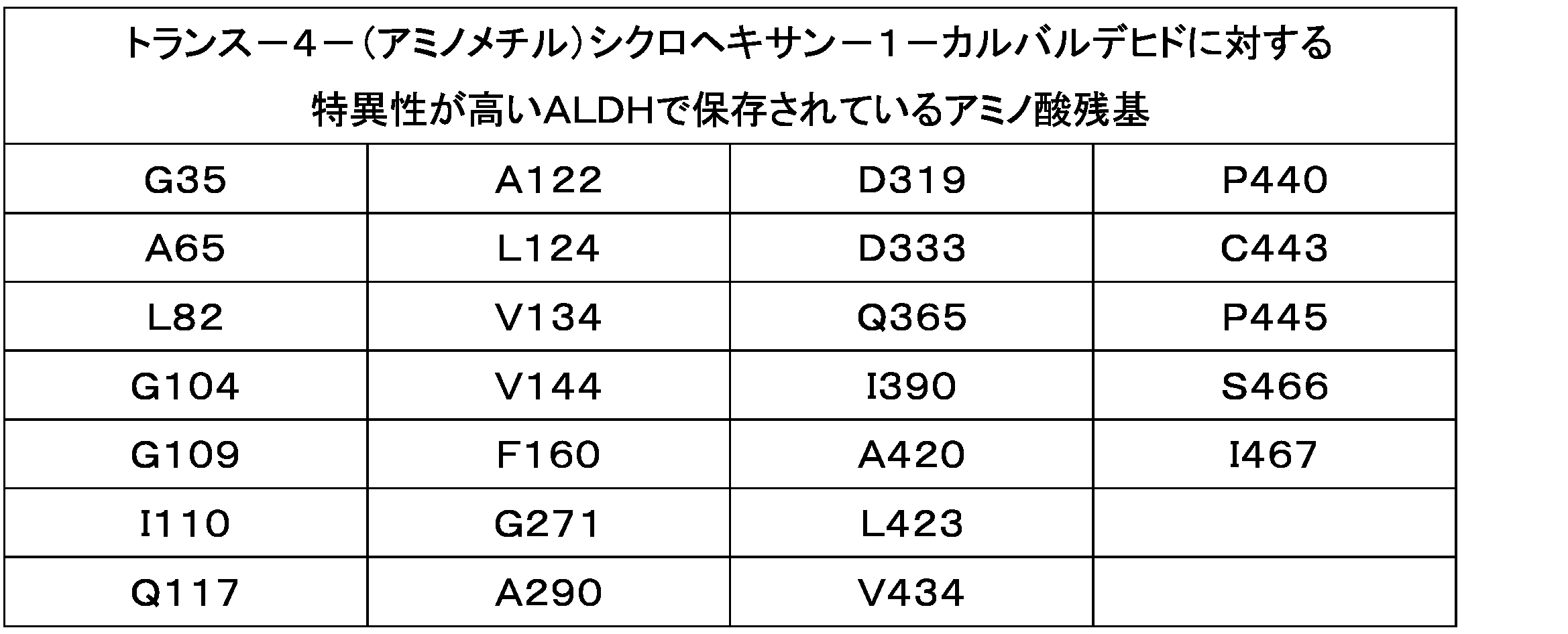
配列番号201で表されるArthrobacter chlorophenolicus由来コリンオキシダーゼをコードするAcCOx遺伝子断片を得るため、配列番号202で表される塩基配列を鋳型として、配列番号203および204で表される塩基配列であるオリゴヌクレオチドをプライマーセットに用いてPCR反応を行い、AcCOx断片を得た。なお、配列番号202で表される塩基配列は、AcCOx遺伝子の塩基配列を、大腸菌で発現させるためにコドン最適化したDNAであり、人工合成により調製した。上記で得たAcCOx遺伝子断片を鋳型として、配列番号203および配列番号205で表される塩基配列をプライマーセットに用いてPCR反応を行い、AcCOx2断片を得た。
上記で造成したMG1655/pQE80L-AcCOx-PatA-XylC株、および、ネガティブコントロールとしてMG1655/pQE80L株を用い、静止菌体反応による1,4-シクロヘキサンジメタノールからの4-(アミノメチル)シクロヘキサン-1-カルボン酸の生産性を評価した。
(1)精製酵素反応およびLC-MS/MSによる分析
実施例1と同様の方法により取得した精製PatA、実施例3と同様の方法により取得した精製XylCを用い、PatAおよびXylC各0.07mg、50mMのMOPS(pH7.8)、10mMの塩化マグネシウム、1mMのピルビン酸、0.1mMのPLP、1mMのNAD+および1mMの1,4-ビス(アミノメチル)シクロヘキサンのシス体およびトランス体混合物(トランス比率45.7%)を含む0.1mLの反応液を調製し、30℃、400rpmの条件で24時間反応を行った。また、精製酵素として、PatAのみ、またはXylCのみを添加したものも同様に反応させた。

(1)精製酵素反応
実施例1と同様の方法により取得したPatA、実施例3と同様の方法により取得したXylCを用い、PatAおよびXylC各0.05mg、50mMのMOPS(pH7.0)、10mMの塩化マグネシウム、1mMのピルビン酸、0.1mMのPLPおよび1mMのNAD+に対し、1mMの1,4-ビス(アミノメチル)シクロヘキサンのシス体、トランス体、または、シス体およびトランス体混合物(トランス比率45.7%)を含む0.1mLの反応液を調製し、30℃、400rpmの条件で24時間反応を行った。反応終了後、反応液を希釈した後、遠心分離し、上清に含まれる反応生成物および残存基質を実施例3と同様の方法でLCMS-8040にて分析した(以下の(2))。また、以下の(3)、(4)の分析に供した。
PatAおよびXylCと1,4-ビス(アミノメチル)シクロヘキサンのトランス体を反応させた場合には溶出時間14.50分に、シス体を反応させた場合には溶出時間15.07分において、質量電荷比142.1の特徴的なピークが検出された。これらは、PatAおよびXylCと1,4-ビス(アミノメチル)シクロヘキサンのシス体およびトランス体混合物を反応させた場合においても検出された。このことから、溶出時間14.50分の化合物はトランス体基質と、溶出時間15.07分の化合物はシス体基質と酵素とが反応して生じた化合物であると考えられ、これらは分子量141の化合物である。これは、1,4-ビス(アミノメチル)シクロヘキサンのひとつのアミノ基が転移された生成物として考えられる4-(アミノメチル)シクロヘキサン-1-カルバルデヒドの分子量141.2と一致する。したがって、溶出時間14.50の化合物はトランス-4-(アミノメチル)シクロヘキサン-1-カルバルデヒドであり、溶出時間溶出時間15.07分の化合物はシス-4-(アミノメチル)シクロヘキサン-1-カルバルデヒドであると推察される。
酵素反応液に含まれるアミノ基を有する化合物を検出するため、第一級アミンを検出可能であるOPA誘導体化を行った。
[分析条件]
・カラム:SUMIPAX ODS Z-CLUE 3μm 4.6×250mm(住化分析センター社)
・カラムオーブン温度:50℃
・移動相:10mMクエン酸三ナトリウム二水和物、10mM無水硫酸ナトリウムおよび10mMドデシル硫酸ナトリウムを精製水に溶解し、希硫酸でpH3.2に調整したもの
・移動相流速:0.7mL/min
・反応液:18.5g/Lホウ酸、11.0g/L水酸化ナトリウム、30% Brij-35 3.0mL/L、0.6g/L o-フタルアルデヒドおよび4.66g/L N-アセチル-L-システインを精製水に溶解したもの
・反応液流速:0.3mL/min
・分析時間:70分
・検出器:RF-20A(島津製作所製)
・励起/蛍光波長:350nm/450nm

酵素反応液に含まれるアルデヒド基を有する化合物を検出するため、アルデヒドを検出可能であるDNPH誘導体化を行った。
[分析条件]
・カラム:YMC-Triart Bio C4 3μm 4.6×150mm(ワイエムシィ社)
・カラム温度:40℃
・移動相:水70%アセトニトリル30%
・分析時間:30分
・流速:0.5mL/min
・PDA検出波長:360nm
・MS検出イオン:
ポジティブモード:[M+H]+=322.10 m/z
ネガティブモード:[M-H]-=320.10 m/z
(1)評価株の造成
配列番号207に示すXanthomonas campestris由来の公知のベンズアルデヒドデヒドロゲナーゼXcBZDHを評価した。XcBZDHをコードする塩基配列を配列番号208に示す。配列番号208で表されるDNAを鋳型とし、配列番号209および210で表される塩基配列からなるDNAをプライマーセットとして、PCR反応を行い、DNA断片を増幅した。なお、鋳型としてXanthomonas campestrisの染色体DNAを用い、染色体DNAは常法により調製した。
上記(1)で得たXcBZDH発現プラスミドを有する大腸菌を用いて、実施例1と同様の方法でHisタグ付加組換え型のXcBZDH精製酵素を取得した。

Claims (11)
- 下記一般式(1)で表される化合物を基質化合物または中間体化合物として、ヒドロキシ基をアルデヒド基に変換する活性を有するタンパク質、アルデヒド基をカルボキシ基に変換する活性を有するタンパク質、およびアルデヒド基とアミノ基を可逆的に変換する活性を有するタンパク質から選択される少なくとも一つの酵素の存在下で、シス体および/またはトランス体の4-(アミノメチル)シクロヘキサン-1-カルボン酸を製造する方法。

- 前記ヒドロキシ基をアルデヒド基に変換する活性を有するタンパク質、前記アルデヒド基をカルボキシ基に変換する活性を有するタンパク質、および前記アルデヒド基とアミノ基を可逆的に変換する活性を有するタンパク質の存在下で製造する、請求項1に記載の方法。
- R1とR2の一方がCH2OHであり、他方がCH2OH、CHO、またはCH2NH2である、前記一般式(1)で表される化合物を基質化合物または中間体化合物とする場合、前記ヒドロキシ基をアルデヒド基に変換する活性を有するタンパク質、前記アルデヒド基をカルボキシ基に変換する活性を有するタンパク質、および前記アルデヒド基とアミノ基を可逆的に変換する活性を有するタンパク質の存在下で製造する、請求項2に記載の方法。
- R1とR2の一方がCH2NH2であり、他方がCHOである、一般式(1)で表される化合物を基質化合物または中間体化合物とする場合、前記アルデヒド基をカルボキシ基に変換する活性を有するタンパク質の存在下で製造する、請求項1に記載の方法。
- R1とR2の一方がCHOであり、他方がCOOHである、一般式(1)で表される化合物を基質化合物または中間体化合物とする場合、前記アルデヒド基とアミノ基を可逆的に変換する活性を有するタンパク質の存在下で製造する、請求項1に記載の方法。
- R1とR2の一方がCHOであり、他方がCH2NH2、もしくはCHOである、またはR1とR2が共にCH2NH2である、一般式(1)で表される化合物を基質化合物または中間体化合物とする場合、前記アルデヒド基をカルボキシ基に変換する活性を有するタンパク質、および前記アルデヒド基とアミノ基を可逆的に変換する活性を有するタンパク質の存在下で製造する、請求項1に記載の方法。
- R1とR2の一方がCH2OHであり、他方がCH2NH2である、一般式(1)で表される化合物を基質化合物または中間体化合物とする場合、前記ヒドロキシ基をアルデヒド基に変換する活性を有するタンパク質、および前記アルデヒド基をカルボキシ基に変換する活性を有するタンパク質の存在下で製造する、請求項1に記載の方法。
- R1とR2の一方がCH2OHであり、他方がCOOHである、一般式(1)で表される化合物を基質化合物または中間体化合物とする場合、前記ヒドロキシ基をアルデヒド基に変換する活性を有するタンパク質、および前記アルデヒド基とアミノ基を可逆的に変換する活性を有するタンパク質の存在下で製造する、請求項1に記載の方法。
- 前記ヒドロキシ基をアルデヒド基に変換する活性を有するタンパク質が、オキシダーゼ活性を有するタンパク質、デヒドロゲナーゼ活性を有するタンパク質およびアルデヒドレダクターゼ活性を有するタンパク質から選択される少なくとも1つであり、前記アルデヒド基をカルボキシ基に変換する活性を有するタンパク質が、アルデヒドデヒドロゲナーゼ活性を有するタンパク質、および/またはアルデヒドオキシダーゼ活性を有するタンパク質であり、前記アルデヒド基とアミノ基を可逆的に変換する活性を有するタンパク質が、アミノ基転移酵素活性を有するタンパク質、アミンデヒドロゲナーゼ活性を有するタンパク質およびアミンオキシダーゼ活性を有するタンパク質から選択される少なくとも1つである、請求項1~8のいずれか一項に記載の方法。
- 前記ヒドロキシ基をアルデヒド基に変換する活性を有するタンパク質が、コリンオキシダーゼ活性を有するタンパク質であり、前記アルデヒド基をカルボキシ基に変換する活性を有するタンパク質が、アルデヒドデヒドロゲナーゼ活性を有するタンパク質であり、前記アルデヒド基とアミノ基を可逆的に変換する活性を有するタンパク質が、アミノ基転移酵素活性を有するタンパク質である、請求項1~8のいずれか一項に記載の方法。
- 前記コリンオキシダーゼ活性を有するタンパク質が、配列番号201で示されるアミノ酸配列と60%以上の同一性を有するアミノ酸配列からなるタンパク質であり、前記アルデヒドデヒドロゲナーゼ活性を有するタンパク質が、配列番号19~22、35~46および127~139のいずれか1つで表されるアミノ酸配列と50%以上の同一性を有するアミノ酸配列からなるタンパク質であり、前記アミノ基転移酵素活性を有するタンパク質が、配列番号1~4および103~105のいずれか1つで表されるアミノ酸配列と60%以上の同一性を有するアミノ酸配列からなるタンパク質である、請求項10に記載の方法。
Priority Applications (5)
| Application Number | Priority Date | Filing Date | Title |
|---|---|---|---|
| CN202480042402.XA CN121420067A (zh) | 2023-06-29 | 2024-06-26 | 4-(氨甲基)环己烷-1-甲酸的制造方法 |
| JP2025530179A JPWO2025005153A1 (ja) | 2023-06-29 | 2024-06-26 | |
| EP24832012.9A EP4726047A1 (en) | 2023-06-29 | 2024-06-26 | Method for producing 4-(aminomethyl)cyclohexane-1-carboxylic acid |
| PCT/JP2024/046225 WO2025143144A1 (ja) | 2023-12-28 | 2024-12-26 | 4-(アミノメチル)シクロヘキサン-1-カルボン酸の製造方法 |
| TW113151167A TW202535347A (zh) | 2023-12-28 | 2024-12-27 | 4-(胺基甲基)環己烷-1-羧酸之製造方法 |
Applications Claiming Priority (4)
| Application Number | Priority Date | Filing Date | Title |
|---|---|---|---|
| JPPCT/JP2023/024236 | 2023-06-29 | ||
| PCT/JP2023/024236 WO2024005155A1 (ja) | 2022-06-30 | 2023-06-29 | 4-(アミノメチル)シクロヘキサン-1-カルボン酸の製造方法 |
| JP2023047340 | 2023-12-28 | ||
| JPPCT/JP2023/047340 | 2023-12-28 |
Publications (1)
| Publication Number | Publication Date |
|---|---|
| WO2025005153A1 true WO2025005153A1 (ja) | 2025-01-02 |
Family
ID=93938694
Family Applications (2)
| Application Number | Title | Priority Date | Filing Date |
|---|---|---|---|
| PCT/JP2024/023249 Ceased WO2025005153A1 (ja) | 2023-06-29 | 2024-06-26 | 4-(アミノメチル)シクロヘキサン-1-カルボン酸の製造方法 |
| PCT/JP2024/046225 Pending WO2025143144A1 (ja) | 2023-12-28 | 2024-12-26 | 4-(アミノメチル)シクロヘキサン-1-カルボン酸の製造方法 |
Family Applications After (1)
| Application Number | Title | Priority Date | Filing Date |
|---|---|---|---|
| PCT/JP2024/046225 Pending WO2025143144A1 (ja) | 2023-12-28 | 2024-12-26 | 4-(アミノメチル)シクロヘキサン-1-カルボン酸の製造方法 |
Country Status (5)
| Country | Link |
|---|---|
| EP (1) | EP4726047A1 (ja) |
| JP (1) | JPWO2025005153A1 (ja) |
| CN (1) | CN121420067A (ja) |
| TW (2) | TW202509230A (ja) |
| WO (2) | WO2025005153A1 (ja) |
Citations (15)
| Publication number | Priority date | Publication date | Assignee | Title |
|---|---|---|---|---|
| JPS5577894A (en) * | 1978-12-05 | 1980-06-12 | Takeda Chem Ind Ltd | Preparation of 4-amino methylcyclohexane-1-carboxylic acid |
| JPS57134500A (en) | 1981-02-12 | 1982-08-19 | Kyowa Hakko Kogyo Co Ltd | Plasmid pcg1 |
| JPS57183799A (en) | 1981-04-17 | 1982-11-12 | Kyowa Hakko Kogyo Co Ltd | Novel plasmid |
| JPS5835197A (ja) | 1981-08-26 | 1983-03-01 | Kyowa Hakko Kogyo Co Ltd | プラスミドpcg2 |
| JPS58105999A (ja) | 1981-12-17 | 1983-06-24 | Kyowa Hakko Kogyo Co Ltd | 新規ベクタ−プラスミド |
| JPS58110600A (ja) | 1981-12-25 | 1983-07-01 | Kyowa Hakko Kogyo Co Ltd | ヒトβ型インタ−フエロン遺伝子を含む組みかえ体プラスミド |
| JPS63152991A (ja) | 1986-12-17 | 1988-06-25 | Idemitsu Kosan Co Ltd | トランス−4−アミノメチルシクロヘキサン−1−カルボン酸の製造方法 |
| JPS63233798A (ja) | 1986-10-09 | 1988-09-29 | Kyowa Hakko Kogyo Co Ltd | 5′−グアニル酸の製造法 |
| JPS63248394A (ja) | 1987-04-06 | 1988-10-14 | Kyowa Hakko Kogyo Co Ltd | 核酸関連物質の製造法 |
| WO1998012343A1 (en) | 1996-09-17 | 1998-03-26 | Kyowa Hakko Kogyo Co., Ltd. | Processes for producing sugar nucleotides and complex carbohydrates |
| WO2018190398A1 (ja) * | 2017-04-13 | 2018-10-18 | 協和発酵バイオ株式会社 | テアニンの製造方法 |
| CN114014768A (zh) | 2021-12-03 | 2022-02-08 | 南京科瑞健医药科技有限公司 | 一种无钡盐杂质的氨甲环酸及其制备方法和制剂组合物 |
| CN114231507A (zh) | 2021-12-27 | 2022-03-25 | 无锡阿科力科技股份有限公司 | 一种胆分节杆菌胆碱氧化酶突变体及其应用 |
| CN115960854A (zh) | 2022-11-28 | 2023-04-14 | 江南大学 | 一种大肠杆菌腐胺转氨酶突变体及其应用 |
| WO2024005155A1 (ja) * | 2022-06-30 | 2024-01-04 | キリンホールディングス株式会社 | 4-(アミノメチル)シクロヘキサン-1-カルボン酸の製造方法 |
Family Cites Families (3)
| Publication number | Priority date | Publication date | Assignee | Title |
|---|---|---|---|---|
| CN103131649B (zh) * | 2012-12-31 | 2014-11-26 | 浙江工业大学 | 荧光假单胞菌及其在制备反式-4-氨甲基-环己烷甲酸中的应用 |
| IN2014CH05323A (ja) * | 2014-10-27 | 2016-08-26 | ||
| WO2023215742A2 (en) * | 2022-05-02 | 2023-11-09 | Aditya Kunjapur | Enzymatic reduction or reductive amination of aryl and heterocyclic carboxylic acids and aldehydes |
-
2024
- 2024-06-26 CN CN202480042402.XA patent/CN121420067A/zh active Pending
- 2024-06-26 EP EP24832012.9A patent/EP4726047A1/en active Pending
- 2024-06-26 JP JP2025530179A patent/JPWO2025005153A1/ja active Pending
- 2024-06-26 WO PCT/JP2024/023249 patent/WO2025005153A1/ja not_active Ceased
- 2024-06-27 TW TW113124025A patent/TW202509230A/zh unknown
- 2024-12-26 WO PCT/JP2024/046225 patent/WO2025143144A1/ja active Pending
- 2024-12-27 TW TW113151167A patent/TW202535347A/zh unknown
Patent Citations (15)
| Publication number | Priority date | Publication date | Assignee | Title |
|---|---|---|---|---|
| JPS5577894A (en) * | 1978-12-05 | 1980-06-12 | Takeda Chem Ind Ltd | Preparation of 4-amino methylcyclohexane-1-carboxylic acid |
| JPS57134500A (en) | 1981-02-12 | 1982-08-19 | Kyowa Hakko Kogyo Co Ltd | Plasmid pcg1 |
| JPS57183799A (en) | 1981-04-17 | 1982-11-12 | Kyowa Hakko Kogyo Co Ltd | Novel plasmid |
| JPS5835197A (ja) | 1981-08-26 | 1983-03-01 | Kyowa Hakko Kogyo Co Ltd | プラスミドpcg2 |
| JPS58105999A (ja) | 1981-12-17 | 1983-06-24 | Kyowa Hakko Kogyo Co Ltd | 新規ベクタ−プラスミド |
| JPS58110600A (ja) | 1981-12-25 | 1983-07-01 | Kyowa Hakko Kogyo Co Ltd | ヒトβ型インタ−フエロン遺伝子を含む組みかえ体プラスミド |
| JPS63233798A (ja) | 1986-10-09 | 1988-09-29 | Kyowa Hakko Kogyo Co Ltd | 5′−グアニル酸の製造法 |
| JPS63152991A (ja) | 1986-12-17 | 1988-06-25 | Idemitsu Kosan Co Ltd | トランス−4−アミノメチルシクロヘキサン−1−カルボン酸の製造方法 |
| JPS63248394A (ja) | 1987-04-06 | 1988-10-14 | Kyowa Hakko Kogyo Co Ltd | 核酸関連物質の製造法 |
| WO1998012343A1 (en) | 1996-09-17 | 1998-03-26 | Kyowa Hakko Kogyo Co., Ltd. | Processes for producing sugar nucleotides and complex carbohydrates |
| WO2018190398A1 (ja) * | 2017-04-13 | 2018-10-18 | 協和発酵バイオ株式会社 | テアニンの製造方法 |
| CN114014768A (zh) | 2021-12-03 | 2022-02-08 | 南京科瑞健医药科技有限公司 | 一种无钡盐杂质的氨甲环酸及其制备方法和制剂组合物 |
| CN114231507A (zh) | 2021-12-27 | 2022-03-25 | 无锡阿科力科技股份有限公司 | 一种胆分节杆菌胆碱氧化酶突变体及其应用 |
| WO2024005155A1 (ja) * | 2022-06-30 | 2024-01-04 | キリンホールディングス株式会社 | 4-(アミノメチル)シクロヘキサン-1-カルボン酸の製造方法 |
| CN115960854A (zh) | 2022-11-28 | 2023-04-14 | 江南大学 | 一种大肠杆菌腐胺转氨酶突变体及其应用 |
Non-Patent Citations (41)
| Title |
|---|
| "Immunology methods manual", 1997, ACADEMIC PRES |
| "Methods for General and Molecular Bacteriology", 1994, ASM PRESS |
| AGRIC. BIOL. CHEM., vol. 48, 1984, pages 669 |
| AGRIC. BIOL. CHEM., vol. 53, 1989, pages 277 |
| APPL ENVIRON MICROBIOL, vol. 79, 2013, pages 3033 - 3039 |
| APPL. ENVIRON. MICROBIOL., vol. 73, 2007, pages 6378 - 6385 |
| APPL. MICROBIOL. BIOTECHNOL., vol. 53, 2000, pages 674 - 679 |
| APPL. MICROBIOL. BIOTECHNOL., vol. 98, 2014, pages 1349 - 1356 |
| APPLIED AND ENVIRONMENTAL MICROBIOLOGY, vol. 73, no. 20, 2007, pages 6378 - 6385 |
| APPLIED MICROBIOLOGY AND BIOTECHNOLOGY, vol. 104, 2020, pages 7745 - 7766 |
| ARCH.MICROBIOL., vol. 193, 2011, pages 553 - 563 |
| ARCHIVES OF BIOCHEMISTRY AND BIOPHYSICS, vol. 616, 2017, pages 47 - 58 |
| BIORESOURCES AND BIOPROCESSING, vol. 9, 2022, pages 80 |
| BIOSCI. BIOTECHNOL.BIOCHEM., vol. 71, 2007, pages 2905 |
| BIOTECHNOL., vol. 98, 2014, pages 1349 - 1356 |
| DATABASE PROTEIN 15 April 2005 (2005-04-15), ANONYMOUS: "phenylacetaldehyde dehydrogenase [Pseudomonas sp. Y2]", XP093254916, Database accession no. CAA04003.1 * |
| DATABASE PROTEIN 18 August 2020 (2020-08-18), ANONYMOUS: "Benzaldehyde dehydrogenase [NAD(+)] [Stutzerimonas stutzeri]", XP093254919, Database accession no. CAD2266443.1 * |
| DATABASE Protein 2 September 2020 (2020-09-02), "putrescine aminotransferase [Shigella boydii]", XP093257125, Database accession no. EGE3747071.1 * |
| DATABASE PROTEIN 26 July 2016 (2016-07-26), ANONYMOUS: "p-hydroxybenzaldehyde dehydrogenase (plasmid) [Pseudomonas putida]", XP093254918, Database accession no. AAA75634.2 * |
| DATABASE PROTEIN 30 January 2014 (2014-01-30), ANONYMOUS: "aminotransferase [Pseudomonas putida ND6]", XP093254911, Database accession no. AFK66983.1 * |
| DATABASE PROTEIN 31 January 2014 (2014-01-31), ANONYMOUS: "medium chain aldehyde dehydrogenase [Escherichia coli str. K-12 substr. DH10B]", XP093254915, Database accession no. ACB02660.1 * |
| DATABASE PROTEIN 8 June 2017 (2017-06-08), ANONYMOUS: "Omega-amino acid--pyruvate aminotransferase [Aeromonas salmonicida]", XP093254912, Database accession no. ARW84612.1 * |
| DATSENKO, K. A.WARNER, B. L., PROC. NATL. ACAD. SCI., vol. 97, 2000, pages 6640 - 6645 |
| EUROPEAN JOURNAL OF HAEMATOLOGY, vol. 104, no. 2, 2020, pages 79 - 87 |
| FEBS LETTERS, vol. 579, 2005, pages 4107 - 4112 |
| GENE, vol. 33, 1985, pages 103 |
| J. BACTERIOL., vol. 153, 1983, pages 163 |
| J.MOL.BIOL., vol. 215, 1990, pages 403 |
| JOURNAL OF BACTERIOLOGY, vol. 194, no. 15, 2012, pages 4080 - 4088 |
| JOURNAL OF TRAUMA AND ACUTE CARE SURGERY, vol. 86, no. 1, 2019, pages 101 - 107 |
| KEIO JOURNAL OF MEDICINE, vol. 11, no. 8, 1962, pages 105 - 115 |
| KEIO JOURNAL OF MEDICINE, vol. 18, no. 4, 1964, pages 177 - 185 |
| METHODS ENZYMOL., vol. 183, 1990, pages 63 |
| MOL. MICROBIOL., vol. 55, 2005, pages 137 |
| MOLECULAR AND GENERAL GENETICS, vol. 196, 1984, pages 175 |
| NUCLEIC ACIDS RES., vol. 16, 1988, pages 6127 |
| PRO.NAT.ACAD.SCI., vol. 90, 1993, pages 5873 |
| PROC. NATL. ACAD. SCI. USA, vol. 97, 2000, pages 6641 - 6645 |
| PROC. NATL. ACAD. SCI., vol. 69, 1972, pages 2110 |
| PROC. NATL. ACAD. SCI., vol. 81, 1984, pages 4889 |
| PROC.NATL. ACAD. SCI., vol. 82, 1985, pages 4306 |
Also Published As
| Publication number | Publication date |
|---|---|
| JPWO2025005153A1 (ja) | 2025-01-02 |
| WO2025143144A1 (ja) | 2025-07-03 |
| CN121420067A (zh) | 2026-01-27 |
| TW202509230A (zh) | 2025-03-01 |
| EP4726047A1 (en) | 2026-04-15 |
| TW202535347A (zh) | 2025-09-16 |
Similar Documents
| Publication | Publication Date | Title |
|---|---|---|
| Blombach et al. | Acetohydroxyacid synthase, a novel target for improvement of L-lysine production by Corynebacterium glutamicum | |
| KR100760106B1 (ko) | (r)-2-옥탄올탈수소효소, 그 효소의 제조방법, 그 효소를코드하는 dna 및 이를 이용한 알코올의 제조방법 | |
| CN101010433B (zh) | 1,4-丁二胺的生物化学合成 | |
| WO2003066863A1 (fr) | Gene reductase d'un compose carbonyle alpha-substitue-alpha, beta-insature | |
| JP7035024B2 (ja) | テアニンの製造方法 | |
| Kabus et al. | Role of cytochrome bd oxidase from Corynebacterium glutamicum in growth and lysine production | |
| US8168412B2 (en) | Method for producing optically-active amine compound, recombinant vector, and transformant containing the vector | |
| US7217544B2 (en) | Method for the preparation of L-amino acids from D-amino acids | |
| JP2008530978A (ja) | 4−ハイドロキシ−l−イソロイシン又はその塩の製造法 | |
| JP2011507485A (ja) | (2s,3r,4s)−4−ヒドロキシ−l−イソロイシンの製造方法 | |
| EP4541902A1 (en) | Method for producing 4-(aminomethyl)cyclohexane-1-carboxylic acid | |
| CN103534350B (zh) | 对于谷氨酸显示高活性的氨基转移酶、编码该酶的基因和它们的利用法 | |
| AU2004220016B2 (en) | Nucleotide sequences of coryneform bacteria coding for proteins involved in L-serine metabolism and method for producing L-serine | |
| JP5789366B2 (ja) | 新規なスチレンモノオキシゲナーゼ、その製造方法、およびこれを利用する光学活性なスチレンオキシドの製造方法 | |
| WO2025143144A1 (ja) | 4-(アミノメチル)シクロヘキサン-1-カルボン酸の製造方法 | |
| JPWO2006041143A1 (ja) | 新規なd−セリン合成活性を有する酵素をコードするdna、該酵素の製造方法、及びこれを利用したd−セリンの製造方法 | |
| US10364448B2 (en) | Method for producing L-α-amino acid compound | |
| US8703447B2 (en) | Process for production of L-glutamine or L-glutamic acid | |
| US10351829B2 (en) | Oxidase, polynucleotide that codes for same, and use thereof | |
| JP2004065049A (ja) | D−マンデル酸脱水素酵素をコードするポリヌクレオチド、及びその用途 | |
| JP2008048628A (ja) | D−アミノ酸オキシダーゼ、およびl−アミノ酸、2−オキソ酸、又は環状イミンの製造方法。 | |
| WO2018088434A1 (ja) | N-サクシニル-ヒドロキシ-d-アミノ酸及び/又はヒドロキシ-d-アミノ酸の製造方法 | |
| JPWO2006109632A1 (ja) | 新規α−ケト酸還元酵素、その遺伝子、およびその利用法 | |
| WO2025142753A1 (ja) | クロトンアルデヒド-クロチルアルコールデヒドロゲナーゼ変異体 | |
| JP2009131254A (ja) | 4−ヒドロキシイソロイシン又は2−アミノ−3−メチル−4−ケトペンタン酸の製造法 |
Legal Events
| Date | Code | Title | Description |
|---|---|---|---|
| 121 | Ep: the epo has been informed by wipo that ep was designated in this application |
Ref document number: 24832012 Country of ref document: EP Kind code of ref document: A1 |
|
| ENP | Entry into the national phase |
Ref document number: 2025530179 Country of ref document: JP Kind code of ref document: A |
|
| WWE | Wipo information: entry into national phase |
Ref document number: 2025530179 Country of ref document: JP |
|
| WWE | Wipo information: entry into national phase |
Ref document number: 2024832012 Country of ref document: EP |
|
| ENP | Entry into the national phase |
Ref document number: 2024832012 Country of ref document: EP Effective date: 20260108 |
|
| ENP | Entry into the national phase |
Ref document number: 2024832012 Country of ref document: EP Effective date: 20260108 |
|
| NENP | Non-entry into the national phase |
Ref country code: DE |
|
| ENP | Entry into the national phase |
Ref document number: 2024832012 Country of ref document: EP Effective date: 20260108 |
|
| ENP | Entry into the national phase |
Ref document number: 2024832012 Country of ref document: EP Effective date: 20260108 |
|
| WWP | Wipo information: published in national office |
Ref document number: 2024832012 Country of ref document: EP |