WO2025005075A1 - 聴覚障害の処置および/または予防のための組成物 - Google Patents
聴覚障害の処置および/または予防のための組成物 Download PDFInfo
- Publication number
- WO2025005075A1 WO2025005075A1 PCT/JP2024/022948 JP2024022948W WO2025005075A1 WO 2025005075 A1 WO2025005075 A1 WO 2025005075A1 JP 2024022948 W JP2024022948 W JP 2024022948W WO 2025005075 A1 WO2025005075 A1 WO 2025005075A1
- Authority
- WO
- WIPO (PCT)
- Prior art keywords
- asparagus
- composition
- hearing
- tinnitus
- extract
- Prior art date
- Legal status (The legal status is an assumption and is not a legal conclusion. Google has not performed a legal analysis and makes no representation as to the accuracy of the status listed.)
- Ceased
Links
Images

Classifications
-
- A—HUMAN NECESSITIES
- A23—FOODS OR FOODSTUFFS; TREATMENT THEREOF, NOT COVERED BY OTHER CLASSES
- A23L—FOODS, FOODSTUFFS OR NON-ALCOHOLIC BEVERAGES, NOT OTHERWISE PROVIDED FOR; PREPARATION OR TREATMENT THEREOF
- A23L33/00—Modifying nutritive qualities of foods; Dietetic products; Preparation or treatment thereof
- A23L33/10—Modifying nutritive qualities of foods; Dietetic products; Preparation or treatment thereof using additives
- A23L33/105—Plant extracts, their artificial duplicates or their derivatives
-
- A—HUMAN NECESSITIES
- A61—MEDICAL OR VETERINARY SCIENCE; HYGIENE
- A61K—PREPARATIONS FOR MEDICAL, DENTAL OR TOILETRY PURPOSES
- A61K36/00—Medicinal preparations of undetermined constitution containing material from algae, lichens, fungi or plants, or derivatives thereof, e.g. traditional herbal medicines
- A61K36/18—Magnoliophyta (angiosperms)
- A61K36/185—Magnoliopsida (dicotyledons)
- A61K36/48—Fabaceae or Leguminosae (Pea or Legume family); Caesalpiniaceae; Mimosaceae; Papilionaceae
-
- A—HUMAN NECESSITIES
- A61—MEDICAL OR VETERINARY SCIENCE; HYGIENE
- A61P—SPECIFIC THERAPEUTIC ACTIVITY OF CHEMICAL COMPOUNDS OR MEDICINAL PREPARATIONS
- A61P27/00—Drugs for disorders of the senses
- A61P27/16—Otologicals
Definitions
- compositions for treating and/or preventing hearing impairment or for maintaining and/or improving hearing function are incorporated herein by reference.
- the World Health Organization reports that over one billion young people are at risk of noise-induced hearing loss due to exposure to loud noise for purposes such as listening to music.
- Age-related hearing loss is thought to be a major risk factor for dementia, and measures to prevent hearing loss are also important as dementia prevention measures.
- Noise-induced and age-related hearing loss are thought to occur when noise and aging gradually damage the hair cells in the inner ear. Hair cells are difficult to regenerate, making treatment for hearing loss difficult, and prevention in daily life is required.
- Tinnitus is a sensory abnormality in which sound is perceived even when there is no acoustic stimulus, and tinnitus and its associated symptoms place a great psychological burden. Hearing loss is thought to be one of the factors that trigger tinnitus.
- the present disclosure provides a composition for treating and/or preventing hearing loss comprising an asparagus extract.
- the present disclosure provides a composition for maintaining and/or improving hearing function comprising an asparagus extract.
- the present disclosure provides new means for treating and/or preventing hearing impairment or for maintaining and/or improving hearing function.
- mice with age-related hearing loss model fed with a control feed or a test feed containing an asparagus extract, in which a 32 kHz sound stimulus was applied are shown.
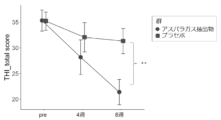
- 1 shows the total THI scores of the asparagus extract group and the placebo group in a clinical trial investigating the effect of asparagus extract intake on tinnitus in healthy subjects.
- the asparagus extract of the present disclosure is a mixture of asparagus-derived components contained in a liquid obtained by subjecting asparagus to hot water extraction treatment and removing the residue.
- the raw material for the asparagus extract is preferably the stem (asparagus stalk) of asparagus (Asparagus officinalis), including young stems and leaves.
- the asparagus stalk may be the undercut portion that is discarded for reasons such as the efficiency of harvesting, transporting, or selling edible asparagus.
- the raw material for the asparagus extract may be, for example, fresh asparagus, dried asparagus, or dried and powdered asparagus. Examples of asparagus include green asparagus, white asparagus, and purple asparagus, with green asparagus being preferred. There are no particular limitations on the place of origin of the asparagus.
- the method for producing an asparagus extract disclosed herein includes a step of subjecting asparagus to hot water extraction treatment.
- "Hot water extraction treatment” means that the raw material is heated in hot water to extract the components contained in the raw material into the water.
- the step of subjecting asparagus to hot water extraction treatment is carried out, for example, by adding 1 to 50 times the amount of water to the asparagus and heating it in hot water for 20 to 180 minutes.
- the temperature at this time is preferably, for example, 50 to 300°C.
- hot water extraction treatment is carried out under atmospheric pressure, a temperature of, for example, 90°C or higher is preferable.
- hot water extraction treatment may be carried out under pressure, for example, a pressure of 0.1 to 0.2 MPa (for example, 0.12 MPa when using an autoclave) is preferable.
- the method for producing an asparagus extract disclosed herein may further include additional steps, such as those exemplified below, for the purpose of increasing the efficiency of the hot water extraction process.
- An additional step may be, for example, a step of shredding the asparagus before the hot water extraction process.
- the asparagus can be shredded to a size of, for example, about 0.1 to 10 cm.
- the shredding may be done manually using, for example, a knife or cutter, or may be done using a machine such as a chopper or mill.
- An additional step may be, for example, an enzyme treatment step before or after the hot water extraction step for the purpose of, for example, disintegrating plant tissue.
- an enzyme treatment step By carrying out the enzyme treatment, the efficiency of the hot water extraction step can be further increased.
- enzymes such as cellulase, hemicellulase, pectinase, amylase, pullulanase, or a combination of two or more of these enzymes are preferably used for the purpose of efficiently decomposing the fibrous matter, pectin, etc. in asparagus.
- the most suitable addition amount, temperature, and reaction time for the enzyme used can be selected.
- the enzyme treatment can be carried out at a temperature of 30 to 60°C for 1 to 72 hours with an addition amount of cellulase of 0.1 to 5% (w/w).
- the enzyme treatment can be carried out at a temperature of 30 to 60°C for 1 to 72 hours with an addition amount of pectinase of 0.1 to 10% (w/w).
- the enzyme treatment step may be carried out before or after the hot water extraction step. It is preferable to carry out the enzyme treatment with cellulase and/or pectinase after the hot water extraction step.
- An additional step is, for example, mechanically grinding the residue after the hot water extraction process.
- a machine such as a mill or mixer may be used.
- Additional steps include, for example, centrifugation or filtration after the hot water extraction process. By further including these steps, it is possible to efficiently remove residue and obtain a heat-treated liquid. Centrifugation can be performed, for example, at a rotation speed of 3,000 to 7,000 rpm and a temperature of 4 to 50°C. For filtration, for example, commercially available filter paper, filter cloth, etc. can be used.
- An additional step is, for example, concentrating the heat-treated liquid obtained after the hot water extraction process under reduced pressure.
- the concentration can be carried out, for example, using an evaporator.
- An additional step may be, for example, spray drying or freeze drying the heat-treated liquid after the hot water extraction process.
- Spray drying may be performed, for example, at an exhaust air temperature of 70-90°C and a chamber temperature of 80-100°C.
- an excipient Prior to spray drying or freeze drying, an excipient may be added to the heat-treated liquid. Examples of excipients include starch, starch hydrolysates, dextrin, maltodextrin, maltooligosaccharides, lactose, sorbitol, mannitol, and sucrose. Following spray drying or freeze drying, the product may be sieved.
- a method for producing an asparagus extract comprises the following steps. (1) A step of subjecting asparagus to hot water extraction treatment to obtain a hot water extraction product; (2) A step of enzymatically treating the hot water extract to obtain an enzyme-treated product; (3) removing residue from the enzyme-treated product to obtain an enzyme-treated liquid; (4) A step of concentrating, spray drying and/or freeze-drying the enzyme-treated liquid to obtain an asparagus extract.
- a method for producing an asparagus extract comprises the following steps. (1) A step of enzymatically treating asparagus to obtain an enzyme-treated product; (2) subjecting the enzyme-treated product to hot water extraction to obtain a hot water extraction product; (3) removing residue from the hot water extraction product to obtain a heat-treated liquid; (4) A step of concentrating, spray drying and/or freeze-drying the heat-treated liquid to obtain an asparagus extract.
- Production Example 1 Asparagus stalks are cut into pieces of about 0.1 to 10 cm, and 1 to 50 times the volume of water is added. Hot water extraction is performed for 20 to 180 minutes at 50 to 100°C or under pressure at 121°C. After cooling, 0.1 to 5% (w/w) cellulase is added, and enzyme treatment is performed at 30 to 60°C for 1 to 72 hours. The residue is mechanically crushed and centrifuged at a rotation speed of 3,000 to 7,000 rpm and 4 to 50°C to obtain a supernatant. The supernatant is spray-dried at an exhaust air temperature of 70 to 90°C and a chamber temperature of 80 to 100°C.
- Process Example 2 Asparagus stalks are cut into pieces of about 0.1-10 cm, and 1-50 times the volume of water is added. Hot water extraction is performed for 20-180 minutes at 50-100°C or under pressure at 121°C. After cooling, 0.1-5% (w/w) cellulase is added, and enzyme treatment is performed for 1-72 hours at 30-60°C. 0.1-10% (w/w) pectinase is added, and enzyme treatment is performed for 1-72 hours at 30-60°C. The enzyme is inactivated by heat treatment. The supernatant is obtained by centrifugation at 3,000-7,000 rpm and 4-50°C. The supernatant is concentrated, excipients are added, and the mixture is autoclaved. The mixture is spray-dried or freeze-dried at an exhaust air temperature of 70-90°C and a chamber temperature of 80-100°C.
- Process Example 3 Dried asparagus stalks are powdered and 1 to 50 times the volume of water is added. Hot water extraction is performed for 20 to 180 minutes at 50 to 100°C or under pressure at 121°C. After cooling, 0.1 to 5% (w/w) cellulase and 0.1 to 10% (w/w) pectinase are added and enzyme treatment is performed for 1 to 72 hours at 30 to 60°C. The enzymes are inactivated by heat treatment. The supernatant is obtained by centrifugation at 3,000 to 7,000 rpm and 4 to 50°C. The supernatant is concentrated, excipients are added, and the mixture is autoclaved. The mixture is spray-dried or freeze-dried at an exhaust air temperature of 70 to 90°C and a chamber temperature of 80 to 100°C.
- asparagus extracts contain no more than 10%, no more than 5%, no more than 4%, no more than 3%, no more than 2%, no more than 1%, no more than 0.5%, no more than 0.3% or no more than 0.25% aspartic acid.
- compositions of the present disclosure can treat and/or prevent hearing impairment.
- hearing impairment includes hearing loss and tinnitus.
- the hearing impairment is not associated with another disease, such as Meniere's disease.
- Hearing loss is one of the most common sensory disorders and is characterized by a decrease in hearing.
- Hearing loss includes age-related hearing loss, noise-induced hearing loss and drug-induced hearing loss, especially age-related hearing loss.
- Examples of noise-induced hearing loss include acoustic hearing loss and occupational hearing loss.
- Hearing loss can be diagnosed by tests such as pure tone audiometry, speech audiometry, word recognition score, tympanometry and acoustic reflex.
- Tinnitus is the perception of sound in the absence of a sound stimulus. Tinnitus can be assessed, for example, by the Tinnitus Distress Inventory (THI).
- THI Tinnitus Distress Inventory
- the THI consists of 25 questions, and subjects select answers from "often (4 points),” "sometimes (2 points),” or "never (0 points)” for each item, and the total score is used to determine the distress of tinnitus.
- the original version of the THI is in English, and it has been translated into multiple languages, including Japanese, and its validity and reliability have been verified. The higher the THI score, the greater the distress of tinnitus, with 18-36 being considered mild, 38-56 being moderate, and 58-100 being considered severe.
- the tinnitus is tinnitus that is considered mild or moderate on the THI.
- treat or “treatment” means slowing or halting the progression of hearing loss and/or reducing, mitigating, ameliorating or eliminating hearing loss in a subject with hearing loss.
- prevent refers to preventing the onset of hearing impairment or reducing the likelihood of developing hearing impairment in a subject, particularly in a subject who may develop hearing impairment but has not yet developed hearing impairment.
- Subjects who may develop hearing impairment but have not yet developed hearing impairment include subjects who have risk factors for hearing impairment.
- Risk factors for hearing impairment include, for example, advanced age (e.g., age 50 or older, 55 or older, 60 or older, 65 or older, 70 or older, or 75 or older), exposure to noise or loud sounds, changes in air pressure, stress, earwax accumulation, impaired blood flow in the inner ear, viral infection, medications (e.g., antibacterial agents, anticancer agents, salicylates, etc.), acoustic neuroma, otitis media (e.g., chronic otitis media, otitis media with effusion, etc.), head trauma, autoimmune disease, and genetics.
- advanced age e.g., age 50 or older, 55 or older, 60 or older, 65 or older, 70 or older, or 75 or older
- medications e.g., antibacterial agents, anticancer agents, salicylates, etc.
- acoustic neuroma e.g., chronic otitis media, otitis media with effusion, etc.
- head trauma e.g.
- the subject for treatment and/or prevention of hearing impairment is an animal, generally a mammal, such as a human, a non-human primate (e.g., a monkey, a gibbon, a chimpanzee, an orangutan, or a macaque), a companion animal (e.g., a dog or a cat), a livestock animal (e.g., a horse, a cow, a goat, a sheep, or a pig), or a laboratory animal (e.g., a mouse, a rat, a rabbit, or a guinea pig), preferably a human.
- a mammal such as a human, a non-human primate (e.g., a monkey, a gibbon, a chimpanzee, an orangutan, or a macaque), a companion animal (e.g., a dog or a cat), a livestock animal (e.g., a horse, a cow,
- the age of the human subject is not limited, but may be, for example, middle-aged or elderly, specifically, 50 years or older, 55 years or older, 60 years or older, 65 years or older, 70 years or older, or 75 years or older. In one embodiment, the subject does not suffer from Meniere's disease.
- compositions of the present disclosure can maintain and/or improve hearing function.
- maintaining hearing function includes maintaining hearing and preventing a decline in hearing.
- Improving hearing function includes improving hearing, maintaining an improved state, and preventing a decline from an improved state.
- Hearing can be measured by pure tone audiometry.
- the subject for maintaining and/or improving hearing function is an animal, generally a mammal, such as a human, a non-human primate (e.g., a monkey, a gibbon, a chimpanzee, an orangutan, or a macaque), a companion animal (e.g., a dog or a cat), a livestock animal (e.g., a horse, a cow, a goat, a sheep, or a pig), or a laboratory animal (e.g., a mouse, a rat, a rabbit, or a guinea pig), preferably a human.
- a mammal such as a human, a non-human primate (e.g., a monkey, a gibbon, a chimpanzee, an orangutan, or a macaque), a companion animal (e.g., a dog or a cat), a livestock animal (e.g., a horse, a cow, a
- the age of the human subject is not limited, but may be, for example, middle-aged or elderly, specifically, 50 years or older, 55 years or older, 60 years or older, 65 years or older, 70 years or older, or 75 years or older.
- the subject may or may not have a hearing impairment. In one embodiment, the subject is not affected by Meniere's disease.
- the composition of the present disclosure may be a pharmaceutical composition or a quasi-drug composition.
- the asparagus extract can be prepared in a conventional manner into dosage forms such as tablets, granules, powders, capsules, syrups, injections, and the like.
- excipients, binders, lubricants, colorants, disintegrants, thickeners, preservatives, stabilizers, pH adjusters, and the like that are commonly used in pharmaceuticals can be added.
- the method of administration of the pharmaceutical composition or quasi-drug composition is not particularly limited, and may be, for example, oral administration, intravenous administration, intraperitoneal administration, intradermal administration, or sublingual administration, with oral administration being preferred.
- the composition of the present disclosure may also be a food composition.
- the food composition may be in the form of a typical processed food, for example, a solid food or a food to be consumed as a liquid such as a beverage, a drink, a powdered beverage, or a soup.
- the food composition may be consumed as, for example, juice, confectionery, jelly, tablet, dressing, seasoning, or the like.
- the food composition may be produced by processing the asparagus extract into a form suitable for consumption, such as granules, tablets, capsules, gels, creams, pastes, suspensions, aqueous solutions, emulsions, or powders, by a conventional method.
- excipients such as binders, lubricants, colorants, disintegrants, thickeners, preservatives, stabilizers, pH adjusters, and the like that are commonly used in foods may also be added.
- sugars, sugar alcohols, salts, fats and oils, amino acids, organic acids, glycerin, and the like may also be added to improve the taste.
- the asparagus extract may also be added to an existing food, and the base food is not particularly limited.
- Health functional foods include, for example, foods for specified health uses, foods with nutrient functions, and foods with functional claims.
- Health functional foods may be labeled as being used for purposes such as maintaining and/or improving hearing function. The labeling may be directly on the packaging, containers, labels, tags, and attached documents that accompany the product, or indirectly through advertising and promotional activities.
- Dietary supplements include, for example, nutritional supplements and health supplements.
- the dosage and administration method, or the amount and method of ingestion of the composition are not particularly limited. They can be set taking into consideration the subject's sex, age, weight, overall health condition, pathology, etc.
- the dosage or intake of the composition of the present disclosure can be about 50 mg to 2000 mg, about 50 mg to 1350 mg, about 100 mg to 1000 mg, about 100 mg to 500 mg, about 100 mg to 300 mg, about 100 mg to 200 mg, about 110 to 190 mg, about 120 to 180 mg, about 130 to 170 mg, about 140 to 160 mg, or about 145 to 155 mg of asparagus extract administered or ingested per day, for example, about 150 mg.
- the dosage or intake amount of asparagus extract per day may be contained in one composition, or may be distributed among multiple compositions administered or ingested per day.
- compositions of the present disclosure may be administered or ingested once or multiple times. When administered or ingested multiple times, for example, they may be administered or ingested once to several times a day, for example, once, twice or three times a day, daily or every few days, for example, every 1, 2, 3 or 7 days.
- the period of administration or ingestion is not limited, and for example, they may be administered or ingested continuously for 1 week or more, preferably 4 weeks or more, more preferably 8 weeks or more. There may be periods during which administration or ingestion is discontinued.
- the compositions of the present disclosure are administered or ingested for at least 8 weeks. In some embodiments, the compositions of the present disclosure are administered or ingested daily.
- compositions of the present disclosure may be used alone or in combination with one or more additional ingredients.
- “Combining” ingredients means not only the use of a dosage form containing all of the ingredients and the use of a combination of dosage forms containing each ingredient separately, but also the administration or ingestion of each ingredient simultaneously or with a delay between any of the ingredients, so long as they are used for the same purpose.
- Two or more additional ingredients may also be used in combination.
- a composition containing one or more additional ingredients in addition to asparagus extract may be used.
- Ingredients suitable for combination include diuretics, vasodilators, vitamins, steroids, anti-vertigo agents, ginkgo leaf extract, bee larvae extract, and herbal medicines.
- non-pharmacological medical interventions such as tinnitus retraining therapy, use of hearing aids, and cochlear implant surgery, may also be performed.
- a method for treating and/or preventing hearing impairment comprising administering to a subject in need thereof an effective amount of an asparagus extract.
- an asparagus extract is provided for treating and/or preventing hearing loss.
- a use of an asparagus extract for treating and/or preventing hearing loss is provided.
- a method of maintaining and/or improving hearing function comprising administering to a subject in need thereof an asparagus extract.
- an asparagus extract is provided for maintaining and/or improving hearing function.
- a use of an asparagus extract for maintaining and/or improving hearing function is provided.
- a composition for treating and/or preventing hearing impairment comprising an asparagus extract.
- the composition described in item 1 wherein the hearing impairment is hearing loss or tinnitus.
- the composition described in item 1, wherein the hearing impairment is age-related hearing loss, noise-induced hearing loss, or tinnitus.
- the composition according to any one of items 1 to 3, wherein the hearing impairment is age-related hearing loss.
- the composition according to any one of items 1 to 3, wherein the hearing impairment is tinnitus.
- the composition described in paragraph 5 wherein the tinnitus is classified as mild or moderate in the Tinnitus Harm Index (THI).
- a composition for maintaining and/or improving hearing function comprising an asparagus extract.
- the composition according to any one of claims 1 to 10 wherein the asparagus extract is produced by a method including subjecting asparagus to a hot water extraction treatment.
- the composition described in item 11, wherein the method further comprises enzymatically treating the product of the hot water extraction treatment.
- the asparagus extract prepared by the following method was used: 1430 L of water was added to chopped green asparagus stalks (fresh weight 1100 kg), and autoclaved (121 ° C, 45 min) for the purpose of hot water extraction treatment. After cooling to 55 ° C, 16.5 kg of cellulase (sucrase C, Mitsubishi Chemical Corporation) was added and enzyme treatment was performed at 58 ° C for 1 hour. After further cooling to 45 ° C, 11 kg of pectinase (Maceroteam A, Yakult Pharmaceutical Industry Co., Ltd.) was added and enzyme treatment was performed at 48 ° C for 24 hours.
- the enzyme was inactivated by heat treatment (100 ° C, 20 min), centrifuged with a centrifuge, and then concentrated with a concentrator to recover 320 kg of concentrate. 50 kg of excipient (Pinex, Matsutani Chemical Industry Co., Ltd.) was added to this concentrate and autoclaved (121 ° C, 45 min). Then, 125 kg of asparagus extract was obtained by spray drying.
- mice Ten-week-old male C57BL/6J mice (SPF) (Charles River Japan Co., Ltd.) were used (12 mice/course). The first course was a 5-day pre-breeding period, the second course was a 6-day pre-breeding period, and the third course was a 7-day pre-breeding period. During this period, the body weight was measured three times, the general condition was observed once a day, and an ABR test was performed once. Animals that showed no abnormalities in body weight transition, auditory brainstem response (ABR) test, or general condition were used for grouping.
- the two animals with the highest total sound pressure thresholds at 16, 24, and 32 kHz in the ABR test on the final day of the preliminary breeding period were excluded (if there were three or more, they were excluded in order of highest sound pressure threshold at 32 kHz), and then the animals were randomly selected and divided into groups so that the mean and variance of body weight in each group was approximately equal.
- feed (CRF-1, Oriental Yeast Co., Ltd.) was placed in the feeder and the animals were allowed to consume it ad libitum.
- control feed Group 1: CRF-1
- test feed Group 2: CRF-1 containing 0.26% asparagus extract
- Asparagus is known to contain aspartic acid, which acts as a neurotransmitter, but CRF-1 contains 1.93 g/100 g of aspartic acid, and the amount of aspartic acid contained in the asparagus extract of the present invention is small, so the amount of aspartic acid hardly changes even when 0.26% asparagus extract is added to CRF-1.
- the feed in the feeder was replaced with new feed at least once a week.
- the administration period was 12 weeks (85 days). The general condition was observed once every morning.
- ABR test was performed before administration (12 weeks old), and 8 and 12 weeks after administration (20 and 24 weeks old).
- a mixed anesthetic [ketamine hydrochloride (75 mg/kg) and xylazine hydrochloride (10 mg/kg)] was administered subcutaneously to the back (administration volume: 2 mL/kg) using a polypropylene disposable syringe (Terumo Corporation) equipped with a 25G needle (Terumo Corporation). After anesthesia, a relevant electrode was attached near the outer ear of the ear (right ear), an indifferent electrode was attached subcutaneously to the top of the head, and an earth electrode was attached subcutaneously to the back of the neck.
- the potential of the ABR was induced from the electrodes to a biopotential amplifier (model: ER-1, Cygnus Technology Inc.) and recorded in a data recording and analysis system (PowerLab, Sampling software: LabChart ver.8, ADInstruments) (recording conditions: Sampling time: 10 ms, Sampling rate: 40 kHz, Bandpass filter: 1-3000 Hz, summation count: 500 times).
- a coupler type speaker (model: ES1spc, Bio Research Center Co., Ltd.) was inserted into the right ear canal and sound stimuli were applied from a TDT sound system (ZBus for system3, Tucker-Davis Technologies Inc.) (sound pressure range: 10-90 dB, sound type: 16, 24 and 32 kHz tone burst).
- a 90 dB sound stimulus was applied to record the ABR.
- the sound pressure was appropriately changed, and the maximum sound pressure at which the ABR waveform disappeared and the minimum sound pressure at which the ABR waveform was detected were confirmed in 5 dB increments.
- the minimum sound pressure at which the ABR waveform was detected was taken as the sound pressure threshold (ABR thresholds; dB SPL).
- the sound pressure threshold was taken as 95 dB SPL.
- THI Tinitus Handicap Inventory
- test food group consumed 1.84 g of a granular food containing 150 mg of asparagus extract
- placebo group consumed 1.84 g of a granular food in which the asparagus extract had been replaced with cornstarch, caramel coloring, and dextrin, once a day for eight weeks.
- these foods contained sweeteners, acidulants, flavorings, and silicon oxide.
- THI-J was administered before ingestion of the test food, and 4 and 8 weeks after the start of ingestion, and the state of tinnitus was evaluated by the total score.
- the results are shown in Figure 2.
- Figure 2 shows the mean ⁇ SEM of the total scores in the test food group and the placebo group. Analysis was performed using a general linear mixed model (fixed values: group, time point, interaction between group and time point, covariate: baseline value) ( ** : p ⁇ 0.01).
- the THI is a questionnaire used worldwide to test the burden of tinnitus, and the Japanese translated version has been verified for validity and reliability (Wakabayashi S, et al., 2020, supra). The higher the THI score, the greater the degree of tinnitus distress, with 18-36 being considered mild, 38-56 being moderate, and 58-100 being severe. It is known that the minimum change in the THI total score to be considered clinically improved is 6 to 7 points (Japan Audiological Society, Tinnitus Management Guidelines 2019, Kanehara Publishing, pp.
- test food group was the only group in which the change in the THI-J total score from before to after intervention exceeded 7 points, and the between-group difference after 8 weeks of intake exceeded 7 points, so this significant difference between groups is clinically meaningful.
- the present disclosure relates to the treatment and/or prevention of hearing impairment, or the maintenance and/or improvement of hearing function, and may be used in the medical or food fields.
Landscapes
- Health & Medical Sciences (AREA)
- Life Sciences & Earth Sciences (AREA)
- Natural Medicines & Medicinal Plants (AREA)
- Chemical & Material Sciences (AREA)
- Engineering & Computer Science (AREA)
- Pharmacology & Pharmacy (AREA)
- Botany (AREA)
- Medicinal Chemistry (AREA)
- Mycology (AREA)
- Veterinary Medicine (AREA)
- Animal Behavior & Ethology (AREA)
- General Health & Medical Sciences (AREA)
- Public Health (AREA)
- Polymers & Plastics (AREA)
- Food Science & Technology (AREA)
- Microbiology (AREA)
- Nutrition Science (AREA)
- Biotechnology (AREA)
- Bioinformatics & Cheminformatics (AREA)
- Chemical Kinetics & Catalysis (AREA)
- General Chemical & Material Sciences (AREA)
- Nuclear Medicine, Radiotherapy & Molecular Imaging (AREA)
- Organic Chemistry (AREA)
- Epidemiology (AREA)
- Medical Informatics (AREA)
- Alternative & Traditional Medicine (AREA)
- Medicines Containing Plant Substances (AREA)
Abstract
Description
本開示は、聴覚障害を処置および/または予防するための組成物、または、聴覚機能を維持および/または改善するための組成物に関するものである。
従って、ある態様では、本開示は、アスパラガス抽出物を含む、聴覚障害を処置および/または予防するための組成物を提供する。
別の態様では、本開示は、アスパラガス抽出物を含む、聴覚機能を維持および/または改善するための組成物を提供する。
(1)アスパラガスを熱水抽出処理し、熱水抽出処理物を得る工程、
(2)熱水抽出処理物を酵素処理し、酵素処理物を得る工程、
(3)酵素処理物から残渣を除去し、酵素処理液を得る工程、
(4)酵素処理液を濃縮、噴霧乾燥および/または凍結乾燥し、アスパラガス抽出物を得る工程。
(1)アスパラガスを酵素処理し、酵素処理物を得る工程、
(2)酵素処理物を熱水抽出処理し、熱水抽出処理物を得る工程、
(3)熱水抽出処理物から残渣を除去し、加熱処理液を得る工程、
(4)加熱処理液を濃縮、噴霧乾燥および/または凍結乾燥し、アスパラガス抽出物を得る工程。
製法例1:アスパラガス茎を0.1~10cm程度に細断し、水を1~50倍量加える。50~100℃で、または121℃の加圧下で、20~180分間熱水抽出処理を行う。放冷後、0.1~5%(w/w)のセルラーゼを添加し、30~60℃で、1~72時間、酵素処理を行う。残渣を機械的に粉砕し、回転数3,000~7,000rpm、4~50℃で遠心分離を行うことで上清を得る。該上清を排風温度70~90℃、チャンバー温度80~100℃で噴霧乾燥する。
ある態様では、聴覚障害を処置および/または予防するための、アスパラガス抽出物が提供される。
ある態様では、聴覚障害を処置および/または予防するための、アスパラガス抽出物の使用が提供される。
ある態様では、聴覚障害を処置および/または予防するための組成物の製造における、アスパラガス抽出物の使用が提供される。
ある態様では、聴覚機能を維持および/または改善するためのアスパラガス抽出物が提供される。
ある態様では、聴覚機能を維持および/または改善するためのアスパラガス抽出物の使用が提供される。
ある態様では、聴覚機能を維持および/または改善するための組成物の製造における、アスパラガス抽出物の使用が提供される。
[1]アスパラガス抽出物を含む、聴覚障害の処置および/または予防のための組成物。
[2]聴覚障害が難聴または耳鳴である、第1項に記載の組成物。
[3]聴覚障害が加齢性難聴、騒音性難聴または耳鳴である、第1項に記載の組成物。
[4]聴覚障害が加齢性難聴である、第1項~第3項のいずれかに記載の組成物。
[5]聴覚障害が耳鳴である、第1項~第3項のいずれかに記載の組成物。
[6]耳鳴が耳鳴苦痛度質問票(THI)において軽度または中等度と分類される耳鳴である、第5項に記載の組成物。
[7]アスパラガス抽出物を含む、聴覚機能を維持および/または改善するための組成物。
[8]医薬組成物、医薬部外品組成物または食品組成物である、第1項~第7項のいずれかに記載の組成物。
[9]1日に50mg~2000mgのアスパラガス抽出物が摂取される、第1項~第8項のいずれかに記載の組成物。
[10]少なくとも8週間にわたって毎日摂取される、第1項~第9項のいずれかに記載の組成物。
[11]アスパラガス抽出物が、アスパラガスを熱水抽出処理すること含む製法により製造されたものである、第1項~第10項のいずれかに記載の組成物。
[12]製法が、熱水抽出処理の産物を酵素処理することをさらに含む、第11項に記載の組成物。
[13]アスパラガス抽出物がアスパラガス茎抽出物である、第1項~第12項のいずれかに記載の組成物。
以下の方法で製造したアスパラガス抽出物を使用した:細断したグリーンアスパラガス茎(新鮮重1100kg)に水1430Lを加え、熱水抽出処理する目的で、加圧滅菌(121℃、45分)を行った。55℃まで放冷後、セルラーゼ(スクラーゼC、三菱ケミカル株式会社)16.5kgを添加して58℃で1時間酵素処理を行った。更に45℃まで放冷後、ペクチナーゼ(マセロチームA、ヤクルト薬品工業株式会社)11kgを添加し、48℃で24時間酵素処理を行った。その後、熱処理にて酵素を失活させ(100℃、20分)、遠心分離機により遠心分離した後、濃縮機により濃縮し、濃縮液320kgを回収した。この濃縮液に賦形剤(パインデックス、松谷化学工業株式会社)50kgを添加し、加圧滅菌(121℃、45分)した。その後、スプレードライによりアスパラガス抽出物125kgを得た。
10週齢オスC57BL/6Jマウス(SPF)(日本チャールス・リバー株式会社)を使用した(12匹/クール)。第1クールは5日間、第2クールは6日間、第3クールは7日間の予備飼育期間を設けた。この間に体重測定を3回、一般状態の観察を1日1回、ABR検査を1回行い、体重推移、聴性脳幹反応(ABR)検査及び一般状態に異常が認められない動物を群分けに使用した。
ABR検査は、投与前(12週齢)、投与8及び12週(20及び24週齢)に行った。25G注射針(テルモ株式会社)を取り付けたポリプロピレン製ディスポーザブル注射筒(テルモ株式会社)を用いて、混合麻酔薬[ケタミン塩酸塩(75mg/kg)とキシラジン塩酸塩(10mg/kg)]を背部に皮下投与(投与液量:2mL/kg)した。麻酔後、関電極を検耳(右耳)の外耳付近、不関電極を頭頂部皮下、アース電極を頸背部皮下にそれぞれ装着した。電極からABRの電位を生体電位アンプ(モデル:ER-1、Cygnus Technology Inc.)に誘導し、データ収録・解析システム(PowerLab、Sampling soft:LabChart ver.8、ADInstruments)に記録した(記録条件:Sampling time:10 ms、Sampling rate:40 kHz、Bandpass filter:1 - 3000 Hz、加算回数500回)。音刺激は、Coupler type speaker(モデル:ES1spc、バイオリサーチセンター株式会社)を右外耳道に挿入し、TDT音響システム(ZBus for system3、Tucker-Davis Technologies Inc.)より与えた(音圧範囲:10-90dB、音の種類:16、24及び32kHzのTone burst)。最初に90dBの音刺激を与えてABRを記録した。その後、音圧を適宜変更し、ABRの波形が消失する最大音圧とABRの波形が検出される最小音圧を5dB刻みで確認した。ABRの波形が検出された最小音圧を音圧閾値(ABR thresholds;dB SPL)とした。なお、90dBの音刺激でABRの波形が検出されない場合は、音圧閾値を95dBSPLとした。
群ごとの各時点における音圧閾値について平均値及び標準誤差を算出した。音圧閾値の有意差検定は、コントロール群のPreと投与6週及び12週の間でWilcoxonの符号付順位和検定を行い、加齢性に難聴が生じていることを確認した。さらに、コントロール群と被験飼料群の間で時点ごとにWilcoxonの順位和検定を行った。有意水準は5%とした。有意差検定は、市販の統計プログラム(SASシステム、SAS Institute Japan株式会社)を用いて行った(**:p<0.01)。
無作為化プラセボ対照二重盲検並行群間比較試験により、アスパラガス抽出物の摂取が健常な成人男女の耳鳴に及ぼす影響について検討した。
Claims (13)
- アスパラガス抽出物を含む、聴覚障害の処置および/または予防のための組成物。
- 聴覚障害が難聴または耳鳴である、請求項1に記載の組成物。
- 聴覚障害が加齢性難聴、騒音性難聴または耳鳴である、請求項1に記載の組成物。
- 聴覚障害が加齢性難聴である、請求項1に記載の組成物。
- 聴覚障害が耳鳴である、請求項1に記載の組成物。
- 耳鳴が耳鳴苦痛度質問票(THI)において軽度または中等度と分類される耳鳴である、請求項5に記載の組成物。
- アスパラガス抽出物を含む、聴覚機能を維持および/または改善するための組成物。
- 医薬組成物、医薬部外品組成物または食品組成物である、請求項1~7のいずれかに記載の組成物。
- 1日に50mg~2000mgのアスパラガス抽出物が摂取される、請求項1~8のいずれかに記載の組成物。
- 少なくとも8週間にわたって毎日摂取される、請求項1~9のいずれかに記載の組成物。
- アスパラガス抽出物が、アスパラガスを熱水抽出処理すること含む製法により製造されたものである、請求項1~10のいずれかに記載の組成物。
- 製法が、熱水抽出処理の産物を酵素処理することをさらに含む、請求項11に記載の組成物。
- アスパラガス抽出物がアスパラガス茎抽出物である、請求項1~12のいずれかに記載の組成物。
Priority Applications (4)
| Application Number | Priority Date | Filing Date | Title |
|---|---|---|---|
| EP24831935.2A EP4732844A1 (en) | 2023-06-26 | 2024-06-25 | Composition for treating and/or preventing hearing impairment |
| CN202480042354.4A CN121368488A (zh) | 2023-06-26 | 2024-06-25 | 用于听觉障碍的处置和/或预防的组合物 |
| JP2025530133A JPWO2025005075A1 (ja) | 2023-06-26 | 2024-06-25 | |
| KR1020267001708A KR20260028034A (ko) | 2023-06-26 | 2024-06-25 | 청각 장애의 처치 및/또는 예방을 위한 조성물 |
Applications Claiming Priority (2)
| Application Number | Priority Date | Filing Date | Title |
|---|---|---|---|
| JP2023104149 | 2023-06-26 | ||
| JP2023-104149 | 2023-06-26 |
Publications (1)
| Publication Number | Publication Date |
|---|---|
| WO2025005075A1 true WO2025005075A1 (ja) | 2025-01-02 |
Family
ID=93939061
Family Applications (1)
| Application Number | Title | Priority Date | Filing Date |
|---|---|---|---|
| PCT/JP2024/022948 Ceased WO2025005075A1 (ja) | 2023-06-26 | 2024-06-25 | 聴覚障害の処置および/または予防のための組成物 |
Country Status (6)
| Country | Link |
|---|---|
| EP (1) | EP4732844A1 (ja) |
| JP (1) | JPWO2025005075A1 (ja) |
| KR (1) | KR20260028034A (ja) |
| CN (1) | CN121368488A (ja) |
| TW (1) | TW202502370A (ja) |
| WO (1) | WO2025005075A1 (ja) |
Citations (5)
| Publication number | Priority date | Publication date | Assignee | Title |
|---|---|---|---|---|
| KR20040051766A (ko) * | 2002-12-13 | 2004-06-19 | 주식회사 오리온 | 숙취해소용 조성물 |
| CN101199744A (zh) * | 2007-12-12 | 2008-06-18 | 叶志军 | 一种治疗耳鸣的内服中药 |
| JP2011153125A (ja) * | 2009-12-28 | 2011-08-11 | Nissei Bio Kk | アスパラガス擬葉を有効成分とする自律神経調整剤 |
| WO2013094676A1 (ja) | 2011-12-20 | 2013-06-27 | 株式会社アミノアップ化学 | ヒドロキシメチルフルフラール誘導体 |
| JP2023104149A (ja) | 2022-01-17 | 2023-07-28 | トヨタ自動車株式会社 | 給電システム、サーバ、及び電力調整方法 |
-
2024
- 2024-06-25 JP JP2025530133A patent/JPWO2025005075A1/ja active Pending
- 2024-06-25 CN CN202480042354.4A patent/CN121368488A/zh active Pending
- 2024-06-25 EP EP24831935.2A patent/EP4732844A1/en active Pending
- 2024-06-25 TW TW113123495A patent/TW202502370A/zh unknown
- 2024-06-25 WO PCT/JP2024/022948 patent/WO2025005075A1/ja not_active Ceased
- 2024-06-25 KR KR1020267001708A patent/KR20260028034A/ko active Pending
Patent Citations (5)
| Publication number | Priority date | Publication date | Assignee | Title |
|---|---|---|---|---|
| KR20040051766A (ko) * | 2002-12-13 | 2004-06-19 | 주식회사 오리온 | 숙취해소용 조성물 |
| CN101199744A (zh) * | 2007-12-12 | 2008-06-18 | 叶志军 | 一种治疗耳鸣的内服中药 |
| JP2011153125A (ja) * | 2009-12-28 | 2011-08-11 | Nissei Bio Kk | アスパラガス擬葉を有効成分とする自律神経調整剤 |
| WO2013094676A1 (ja) | 2011-12-20 | 2013-06-27 | 株式会社アミノアップ化学 | ヒドロキシメチルフルフラール誘導体 |
| JP2023104149A (ja) | 2022-01-17 | 2023-07-28 | トヨタ自動車株式会社 | 給電システム、サーバ、及び電力調整方法 |
Non-Patent Citations (4)
| Title |
|---|
| "Clinical Practice Guidelines for the Diagnosis and Management of Tinnitus", 2019, KANEHARA & CO., LTD, article "Japan Audiological Society", pages: 7 - 61 |
| ANONYMOUS: "Explanation of herbal medicine: Tianmen Dong (Asparagus)", HTTP://WWW.HAL.MSN.TO, HAL PHARMACY, 2 October 2022 (2022-10-02), pages 1 - 5, XP093253852, Retrieved from the Internet <URL:https://web.archive.org/web/20221002232203/http://www.hal.msn.to/kankaisetu/chuyaku090.html> * |
| WAKABAYASHI SOISHI NSHINDEN S ET AL.: "Factor analysis and evaluation of each item of the tinnitus handicap inventory", HEAD FACE MED, vol. 16, no. 1, 2020, pages 1 - 9 |
| ZEMAN FKOLLER MFIGUEIREDO R ET AL.: "Tinnitus Handicap Inventory for Evaluating Treatment Effe", OTOLARYNGOL NECK SURG, vol. 145, no. 2, 2011, pages 282 - 7 |
Also Published As
| Publication number | Publication date |
|---|---|
| CN121368488A (zh) | 2026-01-20 |
| KR20260028034A (ko) | 2026-03-03 |
| EP4732844A1 (en) | 2026-04-29 |
| JPWO2025005075A1 (ja) | 2025-01-02 |
| TW202502370A (zh) | 2025-01-16 |
Similar Documents
| Publication | Publication Date | Title |
|---|---|---|
| JP6596024B2 (ja) | 組成物 | |
| KR20110115862A (ko) | 숙취 해소 및 예방용 조성물과 이를 이용한 음주전 후 숙취해소용 음료 | |
| Kobayashi et al. | Shoyu polysaccharides from soy sauce improve quality of life for patients with seasonal allergic rhinitis: a double-blind placebo-controlled clinical study | |
| JP4917584B2 (ja) | 可溶化蜂の子処理物、その製造方法、抗酸化剤、ace阻害剤、血圧降下剤、皮膚繊維芽細胞増殖促進剤、疲労回復剤、血流改善剤、並びに可溶化蜂の子処理物を含有する医薬品、化粧品又は飲食品 | |
| Kobayashi et al. | Quality of life improvement with soy sauce ingredients, Shoyu polysaccharides, in perennial allergic rhinitis: A double-blind placebo-controlled clinical study | |
| WO2025005075A1 (ja) | 聴覚障害の処置および/または予防のための組成物 | |
| KR20200098430A (ko) | 적포도잎 추출물을 유효성분으로 함유하는 이명의 예방 또는 치료용 조성물 | |
| KR101760186B1 (ko) | 난청의 예방 또는 치료용 조성물 | |
| KR20190066460A (ko) | 람부탄 씨앗 추출물을 유효성분으로 함유하는 당뇨병의 예방 또는 치료용 약학적 조성물 및 건강 기능 식품 | |
| KR101818395B1 (ko) | 난청의 예방 또는 치료용 조성물 | |
| WO2022111570A1 (zh) | 红肉苹果和樱桃李组合物及其在降血糖方面的应用 | |
| JP6381284B2 (ja) | 記憶障害の予防及び/又は治療のための組成物 | |
| US20220401508A1 (en) | Composition comprising sweet potato stem or leaf extract as active ingredient for prevention or treatment of ear disease | |
| EP4289438B1 (en) | Composition for preventing, alleviating or treating sleep disorders, containing, as active ingredient, gut microbiota or extracellular vesicles derived therefrom | |
| KR20200044766A (ko) | 넓패 추출물을 유효성분으로 하는 우울증 또는 스트레스 개선용 조성물 및 넓패 추출물을 유효성분으로 하는 조성물 | |
| EP4527919A1 (en) | Prevotella histicola | |
| KR102951078B1 (ko) | 수수 추출물을 포함하는 청각장애 개선용 조성물 | |
| KR102737164B1 (ko) | 수벌 번데기 분말을 함유하는 숙취해소 및 간기능개선용 조성물 | |
| KR102715990B1 (ko) | 말벌 추출물을 유효성분으로 함유하는 당뇨병의 예방 또는 치료용 약학적 조성물 및 건강 기능 식품 | |
| US20230165910A1 (en) | Composition comprising cricket or extract thereof for improving bowel movement function | |
| US20230141923A1 (en) | Composition comprising beetle larva or extract thereof as active ingredient for improving bowel movement function | |
| US20230149476A1 (en) | Bowel movement improving composition comprising tenebrionidae larva extract | |
| TW202521134A (zh) | 純化之菇蕈β-葡聚多醣於預防、改善或治療阿茲海默症、失智症或腦機能退化之應用 | |
| CN107427538A (zh) | 含有蜂子的滋养强壮剂 | |
| JP2022040620A (ja) | 加齢性難聴改善用組成物 |
Legal Events
| Date | Code | Title | Description |
|---|---|---|---|
| 121 | Ep: the epo has been informed by wipo that ep was designated in this application |
Ref document number: 24831935 Country of ref document: EP Kind code of ref document: A1 |
|
| ENP | Entry into the national phase |
Ref document number: 2025530133 Country of ref document: JP Kind code of ref document: A |
|
| WWE | Wipo information: entry into national phase |
Ref document number: 2025530133 Country of ref document: JP |
|
| WWE | Wipo information: entry into national phase |
Ref document number: MX/A/2025/015805 Country of ref document: MX |
|
| WWE | Wipo information: entry into national phase |
Ref document number: 2501008793 Country of ref document: TH |
|
| ENP | Entry into the national phase |
Ref document number: 1020267001708 Country of ref document: KR Free format text: ST27 STATUS EVENT CODE: A-0-1-A10-A15-NAP-PA0105 (AS PROVIDED BY THE NATIONAL OFFICE) |
|
| WWE | Wipo information: entry into national phase |
Ref document number: 1020267001708 Country of ref document: KR |
|
| ENP | Entry into the national phase |
Ref document number: 2024831935 Country of ref document: EP Effective date: 20260126 |
|
| WWE | Wipo information: entry into national phase |
Ref document number: 2024831935 Country of ref document: EP |
|
| NENP | Non-entry into the national phase |
Ref country code: DE |
|
| WWE | Wipo information: entry into national phase |
Ref document number: 11202508766W Country of ref document: SG |
|
| WWP | Wipo information: published in national office |
Ref document number: 11202508766W Country of ref document: SG |
|
| ENP | Entry into the national phase |
Ref document number: 2024831935 Country of ref document: EP Effective date: 20260126 |
|
| ENP | Entry into the national phase |
Ref document number: 2024831935 Country of ref document: EP Effective date: 20260126 |
|
| WWP | Wipo information: published in national office |
Ref document number: 1020267001708 Country of ref document: KR |