WO2025004843A1 - プラズマ処理装置及び電位制御方法 - Google Patents
プラズマ処理装置及び電位制御方法 Download PDFInfo
- Publication number
- WO2025004843A1 WO2025004843A1 PCT/JP2024/021603 JP2024021603W WO2025004843A1 WO 2025004843 A1 WO2025004843 A1 WO 2025004843A1 JP 2024021603 W JP2024021603 W JP 2024021603W WO 2025004843 A1 WO2025004843 A1 WO 2025004843A1
- Authority
- WO
- WIPO (PCT)
- Prior art keywords
- ring assembly
- electrodes
- plasma processing
- processing apparatus
- supply
- Prior art date
- Legal status (The legal status is an assumption and is not a legal conclusion. Google has not performed a legal analysis and makes no representation as to the accuracy of the status listed.)
- Ceased
Links
Images








Classifications
-
- H—ELECTRICITY
- H01—ELECTRIC ELEMENTS
- H01J—ELECTRIC DISCHARGE TUBES OR DISCHARGE LAMPS
- H01J37/00—Discharge tubes with provision for introducing objects or material to be exposed to the discharge, e.g. for the purpose of examination or processing thereof
- H01J37/32—Gas-filled discharge tubes
- H01J37/32431—Constructional details of the reactor
- H01J37/32623—Mechanical discharge control means
- H01J37/32642—Focus rings
-
- H—ELECTRICITY
- H01—ELECTRIC ELEMENTS
- H01J—ELECTRIC DISCHARGE TUBES OR DISCHARGE LAMPS
- H01J37/00—Discharge tubes with provision for introducing objects or material to be exposed to the discharge, e.g. for the purpose of examination or processing thereof
- H01J37/32—Gas-filled discharge tubes
- H01J37/32009—Arrangements for generation of plasma specially adapted for examination or treatment of objects, e.g. plasma sources
- H01J37/32082—Radio frequency generated discharge
- H01J37/32091—Radio frequency generated discharge the radio frequency energy being capacitively coupled to the plasma
-
- H—ELECTRICITY
- H01—ELECTRIC ELEMENTS
- H01J—ELECTRIC DISCHARGE TUBES OR DISCHARGE LAMPS
- H01J37/00—Discharge tubes with provision for introducing objects or material to be exposed to the discharge, e.g. for the purpose of examination or processing thereof
- H01J37/32—Gas-filled discharge tubes
- H01J37/32431—Constructional details of the reactor
- H01J37/32532—Electrodes
- H01J37/32568—Relative arrangement or disposition of electrodes; moving means
-
- H—ELECTRICITY
- H01—ELECTRIC ELEMENTS
- H01J—ELECTRIC DISCHARGE TUBES OR DISCHARGE LAMPS
- H01J37/00—Discharge tubes with provision for introducing objects or material to be exposed to the discharge, e.g. for the purpose of examination or processing thereof
- H01J37/32—Gas-filled discharge tubes
- H01J37/32431—Constructional details of the reactor
- H01J37/32532—Electrodes
- H01J37/32577—Electrical connecting means
-
- H—ELECTRICITY
- H01—ELECTRIC ELEMENTS
- H01J—ELECTRIC DISCHARGE TUBES OR DISCHARGE LAMPS
- H01J37/00—Discharge tubes with provision for introducing objects or material to be exposed to the discharge, e.g. for the purpose of examination or processing thereof
- H01J37/32—Gas-filled discharge tubes
- H01J37/32431—Constructional details of the reactor
- H01J37/32715—Workpiece holder
-
- H—ELECTRICITY
- H05—ELECTRIC TECHNIQUES NOT OTHERWISE PROVIDED FOR
- H05H—PLASMA TECHNIQUE; PRODUCTION OF ACCELERATED ELECTRICALLY-CHARGED PARTICLES OR OF NEUTRONS; PRODUCTION OR ACCELERATION OF NEUTRAL MOLECULAR OR ATOMIC BEAMS
- H05H1/00—Generating plasma; Handling plasma
- H05H1/24—Generating plasma
- H05H1/46—Generating plasma using applied electromagnetic fields, e.g. high frequency or microwave energy
-
- H—ELECTRICITY
- H10—SEMICONDUCTOR DEVICES; ELECTRIC SOLID-STATE DEVICES NOT OTHERWISE PROVIDED FOR
- H10P—GENERIC PROCESSES OR APPARATUS FOR THE MANUFACTURE OR TREATMENT OF DEVICES COVERED BY CLASS H10
- H10P50/00—Etching of wafers, substrates or parts of devices
- H10P50/20—Dry etching; Plasma etching; Reactive-ion etching
- H10P50/24—Dry etching; Plasma etching; Reactive-ion etching of semiconductor materials
- H10P50/242—Dry etching; Plasma etching; Reactive-ion etching of semiconductor materials of Group IV materials
-
- H—ELECTRICITY
- H01—ELECTRIC ELEMENTS
- H01J—ELECTRIC DISCHARGE TUBES OR DISCHARGE LAMPS
- H01J2237/00—Discharge tubes exposing object to beam, e.g. for analysis treatment, etching, imaging
- H01J2237/20—Positioning, supporting, modifying or maintaining the physical state of objects being observed or treated
- H01J2237/2007—Holding mechanisms
-
- H—ELECTRICITY
- H01—ELECTRIC ELEMENTS
- H01J—ELECTRIC DISCHARGE TUBES OR DISCHARGE LAMPS
- H01J2237/00—Discharge tubes exposing object to beam, e.g. for analysis treatment, etching, imaging
- H01J2237/32—Processing objects by plasma generation
- H01J2237/33—Processing objects by plasma generation characterised by the type of processing
- H01J2237/334—Etching
Definitions
- This disclosure relates to a plasma processing apparatus and a potential control method.
- Patent Document 1 discloses a plasma processing apparatus that generates plasma on a substrate to perform a predetermined process, the plasma processing apparatus comprising: a susceptor having a substrate placement section for placing the substrate and to which high-frequency power is applied; a focus ring integrally formed of an outer ring arranged to surround the periphery of the substrate placed on the substrate placement section and having a higher upper surface than the substrate; an inner ring arranged to extend inside the outer ring and extend below the peripheral edge of the substrate and having a lower upper surface than the substrate; a dielectric ring interposed between the focus ring and the susceptor; a dielectric constant variable mechanism that varies the dielectric constant of the dielectric ring; and a control unit that drives the dielectric constant variable mechanism to adjust the dielectric constant of the dielectric ring, thereby controlling the upper surface potential of the focus ring.
- This disclosure provides a technology that makes it possible to control the potential of a ring assembly without providing a lifting mechanism.
- a plasma processing apparatus includes a chamber, a stage, multiple electrodes, a power supply, a switch unit, and a control unit.
- the chamber is configured to be capable of generating plasma therein.
- the stage is disposed within the chamber and is formed of a dielectric material, and is configured to be capable of carrying a substrate and to be capable of carrying a ring assembly around the substrate.
- the multiple electrodes are provided in a portion of the stage facing the ring assembly.
- the power supply is configured to be capable of supplying bias power for attracting charged particles in the plasma.
- the switch unit is configured to be capable of supplying bias power supplied from the power supply to the multiple electrodes individually.
- the control unit controls the switch unit.
- the potential of the ring assembly can be controlled without providing a lifting mechanism.
- FIG. 1 is a diagram for explaining an example of the configuration of a capacitively coupled plasma processing apparatus.
- FIG. 2A is a cross-sectional view showing an example of the configuration of a main body of a substrate support.
- FIG. 2B is an enlarged view of a portion of the electrodes of the electrostatic chuck.
- FIG. 3A is a cross-sectional view showing another example of the configuration of the main body of the substrate support.
- FIG. 3B is an enlarged view of a portion of the electrodes of the electrostatic chuck.
- FIG. 4 is a circuit diagram illustrating an example of the configuration of the plasma processing apparatus 1.
- FIG. 5 is a diagram for explaining a model used in the simulation.
- FIG. 6 is a diagram illustrating the simulation results.
- FIG. 5 is a diagram for explaining a model used in the simulation.
- FIG. 7 is a diagram illustrating a change in processing characteristics of the plasma processing.
- FIG. 8 is a flowchart showing an example of the process flow of a potential control method.
- FIG. 9A is a diagram showing another example of the arrangement of electrodes.
- FIG. 9B is a diagram showing an example of a combination of switches being turned on and off.
- FIG. 10A is a diagram showing an example in which the annular region of an electrostatic chuck is divided into multiple zones.
- FIG. 10B is a cross-sectional view showing an example of the configuration of the main body when a plurality of electrodes are provided for each zone.
- Plasma processing apparatuses that perform plasma processing such as plasma etching on substrates such as semiconductor wafers (hereinafter also referred to as "wafers”) have been known for some time.
- a ring assembly such as a focus ring is arranged around the substrate to make the plasma uniform.
- the sheath surface if the height of the boundary surface between the bulk plasma and the sheath (hereinafter referred to as the "sheath surface") changes due to wear on the top surface of the ring assembly caused by plasma etching or changes in the potential of the ring assembly, this may affect the processing results for the substrate.
- the direction of the electric field around the periphery of the substrate is not perpendicular to the substrate, causing the trajectory of charged particles such as ions in the plasma to tilt, resulting in a phenomenon known as tilting, in which holes are formed at an angle.
- a method has been proposed in which a dielectric ring is placed on the underside of the ring assembly and the dielectric ring is raised and lowered to adjust the dielectric constant of the ring assembly and control the potential of the ring assembly to a desired value.
- Figure 1 is a diagram for explaining an example of the configuration of a capacitively coupled plasma processing apparatus.
- the plasma processing chamber 10 has at least one gas supply port for supplying at least one processing gas to the plasma processing space 10s and at least one gas exhaust port for exhausting gas from the plasma processing space.
- the plasma processing chamber 10 is grounded.
- the showerhead 13 and the substrate support 11 are electrically insulated from the housing of the plasma processing chamber 10.
- the substrate support 11 includes a main body 111 and a ring assembly 112.
- the main body 111 has a central region 111a for supporting the substrate W and an annular region 111b for supporting the ring assembly 112.
- a wafer is an example of a substrate W.
- the annular region 111b of the main body 111 surrounds the central region 111a of the main body 111 in a plan view.
- the substrate W is disposed on the central region 111a of the main body 111
- the ring assembly 112 is disposed on the annular region 111b of the main body 111 so as to surround the substrate W on the central region 111a of the main body 111. Therefore, the central region 111a is also called a substrate support surface for supporting the substrate W, and the annular region 111b is also called a ring support surface for supporting the ring assembly 112.
- the ceramic member 1111a also has an annular region 111b. It should be noted that other members surrounding the electrostatic chuck 1111, such as an annular electrostatic chuck or an annular insulating member, may have the annular region 111b. In this case, the ring assembly 112 may be disposed on the annular electrostatic chuck or the annular insulating member, or may be disposed on both the electrostatic chuck 1111 and the annular insulating member. Also, at least one RF/DC electrode coupled to an RF (Radio Frequency) power source 31 and/or a DC (Direct Current) power source 32, which will be described later, may be disposed within the ceramic member 1111a.
- RF Radio Frequency
- DC Direct Current
- the at least one RF/DC electrode functions as a lower electrode.
- the RF/DC electrode is also called a bias electrode.
- the conductive member of the base 1110 and the at least one RF/DC electrode may function as a plurality of lower electrodes.
- the electrostatic electrode 1111b may function as a lower electrode.
- the substrate support 11 includes at least one lower electrode.
- the electrostatic chuck 1111 corresponds to the stage of the present disclosure.
- the ring assembly 112 includes one or more annular members.
- the one or more annular members include one or more edge rings and at least one cover ring.
- the edge rings are formed of a conductive or insulating material, and the cover rings are formed of an insulating material.
- the substrate support 11 may also include a temperature adjustment module configured to adjust at least one of the electrostatic chuck 1111, the ring assembly 112, and the substrate to a target temperature.
- the temperature adjustment module may include a heater, a heat transfer medium, a flow passage 1110a, or a combination thereof.
- a heat transfer fluid such as brine or a gas flows through the flow passage 1110a.
- the flow passage 1110a is formed in the base 1110, and one or more heaters are disposed in the ceramic member 1111a of the electrostatic chuck 1111.
- the substrate support 11 may also include a heat transfer gas supply configured to supply a heat transfer gas to a gap between the back surface of the substrate W and the central region 111a.
- the shower head 13 is configured to introduce at least one processing gas from the gas supply unit 20 into the plasma processing space 10s.
- the shower head 13 has at least one gas supply port 13a, at least one gas diffusion chamber 13b, and multiple gas inlets 13c.
- the processing gas supplied to the gas supply port 13a passes through the gas diffusion chamber 13b and is introduced into the plasma processing space 10s from the multiple gas inlets 13c.
- the shower head 13 also includes at least one upper electrode.
- the gas introduction unit may include, in addition to the shower head 13, one or more side gas injectors (SGI) attached to one or more openings formed in the sidewall 10a.
- SGI side gas injectors
- the power supply 30 includes an RF power supply 31 coupled to the plasma processing chamber 10 via at least one impedance matching circuit.
- the RF power supply 31 is configured to supply at least one RF signal (RF power) to at least one lower electrode and/or at least one upper electrode. This causes a plasma to be formed from at least one processing gas supplied to the plasma processing space 10s.
- the RF power supply 31 can function as at least a part of a plasma generating unit configured to generate plasma from one or more processing gases in the plasma processing chamber 10.
- a bias RF signal to the at least one lower electrode, a bias potential is generated on the substrate W, and ion components in the formed plasma can be attracted to the substrate W.
- the RF power supply 31 includes a first RF generating unit 31a and a second RF generating unit 31b.
- the first RF generating unit 31a is coupled to at least one lower electrode and/or at least one upper electrode via at least one impedance matching circuit and configured to generate a source RF signal (source RF power) for plasma generation.
- the source RF signal has a frequency in the range of 10 MHz to 150 MHz.
- the first RF generating unit 31a may be configured to generate multiple source RF signals having different frequencies. The generated one or more source RF signals are supplied to at least one lower electrode and/or at least one upper electrode.
- the second RF generator 31b is coupled to at least one lower electrode via at least one impedance matching circuit and configured to generate a bias RF signal (bias RF power).
- the frequency of the bias RF signal may be the same as or different from the frequency of the source RF signal.
- the bias RF signal has a frequency lower than the frequency of the source RF signal.
- the bias RF signal has a frequency in the range of 100 kHz to 60 MHz.
- the frequency of the bias RF signal is 400 kHz.
- the second RF generator 31b may be configured to generate multiple bias RF signals having different frequencies.
- the generated one or more bias RF signals are supplied to at least one lower electrode.
- at least one of the source RF signal and the bias RF signal may be pulsed.
- the power source 30 or the second RF generator 31b corresponds to the power source of the present disclosure.
- At least one of the first and second DC signals may be pulsed.
- a sequence of voltage pulses is applied to at least one lower electrode and/or at least one upper electrode.
- the voltage pulses may have a rectangular, trapezoidal, triangular or combination thereof pulse waveform.
- a waveform generator for generating a sequence of voltage pulses from the DC signal is connected between the first DC generator 32a and at least one lower electrode.
- the first DC generator 32a and the waveform generator constitute a voltage pulse generator.
- the second DC generator 32b and the waveform generator constitute a voltage pulse generator
- the voltage pulse generator is connected to at least one upper electrode.
- the voltage pulses may have a positive polarity or a negative polarity.
- the acquired program is stored in the storage unit 2a2 and is read from the storage unit 2a2 by the processing unit 2a1 and executed.
- the medium may be various storage media readable by the computer 2a, or may be a communication line connected to the communication interface 2a3.
- the processing unit 2a1 may be a CPU (Central Processing Unit).
- the memory unit 2a2 may include a RAM (Random Access Memory), a ROM (Read Only Memory), a HDD (Hard Disk Drive), a SSD (Solid State Drive), or a combination of these.
- the communication interface 2a3 may communicate with the plasma processing device 1 via a communication line such as a LAN (Local Area Network).
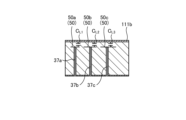
- FIG. 2A is a cross-sectional view showing an example of the configuration of the main body part 111 of the substrate support part 11.
- FIG. 2A shows a schematic cross-section of the main body part 111.
- the main body part 111 has an electrostatic chuck 1111 provided on a base 1110.
- the plurality of electrodes 50 are different in at least one of the depth from the annular region 111b and the area of the surface facing the ring assembly 112 so that the electrostatic capacitance between the plurality of electrodes 50 and the ring assembly 112 is different from each other. That is, the plurality of electrodes 50 are different in at least one of the distance from the ring assembly 112 and the area of the surface facing the ring assembly 112.
- the plurality of electrodes 50 are arranged so as not to overlap each other.
- 2B is an enlarged view of a portion of the electrodes 50 of the electrostatic chuck 1111. In FIG. 2A and FIG. 2B, three electrodes 50a-50c are provided in a portion facing the ring assembly 112 inside the ceramic member 1111a.
- the electrodes 50a-50c are provided at different depths from the annular region 111b.
- the capacitances between the electrodes 50a-50c and the ring assembly 112 are shown as capacitances C L1 -C L3 .
- the electrodes 50a-50c may be formed with the same area or different areas as long as the capacitances C L1 -C L3 between the electrodes 50a-50c and the ring assembly 112 are different.
- the electrodes 50a-50c are formed with the same area and are arranged in the order of the electrodes 50a-50c from the annular region 111b.
- the distance from the ring assembly 112 is the largest for the electrode 50a, the smallest for the electrode 50c, and the size of the electrode 50b is between the electrodes 50a and 50c. Therefore, the capacitances C L1 -C L3 are C L1 >C L2 >C L3 .
- the order of increasing distance from the ring assembly 112 is not limited to the order of the electrodes 50a-50c.
- the distance between the electrodes 50a-50c and the ring assembly 112 may be increased in the order of the electrodes 50a-50c, or may be increased in the order of the electrodes 50a, 50c, and 50b. In other words, the order of increasing distance between the electrodes 50a, 50c, and 50b and the ring assembly 112 may be arbitrarily reversed.
- the second RF generating unit 31b supplies a bias RF signal to the base 1110 via the wiring 34.
- the impedance matching circuit 35 matches the impedance on the second RF generating unit 31b side with the impedance on the load side. By performing matching using the impedance matching circuit 35, it is possible to suppress power losses such as reflection of the bias RF signal and heat generation in the impedance matching circuit 35.
- the bias RF signal supplied to the base 1110 is supplied to the electrostatic electrode 1111b via wiring 36, and is supplied to the switch mechanism 38 via wiring 39.
- the switch mechanism 38 is configured to be able to supply the bias RF signal supplied from the second RF generating unit 31b to the electrodes 50a-50c individually via the wiring 37a-37c.
- the switch mechanism 38 is configured to incorporate switches individually connected to the wiring 37a-37c, and to be able to supply the bias RF signal individually to the electrodes 50a-50c via the wiring 37a-37c by switching each switch between On and Off.
- a bidirectional switch can be used as the switch.
- the switch mechanism 38 corresponds to the switch unit of the present disclosure.
- the control unit 2 is connected to the switch mechanism 38.
- the control unit 2 controls the switch mechanism 38.
- the control unit 2 outputs a signal that controls the On/Off state of each switch of the switch mechanism 38.
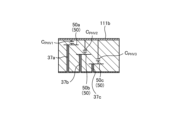
- FIG. 3A is a cross-sectional view showing another example of the configuration of the main body 111 of the substrate support 11.
- FIG. 3B is an enlarged view of the plurality of electrodes 50 of the electrostatic chuck 1111.
- three electrodes 50a-50c are provided in a portion facing the ring assembly 112 inside the ceramic member 1111a.
- the electrodes 50a-50c are formed such that the areas of the surfaces facing the ring assembly 112 are large in the order of the electrodes 50a-50c, and are provided at the same depth from the annular region 111b.
- the capacitances between the electrodes 50a-50c and the ring assembly 112 are indicated as C L1 -C L3 . Since the areas of the faces of the electrodes 50a-50c facing the ring assembly 112 are formed in the order of increasing area, the capacitances C L1 -C L3 are C L1 > C L2 > C L3 .
- the order of increasing area of the faces of the electrodes 50a-50c facing the ring assembly 112 is not limited to the order of the electrodes 50a-50c.
- the areas of the faces of the electrodes 50a-50c facing the ring assembly 112 may be formed in the order of decreasing area of the electrodes 50a-50c, or may be formed in the order of decreasing area of the electrodes 50a, 50c, and 50b. In other words, the order of increasing area of the faces of the electrodes 50a-50c facing the ring assembly 112 may be arbitrarily reversed.
- FIG. 4 is a circuit diagram showing an example of the configuration of the plasma processing apparatus 1.
- FIG. 4 shows an equivalent circuit showing the electrical characteristics of the path through which the bias RF signal flows for the plasma processing apparatus 1.
- the bias RF signal flows from the second RF generating unit 31b to the wiring 34.
- An impedance matching circuit 35 provided in the wiring 34 matches the impedance between the second RF generating unit 31b side and the load side.
- the wiring 34 branches into paths 60a and 60b.
- the path 60a shows the electrical characteristics of the central region 111a of the base 1110.
- the path 60b shows the electrical characteristics of the annular region 111b of the base 1110.
- the electrostatic capacitance Cstage of the path 60a indicates the electrostatic capacitance between the central region 111a of the base 1110 and the substrate W.
- the resistor 61a and capacitor 61b of the path 60a indicate the electrical characteristics of the plasma in the central region 111a.
- Capacitances C L1 -C L3 of the path 60b represent the capacitance between the electrodes 50a-50c of the annular region 111b and the ring assembly 112.
- Capacitance C base of the path 60b represents the capacitance between the annular region 111b portion of the base 1110 and the ring assembly 112.
- Switches SW1-SW3 represent the switches of the switch mechanism 38 connected to the electrodes 50a-50c, respectively.
- Resistor 62a and capacitor 62b of the path 60b represent the electrical characteristics of the plasma in the annular region 111b portion.
- the capacitances C L1 -C L3 connected in parallel to the capacitance C base are switched by turning on and off the switches SW1 -SW3, and the overall capacitance changes. This causes the potential of the ring assembly 112 to change.
- FIG. 5 is a diagram for explaining the model used in the simulation.
- FIG. 5 shows a model 80 simulating the electrostatic chuck 1111, the base 1110, the ring assembly 112, and the substrate W.
- the model 80 is provided with a line 81 simulating the electrostatic electrode 1111b, lines 82a-82c simulating the electrodes 50a-50c, and a line 83 simulating the base 1110.
- the line 82a is provided at a position 0.35 mm from the surface 86 corresponding to the annular region 111b of the electrostatic chuck 1111.
- the line 82b is provided at a position 1.75 mm from the surface 86.
- the line 82c is provided at a position 3.15 mm from the surface 86.
- the line 83 is provided at a position 4.5 mm below the surface 86.
- the lines 81 and 83 are connected by a line 84.
- the lines 82a-82c and the line 83 are connected by a line 85.
- the simulated cases are indicated as "BASE”, “BTM”, “MID”, and "TOP”.
- the lines 81-85 indicate the parts where the bias RF signal is flowing with a solid line, and the cases where the bias RF signal is not flowing with a dashed line.
- the lines 81, 83, and 84 are indicated with a solid line, and the lines 82a-82c and 85 are indicated with a wavy line.
- BASE indicates a case where the bias RF signal flows to the electrostatic electrode 1111b and the base 1110, and the bias RF signal does not flow to the electrodes 50a-50c.
- TOP shows the case where a bias RF signal flows through the electrostatic electrode 1111b, the electrode 50a, and the base 1110, but no bias RF signal flows through the electrodes 50b and 50c.
- BASE corresponds to the equivalent circuit shown in FIG. 4 with switches SW1-SW3 all turned off.
- BTM corresponds to the equivalent circuit shown in FIG. 4 with switch SW3 turned on and switches SW1 and SW2 turned off.
- MID corresponds to the equivalent circuit shown in FIG. 4 with switch SW2 turned on and switches SW1 and SW3 turned off.
- TOP corresponds to the equivalent circuit shown in FIG. 4 with switch SW1 turned on and switches SW2 and SW3 turned off.
- Figure 6 is a diagram explaining the simulation results.
- Figure 6 shows the voltage (substrate voltage) of the substrate W portion of model 80 and the voltage (FR voltage) of the ring assembly 112 portion when simulating the cases of BASE, BTM, MID, and TOP.
- the substrate voltage and FR voltage are shown as negative peak voltages generated by the bias RF signal.
- the voltage (substrate voltage) of the substrate W portion changes little at BASE, BTM, MID, and TOP, with a change of 0.4%.
- the voltage (FR voltage) of the ring assembly 112 portion changes greatly at BASE, BTM, MID, and TOP, with a change of 3.2%.
- the frequency of the bias RF signal is in the range of 100 kHz to 60 MHz.
- the lower the frequency of the bias RF signal the less effective it is at controlling the potential of the ring assembly 112. For example, if the frequency of the bias RF signal is 400 kHz, the conventional method cannot sufficiently change the potential of the ring assembly 112.
- the plasma processing apparatus 1 can change the potential of the ring assembly 112 without providing a lifting mechanism by having the control unit 2 control the switch mechanism 38 to change the electrodes 50a-50c through which the bias RF signal flows. Furthermore, even if the bias RF signal is a low frequency, the plasma processing apparatus 1 can sufficiently change the potential of the ring assembly 112 by having the control unit 2 control the switch mechanism 38 to change the electrodes 50a-50c through which the bias RF signal flows.
- the plasma processing apparatus 1 can control the height of the plasma sheath surface around the periphery of the substrate W. This allows the plasma processing apparatus 1 to change the processing characteristics of the plasma processing around the periphery of the substrate W. For example, the plasma processing apparatus 1 can change the angle of the holes around the periphery of the substrate W when performing plasma etching as the plasma processing.
- Figure 7 is a diagram explaining the changes in processing characteristics of plasma processing.
- Figure 7 shows the angle of holes on the periphery (140-150 mm) of substrate W when plasma etching is performed on a substrate W with a radius of 150 mm in each of the cases of BASE, BTM, MID, and TOP.
- BASE BASE
- MID MID
- TOP TOP
- the control unit 2 controls the switch mechanism 38 to change the potential of the ring assembly 112, thereby controlling the processing characteristics of the plasma processing of the peripheral portion of the substrate W. For example, in the plasma processing apparatus 1, when the upper surface of the ring assembly 112 is worn away by plasma etching, the plasma sheath surface of the peripheral portion of the substrate W is lowered, and tilting occurs in the peripheral portion of the substrate W. Therefore, the control unit 2 controls the switch mechanism 38 to supply a bias RF signal to the electrode having a large capacitance with the ring assembly 112 according to the wear of the ring assembly 112. In the plasma processing apparatus 1, the tilting of the hole formed in the substrate W gradually increases due to repeated plasma processing and cleaning of the substrate W, and exceeds the allowable range.
- the control unit 2 adjusts the potential of the ring assembly 112 when the tilting reaches a predetermined threshold value, although it is within the allowable range.
- the control unit 2 controls the switch mechanism 38 to supply a bias RF signal to the electrode having a large capacitance with the ring assembly 112 each time a predetermined number of substrates W are plasma etched at which the tilting exceeds the allowable range.
- the control unit 2 controls the switch mechanism 38 to supply a bias RF signal to electrode 50b or electrode 50b. This makes it possible to raise the sheath surface of the plasma around the periphery of the substrate W, thereby suppressing the occurrence of tilting around the periphery of the substrate W.
- the control unit 2 may control the switch mechanism 38 to change the potential of the ring assembly 112 depending on the plasma processing to be performed. For example, when processes A and B are performed as plasma processing, the control unit 2 may control the switch mechanism 38 to change the potential of the ring assembly 112 between processes A and B. The control unit 2 may also control the switch mechanism 38 during plasma processing to change the potential of the ring assembly 112. When increasing the potential of the ring assembly 112, the control unit 2 controls the switch mechanism 38 to supply a bias RF signal to an electrode having a large capacitance with the ring assembly 112. When decreasing the potential of the ring assembly 112, the control unit 2 controls the switch mechanism 38 to supply a bias RF signal to an electrode having a small capacitance with the ring assembly 112. In this way, the plasma processing apparatus 1 can change the potential of the ring assembly 112 depending on the plasma processing to be performed.
- FIG. 8 is a flowchart showing an example of the process flow of the potential control method.
- the process illustrated in FIG. 8 is realized by the processing unit 2a1 of the control unit 2 reading a program from the memory unit 2a2 and executing the read program when changing the potential of the ring assembly 112.
- the control unit 2 executes the process when the potential of the ring assembly 112 is changed significantly each time a predetermined number of substrates W are plasma etched at which point tilting exceeds the tolerable range.
- the processing unit 2a1 also executes the process when the potential of the ring assembly 112 is changed to a larger or smaller value depending on the plasma process being performed.
- the processing unit 2a1 determines whether to significantly change the potential of the ring assembly 112 (S10). If the potential of the ring assembly 112 is to be significantly changed (S10: Yes), the processing unit 2a1 controls the switch mechanism 38 to supply a bias RF signal to the electrode 50 that has a large capacitance with the ring assembly 112 (S11), and ends the process.
- the processing unit 2a1 determines whether to change the potential of the ring assembly 112 to a smaller value (S12). If the potential of the ring assembly 112 is to be changed to a smaller value (S12: Yes), the processing unit 2a1 controls the switch mechanism 38 to supply a bias RF signal to the electrode 50 that has a smaller capacitance with the ring assembly 112 (S13), and ends the process.
- Electrodes 50a-50c are provided in the portion of the ceramic member 1111a that faces the ring assembly 112.
- the number of electrodes 50 may be two, or may be four or more.
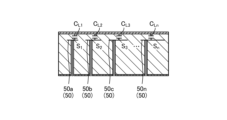
- FIG. 9A is a diagram showing another example of the arrangement of electrodes.
- n electrodes 50a-50n are provided in a portion facing the ring assembly 112 inside the ceramic member 1111a.
- the electrodes 50a-50n are provided at the same depth from the annular region 111b.
- the electrodes 50a-50n are formed so that the areas S 1 -S n of the surfaces facing the ring assembly 112 are different, and the ratio of the areas is 2 n-1 .
- the electrodes 50a-50n are each connected to a switch mechanism 38.
- the switch mechanism 38 has built-in switches that are individually conductive to the electrodes 50a-50n, and is configured to be able to supply a bias RF signal to the electrodes 50a-50n by switching each switch between On and Off.
- the control unit 2 controls the On and Off of each switch of the switch mechanism 38 so as to supply a bias RF signal to one or more electrodes 50.
- FIG. 9B is a diagram showing an example of a combination of On and Off of the switches. 9B shows the areas S 1 -S n of 50a-50n and the On/Off states of the conductive switches for each On/Off pattern of each switch. The On/Off states of the switches are indicated by a circle indicating the On portion.
- FIG. 9B is a diagram showing an example of a combination of On and Off of the switches. 9B shows the areas S 1 -S n of 50a-50n and the On/Off states of the conductive switches for each On/Off pattern of each switch. The On/Off states of the switches are indicated by a circle indicating
- FIG. 9B also shows the total area of the electrodes 50 to which the bias RF signal is supplied by the switches that are turned On.
- the total area of the electrodes 50 is indicated by a ratio to the area S 1.
- the On/Off patterns of each switch are determined so that the ratio of the total area of the electrodes 50 to which the bias RF signal is supplied increases by 1. This allows the total capacitance between the electrodes 50 whose switches are turned on and the ring assembly 112 to be changed in stages at constant intervals, thereby allowing the potential of the ring assembly to be controlled in stages.
- a case has been described in which a plurality of electrodes 50 are formed in an annular shape corresponding to the annular region 111b of the electrostatic chuck 1111, and the potential of the entire annular region 111b is controlled.
- the annular region 111b of the electrostatic chuck 1111 may be divided into a plurality of zones, and a plurality of electrodes 50 may be provided in each zone, allowing the potential to be controlled for each zone.
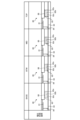
- FIG. 10A is a diagram showing an example in which the annular region 111b of the electrostatic chuck 1111 is divided into multiple zones 90.
- FIG. 10A shows a case in which the annular region 111b is divided into n zones 90 in the circumferential direction. In this case, multiple electrodes 50 and a switch mechanism 38 are provided for each zone 90. In each zone 90, multiple electrodes 50 are arranged according to the shape of the zone 90.
- FIG. 10B is a cross-sectional view showing an example of the configuration of the main body 111 when multiple electrodes 50 are provided for each zone 90. In FIG. 10B, three electrodes 50a-50c and a switch mechanism 38 are provided in each of zones 3 and n.
- the control unit 2 can control the potential for each zone 90 of the annular region 111b by controlling the On/Off of each switch of the switch mechanism 38 of each zone 90.
- the plasma processing system includes a plasma processing chamber 10, an electrostatic chuck 1111 (stage), a plurality of electrodes 50, a power supply, a switch mechanism 38 (switch unit), and a control unit 2.
- the plasma processing chamber 10 is configured to be capable of generating plasma therein.
- the electrostatic chuck 1111 is disposed in the plasma processing chamber 10 and is formed of a dielectric material.
- the electrostatic chuck 1111 is configured to be capable of mounting a substrate W thereon and to mount a ring assembly 112 around the substrate W.
- the plurality of electrodes 50 are provided in a portion of the electrostatic chuck 1111 facing the ring assembly 112.
- the power supply is configured to be capable of supplying bias power for attracting charged particles in the plasma.
- the switch mechanism 38 is configured to be capable of supplying bias power supplied from the power supply to the plurality of electrodes 50 individually.
- the control unit 2 controls the switch mechanism 38. This allows the plasma processing system to control the potential of the ring assembly 112 without providing a lifting mechanism.
- the electrodes 50 may be provided at different depths from the annular region 111b on which the ring assembly 112 of the electrostatic chuck 1111 is placed.
- the electrodes 50 may be provided at the same depth from the annular region 111b on which the ring assembly 112 of the electrostatic chuck 1111 is placed.
- the electrodes 50 may be formed to have the same area.
- the electrodes 50 may be formed to have different areas.
- the plasma processing system can change the capacitance between the electrodes 50 and the ring assembly 112 by changing the depths or areas of the electrodes 50 from the annular region 111b.
- the plasma processing system can control the potential of the ring assembly 112 by changing the number of electrodes 50 that supply bias power, even if the capacitance between the electrodes 50 and the ring assembly 112 is the same.
- the number of electrodes 50 is n (n is a natural number of 2 or more), and the ratio of the areas of the electrodes 50 is 2 n-1 . This allows the plasma processing system to gradually change the total capacitance between the ring assembly 112 at constant intervals, thereby allowing the potential of the ring assembly to be gradually controlled.
- control unit 2 controls the switch mechanism 38 to supply bias power to the electrode 50 having a large capacitance with the ring assembly 112, and when the potential of the ring assembly 112 is to be decreased, the control unit 2 controls the switch mechanism 38 to supply bias power to the electrode 50 having a small capacitance with the ring assembly 112. This allows the plasma processing system to control the potential of the ring assembly 112.
- the control unit 2 also controls the switch mechanism 38 to supply bias power to the electrode 50 that has a large capacitance with the ring assembly 112 in response to wear of the ring assembly 112. This allows the plasma processing system to suppress tilting from occurring around the periphery of the substrate W.
- a chamber configured to be capable of generating plasma therein; a stage that is disposed within the chamber and is made of a dielectric material, and that is configured so that a substrate can be placed thereon and a ring assembly can be placed around the substrate; a plurality of electrodes provided in a portion inside the stage facing the ring assembly; A power source configured to supply bias power for attracting charged particles in the plasma; a switch unit configured to be able to supply bias power supplied from the power source to the plurality of electrodes individually; A control unit that controls the switch unit;
- a plasma processing apparatus comprising:
- Appendix 10 The plasma processing apparatus according to any one of appendices 1 to 9, wherein the power supply is a high-frequency power supply capable of supplying high-frequency power as the bias power.
- Appendix 11 The plasma processing apparatus according to any one of appendices 1 to 9, wherein the power supply is a DC power supply capable of generating a pulsed voltage as the bias power.
- a chamber configured to be capable of generating plasma therein; a stage that is disposed within the chamber and is made of a dielectric material, and that is configured so that a substrate can be placed thereon and a ring assembly can be placed around the substrate; a plurality of electrodes provided in a portion inside the stage facing the ring assembly; A power source configured to supply bias power for attracting charged particles in the plasma; a switch unit configured to be able to supply bias power supplied from the power source to the plurality of electrodes individually; A control unit that controls the switch unit; A potential control method in a plasma processing apparatus comprising: A potential control method in which the control unit controls the switch unit to supply the bias power to an electrode having a large capacitance with the ring assembly when increasing the potential of the ring assembly, and controls the switch unit to supply the bias power to an electrode having a small capacitance with the ring assembly when decreasing the potential of the ring assembly.
Landscapes
- Physics & Mathematics (AREA)
- Engineering & Computer Science (AREA)
- Plasma & Fusion (AREA)
- Chemical & Material Sciences (AREA)
- Analytical Chemistry (AREA)
- Electromagnetism (AREA)
- Spectroscopy & Molecular Physics (AREA)
- Drying Of Semiconductors (AREA)
- Chemical Vapour Deposition (AREA)
Priority Applications (3)
| Application Number | Priority Date | Filing Date | Title |
|---|---|---|---|
| JP2025529638A JPWO2025004843A1 (https=) | 2023-06-27 | 2024-06-14 | |
| CN202480041221.5A CN121359625A (zh) | 2023-06-27 | 2024-06-14 | 等离子体处理装置和电位控制方法 |
| US19/415,795 US20260100340A1 (en) | 2023-06-27 | 2025-12-11 | Plasma processing apparatus and potential control method |
Applications Claiming Priority (2)
| Application Number | Priority Date | Filing Date | Title |
|---|---|---|---|
| JP2023-105013 | 2023-06-27 | ||
| JP2023105013 | 2023-06-27 |
Related Child Applications (1)
| Application Number | Title | Priority Date | Filing Date |
|---|---|---|---|
| US19/415,795 Continuation US20260100340A1 (en) | 2023-06-27 | 2025-12-11 | Plasma processing apparatus and potential control method |
Publications (1)
| Publication Number | Publication Date |
|---|---|
| WO2025004843A1 true WO2025004843A1 (ja) | 2025-01-02 |
Family
ID=93938899
Family Applications (1)
| Application Number | Title | Priority Date | Filing Date |
|---|---|---|---|
| PCT/JP2024/021603 Ceased WO2025004843A1 (ja) | 2023-06-27 | 2024-06-14 | プラズマ処理装置及び電位制御方法 |
Country Status (5)
| Country | Link |
|---|---|
| US (1) | US20260100340A1 (https=) |
| JP (1) | JPWO2025004843A1 (https=) |
| CN (1) | CN121359625A (https=) |
| TW (1) | TW202520337A (https=) |
| WO (1) | WO2025004843A1 (https=) |
Citations (9)
| Publication number | Priority date | Publication date | Assignee | Title |
|---|---|---|---|---|
| JP2010283028A (ja) * | 2009-06-02 | 2010-12-16 | Tokyo Electron Ltd | プラズマ処理装置,プラズマ処理方法,プログラム |
| JP2017055100A (ja) * | 2015-07-13 | 2017-03-16 | ラム リサーチ コーポレーションLam Research Corporation | エッジに限局されたイオン軌道制御及びプラズマ動作を通じた、最端エッジにおけるシース及びウエハのプロフィール調整 |
| US20190013184A1 (en) * | 2017-07-10 | 2019-01-10 | Applied Materials, Inc. | Apparatus and methods for manipulating radio frequency power at an edge ring in plasma process device |
| JP2021044540A (ja) * | 2019-09-09 | 2021-03-18 | 東京エレクトロン株式会社 | 基板支持器及びプラズマ処理装置 |
| JP2021150056A (ja) * | 2020-03-17 | 2021-09-27 | 東京エレクトロン株式会社 | プラズマ処理装置 |
| JP2021158134A (ja) * | 2020-03-25 | 2021-10-07 | 東京エレクトロン株式会社 | 基板支持器及びプラズマ処理装置 |
| JP2023521756A (ja) * | 2020-04-10 | 2023-05-25 | アプライド マテリアルズ インコーポレイテッド | プラズマ処理装置のエッジリングにおける電力を操作するための装置及び方法 |
| JP2023130043A (ja) * | 2022-03-07 | 2023-09-20 | 東京エレクトロン株式会社 | 載置台及び基板処理装置 |
| JP2024013617A (ja) * | 2022-07-20 | 2024-02-01 | 東京エレクトロン株式会社 | 基板処理装置 |
-
2024
- 2024-06-14 JP JP2025529638A patent/JPWO2025004843A1/ja active Pending
- 2024-06-14 CN CN202480041221.5A patent/CN121359625A/zh active Pending
- 2024-06-14 WO PCT/JP2024/021603 patent/WO2025004843A1/ja not_active Ceased
- 2024-06-25 TW TW113123477A patent/TW202520337A/zh unknown
-
2025
- 2025-12-11 US US19/415,795 patent/US20260100340A1/en active Pending
Patent Citations (9)
| Publication number | Priority date | Publication date | Assignee | Title |
|---|---|---|---|---|
| JP2010283028A (ja) * | 2009-06-02 | 2010-12-16 | Tokyo Electron Ltd | プラズマ処理装置,プラズマ処理方法,プログラム |
| JP2017055100A (ja) * | 2015-07-13 | 2017-03-16 | ラム リサーチ コーポレーションLam Research Corporation | エッジに限局されたイオン軌道制御及びプラズマ動作を通じた、最端エッジにおけるシース及びウエハのプロフィール調整 |
| US20190013184A1 (en) * | 2017-07-10 | 2019-01-10 | Applied Materials, Inc. | Apparatus and methods for manipulating radio frequency power at an edge ring in plasma process device |
| JP2021044540A (ja) * | 2019-09-09 | 2021-03-18 | 東京エレクトロン株式会社 | 基板支持器及びプラズマ処理装置 |
| JP2021150056A (ja) * | 2020-03-17 | 2021-09-27 | 東京エレクトロン株式会社 | プラズマ処理装置 |
| JP2021158134A (ja) * | 2020-03-25 | 2021-10-07 | 東京エレクトロン株式会社 | 基板支持器及びプラズマ処理装置 |
| JP2023521756A (ja) * | 2020-04-10 | 2023-05-25 | アプライド マテリアルズ インコーポレイテッド | プラズマ処理装置のエッジリングにおける電力を操作するための装置及び方法 |
| JP2023130043A (ja) * | 2022-03-07 | 2023-09-20 | 東京エレクトロン株式会社 | 載置台及び基板処理装置 |
| JP2024013617A (ja) * | 2022-07-20 | 2024-02-01 | 東京エレクトロン株式会社 | 基板処理装置 |
Also Published As
| Publication number | Publication date |
|---|---|
| CN121359625A (zh) | 2026-01-16 |
| JPWO2025004843A1 (https=) | 2025-01-02 |
| TW202520337A (zh) | 2025-05-16 |
| US20260100340A1 (en) | 2026-04-09 |
Similar Documents
| Publication | Publication Date | Title |
|---|---|---|
| JP6953133B2 (ja) | 容量結合型プラズマ処理装置のエッジリングのrf振幅の制御 | |
| US8440050B2 (en) | Plasma processing apparatus and method, and storage medium | |
| JP2022018776A (ja) | プラズマ処理装置及びプラズマ処理方法 | |
| KR102825584B1 (ko) | 플라즈마 처리 장치 및 플라즈마 처리 방법 | |
| US20250183012A1 (en) | Plasma processing apparatus and electrostatic chuck | |
| KR20230073996A (ko) | 기판 처리 장치 및 기판 처리 방법 | |
| JP7419611B1 (ja) | 伝熱ガスのリーク量低減方法 | |
| JP7826142B2 (ja) | プラズマ処理装置及びエッチング方法 | |
| US20250364212A1 (en) | Plasma processing apparatus | |
| JP2021176187A (ja) | プラズマ処理装置及びプラズマ処理方法 | |
| JP7648307B2 (ja) | シャワーヘッド及びプラズマ処理装置 | |
| WO2025004843A1 (ja) | プラズマ処理装置及び電位制御方法 | |
| KR20230026286A (ko) | 플라즈마 처리 장치 및 에칭 방법 | |
| JP2025004870A (ja) | 基板支持器及びプラズマ処理装置 | |
| US20260088250A1 (en) | Plasma processing apparatus | |
| US20240222090A1 (en) | Plasma processing apparatus | |
| WO2024225034A1 (ja) | プラズマ処理装置及び吸着制御方法 | |
| WO2026004597A1 (ja) | プラズマ処理装置 | |
| WO2024257401A1 (ja) | プラズマ処理装置 | |
| WO2025009468A1 (ja) | プラズマ処理装置、制御方法、及び制御プログラム | |
| JP2025127899A (ja) | プラズマ処理装置 | |
| JP2023064225A (ja) | 基板支持部、プラズマ処理装置及びプラズマ処理方法 | |
| WO2025135037A1 (ja) | プラズマ処理方法及びプラズマ処理装置 | |
| JP2025032620A (ja) | プラズマ処理装置 | |
| WO2025258390A1 (ja) | クリーニング方法及びプラズマ処理装置 |
Legal Events
| Date | Code | Title | Description |
|---|---|---|---|
| 121 | Ep: the epo has been informed by wipo that ep was designated in this application |
Ref document number: 24831708 Country of ref document: EP Kind code of ref document: A1 |
|
| ENP | Entry into the national phase |
Ref document number: 2025529638 Country of ref document: JP Kind code of ref document: A |
|
| WWE | Wipo information: entry into national phase |
Ref document number: 2025529638 Country of ref document: JP |
|
| NENP | Non-entry into the national phase |
Ref country code: DE |