WO2025004409A1 - タイヤ用ゴム組成物及びタイヤ - Google Patents
タイヤ用ゴム組成物及びタイヤ Download PDFInfo
- Publication number
- WO2025004409A1 WO2025004409A1 PCT/JP2023/043881 JP2023043881W WO2025004409A1 WO 2025004409 A1 WO2025004409 A1 WO 2025004409A1 JP 2023043881 W JP2023043881 W JP 2023043881W WO 2025004409 A1 WO2025004409 A1 WO 2025004409A1
- Authority
- WO
- WIPO (PCT)
- Prior art keywords
- group
- rubber composition
- norbornene
- mass
- copolymer
- Prior art date
- Legal status (The legal status is an assumption and is not a legal conclusion. Google has not performed a legal analysis and makes no representation as to the accuracy of the status listed.)
- Ceased
Links
Classifications
-
- B—PERFORMING OPERATIONS; TRANSPORTING
- B60—VEHICLES IN GENERAL
- B60C—VEHICLE TYRES; TYRE INFLATION; TYRE CHANGING; CONNECTING VALVES TO INFLATABLE ELASTIC BODIES IN GENERAL; DEVICES OR ARRANGEMENTS RELATED TO TYRES
- B60C1/00—Tyres characterised by the chemical composition or the physical arrangement or mixture of the composition
-
- C—CHEMISTRY; METALLURGY
- C08—ORGANIC MACROMOLECULAR COMPOUNDS; THEIR PREPARATION OR CHEMICAL WORKING-UP; COMPOSITIONS BASED THEREON
- C08G—MACROMOLECULAR COMPOUNDS OBTAINED OTHERWISE THAN BY REACTIONS ONLY INVOLVING UNSATURATED CARBON-TO-CARBON BONDS
- C08G61/00—Macromolecular compounds obtained by reactions forming a carbon-to-carbon link in the main chain of the macromolecule
- C08G61/02—Macromolecular compounds containing only carbon atoms in the main chain of the macromolecule, e.g. polyxylylenes
- C08G61/04—Macromolecular compounds containing only carbon atoms in the main chain of the macromolecule, e.g. polyxylylenes only aliphatic carbon atoms
- C08G61/06—Macromolecular compounds containing only carbon atoms in the main chain of the macromolecule, e.g. polyxylylenes only aliphatic carbon atoms prepared by ring-opening of carbocyclic compounds
- C08G61/08—Macromolecular compounds containing only carbon atoms in the main chain of the macromolecule, e.g. polyxylylenes only aliphatic carbon atoms prepared by ring-opening of carbocyclic compounds of carbocyclic compounds containing one or more carbon-to-carbon double bonds in the ring
-
- C—CHEMISTRY; METALLURGY
- C08—ORGANIC MACROMOLECULAR COMPOUNDS; THEIR PREPARATION OR CHEMICAL WORKING-UP; COMPOSITIONS BASED THEREON
- C08K—Use of inorganic or non-macromolecular organic substances as compounding ingredients
- C08K3/00—Use of inorganic substances as compounding ingredients
- C08K3/18—Oxygen-containing compounds, e.g. metal carbonyls
- C08K3/20—Oxides; Hydroxides
- C08K3/22—Oxides; Hydroxides of metals
-
- C—CHEMISTRY; METALLURGY
- C08—ORGANIC MACROMOLECULAR COMPOUNDS; THEIR PREPARATION OR CHEMICAL WORKING-UP; COMPOSITIONS BASED THEREON
- C08K—Use of inorganic or non-macromolecular organic substances as compounding ingredients
- C08K3/00—Use of inorganic substances as compounding ingredients
- C08K3/18—Oxygen-containing compounds, e.g. metal carbonyls
- C08K3/24—Acids; Salts thereof
-
- C—CHEMISTRY; METALLURGY
- C08—ORGANIC MACROMOLECULAR COMPOUNDS; THEIR PREPARATION OR CHEMICAL WORKING-UP; COMPOSITIONS BASED THEREON
- C08K—Use of inorganic or non-macromolecular organic substances as compounding ingredients
- C08K5/00—Use of organic ingredients
- C08K5/16—Nitrogen-containing compounds
- C08K5/34—Heterocyclic compounds having nitrogen in the ring
- C08K5/3467—Heterocyclic compounds having nitrogen in the ring having more than two nitrogen atoms in the ring
- C08K5/3477—Six-membered rings
-
- C—CHEMISTRY; METALLURGY
- C08—ORGANIC MACROMOLECULAR COMPOUNDS; THEIR PREPARATION OR CHEMICAL WORKING-UP; COMPOSITIONS BASED THEREON
- C08K—Use of inorganic or non-macromolecular organic substances as compounding ingredients
- C08K5/00—Use of organic ingredients
- C08K5/49—Phosphorus-containing compounds
-
- C—CHEMISTRY; METALLURGY
- C08—ORGANIC MACROMOLECULAR COMPOUNDS; THEIR PREPARATION OR CHEMICAL WORKING-UP; COMPOSITIONS BASED THEREON
- C08L—COMPOSITIONS OF MACROMOLECULAR COMPOUNDS
- C08L65/00—Compositions of macromolecular compounds obtained by reactions forming a carbon-to-carbon link in the main chain; Compositions of derivatives of such polymers
Definitions
- the present invention relates to a rubber composition for tires and a tire.
- a known method for improving abrasion resistance is to increase the amount of filler mixed in, but increasing the amount of filler mixed in leads to a problem that the filler becomes less dispersed, resulting in a worsening of fuel economy.
- Patent Documents 1 and 2 disclose rubber compounds for passenger car tires and rubber compounds for heavy-duty truck and bus tires that contain specific long-chain branched cyclopentene ring-opening rubber (LCB-CPR), and these rubber compounds are said to be effective in reducing tire rolling resistance, improving wet skid resistance, and improving abrasion resistance.
- LLB-CPR long-chain branched cyclopentene ring-opening rubber
- Patent Documents 1 and 2 After investigations, the inventors found that even with the technologies described in Patent Documents 1 and 2, it is difficult to achieve both low fuel consumption and high wear resistance in a tire, and that there is still room for improvement.
- an object of the present invention is to provide a rubber composition for tires that can solve the above-mentioned problems of the conventional techniques and achieve both low fuel consumption and high wear resistance for tires.
- Another object of the present invention is to provide a tire which achieves both low fuel consumption and high wear resistance.
- a rubber composition comprising a rubber component, a heterocyclic compound having a six-membered aromatic heterocycle, and a metal salt
- the rubber component is a compound represented by the following general formula (1): [wherein R 1 to R 4 each independently represent a hydrogen atom, a hydrocarbon group having 1 to 20 carbon atoms, or a substituent containing a halogen atom, a silicon atom, an oxygen atom, or a nitrogen atom, R 2 and R 3 may be bonded to each other to form a ring, and m is an integer of 0 to 2.]
- heterocyclic compound has at least one heterocyclic ring selected from the group consisting of a pyridine ring, a pyrimidine ring, a pyridazine ring, a pyrazine ring, a triazine ring, and a tetrazine ring.
- the heterocyclic compound is represented by the following general formula (2): [In the formula, X1 and X2 each independently represent a pyridyl group or a pyrimidinyl group, and Y1 and Y2 each independently represent a single bond or a divalent hydrocarbon group.].
- the rubber composition for a tire according to any one of [1] to [9].
- a tire comprising the rubber composition for tires described in any one of [1] to [12].
- the present invention it is possible to provide a rubber composition for tires that can achieve both low fuel consumption and high wear resistance for tires. Moreover, according to the present invention, a tire that achieves both low fuel consumption and high wear resistance can be provided.
- the compounds described herein may be derived in whole or in part from fossil sources, from biological sources such as plant sources, from recycled sources such as used tires, or from a mixture of two or more of fossil, biological and/or renewable sources.
- the rubber composition for tires of the present embodiment includes a rubber component, a heterocyclic compound having a six-membered aromatic heterocycle (also simply referred to as a "heterocyclic compound”), and a metal salt.
- the rubber component is a compound represented by the formula (1) below: [wherein R 1 to R 4 each independently represent a hydrogen atom, a hydrocarbon group having 1 to 20 carbon atoms, or a substituent containing a halogen atom, a silicon atom, an oxygen atom, or a nitrogen atom, R 2 and R 3 may be bonded to each other to form a ring, and m is an integer of 0 to 2.]
- the copolymer of cyclopentene and norbornene-based compounds is characterized by having crosslinking points and by the entanglement of polymer chains.
- a reinforcing layer made of the filler and the rubber component is formed around the filler, and the reinforcing layer contributes to improving the reinforcing properties of the rubber composition, thereby improving the abrasion resistance, etc.
- the rubber component contains the copolymer of cyclopentene and norbornene-based compounds, so that the reinforcing layer formed around the filler is specifically increased by the entanglement of the above-mentioned polymer chains, and the abrasion resistance can be sufficiently improved.
- the heterocyclic compound is added to the main chain of the rubber component.
- the rubber composition for tires of this embodiment contains a metal salt, and the metal salt forms a coordinate bond with the heterocyclic compound portion added to the main chain of the rubber component to form a complex. The metal salt forms multiple coordinate bonds, thereby crosslinking multiple rubber components.
- the crosslinking by the coordinate bond is a reversible crosslinking in which the bond (crosslinking) and dissociation (cleavage) are reversible, and is a weaker bond than the sulfur crosslinking in general crosslinked rubber, but has sufficient strength in a low strain region even if the rubber composition is subjected to strain.
- the rubber composition for tires of this embodiment can reduce hysteresis loss and improve fuel efficiency by maintaining a high network density by crosslinking by coordinate bonds in a low strain region. Therefore, by applying the rubber composition for tires of the present embodiment to tires, it is possible to achieve both low fuel consumption and high wear resistance for the tires.
- the rubber composition for a tire of the present embodiment contains a rubber component, and the rubber component provides rubber elasticity to the composition.
- the rubber component of the rubber composition for a tire of the present embodiment contains a copolymer of cyclopentene and a norbornene-based compound represented by the above general formula (1), and may further contain other rubbers.
- copolymer of cyclopentene and norbornene compounds contains a structural unit derived from cyclopentene and a structural unit derived from a norbornene-based compound represented by the above general formula (1).
- the copolymer of cyclopentene and a norbornene-based compound is a ring-opened copolymer, and in particular, a cyclopentene ring-opened copolymer.
- R 1 to R 4 each independently represent a hydrogen atom, a hydrocarbon group having 1 to 20 carbon atoms, or a substituent containing a halogen atom, a silicon atom, an oxygen atom, or a nitrogen atom
- R 2 and R 3 may be bonded to each other to form a ring
- m is an integer of 0 to 2.
- examples of the hydrocarbon group having 1 to 20 carbon atoms include alkyl groups such as a methyl group, an ethyl group, an n-propyl group, an isopropyl group, an n-butyl group, an isobutyl group, a sec-butyl group, a tert-butyl group, a neopentyl group, a hexyl group, and an octyl group; alkenyl groups such as a vinyl group, an allyl group, a 2-pentenyl group, a 3-pentenyl group, and a 4-methyl-3-pentenyl group; aryl groups such as a phenyl group, a tolyl group, a 2,6-dimethylphenyl group, a 2,6-diisopropylphenyl group, and a naphthyl group; and aralkyl groups such as a benzyl group and a phenethyl
- Examples of the norbornene-based compounds represented by the above general formula (1) include 2-norbornene, 5-methyl-2-norbornene, 5-ethyl-2-norbornene, 5-butyl-2-norbornene, 5-hexyl-2-norbornene, 5-decyl-2-norbornene, 5-cyclohexyl-2-norbornene, 5-cyclopentyl-2-norbornene, 5-ethylidene-2-norbornene, 5-vinyl-2-norbornene, 5-propenyl-2-norbornene, 5-cyclohexenyl-2-norbornene, 5-cyclopentenyl-2-norbornene, 5-phenyl-2-norbornene, tetracyclo[9.2.1.0 2,10 .
- bicyclo[2.2.1]hept-2 - enes such as tetracyclo[10.2.1.0 2,11 . 0 4,9 ]pentadeca-4,6,8,13-tetraene (also referred to as "1,4-methano-1,4,4a,9,9a,10-hexahydroanthracene"), dicyclopentadiene, methyldicyclopentadiene, and dihydrodicyclopentadiene (also referred to as "tricyclo[5.2.1.0 2,6 ]dec-8-ene”); Tetracyclo[6.2.1.1 3,6 .
- Bicyclo[2.2.1]hept-2-enes having an alkoxycarbonyl group such as methyl 5-norbornene-2-carboxylate, ethyl 5-norbornene-2-carboxylate, methyl 2-methyl-5-norbornene-2-carboxylate, and ethyl 2-methyl-5-norbornene-2-carboxylate; Tetracyclo[6.2.1.1 3,6 . 0 2,7 ]dodec-4-enes having an alkoxycarbonyl group, such as methyl tetracyclo[6.2.1.1 3,6 .
- dodec-4-enes having a hydroxycarbonyl group or an acid anhydride group Bicyclo[2.2.1]hept-2-enes having a hydroxyl group, such as 5-hydroxy-2-norbornene, 5-hydroxymethyl-2-norbornene, 5,6-di(hydroxymethyl)-2-norbornene, 5,5-di(hydroxymethyl)-2-norbornene, 5-(2-hydroxyethoxycarbonyl)-2-norbornene, and 5-methyl-5-(2-hydroxyethoxycarbonyl)-2-norbornene; Tetracyclo[6.2.1.1 3,6 .
- dodec-4-enes having a carbonyloxy group such as 9-tetracyclo[6.2.1.1 3,6 . 0 2,7 ] dodec-4-enyl acetate, 9-tetracyclo[6.2.1.1 3,6 . 0 2,7 ] dodec-4-enyl acrylate, and 9-tetracyclo[6.2.1.1 3,6 .
- Bicyclo[2.2.1]hept-2-enes having a functional group containing a silicon atom such as 5-trimethoxysilyl-2-norbornene and 5-triethoxysilyl-2-norbornene
- Examples of the norbornene-based compound include tetracyclo[6.2.1.1 3,6 . 0 2,7 ]dodec-4-enes having a functional group containing a silicon atom, such as 4-trimethoxysilyltetracyclo[6.2.1.1 3,6 . 0 2,7 ]dodec-9-ene and 4-triethoxysilyltetracyclo[6.2.1.1 3,6 . 0 2,7 ]dodec-9-ene.
- the norbornene-based compound may be used alone or in combination of two or more.
- the norbornene-based compound represented by the above general formula (1) is preferably one in which m is 0 or 1, and more preferably one in which m is 0.
- R 1 to R 4 may be the same or different.
- R 1 to R 4 in the above general formula (1) are a hydrogen atom, a chain hydrocarbon group having 1 to 20 carbon atoms, or a substituent containing a halogen atom, a silicon atom, an oxygen atom, or a nitrogen atom.
- R 1 to R 4 are not particularly limited as long as they are groups that are not bonded to each other and do not form a ring, and may be the same or different, and R 1 to R 4 are preferably a hydrogen atom or an alkyl group having 1 to 3 carbon atoms.
- m is 0 or 1
- R 1 to R 4 in the above general formula (1) are a hydrogen atom, a chain hydrocarbon group having 1 to 20 carbon atoms, or a substituent containing a halogen atom, a silicon atom, an oxygen atom, or a nitrogen atom
- unsubstituted or hydrocarbon-substituted bicyclo[2.2.1]hept-2-enes are preferred, and among these, 2-norbornene is particularly preferred.
- a compound in which R 2 and R 3 are bonded to each other to form a ring is also preferred.
- specific examples of the ring structure formed by R 2 and R 3 being bonded to each other include a cyclopentane ring, a cyclopentene ring, a cyclohexane ring, a cyclohexene ring, a benzene ring, etc., which may form a polycyclic structure, and may further have a substituent.
- a cyclopentane ring, a cyclopentene ring, and a benzene ring are preferred, and in particular, a compound having a cyclopentene ring alone, or a compound having a polycyclic structure of a cyclopentane ring and a benzene ring is preferred.
- R 1 and R 4 other than R 2 and R 3 forming a ring structure may be the same or different, and are preferably a hydrogen atom or an alkyl group having 1 to 3 carbon atoms. In this case, it is preferable that m is 0.
- the copolymer of cyclopentene and a norbornene-based compound preferably has a content of cyclopentene-derived structural units of 20 to 75 mass%, more preferably 25 to 70 mass%, even more preferably 30 to 65 mass%, and particularly preferably 35 to 60 mass%, based on all repeating structural units of the copolymer.
- the copolymer of cyclopentene and a norbornene-based compound preferably contains structural units derived from a norbornene-based compound represented by the above general formula (1) in a proportion of 10 to 80 mass %, more preferably 20 to 70 mass %, even more preferably 25 to 65 mass %, and particularly preferably 40 to 65 mass %, based on all repeating structural units of the copolymer.
- the norbornene-based compound represented by the above general formula (1) is preferably 2-norbornene and/or dicyclopentadiene. Since 2-norbornene and dicyclopentadiene are easily available, a copolymer of cyclopentene and 2-norbornene and/or dicyclopentadiene is also easily available. Therefore, a rubber composition for tires containing a copolymer of cyclopentene and 2-norbornene and/or dicyclopentadiene is advantageous in terms of cost.
- the copolymer of cyclopentene and a norbornene-based compound preferably contains 10 to 60 mass% of structural units derived from 2-norbornene relative to the total repeating structural units of the copolymer, and more preferably 20 to 60 mass%.
- the copolymer of cyclopentene and a norbornene-based compound preferably has a content of dicyclopentadiene-derived structural units of 10 to 60 mass%, and more preferably 20 to 50 mass%, relative to the total repeating structural units of the copolymer.
- a terpolymer of cyclopentene (CP), 2-norbornene (NB), and dicyclopentadiene (DCPD) may be used as the copolymer of cyclopentene and a norbornene-based compound.
- the terpolymer of cyclopentene, 2-norbornene, and dicyclopentadiene is highly effective in improving the fuel economy of the rubber composition.
- the copolymer of cyclopentene and a norbornene compound may be a copolymer of cyclopentene and a norbornene compound represented by the general formula (1) with other monomers copolymerizable therewith.
- examples of such other monomers include cyclic monoolefins such as cyclopropene, cyclobutene, methylcyclopentene, cyclohexene, methylcyclohexene, cycloheptene, and cyclooctene; cyclic diolefins such as cyclohexadiene, methylcyclohexadiene, cyclooctadiene, and methylcyclooctadiene; and polycyclic cycloolefins having aromatic rings such as phenylcyclooctene, 5-phenyl-1,5-cyclooctadiene, and phenylcyclopentene.
- the content of structural units derived from other monomers in the copolymer of cyclopentene and a norbornene compound is preferably 40% by mass or less, more preferably 30% by mass or less, based on the total repeating structural units of the copolymer. It is particularly preferable that the copolymer does not substantially contain structural units derived from other monomers.
- the copolymer of cyclopentene and norbornene-based compound preferably has a weight average molecular weight (Mw) of 200,000 to 1,000,000, more preferably 200,000 to 800,000, even more preferably 200,000 to 700,000, and particularly preferably 200,000 to 600,000.
- Mw weight average molecular weight
- a copolymer having a weight average molecular weight (Mw) in the range of 200,000 to 1,000,000 is easy to manufacture and has good processability (workability).
- the weight average molecular weight (Mw) of the copolymer in the range of 200,000 to 1,000,000, the fuel economy and wear resistance of a rubber composition containing the copolymer can be further improved.
- the copolymer of cyclopentene and a norbornene-based compound preferably has a ratio of weight average molecular weight (Mw) to number average molecular weight (Mn) (Mw/Mn, also referred to as "molecular weight distribution") of 1.0 to 5.0, more preferably 1.5 to 2.9, even more preferably 1.5 to 2.5, and particularly preferably 1.5 to 2.3.
- Mw/Mn weight average molecular weight
- Mw/Mn number average molecular weight distribution
- the copolymer of cyclopentene and a norbornene-based compound preferably has a cis/trans ratio of 0/100 to 60/40, more preferably 5/95 to 55/45, even more preferably 10/90 to 50/50, and particularly preferably 15/85 to 39/61.
- the cis/trans ratio is the ratio of the cis structure and the trans structure of the double bond present in the repeating units constituting the copolymer of cyclopentene and a norbornene-based compound (cis/trans ratio).
- the copolymer of cyclopentene and a norbornene-based compound preferably has a glass transition temperature (Tg) of -80°C to 10°C, more preferably -75°C to 0°C, and even more preferably -70°C to -10°C.
- Tg glass transition temperature
- the glass transition temperature of the copolymer can be controlled, for example, by adjusting the type and amount of the norbornene-based compound used.
- the copolymer of cyclopentene and a norbornene compound may have a modified group at the polymer chain end.
- a modified end group By having such a modified end group, the affinity for silica and the like can be further increased, and the dispersibility of silica and the like in the rubber composition can be increased, and as a result, the processability (workability), fuel efficiency, and wear resistance of the rubber composition can be further improved.
- the modified group to be introduced into the polymer chain end of the copolymer is not particularly limited, but is preferably a modified group containing an atom selected from the group consisting of an atom of Group 15 of the periodic table, an atom of Group 16 of the periodic table, and a silicon atom.
- a modified group containing an atom selected from the group consisting of a nitrogen atom, an oxygen atom, a phosphorus atom, a sulfur atom, and a silicon atom is more preferable, and among these, a modified group containing an atom selected from the group consisting of a nitrogen atom, an oxygen atom, and a silicon atom is even more preferable.
- Examples of the modified group containing a nitrogen atom include an amino group, a pyridyl group, an imino group, an amide group, a nitro group, a urethane bond group, or a hydrocarbon group containing any of these groups.
- Examples of the modified group containing an oxygen atom include a hydroxyl group, a carboxylic acid group, an ether group, an ester group, a carbonyl group, an aldehyde group, an epoxy group, or a hydrocarbon group containing any of these groups.
- Examples of the modified group containing a silicon atom include an alkylsilyl group, an oxysilyl group, or a hydrocarbon group containing any of these groups.
- modified group containing a phosphorus atom examples include a phosphate group, a phosphino group, or a hydrocarbon group containing any of these groups.
- modified group containing a sulfur atom examples include a sulfonyl group, a thiol group, a thioether group, or a hydrocarbon group containing any of these groups.
- the modified group may also be a modified group containing a plurality of the above groups.
- amino groups, pyridyl groups, imino groups, amide groups, hydroxyl groups, carboxylic acid groups, aldehyde groups, epoxy groups, oxysilyl groups, and hydrocarbon groups containing any of these groups are preferred, and from the viewpoint of affinity for silica, etc., oxysilyl groups are particularly preferred.
- the oxysilyl group refers to a group having a silicon-oxygen bond.
- the oxysilyl group includes an alkoxysilyl group, an aryloxysilyl group, an acyloxy group, an alkylsiloxysilyl group, and an arylsiloxysilyl group.
- an alkoxysilyl group, an aryloxysilyl group, or a hydroxysilyl group obtained by hydrolysis of an acyloxy group can be mentioned.
- an alkoxysilyl group is preferred from the viewpoint of affinity with silica.
- the alkoxysilyl group is a group in which one or more alkoxy groups are bonded to a silicon atom, and specific examples thereof include a trimethoxysilyl group, a dimethoxymethylsilyl group, a methoxydimethylsilyl group, a methoxydichlorosilyl group, a triethoxysilyl group, a diethoxymethylsilyl group, an ethoxydimethylsilyl group, a dimethoxyethoxysilyl group, a methoxydiethoxysilyl group, and a tripropoxysilyl group.
- the introduction ratio of the modified group at the polymer chain end of the copolymer of cyclopentene and norbornene-based compound is not particularly limited, but is preferably 10% or more, more preferably 20% or more, even more preferably 30% or more, and particularly preferably 40% or more, as a percentage value of the number of copolymer chain ends into which the modified group is introduced/the total number of copolymer chain ends.
- the method for measuring the introduction ratio of the modified group at the polymer chain end is not particularly limited, but for example, in the case of introducing an oxysilyl group as the terminal modified group, it can be determined from the peak area ratio corresponding to the oxysilyl group determined by 1 H-NMR spectrum measurement and the number average molecular weight (Mn) determined by gel permeation chromatography (GPC).
- the copolymer of cyclopentene and a norbornene compound preferably has a Mooney viscosity (ML 1+4 , 100° C.) of 20-150, more preferably 22-120, and particularly preferably 25-90.
- the method for producing the copolymer of cyclopentene and a norbornene-based compound is not particularly limited, but an example thereof is a method in which cyclopentene and a norbornene-based compound represented by the above general formula (1) are copolymerized in the presence of a ring-opening polymerization catalyst.
- the ring-opening polymerization catalyst is not particularly limited as long as it can ring-open copolymerize cyclopentene with the norbornene-based compound represented by the above general formula (1), but ruthenium carbene complexes and halogen-containing Group 6 transition metal compounds of the periodic table (hereinafter also referred to as "Group 6 transition metal compounds of the periodic table"). These ring-opening polymerization catalysts may be used alone or in combination of two or more.
- the ruthenium carbene complexes include bis(tricyclohexylphosphine)benzylidene ruthenium dichloride, bis(triphenylphosphine)-3,3-diphenylpropenylidene ruthenium dichloride, bis(tricyclohexylphosphine)t-butylvinylidene ruthenium dichloride, dichloro-(3-phenyl-1H-inden-1-ylidene)bis(tricyclohexylphosphine)ruthenium, bis(1,3-diisopropylimidazolin-2-ylidene)benzylidene ruthenium dichloride, bis(1,3-dicyclohexylimidazolin-2-ylidene)benzylidene ruthenium dichloride, and bis(1,3-dicyclohexylimidazolin-2-ylidene)benzylidene ruthenium dichloride
- Examples include (1,3-dimesitylimidazolin-2-ylidene)benzylidene ruthenium dichloride, (1,3-dimesitylimidazolin-2-ylidene)(tricyclohexylphosphine)benzylidene ruthenium dichloride, (1,3-dimesitylimidazolin-2-ylidene)(tricyclohexylphosphine)benzylidene ruthenium dichloride, bis(tricyclohexylphosphine)ethoxymethylidene ruthenium dichloride, (1,3-dimesitylimidazolin-2-ylidene)(tricyclohexylphosphine)ethoxymethylidene ruthenium dichloride, etc.
- the periodic table Group 6 transition metal compound is a compound having a periodic table Group 6 transition metal atom (long period periodic table, the same applies below), specifically, a compound having a chromium atom, a molybdenum atom, or a tungsten atom, with a compound having a molybdenum atom or a compound having a tungsten atom being preferred, and a compound having a tungsten atom being more preferred from the viewpoint of high solubility in cyclopentene.
- the periodic table Group 6 transition metal compound examples include molybdenum compounds such as molybdenum pentachloride, molybdenum oxotetrachloride, and molybdenum (phenylimido) tetrachloride; tungsten compounds such as tungsten hexachloride, tungsten oxotetrachloride, tungsten (phenylimido) tetrachloride, monocatecholate tungsten tetrachloride, bis(3,5-ditertiarybutyl)catecholate tungsten dichloride, and bis(2-chloroetherate) tetrachloride; and the like.
- molybdenum compounds such as molybdenum pentachloride, molybdenum oxotetrachloride, and molybdenum (phenylimido) tetrachloride
- tungsten compounds such as tungsten hexachloride,
- the amount of the ring-opening polymerization catalyst used is, in terms of the molar ratio of (ring-opening polymerization catalyst:monomer used in copolymerization), usually in the range of 1:500 to 1:2,000,000, preferably 1:700 to 1:1,500,000, and more preferably 1:1,000 to 1:1,000,000.
- the amount of the periodic table Group 6 transition metal compound used is, in terms of the molar ratio of "Group 6 transition metal atom in the ring-opening polymerization catalyst:monomer used in ring-opening polymerization", preferably in the range of 1:100 to 1:200,000, more preferably 1:200 to 1:150,000, and even more preferably 1:500 to 1:100,000.
- the above-mentioned Group 6 transition metal compound of the periodic table is used as the ring-opening polymerization catalyst, it is preferable to use it in combination with an organoaluminum compound represented by the following general formula (3):
- the organoaluminum compound acts as a ring-opening polymerization catalyst together with the above-mentioned Group 6 transition metal compound.
- R 5 and R6 are each independently a hydrocarbon group having 1 to 20 carbon atoms, and preferably a hydrocarbon group having 1 to 10 carbon atoms.
- x satisfies 0 ⁇ x ⁇ 3.
- examples of R5 and R6 include alkyl groups such as a methyl group, an ethyl group, an isopropyl group, an n-propyl group, an isobutyl group, an n-butyl group, a t-butyl group, an n-hexyl group, a cyclohexyl group, an n-octyl group, and an n-decyl group; and aryl groups such as a phenyl group, a 4-methylphenyl group, a 2,6-dimethylphenyl group, a 2,6-diisopropylphenyl group, and a naphthyl group.
- x is 0 ⁇ x ⁇ 3. That is, in general formula (3), the composition ratio of R5 to OR6 can be any value within the ranges of 0 ⁇ 3-x ⁇ 3 and 0 ⁇ x ⁇ 3, respectively, but from the viewpoint of increasing the polymerization activity, it is preferable that x is 0.5 ⁇ x ⁇ 1.5.
- the organoaluminum compound represented by the above general formula (3) can be synthesized, for example, by reacting trialkylaluminum with an alcohol, as shown in the following general formula (4).
- x in the above general formula (3) can be arbitrarily controlled by specifying the reaction ratio of the corresponding trialkylaluminum and alcohol, as shown in the above general formula (4).
- the amount of the organoaluminum compound used varies depending on the type of organoaluminum compound used, but is preferably 0.1 to 100 times by mole, more preferably 0.2 to 50 times by mole, and even more preferably 0.5 to 20 times by mole, based on the Group 6 transition metal atoms constituting the Group 6 transition metal compound. If the amount of the organoaluminum compound used is too small, the polymerization activity may be insufficient, and if it is too large, side reactions tend to occur more easily during ring-opening polymerization.
- the polymerization reaction may be carried out without a solvent or in a solution.
- the solvent used is not particularly limited as long as it is inert in the polymerization reaction and can dissolve the cyclopentene used in the copolymerization, the norbornene compound represented by the above general formula (1), the polymerization catalyst, etc., but it is preferable to use a hydrocarbon solvent or a halogen-based solvent.
- hydrocarbon solvent examples include aromatic hydrocarbons such as benzene, toluene, xylene, and ethylbenzene; aliphatic hydrocarbons such as hexane, n-heptane, and n-octane; alicyclic hydrocarbons such as cyclohexane, cyclopentane, and methylcyclohexane; and the like.
- halogen-based solvent include haloalkanes such as dichloromethane and chloroform; aromatic halogens such as chlorobenzene and dichlorobenzene; and the like. These solvents may be used alone or in combination of two or more.
- an olefin compound or a diolefin compound may be added to the polymerization reaction system as a molecular weight regulator, if necessary, in order to adjust the molecular weight of the resulting copolymer.
- the olefin compound is not particularly limited as long as it is an organic compound having an ethylenically unsaturated bond, and examples thereof include ⁇ -olefins such as 1-butene, 1-pentene, 1-hexene, 1-octene, etc.; styrenes such as styrene and vinyl toluene; halogen-containing vinyl compounds such as allyl chloride; alkenyl alcohols such as allyl alcohol and 5-hexenol; silicon-containing vinyl compounds such as allyltrimethoxysilane, allyltriethoxysilane, allyltrichlorosilane, and styryltrimethoxysilane; disubstituted olefins such as 2-butene and 3-hexene; etc.
- ⁇ -olefins such as 1-butene, 1-pentene, 1-hexene, 1-octene, etc.
- styrenes
- diolefin compound examples include non-conjugated diolefins such as 1,4-pentadiene, 1,4-hexadiene, 1,5-hexadiene, 1,6-heptadiene, 2-methyl-1,4-pentadiene, and 2,5-dimethyl-1,5-hexadiene.
- the amount of the olefin compound and diolefin compound used as the molecular weight regulator may be appropriately selected depending on the molecular weight of the copolymer to be produced, but is usually in the range of 1/100 to 1/100,000, preferably 1/200 to 1/50,000, more preferably 1/500 to 1/10,000 in terms of molar ratio to the monomer used in the copolymerization.
- the copolymer of cyclopentene and norbornene-based compounds is to have a modifying group at the polymer chain end
- a modifying group-containing olefinically unsaturated hydrocarbon compound as a molecular weight regulator instead of the above-mentioned olefin compound or diolefin compound.
- the modifying group can be suitably introduced at the polymer chain end of the copolymer obtained by copolymerization.
- the modifying group-containing olefinically unsaturated hydrocarbon compound is not particularly limited as long as it has a modifying group and one olefinic carbon-carbon double bond that has metathesis reactivity.
- an oxysilyl group-containing olefinically unsaturated hydrocarbon may be present in the polymerization reaction system.
- Examples of the oxysilyl group-containing olefinic unsaturated hydrocarbons include alkoxysilane compounds such as vinyltrimethoxysilane, vinyltriethoxysilane, allyltrimethoxysilane, allylmethoxydimethylsilane, allyltriethoxysilane, allylethoxydimethylsilane, styryltrimethoxysilane, styryltriethoxysilane, styrylethyltriethoxysilane, allyltriethoxysilylmethylether, and allyltriethoxysilylmethylethylamine, which introduce a modifying group only at one end (single end) of the polymer chain of the copolymer; vinyltriphenoxysilane, allyltriphenoxysilane, and a aryloxysilane compounds such as allylphenoxydimethylsilane; acyloxysilane compounds such as vinyl
- examples of compounds for introducing modifying groups into both ends (both ends) of the polymer chain of the copolymer include alkoxysilane compounds such as bis(trimethoxysilyl)ethylene, bis(triethoxysilyl)ethylene, 2-butene-1,4-di(trimethoxysilane), 2-butene-1,4-di(triethoxysilane), and 1,4-di(trimethoxysilylmethoxy)-2-butene; aryloxysilane compounds such as 2-butene-1,4-di(triphenoxysilane); Examples include acyloxysilane compounds such as 1,4-di(triacetoxysilane); alkylsiloxysilane compounds such as 2-butene-1,4-di[tris(trimethylsiloxy)silane]; arylsiloxysilane compounds such as 2-butene-1,4-di[tris(triphenylsiloxy)silane]
- the modifying group-containing olefinically unsaturated hydrocarbon compound acts as a molecular weight regulator in addition to introducing a modifying group to the polymer chain end of the copolymer, so the amount of the modifying group-containing olefinically unsaturated hydrocarbon compound used may be appropriately selected depending on the molecular weight of the copolymer to be produced, but is usually in the range of 1/100 to 1/100,000, preferably 1/200 to 1/50,000, and more preferably 1/500 to 1/10,000 in molar ratio to the monomers used in the copolymerization.
- the polymerization reaction temperature is not particularly limited, but is preferably -100°C or higher, more preferably -50°C or higher, even more preferably 0°C or higher, and particularly preferably 20°C or higher.
- the upper limit of the polymerization reaction temperature is not particularly limited, but is preferably less than 120°C, more preferably less than 100°C, even more preferably less than 90°C, and particularly preferably less than 80°C.
- the polymerization reaction time is not particularly limited, but is preferably 1 minute to 72 hours, and more preferably 10 minutes to 20 hours.
- an anti-aging agent such as a phenol-based stabilizer, a phosphorus-based stabilizer, or a sulfur-based stabilizer may be added to the copolymer obtained by the polymerization reaction.
- the amount of the anti-aging agent to be added may be determined appropriately depending on the type of the anti-aging agent.
- an extender oil may be blended into the copolymer.
- a known recovery method may be used to recover the copolymer from the polymerization solution. For example, a method may be used in which the solvent is separated by steam stripping, the solid is filtered off, and then the solid is dried to obtain a solid copolymer.
- the content of the copolymer of cyclopentene and norbornene-based compounds is preferably 20 to 90 parts by mass, and more preferably 30 to 85 parts by mass, per 100 parts by mass of the rubber component.
- the content of the copolymer of cyclopentene and norbornene-based compounds is in the range of 20 to 90 parts by mass per 100 parts by mass of the rubber component, the balance between fuel economy and abrasion resistance of the rubber composition is further improved.
- the rubber component preferably further contains butadiene rubber (BR), which has a low glass transition temperature (Tg), and by containing the butadiene rubber in addition to the copolymer of cyclopentene and a norbornene compound, the rubber composition can further improve fuel economy and abrasion resistance.
- BR butadiene rubber
- Tg glass transition temperature
- the content of the butadiene rubber is preferably in the range of 10 to 80 parts by mass, and more preferably in the range of 15 to 70 parts by mass, per 100 parts by mass of the rubber component.
- the content of the butadiene rubber is in the range of 10 to 80 parts by mass, per 100 parts by mass of the rubber component, the balance between fuel efficiency and abrasion resistance of the rubber composition is further improved.
- the rubber component may further contain other rubbers.
- other rubbers include natural rubber (NR), synthetic isoprene rubber (IR), styrene-butadiene rubber (SBR), chloroprene rubber (CR), butyl rubber (IIR), halogenated butyl rubber, ethylene-propylene rubber (EPR, EPDM), fluororubber, silicone rubber, urethane rubber, etc.
- the content of these other rubbers is preferably 30 parts by mass or less, more preferably 20 parts by mass or less, and even more preferably 10 parts by mass or less, per 100 parts by mass of the rubber component.
- the rubber composition for tires of this embodiment includes a heterocyclic compound having a six-membered aromatic heterocycle.
- the six-membered aromatic heterocycle has a heteroatom in the ring and can be coordinately bonded to a metal salt.
- the heterocyclic compound having the six-membered aromatic heterocycle can crosslink multiple rubber components together with the metal salt.
- examples of the heteroatom in the six-membered aromatic heterocycle include a nitrogen atom and a phosphorus atom.
- the six-membered aromatic heterocycle includes nitrogen-containing aromatic heterocycles such as pyridine ring, pyrimidine ring, pyridazine ring, pyrazine ring, triazine ring, and tetrazine ring, and aromatic heterocycles in which the nitrogen in the nitrogen-containing aromatic heterocycle is replaced with phosphorus.
- nitrogen-containing aromatic heterocycles such as pyridine ring, pyrimidine ring, pyridazine ring, pyrazine ring, triazine ring, and tetrazine ring are preferred.
- Heterocyclic compounds having a pyridine ring, pyrimidine ring, pyridazine ring, pyrazine ring, triazine ring, or tetrazine ring are highly reactive with rubber components and easily form crosslinks by coordinate bonds in combination with metal salts, further improving the fuel economy of the rubber composition.
- the heterocyclic compound has a triazine ring or a tetrazine ring.
- Heterocyclic compounds having a triazine ring or a tetrazine ring have higher reactivity with rubber components and, when combined with a metal salt, are more likely to form crosslinks through coordinate bonds, further improving the fuel economy of the rubber composition.
- the triazine ring or tetrazine ring of the compound having the triazine ring or tetrazine ring is preferably bonded with a pyridyl group or a pyrimidinyl group, and more preferably with two pyridyl groups or pyrimidinyl groups.
- a pyridyl group or a pyrimidinyl group is bonded to the triazine ring or tetrazine ring
- the heterocyclic compound and the metal salt are more easily complexed, the bond dissociation energy is more easily increased, and a crosslinked structure with higher strength can be formed.
- the heterocyclic compound and the metal salt are more easily complexed, the bond dissociation energy is more easily increased, and a crosslinked structure with higher strength can be formed.
- the pyridyl group may be a 2-pyridyl group, a 3-pyridyl group, or a 4-pyridyl group, with a 2-pyridyl group being preferred.
- the pyrimidinyl group may be a 2-pyrimidinyl group, a 4-pyrimidinyl group, or a 5-pyrimidinyl group.
- the heterocyclic compound is represented by the following general formula (2): [wherein X1 and X2 are each independently a pyridyl group or a pyrimidinyl group, and Y1 and Y2 are each independently a single bond or a divalent hydrocarbon group.] is more preferably represented.
- the compound represented by the general formula (2) is easy to undergo a Diels-Alder reaction with a rubber component, and is easy to form a crosslink by a coordinate bond in combination with a metal salt, so that the fuel economy of the rubber composition is further improved.
- the compound represented by the general formula (2) and the metal salt are particularly easy to complex, and the bond dissociation energy is particularly easy to increase, so that a crosslinked structure with even higher strength can be formed.
- X1 and X2 are each independently a pyridyl group or a pyrimidinyl group. From the viewpoint of ease of synthesis, X1 and X2 are preferably a pyridyl group.
- the pyridyl group may be a 2-pyridyl group, a 3-pyridyl group, or a 4-pyridyl group, with a 2-pyridyl group being preferred.
- the pyrimidinyl group may be a 2-pyrimidinyl group, a 4-pyrimidinyl group, or a 5-pyrimidinyl group.
- Y1 and Y2 are each independently a single bond or a divalent hydrocarbon group.
- the divalent hydrocarbon group include an alkylene group, an alkenylene group, and an arylene group. More specifically, examples of the alkylene group include a methylene group, an ethylene group, a trimethylene group, and a tetramethylene group.
- the alkenylene group include a vinylene group, a propenylene group, and a butenylene group.
- the arylene group include a phenylene group, a tolylene group, and a naphthylene group. From the viewpoint of ease of synthesis, it is preferable that Y1 and Y2 are single bonds (i.e., it is preferable that X1 and X2 are directly bonded to the tetrazine ring).
- X1 and X2 in the above general formula (2) are pyridyl groups, and Y1 and Y2 are single bonds.
- the compound of formula (2) is easily available, and is particularly easily complexed with a metal salt, and the bond dissociation energy is particularly easily increased, so that a crosslinked structure with even higher strength can be formed.
- the compounds represented by the above general formula (2) include 3,6-di(2-pyridyl)-1,2,4,5-tetrazine, 3,6-di(3-pyridyl)-1,2,4,5-tetrazine, 3,6-di(4-pyridyl)-1,2,4,5-tetrazine, 3,6-di(2-pyridylmethyl)-1,2,4,5-tetrazine, 3,6-di(2-pyridylethyl)-1,2,4,5-tetrazine, 3-(2- pyridylmethyl)-6-(2-pyridylethyl)-1,2,4,5-tetrazine, 3,6-di(2-pyrimidinyl)-1,2,4,5-tetrazine, 3,6-di(4-pyrimidinyl)-1,2,4,5-tetrazine, 3,6-di(5-pyrimidinyl)-1,2,4,5-tetrazine, etc., among which 3,6-d
- the content of the heterocyclic compound in the rubber composition is preferably 0.1 parts by mass or more, more preferably 0.2 parts by mass or more, and more preferably 10 parts by mass or less, and even more preferably 5.0 parts by mass or less, per 100 parts by mass of the rubber component.
- the content of the heterocyclic compound is 0.1 parts by mass or more per 100 parts by mass of the rubber component, crosslinking due to coordinate bonds increases, and the network density is further increased by crosslinking due to coordinate bonds, thereby further reducing hysteresis loss and further improving fuel economy.
- the content of the heterocyclic compound is 10 parts by mass or less per 100 parts by mass of the rubber component, a crosslinked rubber having sufficient elastomeric properties is easily obtained.
- the rubber component is preferably modified with the heterocyclic compound.
- the rubber component is modified with the heterocyclic compound, multiple heterocyclic compound moieties are complexed with a metal salt to form coordinate bonds, and the main chains of multiple rubber components can be crosslinked.
- the modification of the rubber component with the heterocyclic compound may be performed at the compounding stage of the rubber composition.
- the rubber component may be modified with a heterocyclic compound in advance (i.e., a master batch of the rubber component and the heterocyclic compound is prepared), and the rubber component modified with the heterocyclic compound (the master batch) may be compounded with a metal salt or the like at the compounding stage of the rubber composition to crosslink the main chains of multiple rubber components.
- the heterocyclic compound is preferably bonded in an amount of 0.01 to 10 mol% relative to the monomer units in the rubber component, more preferably 0.02 to 8 mol%, even more preferably 0.03 to 5 mol%, and particularly preferably 0.03 to 3 mol%.
- the heterocyclic compound is bonded in an amount of 0.01 mol% or more relative to the monomer units in the rubber component, crosslinking due to coordinate bonds increases, and the network density is further increased by crosslinking due to coordinate bonds, thereby further reducing hysteresis loss and further improving fuel economy.
- the heterocyclic compound is bonded in an amount of 10 mol% or less relative to the monomer units in the rubber component, a crosslinked rubber with sufficient elastomeric properties is easily obtained.
- the rubber composition for tires of the present embodiment contains a metal salt.
- the metal salt forms coordinate bonds with a plurality of heterocyclic compounds, thereby crosslinking a plurality of rubber components, and the fuel economy of the rubber composition is further improved.
- the crosslinking by the coordinate bond is a reversible crosslinking in which the bond (crosslinking) and dissociation (cleavage) are reversible, and the bond dissociation energy is relatively low, so that even if the bond is broken by an external stimulus, it can be reversibly regenerated.
- the metal salt preferably contains at least one metal selected from the group consisting of transition metals and zinc.
- Metal salts containing a transition metal and/or zinc are easily complexed with the heterocyclic compound.
- transition metals include elements in Groups 7 to 11 of the periodic table. Specifically, examples of elements in Group 7 of the periodic table include manganese and rhenium. Examples of elements in Group 8 of the periodic table include iron, ruthenium, and osmium. Examples of elements in Group 9 of the periodic table include cobalt, rhodium, and iridium. Examples of elements in Group 10 of the periodic table include nickel, palladium, and platinum. Moreover, examples of elements in Group 11 of the periodic table include copper.
- the valence of the ions is not particularly limited and may have any possible valence for each element, but is preferably divalent or greater.
- the metal salt particularly preferably contains iron, zinc, copper, or nickel. Iron ions, zinc ions, copper ions, and nickel ions are particularly likely to bond strongly with the heterocyclic compound, and can form a crosslinked structure with higher strength.
- the valence of the iron ion is preferably divalent (Fe 2+ ) or trivalent (Fe 3+ ).
- the metal salts include zinc oxide (zinc oxide), metal halide salts, metal sulfate salts, metal nitrate salts, metal acrylate salts, metal methacrylate salts, metal acetate salts, etc., and among these, zinc oxide, metal halide salts, metal acrylate salts, metal methacrylate salts, and metal acetate salts are preferred.
- Zinc oxide, metal halide salts, metal acrylate salts, metal methacrylate salts, and metal acetate salts are easy to handle and easily form bonds with heterocyclic compounds.
- the form of the metal salts is not particularly limited, and may be, for example, a hydrate, etc.
- the metal halide salt may be, for example, a metal fluoride salt, a metal chloride salt, a metal bromide salt, or a metal iodide salt. Among these, a metal chloride salt is preferred. A metal chloride salt is easy to handle and also easily forms a bond with a heterocyclic compound.
- the form of the metal halide salt is not particularly limited, and may be, for example, a hydrate.
- the metal salt examples include ZnO , FeCl2 , FeCl2.4H2O , FeCl3 , FeCl3.6H2O , ZnCl2 , CuCl, CuCl2 , CuBr, zinc diacrylate, zinc dimethacrylate, Ni( CH3COO ) 2.4H2O , etc.
- the metal salt may be used alone or in combination of two or more kinds.
- the content of the metal salt is preferably in the range of 0.1 to 30 parts by mass, more preferably in the range of 0.1 to 15 parts by mass, even more preferably in the range of 0.1 to 10 parts by mass, and particularly preferably in the range of 0.1 to 5 parts by mass, per 100 parts by mass of the rubber component.
- the content of the metal salt is 0.1 parts by mass or more per 100 parts by mass of the rubber component, crosslinking due to coordinate bonds increases, and the network density is further increased by crosslinking due to coordinate bonds, thereby further reducing hysteresis loss and further improving fuel economy.
- the content of the metal salt is 30 parts by mass or less per 100 parts by mass of the rubber component, a crosslinked rubber having sufficient elastomeric properties is easily obtained.
- the rubber composition for a tire of the present embodiment preferably contains zinc oxide as the metal salt.
- the rubber composition for a tire containing zinc oxide as the metal salt has further improved fuel economy.
- the metal salt further contains a metal salt other than zinc oxide. Even if the rubber composition contains a metal salt other than zinc oxide together with zinc oxide, the rubber composition can achieve both low fuel consumption and wear resistance, and the fuel consumption of such a rubber composition is further improved.
- the content of the zinc oxide in the rubber composition is preferably 0.1 parts by mass or more, more preferably 0.5 parts by mass or more, and is preferably 30 parts by mass or less, and more preferably 10 parts by mass or less, per 100 parts by mass of the rubber component.
- the mass ratio (A/B) of zinc oxide (A) to the metal salt other than zinc oxide (B) is preferably in the range of 0.1 to 50.
- the rubber composition for tires of the present embodiment preferably contains a filler.
- a filler By containing the filler, the reinforcing property of the rubber composition is improved.
- the filler include carbon black, silica, clay, talc, calcium carbonate, aluminum hydroxide, etc., and among these, carbon black is preferred.
- the content of the filler is preferably in the range of 5 to 80 parts by mass per 100 parts by mass of the rubber component.
- the content of the filler is 5 parts by mass or more per 100 parts by mass of the rubber component, the abrasion resistance of the rubber composition is further improved, and when the content is 80 parts by mass or less, the fuel efficiency of the rubber composition is further improved.
- the content of the filler is more preferably 10 parts by mass or more, and even more preferably 20 parts by mass or more, per 100 parts by mass of the rubber component, and from the viewpoint of fuel efficiency, it is more preferably 70 parts by mass or less, and even more preferably 60 parts by mass or less.
- the filler preferably contains carbon black, which has a large effect of reinforcing the rubber composition and improving the abrasion resistance of the rubber composition, and therefore a rubber composition for tires containing carbon black as a filler has further improved abrasion resistance.
- the carbon black content is preferably in the range of 5 to 80 parts by mass per 100 parts by mass of the rubber component.
- the carbon black content is more preferably 10 parts by mass or more, and even more preferably 20 parts by mass or more per 100 parts by mass of the rubber component, and from the viewpoint of fuel economy, it is more preferably 70 parts by mass or less, and even more preferably 60 parts by mass or less.
- the proportion of carbon black in the filler is preferably 70% by mass or more, more preferably 80% by mass or more, even more preferably 90% by mass or more, and may be 100% by mass.
- the rubber composition for tires of this embodiment may contain, in addition to the above-mentioned rubber component, heterocyclic compound having a six-membered aromatic heterocycle, metal salt, and filler, various components usually used in the rubber industry, such as silane coupling agents, antioxidants, hardened fatty acids, tackifiers, vulcanization accelerators, vulcanizing agents, etc., which are appropriately selected as necessary within the range that does not impair the object of the present invention. Commercially available products can be suitably used as these compounding agents.
- the antioxidants include N-(1,3-dimethylbutyl)-N'-phenyl-p-phenylenediamine (6C), 2,2,4-trimethyl-1,2-dihydroquinoline polymer (TMDQ), etc. These antioxidants may be used alone or in combination of two or more. There are no particular restrictions on the content of the antioxidant, and it is preferably in the range of 0.1 to 5 parts by mass, more preferably 1 to 4 parts by mass, per 100 parts by mass of the rubber component.
- the hardened fatty acid may be stearic acid or the like. There are no particular restrictions on the amount of hardened fatty acid, but it is preferably in the range of 0.1 to 5 parts by mass, and more preferably 1 to 4 parts by mass, per 100 parts by mass of the rubber component.
- the tackifier examples include rosin-based resins, terpene-based resins, petroleum-based resins, phenol-based resins, coal-based resins, xylene-based resins, etc., and among these, petroleum-based resins are preferred.
- the petroleum-based resins include C5 -based resins, C5 - C9- based resins, C9 -based resins, dicyclopentadiene resins, etc.
- the content of the tackifier is not particularly limited, and is preferably in the range of 0.1 to 5 parts by mass, more preferably 0.5 to 3 parts by mass, per 100 parts by mass of the rubber component.
- the vulcanization accelerator may be a sulfenamide-based vulcanization accelerator, a guanidine-based vulcanization accelerator, a thiazole-based vulcanization accelerator, a thiuram-based vulcanization accelerator, a dithiocarbamate-based vulcanization accelerator, or the like. These vulcanization accelerators may be used alone or in combination of two or more. There are no particular limitations on the content of the vulcanization accelerator, and the content is preferably in the range of 0.1 to 5 parts by mass, and more preferably in the range of 0.2 to 4 parts by mass, per 100 parts by mass of the rubber component.
- the vulcanizing agent may be sulfur.
- the content of the vulcanizing agent is preferably in the range of 0.1 to 6 parts by mass, more preferably 0.5 to 3 parts by mass, in terms of sulfur content per 100 parts by mass of the rubber component.
- the method for producing the rubber composition for tires is not particularly limited, but the rubber composition for tires can be produced, for example, by blending the above-mentioned rubber component, the heterocyclic compound having a six-membered aromatic heterocycle, and the metal salt with various components appropriately selected as necessary, and kneading, heating, extruding, etc.
- the obtained rubber composition can be vulcanized to produce a vulcanized rubber.
- kneading there are no particular limitations on the conditions for the kneading, and the input volume of the kneading device, the rotation speed of the rotor, the ram pressure, etc., as well as the conditions for the kneading temperature, kneading time, type of kneading device, etc., can be appropriately selected according to the purpose.
- kneading devices include Banbury mixers, intermixes, kneaders, rolls, etc., which are typically used for kneading rubber compositions.
- heat-in process temperature heat-in process time
- heat-in process equipment heat-in process equipment
- other conditions can be appropriately selected depending on the purpose.
- the heat-in process equipment include a heat-in process roll machine that is typically used for heat-in process of rubber compositions.
- extrusion conditions there are no particular limitations on the extrusion conditions, and various conditions such as extrusion time, extrusion speed, extrusion equipment, and extrusion temperature can be appropriately selected depending on the purpose.
- extrusion equipment include extruders that are typically used for extruding rubber compositions.
- the extrusion temperature can be appropriately determined.
- Typical vulcanization equipment includes a mold vulcanizer that uses a mold used to vulcanize rubber compositions.
- the vulcanization temperature is, for example, about 100 to 190°C.
- the tire of the present embodiment is characterized by including the above-mentioned rubber composition for tires. Since the tire of the present embodiment includes the above-mentioned rubber composition for tires, it can achieve both low fuel consumption and wear resistance.
- the rubber composition is applied to the tread rubber of the tire.
- the tire of this embodiment may be obtained by molding an unvulcanized rubber composition and then vulcanizing it, depending on the type of tire to which it is applied, or by molding a semi-vulcanized rubber that has been subjected to a pre-vulcanization process or the like, and then further vulcanizing it.
- the tire of this embodiment is preferably a pneumatic tire, and the gas to be filled in the pneumatic tire may be normal air or air with an adjusted oxygen partial pressure, or an inert gas such as nitrogen, argon, or helium.
- the polymerization was stopped by adding an excess of vinyl ethyl ether.
- the polymerization solution was poured into a large excess of methanol containing 2,6-di-t-butyl-p-cresol (BHT), and the precipitated polymer was collected and washed with methanol, and then vacuum dried at 50°C for 24 hours to obtain 60 parts by mass of a copolymer.
- BHT 2,6-di-t-butyl-p-cresol
- each rubber composition further contained the following compounding ingredients per 100 parts by mass of the rubber component: 2 parts by mass of hardened fatty acid, 2.5 parts by mass of antioxidant (total amount of two types), 1 part by mass of resin, 1.4 parts by mass of sulfenamide-based vulcanization accelerator, and 1.05 parts by mass of sulfur.
- Carbon black Carbon black having a cetyltrimethylammonium bromide (CTAB) adsorption specific surface area of 130 m 2 /g and a dibutyl phthalate (DBP) absorption of 140 mL/100 g.
- CTAB cetyltrimethylammonium bromide
- DBP dibutyl phthalate
- ZDMA Zinc dimethacrylate, manufactured by CRAY VALLEY, product name "DYMALINK 708".
- the rubber composition of Comparative Example 2 which contains a heterocyclic compound having a six-membered aromatic heterocycle but does not contain a copolymer of cyclopentene and a norbornene compound, has significantly deteriorated wear resistance.
- the rubber composition of Comparative Example 3 which contains a copolymer of cyclopentene and a norbornene-based compound but does not contain a heterocyclic compound having a six-membered aromatic heterocycle, has significantly deteriorated fuel economy.
Landscapes
- Chemical & Material Sciences (AREA)
- Health & Medical Sciences (AREA)
- Chemical Kinetics & Catalysis (AREA)
- Medicinal Chemistry (AREA)
- Polymers & Plastics (AREA)
- Organic Chemistry (AREA)
- Engineering & Computer Science (AREA)
- Mechanical Engineering (AREA)
- Compositions Of Macromolecular Compounds (AREA)
- Tires In General (AREA)
- Polyoxymethylene Polymers And Polymers With Carbon-To-Carbon Bonds (AREA)
Abstract
本発明の課題は、タイヤの低燃費性と耐摩耗性とを両立することが可能なタイヤ用ゴム組成物を提供することであり、その解決手段は、ゴム成分と、六員環の芳香族複素環を有する複素環式化合物と、金属塩と、を含み、前記ゴム成分が、シクロペンテンと下記一般式(1):[式中、R1~R4は、それぞれ独立して水素原子、炭素数1~20の炭化水素基、又は、ハロゲン原子、ケイ素原子、酸素原子若しくは窒素原子を含む置換基を示し、R2とR3とは、互いに結合して環を形成してもよく、mは、0~2の整数である。]で表されるノルボルネン系化合物との共重合体を含むことを特徴とする、タイヤ用ゴム組成物である。
Description
本発明は、タイヤ用ゴム組成物及びタイヤに関するものである。
昨今の環境問題への関心の高まりに伴う世界的な二酸化炭素排出規制の動きに関連して、自動車の低燃費化に対する要求が強まりつつある。このような要求に対応するため、タイヤ性能についても、低燃費性の向上(即ち、転がり抵抗の低減)が求められている。
また、タイヤの経済性の観点から、タイヤ用ゴム組成物の開発にあたっては、低燃費性の他、耐摩耗性を向上させることも求められている。
また、タイヤの経済性の観点から、タイヤ用ゴム組成物の開発にあたっては、低燃費性の他、耐摩耗性を向上させることも求められている。
しかしながら、一般に、低燃費性と耐摩耗性とは二律背反の関係にあるため、両立させることは困難である。例えば、耐摩耗性の向上のために、充填剤の配合量を増やす手法が知られているが、充填剤の配合量を増やすと、充填剤の分散状態が悪化して、低燃費性が悪化するという問題がある。
これに対して、下記特許文献1及び2には、特定の長鎖分岐状シクロペンテン開環ゴム(LCB-CPR)を含む、乗用車タイヤ用のゴム配合物や、重荷重トラック・バスタイヤ用ゴム配合物が開示されており、これらのゴム配合物は、タイヤの転がり抵抗の低減、ウェットスキッド抵抗の向上、耐摩耗性の向上に有効であるとされている。
しかしながら、本発明者らが検討したところ、上記特許文献1及び2に記載の技術であっても、タイヤの低燃費性と耐摩耗性とを両立することは難しく、依然として改良の余地があることが分かった。
そこで、本発明は、上記従来技術の問題を解決し、タイヤの低燃費性と耐摩耗性とを両立することが可能なタイヤ用ゴム組成物を提供することを課題とする。
また、本発明は、低燃費性と耐摩耗性とを両立したタイヤを提供することを更なる課題とする。
また、本発明は、低燃費性と耐摩耗性とを両立したタイヤを提供することを更なる課題とする。
上記課題を解決する本発明のタイヤ用ゴム組成物及びタイヤの要旨構成は、以下の通りである。
[1] ゴム成分と、六員環の芳香族複素環を有する複素環式化合物と、金属塩と、を含み、
前記ゴム成分が、シクロペンテンと下記一般式(1):
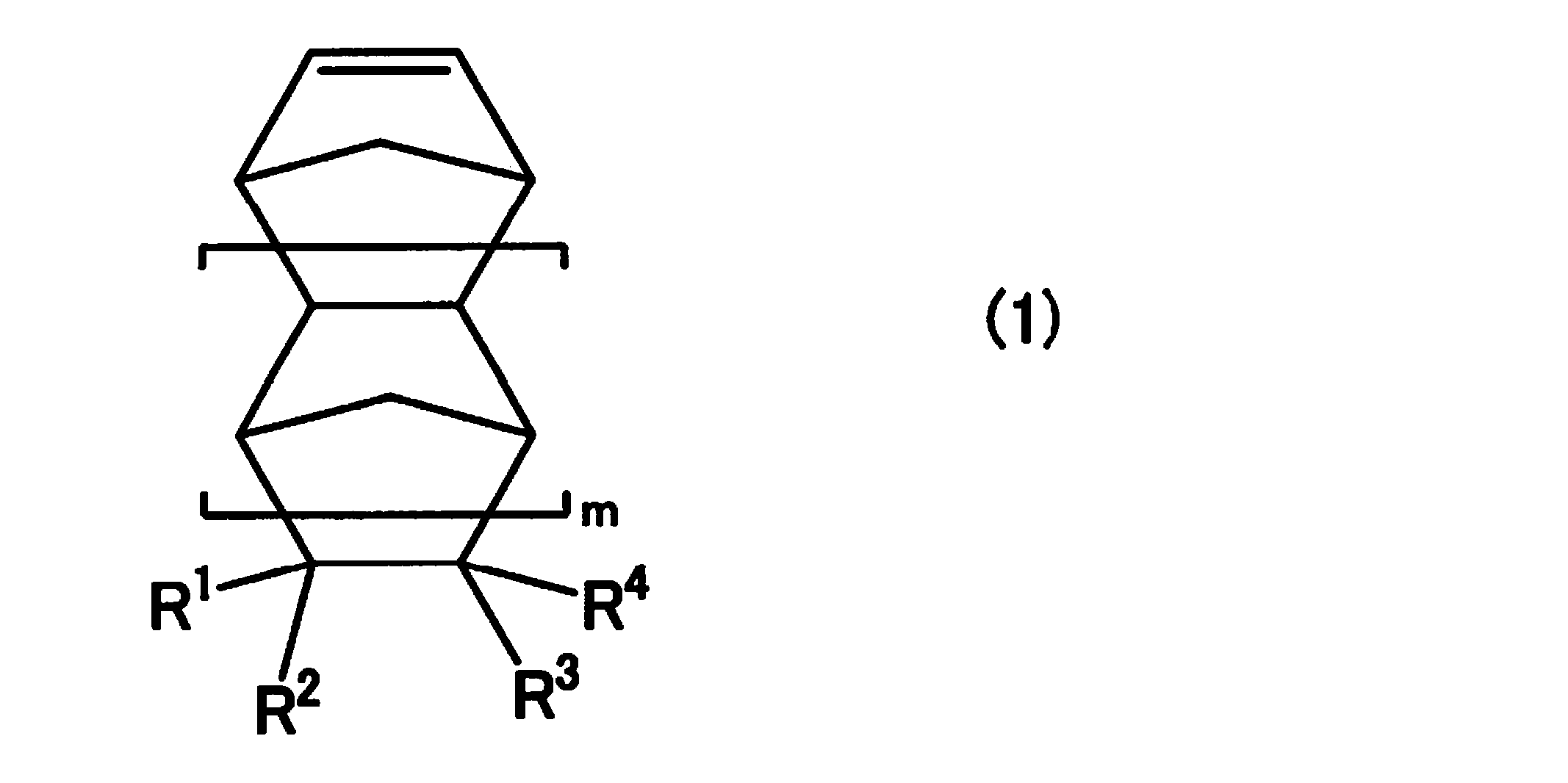
[式中、R1~R4は、それぞれ独立して水素原子、炭素数1~20の炭化水素基、又は、ハロゲン原子、ケイ素原子、酸素原子若しくは窒素原子を含む置換基を示し、R2とR3とは、互いに結合して環を形成してもよく、mは、0~2の整数である。]で表されるノルボルネン系化合物との共重合体を含むことを特徴とする、タイヤ用ゴム組成物。
前記ゴム成分が、シクロペンテンと下記一般式(1):
[2] 上記一般式(1)で表されるノルボルネン系化合物が、2-ノルボルネン及び/又はジシクロペンタジエンである、[1]に記載のタイヤ用ゴム組成物。
[3] 前記シクロペンテンとノルボルネン系化合物との共重合体の含有量が、前記ゴム成分100質量部中、20~90質量部である、[1]又は[2]に記載のタイヤ用ゴム組成物。
[4] 前記シクロペンテンとノルボルネン系化合物との共重合体は、重量平均分子量(Mw)が20万~100万である、[1]~[3]のいずれか一つに記載のタイヤ用ゴム組成物。
[5] 前記シクロペンテンとノルボルネン系化合物との共重合体は、シクロペンテン由来の構造単位の含有割合が20~75質量%である、[1]~[4]のいずれか一つに記載のタイヤ用ゴム組成物。
[6] 前記シクロペンテンとノルボルネン系化合物との共重合体は、2-ノルボルネン由来の構造単位の含有割合が10~60質量%である、[2]~[5]のいずれか一つに記載のタイヤ用ゴム組成物。
[7] 前記シクロペンテンとノルボルネン系化合物との共重合体は、ジシクロペンタジエン由来の構造単位の含有割合が10~60質量%である、[2]~[6]のいずれか一つに記載のタイヤ用ゴム組成物。
[8] 前記複素環式化合物が、ピリジン環、ピリミジン環、ピリダジン環、ピラジン環、トリアジン環、及びテトラジン環からなる群から選択される少なくとも一つの複素環を有する、[1]~[7]のいずれか一つに記載のタイヤ用ゴム組成物。
[9] 前記複素環式化合物が、トリアジン環又はテトラジン環を有する、[1]~[8]のいずれか一つに記載のタイヤ用ゴム組成物。
[10] 前記複素環式化合物が、下記一般式(2):

[式中、X1及びX2は、それぞれ独立してピリジル基又はピリミジニル基であり、Y1及びY2は、それぞれ独立して単結合又は二価の炭化水素基である。]で表される、[1]~[9]のいずれか一つに記載のタイヤ用ゴム組成物。
[11] 前記金属塩として、酸化亜鉛を含む、[1]~[10]のいずれか一つに記載のタイヤ用ゴム組成物。
[12] 前記金属塩として、更に、酸化亜鉛以外の金属塩を含む、[11]に記載のタイヤ用ゴム組成物。
[13] [1]~[12]のいずれか一つに記載のタイヤ用ゴム組成物を含むことを特徴とする、タイヤ。
本発明によれば、タイヤの低燃費性と耐摩耗性とを両立することが可能なタイヤ用ゴム組成物を提供することができる。
また、本発明によれば、低燃費性と耐摩耗性とを両立したタイヤを提供することができる。
また、本発明によれば、低燃費性と耐摩耗性とを両立したタイヤを提供することができる。
以下に、本発明のタイヤ用ゴム組成物及びタイヤを、その実施形態に基づき、詳細に例示説明する。
<定義>
本明細書に記載されている化合物は、部分的に、又は全てが化石資源由来であってもよく、植物資源等の生物資源由来であってもよく、使用済タイヤ等の再生資源由来であってもよい。また、化石資源、生物資源、再生資源のいずれか2つ以上の混合物由来であってもよい。
本明細書に記載されている化合物は、部分的に、又は全てが化石資源由来であってもよく、植物資源等の生物資源由来であってもよく、使用済タイヤ等の再生資源由来であってもよい。また、化石資源、生物資源、再生資源のいずれか2つ以上の混合物由来であってもよい。
<タイヤ用ゴム組成物>
本実施形態のタイヤ用ゴム組成物は、ゴム成分と、六員環の芳香族複素環を有する複素環式化合物(単に「複素環式化合物」とも呼ぶ。)と、金属塩と、を含む。そして、本実施形態のタイヤ用ゴム組成物においては、前記ゴム成分が、シクロペンテンと下記一般式(1):
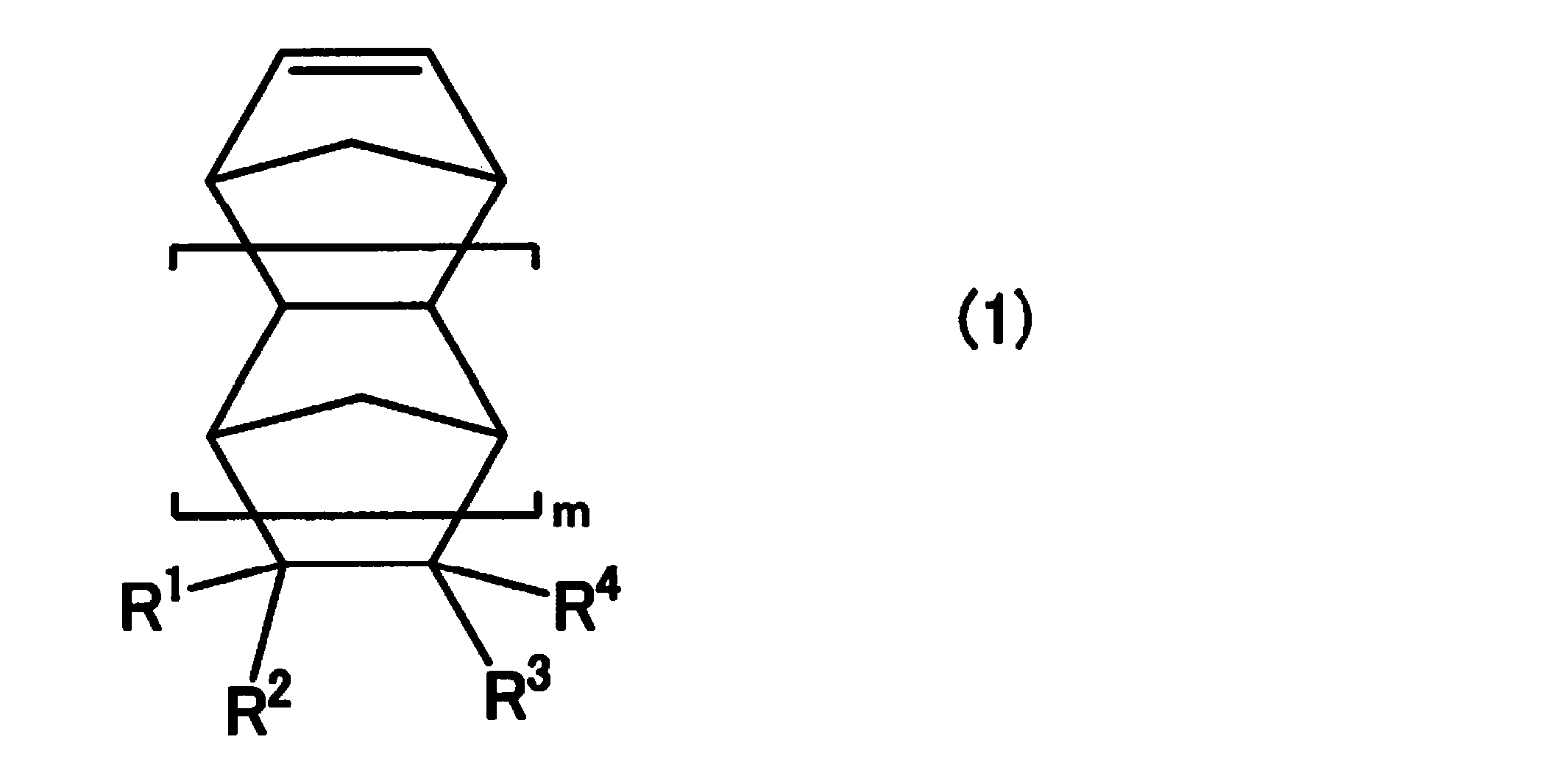
[式中、R1~R4は、それぞれ独立して水素原子、炭素数1~20の炭化水素基、又は、ハロゲン原子、ケイ素原子、酸素原子若しくは窒素原子を含む置換基を示し、R2とR3とは、互いに結合して環を形成してもよく、mは、0~2の整数である。]で表されるノルボルネン系化合物との共重合体(単に「シクロペンテンとノルボルネン系化合物との共重合体」や「共重合体」とも呼ぶ。)を含むことを特徴とする。
本実施形態のタイヤ用ゴム組成物は、ゴム成分と、六員環の芳香族複素環を有する複素環式化合物(単に「複素環式化合物」とも呼ぶ。)と、金属塩と、を含む。そして、本実施形態のタイヤ用ゴム組成物においては、前記ゴム成分が、シクロペンテンと下記一般式(1):
本実施形態のタイヤ用ゴム組成物において、前記シクロペンテンとノルボルネン系化合物との共重合体は、架橋点を有することに加え、ポリマー鎖同士が絡み合うことに特徴がある。一般に、ゴム成分に充填剤を配合すると、充填剤の周りに、当該充填剤とゴム成分とからなる補強層が形成され、該補強層が、ゴム組成物の補強性の向上に寄与して、耐摩耗性等が向上する。これに対して、本実施形態のタイヤ用ゴム組成物においては、ゴム成分が前記シクロペンテンとノルボルネン系化合物との共重合体を含むことで、充填剤の周りに形成される補強層が、上述のポリマー鎖同士の絡み合いにより特異的に増加するため、耐摩耗性を十分に向上させることができる。
また、本実施形態のタイヤ用ゴム組成物においては、ゴム成分の主鎖に前記複素環式化合物が付加する。また、本実施形態のタイヤ用ゴム組成物は、金属塩を含み、前記ゴム成分の主鎖に付加した複素環式化合物部分に、金属塩が配位結合して、錯体を形成する。そして、金属塩が、複数の配位結合を形成することで、複数のゴム成分が架橋されることとなる。ここで、配位結合による架橋は、結合(架橋)と解離(開裂)が可逆的な可逆架橋であり、一般的な架橋ゴムにおける硫黄架橋に比べて、弱い結合であるが、ゴム組成物が歪みを受けても、低歪み領域においては、十分な強度を有する。そして、本実施形態のタイヤ用ゴム組成物は、低歪み領域においては、配位結合による架橋により網目密度を高く保つことで、ヒステリシスロスを低減して、低燃費性を向上させることができる。
従って、本実施形態のタイヤ用ゴム組成物は、タイヤに適用することで、タイヤの低燃費性と耐摩耗性とを両立することができる。
(ゴム成分)
本実施形態のタイヤ用ゴム組成物は、ゴム成分を含み、該ゴム成分が、組成物にゴム弾性をもたらす。本実施形態のタイヤ用ゴム組成物のゴム成分は、シクロペンテンと上記一般式(1)で表されるノルボルネン系化合物との共重合体を含み、更に他のゴムを含んでもよい。
本実施形態のタイヤ用ゴム組成物は、ゴム成分を含み、該ゴム成分が、組成物にゴム弾性をもたらす。本実施形態のタイヤ用ゴム組成物のゴム成分は、シクロペンテンと上記一般式(1)で表されるノルボルネン系化合物との共重合体を含み、更に他のゴムを含んでもよい。
-シクロペンテンとノルボルネン系化合物との共重合体-
前記シクロペンテンとノルボルネン系化合物との共重合体は、シクロペンテン由来の構造単位と、上記一般式(1)で表されるノルボルネン系化合物由来の構造単位と、を含む。また、該シクロペンテンとノルボルネン系化合物との共重合体は、一好適実施形態においては、開環共重合体であり、特には、シクロペンテン開環共重合体である。
前記シクロペンテンとノルボルネン系化合物との共重合体は、シクロペンテン由来の構造単位と、上記一般式(1)で表されるノルボルネン系化合物由来の構造単位と、を含む。また、該シクロペンテンとノルボルネン系化合物との共重合体は、一好適実施形態においては、開環共重合体であり、特には、シクロペンテン開環共重合体である。
上記一般式(1)中、R1~R4は、それぞれ独立して水素原子、炭素数1~20の炭化水素基、又は、ハロゲン原子、ケイ素原子、酸素原子若しくは窒素原子を含む置換基を示し、R2とR3とは、互いに結合して環を形成してもよく、mは、0~2の整数である。ここで、炭素数1~20の炭化水素基としては、メチル基、エチル基、n-プロピル基、イソプロピル基、n-ブチル基、イソブチル基、sec-ブチル基、tert-ブチル基、ネオペンチル基、ヘキシル基、オクチル基等のアルキル基;ビニル基、アリル基、2-ペンテニル基、3-ペンテニル基、4-メチル-3-ペンテニル基等のアルケニル基;フェニル基、トリル基、2,6-ジメチルフェニル基、2,6-ジイソプロピルフェニル基、ナフチル基等のアリール基;ベンジル基、フェネチル基等のアラルキル基;等が挙げられる。
上記一般式(1)で表されるノルボルネン系化合物としては、2-ノルボルネン、5-メチル-2-ノルボルネン、5-エチル-2-ノルボルネン、5-ブチル-2-ノルボルネン、5-ヘキシル-2-ノルボルネン、5-デシル-2-ノルボルネン、5-シクロヘキシル-2-ノルボルネン、5-シクロペンチル-2-ノルボルネン、5-エチリデン-2-ノルボルネン、5-ビニル-2-ノルボルネン、5-プロペニル-2-ノルボルネン、5-シクロヘキセニル-2-ノルボルネン、5-シクロペンテニル-2-ノルボルネン、5-フェニル-2-ノルボルネン、テトラシクロ[9.2.1.02,10.03,8]テトラデカ-3,5,7,12-テトラエン(「1,4-メタノ-1,4,4a,9a-テトラヒドロ-9H-フルオレン」とも呼ぶ。)、テトラシクロ[10.2.1.02,11.04,9]ペンタデカ-4,6,8,13-テトラエン(「1,4-メタノ-1,4,4a,9,9a,10-ヘキサヒドロアントラセン」とも呼ぶ。)、ジシクロペンタジエン、メチルジシクロペンタジエン、ジヒドロジシクロペンタジエン(「トリシクロ[5.2.1.02,6]デカ-8-エン」とも呼ぶ。)等の無置換又は炭化水素置換基を有するビシクロ[2.2.1]ヘプト-2-エン類;
テトラシクロ[6.2.1.13,6.02,7]ドデカ-4-エン、9-メチルテトラシクロ[6.2.1.13,6.02,7]ドデカ-4-エン、9-エチルテトラシクロ[6.2.1.13,6.02,7]ドデカ-4-エン、9-シクロヘキシルテトラシクロ[6.2.1.13,6.02,7]ドデカ-4-エン、9-シクロペンチルテトラシクロ[6.2.1.13,6.02,7]ドデカ-4-エン、9-メチレンテトラシクロ[6.2.1.13,6.02,7]ドデカ-4-エン、9-エチリデンテトラシクロ[6.2.1.13,6.02,7]ドデカ-4-エン、9-ビニルテトラシクロ[6.2.1.13,6.02,7]ドデカ-4-エン、9-プロペニルテトラシクロ[6.2.1.13,6.02,7]ドデカ-4-エン、9-シクロヘキセニルテトラシクロ[6.2.1.13,6.02,7]ドデカ-4-エン、9-シクロペンテニルテトラシクロ[6.2.1.13,6.02,7]ドデカ-4-エン、9-フェニルテトラシクロ[6.2.1.13,6.02,7]ドデカ-4-エン等の無置換又は炭化水素置換基を有するテトラシクロ[6.2.1.13,6.02,7]ドデカ-4-エン類;
5-ノルボルネン-2-カルボン酸メチル、5-ノルボルネン-2-カルボン酸エチル、2-メチル-5-ノルボルネン-2-カルボン酸メチル、2-メチル-5-ノルボルネン-2-カルボン酸エチル等のアルコキシカルボニル基を有するビシクロ[2.2.1]ヘプト-2-エン類;
テトラシクロ[6.2.1.13,6.02,7]ドデカ-9-エン-4-カルボン酸メチル、4-メチルテトラシクロ[6.2.1.13,6.02,7]ドデカ-9-エン-4-カルボン酸メチル等のアルコキシカルボニル基を有するテトラシクロ[6.2.1.13,6.02,7]ドデカ-4-エン類;
5-ノルボルネン-2-カルボン酸、5-ノルボルネン-2,3-ジカルボン酸、5-ノルボルネン-2,3-ジカルボン酸無水物等のヒドロキシカルボニル基又は酸無水物基を有するビシクロ[2.2.1]ヘプト-2-エン類;
テトラシクロ[6.2.1.13,6.02,7]ドデカ-9-エン-4-カルボン酸、テトラシクロ[6.2.1.13,6.02,7]ドデカ-9-エン-4,5-ジカルボン酸、テトラシクロ[6.2.1.13,6.02,7]ドデカ-9-エン-4,5-ジカルボン酸無水物等のヒドロキシカルボニル基又は酸無水物基を有するテトラシクロ[6.2.1.13,6.02,7]ドデカ-4-エン類;
5-ヒドロキシ-2-ノルボルネン、5-ヒドロキシメチル-2-ノルボルネン、5,6-ジ(ヒドロキシメチル)-2-ノルボルネン、5,5-ジ(ヒドロキシメチル)-2-ノルボルネン、5-(2-ヒドロキシエトキシカルボニル)-2-ノルボルネン、5-メチル-5-(2-ヒドロキシエトキシカルボニル)-2-ノルボルネン等のヒドロキシル基を有するビシクロ[2.2.1]ヘプト-2-エン類;
テトラシクロ[6.2.1.13,6.02,7]ドデカ-9-エン-4-メタノール、テトラシクロ[6.2.1.13,6.02,7]ドデカ-9-エン-4-オール等のヒドロキシル基を有するテトラシクロ[6.2.1.13,6.02,7]ドデカ-4-エン類;
5-ノルボルネン-2-カルバルデヒド等のヒドロカルボニル基を有するビシクロ[2.2.1]ヘプト-2-エン類;
テトラシクロ[6.2.1.13,6.02,7]ドデカ-9-エン-4-カルバルデヒド等のヒドロカルボニル基を有するテトラシクロ[6.2.1.13,6.02,7]ドデカ-4-エン類;
3-メトキシカルボニル-5-ノルボルネン-2-カルボン酸等のアルコキシカルボニル基とヒドロキシカルボニル基とを有するビシクロ[2.2.1]ヘプト-2-エン類;
酢酸5-ノルボルネン-2-イル、酢酸2-メチル-5-ノルボルネン-2-イル、アクリル酸5-ノルボルネン-2-イル、メタクリル酸5-ノルボルネン-2-イル等のカルボニルオキシ基を有するビシクロ[2.2.1]ヘプト-2-エン類;
酢酸9-テトラシクロ[6.2.1.13,6.02,7]ドデカ-4-エニル、アクリル酸9-テトラシクロ[6.2.1.13,6.02,7]ドデカ-4-エニル、メタクリル酸9-テトラシクロ[6.2.1.13,6.02,7]ドデカ-4-エニル等のカルボニルオキシ基を有するテトラシクロ[6.2.1.13,6.02,7]ドデカ-4-エン類;
5-ノルボルネン-2-カルボニトリル、5-ノルボルネン-2-カルボキサミド、5-ノルボルネン-2、3-ジカルボン酸イミド等の窒素原子を含む官能基を有するビシクロ[2.2.1]ヘプト-2-エン類;
テトラシクロ[6.2.1.13,6.02,7]ドデカ-9-エン-4-カルボニトリル、テトラシクロ[6.2.1.13,6.02,7]ドデカ-9-エン-4-カルボキサミド、テトラシクロ[6.2.1.13,6.02,7]ドデカ-9-エン-4,5-ジカルボン酸イミド等の窒素原子を含む官能基を有するテトラシクロ[6.2.1.13,6.02,7]ドデカ-4-エン類;
5-クロロ-2-ノルボルネン等のハロゲン原子を有するビシクロ[2.2.1]ヘプト-2-エン類;
9-クロロテトラシクロ[6.2.1.13,6.02,7]ドデカ-4-エン等のハロゲン原子を有するテトラシクロ[6.2.1.13,6.02,7]ドデカ-4-エン類;
5-トリメトキシシリル-2-ノルボルネン、5-トリエトキシシリル-2-ノルボルネン等のケイ素原子を含む官能基を有するビシクロ[2.2.1]ヘプト-2-エン類;
4-トリメトキシシリルテトラシクロ[6.2.1.13,6.02,7]ドデカ-9-エン、4-トリエトキシシリルテトラシクロ[6.2.1.13,6.02,7]ドデカ-9-エン等のケイ素原子を含む官能基を有するテトラシクロ[6.2.1.13,6.02,7]ドデカ-4-エン類;等が挙げられる。前記ノルボルネン系化合物は、1種単独で用いてもよいし、2種以上を組み合わせて用いてもよい。
上記一般式(1)で表されるノルボルネン系化合物としては、上記一般式(1)において、mが0又は1であるものが好ましく、mが0であるものがより好ましい。また、上記一般式(1)において、R1~R4は、同一であってもよいし、異なっていてもよい。
上記一般式(1)で表されるノルボルネン系化合物の中でも、ゴム組成物の低燃費性及び耐摩耗性の観点から、上記一般式(1)におけるR1~R4が、水素原子、炭素数1~20の鎖状炭化水素基、又は、ハロゲン原子、ケイ素原子、酸素原子若しくは窒素原子を含む置換基であることが好ましい。この場合において、R1~R4は、互いに結合せず、環を形成しない基であればよく、特に限定されず、同一であっても、異なっていてもよく、R1~R4としては、水素原子又は炭素数1~3のアルキル基が好ましい。また、この場合においても、mが0又は1であるものが好ましく、mが0であるものがより好ましい。上記一般式(1)におけるR1~R4が、水素原子、炭素数1~20の鎖状炭化水素基、又は、ハロゲン原子、ケイ素原子、酸素原子若しくは窒素原子を含む置換基であるノルボルネン系化合物としては、無置換又は炭化水素置換基を有するビシクロ[2.2.1]ヘプト-2-エン類が好ましく、中でも、2-ノルボルネンが特に好ましい。
また、上記一般式(1)で表されるノルボルネン系化合物として、R2とR3とが互いに結合して環を形成している化合物も好ましい。ここで、R2とR3とが互いに結合して形成する環構造の具体例としては、シクロペンタン環、シクロペンテン環、シクロヘキサン環、シクロへキセン環、ベンゼン環等が好適に挙げられ、これらは多環構造を形成していてもよく、更には、置換基を有するものであってもよい。これらの中でも、シクロペンタン環、シクロペンテン環、ベンゼン環が好ましく、特に、シクロペンテン環を単独で有する化合物、又はシクロペンタン環とベンゼン環との多環構造を有する化合物が好ましい。なお、環構造を形成するR2、R3以外のR1、R4は、同一であっても、異なっていてもよく、水素原子又は炭素数1~3のアルキル基が好ましい。また、この場合においては、mが0であるものが好ましい。上記一般式(1)におけるR2とR3とが互いに結合して環を形成しているノルボルネン系化合物としては、無置換又は炭化水素置換基を有するビシクロ[2.2.1]ヘプト-2-エン類が好ましく、中でも、ジシクロペンタジエンが特に好ましい。
前記シクロペンテンとノルボルネン系化合物との共重合体は、シクロペンテン由来の構造単位の含有割合が、当該共重合体の全繰返し構造単位に対して、好ましくは20~75質量%であり、より好ましくは25~70質量%であり、更に好ましくは30~65質量%であり、特に好ましくは35~60質量%である。共重合体中のシクロペンテン由来の構造単位の含有割合を20~75質量%の範囲とすることにより、該共重合体を含むゴム組成物の低燃費性及び耐摩耗性を更に向上させることができる。
前記シクロペンテンとノルボルネン系化合物との共重合体は、上記一般式(1)で表されるノルボルネン系化合物由来の構造単位の含有割合が、当該共重合体の全繰返し構造単位に対して、好ましくは10~80質量%であり、より好ましくは20~70質量%であり、更に好ましくは25~65質量%であり、特に好ましくは40~65質量%である。共重合体中の一般式(1)で表されるノルボルネン系化合物由来の構造単位の含有割合を10~80質量%の範囲とすることにより、該共重合体を含むゴム組成物の低燃費性及び耐摩耗性を更に向上させることができる。
前記シクロペンテンとノルボルネン系化合物との共重合体において、上記一般式(1)で表されるノルボルネン系化合物は、2-ノルボルネン及び/又はジシクロペンタジエンであることが好ましい。2-ノルボルネン及びジシクロペンタジエンは入手し易いため、シクロペンテンと2-ノルボルネン及び/又はジシクロペンタジエンとの共重合体は、入手し易い。そのため、シクロペンテンと2-ノルボルネン及び/又はジシクロペンタジエンとの共重合体を含むタイヤ用ゴム組成物は、コストの点で有利である。
上記一般式(1)で表されるノルボルネン系化合物として、2-ノルボルネンを使用する場合、前記シクロペンテンとノルボルネン系化合物との共重合体は、当該共重合体の全繰返し構造単位に対して、2-ノルボルネン由来の構造単位の含有割合が10~60質量%であることが好ましく、20~60質量%であることが更に好ましい。共重合体中の2-ノルボルネン由来の構造単位の含有割合を10~60質量%の範囲とすることにより、該共重合体を含むゴム組成物の低燃費性及び耐摩耗性を更に向上させることができる。
上記一般式(1)で表されるノルボルネン系化合物として、ジシクロペンタジエンを使用する場合、前記シクロペンテンとノルボルネン系化合物との共重合体は、当該共重合体の全繰返し構造単位に対して、ジシクロペンタジエン由来の構造単位の含有割合が10~60質量%であることが好ましく、20~50質量%であることが更に好ましい。共重合体中のジシクロペンタジエン由来の構造単位の含有割合を10~60質量%の範囲とすることにより、該共重合体を含むゴム組成物の低燃費性及び耐摩耗性を更に向上させることができる。
一実施形態においては、前記シクロペンテンとノルボルネン系化合物との共重合体として、シクロペンテン(CP)と、2-ノルボルネン(NB)と、ジシクロペンタジエン(DCPD)との三元共重合体を使用してもよい。シクロペンテンと2-ノルボルネンとジシクロペンタジエンとの三元共重合体は、ゴム組成物の低燃費性を向上させる効果が大きい。
前記シクロペンテンとノルボルネン系化合物との共重合体は、シクロペンテン及び上記一般式(1)で表されるノルボルネン系化合物に加えて、これらと共重合可能な他の単量体を共重合したものであってもよい。このような他の単量体としては、シクロプロペン、シクロブテン、メチルシクロペンテン、シクロヘキセン、メチルシクロヘキセン、シクロヘプテン、シクロオクテン等の環状モノオレフィン;シクロヘキサジエン、メチルシクロヘキサジエン、シクロオクタジエン、メチルシクロオクタジエン等の環状ジオレフィン;フェニルシクロオクテン、5-フェニル-1,5-シクロオクタジエン、フェニルシクロペンテン等の芳香環を有する多環のシクロオレフィン等が挙げられる。前記シクロペンテンとノルボルネン系化合物との共重合体中における、他の単量体由来の構造単位の含有割合は、当該共重合体の全繰り返し構造単位に対して、好ましくは40質量%以下であり、より好ましくは30質量%以下であり、また、他の単量体由来の構造単位が実質的に含まれていないことが特に好ましい。
前記シクロペンテンとノルボルネン系化合物との共重合体は、重量平均分子量(Mw)が20万~100万であることが好ましく、20万~80万であることが更に好ましく、20万~70万であることがより一層好ましく、20万~60万であることが特に好ましい。重量平均分子量(Mw)が20万~100万の範囲の共重合体は、製造が容易であり、また、加工性(作業性)が良好である。また、共重合体の重量平均分子量(Mw)を20万~100万の範囲とすることにより、該共重合体を含むゴム組成物の低燃費性及び耐摩耗性を更に向上させることができる。
また、前記シクロペンテンとノルボルネン系化合物との共重合体は、重量平均分子量(Mw)と数平均分子量(Mn)との比(Mw/Mn、「分子量分布」とも呼ぶ。)が1.0~5.0であることが好ましく、1.5~2.9であることが更に好ましく、1.5~2.5であることがより一層好ましく、1.5~2.3であることが特に好ましい。
ここで、共重合体の重量平均分子量(Mw)及び数平均分子量(Mn)は、ゲルパーミエーションクロマトグラフィー(GPC)で測定される、ポリスチレン換算の値である。
また、前記シクロペンテンとノルボルネン系化合物との共重合体は、重量平均分子量(Mw)と数平均分子量(Mn)との比(Mw/Mn、「分子量分布」とも呼ぶ。)が1.0~5.0であることが好ましく、1.5~2.9であることが更に好ましく、1.5~2.5であることがより一層好ましく、1.5~2.3であることが特に好ましい。
ここで、共重合体の重量平均分子量(Mw)及び数平均分子量(Mn)は、ゲルパーミエーションクロマトグラフィー(GPC)で測定される、ポリスチレン換算の値である。
前記シクロペンテンとノルボルネン系化合物との共重合体は、シス/トランス比が0/100~60/40であることが好ましく、5/95~55/45であることがより好ましく、10/90~50/50であることが更に好ましく、15/85~39/61であることが特に好ましい。該シス/トランス比とは、前記シクロペンテンとノルボルネン系化合物との共重合体を構成する繰返し単位中に存在する二重結合のシス構造とトランス構造との含有割合(シス/トランスの比率)である。共重合体のシス/トランス比を上記範囲とすることにより、該共重合体を含むゴム組成物の低燃費性及び耐摩耗性を更に向上させることができる。
前記シクロペンテンとノルボルネン系化合物との共重合体は、ガラス転移温度(Tg)が、好ましくは-80℃~10℃であり、より好ましくは-75℃~0℃であり、更に好ましくは-70℃~-10℃である。共重合体のガラス転移温度(Tg)を上記範囲とすることにより、該共重合体を含むゴム組成物の低燃費性及び耐摩耗性を更に向上させることができる。なお、共重合体のガラス転移温度は、例えば、使用するノルボルネン系化合物の種類及び使用量を調整することにより、制御することができる。
前記シクロペンテンとノルボルネン系化合物との共重合体は、ポリマー鎖末端に変性基を有するものであってもよい。このような末端変性基を有することで、シリカ等に対する親和性をより高めることができ、ゴム組成物中のシリカ等の分散性を高めることができ、結果として、ゴム組成物の加工性(作業性)、低燃費性及び耐摩耗性を更に向上させることができる。共重合体のポリマー鎖末端に導入する変性基としては、特に限定されるものではないが、周期表第15族の原子、周期表第16族の原子、及びケイ素原子からなる群から選ばれる原子を含有する変性基が好ましい。前記末端変性基を形成するための変性基としては、シリカ等に対する親和性を高める観点から、窒素原子、酸素原子、リン原子、硫黄原子、及びケイ素原子からなる群から選ばれる原子を含有する変性基がより好ましく、これらの中でも、窒素原子、酸素原子、及びケイ素原子からなる群から選ばれる原子を含有する変性基が更に好ましい。
窒素原子を含有する変性基としては、アミノ基、ピリジル基、イミノ基、アミド基、ニトロ基、ウレタン結合基、又はこれらの基のいずれかを含む炭化水素基が挙げられる。酸素原子を含有する変性基としては、水酸基、カルボン酸基、エーテル基、エステル基、カルボニル基、アルデヒド基、エポキシ基、又はこれらの基のいずれかを含む炭化水素基が挙げられる。ケイ素原子を含有する変性基としては、アルキルシリル基、オキシシリル基、又はこれらの基のいずれかを含む炭化水素基が挙げられる。リン原子を含有する変性基としては、リン酸基、ホスフィノ基、又はこれらの基のいずれかを含む炭化水素基が挙げられる。硫黄原子を含有する変性基としては、スルホニル基、チオール基、チオエーテル基、又はこれらの基のいずれかを含む炭化水素基が挙げられる。また、変性基としては、上記した基を複数含有する変性基であってもよい。これらの中でも、ゴム組成物の加工性(作業性)、低燃費性及び耐摩耗性を更に向上させる観点から、アミノ基、ピリジル基、イミノ基、アミド基、水酸基、カルボン酸基、アルデヒド基、エポキシ基、オキシシリル基、又はこれらの基のいずれかを含む炭化水素基が好ましく、シリカ等に対する親和性の観点から、オキシシリル基が特に好ましい。ここで、オキシシリル基とは、ケイ素-酸素結合を有する基をいう。
前記オキシシリル基としては、アルコキシシリル基、アリールオキシシリル基、アシロキシ基、アルキルシロキシシリル基、アリールシロキシシリル基等が挙げられる。また、アルコキシシリル基、アリールオキシシリル基、又はアシロキシ基を加水分解してなるヒドロキシシリル基を挙げることができる。これらの中でも、シリカに対する親和性の観点から、アルコキシシリル基が好ましい。該アルコキシシリル基は、1つ以上のアルコキシ基がケイ素原子と結合してなる基であり、その具体例としては、トリメトキシシリル基、ジメトキシメチルシリル基、メトキシジメチルシリル基、メトキシジクロロシリル基、トリエトキシシリル基、ジエトキシメチルシリル基、エトキシジメチルシリル基、ジメトキシエトキシシリル基、メトキシジエトキシシリル基、トリプロポキシシリル基等が挙げられる。
前記シクロペンテンとノルボルネン系化合物との共重合体のポリマー鎖末端における、変性基の導入割合は、特に限定されるものではないが、変性基が導入された共重合体鎖末端数/共重合体鎖末端全数の百分率の値として、10%以上であることが好ましく、20%以上であることがより好ましく、30%以上であることが更に好ましく、40%以上であることが特に好ましい。末端変性基の導入割合が高い程、シリカ等に対する親和性が高くなるため、好ましい。なお、ポリマー鎖末端への変性基の導入割合を測定する方法としては、特に限定されるものではないが、末端変性基として、オキシシリル基を導入する場合を例示すると、1H-NMRスペクトル測定により求められるオキシシリル基に対応するピーク面積比と、ゲルパーミエーションクロマトグラフィー(GPC)から求められる数平均分子量(Mn)とから求めることができる。
前記シクロペンテンとノルボルネン系化合物との共重合体は、ムーニー粘度(ML1+4,100℃)が20~150であることが好ましく、22~120であることが更に好ましく、25~90であることが特に好ましい。
前記シクロペンテンとノルボルネン系化合物との共重合体を製造する方法は、特に限定されるものではないが、例えば、シクロペンテンと、上記一般式(1)で表されるノルボルネン系化合物と、を開環重合触媒の存在下で共重合させる方法が挙げられる。
前記開環重合触媒としては、シクロペンテンと上記一般式(1)で表されるノルボルネン系化合物とを開環共重合できるものであれば特に限定されるものではないが、ルテニウムカルベン錯体や、ハロゲン原子を含有する周期表第6族遷移金属化合物(以下、「周期表第6族遷移金属化合物」とも呼ぶ。)が好ましい。これら開環重合触媒は、1種単独で用いてもよいし、2種以上を混合して用いてもよい。
前記ルテニウムカルベン錯体としては、ビス(トリシクロヘキシルホスフィン)ベンジリデンルテニウムジクロリド、ビス(トリフェニルホスフィン)-3,3-ジフェニルプロペニリデンルテニウムジクロリド、ビス(トリシクロヘキシルホスフィン)t-ブチルビニリデンルテニウムジクロリド、ジクロロ-(3-フェニル-1H-インデン-1-イリデン)ビス(トリシクロヘキシルホスフィン)ルテニウム、ビス(1,3-ジイソプロピルイミダゾリン-2-イリデン)ベンジリデンルテニウムジクロリド、ビス(1,3-ジシクロヘキシルイミダゾリン-2-イリデン)ベンジリデンルテニウムジクロリド、(1,3-ジメシチルイミダゾリン-2-イリデン)(トリシクロヘキシルホスフィン)ベンジリデンルテニウムジクロリド、(1,3-ジメシチルイミダゾリジン-2-イリデン)(トリシクロヘキシルホスフィン)ベンジリデンルテニウムジクロリド、ビス(トリシクロヘキシルホスフィン)エトキシメチリデンルテニウムジクロリド、(1,3-ジメシチルイミダゾリジン-2-イリデン)(トリシクロヘキシルホスフィン)エトキシメチリデンルテニウムジクロリド等が挙げられる。
前記周期表第6族遷移金属化合物は、周期表(長周期型周期表、以下同じ。)第6族遷移金属原子を有する化合物、具体的には、クロム原子、モリブデン原子、又はタングステン原子を有する化合物であり、モリブデン原子を有する化合物、又はタングステン原子を有する化合物が好ましく、特に、シクロペンテンに対する溶解性が高いという観点から、タングステン原子を有する化合物がより好ましい。前記周期表第6族遷移金属化合物の具体例としては、モリブデンペンタクロリド、モリブデンオキソテトラクロリド、モリブデン(フェニルイミド)テトラクロリド等のモリブデン化合物;タングステンヘキサクロリド、タングステンオキソテトラクロリド、タングステン(フェニルイミド)テトラクロリド、モノカテコラートタングステンテトラクロリド、ビス(3,5-ジターシャリブチル)カテコラートタングステンジクロリド、ビス(2-クロロエテレート)テトラクロリド等のタングステン化合物;等が挙げられる。
前記開環重合触媒の使用量は、(開環重合触媒:共重合に用いる単量体)のモル比で、通常1:500~1:2,000,000、好ましくは1:700~1:1,500,000、より好ましくは1:1,000~1:1,000,000の範囲である。なお、前記周期表第6族遷移金属化合物を使用する場合、該周期表第6族遷移金属化合物の使用量は、「開環重合触媒中の第6族遷移金属原子:開環重合に用いる単量体」のモル比で、好ましくは1:100~1:200,000、より好ましくは1:200~1:150,000、更に好ましくは1:500~1:100,000の範囲である。
前記開環重合触媒として、前記周期表第6族遷移金属化合物を使用する場合には、下記一般式(3)で示される有機アルミニウム化合物と組み合わせて用いることが好ましい。該有機アルミニウム化合物は、上述した周期表第6族遷移金属化合物と共に開環重合触媒として作用する。
(R5)3-xAl(OR6)x ・・・ (3)
上記一般式(3)中、R5及びR6は、それぞれ独立して炭素数1~20の炭化水素基であり、好ましくは、炭素数1~10の炭化水素基である。また、xは、0<x<3である。
(R5)3-xAl(OR6)x ・・・ (3)
上記一般式(3)中、R5及びR6は、それぞれ独立して炭素数1~20の炭化水素基であり、好ましくは、炭素数1~10の炭化水素基である。また、xは、0<x<3である。
上記一般式(3)において、R5及びR6としては、メチル基、エチル基、イソプロピル基、n-プロピル基、イソブチル基、n-ブチル基、t-ブチル基、n-ヘキシル基、シクロヘキシル基、n-オクチル基、n-デシル基等のアルキル基;フェニル基、4-メチルフェニル基、2,6-ジメチルフェニル基、2,6-ジイソプロピルフェニル基、ナフチル基等のアリール基;等が挙げられる。
また、上記一般式(3)において、xは、0<x<3である。即ち、一般式(3)においては、R5とOR6との組成比は、それぞれ0<3-x<3、及び0<x<3の各範囲において、任意の値をとることができるが、重合活性を高くできる観点から、xは、0.5<x<1.5であることが好ましい。
上記一般式(3)で表される有機アルミニウム化合物は、例えば、下記一般式(4)に示すように、トリアルキルアルミニウムと、アルコールとの反応によって合成することができる。
(R5)3Al + xR6OH → (R5)3-xAl(OR6)x + (R6)xH ・・・ (4)
(R5)3Al + xR6OH → (R5)3-xAl(OR6)x + (R6)xH ・・・ (4)
なお、上記一般式(3)中のxは、上記一般式(4)に示すように、対応するトリアルキルアルミニウムとアルコールの反応比を規定することによって、任意に制御することが可能である。
前記有機アルミニウム化合物の使用量は、使用する有機アルミニウム化合物の種類によっても異なるが、前記周期表第6族遷移金属化合物を構成する周期表第6族遷移金属原子に対して、好ましくは0.1~100倍モル、より好ましくは0.2~50倍モル、更に好ましくは0.5~20倍モルの割合である。有機アルミニウム化合物の使用量が少な過ぎると、重合活性が不十分となる場合があり、多過ぎると、開環重合時において、副反応が起こり易くなる傾向にある。
重合反応は、無溶媒中で行ってもよく、溶液中で行ってもよい。溶液中で共重合する場合、使用する溶媒は、重合反応において不活性であり、共重合に用いるシクロペンテンや上記一般式(1)で表されるノルボルネン系化合物、重合触媒等を溶解させ得る溶媒であれば特に限定されるものではないが、炭化水素系溶媒又はハロゲン系溶媒を用いることが好ましい。前記炭化水素系溶媒としては、例えば、ベンゼン、トルエン、キシレン、エチルベンゼン等の芳香族炭化水素;ヘキサン、n-ヘプタン、n-オクタン等の脂肪族炭化水素;シクロヘキサン、シクロペンタン、メチルシクロヘキサン等の脂環族炭化水素;等が挙げられる。また、前記ハロゲン系溶媒としては、例えば、ジクロロメタン、クロロホルム等のハロアルカン;クロロベンゼン、ジクロロベンゼン等の芳香族ハロゲン;等が挙げられる。これらの溶媒は、1種単独で用いてもよいし、2種以上を混合して用いてもよい。
シクロペンテンと、上記一般式(1)で表されるノルボルネン系化合物と、を共重合させる際には、必要に応じて、得られる共重合体の分子量を調整するために、分子量調整剤として、オレフィン化合物又はジオレフィン化合物を重合反応系に添加してもよい。
前記オレフィン化合物としては、エチレン性不飽和結合を有する有機化合物であれば特に限定されず、例えば、1-ブテン、1-ペンテン、1-ヘキセン、1-オクテン等のα-オレフィン類;スチレン、ビニルトルエン等のスチレン類;アリルクロライド等のハロゲン含有ビニル化合物;アリルアルコール、5-ヘキセノール等のアルケニルアルコール類;アリルトリメトキシシラン、アリルトリエトキシシラン、アリルトリクロロシラン、スチリルトリメトキシシラン等のケイ素含有ビニル化合物;2-ブテン、3-ヘキセン等の二置換オレフィン;等が挙げられる。また、前記ジオレフィン化合物としては、1,4-ペンタジエン、1,4-ヘキサジエン、1,5-ヘキサジエン、1,6-ヘプタジエン、2-メチル-1,4-ペンタジエン、2,5-ジメチル-1,5-ヘキサジエン等の非共役ジオレフィンが挙げられる。
分子量調整剤としてのオレフィン化合物及びジオレフィン化合物の使用量は、製造する共重合体の分子量に応じて適宜選択すればよいが、共重合に用いる単量体に対して、モル比で、通常1/100~1/100,000、好ましくは1/200~1/50,000、より好ましくは1/500~1/10,000の範囲である。
また、前記シクロペンテンとノルボルネン系化合物との共重合体を、ポリマー鎖末端に、変性基を有するものとする場合には、分子量調整剤として、上述したオレフィン化合物やジオレフィン化合物に代えて、変性基含有オレフィン性不飽和炭化水素化合物を用いることが好ましい。変性基含有オレフィン性不飽和炭化水素化合物を用いることで、共重合により得られる共重合体のポリマー鎖末端に、変性基を好適に導入することができる。前記変性基含有オレフィン性不飽和炭化水素化合物としては、変性基を有し、且つ、メタセシス反応性を有するオレフィン性炭素-炭素二重結合を1つ有する化合物であればよく、特に限定されない。例えば、共重合体のポリマー鎖末端にオキシシリル基を導入することを望む場合には、オキシシリル基含有オレフィン性不飽和炭化水素を重合反応系に存在させればよい。
前記オキシシリル基含有オレフィン性不飽和炭化水素の例としては、共重合体のポリマー鎖の一方の末端(片末端)のみに変性基を導入するものとして、ビニルトリメトキシシラン、ビニルトリエトキシシラン、アリルトリメトキシシラン、アリルメトキシジメチルシラン、アリルトリエトキシシラン、アリルエトキシジメチルシラン、スチリルトリメトキシシラン、スチリルトリエトキシシラン、スチリルエチルトリエトキシシラン、アリルトリエトキシシリルメチルエーテル、アリルトリエトキシシリルメチルエチルアミン等のアルコキシシラン化合物;ビニルトリフェノキシシラン、アリルトリフェノキシシラン、アリルフェノキシジメチルシラン等のアリールオキシシラン化合物;ビニルトリアセトキシシラン、アリルトリアセトキシシラン、アリルジアセトキシメチルシラン、アリルアセトキシジメチルシラン等のアシロキシシラン化合物;アリルトリス(トリメチルシロキシ)シラン等のアルキルシロキシシラン化合物;アリルトリス(トリフェニルシロキシ)シラン等のアリールシロキシシラン化合物;1-アリルヘプタメチルトリシロキサン、1-アリルノナメチルテトラシロキサン、1-アリルノナメチルシクロペンタシロキサン、1-アリルウンデカメチルシクロヘキサシロキサン等のポリシロキサン化合物;等が挙げられる。また、共重合体のポリマー鎖の両方の末端(両末端)に変性基を導入するものとして、ビス(トリメトキシシリル)エチレン、ビス(トリエトキシシリル)エチレン、2-ブテン-1,4-ジ(トリメトキシシラン)、2-ブテン-1,4-ジ(トリエトキシシラン)、1,4-ジ(トリメトキシシリルメトキシ)-2-ブテン等のアルコキシシラン化合物;2-ブテン-1,4-ジ(トリフェノキシシラン)等のアリールオキシシラン化合物;2-ブテン-1,4-ジ(トリアセトキシシラン)等のアシロキシシラン化合物;2-ブテン-1,4-ジ[トリス(トリメチルシロキシ)シラン]等のアルキルシロキシシラン化合物;2-ブテン-1,4-ジ[トリス(トリフェニルシロキシ)シラン]等のアリールシロキシシラン化合物;2-ブテン-1,4-ジ(ヘプタメチルトリシロキサン)、2-ブテン-1,4-ジ(ウンデカメチルシクロヘキサシロキサン)等のポリシロキサン化合物;等が挙げられる。
前記変性基含有オレフィン性不飽和炭化水素化合物は、共重合体のポリマー鎖末端への変性基の導入作用に加えて、分子量調整剤としても作用するため、変性基含有オレフィン性不飽和炭化水素化合物の使用量は、製造する共重合体の分子量に応じて適宜選択すればよいが、共重合に用いる単量体に対して、モル比で、通常1/100~1/100,000、好ましくは1/200~1/50,000、より好ましくは1/500~1/10,000の範囲である。
重合反応温度は、特に限定されるものではないが、好ましくは-100℃以上であり、より好ましくは-50℃以上、更に好ましくは0℃以上、特に好ましくは20℃以上である。また、重合反応温度の上限は、特に限定されるものではないが、好ましくは120℃未満であり、より好ましくは100℃未満、更に好ましくは90℃未満、特に好ましくは80℃未満である。また、重合反応時間は、特に限定されるものではないが、好ましくは1分間~72時間、より好ましくは10分間~20時間である。
重合反応により得られる共重合体には、所望により、フェノール系安定剤、リン系安定剤、硫黄系安定剤等の老化防止剤を添加してもよい。老化防止剤の添加量は、その種類等に応じて適宜決定すればよい。更に、所望により、共重合体には、伸展油を配合してもよい。重合溶液として共重合体を得た場合において、重合溶液から共重合体を回収するためには、公知の回収方法を採用すればよく、例えば、スチームストリッピング等で溶媒を分離した後、固体を濾別し、更にそれを乾燥して固形状の共重合体を取得する方法などが採用できる。
前記シクロペンテンとノルボルネン系化合物との共重合体の含有量は、前記ゴム成分100質量部中、20~90質量部であることが好ましく、30~85質量部であることが更に好ましい。シクロペンテンとノルボルネン系化合物との共重合体の含有量が、前記ゴム成分100質量部中、20~90質量部の範囲であると、ゴム組成物の低燃費性と耐摩耗性とのバランスが更に向上する。
-ブタジエンゴム-
前記ゴム成分は、更にブタジエンゴム(BR)を含むことが好ましい。ブタジエンゴムは、ガラス転移温度(Tg)が低く、ゴム成分が、上述のシクロペンテンとノルボルネン系化合物との共重合体に加えてブタジエンゴムを含むことで、ゴム組成物の低燃費性と耐摩耗性とを更に向上させることができる。
前記ゴム成分は、更にブタジエンゴム(BR)を含むことが好ましい。ブタジエンゴムは、ガラス転移温度(Tg)が低く、ゴム成分が、上述のシクロペンテンとノルボルネン系化合物との共重合体に加えてブタジエンゴムを含むことで、ゴム組成物の低燃費性と耐摩耗性とを更に向上させることができる。
前記ゴム成分がブタジエンゴムを含む場合、該ブタジエンゴムの含有量は、前記ゴム成分100質量部中、10~80質量部の範囲が好ましく、15~70質量部の範囲が更に好ましい。ブタジエンゴムの含有量が、前記ゴム成分100質量部中、10~80質量部の範囲であると、ゴム組成物の低燃費性と耐摩耗性とのバランスが更に向上する。
-他のゴム-
前記ゴム成分は、更に他のゴムを含んでもよい。かかる他のゴムとしては、天然ゴム(NR)、合成イソプレンゴム(IR)、スチレン-ブタジエンゴム(SBR)、クロロプレンゴム(CR)、ブチルゴム(IIR)、ハロゲン化ブチルゴム、エチレン-プロピレンゴム(EPR,EPDM)、フッ素ゴム、シリコーンゴム、ウレタンゴム等が挙げられる。これら他のゴムの含有量は、ゴム成分100質量部中、30質量部以下が好ましく、20質量部以下が更に好ましく、10質量部以下がより一層好ましい。
前記ゴム成分は、更に他のゴムを含んでもよい。かかる他のゴムとしては、天然ゴム(NR)、合成イソプレンゴム(IR)、スチレン-ブタジエンゴム(SBR)、クロロプレンゴム(CR)、ブチルゴム(IIR)、ハロゲン化ブチルゴム、エチレン-プロピレンゴム(EPR,EPDM)、フッ素ゴム、シリコーンゴム、ウレタンゴム等が挙げられる。これら他のゴムの含有量は、ゴム成分100質量部中、30質量部以下が好ましく、20質量部以下が更に好ましく、10質量部以下がより一層好ましい。
(六員環の芳香族複素環を有する複素環式化合物)
本実施形態のタイヤ用ゴム組成物は、六員環の芳香族複素環を有する複素環式化合物を含む。六員環の芳香族複素環は、環中にヘテロ原子を有し、金属塩と配位結合できる。また、六員環の芳香族複素環を有する複素環式化合物は、金属塩と共に、複数のゴム成分を架橋することができる。ここで、六員環の芳香族複素環中のヘテロ原子としては、窒素原子、リン原子等が挙げられる。
本実施形態のタイヤ用ゴム組成物は、六員環の芳香族複素環を有する複素環式化合物を含む。六員環の芳香族複素環は、環中にヘテロ原子を有し、金属塩と配位結合できる。また、六員環の芳香族複素環を有する複素環式化合物は、金属塩と共に、複数のゴム成分を架橋することができる。ここで、六員環の芳香族複素環中のヘテロ原子としては、窒素原子、リン原子等が挙げられる。
前記六員環の芳香族複素環としては、ピリジン環、ピリミジン環、ピリダジン環、ピラジン環、トリアジン環、及びテトラジン環等の含窒素芳香族複素環や、該含窒素芳香族複素環中の窒素をリンに置き換えた芳香族複素環等が挙げられる。これらの中でも、ピリジン環、ピリミジン環、ピリダジン環、ピラジン環、トリアジン環、及びテトラジン環が好ましい。ピリジン環、ピリミジン環、ピリダジン環、ピラジン環、トリアジン環、又はテトラジン環を有する複素環式化合物は、ゴム成分との反応性が高く、金属塩と組み合わさって、配位結合による架橋を形成し易く、ゴム組成物の低燃費性が更に向上する。
ここで、前記複素環式化合物は、トリアジン環又はテトラジン環を有することが好ましい。トリアジン環又はテトラジン環を有する複素環式化合物は、ゴム成分との反応性が更に高く、金属塩と組み合わさって、配位結合による架橋を更に形成し易く、ゴム組成物の低燃費性がより一層向上する。
また、前記トリアジン環又はテトラジン環を有する化合物のトリアジン環又はテトラジン環には、ピリジル基又はピリミジニル基が結合していることが好ましく、ピリジル基又はピリミジニル基が2つ結合していることが更に好ましい。トリアジン環又はテトラジン環に、ピリジル基又はピリミジニル基が結合している場合、複素環式化合物と金属塩とが更に錯化し易くなり、結合解離エネルギーが高くなり易く、より強度の高い架橋構造を形成できる。また、トリアジン環又はテトラジン環に、ピリジル基又はピリミジニル基が2つ結合している場合、複素環式化合物と金属塩とがより一層錯化し易くなり、結合解離エネルギーが更に高くなり易く、より一層強度の高い架橋構造を形成できる。
なお、前記ピリジル基は、2-ピリジル基でも、3-ピリジル基でも、4-ピリジル基でもよいが、2-ピリジル基が好ましい。また、前記ピリミジニル基は、2-ピリミジニル基でも、4-ピリミジニル基でも、5-ピリミジニル基でもよい。
なお、前記ピリジル基は、2-ピリジル基でも、3-ピリジル基でも、4-ピリジル基でもよいが、2-ピリジル基が好ましい。また、前記ピリミジニル基は、2-ピリミジニル基でも、4-ピリミジニル基でも、5-ピリミジニル基でもよい。
前記複素環式化合物は、下記一般式(2):

[式中、X1及びX2は、それぞれ独立してピリジル基又はピリミジニル基であり、Y1及びY2は、それぞれ独立して単結合又は二価の炭化水素基である。]で表されることが更に好ましい。一般式(2)で表される化合物は、ゴム成分とのディールス・アルダー反応が進行し易く、金属塩と組み合わさって、配位結合による架橋を更に形成し易く、ゴム組成物の低燃費性がより一層向上する。また、一般式(2)で表される化合物と金属塩とは、特に錯化し易く、結合解離エネルギーが特に高くなり易く、より一層強度の高い架橋構造を形成できる。
上記一般式(2)中、X1及びX2は、それぞれ独立してピリジル基又はピリミジニル基である。合成容易性の観点から、X1及びX2は、ピリジル基であることが好ましい。前記ピリジル基は、2-ピリジル基でも、3-ピリジル基でも、4-ピリジル基でもよいが、2-ピリジル基が好ましい。また、前記ピリミジニル基は、2-ピリミジニル基でも、4-ピリミジニル基でも、5-ピリミジニル基でもよい。
上記一般式(2)中、Y1及びY2は、それぞれ独立して単結合又は二価の炭化水素基である。ここで、二価の炭化水素基としては、アルキレン基、アルケニレン基、アリーレン基等が挙げられる。より具体的には、アルキレン基としては、メチレン基、エチレン基、トリメチレン基、テトラメチレン基等が挙げられ、アルケニレン基としては、ビニレン基、プロペニレン基、ブテニレン基等が挙げられ、アリーレン基としては、フェニレン基、トリレン基、ナフチレン基等が挙げられる。合成容易性の観点から、Y1及びY2は、単結合であることが好ましい(即ち、テトラジン環にX1及びX2が直接結合していることが好ましい)。
ここで、上記一般式(2)中のX1及びX2が、ピリジル基であり、Y1及びY2が、単結合であることが好ましい。この場合、式(2)の化合物の入手が容易であり、また、金属塩と特に錯化し易く、結合解離エネルギーが特に高くなり易く、より一層強度の高い架橋構造を形成できる。
上記一般式(2)で表される化合物としては、3,6-ジ(2-ピリジル)-1,2,4,5-テトラジン、3,6-ジ(3-ピリジル)-1,2,4,5-テトラジン、3,6-ジ(4-ピリジル)-1,2,4,5-テトラジン、3,6-ジ(2-ピリジルメチル)-1,2,4,5-テトラジン、3,6-ジ(2-ピリジルエチル)-1,2,4,5-テトラジン、3-(2-ピリジルメチル)-6-(2-ピリジルエチル)-1,2,4,5-テトラジン、3,6-ジ(2-ピリミジニル)-1,2,4,5-テトラジン、3,6-ジ(4-ピリミジニル)-1,2,4,5-テトラジン、3,6-ジ(5-ピリミジニル)-1,2,4,5-テトラジン等が挙げられ、これらの中でも、3,6-ジ(2-ピリジル)-1,2,4,5-テトラジンが好ましい。
前記ゴム組成物中の前記複素環式化合物の含有量は、前記ゴム成分100質量部に対して0.1質量部以上が好ましく、0.2質量部以上が更に好ましく、また、10質量部以下が好ましく、5.0質量部以下が更に好ましい。複素環式化合物の含有量が、前記ゴム成分100質量部に対して、0.1質量部以上であると、配位結合による架橋が多くなり、配位結合による架橋により網目密度を更に高くすることで、ヒステリシスロスを更に低減して、低燃費性を更に向上させることができる。また、複素環式化合物の含有量が、前記ゴム成分100質量部に対して、10質量部以下であると、十分なエラストマー性を有する架橋ゴムが得られ易い。
前記ゴム成分は、前記複素環式化合物で変性されていることが好ましい。ゴム成分が複素環式化合物で変性されている場合、複数の複素環式化合物部分が金属塩と錯化して配位結合を形成するだけで、複数のゴム成分の主鎖間を架橋することができる。ここで、複素環式化合物によるゴム成分の変性は、ゴム組成物の配合段階でもよい。また、ゴム組成物の配合に先立ち、予め、複素環式化合物によってゴム成分を変性しておき(即ち、ゴム成分と複素環式化合物とのマスターバッチを作製しておき)、複素環式化合物で変性されたゴム成分(前記マスターバッチ)を、ゴム組成物の配合段階で、金属塩等と配合して、複数のゴム成分の主鎖間を架橋してもよい。
前記ゴム成分が前記複素環式化合物で変性されている場合、前記複素環式化合物は、前記ゴム成分中のモノマー単位に対して0.01~10mol%の量で結合していることが好ましく、0.02~8mol%であることがより好ましく、0.03~5mol%であることがより一層好ましく、0.03~3mol%であることが特に好ましい。複素環式化合物が、ゴム成分中のモノマー単位に対して0.01mol%以上の量で結合している場合、配位結合による架橋が多くなり、配位結合による架橋により網目密度を更に高くすることで、ヒステリシスロスを更に低減して、低燃費性を更に向上させることができる。また、複素環式化合物が、ゴム成分中のモノマー単位に対して10mol%以下の量で結合している場合、十分なエラストマー性を有する架橋ゴムが得られ易い。
(金属塩)
本実施形態のタイヤ用ゴム組成物は、金属塩を含む。金属塩が、複数の複素環式化合物と配位結合を形成することで、複数のゴム成分が架橋されることとなり、ゴム組成物の低燃費性が更に向上する。ここで、配位結合による架橋は、結合(架橋)と解離(開裂)が可逆的な可逆架橋であり、結合解離エネルギーが比較的低い架橋であり、外部刺激により切れても可逆的に再生可能である。
本実施形態のタイヤ用ゴム組成物は、金属塩を含む。金属塩が、複数の複素環式化合物と配位結合を形成することで、複数のゴム成分が架橋されることとなり、ゴム組成物の低燃費性が更に向上する。ここで、配位結合による架橋は、結合(架橋)と解離(開裂)が可逆的な可逆架橋であり、結合解離エネルギーが比較的低い架橋であり、外部刺激により切れても可逆的に再生可能である。
前記金属塩は、遷移金属及び亜鉛からなる群から選択される少なくとも一種の金属を含むことが好ましい。遷移金属及び/又は亜鉛を含む金属塩は、前記複素環式化合物と錯化し易い。
遷移金属としては、例えば、周期表7~11族の元素が挙げられる。
具体的には、周期表7族の元素としては、マンガン、レニウム等が挙げられる。
また、周期表8族の元素としては、鉄、ルテニルム、オスミウム等が挙げられる。
また、周期表9族の元素としては、コバルト、ロジウム、イリジウム等が挙げられる。
また、周期表10族の元素としては、ニッケル、パラジウム、白金等が挙げられる。
また、周期表11族の元素としては、銅等が挙げられる。
周期表7~11族の元素及び亜鉛は、複素環式化合物との結合が強くなり易い。
なお、金属塩中の金属イオンに関して、イオンの価数は特に限定されず、各元素の取り得る任意の価数をとることができるが、好ましくは2価以上である。
前記金属塩は、鉄、亜鉛、銅、又はニッケルを含むことが特に好ましい。鉄イオン、亜鉛イオン、銅イオン、及びニッケルイオンは、複素環式化合物との結合が特に強くなり易く、より強度の高い架橋構造を形成できる。なお、鉄イオンの価数は、2価(Fe2+)又は3価(Fe3+)であることが好ましい。
前記金属塩としては、酸化亜鉛(亜鉛華)、ハロゲン化金属塩、硫酸金属塩、硝酸金属塩、アクリル酸金属塩、メタクリル酸金属塩、酢酸金属塩等が挙げられ、これらの中でも、酸化亜鉛、ハロゲン化金属塩、アクリル酸金属塩、メタクリル酸金属塩、及び酢酸金属塩が好ましい。酸化亜鉛、ハロゲン化金属塩、アクリル酸金属塩、メタクリル酸金属塩、及び酢酸金属塩は、取り扱い易く、また、複素環式化合物と結合を形成し易い。なお、前記金属塩の形態は、特に限定されず、例えば、水和物等であってもよい。
また、前記ハロゲン化金属塩としては、フッ化金属塩、塩化金属塩、臭化金属塩、ヨウ化金属塩等が挙げられ、これらの中でも、塩化金属塩が好ましい。塩化金属塩は、取り扱い易く、また、複素環式化合物と結合を更に形成し易い。なお、前記ハロゲン化金属塩の形態は、特に限定されず、例えば、水和物等であってもよい。
前記金属塩として、具体的には、ZnO、FeCl2、FeCl2・4H2O、FeCl3、FeCl3・6H2O、ZnCl2、CuCl、CuCl2、CuBr、ジアクリル酸亜鉛、ジメタクリル酸亜鉛、Ni(CH3COO)2・4H2O等が挙げられる。また、金属塩は、1種のみでも、2種以上の組み合わせでもよい。
前記金属塩の含有量は、前記ゴム成分100質量部に対して、0.1~30質量部の範囲が好ましく、0.1~15質量部の範囲がより好ましく、0.1~10質量部の範囲がより一層好ましく、0.1~5質量部の範囲が特に好ましい。金属塩の含有量が、前記ゴム成分100質量部に対して、0.1質量部以上であると、配位結合による架橋が多くなり、配位結合による架橋により網目密度を更に高くすることで、ヒステリシスロスを更に低減して、低燃費性を更に向上させることができる。また、金属塩の含有量が、前記ゴム成分100質量部に対して、30質量部以下であると、十分なエラストマー性を有する架橋ゴムが得られ易い。
本実施形態のタイヤ用ゴム組成物は、前記金属塩として、酸化亜鉛を含むことが好ましい。金属塩として、酸化亜鉛を含むタイヤ用ゴム組成物は、低燃費性が更に向上している。
また、本実施形態のタイヤ用ゴム組成物においては、前記金属塩として、更に、酸化亜鉛以外の金属塩を含むことも好ましい。ゴム組成物が酸化亜鉛と共に酸化亜鉛以外の金属塩を含んでも、ゴム組成物の低燃費性と耐摩耗性を両立でき、また、かかるゴム組成物は、低燃費性がより一層向上している。
また、本実施形態のタイヤ用ゴム組成物においては、前記金属塩として、更に、酸化亜鉛以外の金属塩を含むことも好ましい。ゴム組成物が酸化亜鉛と共に酸化亜鉛以外の金属塩を含んでも、ゴム組成物の低燃費性と耐摩耗性を両立でき、また、かかるゴム組成物は、低燃費性がより一層向上している。
前記ゴム組成物中の前記酸化亜鉛の含有量は、前記ゴム成分100質量部に対して0.1質量部以上が好ましく、0.5質量部以上が更に好ましく、また、30質量部以下が好ましく、10質量部以下が更に好ましい。酸化亜鉛の含有量が、ゴム成分100質量部に対して、0.1質量部以上30質量部以下の範囲であると、ゴム組成物の低燃費性と耐摩耗性とがより一層向上する。
なお、酸化亜鉛(A)と酸化亜鉛以外の金属塩(B)との質量比(A/B)は、0.1~50の範囲が好ましい。
なお、酸化亜鉛(A)と酸化亜鉛以外の金属塩(B)との質量比(A/B)は、0.1~50の範囲が好ましい。
(充填剤)
本実施形態のタイヤ用ゴム組成物は、充填剤を含むことが好ましい。充填剤を含むことで、ゴム組成物の補強性が向上する。該充填剤としては、カーボンブラック、シリカ、クレー、タルク、炭酸カルシウム、水酸化アルミニウム等が挙げられ、これらの中でも、カーボンブラックが好ましい。
本実施形態のタイヤ用ゴム組成物は、充填剤を含むことが好ましい。充填剤を含むことで、ゴム組成物の補強性が向上する。該充填剤としては、カーボンブラック、シリカ、クレー、タルク、炭酸カルシウム、水酸化アルミニウム等が挙げられ、これらの中でも、カーボンブラックが好ましい。
前記充填剤の含有量は、前記ゴム成分100質量部に対して5~80質量部の範囲が好ましい。充填剤の含有量が、ゴム成分100質量部に対して5質量部以上であると、ゴム組成物の耐摩耗性が更に向上し、また、80質量部以下であると、ゴム組成物の低燃費性が更に向上する。充填剤の含有量は、耐摩耗性の観点から、ゴム成分100質量部に対して10質量部以上がより好ましく、20質量部以上が更に好ましく、また、低燃費性の観点から、70質量部以下がより好ましく、60質量部以下が更に好ましい。
-カーボンブラック-
前記充填剤は、カーボンブラックを含むことが好ましい。該カーボンブラックは、ゴム組成物を補強して、ゴム組成物の耐摩耗性を向上させる効果が大きいため、充填剤として、カーボンブラックを含むタイヤ用ゴム組成物は、耐摩耗性が更に向上している。
前記充填剤は、カーボンブラックを含むことが好ましい。該カーボンブラックは、ゴム組成物を補強して、ゴム組成物の耐摩耗性を向上させる効果が大きいため、充填剤として、カーボンブラックを含むタイヤ用ゴム組成物は、耐摩耗性が更に向上している。
前記カーボンブラックの含有量は、前記ゴム成分100質量部に対して5~80質量部の範囲が好ましい。カーボンブラックの含有量が、ゴム成分100質量部に対して5質量部以上であると、ゴム組成物の耐摩耗性が更に向上し、また、80質量部以下であると、ゴム組成物の低燃費性が更に向上する。カーボンブラックの含有量は、耐摩耗性の観点から、ゴム成分100質量部に対して10質量部以上がより好ましく、20質量部以上が更に好ましく、また、低燃費性の観点から、70質量部以下がより好ましく、60質量部以下が更に好ましい。
前記充填剤中のカーボンブラックの割合は、ゴム組成物の耐摩耗性の観点から、70質量%以上が好ましく、80質量%以上がより好ましく、90質量%以上が更に好ましく、100質量%であってもよい。
(その他)
本実施形態のタイヤ用ゴム組成物は、既述のゴム成分、六員環の芳香族複素環を有する複素環式化合物、金属塩、充填剤の他に、必要に応じて、ゴム工業界で通常使用される各種成分、例えば、シランカップリング剤、老化防止剤、硬化脂肪酸、粘着付与剤、加硫促進剤、加硫剤等を、本発明の目的を害しない範囲内で適宜選択して含有していてもよい。これら配合剤としては、市販品を好適に使用することができる。
本実施形態のタイヤ用ゴム組成物は、既述のゴム成分、六員環の芳香族複素環を有する複素環式化合物、金属塩、充填剤の他に、必要に応じて、ゴム工業界で通常使用される各種成分、例えば、シランカップリング剤、老化防止剤、硬化脂肪酸、粘着付与剤、加硫促進剤、加硫剤等を、本発明の目的を害しない範囲内で適宜選択して含有していてもよい。これら配合剤としては、市販品を好適に使用することができる。
前記老化防止剤としては、N-(1,3-ジメチルブチル)-N’-フェニル-p-フェニレンジアミン(6C)、2,2,4-トリメチル-1,2-ジヒドロキノリン重合体(TMDQ)等が挙げられる。これら老化防止剤は、1種単独で使用してもよく、2種以上を併用してもよい。該老化防止剤の含有量は、特に制限はなく、前記ゴム成分100質量部に対して、0.1~5質量部の範囲が好ましく、1~4質量部がより好ましい。
前記硬化脂肪酸としては、ステアリン酸等が挙げられる。該硬化脂肪酸の含有量は、特に制限はなく、前記ゴム成分100質量部に対して、0.1~5質量部の範囲が好ましく、1~4質量部がより好ましい。
前記粘着付与剤としては、ロジン系樹脂、テルペン系樹脂、石油系樹脂、フェノール系樹脂、石炭系樹脂、キシレン系樹脂等が挙げられ、これらの中でも、石油系樹脂が好ましい。該石油系樹脂としては、C5系樹脂、C5-C9系樹脂、C9系樹脂、ジシクロペンタジエン樹脂等が挙げられる。前記粘着付与剤の含有量は、特に制限はなく、前記ゴム成分100質量部に対して、0.1~5質量部の範囲が好ましく、0.5~3質量部がより好ましい。
前記加硫促進剤としては、スルフェンアミド系加硫促進剤、グアニジン系加硫促進剤、チアゾール系加硫促進剤、チウラム系加硫促進剤、ジチオカルバミン酸塩系加硫促進剤等が挙げられる。これら加硫促進剤は、1種単独で使用してもよく、2種以上を併用してもよい。該加硫促進剤の含有量は、特に制限はなく、前記ゴム成分100質量部に対して、0.1~5質量部の範囲が好ましく、0.2~4質量部の範囲が更に好ましい。
前記加硫剤としては、硫黄等が挙げられる。該加硫剤の含有量は、前記ゴム成分100質量部に対して、硫黄分として0.1~6質量部の範囲が好ましく、0.5~3質量部の範囲が更に好ましい。
(タイヤ用ゴム組成物の製造方法)
前記タイヤ用ゴム組成物の製造方法は、特に限定されるものではないが、例えば、既述のゴム成分、六員環の芳香族複素環を有する複素環式化合物、及び金属塩に、必要に応じて適宜選択した各種成分を配合して、混練り、熱入れ、押出等することにより製造することができる。また、得られたゴム組成物を加硫することで、加硫ゴムとすることができる。
前記タイヤ用ゴム組成物の製造方法は、特に限定されるものではないが、例えば、既述のゴム成分、六員環の芳香族複素環を有する複素環式化合物、及び金属塩に、必要に応じて適宜選択した各種成分を配合して、混練り、熱入れ、押出等することにより製造することができる。また、得られたゴム組成物を加硫することで、加硫ゴムとすることができる。
前記混練りの条件としては、特に制限はなく、混練り装置の投入体積やローターの回転速度、ラム圧等、及び混練り温度や混練り時間、混練り装置の種類等の諸条件について目的に応じて適宜に選択することができる。混練り装置としては、通常、ゴム組成物の混練りに用いるバンバリーミキサーやインターミックス、ニーダー、ロール等が挙げられる。
前記熱入れの条件についても、特に制限はなく、熱入れ温度や熱入れ時間、熱入れ装置等の諸条件について目的に応じて適宜に選択することができる。該熱入れ装置としては、通常、ゴム組成物の熱入れに用いる熱入れロール機等が挙げられる。
前記押出の条件についても、特に制限はなく、押出時間や押出速度、押出装置、押出温度等の諸条件について目的に応じて適宜に選択することができる。押出装置としては、通常、ゴム組成物の押出に用いる押出機等が挙げられる。押出温度は、適宜に決定することができる。
前記加硫を行う装置や方式、条件等については、特に制限はなく、目的に応じて適宜に選択することができる。加硫を行う装置としては、通常、ゴム組成物の加硫に用いる金型による成形加硫機等が挙げられる。加硫の条件として、その温度は、例えば100~190℃程度である。
<タイヤ>
本実施形態のタイヤは、上述のタイヤ用ゴム組成物を含むことを特徴とする。かかる本実施形態のタイヤは、上述のタイヤ用ゴム組成物を含むため、低燃費性と耐摩耗性とを両立することができる。なお、タイヤにおけるゴム組成物の適用部位としては、トレッドゴムが挙げられる。
本実施形態のタイヤは、上述のタイヤ用ゴム組成物を含むことを特徴とする。かかる本実施形態のタイヤは、上述のタイヤ用ゴム組成物を含むため、低燃費性と耐摩耗性とを両立することができる。なお、タイヤにおけるゴム組成物の適用部位としては、トレッドゴムが挙げられる。
本実施形態のタイヤは、適用するタイヤの種類に応じ、未加硫のゴム組成物を用いて成形後に加硫して得てもよく、又は予備加硫工程等を経た半加硫ゴムを用いて成形後、さらに本加硫して得てもよい。なお、本実施形態のタイヤは、好ましくは空気入りタイヤであり、空気入りタイヤに充填する気体としては、通常の或いは酸素分圧を調整した空気の他、窒素、アルゴン、ヘリウム等の不活性ガスを用いることができる。
以下に、実施例を挙げて本発明を更に詳しく説明するが、本発明は下記の実施例に何ら限定されるものではない。
<共重合体の合成方法>
窒素雰囲気下、攪拌機を備えたガラス反応容器に、シクロペンテン77質量部、ジシクロペンタジエン23質量部、シクロヘキサン300質量部および1-ヘキセン0.069質量部を加えた。次に、トルエン1質量部に溶解した開環重合触媒ジクロロ-(3-フェニル-1H-インデン-1-イリデン)ビス(トリシクロヘキシルホスフィン)ルテニウム(II)0.024質量部を加え、40℃で2時間重合反応を行った。重合反応後、過剰のビニルエチルエーテルを加えることにより重合を停止した。重合溶液を2,6-ジ-t-ブチル-p-クレゾール(BHT)を含む大過剰のメタノールに注ぎ、沈殿した重合体を回収し、メタノールで洗浄した後、50℃で24時間、真空乾燥して、共重合体60質量部を得た。
窒素雰囲気下、攪拌機を備えたガラス反応容器に、シクロペンテン77質量部、ジシクロペンタジエン23質量部、シクロヘキサン300質量部および1-ヘキセン0.069質量部を加えた。次に、トルエン1質量部に溶解した開環重合触媒ジクロロ-(3-フェニル-1H-インデン-1-イリデン)ビス(トリシクロヘキシルホスフィン)ルテニウム(II)0.024質量部を加え、40℃で2時間重合反応を行った。重合反応後、過剰のビニルエチルエーテルを加えることにより重合を停止した。重合溶液を2,6-ジ-t-ブチル-p-クレゾール(BHT)を含む大過剰のメタノールに注ぎ、沈殿した重合体を回収し、メタノールで洗浄した後、50℃で24時間、真空乾燥して、共重合体60質量部を得た。
<共重合体の分析>
合成した共重合体の分子量と、各単量体由来の構造単位の割合を下記の方法で測定した。結果を表1に示す。
合成した共重合体の分子量と、各単量体由来の構造単位の割合を下記の方法で測定した。結果を表1に示す。
(1)分子量
ゲル・パーミエーション・クロマトグラフィー(GPC)システム「HLC-8220」(東ソー社製)により、Hタイプカラム「HZ-M」(東ソー社製)二本を直列に連結して用い、テトラヒドロフランを溶媒として、カラム温度40℃で測定した。検出器として
は、示差屈折計「RI-8320」(東ソー社製)を用いた。共重合体の重量平均分子量(Mw)は、ポリスチレン換算値として測定した。
ゲル・パーミエーション・クロマトグラフィー(GPC)システム「HLC-8220」(東ソー社製)により、Hタイプカラム「HZ-M」(東ソー社製)二本を直列に連結して用い、テトラヒドロフランを溶媒として、カラム温度40℃で測定した。検出器として
は、示差屈折計「RI-8320」(東ソー社製)を用いた。共重合体の重量平均分子量(Mw)は、ポリスチレン換算値として測定した。
(2)各単量体由来の構造単位の割合
共重合体を構成する各単量体由来の構造単位の割合を、1H-NMRスペクトル測定から求めた。
共重合体を構成する各単量体由来の構造単位の割合を、1H-NMRスペクトル測定から求めた。
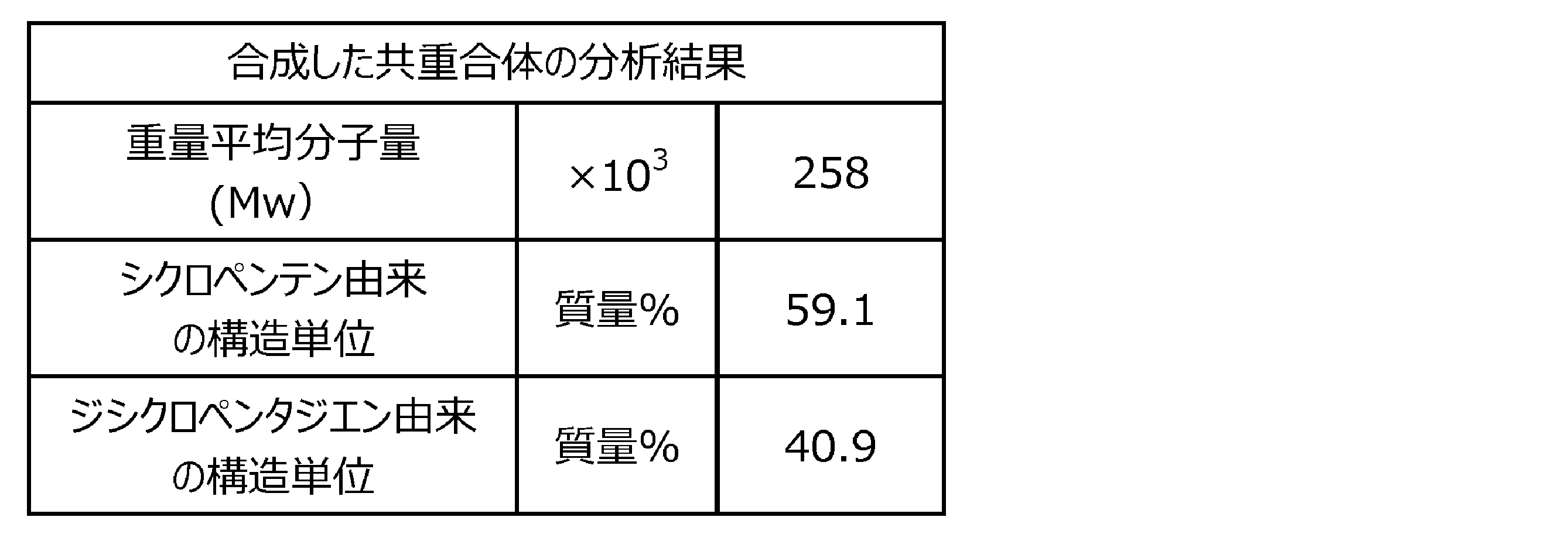
<ゴム組成物の調製>
表2に示す配合処方に従って、各成分を配合して混練し、実施例及び比較例の各ゴム組成物を調製した。
なお、比較例2、実施例1、実施例2においては、ブタジエンゴムまたは上記のようにして合成したシクロペンテンとジシクロペンタジエンとの共重合体の主鎖に複素環式化合物[3,6-ジ(2-ピリジル)-1,2,4,5-テトラジン、東京化成工業社製]が結合した変性ジエン系ゴムを予め調製し、混練の第一段階において、予め調製しておいた該変性ジエン系ゴムと、任意の配合剤と、を混練し、混練の第二段階以降において必要に応じて適宜選択した各種成分を配合して、混練した。
表2に示す配合処方に従って、各成分を配合して混練し、実施例及び比較例の各ゴム組成物を調製した。
なお、比較例2、実施例1、実施例2においては、ブタジエンゴムまたは上記のようにして合成したシクロペンテンとジシクロペンタジエンとの共重合体の主鎖に複素環式化合物[3,6-ジ(2-ピリジル)-1,2,4,5-テトラジン、東京化成工業社製]が結合した変性ジエン系ゴムを予め調製し、混練の第一段階において、予め調製しておいた該変性ジエン系ゴムと、任意の配合剤と、を混練し、混練の第二段階以降において必要に応じて適宜選択した各種成分を配合して、混練した。
また、各ゴム組成物には、表2に示す成分以外の配合剤として、ゴム成分100質量部に対して、硬化脂肪酸2質量部、老化防止剤(二種の合計量)2.5質量部、樹脂1質量部、スルフェンアミド系加硫促進剤1.4質量部、硫黄1.05質量部を更に配合した。
<ゴム組成物の評価>
得られたゴム組成物に対し、下記の方法で低燃費性と耐摩耗性を評価した。結果を表2に示す。
得られたゴム組成物に対し、下記の方法で低燃費性と耐摩耗性を評価した。結果を表2に示す。
(3)低燃費性
得られたゴム組成物から作製した試験片の損失正接(tanδ)を、粘弾性測定装置(TA Instruments)を用いて、温度30℃、歪10%、周波数15Hzの条件で測定した。評価結果は、比較例1のtanδの逆数を100として、指数化した。指数値が大きい程、tanδが小さく、低燃費性に優れることを示す。
得られたゴム組成物から作製した試験片の損失正接(tanδ)を、粘弾性測定装置(TA Instruments)を用いて、温度30℃、歪10%、周波数15Hzの条件で測定した。評価結果は、比較例1のtanδの逆数を100として、指数化した。指数値が大きい程、tanδが小さく、低燃費性に優れることを示す。
(4)耐摩耗性
JIS K 6264-2:2005に準拠し、上島製作所製ランボーン摩耗試験機を使用して、研磨輪にサンドペーパーを貼り付け、スリップ率12%で、室温での摩耗量を測定した。評価結果は、比較例1の摩耗量の逆数を100として、指数化した。指数値が大きい程、摩耗量が少なく、耐摩耗性に優れることを示す。
JIS K 6264-2:2005に準拠し、上島製作所製ランボーン摩耗試験機を使用して、研磨輪にサンドペーパーを貼り付け、スリップ率12%で、室温での摩耗量を測定した。評価結果は、比較例1の摩耗量の逆数を100として、指数化した。指数値が大きい程、摩耗量が少なく、耐摩耗性に優れることを示す。
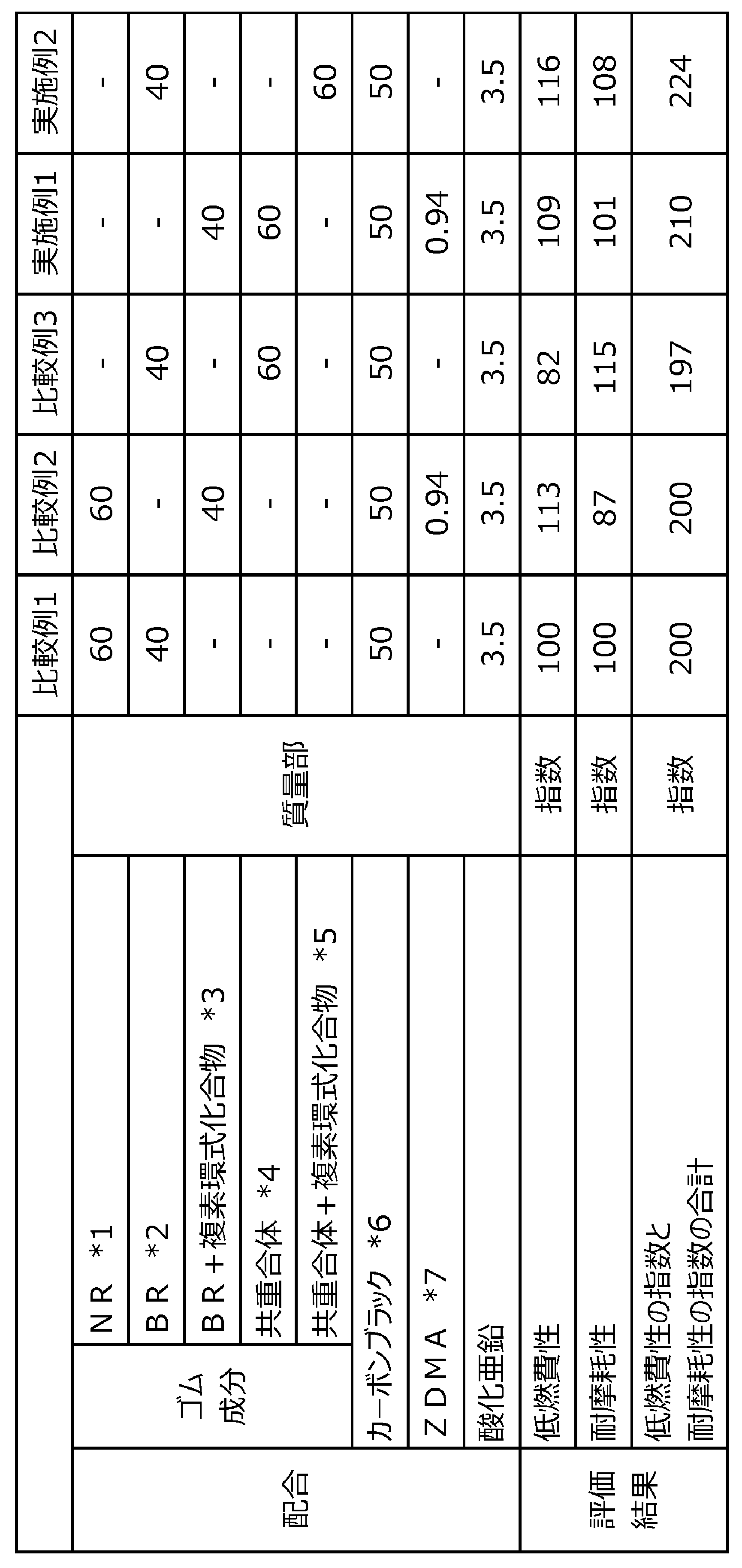
*1 NR: 天然ゴム
*2 BR: ブタジエンゴム、UBEエラストマー社製、商品名「BR150L」
*3 BR+複素環式化合物: ブタジエンゴム[UBEエラストマー社製、商品名「BR150L」]に複素環式化合物が結合した変性ジエン系ゴム(マスターバッチ)
*4 共重合体: 上記の方法で合成したシクロペンテンとジシクロペンタジエンとの共重合体
*5 共重合体+複素環式化合物: 上記の方法で合成したシクロペンテンとジシクロペンタジエンとの共重合体に複素環式化合物が結合した変性ジエン系ゴム(マスターバッチ)
*6 カーボンブラック: セチルトリメチルアンモニウムブロミド(CTAB)吸着比表面積が130m2/gで且つジブチルフタレート(DBP)吸収量が140mL/100gのカーボンブラック
*7 ZDMA: ジメタクリル酸亜鉛、CRAY VALLEY社製、商品名「DYMALINK 708」
表2に示す結果から、シクロペンテンとノルボルネン系化合物との共重合体と、六員環の芳香族複素環を有する複素環式化合物と、金属塩とを含む実施例のゴム組成物は、低燃費性と耐摩耗性を両立できていることが分かる。
一方、六員環の芳香族複素環を有する複素環式化合物を含むものの、シクロペンテンとノルボルネン系化合物との共重合体を含まない比較例2のゴム組成物は、耐摩耗性が大幅に悪化していることが分かる。
また、シクロペンテンとノルボルネン系化合物との共重合体を含むものの、六員環の芳香族複素環を有する複素環式化合物を含まない比較例3のゴム組成物は、低燃費性が大幅に悪化していることが分かる。
また、シクロペンテンとノルボルネン系化合物との共重合体を含むものの、六員環の芳香族複素環を有する複素環式化合物を含まない比較例3のゴム組成物は、低燃費性が大幅に悪化していることが分かる。
Claims (13)
- ゴム成分と、六員環の芳香族複素環を有する複素環式化合物と、金属塩と、を含み、
前記ゴム成分が、シクロペンテンと下記一般式(1):

- 上記一般式(1)で表されるノルボルネン系化合物が、2-ノルボルネン及び/又はジシクロペンタジエンである、請求項1に記載のタイヤ用ゴム組成物。
- 前記シクロペンテンとノルボルネン系化合物との共重合体の含有量が、前記ゴム成分100質量部中、20~90質量部である、請求項1に記載のタイヤ用ゴム組成物。
- 前記シクロペンテンとノルボルネン系化合物との共重合体は、重量平均分子量(Mw)が20万~100万である、請求項1に記載のタイヤ用ゴム組成物。
- 前記シクロペンテンとノルボルネン系化合物との共重合体は、シクロペンテン由来の構造単位の含有割合が20~75質量%である、請求項1に記載のタイヤ用ゴム組成物。
- 前記シクロペンテンとノルボルネン系化合物との共重合体は、2-ノルボルネン由来の構造単位の含有割合が10~60質量%である、請求項2に記載のタイヤ用ゴム組成物。
- 前記シクロペンテンとノルボルネン系化合物との共重合体は、ジシクロペンタジエン由来の構造単位の含有割合が10~60質量%である、請求項2に記載のタイヤ用ゴム組成物。
- 前記複素環式化合物が、ピリジン環、ピリミジン環、ピリダジン環、ピラジン環、トリアジン環、及びテトラジン環からなる群から選択される少なくとも一つの複素環を有する、請求項1に記載のタイヤ用ゴム組成物。
- 前記複素環式化合物が、トリアジン環又はテトラジン環を有する、請求項1に記載のタイヤ用ゴム組成物。
- 前記複素環式化合物が、下記一般式(2):

- 前記金属塩として、酸化亜鉛を含む、請求項1に記載のタイヤ用ゴム組成物。
- 前記金属塩として、更に酸化亜鉛以外の金属塩を含む、請求項11に記載のタイヤ用ゴム組成物。
- 請求項1に記載のタイヤ用ゴム組成物を含むことを特徴とする、タイヤ。
Applications Claiming Priority (2)
| Application Number | Priority Date | Filing Date | Title |
|---|---|---|---|
| JP2023-108693 | 2023-06-30 | ||
| JP2023108693A JP2025007357A (ja) | 2023-06-30 | 2023-06-30 | タイヤ用ゴム組成物及びタイヤ |
Publications (1)
| Publication Number | Publication Date |
|---|---|
| WO2025004409A1 true WO2025004409A1 (ja) | 2025-01-02 |
Family
ID=93938326
Family Applications (1)
| Application Number | Title | Priority Date | Filing Date |
|---|---|---|---|
| PCT/JP2023/043881 Ceased WO2025004409A1 (ja) | 2023-06-30 | 2023-12-07 | タイヤ用ゴム組成物及びタイヤ |
Country Status (2)
| Country | Link |
|---|---|
| JP (1) | JP2025007357A (ja) |
| WO (1) | WO2025004409A1 (ja) |
Citations (9)
| Publication number | Priority date | Publication date | Assignee | Title |
|---|---|---|---|---|
| JPS51122187A (en) * | 1975-04-03 | 1976-10-26 | Goodrich Co B F | Cyclopenteneedicyclopentadiene copolymers and process for producing same |
| JPS60147451A (ja) * | 1984-01-09 | 1985-08-03 | ザ・フアイヤ−スト−ン・タイヤ・アンド・ラバ−・カンパニ− | ジメタクリル酸亜鉛を含む改善されたゴム配合物 |
| JPH02283506A (ja) * | 1989-03-30 | 1990-11-21 | Bridgestone Corp | イオンおよび共有結合の架橋を含有するトレツド素材 |
| JP2012111897A (ja) * | 2010-11-26 | 2012-06-14 | Yokohama Rubber Co Ltd:The | プレキュアトレッド用ゴム組成物、空気入りタイヤおよびその製造方法 |
| WO2014133028A1 (ja) * | 2013-02-26 | 2014-09-04 | 日本ゼオン株式会社 | シクロペンテン開環共重合体、その製造方法およびゴム組成物 |
| WO2018186458A1 (ja) * | 2017-04-07 | 2018-10-11 | 株式会社ブリヂストン | ゴム組成物、ゴム組成物の製造方法及びタイヤ |
| JP2019070085A (ja) * | 2017-10-10 | 2019-05-09 | 株式会社ブリヂストン | ゴム組成物、ゴム組成物の製造方法及びタイヤ |
| WO2020036001A1 (ja) * | 2018-08-17 | 2020-02-20 | 日本ゼオン株式会社 | 環状オレフィン開環共重合体およびその製造方法、ゴム組成物ならびにゴム架橋物 |
| JP2021107506A (ja) * | 2019-12-27 | 2021-07-29 | Toyo Tire株式会社 | ゴム組成物の製造方法 |
-
2023
- 2023-06-30 JP JP2023108693A patent/JP2025007357A/ja active Pending
- 2023-12-07 WO PCT/JP2023/043881 patent/WO2025004409A1/ja not_active Ceased
Patent Citations (9)
| Publication number | Priority date | Publication date | Assignee | Title |
|---|---|---|---|---|
| JPS51122187A (en) * | 1975-04-03 | 1976-10-26 | Goodrich Co B F | Cyclopenteneedicyclopentadiene copolymers and process for producing same |
| JPS60147451A (ja) * | 1984-01-09 | 1985-08-03 | ザ・フアイヤ−スト−ン・タイヤ・アンド・ラバ−・カンパニ− | ジメタクリル酸亜鉛を含む改善されたゴム配合物 |
| JPH02283506A (ja) * | 1989-03-30 | 1990-11-21 | Bridgestone Corp | イオンおよび共有結合の架橋を含有するトレツド素材 |
| JP2012111897A (ja) * | 2010-11-26 | 2012-06-14 | Yokohama Rubber Co Ltd:The | プレキュアトレッド用ゴム組成物、空気入りタイヤおよびその製造方法 |
| WO2014133028A1 (ja) * | 2013-02-26 | 2014-09-04 | 日本ゼオン株式会社 | シクロペンテン開環共重合体、その製造方法およびゴム組成物 |
| WO2018186458A1 (ja) * | 2017-04-07 | 2018-10-11 | 株式会社ブリヂストン | ゴム組成物、ゴム組成物の製造方法及びタイヤ |
| JP2019070085A (ja) * | 2017-10-10 | 2019-05-09 | 株式会社ブリヂストン | ゴム組成物、ゴム組成物の製造方法及びタイヤ |
| WO2020036001A1 (ja) * | 2018-08-17 | 2020-02-20 | 日本ゼオン株式会社 | 環状オレフィン開環共重合体およびその製造方法、ゴム組成物ならびにゴム架橋物 |
| JP2021107506A (ja) * | 2019-12-27 | 2021-07-29 | Toyo Tire株式会社 | ゴム組成物の製造方法 |
Also Published As
| Publication number | Publication date |
|---|---|
| JP2025007357A (ja) | 2025-01-17 |
Similar Documents
| Publication | Publication Date | Title |
|---|---|---|
| JP5733315B2 (ja) | シクロペンテン開環重合体およびその製造方法 | |
| JP5422936B2 (ja) | シクロペンテン開環重合体ゴムとその製造方法 | |
| EP3354675B1 (en) | Cyclopentene ring-opened copolymer | |
| EP3159365B1 (en) | Cyclopentene ring-opening polymer and method for producing same, polymer composition, and polymer crosslinked product | |
| JPWO2020036001A1 (ja) | 環状オレフィン開環共重合体およびその製造方法、ゴム組成物ならびにゴム架橋物 | |
| JP2020015832A (ja) | 耐破壊特性材料用組成物、耐破壊特性材料用架橋物および耐破壊特性材料 | |
| JP5614472B2 (ja) | シクロペンテン開環重合体組成物 | |
| JP7556361B2 (ja) | 開環共重合体 | |
| EP3822317B1 (en) | Ring-opening copolymer composition | |
| JP2025007357A (ja) | タイヤ用ゴム組成物及びタイヤ | |
| WO2025004406A1 (ja) | タイヤ用ゴム組成物及びタイヤ | |
| WO2025004407A1 (ja) | タイヤ用ゴム組成物及びタイヤ | |
| WO2025004405A1 (ja) | タイヤ用ゴム組成物及びタイヤ | |
| WO2025004404A1 (ja) | タイヤ用ゴム組成物及びタイヤ | |
| JP6701892B2 (ja) | 重荷重タイヤ用ゴム組成物 | |
| WO2025169607A1 (ja) | タイヤ用ゴム組成物及びタイヤ | |
| EP4502058A1 (en) | Rubber composition and crosslinked rubber object | |
| WO2015194638A2 (ja) | ゴム組成物、ゴム架橋物およびタイヤ | |
| WO2025004408A1 (ja) | タイヤ用ゴム組成物及びタイヤ | |
| EP3604439A1 (en) | Rubber composition and crosslinked rubber product | |
| EP3502181B1 (en) | Crosslinked rubber | |
| WO2026029019A1 (ja) | タイヤ用ゴム組成物及びタイヤ |
Legal Events
| Date | Code | Title | Description |
|---|---|---|---|
| 121 | Ep: the epo has been informed by wipo that ep was designated in this application |
Ref document number: 23943795 Country of ref document: EP Kind code of ref document: A1 |
|
| NENP | Non-entry into the national phase |
Ref country code: DE |
|
| 122 | Ep: pct application non-entry in european phase |
Ref document number: 23943795 Country of ref document: EP Kind code of ref document: A1 |