WO2024262455A1 - 電極 - Google Patents
電極 Download PDFInfo
- Publication number
- WO2024262455A1 WO2024262455A1 PCT/JP2024/021862 JP2024021862W WO2024262455A1 WO 2024262455 A1 WO2024262455 A1 WO 2024262455A1 JP 2024021862 W JP2024021862 W JP 2024021862W WO 2024262455 A1 WO2024262455 A1 WO 2024262455A1
- Authority
- WO
- WIPO (PCT)
- Prior art keywords
- silver
- mxene
- electrode
- silver chloride
- dimensional material
- Prior art date
- Legal status (The legal status is an assumption and is not a legal conclusion. Google has not performed a legal analysis and makes no representation as to the accuracy of the status listed.)
- Ceased
Links
Images




Classifications
-
- A—HUMAN NECESSITIES
- A61—MEDICAL OR VETERINARY SCIENCE; HYGIENE
- A61B—DIAGNOSIS; SURGERY; IDENTIFICATION
- A61B5/00—Measuring for diagnostic purposes; Identification of persons
- A61B5/24—Detecting, measuring or recording bioelectric or biomagnetic signals of the body or parts thereof
- A61B5/25—Bioelectric electrodes therefor
- A61B5/263—Bioelectric electrodes therefor characterised by the electrode materials
-
- A—HUMAN NECESSITIES
- A61—MEDICAL OR VETERINARY SCIENCE; HYGIENE
- A61B—DIAGNOSIS; SURGERY; IDENTIFICATION
- A61B5/00—Measuring for diagnostic purposes; Identification of persons
- A61B5/24—Detecting, measuring or recording bioelectric or biomagnetic signals of the body or parts thereof
- A61B5/25—Bioelectric electrodes therefor
- A61B5/263—Bioelectric electrodes therefor characterised by the electrode materials
- A61B5/265—Bioelectric electrodes therefor characterised by the electrode materials containing silver or silver chloride
Definitions
- This disclosure relates to electrodes.
- MXene has been attracting attention as a new conductive material.
- MXene is a type of so-called two-dimensional material, and more specifically, as described below, it is a two-dimensional material (layered material) having the form of one or more layers.
- MXene has the form of particles (which may include powder, flakes, nanosheets, etc.) of such two-dimensional materials (layered materials).
- Patent Document 1 shows a bioelectrode formed from a contact material containing this MXene.
- Patent Document 1 MXene is used in the area that comes into contact with the specimen.
- Patent Document 1 does not specifically consider electrodes that include a silver/silver chloride electrode portion, and it is believed that the impedance of electrodes that include a silver/silver chloride electrode portion is insufficient.
- the purpose of the present disclosure is to provide an electrode that includes a silver/silver chloride electrode portion and exhibits low impedance.
- An electrode having a substrate, a silver/silver chloride electrode portion, and a membrane comprising particles of a two-dimensional material comprising one or more layers,
- the one or more layers may have the following formula: M m X n wherein M is at least one Group 3, 4, 5, 6, 7 metal, including Ti; X is a carbon atom, a nitrogen atom, or a combination thereof; n is 1 or more and 4 or less, m is greater than n and is equal to or less than 5. and a modification or termination T (T is at least one selected from the group consisting of a hydroxyl group, a fluorine atom, a chlorine atom, an oxygen atom, and a hydrogen atom) present on the surface of the layer body.
- a novel low impedance electrode has a substrate, a silver/silver chloride electrode portion, and a membrane containing particles of a predetermined two-dimensional material (also referred to herein as "MXene").
- FIG. 1A-1B are schematic cross-sectional views illustrating particles of a two-dimensional material (MXene) that can be used in one embodiment of the present disclosure, where (a) shows a single-layer MXene particle and (b) shows a multi-layer (exemplarily two-layer) MXene particle.
- FIG. 1 is a schematic cross-sectional view showing one embodiment of an electrode of the present disclosure.
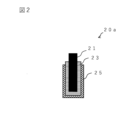
- FIG. 2 is a schematic cross-sectional view showing another embodiment of an electrode according to the present disclosure.
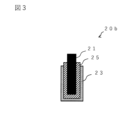
- FIG. 2 is a schematic cross-sectional view showing another embodiment of an electrode according to the present disclosure.
- FIG. 2 is a schematic cross-sectional view showing another embodiment of an electrode according to the present disclosure.
- FIG. 2 is a schematic cross-sectional view showing another embodiment of an electrode according to the present disclosure.
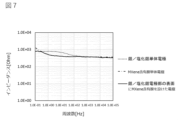
- 1 shows the results of impedance measurement in an example. 13 shows other impedance measurement results in the example.
- the electrode according to the present embodiment includes a substrate, a silver/silver chloride electrode portion, and a membrane (hereinafter sometimes referred to as an "MXene-containing membrane") that includes particles of a two-dimensional material that includes one or more layers, thereby providing an electrode that includes a silver/silver chloride electrode portion and exhibits low impedance.
- a membrane hereinafter sometimes referred to as an "MXene-containing membrane
- a film including particles of a two-dimensional material including one or more layers, which constitutes the electrode of this embodiment will be described.
- the above two-dimensional material can be understood as a layered compound and is also represented as " MmXnTs ", where s is any number, and x or z may be used instead of s in the conventional manner.
- n can be 1, 2, 3, or 4, but is not limited thereto.
- M may be only Ti, or may contain Ti and may further contain one or more of group 3, 4, 5, 6, and 7 metals other than Ti.
- M may contain Ti and may further contain at least one selected from the group consisting of Zr, Hf, V, Nb, Ta, Cr, Mo, and Mn.
- M contains an element other than Ti, it is more preferable that the element other than Ti is at least one selected from the group consisting of V, Cr, and Mo.
- MXene is known in which the above formula: M m X n is expressed as follows: Ti2C , Ti2N , (Ti,V) 2C , (Ti,Nb) 2C , Ti3C2 , Ti3N2 , Ti3 (CN), ( Ti , V) 3C2 , ( Ti2Nb ) C2 , ( Ti2Ta ) C2 , ( Ti2 Mn) C2 , ( V2Ti ) C2 , ( Cr2Ti ) C2 , ( Mo2Ti ) C2 , ( W2Ti )C2 , Ti4N3 , ( Ti , Nb ) 4C3 , ( Ti2Nb2 ) C3 , ( Ti2Ta2 )C 3 , (V 2 Ti 2 ) C3 , ( Cr2Ti2 ) C3 , ( Mo2Ti2 ) C3 , ( W2Ti2 ) C3 , ( W2Ti
- M can be titanium, or titanium and vanadium
- X can be a carbon atom or a nitrogen atom
- the MAX phase which is the precursor of MXene, is Ti3AlC2
- MXene is Ti3C2Ts (in other words, M is Ti , X is C, n is 2 , and m is 3).
- MXene may contain a relatively small amount of residual A atoms derived from its precursor MAX, for example, 10 mass% or less of the original A atoms.
- the amount of residual A atoms may be preferably 8 mass% or less, more preferably 6 mass% or less. However, even if the amount of residual A atoms exceeds 10 mass%, there may be cases where this does not cause a problem depending on the application and conditions of use.
- the MXene particles according to this embodiment are aggregates containing one layer of MXene 10a (single layer MXene) as illustrated in Fig. 1(a), more specifically, aggregates containing two or more MXene 10a.
- MXene 10a is an MXene layer 7a having a layer body ( MmXn layer ) 1a represented by MmXn and modifications or terminations T3a, 5a present on the surface of the layer body 1a (more specifically, on at least one of the two surfaces facing each other in each layer).
- MXene layer 7a is also represented as " MmXnTs " , where s is any number.
- MXene particles according to this embodiment may have one or more layers of MXene.
- MXene with multiple layers include, but are not limited to, two layers of MXene 10b, as shown in FIG. 1(b). 1b, 3b, 5b, and 7b in FIG. 1(b) are the same as 1a, 3a, 5a, and 7a in FIG. 1(a).
- two adjacent MXene layers e.g., 7a and 7b
- the MXene 10a is present as a single layer, with the multilayer MXene 10b being individually separated, and the unseparated multilayer MXene 10b remaining, and may be a mixture of the single layer MXene 10a and multilayer MXene 10b. Even when the multilayer MXene is included, it is preferable that the multilayer MXene is an MXene with a small number of layers obtained through a delamination process.
- the "small number of layers" means, for example, that the number of stacked MXene layers is 10 or less.
- this "multilayer MXene with a small number of layers” may be referred to as “few-layer MXene.”
- the thickness of the few-layer MXene in the stacking direction may be 15 nm or less, and may even be 10 nm or less.
- the single-layer MXene and few-layer MXene may be collectively referred to as “single-layer/few-layer MXene.”
- MXene may be single-layered or few-layered MXene.
- the specific surface area of the MXene can be made larger than that of multi-layered MXene, and as a result, when the laminate is used in an application requiring electrical conductivity, for example, deterioration of electrical conductivity over time can be suppressed.
- the single-layered or few-layered MXene having 10 or less MXene layers and a thickness of 15 nm or less, preferably 10 nm or less may account for, for example, 80% or more by volume, or even 90% or more by volume, or even 95% or more by volume, of the total MXene.
- the volume of the single-layered MXene may be greater than the volume of the few-layered MXene. Since the true density of these MXenes does not vary significantly depending on the form of existence, it can also be said that the mass of the single-layered MXene is greater than the mass of the few-layered MXene. When these relationships are satisfied, the specific surface area of MXene can be increased, and when used in applications requiring electrical conductivity, for example, deterioration of electrical conductivity over time can be suppressed.
- the film may be formed of only a single layer of MXene.
- each layer of MXene can be, for example, 1 nm or more and 30 ⁇ m or less, and can be, for example, 1 nm or more and 5 nm or less, or even 1 nm or more and 3 nm or less (which can vary mainly depending on the number of M atomic layers contained in each layer).
- the interlayer distance or gap dimension, shown as ⁇ d in FIG.
- 1(b)) can be, for example, 0.8 nm or more and 10 nm or less, particularly 0.8 nm or more and 5 nm or less, and more particularly about 1 nm, and the total number of layers can be 2 or more and 20,000 or less.
- the silver/silver chloride electrode portion included in the electrode according to this embodiment is not particularly limited, and a silver/silver chloride electrode that is commonly used in electrodes can be used.
- the material constituting the substrate (also referred to as "electrode substrate") included in the electrode according to this embodiment is not particularly limited, and may be any appropriate material.
- the shape of the substrate is also not limited.
- the substrate may be, for example, a resin film, a metal foil, a printed wiring board, a mounted electronic component, a metal pin, a metal wiring, a metal wire, or the like.
- a substrate formed of a metal material, a resin, or the like suitable for a biosignal sensing electrode can be appropriately adopted.
- the metal material, resin, or the like include at least one of the metal materials gold, silver, copper, platinum, nickel, titanium, tin, iron, zinc, magnesium, aluminum, tungsten, and molybdenum, and a conductive polymer.
- the reason why the electrode according to this embodiment shows a lower impedance, for example, in the low frequency region is presumed to be as follows.
- silver/silver chloride causes a reversible reaction as shown in the following formula (1). Therefore, the silver/silver chloride electrode shows a constant impedance, for example, at low frequencies (0.1 Hz to 1 Hz). In the low frequency region, the state approaches that of a direct current, so an overvoltage is applied. When an overvoltage is applied, a reaction occurs, and a constant resistance according to the reaction rate is shown.
- MXene has a large capacity and low impedance from 1 Hz to 1000 Hz.
- the reason for the large capacity of MXene is that it has a layered structure.
- flake-shaped MXene has a shape of about 3 ⁇ m in the planar direction and a thickness of about 2 nm.
- An MXene electrode formed using this MXene has a mille-feuille-like multi-layer structure in which MXene flakes overlap.
- MXene also has the property of adsorbing metal cations, which further increases the capacity.
- the effective electrode area that expresses the capacity is larger than that of a flat silver/silver chloride electrode, and the impedance is lower.
- the MXene electrode does not show a reversible reaction like the above formula (1) of silver/silver chloride, there is a problem that the impedance is high in the low frequency range of 0.1 Hz to 1 Hz.
- the electrode of this embodiment has a silver/silver chloride electrode part and an MXene-containing film.
- the silver/silver chloride electrode part and the MXene-containing film may be separate, or the MXene-containing film may also serve as the silver/silver chloride electrode part.
- an embodiment in which the silver/silver chloride electrode part and the MXene-containing film are separate will first be described.
- an electrode in which a silver/silver chloride electrode part is disposed on at least a part of the surface of the substrate, and an MXene-containing film is disposed on at least a part of the surface of the silver/silver chloride electrode part exposed to the external environment can be given.
- an electrolyte (electrolyte) such as moisture on the skin penetrates into the MXene-containing film and reaches the silver/silver chloride electrode part, and a reversible reaction as shown in the above formula (1) occurs, thereby suppressing the impedance low.
- the electrode of this embodiment is, for example, an electrode in which an MXene-containing film is disposed on at least a portion of the surface of a substrate, and a silver/silver chloride electrode portion is disposed on at least a portion of the surface of the MXene-containing film exposed to the external environment. Even in this case, the impedance is kept low over a wide frequency range, including the low frequency range.
- the specific form of the MXene-containing film in the electrode of this embodiment is not limited.
- the MXene-containing film may be in a solid state or a soft, flexible state.
- its thickness can be measured, for example, by measuring with a micrometer or by observing the cross section using a scanning electron microscope (SEM), a microscope, or a laser microscope.
- SEM scanning electron microscope
- the thickness of the MXene-containing film is preferably 1 nm or more and 5 ⁇ m or less.
- the impedance can be further reduced.
- the thickness of the MXene-containing film can be, for example, 1.0 ⁇ m or less, further 0.8 ⁇ m or less, and even 0.5 ⁇ m or less.
- the thickness of the MXene-containing film is preferably 1 nm or more.
- the thickness of the MXene-containing film is more preferably 10 nm or more.
- the film containing particles of the two-dimensional material may contain a polymer. By containing the polymer, the adhesive strength with the electrode substrate, etc. can be improved.
- the polymer is preferably a water-soluble polymer.
- the adhesive strength with the electrode substrate can be further improved.
- the water-soluble polymer include water-soluble conductive polymers, such as thiophene-based polymers, MPC polymers mainly composed of monomers having phosphorylcholine groups, acrylic polymers, polyurethanes, polyethylene glycols, carboxymethylcellulose (CMC), alginic acid polymers, polyethers, polyvinyl alcohols, water-soluble polyesters, dicarboxylated polysaccharides, and the like.
- water-soluble polymer examples include one or more selected from the group consisting of poly(3,4-ethylenedioxythiophene)-poly(styrenesulfonic acid) (PEDOT:PSS), Lipidure (registered trademark) A, Lipidure (registered trademark) PMB, polyurethane, polyacrylic acid, sodium polyacrylate, and cation-modified PVA.
- PDOT:PSS poly(3,4-ethylenedioxythiophene)-poly(styrenesulfonic acid)
- Lipidure (registered trademark) A Lipidure (registered trademark) PMB
- polyurethane polyacrylic acid
- sodium polyacrylate sodium polyacrylate
- cation-modified PVA cation-modified PVA
- the ratio of the particles of the two-dimensional material may be, for example, 0.5% by mass or more and 50% by mass or less. By setting the ratio of the particles of the two-dimensional material to 0.5% by mass or more, signals can be detected with high sensitivity.
- the ratio of the particles of the two-dimensional material is more preferably 1.0% by mass or more. From the viewpoint of ensuring higher flexibility of the composite material, the ratio is preferably 50% by mass or less, more preferably 40% by mass or less.
- the ratio of the particles of the two-dimensional material refers to the ratio in the film.
- the MXene-containing film may contain additives such as colorants and antioxidants, in which case the ratio of the particles of the two-dimensional material refers to the ratio (mass%) in the film including the additives.
- the electrodes according to this embodiment can be preferably used, for example, as biosignal sensing electrodes, and can be preferably used, for example, as electrodes for measuring EEG (electroencephalograms), ECG (electrocardiograms), etc., that can sensitively detect bioinformation such as electrical signals from the brain and heart.
- EEG electroencephalograms
- ECG electrocardiograms
- the frequency range in which the electrode according to this embodiment can be used is not particularly limited.
- the electrode according to this embodiment can exhibit excellent conductivity (low impedance) especially when used in a relatively low frequency range (1000 Hz or less).
- the electrode according to this embodiment can be used in a frequency range of, for example, 500 Hz or less, further 300 Hz or less, further 200 Hz or less, and further 150 Hz or less.
- the frequency range can be, for example, 0.05 Hz or more, for example, 0.1 Hz or more.
- the electrode can be used in a frequency range of 0.1 to 150 Hz. Examples of applications in the above relatively low frequency range include measurement of electroencephalograms, electrocardiograms, etc., particularly measurement of electroencephalograms. Therefore, the electrode according to this embodiment can be preferably used for measurement of the above-mentioned electroencephalograms, electrocardiograms, etc.
- the electrode according to this embodiment may have a substrate, a silver/silver chloride electrode portion, and an MXene-containing film.
- One embodiment of the electrode according to this embodiment is an electrode in which a silver/silver chloride electrode portion is disposed on at least a portion of the surface of the substrate, and an MXene-containing film is disposed on at least a portion of the surface of the silver/silver chloride electrode portion that is exposed to the external environment. For example, as shown in the schematic cross-sectional view of FIG.
- an electrode 20a is exemplified in which a silver/silver chloride electrode portion 23 is disposed on the surface of an electrode substrate 21, and an MXene-containing film 25 is disposed on the surface of the silver/silver chloride electrode portion 23.
- an electrode is exemplified in which the substrate has a tip and a longitudinal direction, the silver/silver chloride electrode portion is disposed on the surfaces of the tip and side portions of the substrate, and the MXene-containing film is disposed on about 50% or more of the surface of the silver/silver chloride electrode portion that is exposed to the external environment.
- Another aspect of the electrode according to this embodiment is an electrode in which an MXene-containing film is disposed on at least a portion of the surface of a substrate, and a silver/silver chloride electrode portion is disposed on at least a portion of the surface of the MXene-containing film exposed to the external environment.
- electrode 20b in which an MXene-containing film 25 is disposed on the surface of electrode substrate 21, and a silver/silver chloride electrode portion 23 is disposed on the surface of MXene-containing film 25, as shown in the schematic cross-sectional view of FIG. 3. As shown in FIG.
- an electrode in which the substrate has a tip and a longitudinal direction, the MXene-containing film is disposed on a surface including the tip of the substrate, and the silver/silver chloride electrode portion is disposed on approximately 50% or more of the surface of the MXene-containing film exposed to the external environment is exemplified.
- an electrode 20c in which the proportion of the silver/silver chloride electrode portion 23 arranged on the surface of the electrode substrate 21 is smaller than that of FIG. 2.
- an electrode in which the substrate has a tip and a longitudinal direction the silver/silver chloride electrode portion is arranged on the surface including the tip of the substrate, and the MXene-containing film (film containing particles of a two-dimensional material) is arranged on all of the surfaces of the silver/silver chloride electrode portion exposed to the external environment.
- the electrode of this embodiment may be, for example, a contact pin in which the substrate has a tip and a longitudinal direction as shown in FIG.
- the silver/silver chloride electrode portion 23 is configured only on the tip region 27 of the contact pin, and the MXene-containing film 25 is arranged so as to cover all of the surfaces of the silver/silver chloride electrode portion 23 exposed to the external environment.
- the surface that comes into contact with the skin is an MXene-containing film, and therefore it has excellent biocompatibility.
- the silver/silver chloride electrode portion and the MXene-containing film are in direct contact at least in part.
- Another aspect of the electrode according to this embodiment is a brush-shaped electrode having a support and a plurality of contact pins for contacting the measured object, in which at least one of the plurality of contact pins has a substrate, a silver/silver chloride electrode portion, and a film containing particles of a two-dimensional material having one or more layers, and in which the silver/silver chloride electrode portion is disposed on at least a portion of the surface of the substrate at a portion including the tip of the contact pin, and the MXene-containing film is disposed on at least a portion of the surface of the silver/silver chloride electrode portion that is exposed to the external environment.
- a brush-shaped electrode 30 having a plurality of contact pins 33 connected to a support 31 can be used, and each of the plurality of contact pins 33 can have any of the aspects shown in FIG. 2 to FIG. 4 described above.
- the film containing the particles of the two-dimensional material (MXene particles) further contains silver/silver chloride and also serves as a silver/silver chloride electrode portion.
- the film may be a film in which silver/silver chloride and MXene are dispersed in each other (hereinafter, may be referred to as a "silver/silver chloride-MXene dispersion film").
- Silver has high conductivity, but silver/silver chloride does not.
- the conductivity of MXene is one to two orders of magnitude lower than silver, but its impedance is lower than silver/silver chloride. Therefore, the reason why the impedance of the dispersion of MXene and silver/silver chloride is lower than that of MXene alone and silver/silver chloride alone is thought to be that the low conductivity of MXene is improved by the silver contained in silver/silver chloride. This effect is achieved by dispersing silver/silver chloride and MXene.
- the volume ratio of MXene in the dispersion film is preferably 25% by volume or more, more preferably 30% by volume or more, and 75% by volume or less, more preferably 70% by volume or less.
- the silver/silver chloride-MXene dispersion film may contain a third component other than silver/silver chloride and MXene, such as a binder that may be contained in the silver/silver chloride paste that may be used in the manufacture of the silver/silver chloride-MXene dispersion film, organic dispersion medium molecules, or inorganic materials as thickeners.
- the volume ratio of the third component in the silver/silver chloride-MXene dispersion film may be, for example, 5% by volume or less, or even 1% by volume or less.
- One embodiment of the electrode containing the silver/silver chloride-MXene dispersion film is, for example, an electrode 40 in which a silver/silver chloride-MXene dispersion film 43 is disposed on the surface of an electrode substrate 41, as shown in the schematic cross-sectional view of FIG. 6.
- Another aspect of the electrode according to this embodiment is a brush-shaped electrode having a support and a number of contact pins for contacting the object to be measured, in which at least one of the contact pins has a substrate and the silver/silver chloride-MXene dispersion film, and the silver/silver chloride-MXene dispersion film is disposed on at least a portion of the surface of the substrate at a portion including the tip of the contact pin.
- a brush-shaped electrode 30 having a number of contact pins 33 connected to a support 31 can be used, and each of the contact pins 33 can have the form shown in FIG. 6, for example.
- the above Figures 2 to 6 are explanatory diagrams for ease of understanding, and the shapes, film thicknesses, and other sizes of the electrode substrate, silver/silver chloride electrode portion, MXene-containing film, silver/silver chloride-MXene dispersion film, etc. in these figures may differ from those of an actual electrode.
- the electrodes according to this embodiment have been described using the above figures, the electrodes according to this embodiment are not limited to the forms shown in the above figures.
- the cross section of the contact pins of the brush-shaped electrode may be not only rectangular as shown in the above figures, but also tapered triangular, tapered trapezoidal, etc.
- the tips of the contact pins may be flat or convex curved, etc.
- a particle of a two-dimensional material comprising one or more layers may have the following formula: M m X n wherein M is at least one Group 3, 4, 5, 6, 7 metal, including Ti; X is a carbon atom, a nitrogen atom, or a combination thereof; n is 1 or more and 4 or less, m is greater than n and is equal to or less than 5.
- T being at least one selected from the group consisting of a hydroxyl group, a fluorine atom, a chlorine atom, an oxygen atom, and a hydrogen atom
- T being at least one selected from the group consisting of a hydroxyl group, a fluorine atom, a chlorine atom, an oxygen atom, and a hydrogen atom
- a film containing particles of the two-dimensional material is formed on at least a part of the surface (surface exposed to the external environment) of the silver/silver chloride electrode part formed on the surface of the substrate, or
- a silver/silver chloride electrode part is formed on at least a part of the surface (surface exposed to the external environment) of the film containing the particles of the two-dimensional material.
- a predetermined precursor is prepared.
- the predetermined precursor that can be used in this embodiment is the MAX phase, which is a precursor of MXene.
- A is at least one Group 12, 13, 14, 15, or 16 element, usually a Group A element, typically Group IIIA or Group IVA, and more specifically may include at least one element selected from the group consisting of Al, Ga, In, Tl, Si, Ge, Sn, Pb, P, As, S, and Cd, and is preferably Al.
- the MAX phase has a crystal structure in which a layer composed of A atoms is located between two layers represented by MmXn (each X may have a crystal lattice in which it is located in an octahedral array of M ) .
- the above-mentioned MAX phase can be manufactured by a known method. For example, TiC powder, Ti powder, and Al powder are mixed in a ball mill, and the resulting mixed powder is sintered in an Ar atmosphere to obtain a sintered body (block-shaped MAX phase). The resulting sintered body is then pulverized with an end mill to obtain powdered MAX phase for the next process.
- any suitable post-treatment e.g., ultrasonic treatment, hand shaking, automatic shaker, etc.
- ultrasonic treatment can destroy MXene due to excessive shear force, so if it is desired to obtain MXene with a two-dimensional shape having a larger aspect ratio (preferably single-layer MXene), it is preferable to apply an appropriate shear force using hand shaking or an automatic shaker, etc.
- a monovalent metal ion intercalation treatment may be performed, which includes a step of mixing the etched product obtained by the etching treatment with a metal compound containing a monovalent metal ion.
- the monovalent metal ion constituting the metal compound containing a monovalent metal ion include alkali metal ions such as lithium ions, sodium ions, and potassium ions, copper ions, silver ions, and gold ions.
- the metal compound containing the monovalent metal ion include ionic compounds in which the metal ion and a cation are bonded.
- the metal ion may be an iodide, a phosphate, or a sulfide salt including a sulfate, a nitrate, an acetate, or a carboxylate.
- the monovalent metal ion is preferably a lithium ion
- the metal compound containing a monovalent metal ion is preferably a metal compound containing a lithium ion, more preferably an ionic compound of a lithium ion, and more preferably one or more of an iodide, a phosphate, and a sulfide salt of a lithium ion. If lithium ions are used as the metal ion, it is considered that the water hydrated to the lithium ion has the most negative dielectric constant, and therefore it is easy to form a monolayer.
- the content of the metal compound containing a monovalent metal ion in the compound for intercalation treatment of a monovalent metal ion is preferably 0.001% by mass or more.
- the content is more preferably 0.01% by mass or more, and even more preferably 0.1% by mass or more.
- the content of the metal compound containing a monovalent metal ion is preferably 10% by mass or less, and more preferably 1% by mass or less.
- the intercalation product obtained by intercalation may be used to perform delamination.
- the intercalation product may be centrifuged, the supernatant liquid may be discarded, and the remaining precipitate may be washed with a dispersion medium such as water.
- the conditions for the delamination process are not particularly limited.
- the dispersion medium used for the delamination is also not particularly limited, and for example, one or more of a polar organic dispersion medium and an aqueous dispersion medium may be used.
- ⁇ Process (b1, b2) (b1) Using the particles of the two-dimensional material, at least a part of the surface (surface exposed to the external environment) of a silver/silver chloride electrode part formed on the surface of a substrate is provided with particles of the two-dimensional material.
- a film, or (b2) Using the particles of the two-dimensional material, a film containing the particles of the two-dimensional material is formed on at least a part of the surface of a substrate, and then the surface of the film containing the particles of the two-dimensional material (external environment) is A silver/silver chloride electrode portion is formed on at least a portion of the surface of the substrate (the surface exposed to the heat).
- the silver/silver chloride electrode part can be formed by a method similar to that of forming a normal silver/silver chloride electrode.
- a method of forming a film containing particles of a two-dimensional material (MXene-containing film) using particles of the two-dimensional material on at least a portion of the surface of the silver/silver chloride electrode part formed on the surface of the substrate (step (b1)), or on at least a portion of the surface of the substrate (step (b2)) will be described.
- the MXene particle dispersion may be supplied to at least a part of the surface of the silver/silver chloride electrode part as is or after appropriate adjustment (e.g., dilution with a medium liquid or addition of a binder), and in the case of step (b2), it may be supplied to at least a part of the surface of the substrate.
- An example of the supply method is coating.
- Examples of the coating method include a method of spray coating using a nozzle such as a one-fluid nozzle, a two-fluid nozzle, or an airbrush (a method using a spray coater), slit coating using a table coater, a comma coater, or a bar coater, screen printing, metal mask printing, spin coating, dip coating, dripping, etc.
- the above-mentioned medium liquid may be an aqueous medium liquid or an organic medium liquid.
- the medium liquid constituting the dispersion of the MXene particles is typically water, and may contain a relatively small amount of other liquid substances in addition to water (for example, 30% by mass or less, preferably 20% by mass or less based on the total).
- Examples of the organic medium liquid include N-methylpyrrolidone, N-methylformamide, N,N-dimethylformamide, ethanol, methanol, dimethylsulfoxide, ethylene glycol, and acetic acid.
- the layered material can be mixed with the polymer, as shown in the following example.
- an MXene aqueous dispersion in which the MXene particles (particles of a two-dimensional material) are present in a dispersion medium, or a dispersion of MXene and an organic dispersion medium, or a mixture of MXene powder and a polymer can be used.
- the dispersion medium of the MXene aqueous dispersion is typically water, and in some cases, it may contain, in addition to water, a relatively small amount of other liquid substances (e.g., 30% by mass or less, preferably 20% by mass or less, based on the total amount).
- the MXene particles and polymer can be mixed using a dispersion device such as a homogenizer, a propeller mixer, a thin film rotary mixer, a planetary mixer, a mechanical shaker, or a vortex mixer.
- a dispersion device such as a homogenizer, a propeller mixer, a thin film rotary mixer, a planetary mixer, a mechanical shaker, or a vortex mixer.
- the slurry which is a mixture of the MXene particles and polymer, can be applied to at least a part of the surface (surface exposed to the external environment) of a silver/silver chloride electrode portion formed on the surface of a base material (e.g., a substrate).
- the slurry can be applied to at least a part of the surface of a base material (e.g., a substrate).
- the application method is not limited, and examples include spray application using a nozzle such as a one-fluid nozzle, a two-fluid nozzle, or an airbrush; slit coating using a table coater, a comma coater, or a bar coater; screen printing; metal mask printing; and application methods by spin coating, immersion, or dripping.
- a nozzle such as a one-fluid nozzle, a two-fluid nozzle, or an airbrush
- slit coating using a table coater, a comma coater, or a bar coater
- screen printing metal mask printing
- application methods by spin coating, immersion, or dripping include spray application using a nozzle such as a one-fluid nozzle, a two-fluid nozzle, or an airbrush; slit coating using a table coater, a comma coater, or a bar coater; screen printing; metal mask printing; and application methods by spin coating, immersion, or d
- the formation and drying of the MXene-containing film can be repeated as appropriate until the desired MXene-containing film thickness is obtained.
- the combination of spraying and drying can be repeated multiple times.
- the MXene-containing film may or may not contain residual liquid components derived from the liquid medium of the slurry.
- the drying may be performed under mild conditions such as natural drying (typically placing in an air atmosphere at room temperature and pressure) or air drying (blowing air), or under relatively active conditions such as hot air drying (blowing heated air), heat drying, and/or vacuum drying.
- drying refers to removing the medium liquid that may be present in the precursor film obtained by the coating.
- the drying may be performed at a temperature of 400°C or less using a normal pressure oven or a vacuum oven. For example, drying may be performed at a temperature of 30°C to 200°C for 30 minutes to 24 hours.
- MXene particles particles of a two-dimensional material
- examples include mixing an MXene aqueous dispersion in which the obtained MXene particles (particles of a two-dimensional material) are present in a dispersion medium, a dispersion of MXene and an organic dispersion medium, or MXene powder with silver/silver chloride.
- the dispersion medium of the MXene aqueous dispersion is typically water, and in some cases, in addition to water, it may contain a relatively small amount of other liquid substances (for example, 30 mass% or less, preferably 20 mass% or less on a total basis).
- the silver/silver chloride can be, for example, a paste.
- the MXene particles and silver/silver chloride can be mixed using a dispersing device such as a homogenizer, a propeller mixer, a thin film rotary mixer, a planetary mixer, a mechanical shaker, or a vortex mixer.
- a dispersing device such as a homogenizer, a propeller mixer, a thin film rotary mixer, a planetary mixer, a mechanical shaker, or a vortex mixer.
- a slurry which is a mixture of the MXene particles and silver/silver chloride, is applied to at least a portion of the surface of a base material (e.g., a substrate).
- the application method is not limited, and examples include spray application using a nozzle such as a one-fluid nozzle, a two-fluid nozzle, or an airbrush; slit coating using a table coater, a comma coater, or a bar coater; screen printing; metal mask printing; and application methods by spin coating, immersion, or dripping.
- the formation and drying of the silver/silver chloride-MXene dispersion film can be repeated as appropriate until the desired silver/silver chloride-MXene dispersion film thickness is obtained. For example, a combination of spraying and drying may be repeated multiple times.
- the silver/silver chloride-MXene dispersion film may or may not contain residual liquid components derived from the liquid medium of the slurry.
- the drying may be performed under mild conditions such as natural drying (typically placing in an air atmosphere at room temperature and pressure) or air drying (blowing air), or under relatively active conditions such as hot air drying (blowing heated air), heat drying, and/or vacuum drying.
- drying refers to removing the medium liquid that may be present in the precursor film obtained by the coating.
- the drying may be performed at a temperature of 400°C or less using a normal pressure oven or a vacuum oven. For example, drying may be performed at a temperature of 30°C to 200°C for 30 minutes to 24 hours.
- the electrodes and manufacturing methods of the present disclosure have been described in detail above, but various modifications are possible. It should be noted that the electrodes of the present disclosure may be manufactured by a method different from the manufacturing method in the above-described embodiment.
- Example 1 Preparation of 2D material particles
- 2D material particles were obtained by sequentially carrying out the following steps: (1) preparation of a precursor (MAX), (2) etching of the precursor, (3) cleaning after etching, (4) intercalation of Li, and (5) delamination, as detailed below.
- Precursor (MAX) TiC powder, Ti powder and Al powder (all manufactured by Kojundo Chemical Laboratory Co., Ltd.) were mixed in a molar ratio of 2:1:1 in a ball mill containing zirconia balls for 24 hours. The mixed powder was sintered at 1350°C for 2 hours in an Ar atmosphere. The sintered body (block-shaped MAX) thus obtained was pulverized with an end mill to a maximum dimension of 40 ⁇ m or less. As a result, Ti3AlC2 particles were obtained as the precursor (powdered MAX).
- Example 2 Preparation of MXene/polymer composite slurry (Example 1, Comparative Example 2) 10.9 g of the MXene clay obtained in 1 above and 3.1 g of Lipidure A were weighed into a 50 mL centrifuge tube, and pure water was added so that the concentration of MXene in the mixture became 1.5 mass %. The mixture was then stirred with a shaker for 15 minutes to obtain a slurry of the MXene/polymer composite material as a liquid composition.
- Example 1 Preparation of electrodes (Example 1, Comparative Example 1, Comparative Example 2)
- Example 2 an arbitrary amount of the MXene/polymer composite slurry obtained in 2 above was placed in a petri dish, and the slurry was used to dip coat the tip of a brush electrode, which was a silver/silver chloride single electrode (Soft Pulse) manufactured by Datwyler.
- the MXene-containing film thus formed was then dried in a normal pressure oven.
- the thickness of the resulting MXene-containing film was approximately 1 ⁇ m.
- a silver/silver chloride single electrode (brush electrode) that was not covered with the above-mentioned MXene-containing film (MXene/polymer composite film) was prepared. Furthermore, as Comparative Example 2, a base electrode was prepared in which the silver/silver chloride single electrode (brush electrode) did not have a silver/silver chloride electrode portion formed at the tip portion, and an MXene-containing film (MXene/polymer composite film) was formed on the surface of the base electrode, thereby preparing an MXene-containing film single electrode.
- Impedance measurements were performed as follows.
- a Natus gel electrode product number: 019-415200
- a reference electrode on a WetLab biosheet product number: HXBNXTB858510MX
- the electrodes of Example 1, Comparative Example 1, and Comparative Example 2 prepared in 3 above were placed as working electrodes.
- Impedance measurements were performed using a Metrohm electrochemical measuring device (product number: PGSTAT302N) under the following detailed measurement conditions: (Impedance measurement conditions) ⁇ Frequency range: 0.1 to 10 5 Hz Number of plots: 61 points Voltage: 10mVrms
- the impedance measurements are shown in FIG. 7.
- the impedance was lower than that of the silver/silver chloride single electrode (Comparative Example 1) in the range of about 0.3 to about 200 Hz.
- the impedance was lower than that of the MXene-containing film single electrode (Comparative Example 2) in the range of about 0.1 Hz to about 0.3 Hz.
- the electrode of this embodiment has impedance at all frequencies that is equal to or lower than that of the silver/silver chloride single electrode (Comparative Example 1) and the MXene-containing film single electrode (Comparative Example 2), and showed a stable low impedance in the relatively low frequency range.
- a silver/silver chloride single electrode was prepared using silver/silver chloride single (Dupont 5880 single) instead of the silver/silver chloride-MXene dispersion membrane.
- a MXene membrane single electrode was prepared using an MXene membrane instead of the silver/silver chloride-MXene dispersion membrane.
- Impedance measurements were performed as follows.
- a Natus gel electrode product number: 019-415200
- a reference electrode on a WetLab biosheet product number: HXBNXTB858510MX
- the electrodes of Examples 2 to 4 and Comparative Examples 3 to 6 prepared in 3 above were placed as working electrodes.
- Kapton tape punched to a diameter of ⁇ 3 mm was attached to prepare a measurement electrode having an opening of a diameter of ⁇ 3 mm.
- Impedance measurements were performed using a Metrohm electrochemical measuring device (product number: PGSTAT302N). Detailed measurement conditions are as follows.
- the electrodes disclosed herein may be used for any suitable application, and may be preferably used, for example, as biosignal sensing electrodes.
- An electrode having a substrate, a silver/silver chloride electrode portion, and a membrane comprising particles of a two-dimensional material comprising one or more layers,
- the one or more layers may have the following formula: M m X n wherein M is at least one Group 3, 4, 5, 6, 7 metal, including Ti; X is a carbon atom, a nitrogen atom, or a combination thereof; n is 1 or more and 4 or less, m is greater than n and is equal to or less than 5. and a modification or termination T (T is at least one selected from the group consisting of a hydroxyl group, a fluorine atom, a chlorine atom, an oxygen atom and a hydrogen atom) present on the surface of the layer body.
- ⁇ 2> The electrode according to ⁇ 1>, wherein the film containing particles of the two-dimensional material has a thickness of 1 nm or more and 5 ⁇ m or less.
- ⁇ 3> The electrode according to ⁇ 1> or ⁇ 2>, wherein the silver/silver chloride electrode portion is disposed on at least a portion of the surface of the substrate, and a film containing particles of the two-dimensional material is disposed on at least a portion of the surface of the silver/silver chloride electrode portion that is exposed to the external environment.
- ⁇ 4> The electrode according to any one of ⁇ 1> to ⁇ 3>, wherein the substrate has a tip and a longitudinal direction, the silver/silver chloride electrode portion is disposed on a surface of the substrate including the tip, and a film containing particles of the two-dimensional material is disposed on all of the surfaces of the silver/silver chloride electrode portion that are exposed to the external environment.
- a brush-shaped electrode having a support and a plurality of contact pins for contacting an object to be measured,
- the electrode according to any one of ⁇ 1> to ⁇ 4>, wherein at least one of the plurality of contact pins has a substrate, a silver/silver chloride electrode portion, and a film containing particles of a two-dimensional material including one or more layers, and the silver/silver chloride electrode portion is disposed on at least a portion of a surface of the substrate at a portion including a tip of the contact pin, and a film containing particles of the two-dimensional material is disposed on at least a portion of a surface of the silver/silver chloride electrode portion that is exposed to an external environment.
- ⁇ 6> The electrode according to any one of ⁇ 1> to ⁇ 5>, wherein the film containing particles of the two-dimensional material contains a polymer.
- the polymer is a water-soluble polymer.
- the water-soluble polymer is at least one selected from the group consisting of poly(3,4-ethylenedioxythiophene)-poly(styrenesulfonic acid) (PEDOT:PSS), Lipidure (registered trademark) A, Lipidure (registered trademark) PMB, polyurethane, polyacrylic acid, sodium polyacrylate, and cation-modified PVA.
- ⁇ 9> The electrode according to any one of ⁇ 1>, ⁇ 2>, and ⁇ 6> to ⁇ 8>, wherein the film containing particles of the two-dimensional material further contains silver/silver chloride and is also a silver/silver chloride electrode portion.
- ⁇ 10> The electrode according to ⁇ 9>, wherein a volume ratio of the particles of the two-dimensional material in the film containing the particles of the two-dimensional material is 25 volume % or more and 75 volume % or less.
- ⁇ 11> The electrode according to any one of ⁇ 1> to ⁇ 10>, which is a biosignal sensing electrode.
Landscapes
- Life Sciences & Earth Sciences (AREA)
- Health & Medical Sciences (AREA)
- Medical Informatics (AREA)
- Biophysics (AREA)
- Pathology (AREA)
- Engineering & Computer Science (AREA)
- Biomedical Technology (AREA)
- Heart & Thoracic Surgery (AREA)
- Physics & Mathematics (AREA)
- Molecular Biology (AREA)
- Surgery (AREA)
- Animal Behavior & Ethology (AREA)
- General Health & Medical Sciences (AREA)
- Public Health (AREA)
- Veterinary Medicine (AREA)
- Non-Insulated Conductors (AREA)
Priority Applications (2)
| Application Number | Priority Date | Filing Date | Title |
|---|---|---|---|
| CN202480040433.1A CN121358404A (zh) | 2023-06-20 | 2024-06-17 | 电极 |
| JP2025528044A JPWO2024262455A1 (https=) | 2023-06-20 | 2024-06-17 |
Applications Claiming Priority (4)
| Application Number | Priority Date | Filing Date | Title |
|---|---|---|---|
| JP2023101021 | 2023-06-20 | ||
| JP2023-101021 | 2023-06-20 | ||
| JP2023208787 | 2023-12-11 | ||
| JP2023-208787 | 2023-12-11 |
Publications (1)
| Publication Number | Publication Date |
|---|---|
| WO2024262455A1 true WO2024262455A1 (ja) | 2024-12-26 |
Family
ID=93935407
Family Applications (1)
| Application Number | Title | Priority Date | Filing Date |
|---|---|---|---|
| PCT/JP2024/021862 Ceased WO2024262455A1 (ja) | 2023-06-20 | 2024-06-17 | 電極 |
Country Status (3)
| Country | Link |
|---|---|
| JP (1) | JPWO2024262455A1 (https=) |
| CN (1) | CN121358404A (https=) |
| WO (1) | WO2024262455A1 (https=) |
Citations (4)
| Publication number | Priority date | Publication date | Assignee | Title |
|---|---|---|---|---|
| JP2020534067A (ja) * | 2017-09-15 | 2020-11-26 | ザ トラスティーズ オブ ザ ユニバーシティ オブ ペンシルバニア | 2d金属炭化物と窒化物(mxenes)を使用する埋め込み型装置 |
| WO2021025026A1 (ja) * | 2019-08-05 | 2021-02-11 | 株式会社村田製作所 | 導電性材料、導電性フィルム、電気化学キャパシタ、導電性材料の製造方法および導電性フィルムの製造方法 |
| US20210096096A1 (en) * | 2018-03-06 | 2021-04-01 | King Abdullah University Of Science And Technology | Sensor electrode, sensor, and method of production |
| WO2022030448A1 (ja) * | 2020-08-03 | 2022-02-10 | 株式会社村田製作所 | 生体信号センシング電極 |
-
2024
- 2024-06-17 JP JP2025528044A patent/JPWO2024262455A1/ja active Pending
- 2024-06-17 CN CN202480040433.1A patent/CN121358404A/zh active Pending
- 2024-06-17 WO PCT/JP2024/021862 patent/WO2024262455A1/ja not_active Ceased
Patent Citations (4)
| Publication number | Priority date | Publication date | Assignee | Title |
|---|---|---|---|---|
| JP2020534067A (ja) * | 2017-09-15 | 2020-11-26 | ザ トラスティーズ オブ ザ ユニバーシティ オブ ペンシルバニア | 2d金属炭化物と窒化物(mxenes)を使用する埋め込み型装置 |
| US20210096096A1 (en) * | 2018-03-06 | 2021-04-01 | King Abdullah University Of Science And Technology | Sensor electrode, sensor, and method of production |
| WO2021025026A1 (ja) * | 2019-08-05 | 2021-02-11 | 株式会社村田製作所 | 導電性材料、導電性フィルム、電気化学キャパシタ、導電性材料の製造方法および導電性フィルムの製造方法 |
| WO2022030448A1 (ja) * | 2020-08-03 | 2022-02-10 | 株式会社村田製作所 | 生体信号センシング電極 |
Also Published As
| Publication number | Publication date |
|---|---|
| JPWO2024262455A1 (https=) | 2024-12-26 |
| CN121358404A (zh) | 2026-01-16 |
Similar Documents
| Publication | Publication Date | Title |
|---|---|---|
| JP7626138B2 (ja) | 導電性複合材料 | |
| JP7513110B2 (ja) | 導電性2次元粒子およびその製造方法、導電性膜、導電性複合材料、ならびに導電性ペースト | |
| US12404411B2 (en) | Conductive paste based on nano-hybrid materials | |
| JP7164055B2 (ja) | 導電性複合構造体およびその製造方法 | |
| WO2017184957A1 (en) | Two-dimensional metal carbide, nitride, and carbonitride films and composites for emi shielding | |
| US20240321475A1 (en) | Conductive film, electrode, and method for producing conductive film | |
| JP6604965B2 (ja) | シリカ被覆カーボンブラック並びにそれを用いた電極用組成物、二次電池用電極及び二次電池 | |
| JP7448013B2 (ja) | 生体信号センシング電極 | |
| US12476019B2 (en) | Conductive film and method for producing the same | |
| US20240148302A1 (en) | Electrode and method for producing the same | |
| JP7670178B2 (ja) | 複合材料および複合材料構造体の製造方法 | |
| US20230233127A1 (en) | Biosignal sensing electrode | |
| JP2024526906A (ja) | 電極およびその製造方法 | |
| WO2024262455A1 (ja) | 電極 | |
| WO2024162390A1 (ja) | 電極および電極の製造方法 | |
| CN120033317A (zh) | 一种具有修饰层的固态电解质及其制备方法 | |
| CN117769387A (zh) | 生物信号传感电极 | |
| JP7750406B2 (ja) | 電極および電極の製造方法 | |
| JP7786571B2 (ja) | 膜および電極 | |
| JP7729403B2 (ja) | 2次元粒子、導電性膜、導電性ペーストおよび複合材料 | |
| US20250066208A1 (en) | Conductive two-dimensional particle and method for producing same, conductive film, conductive paste, and conductive composite material | |
| WO2024203470A1 (ja) | 2次元粒子、導電性膜およびその製造方法 | |
| WO2025127027A1 (ja) | 電極 | |
| JP2024514940A5 (https=) |
Legal Events
| Date | Code | Title | Description |
|---|---|---|---|
| 121 | Ep: the epo has been informed by wipo that ep was designated in this application |
Ref document number: 24825856 Country of ref document: EP Kind code of ref document: A1 |
|
| ENP | Entry into the national phase |
Ref document number: 2025528044 Country of ref document: JP Kind code of ref document: A |
|
| WWE | Wipo information: entry into national phase |
Ref document number: 2025528044 Country of ref document: JP |
|
| NENP | Non-entry into the national phase |
Ref country code: DE |