WO2024257874A1 - オーステナイト系ステンレス鋼板、水素ガス輸送配管、バルブ、継手、および計器 - Google Patents
オーステナイト系ステンレス鋼板、水素ガス輸送配管、バルブ、継手、および計器 Download PDFInfo
- Publication number
- WO2024257874A1 WO2024257874A1 PCT/JP2024/021768 JP2024021768W WO2024257874A1 WO 2024257874 A1 WO2024257874 A1 WO 2024257874A1 JP 2024021768 W JP2024021768 W JP 2024021768W WO 2024257874 A1 WO2024257874 A1 WO 2024257874A1
- Authority
- WO
- WIPO (PCT)
- Prior art keywords
- less
- stainless steel
- content
- austenitic stainless
- grain size
- Prior art date
- Legal status (The legal status is an assumption and is not a legal conclusion. Google has not performed a legal analysis and makes no representation as to the accuracy of the status listed.)
- Ceased
Links
Classifications
-
- B—PERFORMING OPERATIONS; TRANSPORTING
- B21—MECHANICAL METAL-WORKING WITHOUT ESSENTIALLY REMOVING MATERIAL; PUNCHING METAL
- B21B—ROLLING OF METAL
- B21B3/00—Rolling materials of special alloys so far as the composition of the alloy requires or permits special rolling methods or sequences ; Rolling of aluminium, copper, zinc or other non-ferrous metals
- B21B3/02—Rolling special iron alloys, e.g. stainless steel
-
- C—CHEMISTRY; METALLURGY
- C21—METALLURGY OF IRON
- C21D—MODIFYING THE PHYSICAL STRUCTURE OF FERROUS METALS; GENERAL DEVICES FOR HEAT TREATMENT OF FERROUS OR NON-FERROUS METALS OR ALLOYS; MAKING METAL MALLEABLE, e.g. BY DECARBURISATION OR TEMPERING
- C21D8/00—Modifying the physical properties of ferrous metals or ferrous alloys by deformation combined with, or followed by, heat treatment
- C21D8/02—Modifying the physical properties of ferrous metals or ferrous alloys by deformation combined with, or followed by, heat treatment during manufacturing of plates or strips
-
- C—CHEMISTRY; METALLURGY
- C22—METALLURGY; FERROUS OR NON-FERROUS ALLOYS; TREATMENT OF ALLOYS OR NON-FERROUS METALS
- C22C—ALLOYS
- C22C38/00—Ferrous alloys, e.g. steel alloys
-
- C—CHEMISTRY; METALLURGY
- C22—METALLURGY; FERROUS OR NON-FERROUS ALLOYS; TREATMENT OF ALLOYS OR NON-FERROUS METALS
- C22C—ALLOYS
- C22C38/00—Ferrous alloys, e.g. steel alloys
- C22C38/005—Ferrous alloys, e.g. steel alloys containing rare earths, i.e. Sc, Y, Lanthanides
-
- C—CHEMISTRY; METALLURGY
- C22—METALLURGY; FERROUS OR NON-FERROUS ALLOYS; TREATMENT OF ALLOYS OR NON-FERROUS METALS
- C22C—ALLOYS
- C22C38/00—Ferrous alloys, e.g. steel alloys
- C22C38/06—Ferrous alloys, e.g. steel alloys containing aluminium
-
- C—CHEMISTRY; METALLURGY
- C22—METALLURGY; FERROUS OR NON-FERROUS ALLOYS; TREATMENT OF ALLOYS OR NON-FERROUS METALS
- C22C—ALLOYS
- C22C38/00—Ferrous alloys, e.g. steel alloys
- C22C38/18—Ferrous alloys, e.g. steel alloys containing chromium
- C22C38/40—Ferrous alloys, e.g. steel alloys containing chromium with nickel
- C22C38/44—Ferrous alloys, e.g. steel alloys containing chromium with nickel with molybdenum or tungsten
-
- C—CHEMISTRY; METALLURGY
- C22—METALLURGY; FERROUS OR NON-FERROUS ALLOYS; TREATMENT OF ALLOYS OR NON-FERROUS METALS
- C22C—ALLOYS
- C22C38/00—Ferrous alloys, e.g. steel alloys
- C22C38/18—Ferrous alloys, e.g. steel alloys containing chromium
- C22C38/40—Ferrous alloys, e.g. steel alloys containing chromium with nickel
- C22C38/46—Ferrous alloys, e.g. steel alloys containing chromium with nickel with vanadium
-
- C—CHEMISTRY; METALLURGY
- C22—METALLURGY; FERROUS OR NON-FERROUS ALLOYS; TREATMENT OF ALLOYS OR NON-FERROUS METALS
- C22C—ALLOYS
- C22C38/00—Ferrous alloys, e.g. steel alloys
- C22C38/18—Ferrous alloys, e.g. steel alloys containing chromium
- C22C38/40—Ferrous alloys, e.g. steel alloys containing chromium with nickel
- C22C38/48—Ferrous alloys, e.g. steel alloys containing chromium with nickel with niobium or tantalum
-
- C—CHEMISTRY; METALLURGY
- C22—METALLURGY; FERROUS OR NON-FERROUS ALLOYS; TREATMENT OF ALLOYS OR NON-FERROUS METALS
- C22C—ALLOYS
- C22C38/00—Ferrous alloys, e.g. steel alloys
- C22C38/18—Ferrous alloys, e.g. steel alloys containing chromium
- C22C38/40—Ferrous alloys, e.g. steel alloys containing chromium with nickel
- C22C38/50—Ferrous alloys, e.g. steel alloys containing chromium with nickel with titanium or zirconium
-
- C—CHEMISTRY; METALLURGY
- C22—METALLURGY; FERROUS OR NON-FERROUS ALLOYS; TREATMENT OF ALLOYS OR NON-FERROUS METALS
- C22C—ALLOYS
- C22C38/00—Ferrous alloys, e.g. steel alloys
- C22C38/18—Ferrous alloys, e.g. steel alloys containing chromium
- C22C38/40—Ferrous alloys, e.g. steel alloys containing chromium with nickel
- C22C38/52—Ferrous alloys, e.g. steel alloys containing chromium with nickel with cobalt
-
- C—CHEMISTRY; METALLURGY
- C22—METALLURGY; FERROUS OR NON-FERROUS ALLOYS; TREATMENT OF ALLOYS OR NON-FERROUS METALS
- C22C—ALLOYS
- C22C38/00—Ferrous alloys, e.g. steel alloys
- C22C38/18—Ferrous alloys, e.g. steel alloys containing chromium
- C22C38/40—Ferrous alloys, e.g. steel alloys containing chromium with nickel
- C22C38/54—Ferrous alloys, e.g. steel alloys containing chromium with nickel with boron
-
- C—CHEMISTRY; METALLURGY
- C22—METALLURGY; FERROUS OR NON-FERROUS ALLOYS; TREATMENT OF ALLOYS OR NON-FERROUS METALS
- C22C—ALLOYS
- C22C38/00—Ferrous alloys, e.g. steel alloys
- C22C38/18—Ferrous alloys, e.g. steel alloys containing chromium
- C22C38/40—Ferrous alloys, e.g. steel alloys containing chromium with nickel
- C22C38/58—Ferrous alloys, e.g. steel alloys containing chromium with nickel with more than 1.5% by weight of manganese
-
- C—CHEMISTRY; METALLURGY
- C21—METALLURGY OF IRON
- C21D—MODIFYING THE PHYSICAL STRUCTURE OF FERROUS METALS; GENERAL DEVICES FOR HEAT TREATMENT OF FERROUS OR NON-FERROUS METALS OR ALLOYS; MAKING METAL MALLEABLE, e.g. BY DECARBURISATION OR TEMPERING
- C21D2211/00—Microstructure comprising significant phases
- C21D2211/001—Austenite
Definitions
- the present invention relates to austenitic stainless steel plates, hydrogen gas transport piping, valves, fittings, and instruments.
- Hydrogen power generation is power generation using hydrogen as fuel.
- An example of a hydrogen power generation facility is the facility described in Patent Document 1.
- a large amount of hydrogen needs to be transported, and various parts and members such as pipelines are installed.
- the parts and members used in such hydrogen power generation facilities are required to have hydrogen embrittlement resistance.
- Some of the parts and members used in hydrogen power generation facilities are manufactured from thick steel plates.
- a certain amount of strain is introduced into a thick material such as thick steel plate and used in a hydrogen environment, there is a problem that hydrogen embrittlement is likely to occur.
- some of the parts and members used in hydrogen power generation facilities may require high strength. For this reason, there is a demand for austenitic stainless steel plates that combine good hydrogen embrittlement resistance with high strength.
- the present invention aims to solve the above problems and provide an austenitic stainless steel sheet that is 4.5 mm or more thick, has excellent hydrogen embrittlement resistance, and has high strength.
- the present invention was made to solve the above problems, and the gist of the invention is the following austenitic stainless steel sheet, etc.
- the M value calculated by the following formula (i) is ⁇ 90 to ⁇ 20,
- the difference between GSNo(1/4) ave , which is the average value of the grain size number at 1/4 of the sheet thickness, and GSNo(1/2) ave , which is the average value of the grain size number at 1/2 of the sheet thickness, satisfies the following formula (ii):
- the minimum grain size number GSNo min among the grain size number of the sheet thickness 1/4 part and the grain size number of the sheet thickness 1/2 part is 4.5 or more;
- the tensile strength is 550 MPa or more,
- the plate thickness is 4.5 mm or more. Austenitic stainless steel plate.
- each element symbol represents the content (mass%) of each element contained in the austenitic stainless steel sheet, and if the element is not contained, the value is set to zero.
- the chemical composition is, in mass%, Al: 0.01-0.10%, Nb: 0.01 to 0.10%, Ti: 0.01 to 0.10%, B: 0.0002 to 0.0050%, V: 0.05-0.50%, W: 0.05-0.50%, Ca: 0.0002-0.010%, Mg: 0.0002 to 0.010%, Zr: 0.01-0.50%, Ga: 0.001-0.05%, Hf: 0.01-0.10%, and REM: 0.01-0.10%, Contains one or more selected from The austenitic stainless steel sheet according to (1) above.
- the area ratio of the region satisfying the following formula (iii) is 90% or more, and the area ratio of the region satisfying the following formula (iv) is 90% or more.
- a valve, fitting, or meter for hydrogen gas use that uses an austenitic stainless steel plate described in any one of (1) to (3) above.
- an austenitic stainless steel sheet having a thickness of 4.5 mm or more, excellent resistance to hydrogen embrittlement, and high strength.
- the inventors have investigated the hydrogen embrittlement resistance of thick steel plates and have come to the following findings.
- C 0.10% or less
- C is an element effective in stabilizing the austenite phase and also contributes to improving hydrogen embrittlement resistance.
- the C content is 0.10% or less.
- the C content is preferably 0.080% or less, more preferably 0.070% or less, and even more preferably 0.060% or less.
- the C content is preferably 0.010% or more, more preferably 0.020% or more, even more preferably 0.030% or more, and even more preferably 0.040% or more.
- Si 1.0% or less Si (silicon) is an element effective for deoxidation and also contributes to improving hydrogen embrittlement resistance. However, excessive Si promotes the formation of intermetallic compounds such as ⁇ phase, and reduces hot workability and toughness. For this reason, the Si content is 1.0% or less.
- the Si content is preferably 0.90% or less, more preferably 0.80% or less, even more preferably 0.70% or less, and even more preferably 0.60% or less.
- the Si content is preferably 0.10% or more, more preferably 0.20% or more, even more preferably 0.30% or more, and even more preferably 0.40% or more.
- Mn 8.0-10.0%
- Mn manganese
- Mn manganese
- the Mn content is set to 8.0
- the Mn content is preferably 8.5% or more.
- the Mn content is set to 10.0% or less, and preferably to 9.5% or less.
- P 0.050% or less
- P (phosphorus) is an element contained in steel as an impurity, which causes segregation and reduces hydrogen embrittlement resistance. Therefore, the P content is 0.050% or less.
- the P content is preferably 0.040% or less, and more preferably 0.030% or less.
- the P content is preferably 0.001% or more, and more preferably 0.010% or more.
- S 0.0050% or less
- S (sulfur) is an element contained in steel as an impurity, and forms MnS, which reduces hydrogen embrittlement resistance. Therefore, the S content is 0.0050% or less.
- the S content is preferably 0.0040% or less, and more preferably 0.0030% or less. However, if S is excessively reduced, the manufacturing cost increases. Therefore, the S content is preferably 0.0001% or more, and more preferably 0.0002% or more.
- Cr 14.0-18.0%
- Cr chromium
- the Cr content is 14.5 % or more, more preferably 15.0% or more, and even more preferably 15.5% or more.
- Cr is a ferrite forming element. Therefore, excessive Cr content If the Cr content is too high, the austenite phase becomes unstable and a large amount of carbides precipitate, lowering the hydrogen embrittlement resistance. Therefore, the Cr content is set to 18.0% or less. It is preferably 0.5% or less, more preferably 17.0% or less, and even more preferably 16.5% or less.
- Mo 1.0% or less Mo (molybdenum) has the effect of improving strength. However, if Mo is contained in excess, the formation of ⁇ ferrite phase is promoted, and hydrogen embrittlement resistance is reduced. For this reason, the Mo content is 1.0% or less.
- the Mo content is preferably 0.85% or less, more preferably 0.70% or less, even more preferably 0.50% or less, and even more preferably 0.30% or less.
- Mo content is preferably 0.01% or more, more preferably 0.05% or more, and even more preferably 0.10% or more.
- Ni 6.0-9.0%
- Ni (nickel) is an element necessary, together with Mn, for ensuring hydrogen embrittlement resistance and strength. Therefore, the Ni content is 6.0% or more.
- the Ni content is preferably 3% or more, more preferably 6.7% or more, and even more preferably 7.0% or more. However, if Ni is excessively contained, the manufacturing cost increases. In addition, excessive Ni content may cause solution softening and reduce strength.
- the Ni content is preferably 8.5% or less, more preferably 8.0% or less, and even more preferably 7.6% or less. .
- Cu 1.5% or less
- Cu copper
- Cu is an element that is mixed in from raw materials such as scrap, and is an element that is effective in stabilizing the austenite phase.
- Cu is a low melting point element that segregates at grain boundaries and makes it easy to generate starting points for fracture. For this reason, the Cu content is 1.5% or less.
- the Cu content is preferably 1.0% or less, more preferably 0.70% or less, and even more preferably 0.50% or less.
- the Cu content is preferably 0.01% or more, preferably 0.05% or more, and even more preferably 0.10% or more.
- Co is an important element that improves corrosion resistance, stabilizes the austenite phase, and has the effect of improving hydrogen embrittlement resistance, particularly when the plate thickness is large.
- the Co content is preferably 0.05% or more, more preferably 0.10% or more, and even more preferably 0.15% or more. However, if Co is excessively contained, toughness and workability are reduced. Therefore, the Co content is 1.0% or less.
- the Co content is preferably 0.70% or less. It is preferable that the content of Si is 0.50% or less, and more preferable that the content of Si is 0.50% or less.
- N 0.25% or less
- nitrogen is an element effective in improving hydrogen embrittlement resistance.
- the N content is 0.25% or less.
- the N content is preferably 0.20% or less, and more preferably 0.18% or less.
- the N content is preferably 0.010% or more, more preferably 0.020% or more, even more preferably 0.050% or more, and even more preferably 0.10% or more.
- one or more elements selected from Al, Nb, Ti, B, V, W, Ca, Mg, Zr, Ga, Hf, and REM may be contained within the ranges shown below. The reasons for limiting each element are explained below.
- Al 0-0.10%
- Al is an effective deoxidizing element, and also has the effect of suppressing the grain boundary segregation of low melting point elements and strengthening the grain boundaries. Therefore, it may be contained as necessary.
- Al is a ferrite forming element. Therefore, if Al is contained in excess, the austenite phase becomes unstable. Therefore, the Al content is 0.10% or less.
- the amount of Al is preferably 0.07% or less, and more preferably 0.05% or less.
- the Al content is preferably 0.01% or more. It is preferable that the content of C is 0.02% or more, and more preferable that the content of C is 0.02% or more.
- Nb 0-0.10%
- Nb niobium
- the Nb content is 0.10% or less.
- the Nb content is preferably 0.08% or less, and more preferably 0.
- the Nb content is preferably 0.01% or more, and more preferably 0.02% or more.
- Ti 0-0.10%
- Ti titanium
- the Ti content is preferably 0.07% or less, and more preferably 0.05% or less.
- the Ti content must be 0.01% or more. is preferable, and 0.02% or more is more preferable.
- B 0-0.0050%
- B has the effect of strengthening grain boundaries, improving strength, and improving impact resistance. Therefore, it may be contained as necessary. However, excessive B content However, not only does the effect saturate, but impact resistance may also decrease. For this reason, the B content is set to 0.0050% or less. The B content is set to 0.0040% or less. On the other hand, in order to obtain the above-mentioned effects, the B content is preferably 0.0002% or more, and more preferably 0.0005% or more. It is more preferable, and further more preferable that it is 0.0010% or more.
- V 0 to 0.50%
- V vanadium
- the V content is preferably 0.40% or less, more preferably 0.30% or less, and even more preferably 0.20% or less.
- the V content is preferably 0.05% or more, and more preferably 0.10% or more.
- W 0 to 0.50% W (tungsten) has the effect of improving strength and corrosion resistance. Therefore, it may be contained as necessary. However, if W is contained in excess, the manufacturing cost increases. Therefore, the W content is 0.50% or less.
- the W content is preferably 0.40% or less, and more preferably 0.30% or less.
- the W content is preferably 0.05% or more, and more preferably 0.10% or more.
- Ca 0-0.010%
- Ca (calcium) is an element effective in improving deoxidation and hot workability. Therefore, it may be contained as necessary. However, if Ca is contained in excess, segregation is likely to occur. The segregation easily becomes the starting point of fracture. As a result, the impact resistance may be deteriorated. Therefore, the Ca content is 0.010% or less.
- the Ca content is 0.0050% or less.
- the Ca content is preferably 0.0002% or more, and more preferably 0.0005% or more. It is more preferable that the content of Si is 0.0010% or more, and further more preferable that the content of Si is 0.0010% or more.
- Mg 0-0.010%
- Mg manganesium
- Mg is an element effective in improving deoxidation and hot workability. Therefore, it may be contained as necessary. However, if Mg is contained in excess, a large amount of inclusions will be formed. As a result, the impact resistance may decrease. Therefore, the Mg content is 0.010% or less.
- the Mg content is 0.0050% or less. It is preferable that the Mg content is 0.0030% or less, more preferably 0.0010% or less, and further preferably 0.0010% or less.
- the Mg content should be 0.0001% or more. It is preferable that the content of Si is at least 0.0002%, and more preferable that the content of Si is at least 0.0002%.
- Zr 0-0.50% Zr (zirconium) has a deoxidizing effect. It also has an effect of improving corrosion resistance. Therefore, it may be contained as necessary. However, if Zr is contained in excess, toughness and workability are deteriorated. Therefore, the Zr content is set to 0.50% or less.
- the Zr content is preferably set to 0.30% or less, more preferably set to 0.10% or less, and more preferably set to 0.
- the Zr content is preferably 0.01% or more, and more preferably 0.02% or more.
- Ga 0-0.05% Ga (gallium) has the effect of improving hot workability. Therefore, it may be contained as necessary. However, if Ga is contained in excess, manufacturability decreases. For this reason, The Ga content is 0.05% or less.
- the Ga content is preferably 0.04% or less, and more preferably 0.02% or less.
- the Ga content is preferably 0.001% or more, and more preferably 0.005% or more.
- Hf 0-0.10% Hf (hafnium) has the effect of improving strength and hydrogen embrittlement resistance. Therefore, it may be contained as necessary. However, if Hf is contained in excess, it deteriorates workability. Therefore, the Hf content is set to 0.10% or less.
- the Hf content is preferably set to 0.07% or less, more preferably set to 0.05% or less, and more preferably set to 0.
- the Hf content is preferably 0.001% or more, more preferably 0.005% or more, and more preferably 0. It is more preferable that the content is 0.1% or more.
- REM 0 ⁇ 0.10% REM (rare earth elements) have the effect of improving hot workability. They also have the effect of improving corrosion resistance. Therefore, they may be contained as necessary. However, excessive REM content If the REM content exceeds 0.10%, the effect of the REM content will saturate and the hot workability will decrease. Therefore, the REM content is set to 0.10% or less.
- the REM content is preferably set to 0.07% or less, and more preferably 0.05% or less.
- the REM content is preferably 0.001% or more, and more preferably 0.05% or less, and even more preferably 0.03% or less. It is more preferable that it is 0.005% or more, and even more preferable that it is 0.01% or more.
- REM refers to a total of 17 elements, including Sc, Y, and lanthanides, and the REM content above refers to the total content of these elements. In industry, REM is often added in the form of misch metal.
- the balance is Fe and impurities.
- impurities refers to components that are mixed in due to various factors in the raw materials such as ores and scraps and the manufacturing process when industrially manufacturing austenitic stainless steel sheet, and are acceptable within the range that does not adversely affect this embodiment.
- the M value calculated by the following formula (i) is an index showing the stability of the austenitic phase in an austenitic stainless steel sheet.
- the M value is ⁇ 90 to ⁇ 20 in order to improve hydrogen embrittlement resistance and strength.
- M value 551-462(C+N)-9.2Si-8.1Mn-13.7Cr-29(Ni+Cu)-18.2Mo...(i)
- each element symbol represents the content (mass%) of each element contained in the austenitic stainless steel sheet, and if the element is not contained, the value is set to zero.
- the M value is less than -90, the alloy cost will increase. For this reason, the M value is -90 or more.
- the M value is preferably -80 or more, and more preferably -70 or more.
- the M value exceeds -20, the stability of the austenite phase is low, transformation to the ⁇ ' phase is likely to occur, and hydrogen embrittlement resistance decreases. In addition, it becomes difficult to obtain the desired strength. For this reason, the M value is -20 or less.
- the M value is preferably -25 or less, and more preferably -35 or less.
- Grain size number 2-1 Difference between grain size near the surface and grain size at the center
- the austenitic stainless steel sheet of this embodiment needs to have a small difference between the grain size near the surface and the grain size at the center, and the grains at the 1 ⁇ 4 part of the sheet thickness need to be finer than those at the 1 ⁇ 2 part.
- the difference between GSNo(1/4) ave which is the average value of the grain size number at 1/4 of the sheet thickness
- GSNo(1/2) ave which is the average value of the grain size number at 1/2 of the sheet thickness
- the above grain size difference is preferably 0.1 or more, and more preferably 0.3 or more.
- the grain size difference is preferably 1.5 or less, and more preferably 1.0 or less.
- the 1/4 thickness part refers to a position that is 1/4t from the surface in the thickness direction, where t is the thickness of the plate.
- the 1/2 thickness part refers to a position that is 1/2t from the surface in the thickness direction, where t is the thickness of the plate.
- the average grain size number GSNo(1/4) ave of the 1/4 thickness portion and the average grain size number GSNo(1/2) ave of the 1/2 thickness portion are measured by the following procedure. Specifically, a surface parallel to the thickness direction and the longitudinal direction (hereinafter referred to as "L section") in the vicinity of the center of the steel sheet is used as the observation surface, and after the grain boundaries are revealed by nitric acid electrolysis or immersion in aqua regia, the surface is observed using an optical microscope.
- the size of the observation surface is the sheet thickness x 30 mm (length in the longitudinal direction), and the magnification during observation is 100 times.
- the austenitic stainless steel sheet of this embodiment suppresses the formation of coarse grains in order to suppress the penetration of hydrogen and improve hydrogen embrittlement resistance.
- the grain size number GSNo min of the smallest grain i.e., the coarsest grain, among the grain size numbers at 1/4 of the sheet thickness and the grain size numbers at 1/2 of the sheet thickness in the observed visual field, is 4.5 or more.
- the GSNo min is preferably 5.0 or more, and more preferably 5.5 or more.
- the upper limit of the GSNo min is not particularly limited, but is usually preferably 8.0 in consideration of production costs and constraints during production.
- GSNo min is obtained by determining the smallest grain size number among five visual fields at 1/4 of the sheet thickness and five visual fields at 1/2 of the sheet thickness in the observations performed to measure the above-mentioned GSNo(1/4) ave and GSNo (1/2)ave.
- the tensile strength of the austenitic stainless steel sheet of this embodiment at room temperature is 550 MPa or more in order to obtain the desired strength.
- the tensile strength is preferably 600 MPa or more, and more preferably 650 MPa or more.
- the upper limit of the tensile strength is not particularly limited, but is usually 900 MPa. It is preferably less than 800 MPa, more preferably 780 MPa or less, and even more preferably 750 MPa or less.
- the tensile strength at room temperature can be measured by carrying out a tensile test at room temperature (24° C.)
- the tensile test conditions may be general conditions.
- the austenitic stainless steel plate of this embodiment is intended for use in hydrogen power generation facilities and has a large plate thickness. For this reason, the plate thickness of the steel plate is 4.5 mm or more.
- the plate thickness is preferably 10 mm or more, more preferably 20 mm or more, and even more preferably 30 mm or more.
- the upper limit of the plate thickness is not particularly limited, but is usually 100 mm.
- Segregation state In order to obtain good hydrogen embrittlement resistance, it is preferable to control the segregation state. Segregation is a phenomenon in which the concentration of solute elements becomes non-uniform during solidification, and is likely to occur remarkably in the case of thick steel plates. This segregation state will remain in part in the metal structure even after it is manufactured into a steel plate later, adversely affecting hydrogen embrittlement resistance. In particular, the effect of segregation is significant in the 1/4 plate thickness part near the surface, and pre-strain is locally accumulated in the area where segregation occurs, which makes it easy for hydrogen embrittlement resistance to decrease. In addition, when segregation occurs, the austenite phase is easily transformed into the ⁇ ' phase, which is also one of the factors that makes it easy for hydrogen embrittlement resistance to decrease.
- Segregation can be classified as positive segregation, in which elements are distributed at higher than average concentrations, or negative segregation, in which elements are distributed at lower than average concentrations.
- the main focus is on negative segregation from the perspective of hydrogen embrittlement resistance.
- the area ratio of the region satisfying the following formula (iii) is 90% or more, and the area ratio of the region satisfying the following formula (iv) is 90% or more.
- Nis represents the degree of segregation of Ni (nickel)
- Mns represents the degree of segregation of Mn (manganese).
- Ni and Mn are elements that segregate and affect hydrogen embrittlement resistance. For this reason, the segregation degrees of Ni and Mn are controlled.
- the segregation degree is the concentration of the segregated part relative to the average concentration of a given element, and the segregation degree of Ni can be calculated by (local Ni concentration) / (average Ni content in the entire thickness of the steel plate), and the segregation degree of Mn can be calculated by (local Mn concentration) / (average Mn content in the entire thickness of the steel plate). The closer the segregation degree is to 1, the less segregation there is.
- the area ratio of the region satisfying formula (iii) in the 1/4 plate thickness portion is 90% or more. It is more preferable that the area ratio of the region satisfying formula (iii) is 95% or more.
- the area ratio of the region satisfying formula (iv) in the 1/4 plate thickness portion is 90% or more.
- the area ratio of the region satisfying formula (iv) is 90% or more, and more preferably 95% or more.
- the area satisfying formula (iii) is 90% or more, and the area satisfying formula (iv) is 90% or more.
- the above Nis and Mns in the 1/4 thickness portion, as well as the area ratio of the region satisfying formula (iii) and the area ratio of the region satisfying formula (iv) may be measured by the following procedure.
- the 1/4 thickness portion is set as the center of the field of view, and the observation field is set to 2 mm square above and below the center.
- surface analysis is performed using EPMA for the observation field under conditions of beam diameter 6 ⁇ m, acceleration voltage 15 kV, and irradiation current 1.17 ⁇ 10 -9 A.
- Ni concentration and Mn concentration are mapped, and the region satisfying formula (iii) and the region satisfying formula (iv) are calculated as area ratios. Note that the observation is preferably performed near the center of the width of the steel plate where segregation is likely to occur, but regardless of the position in the width direction, as long as the above range is satisfied, it is within the scope of the invention of this embodiment.
- the austenitic stainless steel sheet of this embodiment is suitable for use in a hydrogen gas environment, particularly for parts and members of hydrogen power generation facilities. That is, it is preferably used for hydrogen gas transport piping used in the above-mentioned facilities, and valves, joints, and instruments for hydrogen gas applications.
- the hydrogen gas is preferably compressed gas or liquefied gas, and the pressure of the hydrogen gas is preferably in the range of, for example, 0.1 to 20 MPa.
- the austenitic stainless steel sheet of this embodiment can be stably manufactured, for example, by the following manufacturing method.
- Hot rolling process 7-1-1 Preliminary rolling Stainless steel having the above chemical composition is melted and a steel slab or other such steel billet is produced. Next, the steel billet is heated to a predetermined temperature and hot rolled (hot rolling process). In this hot rolling process, the steel billet is first heated to a temperature of 1200°C or less, and pre-rolled by performing three or more passes to obtain a rolling shape ratio mj of 0.5 or more.
- the heating temperature for preliminary rolling is 1200°C or less.
- the heating temperature for preliminary rolling is preferably 1100°C or less. This is to suppress recrystallization and grain growth and accumulate strain in the 1/4 portion of the sheet thickness. This accumulation of strain promotes recrystallization in the next heat treatment process or in the heating for finish rolling, resulting in fine grains in the 1/4 portion of the sheet thickness.
- the shape factor mj is calculated by the following formula (a).
- a plurality of rolling mills each having a pair of rolling rolls are installed in series.
- the steel sheet is rolled by passing between the plurality of rolling mills.
- the passing of the steel sheet between the pair of rolls of one rolling mill and rolling is called a pass. Therefore, the above R is the roll radius of the rolling roll, tj is the thickness of the sheet before rolling when entering the rolling mill during one pass, and tj+1 is the thickness of the sheet after passing through the rolling mill. Since the shape factor mj is affected by the roll diameter, reduction rate, etc. of the rolling mill, these may be controlled within an appropriate range to make the shape factor mj 0.5 or more. Other conditions of the preliminary rolling may be appropriately in accordance with conventional methods.
- Heat treatment After preliminary rolling, heat treatment may be performed as necessary. This is because heat treatment makes it easier for the area satisfying formulas (iii) and (iv) to be 90% or more in the quarter thickness portion.
- the heat treatment temperature is preferably 1200 to 1300°C, and the heat treatment time is preferably 60 minutes or more.
- finish rolling is performed after the heat treatment.
- finish rolling it is preferable to perform 5 passes or more to obtain a rolling shape ratio mj of 0.8 or more. This is because the grain size difference becomes 1.0 or less, and better hydrogen embrittlement resistance can be obtained.
- the rolling shape ratio mj may be calculated in the same manner as in preliminary rolling.
- the heating temperature of the steel sheet in the finish rolling is preferably in the range of 1150 to 1250°C. Other conditions of the finish rolling may be appropriately in accordance with conventional methods.
- the sheet is cooled in accordance with conventional methods to obtain an austenitic stainless steel sheet.
- annealing and pickling may be performed as necessary.
- the annealing conditions may be in accordance with conventional methods, and for example, the annealing temperature is preferably 1050 to 1150°C, and the annealing time is preferably 5 to 15 minutes. Thereafter, the sheet is cooled to finally become an austenitic stainless steel sheet, and pickling may be performed as necessary.
- the pickling conditions may also be in accordance with conventional methods as appropriate.
- Stainless steel having the chemical composition shown in Table 1 was melted and a slab having a thickness of 200 mm was manufactured.
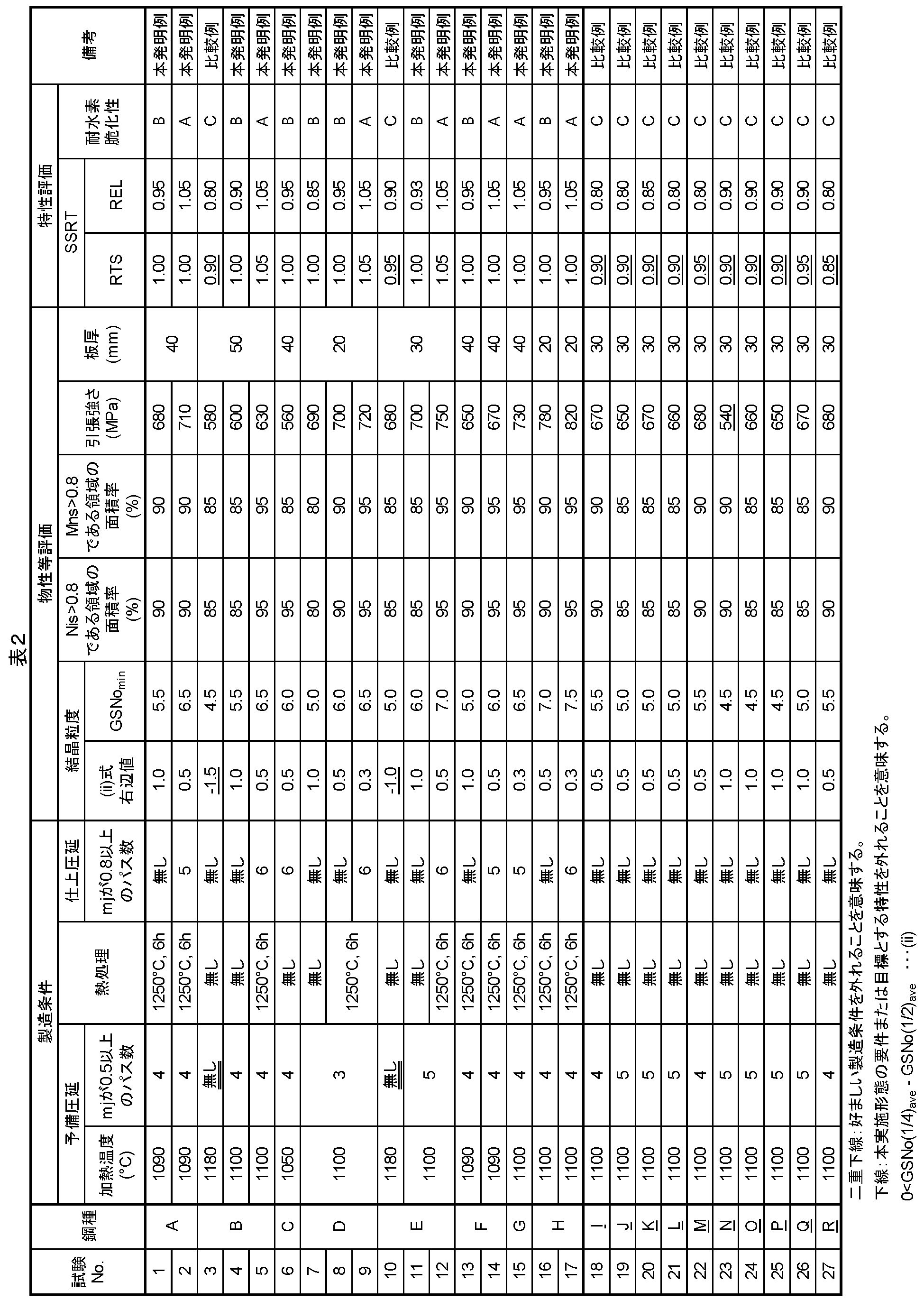
- the obtained slab was pre-rolled.
- the slab was heated at the temperature shown in Table 2.
- the number of passes in which the shape factor mj in the pre-rolling was 0.5 or more was counted.
- heat treatment was performed under the conditions shown in Table 2.
- the slab was heated to 1150 to 1200 ° C. after the heat treatment and then subjected to finish rolling.
- the number of passes in which the shape factor mj in the finish rolling was 0.8 or more was counted.
- the slab was annealed for 5 minutes in a temperature range of 1050 to 1100 ° C., and then cooled and pickled to obtain an austenitic stainless steel sheet.
- GSNo(1/4) ave , GSNo(1/2) ave , GSNomin , and the area ratios of the region satisfying formula (iii) and the region satisfying formula (iv) at the 1/4 plate thickness portion were measured in the following manner.
- a slow strain rate tensile test was performed in the following manner.
- the L-section of the steel plate was used as the observation surface.
- the size of the observation surface was the plate thickness x 30 mm (length in the longitudinal direction), and the magnification during observation was 100 times.
- the crystal grain size was calculated by a linear intercept method, and the average value was taken as the above GSNo(1/4) ave .
- the crystal grain size was calculated by a linear intercept method, and the average value was taken as the above-mentioned GSNo(1/2) ave .
- Other observation conditions were in accordance with JIS G 0551:2020.
- the grain size number of the visual field with the smallest grain size number in the observation performed to measure the above-mentioned GSNo(1/4) ave and GSNo(1/2) ave was designated as GSNomin . That is, the smallest grain size number among the five visual fields at the 1/4 part of the sheet thickness and the five visual fields at the 1/2 part of the sheet thickness was designated as GSNomin .
- the area ratio of the area satisfying the formula (iii) in the plate thickness 1/4 part was described in the table as the area ratio of the area where Nis>0.8, and the area ratio of the area satisfying the formula (iv) in the plate thickness 1/4 part was described as the area ratio of the area where Mns>0.8.
- the tensile speed was 0.036 mm/min, and the strain rate was 3 ⁇ 10 -5 /s.
- the tensile strength and break elongation in air were also measured separately for each test piece in order to calculate the RTS (relative tensile strength) and REL (relative elongation at break) described later.
- the round bar test piece is used, but if the plate thickness is less than 8 mm, a test piece may be used in which the parallel part is plate thickness x width 4 mm x length 20 mm, the grip part is width 25 mm x length 27 mm, and the total length is 94 mm (R10 mm from the parallel part to the grip part). If the above test piece cannot be taken, the test may be performed using a test piece of a size that can be taken.
- RTS relative tensile strength
- REL relative elongation at break
Landscapes
- Chemical & Material Sciences (AREA)
- Engineering & Computer Science (AREA)
- Mechanical Engineering (AREA)
- Materials Engineering (AREA)
- Metallurgy (AREA)
- Organic Chemistry (AREA)
- Physics & Mathematics (AREA)
- Thermal Sciences (AREA)
- Crystallography & Structural Chemistry (AREA)
- Heat Treatment Of Steel (AREA)
Abstract
Description
C:0.10%以下、
Si:1.0%以下、
Mn:8.0~10.0%、
P:0.050%以下、
S:0.0050%以下、
Cr:14.0~18.0%、
Mo:1.0%以下、
Ni:6.0~9.0%、
Cu:1.5%以下、
Co:0.01~1.0%、
N:0.25%以下、
Al:0~0.10%、
Nb:0~0.10%、
Ti:0~0.10%、
B:0~0.0050%、
V:0~0.50%、
W:0~0.50%、
Ca:0~0.010%、
Mg:0~0.010%、
Zr:0~0.50%、
Ga:0~0.05%、
Hf:0~0.10%、
REM:0~0.10%、
残部:Feおよび不純物であり、
下記(i)式で算出されるM値が-90~-20であり、
板厚1/4部の結晶粒度番号の平均値であるGSNo(1/4)aveと、板厚1/2部の結晶粒度番号の平均値であるGSNo(1/2)aveとの差が、下記(ii)式を満足し、
前記板厚1/4部の結晶粒度番号および前記板厚1/2部の結晶粒度番号のうち、最小の結晶粒度番号であるGSNominが、4.5以上であり、
引張強さが550MPa以上であり、
板厚が4.5mm以上である、
オーステナイト系ステンレス鋼板。
M値=551-462(C+N)-9.2Si-8.1Mn-13.7Cr-29(Ni+Cu)-18.2Mo ・・・(i)
0<GSNo(1/4)ave-GSNo(1/2)ave ・・・(ii)
但し、上記(i)式中の各元素記号はオーステナイト系ステンレス鋼板に含まれる各元素の含有量(質量%)を表し、含有されない場合はゼロとする。
Al:0.01~0.10%、
Nb:0.01~0.10%、
Ti:0.01~0.10%、
B:0.0002~0.0050%、
V:0.05~0.50%、
W:0.05~0.50%、
Ca:0.0002~0.010%、
Mg:0.0002~0.010%、
Zr:0.01~0.50%、
Ga:0.001~0.05%、
Hf:0.01~0.10%、および
REM:0.01~0.10%、
から選択される一種以上を含有する、
上記(1)に記載のオーステナイト系ステンレス鋼板。
上記(1)または(2)に記載のオーステナイト系ステンレス鋼板。
Nis>0.8 ・・・ (iii)
Mns>0.8 ・・・ (iv)
但し、上記(iii)式中で、NisはNiの偏析度を表し、上記(iv)式中でMnsは、Mnの偏析度を表す。
上記(1)~(3)のいずれかに記載のオーステナイト系ステンレス鋼板。
各元素の限定理由は下記のとおりである。なお、以下の説明において含有量についての「%」は、「質量%」を意味する。
C(炭素)は、オーステナイト相の安定化に有効な元素であり、耐水素脆化性の向上にも寄与する。しかしながら、Cが過剰に含有されると、Cr系炭化物が粒界析出するのを助長し、却って、耐水素脆化性が低下しやすくなる。このため、C含有量は、0.10%以下である。C含有量は、0.080%以下であるのが好ましく、0.070%以下であるのがより好ましく、0.060%以下であるのがさらに好ましい。一方、上記効果を得るためには、C含有量は、0.010%以上であるのが好ましく、0.020%以上であるのがより好ましく、0.030%以上であるのがさらに好ましく、0.040%以上であるのがさらに好ましい。
Si(ケイ素)は、脱酸に有効な元素であり、耐水素脆化性の向上にも寄与する。しかしながら、Siが過剰に含有されると、σ相などの金属間化合物の生成を助長し、熱間加工性および靭性を低下させる。このため、Si含有量は、1.0%以下である。Si含有量は、0.90%以下であるのが好ましく、0.80%以下であるのがより好ましく、0.70%以下であるのがさらに好ましく、0.60%以下であるのがさらに好ましい。一方、上記効果を得るためには、Si含有量は、0.10%以上であるのが好ましく、0.20%以上であるのがより好ましく、0.30%以上であるのがさらに好ましく、0.40%以上であるのがさらに好ましい。
Mn(マンガン)は、オーステナイト相の安定化に有効な元素であり、耐水素脆化性の向上に寄与する。また、強度を向上させる効果を有する。このため、Mn含有量は、8.0%以上である。Mn含有量は、8.5%以上であるのが好ましい。しかしながら、Mnを過剰に含有させると、水素脆化感受性の高いε相の生成を助長し、却って耐水素脆化性を低下させる。このため、Mn含有量は、10.0%以下である。Mn含有量は、9.5%以下であるのが好ましい。
P(リン)は、不純物として鋼に含有される元素であり、偏析を生じさせ、耐水素脆化性を低下させる。このため、P含有量は、0.050%以下である。P含有量は、0.040%以下であるのが好ましく、0.030%以下であるのがより好ましい。一方、Pが過剰に低減されると、製造コストの増加に繋がることから、P含有量は、0.001%以上であるのが好ましく、0.010%以上であるのがより好ましい。
S(硫黄)は、不純物として鋼に含有される元素であり、MnSを形成し、耐水素脆化性を低下させる。このため、S含有量は、0.0050%以下である。S含有量は、0.0040%以下であるのが好ましく、0.0030%以下であるのがより好ましい。しかしながら、Sが過剰に低減されると、製造コストが増加する。このため、S含有量は、0.0001%以上であるのが好ましく、0.0002%以上であるのがより好ましい。
Cr(クロム)は、ステンレス鋼において一定量含有される元素であり、耐食性を向上させる効果を有する。このため、Cr含有量は、14.0%以上である。Cr含有量は、14.5%以上であるのが好ましく、15.0%以上であるのがより好ましく、15.5%以上であるのがさらに好ましい。しかしながら、Crはフェライト形成元素である。したがって、Crが過剰に含有されると、オーステナイト相が不安定化するとともに、炭化物が多量に析出し、耐水素脆化性を低下させる。このため、Cr含有量は、18.0%以下である。Cr含有量は、17.5%以下であるのが好ましく、17.0%以下であるのがより好ましく、16.5%以下であるのがより好ましい。
Mo(モリブデン)は、強度を向上させる効果を有する。しかしながら、Moが過剰に含有されると、δフェライト相の生成が促進し、耐水素脆化性が低下する。このため、Mo含有量は、1.0%以下である。Mo含有量は、0.85%以下であるのが好ましく、0.70%以下であるのがより好ましく、0.50%以下であるのがさらに好ましく、0.30%以下であるのがさらに好ましい。一方、Moが過剰に低減されると、溶解原料の制約を招き、製造コストが増加する。このため、Mo含有量は、0.01%以上であるのが好ましく、0.05%以上であるのがより好ましく、0.10%以上であるのがさらに好ましい。
Ni(ニッケル)は、Mnとともに、耐水素脆化性および強度を確保するために必要な元素である。このため、Ni含有量は、6.0%以上である。Ni含有量は、6.3%以上であるのが好ましく、6.7%以上であるのがより好ましく、7.0%以上であるのがさらに好ましい。しかしながら、Niが過剰に含有されると、製造コストが増加するだけでなく、偏析が生じやすくなり、却って、耐水素脆化性が低下しやすくなる。加えて、過剰なNiの含有は固溶軟化を引き起こし、強度を低下させる場合もある。このため、Ni含有量は、9.0%以下である。Ni含有量は、8.5%以下であるのが好ましく、8.0%以下であるのがより好ましく、7.6%以下であるのがさらに好ましい。
Cu(銅)は、スクラップ等の原料から混入する元素であり、オーステナイト相の安定化に有効な元素である。その一方、Cuは、低融点元素であり、粒界に偏析し、破壊の起点を生じやすくする。このため、Cu含有量は、1.5%以下である。Cu含有量は、1.0%以下であるのが好ましく、0.70%以下であるのがより好ましく、0.50%以下であるのがさらに好ましい。しかしながら、Cuが過剰に低減されると、溶解原料の制約を招き、製造コストが増加する。このため、Cu含有量は、0.01%以上であるのが好ましく、0.05%以上であるのが好ましく、0.10%以上であるのがさらに好ましい。
Co(コバルト)は、重要な元素であり、耐食性を向上させ、オーステナイト相を安定化させるとともに、特に、板厚が厚い場合、耐水素脆化性を向上させる効果を有する。このため、Co含有量は、0.01%以上である。Co含有量は、0.05%以上であるのが好ましく、0.10%以上であるのがより好ましく、0.15%以上であるのがさらに好ましい。しかしながら、Coが過剰に含有されると、靭性および加工性が低下する。このため、Co含有量は、1.0%以下である。Co含有量は、0.70%以下であるのが好ましく、0.50%以下であるのがさらに好ましい。
N(窒素)は、MnおよびNiと同様に、耐水素脆化性の向上に有効な元素である。しかしながら、Nが過剰に含有されると、溶製時のブローホール等、内部欠陥が発生する場合があり、却って、耐水素脆化性が低下しやすくなる。このため、N含有量は、0.25%以下である。N含有量は、0.20%以下であるのが好ましく、0.18%以下であるのがより好ましい。一方、上記効果を得るためには、N含有量は、0.010%以上であるのが好ましく、0.020%以上であるのがより好ましく、0.050%以上であるのがさらに好ましく、0.10%以上であるのがさらに好ましい。
Al(アルミニウム)は、有効な脱酸元素であることに加え、低融点元素の粒界偏析を抑制して、粒界を強化する効果を有する。このため、必要に応じて含有させてもよい。しかしながら、Alは、フェライト形成元素である。このため、Alが過剰に含有されると、オーステナイト相が不安定化する。このため、Al含有量は、0.10%以下である。Al含有量は、0.07%以下であるのが好ましく、0.05%以下であるのがより好ましい。一方、上記効果を得るためには、Al含有量は、0.01%以上であるのが好ましく、0.02%以上であるのがより好ましい。
Nb(ニオブ)は、炭窒化物を形成し、結晶粒を微細化し、粒界を強化する効果を有する。このため、必要に応じて含有させてもよい。しかしながら、Nbが過剰に含有されると、熱間圧延時の製造性および加工性が低下する。このため、Nb含有量は、0.10%以下である。Nb含有量は、0.08%以下であるのが好ましく、0.07%以下であるのがより好ましい。一方、上記効果を得るためには、Nb含有量は、0.01%以上であるのが好ましく、0.02%以上であるのがより好ましい。
Ti(チタン)は、炭窒化物を形成し、結晶粒を微細化し、粒界を強化する効果を有する。このため、必要に応じて含有させてもよい。しかしながら、Tiが過剰に含有されると、熱間圧延時の製造性が低下する。また、介在物が多量に形成し、耐衝撃特性が低下する場合がある。このため、Ti含有量は、0.10%以下である。Ti含有量は、0.07%以下であるのが好ましく、0.05%以下であるのがより好ましい。一方、上記効果を得るためには、Ti含有量は、0.01%以上であるのが好ましく、0.02%以上であるのがより好ましい。
B(ボロン)は、粒界を強化し、強度を向上させるとともに、耐衝撃特性を向上させる効果を有する。このため、必要に応じて含有させてもよい。しかしながら、Bが過剰に含有されても、その効果が飽和するばかりか、却って耐衝撃特性が低下する場合がある。このため、B含有量は、0.0050%以下である。B含有量は、0.0040%以下であるのが好ましく、0.0030%以下であるのがより好ましい。一方、上記効果を得るためには、B含有量は、0.0002%以上であるのが好ましく、0.0005%以上であるのがより好ましく、0.0010%以上であるのがさらに好ましい。
V(バナジウム)は、鋼中に固溶または炭窒化物として析出し、強度を向上させる効果を有する。このため、必要に応じて含有させてもよい。しかしながら、Vが過剰に含有されると、炭窒化物が過剰に形成し、熱間圧延時の製造性を低下させる。このため、V含有量は、0.50%以下である。V含有量は、0.40%以下であるのが好ましく、0.30%以下であるのがより好ましく、0.20%以下であるのがさらに好ましい。一方、上記効果を得るためには、V含有量は、0.05%以上であるのが好ましく、0.10%以上であるのがより好ましい。
W(タングステン)は、強度および耐食性を向上させる効果を有する。このため、必要に応じて含有させてもよい。しかしながら、Wが過剰に含有されると、製造コストが増加する。このため、W含有量は、0.50%以下である。W含有量は、0.40%以下であるのが好ましく、0.30%以下であるのがより好ましい。一方、上記効果を得るためには、W含有量は、0.05%以上であるのが好ましく、0.10%以上であるのがより好ましい。
Ca(カルシウム)は、脱酸および熱間加工性の向上に有効な元素である。このため、必要に応じて含有させてもよい。しかしながら、Caが過剰に含有されると、偏析が生じやすくなり、偏析が破壊の起点になりやすくなる。この結果、耐衝撃特性が低下する場合がある。このため、Ca含有量は、0.010%以下である。Ca含有量は、0.0050%以下であるのが好ましく、0.0030%以下であるのがより好ましい。一方、上記効果を得るためには、Ca含有量は、0.0002%以上であるのが好ましく、0.0005%以上であるのがより好ましく、0.0010%以上であるのがさらに好ましい。
Mg(マグネシウム)は、脱酸および熱間加工性の向上に有効な元素である。このため、必要に応じて含有させてもよい。しかしながら、Mgが過剰に含有されると、介在物が多量に形成し、破壊の起点になりやすくなる結果、耐衝撃特性が低下する場合がある。このため、Mg含有量は、0.010%以下である。Mg含有量は、0.0050%以下であるのが好ましく、0.0030%以下であるのがより好ましく、0.0010%以下であるのがさらに好ましい。一方、上記効果を得るためには、Mg含有量は、0.0001%以上であるのが好ましく、0.0002%以上であるのがより好ましい。
Zr(ジルコニウム)は、脱酸効果を有する。また、耐食性を向上させる効果を有する。このため、必要に応じて含有させてもよい。しかしながら、Zrが過剰に含有されると、靭性および加工性が低下する。このため、Zr含有量は、0.50%以下である。Zr含有量は、0.30%以下であるのが好ましく、0.10%以下であるのがより好ましく、0.05%以下であるのがさらに好ましい。一方、上記効果を得るためには、Zr含有量は、0.01%以上であるのが好ましく、0.02%以上であるのがより好ましい。
Ga(ガリウム)は、熱間加工性を向上させる効果を有する。このため、必要に応じて、含有させてもよい。しかしながら、Gaが過剰に含有されると、製造性が低下する。このため、Ga含有量は、0.05%以下である。Ga含有量は、0.04%以下であるのが好ましく、0.02%以下であるのがより好ましい。一方、上記効果を得るためには、Ga含有量は、0.001%以上であるのが好ましく、0.005%以上であるのがより好ましい。
Hf(ハフニウム)は、強度を向上させ、耐水素脆化性を向上させる効果を有する。このため、必要に応じて、含有させてもよい。しかしながら、Hfが過剰に含有されると、加工性が低下する。このため、Hf含有量は、0.10%以下である。Hf含有量は、0.07%以下であるのが好ましく、0.05%以下であるのがより好ましく、0.03%以下であるのがさらに好ましい。一方、上記効果を得るためには、Hf含有量は、0.001%以上であるのが好ましく、0.005%以上であるのがより好ましく、0.01%以上であるのがさらに好ましい。
REM(希土類元素)は、熱間加工性を向上させる効果を有する。また、耐食性を向上させる効果も有する。このため、必要に応じて含有させてもよい。しかしながら、REMが過剰に含有されると、その効果が飽和するばかりか熱間加工性が低下する。このため、REM含有量は、0.10%以下である。REM含有量は、0.07%以下であるのが好ましく、0.05%以下であるのがより好ましく、0.03%以下であるのがさらに好ましい。一方、上記効果を得るためには、REM含有量は、0.001%以上であるのが好ましく、0.005%以上であるのがより好ましく、0.01%以上であるのがさらに好ましい。
下記(i)式で算出されるM値は、オーステナイト系ステンレス鋼板において、オーステナイト相の安定性を示す指標である。本実施形態のオーステナイト系ステンレス鋼板では、耐水素脆化性および強度を向上させるため、M値は、-90~-20である。
M値=551-462(C+N)-9.2Si-8.1Mn-13.7Cr-29(Ni+Cu)-18.2Mo ・・・(i)
但し、上記(i)式中の各元素記号はオーステナイト系ステンレス鋼板に含まれる各元素の含有量(質量%)を表し、含有されない場合はゼロとする。
2-1.表面付近の結晶粒度と中心部の結晶粒度との差
本実施形態のオーステナイト系ステンレス鋼板は、耐水素脆化性を高めるため、表面付近の結晶粒度と中心部の結晶粒度との差を小さくし、板厚1/2部より1/4部の結晶粒の方が細粒である必要がある。
0<GSNo(1/4)ave-GSNo(1/2)ave ・・・(ii)
本実施形態のオーステナイト系ステンレス鋼板は、水素の浸入を抑制し、耐水素脆化性を向上させるために、粗大な粒の形成を抑制する。具体的には、観察された視野において板厚1/4部の結晶粒度番号および板厚1/2部の結晶粒度番号のうち、最小、すなわち最も粗粒である視野の結晶粒度番号GSNominが、4.5以上である。上記GSNominは、5.0以上であるのが好ましく、5.5以上であるのがより好ましい。なお、上記GSNominの上限は、特に、限定されないが、製造コストおよび製造時の制約等を考慮し、通常、8.0であるのが好ましい。
本実施形態のオーステナイト系ステンレス鋼板の常温の引張強さは、所望する強度を得るため、550MPa以上である。引張強さは、600MPa以上であるのが好ましく、650MPa以上であるのがより好ましい。なお、引張強さの上限は、特に、限定されないが、通常、900MPaである。好ましくは800MPa未満、より好ましくは780MPa以下、さらに好ましくは750MPa以下である。
なお、常温での引張強さは、室温(24℃)で、引張試験を行うことで、測定できる。引張試験の条件は、一般的な条件とすればよい。
本実施形態のオーステナイト系ステンレス鋼板では、水素発電設備での使用が想定された板厚の厚い厚鋼板を対象としている。このため、鋼板の板厚は、4.5mm以上である。板厚は、10mm以上であるのが好ましく、20mm以上であるのがより好ましく、30mm以上であるのがさらに好ましい。なお、板厚の上限は、特に、限定されないが、通常、100mmとなる。
良好な耐水素脆化性を得るため、偏析の状態を制御するのが好ましい。偏析は、凝固の際、溶質元素の濃度が不均一になる現象のことであり、厚鋼板の場合、顕著に生じやすい。そして、この偏析の状態が、後々、鋼板として製造された後も、金属組織において、一部、残存することで、耐水素脆化性に悪影響を及ぼす。特に、表面近傍の板厚1/4部では、偏析の影響が顕著であり、偏析が生じた領域で、予ひずみが局部的に蓄積される結果、耐水素脆化性が低下しやすくなる。また、偏析が生じていると、オーステナイト相からα’相への変態が生じやすくなることも耐水素脆化性が低下しやすい一因となる。
Nis>0.8 ・・・ (iii)
Mns>0.8 ・・・ (iv)
但し、上記(iii)式中で、NisはNi(ニッケル)の偏析度を表し、上記(iv)式中でMnsは、Mn(マンガン)の偏析度を表す。
本実施形態のオーステナイト系ステンレス鋼板は、水素ガス環境下での使用、特に、水素発電設備の部品および部材に適している。すなわち、上記設備に使用される水素ガス輸送配管、水素ガス用途のバルブ、継手、計器に使用されるのが好ましい。なお、水素ガスは、圧縮ガスまたは液化ガスであるのが好ましく、水素ガスの圧力は、例えば、0.1~20MPaの範囲であるのが好ましい。
本実施形態のオーステナイト系ステンレス鋼板は、例えば、以下のような製造方法により、安定して製造することができる。
7-1-1.予備圧延
上記化学組成を有するステンレス鋼を溶製し、スラブなどの鋼片を製造する。次に、鋼片を所定の温度に加熱して熱間圧延を行う(熱間圧延工程)。この熱間圧延工程において、最初に1200℃以下の温度で鋼片を加熱して、圧延形状比mjが0.5以上となるパスを3パス以上行う予備圧延を行う。

R:ロール半径(mm)
tj:入側板厚(mm)
tj+1:出側板厚(mm)
予備圧延後に、必要に応じて、熱処理を行ってもよい。熱処理を行うと、板厚1/4部において、(iii)および(iv)式を満足する領域が90%以上になりやすくなるからである。熱処理温度は、1200~1300℃であるのが好ましく、熱処理時間は、60分以上であるのが好ましい。
熱間圧延工程において、予備圧延後、または、必要に応じて、熱処理を行った場合は、熱処理後、仕上圧延を行う。仕上圧延では、圧延形状比mjが0.8以上となるパス数を5パス以上行うのが好ましい。結晶粒度差が1.0以下となり、より良好な耐水素脆化性を得ることができるからである。なお、圧延形状比mjは、予備圧延の際と同様に算出すればよい。また、所望する結晶粒度の組織を得るために、仕上圧延における鋼板の加熱温度は、1150~1250℃の範囲であるのが好ましい。なお、仕上圧延のその他の条件は、適宜、常法に従えばよい。仕上圧延後、常法に従い、冷却し、オーステナイト系ステンレス鋼板とする。
熱間圧延工程後において、必要に応じて、焼鈍、酸洗を行ってもよい。焼鈍条件は、常法に従えばよく、例えば、焼鈍温度は、1050~1150℃であるのが好ましく、焼鈍時間は、5~15分であるのが好ましい。その後、最終的にオーステナイト系ステンレス鋼板となるよう、冷却すればよく、必要に応じて、酸洗を行ってもよい。酸洗の条件も適宜、常法に従えばよい。
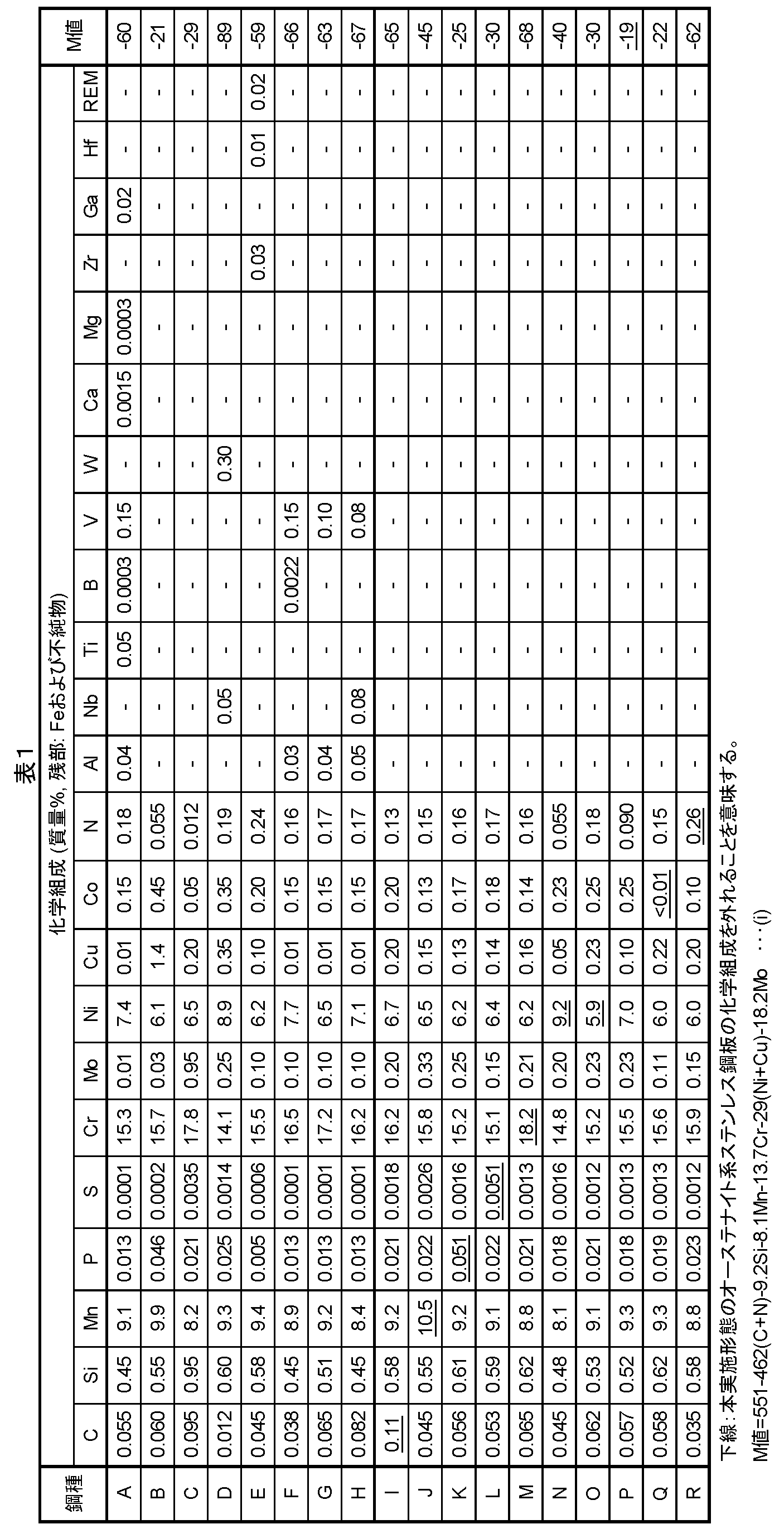
鋼板のL断面を観察面とする。観察面の大きさは、板厚×30mm(長手方向の長さ)とし、観察の際の倍率は、100倍とした。そして、上記観察面の板厚1/4部について、5視野測定し、結晶粒度を直線的に切断法で算出し、その平均値を上記GSNo(1/4)aveとした。同様に、板厚1/2部についても、5視野測定し、結晶粒度を直線的に切断法で算出し、その平均値を上記GSNo(1/2)aveとした。その他、観察条件は、JIS G 0551:2020に従った。
鋼板のC断面において、板厚1/4部を視野の中心とし、その中心から上下2mm四方を観察視野とした。続いて、当該観察視野に対して、ビーム径6μm、加速電圧15kV、照射電流1.17×10-9Aの条件で、EPMAを用いた面分析を行った。EPMAを用いた面分析により、NiおよびMn濃度をマッピングするとともに、(iii)式を満足する領域および(iv)式を満足する領域を面積率で算出した。なお、板厚1/4部における(iii)式を満足する領域の面積率について、表中では、Nis>0.8である領域の面積率と記載し、板厚1/4部における(iv)式を満足する領域の面積率について、Mns>0.8である領域の面積率と記載した。
耐水素脆化性を評価するため、低ひずみ速度引張試験を行った。板厚1/4位置でかつ圧延面に平行な面から、長手方向が鋼板の長手方向と一致するように、平行部がΦ3mm×長さ20mmの丸棒で、掴み部Φ8mm、全長80mmの試験片を採取した。この試験片の平行部の変位が6mmになるまで大気中で引っ張り、伸びが30%の予ひずみを加えた。その後、20MPaH2ガス中で破断まで、引張応力を加えて、試験を行った。なお、引張速度は0.036mm/minとし、ひずみ速度3×10-5/sとした。なお、各試験片について、後述するRTS(相対引張強さ)とREL(相対破断伸び)を算出するため、大気中での引張強さおよび破断伸びも、別途、測定した。なお、本実施例では、上記の丸棒試験片を用いているが、板厚が8mm未満の場合には、例えば、平行部が板厚×幅4mm×長さ20mmの板状で、掴み部:幅25mm×長さ27mm、全長94mm(平行部から掴み部のR10mm)の試験片を用いればよい。また、上記試験片を採取できない場合は、採取可能な大きさの試験片を用いて試験を行えばよい。
RTS=大気中で予ひずみを付与した後、20MPaH2中で引張応力を付与して試験した際の引張強さ÷大気中の引張強さ ・・・(b)
REL=大気中で予ひずみを付与した後、20MPaH2中で引張応力を付与して試験した際の破断伸び÷大気中の破断伸び ・・・(c)
Claims (7)
- 化学組成が、質量%で、
C:0.10%以下、
Si:1.0%以下、
Mn:8.0~10.0%、
P:0.050%以下、
S:0.0050%以下、
Cr:14.0~18.0%、
Mo:1.0%以下、
Ni:6.0~9.0%、
Cu:1.5%以下、
Co:0.01~1.0%、
N:0.25%以下、
Al:0~0.10%、
Nb:0~0.10%、
Ti:0~0.10%、
B:0~0.0050%、
V:0~0.50%、
W:0~0.50%、
Ca:0~0.010%、
Mg:0~0.010%、
Zr:0~0.50%、
Ga:0~0.05%、
Hf:0~0.10%、
REM:0~0.10%、
残部:Feおよび不純物であり、
下記(i)式で算出されるM値が-90~-20であり、
板厚1/4部の結晶粒度番号の平均値であるGSNo(1/4)aveと、板厚1/2部の結晶粒度番号の平均値であるGSNo(1/2)aveとの差が、下記(ii)式を満足し、
前記板厚1/4部の結晶粒度番号および前記板厚1/2部の結晶粒度番号のうち、最小の結晶粒度番号であるGSNominが、4.5以上であり、
引張強さが550MPa以上であり、
板厚が4.5mm以上である、
オーステナイト系ステンレス鋼板。
M値=551-462(C+N)-9.2Si-8.1Mn-13.7Cr-29(Ni+Cu)-18.2Mo ・・・(i)
0<GSNo(1/4)ave-GSNo(1/2)ave ・・・(ii)
但し、上記(i)式中の各元素記号はオーステナイト系ステンレス鋼板に含まれる各元素の含有量(質量%)を表し、含有されない場合はゼロとする。 - 前記化学組成が、質量%で、
Al:0.01~0.10%、
Nb:0.01~0.10%、
Ti:0.01~0.10%、
B:0.0002~0.0050%、
V:0.05~0.50%、
W:0.05~0.50%、
Ca:0.0002~0.010%、
Mg:0.0002~0.010%、
Zr:0.01~0.50%、
Ga:0.001~0.05%、
Hf:0.01~0.10%、および
REM:0.01~0.10%、
から選択される一種以上を含有する、
請求項1に記載のオーステナイト系ステンレス鋼板。 - 板厚1/4部において、下記(iii)式を満足する領域の面積率が90%以上であり、下記(iv)式を満足する領域の面積率が90%以上である、
請求項1に記載のオーステナイト系ステンレス鋼板。
Nis>0.8 ・・・ (iii)
Mns>0.8 ・・・ (iv)
但し、上記(iii)式中で、NisはNiの偏析度を表し、上記(iv)式中でMnsは、Mnの偏析度を表す。 - 板厚1/4部において、下記(iii)式を満足する領域の面積率が90%以上であり、下記(iv)式を満足する領域の面積率が90%以上である、
請求項2に記載のオーステナイト系ステンレス鋼板。
Nis>0.8 ・・・ (iii)
Mns>0.8 ・・・ (iv)
但し、上記(iii)式中で、NisはNiの偏析度を表し、上記(iv)式中でMnsは、Mnの偏析度を表す。 - 水素ガス環境下で用いられる、
請求項1~4のいずれかに記載のオーステナイト系ステンレス鋼板。 - 請求項1~4のいずれかに記載のオーステナイト系ステンレス鋼板を用いた水素ガス輸送配管。
- 請求項1~4のいずれかに記載のオーステナイト系ステンレス鋼板を用いた水素ガス用途のバルブ、継手または計器。
Priority Applications (4)
| Application Number | Priority Date | Filing Date | Title |
|---|---|---|---|
| JP2025528030A JPWO2024257874A1 (ja) | 2023-06-15 | 2024-06-14 | |
| CN202480032941.5A CN121127618A (zh) | 2023-06-15 | 2024-06-14 | 奥氏体系不锈钢钢板、氢气输送配管、阀、接头和仪表 |
| AU2024304286A AU2024304286B2 (en) | 2023-06-15 | 2024-06-14 | Austenitic stainless steel plate, hydrogen gas transmission pipe, valve, joint, and instrument |
| KR1020257038165A KR20250174080A (ko) | 2023-06-15 | 2024-06-14 | 오스테나이트계 스테인리스 강판, 수소 가스 수송 배관, 밸브, 이음, 및 계기 |
Applications Claiming Priority (2)
| Application Number | Priority Date | Filing Date | Title |
|---|---|---|---|
| JP2023-098220 | 2023-06-15 | ||
| JP2023098220 | 2023-06-15 |
Publications (1)
| Publication Number | Publication Date |
|---|---|
| WO2024257874A1 true WO2024257874A1 (ja) | 2024-12-19 |
Family
ID=93852211
Family Applications (1)
| Application Number | Title | Priority Date | Filing Date |
|---|---|---|---|
| PCT/JP2024/021768 Ceased WO2024257874A1 (ja) | 2023-06-15 | 2024-06-14 | オーステナイト系ステンレス鋼板、水素ガス輸送配管、バルブ、継手、および計器 |
Country Status (5)
| Country | Link |
|---|---|
| JP (1) | JPWO2024257874A1 (ja) |
| KR (1) | KR20250174080A (ja) |
| CN (1) | CN121127618A (ja) |
| AU (1) | AU2024304286B2 (ja) |
| WO (1) | WO2024257874A1 (ja) |
Citations (7)
| Publication number | Priority date | Publication date | Assignee | Title |
|---|---|---|---|---|
| JPH0297649A (ja) * | 1988-09-30 | 1990-04-10 | Aichi Steel Works Ltd | 極低温下において強度と靭性の優れたオーステナイト系ステンレス鋼およびその製造方法 |
| WO2012043877A1 (ja) * | 2010-09-29 | 2012-04-05 | 新日鐵住金ステンレス株式会社 | オーステナイト系高Mnステンレス鋼およびその製造方法と、その鋼を用いた部材 |
| JP2019143228A (ja) * | 2018-02-23 | 2019-08-29 | 日鉄ステンレス株式会社 | 高Mnオーステナイト系ステンレス鋼およびその製造方法 |
| JP2022089302A (ja) * | 2020-12-04 | 2022-06-16 | 日鉄ステンレス株式会社 | オーステナイト系ステンレス鋼板および鋼管ならびにこれらの製造方法 |
| JP2022155180A (ja) * | 2021-03-30 | 2022-10-13 | 日鉄ステンレス株式会社 | オーステナイト系ステンレス鋼およびその製造方法 |
| JP2024020935A (ja) * | 2022-08-02 | 2024-02-15 | 日鉄ステンレス株式会社 | オーステナイト系ステンレス鋼板 |
| JP2024047464A (ja) * | 2022-09-26 | 2024-04-05 | 日鉄ステンレス株式会社 | オーステナイト系ステンレス鋼板 |
Family Cites Families (1)
| Publication number | Priority date | Publication date | Assignee | Title |
|---|---|---|---|---|
| JP7638728B2 (ja) | 2020-03-06 | 2025-03-04 | 日本フイルコン株式会社 | 水素発電システム |
-
2024
- 2024-06-14 KR KR1020257038165A patent/KR20250174080A/ko active Pending
- 2024-06-14 AU AU2024304286A patent/AU2024304286B2/en active Active
- 2024-06-14 WO PCT/JP2024/021768 patent/WO2024257874A1/ja not_active Ceased
- 2024-06-14 JP JP2025528030A patent/JPWO2024257874A1/ja active Pending
- 2024-06-14 CN CN202480032941.5A patent/CN121127618A/zh active Pending
Patent Citations (7)
| Publication number | Priority date | Publication date | Assignee | Title |
|---|---|---|---|---|
| JPH0297649A (ja) * | 1988-09-30 | 1990-04-10 | Aichi Steel Works Ltd | 極低温下において強度と靭性の優れたオーステナイト系ステンレス鋼およびその製造方法 |
| WO2012043877A1 (ja) * | 2010-09-29 | 2012-04-05 | 新日鐵住金ステンレス株式会社 | オーステナイト系高Mnステンレス鋼およびその製造方法と、その鋼を用いた部材 |
| JP2019143228A (ja) * | 2018-02-23 | 2019-08-29 | 日鉄ステンレス株式会社 | 高Mnオーステナイト系ステンレス鋼およびその製造方法 |
| JP2022089302A (ja) * | 2020-12-04 | 2022-06-16 | 日鉄ステンレス株式会社 | オーステナイト系ステンレス鋼板および鋼管ならびにこれらの製造方法 |
| JP2022155180A (ja) * | 2021-03-30 | 2022-10-13 | 日鉄ステンレス株式会社 | オーステナイト系ステンレス鋼およびその製造方法 |
| JP2024020935A (ja) * | 2022-08-02 | 2024-02-15 | 日鉄ステンレス株式会社 | オーステナイト系ステンレス鋼板 |
| JP2024047464A (ja) * | 2022-09-26 | 2024-04-05 | 日鉄ステンレス株式会社 | オーステナイト系ステンレス鋼板 |
Also Published As
| Publication number | Publication date |
|---|---|
| AU2024304286A1 (en) | 2025-09-25 |
| JPWO2024257874A1 (ja) | 2024-12-19 |
| CN121127618A (zh) | 2025-12-12 |
| AU2024304286B2 (en) | 2026-07-23 |
| KR20250174080A (ko) | 2025-12-11 |
Similar Documents
| Publication | Publication Date | Title |
|---|---|---|
| EP2392681B1 (en) | Heavy gauge, high tensile strength, hot rolled steel sheet with excellent hic resistance and manufacturing method therefor | |
| US20190284666A1 (en) | NiCrFe Alloy | |
| EP2309014A1 (en) | Thick, high tensile-strength hot-rolled steel sheets with excellent low temperature toughness and manufacturing method therefor | |
| JP2022089302A (ja) | オーステナイト系ステンレス鋼板および鋼管ならびにこれらの製造方法 | |
| JP7121142B2 (ja) | 耐水素脆性に優れたCr系ステンレス鋼板 | |
| CN115210400B (zh) | 钢材及其制造方法、以及罐 | |
| WO2024247791A1 (ja) | オーステナイト系ステンレス鋼及びその製造方法 | |
| JP7705094B2 (ja) | オーステナイト系ステンレス鋼材およびその製造方法ならびに水素用機器 | |
| JP3932020B2 (ja) | 深絞り性に優れ面内異方性の小さいフェライト系ステンレス鋼及びその製造方法 | |
| JP7817655B2 (ja) | 鋼材 | |
| JP2023031269A (ja) | 超低降伏比高張力厚鋼板およびその製造方法 | |
| WO2019168172A1 (ja) | 高Mn鋼およびその製造方法 | |
| JP7787417B2 (ja) | オーステナイト系ステンレス鋼板 | |
| WO2024203317A1 (ja) | フェライト系ステンレス鋼板 | |
| JP7787416B2 (ja) | オーステナイト系ステンレス鋼板 | |
| KR102888547B1 (ko) | 강시판 및 그 제조 방법 | |
| CN118516603A (zh) | 氢气环境用马氏体不锈钢及其制造方法 | |
| WO2024106010A1 (ja) | フェライト・オーステナイト系二相ステンレス鋼材 | |
| US20250003042A1 (en) | High-strength seamless stainless steel pipe for oil wells | |
| JP2024179398A (ja) | オーステナイト系ステンレス鋼板、水素ガス輸送管、およびバルブ、継手、計器 | |
| KR20190077672A (ko) | 리징성이 우수한 페라이트계 스테인리스강 | |
| CN121127618A (zh) | 奥氏体系不锈钢钢板、氢气输送配管、阀、接头和仪表 | |
| JP7801649B1 (ja) | 高炭素冷間圧延鋼板、高炭素熱間圧延鋼板および渦巻ばね | |
| JP7801656B1 (ja) | ステンレス鋼材および鍛造部品 | |
| WO2026079034A1 (ja) | 鋼材 |
Legal Events
| Date | Code | Title | Description |
|---|---|---|---|
| 121 | Ep: the epo has been informed by wipo that ep was designated in this application |
Ref document number: 24823487 Country of ref document: EP Kind code of ref document: A1 |
|
| WWE | Wipo information: entry into national phase |
Ref document number: AU2024304286 Country of ref document: AU |
|
| ENP | Entry into the national phase |
Ref document number: 2025528030 Country of ref document: JP Kind code of ref document: A |
|
| WWE | Wipo information: entry into national phase |
Ref document number: 2025528030 Country of ref document: JP |
|
| ENP | Entry into the national phase |
Ref document number: 2024304286 Country of ref document: AU Date of ref document: 20240614 Kind code of ref document: A |
|
| ENP | Entry into the national phase |
Ref document number: 1020257038165 Country of ref document: KR Free format text: ST27 STATUS EVENT CODE: A-0-1-A10-A15-NAP-PA0105 (AS PROVIDED BY THE NATIONAL OFFICE) |
|
| WWE | Wipo information: entry into national phase |
Ref document number: KR1020257038165 Country of ref document: KR |
|
| NENP | Non-entry into the national phase |
Ref country code: DE |
|
| 122 | Ep: pct application non-entry in european phase |
Ref document number: 24823487 Country of ref document: EP Kind code of ref document: A1 |