WO2024257646A1 - β型サイアロン蛍光体、発光部材、および発光装置 - Google Patents
β型サイアロン蛍光体、発光部材、および発光装置 Download PDFInfo
- Publication number
- WO2024257646A1 WO2024257646A1 PCT/JP2024/020309 JP2024020309W WO2024257646A1 WO 2024257646 A1 WO2024257646 A1 WO 2024257646A1 JP 2024020309 W JP2024020309 W JP 2024020309W WO 2024257646 A1 WO2024257646 A1 WO 2024257646A1
- Authority
- WO
- WIPO (PCT)
- Prior art keywords
- sialon phosphor
- value
- wave number
- spectrum
- phosphor
- Prior art date
- Legal status (The legal status is an assumption and is not a legal conclusion. Google has not performed a legal analysis and makes no representation as to the accuracy of the status listed.)
- Ceased
Links
Images







Classifications
-
- C—CHEMISTRY; METALLURGY
- C09—DYES; PAINTS; POLISHES; NATURAL RESINS; ADHESIVES; COMPOSITIONS NOT OTHERWISE PROVIDED FOR; APPLICATIONS OF MATERIALS NOT OTHERWISE PROVIDED FOR
- C09K—MATERIALS FOR MISCELLANEOUS APPLICATIONS, NOT PROVIDED FOR ELSEWHERE
- C09K11/00—Luminescent materials, e.g. electroluminescent or chemiluminescent
- C09K11/08—Luminescent materials, e.g. electroluminescent or chemiluminescent containing inorganic luminescent materials
- C09K11/77—Luminescent materials, e.g. electroluminescent or chemiluminescent containing inorganic luminescent materials containing rare earth metals
- C09K11/7728—Luminescent materials, e.g. electroluminescent or chemiluminescent containing inorganic luminescent materials containing rare earth metals containing europium
- C09K11/77348—Silicon Aluminium Nitrides or Silicon Aluminium Oxynitrides
-
- C—CHEMISTRY; METALLURGY
- C09—DYES; PAINTS; POLISHES; NATURAL RESINS; ADHESIVES; COMPOSITIONS NOT OTHERWISE PROVIDED FOR; APPLICATIONS OF MATERIALS NOT OTHERWISE PROVIDED FOR
- C09K—MATERIALS FOR MISCELLANEOUS APPLICATIONS, NOT PROVIDED FOR ELSEWHERE
- C09K11/00—Luminescent materials, e.g. electroluminescent or chemiluminescent
- C09K11/08—Luminescent materials, e.g. electroluminescent or chemiluminescent containing inorganic luminescent materials
- C09K11/0883—Arsenides; Nitrides; Phosphides
-
- C—CHEMISTRY; METALLURGY
- C09—DYES; PAINTS; POLISHES; NATURAL RESINS; ADHESIVES; COMPOSITIONS NOT OTHERWISE PROVIDED FOR; APPLICATIONS OF MATERIALS NOT OTHERWISE PROVIDED FOR
- C09K—MATERIALS FOR MISCELLANEOUS APPLICATIONS, NOT PROVIDED FOR ELSEWHERE
- C09K11/00—Luminescent materials, e.g. electroluminescent or chemiluminescent
- C09K11/08—Luminescent materials, e.g. electroluminescent or chemiluminescent containing inorganic luminescent materials
- C09K11/64—Luminescent materials, e.g. electroluminescent or chemiluminescent containing inorganic luminescent materials containing aluminium
-
- H—ELECTRICITY
- H10—SEMICONDUCTOR DEVICES; ELECTRIC SOLID-STATE DEVICES NOT OTHERWISE PROVIDED FOR
- H10H—INORGANIC LIGHT-EMITTING SEMICONDUCTOR DEVICES HAVING POTENTIAL BARRIERS
- H10H20/00—Individual inorganic light-emitting semiconductor devices having potential barriers, e.g. light-emitting diodes [LED]
- H10H20/80—Constructional details
- H10H20/85—Packages
- H10H20/851—Wavelength conversion means
- H10H20/8511—Wavelength conversion means characterised by their material, e.g. binder
- H10H20/8512—Wavelength conversion materials
Definitions
- the present invention relates to a ⁇ -SiAlON phosphor, a light-emitting component, and a light-emitting device.
- Patent Document 1 describes a method for producing a ⁇ -sialon phosphor, which comprises mixing a first heat-treated product obtained by heat-treating a composition containing silicon nitride containing aluminum, oxygen atoms, and europium with an aqueous sodium hydroxide solution, performing a first heat-basing treatment in the atmosphere at 70° C. for 3 hours, and further performing a second heat-basing treatment in a nitrogen atmosphere at 200° C. for 2 hours. Furthermore, paragraph 0051 of Patent Document 1 describes that the first temperature, which is the heating temperature of the first heat-basing treatment, is 50° C. or more and 150° C. or less.
- the absorbance of the spectrum is converted into a KM value by the Kubelka-Munk function, and the KM value at a wavenumber of 3050 cm -1 is E, the KM value at a wavenumber of 3330 cm -1 is F, the KM value at a wavenumber of 3500 cm -1 is G, and the KM value at a wavenumber of 3530 cm -1 is H.
- the absorbance of the spectrum is converted into a KM value by the Kubelka-Munk function, and the KM value at a wavenumber of 3330 cm -1 is designated as A, the KM value at a wavenumber of 3550 cm -1 is designated as B, the KM value at a wavenumber of 3500 cm -1 is designated as C, the KM value at a wavenumber of 3600 cm -1 is designated as D, the KM value at a wavenumber of 3050 cm -1 is designated as L, and the KM value at a wavenumber of 3530 cm -1 is designated as M.
- ⁇ -SiAlON phosphor containing europium as a solid solution
- the absorbance of the spectrum is converted into a KM value by the Kubelka-Munk function, and the KM value at a wave number of 3050 cm ⁇ 1 is E, the KM value at a wave number of 3330 cm ⁇ 1 is F, the KM value at a wave number of 3500 cm ⁇ 1 is G, and the KM value at a wave number of 3530 cm ⁇ 1 is H.
- the absorbance of the spectrum is converted into KM values by the Kubelka-Munk function, and the KM value at a wave number of 3330 cm ⁇ 1 is designated as A, the KM value at a wave number of 3550 cm ⁇ 1 is designated as B, the KM value at a wave number of 3500 cm ⁇ 1 is designated as C, the KM value at a wave number of 3600 cm ⁇ 1 is designated as D, the KM value at a wave number of 3050 cm ⁇ 1 is designated as L, and the KM value at a wave number of 3530 cm ⁇ 1 is designated as M;
- the ⁇ -sialon phosphor obtained by FT-IR before exposure for 1000 hours in an environment of a temperature of 85° C.
- the absorbance of the spectrum is converted into a KM value by the Kubelka-Munk function, and the KM value at a wave number of 3050 cm ⁇ 1 is E and the KM value at a wave number of 3330 cm ⁇ 1 is F.
- a light-emitting element A wavelength converter that converts light irradiated from the light emitting element and emits the converted light;
- a light emitting member comprising: The wavelength converter has the ⁇ -type sialon phosphor according to any one of 1. to 4. Illuminating components. 6.
- a light emitting device comprising the light emitting member according to 5.
- the present invention provides a ⁇ -SiAlON phosphor that exhibits excellent reliability in LED brightness when the LED is energized (continuously lit) in a high-temperature, high-humidity environment, as well as a light-emitting component and a light-emitting device that use the same.
- FIG. 2 is a cross-sectional view illustrating a schematic structure of an LED package used in a reliability test.
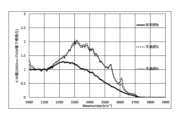
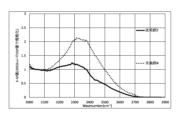
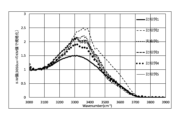
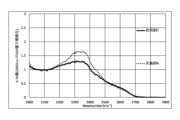
- the FT-IR spectrum of the ⁇ -sialon phosphor before exposure to a temperature of 85° C. and a humidity of 85% for 1000 hours is shown, normalized by the KM value at a wave number of 3050 cm ⁇ 1 .
- the FT-IR spectrum of the ⁇ -sialon phosphor before exposure to a temperature of 85° C. and a humidity of 85% for 1000 hours is shown, normalized by the KM value at a wave number of 3050 cm ⁇ 1 .
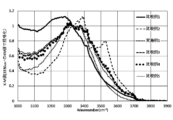
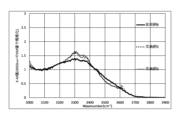
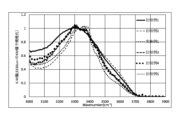
- the FT-IR spectrum of the ⁇ -sialon phosphor before exposure to a temperature of 85° C. and a humidity of 85% for 1000 hours is shown, normalized with the KM value at a wave number of 3330 cm ⁇ 1 .
- the FT-IR spectrum of the ⁇ -sialon phosphor before exposure to a temperature of 85° C. and a humidity of 85% for 1000 hours is shown, normalized with the KM value at a wave number of 3330 cm ⁇ 1 .
- the FT-IR spectrum of the ⁇ -sialon phosphor before exposure to a temperature of 85° C. and a humidity of 85% for 1000 hours is shown, normalized with the KM value at a wave number of 3330 cm ⁇ 1 .
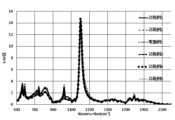
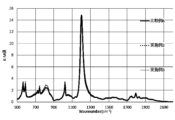
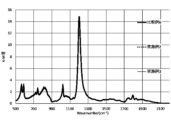
- FT-IR spectrum of a ⁇ -sialon phosphor before exposure to a temperature of 85° C. and a humidity of 85% for 1000 hours is shown.
- FT-IR spectrum of a ⁇ -sialon phosphor before exposure to a temperature of 85° C. and a humidity of 85% for 1000 hours is shown.
- FT-IR spectrum of a ⁇ -sialon phosphor before exposure to a temperature of 85° C. and a humidity of 85% for 1000 hours is shown.
- the FT-IR spectrum of the ⁇ -sialon phosphor after exposure to a temperature of 85° C. and a humidity of 85% for 1000 hours is shown, normalized with the KM value at a wave number of 3050 cm ⁇ 1 .
- the FT-IR spectrum of the ⁇ -sialon phosphor after exposure to a temperature of 85° C. and a humidity of 85% for 1000 hours is shown, normalized with the KM value at a wave number of 3050 cm ⁇ 1 .
- the FT-IR spectrum of the ⁇ -sialon phosphor after exposure to a temperature of 85° C. and a humidity of 85% for 1000 hours is shown, normalized with the KM value at a wave number of 3050 cm ⁇ 1 .
- FT-IR spectrum of a ⁇ -sialon phosphor after exposure to a temperature of 85° C. and a humidity of 85% for 1000 hours is shown, normalized with the KM value at a wave number of 3330 cm ⁇ 1 .
- the FT-IR spectrum of the ⁇ -sialon phosphor after exposure to a temperature of 85° C. and a humidity of 85% for 1000 hours is shown, normalized with the KM value at a wave number of 3330 cm ⁇ 1 .
- FT-IR spectrum of the ⁇ -sialon phosphor after exposure to a temperature of 85° C. and a humidity of 85% for 1000 hours is shown, normalized with the KM value at a wave number of 3330 cm ⁇ 1 .
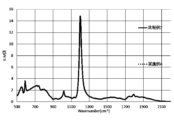
- FT-IR spectrum of a ⁇ -sialon phosphor after exposure to a temperature of 85° C. and a humidity of 85% for 1000 hours is shown.
- FT-IR spectrum of a ⁇ -sialon phosphor after exposure to a temperature of 85° C. and a humidity of 85% for 1000 hours is shown.
- the ⁇ -type sialon phosphor of the first example of the present embodiment P is a ⁇ -type sialon phosphor containing europium as a solid solution
- the absorbance of the spectrum is converted into a KM value by the Kubelka-Munk function, and the KM value at a wave number of 3050 cm ⁇ 1 is E, the KM value at a wave number of 3330 cm ⁇ 1 is F, and the KM value at a wave number of 3500 cm ⁇ 1 is G.
- E, F, and G are configured to satisfy 1.8 ⁇ F/E and 1.8>G/E.
- the ⁇ -SiAlON phosphor of the second example of the present embodiment P is a ⁇ -SiAlON phosphor containing europium as a solid solution
- the absorbance of the spectrum is converted into a KM value by the Kubelka-Munk function, and the KM value at a wave number of 3050 cm ⁇ 1 is E, the KM value at a wave number of 3330 cm ⁇ 1 is F, and the KM value at a wave number of 3530 cm ⁇ 1 is H.
- E, F, and H are configured to satisfy 1.8 ⁇ F/E and 2.0>H/E.
- the stable state of the surface of a ⁇ -SiAlON phosphor when an LED is energized (continuously lit) in a high-temperature and high-humidity environment can be evaluated based on the infrared absorption spectrum of the ⁇ -SiAlON phosphor obtained by FT-IR.
- 3330 cm -1 represents an NH group
- 3500 cm -1 represents an Si-OH group
- 3530 cm -1 represents an Si-OH group.
- a relatively large KM value (F) at 3330 cm -1 and a relatively small KM value (G) at 3500 cm -1 mean that the proportion of Si-OH groups among the functional groups present on the surface of the ⁇ -SiAlON phosphor is small.
- the amount of adsorbed water due to hydrogen bonding increases, and during a reliability test of LED current application (lighting) in a high-temperature and high-humidity environment, the adsorbed water is desorbed or vaporized by heat emitted from the LED, or the OH of the Si-OH group is desorbed or vaporized as water by heat, forming a gap at the interface between the phosphor and the resin sealing the phosphor, which makes it easier for light to be reflected and scattered, and the excitation light that excites the phosphor is difficult to be absorbed by the phosphor, thereby reducing the LED brightness.
- the phosphor is often placed near the LED chip, there is a concern that the above-mentioned adsorbed water, desorption from the Si-OH group, and vaporized water will promote deterioration of the LED chip itself.
- the proportion of Si-OH groups present is small, the fluctuation in the light emission characteristics of the LED originating from the ⁇ -sialon phosphor can be suppressed.
- the FT-IR spectrum of the ⁇ -SiAlON phosphor is the FT-IR spectrum after KM transformation using the Kubelka-Munk function, and each wavenumber value is normalized by 3050 cm -1 , which represents the valley portion where there is little absorption component; that is, by using F/E and G/E as the first index and F/E and H/E as the second index, it is possible to reproducibly evaluate the stable state of the surface of the ⁇ -SiAlON phosphor when the LED is energized (continuously lit) in a high-temperature and high-humidity environment.
- the lower limit of F/E is more than 1.8, preferably 1.9 or more, and more preferably 2.1 or more, which can improve the reliability of the LED luminance when the LED is energized (continuously lit) in a high-temperature and high-humidity environment.
- the upper limit of F/E is not particularly limited, but may be 6.0 or less, or 4.0 or less.
- the upper limit of G/E is less than 1.8, preferably less than 1.4, and more preferably 1.1 or less, which can improve the reliability of the LED luminance when the LED is energized (continuously lit) in a high-temperature and high-humidity environment.
- the lower limit of G/E is not particularly limited, but may be 0.05 or more, or may be 0.1 or more.
- the upper limit of H/E is less than 1.8, preferably less than 1.19, and more preferably 1.16 or less, which can improve the reliability of the LED luminance when the LED is energized (continuously lit) in a high-temperature and high-humidity environment.
- the lower limit of H/E is not particularly limited, but may be 0.05 or more, or may be 0.1 or more.
- this embodiment P it is possible to control the above F/E, G/E and H/E by appropriately selecting, for example, the type and amount of each component contained in the ⁇ -sialon phosphor, the preparation method of the ⁇ -sialon phosphor, etc.
- performing an alkali treatment on the ⁇ -sialon phosphor in particular performing an alkali treatment in which the surface of the ⁇ -sialon phosphor is heated in a state in which water is substantially absent, and appropriately performing a water washing process and a decantation process are cited as elements for setting the above F/E, G/E and H/E within the desired numerical range.
- the ⁇ -sialon phosphor of this embodiment Q is a ⁇ -sialon phosphor containing europium as a solid solution.
- the infrared absorption spectrum is determined by FT-IR using a sample of a ⁇ -SiAlON phosphor that has been exposed for 1000 hours in an environment with a temperature of 85°C and a humidity of 85%.
- the absorbance of the infrared absorption spectrum is converted into a KM value by the Kubelka-Munk function, with the KM value at wavenumber 3330 cm -1 being A, the KM value at wavenumber 3500 cm -1 being C, the KM value at wavenumber 3550 cm -1 being B, the KM value at wavenumber 3600 cm -1 being D, the KM value at wavenumber 3050 cm -1 being L, and the KM value at wavenumber 3530 cm -1 being M.
- the infrared absorption spectrum is determined by FT-IR using the sample before it is exposed for 1000 hours in an environment with a temperature of 85°C and a humidity of 85%.
- the absorbance of the infrared absorption spectrum is converted into a KM value by the Kubelka-Munk function, and the KM value at a wave number of 3,330 cm -1 is designated as F, and the KM value at a wave number of 3,050 cm -1 is designated as E.
- the ⁇ -SiAlON phosphor of this embodiment Q has a normalized KM value at a predetermined wavenumber, determined from the FT-IR spectrum after such KM conversion, that satisfies at least one of the conditions (Q1) to (Q6) described below.
- the samples exposed for 1000 hours in an environment with a temperature of 85°C and a humidity of 85% were then kept for 1 hour in an environment with a temperature of 15°C to 30°C and a humidity of 45 to 85% after exposure, and then stored in polyethylene bottles (hard bottles).
- polyethylene bottles hard bottles
- the ⁇ -sialon phosphor is configured so that A and B satisfy 0.31>B/A.
- the ⁇ -sialon phosphor is configured so that A and C satisfy 0.44>C/A.
- the ⁇ -sialon phosphor is configured so that A and D satisfy 0.21>D/A.
- the ⁇ -SiAlON phosphor is configured so that L, A, and C satisfy 1.4 ⁇ A/L and 0.81>C/L.
- the ⁇ -sialon phosphor is configured so that L, A, and M satisfy 1.4 ⁇ A/L and 0.67>M/L.
- the ⁇ -SiAlON phosphor is configured so that L, A, F, and E satisfy 0.94>((A/L)/(F/E)).
- the stable state of the surface of a ⁇ -SiAlON phosphor when an LED is energized (continuously lit) in a high-temperature and high-humidity environment can be evaluated based on the infrared absorption spectrum of the ⁇ -SiAlON phosphor obtained by FT-IR.
- 3500 cm -1 represents Si-OH groups
- 3550 cm -1 represents Si-OH groups
- 3600 cm -1 represents Si-OH groups.
- a small value of at least one index selected from the group consisting of the KM value at wave number 3550 cm -1 (B), the KM value at wave number 3500 cm -1 (C), and the KM value at wave number 3600 cm -1 (D) means that the proportion of Si-OH groups in the functional groups present on the surface of the ⁇ -sialon phosphor is small.
- 3330 cm -1 represents an NH group
- 3500 cm -1 represents an Si-OH group
- 3530 cm -1 represents an Si-OH group.
- a relatively large KM value (A) at a wave number of 3330 cm -1 and a relatively small KM value (C) at a wave number of 3500 cm -1 mean that the proportion of Si-OH groups among the functional groups present on the surface of the ⁇ -sialon phosphor is small.
- the amount of adsorbed water due to hydrogen bonding increases, and during a reliability test of LED current application (lighting) in a high-temperature and high-humidity environment, the adsorbed water is desorbed or vaporized by heat emitted from the LED, or the OH of the Si-OH group is desorbed or vaporized as water by heat, forming a gap at the interface between the phosphor and the resin sealing the phosphor, which makes it easier for light to be reflected and scattered, and the excitation light that excites the phosphor is difficult to be absorbed by the phosphor, thereby reducing the LED brightness.
- the phosphor is often placed near the LED chip, there is a concern that the above-mentioned adsorbed water, desorption from the Si-OH group, and vaporized water will promote deterioration of the LED chip itself.
- the proportion of Si-OH groups present is small, the fluctuation in the light emission characteristics of the LED originating from the ⁇ -sialon phosphor can be suppressed.
- the KM value at a wave number of 3,330 cm -1 which represents NH groups normalized with a value of 3,050 cm -1 , decreased after exposure for 1,000 hours compared with before exposure at a temperature of 85°C and a humidity of 85%. This suggests that there were many NH groups and few Si-OH groups on the surface before exposure.
- a FT-IR spectrum after KM conversion converted by a Kubelka-Munk function is used, and for each wavenumber value, B/A, C/A, or D/A is used as an index normalized by the KM value (A) of a wavenumber of 3330 cm ⁇ 1 representing an NH group, and A/L and C/L and/or A/L and M/L are used as indexes normalized by the value (L) of a wavenumber of 3050 cm ⁇ 1 representing a valley portion with few absorbing components, and F/E is used as an index normalized by the value (E) of the wavenumber of 3050 cm ⁇ 1 of the FT-IR spectrum of the ⁇ -SiAlON phosphor before exposure ((A/L)/(F/E)), thereby making it possible to reproducibly evaluate
- the upper limit of B/A is less than 0.31, preferably 0.29 or less, and more preferably 0.27 or less, which can improve the reliability of the LED luminance when the LED is energized (continuously lit) in a high-temperature and high-humidity environment.
- the lower limit of B/A is not particularly limited, but may be 0.05 or more, or 0.10 or more.
- the upper limit of C/A is less than 0.44, preferably less than 0.40, and more preferably 0.37 or less, which can improve the reliability of the LED luminance when the LED is energized (continuously lit) in a high-temperature and high-humidity environment.
- the lower limit of C/A is not particularly limited, but may be 0.05 or more, or 0.10 or more.
- the upper limit of D/A is less than 0.21, preferably 0.20 or less, and more preferably 0.19 or less, which can improve the reliability of the LED luminance when the LED is energized (continuously lit) in a high-temperature and high-humidity environment.
- the lower limit of D/A is not particularly limited, but may be 0.01 or more, or may be 0.05 or more.
- the lower limit of A/L is more than 1.4, preferably 1.45 or more, and more preferably 1.50 or more. This can improve the reliability of the LED luminance when the LED is energized (continuously lit) in a high-temperature and high-humidity environment.
- the upper limit of A/L is not particularly limited, but may be 4.0 or less, or 3.0 or less.
- the upper limit of C/L is less than 0.81, preferably 0.79 or less, and more preferably 0.76 or less, which can improve the reliability of the LED luminance when the LED is energized (continuously lit) in a high-temperature and high-humidity environment.
- the lower limit of C/L is not particularly limited, but may be 0.05 or more, or may be 0.10 or more.
- the upper limit of M/L is less than 0.67, preferably 0.64 or less, and more preferably 0.61 or less, thereby ensuring the reliability of the LED luminance when the LED is energized (continuously lit) in a high-temperature and high-humidity environment.
- the lower limit of M/L is not particularly limited, but may be 0.01 or more, or may be 0.05 or more.
- the upper limit of ((A/L)/(F/E)) is less than 0.94, preferably 0.91 or less, and more preferably 0.89 or less. This ensures the reliability of the LED luminance when the LED is energized (continuously lit) in a high-temperature and high-humidity environment.
- the lower limit of M/L is not particularly limited, but may be 0.01 or more, or may be 0.05 or more.
- applying an alkali treatment to the ⁇ -sialon phosphor particularly applying an alkali treatment in which the surface of the ⁇ -sialon phosphor is heated in a state where water is substantially not present, and appropriately carrying out a water washing treatment or a decantation treatment, etc.
- applying an alkali treatment to the ⁇ -sialon phosphor particularly applying an alkali treatment in which the surface of the ⁇ -sialon phosphor is heated in a state where water is substantially not present, and appropriately carrying out a water washing treatment or a decantation treatment, etc.
- applying an alkali treatment to the ⁇ -sialon phosphor particularly applying an alkali treatment in which the surface of the ⁇ -sialon phosphor is heated in a state where water is substantially not present, and appropriately carrying out a water washing treatment or a decantation treatment, etc.
- the ⁇ -SiAlON phosphor of this embodiment is described in detail below.
- the ⁇ -SiAlON phosphor of this embodiment is extremely useful as a phosphor for light sources such as light-emitting diodes (hereinafter referred to as LEDs).
- Beta-SiAlON phosphors for example, can absorb blue light with wavelengths in the range of 420 nm to 480 nm, and emit light with a peak wavelength in the range of more than 480 nm and less than or equal to 800 nm.
- the ⁇ -SiAlON phosphor is not particularly limited as long as it can be used as a phosphor, but it is composed of europium-activated ⁇ -SiAlON in which europium is dissolved.
- Europium-activated ⁇ -type sialon phosphor is represented by the general formula Si6 - zAlzOzN8 -z :Eu2 + (0 ⁇ z ⁇ 4.2).
- the z value and the europium content are not particularly limited, but the z value is, for example, more than 0 and not more than 4.2, and from the viewpoint of further improving the emission intensity of the europium-activated ⁇ -type Sialon phosphor, preferably 0.002 or more and 1.0 or less.
- the europium content in the europium-activated ⁇ -sialon phosphor is preferably, for example, 0.1% by mass or more and 2.0% by mass or less.
- the upper limit of (D90-D10)/D50 of the ⁇ -SiAlON phosphor powder may be, for example, 2.00 or less, 1.50 or less, 1.00 or less, 0.90 or less, or 0.80 or less.
- the lower limit of (D90-D10)/D50 of the ⁇ -SiAlON phosphor powder may be, for example, 0.50 or more, 0.60 or more, or 0.70 or more.
- the upper limit of D10 of the ⁇ -SiAlON phosphor powder may be, for example, 16 ⁇ m or less, 14 ⁇ m or less, 12 ⁇ m or less, 10 ⁇ m or less, or 8 ⁇ m or less.
- the lower limit of D10 of the ⁇ -SiAlON phosphor powder may be, for example, 1 ⁇ m or more, 5 ⁇ m or more, or 7 ⁇ m or more.
- the upper limit of D50 of the ⁇ -SiAlON phosphor powder may be, for example, 40 ⁇ m or less, 30 ⁇ m or less, 20 ⁇ m or less, or 12 ⁇ m or less.
- the lower limit of D50 of the ⁇ -SiAlON phosphor powder may be, for example, 5 ⁇ m or more, 8 ⁇ m or more, or 10 ⁇ m or more.
- the upper limit of D90 of the ⁇ -SiAlON phosphor powder may be, for example, 60 ⁇ m or less, 40 ⁇ m or less, 30 ⁇ m or less, or 25 ⁇ m or less.
- the lower limit of D90 of the ⁇ -SiAlON phosphor powder may be, for example, 15 ⁇ m or more, 18 ⁇ m or more, or 21 ⁇ m or more.
- D10, D50, and D90 refer to the particle sizes at which the integrated values from small particle sizes reach 10%, 50%, and 90% of the total in a volume-based particle size distribution curve measured by a laser diffraction/scattering method, respectively.
- the particle size was measured in accordance with the particle size distribution measurement method by the laser diffraction/scattering method described in JIS R 1629:1997 "Method for measuring particle size distribution by the laser diffraction/scattering method for fine ceramic raw materials".
- a particle size distribution measurement device manufactured by Microtrac Bell Co., Ltd., product name: "Microtrac MT3300EX II" was used.
- 0.1 g of the phosphor to be measured was put into 100 mL of ion-exchanged water, and a dispersion process was performed for 3 minutes using an ultrasonic homogenizer (manufactured by Nippon Seiki Seisakusho Co., Ltd., product name: "Ultrasonic Homogenizer US-150E", tip size: ⁇ 20, Amplitude: 100%, oscillation frequency: 19.5 KHz, amplitude: about 31 ⁇ m) to prepare a measurement sample. Then, the particle size was measured using a particle size distribution measurement device.
- an ultrasonic homogenizer manufactured by Nippon Seiki Seisakusho Co., Ltd., product name: "Ultrasonic Homogenizer US-150E"
- tip size ⁇ 20
- Amplitude 100%
- oscillation frequency 19.5 KHz
- amplitude about 31 ⁇ m
- the surface composition of the ⁇ -sialon phosphor can be obtained by X-ray photoelectron spectroscopy (XPS) under the following measurement conditions.
- Measurement device X-ray photoelectron spectrometer (ULVAC-PHI PHI5000VersaProbeII)
- Excitation source Al-X-ray source (Al K Alpha)
- Output 15kV-50W
- Measurement area ⁇ 200 ⁇ m
- Pass energy 46.95 eV Energy step size: 0.05 eV
- Time per step 50ms Number of Scans 10 Time 13min/point Note: Narrow scan, average of three measurements.
- the surface composition was analyzed so that the total of B, N, O, F, Na, Al, Si, and Eu was 100 atom % (carbon was excluded).
- the amount of fluorine is, for example, less than 0.4 atom %, preferably 0.3 atom % or less, and more preferably 0.2 atom % or less.
- the amount of fluorine in the surface composition may be below the detection limit.
- the amount of boron in the surface composition of the ⁇ -sialon phosphor is, for example, less than 0.5 atom %, preferably 0.4 atom % or less, and more preferably 0.3 atom % or less.
- the amount of boron in the surface composition may be below the detection limit.
- the amount of sodium is, for example, less than 0.3 atom %, preferably 0.2 atom % or less, and more preferably 0.1 atom % or less.
- the amount of sodium in the surface composition may be below the detection limit.
- the 800 nm diffuse reflectance of the ⁇ -sialon phosphor is, for example, 90% or more, preferably 92% or more, and more preferably 94% or more. This allows for the realization of a ⁇ -sialon phosphor with excellent optical properties.
- the 500 nm diffuse reflectance is, for example, 75% or more, preferably 80% or more, and more preferably 84% or more. This allows for the realization of a ⁇ -sialon phosphor with excellent optical properties.
- An example of a method for producing a ⁇ -SiAlON phosphor according to this embodiment includes a preparation step for preparing a ⁇ -SiAlON phosphor, and an alkali treatment step for subjecting the surface of the ⁇ -SiAlON phosphor to an alkali treatment.
- the preparation step for preparing the ⁇ -SiAlON phosphor may be performed by a known method, but may also include, for example, a firing step for mixing raw material powders containing silicon, aluminum, and an activator element and firing the mixture to obtain a fired product, and at least one or more post-treatment steps for the fired product after the firing step, such as crushing, sieving, annealing, and acid treatment.
- the post-treatment steps may be performed in any order.
- the alkali treatment step may be carried out after the above classification treatment, or after the acid treatment.
- the firing temperature in the firing process is, for example, 1800°C or higher and 2100°C or lower, preferably 1850°C or higher and 2050°C or lower. By setting the firing temperature to the above lower limit or higher, the luminescence intensity can be improved.
- the firing process may be performed multiple times. In addition, when performing the second or subsequent firings, a portion of the raw material may be added.
- the ambient temperature during the annealing process is, for example, 1100°C or higher and 1800°C or lower, and preferably 1300°C or higher and 1750°C or lower.
- the atmospheric gas used during the annealing process is selected from among inert gases such as nitrogen gas or rare gases of group 18 elements of the periodic table, hydrogen gas, or a mixture of hydrogen gas and argon gas.
- the characteristic improvement effect of the annealing process is achieved over a wide range of atmospheric pressures, from reduced pressure to pressurized pressure, but pressures lower than 1 kPa are not preferred because they accelerate the decomposition of the ⁇ -SiAlON phosphor.
- pressures lower than 1 kPa are not preferred because they accelerate the decomposition of the ⁇ -SiAlON phosphor.
- by pressurizing the atmosphere it is possible to expand the other conditions required to produce the annealing effect (lower temperature, shorter time), but if the atmospheric pressure is too high, the annealing effect will plateau and specialized, expensive annealing equipment will be required, so when considering mass production, the preferred atmospheric pressure is 10 MPa or less, and more preferably less than 1 MPa.
- the processing time for the annealing step should be between 1 and 24 hours, preferably between 2 and 10 hours, because if it is too short, the effect of improving crystallinity will be low, and if it is too long, the annealing effect will plateau.
- the manufacturing method of this embodiment may also include an acid treatment step in which the ⁇ -SiAlON phosphor is immersed in an acid solution after the annealing step. This can further improve the properties of the phosphor.
- the acid treatment step preferably includes a step of immersing the ⁇ -sialon phosphor in an acid solution, separating the ⁇ -sialon phosphor from the acid using a filter or the like, and washing the separated ⁇ -sialon phosphor with water.
- the acid treatment can remove decomposition products of the ⁇ -sialon phosphor crystals that occur during the annealing step, thereby improving the fluorescent properties.
- Examples of acids used in the acid treatment include hydrofluoric acid, sulfuric acid, phosphoric acid, hydrochloric acid, and nitric acid alone or in combination, and a mixed acid of hydrofluoric acid and nitric acid, which is suitable for removing decomposition products, is preferred.
- the temperature of the acid solution during the acid treatment may be room temperature, but in order to enhance the effect of the acid treatment, it is preferable to heat it to between 50°C and 90°C.
- the classification process involves a decantation process in which fine powder is removed from the supernatant liquid in which the powder after the acid treatment process is settling, in order to remove fine powder from the powder after the acid treatment process.
- the resulting precipitate is filtered, washed with ion-exchanged water or pure water, dried, and may be passed through a sieve with a mesh size of 250 ⁇ m to obtain a ⁇ -sialon phosphor.
- An aqueous solution containing a dispersant such as sodium hexametaphosphate may be used as the dispersion medium. It is then preferable to wash with ion-exchanged water or pure water, filter, dry, and sieve the resulting mixture.
- a ⁇ -sialon phosphor containing an activator element in solid solution can be obtained.
- known processes may be added, such as post-treatments such as crushing/disintegration, purification, drying, sieving/classification, etc.
- the step of adjusting the particle size, such as sieving or classification may be carried out at any time after the firing step, the annealing step, or the acid treatment step.
- the ⁇ -SiAlON phosphor is heated with a solid basic substance attached to its surface.
- Examples of the basic substance include alkali metal hydroxides, alkali metal carbonates, hydroxides of Group 2 elements of the periodic table, oxides of Group 2 elements of the periodic table, and quaternary ammonium.
- An example of the basic substance includes one or more selected from the group consisting of NaOH, KOH, LiOH, CaO, SrO, Na2CO3 , and NaHCO3 .
- the solid basic substance may be a basic substance that is solid at room temperature, or a basic solution in which the basic substance is dissolved in a solvent such as water and the solvent is removed at a temperature below 50°C and the solution is dried.
- the solid basic substance may be vacuum dried at a temperature below 50°C.
- a powder of a ⁇ -sialon phosphor may be mixed with a basic substance that is solid at room temperature.
- a mixed solution containing a powder of a ⁇ -sialon phosphor, a basic substance, and water may be vacuum-dried at a temperature below 50° C. to remove the water from the basic substance and adhere the solid basic substance to the surface of the ⁇ -sialon phosphor.
- the ⁇ -SiAlON phosphor is heated with a solid basic substance attached to its surface in an environment substantially free of water.
- substantially free of water means that moisture (humidity) contained in the exposure atmosphere outside the solid basic substance is permitted, or moisture in hydrates contained in the solid basic substance is permitted.
- the ⁇ -sialon phosphor can be heated from room temperature.
- Room temperature may be, for example, 23°C or 25°C.
- the upper limit of the heating temperature is not particularly limited, but may be, for example, 400° C. or lower, or 450° C. or lower.
- the material may be heated from room temperature at a temperature rise rate of, for example, 0.1°C/min to 100°C/min, preferably 5°C/min to 50°C/min, and more preferably 1°C/min to 30°C/min.
- the heating atmosphere may be, for example, an air atmosphere, a vacuum atmosphere, or an inert gas atmosphere such as a rare gas atmosphere or nitrogen atmosphere.
- the method for producing a ⁇ -sialon phosphor of this embodiment may further include a step of washing the obtained ⁇ -sialon phosphor after the alkali treatment step.
- the washing method involves stirring the ⁇ -sialon phosphor in ion-exchanged water or pure water for several minutes, and then leaving it to stand, which causes fine powders and the like to float on the water surface. The supernatant is discarded together with the floating fine powders and the like, and the precipitate is filtered.
- Ion-exchanged water is added to the cake of the ⁇ -sialon phosphor (precipitate) that contains water during the filtration, and the basic substances are further removed by filtering, and the operation of recovering the ⁇ -sialon phosphor is repeated. It is preferable to perform washing with water two or more times. Washing with water is repeated until the pH of the filtrate is 6 to 8. The fine powders and the like floating on the water surface during washing with water are generated more in the second washing with water than in the first washing with water. It is considered that the fine powders and the like removed together with the supernatant during washing with water contain impurities and the like removed from the surface of the ⁇ -sialon phosphor during the alkali treatment.
- the FT-IR spectrum showed a significantly high peak of Si-OH groups at a wave number of about 3530 cm -1 , and the XPS surface composition analysis showed significantly high peaks of B (boron) and F (fluorine).
- the water used for washing is removed by drying using a known method. After the alkali treatment step, post-treatments such as crushing/disintegration, purification, drying, sieving/classification, etc. may be carried out as necessary.
- the light-emitting member of the present embodiment includes a light-emitting element and a wavelength converter that converts light irradiated from the light-emitting element and emits light, and the wavelength converter has the above-mentioned ⁇ -sialon phosphor.
- An example of a method for manufacturing a wavelength conversion member according to this embodiment includes a process for manufacturing a wavelength conversion member using a ⁇ -SiAlON phosphor obtained by the method for manufacturing a ⁇ -SiAlON phosphor.
- the wavelength converter of this embodiment converts light irradiated from a light-emitting element and emits light, and has the above-mentioned ⁇ -sialon phosphor.
- the wavelength converter may be composed only of ⁇ -sialon phosphor, or may include a base material in which ⁇ -sialon phosphor is dispersed. Any known base material can be used, and examples of the base material include glass, resin, and inorganic materials.
- the shape of the wavelength converter is not particularly limited, and it may be configured in a plate shape, or may be configured to seal a part of the light-emitting element or the entire light-emitting surface.
- the light emitting device includes a light emitting member including a light source (light emitting element) and the above-mentioned wavelength converter. By combining a light emitting source with a wavelength converter, it is possible to emit light having a high emission intensity.
- An example of a method for manufacturing a light emitting device includes a step of mounting a wavelength conversion member obtained by the method for manufacturing a wavelength conversion member on the light emitting surface of a light emitting source.
- the LED package may include a light-emitting source (LED chip), a substrate (lead frame) on which the light-emitting source is mounted, and a wavelength converter that covers the light-emitting source.
- the LED chip may generate light with a wavelength of 300 nm to 500 nm, which is from near ultraviolet to blue light.
- the LED chip and the lead frame may be electrically connected by a bonding wire.
- the wavelength converter may be covered with a cap made of synthetic resin.
- the wavelength converter may contain the ⁇ -SiAlON phosphor, but may also contain other phosphors.
- Examples of other phosphors include ⁇ -SiAlON phosphor, KSF phosphor, CASN phosphor, SCASN phosphor, and YAG phosphor. These phosphors may be used alone or in combination of two or more.
- a light-emitting device using the above-mentioned ⁇ -type Sialon phosphor by irradiating near-ultraviolet light or visible light containing a wavelength of 300 nm or more and 500 nm or less as an excitation source as a light emission source, it has green light emission characteristics with a peak in the wavelength range of 520 nm or more and 560 nm or less.
- a near-ultraviolet LED chip or blue LED chip and a ⁇ -type Sialon phosphor as a light emission source, and further combining one or more red-emitting phosphors, blue-emitting phosphors, yellow-emitting phosphors, or orange-emitting phosphors, it is possible to produce white light.
- a combination of a green ⁇ -SiAlON phosphor and a red KSF phosphor can be used in LED backlights suitable for high color rendering TVs.
- a ⁇ -type sialon phosphor containing europium as a solid solution In the spectrum of the ⁇ -sialon phosphor obtained by FT-IR, the absorbance of the spectrum is converted into a KM value by the Kubelka-Munk function, and the KM value at a wave number of 3050 cm ⁇ 1 is E, the KM value at a wave number of 3330 cm ⁇ 1 is F, and the KM value at a wave number of 3500 cm ⁇ 1 is G.
- a ⁇ -type sialon phosphor containing europium as a solid solution In the spectrum of the ⁇ -sialon phosphor obtained by FT-IR, the absorbance of the spectrum is converted into a KM value by the Kubelka-Munk function, and the KM value at a wave number of 3050 cm ⁇ 1 is E, the KM value at a wave number of 3330 cm ⁇ 1 is F, and the KM value at a wave number of 3530 cm ⁇ 1 is H.
- the ⁇ -SiAlON phosphor according to 1. A ⁇ -type SiAlON phosphor, in which E, F, and G are configured so as to satisfy 1.8 ⁇ F/E and 1.4>G/E. 4.
- the ⁇ -SiAlON phosphor according to 2. A ⁇ -type SiAlON phosphor, wherein E, F, and H satisfy 1.8 ⁇ F/E and 1.19>H/E. 5.
- a light emitting member comprising:
- the wavelength converter has a ⁇ -sialon phosphor according to any one of 1. to 6.
- Illuminating components. 8 A light emitting device comprising the light emitting member according to 7.
- An example of reference form Q is provided below. 1.
- a ⁇ -type sialon phosphor containing europium as a solid solution In the spectrum of the ⁇ -sialon phosphor obtained by FT-IR after exposure for 1000 hours in an environment of a temperature of 85°C and a humidity of 85%, the absorbance of the spectrum is converted into a KM value by the Kubelka-Munk function, and the KM value at a wave number of 3330 cm -1 is A and the KM value at a wave number of 3550 cm -1 is B.
- a ⁇ -type sialon phosphor containing europium as a solid solution In the spectrum of the ⁇ -sialon phosphor obtained by FT-IR after exposure for 1000 hours in an environment of a temperature of 85°C and a humidity of 85%, the absorbance of the spectrum is converted into a KM value by the Kubelka-Munk function, and the KM value at a wave number of 3330 cm -1 is A and the KM value at a wave number of 3500 cm -1 is C.
- a ⁇ -type sialon phosphor containing europium as a solid solution In the spectrum of the ⁇ -sialon phosphor obtained by FT-IR after exposure for 1000 hours in an environment of a temperature of 85° C. and a humidity of 85%, the absorbance of the spectrum is converted into a KM value by the Kubelka-Munk function, and the KM value at a wave number of 3330 cm ⁇ 1 is A and the KM value at a wave number of 3600 cm ⁇ 1 is D.
- a ⁇ -type sialon phosphor containing europium as a solid solution In the spectrum of the ⁇ -sialon phosphor obtained by FT-IR after exposure for 1000 hours in an environment of a temperature of 85° C. and a humidity of 85%, the absorbance of the spectrum is converted into a KM value by the Kubelka-Munk function, and the KM value at a wave number of 3050 cm ⁇ 1 is L, the KM value at a wave number of 3330 cm ⁇ 1 is A, and the KM value at a wave number of 3500 cm ⁇ 1 is C.
- a ⁇ -type sialon phosphor containing europium as a solid solution In the spectrum of the ⁇ -sialon phosphor obtained by FT-IR after exposure for 1000 hours in an environment of a temperature of 85° C. and a humidity of 85%, the absorbance of the spectrum is converted into a KM value by the Kubelka-Munk function, and the KM value at a wave number of 3050 cm ⁇ 1 is L, the KM value at a wave number of 3330 cm ⁇ 1 is A, and the KM value at a wave number of 3530 cm ⁇ 1 is M.
- the ⁇ -SiAlON phosphor according to 2. A ⁇ -type sialon phosphor, wherein A and C satisfy 0.40>C/A. 7.
- a ⁇ -type sialon phosphor containing europium as a solid solution In the spectrum of the ⁇ -sialon phosphor obtained by FT-IR after exposure for 1000 hours in an environment of a temperature of 85° C. and a humidity of 85%, the absorbance of the spectrum was converted to a KM value by the Kubelka-Munk function, and the KM value at a wave number of 3050 cm ⁇ 1 was defined as L, and the KM value at a wave number of 3330 cm ⁇ 1 was defined as A.
- the absorbance of the spectrum is converted into a KM value by the Kubelka-Munk function, and the KM value at a wave number of 3050 cm ⁇ 1 is defined as E, and the KM value at a wave number of 3330 cm ⁇ 1 is defined as F, A ⁇ -type SiAlON phosphor, wherein L, A, E, and F satisfy 0.94>((A/L)/(F/E)).
- a light-emitting element A wavelength converter that converts light irradiated from the light emitting element and emits the converted light;
- a light emitting member comprising: The wavelength converter has a ⁇ -sialon phosphor according to any one of 1. to 9. Illuminating components.
- a light emitting device comprising the light emitting member according to 10.
- the obtained mixture was passed through a sieve with 250 ⁇ m openings to remove agglomerates, thereby obtaining a raw material composition.
- the agglomerates that did not pass through the sieve were pulverized, and the particle size was adjusted so that they would pass through the sieve.
- the first fired body was packed into a cylindrical boron nitride container, and the container was placed in an electric furnace equipped with a carbon heater.
- the temperature was raised to 1450°C in an argon gas atmosphere (pressure: 0.025 MPaG), and heating was performed at the heating temperature of 1450°C for 5 hours (annealing process).
- the lumps of loosely aggregated particles in the container were crushed in a mortar and passed through a 250 ⁇ m sieve to obtain a powder.
- Example 1 In the same manner as in Comparative Example 1, the powder of the ⁇ -SiAlON phosphor obtained in (5) was mixed with a 50 mass% aqueous sodium hydroxide solution, and then this mixed solution was filtered. The residue was vacuum dried at 45°C to obtain a dry powder. The dry powder was heated in an alumina container under air atmosphere at a heating rate of 10°C/min from 25°C to 175°C for 1 hour (alkali treatment step), and then washed with water.
- the washing method involves stirring the ⁇ -SiAlON phosphor in ion-exchanged water for a few minutes, then leaving it to stand, which will cause fine powder to float on the water surface, and discarding the supernatant along with the floating fine powder, filtering the precipitate, pouring ion-exchanged water into the cake of ⁇ -SiAlON phosphor (precipitate) that has absorbed water during the filtration, and filtering to further remove basic substances, and repeating the process of recovering the ⁇ -SiAlON phosphor. Washing with water is performed twice. The amount of fine powder floating on the water surface during washing with water is greater in the second washing with water than in the first washing with water.
- the fine powder removed together with the supernatant during washing with water is thought to contain impurities removed from the surface of the ⁇ -SiAlON phosphor during the alkali treatment.
- the peak of the Si-OH group at a wave number of about 3530 cm -1 was significantly high in the FT-IR spectrum (higher than the samples of Example 1 and Comparative Example 1), and the B (boron) and F (fluorine) were significantly high in the XPS surface composition analysis (higher than the samples of Example 1 and Comparative Example 1).
- the phosphor was dried and passed through a sieve with an opening of 250 ⁇ m to obtain a europium-activated ⁇ -type Sialon phosphor of Example 1.
- Comparative Example 3 The powder of the ⁇ -SiAlON phosphor obtained in (5) in the same manner as in Comparative Example 1 was mixed with a 0.5 mass% aqueous sodium hydroxide solution, and the mixed solution was then placed in a polyethylene container, lightly covered with a lid so as not to completely seal the container, and placed in a dryer set at 70°C for 1 hour.
- the solvent is removed by filtration, and the ⁇ -SiAlON phosphor is stirred in ion-exchanged water for several minutes, and the entire amount of the slurry, including the supernatant and floating fine powder, is filtered and collected, and ion-exchanged water is added to the cake of ⁇ -SiAlON phosphor that has absorbed water during filtration, and the alkaline substances are further removed by filtering, and the process of collecting the ⁇ -SiAlON phosphor is repeated. Water washing is performed twice. After washing with water, the phosphor was dried and passed through a sieve with an opening of 250 ⁇ m to obtain a ⁇ -sialon phosphor of Comparative Example 3.
- Comparative Example 4 The powder of the ⁇ -SiAlON phosphor obtained in (5) in the same manner as in Comparative Example 1 was mixed with a 0.5 mass% aqueous sodium hydroxide solution, and the mixed solution was then placed in a polyethylene container, lightly covered with a lid so as not to airtightly seal the container, and treated in a warm bath at 50°C for 30 minutes while stirring with a magnetic stirrer, and then placed in a dryer set at 105°C for 30 minutes.
- the solvent is removed by filtration, and the ⁇ -SiAlON phosphor is stirred in ion-exchanged water for several minutes, and the entire amount of the slurry, including the supernatant and floating fine powder, is filtered and collected, and ion-exchanged water is added to the cake of ⁇ -SiAlON phosphor that has absorbed water during filtration, and the alkaline substances are further removed by filtering, and the process of collecting the ⁇ -SiAlON phosphor is repeated. Water washing is performed twice. After washing with water, the phosphor was dried and passed through a sieve with an opening of 250 ⁇ m to obtain a ⁇ -sialon phosphor of Comparative Example 4.
- Example 2 In the same manner as in Comparative Example 6, the powder of the ⁇ -type sialon phosphor obtained in (5) was mixed with a 50% by mass aqueous solution of sodium hydroxide, the mixed solution was filtered, and the residue was vacuum dried at 45°C to obtain a dried powder, which was heated in an alumina container under an air atmosphere at a temperature increase rate of 10°C/min from 25°C, and then heated at 110°C for 1 hour (alkali treatment step), and then washed with water.
- the method of washing with water was to stir the ⁇ -type sialon phosphor in ion-exchanged water for several minutes, and then, since fine powder and the like floats on the water surface when left to stand, the supernatant was discarded together with the floating fine powder and the like, and the precipitate was filtered, and ion-exchanged water was added to the cake of the ⁇ -type sialon phosphor (precipitate) that had been hydrated during filtration, and the operation of further removing basic substances by filtering and recovering the ⁇ -type sialon phosphor was repeated. Washing with water was performed twice. After washing with water, the phosphor was dried and passed through a sieve with an opening of 250 ⁇ m to obtain a europium-activated ⁇ -type Sialon phosphor of Example 2.
- Example 3 In the same manner as in Comparative Example 6, the powder of the ⁇ -SiAlON phosphor obtained in (5) was mixed with a 50 mass% aqueous sodium hydroxide solution, and then this mixed solution was filtered. The residue was vacuum dried at 45°C to obtain a dry powder. The dry powder was heated in an alumina container under air atmosphere at a temperature increase rate of 10°C/min from 25°C to 175°C for 1 hour (alkali treatment step), and then washed with water.
- the washing method involves stirring the ⁇ -SiAlON phosphor in ion-exchanged water for a few minutes, then leaving it to stand, which will cause fine powder to float on the water surface, and discarding the supernatant along with the floating fine powder, filtering the precipitate, pouring ion-exchanged water into the cake of ⁇ -SiAlON phosphor (precipitate) that has absorbed water during the filtration, and filtering to further remove basic substances, and repeating the process of recovering the ⁇ -SiAlON phosphor. Washing with water is performed twice. After washing with water, the phosphor was dried and passed through a sieve with an opening of 250 ⁇ m to obtain a europium-activated ⁇ -type Sialon phosphor of Example 3.
- Example 4 In the same manner as in Comparative Example 7, the powder of the ⁇ -SiAlON phosphor obtained in (5) was mixed with a 50 mass% aqueous sodium hydroxide solution, and then this mixed solution was filtered. The residue was vacuum dried at 45°C to obtain a dry powder. The dry powder was heated in an alumina container under air atmosphere at a temperature increase rate of 10°C/min from 25°C to 175°C for 1 hour (alkali treatment step), and then washed with water.
- the washing method involves stirring the ⁇ -SiAlON phosphor in ion-exchanged water for a few minutes, then leaving it to stand, which will cause fine powder to float on the water surface, and discarding the supernatant along with the floating fine powder, filtering the precipitate, pouring ion-exchanged water into the cake of ⁇ -SiAlON phosphor (precipitate) that has absorbed water during the filtration, and filtering to further remove basic substances, and repeating the process of recovering the ⁇ -SiAlON phosphor. Washing with water is performed twice. After washing with water, the phosphor was dried and passed through a sieve with an opening of 250 ⁇ m to obtain a europium-activated ⁇ -type Sialon phosphor of Example 4.
- FT-IR Spectral Measurement For the obtained ⁇ -sialon phosphor, an infrared absorption spectrum was obtained by FT-IR, and the absorbance of the spectrum was converted into a KM value by the Kubelka-Munk function.
- the KM-transformed spectrum which shows the relationship between the Kubelka-Munk function value (KM value of absorbance) and the wave number (cm ⁇ 1 ), can be obtained by Fourier transform infrared absorption analysis (FT-IR) using a PerkinElmer Spectrum One (accessory: diffuse reflection, number of integrations 64, resolution 4 cm ⁇ 1 , setting AutoZero (normalized so that the lowest value of the KM-transformed spectrum is zero)).
- measurement sample P a ⁇ -sialon phosphor was used that had not yet been exposed to an environment of 85% humidity for 1000 hours.
- a ⁇ -sialon phosphor that had been exposed for 1000 hours in an environment with a temperature of 85° C. and a humidity of 85% was used for measurement sample Q.
- measurement sample Q was kept in an environment with a temperature of 15° C. to 30° C. and a humidity of 45 to 85% for 1 hour, then stored in a polyethylene bottle (hard bottle), and was taken out of the polyethylene bottle immediately before measurement, and the FT-IR spectrum was measured.
- pellets of the ⁇ -sialon phosphor were used without dilution.
- Kubelka-Munk function value refers to a function that converts the reflectance of a substance into a value that serves as an index of the absorption specific to the substance, and can be obtained by dividing the extinction coefficient by the scattering coefficient (extinction coefficient/scattering coefficient).
- the KM value at wavenumber 3050 cm -1 was E
- the KM value at wavenumber 3330 cm -1 was F
- the KM value at wavenumber 3500 cm -1 was G
- the KM value at wavenumber 3530 cm -1 was H.
- the KM value at wavenumber 3330 cm -1 was A
- the KM value at wavenumber 3500 cm -1 was C
- the KM value at wavenumber 3550 cm -1 was B
- the KM value at wavenumber 3600 cm -1 was D
- the KM value at wavenumber 3050 cm -1 was L
- the KM value at wavenumber 3530 cm -1 was M.
- 3330 cm -1 represents an NH group
- 3500 cm -1 represents an Si-OH group
- 3530 cm -1 represents an Si-OH group
- 3050 cm -1 represents a valley portion with few absorbing components
- 3330 cm -1 represents the NH group
- 3500 cm -1 represents the Si-OH group
- 3550 cm -1 represents the Si-OH group
- 3050 cm -1 represents a valley portion with few absorbing components
- 3530 cm -1 represents the Si-OH group.
- the absorption is very small, but some absorption due to the Si-OH group appears.
- Table 1 shows the values of F/E, G/E, and H/E for each of the examples and comparative examples in which measurement sample Q was used.
- the values of B/A, C/A, D/A, A/L, C/L, M/L, and ((A/L)/(F/E)) are shown in Table 1.
- 11, 12 and 13 show FT-IR spectra of measurement sample Q of a ⁇ -sialon phosphor after exposure to a temperature of 85° C. and a humidity of 85% for 1000 hours, normalized by the KM value at a wave number of 3050 cm ⁇ 1 .
- 14 show FT-IR spectra of measurement sample Q of a ⁇ -sialon phosphor after exposure to a temperature of 85° C. and a humidity of 85% for 1000 hours, normalized by the KM value at a wave number of 3330 cm ⁇ 1 .
- 17, 18 and 19 show FT-IR spectra of the measurement sample Q of the ⁇ -sialon phosphor after exposure to a temperature of 85° C. and a humidity of 85% for 1000 hours.
- the surface composition of the measurement sample P of the ⁇ -SiAlON phosphor obtained in each Example and Comparative Example before exposure for 1000 hours in an environment of 85% humidity was measured by X-ray photoelectron spectroscopy (XPS) under the following measurement conditions.
- Measurement device X-ray photoelectron spectrometer (ULVAC-PHI PHI5000VersaProbeII)
- Excitation source Al-X-ray source (Al K Alpha)
- Output 15kV-50W Measurement area: ⁇ 200 ⁇ m
- Pass energy 46.95 eV Energy step size: 0.05 eV Time per step: 50ms Number of Scans 10 Time 13min/point Note: Narrow scan, average of three measurements.
- the surface composition was analyzed so that the total of B, N, O, F, Na, Al, Si, and Eu was 100 atom % (carbon was excluded).
- the obtained ⁇ -SiAlON phosphor was evaluated for the following items:
- the particle size was measured in accordance with the particle size distribution measurement method by the laser diffraction/scattering method described in JIS R 1629:1997 "Method for measuring particle size distribution by the laser diffraction/scattering method for fine ceramic raw materials".
- a particle size distribution measurement device manufactured by Microtrac Bell Co., Ltd., product name: "Microtrac MT3300EX II" was used.
- the particle sizes at which the integrated values from small particle sizes reached 10%, 50%, and 90% of the total were defined as D10, D50, and D90.
- ⁇ Chromaticity X> Using the measurement sample P of the ⁇ -SiAlON phosphor of each Example, the chromaticity X was calculated from the spectral data in the wavelength range of 465 to 780 nm of the fluorescence spectrum by calculating the CIE chromaticity coordinate x value (chromaticity X) in the XYZ color system specified in JIS Z8781-3:2016 in accordance with JIS Z8724:2015.
- the measurement method was such that the phosphor to be measured was filled in a concave cell so that the surface was smooth, and the cell was attached to the opening of the integrating sphere.
- the resin composition obtained was injected into the concave case from a microsyringe, and then left to stand for 15 hours in a room temperature and low humidity environment (MacDry MCU-201A, manufactured by ERC Co., Ltd.), and then cured at 150°C for 1 hour. This resulted in an LED package equipped with a ⁇ -type SiAlON phosphor.
- the LED package thus obtained was measured for luminous flux, and the initial value was taken as L0.
- the LED package was then left for 500 hours at 85° C. and 85% RH with 300 mA current, and then taken out and dried at room temperature.
- the relative ratio of the reliability coefficients of Comparative Examples 2 to 5 and Example 1 is shown in Table 1, where the reliability coefficient M of Comparative Example 1 is set to 100.0%, and the relative values (%) of the reliability coefficients of Comparative Examples 2 to 5 and Example 1.
- the reliability coefficient M of Comparative Example 1 is set to M1 and the reliability coefficient M of Example 1 is set to M2
- the relative value of the reliability coefficient M of Example 1 is represented as M2/M1 ⁇ 100.
- the relative ratio of the reliability coefficients of Examples 2 and 3 is shown in Table 1 as the relative values (%) of the reliability coefficients of Examples 2 and 3 when the reliability coefficient M of Comparative Example 6 is set to 100.0%.
- the relative ratio of the reliability coefficient of Example 4 when the reliability coefficient M of Comparative Example 7 is set to 100.0% is shown in Tables 1 and 2 as the relative values (%) of the reliability coefficient of Example 4, respectively.
- the ⁇ -SiAlON phosphors of Examples 1 to 4 showed superior reliability in LED brightness when the LED was energized (continuously lit) in a high-temperature, high-humidity environment, compared to Comparative Examples 1 to 7.
- Reference Signs List 10 Light emitting device 20 Light emitting element 30 Heat sink 40 Case 50 First lead frame 60 Second lead frame 70 Bonding wire 72 Bonding wire 80 Composite 82 Alkali-treated phosphor particles 84 Sealing material
Landscapes
- Chemical & Material Sciences (AREA)
- Inorganic Chemistry (AREA)
- Engineering & Computer Science (AREA)
- Materials Engineering (AREA)
- Organic Chemistry (AREA)
- Luminescent Compositions (AREA)
Abstract
Description
特許文献1の請求項1、段落0009、実施例6等には、アルミニウム、酸素原子及びユーロピウムを含む窒化ケイ素を含む組成物を熱処理した第一熱処理物を、水酸化ナトリウム水溶液と混合しし、70℃、3時間、大気中で第一熱塩基処理を行い、更に200℃、2時間、窒素雰囲気で第二熱塩基処理を行う、βサイアロン蛍光体の製造方法が記載されている。また、特許文献1の段落0051には、第一熱塩基処理の加熱温度である第一の温度が、50℃以上150℃以下と記載されている。
β型サイアロン蛍光体の表面に存在する官能基中のSi-OH基の存在比率について、FT-IRスペクトルの吸収度をクベルカ-ムンク関数により変換したKM値を用いた指標を活用することにより安定的に評価できると考え、
指標として、
下記(P1)および(P2)の少なくとも一以上を有するもの、または、
下記(Q1)~(Q6)の少なくとも一以上を有するものを活用できることを見出した。
(P1)E,F,Gが、1.8<F/Eかつ1.8>G/Eを満たすこと
(P2)E,F,Hが、1.8<F/Eかつ2.0>H/Eを満たすこと
(Q1)A,Bが、0.31>B/Aを満たすこと
(Q2)A,Cが、0.44>C/Aを満たすこと
(Q3)A,Dが、0.21>D/Aを満たすこと
(Q4)L,A,Cが、1.4<A/Lかつ0.81>C/Lを満たすこと
(Q5)L,A,Mが、1.4<A/Lかつ0.67>M/Lを満たすこと
(Q6)L,A,E,Fが、0.94>((A/L)/(F/E))を満たすこと
ただし、温度85℃、湿度85%の環境下で1000時間暴露を行う前にFT-IRにより求められるβ型サイアロン蛍光体のスペクトルにおいて、前記スペクトルの吸収度をクベルカ-ムンク関数によりKM値に変換し、波数3050cm-1のKM値をE、波数3330cm-1のKM値をF、波数3500cm-1のKM値をG、波数3530cm-1のKM値をHとする。
温度85℃、湿度85%の環境下で1000時間暴露後にFT-IRにより求められる当該β型サイアロン蛍光体のスペクトルにおいて、前記スペクトルの吸収度をクベルカ-ムンク関数によりKM値に変換し、波数3330cm-1のKM値をA、波数3550cm-1のKM値をB、波数3500cm-1のKM値をC、波数3600cm-1のKM値をD、波数3050cm-1のKM値をL、波数3530cm-1のKM値をMとする。
さらに鋭意検討した結果、各指標の数値範囲を適切に制御することにより、β型サイアロン蛍光体の高温高湿環境下のLED通電(継続点灯)試験におけるLED輝度の信頼性を向上できることを見出し、本願発明を完成するに至った。
1. ユーロピウムが固溶したβ型サイアロン蛍光体であって、
FT-IRにより求められる当該β型サイアロン蛍光体のスペクトルにおいて、前記スペクトルの吸収度をクベルカ-ムンク関数によりKM値に変換し、波数3050cm-1のKM値をE、波数3330cm-1のKM値をF、波数3500cm-1のKM値をG、波数3530cm-1のKM値をHとしたとき、
下記(P1)および(P2)の少なくとも一以上を有する、
(P1)E,F,Gが、1.8<F/Eかつ1.8>G/Eを満たすこと
(P2)E,F,Hが、1.8<F/Eかつ2.0>H/Eを満たすこと
β型サイアロン蛍光体。
2. ユーロピウムが固溶したβ型サイアロン蛍光体であって、
温度85℃、湿度85%の環境下で1000時間暴露後にFT-IRにより求められる当該β型サイアロン蛍光体のスペクトルにおいて、前記スペクトルの吸収度をクベルカ-ムンク関数によりKM値に変換し、波数3330cm-1のKM値をA、波数3550cm-1のKM値をB、波数3500cm-1のKM値をC、波数3600cm-1のKM値をD、波数3050cm-1のKM値をL、波数3530cm-1のKM値をMとし、
温度85℃、湿度85%の環境下で1000時間暴露を行う前にFT-IRにより求められる当該β型サイアロン蛍光体のスペクトルにおいて、前記スペクトルの吸収度をクベルカ-ムンク関数によりKM値に変換し、波数3050cm-1のKM値をE、波数3330cm-1のKM値をFとしたとき、
下記(Q1)~(Q6)の少なくとも一以上を有する、
(Q1)A,Bが、0.31>B/Aを満たすこと
(Q2)A,Cが、0.44>C/Aを満たすこと
(Q3)A,Dが、0.21>D/Aを満たすこと
(Q4)L,A,Cが、1.4<A/Lかつ0.81>C/Lを満たすこと
(Q5)L,A,Mが、1.4<A/Lかつ0.67>M/Lを満たすこと
(Q6)L,A,E,Fが、0.94>((A/L)/(F/E))を満たすこと
β型サイアロン蛍光体。
3. 1.または2.に記載のβ型サイアロン蛍光体であって、
当該β型サイアロン蛍光体の表面組成において、フッ素の量が0.4atom%未満である、β型サイアロン蛍光体。
4. 1.~3.のいずれか一項に記載のβ型サイアロン蛍光体であって、
当該β型サイアロン蛍光体の表面組成において、ホウ素の量が0.5atom%未満である、β型サイアロン蛍光体。
5. 発光素子と、
前記発光素子から照射された光を変換して発光する波長変換体と、
を備える、発光部材であって、
前記波長変換体は、1.~4.のいずれか一項に記載のβ型サイアロン蛍光体を有する、
発光部材。
6. 5.に記載の発光部材を備える、発光装置。
本実施形態Pの第一例のβ型サイアロン蛍光体は、ユーロピウムが固溶したβ型サイアロン蛍光体であり、
FT-IRにより求められる当該β型サイアロン蛍光体のスペクトルにおいて、前記スペクトルの吸収度をクベルカ-ムンク関数によりKM値に変換し、波数3050cm-1のKM値をE、波数3330cm-1のKM値をF、波数3500cm-1のKM値をGとしたとき、
E,F,Gが、1.8<F/Eかつ1.8>G/Eを満たすように構成されるものである。
FT-IRにより求められる当該β型サイアロン蛍光体のスペクトルにおいて、前記スペクトルの吸収度をクベルカ-ムンク関数によりKM値に変換し、波数3050cm-1のKM値をE、波数3330cm-1のKM値をF、波数3530cm-1のKM値をHとしたとき、
E,F,Hが、1.8<F/Eかつ2.0>H/Eを満たすように構成されるものである。
具体的には、赤外吸収スペクトル中、3330cm-1はNH基、3500cm-1はSi-OH基、3530cm-1はSi-OH基を表す。したがって、3330cm-1のKM値(F)が相対的に大きいかつ3500cm-1のKM値(G)が相対的に小さいこと、および/または3330cm-1のKM値(F)が相対的に大きいかつ3530cm-1のKM値(H)が相対的に小さいことは、β型サイアロン蛍光体の表面に存在する官能基中のSi-OH基の存在比率が小さいことを意味する。
詳細なメカニズムは定かではないが、β型サイアロン蛍光体を備える発光装置の製造過程やその発光装置の使用中において、蛍光体に水分が暴露したしても、β型サイアロン蛍光体の表面におけるSi-OH基の存在比率が小さい場合には、表面状態の変動が抑制されるため、β型サイアロン蛍光体由来のLEDの発光特性変動を抑制できる、すなわち、発光装置の信頼性を向上できると推察される。また、Si-OH基が多いと水素結合による吸着水などが増加し、高温高湿環境下のLED通電(点灯)信頼性試験時に吸着水がLEDから発する熱などで脱離または気化し、またはSi-OH基のOHが熱により水として脱離または気化することで蛍光体と蛍光体を封止する樹脂との界面に隙間が形成されることで光が反射、散乱しやすくなり、蛍光体を励起する励起光が蛍光体に吸収され難くなるため、LED輝度が低下する。または蛍光体はLEDチップ近傍に配置されることが多いため、左記の吸着水、Si-OH基由来の脱離、気化した水よって、LEDチップ自体の劣化が促進することも懸念される。Si-OH基の存在比率が小さい場合にはβ型サイアロン蛍光体由来のLEDの発光特性変動を抑制できる。
F/Eの上限は、とくに限定されないが、6.0以下でもよく、4.0以下でもよい。
G/Eの下限は、とくに限定されないが、0.05以上でもよく、0.1以上でもよい。
H/Eの下限は、とくに限定されないが、0.05以上でもよく、0.1以上でもよい。
本実施形態Qのβ型サイアロン蛍光体は、ユーロピウムが固溶したβ型サイアロン蛍光体である。
β型サイアロン蛍光体を温度85℃、湿度85%の環境下で1000時間暴露したサンプルを用いて、FT-IRにより赤外吸収スペクトルを求める。その赤外吸収スペクトルの吸収度をクベルカ-ムンク関数によりKM値に変換し、波数3330cm-1のKM値をA、波数3500cm-1のKM値をC、波数3550cm-1のKM値をB、波数3600cm-1のKM値をD、波数3050cm-1のKM値をL、波数3530cm-1のKM値をMとする。また、温度85℃、湿度85%の環境下で1000時間暴露する前のサンプルを用いてFT-IRにより赤外吸収スペクトルを求める。その赤外吸収スペクトルの吸収度をクベルカ-ムンク関数によりKM値に変換し、波数3330cm-1のKM値をF、波数3050cm-1のKM値をEとする。
本実施形態Qのβ型サイアロン蛍光体は、このようなKM変換後のFT-IRスペクトルにより求められる、規格化された所定波数のKM値が、後述の条件(Q1)~(Q6)の少なくとも一つ以上を満たすものである。
なお、温度85℃、湿度85%の環境下で1000時間暴露したサンプルは暴露後に温度15℃~30℃、湿度45~85%の環境で1時間保持した後でポリエチレンの瓶(硬い瓶)に入れて保管し、各種測定、分析、評価を行う際にポリエチレンの瓶から取り出して測定、分析、評価を行った。
(Q2)β型サイアロン蛍光体は、A,Cが、0.44>C/Aを満たすように構成される。
(Q3)β型サイアロン蛍光体は、A,Dが、0.21>D/Aを満たすように構成される。
(Q4)β型サイアロン蛍光体は、L,A,Cが、1.4<A/Lかつ0.81>C/Lを満たすように構成される。
(Q5)β型サイアロン蛍光体は、L,A,Mが、1.4<A/Lかつ0.67>M/Lを満たすように構成される。
(Q6)β型サイアロン蛍光体は、L,A,F,Eが、0.94>((A/L)/(F/E))を満たすように構成される。
具体的には、赤外吸収スペクトル中、3500cm-1はSi-OH基、3550cm-1はSi-OH基、3600cm-1はSi-OH基を表す。したがって、波数3550cm-1のKM値(B)、波数3500cm-1のKM値(C)、および波数3600cm-1のKM値(D)からなる群の少なくとも一つ以上の指標が小さいことは、β型サイアロン蛍光体の表面に存在する官能基中のSi-OH基の存在比率が小さいことを意味する。
また、赤外吸収スペクトル中、3330cm-1はNH基、3500cm-1はSi-OH基、3530cm-1はSi-OH基を表す。したがって、波数3330cm-1のKM値(A)が相対的に大きいかつ波数3500cm-1のKM値(C)が相対的に小さいこと、および/または波数3330cm-1のKM値(A)が相対的に大きいかつ波数3530cm-1のKM値(M)が相対的に小さいことは、β型サイアロン蛍光体の表面に存在する官能基中のSi-OH基の存在比率が小さいことを意味する。
詳細なメカニズムは定かではないが、β型サイアロン蛍光体を備える発光装置の製造過程やその発光装置の使用中において、蛍光体に水分が暴露したしても、β型サイアロン蛍光体の表面におけるSi-OH基の存在比率が小さい場合には、表面状態の変動が抑制されるため、β型サイアロン蛍光体由来のLEDの発光特性変動を抑制できる、すなわち、発光装置の信頼性を向上できると推察される。また、Si-OH基が多いと水素結合による吸着水などが増加し、高温高湿環境下のLED通電(点灯)信頼性試験時に吸着水がLEDから発する熱などで脱離または気化し、またはSi-OH基のOHが熱により水として脱離または気化することで蛍光体と蛍光体を封止する樹脂との界面に隙間が形成されることで光が反射、散乱しやすくなり、蛍光体を励起する励起光が蛍光体に吸収され難くなるため、LED輝度が低下する。または蛍光体はLEDチップ近傍に配置されることが多いため、左記の吸着水、Si-OH基由来の脱離、気化した水よって、LEDチップ自体の劣化が促進することも懸念される。Si-OH基の存在比率が小さい場合にはβ型サイアロン蛍光体由来のLEDの発光特性変動を抑制できる。
また、温度85℃、湿度85%、1000時間暴露前に比較して暴露後で3050cm-1の値で規格化したNH基を表す波数3330cm-1のKM値が低下したことは暴露前に表面にNH基が多く存在し、Si-OH基が少ないことを示唆する。
また、B/Aの下限は、とくに限定されないが、0.05以上でもよく、0.10以上でもよい。
また、C/Aの下限は、とくに限定されないが、0.05以上でもよく、0.10以上でもよい。
また、D/Aの下限は、とくに限定されないが、0.01以上でもよく、0.05以上でもよい。
また、A/Lの上限は、とくに限定されないが、4.0以下でもよく、3.0以下でもよい。
また、C/Lの下限は、とくに限定されないが、0.05以上でもよく、0.10以上でもよい。
M/Lの下限は、とくに限定されないが、0.01以上でもよく、0.05以上でもよい。
M/Lの下限は、とくに限定されないが、0.01以上でもよく、0.05以上でもよい。
一般式Si6-zAlzOzN8-z:Eu2+において、z値とユウロピウムの含有量は特に限定されないが、z値は、例えば0を超えて4.2以下であり、ユウロピウム賦活β型サイアロン蛍光体の発光強度をより向上させる観点から、好ましくは0.002以上1.0以下である。
また、ユウロピウム賦活β型サイアロン蛍光体中のユウロピウムの含有量は、例えば、0.1質量%以上2.0質量%以下であることが好ましい。
粒子径の測定は、JIS R 1629:1997「ファインセラミックス原料のレーザ回折・散乱法による粒子径分布測定方法」に記載のレーザ回折・散乱法による粒子径分布測定方法に準拠して行った。測定には、粒子径分布測定装置(マイクロトラック・ベル株式会社製、製品名:「Microtrac MT3300EX II」)を用いた。具体的には、まず、測定対象となる蛍光体0.1gをイオン交換水100mLに投入し、超音波ホモジナイザー(株式会社日本精機製作所製、製品名:「Ultrasonic Homogenizer US-150E」、チップサイズ:φ20、Amplitude:100%、発振周波数:19.5KHz、振幅:約31μm)を用いて3分間、分散処理を行い、測定サンプルを調製した。その後、粒子径分布測定装置を用いて粒度を測定した。
測定装置:X線光電子分光分析装置(アルバック・ファイ社製PHI5000VersaProbeII)
励起源:Al-X線源(Al K Alpha)
出力:15kV-50W
測定領域:φ200μm
パスエネルギー:46.95eV
エネルギーステップサイズ 0.05eV
Time per step:50ms
Number of Scans 10
Time 13min/point
備考:Narrow Scan、3回測定の平均。表面組成としてB、N,O,F,Na,Al,Si,Euの合計が100atom%となるように解析(炭素は除外)。
また、β型サイアロン蛍光体の表面組成において、ホウ素の量は、例えば、0.5atom%未満、好ましくは0.4atom%以下、より好ましくは0.3atom%以下である。表面組成中におけるホウ素の量は検出限界以下でもよい。
β型サイアロン蛍光体の表面組成において、ナトリウムの量は、例えば、0.3atom%未満、好ましくは0.2atom%以下、より好ましくは0.1atom%以下である。表面組成中におけるナトリウムの量は検出限界以下でもよい。
なお、アルカリ処理工程は、上記の分級処理の後に実施してもよいが、酸処理の後に実施してもよい。
なお、必要に応じて公知の工程を追加してもよい。例えば、破砕・解砕処理、精製処理、乾燥処理、篩・分級処理などの後処理を行ってもよい。
篩・分級処理などの粒径を調整する工程は、焼成工程後、アニール工程後、酸処理工程後のいずれの時点で行ってもよい。
塩基性物質の一例は、NaOH、KOH、LiOH、CaO、SrO、Na2CO3、およびNaHCO3からなる群から選ばれる一または二以上を含む。
また、β型サイアロン蛍光体の粉末、塩基性物質、および水を含む混合溶液を、50℃未満の温度で真空乾燥させて、水を塩基性物質中から除去して、β型サイアロン蛍光体の表面に固体塩基性物質を付着させてもよい。50℃未満の比較的低温において水などの溶媒を除去することで、β型サイアロン蛍光体の表面のSi-OH基の形成を抑制できる。
室温とは、例えば、23℃または25℃としてもよい。
なお、加熱温度の上限は、特に限定されないが、たとえば、400℃以下でもよく、450℃以下でもよい。
水洗に使用した水は、公知の方法により、乾燥して除去する。
アルカリ処理工程の後、必要に応じて、破砕・解砕処理、精製処理、乾燥処理、篩・分級処理などの後処理を行ってもよい。
本実施形態の発光部材は、発光素子と、発光素子から照射された光を変換して発光する波長変換体と、を備え、波長変換体が、上記のβ型サイアロン蛍光体を有するものである。
本実施形態に係る発光装置は、発光光源(発光素子)と上記波長変換体とを含む発光部材を備える。
発光光源と波長変換体とを組み合わせることによって高い発光強度を有する光を発光させることができる。
以下、参考形態Pの例を付記する。
1. ユーロピウムが固溶したβ型サイアロン蛍光体であって、
FT-IRにより求められる当該β型サイアロン蛍光体のスペクトルにおいて、前記スペクトルの吸収度をクベルカ-ムンク関数によりKM値に変換し、波数3050cm-1のKM値をE、波数3330cm-1のKM値をF、波数3500cm-1のKM値をGとしたとき、
E,F,Gが、1.8<F/Eかつ1.8>G/Eを満たすように構成される、β型サイアロン蛍光体。
2. ユーロピウムが固溶したβ型サイアロン蛍光体であって、
FT-IRにより求められる当該β型サイアロン蛍光体のスペクトルにおいて、前記スペクトルの吸収度をクベルカ-ムンク関数によりKM値に変換し、波数3050cm-1のKM値をE、波数3330cm-1のKM値をF、波数3530cm-1のKM値をHとしたとき、
E,F,Hが、1.8<F/Eかつ2.0>H/Eを満たすように構成される、β型サイアロン蛍光体。
3. 1.に記載のβ型サイアロン蛍光体であって、
E,F,Gが、1.8<F/Eかつ1.4>G/Eを満たすように構成される、β型サイアロン蛍光体。
4. 2.に記載のβ型サイアロン蛍光体であって、
E,F,Hが、1.8<F/Eかつ1.19>H/Eを満たすように構成される、β型サイアロン蛍光体。
5. 1.~4.のいずれか一つに記載のユーロピウムが固溶したβ型サイアロン蛍光体であって、
当該β型サイアロン蛍光体の表面組成において、フッ素の量が0.4atom%未満であるβ型サイアロン蛍光体。
6. 1.~5.のいずれか一つに記載のユーロピウムが固溶したβ型サイアロン蛍光体であって、
当該β型サイアロン蛍光体の表面組成において、ホウ素の量が0.5atom%未満であるβ型サイアロン蛍光体。
7. 発光素子と、
前記発光素子から照射された光を変換して発光する波長変換体と、
を備える、発光部材であって、
前記波長変換体は、1.~6.のいずれか一つに記載のβ型サイアロン蛍光体を有する、
発光部材。
8. 7.に記載の発光部材を備える、発光装置。
以下、参考形態Qの例を付記する。
1. ユーロピウムが固溶したβ型サイアロン蛍光体であって、
温度85℃、湿度85%の環境下で1000時間暴露後にFT-IRにより求められる当該β型サイアロン蛍光体のスペクトルにおいて、前記スペクトルの吸収度をクベルカ-ムンク関数によりKM値に変換し、波数3330cm-1のKM値をA、波数3550cm-1のKM値をBとしたとき、
A,Bが、0.31>B/Aを満たすように構成される、β型サイアロン蛍光体。
2. ユーロピウムが固溶したβ型サイアロン蛍光体であって、
温度85℃、湿度85%の環境下で1000時間暴露後にFT-IRにより求められる当該β型サイアロン蛍光体のスペクトルにおいて、前記スペクトルの吸収度をクベルカ-ムンク関数によりKM値に変換し、波数3330cm-1のKM値をA、波数3500cm-1のKM値をCとしたとき、
A,Cが、0.44>C/Aを満たすように構成される、β型サイアロン蛍光体。
3. ユーロピウムが固溶したβ型サイアロン蛍光体であって、
温度85℃、湿度85%の環境下で1000時間暴露後にFT-IRにより求められる当該β型サイアロン蛍光体のスペクトルにおいて、前記スペクトルの吸収度をクベルカ-ムンク関数によりKM値に変換し、波数3330cm-1のKM値をA、波数3600cm-1のKM値をDとしたとき、
A,Dが、0.21>D/Aを満たすように構成される、β型サイアロン蛍光体。
4. ユーロピウムが固溶したβ型サイアロン蛍光体であって、
温度85℃、湿度85%の環境下で1000時間暴露後にFT-IRにより求められる当該β型サイアロン蛍光体のスペクトルにおいて、前記スペクトルの吸収度をクベルカ-ムンク関数によりKM値に変換し、波数3050cm-1のKM値をL、波数3330cm-1のKM値をA、波数3500cm-1のKM値をCとしたとき、
L,A,Cが、1.4<A/Lかつ0.81>C/Lを満たすように構成される、β型サイアロン蛍光体。
5. ユーロピウムが固溶したβ型サイアロン蛍光体であって、
温度85℃、湿度85%の環境下で1000時間暴露後にFT-IRにより求められる当該β型サイアロン蛍光体のスペクトルにおいて、前記スペクトルの吸収度をクベルカ-ムンク関数によりKM値に変換し、波数3050cm-1のKM値をL、波数3330cm-1のKM値をA、波数3530cm-1のKM値をMとしたとき、
L,A,Mが、1.4<A/Lかつ0.67>M/Lを満たすように構成される、β型サイアロン蛍光体。
6. 2.に記載のβ型サイアロン蛍光体であって、
A,Cが、0.40>C/Aを満たすように構成される、β型サイアロン蛍光体。
7. ユーロピウムが固溶したβ型サイアロン蛍光体であって、
温度85℃、湿度85%の環境下で1000時間暴露後にFT-IRにより求められる当該β型サイアロン蛍光体のスペクトルにおいて、前記スペクトルの吸収度をクベルカ-ムンク関数によりKM値に変換し、波数3050cm-1のKM値をL、波数3330cm-1のKM値をAとした。
次に温度85℃、湿度85%の環境下で1000時間暴露を行う前のユーロピウムが固溶したβ型サイアロン蛍光体であって、FT-IRにより求められる当該β型サイアロン蛍光体のスペクトルにおいて、前記スペクトルの吸収度をクベルカ-ムンク関数によりKM値に変換し、波数3050cm-1のKM値をE、波数3330cm-1のKM値をFとし、
L,A,E,Fが、0.94>((A/L)/(F/E))を満たすように構成される、β型サイアロン蛍光体。
8. 1.~7.のいずれか一つに記載のユーロピウムが固溶したβ型サイアロン蛍光体であって、
当該β型サイアロン蛍光体の表面組成において、フッ素の量が0.4atom%未満であるβ型サイアロン蛍光体。
9. 1.~8.のいずれか一つに記載のユーロピウムが固溶したβ型サイアロン蛍光体であって、
当該β型サイアロン蛍光体の表面組成において、ホウ素の量が0.5atom%未満であるβ型サイアロン蛍光体。
10. 発光素子と、
前記発光素子から照射された光を変換して発光する波長変換体と、
を備える、発光部材であって、
前記波長変換体は、1.~9.のいずれか一つに記載のβ型サイアロン蛍光体を有する、
発光部材。
11. 10.に記載の発光部材を備える、発光装置。
[比較例1]
(1)容器に、窒化ケイ素(Si3N4,宇部興産社製SN-E10グレード)が98.4質量%、窒化アルミニウム(AlN,トクヤマ社製Eグレード)が1.01質量%、及び酸化ユウロピウムム(Eu2O3,信越化学社製RUグレード)が0.59質量%となるように各原材料を測り取り、V型混合機(筒井理化学機械株式会社製)によって混合し、混合物を得た。得られた混合物を目開き250μmの篩を全通させ凝集物を取り除くことで、原料組成物を得た。篩を通らない凝集物は粉砕し、篩を通るように粒径を調整した。
比較例1と同様にして(5)で得られたβ型サイアロン蛍光体の粉末を、さらにフッ化水素酸(濃度:50質量%)及び硝酸(濃度:70質量%)の混酸(フッ化水素酸と硝酸とを体積比で1:1となるように混合したもの)に添加し、75℃の温度下で撹拌させながら30分間酸処理を行った。酸処理後、撹拌を終了し粉体を沈殿させて、上澄み及び酸処理で精製した微粉を除去した。その後、蒸留水を更に加え再度撹拌した。撹拌を終了し粉体を沈殿させ上澄みを除去した。かかる操作を水溶液のpHが8以下で、上澄み液が透明になるまで繰り返し、得られた沈殿物をろ過、乾燥、目開きが250μmの篩を全通し、比較例2のβ型サイアロン蛍光体を得た。
比較例1と同様にして(5)で得られたβ型サイアロン蛍光体の粉末を、50質量%の水酸化ナトリウム水溶液に混合した後、この混合溶液を、ろ過し、その残渣物に45℃の真空乾燥を施して得られた乾燥粉末を用いて、大気雰囲気下、アルミナ容器中で25℃から昇温速度10℃/分の条件で昇温させて175℃で1時間加熱した後(アルカリ処理工程)、水洗した。
水洗の方法はイオン交換水中でβ型サイアロン蛍光体を数分撹拌し、その後、静置すると水面に微粉などが浮遊するため、浮遊している微粉などと一緒に上澄みを廃棄した後に、沈殿物のろ過を行い、ろ過時に含水したβ型サイアロン蛍光体(沈殿物)のケーキにイオン交換水を投入、ろ過することで塩基性物質をさらに除去し、β型サイアロン蛍光体を回収する操作を繰り返す。水洗は2回実施。
水洗時に水面に浮遊する微粉などは水洗1回目と比較し、水洗2回目で多く発生する。水洗で上澄みと一緒に除去した微粉などはアルカリ処理時にβ型サイアロン蛍光体の表面から除去された不純物などが含まれていると考えられる。水洗で上澄みと一緒に除去した微粉などを分析するとFT-IRスペクトルでは波数3530cm-1付近のSi-OH基のピークが顕著に高く(実施例1や比較例1のサンプルと比較して高い)、XPSの表面組成分析ではB(ほう素)、F(フッ素)が顕著に高い(実施例1や比較例1のサンプルと比較して高い)。
水洗後は乾燥させ、および目開きが250μmの篩に通すことによって、実施例1のユウロピウム賦活β型サイアロン蛍光体を得た。
比較例1と同様にして(5)で得られたβ型サイアロン蛍光体の粉末を、さらに比較例1と同様にして(5)で得られたβ型サイアロン蛍光体の粉末を、0.5質量%の水酸化ナトリウム水溶液に混合した後、この混合溶液を、ポリエチレン製の容器に入れ、完全密閉とならないように蓋を軽くのせて、70℃に設定した乾燥器内に1時間投入した。
その後、ろ過を行い溶媒を除去した後にイオン交換水中でβ型サイアロン蛍光体を数分撹拌し、上澄みや浮遊している微粉なども含め、スラリーの全量のろ過・回収を行い、ろ過時に含水したβ型サイアロン蛍光体のケーキにイオン交換水を投入、ろ過することで塩基性物質をさらに除去し、β型サイアロン蛍光体を回収する操作を繰り返す。水洗は2回実施。
水洗後は乾燥させ、および目開きが250μmの篩に通すことにより、比較例3のβ型サイアロン蛍光体を得た。
比較例1と同様にして(5)で得られたβ型サイアロン蛍光体の粉末を、さらに比較例1と同様にして(5)で得られたβ型サイアロン蛍光体の粉末を、0.5質量%の水酸化ナトリウム水溶液に混合した後、この混合溶液を、ポリエチレン製の容器に入れ、密閉とならないように蓋を軽くのせて、温浴中でマグネチックスターラーで撹拌しながら50℃30分処理を行い、その後、105℃に設定した乾燥器内に30分投入した。
その後、ろ過を行い溶媒を除去した後にイオン交換水中でβ型サイアロン蛍光体を数分撹拌し、上澄みや浮遊している微粉なども含め、スラリーの全量のろ過・回収を行い、ろ過時に含水したβ型サイアロン蛍光体のケーキにイオン交換水を投入、ろ過することで塩基性物質をさらに除去し、β型サイアロン蛍光体を回収する操作を繰り返す。水洗は2回実施。
水洗後は乾燥させ、および目開きが250μmの篩に通すことにより、比較例4のβ型サイアロン蛍光体を得た。
比較例1と同様にして(5)で得られたβ型サイアロン蛍光体の粉末を、0.5質量%の水酸化ナトリウム水溶液に混合した後、この混合溶液を、撹拌1分行い、その後、ろ過を行い溶媒を除去した後にイオン交換水中でβ型サイアロン蛍光体を数分撹拌し、上澄みや浮遊している微粉なども含め、スラリーの全量のろ過・回収を行い、ろ過時に含水したβ型サイアロン蛍光体のケーキにイオン交換水を投入、ろ過することで塩基性物質をさらに除去し、β型サイアロン蛍光体を回収する操作を繰り返す。水洗は2回実施。
水洗後は常温で真空乾燥させ、および目開きが250μmの篩に通すことにより、比較例5のβ型サイアロン蛍光体を得た。
容器に、窒化ケイ素(Si3N4,宇部興産社製SN-E10グレード)が99.0質量%、窒化アルミニウム(AlN,トクヤマ社製Eグレード)が0.58質量%、及び酸化ユウロピウム(Eu2O3,信越化学社製RUグレード)が0.42質量%となるように各原材料を測り取り、V型混合機(筒井理化学機械株式会社製)によって混合し、混合物を得た条件を変更した以外は、比較例1と同様にして、比較例6のβ型サイアロン蛍光体を得た。
比較例6と同様にして(5)で得られたβ型サイアロン蛍光体の粉末を、50質量%の水酸化ナトリウム水溶液に混合した後、この混合溶液を、ろ過し、その残渣物に45℃の真空乾燥を施して得られた乾燥粉末を用いて、大気雰囲気下、アルミナ容器中で25℃から昇温速度10℃/分の条件で昇温させて110℃で1時間加熱した後(アルカリ処理工程)、水洗した。水洗の方法はイオン交換水中でβ型サイアロン蛍光体を数分撹拌し、その後、静置すると水面に微粉などが浮遊するため、浮遊している微粉などと一緒に上澄みを廃棄した後に、沈殿物のろ過を行い、ろ過時に含水したβ型サイアロン蛍光体(沈殿物)のケーキにイオン交換水を投入、ろ過することで塩基性物質をさらに除去し、β型サイアロン蛍光体を回収する操作を繰り返す。水洗は2回実施。水洗後は乾燥させ、および目開きが250μmの篩に通すことによって、実施例2のユウロピウム賦活β型サイアロン蛍光体を得た。
比較例6と同様にして(5)で得られたβ型サイアロン蛍光体の粉末を、50質量%の水酸化ナトリウム水溶液に混合した後、この混合溶液を、ろ過し、その残渣物に45℃の真空乾燥を施して得られた乾燥粉末を用いて、大気雰囲気下、アルミナ容器中で25℃から昇温速度10℃/分の条件で昇温させて175℃で1時間加熱した後(アルカリ処理工程)、水洗した。
水洗の方法はイオン交換水中でβ型サイアロン蛍光体を数分撹拌し、その後、静置すると水面に微粉などが浮遊するため、浮遊している微粉などと一緒に上澄みを廃棄した後に、沈殿物のろ過を行い、ろ過時に含水したβ型サイアロン蛍光体(沈殿物)のケーキにイオン交換水を投入、ろ過することで塩基性物質をさらに除去し、β型サイアロン蛍光体を回収する操作を繰り返す。水洗は2回実施。
水洗後は乾燥させ、および目開きが250μmの篩に通すことによって、実施例3のユウロピウム賦活β型サイアロン蛍光体を得た。
容器に、窒化ケイ素(Si3N4,宇部興産社製SN-E10グレード)が96.2質量%、窒化アルミニウム(AlN,トクヤマ社製Eグレード)が2.46質量%、酸化アルミニウム粉末(大明化学社製TM-DARグレード)が0.56質量%、及び酸化ユウロピウム(Eu2O3,信越化学社製RUグレード)が0.78質量%となるように各原材料を測り取り、V型混合機(筒井理化学機械株式会社製)によって混合し、混合物を得た条件を変更した以外は、比較例1と同様にして、比較例7のβ型サイアロン蛍光体を得た。
比較例7と同様にして(5)で得られたβ型サイアロン蛍光体の粉末を、50質量%の水酸化ナトリウム水溶液に混合した後、この混合溶液を、ろ過し、その残渣物に45℃の真空乾燥を施して得られた乾燥粉末を用いて、大気雰囲気下、アルミナ容器中で25℃から昇温速度10℃/分の条件で昇温させて175℃で1時間加熱した後(アルカリ処理工程)、水洗した。
水洗の方法はイオン交換水中でβ型サイアロン蛍光体を数分撹拌し、その後、静置すると水面に微粉などが浮遊するため、浮遊している微粉などと一緒に上澄みを廃棄した後に、沈殿物のろ過を行い、ろ過時に含水したβ型サイアロン蛍光体(沈殿物)のケーキにイオン交換水を投入、ろ過することで塩基性物質をさらに除去し、β型サイアロン蛍光体を回収する操作を繰り返す。水洗は2回実施。
水洗後は乾燥させ、および目開きが250μmの篩に通すことによって、実施例4のユウロピウム賦活β型サイアロン蛍光体を得た。
得られたβ型サイアロン蛍光体について、FT-IRにより赤外吸収スペクトルを求め、そのスペクトルの吸収度をクベルカ-ムンク関数によりKM値に変換した。
クベルカ-ムンク関数の値(吸収度のKM値)と波数(cm-1)との関係を示すKM変換後スペクトルは、パーキンエルマー社製Spectrum One(アクセサリー:拡散反射、積算回数64、分解能4cm-1、設定はAutoZero(KM変換後スペクトルの一番低い値をゼロとなるように規格化))を用いた、フーリエ変換赤外吸収分析(FT-IR)により得ることができる。
測定サンプルPには、湿度85%の環境下で1000時間暴露する前のβ型サイアロン蛍光体を使用した。
測定サンプルQには、温度85℃、湿度85%の環境下で1000時間暴露した後のβ型サイアロン蛍光体を使用した。そして、測定サンプルQは、上記暴露後に、温度15℃~30℃、湿度45~85%の環境で1時間保持した後でポリエチレンの瓶(硬い瓶)に入れて保管し、測定の直前にポリエチレンの瓶から取り出し、FT-IRスペクトルの測定を行った。
なお、測定サンプルPおよびQはβ型サイアロン蛍光体を希釈せずにペレット化したものを使用した。
本明細書において「クベルカ-ムンク関数の値」とは、物質の反射率を物質固有の吸収の指標となる値に変換する関数であり、吸光係数を散乱係数で除すること(吸光係数/散乱係数)によって得ることができる。
また、測定サンプルQにおいて、3330cm-1はNH基、3500cm-1はSi-OH基、3550cm-1はSi-OH基、3050cm-1は吸収成分が少ない谷の部分、3530cm-1はSi-OH基、を表す。3600cm-1は吸収が非常に小さいがSi-OH基由来の吸収が若干現れる。
測定サンプルQを用いた各実施例および各比較例において、B/A、C/A、D/A、A/L、C/L、M/L、および((A/L)/(F/E))の値を表1に示す。
図5、図6、および図7は、温度85℃、湿度85%、1000時間暴露前における、各実施例および各比較例で得られたβ型サイアロン蛍光体の測定サンプルPにおけるFT-IRスペクトルを波数3330cm-1のKM値で規格化したスペクトルとなる。
図8、図9、および図10は、温度85℃、湿度85%、1000時間暴露前における、各実施例および各比較例で得られたβ型サイアロン蛍光体の測定サンプルPにおけるFT-IRスペクトルとなる。
図14、図15、図16は、温度85℃、湿度85%、1000時間暴露後のβ型サイアロン蛍光体の測定サンプルQにおけるFT-IRスペクトルを波数3330cm-1のKM値で規格化したスペクトルとなる。
図17、図18、図19は、温度85℃、湿度85%、1000時間暴露後のβ型サイアロン蛍光体の測定サンプルQにおけるFT-IRスペクトルとなる。
各実施例および各比較例で得られた湿度85%の環境下で1000時間暴露する前のβ型サイアロン蛍光体の測定サンプルPにおける表面組成について、以下の測定条件に従って、X線光電子分光分析(XPS)により測定した。
測定装置:X線光電子分光分析装置(アルバック・ファイ社製PHI5000VersaProbeII)
励起源:Al-X線源(Al K Alpha)
出力:15kV-50W
測定領域:φ200μm
パスエネルギー:46.95eV
エネルギーステップサイズ 0.05eV
Time per step:50ms
Number of Scans 10
Time 13min/point
備考:Narrow Scan、3回測定の平均。表面組成としてB、N,O,F,Na,Al,Si,Euの合計が100atom%となるように解析(炭素は除外)。

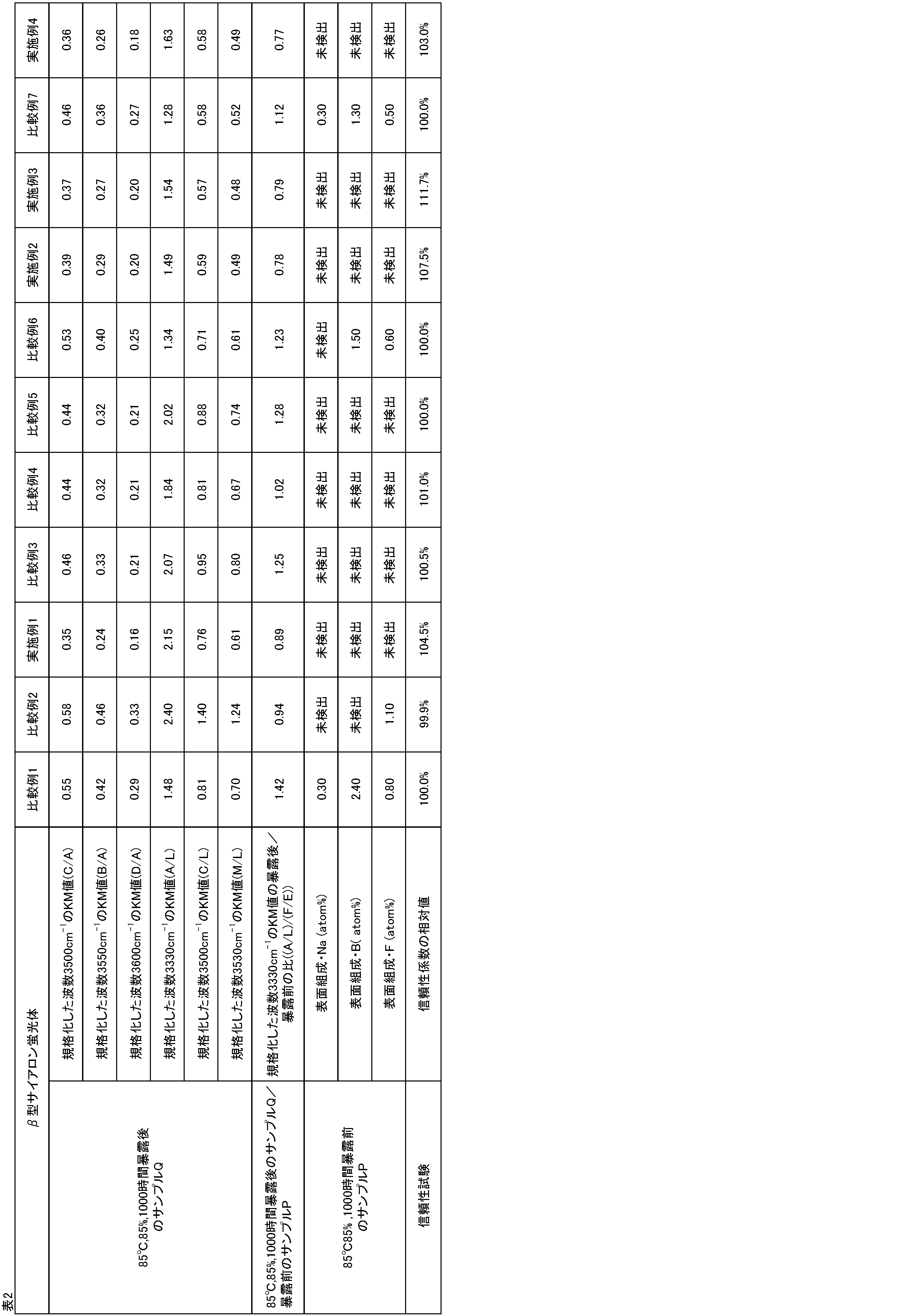
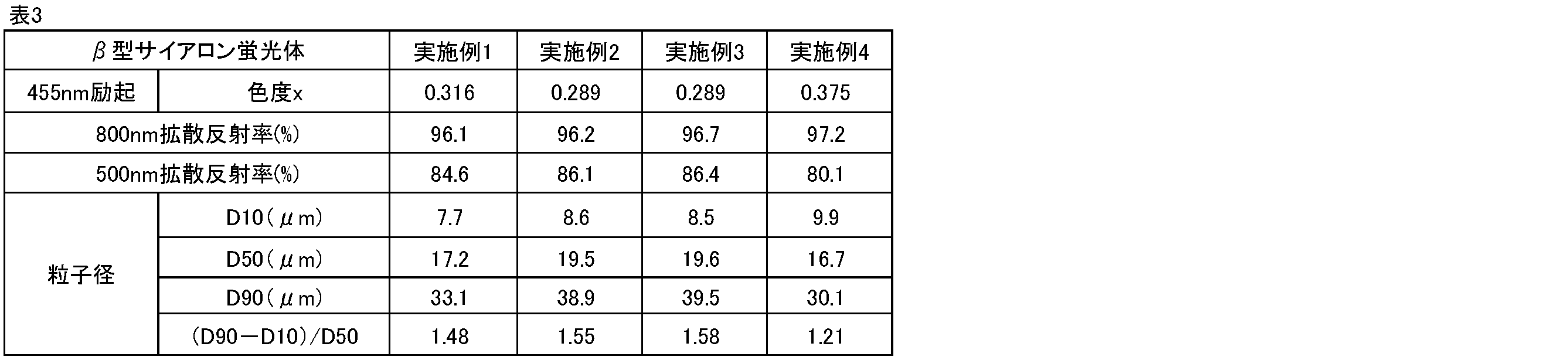
各実施例のβ型サイアロン蛍光体の測定サンプルPを用いて、粒子径の測定を、JIS R 1629:1997「ファインセラミックス原料のレーザ回折・散乱法による粒子径分布測定方法」に記載のレーザ回折・散乱法による粒子径分布測定方法に準拠して行った。測定には、粒子径分布測定装置(マイクロトラック・ベル株式会社製、製品名:「Microtrac MT3300EX II」)を用いた。具体的には、まず、測定対象となる蛍光体0.1gをイオン交換水100mLに投入し、超音波ホモジナイザー(株式会社日本精機製作所製、製品名:「Ultrasonic Homogenizer US-150E」、チップサイズ:φ20、Amplitude:100%、発振周波数:19.5KHz、振幅:約31μm)を用いて3分間、分散処理を行い、測定サンプルを調製した。その後、粒子径分布測定装置を用いて粒度を測定した。
上記のレーザ回折・散乱法によって測定された体積基準の粒子径の分布曲線において、小粒径からの積算値が全体の10%、50%及び90%に達した時の粒子径をD10、D50、D90とした。
各実施例のβ型サイアロン蛍光体の測定サンプルPを用いて、拡散反射率は、日本分光社製紫外可視分光光度計(V-550)に積分球装置(ISV-469)を取り付けた装置で測定した。
標準反射板(スペクトラロン)でベースライン補正を行い、β型サイアロン蛍光体を充填した固体試料ホルダーをセットし、500~850nmの波長範囲で拡散反射率の測定を行った。
500nmおよび800nmにおける拡散反射率(%)を測定した。
各実施例のβ型サイアロン蛍光体の測定サンプルPを用いて、色度Xは、蛍光スペクトルの465~780nmの範囲の波長域におけるスペクトルデータから、JIS Z8781-3:2016で規定されるXYZ表色系におけるCIE色度座標x値(色度X)をJIS Z8724:2015に準じ算出することで求めた。測定方法は測定対象である蛍光体を、凹型セルに表面が平滑になるように充填し、積分球の開口部に取り付けた。発光光源であるXeランプから455nmの波長に分光した単色光を、光ファイバーを用いて蛍光体の励起光として上記積分球内に導入した。この励起光である単色光を測定対象である蛍光体に照射し、蛍光スペクトルを測定した。測定には、分光光度計(大塚電子株式会社製、商品名:MCPD-7000)を用いた。
得られたβ型サイアロン蛍光体を搭載したLEDパッケージの信頼性試験を以下の要領で評価した。
LEDパッケージは、図1に示した発光装置の構造に準じたものを準備した。
まず、ケース凹型の底部に設置されたLED上面の電極とリードフレームとをワイヤボンディングした。LEDは、発光ピーク波長448nmで、チップ1.0mm×0.5mmの大きさのものを用いた。続いて、液体状のシリコーン樹脂(KER6150、信越化学工業社製)に、蛍光体濃度が10.5wt%となるようにβ型サイアロン蛍光体を混合して樹脂組成物を得た。得られた樹脂組成物を、マイクロシリンジからケース凹部に注入した後、常温低湿度環境下(マックドライMCU-201A、エクアールシー社製)で15時間静置し、その後150℃、1時間で硬化させた。これにより、β型サイアロン蛍光体を搭載したLEDパッケージを得た。
得られたLEDパッケージについて、光束を測定し、初期値L0とした。また、85℃、85%RHで300mAで通電点灯させながら500時間放置後、取り出して室温で乾燥した際の光束L1を測定し、信頼係数M(=L1/L0×100)を算出した。
比較例2~5と実施例1の信頼性係数の相対比は比較例1の信頼係数Mを100.0%としたとき、比較例2~5と実施例1の信頼係数の相対値(%)を表1に示す。例えば、比較例1の信頼係数MをM1、実施例1の信頼係数MをM2とした場合、実施例1の信頼係数Mの相対値はM2/M1×100で示される。
実施例2,3の信頼性係数の相対比は比較例6の信頼係数Mを100.0%としたとき、実施例2,3の信頼係数の相対値(%)を表1に示す。
実施例4の信頼性係数の相対比は比較例7の信頼係数Mを100.0%としたとき、実施例4の信頼係数の相対値(%)を、表1および表2のそれぞれに示す。
20 発光素子
30 ヒートシンク
40 ケース
50 第1リードフレーム
60 第2リードフレーム
70 ボンディングワイヤ
72 ボンディングワイヤ
80 複合体
82 アルカリ処理蛍光体粒子
84 封止材
Claims (6)
- ユーロピウムが固溶したβ型サイアロン蛍光体であって、
FT-IRにより求められる当該β型サイアロン蛍光体のスペクトルにおいて、前記スペクトルの吸収度をクベルカ-ムンク関数によりKM値に変換し、波数3050cm-1のKM値をE、波数3330cm-1のKM値をF、波数3500cm-1のKM値をG、波数3530cm-1のKM値をHとしたとき、
下記(P1)および(P2)の少なくとも一以上を有する、
(P1)E,F,Gが、1.8<F/Eかつ1.8>G/Eを満たすこと
(P2)E,F,Hが、1.8<F/Eかつ2.0>H/Eを満たすこと
β型サイアロン蛍光体。 - ユーロピウムが固溶したβ型サイアロン蛍光体であって、
温度85℃、湿度85%の環境下で1000時間暴露後にFT-IRにより求められる当該β型サイアロン蛍光体のスペクトルにおいて、前記スペクトルの吸収度をクベルカ-ムンク関数によりKM値に変換し、波数3330cm-1のKM値をA、波数3550cm-1のKM値をB、波数3500cm-1のKM値をC、波数3600cm-1のKM値をD、波数3050cm-1のKM値をL、波数3530cm-1のKM値をMとし、
温度85℃、湿度85%の環境下で1000時間暴露を行う前にFT-IRにより求められる当該β型サイアロン蛍光体のスペクトルにおいて、前記スペクトルの吸収度をクベルカ-ムンク関数によりKM値に変換し、波数3050cm-1のKM値をE、波数3330cm-1のKM値をFとしたとき、
下記(Q1)~(Q6)の少なくとも一以上を有する、
(Q1)A,Bが、0.31>B/Aを満たすこと
(Q2)A,Cが、0.44>C/Aを満たすこと
(Q3)A,Dが、0.21>D/Aを満たすこと
(Q4)L,A,Cが、1.4<A/Lかつ0.81>C/Lを満たすこと
(Q5)L,A,Mが、1.4<A/Lかつ0.67>M/Lを満たすこと
(Q6)L,A,E,Fが、0.94>((A/L)/(F/E))を満たすこと
β型サイアロン蛍光体。 - 請求項1または2に記載のβ型サイアロン蛍光体であって、
当該β型サイアロン蛍光体の表面組成において、フッ素の量が0.4atom%未満である、β型サイアロン蛍光体。 - 請求項1または2に記載のβ型サイアロン蛍光体であって、
当該β型サイアロン蛍光体の表面組成において、ホウ素の量が0.5atom%未満である、β型サイアロン蛍光体。 - 発光素子と、
前記発光素子から照射された光を変換して発光する波長変換体と、
を備える、発光部材であって、
前記波長変換体は、請求項1または2に記載のβ型サイアロン蛍光体を有する、
発光部材。 - 請求項5に記載の発光部材を備える、発光装置。
Priority Applications (2)
| Application Number | Priority Date | Filing Date | Title |
|---|---|---|---|
| CN202480039475.3A CN121311564A (zh) | 2023-06-16 | 2024-06-04 | β型赛隆荧光体、发光部件及发光装置 |
| KR1020267000981A KR20260021776A (ko) | 2023-06-16 | 2024-06-04 | β형 사이알론 형광체, 발광 부재, 및 발광 장치 |
Applications Claiming Priority (4)
| Application Number | Priority Date | Filing Date | Title |
|---|---|---|---|
| JP2023-099450 | 2023-06-16 | ||
| JP2023099450A JP2024180033A (ja) | 2023-06-16 | 2023-06-16 | β型サイアロン蛍光体、発光部材、および発光装置 |
| JP2023099451A JP2024180034A (ja) | 2023-06-16 | 2023-06-16 | β型サイアロン蛍光体、発光部材、および発光装置 |
| JP2023-099451 | 2023-06-16 |
Publications (1)
| Publication Number | Publication Date |
|---|---|
| WO2024257646A1 true WO2024257646A1 (ja) | 2024-12-19 |
Family
ID=93851865
Family Applications (1)
| Application Number | Title | Priority Date | Filing Date |
|---|---|---|---|
| PCT/JP2024/020309 Ceased WO2024257646A1 (ja) | 2023-06-16 | 2024-06-04 | β型サイアロン蛍光体、発光部材、および発光装置 |
Country Status (3)
| Country | Link |
|---|---|
| KR (1) | KR20260021776A (ja) |
| CN (1) | CN121311564A (ja) |
| WO (1) | WO2024257646A1 (ja) |
Citations (4)
| Publication number | Priority date | Publication date | Assignee | Title |
|---|---|---|---|---|
| JP2014197635A (ja) * | 2013-03-29 | 2014-10-16 | 三菱化学株式会社 | 発光装置と、それに用いるβサイアロン蛍光体 |
| JP2021042395A (ja) * | 2015-12-15 | 2021-03-18 | 日亜化学工業株式会社 | βサイアロン蛍光体の製造方法 |
| JP2021169629A (ja) * | 2018-06-27 | 2021-10-28 | 日亜化学工業株式会社 | βサイアロン蛍光体の製造方法 |
| JP2022069578A (ja) * | 2019-09-27 | 2022-05-11 | 日亜化学工業株式会社 | βサイアロン蛍光体の製造方法 |
-
2024
- 2024-06-04 WO PCT/JP2024/020309 patent/WO2024257646A1/ja not_active Ceased
- 2024-06-04 CN CN202480039475.3A patent/CN121311564A/zh active Pending
- 2024-06-04 KR KR1020267000981A patent/KR20260021776A/ko active Pending
Patent Citations (4)
| Publication number | Priority date | Publication date | Assignee | Title |
|---|---|---|---|---|
| JP2014197635A (ja) * | 2013-03-29 | 2014-10-16 | 三菱化学株式会社 | 発光装置と、それに用いるβサイアロン蛍光体 |
| JP2021042395A (ja) * | 2015-12-15 | 2021-03-18 | 日亜化学工業株式会社 | βサイアロン蛍光体の製造方法 |
| JP2021169629A (ja) * | 2018-06-27 | 2021-10-28 | 日亜化学工業株式会社 | βサイアロン蛍光体の製造方法 |
| JP2022069578A (ja) * | 2019-09-27 | 2022-05-11 | 日亜化学工業株式会社 | βサイアロン蛍光体の製造方法 |
Also Published As
| Publication number | Publication date |
|---|---|
| KR20260021776A (ko) | 2026-02-13 |
| CN121311564A (zh) | 2026-01-09 |
Similar Documents
| Publication | Publication Date | Title |
|---|---|---|
| JP7303822B2 (ja) | 蛍光体及び発光装置 | |
| KR101251138B1 (ko) | β형 사이알론 형광체, 그의 용도 및 그의 제조 방법 | |
| KR101419626B1 (ko) | β형 사이알론, β형 사이알론의 제조 방법 및 발광 장치 | |
| CN112739796A (zh) | 荧光体和发光装置 | |
| CN102959044B (zh) | β型赛隆及其制备方法和发光装置 | |
| TWI751140B (zh) | 螢光體、發光元件及發光裝置 | |
| CN118995205A (zh) | 铕活化β型塞隆荧光体和发光装置 | |
| JP2022148419A (ja) | β型サイアロン蛍光体粉末および発光装置 | |
| JP2022148407A (ja) | β型サイアロン蛍光体粉末の製造方法 | |
| JP2024180033A (ja) | β型サイアロン蛍光体、発光部材、および発光装置 | |
| JP2024180034A (ja) | β型サイアロン蛍光体、発光部材、および発光装置 | |
| JP7760608B2 (ja) | β型サイアロン蛍光体、発光部材、および発光装置 | |
| CN118256236A (zh) | β型塞隆荧光体粒子和发光装置 | |
| JP7778554B2 (ja) | β型サイアロン蛍光体の製造方法、波長変換部材の製造方法、及び発光装置の製造方法 | |
| KR20260021776A (ko) | β형 사이알론 형광체, 발광 부재, 및 발광 장치 | |
| JP2023167885A (ja) | β型サイアロン蛍光体粒子、β型サイアロン蛍光体粉末、発光装置およびβ型サイアロン蛍光体粒子の製造方法 | |
| JP7507018B2 (ja) | β型サイアロン蛍光体の製造方法、波長変換部材の製造方法、及び発光装置の製造方法 | |
| CN113874468A (zh) | α型塞隆荧光体、发光构件和发光装置 | |
| JP7763932B2 (ja) | Eu賦活β型サイアロン蛍光体粒子、β型サイアロン蛍光体粉末および発光装置 | |
| JP7539811B2 (ja) | β型サイアロン蛍光体の製造方法 | |
| WO2026100433A1 (ja) | β型サイアロン蛍光体粒子 | |
| JP2026081528A (ja) | β型サイアロン蛍光体粒子 | |
| KR20250127718A (ko) | β형 사이알론 형광체, 복합체, 파장 변환 부재, 발광 장치 및 β형 사이알론 형광체의 제조 방법 | |
| KR20250164299A (ko) | 형광체 분말 및 발광 장치 | |
| JP2023030277A (ja) | ユウロピウム賦活β型サイアロン蛍光体の製造方法 |
Legal Events
| Date | Code | Title | Description |
|---|---|---|---|
| 121 | Ep: the epo has been informed by wipo that ep was designated in this application |
Ref document number: 24823265 Country of ref document: EP Kind code of ref document: A1 |
|
| ENP | Entry into the national phase |
Ref document number: 1020267000981 Country of ref document: KR Free format text: ST27 STATUS EVENT CODE: A-0-1-A10-A15-NAP-PA0105 (AS PROVIDED BY THE NATIONAL OFFICE) |
|
| WWE | Wipo information: entry into national phase |
Ref document number: 1020267000981 Country of ref document: KR |
|
| NENP | Non-entry into the national phase |
Ref country code: DE |
|
| WWP | Wipo information: published in national office |
Ref document number: 1020267000981 Country of ref document: KR |