WO2024257548A1 - 組成物、成形体、組成物の製造方法 - Google Patents
組成物、成形体、組成物の製造方法 Download PDFInfo
- Publication number
- WO2024257548A1 WO2024257548A1 PCT/JP2024/018279 JP2024018279W WO2024257548A1 WO 2024257548 A1 WO2024257548 A1 WO 2024257548A1 JP 2024018279 W JP2024018279 W JP 2024018279W WO 2024257548 A1 WO2024257548 A1 WO 2024257548A1
- Authority
- WO
- WIPO (PCT)
- Prior art keywords
- composition
- group
- cellulose
- polyrotaxane
- examples
- Prior art date
- Legal status (The legal status is an assumption and is not a legal conclusion. Google has not performed a legal analysis and makes no representation as to the accuracy of the status listed.)
- Ceased
Links
Classifications
-
- B—PERFORMING OPERATIONS; TRANSPORTING
- B29—WORKING OF PLASTICS; WORKING OF SUBSTANCES IN A PLASTIC STATE IN GENERAL
- B29C—SHAPING OR JOINING OF PLASTICS; SHAPING OF MATERIAL IN A PLASTIC STATE, NOT OTHERWISE PROVIDED FOR; AFTER-TREATMENT OF THE SHAPED PRODUCTS, e.g. REPAIRING
- B29C45/00—Injection moulding, i.e. forcing the required volume of moulding material through a nozzle into a closed mould; Apparatus therefor
- B29C45/0001—Injection moulding, i.e. forcing the required volume of moulding material through a nozzle into a closed mould; Apparatus therefor characterised by the choice of material
-
- C—CHEMISTRY; METALLURGY
- C08—ORGANIC MACROMOLECULAR COMPOUNDS; THEIR PREPARATION OR CHEMICAL WORKING-UP; COMPOSITIONS BASED THEREON
- C08J—WORKING-UP; GENERAL PROCESSES OF COMPOUNDING; AFTER-TREATMENT NOT COVERED BY SUBCLASSES C08B, C08C, C08F, C08G or C08H
- C08J3/00—Processes of treating or compounding macromolecular substances
- C08J3/005—Processes for mixing polymers
-
- C—CHEMISTRY; METALLURGY
- C08—ORGANIC MACROMOLECULAR COMPOUNDS; THEIR PREPARATION OR CHEMICAL WORKING-UP; COMPOSITIONS BASED THEREON
- C08K—Use of inorganic or non-macromolecular organic substances as compounding ingredients
- C08K5/00—Use of organic ingredients
- C08K5/04—Oxygen-containing compounds
- C08K5/05—Alcohols; Metal alcoholates
-
- C—CHEMISTRY; METALLURGY
- C08—ORGANIC MACROMOLECULAR COMPOUNDS; THEIR PREPARATION OR CHEMICAL WORKING-UP; COMPOSITIONS BASED THEREON
- C08K—Use of inorganic or non-macromolecular organic substances as compounding ingredients
- C08K5/00—Use of organic ingredients
- C08K5/04—Oxygen-containing compounds
- C08K5/05—Alcohols; Metal alcoholates
- C08K5/053—Polyhydroxylic alcohols
-
- C—CHEMISTRY; METALLURGY
- C08—ORGANIC MACROMOLECULAR COMPOUNDS; THEIR PREPARATION OR CHEMICAL WORKING-UP; COMPOSITIONS BASED THEREON
- C08K—Use of inorganic or non-macromolecular organic substances as compounding ingredients
- C08K5/00—Use of organic ingredients
- C08K5/04—Oxygen-containing compounds
- C08K5/10—Esters; Ether-esters
-
- C—CHEMISTRY; METALLURGY
- C08—ORGANIC MACROMOLECULAR COMPOUNDS; THEIR PREPARATION OR CHEMICAL WORKING-UP; COMPOSITIONS BASED THEREON
- C08K—Use of inorganic or non-macromolecular organic substances as compounding ingredients
- C08K5/00—Use of organic ingredients
- C08K5/04—Oxygen-containing compounds
- C08K5/13—Phenols; Phenolates
-
- C—CHEMISTRY; METALLURGY
- C08—ORGANIC MACROMOLECULAR COMPOUNDS; THEIR PREPARATION OR CHEMICAL WORKING-UP; COMPOSITIONS BASED THEREON
- C08L—COMPOSITIONS OF MACROMOLECULAR COMPOUNDS
- C08L1/00—Compositions of cellulose, modified cellulose or cellulose derivatives
- C08L1/08—Cellulose derivatives
-
- C—CHEMISTRY; METALLURGY
- C08—ORGANIC MACROMOLECULAR COMPOUNDS; THEIR PREPARATION OR CHEMICAL WORKING-UP; COMPOSITIONS BASED THEREON
- C08L—COMPOSITIONS OF MACROMOLECULAR COMPOUNDS
- C08L101/00—Compositions of unspecified macromolecular compounds
- C08L101/16—Compositions of unspecified macromolecular compounds the macromolecular compounds being biodegradable
-
- C—CHEMISTRY; METALLURGY
- C08—ORGANIC MACROMOLECULAR COMPOUNDS; THEIR PREPARATION OR CHEMICAL WORKING-UP; COMPOSITIONS BASED THEREON
- C08L—COMPOSITIONS OF MACROMOLECULAR COMPOUNDS
- C08L71/00—Compositions of polyethers obtained by reactions forming an ether link in the main chain; Compositions of derivatives of such polymers
- C08L71/02—Polyalkylene oxides
-
- B—PERFORMING OPERATIONS; TRANSPORTING
- B29—WORKING OF PLASTICS; WORKING OF SUBSTANCES IN A PLASTIC STATE IN GENERAL
- B29K—INDEXING SCHEME ASSOCIATED WITH SUBCLASSES B29B, B29C OR B29D, RELATING TO MOULDING MATERIALS OR TO MATERIALS FOR MOULDS, REINFORCEMENTS, FILLERS OR PREFORMED PARTS, e.g. INSERTS
- B29K2001/00—Use of cellulose, modified cellulose or cellulose derivatives, e.g. viscose, as moulding material
- B29K2001/08—Cellulose derivatives
- B29K2001/12—Cellulose acetate
-
- B—PERFORMING OPERATIONS; TRANSPORTING
- B29—WORKING OF PLASTICS; WORKING OF SUBSTANCES IN A PLASTIC STATE IN GENERAL
- B29K—INDEXING SCHEME ASSOCIATED WITH SUBCLASSES B29B, B29C OR B29D, RELATING TO MOULDING MATERIALS OR TO MATERIALS FOR MOULDS, REINFORCEMENTS, FILLERS OR PREFORMED PARTS, e.g. INSERTS
- B29K2003/00—Use of starch or derivatives as moulding material
-
- B—PERFORMING OPERATIONS; TRANSPORTING
- B29—WORKING OF PLASTICS; WORKING OF SUBSTANCES IN A PLASTIC STATE IN GENERAL
- B29K—INDEXING SCHEME ASSOCIATED WITH SUBCLASSES B29B, B29C OR B29D, RELATING TO MOULDING MATERIALS OR TO MATERIALS FOR MOULDS, REINFORCEMENTS, FILLERS OR PREFORMED PARTS, e.g. INSERTS
- B29K2067/00—Use of polyesters or derivatives thereof, as moulding material
-
- B—PERFORMING OPERATIONS; TRANSPORTING
- B29—WORKING OF PLASTICS; WORKING OF SUBSTANCES IN A PLASTIC STATE IN GENERAL
- B29K—INDEXING SCHEME ASSOCIATED WITH SUBCLASSES B29B, B29C OR B29D, RELATING TO MOULDING MATERIALS OR TO MATERIALS FOR MOULDS, REINFORCEMENTS, FILLERS OR PREFORMED PARTS, e.g. INSERTS
- B29K2071/00—Use of polyethers, e.g. PEEK, i.e. polyether-etherketone or PEK, i.e. polyetherketone or derivatives thereof, as moulding material
- B29K2071/02—Polyalkylene oxides, e.g. PEO, i.e. polyethylene oxide, or derivatives thereof
-
- B—PERFORMING OPERATIONS; TRANSPORTING
- B29—WORKING OF PLASTICS; WORKING OF SUBSTANCES IN A PLASTIC STATE IN GENERAL
- B29K—INDEXING SCHEME ASSOCIATED WITH SUBCLASSES B29B, B29C OR B29D, RELATING TO MOULDING MATERIALS OR TO MATERIALS FOR MOULDS, REINFORCEMENTS, FILLERS OR PREFORMED PARTS, e.g. INSERTS
- B29K2995/00—Properties of moulding materials, reinforcements, fillers, preformed parts or moulds
- B29K2995/0037—Other properties
- B29K2995/0089—Impact strength or toughness
-
- C—CHEMISTRY; METALLURGY
- C08—ORGANIC MACROMOLECULAR COMPOUNDS; THEIR PREPARATION OR CHEMICAL WORKING-UP; COMPOSITIONS BASED THEREON
- C08J—WORKING-UP; GENERAL PROCESSES OF COMPOUNDING; AFTER-TREATMENT NOT COVERED BY SUBCLASSES C08B, C08C, C08F, C08G or C08H
- C08J2301/00—Characterised by the use of cellulose, modified cellulose or cellulose derivatives
- C08J2301/08—Cellulose derivatives
- C08J2301/10—Esters of organic acids
- C08J2301/12—Cellulose acetate
-
- C—CHEMISTRY; METALLURGY
- C08—ORGANIC MACROMOLECULAR COMPOUNDS; THEIR PREPARATION OR CHEMICAL WORKING-UP; COMPOSITIONS BASED THEREON
- C08J—WORKING-UP; GENERAL PROCESSES OF COMPOUNDING; AFTER-TREATMENT NOT COVERED BY SUBCLASSES C08B, C08C, C08F, C08G or C08H
- C08J2403/00—Characterised by the use of starch, amylose or amylopectin or of their derivatives or degradation products
- C08J2403/02—Starch; Degradation products thereof, e.g. dextrin
-
- C—CHEMISTRY; METALLURGY
- C08—ORGANIC MACROMOLECULAR COMPOUNDS; THEIR PREPARATION OR CHEMICAL WORKING-UP; COMPOSITIONS BASED THEREON
- C08J—WORKING-UP; GENERAL PROCESSES OF COMPOUNDING; AFTER-TREATMENT NOT COVERED BY SUBCLASSES C08B, C08C, C08F, C08G or C08H
- C08J2467/00—Characterised by the use of polyesters obtained by reactions forming a carboxylic ester link in the main chain; Derivatives of such polymers
-
- C—CHEMISTRY; METALLURGY
- C08—ORGANIC MACROMOLECULAR COMPOUNDS; THEIR PREPARATION OR CHEMICAL WORKING-UP; COMPOSITIONS BASED THEREON
- C08J—WORKING-UP; GENERAL PROCESSES OF COMPOUNDING; AFTER-TREATMENT NOT COVERED BY SUBCLASSES C08B, C08C, C08F, C08G or C08H
- C08J2471/00—Characterised by the use of polyethers obtained by reactions forming an ether link in the main chain; Derivatives of such polymers
- C08J2471/02—Polyalkylene oxides
Definitions
- the present invention relates to a composition, a molded body, and a method for producing the composition.
- Patent Document 1 discloses a resin composition that contains a resin having carbon atoms derived from biomass and meets certain requirements.
- an object of the present invention is to provide a composition having excellent dart impact strength. Another object of the present invention is to provide a molded article of the above composition and a method for producing the composition.
- a composition comprising a cellulose derivative and a polyrotaxane, The composition, wherein the composition is amorphous.
- the composition according to [1], wherein the cellulose derivative is cellulose acylate.
- the composition according to [2], wherein the cellulose acylate has a degree of acyl substitution of 1.7 to 2.6.
- the composition according to any one of [1] to [3], wherein the cellulose derivative is at least one selected from the group consisting of cellulose acetate, cellulose acetate propionate, and cellulose acetate butyrate.
- the composition according to any one of [1] to [4], wherein the cellulose derivative is cellulose acetate.
- the plasticizer is at least one selected from the group consisting of a cardanol compound, a carboxylic acid ester compound, and an alkyldiol having 9 to 14 carbon atoms.
- a mass ratio of a content of the polyrotaxane to a content of the cellulose derivative is 0.10 or less.
- a molded article comprising the composition according to any one of [1] to [9]. [11] The molded article according to [10], having a maximum impact force of 4000 N or more. [12] A method for producing a composition, comprising producing a composition that contains a cellulose derivative and a polyrotaxane and is amorphous, comprising the steps of: A method for producing a composition, comprising the step of melt-kneading the cellulose derivative and the polyrotaxane in substantially no solvent.
- a composition having excellent dart impact strength can be provided.
- the present invention also provides a molded article of the above composition and a method for producing the composition.
- a numerical range expressed using “to” means a range that includes the numerical values before and after “to” as the lower and upper limits.
- the “content” of the component means the total content of those two or more components.
- the upper limit or lower limit described in a certain numerical range may be replaced with the upper limit or lower limit of another numerical range described stepwise.
- the upper limit or lower limit described in a certain numerical range may be replaced with a value shown in the examples.
- a combination of two or more preferred aspects is a more preferred aspect.
- substituents, etc. when there are multiple substituents and linking groups, etc. (hereinafter referred to as "substituents, etc.") indicated by a specific symbol, or when multiple substituents, etc. are specified at the same time, it means that each of the substituents, etc. may be the same or different from each other. This also applies to the specification of the number of substituents, etc.
- composition The composition of the present invention will be described in detail below.
- the composition of the present invention (hereinafter also simply referred to as "composition") contains a cellulose derivative and a polyrotaxane, and is amorphous.
- composition having the above configuration can solve the problems of the present invention is not necessarily clear, but the present inventors speculate as follows.
- the mechanism by which the effects are obtained is not limited by the following speculation. In other words, even if the effects are obtained by a mechanism other than the following, it is included in the scope of the present invention.
- Amorphous compositions containing cellulose derivatives have low mechanical strength because they do not have a crystalline structure, whereas the composition of the present invention further contains polyrotaxane, which can reduce impact energy due to the ring structure of the polyrotaxane, thus overturning conventional wisdom and exhibiting extremely superior dart impact strength compared to crystalline compositions.
- the composition includes a cellulose derivative.
- the cellulose derivative refers to a modified cellulose in which at least a part of the hydroxyl group of cellulose, which is a natural polymer, is chemically modified.
- the above-mentioned chemical modification is not particularly limited, but examples thereof include esterification, alkyl etherification, and hydroxyalkyl etherification of the hydroxyl group, with esterification being preferred.
- the cellulose derivative is preferably cellulose acylate, alkyl cellulose, and hydroxyalkyl cellulose, with cellulose acylate being more preferred.
- the resin constituting the composition is a cellulose derivative, so that the composition can exhibit biodegradability. In other words, the composition of the present invention exhibits excellent dart impact strength while exhibiting biodegradability.
- Cellulose acylate is a cellulose derivative in which hydrogen atoms in at least some of the hydroxyl groups of cellulose are substituted with acyl groups.
- the cellulose acylate may be, for example, a cellulose derivative represented by the following general formula (CA).
- a 1 , A 2 , and A 3 each independently represent a hydrogen atom or an acyl group, and n represents an integer of 2 or more, provided that at least one of the n A 1 s , n A 2 s , and n A 3 s represents an acyl group.
- a 1 , A 2 and A 3 each of which is present in an amount of n in a molecule, may be the same or different.
- the hydrocarbon group contained in the acyl groups represented by A 1 , A 2 and A 3 may be either an aliphatic hydrocarbon group or an aromatic hydrocarbon group, with an aliphatic hydrocarbon group being preferred.
- the aliphatic hydrocarbon group may be any one of linear, branched, and cyclic, but is preferably linear or branched, and more preferably linear.
- the aliphatic hydrocarbon group may be either a saturated aliphatic hydrocarbon group or an unsaturated aliphatic hydrocarbon group, with a saturated aliphatic hydrocarbon group being preferred.
- the acyl group preferably has 1 to 6 carbon atoms, more preferably 2 to 4 carbon atoms, and even more preferably 2 or 3 carbon atoms.
- the acyl group may have a substituent, but is preferably unsubstituted.
- substituent include a halogen atom (e.g., a fluorine atom, a chlorine atom, a bromine atom, and an iodine atom), a hydroxy group, and an amino group.
- halogen atom e.g., a fluorine atom, a chlorine atom, a bromine atom, and an iodine atom
- a hydroxy group e.g., a halogen atom (e.g., a fluorine atom, a chlorine atom, a bromine atom, and an iodine atom)
- a hydroxy group e.g., a hydroxy group
- amino group e.g., a halogen atom
- examples of the acyl group include a formyl group, an acetyl group, a propionyl group, a but
- cellulose acylates examples include cellulose acetate (cellulose monoacetate, cellulose diacetate (DAC), cellulose triacetate, etc.), cellulose acetate propionate (CAP), and cellulose acetate butyrate (CAB), with cellulose acetate being preferred since it provides better effects for the present invention.
- the weight average molecular weight (Mw) of the cellulose acylate is preferably from 20,000 to 200,000, more preferably from 70,000 to 180,000, and even more preferably from 90,000 to 160,000.
- the weight average polymerization degree of the cellulose acylate is preferably from 150 to 1,000, and more preferably from 300 to 700.
- the weight average molecular weight (Mw) of the cellulose acylate can be a polystyrene equivalent value measured using tetrahydrofuran as a solvent and a gel permeation chromatography apparatus (GPC apparatus: Tosoh Corporation, HLC-8320GPC, column: TSKgel ⁇ -M).
- the weight-average degree of polymerization can be calculated by dividing the weight-average molecular weight (Mw) by the molecular weight of the constituent unit of cellulose acylate.
- Mw weight-average molecular weight
- the molecular weight of the constituent unit of cellulose acylate is 263 when the degree of acetyl substitution is 2.4.
- the degree of acyl substitution of the cellulose acylate is preferably from 1.4 to 2.9, more preferably from 1.7 to 2.6, and even more preferably from 2.3 to 2.5.
- the degree of acyl substitution is an index showing the degree to which hydrogen atoms of hydroxyl groups in cellulose are replaced by acyl groups (i.e., acylation), and specifically means the intramolecular average of the acylated hydroxyl groups among the three hydroxyl groups present in a D-glucopyranose unit.
- the degree of acyl substitution is determined from the integral ratio of the peak of hydrogen atoms derived from cellulose to the peak of hydrogen atoms derived from acyl groups, obtained by 1H -NMR.
- 1 H-NMR (JMN-ECA/JEOL RESONANCE) measurement is performed using tetramethylsilane as a standard substance
- P1 is the integral value of the peak derived from a hydroxyl group present at a chemical shift of 4.5 to 5.5 ppm
- P2 is the integral value of the peak derived from an acyl group present at a chemical shift of 2.5 to 3.5 ppm divided by the number of hydrogen atoms in the corresponding acyl group (for example, in the case of an acetyl group, the number of hydrogen atoms is 3), and the concentration is calculated from the following formula (10).
- a solvent selected from tetrahydrofuran-d8, chloroform-d, methanol-d4, and dimethylsulfoxide-d6 can be used, and it is preferable to use tetrahydrofuran-d8.
- Degree of acyl substitution P2/(P1+P2) Formula (10)
- the ratio of the degree of substitution of acetyl groups to the degree of substitution of propionyl groups is preferably from 0.01 to 1.0, and more preferably from 0.05 to 0.1.
- the ratio of the degree of substitution of acetyl groups to the degree of substitution of butyryl groups is preferably from 0.05 to 3.5, and more preferably from 0.5 to 3.0.
- the degree of acetyl substitution is preferably from 1.4 to 2.9, more preferably from 1.7 to 2.6, and even more preferably from 2.3 to 2.5.
- the degree of acetyl substitution can be determined by the same method as that for the degree of acyl substitution described above.
- cellulose derivatives other than cellulose acetate examples include alkyl celluloses such as methyl cellulose, ethyl cellulose, propyl cellulose, and butyl cellulose, hydroxyalkyl celluloses such as hydroxyethyl cellulose, hydroxypropyl cellulose, hydroxypropyl methyl cellulose, and hydroxybutyl methyl cellulose, carboxymethyl cellulose, and nitrocellulose.
- the cellulose derivatives may be used alone or in combination of two or more.
- the content of the cellulose derivative is preferably 70% by mass or more, more preferably 80% by mass or more, based on the total mass of the composition, in terms of better effects of the present invention.
- the upper limit of the content of the cellulose derivative is less than 100% by mass, preferably 99% by mass or less, more preferably 93% by mass or less, based on the total mass of the composition.
- the composition includes a polyrotaxane.
- Polyrotaxane is a molecular complex in which the openings of multiple cyclic molecules are pierced by an axis molecule in a skewered manner, and multiple cyclic molecules encapsulate the axis molecule.
- the pseudo-polyrotaxane has blocking groups at both ends (both ends of the axis molecule) to prevent the cyclic molecules from being released.
- the cyclic molecules can move freely on the axial molecule, which has the effect of alleviating external and internal stresses. It is believed that the composition contains polyrotaxane in addition to the above-mentioned cellulose derivative, which alleviates stress when a surface impact is applied, thereby exhibiting excellent surface impact strength.
- the axis molecule in the polyrotaxane has an axis portion that passes through the cyclic molecule, and further has a blocking group at the end of the axis portion that prevents the cyclic molecule from being detached.
- the axial portion of the axial molecule is not particularly limited, but is preferably a divalent aliphatic hydrocarbon group, and more preferably an alkylene group.
- One or more carbon atoms constituting the divalent aliphatic hydrocarbon group may be substituted with -O-, -S-, -SO 2 -, -N(R)- (R: hydrogen atom or substituent), -CO-, -COO-, -CONR- (R: hydrogen atom or substituent), or a combination of these.
- the divalent aliphatic hydrocarbon group be one in which at least one carbon atom constituting the divalent aliphatic hydrocarbon group is replaced by -O-, -S-, -SO 2 -, -N(R)- (R: hydrogen atom or substituent), -CO-, -COO-, -CONR- (R: hydrogen atom or substituent), or a combination of these.
- the axial molecule is preferably formed by introducing a blocking group into a molecule constituting an axial portion having a functional group to which a blocking group can be introduced (e.g., a hydroxy group, an amino group, a carboxy group, a thiol group, etc.).
- a blocking group e.g., a hydroxy group, an amino group, a carboxy group, a thiol group, etc.
- the molecule constituting the shaft portion is preferably a linear molecule, and examples thereof include polyalkylene glycols such as polyethylene glycol, polypropylene glycol, and polytetramethylene glycol; polyesters such as polycaprolactone diol, polylactic acid, polyethylene adipate, polybutylene adipate, polyethylene terephthalate, and polybutylene terephthalate; hydroxyl group-terminated polyolefins such as polybutadiene diol, polyisoprene diol, polyisobutylene diol, poly(acrylonitrile-butadiene) diol, hydrogenated polybutadiene diol, polyethylene diol, and polypropylene diol; terminal functional polysiloxanes such as terminal silanol type polydimethylsiloxane; and terminal amino group chain polymers such as terminal amino group polyethylene glycol, terminal amino group polypropylene glycol, and terminal amino group polybutadiene.
- the blocking group may be any group that has the function of holding the cyclic molecule so that it does not detach from the axis molecule, and examples of the blocking group include bulky substituents.
- examples of the blocking group include a dinitrophenyl group, a cyclodextrin group, an adamantyl group, a trityl group, a fluoresceinyl group, a pyrenyl group, an anthracenyl group, and derivatives thereof.
- the weight average molecular weight (Mw) of the axial molecule is preferably 5,000 to 50,000, and more preferably 10,000 to 30,000.
- the cyclic molecule is not particularly limited as long as it is a cyclic molecule that can encapsulate the above-mentioned axis molecule, and examples thereof include cyclodextrins (e.g., ⁇ -cyclodextrin, ⁇ -cyclodextrin, ⁇ -cyclodextrin, dimethylcyclodextrin, and glucosylcyclodextrin), crown ethers, benzocrowns, dibenzocrowns, dicyclohexanocrowns, calixarenes, macrocyclic amines, and cyclophanes, as well as derivatives or modified forms thereof. Cyclodextrins are preferred because of their excellent compatibility with cellulose derivatives, and ⁇ -cyclodextrin, ⁇ -cyclodextrin, or ⁇ -cyclodextrin, or derivatives thereof are more preferred.
- cyclodextrins e.g., ⁇ -cyclodext
- the cyclic molecule may have a functional group or may be modified with a hydrophobic group.
- functional groups include polymerizable groups (e.g., ethylenically unsaturated double bonds), amino groups, glycidyl groups, carboxy groups, isocyanate groups, thiol groups, and sulfonic acid groups.
- the cyclic molecule may have a side chain.
- the cyclic molecule having a side chain refers to an embodiment in which the cyclic molecule is modified with a polymer chain, such as an embodiment in which a hydroxy group of a cyclodextrin is modified with a polymer chain.
- the side chain is not particularly limited, but examples thereof include polyesters, such as polycaprolactone, polylactic acid, polyglycolic acid, poly-3-hydroxybutyrate, and poly-4-hydroxybutyrate, with polycaprolactone being preferred. It is also preferable that the cyclodextrins have no side chains.
- the weight average molecular weight (Mw) of the polyrotaxane is preferably from 10,000 to 1,000,000, more preferably from 10,000 to 900,000, and even more preferably from 15,000 to 900,000.
- the weight average molecular weight (Mw) of the polyrotaxane can be measured by gel permeation chromatography (GPC) or the like.
- Polyrotaxanes can be synthesized by known methods. For example, they can be synthesized by mixing the molecules that make up the shaft portion with cyclic molecules to form a pseudopolyrotaxane, and then introducing a blocking group.
- the mass ratio of the polyrotaxane content to the cellulose derivative content is preferably 0.50 or less, more preferably 0.10 or less, and even more preferably 0.05 or less.
- the mass ratio of the polyrotaxane content to the cellulose derivative content is more than 0, and in view of the superior effects of the present invention, it is preferably 0.001 or more, and more preferably 0.002 or more.
- the mass ratio of the polyrotaxane content to the cellulose derivative content is preferably from 0.001 to 0.50, more preferably from 0.001 to 0.10, and even more preferably from 0.002 to 0.05.
- the composition of the present invention has a polyrotaxane content as small as 0.10 or less in mass ratio to the cellulose derivative content, the composition exhibits a dart impact strength that is remarkably improved to a level not anticipated by conventional techniques, as compared with a composition not containing polyrotaxane, and exhibits a dart impact strength comparable to that of so-called super engineering plastics.
- the content of the polyrotaxane is preferably from 0.01 to 20% by mass, more preferably from 0.1 to 10% by mass, and even more preferably from 0.2 to 5% by mass, based on the total mass of the composition.
- the content of each component can be calculated from the mass of each component extracted by separation or the like and the mass of the composition and other components before extraction.
- the content of polyrotaxane can be calculated by the following method.
- a composition containing a cellulose derivative (e.g., cellulose acetate) and a water-soluble polyrotaxane (e.g., a polyrotaxane composed of an axis molecule derived from polyethylene oxide and cyclodextrin as a cyclic molecule) is dissolved in methylene chloride, and then water is added to perform a liquid separation operation, extracting the cellulose derivative (e.g., cellulose acetate) in the methylene chloride phase and the polyrotaxane in the water phase. After liquid separation, the content of polyrotaxane relative to the total mass of the composition is quantified from the solid mass obtained by drying each phase.
- a cellulose derivative e.g., cellulose acetate
- a water-soluble polyrotaxane e.g., a polyrotaxane composed of an axis molecule derived from polyethylene oxide and cyclodextrin as a cyclic molecule
- the composition further contains a plasticizer.
- a plasticizer By containing a plasticizer, the flexibility of the composition is improved and the dart impact strength is better.
- the plasticizer include cardanol compounds, ester compounds, alkyl diols, polyols, camphor, metal soaps, and polyalkylene oxides. Of these, cardanol compounds, ester compounds, and alkyl diols are preferred, and cardanol compounds are more preferred.
- Cardanol compounds are components contained in naturally occurring compounds derived from cashews and derivatives thereof.
- Examples of the naturally occurring compounds derived from cashews include the compounds represented by the following formulas (c-1) to (c-4).
- the cardanol compound may be used alone or in combination of two or more types.
- the cardanol compound may be a mixture of naturally derived compounds made from cashews (hereinafter also referred to as a "cashew-derived mixture").
- the cardanol compounds may be derivatives of cashew-derived mixtures, including, for example, the following compounds and mixtures: - A mixture in which the composition ratio of each component in the cashew-derived mixture has been adjusted - A single entity in which only a specific component is isolated from the cashew-derived mixture - A mixture containing a modified product obtained by modifying a component in the cashew-derived mixture - A mixture containing a polymer obtained by polymerizing a component in the cashew-derived mixture - A mixture containing a modified polymer obtained by modifying and polymerizing a component in the cashew-derived mixture - A mixture containing a modified product obtained by further modifying a component in a mixture in which the composition ratio has been adjusted - A mixture containing a polymer obtained by further polymerizing a component in a mixture in which the composition ratio has been adjusted - A mixture containing a polymer obtained by further polymerizing a component in a mixture in which the composition ratio has been adjusted - A mixture
- the cardanol compound is preferably at least one selected from the group consisting of compounds represented by general formula (CDN1) and polymers of compounds represented by general formula (CDN1), in that the effects of the present invention are more excellent and the composition has excellent biodegradability.
- R 1 represents an alkyl group which may have a substituent, or an unsaturated aliphatic group which may have a substituent.
- Each of R 2 independently represents a hydroxy group, a carboxy group, an alkyl group which may have a substituent, or an unsaturated aliphatic group which may have a substituent.
- P2 represents an integer of 0 to 4. When a plurality of R 2s are present, the plurality of R 2s may be the same or different from each other.
- the alkyl group which may have a substituent and is represented by R 1 preferably has 3 to 30 carbon atoms, more preferably 5 to 25 carbon atoms, and even more preferably 8 to 20 carbon atoms.
- substituents that the alkyl group may have include a hydroxy group, an ether bond-containing group (e.g., an alkoxy group, an epoxy group, and an oxetanyl group), an acyl group, and an ester bond-containing group (e.g., an alkyloxycarbonyl group and an alkylcarbonyloxy group).
- the unsaturated aliphatic group which may have a substituent, represented by R 1 preferably has 3 to 30 carbon atoms, more preferably 5 to 25 carbon atoms, and even more preferably 8 to 20 carbon atoms.
- the unsaturated aliphatic group preferably has at least one double bond, and the number of double bonds in the unsaturated aliphatic group is preferably 1 to 3.
- Examples of the substituent which the unsaturated aliphatic group may have include the substituents which the alkyl group may have.
- Examples of the unsaturated aliphatic group which may have a substituent include a pentadec-8-en-1-yl group, a pentadeca-8,11-dien-1-yl group, a pentadeca-8,11,14-trien-1-yl group, a pentadec-7-en-1-yl group, a pentadeca-7,10-dien-1-yl group, and a pentadeca-7,10,14-trien-1-yl group.
- R 1 is preferably a pentadec-8-en-1-yl group, a pentadeca-8,11-dien-1-yl group, a pentadeca-8,11,14-trien-1-yl group, a pentadec-7-en-1-yl group, a pentadeca-7,10-dien-1-yl group, or a pentadeca-7,10,14-trien-1-yl group.
- the compound represented by the general formula (CDN1) and its polymer may be modified, for example, epoxidized.
- the compound represented by the general formula (CDN1) may be a compound represented by the general formula (CDN1-e) in which the hydroxy group of the compound represented by the general formula (CDN1) is substituted with the following group (EP).
- L EP represents a single bond or a divalent linking group.
- R 1 , R 2 and P2 are the same as R 1 , R 2 and P2 in the general formula (CND1), respectively.
- Examples of the divalent linking group represented by L EP include an alkylene group (preferably having 1 to 4 carbon atoms, more preferably having 1 carbon atom) which may have a substituent, and a -CH 2 CH 2 OCH 2 CH 2 - group.
- Examples of the substituent that the alkylene group may have include the substituents that the alkyl group represented by R 1 in general formula (CDN) may have.
- LEP is preferably a methylene group.
- a polymer of a compound represented by general formula (CDN1) refers to a polymer in which compounds represented by general formula (CDN1) are linked via a linking group or a single bond, and examples of such polymers include compounds represented by the following general formula (CDN2).
- R 11 , R 12 , and R 13 each independently represent an alkyl group which may have a substituent, or an unsaturated aliphatic group which may have a substituent.
- R 21 , R 22 , and R 23 each independently represent a hydroxyl group, a carboxyl group, an alkyl group which may have a substituent, or an unsaturated aliphatic group which may have a substituent.
- P21 and P23 each independently represent an integer of 0 to 3.
- P22 represents an integer of 0 to 2.
- L 1 and L 2 each independently represent a divalent linking group.
- n represents an integer of 0 to 10.
- R 11 , R 12 , and R 13 are the same as those of the group represented by R 1 in general formula (CDN1), and the definitions and preferred embodiments of R 21 , R 22 , and R 23 are the same as those of the group represented by R 2 in general formula (CDN1).
- examples of the divalent linking group represented by L1 and L2 include an alkylene group (preferably having 2 to 30 carbon atoms, more preferably having 5 to 20 carbon atoms) which may have a substituent.
- examples of the substituent which the alkylene group may have include the substituent which the alkyl group represented by R1 in general formula (CDN) may have.
- n is preferably 1 to 10, and more preferably 1 to 5.
- the compound represented by the general formula (CDN2) may be modified, for example, epoxidized.
- the compound represented by the general formula (CDN2) may be a compound represented by the general formula (CDN2-e) in which the hydroxy group of the compound represented by the general formula (CDN2) is substituted with the above-mentioned group (EP).
- R 11 , R 12 , R 13 , R 21 , R 22 , R 23 , P21, P22, P23, L 1 , L 2 , and n are each synonymous with R 11 , R 12 , R 13 , R 21 , R 22, R 23 , P21, P22 , P23, L 1 , L 2 , and n in general formula (CDN2).
- L EP1 , L EP2 and L EP3 each independently represent a single bond or a divalent linking group. When a plurality of L EP2s are present, the plurality of L EP2s may be the same or different.
- L EP1 , L EP2 and L EP3 are the same as those of L EP in group (EP).
- the polymer of the compound represented by the general formula (CDN1) and the polymer of the compound represented by the general formula (CDN1-e) may be a three-dimensionally cross-linked polymer.
- these polymers include compounds represented by the following structural formulas.
- R 10 , R 20 , and P20 are respectively defined as R 1 , R 2 , and P2 in general formula (CDN1).
- L 10 is defined as L 1 in general formula (CDN2).
- Plural R 10 , R 20 , P20 , and L 10 may be the same or different from each other.
- cardanol compounds may be used. Examples of commercially available products include NX-2024, Ultra LITE 2023, NX-2026, GX-2503, NC-510, LITE 2020, NX-9001, NX-9004, NX-9007, NX-9008, NX-9201, and NX-9203 manufactured by Cardolite Corporation, and LB-7000, LB-7250, and CD-5L manufactured by Tohoku Kako Co., Ltd.
- Commercially available cardanol compounds having an epoxy group include NC-513, NC-514S, NC-547, LITE513E, and Ultra LITE 513 manufactured by Cardolite Corporation.
- the hydroxyl value of the cardanol compound is preferably 100 mgKOH/g or more, more preferably 120 mgKOH/g or more, and even more preferably 150 mgKOH/g or more.
- the measurement of the hydroxyl value of the cardanol compound is carried out in accordance with ISO 14900 Method A.
- the epoxy equivalent is preferably from 300 to 500, more preferably from 350 to 480, and even more preferably from 400 to 470.
- the epoxy equivalent is measured in accordance with ISO 3001.
- the molecular weight of the cardanol compound is preferably 250 to 1000, more preferably 280 to 800, and even more preferably 300 to 500.
- the above molecular weight represents the weight average molecular weight.
- the ester compound is a compound different from the above-mentioned components (the cellulose derivative, the polyrotaxane, and the cardanol compound).
- Examples of the ester compound include a carboxylate compound, a phosphate compound, and a condensed phosphate compound, and the carboxylate compound is preferred.
- the carboxylate compound includes fatty acid ester compounds and aromatic carboxylate compounds.
- fatty acid ester compounds include aliphatic monocarboxylates (acetate esters, etc.), aliphatic dicarboxylates (succinate esters, adipate ester-containing compounds, azelaic acid esters, sebacic acid esters, stearic acid esters, etc.), and aliphatic tricarboxylates (citrate esters, isocitrate esters, etc.).
- the aromatic carboxylate compound include dimethyl phthalate, diethyl phthalate, bis(2-ethylhexyl) phthalate, and terephthalic acid ester.
- the carboxylate compound is preferably a fatty acid ester compound, more preferably an aliphatic dicarboxylate or an aliphatic tricarboxylate, and further preferably a citrate, an adipic acid, or a sebacic acid ester.
- the carboxylate compounds include esters of carboxylic acids and alcohols which form the respective carboxylate compounds.
- the alcohol preferably has 1 to 12 carbon atoms, and more preferably has 1 to 8 carbon atoms.
- the alcohol examples include monohydric alcohols such as methanol, ethanol, propanol, butanol, and 2-ethylhexanol; and polyhydric alcohols such as glycerin, polyglycerin (diglycerin, etc.), pentaerythritol, ethylene glycol, diethylene glycol, propylene glycol, trimethylolpropane, trimethylolethane, and sugar alcohols.
- monohydric alcohols such as methanol, ethanol, propanol, butanol, and 2-ethylhexanol
- polyhydric alcohols such as glycerin, polyglycerin (diglycerin, etc.), pentaerythritol, ethylene glycol, diethylene glycol, propylene glycol, trimethylolpropane, trimethylolethane, and sugar alcohols.
- the carboxylic acid ester compounds may be modified, for example, epoxidized fatty acid esters.
- Epoxidized fatty acid esters are ester compounds having a structure in which the carbon-carbon unsaturated bonds of an unsaturated fatty acid ester have been epoxidized (i.e., oxacyclopropane).
- Examples of epoxidized fatty acid esters include esters of alcohols and fatty acids in which some or all of the carbon-carbon unsaturated bonds in unsaturated fatty acids (e.g., oleic acid, palmitoleic acid, vaccenic acid, linoleic acid, linolenic acid, and nervonic acid) have been epoxidized.
- Examples of the alcohols include monohydric alcohols such as methanol, ethanol, propanol, butanol, and 2-ethylhexanol; and polyhydric alcohols such as glycerin, polyglycerin (diglycerin, etc.), pentaerythritol, ethylene glycol, diethylene glycol, propylene glycol, trimethylolpropane, trimethylolethane, and sugar alcohols.
- Epoxidized fatty acid esters include, for example, epoxidized soybean oil, epoxidized linseed oil, epoxidized rapeseed fatty acid isobutyl, and epoxidized fatty acid 2-ethylhexyl.
- the phosphate ester compound is preferably a phosphate triester.
- phosphate triesters include tris(2-ethylhexyl) phosphate, triphenyl phosphate, tritolyl phosphate, isodecyl diphenyl phosphate, t-butylphenyl diphenyl phosphate, and isopropylphenyl diphenyl phosphate.
- the molecular weight of the ester compound is preferably 200 to 2000, more preferably 250 to 1500, and even more preferably 280 to 1000. If the ester compound has a molecular weight distribution, the above molecular weight represents the weight average molecular weight.
- the alkyldiol is a compound in which two hydroxy groups are substituted on an alkane, and is a compound different from the above-mentioned components (cellulose derivatives, polyrotaxanes, cardanol compounds, and ester compounds).
- the alkane may be linear, branched, or cyclic, preferably linear or branched, and more preferably linear.
- the number of carbon atoms in the alkane is preferably 8 to 20, and more preferably 9 to 14, in terms of being able to suppress volatilization of the alkyldiol and having excellent compatibility with the cellulose derivative.
- substitution positions of the hydroxy groups are not particularly limited, but they are preferably substituted at the two terminals of the alkane.
- alkyl diol include 1,9-nonanediol, 1,10-decanediol, 1,2-decanediol, 1,6-decanediol, 1,11-undecanediol, 1,10-undecanediol, 1,12-dodecanediol, 1,2-dodecanediol, 1,13-tridecanediol, 1,14-tetradecanediol, and 1,2-tetradecanediol.
- the plasticizer is preferably at least one selected from the group consisting of cardanol compounds, carboxylic acid ester compounds, and alkyl diols having 9 to 14 carbon atoms, and more preferably a cardanol compound.
- the plasticizers may be used alone or in combination of two or more.
- the mass ratio of the content of the plasticizer to the content of the cellulose derivative is preferably from 0.01 to 0.35, more preferably from 0.07 to 0.3, and even more preferably from 0.1 to 0.2.
- the content of the plasticizer is preferably from 1 to 30% by mass, more preferably from 5 to 25% by mass, and even more preferably from 10 to 20% by mass, based on the total mass of the composition.
- the composition be substantially solvent-free.
- substantially free of solvent means that the solvent content is less than 0.3% by mass, preferably 0.1% by mass or less, and more preferably 0% by mass, based on the total mass of the composition.
- the above-mentioned solvent refers to a component that is liquid at room temperature (25° C.) and has a boiling point of less than 100° C. at 1 atmospheric pressure (760 mmHg), and examples of such a solvent include known organic solvents. Examples of the organic solvent include ester solvents, ketone solvents, ether solvents, alcohol solvents, halogenated hydrocarbon solvents, and hydrocarbon solvents.
- the content of the solvent can be measured, for example, by pyrolysis mass spectrometry.
- the composition may contain other components in addition to those described above.
- the other components include flame retardants, compatibilizers, oxidation inhibitors, stabilizers, release agents, light resistance agents, weather resistance agents, colorants, pigments, modifiers, drip prevention agents, antistatic agents, hydrolysis prevention agents, fillers, reinforcing materials (glass fibers, carbon fibers, talc, clay, mica, glass flakes, milled glass, glass beads, crystalline silica, alumina, silicon nitride, aluminum nitride, boron nitride, etc.), acid acceptors (metal oxides such as magnesium oxide and aluminum oxide, magnesium hydroxide, calcium hydroxide, aluminum hydroxide, metal hydroxides such as hydrotalcite, calcium carbonate, talc, etc.), and reactive trapping agents (epoxy compounds, acid anhydrides, carbodiimides, etc.).
- the composition may contain other resins different from the cellulose derivative, but the content of the other resins is preferably 5 mass % or less, more preferably less than 1 mass %, and even more preferably 0 mass % (i.e., no other resins) relative to the total mass of the composition.
- Examples of other resins include known thermoplastic resins, and specific examples thereof include polycarbonate resins, polypropylene resins, polyester resins, polyolefin resins, polyester carbonate resins, polyphenylene ether resins, polyphenylene sulfide resins, polysulfone resins, polyether sulfone resins, polyarylene resins, polyetherimide resins, polyacetal resins, polyvinyl acetal resins, polyketone resins, polyether ketone resins, polyether ether ketone resins, polyaryl ketone resins, polyether nitrile resins, liquid crystal resins, polybenzimidazole resins, and polypa
- the vinyl polymer or copolymer include lavan acid resin, diene-aromatic alkenyl compound copolymer, vinyl cyanide-diene-aromatic alkenyl compound copolymer, aromatic alkenyl compound-diene-vinyl cyanide-N-phenylmale
- composition [Properties of the composition] The properties of the composition are described in detail below.
- compositions of the present invention are amorphous.
- amorphous means that the composition does not have a melting point, and specifically means that when differential scanning calorimetry (DSC) is performed on the composition by the following method, no crystalline melting peak is observed.
- DSC differential scanning calorimeter
- the temperature is raised from 30°C to 350°C at a heating rate of 2°C/min, then lowered from 350°C to 30°C at a heating rate of 10°C/min, and then heated again from 30°C to 350°C at a heating rate of 2°C/min to obtain a DSC profile of 10 mg of the composition.
- the obtained DSC profile is checked for the presence or absence of an endothermic peak in the first heating process. If there is no peak, the composition is amorphous, and if there is a peak, the composition contains crystals (i.e., it is crystalline). However, for the DSC profile, a peak with a peak top within ⁇ 0.8 mW is noise with respect to a straight line connecting the start and end of each heating process or cooling process (for example, in the first heating process, a straight line connecting 30°C to 350°C in the first heating process) and is not included in the peak.
- the maximum impact force of the composition is preferably 3600 N or more, more preferably 3700 N or more, even more preferably 3800 N or more, and particularly preferably 4000 N or more. There is no particular upper limit, and it is often 10000 N or less.
- the maximum impact force of the composition can be measured using the method described in ISO 6603-2:2000.
- the maximum impact force of the composition can be adjusted, for example, by adjusting the composition of the composition.
- the maximum impact energy of the composition is preferably 10 J or more, more preferably 15 J or more, and even more preferably 20 J or more. There is no particular upper limit, and it is often 100 J or less.
- the maximum impact energy of the composition can be measured using the method described in ISO 6603-2:2000.
- the maximum impact energy of the composition can be adjusted, for example, by adjusting the composition of the composition.
- the molded article of the present invention is a molded article made of the composition of the present invention, that is, an amorphous molded article containing a cellulose derivative and a polyrotaxane.
- the molded article is preferably an injection molded article obtained by injection molding the composition, a blow molded article obtained by blow molding, or a film-like molded article.
- the molding method for the molded article includes a method of melting and molding the composition, and specifically, for example, injection molding, extrusion molding, blow molding, heat press molding, calendar molding, vacuum molding, and transfer molding can be used.
- injection molding or blow molding is preferred because of the high degree of freedom in shape, and injection molding is more preferred.
- the cylinder temperature during the above injection molding can be appropriately adjusted depending on the composition, and is preferably from 160 to 280°C, more preferably from 200 to 270°C.
- the mold temperature during the above injection molding can be appropriately adjusted depending on the composition, and is preferably 40 to 90°C, more preferably 40 to 60°C.
- the injection molding may be carried out using commercially available equipment such as Nissei Plastic Industrial Co., Ltd.'s NEX500, Nissei Plastic Industrial Co., Ltd.'s NEX150, Nissei Plastic Industrial Co., Ltd.'s NEX7000, Nissei Plastic Industrial Co., Ltd.'s PNX40, and Sumitomo Machinery Co., Ltd.'s SE50D.
- the molded body is substantially free of solvent.
- substantially free of solvent means that the solvent content is less than 0.3% by mass, preferably 0.1% by mass or less, and more preferably 0% by mass, based on the total mass of the molded article.
- the definition and examples of the solvent are as described above.
- the content of the solvent can be measured, for example, by pyrolysis mass spectrometry.
- the molded article can be suitably used for applications such as electronic and electrical equipment, office supplies, home appliances, automotive interior materials, toys, and containers.
- Specific applications of the molded article according to this embodiment include housings for electronic and electrical equipment or home appliances; various parts for electronic and electrical equipment or home appliances; interior and exterior parts for automobiles; building block toys; plastic model kits; storage cases for CD-ROMs or DVDs; tableware; beverage bottles; food trays; wrapping materials; films; sheets; eyeglass frames; drone housings, and the like.
- the method for producing the composition is not particularly limited as long as it is a method that can obtain an amorphous composition.
- a method of mixing a cellulose derivative, a polyrotaxane, and, if necessary, optional components other than the above, and melt-kneading the mixture substantially without a solvent is preferred, in that it is easy to form an amorphous composition.
- the melt kneading method a known method can be used, for example, a twin screw extruder, a Henschel mixer, a Banbury mixer, a single screw extruder, a multi-screw extruder, a co-kneader, and the like.
- substantially solvent-free means that the content of the solvent during kneading is less than 0.3 mass%, preferably 0.1 mass% or less, and more preferably 0 mass%, relative to the total mass of the mixture.
- the above-mentioned solvent is intended to be a component that is liquid at room temperature (25° C.) and has a boiling point of less than 100° C. at 1 atmospheric pressure (760 mmHg), and examples thereof include known organic solvents. Examples of the organic solvent include ester solvents, ketone solvents, ether solvents, alcohol solvents, halogenated hydrocarbon solvents, and hydrocarbon solvents.
- ⁇ Cellulose derivatives> CA01: L50, Daicel Corporation, cellulose acetate, acetyl substitution degree 2.4, Mw: 157,000 CA02: CA398-3, manufactured by Eastman Chemical Company, cellulose acetate, acetyl substitution degree 2.2, Mw: 37,000 CA03: CAP482-20, manufactured by Eastman Chemical Company, cellulose acetate propionate, acetyl substitution degree 0.18, propionyl substitution degree 2.4, Mw: 205,000 CA04: CAB381-20, manufactured by Daicel Corporation, manufactured by Eastman Chemical Company, cellulose acetate butyrate, acetyl substitution degree 0.4, butyryl substitution degree 2.3, Mw: 223,000 CA06: Cellulose acetate, acetyl substitution degree 1.75, Mw: 122,000 CA07: Cellulose acetate, acetyl substitution degree 1.65, Mw: 118,000 CA08: Cellulose acetate, acetyl substitution degree 2.75, Mw:
- the degree of acyl substitution of the above-mentioned cellulose derivative was calculated according to the above-mentioned method by preparing a measurement sample using tetrahydrofuran-d8 as a solvent, tetramethylsilane as a reference substance, a sample concentration of 1 mass%, and a sample tube with a diameter of 5 mm, and measuring by 1H -NMR (JMN-ECA/JEOL RESONANCE, frequency 500 MHz, number of accumulations 32, measurement temperature 30°C).
- Polyrotaxane (polyrotaxane not modified with cyclodextrin) synthesized by the following method in accordance with the method described in RSC Adv. 2022, 12, 3796-3800.
- PR2 Selm Super Polymer SH2400P, manufactured by ASM (a modified polyrotaxane in which cyclodextrin is modified with a caprolactone chain)
- PR3 Polyrotaxane synthesized according to the method described in paragraph [0083] of JP-A-2009-204834
- PC1 NX2026, manufactured by Cardlight, cardanol compound
- PC2 UL501, manufactured by Cardlight, cardanol compound
- PC3 triethyl citrate, manufactured by Fujifilm Shonan Wako, carboxylic acid ester compound
- PC4 C-1090, manufactured by Kuraray, nonanediol
- PC5 Adeka Cizer O-139P, manufactured by Adeka, epoxidized soybean oil
- PC6 TPP, manufactured by Daihachi Chemical Industry, triphenyl phosphate
- PC7 dibutyl phosphate
- Examples 1 to 21 and Comparative Examples 1 to 2 The raw materials shown in Table 1 below were fed into a twin-screw extruder (TEM48SS, manufactured by Shibaura Machine Co., Ltd.) so as to obtain the composition shown in Table 1, and kneaded at the cylinder temperature shown in Table 1. A strand was extruded, cooled in a cooling tank, and then cut with a rotary cutter to obtain composition pellets.
- TEM48SS twin-screw extruder
- the maximum impact force (N) and energy at maximum impact force (J) of each of the obtained D2 test pieces were measured using a puncture test device (Shimadzu Corporation, Hydroshot HITS-PX) in accordance with ISO 6603-2:2000.
- Table 1 shows the composition, kneading conditions, and evaluation results of each composition.
- the column “(B)/(A)” indicates the mass ratio of the content of polyrotaxane (B) to the content of cellulose derivative (A).
- compositions that were confirmed to be amorphous in the above-mentioned ⁇ Confirmation of Amorphousness> were marked as "Amorphous”
- compositions that were confirmed to have a crystalline melting peak were marked as "Crystalline”.
Landscapes
- Chemical & Material Sciences (AREA)
- Health & Medical Sciences (AREA)
- Chemical Kinetics & Catalysis (AREA)
- Medicinal Chemistry (AREA)
- Polymers & Plastics (AREA)
- Organic Chemistry (AREA)
- Engineering & Computer Science (AREA)
- Manufacturing & Machinery (AREA)
- Mechanical Engineering (AREA)
- Compositions Of Macromolecular Compounds (AREA)
Abstract
本発明は、面衝撃強度に優れる組成物、及び、組成物の製造方法の提供を課題とする。本発明の組成物は、セルロース誘導体と、ポリロタキサンとを含む組成物であって、非晶性である。
Description
本発明は、組成物、成形体、及び、組成物の製造方法に関する。
従来、様々な種類の樹脂組成物が開発され、家電製品、自動車、事務機器、及び、電子電気機器等、種々の製品の各種部品及び筐体として使用されている。なかでも、航空宇宙、自動車、及び、スポーツ用品等の用途で使用するにあたっては、金属に匹敵する高い強度が要求され、エンジニアリングプラスチック及びスーパーエンジニアリングプラスチック等の種々の高強度樹脂材料が開発されている。
また、近年では環境的な観点から、バイオマス由来の樹脂及び生分解性を示す樹脂組成物を上記のような用途に使用する需要も高まっている。
また、近年では環境的な観点から、バイオマス由来の樹脂及び生分解性を示す樹脂組成物を上記のような用途に使用する需要も高まっている。
上記のような樹脂組成物としては、例えば、特許文献1には、バイオマス由来炭素原子を有する樹脂を含み、特定の要件を満たす樹脂組成物が開示されている。
本発明者らが、特許文献1に記載の樹脂組成物について検討したところ、面衝撃強度について更なる改良の余地があることを知見した。
なお、本明細書において、面衝撃強度が優れるとは、最大衝撃力及び最大衝撃力時エネルギーが優れることを意図する。
なお、本明細書において、面衝撃強度が優れるとは、最大衝撃力及び最大衝撃力時エネルギーが優れることを意図する。
そこで、本発明は、面衝撃強度に優れる組成物の提供を課題とする。
また、本発明は、上記組成物の成形体、及び、組成物の製造方法の提供も課題とする。
また、本発明は、上記組成物の成形体、及び、組成物の製造方法の提供も課題とする。
本発明者らは、上記課題を解決すべく鋭意検討した結果、以下の構成により課題を解決できることを見出した。
〔1〕 セルロース誘導体と、ポリロタキサンとを含む組成物であって、
上記組成物が、非晶性である、組成物。
〔2〕 上記セルロース誘導体が、セルロースアシレートである、〔1〕に記載の組成物。
〔3〕 上記セルロースアシレートのアシル置換度が、1.7~2.6である、〔2〕に記載の組成物。
〔4〕 上記セルロース誘導体が、セルロースアセテート、セルロースアセテートプロピオネート、及び、セルロースアセテートブチレートからなる群から選択される少なくとも1種である、〔1〕~〔3〕のいずれか1つに記載の組成物。
〔5〕 上記セルロース誘導体が、セルロースアセテートである、〔1〕~〔4〕のいずれか1つに記載の組成物。
〔6〕 上記セルロースアセテートのアセチル置換度が、1.7~2.6である、〔5〕に記載の組成物。
〔7〕 さらに、可塑剤を含む、〔1〕~〔6〕のいずれか1つに記載の組成物。
〔8〕 上記可塑剤が、カルダノール化合物、カルボン酸エステル化合物、及び、炭素数9~14のアルキルジオールからなる群から選択される少なくとも1種である、〔7〕に記載の組成物。
〔9〕 上記セルロース誘導体の含有量に対する、上記ポリロタキサンの含有量の質量比が、0.10以下である、〔1〕~〔8〕のいずれか1つに記載の組成物。
〔10〕 〔1〕~〔9〕のいずれか1つに記載の組成物からなる、成形体。
〔11〕 最大衝撃力が4000N以上である、〔10〕に記載の成形体。
〔12〕 セルロース誘導体と、ポリロタキサンとを含み、非晶性である組成物を製造する、組成物の製造方法であって、
上記セルロース誘導体と、上記ポリロタキサンとを、実質的に無溶媒下で溶融混錬する工程を含む、組成物の製造方法。
上記組成物が、非晶性である、組成物。
〔2〕 上記セルロース誘導体が、セルロースアシレートである、〔1〕に記載の組成物。
〔3〕 上記セルロースアシレートのアシル置換度が、1.7~2.6である、〔2〕に記載の組成物。
〔4〕 上記セルロース誘導体が、セルロースアセテート、セルロースアセテートプロピオネート、及び、セルロースアセテートブチレートからなる群から選択される少なくとも1種である、〔1〕~〔3〕のいずれか1つに記載の組成物。
〔5〕 上記セルロース誘導体が、セルロースアセテートである、〔1〕~〔4〕のいずれか1つに記載の組成物。
〔6〕 上記セルロースアセテートのアセチル置換度が、1.7~2.6である、〔5〕に記載の組成物。
〔7〕 さらに、可塑剤を含む、〔1〕~〔6〕のいずれか1つに記載の組成物。
〔8〕 上記可塑剤が、カルダノール化合物、カルボン酸エステル化合物、及び、炭素数9~14のアルキルジオールからなる群から選択される少なくとも1種である、〔7〕に記載の組成物。
〔9〕 上記セルロース誘導体の含有量に対する、上記ポリロタキサンの含有量の質量比が、0.10以下である、〔1〕~〔8〕のいずれか1つに記載の組成物。
〔10〕 〔1〕~〔9〕のいずれか1つに記載の組成物からなる、成形体。
〔11〕 最大衝撃力が4000N以上である、〔10〕に記載の成形体。
〔12〕 セルロース誘導体と、ポリロタキサンとを含み、非晶性である組成物を製造する、組成物の製造方法であって、
上記セルロース誘導体と、上記ポリロタキサンとを、実質的に無溶媒下で溶融混錬する工程を含む、組成物の製造方法。
本発明によれば、面衝撃強度に優れる組成物を提供できる。
また、本発明によれば、上記組成物の成形体、及び、組成物の製造方法も提供できる。
また、本発明によれば、上記組成物の成形体、及び、組成物の製造方法も提供できる。
以下、本発明について詳述する。
以下に記載する構成要件の説明は、本発明の代表的な実施態様に基づいてなされる場合があるが、本発明はそのような実施態様に制限されない。
以下に記載する構成要件の説明は、本発明の代表的な実施態様に基づいてなされる場合があるが、本発明はそのような実施態様に制限されない。
本明細書において、「~」を用いて表される数値範囲は、「~」の前後に記載される数値を下限値及び上限値として含む範囲を意味する。
また、本明細書において、ある成分が2種以上存在する場合、その成分の「含有量」は、それら2種以上の成分の合計含有量を意味する。
本明細書において、段階的に記載されている数値範囲において、ある数値範囲で記載された上限値又は下限値は、他の段階的な記載の数値範囲の上限値又は下限値に置き換えてもよい。また、本明細書に記載されている数値範囲において、ある数値範囲で記載された上限値又は下限値は、実施例に示されている値に置き換えてもよい。
本明細書において、2以上の好ましい態様の組み合わせは、より好ましい態様である。
また、本明細書において、ある成分が2種以上存在する場合、その成分の「含有量」は、それら2種以上の成分の合計含有量を意味する。
本明細書において、段階的に記載されている数値範囲において、ある数値範囲で記載された上限値又は下限値は、他の段階的な記載の数値範囲の上限値又は下限値に置き換えてもよい。また、本明細書に記載されている数値範囲において、ある数値範囲で記載された上限値又は下限値は、実施例に示されている値に置き換えてもよい。
本明細書において、2以上の好ましい態様の組み合わせは、より好ましい態様である。
本明細書において、特定の符号で表示された置換基及び連結基等(以下、置換基等という)が複数あるとき、又は、複数の置換基等を同時に規定するときには、それぞれの置換基等は互いに同一でも異なっていてもよいことを意味する。このことは、置換基等の数の規定についても同様である。
[組成物]
以下、本発明の組成物について詳述する。
本発明の組成物(以下、単に「組成物」ともいう。)は、セルロース誘導体と、ポリロタキサンとを含み、非晶性である。
以下、本発明の組成物について詳述する。
本発明の組成物(以下、単に「組成物」ともいう。)は、セルロース誘導体と、ポリロタキサンとを含み、非晶性である。
上記構成を有する組成物が本発明の課題を解決できる理由は必ずしも明らかではないが、本発明者らは以下のとおり推測する。
なお、下記推測により、効果が得られる機序が制限されるものではない。換言すれば、下記以外の機序により効果が得られる場合でも、本発明の範囲に含まれる。
セルロース誘導体を含む、非晶性の組成物は、結晶構造を有しないために力学強度が低下する。これに対し、本発明の組成物は、さらにポリロタキサンを含むことにより、ポリロタキサンの環動構造により衝撃エネルギーが緩和でき、従来の常識を覆し、結晶性の組成物と比較して極めて優れた面衝撃強度を発揮するものと考えられる。
なお、下記推測により、効果が得られる機序が制限されるものではない。換言すれば、下記以外の機序により効果が得られる場合でも、本発明の範囲に含まれる。
セルロース誘導体を含む、非晶性の組成物は、結晶構造を有しないために力学強度が低下する。これに対し、本発明の組成物は、さらにポリロタキサンを含むことにより、ポリロタキサンの環動構造により衝撃エネルギーが緩和でき、従来の常識を覆し、結晶性の組成物と比較して極めて優れた面衝撃強度を発揮するものと考えられる。
〔セルロース誘導体〕
組成物は、セルロース誘導体を含む。
セルロース誘導体とは、天然高分子であるセルロースが有するヒドロキシ基の少なくとも一部が化学修飾された変性セルロースをいう。上記化学修飾は特に制限されないが、例えば、ヒドロキシ基のエステル化、アルキルエーテル化、及び、ヒドロキシアルキルエーテル化が挙げられ、エステル化が好ましい。換言すれば、セルロース誘導体としては、セルロースアシレート、アルキルセルロース、及び、ヒドロキシアルキルセルロースが好適に挙げられ、セルロースアシレートがより好ましい。
組成物を構成する樹脂がセルロース誘導体であることで、組成物は生分解性を示し得る。換言すれば、本発明の組成物は、生分解性を示しながらも、面衝撃強度が優れる。
組成物は、セルロース誘導体を含む。
セルロース誘導体とは、天然高分子であるセルロースが有するヒドロキシ基の少なくとも一部が化学修飾された変性セルロースをいう。上記化学修飾は特に制限されないが、例えば、ヒドロキシ基のエステル化、アルキルエーテル化、及び、ヒドロキシアルキルエーテル化が挙げられ、エステル化が好ましい。換言すれば、セルロース誘導体としては、セルロースアシレート、アルキルセルロース、及び、ヒドロキシアルキルセルロースが好適に挙げられ、セルロースアシレートがより好ましい。
組成物を構成する樹脂がセルロース誘導体であることで、組成物は生分解性を示し得る。換言すれば、本発明の組成物は、生分解性を示しながらも、面衝撃強度が優れる。
<セルロースアシレート>
セルロースアシレートは、セルロースが有する少なくとも一部のヒドロキシ基中の水素原子がアシル基により置換されたセルロース誘導体である。
セルロースアシレートは、例えば、下記の一般式(CA)で表されるセルロース誘導体が挙げられる。
セルロースアシレートは、セルロースが有する少なくとも一部のヒドロキシ基中の水素原子がアシル基により置換されたセルロース誘導体である。
セルロースアシレートは、例えば、下記の一般式(CA)で表されるセルロース誘導体が挙げられる。
一般式(CA)中、A1、A2、及び、A3は、それぞれ独立に、水素原子又はアシル基を表す。nは、2以上の整数を表す。但し、n個のA1、n個のA2、及び、n個のA3のうち少なくとも1つ以上はアシル基を表す。
分子中にそれぞれn個存在するA1、A2、及び、A3は、それぞれ、互いに同一であっても異なっていてもよい。
分子中にそれぞれn個存在するA1、A2、及び、A3は、それぞれ、互いに同一であっても異なっていてもよい。
A1、A2、及び、A3で表されるアシル基が有する炭化水素基は、脂肪族炭化水素基及び芳香族炭化水素基のいずれであってもよいが、脂肪族炭化水素基が好ましい。
上記脂肪族炭化水素基は、直鎖状、分岐鎖状、及び、環状のいずれであってもよいが、直鎖状又は分岐鎖状が好ましく、直鎖状がより好ましい。
上記脂肪族炭化水素基は、飽和脂肪族炭化水素基及び不飽和脂肪族炭化水素基のいずれであってもよいが、飽和脂肪族炭化水素基が好ましい。
本発明の効果がより優れる点で、上記アシル基の炭素数は、1~6が好ましく、2~4がより好ましく、2又は3がさらに好ましい。
上記アシル基は、置換基を有していてもよいが、無置換であることも好ましい。置換基としては、ハロゲン原子(例えば、フッ素原子、塩素原子、臭素原子、及び、ヨウ素原子)、ヒドロキシ基、及び、アミノ基等が挙げられる。
上記アシル基としては、例えば、ホルミル基、アセチル基、プロピオニル基、ブチリル基(ブタノイル基)、プロペノイル基、及び、ヘキサノイル基等が挙げられ、アセチル基、プロピオニル基、又は、ブチリル基が好ましく、アセチル基がより好ましい。
上記脂肪族炭化水素基は、直鎖状、分岐鎖状、及び、環状のいずれであってもよいが、直鎖状又は分岐鎖状が好ましく、直鎖状がより好ましい。
上記脂肪族炭化水素基は、飽和脂肪族炭化水素基及び不飽和脂肪族炭化水素基のいずれであってもよいが、飽和脂肪族炭化水素基が好ましい。
本発明の効果がより優れる点で、上記アシル基の炭素数は、1~6が好ましく、2~4がより好ましく、2又は3がさらに好ましい。
上記アシル基は、置換基を有していてもよいが、無置換であることも好ましい。置換基としては、ハロゲン原子(例えば、フッ素原子、塩素原子、臭素原子、及び、ヨウ素原子)、ヒドロキシ基、及び、アミノ基等が挙げられる。
上記アシル基としては、例えば、ホルミル基、アセチル基、プロピオニル基、ブチリル基(ブタノイル基)、プロペノイル基、及び、ヘキサノイル基等が挙げられ、アセチル基、プロピオニル基、又は、ブチリル基が好ましく、アセチル基がより好ましい。
セルロースアシレートとしては、例えば、セルロースアセテート(セルロースモノアセテート、セルロースジアセテート(DAC)、及び、セルローストリアセテート等)、セルロースアセテートプロピオネート(CAP)、及び、セルロースアセテートブチレート(CAB)が挙げられ、本発明の効果がより優れる点で、セルロースアセテートが好ましい。
セルロースアシレートの重量平均分子量(Mw)は、20,000~200,000が好ましく、70,000~180,000がより好ましく、90,000~160,000がさらに好ましい。
本発明の効果及び成形性がより優れる点で、セルロースアシレートの重量平均重合度は、150~1,000が好ましく、300~700がより好ましい。
セルロースアシレートの重量平均分子量(Mw)としては、溶媒にテトラヒドロフランを用いて、ゲルパーミエーションクロマトグラフィ装置(GPC装置:東ソー社製、HLC-8320GPC、カラム:TSKgel α - M)を用いて測定した、ポリスチレン換算値を使用できる。
重量平均重合度は、得られた重量平均分子量(Mw)を、セルロースアシレートの構成単位分子量で除算することにより算出できる。セルロースアシレートの構成単位分子量は、例えば、アセチル置換度が2.4のとき、263である。
本発明の効果及び成形性がより優れる点で、セルロースアシレートの重量平均重合度は、150~1,000が好ましく、300~700がより好ましい。
セルロースアシレートの重量平均分子量(Mw)としては、溶媒にテトラヒドロフランを用いて、ゲルパーミエーションクロマトグラフィ装置(GPC装置:東ソー社製、HLC-8320GPC、カラム:TSKgel α - M)を用いて測定した、ポリスチレン換算値を使用できる。
重量平均重合度は、得られた重量平均分子量(Mw)を、セルロースアシレートの構成単位分子量で除算することにより算出できる。セルロースアシレートの構成単位分子量は、例えば、アセチル置換度が2.4のとき、263である。
本発明の効果がより優れる点で、セルロースアシレートのアシル置換度は、1.4~2.9が好ましく、1.7~2.6がより好ましく、2.3~2.5がさらに好ましい。
上記アシル置換度とは、セルロースが有するヒドロキシ基の水素原子がアシル基により置換されている(すなわち、アシル化されている)程度を表す指標であり、具体的には、D-グルコピラノース単位中に3個存在するヒドロキシ基のうち、アシル化されたヒドロキシ基の分子内平均を意味する。アシル置換度は、1H-NMRより得られる、セルロース由来の水素原子のピークと、アシル基由来の水素原子のピークとの積分比から求められる。
具体的には、基準物質としてテトラメチルシランを使用して1H-NMR(JMN-ECA/JEOL RESONANCE社製)測定を実施し、化学シフト4.5~5.5ppmに存在するヒドロキシ基由来のピークの積分値をP1、化学シフト2.5~3.5ppmに存在するアシル基由来のピークの積分値を該当するアシル基の水素数(例えば、アセチル基の場合、水素数3)で除した値をP2として、以下の式(10)より求められる。上記1H-NMR測定における溶媒としては、テトラヒドロフラン-d8、クロロホルム-d、メタノール-d4、及び、ジメチルスルホキシド-d6から選択される溶媒を使用でき、テトラヒドロフラン-d8を使用することが好ましい。
アシル置換度=P2/(P1+P2) 式(10)
上記アシル置換度とは、セルロースが有するヒドロキシ基の水素原子がアシル基により置換されている(すなわち、アシル化されている)程度を表す指標であり、具体的には、D-グルコピラノース単位中に3個存在するヒドロキシ基のうち、アシル化されたヒドロキシ基の分子内平均を意味する。アシル置換度は、1H-NMRより得られる、セルロース由来の水素原子のピークと、アシル基由来の水素原子のピークとの積分比から求められる。
具体的には、基準物質としてテトラメチルシランを使用して1H-NMR(JMN-ECA/JEOL RESONANCE社製)測定を実施し、化学シフト4.5~5.5ppmに存在するヒドロキシ基由来のピークの積分値をP1、化学シフト2.5~3.5ppmに存在するアシル基由来のピークの積分値を該当するアシル基の水素数(例えば、アセチル基の場合、水素数3)で除した値をP2として、以下の式(10)より求められる。上記1H-NMR測定における溶媒としては、テトラヒドロフラン-d8、クロロホルム-d、メタノール-d4、及び、ジメチルスルホキシド-d6から選択される溶媒を使用でき、テトラヒドロフラン-d8を使用することが好ましい。
アシル置換度=P2/(P1+P2) 式(10)
セルロースアセテートプロピオネート(CAP)において、プロピオニル基の置換度に対するアセチル基の置換度の比は、0.01~1.0が好ましく、0.05~0.1がより好ましい。
セルロースアセテートブチレート(CAB)において、ブチリル基の置換度に対するアセチル基の置換度の比は、0.05~3.5が好ましく、0.5~3.0がより好ましい。
セルロースアセテートブチレート(CAB)において、ブチリル基の置換度に対するアセチル基の置換度の比は、0.05~3.5が好ましく、0.5~3.0がより好ましい。
セルロースアセテートにおいて、アセチル置換度は、1.4~2.9が好ましく、1.7~2.6がより好ましく、2.3~2.5がさらに好ましい。
アセチル置換度は、上述したアシル置換度と同様の手法により求められる。
アセチル置換度は、上述したアシル置換度と同様の手法により求められる。
セルロースアセテート以外のセルロース誘導体としては、例えば、メチルセルロース、エチルセルロース、プロピルセルロース、及び、ブチルセルロース等のアルキルセルロース、ヒドロキシエチルセルロース、ヒドロキシプロピルセルロース、ヒドロキシプロピルメチルセルロース、及び、ヒドロキシブチルメチルセルロース等のヒドロキシアルキルセルロース、カルボキシメチルセルロース、並びに、ニトロセルロースが挙げられる。
セルロース誘導体は、1種単独で用いてもよく、2種以上を組み合わせて用いてもよい。
セルロース誘導体の含有量は、本発明の効果がより優れる点で、組成物の全質量に対して、70質量%以上が好ましく、80質量%以上がより好ましい。セルロース誘導体の含有量の上限は、組成物の全質量に対して、100質量%未満であり、99質量%以下が好ましく、93質量%以下がより好ましい。
セルロース誘導体の含有量は、本発明の効果がより優れる点で、組成物の全質量に対して、70質量%以上が好ましく、80質量%以上がより好ましい。セルロース誘導体の含有量の上限は、組成物の全質量に対して、100質量%未満であり、99質量%以下が好ましく、93質量%以下がより好ましい。
〔ポリロタキサン〕
組成物は、ポリロタキサンを含む。
ポリロタキサンは、複数の環状分子の開口部が軸分子によって串刺し状に貫かれ、複数の環状分子が軸分子を包摂してなる擬ポリロタキサンの両末端(軸分子の両末端)に、環状分子が遊離しないようブロック基が配置された分子複合体である。
ポリロタキサンにおいて環状分子は軸分子上を自由に移動でき、これにより外部応力及び内部応力を緩和する効果を示す。組成物は上述したセルロース誘導体に加え、ポリロタキサンを含むことにより、面衝撃が加えられた際に応力が緩和され、優れた面衝撃強度を示すと考えられる。
組成物は、ポリロタキサンを含む。
ポリロタキサンは、複数の環状分子の開口部が軸分子によって串刺し状に貫かれ、複数の環状分子が軸分子を包摂してなる擬ポリロタキサンの両末端(軸分子の両末端)に、環状分子が遊離しないようブロック基が配置された分子複合体である。
ポリロタキサンにおいて環状分子は軸分子上を自由に移動でき、これにより外部応力及び内部応力を緩和する効果を示す。組成物は上述したセルロース誘導体に加え、ポリロタキサンを含むことにより、面衝撃が加えられた際に応力が緩和され、優れた面衝撃強度を示すと考えられる。
<軸分子>
ポリロタキサンにおける軸分子は、環状分子を貫通する軸状部分を有し、さらに軸状部分の末端に環状分子の脱離を防止するブロック基を有する。
軸分子の軸状部分は特に制限されないが、2価の脂肪族炭化水素基であることが好ましく、アルキレン基であることがより好ましい。
なお、上記2価の脂肪族炭化水素基を構成する1又は2以上の炭素原子は、-O-、-S-、-SO2-、-N(R)-(R:水素原子又は置換基)、-CO-、-COO-、-CONR-(R:水素原子又は置換基)、又は、これらを組み合わせた基によって置換されていてもよい。
上記2価の脂肪族炭化水素基は、本発明の効果がより優れる点で、上記2価の脂肪族炭化水素基を構成する少なくとも1つの炭素原子が、-O-、-S-、-SO2-、-N(R)-(R:水素原子又は置換基)、-CO-、-COO-、-CONR-(R:水素原子又は置換基)、又は、これらを組み合わせた基によって置き換えられたものであることが好ましい。
ポリロタキサンにおける軸分子は、環状分子を貫通する軸状部分を有し、さらに軸状部分の末端に環状分子の脱離を防止するブロック基を有する。
軸分子の軸状部分は特に制限されないが、2価の脂肪族炭化水素基であることが好ましく、アルキレン基であることがより好ましい。
なお、上記2価の脂肪族炭化水素基を構成する1又は2以上の炭素原子は、-O-、-S-、-SO2-、-N(R)-(R:水素原子又は置換基)、-CO-、-COO-、-CONR-(R:水素原子又は置換基)、又は、これらを組み合わせた基によって置換されていてもよい。
上記2価の脂肪族炭化水素基は、本発明の効果がより優れる点で、上記2価の脂肪族炭化水素基を構成する少なくとも1つの炭素原子が、-O-、-S-、-SO2-、-N(R)-(R:水素原子又は置換基)、-CO-、-COO-、-CONR-(R:水素原子又は置換基)、又は、これらを組み合わせた基によって置き換えられたものであることが好ましい。
軸分子は、ブロック基を導入し得る官能基(例えば、ヒドロキシ基、アミノ基、カルボキシ基、及び、チオール基等)を有する軸状部分を構成する分子に、ブロック基を導入して形成されることが好ましい。
上記軸状部分を構成する分子は、直鎖状分子が好ましく、例えば、ポリエチレングリコール、ポリプロピレングリコール、及び、ポリテトラメチレングリコール等のポリアルキレングリコール類;ポリカプロラクトンジオール、ポリ乳酸、ポリエチレンアジペート、ポリブチレンアジペート、ポリエチレンテレフタレート、及び、ポリブチレンテレフタレート等のポリエステル類;ポリブタジエンジオール、ポリイソプレンジオール、ポリイソブチレンジオール、ポリ(アクリロニトリル-ブタジエン)ジオール、水素化ポリブタジエンジオール、ポリエチレンジオール、及び、ポリプロピレンジオール等の末端水酸基ポリオレフィン類;末端シラノール型ポリジメチルシロキサン等の末端官能性ポリシロキサン類;末端アミノ基ポリエチレングリコール、末端アミノ基ポリプロピレングリコール、及び、末端アミノ基ポリブタジエン等の末端アミノ基鎖状ポリマー類;が挙げられる。
上記軸状部分を構成する分子としては、ポリアルキレングリコール類又はポリエステル類が好ましい。
上記軸状部分を構成する分子は、直鎖状分子が好ましく、例えば、ポリエチレングリコール、ポリプロピレングリコール、及び、ポリテトラメチレングリコール等のポリアルキレングリコール類;ポリカプロラクトンジオール、ポリ乳酸、ポリエチレンアジペート、ポリブチレンアジペート、ポリエチレンテレフタレート、及び、ポリブチレンテレフタレート等のポリエステル類;ポリブタジエンジオール、ポリイソプレンジオール、ポリイソブチレンジオール、ポリ(アクリロニトリル-ブタジエン)ジオール、水素化ポリブタジエンジオール、ポリエチレンジオール、及び、ポリプロピレンジオール等の末端水酸基ポリオレフィン類;末端シラノール型ポリジメチルシロキサン等の末端官能性ポリシロキサン類;末端アミノ基ポリエチレングリコール、末端アミノ基ポリプロピレングリコール、及び、末端アミノ基ポリブタジエン等の末端アミノ基鎖状ポリマー類;が挙げられる。
上記軸状部分を構成する分子としては、ポリアルキレングリコール類又はポリエステル類が好ましい。
ブロック基は、環状分子が軸分子から脱離しないよう保持する機能を有する基であればよく、例えば、嵩高い置換基が挙げられる。
上記ブロック基としては、例えば、ジニトロフェニル基、シクロデキストリン基、アダマンチル基、トリチル基、フルオレセイニル基、ピレニル基、アントラセニル基、及び、これらの誘導体等が挙げられる。
上記ブロック基としては、例えば、ジニトロフェニル基、シクロデキストリン基、アダマンチル基、トリチル基、フルオレセイニル基、ピレニル基、アントラセニル基、及び、これらの誘導体等が挙げられる。
軸分子の重量平均分子量(Mw)は、5,000~50,000が好ましく、10,000~30,000が好ましい。
<環状分子>
環状分子は、上述の軸分子を包摂可能な環状分子であれば特に制限されないが、例えば、シクロデキストリン類(例えば、α-シクロデキストリン、β-シクロデキストリン、γ-シクロデキストリン、ジメチルシクロデキストリン、及び、グルコシルシクロデキストリン)、クラウンエーテル類、ベンゾクラウン類、ジベンゾクラウン類、ジシクロヘキサノクラウン類、カリックスアレーン類、大環状アミン類、及び、シクロファン類、並びにこれらの誘導体又は変性体が挙げられ、セルロース誘導体との相溶性が優れる点で、シクロデキストリン類が好ましく、α-シクロデキストリン、β-シクロデキストリン、若しくは、γ-シクロデキストリン、又はこれらの誘導体がより好ましい。
環状分子は、上述の軸分子を包摂可能な環状分子であれば特に制限されないが、例えば、シクロデキストリン類(例えば、α-シクロデキストリン、β-シクロデキストリン、γ-シクロデキストリン、ジメチルシクロデキストリン、及び、グルコシルシクロデキストリン)、クラウンエーテル類、ベンゾクラウン類、ジベンゾクラウン類、ジシクロヘキサノクラウン類、カリックスアレーン類、大環状アミン類、及び、シクロファン類、並びにこれらの誘導体又は変性体が挙げられ、セルロース誘導体との相溶性が優れる点で、シクロデキストリン類が好ましく、α-シクロデキストリン、β-シクロデキストリン、若しくは、γ-シクロデキストリン、又はこれらの誘導体がより好ましい。
上記環状分子は、官能基を有していてもよく、疎水性基で修飾されていてもよい。官能基としては、例えば、重合性基(例えば、エチレン性不飽和二重結合)、アミノ基、グリシジル基、カルボキシ基、イソシアネート基、チオール基、及び、スルホン酸基等が挙げられる。
上記環状分子は、側鎖を有していてもよい。環状分子が側鎖を有するとは、環状分子が高分子鎖により修飾されている態様を意図し、例えば、シクロデキストリン類のヒドロキシ基が高分子鎖により修飾されている態様が挙げられる。
上記側鎖としては特に制限されないが、例えば、ポリエステルが挙げられる。ポリエステルとしては、例えばポリカプロラクトン、ポリ乳酸、ポリグリコール酸、ポリ3-ヒドロキシブチレート、及び、ポリ4-ヒドロキシブチレートが挙げられ、ポリカプロラクトンが好ましい。
上記シクロデキストリン類は、側鎖を有しないことも好ましい。側鎖を有しないシクロデキストリン類を環状分子として用いることで、セルロース誘導体とポリロタキサンとの相溶性が優れ、ポリロタキサンが均一に分散し、ポリロタキサンに由来する面衝撃強度の向上の効果がより効率的に働き、本発明の効果がより優れると推測される。
上記側鎖としては特に制限されないが、例えば、ポリエステルが挙げられる。ポリエステルとしては、例えばポリカプロラクトン、ポリ乳酸、ポリグリコール酸、ポリ3-ヒドロキシブチレート、及び、ポリ4-ヒドロキシブチレートが挙げられ、ポリカプロラクトンが好ましい。
上記シクロデキストリン類は、側鎖を有しないことも好ましい。側鎖を有しないシクロデキストリン類を環状分子として用いることで、セルロース誘導体とポリロタキサンとの相溶性が優れ、ポリロタキサンが均一に分散し、ポリロタキサンに由来する面衝撃強度の向上の効果がより効率的に働き、本発明の効果がより優れると推測される。
ポリロタキサンの重量平均分子量(Mw)は、10,000~1,000,000が好ましく、10,000~900,000がより好ましく、15,000~900,000がさらに好ましい。
ポリロタキサンの重量平均分子量(Mw)は、ゲル透過クロマトグラフィー(GPC)等により測定できる。
ポリロタキサンの重量平均分子量(Mw)は、ゲル透過クロマトグラフィー(GPC)等により測定できる。
ポリロタキサンは公知の方法により合成できる。例えば、軸状部分を構成する分子と環状分子を混合して擬ポリロタキサンを形成した後、ブロック基を導入する方法により合成できる。
本発明の効果がより優れる点で、セルロース誘導体の含有量に対する、ポリロタキサンの含有量の質量比は、0.50以下が好ましく、0.10以下がより好ましく、0.05以下がさらに好ましい。セルロース誘導体の含有量に対する、ポリロタキサンの含有量の質量比は、0超であり、本発明の効果がより優れる点で、0.001以上が好ましく、0.002以上がより好ましい。
また、セルロース誘導体の含有量に対する、ポリロタキサンの含有量の質量比は、0.001~0.50も好ましく、0.001~0.10がより好ましく、0.002~0.05がさらに好ましい。
本発明の組成物は、ポリロタキサンの含有量が、セルロース誘導体の含有量に対する質量比で0.10以下という少量であっても、ポリロタキサンを含まない組成物と比較して、従来技術から想定されない水準で面衝撃強度が顕著に向上し、所謂スーパーエンジニアリングプラスチックに匹敵する面衝撃強度を示す。
ポリロタキサンの含有量は、組成物の全質量に対して、0.01~20質量%が好ましく、0.1~10質量%がより好ましく、0.2~5質量%がさらに好ましい。
なお、各成分(例えば、ポリロタキサン)の含有量は、分液等により抽出した各成分の質量と、抽出前の組成物及び他の成分の質量とから算出できる。
具体的には、例えば、ポリロタキサンの含有量を算出する際には、以下の方法により算出できる。セルロース誘導体(例えば、セルロースアセテート)と、水に溶解するポリロタキサン(例えば、ポリエチレンオキシドに由来する軸分子と、環状分子としてのシクロデキストリンとから構成されるポリロタキサン)とを含む組成物をメチレンクロライドに溶解させた後、水を加えて分液操作を行い、メチレンクロライド相にセルロール誘導体(例えば、セルロースアセテート)を、水相にポリロタキサンを抽出する。分液後、各相を乾燥して得られる固形分質量から、組成物の全質量に対するポリロタキサンの含有量を定量する。
また、セルロース誘導体の含有量に対する、ポリロタキサンの含有量の質量比は、0.001~0.50も好ましく、0.001~0.10がより好ましく、0.002~0.05がさらに好ましい。
本発明の組成物は、ポリロタキサンの含有量が、セルロース誘導体の含有量に対する質量比で0.10以下という少量であっても、ポリロタキサンを含まない組成物と比較して、従来技術から想定されない水準で面衝撃強度が顕著に向上し、所謂スーパーエンジニアリングプラスチックに匹敵する面衝撃強度を示す。
ポリロタキサンの含有量は、組成物の全質量に対して、0.01~20質量%が好ましく、0.1~10質量%がより好ましく、0.2~5質量%がさらに好ましい。
なお、各成分(例えば、ポリロタキサン)の含有量は、分液等により抽出した各成分の質量と、抽出前の組成物及び他の成分の質量とから算出できる。
具体的には、例えば、ポリロタキサンの含有量を算出する際には、以下の方法により算出できる。セルロース誘導体(例えば、セルロースアセテート)と、水に溶解するポリロタキサン(例えば、ポリエチレンオキシドに由来する軸分子と、環状分子としてのシクロデキストリンとから構成されるポリロタキサン)とを含む組成物をメチレンクロライドに溶解させた後、水を加えて分液操作を行い、メチレンクロライド相にセルロール誘導体(例えば、セルロースアセテート)を、水相にポリロタキサンを抽出する。分液後、各相を乾燥して得られる固形分質量から、組成物の全質量に対するポリロタキサンの含有量を定量する。
〔可塑剤〕
本発明の効果及び成形性がより優れる点で、組成物は、さらに可塑剤を含むことが好ましい。可塑剤を含むことにより、組成物の柔軟性が向上し、面衝撃強度がより優れる。
可塑剤としては、例えば、カルダノール化合物、エステル化合物、アルキルジオール、ポリオール、樟脳、金属石鹸、及び、ポリアルキレンオキサイド等が挙げられ、カルダノール化合物、エステル化合物、又は、アルキルジオールが好ましく、カルダノール化合物がより好ましい。
本発明の効果及び成形性がより優れる点で、組成物は、さらに可塑剤を含むことが好ましい。可塑剤を含むことにより、組成物の柔軟性が向上し、面衝撃強度がより優れる。
可塑剤としては、例えば、カルダノール化合物、エステル化合物、アルキルジオール、ポリオール、樟脳、金属石鹸、及び、ポリアルキレンオキサイド等が挙げられ、カルダノール化合物、エステル化合物、又は、アルキルジオールが好ましく、カルダノール化合物がより好ましい。
<カルダノール化合物>
カルダノール化合物は、カシューを原料とする天然由来の化合物に含まれる成分及びその誘導体であり、上記カシューを原料とする天然由来の化合物としては、例えば、下記の式(c-1)~式(c-4)で表される化合物が挙げられる。
カルダノール化合物は、カシューを原料とする天然由来の化合物に含まれる成分及びその誘導体であり、上記カシューを原料とする天然由来の化合物としては、例えば、下記の式(c-1)~式(c-4)で表される化合物が挙げられる。
カルダノール化合物は、1種単独で用いてもよく、2種以上を組み合わせて用いてもよい。すなわち、カルダノール化合物は、カシューを原料とする天然由来の化合物の混合物(以下、「カシュー由来混合物」ともいう。)であってもよい。
カルダノール化合物は、カシュー由来混合物の誘導体であってもよく、例えば、以下の化合物及び混合物が挙げられる。
・カシュー由来混合物中の各成分の組成比を調整した混合物
・カシュー由来混合物中から特定の成分のみを単離した単体
・カシュー由来混合物中の成分を変性した変性体を含む混合物
・カシュー由来混合物中の成分を重合した重合体を含む混合物
・カシュー由来混合物中の成分を変性し且つ重合した変性重合体を含む混合物
・組成比を調整した混合物中の成分をさらに変性した変性体を含む混合物
・組成比を調整した混合物中の成分をさらに重合した重合体を含む混合物
・組成比を調整した混合物中の成分をさらに変性し且つ重合した変性重合体を含む混合物
・単離した単体をさらに変性した変性体
・単離した単体をさらに重合した重合体
・単離した単体をさらに変性し且つ重合した変性重合体
なお、上記単体には、2量体及び3量体等のオリゴマーも含まれるものとする。
・カシュー由来混合物中の各成分の組成比を調整した混合物
・カシュー由来混合物中から特定の成分のみを単離した単体
・カシュー由来混合物中の成分を変性した変性体を含む混合物
・カシュー由来混合物中の成分を重合した重合体を含む混合物
・カシュー由来混合物中の成分を変性し且つ重合した変性重合体を含む混合物
・組成比を調整した混合物中の成分をさらに変性した変性体を含む混合物
・組成比を調整した混合物中の成分をさらに重合した重合体を含む混合物
・組成比を調整した混合物中の成分をさらに変性し且つ重合した変性重合体を含む混合物
・単離した単体をさらに変性した変性体
・単離した単体をさらに重合した重合体
・単離した単体をさらに変性し且つ重合した変性重合体
なお、上記単体には、2量体及び3量体等のオリゴマーも含まれるものとする。
カルダノール化合物は、本発明の効果がより優れ、組成物の生分解性が優れる点で、一般式(CDN1)で表される化合物、及び、一般式(CDN1)で表される化合物の重合体からなる群から選択される少なくとも1種であることが好ましい。
一般式(CND1)中、R1は、置換基を有していてもよいアルキル基、又は、置換基を有していてもよい不飽和脂肪族基を表す。R2は、それぞれ独立に、ヒドロキシ基、カルボキシ基、置換基を有していてもよいアルキル基、又は、置換基を有していてもよい不飽和脂肪族基を表す。P2は、0~4の整数を表す。R2が複数存在する場合、複数存在するR2は互いに同一であっても異なっていてもよい。
R1で表される置換基を有していてもよいアルキル基の炭素数は、3~30が好ましく、5~25がより好ましく、8~20がさらに好ましい。
上記アルキル基が有していてもよい置換基としては、例えば、ヒドロキシ基、エーテル結合含有基(例えば、アルコキシ基、エポキシ基、及び、オキセタニル基)、アシル基、エステル結合含有基(例えば、アルキルオキシカルボニル基及びアルキルカルボニルオキシ基)が挙げられる。
上記置換基を有していてもよいアルキル基としては、例えば、ペンタデカン-1-イル基、ヘプタン-1-イル基、オクタン-1-イル基、ノナン-1-イル基、デカン-1-イル基、ウンデカン-1-イル基、ドデカン-1-イル基、及び、テトラデカン-1-イル基が挙げられる。
上記アルキル基が有していてもよい置換基としては、例えば、ヒドロキシ基、エーテル結合含有基(例えば、アルコキシ基、エポキシ基、及び、オキセタニル基)、アシル基、エステル結合含有基(例えば、アルキルオキシカルボニル基及びアルキルカルボニルオキシ基)が挙げられる。
上記置換基を有していてもよいアルキル基としては、例えば、ペンタデカン-1-イル基、ヘプタン-1-イル基、オクタン-1-イル基、ノナン-1-イル基、デカン-1-イル基、ウンデカン-1-イル基、ドデカン-1-イル基、及び、テトラデカン-1-イル基が挙げられる。
R1で表される置換基を有していてもよい不飽和脂肪族基の炭素数は、3~30が好ましく、5~25がより好ましく、8~20がさらに好ましい。
上記不飽和脂肪族基は、少なくとも二重結合を有することが好ましい。上記不飽和脂肪族基が有する二重結合の数は、1~3が好ましい。
上記不飽和脂肪族基が有していてもよい置換基としては、上述したアルキル基が有していてもよい置換基が挙げられる。
上記置換基を有していてもよい不飽和脂肪族基としては、例えば、ペンタデカ-8-エン-1-イル基、ペンタデカ-8,11-ジエン-1-イル基、ペンタデカ-8,11,14-トリエン-1-イル基、ペンタデカ-7-エン-1-イル基、ペンタデカ-7,10-ジエン-1-イル基、及び、ペンタデカ-7,10,14-トリエン-1-イル基が挙げられる。
上記不飽和脂肪族基は、少なくとも二重結合を有することが好ましい。上記不飽和脂肪族基が有する二重結合の数は、1~3が好ましい。
上記不飽和脂肪族基が有していてもよい置換基としては、上述したアルキル基が有していてもよい置換基が挙げられる。
上記置換基を有していてもよい不飽和脂肪族基としては、例えば、ペンタデカ-8-エン-1-イル基、ペンタデカ-8,11-ジエン-1-イル基、ペンタデカ-8,11,14-トリエン-1-イル基、ペンタデカ-7-エン-1-イル基、ペンタデカ-7,10-ジエン-1-イル基、及び、ペンタデカ-7,10,14-トリエン-1-イル基が挙げられる。
R1としては、ペンタデカ-8-エン-1-イル基、ペンタデカ-8,11-ジエン-1-イル基、ペンタデカ-8,11,14-トリエン-1-イル基、ペンタデカ-7-エン-1-イル基、ペンタデカ-7,10-ジエン-1-イル基、又は、ペンタデカ-7,10,14-トリエン-1-イル基が好ましい。
一般式(CND1)中、R2で表される置換基を有していてもよいアルキル基及び置換基を有していてもよい不飽和脂肪族基の定義及び好適態様は、R1で表される置換基を有していてもよいアルキル基及び置換基を有していてもよい不飽和脂肪族基と同じである。
一般式(CDN1)で表される化合物及びその重合体は変性されていてもよく、例えば、エポキシ化されていてもよい。具体的には、一般式(CDN1)で表される化合物が有するヒドロキシ基が下記の基(EP)に置換された、一般式(CDN1-e)で表される化合物であってもよい。
基(EP)及び一般式(CDN1-e)中、LEPは、単結合又は2価の連結基を表す。一般式(CDN1-e)中、R1、R2、及び、P2は、それぞれ、一般式(CND1)におけるR1、R2、及び、P2と同じである。
LEPで表される2価の連結基としては、例えば、置換基を有していてもよいアルキレン基(好ましくは炭素数1~4、より好ましくは炭素数1)、及び、-CH2CH2OCH2CH2-基等が挙げられる。
上記アルキレン基が有していてもよい置換基としては、一般式(CDN)中、R1で表されるアルキル基が有していてもよい置換基が挙げられる。
LEPとしては、メチレン基が好ましい。
上記アルキレン基が有していてもよい置換基としては、一般式(CDN)中、R1で表されるアルキル基が有していてもよい置換基が挙げられる。
LEPとしては、メチレン基が好ましい。
一般式(CDN1)で表される化合物の重合体とは、一般式(CDN1)で表される化合物が、連結基又は単結合を介して連結した重合体をいい、例えば、以下の一般式(CDN2)で表される化合物が挙げられる。
一般式(CDN2)中、R11、R12、及び、R13は、それぞれ独立に、置換基を有していてもよいアルキル基、又は、置換基を有していてもよい不飽和脂肪族基を表す。R21、R22、及び、R23は、それぞれ独立に、ヒドロキシ基、カルボキシ基、置換基を有していてもよいアルキル基、又は、置換基を有していてもよい不飽和脂肪族基を表す。P21及びP23は、それぞれ独立に、0~3の整数を表す。P22は、0~2の整数を表す。L1及びL2は、それぞれ独立に、2価の連結基を表す。nは、0以上10以下の整数を表す。
R21、R22、R23、R12、P22、及び、L1は、それぞれ、複数存在する場合、複数存在するR21、R22、R23、R12、P22、及び、L1は、それぞれ互いに同一であっても異なっていてもよい。
R21、R22、R23、R12、P22、及び、L1は、それぞれ、複数存在する場合、複数存在するR21、R22、R23、R12、P22、及び、L1は、それぞれ互いに同一であっても異なっていてもよい。
一般式(CDN2)中、R11、R12、及び、R13の定義及び好適態様は、一般式(CDN1)中、R1で表される基と同じであり、R21、R22、及び、R23の定義及び好適態様は、一般式(CDN1)中、R2で表される基と同じである。
一般式(CDN2)中、L1及びL2で表される2価の連結基としては、例えば、置換基を有していてもよいアルキレン基(好ましくは炭素数2~30、より好ましくは炭素数5~20)が挙げられる。上記アルキレン基が有していてもよい置換基としては、一般式(CDN)中、R1で表されるアルキル基が有していてもよい置換基が挙げられる。
一般式(CDN2)中、nは、1~10が好ましく、1~5がより好ましい。
一般式(CDN2)で表される化合物は変性されていてもよく、例えば、エポキシ化されていてもよい。具体的には、一般式(CDN2)で表される化合物が有するヒドロキシ基が上述の基(EP)に置換された、一般式(CDN2-e)で表される化合物であってもよい。
一般式(CDN2-e)中、R11、R12、R13、R21、R22、R23、P21、P22、P23、L1、L2、及び、nは、それぞれ、一般式(CDN2)中のR11、R12、R13、R21、R22、R23、P21、P22、P23、L1、L2、及び、nと同義である。
LEP1、LEP2、及び、LEP3は、それぞれ独立に、単結合又は2価の連結基を表す。LEP2が複数存在する場合、複数存在するLEP2は、互いに同一であっても異なっていてもよい。
LEP1、LEP2、及び、LEP3は、それぞれ独立に、単結合又は2価の連結基を表す。LEP2が複数存在する場合、複数存在するLEP2は、互いに同一であっても異なっていてもよい。
一般式(CDN2)中、LEP1、LEP2、及び、LEP3で表される基の定義及び好適態様は、基(EP)におけるLEPと同じである。
一般式(CDN1)で表される化合物の重合体及び一般式(CDN1-e)で表される化合物の重合体は、三次元的に架橋重合された重合体であってもよい。これらの重合体としては、例えば、以下の構造式で表される化合物が挙げられる。
上記構造式中、R10、R20、及び、P20は、それぞれ、一般式(CDN1)におけるR1、R2、及び、P2と同義である。L10は、一般式(CDN2)におけるL1と同義である。複数存在するR10、R20、P20、及び、L10は、それぞれ、互いに同一であっても異なっていてもよい。
カルダノール化合物としては、市販品を用いてもよい。市販品としては、例えば、Cardolite社製のNX-2024、Ultra LITE 2023、NX-2026、GX-2503、NC-510、LITE 2020、NX-9001、NX-9004、NX-9007、NX-9008、NX-9201、NX-9203、東北化工社製のLB-7000、LB-7250、CD-5L等が挙げられる。エポキシ基を有するカルダノール化合物の市販品としては、例えば、Cardolite社製のNC-513、NC-514S、NC-547、LITE513E、Ultra LITE 513等が挙げられる。
カルダノール化合物の水酸基価は、100mgKOH/g以上が好ましく、120mgKOH/g以上がより好ましく、150mgKOH/g以上がさらに好ましい。カルダノール化合物の水酸基価の測定は、ISO14900のA法に従って行われる。
カルダノール化合物がエポキシ基で変性されている場合、エポキシ当量は、300~500が好ましく、350~480がより好ましく、400~470がさらに好ましい。エポキシ当量の測定は、ISO3001に従って行われる。
カルダノール化合物がエポキシ基で変性されている場合、エポキシ当量は、300~500が好ましく、350~480がより好ましく、400~470がさらに好ましい。エポキシ当量の測定は、ISO3001に従って行われる。
カルダノール化合物の分子量は、250~1000が好ましく、280~800がより好ましく、300~500がさらに好ましい。なお、カルダノール化合物が分子量分布を有する場合、上記分子量は、重量平均分子量を表す。
<エステル化合物>
エステル化合物は、上述した各成分(セルロース誘導体、ポリロタキサン、及び、カルダノール化合物)とは異なる化合物である。
エステル化合物としては、カルボン酸エステル化合物、リン酸エステル化合物、及び、縮合リン酸エステル化合物が挙げられ、カルボン酸エステル化合物が好ましい。
エステル化合物は、上述した各成分(セルロース誘導体、ポリロタキサン、及び、カルダノール化合物)とは異なる化合物である。
エステル化合物としては、カルボン酸エステル化合物、リン酸エステル化合物、及び、縮合リン酸エステル化合物が挙げられ、カルボン酸エステル化合物が好ましい。
カルボン酸エステル化合物としては、脂肪酸エステル化合物及び芳香族カルボン酸エステル化合物が挙げられる。
脂肪酸エステル化合物としては、脂肪族モノカルボン酸エステル(酢酸エステル等)、脂肪族ジカルボン酸エステル(コハク酸エステル、アジピン酸エステル含有化合物、アゼライン酸エステル、セバシン酸エステル、及び、ステアリン酸エステル等)、及び、脂肪族トリカルボン酸エステル(クエン酸エステル及びイソクエン酸エステル等)等が挙げられる。
芳香族カルボン酸エステル化合物としては、フタル酸ジメチル、フタル酸ジエチル、フタル酸ビス(2-エチルヘキシル)、及び、テレフタル酸エステル等が挙げられる。
脂肪酸エステル化合物としては、脂肪族モノカルボン酸エステル(酢酸エステル等)、脂肪族ジカルボン酸エステル(コハク酸エステル、アジピン酸エステル含有化合物、アゼライン酸エステル、セバシン酸エステル、及び、ステアリン酸エステル等)、及び、脂肪族トリカルボン酸エステル(クエン酸エステル及びイソクエン酸エステル等)等が挙げられる。
芳香族カルボン酸エステル化合物としては、フタル酸ジメチル、フタル酸ジエチル、フタル酸ビス(2-エチルヘキシル)、及び、テレフタル酸エステル等が挙げられる。
本発明の効果がより優れる点で、カルボン酸エステル化合物としては、脂肪酸エステル化合物が好ましく、脂肪族ジカルボン酸エステル又は脂肪族トリカルボン酸エステルがより好ましく、クエン酸エステル、アジピン酸エステル、又は、セバシン酸エステルがさらに好ましい。
上記カルボン酸エステル化合物としては、各カルボン酸エステル化合物を形成するカルボン酸とアルコールとのエステルが挙げられる。
上記アルコールの炭素数は、1~12が好ましく、1~8がより好ましい。
上記アルコールとしては、例えば、メタノール、エタノール、プロパノール、ブタノール、及び、2-エチルヘキサノール等の一価アルコール;グリセリン、ポリグリセリン(ジグリセリン等)、ペンタエリスリトール、エチレングリコール、ジエチレングリコール、プロピレングリコール、トリメチロールプロパン、トリメチロールエタン、及び、糖アルコール等の多価アルコール;が挙げられる。
上記カルボン酸エステル化合物としては、各カルボン酸エステル化合物を形成するカルボン酸とアルコールとのエステルが挙げられる。
上記アルコールの炭素数は、1~12が好ましく、1~8がより好ましい。
上記アルコールとしては、例えば、メタノール、エタノール、プロパノール、ブタノール、及び、2-エチルヘキサノール等の一価アルコール;グリセリン、ポリグリセリン(ジグリセリン等)、ペンタエリスリトール、エチレングリコール、ジエチレングリコール、プロピレングリコール、トリメチロールプロパン、トリメチロールエタン、及び、糖アルコール等の多価アルコール;が挙げられる。
カルボン酸エステル化合物は、変性されていてもよく、例えば、エポキシ化脂肪酸エステルであってもよい。
エポキシ化脂肪酸エステルは、不飽和脂肪酸エステルの炭素-炭素不飽和結合がエポキシ化された構造(つまり、オキサシクロプロパン)を有するエステル化合物である。エポキシ化脂肪酸エステルとしては、例えば、不飽和脂肪酸(例えば、オレイン酸、パルミトレイン酸、バクセン酸、リノール酸、リノレン酸、及び、ネルボン酸)における炭素-炭素不飽和結合の一部又は全部がエポキシ化された脂肪酸とアルコールとのエステルが挙げられる。上記アルコールとしては、例えば、メタノール、エタノール、プロパノール、ブタノール、及び、2-エチルヘキサノール等の一価アルコール;グリセリン、ポリグリセリン(ジグリセリン等)、ペンタエリスリトール、エチレングリコール、ジエチレングリコール、プロピレングリコール、トリメチロールプロパン、トリメチロールエタン、及び、糖アルコール等の多価アルコール;が挙げられる。
エポキシ化脂肪酸エステルとしては、例えば、エポキシ化大豆油、エポキシ化亜麻仁油、エポキシ化菜種脂肪酸イソブチル、及び、エポキシ化脂肪酸2-エチルヘキシルが挙げられる。
エポキシ化脂肪酸エステルは、不飽和脂肪酸エステルの炭素-炭素不飽和結合がエポキシ化された構造(つまり、オキサシクロプロパン)を有するエステル化合物である。エポキシ化脂肪酸エステルとしては、例えば、不飽和脂肪酸(例えば、オレイン酸、パルミトレイン酸、バクセン酸、リノール酸、リノレン酸、及び、ネルボン酸)における炭素-炭素不飽和結合の一部又は全部がエポキシ化された脂肪酸とアルコールとのエステルが挙げられる。上記アルコールとしては、例えば、メタノール、エタノール、プロパノール、ブタノール、及び、2-エチルヘキサノール等の一価アルコール;グリセリン、ポリグリセリン(ジグリセリン等)、ペンタエリスリトール、エチレングリコール、ジエチレングリコール、プロピレングリコール、トリメチロールプロパン、トリメチロールエタン、及び、糖アルコール等の多価アルコール;が挙げられる。
エポキシ化脂肪酸エステルとしては、例えば、エポキシ化大豆油、エポキシ化亜麻仁油、エポキシ化菜種脂肪酸イソブチル、及び、エポキシ化脂肪酸2-エチルヘキシルが挙げられる。
リン酸エステル化合物としては、リン酸トリエステルが好ましい。
リン酸トリエステルとしては、例えば、リン酸トリス(2-エチルヘキシル)、リン酸トリフェニル、リン酸トリトリル、リン酸イソデシルジフェニル、リン酸t-ブチルフェニルジフェニルホスフェート、及び、リン酸イソプロピルフェニルジフェニルが挙げられる。
リン酸トリエステルとしては、例えば、リン酸トリス(2-エチルヘキシル)、リン酸トリフェニル、リン酸トリトリル、リン酸イソデシルジフェニル、リン酸t-ブチルフェニルジフェニルホスフェート、及び、リン酸イソプロピルフェニルジフェニルが挙げられる。
エステル化合物の分子量は、200~2000が好ましく、250~1500がより好ましく、280~1000がさらに好ましい。なお、エステル化合物が分子量分布を有する場合、上記分子量は、重量平均分子量を表す。
<アルキルジオール>
アルキルジオールは、アルカンに2つのヒドロキシ基が置換した化合物であり、上述した各成分(セルロース誘導体、ポリロタキサン、カルダノール化合物、及び、エステル化合物)とは異なる化合物である。
上記アルカンは、直鎖状、分岐鎖状、及び、環状のいずれであってもよく、直鎖状又は分岐鎖状が好ましく、直鎖状がより好ましい。
上記アルカンの炭素数は、アルキルジオールの揮発が抑制でき、上記セルロース誘導体との相溶性が優れる点で、8~20が好ましく、9~14がより好ましい。
ヒドロキシ基の置換位置は特に制限されないが、アルカンが有する2つの末端に置換していることが好ましい。
上記アルキルジオールとしては、例えば、1,9-ノナンジオール、1,10-デカンジオール、1,2-デカンジオール、1,6-デカンジオール、1,11-ウンデカンジオール、1,10-ウンデカンジオール、1,12-ドデカンジオール、1,2-ドデカンジオール、1,13-トリデカンジオール、1,14-テトラデカンジオール、及び、1,2-テトラデカンジオール等が挙げられる。
アルキルジオールは、アルカンに2つのヒドロキシ基が置換した化合物であり、上述した各成分(セルロース誘導体、ポリロタキサン、カルダノール化合物、及び、エステル化合物)とは異なる化合物である。
上記アルカンは、直鎖状、分岐鎖状、及び、環状のいずれであってもよく、直鎖状又は分岐鎖状が好ましく、直鎖状がより好ましい。
上記アルカンの炭素数は、アルキルジオールの揮発が抑制でき、上記セルロース誘導体との相溶性が優れる点で、8~20が好ましく、9~14がより好ましい。
ヒドロキシ基の置換位置は特に制限されないが、アルカンが有する2つの末端に置換していることが好ましい。
上記アルキルジオールとしては、例えば、1,9-ノナンジオール、1,10-デカンジオール、1,2-デカンジオール、1,6-デカンジオール、1,11-ウンデカンジオール、1,10-ウンデカンジオール、1,12-ドデカンジオール、1,2-ドデカンジオール、1,13-トリデカンジオール、1,14-テトラデカンジオール、及び、1,2-テトラデカンジオール等が挙げられる。
なかでも、本発明の効果がより優れる点で、可塑剤は、カルダノール化合物、カルボン酸エステル化合物、及び、炭素数9~14のアルキルジオールからなる群から選択される少なくとも1種であることが好ましく、カルダノール化合物であることがより好ましい。
可塑剤は、1種単独で用いてもよく、2種以上を組み合わせて用いてもよい。
本発明の効果がより優れる点で、セルロース誘導体の含有量に対する、可塑剤の含有量の質量比は、0.01~0.35が好ましく、0.07~0.3がより好ましく、0.1~0.2がさらに好ましい。
本発明の効果がより優れる点で、可塑剤の含有量は、組成物の全質量に対して、1~30質量%が好ましく、5~25質量%がより好ましく、10~20質量%がさらに好ましい。
本発明の効果がより優れる点で、セルロース誘導体の含有量に対する、可塑剤の含有量の質量比は、0.01~0.35が好ましく、0.07~0.3がより好ましく、0.1~0.2がさらに好ましい。
本発明の効果がより優れる点で、可塑剤の含有量は、組成物の全質量に対して、1~30質量%が好ましく、5~25質量%がより好ましく、10~20質量%がさらに好ましい。
〔溶媒〕
組成物は、実質的に溶媒を含まないことも好ましい。
実質的に溶媒を含まないとは、溶媒の含有量が、組成物の全質量に対して、0.3質量%未満であることを意味し、好ましくは0.1質量%以下であり、より好ましくは0質量%である。
上記溶媒とは、室温(25℃)にて液体である、1気圧(760mmHg)における沸点が100℃未満の成分を意図し、例えば、公知の有機溶剤が挙げられる。
有機溶剤としては、例えば、エステル溶剤、ケトン溶剤、エーテル溶剤、アルコール溶剤、ハロゲン化炭化水素溶剤、及び、炭化水素溶剤等が挙げられる。
溶媒の含有量は、例えば、熱分解質量分析法等により測定できる。
組成物は、実質的に溶媒を含まないことも好ましい。
実質的に溶媒を含まないとは、溶媒の含有量が、組成物の全質量に対して、0.3質量%未満であることを意味し、好ましくは0.1質量%以下であり、より好ましくは0質量%である。
上記溶媒とは、室温(25℃)にて液体である、1気圧(760mmHg)における沸点が100℃未満の成分を意図し、例えば、公知の有機溶剤が挙げられる。
有機溶剤としては、例えば、エステル溶剤、ケトン溶剤、エーテル溶剤、アルコール溶剤、ハロゲン化炭化水素溶剤、及び、炭化水素溶剤等が挙げられる。
溶媒の含有量は、例えば、熱分解質量分析法等により測定できる。
〔その他の成分〕
組成物は、上記以外のその他の成分を含んでいてもよい。その他の成分としては、例えば、難燃剤、相溶化剤、酸化抑制剤、安定化剤、離型剤、耐光剤、耐候剤、着色剤、顔料、改質剤、ドリップ防止剤、帯電防止剤、加水分解防止剤、充填剤、補強材(ガラス繊維、炭素繊維、タルク、クレー、マイカ、ガラスフレーク、ミルドガラス、ガラスビーズ、結晶性シリカ、アルミナ、窒化ケイ素、窒化アルミニウム、及び、ボロンナイトライド等)、受酸剤(酸化マグネシウム及び酸化アルミニウム等の金属酸化物、水酸化マグネシウム、水酸化カルシウム、水酸化アルミニウム、及び、ハイドロタルサイト等の金属水酸化物、炭酸カルシウム、並びにタルク等)、及び、反応性トラップ剤(エポキシ化合物、酸無水物、及び、カルボジイミド等)等が挙げられる。
組成物は、上記以外のその他の成分を含んでいてもよい。その他の成分としては、例えば、難燃剤、相溶化剤、酸化抑制剤、安定化剤、離型剤、耐光剤、耐候剤、着色剤、顔料、改質剤、ドリップ防止剤、帯電防止剤、加水分解防止剤、充填剤、補強材(ガラス繊維、炭素繊維、タルク、クレー、マイカ、ガラスフレーク、ミルドガラス、ガラスビーズ、結晶性シリカ、アルミナ、窒化ケイ素、窒化アルミニウム、及び、ボロンナイトライド等)、受酸剤(酸化マグネシウム及び酸化アルミニウム等の金属酸化物、水酸化マグネシウム、水酸化カルシウム、水酸化アルミニウム、及び、ハイドロタルサイト等の金属水酸化物、炭酸カルシウム、並びにタルク等)、及び、反応性トラップ剤(エポキシ化合物、酸無水物、及び、カルボジイミド等)等が挙げられる。
組成物は、セルロース誘導体とは異なる他の樹脂を含んでいてもよいが、他の樹脂の含有量は、組成物の全質量に対して、5質量%以下が好ましく、1質量%未満がより好ましく、0質量%(すなわち、他の樹脂を含まないこと)がさらに好ましい。
他の樹脂としては、公知の熱可塑性樹脂が挙げられ、具体的には、例えば、ポリカーボネート樹脂、ポリプロピレン樹脂、ポリエステル樹脂、ポリオレフィン樹脂、ポリエステルカーボネート樹脂、ポリフェニレンエーテル樹脂、ポリフェニレンスルフィド樹脂、ポリスルホン樹脂、ポリエーテルスルホン樹脂、ポリアリーレン樹脂、ポリエーテルイミド樹脂、ポリアセタール樹脂、ポリビニルアセタール樹脂、ポリケトン樹脂、ポリエーテルケトン樹脂、ポリエーテルエーテルケトン樹脂、ポリアリールケトン樹脂、ポリエーテルニトリル樹脂、液晶樹脂、ポリベンズイミダゾール樹脂、ポリパラバン酸樹脂、ジエン-芳香族アルケニル化合物共重合体、シアン化ビニル-ジエン-芳香族アルケニル化合物共重合体、芳香族アルケニル化合物-ジエン-シアン化ビニル-N-フェニルマレイミド共重合体、シアン化ビニル-(エチレン-ジエン-プロピレン(EPDM))-芳香族アルケニル化合物共重合体、塩化ビニル樹脂、塩素化塩化ビニル樹脂、並びに、芳香族アルケニル化合物、メタクリル酸エステル、アクリル酸エステル、及びシアン化ビニル化合物からなる群より選ばれる1種以上のビニル単量体を、重合又は共重合させて得られるビニル系重合体又は共重合体が挙げられる。
他の樹脂としては、公知の熱可塑性樹脂が挙げられ、具体的には、例えば、ポリカーボネート樹脂、ポリプロピレン樹脂、ポリエステル樹脂、ポリオレフィン樹脂、ポリエステルカーボネート樹脂、ポリフェニレンエーテル樹脂、ポリフェニレンスルフィド樹脂、ポリスルホン樹脂、ポリエーテルスルホン樹脂、ポリアリーレン樹脂、ポリエーテルイミド樹脂、ポリアセタール樹脂、ポリビニルアセタール樹脂、ポリケトン樹脂、ポリエーテルケトン樹脂、ポリエーテルエーテルケトン樹脂、ポリアリールケトン樹脂、ポリエーテルニトリル樹脂、液晶樹脂、ポリベンズイミダゾール樹脂、ポリパラバン酸樹脂、ジエン-芳香族アルケニル化合物共重合体、シアン化ビニル-ジエン-芳香族アルケニル化合物共重合体、芳香族アルケニル化合物-ジエン-シアン化ビニル-N-フェニルマレイミド共重合体、シアン化ビニル-(エチレン-ジエン-プロピレン(EPDM))-芳香族アルケニル化合物共重合体、塩化ビニル樹脂、塩素化塩化ビニル樹脂、並びに、芳香族アルケニル化合物、メタクリル酸エステル、アクリル酸エステル、及びシアン化ビニル化合物からなる群より選ばれる1種以上のビニル単量体を、重合又は共重合させて得られるビニル系重合体又は共重合体が挙げられる。
〔組成物の性状〕
以下、組成物の性状について詳述する。
以下、組成物の性状について詳述する。
<非晶性>
本発明の組成物は、非晶性である。
本明細書において、組成物が非晶性であるとは、組成物が融点を持たないことを意図し、具体的には、組成物について以下の方法で示差走査熱量測定(DSC;Differential Scanning Calorimetry)を実施した際に、結晶の融解ピークが観測されないことをいう。
示差走査熱量測定装置(パーキンエルマー社製、DSC4000)を用いて、昇温速度2℃/minで30℃から350℃まで昇温後、降温速度10℃/minで350℃から30℃まで降温、再び昇温速度2℃/minで30℃から350℃まで昇温し、10mgの組成物のDSCプロファイルを得る。得られたDSCプロファイルについて、1回目の昇温過程における吸熱ピークの有無を確認する。ピークが存在しない場合、組成物は非晶性であり、ピークが存在する場合、組成物は結晶を含む(すなわち、結晶性である)。但し、DSCプロファイルについて、各昇温過程又は降温過程におけるスタートからエンドまでを結んだ直線(例えば、1回目の昇温過程においては、1回目の昇温過程における30℃から350℃までを結んだ直線)に対して、ピークトップが±0.8mW以内のピークはノイズであり、ピークには含まない。
本発明の組成物は、非晶性である。
本明細書において、組成物が非晶性であるとは、組成物が融点を持たないことを意図し、具体的には、組成物について以下の方法で示差走査熱量測定(DSC;Differential Scanning Calorimetry)を実施した際に、結晶の融解ピークが観測されないことをいう。
示差走査熱量測定装置(パーキンエルマー社製、DSC4000)を用いて、昇温速度2℃/minで30℃から350℃まで昇温後、降温速度10℃/minで350℃から30℃まで降温、再び昇温速度2℃/minで30℃から350℃まで昇温し、10mgの組成物のDSCプロファイルを得る。得られたDSCプロファイルについて、1回目の昇温過程における吸熱ピークの有無を確認する。ピークが存在しない場合、組成物は非晶性であり、ピークが存在する場合、組成物は結晶を含む(すなわち、結晶性である)。但し、DSCプロファイルについて、各昇温過程又は降温過程におけるスタートからエンドまでを結んだ直線(例えば、1回目の昇温過程においては、1回目の昇温過程における30℃から350℃までを結んだ直線)に対して、ピークトップが±0.8mW以内のピークはノイズであり、ピークには含まない。
<最大衝撃力>
組成物の最大衝撃力は、3600N以上が好ましく、3700N以上がより好ましく、3800N以上がさらに好ましく、4000N以上が特に好ましい。上限は特に制限されず、10000N以下の場合が多い。
組成物の最大衝撃力は、ISO6603-2:2000に記載の方法を用いて測定できる。
組成物の最大衝撃力は、例えば、上記組成物の組成を調整することにより調整できる。
組成物の最大衝撃力は、3600N以上が好ましく、3700N以上がより好ましく、3800N以上がさらに好ましく、4000N以上が特に好ましい。上限は特に制限されず、10000N以下の場合が多い。
組成物の最大衝撃力は、ISO6603-2:2000に記載の方法を用いて測定できる。
組成物の最大衝撃力は、例えば、上記組成物の組成を調整することにより調整できる。
<最大衝撃力時エネルギー>
組成物の最大衝撃力時エネルギーは、10J以上が好ましく、15J以上がより好ましく、20J以上がさらに好ましい。上限は特に制限されず、100J以下の場合が多い。
組成物の最大衝撃力時エネルギーは、ISO6603-2:2000に記載の方法を用いて測定できる。
組成物の最大衝撃力時エネルギーは、例えば、上記組成物の組成を調整することにより調整できる。
組成物の最大衝撃力時エネルギーは、10J以上が好ましく、15J以上がより好ましく、20J以上がさらに好ましい。上限は特に制限されず、100J以下の場合が多い。
組成物の最大衝撃力時エネルギーは、ISO6603-2:2000に記載の方法を用いて測定できる。
組成物の最大衝撃力時エネルギーは、例えば、上記組成物の組成を調整することにより調整できる。
[成形体]
本発明の成形体は、本発明の組成物からなる成形体であり、即ち、セルロース誘導体と、ポリロタキサンとを含む、非晶性の成形体である。
成形体は、組成物の射出成形により得られる射出成形体、ブロー成型により得られるブロー成型体、又は、フィルム状の成形体であることが好ましい。
本発明の成形体は、本発明の組成物からなる成形体であり、即ち、セルロース誘導体と、ポリロタキサンとを含む、非晶性の成形体である。
成形体は、組成物の射出成形により得られる射出成形体、ブロー成型により得られるブロー成型体、又は、フィルム状の成形体であることが好ましい。
成形体の成形方法は、組成物を溶融して成形する方法が挙げられ、具体的には、例えば、射出成形、押出成形、ブロー成型、熱プレス成形、カレンダ成形、真空成型、及び、トランスファ成形等が使用できる。なかでも、形状の自由度が高い点で、射出成形又はブロー成型が好ましく、射出成型がより好ましい。
上記射出成形の際のシリンダ温度は、組成物に応じて適宜調整でき、160~280℃が好ましく、200~270℃がより好ましい。
上記射出成形の際の金型温度は、組成物に応じて適宜調整でき、40~90℃が好ましく、40~60℃がより好ましい。
上記射出成形は、例えば、日精樹脂工業社製NEX500、日精樹脂工業社製NEX150、日精樹脂工業社製NEX7000、日精樹脂工業社製PNX40、及び、住友機械社製SE50D等市販の装置を用いて実施してもよい。
上記射出成形の際の金型温度は、組成物に応じて適宜調整でき、40~90℃が好ましく、40~60℃がより好ましい。
上記射出成形は、例えば、日精樹脂工業社製NEX500、日精樹脂工業社製NEX150、日精樹脂工業社製NEX7000、日精樹脂工業社製PNX40、及び、住友機械社製SE50D等市販の装置を用いて実施してもよい。
成形体は、実質的に溶媒を含まないことも好ましい。
実質的に溶媒を含まないとは、溶媒の含有量が、成形体の全質量に対して、0.3質量%未満であることを意味し、好ましくは0.1質量%以下であり、より好ましくは0質量%である。
上記溶媒の定義及び例は、上述した通りである。
溶媒の含有量は、例えば、熱分解質量分析法等により測定できる。
実質的に溶媒を含まないとは、溶媒の含有量が、成形体の全質量に対して、0.3質量%未満であることを意味し、好ましくは0.1質量%以下であり、より好ましくは0質量%である。
上記溶媒の定義及び例は、上述した通りである。
溶媒の含有量は、例えば、熱分解質量分析法等により測定できる。
成形体は、電子・電気機器、事務用品、家電製品、自動車内装材、玩具、及び、容器等の用途に好適に使用できる。本実施形態に係る成形体の具体的な用途として、電子・電気機器又は家電製品の筐体;電子・電気機器又は家電製品の各種部品;自動車の内装部品・外装部品;ブロック組み立て玩具;プラスチックモデルキット;CD-ROM又はDVDの収納ケース;食器;飲料ボトル;食品トレイ;ラップ材;フィルム;シート;眼鏡フレーム;ドローン筐体等が挙げられる。
[組成物の製造方法]
組成物の製造方法は、非晶性の組成物が得られる方法であれば特に制限されない。なかでも、非晶性の組成物の形成が容易である点で、セルロース誘導体と、ポリロタキサンと、必要に応じて上記以外の任意成分とを混合し、実質的に無溶媒下で溶融混錬する方法が好ましい。
上記溶融混錬の方法としては、公知の方法が使用でき、例えば、二軸押出機、ヘンシェルミキサー、バンバリーミキサー、単軸スクリュー押出機、多軸スクリュー押出機、及び、コニーダ等が挙げられる。
なお、組成物の製造方法において、実質的に無溶媒下とは、混錬中、混合物の全質量に対して、溶媒の含有量が、0.3質量%未満であることを意味し、好ましくは0.1質量%以下であり、より好ましくは0質量%である。
上記溶媒は、室温(25℃)にて液体である、1気圧(760mmHg)における沸点が100℃未満の成分を意図し、例えば、公知の有機溶剤が挙げられる。
有機溶剤としては、例えば、エステル溶剤、ケトン溶剤、エーテル溶剤、アルコール溶剤、ハロゲン化炭化水素溶剤、及び、炭化水素溶剤等が挙げられる。
組成物の製造方法は、非晶性の組成物が得られる方法であれば特に制限されない。なかでも、非晶性の組成物の形成が容易である点で、セルロース誘導体と、ポリロタキサンと、必要に応じて上記以外の任意成分とを混合し、実質的に無溶媒下で溶融混錬する方法が好ましい。
上記溶融混錬の方法としては、公知の方法が使用でき、例えば、二軸押出機、ヘンシェルミキサー、バンバリーミキサー、単軸スクリュー押出機、多軸スクリュー押出機、及び、コニーダ等が挙げられる。
なお、組成物の製造方法において、実質的に無溶媒下とは、混錬中、混合物の全質量に対して、溶媒の含有量が、0.3質量%未満であることを意味し、好ましくは0.1質量%以下であり、より好ましくは0質量%である。
上記溶媒は、室温(25℃)にて液体である、1気圧(760mmHg)における沸点が100℃未満の成分を意図し、例えば、公知の有機溶剤が挙げられる。
有機溶剤としては、例えば、エステル溶剤、ケトン溶剤、エーテル溶剤、アルコール溶剤、ハロゲン化炭化水素溶剤、及び、炭化水素溶剤等が挙げられる。
以下に実施例に基づいて本発明をさらに詳細に説明する。
以下の実施例に示す材料、使用量、割合、処理内容、及び、処理手順等は、本発明の趣旨を逸脱しない限り適宜変更できる。したがって、本発明の範囲は以下に示す実施例により限定的に解釈されるべきではない。
以下の実施例に示す材料、使用量、割合、処理内容、及び、処理手順等は、本発明の趣旨を逸脱しない限り適宜変更できる。したがって、本発明の範囲は以下に示す実施例により限定的に解釈されるべきではない。
[材料の準備]
以下の材料を準備した。
以下の材料を準備した。
<セルロース誘導体>
・CA01:L50、ダイセル社製、セルロースアセテート、アセチル置換度2.4、Mw:157,000
・CA02:CA398-3、イーストマンケミカル社製、セルロースアセテート、アセチル置換度2.2、Mw:37,000
・CA03:CAP482-20、イーストマンケミカル社製、セルロースアセテートプロピオネート、アセチル置換度0.18、プロピオニル置換度2.4、Mw:205,000
・CA04:CAB381-20、ダイセル社製、イーストマンケミカル社製、セルロースアセテートブチレート、アセチル置換度0.4、ブチリル置換度2.3、Mw:223,000
・CA06:セルロースアセテート、アセチル置換度1.75、Mw:122,000
・CA07:セルロースアセテート、アセチル置換度1.65、Mw:118,000
・CA08:セルロースアセテート、アセチル置換度2.75、Mw:165,000
・CA09:セルロースアセテート、アセチル置換度2.85、Mw:172,000
・CA10:特開第2009-204834号公報の段落[0092]に記載の方法に準じて合成したセルロースアシレート
・CA01:L50、ダイセル社製、セルロースアセテート、アセチル置換度2.4、Mw:157,000
・CA02:CA398-3、イーストマンケミカル社製、セルロースアセテート、アセチル置換度2.2、Mw:37,000
・CA03:CAP482-20、イーストマンケミカル社製、セルロースアセテートプロピオネート、アセチル置換度0.18、プロピオニル置換度2.4、Mw:205,000
・CA04:CAB381-20、ダイセル社製、イーストマンケミカル社製、セルロースアセテートブチレート、アセチル置換度0.4、ブチリル置換度2.3、Mw:223,000
・CA06:セルロースアセテート、アセチル置換度1.75、Mw:122,000
・CA07:セルロースアセテート、アセチル置換度1.65、Mw:118,000
・CA08:セルロースアセテート、アセチル置換度2.75、Mw:165,000
・CA09:セルロースアセテート、アセチル置換度2.85、Mw:172,000
・CA10:特開第2009-204834号公報の段落[0092]に記載の方法に準じて合成したセルロースアシレート
上記セルロース誘導体のアシル置換度は、溶媒テトラヒドロフラン-d8、基準物質テトラメチルシラン、試料濃度1質量%、試料管5mmφの測定サンプルを用意し、1H-NMR(JMN-ECA/JEOL RESONANCE社製、周波数500MHz、積算回数32回、測定温度30℃)測定を行い、上述の方法に従って算出した。
<ポリロタキサン>
・PR1:RSC Adv. 2022, 12, 3796-3800に記載の方法に準じて、以下の方法で合成したポリロタキサン(シクロデキストリンが未修飾のポリロタキサン)
(2-ヒドロキシプロピル)-α-シクロデキストリン(重量平均分子量1,180)240gと、及び末端アミンポリエチレングリコール(数平均分子量10,000)120gとを、0.1mol/Lリン酸緩衝液1000mLに溶解させた混合液を、65時間冷蔵した。その後、混合液を室温に戻し、3-ヒドロキシアダマンタン-1-カルボン酸30gと、4-(4,6-ジメトキシ-1,3,5-トリアジン-2-イル)-4-メチルモルホリニウムクロリド70gを加え、室温で24時間撹拌した後、4-(4,6-ジメトキシ-1,3,5-トリアジン-2-イル)-4-メチルモルホリニウムクロリド70gを添加し、更に24時間撹拌した。その後、反応物を限外ろ過により精製し、凍結乾燥して、PR1を300g得た。
・PR2:セルムスーパーポリマーSH2400P、ASM社製(シクロデキストリンがカプロラクトン鎖で変性された修飾ポリロタキサン)
・PR3:特開第2009-204834号公報の段落[0083]に記載の方法に準じて合成したポリロタキサン
・PR1:RSC Adv. 2022, 12, 3796-3800に記載の方法に準じて、以下の方法で合成したポリロタキサン(シクロデキストリンが未修飾のポリロタキサン)
(2-ヒドロキシプロピル)-α-シクロデキストリン(重量平均分子量1,180)240gと、及び末端アミンポリエチレングリコール(数平均分子量10,000)120gとを、0.1mol/Lリン酸緩衝液1000mLに溶解させた混合液を、65時間冷蔵した。その後、混合液を室温に戻し、3-ヒドロキシアダマンタン-1-カルボン酸30gと、4-(4,6-ジメトキシ-1,3,5-トリアジン-2-イル)-4-メチルモルホリニウムクロリド70gを加え、室温で24時間撹拌した後、4-(4,6-ジメトキシ-1,3,5-トリアジン-2-イル)-4-メチルモルホリニウムクロリド70gを添加し、更に24時間撹拌した。その後、反応物を限外ろ過により精製し、凍結乾燥して、PR1を300g得た。
・PR2:セルムスーパーポリマーSH2400P、ASM社製(シクロデキストリンがカプロラクトン鎖で変性された修飾ポリロタキサン)
・PR3:特開第2009-204834号公報の段落[0083]に記載の方法に準じて合成したポリロタキサン
<可塑剤>
・PC1:NX2026、カードライト社製、カルダノール化合物
・PC2:UL501、カードライト社製、カルダノール化合物
・PC3:クエン酸トリエチル、富士フイルム湘南和光社製、カルボン酸エステル化合物
・PC4:C-1090、クラレ社製、ノナンジオール
・PC5:アデカサイザーO-139P、アデカ社製、エポキシ化大豆油
・PC6:TPP、大八化学社製、トリフェニルホスフェート
・PC7:ジブチルホスフェート
・PC1:NX2026、カードライト社製、カルダノール化合物
・PC2:UL501、カードライト社製、カルダノール化合物
・PC3:クエン酸トリエチル、富士フイルム湘南和光社製、カルボン酸エステル化合物
・PC4:C-1090、クラレ社製、ノナンジオール
・PC5:アデカサイザーO-139P、アデカ社製、エポキシ化大豆油
・PC6:TPP、大八化学社製、トリフェニルホスフェート
・PC7:ジブチルホスフェート
[組成物の製造]
<実施例1~21及び比較例1~2>
下記表1に示す原料を、表1に示す組成となるように2軸押出装置(芝浦機械社製、TEM48SS)投入し、表1に示すシリンダ温度にて混練、ストランドを押出し、冷却槽にて冷却後、ロータリーカッターにて裁断し、組成物ペレットを得た。
<実施例1~21及び比較例1~2>
下記表1に示す原料を、表1に示す組成となるように2軸押出装置(芝浦機械社製、TEM48SS)投入し、表1に示すシリンダ温度にて混練、ストランドを押出し、冷却槽にて冷却後、ロータリーカッターにて裁断し、組成物ペレットを得た。
<比較例3>
特開第2009-204834号公報の[0098]~[0100]の[実施例-1]に記載の方法に準じて、溶液キャスト法によりフィルムを得た。
特開第2009-204834号公報の[0098]~[0100]の[実施例-1]に記載の方法に準じて、溶液キャスト法によりフィルムを得た。
<非晶性の確認>
上述の方法により作製した各実施例及び比較例のペレット又はフィルムについて、示差走査熱量測定装置(パーキンエルマー社製、DSC4000)を用いて、上述した方法により非晶性の確認を行った。
上述の方法により作製した各実施例及び比較例のペレット又はフィルムについて、示差走査熱量測定装置(パーキンエルマー社製、DSC4000)を用いて、上述した方法により非晶性の確認を行った。
[評価]
実施例1~21及び比較例1~2においては、得られた組成物ペレットを用いて、射出成型装置(日精樹脂社製、NEX80)を用いて、表1に示すシリンダ温度、金型温度40℃にて、D2試験片(幅×長さ×厚み=60×60×2mm)を成形した。
比較例3においては、上述の方法により得られたフィルムを30枚重ね、150℃にて1時間熱プレスし、幅×長さ×厚み=60×60×2mmの大きさに切り出してD2試験片を用意した。
実施例1~21及び比較例1~2においては、得られた組成物ペレットを用いて、射出成型装置(日精樹脂社製、NEX80)を用いて、表1に示すシリンダ温度、金型温度40℃にて、D2試験片(幅×長さ×厚み=60×60×2mm)を成形した。
比較例3においては、上述の方法により得られたフィルムを30枚重ね、150℃にて1時間熱プレスし、幅×長さ×厚み=60×60×2mmの大きさに切り出してD2試験片を用意した。
得られた各D2試験片について、パンクチャー試験装置(島津製作所社製、ハイドロショットHITS-PX)を用いて、ISO6603-2:2000に準ずる方法で、最大衝撃力(N)及び最大衝撃力時エネルギー(J)を測定した。
[結果]
表1に、各組成物の組成、混錬条件、及び、評価結果を示す。
表1中、「(B)/(A)」欄は、セルロース誘導体(A)の含有量に対する、ポリロタキサン(B)の含有量の質量比を示す。
表1中、「非晶性」欄は、上述した<非晶性の確認>において、非晶性であることが確認された組成物は「非晶性」とし、結晶の融解ピークが確認された組成物は「結晶性」とした。
表1に、各組成物の組成、混錬条件、及び、評価結果を示す。
表1中、「(B)/(A)」欄は、セルロース誘導体(A)の含有量に対する、ポリロタキサン(B)の含有量の質量比を示す。
表1中、「非晶性」欄は、上述した<非晶性の確認>において、非晶性であることが確認された組成物は「非晶性」とし、結晶の融解ピークが確認された組成物は「結晶性」とした。
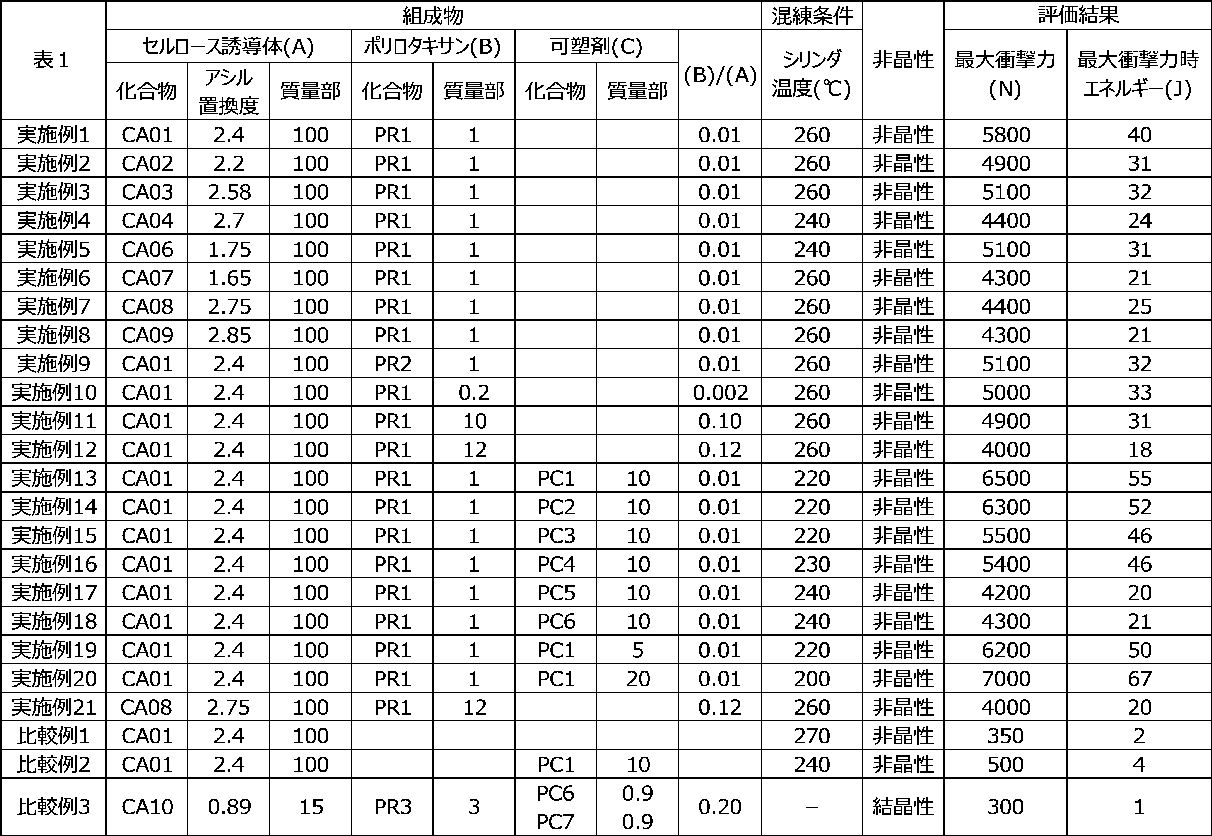
表1に示す結果より、本発明の組成物は、最大衝撃力及び最大衝撃力時エネルギーが優れる、すなわち、面衝撃強度が優れることが確認された。
実施例1~8の比較より、アシル置換度が、1.7~2.6である場合、面衝撃強度がより優れることが確認された。
実施例1と実施例10との比較より、ポリロタキサンの環状分子が側鎖を有しない場合、面衝撃強度がより優れることが確認された。
実施例1及び実施例10~12の比較、並びに、実施例7及び実施例21の比較より、セルロース誘導体の含有量に対する、ポリロタキサンの含有量の質量比が、0.10以下である場合、面衝撃強度がより優れることが確認された。
実施例13~18の比較より、可塑剤がカルダノール化合物、カルボン酸エステル化合物、及び、炭素数9~14のアルキルジオールからなる群から選択される少なくとも1種である場合、面衝撃強度がより優れ、カルダノール化合物である場合、面衝撃強度がさらに優れることが確認された。
実施例13及び実施例19~20の比較より、可塑剤の含有量が、組成物の全質量に対して、10~20質量%である場合、面衝撃強度がより優れることが確認された。
実施例1と実施例10との比較より、ポリロタキサンの環状分子が側鎖を有しない場合、面衝撃強度がより優れることが確認された。
実施例1及び実施例10~12の比較、並びに、実施例7及び実施例21の比較より、セルロース誘導体の含有量に対する、ポリロタキサンの含有量の質量比が、0.10以下である場合、面衝撃強度がより優れることが確認された。
実施例13~18の比較より、可塑剤がカルダノール化合物、カルボン酸エステル化合物、及び、炭素数9~14のアルキルジオールからなる群から選択される少なくとも1種である場合、面衝撃強度がより優れ、カルダノール化合物である場合、面衝撃強度がさらに優れることが確認された。
実施例13及び実施例19~20の比較より、可塑剤の含有量が、組成物の全質量に対して、10~20質量%である場合、面衝撃強度がより優れることが確認された。
[生分解性の評価]
実施例1及び実施例15の組成物ペレットを用いて、以下の手順により生分解性の評価を行った。
組成物ペレット100gを、ラボミル(ダルトン社製、ラボミルLM-05)を用いて液体窒素を入れながら粉砕し、網目100μmの篩にて篩分け、篩を通過した粉末30gを採取した。得られた組成物粉末を用いて、ISO-14855に準じた方法で、28日経過後の重量減少率(コンポスト分解率)を測定し、生分解性を評価した。その結果、実施例1の重量減少率は56%であり、実施例15の重量減少率は82%であり、いずれも生分解性を示した。すなわち、本発明の組成物は、面衝撃強度に優れ、かつ、生分解性を示すことが確認された。
実施例1及び実施例15の組成物ペレットを用いて、以下の手順により生分解性の評価を行った。
組成物ペレット100gを、ラボミル(ダルトン社製、ラボミルLM-05)を用いて液体窒素を入れながら粉砕し、網目100μmの篩にて篩分け、篩を通過した粉末30gを採取した。得られた組成物粉末を用いて、ISO-14855に準じた方法で、28日経過後の重量減少率(コンポスト分解率)を測定し、生分解性を評価した。その結果、実施例1の重量減少率は56%であり、実施例15の重量減少率は82%であり、いずれも生分解性を示した。すなわち、本発明の組成物は、面衝撃強度に優れ、かつ、生分解性を示すことが確認された。
Claims (12)
- セルロース誘導体と、ポリロタキサンとを含む組成物であって、
前記組成物が、非晶性である、組成物。 - 前記セルロース誘導体が、セルロースアシレートである、請求項1に記載の組成物。
- 前記セルロースアシレートのアシル置換度が、1.7~2.6である、請求項2に記載の組成物。
- 前記セルロース誘導体が、セルロースアセテート、セルロースアセテートプロピオネート、及び、セルロースアセテートブチレートからなる群から選択される少なくとも1種である、請求項1に記載の組成物。
- 前記セルロース誘導体が、セルロースアセテートである、請求項1に記載の組成物。
- 前記セルロースアセテートのアセチル置換度が、1.7~2.6である、請求項5に記載の組成物。
- さらに、可塑剤を含む、請求項1に記載の組成物。
- 前記可塑剤が、カルダノール化合物、カルボン酸エステル化合物、及び、炭素数9~14のアルキルジオールからなる群から選択される少なくとも1種である、請求項7に記載の組成物。
- 前記セルロース誘導体の含有量に対する、前記ポリロタキサンの含有量の質量比が、0.10以下である、請求項1に記載の組成物。
- 請求項1~9のいずれか1項に記載の組成物からなる、成形体。
- 最大衝撃力が4000N以上である、請求項10に記載の成形体。
- セルロース誘導体と、ポリロタキサンとを含み、非晶性である組成物を製造する、組成物の製造方法であって、
前記セルロース誘導体と、前記ポリロタキサンとを、実質的に無溶媒下で溶融混錬する工程を含む、組成物の製造方法。
Priority Applications (2)
| Application Number | Priority Date | Filing Date | Title |
|---|---|---|---|
| JP2025527586A JPWO2024257548A1 (ja) | 2023-06-15 | 2024-05-17 | |
| US19/390,672 US20260070270A1 (en) | 2023-06-15 | 2025-11-17 | Composition, molded body, and method for producing composition |
Applications Claiming Priority (2)
| Application Number | Priority Date | Filing Date | Title |
|---|---|---|---|
| JP2023098244 | 2023-06-15 | ||
| JP2023-098244 | 2023-06-15 |
Related Child Applications (1)
| Application Number | Title | Priority Date | Filing Date |
|---|---|---|---|
| US19/390,672 Continuation US20260070270A1 (en) | 2023-06-15 | 2025-11-17 | Composition, molded body, and method for producing composition |
Publications (1)
| Publication Number | Publication Date |
|---|---|
| WO2024257548A1 true WO2024257548A1 (ja) | 2024-12-19 |
Family
ID=93852090
Family Applications (1)
| Application Number | Title | Priority Date | Filing Date |
|---|---|---|---|
| PCT/JP2024/018279 Ceased WO2024257548A1 (ja) | 2023-06-15 | 2024-05-17 | 組成物、成形体、組成物の製造方法 |
Country Status (3)
| Country | Link |
|---|---|
| US (1) | US20260070270A1 (ja) |
| JP (1) | JPWO2024257548A1 (ja) |
| WO (1) | WO2024257548A1 (ja) |
Citations (3)
| Publication number | Priority date | Publication date | Assignee | Title |
|---|---|---|---|---|
| JP2009204834A (ja) * | 2008-02-27 | 2009-09-10 | Fujifilm Corp | 光学フィルム、光学機能性フィルム、偏光板、および画像表示装置 |
| JP2020007648A (ja) * | 2018-07-03 | 2020-01-16 | セイコーエプソン株式会社 | 繊維状物質及び繊維強化樹脂組成物 |
| JP2021181523A (ja) * | 2020-05-19 | 2021-11-25 | 株式会社タイテックスジャパン | 複合制振材料 |
-
2024
- 2024-05-17 WO PCT/JP2024/018279 patent/WO2024257548A1/ja not_active Ceased
- 2024-05-17 JP JP2025527586A patent/JPWO2024257548A1/ja active Pending
-
2025
- 2025-11-17 US US19/390,672 patent/US20260070270A1/en active Pending
Patent Citations (3)
| Publication number | Priority date | Publication date | Assignee | Title |
|---|---|---|---|---|
| JP2009204834A (ja) * | 2008-02-27 | 2009-09-10 | Fujifilm Corp | 光学フィルム、光学機能性フィルム、偏光板、および画像表示装置 |
| JP2020007648A (ja) * | 2018-07-03 | 2020-01-16 | セイコーエプソン株式会社 | 繊維状物質及び繊維強化樹脂組成物 |
| JP2021181523A (ja) * | 2020-05-19 | 2021-11-25 | 株式会社タイテックスジャパン | 複合制振材料 |
Also Published As
| Publication number | Publication date |
|---|---|
| JPWO2024257548A1 (ja) | 2024-12-19 |
| US20260070270A1 (en) | 2026-03-12 |
Similar Documents
| Publication | Publication Date | Title |
|---|---|---|
| EP2500378B1 (en) | Bio-resins | |
| CN113416301B (zh) | 聚酯树脂及该聚酯树脂的制造方法、以及聚酯树脂组合物 | |
| EP3360923B1 (en) | Resin composition and resin molded product | |
| JP5078378B2 (ja) | ポリエステル樹脂組成物 | |
| US10889701B2 (en) | Resin composition and resin molded article | |
| TW201609952A (zh) | 聚酯樹脂組成物及成形體 | |
| US10689506B2 (en) | Resin composition and resin molded body | |
| KR20190078387A (ko) | 생분해성 고분자 조성물의 제조방법 | |
| CN119912795B (zh) | 一种利用双螺杆挤出机制备改性pha复合材料的方法及其应用 | |
| CN114426761B (zh) | 生物可分解聚酯材料及其制造方法 | |
| US20110152456A1 (en) | Polyester Compositions with Good Melt Rheological Properties | |
| CN110872392B (zh) | 树脂组合物和树脂成型品 | |
| JP2019059828A (ja) | 樹脂組成物およびその樹脂成形体 | |
| JP2016074795A (ja) | 樹脂組成物および樹脂成形体 | |
| WO2024257548A1 (ja) | 組成物、成形体、組成物の製造方法 | |
| Abd Rahman et al. | Mechanical and thermal properties of polylactic acid filled lignin powder biocomposite filaments with epoxidized palm oil for sustainable 3D printing application | |
| KR101407691B1 (ko) | 바이오플라스틱 조성물 및 그 제조방법 | |
| JP2018131484A (ja) | 樹脂組成物および樹脂成形体 | |
| JP2016183285A (ja) | 樹脂組成物及び樹脂成形体 | |
| CN105440700A (zh) | 一种高强韧聚乳酸基合金材料的制备方法 | |
| TW202216899A (zh) | 生物可分解聚酯材料及其製造方法 | |
| KR20220042083A (ko) | 생분해성 고분자 조성물의 제조방법 | |
| TWI912656B (zh) | 包含無定形聚羥基烷酸酯的組成物及其用途 | |
| US20250197604A1 (en) | High-performance thermoplastic cellulose acetate compositions formed with organic peroxide | |
| WO2023158999A1 (en) | Melt-processable cellulose ester compositions, melts and melt-formed articles made therefrom |
Legal Events
| Date | Code | Title | Description |
|---|---|---|---|
| 121 | Ep: the epo has been informed by wipo that ep was designated in this application |
Ref document number: 24823170 Country of ref document: EP Kind code of ref document: A1 |
|
| ENP | Entry into the national phase |
Ref document number: 2025527586 Country of ref document: JP Kind code of ref document: A |
|
| NENP | Non-entry into the national phase |
Ref country code: DE |