WO2024253067A1 - ウェットエッチング液、エッチング処理された無機材料の製造方法、半導体デバイスの製造方法 - Google Patents
ウェットエッチング液、エッチング処理された無機材料の製造方法、半導体デバイスの製造方法 Download PDFInfo
- Publication number
- WO2024253067A1 WO2024253067A1 PCT/JP2024/020238 JP2024020238W WO2024253067A1 WO 2024253067 A1 WO2024253067 A1 WO 2024253067A1 JP 2024020238 W JP2024020238 W JP 2024020238W WO 2024253067 A1 WO2024253067 A1 WO 2024253067A1
- Authority
- WO
- WIPO (PCT)
- Prior art keywords
- wet etching
- etching solution
- weight
- water
- group
- Prior art date
- Legal status (The legal status is an assumption and is not a legal conclusion. Google has not performed a legal analysis and makes no representation as to the accuracy of the status listed.)
- Ceased
Links
Classifications
-
- C—CHEMISTRY; METALLURGY
- C09—DYES; PAINTS; POLISHES; NATURAL RESINS; ADHESIVES; COMPOSITIONS NOT OTHERWISE PROVIDED FOR; APPLICATIONS OF MATERIALS NOT OTHERWISE PROVIDED FOR
- C09K—MATERIALS FOR MISCELLANEOUS APPLICATIONS, NOT PROVIDED FOR ELSEWHERE
- C09K13/00—Etching, surface-brightening or pickling compositions
- C09K13/04—Etching, surface-brightening or pickling compositions containing an inorganic acid
- C09K13/06—Etching, surface-brightening or pickling compositions containing an inorganic acid with organic material
-
- C—CHEMISTRY; METALLURGY
- C09—DYES; PAINTS; POLISHES; NATURAL RESINS; ADHESIVES; COMPOSITIONS NOT OTHERWISE PROVIDED FOR; APPLICATIONS OF MATERIALS NOT OTHERWISE PROVIDED FOR
- C09K—MATERIALS FOR MISCELLANEOUS APPLICATIONS, NOT PROVIDED FOR ELSEWHERE
- C09K13/00—Etching, surface-brightening or pickling compositions
- C09K13/04—Etching, surface-brightening or pickling compositions containing an inorganic acid
- C09K13/08—Etching, surface-brightening or pickling compositions containing an inorganic acid containing a fluorine compound
-
- C—CHEMISTRY; METALLURGY
- C11—ANIMAL OR VEGETABLE OILS, FATS, FATTY SUBSTANCES OR WAXES; FATTY ACIDS THEREFROM; DETERGENTS; CANDLES
- C11D—DETERGENT COMPOSITIONS; USE OF SINGLE SUBSTANCES AS DETERGENTS; SOAP OR SOAP-MAKING; RESIN SOAPS; RECOVERY OF GLYCEROL
- C11D7/00—Compositions of detergents based essentially on non-surface-active compounds
- C11D7/22—Organic compounds
- C11D7/28—Organic compounds containing halogen
-
- C—CHEMISTRY; METALLURGY
- C11—ANIMAL OR VEGETABLE OILS, FATS, FATTY SUBSTANCES OR WAXES; FATTY ACIDS THEREFROM; DETERGENTS; CANDLES
- C11D—DETERGENT COMPOSITIONS; USE OF SINGLE SUBSTANCES AS DETERGENTS; SOAP OR SOAP-MAKING; RESIN SOAPS; RECOVERY OF GLYCEROL
- C11D7/00—Compositions of detergents based essentially on non-surface-active compounds
- C11D7/22—Organic compounds
- C11D7/40—Products in which the composition is not well defined
- C11D7/44—Vegetable products
-
- H—ELECTRICITY
- H10—SEMICONDUCTOR DEVICES; ELECTRIC SOLID-STATE DEVICES NOT OTHERWISE PROVIDED FOR
- H10P—GENERIC PROCESSES OR APPARATUS FOR THE MANUFACTURE OR TREATMENT OF DEVICES COVERED BY CLASS H10
- H10P50/00—Etching of wafers, substrates or parts of devices
-
- H—ELECTRICITY
- H10—SEMICONDUCTOR DEVICES; ELECTRIC SOLID-STATE DEVICES NOT OTHERWISE PROVIDED FOR
- H10P—GENERIC PROCESSES OR APPARATUS FOR THE MANUFACTURE OR TREATMENT OF DEVICES COVERED BY CLASS H10
- H10P50/00—Etching of wafers, substrates or parts of devices
- H10P50/60—Wet etching
- H10P50/68—Wet etching of insulating materials
- H10P50/683—Wet etching of insulating materials of inorganic materials
-
- H—ELECTRICITY
- H10—SEMICONDUCTOR DEVICES; ELECTRIC SOLID-STATE DEVICES NOT OTHERWISE PROVIDED FOR
- H10P—GENERIC PROCESSES OR APPARATUS FOR THE MANUFACTURE OR TREATMENT OF DEVICES COVERED BY CLASS H10
- H10P50/00—Etching of wafers, substrates or parts of devices
- H10P50/69—Etching of wafers, substrates or parts of devices using masks for semiconductor materials
- H10P50/691—Etching of wafers, substrates or parts of devices using masks for semiconductor materials for Group V materials or Group III-V materials
Definitions
- This disclosure relates to a wet etching solution, a method for manufacturing an etched inorganic material using the wet etching solution, and a method for manufacturing a semiconductor device using the wet etching solution.
- silicon oxide films and silicon nitride films are formed by CVD or other methods and used as insulating films. In addition, there are cases where the silicon oxide films and silicon nitride films need to be removed.
- wet etching is known as a method for removing the silicon oxide film and silicon nitride film.
- the wet etching method is a method in which the film to be removed is corroded and dissolved using a wet etching solution, and a wet etching solution containing a specific acid is selected and used depending on the film to be removed.
- buffered hydrofluoric acid is used as the acid.
- hot phosphoric acid is used as the acid (for example, Patent Document 1).
- the nitride film is etched at a higher etching rate than the oxide film, but when water-soluble cellulose is added to hydrofluoric acid, the water-soluble cellulose does not adhere to the oxide film but adheres only to the nitride film, selectively reducing the etching rate of the nitride film, and as a result, the oxide film and the nitride film can be etched at equal or nearly equal rates. 3.
- Water-soluble cellulose adheres firmly to the nitride film in acidic water or water at or below room temperature, but easily peels off from the nitride film in alkaline water or water at a temperature above room temperature, so that the adhesion to and peeling off from the nitride film can be controlled by adjusting the pH and temperature of the water.
- the present disclosure provides a wet etching solution containing hydrogen fluoride and water-soluble cellulose.
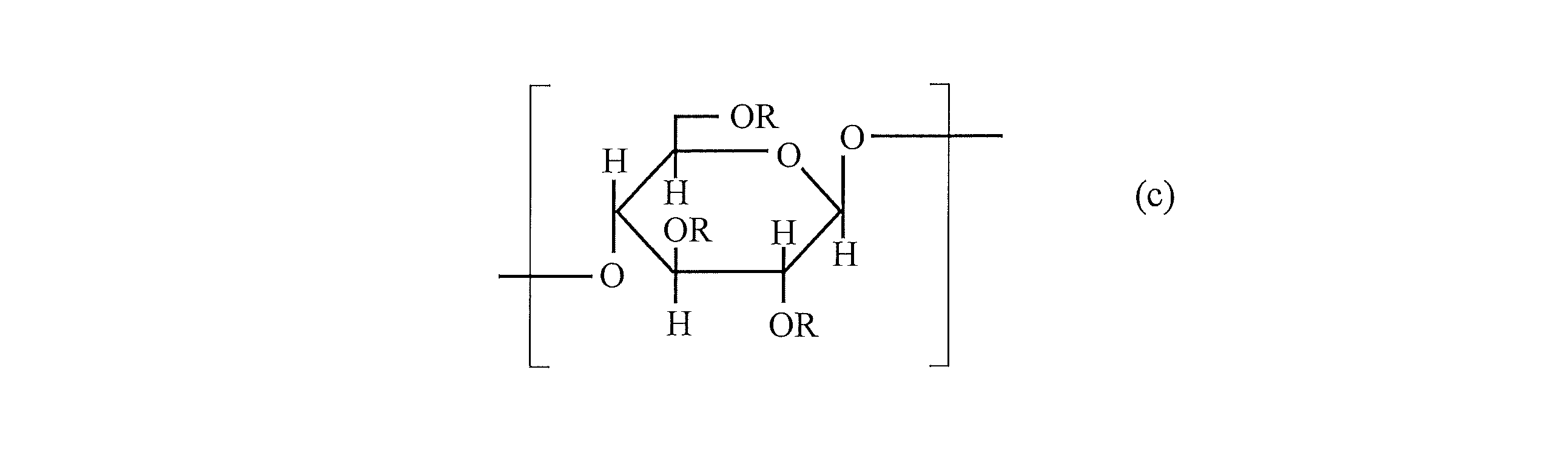
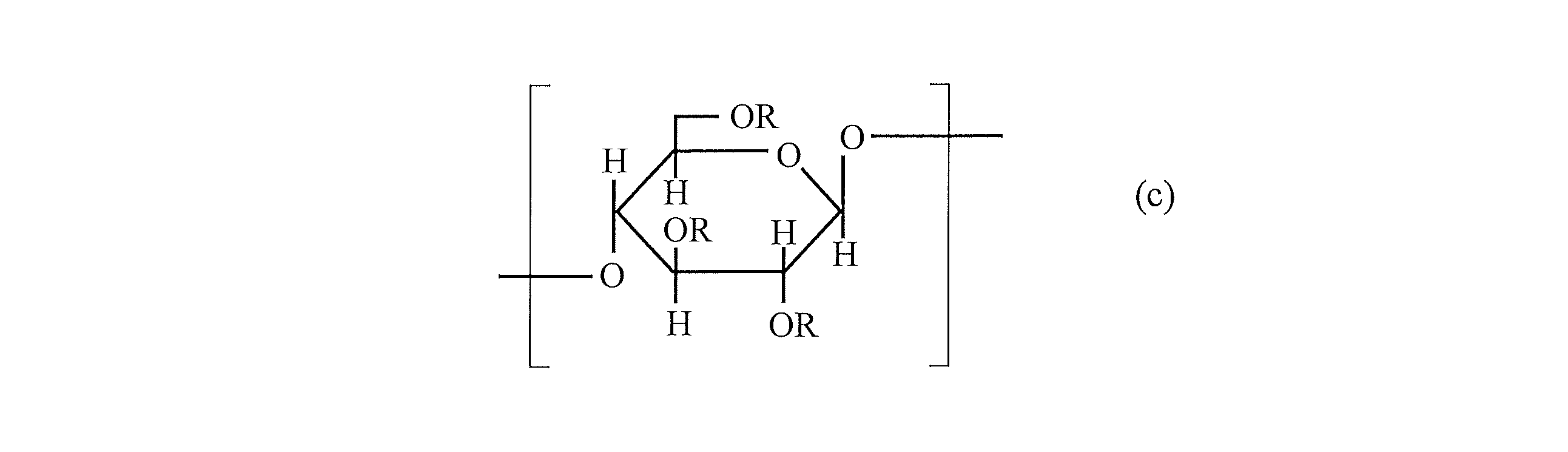
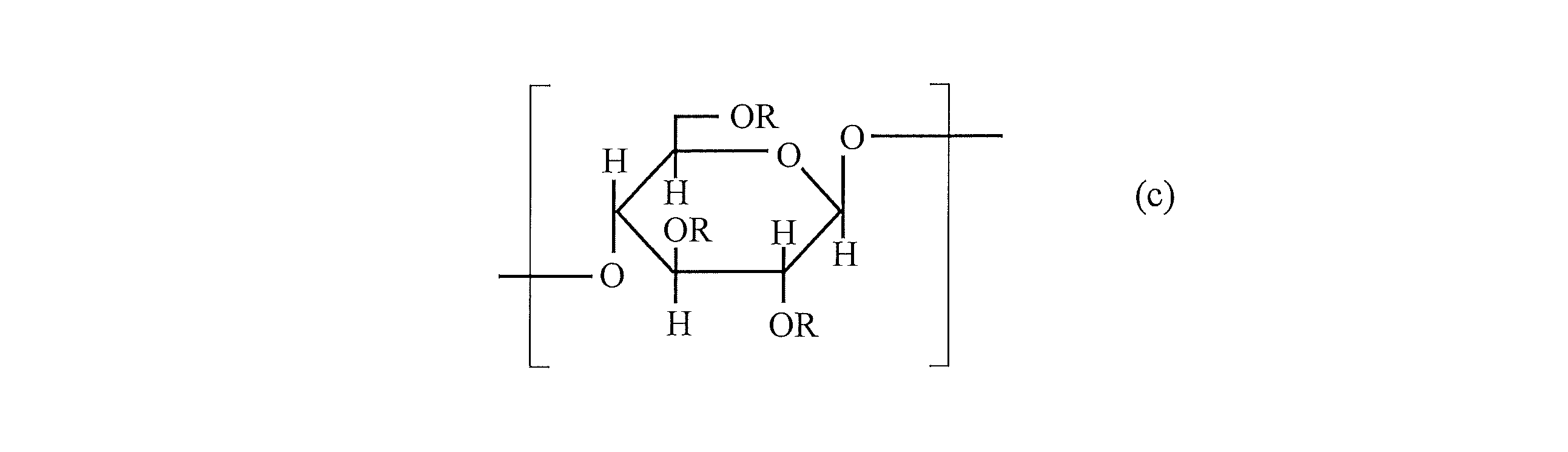
- the present disclosure also provides the wet etching solution as described above, wherein the water-soluble cellulose is a cellulose derivative having a constitutional unit represented by the following formula (c), or a salt thereof:
- the three R's may be the same or different and each represent a hydrogen atom, a hydrocarbon group, or a group in which two or more hydrocarbon groups are bonded via a linking group. However, of the three R's, at least one is a hydrocarbon group or a group in which two or more hydrocarbon groups are bonded via a linking group.
- the hydrocarbon group may have a hydroxyl group or a carboxyl group.
- the weight average molecular weight of the water-soluble cellulose is, for example, 50 ⁇ 10 4 or less.
- the degree of cross-linking of the water-soluble cellulose is, for example, 0.3% or less.
- the content of the water-soluble cellulose is, for example, 0.005 to 0.5% by weight of the total amount of the wet etching solution.
- the hydrogen fluoride content is, for example, 0.005 to 30% by weight of the total amount of the wet etching solution.
- the present disclosure also provides a method for producing an etched inorganic material, which includes a step of supplying the wet etching solution to a surface layer of an inorganic material having an oxide film and a nitride film, thereby obtaining an inorganic material having an etched surface layer.
- the present disclosure also provides a method for manufacturing a semiconductor device, which includes a step of supplying the wet etching solution to a surface layer of an inorganic material having a surface layer including an oxide film and a nitride film, thereby obtaining a semiconductor device including an inorganic material having an etched surface layer.
- the oxide film and the nitride film can be efficiently etched at equal or nearly equal rates.
- the water-soluble cellulose contained in the wet etching solution adheres well to the nitride film during the etching process and does not peel off, but after the etching process, it can be easily peeled off by washing with warm water or an alkaline aqueous solution. Therefore, by using the wet etching solution, the oxide film and the nitride film can be removed at the same time, and an inorganic material from which the oxide film and the nitride film have been removed can be produced simply and efficiently.
- the wet etching solution of the present disclosure is a composition containing hydrogen fluoride and water-soluble cellulose.
- the wet etching solution may further contain water.
- Hydrogen fluoride has the effect of etching both oxide and nitride films, but tends to etch nitride films more selectively than oxide films.
- the etching rate of an oxide film using hydrofluoric acid is, for example, 20 to 30 nm/min.
- the etching rate of a nitride film using hydrofluoric acid is, for example, 35 to 45 nm/min.
- the hydrogen fluoride concentration of the hydrofluoric acid is, for example, 0.005 to 30% by weight.
- the upper limit of the hydrogen fluoride concentration is preferably 10% by weight, more preferably 8% by weight, particularly preferably 6% by weight, most preferably 5% by weight, and especially preferably 4.5% by weight.
- the lower limit of the hydrogen fluoride concentration is preferably 0.05% by weight, more preferably 0.1% by weight, particularly preferably 0.5% by weight, most preferably 1% by weight, and especially preferably 3% by weight.
- Buffered hydrofluoric acid (a mixture of hydrogen fluoride and ammonium fluoride; the volume ratio of 40% by weight ammonium fluoride solution/50% by weight hydrofluoric acid is, for example, 5-2000) has a strong salting-out effect, so when water-soluble cellulose is added to a wet etching solution containing buffered hydrofluoric acid, the water-soluble cellulose precipitates, whereas hydrogen fluoride has a small salting-out effect. Therefore, water-soluble cellulose can be dissolved well in a wet etching solution containing hydrogen fluoride.
- the hydrogen fluoride content in the total amount of the wet etching solution is, for example, 0.005 to 30% by weight.
- the upper limit of the hydrogen fluoride content is preferably 10% by weight, more preferably 8% by weight, particularly preferably 6% by weight, most preferably 5% by weight, and especially preferably 4.5% by weight.
- the lower limit of the hydrogen fluoride content is preferably 0.05% by weight, more preferably 0.1% by weight, particularly preferably 0.5% by weight, most preferably 1% by weight, and especially preferably 3% by weight.
- the wet etching solution may contain acid components other than hydrogen fluoride, but the content of acid components other than hydrogen fluoride is preferably 0.005% by weight or less of the total amount of the wet etching solution, more preferably 0.001% by weight or less, and most preferably substantially free of such components.
- the wet etching solution may contain fluorine compounds other than hydrogen fluoride (for example, salts of hydrogen fluoride such as ammonium fluoride), but the content of fluorine compounds other than hydrogen fluoride is, for example, 100 parts by weight or less, preferably 80 parts by weight or less, more preferably 50 parts by weight or less, more preferably 20 parts by weight or less, even more preferably 10 parts by weight or less, particularly preferably 5 parts by weight or less, and most preferably 1 part by weight or less, relative to 100 parts by weight of hydrogen fluoride, and it is particularly preferable that the wet etching solution does not contain substantially any fluorine compounds other than hydrogen fluoride.
- fluorine compounds other than hydrogen fluoride for example, salts of hydrogen fluoride such as ammonium fluoride
- the water-soluble cellulose is, for example, cellulose that is soluble in water at 0 to 100° C. (preferably 20 to 60° C.), and its solubility in water at 20° C. is, for example, 5% by weight or more.
- water-soluble cellulose examples include cellulose derivatives having a structural unit represented by the following formula (c) and salts of the cellulose derivatives.
- the three R's may be the same or different and each represent a hydrogen atom, a hydrocarbon group, or a group in which two or more hydrocarbon groups are bonded via a linking group. However, of the three R's, at least one is a hydrocarbon group or a group in which two or more hydrocarbon groups are bonded via a linking group.
- the hydrocarbon group may have a hydroxyl group or a carboxyl group as a substituent.
- the hydrocarbon group is preferably an aliphatic hydrocarbon group, and more preferably a saturated aliphatic hydrocarbon group (i.e., an alkyl group).
- alkyl group examples include alkyl groups having 1 to 5 carbon atoms (specifically, linear or branched alkyl groups), such as methyl, ethyl, propyl, isopropyl, butyl, isobutyl, s-butyl, t-butyl, and pentyl groups. Of these, alkyl groups having 1 to 3 carbon atoms are preferred, and alkyl groups having 1 to 2 carbon atoms are particularly preferred.
- the linking group is preferably an ether bond (-O-).
- the group in which two or more hydrocarbon groups are bonded via a linking group is preferably a group represented by the following formula (r):
- the bond extending from the left end in formula (r) is bonded to the oxygen atom constituting the OR group in formula (c) above.
- R 1 and R 2 are the same or different and each represents a hydrocarbon group (more specifically, a divalent hydrocarbon group).
- the hydrocarbon group is preferably an aliphatic hydrocarbon group, and more preferably a saturated aliphatic hydrocarbon group (more specifically, an alkylene group).
- an alkylene group having 1 to 3 carbon atoms such as a methylene group, a dimethylene group, a methylmethylene group, a 1-methylethylene group, a 1,1-dimethylmethylene group, or a trimethylene group, is preferred, and an alkylene group having 1 to 2 carbon atoms is particularly preferred.
- X represents a hydroxyl group or a carboxyl group.
- n represents the average number of moles of (O—R 2 ) groups added, and is, for example, more than 0, preferably more than 0 and up to 10, and particularly preferably 1.5 to 3.
- At least one of the three Rs in formula (c) above is preferably a hydrocarbon group having a hydroxyl group, and is particularly preferably an alkyl group having a hydroxyl group (having, for example, 1 to 3 carbon atoms, preferably 1 to 2 carbon atoms).
- the cellulose derivative having the structural unit represented by the above formula (c) may form a salt.
- the salts include, for example, monovalent metal salts such as alkali metal salts (lithium salts, sodium salts, potassium salts, rubidium salts, cesium salts, etc.); divalent metal salts such as alkaline earth metal salts (calcium salts, magnesium salts, etc.); quaternary ammonium salts, amine salts, substituted amine salts, and double salts thereof.
- alkali metal salts such as sodium salts and quaternary ammonium salts are preferred.
- the hydroxyl or carboxyl group in the cellulose derivative forms a sodium salt
- the hydroxyl group (-OH) becomes -ONa
- the carboxyl group (-COOH) becomes -COONa
- the degree of etherification of a cellulose derivative having a structural unit represented by the above formula (c) (or the (total) degree of substitution of a hydrocarbon group having a hydroxyl group or a carboxyl group) can be selected, for example, from the range of 0.1 to 3.0.
- the degree of etherification of a cellulose derivative is the average value of the degrees of etherification (degree of substitution) of the hydroxyl groups at the 2nd, 3rd, and 6th positions of the glucose units constituting the cellulose.
- the degree of etherification is preferably 0.5 or more, more preferably 0.8 or more, and particularly preferably 1.0 or more, because it provides excellent adhesion to the nitride film and is particularly effective in equalizing the etching rates of the oxide film and the nitride film.
- the upper limit of the degree of etherification is preferably 2.5, more preferably 2.0, and particularly preferably 1.6.
- water-soluble cellulose examples include methyl cellulose, hydroxyethyl cellulose, hydroxypropyl cellulose, hydroxyethyl methyl cellulose, hydroxypropyl methyl cellulose, carboxymethyl cellulose, carboxyethyl cellulose, and alkali metal salts thereof (e.g., sodium carboxymethyl cellulose). These water-soluble celluloses can be used alone or in combination of two or more.
- Hydroxyethyl cellulose is preferred as the water-soluble cellulose, as it is excellent in equalizing the etching rates of oxide and nitride films.
- the weight average molecular weight (Mw) of the water-soluble cellulose is, for example, 50 ⁇ 10 4 or less, and from the viewpoint of excellent effect of equalizing the etching rates of oxide film and nitride film, it is preferably 30 ⁇ 10 4 or less, more preferably 20 ⁇ 10 4 or less, even more preferably 15 ⁇ 10 4 or less, even more preferably 12 ⁇ 10 4 or less, particularly preferably 10 ⁇ 10 4 or less, most preferably 5 ⁇ 10 4 or less, and particularly preferably 3 ⁇ 10 4 or less.
- the weight average molecular weight (Mw) of the water-soluble cellulose is preferably 0.1 ⁇ 10 4 or more, more preferably 0.3 ⁇ 10 4 or more, even more preferably 0.5 ⁇ 10 4 or more, particularly preferably 0.8 ⁇ 10 4 or more, and most preferably 1 ⁇ 10 4 or more.
- the water-soluble cellulose may also be one in which the hydroxyl groups are crosslinked with each other by a crosslinking agent (e.g., glyoxal, etc.), but in particular, in terms of the excellent effect of equalizing the etching rates of the oxide film and the nitride film, the crosslinking degree of the water-soluble cellulose is preferably 0.3% or less, more preferably 0.25% or less, even more preferably 0.2% or less, even more preferably 0.1% or less, particularly preferably less than 0.1%, and most preferably 0.05% or less.
- a crosslinking agent e.g., glyoxal, etc.
- the degree of crosslinking of the water-soluble cellulose can be determined by the DNPH test.
- the DNPH test is a method for calculating the degree of crosslinking by utilizing derivatization with dinitrophenylhydrazine, and the degree of crosslinking can be calculated, for example, by the following steps 1 to 5.
- Step 2 To the obtained cellulose solution, 20 mL of a 0.05% 2,4-dinitrophenylhydrazine solution acidified with hydrochloric acid is added, and the mixture is reacted at 40° C. for 60 minutes.
- Step 3 After the reaction is complete, add an 8% KOH solution in ethanol to make the mixture basic.
- Step 4 The upper layer obtained after centrifugation is collected and its absorbance at 575 nm is measured.
- Step 5 The degree of crosslinking is calculated from a calibration curve prepared using glyoxal as a standard.
- the content of water-soluble cellulose is, for example, 0.005 to 0.5% by weight.
- the upper limit of the content of water-soluble cellulose is preferably 0.45% by weight, particularly preferably 0.4% by weight, and most preferably 0.3% by weight.
- the lower limit of the content of water-soluble cellulose is preferably 0.01% by weight, particularly preferably 0.03% by weight, and most preferably 0.05% by weight.
- the wet etching solution may contain one or more polymeric compounds other than water-soluble cellulose, but the proportion of water-soluble cellulose in the total amount of polymeric compounds contained in the wet etching solution (100% by weight) is, for example, 50% by weight or more, and is preferably 60% by weight or more, more preferably 70% by weight or more, even more preferably 80% by weight or more, even more preferably 90% by weight or more, particularly preferably 95% by weight or more, and most preferably 99% by weight or more, in terms of its excellent effect of equalizing the etching rates of oxide films and nitride films.
- polymeric compounds other than the water-soluble cellulose examples include vinyl resins (polyvinyl alcohol, polyvinyl acetal, polyvinylpyrrolidone, polyacrylamide, poly(N-alkylacrylamide), polyallylamine, poly(N-alkylallylamine), partially amidated polyallylamine, poly(diallylamine), allylamine-diallylamine copolymer, polyacrylic acid, polyvinyl alcohol-polyacrylic acid block copolymer, polyvinyl alcohol-polyacrylic acid ester block copolymer, etc.), polyalkylene glycols (polyethylene glycol, etc.), polyglycerin, and water-soluble nylon.
- vinyl resins polyvinyl alcohol, polyvinyl acetal, polyvinylpyrrolidone
- polyacrylamide poly(N-alkylacrylamide)
- polyallylamine poly(N-alkylallylamine)
- partially amidated polyallylamine poly(diallylamine)
- a "polymer compound” refers to a compound having a weight average molecular weight (Mw) of 0.1 x 10 4 or more (preferably 0.3 x 10 4 or more, more preferably 0.5 x 10 4 or more, particularly preferably 0.8 x 10 4 or more, and most preferably 1 x 10 4 or more).
- the proportion of water-soluble cellulose in the total amount (100% by weight) of components other than water contained in the wet etching solution is, for example, 50% by weight or more, preferably 60% by weight or more, more preferably 70% by weight or more, even more preferably 80% by weight or more, particularly preferably 95% by weight or more, and most preferably 99% by weight or more.
- the wet etching solution may contain other components in addition to the above components [e.g., non-volatile components such as dispersants and surfactants; water; and volatile components such as water-soluble organic solvents (e.g., lactones and polyhydric alcohols)].
- non-volatile components such as dispersants and surfactants
- water such as water-soluble organic solvents (e.g., lactones and polyhydric alcohols)].
- the content of non-volatile matter is preferably 5 parts by weight or less, more preferably 3 parts by weight or less, and even more preferably 1 part by weight or less, per 100 parts by weight of the water-soluble cellulose.
- the content of volatile matter is preferably 50 parts by weight or less, more preferably 30 parts by weight or less, even more preferably 10 parts by weight or less, particularly preferably 5 parts by weight or less, and most preferably 1 part by weight or less, per 100 parts by weight of water contained in the wet etching solution.
- the "volatile content” refers to a component that volatilizes when the wet etching solution is heated at 100° C. for 1 hour under normal pressure.
- the “non-volatile content” refers to the components remaining after the wet etching solution is heated at 100° C. under normal pressure for one hour.
- the wet etching solution can be prepared, for example, by mixing and stirring hydrogen fluoride, water-soluble cellulose, and, if necessary, other components (e.g., water).
- the wet etching solution is a solution used in wet etching processing, and has the effect of etching (or corroding or dissolving) oxide films and nitride films.
- the hydrogen fluoride contained in the wet etching solution corrodes and dissolves both oxide and nitride films, but the etching rate of nitride films tends to be higher than that of oxide films.
- the water-soluble cellulose contained in the wet etching solution does not adhere to oxide films, but adheres only to nitride films, suppressing corrosion and dissolution of the nitride film by hydrogen fluoride, and has the effect of lowering the etching rate of the nitride film while maintaining the etching rate of the oxide film.
- the wet etching solution contains hydrogen fluoride having the above-mentioned properties and water-soluble cellulose having the above-mentioned properties, so it can efficiently etch oxide and nitride films at equal or nearly equal rates.
- Oxide and nitride films can be etched at equal or nearly equal rates means that the etching rate ratio [etching rate of nitride film/etching rate of oxide film] is close to 1, and the etching selectivity ratio [nitride film/oxide film] is close to 1.
- the etching rate ratio is, for example, 0.7 to 1.3, preferably 0.75 to 1.25, more preferably 0.8 to 1.25, and particularly preferably 0.9 or more and less than 1.20.
- the etching selectivity ratio is, for example, 0.7 to 1.3, preferably 0.75 to 1.25, more preferably 0.8 to 1.25, and particularly preferably 0.9 or more and less than 1.20.
- the etching rate of the oxide film and the nitride film by the wet etching solution depends on the hydrogen fluoride concentration in the wet etching solution, but when an inorganic material having an oxide film or a nitride film is immersed in the wet etching solution at 20°C, the etching rate of each of the oxide film and the nitride film is, for example, 5 nm/min or more, and from the viewpoint of improving workability, is preferably 8 nm/min or more, particularly preferably 10 nm/min or more, and most preferably 20 nm/min or more.
- the method for producing an etched inorganic material disclosed herein is a method for obtaining an inorganic material having an etched surface layer by passing through a step of supplying the above-mentioned wet etching solution to a surface layer of an inorganic material having a surface layer including an oxide film and a nitride film.
- the inorganic material may be, for example, a metal (e.g., gold, silver, copper, platinum, palladium, tin, titanium, molybdenum, tungsten, tantalum, aluminum, gallium, etc.) or a semiconductor (e.g., silicon, etc.).
- a metal e.g., gold, silver, copper, platinum, palladium, tin, titanium, molybdenum, tungsten, tantalum, aluminum, gallium, etc.
- a semiconductor e.g., silicon, etc.
- the shape of the inorganic material is not particularly limited, and may be a variety of shapes such as a flat plate, a curved plate, a column, a sphere, a disk, etc. It may also have a complex structure such as grooves or irregularities.
- the inorganic material includes an oxide film and a nitride film in the surface layer.
- the area where the oxide film exists and the area where the nitride film exists may be adjacent to each other or may be separated from each other.
- the surface layer including the oxide film and the nitride film may be laminated directly onto the inorganic material, or may be laminated via an insulating film or a conductive film for forming wiring.
- the oxide film and the nitride film are a silicon oxide (SiO 2 ) film and a silicon nitride (Si 3 N 4 ) film, respectively.
- the oxide film may be doped with impurities such as boron or phosphorus, and the silicon oxide ( SiO2 ) film may be BSG doped with boron, PSG doped with phosphorus, or BPSG doped with boron and phosphorus.
- the nitride film may be a film formed by a plasma-enhanced CVD method or a thermal CVD method, but a nitride film formed by a plasma-enhanced CVD method is preferable in that the etching rate can be easily adjusted using the wet etching solution and is easily equalized to the etching rate of an oxide film.
- a silicon substrate having a surface layer including an oxide film and a nitride film can be manufactured by subjecting the silicon substrate to a film formation process such as thermal oxidation, CVD (chemical vapor deposition), or PVD (physical vapor deposition).
- a film formation process such as thermal oxidation, CVD (chemical vapor deposition), or PVD (physical vapor deposition).
- Methods for supplying the wet etching solution to the surface layer of the inorganic material include the dipping method and the coating method.
- a method of immersing an inorganic material having a surface layer including an oxide film and a nitride film in the wet etching solution i.e., a dip method.
- a method of spraying the wet etching solution onto a surface layer of an inorganic material having a surface layer including an oxide film and a nitride film i.e., a coating method.
- the immersion time is, for example, 0.1 to 5 minutes, preferably 0.5 to 3 minutes.
- the immersion temperature (for example, the temperature of the wet etching solution during immersion) is, for example, 20 to 30°C.
- examples of the method for spraying the wet etching solution onto the surface layer of the inorganic material include spin coating, stamping, dispensing, the squeegee method, spraying, brushing, etc.
- the water-soluble cellulose contained in the wet etching solution adheres to the nitride film and acts to inhibit the corrosion and dissolution of the nitride film caused by hydrogen fluoride.
- the water-soluble cellulose does not adhere to the oxide film, and the corrosion and dissolution of the oxide film caused by hydrogen fluoride is not inhibited by the water-soluble cellulose.
- the difference in etching rate between the oxide film and the nitride film is reduced and they are equalized.
- the method for producing the etched inorganic material may include other steps in addition to the steps described above.
- the method may include a step of washing and removing the water-soluble cellulose adhering to the inorganic material with warm water or an alkaline aqueous solution.
- the hot water is, for example, water at 40°C or higher.
- the temperature of the hot water is preferably 40 to 85°C, and the pH of the hot water is, for example, 6 to 8, preferably 6.5 to 7.5.
- the hot water is preferably ultrapure water at 40°C or higher.
- the alkaline aqueous solution is, for example, an aqueous solution having a pH of 8 or higher.
- the pH of the alkaline aqueous solution is preferably 10 or higher, and particularly preferably 12 or higher.
- the temperature of the alkaline aqueous solution is, for example, less than 40°C, preferably 10°C or higher and less than 40°C, and particularly preferably 20 to 30°C.
- Water-soluble cellulose attached to inorganic materials can be easily removed by simply washing with warm water or an alkaline aqueous solution, which prevents the etched inorganic materials from being damaged during washing.
- the above manufacturing method makes it possible to obtain an inorganic material having a surface layer including an oxide film and a nitride film, in which the oxide film and the nitride film contained in the surface layer have been etched to the same extent (preferably simultaneously and to the same extent).
- the method for manufacturing a semiconductor device disclosed herein is a method for obtaining a semiconductor device comprising an inorganic material having a surface layer that includes an oxide film and a nitride film, through a step of supplying the above-mentioned wet etching solution to the surface layer of the inorganic material (i.e., a wet etching treatment step), the surface layer of the inorganic material being etched.
- Semiconductor devices include, for example, integrated circuits such as ICs and LSIs; light-emitting devices such as lasers and LEDs; light-receiving devices such as solar cells, optical sensors, and CMOS image sensors; semiconductor sensors such as MEMS; memories, analog ICs, transistors, etc.
- an inorganic material having a surface layer including an oxide film and a nitride film is obtained in which the oxide film and the nitride film contained in the surface layer have been etched to the same extent (preferably simultaneously and to the same extent).
- the etched inorganic material is then subjected to an electrode formation process, a dicing process, etc. to obtain a semiconductor element, and the semiconductor element can be further subjected to a conventional semiconductor device manufacturing process such as a wire bonding process, a molding process, etc. to manufacture a semiconductor device.
- the above manufacturing method is excellent in workability because the oxide film and nitride film can be etched extremely easily using the wet etching process.
- HEC50 Hydroxyethyl cellulose (degree of etherification: 1.2 to 1.4, weight average molecular weight: 50 x 10 4 )
- HEC25 Hydroxyethyl cellulose (degree of etherification: 1.2 to 1.4, weight average molecular weight: 25 ⁇ 10 4 )
- HEC10 Hydroxyethyl cellulose (degree of etherification: 1.2 to 1.4, weight average molecular weight: 10 ⁇ 10 4 )
- HEC6 Hydroxyethyl cellulose (degree of etherification: 1.2 to 1.4, weight average molecular weight: 6 ⁇ 10 4 )
- HEC4 Hydroxyethyl cellulose (degree of etherification: 1.2 to 1.4, weight average molecular weight: 4 ⁇ 10 4 )
- HEC2 Hydroxyethyl cellulose (degree of etherification: 1.2 to 1.4, weight average molecular weight: 2 ⁇ 10 4
- the thickness of the oxide and nitride films was measured using a spectroscopic ellipsometer (product name "FE-5000", manufactured by Otsuka Electronics Co., Ltd.).
- Example 1 (Preparation of Wet Etching Solution) Wet etching solution 1 was prepared by mixing 0.3 g of HEC4 with 100 g of 4.5 wt % hydrofluoric acid and stirring for 3 minutes.
- Example 2 to 14 Comparative Examples 1 to 5
- a wet etching solution was obtained in the same manner as in Example 1 except that the conditions were changed as shown in the table below.
- a wet etching process was performed using the obtained wet etching solution, and the etching rate and the etching rate ratio were calculated.
- the nitride film is etched at a speed 1.3 to 1.5 times faster than the oxide film, but when water-soluble cellulose is added to the wet etching solution, the nitride film and the oxide film can be efficiently etched at equal or nearly equal rates. Therefore, it can be seen that when the wet etching solution of the present disclosure is used, the oxide film and the nitride film can be removed by a single wet etching process. It is also understood that the etching rate ratio of the nitride film to the oxide film can be brought closer to 1 by using a water-soluble cellulose having a low weight average molecular weight or a low degree of crosslinking.
- a wet etching solution containing hydrogen fluoride and water-soluble cellulose [2] The wet etching solution according to [1], wherein the water-soluble cellulose is a cellulose derivative having a structural unit represented by formula (c) or a salt thereof. [3] The wet etching solution according to [1] or [2], wherein the water-soluble cellulose has a weight average molecular weight of 50 ⁇ 10 4 or less. [4] The wet etching solution according to any one of [1] to [3], wherein the water-soluble cellulose has a degree of crosslinking of 0.3% or less.
- the wet etching solution according to any one of [1] to [6] which may further contain ammonium fluoride, but the content of the ammonium fluoride is 100 parts by weight or less per 100 parts by weight of hydrogen fluoride.
- the water-soluble cellulose is hydroxyethyl cellulose or an alkali metal salt of hydroxyethyl cellulose.
- a method for producing an etched inorganic material comprising: supplying the wet etching solution according to any one of [1] to [18] to a surface layer of an inorganic material having a surface layer including an oxide film and a nitride film, thereby obtaining an inorganic material having an etched surface layer.
- a method for manufacturing a semiconductor device comprising: supplying the wet etching solution according to any one of [1] to [18] to a surface layer of an inorganic material having a surface layer including an oxide film and a nitride film, thereby obtaining a semiconductor device including an inorganic material having an etched surface layer.
- a composition comprising hydrogen fluoride and a water-soluble cellulose.
- composition according to [21], wherein the water-soluble cellulose is a cellulose derivative having a structural unit represented by formula (c) or a salt thereof.
- the content of the water-soluble cellulose is 0.005 to 0.5% by weight of the total amount of the composition.
- the water-soluble cellulose is hydroxyethyl cellulose or an alkali metal salt of hydroxyethyl cellulose.
- composition according to any one of [21] to [32], wherein the proportion of water-soluble cellulose in the total amount of polymer compounds contained in the composition, i.e., the total amount of compounds having a weight-average molecular weight of 0.1 x 10 or more, is 80% by weight or more (preferably 90% by weight or more, particularly preferably 95% by weight or more, and most preferably 99% by weight or more).
- a method for producing an etched inorganic material comprising: supplying the composition according to any one of [21] to [38] to a surface layer of an inorganic material having a surface layer including an oxide film and a nitride film, thereby obtaining an inorganic material having an etched surface layer.
- a method for producing a semiconductor device comprising the steps of: supplying the composition according to any one of [21] to [38] to a surface layer of an inorganic material having a surface layer including an oxide film and a nitride film, thereby obtaining a semiconductor device including an inorganic material having an etched surface layer.
- [41] Use of the composition according to any one of [21] to [38] as a wet etching solution.
- a method for producing a wet etching solution comprising mixing hydrogen fluoride and water-soluble cellulose to produce the wet etching solution.
- the method for producing a wet etching solution according to [42] or [43] wherein the water-soluble cellulose has a weight-average molecular weight of 50 ⁇ 10 4 or less.
- Hydrogen fluoride is an acid that has a tendency to selectively etch oxide films relative to nitride films.
- the wet etching solution of the present disclosure contains, in addition to hydrogen fluoride, water-soluble cellulose, which has the effect of selectively reducing the etching rate of nitride films by selectively adhering to the nitride films. Therefore, when the wet etching solution is used to treat an inorganic material having a surface layer that includes an oxide film and a nitride film, the oxide film and the nitride film can be etched at equal or nearly equal rates. Therefore, the wet etching solution can be suitably used for simultaneously removing an oxide film and a nitride film from an inorganic material having a surface layer including the oxide film and the nitride film.
Landscapes
- Chemical & Material Sciences (AREA)
- Engineering & Computer Science (AREA)
- Organic Chemistry (AREA)
- Inorganic Chemistry (AREA)
- Materials Engineering (AREA)
- Life Sciences & Earth Sciences (AREA)
- Chemical Kinetics & Catalysis (AREA)
- Oil, Petroleum & Natural Gas (AREA)
- Wood Science & Technology (AREA)
- Weting (AREA)
Abstract
Description
すなわち、ウェットエッチング法により、酸化膜と窒化膜を等速度或いはそれに近い速度で効率よくエッチングする方法は知られていないのが現状である。
本開示の他の目的は、前記ウェットエッチング液を用いて、エッチングされた表面層を有する無機材料を製造する方法を提供することにある。
本開示の他の目的は、前記ウェットエッチング液を用いて半導体デバイスを製造する方法を提供することにある。
1.水溶性セルロースが溶解した溶液を、酸化膜と窒化膜を含む表面層を有する無機材料の表面層に供給すると、窒化膜には水溶性セルロースが付着するが、酸化膜には水溶性セルロースは付着し難く一旦付着しても容易に剥がれること
2.ウェットエッチング液としてフッ化水素酸を使用した場合、酸化膜より窒化膜が高いエッチングレートでエッチングされるが、フッ化水素酸に水溶性セルロースを添加すると、水溶性セルロースは酸化膜には付着せず、窒化膜にのみ付着して、窒化膜のエッチング速度を選択的に低下させるので、結果として、酸化膜と窒化膜を等速度或いはそれに近い速度でエッチングできるようになること
3.水溶性セルロースは、酸性や室温以下の温度の水中では窒化膜に強固に付着するが、アルカリ性や室温を超える温度の水中では窒化膜から容易に剥離する性質を有するので、水のpHや温度を調整することで、窒化膜への付着と剥離をコントロールすることができること
本開示はこれらの知見に基づいて完成させたものである。
また、エッチング処理中は前記ウェットエッチング液中に含まれる水溶性セルロースは、窒化膜に良好に密着するので剥がれることはないが、エッチング処理後は、温水やアルカリ水溶液で洗浄することで、容易に剥離させることができる。
そのため、前記ウェットエッチング液を使用すれば、酸化膜と窒化膜を一度に除去することができ、酸化膜と窒化膜が除去された無機材料を、簡便且つ効率よく製造することができる。
本開示のウェットエッチング液は、フッ化水素と水溶性セルロースを含む組成物である。
フッ化水素は、酸化膜と窒化膜の両方をエッチングする効果を有するが、酸化膜に対して窒化膜をより選択的にエッチングする傾向がある。
前記水溶性セルロースは、例えば0~100℃(好ましくは20~60℃)の水に溶解性を示すセルロースであり、20℃における水への溶解度は例えば5重量%以上である。
-R1-(O-R2)n-X (r)
DNPHテストは、ジニトロフェニルヒドラジンによる誘導化を利用して架橋度を算出する方法であり、例えば下記手順1~5により架橋度を算出することができる。
[手順1]水溶性セルロース200mgを0.1Nの塩酸水溶液100mLに溶解させて、セルロース溶液を得る。
[手順2]得られたセルロース溶液に、塩酸酸性にした0.05%の2.4-ジニトロフェニルヒドラジン溶液20mLを加え、40℃で60分間反応させる。
[手順3]反応終了後、8%KOHのエタノール溶液を加えて塩基性とする。
[手順4]遠心分離処理に付して得られた上層を採取し、575nmの吸光度を測定する。
[手順5]グリオキザールを標品として作成した検量線から、架橋度を算出する。
また、「不揮発分」とは、前記ウェットエッチング液を常圧下において100℃で1時間加熱した後に残る成分である。
前記ウェットエッチング液は、ウェットエッチング処理において使用される、酸化膜と窒化膜をエッチング(若しくは、腐食・溶解)する作用を有する溶液である。
本開示のエッチング処理された無機材料の製造方法は、酸化膜と窒化膜を含む表面層を有する無機材料の前記表面層に、上述のウェットエッチング液を供給する工程を経て、前記表面層がエッチング処理された無機材料を得る方法である。
[2]酸化膜と窒化膜を含む表面層を有する無機材料の前記表面層上に前記ウェットエッチング液を散布する方法(すなわち、コーティング法)
本開示の半導体デバイスの製造方法は、酸化膜と窒化膜を含む表面層を有する無機材料の前記表面層に、上述のウェットエッチング液を供給する工程(すなわち、ウェットエッチング処理工程)を経て、前記表面層がエッチング処理された無機材料を含む半導体デバイスを得る方法である。
(高分子化合物)
・HEC50:ヒドロキシエチルセルロース(エーテル化度1.2~1.4、重量平均分子量50×104)
・HEC25:ヒドロキシエチルセルロース(エーテル化度1.2~1.4、重量平均分子量25×104)
・HEC10:ヒドロキシエチルセルロース(エーテル化度1.2~1.4、重量平均分子量10×104)
・HEC6:ヒドロキシエチルセルロース(エーテル化度1.2~1.4、重量平均分子量6×10⁴)
・HEC4:ヒドロキシエチルセルロース(エーテル化度1.2~1.4、重量平均分子量4×10⁴)
・HEC2:ヒドロキシエチルセルロース(エーテル化度1.2~1.4、重量平均分子量2×10⁴)
・HPC8:ヒドロキシプロピルセルロース(エーテル化度1.2~1.4、重量平均分子量8×10⁴)
・HPMC3:ヒドロキシプロピルメチルセルロース(エーテル化度1.2~1.4、重量平均分子量3×10⁴)
・PEG20:ポリエチレングリコール(分子量950~1050)
・PAA25:ポリアクリル酸(平均分子量25000、富士フイルム和光純薬(株)製)
・PVP40:ポリビニルピロリドン(重量平均分子量4×10⁴、シグマアルドリッチ社製)
(酸化膜又は窒化膜を有する無機材料)
・Th-SiO2:熱酸化により成膜された、厚さ1.5μmのSiO2膜付きシリコン基板、商品名「Th-SiO2」、アドバンテック社製
・PE-SiN:PE-CVDにより成膜された、厚さ300nmのSi3N4膜付きシリコン基板、商品名「PE-SiN」、アドバンテック社製
(ウェットエッチング液の調製)
4.5重量%のフッ化水素酸100gに対し、0.3gのHEC4を配合し、3分間撹拌することによって、ウェットエッチング液1を調製した。
無機材料としてのTh-SiO2及びPE-SiNを、20℃条件下、ウェットエッチング液1に5分間浸漬させた。
その後、Th-SiO2のSiO2膜の厚み、及びPE-SiNのSi3N4膜の厚みを測定した。そして、各エッチングレートを算出し、エッチングレート比を算出した。
結果を下記表に示す。
下記表に記載の通り条件変更を行った以外は実施例1と同様にして、ウェットエッチング液を得、得られたウェットエッチング液を使用してウェットエッチング処理を行って、エッチングレート及びエッチングレート比を算出した。
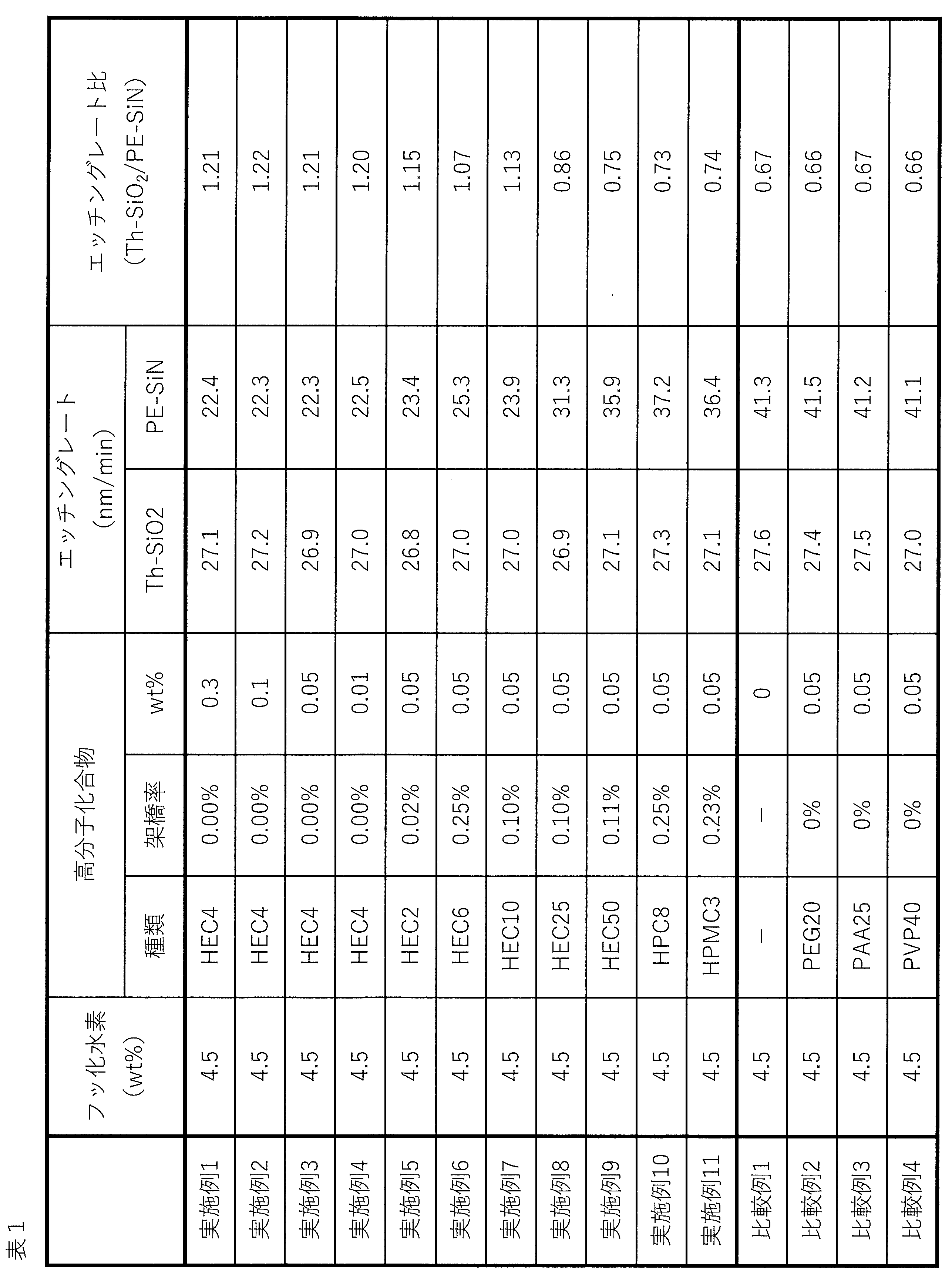
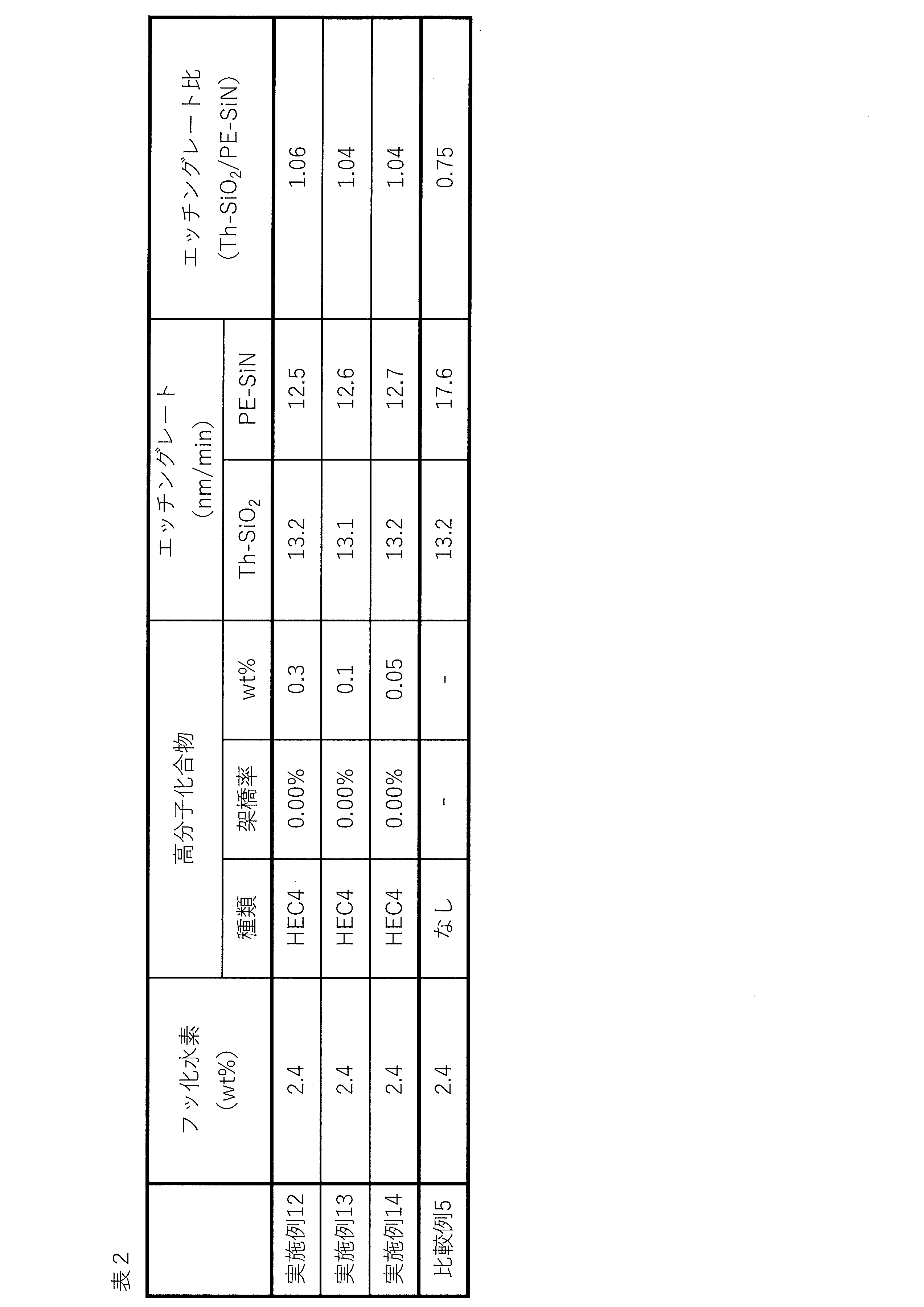
また、水溶性セルロースの重量平均分子量が低いものや、架橋度が低いものを使用すると、窒化膜と酸化膜のエッチングレート比をより1に近づけられることが分かる。
[1] フッ化水素と水溶性セルロースを含むウェットエッチング液。
[2] 前記水溶性セルロースが、式(c)で表される構成単位を有するセルロース誘導体、又はその塩である、[1]に記載のウェットエッチング液。
[3] 前記水溶性セルロースの重量平均分子量は50×104以下である[1]又は[2]に記載のウェットエッチング液。
[4] 前記水溶性セルロースの架橋度は0.3%以下である[1]~[3]の何れか1つに記載のウェットエッチング液。
[5] 水溶性セルロースの含有量がウェットエッチング液全量の0.005~0.5重量%である、[1]~[4]の何れか1つに記載のウェットエッチング液。
[6] フッ化水素の含有量がウェットエッチング液全量の0.005~30重量%である、[1]~[5]の何れか1つに記載のウェットエッチング液。
[7] 更に、フッ化水素以外の酸成分を含有しても良いが、前記酸成分の含有量はウェットエッチング液全量の0.005重量%以下である、[1]~[6]の何れか1つに記載のウェットエッチング液。
[8] 更に、フッ化水素以外のフッ素化合物を含有しても良いが、前記フッ素化合物の含有量は、フッ化水素100重量部に対して100重量部以下である、[1]~[6]の何れか1つに記載のウェットエッチング液。
[9] 更に、フッ化水素の塩を含有しても良いが、フッ化水素の塩の含有量は、フッ化水素100重量部に対して100重量部以下である、[1]~[6]の何れか1つに記載のウェットエッチング液。
[10] 更に、フッ化アンモニウムを含有しても良いが、フッ化アンモニウムの含有量は、フッ化水素100重量部に対して100重量部以下である、[1]~[6]の何れか1つに記載のウェットエッチング液。
[11] 前記水溶性セルロースは、メチルセルロース、ヒドロキシエチルセルロース、ヒドロキシプロピルセルロース、ヒドロキシエチルメチルセルロース、ヒドロキシプロピルメチルセルロース、カルボキシメチルセルロース、及びカルボキシエチルセルロースからなる群から選択されるセルロース誘導体、並びに前記セルロース誘導体のアルカリ金属塩から選択される少なくとも1種の化合物である、[1]~[10]の何れか1つに記載のウェットエッチング液。
[12] 前記水溶性セルロースは、ヒドロキシエチルセルロース、又はヒドロキシエチルセルロースのアルカリ金属塩である、[1]~[10]の何れか1つに記載のウェットエッチング液。
[13] ウェットエッチング液に含まれる高分子化合物全量において、すなわち重量平均分子量が0.1×10⁴以上の化合物全量において、水溶性セルロースの占める割合は80重量%以上(好ましくは90重量%以上、特に好ましくは95重量%以上、最も好ましくは99重量%以上)である、[1]~[12]の何れか1つに記載のウェットエッチング液。
[14] 更に、フッ化水素と水溶性セルロース以外の不揮発分を含有しても良いが、前記不揮発分の含有量は、前記水溶性セルロース100重量部に対して5重量部以下(好ましくは3重量部以下、特に好ましくは1重量部以下)である、[1]~[13]の何れか1つに記載のウェットエッチング液。
[15] 更に水を含有し、更にまた水以外の揮発分を含有しても良いが、前記水以外の揮発分の含有量は、水100重量部に対して50重量部以下(好ましくは30重量部以下、特に好ましくは10重量部以下、最も好ましくは5重量部以下、とりわけ好ましくは1重量部以下)である、[1]~[14]の何れか1つに記載のウェットエッチング液。
[16] 酸化膜と窒化膜のエッチングレート比(窒化膜/酸化膜)は0.7~1.3である、[1]~[15]の何れか1つに記載のウェットエッチング液。
[17] 酸化膜と窒化膜のエッチングレートは5nm/min以上である、[1]~[16]の何れか1つに記載のウェットエッチング液。
[18] 酸化膜と窒化膜のエッチングレートは5nm/min以上であり、且つ酸化膜と窒化膜のエッチングレート比(窒化膜/酸化膜)は0.7~1.3である、[1]~[15]の何れか1つに記載のウェットエッチング液。
[19] 酸化膜と窒化膜を含む表面層を有する無機材料の前記表面層に、[1]~[18]の何れか1つに記載のウェットエッチング液を供給する工程を経て、前記表面層がエッチング処理された無機材料を得る、エッチング処理された無機材料の製造方法。
[20] 酸化膜と窒化膜を含む表面層を有する無機材料の前記表面層に、[1]~[18]の何れか1つに記載のウェットエッチング液を供給する工程を経て、前記表面層がエッチング処理された無機材料を含む半導体デバイスを得る、半導体デバイスの製造方法。
[21] フッ化水素と水溶性セルロースを含む組成物。
[22] 前記水溶性セルロースが、式(c)で表される構成単位を有するセルロース誘導体、又はその塩である、[21]に記載の組成物。
[23] 前記水溶性セルロースの重量平均分子量は50×104以下である[21]又は[22]に記載の組成物。
[24] 前記水溶性セルロースの架橋度は0.3%以下である[21]~[23]の何れか1つに記載の組成物。
[25] 水溶性セルロースの含有量が前記組成物全量の0.005~0.5重量%である、[21]~[24]の何れか1つに記載の組成物。
[26] フッ化水素の含有量が前記組成物全量の0.005~30重量%である、[21]~[25]の何れか1つに記載の組成物。
[27] 更に、フッ化水素以外の酸成分を含有しても良いが、前記酸成分の含有量は前記組成物全量の0.005重量%以下である、[21]~[25]の何れか1つに記載の組成物。
[28] 更に、フッ化水素以外のフッ素化合物を含有しても良いが、前記フッ素化合物の含有量は、フッ化水素100重量部に対して100重量部以下である、[21]~[25]の何れか1つに記載の組成物。
[29] 更に、フッ化水素の塩を含有しても良いが、フッ化水素の塩の含有量は、フッ化水素100重量部に対して100重量部以下である、[21]~[25]の何れか1つに記載の組成物。
[30] 更に、フッ化アンモニウムを含有しても良いが、フッ化アンモニウムの含有量は、フッ化水素100重量部に対して100重量部以下である、[21]~[25]の何れか1つに記載の組成物。
[31] 前記水溶性セルロースは、メチルセルロース、ヒドロキシエチルセルロース、ヒドロキシプロピルセルロース、ヒドロキシエチルメチルセルロース、ヒドロキシプロピルメチルセルロース、カルボキシメチルセルロース、及びカルボキシエチルセルロースからなる群から選択されるセルロース誘導体、並びに前記セルロース誘導体のアルカリ金属塩から選択される少なくとも1種の化合物である、[21]~[30]の何れか1つに記載の組成物。
[32] 前記水溶性セルロースは、ヒドロキシエチルセルロース、又はヒドロキシエチルセルロースのアルカリ金属塩である、[21]~[30]の何れか1つに記載の組成物。
[33] 前記組成物に含まれる高分子化合物全量において、すなわち重量平均分子量が0.1×10⁴以上の化合物全量において、水溶性セルロースの占める割合は80重量%以上(好ましくは90重量%以上、特に好ましくは95重量%以上、最も好ましくは99重量%以上)である、[21]~[32]の何れか1つに記載の組成物。
[34] 更に、フッ化水素と水溶性セルロース以外の不揮発分を含有しても良いが、前記不揮発分の含有量は、前記水溶性セルロース100重量部に対して5重量部以下(好ましくは3重量部以下、特に好ましくは1重量部以下)である、[21]~[33]の何れか1つに記載の組成物。
[35] 更に水を含有し、更にまた水以外の揮発分を含有しても良いが、前記水以外の揮発分の含有量は、水100重量部に対して50重量部以下(好ましくは30重量部以下、特に好ましくは10重量部以下、最も好ましくは5重量部以下、とりわけ好ましくは1重量部以下)である、[21]~[34]の何れか1つに記載の組成物。
[36] 酸化膜と窒化膜のエッチングレート比(窒化膜/酸化膜)は0.7~1.3である、[21]~[35]の何れか1つに記載のウェットエッチング液。
[37] 酸化膜と窒化膜のエッチングレートは5nm/min以上である、[21]~[36]の何れか1つに記載のウェットエッチング液。
[38] 酸化膜と窒化膜のエッチングレートは5nm/min以上であり、且つ酸化膜と窒化膜のエッチングレート比(窒化膜/酸化膜)は0.7~1.3である、[21]~[35]の何れか1つに記載のウェットエッチング液。
[39] 酸化膜と窒化膜を含む表面層を有する無機材料の前記表面層に、[21]~[38]の何れか1つに記載の組成物を供給する工程を経て、前記表面層がエッチング処理された無機材料を得る、エッチング処理された無機材料の製造方法。
[40] 酸化膜と窒化膜を含む表面層を有する無機材料の前記表面層に、[21]~[38]の何れか1つに記載の組成物を供給する工程を経て、前記表面層がエッチング処理された無機材料を含む半導体デバイスを得る、半導体デバイスの製造方法。
[41] [21]~[38]の何れか1つに記載の組成物のウェットエッチング液としての使用。
[42] フッ化水素と水溶性セルロースを混合してウェットエッチング液を製造する、ウェットエッチング液の製造方法。
[43] 前記水溶性セルロースが、式(c)で表される構成単位を有するセルロース誘導体、又はその塩である、[42]に記載のウェットエッチング液の製造方法。
[44] 前記水溶性セルロースの重量平均分子量は50×104以下である[42]又は[43]に記載のウェットエッチング液の製造方法。
[45] 前記水溶性セルロースの架橋度は0.3%以下である[42]~[44]の何れか1つに記載のウェットエッチング液の製造方法。
[46] 水溶性セルロースの配合量を、ウェットエッチング液全量の0.005~0.5重量%とする、[42]~[45]の何れか1つに記載のウェットエッチング液の製造方法。
[47] フッ化水素の配合量を、ウェットエッチング液全量の0.005~30重量%とする、[42]~[46]の何れか1つに記載のウェットエッチング液の製造方法。
[48] 前記水溶性セルロースは、メチルセルロース、ヒドロキシエチルセルロース、ヒドロキシプロピルセルロース、ヒドロキシエチルメチルセルロース、ヒドロキシプロピルメチルセルロース、カルボキシメチルセルロース、及びカルボキシエチルセルロースからなる群から選択されるセルロース誘導体、並びに前記セルロース誘導体のアルカリ金属塩から選択される少なくとも1種の化合物である、[42]~[47]の何れか1つに記載のウェットエッチング液の製造方法。
[49] 前記水溶性セルロースは、ヒドロキシエチルセルロース、又はヒドロキシエチルセルロースのアルカリ金属塩である、[42]~[47]の何れか1つに記載のウェットエッチング液の製造方法。
[50] 前記ウェットエッチング液が、酸化膜と窒化膜のエッチングレート比(窒化膜/酸化膜)が0.7~1.3のウェットエッチング液である、[42]~[49]の何れか1つに記載のウェットエッチング液の製造方法。
[51] 前記ウェットエッチング液が、酸化膜と窒化膜のエッチングレートが5nm/min以上のウェットエッチング液である、[42]~[50]の何れか1つに記載のウェットエッチング液の製造方法。
[52] 前記ウェットエッチング液が、酸化膜と窒化膜のエッチングレートが5nm/min以上、且つ酸化膜と窒化膜のエッチングレート比(窒化膜/酸化膜)が0.7~1.3のウェットエッチング液である、[42]~[49]の何れか1つに記載のウェットエッチング液の製造方法。
そのため、前記ウェットエッチング液は、酸化膜と窒化膜を含む表面層を有する無機材料から、酸化膜と窒化膜を同時に除去する用途に好適に使用することができる。
Claims (8)
- フッ化水素と水溶性セルロースを含むウェットエッチング液。
- 前記水溶性セルロースが、下記式(c)で表される構成単位を有するセルロース誘導体、又はその塩である、請求項1に記載のウェットエッチング液。
- 前記水溶性セルロースの重量平均分子量は50×104以下である、請求項1又は2に記載のウェットエッチング液。
- 前記水溶性セルロースの架橋度は0.3%以下である、請求項1又は2に記載のウェットエッチング液。
- 前記水溶性セルロースの含有量がウェットエッチング液全量の0.005~0.5重量%である、請求項1又は2に記載のウェットエッチング液。
- 前記フッ化水素の含有量がウェットエッチング液全量の0.005~30重量%である、請求項1又は2に記載のウェットエッチング液。
- 酸化膜と窒化膜を含む表面層を有する無機材料の前記表面層に、請求項1又は2に記載のウェットエッチング液を供給する工程を経て、前記表面層がエッチング処理された無機材料を得る、エッチング処理された無機材料の製造方法。
- 酸化膜と窒化膜を含む表面層を有する無機材料の前記表面層に、請求項1又は2に記載のウェットエッチング液を供給する工程を経て、前記表面層がエッチング処理された無機材料を含む半導体デバイスを得る、半導体デバイスの製造方法。
Priority Applications (2)
| Application Number | Priority Date | Filing Date | Title |
|---|---|---|---|
| JP2025526103A JPWO2024253067A1 (ja) | 2023-06-09 | 2024-06-03 | |
| KR1020267000281A KR20260021709A (ko) | 2023-06-09 | 2024-06-03 | 웨트 에칭액, 에칭 처리된 무기 재료의 제조 방법, 반도체 디바이스의 제조 방법 |
Applications Claiming Priority (2)
| Application Number | Priority Date | Filing Date | Title |
|---|---|---|---|
| JP2023-095307 | 2023-06-09 | ||
| JP2023095307 | 2023-06-09 |
Publications (1)
| Publication Number | Publication Date |
|---|---|
| WO2024253067A1 true WO2024253067A1 (ja) | 2024-12-12 |
Family
ID=93796017
Family Applications (1)
| Application Number | Title | Priority Date | Filing Date |
|---|---|---|---|
| PCT/JP2024/020238 Ceased WO2024253067A1 (ja) | 2023-06-09 | 2024-06-03 | ウェットエッチング液、エッチング処理された無機材料の製造方法、半導体デバイスの製造方法 |
Country Status (4)
| Country | Link |
|---|---|
| JP (1) | JPWO2024253067A1 (ja) |
| KR (1) | KR20260021709A (ja) |
| TW (1) | TW202506964A (ja) |
| WO (1) | WO2024253067A1 (ja) |
Citations (5)
| Publication number | Priority date | Publication date | Assignee | Title |
|---|---|---|---|---|
| JPH11121442A (ja) * | 1997-09-18 | 1999-04-30 | Internatl Business Mach Corp <Ibm> | 窒化ケイ素のエッチング方法およびそれに適したエッチング組成物 |
| JP2002208573A (ja) * | 2001-10-15 | 2002-07-26 | Hitachi Chem Co Ltd | 金属用研磨液及び研磨方法 |
| WO2010113744A1 (ja) * | 2009-03-30 | 2010-10-07 | 東レ株式会社 | 導電膜除去剤および導電膜除去方法 |
| JP2012504871A (ja) * | 2008-10-02 | 2012-02-23 | アドバンスド テクノロジー マテリアルズ,インコーポレイテッド | 高度な金属負荷及びシリコン基板の表面パッシベーションのための界面活性剤/消泡剤混合物の使用 |
| WO2018021038A1 (ja) * | 2016-07-29 | 2018-02-01 | 富士フイルム株式会社 | 処理液及び基板洗浄方法 |
Family Cites Families (1)
| Publication number | Priority date | Publication date | Assignee | Title |
|---|---|---|---|---|
| JP5490071B2 (ja) | 2011-09-12 | 2014-05-14 | 株式会社東芝 | エッチング方法 |
-
2024
- 2024-06-03 KR KR1020267000281A patent/KR20260021709A/ko active Pending
- 2024-06-03 WO PCT/JP2024/020238 patent/WO2024253067A1/ja not_active Ceased
- 2024-06-03 JP JP2025526103A patent/JPWO2024253067A1/ja active Pending
- 2024-06-06 TW TW113121066A patent/TW202506964A/zh unknown
Patent Citations (5)
| Publication number | Priority date | Publication date | Assignee | Title |
|---|---|---|---|---|
| JPH11121442A (ja) * | 1997-09-18 | 1999-04-30 | Internatl Business Mach Corp <Ibm> | 窒化ケイ素のエッチング方法およびそれに適したエッチング組成物 |
| JP2002208573A (ja) * | 2001-10-15 | 2002-07-26 | Hitachi Chem Co Ltd | 金属用研磨液及び研磨方法 |
| JP2012504871A (ja) * | 2008-10-02 | 2012-02-23 | アドバンスド テクノロジー マテリアルズ,インコーポレイテッド | 高度な金属負荷及びシリコン基板の表面パッシベーションのための界面活性剤/消泡剤混合物の使用 |
| WO2010113744A1 (ja) * | 2009-03-30 | 2010-10-07 | 東レ株式会社 | 導電膜除去剤および導電膜除去方法 |
| WO2018021038A1 (ja) * | 2016-07-29 | 2018-02-01 | 富士フイルム株式会社 | 処理液及び基板洗浄方法 |
Also Published As
| Publication number | Publication date |
|---|---|
| TW202506964A (zh) | 2025-02-16 |
| KR20260021709A (ko) | 2026-02-13 |
| JPWO2024253067A1 (ja) | 2024-12-12 |
Similar Documents
| Publication | Publication Date | Title |
|---|---|---|
| US7354863B2 (en) | Methods of selectively removing silicon | |
| US8802608B2 (en) | Composition for cleaning and rust prevention and process for producing semiconductor element or display element | |
| EP3697866B1 (en) | Etching compositions | |
| TW200300876A (en) | Photoresist residue removing liquid composition | |
| JP7635158B2 (ja) | 低k値の材料、銅、コバルト、および/またはタングステンの層が存在する状態で、ハードマスクおよび/またはエッチング停止層を選択的にエッチングするための組成物および方法 | |
| CN102149851A (zh) | 钛系金属、钨系金属、钛钨系金属或它们的氮化物的蚀刻液 | |
| JP7772043B2 (ja) | 塗布膜形成組成物、及び半導体装置の製造方法 | |
| FR2950633A1 (fr) | Solution et procede d'activation de la surface oxydee d'un substrat semi-conducteur. | |
| TW202037707A (zh) | 蝕刻液、被處理體之處理方法及半導體元件之製造方法 | |
| CN114072488A (zh) | 蚀刻组合物 | |
| CN118900935A (zh) | 铜表面保护用组合物、以及使用其的半导体中间体和半导体的制造方法 | |
| TWI857003B (zh) | 蝕刻組成物 | |
| KR20260021709A (ko) | 웨트 에칭액, 에칭 처리된 무기 재료의 제조 방법, 반도체 디바이스의 제조 방법 | |
| TW202235683A (zh) | 濕式蝕刻溶液及濕式蝕刻方法 | |
| JP2024084484A (ja) | エッチングされたシリコン基板の製造方法 | |
| TW201022433A (en) | Solution for removal of residue after semiconductor dry processing and residue removal method using same | |
| JP2023157154A (ja) | 無機材料層の保護膜及びエッチング方法 | |
| KR102487249B1 (ko) | 텅스텐막 식각액 조성물 | |
| WO2023199900A1 (ja) | 無機材料の表面層保護膜、エッチング方法、エッチング処理された表面層を有する無機材料の製造方法 | |
| TWI839349B (zh) | 用以去除乾蝕刻殘渣之洗淨液及使用此洗淨液之半導體基板之製造方法 | |
| JP2023175389A (ja) | エッチング処理された表面層を有する無機材料の製造方法 | |
| WO2024127794A1 (ja) | 表面処理剤、及びエッチングされたシリコン基板の製造方法 | |
| JP2024084483A (ja) | 表面処理剤、及びエッチングされたシリコン基板の製造方法 | |
| CN114657565A (zh) | 用于钨层的蚀刻溶液组合物、用其制作电子器件的方法及电子器件 | |
| TW202417989A (zh) | 薄膜形成用組成物、及半導體元件的製造方法 |
Legal Events
| Date | Code | Title | Description |
|---|---|---|---|
| 121 | Ep: the epo has been informed by wipo that ep was designated in this application |
Ref document number: 24819297 Country of ref document: EP Kind code of ref document: A1 |
|
| ENP | Entry into the national phase |
Ref document number: 2025526103 Country of ref document: JP Kind code of ref document: A |
|
| ENP | Entry into the national phase |
Ref document number: 1020267000281 Country of ref document: KR Free format text: ST27 STATUS EVENT CODE: A-0-1-A10-A15-NAP-PA0105 (AS PROVIDED BY THE NATIONAL OFFICE) |
|
| WWE | Wipo information: entry into national phase |
Ref document number: 1020267000281 Country of ref document: KR |
|
| NENP | Non-entry into the national phase |
Ref country code: DE |
|
| WWP | Wipo information: published in national office |
Ref document number: 1020267000281 Country of ref document: KR |