WO2024253026A1 - 粘着シート - Google Patents
粘着シート Download PDFInfo
- Publication number
- WO2024253026A1 WO2024253026A1 PCT/JP2024/019971 JP2024019971W WO2024253026A1 WO 2024253026 A1 WO2024253026 A1 WO 2024253026A1 JP 2024019971 W JP2024019971 W JP 2024019971W WO 2024253026 A1 WO2024253026 A1 WO 2024253026A1
- Authority
- WO
- WIPO (PCT)
- Prior art keywords
- meth
- pressure
- adhesive sheet
- sensitive adhesive
- water
- Prior art date
- Legal status (The legal status is an assumption and is not a legal conclusion. Google has not performed a legal analysis and makes no representation as to the accuracy of the status listed.)
- Ceased
Links
Images

Classifications
-
- C—CHEMISTRY; METALLURGY
- C09—DYES; PAINTS; POLISHES; NATURAL RESINS; ADHESIVES; COMPOSITIONS NOT OTHERWISE PROVIDED FOR; APPLICATIONS OF MATERIALS NOT OTHERWISE PROVIDED FOR
- C09J—ADHESIVES; NON-MECHANICAL ASPECTS OF ADHESIVE PROCESSES IN GENERAL; ADHESIVE PROCESSES NOT PROVIDED FOR ELSEWHERE; USE OF MATERIALS AS ADHESIVES
- C09J7/00—Adhesives in the form of films or foils
- C09J7/30—Adhesives in the form of films or foils characterised by the adhesive composition
- C09J7/38—Pressure-sensitive adhesives [PSA]
- C09J7/381—Pressure-sensitive adhesives [PSA] based on macromolecular compounds obtained by reactions involving only carbon-to-carbon unsaturated bonds
- C09J7/385—Acrylic polymers
-
- C—CHEMISTRY; METALLURGY
- C09—DYES; PAINTS; POLISHES; NATURAL RESINS; ADHESIVES; COMPOSITIONS NOT OTHERWISE PROVIDED FOR; APPLICATIONS OF MATERIALS NOT OTHERWISE PROVIDED FOR
- C09J—ADHESIVES; NON-MECHANICAL ASPECTS OF ADHESIVE PROCESSES IN GENERAL; ADHESIVE PROCESSES NOT PROVIDED FOR ELSEWHERE; USE OF MATERIALS AS ADHESIVES
- C09J133/00—Adhesives based on homopolymers or copolymers of compounds having one or more unsaturated aliphatic radicals, each having only one carbon-to-carbon double bond, and at least one being terminated by only one carboxyl radical, or of salts, anhydrides, esters, amides, imides, or nitriles thereof; Adhesives based on derivatives of such polymers
-
- C—CHEMISTRY; METALLURGY
- C09—DYES; PAINTS; POLISHES; NATURAL RESINS; ADHESIVES; COMPOSITIONS NOT OTHERWISE PROVIDED FOR; APPLICATIONS OF MATERIALS NOT OTHERWISE PROVIDED FOR
- C09J—ADHESIVES; NON-MECHANICAL ASPECTS OF ADHESIVE PROCESSES IN GENERAL; ADHESIVE PROCESSES NOT PROVIDED FOR ELSEWHERE; USE OF MATERIALS AS ADHESIVES
- C09J143/00—Adhesives based on homopolymers or copolymers of compounds having one or more unsaturated aliphatic radicals, each having only one carbon-to-carbon double bond, and containing boron, silicon, phosphorus, selenium, tellurium, or a metal; Adhesives based on derivatives of such polymers
- C09J143/04—Homopolymers or copolymers of monomers containing silicon
-
- C—CHEMISTRY; METALLURGY
- C09—DYES; PAINTS; POLISHES; NATURAL RESINS; ADHESIVES; COMPOSITIONS NOT OTHERWISE PROVIDED FOR; APPLICATIONS OF MATERIALS NOT OTHERWISE PROVIDED FOR
- C09J—ADHESIVES; NON-MECHANICAL ASPECTS OF ADHESIVE PROCESSES IN GENERAL; ADHESIVE PROCESSES NOT PROVIDED FOR ELSEWHERE; USE OF MATERIALS AS ADHESIVES
- C09J2301/00—Additional features of adhesives in the form of films or foils
- C09J2301/10—Additional features of adhesives in the form of films or foils characterized by the structural features of the adhesive tape or sheet
- C09J2301/12—Additional features of adhesives in the form of films or foils characterized by the structural features of the adhesive tape or sheet by the arrangement of layers
- C09J2301/122—Additional features of adhesives in the form of films or foils characterized by the structural features of the adhesive tape or sheet by the arrangement of layers the adhesive layer being present only on one side of the carrier, e.g. single-sided adhesive tape
-
- C—CHEMISTRY; METALLURGY
- C09—DYES; PAINTS; POLISHES; NATURAL RESINS; ADHESIVES; COMPOSITIONS NOT OTHERWISE PROVIDED FOR; APPLICATIONS OF MATERIALS NOT OTHERWISE PROVIDED FOR
- C09J—ADHESIVES; NON-MECHANICAL ASPECTS OF ADHESIVE PROCESSES IN GENERAL; ADHESIVE PROCESSES NOT PROVIDED FOR ELSEWHERE; USE OF MATERIALS AS ADHESIVES
- C09J2301/00—Additional features of adhesives in the form of films or foils
- C09J2301/30—Additional features of adhesives in the form of films or foils characterized by the chemical, physicochemical or physical properties of the adhesive or the carrier
- C09J2301/312—Additional features of adhesives in the form of films or foils characterized by the chemical, physicochemical or physical properties of the adhesive or the carrier parameters being the characterizing feature
Definitions
- the present invention relates to an adhesive sheet.
- an adhesive sheet is a medical adhesive sheet that is attached to the skin, etc.
- Medical adhesive sheets are used for purposes such as protecting affected areas, transdermal absorption of drugs, and fixing gauze or tubes.
- Such adhesive sheets usually have an adhesive layer, and the adhesive sheet can be attached to the skin, etc. via this adhesive layer.
- the adhesive layer of the adhesive sheet can be formed by curing an adhesive composition containing a polymer.
- Patent Document 1 describes the production of an adhesive layer by curing an adhesive composition containing a (meth)acrylic polymer and an isocyanate crosslinking agent.
- a typical pressure-sensitive adhesive sheet is manufactured, for example, by the following method. First, a crosslinking agent or the like is added to a polymer synthesized by polymerizing a group of monomers in an organic solvent to prepare a pressure-sensitive adhesive composition. This pressure-sensitive adhesive composition is applied to a release liner, the organic solvent is removed by heating, and heat aging is further performed as necessary to prepare a pressure-sensitive adhesive layer. The obtained pressure-sensitive adhesive layer is laminated to a substrate to manufacture a pressure-sensitive adhesive sheet. In this manufacturing process, if the organic solvent removed by heating is directly released into the atmosphere, it may have a significant adverse effect on the surrounding environment. Therefore, the organic solvent is often burned in a deodorizing furnace or the like before being released. In this case, not only is extra fuel required for combustion in the deodorizing furnace, but the organic solvent itself is converted into CO 2 by combustion and released into the atmosphere, so this manufacturing process produces a very large amount of CO 2 emissions.
- a pressure-sensitive adhesive layer is produced using a pressure-sensitive adhesive composition containing a water-dispersible polymer, the amount of organic solvent used can be significantly reduced, and thus CO2 emissions can also be significantly reduced.
- the skin tends to easily become irritated.
- the present invention aims to provide an adhesive sheet that has an adhesive layer formed from an adhesive composition containing a water-dispersible polymer and is suitable for suppressing skin rashes during use.
- the present invention relates to A pressure-sensitive adhesive layer which is formed from a pressure-sensitive adhesive composition containing a water-dispersible polymer,
- the pressure-sensitive adhesive sheet has a moisture permeability of 900 g/(m 2 ⁇ 24 h) or more as determined by the following test.
- the present invention provides an adhesive sheet that has an adhesive layer formed from an adhesive composition containing a water-dispersible polymer and is suitable for suppressing skin rashes during use.
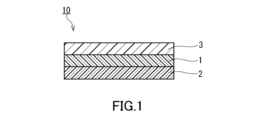
- FIG. 1 is a cross-sectional view showing a schematic diagram of a pressure-sensitive adhesive sheet according to one embodiment of the present invention.
- FIG. 2 is a diagram for explaining a test for measuring the moisture permeability of a pressure-sensitive adhesive layer.
- the pressure-sensitive adhesive sheet according to the first aspect of the present invention comprises: A pressure-sensitive adhesive layer is provided which is formed from a pressure-sensitive adhesive composition containing a water-dispersible polymer,
- the pressure-sensitive adhesive layer has a moisture permeability of 900 g/(m 2 ⁇ 24 h) or more as determined by the following test.
- the water-dispersible polymer is a (meth)acrylic polymer.
- the (meth)acrylic polymer has a structural unit derived from an alkyl (meth)acrylate ester.
- the average carbon number of the alkyl group of the (meth)acrylic acid alkyl ester is 7.0 or less.
- the (meth)acrylic acid alkyl ester includes a first (meth)acrylic acid alkyl ester having an alkyl group having 1 to 7 carbon atoms.
- the (meth)acrylic acid alkyl ester includes at least one selected from the group consisting of n-butyl acrylate and isobutyl acrylate as the first (meth)acrylic acid alkyl ester.
- the (meth)acrylic acid alkyl ester further includes a second (meth)acrylic acid alkyl ester having an alkyl group having 8 to 12 carbon atoms.
- the (meth)acrylic polymer has a constituent unit derived from a carboxyl group-containing monomer.
- the (meth)acrylic polymer has a constituent unit derived from a silane monomer.
- the pressure-sensitive adhesive composition contains water as a dispersion medium.
- the adhesive composition contains a surfactant.
- the pressure-sensitive adhesive composition includes an organic liquid component.
- the organic liquid component contains glyceryl tricaprylate.
- the pressure-sensitive adhesive composition contains particles of the water-dispersible polymer, and the average particle size of the particles is 200 nm or less.
- the adhesive sheet according to any one of the first to fourteenth aspects further comprises a substrate that supports the adhesive layer.
- the adhesive sheet according to any one of the first to fifteenth aspects is for medical use.
- the adhesive sheet 10 of this embodiment includes an adhesive layer 1.
- the adhesive layer 1 is formed from an adhesive composition containing a water-dispersible polymer, and more specifically, is a cured product of the adhesive composition.
- the term "adhesive sheet” is used to include “adhesive tape.”
- water-dispersible polymer means a polymer emulsified in water.
- the adhesive composition contains water as a dispersion medium, and the water-dispersible polymer is emulsified in the water.
- an adhesive composition containing a water-dispersible polymer may be referred to as an "emulsion-based adhesive composition.”
- the adhesive sheet 10 may further include a substrate 2 that supports the adhesive layer 1, and a release liner 3 disposed on the surface of the adhesive layer 1.
- the adhesive layer 1 is, for example, located between the substrate 2 and the release liner 3, and is in direct contact with both the substrate 2 and the release liner 3.
- the adhesive sheet 10 can be used by peeling off the release liner 3 and then attaching the adhesive layer 1 to an object (for example, skin).
- the adhesive sheet 10 is not limited to the above structure.
- the adhesive sheet 10 may be composed of only the adhesive layer 1.
- the adhesive sheet 10 may also include two adhesive layers 1 and two release liners 3, and may have a structure in which the release liner 3, adhesive layer 1, substrate 2, adhesive layer 1, and release liner 3 are layered in this order.
- the pressure-sensitive adhesive layer 1 has a moisture permeability P of 900 g/(m 2 ⁇ 24 h) or more, as determined by the following test.
- Test A laminate consisting of a 25 ⁇ m thick adhesive layer 1 and a 30 ⁇ m thick polyurethane film is prepared. The laminate is attached to a glass container so as to close the opening of the glass container containing water. The glass container is left for 24 hours under conditions of a temperature of 40° C. and a humidity of 30% RH, and the weight of water that has permeated the laminate from inside the glass container is determined. The ratio of the weight (g) to the opening area (m 2 ) of the opening is determined as the moisture permeability P.
- a 25 ⁇ m thick adhesive layer 1 having the same composition as the adhesive layer 1 of the adhesive sheet 10 is formed on a release liner to prepare a laminate of the release liner and the adhesive layer 1.
- the adhesive layer 1 can be prepared by a method described later.
- the entire surface of the adhesive layer 1 of the obtained laminate is overlaid on a polyurethane film 5 (thickness 30 ⁇ m), and a 2 kg roller is moved back and forth once to press them together.
- the polyurethane film 5 used has sufficiently high moisture permeability compared to the adhesive layer 1 and has little effect on the value of the moisture permeability P.
- the release liner is peeled off from the adhesive layer 1 to prepare a laminate 20 composed of the adhesive layer 1 and the polyurethane film 5. If necessary, the laminate 20 is cut to adjust its shape and dimensions. As an example, the laminate 20 is adjusted to have a circular shape in a plan view and a diameter of 50 mm.
- a glass container 30 containing water (distilled water) 35 is prepared.
- the glass container 30 has an opening 31 and is, for example, a bottomed cylindrical container with an inner diameter of 40 mm and a height of 40 mm.
- the volume of water 35 contained in the glass container 30 is, for example, 10 mL.
- the laminate 20 is attached to the glass container 30 so as to close the opening 31 of the glass container 30 ( Figure 2).
- the adhesive layer 1 of the laminate 20 is attached to the end face of the glass container 30 to seal the internal space of the glass container 30. This results in the measurement object 50 being obtained.
- the glass container 30 (specifically, the measurement object 50) is set in a commercially available thermo-hygrostat and left for 24 hours under conditions of a temperature of 40° C. and a humidity of 30% RH. At this time, a part of the water 35 evaporates and permeates the laminate 20, and is released from the inside of the glass container 30 to the outside.
- the weight W (g) of the measurement object 50 after being left for 24 hours is subtracted from the weight W1 (g) of the measurement object 50 immediately after preparation (W1-W2), and the value is specified as the weight W (g) of the water (specifically, water vapor) that permeates the laminate 20 from the inside of the glass container 30.
- the ratio W/A of the weight W (g) of the water that permeates the laminate 20 to the opening area A (m 2 ) of the opening 31 of the glass container 30 can be specified as the moisture permeability P.
- the opening area A (m 2 ) of the opening 31 can be calculated, for example, based on the inner radius r (m) of the glass container 30 by the formula (r/2) 2 ⁇ .
- the moisture permeability P of the adhesive layer 1 is 900 g/( m2 ⁇ 24 h) or more, when the adhesive sheet 10 is applied to the skin, the skin is prevented from becoming damp, which tends to prevent skin rash.
- the moisture permeability P of the pressure-sensitive adhesive layer 1 is preferably 930 g/( m2 ⁇ 24h) or more, 950 g/( m2 ⁇ 24h) or more, 980 g/( m2 ⁇ 24h) or more, 1000 g/( m2 ⁇ 24h) or more, 1100 g/( m2 ⁇ 24h) or more, 1200 g/( m2 ⁇ 24h) or more, 1300 g/( m2 ⁇ 24h) or more, or even 1400 g/( m2 ⁇ 24h) or more.
- the upper limit of the moisture permeability P is not particularly limited, and may be, for example, 5000 g/( m2 ⁇ 24h) or less, or 3000 g/( m2 ⁇ 24h) or less.
- the pressure-sensitive adhesive layer 1 is formed from a pressure-sensitive adhesive composition containing a water-dispersed polymer.
- the water-dispersed polymer is emulsified in water and has a particle shape.
- the pressure-sensitive adhesive composition contains particles of a water-dispersed polymer.
- the particles of the water-dispersed polymer may not be aggregated in water and may exist as single particles (primary particles), or may be aggregated in water to form aggregates.
- the particles may be of a core-shell type having a core and a shell covering the core.
- the water-dispersible polymer may be a homopolymer or a copolymer.
- Examples of the copolymer include random copolymers, block copolymers, and graft copolymers.
- the pressure-sensitive adhesive composition may contain two or more types of water-dispersible polymers.
- the water-dispersible polymer is preferably a (meth)acrylic polymer.
- (meth)acrylic means acrylic and/or methacrylic.
- the (meth)acrylic polymer contains, for example, a structural unit derived from an alkyl (meth)acrylate ester.
- An alkyl (meth)acrylate ester is a compound having an alkyl group at the ester end.
- the number of carbon atoms in the alkyl group is, for example, 1 to 20, and may be 1 to 12 or even 1 to 9.
- the alkyl group may be linear or branched.
- the present invention provides A pressure-sensitive adhesive layer 1 which is formed from a pressure-sensitive adhesive composition containing a water-dispersible polymer,
- the water-dispersible polymer is a (meth)acrylic polymer having a structural unit derived from an alkyl (meth)acrylate ester,
- the present invention provides a pressure-sensitive adhesive sheet, in which the average number of carbon atoms in the alkyl group of the (meth)acrylic acid alkyl ester is 7.0 or less.
- the average carbon number of the alkyl group of the (meth)acrylic acid alkyl ester is preferably 6.8 or less, and may be 6.5 or less, 6.3 or less, 6.0 or less, 5.8 or less, 5.5 or less, or even 5.3 or less.
- the smaller the average carbon number of the alkyl group the more the moisture permeability of the adhesive layer 1 tends to improve. However, if the average carbon number of the alkyl group is too small, the compatibility between the (meth)acrylic polymer and the organic liquid component described below may decrease.
- the lower limit of the average carbon number of the alkyl group is, for example, 2.0 or more, and may be 3.0 or more, 4.0 or more, 4.5 or more, or even 5.0 or more.
- the lower limit of the average carbon number of the alkyl group may be 6.0 or more, or 6.5 or more, depending on the case.
- the average number of carbon atoms in the alkyl group is the sum of the weight ratio of the constituent units derived from each (meth)acrylic acid alkyl ester to all constituent units derived from the (meth)acrylic acid alkyl ester multiplied by the number of carbon atoms in the alkyl group of each (meth)acrylic acid alkyl ester.
- a (meth)acrylic polymer is synthesized by polymerizing a monomer group containing 30 parts by weight of 2-ethylhexyl acrylate and 65 parts by weight of n-butyl acrylate as the (meth)acrylic acid alkyl ester.
- the average number of carbon atoms in the alkyl group of the (meth)acrylic acid alkyl ester is calculated to be 5.26 by the formula 8 x (30/95) + 4 x (65/95).
- the (meth)acrylic acid alkyl ester preferably includes a first (meth)acrylic acid alkyl ester having an alkyl group with 1 to 7 carbon atoms, and more preferably includes a second (meth)acrylic acid alkyl ester having an alkyl group with 8 to 12 carbon atoms together with the first (meth)acrylic acid alkyl ester.
- the (meth)acrylic acid alkyl ester includes both the first (meth)acrylic acid alkyl ester and the second (meth)acrylic acid alkyl ester, and the average carbon number of the alkyl group is adjusted to 7.0 or less, it is easy to appropriately adjust the compatibility of the (meth)acrylic polymer with the organic liquid component, and the moisture permeability of the adhesive layer 1.
- the (meth)acrylic acid alkyl ester may include a third (meth)acrylic acid alkyl ester having an alkyl group with 13 or more carbon atoms, but preferably does not include it.
- the number of carbon atoms in the alkyl group is preferably 6 or less, and may be 5 or less, or even 4 or less.
- the lower limit of the number of carbon atoms in the alkyl group may be 2 or more.
- the number of carbon atoms in the alkyl group is preferably 1 to 4.
- Examples of the first (meth)acrylic acid alkyl ester include methyl (meth)acrylate, ethyl (meth)acrylate, n-propyl (meth)acrylate, isopropyl (meth)acrylate, n-butyl (meth)acrylate, isobutyl (meth)acrylate, sec-butyl (meth)acrylate, t-butyl (meth)acrylate, n-pentyl (meth)acrylate, isopentyl (meth)acrylate, n-hexyl (meth)acrylate, isohexyl (meth)acrylate, n-heptyl (meth)acrylate, and isoheptyl (meth)acrylate.
- the (meth)acrylic acid alkyl ester preferably contains at least one selected from the group consisting of n-butyl acrylate and isobutyl acrylate as the first (meth)acrylic acid alkyl ester, and more preferably contains n-butyl acrylate.
- the weight ratio of the constituent units derived from the first (meth)acrylic acid alkyl ester to all constituent units derived from the (meth)acrylic acid alkyl ester is, for example, 20% by weight or more, and may be 30% by weight or more, 40% by weight or more, 50% by weight or more, or even 60% by weight or more.
- the upper limit of this weight ratio is, for example, 95% by weight or less, and may be 90% by weight or less, 80% by weight or less, or even 70% by weight or less.
- the number of carbon atoms in the alkyl group is preferably 11 or less, and may be 10 or less, or even 9 or less.
- the number of carbon atoms in the alkyl group is preferably 8 to 9.
- Examples of the second (meth)acrylic acid alkyl ester include n-octyl (meth)acrylate, isooctyl (meth)acrylate, 2-ethylhexyl (meth)acrylate, n-nonyl (meth)acrylate, isononyl (meth)acrylate, n-decyl (meth)acrylate, n-undecyl (meth)acrylate, and n-dodecyl (meth)acrylate.
- the (meth)acrylic acid alkyl ester preferably contains 2-ethylhexyl acrylate as the second (meth)acrylic acid alkyl ester.
- the weight ratio of the constituent units derived from the second (meth)acrylic acid alkyl ester to all constituent units derived from the (meth)acrylic acid alkyl ester may be, for example, 80% by weight or less, 70% by weight or less, 60% by weight or less, 50% by weight or less, or even 40% by weight or less.
- the lower limit of this weight ratio may be, for example, 5% by weight or more, 10% by weight or more, 20% by weight or more, or even 30% by weight or more.
- the content of structural units derived from (meth)acrylic acid alkyl ester is, for example, 50% by weight or more, and may be 60% by weight or more, 70% by weight or more, 80% by weight or more, 90% by weight or more, or even 95% by weight or more. There is no particular upper limit to this content, and it is, for example, 99% by weight or less.
- the (meth)acrylic polymer may contain a constituent unit derived from another monomer that is copolymerizable with the (meth)acrylic acid alkyl ester.
- the other monomer include a carboxyl group-containing monomer and a silane monomer.
- the other monomer may be one type only, or two or more types.
- the (meth)acrylic polymer preferably contains a structural unit derived from a carboxyl group-containing monomer. This structural unit can contribute to the stabilization of the water-dispersible polymer particles in the pressure-sensitive adhesive composition.
- the carboxyl group-containing monomer is a compound that contains a carboxyl group in its structure and a polymerizable unsaturated double bond such as a (meth)acryloyl group or a vinyl group.
- carboxyl group-containing monomer examples include (meth)acrylic acid, carboxyethyl (meth)acrylate, carboxypentyl (meth)acrylate, (meth)acryloyloxyethyl succinic acid, itaconic acid, maleic acid, fumaric acid, and crotonic acid, with acrylic acid (AA) being preferred.
- the (meth)acrylic polymer preferably contains, for example, a structural unit derived from a silane monomer.
- the silane monomer is a radically polymerizable compound having a silicon atom, and is preferably a silane compound having a (meth)acryloyl group. It is further preferable that the silane monomer has an alkoxysilyl group.
- silane monomers include 3-(meth)acryloyloxypropyltrimethoxysilane, 3-(meth)acryloyloxypropyltriethoxysilane, 3-(meth)acryloyloxypropylmethyldimethoxysilane, 3-(meth)acryloyloxypropylmethyldiethoxysilane, 10-(meth)acryloyloxydecyltrimethoxysilane, 10-(meth)acryloyloxydecyltriethoxysilane, vinyltrimethoxysilane, vinyltriethoxysilane, 4-vinylbutyltrimethoxysilane, 4-vinylbutyltriethoxysilane, 8-vinyloctyltrimethoxysilane, and 8-vinyloctyltriethoxysilane.
- the silane monomer undergoes hydrolysis during emulsification and/or emulsion polymerization in the presence of water, for example, to form a silanol group (-SiOH). That is, when a (meth)acrylic polymer is synthesized using a silane monomer in the presence of water, the constituent units derived from the silane monomer have, for example, a silanol group.
- the adhesive layer 1 is produced from the adhesive composition, the silanol groups undergo a condensation reaction with each other, resulting in crosslinking of the (meth)acrylic polymer (silanol crosslinking).
- a structure is formed in the adhesive layer 1 in which multiple water-dispersible polymer particles are crosslinked with each other.
- the other monomers are not limited to those mentioned above.
- the other monomers include sulfoxyl group-containing monomers such as styrene sulfonic acid, allyl sulfonic acid, sulfopropyl (meth)acrylate, (meth)acryloyloxynaphthalene sulfonic acid, and acrylamidomethylpropane sulfonic acid; hydroxyl group-containing monomers such as (meth)acrylic acid hydroxyethyl ester and (meth)acrylic acid hydroxypropyl ester; amide group-containing monomers such as (meth)acrylamide, dimethyl (meth)acrylamide, N-butylacrylamide, N-methylol (meth)acrylamide, and N-methylolpropane (meth)acrylamide; (meth)acrylic acid alkylamino alkyl esters such as (meth)acrylic acid aminoethyl ester, (meth)acrylic acid dimethyla
- (meth)acrylic acid alkoxyalkyl esters such as esters; (meth)acrylic acid esters containing an alkoxy group (or an ether bond on the side chain), such as (meth)acrylic acid methoxyethylene glycol ester, (meth)acrylic acid tetrahydrofurfuryl ester, (meth)acrylic acid methoxyethylene glycol ester, (meth)acrylic acid methoxydiethylene glycol ester, (meth)acrylic acid methoxypolyethylene glycol ester, and (meth)acrylic acid methoxypolypropylene glycol ester; and vinyl monomers such as (meth)acrylonitrile, vinyl acetate, vinyl propionate, N-vinyl-2-pyrrolidone, methylvinylpyrrolidone, vinylpyridine, vinylpiperidine, vinylpyrimidine, vinylpiperazine, vinylpyrazine, vinylpyrrole, vinylimidazole, vinylcaprolactam, vinyloxazole
- the content of structural units derived from other monomers may be, for example, greater than 0% by weight, 0.1% to 50% by weight, 1% to 30% by weight, 2% to 20% by weight, or even 3% to 10% by weight.
- the content of structural units derived from carboxyl group-containing monomers is, for example, 0.1% by weight or more, and may be 1% by weight or more, 2% by weight or more, or even 3% by weight or more. This content may be, for example, 25% by weight or less, 20% by weight or less, or even 10% by weight or less.
- the content of structural units derived from silane monomers is, for example, 0.01% by weight or more. This content may be, for example, 10% by weight or less, 1% by weight or less, or even 0.1% by weight or less.
- the adhesive layer of the conventional adhesive sheet is formed from an adhesive composition containing a polymer synthesized by polymerizing a group of monomers in an organic solvent.
- an organic solvent when the polymer has a high content of structural units derived from hydrophilic monomers such as methoxyethyl acrylate (MEA), the moisture permeability of the adhesive layer tends to improve.
- the water-dispersible polymer when the water-dispersible polymer has a high content of structural units derived from hydrophilic monomers, the water-dispersible polymer tends to dissolve in the dispersion medium (specifically, water) of the adhesive composition, and the viscosity of the adhesive composition tends to increase excessively.
- the dissolution of the water-dispersible polymer into the dispersion medium can occur significantly when the adhesive composition is neutral (pH is about 7).
- An adhesive composition with an excessively increased viscosity has extremely low coatability, and therefore it tends to be difficult to prepare an adhesive layer using the adhesive composition.
- the content of structural units derived from hydrophilic monomers in the water-dispersed polymer is low.
- the content of structural units derived from hydrophilic monomers (particularly MEA) in the water-dispersed polymer is, for example, 10% by weight or less, and may be 5% by weight or less, 1% by weight or less, or even 0.1% by weight or less.
- the water-dispersed polymer may not substantially have structural units derived from hydrophilic monomers (particularly MEA).
- the hydrophilic monomer means a monomer having a solubility in water at 25°C of more than 0.140 g/100 mL.
- the (meth)acrylic acid alkyl ester for forming the structural units of the water-dispersed polymer has a solubility in water at 25°C of 0.140 g/100 mL or less.
- the glass transition temperature (Tg) of the (meth)acrylic polymer is, as a theoretically calculated value obtained by the FOX formula, for example, -10°C to 30°C, and may be -5°C to 20°C, 0°C to 15°C, or even 5°C to 10°C.
- the weight average molecular weight of the (meth)acrylic polymer is, for example, 1,000 to 10,000,000, and may be 5,000 to 5,000,000, 10,000 to 1,000,000, or even 50,000 to 800,000.
- the weight average molecular weight of the (meth)acrylic polymer can be controlled by the amounts of polymerization initiator, chain transfer agent, emulsifier, etc. used during polymerization, reaction conditions, etc.
- Methodacrylic polymers can be synthesized by emulsion polymerization using an emulsion of the monomer group, which is the raw material.
- an emulsifier surfactant
- a polymerization initiator emulsion polymerization initiator
- a chain transfer agent emulsion polymerization
- Methods of emulsion polymerization include a batch charge method (batch polymerization method), a monomer dropping method, and a monomer emulsion dropping method.
- a continuous dropping method or a divided dropping method can be appropriately selected. These methods can be appropriately combined.
- the reaction conditions for emulsion polymerization can be appropriately adjusted depending on the monomer group, etc., and as an example, the polymerization temperature is 20°C to 100°C, and the polymerization time is 30 minutes to 24 hours.
- polymerization initiators examples include 2,2'-azobisisobutyronitrile, 2,2'-azobis(2-methylpropionamidine) disulfate, 2,2'-azobis(2-amidinopropane) dihydrochloride, 2,2'-azobis[2-(5-methyl-2-imidazolin-2-yl)propane] dihydrochloride, 2,2'-azobis(N,N'-dimethyleneisobutylamidine), 2,2'-azobis[N-(2-carboxyethyl)-2-methylpropionamidine]
- the initiator include azo initiators such as potassium persulfate and ammonium persulfate; persulfates such as potassium persulfate and ammonium persulfate; peroxide initiators such as benzoyl peroxide, tert-butyl hydroperoxide and hydrogen peroxide; substituted ethane initiators such as phenyl-substituted ethane; aromatic
- chain transfer agents examples include mercaptans such as dodecanethiol.
- the amount of chain transfer agent used is, for example, 0.001 to 0.5 parts by weight, 0.01 to 0.4 parts by weight, or even 0.01 to 0.04 parts by weight, per 100 parts by weight of the monomer group.
- emulsifiers include anionic emulsifiers such as sodium lauryl sulfate, ammonium lauryl sulfate, sodium dodecylbenzenesulfonate, sodium polyoxyethylene alkyl ether sulfate, ammonium polyoxyethylene alkyl phenyl ether sulfate, and sodium polyoxyethylene alkyl phenyl ether sulfate; and nonionic emulsifiers such as polyoxyethylene alkyl ether and polyoxyethylene alkyl phenyl ether.
- the amount of emulsifier used is, for example, 0.2 to 10 parts by weight, or may be 0.5 to 5 parts by weight, per 100 parts by weight of the monomer group.
- the dispersion medium used in the emulsion polymerization preferably contains water.
- the dispersion medium may contain an organic solvent in addition to water.
- the amount of the dispersion medium used is, for example, 30 parts by weight to 80 parts by weight, and may be 40 parts by weight to 70 parts by weight, per 100 parts by weight of the monomer group.
- the (meth)acrylic polymer can also be synthesized by a method other than emulsion polymerization.
- the adhesive composition can be prepared by dispersing the synthesized (meth)acrylic polymer in a dispersion medium using an emulsifier.
- the average particle size of the water-dispersed polymer particles is, for example, 1000 nm or less, and may be 700 nm or less, 500 nm or less, 400 nm or less, 300 nm or less, or even 200 nm or less.
- the average particle size of the water-dispersed polymer particles is 200 nm or less, the compatibility between the water-dispersed polymer and the organic liquid component tends to be good.
- the lower limit of the average particle size of the water-dispersed polymer particles is not particularly limited, and may be, for example, 50 nm or more, or 100 nm or more.
- average particle size means the volume-based average particle size (volume average particle size) measured by dynamic light scattering.
- the average particle size of the water-dispersed polymer particles can be adjusted by the reaction conditions during the synthesis of the water-dispersed polymer.
- the adhesive composition contains water as a dispersion medium.
- the adhesive composition is typically an oil-in-water (O/W) emulsion.
- the adhesive composition may contain an organic solvent as a dispersion medium in addition to water.
- the content of the dispersion medium in the adhesive composition is not particularly limited, and is, for example, 10% by weight to 90% by weight.
- the adhesive composition preferably contains an emulsifier (surfactant).
- emulsifiers include those mentioned above.
- the content of the emulsifier in the adhesive composition is not particularly limited, and is, for example, 0.2% by weight to 10% by weight, and preferably 2% by weight to 5% by weight.
- the organic liquid component is preferably a component that is liquid at room temperature (25°C) and is compatible with the water-dispersible polymer.
- “compatible” means that the organic liquid component is uniformly dissolved and incorporated into the water-dispersible polymer in the adhesive composition, and separation cannot be confirmed by visual inspection. It is preferable that the organic liquid component is unlikely to migrate from the adhesive sheet 10 to medical tools or medical equipment when the adhesive sheet 10 is in use.
- the organic liquid component preferably contains a carboxylate ester.
- the carboxylic acid constituting the carboxylate ester may be a monobasic acid or a polybasic acid.
- the carboxylic acid may be a saturated fatty acid or an unsaturated fatty acid.
- the carboxylic acid may be a linear or branched chain.
- the number of carbon atoms in the carboxylic acid is not particularly limited, and may be, for example, 1 to 18, 5 to 18, or even 8 to 18.
- carboxylic acid examples include myristic acid, myristoleic acid, palmitic acid, isopalmitic acid, stearic acid, isostearic acid, lauric acid, caprylic acid, capric acid, lactic acid, phthalic acid, oleic acid, dimethyloctanoic acid, 2-ethylhexanoic acid, succinic acid, adipic acid, sebacic acid, trimellitic acid, linoleic acid, and linolenic acid.
- the alcohol constituting the carboxylic acid ester may be a monohydric alcohol or a polyhydric alcohol.
- the valence of the polyhydric alcohol is, for example, 2 to 4.
- the alcohol may be linear or branched.
- the number of carbon atoms of the alcohol is not particularly limited and may be, for example, 1 to 18, 1 to 10, or even 1 to 5.
- alcohols examples include ethanol, isopropanol, butanol, hexanol, octanol, myristyl alcohol, cetyl alcohol, isocetyl alcohol, stearyl alcohol, isostearyl alcohol, oleyl alcohol, hexyldecanol, octyldodecanol, ethylene glycol, propylene glycol, glycerin, trimethylolpropane, pentaerythritol, and sorbitan.
- carboxylate esters include ethyl myristate, isopropyl myristate, isocetyl myristate, octyldodecyl myristate, isopropyl palmitate, isostearyl palmitate, butyl stearate, isocetyl stearate, isopropyl isostearate, hexyl laurate, isostearyl laurate, cetyl lactate, myristyl lactate, diethyl phthalate, octyldodecyl oleate, hexyldecyl dimethyloctanoate, cetyl 2-ethylhexanoate, isocetyl 2-ethylhexanoate, stearyl 2-ethylhexanoate, cobalt ester, butyl stearate, isocetyl stearate, isopropyl isostearate,
- suitable organic liquid components include dioctyl acrylate, diisostearyl adipate, diisocetyl sebacate, trioleyl trimellitate, triisocetyl trimellitate, propylene glycol dicaprylate, propylene glycol dicaprate, propylene glycol diisostearate, glyceryl monocaprylate, glyceryl tricaprylate, glyceryl tri-2-ethylhexanoate, glyceryl tricaprate, glyceryl trilaurate, glyceryl triisostearate, glyceryl trioleate, trimethylolpropane tri-2-ethylhexanoate, and sorbitan trioleate.
- the organic liquid component preferably contains glyceryl tricaprylate or sorbitan trioleate as a carboxylic acid ester, and more preferably contains glyceryl tricaprylate.
- the amount of the organic liquid component is, for example, 10 parts by weight or more, and may be 20 parts by weight or more, 30 parts by weight or more, 40 parts by weight or more, 50 parts by weight or more, 60 parts by weight or more, or even 70 parts by weight or more, relative to 100 parts by weight of the water-dispersible polymer.
- the greater the amount of the organic liquid component the more likely the moisture permeability of the pressure-sensitive adhesive layer 1 is to be improved.
- the upper limit of the amount of the organic liquid component is, for example, 120 parts by weight or less, and may be 100 parts by weight or less, or even 80 parts by weight or less, relative to 100 parts by weight of the water-dispersible polymer.
- the adhesive composition may further contain additives other than those mentioned above.
- additives include crosslinkers, tackifiers, thickeners, plasticizers, softeners, fillers, pigments, etc.
- the adhesive composition is preferably neutral.
- a neutral adhesive composition the water-dispersible polymer particles are less likely to aggregate and tend to be highly stable.
- the pH of the adhesive composition is, for example, 6.0 to 8.0, and may be 6.5 to 7.5.
- the pH of the adhesive composition is preferably 7.0.
- the viscosity of the adhesive composition is, for example, 500 mPa ⁇ s or less, and may be 300 mPa ⁇ s or less, or even 100 mPa ⁇ s or less, under conditions of pH 7.0 and temperature 25°C.
- An adhesive composition having a viscosity of 500 mPa ⁇ s or less can be said to have sufficient coatability for practical use.
- the lower limit of the viscosity of the adhesive composition is, for example, 10 mPa ⁇ s or more.
- the thickness of the adhesive layer 1 is not particularly limited, but is, for example, 10 to 80 ⁇ m.
- the gel fraction of the adhesive layer 1 is, for example, 20% to 80%, and may be 30% to 60%.
- the substrate 2 is, for example, a layered member that supports the pressure-sensitive adhesive layer 1.
- the substrate 2 may be a single layer or a laminate having multiple layers. From the viewpoint of suppressing sweating of the skin when the pressure-sensitive adhesive sheet 10 is attached to the skin, it is preferable that the substrate 2 has sufficiently high moisture permeability compared to the pressure-sensitive adhesive layer 1.
- the substrate 2 may be non-porous or porous.
- moisture permeability tends not to decrease even if the substrate 2 is thick. It is preferable that the porous substrate 2 has water vapor permeability that allows water vapor to pass through, but is non-permeable that does not allow liquid water to pass through.
- the substrate 2 includes urethane-based polymers such as polyether urethane and polyester urethane; amide-based polymers such as polyether polyamide block polymers; acrylic polymers such as polyacrylate; polyolefin-based polymers such as polyethylene, polypropylene, and ethylene/vinyl acetate copolymer; and polyester-based polymers such as polyether polyester.
- the substrate 2 preferably contains a urethane-based polymer or an amide-based polymer, and it is particularly preferable that the substrate 2 contains a urethane-based polymer.
- the substrate 2 may be a polyurethane film made of a urethane-based polymer, or a laminate in which a layer containing a polyolefin-based polymer is laminated on a polyurethane film.
- the thickness of the substrate 2 is not particularly limited and may be, for example, 10 to 100 ⁇ m, or 20 to 40 ⁇ m.
- substrate 2 preferably has, for example, a tensile strength of 100 to 900 kg/cm 2 and a 100% modulus of 10 to 100 kg/cm 2 .
- the release liner 3 includes, for example, a liner substrate and a release layer formed on one surface of the liner substrate.
- materials for the liner substrate include those mentioned above for the substrate 2.
- the release layer can be formed by applying a release treatment agent to the surface of the liner substrate.
- the release treatment agent include silicone-based release treatment agents, long-chain alkyl-based release treatment agents, fluorine-based release treatment agents, molybdenum sulfide-based release treatment agents, etc.
- the thickness of the release liner 3 is not particularly limited and may be, for example, 5 to 100 ⁇ m, or 10 to 50 ⁇ m.
- the pressure-sensitive adhesive sheet 10 of the present embodiment can be manufactured, for example, by the following method. First, a pressure-sensitive adhesive composition containing a water-dispersible polymer is applied onto a release liner 3 to form a coating film.
- the method for applying the pressure-sensitive adhesive composition is not particularly limited, and for example, a spin coating method, a dip coating method, or the like can be used.
- the pressure-sensitive adhesive composition may also be applied using a wire bar or the like.
- the adhesive layer 1 is formed by drying the coating film.
- the coating film can be dried, for example, under heating conditions.
- the heating temperature of the coating film is, for example, 50°C or higher, and may be 100°C or higher.
- the heating time of the coating film is, for example, 1 minute or longer.
- the substrate 2 is bonded to the adhesive layer 1. This allows the adhesive sheet 10 to be manufactured.
- the pressure-sensitive adhesive sheet 10 including the pressure-sensitive adhesive layer 1 tends to have high moisture permeability.
- the moisture permeability of the pressure-sensitive adhesive sheet 10 may be, for example, 900 g/( m2 ⁇ 24h) or more, 930 g/( m2 ⁇ 24h) or more, 950 g/( m2 ⁇ 24h) or more, 980 g/( m2 ⁇ 24h) or more, 1000 g/( m2 ⁇ 24h) or more, 1100 g/( m2 ⁇ 24h) or more, 1200 g/( m2 ⁇ 24h) or more, 1300 g/( m2 ⁇ 24h) or more, or even 1400 g/( m2 ⁇ 24h) or more.
- the upper limit of the moisture permeability of the pressure-sensitive adhesive sheet 10 is not particularly limited, and may be, for example, 5000 g/( m2 ⁇ 24h) or less, or 3000 g/( m2 ⁇ 24h) or less.
- the moisture permeability of the adhesive sheet 10 can be measured in the same manner as the moisture permeability P described above, except that an adhesive sheet 10 from which the release liner 3 has been removed is used instead of a laminate 20 of a polyurethane film 5 and an adhesive layer 1.
- the adhesive sheet 10 of this embodiment tends to be able to be attached to an object (especially skin) with sufficient strength via the adhesive layer 1.
- the adhesive sheet 10 has an adhesive strength F to a bakelite plate of 0.1 N/10 mm or more.
- the above adhesive strength F can be measured by the following method. First, the adhesive sheet 10 to be evaluated is cut into a test piece measuring 100 mm long x 10 mm wide. Next, the release liner 3 is removed from the test piece to expose the surface of the adhesive layer 1. The entire surface of the adhesive layer 1 is placed on a bakelite plate, and a 2 kg roller is moved back and forth once to press them together. Next, using a commercially available tensile tester, the test piece is peeled off from the bakelite plate at a peeling speed of 300 mm/min and a peeling angle of 180°. At this time, the force required to peel the test piece from the bakelite plate is measured once per 0.5 s at a point where the numerical value is relatively stable. The average value of the obtained measurements is specified as the adhesive strength F. The above test is performed in an atmosphere of 23°C.
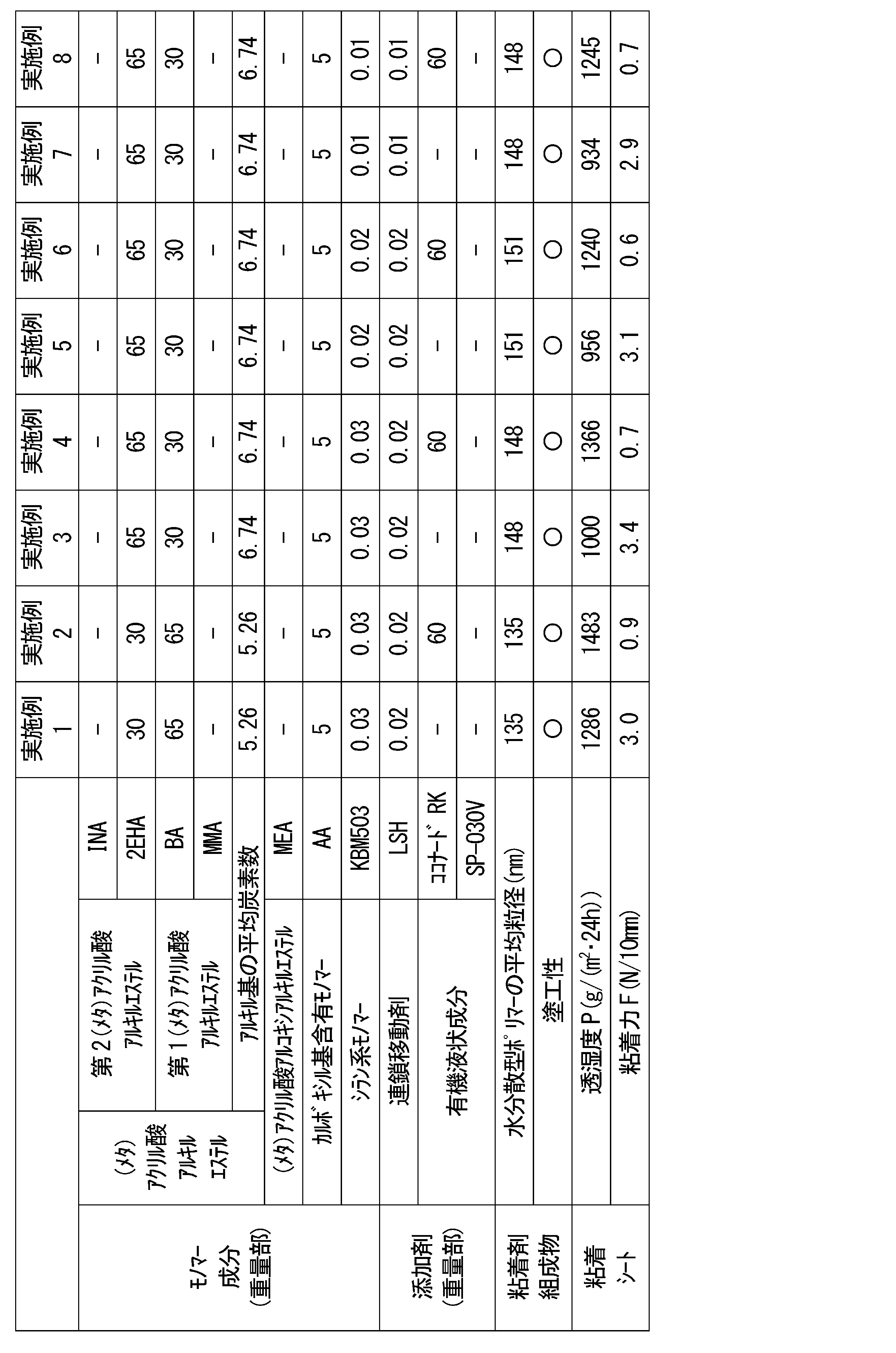
- Example 1 In a vessel were placed 30 parts by weight of 2-ethylhexyl acrylate (2EHA), 65 parts by weight of butyl acrylate (BA), 5 parts by weight of acrylic acid (AA), 0.03 parts by weight of 3-methacryloyloxypropyltrimethoxysilane (KBM-503, manufactured by Shin-Etsu Silicones Co., Ltd.) as monomer components, 0.02 parts by weight of 1-dodecanethiol (LSH) as a chain transfer agent, 2 parts by weight of polyoxyethylene-1-(allyloxymethyl) alkyl ether sulfate ester ammonium salt as an emulsifier, and 52.68 parts by weight of water, and the monomer components were emulsified by stirring using a homomixer. This produced a monomer emulsion.
- 2EHA 2-ethylhexyl acrylate
- BA butyl acrylate
- acrylic acid AA
- KBM-503 3-methacrylo
- the adhesive composition was then applied to a release liner (PET-50-SCA1, manufactured by Fujiko Co., Ltd.) so that the thickness after drying was 25 ⁇ m, creating a coating film.
- This coating film was dried at 130°C for 3 minutes to form an adhesive layer (thickness 25 ⁇ m).
- the adhesive layer was bonded to a substrate to obtain the adhesive sheet of Example 1.
- a polyurethane film (thickness 30 ⁇ m) (Esmer URS210, manufactured by Nihon Matai Co., Ltd.) was used as the substrate.
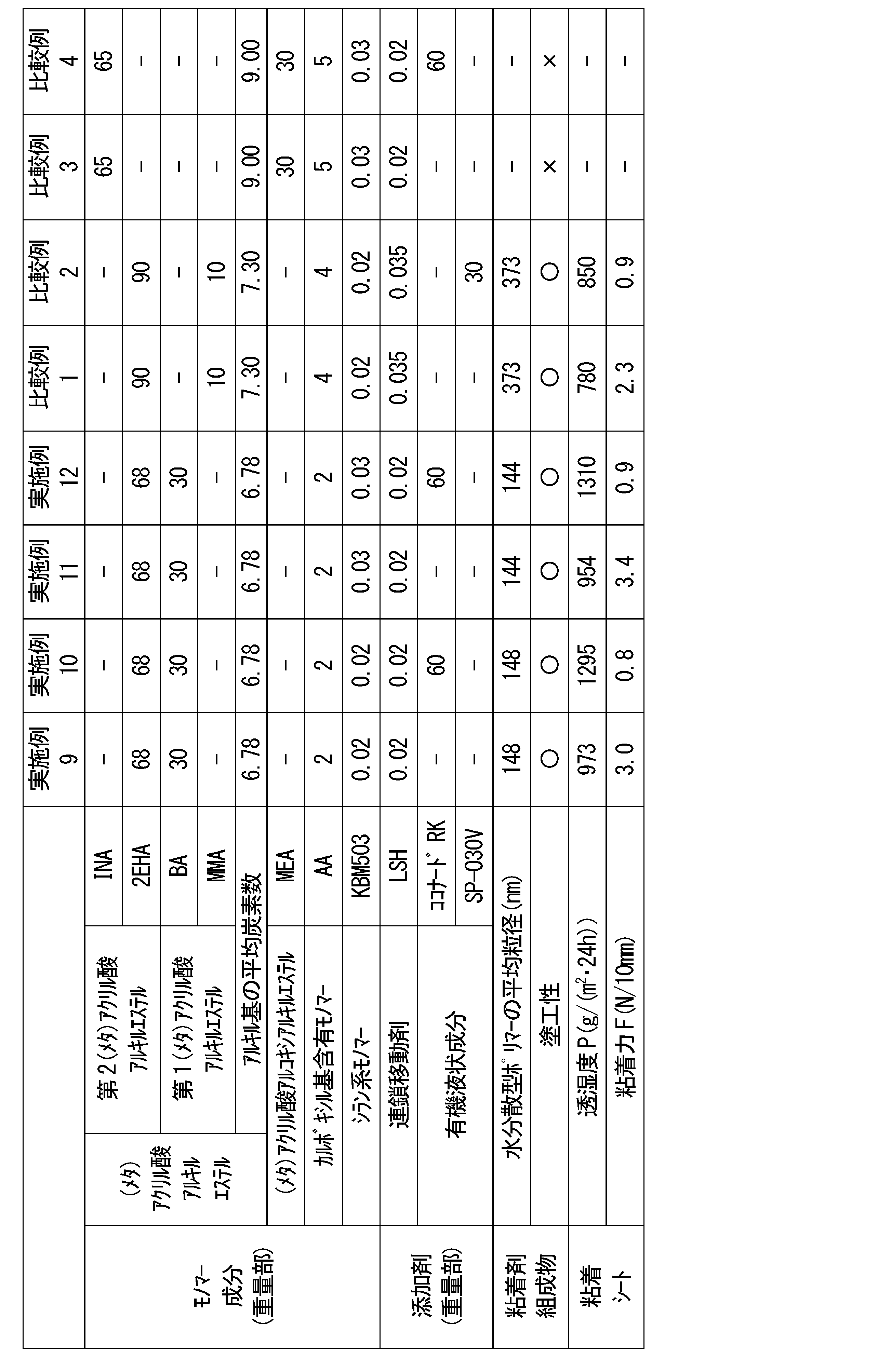
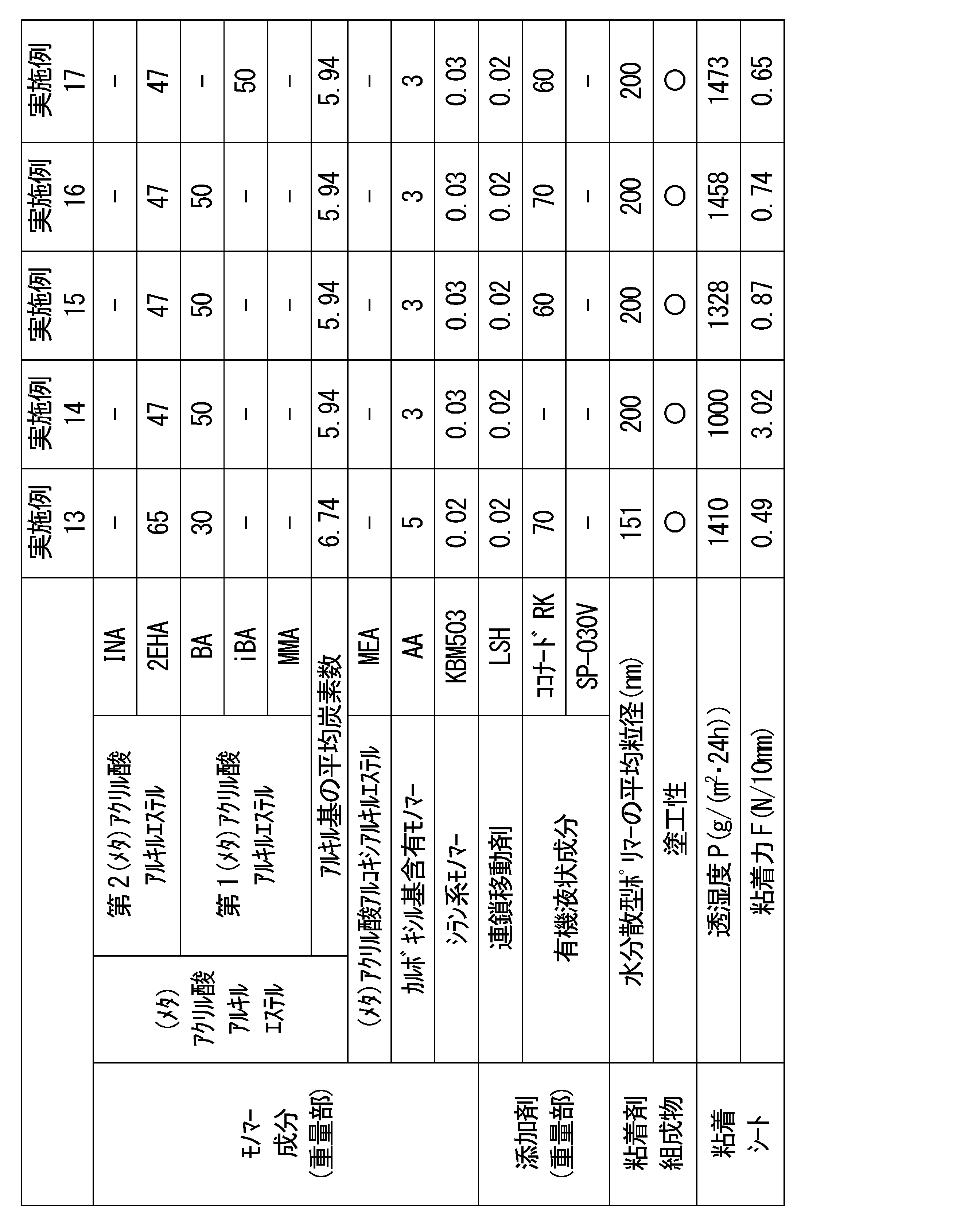
- Examples 2 to 17 and Comparative Examples 1 and 2 Except for changing the types and amounts of monomer components and additives as shown in Tables 1 to 3, pressure-sensitive adhesive sheets of Examples 2 to 17 and Comparative Examples 1 and 2 were produced by the same method as Example 1. Note that in Examples 2, 4, 6, 8, 10, 12, 13, 15 to 17 and Comparative Example 2, the pressure-sensitive adhesive composition was prepared by adding an organic liquid component to the dispersion after adding aqueous ammonia to the dispersion. In these examples, the organic liquid component was compatible with the water-dispersed polymer in the pressure-sensitive adhesive composition, and separation could not be confirmed by visual inspection.
- Comparative Examples 3 to 4 pressure-sensitive adhesive compositions were prepared by the same method as in Example 1, except that the types and amounts of monomer components and additives were changed as shown in Table 2. However, in Comparative Examples 3 and 4, the viscosity of the pressure-sensitive adhesive composition excessively increased when aqueous ammonia was added, so that the pressure-sensitive adhesive composition could not be applied to the release liner, and a pressure-sensitive adhesive sheet could not be produced.
- the moisture permeability of the pressure-sensitive adhesive sheets prepared in the examples and comparative examples was measured by the above-mentioned method.
- the thickness of the pressure-sensitive adhesive layer was 25 ⁇ m
- the substrate was a polyurethane film with a thickness of 30 ⁇ m. Therefore, the measured moisture permeability can be regarded as the moisture permeability P of the pressure-sensitive adhesive layer 1.
- Adhesive strength F of the pressure-sensitive adhesive sheets of the Examples and Comparative Examples was measured by the method described above.
- INA Isononyl acrylate 2EHA: 2-ethylhexyl acrylate BA: n-butyl acrylate iBA: isobutyl acrylate MMA: methyl methacrylate MEA: methoxyethyl acrylate AA: acrylic acid
- KBM503 3-methacryloyloxypropyltrimethoxysilane (manufactured by Shin-Etsu Silicone Co., Ltd., KBM-503)
- LSH 1-dodecanethiol Coconard RK: glyceryl tricaprylate (manufactured by Kao Corporation, Coconard RK)
- SP-O30V Sorbitan trioleate (Kao Corporation, Rheodol SP-O30V)
- the pressure-sensitive adhesive layers of the pressure-sensitive adhesive sheets of Examples 1 to 17 had moisture permeabilities P of 900 g/( m2 ⁇ 24 h) or more. According to studies by the present inventors, the pressure-sensitive adhesive sheets of the Examples, when applied to the skin, tended to suppress stuffiness of the skin compared to the Comparative Examples, thereby suppressing skin rash.
- Reference Example 1 The adhesive composition of Reference Example 1 was prepared in the same manner as in Example 2, except that when preparing the monomer emulsion, the amount of 3-methacryloyloxypropyltrimethoxysilane used was changed to 0.02 parts by weight, and when preparing a dispersion containing a water-dispersible polymer, the monomer emulsion was not charged in advance into the reaction vessel, but the entire amount of the monomer emulsion to be used was added dropwise after the polymerization initiator was charged.
- the average particle size of the water-dispersible polymer particles was 433 nm.
- the organic liquid component was not sufficiently compatible with the water-dispersible polymer, and separation was confirmed by visual inspection.
- Example 2 and Reference Example 1 show that when the average particle size of the water-dispersible polymer particles is small, at about 200 nm or less, the compatibility between the water-dispersible polymer and the organic liquid component tends to be good.
- the adhesive sheet of this embodiment can be used by attaching it to an object such as the skin.
Landscapes
- Chemical & Material Sciences (AREA)
- Organic Chemistry (AREA)
- Chemical Kinetics & Catalysis (AREA)
- Adhesives Or Adhesive Processes (AREA)
Abstract
Description
水分散型ポリマーを含む粘着剤組成物から形成された粘着剤層を備え、
下記試験により求めた前記粘着剤層の透湿度が900g/(m2・24h)以上である、粘着シートを提供する。
試験:厚さ25μmの前記粘着剤層、及び厚さ30μmのポリウレタンフィルムから構成された積層体を作製する。水を収容しているガラス容器の開口を閉じるように、前記積層体を前記ガラス容器に貼り付ける。前記ガラス容器を温度40℃、湿度30%RHの条件で24時間放置し、前記ガラス容器の内部から前記積層体を透過した水の重量を特定する。前記開口の開口面積(m2)に対する前記重量(g)の比を前記透湿度として特定する。
水分散型ポリマーを含む粘着剤組成物から形成された粘着剤層を備え、
下記試験により求めた前記粘着剤層の透湿度が900g/(m2・24h)以上である。
試験:厚さ25μmの前記粘着剤層、及び厚さ30μmのポリウレタンフィルムから構成された積層体を作製する。水を収容しているガラス容器の開口を閉じるように、前記積層体を前記ガラス容器に貼り付ける。前記ガラス容器を温度40℃、湿度30%RHの条件で24時間放置し、前記ガラス容器の内部から前記積層体を透過した水の重量を特定する。前記開口の開口面積(m2)に対する前記重量(g)の比を前記透湿度として特定する。
試験:厚さ25μmの粘着剤層1、及び厚さ30μmのポリウレタンフィルムから構成された積層体を作製する。水を収容しているガラス容器の開口を閉じるように、積層体をガラス容器に貼り付ける。ガラス容器を温度40℃、湿度30%RHの条件で24時間放置し、ガラス容器の内部から積層体を透過した水の重量を特定する。開口の開口面積(m2)に対する当該重量(g)の比を透湿度Pとして特定する。
上述のとおり、粘着剤層1は、水分散型ポリマーを含む粘着剤組成物から形成されている。粘着剤組成物において、水分散型ポリマーは、水中で乳化しており、粒子の形状を有する。言い換えると、粘着剤組成物は、水分散型ポリマーの粒子を含む。水分散型ポリマーの粒子は、水中で凝集しておらず、単一粒子(一次粒子)として存在していてもよく、水中で凝集して凝集体を形成していてもよい。この粒子は、コアと当該コアを被覆するシェルとを有するコアシェル型であってもよい。
本発明は、その別の側面から、
水分散型ポリマーを含む粘着剤組成物から形成された粘着剤層1を備え、
水分散型ポリマーは、(メタ)アクリル酸アルキルエステルに由来する構成単位を有する(メタ)アクリル系ポリマーであり、
(メタ)アクリル酸アルキルエステルが有するアルキル基の平均炭素数が7.0以下である、粘着シートを提供する。
基材2は、例えば、粘着剤層1を支持する層状の部材である。基材2は、単層であってもよく、複数の層を有する積層体であってもよい。粘着シート10を皮膚に貼り付けたときの皮膚の蒸れを抑制する観点から、基材2は、粘着剤層1に比べて十分に高い透湿性を有していることが好ましい。
はく離ライナー3としては、公知のものを適宜使用することができる。はく離ライナー3は、例えば、ライナー基材と、ライナー基材の一方の面に形成された離型層とを備える。ライナー基材の材料としては、基材2について上述したものが挙げられる。離型層は、ライナー基材の表面に剥離処理剤を付与することによって形成することができる。剥離処理剤としては、シリコーン系剥離処理剤、長鎖アルキル系剥離処理剤、フッ素剥離処理剤、硫化モリブデン系剥離処理剤などが挙げられる。
本実施形態の粘着シート10は、例えば、次の方法によって製造することができる。まず、はく離ライナー3の上に、水分散型ポリマーを含む粘着剤組成物を塗布し、塗布膜を形成する。粘着剤組成物の塗布方法は、特に限定されず、例えば、スピンコート法、ディップコート法などを利用できる。ワイヤーバーなどを利用して粘着剤組成物を塗布してもよい。
粘着剤層1を備える粘着シート10は、透湿度が高い傾向がある。粘着シート10の透湿度は、例えば900g/(m2・24h)以上であり、930g/(m2・24h)以上、950g/(m2・24h)以上、980g/(m2・24h)以上、1000g/(m2・24h)以上、1100g/(m2・24h)以上、1200g/(m2・24h)以上、1300g/(m2・24h)以上、さらには1400g/(m2・24h)以上であってもよい。粘着シート10の透湿度の上限は、特に限定されず、例えば5000g/(m2・24h)以下であり、3000g/(m2・24h)以下であってもよい。粘着シート10の透湿度は、ポリウレタンフィルム5及び粘着剤層1の積層体20に代えて、はく離ライナー3を取り除いた粘着シート10を用いることを除き、上記の透湿度Pと同じ方法によって測定することができる。
本実施形態の粘着シート10は、典型的には、医療用である。粘着シート10は、具体的には、粘着包帯、サージカルテープ、救急絆創膏、大型絆創膏、ドレッシング材、パップ剤、ドレープ材などに利用することができる。粘着シート10は、粘着剤層1に薬剤を担持させることによって、経皮吸収製剤として利用することも可能である。なお、粘着シート10は、医療以外の用途に用いてもよい。
容器に、モノマー成分として、アクリル酸2-エチルヘキシル(2EHA)30重量部、アクリル酸ブチル(BA)65重量部、アクリル酸(AA)5重量部及び3-メタクリロイルオキシプロピルトリメトキシシラン(信越シリコーン社製、KBM-503)0.03重量部、連鎖移動剤としての1-ドデカンチオール(LSH)0.02重量部、乳化剤としてのポリオキシエチレン-1-(アリルオキシメチル)アルキルエーテル硫酸エステルアンモニウム塩2重量部、並びに、水52.68重量部を入れ、ホモミキサーを用いて撹拌することによって、モノマー成分を乳化させた。これにより、モノマーエマルションを得た。
モノマー成分及び添加剤の種類、配合量を表1~3のように変更したことを除き、実施例1と同じ方法によって、実施例2~17及び比較例1~2の粘着シートを作製した。なお、実施例2、4、6、8、10、12、13、15~17及び比較例2では、アンモニア水を分散液に添加した後に、有機液状成分を分散液に加えて粘着剤組成物を調製した。これらの例では、粘着剤組成物において、有機液状成分が水分散型ポリマーと相溶しており、目視にて分離が確認できない状態であった。
比較例3~4では、モノマー成分及び添加剤の種類、配合量を表2のように変更したことを除き、実施例1と同じ方法によって粘着剤組成物を調製した。しかし、比較例3~4では、アンモニア水を添加した時点で粘着剤組成物の粘度が過度に上昇したため、粘着剤組成物をはく離ライナーに塗布することができず、粘着シートを作製することができなかった。
実施例及び比較例で作製した粘着剤組成物において、水分散型ポリマーの粒子の平均粒径を測定した。
実施例及び比較例で作製した粘着剤組成物の塗工性を下記基準により評価した。
・評価基準
〇:粘着剤組成物の粘度が、pH7.0、温度25℃の条件で500mPa・s以下であり、問題なく塗工できる。
×:粘着剤組成物の粘度が、pH7.0、温度25℃の条件で500mPa・sを上回り、塗工性に問題がある。
実施例及び比較例で作製した粘着シートについて、上述の方法によって透湿度を測定した。なお、実施例及び比較例では、粘着剤層の厚さが25μmであり、かつ、基材が厚さ30μmのポリウレタンフィルムである。そのため、測定した透湿度は、粘着剤層1の透湿度Pとみなすことができる。
実施例及び比較例の粘着シートについて、上述の方法によって粘着力Fを測定した。
INA:アクリル酸イソノニル
2EHA:アクリル酸2-エチルヘキシル
BA:アクリル酸n-ブチル
iBA:アクリル酸イソブチル
MMA:メタクリル酸メチル
MEA:アクリル酸メトキシエチルエステル
AA:アクリル酸
KBM503:3-メタクリロイルオキシプロピルトリメトキシシラン(信越シリコーン社製、KBM-503)
LSH:1-ドデカンチオール
ココナードRK:トリカプリル酸グリセリル(花王社製、ココナードRK)
SP-O30V:トリオレイン酸ソルビタン(花王社製、レオドールSP-O30V)
モノマーエマルションを作製するときに、3-メタクリロイルオキシプロピルトリメトキシシランの使用量を0.02重量部に変更したこと、及び、水分散型ポリマーを含む分散液を作製するときに、反応容器にモノマーエマルションを予め投入せずに、重合開始剤の投入後に、使用するモノマーエマルションの全量を滴下したことを除き、実施例2と同じ方法によって、参考例1の粘着剤組成物を作製した。
Claims (16)
- 水分散型ポリマーを含む粘着剤組成物から形成された粘着剤層を備え、
下記試験により求めた前記粘着剤層の透湿度が900g/(m2・24h)以上である、粘着シート。
試験:厚さ25μmの前記粘着剤層、及び厚さ30μmのポリウレタンフィルムから構成された積層体を作製する。水を収容しているガラス容器の開口を閉じるように、前記積層体を前記ガラス容器に貼り付ける。前記ガラス容器を温度40℃、湿度30%RHの条件で24時間放置し、前記ガラス容器の内部から前記積層体を透過した水の重量を特定する。前記開口の開口面積(m2)に対する前記重量(g)の比を前記透湿度として特定する。 - 前記水分散型ポリマーが(メタ)アクリル系ポリマーである、請求項1に記載の粘着シート。
- 前記(メタ)アクリル系ポリマーは、(メタ)アクリル酸アルキルエステルに由来する構成単位を有する、請求項2に記載の粘着シート。
- 前記(メタ)アクリル酸アルキルエステルが有するアルキル基の平均炭素数が7.0以下である、請求項3に記載の粘着シート。
- 前記(メタ)アクリル酸アルキルエステルは、炭素数1~7のアルキル基を有する第1(メタ)アクリル酸アルキルエステルを含む、請求項3に記載の粘着シート。
- 前記(メタ)アクリル酸アルキルエステルは、前記第1(メタ)アクリル酸アルキルエステルとして、アクリル酸n-ブチル及びアクリル酸イソブチルからなる群より選ばれる少なくとも1つを含む、請求項5に記載の粘着シート。
- 前記(メタ)アクリル酸アルキルエステルは、炭素数8~12のアルキル基を有する第2(メタ)アクリル酸アルキルエステルをさらに含む、請求項5に記載の粘着シート。
- 前記(メタ)アクリル系ポリマーは、カルボキシル基含有モノマーに由来する構成単位を有する、請求項2に記載の粘着シート。
- 前記(メタ)アクリル系ポリマーは、シラン系モノマーに由来する構成単位を有する、請求項2に記載の粘着シート。
- 前記粘着剤組成物は、分散媒として水を含む、請求項1に記載の粘着シート。
- 前記粘着剤組成物が界面活性剤を含む、請求項1に記載の粘着シート。
- 前記粘着剤組成物が有機液状成分を含む、請求項1に記載の粘着シート。
- 前記有機液状成分がトリカプリル酸グリセリルを含む、請求項12に記載の粘着シート。
- 前記粘着剤組成物が前記水分散型ポリマーの粒子を含み、
前記粒子の平均粒径が200nm以下である、請求項1に記載の粘着シート。 - 前記粘着剤層を支持する基材をさらに備えた、請求項1に記載の粘着シート。
- 医療用である、請求項1に記載の粘着シート。
Priority Applications (3)
| Application Number | Priority Date | Filing Date | Title |
|---|---|---|---|
| CN202480037230.7A CN121263493A (zh) | 2023-06-09 | 2024-05-31 | 粘合片 |
| JP2025526083A JPWO2024253026A1 (ja) | 2023-06-09 | 2024-05-31 | |
| EP24819256.9A EP4726006A1 (en) | 2023-06-09 | 2024-05-31 | Pressure-sensitive adhesive sheet |
Applications Claiming Priority (2)
| Application Number | Priority Date | Filing Date | Title |
|---|---|---|---|
| JP2023-095667 | 2023-06-09 | ||
| JP2023095667 | 2023-06-09 |
Publications (1)
| Publication Number | Publication Date |
|---|---|
| WO2024253026A1 true WO2024253026A1 (ja) | 2024-12-12 |
Family
ID=93795982
Family Applications (1)
| Application Number | Title | Priority Date | Filing Date |
|---|---|---|---|
| PCT/JP2024/019971 Ceased WO2024253026A1 (ja) | 2023-06-09 | 2024-05-31 | 粘着シート |
Country Status (5)
| Country | Link |
|---|---|
| EP (1) | EP4726006A1 (ja) |
| JP (1) | JPWO2024253026A1 (ja) |
| CN (1) | CN121263493A (ja) |
| TW (1) | TW202500701A (ja) |
| WO (1) | WO2024253026A1 (ja) |
Citations (6)
| Publication number | Priority date | Publication date | Assignee | Title |
|---|---|---|---|---|
| JP2003129013A (ja) * | 2001-10-29 | 2003-05-08 | Nitto Denko Corp | 粘着シートの製造方法及び医療用粘着シート |
| JP2006213603A (ja) | 2005-02-01 | 2006-08-17 | Lintec Corp | 皮膚貼付用粘着剤組成物および皮膚貼付用粘着シート |
| JP2008001679A (ja) * | 2006-05-24 | 2008-01-10 | Nitto Denko Corp | 医療用粘着剤及び医療用粘着テープ又はシート |
| JP2015188500A (ja) * | 2014-03-27 | 2015-11-02 | ニチバン株式会社 | ハイドロコロイド型粘着剤組成物及びこれを使用した創傷材 |
| JP2019047961A (ja) * | 2017-09-11 | 2019-03-28 | 東洋インキScホールディングス株式会社 | 皮膚貼付用粘着剤および皮膚貼付シート |
| JP2019115403A (ja) * | 2017-12-26 | 2019-07-18 | 東洋インキScホールディングス株式会社 | 医療用粘着剤、医療用粘着剤の製造方法、および医療用粘着シート |
-
2024
- 2024-05-31 WO PCT/JP2024/019971 patent/WO2024253026A1/ja not_active Ceased
- 2024-05-31 EP EP24819256.9A patent/EP4726006A1/en active Pending
- 2024-05-31 JP JP2025526083A patent/JPWO2024253026A1/ja active Pending
- 2024-05-31 TW TW113120147A patent/TW202500701A/zh unknown
- 2024-05-31 CN CN202480037230.7A patent/CN121263493A/zh active Pending
Patent Citations (6)
| Publication number | Priority date | Publication date | Assignee | Title |
|---|---|---|---|---|
| JP2003129013A (ja) * | 2001-10-29 | 2003-05-08 | Nitto Denko Corp | 粘着シートの製造方法及び医療用粘着シート |
| JP2006213603A (ja) | 2005-02-01 | 2006-08-17 | Lintec Corp | 皮膚貼付用粘着剤組成物および皮膚貼付用粘着シート |
| JP2008001679A (ja) * | 2006-05-24 | 2008-01-10 | Nitto Denko Corp | 医療用粘着剤及び医療用粘着テープ又はシート |
| JP2015188500A (ja) * | 2014-03-27 | 2015-11-02 | ニチバン株式会社 | ハイドロコロイド型粘着剤組成物及びこれを使用した創傷材 |
| JP2019047961A (ja) * | 2017-09-11 | 2019-03-28 | 東洋インキScホールディングス株式会社 | 皮膚貼付用粘着剤および皮膚貼付シート |
| JP2019115403A (ja) * | 2017-12-26 | 2019-07-18 | 東洋インキScホールディングス株式会社 | 医療用粘着剤、医療用粘着剤の製造方法、および医療用粘着シート |
Also Published As
| Publication number | Publication date |
|---|---|
| CN121263493A (zh) | 2026-01-02 |
| EP4726006A1 (en) | 2026-04-15 |
| TW202500701A (zh) | 2025-01-01 |
| JPWO2024253026A1 (ja) | 2024-12-12 |
Similar Documents
| Publication | Publication Date | Title |
|---|---|---|
| KR101442286B1 (ko) | 경피 흡수 제제 | |
| CN104922721A (zh) | 皮肤贴合带或片 | |
| CN101077422B (zh) | 医用胶粘剂和医用胶粘带或胶粘片 | |
| EP1148106B1 (en) | Pressure-sensitive adhesive composition and moisture-permeable pressure-sensitive adhesive tape, pressure-sensitive adhesive drug composition, and pressure-sensitive adhesive tape preparation each containing the composition | |
| US20130022734A1 (en) | Production method for medical pressure-sensitive adhesive tape or sheet | |
| JP2000044904A (ja) | アクリル系粘着テープおよび経皮吸収製剤 | |
| JP2009261727A (ja) | 医療用粘着組成物及び粘着テープもしくはシート | |
| JPH03291217A (ja) | ニトログリセリン貼付剤 | |
| TWI741168B (zh) | 經皮吸收製劑 | |
| TWI825121B (zh) | 黏著劑組合物及貼附劑 | |
| JP5818709B2 (ja) | 貼付製剤 | |
| JP2012219055A (ja) | 貼付製剤およびその包装体 | |
| JP2012180332A (ja) | 貼付剤および貼付製剤 | |
| CN101411694A (zh) | 贴片制剂 | |
| JP4988306B2 (ja) | 医療用粘着剤及び医療用粘着テープ又はシート | |
| US20250297142A1 (en) | Pressure-sensitive adhesive composition and pressure-sensitive adhesive sheet | |
| EP4726006A1 (en) | Pressure-sensitive adhesive sheet | |
| CN101627980A (zh) | 贴剂和贴剂制剂 | |
| JP4970888B2 (ja) | 医療用粘着剤及び医療用粘着テープ又はシート | |
| JP4527949B2 (ja) | 粘着テープ | |
| JP2011254909A (ja) | 医療用粘着テープまたはシート | |
| CN105517543A (zh) | 含有比索洛尔的贴剂及其包装体 | |
| JP2010241746A (ja) | 貼付剤および貼付製剤 | |
| HK1116099B (en) | Medical tape preparation | |
| HK1116099A1 (en) | Medical tape preparation |
Legal Events
| Date | Code | Title | Description |
|---|---|---|---|
| 121 | Ep: the epo has been informed by wipo that ep was designated in this application |
Ref document number: 24819256 Country of ref document: EP Kind code of ref document: A1 |
|
| ENP | Entry into the national phase |
Ref document number: 2025526083 Country of ref document: JP Kind code of ref document: A |
|
| WWE | Wipo information: entry into national phase |
Ref document number: 2025526083 Country of ref document: JP |
|
| WWE | Wipo information: entry into national phase |
Ref document number: 2024819256 Country of ref document: EP |
|
| NENP | Non-entry into the national phase |
Ref country code: DE |
|
| ENP | Entry into the national phase |
Ref document number: 2024819256 Country of ref document: EP Effective date: 20260109 |
|
| ENP | Entry into the national phase |
Ref document number: 2024819256 Country of ref document: EP Effective date: 20260109 |
|
| ENP | Entry into the national phase |
Ref document number: 2024819256 Country of ref document: EP Effective date: 20260109 |
|
| WWP | Wipo information: published in national office |
Ref document number: 2024819256 Country of ref document: EP |