WO2024247899A1 - 眼科装置 - Google Patents
眼科装置 Download PDFInfo
- Publication number
- WO2024247899A1 WO2024247899A1 PCT/JP2024/019122 JP2024019122W WO2024247899A1 WO 2024247899 A1 WO2024247899 A1 WO 2024247899A1 JP 2024019122 W JP2024019122 W JP 2024019122W WO 2024247899 A1 WO2024247899 A1 WO 2024247899A1
- Authority
- WO
- WIPO (PCT)
- Prior art keywords
- eye
- subject
- light beam
- optical system
- alignment index
- Prior art date
- Legal status (The legal status is an assumption and is not a legal conclusion. Google has not performed a legal analysis and makes no representation as to the accuracy of the status listed.)
- Ceased
Links
Images







Classifications
-
- A—HUMAN NECESSITIES
- A61—MEDICAL OR VETERINARY SCIENCE; HYGIENE
- A61B—DIAGNOSIS; SURGERY; IDENTIFICATION
- A61B3/00—Apparatus for testing the eyes; Instruments for examining the eyes
- A61B3/10—Objective types, i.e. instruments for examining the eyes independent of the patients' perceptions or reactions
- A61B3/14—Arrangements specially adapted for eye photography
- A61B3/15—Arrangements specially adapted for eye photography with means for aligning, spacing or blocking spurious reflection ; with means for relaxing
- A61B3/152—Arrangements specially adapted for eye photography with means for aligning, spacing or blocking spurious reflection ; with means for relaxing for aligning
-
- A—HUMAN NECESSITIES
- A61—MEDICAL OR VETERINARY SCIENCE; HYGIENE
- A61B—DIAGNOSIS; SURGERY; IDENTIFICATION
- A61B3/00—Apparatus for testing the eyes; Instruments for examining the eyes
- A61B3/0091—Fixation targets for viewing direction
-
- A—HUMAN NECESSITIES
- A61—MEDICAL OR VETERINARY SCIENCE; HYGIENE
- A61B—DIAGNOSIS; SURGERY; IDENTIFICATION
- A61B3/00—Apparatus for testing the eyes; Instruments for examining the eyes
- A61B3/02—Subjective types, i.e. testing apparatus requiring the active assistance of the patient
- A61B3/028—Subjective types, i.e. testing apparatus requiring the active assistance of the patient for testing visual acuity; for determination of refraction, e.g. phoropters
- A61B3/032—Devices for presenting test symbols or characters, e.g. test chart projectors
-
- A—HUMAN NECESSITIES
- A61—MEDICAL OR VETERINARY SCIENCE; HYGIENE
- A61B—DIAGNOSIS; SURGERY; IDENTIFICATION
- A61B3/00—Apparatus for testing the eyes; Instruments for examining the eyes
- A61B3/10—Objective types, i.e. instruments for examining the eyes independent of the patients' perceptions or reactions
- A61B3/103—Objective types, i.e. instruments for examining the eyes independent of the patients' perceptions or reactions for determining refraction, e.g. refractometers, skiascopes
-
- A—HUMAN NECESSITIES
- A61—MEDICAL OR VETERINARY SCIENCE; HYGIENE
- A61B—DIAGNOSIS; SURGERY; IDENTIFICATION
- A61B3/00—Apparatus for testing the eyes; Instruments for examining the eyes
- A61B3/10—Objective types, i.e. instruments for examining the eyes independent of the patients' perceptions or reactions
- A61B3/12—Objective types, i.e. instruments for examining the eyes independent of the patients' perceptions or reactions for looking at the eye fundus, e.g. ophthalmoscopes
Definitions
- This disclosure relates to an ophthalmic device for examining a subject's eye.
- a subjective ophthalmological examination device that subjectively measures the optical characteristics of the subject's eye
- other known ophthalmic devices include an ocular refractive power measurement device that objectively measures the optical characteristics of the subject's eye.
- the relative positional relationship between the test eye and the ophthalmic device is adjusted (i.e., alignment) by detecting the test eye.
- the corneal apex position is detected using an alignment bright spot projected onto the test eye, and the alignment is automatically adjusted by moving the measurement unit based on the positional deviation between the corneal apex position and the alignment reference position.
- the technical objective of this disclosure is to provide an ophthalmic device that can easily align the subject's eye.
- An ophthalmic device includes an optotype presenting optical system that projects a visual target light beam toward a test eye to present a visual target to the test eye, and an alignment index presenting optical system that projects an alignment index toward a fundus of the test eye to present an alignment index to the test eye and presents an alignment index light beam to be observed by a test subject, wherein the visual target light beam of the optotype presenting optical system passes through a first region on a pupil plane of the test eye, and the alignment index light beam of the alignment index presenting optical system passes through a second region on the pupil plane of the test eye that is different from the first region, and the second region includes at least a region outer than the first region.
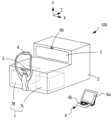
- FIG. 1 is an external view of an ophthalmologic apparatus.
- FIG. 13 is a diagram showing a measurement unit for the left eye.
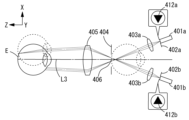
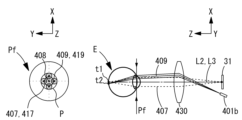
- FIG. 4 is a ray diagram of an alignment target presenting optical system. 4 is a diagram showing the positional relationship between an alignment index light beam and a visual target light beam.
- FIG. 1 is a schematic configuration diagram of the inside of an ophthalmologic apparatus as viewed from the front.
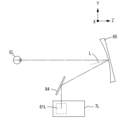
- 2 is a schematic configuration diagram of the inside of the ophthalmologic apparatus as viewed from the side.
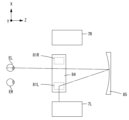
- FIG. 2 is a schematic configuration diagram of the inside of the ophthalmologic apparatus as viewed from above.
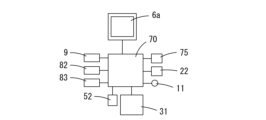
- FIG. FIG. 2 is a diagram illustrating a control system of the ophthalmic apparatus.
- the state in which the subject's eye E is properly aligned is shown. 13 shows a state in which the alignment of the subject's eye E is slightly deviated. This shows a state in which the alignment of the subject's eye E is significantly misaligned. The state in which the subject's eye E is properly aligned is shown. 13 shows a state in which the alignment of the subject's eye E is slightly deviated. This shows a state in which the alignment of the subject's eye E is significantly misaligned.
- the first region of the target light beam completely overlaps with the second region of the alignment index light beam.
- the first region of the target light beam does not overlap with the second region of the alignment index light beam.
- the first region of the target light beam partially overlaps with the second region of the alignment index light beam.
- the ophthalmologic apparatus in this embodiment may be an apparatus for examining an eye to be examined.
- the ophthalmic device may be a device that examines the subject's eye by measuring the subject's eye.
- the ophthalmic device may be a subjective ophthalmic examination device for subjectively measuring the optical characteristics of the subject's eye.
- the ophthalmic device may be an objective ophthalmic examination device for objectively measuring the optical characteristics of the subject's eye.
- the optical characteristics of the subject's eye may be the ocular refractive power of the subject's eye (for example, at least one of spherical power, cylindrical power, astigmatism axis angle, etc.).
- the ophthalmic device may be a device that examines the subject's eye by photographing the subject's eye.
- it may be an ophthalmic imaging device that photographs the anterior segment of the subject's eye to obtain anterior segment image data of the subject's eye, the corneal shape of the subject's eye, etc.
- it may be an ophthalmic imaging device that photographs the fundus of the subject's eye to obtain frontal fundus image data of the subject's eye, tomographic fundus image data of the subject's eye, etc.
- the ophthalmologic apparatus in this embodiment may include a target presenting optical system (e.g., a target presenting optical system 26).
- a target presenting optical system e.g., a target presenting optical system 26
- the target presenting optical system projects a target light beam toward the subject's eye in order to present a target to the subject's eye.
- the optotype presenting optical system may include an optotype presenting unit that presents an optotype (for example, at least one of a fixation target, a test target, etc.) to the subject's eye.
- the optotype presenting unit may include a visible light source for presenting the optotype.
- the optotype presenting unit may be a light source and an optotype plate.
- the optotype presenting unit may be a light source and a DMD (Digital Micromirror Device).
- the optotype presenting unit may be a display.
- the display may be an LCD (Liquid Crystal Display), an organic EL (Electro Luminescence) display, or the like.
- the display may be a light field display that can reproduce light rays emitted by an object (for example, light rays reflected by an object) by emitting different light from each pixel group unit for each direction.
- the ophthalmologic apparatus in this embodiment may include an alignment index presenting optical system (e.g., the alignment index presenting optical system 45).
- the alignment index presenting optical system projects an alignment index light beam toward the fundus of the subject's eye, and presents the alignment index to be observed by the subject.
- the alignment index presenting optical system may include an alignment index presenting section that presents an alignment index to the subject's eye.
- the alignment index presenting section may include a visible light source for presenting the alignment index.
- the alignment index presenting section may be a display (examples include LCD, organic EL, light field display, etc.).
- the alignment index presenting optical system may have one or more optical members for guiding the alignment index light beam from the alignment index presenting section.
- the alignment index presenting optical system may have one alignment index presenting unit.
- the alignment index light beam may be projected as one light beam from the alignment index presenting unit.
- the alignment index light beam may be projected as one light beam from the alignment index presenting unit, and further split into multiple alignment index light beams via a light beam splitting member.
- the light beam splitting member may be at least one of a lens array, a light shielding mask, and the like.
- the light beam splitting member may be disposed at a pupil conjugate position (approximately a pupil conjugate position).
- the alignment index presenting optical system may have multiple alignment index presenting units.
- an alignment index light beam may be projected from each alignment index presenting unit.
- multiple alignment index light beams may be projected.
- the alignment index presenting section of the alignment index presenting optical system and the optotype presenting section of the optotype presenting optical system may be provided as different presenting sections.
- the alignment index presenting section of the alignment index presenting optical system and the optotype presenting section of the optotype presenting optical system may be provided as a common presenting section. In other words, the alignment index presenting section and the optotype presenting section may be shared.
- the alignment index presenting optical system may present an alignment index to at least make the subject recognize that a positional misalignment (alignment misalignment) has occurred between the subject and the ophthalmic device.
- the alignment index presenting optical system may present an alignment index so that the subject can identify the alignment index depending on the alignment misalignment between the subject and the ophthalmic device.
- the alignment index presenting optical system may present an alignment index so that the appearance of the alignment index identified by the subject changes.
- the alignment index presenting optical system may present an alignment index so that whether or not the subject can observe the alignment index changes depending on the alignment misalignment between the subject and the ophthalmic device.
- the alignment index presenting optical system may present an alignment index so that at least one state of the brightness, saturation, contrast, etc. of the alignment index identified by the subject changes depending on the alignment misalignment between the subject and the ophthalmic device.
- the alignment index presenting optical system may present an alignment index as a guide index that allows the subject to recognize the direction in which to move the subject's eye, in addition to making the subject aware that an alignment misalignment has occurred.
- the alignment index presenting optical system may present an alignment index (e.g., a guide index) so that whether or not the subject can observe an alignment index indicating a specific direction changes depending on the alignment misalignment between the subject and the ophthalmic device.
- the alignment index presenting optical system may indicate the direction in which the subject moves the subject's eye by the shape of the alignment index (guide index).
- the alignment index may be shaped to have a specific directionality.
- the alignment index may be triangular, with the direction indicated by the apex of the triangle.
- the alignment index may be arrow-shaped.
- the alignment index may be shaped differently from a triangular shape or an arrow shape.
- the alignment index presenting optical system may indicate the direction in which the subject should move the subject's eye by using a symbol contained in the alignment index (guide index).
- the alignment index may be, for example, a character representing a specific direction (such as "right” as an example) or an icon representing a specific direction.
- the alignment index presenting optical system may indicate the direction in which the subject should move the subject's eye by the color of the alignment index (guide index).
- the alignment index may be configured so that the color it appears changes depending on a specific direction.
- the alignment index presenting optical system may be configured to enable the subject to recognize alignment deviations.
- the alignment index presenting optical system may project an alignment index light beam from the alignment index presenting section and present an image of the alignment target light beam (in other words, an alignment index image) to the subject.
- the alignment index presenting optical system may be configured to enable the subject to recognize the direction of movement of the subject's eye.
- the alignment index presenting optical system may project an alignment index light beam from the alignment index presenting section, and further shape the alignment index light beam into a predetermined pattern shape by passing it through a light beam shaping member.
- the light beam splitting member may be a light-shielding mask or the like, and the opening of the light-shielding mask may be shaped to have a predetermined directionality. For example, this causes the image of the alignment target light beam that can be observed by the subject to be displayed as a shape with a predetermined directionality.
- the alignment index presenting optical system may project an alignment index light beam from the alignment index presenting unit as a configuration that allows the subject to recognize the movement direction of the subject's eye, and may further change the alignment index light beam to a predetermined color through a color member.
- the color member may be a color filter, etc., and the color of the color filter may be a different color for each specific direction.
- the color of the image of the alignment target light beam that the subject can observe changes depending on the alignment deviation.
- the ophthalmic device of this embodiment when the subject consciously recognizes an alignment misalignment between the subject's eye and the ophthalmic device, the subject can easily grasp the direction in which to correct the misalignment. Furthermore, the subject can position the subject's eye in the correct alignment position by simply moving his or her face in the direction indicated by the guide indicator.
- the visual target presenting optical system may be configured such that the visual target light beam passes through a first region on the pupil plane of the subject's eye
- the alignment index presenting optical system may be configured such that the alignment index light beam passes through a second region on the pupil plane of the subject's eye that is different from the first region. That is, the visual target light beam of the visual target presenting optical system may pass through the first region on the pupil plane, and the alignment index light beam of the alignment index presenting optical system may pass through the second region on the pupil plane.
- the second region may include at least an outer region than the first region through which the visual target light beam passes.
- the region outside the first region may be an area adjacent to the first region, or may be an area away from the first region.
- the entire first region may be included within the second region.
- the entire first region may overlap with the second region, and the second region may extend beyond the first region.
- at least a portion of the first region may be outside the second region. More specifically, the second region may partially overlap with the first region, and the second region may extend beyond the first region. Alternatively, the second region may not overlap with the first region, and may extend beyond the first region.
- the amount of alignment index light beam directed toward the fundus increases or decreases depending on the degree of misalignment between the test eye and the ophthalmic device, and the appearance of the alignment index image that can be observed by the subject changes. Therefore, the subject can easily recognize the occurrence of an alignment misalignment by using the appearance of the alignment index image.
- the first region through which the visual target light beam of the visual target presenting optical system passes may be a pupil center region including the pupil center of the test eye
- the second region through which the alignment target light beam of the alignment target presenting optical system passes may include at least a region outside the pupil center region.
- the pupil center region of the test eye may be a predetermined region based on the pupil center position of the test eye.
- the region outside the pupil center region of the test eye may be a region a predetermined distance away in each meridian direction from the pupil center position of the test eye.
- the appearance of the alignment index image (for example, the brightness or lack of alignment index image) will be the same regardless of the direction of the alignment misalignment between the test eye and the ophthalmic device. More specifically, the appearance of the alignment index image will be the same regardless of the direction in which the pupil center position is shifted from the state in which the optical axis of the optotype presenting optical system and the pupil center position of the test eye are aligned (approximately aligned) relative to the optical axis. Therefore, the test subject can easily move the test eye to the correct position by moving their face, etc.
- the alignment index image for example, the brightness or lack of alignment index image
- the second region through which the alignment index light beam of the alignment index presenting optical system passes may be located in each of the regions to the left and right of the pupil center position of the test eye.
- the left direction with respect to the pupil center position of the test eye may be substantially leftward.
- it may be to the left of the vertical axis passing through the pupil center position of the test eye (i.e., the Y axis passing through the pupil center position of the test eye).
- the right direction with respect to the pupil center position of the test eye may be substantially rightward.
- it may be to the right of the vertical axis passing through the pupil center position of the test eye.
- the second region in the left direction through which the alignment index light beam passes may be a region from 0 degrees to 45 degrees and a region from 225 degrees to 360 degrees, with the horizontal axis passing through the pupil center of the test eye (i.e., the X-axis passing through the pupil center of the test eye) as the reference (0 degrees).
- it may preferably be a region in the 0 degree (360 degree) direction.
- the second region in the right direction through which the alignment index light beam passes may be a region from 135 degrees to 225 degrees, with the horizontal axis passing through the pupil center of the test eye as the reference.
- it may preferably be a region in the 180 degree direction. This allows the test subject to easily recognize the leftward and rightward alignment deviations of the test eye relative to the ophthalmic device.
- the second region through which the alignment index light beam of the alignment index presenting optical system passes may be located in an upper and lower region based on the pupil center position of the test eye.
- the upper direction with respect to the pupil center position of the test eye may be a substantially upward direction.
- it may be above the horizontal axis passing through the pupil center position of the test eye (i.e., the X-axis passing through the pupil center position of the test eye).
- the downward direction with respect to the pupil center position of the test eye may be a substantially downward direction.
- it may be below the horizontal axis passing through the pupil center position of the test eye.
- the second upper region through which the alignment index light beam passes may be an area in the direction of 45 degrees to 135 degrees with respect to a horizontal axis passing through the center of the pupil of the test eye.
- it may be an area in the direction of 90 degrees, preferably.
- the second downward region through which the alignment index light beam passes may be a region in the direction of 225 degrees to 315 degrees with respect to a horizontal axis passing through the center position of the pupil of the subject's eye.
- it may preferably be a region in the direction of 270 degrees. This allows the subject to easily recognize the upward and downward misalignment of the subject's eye relative to the ophthalmic device.
- the second region through which the alignment index light beam of the alignment index presenting optical system passes may be located in each of the regions to the left, right, up, and down with respect to the pupil center position of the test eye.
- the second region may be located in each of the diagonal directions, such as the upper left, lower left, upper right, and lower right directions, as well as in the left, right, and up and down directions.
- the second region may be located in all directions from 0 degrees to 360 degrees.
- the first region through which the visual target light beam of the visual target presenting optical system passes may be a region within the pupil of the test eye.
- the second region through which the alignment index light beam of the alignment index presenting optical system passes may be a region within the pupil of the test eye.
- the second region may be a region outside the pupil of the test eye.
- the second region may be a region including a portion of the pupil of the test eye and a region outside the pupil of the test eye.
- the visual target light beam and the alignment indicator light beam are incident on the fundus of the test eye.
- the second region which is outside the first region, moves out of the pupil, and the alignment indicator light beam is no longer incident on the fundus.
- the subject is no longer able to recognize the alignment indicator image, and is therefore able to recognize the occurrence of an alignment misalignment for himself.
- the first region is an area inside the pupil and the second region is an area outside the pupil
- only the visual target light beam is incident on the fundus of the test eye.
- the second region outside the first region is positioned inside the pupil, causing the alignment indicator light beam to be incident on the fundus.
- the subject is able to recognize the alignment indicator image, allowing the subject to recognize the occurrence of an alignment misalignment.
- the tolerance for alignment deviation can be set by appropriately positioning the second region with respect to the first region on the pupil plane of the subject's eye. For example, the closer the second region is to the first region, the stricter the tolerance for alignment deviation can be set. In other words, the subject will be able to recognize the alignment index image even if the subject's face moves slightly. Also, for example, the farther the second region is from the first region, the rougher the tolerance for alignment deviation can be set. In other words, the subject will be able to recognize the alignment index image even if the subject's face moves significantly.
- the ophthalmic device 100 includes a housing 2, a presentation window 3, a forehead rest 4, a chin rest 5, a controller 6, an imaging unit 90, and the like.
- the housing 2 includes a measurement unit 7, a deflection mirror 81, a reflection mirror 84, a concave mirror 85, and the like inside.
- the presentation window 3 is used to present a visual target to the subject's eye E.
- the forehead rest 4 and the chin rest 5 are used to keep the distance between the subject's eye E and the ophthalmic device 100 constant.
- the controller 6 includes a monitor 6a, a switch unit 6b, and the like.
- the monitor 6a displays various information (e.g., the measurement results of the subject's eye, etc.).
- the monitor 6a may be a touch panel that also functions as the switch unit 6b.
- the switch unit 6b is used to perform various settings (e.g., input of a start signal, etc.).
- a signal corresponding to an operation instruction from the controller 6 is output to the control unit 70 by wired or wireless communication.
- the imaging unit 90 is used to capture an image of the subject's face and adjust the position of the subject's eye in the Y direction.
- the imaging unit 90 includes an imaging optical system (not shown).
- the imaging optical system may be composed of an imaging element and a lens.
- the measurement unit 7 includes a left eye measurement unit 7L and a right eye measurement unit 7R.
- the left eye measurement unit 7L and the right eye measurement unit 7R are made of the same material.
- the left eye measurement unit 7L and the right eye measurement unit 7R may be made of at least a part of different materials.
- the measurement unit 7 has a pair of left and right subjective measurement units and a pair of left and right objective measurement units (details will be described later).
- the target light beam and the measurement light beam from the measurement unit 7 are guided to the subject's eye E through the presentation window 3.
- FIG. 2 is a diagram showing the left eye measurement unit 7L.
- the right eye measurement unit 7R has the same configuration as the left eye measurement unit 7L, so it is omitted.
- the left eye measurement unit 7L includes an alignment index presenting optical system 45, a subjective measurement optical system 25, an objective measurement optical system 10, etc.
- the optical path of the alignment index presenting optical system 45, the optical path of the subjective measurement optical system 25, and the optical path of the objective measurement optical system 10 become a common optical path via a dichroic mirror 29.
- the optical axis L3 of the alignment index presenting optical system 45, the optical axis L2 of the subjective measurement optical system 25, and the optical axis L1 of the objective measurement optical system 10 become coaxial via the dichroic mirror 29.
- the alignment index presenting optical system 45 projects an alignment index light beam that can be observed by the subject toward the fundus of the subject's eye E in order to present an alignment index to the subject's eye E.
- the alignment index presenting optical system 45 includes a light source, an index mask, a relay lens, and the like, which will be described later, arranged at 90-degree intervals on a concentric circle based on the optical axis L3.
- these optical members are arranged at 0 degrees (leftward), 90 degrees (upward), 180 degrees (rightward), and 270 degrees (downward) on a concentric circle based on the optical axis L3. That is, for example, a plurality of these optical members are arranged so as to be symmetrical with respect to a vertical plane passing through the optical axis L3.
- the alignment index presenting optical system 45 includes light sources 401a and 401b, index masks 402a and 402b, relay lenses 403a and 403b, a light receiving aperture 404, an objective lens 405, a dichroic mirror 29, etc.
- the light sources 401a and 401b emit alignment index light beams.
- the index masks 402a and 402b shape the alignment index light beams into a predetermined index pattern.
- the index masks 402a and 402b are placed at the fundus conjugate position (approximate fundus conjugate position) of the subject's eye E.
- the index masks 402a and 402b have openings 412a and 412b (see FIG. 3).
- the relay lenses 403a and 403b focus the alignment index light beams at the fundus conjugate position (approximate fundus conjugate position) 406 of the subject's eye E.
- the light receiving aperture 404 is placed at the fundus conjugate position (approximate fundus conjugate position) 406 of the subject's eye E, and prevents stray light caused by the diffusion or reflection of the alignment index light beams from entering the fundus of the subject's eye.
- FIG. 3 is a ray diagram of the alignment index presenting optical system 45.
- the alignment index light beam from the light source 401a passes through the index mask 402a and relay lens 403a, is focused at the fundus conjugate position (approximate fundus conjugate position) 406 (i.e., the position of the light receiving aperture 404), and then passes through the objective lens 405 to reach the subject's eye E.
- the alignment index light beam from the light source 401b also passes through each optical member in the same manner to reach the subject's eye E.
- the alignment index light beam reaches the subject's eye E and forms an image on the fundus due to misalignment between the subject's eye E and the measurement unit 7, the subject can observe the image of the alignment index light beam (in other words, the index pattern image). Details of the misalignment between the subject's eye E and the measurement unit 7 and how the optotype pattern image appears will be described later.
- the shape of the opening 412a (412b) may be any shape that allows the subject to recognize the alignment deviation.
- the shape of the opening 412a (412b) may be a shape that does not have a specific direction (for example, a perfect circle, a regular square, etc.).
- the subject can recognize that an alignment deviation has occurred when the index pattern image becomes visible.
- the shape of the opening 412a (412b) may be any shape that allows the subject to recognize the direction in which to move the subject's eye.
- the shape of the opening 412a (412b) may be a shape that has a specific direction (for example, a triangular shape, an arrow shape, etc.).
- the subject can recognize that an alignment deviation has occurred when the index pattern image becomes visible, and can further recognize the direction in which to move the subject's eye to correct the alignment deviation by himself.
- the shape of the opening 412a (412b) of the index mask 402a (402b) is triangular.
- the index pattern image guides the subject's eye to move in the direction indicated by the triangular shape.
- the subjective measurement optical system 25 is used as a part of a subjective measurement unit that subjectively measures the optical characteristics of the subject's eye E.
- the ocular refractive power of the subject's eye E is measured as the optical characteristics of the subject's eye E.
- the subjective measurement optical system 25 is composed of an optotype presenting optical system 26, a light projecting optical system 30, and a correction optical system 60.
- the optotype presenting optical system 26 projects an optotype light beam toward the subject's eye in order to present an optotype to the subject's eye.
- the optotype presenting optical system 26 includes a display 31.
- an optotype (fixation target, test optotype, etc.) is displayed on the display 31.
- the optotype presenting optical system 26 may be used as a part of the configuration of the light projection optical system 30.
- the light projection optical system 30 projects the visual target light beam emitted from the visual target presenting optical system 26 toward the subject's eye E.
- the light projection optical system 30 includes a display 31, a light projection lens 33, a light projection lens 34, a reflecting mirror 36, an objective lens 92, a dichroic mirror 35, a dichroic mirror 29, and the like.
- the correction optical system 60 is disposed in the optical path of the projection optical system 30.
- the correction optical system 60 changes the optical characteristics of the visual target light beam emitted from the display 31.
- the correction optical system 60 includes an astigmatism correction optical system 63, a driving mechanism 39, and the like.
- the astigmatism correction optical system 63 is used to correct the cylindrical power and astigmatism axis angle of the subject's eye E.
- the astigmatism correction optical system 63 is disposed between the projection lens 33 and the projection lens 34.
- the astigmatism correction optical system 63 is composed of two positive cylindrical lenses 61a and 61b having the same focal length.
- the cylindrical lenses 61a and 61b are independently rotated around the optical axis L2 by driving the rotation mechanisms 62a and 62b.
- the astigmatism correcting optical system 63 is described using cylindrical lenses 61a and 61b as an example, but is not limited to this.
- the astigmatism correcting optical system 63 may be configured to correct the cylindrical power, astigmatism axis angle, etc.
- a corrective lens may be inserted and removed from the optical path of the projection optical system 30.
- the light source 11 and relay lens 12 of the projection optical system 10a, the light receiving diaphragm 18, collimator lens 19, ring lens 20, and image sensor 22 of the light receiving optical system 10b, and the display 31 of the light projection optical system 30 can be moved together in the optical axis direction by a drive mechanism 39.
- the display 31, light source 11, relay lens 12, light receiving diaphragm 18, collimator lens 19, ring lens 20, and image sensor 22 are synchronized as a drive unit 95, and are moved together by the drive mechanism 39.
- the drive mechanism 39 is composed of a motor and a slide mechanism.
- the drive mechanism 39 moves the drive unit 95 in the optical axis direction to move the display 31 in the optical axis L2 direction.
- the presentation distance of the optotype relative to the subject's eye E can be optically changed to correct the spherical power of the subject's eye E.
- the configuration that moves the display 31 in the optical axis L2 direction is used as a spherical correction optical system that corrects the spherical power of the subject's eye E, and the spherical power of the subject's eye E is corrected by changing the position of the display 31.
- the configuration of the spherical correction optical system may be different from that of this embodiment.
- the spherical power may be corrected by placing a number of optical elements in the optical path.
- the spherical power may be corrected by placing a lens in the optical path and moving the lens in the optical axis direction.
- the driving mechanism 39 also moves the light source 11 and relay lens 12, and the light receiving aperture 18 to the image sensor 22 in the direction of the optical axis L1 by moving the driving unit 95 in the optical axis direction.
- the light source 11, the light receiving aperture 18, and the image sensor 22 are arranged so as to be optically conjugate with the fundus of the subject's eye E.
- the hole mirror 13 and the ring lens 20 are arranged so as to be conjugate with the pupil of the subject's eye E at a constant magnification.
- the fundus reflected light beam which is the measurement light beam reflected from the projection optical system 10a, is always incident on the ring lens 20 of the light receiving optical system 10b as a parallel light beam, and a ring-shaped light beam of the same size as the ring lens 20 is imaged by the image sensor 22 in a focused state, regardless of the ocular refractive power of the subject's eye E.
- the optical axis L3 of the alignment index presenting optical system 45 and the optical axis L2 of the optotype presenting optical system 26 are arranged at the pupil center position (approximate pupil center position) of the test eye E.
- the chief ray of the alignment index light beam irradiated from the outside of the optical axis L3 by each light source is configured to pass through a position different from the optical axis L3 on the pupil plane of the test eye E.
- the chief ray of the optotype light beam irradiated by the display 31 coincides (approximately coincides) with the optical axis L2. That is, the chief ray of the optotype light beam of the optotype presenting optical system 26 is configured to pass through the same position as the optical axis L2 on the pupil plane of the test eye E.
- FIG. 4 is a diagram showing the positional relationship between the alignment index light beam and the visual target light beam on the pupil plane of the subject's eye E.
- the visual target light beam 407 from the visual target presenting optical system 26 is incident on the pupil P of the subject's eye E.
- the visual target light beam 407 from the visual target presenting optical system 26 has a diameter smaller than the diameter of the pupil P on the pupil plane, and passes through a first region 417 of the pupil P.
- the first region 417 on the pupil plane of the test eye E is a pupil center region that includes the pupil center position of the test eye E.
- the first region 417 may be a region based on the pupil center position 408. Note that, for example, in this case, the center of the diameter of the visual target light beam 407 (principal ray 427 of the visual target light beam 407) is positioned at the pupil center position 408.
- the alignment index light beam 409 from the alignment index presenting optical system 45 reaches the test eye E.
- the alignment index light beam 409 reaches the test eye E from each of the four light sources.
- the alignment index light beam 409 from the alignment index presenting optical system 45 is positioned in a second region 419 different from the first region 417 of the pupil P.
- the second region 419 may be positioned in a region at least outside the first region 417.
- the alignment index light beam 409 may be designed to be positioned outside the pupil P (as an example, the iris).
- the first region 417 on the pupil plane of the test eye E is a pupil center region based on the pupil center position as described above. Therefore, the second region 419 is a region that includes at least an area outside the pupil center region. As an example, it may be a region that is a predetermined distance away in any meridian direction from the pupil center position 408 of the test eye E. Note that, for example, in this case, the center of the diameter of the alignment index light beam 409 (principal ray 429 of the alignment index light beam 409) is located at a position different from the pupil center position 408.
- the chief ray 427 of the visual target light beam 407 of the visual target presenting optical system 26 and the chief ray 429 of the alignment index light beam 409 of the alignment index presenting optical system 45 are located at different positions.
- the chief ray 427 of the visual target light beam 407 and the chief ray 429 of the alignment index light beam 409 are located at positions where they do not intersect.
- the objective measuring optical system 10 is used as a part of an objective measuring unit that objectively measures the optical characteristics of the subject's eye E.
- the ocular refractive power of the subject's eye E is measured as the optical characteristic of the subject's eye E.
- the objective measuring optical system 10 is composed of a projection optical system 10a and a light receiving optical system 10b.
- the projection optical system 10a projects a spot-shaped measurement target onto the fundus of the test eye E through the center of the pupil of the test eye E.
- the projection optical system 10a includes a light source 11, a relay lens 12, a hole mirror 13, a prism 15, an objective lens 93, a dichroic mirror 35, a dichroic mirror 29, etc.
- the light source 11 emits a measurement light beam.
- the light source 11 is conjugate with the fundus of the test eye E.
- the hole portion of the hole mirror 13 is conjugate with the pupil of the test eye E.
- the prism 15 is a light beam deflection member.
- the prism 15 is positioned at a position away from the position conjugate with the pupil of the test eye E, and decenters the measurement light beam passing through the prism 15 with respect to the optical axis L1.
- the prism 15 is rotated around the optical axis L1 by a drive unit (motor) 23.
- the dichroic mirror 35 makes the optical path of the objective measurement optical system 10 and the optical path of the subjective measurement optical system 25 a common optical path. In other words, the optical axis L1 of the objective measurement optical system 10 and the optical axis L2 of the subjective measurement optical system 25 are coaxial.
- the dichroic mirror 29 is an optical path branching member. The dichroic mirror 29 reflects the measurement light beam from the projection optical system 10a and the visual target light beam from the projection optical system 30 (described later) and guides them to the subject's eye E.
- the light receiving optical system 10b extracts the fundus reflected light beam reflected by the fundus of the subject's eye E in a ring shape through the pupil periphery of the subject's eye E.
- the light receiving optical system 10b includes a dichroic mirror 29, a dichroic mirror 35, an objective lens 93, a prism 15, a hole mirror 13, a relay lens 16, a mirror 17, a light receiving aperture 18, a collimator lens 19, a ring lens 20, an image sensor 22, etc.
- the ring lens 20 is composed of a lens portion formed in a ring shape and a light shielding portion in which a light shielding coating is applied to the area other than the lens portion.
- the ring lens 20 is in an optically conjugate positional relationship with the pupil of the subject's eye E.
- the light receiving aperture 18 and the image sensor 22 are in a conjugate relationship with the fundus of the subject's eye E.
- the output from the image sensor 22 is input to the control unit 70.
- the prism 15 is disposed on the common optical axis of the projection optical system 10a and the light receiving optical system 10b.
- the measurement light beam from the projection optical system 10a passes through the prism 15 and enters the subject's eye E, and the fundus reflected light beam reflected by the fundus of the subject's eye E passes through the same prism 15, so that in the subsequent optical systems, the projection light beam and fundus reflected light beam (received light beam) are reverse scanned as if there was no decentering of the projection light beam and fundus reflected light beam (received light beam) on the pupil.
- Fig. 5 is a schematic diagram of the inside of the ophthalmic device 100 as viewed from the front.
- Fig. 6 is a schematic diagram of the inside of the ophthalmic device 100 as viewed from the side.
- Fig. 7 is a schematic diagram of the inside of the ophthalmic device 100 as viewed from the top.
- Figs. 6 and 7 only show the optical axis of the left eye measurement unit 7L.
- the ophthalmic device 100 includes an objective measurement unit.
- the objective measurement unit is composed of a measurement unit 7, a deflection mirror 81, a reflection mirror 84, a concave mirror 85, etc.
- the ophthalmic device 100 also includes a subjective measurement unit.
- the subjective measurement unit is composed of a measurement unit 7, a deflection mirror 81, a reflection mirror 84, a concave mirror 85, etc.
- the objective measurement unit and the subjective measurement unit are not limited to this configuration. For example, a configuration without a reflection mirror 84 is also possible.
- the light beam from the measurement unit 7 may be irradiated from an oblique direction with respect to the optical axis L of the concave mirror 85 after passing through the deflection mirror 81.
- a configuration with a half mirror may be used.
- the light beam from the measurement unit 7 may be irradiated from an oblique direction with respect to the optical axis L of the concave mirror 85 via the half mirror.
- the deflection mirror 81 has a left eye deflection mirror 81L and a right eye deflection mirror 81R arranged in a pair on the left and right sides.
- the deflection mirror 81 is arranged between the correction optical system 60 and the subject's eye E. That is, the correction optical system 60 in this embodiment has a left eye corrective optical system and a right eye corrective optical system arranged in a pair on the left and right sides, with the left eye deflection mirror 81L arranged between the left eye corrective optical system and the left eye EL, and the right eye deflection mirror 81R arranged between the right eye corrective optical system and the right eye ER.
- the deflection mirror 81 is preferably arranged at a pupil conjugate position.
- the left eye deflection mirror 81L reflects the light beam projected from the left eye measurement unit 7L and guides it to the left eye EL. Also, for example, the left eye deflection mirror 81L reflects the fundus reflected light beam from the left eye EL and guides it to the left eye measurement unit 7L.
- the right eye deflection mirror 81R reflects the light beam projected from the right eye measurement unit 7R and guides it to the right eye ER. Also, for example, the right eye deflection mirror 81R reflects the fundus reflected light beam from the right eye ER and guides it to the right eye measurement unit 7R.
- the deflection mirror 81 is rotated by the drive unit 82.
- the rotation of the deflection mirror 81 can deflect the apparent light beam for forming an image of the visual target light beam in front of the subject's eye, and optically correct the position where the image of the visual target light beam is formed.
- the drive unit 82 is made of a motor or the like.
- the drive unit 82 rotates the deflection mirror 81 about a horizontal rotation axis (X direction) and a vertical rotation axis (Y direction). That is, the drive unit 82 rotates the deflection mirror 81 in the XY direction.
- the rotation of the deflection mirror 81 may be either the horizontal direction or the vertical direction.
- the drive unit 82 has a drive unit 82L for driving the left eye deflection mirror 81L and a drive unit 82R for driving the right eye deflection mirror 81R.
- a deflection mirror 81 is used as a deflection member that reflects and guides the light beam projected from the measurement unit 7 to the subject's eye E, but this is not limiting.
- the deflection member may be a prism, lens, etc., as long as it can reflect and guide the light beam projected from the measurement unit 7 to the subject's eye E.
- multiple deflection mirrors 81 may be provided in each of the left eye optical path and the right eye optical path.
- a configuration in which two deflection mirrors are provided in each of the left eye optical path and the right eye optical path (for example, a configuration in which two deflection mirrors are provided in the left eye optical path, etc.) can be mentioned.
- one deflection mirror may be rotated in the X direction
- the other deflection mirror may be rotated in the Y direction.
- the deflection mirror 81 by rotating and moving the deflection mirror 81, the apparent light beam for forming an image of the visual target light beam in front of the subject's eye can be deflected, and the position at which the image of the visual target light beam is formed can be optically corrected.
- the concave mirror 85 guides the visual target light beam that has passed through the correction optical system 60 to the subject's eye E, and forms an image of the visual target light beam that has passed through the correction optical system 60 in front of the subject's eye E.
- the concave mirror 85 is shared by the left eye measurement unit 7L and the right eye measurement unit 7R.
- the concave mirror 85 is shared by the left eye optical path including the left eye correction optical system and the right eye optical path including the right eye correction optical system. That is, the concave mirror 85 is disposed at a position where both the left eye optical path including the left eye correction optical system and the right eye optical path including the right eye correction optical system pass through.
- the concave mirror 85 does not have to be configured to be shared by the left eye optical path and the right eye optical path. That is, a concave mirror may be provided in each of the left eye optical path including the left eye correction optical system and the right eye optical path including the right eye correction optical system.
- the concave mirror 85 guides the visual target light beam that has passed through the correction optical system 60 to the subject's eye E, and forms an image of the visual target light beam that has passed through the correction optical system 60 in front of the subject's eye E.
- the deflection mirror 81 is driven by a drive unit 83 (e.g., a motor, etc.).
- the drive unit 83 has a left drive unit 83L for driving the left eye deflection mirror 81L and a right drive unit 83R for driving the right eye deflection mirror 81R.
- Each deflection mirror is moved in the X direction by the drive unit 83.
- the distance between the left eye deflection mirror 81L and the right eye deflection mirror 81R is changed, and the distance in the X direction between the left eye optical path and the right eye optical path can be changed according to the interpupillary distance of the test eye E.
- the measurement unit 7 is driven by a drive unit 9 (e.g., a motor, etc.).
- the drive unit 9 has a left drive unit 9L for driving the left eye measurement unit 7L and a right drive unit 9R for driving the right eye measurement unit 7R.
- Each measurement unit is moved in the X direction by the drive unit 9.
- the left eye measurement unit 7L and the right eye measurement unit 7R are moved, so that the distance between each measurement unit and the deflection mirror 81 changes, and the presentation position in the Z direction of the visual target light beam from each measurement unit is changed.
- the measurement unit 7 to be adjusted in the Z direction so that the visual target light beam corrected by the correction optical system 60 is guided to the subject's eye E and an image of the visual target light beam corrected by the correction optical system 60 is formed on the fundus of the subject's eye E.
- the optical path of the objective measurement unit will be described by taking the optical path for the left eye as an example.
- the optical path for the right eye has the same configuration as the optical path for the left eye.
- the measurement light beam emitted from the light source 11 of the projection optical system 10a reaches the left eye EL via each optical member.
- the measurement light beam is guided from the left eye measurement unit 7L to the left eye deflection mirror 81L by passing through the optical members from the relay lens 12 to the dichroic mirror 29 in order.
- the visual target light beam is reflected by the left eye deflection mirror 81L and guided to the left eye EL via the reflection mirror 84 and the concave mirror 85.
- a spot-shaped point light source image is formed on the fundus of the left eye EL.
- the prism 15 rotating around the optical axis causes the pupil projection image (projection light beam on the pupil) of the hole part in the hole mirror 13 to be eccentrically rotated at high speed.
- the measurement light beam is reflected and emitted from the fundus of the test eye E, and is guided to the left eye measurement unit 7L via the concave mirror 85, the reflecting mirror 84, and the deflection mirror 81. It is further reflected by the dichroic mirror 29 and the dichroic mirror 35, and is focused by the objective lens 93. It is then focused again on the opening of the light receiving diaphragm 18 via the rapidly rotating prism 15 and the optical components from the hole mirror 13 to the mirror 17, and is formed as a ring-shaped image on the image sensor 22 by the collimator lens 19 and the ring lens 20.
- the optical characteristics of the test eye E can be objectively measured by analyzing the ring-shaped image captured by the image sensor 22.
- the optical path of the subjective measurement section will be explained using the optical path for the left eye as an example.
- the optical path for the right eye has the same configuration as the optical path for the left eye.
- the visual target light beam emitted from the display 31 of the subjective measurement optical system 25 reaches the left eye EL via each optical component.
- the visual target light beam is guided from the left eye measurement section 7L to the left eye deflection mirror 81L by passing through the optical components from the light projector lens 33 to the dichroic mirror 29 in order.
- the visual target light beam is reflected by the left eye deflection mirror 81L and guided to the left eye EL via the reflecting mirror 84 and concave mirror 85.
- an image of the visual target light beam corrected by the correction optical system 60 is formed on the fundus of the left eye EL, based on the eyeglass wearing position of the left eye EL (for example, approximately 12 mm from the corneal apex position). Therefore, adjustment of the spherical power by the correction optical system (in this embodiment, driving of the drive mechanism 39) is performed in front of the eye, which is equivalent to placing the astigmatism correction optical system 63 as if it were in front of the eye.
- the subject can collimate in a natural state the image of the visual target light beam optically formed in front of the eye at a specified test distance via the concave mirror 85.
- control unit 70 is electrically connected to various components such as the monitor 6a, light source 11, image sensor 22, display 31, image sensor 52, non-volatile memory 75 (hereinafter, memory 75), etc.
- control unit 70 is electrically connected to the drive unit 9, drive unit 82, drive unit 83, drive mechanism 39, etc.
- the memory 75 is a non-transient storage medium that can retain its contents even if the power supply is cut off.
- the memory 75 can be a hard disk drive, a flash ROM, a USB memory, etc.
- the appearance of the index pattern image changes depending on the degree of misalignment between the subject's eye E and the measurement unit 7, due to the alignment index presenting optical system 45 and the optotype presenting optical system 26. This will be described in detail below with reference to Figures 9A to 9C and 10A to 10C.
- Figs. 9A and 10A show a state in which the test eye E is properly aligned.
- 9B and 10B show a state in which the alignment of the test eye E is slightly misaligned.
- 9C and 10C show a state in which the alignment of the test eye E is significantly misaligned.
- the pupil center position 408 of the subject's eye E, the optical axis L2 of the target presenting optical system 26, and the optical axis L3 of the alignment index presenting optical system 45 are aligned (approximately aligned).
- the target light beam 407 from the target presenting optical system 26 is emitted from the display 31 and passes through a first region (pupil center region) 417 on the pupil plane Pf of the subject's eye E via a synthesis lens 430 or the like.
- the alignment index light beam 409 from the alignment index presenting optical system 45 is emitted from the light source 401b and passes through a synthesis lens 430, etc., to reach a second region 419 (here, the region outside the pupil P) that is outside the first region 417 on the pupil plane Pf of the test eye E.
- the alignment index light beam 409 is not imaged on the fundus because the entire beam is blocked by the iris.
- the subject can clearly see the image of the target light beam 407, but cannot see the image of the alignment index light beam 409 (alignment index image).
- the subject can clearly observe the Landolt ring target displayed on the display 31, but cannot observe the alignment index image. Therefore, if the subject cannot see the alignment index image during the examination of the subject's eye E, the subject can easily determine that no alignment deviation has occurred.
- the state where the alignment of the subject's eye E is slightly shifted is a state where the pupil center position 408 of the subject's eye E does not coincide with the optical axis L2 of the optotype presenting optical system 26 and the optical axis L3 of the alignment index presenting optical system 45.
- the optotype light beam 407 from the optotype presenting optical system 26 is emitted from the display 31 and passes through a synthesis lens 430, etc., and then passes through an area shifted to the right of the first area (pupil center area) 417 on the pupil plane Pf of the subject's eye E.
- the optotype light beam 407 passes through a part of the first area (pupil center area) 417 and an area in the pupil P adjacent to the first area 417. Therefore, for example, a part of the visual target light beam 407 is blocked by the iris, etc., and the remaining light beam travels toward the fundus and forms an image at the imaging position t1.
- the alignment index light beam 409 from the alignment index presenting optical system 45 is emitted from the light source 401b and passes through a region shifted to the right of the second region 419 on the pupil plane Pf of the test eye E by passing through a synthesis lens 430, etc.
- the alignment index light beam 409 passes through a region shifted to the right of the second region 419 on the pupil plane Pf of the test eye E.
- the alignment index light beam 409 passes through a region in the pupil P adjacent to the first region 417. Therefore, for example, a part of the alignment index light beam 409 is blocked by the iris, etc., and the remaining light beam travels toward the fundus and forms an image at the imaging position t2.
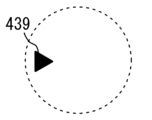
- the subject can recognize the image of the target light beam 407 and the image of the alignment index light beam 409 (alignment index image 439) when the alignment of the subject's eye E is slightly misaligned. For example, as shown in FIG. 10B, the subject can observe both the Landolt ring target displayed on the display 31 and the alignment index image 439 that appears around the Landolt ring target. Therefore, when the subject sees the alignment index image 439 during the examination of the subject's eye E, the subject can easily determine that an alignment misalignment has occurred due to face movement.
- the pupil center position 408 of the subject's eye E does not coincide with the optical axis L2 of the target presenting optical system 26 and the optical axis L3 of the alignment index presenting optical system 45.
- an example is given in which the subject's face moves further leftward from the state of FIG. 9B, causing the pupil center position 408 of the subject's eye E to shift leftward relative to the optical axis.
- the target light beam 407 from the target presenting optical system 26 is emitted from the display 31 and passes through a synthesis lens 430, etc., before reaching an area significantly shifted to the right of the first area (pupil center area) 417 on the pupil plane Pf of the subject's eye E.
- the target light beam 407 reaches an area outside the pupil P. For this reason, for example, the target light beam 407 is entirely blocked by the iris and is not imaged on the fundus.
- the alignment index light beam 409 from the alignment index presenting optical system 45 is emitted from the light source 401b, and passes through a region significantly shifted to the right of the second region 419 on the pupil plane Pf of the subject's eye E by passing through a synthesis lens 430 or the like.
- the alignment index light beam 409 passes through the first region 417. Therefore, for example, all of the alignment index light beam 409 travels toward the fundus without being blocked by the iris or the like, and is imaged at the imaging position t2.
- the subject When the alignment of the subject's eye E is significantly misaligned, the subject will no longer be able to see the image of the target light beam 407, and will only be able to see the image of the alignment indicator light beam 409 (alignment indicator image). For example, as shown in FIG. 10C, the subject will not be able to observe the Landolt ring target displayed on the display 31, and will only be able to observe the alignment indicator image 439. Therefore, if the subject can only see the alignment indicator image 439 during the examination of the subject's eye E, he or she can easily determine that the face has moved and an alignment misalignment has occurred.
- the triangular alignment index image 439 is used, so the subject can easily understand the direction in which to move the subject's eye. For example, the subject can move his or her face based on the alignment index image 439 to position the subject's eye E in an appropriate alignment position (in other words, a position where the Landolt ring can be clearly recognized).
- the examiner instructs the subject to place his/her face against the forehead rest 4 and the chin rest 5 and observe the presentation window 3.
- the examiner operates the switch unit 6b to check the alignment state between the subject's eye E and the measurement unit 7.
- the control unit 70 turns on the light source 401 of the alignment index presenting optical system 45 and displays the Landolt ring target on the display 31 in response to an input signal from the switch unit 6b.
- the examiner asks the subject whether or not they can recognize only the Landolt ring. For example, if the subject answers that they can recognize the alignment index image, the examiner may adjust the position of the forehead rest 4 or chin rest 5 to position the subject's eye E in a position where the alignment index image is no longer visible. Alternatively, the examiner may instruct the subject to move his or her face, so that the subject himself or herself positions the subject's eye E in a position where the alignment index image is no longer visible. For example, this completes the alignment of the subject's eye E in the XY directions with respect to the measurement unit 7.
- the position of the measurement unit 7 in the Z direction inside the ophthalmic device may be set in advance based on the approximate position where the subject's eye E is located and the working distance from the subject's eye E to the measurement unit 7. For example, in this case, the subject abuts his or her face against the forehead rest 4 and chin rest 5, completing the alignment of the subject's eye E with the measurement unit 7 in the Z direction.
- the examiner After confirming the alignment state between the subject's eye E and the measurement unit 7, the examiner starts subjective measurement of the subject's eye E. At this time, the examiner may instruct the subject to move his/her face so that the alignment target image does not enter his/her field of vision if the alignment target image appears during measurement of the subject's eye E.
- the examiner operates the switch unit 6b to select the correction power (for example, at least one of spherical power, cylindrical power, and astigmatism axis angle) to correct the eye E.
- the control unit 70 controls at least one of the projection optical system 30 and the correction optical system 60 in response to a selection signal from the switch unit 6b.
- the control unit 70 may drive the drive mechanism 39 to move the display 31 in the direction of the optical axis L2 to correct the spherical power of the eye E.
- control unit 70 may drive the rotation mechanism 62a and the rotation mechanism 62b to rotate the cylindrical lens 61a and the cylindrical lens 61b around the optical axis L2b to correct at least one of the cylindrical power and the astigmatism axis angle of the eye E.
- the eye E is corrected to a predetermined diopter value (for example, 0D, etc.).
- the examiner operates switch unit 6b to change the visual acuity value of the Landolt ring presented to the subject's eye E, while checking whether the correction power for correcting the subject's eye E is appropriate. For example, the examiner asks the subject what the orientation of the Landolt ring is, and if the subject answers correctly, the visual acuity value is changed to one level higher (i.e., smaller), and if the subject answers incorrectly, the visual acuity value is changed to one level lower (i.e., larger). Based on the change signal from switch unit 6b, control unit 70 changes the Landolt ring shown on display 31. Note that if the correction power for correcting the subject's eye E is inappropriate, the correction power is changed. In this way, the subjective ocular refractive power (subjective value) of the subject's eye E is obtained.
- the alignment index light beam 409 is projected from the light source 401 of the alignment index presenting optical system 45.
- the subject moves his or her face during measurement, as described above, an alignment index image will appear around the Landolt ring target, making it possible to recognize the occurrence of an alignment shift.
- the subject can correct the alignment shift as appropriate by moving their face in the direction indicated by the alignment index image, allowing the measurement to proceed with precision.
- the ophthalmic device of this embodiment does not need to provide an optical system for photographing the anterior segment of the subject's eye E, and an optical system for performing alignment using an alignment bright spot contained in the anterior segment image. Therefore, even if the subject is wearing spectacles or the like during measurement, for example, there is no possibility that the reflected light beam from the spectacles will interfere with the detection of the alignment bright spot, making alignment difficult.
- the ophthalmic device can be made more compact.
- the ophthalmic device of this embodiment includes an optotype presenting optical system that projects an optotype light beam toward the eye to be examined in order to present an optotype to the eye to be examined, and an alignment index presenting optical system that projects an alignment index toward the fundus of the eye to be examined in order to present an alignment index to the eye to be examined, and presents an alignment index light beam observed by the subject.
- the optotype light beam of the optotype presenting optical system passes through a first region on the pupil plane of the eye to be examined, and the alignment index light beam of the alignment index presenting optical system passes through a second region different from the first region on the pupil plane of the eye to be examined, and the second region is a region that includes at least a region outside the first region.
- the amount of alignment index light beam directed toward the fundus increases or decreases depending on the degree of deviation in the positional relationship between the eye to be examined and the ophthalmic device (i.e., alignment deviation), and the appearance of the image of the alignment index light beam that can be observed by the subject changes. Therefore, the subject can easily and consciously recognize the misalignment by using the appearance of the image of the alignment index light beam.
- the alignment index can be recognized according to the deviation of the pupil center from the optical axis. Furthermore, regardless of the direction in which the pupil center is deviated from the optical axis, the visibility of the alignment index (for example, the brightness and degree of chipping of the alignment index) will be similar. Therefore, the subject can easily move the eye to the correct position by moving the face, etc. As a result, the eye can be examined with high accuracy.
- the second area on the pupil plane of the subject's eye is located to the left and right of the pupil center position of the subject's eye. This allows, for example, the subject to easily recognize the left and right misalignment of the subject's eye relative to the ophthalmic device. Note that, for example, if the ophthalmic device is equipped with a forehead rest or chin rest, the subject's face does not move easily in the up and down direction but moves easily left and right.
- the image of the alignment index light beam corresponding to the left and right misalignment of the subject's eye can be observed, allowing the misalignment to be easily recognized.
- the second area on the pupil plane of the subject's eye is located above and below the pupil center position of the subject's eye. This allows, for example, the subject to easily recognize the upward and downward alignment misalignment of the subject's eye relative to the ophthalmic device. For example, even if the ophthalmic device does not have a forehead rest or chin rest and the subject's face is easy to move up and down, by providing the second area at least above and below the pupil center position of the subject's eye, the image of the alignment index light beam corresponding to the vertical alignment misalignment of the subject's eye can be observed, and the alignment misalignment can be easily recognized. Note that, for example, by providing the second area each in the up, down, left and right directions relative to the pupil center position of the subject's eye, the subject can more accurately grasp the direction of the alignment misalignment.
- the alignment index presenting optical system presents a guide index as an alignment index that enables the subject to recognize the direction in which to move the subject's eye.
- a guide index as an alignment index that enables the subject to recognize the direction in which to move the subject's eye. This allows, for example, the subject to easily grasp the direction in which to correct the misalignment between the subject's eye and the ophthalmic device when he or she consciously recognizes an alignment misalignment between the subject's eye and the ophthalmic device.
- the subject can position the subject's eye in the correct alignment position by simply moving his or her face in the direction indicated by the guide index.
- the ophthalmologic apparatus of this embodiment may be configured such that a second region 419 through which an alignment index light beam 409 of the alignment index presenting optical system 45 passes is located at least outside a first region (pupil central region) 417 through which an optotype light beam 407 of the optotype presenting optical system 26 passes on the pupil plane Pf of the subject's eye E. Also, it may be configured such that the second region 419 is located at least in each of the regions to the left and right with respect to a pupil center position 408 of the subject's eye E as a reference.
- the entire area of the first region 417 through which the visual target light beam 407 passes may be included in the second region 419 through which the alignment index light beam 409 passes. That is, for example, the second region 419 may completely overlap the first region 417. Also, for example, in this case, on the pupil plane Pf of the test eye E, at least a portion of the area of the first region 417 through which the visual target light beam 407 passes may be outside the second region 419 through which the alignment index light beam 409 passes. That is, for example, the second region 419 may not overlap the first region 417. Also, for example, the second region 419 may partially overlap the first region 417.
- the display 31 may be arranged on the optical axis L2 of the visual target presenting optical system 26, and the light source (light source 440) may be arranged on the optical axis L3 of the alignment index presenting optical system 45.
- the chief ray of the visual target light beam 407 is located at the same position as the optical axis L2
- the chief ray of the alignment index light beam 409 is located at the same position as the optical axis L3.
- the chief ray of the visual target light beam 407 and the chief ray of the alignment index light beam 409 are coaxial.
- the diameter of the alignment index light beam 409 may be larger than the diameter of the visual target light beam 407 and the pupil diameter on the pupil plane Pf.
- the target light beam 407 enters through a first region (pupil central region) 417 on the pupil plane Pf of the subject's eye E.
- the alignment index light beam 409 enters through the first region 417 on the pupil plane Pf of the subject's eye E and a region in the pupil P adjacent to the first region 417. Therefore, for example, at the fundus of the subject's eye E, all of the target light beam 407 and a portion of the alignment index light beam 409 are imaged at the imaging position t1.
- the subject's eye E is properly aligned, the subject can see both the Landolt ring target and the alignment index.
- an alignment deviation occurs in the subject's eye E, only the alignment index image will be visible depending on the degree of deviation.
- the alignment index light beams 409 are arranged in each direction on the pupil plane Pf of the subject's eye E, but since they are not divided into each direction, it is difficult to recognize the direction of alignment misalignment from the alignment index image.
- color filters having different colors in the left, right, up, and down directions may be arranged at positions different from the fundus conjugate position (approximate fundus conjugate position) of the subject's eye E.
- a color filter may be arranged at the pupil conjugate position (approximate pupil conjugate position) of the subject's eye E.
- the color of the subject's field of vision changes according to the alignment misalignment, making it possible to recognize the direction in which the subject moves his or her face.
- FIG. 12 shows an example in which the second region 419 of the alignment index light beam 409 does not overlap with the first region 417 of the visual target light beam 407 on the pupil plane Pf of the subject's eye E.
- a light-shielding mask 431 may be further arranged in front of the light source 440 in addition to the configuration of FIG. 11.
- the light-shielding mask 431 may have a ring-shaped opening based on the optical axis L3.
- the alignment index light beam 409 passes through the light-shielding mask 431, the alignment index light beam 409 becomes a ring-shaped light beam.
- the visual target light beam 407 enters through a first region (pupil central region) 417 on the pupil plane Pf of the subject's eye E. Meanwhile, part of the alignment index light beam 409 near the optical axis L3 is blocked by the light-shielding mask 431, and the remaining light beam reaches an area outside the pupil P.
- the fundus of the subject's eye E only the entire light beam of the visual target light beam 407 is imaged at the imaging position t1.
- the subject can visually recognize the Landolt ring visual target when the subject's eye E is properly aligned. If an alignment deviation occurs in the subject's eye E, the alignment index image can be visually recognized.
- the alignment index light beams 409 are arranged in each direction on the pupil plane Pf of the subject's eye E, but since they are not divided into each direction, it is difficult to recognize the direction of the alignment shift from the alignment index image.
- the ring-shaped opening of the light-shielding mask 431 may be divided into left, right, upward, and downward directions.
- an arc-shaped alignment index image corresponding to the alignment shift appears in the subject's field of vision, making it possible to recognize the direction in which the subject moves his or her face.
- FIG. 13 shows an example in which the second region 419 of the alignment index light beam 409 partially overlaps with the first region 417 of the visual target light beam 407 on the pupil plane Pf of the subject's eye E.
- the display 31 may be placed on the optical axis L2 of the visual target presenting optical system 26, and the light source (light source 401) may be placed outside the optical axis L3 of the alignment index presenting optical system 45.
- the target light beam 407 enters through a first region (pupil central region) 417 on the pupil plane Pf of the test eye E.
- the alignment index light beam 409 enters through a portion of the first region 417 on the pupil plane Pf of the test eye E and a region in the pupil P adjacent to the first region 417. Therefore, for example, on the fundus of the test eye E, all of the target light beam 407 is imaged at imaging position t1, and a portion of the alignment index light beam 409 is imaged at imaging position t2.
- the test eye E is properly aligned, the test subject can see both the Landolt ring target and the alignment index.
- an alignment deviation occurs in the test eye E, only the alignment index image is visible depending on the degree of deviation.
- the alignment index light beam 409 passes in each direction relative to the pupil center position 408 on the pupil plane Pf of the subject's eye E, so that second regions 419 are positioned in the left-right and up-down directions of the first region 417. Therefore, no matter in which direction the subject's face moves, the subject can easily consciously recognize the alignment deviation.
- the configurations of Figures 9A to 9C and 13 may be designed so that the second regions 419 are positioned only in the up-down direction, or only in the left-right direction.
- a second region 419 through which the alignment index light beam 409 of the alignment index presenting optical system 45 passes may be disposed on the pupil plane Pf of the subject's eye E in a diagonal direction of a first region 417 through which the visual target light beam 407 of the visual target presenting optical system 26 passes.
- the second region 419 may be disposed in a diagonal direction based on the pupil center position 408 of the subject's eye E.
- the light source, the index mask, and the relay lens of the alignment index presenting optical system 45 may be disposed in a 45-degree direction, a 135-degree direction, a 225-degree direction, or a 315-degree direction on a concentric circle based on the optical axis L3.
- each optical component of the alignment index presenting optical system 45 may be disposed in a combination of up, down, left, right, and diagonal directions.
- the ophthalmic apparatus of this embodiment may be configured to cause the alignment index light beam 409 to be incident on the subject's eye E as a convergent light beam.
- the alignment index light beam 409 may be incident at a predetermined angle with respect to the optical axis L2 of the visual target light beam 407.
- the ophthalmic device of this embodiment may be configured to focus the target light beam 407 of the target presenting optical system 26 and the alignment index light beam 409 of the alignment index presenting optical system 45 on the fundus of the subject's eye E.
- the subject can clearly see both the Landolt ring target image and the alignment index image.
- the ophthalmic device of this embodiment may also be configured to focus the target light beam 407 of the target presenting optical system 26 on the fundus of the subject's eye E, and to focus the alignment index light beam 409 of the alignment index presenting optical system 45 in front of the fundus of the subject's eye E.
- the subject can clearly see the Landolt ring target image, and the alignment index image is slightly blurred.
- the alignment index image is viewed by the test eye E in a cloudy state.
- the distance in the optical axis direction between the focusing position of the visual target light beam 407 and the focusing position of the alignment index light beam 409 may be kept constant by moving at least a part of the optical members of the alignment index presenting optical system 45 together with the display 31 in the optical axis direction.
- the focusing position of the alignment index light beam 409 may always be positioned in front of the focusing position of the visual target light beam 407 by a distance equivalent to 1.0 D.
- the ophthalmic device of this embodiment may execute an application (self-eye examination application) that automatically proceeds with the eye examination based on the answers entered by the subject.
- the self-eye examination application may store a program for having the subject check whether there is an alignment error.
- the contact of the subject's face with at least one of the forehead rest 4 and the chin rest 5 may be used as a trigger signal to execute control for checking for alignment error.
- the timing of a change in the eye examination item for the subject's eye E (for example, the timing of transition from objective measurement to subjective measurement), the timing of each time a predetermined time has elapsed, etc. may be used as a trigger signal to periodically execute control for checking for alignment error.
- the control unit 70 may execute audio output using a speaker or the like based on such a trigger signal.
Landscapes
- Life Sciences & Earth Sciences (AREA)
- Health & Medical Sciences (AREA)
- Medical Informatics (AREA)
- Biophysics (AREA)
- Ophthalmology & Optometry (AREA)
- Engineering & Computer Science (AREA)
- Biomedical Technology (AREA)
- Heart & Thoracic Surgery (AREA)
- Physics & Mathematics (AREA)
- Molecular Biology (AREA)
- Surgery (AREA)
- Animal Behavior & Ethology (AREA)
- General Health & Medical Sciences (AREA)
- Public Health (AREA)
- Veterinary Medicine (AREA)
- Eye Examination Apparatus (AREA)
Priority Applications (2)
| Application Number | Priority Date | Filing Date | Title |
|---|---|---|---|
| JP2025524052A JPWO2024247899A1 (https=) | 2023-06-02 | 2024-05-23 | |
| EP24815383.5A EP4721642A1 (en) | 2023-06-02 | 2024-05-23 | Ophthalmic device |
Applications Claiming Priority (2)
| Application Number | Priority Date | Filing Date | Title |
|---|---|---|---|
| JP2023-091298 | 2023-06-02 | ||
| JP2023091298 | 2023-06-02 |
Publications (1)
| Publication Number | Publication Date |
|---|---|
| WO2024247899A1 true WO2024247899A1 (ja) | 2024-12-05 |
Family
ID=93657521
Family Applications (1)
| Application Number | Title | Priority Date | Filing Date |
|---|---|---|---|
| PCT/JP2024/019122 Ceased WO2024247899A1 (ja) | 2023-06-02 | 2024-05-23 | 眼科装置 |
Country Status (3)
| Country | Link |
|---|---|
| EP (1) | EP4721642A1 (https=) |
| JP (1) | JPWO2024247899A1 (https=) |
| WO (1) | WO2024247899A1 (https=) |
Citations (6)
| Publication number | Priority date | Publication date | Assignee | Title |
|---|---|---|---|---|
| JPH0956682A (ja) * | 1995-08-30 | 1997-03-04 | Canon Inc | 眼底カメラ |
| JP2017143920A (ja) * | 2016-02-15 | 2017-08-24 | 株式会社トプコン | 眼科装置 |
| JP2018186930A (ja) | 2017-04-28 | 2018-11-29 | 株式会社ニデック | 眼科撮影装置 |
| JP2019150299A (ja) * | 2018-03-02 | 2019-09-12 | 株式会社ニデック | 眼科装置 |
| JP2020044452A (ja) * | 2016-02-15 | 2020-03-26 | 株式会社トプコン | 眼科装置 |
| WO2021029304A1 (ja) * | 2019-08-09 | 2021-02-18 | キヤノン株式会社 | 眼科装置、眼科装置の制御方法、及びプログラム |
-
2024
- 2024-05-23 JP JP2025524052A patent/JPWO2024247899A1/ja active Pending
- 2024-05-23 EP EP24815383.5A patent/EP4721642A1/en active Pending
- 2024-05-23 WO PCT/JP2024/019122 patent/WO2024247899A1/ja not_active Ceased
Patent Citations (6)
| Publication number | Priority date | Publication date | Assignee | Title |
|---|---|---|---|---|
| JPH0956682A (ja) * | 1995-08-30 | 1997-03-04 | Canon Inc | 眼底カメラ |
| JP2017143920A (ja) * | 2016-02-15 | 2017-08-24 | 株式会社トプコン | 眼科装置 |
| JP2020044452A (ja) * | 2016-02-15 | 2020-03-26 | 株式会社トプコン | 眼科装置 |
| JP2018186930A (ja) | 2017-04-28 | 2018-11-29 | 株式会社ニデック | 眼科撮影装置 |
| JP2019150299A (ja) * | 2018-03-02 | 2019-09-12 | 株式会社ニデック | 眼科装置 |
| WO2021029304A1 (ja) * | 2019-08-09 | 2021-02-18 | キヤノン株式会社 | 眼科装置、眼科装置の制御方法、及びプログラム |
Also Published As
| Publication number | Publication date |
|---|---|
| JPWO2024247899A1 (https=) | 2024-12-05 |
| EP4721642A1 (en) | 2026-04-08 |
Similar Documents
| Publication | Publication Date | Title |
|---|---|---|
| US10188282B2 (en) | Subjective optometry apparatus | |
| JP6951054B2 (ja) | 自覚式検眼装置 | |
| JP7298134B2 (ja) | 検眼システム | |
| US10966604B2 (en) | Subjective optometry apparatus and storage medium | |
| US10264967B2 (en) | Subjective optometry apparatus and subjective optometry program | |
| JP2018047049A (ja) | 自覚式検眼装置、及び自覚式検眼プログラム | |
| CN107788946B (zh) | 主观式验光装置及主观式验光程序 | |
| US10602924B2 (en) | Subjective optometry apparatus | |
| JP7098880B2 (ja) | 自覚式検眼装置及び自覚式検眼プログラム | |
| JP6841091B2 (ja) | 自覚式検眼装置 | |
| JP6853495B2 (ja) | 自覚式検眼装置及び自覚式検眼プログラム | |
| JP2018143553A (ja) | 自覚式検眼装置 | |
| JP6064445B2 (ja) | 眼屈折力測定装置 | |
| WO2024247899A1 (ja) | 眼科装置 | |
| JP6686380B2 (ja) | 自覚式検眼装置及び自覚式検眼プログラム | |
| JP6766342B2 (ja) | 自覚式検眼装置 | |
| JP2023150640A (ja) | 検眼装置 | |
| JP2021058766A (ja) | 自覚式検眼装置 | |
| JP7078187B2 (ja) | 自覚式検眼装置及び自覚式検眼プログラム | |
| JP2020202904A (ja) | 検眼装置 | |
| JP2024021350A (ja) | 自覚式検眼装置 | |
| JP2024034752A (ja) | 検眼装置 | |
| JP2021010415A (ja) | 眼屈折力測定装置 | |
| JP2019118551A (ja) | 自覚式検眼装置 |
Legal Events
| Date | Code | Title | Description |
|---|---|---|---|
| 121 | Ep: the epo has been informed by wipo that ep was designated in this application |
Ref document number: 24815383 Country of ref document: EP Kind code of ref document: A1 |
|
| ENP | Entry into the national phase |
Ref document number: 2025524052 Country of ref document: JP Kind code of ref document: A |
|
| WWE | Wipo information: entry into national phase |
Ref document number: 2025524052 Country of ref document: JP |
|
| WWE | Wipo information: entry into national phase |
Ref document number: 2024815383 Country of ref document: EP |
|
| NENP | Non-entry into the national phase |
Ref country code: DE |
|
| ENP | Entry into the national phase |
Ref document number: 2024815383 Country of ref document: EP Effective date: 20260102 |
|
| ENP | Entry into the national phase |
Ref document number: 2024815383 Country of ref document: EP Effective date: 20260102 |
|
| ENP | Entry into the national phase |
Ref document number: 2024815383 Country of ref document: EP Effective date: 20260102 |
|
| ENP | Entry into the national phase |
Ref document number: 2024815383 Country of ref document: EP Effective date: 20260102 |
|
| ENP | Entry into the national phase |
Ref document number: 2024815383 Country of ref document: EP Effective date: 20260102 |
|
| ENP | Entry into the national phase |
Ref document number: 2024815383 Country of ref document: EP Effective date: 20260102 |
|
| WWP | Wipo information: published in national office |
Ref document number: 2024815383 Country of ref document: EP |