WO2024247506A1 - 磁性ペースト、回路部材、回路部材の製造方法 - Google Patents
磁性ペースト、回路部材、回路部材の製造方法 Download PDFInfo
- Publication number
- WO2024247506A1 WO2024247506A1 PCT/JP2024/014584 JP2024014584W WO2024247506A1 WO 2024247506 A1 WO2024247506 A1 WO 2024247506A1 JP 2024014584 W JP2024014584 W JP 2024014584W WO 2024247506 A1 WO2024247506 A1 WO 2024247506A1
- Authority
- WO
- WIPO (PCT)
- Prior art keywords
- magnetic
- magnetic paste
- paste
- mass
- group
- Prior art date
- Legal status (The legal status is an assumption and is not a legal conclusion. Google has not performed a legal analysis and makes no representation as to the accuracy of the status listed.)
- Ceased
Links
Images
Classifications
-
- C—CHEMISTRY; METALLURGY
- C08—ORGANIC MACROMOLECULAR COMPOUNDS; THEIR PREPARATION OR CHEMICAL WORKING-UP; COMPOSITIONS BASED THEREON
- C08G—MACROMOLECULAR COMPOUNDS OBTAINED OTHERWISE THAN BY REACTIONS ONLY INVOLVING UNSATURATED CARBON-TO-CARBON BONDS
- C08G59/00—Polycondensates containing more than one epoxy group per molecule; Macromolecules obtained by polymerising compounds containing more than one epoxy group per molecule using curing agents or catalysts which react with the epoxy groups
- C08G59/18—Macromolecules obtained by polymerising compounds containing more than one epoxy group per molecule using curing agents or catalysts which react with the epoxy groups ; e.g. general methods of curing
- C08G59/40—Macromolecules obtained by polymerising compounds containing more than one epoxy group per molecule using curing agents or catalysts which react with the epoxy groups ; e.g. general methods of curing characterised by the curing agents used
- C08G59/50—Amines
-
- C—CHEMISTRY; METALLURGY
- C08—ORGANIC MACROMOLECULAR COMPOUNDS; THEIR PREPARATION OR CHEMICAL WORKING-UP; COMPOSITIONS BASED THEREON
- C08K—Use of inorganic or non-macromolecular organic substances as compounding ingredients
- C08K3/00—Use of inorganic substances as compounding ingredients
- C08K3/01—Use of inorganic substances as compounding ingredients characterized by their specific function
-
- C—CHEMISTRY; METALLURGY
- C08—ORGANIC MACROMOLECULAR COMPOUNDS; THEIR PREPARATION OR CHEMICAL WORKING-UP; COMPOSITIONS BASED THEREON
- C08L—COMPOSITIONS OF MACROMOLECULAR COMPOUNDS
- C08L101/00—Compositions of unspecified macromolecular compounds
-
- H—ELECTRICITY
- H01—ELECTRIC ELEMENTS
- H01F—MAGNETS; INDUCTANCES; TRANSFORMERS; SELECTION OF MATERIALS FOR THEIR MAGNETIC PROPERTIES
- H01F1/00—Magnets or magnetic bodies characterised by the magnetic materials therefor; Selection of materials for their magnetic properties
- H01F1/01—Magnets or magnetic bodies characterised by the magnetic materials therefor; Selection of materials for their magnetic properties of inorganic materials
- H01F1/03—Magnets or magnetic bodies characterised by the magnetic materials therefor; Selection of materials for their magnetic properties of inorganic materials characterised by their coercivity
- H01F1/12—Magnets or magnetic bodies characterised by the magnetic materials therefor; Selection of materials for their magnetic properties of inorganic materials characterised by their coercivity of soft-magnetic materials
- H01F1/14—Magnets or magnetic bodies characterised by the magnetic materials therefor; Selection of materials for their magnetic properties of inorganic materials characterised by their coercivity of soft-magnetic materials metals or alloys
- H01F1/20—Magnets or magnetic bodies characterised by the magnetic materials therefor; Selection of materials for their magnetic properties of inorganic materials characterised by their coercivity of soft-magnetic materials metals or alloys in the form of particles, e.g. powder
- H01F1/22—Magnets or magnetic bodies characterised by the magnetic materials therefor; Selection of materials for their magnetic properties of inorganic materials characterised by their coercivity of soft-magnetic materials metals or alloys in the form of particles, e.g. powder pressed, sintered, or bound together
- H01F1/24—Magnets or magnetic bodies characterised by the magnetic materials therefor; Selection of materials for their magnetic properties of inorganic materials characterised by their coercivity of soft-magnetic materials metals or alloys in the form of particles, e.g. powder pressed, sintered, or bound together the particles being insulated
- H01F1/26—Magnets or magnetic bodies characterised by the magnetic materials therefor; Selection of materials for their magnetic properties of inorganic materials characterised by their coercivity of soft-magnetic materials metals or alloys in the form of particles, e.g. powder pressed, sintered, or bound together the particles being insulated by macromolecular organic substances
-
- H—ELECTRICITY
- H05—ELECTRIC TECHNIQUES NOT OTHERWISE PROVIDED FOR
- H05K—PRINTED CIRCUITS; CASINGS OR CONSTRUCTIONAL DETAILS OF ELECTRIC APPARATUS; MANUFACTURE OF ASSEMBLAGES OF ELECTRICAL COMPONENTS
- H05K1/00—Printed circuits
- H05K1/02—Details
- H05K1/09—Use of materials for the conductive, e.g. metallic pattern
-
- H—ELECTRICITY
- H05—ELECTRIC TECHNIQUES NOT OTHERWISE PROVIDED FOR
- H05K—PRINTED CIRCUITS; CASINGS OR CONSTRUCTIONAL DETAILS OF ELECTRIC APPARATUS; MANUFACTURE OF ASSEMBLAGES OF ELECTRICAL COMPONENTS
- H05K1/00—Printed circuits
- H05K1/16—Printed circuits incorporating printed electric components, e.g. printed resistors, capacitors or inductors
Definitions
- This disclosure relates to magnetic paste, circuit components, and methods for manufacturing circuit components.
- Materials containing metal powders with various physical properties are used depending on the characteristics required for industrial products.
- magnetic materials containing magnetic powders are used in the fields of inductors, electromagnetic shields, and bonded magnets.
- there has been an increasing demand in recent years for materials containing magnetic powders and resins see, for example, Patent Document 1).
- a method of filling a paste-like magnetic material (magnetic paste) into recesses such as through holes (penetrating holes), non-penetrating holes, cavities, and trenches provided in a substrate is being considered.
- a paste-like magnetic material magnetic paste
- recesses such as through holes (penetrating holes), non-penetrating holes, cavities, and trenches provided in a substrate.
- circuit components become ever more miniaturized, the size of the recesses to which the magnetic paste is applied is also becoming smaller, making it difficult to sufficiently fill the recesses with the magnetic paste.
- one aspect of the present disclosure aims to provide a magnetic paste that has excellent filling properties for recesses (e.g., through holes, blind holes, cavities, trenches).
- other aspects of the present disclosure aim to provide a circuit component obtained using the magnetic paste of the above aspect, and a method for manufacturing the same.
- the present disclosure provides the following [1] to [10].
- [1] Contains magnetic powder, a thermosetting component, and a coupling agent;
- the magnetic powder has a 10% cumulative particle size based on volume of 0.6 to 2.0 ⁇ m;
- the magnetic powder has a volume-based 50% cumulative particle size of 1.1 to 3.6 ⁇ m;
- the magnetic paste has a 90% cumulative particle size by volume of the magnetic powder of 2.1 to 6.3 ⁇ m.
- thermosetting component includes an epoxy group-containing compound and a curing agent.
- the magnetic recording medium includes a substrate and a magnetic body that fills a recess provided in the substrate, A circuit member comprising the magnetic body comprising a hardened product of the magnetic paste according to any one of [1] to [8].
- a magnetic paste that has excellent recess-filling properties.
- a circuit component obtained using the magnetic paste of the above aspect, and a method for manufacturing the same.
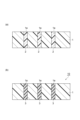
- 5A to 5C are schematic cross-sectional views showing an example of a method for manufacturing a circuit member according to an embodiment of the present disclosure.
- the numerical range indicated by “ ⁇ ” indicates a range including the numerical values before and after “ ⁇ ” as the minimum and maximum values, respectively.
- the units of the numerical values before and after “ ⁇ ” are the same.
- the upper or lower limit of a certain numerical range may be replaced with the upper or lower limit of the numerical range of another stage.
- the upper or lower limit of the numerical range may be replaced with a value shown in the examples.
- the upper and lower limits described individually can be arbitrarily combined.
- “A or B" may include either A or B, or may include both.
- the materials exemplified below may be used alone or in combination of two or more types, unless otherwise specified.
- the content of each component in the paste means the total amount of the multiple substances present in the paste, unless otherwise specified.
- One embodiment of the present disclosure is a magnetic paste containing a magnetic powder, a thermosetting component, and a coupling agent, in which the magnetic powder has a 10% cumulative particle size (hereinafter referred to as “ D10 ”) based on volume of 0.6 to 2.0 ⁇ m, a 50% cumulative particle size (hereinafter referred to as “ D50 ”) based on volume of 1.1 to 3.6 ⁇ m, and a 90% cumulative particle size (hereinafter referred to as " D90 ”) based on volume of 2.1 to 6.3 ⁇ m.
- D10 10% cumulative particle size
- D50 50% cumulative particle size
- D90 90% cumulative particle size
- D10 means a particle size when the cumulative volume from the small particle size side in the volume-based particle size distribution of the magnetic powder is 10% of the entire magnetic powder.
- D50 means a particle size when the cumulative volume from the small particle size side in the volume-based particle size distribution of the magnetic powder is 50% of the entire magnetic powder.
- D90 means a particle size when the cumulative volume from the small particle size side in the volume-based particle size distribution of the magnetic powder is 90% of the entire magnetic powder.
- the particle size distribution used to calculate D10 , D50 and D90 of the magnetic powder can be obtained by performing particle size distribution measurement using a laser diffraction scattering type particle size distribution measuring device under the conditions described in the examples.
- the magnetic paste has excellent filling properties (hereinafter, simply referred to as "filling properties") for recesses such as through holes, non-through holes, cavities, and trenches.
- the magnetic paste can satisfactorily fill recesses provided in substrates for circuit components. Therefore, the magnetic paste is suitable for use in filling recesses provided in substrates for circuit components.
- the above effect is presumably due to the particle diameter (particularly D90) of the magnetic powder being small enough to be able to enter recesses such as through holes, and the particle diameter (particularly D10) of the magnetic powder being large enough so that the viscosity of the magnetic paste does not become too high.
- the magnetic powder is an aggregate of magnetic particles.
- the magnetic particles contain at least a magnetic component.
- the magnetic particles may contain only one type of magnetic component, or may contain multiple types of magnetic components.
- the magnetic particles may consist of only the magnetic component, or may further contain components other than the magnetic component.
- the content of the magnetic component based on the total mass of the magnetic particles may be 20% by mass or more, and the content of the magnetic component based on the total mass of the magnetic powder may be 50% by mass or more.
- the magnetic component includes, for example, a metal element.
- the metal element included in the magnetic component may be, for example, at least one selected from the group consisting of base metal elements, precious metal elements, transition metal elements, and rare earth elements.
- the metal element may be, for example, at least one selected from the group consisting of iron (Fe), copper (Cu), titanium (Ti), manganese (Mn), cobalt (Co), nickel (Ni), zinc (Zn), niobium (Nb), aluminum (Al), tin (Sn), chromium (Cr), barium (Ba), strontium (Sr), lead (Pb), silver (Ag), praseodymium (Pr), neodymium (Nd), samarium (Sm), and dysprosium (Dy).
- the magnetic component may be a single metal element consisting of only one type of metal element, or an alloy consisting of two or more types of metal elements.
- the alloy may include at least one selected from the group consisting of solid solutions, eutectics, and intermetallic compounds.
- the alloy may be, for example, an iron alloy such as an Fe-Cr alloy or an Fe-Ni-Cr alloy. It may also be a copper alloy such as a Cu-Sn alloy, a Cu-Sn-P alloy, a Cu-Ni alloy, or a Cu-Be alloy.
- the magnetic component may be a metal compound containing the above metal element and an element other than the above metal element.
- the element other than the above metal element may be, for example, at least one selected from the group consisting of carbon (C), oxygen (O), beryllium (Be), phosphorus (P), boron (B), and silicon (Si).
- the metal compound may be, for example, a metal oxide such as iron oxide.
- the metal compound may be a sintered body mainly composed of a metal oxide (for example, a sintered body obtained by mixing and sintering a metal oxide with a metal element such as cobalt, nickel, or manganese).
- the magnetic component may be a soft magnetic component (e.g., a soft magnetic alloy) or a ferromagnetic component (e.g., a ferromagnetic alloy).
- the magnetic component may be at least one selected from the group consisting of, for example, an Fe-Si alloy, an Fe-Si-Al alloy (Sendust), an Fe-Ni alloy (Permalloy), an Fe-Cu-Ni alloy (Permalloy), an Fe-Co alloy (Permendur), an Fe-Cr-Si alloy (electromagnetic stainless steel), an Nd-Fe-B alloy (rare earth magnet), an Sm-Fe-N alloy (rare earth magnet), an Al-Ni-Co alloy (Alnico magnet), and a ferrite.
- the ferrite may be, for example, a spinel ferrite, a hexagonal ferrite, or a garnet ferrite.
- the magnetic powder may contain at least one selected from the group consisting of Fe alone and Fe-based alloys, from the viewpoint of obtaining higher magnetic permeability.
- the Fe-based alloy may be, for example, at least one selected from the group consisting of Fe-Si alloys, Fe-Si-Al alloys, Fe-Ni alloys, Fe-Cu-Ni alloys, Fe-Co alloys, Fe-Cr-Si alloys, Fe-Si-B alloys, and Fe-Si-B-P-Nb-Cr alloys.
- the magnetic powder may contain Fe amorphous alloy powder, from the viewpoint of obtaining even higher magnetic permeability.
- Fe amorphous alloys are amorphous powders obtained by rapidly cooling an alloy in which the main component Fe is melted at high temperature together with other elements such as Si, and are also known as metallic glasses. Fe amorphous alloy powders can be produced according to methods well known in the art. Fe amorphous alloy powders are also available commercially.
- Epson Atmix Corporation's product names AW2-08 and KUAMET-6B2 Daido Steel Co., Ltd.'s product names DAPMS3, DAPMS7, DAPMSA10, DAPPB, DAPPC, DAPMKV49, DAP410L, DAP430L, and DAPHYB series
- Kobe Steel, Ltd.'s product names MH45D, MH28D, MH25D, and MH20D can be mentioned.
- These Fe amorphous alloy powders may be used alone or in combination of two or more.
- the entire or part of the surface of the magnetic powder may be coated with a surface treatment agent.
- the surface treatment agent may be, for example, an inorganic surface treatment agent such as an inorganic oxide, a phosphoric acid compound, a phosphate compound, or a silane coupling agent, an organic surface treatment agent such as montan wax, or a resin cured product. Coupling agents, which will be described later, may also be used as the surface treatment agent.
- the magnetic powder may have the entire or part of its surface coated with an insulating material. That is, the magnetic powder may contain magnetic particles whose surfaces are coated with an insulating material (hereinafter, "insulating coated magnetic particles"). Examples of insulating materials include silica, titania, calcium phosphate, montan wax, and cured epoxy resins.
- the insulating coated magnetic particles may be Fe amorphous alloy powder having an insulating coating. The thickness of the inorganic oxide coating constituting the insulating coating may be, for example, 1 to 100 nm.
- insulating coated magnetic particles for example, "KUAMET9A4" (Fe-Si-B alloy, D50: 20 ⁇ m, with insulating coating) manufactured by Epson Atmix Corporation and "SAP-2C" (Fe-Si-B-P-Nb-Cr alloy, D50: 2.2 ⁇ m, with insulating coating) manufactured by Shinto Kogyo Co., Ltd. can be used.
- These insulating coated magnetic particles may be used in combination with magnetic particles that do not have an insulating coating, for example, soft ferrite powder "BSN-125" (Ni-Zn alloy, D50: 10 ⁇ m, without insulating coating) manufactured by Toda Kogyo Co., Ltd.
- the shape of the magnetic particles is not particularly limited.
- the magnetic particles may be, for example, spherical, elliptical, flat, plate-like, rod-like, or needle-like. From the viewpoint of further improving the filling of the recesses, the shape of the magnetic particles may be spherical.
- the magnetic particles being spherical means that the average aspect ratio, which is the ratio of the long axis to the short axis (long axis/short axis) of the magnetic particles measured by the method described below, is 1.0 to 4.0.
- the average aspect ratio is the ratio of the long axis to the short axis (long axis/short axis) of each of 100 randomly selected magnetic particles, and the average of these aspect ratios obtained.
- the long axis of the magnetic particle means the distance between two planes that circumscribe the magnetic particle and are parallel to each other and are selected so that the distance between them is maximum.
- the short axis of the magnetic particle means the distance between two planes that circumscribe the magnetic particle and are parallel to each other and are selected so that the distance between them is minimum.
- the aspect ratio is preferably 1.0 to 3.0, more preferably 1.0 to 2.0, and even more preferably 1.0 to 1.5.
- the D10 of the magnetic powder is 0.6 ⁇ m or more, and may be 0.7 ⁇ m or more from the viewpoint of improving the fluidity of the magnetic paste and obtaining better filling properties.
- the D10 of the magnetic powder is 2.0 ⁇ m or less, and may be 1.9 ⁇ m or less from the viewpoint of obtaining better filling properties by densely filling the recesses with the magnetic particles in the magnetic paste. From these viewpoints, the D10 of the magnetic powder may be 0.7 to 1.9 ⁇ m.
- the D50 of the magnetic powder is 1.1 ⁇ m or more, and may be 1.2 ⁇ m or more from the viewpoint of improving the fluidity of the magnetic paste and obtaining better filling properties.
- the D50 of the magnetic powder is 3.6 ⁇ m or less, and may be 3.5 ⁇ m or less from the viewpoint of obtaining better filling properties by densely filling the recesses with the magnetic particles in the magnetic paste. From these viewpoints, the D50 of the magnetic powder may be 1.2 to 3.5 ⁇ m.
- the D 90 of the magnetic powder is 2.1 ⁇ m or more, and may be 2.2 ⁇ m or more in order to improve the fluidity of the magnetic paste and obtain better filling properties.
- the D 90 of the magnetic powder is 6.3 ⁇ m or less, and may be 6.0 ⁇ m or less in order to obtain better filling properties by densely filling the recesses with the magnetic particles in the magnetic paste. From these viewpoints, the D 90 of the magnetic powder may be 2.2 to 6.0 ⁇ m.
- Magnetic powder having the above particle size distribution can be obtained, for example, by atomization or liquid phase synthesis.
- the particle size distribution of the magnetic powder produced by the above method may be adjusted, for example, by using a pulverizer, ball mill, bead mill, air classifier, wet sifter, or sieve.
- the method of adjusting the particle size distribution to the desired size using a classifier, sieve, or the like allows the particles to maintain their spherical shape, compared to the method of adjusting the particle size distribution by applying force to the particles with a pulverizer, ball mill, or the like, and therefore the fluidity of the magnetic paste is better.
- structural defects and crystal distortions at the interface caused by pulverization do not occur, so the magnetic permeability is less likely to decrease.
- the content of the magnetic powder may be 70% by mass or more, 75% by mass or more, or 80% by mass or more, based on the total mass of the nonvolatile content in the magnetic paste, from the viewpoint of obtaining high magnetic permeability.
- the content of the magnetic powder may be 97% by mass or less, 96% by mass or less, 95% by mass or less, or 93% by mass or less, based on the total mass of the nonvolatile content in the magnetic paste, from the viewpoint of improving filling properties. From these viewpoints, the content of the magnetic powder may be 70 to 97% by mass, 75 to 96% by mass, 75 to 95% by mass, 80 to 95% by mass, or 80 to 93% by mass, based on the total mass of the nonvolatile content in the magnetic paste.
- the nonvolatile content in the magnetic paste means the components contained in the magnetic paste other than the volatile components.
- the volatile components refer to components that show a mass reduction of 10% by mass or more when heated at 180°C for 60 minutes and components with a boiling point of 300°C or less.
- thermosetting component includes, for example, a thermosetting compound.
- the thermosetting component may further include a curing agent for the thermosetting compound, and may further include a curing accelerator.
- thermosetting compound is, for example, a compound that cures by heat treatment alone or by reacting with a curing agent.
- the thermosetting compound may be a monomer or a compound (oligomer or polymer) having a structural unit formed by polymerization of a monomer, which is generally called a thermosetting resin.
- the thermosetting compound preferably contains a compound having one or more epoxy groups in the molecule (hereinafter referred to as an "epoxy group-containing compound").
- the epoxy group-containing compound may be in the form of either a monomer, or an oligomer or polymer having structural units formed by polymerization of the monomer.
- the epoxy-containing compound is preferably used in combination with a curing agent, which will be described later.
- an epoxy group-containing compound is an oligomer or polymer having two or more epoxy groups in the molecule, which is generally known as an epoxy resin.
- Another example of an epoxy group-containing compound is a compound having one or more epoxy groups in the molecule but not containing a structural unit formed by polymerization (hereinafter referred to as an "epoxy compound").
- an epoxy compound is generally known as a reactive diluent.
- the epoxy group-containing compound preferably contains at least one type selected from the group consisting of an epoxy resin and an epoxy compound.
- Epoxy resins include, for example, biphenyl type epoxy resins, stilbene type epoxy resins, diphenylmethane type epoxy resins, sulfur atom-containing epoxy resins, novolac type epoxy resins, dicyclopentadiene type epoxy resins, salicylaldehyde type epoxy resins, naphthol and phenol copolymer type epoxy resins, epoxidized products of aralkyl type phenolic resins, bisphenol type epoxy resins, glycidyl ether type epoxy resins of alcohols, glycidyl ether type epoxy resins of paraxylylene and/or metaxylylene modified phenolic resins, glycidyl ether type epoxy resins of terpene modified phenolic resins, etc.
- the epoxy resin may be at least one selected from the group consisting of glycidyl ether type epoxy resins, cyclopentadiene type epoxy resins, glycidyl ether type epoxy resins of polycyclic aromatic ring modified phenolic resins, glycidyl ether type epoxy resins of naphthalene ring-containing phenolic resins, glycidyl ester type epoxy resins, glycidyl or methylglycidyl type epoxy resins, alicyclic type epoxy resins, halogenated phenol novolac type epoxy resins, hydroquinone type epoxy resins, trimethylolpropane type epoxy resins, and linear aliphatic epoxy resins obtained by oxidizing olefin bonds with peracids such as peracetic acid.
- the epoxy resin may be in the form of liquid, semi-solid, or solid, or may be a mixture of these.
- the molecular weight of the epoxy compound is preferably 100 or more, more preferably 150 or more, and even more preferably 200 or more.
- an epoxy compound with a molecular weight of 100 or more volatilization before reaction with the curing agent can be suppressed by setting appropriate curing conditions.
- a low molecular weight reduces the distance between crosslinking points after reaction, which makes the cured product more likely to crack.
- the molecular weight of the epoxy compound is preferably 700 or less, more preferably 500 or less, and even more preferably 300 or less. When an epoxy compound with a molecular weight of 700 or less is used, it is easy to obtain an appropriate viscosity as a diluent.
- the molecular weight of the epoxy compound is preferably in the range of 100 to 700, more preferably in the range of 150 to 500, and even more preferably in the range of 200 to 300.
- an epoxy compound having a molecular weight in such a range it becomes easier to adjust the viscosity of the magnetic paste.
- the epoxy compound Unlike components such as organic solvents that volatilize when heated, epoxy compounds harden when heated and are incorporated into the hardened product. Therefore, the epoxy compound contributes to adjusting the viscosity of the magnetic paste and contributes to suppressing deterioration of the properties of the hardened product.
- the epoxy compound may contain one or more epoxy groups in the molecule.
- the epoxy compound may be, for example, at least one selected from the group consisting of n-butyl glycidyl ether, versatic acid glycidyl ether, styrene oxide, ethylhexyl glycidyl ether, phenyl glycidyl ether, butylphenyl glycidyl ether, 1,6-hexanediol diglycidyl ether, neopentyl glycol diglycidyl ether, diethylene glycol diglycidyl ether, and trimethylolpropane triglycidyl ether.
- the epoxy compound is sufficiently purified and has a low content of ionic impurities.
- the content of ionic impurities such as free Na ions and free Cl ions is 500 ppm or less.
- the epoxy equivalent of the epoxy group-containing compound is preferably 80 g/eq to 350 g/eq, more preferably 100 g/eq to 300 g/eq, and even more preferably 120 g/eq to 250 g/eq.
- the epoxy equivalent of the epoxy group-containing compound can be measured according to JIS K 7236.
- the epoxy equivalent measured for the mixture of all the epoxy group-containing compounds may be within the above range.
- the epoxy group-containing compound preferably includes an epoxy group-containing compound that is liquid at 25°C.
- liquid at 25°C means that the viscosity of the epoxy group-containing compound at 25°C is 200 Pa ⁇ s or less.
- the above viscosity is a value measured using an E-type viscometer under the following conditions: temperature: 25°C, rotor: SPP, rotation speed: 2.5 rpm.
- E-type viscometer for example, a TV-33 type viscometer manufactured by Toki Sangyo Co., Ltd. can be used.
- the viscosity of the epoxy group-containing compound is preferably 100 Pa ⁇ s or less, more preferably 50 Pa ⁇ s or less, and even more preferably 10 Pa ⁇ s or less.
- the viscosity of the epoxy group-containing compound is greater than 0 Pa ⁇ s, and may be 0.001 Pa ⁇ s or more, or may be 0.01 Pa ⁇ s or more.
- the viscosity of the epoxy compound is preferably lower than the viscosity of the liquid epoxy resin from the viewpoint of adjusting the viscosity of the magnetic paste.
- the viscosity of the epoxy compound is preferably 1 Pa ⁇ s or less, more preferably 0.5 Pa ⁇ s or less, and even more preferably 0.1 Pa ⁇ s or less.
- the viscosity of the epoxy compound is greater than 0 Pa ⁇ s, and may be 0.001 Pa ⁇ s or more, or 0.01 Pa ⁇ s or more.
- the epoxy group-containing compound that is liquid at 25°C may contain at least one selected from the group consisting of an epoxy resin that is liquid at 25°C (hereinafter referred to as "liquid epoxy resin") and an epoxy compound that is liquid at 25°C.
- the content of the liquid epoxy resin is preferably 50 mass% or more, more preferably 70 mass% or more, and even more preferably 90 mass% or more, and may be 100 mass% based on the total mass of the epoxy group-containing compound.
- the content of the liquid epoxy resin is not limited to the above range.
- the liquid epoxy resin may contain at least one liquid epoxy resin selected from, for example, bisphenol A type epoxy resin, bisphenol F type epoxy resin, bisphenol AD type epoxy resin, bisphenol S type epoxy resin, naphthalene diol type epoxy resin, hydrogenated bisphenol A type epoxy resin, and aminoglycidyl ether type epoxy resin.
- liquid epoxy resin selected from, for example, bisphenol A type epoxy resin, bisphenol F type epoxy resin, bisphenol AD type epoxy resin, bisphenol S type epoxy resin, naphthalene diol type epoxy resin, hydrogenated bisphenol A type epoxy resin, and aminoglycidyl ether type epoxy resin.
- Liquid epoxy group-containing compounds can also be obtained as commercial products.
- Commercially available products include liquid bisphenol A type epoxy resin and liquid bisphenol F type epoxy resin sold by Nippon Steel Chemical Co., Ltd.
- liquid bisphenol F type epoxy resin with the product name "YDF-8170C” epoxy equivalent 165, viscosity 1,000 to 1,500 mPa ⁇ s
- Epoxy compounds include the Adeka Glysilol (product name) series manufactured by ADEKA Corporation.
- product name "Adeka Glysilol ED-503G” epoxy equivalent 135, viscosity 15 mPa ⁇ s
- the thermosetting compound may contain a thermosetting resin such as a phenol resin, an acrylic resin, a polyimide resin, or a polyamide-imide resin instead of or in addition to the epoxy group-containing compound.
- a thermosetting resin such as a phenol resin, an acrylic resin, a polyimide resin, or a polyamide-imide resin
- the phenol resin can also function as a curing agent for the epoxy group-containing compound.
- the phenol resin is considered to be a curing agent rather than a thermosetting compound.
- the curing agent can be a known curing agent corresponding to the thermosetting compound.
- the thermosetting compound is an epoxy group-containing compound
- a compound that reacts with the epoxy group of the epoxy group-containing compound to form a cured product can be used.
- the curing agent for the epoxy group-containing compound include phenol-based curing agents, acid anhydride-based curing agents, amine-based curing agents, imidazole-based curing agents, and imidazoline-based curing agents.
- Curing agents are classified into those that cure epoxy resins in a temperature range from low to room temperature (e.g., 0 to 30°C) and heat-curing curing agents that cure epoxy resins by heating.
- curing agents that cure epoxy resins in a temperature range from low to room temperature include aliphatic polyamines, polyaminoamides, and polymercaptans.
- heat-curing curing agents include aromatic polyamines, acid anhydrides, phenol novolac resins, and dicyandiamide (DICY). From the viewpoint of reducing the thermal expansion coefficient and suppressing the occurrence of cracks at temperatures during the manufacturing process, use, storage, etc., it is preferable that the curing agent contains a heat-curing curing agent.
- the glass transition temperature of the resin cured product tends to be low, while in resin systems that cure by heating to a temperature higher than room temperature, the glass transition temperature of the resin cured product tends to be high, and the glass transition temperature tends to be higher than the temperatures during the manufacturing process, use, storage, etc.
- One of the possible causes of cracking is the thermal expansion of the cured resin, but the coefficient of thermal expansion of the cured resin is sufficiently small at temperatures lower than the glass transition temperature, so in resin systems that are cured by heating to temperatures higher than room temperature, cracking tends to be suppressed at temperatures during the manufacturing process, use, storage, etc.
- the hardeners it is preferable to use a hardener that is liquid at 25°C from the viewpoint of reducing the viscosity of the magnetic paste.
- a hardener for example, at least one selected from the group consisting of amine-based hardeners such as aliphatic or aromatic polyamines and aliphatic or aromatic amines, polymercaptans, acid anhydrides, and imidazole-based hardeners can be used.
- a solid hardener may be used at 25°C, or a liquid hardener may be used in combination with a solid hardener.
- solid hardeners examples include dicyandiamide, tertiary amines, imidazole hardeners, and imidazoline hardeners.
- the solid hardeners listed above are polyfunctional or act catalytically, so they can function sufficiently even in small amounts.
- the curing agent preferably includes at least one selected from the group consisting of an amine-based curing agent, an imidazole-based curing agent, and an imidazoline-based curing agent. It is more preferable that the curing agent includes at least one selected from the group consisting of an amine-based curing agent and an imidazole-based curing agent. It is even more preferable that the curing agent includes at least an amine-based curing agent.
- Amine-based hardeners (more specifically tertiary amines), imidazole-based hardeners, and imidazoline-based hardeners can also be used as hardening accelerators in combination with other hardeners.
- the amine-based curing agent may be a compound having at least two amino groups in the molecule.
- the amine-based curing agent includes at least one selected from the group consisting of aliphatic amines and aromatic amines.
- the aliphatic amine may be a compound having a linear or cyclic structure. Examples include diethylenetriamine, triethylenetetramine, n-propylamine, 2-hydroxyethylaminopropylamine, cyclohexylamine, methylcyclohexylamine, isophoronediamine, 4,4'-diamino-dicyclohexylmethane, and diazabicycloundecene.
- the aromatic amine may be a compound in which an amino group is substituted on an aromatic compound, and in particular, a compound having a structure in which hydrogen on a benzene ring is substituted with an amino group is preferred.
- a compound having a structure in which hydrogen on a benzene ring is substituted with an amino group is preferred. Examples include benzyldimethylamine, trisdimethylaminomethylphenol, metaphenylenediamine, benzyldimethylamine, 4,4'-diaminodiphenylmethane, 2-methylaniline, diaminodiphenylsulfone, polyamidoamine, amine compounds represented by the following formula (1), and amine compounds represented by the following formula (2).
- an amine-based curing agent When an amine-based curing agent is used, it tends to be easier to adjust the viscosity and the amount of weight loss due to heat. In particular, when an aromatic amine is used, it tends to be easier to adjust the viscosity and the rate of weight loss due to heat.
- the imidazole-based hardener is a compound having an imidazole skeleton, and may be an imidazole-based compound in which hydrogen atoms in the molecule are replaced with a substituent.
- the imidazole-based hardener may be a compound having an imidazole skeleton, such as an alkyl group-substituted imidazole.
- Examples of imidazole-based hardeners include imidazole, 2-methylimidazole, 2-ethylimidazole, and 2-isopropylimidazole.
- "Curezol 2E4MZ" (2-ethyl-4-methylimidazole) manufactured by Shikoku Chemical Industry Co., Ltd. can be suitably used.
- the imidazoline-based hardener is a compound having an imidazoline skeleton, and may be an imidazoline-based compound in which hydrogen atoms in the molecule are replaced with a substituent. It may be a compound having an imidazoline skeleton, such as an alkyl group-substituted imidazoline. Examples of imidazoline-based hardeners include imidazoline, 2-methylimidazoline, and 2-ethylimidazoline.
- the curing agent contains at least an aromatic amine.
- the aromatic ring of the aromatic amine may have a substituent other than an amino group.
- the aromatic ring of the aromatic amine may have, for example, an alkyl group having 1 to 5 carbon atoms, or an alkyl group having 1 or 3 carbon atoms.
- the number of aromatic rings in the aromatic amine may be one or two or more. When the number of aromatic rings is two or more, the aromatic rings may be bonded to each other by a single bond or via a linking group such as an alkylene group.
- the curing agent contains a liquid aromatic amine.
- the liquid aromatic amine for example, at least one selected from the group consisting of the compound represented by the following formula (1) and the compound represented by the following formula (2) can be used.
- a compound in which the methyl group in the compound represented by formula (2) is replaced with an ethyl group can also be used.
- the compound represented by the following formula (1) can be preferably used.
- Liquid aromatic amines that can be used as curing agents are also available commercially.
- Commercially available products include "Grade: jER Cure WA” (compound represented by formula (1), 2,6-diamino-3,5-diethyltoluene) manufactured by Mitsubishi Chemical Corporation, and "Kayahard AA” (3,3'-diethyl-4,4'-diaminodiphenylmethane) manufactured by Nippon Kayaku Co., Ltd.
- the curing agent contains at least one selected from the group consisting of 2,6-diamino-3,5-diethyltoluene, 3,3'-dimethyl (or diethyl)-4,4'-diaminodiphenylmethane, and 2-ethyl-4-methylimidazole.
- the amount of hardener in the magnetic paste is not particularly limited, and can be set in consideration of the ratio between the number of equivalents of epoxy groups in the epoxy group-containing compound, such as epoxy resin, and the number of equivalents of active groups in the hardener.
- the ratio of hardener to 1 equivalent of epoxy groups in the epoxy group-containing compound is preferably 0.5 to 1.5 equivalents, more preferably 0.9 to 1.4 equivalents, and even more preferably 1.0 to 1.2 equivalents.
- the ratio of active groups in the curing agent is 0.5 equivalents or more, the amount of OH per unit mass of the epoxy resin after heat curing is reduced, and the curing speed of the epoxy resin can be prevented from decreasing. In addition, the glass transition temperature of the obtained cured product and the elastic modulus of the cured product can be prevented from decreasing. Furthermore, the insulation reliability of the cured product can be prevented from decreasing due to unreacted resin components in the binder resin. On the other hand, when the ratio of active groups in the curing agent is 1.5 equivalents or less, the mechanical strength of the cured product formed from the magnetic paste can be further increased. In addition, the insulation property of the cured product can be prevented from decreasing due to unreacted curing agent.
- the ratio of active groups in the curing agent is not limited, and the effects of the present disclosure can be obtained even if it is outside the above range.
- the curing accelerator is not limited as long as it can accelerate the curing reaction between the thermosetting compound and the curing agent (for example, the curing reaction between the epoxy group-containing compound and the curing agent).
- the curing accelerator include tertiary amines, imidazole-based curing accelerators, imidazoline-based curing accelerators, and phosphorus compounds.
- the imidazole-based curing accelerator and the imidazoline-based curing accelerator may be the compound exemplified above as the imidazole-based curing agent and the imidazoline-based curing agent.
- the liquid curing agents when a liquid acid anhydride is used, it is preferable to use a curing accelerator in combination.
- the magnetic paste may contain one or more curing accelerators. When a curing accelerator is used, the mechanical strength of the cured product of the magnetic paste can be improved, and the curing temperature of the magnetic paste can be easily reduced.
- the amount of the hardening accelerator is not particularly limited as long as it is an amount that can achieve a hardening acceleration effect. However, from the viewpoint of improving the hardening and fluidity of the magnetic paste when it absorbs moisture, the amount of the hardening accelerator is preferably 0.001 parts by mass or more per 100 parts by mass of the thermosetting compound and the hardening agent combined. The amount of the hardening accelerator is more preferably 0.01 parts by mass or more, and even more preferably 0.1 parts by mass or more. The amount of the hardening accelerator is preferably 5 parts by mass or less, more preferably 4 parts by mass or less, and even more preferably 3 parts by mass or less per 100 parts by mass of the thermosetting compound and the hardening agent combined.
- the content of the thermosetting component may be 3 mass% or more, 4 mass% or more, or 5 mass% or more, based on the total mass of the non-volatile content in the magnetic paste, from the viewpoint of improving the viscosity of the magnetic paste, the filling ability of the recesses, and the adhesion of the cured product.
- the content of the thermosetting component may be 30 mass% or less, 25 mass% or less, or 20 mass% or less, based on the total mass of the non-volatile content in the magnetic paste, from the viewpoint of improving the magnetic permeability and thermal expansion coefficient of the cured product. From these viewpoints, the content of the thermosetting component may be 3 to 30 mass%, 4 to 25 mass%, or 5 to 20 mass%, based on the total mass of the non-volatile content in the magnetic paste.
- the coupling agent contributes to improving the dispersibility of the magnetic powder. Therefore, by using a magnetic powder having the above particle size distribution in combination with a coupling agent, excellent filling properties can be obtained.
- the coupling agent also contributes to improving the adhesion between the thermosetting component and the magnetic powder, and improving the adhesion, flexibility, mechanical strength, etc. of the cured product obtained from the magnetic paste to the substrate.
- the coupling agent may be, for example, at least one selected from the group consisting of silane-based compounds (silane coupling agents), titanium-based compounds, aluminum compounds (aluminum chelates), and aluminum/zirconium-based compounds.
- silane coupling agents are preferred from the viewpoint of the ease with which the above-mentioned effects can be obtained.
- a silane coupling agent is an organic compound having a hydrolyzable silyl group represented by the formula: -SiR 1 n (OR 2 ) 3-n .
- R 1 and R 2 each independently represent a hydrocarbon group, and n represents an integer of 0 to 2.
- n represents an integer of 0 to 2.
- the hydrocarbon group is, for example, an alkyl group having 1 to 20 carbon atoms.
- the silane coupling agent may further have a reactive functional group such as an epoxy group, a mercapto group, an acryloyl group, a methacryloyl group, a styryl group, a vinyl group, an acid anhydride group, or a ureido group, and/or an organic functional group such as an alkyl group or an aryl group.
- a reactive functional group such as an epoxy group, a mercapto group, an acryloyl group, a methacryloyl group, a styryl group, a vinyl group, an acid anhydride group, or a ureido group
- an organic functional group such as an alkyl group or an aryl group.
- the silane coupling agent may be, for example, at least one selected from the group consisting of epoxy silane, mercapto silane, amino silane, alkyl silane, ureido silane, acid anhydride silane, methacryl silane, styryl silane, and vinyl silane.
- silane coupling agents include N-phenyl-3-aminopropyltrimethoxysilane, 3-aminopropyltrimethoxysilane, 3-glycidoxypropyltrimethoxysilane, octyltrimethoxysilane, 3-methacryloxypropyltrimethoxysilane, 8-methacryloxyoctyltrimethoxysilane, p-styryltrimethoxysilane, vinyltrimethoxysilane, and 7-octenyltrimethoxysilane.
- the content of the coupling agent may be 0.01 mass% or more, 0.05 mass% or more, or 0.1 mass% or more, based on the total mass of the non-volatile content in the magnetic paste, from the viewpoint of adhesion and dispersibility.
- the content of the coupling agent may be 1.0 mass% or less, 0.9 mass% or less, or 0.8 mass% or less, based on the total mass of the non-volatile content in the magnetic paste, from the viewpoint of magnetic permeability. From these viewpoints, the content of the coupling agent may be 0.01 to 1.0 mass%, 0.05 to 0.9 mass%, or 0.1 to 0.8 mass%, based on the total mass of the non-volatile content in the magnetic paste.
- thermoplastic resin may be, for example, at least one selected from the group consisting of acrylic resin, polyethylene, polypropylene, polystyrene, polyvinyl chloride, and polyethylene terephthalate.
- the content of the thermoplastic resin may be, for example, 0.01 to 1.0 mass% based on the total mass of the nonvolatile content in the magnetic paste.
- the flame retardant contributes to the environmental safety, recyclability, and cost reduction of the magnetic paste.
- the flame retardant may be, for example, at least one selected from the group consisting of bromine-based flame retardants, phosphorus-based flame retardants, hydrated metal compound-based flame retardants, silicone-based flame retardants, nitrogen-containing compounds, hindered amine compounds, organometallic compounds, and aromatic engineering plastics.
- the content of the flame retardant may be, for example, 0.01 to 0.5 mass% based on the total mass of the nonvolatile content in the magnetic paste.
- the magnetic paste may contain an organic solvent as necessary.
- the organic solvent is not particularly limited.
- an organic solvent capable of dissolving a thermosetting component may be used.
- the organic solvent may be, for example, at least one selected from the group consisting of acetone, methyl ethyl ketone, methyl isobutyl ketone, benzene, toluene, carbitol acetate, butyl carbitol acetate, cyclohexanone, ethyl acetate, butyl acetate, toluene, and xylene.
- the organic solvent is liquid at room temperature (25°C).
- the boiling point of the organic solvent is 50°C or higher and 250°C or lower, and more preferably 50°C or higher and 160°C or lower.
- the magnetic paste contains an organic solvent
- the content is preferably 5 mass % or less, more preferably 3 mass % or less, and even more preferably 1 mass % or less, based on the total mass of the magnetic paste.
- the magnetic paste is substantially free of organic solvent.
- substantially free means that no organic solvent has been intentionally added to the magnetic paste. Therefore, a magnetic paste that is substantially free of organic solvent may contain, for example, an organic solvent that was used during the production of the resin and remains in the resin.
- the thermal weight loss rate of the magnetic paste when cured by heat treatment at 180°C is 5% or less.
- the thermal weight loss rate is more preferably 3% or less, and even more preferably 2% or less. Most preferably, the thermal weight loss rate is 0%.
- the thermal weight loss rate can be calculated from the measured value using a thermogravimetric differential thermal analyzer (TG-DTA).
- TG-DTA thermogravimetric differential thermal analyzer
- the viscosity of the magnetic paste is preferably 1 Pa ⁇ s or more, more preferably 10 Pa ⁇ s or more, and even more preferably 100 Pa ⁇ s or more. By adjusting the viscosity to 1 Pa ⁇ s or more, the settling of the magnetic powder in the magnetic paste is suppressed, and the decrease in filling property over time after stirring the magnetic paste can be easily improved.
- the viscosity of the magnetic paste is preferably 600 Pa ⁇ s or less, more preferably 400 Pa ⁇ s or less, and even more preferably 200 Pa ⁇ s or less. By adjusting the viscosity to 600 Pa ⁇ s or less, the magnetic paste becomes more likely to have fluidity, and it becomes easier to obtain better filling property.
- the viscosity of the magnetic paste may be 1 to 600 Pa ⁇ s, 10 to 400 Pa ⁇ s, or 100 to 200 Pa ⁇ s.
- the above viscosity is the viscosity at 25°C, and is measured by the method described in the examples.
- the magnetic paste of the above embodiment can be prepared, for example, by uniformly stirring and kneading the magnetic powder, the thermosetting component, the silane coupling agent, and other components (optional components) such as a thermoplastic resin.
- the method of stirring and kneading is not particularly limited, and for example, a stirring blade, a self-revolving stirring, a planetary mixer, a roll mill, a disk mill, and a ball mill can be used.
- circuit member comprising a substrate and a magnetic body filling a recess provided in the substrate, the magnetic body including a hardened product of the magnetic paste of the above embodiment.
- the circuit member comprises a substrate having a through hole and a magnetic body filled in the through hole.
- the recess may be a blind hole, a cavity, or a trench.
- the circuit component of the embodiment may be, for example, an inductor, or an intermediate component for manufacturing an inductor.
- Another embodiment of the present disclosure is a method for manufacturing a circuit component, comprising the steps of filling a recess provided in a substrate with the magnetic paste of the above embodiment (e.g., filling a through hole of a substrate having a through hole with the magnetic paste of the above embodiment), and heating and hardening the magnetic paste.
- the recess may be a blind hole, a cavity, or a trench.
- the above method can obtain the circuit component of the above embodiment. Furthermore, since the above method uses the magnetic paste of the above embodiment, the above method can obtain a circuit component in which the recesses are satisfactorily filled with the magnetic material.
- FIG. 1 is a schematic cross-sectional view showing a method for manufacturing a circuit member 10 according to one embodiment.
- the method for manufacturing a circuit member 10 according to one embodiment includes at least a step of filling a through hole 1a of a substrate 1 having the through hole 1a with a magnetic paste 2 (hereinafter referred to as “step (1)”), and a step of heating and hardening the magnetic paste 2 (hereinafter referred to as “step (2)").
- a magnetic paste 2 is filled into the through-holes 1a of a substrate 1 having the through-holes 1a (see FIG. 1(a)).
- the substrate 1 may be a substrate having a metal layer (e.g., a copper layer, etc.) on the surface of an insulating substrate such as a glass epoxy substrate, a metal substrate, a polyester substrate, a polyimide substrate, a BT resin substrate, or a thermosetting polyphenylene ether substrate.
- the metal layer may be a single layer or a multilayer.
- the metal layer may be formed on the inner wall of the through hole constituting the through-hole 1a.
- the substrate 1 usually has a plurality of through-holes 1a, but the number of the through-holes 1a is not particularly limited.
- the magnetic paste 2 may be filled by printing the magnetic paste using a known printing method (e.g., screen printing) with a squeegee, vacuum printer, etc., or by a roll coating method, inkjet method, dispense method, etc.
- the magnetic paste may also be filled by pressing a film coated with the magnetic paste onto a substrate having through holes with a vacuum press, vacuum lamination, etc.
- a substrate 1 that has been prepared in advance may be used, or a substrate that does not have a through-hole 1a may be prepared, and a through-hole may be formed in the substrate by drilling, laser irradiation, plasma irradiation, or the like, to prepare a substrate 1 that has a through-hole 1a.
- a roughening treatment plasma treatment, wet treatment using a swelling liquid, oxidizing agent, or the like
- a plating treatment may be performed to form a metal layer on the inner wall of the through-hole.
- Step (2) the magnetic paste 2 is heated and cured. As a result, a magnetic body 3 containing a cured product of the magnetic paste is formed, and a circuit member 10 is obtained (see FIG. 1B).
- the heating temperature is, for example, 80° C. or higher, and may be 100 to 240° C., 120 to 220° C., or 140 to 200° C.
- the heating time may be, for example, 20 to 180 minutes, 30 to 150 minutes, or 60 to 120 minutes.
- the heating may be performed in multiple stages including preheating. For example, after preheating at 80° C. for 60 minutes, heating may be performed at 200° C. for 60 minutes.
- the heating is preferably performed so that the degree of curing of the magnetic paste is 80% or higher.
- the degree of curing after heating is more preferably 85% or higher, and more preferably 90% or higher.
- the degree of curing can be measured, for example, using a differential scanning calorimeter.
- step (1) if a portion of the magnetic paste protrudes from the surface of the substrate 1, a step of removing the excess magnetic paste may be carried out. This step may be carried out after step (2).
- the excess magnetic material may be removed by polishing the magnetic material 3 by buff polishing, belt polishing, or the like.
- the method may further include a step of washing off cutting residue adhering to the through-hole formed in the magnetic body 3 with water and/or air, a step of roughening the magnetic body 3 (desmear step), a step of forming a conductor layer on the magnetic body 3, etc.
- the conductor layer can be formed, for example, by performing an electroless plating process, forming a resist corresponding to the wiring pattern, performing an electrolytic copper plating process, and then performing resist peeling and flash etching.
- Example 1 (Preparation of Thermosetting Component) 14.00 g of liquid epoxy resin "YDF-8170C” manufactured by Nippon Steel Chemical Co., Ltd., 6.00 g of liquid epoxy resin "ADEKA GLYCILOR ED-503G” manufactured by ADEKA Corporation, and 5.96 g of hardener "jER CURE WA” (liquid aromatic amine) manufactured by Mitsubishi Chemical Corporation were weighed. These were placed in a 250 ml ointment container as raw materials.
- thermosetting component A All raw materials in the ointment container were stirred and kneaded using a self-revolving mixer to obtain a mixture of liquid epoxy resin (YDF-8170C and ADEKA GLYCILOR ED-503G) and hardener (jER CURE WA).
- a self-revolving mixer "ARE-500" manufactured by Thinky Corporation was used. The stirring and kneading was performed for 1 minute with the revolution speed of the self-revolving mixer set to 2000 rpm. The mixture was stirred with a spoon, and then the revolution speed of the rotary stirrer was set to 2000 rpm again, and the mixture was stirred and kneaded for 1 minute to obtain a thermosetting component A.
- Magnetic powder A metallic glass magnetic powder "SAP-2C” (Fe-Si-B-P-Nb-Cr alloy with insulating coating) manufactured by Shinto Kogyo Co., Ltd. was prepared.
- SAP-2C Fe-Si-B-P-Nb-Cr alloy with insulating coating
- Magnetic powder A and cyclohexanone were weighed to prepare a dispersion of about 50% by mass of magnetic powder A.
- the prepared dispersion was dispersed for 90 seconds using an ultrasonic dispersing device, and then placed in a particle size distribution measuring device (LS 13 320 manufactured by Beckman Coulter, laser diffraction method) to measure the particle size distribution of magnetic powder A.
- LS 13 320 manufactured by Beckman Coulter, laser diffraction method
- thermosetting component A 130.00 g of thermosetting component A, 80.00 g of magnetic powder A, and 0.24 g of silane coupling agent "KBM-573" manufactured by Shin-Etsu Silicone Co., Ltd. were weighed. These were put into a 50 ml ointment container as raw materials. After stirring the raw materials in the ointment container with a medicine spoon, the raw materials were stirred for 45 seconds at a revolution speed of 2000 rpm using a revolution stirrer. The process of stirring again with a medicine spoon and stirring for 45 seconds at a revolution speed of 2000 rpm using a revolution stirrer was repeated twice.
- Example 1 0.28 g of Aerosil "RY200S” manufactured by Nippon Aerosil Co., Ltd. was added to impart thixotropy.
- the content of magnetic powder in the obtained magnetic paste was 85% by mass.
- the magnetic powder content is a value calculated from m/(m+M), where "M” is the mass of non-volatile components (solids) other than the magnetic powder contained in the magnetic paste, and "m” is the mass of the magnetic powder.
- the viscosity of the obtained magnetic paste was measured using a TV-33 viscometer manufactured by Toki Sangyo Co., Ltd. under the conditions of temperature: 25°C, rotor: SPP, and rotation speed: 2.5 rpm.
- the viscosity of the magnetic paste was in the range of 100 to 170 Pa ⁇ s.
- Magnetic powder B Epson Atmix iron amorphous alloy powder "KUAMET 9A4" (Fe-Si-B alloy with insulating coating) was prepared.
- the particle size distribution of magnetic powder B was measured in the same manner as magnetic powder A.
- the D10 of magnetic powder B was 8.1 ⁇ m, the D50 was 20 ⁇ m, and the D90 was 38 ⁇ m.
- the magnetic paste of Comparative Example 1 was obtained in the same manner as in Example 1, except that magnetic powder B was used instead of magnetic powder A.
- the content of magnetic powder in the obtained magnetic paste was 85% by mass.
- the viscosity of the magnetic paste was in the range of 60 to 120 Pa ⁇ s.
- a substrate for filling with magnetic paste was prepared by forming a through hole of 0.35 mm in diameter in a copper-clad laminate (MCL-E-700G (R), manufactured by Resonac Corporation, thickness 1.0 mm).
- MCL-E-700G copper-clad laminate
- the substrate filled with the magnetic paste was heated at 100 ° C. for 60 minutes in an explosion-proof oven (DH610S, manufactured by Yamato Scientific Co., Ltd.) in an air atmosphere. Then, the temperature was raised to 180 ° C., and the magnetic paste was cured by heating for 60 minutes.
- a substrate (substrate sample) filled with a magnetic material, which is a cured product of the magnetic paste was obtained.
- the total area of the through-hole cross section is St
- the total area of the magnetic material in the through-hole cross section is Sm.
- the filling ratio (Sm/St) is calculated, and the filling properties are evaluated by comparing the filling ratios. Specifically, the filling properties are evaluated as good when the following criteria are met: "A”.
Landscapes
- Chemical & Material Sciences (AREA)
- Chemical Kinetics & Catalysis (AREA)
- Organic Chemistry (AREA)
- Engineering & Computer Science (AREA)
- Polymers & Plastics (AREA)
- Medicinal Chemistry (AREA)
- Health & Medical Sciences (AREA)
- Microelectronics & Electronic Packaging (AREA)
- Spectroscopy & Molecular Physics (AREA)
- Power Engineering (AREA)
- Dispersion Chemistry (AREA)
- Physics & Mathematics (AREA)
- Soft Magnetic Materials (AREA)
- Adhesives Or Adhesive Processes (AREA)
- Compositions Of Macromolecular Compounds (AREA)
Priority Applications (2)
| Application Number | Priority Date | Filing Date | Title |
|---|---|---|---|
| JP2025523324A JPWO2024247506A1 (https=) | 2023-05-26 | 2024-04-10 | |
| CN202480028484.2A CN121175766A (zh) | 2023-05-26 | 2024-04-10 | 磁性浆料、电路部件、电路部件的制造方法 |
Applications Claiming Priority (2)
| Application Number | Priority Date | Filing Date | Title |
|---|---|---|---|
| JP2023086806 | 2023-05-26 | ||
| JP2023-086806 | 2023-05-26 |
Publications (1)
| Publication Number | Publication Date |
|---|---|
| WO2024247506A1 true WO2024247506A1 (ja) | 2024-12-05 |
Family
ID=93657736
Family Applications (1)
| Application Number | Title | Priority Date | Filing Date |
|---|---|---|---|
| PCT/JP2024/014584 Ceased WO2024247506A1 (ja) | 2023-05-26 | 2024-04-10 | 磁性ペースト、回路部材、回路部材の製造方法 |
Country Status (4)
| Country | Link |
|---|---|
| JP (1) | JPWO2024247506A1 (https=) |
| CN (1) | CN121175766A (https=) |
| TW (1) | TW202514655A (https=) |
| WO (1) | WO2024247506A1 (https=) |
Citations (2)
| Publication number | Priority date | Publication date | Assignee | Title |
|---|---|---|---|---|
| JP2021118241A (ja) * | 2020-01-24 | 2021-08-10 | 味の素株式会社 | 樹脂組成物 |
| JP2021158316A (ja) * | 2020-03-30 | 2021-10-07 | 味の素株式会社 | 磁性組成物 |
-
2024
- 2024-04-10 WO PCT/JP2024/014584 patent/WO2024247506A1/ja not_active Ceased
- 2024-04-10 CN CN202480028484.2A patent/CN121175766A/zh active Pending
- 2024-04-10 JP JP2025523324A patent/JPWO2024247506A1/ja active Pending
- 2024-04-11 TW TW113113482A patent/TW202514655A/zh unknown
Patent Citations (2)
| Publication number | Priority date | Publication date | Assignee | Title |
|---|---|---|---|---|
| JP2021118241A (ja) * | 2020-01-24 | 2021-08-10 | 味の素株式会社 | 樹脂組成物 |
| JP2021158316A (ja) * | 2020-03-30 | 2021-10-07 | 味の素株式会社 | 磁性組成物 |
Also Published As
| Publication number | Publication date |
|---|---|
| TW202514655A (zh) | 2025-04-01 |
| CN121175766A (zh) | 2025-12-19 |
| JPWO2024247506A1 (https=) | 2024-12-05 |
Similar Documents
| Publication | Publication Date | Title |
|---|---|---|
| JP7740262B2 (ja) | ペースト | |
| CN111770967A (zh) | 复合物粉 | |
| JP2018524415A (ja) | 焼結可能フィルムおよびペーストおよびその使用方法 | |
| JP7608491B2 (ja) | コンパウンド | |
| CN112166154B (zh) | 复合物及成形体 | |
| JP2013147549A (ja) | 液状エポキシ樹脂組成物及び半導体装置 | |
| TWI858040B (zh) | 包含磁性粉體之樹脂組成物 | |
| JP2010185051A (ja) | 樹脂組成物および誘電体接着用接着剤 | |
| CN112992455B (zh) | 磁性糊料 | |
| WO2024247506A1 (ja) | 磁性ペースト、回路部材、回路部材の製造方法 | |
| WO2024247505A1 (ja) | 磁性ペースト、回路部材、回路部材の製造方法 | |
| WO2025110184A1 (ja) | 磁性組成物、磁性膜、積層体及び回路部材 | |
| WO2025110185A1 (ja) | 磁性組成物、磁性膜、積層体及び回路部材 | |
| WO2025110186A1 (ja) | 磁性組成物、磁性膜、積層体及び回路部材 | |
| JP2005320479A (ja) | 液状エポキシ樹脂組成物 | |
| TWI893025B (zh) | 複合物及成形體 | |
| TW202200661A (zh) | 複合物、成形體及固化物 | |
| WO2022050170A1 (ja) | コンパウンド、成形体、及びコンパウンドの硬化物 | |
| WO2025205013A1 (ja) | 磁性ペースト、回路部材及び回路部材の製造方法 | |
| JPH08176521A (ja) | 導電性接着剤 | |
| JP2022166615A (ja) | 配線基板の製造方法 | |
| JP2025140020A (ja) | エポキシ樹脂組成物、硬化物、及び電気・電子部品 | |
| JP2022079540A (ja) | シート | |
| KR20240147588A (ko) | 경화성 수지 조성물 및 경화성 수지 조성물을 이용한 프린트배선기판의 제조 방법 | |
| WO2026070677A1 (ja) | 磁性樹脂組成物、磁性ペースト、磁性シート及び成形体 |
Legal Events
| Date | Code | Title | Description |
|---|---|---|---|
| 121 | Ep: the epo has been informed by wipo that ep was designated in this application |
Ref document number: 24814993 Country of ref document: EP Kind code of ref document: A1 |
|
| ENP | Entry into the national phase |
Ref document number: 2025523324 Country of ref document: JP Kind code of ref document: A |
|
| WWE | Wipo information: entry into national phase |
Ref document number: 2025523324 Country of ref document: JP |
|
| NENP | Non-entry into the national phase |
Ref country code: DE |