WO2024247498A1 - 蓄電デバイス用プリドープ剤及びその製造方法 - Google Patents
蓄電デバイス用プリドープ剤及びその製造方法 Download PDFInfo
- Publication number
- WO2024247498A1 WO2024247498A1 PCT/JP2024/014407 JP2024014407W WO2024247498A1 WO 2024247498 A1 WO2024247498 A1 WO 2024247498A1 JP 2024014407 W JP2024014407 W JP 2024014407W WO 2024247498 A1 WO2024247498 A1 WO 2024247498A1
- Authority
- WO
- WIPO (PCT)
- Prior art keywords
- lithium
- less
- storage device
- iron oxide
- dopant
- Prior art date
- Legal status (The legal status is an assumption and is not a legal conclusion. Google has not performed a legal analysis and makes no representation as to the accuracy of the status listed.)
- Ceased
Links
Images


Classifications
-
- H—ELECTRICITY
- H01—ELECTRIC ELEMENTS
- H01M—PROCESSES OR MEANS, e.g. BATTERIES, FOR THE DIRECT CONVERSION OF CHEMICAL ENERGY INTO ELECTRICAL ENERGY
- H01M4/00—Electrodes
- H01M4/02—Electrodes composed of, or comprising, active material
- H01M4/36—Selection of substances as active materials, active masses, active liquids
- H01M4/48—Selection of substances as active materials, active masses, active liquids of inorganic oxides or hydroxides
- H01M4/52—Selection of substances as active materials, active masses, active liquids of inorganic oxides or hydroxides of nickel, cobalt or iron
-
- H—ELECTRICITY
- H01—ELECTRIC ELEMENTS
- H01G—CAPACITORS; CAPACITORS, RECTIFIERS, DETECTORS, SWITCHING DEVICES, LIGHT-SENSITIVE OR TEMPERATURE-SENSITIVE DEVICES OF THE ELECTROLYTIC TYPE
- H01G11/00—Hybrid capacitors, i.e. capacitors having different positive and negative electrodes; Electric double-layer [EDL] capacitors; Processes for the manufacture thereof or of parts thereof
- H01G11/04—Hybrid capacitors
- H01G11/06—Hybrid capacitors with one of the electrodes allowing ions to be reversibly doped thereinto, e.g. lithium ion capacitors [LIC]
-
- H—ELECTRICITY
- H01—ELECTRIC ELEMENTS
- H01G—CAPACITORS; CAPACITORS, RECTIFIERS, DETECTORS, SWITCHING DEVICES, LIGHT-SENSITIVE OR TEMPERATURE-SENSITIVE DEVICES OF THE ELECTROLYTIC TYPE
- H01G11/00—Hybrid capacitors, i.e. capacitors having different positive and negative electrodes; Electric double-layer [EDL] capacitors; Processes for the manufacture thereof or of parts thereof
- H01G11/22—Electrodes
- H01G11/30—Electrodes characterised by their material
-
- H—ELECTRICITY
- H01—ELECTRIC ELEMENTS
- H01G—CAPACITORS; CAPACITORS, RECTIFIERS, DETECTORS, SWITCHING DEVICES, LIGHT-SENSITIVE OR TEMPERATURE-SENSITIVE DEVICES OF THE ELECTROLYTIC TYPE
- H01G11/00—Hybrid capacitors, i.e. capacitors having different positive and negative electrodes; Electric double-layer [EDL] capacitors; Processes for the manufacture thereof or of parts thereof
- H01G11/22—Electrodes
- H01G11/30—Electrodes characterised by their material
- H01G11/50—Electrodes characterised by their material specially adapted for lithium-ion capacitors, e.g. for lithium-doping or for intercalation
-
- H—ELECTRICITY
- H01—ELECTRIC ELEMENTS
- H01M—PROCESSES OR MEANS, e.g. BATTERIES, FOR THE DIRECT CONVERSION OF CHEMICAL ENERGY INTO ELECTRICAL ENERGY
- H01M10/00—Secondary cells; Manufacture thereof
- H01M10/05—Accumulators with non-aqueous electrolyte
- H01M10/052—Li-accumulators
- H01M10/0525—Rocking-chair batteries, i.e. batteries with lithium insertion or intercalation in both electrodes; Lithium-ion batteries
-
- H—ELECTRICITY
- H01—ELECTRIC ELEMENTS
- H01M—PROCESSES OR MEANS, e.g. BATTERIES, FOR THE DIRECT CONVERSION OF CHEMICAL ENERGY INTO ELECTRICAL ENERGY
- H01M10/00—Secondary cells; Manufacture thereof
- H01M10/42—Methods or arrangements for servicing or maintenance of secondary cells or secondary half-cells
- H01M10/44—Methods for charging or discharging
- H01M10/446—Initial charging measures
-
- Y—GENERAL TAGGING OF NEW TECHNOLOGICAL DEVELOPMENTS; GENERAL TAGGING OF CROSS-SECTIONAL TECHNOLOGIES SPANNING OVER SEVERAL SECTIONS OF THE IPC; TECHNICAL SUBJECTS COVERED BY FORMER USPC CROSS-REFERENCE ART COLLECTIONS [XRACs] AND DIGESTS
- Y02—TECHNOLOGIES OR APPLICATIONS FOR MITIGATION OR ADAPTATION AGAINST CLIMATE CHANGE
- Y02E—REDUCTION OF GREENHOUSE GAS [GHG] EMISSIONS, RELATED TO ENERGY GENERATION, TRANSMISSION OR DISTRIBUTION
- Y02E60/00—Enabling technologies; Technologies with a potential or indirect contribution to GHG emissions mitigation
- Y02E60/10—Energy storage using batteries
Definitions
- the present invention relates to a pre-dopant used in electricity storage devices such as lithium ion batteries, lithium ion capacitors, and electric double layer capacitors.
- Patent Document 1 proposes a method of pre-doping lithium ions into the negative electrode via an electrolyte by using a metal foil with multiple through holes as a current collector and arranging a metal lithium foil in an electrode in which multiple positive and negative electrodes are stacked.
- a metal foil with multiple through holes and a metal lithium foil as a current collector, which increases manufacturing costs and reduces the volumetric energy density of the electricity storage device.
- Patent Document 2 describes a method for producing a lithium ion secondary battery, which comprises a pre-dope agent formed by compounding a lithium manganese oxide having a basic composition of Li 6 MnO 4 with a carbon material, a positive electrode having a positive electrode active material, a negative electrode, and an electrolyte, and an initial charge is performed on the battery, in which the lithium ions released from the positive electrode active material and the pre-dope agent are absorbed in the negative electrode active material and manganese oxide is generated from the pre-dope agent, and the positive electrode potential during the initial charge is 4.5 V (Li counter electrode standard) or more.
- Patent Document 3 describes a pre-doping agent for a storage device made of lithium iron oxide represented by Li x FeO y (3.5 ⁇ x ⁇ 7.0, 3.1 ⁇ y ⁇ 5.0), characterized in that in an X-ray diffraction measurement, the half-width of a diffraction peak with a diffraction angle (2 ⁇ ) of 23.6 ⁇ 0.5° is 0.06 to 0.17°, and the intensity ratio (I44.6/I23.6) between the diffraction peak intensity (I44.6) with a diffraction angle (2 ⁇ ) of 44.6 ⁇ 0.5° and the diffraction peak intensity (I23.6) with a diffraction angle (2 ⁇ ) of 23.6 ⁇ 0.5° is less than 8%.
- Li x FeO y Li x FeO y
- Patent Document 4 describes carbon-coated Li 5 FeO 4 containing Li 5 FeO 4 and a carbon film that coats the surface of the Li 5 FeO 4 , and characterized in that the BET specific surface area is within the range of 2 to 5.4 m 2 / g . According to this, it is said that a carbon-coated lithium iron oxide that exhibits sufficient capacity can be provided. There has been a demand for a pre-dopant having a higher irreversible capacity at a lower charging voltage of 4.3 V or less.
- the present invention has been made to solve the above problems, and aims to provide a pre-dopant for an electricity storage device that suppresses the decrease in energy density of the electricity storage device, reduces manufacturing costs, and can suppress decomposition of the electrolyte by pre-doping lithium ions at a lower charging voltage, and has a very large irreversible capacity.
- a pre-dope agent for an electric storage device which is mainly composed of lithium iron oxide represented by the following formula (1), and is characterized in that in X-ray diffraction measurement, the intensity ratio (I16.7/I23.6) between the diffraction peak intensity (I16.7) at a diffraction angle (2 ⁇ ) of 16.7 ⁇ 0.5° and the diffraction peak intensity (I23.6) at a diffraction angle (2 ⁇ ) of 23.6 ⁇ 0.5° is less than 40%.
- Li 5 Fe x O y (1) [In formula (1), x satisfies 0.6 ⁇ x ⁇ 1.0, and y satisfies 3.4 ⁇ y ⁇ 4.0.]
- a pre-dope agent for an electricity storage device which is mainly composed of lithium iron oxide represented by the following formula (1), and is characterized in that the irreversible capacity at a voltage of 3.0 to 4.3 V (based on Li reference electrode) during initial charging is 712 mAh / g or more and 1100 mAh / g or less.
- Li 5 Fe x O y (1) [In formula (1), x satisfies 0.6 ⁇ x ⁇ 1.0, and y satisfies 3.4 ⁇ y ⁇ 4.0.]
- the intensity ratio (I43.5/I23.6) between the diffraction peak intensity (I43.5) at a diffraction angle (2 ⁇ ) of 43.5 ⁇ 0.5° and the diffraction peak intensity (I23.6) at a diffraction angle (2 ⁇ ) of 23.6 ⁇ 0.5° is less than 10%, which is a preferred embodiment.
- the space group of the crystal structure is Pbca, and the ratios of the crystal lattice constants a, b, and c are a/c 0.99410 or less and b/c 1.00170 or less, respectively. It is preferable that the tap density is 1.0 to 1.5 g/ml, and the SO3 content is 5,000 ppm or less.
- a preferred embodiment is a positive electrode for an electricity storage device that contains the pre-dopant and a positive electrode active material, and a preferred embodiment is also a electricity storage device that includes the positive electrode as a component.
- the above problem is also solved by providing a method for producing a pre-dope agent for an electric storage device, the main component of which is lithium iron oxide obtained by mixing and firing an iron raw material and a lithium raw material, in which the iron raw material and the lithium raw material are mixed and fired in an inert gas atmosphere having an oxygen concentration of 1 to 52,000 ppm at 350 to 650°C for 2 to 100 hours in a first firing step, the powdered product obtained as the first fired product is crushed, and the crushed powder is fired in an inert gas atmosphere having an oxygen concentration of 1 to 52,000 ppm at 700 to 1,050°C for 2 to 100 hours in a second firing step, and the powdered product obtained as the second fired product is crushed to obtain lithium iron oxide.
- the present invention makes it possible to suppress the decrease in energy density of an electricity storage device, while also reducing manufacturing costs. It is also possible to provide a pre-dopant for electricity storage devices that has a very large irreversible capacity, by pre-doping lithium ions at a lower charging voltage, thereby suppressing decomposition of the electrolyte.
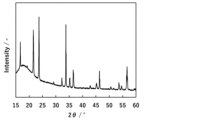
- FIG. 2 is a diagram showing an XRD pattern of the pre-dopant obtained in Example 1.
- FIG. 2 is a diagram showing an XRD pattern of the pre-dopant obtained in Example 2.
- FIG. 13 is a diagram showing an XRD pattern of the pre-dopant obtained in Comparative Example 2.
- pre-dope agent for an electric storage device of the present invention
- pre-dope agent is mainly composed of lithium iron oxide represented by the following formula (1), and is characterized in that in X-ray diffraction measurement, the intensity ratio between the diffraction peak intensity (I16.7) at a diffraction angle (2 ⁇ ) of 16.7 ⁇ 0.5° and the diffraction peak intensity (I23.6) at a diffraction angle (2 ⁇ ) of 23.6 ⁇ 0.5° is less than 40%.
- Li 5 Fe x O y (1) [In formula (1), x satisfies 0.6 ⁇ x ⁇ 1.0, and y satisfies 3.4 ⁇ y ⁇ 4.0.]
- the pre-dopant of the present invention which satisfies the constitution in which the intensity ratio (I16.7/I23.6) is less than 40%, has a large distortion in the crystal structure of the lithium iron oxide represented by the above formula (1), and a certain amount of Fe is doped into the lithium oxide.
- "mainly composed” in the present invention indicates that the content of the lithium iron oxide represented by the above formula (1) constituting the pre-dope agent for a storage battery device is 80 mass% or more, and means that Li compounds other than the lithium iron oxide represented by the above formula (1) may be present. Examples of such compounds include LiOH, Li2CO3 , etc. present on the surface, and lithium iron oxide LiFeO2 with a low Li content.
- the content of the lithium iron oxide represented by the above formula (1) is preferably 90 mass% or more, more preferably 95 mass% or more.
- a pre-doping agent for a power storage device having a very large irreversible capacity can be obtained by satisfying the constitution that the intensity ratio (I16.7/I23.6) between the diffraction peak intensity (I16.7) at a diffraction angle (2 ⁇ ) of 16.7 ⁇ 0.5° and the diffraction peak intensity (I23.6) at a diffraction angle (2 ⁇ ) of 23.6 ⁇ 0.5° is less than 40% in X-ray diffraction measurement.
- a preferred embodiment of the pre-doping agent of the present invention is that the irreversible capacity at a voltage of 3.0 to 4.3 V (based on Li reference electrode) during the initial charge is 712 mAh/g or more and 1100 mAh/g or less.
- the pre-doping agent of the present invention can perform a pre-doping process even at a low charging voltage, can suppress the decomposition of the electrolyte, and has a very large irreversible capacity, so that it is possible to reduce the amount of the pre-doping agent used when applied to a positive electrode. Therefore, the ratio of the positive electrode active material can be increased, and the capacity of the storage device can be increased.
- the irreversible capacity of the pre-dopant of the present invention is more preferably 720 mAh/g or more, even more preferably 750 mAh/g or more, particularly preferably 800 mAh/g or more, even more preferably 820 mAh/g or more, and most preferably 850 mAh/g or more.
- the irreversible capacity is more preferably 1050 mAh/g or less, and even more preferably 980 mAh/g or less.
- the pre-doping agent of the present invention is mainly composed of lithium iron oxide represented by the above formula (1), and x satisfies 0.6 ⁇ x ⁇ 1.0.
- x indicates the amount of Fe doped into the lithium oxide.
- x is 1.0 or more, the amount of Li relative to Fe is small, so that the amount of lithium pre-doped into the negative electrode is insufficient, and a pre-doping agent having a high irreversible capacity of 712 mAh/g or more cannot be obtained.
- x is less than 0.6, the amount of Fe doped is small and approaches the properties of lithium oxide, so that lithium is not easily released accompanied by an oxidation reaction during charging at a low voltage of 4.3 V or less. Therefore, as the charging capacity decreases, a pre-doping agent having a high irreversible capacity of 712 mAh/g or more cannot be obtained.
- lithium iron oxide represented by the above formula (1) and lithium iron oxide adjusted only in composition that is, lithium oxide not doped with Fe
- the intensity ratio (I16.7/I23.6) does not become less than 40%, and a high irreversible capacity of 712 mAh/g or more cannot be obtained.
- lithium oxide doped with Fe means lithium iron oxide having a structure in which part of the Li in the lithium oxide is replaced with Fe.
- the coating slurry thickens and gels when finishing the electrode, so it is essential that a certain amount of Fe is doped into the lithium oxide.
- y satisfies 3.4 ⁇ y ⁇ 4.0. If y is less than 3.4, there is a risk that unreacted lithium and iron raw materials will remain. y is preferably 3.5 or more, more preferably 3.6 or more, and even more preferably 3.7 or more. If y exceeds 4.0, the iron in the lithium iron oxide will be in a highly oxidized state, and the charging capacity may decrease. y is preferably 3.9 or less, and more preferably 3.8 or less.
- the lithium iron oxide represented by the above formula (1) may be further doped with another metal element M other than Fe.
- the other metal element M include Ni, Co, Mn, Ti, Al, V, Zr, and Nb.
- the doping amount z of the other metal element M is premised on the fact that Fe satisfies 0.6 ⁇ x ⁇ 1.0, but is preferably 0.01 ⁇ z ⁇ 0.4, and the lithium iron oxide represented by the following formula (2) is a preferred embodiment.
- the pre-doping agent of the present invention makes it possible to reduce manufacturing costs, and since lithium ions can be pre-doped at a lower charging voltage, the decomposition of the electrolyte can be suppressed, and since the irreversible capacity is very large, it is possible to reduce the amount of pre-doping agent used when applied to the positive electrode. Therefore, the ratio of the positive electrode active material can be increased, and the capacity of the storage device can be increased.
- the pre-dopant of the present invention preferably has a half-width of 0.06 to 0.17° of a diffraction peak with a diffraction angle (2 ⁇ ) of 23.6 ⁇ 0.5°. If the half-width is less than 0.06°, the resulting powder product may become hard and may be difficult to grind. In addition, the particles after grinding may be coarse, making it difficult to apply to an electrode.
- the half-width is more preferably 0.07° or more, even more preferably 0.09° or more, and particularly preferably 0.10° or more. If the half-width exceeds 0.17°, polymorphous lithium iron oxide is generated, and the irreversible capacity may be reduced.
- the half-width is more preferably 0.16° or less, even more preferably 0.15° or less, particularly preferably 0.14° or less, and most preferably 0.13° or less.
- the pre-dope agent of the present invention preferably has an intensity ratio (I43.5/I23.6) of the diffraction peak intensity (I43.5) at a diffraction angle (2 ⁇ ) of 43.5 ⁇ 0.5° to the diffraction peak intensity (I23.6) at a diffraction angle (2 ⁇ ) of 23.6 ⁇ 0.5° of less than 10%. If the intensity ratio (I43.5/I23.6) is 10% or more, the pre-dope agent may have a small irreversible capacity.
- the intensity ratio (I43.5/I23.6) is more preferably 8% or less, even more preferably 6% or less, particularly preferably 4% or less, and most preferably 2% or less.
- the intensity ratio (I43.5/I23.6) is usually 0% or more.
- the pre-dopant of the present invention preferably has an intensity ratio (I44.6/I23.6) of the diffraction peak intensity (I44.6) at a diffraction angle (2 ⁇ ) of 44.6 ⁇ 0.5° to the diffraction peak intensity (I23.6) at a diffraction angle (2 ⁇ ) of 23.6 ⁇ 0.5°, less than 8%. If the intensity ratio (I44.6/I23.6) is 8% or more, there is a risk of a short circuit phenomenon occurring in the power storage device, and it is more preferable that it is 5% or less, even more preferable that it is 3% or less, and particularly preferable that it is 1% or less.
- the intensity ratio (I44.6/I23.6) is usually 0% or more.
- the space group of the crystal structure is Pbca, and the crystal lattice constants a, b, and c satisfy 9.15000 ⁇ a ⁇ 9.15300 ⁇ , 9.21900 ⁇ b ⁇ 9.22200 ⁇ , and 9.20600 ⁇ c ⁇ 9.20800 ⁇ , respectively.
- the space group of the crystal structure is Pbca, and the ratios of the crystal lattice constants a, b, and c are 0.99300 to 0.99410 and 1.00100 to 1.00170, respectively. From the studies of the present inventors, the present inventors infer that in the present pre-doping agent in which Fe is partially removed from the lithium iron oxide, the crystal structure of the lithium iron oxide is distorted, making it easier for lithium to be released.
- the volume resistivity is preferably 1.0 ⁇ 10 1 to 9.0 ⁇ 10 15 ⁇ cm.
- the volume resistivity is less than 1.0 ⁇ 10 1 ⁇ cm, in the power storage device system, electrons preferentially move to the pre-dope agent, so that only the positive electrode active material near the pre-dope agent is utilized, and there is a risk of a local reaction causing a decrease in capacity.
- the volume resistivity is preferably 1.0 ⁇ 10 2 ⁇ cm or more, and more preferably 1.0 ⁇ 10 3 ⁇ cm or more.
- the pre-dope agent of the present invention is preferably coated with a carbonaceous material or the like, but from the viewpoint of controlling the value of the volume resistivity to a certain level while maintaining the irreversible capacity to a certain level, it is also a preferred embodiment that the pre-dope agent does not contain a carbonaceous material.
- the volume resistivity is preferably 9.0 ⁇ 10 4 ⁇ cm or more, more preferably 9.0 ⁇ 10 5 ⁇ cm or more, even more preferably 9.0 ⁇ 10 6 ⁇ cm or more, particularly preferably 9.0 ⁇ 10 7 ⁇ cm or more, and most preferably 9.0 ⁇ 10 8 ⁇ cm or more.
- the volume resistivity is more preferably 9.0 ⁇ 10 12 ⁇ cm or less, even more preferably 9.0 ⁇ 10 11 ⁇ cm or less, and particularly preferably 9.0 ⁇ 10 10 ⁇ cm or less.
- the specific surface area is preferably 0.05 to 5.0 m 2 /g.
- the reaction area is small, lithium is not sufficiently released from the pre-dope agent, the charging capacity is reduced, and the irreversible capacity may be reduced.
- the specific surface area is more preferably 0.1 m 2 /g or more, even more preferably 0.2 m 2 /g or more, and particularly preferably 0.5 m 2 /g or more.
- the specific surface area exceeds 5.0 m 2 /g, there is a risk of causing a side reaction.
- the specific surface area is more preferably 4.0 m 2 /g or less, even more preferably 3.0 m 2 /g or less, particularly preferably 2.0 m 2 /g or less, even more preferably 1.5 m 2 /g or less, and most preferably 1.4 m 2 /g or less.
- the average particle diameter (D50) is preferably 1 to 60 ⁇ m.
- the average particle diameter (D50) is more preferably 2 ⁇ m or more, even more preferably 3 ⁇ m or more, particularly preferably 4 ⁇ m or more, and most preferably 5 ⁇ m or more.
- the average particle diameter (D50) is more preferably 50 ⁇ m or less, even more preferably 40 ⁇ m or less, particularly preferably 30 ⁇ m or less, and most preferably 25 ⁇ m or less.
- the average particle diameter (D50) means the median diameter obtained by measuring the particle size distribution using a laser diffraction type particle size distribution measuring device (Microtrac MT-3000, manufactured by Nikkiso Co., Ltd.).
- the particle size distribution index D10/D50 is preferably 0.1 to 0.4, and more preferably 0.12 to 0.4. Also, the particle size distribution index D90/D50 is preferably 2.0 to 4.0, and more preferably 2.2 to 4.0.
- the tap density is preferably 1.0 to 1.5 g/ml. By having the tap density in this range, the energy density is improved, and a pre-dope agent with a very large irreversible capacity is obtained.
- the tap density is more preferably 1.05 g/ml or more, even more preferably 1.08 g/ml or more, particularly preferably 1.12 g/ml or more, and most preferably 1.18 g/ml or more.
- the tap density is more preferably 1.4 g/ml or less.
- the SO 3 content is preferably 5,000 ppm or less. If the SO 3 content exceeds 5,000 ppm, lithium sulfide is generated as an impurity, and the charging capacity may decrease, so it is more preferably 4,500 ppm or less, even more preferably 3,500 ppm or less, particularly preferably 2,500 ppm or less, and most preferably 1,500 ppm or less. On the other hand, the SO 3 content is usually 1 ppm or more.
- the amount of Li ions eluted is preferably 15 mg/kg or less. If the amount of Li ions eluted exceeds 15 mg/kg, lithium compounds are contained as impurities, and there is a risk that the charging capacity will decrease or the slurry stability during electrode preparation will be poor. Therefore, it is more preferable that the amount is 13 mg/kg, even more preferable that the amount is 12 mg/kg or less, particularly preferable that the amount is 11 mg/kg or less, and most preferable that the amount is 10 mg/kg.
- the powder color L value is preferably 20 to 90.
- the powder color L value is less than 20, it contains unreacted iron raw material and low-order lithium iron oxide LiFeO 2 , and the charging capacity may be reduced, and it is more preferably 30 or more, even more preferably 40 or more, particularly preferably 50 or more, even more preferably 60 or more, and most preferably 70 or more.
- the powder color L value exceeds 90, it contains lithium compounds, and the charging capacity may be reduced, and it is more preferably 88 or less, even more preferably 86 or less, particularly preferably 84 or less, and most preferably 82 or less.
- the method for producing the pre-dope agent of the present invention is not particularly limited.
- a method for producing a pre-dope agent for an electric storage device mainly composed of lithium iron oxide obtained by mixing and baking an iron raw material and a lithium raw material is preferably adopted, in which the iron raw material and the lithium raw material are mixed (hereinafter sometimes abbreviated as “mixing process"), a first baking process is performed in which the iron raw material and the lithium raw material are baked at 350 to 650 ° C for 2 to 100 hours in an inert gas atmosphere with an oxygen concentration of 1 to 52000 ppm (hereinafter sometimes abbreviated as “first baking process”), the powdered product obtained as the first baked product is crushed, and the crushed powder is baked at 700 to 1050 ° C for 2 to 100 hours in an inert gas atmosphere with an oxygen concentration of 1 to 52000 ppm (hereinafter sometimes abbreviated as "second baking process”), and the powdered product obtained as the second baked product is crushed to obtain lithium iron oxide.
- a pre-dope agent for a storage device containing the lithium iron oxide of the present invention as a main component which has a very large irreversible capacity, can be obtained by mixing the iron raw material and the lithium raw material, performing a first firing step in which the material is fired in an inert atmosphere with a specific oxygen concentration at a low temperature for a specific time, and then performing a second firing step in which the material is fired in an inert atmosphere with a specific oxygen concentration at a high temperature for a specific time.
- the inventors presume that the crystal structure is distorted by performing the first firing step in a low temperature range, and then Fe is doped into the crystal structure in the minimum amount required by performing the second firing step in a high temperature range.
- the oxygen concentration in the first and second firing steps is more preferably 5 ppm or more, even more preferably 30 ppm or more, particularly preferably 100 ppm or more, and most preferably 300 ppm or more.
- the oxygen concentration is more preferably 50,000 ppm or less, even more preferably 35,000 ppm or less, particularly preferably 28,000 ppm or less, and most preferably 10,000 ppm or less.
- the iron raw material used in the present invention is not particularly limited, and preferably used are iron hydroxide (III) oxide, iron oxide (II), iron oxide (III), ferrous sulfate (II), ferric sulfate (III), iron hydroxide (II), iron hydroxide (III), etc. Among them, at least one selected from the group consisting of iron hydroxide (III) oxide and iron oxide (III) is more preferably used.
- the lithium raw material used in the present invention is not particularly limited, and lithium hydroxide, lithium carbonate, lithium acetate, lithium nitrate, lithium oxide, etc. are preferably used. These may be hydrated or anhydrous. Of these, lithium hydroxide is more preferably used.
- the iron raw material and the lithium raw material are mixed.
- a carbon raw material may be further mixed with the iron raw material and the lithium raw material. They may be mixed by a dry method or a wet method, but it is preferable to mix them by a dry method. Among them, a preferred embodiment is to mix the iron raw material and the lithium raw material in a powder state, and when a carbon raw material is further included, a preferred embodiment is to mix the iron raw material, the lithium raw material, and the carbon raw material in a powder state.
- the Li/Fe (molar ratio) when mixing the iron raw material and the lithium raw material is preferably 1.0 to 8.0.
- the particle size and/or bulk density of the raw material is within a certain range. This allows the iron raw material and the lithium raw material to react uniformly, and the fired product can be easily recovered after the first firing step. Furthermore, in X-ray diffraction measurement, it is possible to control the intensity ratio (I16.7/I23.6) between the diffraction peak intensity (I16.7) at a diffraction angle (2 ⁇ ) of 16.7 ⁇ 0.5° and the diffraction peak intensity (I23.6) at a diffraction angle (2 ⁇ ) of 23.6 ⁇ 0.5° and/or the intensity ratio (I43.5/I23.6) between the diffraction peak intensity (I43.5) at a diffraction angle (2 ⁇ ) of 43.5 ⁇ 0.5° and the diffraction peak intensity (I23.6) at a diffraction angle (2 ⁇ ) of 23.6 ⁇ 0.5° to a certain level or less.
- the particle diameter of the iron raw material is preferably 30 ⁇ m or less, more preferably 28 ⁇ m or less, even more preferably 25 ⁇ m or less, particularly preferably 22 ⁇ m or less, and most preferably 18 ⁇ m or less.
- the particle diameter of the iron raw material is preferably 0.5 ⁇ m or more.
- the particle diameter of the iron raw material is determined by the median diameter obtained by measuring the particle size distribution using a laser diffraction type particle size distribution measuring device (Microtrac MT-3000, manufactured by Nikkiso Co., Ltd., iron oxide (III) particle refractive index 2.94, iron hydroxide oxide (III) particle refractive index 2.26). At this time, ion-exchanged water was used as the medium.
- the bulk density of the iron raw material is preferably 0.90 g/cm 3 or less, more preferably 0.88 g/cm 3 or less, even more preferably 0.85 g/cm 3 or less, particularly preferably 0.82 g/cm 3 or less, and most preferably 0.78 g/cm 3 or less.
- the bulk density of the iron raw material is preferably 0.1 g/cm 3 or more. The bulk density of the iron raw material is determined by filling a 20 ml graduated cylinder with the iron raw material and weighing the filled iron raw material.
- the particle diameter of the lithium raw material is preferably 100 ⁇ m or less, more preferably 80 ⁇ m or less, even more preferably 60 ⁇ m or less, particularly preferably 50 ⁇ m or less, and most preferably 40 ⁇ m or less.
- the particle diameter of the lithium raw material is preferably 1 ⁇ m or more.
- the particle diameter of the lithium raw material is determined by the median diameter obtained by measuring the particle size distribution using a laser diffraction type particle size distribution measuring device (manufactured by Nikkiso Co., Ltd., Microtrack MT-3000, particle refractive index 1.46). At this time, isopropyl alcohol with a water content of 2000 ppm or less by the Karl Fischer method was used as the medium.
- a first firing step is preferably performed.
- a method of firing in an inert gas atmosphere with an oxygen concentration of 1 to 52,000 ppm at a low temperature for a specific time is preferably adopted.
- Nitrogen, argon, helium, neon, krypton, etc. are preferably used as the inert gas.
- the firing temperature in the first firing step is preferably 350 to 650°C. If the firing temperature is less than 350°C, unreacted raw materials remain, and the lithium iron oxide represented by the above formula (1) may not be obtained.
- the firing temperature is more preferably 380°C or higher, even more preferably 420°C or higher, particularly preferably 450°C or higher, and most preferably 500°C or higher.
- the firing temperature exceeds 650°C, sublimation or fixation of the lithium source occurs, and lithium and iron may not react uniformly, so it is more preferably 620°C or lower, even more preferably 600°C or lower, and particularly preferably 580°C or lower.
- the firing time in the first firing step is preferably 2 to 100 hours. If the firing time is less than 2 hours, unreacted raw materials will remain, and there is a risk that the lithium iron oxide represented by the above formula (1) will not be obtained.
- the firing time is more preferably 3 hours or more, and even more preferably 4 hours or more. On the other hand, if the firing time exceeds 100 hours, there is a risk that productivity will decrease. It is more preferable that the firing time is 90 hours or less.
- a preferred embodiment is to grind the powdered product obtained by the first firing step.
- At least one grinding device selected from the group consisting of a ball mill, a planetary mill, a mortar and pestle mill, a jet mill, and a pin mill is preferably used for grinding, and at least one grinding device selected from the group consisting of a ball mill and a planetary mill is more preferably used.
- the average particle diameter (D50) of the powdered product obtained by the first firing step is preferably 15 ⁇ m or less.
- the average particle diameter (D50) of the powdered product is 15 ⁇ m or less, the reactivity during the second firing step is improved, and the lithium iron oxide represented by the above formula (1) is obtained.
- the average particle diameter (D50) of the powdered product obtained by the first firing step is more preferably 10 ⁇ m or less, and even more preferably 8 ⁇ m or less.
- the average particle diameter (D50) of the powdered product obtained by the first firing step is preferably 1 ⁇ m or more.
- the average particle diameter (D50) refers to the median diameter obtained by measuring the particle size distribution using a laser diffraction type particle size distribution measuring device (Microtrac MT-3000, manufactured by Nikkiso Co., Ltd.).
- a preferred embodiment is a method of obtaining lithium iron oxide by performing a second baking step.
- a method of baking in an inert gas atmosphere with an oxygen concentration of 1 to 52,000 ppm for a specific time at a high temperature range is preferably adopted.
- Nitrogen, argon, helium, neon, krypton, etc. are preferably used as the inert gas.
- the baking temperature in the second baking step is preferably 700 to 1,050°C. If the baking temperature is less than 700°C, unreacted raw materials remain, so there is a risk that the lithium iron oxide represented by the above formula (1) will not be obtained.
- the baking temperature is more preferably 720°C or higher, even more preferably 750°C or higher, particularly preferably 780°C or higher, and most preferably 820°C or higher.
- the baking temperature exceeds 1,050°C, the obtained particles may become coarse and it may be difficult to apply to an electrode, so it is more preferably 1,000°C or lower, even more preferably 980°C or lower, and particularly preferably 950°C or lower.
- the firing time in the second firing step is preferably 2 to 100 hours. If the firing time is less than 2 hours, unreacted raw materials will remain, and there is a risk that the lithium iron oxide represented by the above formula (1) will not be obtained.
- the firing time is more preferably 3 hours or more, and even more preferably 4 hours or more. On the other hand, if the firing time exceeds 100 hours, there is a risk that productivity will decrease. It is more preferable that the firing time is 90 hours or less.
- the pulverization method is preferably the same as that used for pulverization after the first firing step.
- the average particle diameter (D50) of the pre-dope agent is preferably within the range described above. It is also a preferred embodiment to magnetically separate the pre-dope agent obtained after pulverization to remove magnetic materials.
- the pre-dope agent is coated with at least one coating material selected from the group consisting of an organosilicon compound, a fatty acid, lithium carbonate, a niobium compound, a zirconium compound, and a carbonaceous material (hereinafter, it may be referred to as a "coated pre-dope agent” or a "surface-treated pre-dope agent”).
- the pre-dope agent for an electrical storage device is at least one selected from the group consisting of silica-coated lithium iron oxide, fatty acid-coated lithium iron oxide, lithium carbonate-coated lithium iron oxide, lithium niobate-coated lithium iron oxide, lithium zirconate-coated lithium iron oxide, and carbonaceous material-coated lithium iron oxide. It is preferable that the entire surface of the pre-dope agent is coated, but it is acceptable if there are any parts of the surface of the pre-dope agent that are not coated.
- the pre-doping agent being coated means that, when the elements C, O, Si, Fe, Nb, and Zr are specified and measured with an X-ray photoelectron analyzer, the elemental concentration of C, Si, Nb, or Zr from the outermost surface of the pre-doping agent to a depth of 1 nm is a certain level or more.
- the elemental concentration is preferably 1% or more, more preferably 5% or more, even more preferably 12% or more, even more preferably 15% or more, particularly preferably 20% or more, and most preferably 25% or more.
- the elemental concentration is usually 45% or less.
- the elemental concentration of C is preferably 12% or more, more preferably 15% or more.
- the elemental concentration of Si is preferably 1% or more, more preferably 3% or more.
- the elemental concentration of Nb is preferably 1% or more, more preferably 5% or more.
- the elemental concentration of Zr is preferably 1% or more, more preferably 5% or more.
- the pre-dope agent is coated with the coating material, but the powder color L value of the coated pre-dope agent may decrease due to the influence of the coating material such as a carbonaceous material.
- the powder color L value of the coated pre-dope agent is preferably 10 to 90, more preferably 12 to 88, and even more preferably 14 to 86.
- the organic silicon compound is not particularly limited as long as the surface of the pre-dopant is coated with silica, and tetramethoxysilane, tetraethoxysilane, tetrabutoxysilane, methyltrimethoxysilane, ethyltrimethoxysilane, triethoxycaprylylsilane, vinyltriethoxysilane, etc. are preferably used.
- the fatty acid a higher fatty acid having 10 to 24 carbon atoms such as lauric acid, myristic acid, palmitic acid, stearic acid, isostearic acid, oleic acid, behenic acid, etc. are preferably used.
- niobium compound pentaethoxyniobium, pentapropoxyniobium, pentabutoxyniobium, etc. are preferably used.
- zirconium compound tetraethoxyzirconium, tetrapropoxyzirconium, tetrabutoxyzirconium, etc. are preferably used.
- the carbonaceous material preferably used is activated carbon, acetylene black, polyvinyl alcohol, carbon nanotubes, carbon nanofibers, graphene, hard carbon, soft carbon, ketjen black, etc.
- the method of coating the pre-dope agent is not particularly limited, and the coating material and the pre-dope agent can be mixed and, if necessary, baked.
- the baking temperature is preferably 300 to 600°C, and the baking time is preferably 0.5 to 24 hours.
- a method of coating the pre-dope agent using a fatty acid a method of wet-mixing the fatty acid and the pre-dope agent and coating by vacuum distillation instead of baking is preferably adopted.
- a method of baking the pre-dope agent at 300 to 600°C in a carbon dioxide atmosphere with an oxygen concentration of 1 to 52,000 ppm, or a method of bubbling the pre-dope agent with carbon dioxide gas in an organic solvent is preferably adopted.
- a method for coating the pre-dope agent using a niobium compound a method is preferably used in which a niobium compound, the pre-dope agent, and optionally a lithium compound such as lithium methoxide, lithium ethoxide, lithium isopropoxide, or lithium tert-butoxide are mixed, and the mixture is heat-treated at 300 to 600 ° C.
- a method for coating the pre-dope agent using a zirconium compound a method is preferably used in which a zirconium compound, the pre-dope agent, and optionally a lithium compound such as lithium methoxide, lithium ethoxide, lithium isopropoxide, or lithium tert-butoxide are mixed, and the mixture is heat-treated at 300 to 600 ° C.
- the pre-dope agent thus coated is preferably pulverized as appropriate, and the same method as the pulverization method for the powder product is preferably used.
- pre-doping can be performed without using a metal lithium foil, so that it is possible to suppress the decrease in the volume energy density of the power storage device and reduce the manufacturing cost, and since lithium ions can be pre-doped at a lower charging voltage, the decomposition of the electrolyte can be suppressed, and a power storage device with a very large irreversible capacity can be provided.
- a positive electrode for a power storage device containing the pre-doping agent of the present invention and a positive electrode active material is a preferred embodiment.
- a material used in a lithium ion battery or a lithium ion capacitor can be used, and for example, a layered rock salt type lithium oxide containing a transition metal element selected from Ni, Co, Mn, and Al; a spinel type lithium oxide containing a transition metal element selected from Ni, Co, Mn, Ti, Fe, Cr, Zn, and Cu; an olivine type lithium phosphate compound represented by LiFePO 4 ; and carbon-based materials such as activated carbon, acetylene black, ketjen black, and graphene sheets can be preferably used.
- Examples of the layered rock salt type lithium oxide include LiNiO2 , LiCoO2 , Li2MnO3 , Li( Ni1 / 3Co1/ 3Mn1 / 3 ) O2, Li(Ni0.5Co0.2Mn0.3 ) O2 , Li ( Ni0.6Co0.2Mn0.2 ) O2 , Li( Ni0.8Co0.1Mn0.1 ) O2 , and Li( Ni0.8Co0.15Al0.05 ) O2 .
- Examples of the spinel type lithium oxide include LiMn2O4 and LiMn1.5Ni0.5O4 .
- the content of the pre-dopant is preferably 1 to 60% by weight based on the total weight of the pre-dopant and the positive electrode active material. If the content of the pre-dopant is less than 1% by weight, the irreversible capacity is small and there is a risk that the potential of the negative electrode such as graphite or silicon cannot be reduced, so the content of the pre-dopant is more preferably 2% by weight or more, and even more preferably 5% by weight or more.
- the content of the pre-dopant exceeds 60% by weight, there is a risk that the energy density decreases due to the decrease in the content of the positive electrode active material, so the content of the pre-dopant is more preferably 55% by weight or less, and even more preferably 45% by weight or less.
- a more preferred embodiment is an electricity storage device having the positive electrode as a component.
- the negative electrode in the electricity storage device carbon-based materials such as graphite and activated carbon, silicon-based materials such as silicon and silicon monoxide, metal materials such as tin, aluminum, germanium, and sulfur can be preferably used.
- an electrolytic solution liquid electrolyte in which a lithium salt such as LiPF 6 , LiBF 4 , LiClO 4 is dissolved in an organic solvent, a solid electrolyte, and the like can be preferably used.
- the type of the electricity storage device is not particularly limited, and at least one type of electricity storage device selected from the group consisting of a lithium ion battery, an all-solid-state battery, a lithium ion capacitor, and an electric double layer capacitor is preferred. Among them, at least one type of electricity storage device selected from the group consisting of a lithium ion battery and a lithium ion capacitor is more preferred. Among the lithium ion capacitors, a graphite-based lithium ion capacitor using graphite for the negative electrode is a more preferred embodiment.
- the pre-dope agent of the present invention can exert its effect as a pre-dope agent if it is present between the positive electrode and the negative electrode.
- it can be applied to the positive electrode surface, applied to the separator surface, or contained in the separator.
- a slurry made by mixing the pre-dope agent, a solvent, and a binder, etc. is applied to the separator using a coater, and the solvent is removed by drying.
- the pre-dope agent layer may be formed on either side of the separator, but it is preferable to form it closer to the positive electrode active material layer. Specifically, when the positive electrode and the negative electrode are arranged with the separator interposed therebetween, it is preferable to form it on the surface facing the positive electrode.
- the pre-dope agent layer may be formed on both sides of the separator, not just one side.
- anhydrous lithium hydroxide was added to the obtained powdered product as the first fired product so that the Li/Fe ratio became 5.2 (molar ratio), and the mixture was ground and mixed using a dry bead mill.
- anhydrous lithium hydroxide was added to the obtained powdered product as the first fired product so that the Li/Fe ratio became 5.6 (molar ratio), and the mixture was ground and mixed using a dry bead mill.
- anhydrous lithium hydroxide was added to the obtained powdered product as the first fired product so that the Li/Fe ratio became 5.6 (molar ratio), and the mixture was ground and mixed using a dry bead mill.
- anhydrous lithium hydroxide was added to the obtained powdered product as the first fired product so that the Li/Fe ratio became 5.6 (molar ratio), and the mixture was ground and mixed using a dry bead mill.
- anhydrous lithium hydroxide was added to the obtained powdered product as the first fired product so that the Li/Fe ratio became 5.6 (molar ratio), and the mixture was ground and mixed using a dry bead mill.
- anhydrous lithium hydroxide was added to the obtained powdered product as the first fired product so that the Li/Fe ratio became 5.6 (molar ratio), and the mixture was ground and mixed using a dry bead mill.
- anhydrous lithium hydroxide was added to the obtained powdered product as the first fired product so that the Li/Fe ratio became 5.6 (molar ratio), and the mixture was ground and mixed using a dry bead mill.
- KBM-04 tetraethoxysilane
- the Si/Fe (molar ratio) was 0.066.
- the element concentration from the outermost surface to a depth of 1 nm in the pre-dope agent of Example 12 was determined using an X-ray photoelectron analyzer, the element concentration of Si was 3%.
- ANZ-100S manufactured by Nitto Kagaku Co., Ltd.
- the carbon amount of the pre-dope agent of Example 13 was determined using a carbon amount analyzer (J Science Lab Co., Ltd., JMA-1000), the carbon amount was 5.9 wt%.
- the element concentration from the outermost surface to a depth of 1 nm of the pre-dope agent of Example 13 was determined using an X-ray photoelectron analyzer, the element concentration of C was 20%.
- Example 14 In a dry room maintained at a dew point of -30 ° C., 50 g of the lithium iron oxide prepared in Example 9, 1.1 g of lithium ethoxide (manufactured by Sigma-Aldrich) and 6.7 g of pentaethoxy niobium (manufactured by Kanto Chemical Co., Ltd.) were mixed for 20 minutes using a tabletop blender (manufactured by Iwatani Corporation, Lab Mill Surplus), and the resulting treated powder was dried in a dryer at 400 ° C. for 0.5 hours.
- a tabletop blender manufactured by Iwatani Corporation, Lab Mill Surplus
- the amount of Nb in the pre-doping agent of Example 14 was determined using a fluorescent X-ray analyzer (manufactured by Rigaku Corporation, Supermini)
- the Nb / Fe (molar ratio) was 0.065.
- the element concentration of the pre-dopant of Example 14 was measured from the outermost surface to a depth of 1 nm using an X-ray photoelectron analyzer, and the element concentration of Nb was found to be 6%.
- the average particle diameter (D50) of each pre-dopant obtained in the examples and comparative examples was measured using a particle size distribution measuring device (Microtrack MT-3000, manufactured by Nikkiso Co., Ltd.). At this time, isopropyl alcohol with a water content of 2000 ppm or less by the Karl Fischer method was used as a medium, and the measurement was performed in a dispersed state by irradiating ultrasonic waves with an output of 40 W for 30 seconds. The results are shown in Table 3.
- particle size distribution index D10/D50 and D90/D50 The particle diameters D10, D50 and D90 of the pre-dope agents obtained in the examples and comparative examples were measured using a particle size distribution measuring device (Microtrack MT-3000, manufactured by Nikkiso Co., Ltd.). At this time, isopropyl alcohol with a water content of 2000 ppm or less by the Karl Fischer method was used as a medium, and the medium was dispersed by irradiating ultrasonic waves with an output of 40 W for 30 seconds. From the obtained particle diameters D10, D50 and D90 values, the particle size distribution indexes D10/D50 and D90/D50 were calculated. The results are shown in Table 3.
- the pre-dope agent was filled into a 20 ml graduated cylinder, and tapped 200 times using a TAP DENSER, KYT-4000 manufactured by Seishin Enterprise Co., Ltd. The filling volume after tapping was read, and the tap density was calculated from this volume and the weight of the filled pre-dope agent. The results are shown in Table 3.
- the slurry was applied to an etched aluminum foil (JCC-20CB manufactured by Nippon Chemi-Con Corporation) as a current collector and dried at 120 ° C. for 5 minutes. The dried sheet was punched out with a punching machine to prepare an evaluation electrode (positive electrode). Metal lithium was used as the counter electrode, and a metal lithium foil was punched out. A polypropylene separator was sandwiched between the evaluation electrode and the counter electrode to form an electrode, which was then placed in a coin-type battery container.
- JCC-20CB manufactured by Nippon Chemi-Con Corporation
- Iron ion elution rate % iron ion concentration in test solution [mg/L] ⁇ 0.1 [L] ⁇ 1000 ⁇ 100 / (2.0 [g] ⁇ 1000 [mg/g])
- Lithium ion elution amount 1.0 g of each pre-dope agent obtained in the examples and comparative examples and 20 ml of N-methyl-2-pyrrolidone were added to a 30 mL screw tube, and the mixture was stirred overnight at 1000 rpm and 20 ° C. using a stirrer. Thereafter, the solution was collected using a 0.2 ⁇ m membrane filter, and 5 ml of the collected solution was diluted 10 times with 2-propanol. The lithium ion concentration in the diluted solution was measured by ion chromatography (ICS-2100 manufactured by Dionex), and the lithium ions eluted from the pre-dope agent were calculated. The results are shown in Table 3.
- a lithium ion battery was produced and pre-doped.
- the battery was produced in a dry room with a dew point of -20°C or less or in an inert gas atmosphere of nitrogen or argon.
- a positive electrode paint was prepared by dissolving Li( Ni0.5Co0.2Mn0.3 ) O2 (manufactured by Hosen Co., Ltd.) as a positive electrode active material, the pre-dope agent of Example 1 as a pre-dope agent, acetylene black ("Denka Black” manufactured by Denka Co., Ltd.) as a conductive assistant, and polyvinylidene fluoride (PVDF, "KF Polymer” manufactured by Kureha Co., Ltd.) as a binder in N-methylpyrrolidone.
- Li( Ni0.5Co0.2Mn0.3 ) O2 manufactured by Hosen Co., Ltd.
- acetylene black (“Denka Black” manufactured by Denka Co., Ltd.)
- PVDF polyvinylidene fluoride
- the content of the pre-dopant was adjusted to 10% of the total mass of the positive electrode active material and the pre-dopant, as shown in the following calculation formula.
- Content (%) of pre-dopant [mass of pre-dopant / (mass of positive electrode active material + mass of pre-dopant)] x 100
- the mass ratio of the total of the positive electrode active material and the pre-dope agent/the conductive assistant/the binder was adjusted to 90/5/5. That is, the mass ratio of the positive electrode active material/the pre-dope agent/the conductive assistant/the binder was adjusted to 81/9/5/5.
- the prepared positive electrode paint was applied to an etched aluminum foil ("JCC-20CB" manufactured by Nippon Chemi-Con Corporation) as a current collector, dried at 120°C for 5 minutes, and then cut into a size of 3 cm x 4 cm to prepare a positive electrode.
- the design capacity at this time was 15.6 mAh.
- a spherulitic graphite electrode (“HS-LIB-N-Gr-001" manufactured by Hosen Co., Ltd., nominal capacity: 1.6 mAh/cm 2 ) was used for the negative electrode, and the negative electrode was fabricated by cutting it into a size of 3.3 cm x 4.3 cm. The design capacity at this time was 22.7 mAh.
- the lithium ion battery of Example 1 was charged at a constant current to 4.3 V at a current density of 0.02 mA/cm 2 under an environment of 25° C. using a charge/discharge measuring device (manufactured by Hokuto Denko Corporation), and then charged at a constant voltage (termination condition: a current value of 0.007 mA/cm 2 ). Then, a resting step was performed for 3 minutes. Then, the battery was discharged to 3.0 V to perform a pre-doping process.
- a charge/discharge measuring device manufactured by Hokuto Denko Corporation
- the lithium ion batteries of the above Preparation Example and Comparative Preparation Example were evaluated for battery characteristics. Specifically, using a charge/discharge measuring device (manufactured by Hokuto Denko Corporation), charging/discharging was performed in the range of 3.0 to 4.3 V in an environment of 25° C. The charge/discharge rate was 1 C per weight of the positive electrode active material. The current density at the charge/discharge rate of 1 C was 160 mA/g (per weight of the active material). In evaluating the battery characteristics, ten batteries were fabricated for each condition. The short circuit rate was calculated from the number of short-circuited cells among the ten cells measured, and is shown in Table 3.
Landscapes
- Engineering & Computer Science (AREA)
- Chemical & Material Sciences (AREA)
- Power Engineering (AREA)
- Materials Engineering (AREA)
- Chemical Kinetics & Catalysis (AREA)
- Electrochemistry (AREA)
- General Chemical & Material Sciences (AREA)
- Microelectronics & Electronic Packaging (AREA)
- Manufacturing & Machinery (AREA)
- Inorganic Chemistry (AREA)
- Battery Electrode And Active Subsutance (AREA)
Priority Applications (3)
| Application Number | Priority Date | Filing Date | Title |
|---|---|---|---|
| JP2025523316A JPWO2024247498A1 (https=) | 2023-05-31 | 2024-04-09 | |
| EP24814985.8A EP4723242A1 (en) | 2023-05-31 | 2024-04-09 | Pre-doping agent for power storage device and method for producing same |
| CN202480035754.2A CN121219868A (zh) | 2023-05-31 | 2024-04-09 | 蓄电设备用预掺杂剂及其制造方法 |
Applications Claiming Priority (2)
| Application Number | Priority Date | Filing Date | Title |
|---|---|---|---|
| JP2023090338 | 2023-05-31 | ||
| JP2023-090338 | 2023-05-31 |
Publications (1)
| Publication Number | Publication Date |
|---|---|
| WO2024247498A1 true WO2024247498A1 (ja) | 2024-12-05 |
Family
ID=93657725
Family Applications (1)
| Application Number | Title | Priority Date | Filing Date |
|---|---|---|---|
| PCT/JP2024/014407 Ceased WO2024247498A1 (ja) | 2023-05-31 | 2024-04-09 | 蓄電デバイス用プリドープ剤及びその製造方法 |
Country Status (4)
| Country | Link |
|---|---|
| EP (1) | EP4723242A1 (https=) |
| JP (1) | JPWO2024247498A1 (https=) |
| CN (1) | CN121219868A (https=) |
| WO (1) | WO2024247498A1 (https=) |
Citations (6)
| Publication number | Priority date | Publication date | Assignee | Title |
|---|---|---|---|---|
| JP5220510B2 (ja) | 2008-08-06 | 2013-06-26 | 富士重工業株式会社 | 蓄電デバイス |
| JP6217990B2 (ja) | 2013-07-25 | 2017-10-25 | 株式会社豊田自動織機 | プリドープ剤、正極、並びにリチウムイオン二次電池及びその製造方法 |
| JP2020167187A (ja) * | 2019-03-28 | 2020-10-08 | テイカ株式会社 | 蓄電デバイス用プリドープ剤及びその製造方法 |
| WO2021029357A1 (ja) * | 2019-08-09 | 2021-02-18 | テイカ株式会社 | 蓄電デバイス用プリドープ剤及びその製造方法 |
| JP6922672B2 (ja) | 2017-11-09 | 2021-08-18 | 株式会社豊田自動織機 | 炭素被覆Li5FeO4 |
| WO2022172881A1 (ja) | 2021-02-09 | 2022-08-18 | テイカ株式会社 | 蓄電デバイス用プリドープ剤及びその製造方法 |
-
2024
- 2024-04-09 WO PCT/JP2024/014407 patent/WO2024247498A1/ja not_active Ceased
- 2024-04-09 CN CN202480035754.2A patent/CN121219868A/zh active Pending
- 2024-04-09 EP EP24814985.8A patent/EP4723242A1/en active Pending
- 2024-04-09 JP JP2025523316A patent/JPWO2024247498A1/ja active Pending
Patent Citations (6)
| Publication number | Priority date | Publication date | Assignee | Title |
|---|---|---|---|---|
| JP5220510B2 (ja) | 2008-08-06 | 2013-06-26 | 富士重工業株式会社 | 蓄電デバイス |
| JP6217990B2 (ja) | 2013-07-25 | 2017-10-25 | 株式会社豊田自動織機 | プリドープ剤、正極、並びにリチウムイオン二次電池及びその製造方法 |
| JP6922672B2 (ja) | 2017-11-09 | 2021-08-18 | 株式会社豊田自動織機 | 炭素被覆Li5FeO4 |
| JP2020167187A (ja) * | 2019-03-28 | 2020-10-08 | テイカ株式会社 | 蓄電デバイス用プリドープ剤及びその製造方法 |
| WO2021029357A1 (ja) * | 2019-08-09 | 2021-02-18 | テイカ株式会社 | 蓄電デバイス用プリドープ剤及びその製造方法 |
| WO2022172881A1 (ja) | 2021-02-09 | 2022-08-18 | テイカ株式会社 | 蓄電デバイス用プリドープ剤及びその製造方法 |
Also Published As
| Publication number | Publication date |
|---|---|
| JPWO2024247498A1 (https=) | 2024-12-05 |
| EP4723242A1 (en) | 2026-04-08 |
| CN121219868A (zh) | 2025-12-26 |
Similar Documents
| Publication | Publication Date | Title |
|---|---|---|
| US8535832B2 (en) | Metal oxide coated positive electrode materials for lithium-based batteries | |
| Luo et al. | Improved electrochemical performance of LiNi0. 5Co0. 2Mn0. 3O2 cathode material by double-layer coating with graphene oxide and V2O5 for lithium-ion batteries | |
| JP5695373B2 (ja) | 電気化学素子用電極及びそれを用いた電気化学素子 | |
| US9293235B2 (en) | Lithium titanate particles and process for producing the lithium titanate particles, Mg-containing lithium titanate particles and process for producing the Mg-containing lithium titanate particles, negative electrode active substance particles for non-aqueous electrolyte secondary batteries, and non-aqueous electrolyte secondary battery | |
| WO2020143532A1 (zh) | 正极活性材料及其制备方法、钠离子电池及包含钠离子电池的装置 | |
| Nie et al. | Effects of precursor particle size on the performance of LiNi0. 5Co0. 2Mn0. 3O2 cathode material | |
| EP2477258A1 (en) | Cathode active material, cathode and lithium battery including cathode active material, and method of preparing the cathode active material | |
| Wang et al. | An improved solid-state reaction to synthesize Zr-doped Li4Ti5O12 anode material and its application in LiMn2O4/Li4Ti5O12 full-cell | |
| JP6096985B1 (ja) | 非水電解質電池及び電池パック | |
| WO2012039893A2 (en) | Metal halide coatings on lithium ion battery positive electrode materials and corresponding batteries | |
| WO2010147179A1 (ja) | 電気化学素子用電極及びそれを用いた電気化学素子 | |
| CN110048091A (zh) | 活性材料、非水电解质电池和电池组 | |
| WO2013119571A1 (en) | Mixed phase lithium metal oxide compositions with desirable battery performance | |
| CN104641495A (zh) | 用于锂离子电池的具有受控不可逆容量损失的复合阴极材料 | |
| He et al. | SmPO4-coated Li1. 2Mn0. 54Ni0. 13Co0. 13O2 as a cathode material with enhanced cycling stability for lithium ion batteries | |
| KR20200133317A (ko) | 수산화철(FeOOH)의 제조방법 및 수산화철을 포함하는 리튬-황 전지용 양극 | |
| WO2014099878A1 (en) | High capacity cathode material with stabilizing nanocoatings | |
| JP7713885B2 (ja) | リチウムイオン二次電池用正極活物質、およびリチウムイオン二次電池 | |
| Zhang et al. | Synthesis and characterization of mono-dispersion LiNi0. 8Co0. 1Mn0. 1O2 micrometer particles for lithium-ion batteries | |
| WO2022044720A1 (ja) | リチウム二次電池用正極活物質、リチウム二次電池用正極及びリチウム二次電池 | |
| Yang et al. | A simple strategy to prepare the La2Li0. 5Al0. 5O4 modified high-performance ni-rich cathode material | |
| US12113172B2 (en) | Power storage device pre-doping agent and production method for same | |
| KR20160027929A (ko) | 이차 전지용 전극 합제 첨가제, 이의 제조 방법, 이를 포함하는 이차 전지용 전극 및 이차 전지 | |
| Yamashita et al. | Hydrothermal synthesis and electrochemical properties of Li2FexMnxCo1− 2xSiO4/C cathode materials for lithium-ion batteries | |
| WO2024247498A1 (ja) | 蓄電デバイス用プリドープ剤及びその製造方法 |
Legal Events
| Date | Code | Title | Description |
|---|---|---|---|
| 121 | Ep: the epo has been informed by wipo that ep was designated in this application |
Ref document number: 24814985 Country of ref document: EP Kind code of ref document: A1 |
|
| ENP | Entry into the national phase |
Ref document number: 2025523316 Country of ref document: JP Kind code of ref document: A |
|
| WWE | Wipo information: entry into national phase |
Ref document number: 2025523316 Country of ref document: JP |
|
| NENP | Non-entry into the national phase |
Ref country code: DE |
|
| WWE | Wipo information: entry into national phase |
Ref document number: 2024814985 Country of ref document: EP |
|
| ENP | Entry into the national phase |
Ref document number: 2024814985 Country of ref document: EP Effective date: 20260102 |
|
| ENP | Entry into the national phase |
Ref document number: 2024814985 Country of ref document: EP Effective date: 20260102 |
|
| ENP | Entry into the national phase |
Ref document number: 2024814985 Country of ref document: EP Effective date: 20260102 |
|
| ENP | Entry into the national phase |
Ref document number: 2024814985 Country of ref document: EP Effective date: 20260102 |
|
| ENP | Entry into the national phase |
Ref document number: 2024814985 Country of ref document: EP Effective date: 20260102 |
|
| ENP | Entry into the national phase |
Ref document number: 2024814985 Country of ref document: EP Effective date: 20260102 |
|
| WWP | Wipo information: published in national office |
Ref document number: 2024814985 Country of ref document: EP |