WO2024247448A1 - 触媒組成物、アンモニア合成方法、アンモニア分解方法およびペロブスカイト型酸水素化物の製造方法 - Google Patents
触媒組成物、アンモニア合成方法、アンモニア分解方法およびペロブスカイト型酸水素化物の製造方法 Download PDFInfo
- Publication number
- WO2024247448A1 WO2024247448A1 PCT/JP2024/011019 JP2024011019W WO2024247448A1 WO 2024247448 A1 WO2024247448 A1 WO 2024247448A1 JP 2024011019 W JP2024011019 W JP 2024011019W WO 2024247448 A1 WO2024247448 A1 WO 2024247448A1
- Authority
- WO
- WIPO (PCT)
- Prior art keywords
- perovskite
- type
- oxyhydride
- catalyst composition
- ammonia
- Prior art date
- Legal status (The legal status is an assumption and is not a legal conclusion. Google has not performed a legal analysis and makes no representation as to the accuracy of the status listed.)
- Ceased
Links
Images







Classifications
-
- Y—GENERAL TAGGING OF NEW TECHNOLOGICAL DEVELOPMENTS; GENERAL TAGGING OF CROSS-SECTIONAL TECHNOLOGIES SPANNING OVER SEVERAL SECTIONS OF THE IPC; TECHNICAL SUBJECTS COVERED BY FORMER USPC CROSS-REFERENCE ART COLLECTIONS [XRACs] AND DIGESTS
- Y02—TECHNOLOGIES OR APPLICATIONS FOR MITIGATION OR ADAPTATION AGAINST CLIMATE CHANGE
- Y02P—CLIMATE CHANGE MITIGATION TECHNOLOGIES IN THE PRODUCTION OR PROCESSING OF GOODS
- Y02P20/00—Technologies relating to chemical industry
- Y02P20/50—Improvements relating to the production of bulk chemicals
- Y02P20/52—Improvements relating to the production of bulk chemicals using catalysts, e.g. selective catalysts
Definitions
- the present invention relates to a catalyst composition, an ammonia synthesis method, an ammonia decomposition method, and a method for producing a perovskite-type oxyhydride.
- Ammonia is an important compound as a raw material for various chemical products.
- the Haber-Bosch process a representative ammonia synthesis method, uses a doubly promoted iron catalyst containing Fe3O4 and several mass % of Al2O3 and K2O , and directly reacts a mixed gas of nitrogen and hydrogen with this catalyst under high temperature and pressure conditions to produce ammonia.
- This technology is still used industrially today in the manufacturing process that is almost the same as when it was first developed.
- Ammonia synthesis by the Haber-Bosch process which mainly uses a doubly promoted iron catalyst, has been put to practical use, but it requires high temperature and pressure conditions, which poses problems in terms of equipment and costs.
- the supported metal catalysts described in Patent Document 1 generally use a carbonaceous support such as activated carbon or an inorganic oxide support, but these supported metal catalysts do not always have sufficient performance for practical use. In other words, there is a demand for ammonia synthesis catalysts having superior catalytic activity, for example, sufficient reaction activity even under conditions of lower temperature and pressure compared to the reaction conditions of the Haber-Bosch process.
- the present invention has been made in consideration of the above circumstances, and aims to provide a catalyst composition that has sufficient reaction activity even under low temperature and low pressure conditions, an ammonia synthesis method, an ammonia decomposition method, and a method for producing perovskite-type oxyhydrides.
- the catalyst composition of aspect 1 of the present invention is The perovskite-type oxyhydride is represented by the following formula (1): BaREO 2 H m ...(1)
- RE represents a rare earth element selected from the group consisting of Y, Sc, Gd, Tb, Dy, Ho, Er, Tm, Yb, and Lu
- m represents a number in the range of 0.5 to 1.0.
- Aspect 2 of the present invention is a catalyst composition according to aspect 1, The RE may be a rare earth element selected from the group consisting of Y, Sc, Tb, Dy, Ho, Er, Yb and Lu.
- Aspect 3 of the present invention is a catalyst composition according to aspect 1,
- the RE may be Y or Sc.
- Aspect 4 of the present invention is a catalyst composition according to aspect 1, It may be for an ammonia synthesis reaction or an ammonia decomposition reaction.
- Aspect 5 of the present invention is a catalyst composition according to any one of aspects 1 to 4,
- the perovskite-type oxyhydride may support one or more transition metals selected from the group consisting of Ru, Co, Fe, Cr and Mn.
- the method for synthesizing ammonia according to the sixth aspect of the present invention comprises a step of reacting nitrogen with hydrogen in the presence of the catalyst composition according to any one of the first to fifth aspects.
- a ninth aspect of the present invention is a method for producing a perovskite-type oxyhydride according to the eighth aspect,
- the RE may be a rare earth element selected from the group consisting of Y, Sc, Tb, Dy, Ho, Er, Yb and Lu.
- a tenth aspect of the present invention is a method for producing a perovskite-type oxyhydride according to the eighth aspect, comprising:
- the RE may be Y or Sc.
- Aspect 11 of the present invention is a method for producing a perovskite-type oxyhydride according to aspect 8, comprising the steps of:
- the RE may be Y.
- a twelfth aspect of the present invention is a method for producing a perovskite-type oxyhydride according to the eighth aspect, comprising the steps of: In the mechanochemical method, a planetary ball mill or a tumbling ball mill may be used.
- a thirteenth aspect of the present invention is the method for producing a perovskite-type oxyhydride according to the eighth aspect, wherein the pressing and the pulverization are carried out at a temperature of 300° C. or less.
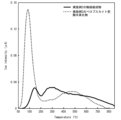
- Example 1 shows the results of TDS measurement for the perovskite-type oxyhydride of Example 2 (BaYO 2 H, after sintering treatment) and the catalyst composition of Example 2 (i.e., Ru-supported perovskite-type oxyhydride (BaYO 2 H, after sintering treatment)).
- Example 2 i.e., Ru-supported perovskite-type oxyhydride (BaYO 2 H, after sintering treatment)
- Example 3 shows the results of TDS measurement for the perovskite-type oxyhydride of Example 3 (BaScO 2 H, after sintering treatment) and the catalyst composition of Example 3 (i.e., Ru-supported perovskite-type oxyhydride (BaScO 2 H, after sintering treatment)).
- Example 1 shows the temperature dependence of ammonia synthesis rate for the catalyst composition of Example 2 (i.e., Ru-supported perovskite-type oxyhydride ( BaYO2H , after sintering treatment)), the catalyst composition of Example 4 (i.e., Co-supported perovskite-type oxyhydride ( BaYO2H , after sintering treatment)), and the catalyst composition of Example 5 (i.e., Fe-supported perovskite-type oxyhydride ( BaYO2H , after sintering treatment)) when exposed to a mixed gas flow of 0.9 MPa H2 and N2.
- Example 2 i.e., Ru-supported perovskite-type oxyhydride ( BaYO2H , after sintering treatment)
- the catalyst composition of Example 4 i.e., Co-supported perovskite-type oxyhydride ( BaYO2H , after sintering treatment)
- the catalyst composition of Example 5 i.e.
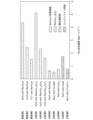
- Example 1 shows the ammonia synthesis rates for the catalyst compositions of Example 2 (i.e., Ru-supported perovskite-type oxyhydride ( BaYO2H , after sintering treatment)), Example 4 (i.e., Co-supported perovskite-type oxyhydride ( BaYO2H , after sintering treatment)), Example 5 (i.e., Fe-supported perovskite-type oxyhydride ( BaYO2H , after sintering treatment)), and Comparative Examples 1 to 8 when exposed to a mixed gas flow of H2 and N2 at 0.9 MPa and 300°C.
- Example 2 i.e., Ru-supported perovskite-type oxyhydride ( BaYO2H , after sintering treatment)
- Example 4 i.e., Co-supported perovskite-type oxyhydride ( BaYO2H , after sintering treatment)
- Example 5 i.e., Fe-supported perov
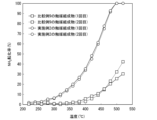
- Example 1 shows the temperature dependence of ammonia conversion for the catalyst composition of Example 2 (i.e., Ru-supported perovskite-type oxyhydride (BaYO 2 H, after sintering treatment)) and the catalyst composition of Comparative Example 9 when exposed to ammonia at 0.1 MPa.
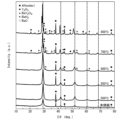
- 13 shows XRD patterns of the perovskite-type oxyhydrides of Example 7 ( BaTbO2H , BaDyO2H , BaHoO2H , BaErO2H , BaYbO2H , and BaLuO2H , after sintering treatment).
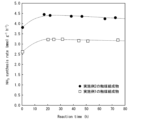
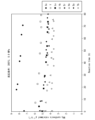
- Example 1 shows the change over time in ammonia synthesis rate for the catalyst composition of Example 2 (i.e., Ru-supported perovskite-type oxyhydride ( BaYO2H , after sintering)), the catalyst composition of Example 3 (i.e., Ru-supported perovskite-type oxyhydride ( BaScO2H , after sintering)), and the catalyst composition of Example 8 (i.e., Ru -supported perovskite-type oxyhydrides ( BaTbO2H , BaDyO2H , BaHoO2H, BaErO2H , BaYbO2H , BaLuO2H , after sintering)) when exposed to a mixed gas flow of H2 and N2 at 0.9 MPa and 300°C.
- Ru-supported perovskite-type oxyhydride BaYO2H , after sintering
- BaScO2H Ru-supported perovskite-type oxyhydride
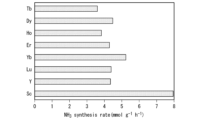
- Example 1 shows the ammonia synthesis rate for the catalyst composition of Example 2 (i.e., Ru-supported perovskite-type oxyhydride ( BaYO2H , after sintering)), the catalyst composition of Example 3 (i.e., Ru -supported perovskite-type oxyhydride ( BaScO2H , after sintering)), and the catalyst composition of Example 8 (i.e., Ru-supported perovskite-type oxyhydride ( BaTbO2H , BaDyO2H , BaHoO2H, BaErO2H , BaYbO2H , BaLuO2H , after sintering)) when exposed to a mixed gas flow of H2 and N2 at 0.9 MPa and 300°C.
- Ru-supported perovskite-type oxyhydride BaYO2H , after sintering
- BaScO2H Ru -supported perovskite-type oxyhydride
- Example 8
- the perovskite-type oxyhydride according to this embodiment is a perovskite-type oxyhydride represented by the following formula (1).
- RE represents a rare earth element selected from the group consisting of Y, Sc, Gd, Tb, Dy, Ho, Er, Tm, Yb and Lu
- m represents a number in the range of 0.5 to 1.0.
- Examples of the catalyst composition according to the embodiment of the present invention include BaYO2Hm1 (0.5 ⁇ m1 ⁇ 1.0 ), BaScO2Hm2 (0.5 ⁇ m2 ⁇ 1.0), BaGdO2Hm3 (0.5 ⁇ m3 ⁇ 1.0), BaTbO2Hm4 (0.5 ⁇ m4 ⁇ 1.0), BaDyO2Hm5 (0.5 ⁇ m5 ⁇ 1.0 ) , BaHoO2Hm6 ( 0.5 ⁇ m6 ⁇ 1.0), BaErO2Hm7 ( 0.5 ⁇ m7 ⁇ 1.0), BaYbO2Hm8 (0.5 ⁇ m8 ⁇ 1.0) , and BaLuO2Hm9 ( 0.5 ⁇ m9 ⁇ 1.0).
- RE in the formula (1) is preferably at least one rare earth element selected from the group consisting of Y, Sc, Tb, Dy, Ho, Er, Yb and Lu, and more preferably Y or Sc.
- RE is Y or Sc
- the catalyst performance can be further improved.
- Examples of the catalyst composition according to this embodiment in which RE is Y or Sc include BaYO 2 H m1 (0.5 ⁇ m1 ⁇ 1.0) and BaScO 2 H m2 (0.5 ⁇ m2 ⁇ 1.0).
- BaYO 2 H and BaScO 2 H are preferred.
- BaYO 2 H has a lower raw material cost than BaScO 2 H and is highly stable when used for ammonia synthesis over a long period of time. Therefore, BaYO 2 H is more preferred as the catalyst composition according to this embodiment.
- the characterization of the perovskite-type oxyhydride according to this embodiment may be performed using methods commonly used in the art, either alone or in combination. For example, Rietveld analysis of X-ray diffraction (XRD) patterns, Thermal Desorption Spectrometry (TDS) measurements, Fourier Transform Infrared Spectroscopy (FT-IR) measurements, nitrogen adsorption measurements, etc. may be performed.
- XRD X-ray diffraction
- TDS Thermal Desorption Spectrometry
- FT-IR Fourier Transform Infrared Spectroscopy
- nitrogen adsorption measurements etc.
- the perovskite-type oxyhydride according to this embodiment forms cubic crystals.
- the cubic perovskite structure is the most densely packed of the perovskite structures based on close packing, and is easily stabilized in synthesis methods that generate high pressures, such as mechanochemical methods.
- the fact that the perovskite-type oxyhydride is a cubic crystal can be confirmed by measuring it using X-ray diffraction (XRD) and performing Rietveld analysis of the obtained XRD pattern.
- XRD X-ray diffraction
- Comparative Example 7 The catalyst composition of Comparative Example 7 (Ru (5 wt%)/Ca 2 N) was obtained in the same manner as described in WO 2015/129471.
- Ru/Ba 3 Y 4 O 9 was obtained in the following manner. Barium carbonate (>99%, Kojundo Chemical) and yttrium oxide (>99.9%, Kojundo Chemical) were mixed in the air using an agate pestle and mortar. At this time, the molar ratio of barium carbonate to yttrium oxide was 3:2. The obtained powder was heat-treated at 1300°C for 5 hours in the air. In this way, Ba 3 Y 4 O 9 powder was obtained.
- the presence or absence of hydrogen and the amount of hydrogen contained were investigated from the desorption temperature and amount of hydrogen contained, focusing on the fragment with a mass ratio of 2 derived from hydrogen in the obtained TDS spectrum. Furthermore, since hydrides are often hydroxylated by water in the atmosphere, the presence or absence of hydroxylation was confirmed by focusing on the water-derived fragment with a mass ratio of 18.
- the TDS spectrum was analyzed using TDS Data Viewer (ESCO).
- Va is the adsorption amount at equilibrium pressure
- Vm is the monoatomic layer adsorption amount
- p0 is the saturated vapor pressure
- p is the equilibrium pressure
- C is a parameter related to the difference in adsorption heat between the first layer adsorption and the second layer and subsequent adsorption.
- BET Brunauer-Emmett-Teller
- the BET specific surface area of the perovskite-type oxyhydride of Example 2 was 2.17 m 2 /g.
- the BET specific surface area of the perovskite-type oxyhydride of Example 3 was 4.38 m 2 /g.
- ammonia synthesis In the ammonia synthesis test, nitrogen gas and hydrogen gas were passed through at flow rates of 15 mL/min and 45 mL/min, respectively, so that the flow rate ratio of the gas was 1:3, and the catalyst loading amount was standardized to 0.1 g.
- the reaction time was 0 to 80 hours, the temperature was 200 to 400°C, and the pressure was 0.1 to 0.9 MPa.
- the gas that had passed through the catalyst was passed through 5 mM dilute sulfuric acid to trap ammonia as ammonium ions, which were sampled at regular intervals and measured by ion chromatography (Prominence, Shimadzu) to qualitatively and quantitatively analyze ammonia.
- the ammonia synthesis rate was then calculated from the slope of a plot of the amount of ammonium ions produced versus the sampling time.
- ammonia decomposition In the ammonia decomposition test, ammonia was passed through at a flow rate of 25 mL/min, and the catalyst loading amount was standardized to 0.1 g. The reaction time was 0 to 80 hours, the temperature was 220 to 520 ° C, and the pressure was 0.1 MPa. The gas that passed through the catalyst was measured by gas chromatography (GC-14A, Shimadzu) to obtain the ammonia conversion rate. The ammonia conversion rate is the percentage of the ratio of the denominator "amount of NH3 fed into circulation before decomposition” and the numerator "(amount of NH3 fed into circulation before decomposition) - (amount of remaining NH3 recovered through circulation after decomposition)".
- the hydrogen desorption peak in the low temperature region (50 to 200°C) was shifted to the high temperature side, and the hydrogen desorption peak in the high temperature region (350°C or higher) was shifted to the low temperature side.
- the Ru surface has strong hydrogen adsorption so that dissociated and adsorbed hydrogen atoms cover the Ru surface in the low temperature region of 400 °C or less, causing hydrogen poisoning in which nitrogen adsorption is inhibited. Therefore, it is presumed that the peak shift in the low temperature region is due to a change in the form of hydrogen desorption from a form in which hydrogen on the perovskite-type oxyhydride surface is reverse spillover onto the supported Ru.
- reverse spillover refers to a phenomenon in which atoms or ions adsorbed on a support or the like in a catalyst consisting of a metal and a support move to the supported metal surface by diffusion and are recombined to be desorbed into the gas phase as molecules.
- the peak shift in the high temperature region indicates that hydrogen diffusion from the bulk to the surface becomes easier, and it is presumed that hydrogen diffusion in the bulk is also promoted along with the promotion of hydrogen diffusion near the surface by the support of Ru.
- FIG. 5 shows the results of TDS measurements for both the perovskite-type oxyhydride of Example 3 (BaScO 2 H, after sintering) and the catalyst composition of Example 3 (i.e., Ru-supported perovskite-type oxyhydride (BaScO 2 H, after sintering)).
- the horizontal axis is temperature (°C)
- the vertical axis is ion current ( ⁇ A).
- strong hydrogen desorption was confirmed at 100 to 200°C and 350°C or higher.
- the fragment with a mass ratio of 18 derived from H 2 O was hardly confirmed.
- Example 3 For the catalyst composition of Example 3, it was confirmed that the hydrogen desorption peak in the low temperature region (50 to 200° C.) shifted to the higher temperature side, and the hydrogen desorption peak in the high temperature region (350° C. or higher) shifted to the lower temperature side, as in Example 2. Since the spectrum shape changed to show uniform hydrogen desorption over the entire temperature range from 150° C. onwards, it was suggested that the catalyst composition exhibited catalytic activity in the temperature range of 150° C. or higher, and that the activity may improve with increasing temperature unless BaScO 2 H decomposes.
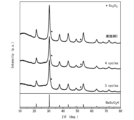
- FIG. 6 shows the results of XRD measurement of the perovskite-type oxyhydride obtained after heat treatment of the perovskite-type oxyhydride of Example 1 (BaYO 2 H, before sintering treatment) in a hydrogen atmosphere at various temperatures for 72 hours.
- the horizontal axis of FIG. 6 is 2 ⁇ (°), and the vertical axis of FIG. 6 means diffraction intensity (au (arbitrary unit)). It was confirmed that BaY 2 O 4 , BaO, BaH 2 and Y 2 O 3 were precipitated at 600° C. or higher, suggesting that BaYO 2 H was decomposed.
- NH 3 ammonia
- the horizontal axis of FIG. 7 is reaction time (h )
- the vertical axis is ammonia synthesis rate (mmolg ⁇ 1 h ⁇ 1 ).
- the ammonia synthesis rate increased until 20 hours and then showed stable behavior.
- the catalyst composition of Example 4 and the catalyst composition of Example 5 the ammonia synthesis rate decreased until 20 hours and then showed stable behavior.
- the catalyst composition of Example 2 had the highest ammonia synthesis rate value, and the catalyst composition with the next highest ammonia synthesis rate value was the catalyst composition of Example 4.
- the ammonia synthesis rate of the catalyst composition of Example 5 was the lowest.
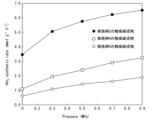
- FIG. 8 shows the pressure dependence of ammonia (NH 3 ) synthesis rate ( mmolg ⁇ 1 h ⁇ 1 ) for the catalyst composition of Example 2 (i.e., Ru-supported perovskite-type oxyhydride (BaYO 2 H, after sintering treatment)), the catalyst composition of Example 4 (i.e., Co-supported perovskite-type oxyhydride (BaYO 2 H, after sintering treatment)), and the catalyst composition of Example 5 (i.e., Fe-supported perovskite-type oxyhydride (BaYO 2 H, after sintering treatment)) when exposed to a mixed gas flow of H 2 and N 2 at 320° C.
- NH 3 ammonia
- the horizontal axis of FIG. 8 is pressure (MPa)
- the vertical axis is ammonia synthesis rate (mmolg ⁇ 1 h ⁇ 1 ). 8
- the ammonia synthesis rate increased with increasing pressure for the catalyst composition of Example 2, the catalyst composition of Example 4, and the catalyst composition of Example 5.
- the ammonia synthesis rate increased three-fold by increasing the pressure from 0.1 MPa to 0.9 MPa.
- NH 3 ammonia
- the horizontal axis of FIG. 9 is temperature (°C), and the vertical axis is ammonia synthesis rate (mmolg -1 h -1 ).
- the ammonia synthesis rate for the catalyst composition of Example 2 above, the catalyst composition of Example 4 above, and the catalyst composition of Example 5 above increased with increasing temperature.
- the horizontal axis of FIG. 10 is time (h), and the vertical axis is ammonia synthesis rate (mmolg ⁇ 1 h ⁇ 1 ).
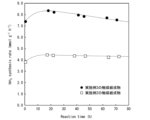
- FIG. 11 shows the change over time in the ammonia synthesis rate for the catalyst composition of Example 2 (i.e., Ru-supported perovskite-type oxyhydride (BaYO 2 H, after sintering treatment)) and the catalyst composition of Example 3 (i.e., Ru-supported perovskite-type oxyhydride (BaScO 2 H, after sintering treatment)).
- the horizontal axis of FIG. 11 is the reaction time (h), and the vertical axis is the ammonia synthesis rate (mmolg ⁇ 1 h ⁇ 1 ).
- the ammonia synthesis rate increased slightly over time from the value measured immediately after the target temperature was reached, and decreased gradually after 20 hours had passed.
- the actual Ru loading rate was in the range of 1.5 to 2.0 wt% in all catalyst compositions.
- the particle size of Ru was smallest when RE was Sc, and it was confirmed that the particle size of Ru tended to increase as the ionic radius of RE increased, and was largest when RE was Tb. Since no correlation was observed between the Ru loading rate and the particle size of Ru, it is possible that such a tendency was obtained due to differences in the surface properties of the support or the interaction between the support and Ru (specific surface area, surface roughness, Ru adsorption energy, etc.).
- each of the perovskite-type oxyhydrides of Example 7 was BaTbO2H (cubic crystal), BaDyO2H (cubic crystal), BaHoO2H (cubic crystal), BaErO2H (cubic crystal), BaYbO2H (cubic crystal), and BaLuO2H (cubic crystal). It was also confirmed that all samples had diffraction lines derived from the cubic perovskite structure, and that as the atomic number of RE increases from Tb to Lu, the diffraction peak of the RE shifts to the higher angle side and the lattice constant decreases, reflecting the decrease in ionic radius due to lanthanide contraction.
- Ru-supported perovskite-type oxyhydride BaTbO2H , BaDyO2H , BaHoO2H
Landscapes
- Catalysts (AREA)
Abstract
Description
本願は、2023年5月26日に、日本に出願された特願2023-086677号に基づき優先権を主張し、その内容をここに援用する。
特許文献1に記載されるような担持金属触媒は、通常、活性炭等の炭素質担体や、無機酸化物担体を用いている。しかしながら、これらの担持金属触媒は、実用に用いるには常に十分な性能を有しているとは言えない。
すなわちハーバー・ボッシュ法の反応条件に比べ、例えば、より低温、低圧の条件下でも十分な反応活性を有するような、一層優れた触媒活性を有するアンモニア合成用触媒が求められている。
<1>本発明の態様1の触媒組成物は、
下記(1)式で示されるペロブスカイト型酸水素化物を含有する。
BaREO2Hm・・・(1)
(式(1)において、REは、Y、Sc、Gd、Tb、Dy、Ho、Er、Tm、YbおよびLuからなる群から選ばれる希土類元素を表し、mは0.5以上1.0以下の範囲に含まれる数字を表す。)
<2>本発明の態様2は、態様1の触媒組成物において、
前記REが、Y、Sc、Tb、Dy、Ho、Er、YbおよびLuからなる群から選ばれる希土類元素であってもよい。
<3>本発明の態様3は、態様1の触媒組成物において、
前記REが、YまたはScであってよい。
<4>本発明の態様4は、態様1の触媒組成物において、
アンモニア合成反応用またはアンモニア分解反応用であってもよい。
<5>本発明の態様5は、態様1~4のいずれか1つの触媒組成物において、
前記ペロブスカイト型酸水素化物がRu、Co、Fe、CrおよびMnからなる群から選ばれる1種以上の遷移金属を担持していてもよい。
<6>本発明の態様6のアンモニア合成方法は、態様1~5のいずれか1つの触媒組成物の存在下において、窒素と水素とを反応させる工程を含む。
<7>本発明の態様7のアンモニア分解方法は、態様1~6のいずれか1つの触媒組成物の存在下においてアンモニアを水素および窒素に分解させる工程を含む。
<8>本発明の態様8のペロブスカイト型酸水素化物の製造方法は、下記(1)式
BaREO2Hm・・・(1)
(式(1)において、REは、Y、Sc、Gd、Tb、Dy、Ho、Er、Tm、YbおよびLuからなる群から選ばれる希土類元素を表し、mは0.5以上1.0以下の範囲に含まれる数字を表す。)
で示されるペロブスカイト型酸水素化物を製造する方法であって、
BaOと、
BaH2と、
下記式(2)
RE2O3・・・(2)
(式(2)において、REは、Y、Sc、Gd、Tb、Dy、Ho、Er、Tm、YbおよびLuからなる群から選ばれる希土類元素を表す。)
で示される化合物と、
を不活性ガス雰囲気下において、メカノケミカル法を用いて、微細化および均質化した合成反応生成物の粒子が形成されるまで、圧着および粉砕を繰り返す工程を含む。
<9>本発明の態様9は、態様8のペロブスカイト型酸水素化物の製造方法において、
前記REが、Y、Sc、Tb、Dy、Ho、Er、YbおよびLuからなる群から選ばれる希土類元素であってもよい。
<10>本発明の態様10は、態様8のペロブスカイト型酸水素化物の製造方法において、
前記REが、YまたはScであってもよい。
<11>本発明の態様11は、態様8のペロブスカイト型酸水素化物の製造方法において、
前記REが、Yであってもよい。
<12>本発明の態様12は、態様8のペロブスカイト型酸水素化物の製造方法において、
前記メカノケミカル法において、遊星ボールミルまたは転動ボールミルを使用してもよい。
<13>本発明の態様13は、態様8のペロブスカイト型酸水素化物の製造方法において、前記圧着および前記粉砕が、300℃以下で行われてもよい。
<14>本発明の態様14は、態様8のペロブスカイト型酸水素化物の製造方法において、前記微細化および均質化した合成反応生成物の粒子の比表面積が5.0m2/g以下であってもよい。
<15>本発明の態様15は、態様8のペロブスカイト型酸水素化物の製造方法により得られうる。
<16>本発明の態様16は、態様15のペロブスカイト型酸水素化物において前記REが、Yであってもよい。
本発明の実施形態に係る触媒組成物は、ペロブスカイト型酸水素化物を含有する。ここで、ペロブスカイト型酸水素化物とは,ペロブスカイト型酸化物ABO3の酸素アニオンO2ーを一部、水素アニオンH-に置換した物質をいう。本実施形態に係る触媒組成物は、アンモニア合成反応用の触媒組成物またはアンモニア分解反応用の触媒組成物であることが好ましい。
本実施形態に係るペロブスカイト型酸水素化物は、下記(1)式で示されるペロブスカイト型酸水素化物である。下記式(1)において、REは、Y、Sc、Gd、Tb、Dy、Ho、Er、Tm、YbおよびLuからなる群から選ばれる希土類元素を表し、mは0.5以上1.0以下の範囲に含まれる数字を表す。本実施形態に係る触媒組成物が下記(1)式で示されるペロブスカイト型酸水素化物を含有することで、比較的容易に当該触媒の表面において水素空孔を形成させることが可能となる。これによって、触媒組成物の触媒性能を一層向上させることができる。
触媒組成物において、ペロブスカイト型酸水素化物が金属(担持金属と称する場合がある)を担持することが好ましい。担持金属は、触媒活性を有する。担持金属は、アンモニア合成反応またはアンモニア分解反応を促進するのであれば、特に限定されない。担持金属としては、Ru、Co、Fe、Ni、Mo、Rh、Re、Cr及びMnなどが挙げられる。本実施形態に係るペロブスカイト型酸水素化物がRu、Co、Fe、CrおよびMnからなる群から選ばれる1種以上の遷移金属(以下、担持遷移金属と称する場合がある)を担持していることが好ましい。本実施形態に係るペロブスカイト型酸水素化物がRuを担持していることがより好ましい。本実施形態に係るペロブスカイト型酸水素化物がRu、Co、Fe、CrおよびMnからなる群から選ばれる1種以上の遷移金属を担持していることで、ペロブスカイト型酸水素化物の表面における水素の拡散および可逆的な水素交換がより促進され、触媒性能が一層向上するので好ましい。
次に、本実施形態に係る触媒組成物の製造方法について、説明する。図1は、本発明の一実施形態に係る触媒組成物の製造方法のフローチャートである。図1に示すように、触媒組成物は、担体である、ペロブスカイト型酸水素化物を作製する第1工程S1と、第1工程S1で作製したペロブスカイト型酸水素化物に遷移金属を担持する第2工程S2と、を含む。
まず、第1工程S1であるペロブスカイト型酸水素化物の製造方法について説明する。下記式(1)で示されるペロブスカイト型酸水素化物の製造方法は、BaOと、BaH2と、下記式(2)で示される化合物と、を不活性ガス雰囲気下において、メカノケミカル法を用いて、微細化および均質化した合成反応生成物の粒子が形成されるまで、圧着および粉砕を繰り返す工程を含む。形成された微細化および均質化した合成反応生成物の粒子がペロブスカイト型酸水素化物である。
第1工程S1では、原料として、BaOと、BaH2と、下記式(2)で示される化合物と、を用いる。下記式(1)において、REは、Y、Sc、Gd、Tb、Dy、Ho、Er、Tm、YbおよびLuからなる群から選ばれる希土類元素を表し、mは0.5以上1.0以下の範囲に含まれる数字を表す。また下記式(2)において、REは、Y、Sc、Gd、Tb、Dy、Ho、Er、Tm、YbおよびLuからなる群から選ばれる希土類元素を表す。式(2)において、REは、YまたはScであることが好ましい。
RE2O3・・・(2)
なお、前記合成反応生成物の粒子を、メカノケミカル法を用いて形成させるための上記の合成反応用原料は、上記の仕込みモル比で添加して得られたものであってもよいし、予め上記の仕込みモル比で予備混合して得られたものであってもよい。
上述の原料を不活性ガス雰囲気下において、メカノケミカル法を用いて、微細化および均質化した合成反応生成物の粒子が形成されるまで、圧着および粉砕を繰り返す。メカノケミカル法は、機械的エネルギーによって周囲の物質との化学変化などを起こす方法をいう。機械的エネルギーを与える(例えば、ボール同士を衝突させる)ことで、原料同士が圧着される。さらにボールが衝突すると圧着された圧着物が粉砕される。この圧着と粉砕とが繰り返されることで、原料が反応しながら微細化および均質化し、合成反応生成物の粒子が形成される。
勿論、上記の微細化および均質化の確認は、上記とは逆に、まず微細化した合成反応生成物が形成されたことを確認した後、ついで微細化した合成反応生成物と確認された試料に対し、微細化および均質化した合成反応生成物の粒子が形成されたことを確認してもよい。
また焼結前に、合成反応生成物の粒子をNH4Cl/MeOH(濃度は例えば、0.1mol/L)で洗浄して、残留したBaH2およびBaOを除去してもよい。
次に、アンモニア合成方法について説明する。本実施形態に係るアンモニア合成方法は、本実施形態に係る触媒組成物の存在下において、水素(H2)と窒素(N2)とを反応させる工程を含む。水素(H2)と窒素(N2)とを反応させることでアンモニアを得ることができる。
次に、本実施形態に係るアンモニア分解方法について説明する。本実施形態に係るアンモニア分解方法は、本実施形態に係る触媒組成物の存在下において、アンモニアを水素および窒素に分解させる工程を含む。
BaH2は、Ba(dendritic pieces, 99.99 %, Aldrich)を水素中、600℃で12時間加熱することにより合成した。
メカノケミカル法の操作はすべてArで満たされたグローブボックス内で実施した。メカノケミカル法を行う装置には遊星ボールミル(Pulverisette 7 Premium Line, Fritsch)を使用した。粉砕容器には容量が20mLのWC製の材質の容器(Fritsch)を使用し、粉砕容器と同じ材質で直径10mmのボール10個を用いて粉砕を行った。BaO(99.99 %, Aldrich)、BaH2およびY2O3 (> 99.9 %, 高純度化学)を仕込みモル比(1:1:1)で総量が約2gになるように秤量し、粉砕容器にボールと一緒に入れてシリコンガスケットで密閉する形で容器のふたを閉めてボールミルに設置した。この際、もう片方の容器設置場所には重量を合わせたダミー容器を設置して重量の平衡を保った。粉砕容器の公転速度は、コンタミネーションがない状態で反応を限界まで促進させるために800rpmに設定した。2分間回転(反応)した後3分間回転停止(放熱)を30回繰り返す処理を1回のメカノケミカル法の反応処理(以下、反応サイクルと称する場合がある)とした。1回の反応サイクル後は容器の壁面に張り付いた試料を引きはがしてメノウ製の乳鉢と乳棒とを用いて予備粉砕した。試料のX線回折(XRD)パターンにおいて原料由来の回折線が確認されない場合か、もしくはXRDパターンに変化がなくなった場合、均質化した合成反応生成物が形成されたと判断して反応を終了した。そうでない場合は上述の条件が達成されるまで上記の反応サイクルを繰り返した。さらにメカノケミカル反応終了後の合成反応生成物を走査型電子顕微鏡(SEM)観察によって、粒子径が10μm以下のペロブスカイト型酸水素化物の粒子であることを確認したうえで、実施例1のペロブスカイト型酸水素化物BaYO2Hとした。なお、前記の反応サイクルでは、上記のような放熱操作を行うことにより、メカノケミカル反応中の試料の連続した温度上昇を抑制し、これにより300℃以下の温度条件下で行った。
実施例1のペロブスカイト型酸水素化物を直径10mmのダイスに充填して20~30MPaの圧力をかけて一軸プレスを行いペレット状に成型した。その後、石英ガラス管に成型した試料を入れてから大気暴露しないようにグローブボックス外へ取り出し、真空封緘を行ったのちに電気炉に設置して加熱した。焼結時の温度プログラムには100℃/hで昇温して500℃で72時間保持したのち室温まで放冷し、焼結処理を行った。このようにして、実施例2のペロブスカイト型酸水素化物(BaYO2H、焼結処理後)を得た。
メカノケミカル法の操作はすべてArで満たされたグローブボックス内で実施した。メカノケミカル法を行う装置には遊星ボールミル(Pulverisette 7 Premium Line, Fritsch)を使用した。粉砕容器には容量が20mLのWC製の材質の容器(Fritsch)を使用し、粉砕容器と同じ材質で直径10mmのボール10個を用いて粉砕を行った。BaO(99.99 %, Aldrich)、BaH2およびSc2O3 (> 99.9 %, 高純度化学)を仕込みモル比(1:1:1)で総量が約2gになるように秤量し、粉砕容器にボールと一緒に入れてシリコンガスケットで密閉する形で容器のふたを閉めてボールミルに設置した。この際、もう片方の容器設置場所には重量を合わせたダミー容器を設置して重量の平衡を保った。粉砕容器の公転速度は、コンタミネーションがない状態で反応を限界まで促進させるために800rpmに設定した。1回の反応サイクル後は容器の壁面に張り付いた試料を引きはがしてメノウ製の乳鉢と乳棒とを用いて予備粉砕した。メカノケミカルの反応サイクルを3回繰り返した試料についてのXRDパターンにおいて、目的物であるBaScO2Hに由来する回折線が主な回折線として観測された。しかしながら、Sc2O3に由来する回折線がわずかに観測されたことから、再度反応を繰り返した。追加で反応を1回実行した試料のXRDパターンは、追加の反応を実行する前の試料についてのXRD パターンと比較してほとんど変化が確認されなかった。したがって、これ以上反応が進行しないものと判断し、メカノケミカル法を終了した。このようにて、焼結処理前の実施例3のペロブスカイト型酸水素化物(BaScO2H、焼結処理前)を得た。
CeO2を600℃で真空加熱処理することで表面に吸着している水などを除去し、脱水処理したCeO2とBa(NH2)2とをArグローブボックス中で、メノウの乳棒と乳鉢とを用いて混合した。この時、CeとBaとの仕込みモル比が1:1になるように混ぜた。得られた粉体をNH3気流中で、600℃で6時間加熱処理を行った。このようにして、BaCeO3-xNyHz粉末を得た。
粉末状BaCeO3-xNyHz95mgと、Co2(CO)8 14.5mg(BaCeO3-xNyHzに対し、担持される金属Coとして5質量%に相当)とを石英ガラス反応管に入れ、次いで当該反応管に窒素ガス15mL/minと水素ガス45mL/min(計60mL/min)とを流通させ、400℃まで2時間昇温し、5時間保持することにより、BaCeO3-xNyHzにCoを固定した比較例2の触媒組成物(Co(5wt%)BaCeO3-xNyHz)を得た。
粉末状BaCeO3-xNyHz95mgと、Fe2(CO)9 16.3mg(BaCeO3-xNyHzに対し、担持される金属Feとして5質量%に相当)とを石英ガラス反応管に入れ、次いで当該反応管に窒素ガス15mL/minと水素ガス45mL/min(計60mL/min)とを流通させ、400℃まで2時間昇温し、5時間保持することにより、BaCeO3-xNyHzにFeを固定した比較例3の触媒組成物(Fe(5wt%)BaCeO3-xNyHz)を得た。
硝酸バリウム5.23g(0.02mol)及び硝酸セリウム6水和物8.68g(0.02mol)及びクエン酸38.4g(0.2mol)を水に溶解させ、得られた溶解物にジエチレングリコール42.4g(0.4mol)を加えることにより、混合物を得た。得られた混合物を一時間攪拌した後、120℃で4時間加熱しゲル化させた。その後、ゲル化した混合物を450℃で5時間加熱することにより、炭化させた。炭化した混合物を900℃で6時間加熱することにより、粉末状のBaCeO3を得た。
比較例1のBaCeO3-xNyHzに代えてCsを添加したMgO(Cs/MgOと表記する)を用いた以外は比較例1と同様の方法を用いることにより、比較例5の触媒組成物(Ru(5wt%)-Cs/MgO(Cs/Ru元素比=1))を得た。
比較例1のBaCeO3-xNyHzに代えてCeO2を用いた以外は、比較例1と同様の方法を用いることにより、比較例6の触媒組成物(Ru(5wt%)/CeO2)を得た。
国際公開第2015/129471号に記載と同様の方法で、比較例7の触媒組成物(Ru(5wt%)/Ca2N)を得た。
国際公開第2012/0077658号に記載された方法と同様の方法で、比較例8の触媒組成物(Ru(2wt%)/C12A7:e-)を得た。
Ru/Ba3Y4O9は以下の方法で得た。
炭酸バリウム(>99%、高純度化学)と酸化イットリウム(>99.9%、高純度化学)とを大気中で、メノウの乳棒と乳鉢とを用いて混合した。この時、炭酸バリウムと酸化イットリウムとの仕込みモル比が3:2になるように混ぜた。得られた粉体を大気中で、1300℃で5時間加熱処理を行った。このようにして、Ba3Y4O9粉末を得た。その後、比較例1のBaCeO3-xNyHzに代えて得られたBa3Y4O9を用いた以外は、比較例1と同様の方法を用いることにより、比較例9の触媒組成物(Ru(2wt%)/Ba3Y4O9)を得た。
X線回折装置(MiniFlex600, Rigaku)を使用し、X線源にはCu-Kα線(λ=0.15418 nm)を使用し、測定範囲は10~80°、測定間隔は0.02°、スキャンスピードは1~2°/minで測定を行った。なお、試料は大気中で分解してしまうため、Arで満たされたグローブボックス中で大気不安定試料用の密閉ホルダーに収納してから測定を行った。試料はTOPAS(Bruker AXS)を用いてXRDパターンのリートベルト解析を実行して結晶相の同定を行った。
四重極質量分析計(PrismaPlus QMG220, Pfeiffer Vacuum)を備えた高真空熱特性測定装置(TDS1400TV, ESCO)を使用し、真空度は10-4~10ー7Pa、熱源は赤外線、昇温速度は60℃/min、保持温度は1200℃、SEM電圧は1200Vで測定を行った。なお、試料はArで満たされたグローブボックス中で1~3mg程度をSiO2ホルダーに載せて専用のトランスファーベッセルを用いて装置に搬送した。水素化物であることを確認し、かつ、水素放出特性を調査するために、得られたTDSスペクトルのうち水素に由来する質量比2のフラグメントに注目してその脱離温度や脱離量から内包する水素の有無やその内包量を調査した。さらに、水素化物は雰囲気中の水によって水酸化されてしまっている場合が多々あることから、水に由来する質量比18のフラグメントにも注目して解析を行うことにより、水酸化の有無を確認した。なお、TDS スペクトルの解析にはTDS Data Viewer(ESCO)を用いた。
比表面積測定装置(BELSORP mini, MicrotracBEL)を使用し、相対圧が0~0.4の範囲で測定を行った。なお、試料はArで満たされたグローブボックス内で密閉式の試料管に0.1g程度充填してから大気暴露しないように装置に接続した。窒素吸着測定を実施し、下記式(3)で示されるBrunauer-Emmett-Teller(BET)式を用いてBET比表面積を求めた。ここで、Vaは平衡圧における吸着量、Vmは単原子層吸着量、p0は飽和蒸気圧、pは平衡圧、Cは第1層吸着と2層目以降の吸着における吸着熱の差に関するパラメータである。具体的には、BET式がよく成り立つ相対圧が0.05~0.35の範囲で、BET式のCが液体窒素温度で推奨される50~300程度になるようにBrunauer-Emmett-Teller(BET)式に基づいたプロットを行い、各試料の比表面積を算出した。実施例1のペロブスカイト型酸水素化物のBET比表面積は2.60m2/gであった。実施例2のペロブスカイト型酸水素化物のBET比表面積は2.17m2/gであった。実施例3のペロブスカイト型酸水素化物のBET比表面積は4.38m2/gであった。

試料である実施例1のペロブスカイト型酸水素化物に対し水素雰囲気下で加熱処理を行うことにより、当該試料の耐熱性を調べた。具体的には、アルミナタンマン管に実施例1のペロブスカイト型酸水素化物を入れてからニードルバルブ付きのベッセルに装填し、大気暴露しないようにグローブボックス外へ取り出して水素炉に取り付けてからベッセル内を水素置換したのちに種々の加熱温度(500℃、550℃、600℃、700℃、または800℃)で加熱した。72時間保持したのち室温まで放冷後、取り出した試料のXRD測定を行った。
アンモニア合成試験は窒素ガスと水素ガスとの流量比が1:3になるようにそれぞれ15 mL/minと45mL/minとの各流量で流通させ、触媒の充填量は0.1gで統一した。また、反応時間は0~80時間、温度は200~400℃、圧力は0.1~0.9MPaの範囲で試験を行い、触媒を通過したガスを5mMの希硫酸に通過させてアンモニアをアンモニウムイオンとしてトラップしたものを一定時間ごとにサンプリングしてイオンクロマトグラフィー(Prominence, Shimadzu)で測定してアンモニアの定性・定量を行った。その後、サンプリング時間に対するアンモニウムイオンの生成量をプロットした傾きからアンモニア合成速度を算出した。
アンモニア分解試験はアンモニアを25mL/minの流量で流通させ、触媒の充填量は0.1gで統一した。また、反応時間は0~80時間、温度は220~520℃、圧力は0.1MPaで試験を行い、触媒を通過したガスをガスクロマトグラフィ(GC-14A, Shimadzu)で測定することにより、アンモニアの転化率を求めた。なお、アンモニアの転化率は、分母「分解前の流通仕込みNH3量」、分子「(分解前の流通仕込みNH3量)-(分解後の流通回収された残存NH3量)」である比の百分率である。
図6に、実施例1のペロブスカイト型酸水素化物(BaYO2H、焼結処理前)を各種温度において水素雰囲気中で72時間加熱処理を行った後に得られたペロブスカイト型酸水素化物のXRD測定を行った結果を示す。図6の横軸は2θ(°)であり、図6の縦軸は回折強度(a.u.(任意単位))を意味する。600℃以上でBaY2O4、BaO、BaH2およびY2O3が析出していることが確認され、BaYO2Hが分解していることが示唆された。また、BaYO2H由来と考えられる回折線は温度上昇に伴って半値幅が小さくなっていることから結晶性が向上していることが確認され、水素欠陥が補完されて格子が広がっていることも確認された。
Y2O3の代わりに、それぞれ、Tb2O3、Dy2O3、Ho2O3、Er2O3、Yb2O3、及びLu2O3(いずれも、99.9%,高純度化学)を用いた以外は、実施例1と同様な方法で、それぞれのペロブスカイト型酸水素化物(BaTbO2H、BaDyO2H、BaHoO2H、BaErO2H、BaYbO2H、及びBaLuO2H、焼結処理前)を得た。
実施例1のペロブスカイト型酸水素化物(BaYO2H、焼結処理前)の代わりに、実施例6のそれぞれのペロブスカイト型酸水素化物(BaTbO2H、BaDyO2H、BaHoO2H、BaErO2H、BaYbO2H、BaLuO2H、焼結処理前)を用いた以外は、実施例2と同様な方法で、実施例7のそれぞれのペロブスカイト型酸水素化物(BaTbO2H、BaDyO2H、BaHoO2H、BaErO2H、BaYbO2H、BaLuO2H、焼結処理後)を得た。
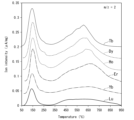
実施例2のペロブスカイト型酸水素化物(BaYO2H、焼結処理後)と同様にXRD、TDSの測定を行った。その結果を図14、15に示す。
実施例2のペロブスカイト型酸水素化物(BaYO2H、焼結処理後)の代わりに、実施例7で得たペロブスカイト型酸水素化物(BaTbO2H、BaDyO2H、BaHoO2H、BaErO2H、BaYbO2H、BaLuO2H、焼結処理後)を用いた以外は、実施例2と同様な方法で、Ruを2wt%担持した実施例8のそれぞれの触媒組成物(即ち、Ru担持ペロブスカイト型酸水素化物(BaTbO2H、BaDyO2H、BaHoO2H、BaErO2H、BaYbO2H、BaLuO2H、焼結処理後)を得た。
実施例2の触媒組成物(即ち、Ru担持ペロブスカイト型酸水素化物(BaYO2H、焼結処理後))と同様にTDS、アンモニア合成速度の経時変化、触媒活性の測定を行った。その結果を図16、17、18、表1に示す。

・使用装置:Bruker製波長分散型蛍光X線分析装置 S8 TIGER
・X線源:Rh-La線
・回折結晶:LiF(200)
・雰囲気:真空
・コリメータマスク(X線の照射範囲):直径5mmの円
・測定対象元素:Ba、RE、Ru
・定量方法:ファンダメンタルパラメータ(FP)法(即ち、構成元素の種類と量との両者から、理論的に蛍光X線強度が計算できることを利用して、実測の蛍光X線強度に一致するように組成を推定する方法)
担体1gに対するRuの重量=0.0541×0.343=0.0186g
Ru担持率=100×0.0186/(0.0186+1)=1.8wt%
・測定温度:50℃
・キャリアガス:He(30mL/min)
・吸着ガス:CO/He(9.51%)
・パルス体積:0.031mL
・試料量:0.15-0.2g程度
・前処理:400℃、水素雰囲気中で2時間加熱する。その後、ガスをHeに切り替えて400℃で30分加熱する。(Ru3(CO)12を前駆体に用いてRuを担持したことにより、測定前に既にRu表面にCOが吸着している状態であることから、そのままではCO吸着量を測定できない。このため、水素流通下で加熱することにより、吸着COを除去する。また、Ruへの水素吸着が強く、水素流通のみではRuに吸着した水素が残ってしまうため、Heを流通させて吸着水素を除去する。これらの前処理を実施することにより、吸着種が存在しない清浄なRu表面が得られる。尚、実際の測定では、CO吸着量が実測値として得られ、試料の充填量とRu担持率の入力値との両者からRuの粒径や分散度が求められる(ソフトウェア:Chem Master内で自動計算される)。
表1の結果から、全ての触媒組成物において実際のRu担持率は1.5~2.0wt%の範囲であった。また、Ruの粒子径はREがScのときに最も小さく、REのイオン半径が大きくなるごとにRuの粒子径も大きくなる傾向が確認され、REがTbのときに最も大きくなった。Ruの担持率とRuの粒径との間における相関関係は見られなかったため、担体の表面物性や担体-Ru間の相互作用(比表面積、表面粗さ、Ruの吸着エネルギーなど)の違いが原因でこのような傾向が得られている可能性がある。
また、全ての試料において立方晶ペロブスカイト構造に由来する回折線が得られていることが確認され、REの原子番号がTbからLuに向かって大きくなるに伴って、前記REの回折ピークが高角度側にシフトし、格子定数が減少することが確認された。これは、ランタノイド収縮によるイオン半径の減少が反映された結果である。
図15の結果から、いずれの試料においても水素脱離のみが確認されており、試料は水酸基(OH-)を含まない純粋な水素化物であることが確認された。また、すべての試料で100℃以上200℃以下の温度領域および350℃以降の温度領域において、水素脱離を示す同様のスペクトル形状が得られているため、異なる材料間での水素脱離能に有意な差はないと考えられる。
図16の結果から、Ruを担持することにより、全体として100℃以上の温度領域全体において均一な水素脱離を示すようにスペクトル形状が変化したため、100℃以上の温度領域で触媒活性を示すとともに担体が分解しない限り温度上昇に伴って活性が向上する可能性が示唆された。
図17の結果から、前記の実施例8の触媒組成物の場合、時間経過に伴うアンモニア合成速度の変化の挙動に若干の差異は存在しているものの、Ru/BaTbO2H、Ru/BaDyO2H、Ru/BaHoO2H、BaErO2H、BaYbO2H、Ru/BaLuO2Hにおいては反応開始後40時間経過した以降においては、一定のアンモニア合成速度を示した。このことから、上記触媒組成物も長期的なアンモニア合成に適していることが確認された。
図18の結果から、いずれの試料においても高いアンモニア合成速度を示すことが確認された。特に、REがScの場合のアンモニア合成速度が顕著に高かった。表1の結果から、REがScの場合のRuの粒子径がYの場合と比較して3/4程度、TbからLuまでのランタノイドと比較して1/2~1/3程度小さいことから、REがScの場合に触媒反応活性点が他の触媒組成物よりも多くなっていることが予想され、これにより顕著に高いアンモニア合成速度が達成されたと考えられる。
Claims (16)
- 下記(1)式で示されるペロブスカイト型酸水素化物を含有することを特徴とする触媒組成物。
BaREO2Hm・・・(1)
(式(1)において、REは、Y、Sc、Gd、Tb、Dy、Ho、Er、Tm、YbおよびLuからなる群から選ばれる希土類元素を表し、mは0.5以上1.0以下の範囲に含まれる数字を表す。) - 前記REが、Y、Sc、Tb、Dy、Ho、Er、YbおよびLuからなる群から選ばれる少なく1種の希土類元素であることを特徴とする請求項1記載の触媒組成物。
- 前記REが、YまたはScであることを特徴とする請求項1記載の触媒組成物。
- アンモニア合成反応用またはアンモニア分解反応用であることを特徴とする請求項1記載の触媒組成物。
- 前記ペロブスカイト型酸水素化物がRu、Co、Fe、CrおよびMnからなる群から選ばれる1種以上の遷移金属を担持していることを特徴とする請求項1記載の触媒組成物。
- 請求項1~5のいずれか1項に記載の触媒組成物の存在下において、窒素と水素とを反応させる工程を含むことを特徴とするアンモニア合成方法。
- 請求項1~5のいずれか1項に記載の触媒組成物の存在下においてアンモニアを水素および窒素に分解させる工程を含むことを特徴とするアンモニア分解方法。
- 下記(1)式
BaREO2Hm・・・(1)
(式(1)において、REは、Y、Sc、Gd、Tb、Dy、Ho、Er、Tm、YbおよびLuからなる群から選ばれる希土類元素を表し、mは0.5以上1.0以下の範囲に含まれる数字を表す。)
で示されるペロブスカイト型酸水素化物を製造する方法であって、
BaOと、
BaH2と、
下記式(2)
RE2O3・・・(2)
(式(2)において、REは、Y、Sc、Gd、Tb、Dy、Ho、Er、Tm、YbおよびLuからなる群から選ばれる希土類元素を表す。)
で示される化合物と、
を不活性ガス雰囲気下において、メカノケミカル法を用いて、微細化および均質化した合成反応生成物の粒子が形成されるまで、圧着および粉砕を繰り返す工程を含むことを特徴とするペロブスカイト型酸水素化物の製造方法。 - 前記REが、Y、Sc、Tb、Dy、Ho、Er、YbおよびLuからなる群から選ばれる少なく1種の希土類元素である、請求項8記載のペロブスカイト型酸水素化物の製造方法。
- 前記REが、YまたはScである、請求項8記載のペロブスカイト型水素化物の製造方法。
- 前記REが、Yであることを特徴とする請求項8記載のペロブスカイト型酸水素化物の製造方法。
- 前記メカノケミカル法において、遊星ボールミルまたは転動ボールミルを使用することを特徴とする請求項7記載のペロブスカイト型酸水素化物の製造方法。
- 前記圧着および前記粉砕が、300℃以下で行われることを特徴とする請求項8記載のペロブスカイト型酸水素化物の製造方法。
- 前記微細化および均質化した合成反応生成物の粒子の比表面積が5.0m2/g以下であることを特徴とする請求項8記載のペロブスカイト型酸水素化物の製造方法。
- 請求項8記載のペロブスカイト型酸水素化物の製造方法により得られうることを特徴とするペロブスカイト型酸水素化物。
- 前記REが、Yであることを特徴とする請求項15記載のペロブスカイト型酸水素化物。
Priority Applications (2)
| Application Number | Priority Date | Filing Date | Title |
|---|---|---|---|
| JP2025523291A JPWO2024247448A1 (ja) | 2023-05-26 | 2024-03-21 | |
| CN202480031293.1A CN121240929A (zh) | 2023-05-26 | 2024-03-21 | 催化剂组合物、氨合成方法、氨分解方法及钙钛矿型氧氢化物的制造方法 |
Applications Claiming Priority (2)
| Application Number | Priority Date | Filing Date | Title |
|---|---|---|---|
| JP2023086677 | 2023-05-26 | ||
| JP2023-086677 | 2023-05-26 |
Publications (1)
| Publication Number | Publication Date |
|---|---|
| WO2024247448A1 true WO2024247448A1 (ja) | 2024-12-05 |
Family
ID=93657591
Family Applications (1)
| Application Number | Title | Priority Date | Filing Date |
|---|---|---|---|
| PCT/JP2024/011019 Ceased WO2024247448A1 (ja) | 2023-05-26 | 2024-03-21 | 触媒組成物、アンモニア合成方法、アンモニア分解方法およびペロブスカイト型酸水素化物の製造方法 |
Country Status (3)
| Country | Link |
|---|---|
| JP (1) | JPWO2024247448A1 (ja) |
| CN (1) | CN121240929A (ja) |
| WO (1) | WO2024247448A1 (ja) |
Citations (4)
| Publication number | Priority date | Publication date | Assignee | Title |
|---|---|---|---|---|
| JP2008100902A (ja) * | 2006-09-22 | 2008-05-01 | National Institute Of Advanced Industrial & Technology | ペロブスカイト型複合酸化物 |
| JP2017098067A (ja) * | 2015-11-24 | 2017-06-01 | 国立大学法人東京工業大学 | ヒドリドイオン導電体およびその製造方法 |
| WO2020175558A1 (ja) * | 2019-02-27 | 2020-09-03 | 国立研究開発法人科学技術振興機構 | 酸窒素水素化物、酸窒素水素化物を含む金属担持物、及びアンモニア合成用触媒 |
| WO2021006136A1 (ja) * | 2019-07-08 | 2021-01-14 | 国立研究開発法人科学技術振興機構 | 金属酸水素化物の製造方法、金属酸水素化物、及びそれを用いたアンモニア合成方法 |
-
2024
- 2024-03-21 JP JP2025523291A patent/JPWO2024247448A1/ja active Pending
- 2024-03-21 CN CN202480031293.1A patent/CN121240929A/zh active Pending
- 2024-03-21 WO PCT/JP2024/011019 patent/WO2024247448A1/ja not_active Ceased
Patent Citations (4)
| Publication number | Priority date | Publication date | Assignee | Title |
|---|---|---|---|---|
| JP2008100902A (ja) * | 2006-09-22 | 2008-05-01 | National Institute Of Advanced Industrial & Technology | ペロブスカイト型複合酸化物 |
| JP2017098067A (ja) * | 2015-11-24 | 2017-06-01 | 国立大学法人東京工業大学 | ヒドリドイオン導電体およびその製造方法 |
| WO2020175558A1 (ja) * | 2019-02-27 | 2020-09-03 | 国立研究開発法人科学技術振興機構 | 酸窒素水素化物、酸窒素水素化物を含む金属担持物、及びアンモニア合成用触媒 |
| WO2021006136A1 (ja) * | 2019-07-08 | 2021-01-14 | 国立研究開発法人科学技術振興機構 | 金属酸水素化物の製造方法、金属酸水素化物、及びそれを用いたアンモニア合成方法 |
Non-Patent Citations (1)
| Title |
|---|
| GOTO YOSHIHIRO, TASSEL CÉDRIC, NODA YASUTO, HERNANDEZ OLIVIER, PICKARD CHRIS J., GREEN MARK A., SAKAEBE HIKARI, TAGUCHI NOBORU, UC: "Pressure-Stabilized Cubic Perovskite Oxyhydride BaScO 2 H", INORGANIC CHEMISTRY, AMERICAN CHEMICAL SOCIETY, EASTON , US, vol. 56, no. 9, 1 May 2017 (2017-05-01), Easton , US , pages 4840 - 4845, XP093245172, ISSN: 0020-1669, DOI: 10.1021/acs.inorgchem.6b02834 * |
Also Published As
| Publication number | Publication date |
|---|---|
| CN121240929A (zh) | 2025-12-30 |
| JPWO2024247448A1 (ja) | 2024-12-05 |
Similar Documents
| Publication | Publication Date | Title |
|---|---|---|
| Lim et al. | Ni-exsolved La1-xCaxNiO3 perovskites for improving CO2 methanation | |
| EP3395441B1 (en) | Transition-metal-supported intermetallic compound, supported metallic catalyst, and ammonia producing method | |
| US10017395B2 (en) | Ammonia synthesis catalyst and ammonia synthesis method | |
| JP7285024B2 (ja) | 金属酸水素化物の製造方法、金属酸水素化物、及びそれを用いたアンモニア合成方法 | |
| WO2017082265A1 (ja) | 金属担持物、担持金属触媒及び該触媒を用いるアンモニア合成法 | |
| Yang et al. | High-performance and long-term stability of mesoporous Cu-doped TiO2 microsphere for catalytic CO oxidation | |
| AU2021213609B2 (en) | Ammonia synthesis catalyst | |
| EP3653296B1 (en) | Intermetallic compound, hydrogen storage/release material, catalyst and method for producing ammonia | |
| JP7603834B2 (ja) | 触媒、及び耐硫黄性転換触媒方法 | |
| EP3932546A1 (en) | Oxynitride hydride, metal carrier containing oxynitride hydride, and catalyst for ammonia synthesis | |
| Ding et al. | Topological transformation of LDH nanosheets to highly dispersed PtNiFe nanoalloys enhancing CO oxidation performance | |
| JP7246101B6 (ja) | 電子又はヒドリドイオン吸放出材料、電子又はヒドリドイオン吸放出性組成物、遷移金属担持物および触媒、ならびに、それらに関連する使用 | |
| US10695751B2 (en) | Laves phase intermetallic compound, catalyst using intermetallic compound, and method for producing ammonia | |
| Su et al. | Boosting ammonia decomposition for hydrogen production over Co/CeO2 catalysts via Sr doping | |
| EP4112166A1 (en) | Oxynitride-hydride, metal carrier containing oxynitride-hydride, and ammonia synthesis catalyst | |
| Chen et al. | AB5-type intermetallic compounds as catalysts for ammonia synthesis | |
| CN121240929A (zh) | 催化剂组合物、氨合成方法、氨分解方法及钙钛矿型氧氢化物的制造方法 | |
| JPH08311596A (ja) | 水素吸蔵合金、水素吸蔵合金の表面改質方法、電池用負極およびアルカリ二次電池 | |
| Imamura et al. | Preparation and properties of nanocrystalline ytterbium and europium nitride (YbN and EuN) | |
| Orlioglo | Sr5 (BO3) 3X (X= F−, H−, OH−) as supports for Ru-based ammonia synthesis catalysts | |
| WO2025244126A1 (ja) | 触媒組成物、アンモニア合成触媒及びアンモニア合成方法 | |
| 손태오 | Ru Precursor Driven Enhancement of Ammonia Decomposition Activity in Ru/CeO2 Catalysts via Oxygen Vacancy Formation and Strong Metal-Support Interaction | |
| JP2022070143A (ja) | アンモニア合成用触媒及び該触媒を用いるアンモニアの合成方法 |
Legal Events
| Date | Code | Title | Description |
|---|---|---|---|
| 121 | Ep: the epo has been informed by wipo that ep was designated in this application |
Ref document number: 24814935 Country of ref document: EP Kind code of ref document: A1 |
|
| ENP | Entry into the national phase |
Ref document number: 2025523291 Country of ref document: JP Kind code of ref document: A |
|
| WWE | Wipo information: entry into national phase |
Ref document number: 2025523291 Country of ref document: JP |
|
| NENP | Non-entry into the national phase |
Ref country code: DE |
|
| 122 | Ep: pct application non-entry in european phase |
Ref document number: 24814935 Country of ref document: EP Kind code of ref document: A1 |