WO2024246973A1 - 空気調和機 - Google Patents
空気調和機 Download PDFInfo
- Publication number
- WO2024246973A1 WO2024246973A1 PCT/JP2023/019637 JP2023019637W WO2024246973A1 WO 2024246973 A1 WO2024246973 A1 WO 2024246973A1 JP 2023019637 W JP2023019637 W JP 2023019637W WO 2024246973 A1 WO2024246973 A1 WO 2024246973A1
- Authority
- WO
- WIPO (PCT)
- Prior art keywords
- plenum
- housing
- plate
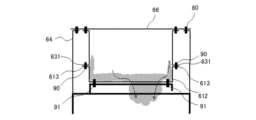
- air
- wall
- Prior art date
- Legal status (The legal status is an assumption and is not a legal conclusion. Google has not performed a legal analysis and makes no representation as to the accuracy of the status listed.)
- Ceased
Links
Images









Classifications
-
- F—MECHANICAL ENGINEERING; LIGHTING; HEATING; WEAPONS; BLASTING
- F24—HEATING; RANGES; VENTILATING
- F24F—AIR-CONDITIONING; AIR-HUMIDIFICATION; VENTILATION; USE OF AIR CURRENTS FOR SCREENING
- F24F2130/00—Control inputs relating to environmental factors not covered by group F24F2110/00
- F24F2130/20—Sunlight
Definitions
- This disclosure relates to an air conditioner that includes a housing having an air outlet through which air is blown out.
- the plenum chamber is placed on top of the air conditioner unit and moved left and right until the end face of the plenum chamber coincides with the end face of the unit, and then fixed to and attached to the air conditioner unit.
- An air conditioner to which a plenum chamber is attached is disclosed in Patent Document 1, for example.
- the plenum chamber described in Patent Document 1 is lifted up to move it left and right, and its position is adjusted in that state. Therefore, installation of the plenum chamber requires multiple people, which makes it difficult to install.
- the present disclosure aims to provide an air conditioner with improved workability in installing a plenum chamber.
- the air conditioner comprises a housing having an outlet formed therein through which air is blown out, a blower provided inside the housing for blowing air towards the outlet, and a plenum chamber placed on top of the housing for storing and discharging the air blown out from the outlet.
- the plenum chamber has a main body having an inner wall on one side, a side plate attached to the outside of the inner wall of the main body and erected from the housing so as to be flush with an end face of the housing, and a side plate fixing portion that allows the position of the side plate relative to the inner wall to be adjusted.
- the air conditioner disclosed herein has a side plate attached to the outside of the inner wall, and the position of the side plate relative to the inner wall is adjusted and fixed by the side plate fixing portion so that it is flush with the end face of the housing. This makes it easier to align the side plate with the end face of the housing, improving the workability of installing the plenum chamber.
- FIG. 1 is a circuit diagram showing an air conditioner according to a first embodiment.
- FIG. 2 is an assembled perspective view showing the indoor unit according to the first embodiment.
- FIG. 2 is an exploded perspective view showing the indoor unit according to the first embodiment.
- FIG. 2 is a perspective view showing an indoor unit main body according to the first embodiment.
- FIG. 2 is a perspective view showing a state in which a front panel has been removed in the indoor unit body according to the first embodiment.
- FIG. 2 is a perspective view showing a secondary side region of the heat exchanger according to the first embodiment.
- FIG. 2 is a perspective view showing a plenum chamber according to the first embodiment.
- FIG. 2 is an exploded perspective view showing a plenum chamber according to the first embodiment.
- FIG. 1 is a perspective view showing a case where a plenum chamber of an air conditioner 1 according to a first embodiment is divided along a longitudinal direction and a left-right direction.
- FIG. FIG. 10 is an enlarged view of part A in FIG. 9 .
- 1 is a diagram showing a longitudinal cross section along the left-right direction in the longitudinal direction of a plenum chamber of an air conditioner 1 according to embodiment 1.
- FIG. FIG. 2 is a partial perspective view of a plenum chamber of the air conditioner 1 according to the first embodiment.
- 1 is a schematic diagram showing a longitudinal section along the left-right direction in the longitudinal direction of a plenum chamber of an air conditioner 1 according to a first embodiment.
- FIG. 11 is a perspective view illustrating a procedure for attaching a plenum chamber in the air conditioner 1 according to the first embodiment.
- FIG. 15 is an enlarged perspective view of part B of FIG. 14 .
- FIG. 2 is a perspective view illustrating a position adjustment of a plenum side plate of the air conditioner 1 according to the first embodiment.
- FIG. 17 is an enlarged perspective view of part C in FIG. 16 .
- 2 is a schematic diagram showing a drainage path of the air conditioner 1 according to the first embodiment.
- FIG. FIG. 11 is a partial exploded perspective view of a plenum chamber of the air conditioner 1 according to a modified example of the first embodiment.
- Fig. 1 is a circuit diagram showing an air conditioner 1 according to embodiment 1.
- the air conditioner 1 is a device that adjusts the air in a space to be air-conditioned, and as shown in Fig. 1, includes an outdoor unit 2 and an indoor unit 3.
- the outdoor unit 2 includes, for example, a compressor 6, a flow path switching device 7, an outdoor heat exchanger 8, an outdoor blower 9, an expansion section 10, and a control box 13.
- the indoor unit 3 includes, for example, a heat exchanger 11 and a blower 12.
- the refrigerant circuit 4 is formed by connecting the compressor 6, the flow path switching device 7, the outdoor heat exchanger 8, the expansion section 10, and the heat exchanger 11 with the refrigerant piping 5.
- the compressor 6 draws in refrigerant in a low-temperature and low-pressure state, compresses the drawn refrigerant, and discharges it as refrigerant in a high-temperature and high-pressure state.
- the compressor 6 is, for example, a capacity-controllable inverter compressor.
- the flow path switching device 7 switches the direction in which the refrigerant flows in the refrigerant circuit 4, and is, for example, a four-way valve.
- the outdoor heat exchanger 8 exchanges heat between, for example, outdoor air and the refrigerant.
- the outdoor heat exchanger 8 acts as a condenser during cooling operation and as an evaporator during heating operation.
- the expansion section 10 is a pressure reducing valve or an expansion valve that reduces the pressure of the refrigerant and expands it.
- the expansion section 10 is, for example, an electronic expansion valve whose opening is adjustable.
- the heat exchanger 11 exchanges heat between, for example, indoor air and a refrigerant.
- the heat exchanger 11 acts as an evaporator during cooling operation and as a condenser during heating operation.
- the blower 12 is a device that sends indoor air to the heat exchanger 11.
- cooling operation the refrigerant sucked into the compressor 6 is compressed by the compressor 6 and discharged in a high-temperature, high-pressure gas state.
- the high-temperature, high-pressure gas state refrigerant discharged from the compressor 6 passes through the flow switching device 7 and flows into the outdoor heat exchanger 8 acting as a condenser, where it is heat-exchanged with outdoor air sent by the outdoor blower 9, condensed and liquefied.
- the condensed liquid state refrigerant flows into the expansion section 10, where it is expanded and decompressed to become a low-temperature, low-pressure gas-liquid two-phase refrigerant.
- the gas-liquid two-phase refrigerant then flows into the heat exchanger 11 acting as an evaporator, where it is heat-exchanged with indoor air sent by the blower 12, evaporating and gasifying. At this time, the indoor air is cooled, and cooling is performed in the room.
- the evaporated refrigerant in a low-temperature, low-pressure gas state passes through the flow switching device 7 and is sucked into the compressor 6 .
- the heating operation In the heating operation, the refrigerant sucked into the compressor 6 is compressed by the compressor 6 and discharged in a high-temperature, high-pressure gas state.
- the high-temperature, high-pressure gas state refrigerant discharged from the compressor 6 passes through the flow path switching device 7 and flows into the heat exchanger 11 acting as a condenser, where it is heat exchanged with the indoor air sent by the blower 12, condensed and liquefied. At this time, the indoor air is warmed, and heating is performed in the room.
- the condensed liquid state refrigerant flows into the expansion section 10, where it is expanded and decompressed to become a low-temperature, low-pressure gas-liquid two-phase refrigerant.
- the gas-liquid two-phase refrigerant then flows into the exterior heat exchanger 8 acting as an evaporator, where it is heat exchanged with the outdoor air sent by the exterior blower 9, evaporating and gasifying.
- the evaporated low-temperature, low-pressure gas state refrigerant passes through the flow path switching device 7 and is sucked into the compressor 6.
- the air conditioner 1 does not have to have a flow path switching device 7. In this case, the air conditioner 1 becomes a dedicated cooling unit or a dedicated heating unit.
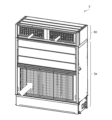
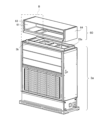
- FIG. 2 is an assembled perspective view showing the indoor unit 3 according to embodiment 1
- Fig. 3 is an exploded perspective view showing the indoor unit 3 according to embodiment 1.
- the indoor unit 3 has an indoor unit main body 3a and a plenum chamber 60 provided on an upper portion of the indoor unit main body 3a.
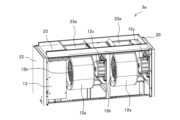
- Fig. 4 is a perspective view showing the indoor unit body 3a according to the first embodiment
- Fig. 5 is a perspective view showing the indoor unit body 3a according to the first embodiment with the front plate 21 removed.
- the indoor unit body 3a includes a housing 20 forming an outer shell, a heat exchanger 11, a blower 12, a drain pan 24 for collecting condensed water from the heat exchanger 11, and a control box 13 having a control unit for controlling the blower 12 and the like.
- the indoor unit 3 takes in air from an intake port 21a formed in the front plate 21 of the housing 20 (white arrow in Figs. 4 and 5).
- the heat exchanger 11 is disposed inside the intake port 21a.
- an air passage is formed from the intake port 21a formed in the front plate 21 to the housing-side outlet 23a formed in the top plate 23.
- the air taken into the housing 20 passes through the heat exchanger 11, is conditioned, and is blown out from the housing-side outlet 23a formed in the top plate 23 of the housing 20 (indicated by the white arrow in FIG. 5).
- Both sides of the housing 20 are side panels 22, and the rear of the housing 20 is a rear panel 25.
- the side of the housing 20 on which the front plate 21 is located is called the front side
- the side facing the front plate 21 is called the rear side.
- the left and right sides of the housing 20 correspond to the left and right when the housing 20 is viewed from the front plate 21.
- the x direction which is the positive direction of the x axis, is the right, and the opposite direction along the x axis is the left.
- the direction parallel to the plane defined by the xz axes is the horizontal direction, and the y direction is the upward direction.
- the front-to-rear direction of the air conditioner 1 is along the z-axis shown in FIG. 4.
- the heat exchanger 11 is disposed on the rear side of the intake port 21a when viewed from the side where the front panel 21 of the housing 20 is disposed.
- the blower 12 includes two blowers 12, and is disposed above the heat exchanger 11, and is located between the housing side outlet 23a and the heat exchanger 11.
- the blower 12 is connected to a fan 12b (see FIG. 6) and a motor 12c (see FIG. 6), and the motor 12c is inverter controlled to drive the fan 12b.
- the air flowing in from the intake port 21a passes through the heat exchanger 11 disposed at an incline inside the housing 20 and flows upward inside the housing 20.
- fan 12b is a sirocco fan.
- FIG. 6 is a perspective view showing the secondary side region of the heat exchanger 11 according to the first embodiment.
- the secondary side region of the heat exchanger 11 means the region inside the housing 20 where air that has passed through the heat exchanger 11 exists.
- the primary side region of the heat exchanger 11 means the region where air exists before passing through the heat exchanger 11. In other words, the primary side region is the region upstream of the heat exchanger 11 in the air passage inside the housing 20.
- the secondary side region is the region downstream of the heat exchanger 11 in the air passage inside the housing 20.
- a motor 12c In the secondary side area of the heat exchanger 11, a motor 12c, a fan 12b directly connected to the motor 12c, and a fan casing 12a fixed to the top plate 23 to cover the periphery of the fan 12b are installed.
- two blowers 12 are arranged in the x direction.
- the control box 13 is arranged in the horizontal direction of the blowers 12, i.e., along the x axis, together with the blowers 12. Since the control box 13 is arranged on the side of the blowers 12, when removing the front plate 21 to perform maintenance around the blowers 12, it is not necessary to remove the control box 13 from the air conditioner 1, improving the workability of maintenance.
- the fan casing 12a is configured to be freely separated in the front-rear direction of the air conditioner 1 and can be removed, so that maintenance such as cleaning of the internal fan 12b is possible.
- the drain pan 24 is disposed in the primary side area of the heat exchanger 11.
- the heat exchanger 11 and the drain pan 24 are prone to adhesion of dust or dirt due to condensed water. Therefore, the primary side area of the heat exchanger 11 is frequently cleaned. If the control box 13 is disposed above the drain pan 24 in the primary side area of the heat exchanger 11 in the indoor unit 3, the control box 13 will hinder the cleaning of the heat exchanger 11 and the drain pan 24, making the cleaning work complicated. In addition, if a large amount of cleaning water is applied to the control box 13 during the cleaning work, the water will enter the inside of the control box 13. This will cause a breakdown of the air conditioner 1, so it is necessary to protect the control box 13 during the cleaning work.
- the control box 13 according to the first embodiment is disposed in the secondary side area rather than the primary side area where cleaning is frequent, and this makes it easier to perform maintenance work on the air conditioner 1.
- the control box 13 is disposed in the secondary side area, which also increases the cooling efficiency.
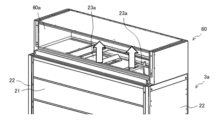
- FIG. 7 is a perspective view showing the plenum chamber 60 according to the first embodiment.
- the plenum chamber 60 is a box provided on the upper part of the indoor unit main body 3a.
- the inside of the plenum chamber 60 is hollow, and a plenum space 60a is formed. The air blown out from the two housing side air outlets 23a flows into the plenum space 60a inside the plenum chamber 60.
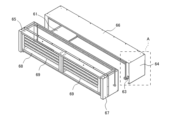
- FIG 8 is an exploded perspective view showing the plenum chamber 60 according to the first embodiment.
- the plenum chamber 60 has a plenum bottom plate 61, a plenum back plate 62, a plenum inner wall 63, a plenum side plate 64, a plenum front top plate 65, a plenum rear top plate 66, a plenum front plate 67, a louver portion 68, and a rectifying plate 70.
- the plenum back plate 62, the plenum front top plate 65, the plenum rear top plate 66, the plenum front plate 67, the louver portion 68, the plenum inner wall 63, and the rectifying plate 70 are examples of the main body portion.
- the plenum chamber 60 can be washed by pouring water over it while it is installed in the indoor unit body 3a.
- the louver portion 68, the plenum front panel 67, and the plenum front top panel 65 are removed, and cleaning water is poured over it from the front.
- the plenum bottom plate 61 is attached to the top of the housing 20 of the indoor unit main body 3a.
- the plenum bottom plate 61 holds the cleaning water that is sprayed from the front when the plenum chamber 60 is cleaned.
- the plenum bottom plate 61 has an opening 61a that opens in a portion that corresponds to the housing side air outlet 23a.
- the plenum back plate 62 is a plate-shaped member that extends upward from the back of the plenum bottom plate 61, and closes the back of the plenum chamber 60.
- the pair of plenum inner walls 63 are plate-like members extending upward from both sides of the plenum bottom plate 61.
- the pair of plenum side plates 64 are plate-like members provided on the outer sides of each of the pair of plenum inner walls 63.
- the pair of plenum side plates 64 are design surfaces that form the left and right side surfaces of the plenum chamber 60.
- the plenum side plates 64 are fixed to the plenum chamber 60 at side plate fixing parts 80 (see Figure 10).
- the plenum inner walls 63 and plenum side plates 64 cover the side surfaces of the plenum chamber 60, forming a double structure.
- the plenum front top plate 65 is a plate-like member extending in the width direction that connects the front upper ends of the pair of plenum inner walls 63.
- the plenum rear top plate 66 is a plate-like member extending in the width direction that connects the rear upper ends of the pair of plenum inner walls 63 and the upper end of the back plate.
- the plenum front top plate 65 and the plenum rear top plate 66 cover the top surface of the plenum chamber 60.
- the pair of plenum front plates 67 are plate-shaped members provided in front of the pair of plenum front plates 67.
- the louver portion 68 is a member that is fitted between the plenum bottom plate 61, the pair of plenum front plates 67, and the plenum front top plate 65.
- a lattice-shaped plenum side outlet 69 is formed in the louver portion 68, and air in the plenum chamber 60 is blown out from the plenum side outlet 69.
- the straightening plate 70 is provided to separate the opening 61a of the plenum bottom plate 61, and straightens the air blown out from the housing side outlet 23a.
- Fig. 9 is a perspective view showing a case where the plenum chamber 60 of the air conditioner 1 according to embodiment 1 is divided along the longitudinal direction, that is, the left-right direction.
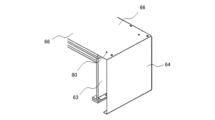
- Fig. 10 is an enlarged view of part A in Fig. 9.
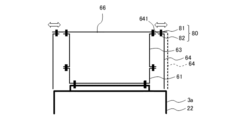
- Fig. 11 is a view showing a longitudinal cross section along the longitudinal direction, that is, the left-right direction, of the plenum chamber 60 of the air conditioner 1 according to embodiment 1.
- the plenum side plate 64 is fixed to the plenum chamber 60 by the side plate fixing part 80.
- the plenum side plate 64 is arranged so that its lower end contacts the upper surface of the indoor unit body 3a and is flush with the side panel 22, which is the end surface of the indoor unit body 3a.
- the plenum side plate 64 can move left and right relative to the plenum inner wall 63, i.e., in the X direction.
- the plenum side plate 64 is moved left and right, i.e., in the X direction, by the side plate fixing portion 80, and its position relative to the plenum inner wall 63 is adjusted.
- the plenum side plate 64 is fixed so that it is flush with the end face of the indoor unit main body 3a.
- the side panel fixing portion 80 is composed of, for example, a first long hole 81 formed in the plenum rear top panel 66 and a first fixing screw 82 inserted through the first long hole 81.
- the first long hole 81 is formed at the side end of the plenum rear top panel 66.
- the first long hole 81 has a shape in which the long axis extends in the left-right direction and the short axis extends in the front-rear direction.
- the dimensions of the first long hole 81 may be any dimension that can absorb the variation between the left-right dimension of the plenum chamber 60 and the left-right dimension of the indoor unit main body 3a, and may be, for example, 7 mm in the short axis and 12 mm in the long axis.
- the first fixing screw 82 is fastened to the plenum side panel 64. Specifically, the first fixing screw 82 is fastened to the side panel flange portion 641 extending inward from the upper end of the plenum side panel 64.
- the plenum side panel 64 becomes movable left and right.
- the plenum side panel 64 is moved left and right, and the left and right position of the plenum side panel 64 is adjusted.
- the side panel fixing portion 80 is fastened at that position. This fixes the plenum side panel 64 to the main body of the plenum chamber 60.
- first long holes 81 and multiple first fixing screws 82 may be provided.
- the first long holes 81 may be provided in the plenum rear top plate 66, or may be provided in both the plenum front top plate 65 and the plenum rear top plate 66.
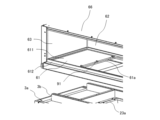
- Fig. 12 is a partial perspective view of the plenum chamber 60 of the air conditioner 1 according to embodiment 1.
- Fig. 13 is a schematic diagram showing a longitudinal section along the left-right direction in the longitudinal direction of the plenum chamber 60 of the air conditioner 1 according to embodiment 1.
- the plenum bottom plate 61 is configured in a tray shape by a main plate 611 and rising portions 612 extending upward from each side of the main plate 611.
- the plenum bottom plate 61 is fixed to the indoor unit body 3a with screws 91.
- the plenum bottom plate 61 is attached, for example, to the upper end of the housing side flange portion 3b formed to extend upward from the top surface of the indoor unit body 3a.
- the plenum bottom plate 61 is fixed to the housing side flange portion 3b of the indoor unit body 3a with screws 91 provided in a total of six locations, for example, three locations in the front-to-rear direction and two locations in the left-to-right direction.
- the opening 61a in the main plate 611 is provided to circulate the air discharged from the housing side outlet 23a formed in the indoor unit body 3a, and to discharge the cleaning water accumulated in the plenum bottom plate 61.
- the opening 61a is located above the housing side outlet 23a, and the opening area is the same as or smaller than the opening area of the housing side outlet 23a of the indoor unit body 3a. This allows the cleaning water accumulated in the plenum bottom plate 61 to be discharged into the interior of the indoor unit body 3a without leaking to the outside.
- the rising portions 612 are provided to hold back cleaning water that accumulates on the plenum bottom plate 61.
- the rising portions 612 located on the sides have bottom plate flange portions 613 that extend outward from their upper ends.
- the bottom plate flange portions 613 are connected to the plenum inner wall 63.
- the bottom plate flange portions 613 are connected to inner wall flange portions 631 that extend outward from the lower end portion of the plenum inner wall 63.
- the plenum inner wall 63 is fixed to the plenum bottom plate 61 by fastening the bottom plate flange portions 613 and the inner wall flange portions 631.
- the plenum bottom plate 61 has a raised portion 612, so that the joint between the plenum inner wall 63 and the plenum bottom plate 61 can be made higher than the main plate 611 of the plenum bottom plate 61.
- the inner wall flange portion 631 and the bottom plate flange portion 613 both extend outward, the screws 90 that fasten the inner wall flange portion 631 and the bottom plate flange portion 613 are positioned outside the cold air passage.
- FIG. 14 is a perspective view illustrating a procedure for attaching the plenum chamber 60 in the air conditioner 1 according to embodiment 1.
- Fig. 15 is an enlarged perspective view of part B in Fig. 14.
- Fig. 16 is a perspective view illustrating the position adjustment of the plenum side plate 64 of the air conditioner 1 according to embodiment 1.
- Fig. 17 is an enlarged perspective view of part C in Fig. 16.
- the plenum chamber 60 As shown in Figures 14 to 17, in the procedure for installing the plenum chamber 60, first, the plenum chamber 60 from which the louver portion 68, plenum front plate 67, and plenum front top plate 65 have been removed is placed on top of the indoor unit body 3a. Next, the plenum bottom plate 61 is fixed to the housing side flange portion 3b of the indoor unit body 3a with screws 91. This fixes the plenum chamber 60 to the indoor unit body 3a.
- the first fixing screw 82 of the side panel fixing part 80 is loosened, so that the plenum side panel 64 is temporarily fixed, and the position of the plenum side panel 64 is adjusted.
- the first fixing screw 82 can move along the first long hole 81 of the side panel fixing part 80, and the position of the plenum side panel 64 can be adjusted. Therefore, there is no need to lift and move the entire plenum chamber 60 when adjusting the position of the plenum side panel 64.
- the plenum side panel 64 moves left and right, thereby changing the position of the plenum side panel 64 relative to the plenum inner wall 63.
- the plenum side panel 64 moves left and right, thereby changing the position of the plenum side panel 64 relative to the plenum inner wall 63.
- the first fixing screw 82 functions as a handle, making it possible to fine-tune the position of the plenum side panel 64.
- the plenum side plate 64 can be made flush with the end face of the indoor unit body 3a even if there is variation in the external dimensions of the indoor unit body 3a and the plenum chamber 60, that is, individual differences. This prevents the end face of the indoor unit body 3a and the end face of the plenum chamber 60 from not matching up, resulting in a step, and improves the design of the air conditioner 1.
- the side of the plenum chamber 60 has a double structure consisting of a plenum inner wall 63 and a plenum side plate 64, and the plenum side plate 64 is located away from the cold air passage. This prevents the plenum side plate 64 from coming into contact with the cold air, and prevents condensation from forming on the outer surface of the plenum side plate 64.
- FIG. 18 is a schematic diagram showing a drainage path of the air conditioner 1 according to embodiment 1. As shown in Fig. 18, when cleaning the plenum chamber 60, the louver portion 68, the plenum front plate 67, and the plenum front top plate 65 are removed, and cleaning water is sprayed onto the plenum chamber 60 from the front side of the plenum chamber 60.
- the cleaning water sprayed into the plenum chamber 60 is received by the plenum inner wall 63, and guided along the plenum inner wall 63 to the plenum bottom plate 61, where it is blocked and held by the rising portion 612 of the plenum bottom plate 61.
- the held cleaning water flows out from the opening 61a of the plenum bottom plate 61 and is discharged into the indoor unit body 3a via the housing side air outlet 23a of the indoor unit body 3a. This prevents the cleaning water that has accumulated in the plenum bottom plate 61 from flowing out from the front of the plenum chamber 60 or the joint between the plenum chamber 60 and the indoor unit body 3a.
- the volume of the plenum bottom plate 61 is set assuming, for example, 0.012 m3 .
- the height of the rising portion 612 of the plenum bottom plate 61 is, for example, 25 mm.
- the volume of the plenum bottom plate 61 is a volume that takes more than one minute for water to accumulate at the front surface of the plenum chamber 60 or the joint between the plenum chamber 60 and the indoor unit body 3a when the amount of water during washing is 10 L/min.
- washing water is less likely to reach the front surface of the plenum chamber 60 and the joint between the plenum chamber 60 and the indoor unit body 3a, and it is possible to suppress outflow of the plenum chamber 60 or the indoor unit body 3a.
- the plenum bottom plate 61 and the plenum inner wall 63 are fastened together by screws 90 that pass through the bottom plate flange portion 613 and the inner wall flange portion 631, which extend outward.
- the screws 90 are provided outside the cold air passage, and the screws 90 do not come into contact with the cold air, preventing condensation from forming on the screws 90.
- Fig. 19 is a partially exploded perspective view of the plenum chamber 60 of the air conditioner 1 according to a modified example of Embodiment 1.
- the side plate fixing portion 80 may be composed of a second oblong hole 83 formed in the plenum side plate 64 and a second fixing screw (not shown) that passes through the second oblong hole 83.
- the second oblong hole 83 is formed in the side plate flange portion 641 that extends inwardly of the plenum chamber 60 from the front end of the periphery of the plenum side plate 64.
- the second oblong hole 83 has a shape in which the long axis extends in the left-right direction and the short axis extends in the up-down direction.
- the dimensions of the second oblong hole 83 are the same as those of the first oblong hole 81, for example, the short axis is 7 mm and the long axis is 12 mm.
- the second fixing screw is fastened to the plenum inner wall 63.
- the second fixing screw is fastened to the inner wall flange portion 631 that extends outwardly of the plenum chamber 60 from the front end of the plenum inner wall 63.
- the second oblong hole 83 and the second fixing screw make it easy to adjust the position of the plenum side plate 64.
- the side panel fixing portion 80 may be configured with a first long hole 81 and a first fixing screw 82, or may be configured with a second long hole 83 and a second fixing screw, or may be configured with a first long hole 81, a first fixing screw 82, a second long hole 83, and a second fixing screw.
- the side plate fixing portion 80 only needs to be able to adjust and fix the position of the plenum side plate 64 relative to the plenum inner wall 63, and the form of the side plate fixing portion 80 is not particularly limited.
- the side plate fixing portion 80 may be configured such that a groove portion formed in the inner wall flange portion 631 and a claw portion formed in the plenum side plate 64 slide against each other.
- the air conditioner 1 has a plenum side plate 64 attached to the outside of the plenum inner wall 63, and the position of the plenum side plate 64 relative to the plenum inner wall 63 is adjusted and fixed by the side plate fixing part 80 so that it is flush with the end face of the indoor unit body 3a. Therefore, even if there is variation in the external dimensions of the indoor unit body 3a when installing the plenum chamber 60, the plenum side plate 64 can be moved to match the external dimensions of the indoor unit body 3a and aligned with the end face of the indoor unit body 3a. This makes it easier to align the plenum chamber 60, and there is no need to lift the plenum chamber 60 to align it, improving the workability of installing the plenum chamber 60.
- the plenum chamber 60 also has a plenum bottom plate 61 that includes a main plate 611 with an opening 61a formed therein and rising portions 612 extending upward from each side of the main plate 611.
- the cleaning water in the plenum chamber 60 is stopped by the rising portions 612 of the plenum bottom plate 61 and discharged from the openings 61a of the main plate 611. This makes it possible to prevent water from leaking out from the front surface of the plenum chamber 60 and from the joint between the plenum chamber 60 and the indoor unit body 3a.
- the plenum bottom plate 61 and the plenum inner wall 63 also separate the air passage from the plenum side plate 64, preventing cold air from coming into contact with the plenum side plate 64, thereby preventing condensation from forming on the outer surface of the plenum side plate 64.
- the main plate 611 of the plenum bottom plate 61 is fixed onto the housing side flange portion 3b that extends upward from the housing side air outlet 23a of the indoor unit body 3a. Therefore, the cleaning water accumulates on the plenum bottom plate 61, moves along the main plate 611 of the plenum bottom plate 61 to the opening 61a, passes through the housing side flange portion 3b, and is discharged from the housing side air outlet 23a to the inside of the indoor unit body 3a. This makes it possible to suppress water leakage from joints between the plenum chamber 60 and the indoor unit body 3a.
- the plenum inner wall 63 is fixed to the indoor unit body 3a via the plenum bottom plate 61 by fixing the inner wall flange portion 631 extending outward from the lower end to the bottom plate flange portion 613 extending outward from the upper end of the rising portion 612. Therefore, the joint between the plenum inner wall 63 and the plenum bottom plate 61 is located higher than the main plate 611 of the plenum bottom plate 61, so that cleaning water accumulated in the plenum bottom plate 61 is less likely to come into contact with the joint, and water leakage from the joint can be suppressed.
- the side panel fixing portion 80 is composed of a first oblong hole 81 provided in the plenum rear top panel 66 and a first fixing screw 82 that is inserted into the first oblong hole 81 and fixed to the plenum side panel 64. Therefore, it is easy to fine-tune the position of the plenum side panel 64 by adjusting the position of the plenum side panel 64 relative to the plenum inner wall 63 by moving the first fixing screw 82 along the first oblong hole 81 while pinching the first fixing screw 82.
Landscapes
- Air Filters, Heat-Exchange Apparatuses, And Housings Of Air-Conditioning Units (AREA)
Priority Applications (2)
| Application Number | Priority Date | Filing Date | Title |
|---|---|---|---|
| PCT/JP2023/019637 WO2024246973A1 (ja) | 2023-05-26 | 2023-05-26 | 空気調和機 |
| JP2025524859A JPWO2024246973A1 (https=) | 2023-05-26 | 2023-05-26 |
Applications Claiming Priority (1)
| Application Number | Priority Date | Filing Date | Title |
|---|---|---|---|
| PCT/JP2023/019637 WO2024246973A1 (ja) | 2023-05-26 | 2023-05-26 | 空気調和機 |
Publications (1)
| Publication Number | Publication Date |
|---|---|
| WO2024246973A1 true WO2024246973A1 (ja) | 2024-12-05 |
Family
ID=93656911
Family Applications (1)
| Application Number | Title | Priority Date | Filing Date |
|---|---|---|---|
| PCT/JP2023/019637 Ceased WO2024246973A1 (ja) | 2023-05-26 | 2023-05-26 | 空気調和機 |
Country Status (2)
| Country | Link |
|---|---|
| JP (1) | JPWO2024246973A1 (https=) |
| WO (1) | WO2024246973A1 (https=) |
Citations (2)
| Publication number | Priority date | Publication date | Assignee | Title |
|---|---|---|---|---|
| JPS5912916U (ja) * | 1982-07-16 | 1984-01-26 | 三菱電機株式会社 | 空気調和機 |
| JP2010117103A (ja) * | 2008-11-14 | 2010-05-27 | Mitsubishi Electric Corp | 空調用室内機 |
-
2023
- 2023-05-26 JP JP2025524859A patent/JPWO2024246973A1/ja active Pending
- 2023-05-26 WO PCT/JP2023/019637 patent/WO2024246973A1/ja not_active Ceased
Patent Citations (2)
| Publication number | Priority date | Publication date | Assignee | Title |
|---|---|---|---|---|
| JPS5912916U (ja) * | 1982-07-16 | 1984-01-26 | 三菱電機株式会社 | 空気調和機 |
| JP2010117103A (ja) * | 2008-11-14 | 2010-05-27 | Mitsubishi Electric Corp | 空調用室内機 |
Also Published As
| Publication number | Publication date |
|---|---|
| JPWO2024246973A1 (https=) | 2024-12-05 |
Similar Documents
| Publication | Publication Date | Title |
|---|---|---|
| KR200342073Y1 (ko) | 공기조화기용 벽 매입형 실외기 | |
| US11578877B2 (en) | Air conditioner having fan module with installation space and stabilizer modifier spaced apart from the fan module | |
| KR20160084225A (ko) | 공기 조화기의 실외기 및 그 제조 방법 | |
| KR20160081720A (ko) | 공기 조화기의 실외기 | |
| JP2011137610A (ja) | 空気調和装置の室外ユニット | |
| KR20160081719A (ko) | 공기 조화기의 실외기 | |
| WO2024246973A1 (ja) | 空気調和機 | |
| WO2012160749A1 (ja) | 冷凍装置の室外ユニット | |
| AU2020290178A1 (en) | Ceiling-embedded indoor unit and air-conditioning device | |
| WO2025020403A1 (zh) | 新风空调器 | |
| WO2024241412A1 (ja) | 空気調和機 | |
| US12130042B2 (en) | Indoor unit of air-conditioning apparatus | |
| JP7834189B2 (ja) | 空気調和機 | |
| WO2025120768A1 (ja) | 室内機 | |
| KR20160086141A (ko) | 공기 조화기의 실외기 | |
| WO2017056152A1 (ja) | 室内機 | |
| CN221839796U (zh) | 窗式空调器 | |
| KR20030036585A (ko) | 공기조화기용 벽 매입형 실외기 | |
| JP7599095B2 (ja) | 室外機 | |
| US20250146678A1 (en) | Ceiling air conditioner | |
| CN212274107U (zh) | 天花板悬吊型空调装置室内机 | |
| KR20050018011A (ko) | 덕트 연결형 공기조화기의 실내기 | |
| KR20030040338A (ko) | 전면 흡토출 방식의 공기조화기용 실외기 | |
| WO2025141685A1 (ja) | 空気調和機 | |
| KR200190467Y1 (ko) | 공기조화기용실외기 |
Legal Events
| Date | Code | Title | Description |
|---|---|---|---|
| 121 | Ep: the epo has been informed by wipo that ep was designated in this application |
Ref document number: 23939458 Country of ref document: EP Kind code of ref document: A1 |
|
| WWE | Wipo information: entry into national phase |
Ref document number: 2025524859 Country of ref document: JP |
|
| NENP | Non-entry into the national phase |
Ref country code: DE |