WO2024242126A1 - 眼鏡 - Google Patents
眼鏡 Download PDFInfo
- Publication number
- WO2024242126A1 WO2024242126A1 PCT/JP2024/018771 JP2024018771W WO2024242126A1 WO 2024242126 A1 WO2024242126 A1 WO 2024242126A1 JP 2024018771 W JP2024018771 W JP 2024018771W WO 2024242126 A1 WO2024242126 A1 WO 2024242126A1
- Authority
- WO
- WIPO (PCT)
- Prior art keywords
- guidance
- gaze
- wearer
- region
- glasses
- Prior art date
- Legal status (The legal status is an assumption and is not a legal conclusion. Google has not performed a legal analysis and makes no representation as to the accuracy of the status listed.)
- Ceased
Links
Images









Classifications
-
- G—PHYSICS
- G02—OPTICS
- G02B—OPTICAL ELEMENTS, SYSTEMS OR APPARATUS
- G02B27/00—Optical systems or apparatus not provided for by any of the groups G02B1/00 - G02B26/00, G02B30/00
- G02B27/0093—Optical systems or apparatus not provided for by any of the groups G02B1/00 - G02B26/00, G02B30/00 with means for monitoring data relating to the user, e.g. head-tracking, eye-tracking
-
- G—PHYSICS
- G02—OPTICS
- G02B—OPTICAL ELEMENTS, SYSTEMS OR APPARATUS
- G02B1/00—Optical elements characterised by the material of which they are made; Optical coatings for optical elements
- G02B1/08—Optical elements characterised by the material of which they are made; Optical coatings for optical elements made of polarising materials
-
- G—PHYSICS
- G02—OPTICS
- G02B—OPTICAL ELEMENTS, SYSTEMS OR APPARATUS
- G02B27/00—Optical systems or apparatus not provided for by any of the groups G02B1/00 - G02B26/00, G02B30/00
- G02B27/01—Head-up displays
- G02B27/017—Head mounted
-
- G—PHYSICS
- G02—OPTICS
- G02B—OPTICAL ELEMENTS, SYSTEMS OR APPARATUS
- G02B27/00—Optical systems or apparatus not provided for by any of the groups G02B1/00 - G02B26/00, G02B30/00
- G02B27/01—Head-up displays
- G02B27/017—Head mounted
- G02B27/0172—Head mounted characterised by optical features
-
- G—PHYSICS
- G02—OPTICS
- G02B—OPTICAL ELEMENTS, SYSTEMS OR APPARATUS
- G02B3/00—Simple or compound lenses
-
- G—PHYSICS
- G02—OPTICS
- G02B—OPTICAL ELEMENTS, SYSTEMS OR APPARATUS
- G02B3/00—Simple or compound lenses
- G02B3/12—Fluid-filled or evacuated lenses
- G02B3/14—Fluid-filled or evacuated lenses of variable focal length
-
- G—PHYSICS
- G02—OPTICS
- G02C—SPECTACLES; SUNGLASSES OR GOGGLES INSOFAR AS THEY HAVE THE SAME FEATURES AS SPECTACLES; CONTACT LENSES
- G02C7/00—Optical parts
-
- G—PHYSICS
- G02—OPTICS
- G02C—SPECTACLES; SUNGLASSES OR GOGGLES INSOFAR AS THEY HAVE THE SAME FEATURES AS SPECTACLES; CONTACT LENSES
- G02C7/00—Optical parts
- G02C7/02—Lenses; Lens systems ; Methods of designing lenses
- G02C7/08—Auxiliary lenses; Arrangements for varying focal length
- G02C7/081—Ophthalmic lenses with variable focal length
- G02C7/083—Electrooptic lenses
-
- G—PHYSICS
- G02—OPTICS
- G02F—OPTICAL DEVICES OR ARRANGEMENTS FOR THE CONTROL OF LIGHT BY MODIFICATION OF THE OPTICAL PROPERTIES OF THE MEDIA OF THE ELEMENTS INVOLVED THEREIN; NON-LINEAR OPTICS; FREQUENCY-CHANGING OF LIGHT; OPTICAL LOGIC ELEMENTS; OPTICAL ANALOGUE/DIGITAL CONVERTERS
- G02F1/00—Devices or arrangements for the control of the intensity, colour, phase, polarisation or direction of light arriving from an independent light source, e.g. switching, gating or modulating; Non-linear optics
- G02F1/01—Devices or arrangements for the control of the intensity, colour, phase, polarisation or direction of light arriving from an independent light source, e.g. switching, gating or modulating; Non-linear optics for the control of the intensity, phase, polarisation or colour
- G02F1/13—Devices or arrangements for the control of the intensity, colour, phase, polarisation or direction of light arriving from an independent light source, e.g. switching, gating or modulating; Non-linear optics for the control of the intensity, phase, polarisation or colour based on liquid crystals, e.g. single liquid crystal display cells
-
- G—PHYSICS
- G02—OPTICS
- G02F—OPTICAL DEVICES OR ARRANGEMENTS FOR THE CONTROL OF LIGHT BY MODIFICATION OF THE OPTICAL PROPERTIES OF THE MEDIA OF THE ELEMENTS INVOLVED THEREIN; NON-LINEAR OPTICS; FREQUENCY-CHANGING OF LIGHT; OPTICAL LOGIC ELEMENTS; OPTICAL ANALOGUE/DIGITAL CONVERTERS
- G02F1/00—Devices or arrangements for the control of the intensity, colour, phase, polarisation or direction of light arriving from an independent light source, e.g. switching, gating or modulating; Non-linear optics
- G02F1/01—Devices or arrangements for the control of the intensity, colour, phase, polarisation or direction of light arriving from an independent light source, e.g. switching, gating or modulating; Non-linear optics for the control of the intensity, phase, polarisation or colour
- G02F1/13—Devices or arrangements for the control of the intensity, colour, phase, polarisation or direction of light arriving from an independent light source, e.g. switching, gating or modulating; Non-linear optics for the control of the intensity, phase, polarisation or colour based on liquid crystals, e.g. single liquid crystal display cells
- G02F1/133—Constructional arrangements; Operation of liquid crystal cells; Circuit arrangements
-
- G—PHYSICS
- G02—OPTICS
- G02F—OPTICAL DEVICES OR ARRANGEMENTS FOR THE CONTROL OF LIGHT BY MODIFICATION OF THE OPTICAL PROPERTIES OF THE MEDIA OF THE ELEMENTS INVOLVED THEREIN; NON-LINEAR OPTICS; FREQUENCY-CHANGING OF LIGHT; OPTICAL LOGIC ELEMENTS; OPTICAL ANALOGUE/DIGITAL CONVERTERS
- G02F1/00—Devices or arrangements for the control of the intensity, colour, phase, polarisation or direction of light arriving from an independent light source, e.g. switching, gating or modulating; Non-linear optics
- G02F1/01—Devices or arrangements for the control of the intensity, colour, phase, polarisation or direction of light arriving from an independent light source, e.g. switching, gating or modulating; Non-linear optics for the control of the intensity, phase, polarisation or colour
- G02F1/13—Devices or arrangements for the control of the intensity, colour, phase, polarisation or direction of light arriving from an independent light source, e.g. switching, gating or modulating; Non-linear optics for the control of the intensity, phase, polarisation or colour based on liquid crystals, e.g. single liquid crystal display cells
- G02F1/133—Constructional arrangements; Operation of liquid crystal cells; Circuit arrangements
- G02F1/1333—Constructional arrangements; Manufacturing methods
-
- G—PHYSICS
- G02—OPTICS
- G02B—OPTICAL ELEMENTS, SYSTEMS OR APPARATUS
- G02B27/00—Optical systems or apparatus not provided for by any of the groups G02B1/00 - G02B26/00, G02B30/00
- G02B27/01—Head-up displays
- G02B27/017—Head mounted
- G02B2027/0178—Eyeglass type
Definitions
- the present invention relates to glasses.
- Patent document 1 describes glasses with optical elements that can adjust the focal length by controlling the refractive index of the liquid crystal layer, and further discloses that the focal length can be controlled according to the line of sight.
- Patent document 2 describes a method for slowing the progression of myopia using an optical device with a specific off-axis aberration control design that slows eye growth.
- Patent document 3 also describes how the object display is displayed to train the wearer's eyesight so that the wearer does not miss the object to be focused on.
- the challenge is to improve user convenience and quality of life.
- the present invention aims to provide eyeglasses that can improve the convenience and quality of life of users.
- the eyeglasses of the present invention are characterized in that they are eyeglasses having a variable focus lens and a lens control unit that controls the refractive index distribution generated in the variable focus lens, and further have a guidance information acquisition unit that acquires guidance information regarding the direction of the line of sight of the wearer to be guided, and the lens control unit controls the refractive index distribution based on the guidance information.
- variable focus lens is a liquid crystal lens divided into a plurality of drive regions
- the lens control unit determines, based on the guidance information, at least one drive region corresponding to the direction of the line of sight to be guided as a line of sight guidance region, and generates a Fresnel lens-like refractive index distribution in the line of sight guidance region.
- the glasses described in (2) may be characterized in that the lens control unit determines at least one driving area outside the gaze guidance area as a non-guidance area, and controls the non-guidance area so that visibility is worse than in the gaze guidance area.
- each of the plurality of drive regions is capable of executing focus formation control for forming a focus, and in the drive region determined as the non-guidance region, the visibility is controlled to be worse than when the focus formation control is executed.
- the glasses described in (3) may further include a gaze direction detection unit that detects the gaze direction of the wearer, and the lens control unit may determine at least one drive area corresponding to the gaze direction detected by the gaze direction detection unit as a gaze area, and control the gaze area so that visibility is worse than the gaze guidance area, and is controlled so that visibility is better than the non-guidance area.
- the eyeglasses described in any one of (3) to (5) may be characterized in that the lens control unit controls the degree of deterioration of visibility in the non-guided area to change periodically.
- the eyeglasses described in any one of (5) to (6) may be characterized in that the lens control unit controls the degree of deterioration of visibility in the line of sight area to change periodically.
- the glasses described in any one of (5) to (7) may be characterized in that the lens control unit controls the visibility to improve from the line of sight area toward the line of sight guidance area.
- the eyeglasses described in any one of (1) to (8) may further include a gaze direction detection unit that detects the gaze direction of the wearer, and the lens control unit may have a means for switching between a guidance control mode that controls the refractive index distribution based on the guidance information and a detection control mode that controls the refractive index distribution in response to the gaze direction detected by the gaze direction detection unit.
- the glasses described in any one of (3) to (9) may be characterized in that they have a plurality of modes that are set to differ in the degree of deterioration of visibility in the non-induction area, and the lens control unit has a means for switching between the plurality of modes.
- the eyeglasses described in (10) may be characterized in that they have a means for capturing the eye behavior of the wearer, and the lens control unit switches between the multiple modes based on the eye behavior.
- the eyeglasses described in any one of (1) to (11) may further include a gaze space information acquisition unit that acquires gaze space information related to the state of a space covered by the wearer's gaze, and the guidance information may be acquired based on the gaze space information.
- the eyeglasses described in any one of (1) to (11) may further include a sound detection unit that detects sounds emitted around the wearer, and the guidance information may be acquired based on the sounds detected by the sound detection unit.
- the glasses described in any one of (1) to (11) may be characterized in that the guidance information acquisition unit acquires the guidance information by receiving information from an external source.
- the eyeglasses described in any one of (1) to (11) may be characterized in that the eyeglasses are an eyeglass-type information device having an image display device on the front surface of the variable focus lens, the image display device displays an image representing the field of view from the wearer's viewpoint based on three-dimensional space information indicating the situation of the three-dimensional space in which the wearer is placed, and the guidance information acquisition unit acquires the guidance information based on a positional relationship between an object to be gazed upon by the wearer in the three-dimensional space and the wearer in the three-dimensional space.
- the eyeglasses described in any one of (1) to (15) may further include a power model information storage unit that stores power model information indicating the relationship between the distance to an object on which the wearer is gazing and the lens power to be set.
- the eyeglasses described in (16) may be characterized in that the lens control unit further acquires information indicating the distance to an object on an extension of the line of sight to be guided, and generates a Fresnel lens-shaped refractive index distribution in the line of sight guidance area that corresponds to the lens power determined based on the information indicating the distance and the power model information.
- the eyeglasses described in (16) may further include a gaze space information acquisition unit that acquires gaze space information related to the state of the space covered by the wearer's gaze, and the lens control unit may determine the direction of the wearer's gaze to be guided and the distance to an object that the wearer will be gazing at after gaze guidance based on the gaze space information, and generate a Fresnel lens-like refractive index distribution in the gaze guidance area based on the distance and the power model information.
- the glasses described in (3) may be a glasses-type information device having an image display device that displays an image superimposed on the real world visually recognized by the wearer through the variable focus lens, and the image display device may be controlled to display an image in a portion that overlaps with the non-guided area.
- the glasses described in (19) may be characterized in that the non-inducing region is controlled so that the degree of deterioration of visibility changes periodically, and the image display device changes the brightness of the image displayed in the portion overlapping the non-inducing region in accordance with the degree of deterioration of visibility (improving the brightness when visibility deteriorates).
- the eyeglasses of the present invention are eyeglasses having a variable focus lens, a lens control unit that controls the refractive index distribution generated in the variable focus lens, and an image display device that displays an image superimposed on the real world viewed by the wearer through the variable focus lens, characterized in that the variable focus lens is a liquid crystal lens divided into a plurality of drive regions, and the lens control unit controls the visibility to deteriorate in at least one of the drive regions that superimposes on the image displayed by the image display device.
- the glasses described in (21) may be characterized in that they have an eye behavior detection unit that detects the eye behavior of the wearer, and the lens control unit changes the degree of deterioration of visibility in the at least one driving region in response to the eye behavior, and/or the image display device changes the brightness of an image displayed superimposed on the at least one driving region in response to the eye behavior.
- the glasses described in (21) may further include an eye behavior detection unit that detects the eye behavior of a wearer, and when the gaze direction of the wearer derived from the eye behavior overlaps with an image displayed by the image display device in the driving region controlled to deteriorate the visibility, the lens control unit changes the degree of deterioration of visibility in the at least one driving region based on the eye behavior, and/or the image display device changes the brightness of the image displayed overlapping with the at least one driving region in response to the eye behavior.
- an eye behavior detection unit that detects the eye behavior of a wearer, and when the gaze direction of the wearer derived from the eye behavior overlaps with an image displayed by the image display device in the driving region controlled to deteriorate the visibility, the lens control unit changes the degree of deterioration of visibility in the at least one driving region based on the eye behavior, and/or the image display device changes the brightness of the image displayed overlapping with the at least one driving region in response to the eye behavior.
- the glasses described in (23) may be characterized in that it is determined whether the wearer is gazing at a superimposed image or at the real world based on information indicating the distance to an object on which the wearer is gazing, and when the wearer is gazing at the real world, the lens control unit reduces the degree of deterioration of visibility in the at least one driving region, and when the wearer is gazing at a superimposed image, the image display device increases the brightness of the superimposed image displayed superimposed on the at least one driving region.
- the eyeglasses according to the present invention are eyeglasses having a liquid crystal member having a liquid crystal layer and divided into a plurality of drive regions, and a control unit that controls the refractive index distribution generated in the liquid crystal layer, and further have a guidance information acquisition unit that acquires guidance information related to the direction of the line of sight of the wearer to be guided, and the control unit determines, based on the guidance information, a gaze guidance region corresponding to at least one drive region corresponding to the direction of the line of sight of the wearer to be guided, and at least one drive region outside the gaze guidance region, as a non-guidance region, and the non-guidance region is controlled so that visibility is worse than that of the gaze guidance region, and the control unit has a means for switching between a plurality of modes set to differ in degree of visibility in the non-guidance region.
- the glasses described in (25) may further include a means for detecting the eye behavior of the wearer, and the control unit may switch between the multiple modes based on the eye behavior.
- the eyeglasses of the present invention are eyeglasses having a liquid crystal member having a liquid crystal layer and divided into a plurality of driving regions, a control unit that controls the refractive index distribution generated in the liquid crystal layer, and a gaze direction detection unit that detects the gaze direction of the wearer, and further have a guidance information acquisition unit that acquires guidance information regarding the gaze direction to which the wearer should be guided, and the control unit has a means for switching between a guidance control mode that controls the plurality of driving regions based on the guidance information and a detection control mode that controls the plurality of driving regions based on the gaze direction acquired by the gaze direction detection unit.
- the glasses described in any one of (25) to (27) may be characterized in that the glasses are a glasses-type information device having an image display device on the front surface of the liquid crystal member, the image display device displays an image representing the field of view from the wearer's viewpoint based on three-dimensional space information indicating the situation of the three-dimensional space in which the wearer is placed, and the guidance information acquisition unit acquires the guidance information based on a positional relationship between an object to be gazed upon by the wearer in the three-dimensional space and the wearer in the three-dimensional space.
- the optical element of the present invention is an optical element having a liquid crystal layer, a liquid crystal lens having a plurality of driving regions formed in an arc shape centered on an optical axis, and a lens control unit that controls the refractive index distribution in the liquid crystal layer, and is characterized in that the lens control unit generates a Fresnel lens-like refractive index distribution in some of the driving regions, and controls the driving regions other than the some of the driving regions so that visibility is worse than that of the some of the driving regions.
- the optical element according to the present invention is an optical element having a liquid crystal layer, a liquid crystal lens having a plurality of driving regions, and a lens control unit that controls a refractive index distribution in the liquid crystal layer, each of the plurality of driving regions having a plurality of unit electrodes of different widths connected to the same input wiring, and in each of the plurality of driving regions, a Fresnel lens-shaped refractive index distribution composed of a plurality of sawtooth-shaped refractive index distributions is formed by inputting a common control voltage to the plurality of unit electrodes, each of the plurality of unit electrodes corresponds to each of the plurality of sawtooth-shaped refractive index distributions, and the lens control unit generates a Fresnel lens-shaped refractive index distribution in a portion of the plurality of driving regions, and controls the driving regions different from the portion of the driving regions so that visibility is worse than that of the portion of the driving regions.
- the eyeglasses of the present invention include an eyeglasses having a liquid crystal layer, a control unit that controls the refractive index distribution of the liquid crystal layer, a gaze direction detection unit that detects the gaze direction of the wearer, an optical central region that includes an optical center, and an outer peripheral region located outside the optical central region, and the control unit has a means for switching between a first control that controls the focal position of the outer peripheral region to be closer to the eyeglasses than the focal position of the optical central region, and a second control that deteriorates visibility in the outer peripheral region compared to visibility in the optical central region, based on the gaze direction.
- the eyeglasses described in (31) may be characterized in that the control unit executes the first control when the line of sight corresponds to the optical central region, and executes the second control when the line of sight does not correspond to the optical central region.
- the eyeglasses of the present invention have a liquid crystal layer, a control unit that controls the refractive index distribution of the liquid crystal layer, an optical central region that includes an optical center, and a peripheral region located outside the optical central region, and the control unit vibrates the focal position in the peripheral region by controlling the refractive index distribution of the liquid crystal layer in the peripheral region, and at least a part of the vibration range of the focal position in the peripheral region is closer to the eyeglasses than the focal position in the optical central region.
- the eyeglasses described in (34) may be characterized in that one cycle of vibration control of the focal position of the peripheral region includes a forward movement period during which the focal position of the peripheral region changes to move toward the eyeglasses, and a rearward movement period during which the focal position of the peripheral region changes to move away from the eyeglasses, and the forward movement period is longer than the rearward movement period.
- the eyeglasses according to any one of (34) to (35) may further include a gaze direction detection unit that detects the gaze direction of the wearer, and the control unit may vibrate the focal position in the peripheral region when the gaze direction corresponds to the optical center region.
- the eyeglasses of the present invention are eyeglasses having a liquid crystal lens having a liquid crystal layer and divided into a plurality of drive regions, a lens control unit that controls the refractive index distribution of the liquid crystal layer, and a gaze direction detection unit that detects the gaze direction of the wearer, wherein the control unit determines at least one of the drive regions corresponding to the gaze direction and at least one of the drive regions located around the drive region corresponding to the gaze direction based on the gaze direction, and the focal position of the surrounding drive regions is vibration-controlled, and at least a portion of the vibration range in the vibration control is forward of the focal position formed by the drive region corresponding to the gaze direction.
- the glasses described in (1) may be characterized in that the guidance information includes information about a direction different from the direction of the wearer's gaze.
- the glasses described in (1) may also be characterized in that they further include a gaze direction detection unit that detects the wearer's gaze direction, and the gaze direction to be guided is a direction different from the gaze direction detected by the gaze direction detection unit.
- the present invention provides eyeglasses that can improve the user's convenience and quality of life.
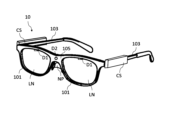
- FIG. 1 is a diagram showing a schematic configuration of glasses according to a first embodiment.
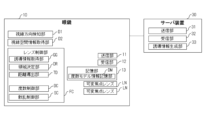
- FIG. 2 is a diagram for explaining a functional configuration of the glasses system according to the first embodiment.
- 1 is a diagram for explaining a schematic configuration of a variable-focus lens according to a first embodiment.
- FIG. 2 is a diagram for illustrating the arrangement of an electrode structure of the liquid crystal element according to the first embodiment.
- FIG. 3C is a schematic diagram of a refractive index distribution appearing in a cross section passing through the center of the liquid crystal element in FIG. 3B in an arbitrary direction.
- FIG. 2 is a schematic diagram for explaining a planar configuration of a unit electrode in the first embodiment.
- 5 is a schematic diagram for explaining the VV cross section in FIG. 4.
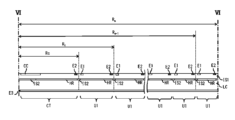
- FIG. 6 is a diagram showing a cross section taken along the line VI-VI in FIG. 3B.
- FIG. 4 is an explanatory diagram of a lead wire connected to a unit electrode.
- 5A to 5C are diagrams for explaining how a liquid crystal element is controlled by a lens control unit according to the first embodiment.
- 5 is a diagram showing a flow of control processing of a variable-focus lens in the glasses of the first embodiment.
- FIG. 10A to 10C are diagrams for explaining the state of control of the driving region according to the first modified example of the first embodiment.
- FIG. 11 is a diagram for explaining a first guidance control mode according to the second modification of the first embodiment.
- FIG. 11 is a diagram for explaining a second guidance control mode according to the second modification of the first embodiment.
- FIG. 11 is a diagram for explaining a second guidance control mode according to the second modification of the first embodiment.
- FIG. 11 is a diagram for illustrating two liquid crystal elements according to a third modified example of the first embodiment.
- FIG. 11 is a diagram for illustrating two liquid crystal elements according to a fourth modified example of the first embodiment.
- FIG. 11 is a diagram for explaining a functional configuration of glasses according to a second embodiment.
- 13 is a diagram for explaining a driving region in a liquid crystal element of glasses according to a second embodiment.
- FIG. 13A and 13B are schematic diagrams for explaining control by a lens control unit of glasses according to a second embodiment.
- 13A and 13B are schematic diagrams for explaining control by a lens control unit of glasses according to a second embodiment.
- 13 is a schematic diagram for explaining control by a lens control unit FC of glasses in a first modified example of the second embodiment.
- FIG. 1 is a diagram showing the schematic configuration of glasses 10 (variable focus glasses) according to the first embodiment.
- the glasses 10 have a pair of variable focus lenses LN fixed by a pair of rims 101, and further comprise a pair of temples 103, a bridge 105, and a nose pad NP.
- the left and right temples 103 each have a housing CS that houses a control circuit for the variable focus lenses LN, a power supply circuit, a communication circuit, a battery, etc., and a gaze direction detection unit D1 is disposed on the upper part of the left and right rims 101.
- a gaze space information acquisition unit D2 is disposed on the nose pad NP.
- the variable focus lenses LN of this embodiment are variable focus liquid crystal lenses that can form a refractive index distribution like a convex and concave Fresnel lens, and details of this will be described later.
- FIG. 2 is a diagram for explaining the functional configuration of the eyewear system 1 of this embodiment.
- the eyewear system 1 is configured to include at least one pair of glasses 10 and a server device 30.
- the eyewear system 1 is installed, for example, in an amusement facility or a factory facility, and the glasses 10 and the server device 30 are connected to each other via a network line so that they can communicate data with each other.
- the glasses 10 of this embodiment receive guidance information transmitted from the server device 30, and perform focus control and control that worsens visibility based on the guidance information.
- the glasses 10 and server device 30 are realized by including memory elements such as RAM (Random Access Memory) and ROM (Read Only Memory), as well as a memory area constituted by a hard disk or SSD (Solid State Drive), and a program control device such as a CPU (Central Processing Unit).
- memory elements such as RAM (Random Access Memory) and ROM (Read Only Memory)
- ROM Read Only Memory
- a program control device such as a CPU (Central Processing Unit).
- each function is realized by the CPU executing a program stored in a memory area such as a hard disk.
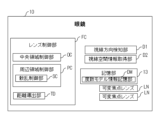
- the glasses 10 are configured to include a lens control unit FC, a pair of variable focus lenses LN, a gaze direction detection unit D1, a gaze space information acquisition unit D2, a transmission unit 11, a reception unit 12, and a memory unit 13 having a power model information memory unit DM.
- the lens control unit FC is further configured to include a guidance information acquisition unit GG, a region determination unit DR, a distance derivation unit TD, a power control unit DC, and a scattering control unit SC.
- the glasses 10 also include various sensors (not shown) for detecting the position within the facility in which the glasses system 1 is installed.
- the power control unit DC of the glasses 10 controls the variable focus lens LN based on power model information specific to the wearer that is pre-stored in the power model information storage unit DM.
- the power model information is information for changing the power set in the variable focus lens LN depending on the wearer's situation and behavior, and is, for example, information indicating the relationship between the distance to an object that the wearer is looking at and the "spherical power (SPH)" of the variable focus lens LN that should be set by the wearer.
- the distance to the object of interest is calculated by the distance derivation unit TD based on information detected by sensors such as the gaze direction detection unit D1.
- the power model information may be two types corresponding to the SPH of both eyes, or six types including the "axis of cylindrical vision (AXIS)” and the “degree of cylindrical vision (CLY).” These six types of power model information may be stored in the memory unit 13.
- the server device 30 is configured to include a transmission unit 31, a reception unit 32, and a guidance information generation unit 33.
- the guidance information generation unit 33 generates information regarding the direction in which the wearer of the eyeglasses 10 should look, as guidance information.
- the guidance information generation unit 33 first determines an object (e.g., an object moving within a facility) that the wearer should pay attention to based on information indicating the position and direction of the glasses 10 transmitted from the glasses 10 (hereinafter also referred to as position information, etc.). The guidance information generation unit 33 then calculates the direction in which the wearer should rotate his/her viewpoint based on the position information of the object and the position information of the wearer, etc. (based on the positional relationship between the two), thereby generating guidance information that indicates the direction in which the wearer should look. The transmission unit 31 transmits the guidance information to the glasses 10.
- an object e.g., an object moving within a facility
- the guidance information acquisition unit GG of the glasses 10 acquires guidance information from the server device 30 via the receiving unit 12, and the lens control unit FC controls the refractive index distribution of the variable-focus lens LN based on the guidance information.
- the variable-focus lens LN is divided into multiple driving regions, and the refractive index distribution in the liquid crystal layer is controlled by inputting a control voltage to each driving region.
- the lens control unit FC determines the control mode of each driving region based on the guidance information, and determines the driving region that generates a Fresnel lens-like refractive index distribution and the driving region that performs scattering control to deteriorate visibility.
- the region determination unit DR of the lens control unit FC determines the driving region corresponding to the direction in which the wearer's gaze should be guided as the gaze guidance region based on the guidance information acquired by the guidance information acquisition unit GG, and determines the driving region located outside the gaze guidance region as the non-guidance region.
- the control voltage determined by the power control unit DC is input, and for the driving area that is the non-guidance area, the control voltage determined by the scattering control unit SC is input.
- the power of the gaze guidance area is controlled by the power control unit DC, making it easier for the wearer to notice the direction in which to look (the wearer can easily recognize an object in that direction as it is in focus, making it easier for the wearer to clearly recognize it and direct their attention in that direction). This allows the wearer's gaze to be guided in the direction in which they should pay attention or be aware, making the glasses 10 more convenient for the wearer.
- the scattering control unit SC controls the scattering of the non-guided area, making it difficult for the wearer to see directions other than the direction of their gaze. This leads to the gaze of the wearer being guided in the direction that they should pay attention to or recognize, making the glasses 10 more convenient for the wearer.
- variable focus lens LN included in the glasses 10 will be described in detail below.
- FIG. 3A is a diagram for explaining the schematic configuration of the variable-focus lens LN.
- the variable-focus lens LN is configured to include two liquid crystal elements LU1 and LU2, which sandwich a liquid crystal layer LC between transparent substrates B1 and B2.
- the liquid crystal layer LC in the two liquid crystal elements LU1 and LU2 generates a sawtooth refractive index distribution when a control voltage is applied, and each functions as a Fresnel lens that can change the focus.
- the two liquid crystal elements LU1 and LU2 have different alignment films in the liquid crystal layer LC such that the alignment directions are perpendicular to each other, but apart from this they have the same configuration. Therefore, in the following explanation, the structure of the two liquid crystal elements LU1 and LU2 will be omitted as appropriate.
- the alignment directions of the liquid crystal layer LC in the two liquid crystal elements LU1 and LU2 are perpendicular to each other, so that the p-polarized component and s-polarized component of the incident light can be refracted.
- FIG. 3B is a diagram for explaining the arrangement of the electrode structure in the liquid crystal element LU1.
- a center electrode CT is disposed in the center, and a number of arc-shaped unit electrodes U1 are disposed concentrically around it.
- each unit electrode U1 corresponds to a ring-like shape having a central angle of approximately 90 degrees, and is disposed radially in a row within each of four sector-shaped regions with a central angle of approximately 90 degrees.
- FIG. 3C is a schematic diagram of the refractive index distribution RF appearing in a cross section in any direction passing through the center of the liquid crystal element LU1 in FIG. 3B.
- a control voltage is supplied to the center electrode CT and each unit electrode U1, and an electric field is applied to the liquid crystal layer LC to generate a sawtooth refractive index distribution RF.
- the refractive index distribution RF is formed to be approximately symmetrical about the optical axis LA, and the refractive index undulations are distributed concentrically when viewed in a plan view.
- a planar view refers to a view from the direction of the optical axis LA of the liquid crystal element LU1, that is, a direction perpendicular to the transparent substrate B1.
- FIG. 4 is a schematic diagram for explaining the planar configuration of one unit electrode U1.
- the unit electrode U1 of this embodiment is defined by an arc-shaped region of approximately 90 degrees, and is configured to include a first electrode E1 and a second electrode E2 formed in a linear shape.
- the unit electrode U1 has a space between the first electrode E1 and the second electrode E2 that is wider than the line width of these electrodes, and a potential gradient can be generated in the space by applying different voltages to the first electrode E1 and the second electrode E2.
- the first electrode E1 and second electrode E2 extend in an arc shape along the outer shape of each unit electrode U1 and are connected to the first lead wire W1 and the second lead wire W2, respectively, to form a comb-like shape.
- first electrode E1 of the unit electrode U1 located on the outer periphery and the second electrode E2 of the unit electrode U1 located on the inner periphery are adjacently arranged with a narrow space between them.
- the first lead wire W1 and the second lead wire W2 extend in the radial direction and are provided between unit electrodes U1 adjacent in the circumferential direction in FIG. 3B.
- the liquid crystal element LU1 of this embodiment in the space between unit electrodes U1 adjacent in the circumferential direction, there are other leads in addition to the first lead wire W1 and the second lead wire W2, but this will be described in detail later.
- the center electrode CT which is located in the center of the liquid crystal element LU1, has a fan-shaped (or other shape such as a disk) core electrode CC instead of the first electrode E1, and a potential gradient can be generated in the region between the second electrode E2 connected to the second lead wire W2 and the core electrode CC.
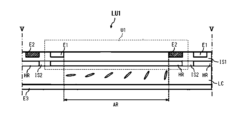
- FIG. 5 is a schematic diagram for explaining the V-V cross section in FIG. 4, with some components omitted for simplification.
- the V-V cross section in FIG. 4 is a radial cross section passing through the position corresponding to the center of the concentric arrangement of each unit electrode U1.
- the structure of the unit electrode U1 will be explained in more detail using FIG. 5, and the potential distribution applied to the liquid crystal layer LC by the unit electrode U1 and the refractive index distribution caused by the potential distribution will be explained.
- the liquid crystal layer LC in FIG. 5 is sandwiched between a substrate located at the top of the figure (transparent substrate B1 in FIG. 3A) and a substrate located at the bottom of the figure (transparent substrate B2 in FIG. 3A).
- the former substrate is constructed by laminating a first electrode E1, a second electrode E2, an insulating layer IS1, a resistive layer HR, and an insulating layer IS2 on a glass substrate (not shown in FIG. 5), and the latter substrate is constructed by laminating a counter electrode E3 on a glass substrate (not shown in FIG. 5).
- the first electrode E1 and the second electrode E2 are formed on a glass substrate, and an insulating layer IS1 is further laminated so as to bury the first electrode E1 and the second electrode E2.
- a resistive layer HR is laminated on the insulating layer IS1, and an insulating layer IS2 is further disposed so as to fill the gap between the resistive layers HR.
- a counter electrode E3 is formed on the glass substrate.
- the transparent substrate B1 and the transparent substrate B2 have anti-parallel parallel alignment films at the interface with the liquid crystal layer LC, but these are not shown for simplification.
- the liquid crystal layer LC is, for example, a nematic liquid crystal, and the liquid crystal is homogeneously oriented in an electric field-free environment where no voltage is applied from the first electrode E1 and the second electrode E2, and the liquid crystal is transparent.
- the thickness of the liquid crystal layer LC is preferably 5 ⁇ m or more and 30 ⁇ m or less.
- the first electrode E1 and the second electrode E2 are formed at both ends of the unit electrode U1 using a transparent conductive film such as ITO (indium tin oxide).
- ITO indium tin oxide
- the area AR in the unit electrode U1 is defined by the space between the first electrode E1 and the second electrode E2, and is interposed between the first electrode E1 and the second electrode E2.
- the width of the area AR is greater than the line width of the first electrode E1 and the second electrode E2.
- the insulating layer IS1 is a transparent electrical insulator, and is formed, for example, from silicon dioxide (SiO2).
- the insulating layer IS1 is laminated so as to bury the first electrode E1, the second electrode E2, the first lead wire W1, the second lead wire W2, and other components.
- the insulating layer IS2 is laminated so as to fill the gaps between the resistive layer HR formed on the insulating layer IS1.
- the insulating layer IS2 may be formed by burying the resistive layer HR in silicon dioxide similar to the insulating layer IS1, or may be formed by burying the resistive layer HR in an alignment film extending to the interface with the liquid crystal layer LC.
- the resistive layer HR has a higher electrical resistivity than the first electrode E1 and the second electrode E2, and a lower electrical resistivity than the insulating layer IS1 made of silicon dioxide, and is made of a transparent film such as zinc oxide (ZnO).
- the sheet resistivity of the resistive layer HR is higher than the sheet resistivity of the first electrode E1 and the sheet resistivity of the second electrode E2, and lower than the sheet resistivity of the insulating layer IS1.
- the sheet resistivity of a material is the value obtained by dividing the electrical resistivity of the material by the thickness of the material.
- the electrical resistivity of the resistive layer HR is preferably 1 ⁇ m or more, and the sheet resistivity of the resistive layer HR is preferably 1 x 10² ⁇ / ⁇ or more and 1 x 10¹¹ ⁇ / ⁇ or less.
- the resistive layer HR is included in the unit electrode U1, and its planar shape is an arc shape with a width slightly narrower than the width of the unit electrode U1, and is separated from the resistive layer HR in the adjacent unit electrode U1.
- the resistive layer HR is preferably formed so as to be electrically isolated from the resistive layer HR in the other unit electrodes U1.
- the resistive layer HR is disposed in an area AR between the first electrode E1 and the second electrode E2 in a planar view. As shown in FIG. 5, the resistive layer HR is preferably formed so as to overlap at least a portion of the first electrode E1, extend between the first electrode E1 and the second electrode E2, and further overlap at least a portion of the second electrode E2, but is not necessarily limited to this form.
- the first electrode E1 of a unit electrode U1 is formed along the second electrode E2 of an adjacent other unit electrode U1
- the second electrode E2 of a unit electrode U1 is formed along the first electrode E1 of an adjacent other unit electrode U1.
- An insulating layer IS1 is disposed at the boundaries between the first electrode E1 of a unit electrode U1 and the second electrode E2 of an adjacent other unit electrode U1, and between the second electrode E2 of a unit electrode U1 and the first electrode E1 of an adjacent other unit electrode U1, and the resistive layer HR between adjacent unit electrodes is separated by an insulating layer IS2.
- the boundary of the unit electrodes is defined at the center of the insulating layer IS1 interposed between adjacent unit electrodes in the radial direction.
- the unit electrode U1 and the first electrode E1, second electrode E2, and resistive layer HR contained therein are each formed in an arc shape extending in the circumferential direction of the concentric circles, and the width of these refers to a size corresponding to the radial thickness of the concentric circles.
- the width of the insulating layer IS1 interposed between two unit electrodes U1 adjacent in the radial direction may be, for example, 5 ⁇ m or more and not more than 15 ⁇ m, and may be narrowed depending on the distance from the optical axis LA of the liquid crystal element LU1.
- the counter electrode E3 is formed in a planar shape on the transparent substrate B2 using a transparent conductive film such as ITO. In this embodiment, a ground potential (0 V) is supplied to the counter electrode E3.
- a first voltage V1 is supplied to the first electrode E1 via a first lead wire W1 by input from a control unit (not shown) in the liquid crystal element LU1.
- a second voltage V2 is supplied to the second electrode E2 from the control unit via a second lead wire W2.
- the first voltage V1 and the second voltage V2 are square wave AC voltages and have the same frequency and phase, but this is not necessarily limited to this.
- the maximum amplitude of the first voltage V1 and the second voltage V2 is, for example, 10 V or less, and the frequency is, for example, 10 Hz to 1 kHz.
- the liquid crystal molecules change from a state parallel to the transparent substrate B1 to a state vertically rising from the first electrode E1 side (low potential side) to the second electrode E2 side (high potential side) as shown in FIG. 5.
- the liquid crystal layer LC is interposed between the first electrode E1 and the second electrode E2 and the counter electrode E3, and further, the resistance layer HR is disposed between the first electrode E1 and the second electrode E2 in a planar view, so that a potential distribution is generated in which the potential of the second voltage V2 of the second electrode E2 gradually transitions to the potential of the first voltage V1 of the first electrode E1, and this causes a refractive index gradient in each unit electrode U1 in the liquid crystal layer LC.
- the refractive index gradient caused in the liquid crystal layer LC changes according to the width of the region AR in the unit electrode U1, and the gradient tends to become steeper as the width becomes narrower.
- FIG. 6 shows the state of the VI-VI cross section in Figure 3B, and is a radial cross section passing near the optical axis of the liquid crystal element LU1.
- a center electrode CT including a core electrode CC is arranged in the center of the liquid crystal element LU1, and unit electrodes U1 are arranged in a radial direction around the center electrode CT.
- the boundary between the center electrode CT and the unit electrode U1 is defined by the center of the insulating layer IS1 interposed therebetween, and the radius Rc of the center electrode CT corresponds to the distance from the optical axis of the liquid crystal element LU1 (the position corresponding to the center of the concentric arrangement of the unit electrodes U1) to the boundary.
- the radius of the unit electrode U1 is Rn, and the subscript n is an integer between 1 and N that is assigned to each of the multiple unit electrodes U1 in ascending order from the unit electrode with the smallest radius to the unit electrode with the largest radius.
- N may be assigned a value such as 50 or 60, for example, or a larger value to increase the diameter of the variable-focus lens LN.
- the size of the radius of the unit electrode U1 corresponds to the distance from the optical axis of the liquid crystal element LU1 to the boundary on the outer periphery side (second electrode E2 side) of the unit electrode U1.
- the radius Rn of the unit electrode U1 is expressed by the following formula (1).
- the unit electrodes U1 are divided into several unit electrode groups, and multiple combinations of lead wires for input to the first electrode E1 and lead wires for input to the second electrode E2 are provided so that the input to the different unit electrode groups can be individually controlled.
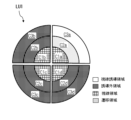
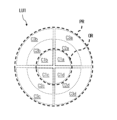
- the liquid crystal element LU1 has a plurality of drive regions C1a-C1SCa-C2d, C3a-C3d consisting of 12 regions, each of which corresponds to an area whose distance from the optical axis LA is within a predetermined range.
- drive regions C1a-C1d correspond to four sector-shaped regions with a central angle of approximately 90 degrees
- drive regions C2a-C2d and C3a-C3d correspond to four ring-shaped regions with a central angle of approximately 90 degrees and thickness in the radial direction.
- drive regions C1a, C2a, C3a are arranged in order of proximity to the optical axis LA of liquid crystal element LU1, and the same is true for drive regions C1b, C2b, C3b, etc.
- the multiple unit electrodes U1 in the liquid crystal element LU1 belong to one of the drive regions, and in the unit electrode group of each drive region, the input to the first electrode E1 is common, and the input to the second electrode E2 is common.
- the first electrode E1 group of the unit electrodes U1 belonging to the driving region C1a is connected to the first lead wire W1
- the second electrode E2 group is connected to the second lead wire W2.
- the first electrode E1 group and the first lead wire W1, and the second electrode E2 group and the second lead wire W2 are arranged so as to be nested with each other, forming a comb-like structure.
- the third lead wire W3 is connected to the first electrode E1 group of the unit electrodes belonging to the driving region C2a
- the fourth lead wire W4 is connected to the second electrode E2 group of the unit electrodes belonging to the driving region C2a
- the fifth lead wire W5 is connected to the first electrode E1 group of the unit electrodes belonging to the driving region C3a
- the sixth lead wire W6 is connected to the second electrode E2 group of the unit electrodes belonging to the driving region C3a.
- the lead wires W1, W3, W5 also extend toward the center where the core electrodes CC are arranged from the 180 degree, 270 degree, and 0 degree directions in the figure
- the lead wires W2, W4, W6 also extend toward the center where the core electrodes CC are arranged from the 90 degree, 180 degree, and 270 degree directions in the figure.
- the first electrodes E1 group of the unit electrodes are connected to the lead wires W1, W3, and W5
- the second electrodes E2 group of the unit electrodes are connected to the lead wires W2, W4, and W6.
- each of the multiple driving areas C1a-C1SCa-C2d, C3a-C3d receives a control voltage from the control unit in the glasses 10 via a connected lead wire.
- the gaze direction detection unit D1 includes a sensor that acquires information about the user's gaze.
- the gaze direction detection unit D1 is arranged on a pair of rims 101 and includes a light source such as an LED (Light Emitting Diode) and an imaging unit such as a camera, and detects the behavior and gaze direction of the wearer's eyes.
- the gaze direction detection unit D1 is for eye tracking that detects the behavior and gaze direction of the eyes, and may employ a non-contact sensor such as a corneal reflex method, or a contact sensor such as an electrooculography method. In addition, both non-contact and contact types may be used as the gaze direction detection unit D1, and there is no particular limitation.
- the gaze space information acquisition unit D2 is configured to include a sensor for acquiring information about the state of the space covered by the wearer's gaze, and is arranged on the bridge 105.
- a LiDAR (Light Detection and Ranging) sensor is used as the gaze space information acquisition unit D2, but is not limited to this and may be a depth camera capable of acquiring three-dimensional information, etc.
- the temples 103 and the housing CS of the glasses 10 also include sensors (not shown in FIGS. 1 and 2) for detecting the behavior of the wearer and the position and orientation of the glasses 10. These sensors may be, for example, a six-axis sensor, a GPS sensor, a sensor for detecting position and orientation, etc.
- FIG. 8 is a diagram for explaining how the liquid crystal element LU1 is controlled based on the guidance information.
- the figure shows an example in which the region determination unit DR in the lens control unit FC determines the driving regions C2a and C3a in the upper right corner of the figure as the gaze guidance region based on the guidance information.
- the region determination unit DR also determines the driving regions C1a-C1SCb-C2d and C3b-C3d other than the driving regions C2a and C3a as non-guidance regions.
- the lens control unit FC outputs input voltages for each of the driving regions C1a-C4d corresponding to the gaze guidance region and non-guidance region to the liquid crystal element LU1, and controls the refractive index distribution in the liquid crystal layer LC.
- the control voltage to the driving areas C2a and C3a determined as the gaze guidance areas is output by the power control unit DC.
- the power control unit DC executes control to determine the lens power to be generated in the driving areas C2a and C3a and form a focus based on the power model information and information indicating the distance to the object to which the wearer should pay attention.
- the power control unit DC outputs a control voltage to generate a Fresnel lens-like refractive index distribution in the part of the liquid crystal layer LC corresponding to the driving areas C2a and C3a.
- the distance derivation unit TD calculates the distance to the object to be paid attention to.
- the distance to an object located on the extension of the gaze when the wearer shifts the gaze direction to the driving areas C2a and C3a is derived based on the three-dimensional point cloud information acquired by the gaze space information acquisition unit D2.
- the object located on the extension of the gaze when the gaze direction is shifted may be specified by setting some kind of criterion.
- the scattering control unit SC outputs a control voltage to the driving area to create a state of poor visibility. Specifically, the scattering control unit SC outputs a control voltage so that the incident light in the driving areas C1a-C1d, C2b-C2d, and C3b-C3d, which have been determined as non-guided areas, is scattered.
- the state where visibility in the driving area is poor refers to, for example, a state where scattering or diffusion occurs in the group of unit electrodes U1 belonging to the driving area, causing the light collection range to expand and resulting in out-of-focus (a state where the lens image quality has deteriorated).
- a state where scattering or diffusion becomes dominant in the driving area and a focus cannot be formed is also included in the state of poor visibility.
- the control of the scattering control unit SC to deteriorate such visibility can be realized, for example, by inputting voltages with a certain degree of phase shift to the first electrode E1 and the second electrode E2 of each unit electrode U1 belonging to the driving region corresponding to the non-guided region, or by making the frequency of the voltage input to the first electrode E1 or the second electrode E2, which is the lower potential side, higher than the frequency of the voltage input to the other electrode, which is the higher potential side. It can also be realized by inputting a high-frequency voltage of 50 kHz or more to both the first electrode E1 and the second electrode E2.
- scattering control may be realized by changing the input to the driving region over time.
- FIG. 9 is a diagram showing the flow of control processing for the variable-focus lens LN of the glasses 10. As shown in FIG.
- the lens control unit FC judges whether the guidance information acquisition unit GG has acquired guidance information via the receiving unit 12 (S901). If guidance information has not been acquired (NO in S901), the process proceeds to S902 to S904, and the power is controlled based on the detection of the wearer's line of sight (also referred to as the "detection control mode" in this specification).
- the gaze direction of the wearer detected by the gaze direction detection unit D1 is acquired, and then in S903, the distance to the object that the wearer is gazing at is acquired based on the gaze direction.
- the distance derivation unit TD derives the distance to the gazed object based on the gaze direction of at least one of the wearer's eyes. Specifically, the distance to the object that the wearer is looking at is derived by deriving the point of interest in the three-dimensional point cloud data acquired by the gaze space information acquisition unit D2 from the detected gaze direction. Note that the method by which the distance derivation unit TD derives the distance to the gazed object is not particularly limited, and may be based on the convergence angle derived from the gaze directions of the wearer's two eyes, or may be based on triangulation using a sensor in the glasses 10.
- the power control unit DC references the power model information stored in the power model information storage unit DM, and outputs a control voltage to the driving regions C1a to C3d so that the power corresponds to the distance to the target object derived by the distance derivation unit TD. In this way, the variable-focus lens LN is controlled when guidance information is not acquired.
- the storage unit 13 holds information that associates power with control voltage for each driving region.
- the power control unit DC outputs a control voltage by reference to the associated information.
- the area determination unit DR determines whether each of the drive areas C1a to C3d will be a gaze guidance area or a non-guidance area.
- a gaze guidance area one or more drive areas
- the scattering control unit SC outputs a control voltage to the drive region corresponding to the non-guided region determined in S905, and control is performed to deteriorate visibility in the non-guided region.
- the wearer's gaze is more easily guided. Note that the visibility of each of the drive areas C1a to C3d is worse when control is performed by the scattering control unit SC than when control is performed to form a focus by the power control unit DC (S904 or S907).
- the process After completing the process of S904 or S908, the process returns to S901 to determine whether guidance information has been acquired (whether valid guidance information has been acquired). Depending on changes in the situation, such as changes in the wearer's line of sight or posture, the validity of the previously acquired guidance information is determined (or whether the wearer's line of sight matches the direction to which the wearer should be guided, etc.), and the processes of S902 to S904 or S905 to S908 are selectively executed. Note that even if the wearer's line of sight or other conditions change, the guidance control mode may be continued, for example, for a predetermined period of time.
- the region determination unit DR determines the driving region C3a in the upper right corner of the figure as the gaze guidance region. In addition to the gaze guidance region, the region determination unit DR then determines six driving regions C2b-C2d and C3b-C3d as non-guidance regions, determines four driving regions C1a-C1d as gaze regions, and further determines driving region C2a as the transition region.
- the region determination unit DR determines the drive region that corresponds to the gaze region based on the wearer's current gaze direction detected by the gaze direction detection unit D1. In the case of FIG. 10A, the region determination unit DR determines the four drive regions C1a to C1d in the center of the liquid crystal element LU1 as the gaze region. The region determination unit DR also determines the drive region C2a, which is located between the gaze guidance region and the gaze region, as the transition region.
- the driving regions C1a-C1d corresponding to the gaze region are scattering controlled to have lower visibility than the driving region C3a in the gaze guidance region, and improved visibility than the driving regions C2b-C2d and C3b-C3d in the non-guidance region.
- the driving region C2a corresponding to the transition region is scattering controlled to have lower visibility than the driving region C3a in the gaze guidance region, and improved visibility than the driving regions C1a-C1d in the gaze region. In this way, visibility improves as one approaches the gaze guidance region, making it easier for the wearer's gaze to be guided.
- the scattering control unit SC may periodically switch between a period in which scattering is not intentionally generated and a period in which scattering is intentionally generated, and control the degree of visibility by changing the ratio of the former period to the latter period. In this case, a state in which scattering is not dominant and a state in which scattering is dominant are alternately repeated, and the refractive index of the part corresponding to the driving area oscillates between a state of good visibility and a state of bad visibility.
- the control of visibility by the scattering control unit SC is not limited to the above-mentioned mode, and the degree of visibility may be controlled by changing the phase and frequency of the input voltage to the first electrode E1 and the second electrode E2.
- the line of sight and transition areas are controlled to periodically switch between good and poor visibility states
- the line of sight may be guided by repeatedly controlling the state of poor visibility to spread from the line of sight area to the transition area.
- the line of sight may be guided by repeatedly controlling the state of good visibility to spread from the line of sight guidance area.
- the glasses 10 of Modification 2 have a plurality of modes (multiple guidance control modes) in which the control manner of the variable-focus lens LN based on the guidance information is different, and the lens controller FC further has a switching means between the guidance control modes.
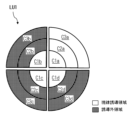
- FIGS. 10B and 10C are diagrams for explaining the control of the drive regions C1a to C3d by the two guidance control modes of the eyeglasses 10 according to variant example 2.
- FIG. 10B is a diagram for explaining the control by the first guidance control mode
- FIG. 10C is a diagram for explaining the control by the second guidance control mode.
- the non-guidance region is wider in FIG. 10C than in FIG. 10B (the gaze guidance region is narrower), so the wearer's gaze is more easily guided in the second guidance control mode.
- the glasses 10 also have a means for capturing the eye behavior of the wearer (this may be a sensor in the gaze direction detection unit D1 that captures gaze behavior, or an electrooculography sensor provided in the nose pad NP, etc.), and the lens control unit FC switches between guidance control modes based on the eye behavior.
- a means for capturing the eye behavior of the wearer this may be a sensor in the gaze direction detection unit D1 that captures gaze behavior, or an electrooculography sensor provided in the nose pad NP, etc.
- the lens control unit FC switches between guidance control modes based on the eye behavior.
- the guidance control mode may be switched, for example, when there is a certain change in eye behavior based on eye behavior for a specified period, such as when the wearer first starts wearing the glasses, and may switch to a mode that is easier to guide the gaze when there is a lot of blinking or when there is a large degree of insufficient or excessive convergence and convergence.
- the degree of eye fatigue of the wearer may also be evaluated to switch to a mode that is easier to guide the gaze, or the mode may be switched to a mode that is easier to guide the gaze depending on the tendency of the wearer's gaze period or the frequency of changing the direction of the gaze.
- the glasses 10 of the second modified example are substantially similar to the glasses 10 of the first embodiment, except for the fact that they have multiple induction control modes. Explanations of the aspects that are substantially similar to the glasses 10 of the first embodiment will be omitted as appropriate.
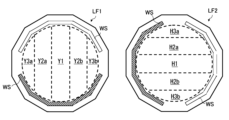
- FIG. 11 is a diagram for explaining the liquid crystal elements LF1 and LF2 according to the third modification.
- Liquid crystal element LF1 of modification 3 has a unit electrode formed in a straight line in the vertical direction in the figure, and liquid crystal element LF2 has a unit electrode formed in a straight line in the horizontal direction in the figure, and both are configured so that the width of the unit electrodes narrows the further away from the center (see Figure 6).
- the variable-focus lens LN of modification 3 is configured by overlapping liquid crystal elements LF1 and LF2, each of which generates a linear Fresnel lens-like refractive index distribution, and can generate a concentric Fresnel lens-like refractive index distribution similar to liquid crystal element LU1.
- liquid crystal element LF1 has driving regions Y1, Y2a, Y2b, Y3a, and Y3b, and a different control voltage is supplied to each driving region from lead wiring region WS.
- liquid crystal element LF2 has driving regions H1, H2a, H2b, H3a, and H3b, and a different control voltage is supplied to each driving region from lead wiring region WS.
- Each lead wire region WS has five lead wires corresponding to the five drive regions, but the lead wires are omitted from FIG. 11.
- the lead wire region WS on the lower side of the figure for liquid crystal element LF1 and the lead wire region WS on the left side of the figure for liquid crystal element LF2 are areas where five lead wires connected to the second electrode E2 are arranged, and the lead wire region WS on the upper side of the figure for liquid crystal element LF1 and the lead wire region WS on the right side of the figure for liquid crystal element LF2 are areas where five lead wires connected to the first electrode E1 are arranged.
- the region determination unit DR in the third modification determines the gaze guidance region, non-guidance region, etc. based on the guidance information acquired by the guidance information acquisition unit GG. For example, when guiding the wearer's gaze in the upper right direction based on the guidance information, the driving regions Y2b, Y3b, H2a, and H3a are determined as the gaze guidance region, and the lens control unit FC generates a linear Fresnel lens-like refractive index distribution in these regions.
- the region determination unit DR also determines the remaining driving regions Y1, Y2a, Y3a, H1, H2b, and H3b as non-guidance regions, and the scattering control unit SC controls these regions so that visibility is worse than in the gaze guidance region. Note that in the third modification, the gaze region and transition region may be controlled as in the first modification.
- the glasses 10 of the third modified example differ from the glasses 10 of the first embodiment in that the liquid crystal elements LF1 and LF2 that make up the variable focus lens LN have the configuration described above, but apart from this difference, the glasses 10 are substantially similar to the glasses 10 of the first embodiment. Explanations of the points that are substantially similar to the glasses 10 of the first embodiment will be omitted as appropriate.
- variable-focus lens LN of the fourth modification is made up of four liquid crystal elements, including two liquid crystal elements that generate a linear Fresnel lens-like refractive index distribution in the vertical and horizontal directions, respectively, and two liquid crystal elements that have the same configuration as the first two liquid crystal elements except that their orientation directions are perpendicular to those of the first two liquid crystal elements.
- FIG. 12 is a diagram for explaining the liquid crystal elements LX1 and LX2 according to the fourth modification.
- a plurality of unit electrodes U1 e.g., 200 electrodes
- the first controller AX1 and the second controller AX2 set a control voltage individually for each unit electrode U1, thereby generating a linear Fresnel lens-like refractive index distribution in which the position of the optical axis is variable.
- the first controller AX1 and the second controller AX2 output 400 control voltages to input two types of signals, the first electrode E1 and the second electrode E2, to each of the 200 unit electrodes U1.
- each unit electrode U1 corresponds to one drive region.
- the region determination unit DR in the fourth modification determines the gaze guidance region, non-guidance region, etc. based on the guidance information acquired by the guidance information acquisition unit GG, as in the first embodiment. For example, when guiding the wearer's gaze to the upper right based on the guidance information, the region determination unit DR determines that the multiple unit electrodes U1 located on the right side of the liquid crystal element LX1 in FIG. 12 and the multiple unit electrodes U1 located on the upper side of the liquid crystal element LX2 in FIG.
- the remaining unit electrodes U1 of the liquid crystal elements LX1 and LX2 are determined to correspond to the non-guidance region, and control is performed so that visibility in these regions is worse than in the gaze guidance region.
- the glasses 10 of modified example 4 differ from the glasses 10 of modified example 3 in the above respects, but apart from these points, they are substantially similar to the glasses 10 of modified example 3. Explanations of the points that are substantially similar to the glasses 10 of modified example 3 will be omitted as appropriate.
- the detection control mode and the guidance control mode are switched depending on the presence or absence of guidance information as shown in the flow of Fig. 9, but the switching may be made depending on the intention of the wearer.
- the lens control unit FC may have a means for switching between the guidance control mode and the detection control mode, and the wearer may be able to switch between the modes using an operation device separately provided on the eyeglasses 10.
- the guidance information acquired by the glasses 10 in the first embodiment and the like is generated and received by the server device 30 in the facility, but is not limited to this form.
- the server device may transmit position information within the facility of an object that the wearer should pay attention to, and the guidance information acquisition unit GG may generate and acquire guidance information based on the position information and position information acquired from a position sensor or the like of the glasses 10.
- the eyeglass system 1 of the first embodiment and the like is not limited to being a system installed within a facility, but may be one in which the server device 30 and the glasses 10 are connected via an internet line. Furthermore, such an eyeglass system 1 may be one in which the direction in which the wearer should proceed is guided by refractive index distribution control in the glasses 10. Specifically, map information may be recorded in the server device 30, information indicating the route to proceed is generated based on destination information on the map input by the wearer, and guidance information may be obtained by the glasses 10 based on the information indicating the route and information indicating the position and direction of the wearer.
- a sound detection unit that detects surrounding sounds may be disposed in the housing CS of the glasses 10 of the first embodiment, etc., so that guidance information is acquired based on the sound information acquired by detecting the sound.
- a gaze guidance area is determined according to the direction from which the sound is generated (and a non-guidance area, etc., is determined in a direction less related to the direction from which the sound is generated), making it easier for the wearer to notice that sound has been generated.
- Such glasses 10 are beneficial for elderly people with presbyopia and hearing loss.
- the glasses 10 of the first embodiment and the like may be XR (AR: Augmented Reality, VR: Virtual Reality, MR: Mixed Reality) glasses-type information device such as smart glasses or a head-mounted display having an image display device in front of the variable focus lens LN (the side opposite the wearer's eye of the variable focus lens LN).
- the image display device of the glasses-type information device displays an image representing the field of view from the wearer's viewpoint based on three-dimensional space information indicating the situation of the (virtual) three-dimensional space in which the wearer is placed.
- both the real world and the superimposed image can be easily recognized by the wearer.
- the eye behavior detection unit may be a sensor for detecting the gaze direction of the wearer from the eye behavior, and the degree of deterioration of visibility or the brightness of the superimposed image may be controlled when the gaze direction of the wearer is toward the scattering-controlled drive region or the superimposed image.
- Such glasses may also include a distance derivation unit TD that derives the distance to an object that the wearer is gazing at, and thereby determines whether the wearer is gazing at the superimposed image or the real world, and the degree of deterioration of visibility or the brightness of the superimposed image may be controlled depending on the result of the determination.
- the superimposed image is displayed on a virtual screen at a preset distance from the wearer's eyes, and it can be determined whether the wearer is gazing at the superimposed image based on whether the distance to the object being gazed at, determined from the wearer's line of sight, etc., approximately matches the distance to the virtual screen.
- variable-focus lens LN having a power-controlled driving region and a scattering-controlled driving region, as described in the first embodiment, may also be used as an optical component in an illumination optical system or a projection optical system.
- the glasses 10 of the first embodiment and the like are premised on having a variable focus lens LN, but a liquid crystal member such as a liquid crystal shutter that has multiple drive areas and can control the visibility of each drive area may be applied to make the glasses or glasses-type information device switchable between a guidance control mode and a detection control mode, or glasses that can switch between multiple guidance control modes.
- a liquid crystal member such as a liquid crystal shutter that has multiple drive areas and can control the visibility of each drive area may be applied to make the glasses or glasses-type information device switchable between a guidance control mode and a detection control mode, or glasses that can switch between multiple guidance control modes.
- the eyeglasses 10 according to the second embodiment are variable focus eyeglasses having a function for suppressing myopia.
- One example of conventional glasses for preventing the progression of myopia is a type that corrects peripheral hyperopic defocus.
- Such glasses are equipped with fixed-focus lenses designed to create a curvature of field at the peripheral retina, which is thought to prevent the increase in axial length.
- FIG. 13 is a diagram for explaining the functional configuration of glasses 10 of the second embodiment. Similar to the first embodiment, glasses 10 of the second embodiment are configured to include a lens control unit FC, a gaze direction detection unit D1, a gaze space information acquisition unit D2, a storage unit 13 including a power model information storage unit DM, and two variable focus lenses LN.
- the lens control unit FC includes a central area control unit OC, a peripheral area control unit PC, and a distance derivation unit TD.
- the peripheral area control unit PC includes a scattering control unit SC.
- FIG. 14 is a diagram for explaining the driving regions in the liquid crystal element LU1 of the glasses 10 of the second embodiment.
- the driving regions of the glasses 10 of the second embodiment have 12 driving regions C1a-C3d, as in the first embodiment, but the central four driving regions C1a-C1d are driven uniformly as the optical center region OR, and the remaining eight driving regions C2a-C3d are driven uniformly as the peripheral region PR.
- the central region control unit OC controls the refractive index distribution of the optical central region OR
- the peripheral region control unit PC controls the refractive index distribution of the peripheral region PR.
- the central region control unit OC controls the refractive index distribution of the optical central region OR based on the distance to the object of interest calculated by the distance derivation unit TD and the power model information, as in the first embodiment.
- the peripheral region control unit PC causes the scattering control unit SC to execute control to worsen visibility in the peripheral region PR.
- the peripheral region control unit PC controls the focal position of the peripheral region PR to be forward (closer to the variable-focus lens LN) than the focal position of the optical central region OP.
- the peripheral region control unit PC controls the power of the optical central region OR set by the central region control unit OC (negative power in the case of a person with myopia) to be increased by, for example, +1D or more and +2D or less.
- the difference in power (addition power) between the peripheral region PR and the optical central region OP may be included in the power model information.
- information indicating the relationship between the distance to the object the wearer is looking at and the addition power may be stored in the power model information storage unit DM.
- the addition power may vary according to the power set in the optical central region OP, or may be determined based on a function that uses both the distance to the object being looked at and the power set in the optical central region OR as variables.
- FIG. 15A and 15B are schematic diagrams for explaining the control by the lens control unit FC of the glasses 10 in the second embodiment.
- FIG. 15A shows the control by the lens control unit FC when the wearer's line of sight corresponds to the optical central region OR
- FIG. 15B shows the control by the lens control unit FC when the wearer's line of sight is outside the optical central region OR.
- the peripheral region PR is controlled to scatter light, deteriorating visibility, and the wearer will attempt to return their gaze to the optical central region OP where a clear field of vision is ensured.
- the optical central region OP is controlled so that visibility does not deteriorate.
- the central region control unit OC controls the optical central region OP to maintain the state of the refractive index distribution in the optical central region OP just before the line of sight deviates from the center.
- the refractive index distribution of the variable focus lens LN is controlled according to the line of sight, as shown in Figures 15A and 15B.
- the line of sight is directed toward the optical central region OR, a wide field of view is ensured by the optical central region OR and the peripheral region PR, while the field curvature CVF is formed so that the image position by the peripheral region PR coincides with the retina, suppressing the backward growth of the axial length.
- the scattering control unit SC deteriorates the visibility of the peripheral region PR, prompting the wearer to return the line of sight to the original direction.
- Fig. 15C is a schematic diagram for explaining the control by the lens controller FC of the eyeglasses 10 of the first modified example of the second embodiment, and shows how the curvature of field CVF vibrates by controlling the refractive index distribution of the peripheral region PR.
- the notation of the eye tissues of the wearer is appropriately omitted.
- the focal position of the peripheral region PR is controlled to vibrate forward of the focal position of the optical central region OP (the peripheral region control unit PC controls the refractive index distribution of the peripheral region PR so that at least a part of the vibration range is forward of the focal position of the optical central region OP).
- the peripheral region control unit PC controls the refractive index distribution of the peripheral region PR so that at least a part of the vibration range is forward of the focal position of the optical central region OP).
- Cell groups that act as growth factors for axial length are present in the peripheral retina, and dynamic stimulation of these cell groups can suppress the backward growth of the axial length (or promote growth so that the axial length becomes shorter).
- the vibration control of the focal position by the peripheral area control unit PC may be, for example, based on a preset add power (or an add power determined based on the power model information) and may be performed by vibrating the focal position within a range of ⁇ 1% to 15%, or 2% to 7%.
- the add power is plus 2D and is vibrated by 2%
- the add power of the peripheral area RP is vibration controlled within a range of 1.96D to 2.04D.
- the vibration control of the focal position may be performed so that it changes periodically, for example, with an amplitude of 0.02D to 0.1D, regardless of the add power.
- the amplitude and vibration range in the vibration control may correspond to the thickness of the retina (or a thickness corresponding to the range of cells present in the retina that act as growth factors for the axial length).
- Information regarding the vibration control may be included in the power model information, and the vibration range, etc. may be determined according to at least one of the distance to the object of gaze and the add power.
- the focal position may be vibrated at a frequency of 0.1 Hz or more and 2 Hz or less, or the focal position may be vibrated at a frequency of 0.3 Hz or more and 1 Hz or less.
- the period during which the focal position moves forward is made longer than the period during which the focal position moves backward.
- the period during which the power changes to the positive side is longer than the period during which the power changes to the negative side, and in the former period, the power changes gradually to the positive side, while in the latter period, the change in power to the negative side is steeper than the change to the positive side.
- the glasses 10 of the first modified example differ from the glasses 10 of the second embodiment in the above respects, but apart from these points, they are substantially similar to the glasses 10 of the second embodiment. Explanations of the points that are substantially similar to the glasses 10 of the second embodiment will be omitted as appropriate.
- the vibration control of the variable focus lens LN of variant example 1 may be used for devices other than glasses, and may also be applied to contact lenses and intraocular lenses.
- variable-focus lens LN of the first modified example a liquid crystal element LX1 as shown in FIG. 12 may be used, and the focal position may be vibration-controlled in an area located around the area corresponding to the line of sight.
- the power model information in the first embodiment and the like may be generated based on the results of measurement of the axial length and the shape of the retina around the axial length, or may be provided to the glasses 10 via a network.
- the power model information may also be generated by manual input by the wearer via an operation device.
- the power model information in the first embodiment and the like is information (function or table) that indicates the relationship between the distance to an object that the wearer is looking at and the lens power to be set, but is not limited to this and may be a relational equation that derives the lens power to be set based on other variables (for example, the convergence angle based on the line of sight of both eyes).
- power control is performed based on the power model information, but is not limited to this and, for example, the power control unit DC may form a focus so that the lens power is a fixed power input in advance by the wearer.
- a liquid crystal layer is arranged in the optical center region OR and the peripheral region PR, and the power is controlled in the optical center region OR as well, but this is not limited to the above embodiment. Therefore, for example, a liquid crystal layer may not be arranged in the optical center region OR, and the optical center region OR may be configured as a fixed-focus lens for myopia.
- the glasses 10 are described as being for myopia, but the power of the central optical region OR may be set to the positive side, and the add power in the peripheral region PR may be set to a power of minus 1D or more and 2D or less for hyperopia.
- each unit electrode U1 of the liquid crystal element LU1 in the first embodiment etc. described above has a structure as shown in FIG. 5, but is not necessarily limited to this form, and the first electrode E1 and the second electrode E2 may be formed in contact with the resistive layer HR, or may be disposed closer to the liquid crystal layer LC than the resistive layer HR.
- the driving region in the first embodiment etc. is an arc-shaped region with a central angle of 90 degrees as shown in FIG. 8 etc., but is not limited to this form, and for example, the central angle may be another angle, and the number of driving regions may be greater than 12.
- a concave lens may be attached to the wearer side of the variable focus lens LN, or a convex lens may be attached to the opposite side of the variable focus lens LN from the wearer.
- the variable focus lens LN may be a combination of a liquid crystal element LU1 that generates a concentric Fresnel lens-like refractive index distribution as shown in FIG. 7 and one or more liquid crystal elements LF1 that generate a linear Fresnel lens-like refractive index distribution as shown in FIG. 11.
- the liquid crystal layer LC of the first embodiment may be made of, for example, a polymer network type liquid crystal material. Also, for example, an insulating wall-like structure may be disposed at the boundary between two adjacent unit electrodes U1 to separate the liquid crystal layer LC.
- the glasses 10 may also be of a goggle type.
- the present invention is not limited to the above-described embodiments, and various modifications and combinations are possible without departing from the spirit of the present invention.
- the configurations described in the above embodiments can be replaced with substantially the same configurations, configurations that achieve the same effects, or configurations that can achieve the same purpose.
Landscapes
- Physics & Mathematics (AREA)
- General Physics & Mathematics (AREA)
- Optics & Photonics (AREA)
- Health & Medical Sciences (AREA)
- Ophthalmology & Optometry (AREA)
- Nonlinear Science (AREA)
- General Health & Medical Sciences (AREA)
- Chemical & Material Sciences (AREA)
- Crystallography & Structural Chemistry (AREA)
- Mathematical Physics (AREA)
- Liquid Crystal (AREA)
Priority Applications (3)
| Application Number | Priority Date | Filing Date | Title |
|---|---|---|---|
| JP2025522426A JPWO2024242126A1 (https=) | 2023-05-24 | 2024-05-22 | |
| EP24811132.0A EP4722792A1 (en) | 2023-05-24 | 2024-05-22 | Eyeglasses |
| US19/389,588 US20260072297A1 (en) | 2023-05-24 | 2025-11-14 | Eyeglasses |
Applications Claiming Priority (2)
| Application Number | Priority Date | Filing Date | Title |
|---|---|---|---|
| JP2023-085804 | 2023-05-24 | ||
| JP2023085804 | 2023-05-24 |
Related Child Applications (1)
| Application Number | Title | Priority Date | Filing Date |
|---|---|---|---|
| US19/389,588 Continuation US20260072297A1 (en) | 2023-05-24 | 2025-11-14 | Eyeglasses |
Publications (1)
| Publication Number | Publication Date |
|---|---|
| WO2024242126A1 true WO2024242126A1 (ja) | 2024-11-28 |
Family
ID=93589972
Family Applications (1)
| Application Number | Title | Priority Date | Filing Date |
|---|---|---|---|
| PCT/JP2024/018771 Ceased WO2024242126A1 (ja) | 2023-05-24 | 2024-05-22 | 眼鏡 |
Country Status (4)
| Country | Link |
|---|---|
| US (1) | US20260072297A1 (https=) |
| EP (1) | EP4722792A1 (https=) |
| JP (1) | JPWO2024242126A1 (https=) |
| WO (1) | WO2024242126A1 (https=) |
Citations (8)
| Publication number | Priority date | Publication date | Assignee | Title |
|---|---|---|---|---|
| JP5172148B2 (ja) | 2003-11-19 | 2013-03-27 | ヴィジョン・シーアールシー・リミテッド | 相対像面湾曲および周辺軸外焦点の位置を変える方法および装置 |
| US20160150951A1 (en) * | 2013-09-30 | 2016-06-02 | Beijing Zhigu Rui Tuo Tech Co., Ltd. | Imaging for local scaling |
| CN108508634A (zh) * | 2018-05-22 | 2018-09-07 | 深圳倍易通科技有限公司 | 一种智能语音眼镜及其智能识别方法 |
| JP2019002977A (ja) | 2017-06-13 | 2019-01-10 | 義一 澁谷 | 眼鏡 |
| US11086143B1 (en) * | 2018-06-11 | 2021-08-10 | Apple Inc. | Tunable and foveated lens systems |
| JP2022538216A (ja) * | 2019-06-28 | 2022-09-01 | エシロール・アンテルナシオナル | 光学物品 |
| JP2023030002A (ja) | 2022-04-20 | 2023-03-07 | 株式会社レーベン | 視力訓練具 |
| JP2023032886A (ja) * | 2021-08-27 | 2023-03-09 | トヨタ自動車株式会社 | 表示制御装置、表示システム、表示方法、及び表示プログラム |
-
2024
- 2024-05-22 JP JP2025522426A patent/JPWO2024242126A1/ja active Pending
- 2024-05-22 WO PCT/JP2024/018771 patent/WO2024242126A1/ja not_active Ceased
- 2024-05-22 EP EP24811132.0A patent/EP4722792A1/en active Pending
-
2025
- 2025-11-14 US US19/389,588 patent/US20260072297A1/en active Pending
Patent Citations (8)
| Publication number | Priority date | Publication date | Assignee | Title |
|---|---|---|---|---|
| JP5172148B2 (ja) | 2003-11-19 | 2013-03-27 | ヴィジョン・シーアールシー・リミテッド | 相対像面湾曲および周辺軸外焦点の位置を変える方法および装置 |
| US20160150951A1 (en) * | 2013-09-30 | 2016-06-02 | Beijing Zhigu Rui Tuo Tech Co., Ltd. | Imaging for local scaling |
| JP2019002977A (ja) | 2017-06-13 | 2019-01-10 | 義一 澁谷 | 眼鏡 |
| CN108508634A (zh) * | 2018-05-22 | 2018-09-07 | 深圳倍易通科技有限公司 | 一种智能语音眼镜及其智能识别方法 |
| US11086143B1 (en) * | 2018-06-11 | 2021-08-10 | Apple Inc. | Tunable and foveated lens systems |
| JP2022538216A (ja) * | 2019-06-28 | 2022-09-01 | エシロール・アンテルナシオナル | 光学物品 |
| JP2023032886A (ja) * | 2021-08-27 | 2023-03-09 | トヨタ自動車株式会社 | 表示制御装置、表示システム、表示方法、及び表示プログラム |
| JP2023030002A (ja) | 2022-04-20 | 2023-03-07 | 株式会社レーベン | 視力訓練具 |
Also Published As
| Publication number | Publication date |
|---|---|
| JPWO2024242126A1 (https=) | 2024-11-28 |
| US20260072297A1 (en) | 2026-03-12 |
| EP4722792A1 (en) | 2026-04-08 |
Similar Documents
| Publication | Publication Date | Title |
|---|---|---|
| AU2020261009B2 (en) | Ophthalmic lenses with dynamic optical properties for reducing development of myopia | |
| JP2022058891A (ja) | 眼鏡および光学素子 | |
| CN104272173B (zh) | 用于近视眼的透镜 | |
| EP1721208B1 (en) | Multifocal contact lenses manufactured from a responsive polymer gel | |
| CN107850793B (zh) | 控制用于可调节视力矫正的镜片 | |
| JP2022075797A (ja) | コンテンツをクリッピングし、視認快適性を増加させるためのディスプレイシステムおよび方法 | |
| US20240319522A1 (en) | Optical element and glasses | |
| CN115840302B (zh) | 一种透镜的调节方法及眼镜 | |
| JP2000249902A (ja) | 自動焦点調節眼鏡 | |
| WO2016002296A1 (ja) | 光学制御装置、および光学制御方法 | |
| JP2025505103A (ja) | 能動補償光学部品及び器具 | |
| JP2013207665A (ja) | 立体視用眼鏡及び立体視用眼鏡の調整方法 | |
| WO2024242126A1 (ja) | 眼鏡 | |
| CN104662467B (zh) | 用于提高佩戴者的视觉舒适度的方法以及相关联的主动视觉系统 | |
| Padmanaban | Enabling Gaze-Contingent Accommodation in Presbyopia Correction and Near-Eye Displays | |
| US12458531B2 (en) | Actively adaptive optical apparatuses for amblyopia treatment | |
| JPH05323242A (ja) | 無跳躍像二重焦点コンタクトレンズ | |
| CN121704065A (zh) | 一种头盔的视觉矫正系统、方法、头盔、设备及存储介质 | |
| CN118369608A (zh) | 光学元件及眼镜 | |
| CN118938540A (zh) | 显示装置、智能终端设备、视力矫正方法及视力保护方法 | |
| TW202509607A (zh) | 在液晶材料中創建徑向折射率圖案之技術 |
Legal Events
| Date | Code | Title | Description |
|---|---|---|---|
| 121 | Ep: the epo has been informed by wipo that ep was designated in this application |
Ref document number: 24811132 Country of ref document: EP Kind code of ref document: A1 |
|
| ENP | Entry into the national phase |
Ref document number: 2025522426 Country of ref document: JP Kind code of ref document: A |
|
| NENP | Non-entry into the national phase |
Ref country code: DE |
|
| WWE | Wipo information: entry into national phase |
Ref document number: 2024811132 Country of ref document: EP |
|
| ENP | Entry into the national phase |
Ref document number: 2024811132 Country of ref document: EP Effective date: 20260102 |
|
| ENP | Entry into the national phase |
Ref document number: 2024811132 Country of ref document: EP Effective date: 20260102 |
|
| ENP | Entry into the national phase |
Ref document number: 2024811132 Country of ref document: EP Effective date: 20260102 |
|
| ENP | Entry into the national phase |
Ref document number: 2024811132 Country of ref document: EP Effective date: 20260102 |
|
| ENP | Entry into the national phase |
Ref document number: 2024811132 Country of ref document: EP Effective date: 20260102 |
|
| ENP | Entry into the national phase |
Ref document number: 2024811132 Country of ref document: EP Effective date: 20260102 |
|
| WWP | Wipo information: published in national office |
Ref document number: 2024811132 Country of ref document: EP |