WO2024241607A1 - 被検査物の欠陥を管理する装置、機械学習方法および学習済モデルの製造方法 - Google Patents
被検査物の欠陥を管理する装置、機械学習方法および学習済モデルの製造方法 Download PDFInfo
- Publication number
- WO2024241607A1 WO2024241607A1 PCT/JP2023/041464 JP2023041464W WO2024241607A1 WO 2024241607 A1 WO2024241607 A1 WO 2024241607A1 JP 2023041464 W JP2023041464 W JP 2023041464W WO 2024241607 A1 WO2024241607 A1 WO 2024241607A1
- Authority
- WO
- WIPO (PCT)
- Prior art keywords
- inspected
- information
- density
- injection
- test object
- Prior art date
- Legal status (The legal status is an assumption and is not a legal conclusion. Google has not performed a legal analysis and makes no representation as to the accuracy of the status listed.)
- Ceased
Links
Images







Classifications
-
- B—PERFORMING OPERATIONS; TRANSPORTING
- B29—WORKING OF PLASTICS; WORKING OF SUBSTANCES IN A PLASTIC STATE IN GENERAL
- B29C—SHAPING OR JOINING OF PLASTICS; SHAPING OF MATERIAL IN A PLASTIC STATE, NOT OTHERWISE PROVIDED FOR; AFTER-TREATMENT OF THE SHAPED PRODUCTS, e.g. REPAIRING
- B29C39/00—Shaping by casting, i.e. introducing the moulding material into a mould or between confining surfaces without significant moulding pressure; Apparatus therefor
- B29C39/22—Component parts, details or accessories; Auxiliary operations
- B29C39/44—Measuring, controlling or regulating
-
- B—PERFORMING OPERATIONS; TRANSPORTING
- B29—WORKING OF PLASTICS; WORKING OF SUBSTANCES IN A PLASTIC STATE IN GENERAL
- B29C—SHAPING OR JOINING OF PLASTICS; SHAPING OF MATERIAL IN A PLASTIC STATE, NOT OTHERWISE PROVIDED FOR; AFTER-TREATMENT OF THE SHAPED PRODUCTS, e.g. REPAIRING
- B29C41/00—Shaping by coating a mould, core or other substrate, i.e. by depositing material and stripping-off the shaped article; Apparatus therefor
- B29C41/34—Component parts, details or accessories; Auxiliary operations
- B29C41/52—Measuring, controlling or regulating
-
- G—PHYSICS
- G01—MEASURING; TESTING
- G01N—INVESTIGATING OR ANALYSING MATERIALS BY DETERMINING THEIR CHEMICAL OR PHYSICAL PROPERTIES
- G01N21/00—Investigating or analysing materials by the use of optical means, i.e. using sub-millimetre waves, infrared, visible or ultraviolet light
- G01N21/84—Systems specially adapted for particular applications
- G01N21/88—Investigating the presence of flaws or contamination
- G01N21/95—Investigating the presence of flaws or contamination characterised by the material or shape of the object to be examined
-
- G—PHYSICS
- G06—COMPUTING OR CALCULATING; COUNTING
- G06N—COMPUTING ARRANGEMENTS BASED ON SPECIFIC COMPUTATIONAL MODELS
- G06N20/00—Machine learning
Definitions
- the present disclosure relates to an apparatus for managing defects in inspected objects, a machine learning method, and a method for manufacturing a trained model.
- One method for determining whether or not there is a defect is to shine light on the object being inspected, capture an image of that state with a camera, and determine that there is a defect if there is a point where the brightness of the captured image is high.
- Patent Document 1 discloses a defect inspection method in which a sheet-like object to be inspected is irradiated with a first light from one side and with a second light from the other side, imaging data corresponding to the intensities of the reflected light of the first light and the transmitted light of the second light is acquired, and inner layer defects of the object to be inspected are detected based on the intensities of the acquired reflected light and transmitted light.
- a luminance ratio obtained by dividing the luminance value of the acquired reflected light or transmitted light by the luminance value when there is no defect is used to determine whether a defect occurring in the object to be inspected is a surface defect or an inner layer defect.
- the defect inspection method described in Patent Document 1 can determine the presence or absence of defects in a sheet-like object to be inspected, but cannot estimate the volume of the area where the defect occurs (for example, the volume of the vacuole caused by the defect) or the density of the area containing the defect (for example, the density of some areas decreases due to the inclusion of vacuoles) in a thick object to be inspected.
- polyurethane foam resin molded products which are made by injecting resin into a mold and then going through a foaming process to form a three-dimensional shape, defects such as chips or cavities that can cause scratches can occur on the surface or in the inner layers.
- polyurethane foam resin molded products where the molding results are irregular, it is difficult to control the density of the molded product, and it has not been possible to create an optimal molding process that will make the density uniform.
- the present disclosure has been made to solve the problems described above, and its purpose is to provide a technology that can appropriately manage the density of an object to be inspected, which is related to defects in the object.
- the apparatus for managing defects in an object to be inspected includes an illumination device, an imaging device, a sensor, and a processing device.
- the illumination device illuminates a first surface of the object to be inspected with transmitted light.
- the imaging device is disposed opposite the illumination device and images a second surface of the object to be inspected opposite the first surface.
- the sensor measures information relating to the external shape of the object to be inspected.
- the processing device processes information acquired from the sensor and the imaging device.
- the processing device calculates the brightness of the transmitted light in each of a plurality of regions included in the object to be inspected based on the information acquired from the imaging device.
- Each of the plurality of regions is a three-dimensional region between a two-dimensional minute first region included in the first surface and a two-dimensional minute second region included in the second surface.
- the second region is a region where the transmitted light irradiated to the first region reaches after penetrating the object to be inspected.
- the processing device estimates the shape of the first surface and the shape of the second surface based on the information acquired from the sensor.
- the processing device estimates density information indicating the density distribution of each of the multiple regions based on the shapes of the first and second surfaces and the brightness of the transmitted light in each of the multiple regions.
- the device for managing defects in an object to be inspected includes a data acquisition unit and a model generation unit.
- the data acquisition unit acquires learning data including density information indicating the distribution of density in each of a plurality of regions included in the object to be inspected, and injection path information of the object to be inspected corresponding to the density information.
- the model generation unit uses the learning data to generate a trained model for inferring the injection path information from the density information.
- the injection path information includes an injection path along which a robot that generates the object to be inspected by injecting the material of the object to be inspected into a mold for molding the object to be inspected moves while injecting the material of the object to be inspected.
- the device for managing defects in an object to be inspected includes a data acquisition unit and an inference unit.
- the data acquisition unit acquires density information indicating the distribution of density in each of a plurality of regions contained in the object to be inspected.
- the inference unit outputs injection path information from the density information acquired by the data acquisition unit using a trained model for inferring injection path information of the object to be inspected from the density information.
- the injection path information is information including an injection path along which a robot that generates the object to be inspected by injecting the material of the object to be inspected into a mold for molding the object to be inspected moves while injecting the material of the object to be inspected.
- the machine learning method for managing defects in an object to be inspected disclosed herein includes the steps of acquiring training data including density information indicating the density distribution of each of a plurality of regions included in the object to be inspected and injection path information of the object to be inspected corresponding to the density information, and generating a trained model for inferring the injection path information from the density information using the training data.
- the injection path information is information including an injection path along which a robot that generates the object to be inspected by injecting the material of the object to be inspected into a mold for molding the object to be inspected moves while injecting the material of the object to be inspected.
- the manufacturing method of the trained model disclosed herein includes an acquisition step of acquiring training data including density information indicating the density distribution of each of a plurality of regions included in the test object and injection path information of the test object corresponding to the density information, and a generation step of generating a trained model for inferring the injection path information from the density information using the training data.
- the injection path information is information including the injection path along which a robot that generates the test object by injecting the material of the test object into a mold for molding the test object moves while injecting the material of the test object.
- the present disclosure it is possible to appropriately manage the density of the object to be inspected, which is related to defects in the object to be inspected.
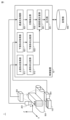
- FIG. 1 is a diagram showing a schematic configuration of an entire defect management device according to a first embodiment
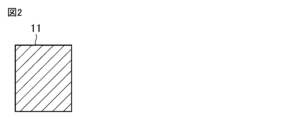
- FIG. 2 is a diagram showing a cross-sectional shape of an object to be inspected.
- FIG. 2 is a diagram showing a cross-sectional shape of an object to be inspected.
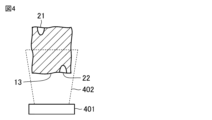
- FIG. 2 is a diagram showing a cross-sectional shape of an object to be inspected.
- FIG. 2 is a diagram showing a cross-sectional shape of an object to be inspected.
- 1 is a graph showing a virtual cross section of an object to be inspected.
- 1 is a graph showing a virtual cross section of an object to be inspected.
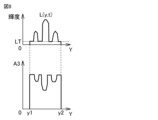
- 1 is a graph showing brightness and cross-sectional density of an object to be inspected.
- 1 is a graph showing corrected section density of a specimen.
- FIG. 4 is a flowchart showing a process executed by a control device.
- 13 is a flowchart showing a defect determination process.
- FIG. 2 is a diagram illustrating a hardware configuration of a control device.
- FIG. 11 is a diagram showing a schematic configuration of an entire defect management device according to a second embodiment.
- 1A to 1C are diagrams showing a process in which an inspection object is generated by a robot.
- FIG. 2 is a diagram showing how an object to be inspected is measured;
- FIG. 2 is a diagram showing how an object to be inspected is measured;
- FIG. 2 is a diagram showing how an object to be inspected is measured;
- FIG. 2 is a diagram showing how an object to be inspected is measured;
- FIG. 2 is a configuration diagram of a learning device.
- 4 is a flowchart showing a learning process of the learning device.
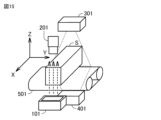
- Embodiment 1. 1 is a diagram showing a schematic configuration of an entire defect management device 1 according to embodiment 1.
- the defect management device 1 is a device that manages defects of an inspection object S.
- the defect management device 1 inspects the inspection object S transported by a transport conveyor 501.
- the object to be inspected S is, for example, a urethane foam resin molded product used as a thermal insulation material.
- a urethane foam resin molded product is made by injecting resin into a mold having the desired shape, and then going through a foaming process to form it into a three-dimensional shape. Depending on how the foaming progresses, defects such as chips or cavities that can become scratches may occur on the surface or inner layer of the finished resin molded product.
- the defect management device 1 obtains the external shape of the object S to be inspected and detects the amount of defects present in the inner layers, thereby obtaining an accurate density of the object S to be inspected.
- the defect management device 1 is capable of determining the presence or absence of defects based on the density of the object S to be inspected, rather than determining the presence or absence of defects based on the presence or absence of scratches or cavities that may occur.
- the defect management device 1 includes a light source 101 as an illumination device, a camera 201 as an imaging device, sensors 301 and 401, a transport conveyor 501, a control device 10 as a processing device, and a memory unit 660 that stores data output by the control device 10.
- Sensors 301, 401 measure information related to the external shape of the object to be inspected S.
- the sensors include a sensor (also referred to as the "lower sensor”) 401 as a first sensor that measures a first surface (lower surface) of the lower part of the object to be inspected S, and a sensor (also referred to as the "upper sensor”) 301 as a second sensor that measures a second surface (upper surface) of the upper part of the object to be inspected S.
- the external shape dimensions of the object to be inspected S can be obtained.
- the light source 101 irradiates light (transmitted light) onto the bottom surface of the object to be inspected S.
- the camera 201 is disposed opposite the light source 101 and captures an image of the top surface of the object to be inspected S opposite the bottom surface.
- the camera 201 captures an image of the transmitted light irradiated from the light source 101 and transmitted through the object to be inspected S.
- the control device 10 processes the information acquired from the sensors 301, 401 and the camera 201, estimates density information of the object to be inspected S (described below), and can determine whether or not the object to be inspected S has a defect.
- the transport conveyor 501 moves the object to be inspected S in the X-axis direction.
- the sensors 301 and 401 continue to measure the shape of the object to be inspected S as it moves in the X-axis direction while being transported by the transport conveyor 501.
- the sensors 301 and 401 measure the distance in the Z direction from their respective installation positions to the object to be inspected S by the amount of the Y-direction component.
- the sensors 301 and 401 are selected to have an appropriate resolution that affects the measurement accuracy within a range that covers the object to be inspected S.
- the upper shape acquisition unit 611 acquires information from the sensor (upper sensor) 301.
- the upper shape acquisition unit 611 acquires information on the height z1(y, t) for the Y-direction component in the transport time unit t as the measurement result of the upper sensor 301.
- the lower shape acquisition unit 621 acquires information from the sensor (lower sensor) 401.
- the lower shape acquisition unit 621 acquires information on height z2(y, t) for the Y-direction component in the transport time unit t as the measurement result of the lower sensor 401.
- inspection is performed using light source 101 and camera 201. If the object to be inspected S has a cavity, the amount of light irradiated from light source 101 that is transmitted is greater than when there is no cavity, and the brightness of the image captured by camera 201 is therefore higher.
- the transmitted light processing unit 631 acquires the image data captured by camera 201. This makes it possible to detect inner layer defects in the object to be inspected S based on the brightness of the captured data.
- Figures 2 to 5 are diagrams showing the cross-sectional shape of the test object S.
- the ideal cross-section 11 shown in Figure 2 is a cross-section of the test object S when it is ideally formed.
- Figures 3 to 5 show cross-sections of the test object S that have actually been produced.
- the upper shape acquisition unit 611 acquires the shape of the cross section 12 within the sensor detection range 302 of the upper sensor 301. Specifically, the upper shape acquisition unit 611 can acquire the shape of the upper surface of the inspection object S. A surface defect 21 is present in the upper part of the cross section 12.
- the lower shape acquisition unit 621 acquires the shape of the cross section 13 within the sensor detection range 402 of the lower sensor 401. Specifically, the lower shape acquisition unit 621 can acquire the shape of the bottom surface of the object to be inspected S. A surface defect 21 exists in the upper part of the cross section 13, and a surface defect 22 exists in the lower part of the cross section 13.
- the upper sensor 301 will detect the shape of the upper part of the circle, and the lower sensor 401 will detect the shape of the lower part of the circle.
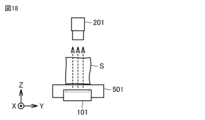
- the light source 101 irradiates the bottom surface of the object S to be inspected with light.
- the camera 201 captures an image of the top surface of the object S to be inspected, which allows observation of the state of the transmitted light that has passed through the object S to be inspected.
- the transmitted light processing unit 631 acquires the image captured by the camera 201.
- an inner layer defect 23 is present on the cross section 14.
- FIGS. 6 and 7 are graphs showing a virtual cross section of the test object S.
- the outer shape of the upper surface of the test object S is measured as a measurement height z1(y, t).
- a measurement height zT1 is obtained.
- the surface defect is removed to obtain the virtual cross section A1(y,t).
- “0" is used as a threshold, and defect portion 31 (detected as surface defect 21) that is 0 or less is removed from ⁇ z1(y,t) (if it is less than 0, it is corrected to 0).
- the surface defect 21 is corrected to the measurement height zT1.
- the outer shape of the bottom surface of the test object S is measured as the measurement height z2(y,t).
- the measurement height zT2 is obtained.
- a surface defect is detected in ⁇ z1(y,t)
- the surface defect is removed to obtain the virtual cross section A2(y,t).
- a defect portion 32 (detected as a surface defect 22) that is equal to or smaller than a threshold value (a negative value in this example) is removed from ⁇ z2(y,t).
- Figure 8 is a graph showing the brightness and cross-sectional density of the inspection object S.
- the brightness value is higher at locations that include inner layer defects 23 than at locations that do not include inner layer defects 23, because the amount of transmitted light is greater at these locations. Additionally, the brightness value is also higher at locations that include surface defects 21, 22.
- the luminance of the ideal cross section 11, where the inner layer state is uniform, is luminance LT.
- the luminance of the cross section 14 of the inspection object S shown in Figure 5 is L(y, t).
- the luminance value is high due to the surface defect 21, inner layer defect 23, and surface defect 22.
- the defect detection unit 632 calculates the cross-sectional density A3(y,t) in the Y-axis direction.
- the cross-sectional density A3(y,t) is obtained by correcting and converting the value of L(y,t) from the correlation with the luminance LT as the reference.
- the cross-sectional density A3(y,t) is found based on the inner layer defect or the defect amount due to the inner layer defect (value expressed in L(y,t)) relative to the density of the inspected object S when it is an ideal cross-section 11 (value based on the luminance LT).
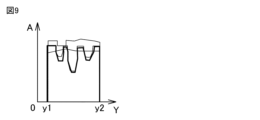
- FIG. 9 is a graph showing the corrected cross-sectional density of the object S to be inspected.
- the cross-sectional density calculation unit 641 compositely adds the cross-sectional densities in the Y-axis direction to obtain the cross-sectional density A(y,t).
- the value A(t) obtained by integrating the cross-sectional density A(y, t) in the Y-axis direction can be derived as the cross-sectional density in a very small time unit. Furthermore, by integrating the value A(t) in the X-axis direction, the total density A of the object to be inspected S can be derived.
- the output unit 651 outputs information on the cross-sectional density A(t) in a very small time unit, the value of the total density A, etc. as results.
- the cross-sectional density calculation unit 641 can calculate the cross-sectional area and total volume of the object S to be inspected excluding the cavity. If there is no cavity, the density of the object S to be inspected is homogeneous. If there is a cavity, the density of the object S to be inspected decreases locally. For example, it is possible to calculate the cross-sectional area and total volume of the object S to be inspected excluding the cavity based on the distance between the top and bottom surfaces and the density information. In addition, the total weight of the object S to be inspected can be calculated from the total density A and the total volume.
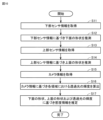
- FIG. 10 is a flowchart showing the process executed by the control device 10.
- S This process may be started, for example, each time the camera 201 and the sensors 301 and 401 detect an inspection object S moving on the transport conveyor 501 (at each sampling time).
- the control device 10 acquires information (distance to the underside) detected by the lower sensor 401.
- the control device 10 estimates the shape of the underside based on the information acquired from the lower sensor 401.
- the outer shape of the underside of the test object S is calculated as the measurement height z2(y,t), and further, a virtual cross section A2(y,t) is obtained.
- the control device 10 acquires information (distance to the top surface) detected by the upper sensor 301.
- the control device 10 estimates the shape of the top surface based on the information acquired from the upper sensor 301. As described with reference to Figures 3 and 6, for example, the outer shape of the top surface of the test object S is calculated as the measurement height z1(y, t), and further, a virtual cross section A1(y, t) is obtained.
- the control device 10 acquires the information detected by the camera 201.
- the control device 10 calculates the luminance of the transmitted light in each region based on the information acquired from the camera 201. As described with reference to Figures 5 and 8, for example, L(y, t) is calculated as the luminance, and further, the cross-sectional density A3(y, t) is obtained.
- the control device 10 estimates density information based on the shape of the lower surface, the shape of the upper surface, and the brightness of the transmitted light, and ends this process.
- the lower sensor 401 provides the measurement height z2(y,t)
- the upper sensor 301 provides the measurement height z1(y,t)
- the camera 201 provides the brightness L(y,t).
- the cross-sectional density A(y,t) is then obtained from the finally calculated virtual cross sections A2(y,t), A1(y,t), and cross-sectional density A3(y,t).
- the value A(t) is obtained by integrating the cross-sectional density A3(y,t) in the Y-axis direction.
- This process is executed at a predetermined cycle (sampling cycle) while the object to be inspected S is moving in the X-axis direction. While the object to be inspected S is being transported, the length of the object to be inspected S in the transport direction (X-axis direction) can be calculated based on the timing of the start and end of inspection by the sensor 301, etc.
- the total density A is obtained by integrating the value A(t) in the X-axis direction.
- the cross-sectional area, total volume, and total weight of the object to be inspected S excluding hollow parts can be calculated.
- the control device 10 divides the object to be inspected S into multiple regions and estimates the density of each of the multiple regions.
- Each of the multiple regions is a tiny region in the Y-axis direction indicated by y(t) in FIG. 6 or FIG. 7, and in the X-axis direction is a tiny region in the X-axis direction due to the movement of the object to be inspected S for each sampling period.
- Each of the multiple regions is an area partitioned by a small width in the Y-axis direction x a small width in the Z-axis direction, and density is obtained for each of these small regions.
- the area of this small region that contacts the bottom surface is referred to as the first region
- the area that contacts the top surface is referred to as the second region.
- each of the multiple regions is a three-dimensional region between a two-dimensional microscopic first region included on the bottom surface and a two-dimensional microscopic second region included on the top surface.
- the second region is the region where the transmitted light irradiated to the first region reaches after penetrating the object to be inspected S.
- Sensor 401 measures the distance to a first area on the bottom surface.
- Sensor 301 measures the distance to a second area on the top surface.
- Sensors 301 and 401 repeat these measurements, making it possible to measure the shape of the object to be inspected S.
- the control device 10 estimates the shape of the bottom surface based on information obtained from the sensor 401.
- the control device 10 estimates the shape of the top surface based on information obtained from the sensor 301.
- the control device 10 calculates the luminance of transmitted light in each of the multiple regions included in the object S to be inspected based on information obtained from the camera 201.
- the control device 10 estimates density information indicating the density distribution of each of the multiple regions based on the shapes of the bottom surface and the top surface and the luminance of transmitted light in each of the multiple regions.
- FIG. 11 is a flowchart showing the defect determination process.
- the defect determination process may be started, for example, when the inspection shown in FIG. 10 is completed for the entire object to be inspected S.
- the control device 10 detects vacuoles based on the density information obtained in the process shown in FIG. 10. For example, if there are multiple areas where the density drops, it can be determined that there are vacuoles. For example, the inner layer 23 shown in FIG. 5 and FIG. 9 corresponds to this.
- the control device 10 determines whether a vacuole with a predetermined volume or more has been detected.
- the volume of the vacuole can be calculated based on the amount of density reduction and the size of the area where the density is reduced.
- control device 10 determines that a void (an unacceptably large inner layer defect) of a predetermined volume or more has been detected (YES in S22), it determines that the inspected object has a defect (S23) and ends the defect determination process.
- control device 10 determines that the inspected object has no defects (S24) and ends the defect determination process. If the inner layer defect is within the acceptable quality range (for example, a minute void), there is no problem.
- the control device 10 detects voids in the object to be inspected S based on the density information. When a void of a predetermined volume or more is detected, the control device 10 determines that the object to be inspected S has a defect. In this way, it is possible to determine whether or not the object to be inspected has a defect due to a void. This makes it possible to appropriately manage the density of the object to be inspected, which is related to defects in the object to be inspected.
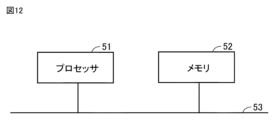
- FIG. 12 is a diagram showing the hardware configuration of the control device 10.
- the control device 10 can be configured with digital circuit hardware or software to perform the corresponding operations.
- the control device 10 can include, for example, a processor 51 and a memory 52 connected by a bus 53, as shown in FIG. 12, and the processor 51 can execute a program stored in the memory 52.
- Embodiment 2. 13 is a diagram showing a schematic configuration of the entire defect management device 2 according to the second embodiment.
- the defect management device 2 is a device that manages defects in the object S to be inspected.
- the defect management device 1 includes a light source 101, a camera 201, sensors 301 and 401, a transport conveyor 501, and a control device 10.
- the defect management device 2 according to the second embodiment further includes a trained model storage unit 661, a learning device 701, an inference device 761, and a robot 801.
- the defect management device 2 inspects the object S to be inspected transported by the transport conveyor 501, generates (manufactures) a trained model by the learning device 701, performs inference using the trained model by the inference device 761, and generates the object S to be inspected by the robot 801.
- FIG. 14 is a diagram showing the process by which the object to be inspected S is produced by the robot 801.
- the robot 801 produces the object to be inspected S by injecting the material (base material) of the object to be inspected S into a mold 821 for molding the object to be inspected S.
- the robot 801 controls the trajectory (injection path) for injecting the base material of the test object S into the shape (mold 821) to be molded into the test object S, as well as the amount of base material injected over time, to generate a molding trajectory 811.
- a means such as the robot 801 is envisioned.
- the robot 801 can control the horizontal direction and angular attitude, which affect the quality of the test object S.
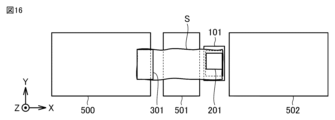
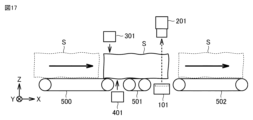
- FIGS. 15 to 18 are diagrams showing how the inspection object S is measured.
- the equipment configuration in FIG. 15 is the same as that shown in FIG. 1.
- the inspection object S which is a molded product generated after the base material is injected, is placed on a transport conveyor 501 and inspected by the defect management device 2.
- the generated inspection object S is transported by a transport conveyor 500, then the inspection object S is inspected on a transport conveyor 501, and after inspection, the inspection object S is transported by a transport conveyor 502.
- the shape of the inspection object S is estimated using sensors 301 and 401 installed between the transport conveyors 500 and 501, and then the brightness of the transmitted light passing through the inspection object S is measured using the light source 101 and camera 201 installed between the transport conveyors 501 and 502.
- the defect management device 1 according to the first embodiment may also be configured in this manner using the transport conveyors 500 to 502.
- the following consists of a learning phase in which the process of injecting base material into the object S to be inspected is learned based on the cross-sectional density information acquired by the defect management device 2, and a utilization phase in which the molding process is used to approach the reference cross-sectional density.
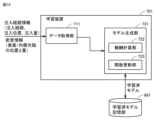
- ⁇ Learning Phase> 19 is a configuration diagram of the learning device 701.
- the learning device 701 includes a data acquisition unit 711 and a model generation unit 721.
- the data acquisition unit 711 acquires data including density information (similar to that in embodiment 1) indicating the density distribution of each of the multiple regions included in the object to be inspected S, and injection path information of the object to be inspected S corresponding to the density information, as learning data.
- the density information is also information indicating the presence or absence of defects (surface/internal layer defects) at each position in the object to be inspected S and the size of the defects.
- the injection path information includes the injection amount of material (base material) at the injection path and the injection position on the injection path.
- the injection path is the path along which the robot 801 moves while injecting the material of the object to be inspected S.
- the model generation unit 721 uses the learning data to generate a trained model for inferring injection route information from the density information of the object S to be inspected.
- a trained model is generated that infers injection route information in the input state (injection route information corresponding to the density information) from the density information of the object S to be inspected.
- density information position and amount of surface/internal layer defects
- appropriate injection route information injection route and injection amount of material at the injection position on the injection route
- the learning algorithm used by the model generation unit 721 may be a known algorithm such as supervised learning, unsupervised learning, or reinforcement learning.
- reinforcement learning an agent (acting subject) in a certain environment observes the current state (environmental parameters) and decides on the action to be taken. The environment changes dynamically due to the agent's actions, and the agent is given a reward according to the change in the environment. The agent repeats this process, and learns the course of action that will obtain the most reward through a series of actions.
- Q-learning and TD-learning are known as representative methods of reinforcement learning.
- the general update formula for the action value function Q(s, a) is expressed by Equation 1.
- st represents the state of the environment at time t, and at represents the action at time t.
- the state changes to st+1 due to action at. rt+1 represents the reward obtained due to the change in state
- ⁇ represents the discount rate
- ⁇ represents the learning coefficient. Note that ⁇ is in the range of 0 ⁇ 1, and ⁇ is in the range of 0 ⁇ 1.
- the injection route information of the inspected object S becomes the action at, and the density information of the molded product (position and amount of surface/inner layer defects) becomes the state st, and the best action at for state st at time t is learned.
- the update formula expressed by equation 1 increases the action value Q if the action value Q of the action a with the highest Q value at time t+1 is greater than the action value Q of the action a executed at time t, and decreases the action value Q in the opposite case.
- it updates the action value function Q(s, a) so that the action value Q of action a at time t approaches the best action value at time t+1. This allows the best action value in a certain environment to be propagated sequentially to the action value in the previous environment.
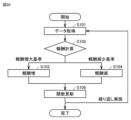
- the model generation unit 721 when generating a trained model by reinforcement learning, includes a reward calculation unit 722 and a function update unit 723.
- the reward calculation unit 722 calculates the reward based on the injection route information and density information of the specimen S.
- the reward calculation unit 722 calculates the reward r based on the deviation value from the reference cross-sectional density. For example, if the deviation value from the reference cross-sectional density decreases, the reward r is increased (e.g., a reward of "1" is given), whereas if the deviation value from the reference cross-sectional density increases, the reward r is decreased (e.g., a reward of "-1" is given).
- the function update unit 723 updates the function for determining the injection route information in the input state according to the reward calculated by the reward calculation unit 722, and outputs it to the learned model storage unit 661.
- the action value function Q(st,at) expressed by Equation 1 is used as a function for calculating the injection route information in the input state.
- the learned model storage unit 661 stores the action value function Q(st,at) updated by the function update unit 723, i.e., the learned model.
- FIG. 20 is a flowchart showing the learning process of the learning device 701.
- the data acquisition unit acquires injection path information and density information of the test object S as learning data.
- the model generation unit 721 calculates the reward based on the injection route information and density information. Specifically, the reward calculation unit 722 acquires the injection route information and density information, and determines whether to increase the reward (S103) or decrease the reward (S104) based on the deviation value from a predetermined reference cross-sectional density.
- the model generation unit 721 increases the reward given to the model being trained (action value function Q).
- the reward calculation unit 722 determines that the reward should be increased, it increases the reward in S103. On the other hand, if the reward calculation unit determines that the reward should be decreased, it decreases the reward in S104.
- the function update unit 723 updates the action value function Q(st,at) represented by Equation 1 and stored in the trained model storage unit 661 based on the reward calculated by the reward calculation unit 722.
- the learning device repeatedly executes steps S101 to S105 above and stores the generated action value function Q(st,at) as a learned model.
- the learning device stores the learned model in a learned model storage unit 661 provided outside the learning device, but the learned model storage unit 661 may be provided inside the learning device 701.
- the learning method includes a step of acquiring learning data including density information and injection route information, and a step of generating a trained model for inferring injection route information from the density information using the learning data.
- the manufacturing method for the trained model includes an acquisition step of acquiring learning data including density information and injection route information of the test object S corresponding to the density information, and a generation step of generating a trained model for inferring injection route information from the density information using the learning data.
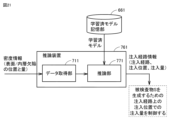
- ⁇ Utilization phase> 21 is a configuration diagram of an inference device 761.
- the inference device 761 includes a data acquisition unit 711 and an inference unit 771.
- the data acquisition unit 711 acquires density information (the same as in the first embodiment) indicating the distribution of density in each of a plurality of regions included in the object S to be inspected.
- the inference unit 771 outputs injection route information from the density information acquired by the data acquisition unit 711, using a trained model for inferring injection route information of the test object S from density information. By inputting the density information acquired by the data acquisition unit 711 into this trained model, it is possible to infer injection route information in the input state (injection route information corresponding to the density information).
- the injection route information in the input state is output using a trained model trained by the model generation unit 721 of the test object S.
- a trained model trained by the model generation unit 721 of the test object S.
- FIG. 22 is a flowchart showing the inference procedure performed by the inference device 761.
- the data acquisition unit 711 acquires density information.
- the inference unit 771 inputs the density information to the trained model stored in the trained model storage unit 661, and obtains injection route information in the input state (injection route information corresponding to the density information).
- the inference unit 771 outputs the obtained injection route information in the input state to the test object S.
- the inference unit 771 outputs the injection route information in the input state obtained by the learned model to the robot 801.
- the robot 801 uses the injection path information in the input state that has been output to control the injection amount at the injection position on the injection path to form the test object S. This makes it possible to create a shape with a uniform cross-sectional density that is close to the reference cross-sectional density.
- reinforcement learning is applied to the learning algorithm used by the inference unit, but this is not limited to this.
- the learning algorithm it is also possible to apply supervised learning in addition to reinforcement learning.
- the learning algorithm used in the model generation unit can be deep learning, which learns to extract the features themselves, or machine learning can be performed according to other known methods, such as neural networks, genetic programming, functional logic programming, and support vector machines.
- the learning device 701 and the inference device 761 may be connected to grasp the state of the object S to be inspected via a network, for example, and may be devices separate from the molding environment of the object S to be inspected.
- the learning device 701 and the inference device 761 may also be built into the object S to be inspected.
- the learning device 701 and the inference device 761 may exist on a cloud server.
- the model generation unit 721 may learn the injection route information in the input state by using learning data acquired from multiple test objects S.
- the model generation unit 721 may acquire learning data from multiple test objects S used in the same area, or may learn the injection route information in the input state by using learning data collected from multiple test objects S operating independently in different areas.
- a learning device that has learned the injection route information in the input state for a certain test object may be applied to another test object, and the injection route information for the other test object may be re-learned and updated.
- the learning device 701 and the inference device 761 can be configured with digital circuit hardware or software to perform the corresponding operations.
- the learning device 701 and the inference device 761 can include, for example, a processor 51 and a memory 52 connected by a bus 53, as shown in FIG. 12, and the processor 51 can execute a program stored in the memory 52.
- the learning device 701 of the defect management device 2 that manages defects in the object S includes a data acquisition unit 711 and a model generation unit 721.
- the data acquisition unit 711 acquires learning data including density information indicating the density distribution of each of a plurality of regions included in the object S, and injection path information of the object S corresponding to the density information.
- the model generation unit 721 uses the learning data to generate a learned model for inferring the injection path information from the density information.
- the injection path information includes an injection path along which the robot 801, which generates the object S by injecting the material of the object S into a mold 821 for molding the object S, moves while injecting the material of the object S.
- the model generation unit 721 increases the reward given to the learning model when the difference between the predetermined reference density information of the object S and the density information is equal to or less than a predetermined standard.
- the defect management device 2 and the inference device 761 include a data acquisition unit 711 and an inference unit 771.
- the data acquisition unit 711 acquires density information indicating the distribution of density in each of a plurality of regions included in the object to be inspected S.
- the inference unit 771 outputs injection path information from the density information acquired by the data acquisition unit 711, using a trained model for inferring injection path information of the object to be inspected S from the density information.
Landscapes
- Engineering & Computer Science (AREA)
- Software Systems (AREA)
- Theoretical Computer Science (AREA)
- General Physics & Mathematics (AREA)
- Physics & Mathematics (AREA)
- General Engineering & Computer Science (AREA)
- Health & Medical Sciences (AREA)
- Evolutionary Computation (AREA)
- Data Mining & Analysis (AREA)
- Computing Systems (AREA)
- Computer Vision & Pattern Recognition (AREA)
- Artificial Intelligence (AREA)
- Mathematical Physics (AREA)
- Mechanical Engineering (AREA)
- Medical Informatics (AREA)
- Life Sciences & Earth Sciences (AREA)
- Chemical & Material Sciences (AREA)
- Analytical Chemistry (AREA)
- Biochemistry (AREA)
- General Health & Medical Sciences (AREA)
- Immunology (AREA)
- Pathology (AREA)
- Investigating Materials By The Use Of Optical Means Adapted For Particular Applications (AREA)
Priority Applications (1)
| Application Number | Priority Date | Filing Date | Title |
|---|---|---|---|
| JP2025521788A JPWO2024241607A1 (https=) | 2023-05-22 | 2023-11-17 |
Applications Claiming Priority (2)
| Application Number | Priority Date | Filing Date | Title |
|---|---|---|---|
| JP2023-083854 | 2023-05-22 | ||
| JP2023083854 | 2023-05-22 |
Publications (1)
| Publication Number | Publication Date |
|---|---|
| WO2024241607A1 true WO2024241607A1 (ja) | 2024-11-28 |
Family
ID=93589916
Family Applications (1)
| Application Number | Title | Priority Date | Filing Date |
|---|---|---|---|
| PCT/JP2023/041464 Ceased WO2024241607A1 (ja) | 2023-05-22 | 2023-11-17 | 被検査物の欠陥を管理する装置、機械学習方法および学習済モデルの製造方法 |
Country Status (2)
| Country | Link |
|---|---|
| JP (1) | JPWO2024241607A1 (https=) |
| WO (1) | WO2024241607A1 (https=) |
Citations (8)
| Publication number | Priority date | Publication date | Assignee | Title |
|---|---|---|---|---|
| JPH08152416A (ja) * | 1994-09-28 | 1996-06-11 | Toray Ind Inc | シート状物の欠点検出装置 |
| JP2003083911A (ja) * | 2001-09-07 | 2003-03-19 | Hitachi Kokusai Electric Inc | マクロ検査装置 |
| JP3098369U (ja) * | 2003-06-06 | 2004-02-26 | 有限会社 フロンティアシステム | 発泡シート材のピンホール検査装置 |
| JP2005274522A (ja) * | 2004-03-26 | 2005-10-06 | National Printing Bureau | 用紙検査装置 |
| JP2019190891A (ja) * | 2018-04-20 | 2019-10-31 | オムロン株式会社 | 検査管理システム、検査管理装置及び検査管理方法 |
| US20200202235A1 (en) * | 2018-12-21 | 2020-06-25 | Industrial Technology Research Institute | Model-based machine learning system |
| JP2020148702A (ja) * | 2019-03-15 | 2020-09-17 | 日立化成株式会社 | 発泡成形体の外観評価方法 |
| WO2022196755A1 (ja) * | 2021-03-18 | 2022-09-22 | 株式会社日本製鋼所 | 強化学習方法、コンピュータプログラム、強化学習装置及び成形機 |
-
2023
- 2023-11-17 JP JP2025521788A patent/JPWO2024241607A1/ja active Pending
- 2023-11-17 WO PCT/JP2023/041464 patent/WO2024241607A1/ja not_active Ceased
Patent Citations (8)
| Publication number | Priority date | Publication date | Assignee | Title |
|---|---|---|---|---|
| JPH08152416A (ja) * | 1994-09-28 | 1996-06-11 | Toray Ind Inc | シート状物の欠点検出装置 |
| JP2003083911A (ja) * | 2001-09-07 | 2003-03-19 | Hitachi Kokusai Electric Inc | マクロ検査装置 |
| JP3098369U (ja) * | 2003-06-06 | 2004-02-26 | 有限会社 フロンティアシステム | 発泡シート材のピンホール検査装置 |
| JP2005274522A (ja) * | 2004-03-26 | 2005-10-06 | National Printing Bureau | 用紙検査装置 |
| JP2019190891A (ja) * | 2018-04-20 | 2019-10-31 | オムロン株式会社 | 検査管理システム、検査管理装置及び検査管理方法 |
| US20200202235A1 (en) * | 2018-12-21 | 2020-06-25 | Industrial Technology Research Institute | Model-based machine learning system |
| JP2020148702A (ja) * | 2019-03-15 | 2020-09-17 | 日立化成株式会社 | 発泡成形体の外観評価方法 |
| WO2022196755A1 (ja) * | 2021-03-18 | 2022-09-22 | 株式会社日本製鋼所 | 強化学習方法、コンピュータプログラム、強化学習装置及び成形機 |
Also Published As
| Publication number | Publication date |
|---|---|
| JPWO2024241607A1 (https=) | 2024-11-28 |
Similar Documents
| Publication | Publication Date | Title |
|---|---|---|
| JP7553983B2 (ja) | 積層造形における人工知能プロセス制御のためのシステム、方法および媒体 | |
| CN109382838B (zh) | 控制装置以及机器学习装置 | |
| Radhwan et al. | Optimization parameter effects on the quality surface finish of the three-dimensional printing (3D-printing) fused deposition modeling (FDM) using RSM | |
| Cheng et al. | Vision-based online process control in manufacturing applications | |
| US10444731B2 (en) | Controller and machine learning device | |
| US10852710B2 (en) | Thermal displacement compensation apparatus | |
| CN109308051B (zh) | 数值控制装置 | |
| Moroni et al. | Inspection strategies and multiple geometric tolerances | |
| JP2020061575A (ja) | 高次元変数選択モデルを使用した重要なパラメータの決定システム | |
| KR20230122590A (ko) | 반도체 시편의 전기적 특성들의 예측 | |
| CN116968031B (zh) | 一种工业机器人位置误差置信区间预测和评价方法 | |
| CN119935035B (zh) | 一种基于tm传感器的多层材料厚度检测系统、方法、电子设备及存储介质 | |
| CN119224788A (zh) | 测风激光雷达外壳气密性自适应控制方法及系统 | |
| WO2024241607A1 (ja) | 被検査物の欠陥を管理する装置、機械学習方法および学習済モデルの製造方法 | |
| CN119165042A (zh) | 确定缺陷的几何结构的方法以及确定负荷能力极限的方法 | |
| TWI880217B (zh) | 缺陷檢查裝置 | |
| Sepahi-Boroujeni et al. | Digital twin-enabled error and uncertainty mapping for 3D scanning | |
| CN120009359A (zh) | 基于工业物联网的工件质量检测方法、系统、设备及介质 | |
| JP2022127394A5 (https=) | ||
| CN107270858A (zh) | 一种基于三坐标自由曲面的智能几何采样方法 | |
| CN117940750A (zh) | 用于表征机械部件的方法 | |
| Ahuett-Garza et al. | A reference model for evolving digital twins and its application to cases in the manufacturing floor | |
| Wardhani et al. | Prediction of Surface Roughness and Hardness on Multi 3D Printers with Machine Learning | |
| Shi et al. | Development of dynamic inspection methods for dimensional measurement of automotive body parts | |
| Shi et al. | Recursive measurement process for improving accuracy of dimensional inspection of automotive body parts |
Legal Events
| Date | Code | Title | Description |
|---|---|---|---|
| 121 | Ep: the epo has been informed by wipo that ep was designated in this application |
Ref document number: 23938569 Country of ref document: EP Kind code of ref document: A1 |
|
| WWE | Wipo information: entry into national phase |
Ref document number: 2025521788 Country of ref document: JP |
|
| NENP | Non-entry into the national phase |
Ref country code: DE |