WO2024237291A1 - 乗物用シート - Google Patents
乗物用シート Download PDFInfo
- Publication number
- WO2024237291A1 WO2024237291A1 PCT/JP2024/018005 JP2024018005W WO2024237291A1 WO 2024237291 A1 WO2024237291 A1 WO 2024237291A1 JP 2024018005 W JP2024018005 W JP 2024018005W WO 2024237291 A1 WO2024237291 A1 WO 2024237291A1
- Authority
- WO
- WIPO (PCT)
- Prior art keywords
- control
- control device
- occupant
- fluid
- vehicle
- Prior art date
- Legal status (The legal status is an assumption and is not a legal conclusion. Google has not performed a legal analysis and makes no representation as to the accuracy of the status listed.)
- Ceased
Links
Images






Classifications
-
- B—PERFORMING OPERATIONS; TRANSPORTING
- B60—VEHICLES IN GENERAL
- B60N—SEATS SPECIALLY ADAPTED FOR VEHICLES; VEHICLE PASSENGER ACCOMMODATION NOT OTHERWISE PROVIDED FOR
- B60N2/00—Seats specially adapted for vehicles; Arrangement or mounting of seats in vehicles
- B60N2/64—Back-rests or cushions
- B60N2/66—Lumbar supports
- B60N2/665—Lumbar supports using inflatable bladders
-
- B—PERFORMING OPERATIONS; TRANSPORTING
- B60—VEHICLES IN GENERAL
- B60N—SEATS SPECIALLY ADAPTED FOR VEHICLES; VEHICLE PASSENGER ACCOMMODATION NOT OTHERWISE PROVIDED FOR
- B60N2/00—Seats specially adapted for vehicles; Arrangement or mounting of seats in vehicles
- B60N2/002—Seats provided with an occupancy detection means mounted therein or thereon
- B60N2/0021—Seats provided with an occupancy detection means mounted therein or thereon characterised by the type of sensor or measurement
- B60N2/0024—Seats provided with an occupancy detection means mounted therein or thereon characterised by the type of sensor or measurement for identifying, categorising or investigation of the occupant or object on the seat
- B60N2/0027—Seats provided with an occupancy detection means mounted therein or thereon characterised by the type of sensor or measurement for identifying, categorising or investigation of the occupant or object on the seat for detecting the position of the occupant or of occupant's body part
-
- B—PERFORMING OPERATIONS; TRANSPORTING
- B60—VEHICLES IN GENERAL
- B60N—SEATS SPECIALLY ADAPTED FOR VEHICLES; VEHICLE PASSENGER ACCOMMODATION NOT OTHERWISE PROVIDED FOR
- B60N2/00—Seats specially adapted for vehicles; Arrangement or mounting of seats in vehicles
- B60N2/002—Seats provided with an occupancy detection means mounted therein or thereon
- B60N2/0021—Seats provided with an occupancy detection means mounted therein or thereon characterised by the type of sensor or measurement
- B60N2/003—Seats provided with an occupancy detection means mounted therein or thereon characterised by the type of sensor or measurement characterised by the sensor mounting location in or on the seat
- B60N2/0033—Seats provided with an occupancy detection means mounted therein or thereon characterised by the type of sensor or measurement characterised by the sensor mounting location in or on the seat mounted on or in the foam cushion
-
- B—PERFORMING OPERATIONS; TRANSPORTING
- B60—VEHICLES IN GENERAL
- B60N—SEATS SPECIALLY ADAPTED FOR VEHICLES; VEHICLE PASSENGER ACCOMMODATION NOT OTHERWISE PROVIDED FOR
- B60N2/00—Seats specially adapted for vehicles; Arrangement or mounting of seats in vehicles
- B60N2/56—Heating or ventilating devices
- B60N2/5678—Heating or ventilating devices characterised by electrical systems
- B60N2/5685—Resistance
-
- B—PERFORMING OPERATIONS; TRANSPORTING
- B60—VEHICLES IN GENERAL
- B60N—SEATS SPECIALLY ADAPTED FOR VEHICLES; VEHICLE PASSENGER ACCOMMODATION NOT OTHERWISE PROVIDED FOR
- B60N2/00—Seats specially adapted for vehicles; Arrangement or mounting of seats in vehicles
- B60N2/90—Details or parts not otherwise provided for
- B60N2/914—Hydro-pneumatic adjustments of the shape
-
- B—PERFORMING OPERATIONS; TRANSPORTING
- B60—VEHICLES IN GENERAL
- B60N—SEATS SPECIALLY ADAPTED FOR VEHICLES; VEHICLE PASSENGER ACCOMMODATION NOT OTHERWISE PROVIDED FOR
- B60N2/00—Seats specially adapted for vehicles; Arrangement or mounting of seats in vehicles
- B60N2/90—Details or parts not otherwise provided for
- B60N2/976—Details or parts not otherwise provided for massaging systems
-
- B—PERFORMING OPERATIONS; TRANSPORTING
- B60—VEHICLES IN GENERAL
- B60N—SEATS SPECIALLY ADAPTED FOR VEHICLES; VEHICLE PASSENGER ACCOMMODATION NOT OTHERWISE PROVIDED FOR
- B60N2/00—Seats specially adapted for vehicles; Arrangement or mounting of seats in vehicles
- B60N2/90—Details or parts not otherwise provided for
- B60N2002/981—Warning systems, e.g. the seat or seat parts vibrates to warn the passenger when facing a danger
-
- B—PERFORMING OPERATIONS; TRANSPORTING
- B60—VEHICLES IN GENERAL
- B60N—SEATS SPECIALLY ADAPTED FOR VEHICLES; VEHICLE PASSENGER ACCOMMODATION NOT OTHERWISE PROVIDED FOR
- B60N2210/00—Sensor types, e.g. for passenger detection systems or for controlling seats
- B60N2210/40—Force or pressure sensors
- B60N2210/44—Force or pressure sensors using fluids
-
- B—PERFORMING OPERATIONS; TRANSPORTING
- B60—VEHICLES IN GENERAL
- B60N—SEATS SPECIALLY ADAPTED FOR VEHICLES; VEHICLE PASSENGER ACCOMMODATION NOT OTHERWISE PROVIDED FOR
- B60N2220/00—Computerised treatment of data for controlling of seats
- B60N2220/30—Computerised treatment of data for controlling of seats using a neural network
Definitions
- the present invention relates to a vehicle seat.
- Patent Document 1 discloses a seat that can determine the posture of a seated occupant.
- the seat has multiple air bags arranged vertically on the seat back, an air pump that supplies compressed air to the multiple air bags, multiple pressure sensors that detect the pressure inside the multiple air bags, and a control device that controls the air pump and determines the posture of the occupant.
- the control device supplies compressed air to each air bag, measures the time required for the pressure in each air bag to reach a predetermined value, and determines the posture of the occupant based on each measured time.
- the present invention aims to accurately determine the posture of an occupant in a vehicle seat.
- one aspect of the present invention is a vehicle seat (1) having a seat cushion (3) and a seat back (4), the seat back having a seat back frame (21), a lumbar pressure receiving portion (51) provided on the seat back frame for supporting the lumbar region of the occupant, left and right shoulder pressure receiving portions (52) provided on the seat back frame above the lumbar pressure receiving portion for supporting the left and right shoulders of the occupant, a pad (22) supported by the seat back frame, the lumbar pressure receiving portion, and the left and right shoulder pressure receiving portions, a plurality of front fluid bags (61) arranged vertically on the front surface of the pad, and a control device (78) for determining the posture of the occupant based on the internal pressure of the plurality of front fluid bags, and the upper end fluid bag (61A) located at the top of the plurality of front fluid bags as viewed from the front is located between the left and right shoulder pressure receiving portions.
- the upper end fluid bag is positioned relatively high up on the seat back.
- the upper part of the body including the shoulders, tends to move more easily depending on the occupant's posture than the lower part, including the waist. Therefore, by detecting the internal pressure of the upper end fluid bag, the control device can accurately determine the occupant's posture.
- a plurality of rear fluid bags (65) are arranged vertically between the front surface of the lumbar pressure receiving portion and the rear surface of the pad, and the rear fluid bags have overlapping portions (66) where they overlap each other when viewed from the front-to-rear direction, and the upper end fluid bag may be positioned above the overlapping portions when viewed from the front.
- the upper fluid bag can be positioned at a relatively high position on the seat back. As a result, the position of the occupant can be determined with high accuracy by the upper fluid bag.
- At least one of the plurality of front fluid bags may overlap with the overlapping portion.
- At least one of the front fluid bags is supported by the overlapping portion from the rear, so that it can properly bear the load from the back of the occupant.
- the waist pressure receiving portion and the left and right shoulder pressure receiving portions are connected to each other by left and right connecting portions (48), and the upper end fluid bag may overlap the left and right connecting portions when viewed from the front.
- the upper fluid bag is supported by the connecting portion from the rear, so it can properly bear the load from the back of the occupant.
- the waist pressure receiving portion and the left and right shoulder pressure receiving portions are connected to each other by left and right connecting portions, and the upper end fluid bag may be positioned so as not to overlap the left and right connecting portions when viewed from the front.
- a blower (57) may be supported on the seat back frame, and each of the rear fluid bags may be positioned forward of the blower.
- the seatback frame has left and right side members (41) extending vertically, and an upper member (42) extending horizontally and connected to the upper ends of the left and right side members, and the upper end fluid bag may be disposed above the connection portion (46) between the left and right side members and the upper member.
- the upper fluid bag can be positioned at a relatively high position on the seat back. As a result, the position of the occupant can be determined with high accuracy by the upper fluid bag.
- the seatback frame has left and right side members (41) extending vertically, and an upper member (42) extending horizontally and connected to the upper ends of the left and right side members, and the upper end fluid bag may be disposed below the connection portion (46) between the left and right side members and the upper member.
- the lower end of the upper fluid bag may be positioned higher than the lower ends of the left and right shoulder pressure receiving portions.
- the upper fluid bag can be positioned at a relatively high position on the seat back. As a result, the position of the occupant can be determined with high accuracy by the upper fluid bag.
- the upper end of the upper end fluid bag may be positioned lower than the upper ends of the left and right shoulder pressure receiving portions.
- the upper fluid bag can be positioned at a relatively high position on the seat back. As a result, the position of the occupant can be determined with high accuracy by the upper fluid bag.
- One aspect of the invention is a vehicle seat (1) having a seat cushion (3) and a seat back (4), the seat back having a seat back frame (21), a lumbar pressure receiving portion (51) provided on the seat back frame for supporting the lumbar region of the occupant, left and right shoulder pressure receiving portions (52) provided on the seat back frame above the lumbar pressure receiving portion for supporting the left and right shoulders of the occupant, a pad (22) supported by the seat back frame, the lumbar pressure receiving portion, and the left and right shoulder pressure receiving portions, a plurality of front fluid bags (61) arranged vertically on the front surface of the pad, and a control device (78) for determining the posture of the occupant based on the internal pressure of the plurality of front fluid bags, and the upper end fluid bag (61A) located at the top of the plurality of front fluid bags as viewed from the front is located between the left and right shoulder pressure receiving portions.
- the upper end fluid bag is positioned relatively high up on the seat back.
- the upper part of the body including the shoulders, tends to move more easily depending on the occupant's posture than the lower part, including the waist. Therefore, by detecting the internal pressure of the upper end fluid bag, the control device can accurately determine the occupant's posture.
- a plurality of rear fluid bags (65) are arranged vertically between the front surface of the lumbar pressure receiving portion and the rear surface of the pad, and the rear fluid bags have overlapping portions (66) where they overlap each other when viewed from the front-to-rear direction, and the upper end fluid bag may be positioned above the overlapping portions when viewed from the front.
- the upper fluid bag can be positioned at a relatively high position on the seat back. As a result, the position of the occupant can be determined with high accuracy by the upper fluid bag.
- At least one of the plurality of front fluid bags may overlap with the overlapping portion.
- At least one of the front fluid bags is supported by the overlapping portion from the rear, so that it can properly bear the load from the back of the occupant.
- the waist pressure receiving portion and the left and right shoulder pressure receiving portions are connected to each other by left and right connecting portions (48), and the upper end fluid bag may overlap the left and right connecting portions when viewed from the front.
- the upper fluid bag is supported by the connecting portion from the rear, so it can properly bear the load from the back of the occupant.
- the waist pressure receiving portion and the left and right shoulder pressure receiving portions are connected to each other by left and right connecting portions, and the upper end fluid bag may be positioned so as not to overlap the left and right connecting portions when viewed from the front.
- a blower (57) may be supported on the seat back frame, and each of the rear fluid bags may be positioned forward of the blower.
- the seatback frame has left and right side members (41) extending vertically, and an upper member (42) extending horizontally and connected to the upper ends of the left and right side members, and the upper end fluid bag may be disposed above the connection portion (46) between the left and right side members and the upper member.
- the upper fluid bag can be positioned at a relatively high position on the seat back. As a result, the position of the occupant can be determined with high accuracy by the upper fluid bag.
- the seatback frame has left and right side members (41) extending vertically, and an upper member (42) extending horizontally and connected to the upper ends of the left and right side members, and the upper end fluid bag may be disposed below the connection portion (46) between the left and right side members and the upper member.
- the lower end of the upper fluid bag may be positioned higher than the lower ends of the left and right shoulder pressure receiving portions.
- the upper fluid bag can be positioned at a relatively high position on the seat back. As a result, the position of the occupant can be determined with high accuracy by the upper fluid bag.
- the upper end of the upper end fluid bag may be positioned lower than the upper ends of the left and right shoulder pressure receiving portions.
- the upper fluid bag can be positioned at a relatively high position on the seat back. As a result, the position of the occupant can be determined with high accuracy by the upper fluid bag.
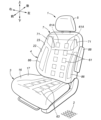
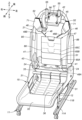
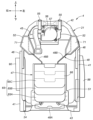
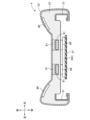
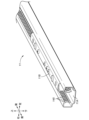
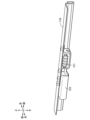
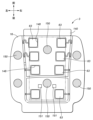
- FIG. 1 is a perspective view of a seat according to an embodiment; Perspective view of the seat frame Front view of seat back frame Seat back cross section Block diagram showing the seat configuration
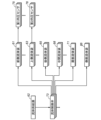
- FIG. 1 is a block diagram showing a connection configuration between a fluid supply source and a fluid bag.
- Flow diagram showing an example of attitude determination control Flow diagram showing an example of attitude determination control
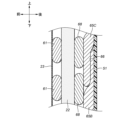
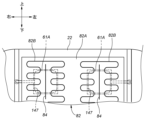
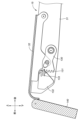
- Seat back cross section Heater diagram Cross-sectional view showing the front member Perspective view of the slide rail
- the vehicle may be, for example, an electric vehicle having an electric motor and a battery, or a vehicle having an internal combustion engine.
- the seat 1 has a seat cushion 3 provided on the floor 2, a seat back 4 extending upward from the rear of the seat cushion 3, and a headrest 5 connected to the upper part of the seat back 4.
- the seat back 4 is rotatably supported by the seat cushion 3.
- the seat cushion 3, the seat back 4, and the headrest 5 constitute a seat body 7.
- the seat cushion 3 supports the buttocks of the occupant, and the seat back 4 supports the back of the occupant.
- the seat cushion 3 is mounted on the floor 2 via slide rails 11.
- the slide rails 11 have left and right lower rails 11A connected to the floor 2, and left and right upper rails 11B supported on the left and right lower rails 11A so as to be slidable.
- the seat cushion 3 is connected to the left and right upper rails 11B.
- a lifting device 12 may be interposed between the seat cushion 3 and the upper rails 11B. The lifting device 12 supports the seat cushion 3 so as to be liftable and lowerable relative to the left and right upper rails 11B.
- the seat cushion 3 has a seat cushion frame 15 forming a skeleton, a seat cushion pad 16 supported by the seat cushion frame 15, and a skin material 17 covering the surface of the seat cushion pad 16.
- the seat back 4 has a seat back frame 21 forming a skeleton, a seat back pad 22 supported by the seat back frame 21, and a skin material 23 covering the surface of the seat back pad 22.
- the seat cushion frame 15 and the seat back frame 21 are connected to each other via a reclining device 24.
- the seat cushion frame 15 is formed in a rectangular frame shape.
- the seat cushion frame 15 has left and right seat cushion side members 31 that extend fore and aft, a front member 32 that extends left and right and is connected to the front ends of the left and right seat cushion side members 31, and a rear member 33 that extends left and right and is connected to the rear ends of the left and right seat cushion side members 31.
- the front member 32 is preferably a pan frame formed in a plate shape.
- a flexible buttocks pressure receiving portion 36 is bridged between the front member 32 and the rear member 33. The buttocks pressure receiving portion 36 supports the occupant's buttocks from below.
- the seatback frame 21 is formed in a rectangular frame shape.
- the seatback frame 21 has left and right seatback side members 41 that extend vertically, an upper member 42 that extends horizontally and is joined to the upper ends of the left and right seatback side members 41, and a lower member 43 that extends horizontally and is joined to the lower ends of the left and right seatback side members 41.
- the left and right seatback side members 41 are formed from sheet metal members.
- the upper member 42 is formed from a metal pipe.
- the upper member 42 is curved so that the center part in the horizontal direction is convex upward.
- the left and right ends of the upper member 42 are joined to the upper ends of the corresponding left and right seatback side members 41.
- the seatback frame 21 has cross members 45 that extend left and right below the upper member 42 and are connected to the left and right ends of the upper member 42.
- the cross members 45 are formed from sheet metal members. In other embodiments, the left and right ends of the cross members 45 may be connected to the left and right seatback side members 41.
- the cross members 45 support the occupant's shoulders from behind.
- the seat back frame 21 is provided with a back pressure receiving portion 47 for supporting the back of the occupant.
- the back pressure receiving portion 47 is stretched between the cross member 45 and the lower member 43.
- the back pressure receiving portion 47 has a metal wire 48 stretched between the cross member 45 and the lower member 43, a lumbar pressure receiving portion 51 supported by the wire 48, and left and right shoulder pressure receiving portions 52 supported by the wire 48.
- the wire 48 is a thin, flexible metal rod.
- the wire 48 extends in the left-right direction along the lower member 43 and has a wire center portion 48A that is connected to the lower member 43 at multiple points, and left and right wire side portions 48B that extend upward from the left and right ends of the center portion.
- the upper ends of the left and right wire side portions 48B are supported on the left and right ends of the cross member 45 so that they can be displaced in the up-down direction.
- the cross member 45 has left and right through holes that extend in the up-down direction, and the upper ends of the left and right wire side portions 48B preferably protrude into the through holes so that they can be displaced.
- the lumbar pressure receiving portion 51 may be a plate made of resin.
- the lumbar pressure receiving portion 51 is joined to the lower portions of the left and right wire side portions 48B, with its surface facing forward.
- the upper portions of the left and right wire side portions 48B extend upward and outward to the left and right from the lumbar pressure receiving portion 51.
- the lumbar pressure receiving portion 51 is positioned behind the occupant's waist, and supports the occupant's waist from behind.
- the left and right shoulder pressure receiving parts 52 are provided on the seatback frame 21 above the lumbar pressure receiving part 51.
- the left and right shoulder pressure receiving parts 52 may be plates formed from resin.
- the left and right shoulder pressure receiving parts 52 are joined to the upper parts of the corresponding wire side parts 48B, with their faces facing forward.
- the left and right shoulder pressure receiving parts 52 may be joined to at least one of the cross member 45, the upper member 42, and the left and right seatback side members 41.
- the left and right shoulder pressure receiving parts 52 are positioned rearward of the left and right shoulders of the occupant, and support the left and right shoulders of the occupant from behind.
- the upper member 42 is provided with left and right headrest support parts 55 for supporting the headrest 5.
- Each headrest support part 55 is formed in a cylindrical shape and extends vertically.
- a bracket 56 is disposed between the upper member 42 and the cross member 45.
- the bracket 56 is preferably a plate whose surface faces forward.
- a blower 57 is supported on the front surface of the bracket 56.
- the seatback pad 22 is supported by the seatback frame 21, the lower back pressure receiving portion 51, and the left and right shoulder pressure receiving portions 52.
- the seat cushion pad 16 is supported by the seat cushion frame 15 and the buttocks pressure receiving portion 36.
- a plurality of front fluid bags 61 are provided on the front surface of the seat back pad 22.
- the plurality of front fluid bags 61 are arranged between the seat back pad 22 and the upholstery material 23.
- Each front fluid bag 61 is connected to a fluid supply source 62 (see FIG. 5) and inflates by receiving a supply of fluid from the fluid supply source 62.
- the fluid may be, for example, air or water.
- the fluid supply source 62 may be a compressor or a pump that pressurizes air or water.
- the fluid supply source 62 may be provided inside the seat cushion 3 or the seat back 4, or may be provided on the floor 2.
- the fluid supply source 62 may be provided between the floor 2 and the seat cushion 3.
- the plurality of front fluid bags 61 are arranged vertically. Furthermore, the plurality of front fluid bags 61 may be arranged horizontally. In this embodiment, the plurality of front fluid bags 61 are arranged in two rows, left and right. Also, five of the plurality of front fluid bags 61 are arranged vertically.
- a plurality of upper fluid bags 63 are provided on the upper surface of the seat cushion pad 16.
- the plurality of upper fluid bags 63 are disposed between the seat cushion pad 16 and the upholstery material 17.
- Each upper fluid bag 63 is connected to a fluid supply source 62 and inflates upon receiving a supply of fluid from the fluid supply source 62.
- the plurality of upper fluid bags 63 are arranged in a front-to-back manner on the upper surface of the seat cushion pad 16. Furthermore, the plurality of upper fluid bags 63 may be arranged left-to-right. In this embodiment, the plurality of upper fluid bags 63 are arranged in two rows, left and right. Furthermore, the plurality of upper fluid bags 63 are arranged in four rows, front-to-back.
- a number of rear fluid bags 65 are provided between the front surface of the lumbar pressure receiving portion 51 and the rear surface of the seat back pad 22.
- Each rear fluid bag 65 is connected to a fluid supply source 62 and inflates upon receiving a supply of fluid from the fluid supply source 62.
- the rear fluid bags 65 are arranged vertically.
- the rear fluid bags 65 include, from the bottom, a first rear fluid bag 65A, a second rear fluid bag 65B, and a third rear fluid bag 65C.
- Each of the first to third rear fluid bags 65A to 65C is joined at its upper end to the front surface of the lumbar pressure receiving portion 51.
- the multiple rear fluid bags 65 have overlapping portions 66 where they overlap each other when viewed from the front-rear direction. Specifically, the lower end of the second rear fluid bag 65B is arranged overlapping in front of the upper end of the first rear fluid bag 65A. The lower end of the third rear fluid bag 65C is arranged overlapping in front of the upper end of the second rear fluid bag 65B. Each of the first to third rear fluid bags 65A to 65C is capable of expanding at its lower end to a greater extent than its upper end. Each of the first to third rear fluid bags 65A to 65C pushes the seatback pad 22 forward by expanding, changing the shape of the seatback pad 22.
- a plurality of intermediate fluid bags 68 may be provided between the rear surface of the seat back pad 22 and the plurality of rear fluid bags 65.
- Each intermediate fluid bag 68 is connected to a fluid supply source 62 and inflates upon receiving fluid from the fluid supply source 62.
- Each intermediate fluid bag 68 pushes the seat back pad 22 forward by inflating, thereby changing the shape of the seat back pad 22.
- left and right shoulder fluid bags 71 are provided between the front surfaces of the left and right shoulder pressure receiving portions 52 and the rear surface of the seat back pad 22.
- Each shoulder fluid bag 71 is connected to a fluid supply source 62 and inflates when supplied with fluid from the fluid supply source 62. When inflated, each of the left and right shoulder fluid bags 71 pushes the seat back pad 22 forward, changing the shape of the seat back pad 22.
- a plurality of fluid control valves 73 are provided on each of a plurality of tubes connecting each of the front fluid bags 61, the upper fluid bags 63, the rear fluid bags 65, the middle fluid bags 68, and the left and right shoulder fluid bags 71 to the fluid supply source 62.
- Each fluid control valve 73 switches between a closed state in which the corresponding fluid bag 61, 63, 65, 68, 71 is closed, a supply state in which the corresponding fluid bag 61, 63, 65, 68, 71 is connected to the fluid supply source 62, and an open state in which the corresponding fluid bag 61, 63, 65, 68, 71 is released to the atmosphere.
- the corresponding fluid bag When the fluid control valve 73 is in the supply state, the corresponding fluid bag receives a supply of fluid from the fluid supply source 62 and expands. When the fluid control valve 73 is in the closed state, the corresponding fluid bag is closed and fluid is maintained in the fluid bag. When the fluid control valve 73 is in the open state, the fluid in the corresponding fluid bag is released to the atmosphere and the fluid bag contracts.
- the fluid control valve 73 may be a solenoid valve.
- the seat back 4 has a plurality of first internal pressure sensors 75 for measuring the internal pressure of each of the plurality of front fluid bags 61.
- the plurality of first internal pressure sensors 75 may be provided in the corresponding front fluid bags 61, or may be provided in tubes connected to the corresponding front fluid bags 61.
- the seat cushion 3 has a plurality of second internal pressure sensors 76 for measuring the internal pressure of each of the plurality of upper fluid bags 63.
- the plurality of second internal pressure sensors 76 may be provided in the corresponding upper fluid bags 63, or may be provided in tubes connected to the corresponding upper fluid bags 63.
- the fluid supply source 62, the plurality of fluid control valves 73, the plurality of first internal pressure sensors 75, and the plurality of second internal pressure sensors 76 are connected to a control device 78.
- the control device 78 is an electronic control device having a processor and a memory communicatively connected to the processor.
- the processor may include at least one of a CPU (Central Processing Unit), a GPU (Graphics Processing Unit), or a RISC (Reduced Instruction Set Computer) as a core.
- the memory may include at least one of a volatile memory and a non-volatile memory.
- the volatile memory may be, for example, a DRAM (Dynamic Random Access Memory) or a SRAM (Static Random Access Memory).
- the non-volatile memory may be, for example, an SSD (Solid State Drive), a flash memory, a magnetic disk storage device, or an optical disk storage device.
- the control device 78 may be realized by hardware such as an LSI, ASIC, or FPGA, or may be realized by a combination of software and hardware.
- the processor realizes various applications by executing programs stored in the memory.
- the programs may be stored in the memory, or may be stored in a removable storage medium such as a DVD or CD-ROM, and may be installed in the memory by loading the storage medium into a reading device.
- the programs may also be downloaded and installed in the memory via a communication network such as the Internet.
- the control device 78 may be configured by a single piece of hardware, or may be configured by multiple pieces of hardware capable of communication.
- the control device 78 controls the operation of the fluid supply source 62 and also controls the multiple fluid control valves 73.
- the control device 78 also functions as a posture determination unit that determines the posture of the occupant based on the internal pressure of the multiple front fluid bags 61.
- the control device 78 executes posture determination control at a predetermined timing.
- posture determination control the control device 78 controls the fluid control valves 73 of the multiple front fluid bags 61 to control the fluid supplied to the front fluid bags 61, and obtains the internal pressures of the multiple front fluid bags 61 based on signals from the multiple first internal pressure sensors 75, and determines the posture of the occupant seated in the seat 1 based on the internal pressures of the multiple front fluid bags 61.
- the control device 78 In posture determination control, the control device 78 first opens all of the fluid control valves 73 corresponding to all of the front fluid bags 61 (S1), as shown in FIG. 7, for example. This causes all of the front fluid bags 61 to enter a depressurized (contracted) initial state. Next, the control device 78 switches all of the fluid control valves 73 corresponding to all of the front fluid bags 61 to a supply state (S2). This causes fluid to begin to be supplied to all of the front fluid bags 61. Thereafter, the control device 78 measures the time it takes for the internal pressure of each of the front fluid bags 61 to reach a predetermined threshold as the arrival time (S3). The control device 78 then determines the posture of the occupant based on the arrival time of each of the front fluid bags 61 (S4).
- the front fluid bag 61 with a short arrival time receives a greater pressure from the occupant than the other front fluid bags 61 with a long arrival time.
- the pressure distribution applied by the occupant to the seat back 4 can be determined from the arrival time. For example, if the arrival time of the lower front fluid bag 61 is shorter than the arrival time of the upper front fluid bag 61, it is advisable to determine that the occupant has a hunched posture. Conversely, if the arrival time of the lower front fluid bag 61 is longer than the arrival time of the upper front fluid bag 61, it is advisable to determine that the occupant has a hunched posture.
- the control device 78 can determine the occupant's posture based on the difference in the arrival times in the vertical direction.
- the arrival time of the right front fluid bag 61 is shorter than the arrival time of the left front fluid bag 61, it may be determined that the occupant's posture is tilted to the right. If the arrival time of the left front fluid bag 61 is shorter than the arrival time of the right front fluid bag 61, it may be determined that the occupant's posture is tilted to the left. If the difference between the arrival time of the right front fluid bag 61 and the arrival time of the left front fluid bag 61 is less than a predetermined value, it may be determined that the occupant's posture is neutral (proper) in the left-right direction.
- the control device 78 may store in advance the relationship between the arrival time corresponding to each front fluid bag 61 and the posture as a map, and may determine the posture based on the arrival time corresponding to each front fluid bag 61 and the map. In this way, the control device 78 may determine the occupant's posture based on the difference in the arrival times in the left-right direction.
- the control device 78 controls the fluid control valve 73 so that the internal pressure of all the front fluid bladders 61 becomes a predetermined value before the occupant sits down on the seat 1 (S11). Next, the control device 78 closes each fluid control valve 73 (S12).
- the control device 78 measures the internal pressure of each front fluid bladders 61 after the occupant sits down on the seat 1 (S13). It is preferable to detect whether the occupant is seated or not by a change in the internal pressure of each front fluid bladders 61. Then, the control device 78 determines the posture of the occupant based on the internal pressure of each front fluid bladders 61 (S14). For example, if the internal pressure of the lower front fluid bag 61 is higher than the internal pressure of the upper front fluid bag 61, it may be determined that the occupant's posture is hunched.
- the control device 78 may determine the occupant's posture based on a map that defines the relationship between the internal pressure distribution of the front fluid bag 61 and the occupant's posture.
- control device 78 may control the fluid control valve 73 to set all rear fluid bags 65 and all intermediate fluid bags 68 to their initial state (contracted state). In addition, when the multiple rear fluid bags 65 and the multiple intermediate fluid bags 68 are filled with fluid, the control device 78 may correct the internal pressure of the multiple front fluid bags 61 based on the internal pressure of each of the multiple rear fluid bags 65 and the multiple intermediate fluid bags 68.
- an internal pressure sensor may be provided to measure the internal pressure of the multiple rear fluid bags 65.
- the control device 78 may determine the posture of the occupant based on the internal pressure of the multiple rear fluid bags 65 instead of the multiple front fluid bags 61.
- the multiple front fluid bags 61 and the multiple intermediate fluid bags 68 may be used for the purpose of massage or posture correction.
- the uppermost fluid bag 61A of the multiple front fluid bags 61 is located between the left and right shoulder pressure receiving portions 52.
- two uppermost fluid bags 61A are located between the left and right shoulder pressure receiving portions 52.
- the uppermost fluid bag 61A is located relatively high up in the seat back 4.
- the upper end fluid bag 61A When viewed from the front, the upper end fluid bag 61A is positioned above the overlapping portion 66. When viewed from the front, the upper end fluid bag 61A is positioned above the overlapping portion 66 between the second rear fluid bag 65B and the third rear fluid bag 65C. According to this embodiment, the upper end fluid bag 61A can be positioned at a relatively high position on the seat back 4. As a result, the upper end fluid bag 61A can accurately determine the posture of the occupant. Also, when viewed from the front, the upper end fluid bag 61A is positioned above the upper edge of the waist pressure receiving portion 51. When viewed from the front, at least one of the multiple front fluid bags 61 may overlap with the overlapping portion 66.
- the upper end fluid bag 61A is positioned so as not to overlap the upper parts of the left and right wire side parts 48B, which function as connecting parts connecting the waist pressure receiving part 51 and the left and right shoulder pressure receiving parts 52, when viewed from the front. Also, the upper end fluid bag 61A may be positioned inside the upper parts of the left and right wire side parts 48B, when viewed from the front. In other embodiments, the upper end fluid bag 61A may overlap the upper parts of the left and right wire side parts 48B, which function as connecting parts connecting the waist pressure receiving part 51 and the left and right shoulder pressure receiving parts 52, when viewed from the front.
- Each of the multiple rear fluid bags 65 may be disposed forward of the blower 57.
- Each of the left and right upper end fluid bags 61A may be disposed above the joints 46 between the left and right side members and the upper member 42.
- Each of the left and right upper end fluid bags 61A may also be disposed below the joints 46 between the left and right side members and the upper member 42.
- the lower ends of the left and right upper fluid bags 61A are preferably positioned higher than the lower ends of the left and right shoulder pressure receiving portions 52.
- the upper ends of the left and right upper fluid bags 61A are preferably positioned lower than the upper ends of the left and right shoulder pressure receiving portions 52.
- the upper fluid bag 61A can be positioned at a relatively high position on the seat back 4. As a result, the posture of the occupant can be determined with high accuracy by the upper fluid bag 61A.
- an air duct 81 that forms an air passage may be provided in the seat back pad 22.
- the air duct 81 may be made of a material harder than the seat back pad 22.
- the seat back pad 22 may be made of urethane foam, and the air duct 81 may be made of urethane foam that is harder than the seat back pad 22.
- the air duct 81 may also be made of a resin such as polyethylene.
- the multiple front fluid bags 61 When viewed from the front, the multiple front fluid bags 61 may be positioned so as to overlap with the air duct 81.
- the air duct 81 supports the multiple front fluid bags 61 from the rear, so that the multiple front fluid bags 61 can appropriately bear the load from the occupant.
- a sheet-like heater 82 may be provided between the front surface of the seatback pad 22 and the covering material 23.
- the heater 82 has a base fabric 82A formed of nonwoven fabric or the like, and a heating wire 82B provided on the surface of the base fabric 82A.
- a plurality of front fluid bags 61 may be provided between the front surface of the seatback pad 22 and the base fabric 82A of the heater 82.
- the base fabric 82A may have a plurality of slits 84 in a portion facing the plurality of front fluid bags 61. By opening the slits 84, the front fluid bags 61 can expand without being hindered by the base fabric 82A.
- the seat 1 When determining the posture of an occupant, there is a problem that the accuracy of posture determination decreases if the occupant's seating position, specifically the position of the buttocks, is shifted left/right or front/rear from the correct position.
- the occupant's seating position may also change due to the turning or acceleration/deceleration of the vehicle.
- the seat 1 has a first posture correction means provided on the left and right sides of the seat back 4.
- the first posture correction means is preferably left and right shoulder fluid bags 71. When the left and right shoulder fluid bags 71 inflate, the occupant is pushed toward the center of the seat back 4, and the occupant's seating position in the left/right direction is corrected to the correct position.
- the first posture correction means may be left and right side fluid bags 86 provided on the left and right sides of the seat back 4.
- the left and right side fluid bags 86 may be provided below the left and right shoulder fluid bags 71 and extend vertically.
- the left and right side fluid bags 86 may be provided between the front surface of the seat back pad 22 and the upholstery material 23, or between the seat back pad 22 and the left and right seat back side members 41.
- the left and right side fluid bags 86 inflate to cause the bank portion on the front surface of the seat back 4 to protrude forward.
- the first posture correction means may also be arm rests 88 provided on the left and right sides of the seat back 4.
- the seat 1 may have a second correction device that corrects the seating position of the occupant in the fore-aft direction.
- the second correction device may be a seat belt 91 provided on the seat 1 (see FIG. 5). When the seat belt 91 is fastened, the seating position of the occupant in the fore-aft direction is corrected to an appropriate position.
- the control device 78 may perform posture determination control after the first posture correction means is activated and the second posture correction means is attached.
- the control device 78 may notify the occupant that posture determination control will be performed before posture determination control is performed.
- a speaker 93 and a display 94 may be connected to the control device 78.
- the display 94 may be a touch panel display. The notification may be made by audio from the speaker 93 or an image displayed on the display 94.
- the control device 78 may also determine a shift in the left-right direction of the occupant's seating position based on the internal pressure of the multiple front fluid bags 61. Then, when the control device 78 determines that the occupant's seating position has shifted left-right, it may notify the occupant to sit in the appropriate position on the seat 1.
- the control device 78 executes posture determination control when the vehicle is traveling steadily.
- the control device 78 is connected to an acceleration sensor 96 of the vehicle and acquires the acceleration of the vehicle.
- the acceleration sensor 96 may detect the longitudinal acceleration, lateral acceleration, and vertical acceleration of the vehicle.
- the control device 78 may determine that the vehicle is traveling steadily when the absolute values of the longitudinal acceleration, lateral acceleration, and vertical acceleration are equal to or less than a predetermined determination value, and execute posture determination control. In another embodiment, the control device 78 may determine that the vehicle is traveling steadily when the absolute value of the yaw rate of the vehicle is equal to or less than a predetermined determination value, and execute posture determination control.
- the control device 78 may be connected to a navigation device 97, acquire the shape of the road on which the vehicle is traveling based on map information held by the navigation device 97 and the position of the vehicle, and determine whether the vehicle's traveling is stable or not based on the shape of the road on which the vehicle is traveling. For example, the vehicle's traveling may be determined to be stable when the curvature of the road is equal to or less than a predetermined judgment value.
- the control device 78 may also be connected to an exterior camera 98 that captures an image in front of the vehicle, acquire the shape of the road on which the vehicle is traveling based on an image captured by the exterior camera 98, and determine whether the vehicle's traveling is stable or not based on the shape of the road on which the vehicle is traveling.
- control device 78 When the control device 78 determines that the vehicle is running stably, it may inquire of the occupant by voice from the speaker 93 or by an image displayed on the display 94 whether or not to execute attitude determination control.
- the control device 78 may start attitude determination control based on a signal from a switch 99 operated by an occupant. When the control device 78 receives a signal from the switch 99, it may determine that the vehicle is running stable and start attitude determination control.
- the switch 99 may be a mechanical switch provided on the vehicle or the seat 1, or a switch configured by the display 94 or the touch panel display of the smartphone 101.
- the smartphone 101 is connected to the control device 78 so as to be able to communicate with it.
- the vehicle may be provided with an inclination sensor 103 for detecting the inclination of the vehicle and a temperature sensor 104 for detecting the temperature inside the vehicle cabin.
- the control device 78 is connected to the inclination sensor 103 and the temperature sensor 104.
- the control device 78 may correct the internal pressure of the multiple front fluid bags 61 based on at least one of the inclination of the vehicle and the temperature inside the vehicle cabin.
- the control device 78 may also correct the posture of the occupant determined based on the internal pressure of the multiple front fluid bags 61 based on at least one of the inclination of the vehicle and the temperature inside the vehicle cabin.
- the control device 78 may set a correction coefficient for each of the front fluid bags 61 based on the inclination of the vehicle, and correct the internal pressure value of each of the front fluid bags 61 by multiplying each correction coefficient by the measured internal pressure.
- the control device 78 may correct the internal pressure of the multiple front fluid bags 61 based on the vibration state of the vehicle.
- the control device 78 may also correct the posture of the occupant, which is determined based on the internal pressure of the multiple front fluid bags 61, based on the vibration state of the vehicle.
- the control device 78 may obtain the vibration of the vehicle based on a signal from the acceleration sensor 96.
- the control device 78 may set a correction coefficient for each of the front fluid bags 61 based on at least one of the longitudinal acceleration, the lateral acceleration, and the vertical acceleration, and correct the internal pressure value of each of the front fluid bags 61 by multiplying each correction coefficient by the measured internal pressure.
- the control device 78 may set a correction coefficient for each of the front fluid bags 61 based on the external air pressure, and correct the internal pressure of each of the front fluid bags 61 by multiplying each correction coefficient by the measured internal pressure.
- the external air pressure may be obtained by an external air pressure sensor.
- the control device 78 estimates the risk of collision based on an image of the front of the vehicle acquired by the exterior camera 98, and if the risk of collision is equal to or greater than a predetermined judgment value, it is preferable for the control device 78 to stop the posture determination control and posture correction processing. Specifically, it is preferable for the control device 78 to open all fluid control valves 73 and return all fluid bags to their initial states.
- the control device 78 may stagger the timing of supplying fluid to each of the front fluid bags 61, rather than supplying fluid to all of the front fluid bags 61 at the same time.
- the control device 78 may supply fluid to multiple front fluid bags 61 in sequence starting from the bottom.
- two rows of front fluid bags 61 are provided on the left and right, so the control device 78 may supply fluid to the two front fluid bags 61 on the left and right in sequence starting from the bottom.
- the lower part of the seat back 4 receives greater pressure from the occupant than the upper part. Therefore, the posture of the occupant is stabilized by inflating the front fluid bags 61 arranged on the lower side first. This allows the control device 78 to appropriately determine the posture of the occupant.
- the front member 32 may be provided rotatably relative to the left and right seat cushion side members 31.
- the rear end of the front member 32 is supported by the left and right seat cushion side members 31 so as to be rotatable about an axis extending in the left-right direction.
- the front member 32 rotates between a low position where the front member 32 extends parallel to the left and right seat cushion side members 31 and a high position where the front end of the front member 32 is positioned above the front ends of the left and right seat cushion side members 31.
- the front part of the front member 32 is connected to the left and right cushion side members via left and right links 130.
- One end of each link 130 is rotatably supported by the corresponding cushion side member.
- One link 130 is provided with a sector gear 131.
- a pinion 133 connected to the output shaft of a front member actuator 132 for driving the front member 32 meshes with the sector gear 131.
- a seat cushion airbag 135 is provided on the upper surface of the front member 32.
- the seat cushion airbag 135 inflates during a vehicle collision, causing the front of the seat cushion 3 to protrude upward. This makes it possible to suppress the submarine phenomenon.
- the submarine phenomenon is a phenomenon in which an occupant seated in the seat 1 slides forward from under the seat belt 91 due to a frontal collision of the vehicle.
- the seat cushion airbag 135 has an airbag and an inflator that inflates the airbag.
- the ottoman 140 is rotatably supported at the front end of the front member 32.
- the ottoman 140 has an ottoman actuator, for example an electric motor.
- the ottoman actuator is controlled by the control device 78 and changes the angle of the ottoman 140 relative to the front member 32.
- the lower rail 11A may have multiple locking holes 145 arranged in a row in the front and rear.
- the upper rail 11B may have a rotatably supported screw shaft 121 and an electric motor 122 that rotates the screw shaft 121.
- the screw shaft 121 engages with some of the multiple locking holes 145 and moves back and forth relative to the locking holes 145 as it rotates. In other words, as the screw shaft 121 rotates, the upper rail 11B moves back and forth relative to the lower rail 11A.
- the lower rail 11A may be a long rail, for example, 2 m or more, and may be shared by the front and rear seats 1.
- the front surface of the seat back pad 22 may be provided with a plurality of recesses 147 for respectively accommodating the plurality of front fluid bags 61.
- the front surface of each front fluid bag 61 When each front fluid bag 61 is in its initial state (contracted state), the front surface of each front fluid bag 61 may be disposed flush with the front surface of the seat back pad 22.
- the upper surface of the seat cushion pad 16 may be provided with a plurality of recesses 148 for respectively accommodating the plurality of upper fluid bags 63.
- the upper surface of each upper fluid bag 63 When each upper fluid bag 63 is in its initial state (contracted state), the upper surface of each upper fluid bag 63 may be disposed flush with the upper surface of the seat cushion pad 16.
- a plurality of vibrators 150 may be provided on the upper surface of the seat cushion pad 16 and the front surface of the seat back pad 22.
- the plurality of vibrators 150 may be arranged apart from one another.
- the plurality of vibrators 150 may be arranged, for example, at the front center, front left, front right, rear center, rear left, and rear right of the upper surface of the seat cushion pad 16.
- the plurality of vibrators 150 may be arranged in a position that does not overlap with the plurality of upper fluid bags 63.
- at least one seating sensor 151 may be provided on the upper surface of the seat cushion pad 16.
- the seating sensor 151 may be, for example, a membrane switch, which receives a load from an occupant and outputs a signal to the control device 78.
- the multiple vibrators 150 may be arranged, for example, at the upper center, upper left, upper right, center, lower center, lower left, and lower right of the upper surface of the seatback pad 22.
- multiple air vents 152 are opened on the front surface of the seatback pad 22.
- the multiple air vents 152 are connected to the blower 57 via the air duct 81.
- the upper surface of the seat cushion pad 16 and the front surface of the seat back pad 22 may be provided with a number of recesses for respectively accommodating a number of vibrators 150.
- the vibrators 150 may be configured to provide notifications or warnings to the occupants or to be synchronized with the music of the vehicle.
- a table 160 is displaceably supported on the armrest 88 of the seat 1.
- the table 160 is displaceable between a stored state and a usage state.
- the table 160 In the stored state, the table 160 preferably extends downward from the armrest 88.
- the table 160 In the usage state, the table 160 extends from the armrest 88 above the seat cushion 3, with its surface facing up and down.
- the armrest 88 is provided with a table actuator 161 that drives the table 160 between the stored position and the usage position.
- the reclining device 24 includes an actuator and changes the angle of the seat back 4 relative to the seat cushion 3, i.e., the reclining angle.
- a rotation device 164 may be provided between the lifting device 12 and the seat cushion 3, which supports the seat cushion 3 rotatably around a vertical axis relative to the lifting device 12.
- the lifting device 12 has a lower plate connected to an upper portion of the lifting device 12, an upper plate supported on the lower plate rotatably around a vertical axis, and an actuator that rotates the upper plate relative to the lower plate.
- the upper plate is connected to the seat cushion 3.
- the rotation device 164 may be provided between the left and right upper rails 11B and the lifting device 12. In this case, the base plate is connected to the left and right upper rails 11B, and the upper plate is connected to the lower portion of the lifting device 12.
- the control device 78 is connected to and controls the lifting device 12, the front member 32 (front member actuator 132), the ottoman 140, the reclining device 24, the table 160 (table actuator 161), the multiple vibrators 150, and the rotation device 164.
- the control device 78 may control these independently or in coordination.
- the control device 78 may control the lifting device 12 to lower the height of the seat cushion 3, and at the same time, control the front member 32 (front member actuator 132) to move the front member 32 to a high position, and further control the ottoman 140 to rotate the ottoman 140 forward.
- the control device 78 may control the reclining device 24 to tilt the seat back 4 backward.
- the control device 78 expands and contracts the front fluid bags 61, the upper fluid bags 63, the rear fluid bags 65, the middle fluid bags 68, the left and right shoulder fluid bags 71, and the left and right side fluid bags 86 by controlling the fluid supply source 62 and the multiple fluid control valves 73.
- the control device 78 controls the fluid supply source 62 and the multiple fluid control valves 73 based on massage control for massaging the occupant, correction control for correcting the posture of the occupant, and posture determination control for determining the posture of the occupant.
- massage control the fluid bags repeatedly expand and contract to massage the occupant.
- correction control a specific fluid bag expands to change the shape of the seat cushion 3 and the seat back 4, thereby correcting the posture of the occupant seated in the seat 1.
- control device 78 may execute or prohibit massage control, correction control, and posture determination control based on the environmental conditions. According to this embodiment, the execution of massage control, correction control, and posture determination control in an inappropriate environment is suppressed.
- the environmental conditions refer to the surrounding conditions that affect the occupants, and include, for example, at least one of the following: the state of the vehicle (vehicle), the environmental conditions inside the vehicle, the environmental conditions outside the vehicle, the state of the occupants, and the state of the seat 1.
- the vehicle state includes whether the vehicle is running, stopped, parked, or charging, as well as the vehicle's longitudinal speed, lateral speed, longitudinal acceleration, lateral acceleration, and vertical acceleration.
- the vehicle's running, stopped, or parked state may be determined based on the vehicle speed and shift position.
- the charging state may be determined based on the connection state of the charging plug and the current flowing through the battery.
- the charging state also includes the state in which the battery is being replaced. In this case, it may be determined whether the battery is being replaced based on the connection state of the battery.
- the environmental conditions inside the vehicle include the number of occupants, the conversation state of the occupants, the usage state of the audio system, the usage state of the television, the operation state of the air conditioning system, the temperature inside the vehicle, the humidity inside the vehicle, etc.
- the number of occupants may be determined based on an image captured by the in-vehicle camera 157.
- the conversation state of the occupants may be acquired by a microphone.
- the air conditioning system includes an air conditioning system provided in the vehicle and a blower 57.
- the occupant's condition includes the occupant's fatigue level, alertness, health condition, posture, etc.
- the occupant's fatigue level, alertness, health condition, and posture may be acquired based on an image of the occupant captured by the in-vehicle camera 157.
- the occupant's health condition may be acquired based on a vital sensor such as a heart rate sensor.
- the posture may be acquired by the posture determination control described above.
- the state of the seat 1 includes the reclining angle, the height of the lifting device 12, the height of the front member 32, the ottoman angle, the front-rear position of the seat 1, etc. These may be acquired by various sensors provided in the seat 1.
- the control device 78 may execute or be able to execute posture determination control and correction control when the vehicle's running condition is stable.
- a state in which the vehicle's running condition is stable may be, for example, when the vehicle is running at a constant speed, when there is little fluctuation in the vehicle speed, when the vehicle speed is below a predetermined value (for example, below 50 km/h), etc.
- the accuracy of the posture determination control is improved.
- the effect of the correction control can be effectively exerted on the occupants.
- the control device 78 may limit or prohibit the attitude determination control and the correction control when the vehicle's running condition is unstable (unstable).
- the vehicle's running condition when the vehicle's running condition is unstable, it may be when the absolute values of the longitudinal acceleration and lateral acceleration are equal to or greater than a determination value, when the vehicle speed is equal to or greater than a predetermined value (e.g., 60 km/h or greater), etc.
- limiting the attitude determination control and the correction control includes reducing the number of controls or reducing the amount of operation of each fluid bag. According to this aspect, in a state that is not suitable for the attitude determination control, it is possible to limit or prohibit the attitude determination control. Also, in a state that is not suitable for the correction control, it is possible to limit or prohibit the correction control.
- the control device 78 may execute posture determination control or correction control when the vehicle speed is low (e.g., less than 30 km/h), limit posture determination control and correction control when the vehicle speed is medium (e.g., 30 km/h or more and less than 60 km/h), and prohibit posture determination control and correction control when the vehicle speed is high (e.g., 60 km/h or more).
- the control device 78 may execute or be able to execute posture determination control and correction control when the vehicle is stopped or parked. This embodiment improves the accuracy of posture determination control. In addition, the effect of the correction control can be effectively exerted on the occupants.
- the control device 78 may limit or prohibit massage control, posture determination control, and correction control when the vehicle is in reverse.
- the control device 78 may also limit or prohibit posture determination control and correction control when the vehicle is in reverse. Whether the vehicle is in reverse may be determined based on, for example, the shift position.
- the control device 78 may execute or be able to execute attitude determination control or correction control when the vehicle is in a charging state. This aspect improves the accuracy of attitude determination control. Also, the effect of the correction control can be effectively exerted on the occupants.
- the control device 78 may limit or prohibit the attitude determination control or the correction control based on the remaining battery charge.
- the control device 78 may limit or prohibit the attitude determination control or the correction control when the remaining battery charge is less than a predetermined amount (e.g., the SOC is less than 20%).
- the control device 78 may execute or be able to execute posture determination control or correction control when the vehicle has one occupant.
- the control device 78 may limit or prohibit posture determination control or correction control when the vehicle has multiple occupants.
- the control device 78 may limit or prohibit posture determination control or correction control when it is detected that the passengers in the vehicle are talking, when the audio is being used, or when the television is being used. This makes it easier for the passengers to concentrate on the conversation, music, television, etc.
- the control device 78 may execute or make executable posture determination control or correction control when it is detected that the passengers in the vehicle have finished talking, when it is detected that the audio use has ended, or when it is detected that the television is being used.
- the control device 78 may limit or prohibit posture determination control or correction control when the operating state of the air conditioner (particularly when the air conditioner starts operating) is detected. This makes it possible to suppress posture determination control or correction control in an uncomfortable temperature environment.
- the control device 78 may execute or be able to execute posture determination control or correction control when it detects that the air conditioning device has started to operate and thereafter detects that the temperature in the vehicle cabin has reached the set temperature (target temperature) of the air conditioning device.
- the control device 78 may also execute or be able to execute posture determination control or correction control when it detects that the air conditioning device has started to operate and thereafter detects that a predetermined time has elapsed.
- the control device 78 may limit or prohibit posture determination control or correction control when the temperature inside the vehicle is equal to or higher than a predetermined value.
- the control device 78 may limit or prohibit posture determination control or correction control when the humidity inside the vehicle is equal to or higher than a predetermined value. This makes it possible to suppress posture determination control or correction control in an uncomfortable temperature environment.
- the control device 78 may limit or prohibit posture determination control or correction control when the occupant's fatigue level is equal to or higher than a predetermined value.
- the control device 78 may limit or prohibit posture determination control or correction control when the occupant's alertness level is equal to or lower than a predetermined value.
- the control device 78 may limit or prohibit posture determination control or correction control when it detects that the occupant's health condition is abnormal. For example, the control device 78 may limit or prohibit posture determination control or correction control when the occupant's heart rate is equal to or higher than a predetermined value. The control device 78 may limit or prohibit posture determination control or correction control based on the occupant's brain waves. The control device 78 may limit or prohibit posture determination control or correction control when it detects that the occupant's brain waves are abnormal.
- the control device 78 may limit or prohibit posture determination control or correction control when it detects that the occupant's posture is not appropriate.
- an occupant's posture is not appropriate includes a state in which the occupant's posture is hunched, arched, tilted to the left or right, or the seating position is shifted.
- the control device 78 may limit or prohibit posture determination control or correction control when it detects that the occupant's posture is not a driving posture.
- the control device 78 may execute or make executable posture determination control or correction control when it detects that the state of the seat 1 is a driving state.
- the state of the seat 1 being a driving state means that the seat 1 is in a state suitable for driving a vehicle. Whether or not the seat 1 is in a driving state may be determined based on the reclining angle or the angle of the ottoman 140.
- the control device 78 may limit or prohibit posture determination control or correction control based on the operating state of the ottoman 140 (ottoman angle).
- the control device 78 may limit or prohibit posture determination control or correction control when it detects that the seat 1 is not in a driving state.
- the control device 78 may limit or prohibit posture determination control or correction control when it detects that the seat 1 is rotated around the vertical axis.
- a state in which the seat 1 is rotated around the vertical axis refers to a state in which the seat 1 is rotated from its initial position.
- the initial position of the seat 1 refers to a state in which the seat 1 faces forward.
- control device 78 may execute or be able to execute posture determination control or correction control regardless of whether the seat 1 is rotated around the vertical axis. This makes it possible to detect posture and correct posture without affecting driving.
- the control device 78 may change the method of detecting the occupant posture or the method of correcting the occupant posture (correction method) based on the vehicle's running conditions (vehicle speed, vehicle speed fluctuations, etc.).
- the control device 78 may limit or prohibit attitude determination control or correction control when the vehicle is not in cruise control.
- the control device 78 may limit or prohibit posture determination control or correction control when the magnitude of the occupant's behavior is equal to or greater than a predetermined value (when the vehicle or occupant's shaking is much greater than normal).
- a predetermined value when the vehicle or occupant's shaking is much greater than normal.
- the occupant's behavior may be determined based on the vehicle's longitudinal acceleration, lateral acceleration, and vertical acceleration.
- the control device 78 may limit or prohibit posture determination control or correction control based on the level (curvature) of the curve on the road on which the vehicle is traveling and the continuous distance (time) of the curve.
- the level of the curve on the road and the continuous distance of the curve may be obtained from map information.
- the control device 78 may predict the lateral acceleration of the vehicle based on map information, and may limit or prohibit posture determination control or correction control based on the lateral acceleration.
- the control device 78 may limit or prohibit posture determination control or correction control based on the road surface condition.
- the road surface condition may be determined based on a road surface image acquired by the external camera 98. This suppresses posture determination control and correction control when the road surface is inappropriate.
- the control device 78 may limit or prohibit posture determination control or correction control when the vehicle is overtaking a vehicle ahead. Whether or not the vehicle is overtaking a vehicle ahead may be determined based on, for example, the vehicle speed and the operating state of the turn signal. This suppresses posture determination control and correction control when the driving condition is unstable.
- the control device 78 may stop the correction control or reduce the amount of operation in the correction control when the driving time is greater than a predetermined value (e.g., 2 hours).
- the control device 78 may also execute posture determination control when the driving time is greater than a predetermined value, and execute correction control based on the result of the control.
- the control device 78 may limit or prohibit correction control based on road surface conditions or weather.
- road surface conditions include unevenness of the road surface and the presence of snow or ice, etc.
- Weather conditions include heavy rain, strong winds, snow, etc.
- the control device 78 may execute or be able to execute posture determination control or correction control when the battery is being charged or replaced. This allows posture determination control or correction control to be executed by utilizing the time during charging or battery replacement. In other embodiments, the control device 78 may prohibit posture determination control or correction control when the battery is being charged or battery replacement.
- the control device 78 may execute posture determination control or correction control while the battery is being charged or replaced, and may then award points based on the amount of exercise if the occupant exercises or performs exercises in the vehicle cabin.
- the points may be used to cover battery charging costs, replacement costs, etc.
- the occupant's exercise or exercise and the amount of exercise may be determined based on images acquired by the in-vehicle camera 157.
- the exercise or exercise may be performed using an application that promotes exercise on the seat 1. In this case, the presence or absence of exercise may be determined based on the use of the application. This promotes the execution of posture determination control or correction control.
- control device 78 When the control device 78 detects that the occupant has exercised while seated in the seat 1, it may execute massage control, posture determination control, or correction control after the exercise ends.
- a vehicle equipped with a vehicle cabin that measures the amount of exercise or a vehicle cabin in which a game can be used may enable the transfer of acquired points between other vehicles.
- the acquired points may be convertible into points for other games.
- the control device 78 may change the attitude detection method based on the amount of vibration of the vehicle.
- the control device 78 may correct the judgment result in the attitude judgment control based on the amount of vibration of the vehicle, and may correct the amount of correction in the correction control based on the amount of vibration of the vehicle. The larger the amount of vibration, the more the discomfort of the occupants is suppressed by limiting or reducing the amount of correction.
- the control device 78 may change the attitude detection method based on the longitudinal acceleration, lateral acceleration, and up and down acceleration generated in the vehicle. The control device 78 suppresses the discomfort of the occupants by limiting the amount of correction when turning more than when the vehicle is traveling straight.
- the control device 78 may also change the attitude detection method based on road conditions. For example, the amount of correction may be limited when traveling on a rough road more than when traveling on a normal road.
- the control device 78 may execute or enable the massage control, posture determination control, or correction control when the seat 1 is at the most forward position relative to the floor 2, or when the seat 1 is at the most rearward position relative to the floor 2.
- the control device 78 may limit or prohibit the massage control, posture determination control, or correction control when the vehicle is traveling.
- the control device 78 may limit or prohibit massage control, posture determination control, or correction control when the seat 1 is moving.
- the movement of the seat 1 includes movement in the forward/backward direction, movement in the left/right direction, and rotation around the vertical axis. This suppresses posture determination control and correction control when the seat 1 is in an unstable state, and suppresses a decrease in the determination accuracy of the posture determination control and a decrease in the correction effect.
- the control device 78 may execute or make executable massage control, posture determination control, or correction control when the seat 1 is moving.
- the control device 78 may use the movement time of the seats 1 to execute or make executable massage control, posture determination control, or correction control.
- the control device 78 may execute massage control, posture determination control, or correction control based on a signal from the switch 99.
- the control device 78 may also limit or prohibit massage control, posture determination control, or correction control based on a signal from the switch 99.
- the switch 99 may be an operation priority switch, an operation limit switch, an operation prohibition switch, or the like.
- the control device 78 may execute or prohibit massage control, posture determination control, or correction control based on the machine learning model.
- the control device 78 may also limit or prohibit massage control, posture determination control, or correction control based on the machine learning model.
- the machine learning model may determine whether to execute or prohibit massage control, posture determination control, or correction control based on the environment that affects the occupant.
- the environment that affects the occupant includes the state of the vehicle (driving state, stopped state, parked state, moving backward), the environment inside the vehicle (number of occupants, occupant conversation state, music playing state, television being on, air conditioning operation state, temperature and humidity inside the vehicle, etc.), the state of the occupant (fatigue level, alertness level, health state, brain wave state, posture, etc.), the state of the seat 1 (driving posture, relaxed posture with the seat back 4 tilted backward, resting state or nap state with the seat back 4 in a nearly horizontal position, seat 1 rotated state, etc.), the charging state of the vehicle (battery charging, or parked while the battery is being replaced), road surface conditions (uneven road surface, snowy road, etc.), weather (heavy rain, strong wind, snow), and the state in which the vehicle is overtaking the vehicle in front (turn signal activated).
- the control device 78 may limit or prohibit massage control, posture determination control, or correction control when the navigation device 97 is being operated.
- the operation of the navigation device 97 includes, for example, setting a destination. This makes it easier for the occupant to concentrate on operating the navigation.
- the control device 78 may limit or prohibit massage control, posture determination control, or correction control when the vehicle arrives at the destination set by the navigation device 97, or when the time until the destination is reached is less than a predetermined time.
- the control device 78 may limit or prohibit massage control, posture determination control, or correction control when it detects that the vehicle is stopped at a red light. This can reduce adverse effects on the occupants, including the driver, when the vehicle resumes traveling.
- the control device 78 may execute or make executable massage control, posture determination control, or correction control when it determines that the signal waiting time is longer than the time required to execute posture determination control.
- the control device 78 may execute or be able to execute massage control, posture determination control, or correction control when the vehicle is stopped and in an idling stop state. Since posture determination control is executed when there is little vibration in the vehicle, the accuracy of posture determination is improved.
- the control device 78 may limit or prohibit massage control, posture determination control, or correction control when the transmission is performing a shift operation. Since posture determination control is performed while avoiding vibrations associated with shift operations, the accuracy of posture determination can be improved.
- the control device 78 may execute or be able to execute massage control, posture determination control, or correction control when the occupant's head is in contact with the headrest 5.
- the control device 78 may determine whether the occupant's head is in contact with the headrest 5 based on a signal from a pressure sensor provided in the headrest 5. This improves the accuracy of posture determination. It also improves the accuracy of posture correction. It also enables an appropriate massage.
- the control device 78 may limit or prohibit massage control, posture determination control, or correction control when the seat back 4 is tilted further rearward than the normal position suitable for driving and the occupant's head is in contact with the headrest 5. This prevents posture determination, posture correction, and massage from being performed in an inappropriate posture, reducing discomfort felt by the occupant.
- the control device 78 may execute or be able to execute massage control, posture determination control, or correction control when the seat back 4 is in a normal position suitable for driving and the occupant's head is in contact with the headrest 5. This improves the accuracy of posture determination. It also improves the accuracy of posture correction. It also enables an appropriate massage.
- the control device 78 may execute or be able to execute massage control, posture determination control, or correction control when the vehicle is in an autonomous driving state. This makes it possible to determine posture, correct posture, and perform massage without affecting driving.
- the control device 78 may obtain information regarding the state of the vehicle from the vehicle control device 78.
- the control device 78 may limit or prohibit massage control, posture determination control, or correction control when the vehicle is in a transition state where it is switching from an automatic driving state to a manual driving state. This allows the driver, or passenger, to prepare for manual driving.
- the control device 78 may execute or enable execution of massage control, posture determination control, or correction control when it determines that the duration of the transition state is longer than the time required to execute posture determination control.
- control device 78 may issue a notification recommending massage control, posture determination control, or correction control. This allows the driver to be provided with posture correction or massage during autonomous driving.
- the control device 78 may limit or prohibit massage control, posture determination control, or correction control when the vehicle is traveling on a highway.
- the control device 78 may determine whether the vehicle is traveling on a highway based on the vehicle's position and map information. This allows the occupants to concentrate on driving on the highway, which requires more attention than general roads.
- the control device 78 may execute or be able to execute massage control, posture determination control, or correction control when the vehicle is traveling on a highway. This makes it possible to determine posture and perform posture and massage when the vehicle is traveling stably.
- the control device 78 may execute or be able to execute massage control, posture determination control, or correction control when the vehicle is performing follow-up control for the vehicle in front.
- the control device 78 may obtain information on whether the vehicle is performing follow-up control from the vehicle's driving control device 170. This makes it possible to perform posture determination and posture and massage during follow-up driving, which reduces the burden on the driver.
- the control device 78 may limit or prohibit massage control, attitude determination control, or correction control when the vehicle is performing tracking control for the vehicle ahead. This allows the driver to concentrate on monitoring the vehicle ahead.
- the control device 78 may execute or be able to execute massage control, posture determination control, or correction control when the vehicle is performing lane keeping control.
- Lane keeping control refers to control that causes the vehicle to travel along the lane.
- the control device 78 may obtain information regarding whether or not the vehicle is performing lane keeping control from the vehicle's driving control device 170. This makes it possible to perform posture determination and posture and massage when performing lane keeping control, which reduces the burden on the driver.
- the control device 78 may limit or prohibit massage control, posture determination control, or correction control while the vehicle is performing lane keeping control. This allows the driver to concentrate on driving.
- the control device 78 may limit or prohibit massage control, posture determination control, or correction control when the vehicle transitions from an expressway to a general road. This allows the driver to concentrate on driving.
- the control device 78 may determine whether the vehicle is transitioning from an expressway to a general road based on the vehicle's position and map information.
- the control device 78 may limit or prohibit massage control, posture determination control, or correction control when an abnormality is detected in at least one of the vehicle, the occupant, the seat 1, and the related devices of the seat 1.
- the related devices of the seat 1 include the heater 82, the blower 57, the seating sensor 151, the side airbag 90, the vibrator 150, the speaker 93, the display 94, etc.
- seat 1 there is a demand for technology that optimally combines occupant posture determination control, correction control, massage control, and heater control.
- the control device 78 may operate the heater 82 to heat up a specific portion. In another embodiment, the control device 78 may stop the heater 82 when performing posture determination control. The control device 78 may also prohibit the operation of the heater 82 when performing posture determination control. The control device 78 may also place the heater 82 in a restricted mode when performing posture determination control. In the restricted mode, the output of the heater 82 is suppressed more than in the normal mode. In other words, the amount of current flowing through the heater 82 is suppressed.
- the control device 78 may operate the heater 82 to heat up a specific area. In another embodiment, the control device 78 may stop the heater 82 when performing massage control. The control device 78 may also prohibit the operation of the heater 82 when performing massage control. The control device 78 may also place the heater 82 in a restricted mode when performing massage control.
- the control device 78 may operate the heater 82 to heat up a specific area. In another embodiment, the control device 78 may stop the heater 82 when performing straightening control. Furthermore, the control device 78 may prohibit the operation of the heater 82 when performing straightening control. Furthermore, the control device 78 may put the heater 82 into a restricted mode when performing straightening control.
- the control device 78 may operate the blower 57 to blow air to a specified area. In another embodiment, the control device 78 may stop the blower 57 when performing posture determination control. The control device 78 may also prohibit the operation of the blower 57 when performing posture determination control. The control device 78 may also place the blower 57 in a restricted mode when performing posture determination control. In the restricted mode, the output of the blower 57 is suppressed more than in the normal mode. In other words, the amount of current flowing through the blower 57 is suppressed.
- the control device 78 may operate the blower 57 to blow air to a specified area. In another embodiment, the control device 78 may stop the blower 57 when performing massage control. The control device 78 may also prohibit the operation of the blower 57 when performing massage control. The control device 78 may also place the blower 57 in a restricted mode when performing massage control. In the restricted mode, the output of the blower 57 is suppressed more than in the normal mode. In other words, the amount of current flowing through the blower 57 is suppressed.
- the control device 78 may operate the blower 57 to blow air to a specified area. In another embodiment, the control device 78 may stop the blower 57 when performing straightening control. The control device 78 may also prohibit the operation of the blower 57 when performing straightening control. The control device 78 may also place the blower 57 in a restricted mode when performing straightening control. In the restricted mode, the output of the blower 57 is suppressed more than in the normal mode. In other words, the amount of current flowing through the blower 57 is suppressed.
- the control device 78 may operate the slide rail 11 and move the seat 1 relative to the floor 2. In another embodiment, the control device 78 may stop the slide rail 11 when performing posture determination control. In other words, the control device 78 may prevent the upper rail 11B from moving relative to the lower rail 11A. The control device 78 may also put the slide rail 11 into a restricted mode when performing posture determination control. In the restricted mode, the movement speed of the slide rail 11 is suppressed more than in the normal mode.
- the control device 78 may operate the slide rail 11 and move the seat 1 relative to the floor 2. In another embodiment, when performing massage control, the control device 78 may stop the slide rail 11. That is, the upper rail 11B may not be able to move relative to the lower rail 11A. The control device 78 may also put the slide rail 11 into a restricted mode when performing massage control. In the restricted mode, the movement speed of the slide rail 11 is suppressed more than in the normal mode.
- control device 78 When performing correction control, the control device 78 may operate the slide rail 11 and move the seat 1 relative to the floor 2. In another embodiment, when performing correction control, the control device 78 may stop the slide rail 11. In other words, the upper rail 11B may be prevented from moving relative to the lower rail 11A. The control device 78 may also put the slide rail 11 into a restricted mode when performing correction control. In the restricted mode, the movement speed of the slide rail 11 is suppressed more than in the normal mode.
- the control device 78 may activate a specific vibrator 150 when performing posture determination control. This causes the vibrator 150 to stimulate a specific part of the occupant. In another embodiment, the control device 78 may prohibit the operation of the vibrator 150 when performing posture determination control. The control device 78 may put the vibrator 150 into a restricted mode when performing posture determination control. In the restricted mode, the output of the vibrator 150 is suppressed more than in the normal mode. The output of the vibrator 150 may be suppressed by reducing the amplitude, reducing the vibration frequency, or shortening the vibration time.
- the control device 78 may activate a specific vibrator 150 when performing massage control. This causes a specific part of the occupant to be stimulated by the vibrator 150. In another embodiment, the control device 78 may prohibit the activation of the vibrator 150 when performing massage control. The control device 78 may put the vibrator 150 into a restricted mode when performing massage control.
- the control device 78 may activate a specific vibrator 150 when performing correction control. This causes a specific part of the occupant to be stimulated by the vibrator 150. In another embodiment, the control device 78 may prohibit the operation of the vibrator 150 when performing correction control. The control device 78 may put the vibrator 150 into a restricted mode when performing correction control.
- the control device 78 may operate at least one of the armrest 88 and the table 160 when performing posture determination control.
- the control device 78 may move the armrest 88 to the use position when performing posture determination control.
- the control device 78 may also move the table 160 to the use position when performing posture determination control.
- the control device 78 may prohibit the operation of the armrest 88 and the table 160 when performing posture determination control.
- the control device 78 may also move the armrest 88 and the table 160 to the storage position when performing posture determination control.
- the control device 78 may put the armrest 88 and the table 160 into a restricted mode when performing posture determination control. In the restricted mode, the movement speed of the armrest 88 and the table 160 is suppressed more than in the normal mode.
- the control device 78 may operate at least one of the armrest 88 and the table 160 when performing massage control.
- the control device 78 may move the armrest 88 to the use position when performing massage control.
- the control device 78 may also move the table 160 to the use position when performing massage control.
- the control device 78 may prohibit the operation of the armrest 88 and the table 160 when performing massage control.
- the control device 78 may also move the armrest 88 and the table 160 to the storage position when performing massage control.
- the control device 78 may put the armrest 88 and the table 160 into a restricted mode when performing massage control. In the restricted mode, the movement speed of the armrest 88 and the table 160 is suppressed more than in the normal mode.
- the control device 78 may operate at least one of the armrest 88 and the table 160 when performing the straightening control.
- the control device 78 may move the armrest 88 to the use position when performing the straightening control.
- the control device 78 may also move the table 160 to the use position when performing the straightening control.
- the control device 78 may prohibit the operation of the armrest 88 and the table 160 when performing the straightening control.
- the control device 78 may also move the armrest 88 and the table 160 to the storage position when performing the straightening control.
- the control device 78 may put the armrest 88 and the table 160 into a restricted mode when performing the straightening control. In the restricted mode, the movement speed of the armrest 88 and the table 160 is suppressed more than in the normal mode.
- the control device 78 may operate at least one of the reclining device 24, the lifting device 12, the ottoman 140, the front member 32, the shoulder fluid bag 71, and the side fluid bag 86 when performing posture determination control. In another embodiment, the control device 78 may prohibit the operation of at least one of the reclining device 24, the lifting device 12, the ottoman 140, the front member 32, the shoulder fluid bag 71, and the side fluid bag 86 when performing posture determination control.
- the control device 78 may also set at least one of the reclining device 24, the lifting device 12, the ottoman 140, the front member 32, the shoulder fluid bag 71, and the side fluid bag 86 to a restricted mode when performing posture determination control. In the restricted mode, the amount of operation is suppressed more than in the normal mode.
- the control device 78 may operate at least one of the reclining device 24, the lifting device 12, the ottoman 140, the front member 32, the shoulder fluid bag 71, and the side fluid bag 86 when performing massage control. In another embodiment, the control device 78 may prohibit the operation of at least one of the reclining device 24, the lifting device 12, the ottoman 140, the front member 32, the shoulder fluid bag 71, and the side fluid bag 86 when performing massage control.
- the control device 78 may also set at least one of the reclining device 24, the lifting device 12, the ottoman 140, the front member 32, the shoulder fluid bag 71, and the side fluid bag 86 to a restricted mode when performing massage control. In the restricted mode, the amount of operation is suppressed more than in the normal mode.
- the control device 78 may operate at least one of the reclining device 24, the lifting device 12, the ottoman 140, the front member 32, the shoulder fluid bag 71, and the side fluid bag 86. In another embodiment, when performing the correction control, the control device 78 may prohibit the operation of at least one of the reclining device 24, the lifting device 12, the ottoman 140, the front member 32, the shoulder fluid bag 71, and the side fluid bag 86. When performing the correction control, the control device 78 may also set at least one of the reclining device 24, the lifting device 12, the ottoman 140, the front member 32, the shoulder fluid bag 71, and the side fluid bag 86 to a restricted mode. In the restricted mode, the amount of operation is suppressed more than in the normal mode.
- the control device 78 may prohibit posture determination control when activating the side airbag 90.
- the control device 78 may activate the side airbag 90, for example, when the longitudinal acceleration is equal to or greater than a predetermined value.
- the activation of the side airbag 90 may be controlled by another control device 78 that is independent of the control device 78. In this case, the control device 78 may prohibit posture determination control when the longitudinal acceleration is equal to or greater than a value at which the side airbag 90 is activated.
- the control device 78 may prohibit massage control when the side airbag 90 is activated.
- the control device 78 may prohibit massage control when the longitudinal acceleration is equal to or greater than a value at which the side airbag 90 is activated.
- the control device 78 may prohibit the correction control when the side airbag 90 is activated.
- the control device 78 may prohibit the correction control when the longitudinal acceleration is equal to or greater than the value at which the side airbag 90 is activated.
- the control device 78 may execute or be able to execute posture determination control, correction control, or massage control when the occupant is in contact with the steering device.
- the steering device includes a steering wheel and a joystick.
- the steering device may be provided with a sensor such as a capacitance sensor or a pressure sensor for detecting the contact of the occupant.
- the control device 78 may also determine whether the occupant is in contact with the steering device based on an image of the occupant acquired by the in-vehicle camera 157.
- the state in which the occupant is in contact with the steering device includes a state in which the occupant is touching or gripping the steering device. This makes it possible to determine the posture, correct the posture, or massage the occupant who is driving.
- the position of the occupant is stable, so that the posture determination, posture correction, or massage is appropriately performed.
- the control device 78 may prohibit or limit posture determination control, correction control, or massage control when the occupant is in contact with the steering device. This makes it possible to suppress posture determination, posture correction, or massage for the occupant who is driving.
- the control device 78 may execute or enable posture determination control, correction control, or massage control when the occupant is in contact with the steering device and the vehicle is stopped.
- the control device 78 may also prohibit or suppress posture determination control, correction control, or massage control when the occupant is in contact with the steering device and the vehicle is stopped.
- the control device 78 may determine that the vehicle is stopped when the vehicle speed is equal to or lower than a predetermined value.
- the control device 78 may execute or enable posture determination control, correction control, or massage control when the occupant is in a specific work state.
- the control device 78 may also prohibit or suppress posture determination control, correction control, or massage control when the occupant is in a specific work state.
- the specific work state includes, for example, an eating and drinking state in which eating and drinking is being performed, a learning state in which studying is being performed, a business state in which work is being performed, a reading state in which reading is being performed, and an information terminal usage state in which an information terminal such as a smartphone is being used.
- the control device 78 may determine whether or not the occupant is in a specific work state based on an image of the occupant acquired by the in-vehicle camera 157.
- the control device 78 may also determine whether or not the occupant is in a specific work state based on the position of the table 160 and a signal from a switch 99 operated by the occupant.
- the control device 78 may execute or be able to execute posture determination control, correction control, or massage control when the occupant is eating or drinking. For example, the control device 78 may determine whether the occupant is eating or drinking based on an image of the occupant captured by the in-vehicle camera 157. The control device 78 may also determine that the occupant is eating or drinking when the table 160 is in the use position. The control device 78 may also determine that the occupant is eating or drinking based on a signal from a switch 99 operated by the occupant. The control device 78 may execute or be able to execute posture determination control, correction control, or massage control when the occupant is eating or drinking and the vehicle is stopped.
- control device 78 may prohibit or suppress posture determination control, correction control, or massage control when the occupant is eating or drinking.
- the control device 78 may also prohibit or suppress posture determination control, correction control, or massage control when the occupant is eating or drinking and the vehicle is stopped.
- the control device 78 may also prohibit or suppress posture determination control, correction control, or massage control before a predetermined period of time (e.g., 20 minutes) has elapsed after the occupant has finished eating or drinking.
- multiple pressure sensors may be provided in appropriate locations on the seat 1 cushion and the seat back 4.
- the control device 78 may then determine the posture of the occupant based on the pressure distribution detected by the multiple pressure sensors.
- the control device 78 may also determine the posture of the occupant based on an image of the occupant captured by the in-vehicle camera 157.
- control device 78 determines, based on a front image of the seated occupant acquired by the in-vehicle camera 157, that the occupant's upper body is tilted left or right by a predetermined amount or more, it may prohibit or stop posture determination control and correction control. If the control device 78 determines, based on a front image of the seated occupant acquired by the in-vehicle camera 157, that the occupant's upper body is tilted left or right by a predetermined amount or more, it may inflate the side fluid bag 86 or shoulder fluid bag 71 in the same direction as the occupant's upper body is tilted. This guides the occupant's upper body toward the center in the left or right direction.
- the control device 78 may execute the correction control after the occupant exercises. For example, if the control device 78 has an exercise application that promotes the occupant's physical movement, the control device 78 may execute the correction control after the exercise application is executed.
- the exercise application for example, displays instructions regarding physical movement on the display 94. The occupant may move his/her body in response to the instructions. The occupant's physical movement may be detected by a pressure sensor provided in the seat 1 or an in-vehicle camera 157.
- the control device 78 may limit or prohibit posture determination control or correction control based on the remaining battery charge. At this time, the control device 78 may enable operation of at least one of the reclining device 24, the lifting device 12, the ottoman 140, the front member 32, the shoulder fluid bag 71, and the side fluid bag 86.
- the control device 78 may limit or prohibit posture determination control or correction control while the battery is charging. At this time, the control device 78 may enable operation of at least one of the reclining device 24, the lifting device 12, the ottoman 140, the front member 32, the shoulder fluid bag 71, and the side fluid bag 86.
- the seat 1 can be used for things other than vehicles, and can also be used for sofas and reclining beds.
Landscapes
- Engineering & Computer Science (AREA)
- Aviation & Aerospace Engineering (AREA)
- Transportation (AREA)
- Mechanical Engineering (AREA)
- Seats For Vehicles (AREA)
- Chair Legs, Seat Parts, And Backrests (AREA)
Priority Applications (3)
| Application Number | Priority Date | Filing Date | Title |
|---|---|---|---|
| JP2024568626A JPWO2024237291A1 (https=) | 2023-05-16 | 2024-05-15 | |
| EP24807242.3A EP4714739A1 (en) | 2023-05-16 | 2024-05-15 | Vehicle seat |
| CN202480004004.9A CN119866283A (zh) | 2023-05-16 | 2024-05-15 | 车辆座椅 |
Applications Claiming Priority (4)
| Application Number | Priority Date | Filing Date | Title |
|---|---|---|---|
| US202363502547P | 2023-05-16 | 2023-05-16 | |
| US202363502551P | 2023-05-16 | 2023-05-16 | |
| US63/502,551 | 2023-05-16 | ||
| US63/502,547 | 2023-05-16 |
Publications (1)
| Publication Number | Publication Date |
|---|---|
| WO2024237291A1 true WO2024237291A1 (ja) | 2024-11-21 |
Family
ID=93519179
Family Applications (1)
| Application Number | Title | Priority Date | Filing Date |
|---|---|---|---|
| PCT/JP2024/018005 Ceased WO2024237291A1 (ja) | 2023-05-16 | 2024-05-15 | 乗物用シート |
Country Status (4)
| Country | Link |
|---|---|
| EP (1) | EP4714739A1 (https=) |
| JP (1) | JPWO2024237291A1 (https=) |
| CN (1) | CN119866283A (https=) |
| WO (1) | WO2024237291A1 (https=) |
Citations (9)
| Publication number | Priority date | Publication date | Assignee | Title |
|---|---|---|---|---|
| JP2014083916A (ja) * | 2012-10-22 | 2014-05-12 | Toyota Motor Corp | 車両用シート |
| JP2015209062A (ja) * | 2014-04-25 | 2015-11-24 | トヨタ紡織株式会社 | 乗物用シート |
| JP2017226354A (ja) * | 2016-06-23 | 2017-12-28 | アイシン精機株式会社 | 車両シートの空気圧制御装置及び車両シートの空気圧制御方法 |
| US20180326881A1 (en) * | 2017-05-11 | 2018-11-15 | Lear Corporation | Inflatable support bladder assembly |
| JP2021097860A (ja) * | 2019-12-20 | 2021-07-01 | 水戸工業株式会社 | 車両用シート |
| JP2021123159A (ja) | 2020-02-03 | 2021-08-30 | テイ・エス テック株式会社 | シート |
| JP2022012670A (ja) * | 2020-07-02 | 2022-01-17 | テイ・エス テック株式会社 | 流体袋装置及び流体袋装置を備えた乗物用シート |
| JP2022136274A (ja) * | 2021-01-07 | 2022-09-15 | テイ・エス テック株式会社 | 状態矯正ユニット |
| JP2022162083A (ja) * | 2018-10-26 | 2022-10-21 | テイ・エス テック株式会社 | 姿勢判定装置 |
-
2024
- 2024-05-15 JP JP2024568626A patent/JPWO2024237291A1/ja active Pending
- 2024-05-15 WO PCT/JP2024/018005 patent/WO2024237291A1/ja not_active Ceased
- 2024-05-15 EP EP24807242.3A patent/EP4714739A1/en active Pending
- 2024-05-15 CN CN202480004004.9A patent/CN119866283A/zh active Pending
Patent Citations (9)
| Publication number | Priority date | Publication date | Assignee | Title |
|---|---|---|---|---|
| JP2014083916A (ja) * | 2012-10-22 | 2014-05-12 | Toyota Motor Corp | 車両用シート |
| JP2015209062A (ja) * | 2014-04-25 | 2015-11-24 | トヨタ紡織株式会社 | 乗物用シート |
| JP2017226354A (ja) * | 2016-06-23 | 2017-12-28 | アイシン精機株式会社 | 車両シートの空気圧制御装置及び車両シートの空気圧制御方法 |
| US20180326881A1 (en) * | 2017-05-11 | 2018-11-15 | Lear Corporation | Inflatable support bladder assembly |
| JP2022162083A (ja) * | 2018-10-26 | 2022-10-21 | テイ・エス テック株式会社 | 姿勢判定装置 |
| JP2021097860A (ja) * | 2019-12-20 | 2021-07-01 | 水戸工業株式会社 | 車両用シート |
| JP2021123159A (ja) | 2020-02-03 | 2021-08-30 | テイ・エス テック株式会社 | シート |
| JP2022012670A (ja) * | 2020-07-02 | 2022-01-17 | テイ・エス テック株式会社 | 流体袋装置及び流体袋装置を備えた乗物用シート |
| JP2022136274A (ja) * | 2021-01-07 | 2022-09-15 | テイ・エス テック株式会社 | 状態矯正ユニット |
Also Published As
| Publication number | Publication date |
|---|---|
| EP4714739A1 (en) | 2026-03-25 |
| JPWO2024237291A1 (https=) | 2024-11-21 |
| CN119866283A (zh) | 2025-04-22 |
Similar Documents
| Publication | Publication Date | Title |
|---|---|---|
| JP7851359B2 (ja) | 乗物用シート | |
| CN108215946B (zh) | 机动车辆的用于惯性补偿的有源车辆座椅结构 | |
| CN112693370B (zh) | 车辆的座椅控制系统 | |
| US10384565B2 (en) | Adjustable seat assembly | |
| JP6647328B2 (ja) | 車両用シート | |
| US11213140B2 (en) | System for correcting passenger's posture in autonomous vehicle | |
| JP7436909B2 (ja) | 乗物用シート | |
| JP6565712B2 (ja) | 乗物用シート装置 | |
| JP7328493B2 (ja) | 車両用シート | |
| JP2009165588A (ja) | 座席 | |
| JP6589558B2 (ja) | 乗物用シート | |
| US20250100435A1 (en) | Vehicle Seat | |
| US20220185159A1 (en) | Vehicle seat, headrest, and head support member | |
| JP7070212B2 (ja) | 車両用運動支援装置 | |
| JP2006008098A (ja) | 座席制御装置 | |
| WO2024237291A1 (ja) | 乗物用シート | |
| JP2019089400A (ja) | アームレストの調整方法及びアームレスト装置 | |
| JP2016175437A (ja) | 乗物用シート | |
| CN120035531A (zh) | 用于减少车辆座椅上的乘员的移动病相关干扰的方法 | |
| JP2005253867A (ja) | 車両用シート | |
| JP7716021B2 (ja) | 車両内装システム | |
| JP7684546B2 (ja) | 乗物用シート装置 | |
| KR20050048239A (ko) | 차량의 경사조절 시트 | |
| JP2025092329A (ja) | 乗物用シートおよびヘッドレスト回動方法 | |
| JP2019209971A (ja) | 乗物用シート |
Legal Events
| Date | Code | Title | Description |
|---|---|---|---|
| WWE | Wipo information: entry into national phase |
Ref document number: 2024568626 Country of ref document: JP |
|
| 121 | Ep: the epo has been informed by wipo that ep was designated in this application |
Ref document number: 24807242 Country of ref document: EP Kind code of ref document: A1 |
|
| WWE | Wipo information: entry into national phase |
Ref document number: 202480004004.9 Country of ref document: CN |
|
| WWE | Wipo information: entry into national phase |
Ref document number: 2501001718 Country of ref document: TH |
|
| WWE | Wipo information: entry into national phase |
Ref document number: 202547023838 Country of ref document: IN |
|
| WWP | Wipo information: published in national office |
Ref document number: 202547023838 Country of ref document: IN |
|
| WWP | Wipo information: published in national office |
Ref document number: 202480004004.9 Country of ref document: CN |
|
| WWE | Wipo information: entry into national phase |
Ref document number: 2024807242 Country of ref document: EP |
|
| NENP | Non-entry into the national phase |
Ref country code: DE |
|
| ENP | Entry into the national phase |
Ref document number: 2024807242 Country of ref document: EP Effective date: 20251216 |
|
| ENP | Entry into the national phase |
Ref document number: 2024807242 Country of ref document: EP Effective date: 20251216 |
|
| ENP | Entry into the national phase |
Ref document number: 2024807242 Country of ref document: EP Effective date: 20251216 |
|
| ENP | Entry into the national phase |
Ref document number: 2024807242 Country of ref document: EP Effective date: 20251216 |
|
| ENP | Entry into the national phase |
Ref document number: 2024807242 Country of ref document: EP Effective date: 20251216 |
|
| ENP | Entry into the national phase |
Ref document number: 2024807242 Country of ref document: EP Effective date: 20251216 |
|
| ENP | Entry into the national phase |
Ref document number: 2024807242 Country of ref document: EP Effective date: 20251216 |
|
| ENP | Entry into the national phase |
Ref document number: 2024807242 Country of ref document: EP Effective date: 20251216 |