WO2024237259A1 - 非アルコール性脂肪肝疾患の発症リスク評価方法、および、バイオマーカー - Google Patents
非アルコール性脂肪肝疾患の発症リスク評価方法、および、バイオマーカー Download PDFInfo
- Publication number
- WO2024237259A1 WO2024237259A1 PCT/JP2024/017846 JP2024017846W WO2024237259A1 WO 2024237259 A1 WO2024237259 A1 WO 2024237259A1 JP 2024017846 W JP2024017846 W JP 2024017846W WO 2024237259 A1 WO2024237259 A1 WO 2024237259A1
- Authority
- WO
- WIPO (PCT)
- Prior art keywords
- acid
- types
- compounds
- risk
- detection
- Prior art date
- Legal status (The legal status is an assumption and is not a legal conclusion. Google has not performed a legal analysis and makes no representation as to the accuracy of the status listed.)
- Ceased
Links
Images

Classifications
-
- G—PHYSICS
- G01—MEASURING; TESTING
- G01N—INVESTIGATING OR ANALYSING MATERIALS BY DETERMINING THEIR CHEMICAL OR PHYSICAL PROPERTIES
- G01N33/00—Investigating or analysing materials by specific methods not covered by groups G01N1/00 - G01N31/00
- G01N33/48—Biological material, e.g. blood, urine; Haemocytometers
- G01N33/50—Chemical analysis of biological material, e.g. blood, urine; Testing involving biospecific ligand binding methods; Immunological testing
- G01N33/68—Chemical analysis of biological material, e.g. blood, urine; Testing involving biospecific ligand binding methods; Immunological testing involving proteins, peptides or amino acids
- G01N33/6893—Chemical analysis of biological material, e.g. blood, urine; Testing involving biospecific ligand binding methods; Immunological testing involving proteins, peptides or amino acids related to diseases not provided for elsewhere
-
- G—PHYSICS
- G01—MEASURING; TESTING
- G01N—INVESTIGATING OR ANALYSING MATERIALS BY DETERMINING THEIR CHEMICAL OR PHYSICAL PROPERTIES
- G01N33/00—Investigating or analysing materials by specific methods not covered by groups G01N1/00 - G01N31/00
- G01N33/48—Biological material, e.g. blood, urine; Haemocytometers
- G01N33/50—Chemical analysis of biological material, e.g. blood, urine; Testing involving biospecific ligand binding methods; Immunological testing
- G01N33/68—Chemical analysis of biological material, e.g. blood, urine; Testing involving biospecific ligand binding methods; Immunological testing involving proteins, peptides or amino acids
- G01N33/6803—General methods of protein analysis not limited to specific proteins or families of proteins
- G01N33/6806—Determination of free amino acids
- G01N33/6812—Assays for specific amino acids
-
- G—PHYSICS
- G01—MEASURING; TESTING
- G01N—INVESTIGATING OR ANALYSING MATERIALS BY DETERMINING THEIR CHEMICAL OR PHYSICAL PROPERTIES
- G01N2560/00—Chemical aspects of mass spectrometric analysis of biological material
-
- G—PHYSICS
- G01—MEASURING; TESTING
- G01N—INVESTIGATING OR ANALYSING MATERIALS BY DETERMINING THEIR CHEMICAL OR PHYSICAL PROPERTIES
- G01N2800/00—Detection or diagnosis of diseases
- G01N2800/08—Hepato-biliairy disorders other than hepatitis
- G01N2800/085—Liver diseases, e.g. portal hypertension, fibrosis, cirrhosis, bilirubin
-
- G—PHYSICS
- G01—MEASURING; TESTING
- G01N—INVESTIGATING OR ANALYSING MATERIALS BY DETERMINING THEIR CHEMICAL OR PHYSICAL PROPERTIES
- G01N2800/00—Detection or diagnosis of diseases
- G01N2800/50—Determining the risk of developing a disease
Definitions
- the present invention relates to a method for assessing the risk of developing non-alcoholic fatty liver disease and a biomarker used therein.
- Nonalcoholic fatty liver disease is a general term for fatty liver that is not caused by alcohol or viruses.
- NAFLD includes simple fatty liver, in which fat is simply deposited in liver cells, and nonalcoholic steatohepatitis (NASH), in which liver cells are destroyed and no longer function, and fatty liver leads to inflammation and fibrosis, with the risk of progressing to cirrhosis or liver cancer. Since simple fatty liver can lead to nonalcoholic steatohepatitis, it is important to diagnose NAFLD, including NASH and simple fatty liver.
- Proposed methods for predicting the risk of developing this disease include, for example, a prediction method that measures the total amount of acylcarnitines in a sample (Patent Document 1), a prediction or determination method that measures the concentration of growth differentiation factor 15 protein in a sample (Patent Document 2), and a method that compares the levels of trimethylamine-containing compounds (Patent Document 3).
- these methods only analyze a sample of 200 people at most, and are insufficient in terms of reliability.
- Patent Document 4 employs a genetic analysis method that uses primers and probes that hybridize to specific base sequences (SNPs), so the prediction of onset is based on genetic background (constitution) and does not take into account internal or external environmental factors. For this reason, alternative methods other than genetic analysis are desired.
- SNPs specific base sequences
- the objective is therefore to provide a highly reliable method for assessing the risk of developing NAFLD and a biomarker for use therein.
- the method for assessing the risk of developing non-alcoholic fatty liver disease comprises an acquisition step of acquiring a sample derived from a subject's body fluid, a detection step of detecting 14 types of compounds in the sample, which are lactic acid, alanine, acetylglycine, isoleucine, proline, serine, glutaric acid, ⁇ -ketoglutaric acid, creatinine, glutamic acid, asparagine, fructose, uric acid, and tryptophan, and a use step of using all of the 14 types of compounds detected by the detection step.
- 14 types of compounds in the sample which are lactic acid, alanine, acetylglycine, isoleucine, proline, serine, glutaric acid, ⁇ -ketoglutaric acid, creatinine, glutamic acid, asparagine, fructose, uric acid, and tryptophan
- the risk assessment method and biomarker of the first aspect of the present invention make it possible to predict with high reliability whether or not a person will develop non-alcoholic fatty liver disease in the future.
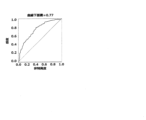
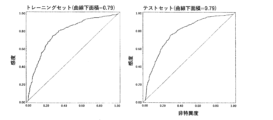
- Fig. 1 is a graph showing the performance of the prediction discriminant in Example 1 (31 specific compounds) evaluated by an ROC curve, in which the sample cohort is the training set in the right figure and the sample cohort is the test set in the left figure.
- the vertical axis indicates sensitivity and the horizontal axis indicates non-specificity (1-specificity).
- FIG. 2 is a graph showing an ROC curve evaluation of the performance of the prediction discriminant in the example for a cohort different from that in FIG. 1 .
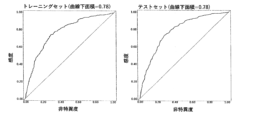
- FIG. 3 is a graph showing the performance of the prediction discriminant in Example 2 (21 types of specific compounds) evaluated by an ROC curve, in which the sample cohort is the training set in the right graph and the sample cohort is the test set in the right graph.
- FIG. 1 is a graph showing the performance of the prediction discriminant in Example 1 (31 specific compounds) evaluated by an ROC curve, in which the sample cohort is the training set in the right figure and the sample cohort is the test set in the left figure.
- the vertical axis indicates sensitivity and the horizontal
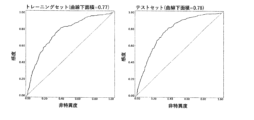
- FIG. 4 is a graph showing the performance of the prediction discriminant in Example 3 (15 types of specific compounds) evaluated by an ROC curve, in which the sample cohort is the training set in the right graph and the sample cohort is the test set in the right graph.
- FIG. 5 is a graph showing the performance of the prediction discriminant in Example 4 (14 types of specific compounds) evaluated by an ROC curve, in which the sample cohort is the training set in the right panel and the sample cohort is the test set in the right panel.
- the onset risk assessment method of the first embodiment of the present invention is a method for assessing the presence or absence of future onset of non-alcoholic fatty liver disease (hereinafter sometimes abbreviated as "NAFLD"), and uses 14 types of compounds consisting of lactic acid, alanine, acetylglycine, isoleucine, proline, serine, glutaric acid, ⁇ -ketoglutaric acid, creatinine, glutamic acid, asparagine, fructose, uric acid, and tryptophan as biomarkers for assessing the onset risk of NAFLD.
- the assessment method of the first embodiment includes an acquisition step, a detection step, and a use step. Each step will be described in detail below.
- Body fluids include blood, urine, saliva, sweat, phlegm, and feces.
- Blood includes whole blood, plasma, and serum. Blood is preferred, and serum is more preferred. Blood is minimally invasive and is easily obtained as a sample for screening in health checkups and the like.
- the sample is temporarily stored before the detection step.
- the storage method may be freezing, refrigeration, or room temperature.
- serum or plasma When serum or plasma is used as the sample, it may be stored in the form of whole blood, or in the form of serum or plasma obtained by centrifuging whole blood.
- Detection step In this step, at least all of the 14 types of compounds consisting of lactic acid, alanine, acetylglycine, isoleucine, proline, serine, glutaric acid, ⁇ -ketoglutaric acid, creatinine, glutamic acid, asparagine, fructose, uric acid, and tryptophan are detected from the sample.
- these 14 types of compounds are collectively referred to as specific compounds.
- detecting a compound refers to directly or indirectly detecting a specific compound contained in a sample for quantitative determination, and specifically includes not only detecting the specific compound itself, but also processing the specific compound by ionization, dissociation, derivatization, etc., and detecting the processed specific compound (ionized product, dissociated product, derivative, etc.).
- the detection method may be any method capable of quantifying a specific compound contained in a sample, such as gas chromatography (GC), liquid chromatography (LC), mass spectrometry (MS), gas chromatography/mass spectrometry (GC/MS), liquid chromatography/mass spectrometry (LC/MS), nuclear magnetic resonance spectrometry, immunological detection methods, etc.
- GC gas chromatography
- LC liquid chromatography
- MS mass spectrometry
- GC/MS gas chromatography/mass spectrometry
- LC/MS liquid chromatography/mass spectrometry
- nuclear magnetic resonance spectrometry etc.
- examples of the ionization method include electron ionization (EI), electrospray ionization (ESI), and atmospheric pressure chemical ionization (APCI).
- Examples of the mass separation method include quadrupole, magnetic sector, time-of-flight, ion trap, and ion cyclotron resonance.
- Other examples include tandem mass separation methods such as triple quadrupole (Q-Q), tandem time-of-flight (TOF-TOF), quadrupole-time-of-flight (Q-TOF), quadrupole-ion trap (Q-IT), quadrupole-ion cyclotron resonance (Q-ICR), and ion trap-time-of-flight (IT-TOF).
- the sample Before carrying out the detection step, the sample may be pretreated. Pretreatments include treatments aimed at purification, derivatization, etc. For example, when detecting serum or the like by mass spectrometry, it is preferable to carry out deproteinization treatment, derivatization, etc.
- Deproteinization is carried out, for example, by mixing an extraction solvent such as chloroform and water with the sample, centrifuging the mixture, and removing the precipitate from the mixture after centrifugation.
- an extraction solvent such as chloroform and water
- Examples of derivatization include silylation such as trimethylsilylation, dimethylsilylation, and halomethylsilylation; esterification such as methyl esterification; acylation; and alkylation. From the viewpoints of the large number of target compounds that can be derivatized, the ability to react with many compounds having active hydrogen, and the ability to give peaks in mass spectra that facilitate analysis, silylation is preferred, and trimethylsilylation is particularly preferred. In other words, it is preferable to use the detection amount of a derivative of a specific compound, and in particular, a trimethylsilylated derivative of a specific compound.
- trimethylsilylation for example, a methoxyamine solution is added to the freeze-dried sample to convert it into an oxime, and then a trimethylsilylation agent is added.
- trimethylsilylation agents include N,O-bis(trimethylsilyl)trifluoroacetamide (BSTFA) and N-Methyl-N-trimethylsilyltrifluoroacetamide (MSTFA).
- trimethylsilylated derivatives of specific compounds include: Bis(trimethylsilyl)lactic acid (Lactic acid-2TMS), Bis(trimethylsilyl)alanine (Alanine-2TMS), Trimethylsilylacetylglycine (TMS), Bis(trimethylsilyl)isoleucine (Isoleucine-2TMS), Bis(trimethylsilyl)proline (Proline-2TMS), Tris(trimethylsilyl)serine (Serine-3TMS), Bis(trimethylsilyl)glutaric acid (Glutaric acid-2TMS), Bis(trimethylsilyl) ⁇ -ketoglutaric acid-methyloxime ( ⁇ -Ketoglutaric acid-methyloxime-2TMS), Tris(trimethylsilyl)creatinine (Creatinine-3TMS), Tris(trimethylsilyl)glutamic acid (Glutamic acid-3TMS), Tris(trimethylsilyl)asparagine (Asparagine-3TMS
- multiple derivatives may be obtained for one specific compound (e.g., Glycine, which will be described later). In that case, only one of the multiple derivatives may be selected, or multiple derivatives may be selected.
- a predetermined coefficient (described later) is set for each of the multiple derivatives in the use step, which will be described later.
- the detection amounts of multiple derivatizations may be added together and set. Then, the detection amounts of the multiple derivatives and the multiple corresponding predetermined coefficients are substituted into the prediction discriminant. Even when multiple derivatives are used from one type of specific compound, the number of specific compounds selected is treated as one type.
- a stable isotope of a specific compound and/or an internal standard By mixing a stable isotope, the absolute amount of a specific compound contained in a body fluid such as blood can be measured. Furthermore, by mixing an internal standard, the accuracy of quantification by mass spectrometry can be improved.
- stable isotopes include compounds in which one or more carbon atoms, hydrogen atoms, nitrogen atoms, or oxygen atoms in the molecule are replaced with stable carbon isotopes (12C, 13C), stable hydrogen isotopes (1H, 2H, D), stable nitrogen isotopes (14N, 15N), and stable oxygen isotopes (16O, 17O, 18O).
- the internal standard may be any substance that is not naturally contained in body fluids, such as 2-isopropylmalic acid, ribitol, and tropic acid.
- the pretreated sample is detected by the above detection method.
- the detection method conditions can be appropriately carried out with reference to the conditions recommended by the device used in the detection method (e.g., GC/MS device, LC/MS device).
- the amount of detection is determined appropriately depending on the detection method and the detection device, and is output, for example, as a concentration; a peak area or peak intensity of a mass spectrum or mass chromatogram; or light intensity.
- the amount of detection may be converted.
- the amount of detection of a specific compound is output as a peak area of a mass spectrum, the peak area may be converted to a concentration.
- the conversion examples include known methods such as the internal standard method and the absolute calibration curve method, and the conversion may be performed using any of the means such as an analysis function attached to the detection device, another analysis device, or manually.
- a concentration as the amount of detection, and it is particularly preferable to use the concentration ( ⁇ g) of the specific compound present in 1 mL of serum.
- the amounts of all 14 types of specific compounds detected in the subject's sample are used in a specified formula, specifically, substituted into a predictive discriminant formula. Then, based on the results obtained, it is evaluated whether or not the subject is likely to develop NAFLD in the future.
- the prediction discriminant formula contains the sum (specifically, the second term on the right side of formula (1) described below) of the values obtained by multiplying each of the detected amounts of the 14 specific compounds by a specific coefficient for each specific compound.
- each detected amount of a compound (14 types) is multiplied by a specific coefficient that is determined in advance for each compound. This gives 14 values for each compound, which are then summed to derive a sum, and this sum is then substituted into the prediction discriminant formula.
- the calculation result from the prediction discriminant i.e., the hazard ratio
- the criterion for judging whether or not the subject will develop NAFLD in the future (for example, within 1 to 3 years). For example, if the hazard ratio is 4 or higher, the risk of development is judged to be high; if the hazard ratio is 1 or higher but less than 4, the risk of development is judged to be medium; and if it is less than 1, the possibility of development is judged to be low.
- the constant K and the predetermined coefficients (14 types of coefficients) for each compound can be obtained, for example, by acquiring data in advance from measurements of a large number of samples from healthy subjects and samples from NAFLD patients, and calculating and verifying this data using a statistical machine learning method (such as LASSO).
- LASSO statistical machine learning method
- the inventors have already collected a large amount of follow-up data on NAFLD disease in healthy subjects over the past three years, and have calculated the results, which are listed in Tables 2 to 8 in the Examples described below, and these constants K and coefficients for each compound can be used.
- a value using the amount of a specific compound detected in a sample from a subject is compared with a value using the amount of a specific compound detected in a sample from a person who remained healthy for a predetermined period after the sample was collected, or a person who was healthy at the time of sample collection but developed NAFLD within the predetermined period (normal group value or NAFLD pre-group value), and (ii) the risk of future onset of NAFLD may be determined to be high or low based on whether the subject's value is higher or lower than the normal group value or the NAFLD pre-group value.
- the value obtained by substituting the amount detected in the subject into the second term on the right side of the above formula (1) is compared with the result obtained by substituting the amount detected in the normal group or NAFLD pre-group into the second term on the right side of the above formula (1). And (ii) if the subject's value is equal to or higher (or lower) than the value of the pre-NAFLD group (threshold for developing NAFLD), the subject is judged to have a high risk of developing NAFLD in the future, and if the subject's value is equal to or lower (or higher) than the value of the normal group (threshold for normal), the subject is judged to have a low risk of developing NAFLD in the future. Part or all of this use process may be processed by a computer.
- the evaluation method of the first embodiment can predict whether a subject will suffer from NAFLD in the future. As a result, the subject's risk of developing NAFLD is evaluated. Therefore, for example, if a medical professional presents the judgment result obtained by implementing this discrimination method to a doctor, the doctor can use the judgment result to help the patient decide on a policy for preventing NAFLD.
- a treatment step can be performed.
- the treatment step includes known methods for treating NAFLD, such as dietary therapy, exercise therapy, drug therapy, and surgical therapy. Dietary therapy, exercise therapy, and surgical therapy that aim to reduce body weight are effective, and medications used in drug therapy include, for example, antioxidants and antidiabetic drugs. These therapies are applied in appropriate combinations depending on the condition of the subject.
- the detection results of 14 specific compounds are used, but the present invention may include the detection amounts of 31 specific compounds, and may also include the detection amounts of other compounds. That is, the detection amounts of 15 or more compounds may be used. Examples are shown below.
- 31 kinds of compounds consisting of lactic acid, alanine, acetylglycine, isoleucine, proline, serine, glutaric acid, ⁇ -ketoglutaric acid, creatinine, glutamic acid, asparagine, fructose, uric acid, tryptophan, pyruvic acid, 2-aminobutyric acid, succinic acid, threonine, decanoic acid, methionine, phenylalanine, xylose, arabinose, ⁇ -aminoadipic acid, lysine, 1-hexadecanol, tyrosine, myoinositol, uridine, glycine and leucine are used as biomarkers for evaluating the risk of developing NAFLD.
- These 31 kinds of compounds are also collectively referred to as specific compounds.
- this embodiment is the same as the above embodiment. That is, the evaluation method of this implementation process includes an acquisition process, a detection process, and a use process, as described above in the first embodiment. This embodiment also achieves the same adoption effects as the first embodiment.
- the trimethylsilylated derivatives of the 31 specific compounds may be, for example, the following in addition to the trimethylsilylated derivatives of the 14 specific compounds: Trimethylsilylpyruvic acid-methyloxime (TMS), Bis(trimethylsilyl) 2-aminobutyric acid (2-Aminobutyric acid-2TMS), Bis(trimethylsilyl)succinic acid (Succinic acid-2TMS), Tris(trimethylsilyl)threonine (Threonine-3TMS), Trimethylsilyldecanoic acid (TMS), Bis(trimethylsilyl)methionine (Methionine-2TMS), Bis(trimethylsilyl)phenylalanine (Phenylalanine-2TMS), Tetrakis(trimethylsilyl)xylose-methyloxime (Xylose-methyloxime-4TMS), Tetrakis(trimethylsilyl)arabinose-methyloxime (Arabinose-methyloxime-4TM
- 21 types of compounds consisting of lactic acid, alanine, acetylglycine, isoleucine, proline, serine, glutaric acid, ⁇ -ketoglutaric acid, creatinine, glutamic acid, asparagine, fructose, uric acid, tryptophan, 3-hydroxybutyric acid, leucine, glycine, methionine, glucose, tyrosine, and myo-inositol are used as biomarkers for evaluating the risk of developing NAFLD. These 21 types of compounds are collectively referred to as specific compounds.
- this embodiment is the same as the above embodiment. That is, the evaluation method of this implementation process includes an acquisition process, a detection process, and a use process, as described above in the first embodiment. This embodiment also achieves the same adoption effects as the first embodiment.
- the trimethylsilylated derivatives of the 21 specific compounds may be, for example, the following in addition to the trimethylsilylated derivatives of the 14 specific compounds: Bis(trimethylsilyl) 3-hydroxybutyric acid (3-Hydroxybutyric acid-2TMS), Bis(trimethylsilyl)leucine (Leucine-2TMS), Bis(trimethylsilyl)glycine (Glycine-2TMS) and/or tris(trimethylsilyl)glycine (Glycine-3TMS), Bis(trimethylsilyl)methionine (Methionine-2TMS), Pentakis(trimethylsilyl)glucose-methyloxime (Glucose-methyloxime-5TMS), Tris(trimethylsilyl)tyrosine (Tyrosine-3TMS), Hexakis(trimethylsilyl)myo-inositol (myo-Inositol-6TMS)
- glycine is used as a biomarker for evaluating the risk of developing NAFLD.
- 15 kinds of compounds consisting of lactic acid, alanine, acetylglycine, isoleucine, proline, serine, glutaric acid, ⁇ -ketoglutaric acid, creatinine, glutamic acid, asparagine, fructose, uric acid and glycine are used as a biomarker for evaluating the risk of developing NAFLD.
- These 15 kinds of compounds are collectively referred to as specific compounds.
- this embodiment is the same as the above embodiment. That is, the evaluation method of this implementation process includes an acquisition process, a detection process, and a use process, as described above in the first embodiment. This embodiment also achieves the same adoption effects as the first embodiment.
- the trimethylsilylated derivatives of the 15 specific compounds include, in addition to the trimethylsilylated derivatives of the 14 specific compounds mentioned above, for example, bis(trimethylsilyl)glycine (Glycine-2TMS) and/or tris(trimethylsilyl)glycine (Glycine-3TMS).
- Glycine-2TMS bis(trimethylsilyl)glycine
- Glycine-3TMS tris(trimethylsilyl)glycine
- at least 15 types of detection amounts are used. Specifically, the detection amounts of the at least 15 specific compounds are multiplied by a predetermined coefficient for each specific compound, and the total is used in the prediction discriminant.
- a method for assessing the risk of developing non-alcoholic fatty liver disease may include a detection step for detecting 14 types of compounds consisting of lactic acid, alanine, acetylglycine, isoleucine, proline, serine, glutaric acid, ⁇ -ketoglutaric acid, creatinine, glutamic acid, asparagine, fructose, uric acid, and tryptophan in the sample, and a use step for using all of the 14 detected amounts obtained by the detection step.
- This evaluation method makes it possible to predict whether or not a subject will suffer from NAFLD in the future.
- the detection amounts of the 14 types of compounds obtained in the detecting step may be multiplied by a predetermined coefficient for each of the 14 types of compounds to at least sum up the values.
- the detection step may obtain the concentrations of the 14 types of compounds or their derivatives. This evaluation method makes it possible to more reliably predict whether or not a subject will suffer from NAFLD in the future.
- the derivative may be one that has been derivatized by silylation, acylation, esterification, or alkylation. This evaluation method allows the derivative to be detected with high sensitivity, making it possible to more accurately predict whether or not a patient is affected by NAFLD.
- the detection step may be performed by gas chromatography, liquid chromatography, mass spectrometry, gas chromatography/mass spectrometry, liquid chromatography/mass spectrometry, nuclear magnetic resonance spectroscopy, or an immunological detection method.
- This evaluation method uses a detection method with good sensitivity, making it possible to more accurately predict whether or not a patient suffers from NAFLD.
- the body fluid may be blood. According to this evaluation method, measurement samples are easy to obtain and the method is less invasive to the subject, so that the burden of diagnosis on the subject can be reduced.
- the biomarker for assessing the risk of developing non-alcoholic fatty liver disease may contain 14 types of compounds consisting of lactic acid, alanine, acetylglycine, isoleucine, proline, serine, glutaric acid, ⁇ -ketoglutaric acid, creatinine, glutamic acid, asparagine, fructose, uric acid, and tryptophan. This biomarker makes it possible to predict whether or not a subject will suffer from NAFLD in the future.
- the biomarker for assessing the risk of developing non-alcoholic fatty liver disease described in Item 10 may contain 15 types of compounds consisting of lactic acid, alanine, acetylglycine, isoleucine, proline, serine, glutaric acid, ⁇ -ketoglutaric acid, creatinine, glutamic acid, asparagine, fructose, uric acid, tryptophan, and glycine. This biomarker makes it possible to more reliably predict whether or not a person will suffer from NAFLD.
- the biomarker for assessing the risk of developing non-alcoholic fatty liver disease described in Item 10 may contain 21 types of compounds consisting of lactic acid, alanine, acetylglycine, isoleucine, proline, serine, glutaric acid, ⁇ -ketoglutaric acid, creatinine, glutamic acid, asparagine, fructose, uric acid, tryptophan, 3-hydroxybutyric acid, leucine, glycine, methionine, glucose, tyrosine, and myo-inositol. This biomarker makes it possible to more reliably predict whether or not a person will suffer from NAFLD.
- the biomarker for assessing the risk of developing non-alcoholic fatty liver disease described in Item 10 may contain 31 types of compounds consisting of lactate, alanine, acetylglycine, isoleucine, proline, serine, glutaric acid, ⁇ -ketoglutaric acid, creatinine, glutamic acid, asparagine, fructose, uric acid, tryptophan, pyruvic acid, 2-aminobutyric acid, succinic acid, threonine, decanoic acid, methionine, phenylalanine, xylose, arabinose, ⁇ -aminoadipic acid, lysine, 1-hexadecanol, tyrosine, myo-inositol, uridine, glycine, and leucine.
- This biomarker makes it possible to more reliably predict whether or not a person will suffer from NAFLD.
- GC/MS was performed using serum obtained from patients who had been diagnosed with NAFLD based on abdominal ultrasound findings within the past three years (NAFLD pre-group) and serum obtained from patients who had been healthy for the past three years (normal group), and the results of the analysis conducted to search for components in the serum with different concentrations between the NAFLD pre-group and the normal group are described.
- Subjects with a history of current medical treatment for liver disease Subjects with a history of current medical treatment for at least one of the following: diabetes mellitus, dyslipidemia, or hyperuricemia.
- Subjects with a history of current medical treatment for malignant disease Subjects with a history of current medical treatment for malignant disease.
- an internal standard solution 2-isopropylmalic acid; 0.1 mg/mL
- the dried sample was mixed with 80 ⁇ L of a pyridine solution containing methoxyamine hydrochloride (methoxyamine hydrochloride; 20 mg/mL) and 40 ⁇ L of N-methyl-N-trimethylsilyltrifluoroacetamide, and then centrifuged. 50 ⁇ L of the resulting supernatant was placed in the autosampler of the GC/MS.
- methoxyamine hydrochloride methoxyamine hydrochloride
- LASSO is one of the machine learning methods. Specifically, before performing LASSO, subjects were divided into two groups, a training set and a test set, a prediction discriminant was developed in the training set, and its validation was performed in the test set. In performing LASSO, logistic regression with 10-fold cross-validation was applied.
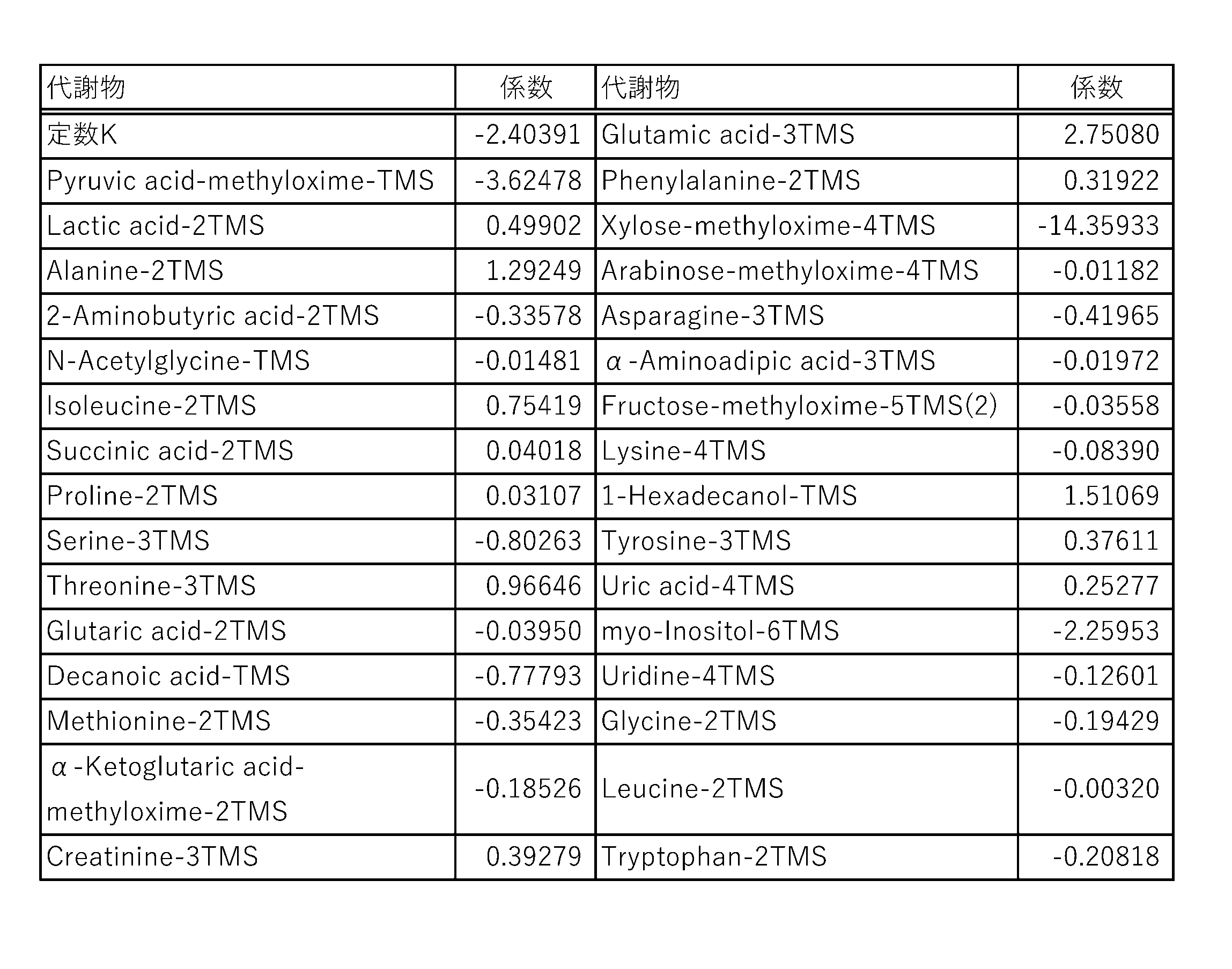
- the prediction score (formula (1) below) is the sum of a predetermined constant (first term on the right side) and the sum of the detected amounts of each compound multiplied by each coefficient (second term on the right side).
- This prediction score is a logarithmic hazard ratio, and the hazard ratio (hazard ratio relative to the median hazard in the general population for the onset of NAFLD) is derived by calculating 1e [prediction score].
- TMS in Table 2 stands for trimethylsilylated derivative.
- Equation 1 the second term on the right side is the sum of 31 compounds, the constant K and the coefficients of each compound are as shown in Table 2, and the detection amount of each compound is the concentration ( ⁇ g) of a specific compound present in 1 mL of serum.
- Example 2 Among the 40 metabolites, 6 metabolites having unstable elements (Leucine-TMS, Decanoic acid-TMS, 1-Hexadecanol-TMS, Uridine-4TMS, 2-Aminoadipic acid-3TMS, Histidine-3TMS) were excluded in order to improve the stability of the analysis, and the values of 34 metabolites (specific compounds) were subjected to the LASSO method in the same manner as in Example 1 (cohort of 4,495 people). As a result, 21 metabolites were selected as distinguishable metabolites, as shown in Table 4 below, and the regression coefficients of these were calculated. In addition, the relationship between the hazard ratio and the incidence rate was calculated, as shown in Table 5 below.
- ROC analysis was performed using the above 21 metabolites in the same manner as in Example 1, and the results are shown in Figure 3.
- the AUC was a good value of 0.79 for both the training set and the test set.
- Example 3 Six metabolites having unstable elements (Leucine-TMS, Decanoic acid-TMS, 1-Hexadecanol-TMS, Uridine-4TMS, 2-Aminoadipic acid-3TMS, Histidine-3TMS) were excluded from the above 40 metabolites, and the values of 15 metabolites (specific compounds) were subjected to the LASSO method in the same manner as in Example 1 (cohort of 4,495 people) except that a mode was executed in which the number of metabolites was set to be small. As a result, 15 metabolites were selected as distinguishable metabolites, as shown in Table 6 below, and their regression coefficients were calculated, and the relationship between the hazard ratio and the incidence rate was calculated, as shown in Table 7 below.
- ROC analysis was performed using the above 15 metabolites in the same manner as in Example 1, and the results are shown in Figure 4.
- the AUC was a good value of 0.78 for both the training set and the test set.
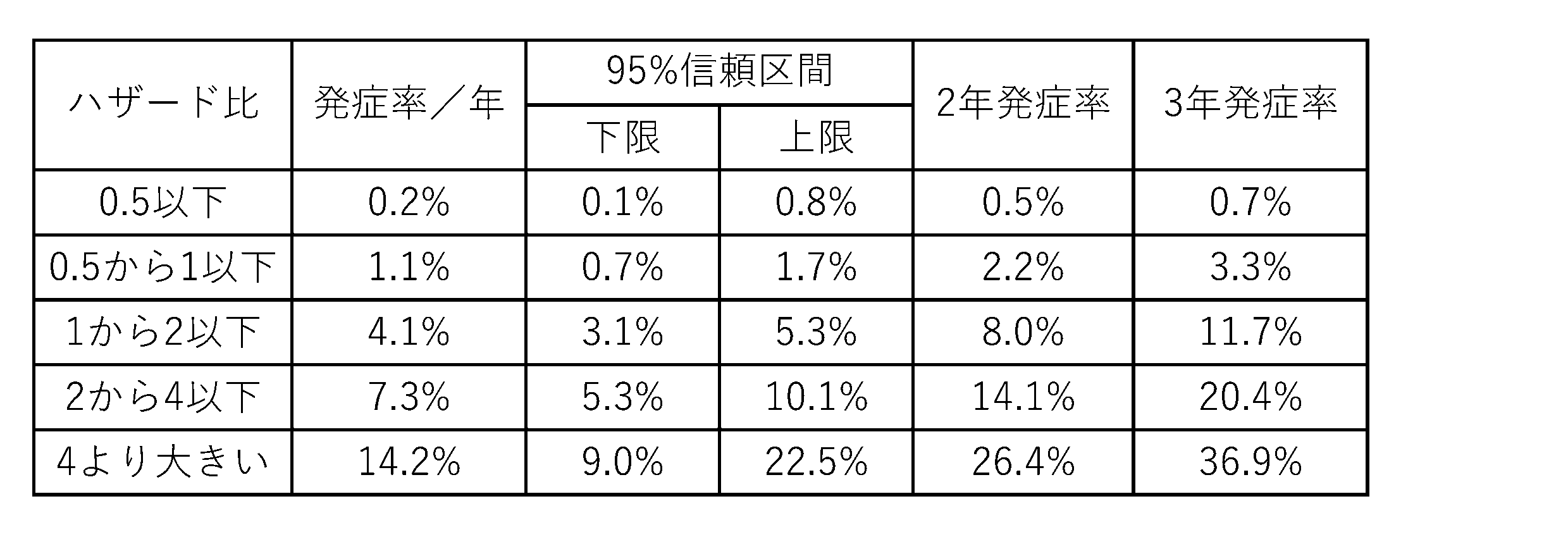
- Example 4 Fourteen types of compounds common to Examples 1 to 3 were selected as distinguishable compounds (see Table 8 below). In addition, as shown in Table 9 below, the relationship between the hazard ratio and the incidence rate was calculated.
Landscapes
- Life Sciences & Earth Sciences (AREA)
- Health & Medical Sciences (AREA)
- Engineering & Computer Science (AREA)
- Molecular Biology (AREA)
- Hematology (AREA)
- Chemical & Material Sciences (AREA)
- Urology & Nephrology (AREA)
- Immunology (AREA)
- Biomedical Technology (AREA)
- Physics & Mathematics (AREA)
- Medicinal Chemistry (AREA)
- Food Science & Technology (AREA)
- Biotechnology (AREA)
- Proteomics, Peptides & Aminoacids (AREA)
- Microbiology (AREA)
- Pathology (AREA)
- General Physics & Mathematics (AREA)
- Cell Biology (AREA)
- General Health & Medical Sciences (AREA)
- Analytical Chemistry (AREA)
- Biochemistry (AREA)
- Bioinformatics & Cheminformatics (AREA)
- Bioinformatics & Computational Biology (AREA)
- Biophysics (AREA)
- Investigating Or Analysing Biological Materials (AREA)
Abstract
Description
本発明の第1の実施形態の発症リスク評価方法は、将来における非アルコール性脂肪肝疾患(以下、「NAFLD」と略することもある。)の発症の有無を評価する方法であり、NAFLDの発症リスクを評価するためのバイオマーカーとして、乳酸、アラニン、アセチルグリシン、イソロイシン、プロリン、セリン、グルタル酸、α-ケトグルタル酸、クレアチニン、グルタミン酸、アスパラギン、フルクトース、尿酸およびトリプトファンからなる14種類の化合物を使用するものである。具体的には、第1の実施形態の評価方法は、取得工程、検出工程および使用工程を備える。以下、各工程を詳述する。
本工程では、 被験者の体液に由来する試料を取得する。
本工程では、試料から、乳酸、アラニン、アセチルグリシン、イソロイシン、プロリン、セリン、グルタル酸、α-ケトグルタル酸、クレアチニン、グルタミン酸、アスパラギン、フルクトース、尿酸およびトリプトファンからなる14種類の化合物の全てを少なくとも検出する。以下、これらの14種類の化合物をまとめて、特定化合物とも称する。
ビス(トリメチルシリル)乳酸(Lactic acid-2TMS)、
ビス(トリメチルシリル)アラニン(Alanine-2TMS)、
トリメチルシリルアセチルグリシン(Acetylglycine-TMS)、
ビス(トリメチルシリル)イソロイシン(Isoleucine-2TMS)、
ビス(トリメチルシリル)プロリン(Proline-2TMS)、
トリス(トリメチルシリル)セリン(Serine-3TMS)、
ビス(トリメチルシリル)グルタル酸(Glutaric acid-2TMS)、
ビス(トリメチルシリル)α-ケトグルタル酸-メチルオキシム(α-Ketoglutaric acid-methyloxime-2TMS)、
トリス(トリメチルシリル)クレアチニン(Creatinine-3TMS)、
トリス(トリメチルシリル)グルタミン酸(Glutamic acid-3TMS)、
トリス(トリメチルシリル)アスパラギン(Asparagine-3TMS)、
ペンタキス(トリメチルシリル)フルクトース-メチルオキシム(Fructose-methyloxime-5TMS)、
テトラキス(トリメチルシリル)尿酸(Uric acid-4TMS)、
ビス(トリメチルシリル)トリプトファン(Tryptophan-2TMS)
などが挙げられる。なお、特定化合物を誘導体化する際、一つの特定化合物(例えば、後述するGlycine)に対して、複数の誘導体(例えば、Glycine-2TMSおよびGlycine-3TMS)が得られる場合がある。その際は、複数の誘導体のうち、任意に、一つのみを選択してもよく、複数を選択してもよい。複数の誘導体を選択した場合は、後述する使用工程において、複数の誘導体のそれぞれに対して、所定の係数(後述)をそれぞれ設定する。また、係数を設定する際に、複数の誘導体化の検出量を足し合わせて設定してもよい。そして、複数の誘導体の検出量およびそれらに対応する複数の所定の係数を、予測判別式に代入する。一種類の特定化合物から複数の誘導体を使用した場合でも、選択される特定化合物の数は一種類として扱う。
本工程では、前記検出工程によって得られた14種類の検出量の全てを少なくとも使用する。具体的には、特定化合物における14種類の検出量の全てを使用し、その使用結果に基づいて、将来において、被験者がNAFLDに罹患するリスクを評価する。この使用によって、被験者に対して、NAFLDの発症リスクの高低が評価される

上記第1の実施形態では、14種類の特定化合物の検出結果を用いているが、本発明は、31種類の特定化合物の検出量を含んでいればよく、例えば、その他の化合物の検出量も加えていてもよい。すなわち、15種類以上の化合物の検出量を用いていてもよい。以下に例示する。
本実施形態では、NAFLDの発症リスクを評価するためのバイオマーカーとして、乳酸、アラニン、アセチルグリシン、イソロイシン、プロリン、セリン、グルタル酸、α-ケトグルタル酸、クレアチニン、グルタミン酸、アスパラギン、フルクトース、尿酸およびトリプトファンからなる14種類の化合物に加えて、さらに、ピルビン酸、2-アミノ酪酸、コハク酸、スレオニン、デカン酸、メチオニン、フェニルアラニン、キシロース、アラビノース、α-アミノアジピン酸、リジン、1-ヘキサデカノール、チロシン、ミオイノシトール、ウリジン、グリシンおよびロイシンを使用するものである。すなわち、乳酸、アラニン、アセチルグリシン、イソロイシン、プロリン、セリン、グルタル酸、α-ケトグルタル酸、クレアチニン、グルタミン酸、アスパラギン、フルクトース、尿酸、トリプトファン、ピルビン酸、2-アミノ酪酸、コハク酸、スレオニン、デカン酸、メチオニン、フェニルアラニン、キシロース、アラビノース、α-アミノアジピン酸、リジン、1-ヘキサデカノール、チロシン、ミオイノシトール、ウリジン、グリシンおよびロイシンからなる31種類の化合物をNAFLD発症リスク評価用のバイオマーカーとして用いる。これらの31種類の化合物をまとめて、特定化合物とも称する。
トリメチルシリルピルビン酸-メチルオキシム(Pyruvic acid-methyloxime-TMS)、
ビス(トリメチルシリル)2-アミノ酪酸(2-Aminobutyric acid-2TMS)、
ビス(トリメチルシリル)コハク酸(Succinic acid-2TMS)、
トリス(トリメチルシリル)スレオニン(Threonine-3TMS)、
トリメチルシリルデカン酸(Decanoic acid-TMS)、
ビス(トリメチルシリル)メチオニン(Methionine-2TMS)、
ビス(トリメチルシリル)フェニルアラニン(Phenylalanine-2TMS)、
テトラキス(トリメチルシリル)キシロース-メチルオキシム(Xylose-methyloxime-4TMS)、
テトラキス(トリメチルシリル)アラビノース-メチルオキシム(Arabinose-methyloxime-4TMS)、
トリス(トリメチルシリル)α-アミノアジピン酸 (Aminoadipic acid-3TMS)、
テトラキス(トリメチルシリル)リジン(Lysine-4TMS)、
トリメチルシリル1-ヘキサデカノール(1-Hexadecanol-TMS)、
トリス(トリメチルシリル)チロシン(Tyrosine-3TMS)、
ヘキサキス(トリメチルシリル)ミオイノシトール(myo-Inositol-6TMS)、
テトラキス(トリメチルシリル)ウリジン(Uridine-4TMS)、
ビス(トリメチルシリル)グリシン(Glycine-2TMS)および/またはトリス(トリメチルシリル)グリシン(Glycine-3TMS)、
ビス(トリメチルシリル)ロイシン(Leucine-2TMS)、
などが挙げられる。また、使用工程では、少なくとも31種類の検出量を使用する。具体的には、少なくとも31種類の特定化合物(またはその誘導体)の検出量(濃度など)のそれぞれに、特定化合物ごとの所定の係数を乗じた値を合算し、それによって得られた総和を予測判別式に使用すればよい。
本実施形態では、NAFLDの発症リスクを評価するためのバイオマーカーとして、乳酸、アラニン、アセチルグリシン、イソロイシン、プロリン、セリン、グルタル酸、α-ケトグルタル酸、クレアチニン、グルタミン酸、アスパラギン、フルクトース、尿酸およびトリプトファンからなる14種類の化合物に加えて、さらに、3-ヒドロキシ酪酸、ロイシン、グリシン、メチオニン、グルコース、チロシンおよびミオ-イノシトールを使用するものである。すなわち、乳酸、アラニン、アセチルグリシン、イソロイシン、プロリン、セリン、グルタル酸、α-ケトグルタル酸、クレアチニン、グルタミン酸、アスパラギン、フルクトース、尿酸、トリプトファン、3-ヒドロキシ酪酸、ロイシン、グリシン、メチオニン、グルコース、チロシンおよびミオ-イノシトールからなる21種類の化合物をNAFLD発症リスク評価用のバイオマーカーとして用いる。これらの21種類の化合物をまとめて、特定化合物とも称する。
ビス(トリメチルシリル)3-ヒドロキシ酪酸(3-Hydroxybutyric acid-2TMS)、
ビス(トリメチルシリル)ロイシン(Leucine-2TMS)、
ビス(トリメチルシリル)グリシン(Glycine-2TMS)および/またはトリス(トリメチルシリル)グリシン(Glycine-3TMS)、
ビス(トリメチルシリル)メチオニン(Methionine-2TMS)、
ペンタキス(トリメチルシリル)グルコース-メチルオキシム(Glucose-methyloxime-5TMS)、
トリス(トリメチルシリル)チロシン(Tyrosine-3TMS)、
ヘキサキス(トリメチルシリル)ミオ-イノシトール(myo-Inositol-6TMS)
などが挙げられる。また、使用工程では、少なくとも21種類の検出量を使用する。具体的には、少なくとも21種類の特定化合物の検出量のそれぞれに、特定化合物ごとの所定の係数を乗じた値を合算し、それによって得られた総和を予測判別式に使用すればよい。
本実施形態では、NAFLDの発症リスクを評価するためのバイオマーカーとして、乳酸、アラニン、アセチルグリシン、イソロイシン、プロリン、セリン、グルタル酸、α-ケトグルタル酸、クレアチニン、グルタミン酸、アスパラギン、フルクトース、尿酸およびトリプトファンからなる14種類の化合物に加えて、さらに、グリシンを使用するものである。すなわち、乳酸、アラニン、アセチルグリシン、イソロイシン、プロリン、セリン、グルタル酸、α-ケトグルタル酸、クレアチニン、グルタミン酸、アスパラギン、フルクトース、尿酸、および、グリシンからなる15種類の化合物をNAFLD発症リスク評価用のバイオマーカーとして用いる。これらの15種類の化合物をまとめて、特定化合物とも称する。
上述した例示的な実施形態は、以下の態様の具体例であることが当業者により理解される。
以下の実施例では、健常者が3年以内に腹部超音波所見によりNAFLDと診断された患者から得られた血清(NAFLD予備群)と、3年間健常者である患者からから得られた血清(正常群)とを用いてGC/MSを実施し、NAFLD予備群と正常群とにおいて、濃度の異なる血清中の成分を探索した分析結果を説明する。
2015年10月から2016年9月までに病院を訪れた日本人の人間ドック受診者からランダムに抽出した者のうち、採用基準を満たした4,495人の血清を試料として用いた。採用基準は、以下の(1)~(5)のいずれにも該当しないこととした。
(1)研究参加に不同意を表明した者
(2)アルコール摂取量において、男性:エタノール換算30g/日以上、女性:エタノール換算20g/日以上である者
(3)肝疾患で治療中の現病歴を有する者
(4)糖尿病、脂質異常症、高尿酸血症の少なくとも一つについて治療中の現病歴を有する者
(5)悪性疾患について治療中の現病歴を有する者
対象者から採血した後、遠心分離にて血清を抽出し、採血から6時間以内に-80℃で冷凍した。冷凍保存後の血清を25℃で5分間放置して解凍した。解凍後の血清を遠心分離に供し、その上清を、規定量の40種の安定同位体が入ったチューブに採取した(表1は、測定対象である代謝物40種類に対応する安定同位体のうち、31種類の代謝物に対応する安定同位体のみを表記した)。採取した血清に、クロロホルム混合溶媒(メタノール/水/クロロホルム=2.5:1:1)250μL、内部標準溶液(2-イソプロピルリンゴ酸;0.1mg/mL)6μLを混合および振とうし、遠心分離を実施した後、さらに、水140μLを混合および振とうし、遠心分離を実施して、内部標準・安定同位体含有の試料を得た。この試料180μLを、室温、60分間の条件で遠心エバポレーターを用いて濃縮し、-80℃に30分放置して凍結させた後、凍結乾燥機を用いて一晩乾燥させた。
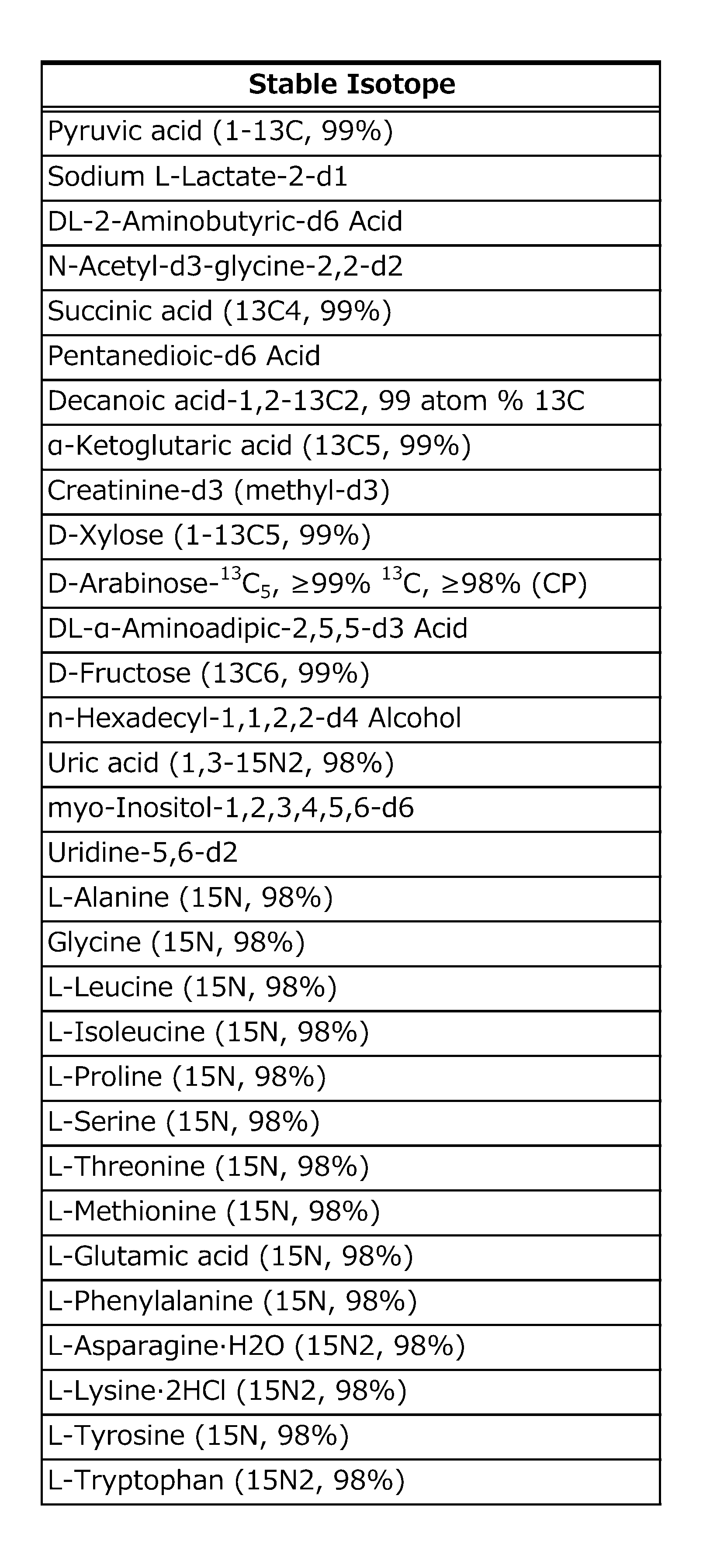
乾燥させた試料に、メトキシアミン塩酸塩を含むピリジン溶液(メトキシアミン塩酸塩;20mg/mL)80μL、および、N-メチル-N-トリメチルシリルトリフルオロアセトアミド40μLを順次混合および振とうした後、遠心分離を実施した。これにより得られた試料の上清50μLを、GC/MSのオートサンプラー内に設置した。
下記の条件で、試料に対して、ガスクロマトグラフィ質量分析法を実施した。
<ガスクロマトグラフィの条件>
システム:GCMS-TQ8040(島津製作所社製)
カラムオーブン温度:80℃
インジェクション温度:280℃
インジェクションモード:スプリット導入法
キャリアガス:ヘリウム
キャリアガス流量:39cm/sec
分離カラム:DB-5(アジレントテクノロジー社製)
固定相:(5%-フェニル)-メチルポリシロキサン(無極性)
カラム長さ:30.0m、カラム内径:0.25mm、カラム膜厚:1.00μm
カラム温度プログラム:80℃(0分)/80℃(2.5分)/280℃(18.5分)/280℃(23.0分)
<質量分析の条件>
システム:GCMS-TQ8040(島津製作所社製)
イオン源温度:200℃
インターフェイス温度:250℃
検出器電圧:0.2kV
測定モード:MRMモード
走査範囲:m/z 82-500
各保持時間においてm/zを走査して得られた検出強度から、各保持時間におけるマススペクトルを出力した。過去に得られた血清試料におけるマススペクトルのデータに基づいて、マススペクトルにおける各ピークに対応する代謝物(40種)とその代謝物に対応する安定同位体を同定した。各代謝物に対応する検出強度を、各代謝物に対応する安定同位体の検出強度を用いて標準化して、試料における濃度(単位μg/mL)を、検出量として算出した。
臨床診断情報およびGC/MSにより得られた検出量をもとに、正常群と発症群とが判別可能となる代謝物の組み合わせを、機械学習手法の1つであるLASSOを用いて、検討した。具体的には、LASSO実行前に、被験者をトレーニングセットおよびテストセットの2つのグループに分け、トレーニングセットで予測判別式を開発し、テストセットにおいてその検証(バリデーション)を実施した。LASSO実行では、10分割交差検証を実装したロジスティック回帰を適用した。

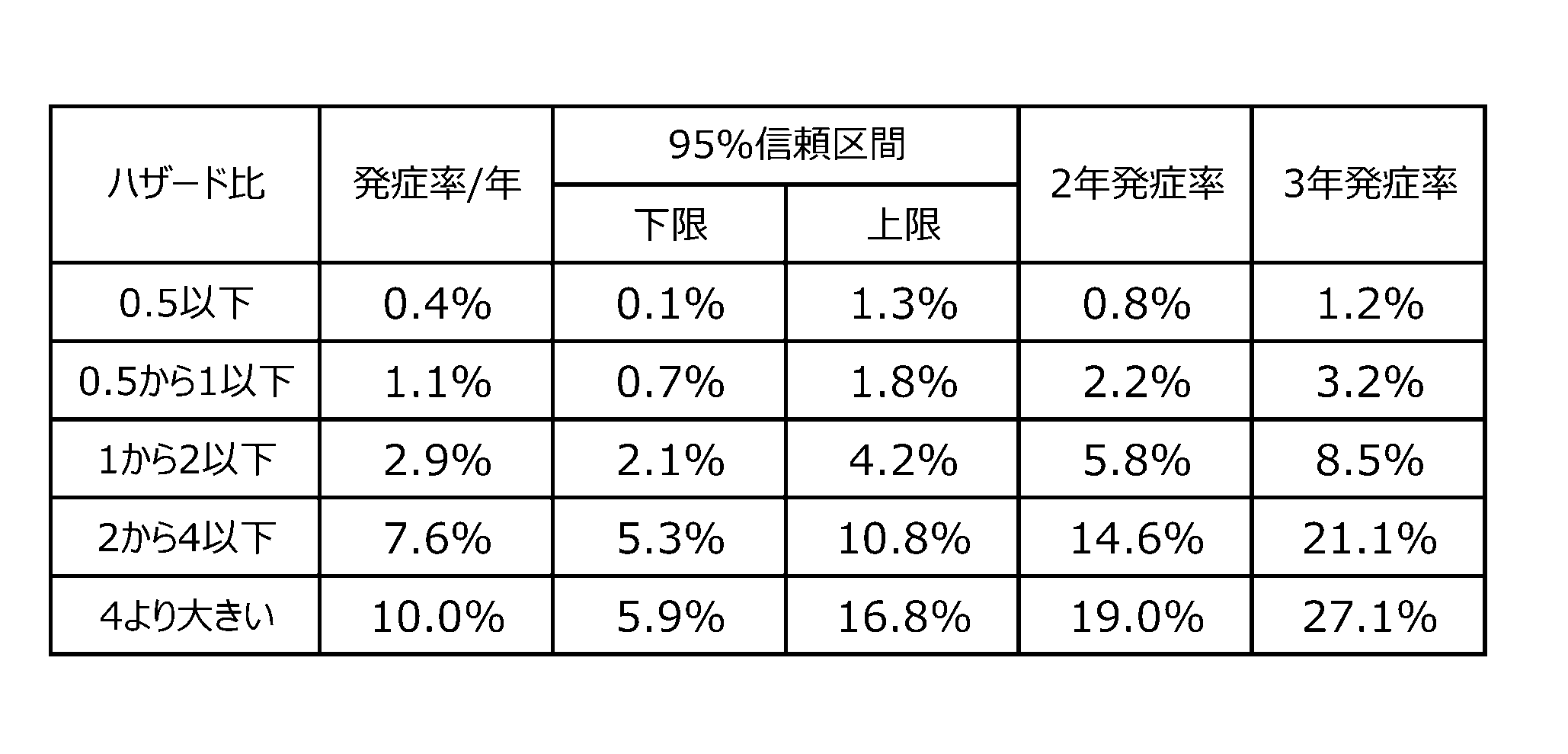
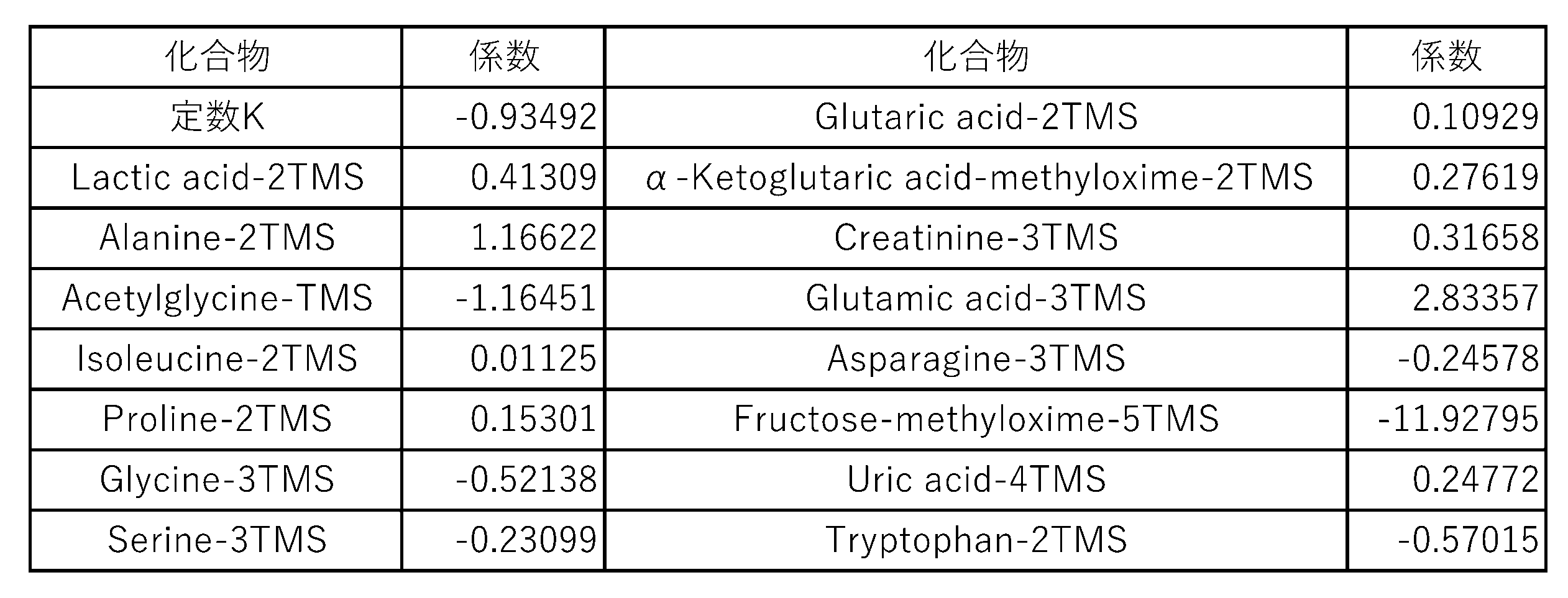
上記40種の代謝物から不安定要素を有する6種の代謝物(Leucine-TMS, Decanoic acid-TMS,1-Hexadecanol-TMS,Uridine-4TMS,2-Aminoadipic acid-3TMS,Histidine-3TMS)を、分析の安定性をより高めるために除外した以外は上記実施例1(4,495人のコホート)と同様にして、34種の代謝物(特定化合物)の値をLASSO法に供した。その結果、判別可能な代謝物として、下記表4に示すように、21種の代謝物が選出され、これらの回帰係数が算出され、また、下記表5に示すように、ハザード比と発症率との関係が算出された。
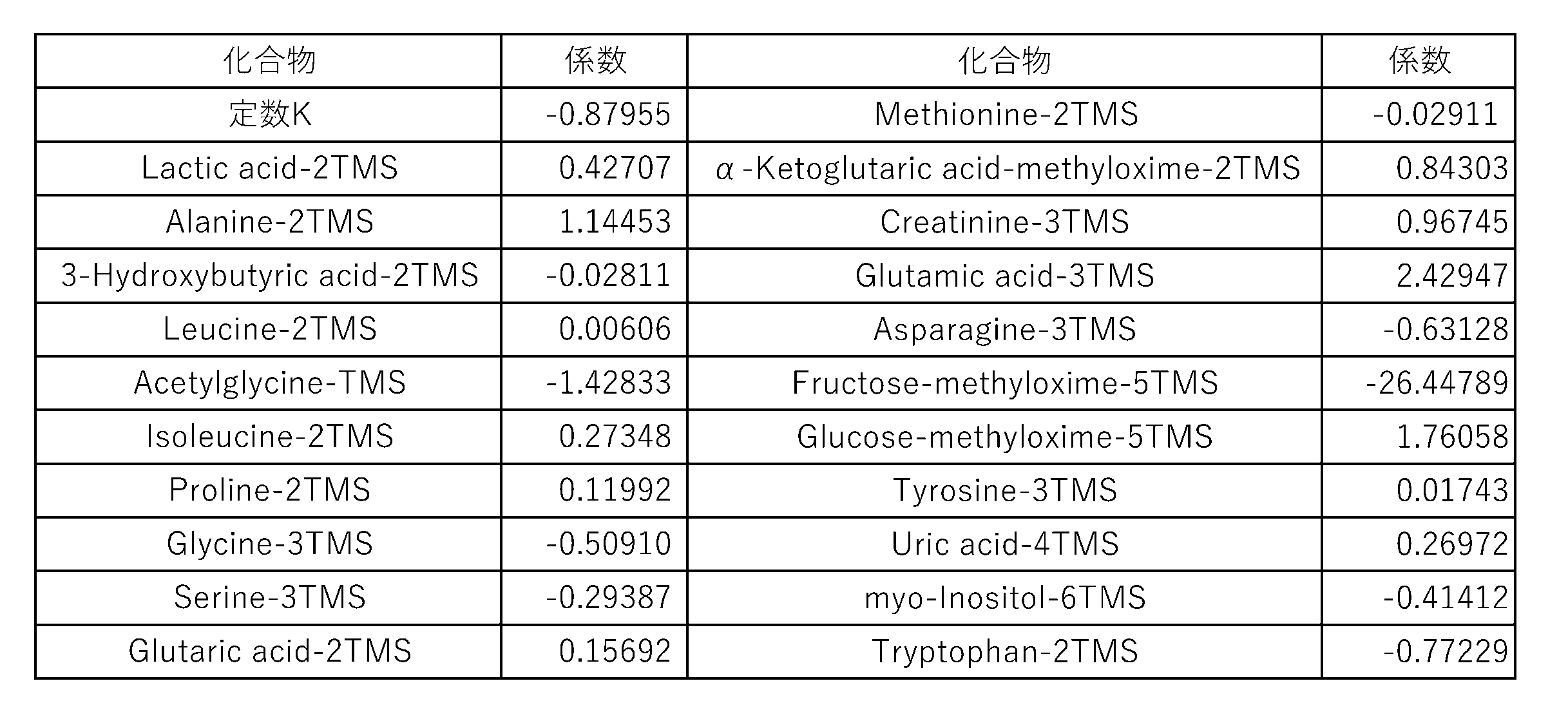
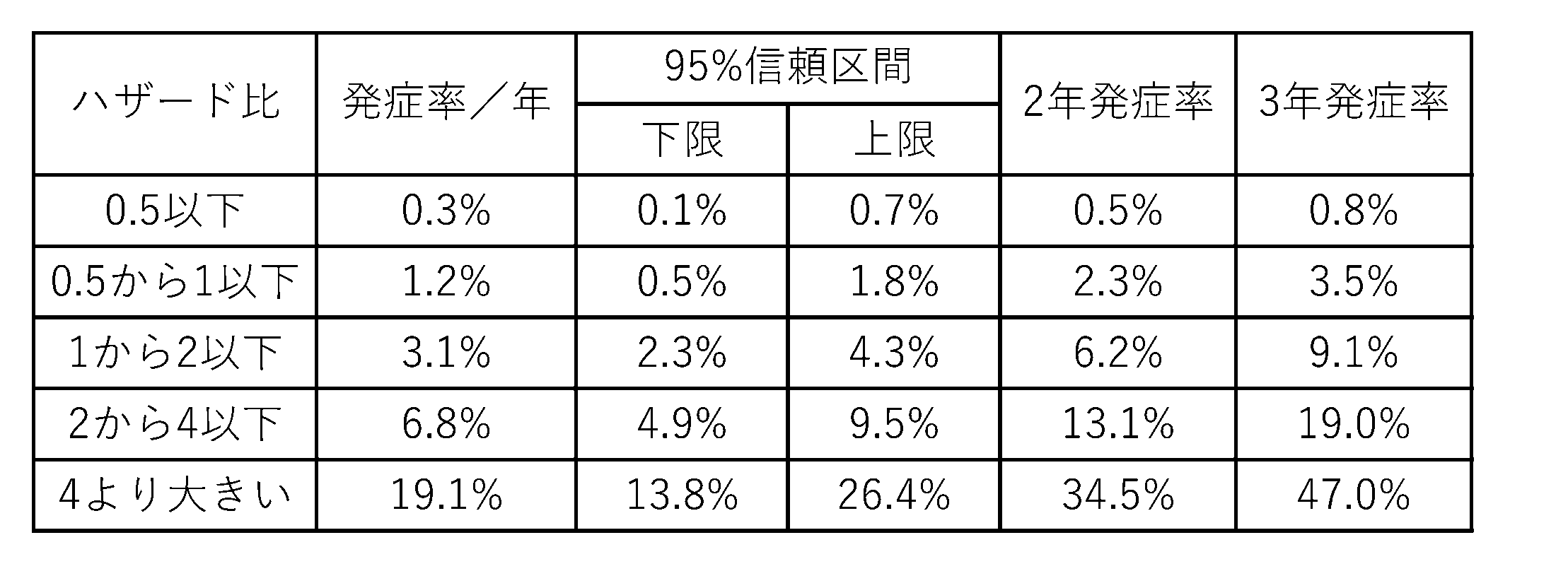
上記40種の代謝物から不安定要素を有する6種の代謝物(Leucine-TMS, Decanoic acid-TMS,1-Hexadecanol-TMS,Uridine-4TMS,2-Aminoadipic acid-3TMS,Histidine-3TMS)を除外し、さらに、代謝物の数が少なくように設定したモードを実行した以外は上記実施例1(4,495人のコホート)と同様にして、15種の代謝物(特定化合物)の値をLASSO法に供した。その結果、判別可能な代謝物として、下記表6に示すように、15種の代謝物が選出され、これらの回帰係数が算出され、また、下記表7に示すように、ハザード比と発症率との関係が算出された。
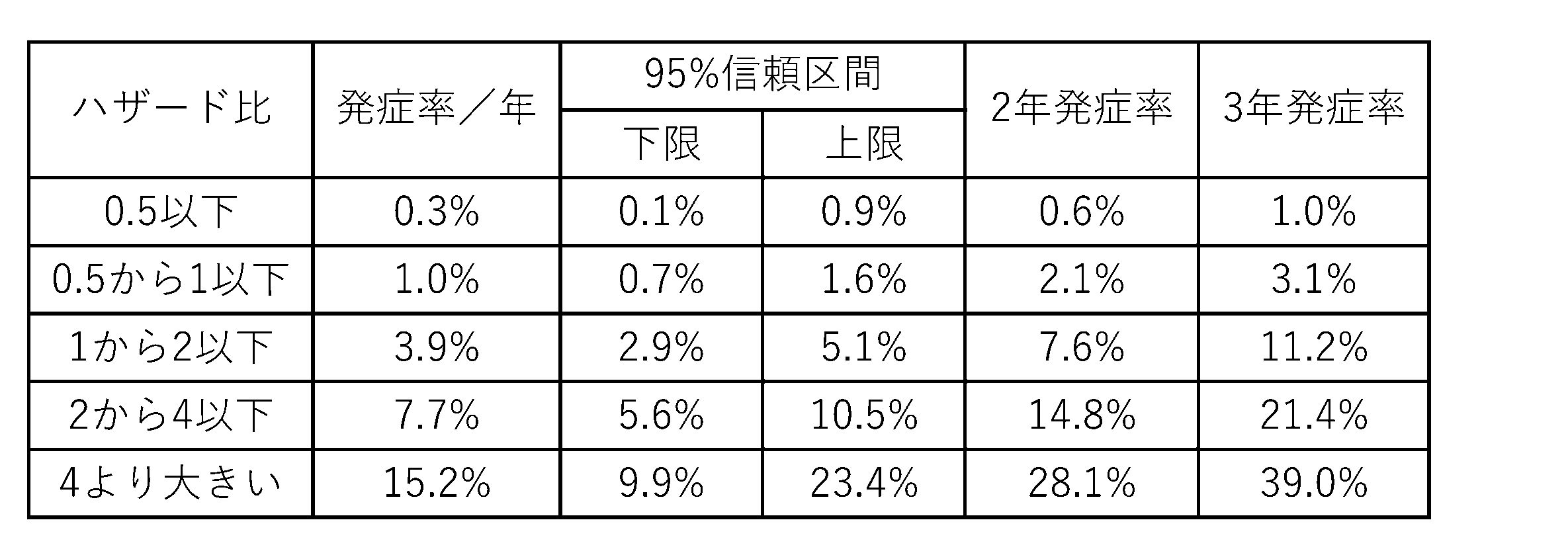
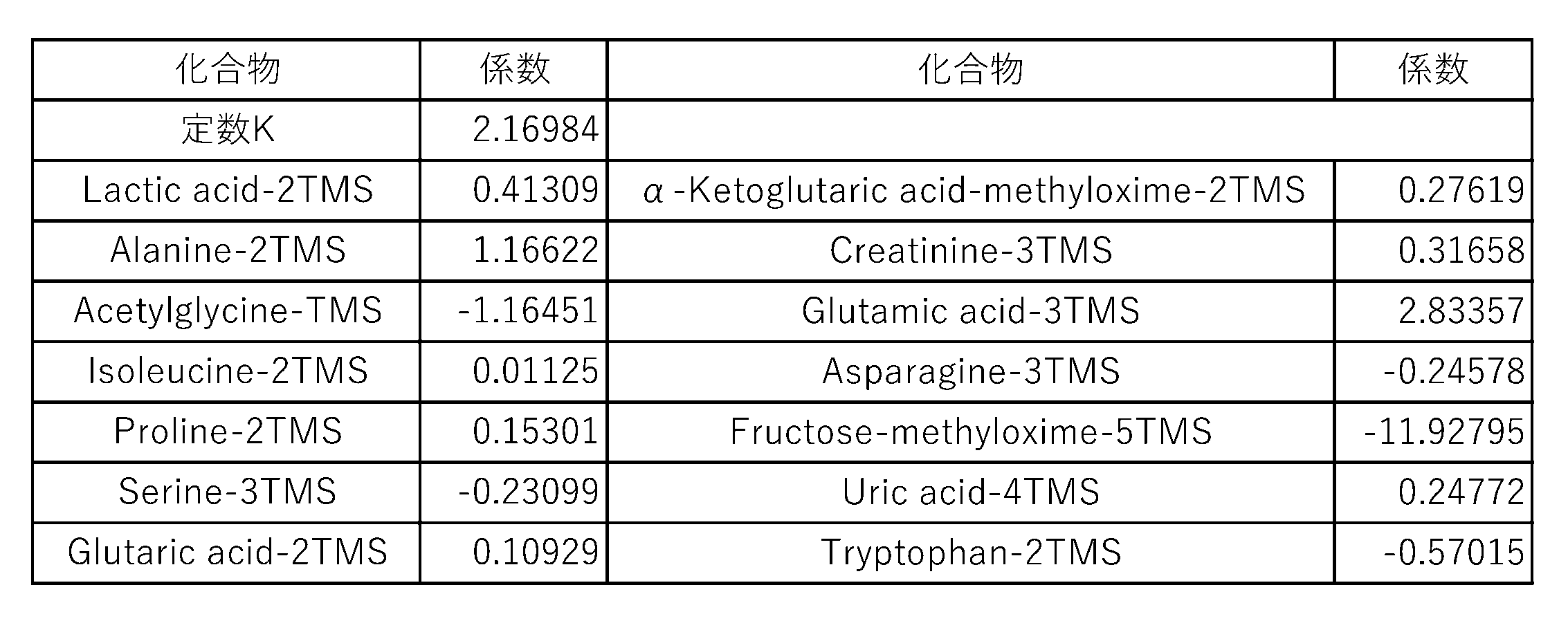
実施例1~3で共通する14種類の化合物を、判別可能な化合物として選出した(下記表8参照)。また、下記表9に示すように、ハザード比と発症率との関係を算出した。
Claims (13)
- 被験者の体液に由来する試料を取得する取得工程と、
前記試料中の乳酸、アラニン、アセチルグリシン、イソロイシン、プロリン、セリン、グルタル酸、α-ケトグルタル酸、クレアチニン、グルタミン酸、アスパラギン、フルクトース、尿酸およびトリプトファンからなる14種類の化合物を検出する検出工程と、
前記検出工程によって得られた14種類の検出量の全てを使用する使用工程と
を備える、非アルコール性脂肪肝疾患の発症リスク評価方法。 - 前記検出工程において、前記14種類の化合物に加えてグリシンを検出し、
前記使用工程において、前記検出工程によって得られた15種類の検出量の全てを使用する、請求項1に記載の発症リスク評価方法。 - 前記検出工程において、前記14種類の化合物に加えて、3-ヒドロキシ酪酸、ロイシン、グリシン、メチオニン、グルコース、チロシンおよびミオ-イノシトールを検出し、
前記使用工程において、前記検出工程によって得られた21種類の検出量の全てを使用する、請求項1に記載の発症リスク評価方法。 - 前記検出工程において、前記14種類の化合物に加えて、ピルビン酸、2-アミノ酪酸、コハク酸、スレオニン、デカン酸、メチオニン、フェニルアラニン、キシロース、アラビノース、α-アミノアジピン酸、リジン、1-ヘキサデカノール、チロシン、ミオイノシトール、ウリジン、グリシンおよびロイシンを検出し、
前記使用工程において、前記検出工程によって得られた31種類の検出量の全てを使用する、請求項1に記載の発症リスク評価方法。 - 前記使用工程では、前記14種類の化合物の検出量のそれぞれに、前記14種類の化合物ごとの所定の係数を乗じた値を少なくとも合算する、請求項1に記載の発症リスク評価方法。
- 前記検出工程では、前記14種類の化合物またはこれらの誘導体の濃度を得る、請求項1に記載の発症リスク評価方法。
- 前記誘導体は、シリル化、アシル化、エステル化またはアルキル化によって誘導体化されたものである、請求項6に記載の発症リスク評価方法。
- 前記検出工程は、ガスクロマトグラフィ、液体クロマトグラフィ、質量分析、ガスクロマトグラフィ/質量分析、液体クロマトグラフィ/質量分析、核磁気共鳴分光法、または、免疫学的検出法により実施される、請求項1に記載の発症リスク評価方法。
- 前記体液は、血液である、請求項1に記載の発症リスク評価方法。
- 乳酸、アラニン、アセチルグリシン、イソロイシン、プロリン、セリン、グルタル酸、α-ケトグルタル酸、クレアチニン、グルタミン酸、アスパラギン、フルクトース、尿酸およびトリプトファンからなる14種類の化合物を含む、非アルコール性脂肪肝疾発症リスク評価用バイオマーカー。
- 乳酸、アラニン、アセチルグリシン、イソロイシン、プロリン、セリン、グルタル酸、α-ケトグルタル酸、クレアチニン、グルタミン酸、アスパラギン、フルクトース、尿酸、トリプトファンおよびグリシンからなる15種類の化合物を含む、請求項10に記載のバイオマーカー。
- 乳酸、アラニン、アセチルグリシン、イソロイシン、プロリン、セリン、グルタル酸、α-ケトグルタル酸、クレアチニン、グルタミン酸、アスパラギン、フルクトース、尿酸、トリプトファン、3-ヒドロキシ酪酸、ロイシン、グリシン、メチオニン、グルコース、チロシンおよびミオ-イノシトールからなる21種類の化合物を含む、請求項10に記載のバイオマーカー。
- 乳酸、アラニン、アセチルグリシン、イソロイシン、プロリン、セリン、グルタル酸、α-ケトグルタル酸、クレアチニン、グルタミン酸、アスパラギン、フルクトース、尿酸、トリプトファン、ピルビン酸、2-アミノ酪酸、コハク酸、スレオニン、デカン酸、メチオニン、フェニルアラニン、キシロース、アラビノース、α-アミノアジピン酸、リジン、1-ヘキサデカノール、チロシン、ミオイノシトール、ウリジン、グリシンおよびロイシンからなる31種類の化合物を含む、請求項10に記載のバイオマーカー。
Priority Applications (3)
| Application Number | Priority Date | Filing Date | Title |
|---|---|---|---|
| CN202480032363.5A CN121100279A (zh) | 2023-05-17 | 2024-05-14 | 非酒精性脂肪性肝病的发生风险评价方法和生物标志物 |
| EP24807211.8A EP4715381A1 (en) | 2023-05-17 | 2024-05-14 | Method for evaluating onset risk of non-alcoholic fatty liver disease, and biomarkers |
| JP2025520602A JPWO2024237259A1 (ja) | 2023-05-17 | 2024-05-14 |
Applications Claiming Priority (2)
| Application Number | Priority Date | Filing Date | Title |
|---|---|---|---|
| JP2023-081585 | 2023-05-17 | ||
| JP2023081585 | 2023-05-17 |
Publications (1)
| Publication Number | Publication Date |
|---|---|
| WO2024237259A1 true WO2024237259A1 (ja) | 2024-11-21 |
Family
ID=93519696
Family Applications (1)
| Application Number | Title | Priority Date | Filing Date |
|---|---|---|---|
| PCT/JP2024/017846 Ceased WO2024237259A1 (ja) | 2023-05-17 | 2024-05-14 | 非アルコール性脂肪肝疾患の発症リスク評価方法、および、バイオマーカー |
Country Status (4)
| Country | Link |
|---|---|
| EP (1) | EP4715381A1 (ja) |
| JP (1) | JPWO2024237259A1 (ja) |
| CN (1) | CN121100279A (ja) |
| WO (1) | WO2024237259A1 (ja) |
Citations (6)
| Publication number | Priority date | Publication date | Assignee | Title |
|---|---|---|---|---|
| WO2013002381A1 (ja) * | 2011-06-30 | 2013-01-03 | 味の素株式会社 | 脂肪性肝疾患の評価方法、脂肪性肝疾患評価装置、脂肪性肝疾患評価方法、脂肪性肝疾患評価プログラム、脂肪性肝疾患評価システム、情報通信端末装置、および脂肪性肝疾患の予防・改善物質の探索方法 |
| JP2016065873A (ja) * | 2010-06-10 | 2016-04-28 | メタノミクス ヘルス ゲーエムベーハー | 肝疾患を診断する方法 |
| JP2018502286A (ja) * | 2014-11-19 | 2018-01-25 | メタボロン,インコーポレイテッド | 脂肪肝疾患のバイオマーカーおよびその使用方法 |
| JP2020034561A (ja) | 2019-09-19 | 2020-03-05 | 国立大学法人 東京大学 | Nafld又はnashの検出又はリスクの予測方法、nafld又はnashを検出するための診断薬キット、対象における肝線維化の進行度の判定方法、及び対象における肝線維化の進行度を判定するための診断薬キット |
| WO2020066162A1 (ja) * | 2018-09-26 | 2020-04-02 | 株式会社島津製作所 | 非アルコール性脂肪肝疾患の検出方法、非アルコール性脂肪肝疾患検出用キットおよび非アルコール性脂肪肝疾患検出用バイオマーカー |
| JP2020120625A (ja) | 2019-01-31 | 2020-08-13 | 国立大学法人京都大学 | 一塩基多型を用いた非アルコール性肝疾患の発症リスク評価方法 |
-
2024
- 2024-05-14 EP EP24807211.8A patent/EP4715381A1/en active Pending
- 2024-05-14 CN CN202480032363.5A patent/CN121100279A/zh active Pending
- 2024-05-14 WO PCT/JP2024/017846 patent/WO2024237259A1/ja not_active Ceased
- 2024-05-14 JP JP2025520602A patent/JPWO2024237259A1/ja active Pending
Patent Citations (6)
| Publication number | Priority date | Publication date | Assignee | Title |
|---|---|---|---|---|
| JP2016065873A (ja) * | 2010-06-10 | 2016-04-28 | メタノミクス ヘルス ゲーエムベーハー | 肝疾患を診断する方法 |
| WO2013002381A1 (ja) * | 2011-06-30 | 2013-01-03 | 味の素株式会社 | 脂肪性肝疾患の評価方法、脂肪性肝疾患評価装置、脂肪性肝疾患評価方法、脂肪性肝疾患評価プログラム、脂肪性肝疾患評価システム、情報通信端末装置、および脂肪性肝疾患の予防・改善物質の探索方法 |
| JP2018502286A (ja) * | 2014-11-19 | 2018-01-25 | メタボロン,インコーポレイテッド | 脂肪肝疾患のバイオマーカーおよびその使用方法 |
| WO2020066162A1 (ja) * | 2018-09-26 | 2020-04-02 | 株式会社島津製作所 | 非アルコール性脂肪肝疾患の検出方法、非アルコール性脂肪肝疾患検出用キットおよび非アルコール性脂肪肝疾患検出用バイオマーカー |
| JP2020120625A (ja) | 2019-01-31 | 2020-08-13 | 国立大学法人京都大学 | 一塩基多型を用いた非アルコール性肝疾患の発症リスク評価方法 |
| JP2020034561A (ja) | 2019-09-19 | 2020-03-05 | 国立大学法人 東京大学 | Nafld又はnashの検出又はリスクの予測方法、nafld又はnashを検出するための診断薬キット、対象における肝線維化の進行度の判定方法、及び対象における肝線維化の進行度を判定するための診断薬キット |
Also Published As
| Publication number | Publication date |
|---|---|
| JPWO2024237259A1 (ja) | 2024-11-21 |
| EP4715381A1 (en) | 2026-03-25 |
| CN121100279A (zh) | 2025-12-09 |
Similar Documents
| Publication | Publication Date | Title |
|---|---|---|
| EP2863227B1 (en) | Means and methods for metabolic differentiation of non-alcoholic steatohepatitis from liver disease | |
| Calderón-Santiago et al. | Human sweat metabolomics for lung cancer screening: M. Calderón-Santiago et al. | |
| CN106979982B (zh) | 一种用于糖尿病风险预测、治疗评价的方法及试剂盒 | |
| CN113960235B (zh) | 生物标志物在制备肺癌检测试剂中的用途和方法 | |
| Taylor et al. | A metabolomics approach using juvenile cystic mice to identify urinary biomarkers and altered pathways in polycystic kidney disease | |
| CA2775033A1 (en) | Method for the diagnosis of non-alcoholic steatohepatitis based on a metabolomic profile | |
| CN108351342B (zh) | 冠心病的生物标志物 | |
| JP2016500821A (ja) | 癌マーカーとしてのメチルグリオキサール | |
| Goldberg et al. | Comparative metabolomics studies of blood collected in streck and heparin tubes from lung cancer patients | |
| TWI721462B (zh) | 非酒精性脂肪肝疾病的檢測方法、非酒精性脂肪肝疾病檢測用試劑盒和非酒精性脂肪肝疾病檢測用生物標記 | |
| WO2018007422A1 (en) | Identification of human non-alcoholic fatty liver disease (nafld) subtypes | |
| JP7819733B2 (ja) | 心房細動指標値の測定方法 | |
| US8563318B2 (en) | Method for the diagnosis of non-alcoholic steatohepatitis based on a metabolomic profile | |
| CN119470933A (zh) | 代谢标志物、试剂盒及其在辅助诊断精神分裂症上的应用 | |
| EP3622295A1 (en) | Cholesteryl linoleate (18:2) in feces samples as biomarker for colorectal cancer | |
| EP4715381A1 (en) | Method for evaluating onset risk of non-alcoholic fatty liver disease, and biomarkers | |
| US20190219602A1 (en) | Diagnostic methods based on lipid profiles | |
| WO2024237258A1 (ja) | 非アルコール性脂肪肝疾患の識別方法、および、バイオマーカー | |
| CN119470873A (zh) | 代谢综合征的生物标志物 | |
| AU2022341129A1 (en) | Biological markers of liver fat | |
| CN112858552A (zh) | 用于诊断食管上皮非典型增生的联合型代谢生物标志物及试剂盒 | |
| CN112986588B (zh) | 脂质标志物在制备结直肠癌检测试剂盒中的用途 | |
| Schierwagen | Gut-liver crosstalk: Effect of the transjugular intrahepatic portosystemic shunt on peptidomics composition of peripheral plasma | |
| WO2025054293A1 (en) | Biomarker for prostate cancer | |
| Xu | Liquid chromatography-mass spectrometry based metabolomics, lipidomics and epitranscriptomics. |
Legal Events
| Date | Code | Title | Description |
|---|---|---|---|
| 121 | Ep: the epo has been informed by wipo that ep was designated in this application |
Ref document number: 24807211 Country of ref document: EP Kind code of ref document: A1 |
|
| ENP | Entry into the national phase |
Ref document number: 2025520602 Country of ref document: JP Kind code of ref document: A |
|
| WWE | Wipo information: entry into national phase |
Ref document number: 2025520602 Country of ref document: JP |
|
| WWE | Wipo information: entry into national phase |
Ref document number: 2024807211 Country of ref document: EP |
|
| NENP | Non-entry into the national phase |
Ref country code: DE |
|
| ENP | Entry into the national phase |
Ref document number: 2024807211 Country of ref document: EP Effective date: 20251217 |
|
| ENP | Entry into the national phase |
Ref document number: 2024807211 Country of ref document: EP Effective date: 20251217 |
|
| ENP | Entry into the national phase |
Ref document number: 2024807211 Country of ref document: EP Effective date: 20251217 |
|
| ENP | Entry into the national phase |
Ref document number: 2024807211 Country of ref document: EP Effective date: 20251217 |
|
| ENP | Entry into the national phase |
Ref document number: 2024807211 Country of ref document: EP Effective date: 20251217 |
|
| WWP | Wipo information: published in national office |
Ref document number: 2024807211 Country of ref document: EP |