WO2024237253A1 - 光輝性顔料、顔料含有組成物、及び顔料含有塗装体 - Google Patents
光輝性顔料、顔料含有組成物、及び顔料含有塗装体 Download PDFInfo
- Publication number
- WO2024237253A1 WO2024237253A1 PCT/JP2024/017832 JP2024017832W WO2024237253A1 WO 2024237253 A1 WO2024237253 A1 WO 2024237253A1 JP 2024017832 W JP2024017832 W JP 2024017832W WO 2024237253 A1 WO2024237253 A1 WO 2024237253A1
- Authority
- WO
- WIPO (PCT)
- Prior art keywords
- pigment
- oxide
- particles
- flake
- optical interference
- Prior art date
- Legal status (The legal status is an assumption and is not a legal conclusion. Google has not performed a legal analysis and makes no representation as to the accuracy of the status listed.)
- Ceased
Links
Classifications
-
- A—HUMAN NECESSITIES
- A61—MEDICAL OR VETERINARY SCIENCE; HYGIENE
- A61K—PREPARATIONS FOR MEDICAL, DENTAL OR TOILETRY PURPOSES
- A61K8/00—Cosmetics or similar toiletry preparations
- A61K8/18—Cosmetics or similar toiletry preparations characterised by the composition
- A61K8/19—Cosmetics or similar toiletry preparations characterised by the composition containing inorganic ingredients
- A61K8/25—Silicon; Compounds thereof
-
- A—HUMAN NECESSITIES
- A61—MEDICAL OR VETERINARY SCIENCE; HYGIENE
- A61K—PREPARATIONS FOR MEDICAL, DENTAL OR TOILETRY PURPOSES
- A61K8/00—Cosmetics or similar toiletry preparations
- A61K8/02—Cosmetics or similar toiletry preparations characterised by special physical form
- A61K8/0241—Containing particulates characterized by their shape and/or structure
- A61K8/0254—Platelets; Flakes
-
- A—HUMAN NECESSITIES
- A61—MEDICAL OR VETERINARY SCIENCE; HYGIENE
- A61K—PREPARATIONS FOR MEDICAL, DENTAL OR TOILETRY PURPOSES
- A61K8/00—Cosmetics or similar toiletry preparations
- A61K8/18—Cosmetics or similar toiletry preparations characterised by the composition
- A61K8/19—Cosmetics or similar toiletry preparations characterised by the composition containing inorganic ingredients
-
- A—HUMAN NECESSITIES
- A61—MEDICAL OR VETERINARY SCIENCE; HYGIENE
- A61K—PREPARATIONS FOR MEDICAL, DENTAL OR TOILETRY PURPOSES
- A61K8/00—Cosmetics or similar toiletry preparations
- A61K8/18—Cosmetics or similar toiletry preparations characterised by the composition
- A61K8/19—Cosmetics or similar toiletry preparations characterised by the composition containing inorganic ingredients
- A61K8/26—Aluminium; Compounds thereof
-
- A—HUMAN NECESSITIES
- A61—MEDICAL OR VETERINARY SCIENCE; HYGIENE
- A61K—PREPARATIONS FOR MEDICAL, DENTAL OR TOILETRY PURPOSES
- A61K8/00—Cosmetics or similar toiletry preparations
- A61K8/18—Cosmetics or similar toiletry preparations characterised by the composition
- A61K8/19—Cosmetics or similar toiletry preparations characterised by the composition containing inorganic ingredients
- A61K8/27—Zinc; Compounds thereof
-
- A—HUMAN NECESSITIES
- A61—MEDICAL OR VETERINARY SCIENCE; HYGIENE
- A61K—PREPARATIONS FOR MEDICAL, DENTAL OR TOILETRY PURPOSES
- A61K8/00—Cosmetics or similar toiletry preparations
- A61K8/18—Cosmetics or similar toiletry preparations characterised by the composition
- A61K8/19—Cosmetics or similar toiletry preparations characterised by the composition containing inorganic ingredients
- A61K8/28—Zirconium; Compounds thereof
-
- A—HUMAN NECESSITIES
- A61—MEDICAL OR VETERINARY SCIENCE; HYGIENE
- A61K—PREPARATIONS FOR MEDICAL, DENTAL OR TOILETRY PURPOSES
- A61K8/00—Cosmetics or similar toiletry preparations
- A61K8/18—Cosmetics or similar toiletry preparations characterised by the composition
- A61K8/19—Cosmetics or similar toiletry preparations characterised by the composition containing inorganic ingredients
- A61K8/29—Titanium; Compounds thereof
-
- A—HUMAN NECESSITIES
- A61—MEDICAL OR VETERINARY SCIENCE; HYGIENE
- A61Q—SPECIFIC USE OF COSMETICS OR SIMILAR TOILETRY PREPARATIONS
- A61Q1/00—Make-up preparations; Body powders; Preparations for removing make-up
- A61Q1/02—Preparations containing skin colorants, e.g. pigments
-
- C—CHEMISTRY; METALLURGY
- C09—DYES; PAINTS; POLISHES; NATURAL RESINS; ADHESIVES; COMPOSITIONS NOT OTHERWISE PROVIDED FOR; APPLICATIONS OF MATERIALS NOT OTHERWISE PROVIDED FOR
- C09C—TREATMENT OF INORGANIC MATERIALS, OTHER THAN FIBROUS FILLERS, TO ENHANCE THEIR PIGMENTING OR FILLING PROPERTIES ; PREPARATION OF CARBON BLACK ; PREPARATION OF INORGANIC MATERIALS WHICH ARE NO SINGLE CHEMICAL COMPOUNDS AND WHICH ARE MAINLY USED AS PIGMENTS OR FILLERS
- C09C1/00—Treatment of specific inorganic materials other than fibrous fillers; Preparation of carbon black
- C09C1/0015—Pigments exhibiting interference colours, e.g. transparent platelets of appropriate thinness or flaky substrates, e.g. mica, bearing appropriate thin transparent coatings
- C09C1/0024—Pigments exhibiting interference colours, e.g. transparent platelets of appropriate thinness or flaky substrates, e.g. mica, bearing appropriate thin transparent coatings comprising a stack of coating layers with alternating high and low refractive indices, wherein the first coating layer on the core surface has the high refractive index
-
- C—CHEMISTRY; METALLURGY
- C09—DYES; PAINTS; POLISHES; NATURAL RESINS; ADHESIVES; COMPOSITIONS NOT OTHERWISE PROVIDED FOR; APPLICATIONS OF MATERIALS NOT OTHERWISE PROVIDED FOR
- C09C—TREATMENT OF INORGANIC MATERIALS, OTHER THAN FIBROUS FILLERS, TO ENHANCE THEIR PIGMENTING OR FILLING PROPERTIES ; PREPARATION OF CARBON BLACK ; PREPARATION OF INORGANIC MATERIALS WHICH ARE NO SINGLE CHEMICAL COMPOUNDS AND WHICH ARE MAINLY USED AS PIGMENTS OR FILLERS
- C09C1/00—Treatment of specific inorganic materials other than fibrous fillers; Preparation of carbon black
- C09C1/0015—Pigments exhibiting interference colours, e.g. transparent platelets of appropriate thinness or flaky substrates, e.g. mica, bearing appropriate thin transparent coatings
- C09C1/0051—Pigments exhibiting interference colours, e.g. transparent platelets of appropriate thinness or flaky substrates, e.g. mica, bearing appropriate thin transparent coatings comprising a stack of coating layers with alternating low and high refractive indices, wherein the first coating layer on the core surface has the low refractive index
-
- C—CHEMISTRY; METALLURGY
- C09—DYES; PAINTS; POLISHES; NATURAL RESINS; ADHESIVES; COMPOSITIONS NOT OTHERWISE PROVIDED FOR; APPLICATIONS OF MATERIALS NOT OTHERWISE PROVIDED FOR
- C09C—TREATMENT OF INORGANIC MATERIALS, OTHER THAN FIBROUS FILLERS, TO ENHANCE THEIR PIGMENTING OR FILLING PROPERTIES ; PREPARATION OF CARBON BLACK ; PREPARATION OF INORGANIC MATERIALS WHICH ARE NO SINGLE CHEMICAL COMPOUNDS AND WHICH ARE MAINLY USED AS PIGMENTS OR FILLERS
- C09C3/00—Treatment in general of inorganic materials, other than fibrous fillers, to enhance their pigmenting or filling properties
- C09C3/06—Treatment with inorganic compounds
-
- A—HUMAN NECESSITIES
- A61—MEDICAL OR VETERINARY SCIENCE; HYGIENE
- A61K—PREPARATIONS FOR MEDICAL, DENTAL OR TOILETRY PURPOSES
- A61K2800/00—Properties of cosmetic compositions or active ingredients thereof or formulation aids used therein and process related aspects
- A61K2800/40—Chemical, physico-chemical or functional or structural properties of particular ingredients
- A61K2800/42—Colour properties
- A61K2800/43—Pigments; Dyes
- A61K2800/436—Interference pigments, e.g. Iridescent, Pearlescent
-
- C—CHEMISTRY; METALLURGY
- C09—DYES; PAINTS; POLISHES; NATURAL RESINS; ADHESIVES; COMPOSITIONS NOT OTHERWISE PROVIDED FOR; APPLICATIONS OF MATERIALS NOT OTHERWISE PROVIDED FOR
- C09C—TREATMENT OF INORGANIC MATERIALS, OTHER THAN FIBROUS FILLERS, TO ENHANCE THEIR PIGMENTING OR FILLING PROPERTIES ; PREPARATION OF CARBON BLACK ; PREPARATION OF INORGANIC MATERIALS WHICH ARE NO SINGLE CHEMICAL COMPOUNDS AND WHICH ARE MAINLY USED AS PIGMENTS OR FILLERS
- C09C2200/00—Compositional and structural details of pigments exhibiting interference colours
- C09C2200/10—Interference pigments characterized by the core material
- C09C2200/102—Interference pigments characterized by the core material the core consisting of glass or silicate material like mica or clays, e.g. kaolin
Definitions
- the present invention relates to a photoluminescent pigment, more specifically, a photoluminescent pigment having a flake-shaped substrate and an optical interference film on the flake-shaped substrate.
- the present invention further relates to a pigment-containing composition and a pigment-containing coating that contain the photoluminescent pigment.
- Photo-luminescent pigments produce a pearlescent luster due to the light interference effect of the light interference film.
- Photo-luminescent pigments are added to products such as paints and cosmetics, and give these products a vivid particulate light reflection.
- a typical light interference film is a titanium oxide film.
- Photo-luminescent pigments that use a dye in addition to a light interference film are also known.
- Patent Document 1 discloses a cosmetic additive in which mica coated with a titanium oxide film (titanium oxide-coated mica) is further coated with a red organic dye.
- the use of pigments is useful as a method for adjusting the color tone, etc., of the reflected light from a photoluminescent pigment.
- a photoluminescent pigment in which pigment particles are attached to an optical interference film as a pigment may not produce the desired reflected light.
- the object of the present invention is to provide a new photoluminescent pigment that contains pigment particles together with an optical interference film.
- the present invention relates to A flake-like substrate; an optical interference film on the flake-shaped substrate; Composite particles including pigment particles and oxide particles attached on the optical interference film.
- a photoluminescent pigment is provided.
- the present invention provides a new photoluminescent pigment that contains pigment particles along with an optical interference film.
- the average particle size can be determined based on the observation results of 20 or more, preferably 50 objects, using a scanning electron microscope (SEM) or the like.
- the average particle size is the arithmetic mean of the particle sizes of the individual objects, determined, for example, by averaging the longest diameter and the diameter at the midpoint of the longest diameter in a direction perpendicular to the longest diameter.
- the flaky substrate is a minute plate-like flake, also called a scale-like substrate.
- the flaky substrate is, for example, flaky glass, flaky alumina, mica, talc, or sericite.
- the flaky substrate is preferably flaky glass, flaky alumina, or mica.
- the mica may be natural or synthetic.
- the preferred average thickness of the flake substrate is 5 ⁇ m or less, particularly 2 ⁇ m or less, for example, 0.1 to 5 ⁇ m, and further 0.15 to 2 ⁇ m.
- the average thickness of the flake substrate is determined by the average value of the thicknesses of 20 or more, preferably 50, flake substrates.
- the thickness of each flake substrate can be measured by observation using a scanning electron microscope (SEM).
- the preferred average particle size of the flake substrate is 3 to 600 ⁇ m, particularly 4 to 500 ⁇ m, for example, 5 to 200 ⁇ m.
- a particularly preferred flake-shaped substrate is flake-shaped glass.
- the main surface of flake-shaped glass is smoother than crystalline particles such as mica, and is suitable for producing vivid interference light by the interference of incident light.
- the glass composition constituting the flake-shaped glass there are no particular limitations on the glass composition constituting the flake-shaped glass, but for example, a glass composition containing silicon oxide as the main component and further containing other metal oxide components such as aluminum oxide, calcium oxide, and sodium oxide can be used.
- Specific examples of glass compositions include soda-lime glass, A glass, C glass, E glass, ECR glass, borosilicate glass, and aluminosilicate glass.
- the optical interference film may contain at least one selected from the group consisting of, for example, silicon oxide, aluminum oxide, zirconium oxide, titanium oxide, zinc oxide, iron oxide, tin oxide, niobium oxide, cerium oxide, nickel oxide, chromium oxide, and vanadium oxide.
- the optical interference film may be composed of a single layer or multiple layers. Each layer constituting the optical interference film contains, for example, at least one of the above-mentioned oxides, and preferably contains any of the above-mentioned oxides as a main component.
- the optical interference film may contain titanium oxide, or may contain a layer containing titanium oxide as a main component.
- interference films produce a variety of interference lights depending on the number and arrangement of layers and the materials that compose each layer.
- interference colors can be obtained as follows: yellow at a thickness of about 100 nm, red at a thickness of about 130 nm, blue at a thickness of about 160 nm, and green at a thickness of about 175 nm.
- the color tone can vary slightly even if the titanium oxide film has the same thickness.
- Titanium oxide has a high refractive index and is suitable for forming films with excellent color development. Titanium oxide has three crystal types: anatase, brookite, and rutile, with anatase and rutile being mass-produced industrially. The preferred crystal type of titanium oxide is rutile. Rutile titanium oxide has low photocatalytic activity, so it is less likely to affect matrix materials such as paints to which photoluminescent pigments are added, and it has the highest refractive index.
- rutile-type titanium oxide film on a flake-shaped substrate may be carried out by referring to the methods disclosed in, for example, Japanese Patent Application Laid-Open Nos. 2001-31421 and 2003-12962.
- rutile-type titanium oxide is precipitated on flake-shaped glass in a solution containing a titanium compound such as titanium tetrachloride to form a film.
- Rutile-type titanium oxide can be precipitated on flake-shaped glass by adding an alkaline compound or alkaline solution to a solution containing a titanium compound at a temperature of 55 to 85°C and a pH of 1.3 or less.
- the precipitation of rutile-type titanium oxide is promoted by carrying out a tin treatment in which tin or a tin compound is attached to the flake-shaped glass in advance.
- a rutile-type titanium oxide film can be formed without the need for heating for crystal transition.
- the manufacturing method of titanium oxide film and other films is not limited to liquid phase film formation, and gas phase film formation methods such as sputtering may also be applied.
- a more diverse range of interference light can be obtained from an optical interference film that is a multilayer film.
- each layer may be a layer whose main component is the indicated oxide, or may be a layer composed of the indicated oxide.
- the optical interference film is preferably formed so as to cover the entire surface of the flake-shaped substrate, but for convenience, only the multilayer film on one of the main surfaces of the flake-shaped substrate is shown in the above description.
- the composite particles include pigment particles and oxide particles.
- the composite particles may include one pigment particle and a plurality of oxide particles, or may include a plurality of pigment particles and a plurality of oxide particles.
- the composite particles may include 5 or more, 10 or more, 30 or more, 50 or more, or in some cases 100 or more oxide particles.
- the number of pigment particles that can be included in the composite particles may also be equal to or greater than the lower limit exemplified above.
- the upper limit of the number of pigment particles and the number of oxide particles that can be included in the composite particles is not particularly limited, but is, for example, 10,000 or less, 5,000 or less, 3,000 or less, 1,000 or less, or even 500 or less, respectively.
- the pigment may include an inorganic pigment and/or an organic pigment, or may include an organic pigment.
- the pigment may be composed of a non-metallic material.
- inorganic pigments include yellow pigments such as yellow iron oxide, composite oxide yellow, and bismuth yellow; red pigments such as molybdenum red and red iron oxide; green pigments such as chromium oxide green, chromium hydroxide green, and composite oxide green; blue pigments such as Prussian blue, ultramarine blue, and composite oxide blue (e.g., cobalt blue); and purple pigments such as manganese violet.
- organic pigments examples include azo pigments, isoindoline/isoindolinone pigments, metal complex pigments, phthalocyanine pigments, quinacridone pigments, dioxazine pigments, diketopyrrolopyrrole pigments, quinophthalone pigments, perylene pigments, thioindigo pigments, anthraquinone pigments, and triarylmethane pigments.
- the azo pigment may be either a soluble azo pigment or an insoluble azo pigment.
- Soluble azo pigments are usually produced by insolubilizing (laking) the pigment with barium or other metal salts after the coupling reaction, and are therefore also called azo lake pigments.
- Examples of azo lake pigments include ⁇ -naphthol-based, ⁇ -oxynaphthoic acid-based, naphthol AS-based, arylide acetoacetate-based, and naphthalenesulfonic acid-based pigments.
- Many azo lake pigments exhibit a color tone ranging from yellow to red.
- Azo pigments, such as azo lake pigments have high coloring power and excellent clarity, and are suitable for making the effects of the glittering pigment of this embodiment more pronounced.
- the size of the pigment particles may be of a size suitable for functioning as a pigment.
- the average particle size of the pigment particles is, for example, 50 nm or more and 1 ⁇ m or less.
- the lower limit of this average particle size may be 70 nm or more, 80 nm or more, 100 nm or more, or even 150 nm or more.
- the upper limit of this average particle size may be 800 nm or less, 700 nm or less, 600 nm or less, or even 500 nm or less.
- the oxide particles may contain at least one oxide selected from the group consisting of silicon oxide, aluminum oxide, zirconium oxide, titanium oxide, zinc oxide, tin oxide, niobium oxide, cerium oxide, nickel oxide, chromium oxide, vanadium oxide, and iron oxide.
- the oxide particles may contain at least one oxide selected from the group consisting of silicon oxide, aluminum oxide, zirconium oxide, titanium oxide, and zinc oxide.
- the oxide particles may contain silicon oxide, or may contain silicon oxide as a main component. Silicon oxide has high light transmittance and is basically colorless, and is particularly suitable for use in combination with pigments.
- the average particle size of the oxide particles is, for example, 5 nm or more and 500 nm or less.
- the lower limit of this average particle size may be 10 nm or more, 30 nm or more, or even 50 nm or more.
- the upper limit of this average particle size may be 500 nm or less, 200 nm or less, or even 150 nm or less.
- the average particle size of the oxide particles may be smaller than the average particle size of the pigment particles.
- Oxide particles prevent multiple pigment particles from agglomerating in a state of direct contact on the optical interference film. Aggregation of pigment particles alone leads to an increase in the apparent particle size of the pigment particles, which can cause them to fall off from the optical interference film. Falling off of pigment particles inhibits the expression of reflected color resulting from the combination of the optical interference film and the pigment particles. It is possible that oxide particles act to hold the pigment particles on the optical interference film by virtue of the hydroxyl groups present on their surface.
- the oxide particles themselves can improve the vividness of the color produced by the combination of an optical interference film and pigment particles.
- the oxide particles may prevent a large area of the surface of the optical interference film from being covered only by the pigment particles, making it easier to see the reflected light from the optical interference film.
- the ratio of the amount of oxide particles to the amount of pigment particles is not particularly limited, but may be, for example, 0.25 or more, or 1.8 or less, based on mass.
- the lower limit of this ratio may be, for example, 0.3 or more, 0.4 or more, 0.5 or more, 0.7 or more, or even 0.8 or more, or in some cases 1.0 or more.
- the upper limit of this ratio may be, for example, 1.8 or less, 1.75 or less, or even 1.7 or less, or in some cases 1.6 or less.
- the ratio of the amount of the composite particles to the amount of the glittering pigment is not particularly limited, but may be, for example, 0.05% or more and 70% or less by mass.
- the lower limit of this ratio may be, for example, 0.1% or more, 0.5% or more, or even 1% or more.
- the upper limit of this ratio may be, for example, 50% or less, 20% or less, or even 10% or less.
- the composite particles are attached so that at least a part of the surface of the optical interference film is exposed, in other words, so as not to cover the optical interference film, because this is suitable for improving the vividness of the color development of the effective pigment.
- the bright pigment of this embodiment may further include a film that covers the composite particles. This aspect is desirable in terms of reliably suppressing the composite particles from falling off.
- the additional film may contain the oxides exemplified as the oxides that constitute the optical interference film. However, the additional film may affect the color development of the bright pigment. In the bright pigment, at least the composite particles, and in some cases, a part of the surface of the optical interference film and the composite particles may be exposed.
- the difference between the h of the reflected light from the optical interference film and the h of the reflected light from the pigment particles may be 100 degrees or less, 80 degrees or less, or even 60 degrees or less.
- the optical interference film and pigment used in the examples have a difference of 60 degrees or less.
- the h of the reflected light from the optical interference film can be measured specifically as the h of the flake-shaped substrate with the optical interference film. h can be measured by (color evaluation) described in the Examples section.
- c * is not particularly limited, but may be at least 30, at least 40, or even at least 45, and in some cases may be at least 50.
- the bright pigment according to the present embodiment can be used, for example, by blending it with various compositions.
- the present invention provides a pigment-containing composition containing the bright pigment according to the present invention.
- the pigment-containing composition can be at least one selected from paints, inks, cosmetics, and resin compositions.
- the resin composition can be an artificial marble molding.
- the present invention provides a pigment-containing coated body comprising a coating film containing the photoluminescent pigment of the present invention and a substrate supporting the coating film.
- the pigment-containing coated body may be coated paper.
- the substrate is paper, but the substrate is not limited to paper and may be metal, resin, ceramics, or the like.
- the coating film may be composed of the pigment-containing composition of the present invention, or may be formed by applying the pigment-containing composition of the present invention onto the substrate.
- pigment-containing compositions and pigment-containing coatings are well known, so their explanation will be omitted here, except for the following description of cosmetics.
- the powders of the brilliant pigments obtained in the above examples and comparative examples and the powders of the base pigments (titanium oxide-coated flake glass) used were measured using a spectrophotometer "CM-5" (manufactured by Konica Minolta).
- CM-5" manufactured by Konica Minolta
- the powders to be measured were filled into a small petri dish ( ⁇ 3 mm) and used for measurement.
- the light source used was D65, and the color measurements were performed under the SCE (specularly reflected light excluded) method and a viewing angle of 2°.
- the resulting luster pigment was dissolved by heating with sodium carbonate and boric acid, and further dissolved by adding hydrochloric acid. This was thoroughly washed with hydrochloric acid and hot water, and solid-liquid separation was performed using filter paper. The amount of silica contained in the filtrate was determined by molybdenum blue absorptiometry. The amount of silica in the solid was determined by the weight difference before and after washing with hydrofluoric acid. Thermogravimetric analysis was performed on the solid obtained by solid-liquid separation and the solid in which silica was dissolved and washed with hydrofluoric acid, and the amount of silica was determined from the difference.
- the silica concentration contained in the luster pigment was determined from the sum of the silica amounts of the filtrate and the solid. Furthermore, the silica concentration of the titanium oxide-coated flake glass used as the substrate was determined by the same method, and the amount of silica (silicon oxide) constituting the attached oxide particles was determined from the difference between the silica of the luster pigment and the substrate.
- Example 1 Ethanol and pigment were mixed so that the pigment concentration was 3% by mass, and dispersed in a bead mill using 0.3 mm zirconia balls to obtain a pigment dispersion.
- Red 202 a type of azo pigment, was used as the pigment.
- the average particle size of the obtained pigment was between 100 nm and 200 nm.
- 51.3 g of tetramethyl orthosilicate (TMOS) was weighed out into a flask, and 623.7 g of pure water was added while stirring, and the mixture was further stirred for 1 hour to obtain a TMOS hydrolyzed liquid with a silica content of 3% by mass.
- TMOS tetramethyl orthosilicate
- TMOS hydrolyzed liquid 1N TMAH was also added dropwise so that the pH was maintained in the range of 8 to 9.
- the resulting dispersion was then spray-dried to remove the solvent, and the resulting powder was dried at 150°C to obtain a powder of a luster pigment in which the pigment and silicon oxide particles were combined and attached to the titanium oxide film.
- Example 2 to 5 and Comparative Example 1 A bright pigment was obtained in the same manner as in Example 1, except that the amount of the pigment dispersion and the amount of the TMOS hydrolyzed liquid containing the pigment dispersed therein that was dropped, calculated as silica, were changed to the values shown in Table 1. However, in Comparative Example 1, TMOS was not used.
- composite particles containing pigment particles and oxide particles were found to be attached to the surface of the optical interference film in each example. However, part of the surface of the optical interference film was exposed.
- the resulting eyeshadow was observed to have a vivid red color.
- a clear red color without any dullness was visible regardless of the angle.
- a brilliant red color was visible from the direction of specular reflection.
- the lip gloss of formula 1 had a striking bright pink pearly appearance.
- Formula 2 had excellent transparency and shine, but some red pigment was observed to have fallen off and aggregated.
- formula 1 gave a glossy look as well as a healthy glow.
- Formula 2 gave a glossy look but no healthy glow.
- the present invention provides, as a first aspect, A flake-like substrate; an optical interference film on the flake-shaped substrate; Composite particles including pigment particles and oxide particles attached to the optical interference film.
- a photoluminescent pigment is provided.
- the present invention provides the photoluminescent pigment according to the first aspect, in which the pigment particles include an organic pigment.
- the present invention provides a luster pigment according to the first or second embodiment, in which the oxide particles include at least one selected from the group consisting of silicon oxide, aluminum oxide, zirconium oxide, titanium oxide, zinc oxide, iron oxide, tin oxide, niobium oxide, and cerium oxide.
- the present invention provides the bright pigment of the third embodiment, in which the oxide particles contain silicon oxide.
- the present invention provides a photoluminescent pigment according to any one of the first to fourth aspects, wherein the optical interference film contains titanium oxide.
- the present invention provides a luster pigment according to any one of the first to fifth aspects, in which the flake-shaped substrate is flake-shaped glass.
- the present invention provides a luster pigment according to any one of the first to sixth aspects, in which the ratio of the amount of the oxide particles to the amount of the pigment particles is 0.25 or more by mass.
- the present invention provides a luster pigment according to any one of the first to seventh aspects, in which the ratio of the amount of the oxide particles to the amount of the pigment particles is 1.8 or less by mass.
- the present invention provides a pigment-containing composition comprising any one of the luster pigments in the first to eighth aspects.
- the present invention provides a pigment-containing coating body comprising a coating film containing the luster pigment of any one of the first to eighth aspects and a substrate supporting the coating film.
Landscapes
- Life Sciences & Earth Sciences (AREA)
- Health & Medical Sciences (AREA)
- Chemical & Material Sciences (AREA)
- Public Health (AREA)
- Animal Behavior & Ethology (AREA)
- General Health & Medical Sciences (AREA)
- Veterinary Medicine (AREA)
- Birds (AREA)
- Epidemiology (AREA)
- Inorganic Chemistry (AREA)
- Organic Chemistry (AREA)
- Pigments, Carbon Blacks, Or Wood Stains (AREA)
- Cosmetics (AREA)
Abstract
Description
フレーク状基体と、
前記フレーク状基体上の光干渉膜と、
前記光干渉膜上に付着した、顔料粒子及び酸化物粒子を含む複合粒子と、を備えた、
光輝性顔料、を提供する。
フレーク状基体は、鱗片状基体とも呼ばれる微小な板状の薄片である。フレーク状基体は、例えば、フレーク状ガラス、フレーク状アルミナ、雲母、タルク又はセリサイトである。フレーク状基体は、好ましくはフレーク状ガラス、フレーク状アルミナ又は雲母である。雲母は天然雲母であっても合成雲母であってもよい。
光干渉膜は、例えば、酸化ケイ素、酸化アルミニウム、酸化ジルコニウム、酸化チタン、酸化亜鉛、酸化鉄、酸化錫、酸化ニオブ、酸化セリウム、酸化ニッケル、酸化クロム、及び酸化バナジウムからなる群より選択される少なくとも1種を含んでいてもよい。光干渉膜は、単層であっても複数層から構成されていてもよい。光干渉膜を構成する各層は、例えば、上述した酸化物の少なくとも1種を含み、好ましくは上述した酸化物のいずれかを主成分とする。光干渉膜は、酸化チタンを含んでいてもよく、酸化チタンを主成分とする層を含んでいてもよい。
・フレーク状基体/酸化ケイ素/酸化チタン
・フレーク状基体/酸化ケイ素/酸化鉄
・フレーク状基体/酸化ケイ素/酸化チタン/酸化鉄
・フレーク状基体/酸化ケイ素/酸化チタン/酸化アルミニウム
・フレーク状基体/酸化ケイ素/酸化チタン/酸化ケイ素/酸化チタン
・フレーク状基体/酸化チタン/酸化鉄
・フレーク状基体/酸化チタン/酸化アルミニウム
・フレーク状基体/酸化チタン/酸化ケイ素/酸化チタン
・フレーク状基体/酸化錫/酸化チタン
・フレーク状基体/酸化アルミニウム/酸化チタン
・フレーク状基体/酸化鉄/酸化チタン
複合粒子は、顔料粒子と酸化物粒子とを含む。複合粒子は、1つの顔料粒子と複数の酸化物粒子とを含んでいてもよく、複数の顔料粒子と複数の酸化物粒子とを含んでいてもよい。複合粒子には、5以上、10以上、30以上、50以上、場合によっては100以上の酸化物粒子が含まれていてもよい。複合粒子に含まれうる顔料粒子の数も、上記に例示した下限以上であってもよい。複合粒子に含まれ得る顔料粒子の数及び酸化物粒子の数の上限は、特に制限されないが、それぞれ、例えば10000以下、5000以下、3000以下、1000以下、さらには500以下である。
顔料は、無機顔料及び/又は有機顔料を含んでいてもよく、有機顔料を含んでいてもよい。顔料は、非金属材料により構成されていてもよい。無機顔料としては、黄色酸化鉄、複合酸化物イエロー、ビスマスイエロー等の黄色顔料;モリブデンレッド、弁柄(酸化鉄赤)等の赤色顔料;酸化クロムグリーン、水酸化クロムグリーン、複合酸化物グリーン等の緑色顔料;紺青(プルシアンブルー)、群青(ウルトラマリンブルー)、複合酸化物ブルー(例えばコバルトブルー)等の青色顔料;マンガンバイオレット等の紫色顔料を例示できる。有機顔料としては、アゾ顔料、イソインドリン・イソインドリノン顔料、金属錯体顔料、フタロシアニン顔料、キナクリドン顔料、ジオキサジン顔料、ジケトピロロピロール顔料、キノフタロン顔料、ペリレン顔料、チオインジゴ顔料、アントラキノン顔料、トリアリールメタン顔料を例示できる。
酸化物粒子は、酸化ケイ素、酸化アルミニウム、酸化ジルコニウム、酸化チタン、酸化亜鉛、酸化錫、酸化ニオブ、酸化セリウム、酸化ニッケル、酸化クロム、酸化バナジウム、及び酸化鉄からなる群より選択される少なくとも1種の酸化物を含んでいてもよい。酸化物粒子は、酸化ケイ素、酸化アルミニウム、酸化ジルコニウム、酸化チタン、及び酸化亜鉛からなる群より選択される少なくとも1種の酸化物を含んでいてもよい。酸化物粒子は、酸化ケイ素を含んでいてもよく、酸化ケイ素を主成分として含んでいてもよい。酸化ケイ素は、光透過性が高く基本的に無色であって、顔料との併用に特に適している。
顔料粒子の量に対する酸化物粒子の量の比は、特に制限されないが、質量基準で、例えば0.25以上であってもよく、1.8以下であってもよい。この比の下限は、例えば0.3以上、0.4以上、0.5以上、0.7以上、さらに0.8以上、場合によっては1.0以上であってもよい。この比の上限は、例えば1.8以下、1.75以下、さらに1.7以下、場合によっては1.6以下であってもよい。顔料粒子に対する酸化物粒子の比を適切に調整すると、顔料粒子の脱落が確実に抑制され、光輝性顔料の発色の鮮やかさがさらに向上することがある。
光輝性顔料の量(顔料全体量)に対する複合粒子の量の比率は、特に制限されないが、質量基準で、例えば0.05%以上であってもよく、70%以下であってもよい。この比率の下限は、例えば0.1%以上、0.5%以上、さらに1%以上であってもよい。この比率の上限は、例えば50%以下、20%以下、さらに10%以下であってもよい。
複合粒子は、光干渉膜の表面の少なくとも一部が露出しているように、言い換えると光干渉膜を被覆しないように、付着していることが望ましい。光輝性顔料の発色の鮮やかさの向上に適しているためである。
本実施形態の光輝性顔料は、複合粒子を被覆する膜をさらに備えていてもよい。この態様は、複合粒子の脱落を確実に抑制する上では望ましい。追加の膜は、光干渉膜を構成する酸化物として例示した酸化物を含むことができる。ただし、追加の膜は、光輝性顔料の発色に影響を及ぼすことがある。光輝性顔料においては、少なくとも複合粒子が、場合によっては光干渉膜の表面の一部及び複合粒子が露出していてもよい。
L*C*h表色系においてhは色相角を示す。hは、L*a*b*表色系におけるa*及びb*と、h=tan-1(b*/a*)の関係にある。本実施形態の光輝性顔料において、光干渉膜からの反射光のhと、顔料粒子からの反射光のhとの相異は、100度以下、80度以下、さらに60度以下であってもよい。実施例で用いた光干渉膜及び顔料は、hの相違が60度以下である。光干渉膜からの反射光のhは、具体的には、光干渉膜付きフレーク状基体のhとして測定することができる。hは、実施例の欄で述べる(色評価)により測定できる。hの相異は、差分が180度より大きくなる場合は360度からその差分を引いた値により示される。したがって、h1=340度とh2=20度との相異は、320度ではなく、40度である。本実施形態の光輝性顔料において、c*は、特に限定されないが、30以上、40以上、さらに45以上、場合によっては50以上であってもよい。c*は、色の鮮やかさを示す指標であって彩度と呼ばれ、c*=((a*)2+(b*)2)1/2の関係が成立する。
本実施形態による光輝性顔料は、例えば、各種組成物に配合して使用することが可能である。本発明は、その別の側面から、本発明による光輝性顔料を含む顔料含有組成物を提供する。顔料含有組成物としては、塗料、インキ、化粧料及び樹脂組成物から選ばれる少なくとも1つを例示できる。樹脂組成物としては、人造大理石成型品を例示できる。
上記実施例及び比較例から得た光輝性顔料の粉体と、用いた基体顔料(酸化チタン被覆フレーク状ガラス)の粉体に関し、分光測色計「CM-5」(コニカミノルタ製)を使用して測色を実施した。測色する粉体は微小シャーレ(φ3mm)に充填して測定に供した。光源はD65を用い、SCE(正反射光除去)法、視野角2°の条件で測色した。
ビーカーに光輝性顔料の粉体0.1gと20mLの水を入れ、攪拌子とスターラーを用いて、約200rpmで24時間攪拌した。攪拌後、上澄み液の着色を目視で観察して光輝性顔料から顔料粒子が脱落したかを確認した。
熱重量示唆熱分析装置(TG-DTA)にて、光輝性顔料に含まれる有機物濃度を測定した。この値を、顔料粒子を構成する顔料における有機物成分濃度(50質量%)で割ることにより、付着した顔料粒子の量を求めた。
得られた光輝性顔料を炭酸ナトリウムとホウ酸で加熱溶解させ、さらに塩酸を加え溶解させた。これを塩酸と熱水で十分に洗浄し、濾紙を用いて固液分離した。濾液に含まれるシリカ量をモリブデン青吸光光度法により求めた。固体中のシリカ量は、フッ酸洗浄前後の重量差分により求めた。固液分離で得られた固体と、フッ酸にてシリカを溶解・洗浄させた固体それぞれの熱重量分析を行い、差分からシリカ量を求めた。濾液、固体それぞれのシリカ量の和より、光輝性顔料に含まれるシリカ濃度を求めた。さらに、基材として用いた酸化チタン被覆フレーク状ガラスも同様の方法でシリカ濃度を求め、光輝性顔料と基材のシリカの差分から、付着した酸化物粒子を構成するシリカ(酸化ケイ素)の量を求めた。
(実施例1)
エタノールと顔料とを顔料濃度が3質量%になるように混合し、0.3mmのジルコニアボールを使用してビーズミルで分散し、顔料分散液を得た。顔料としては、アゾ顔料の一種である赤202を使用した。得られた顔料の平均粒径は、100nmから200nmの間にあった。一方で、フラスコにテトラメチルオルトシリケート(TMOS)51.3gを計り取り、これを攪拌しながら純水623.7gを加えてさらに1時間攪拌し、シリカ換算で3質量%のTMOS加水分解液を得た。次に、この加水分解液に表1に示した量の顔料分散液を投入し、顔料が分散したTMOS加水分解液を得た。
顔料分散液の投入量と、顔料が分散したTMOS加水分解液のシリカ換算による滴下量とをそれぞれ表1に示した値となるように変更した点を除いては、実施例1と同様にして光輝性顔料を得た。ただし、比較例1では、TMOSを使用しなかった。

(アイシャドウ)
表2に示した区分Aの体質顔料及び球状粉体をディスポカップに入れてスパチュラで混合した。その後、混合物をミキサーに投入して1分間混合した。さらに、着色顔料及び光輝性顔料を投入し、ミキサーでさらに30秒間混合した。引き続き、区分Bの原料をミキサーに投入してさらに1分間混合した。得られた粉末を取り出し、適量を金型に入れてプレスしてアイシャドウを得た。
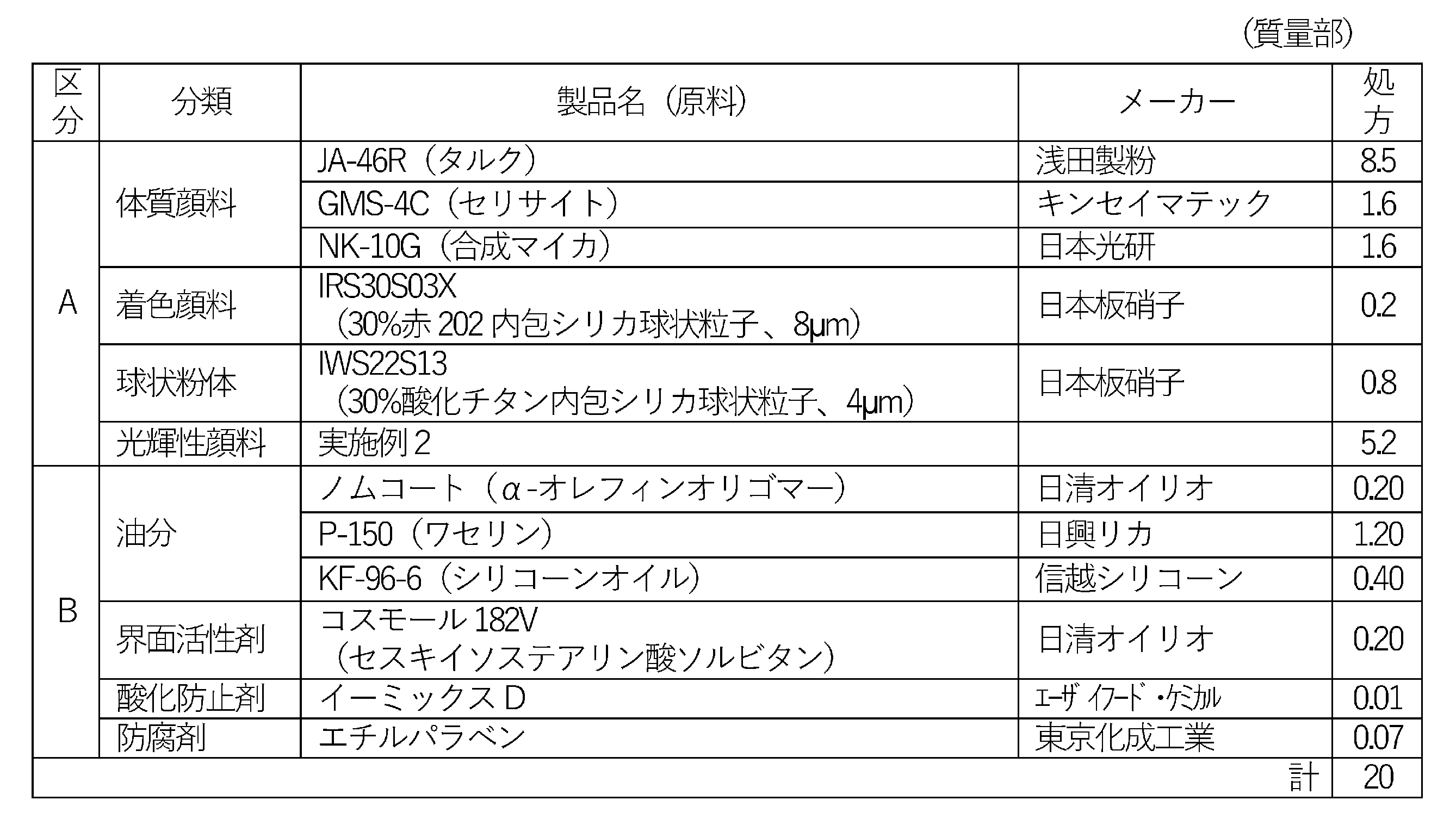
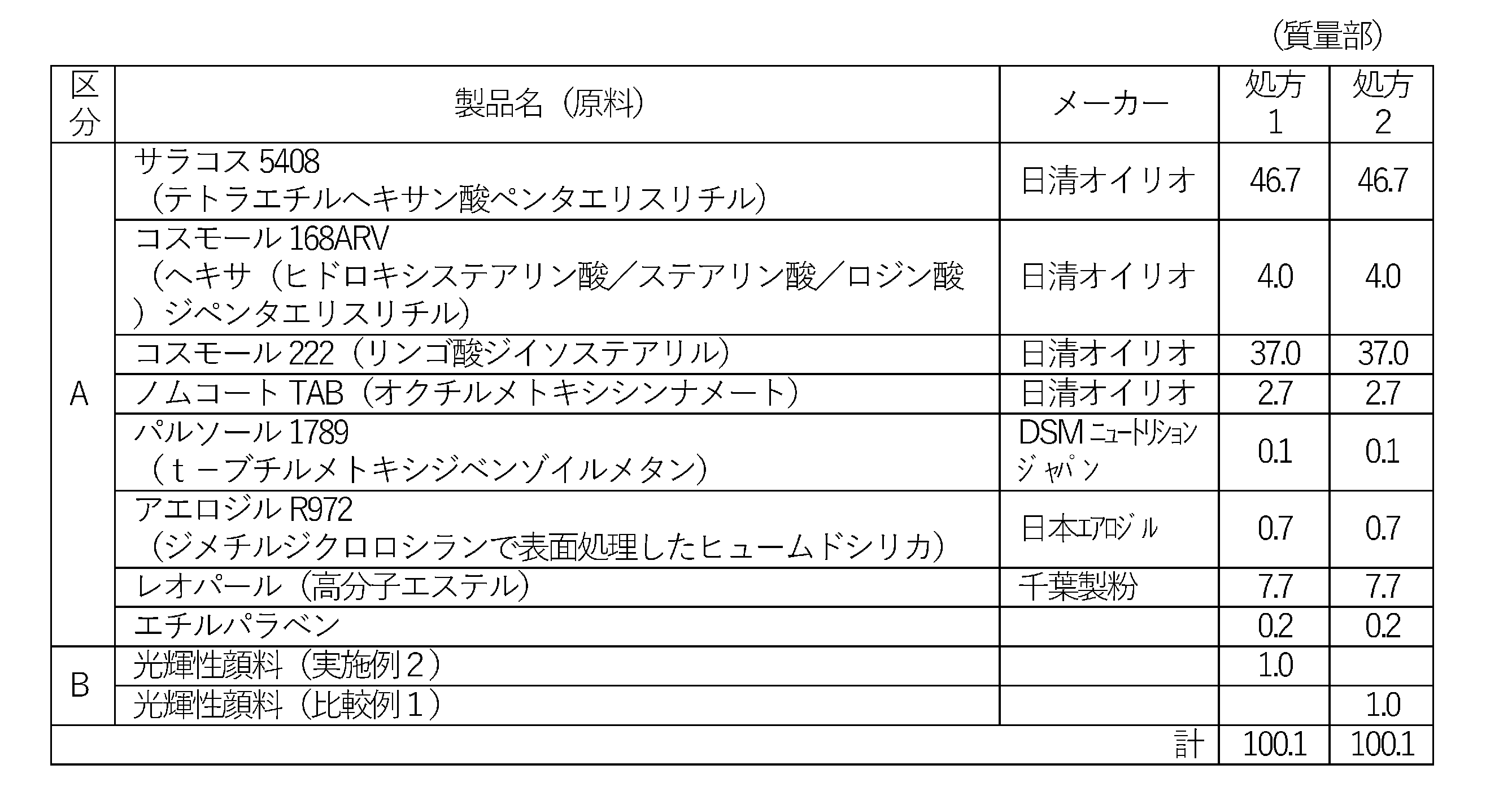
表3に示した区分Aの原料をディスポカップに計り取り、80~90℃で湯煎して原料を溶かしながら混合した。さらに、区分Bの光輝性顔料を添加して混合し、透明容器に流し入れた。
以上説明したとおり、本発明は、第一形態として、
フレーク状基体と、
前記フレーク状基体上の光干渉膜と、
前記光干渉膜に付着した、顔料粒子及び酸化物粒子を含む複合粒子と、を備えた、
光輝性顔料、を提供する。
Claims (10)
- フレーク状基体と、
前記フレーク状基体上の光干渉膜と、
前記光干渉膜に付着した、顔料粒子及び酸化物粒子を含む複合粒子と、を備えた、
光輝性顔料。 - 前記顔料粒子は、有機顔料を含む、請求項1に記載の光輝性顔料。
- 前記酸化物粒子は、酸化ケイ素、酸化アルミニウム、酸化ジルコニウム、酸化チタン、酸化亜鉛、酸化鉄、酸化錫、酸化ニオブ、及び酸化セリウムからなる群より選択される少なくとも1種を含む、請求項1に記載の光輝性顔料。
- 前記酸化物粒子は、酸化ケイ素を含む、請求項3に記載の光輝性顔料。
- 前記光干渉膜は、酸化チタンを含む、請求項1に記載の光輝性顔料。
- 前記フレーク状基体は、フレーク状ガラスである、請求項1に記載の光輝性顔料。
- 前記顔料粒子の量に対する前記酸化物粒子の量の比が、質量基準で、0.25以上である、請求項1に記載の光輝性顔料。
- 前記顔料粒子の量に対する前記酸化物粒子の量の比が、質量基準で、1.8以下である、請求項1に記載の光輝性顔料。
- 請求項1~8のいずれか1項に記載の光輝性顔料を含む、顔料含有組成物。
- 請求項1~8のいずれか1項に記載の光輝性顔料を含む塗膜と、前記塗膜を支持する基材と、を備えた顔料含有塗装体。
Priority Applications (3)
| Application Number | Priority Date | Filing Date | Title |
|---|---|---|---|
| JP2025520599A JPWO2024237253A1 (ja) | 2023-05-15 | 2024-05-14 | |
| EP24807205.0A EP4715015A1 (en) | 2023-05-15 | 2024-05-14 | Brilliant pigment, pigment-containing composition, and pigment-containing coated body |
| CN202480032786.7A CN121195030A (zh) | 2023-05-15 | 2024-05-14 | 光亮性颜料、含颜料组合物以及含颜料涂装体 |
Applications Claiming Priority (2)
| Application Number | Priority Date | Filing Date | Title |
|---|---|---|---|
| JP2023-080336 | 2023-05-15 | ||
| JP2023080336 | 2023-05-15 |
Publications (1)
| Publication Number | Publication Date |
|---|---|
| WO2024237253A1 true WO2024237253A1 (ja) | 2024-11-21 |
Family
ID=93519686
Family Applications (1)
| Application Number | Title | Priority Date | Filing Date |
|---|---|---|---|
| PCT/JP2024/017832 Ceased WO2024237253A1 (ja) | 2023-05-15 | 2024-05-14 | 光輝性顔料、顔料含有組成物、及び顔料含有塗装体 |
Country Status (4)
| Country | Link |
|---|---|
| EP (1) | EP4715015A1 (ja) |
| JP (1) | JPWO2024237253A1 (ja) |
| CN (1) | CN121195030A (ja) |
| WO (1) | WO2024237253A1 (ja) |
Citations (10)
| Publication number | Priority date | Publication date | Assignee | Title |
|---|---|---|---|---|
| JPH08239310A (ja) * | 1995-03-02 | 1996-09-17 | Nippon Sheet Glass Co Ltd | フレーク状粉体、その製造方法、およびそれを配合した化粧料 |
| JPH1087433A (ja) * | 1996-09-06 | 1998-04-07 | Pola Chem Ind Inc | メークアップ化粧料 |
| JP2001031421A (ja) | 1999-05-14 | 2001-02-06 | Nippon Sheet Glass Co Ltd | ルチル型二酸化チタンの析出方法、ならびにそれが定着した基材およびガラスフレーク |
| JP2003012962A (ja) | 2001-06-27 | 2003-01-15 | Nippon Sheet Glass Co Ltd | 透明光輝性顔料、ならびにそれを用いた塗料、樹脂組成物、インキ組成物、人造大理石成型品、塗被紙および化粧料 |
| JP2004506804A (ja) * | 2000-08-23 | 2004-03-04 | エンゲルハード・コーポレーシヨン | 乾式混合顔料 |
| JP2004315426A (ja) | 2003-04-16 | 2004-11-11 | L'oreal Sa | 化粧品用添加剤 |
| JP2006176742A (ja) * | 2004-01-22 | 2006-07-06 | Nippon Sheet Glass Co Ltd | 着色された光輝性顔料 |
| JP2012021089A (ja) * | 2010-07-15 | 2012-02-02 | Kansai Paint Co Ltd | 塗料組成物及び塗膜形成方法 |
| JP2014098056A (ja) * | 2012-11-13 | 2014-05-29 | Kansai Paint Co Ltd | 塗料組成物及び塗膜形成方法 |
| JP2020076071A (ja) * | 2015-06-02 | 2020-05-21 | 日本板硝子株式会社 | 光輝性顔料とその製造方法、顔料含有組成物、及び顔料含有塗装体 |
-
2024
- 2024-05-14 EP EP24807205.0A patent/EP4715015A1/en active Pending
- 2024-05-14 CN CN202480032786.7A patent/CN121195030A/zh active Pending
- 2024-05-14 JP JP2025520599A patent/JPWO2024237253A1/ja active Pending
- 2024-05-14 WO PCT/JP2024/017832 patent/WO2024237253A1/ja not_active Ceased
Patent Citations (10)
| Publication number | Priority date | Publication date | Assignee | Title |
|---|---|---|---|---|
| JPH08239310A (ja) * | 1995-03-02 | 1996-09-17 | Nippon Sheet Glass Co Ltd | フレーク状粉体、その製造方法、およびそれを配合した化粧料 |
| JPH1087433A (ja) * | 1996-09-06 | 1998-04-07 | Pola Chem Ind Inc | メークアップ化粧料 |
| JP2001031421A (ja) | 1999-05-14 | 2001-02-06 | Nippon Sheet Glass Co Ltd | ルチル型二酸化チタンの析出方法、ならびにそれが定着した基材およびガラスフレーク |
| JP2004506804A (ja) * | 2000-08-23 | 2004-03-04 | エンゲルハード・コーポレーシヨン | 乾式混合顔料 |
| JP2003012962A (ja) | 2001-06-27 | 2003-01-15 | Nippon Sheet Glass Co Ltd | 透明光輝性顔料、ならびにそれを用いた塗料、樹脂組成物、インキ組成物、人造大理石成型品、塗被紙および化粧料 |
| JP2004315426A (ja) | 2003-04-16 | 2004-11-11 | L'oreal Sa | 化粧品用添加剤 |
| JP2006176742A (ja) * | 2004-01-22 | 2006-07-06 | Nippon Sheet Glass Co Ltd | 着色された光輝性顔料 |
| JP2012021089A (ja) * | 2010-07-15 | 2012-02-02 | Kansai Paint Co Ltd | 塗料組成物及び塗膜形成方法 |
| JP2014098056A (ja) * | 2012-11-13 | 2014-05-29 | Kansai Paint Co Ltd | 塗料組成物及び塗膜形成方法 |
| JP2020076071A (ja) * | 2015-06-02 | 2020-05-21 | 日本板硝子株式会社 | 光輝性顔料とその製造方法、顔料含有組成物、及び顔料含有塗装体 |
Also Published As
| Publication number | Publication date |
|---|---|
| EP4715015A1 (en) | 2026-03-25 |
| CN121195030A (zh) | 2025-12-23 |
| JPWO2024237253A1 (ja) | 2024-11-21 |
Similar Documents
| Publication | Publication Date | Title |
|---|---|---|
| RU2323238C2 (ru) | Многослойные пигменты на основе стеклянных чешуек | |
| JP5409983B2 (ja) | 干渉顔料 | |
| JP6263427B2 (ja) | 狭いサイズ分布を有する人工的に製造された基材をベースとする効果顔料 | |
| JP4960229B2 (ja) | 大粒径のカラートラベル効果顔料を有する化粧用粉末組成物 | |
| US8007583B2 (en) | Multi-layer effect pigment | |
| JP6027439B2 (ja) | 狭いサイズ分布を有する高光沢多層効果顔料、およびそれを製造するための方法 | |
| TW200424271A (en) | Silver pigments | |
| JP2003155423A (ja) | 多層干渉顔料、その調製方法、その使用ならびに該顔料を含有する部材 | |
| EP1935946B1 (en) | Filler, process for producing the same, and cosmetic | |
| JP7000420B2 (ja) | 光輝性顔料、顔料含有組成物、及び顔料含有塗装体 | |
| CN107614628A (zh) | 干涉颜料、以及包含其的化妆料、涂料、油墨及树脂组合物 | |
| CN1789343B (zh) | 珠光颜料 | |
| JP5563732B2 (ja) | 平滑薄片状粉体、高光輝性顔料及びそれらの製造方法 | |
| JPH0971417A (ja) | フレーク状粉体及びそれを配合した化粧料 | |
| CN106458622A (zh) | α‑Al2O3薄片 | |
| JP6116602B2 (ja) | 酸化鉄被覆層状ケイ酸塩顔料の製造方法 | |
| JPS61161212A (ja) | 化粧料 | |
| WO2024237253A1 (ja) | 光輝性顔料、顔料含有組成物、及び顔料含有塗装体 | |
| JP2013018987A (ja) | 干渉顔料 | |
| JP7708850B2 (ja) | 酸化ジルコニウムを含む被膜を有する光揮性顔料 | |
| JP7730896B2 (ja) | 光輝性顔料を含む化粧料 | |
| JPS61293906A (ja) | 仕上げ化粧料 | |
| CN114788793A (zh) | 粉末颜料组合物 | |
| WO2024195669A1 (ja) | 光輝材 | |
| JP2008127273A (ja) | 還元型薄片状高虹彩色酸化チタン組成物とその製法 |
Legal Events
| Date | Code | Title | Description |
|---|---|---|---|
| 121 | Ep: the epo has been informed by wipo that ep was designated in this application |
Ref document number: 24807205 Country of ref document: EP Kind code of ref document: A1 |
|
| ENP | Entry into the national phase |
Ref document number: 2025520599 Country of ref document: JP Kind code of ref document: A |
|
| ENP | Entry into the national phase |
Ref document number: 2024807205 Country of ref document: EP Effective date: 20251215 |
|
| WWE | Wipo information: entry into national phase |
Ref document number: 2024807205 Country of ref document: EP |
|
| NENP | Non-entry into the national phase |
Ref country code: DE |
|
| ENP | Entry into the national phase |
Ref document number: 2024807205 Country of ref document: EP Effective date: 20251215 |
|
| ENP | Entry into the national phase |
Ref document number: 2024807205 Country of ref document: EP Effective date: 20251215 |
|
| ENP | Entry into the national phase |
Ref document number: 2024807205 Country of ref document: EP Effective date: 20251215 |
|
| ENP | Entry into the national phase |
Ref document number: 2024807205 Country of ref document: EP Effective date: 20251215 |
|
| ENP | Entry into the national phase |
Ref document number: 2024807205 Country of ref document: EP Effective date: 20251215 |
|
| ENP | Entry into the national phase |
Ref document number: 2024807205 Country of ref document: EP Effective date: 20251215 |
|
| ENP | Entry into the national phase |
Ref document number: 2024807205 Country of ref document: EP Effective date: 20251215 |
|
| ENP | Entry into the national phase |
Ref document number: 2024807205 Country of ref document: EP Effective date: 20251215 |
|
| WWP | Wipo information: published in national office |
Ref document number: 2024807205 Country of ref document: EP |